EP3133052B1 - Charge de type plaque poreuse, film d'isolation thermique et procédé de production de charge de type plaque poreuse - Google Patents
Charge de type plaque poreuse, film d'isolation thermique et procédé de production de charge de type plaque poreuse Download PDFInfo
- Publication number
- EP3133052B1 EP3133052B1 EP15779615.2A EP15779615A EP3133052B1 EP 3133052 B1 EP3133052 B1 EP 3133052B1 EP 15779615 A EP15779615 A EP 15779615A EP 3133052 B1 EP3133052 B1 EP 3133052B1
- Authority
- EP
- European Patent Office
- Prior art keywords
- porous plate
- shaped
- heat insulation
- filler
- plate
- Prior art date
- Legal status (The legal status is an assumption and is not a legal conclusion. Google has not performed a legal analysis and makes no representation as to the accuracy of the status listed.)
- Active
Links
Images


Classifications
-
- C—CHEMISTRY; METALLURGY
- C09—DYES; PAINTS; POLISHES; NATURAL RESINS; ADHESIVES; COMPOSITIONS NOT OTHERWISE PROVIDED FOR; APPLICATIONS OF MATERIALS NOT OTHERWISE PROVIDED FOR
- C09D—COATING COMPOSITIONS, e.g. PAINTS, VARNISHES OR LACQUERS; FILLING PASTES; CHEMICAL PAINT OR INK REMOVERS; INKS; CORRECTING FLUIDS; WOODSTAINS; PASTES OR SOLIDS FOR COLOURING OR PRINTING; USE OF MATERIALS THEREFOR
- C09D7/00—Features of coating compositions, not provided for in group C09D5/00; Processes for incorporating ingredients in coating compositions
- C09D7/40—Additives
- C09D7/60—Additives non-macromolecular
- C09D7/61—Additives non-macromolecular inorganic
- C09D7/62—Additives non-macromolecular inorganic modified by treatment with other compounds
-
- C—CHEMISTRY; METALLURGY
- C04—CEMENTS; CONCRETE; ARTIFICIAL STONE; CERAMICS; REFRACTORIES
- C04B—LIME, MAGNESIA; SLAG; CEMENTS; COMPOSITIONS THEREOF, e.g. MORTARS, CONCRETE OR LIKE BUILDING MATERIALS; ARTIFICIAL STONE; CERAMICS; REFRACTORIES; TREATMENT OF NATURAL STONE
- C04B38/00—Porous mortars, concrete, artificial stone or ceramic ware; Preparation thereof
-
- C—CHEMISTRY; METALLURGY
- C04—CEMENTS; CONCRETE; ARTIFICIAL STONE; CERAMICS; REFRACTORIES
- C04B—LIME, MAGNESIA; SLAG; CEMENTS; COMPOSITIONS THEREOF, e.g. MORTARS, CONCRETE OR LIKE BUILDING MATERIALS; ARTIFICIAL STONE; CERAMICS; REFRACTORIES; TREATMENT OF NATURAL STONE
- C04B38/00—Porous mortars, concrete, artificial stone or ceramic ware; Preparation thereof
- C04B38/06—Porous mortars, concrete, artificial stone or ceramic ware; Preparation thereof by burning-out added substances by burning natural expanding materials or by sublimating or melting out added substances
-
- C—CHEMISTRY; METALLURGY
- C09—DYES; PAINTS; POLISHES; NATURAL RESINS; ADHESIVES; COMPOSITIONS NOT OTHERWISE PROVIDED FOR; APPLICATIONS OF MATERIALS NOT OTHERWISE PROVIDED FOR
- C09C—TREATMENT OF INORGANIC MATERIALS, OTHER THAN FIBROUS FILLERS, TO ENHANCE THEIR PIGMENTING OR FILLING PROPERTIES ; PREPARATION OF CARBON BLACK ; PREPARATION OF INORGANIC MATERIALS WHICH ARE NO SINGLE CHEMICAL COMPOUNDS AND WHICH ARE MAINLY USED AS PIGMENTS OR FILLERS
- C09C1/00—Treatment of specific inorganic materials other than fibrous fillers; Preparation of carbon black
-
- C—CHEMISTRY; METALLURGY
- C09—DYES; PAINTS; POLISHES; NATURAL RESINS; ADHESIVES; COMPOSITIONS NOT OTHERWISE PROVIDED FOR; APPLICATIONS OF MATERIALS NOT OTHERWISE PROVIDED FOR
- C09C—TREATMENT OF INORGANIC MATERIALS, OTHER THAN FIBROUS FILLERS, TO ENHANCE THEIR PIGMENTING OR FILLING PROPERTIES ; PREPARATION OF CARBON BLACK ; PREPARATION OF INORGANIC MATERIALS WHICH ARE NO SINGLE CHEMICAL COMPOUNDS AND WHICH ARE MAINLY USED AS PIGMENTS OR FILLERS
- C09C1/00—Treatment of specific inorganic materials other than fibrous fillers; Preparation of carbon black
- C09C1/28—Compounds of silicon
- C09C1/30—Silicic acid
- C09C1/309—Combinations of treatments provided for in groups C09C1/3009 - C09C1/3081
-
- C—CHEMISTRY; METALLURGY
- C09—DYES; PAINTS; POLISHES; NATURAL RESINS; ADHESIVES; COMPOSITIONS NOT OTHERWISE PROVIDED FOR; APPLICATIONS OF MATERIALS NOT OTHERWISE PROVIDED FOR
- C09C—TREATMENT OF INORGANIC MATERIALS, OTHER THAN FIBROUS FILLERS, TO ENHANCE THEIR PIGMENTING OR FILLING PROPERTIES ; PREPARATION OF CARBON BLACK ; PREPARATION OF INORGANIC MATERIALS WHICH ARE NO SINGLE CHEMICAL COMPOUNDS AND WHICH ARE MAINLY USED AS PIGMENTS OR FILLERS
- C09C1/00—Treatment of specific inorganic materials other than fibrous fillers; Preparation of carbon black
- C09C1/36—Compounds of titanium
- C09C1/3607—Titanium dioxide
-
- C—CHEMISTRY; METALLURGY
- C09—DYES; PAINTS; POLISHES; NATURAL RESINS; ADHESIVES; COMPOSITIONS NOT OTHERWISE PROVIDED FOR; APPLICATIONS OF MATERIALS NOT OTHERWISE PROVIDED FOR
- C09C—TREATMENT OF INORGANIC MATERIALS, OTHER THAN FIBROUS FILLERS, TO ENHANCE THEIR PIGMENTING OR FILLING PROPERTIES ; PREPARATION OF CARBON BLACK ; PREPARATION OF INORGANIC MATERIALS WHICH ARE NO SINGLE CHEMICAL COMPOUNDS AND WHICH ARE MAINLY USED AS PIGMENTS OR FILLERS
- C09C1/00—Treatment of specific inorganic materials other than fibrous fillers; Preparation of carbon black
- C09C1/40—Compounds of aluminium
- C09C1/407—Aluminium oxides or hydroxides
-
- C—CHEMISTRY; METALLURGY
- C09—DYES; PAINTS; POLISHES; NATURAL RESINS; ADHESIVES; COMPOSITIONS NOT OTHERWISE PROVIDED FOR; APPLICATIONS OF MATERIALS NOT OTHERWISE PROVIDED FOR
- C09C—TREATMENT OF INORGANIC MATERIALS, OTHER THAN FIBROUS FILLERS, TO ENHANCE THEIR PIGMENTING OR FILLING PROPERTIES ; PREPARATION OF CARBON BLACK ; PREPARATION OF INORGANIC MATERIALS WHICH ARE NO SINGLE CHEMICAL COMPOUNDS AND WHICH ARE MAINLY USED AS PIGMENTS OR FILLERS
- C09C3/00—Treatment in general of inorganic materials, other than fibrous fillers, to enhance their pigmenting or filling properties
-
- C—CHEMISTRY; METALLURGY
- C09—DYES; PAINTS; POLISHES; NATURAL RESINS; ADHESIVES; COMPOSITIONS NOT OTHERWISE PROVIDED FOR; APPLICATIONS OF MATERIALS NOT OTHERWISE PROVIDED FOR
- C09C—TREATMENT OF INORGANIC MATERIALS, OTHER THAN FIBROUS FILLERS, TO ENHANCE THEIR PIGMENTING OR FILLING PROPERTIES ; PREPARATION OF CARBON BLACK ; PREPARATION OF INORGANIC MATERIALS WHICH ARE NO SINGLE CHEMICAL COMPOUNDS AND WHICH ARE MAINLY USED AS PIGMENTS OR FILLERS
- C09C3/00—Treatment in general of inorganic materials, other than fibrous fillers, to enhance their pigmenting or filling properties
- C09C3/04—Physical treatment, e.g. grinding or treatment with ultrasonic vibrations
- C09C3/043—Drying, calcination
-
- C—CHEMISTRY; METALLURGY
- C09—DYES; PAINTS; POLISHES; NATURAL RESINS; ADHESIVES; COMPOSITIONS NOT OTHERWISE PROVIDED FOR; APPLICATIONS OF MATERIALS NOT OTHERWISE PROVIDED FOR
- C09C—TREATMENT OF INORGANIC MATERIALS, OTHER THAN FIBROUS FILLERS, TO ENHANCE THEIR PIGMENTING OR FILLING PROPERTIES ; PREPARATION OF CARBON BLACK ; PREPARATION OF INORGANIC MATERIALS WHICH ARE NO SINGLE CHEMICAL COMPOUNDS AND WHICH ARE MAINLY USED AS PIGMENTS OR FILLERS
- C09C3/00—Treatment in general of inorganic materials, other than fibrous fillers, to enhance their pigmenting or filling properties
- C09C3/06—Treatment with inorganic compounds
-
- C—CHEMISTRY; METALLURGY
- C09—DYES; PAINTS; POLISHES; NATURAL RESINS; ADHESIVES; COMPOSITIONS NOT OTHERWISE PROVIDED FOR; APPLICATIONS OF MATERIALS NOT OTHERWISE PROVIDED FOR
- C09C—TREATMENT OF INORGANIC MATERIALS, OTHER THAN FIBROUS FILLERS, TO ENHANCE THEIR PIGMENTING OR FILLING PROPERTIES ; PREPARATION OF CARBON BLACK ; PREPARATION OF INORGANIC MATERIALS WHICH ARE NO SINGLE CHEMICAL COMPOUNDS AND WHICH ARE MAINLY USED AS PIGMENTS OR FILLERS
- C09C3/00—Treatment in general of inorganic materials, other than fibrous fillers, to enhance their pigmenting or filling properties
- C09C3/10—Treatment with macromolecular organic compounds
-
- C—CHEMISTRY; METALLURGY
- C09—DYES; PAINTS; POLISHES; NATURAL RESINS; ADHESIVES; COMPOSITIONS NOT OTHERWISE PROVIDED FOR; APPLICATIONS OF MATERIALS NOT OTHERWISE PROVIDED FOR
- C09D—COATING COMPOSITIONS, e.g. PAINTS, VARNISHES OR LACQUERS; FILLING PASTES; CHEMICAL PAINT OR INK REMOVERS; INKS; CORRECTING FLUIDS; WOODSTAINS; PASTES OR SOLIDS FOR COLOURING OR PRINTING; USE OF MATERIALS THEREFOR
- C09D183/00—Coating compositions based on macromolecular compounds obtained by reactions forming in the main chain of the macromolecule a linkage containing silicon, with or without sulfur, nitrogen, oxygen, or carbon only; Coating compositions based on derivatives of such polymers
- C09D183/04—Polysiloxanes
-
- C—CHEMISTRY; METALLURGY
- C09—DYES; PAINTS; POLISHES; NATURAL RESINS; ADHESIVES; COMPOSITIONS NOT OTHERWISE PROVIDED FOR; APPLICATIONS OF MATERIALS NOT OTHERWISE PROVIDED FOR
- C09D—COATING COMPOSITIONS, e.g. PAINTS, VARNISHES OR LACQUERS; FILLING PASTES; CHEMICAL PAINT OR INK REMOVERS; INKS; CORRECTING FLUIDS; WOODSTAINS; PASTES OR SOLIDS FOR COLOURING OR PRINTING; USE OF MATERIALS THEREFOR
- C09D201/00—Coating compositions based on unspecified macromolecular compounds
-
- C—CHEMISTRY; METALLURGY
- C09—DYES; PAINTS; POLISHES; NATURAL RESINS; ADHESIVES; COMPOSITIONS NOT OTHERWISE PROVIDED FOR; APPLICATIONS OF MATERIALS NOT OTHERWISE PROVIDED FOR
- C09D—COATING COMPOSITIONS, e.g. PAINTS, VARNISHES OR LACQUERS; FILLING PASTES; CHEMICAL PAINT OR INK REMOVERS; INKS; CORRECTING FLUIDS; WOODSTAINS; PASTES OR SOLIDS FOR COLOURING OR PRINTING; USE OF MATERIALS THEREFOR
- C09D7/00—Features of coating compositions, not provided for in group C09D5/00; Processes for incorporating ingredients in coating compositions
- C09D7/40—Additives
-
- F—MECHANICAL ENGINEERING; LIGHTING; HEATING; WEAPONS; BLASTING
- F16—ENGINEERING ELEMENTS AND UNITS; GENERAL MEASURES FOR PRODUCING AND MAINTAINING EFFECTIVE FUNCTIONING OF MACHINES OR INSTALLATIONS; THERMAL INSULATION IN GENERAL
- F16L—PIPES; JOINTS OR FITTINGS FOR PIPES; SUPPORTS FOR PIPES, CABLES OR PROTECTIVE TUBING; MEANS FOR THERMAL INSULATION IN GENERAL
- F16L59/00—Thermal insulation in general
- F16L59/02—Shape or form of insulating materials, with or without coverings integral with the insulating materials
- F16L59/028—Compositions for or methods of fixing a thermally insulating material
-
- C—CHEMISTRY; METALLURGY
- C01—INORGANIC CHEMISTRY
- C01P—INDEXING SCHEME RELATING TO STRUCTURAL AND PHYSICAL ASPECTS OF SOLID INORGANIC COMPOUNDS
- C01P2004/00—Particle morphology
- C01P2004/20—Particle morphology extending in two dimensions, e.g. plate-like
- C01P2004/24—Nanoplates, i.e. plate-like particles with a thickness from 1-100 nanometer
-
- C—CHEMISTRY; METALLURGY
- C01—INORGANIC CHEMISTRY
- C01P—INDEXING SCHEME RELATING TO STRUCTURAL AND PHYSICAL ASPECTS OF SOLID INORGANIC COMPOUNDS
- C01P2006/00—Physical properties of inorganic compounds
- C01P2006/32—Thermal properties
-
- C—CHEMISTRY; METALLURGY
- C04—CEMENTS; CONCRETE; ARTIFICIAL STONE; CERAMICS; REFRACTORIES
- C04B—LIME, MAGNESIA; SLAG; CEMENTS; COMPOSITIONS THEREOF, e.g. MORTARS, CONCRETE OR LIKE BUILDING MATERIALS; ARTIFICIAL STONE; CERAMICS; REFRACTORIES; TREATMENT OF NATURAL STONE
- C04B35/00—Shaped ceramic products characterised by their composition; Ceramics compositions; Processing powders of inorganic compounds preparatory to the manufacturing of ceramic products
- C04B35/01—Shaped ceramic products characterised by their composition; Ceramics compositions; Processing powders of inorganic compounds preparatory to the manufacturing of ceramic products based on oxide ceramics
- C04B35/48—Shaped ceramic products characterised by their composition; Ceramics compositions; Processing powders of inorganic compounds preparatory to the manufacturing of ceramic products based on oxide ceramics based on zirconium or hafnium oxides, zirconates, zircon or hafnates
Definitions
- the present invention relates to a porous plate-shaped filler to form a heat insulation film in which a heat insulation effect improves, a heat insulation film including the porous plate-shaped filler, and a method for producing the porous plate-shaped filler.
- Patent Document 1 discloses, as fillers to be included in a heat insulation film, porous plate-shaped fillers which are plates having an aspect ratio of 3 or more, a minimum length of 0.1 to 50 ⁇ m and a porosity of 20 to 99%.
- a length of a heat insulation route increases and a thermal conductivity can decrease as compared with a case of using spherical or cubic fillers.
- Patent Document 1 discloses, as a method for producing the porous plate-shaped filler, a method of firing a green sheet made of a material including ceramics powder and suitably grinding the fired green sheet. Furthermore, as another producing method, there is also disclosed a method of performing processing such as cutting or punching of the material in a state of the green sheet prior to the firing into a predetermined surface shape, and firing the green sheet to produce the porous plate-shaped filler without performing the grinding after the firing.
- Patent Document 1 WO 2013/191263
- An object of the present invention is to provide a porous plate-shaped filler to form a heat insulation film in which a heat insulation effect improves, a heat insulation film including the porous plate-shaped filler, and a method for producing the porous plate-shaped filler.
- a porous plate-shaped filler as defined in claim 1 makes it possible to achieve the above object. That is, according to the present invention, there are provided a porous plate-shaped filler, a heat insulation film including the porous plate-shaped filler, and a method for producing the porous plate-shaped filler as defined in claims 1, 3 and 5.
- the porous plate-shaped filler is a plate shape having an aspect ratio of 3 or more, has a minimum length of 0.1 to 50 ⁇ m and a porosity of 20 to 90%, and includes plate-shaped pores having an aspect ratio of 1.5 or more.
- an average of angles between directions of minimum lengths of the pores and the direction of the minimum length of the porous plate-shaped filler is 45° or less.
- a thermal conductivity in the direction of the minimum length of the porous plate-shaped filler is 1 W/(m ⁇ K) or less.
- the invention also provides a heat insulation film which includes the porous plate-shaped filler according to any one of the above [1] to [3].
- the viscosity of the slurry is preferably from 100 to 90000 cps.
- the porous plate-shaped filler is a plate shape having an aspect ratio of 3 or more, and has a minimum length of 0.1 to 50 ⁇ m and a porosity of 20 to 90%. Furthermore, the porous plate-shaped filler includes plate-shaped pores having an aspect ratio of 1.5 or more. Consequently, the porous plate-shaped filler has a low thermal conductivity. A heat insulation effect of a heat insulation film including this porous plate-shaped filler can improve.
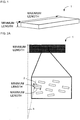
- Fig. 1 and Fig. 2A show one embodiment of a porous plate-shaped filler 1 of the present invention.
- Fig. 1 is a schematic view showing the one embodiment of the porous plate-shaped filler 1.
- Fig. 2A is a view showing a cross section of the porous plate-shaped filler 1 and its enlargement.
- the porous plate-shaped filler 1 is a plate shape having an aspect ratio of 3 or more, and has a minimum length of 0.1 to 50 ⁇ m and a porosity of 20 to 90%.
- the porous plate-shaped filler 1 has plate-shaped pores 2 having an aspect ratio of 1.5 or more.
- the porous plate-shaped filler 1 has the pores 2 in which pore sizes are from 10 to 500 nm.
- the apparent particle density is measured by a liquid immersion method using mercury. Furthermore, the true density is measured by pycnometry after sufficiently grinding the porous plate-shaped filler 1.
- the aspect ratio of the porous plate-shaped filler 1 is defined by a maximum length/the minimum length of the porous plate-shaped filler 1.
- the maximum length is a length maximized when sandwiching a particle (the porous plate-shaped fillers 1) between a pair of parallel surfaces.
- the minimum length is a length minimized when similarly sandwiching the particle between the pair of parallel surfaces, and corresponds to a so-called thickness in a case of a flat plate.
- the plate shape of the porous plate-shaped filler 1 includes not only a flat plate shape (the plate which is flat and does not curve) but also a curved flat plate shape and a plate shape having a thickness (the minimum length) which is not constant, as long as the aspect ratio is 3 or more and the minimum length is from 0.1 to 50 ⁇ m.
- the filler may have a shape such as a fibrous shape, a needle shape or a billet shape.
- the porous plate-shaped filler 1 is preferably the flat plate.
- a surface shape of the plate may be any shape such as a square shape, a quadrangular shape, a triangular shape, a hexagonal shape or a round shape. That is, the porous plate-shaped filler 1 may have any shape as long as the filler is the plate.
- the aspect ratio of the porous plate-shaped filler 1 is 3 or more. As the aspect ratio is larger, a heat transfer path deflects to lengthen and the thermal conductivity of a heat insulation film 3 decreases, when the heat insulation film 3 is formed. However, when the aspect ratio is excessively large, it becomes difficult to handle the filler during producing, and yield might deteriorate. For example, when the minimum length is decreased to increase the aspect ratio, the strength might not sufficiently be obtained. On the other hand, when increasing the maximum length, the porous plate-shaped filler 1 might become large and be damaged. Consequently, the aspect ratio is more preferably 3 or more and 50 or less, further preferably 3.5 or more and 40 or less, and most preferably 4 or more and 30 or less.
- the aspect ratio of the pore 2 of the porous plate-shaped filler 1 is defined by a maximum length/a minimum length of the pore 2.
- the maximum length of the pore 2 is a maximum length in a cross section of the porous plate-shaped filler 1 in a direction of the minimum length. After determining the maximum length of the pore 2, a line vertical to the maximum length is drawn, and a length of the vertical line is defined as the minimum length of the pore 2.
- an average aspect ratio is 1.5 or more and is preferably 3 or more.
- the thermal conductivity of the porous plate-shaped filler 1 in a direction crossing the pore 2 decreases.
- a heat insulation effect of the heat insulation film 3 including this filler can improve, and in a case of forming the heat insulation film 3, a thickness of the heat insulation film 3 can decrease. Consequently, it is possible to anticipate the effect that a space broadens, and it is possible to decrease cost. Furthermore, in a case of bonding the heat insulation film 3 to a material different from the film, it is possible to decrease thermal stress, and a heat resistance can improve.
- a surface shape may be one of a square shape, a quadrangular shape, a triangular shape, a hexagonal shape, a round shape, and an intermediate shape. That is, there is not any special restriction on the shape of the pore 2, as long as the pore has a plate-shaped shape having an aspect ratio of 1.5 or more.
- the aspect ratio of the pore 2 is the same degree as in the aspect ratio of a pore former. That is, the shape of the pore 2 is determined by a shape of the pore former, and hence it is preferable to use the pore former of a plate-shaped shape having an aspect ratio of 1.5 or more and preferably 3 or more.
- a material of the pore former there is not any special restriction on a material of the pore former, as long as the material has the above shape, but there is usable graphite, latex, melamine resin, PMMA, polyethylene, polystyrene, carbon black, foamable resin, water absorbable resin or the like.
- Fig. 2A shows the porous plate-shaped filler 1 and also shows an enlarged view of a part of the filler.
- the pores 2 are drawn in the porous plate-shaped filler 1, but the view shows a direction of the minimum length of the pore 2 and a direction of the minimum length of the porous plate-shaped filler 1.
- an average of angles k between the directions of the minimum lengths of the pores 2 and the direction of the minimum length of the porous plate-shaped filler 1 is preferably 45° or less, more preferably 30° or less, and further preferably 10° or less.
- Examples of a material of the porous plate-shaped filler 1 include hollow plate-shaped glass and hollow plate-shaped ceramics. Furthermore, the examples of the material include mesoporous silica, mesoporous titania, mesoporous zirconia, and Shirasu balloons. Alternatively, an example of the filler is also a porous plate-shaped filler obtained by an after-mentioned producing method.
- the porous plate-shaped filler 1 preferably includes a metal oxide, and is further preferably constituted only of the metal oxide. This is because, when the filler includes the metal oxide, ion bonding properties between a metal and oxygen are strong and hence the thermal conductivity is easy to decrease as compared with a non-oxide (e.g., a carbide or a nitride) of the metal.
- a non-oxide e.g., a carbide or a nitride
- the metal oxide is an oxide of one selected from the group consisting of elements such as Zr, Y, Al, Si, Ti, Nb, Sr, La, Hf, Ce, Gd, Sm, Mn, Yb, Er and Ta or a complex oxide of two or more selected from the group.
- the metal oxide is the oxide or the complex oxide of these elements, heat conduction is hard to occur by lattice vibration (phonons) which is a main factor of the heat conduction.
- a specific example of the material of the porous plate-shaped filler 1 is a material obtained by adding Gd 2 O 3 , Yb 2 O 3, Er 2 O 3 or the like to ZrO 2 -Y 2 O 3 .
- the examples of the material include ZrO 2 -HfO 2 -Y 2 O 3 , ZrO 2 -Y 2 O 3 -La 2 O 3 , ZrO 2 -HfO 2 -Y 2 O 3 -La 2 O 3 , HfO 2 -Y 2 O 3 , CeO 2 -Y 2 O 3 , Gd 2 Zr 2 O 7 , Sm 2 Zr 2 O 7 , LaMnAl 11 O 19 , YTa 3 O 9 , Y 0.7 La 0.3 Ta 3 O 9 , Y 1.08 Ta 2.76 Zr 0.24 O 9 , Y 2 Ti 2 O 7 , LaTa 3 O 9 , Yb 2 Si 2 O 7 , and Y 2 Si 2 O 7 .
- the porous plate-shaped filler 1 may be an inorganic material, an organic material, or a composite material of the inorganic material and the organic material.
- the material is an inorganic material such as zirconia, partially stabilized zirconia (e.g., yttria partially stabilized zirconia), completely stabilized zirconia (e.g., yttria completely stabilized zirconia), yttrium oxide, alumina, silica, titania, niobium oxide, strontium oxide, lanthanum oxide, zirconium, yttria, aluminum, silicon, titanium, niobium, strontium, lanthanum, rare earth zirconate (e.g., lanthanum zirconate), rare earth silicate (e.g., yttrium silicate), niobate (e.g., strontium niobate), mullite, mica, spinel, zircon,
- zircon
- the material is a metal oxide such as zirconia, partially stabilized zirconia (e.g., yttria partially stabilized zirconia), completely stabilized zirconia (e.g., yttria completely stabilized zirconia), yttrium oxide, alumina, silica, titania, niobium oxide, strontium oxide or lanthanum oxide. One of them may be used alone, or any combination of two or more of them may be used.
- a metal oxide such as zirconia, partially stabilized zirconia (e.g., yttria partially stabilized zirconia), completely stabilized zirconia (e.g., yttria completely stabilized zirconia), yttrium oxide, alumina, silica, titania, niobium oxide, strontium oxide or lanthanum oxide.
- yttria partially stabilized zirconia e.g., yttria partially stabilized
- the porous plate-shaped filler 1 includes particles having particle sizes of 1 nm to 10 ⁇ m.
- the particle may be a particle constituted of one crystal grain (a single crystalline particle) or a particle constituted of a large number of crystal grains (a polycrystalline particle). That is, it is preferable that the porous plate-shaped filler 1 is an aggregate of particles having particle sizes of this range.
- a size of one particle of a particle group constituting a framework of the porous plate-shaped filler 1 is measured from an image of electron microscope observation.
- the particle size is more preferably from 1 nm to 5 ⁇ m and further preferably from 50 nm to 1 ⁇ m.
- the porous plate-shaped filler 1 having the particle sizes of such a range is included in the heat insulation film 3, the heat insulation effect can improve.
- the minimum length of the porous plate-shaped filler 1 is from 0.1 to 50 ⁇ m, more preferably from 0.5 to 20 ⁇ m, further preferably from 2 to 15 ⁇ m, and most preferably from 2 to 10 ⁇ m.
- the minimum length of the porous plate-shaped filler 1 is shorter than 0.1 ⁇ m, it might be difficult to keep the shape of the porous plate-shaped filler 1 in producing steps.
- the minimum length of the porous plate-shaped filler 1 is longer than 50 ⁇ m, there decreases the number of layers in the porous plate-shaped filler 1 when included in the heat insulation film 3, so that the heat transfer path becomes close to a straight line and accordingly shortens, and the thermal conductivity of the heat insulation film 3 might be high.
- the minimum length of the porous plate-shaped filler 1 is short, the heat insulation film 3 can be thinned. That is, even in the thin heat insulation film 3, the heat insulation effect can improve.
- the thermal conductivity of the porous plate-shaped filler 1 is preferably 1 W/(m ⁇ K) or less.
- the thermal conductivity is more preferably 0.7 W/(m ⁇ K) or less, further preferably 0.5 W/(m ⁇ K) or less, and most preferably 0.3 W/(m ⁇ K) or less.
- the porous plate-shaped filler 1 having such a thermal conductivity is included in the heat insulation film 3, the heat insulation effect can improve.
- thermal conductivity W / m ⁇ K thermal diffusivity ⁇ specific heat ⁇ density
- the thermal diffusivity is measured by a light AC method. Furthermore, “the specific heat” is measured by a DSC method. “The density” is measured by a mercury porosimeter.
- a heat capacity of the porous plate-shaped filler 1 is from 10 to 3000 kJ/(m 3 ⁇ K).
- the heat capacity is more preferably from 10 to 2500 kJ/(m 3 ⁇ K), further preferably from 300 to 2000 kJ/(m 3 ⁇ K), and most preferably from 400 to 1500 kJ/(m 3 ⁇ K).
- the porous plate-shaped filler 1 having the heat capacity of such a range is included in the heat insulation film 3, the heat insulation effect can improve. It is to be noted that in the present description, the heat capacity is generally argued per unit volume called volume specific heat, and hence a unit is kJ/(m 3 ⁇ K).
- the specific heat is measured by the DSC method.
- the density is measured by the liquid immersion method using mercury.
- the porous plate-shaped filler 1 has a coating layer 7 having a thickness of 1 nm to 1 ⁇ m in at least a part of its surface.
- the coating layer 7 is preferably a thermal resistance film to inhibit heat conduction and/or to reflect radiant heat and/or to scatter the lattice vibration (the phonons).
- the thermal resistance film having a thickness of several tens nm is formed on the surface of the porous plate-shaped filler 1, it is further preferably possible to decrease the thermal conductivity of the heat insulation film 3.
- the thermal resistance film may be any film as long as a material thereof is not the same as in the porous plate-shaped filler to be coated, and the porous plate-shaped filler 1 is preferably coated with a different material from the porous plate-shaped filler 1 (e.g., alumina or zinc oxide). Even when the thermal resistance film is dense or porous, there is not any problem, but it is preferable that the film is dense.
- the thermal resistance film is formed in a part of the surface of the porous plate-shaped filler 1, an effect of decreasing the thermal conductivity can be obtained, but when the whole surface of the porous plate-shaped filler 1 is coated with the thermal resistance film, the effect of decreasing the thermal conductivity can further be obtained.
- An example of the method for producing the porous plate-shaped filler 1 of the present invention is a method of preparing a slurry including a plate-shaped pore former having an aspect ratio of 1.5 or more and firing the pore former to produce the porous plate-shaped filler 1 including the plate-shaped pores 2 having an aspect ratio of 1.5 or more.
- Examples of the method for producing the porous plate-shaped filler 1 include press molding, casting, extrusion, injection molding, tape forming, and a doctor blade method. Any method may be used, but hereinafter, the doctor blade method will be described as an example.
- a pore former, a binder, a plasticizer, a solvent and the like are added to ceramics powder to be mixed by a ball mill or the like, thereby preparing a green sheet forming slurry.
- zirconia powder there is usable zirconia powder, partially stabilized zirconia powder (e.g., yttria partially stabilized zirconia powder), completely stabilized zirconia powder (e.g., yttria completely stabilized zirconia powder), alumina powder, silica powder, titania powder, lanthanum oxide powder, yttria powder, rare earth zirconate powder (e.g., lanthanum zirconate powder), rare earth silicate powder (e.g., yttrium silicate powder), niobate powder (e.g., strontium niobate powder), mullite powder, spinel powder, zircon particles, magnesia powder, yttria powder, ceria powder, silicon carbide powder, silicon nitride powder, aluminum nitride powder or the like.
- partially stabilized zirconia powder e.g., yttria partially stabilized zirconia powder
- the powder is not limited to dried powder, and the powder may be used in a colloidal state (a sol state) in which the powder is dispersed in water or an organic liquid medium.
- the pore former there is usable graphite, latex, melamine resin, PMMA, polyethylene, polystyrene, carbon black, foamable resin, water absorbable resin or the like.
- the binder there is usable polyvinyl butyral resin (PVB), polyvinyl alcohol resin, polyvinyl acetate resin, polyacrylic resin or the like.
- the plasticizer DBP (dibutyl phthalate), DOP (dioctyl phthalate) or the like is usable.
- the solvent xylene, 1-butanol or the like is usable.
- the above green sheet forming slurry is subjected to a vacuum defoaming treatment, thereby adjusting the slurry into 100 to 90000 cps and further preferably 700 to 50000 cps.
- the angle of the pore 2 is determined by arrangement of the pore former in a formed body (the body formed from a green sheet into a predetermined shape). The lower the viscosity of the green sheet forming slurry is, the more easily the pore former moves during formation, and the more easily the directions are aligned. By adjusting the viscosity into 100 cps or more, it is possible to maintain the shape of the formed body. By adjusting the viscosity into 90000 cps or less, it is possible to form the body into the desirable shape. Therefore, to adjust the angle of the pore 2 into a desirable angle, it is preferable that the viscosity of the green sheet forming slurry is in the above range.
- the green sheet is formed from the green sheet forming slurry by a doctor blade device so that a thickness of the fired green sheet is from 0.1 to 100 ⁇ m.
- a thickness of the green sheet is preferably 70 ⁇ m or less, more preferably 50 ⁇ m or less, and further preferably 30 ⁇ m or less.
- an outer shape of the green sheet is cut into a dimension of (0.5 to 200) mm ⁇ (0.5 to 200) mm.
- a cut formed body is fired at 800 to 2300°C for 0.5 to 20 hours and this fired body is suitably ground, thereby making it possible to obtain a porous thin plate-shaped filler (the porous plate-shaped filler 1).
- the green sheet before fired may be processed into a predetermined surface shape (a square shape, a quadrangular shape, a hexagonal shape or a round shape) or the like by cutting or punching, and then fired, thereby making it possible to obtain the porous thin plate-shaped filler without performing grinding after the firing.
- the heat insulation film 3 will be described with reference to Fig. 3 .
- the porous plate-shaped fillers 1 mentioned above are dispersed in a matrix 3m to bond the porous plate-shaped fillers 1.
- the matrix 3m is a component which is present around the porous plate-shaped fillers 1 and between the particles of the fillers and bonds these particles to each other.
- the porous plate-shaped fillers 1 are arranged in the form of layers (laminated).
- the arrangement in the form of the layers mentioned herein indicates that a large number of porous plate-shaped fillers 1 are present in the matrix 3m in a state where the porous plate-shaped fillers 1 are oriented in the direction of the minimum length of the porous plate-shaped filler 1 which is close to a direction parallel to a thickness direction of the heat insulation film 3.
- positions of the porous plate-shaped fillers 1 do not have to be orderly periodically arranged in X, Y and Z-directions of the heat insulation film 3 (provided that the Z-direction is defined as the thickness (film thickness) direction), and there is not any problem even when the fillers are present at random.
- the number of the layers is 1 or more, but the larger number of the layers is more preferable and the number of the layers is desirably 5 or more.
- the fillers preferably are not orderly arranged in the Z-direction (the fillers preferably shift alternately), because the heat transfer path more deflects to lengthen.
- a matrix 3m portion in which the thermal conductivity is high becomes a main heat transfer path, but the heat insulation film 3 of the present invention includes the porous plate-shaped fillers 1, and the heat transfer path makes more detours to a direction in which heat is not to be transferred (the film thickness direction). That is, a length of the heat transfer path increases, and hence it is possible to decrease the thermal conductivity. Additionally, a bonding area between the porous plate-shaped fillers 1 via the matrix 3m is larger than that between spherical fillers, and hence a strength of the whole heat insulation film heightens, and erosion, peeling or the like is hard to occur.
- the porous plate-shaped fillers 1 are the plates, and hence concavity and convexity are hard to be formed on the outermost surface of the heat insulation film 3 as compared with the case of the spherical fillers. Therefore, even in a case of giving shock to a heat insulation film portion, it is possible to prevent particle drop of the porous plate-shaped fillers 1, i.e., deficiency of the heat insulation film 3.
- the heat insulation film 3 of the present invention includes at least one of ceramics, glass and resin as the matrix 3m.
- ceramics or glass is more preferable.
- a material forming the matrix 3m include silica, alumina, mullite, zirconia, titania, silicon nitride, acid silicon nitride, silicon carbide, acid silicon carbide, calcium silicate, calcium aluminate, calcium aluminosilicate, aluminum phosphate, aluminosilicate, potassium aluminosilicate, and glass. These materials are preferably amorphous from the viewpoint of the thermal conductivity.
- the matrix is preferably an aggregate of particulates having particle diameters of 500 nm or less.
- the aggregate of the particulates having the particle diameters of 500 nm or less is used as the matrix 3m, it is possible to further decrease the thermal conductivity.
- the material forming the matrix 3m is a resin
- examples of the material include a silicone resin, a polyimide resin, a polyamide resin, an acrylic resin, and an epoxy resin.
- a porosity of the whole heat insulation film 3 is from 10 to 90%
- a porosity of the porous plate-shaped filler 1 is from 20 to 90%
- a porosity of the matrix 3m is from 0 to 70%.
- a thickness is from 1 ⁇ m to 5 mm. According to such a thickness, it is possible to obtain the heat insulation effect without adversely affecting characteristics of a substrate 8 coated with the heat insulation film 3. It is to be noted that the thickness of the heat insulation film 3 can suitably be selected in the above range in accordance with its use application.
- a heat capacity is preferably 1500 kJ/(m 3 ⁇ K) or less, more preferably 1300 kJ/(m 3 ⁇ K) or less, further preferably 1000 kJ/(m 3 ⁇ K) or less, and most preferably 500 kJ/(m 3 ⁇ K) or less.
- a temperature of the heat insulation film 3 is easy to drop after exhaust of fuel in a case of forming the heat insulation film 3 in an engine combustion chamber. Consequently, it is possible to inhibit a problem such as abnormal combustion of an engine.
- the thermal conductivity in the thickness direction is 1.5 W/(m ⁇ K) or less.
- the thermal conductivity of the heat insulation film 3 is further preferably 1 W/(m ⁇ K) or less and most preferably 0.5 W/(m ⁇ K) or less.
- the heat insulation film has a low thermal conductivity, thereby making it possible to inhibit the heat transfer.
- a method for producing the heat insulation film 3 will be described.
- a coating composition including the porous plate-shaped filler 1 mentioned above, and one or more selected from the group consisting of an inorganic binder, an inorganic polymer, an organic/inorganic hybrid material, oxide sol, and water glass.
- the coating composition may further include dense fillers, a viscosity modifier, a liquid medium, a dispersing agent and the like.
- Specific substances to be included in the coating composition are cement, bentonite, aluminum phosphate, silica sol, alumina sol, boehmite sol, zirconia sol, titania sol, tetramethyl orthosilicate, tetraethyl orthosilicate, polysilazane, polycarbosilane, polyvinyl silane, polymethyl silane, polysiloxane, polysilsesquioxane, silicone, geopolymer, sodium silicate and the like.
- an acryl-silica based hybrid material an epoxy-silica based hybrid material, a phenol-silica based hybrid material, a polycarbonate-silica based hybrid material, a nylon-silica based hybrid material, a nylon-clay based hybrid material, an acryl-alumina based hybrid material, an acryl-calcium silicate hydrate based hybrid material and the like.
- liquid medium examples include ethanol and 2-propanol, but there is not any special restriction on the liquid medium.
- dispersing agent examples include anionic substances such as alkylol ammonium salt, soap (fatty acid sodium salt), monoalkyl sulfate, alkyl polyoxyethylene sulfate, alkylbenzenesulfonate, and monoalkyl phosphate; cationic substances such as alkyltrimethylammonium salt, dialkyldimethylammonium salt, and alkyl benzyl dimethyl ammonium salt; geminate substances such as alkyl dimethylamine oxide, and alkyl carboxybetaine; and nonionic substances such as polyoxyethylene alkyl ether, fatty acid sorbitan ester, alkyl polyglucoside, fatty acid diethanolamide, and alkyl monoglyceryl ether.
- anionic substances such as alkylol ammonium salt, soap (fatty acid sodium salt), monoalkyl sulfate, alkyl polyoxy
- a viscosity of the coating composition is preferably from 0.1 to 5000 cps, and further preferably from 0.5 to 1000 cps. In a case where the viscosity is smaller than 0.1 cps, the coating composition flows after coating, and a thickness of a coating film might be non-uniform. In a case where the viscosity is larger than 5000 cps, the coating composition does not have any fluidity and might not easily uniformly coat the substrate.
- the heat insulation film 3 in which the porous plate-shaped fillers 1 are uniformly dispersed in the matrix 3m can be obtained by adjusting the viscosity. For example, when the viscosity is excessively high, the porous plate-shaped fillers 1 are hard to be uniformly dispersed, and a portion where there are less porous plate-shaped fillers 1 is easily generated in the heat insulation film 3.
- the adding of the dispersing agent improves dispersing properties of the porous plate-shaped fillers 1 in the coating composition (the slurry), thereby making it possible to form the heat insulation film 3 which is homogeneous. That is, by improving the dispersing properties of the porous plate-shaped fillers 1, the homogeneous heat insulation film 3 can be formed, and it is possible to decrease the thermal conductivity.
- the heat insulation film 3 can be formed by coating the substrate 8 with the above-mentioned coating composition and drying the coating composition. Furthermore, the film may be formed by performing a heat treatment after the drying. At this time, the thick heat insulation film 3 can be formed by repeatedly performing the coating and the drying or the heat treatment. Alternatively, the heat insulation film 3 is formed on a virtual substrate, and then the virtual substrate is removed, thereby separately preparing the heat insulation film 3 singly formed into a thin plate, and the heat insulation film 3 may be adhesively bonded to or bonded to the substrate 8.
- a metal, ceramics, glass, plastic, wood, cloth, paper or the like is usable.
- examples of the substrate 8 made of the metal include iron, an iron alloy, stainless steel, aluminum, an aluminum alloy, a nickel alloy, a cobalt alloy, a tungsten alloy, and a copper alloy.
- the heat insulation film 3 of the present invention can be utilized in an engine combustion chamber, a pipe, cookware, a building material or the like.
- a pore former plate-shaped graphite: SEC carbon SGP-3
- polyvinyl butyral resin PVB
- DOP polyvinyl butyral resin
- xylene and 1-butanol solvents
- This slurry was subjected to a vacuum defoaming treatment to adjust a viscosity into 20000 cps, and then a green sheet was formed and ground to obtain a thickness of 10 ⁇ m after firing by a doctor blade device, thereby obtaining a formed body of a thin plate.
- This formed body was fired at 1100 °C for one hour, thereby obtaining porous thin plate-shaped fillers (porous plate-shaped fillers 1).
- Example 1 The procedure of Example 1 was repeated to obtain porous plate-shaped fillers 1.
- Table 1 shows types of used pore formers, aspect ratios and viscosities of green sheet forming slurries. Additionally, in Example 8, 50 vol% of an amount of the pore former to be added was graphite, and 50 vol% thereof was carbon black.
- Example 2 The procedure of Example 1 was repeated to obtain porous plate-shaped fillers 1.
- Table 1 shows types of used pore formers, aspect ratios and viscosities of green sheet forming slurries. Additionally, each green sheet was formed and ground so that a thickness and an aspect ratio of the fired porous plate-shaped filler 1 were values shown in Table 2.
- Porous plate-shaped fillers 1 of materials different from that of Example 1 were prepared. Table 1 shows the materials of the porous plate-shaped fillers 1.
- a porous plate-shaped filler 1 was obtained in the same manner as in the examples.
- a pore former spherical carbon black was used.
- the apparent particle density was measured by a liquid immersion method using mercury. Furthermore, the true density was measured by pycnometry after sufficiently grinding the porous plate-shaped filler 1.
- Each of the porous plate-shaped fillers 1 of Examples 9 to 25 had an aspect ratio, pore sizes, a minimum length and a porosity shown in Table 2.
- the minimum length of the pore 2 was the same direction as in the minimum length of the porous plate-shaped filler 1. 50 pores 2 were selected at random, and angles k (see Fig. 2A ) between the directions of the minimum lengths of the pores 2 and the direction of the minimum length of the porous plate-shaped filler 1 were measured, to obtain an average of the angles.
- the porous plate-shaped filler 1 which was 0.5 mm in the minimum length direction and had a size of 10 mm was separately prepared, and a thermal conductivity of the porous plate-shaped filler 1 in the minimum length direction was measured by laser flash.
- a coating composition including polysiloxane forming a matrix 3m, a porous plate-shaped filler 1, and water. Additionally, a dispersing agent was added to the coating composition.
- a stainless steel substrate (a diameter of 10 mm and a thickness of 1 mm) which was a substrate material was coated and dried, and then a heat insulation film 3 was formed by a heat treatment at 200°C.
- the heat insulation film 3 5 or more porous plate-shaped fillers 1 were laminated in a thickness direction, and a thickness of the film was about 100 ⁇ m.
- the thermal conductivity was low, and in the heat insulation film 3 including the fillers, the thermal conductivity decreased. Furthermore, when comparing Examples 9 to 16 and Example 4, as the minimum length of the porous plate-shaped filler 1 was shorter, the aspect ratio was larger and the porosity was higher, the thermal conductivity of the heat insulation film 3 including the fillers decreased. Furthermore, in Examples 17 to 25 of the porous plate-shaped fillers 1 in which the materials were changed, it was possible to obtain the heat insulation films 3 having a low thermal conductivity.
- yttria partially stabilized zirconia (Examples 1 to 16), yttria completely stabilized zirconia (Example 17) and zirconia (Example 18) which were zirconia based materials, it was possible to especially decrease the thermal conductivity. Furthermore, in a metal oxide, ion bonding properties between a metal and oxygen were strong, and hence for alumina (Example 19), silica (Example 20), titania (Example 21), lanthanum oxide (Example 22) and yttria (Example 23) which were metal oxides, it was possible to decrease the thermal conductivity. For lanthanum zirconate (Example 24) and yttrium silicate (Example 25), it was also possible to obtain suitable results.
- porous plate-shaped filler a heat insulation film, and a method for producing the porous plate-shaped filler of the present invention to an engine for a car or the like, a pipe, a building material, cookware or the like.
- 1 porous plate-shaped filler
- 2 pore
- 3 heat insulation film
- 3m matrix
- 7 coating layer
- 8 substrate.
Landscapes
- Chemical & Material Sciences (AREA)
- Organic Chemistry (AREA)
- Engineering & Computer Science (AREA)
- Materials Engineering (AREA)
- Ceramic Engineering (AREA)
- Life Sciences & Earth Sciences (AREA)
- Wood Science & Technology (AREA)
- Structural Engineering (AREA)
- General Engineering & Computer Science (AREA)
- Inorganic Chemistry (AREA)
- Chemical Kinetics & Catalysis (AREA)
- Mechanical Engineering (AREA)
- Porous Artificial Stone Or Porous Ceramic Products (AREA)
- Compositions Of Macromolecular Compounds (AREA)
- Paints Or Removers (AREA)
- Manufacture Of Porous Articles, And Recovery And Treatment Of Waste Products (AREA)
- Thermal Insulation (AREA)
- Laminated Bodies (AREA)
Claims (4)
- Charge poreuse en forme plaque ayant la forme d'une plaque ayant un rapport d'aspect de 3 ou plus, a une longueur minimale de 0,1 à 50 |jm et une porosité de 20 à 90% et
comprend des pores en forme de plaque d'un rapport d'aspect de 1,5 ou plus,
dans laquelle, en coupe transversale dans le sens de la longueur minimale de la charge en forme de plaque poreuse, une moyenne des angles entre les sens de longueurs minimales des pores et le sens de la longueur minimale de la charge en forme de plaque poreuse est 45° ou moins, et
dans laquelle la longueur minimale est définie comme une longueur réduite au minimum quand on prend la charge en forme de plaque en sandwich entre une paire de surface parallèles. - Charge poreuse en forme de plaque selon la revendication 1,
dans laquelle la conductivité thermique dans le sens de la longueur minimale de la charge en forme de plaque poreuse est 1 W/(m·K) ou moins. - Film d'isolation thermique qui comprend la charge en forme de plaque poreuse selon les revendications 1 ou 2.
- Film d'isolation thermique selon la revendication 3,
dans lequel la conductivité thermique dans le sens de l'épaisseur du film est de 1,5 W/(m·K) ou moins.
Applications Claiming Priority (2)
| Application Number | Priority Date | Filing Date | Title |
|---|---|---|---|
| JP2014085911 | 2014-04-17 | ||
| PCT/JP2015/061319 WO2015159838A1 (fr) | 2014-04-17 | 2015-04-13 | Charge de type plaque poreuse, film d'isolation thermique et procédé de production de charge de type plaque poreuse |
Publications (3)
| Publication Number | Publication Date |
|---|---|
| EP3133052A1 EP3133052A1 (fr) | 2017-02-22 |
| EP3133052A4 EP3133052A4 (fr) | 2018-01-03 |
| EP3133052B1 true EP3133052B1 (fr) | 2019-10-02 |
Family
ID=54324044
Family Applications (1)
| Application Number | Title | Priority Date | Filing Date |
|---|---|---|---|
| EP15779615.2A Active EP3133052B1 (fr) | 2014-04-17 | 2015-04-13 | Charge de type plaque poreuse, film d'isolation thermique et procédé de production de charge de type plaque poreuse |
Country Status (4)
| Country | Link |
|---|---|
| US (1) | US10317004B2 (fr) |
| EP (1) | EP3133052B1 (fr) |
| JP (1) | JP6527139B2 (fr) |
| WO (1) | WO2015159838A1 (fr) |
Families Citing this family (9)
| Publication number | Priority date | Publication date | Assignee | Title |
|---|---|---|---|---|
| US10781319B2 (en) * | 2011-01-21 | 2020-09-22 | Lockheed Martin Corporation | Ultra high temperature environmental protection coating |
| WO2019239178A1 (fr) * | 2018-06-13 | 2019-12-19 | 日産自動車株式会社 | Élément de protection thermique |
| US11426818B2 (en) | 2018-08-10 | 2022-08-30 | The Research Foundation for the State University | Additive manufacturing processes and additively manufactured products |
| JP7440233B2 (ja) * | 2019-09-19 | 2024-02-28 | イビデン株式会社 | 組電池用断熱シート及び組電池 |
| CN114375228B (zh) * | 2019-11-26 | 2024-06-28 | Fl史密斯公司 | 用于粉碎装置的耐磨元件 |
| DE102020129161A1 (de) * | 2020-11-05 | 2022-05-05 | Schott Ag | Glas- oder Glaskeramikelement umfassend Glas- oder Glaskeramiksubstrat und Beschichtung sowie Verfahren zu dessen Herstellung und dessen Verwendung |
| CN113097228B (zh) * | 2021-03-24 | 2023-10-03 | 深圳市华星光电半导体显示技术有限公司 | 遮光基板及其制备方法和阵列基板 |
| CN117567878B (zh) * | 2024-01-11 | 2024-04-05 | 中稀易涂科技发展有限公司 | 一种高性能多孔辐射制冷填料及其制备方法 |
| CN117922815B (zh) * | 2024-01-25 | 2025-09-16 | 中国航空制造技术研究院 | 面内可变形的热防护结构 |
Family Cites Families (8)
| Publication number | Priority date | Publication date | Assignee | Title |
|---|---|---|---|---|
| JP4669925B2 (ja) * | 2004-03-17 | 2011-04-13 | 国立大学法人東京工業大学 | 貫通孔を有するセラミックス多孔体の製造方法 |
| EP1769049A2 (fr) * | 2004-07-16 | 2007-04-04 | Ciba Specialty Chemicals Holding Inc. | Flocons d'oxyde de silicium luminescents |
| GB0516968D0 (en) * | 2005-08-18 | 2005-09-28 | Dunwilco 1198 Ltd | Process |
| JP4925086B2 (ja) * | 2005-10-21 | 2012-04-25 | 独立行政法人産業技術総合研究所 | 薄板状もしくは繊維状の有機無機多孔質シリカ粒子とその製造方法 |
| JP4850868B2 (ja) * | 2008-05-13 | 2012-01-11 | ダイセラ株式会社 | 扁平状の連続気孔が積層配向されたセラミックス焼結体とその製造方法 |
| US8713693B2 (en) * | 2011-07-26 | 2014-04-29 | Salesforce.Com, Inc. | Secure access to customer log data in a multi-tenant environment |
| WO2013125713A1 (fr) * | 2012-02-24 | 2013-08-29 | 日本碍子株式会社 | Structure en nid d'abeilles |
| EP2865722B1 (fr) | 2012-06-20 | 2019-03-13 | NGK Insulators, Ltd. | Charge poreuse en forme de plaque, composition de revêtement, film thermo-isolant, et structure de film thermo-isolant |
-
2015
- 2015-04-13 JP JP2016513770A patent/JP6527139B2/ja active Active
- 2015-04-13 WO PCT/JP2015/061319 patent/WO2015159838A1/fr not_active Ceased
- 2015-04-13 EP EP15779615.2A patent/EP3133052B1/fr active Active
-
2016
- 2016-10-04 US US15/284,798 patent/US10317004B2/en not_active Expired - Fee Related
Non-Patent Citations (1)
| Title |
|---|
| None * |
Also Published As
| Publication number | Publication date |
|---|---|
| EP3133052A4 (fr) | 2018-01-03 |
| US10317004B2 (en) | 2019-06-11 |
| WO2015159838A1 (fr) | 2015-10-22 |
| JPWO2015159838A1 (ja) | 2017-04-13 |
| EP3133052A1 (fr) | 2017-02-22 |
| US20170023168A1 (en) | 2017-01-26 |
| JP6527139B2 (ja) | 2019-06-05 |
Similar Documents
| Publication | Publication Date | Title |
|---|---|---|
| US10317004B2 (en) | Porous plate-shaped filler, heat insulation film, and method for producing porous plate-shaped filler | |
| EP3075719B1 (fr) | Matériau poreux et film thermo-isolant | |
| EP3073171A1 (fr) | Film d'isolation thermique et structure de film d'isolation thermique | |
| JP6562841B2 (ja) | 多孔質板状フィラー | |
| WO2013191263A1 (fr) | Charge poreuse en forme de plaque, composition de revêtement, film thermo-isolant, et structure de film thermo-isolant | |
| EP2668990A1 (fr) | Structure en nid d'abeilles | |
| WO2015076317A1 (fr) | Film calorifuge et structure à film calorifuge | |
| US10464287B2 (en) | Porous plate-shaped filler, method for producing same, and heat insulation film | |
| JP6453235B2 (ja) | 多孔質板状フィラー、及び断熱膜 | |
| WO2015115668A1 (fr) | Remplissage en forme de plaque poreuse et film d'isolation thermique | |
| CN107459273A (zh) | 多孔质陶瓷结构体 | |
| US10590004B2 (en) | Porous ceramic particles | |
| WO2015087887A1 (fr) | Charge poreuse en forme de plaque et film isolant thermique |
Legal Events
| Date | Code | Title | Description |
|---|---|---|---|
| STAA | Information on the status of an ep patent application or granted ep patent |
Free format text: STATUS: THE INTERNATIONAL PUBLICATION HAS BEEN MADE |
|
| PUAI | Public reference made under article 153(3) epc to a published international application that has entered the european phase |
Free format text: ORIGINAL CODE: 0009012 |
|
| STAA | Information on the status of an ep patent application or granted ep patent |
Free format text: STATUS: REQUEST FOR EXAMINATION WAS MADE |
|
| 17P | Request for examination filed |
Effective date: 20161020 |
|
| AK | Designated contracting states |
Kind code of ref document: A1 Designated state(s): AL AT BE BG CH CY CZ DE DK EE ES FI FR GB GR HR HU IE IS IT LI LT LU LV MC MK MT NL NO PL PT RO RS SE SI SK SM TR |
|
| AX | Request for extension of the european patent |
Extension state: BA ME |
|
| DAV | Request for validation of the european patent (deleted) | ||
| DAX | Request for extension of the european patent (deleted) | ||
| A4 | Supplementary search report drawn up and despatched |
Effective date: 20171205 |
|
| RIC1 | Information provided on ipc code assigned before grant |
Ipc: C04B 38/00 20060101AFI20171129BHEP Ipc: C09D 201/00 20060101ALI20171129BHEP Ipc: C04B 35/48 20060101ALI20171129BHEP Ipc: C09D 7/12 00000000ALI20171129BHEP Ipc: C04B 38/06 20060101ALI20171129BHEP |
|
| RIC1 | Information provided on ipc code assigned before grant |
Ipc: C09D 7/12 20060101ALI20171129BHEP Ipc: C04B 38/00 20060101AFI20171129BHEP Ipc: C04B 35/48 20060101ALI20171129BHEP Ipc: C09D 201/00 20060101ALI20171129BHEP Ipc: C04B 38/06 20060101ALI20171129BHEP |
|
| REG | Reference to a national code |
Ref country code: DE Ref legal event code: R079 Ref document number: 602015039127 Country of ref document: DE Free format text: PREVIOUS MAIN CLASS: C04B0038000000 Ipc: C09C0001400000 |
|
| GRAP | Despatch of communication of intention to grant a patent |
Free format text: ORIGINAL CODE: EPIDOSNIGR1 |
|
| STAA | Information on the status of an ep patent application or granted ep patent |
Free format text: STATUS: GRANT OF PATENT IS INTENDED |
|
| RIC1 | Information provided on ipc code assigned before grant |
Ipc: C09C 1/30 20060101ALI20190327BHEP Ipc: C09C 3/00 20060101ALI20190327BHEP Ipc: C09C 3/10 20060101ALI20190327BHEP Ipc: C09C 1/40 20060101AFI20190327BHEP Ipc: C09D 7/40 20180101ALI20190327BHEP Ipc: C09D 183/04 20060101ALI20190327BHEP Ipc: C09C 3/04 20060101ALI20190327BHEP Ipc: C09D 201/00 20060101ALI20190327BHEP Ipc: F16L 59/02 20060101ALI20190327BHEP Ipc: C09C 1/36 20060101ALI20190327BHEP Ipc: C09D 7/62 20180101ALI20190327BHEP Ipc: C04B 35/48 20060101ALI20190327BHEP Ipc: C04B 38/06 20060101ALI20190327BHEP Ipc: C04B 38/00 20060101ALI20190327BHEP Ipc: C09C 3/06 20060101ALI20190327BHEP Ipc: C09C 1/00 20060101ALI20190327BHEP |
|
| INTG | Intention to grant announced |
Effective date: 20190423 |
|
| GRAS | Grant fee paid |
Free format text: ORIGINAL CODE: EPIDOSNIGR3 |
|
| GRAA | (expected) grant |
Free format text: ORIGINAL CODE: 0009210 |
|
| STAA | Information on the status of an ep patent application or granted ep patent |
Free format text: STATUS: THE PATENT HAS BEEN GRANTED |
|
| AK | Designated contracting states |
Kind code of ref document: B1 Designated state(s): AL AT BE BG CH CY CZ DE DK EE ES FI FR GB GR HR HU IE IS IT LI LT LU LV MC MK MT NL NO PL PT RO RS SE SI SK SM TR |
|
| REG | Reference to a national code |
Ref country code: GB Ref legal event code: FG4D |
|
| REG | Reference to a national code |
Ref country code: CH Ref legal event code: EP Ref country code: AT Ref legal event code: REF Ref document number: 1186132 Country of ref document: AT Kind code of ref document: T Effective date: 20191015 |
|
| REG | Reference to a national code |
Ref country code: DE Ref legal event code: R096 Ref document number: 602015039127 Country of ref document: DE |
|
| REG | Reference to a national code |
Ref country code: IE Ref legal event code: FG4D |
|
| REG | Reference to a national code |
Ref country code: NL Ref legal event code: MP Effective date: 20191002 |
|
| REG | Reference to a national code |
Ref country code: LT Ref legal event code: MG4D |
|
| REG | Reference to a national code |
Ref country code: AT Ref legal event code: MK05 Ref document number: 1186132 Country of ref document: AT Kind code of ref document: T Effective date: 20191002 |
|
| PG25 | Lapsed in a contracting state [announced via postgrant information from national office to epo] |
Ref country code: NL Free format text: LAPSE BECAUSE OF FAILURE TO SUBMIT A TRANSLATION OF THE DESCRIPTION OR TO PAY THE FEE WITHIN THE PRESCRIBED TIME-LIMIT Effective date: 20191002 Ref country code: GR Free format text: LAPSE BECAUSE OF FAILURE TO SUBMIT A TRANSLATION OF THE DESCRIPTION OR TO PAY THE FEE WITHIN THE PRESCRIBED TIME-LIMIT Effective date: 20200103 Ref country code: NO Free format text: LAPSE BECAUSE OF FAILURE TO SUBMIT A TRANSLATION OF THE DESCRIPTION OR TO PAY THE FEE WITHIN THE PRESCRIBED TIME-LIMIT Effective date: 20200102 Ref country code: LT Free format text: LAPSE BECAUSE OF FAILURE TO SUBMIT A TRANSLATION OF THE DESCRIPTION OR TO PAY THE FEE WITHIN THE PRESCRIBED TIME-LIMIT Effective date: 20191002 Ref country code: AT Free format text: LAPSE BECAUSE OF FAILURE TO SUBMIT A TRANSLATION OF THE DESCRIPTION OR TO PAY THE FEE WITHIN THE PRESCRIBED TIME-LIMIT Effective date: 20191002 Ref country code: PL Free format text: LAPSE BECAUSE OF FAILURE TO SUBMIT A TRANSLATION OF THE DESCRIPTION OR TO PAY THE FEE WITHIN THE PRESCRIBED TIME-LIMIT Effective date: 20191002 Ref country code: LV Free format text: LAPSE BECAUSE OF FAILURE TO SUBMIT A TRANSLATION OF THE DESCRIPTION OR TO PAY THE FEE WITHIN THE PRESCRIBED TIME-LIMIT Effective date: 20191002 Ref country code: SE Free format text: LAPSE BECAUSE OF FAILURE TO SUBMIT A TRANSLATION OF THE DESCRIPTION OR TO PAY THE FEE WITHIN THE PRESCRIBED TIME-LIMIT Effective date: 20191002 Ref country code: PT Free format text: LAPSE BECAUSE OF FAILURE TO SUBMIT A TRANSLATION OF THE DESCRIPTION OR TO PAY THE FEE WITHIN THE PRESCRIBED TIME-LIMIT Effective date: 20200203 Ref country code: FI Free format text: LAPSE BECAUSE OF FAILURE TO SUBMIT A TRANSLATION OF THE DESCRIPTION OR TO PAY THE FEE WITHIN THE PRESCRIBED TIME-LIMIT Effective date: 20191002 Ref country code: BG Free format text: LAPSE BECAUSE OF FAILURE TO SUBMIT A TRANSLATION OF THE DESCRIPTION OR TO PAY THE FEE WITHIN THE PRESCRIBED TIME-LIMIT Effective date: 20200102 Ref country code: ES Free format text: LAPSE BECAUSE OF FAILURE TO SUBMIT A TRANSLATION OF THE DESCRIPTION OR TO PAY THE FEE WITHIN THE PRESCRIBED TIME-LIMIT Effective date: 20191002 |
|
| PG25 | Lapsed in a contracting state [announced via postgrant information from national office to epo] |
Ref country code: RS Free format text: LAPSE BECAUSE OF FAILURE TO SUBMIT A TRANSLATION OF THE DESCRIPTION OR TO PAY THE FEE WITHIN THE PRESCRIBED TIME-LIMIT Effective date: 20191002 Ref country code: IS Free format text: LAPSE BECAUSE OF FAILURE TO SUBMIT A TRANSLATION OF THE DESCRIPTION OR TO PAY THE FEE WITHIN THE PRESCRIBED TIME-LIMIT Effective date: 20200224 Ref country code: HR Free format text: LAPSE BECAUSE OF FAILURE TO SUBMIT A TRANSLATION OF THE DESCRIPTION OR TO PAY THE FEE WITHIN THE PRESCRIBED TIME-LIMIT Effective date: 20191002 Ref country code: CZ Free format text: LAPSE BECAUSE OF FAILURE TO SUBMIT A TRANSLATION OF THE DESCRIPTION OR TO PAY THE FEE WITHIN THE PRESCRIBED TIME-LIMIT Effective date: 20191002 |
|
| PG25 | Lapsed in a contracting state [announced via postgrant information from national office to epo] |
Ref country code: AL Free format text: LAPSE BECAUSE OF FAILURE TO SUBMIT A TRANSLATION OF THE DESCRIPTION OR TO PAY THE FEE WITHIN THE PRESCRIBED TIME-LIMIT Effective date: 20191002 |
|
| REG | Reference to a national code |
Ref country code: DE Ref legal event code: R097 Ref document number: 602015039127 Country of ref document: DE |
|
| PG2D | Information on lapse in contracting state deleted |
Ref country code: IS |
|
| PG25 | Lapsed in a contracting state [announced via postgrant information from national office to epo] |
Ref country code: DK Free format text: LAPSE BECAUSE OF FAILURE TO SUBMIT A TRANSLATION OF THE DESCRIPTION OR TO PAY THE FEE WITHIN THE PRESCRIBED TIME-LIMIT Effective date: 20191002 Ref country code: RO Free format text: LAPSE BECAUSE OF FAILURE TO SUBMIT A TRANSLATION OF THE DESCRIPTION OR TO PAY THE FEE WITHIN THE PRESCRIBED TIME-LIMIT Effective date: 20191002 Ref country code: EE Free format text: LAPSE BECAUSE OF FAILURE TO SUBMIT A TRANSLATION OF THE DESCRIPTION OR TO PAY THE FEE WITHIN THE PRESCRIBED TIME-LIMIT Effective date: 20191002 Ref country code: IS Free format text: LAPSE BECAUSE OF FAILURE TO SUBMIT A TRANSLATION OF THE DESCRIPTION OR TO PAY THE FEE WITHIN THE PRESCRIBED TIME-LIMIT Effective date: 20200202 |
|
| PGFP | Annual fee paid to national office [announced via postgrant information from national office to epo] |
Ref country code: DE Payment date: 20200331 Year of fee payment: 6 |
|
| PLBE | No opposition filed within time limit |
Free format text: ORIGINAL CODE: 0009261 |
|
| STAA | Information on the status of an ep patent application or granted ep patent |
Free format text: STATUS: NO OPPOSITION FILED WITHIN TIME LIMIT |
|
| PG25 | Lapsed in a contracting state [announced via postgrant information from national office to epo] |
Ref country code: SM Free format text: LAPSE BECAUSE OF FAILURE TO SUBMIT A TRANSLATION OF THE DESCRIPTION OR TO PAY THE FEE WITHIN THE PRESCRIBED TIME-LIMIT Effective date: 20191002 Ref country code: SK Free format text: LAPSE BECAUSE OF FAILURE TO SUBMIT A TRANSLATION OF THE DESCRIPTION OR TO PAY THE FEE WITHIN THE PRESCRIBED TIME-LIMIT Effective date: 20191002 Ref country code: IT Free format text: LAPSE BECAUSE OF FAILURE TO SUBMIT A TRANSLATION OF THE DESCRIPTION OR TO PAY THE FEE WITHIN THE PRESCRIBED TIME-LIMIT Effective date: 20191002 |
|
| 26N | No opposition filed |
Effective date: 20200703 |
|
| PG25 | Lapsed in a contracting state [announced via postgrant information from national office to epo] |
Ref country code: SI Free format text: LAPSE BECAUSE OF FAILURE TO SUBMIT A TRANSLATION OF THE DESCRIPTION OR TO PAY THE FEE WITHIN THE PRESCRIBED TIME-LIMIT Effective date: 20191002 Ref country code: MC Free format text: LAPSE BECAUSE OF FAILURE TO SUBMIT A TRANSLATION OF THE DESCRIPTION OR TO PAY THE FEE WITHIN THE PRESCRIBED TIME-LIMIT Effective date: 20191002 |
|
| REG | Reference to a national code |
Ref country code: CH Ref legal event code: PL |
|
| PG25 | Lapsed in a contracting state [announced via postgrant information from national office to epo] |
Ref country code: LI Free format text: LAPSE BECAUSE OF NON-PAYMENT OF DUE FEES Effective date: 20200430 Ref country code: LU Free format text: LAPSE BECAUSE OF NON-PAYMENT OF DUE FEES Effective date: 20200413 Ref country code: FR Free format text: LAPSE BECAUSE OF NON-PAYMENT OF DUE FEES Effective date: 20200430 Ref country code: CH Free format text: LAPSE BECAUSE OF NON-PAYMENT OF DUE FEES Effective date: 20200430 |
|
| REG | Reference to a national code |
Ref country code: BE Ref legal event code: MM Effective date: 20200430 |
|
| PG25 | Lapsed in a contracting state [announced via postgrant information from national office to epo] |
Ref country code: BE Free format text: LAPSE BECAUSE OF NON-PAYMENT OF DUE FEES Effective date: 20200430 |
|
| GBPC | Gb: european patent ceased through non-payment of renewal fee |
Effective date: 20200413 |
|
| PG25 | Lapsed in a contracting state [announced via postgrant information from national office to epo] |
Ref country code: GB Free format text: LAPSE BECAUSE OF NON-PAYMENT OF DUE FEES Effective date: 20200413 Ref country code: IE Free format text: LAPSE BECAUSE OF NON-PAYMENT OF DUE FEES Effective date: 20200413 |
|
| REG | Reference to a national code |
Ref country code: DE Ref legal event code: R119 Ref document number: 602015039127 Country of ref document: DE |
|
| PG25 | Lapsed in a contracting state [announced via postgrant information from national office to epo] |
Ref country code: DE Free format text: LAPSE BECAUSE OF NON-PAYMENT OF DUE FEES Effective date: 20211103 |
|
| PG25 | Lapsed in a contracting state [announced via postgrant information from national office to epo] |
Ref country code: TR Free format text: LAPSE BECAUSE OF FAILURE TO SUBMIT A TRANSLATION OF THE DESCRIPTION OR TO PAY THE FEE WITHIN THE PRESCRIBED TIME-LIMIT Effective date: 20191002 Ref country code: MT Free format text: LAPSE BECAUSE OF FAILURE TO SUBMIT A TRANSLATION OF THE DESCRIPTION OR TO PAY THE FEE WITHIN THE PRESCRIBED TIME-LIMIT Effective date: 20191002 Ref country code: CY Free format text: LAPSE BECAUSE OF FAILURE TO SUBMIT A TRANSLATION OF THE DESCRIPTION OR TO PAY THE FEE WITHIN THE PRESCRIBED TIME-LIMIT Effective date: 20191002 |
|
| PG25 | Lapsed in a contracting state [announced via postgrant information from national office to epo] |
Ref country code: MK Free format text: LAPSE BECAUSE OF FAILURE TO SUBMIT A TRANSLATION OF THE DESCRIPTION OR TO PAY THE FEE WITHIN THE PRESCRIBED TIME-LIMIT Effective date: 20191002 |