EP3133285A1 - Compresseur, châssis de compresseur, et procédé de fabrication d'un châssis de compresseur - Google Patents
Compresseur, châssis de compresseur, et procédé de fabrication d'un châssis de compresseur Download PDFInfo
- Publication number
- EP3133285A1 EP3133285A1 EP15780667.0A EP15780667A EP3133285A1 EP 3133285 A1 EP3133285 A1 EP 3133285A1 EP 15780667 A EP15780667 A EP 15780667A EP 3133285 A1 EP3133285 A1 EP 3133285A1
- Authority
- EP
- European Patent Office
- Prior art keywords
- resin
- metal
- metal member
- resin member
- test piece
- Prior art date
- Legal status (The legal status is an assumption and is not a legal conclusion. Google has not performed a legal analysis and makes no representation as to the accuracy of the status listed.)
- Withdrawn
Links
- 238000004519 manufacturing process Methods 0.000 title claims description 26
- 229920005989 resin Polymers 0.000 claims abstract description 243
- 239000011347 resin Substances 0.000 claims abstract description 243
- 229910052751 metal Inorganic materials 0.000 claims abstract description 222
- 239000002184 metal Substances 0.000 claims abstract description 222
- 238000012360 testing method Methods 0.000 claims abstract description 94
- 239000000805 composite resin Substances 0.000 claims abstract description 90
- 229920001187 thermosetting polymer Polymers 0.000 claims abstract description 71
- 239000011342 resin composition Substances 0.000 claims abstract description 59
- 238000005452 bending Methods 0.000 claims abstract description 49
- 235000019994 cava Nutrition 0.000 claims abstract description 9
- 238000013001 point bending Methods 0.000 claims abstract description 9
- 230000006835 compression Effects 0.000 claims abstract description 8
- 238000007906 compression Methods 0.000 claims abstract description 8
- 238000000034 method Methods 0.000 claims description 57
- 239000000463 material Substances 0.000 claims description 48
- 238000000465 moulding Methods 0.000 claims description 46
- 239000007789 gas Substances 0.000 claims description 39
- IJGRMHOSHXDMSA-UHFFFAOYSA-N Atomic nitrogen Chemical compound N#N IJGRMHOSHXDMSA-UHFFFAOYSA-N 0.000 claims description 21
- 229910052757 nitrogen Inorganic materials 0.000 claims description 10
- 238000011049 filling Methods 0.000 claims description 9
- 238000001179 sorption measurement Methods 0.000 claims description 8
- KXGFMDJXCMQABM-UHFFFAOYSA-N 2-methoxy-6-methylphenol Chemical compound [CH]OC1=CC=CC([CH])=C1O KXGFMDJXCMQABM-UHFFFAOYSA-N 0.000 claims description 7
- 229920001568 phenolic resin Polymers 0.000 claims description 7
- 239000005011 phenolic resin Substances 0.000 claims description 7
- 238000004438 BET method Methods 0.000 claims description 5
- 238000007788 roughening Methods 0.000 claims description 4
- 239000000945 filler Substances 0.000 description 84
- 230000035882 stress Effects 0.000 description 28
- 230000000052 comparative effect Effects 0.000 description 24
- 239000012765 fibrous filler Substances 0.000 description 19
- 239000003507 refrigerant Substances 0.000 description 17
- 229920001971 elastomer Polymers 0.000 description 15
- 238000011156 evaluation Methods 0.000 description 15
- 239000000835 fiber Substances 0.000 description 15
- VKYKSIONXSXAKP-UHFFFAOYSA-N hexamethylenetetramine Chemical compound C1N(C2)CN3CN1CN2C3 VKYKSIONXSXAKP-UHFFFAOYSA-N 0.000 description 14
- 239000003795 chemical substances by application Substances 0.000 description 13
- 239000006087 Silane Coupling Agent Substances 0.000 description 12
- 208000010392 Bone Fractures Diseases 0.000 description 11
- 206010017076 Fracture Diseases 0.000 description 11
- 239000000806 elastomer Substances 0.000 description 11
- 239000000203 mixture Substances 0.000 description 11
- 239000012756 surface treatment agent Substances 0.000 description 11
- VTYYLEPIZMXCLO-UHFFFAOYSA-L Calcium carbonate Chemical compound [Ca+2].[O-]C([O-])=O VTYYLEPIZMXCLO-UHFFFAOYSA-L 0.000 description 10
- 230000035699 permeability Effects 0.000 description 10
- 239000000314 lubricant Substances 0.000 description 9
- 239000012466 permeate Substances 0.000 description 9
- 239000007864 aqueous solution Substances 0.000 description 8
- 230000000694 effects Effects 0.000 description 8
- 239000010680 novolac-type phenolic resin Substances 0.000 description 8
- 150000001875 compounds Chemical class 0.000 description 7
- 235000010299 hexamethylene tetramine Nutrition 0.000 description 7
- 239000004312 hexamethylene tetramine Substances 0.000 description 7
- 238000005259 measurement Methods 0.000 description 7
- 239000000155 melt Substances 0.000 description 7
- 238000001721 transfer moulding Methods 0.000 description 7
- 239000003981 vehicle Substances 0.000 description 7
- 229910000838 Al alloy Inorganic materials 0.000 description 6
- XLOMVQKBTHCTTD-UHFFFAOYSA-N Zinc monoxide Chemical compound [Zn]=O XLOMVQKBTHCTTD-UHFFFAOYSA-N 0.000 description 6
- -1 chlorine ions Chemical class 0.000 description 6
- 239000002131 composite material Substances 0.000 description 6
- 238000000748 compression moulding Methods 0.000 description 6
- 238000010438 heat treatment Methods 0.000 description 6
- 238000004898 kneading Methods 0.000 description 6
- 239000002245 particle Substances 0.000 description 6
- 238000002360 preparation method Methods 0.000 description 6
- 230000003746 surface roughness Effects 0.000 description 6
- 229920000049 Carbon (fiber) Polymers 0.000 description 5
- 229910052782 aluminium Inorganic materials 0.000 description 5
- XAGFODPZIPBFFR-UHFFFAOYSA-N aluminium Chemical compound [Al] XAGFODPZIPBFFR-UHFFFAOYSA-N 0.000 description 5
- 229910000019 calcium carbonate Inorganic materials 0.000 description 5
- 239000004917 carbon fiber Substances 0.000 description 5
- 239000004927 clay Substances 0.000 description 5
- 239000003365 glass fiber Substances 0.000 description 5
- 239000000126 substance Substances 0.000 description 5
- 238000004381 surface treatment Methods 0.000 description 5
- WYTZZXDRDKSJID-UHFFFAOYSA-N (3-aminopropyl)triethoxysilane Chemical compound CCO[Si](OCC)(OCC)CCCN WYTZZXDRDKSJID-UHFFFAOYSA-N 0.000 description 4
- XEEYBQQBJWHFJM-UHFFFAOYSA-N Iron Chemical compound [Fe] XEEYBQQBJWHFJM-UHFFFAOYSA-N 0.000 description 4
- ISWSIDIOOBJBQZ-UHFFFAOYSA-N Phenol Chemical compound OC1=CC=CC=C1 ISWSIDIOOBJBQZ-UHFFFAOYSA-N 0.000 description 4
- 239000005062 Polybutadiene Substances 0.000 description 4
- PPBRXRYQALVLMV-UHFFFAOYSA-N Styrene Chemical group C=CC1=CC=CC=C1 PPBRXRYQALVLMV-UHFFFAOYSA-N 0.000 description 4
- QAOWNCQODCNURD-UHFFFAOYSA-N Sulfuric acid Chemical compound OS(O)(=O)=O QAOWNCQODCNURD-UHFFFAOYSA-N 0.000 description 4
- OJMOMXZKOWKUTA-UHFFFAOYSA-N aluminum;borate Chemical compound [Al+3].[O-]B([O-])[O-] OJMOMXZKOWKUTA-UHFFFAOYSA-N 0.000 description 4
- 238000009826 distribution Methods 0.000 description 4
- 238000005530 etching Methods 0.000 description 4
- 238000001746 injection moulding Methods 0.000 description 4
- VNWKTOKETHGBQD-UHFFFAOYSA-N methane Chemical compound C VNWKTOKETHGBQD-UHFFFAOYSA-N 0.000 description 4
- 229920002857 polybutadiene Polymers 0.000 description 4
- 229920002689 polyvinyl acetate Polymers 0.000 description 4
- 239000011118 polyvinyl acetate Substances 0.000 description 4
- 239000011134 resol-type phenolic resin Substances 0.000 description 4
- 239000005060 rubber Substances 0.000 description 4
- 239000007787 solid Substances 0.000 description 4
- 239000010935 stainless steel Substances 0.000 description 4
- 229910001220 stainless steel Inorganic materials 0.000 description 4
- XLYOFNOQVPJJNP-UHFFFAOYSA-N water Substances O XLYOFNOQVPJJNP-UHFFFAOYSA-N 0.000 description 4
- 239000005995 Aluminium silicate Substances 0.000 description 3
- 229920001342 Bakelite® Polymers 0.000 description 3
- WSFSSNUMVMOOMR-UHFFFAOYSA-N Formaldehyde Chemical compound O=C WSFSSNUMVMOOMR-UHFFFAOYSA-N 0.000 description 3
- GRYLNZFGIOXLOG-UHFFFAOYSA-N Nitric acid Chemical compound O[N+]([O-])=O GRYLNZFGIOXLOG-UHFFFAOYSA-N 0.000 description 3
- KWYUFKZDYYNOTN-UHFFFAOYSA-M Potassium hydroxide Chemical compound [OH-].[K+] KWYUFKZDYYNOTN-UHFFFAOYSA-M 0.000 description 3
- HEMHJVSKTPXQMS-UHFFFAOYSA-M Sodium hydroxide Chemical compound [OH-].[Na+] HEMHJVSKTPXQMS-UHFFFAOYSA-M 0.000 description 3
- 235000012211 aluminium silicate Nutrition 0.000 description 3
- 239000012298 atmosphere Substances 0.000 description 3
- 239000000378 calcium silicate Substances 0.000 description 3
- 229910052918 calcium silicate Inorganic materials 0.000 description 3
- OYACROKNLOSFPA-UHFFFAOYSA-N calcium;dioxido(oxo)silane Chemical compound [Ca+2].[O-][Si]([O-])=O OYACROKNLOSFPA-UHFFFAOYSA-N 0.000 description 3
- 150000001732 carboxylic acid derivatives Chemical class 0.000 description 3
- 238000006243 chemical reaction Methods 0.000 description 3
- 229910052570 clay Inorganic materials 0.000 description 3
- NJLLQSBAHIKGKF-UHFFFAOYSA-N dipotassium dioxido(oxo)titanium Chemical compound [K+].[K+].[O-][Ti]([O-])=O NJLLQSBAHIKGKF-UHFFFAOYSA-N 0.000 description 3
- 238000007580 dry-mixing Methods 0.000 description 3
- 239000011521 glass Substances 0.000 description 3
- 230000009477 glass transition Effects 0.000 description 3
- 229910002804 graphite Inorganic materials 0.000 description 3
- 239000010439 graphite Substances 0.000 description 3
- RAXXELZNTBOGNW-UHFFFAOYSA-N imidazole Natural products C1=CNC=N1 RAXXELZNTBOGNW-UHFFFAOYSA-N 0.000 description 3
- NLYAJNPCOHFWQQ-UHFFFAOYSA-N kaolin Chemical compound O.O.O=[Al]O[Si](=O)O[Si](=O)O[Al]=O NLYAJNPCOHFWQQ-UHFFFAOYSA-N 0.000 description 3
- 239000000395 magnesium oxide Substances 0.000 description 3
- CPLXHLVBOLITMK-UHFFFAOYSA-N magnesium oxide Inorganic materials [Mg]=O CPLXHLVBOLITMK-UHFFFAOYSA-N 0.000 description 3
- 239000007769 metal material Substances 0.000 description 3
- 229910017604 nitric acid Inorganic materials 0.000 description 3
- 229920003986 novolac Polymers 0.000 description 3
- 238000005498 polishing Methods 0.000 description 3
- 238000012545 processing Methods 0.000 description 3
- 229920003987 resole Polymers 0.000 description 3
- 238000001878 scanning electron micrograph Methods 0.000 description 3
- 239000000454 talc Substances 0.000 description 3
- 229910052623 talc Inorganic materials 0.000 description 3
- 239000010456 wollastonite Substances 0.000 description 3
- 229910052882 wollastonite Inorganic materials 0.000 description 3
- 239000011787 zinc oxide Substances 0.000 description 3
- NLHHRLWOUZZQLW-UHFFFAOYSA-N Acrylonitrile Chemical compound C=CC#N NLHHRLWOUZZQLW-UHFFFAOYSA-N 0.000 description 2
- OKTJSMMVPCPJKN-UHFFFAOYSA-N Carbon Chemical compound [C] OKTJSMMVPCPJKN-UHFFFAOYSA-N 0.000 description 2
- GXGJIOMUZAGVEH-UHFFFAOYSA-N Chamazulene Chemical group CCC1=CC=C(C)C2=CC=C(C)C2=C1 GXGJIOMUZAGVEH-UHFFFAOYSA-N 0.000 description 2
- RYGMFSIKBFXOCR-UHFFFAOYSA-N Copper Chemical compound [Cu] RYGMFSIKBFXOCR-UHFFFAOYSA-N 0.000 description 2
- 229910000881 Cu alloy Inorganic materials 0.000 description 2
- JPVYNHNXODAKFH-UHFFFAOYSA-N Cu2+ Chemical compound [Cu+2] JPVYNHNXODAKFH-UHFFFAOYSA-N 0.000 description 2
- YCKRFDGAMUMZLT-UHFFFAOYSA-N Fluorine atom Chemical compound [F] YCKRFDGAMUMZLT-UHFFFAOYSA-N 0.000 description 2
- MHAJPDPJQMAIIY-UHFFFAOYSA-N Hydrogen peroxide Chemical compound OO MHAJPDPJQMAIIY-UHFFFAOYSA-N 0.000 description 2
- FYYHWMGAXLPEAU-UHFFFAOYSA-N Magnesium Chemical compound [Mg] FYYHWMGAXLPEAU-UHFFFAOYSA-N 0.000 description 2
- 229910000861 Mg alloy Inorganic materials 0.000 description 2
- WCUXLLCKKVVCTQ-UHFFFAOYSA-M Potassium chloride Chemical compound [Cl-].[K+] WCUXLLCKKVVCTQ-UHFFFAOYSA-M 0.000 description 2
- VYPSYNLAJGMNEJ-UHFFFAOYSA-N Silicium dioxide Chemical compound O=[Si]=O VYPSYNLAJGMNEJ-UHFFFAOYSA-N 0.000 description 2
- GWEVSGVZZGPLCZ-UHFFFAOYSA-N Titan oxide Chemical compound O=[Ti]=O GWEVSGVZZGPLCZ-UHFFFAOYSA-N 0.000 description 2
- 239000000853 adhesive Substances 0.000 description 2
- 230000001070 adhesive effect Effects 0.000 description 2
- 239000003513 alkali Substances 0.000 description 2
- TZCXTZWJZNENPQ-UHFFFAOYSA-L barium sulfate Chemical compound [Ba+2].[O-]S([O-])(=O)=O TZCXTZWJZNENPQ-UHFFFAOYSA-L 0.000 description 2
- 230000004888 barrier function Effects 0.000 description 2
- AXCZMVOFGPJBDE-UHFFFAOYSA-L calcium dihydroxide Chemical compound [OH-].[OH-].[Ca+2] AXCZMVOFGPJBDE-UHFFFAOYSA-L 0.000 description 2
- 239000000920 calcium hydroxide Substances 0.000 description 2
- 235000011116 calcium hydroxide Nutrition 0.000 description 2
- 229910001861 calcium hydroxide Inorganic materials 0.000 description 2
- OSGAYBCDTDRGGQ-UHFFFAOYSA-L calcium sulfate Chemical compound [Ca+2].[O-]S([O-])(=O)=O OSGAYBCDTDRGGQ-UHFFFAOYSA-L 0.000 description 2
- 239000010949 copper Substances 0.000 description 2
- 229910052802 copper Inorganic materials 0.000 description 2
- 238000005520 cutting process Methods 0.000 description 2
- 238000003795 desorption Methods 0.000 description 2
- 229910052731 fluorine Inorganic materials 0.000 description 2
- 239000011737 fluorine Substances 0.000 description 2
- 238000011835 investigation Methods 0.000 description 2
- 229910052742 iron Inorganic materials 0.000 description 2
- 229920003049 isoprene rubber Chemical group 0.000 description 2
- 239000007788 liquid Substances 0.000 description 2
- 239000011777 magnesium Substances 0.000 description 2
- 229910052749 magnesium Inorganic materials 0.000 description 2
- AXZKOIWUVFPNLO-UHFFFAOYSA-N magnesium;oxygen(2-) Chemical compound [O-2].[Mg+2] AXZKOIWUVFPNLO-UHFFFAOYSA-N 0.000 description 2
- 238000002844 melting Methods 0.000 description 2
- 230000008018 melting Effects 0.000 description 2
- 150000007522 mineralic acids Chemical class 0.000 description 2
- 238000007415 particle size distribution analysis Methods 0.000 description 2
- 229920002037 poly(vinyl butyral) polymer Chemical group 0.000 description 2
- 239000011148 porous material Substances 0.000 description 2
- 239000000843 powder Substances 0.000 description 2
- 238000003825 pressing Methods 0.000 description 2
- 238000003672 processing method Methods 0.000 description 2
- 238000010992 reflux Methods 0.000 description 2
- 238000011160 research Methods 0.000 description 2
- VWDWKYIASSYTQR-UHFFFAOYSA-N sodium nitrate Chemical compound [Na+].[O-][N+]([O-])=O VWDWKYIASSYTQR-UHFFFAOYSA-N 0.000 description 2
- 239000000243 solution Substances 0.000 description 2
- OGIDPMRJRNCKJF-UHFFFAOYSA-N titanium oxide Inorganic materials [Ti]=O OGIDPMRJRNCKJF-UHFFFAOYSA-N 0.000 description 2
- JIAARYAFYJHUJI-UHFFFAOYSA-L zinc dichloride Chemical compound [Cl-].[Cl-].[Zn+2] JIAARYAFYJHUJI-UHFFFAOYSA-L 0.000 description 2
- JYEUMXHLPRZUAT-UHFFFAOYSA-N 1,2,3-triazine Chemical compound C1=CN=NN=C1 JYEUMXHLPRZUAT-UHFFFAOYSA-N 0.000 description 1
- RNFJDJUURJAICM-UHFFFAOYSA-N 2,2,4,4,6,6-hexaphenoxy-1,3,5-triaza-2$l^{5},4$l^{5},6$l^{5}-triphosphacyclohexa-1,3,5-triene Chemical compound N=1P(OC=2C=CC=CC=2)(OC=2C=CC=CC=2)=NP(OC=2C=CC=CC=2)(OC=2C=CC=CC=2)=NP=1(OC=1C=CC=CC=1)OC1=CC=CC=C1 RNFJDJUURJAICM-UHFFFAOYSA-N 0.000 description 1
- QJPPPLJETZSLMG-UHFFFAOYSA-N 2-(3-trimethoxysilylpropylamino)ethylurea Chemical compound CO[Si](OC)(OC)CCCNCCNC(N)=O QJPPPLJETZSLMG-UHFFFAOYSA-N 0.000 description 1
- HHPDFYDITNAMAM-UHFFFAOYSA-N 2-[cyclohexyl(2-hydroxyethyl)amino]ethanol Chemical compound OCCN(CCO)C1CCCCC1 HHPDFYDITNAMAM-UHFFFAOYSA-N 0.000 description 1
- QTWJRLJHJPIABL-UHFFFAOYSA-N 2-methylphenol;3-methylphenol;4-methylphenol Chemical compound CC1=CC=C(O)C=C1.CC1=CC=CC(O)=C1.CC1=CC=CC=C1O QTWJRLJHJPIABL-UHFFFAOYSA-N 0.000 description 1
- CMLFRMDBDNHMRA-UHFFFAOYSA-N 2h-1,2-benzoxazine Chemical group C1=CC=C2C=CNOC2=C1 CMLFRMDBDNHMRA-UHFFFAOYSA-N 0.000 description 1
- ULRPISSMEBPJLN-UHFFFAOYSA-N 2h-tetrazol-5-amine Chemical compound NC1=NN=NN1 ULRPISSMEBPJLN-UHFFFAOYSA-N 0.000 description 1
- FMGBDYLOANULLW-UHFFFAOYSA-N 3-isocyanatopropyl(trimethoxy)silane Chemical compound CO[Si](OC)(OC)CCCN=C=O FMGBDYLOANULLW-UHFFFAOYSA-N 0.000 description 1
- NNTRMVRTACZZIO-UHFFFAOYSA-N 3-isocyanatopropyl-dimethoxy-methylsilane Chemical compound CO[Si](C)(OC)CCCN=C=O NNTRMVRTACZZIO-UHFFFAOYSA-N 0.000 description 1
- NMUBRRLYMADSGF-UHFFFAOYSA-N 3-triethoxysilylpropan-1-ol Chemical compound CCO[Si](OCC)(OCC)CCCO NMUBRRLYMADSGF-UHFFFAOYSA-N 0.000 description 1
- DCQBZYNUSLHVJC-UHFFFAOYSA-N 3-triethoxysilylpropane-1-thiol Chemical compound CCO[Si](OCC)(OCC)CCCS DCQBZYNUSLHVJC-UHFFFAOYSA-N 0.000 description 1
- LVNLBBGBASVLLI-UHFFFAOYSA-N 3-triethoxysilylpropylurea Chemical compound CCO[Si](OCC)(OCC)CCCNC(N)=O LVNLBBGBASVLLI-UHFFFAOYSA-N 0.000 description 1
- SJECZPVISLOESU-UHFFFAOYSA-N 3-trimethoxysilylpropan-1-amine Chemical compound CO[Si](OC)(OC)CCCN SJECZPVISLOESU-UHFFFAOYSA-N 0.000 description 1
- YATIYDNBFHEOFA-UHFFFAOYSA-N 3-trimethoxysilylpropan-1-ol Chemical compound CO[Si](OC)(OC)CCCO YATIYDNBFHEOFA-UHFFFAOYSA-N 0.000 description 1
- UUEWCQRISZBELL-UHFFFAOYSA-N 3-trimethoxysilylpropane-1-thiol Chemical compound CO[Si](OC)(OC)CCCS UUEWCQRISZBELL-UHFFFAOYSA-N 0.000 description 1
- LVACOMKKELLCHJ-UHFFFAOYSA-N 3-trimethoxysilylpropylurea Chemical compound CO[Si](OC)(OC)CCCNC(N)=O LVACOMKKELLCHJ-UHFFFAOYSA-N 0.000 description 1
- KLSJWNVTNUYHDU-UHFFFAOYSA-N Amitrole Chemical compound NC1=NC=NN1 KLSJWNVTNUYHDU-UHFFFAOYSA-N 0.000 description 1
- 229910052582 BN Inorganic materials 0.000 description 1
- 229930185605 Bisphenol Natural products 0.000 description 1
- PZNSFCLAULLKQX-UHFFFAOYSA-N Boron nitride Chemical compound N#B PZNSFCLAULLKQX-UHFFFAOYSA-N 0.000 description 1
- 235000008733 Citrus aurantifolia Nutrition 0.000 description 1
- 239000004641 Diallyl-phthalate Substances 0.000 description 1
- VGGSQFUCUMXWEO-UHFFFAOYSA-N Ethene Chemical compound C=C VGGSQFUCUMXWEO-UHFFFAOYSA-N 0.000 description 1
- 239000005977 Ethylene Substances 0.000 description 1
- 244000043261 Hevea brasiliensis Species 0.000 description 1
- PEEHTFAAVSWFBL-UHFFFAOYSA-N Maleimide Chemical compound O=C1NC(=O)C=C1 PEEHTFAAVSWFBL-UHFFFAOYSA-N 0.000 description 1
- 239000004640 Melamine resin Substances 0.000 description 1
- 229920000877 Melamine resin Polymers 0.000 description 1
- 229910002651 NO3 Inorganic materials 0.000 description 1
- ABLZXFCXXLZCGV-UHFFFAOYSA-N Phosphorous acid Chemical compound OP(O)=O ABLZXFCXXLZCGV-UHFFFAOYSA-N 0.000 description 1
- 239000004642 Polyimide Substances 0.000 description 1
- 239000004113 Sepiolite Substances 0.000 description 1
- 229910052581 Si3N4 Inorganic materials 0.000 description 1
- 235000011941 Tilia x europaea Nutrition 0.000 description 1
- 229920001807 Urea-formaldehyde Polymers 0.000 description 1
- 229920006311 Urethane elastomer Polymers 0.000 description 1
- 235000019498 Walnut oil Nutrition 0.000 description 1
- 238000005299 abrasion Methods 0.000 description 1
- ZOIORXHNWRGPMV-UHFFFAOYSA-N acetic acid;zinc Chemical compound [Zn].CC(O)=O.CC(O)=O ZOIORXHNWRGPMV-UHFFFAOYSA-N 0.000 description 1
- 150000003973 alkyl amines Chemical class 0.000 description 1
- WNROFYMDJYEPJX-UHFFFAOYSA-K aluminium hydroxide Chemical compound [OH-].[OH-].[OH-].[Al+3] WNROFYMDJYEPJX-UHFFFAOYSA-K 0.000 description 1
- PNEYBMLMFCGWSK-UHFFFAOYSA-N aluminium oxide Inorganic materials [O-2].[O-2].[O-2].[Al+3].[Al+3] PNEYBMLMFCGWSK-UHFFFAOYSA-N 0.000 description 1
- 125000003277 amino group Chemical group 0.000 description 1
- 238000004458 analytical method Methods 0.000 description 1
- 239000003963 antioxidant agent Substances 0.000 description 1
- 230000003078 antioxidant effect Effects 0.000 description 1
- 229920006231 aramid fiber Polymers 0.000 description 1
- 239000010425 asbestos Substances 0.000 description 1
- 229960000892 attapulgite Drugs 0.000 description 1
- 150000003851 azoles Chemical class 0.000 description 1
- QBLDFAIABQKINO-UHFFFAOYSA-N barium borate Chemical compound [Ba+2].[O-]B=O.[O-]B=O QBLDFAIABQKINO-UHFFFAOYSA-N 0.000 description 1
- 239000011324 bead Substances 0.000 description 1
- 230000002146 bilateral effect Effects 0.000 description 1
- QUDWYFHPNIMBFC-UHFFFAOYSA-N bis(prop-2-enyl) benzene-1,2-dicarboxylate Chemical compound C=CCOC(=O)C1=CC=CC=C1C(=O)OCC=C QUDWYFHPNIMBFC-UHFFFAOYSA-N 0.000 description 1
- IISBACLAFKSPIT-UHFFFAOYSA-N bisphenol A Chemical compound C=1C=C(O)C=CC=1C(C)(C)C1=CC=C(O)C=C1 IISBACLAFKSPIT-UHFFFAOYSA-N 0.000 description 1
- 229910021538 borax Inorganic materials 0.000 description 1
- 229920005549 butyl rubber Polymers 0.000 description 1
- GBAOBIBJACZTNA-UHFFFAOYSA-L calcium sulfite Chemical compound [Ca+2].[O-]S([O-])=O GBAOBIBJACZTNA-UHFFFAOYSA-L 0.000 description 1
- 235000010261 calcium sulphite Nutrition 0.000 description 1
- 125000001951 carbamoylamino group Chemical group C(N)(=O)N* 0.000 description 1
- 239000000919 ceramic Substances 0.000 description 1
- 230000008859 change Effects 0.000 description 1
- 239000002738 chelating agent Substances 0.000 description 1
- 239000000460 chlorine Substances 0.000 description 1
- 229910052801 chlorine Inorganic materials 0.000 description 1
- 239000000470 constituent Substances 0.000 description 1
- PMHQVHHXPFUNSP-UHFFFAOYSA-M copper(1+);methylsulfanylmethane;bromide Chemical compound Br[Cu].CSC PMHQVHHXPFUNSP-UHFFFAOYSA-M 0.000 description 1
- JZCCFEFSEZPSOG-UHFFFAOYSA-L copper(II) sulfate pentahydrate Chemical compound O.O.O.O.O.[Cu+2].[O-]S([O-])(=O)=O JZCCFEFSEZPSOG-UHFFFAOYSA-L 0.000 description 1
- 239000007822 coupling agent Substances 0.000 description 1
- 229930003836 cresol Natural products 0.000 description 1
- 239000004643 cyanate ester Substances 0.000 description 1
- 230000003247 decreasing effect Effects 0.000 description 1
- 230000018044 dehydration Effects 0.000 description 1
- 238000006297 dehydration reaction Methods 0.000 description 1
- PJIFJEUHCQYNHO-UHFFFAOYSA-N diethoxy-(3-isocyanatopropyl)-methylsilane Chemical compound CCO[Si](C)(OCC)CCCN=C=O PJIFJEUHCQYNHO-UHFFFAOYSA-N 0.000 description 1
- OOISEBIWKZXNII-UHFFFAOYSA-N diethoxy-ethyl-(3-isocyanatopropyl)silane Chemical compound CCO[Si](CC)(OCC)CCCN=C=O OOISEBIWKZXNII-UHFFFAOYSA-N 0.000 description 1
- 229910001873 dinitrogen Inorganic materials 0.000 description 1
- 238000005265 energy consumption Methods 0.000 description 1
- 125000003700 epoxy group Chemical group 0.000 description 1
- 239000003822 epoxy resin Substances 0.000 description 1
- WYZXIJYWXFEAFG-UHFFFAOYSA-N ethyl-(3-isocyanatopropyl)-dimethoxysilane Chemical compound CC[Si](OC)(OC)CCCN=C=O WYZXIJYWXFEAFG-UHFFFAOYSA-N 0.000 description 1
- 239000003063 flame retardant Substances 0.000 description 1
- 239000012530 fluid Substances 0.000 description 1
- 239000004088 foaming agent Substances 0.000 description 1
- 230000008014 freezing Effects 0.000 description 1
- 238000007710 freezing Methods 0.000 description 1
- 239000008187 granular material Substances 0.000 description 1
- 230000005484 gravity Effects 0.000 description 1
- 125000002887 hydroxy group Chemical group [H]O* 0.000 description 1
- 238000010191 image analysis Methods 0.000 description 1
- 230000005764 inhibitory process Effects 0.000 description 1
- 239000007924 injection Substances 0.000 description 1
- 239000011256 inorganic filler Substances 0.000 description 1
- 229910003475 inorganic filler Inorganic materials 0.000 description 1
- 150000002500 ions Chemical class 0.000 description 1
- 125000001261 isocyanato group Chemical group *N=C=O 0.000 description 1
- 239000004571 lime Substances 0.000 description 1
- 239000000944 linseed oil Substances 0.000 description 1
- 235000021388 linseed oil Nutrition 0.000 description 1
- ZLNQQNXFFQJAID-UHFFFAOYSA-L magnesium carbonate Chemical compound [Mg+2].[O-]C([O-])=O ZLNQQNXFFQJAID-UHFFFAOYSA-L 0.000 description 1
- 239000001095 magnesium carbonate Substances 0.000 description 1
- 229910000021 magnesium carbonate Inorganic materials 0.000 description 1
- VTHJTEIRLNZDEV-UHFFFAOYSA-L magnesium dihydroxide Chemical compound [OH-].[OH-].[Mg+2] VTHJTEIRLNZDEV-UHFFFAOYSA-L 0.000 description 1
- 239000000347 magnesium hydroxide Substances 0.000 description 1
- 229910001862 magnesium hydroxide Inorganic materials 0.000 description 1
- 229910021645 metal ion Inorganic materials 0.000 description 1
- 239000010445 mica Substances 0.000 description 1
- 229910052618 mica group Inorganic materials 0.000 description 1
- 239000011490 mineral wool Substances 0.000 description 1
- PHQOGHDTIVQXHL-UHFFFAOYSA-N n'-(3-trimethoxysilylpropyl)ethane-1,2-diamine Chemical compound CO[Si](OC)(OC)CCCNCCN PHQOGHDTIVQXHL-UHFFFAOYSA-N 0.000 description 1
- MQWFLKHKWJMCEN-UHFFFAOYSA-N n'-[3-[dimethoxy(methyl)silyl]propyl]ethane-1,2-diamine Chemical compound CO[Si](C)(OC)CCCNCCN MQWFLKHKWJMCEN-UHFFFAOYSA-N 0.000 description 1
- 229920003052 natural elastomer Chemical group 0.000 description 1
- 229920001194 natural rubber Chemical group 0.000 description 1
- 150000007524 organic acids Chemical class 0.000 description 1
- 239000012766 organic filler Substances 0.000 description 1
- AHHWIHXENZJRFG-UHFFFAOYSA-N oxetane Chemical compound C1COC1 AHHWIHXENZJRFG-UHFFFAOYSA-N 0.000 description 1
- 239000007800 oxidant agent Substances 0.000 description 1
- 230000001590 oxidative effect Effects 0.000 description 1
- 229910052625 palygorskite Inorganic materials 0.000 description 1
- 230000002093 peripheral effect Effects 0.000 description 1
- JRKICGRDRMAZLK-UHFFFAOYSA-L peroxydisulfate Chemical compound [O-]S(=O)(=O)OOS([O-])(=O)=O JRKICGRDRMAZLK-UHFFFAOYSA-L 0.000 description 1
- 239000000049 pigment Substances 0.000 description 1
- 239000004014 plasticizer Substances 0.000 description 1
- 238000007747 plating Methods 0.000 description 1
- 229920001084 poly(chloroprene) Polymers 0.000 description 1
- 229920001515 polyalkylene glycol Polymers 0.000 description 1
- 229920000647 polyepoxide Polymers 0.000 description 1
- 229920001721 polyimide Polymers 0.000 description 1
- 229920005749 polyurethane resin Polymers 0.000 description 1
- 239000001103 potassium chloride Substances 0.000 description 1
- 235000011164 potassium chloride Nutrition 0.000 description 1
- 230000008569 process Effects 0.000 description 1
- 239000000047 product Substances 0.000 description 1
- QQONPFPTGQHPMA-UHFFFAOYSA-N propylene Natural products CC=C QQONPFPTGQHPMA-UHFFFAOYSA-N 0.000 description 1
- 125000004805 propylene group Chemical group [H]C([H])([H])C([H])([*:1])C([H])([H])[*:2] 0.000 description 1
- 238000010298 pulverizing process Methods 0.000 description 1
- 150000003222 pyridines Chemical class 0.000 description 1
- 230000001105 regulatory effect Effects 0.000 description 1
- 229910052895 riebeckite Inorganic materials 0.000 description 1
- 238000007789 sealing Methods 0.000 description 1
- 238000000926 separation method Methods 0.000 description 1
- 229910052624 sepiolite Inorganic materials 0.000 description 1
- 235000019355 sepiolite Nutrition 0.000 description 1
- 239000000377 silicon dioxide Substances 0.000 description 1
- HQVNEWCFYHHQES-UHFFFAOYSA-N silicon nitride Chemical compound N12[Si]34N5[Si]62N3[Si]51N64 HQVNEWCFYHHQES-UHFFFAOYSA-N 0.000 description 1
- 229920002050 silicone resin Polymers 0.000 description 1
- 229920002379 silicone rubber Polymers 0.000 description 1
- 235000010344 sodium nitrate Nutrition 0.000 description 1
- 239000004317 sodium nitrate Substances 0.000 description 1
- 235000010339 sodium tetraborate Nutrition 0.000 description 1
- AKHNMLFCWUSKQB-UHFFFAOYSA-L sodium thiosulfate Chemical compound [Na+].[Na+].[O-]S([O-])(=O)=S AKHNMLFCWUSKQB-UHFFFAOYSA-L 0.000 description 1
- 235000019345 sodium thiosulphate Nutrition 0.000 description 1
- 238000001256 steam distillation Methods 0.000 description 1
- 150000005846 sugar alcohols Chemical class 0.000 description 1
- 150000003536 tetrazoles Chemical class 0.000 description 1
- 230000008646 thermal stress Effects 0.000 description 1
- 125000003396 thiol group Chemical group [H]S* 0.000 description 1
- 150000003573 thiols Chemical class 0.000 description 1
- NBOMNTLFRHMDEZ-UHFFFAOYSA-N thiosalicylic acid Chemical compound OC(=O)C1=CC=CC=C1S NBOMNTLFRHMDEZ-UHFFFAOYSA-N 0.000 description 1
- 229940103494 thiosalicylic acid Drugs 0.000 description 1
- 150000003918 triazines Chemical class 0.000 description 1
- VLCLHFYFMCKBRP-UHFFFAOYSA-N tricalcium;diborate Chemical compound [Ca+2].[Ca+2].[Ca+2].[O-]B([O-])[O-].[O-]B([O-])[O-] VLCLHFYFMCKBRP-UHFFFAOYSA-N 0.000 description 1
- DDBUVUBWJVIGFH-UHFFFAOYSA-N trichloro(3-isocyanatopropyl)silane Chemical compound Cl[Si](Cl)(Cl)CCCN=C=O DDBUVUBWJVIGFH-UHFFFAOYSA-N 0.000 description 1
- FRGPKMWIYVTFIQ-UHFFFAOYSA-N triethoxy(3-isocyanatopropyl)silane Chemical compound CCO[Si](OCC)(OCC)CCCN=C=O FRGPKMWIYVTFIQ-UHFFFAOYSA-N 0.000 description 1
- JXUKBNICSRJFAP-UHFFFAOYSA-N triethoxy-[3-(oxiran-2-ylmethoxy)propyl]silane Chemical compound CCO[Si](OCC)(OCC)CCCOCC1CO1 JXUKBNICSRJFAP-UHFFFAOYSA-N 0.000 description 1
- DQZNLOXENNXVAD-UHFFFAOYSA-N trimethoxy-[2-(7-oxabicyclo[4.1.0]heptan-4-yl)ethyl]silane Chemical compound C1C(CC[Si](OC)(OC)OC)CCC2OC21 DQZNLOXENNXVAD-UHFFFAOYSA-N 0.000 description 1
- BPSIOYPQMFLKFR-UHFFFAOYSA-N trimethoxy-[3-(oxiran-2-ylmethoxy)propyl]silane Chemical compound CO[Si](OC)(OC)CCCOCC1CO1 BPSIOYPQMFLKFR-UHFFFAOYSA-N 0.000 description 1
- BSVBQGMMJUBVOD-UHFFFAOYSA-N trisodium borate Chemical compound [Na+].[Na+].[Na+].[O-]B([O-])[O-] BSVBQGMMJUBVOD-UHFFFAOYSA-N 0.000 description 1
- BIKXLKXABVUSMH-UHFFFAOYSA-N trizinc;diborate Chemical compound [Zn+2].[Zn+2].[Zn+2].[O-]B([O-])[O-].[O-]B([O-])[O-] BIKXLKXABVUSMH-UHFFFAOYSA-N 0.000 description 1
- 239000002383 tung oil Substances 0.000 description 1
- 229920006337 unsaturated polyester resin Polymers 0.000 description 1
- 239000008170 walnut oil Substances 0.000 description 1
- 239000004246 zinc acetate Substances 0.000 description 1
- 239000011592 zinc chloride Substances 0.000 description 1
- 235000005074 zinc chloride Nutrition 0.000 description 1
Images

Classifications
-
- B—PERFORMING OPERATIONS; TRANSPORTING
- B29—WORKING OF PLASTICS; WORKING OF SUBSTANCES IN A PLASTIC STATE IN GENERAL
- B29C—SHAPING OR JOINING OF PLASTICS; SHAPING OF MATERIAL IN A PLASTIC STATE, NOT OTHERWISE PROVIDED FOR; AFTER-TREATMENT OF THE SHAPED PRODUCTS, e.g. REPAIRING
- B29C45/00—Injection moulding, i.e. forcing the required volume of moulding material through a nozzle into a closed mould; Apparatus therefor
- B29C45/0001—Injection moulding, i.e. forcing the required volume of moulding material through a nozzle into a closed mould; Apparatus therefor characterised by the choice of material
-
- F—MECHANICAL ENGINEERING; LIGHTING; HEATING; WEAPONS; BLASTING
- F04—POSITIVE - DISPLACEMENT MACHINES FOR LIQUIDS; PUMPS FOR LIQUIDS OR ELASTIC FLUIDS
- F04B—POSITIVE-DISPLACEMENT MACHINES FOR LIQUIDS; PUMPS
- F04B27/00—Multi-cylinder pumps specially adapted for elastic fluids and characterised by number or arrangement of cylinders
- F04B27/08—Multi-cylinder pumps specially adapted for elastic fluids and characterised by number or arrangement of cylinders having cylinders coaxial with, or parallel or inclined to, main shaft axis
- F04B27/10—Multi-cylinder pumps specially adapted for elastic fluids and characterised by number or arrangement of cylinders having cylinders coaxial with, or parallel or inclined to, main shaft axis having stationary cylinders
- F04B27/1036—Component parts, details, e.g. sealings, lubrication
- F04B27/1081—Casings, housings
-
- B—PERFORMING OPERATIONS; TRANSPORTING
- B29—WORKING OF PLASTICS; WORKING OF SUBSTANCES IN A PLASTIC STATE IN GENERAL
- B29C—SHAPING OR JOINING OF PLASTICS; SHAPING OF MATERIAL IN A PLASTIC STATE, NOT OTHERWISE PROVIDED FOR; AFTER-TREATMENT OF THE SHAPED PRODUCTS, e.g. REPAIRING
- B29C45/00—Injection moulding, i.e. forcing the required volume of moulding material through a nozzle into a closed mould; Apparatus therefor
- B29C45/14—Injection moulding, i.e. forcing the required volume of moulding material through a nozzle into a closed mould; Apparatus therefor incorporating preformed parts or layers, e.g. injection moulding around inserts or for coating articles
-
- B—PERFORMING OPERATIONS; TRANSPORTING
- B29—WORKING OF PLASTICS; WORKING OF SUBSTANCES IN A PLASTIC STATE IN GENERAL
- B29C—SHAPING OR JOINING OF PLASTICS; SHAPING OF MATERIAL IN A PLASTIC STATE, NOT OTHERWISE PROVIDED FOR; AFTER-TREATMENT OF THE SHAPED PRODUCTS, e.g. REPAIRING
- B29C45/00—Injection moulding, i.e. forcing the required volume of moulding material through a nozzle into a closed mould; Apparatus therefor
- B29C45/14—Injection moulding, i.e. forcing the required volume of moulding material through a nozzle into a closed mould; Apparatus therefor incorporating preformed parts or layers, e.g. injection moulding around inserts or for coating articles
- B29C45/14008—Inserting articles into the mould
-
- B—PERFORMING OPERATIONS; TRANSPORTING
- B29—WORKING OF PLASTICS; WORKING OF SUBSTANCES IN A PLASTIC STATE IN GENERAL
- B29C—SHAPING OR JOINING OF PLASTICS; SHAPING OF MATERIAL IN A PLASTIC STATE, NOT OTHERWISE PROVIDED FOR; AFTER-TREATMENT OF THE SHAPED PRODUCTS, e.g. REPAIRING
- B29C45/00—Injection moulding, i.e. forcing the required volume of moulding material through a nozzle into a closed mould; Apparatus therefor
- B29C45/14—Injection moulding, i.e. forcing the required volume of moulding material through a nozzle into a closed mould; Apparatus therefor incorporating preformed parts or layers, e.g. injection moulding around inserts or for coating articles
- B29C45/14631—Coating reinforcements
-
- B—PERFORMING OPERATIONS; TRANSPORTING
- B32—LAYERED PRODUCTS
- B32B—LAYERED PRODUCTS, i.e. PRODUCTS BUILT-UP OF STRATA OF FLAT OR NON-FLAT, e.g. CELLULAR OR HONEYCOMB, FORM
- B32B15/00—Layered products comprising a layer of metal
- B32B15/04—Layered products comprising a layer of metal comprising metal as the main or only constituent of a layer, which is next to another layer of the same or of a different material
- B32B15/08—Layered products comprising a layer of metal comprising metal as the main or only constituent of a layer, which is next to another layer of the same or of a different material of synthetic resin
-
- F—MECHANICAL ENGINEERING; LIGHTING; HEATING; WEAPONS; BLASTING
- F04—POSITIVE - DISPLACEMENT MACHINES FOR LIQUIDS; PUMPS FOR LIQUIDS OR ELASTIC FLUIDS
- F04B—POSITIVE-DISPLACEMENT MACHINES FOR LIQUIDS; PUMPS
- F04B27/00—Multi-cylinder pumps specially adapted for elastic fluids and characterised by number or arrangement of cylinders
- F04B27/08—Multi-cylinder pumps specially adapted for elastic fluids and characterised by number or arrangement of cylinders having cylinders coaxial with, or parallel or inclined to, main shaft axis
- F04B27/10—Multi-cylinder pumps specially adapted for elastic fluids and characterised by number or arrangement of cylinders having cylinders coaxial with, or parallel or inclined to, main shaft axis having stationary cylinders
- F04B27/1036—Component parts, details, e.g. sealings, lubrication
- F04B27/1045—Cylinders
-
- F—MECHANICAL ENGINEERING; LIGHTING; HEATING; WEAPONS; BLASTING
- F04—POSITIVE - DISPLACEMENT MACHINES FOR LIQUIDS; PUMPS FOR LIQUIDS OR ELASTIC FLUIDS
- F04B—POSITIVE-DISPLACEMENT MACHINES FOR LIQUIDS; PUMPS
- F04B27/00—Multi-cylinder pumps specially adapted for elastic fluids and characterised by number or arrangement of cylinders
- F04B27/08—Multi-cylinder pumps specially adapted for elastic fluids and characterised by number or arrangement of cylinders having cylinders coaxial with, or parallel or inclined to, main shaft axis
- F04B27/10—Multi-cylinder pumps specially adapted for elastic fluids and characterised by number or arrangement of cylinders having cylinders coaxial with, or parallel or inclined to, main shaft axis having stationary cylinders
- F04B27/1036—Component parts, details, e.g. sealings, lubrication
- F04B27/1054—Actuating elements
-
- F—MECHANICAL ENGINEERING; LIGHTING; HEATING; WEAPONS; BLASTING
- F04—POSITIVE - DISPLACEMENT MACHINES FOR LIQUIDS; PUMPS FOR LIQUIDS OR ELASTIC FLUIDS
- F04B—POSITIVE-DISPLACEMENT MACHINES FOR LIQUIDS; PUMPS
- F04B39/00—Component parts, details, or accessories, of pumps or pumping systems specially adapted for elastic fluids, not otherwise provided for in, or of interest apart from, groups F04B25/00 - F04B37/00
-
- F—MECHANICAL ENGINEERING; LIGHTING; HEATING; WEAPONS; BLASTING
- F04—POSITIVE - DISPLACEMENT MACHINES FOR LIQUIDS; PUMPS FOR LIQUIDS OR ELASTIC FLUIDS
- F04B—POSITIVE-DISPLACEMENT MACHINES FOR LIQUIDS; PUMPS
- F04B39/00—Component parts, details, or accessories, of pumps or pumping systems specially adapted for elastic fluids, not otherwise provided for in, or of interest apart from, groups F04B25/00 - F04B37/00
- F04B39/12—Casings; Cylinders; Cylinder heads; Fluid connections
-
- F—MECHANICAL ENGINEERING; LIGHTING; HEATING; WEAPONS; BLASTING
- F04—POSITIVE - DISPLACEMENT MACHINES FOR LIQUIDS; PUMPS FOR LIQUIDS OR ELASTIC FLUIDS
- F04B—POSITIVE-DISPLACEMENT MACHINES FOR LIQUIDS; PUMPS
- F04B39/00—Component parts, details, or accessories, of pumps or pumping systems specially adapted for elastic fluids, not otherwise provided for in, or of interest apart from, groups F04B25/00 - F04B37/00
- F04B39/12—Casings; Cylinders; Cylinder heads; Fluid connections
- F04B39/121—Casings
-
- B—PERFORMING OPERATIONS; TRANSPORTING
- B29—WORKING OF PLASTICS; WORKING OF SUBSTANCES IN A PLASTIC STATE IN GENERAL
- B29C—SHAPING OR JOINING OF PLASTICS; SHAPING OF MATERIAL IN A PLASTIC STATE, NOT OTHERWISE PROVIDED FOR; AFTER-TREATMENT OF THE SHAPED PRODUCTS, e.g. REPAIRING
- B29C45/00—Injection moulding, i.e. forcing the required volume of moulding material through a nozzle into a closed mould; Apparatus therefor
- B29C45/14—Injection moulding, i.e. forcing the required volume of moulding material through a nozzle into a closed mould; Apparatus therefor incorporating preformed parts or layers, e.g. injection moulding around inserts or for coating articles
- B29C45/14311—Injection moulding, i.e. forcing the required volume of moulding material through a nozzle into a closed mould; Apparatus therefor incorporating preformed parts or layers, e.g. injection moulding around inserts or for coating articles using means for bonding the coating to the articles
- B29C2045/14327—Injection moulding, i.e. forcing the required volume of moulding material through a nozzle into a closed mould; Apparatus therefor incorporating preformed parts or layers, e.g. injection moulding around inserts or for coating articles using means for bonding the coating to the articles anchoring by forcing the material to pass through a hole in the article
-
- B—PERFORMING OPERATIONS; TRANSPORTING
- B29—WORKING OF PLASTICS; WORKING OF SUBSTANCES IN A PLASTIC STATE IN GENERAL
- B29C—SHAPING OR JOINING OF PLASTICS; SHAPING OF MATERIAL IN A PLASTIC STATE, NOT OTHERWISE PROVIDED FOR; AFTER-TREATMENT OF THE SHAPED PRODUCTS, e.g. REPAIRING
- B29C45/00—Injection moulding, i.e. forcing the required volume of moulding material through a nozzle into a closed mould; Apparatus therefor
- B29C45/14—Injection moulding, i.e. forcing the required volume of moulding material through a nozzle into a closed mould; Apparatus therefor incorporating preformed parts or layers, e.g. injection moulding around inserts or for coating articles
- B29C2045/1486—Details, accessories and auxiliary operations
- B29C2045/14868—Pretreatment of the insert, e.g. etching, cleaning
-
- B—PERFORMING OPERATIONS; TRANSPORTING
- B29—WORKING OF PLASTICS; WORKING OF SUBSTANCES IN A PLASTIC STATE IN GENERAL
- B29K—INDEXING SCHEME ASSOCIATED WITH SUBCLASSES B29B, B29C OR B29D, RELATING TO MOULDING MATERIALS OR TO MATERIALS FOR MOULDS, REINFORCEMENTS, FILLERS OR PREFORMED PARTS, e.g. INSERTS
- B29K2101/00—Use of unspecified macromolecular compounds as moulding material
- B29K2101/10—Thermosetting resins
-
- B—PERFORMING OPERATIONS; TRANSPORTING
- B29—WORKING OF PLASTICS; WORKING OF SUBSTANCES IN A PLASTIC STATE IN GENERAL
- B29K—INDEXING SCHEME ASSOCIATED WITH SUBCLASSES B29B, B29C OR B29D, RELATING TO MOULDING MATERIALS OR TO MATERIALS FOR MOULDS, REINFORCEMENTS, FILLERS OR PREFORMED PARTS, e.g. INSERTS
- B29K2705/00—Use of metals, their alloys or their compounds, for preformed parts, e.g. for inserts
-
- B—PERFORMING OPERATIONS; TRANSPORTING
- B29—WORKING OF PLASTICS; WORKING OF SUBSTANCES IN A PLASTIC STATE IN GENERAL
- B29L—INDEXING SCHEME ASSOCIATED WITH SUBCLASS B29C, RELATING TO PARTICULAR ARTICLES
- B29L2031/00—Other particular articles
- B29L2031/34—Electrical apparatus, e.g. sparking plugs or parts thereof
- B29L2031/3481—Housings or casings incorporating or embedding electric or electronic elements
-
- F—MECHANICAL ENGINEERING; LIGHTING; HEATING; WEAPONS; BLASTING
- F05—INDEXING SCHEMES RELATING TO ENGINES OR PUMPS IN VARIOUS SUBCLASSES OF CLASSES F01-F04
- F05C—INDEXING SCHEME RELATING TO MATERIALS, MATERIAL PROPERTIES OR MATERIAL CHARACTERISTICS FOR MACHINES, ENGINES OR PUMPS OTHER THAN NON-POSITIVE-DISPLACEMENT MACHINES OR ENGINES
- F05C2251/00—Material properties
- F05C2251/02—Elasticity
-
- F—MECHANICAL ENGINEERING; LIGHTING; HEATING; WEAPONS; BLASTING
- F05—INDEXING SCHEMES RELATING TO ENGINES OR PUMPS IN VARIOUS SUBCLASSES OF CLASSES F01-F04
- F05C—INDEXING SCHEME RELATING TO MATERIALS, MATERIAL PROPERTIES OR MATERIAL CHARACTERISTICS FOR MACHINES, ENGINES OR PUMPS OTHER THAN NON-POSITIVE-DISPLACEMENT MACHINES OR ENGINES
- F05C2251/00—Material properties
- F05C2251/04—Thermal properties
-
- F—MECHANICAL ENGINEERING; LIGHTING; HEATING; WEAPONS; BLASTING
- F05—INDEXING SCHEMES RELATING TO ENGINES OR PUMPS IN VARIOUS SUBCLASSES OF CLASSES F01-F04
- F05C—INDEXING SCHEME RELATING TO MATERIALS, MATERIAL PROPERTIES OR MATERIAL CHARACTERISTICS FOR MACHINES, ENGINES OR PUMPS OTHER THAN NON-POSITIVE-DISPLACEMENT MACHINES OR ENGINES
- F05C2253/00—Other material characteristics; Treatment of material
- F05C2253/04—Composite, e.g. fibre-reinforced
Definitions
- the present invention relates to a compressor, a compressor housing, and a method for manufacturing a compressor housing.
- Low-energy consumption vehicles are in demand, and there is a method for saving energy that reduces the weight of parts mounted on vehicles.
- Patent Document 1 discloses a pressure-resistant vessel made of a resin. Although the pressure-resistant vessel made of a resin is lightweight, it has a problem with gas barrier properties. Patent Document 1 describes a technique for improving gas barrier properties by forming a metal film on the surface of the vessel through plating or the like. However, according to investigation conducted by the inventor of the present invention, in a case where such a technique for a pressure-resistant vessel made of a resin was applied to a housing of an air conditioner compressor for vehicles, sufficient durability was not obtained. As a result of further conducting investigation regarding the cause, the inventor newly found that, due to the repeated stress resulting from the operation of the compressor, interfacial peeling occurs between a metal and a resin, and hence the resistance becomes insufficient.
- Patent Document 1 Japanese Unexamined Patent Publication No. 2004-196926
- the present invention provides a compressor housing in which performances including lightweight properties and high resistance are excellently balanced.
- a compressor housing composed of a metal-resin composite in which a resin member composed of a thermosetting resin composition and a metal member are bonded to each other, the compressor housing including at least one compression chamber that compresses a gas aspirated into the inside thereof, in which in a case where the metal-resin composite is made into a test piece in which the resin member having a thickness d 1 and the metal member having a thickness d 2 are laminated on and bonded to each other and a ratio of d 1 /d 2 is 3, and the test piece is put in a first state where the test piece is disposed, the surface on the resin member-exposed side up, on two supports with no stress applied thereto and a second state where a 1-point bending stress of 140 MPa is applied in a thickness direction to the center of the surface on the resin member side such that the center caves in after the first state, when putting in the first and second states is alternately repeated 1,000,000 times at a frequency of 30 Hz under a
- a compressor including the compressor housing.
- a method for manufacturing a compressor housing including a step of preparing a metal member and a mold, a step of disposing the metal member in a molding space of the mold, a step of filling the molding space with a fluidized resin material containing a thermosetting resin, and a step of obtaining a housing composed of a metal-resin composite in which a resin member and the metal member are bonded to each other by curing the resin material filling the molding space in this order, in which in a case where the metal-resin composite is made into a test piece in which the resin member having a thickness d 1 and the metal member having a thickness d 2 are laminated on and bonded to each other and a ratio of d 1 /d 2 is 3, and the test piece is put in a first state where the test piece is disposed, the surface on the resin member-exposed side up, on two supports with no stress applied thereto and a second state where a 1-point bending stress of 140 MPa is applied
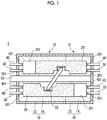
- FIG. 1 is a view for illustrating a housing 10 of a compressor 1 according to an embodiment.
- FIG. 1 is a sectional view schematically showing an example of the structure of the compressor 1.
- the housing 10 of the compressor 1 includes at least one compression chamber 101 that compresses a gas aspirated into the inside thereof, and is composed of a metal-resin composite 16 in which a resin member 14 composed of a thermosetting resin composition and a metal member 12 are bonded to each other.
- the metal-resin composite 16 is made into a test piece in which the resin member 14 having a thickness of d 1 and the metal member 12 having a thickness of d 2 are laminated on and bonded to each other and a ratio of d 1 /d 2 is 3, and the test piece is put in a first a state where it is disposed, the surface on the resin member 14-exposed side up, on two supports under a temperature condition of 25°C with no stress applied thereto and a second state where a 1-point bending stress of 140 MPa is applied in a thickness direction to the center of the resin member 14 side such that the center caves in after the first state, when putting in the first and second states is alternately repeated 1,000,000 times at a frequency of 30 Hz, the metal-resin composite exhibits bending fatigue resistance in which neither peeling nor fracture occurs.
- the compressor 1 aspirates a low-temperature low-pressure gas into a cylinder (compression chamber) 101, compresses the aspirated gas inside the cylinder 101 by using a piston 20 so as to change the gas into a high-temperature high-pressure gas, and then discharges the gas.
- the gas is, for example, a refrigerant gas.
- the compressor 1 according to the present embodiment includes the housing 10, the piston 20, a swash plate 30, an aspiration pipe 40, a discharge pipe 50, and a shaft 60.
- the shaft 60 in inserted into the housing 10, and the swash plate 30 is obliquely fixed to the shaft 60.
- the shaft 60 is connected to a motor or an engine not shown in the drawing and can rotate relative to the housing 10.
- a plurality of pistons 20 is provided in the housing 10, and the cylinder 101 is formed at both ends of each piston 20.
- the cylinder 101 is a cylindrical system, and the piston 20 can reciprocate in the cylinder 101.
- a gas is aspirated into a space formed by the cylinder 101 and the tip of the piston 20 and compressed by the piston 20.
- the rotation axis of the shaft 60 and the major axis of the cylinder 101 are in parallel with each other.
- the swash plate 30 is mounted such that it can rotate in each piston 20 in the vicinity of the outer peripheral portion thereof.
- Each cylinder 101 is connected to the aspiration pipe 40 and the discharge pipe 50.
- an aspiration valve 401 is provided, and in the connection portion between the discharge pipe 5 0 and the cylinder 101, a discharge valve 501 is provided.
- the compressor 1 includes the housing 10 composed of the metal-resin composite 16.
- the compressor 1 according to the present embodiment includes two housings 10, and the two housings 10 are connected to each other through a plurality of bolts not shown in the drawing.
- the housings 10 according to the present embodiment are both composed of the metal-resin composite 16 having the metal member 12 and the resin member 14.
- the present invention is not limited thereto, and the compressor 1 may be constituted with a housing solely composed of, for example, a metal.
- the way the metal member 12 and the resin member 14 are disposed in the housing 10 according to the present embodiment is not particularly limited. From the viewpoint of improving strength and sealing properties within the housing 10, a portion forming the outermost surface of the compressor 1 is preferably composed of the metal member 12.
- the resin member 14 is preferably exposed as the inner wall of the cylinder 101 in the housing 10, and within the inner wall of the cylinder 101, at least a portion on which the piston 20 slides is preferably composed of the resin member 14.
- the inner wall of the cylinder 101 may be totally composed of the resin member 14. From the viewpoint of weight lightening, 50% by volume or more of the housing 10 is preferably composed of the resin member 14.
- the metal-resin composite 16 When a bending stress of 140 MPa is repeatedly applied 1,000,000 times to the metal-resin composite 16 by means of pulsating three-point bending at 25°C, the metal-resin composite 16 exhibits bending fatigue resistance in which neither peeling nor fracture occurs.
- the method for evaluating the fatigue resistance will be specifically described later. Because the metal-resin composite 16 has the bending fatigue resistance described above, a compressor 1 having excellent durability can be obtained. The method for manufacturing the housing 10 will be described later.
- the shaft 60 rotates due to the driving of a motor or an engine. Due to the rotation of the shaft 60, the swash plate 30 fixed to the shaft 60 rotates. The swash plate 30 is obliquely fixed to the shaft 60. Accordingly, by performing rotation, the swash plate 30 applies a force acting on the major axis direction (horizontal direction in FIG. 1 ) of the cylinder 101 to each piston 20 and makes the piston reciprocate. The piston 20 then compresses the gas in the cylinder 101. While the shaft 60 is rotating once, the piston 20 reciprocates once.
- the refrigerant gas is supplied into the cylinder 101 connected to the aspiration pipe 40 from the outside of the housing 10 through the aspiration pipe 40. Then, the refrigerant gas compressed by the piston 20 is discharged outside the housing 10 through the discharge pipe 50. Specifically, when the piston 20 moves such that the space in the cylinder 101 connected to the aspiration pipe 40 widens, the internal pressure of the space is reduced, the aspiration valve 401 is opened, the low-temperature low-pressure refrigerant gas is introduced into the space from the aspiration pipe 40, and the space is filled with the refrigerant gas. At this time, the discharge valve 501 remains closed.
- the refrigerant gas is compressed and becomes a high-temperature and high-pressure gas.
- the discharge valve 501 is opened, and the high-temperature and high-pressure refrigerant gas is discharged through the discharge pipe 50.
- the compressor 1 is used as, for example, a compressor for a car air conditioner mounted on vehicles, but the compressor 1 is not limited thereto.
- the compressor 1 may be used in air conditioners not being mounted on vehicles and may be used in applications other than air conditioners, such as a freezing machine, an air compressor, an atomizer, and supercharger.
- the compressor 1 is a swash plate-type compressor.
- the compressor 1 may be other types of compressor such as a crank-type, a waffle-type, a scroll-type, or a vane-type compressor.
- the housing 10 In a case where the metal-resin composite 16 constituting the housing 10 is made into a test piece in which the resin member 14 having a thickness of d 1 and the metal member 12 having a thickness of d 2 are laminated on and bonded to each other and a ratio of d 1 /d 2 is 3, and the test piece is put in a first state where the test piece is disposed, the surface on the resin member 14 side up, on two supports with no stress applied thereto and a second state where 1-point bending stress of 140 MPa is applied in a thickness direction to the center of the resin member 14 side such that the center caves in after the first state, when putting in the first and second states is alternately repeated 1,000,000 times at a frequency of 30 Hz under a temperature condition of 25°C, the metal-resin composite 16 exhibits bending fatigue resistance in which neither peeling nor fracture occurs.
- the bending fatigue resistance described above will be referred to as "1,000,000-time bending fatigue resistance”.
- Whether or not the metal-resin composite 16 has 1,000,000-time bending fatigue resistance can be evaluated by repeatedly applying bending stress to the test piece composed of the metal-resin composite 16. The evaluation method will be specifically described below.
- FIG. 2 is a view for illustrating a method for evaluating 1,000,000-time bending fatigue resistance.
- a rectangular test piece composed of the metal-resin composite 16 is prepared.
- d 1 /d 2 3
- a thickness h, a width b, and a depth of the test piece are not limited.
- the thickness h of the test piece is preferably 4.0 ⁇ 0.2 mm
- the width b is preferably 80.0 ⁇ 2.0 mm
- the depth is preferably 10.0 ⁇ 0.2 mm.
- the bonding surface 103 between the metal member 12 and the resin member 14 is orthogonal to the thickness direction.
- the test piece can be prepared by being cut off from the housing 10, for example.
- the prepared test piece is disposed on two supports 703 (first state).
- the distance between the two supports 703 is regulated in advance such that the prepared test piece can be placed thereon.
- the two supports are disposed to establish bilateral symmetry with respect to the test piece.
- the test piece is disposed, the surface on the metal member 12 side down, so as to contacts the supports 703.
- an indenter 701 is brought into contact with the surface of the resin member 14 on the opposite side, and a pulsating bending stress of 140 MPa is repeatedly applied in a direction perpendicular to the bonding surface 103.
- the indenter 701 and the test piece contact each other in a position that is away from each of contact positions (supporting points) between each of the two supports 703 and the test piece by the same distance.
- the repeated application of stress is performed in an atmosphere at 25°C.
- F [N] is a force applied from the indenter 701 (unit: N)
- L is a distance between supporting points (unit: mm)
- b is a width of the test piece (unit: mm)
- h is a thickness of the test piece (unit: mm).
- the force F is determined such that the magnitude of the bending stress becomes 140 MPa, and the stress is repeatedly applied. In this way, the 1,000,000-time bending fatigue resistance can be evaluated.
- the test piece bends slightly such that the center thereof caves in (second state).
- the application of stress is then stopped, and the test piece reverts to the first state where no stress is applied.
- the first state and the second state are alternately repeated 1,000,000 times at a frequency of 30 Hz.
- the test piece is observed to check whether peeling or fracture occurs. In a case where neither peeling nor fracture occurs, the test piece is evaluated to have 1,000,000-time bending fatigue resistance.
- the metal-resin composite 16 by setting the distance L between supporting points to be 64 mm, the width b of the test piece to be 80 mm, the depth to be 10 mm, the height h to be 4.0 mm (thickness of the metal member 12: 1.0 mm, thickness of the resin member 14: 3.0 mm), and the force F to be 1.87 kN and applying a bending stress of 140 MPa, whether the metal-resin composite 16 has 1,000,000-time bending fatigue resistance can be checked.
- the present invention is not limited to the aforementioned conditions.
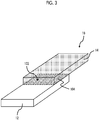
- FIG. 3 is a view for illustrating the metal-resin composite 16 according to the present embodiment.
- FIG. 3 is a model view for illustrating particularly the bonding surface 103 between the metal member 12 and the resin member 14 in the metal-resin composite 16, and is not a view exactly showing the structure of the housing 10 entirely or partially.
- FIG 3 is a perspective view showing schematically showing an example of a molded article of the metal-resin composite 16 constituting the housing 10.
- the metal material constituting the metal member 12 is not particularly limited. From the viewpoint of ease of availability or costs, examples of the metal material include iron, stainless steel, aluminum, an aluminum alloy, magnesium, a magnesium alloy, copper, a copper alloy, and the like. One kind of these may be used singly, or two or more kinds thereof may be used in combination. Among these, aluminum and an aluminum alloy are preferable because these are lightweight and have high strength. From the viewpoint of improving the bond strength between the resin member 14 and the metal member 12, the metal member 12 preferably has a roughened layer 104 including fine irregularities within the bonding surface 103 between the metal member 12 and the resin member 14.
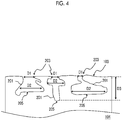
- FIG. 4 is a schematic view for illustrating an example of sectional shapes of depression portions 201 constituting the roughened layer 104 on the surface of the metal member 12 according to the present embodiment.
- the roughened layer 104 refers to a region having a plurality of depression portions 201 provided on the surface of the metal member 12.
- the thickness of the roughened layer 104 is preferably equal to or greater than 3 ⁇ m and equal to or less than 40 ⁇ m, more preferably equal to or greater than 4 ⁇ m and equal to or less than 32 ⁇ m, and particularly preferably equal to or greater than 4 ⁇ m and equal to or less than 30 ⁇ m. If the thickness of the roughened layer 104 is within the above range, the bond strength between the resin member 14 and the metal member 12 and the durability of bonding can be further improved. In the present embodiment, the thickness of the roughened layer 104 refers to a depth D3 of a depression portion having the greatest depth among a plurality of depression portions 201, and can be calculated from an image of a scanning electron microscope (SEM).
- SEM scanning electron microscope
- each depression portion 201 has such a sectional shape that, between an opening portion 203 and a bottom portion 205 of the depression portion 201, there is at least a portion whose section width D2 is greater than a section width D1 of the opening portion 203.
- the sectional shape of the depression portion 201 is not particularly limited as long as D2 is greater than D1, and various shapes can be adopted.
- the sectional shape of the depression portion 201 can be observed with, for example, a scanning electron microscope (SEM).
- the metal-resin composite 16 in which the bond strength is further improved is obtained if the depression portion 201 has the aforementioned sectional shape. Presumably, this is because the bonding surface 103 has a surface structure by which the anchor effect between the resin member 14 and the metal member 12 can be more strongly exhibited.
- the resin member 14 is entangled in the depression portion 201 throughout the opening portion 203 and the bottom portion 205, and thus the anchor effect is effectively exerted. It is considered that, for this reason, the bond strength between the resin member 14 and the metal member 12 and the durability of bonding are improved.
- the average depth the depression portion 201 is preferably equal to or greater than 0.5 ⁇ m and equal to or less than 40 ⁇ m, and more preferably equal to or greater than 1 ⁇ m and equal to or less than 30 ⁇ m. If the average depth of the depression portions 201 is equal to or less than the upper limit described above, a thermosetting resin composition (P) can sufficiently permeate deep into the depression portion 201, and hence the mechanical strength of the region, in which the resin member 14 and the metal member 12 permeate to each other, and the durability of bonding can be further improved.
- the average depth of the depression portions 201 is equal to or greater than the lower limit described above, in a case where the thermosetting resin composition (P) contains a filler (B), a ratio of the filler (B) present in the depression portions 201 can be increased, and hence the mechanical strength of the region, in which the resin member 14 and the metal member 12 permeate to each other, and the durability of bonding can be further improved. Consequently, if the average depth of the depression portions 201 is within the above range, the bond strength between the resin member 14 and the metal member 12 and the durability of bonding can be further improved.
- the average depth of the depression portions 201 can be measured using an image of a scanning electron microscope (SEM) as below, for example.
- SEM scanning electron microscope
- a section of the roughened layer 104 is imaged by a scanning electron microscope. From the image observed, 50 depression portions 201 are randomly selected, and the depth of each of them is measured. Then, all of the depths of the depression portions 201 are added up and divided by 50, thereby obtaining the average depth.
- the surface roughness Ra of the bonding surface 103 of the metal member 12 is preferably equal to or greater than 0.5 ⁇ m and equal to or less than 40.0 ⁇ m, more preferably equal to or greater than 1.0 ⁇ m and equal to or less than 20.0 ⁇ m, and particularly preferably equal to or greater than 1.0 ⁇ m and equal to or less than 10.0 ⁇ m. If the surface roughness Ra is within the above range, the bond strength between the resin member 14 and the metal member 12 can be further improved.
- the maximum height Rz of the bonding surface 103 of the metal member 12 is preferably equal to or greater than 1.0 ⁇ m and equal to or less than 40.0 ⁇ m, and more preferably equal to or greater than 3.0 ⁇ m and equal to or less than 30.0 ⁇ m. If the maximum height Rz is within the above range, the bond strength between the resin member 14 and the metal member 12 and the durability of bonding can be further improved. Ra and Rz can be measured based on JIS-B0601.
- the ratio of an actual surface area (hereinafter, simply referred to as a specific surface area as well), which is measured by a nitrogen adsorption BET method, of the metal member 12 to an apparent surface area of the bonding surface 103 bonded to at least the resin member 14 is preferably equal to or greater than 100, and more preferably equal to or greater than 150. If the specific surface area is equal to or greater than the lower limit described above, the bond strength between the resin member 14 and the metal member 12 and the durability of bonding can be further improved.
- the specific surface area is preferably equal to or less than 400, more preferably equal to or less than 380, and particularly preferably equal to or less than 300. If the specific surface area is equal to or less than the upper limit described above, the bond strength between the resin member 14 and the metal member 12 and the durability of bonding can be further improved.
- the apparent surface area means a surface area determined on the assumption that the surface of the metal member 12 has a smooth surface shape free of irregularities.
- the apparent surface area is represented by width x length.
- the actual surface area determined by a nitrogen adsorption BET method means a BET surface area determined by an adsorption amount of nitrogen gas.
- an adsorption and desorption amount of nitrogen at the temperature of liquid nitrogen is measured using an automatic specific surface area/pore distribution analyzer (BELSORPmini II manufactured by BEL Japan, Inc.), and based on the adsorption and desorption amount of nitrogen, the actual surface area can be calculated.
- the metal-resin composite 16 in which the bond strength and the durability of bonding are further improved is obtained if the specific surface area is within the above range. Presumably, this is because the bonding surface 103 bonded to the resin member 14 has a surface structure by which the anchor effect between the resin member 14 and the metal member 12 can be more strongly exhibited.
- the specific surface area is equal to or greater than the lower limit described above, the contact area between the resin member 14 and the metal member 12 is enlarged, and thus the number of regions in which the resin member 14 and the metal member 12 permeate to each other is increased. It is considered that, as a result, the number of regions in which the anchor effect is exerted is increased, and hence the bond strength between the resin member 14 and the metal member 12 and the durability of bonding are further improved.
- the specific surface area is equal to or less than the upper limit described above, the mechanical strength of the region, in which the resin member 14 and the metal member 12 permeate to each other, and the durability of bonding are further improved, and hence the bond strength between the resin member 14 and the metal member 12 and the durability of bonding can be further improved.
- the bonding surface 103 bonded to the resin member 14 has an excellently balanced surface structure by which the anchor effect between the resin member 14 and the metal member 12 are more strongly exhibited.
- the metal member 12 is not particularly limited.
- a degree of glossiness of at least the bonding surface 103 to be bonded to the resin member 14 is preferably equal to or greater than 0.1, more preferably equal to or greater than 0.5, and even more preferably equal to or greater than 1. If the degree of glossiness is equal to or greater than the lower limit described above, the bond strength between the resin member 14 and the metal member 12 can be further improved.
- the degree of glossiness is preferably equal to or less than 30, and more preferably equal to or less than 20. If the degree of glossiness is equal to or less than the upper limit described above, the bond strength between the resin member 14 and the metal member 12 can be further improved.
- the degree of glossiness refers to a value measured based on ASTM-D523 at a measurement angle of 60° (incidence angle: 60°, reflection angle: 60°).
- the degree of glossiness can be measured using a digital gloss meter (20°, 60°) (GM-26 model, manufactured by MURAKAMI COLOR RESEARCH LABORATORY CO., Ltd.), for example.
- the metal-resin composite 16 in which the bond strength is further improved is obtained if the degree of glossiness is within the above range. Presumably, this is because the bonding surface 103 bonded to the resin member 14 has a more complicated surface structure by which the anchor effect between the resin member 14 and the metal member 12 can be more strongly exhibited.
- the shape of the metal member 12 is not particularly limited as long as it has the bonding surface 103 to be bonded to the resin member 14.
- the metal member 12 can have a sheet shape, a flat plate shape, a curved plate shape, a rod shape, a cylindrical shape, a lump shape, and the like.
- the metal member 12 may be a structure having these shapes in combination.
- the metal member 12 having the above shape can be obtained by processing the aforementioned metal material by a known processing method.
- the shape of the bonding surface 103 to be bonded to the resin member 14 is not particularly limited, and examples thereof include a flat surface, a curved surface, and the like.
- the roughened layer 104 can be formed by chemically treating the surface of the metal member 12 by using a surface treatment agent, for example.
- aqueous solution obtained by combining an inorganic acid, a source of chlorine ions, a source of copper (II) ions, and a thiol-based compound as necessary.
- aqueous solution obtained by combining a source of alkali, a source of amphoteric metal ions, a source of nitrate ions, and a thio compound as necessary.
- a source of alkali is used, and it is particularly preferable to select an aqueous solution of sodium hydroxide.
- aqueous solution using at least one kind of component selected from an inorganic acid such as nitric acid or sulfuric acid, an organic acid such as unsaturated carboxylic acid, persulfate, hydrogen peroxide, azoles such as imidazole and a derivative thereof, tetrazole and a derivative thereof, aminotetrazole and a derivative thereof, and aminotriazole and a derivative thereof, a pyridine derivative, triazine, a triazine derivative, alkanolamine, an alkylamine derivative, polyalkylene glycol, sugar alcohol, a source of copper (II) ions, a source of chorine ions, a phosphonic acid-based chelating agent oxidant, and N,N-bis(2-hydroxyethyl)-N-cyclohexylamine.
- an inorganic acid such as nitric acid or sulfuric acid
- an organic acid such as unsaturated carboxylic acid, persulfate, hydrogen peroxide
- the metal member is dipped into the surface treatment agent such that the surface of the metal member is chemically treated.
- the treatment temperature is 30°C, for example.
- the treatment time is appropriately determined according to the material or surface condition of the selected metal member, the type or concentration of the surface treatment agent, the treatment temperature, and the like.
- the treatment time is, for example, 30 seconds to 300 seconds.
- an etching amount in the depth direction of the metal member is preferably set to be equal to or greater than 3 ⁇ m and more preferably set to be equal to or greater than 5 ⁇ m.
- the etching amount in the depth direction of the metal member can be evaluated by being calculated from the weight, specific gravity, and surface area of the dissolved metal member.
- the etching amount in the depth direction can be adjusted by the type or concentration of the surface treatment agent, the treatment temperature, the treatment time, and the like.
- the thickness of the roughened layer 104, the average depth of the depression portions 201, Ra, Rz, and the like described above can be adjusted.
- the surface of the metal member having undergone the chemical treatment is subjected to a post-treatment.
- the surface of the metal member is washed with water and dried.
- the surface of the metal member having undergone the chemical treatment is treated with an aqueous nitric acid solution or the like.
- the metal member 12 having the roughened layer 104 according to the present embodiment can be obtained.
- the resin member 14 is obtained by curing the thermosetting resin composition (P).
- thermosetting resin composition (P) contains a thermosetting resin (A), and as the thermosetting resin (A), for example, a phenolic resin, an epoxy resin, an unsaturated polyester resin, a diallyl phthalate resin, a melamine resin, an oxetane resin, a maleimide resin, an urea resin, a polyurethane resin, a silicone resin, a resin having an benzoxazine ring, or a cyanate ester resin is used.
- a thermosetting resin for example, a phenolic resin, an epoxy resin, an unsaturated polyester resin, a diallyl phthalate resin, a melamine resin, an oxetane resin, a maleimide resin, an urea resin, a polyurethane resin, a silicone resin, a resin having an benzoxazine ring, or a cyanate ester resin is used.
- a thermosetting resin for example, a phenolic resin, an epoxy resin, an
- a phenolic resin excellent in heat resistance, processability, mechanical characteristics, adhesiveness, and abrasion resistance is preferably used.
- the content of the thermosetting resin (A) is preferably equal to or greater than 15 parts by mass and equal to or less than 60 parts by mass, and more preferably equal to or greater than 25 parts by mass and equal to or less than 50 parts by mass.
- the phenolic resin examples include a novolac-type phenolic resin such as a phenol novolac resin, a cresol novolac resin, or a bisphenol A-type novolac resin; a resol-type phenolic resin such as a methylol-type resol resin, a dimethylene ether-type resol resin, or an oil-melted resol phenolic resin melted using tung oil, linseed oil, walnut oil, or the like; an arylalkylene-type phenolic resin; and the like.
- a novolac-type phenolic resin such as a phenol novolac resin, a cresol novolac resin, or a bisphenol A-type novolac resin
- a resol-type phenolic resin such as a methylol-type resol resin, a dimethylene ether-type resol resin, or an oil-melted resol phenolic resin melted using tung oil, linseed oil, walnut
- a novolac-type phenolic resin is preferable because it is excellent in ease of availability, is inexpensive, and exhibits excellent workability at the time of roll kneading.
- hexamethylenetetramine is used as a curing agent.
- the hexamethylenetetramine is not particularly limited, but the amount thereof used is preferably 10 to 25 parts by mass, and more preferably 13 to 20 parts by mass, with respect to 100 parts by mass of the novolac-type phenolic resin. If the amount of the hexamethylenetetramine used is equal to or greater than the lower limit described above, the curing time at the time of molding can be shortened. If the amount of the hexamethylenetetramine used is equal to or less than the upper limit described above, the appearance of the molded article can be improved.
- thermosetting resin composition (P) preferably contains the filler (B).
- an elastomer (D), which will be described later, is not included in the filler (B).
- the content of the filler (B) is preferably equal to or greater than 30 parts by mass and equal to or less than 80 parts by mass, and more preferably equal to or greater than 40 parts by mass and equal to or less than 70 parts by mass. If the content of the filler (B) is within the above range, it is possible to improve the workability of the thermosetting resin composition (P) and to further improve the mechanical strength of the obtained resin member 14. As a result, it is possible to obtain a metal-resin composite 16 in which the bond strength between the resin member 14 and the metal member 12 is further improved. Furthermore, by adjusting the type or content of the filler (B), the value of a coefficient of linear expansion ⁇ R of the obtained resin member 14 can be adjusted.
- Examples of the filler (B) include a fibrous filler, a granular filler, a plate-like filler, and the like.
- the fibrous filler is a filler having a fibrous shape.
- the plate-like filler is a filler having a plate-like shape.
- the granular filler is a filler whose shape is different from the shape of fibrous and plate-like filler including an amorphous filler.
- the fibrous filler examples include a fibrous inorganic filler such as glass fiber, carbon fiber, asbestos fiber, metal fiber, wollastonite, attapulgite, sepiolite, rock wool, aluminum borate whiskers, potassium titanate fiber, calcium carbonate whiskers, titanium oxide whiskers, or ceramic fiber; and a fibrous organic filler such as aramid fiber, polyimide fiber, and poly(paraphenylene benzobisoxazole) fiber.
- aramid fiber, polyimide fiber, and poly(paraphenylene benzobisoxazole) fiber One kind of these may be used singly, or two or more kinds thereof may be used in combination.
- Examples of the plate-like filler and the granular filler include talc, kaolin clay, calcium carbonate, zinc oxide, calcium silicate hydrate, mica, glass flake, glass powder, magnesium carbonate, silica, titanium oxide, alumina, aluminum hydroxide, magnesium hydroxide, barium sulfate, calcium sulfate, calcium sulfite, zinc borate, barium metaborate, aluminum borate, calcium borate, sodium borate, aluminum nitride, boron nitride, silicon nitride, those obtained by pulverizing the above fibrous fillers, and the like.
- One kind of these may be used singly, or two or more kinds thereof may be used in combination.
- the filler (B) contains a filler (B1) whose average particle size in a weight-based particle size distribution measured by a laser diffraction and scattering-type particle size distribution analysis method is greater than 5 ⁇ m, preferably in an amount of equal to or greater than 70 parts by mass and equal to or less than 99 parts by mass, and more preferably in an amount of equal to or greater than 85 parts by mass and equal to or less than 98 parts by mass. If the content of the filler (B1) is within the above range, it is possible to improve the workability of the thermosetting resin composition (P) and to further improve the mechanical strength of the obtained resin member 14.
- the upper limit of the average particle size of the filler (B1) is not particularly limited, but is equal to or less than 100 ⁇ m, for example.
- the filler (B) contains, as the filler (B1), a fibrous filler or a plate-like filler having an average major axis length of equal to or greater than 5 ⁇ m and equal to or less than 50 mm and an average aspect ratio of equal to or greater than 1 and equal to or less than 1,000.
- the average major axis length and the average aspect ratio of the filler (B1) can be measured using an SEM image as below.
- a plurality of fibrous fillers or plate-like fillers is imaged. From the images observed, 50 fibrous fillers or plate-like fillers are randomly selected, and a major axis length (fiber length in a case of fibrous filler or a major axis size in a plane direction in a case of plate-like filler) and a minor axis length (fiber diameter in a case of fibrous filler or the size in the thickness direction in a case of plate-like filler) of each of the fillers are measured.
- All of the major axis lengths are added up and divided by 50, thereby obtaining the average major axis length.
- all of the minor axis lengths are added up and divided by 50, thereby obtaining the average minor axis length.
- a ratio of the average major axis length to the average minor axis length is determined as the average aspect ratio.
- filler (B1) one kind of filler or two or more kinds of filler selected from glass fiber, carbon fiber, glass beads, and calcium carbonate are more preferable. If such a filler (B1) is used, the mechanical strength of the resin member 14 can be particularly improved.
- the filler (B) contains a filler (B2) whose average particle size in a weight-based particle size distribution measured by a laser diffraction and scattering-type particle size distribution analysis method is equal to or greater than 0.1 ⁇ m and equal to or less than 5 ⁇ m, preferably in an amount of equal to or greater than 1 part by mass and equal to or less than 30 parts by mass, and more preferably in an amount of equal to or greater than 2 parts by mass and equal to or less than 15 parts by mass. If the content of the filler (B2) is within the above range, it is possible to cause a sufficient amount of filler (B) to be present in the depression portions 201. As a result, it is possible to further improve the mechanical strength of the region in which the resin member 14 and the metal member 12 permeate to each other.
- a filler (B2) whose average particle size in a weight-based particle size distribution measured by a laser diffraction and scattering-type particle size distribution analysis method is equal to or greater than 0.1 ⁇ m and equal
- the filler (B) contains, as the filler (B2), a fibrous filler or a plate-like filler having an average major axis length, which is preferably equal to or greater than 0.1 ⁇ m and equal to or less than 100 ⁇ m and more preferably equal to or greater than 0.2 ⁇ m and equal to or less than 50 ⁇ m, and an average aspect ratio which is preferably equal to or greater than 1 and equal to or less than 50 and more preferably equal to or greater than 1 and equal to or less than 40.
- a fibrous filler or a plate-like filler having an average major axis length, which is preferably equal to or greater than 0.1 ⁇ m and equal to or less than 100 ⁇ m and more preferably equal to or greater than 0.2 ⁇ m and equal to or less than 50 ⁇ m, and an average aspect ratio which is preferably equal to or greater than 1 and equal to or less than 50 and more preferably equal to or greater than 1 and equal to or less than 40.
- the average major axis length and the average aspect ratio of the filler (B2) can be measured using an SEM image as below.
- a plurality of fibrous fillers or plate-like fillers is imaged. From the images observed, 50 fibrous fillers or plate-like fillers are randomly selected, and a major axis length (fiber length in a case of fibrous filler or a major axis size in a plane direction in a case of plate-like filler) and a minor axis length (fiber diameter in a case of fibrous filler or the size in the thickness direction in a case of plate-like filler) of each of the fillers are measured.
- All of the major axis lengths are added up and divided by 50, thereby obtaining the average major axis length.
- all of the minor axis lengths are added up and divided by 50, thereby obtaining the average minor axis length.
- a ratio of the average major axis length to the average minor axis length is determined as the average aspect ratio.
- filler (B2) one kind of filler or two or more kinds of filler selected from wollastonite, kaolin clay, talc, calcium carbonate, zinc oxide, calcium silicate hydrate, aluminum borate whiskers, and potassium titanate fiber are more preferable.
- the thermosetting resin composition (P) contains a solid lubricant as the filler (B).
- the solid lubricant for example, one kind or two or more kinds of lubricant selected from graphite, carbon fiber, and fluorine fiber are preferable. If the thermosetting resin composition (P) contains the solid lubricant, a coefficient of friction of the resin member 14 is reduced. Furthermore, in a case where the resin member 14 is used as a portion in which the cylinder 101 and piston 20 slide in the housing 10, the sliding properties can be improved, and hence the energy efficiency of the compressor 1 can be improved.
- the surface of the filler (B) may be treated with a coupling agent such as a silane coupling agent (C) which will be described later.
- a coupling agent such as a silane coupling agent (C) which will be described later.
- thermosetting resin composition (P) may further contain the silane coupling agent (C). If it contains the silane coupling agent (C), the adhesiveness between the resin member 14 and the metal member 12 can be further improved. Furthermore, if the thermosetting resin composition (P) contains the silane coupling agent (C), the affinity between the thermosetting resin (A) and the filler (B) can be improved, and hence the mechanical strength of the resin member 14 can be further improved.
- the content of the silane coupling agent (C) is not particularly limited because it depends on the specific surface area of the filler (B).
- the content of the silane coupling agent (C) is preferably equal to or greater than 0.01 parts by mass and equal to or less than 4.0 parts by mass, and more preferably equal to or greater than 0.1 parts by mass and equal to or less than 1.0 part by mass, with respect to 100 parts by mass of the filler (B). If the content of the silane coupling agent (C) is within the above range, it is possible to sufficiently coat the filler (B) and to further improve the mechanical strength of the resin member 14.
- silane coupling agent (C) examples include an epoxy group-containing alkoxysilane compound such as ⁇ -glycidoxypropyl trimethoxysilane, ⁇ -glycidoxypropyl triethoxysilane, or ⁇ -(3,4-epoxycyclohexyl)ethyl trimethoxysilane; a mercapto group-containing alkoxysilane compound such as ⁇ -mercaptopropyl trimethoxysilane or ⁇ -mercaptopropyl triethoxysilane; a ureido group-containing alkoxysilane compound such as ⁇ -ureidopropyl triethoxysilane, ⁇ -ureidopropyl trimethoxysilane, or ⁇ -(2-ureidoethyl)aminopropyl trimethoxysilane; an isocyanato group-containing alkoxysilane compound such as ⁇ -isocyanatoprop
- One kind of these may be used singly, or two or more kinds of these may be used in combination.
- thermosetting resin composition (P) according to the present embodiment may further contain an elastomer (D).
- the filler (B) is not included in the elastomer (D).
- the content of the elastomer (D) is preferably equal to or greater than 1 part by mass and equal to or less than 10 parts by mass, and more preferably equal to or greater than 1.5 parts by mass and equal to or less than 7 parts by mass. If the content of the elastomer (D) is within the above range, it is possible to further improve the toughness of the resin member 14 while maintaining the mechanical strength of the resin member 14. As a result, it is possible to obtain a metal-resin composite 16 in which the bond strength between the resin member 14 and the metal member 12 is further improved.
- Examples of the elastomer (D) include unmodified polyvinyl acetate, polyvinyl acetate modified with carboxylic acid, polyvinyl butyral, natural rubber, isoprene rubber, styrene ⁇ butadiene rubber, butadiene rubber, chloroprene rubber, butyl rubber, ethylene ⁇ propylene rubber, acryl rubber, styrene ⁇ isoprene rubber, acrylonitrile ⁇ butadiene rubber, urethane rubber, silicon rubber, and fluorine rubber.
- One kind of these may be used singly, or two or more kinds thereof may be used in combination.
- unmodified polyvinyl acetate, polyvinyl acetate modified with carboxylic acid, acryl rubber, acrylonitrile ⁇ butadiene rubber, and polyvinyl butyral are preferable. If these elastomers are used, the toughness of the resin member 14 can be particularly improved.
- thermosetting resin composition (P) is not particularly limited.
- the composition can be manufactured by a known method.
- the following method can be used.
- the thermosetting resin (A) is formulated with the filler (B), the silane coupling agent (C), the elastomer (D), a curing agent, an auxiliary curing agent, a release agent, a pigment, a flame retardant, a weatherproofing agent, an antioxidant, a plasticizer, a lubricant, a sliding agent, a foaming agent, and the like are which are used if necessary, and the resultant is uniformly mixed.
- thermosetting resin composition (P) the thermosetting resin composition (P).
- the coefficient of linear expansion ⁇ R of the resin member 14 within a range of 25°C to a glass transition temperature of the resin member 14 is preferably equal to or greater than 10 ppm/°C and equal to or less than 50 ppm/°C, and more preferably equal to or greater than 15 ppm/°C and equal to or less than 45 ppm/°C. If the coefficient of linear expansion ⁇ R is within the above range, the reliability of temperature cycle of the metal-resin composite 16 can be further improved.
- the density of the resin member 14 is preferably equal to or less than 2.5 g/cm 3 , and more preferably equal to or less than 2.0 g/cm 3 .
- the thermal conductivity of the resin member 14 is preferably equal to or less than 90 W/(m ⁇ K), and more preferably equal to or less than 1 W/(m ⁇ K). If the thermal conductivity is equal to or less than the upper limit described above, thermal insulating properties of the compressor 1 are improved, and accordingly, the energy efficiency of the compressor 1 can be improved.
- the thermal conductivity can be measured by a laser flash method. In a case where the thermal conductivity has anisotropy, thermal conductivity in a direction perpendicular to the bonding surface 103 between the metal member 12 and the resin member 14 is adopted.
- the resin member 14 and the metal member 12 are bonded to each other.
- the absolute value of a difference ( ⁇ R - ⁇ M ) between a coefficient of linear expansion ⁇ R of the resin member 14 within a range of 25°C to a glass transition temperature of the resin member 14 and a coefficient of linear expansion ⁇ M of the metal member 12 within a range of 25°C to the glass transition temperature of the resin member 12 is preferably equal to or less than 25 ppm/°C, and more preferably equal to or less than 10 ppm/°C. If the difference between the coefficients of linear expansion is equal to or less than the upper limit described above, it is possible to suppress the thermal stress which occurs due to the difference of linear expansion when the metal-resin composite 16 is exposed to a high temperature.
- the average thereof is adopted.
- MD the coefficient of linear expansion in the flow direction
- TD the coefficient of linear expansion in the direction perpendicular to MD
- the average thereof is determined as the coefficient of linear expansion ⁇ R of the resin member 14.
- the metal-resin composite 16 is not particularly limited, but is preferably a composite in which the resin member 14 and the metal member 12 are directly bonded to each other without the aid of an adhesive.
- the resin member 14 and the metal member 12 have excellent bond strength even if an adhesive is not used. Therefore, the manufacturing process of the metal-resin composite 16 can be simplified.
- the filler (B) is present in the depression portions 201.
- the average major axis length of the filler (B) present in the depression portions 201 that is determined by the analysis of an image of scanning electron microscope is preferably equal to or greater than 0.1 ⁇ m and equal to or less than 5.0 ⁇ m, and more preferably equal to or greater than 0.2 ⁇ m and equal to or less than 4 ⁇ m. If the average major axis length is within the above range, it is possible to further improve the mechanical strength of the region in which the resin member 14 and the metal member 12 permeate to each other.
- the average aspect ratio of the filler (B) present in the depression portions 201 is preferably equal to or greater than 1 and equal to or less than 50, and more preferably equal to or greater than 1 and equal to or less than 40.
- the average major axis length and the average aspect ratio of the filler (B) present in the depression portions 201 can be measured using an SEM image as below. First, by using a scanning electron microscope, a section of the roughened layer 104 is imaged. From the image observed, 50 fillers (B) present in the depression portions 201 are randomly selected, and a major axis length (fiber length in a case of fibrous filler or a major axis size in a plane direction in a case of plate-like filler) and a minor axis length (fiber diameter in a case of fibrous filler or the size in the thickness direction in a case of plate-like filler) of each of the fillers are measured.
- a major axis length fiber length in a case of fibrous filler or a major axis size in a plane direction in a case of plate-like filler
- a minor axis length fiber diameter in a case of fibrous filler or the size in the thickness direction in a case of plate-like filler
- All of the major axis lengths are added up and divided by 50, thereby obtaining the average major axis length.
- all of the minor axis lengths are added up and divided by 50, thereby obtaining the average minor axis length.
- a ratio of the average major axis length to the average minor axis length is determined as the average aspect ratio.
- the filler (B) present in the depression portions 201 is preferably one kind of filler or two or more kinds of filler selected from the group consisting of wollastonite, kaolin clay, talc, calcium carbonate, zinc oxide, calcium silicate hydrate, aluminum borate whiskers, and potassium titanate fiber.
- the resin member 14 contains the elastomer (D)
- the resin member 14 preferably has a sea-island structure, and the elastomer (D) is preferably present in sea-islands.
- the sea-island structure can be observed using an image of a scanning electron microscope.
- the average diameter of the sea-islands that is determined through the image analysis performed on the image of a scanning electron microscope is preferably equal to or greater than 0.1 ⁇ m and equal to or less than 100 ⁇ m, and more preferably equal to or greater than 0.2 ⁇ m and equal to or less than 30 ⁇ m. If the average diameter of the sea-islands is within the above range, it is possible to further improve the toughness of the resin member 14 and to further improve the impact resistance of the metal-resin composite 16.
- the average diameter of the sea-islands can be determined using an image of a scanning electron microscope (SEM) as below.
- SEM scanning electron microscope
- the bending strength of the metal-resin composite 16 is preferably equal to or greater than 150 MPa, and more preferably equal to or greater than 200 MPa.
- the bending strength can be measured based on JIS K 7171.
- As a test piece a substance in which the resin member 14 and the metal member 12 are laminated on and bonded to each other and a thickness ratio d 1 /d 2 thereof is 3 is used. By making the resin member 14 side of the test piece cave in, the bending strength is measured. Furthermore, the bending strength can be converted from measurement results obtained using a Dynstat tester.
- the width b, the thickness, and the depth of the test piece used in the Dynstat test can be set to be 4 mm, 4 mm, and 15 mm respectively.
- the bending strength can be evaluated by preparing an appropriate test piece by cutting off the test piece from the housing 10. At this time, the test piece includes only one bonding surface between the metal member 12 and the resin member 14.
- the metal-resin composite 16 preferably exhibits low permeability with respect to a refrigerant gas.
- the permeability of a refrigerant gas can be evaluated by measuring a coefficient of gas permeability based on JIS K 7126-1 by using a pressure sensor method.
- the refrigerant gas is, for example, freon gas.
- the coefficient of gas permeability measured using freon gas is preferably less than 1 x 10 16 mol ⁇ m/(m 2 ⁇ s/Pa), and more preferably less than 5 x 10 17 mol ⁇ m/(m 2 ⁇ s/Pa). If the coefficient of gas permeability is less than the upper limit described above, an efficiently functioning compressor 1 can be provided.
- the permeability of a refrigerant gas can be evaluated by preparing an appropriate test piece by cutting off the test piece from the housing 10. At this time, the test piece includes only on bonding surface between the metal member 12 and the resin member 14. Furthermore, as the test piece, the one in which a ratio d1/d2 between the thickness d 1 of the resin member 14 and the thickness d 2 of the metal member 12 is 2 is used.
- the housing 10 may include only one metal member 12 or a plurality of metal members 12.
- the method for manufacturing the housing 10 is merely an example of a method for manufacturing the housing 10 composed of the metal-resin composite 16 having 1,000,000-time bending fatigue resistance described above.
- the housing 10 may be manufactured by other methods as long as it is manufactured as a housing composed of the metal-resin composite 16 having 1,000,000-time bending fatigue resistance.
- the method for manufacturing the housing 10 is not particularly limited, and examples thereof include an injection molding method, a transfer molding method, a compression molding method, an injection and compression molding method, and the like.
- FIGS. 5A to 5D are views for illustrating an example of the method for manufacturing the housing 10 according to the present embodiment.
- the method for manufacturing the housing 10 according to the present embodiment includes a step of preparing the metal member 12 and a mold 8, a step of disposing the metal member 12 in a molding space 810 of the mold 8, a step of filling the molding space 810 with a fluidized resin material 850 containing the thermosetting resin (P), and a step of obtaining the housing 10 composed of the metal-resin composite 16, in which the resin member 14 and the metal member 12 are bonded to each other, by curing the resin material 850 filling the molding space, in this order.
- P thermosetting resin
- the mold 8 includes a first mold portion 81 and a second mold portion 82.
- the molding space 810 is formed by the first mold portion 81 and the second mold portion 82.
- the first mold portion 81 and the second mold portion 82 mean a portion of the mold 8, and the mold 8 may further include a nest or a slide core.
- the method for manufacturing the housing 10 during the step of filing the molding space 810 with the fluidized resin material 850, it is preferable to fill the molding space 810 with the resin material 850 while pressing the metal member 12 on a molding surface of either the first mold portion 81 or the second mold portion 82 by using the flow pressure of the resin material 850. In this way, it is possible to inhibit the occurrence of burrs and to obtain a housing 10 having excellent quality that is excellent in the adhesiveness between the metal member 12 and the resin member 14.
- a mold for transfer molding is used as the mold 8, for example.
- a mold for transfer molding a mold for injection molding, or a mold of compression molding may be used.
- a mold for injection molding or a mold for compression molding the same effect as in a case where a mold for transfer molding is used is obtained.
- a mold for transfer molding is used from the viewpoint of improving the controllability of dimensional accuracy of a molded article.
- the housing 10 may be manufactured using a single metal member 12 in which the respective portions constituting the outer surface are integrated. If the housing 10 is manufactured using a plurality of metal members 12, a large metal member 12 does not need to be prepared, and the manufacturing costs are reduced. In contrast, if the integrated metal member 12 is used, the strength of the housing 10 can be improved. The shape and disposition of the metal member 12 can be appropriately determined according to the structure of the housing 10.
- FIGS. 5A to 5D are views for illustrating an example of the method for manufacturing the housing 10 according to the present embodiment.
- the shapes of the metal member 12 and the resin member 14 are described in a simplified manner.
- FIG. 5A is a view showing the structure of the mold 8 in which the metal member 12 has not yet been disposed.
- FIG. 5B is a view for illustrating a step of disposing the metal member 12.
- FIG. 5C is a view for illustrating a step of filling the molding space 810 with the resin material 850.
- FIG. 5D is a view for illustrating a step of obtaining the housing 10 by curing the resin material 850.
- the mold 8 shown in FIG. 5A is prepared.
- the mold 8 according to the present embodiment includes the first mold portion 81 and the second mold portion 82.
- the second mold portion 82 is provided with a pot 820 which is filled with the resin material 850 before molding, a plunger 830 which includes an auxiliary rammer to be inserted into the pot 820 so as to melt the resin material 850 by applying pressure, and a sprue 840 which injects the melted resin material 850 into the molding space 810.
- the mold 8 according to the present embodiment may be applied to a plunger-type transfer molding machine including an auxiliary rammer as shown in FIG. 5A or applied to a pot-type transfer molding machine (not shown in the drawing) without an auxiliary rammer.
- the metal member 12 it is preferable to prepare a metal member 12 in which a region that will be bonded to at least the resin member 14 has undergone a roughening treatment.
- the metal member 12 is disposed in the molding space 810 of the mold 8. Specifically, the first mold portion 81 is pulled down such that the mold 8 is opened, and in this state, the metal member 12 is disposed in a portion corresponding to the molding space 810 without being fixed thereto. If the metal member 12 is disposed in this way, when the melted resin material 850 is introduced into the molding space 810, by the flow pressure of the introduced resin, the metal member 12 can be pressed on the wall surface (molding surface) of one of the mold members of the first mold portion 81 and the second mold portion 82. In the present embodiment, the metal member 12 is pressed on the wall surface of the first mold portion 81.
- the metal member 12 is disposed in a state where it is brought into contact in advance with the wall surface (molding surface) of either the first mold portion 81 or the second mold portion 82. If the metal member 12 is disposed in this state, it is possible to effectively prevent the melted resin material 850 from flowing into the gap between the metal member 12 and the wall surface of the mold member.
- the metal member 12 has a plate shape or a sheet shape that complies with the wall surface of the first mold portion 81 or the second mold portion 82 on which the metal member 12 is pressed. If the metal member 12 has such a shape, the surface of the metal member 12 can receive the flow pressure of the resin material 850, and consequently, the metal member 12 can be reliably pressed on the wall surface (molding surface) of either the second mold portion 82 or the first mold portion 81. As a result, it is possible to prevent the positional deviation of the metal member 12 caused when the resin material 850 is introduced into the molding space 810, and to reliably inhibit the occurrence of burrs.
- the first mold portion 81 is pulled up such that the mold 8 is closed, and in this state, the pot 820 is filled with the resin material 850 before molding.
- the properties of the resin material 850 before molding are not particularly limited.
- the resin material 850 may remain in the form of powder or granules of the thermosetting resin composition (P) or may be formed into cylindrical tablets composed of the thermosetting resin composition (P).
- the resin material 850 may be in a semi-molten state by being preheated by a pre-heater or the like.
- the resin material 850 introduced into the molding space 810 in the present step does not flow back and runs in one direction. Therefore, in a case where the thermosetting resin composition (P) contains a fibrous filler, the mechanical strength of the resin member 14 can be improved. If the resin material 850 introduced into the molding space 810 runs in one direction without flowing back, the orientation of the fibrous filler in the cured resin member 14 can be controlled. If the orientation of the fibrous filler can be controlled, by the method for manufacturing the housing 10 according to the present embodiment, it is possible to obtain a housing 10 with excellent quality that is uniform in view of strength.
- the step of filing the molding space 810 with the resin material 850 it is preferable to introduce the melted resin material 850 into the molding space 810 after deaerating the inside of the molding space 810. If the resin material 850 is introduced in the above manner, a likelihood that voids will occur in the next step in the resin member 14 obtained by curing can be reduced. Accordingly, a housing 10 with further improved mechanical strength can be obtained.
- thermosetting resin composition (P) has high fluidity such that molding is excellently performed. Therefore, a melt viscosity of the thermosetting resin composition (P) at 175°C is preferably equal to or greater than 10 Pa ⁇ s and equal to or less than 3,000 Pa ⁇ s, and more preferably equal to or greater than 30 Pa ⁇ s and equal to or less than 2,000 Pa ⁇ s.
- the melt viscosity at 175°C can be measured using a heat flow evaluator (flow tester) manufactured by Shimadzu Corporation, for example.
- thermosetting resin composition (P) shows the following viscosity behavior.
- the melt viscosity of the thermosetting resin composition (P) is reduced during the initial stage but increases after the composition reaches the lowest melt viscosity, and the lowest melt viscosity is within a range of equal to or greater than 10 Pa ⁇ s and equal to or less than 2,000 Pa ⁇ s.
- thermosetting resin composition (P) contains the filler (B)
- thermosetting resin composition (P) contains the filler (B)
- the permeability of the thermosetting resin composition (P) into the depression portions 201 can be improved, and thus the filler (B) can be sufficiently supplied into the depression portions 201. As a result, it is possible to further improve the mechanical strength of the region in which the resin member 14 and the metal member 12 permeate to each other.
- thermosetting resin composition (P) reaches the lowest melt viscosity is preferably within a range of equal to or higher than 100°C and equal to or lower than 250°C.
- thermosetting resin composition (P) shows the viscosity behavior described above, it is possible to inhibit the permeation of air into the thermosetting resin composition (P) at the time of forming the resin member 14 by heating and curing the thermosetting resin composition (P), and to thoroughly discharge a gas dissolved in the thermosetting resin composition (P) to the outside. As a result, it is possible to inhibit the generation of air bubbles in the resin member 14. By the inhibition of the generation of air bubbles, the mechanical strength of the resin member 14 can be further improved.
- thermosetting resin composition (P) showing the viscosity behavior described above
- the type or amount of the thermosetting resin (A), the type or amount of the filler (B), and the type or amount of the elastomer (D) described above should be appropriately adjusted.
- the molding conditions of the metal-resin composite 16 are not particularly limited.
- the housing 10 obtained by the manufacturing method described above is a high-quality housing solving the problems such as insert margin or the occurrence of burrs formed because the resin material 850 flows in from the gap between the metal member 12 and the mold member. Furthermore, in the housing 10 according to the present embodiment, there is no difference in level at a site where the metal member 12, in which the occurrence of burrs is inhibited, and the resin member 14 are bonded to each other. Therefore, in the housing 10, mechanical strength and rigidity are excellently balanced, and the housing 10 can be used for a long period of time.
- the compressor 1 according to the present embodiment is manufactured by combining the housing 10 and other parts. Other parts can be manufactured by generally known methods.
- the housing 10 according to the present embodiment is composed of the metal-resin composite 16 having 1,000,000-time bending fatigue resistance. Therefore, it is possible to provide a housing in which performances including lightweight properties and high resistance are excellently balanced.
- the housing 10 according to the present embodiment is composed of the metal-resin composite 16 including the resin member 14. Therefore, the housing 10 according to the present embodiment can maintain necessary strength, while the weight thereof can be further reduced compared to the weight of a housing 10 solely composed of the same type of metal. As a result, even if the housing 10 according to the present embodiment is mounted on a vehicle, an energy saving vehicle can be realized. Furthermore, because the metal-resin composite 16 has excellent thermal insulating properties, a compressor 1 having excellent energy efficiency can be realized. In addition, due to a high degree of freedom of processing, the housing 10 and the compressor 1 can be efficiently manufactured. Moreover, a housing 10 having a complicated shape can be manufactured.
- the housing 10 according to the present embodiment is composed of the metal-resin composite 16 including the metal member 12. Therefore, it is possible to provide a compressor 1 that seals better a refrigerant gas and has better energy efficiency compared to a compressor having a housing 10 solely composed of a resin. Furthermore, it is possible to provide a housing 10 and a compressor 1 having excellent strength or durability.
- thermosetting resin composition (P1) ⁇ Preparation of thermosetting resin composition (P1)>
- the mixture was subjected to melt kneading by using a heating role with a temperature of 90°C such that the mixture is formed into a sheet, and the resultant was cooled and pulverized, thereby obtaining a granular thermosetting resin composition (P1).
- thermosetting resin composition (P1) ⁇ Evaluation of thermosetting resin composition (P1)>
- thermosetting resin composition (P1) at 175°C was measured.
- the melt viscosity ofthe thermosetting resin composition (P1) at 175°C was 425 Pa ⁇ S.
- a metal sheet A (80 mm x 10 mm, thickness: 1.0 mm, density: 2.68 g/cm 3 , thermal conductivity: 138 W/(m ⁇ K))of an aluminum alloy A5052 whose surface was sufficiently polished with #4000 polishing paper was prepared.
- the metal sheet A was dipped into the obtained aqueous solution (30°C) and shaken, thereby dissolving the metal sheet by 15 ⁇ m (calculated from the reduced weight of aluminum) in the depth direction.
- the metal sheet A was washed with water, dipped into 35 parts by mass of an aqueous nitric acid solution (30°C), and shaken for 20 seconds. Thereafter, the metal sheet A was washed with water and dried, thereby obtaining a metal sheet 1.
- Ra and Rz of the metal sheet 1 were 4.0 ⁇ m and 15.5 ⁇ m respectively.
- the sample to be measured was dried in a vacuum for 6 hours at 120°C. Then, by using an automatic specific surface area/pore distribution analyzer (BELSORPmini II manufactured by BEL Japan, Inc.), the amount of nitrogen adsorbed onto and desorbed from the sample at the temperature of liquid nitrogen was measured. The actual surface area based on the nitrogen adsorption BET method was calculated from the BET plot. The actual surface area measured by the nitrogen adsorption BET method was divided by the apparent surface area, thereby calculating the specific surface area. The specific surface area of the metal sheet 1 was 270.
- BELSORPmini II automatic specific surface area/pore distribution analyzer
- a degree of glossiness of the surface of the metal member was measured based on ASTM-D523 at a measurement angle of 60° (incidence angle: 60°, reflection angle: 60°) by using a digital gloss meter (20°, 60°) (GM-26 model, manufactured by MURAKAMI COLOR RESEARCH LABORATORY CO., Ltd.).
- the degree of glossiness ofthe metal sheet 1 was 10.
- thermosetting resin composition (P1) and the metal sheet 1 a metal-resin composite 1 was prepared. Specifically, the composite was prepared according to the following procedure. First, a mold consisting of a first mold portion and a second mold portion was prepared, and the metal sheet 1 having a thickness of 1 mm was disposed in the mold without being fixed to the mold. Then, the first mold portion and the second mold portion were fastened by a mold clamp, thereby forming a molding space, in which the metal sheet 1 was disposed, between the first mold portion and the second mold portion. Thereafter, the thermosetting resin composition (P1) melted in the pot provided in the second mold portion was injected into the molding space through a sprue and molded.
- thermosetting resin composition (P1) The melting of the thermosetting resin composition (P1) in the pot and the introduction of the thermosetting resin composition (P1) into the molding space were performed simultaneously, and by the fluid pressure of the thermosetting resin composition (P) introduced, the metal sheet 1 was pressed on the inner wall of the mold.
- the thermosetting resin composition (P1) was molded under conditions of an effective pressure of 20 MPa, a mold temperature of 175°C, and a curing time of 3 minutes.
- a metal-resin composite 1 composite member
- the metal-resin composite 1 was named a test piece 1.
- a resin sample having a thickness of 2 mm was cut off from the resin member sheet of the prepared test piece 1.
- the thermal conductivity of the resin member in the thickness direction was measured.
- the density of the resin member was measured.
- the resin member of the test piece 1 had a thermal conductivity of 0.4 W/(m ⁇ K) and a density of 1.78 g/cm 3 .
- a section of the bonding portion between the metal member and the resin member of the test piece 1 was imaged using a scanning electron microscope (SEM), and the structure of the section of the bonding portion was observed. From the observed image, the thickness of the roughened layer of the metal member and the average depth of the depression portions was determined respectively.
- the thickness of the roughened layer of the metal member of the test piece 1 was 15 ⁇ m, and the average depth of the depression portions was 13 ⁇ m.
- the section of each depression portion had such a shape that, between an opening portion and a bottom portion of the depression portion, there is at least a portion whose section width was greater than a section width of the opening portion.
- the bending strength of the test piece 1 was measured based on JIS K 7171. At this time, for the test piece of the composite member, the metal member side was brought into contact with two supporting points, an indenter was brought into contact with the center of the resin member side, and three-point stress was applied thereto. By setting a test rate to be 2 mm/min and a distance L between supporting points to be 64 mm, the bending strength was measured in an atmosphere at 25°C. The bending strength of the test piece 1 was 273 MPa.
- the refrigerant gas impermeability of the test piece 1 was evaluated.
- a coefficient of gas permeability was measured based on JIS K 7126-1 by using a pressure sensor method.
- a measurement sample having a thickness of 3 mm was cut off from the test piece 1.
- the measurement sample was cut off such that the thickness of the metal member became 1 mm and the thickness of the resin member became 2 mm.
- 134a freon gas was used as 134a freon gas.
- the sample was evaluated to be O, and in a case where the measured coefficient of gas permeability was equal to or greater than 5 x 10 17 mol ⁇ m/(m 2 ⁇ s/Pa), the sample was evaluated to be x.
- a housing of a compressor composed of a metal-resin composite was prepared, and a swash plate-type compressor using the housing was prepared.
- parts of the compressor other than the housing those fabricated by generally known methods were prepared.
- the housing was prepared such that a sliding portion for cylinders and pistons was composed of a resin member.
- the assembled compressor was constituted such that the outermost surface thereof was covered with a metal member.
- An air conditioner using the prepared compressor was driven in a set-up in which the temperature of a 1 m 3 space was lowered 3°C from room temperature.
- the performance of the compressor was evaluated to be O, and in a case where the air conditioner did not function, the performance of the compressor was evaluated to be x.
- the prepared compressor was continuously driven for 24 hours. Then, the housing was detached from the compressor and observed. In a case where the housing was not damaged, the durability was evaluated to be O. In a case where the housing was damaged but the damage was not problematic for the housing to be used as a product, the durability was evaluated to be ⁇ . In a case where the housing was damaged and the damage will cause problems, the durability was evaluated to be x.
- a metal-resin composite 2 was prepared by the same method as in Example 1, except that the following thermosetting resin composition (P2) was used instead of the thermosetting resin composition (P1).
- the metal-resin composite 2 was used as a test piece 2 and evaluated in the same manner as in Example 1.
- thermosetting resin composition (P2) ⁇ Preparation of thermosetting resin composition (P2)>
- a reaction tank equipped with a reflux condenser stirrer, a heating device, and a vacuum dehydration device was filled with phenol (p) and formaldehyde (f) at a molar ratio (f/p) of 1.7, and zinc acetate was added thereto in an amount of 0.5 parts by mass with respect to 100 parts by mass of phenol.
- the pH of the reaction system was adjusted to be 5.5, and a reflux reaction was performed for 3 hours. Then, by performing steam distillation for 2 hours at a degree of vacuum of 100 Torr and a temperature of 100°C, unreacted phenol was removed, and the resultant was further reacted for 1 hour at a degree of vacuum of 100 Torr and a temperature of 115°C. In this way, a dimethylene ether-type solid having a number average molecular weight of 800 was obtained as a resol-type phenolic resin.
- the mixture was subjected to melt kneading by using a heating role with a temperature of 90°C such that the mixture is formed into a sheet, and the resultant was cooled and pulverized, thereby obtaining a granular thermosetting resin composition (P2).
- thermosetting resin composition (P2) at 175°C was 435 Pa ⁇ S.
- the resin member of the test piece 2 had a thermal conductivity of 0.4 W/(m ⁇ K) and a density of 1.79 g/cm 3 .
- a metal-resin composite 3 was prepared by the same method as in Example 1, except that the following thermosetting resin composition (P3) was used instead of the thermosetting resin composition (P1).
- the metal-resin composite 3 was used as a test piece 3 and evaluated in the same manner as in Example 1.
- thermosetting resin composition (P3) ⁇ Preparation of thermosetting resin composition (P3)>
- a novolac-type phenolic resin PR-51305, manufactured by Sumitomo Bakelite Co., Ltd.
- 21.0 parts by mass of graphite as a filler 30.0 parts by mass of carbon fiber (manufactured by Zoltek Companies, Inc.) as a filler
- 30.0 parts by mass of carbon fiber manufactured by Zoltek Companies, Inc.
- 6.0 parts by mass of hexamethylenetetramine as a curing agent
- 1.5 parts by mass of magnesium oxide manufactured by Konoshima Chemical Co., Ltd.
- 7.5 parts by mass of other components such as a lubricant were subjected to dry mixing.
- the mixture was subjected to melt kneading by using a heating role with a temperature of 90°C such that the mixture is formed into a sheet, and the resultant was cooled and pulverized, thereby obtaining a granular thermosetting resin composition (P3).
- thermosetting resin composition (P3) at 175°C was 430 Pa ⁇ S.
- the resin member of the test piece 2 had a thermal conductivity of 0.4 W/(m ⁇ K) and a density of 1.46 g/cm 3 .
- a metal-resin composite 4 was prepared by the same method as in Example 1, except that, instead of the metal sheet A, as a metal sheet which had not undergone a surface treatment, a metal sheet B (80 mm x 10 mm, thickness: 1.0 mm, density: 2.71 g/cm 3 , thermal conductivity: 92 W/(m ⁇ K)) of an aluminum die cast ADC12 whose surface was sufficiently polished with #4000 polishing paper was used.
- the metal sheet B was treated by the same method as in Example 1, thereby obtaining a metal sheet 2 instead of the metal sheet 1.
- the metal-resin composite 4 was used as a test piece 4 and evaluated in the same manner as in Example 1.
- the metal sheet 2 had the following properties.
- each depression portion had such a shape that, between an opening portion and a bottom portion of the depression portion, there is at least a portion whose section width was greater than a section width of the opening portion.
- a metal-resin composite 5 was prepared by the same method as in Example 1, except that the following metal sheet 3 was used instead of the metal sheet 1.
- the metal-resin composite 5 was used as a test piece 5 and evaluated in the same manner as in Example 1.
- the metal sheet 3 was obtained as below. First, a metal sheet C (80 mm x 10 mm, thickness: 1.0 mm, density: 7.93 g/cm 3 , thermal conductivity: 16.7 W/(m ⁇ K)) of stainless steel SUS304 which had not undergone a surface treatment was prepared.
- the metal sheet 3 had the following properties.
- each depression portion had such a shape that, between an opening portion and a bottom portion of the depression portion, there is at least a portion whose section width was greater than a section width of the opening portion.
- a test piece not including a resin member was prepared. Specifically, as a metal sheet which had not undergone a surface treatment, a metal sheet D (80 mm x 10 mm, thickness: 4.0 mm, density: 2.68 g/cm 3 , thermal conductivity: 138 W/(m ⁇ K)) of an aluminum alloy A5052 whose surface was sufficiently polished with #4000 polishing paper was prepared and used as a test piece 6.
- a metal sheet D 80 mm x 10 mm, thickness: 4.0 mm, density: 2.68 g/cm 3 , thermal conductivity: 138 W/(m ⁇ K)
- the test piece 6 was evaluated in the same manner as in Example 1.
- the thickness of the roughened layer and the average depth of the depression portions were determined by observing a section of the surface portion of the test piece 6 by using a scanning electron microscope.
- a housing composed only of the metal member of the present comparative example was prepared by processing an aluminum alloy A5052 by a known processing method.
- the metal sheet D had the following properties.
- thermosetting resin composition (P1) was heated, injected in a predetermined amount into a mold, and then cured by compression molding, thereby obtaining a test piece 7 composed only of a 80 mm x 10 mm resin member having a thickness of 4.0 mm.
- the compression molding was performed under the conditions of an effective pressure of 20 MPa, a mold temperature of 175°C, and a curing time of 3 minutes.
- test piece 7 was evaluated in the same manner as in Example 1.
- a metal-resin composite 6 was prepared by the same method as in Example 1, except that, instead of the metal sheet 1, the metal sheet A used in Example 1 that had not undergone a surface treatment was used.
- the metal-resin composite 6 was used as a test piece 8 and evaluated in the same manner as in Example 1.
- the metal sheet A had the following properties.
- Examples 1 to 5 were composed of a metal-resin composite, the weight thereof could be further reduced compared to the weight of housing composed only of the same type of metal.
- the metal-resin composites 1 to 5 obtained in Examples 1 to 5 have bending fatigue resistance (1,000,000-time bending fatigue resistance) by which peeling and fracture do not occur even if a pulsating three-point bending stress of 140 MPa was repeatedly applied thereto 1,000,000 times at 25°C. Therefore, in the housings of the compressors of Examples 1 to 5, the performances such as lightweight properties and high resistance were well balanced.
- Comparative Example 1 Although the performance of the compressor and the durability of the housing were excellent, the housing was heavy. In Comparative Example 2, although the lightweight properties were excellent, the compressor could not demonstrate its performance. In Comparative Example 3, although the housing was lightweight, the durability thereof was poor. That is, all of Comparative Examples 1 to 3 were problematic in terms of the balance between performances such as lightweight properties and high durability.
Landscapes
- Engineering & Computer Science (AREA)
- Mechanical Engineering (AREA)
- General Engineering & Computer Science (AREA)
- Manufacturing & Machinery (AREA)
- Laminated Bodies (AREA)
- Injection Moulding Of Plastics Or The Like (AREA)
- Compressor (AREA)
Applications Claiming Priority (2)
| Application Number | Priority Date | Filing Date | Title |
|---|---|---|---|
| JP2014084325A JP6331631B2 (ja) | 2014-04-16 | 2014-04-16 | 圧縮機、圧縮機の筐体および圧縮機の筐体の製造方法 |
| PCT/JP2015/060323 WO2015159713A1 (fr) | 2014-04-16 | 2015-04-01 | Compresseur, châssis de compresseur, et procédé de fabrication d'un châssis de compresseur |
Publications (2)
| Publication Number | Publication Date |
|---|---|
| EP3133285A1 true EP3133285A1 (fr) | 2017-02-22 |
| EP3133285A4 EP3133285A4 (fr) | 2017-12-27 |
Family
ID=54323924
Family Applications (1)
| Application Number | Title | Priority Date | Filing Date |
|---|---|---|---|
| EP15780667.0A Withdrawn EP3133285A4 (fr) | 2014-04-16 | 2015-04-01 | Compresseur, châssis de compresseur, et procédé de fabrication d'un châssis de compresseur |
Country Status (5)
| Country | Link |
|---|---|
| US (1) | US10072647B2 (fr) |
| EP (1) | EP3133285A4 (fr) |
| JP (1) | JP6331631B2 (fr) |
| TW (1) | TW201608224A (fr) |
| WO (1) | WO2015159713A1 (fr) |
Families Citing this family (6)
| Publication number | Priority date | Publication date | Assignee | Title |
|---|---|---|---|---|
| CN108700075B (zh) * | 2016-02-24 | 2019-12-20 | 三菱电机株式会社 | 旋转压缩机 |
| EP3419821A4 (fr) * | 2016-02-26 | 2019-09-25 | Standard Aero Limited | Revêtement pour revêtir un carter de compresseur |
| TWM585430U (zh) * | 2019-02-24 | 2019-10-21 | 毅力科技有限公司 | 除泡烤箱系統 |
| JP7431105B2 (ja) * | 2020-05-28 | 2024-02-14 | 株式会社日立産機システム | 圧縮機 |
| DE102020119914A1 (de) * | 2020-07-28 | 2022-02-03 | KSB SE & Co. KGaA | Gehäuse für strömungsführende Bauteile |
| JP7274221B2 (ja) * | 2020-11-11 | 2023-05-16 | メック株式会社 | エッチング剤及び回路基板の製造方法 |
Family Cites Families (16)
| Publication number | Priority date | Publication date | Assignee | Title |
|---|---|---|---|---|
| GB1602568A (en) | 1978-05-26 | 1981-11-11 | Buckell R A | Body having fluid passages |
| US4304533A (en) * | 1978-05-26 | 1981-12-08 | Bucknell Engineering Ltd. | Body having fluid passages |
| JPH01106697U (fr) * | 1988-01-06 | 1989-07-18 | ||
| JPH021482U (fr) * | 1988-06-14 | 1990-01-08 | ||
| JPH0286431A (ja) * | 1988-09-22 | 1990-03-27 | Toray Ind Inc | 複合材料 |
| JPH0419373A (ja) * | 1990-05-14 | 1992-01-23 | Toshiba Corp | 密閉型圧縮機およびその製造方法 |
| US20030017440A1 (en) | 2001-07-18 | 2003-01-23 | The Procter & Gamble Company | Methods for improving patient compliance with a treatment regimen |
| JP2004196926A (ja) | 2002-12-18 | 2004-07-15 | Toray Ind Inc | 熱可塑性樹脂製耐圧容器および高圧体封入容器 |
| US20050048260A1 (en) * | 2003-08-27 | 2005-03-03 | The Boeing Company | Method and apparatus for fabricating a laminated fiber metal composite |
| JP4218491B2 (ja) * | 2003-10-10 | 2009-02-04 | 株式会社アドヴィックス | ピストンポンプ |
| US7785085B2 (en) | 2003-10-03 | 2010-08-31 | Advics Co., Ltd. | Piston pump |
| JP2008126417A (ja) * | 2006-11-16 | 2008-06-05 | Rimtec Kk | 複合成形体 |
| US8807015B2 (en) * | 2010-03-31 | 2014-08-19 | Nissin Kogyo Co., Ltd. | Piston pump |
| JP5825894B2 (ja) * | 2011-07-15 | 2015-12-02 | 三星エスディアイ株式会社Samsung SDI Co.,Ltd. | 二次電池用電極、二次電池用電極の製造方法並びに二次電池 |
| JP5755092B2 (ja) | 2011-09-15 | 2015-07-29 | 日東電工株式会社 | 樹脂成形品用補強シート、樹脂成形品の補強構造および補強方法 |
| JP2013249741A (ja) * | 2012-05-30 | 2013-12-12 | Toyota Industries Corp | 電動圧縮機 |
-
2014
- 2014-04-16 JP JP2014084325A patent/JP6331631B2/ja active Active
-
2015
- 2015-04-01 WO PCT/JP2015/060323 patent/WO2015159713A1/fr not_active Ceased
- 2015-04-01 US US15/303,844 patent/US10072647B2/en not_active Expired - Fee Related
- 2015-04-01 EP EP15780667.0A patent/EP3133285A4/fr not_active Withdrawn
- 2015-04-09 TW TW104111409A patent/TW201608224A/zh unknown
Also Published As
| Publication number | Publication date |
|---|---|
| US20170030343A1 (en) | 2017-02-02 |
| EP3133285A4 (fr) | 2017-12-27 |
| JP2015203390A (ja) | 2015-11-16 |
| WO2015159713A1 (fr) | 2015-10-22 |
| JP6331631B2 (ja) | 2018-05-30 |
| TW201608224A (zh) | 2016-03-01 |
| US10072647B2 (en) | 2018-09-11 |
Similar Documents
| Publication | Publication Date | Title |
|---|---|---|
| US10072647B2 (en) | Compressor, compressor housing, and method for manufacturing compressor housing | |
| US9987817B2 (en) | Metal-resin composite body | |
| CN104736337B (zh) | 金属树脂复合体和金属树脂复合体的制造方法 | |
| KR101711769B1 (ko) | 금속 수지 복합체 및 금속 수지 복합체의 제조 방법 | |
| EP3085741B1 (fr) | Composition de résine thermodurcissable et composite métal-résine | |
| JP2017005906A (ja) | 整流子 | |
| JP6398280B2 (ja) | ギア | |
| WO2015087722A1 (fr) | Corps composite métal-résine | |
| JP7306086B2 (ja) | コンプレッサハウジング及びその製造方法 | |
| WO2015159642A1 (fr) | Piston de frein, frein à disque, procédé de fabrication d'un piston de frein, et composition de résine thermodurcissable | |
| JP2015214595A (ja) | フェノール樹脂組成物および金属樹脂一体成形品 |
Legal Events
| Date | Code | Title | Description |
|---|---|---|---|
| PUAI | Public reference made under article 153(3) epc to a published international application that has entered the european phase |
Free format text: ORIGINAL CODE: 0009012 |
|
| 17P | Request for examination filed |
Effective date: 20161019 |
|
| AK | Designated contracting states |
Kind code of ref document: A1 Designated state(s): AL AT BE BG CH CY CZ DE DK EE ES FI FR GB GR HR HU IE IS IT LI LT LU LV MC MK MT NL NO PL PT RO RS SE SI SK SM TR |
|
| AX | Request for extension of the european patent |
Extension state: BA ME |
|
| DAV | Request for validation of the european patent (deleted) | ||
| DAX | Request for extension of the european patent (deleted) | ||
| A4 | Supplementary search report drawn up and despatched |
Effective date: 20171123 |
|
| RIC1 | Information provided on ipc code assigned before grant |
Ipc: B32B 15/08 20060101ALI20171117BHEP Ipc: F04B 39/00 20060101ALI20171117BHEP Ipc: F04B 39/12 20060101AFI20171117BHEP Ipc: F04B 27/10 20060101ALI20171117BHEP Ipc: B29C 45/14 20060101ALI20171117BHEP Ipc: B29K 101/10 20060101ALI20171117BHEP |
|
| STAA | Information on the status of an ep patent application or granted ep patent |
Free format text: STATUS: THE APPLICATION HAS BEEN WITHDRAWN |
|
| 18W | Application withdrawn |
Effective date: 20180212 |