EP3133679A1 - Batterie mit nichtwässrigem elektrolyt und batteriepack - Google Patents
Batterie mit nichtwässrigem elektrolyt und batteriepack Download PDFInfo
- Publication number
- EP3133679A1 EP3133679A1 EP16188048.9A EP16188048A EP3133679A1 EP 3133679 A1 EP3133679 A1 EP 3133679A1 EP 16188048 A EP16188048 A EP 16188048A EP 3133679 A1 EP3133679 A1 EP 3133679A1
- Authority
- EP
- European Patent Office
- Prior art keywords
- nonaqueous electrolyte
- solvent
- phosphate
- negative electrode
- nonaqueous
- Prior art date
- Legal status (The legal status is an assumption and is not a legal conclusion. Google has not performed a legal analysis and makes no representation as to the accuracy of the status listed.)
- Granted
Links
- 239000011255 nonaqueous electrolyte Substances 0.000 title claims abstract description 121
- 239000002904 solvent Substances 0.000 claims abstract description 100
- 150000001875 compounds Chemical class 0.000 claims abstract description 13
- 229910052596 spinel Inorganic materials 0.000 claims abstract description 13
- 239000011029 spinel Substances 0.000 claims abstract description 13
- 229910014541 LixNiyMnzCo1-y-zO2 Inorganic materials 0.000 claims abstract description 6
- RUOJZAUFBMNUDX-UHFFFAOYSA-N propylene carbonate Chemical compound CC1COC(=O)O1 RUOJZAUFBMNUDX-UHFFFAOYSA-N 0.000 claims description 43
- 239000007773 negative electrode material Substances 0.000 claims description 39
- 239000003792 electrolyte Substances 0.000 claims description 28
- 239000002245 particle Substances 0.000 claims description 28
- OIFBSDVPJOWBCH-UHFFFAOYSA-N Diethyl carbonate Chemical compound CCOC(=O)OCC OIFBSDVPJOWBCH-UHFFFAOYSA-N 0.000 claims description 19
- RDKKQZIFDSEMNU-UHFFFAOYSA-N 2-ethylsulfonylpropane Chemical compound CCS(=O)(=O)C(C)C RDKKQZIFDSEMNU-UHFFFAOYSA-N 0.000 claims description 16
- YBJCDTIWNDBNTM-UHFFFAOYSA-N 1-methylsulfonylethane Chemical compound CCS(C)(=O)=O YBJCDTIWNDBNTM-UHFFFAOYSA-N 0.000 claims description 10
- ZZXUZKXVROWEIF-UHFFFAOYSA-N 1,2-butylene carbonate Chemical compound CCC1COC(=O)O1 ZZXUZKXVROWEIF-UHFFFAOYSA-N 0.000 claims description 9
- KMTRUDSVKNLOMY-UHFFFAOYSA-N Ethylene carbonate Chemical compound O=C1OCCO1 KMTRUDSVKNLOMY-UHFFFAOYSA-N 0.000 claims description 9
- FDLZQPXZHIFURF-UHFFFAOYSA-N [O-2].[Ti+4].[Li+] Chemical compound [O-2].[Ti+4].[Li+] FDLZQPXZHIFURF-UHFFFAOYSA-N 0.000 claims description 7
- 238000001179 sorption measurement Methods 0.000 claims description 6
- 238000004438 BET method Methods 0.000 claims description 4
- 229910002985 Li4+xTi5O12 Inorganic materials 0.000 claims description 2
- 229910001290 LiPF6 Inorganic materials 0.000 claims 1
- WVLBCYQITXONBZ-UHFFFAOYSA-N trimethyl phosphate Chemical compound COP(=O)(OC)OC WVLBCYQITXONBZ-UHFFFAOYSA-N 0.000 abstract description 27
- -1 fluorinated phosphate ester Chemical class 0.000 abstract description 23
- 229910001463 metal phosphate Inorganic materials 0.000 abstract description 18
- 229910019142 PO4 Inorganic materials 0.000 abstract description 16
- 239000010450 olivine Substances 0.000 abstract description 12
- 229910052609 olivine Inorganic materials 0.000 abstract description 12
- DQWPFSLDHJDLRL-UHFFFAOYSA-N triethyl phosphate Chemical compound CCOP(=O)(OCC)OCC DQWPFSLDHJDLRL-UHFFFAOYSA-N 0.000 abstract description 11
- 229910016159 LixNi0.5Mn1.5O4 Inorganic materials 0.000 abstract description 9
- STCOOQWBFONSKY-UHFFFAOYSA-N tributyl phosphate Chemical compound CCCCOP(=O)(OCCCC)OCCCC STCOOQWBFONSKY-UHFFFAOYSA-N 0.000 abstract description 9
- RXPQRKFMDQNODS-UHFFFAOYSA-N tripropyl phosphate Chemical compound CCCOP(=O)(OCCC)OCCC RXPQRKFMDQNODS-UHFFFAOYSA-N 0.000 abstract description 9
- 229910010251 TiO2(B) Inorganic materials 0.000 description 24
- 229910015918 LiMn0.85Fe0.15PO4 Inorganic materials 0.000 description 21
- 230000000052 comparative effect Effects 0.000 description 20
- 239000007774 positive electrode material Substances 0.000 description 19
- 239000010936 titanium Substances 0.000 description 19
- 229910052719 titanium Inorganic materials 0.000 description 19
- RTAQQCXQSZGOHL-UHFFFAOYSA-N Titanium Chemical compound [Ti] RTAQQCXQSZGOHL-UHFFFAOYSA-N 0.000 description 17
- XEEYBQQBJWHFJM-UHFFFAOYSA-N iron Substances [Fe] XEEYBQQBJWHFJM-UHFFFAOYSA-N 0.000 description 17
- DRVMZMGCPWFDBI-UHFFFAOYSA-N 2,2,2-trifluoroethyl dihydrogen phosphate Chemical compound OP(O)(=O)OCC(F)(F)F DRVMZMGCPWFDBI-UHFFFAOYSA-N 0.000 description 14
- GWEVSGVZZGPLCZ-UHFFFAOYSA-N Titan oxide Chemical compound O=[Ti]=O GWEVSGVZZGPLCZ-UHFFFAOYSA-N 0.000 description 13
- 229910000838 Al alloy Inorganic materials 0.000 description 11
- 239000011230 binding agent Substances 0.000 description 11
- 239000000203 mixture Substances 0.000 description 11
- 230000001681 protective effect Effects 0.000 description 11
- 238000012360 testing method Methods 0.000 description 11
- 229910052744 lithium Inorganic materials 0.000 description 10
- 238000012423 maintenance Methods 0.000 description 10
- 150000003014 phosphoric acid esters Chemical class 0.000 description 10
- 229910015965 LiNi0.8Mn0.1Co0.1O2 Inorganic materials 0.000 description 9
- 229910003260 Nb2TiO7 Inorganic materials 0.000 description 9
- 239000006258 conductive agent Substances 0.000 description 9
- OGIDPMRJRNCKJF-UHFFFAOYSA-N titanium oxide Inorganic materials [Ti]=O OGIDPMRJRNCKJF-UHFFFAOYSA-N 0.000 description 9
- WHXSMMKQMYFTQS-UHFFFAOYSA-N Lithium Chemical compound [Li] WHXSMMKQMYFTQS-UHFFFAOYSA-N 0.000 description 8
- 239000002033 PVDF binder Substances 0.000 description 8
- 229920002981 polyvinylidene fluoride Polymers 0.000 description 8
- 239000002002 slurry Substances 0.000 description 8
- OKTJSMMVPCPJKN-UHFFFAOYSA-N Carbon Chemical compound [C] OKTJSMMVPCPJKN-UHFFFAOYSA-N 0.000 description 7
- 239000003575 carbonaceous material Substances 0.000 description 7
- 239000011888 foil Substances 0.000 description 7
- 150000002500 ions Chemical class 0.000 description 7
- 229910052751 metal Inorganic materials 0.000 description 7
- 238000007254 oxidation reaction Methods 0.000 description 7
- XFSPFPFUBRZQFO-UHFFFAOYSA-N trifluoromethyl dihydrogen phosphate Chemical compound OP(O)(=O)OC(F)(F)F XFSPFPFUBRZQFO-UHFFFAOYSA-N 0.000 description 7
- 239000002131 composite material Substances 0.000 description 6
- 239000002184 metal Substances 0.000 description 6
- 230000003647 oxidation Effects 0.000 description 6
- 239000002861 polymer material Substances 0.000 description 6
- 229910002099 LiNi0.5Mn1.5O4 Inorganic materials 0.000 description 5
- 229910001275 Niobium-titanium Inorganic materials 0.000 description 5
- 229910010455 TiO2 (B) Inorganic materials 0.000 description 5
- XAGFODPZIPBFFR-UHFFFAOYSA-N aluminium Chemical compound [Al] XAGFODPZIPBFFR-UHFFFAOYSA-N 0.000 description 5
- 229910052782 aluminium Inorganic materials 0.000 description 5
- 238000000354 decomposition reaction Methods 0.000 description 5
- 238000001514 detection method Methods 0.000 description 5
- 229910003002 lithium salt Inorganic materials 0.000 description 5
- 159000000002 lithium salts Chemical class 0.000 description 5
- 229910001496 lithium tetrafluoroborate Inorganic materials 0.000 description 5
- RJSRQTFBFAJJIL-UHFFFAOYSA-N niobium titanium Chemical compound [Ti].[Nb] RJSRQTFBFAJJIL-UHFFFAOYSA-N 0.000 description 5
- JRFGITQZJDGRPA-UHFFFAOYSA-N 3,3,3-trifluoropropyl dihydrogen phosphate Chemical compound OP(O)(=O)OCCC(F)(F)F JRFGITQZJDGRPA-UHFFFAOYSA-N 0.000 description 4
- JIEKQRAZCFDQTO-UHFFFAOYSA-N 4,4,4-trifluorobutyl dihydrogen phosphate Chemical compound OP(O)(=O)OCCCC(F)(F)F JIEKQRAZCFDQTO-UHFFFAOYSA-N 0.000 description 4
- 229910002986 Li4Ti5O12 Inorganic materials 0.000 description 4
- SECXISVLQFMRJM-UHFFFAOYSA-N N-Methylpyrrolidone Chemical compound CN1CCCC1=O SECXISVLQFMRJM-UHFFFAOYSA-N 0.000 description 4
- 239000011149 active material Substances 0.000 description 4
- 239000005030 aluminium foil Substances 0.000 description 4
- 239000007789 gas Substances 0.000 description 4
- 229910052742 iron Inorganic materials 0.000 description 4
- 238000000034 method Methods 0.000 description 4
- 239000010955 niobium Substances 0.000 description 4
- 239000010452 phosphate Substances 0.000 description 4
- 229920001343 polytetrafluoroethylene Polymers 0.000 description 4
- 239000004810 polytetrafluoroethylene Substances 0.000 description 4
- 230000009467 reduction Effects 0.000 description 4
- 239000004698 Polyethylene Substances 0.000 description 3
- 239000004743 Polypropylene Substances 0.000 description 3
- 230000003247 decreasing effect Effects 0.000 description 3
- 229920001971 elastomer Polymers 0.000 description 3
- 239000008151 electrolyte solution Substances 0.000 description 3
- 229910002804 graphite Inorganic materials 0.000 description 3
- 239000010439 graphite Substances 0.000 description 3
- 239000005001 laminate film Substances 0.000 description 3
- 229910052749 magnesium Inorganic materials 0.000 description 3
- 238000005259 measurement Methods 0.000 description 3
- 239000004745 nonwoven fabric Substances 0.000 description 3
- 229920000573 polyethylene Polymers 0.000 description 3
- 229920001155 polypropylene Polymers 0.000 description 3
- 229920005989 resin Polymers 0.000 description 3
- 239000011347 resin Substances 0.000 description 3
- 239000005060 rubber Substances 0.000 description 3
- 229920000049 Carbon (fiber) Polymers 0.000 description 2
- YCKRFDGAMUMZLT-UHFFFAOYSA-N Fluorine atom Chemical compound [F] YCKRFDGAMUMZLT-UHFFFAOYSA-N 0.000 description 2
- 229910000733 Li alloy Inorganic materials 0.000 description 2
- 229910016153 LiMn0.9Fe0.1PO4 Inorganic materials 0.000 description 2
- HBBGRARXTFLTSG-UHFFFAOYSA-N Lithium ion Chemical compound [Li+] HBBGRARXTFLTSG-UHFFFAOYSA-N 0.000 description 2
- 229910015966 LixNb2TiO7 Inorganic materials 0.000 description 2
- 229910015977 LixNbaTibOc Inorganic materials 0.000 description 2
- 229910016151 LixNi0.5 Inorganic materials 0.000 description 2
- 229920003171 Poly (ethylene oxide) Polymers 0.000 description 2
- 239000006230 acetylene black Substances 0.000 description 2
- 239000002390 adhesive tape Substances 0.000 description 2
- 229910045601 alloy Inorganic materials 0.000 description 2
- 239000000956 alloy Substances 0.000 description 2
- 239000006229 carbon black Substances 0.000 description 2
- 239000004917 carbon fiber Substances 0.000 description 2
- 229920002678 cellulose Polymers 0.000 description 2
- 239000001913 cellulose Substances 0.000 description 2
- 229910052802 copper Inorganic materials 0.000 description 2
- 238000001035 drying Methods 0.000 description 2
- 239000011737 fluorine Substances 0.000 description 2
- 229910052731 fluorine Inorganic materials 0.000 description 2
- 230000020169 heat generation Effects 0.000 description 2
- 239000002608 ionic liquid Substances 0.000 description 2
- 239000001989 lithium alloy Substances 0.000 description 2
- 229910001540 lithium hexafluoroarsenate(V) Inorganic materials 0.000 description 2
- 229910001416 lithium ion Inorganic materials 0.000 description 2
- MHCFAGZWMAWTNR-UHFFFAOYSA-M lithium perchlorate Chemical compound [Li+].[O-]Cl(=O)(=O)=O MHCFAGZWMAWTNR-UHFFFAOYSA-M 0.000 description 2
- ACFSQHQYDZIPRL-UHFFFAOYSA-N lithium;bis(1,1,2,2,2-pentafluoroethylsulfonyl)azanide Chemical compound [Li+].FC(F)(F)C(F)(F)S(=O)(=O)[N-]S(=O)(=O)C(F)(F)C(F)(F)F ACFSQHQYDZIPRL-UHFFFAOYSA-N 0.000 description 2
- QSZMZKBZAYQGRS-UHFFFAOYSA-N lithium;bis(trifluoromethylsulfonyl)azanide Chemical compound [Li+].FC(F)(F)S(=O)(=O)[N-]S(=O)(=O)C(F)(F)F QSZMZKBZAYQGRS-UHFFFAOYSA-N 0.000 description 2
- 229910052748 manganese Inorganic materials 0.000 description 2
- VNWKTOKETHGBQD-UHFFFAOYSA-N methane Chemical compound C VNWKTOKETHGBQD-UHFFFAOYSA-N 0.000 description 2
- 239000012046 mixed solvent Substances 0.000 description 2
- 229910052759 nickel Inorganic materials 0.000 description 2
- 229920002239 polyacrylonitrile Polymers 0.000 description 2
- 229920000139 polyethylene terephthalate Polymers 0.000 description 2
- 239000005020 polyethylene terephthalate Substances 0.000 description 2
- 239000011164 primary particle Substances 0.000 description 2
- 230000008569 process Effects 0.000 description 2
- 230000003578 releasing effect Effects 0.000 description 2
- 150000003839 salts Chemical class 0.000 description 2
- 239000011163 secondary particle Substances 0.000 description 2
- 238000007086 side reaction Methods 0.000 description 2
- 229910052710 silicon Inorganic materials 0.000 description 2
- 238000003756 stirring Methods 0.000 description 2
- 229910052723 transition metal Inorganic materials 0.000 description 2
- 150000003624 transition metals Chemical class 0.000 description 2
- 229910052725 zinc Inorganic materials 0.000 description 2
- GEWWCWZGHNIUBW-UHFFFAOYSA-N 1-(4-nitrophenyl)propan-2-one Chemical compound CC(=O)CC1=CC=C([N+]([O-])=O)C=C1 GEWWCWZGHNIUBW-UHFFFAOYSA-N 0.000 description 1
- IJGRMHOSHXDMSA-UHFFFAOYSA-N Atomic nitrogen Chemical compound N#N IJGRMHOSHXDMSA-UHFFFAOYSA-N 0.000 description 1
- 229910005143 FSO2 Inorganic materials 0.000 description 1
- KRHYYFGTRYWZRS-UHFFFAOYSA-N Fluorane Chemical compound F KRHYYFGTRYWZRS-UHFFFAOYSA-N 0.000 description 1
- 229910007042 Li(CF3SO2)3 Inorganic materials 0.000 description 1
- 229910010703 Li2+xTi3O7 Inorganic materials 0.000 description 1
- 229910032387 LiCoO2 Inorganic materials 0.000 description 1
- 229910052493 LiFePO4 Inorganic materials 0.000 description 1
- 229910013164 LiN(FSO2)2 Inorganic materials 0.000 description 1
- 229910012160 LiNi0.3Mn0.4Co0.3O2 Inorganic materials 0.000 description 1
- 229910012406 LiNi0.5 Inorganic materials 0.000 description 1
- 229910011322 LiNi0.6Mn0.2Co0.2O2 Inorganic materials 0.000 description 1
- 229910015872 LiNi0.8Co0.1Mn0.1O2 Inorganic materials 0.000 description 1
- 229910001228 Li[Ni1/3Co1/3Mn1/3]O2 (NCM 111) Inorganic materials 0.000 description 1
- 229910002097 Lithium manganese(III,IV) oxide Inorganic materials 0.000 description 1
- 229910015970 LixNb2Ti2O9 Inorganic materials 0.000 description 1
- 229910015979 LixNbTiO5 Inorganic materials 0.000 description 1
- 239000004677 Nylon Substances 0.000 description 1
- 230000001133 acceleration Effects 0.000 description 1
- 230000002776 aggregation Effects 0.000 description 1
- 238000004220 aggregation Methods 0.000 description 1
- 238000013019 agitation Methods 0.000 description 1
- 239000004411 aluminium Substances 0.000 description 1
- 238000009835 boiling Methods 0.000 description 1
- 229910052796 boron Inorganic materials 0.000 description 1
- 229910052791 calcium Inorganic materials 0.000 description 1
- 238000006243 chemical reaction Methods 0.000 description 1
- 229910052804 chromium Inorganic materials 0.000 description 1
- 239000011258 core-shell material Substances 0.000 description 1
- 238000010586 diagram Methods 0.000 description 1
- 229910001873 dinitrogen Inorganic materials 0.000 description 1
- 238000010494 dissociation reaction Methods 0.000 description 1
- 230000005593 dissociations Effects 0.000 description 1
- 239000007770 graphite material Substances 0.000 description 1
- 230000002427 irreversible effect Effects 0.000 description 1
- 239000007788 liquid Substances 0.000 description 1
- 150000002642 lithium compounds Chemical class 0.000 description 1
- 239000000463 material Substances 0.000 description 1
- 239000002905 metal composite material Substances 0.000 description 1
- 229910044991 metal oxide Inorganic materials 0.000 description 1
- 150000004706 metal oxides Chemical class 0.000 description 1
- 125000000956 methoxy group Chemical group [H]C([H])([H])O* 0.000 description 1
- 238000002156 mixing Methods 0.000 description 1
- 238000012986 modification Methods 0.000 description 1
- 230000004048 modification Effects 0.000 description 1
- 229910052750 molybdenum Inorganic materials 0.000 description 1
- 229910052758 niobium Inorganic materials 0.000 description 1
- 229920001778 nylon Polymers 0.000 description 1
- 229910052698 phosphorus Inorganic materials 0.000 description 1
- 239000011148 porous material Substances 0.000 description 1
- 229910052700 potassium Inorganic materials 0.000 description 1
- 239000000843 powder Substances 0.000 description 1
- 239000008213 purified water Substances 0.000 description 1
- 230000002829 reductive effect Effects 0.000 description 1
- 238000012827 research and development Methods 0.000 description 1
- 238000007151 ring opening polymerisation reaction Methods 0.000 description 1
- 229910052708 sodium Inorganic materials 0.000 description 1
- 239000010935 stainless steel Substances 0.000 description 1
- 229910001220 stainless steel Inorganic materials 0.000 description 1
- 229920003048 styrene butadiene rubber Polymers 0.000 description 1
- 239000000126 substance Substances 0.000 description 1
- 238000006467 substitution reaction Methods 0.000 description 1
- 239000004094 surface-active agent Substances 0.000 description 1
- 229920003002 synthetic resin Polymers 0.000 description 1
- 239000000057 synthetic resin Substances 0.000 description 1
- 229910052715 tantalum Inorganic materials 0.000 description 1
- 229910052721 tungsten Inorganic materials 0.000 description 1
- 229910052720 vanadium Inorganic materials 0.000 description 1
- XLYOFNOQVPJJNP-UHFFFAOYSA-N water Chemical compound O XLYOFNOQVPJJNP-UHFFFAOYSA-N 0.000 description 1
- 238000004804 winding Methods 0.000 description 1
- 229910052726 zirconium Inorganic materials 0.000 description 1
Images


Classifications
-
- H—ELECTRICITY
- H01—ELECTRIC ELEMENTS
- H01M—PROCESSES OR MEANS, e.g. BATTERIES, FOR THE DIRECT CONVERSION OF CHEMICAL ENERGY INTO ELECTRICAL ENERGY
- H01M4/00—Electrodes
- H01M4/02—Electrodes composed of, or comprising, active material
- H01M4/36—Selection of substances as active materials, active masses, active liquids
- H01M4/48—Selection of substances as active materials, active masses, active liquids of inorganic oxides or hydroxides
- H01M4/485—Selection of substances as active materials, active masses, active liquids of inorganic oxides or hydroxides of mixed oxides or hydroxides for inserting or intercalating light metals, e.g. LiTi2O4 or LiTi2OxFy
-
- H—ELECTRICITY
- H01—ELECTRIC ELEMENTS
- H01M—PROCESSES OR MEANS, e.g. BATTERIES, FOR THE DIRECT CONVERSION OF CHEMICAL ENERGY INTO ELECTRICAL ENERGY
- H01M10/00—Secondary cells; Manufacture thereof
- H01M10/05—Accumulators with non-aqueous electrolyte
- H01M10/052—Li-accumulators
- H01M10/0525—Rocking-chair batteries, i.e. batteries with lithium insertion or intercalation in both electrodes; Lithium-ion batteries
-
- H—ELECTRICITY
- H01—ELECTRIC ELEMENTS
- H01M—PROCESSES OR MEANS, e.g. BATTERIES, FOR THE DIRECT CONVERSION OF CHEMICAL ENERGY INTO ELECTRICAL ENERGY
- H01M10/00—Secondary cells; Manufacture thereof
- H01M10/05—Accumulators with non-aqueous electrolyte
- H01M10/056—Accumulators with non-aqueous electrolyte characterised by the materials used as electrolytes, e.g. mixed inorganic/organic electrolytes
- H01M10/0564—Accumulators with non-aqueous electrolyte characterised by the materials used as electrolytes, e.g. mixed inorganic/organic electrolytes the electrolyte being constituted of organic materials only
- H01M10/0566—Liquid materials
- H01M10/0568—Liquid materials characterised by the solutes
-
- H—ELECTRICITY
- H01—ELECTRIC ELEMENTS
- H01M—PROCESSES OR MEANS, e.g. BATTERIES, FOR THE DIRECT CONVERSION OF CHEMICAL ENERGY INTO ELECTRICAL ENERGY
- H01M10/00—Secondary cells; Manufacture thereof
- H01M10/05—Accumulators with non-aqueous electrolyte
- H01M10/056—Accumulators with non-aqueous electrolyte characterised by the materials used as electrolytes, e.g. mixed inorganic/organic electrolytes
- H01M10/0564—Accumulators with non-aqueous electrolyte characterised by the materials used as electrolytes, e.g. mixed inorganic/organic electrolytes the electrolyte being constituted of organic materials only
- H01M10/0566—Liquid materials
- H01M10/0569—Liquid materials characterised by the solvents
-
- H—ELECTRICITY
- H01—ELECTRIC ELEMENTS
- H01M—PROCESSES OR MEANS, e.g. BATTERIES, FOR THE DIRECT CONVERSION OF CHEMICAL ENERGY INTO ELECTRICAL ENERGY
- H01M4/00—Electrodes
- H01M4/02—Electrodes composed of, or comprising, active material
- H01M4/36—Selection of substances as active materials, active masses, active liquids
- H01M4/48—Selection of substances as active materials, active masses, active liquids of inorganic oxides or hydroxides
- H01M4/50—Selection of substances as active materials, active masses, active liquids of inorganic oxides or hydroxides of manganese
- H01M4/505—Selection of substances as active materials, active masses, active liquids of inorganic oxides or hydroxides of manganese of mixed oxides or hydroxides containing manganese for inserting or intercalating light metals, e.g. LiMn2O4 or LiMn2OxFy
-
- H—ELECTRICITY
- H01—ELECTRIC ELEMENTS
- H01M—PROCESSES OR MEANS, e.g. BATTERIES, FOR THE DIRECT CONVERSION OF CHEMICAL ENERGY INTO ELECTRICAL ENERGY
- H01M4/00—Electrodes
- H01M4/02—Electrodes composed of, or comprising, active material
- H01M4/36—Selection of substances as active materials, active masses, active liquids
- H01M4/48—Selection of substances as active materials, active masses, active liquids of inorganic oxides or hydroxides
- H01M4/52—Selection of substances as active materials, active masses, active liquids of inorganic oxides or hydroxides of nickel, cobalt or iron
- H01M4/525—Selection of substances as active materials, active masses, active liquids of inorganic oxides or hydroxides of nickel, cobalt or iron of mixed oxides or hydroxides containing iron, cobalt or nickel for inserting or intercalating light metals, e.g. LiNiO2, LiCoO2 or LiCoOxFy
-
- H—ELECTRICITY
- H01—ELECTRIC ELEMENTS
- H01M—PROCESSES OR MEANS, e.g. BATTERIES, FOR THE DIRECT CONVERSION OF CHEMICAL ENERGY INTO ELECTRICAL ENERGY
- H01M4/00—Electrodes
- H01M4/02—Electrodes composed of, or comprising, active material
- H01M4/36—Selection of substances as active materials, active masses, active liquids
- H01M4/58—Selection of substances as active materials, active masses, active liquids of inorganic compounds other than oxides or hydroxides, e.g. sulfides, selenides, tellurides, halogenides or LiCoFy; of polyanionic structures, e.g. phosphates, silicates or borates
- H01M4/5825—Oxygenated metallic salts or polyanionic structures, e.g. borates, phosphates, silicates, olivines
-
- H—ELECTRICITY
- H01—ELECTRIC ELEMENTS
- H01M—PROCESSES OR MEANS, e.g. BATTERIES, FOR THE DIRECT CONVERSION OF CHEMICAL ENERGY INTO ELECTRICAL ENERGY
- H01M2300/00—Electrolytes
- H01M2300/0017—Non-aqueous electrolytes
- H01M2300/0025—Organic electrolyte
- H01M2300/0028—Organic electrolyte characterised by the solvent
-
- H—ELECTRICITY
- H01—ELECTRIC ELEMENTS
- H01M—PROCESSES OR MEANS, e.g. BATTERIES, FOR THE DIRECT CONVERSION OF CHEMICAL ENERGY INTO ELECTRICAL ENERGY
- H01M2300/00—Electrolytes
- H01M2300/0017—Non-aqueous electrolytes
- H01M2300/0025—Organic electrolyte
- H01M2300/0028—Organic electrolyte characterised by the solvent
- H01M2300/0034—Fluorinated solvents
-
- H—ELECTRICITY
- H01—ELECTRIC ELEMENTS
- H01M—PROCESSES OR MEANS, e.g. BATTERIES, FOR THE DIRECT CONVERSION OF CHEMICAL ENERGY INTO ELECTRICAL ENERGY
- H01M2300/00—Electrolytes
- H01M2300/0017—Non-aqueous electrolytes
- H01M2300/0025—Organic electrolyte
- H01M2300/0028—Organic electrolyte characterised by the solvent
- H01M2300/0037—Mixture of solvents
-
- H—ELECTRICITY
- H01—ELECTRIC ELEMENTS
- H01M—PROCESSES OR MEANS, e.g. BATTERIES, FOR THE DIRECT CONVERSION OF CHEMICAL ENERGY INTO ELECTRICAL ENERGY
- H01M2300/00—Electrolytes
- H01M2300/0017—Non-aqueous electrolytes
- H01M2300/0025—Organic electrolyte
- H01M2300/0028—Organic electrolyte characterised by the solvent
- H01M2300/0037—Mixture of solvents
- H01M2300/004—Three solvents
-
- Y—GENERAL TAGGING OF NEW TECHNOLOGICAL DEVELOPMENTS; GENERAL TAGGING OF CROSS-SECTIONAL TECHNOLOGIES SPANNING OVER SEVERAL SECTIONS OF THE IPC; TECHNICAL SUBJECTS COVERED BY FORMER USPC CROSS-REFERENCE ART COLLECTIONS [XRACs] AND DIGESTS
- Y02—TECHNOLOGIES OR APPLICATIONS FOR MITIGATION OR ADAPTATION AGAINST CLIMATE CHANGE
- Y02E—REDUCTION OF GREENHOUSE GAS [GHG] EMISSIONS, RELATED TO ENERGY GENERATION, TRANSMISSION OR DISTRIBUTION
- Y02E60/00—Enabling technologies; Technologies with a potential or indirect contribution to GHG emissions mitigation
- Y02E60/10—Energy storage using batteries
Definitions
- Embodiments described herein relate generally to a nonaqueous electrolyte battery and battery pack.
- a nonaqueous electrolyte battery including a positive electrode, a negative electrode, and a nonaqueous electrolyte.
- the positive electrode contains at least one of a first oxide having a spinel structure and represented by Li x Ni 0.5 Mn 1.5 O 4 (0 ⁇ x ⁇ 1.1) and a second metal phosphate (second oxide) having an olivine structure and represented by Li x Mn 1-w Fe w PO 4 (0 ⁇ x ⁇ 1.1, 0 ⁇ w ⁇ 0.5).
- the negative electrode contains a titanium-containing oxide.
- the nonaqueous electrolyte contains a nonaqueous solvent and LiPF 6 dissolved in the nonaqueous solvent.
- the nonaqueous solvent contains a first solvent.
- the first solvent includes at least one compound selected from the group consisting of trimethyl phosphate, triethyl phosphate, tripropyl phosphate, and tributyl phosphate, and/or fluorinated phosphate esters of the at least one compound.
- a nonaqueous electrolyte battery including a positive electrode, a negative electrode, and a nonaqueous electrolyte.
- the positive electrode includes at least one oxide selected from the group consisting of a first oxide having a spinel structure and represented by Li x Ni 0.5 Mn 1.5 O 9 (0 ⁇ x ⁇ 1.1), a second metal phosphate (second oxide) having an olivine structure and represented by Li x Mn 1-w Fe w PO 4 (0 ⁇ x ⁇ 1.1, 0 ⁇ w ⁇ 0.5), and a third oxide having a layered structure and represented by Li x Ni y Mn z CO 1- y -z O 2 (0 ⁇ x ⁇ 1.1, 0.3 ⁇ y ⁇ 1, 0 ⁇ z ⁇ 0.5).
- the negative electrode includes a titanium-containing oxide.
- the nonaqueous electrolyte includes a nonaqueous solvent and an electrolyte dissolved in the nonaqueous solvent.
- the nonaqueous solvent includes a first solvent.
- the first solvent includes at least one compound selected from the group consisting of trimethyl phosphate, triethyl phosphate, tripropyl phosphate, tributyl phosphate and fluorinated phosphate ester.
- the embodiment provides a battery pack containing the nonaqueous electrolyte battery according to the embodiments.
- a first embodiment provides a nonaqueous electrolyte battery containing a positive electrode, a negative electrode, and a nonaqueous electrolyte.
- the positive electrode contains at least one of a first oxide having a spinel structure and represented by Li x Ni 0.5 Mn 1.5 O 4 (0 ⁇ x ⁇ 1.1) and a second metal phosphate (second oxide) having an olivine structure and represented by L ix Mn 1-w Fe w PO 4 (0 ⁇ x ⁇ 1.1, 0 ⁇ w ⁇ 0.5).
- the negative electrode contains a titanium-containing oxide.
- the nonaqueous electrolyte contains a nonaqueous solvent and LiPF 6 dissolved in the nonaqueous solvent.
- the nonaqueous solvent contains a first solvent.
- the first solvent includes at least one compound selected from the group consisting of trimethyl phosphate (PO (OCH 3 ) 3 ) , triethyl phosphate (PO (OC 2 H 5 ) 3 ), tripropyl phosphate (PO(OC 3 H 7 ) 3 ), and tributyl phosphate (PO(OC 4 H 9 ) 3 ), and/or fluorinated phosphate esters of the at least one compound.
- the first solvent can be used singly or in combination of two or more.
- a nonaqueous electrolytic solution which contains LiBF 4 as an electrolyte, and a mixed solvent containing phosphate ester and ⁇ -butyrolactone (GBL) as a nonaqueous solvent is considered to be used.
- GBL ⁇ -butyrolactone
- LiBF 4 does not readily dissociate in the phosphate ester. Therefore, the nonaqueous electrolyte has poor ion conductivity.
- LiPF 6 is used in place of LiBF 4 , hydrogen fluoride (HF) generated from LiPF 6 is reacted with GBL, to produce the ring-opening polymerization reaction of GBL, resulting in acceleration of the decomposition of the nonaqueous electrolyte.
- GBL has a high viscosity, and is apt to react with the positive electrode.
- the nonaqueous electrolyte which contains the nonaqueous solvent containing a phosphate ester such as trimethyl phosphate, triethyl phosphate, tripropyl phosphate, tributyl phosphate, or fluorinated phosphate esters of these compounds, and LiPF 6 dissolved in the nonaqueous solvent has a high dissociation degree of a lithium salt. Therefore, the nonaqueous electrolyte has excellent ion conductivity, and is useful for improving discharge rate performance.
- a phosphate ester such as trimethyl phosphate, triethyl phosphate, tripropyl phosphate, tributyl phosphate, or fluorinated phosphate esters of these compounds, and LiPF 6 dissolved in the nonaqueous solvent
- the use of the negative electrode containing the titanium-containing oxide suppresses a reduction side reaction in the negative electrode under a high temperature environment such as 45°C, which can suppress the generation of the gas. Therefore, excellent charge/discharge cycle performance even under a high temperature environment can be obtained. Since the first oxide having the spinel structure and represented by Li x Ni 0.5 Mn 1.5 O 4 (0 ⁇ x ⁇ 1.1) and the second metal phosphate having the olivine structure and represented by Li x Mn 1-w Fe w PO 4 (0 ⁇ x ⁇ 1.1, 0 ⁇ w ⁇ 0.5) can enable a high capacity at a high voltage of 4 V or more, a battery capacity can be increased.
- the combination of the positive electrode with the nonaqueous electrolyte of the embodiment can suppress the oxidation decomposition of the nonaqueous electrolyte even under a high-temperature and high-pressure environment, which enables the charge of the positive electrode to a high-voltage range of 4 V or more and an increase in the capacity of the positive electrode.
- the first oxide and the second metal phosphate have higher thermal stability than that of a lithium metal composite oxide containing a transition metal containing Ni and at least one selected from the group consisting of Mn, Fe, Co, Ti, and Cu, as metal elements and having a layered structure, respectively. This can suppress the oxidation reaction of the nonaqueous electrolyte involving heat generation under a high temperature of 150°C or more and an increase in a battery temperature, and can improve safety.
- the first embodiment can provide a nonaqueous electrolyte battery having high safety under a high temperature environment, excellent charge/discharge cycle performance even under a high temperature environment, high discharge rate performance, and a high capacity.
- the nonaqueous solvent further contains a second solvent containing at least one selected from the group consisting of propylene carbonate (PC), ethylene carbonate
- EC EC
- BC butylene carbonate
- DEC diethyl carbonate
- EMS ethylmethyl sulfone
- EiPS ethylisopropyl sulfone
- the titanium-containing oxide contains at least one selected from the group consisting of a lithium titanium oxide, a titanium oxide, and a niobium titanium composite oxide, which can further suppress the reduction decomposition of the nonaqueous electrolyte. Therefore, the amount of a gas generated under a high temperature environment can be further decreased, and cycle life performance under a high temperature environment can be further improved.
- the battery of the embodiment can contain a separator interposed between the positive electrode and the negative electrode.
- the battery can further contain a case to house them and the nonaqueous electrolyte.
- the nonaqueous electrolyte contains a nonaqueous solvent and LiPF 6 dissolved in the nonaqueous solvent.
- the nonaqueous solvent contains a first solvent.
- the first solvent includes at least one compound selected from the group consisting of trimethyl phosphate (PO(OCH 3 ) 3 ), triethyl phosphate (PO(OC 2 H 5 ) 3 ), tripropyl phosphate (PO(OC 3 H 7 ) 3 ), and tributyl phosphate (PO(OC 4 H 9 ) 3 ), and/or fluorinated phosphate esters of the at least one compound.
- the nonaqueous electrolyte has a boiling point of 200°C or more. More preferably, the first solvent contains trimethyl phosphate or triethyl phosphate. Thereby, the oxidation resistance of the nonaqueous electrolyte under a high temperature and a high voltage can be improved.
- the content of the first solvent in the nonaqueous solvent is desirably set to be within a range of 30 to 90% by volume. Thereby, the battery having excellent thermal stability and cycle life performance can be provided.
- the content is more preferably within a range of 40% by volume or more and 80% by volume or less.
- fluorinated phosphate esters examples include trifluoromethyl phosphate (PO(OCF 3 ) 3 ), trifluoroethyl phosphate (PO(OCH 2 CF 3 ) 3 ), trifluoropropyl phosphate (PO(OC 2 H 4 CF 3 ) 3 ), and trifluorobutyl phosphate (PO(OC 3 H 6 CF 3 ) 3 ).
- Preferable examples thereof include trifluoromethyl phosphate or trifluoroethyl phosphate.
- the nonaqueous solvent further contains the second solvent containing at least one selected from the group consisting of propylene carbonate (PC), ethylene carbonate (EC), butylene carbonate (BC), diethyl carbonate (DEC), ethylmethyl sulfone (EMS), and ethylisopropyl sulfone (EiPS).
- PC propylene carbonate
- EC ethylene carbonate
- BC butylene carbonate
- DEC diethyl carbonate
- EMS ethylmethyl sulfone
- EiPS ethylisopropyl sulfone
- the electrolyte dissolved in the nonaqueous solvent may be made of only lithium hexafluorophosphate (LiPF 6 ) or may be a mixture of LiPF 6 and a lithium salt other than LiPF 6 .
- the lithium salt other than LiPF 6 include lithium perchlorate (LiClO 4 ), hexafluoro arsenic lithium (LiAsF 6 ), lithium trifluoromethasulfonate (LiCF 3 SO 3 ), bistrifluoromethylsulfonylimide lithium [LiN(CF 3 SO 2 ) 2 ], LiN(C 2 F 5 SO 2 ) 2 , LiN(FSO 2 ) 2 , Li(CF 3 SO 2 ) 3 C, and LiB[(OCO) 2 ] 2 .
- electrolytes can be used singly or in combination of two or more. Since the electrolyte containing LiPF 6 and LiB[(OCO) 2 ] 2 can increase the chemical stability of the first solvent and can decrease film resistance on the negative electrode, the low temperature performance and the cycle life performance can be significantly improved.
- the concentration of the electrolyte in the nonaqueous solvent is preferably set to be within a range of 1 to 2.5 mol/L.
- a decrease in a lithium ion concentration on the interface between the positive electrode and the nonaqueous electrolyte during discharge in a large current can be suppressed by setting the concentration of the electrolyte to 1 mol/L or more.
- An increase in a viscosity of the nonaqueous electrolyte can be suppressed by setting the concentration of the electrolyte to 2.5 mol/L or less. Therefore, high output can be obtained under a low temperature environment by setting the concentration of the electrolyte to be within the range of 1 to 2.5 mol/L
- the nonaqueous electrolyte may contain a polymer material, or a room temperature molten salt containing a noninflammable ionic liquid having no volatility.
- the polymer material include polyvinylidene fluoride (PVdF), polyacrylonitrile (PAN), and polyethylene oxide (PEO).
- PVdF polyvinylidene fluoride
- PAN polyacrylonitrile
- PEO polyethylene oxide
- the negative electrode contains a negative electrode current collector, and a negative electrode material layer (negative electrode active material-containing layer) supported on one surface or both surfaces of the current collector.
- the negative electrode material layer contains an active material, a conductive agent, and a binder.
- the negative electrode active material contains titanium-containing oxide particles.
- the titanium-containing oxide include a lithium titanium oxide, a titanium oxide, and a niobium titanium composite oxide.
- lithium titanium oxide examples include Li 4+x Ti 5 O 12 (-1 ⁇ x ⁇ 3) having a spinel structure and Li 2+x Ti 3 O 7 (-1 ⁇ x ⁇ 3) having a ramsdelite structure.
- titanium oxide examples include TiO 2 having an anatase structure and monoclinic TiO 2 (B) TiO 2 (B) is preferably heat-treated at 300 to 500°C. TiO 2 (B) preferably contains 0.5 to 10% by weight of Nb. Thereby, the capacity of the negative electrode can be increased. Since irreversible lithium may remain in the titanium oxide after the battery is charged and discharged, the titanium oxide after the battery is charged and discharged can be represented by Li d TiO 2 (0 ⁇ d ⁇ 1).
- Examples of the niobium titanium composite oxide include Li x Nb a Ti b O c (0 ⁇ x ⁇ 3, 0 ⁇ a ⁇ 3, 0 ⁇ b ⁇ 3, 5 ⁇ c ⁇ 10).
- Examples of Li x Nb a Ti b O c include Li x Nb 2 TiO 7 , Li x Nb 2 Ti 2 O 9 , and Li x NbTiO 5 .
- Li x Ti 1-y Nb y Nb 2 O 7+ ⁇ (0 ⁇ x ⁇ 3, 0 ⁇ y ⁇ 1, 0 ⁇ ⁇ ⁇ 0.3) heat-treated at 800°C to 1200°C has a high true density, and can increase a volume specific capacity.
- Li x Nb 2 TiO 7 has a high density and a high capacity, which is preferable. Thereby, the capacity of the negative electrode can be increased.
- a part of Nb or Ti in the above oxides may be substituted with at least one element selected from the group consisting of V, Zr, Ta, Cr, Mo, W, Ca, Mg, Al, Fe, Si, B, P, K, and Na.
- At least a part of the surface of the titanium-containing oxide particles is preferably covered with a carbon material. This increases an electron conduction network in the electrode to reduce electrode resistance, thereby improving large current performance.
- the specific surface area of the negative electrode active material particles measured by the BET method by N 2 adsorption is desirably 3 m 2 /g or more and 50 m 2 /g or less. Since the aggregation of the particles can be decreased by setting the specific surface area to 3 m 2 /g or more, the affinity between the negative electrode and the nonaqueous electrolyte can be increased, and the interface resistance of the negative electrode can be decreased. Therefore, output performance and charge/discharge cycle performance can be improved. Since the nonaqueous electrolyte can be uniformly dispersed in the positive electrode and the negative electrode by setting the specific surface area to 50 m 2 /g or less, the output performance and the charge/discharge cycle performance can be improved.
- the range of the specific surface area is more preferably 5 to 50 m 2 /g.
- the average particle diameter of secondary particles diameters is 10 ⁇ m or less, and a primary particle diameter is 1 ⁇ m or less.
- the affinity between the negative electrode and the nonaqueous electrolyte can be further increased.
- the reduction side reaction of the nonaqueous electrolyte under a high temperature environment is suppressed, and high temperature cycle life performance and thermal stability are increased.
- the negative electrode material layer is desirably a porous layer.
- the porosity of the negative electrode material layer is desirably set to be within a range of 20 to 50%. Thereby, the negative electrode having excellent affinity between the negative electrode and the nonaqueous electrolyte and a high density can be obtained.
- the porosity is more preferably within a range of 25 to 40%.
- the negative electrode current collector is desirably an aluminium foil or an aluminum alloy foil.
- the thicknesses of the aluminum foil and the aluminum alloy foil are preferably set to 20 ⁇ m or less, and more preferably 15 ⁇ m or less.
- the purity of the aluminum foil is preferably 99.99wt% or more.
- the aluminium alloy preferably contains at least one element selected from the group consisting of Mg, Zn, and Si.
- the content of transition metals such as Fe, Cu, Ni, or Cr is preferably set to 100 wt-ppm or less.
- a carbon material can be used as the conductive agent.
- the carbon material include acetylene black, carbon black, corks, carbon fiber, graphite, aluminum powder, and TiO. Corks heat-treated at a temperature of 800 to 2000°C and having an average particle diameter of 10 ⁇ m or less, graphite, and TiO powder, and carbon fiber having an average particle diameter of 1 ⁇ m or less are preferable.
- the BET specific surface area, based on N 2 adsorption, of the carbon material is preferably 10 m 2 /g or more.
- binder examples include polytetrafluoroethylene (PTFE), polyvinylidene fluoride (PVdF), fluorine-based rubber, styrene butadiene rubber, and a core shell binder.
- PTFE polytetrafluoroethylene
- PVdF polyvinylidene fluoride
- fluorine-based rubber examples include polytyrene butadiene rubber, and a core shell binder.
- the formulating ratios of the negative electrode active material, the conductive agent, and the binder are preferably set to be within a range of 80 to 95% by weight, within a range of 3 to 18% by weight, and within a range of 2 to 7% by weight, respectively.
- the negative electrode is produced by, for example, suspending the negative electrode active material, the conductive agent, and the binder in a suitable solvent, applying the slurry onto the current collector, drying the current collector, and subjecting the current collector to a heat press.
- the positive electrode contains a positive electrode current collector and a positive electrode material layer (positive electrode active material-containing layer) supported on one surface or both surfaces of the current collector.
- the positive electrode material layer contains an active material, a conductive agent, and a binder.
- Positive electrode active material particles contain at least one of first oxide particles having a spinel structure and represented by Li x Ni 0.5 Mn 1.5 O 4 (0 ⁇ x ⁇ 1.1) and second metal phosphate particles having an olivine structure and represented by Li x Mn 1-w Fe w PO 4 (0 ⁇ x ⁇ 1.1, 0 ⁇ w ⁇ 0.5).
- the lower limit of w is desirably more than 0 (excluding 0), and the upper limit thereof is preferably set to 0.2 or less.
- Preferable examples of the second metal phosphate include LiMn 0.85 Fe 0.15 PO 4 .
- the specific surface area of the positive electrode active material particles measured by the BET method is preferably within a range of 0.1 to 5 m 2 /g.
- Examples of the conductive agent include acetylene black, carbon black, and graphite.
- binder examples include polytetrafluoroethylene (PTFE), polyvinylidene fluoride (PVdF), and fluorine-based rubber.
- PTFE polytetrafluoroethylene
- PVdF polyvinylidene fluoride
- fluorine-based rubber examples include fluorine-based rubber.
- the formulating ratios of the positive electrode active material, the conductive agent, and the binder are preferably set to be within a range of 80 to 95% by weight, within a range of 3 to 19% by weight, and within a range of 1 to 7 % by weight, respectively.
- the positive electrode current collector is preferably an aluminium foil or an aluminum alloy foil.
- the thickness of the positive electrode current collector is preferably 20 ⁇ m or less, and more preferably 15 ⁇ m or less.
- the positive electrode is produced by, for example, suspending the positive electrode active material, the conductive agent, and the binder in a suitable solvent, applying the slurry onto the positive electrode current collector, drying the positive electrode current collector, and subjecting the positive electrode current collector to a press.
- separator examples include a synthetic resin nonwoven fabric, a polyethylene porous film, a polypropylene porous film, and a cellulose nonwoven fabric.
- a metal case and a case formed of a laminate film may be used for the case.
- a metal can made of aluminium, an aluminium alloy, iron, stainless steel or the like and having a rectangular shape and a cylindrical shape may be used as the metal case.
- the plate thickness of the case is desirably set to 0.5 mm or less, and more preferably 0.3 mm or less.
- the laminate film examples include a multilayer film prepared by covering an aluminium foil with a resin film.
- Polymer materials such as polypropylene (PP), polyethylene (PE), nylon, and polyethylene terephthalate (PET) may be used as the resin.
- the thickness of the laminate film is preferably set to 0.2 mm or less.
- the purity of the aluminium foil is preferably 99.5wt% or more.
- An aluminium alloy for the metal can is preferably an alloy containing elements such as Mn, Mg, Zn, or Si and having an aluminum purity of 99.8wt% or less.
- the strength of the metal can made of an aluminium alloy is increased, which can reduce the thickness of the can. As a result, a thin, light battery having a high output and excellent heat releasing property can be attained.
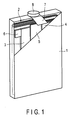
- FIG. 1 An example of a nonaqueous electrolyte battery of the first embodiment is shown in FIG. 1 .
- a flat or thin nonaqueous electrolyte battery shown in FIG. 1 contains a case 1 having a rectangular parallelepiped shape and made of an aluminium alloy, an electrode group 2 housed in the case 1, and a nonaqueous electrolyte (not shown) housed in the case 1 and held by the electrode group 2.
- the electrode group 2 has a flat structure in which a positive electrode 3 and a negative electrode 4 are spirally wound with a separator 5 interposed therebetween.
- the electrode group 2 is produced by, for example, spirally winding the positive electrode 3 and the negative electrode 4 with the separator 5 interposed therebetween such that the wound body has a flat shape, and thereinafter subjecting the wound body to a heat press.
- a rectangular positive electrode lead 6 is electrically connected to the positive electrode 3.
- a rectangular negative electrode lead 7 is electrically connected to the negative electrode 4.
- the positive electrode lead 6 is electrically connected to the case 1.
- the negative electrode lead 7 is electrically connected to a negative electrode terminal 8 insulated from the case 1.
- the nonaqueous electrolyte battery of the first embodiment contains the positive electrode containing at least one of the first oxide and the second metal phosphate, the negative electrode containing the titanium-containing oxide, and the nonaqueous electrolyte containing LiPF 6 and the first solvent, the nonaqueous electrolyte battery having high safety under a high temperature environment, excellent charge/discharge cycle performance even under a high temperature environment, high discharge rate performance, and a high capacity can be provided.
- the nonaqueous electrolyte battery of the first embodiment contains the positive electrode containing at least one of the first oxide and the second metal phosphate, the negative electrode containing the titanium-containing oxide, and the nonaqueous electrolyte containing LiPF 6 and the first solvent, the nonaqueous electrolyte battery having high safety under a high temperature environment, excellent charge/discharge cycle performance even under a high temperature environment, high discharge rate performance, and a high capacity can be provided.
- the first embodiment can use a positive electrode (hereinafter, referred to as a positive electrode B) containing at least one oxide selected from the group consisting of the first oxide having the spinel structure and represented by Li x Ni 0.5 Mn 1.5 SO 4 (0 ⁇ x ⁇ 1.1), the second metal phosphate having the olivine structure and represented by Li x Mn 1-w Fe w PO 4 (0 ⁇ x ⁇ 1.1, 0 ⁇ w ⁇ 0.5), and the third oxide having the layered structure and represented by Li x Ni y Mn z Co 1-y-z O 2 (0 ⁇ x ⁇ 1.1, 0.3 ⁇ y ⁇ 1, 0 ⁇ z ⁇ 0.5) in place of the above positive electrode (hereinafter, referred to as a positive electrode A).
- a positive electrode A a positive electrode
- the positive electrode containing the third oxide can realise a high capacity at a high voltage of 4 V or more, the capacity of the battery can be increased.
- the ranges of x, y, and z 0.2 ⁇ x ⁇ 1.0, 0.5 ⁇ y ⁇ 0.9, and 0.1 ⁇ z ⁇ 0.3 are more preferably set.
- the third oxide more preferably has a composition satisfying 0.5 ⁇ y ⁇ 1. Examples of the composition satisfying 0.5 ⁇ y ⁇ 1 include LiNi 0.6 Co 0.7 Mn 0.2 O 2 and LiNi 0.8 Co 0.1 Mn 0.1 O 2 .
- a nonaqueous electrolyte (hereinafter, referred to as a nonaqueous electrolyte B) which contains the nonaqueous solvent containing the first solvent containing the fluorinated phosphate ester, and the electrolyte dissolved in the nonaqueous solvent can be used in place of the above nonaqueous electrolyte (hereinafter, referred to as a nonaqueous electrolyte A). Since the nonaqueous electrolyte B has excellent oxidation resistance to the positive electrode containing the third oxide, the nonaqueous electrolyte B can suppress the oxidation decomposition of the nonaqueous electrolyte involving heat generation under a high temperature of 150°C or more. As a result, the nonaqueous electrolyte battery having high safety under a high temperature environment, excellent charge/discharge cycle performance even under a high temperature environment, high discharge rate performance, and a high capacity can be provided.
- fluorinated phosphate esters examples include trifluoromethyl phosphate, trifluoroethyl phosphate, trifluoropropyl phosphate, and trifluorobutyl phosphate. Preferable examples thereof include trifluoromethyl phosphate or trifluoroethyl phosphate.
- the content of the first solvent in the nonaqueous solvent is desirably set to be within a range of 30 to 90% by volume. Thereby, the battery having excellent thermal stability and cycle life performance can be provided.
- the content is more preferably within a range of 40% by volume or more and 80% by volume or less.
- the nonaqueous solvent desirably contains the above second solvent. Thereby, the ion conductivity of the nonaqueous electrolyte can be increased.
- the second solvent preferably contains propylene carbonate (PC), diethyl carbonate (DEC) or ethylisopropyl sulfone (EiPS).
- PC propylene carbonate
- DEC diethyl carbonate
- EiPS ethylisopropyl sulfone
- Examples of the electrolyte dissolved in the nonaqueous solvent include, but are not particularly limited to, lithium perchlorate (LiClO 4 ), lithium hexafluorophosphate (LiPF 6 ), lithium tetrafluoroborate (LiBF 9 ), hexafluoro arsenic lithium (LiAsF 6 ), lithium trifluoromethasulfonate (LiCF 3 SO 3 ), bistrifluoromethylsulfonylimide lithium[LiN(CF 3 SO 2 ) 2 ], LiN(C 2 F 5 SO 2 ) 2 , LiN (FSO 2 ) 2, Li (CF 3 SO 2 ) 3 C, and LiB [(OCO) 2 ] 2 .
- LiClO 4 lithium perchlorate
- LiPF 6 lithium hexafluorophosphate
- LiBF 9 lithium tetrafluoroborate
- LiAsF 6 lithium trifluoromethasulfonate
- the electrolyte preferably contains LiPF 6 .
- the nonaqueous solvent containing the first solvent containing the fluorinated phosphate esters has excellent solubility of LiPF 6 . For this reason, the conductivity of the nonaqueous electrolyte can be increased by use of the electrolyte containing LiPF 6 and the first solvent containing the fluorinated phosphate esters. As a result, the discharge rate performance of the battery can further be improved.
- the concentration of the electrolyte in the nonaqueous solvent is preferably set to be within a range 1 to 2.5 mol/L. Thereby, the high output can be obtained even under a low temperature environment.
- the nonaqueous electrolyte may contain a polymer material or a room temperature molten salt containing a noninflammable ionic liquid having no volatility.
- examples of the polymer material include the same materials as those described in the nonaqueous electrolyte A.
- the nonaqueous electrolyte battery of the first embodiment contains the positive electrode containing at least one oxide selected from the group consisting of the first oxide, the second metal phosphate, and the third oxide, the negative electrode containing the titanium-containing oxide, and the nonaqueous electrolyte containing the first solvent, the nonaqueous electrolyte battery having high safety under a high temperature environment, excellent charge/discharge cycle performance even under a high temperature environment, high discharge rate performance, and a high capacity can be provided.
- a second embodiment provides a battery pack containing the nonaqueous electrolyte battery of the first embodiment as a unit cell.
- the number of the unit cells used for the battery pack may be set to one or plural.
- the unit cells may be series-connected or connected in parallel.
- FIG. 2 and FIG. 3 show an example of a battery pack including a plurality of flat-type batteries.
- An battery module 23 is configured by stacking the unit cells 21 so that a negative electrode terminal 19 extended outside and a positive electrode terminal 18 extended outside are arranged in the same direction and fastening them with an adhesive tape 22.
- the unit cells 21 are electrically connected in series as shown in FIG. 3 .
- a printed wiring board 24 is arranged opposed to the side surface of the unit cells 21 where the negative electrode terminal 19 and the positive electrode terminal 18 are extended.
- a thermistor 25, a protective circuit 26, and an energizing terminal 27 to an external instrument are mounted on the printed wiring board 24 as shown in FIG. 3 .
- An electric insulating plate (not shown) is attached to the surface of the printed wiring board 24 facing the battery module 23 to avoid unnecessary connection of the wiring of the battery module 23.
- a positive electrode lead 28 is connected to the positive electrode terminal 18 located at the bottom layer of the battery module 23 and the distal end is inserted into a positive electrode connector 29 of the printed wiring board 24 so as to be electrically connected.
- An negative electrode lead 30 is connected to the negative electrode terminal 19 located at the top layer of the battery module 23 and the distal end is inserted into an negative electrode connector 31 of the printed wiring board 24 so as to be electrically connected.
- the connectors 29 and 31 are connected to the protective circuit 26 through wirings 32 and 33 formed in the printed wiring board 24.
- the thermistor 25 detects the temperature of the unit cells 21 and the detection signal is sent to the protective circuit 26.
- the protective circuit 26 can shut down a plus wiring 34a and a minus wiring 34b between the protective circuit 26 and the energizing terminals 27 to an external instrument under a predetermined condition.
- the predetermined condition indicates when the detection temperature of the thermistor 25 becomes more than a predetermined temperature.
- the predetermined condition indicates when the overcharge, overdischarge, and overcurrent of the unit cells 21 are detected.
- the overcharge detection may be performed on each of the unit cells 21 or the battery module 23. When each of the unit cells 21 is detected, the cell voltage may be detected, or positive electrode or negative electrode potential may be detected.
- a lithium electrode to be used as a reference electrode is inserted into each of the unit cells 21.
- wirings 35 for voltage detection are connected to the unit cells 21 and detection signals are sent to the protective circuit 26 through the wirings 35.
- Protective sheets 36 comprising rubber or resin are arranged on three side surfaces of the battery module 23 except the side surface in which the positive electrode terminal 18 and the negative electrode terminal 19 are protruded.
- the battery module 23 is housed in a housing container 37 together with each of the protective sheets 36 and the printed wiring board 24. That is, the protective sheets 36 are arranged on both internal surfaces in a long side direction of the housing container 37 and on one of the internal surface at the opposite side in a short side direction.
- the printed wiring board 24 is arranged on the other internal surface in a short side direction.
- the battery module 23 is located in a space surrounded by the protective sheets 36 and the printed wiring board 24.
- a lid 38 is attached to the upper surface of the housing container 37.
- a heat-shrinkable tape may be used in place of the adhesive tape 22.
- the battery module is bound by placing the protective sheets on the both sides of the battery module, revolving the heat-shrinkable tube, and thermally shrinking the heat-shrinkable tube.
- the form in which the unit cells 21 are connected in series is shown.
- the cells may be connected in parallel.
- the cells may be formed by combining series connection and parallel connection.
- the battery module packs can be connected in series or in parallel each other.
- the embodiments of the battery pack is appropriately changed according to the use.
- the battery pack is used suitably for the application which requires the excellent cycle performance at a high current. It is used specifically as a power source for digital cameras, for vehicles such as two- or four-wheel hybrid electric vehicles, for two- or four-wheel electric vehicles, and for assisted bicycles. Particularly, it is suitably used as a battery for automobile use.
- the battery pack of the second embodiment contains the nonaqueous electrolyte battery of the first embodiment, the battery pack having high safety under a high temperature environment, excellent charge/discharge cycle performance even under a high temperature environment, high discharge rate performance, and a high capacity can be attained.
- LiMn 0.85 Fe 0.15 PO 4 particles having an average particle diameter of 3 ⁇ m and a specific surface area of 0.8 m 2 /g measured by the BET method by N 2 adsorption, and having an olivine structure were used as a positive electrode active material.
- NMP n-methylpyrrolidone
- the slurry was applied on both surfaces of an aluminum alloy foil (purity: 99wt%) having a thickness of 15 ⁇ m, dried, and subjected to a press process, to produce a positive electrode having a positive electrode material layer obtained by applying the slurry of an amount of 12.8 mg/cm 2 on one surface and having a thickness of 43 ⁇ m on one surface, and an electrode density of 3.2 g/cm 3 .
- the specific surface area of the positive electrode material layer was 0.5 m 2 /g .
- Monoclinic TiO 2 (B) particles having an average particle diameter of secondary particle diameters of 5 ⁇ m, an average primary particle diameter of 0.3 ⁇ m, and a BET specific surface area of 20 m 2 /g were used as a negative electrode active material.
- Negative electrode active material particles, graphite powder having an average particle diameter of 5 ⁇ m and a BET specific surface area of 10 m 2 /g, and PVdF as a binder were formulated at a weight ratio of 90 : 6 : 4. These were dispersed in an n-methylpyrrolidone (NMP) solvent, and stirred under conditions of the number of rotations of 1000 rpm and a stirring time of 2 hours by use of a ball mill, to prepare a slurry.
- NMP n-methylpyrrolidone
- the obtained slurry was applied on an aluminum alloy foil (purity: 99.3wt%) having a thickness of 15 ⁇ m, dried, and subjected to a press process, to produce a negative electrode having a negative electrode material layer obtained by applying the slurry of an amount of 13 mg/cm 2 on one surface and having a thickness of 59 ⁇ m on one surface, and an electrode density of 2.2 g/cm 3 .
- the porosity of the negative electrode except for a current collector was 35%.
- the BET specific surface area (surface area per 1 g of the negative electrode material layer) of the negative electrode material layer was 10 m 2 /g.
- a nonwoven fabric separator having a thickness of 20 ⁇ m and made of cellulose was contacted with the positive electrode, to cover the positive electrode with the separator. Thereafter, the negative electrode was put thereon, and the negative electrode was opposed to the positive electrode with the separator interposed therebetween. These were spirally wound, to produce an electrode group. The electrode group was further pressed to form the electrode group into a flat shape.
- the electrode group was housed in a thin metal can (case) made of an aluminium alloy having a thickness of 0.3 mm (Al purity: 99wt%).
- LiPF 6 in an amount of 1.0 mol/L as an electrolyte was dissolved in a mixed solvent of trimethyl phosphate and propylene carbonate (PC) with volume ratio of 80 : 20 to prepare a liquid nonaqueous electrolyte (nonaqueous electrolytic solution).
- the nonaqueous electrolyte was poured into the electrode group in the case to produce a thin nonaqueous electrolyte battery having the structure shown in FIG. 1 and having a thickness of 4 mm, a width of 30 mm, and a height of 60 mm.
- Thin nonaqueous electrolyte batteries were produced in the same manner as in Example 1 except that a composition of a nonaqueous solvent, a kind and concentration of an electrolyte, a negative electrode active material, a specific surface area of the negative electrode active material, and a positive electrode active material were set as shown in Tables 1 and 2.
- Thin nonaqueous electrolyte batteries were produced in the same manner as in Example 1 except that a composition of a nonaqueous solvent, a kind and concentration of an electrolyte, a negative electrode active material, a specific surface area of the negative electrode active material, and a positive electrode active material were set as shown in Tables 1 and 2.
- the negative electrode active material particles were measured by use of a laser diffraction distribution measurement apparatus (Shimadzu SALD-300) by a method for first adding about 0.1 g of a sample, a surfactant, and 1 to 2 mL of purified water into a beaker; sufficiently stirring the mixture; pouring the mixture into an agitation bath; measuring the luminosity distribution 64 times at intervals of two seconds; and analyzing particle size distribution data.
- a laser diffraction distribution measurement apparatus Shiadzu SALD-300
- the BET specific surface areas, based on N 2 adsorption, of the positive electrode active material particles, the positive electrode material layer, the negative electrode active material particles, and the negative electrode material layer were measured under the following conditions.
- the amount of the sample for measurement was set to 1 g.
- the positive electrode and the negative electrode two small pieces of 2 x 2 cm 2 were cut out from each of the electrodes, which were used as the sample.
- a BET specific surface area measurement apparatus manufactured by Yuasa Ionics Co. was used, and nitrogen gas was used as an adsorption gas.
- the porosity of the negative electrode is calculated by comparing the volume of the negative electrode material layer with the volume of the negative electrode material layer when the porosity is 0%, and considering the increment of the volume from the volume of the negative electrode material layer when the porosity is 0% as a pore volume.
- the volume of the negative electrode material layer is a total of the volumes of both sides of the negative electrode material layer in the case where the negative electrode material layer is formed on both sides of the collector.
- the nonaqueous electrolyte battery was charged to 2.8 V at a constant current of 1 A at 25°C for 1 hour. Thereafter, a discharge capacity when the nonaqueous electrolyte battery was discharged at 0.6 A (equivalent to 1 C) to 1.5 V was measured. The nonaqueous electrolyte battery was charged to 2.8 V at a constant current of 1 A at 25°C for 1 hour. Thereafter, a discharge capacity when the nonaqueous electrolyte battery was discharged ata current value of 5 C to 1.5 V was measured.
- the discharge capacity at 0.6 A (equivalent to 1 C) was defined as 100%, and the discharge capacity obtained when being discharged at 5 C was represented, to obtain a 5 C discharge capacity maintenance rate.
- a high temperature cycle test was performed to repeat charge to 2.8 V at a constant current of 1 A at 45°C for 1 hour and discharge at a constant current of 0.6 A to 1.5 V.
- Cycle life in the cycle test at 45°C was the number of cycles at the capacity maintenance rate of 80% of an initial capacity.
- Discharge capacities, 5 C discharge capacity maintenance rates, and high temperature cycle lives in Examples 18 to 21 and Comparative Examples 1 and 6 were measured under the same conditions as those of the nonaqueous electrolyte batteries of the other Examples and Comparative Examples except that a final charge voltage was changed from 2.8 V to 3.3 V, and a final discharge voltage was changed from 1.5 V to 2.5 V.
- the nonaqueous electrolyte batteries of Comparative Examples 2 to 6 had the highest battery temperatures in the oven test, higher than those of the nonaqueous electrolyte batteries of Examples 1 to 20, and a thermal stability poorer than that of the nonaqueous electrolyte batteries of Examples 1 to 20.
- the nonaqueous electrolyte batteries of Comparative Examples 1 and 7 had the highest battery temperature of 150°C in the oven test, and had a discharge capacity, a capacity maintenance rate at a 5 C large current discharge, and cycle life poorer than those of Examples 1 to 20.
- Examples 1 to 20 can have the highest battery temperature of 150 to 155°C in the oven test, and attain the discharge capacity of 600 mAh or more, the 5 C discharge capacity maintenance rate of 50% or more, and the cycle life of 1500 or more.
- Thin nonaqueous electrolyte batteries were produced in the same manner as in Example 1 except that a composition of a nonaqueous solvent, a kind and concentration of an electrolyte, a negative electrode active material, a specific surface area of the negative electrode active material, and a positive electrode active material were set as shown in Table 5.
- a positive electrode was produced in the same manner as in Example 1 except that one obtained by mixing a third oxide (LiNi 0.8 Mn 0.1 Co 0.1 O 2 ) and a second metal phosphate (LiMn 0.85 Fe 0.1 PO 4 ) at a weight ratio of 1 : 1 was used as a positive electrode active material.
- a thin nonaqueous electrolyte battery was produced in the same manner as in Example 1 except that the obtained positive electrode was used.
- the nonaqueous electrolyte batteries of at least one embodiment and Examples described above contain the positive electrode containing at least one oxide selected from the group consisting of the first oxide having the spinel structure and represented by Li x Ni 0.5 Mn 1.5 O 4 (0 ⁇ x ⁇ 1.1), and the second metal phosphate having the olivine structure and represented by Li x Mn 1-w Fe w PO 4 (0 ⁇ x ⁇ 1.1 0 ⁇ w ⁇ 0.5), the negative electrode containing the titanium-containing oxide, and the nonaqueous electrolyte containing the first solvent and LiPF 6 , the nonaqueous electrolyte battery having excellent cycle performance, thermal stability, and discharge rate performance under a high temperature environment can be attained.
- the positive electrode containing at least one oxide selected from the group consisting of the first oxide having the spinel structure and represented by Li x Ni 0.5 Mn 1.5 O 4 (0 ⁇ x ⁇ 1.1), and the second metal phosphate having the olivine structure and represented by Li x Mn 1-w
- the nonaqueous electrolyte batteries of at least one embodiment and Examples described above contains the positive electrode containing at least one oxide selected from the group consisting of the first oxide having the spinel structure and represented by Li x Ni 0.5 Mn 1.5 O 4 (0 ⁇ x ⁇ 1.1), the second metal phosphate having the olivine structure and represented by Li x Mn 1-w Fe w PO 4 (0 ⁇ x ⁇ 1-1, 0 ⁇ w ⁇ 0.5), and the third oxide having the layered structure and represented by Li x Ni y Mn z Co 1-y-z O 2 (0 ⁇ x ⁇ 1.1, 0.3 ⁇ y ⁇ 1, 0 ⁇ z ⁇ 0.5), the negative electrode containing the titanium-containing oxide, and the nonaqueous electrolyte containing the first solvent, the nonaqueous electrolyte battery having excellent cycle performance, thermal stability, and discharge rate performance under a high temperature environment can be attained.
- the positive electrode containing at least one oxide selected from the group consisting of the
- the present inventions relate to the following items:
Landscapes
- Chemical & Material Sciences (AREA)
- Chemical Kinetics & Catalysis (AREA)
- Electrochemistry (AREA)
- General Chemical & Material Sciences (AREA)
- Inorganic Chemistry (AREA)
- Engineering & Computer Science (AREA)
- Manufacturing & Machinery (AREA)
- General Physics & Mathematics (AREA)
- Condensed Matter Physics & Semiconductors (AREA)
- Physics & Mathematics (AREA)
- Materials Engineering (AREA)
- Crystallography & Structural Chemistry (AREA)
- Secondary Cells (AREA)
- Battery Electrode And Active Subsutance (AREA)
Applications Claiming Priority (3)
| Application Number | Priority Date | Filing Date | Title |
|---|---|---|---|
| JP2013064893 | 2013-03-26 | ||
| JP2014025817A JP5813800B2 (ja) | 2013-03-26 | 2014-02-13 | 非水電解質電池および電池パック |
| EP14158371.6A EP2784854B1 (de) | 2013-03-26 | 2014-03-07 | Nichtwässrige Elektrolytbatterie und Batteriepack |
Related Parent Applications (2)
| Application Number | Title | Priority Date | Filing Date |
|---|---|---|---|
| EP14158371.6A Division EP2784854B1 (de) | 2013-03-26 | 2014-03-07 | Nichtwässrige Elektrolytbatterie und Batteriepack |
| EP14158371.6A Division-Into EP2784854B1 (de) | 2013-03-26 | 2014-03-07 | Nichtwässrige Elektrolytbatterie und Batteriepack |
Publications (2)
| Publication Number | Publication Date |
|---|---|
| EP3133679A1 true EP3133679A1 (de) | 2017-02-22 |
| EP3133679B1 EP3133679B1 (de) | 2018-05-02 |
Family
ID=50231066
Family Applications (2)
| Application Number | Title | Priority Date | Filing Date |
|---|---|---|---|
| EP16188048.9A Not-in-force EP3133679B1 (de) | 2013-03-26 | 2014-03-07 | Batterie mit nichtwässrigem elektrolyt und batteriepack |
| EP14158371.6A Not-in-force EP2784854B1 (de) | 2013-03-26 | 2014-03-07 | Nichtwässrige Elektrolytbatterie und Batteriepack |
Family Applications After (1)
| Application Number | Title | Priority Date | Filing Date |
|---|---|---|---|
| EP14158371.6A Not-in-force EP2784854B1 (de) | 2013-03-26 | 2014-03-07 | Nichtwässrige Elektrolytbatterie und Batteriepack |
Country Status (4)
| Country | Link |
|---|---|
| US (3) | US20140295289A1 (de) |
| EP (2) | EP3133679B1 (de) |
| JP (1) | JP5813800B2 (de) |
| CN (1) | CN104078699B (de) |
Families Citing this family (26)
| Publication number | Priority date | Publication date | Assignee | Title |
|---|---|---|---|---|
| JP5813800B2 (ja) | 2013-03-26 | 2015-11-17 | 株式会社東芝 | 非水電解質電池および電池パック |
| JP5863849B2 (ja) * | 2014-02-13 | 2016-02-17 | 株式会社東芝 | 非水電解質電池および電池パック |
| JP6193285B2 (ja) * | 2015-03-19 | 2017-09-06 | 株式会社東芝 | リチウムイオン二次電池用負極、リチウムイオン二次電池、電池パック及び車 |
| JP6500578B2 (ja) | 2015-04-27 | 2019-04-17 | 株式会社デンソー | 非水電解質二次電池用電極活物質及びその製造方法、並びに非水電解質二次電池 |
| JP6549420B2 (ja) * | 2015-06-04 | 2019-07-24 | 東ソー・ファインケム株式会社 | 非水電解液およびそれを用いた非水系二次電池 |
| WO2016209014A1 (ko) * | 2015-06-26 | 2016-12-29 | 주식회사 엘지화학 | 리튬 이차전지의 제조방법 및 이를 사용하여 제조되는 리튬 이차전지 |
| JP6538500B2 (ja) * | 2015-09-16 | 2019-07-03 | 株式会社東芝 | 非水電解質電池、電池パック、及び車 |
| KR102533156B1 (ko) * | 2015-10-30 | 2023-05-17 | 삼성에스디아이 주식회사 | 리튬전지 |
| CN108352562B (zh) * | 2015-11-30 | 2021-03-16 | 松下知识产权经营株式会社 | 非水电解质二次电池 |
| JP6384467B2 (ja) * | 2015-12-18 | 2018-09-05 | トヨタ自動車株式会社 | リチウム固体電池 |
| JP2017168265A (ja) * | 2016-03-15 | 2017-09-21 | 株式会社東芝 | 非水電解質電池、電池パック及び車両 |
| JP6696689B2 (ja) * | 2016-03-16 | 2020-05-20 | 株式会社東芝 | 活物質、電極、非水電解質電池、電池パック、及び車両 |
| JP6629110B2 (ja) * | 2016-03-16 | 2020-01-15 | 株式会社東芝 | 非水電解質電池、電池パックおよび車両 |
| US11522191B2 (en) | 2016-03-16 | 2022-12-06 | Kabushiki Kaisha Toshiba | Nonaqueous electrolyte battery, battery pack and vehicle |
| JP6736436B2 (ja) * | 2016-09-16 | 2020-08-05 | 株式会社東芝 | 二次電池、電池パック及び車両 |
| JP6659504B2 (ja) * | 2016-09-20 | 2020-03-04 | 株式会社東芝 | 固体電解質、リチウム電池、電池パック、及び車両 |
| JP6932723B2 (ja) * | 2016-12-28 | 2021-09-08 | パナソニック株式会社 | 非水電解質二次電池 |
| CN108630894A (zh) * | 2017-03-23 | 2018-10-09 | 株式会社东芝 | 二次电池、电池包及车辆 |
| JP7281689B2 (ja) * | 2018-09-05 | 2023-05-26 | パナソニックIpマネジメント株式会社 | 正極活物質およびそれを備えた電池 |
| CN110970660A (zh) * | 2018-09-28 | 2020-04-07 | 宁德时代新能源科技股份有限公司 | 非水电解液及锂离子电池 |
| CN110970663A (zh) * | 2018-09-28 | 2020-04-07 | 宁德时代新能源科技股份有限公司 | 非水电解液及锂离子电池 |
| US11522177B2 (en) * | 2018-12-14 | 2022-12-06 | Cuberg, Inc. | System for an ionic liquid-based electrolyte for high energy battery |
| US11121408B2 (en) | 2019-03-14 | 2021-09-14 | Medtronic, Inc. | Lithium-ion battery |
| WO2020202307A1 (ja) * | 2019-03-29 | 2020-10-08 | 日立化成株式会社 | リチウムイオン二次電池 |
| CN110098403A (zh) * | 2019-06-11 | 2019-08-06 | 邓丽萍 | 一种三元材料电极浆料的制备方法 |
| CN113161612B (zh) * | 2021-03-31 | 2022-07-22 | 松山湖材料实验室 | 锂离子电池用非水电解液及包含其的锂离子电池 |
Citations (5)
| Publication number | Priority date | Publication date | Assignee | Title |
|---|---|---|---|---|
| EP1530248A2 (de) * | 2003-11-07 | 2005-05-11 | Matsushita Electric Industrial Co., Ltd. | Sekundärbatterie mit nichtwässrigem Elektrolyt |
| US20070224515A1 (en) * | 2006-03-22 | 2007-09-27 | Ferro Corporation | Stabilized nonaqueous electrolytes for rechargeable batteries |
| US20110236752A1 (en) * | 2010-03-26 | 2011-09-29 | Semiconductor Energy Laboratory Co., Ltd. | Power storage device |
| US20120094190A1 (en) * | 2009-08-04 | 2012-04-19 | Tosoh F-Tech, Inc. | Asymmetric and/or low-symmetric fluorine-containing phosphate for non-aqueous electrolyte solution |
| WO2013180781A1 (en) * | 2012-06-01 | 2013-12-05 | E. I. Du Pont De Nemours And Company | Lithium- ion battery |
Family Cites Families (25)
| Publication number | Priority date | Publication date | Assignee | Title |
|---|---|---|---|---|
| JP4296580B2 (ja) * | 2000-01-11 | 2009-07-15 | 株式会社ジーエス・ユアサコーポレーション | 非水電解質リチウム二次電池 |
| JP4197237B2 (ja) | 2002-03-01 | 2008-12-17 | パナソニック株式会社 | 正極活物質の製造方法 |
| US20050164082A1 (en) * | 2004-01-27 | 2005-07-28 | Takashi Kishi | Nonaqueous electrolyte battery |
| JP2006221972A (ja) * | 2005-02-10 | 2006-08-24 | Sony Corp | 電解液および電池 |
| JP4439456B2 (ja) | 2005-03-24 | 2010-03-24 | 株式会社東芝 | 電池パック及び自動車 |
| JP4968578B2 (ja) * | 2006-04-12 | 2012-07-04 | パナソニック株式会社 | 正極活物質、その製造方法および非水電解質二次電池 |
| JP5168989B2 (ja) | 2006-04-12 | 2013-03-27 | 東レ株式会社 | リチウムイオン二次電池 |
| JP2008027766A (ja) | 2006-07-21 | 2008-02-07 | Hitachi Maxell Ltd | リチウム電池 |
| JP5217281B2 (ja) | 2006-08-01 | 2013-06-19 | 株式会社Gsユアサ | 非水電解質二次電池 |
| JP5093643B2 (ja) | 2006-11-02 | 2012-12-12 | 独立行政法人産業技術総合研究所 | リチウム二次電池活物質及びその製造方法、並びにそれを用いたリチウム二次電池 |
| JP5531301B2 (ja) | 2009-05-28 | 2014-06-25 | 株式会社東芝 | 非水電解質電池用活物質、非水電解質電池および電池パック |
| JP5263683B2 (ja) | 2009-08-19 | 2013-08-14 | 株式会社Gsユアサ | 非水電解質二次電池 |
| CA2810191C (en) * | 2010-07-30 | 2018-06-12 | Board Of Regents, The University Of Texas System | Niobium oxide compositions and methods for using same |
| JP5321847B2 (ja) | 2010-09-27 | 2013-10-23 | 株式会社東芝 | 活物質及びその製造方法、非水電解質電池及び電池パック |
| JP6138490B2 (ja) | 2010-12-07 | 2017-05-31 | 日本電気株式会社 | リチウム二次電池 |
| JP2012160345A (ja) | 2011-01-31 | 2012-08-23 | Toshiba Corp | 非水電解質二次電池 |
| JP5221692B2 (ja) * | 2011-03-02 | 2013-06-26 | 株式会社東芝 | 非水電解質電池及び電池パック |
| JP5649492B2 (ja) * | 2011-03-22 | 2015-01-07 | 株式会社東芝 | 電池用活物質、非水電解質電池及び電池パック |
| JP5772197B2 (ja) | 2011-05-09 | 2015-09-02 | ソニー株式会社 | リチウムイオン二次電池用活物質、リチウムイオン二次電池用電極、リチウムイオン二次電池、電子機器、電動工具、電動車両および電力貯蔵システム |
| KR101863094B1 (ko) * | 2011-09-16 | 2018-07-05 | 삼성에스디아이 주식회사 | 복합양극활물질, 및 이를 채용한 양극과 리튬전지 |
| JP2013152825A (ja) * | 2012-01-24 | 2013-08-08 | Sony Corp | 電池ならびに電池パック、電子機器、電動車両、蓄電装置および電力システム |
| JP6079770B2 (ja) * | 2012-03-02 | 2017-02-15 | 日本電気株式会社 | リチウム二次電池 |
| CN102891304B (zh) * | 2012-09-24 | 2016-01-13 | 合肥国轩高科动力能源有限公司 | 钛酸锂及使用该钛酸锂负极活性物质的锂离子电池 |
| JP5813800B2 (ja) | 2013-03-26 | 2015-11-17 | 株式会社東芝 | 非水電解質電池および電池パック |
| CN103296311A (zh) * | 2013-04-25 | 2013-09-11 | 合肥工业大学 | 一种高安全性磷酸酯基电解液及锂离子电池 |
-
2014
- 2014-02-13 JP JP2014025817A patent/JP5813800B2/ja not_active Expired - Fee Related
- 2014-03-07 EP EP16188048.9A patent/EP3133679B1/de not_active Not-in-force
- 2014-03-07 EP EP14158371.6A patent/EP2784854B1/de not_active Not-in-force
- 2014-03-07 US US14/200,534 patent/US20140295289A1/en not_active Abandoned
- 2014-03-13 CN CN201410091561.7A patent/CN104078699B/zh not_active Expired - Fee Related
-
2018
- 2018-02-20 US US15/899,524 patent/US10700350B2/en not_active Expired - Fee Related
- 2018-02-20 US US15/899,550 patent/US10700351B2/en not_active Expired - Fee Related
Patent Citations (5)
| Publication number | Priority date | Publication date | Assignee | Title |
|---|---|---|---|---|
| EP1530248A2 (de) * | 2003-11-07 | 2005-05-11 | Matsushita Electric Industrial Co., Ltd. | Sekundärbatterie mit nichtwässrigem Elektrolyt |
| US20070224515A1 (en) * | 2006-03-22 | 2007-09-27 | Ferro Corporation | Stabilized nonaqueous electrolytes for rechargeable batteries |
| US20120094190A1 (en) * | 2009-08-04 | 2012-04-19 | Tosoh F-Tech, Inc. | Asymmetric and/or low-symmetric fluorine-containing phosphate for non-aqueous electrolyte solution |
| US20110236752A1 (en) * | 2010-03-26 | 2011-09-29 | Semiconductor Energy Laboratory Co., Ltd. | Power storage device |
| WO2013180781A1 (en) * | 2012-06-01 | 2013-12-05 | E. I. Du Pont De Nemours And Company | Lithium- ion battery |
Also Published As
| Publication number | Publication date |
|---|---|
| EP3133679B1 (de) | 2018-05-02 |
| US20180183056A1 (en) | 2018-06-28 |
| JP2014209436A (ja) | 2014-11-06 |
| CN104078699A (zh) | 2014-10-01 |
| US10700350B2 (en) | 2020-06-30 |
| EP2784854A1 (de) | 2014-10-01 |
| JP5813800B2 (ja) | 2015-11-17 |
| CN104078699B (zh) | 2016-10-26 |
| US10700351B2 (en) | 2020-06-30 |
| EP2784854B1 (de) | 2016-10-19 |
| US20140295289A1 (en) | 2014-10-02 |
| US20180183057A1 (en) | 2018-06-28 |
Similar Documents
| Publication | Publication Date | Title |
|---|---|---|
| US10700351B2 (en) | Nonaqueous electrolyte battery and battery pack | |
| EP2784855B1 (de) | Aktivmaterial mit positiver Elektrode, nichtwässrige Elektrolytbatterie und Batteriepack | |
| JP6797619B2 (ja) | 非水電解質電池、電池パック及び車両 | |
| EP3145018A1 (de) | Sekundärbatterie, verbundelektrolyt, batteriepack und fahrzeug | |
| CN105322153B (zh) | 非水电解质电池、电池模块、以及电池组 | |
| US10411250B2 (en) | Nonaqueous electrolyte battery, battery pack, and vehicle | |
| WO2015040747A1 (ja) | 非水電解質電池用電極、非水電解質電池及び電池パック | |
| EP2827413A1 (de) | Sekundärbatterie mit nichtwässrigem elektrolyt und batteriepack damit | |
| EP3522284B1 (de) | Batterie mit wasserfreiem elektrolyt und batteriepack | |
| JP5863849B2 (ja) | 非水電解質電池および電池パック | |
| CN109952679B (zh) | 非水电解质电池及电池包 | |
| JP6054540B2 (ja) | 正極活物質、非水電解質電池及び電池パック | |
| JP6147797B2 (ja) | 非水電解質電池および電池パック | |
| WO2015040679A1 (ja) | 非水電解質電池及び電池パック | |
| EP4668422A1 (de) | Batteriezelle, batterie und elektrische vorrichtung | |
| EP4668403A1 (de) | Zylindrische batteriezelle, batterie und elektrische vorrichtung | |
| JP2018110127A (ja) | 組電池、電池パック及び車 |
Legal Events
| Date | Code | Title | Description |
|---|---|---|---|
| PUAI | Public reference made under article 153(3) epc to a published international application that has entered the european phase |
Free format text: ORIGINAL CODE: 0009012 |
|
| STAA | Information on the status of an ep patent application or granted ep patent |
Free format text: STATUS: REQUEST FOR EXAMINATION WAS MADE |
|
| 17P | Request for examination filed |
Effective date: 20160909 |
|
| AC | Divisional application: reference to earlier application |
Ref document number: 2784854 Country of ref document: EP Kind code of ref document: P |
|
| AK | Designated contracting states |
Kind code of ref document: A1 Designated state(s): AL AT BE BG CH CY CZ DE DK EE ES FI FR GB GR HR HU IE IS IT LI LT LU LV MC MK MT NL NO PL PT RO RS SE SI SK SM TR |
|
| GRAP | Despatch of communication of intention to grant a patent |
Free format text: ORIGINAL CODE: EPIDOSNIGR1 |
|
| STAA | Information on the status of an ep patent application or granted ep patent |
Free format text: STATUS: GRANT OF PATENT IS INTENDED |
|
| RIC1 | Information provided on ipc code assigned before grant |
Ipc: H01M 10/0568 20100101ALN20171114BHEP Ipc: H01M 10/0569 20100101ALI20171114BHEP Ipc: H01M 4/485 20100101AFI20171114BHEP Ipc: H01M 4/58 20100101ALI20171114BHEP Ipc: H01M 10/0525 20100101ALI20171114BHEP Ipc: H01M 4/505 20100101ALI20171114BHEP Ipc: H01M 4/525 20100101ALI20171114BHEP |
|
| INTG | Intention to grant announced |
Effective date: 20171211 |
|
| GRAS | Grant fee paid |
Free format text: ORIGINAL CODE: EPIDOSNIGR3 |
|
| RAP1 | Party data changed (applicant data changed or rights of an application transferred) |
Owner name: KABUSHIKI KAISHA TOSHIBA |
|
| GRAA | (expected) grant |
Free format text: ORIGINAL CODE: 0009210 |
|
| STAA | Information on the status of an ep patent application or granted ep patent |
Free format text: STATUS: THE PATENT HAS BEEN GRANTED |
|
| AC | Divisional application: reference to earlier application |
Ref document number: 2784854 Country of ref document: EP Kind code of ref document: P |
|
| AK | Designated contracting states |
Kind code of ref document: B1 Designated state(s): AL AT BE BG CH CY CZ DE DK EE ES FI FR GB GR HR HU IE IS IT LI LT LU LV MC MK MT NL NO PL PT RO RS SE SI SK SM TR |
|
| REG | Reference to a national code |
Ref country code: GB Ref legal event code: FG4D |
|
| REG | Reference to a national code |
Ref country code: CH Ref legal event code: EP Ref country code: AT Ref legal event code: REF Ref document number: 996191 Country of ref document: AT Kind code of ref document: T Effective date: 20180515 |
|
| REG | Reference to a national code |
Ref country code: DE Ref legal event code: R096 Ref document number: 602014025089 Country of ref document: DE Ref country code: IE Ref legal event code: FG4D |
|
| REG | Reference to a national code |
Ref country code: NL Ref legal event code: MP Effective date: 20180502 |
|
| REG | Reference to a national code |
Ref country code: LT Ref legal event code: MG4D |
|
| PG25 | Lapsed in a contracting state [announced via postgrant information from national office to epo] |
Ref country code: ES Free format text: LAPSE BECAUSE OF FAILURE TO SUBMIT A TRANSLATION OF THE DESCRIPTION OR TO PAY THE FEE WITHIN THE PRESCRIBED TIME-LIMIT Effective date: 20180502 Ref country code: SE Free format text: LAPSE BECAUSE OF FAILURE TO SUBMIT A TRANSLATION OF THE DESCRIPTION OR TO PAY THE FEE WITHIN THE PRESCRIBED TIME-LIMIT Effective date: 20180502 Ref country code: BG Free format text: LAPSE BECAUSE OF FAILURE TO SUBMIT A TRANSLATION OF THE DESCRIPTION OR TO PAY THE FEE WITHIN THE PRESCRIBED TIME-LIMIT Effective date: 20180802 Ref country code: FI Free format text: LAPSE BECAUSE OF FAILURE TO SUBMIT A TRANSLATION OF THE DESCRIPTION OR TO PAY THE FEE WITHIN THE PRESCRIBED TIME-LIMIT Effective date: 20180502 Ref country code: NO Free format text: LAPSE BECAUSE OF FAILURE TO SUBMIT A TRANSLATION OF THE DESCRIPTION OR TO PAY THE FEE WITHIN THE PRESCRIBED TIME-LIMIT Effective date: 20180802 Ref country code: LT Free format text: LAPSE BECAUSE OF FAILURE TO SUBMIT A TRANSLATION OF THE DESCRIPTION OR TO PAY THE FEE WITHIN THE PRESCRIBED TIME-LIMIT Effective date: 20180502 |
|
| PG25 | Lapsed in a contracting state [announced via postgrant information from national office to epo] |
Ref country code: GR Free format text: LAPSE BECAUSE OF FAILURE TO SUBMIT A TRANSLATION OF THE DESCRIPTION OR TO PAY THE FEE WITHIN THE PRESCRIBED TIME-LIMIT Effective date: 20180803 Ref country code: NL Free format text: LAPSE BECAUSE OF FAILURE TO SUBMIT A TRANSLATION OF THE DESCRIPTION OR TO PAY THE FEE WITHIN THE PRESCRIBED TIME-LIMIT Effective date: 20180502 Ref country code: LV Free format text: LAPSE BECAUSE OF FAILURE TO SUBMIT A TRANSLATION OF THE DESCRIPTION OR TO PAY THE FEE WITHIN THE PRESCRIBED TIME-LIMIT Effective date: 20180502 Ref country code: HR Free format text: LAPSE BECAUSE OF FAILURE TO SUBMIT A TRANSLATION OF THE DESCRIPTION OR TO PAY THE FEE WITHIN THE PRESCRIBED TIME-LIMIT Effective date: 20180502 Ref country code: RS Free format text: LAPSE BECAUSE OF FAILURE TO SUBMIT A TRANSLATION OF THE DESCRIPTION OR TO PAY THE FEE WITHIN THE PRESCRIBED TIME-LIMIT Effective date: 20180502 |
|
| REG | Reference to a national code |
Ref country code: AT Ref legal event code: MK05 Ref document number: 996191 Country of ref document: AT Kind code of ref document: T Effective date: 20180502 |
|
| PG25 | Lapsed in a contracting state [announced via postgrant information from national office to epo] |
Ref country code: CZ Free format text: LAPSE BECAUSE OF FAILURE TO SUBMIT A TRANSLATION OF THE DESCRIPTION OR TO PAY THE FEE WITHIN THE PRESCRIBED TIME-LIMIT Effective date: 20180502 Ref country code: RO Free format text: LAPSE BECAUSE OF FAILURE TO SUBMIT A TRANSLATION OF THE DESCRIPTION OR TO PAY THE FEE WITHIN THE PRESCRIBED TIME-LIMIT Effective date: 20180502 Ref country code: AT Free format text: LAPSE BECAUSE OF FAILURE TO SUBMIT A TRANSLATION OF THE DESCRIPTION OR TO PAY THE FEE WITHIN THE PRESCRIBED TIME-LIMIT Effective date: 20180502 Ref country code: EE Free format text: LAPSE BECAUSE OF FAILURE TO SUBMIT A TRANSLATION OF THE DESCRIPTION OR TO PAY THE FEE WITHIN THE PRESCRIBED TIME-LIMIT Effective date: 20180502 Ref country code: PL Free format text: LAPSE BECAUSE OF FAILURE TO SUBMIT A TRANSLATION OF THE DESCRIPTION OR TO PAY THE FEE WITHIN THE PRESCRIBED TIME-LIMIT Effective date: 20180502 Ref country code: DK Free format text: LAPSE BECAUSE OF FAILURE TO SUBMIT A TRANSLATION OF THE DESCRIPTION OR TO PAY THE FEE WITHIN THE PRESCRIBED TIME-LIMIT Effective date: 20180502 Ref country code: SK Free format text: LAPSE BECAUSE OF FAILURE TO SUBMIT A TRANSLATION OF THE DESCRIPTION OR TO PAY THE FEE WITHIN THE PRESCRIBED TIME-LIMIT Effective date: 20180502 |
|
| REG | Reference to a national code |
Ref country code: DE Ref legal event code: R097 Ref document number: 602014025089 Country of ref document: DE |
|
| PG25 | Lapsed in a contracting state [announced via postgrant information from national office to epo] |
Ref country code: SM Free format text: LAPSE BECAUSE OF FAILURE TO SUBMIT A TRANSLATION OF THE DESCRIPTION OR TO PAY THE FEE WITHIN THE PRESCRIBED TIME-LIMIT Effective date: 20180502 |
|
| PLBE | No opposition filed within time limit |
Free format text: ORIGINAL CODE: 0009261 |
|
| STAA | Information on the status of an ep patent application or granted ep patent |
Free format text: STATUS: NO OPPOSITION FILED WITHIN TIME LIMIT |
|
| 26N | No opposition filed |
Effective date: 20190205 |
|
| PG25 | Lapsed in a contracting state [announced via postgrant information from national office to epo] |
Ref country code: SI Free format text: LAPSE BECAUSE OF FAILURE TO SUBMIT A TRANSLATION OF THE DESCRIPTION OR TO PAY THE FEE WITHIN THE PRESCRIBED TIME-LIMIT Effective date: 20180502 |
|
| PG25 | Lapsed in a contracting state [announced via postgrant information from national office to epo] |
Ref country code: MC Free format text: LAPSE BECAUSE OF FAILURE TO SUBMIT A TRANSLATION OF THE DESCRIPTION OR TO PAY THE FEE WITHIN THE PRESCRIBED TIME-LIMIT Effective date: 20180502 |
|
| REG | Reference to a national code |
Ref country code: CH Ref legal event code: PL |
|
| GBPC | Gb: european patent ceased through non-payment of renewal fee |
Effective date: 20190307 |
|
| PG25 | Lapsed in a contracting state [announced via postgrant information from national office to epo] |
Ref country code: LU Free format text: LAPSE BECAUSE OF NON-PAYMENT OF DUE FEES Effective date: 20190307 Ref country code: AL Free format text: LAPSE BECAUSE OF FAILURE TO SUBMIT A TRANSLATION OF THE DESCRIPTION OR TO PAY THE FEE WITHIN THE PRESCRIBED TIME-LIMIT Effective date: 20180502 |
|
| REG | Reference to a national code |
Ref country code: BE Ref legal event code: MM Effective date: 20190331 |
|
| PG25 | Lapsed in a contracting state [announced via postgrant information from national office to epo] |
Ref country code: LI Free format text: LAPSE BECAUSE OF NON-PAYMENT OF DUE FEES Effective date: 20190331 Ref country code: GB Free format text: LAPSE BECAUSE OF NON-PAYMENT OF DUE FEES Effective date: 20190307 Ref country code: IE Free format text: LAPSE BECAUSE OF NON-PAYMENT OF DUE FEES Effective date: 20190307 Ref country code: CH Free format text: LAPSE BECAUSE OF NON-PAYMENT OF DUE FEES Effective date: 20190331 |
|
| PG25 | Lapsed in a contracting state [announced via postgrant information from national office to epo] |
Ref country code: BE Free format text: LAPSE BECAUSE OF NON-PAYMENT OF DUE FEES Effective date: 20190331 |
|
| PG25 | Lapsed in a contracting state [announced via postgrant information from national office to epo] |
Ref country code: TR Free format text: LAPSE BECAUSE OF FAILURE TO SUBMIT A TRANSLATION OF THE DESCRIPTION OR TO PAY THE FEE WITHIN THE PRESCRIBED TIME-LIMIT Effective date: 20180502 |
|
| PG25 | Lapsed in a contracting state [announced via postgrant information from national office to epo] |
Ref country code: PT Free format text: LAPSE BECAUSE OF FAILURE TO SUBMIT A TRANSLATION OF THE DESCRIPTION OR TO PAY THE FEE WITHIN THE PRESCRIBED TIME-LIMIT Effective date: 20180903 Ref country code: MT Free format text: LAPSE BECAUSE OF NON-PAYMENT OF DUE FEES Effective date: 20190307 |
|
| PG25 | Lapsed in a contracting state [announced via postgrant information from national office to epo] |
Ref country code: CY Free format text: LAPSE BECAUSE OF FAILURE TO SUBMIT A TRANSLATION OF THE DESCRIPTION OR TO PAY THE FEE WITHIN THE PRESCRIBED TIME-LIMIT Effective date: 20180502 |
|
| PG25 | Lapsed in a contracting state [announced via postgrant information from national office to epo] |
Ref country code: IS Free format text: LAPSE BECAUSE OF FAILURE TO SUBMIT A TRANSLATION OF THE DESCRIPTION OR TO PAY THE FEE WITHIN THE PRESCRIBED TIME-LIMIT Effective date: 20180902 |
|
| PG25 | Lapsed in a contracting state [announced via postgrant information from national office to epo] |
Ref country code: HU Free format text: LAPSE BECAUSE OF FAILURE TO SUBMIT A TRANSLATION OF THE DESCRIPTION OR TO PAY THE FEE WITHIN THE PRESCRIBED TIME-LIMIT; INVALID AB INITIO Effective date: 20140307 |
|
| PG25 | Lapsed in a contracting state [announced via postgrant information from national office to epo] |
Ref country code: MK Free format text: LAPSE BECAUSE OF FAILURE TO SUBMIT A TRANSLATION OF THE DESCRIPTION OR TO PAY THE FEE WITHIN THE PRESCRIBED TIME-LIMIT Effective date: 20180502 |
|
| PGFP | Annual fee paid to national office [announced via postgrant information from national office to epo] |
Ref country code: FR Payment date: 20230110 Year of fee payment: 10 |
|
| PGFP | Annual fee paid to national office [announced via postgrant information from national office to epo] |
Ref country code: IT Payment date: 20230213 Year of fee payment: 10 Ref country code: DE Payment date: 20230110 Year of fee payment: 10 |
|
| REG | Reference to a national code |
Ref country code: DE Ref legal event code: R119 Ref document number: 602014025089 Country of ref document: DE |
|
| PG25 | Lapsed in a contracting state [announced via postgrant information from national office to epo] |
Ref country code: DE Free format text: LAPSE BECAUSE OF NON-PAYMENT OF DUE FEES Effective date: 20241001 |
|
| PG25 | Lapsed in a contracting state [announced via postgrant information from national office to epo] |
Ref country code: FR Free format text: LAPSE BECAUSE OF NON-PAYMENT OF DUE FEES Effective date: 20240331 |
|
| PG25 | Lapsed in a contracting state [announced via postgrant information from national office to epo] |
Ref country code: FR Free format text: LAPSE BECAUSE OF NON-PAYMENT OF DUE FEES Effective date: 20240331 Ref country code: DE Free format text: LAPSE BECAUSE OF NON-PAYMENT OF DUE FEES Effective date: 20241001 |
|
| PG25 | Lapsed in a contracting state [announced via postgrant information from national office to epo] |
Ref country code: IT Free format text: LAPSE BECAUSE OF NON-PAYMENT OF DUE FEES Effective date: 20240307 |