EP3134443B1 - Led-fotoinitiatoren - Google Patents
Led-fotoinitiatoren Download PDFInfo
- Publication number
- EP3134443B1 EP3134443B1 EP15782816.1A EP15782816A EP3134443B1 EP 3134443 B1 EP3134443 B1 EP 3134443B1 EP 15782816 A EP15782816 A EP 15782816A EP 3134443 B1 EP3134443 B1 EP 3134443B1
- Authority
- EP
- European Patent Office
- Prior art keywords
- alkyl
- independently selected
- alkoxy
- group
- formula
- Prior art date
- Legal status (The legal status is an assumption and is not a legal conclusion. Google has not performed a legal analysis and makes no representation as to the accuracy of the status listed.)
- Active
Links
- 0 *C(*)(*)OC(c(cccc1)c1C(c1ccccc1)=O)=O Chemical compound *C(*)(*)OC(c(cccc1)c1C(c1ccccc1)=O)=O 0.000 description 4
- WUPGEKMUTJVIIV-UHFFFAOYSA-N CCCCOCC(COC(c(cc(cc1)N(C)C)c1C(c(cc1)ccc1N(C)C)=O)=O)OC(NCCCCCCNC(OC(COCCCC)COC(c(cc(cc1)N(C)C)c1C(c(cc1)ccc1N(C)C)=O)=O)=O)=O Chemical compound CCCCOCC(COC(c(cc(cc1)N(C)C)c1C(c(cc1)ccc1N(C)C)=O)=O)OC(NCCCCCCNC(OC(COCCCC)COC(c(cc(cc1)N(C)C)c1C(c(cc1)ccc1N(C)C)=O)=O)=O)=O WUPGEKMUTJVIIV-UHFFFAOYSA-N 0.000 description 2
- DKNXPGCQZGIZOH-WMZJFQQLSA-N CC(C(c1ccccc1)O1)=C(/C=C\C=C)C1=O Chemical compound CC(C(c1ccccc1)O1)=C(/C=C\C=C)C1=O DKNXPGCQZGIZOH-WMZJFQQLSA-N 0.000 description 1
- SPALNSIPWLCDEV-UHFFFAOYSA-N CC1C=CC=CC1C(c(cccc1)c1C(OC)=O)=O Chemical compound CC1C=CC=CC1C(c(cccc1)c1C(OC)=O)=O SPALNSIPWLCDEV-UHFFFAOYSA-N 0.000 description 1
- XHHRPVRCUKRZDS-UHFFFAOYSA-N CCN(CC)c(cc1)ccc1C(c(c(C(OCC(COc1ccccc1)O)=O)c1)ccc1N(C)C)=O Chemical compound CCN(CC)c(cc1)ccc1C(c(c(C(OCC(COc1ccccc1)O)=O)c1)ccc1N(C)C)=O XHHRPVRCUKRZDS-UHFFFAOYSA-N 0.000 description 1
- HUIPJRGCKJRZFY-UHFFFAOYSA-N CN(C)C(CC1)=CC=C1C(c(ccc(N(C)C)c1)c1C(/[O]=C/C(COCCCCOCC(COC(c1cc(N(C)C)ccc1C(c(cc1)ccc1N(C)C)=O)=O)O)O)=O)=O Chemical compound CN(C)C(CC1)=CC=C1C(c(ccc(N(C)C)c1)c1C(/[O]=C/C(COCCCCOCC(COC(c1cc(N(C)C)ccc1C(c(cc1)ccc1N(C)C)=O)=O)O)O)=O)=O HUIPJRGCKJRZFY-UHFFFAOYSA-N 0.000 description 1
- JJCFABAQVHRXAW-UHFFFAOYSA-N CN(C)c(cc1)ccc1C(c(ccc(N(C)C)c1)c1C(O)=O)=O Chemical compound CN(C)c(cc1)ccc1C(c(ccc(N(C)C)c1)c1C(O)=O)=O JJCFABAQVHRXAW-UHFFFAOYSA-N 0.000 description 1
- DDXDSMCZAZYQNL-UHFFFAOYSA-N CN(C)c(cc1)ccc1C(c(ccc(N(C)C)c1)c1C(OCCOCCOC(c1cc(N(C)C)ccc1C(c(cc1)ccc1N(C)C)=O)=O)=O)=O Chemical compound CN(C)c(cc1)ccc1C(c(ccc(N(C)C)c1)c1C(OCCOCCOC(c1cc(N(C)C)ccc1C(c(cc1)ccc1N(C)C)=O)=O)=O)=O DDXDSMCZAZYQNL-UHFFFAOYSA-N 0.000 description 1
- HUMNYLRZRPPJDN-UHFFFAOYSA-N O=Cc1ccccc1 Chemical compound O=Cc1ccccc1 HUMNYLRZRPPJDN-UHFFFAOYSA-N 0.000 description 1
Images

Classifications
-
- C—CHEMISTRY; METALLURGY
- C07—ORGANIC CHEMISTRY
- C07C—ACYCLIC OR CARBOCYCLIC COMPOUNDS
- C07C229/00—Compounds containing amino and carboxyl groups bound to the same carbon skeleton
- C07C229/52—Compounds containing amino and carboxyl groups bound to the same carbon skeleton having amino and carboxyl groups bound to carbon atoms of six-membered aromatic rings of the same carbon skeleton
- C07C229/54—Compounds containing amino and carboxyl groups bound to the same carbon skeleton having amino and carboxyl groups bound to carbon atoms of six-membered aromatic rings of the same carbon skeleton with amino and carboxyl groups bound to carbon atoms of the same non-condensed six-membered aromatic ring
- C07C229/66—Compounds containing amino and carboxyl groups bound to the same carbon skeleton having amino and carboxyl groups bound to carbon atoms of six-membered aromatic rings of the same carbon skeleton with amino and carboxyl groups bound to carbon atoms of the same non-condensed six-membered aromatic ring the carbon skeleton being further substituted by doubly-bound oxygen atoms
-
- C—CHEMISTRY; METALLURGY
- C08—ORGANIC MACROMOLECULAR COMPOUNDS; THEIR PREPARATION OR CHEMICAL WORKING-UP; COMPOSITIONS BASED THEREON
- C08F—MACROMOLECULAR COMPOUNDS OBTAINED BY REACTIONS ONLY INVOLVING CARBON-TO-CARBON UNSATURATED BONDS
- C08F2/00—Processes of polymerisation
- C08F2/46—Polymerisation initiated by wave energy or particle radiation
- C08F2/48—Polymerisation initiated by wave energy or particle radiation by ultraviolet or visible light
- C08F2/50—Polymerisation initiated by wave energy or particle radiation by ultraviolet or visible light with sensitising agents
-
- C—CHEMISTRY; METALLURGY
- C09—DYES; PAINTS; POLISHES; NATURAL RESINS; ADHESIVES; COMPOSITIONS NOT OTHERWISE PROVIDED FOR; APPLICATIONS OF MATERIALS NOT OTHERWISE PROVIDED FOR
- C09D—COATING COMPOSITIONS, e.g. PAINTS, VARNISHES OR LACQUERS; FILLING PASTES; CHEMICAL PAINT OR INK REMOVERS; INKS; CORRECTING FLUIDS; WOODSTAINS; PASTES OR SOLIDS FOR COLOURING OR PRINTING; USE OF MATERIALS THEREFOR
- C09D11/00—Inks
- C09D11/02—Printing inks
- C09D11/10—Printing inks based on artificial resins
- C09D11/101—Inks specially adapted for printing processes involving curing by wave energy or particle radiation, e.g. with UV-curing following the printing
-
- C—CHEMISTRY; METALLURGY
- C09—DYES; PAINTS; POLISHES; NATURAL RESINS; ADHESIVES; COMPOSITIONS NOT OTHERWISE PROVIDED FOR; APPLICATIONS OF MATERIALS NOT OTHERWISE PROVIDED FOR
- C09D—COATING COMPOSITIONS, e.g. PAINTS, VARNISHES OR LACQUERS; FILLING PASTES; CHEMICAL PAINT OR INK REMOVERS; INKS; CORRECTING FLUIDS; WOODSTAINS; PASTES OR SOLIDS FOR COLOURING OR PRINTING; USE OF MATERIALS THEREFOR
- C09D133/00—Coating compositions based on homopolymers or copolymers of compounds having one or more unsaturated aliphatic radicals, each having only one carbon-to-carbon double bond, and at least one being terminated by only one carboxyl radical, or of salts, anhydrides, esters, amides, imides, or nitriles thereof; Coating compositions based on derivatives of such polymers
- C09D133/04—Homopolymers or copolymers of esters
- C09D133/06—Homopolymers or copolymers of esters of esters containing only carbon, hydrogen and oxygen, the oxygen atom being present only as part of the carboxyl radical
- C09D133/08—Homopolymers or copolymers of acrylic acid esters
Definitions
- the present invention relates to novel photoinitiators for radical energy curing systems, curable with UV-light emitted by light emitting diodes (LED).
- LED light emitting diodes
- UV curable compositions containing acrylic acid ester groups are mainly cured by exposure to ultraviolet light (UV).
- a photoinitiator is necessary, which forms radicals under irradiation with photons, and initiates free-radical polymerization, which then leads to a hardening (curing) of a liquid coating or ink.
- UV light emitting diodes have become more attractive as the power output capabilities considerably increased for UV-LED's of wavelengths of 365-405 nm.
- the UV-LED bulbs do not generate ozone, in contrast to the typical UV-bulbs, require less energy, and exhibit a longer lifetime.
- an additional advantage for UV-LED systems over the currently used UV-bulbs and UV-energy saving bulbs is the absence of mercury in the bulb. Therefore, UV-LED's are regarded as a "green" solution over typical mercury containing UV-bulbs.
- LED initiators Benzophenone derivatives (e.g. in CN103064251 ), or ⁇ -diketones such as campherquinone (in e.g. EP1245219 ) have been proposed as LED initiators. But the most widely used LED initiators are thioxanthone derivatives (e.g. in US2013176370 ) and acylphosphine oxide derivatives (e.g. in US2005234145 ).
- ink makers typically increase the level of photoinitiators and sensitizers that absorb long wavelengths, such as acylphosphine or thioxanthone (TX) derivatives.
- Photoiniators that absorb long wavelengths are able to catch more light from UV-LED emissions, emitting at 365-405 nm, generating more radicals formed to promote curing of coatings and inks in depth, and especially on the surface.
- Surface curing is a challenge when using UV-LED, because short wavelengths irradiation is missing. Absorption of UV radiation of short wavelengths typically promotes surface cure.
- TX Low molecular weight thioxanthone
- isopropyl thioxanthone tend to migrate and are reported to give unstable yellowing behavior (e.g. mentioned in WO2013/164394 ).
- Acyl phosphine oxide initiators can produce an odor, and because they are phosphor-organic compounds and type-I photoinitiators, can lead to splitting products. Splitting products can cause health and safety problems.
- oligomeric and polymeric photoinitiators are proposed in the art to minimize migration in inks [" Industrial Photoinitiators", CRC press London 2010 ].
- Commercially available materials are, for example, oligomeric thioxanthone derivatives such as Omnipol TX (IGM resin) and Genopol TX (Rahn group). The UV absorption of these materials matches the UV emission of the UV-LED bulbs at 365-395 nm.
- thioxanthone materials are not solely able to form enough radicals under irradiation, and require additional synergists and co-initiators, such as benzophenones and amines, in order to be effective.
- the synergists and co-initiators must be low migration products as well, which makes the photoinitiator blend sophisticated and costly.
- CN 101747654 discloses a method of preparing benzofuran ketone compounds containing indoles as substituent groups.
- the compounds are useful as electronic supplying colorless dye, and can be used as thermal-pressure sensitive color couplers in the paper industry.
- JP H07-196929 discloses phthalide compounds useful as an electron-donating leuco dye for recording material having a color-developing part.
- US 2008/0196176 discloses leuco colorants for use as consumer product additives to indicate a product function by color change, make visual effects, or to provide latent or delayed color generation.
- US 4,535,172 discloses 3-aryl or heteroaryl-3-alkoxy-, phenoxy-, alkylthio-, or phenylthiophthalides useful as color formers.
- WO 2013/164394 discloses substituted derivatives of alpha-di-ketones which can be used as photoinitiators in LED photocuring.
- US 2013/0176370 discloses an LED radiation curable composition comprising a thioxanthone derivative as a diffusion-hindered photoinitiator.
- the object of the present invention is to address the aforementioned technical shortcomings, and provide photoinitiators that preferably absorb in the region between 365 nm and 420 nm, exhibiting high photochemical reactivity and good surface cure, have minimal odor or odorous splitting products, and have an increased molecular weight for a low risk of migration.
- the present invention relates to novel amine derivatives of benzoylbenzoic acid, benzoylbenzoic acid esters, and salts thereof, photoinitiators that are suitable for use in radiation curable inks and coatings. More specifically, the invention relates to radical photoinitiators having absorption spectra at 365-405 nm, which are suitable for light emitting diodes (LED) curable compositions. In a second embodiment, the invention relates to water soluble LED photoinitiators.
- the present invention provides a compound of Formula I: wherein:
- the present invention provides a compound of Formula la: wherein:
- R 1 and R 1a are each an independently selected tertiary amine.
- the present invention provides a UV-curable ink or coating composition
- a UV-curable ink or coating composition comprising at least one acrylate or methacrylate compound and at least one compound of Formula I, Ia or II.
- the UV-curable ink or coating composition further comprises at least one colorant.
- the present invention provides an aqueous UV-curable ink or coating composition comprising at least one acrylate or methacrylate compound, water, and at least one compound of Formula la.
- the aqueous UV-curable ink or coating composition further comprises at least one colorant.
- the present invention provides a UV-curable ink or coating composition
- a UV-curable ink or coating composition comprising at least one acrylate or methacrylate compound, and at least one compound of Formula I, Ia, or II, and optionally further comprising a colorant, that is curable with light having a wavelength maximum of 300 to 450 nm, such as that emitted by LED modules.
- the present invention provides an aqueous UV-curable ink or coating composition
- a aqueous UV-curable ink or coating composition comprising at least one acrylate or methacrylate compound, water, and at least one compound of Formula Ia, and optionally further comprising a colorant, that is curable with light having a wavelength maximum of 300 to 450 nm, such as that emitted by LED modules.
- the present invention provides a UV-curable ink or coating composition
- a UV-curable ink or coating composition comprising at least one acrylate or methacrylate compound, and at least one compound of Formula I, Ia, or II, and optionally further comprising a colorant, that is curable with light having a wavelength maximum of 350 to 450 nm, such as that emitted by LED modules.
- the present invention provides an aqueous UV-curable ink or coating composition
- aqueous UV-curable ink or coating composition comprising at least one acrylate or methacrylate compound, water and at least one compound of Formula la, and optionally further comprising a colorant, that is curable with light having a wavelength maximum of 350 to 450 nm, such as that emitted by LED modules.
- Figure 1 is the UV-VIS absorption spectrum of the potassium salt of 5-(dimethylamino)-2-[4-dimethylamino] benzoylbenzoic acid (Example 6) in water at a concentration of 0.01 g/L.
- the terms “comprises” and/or “comprising” specify the presence of the stated features, integers, steps, operations, elements, and/or components, but do not preclude the presence or addition of one or more other features, integers, steps, operations, elements, components, and/or groups thereof. Furthermore, to the extent that the terms “includes,” “having,” “has,” “with,” “composed,” “comprised” or variants thereof are used in either the detailed description or the claims, such terms are intended to be inclusive in a manner similar to the term “comprising.”
- ranges and amounts can be expressed as “about” a particular value or range. “About” is intended to also include the exact amount. Hence “about 5 percent” means “about 5 percent” and also “5 percent.” “About” means within typical experimental error for the application or purpose intended.
- (meth)acrylate or “(meth)acrylic acid” include both acrylate and methacrylate compounds.
- alkyl refers to straight chain and branched saturated non-cyclic hydrocarbons, having from 1 to 20 carbon atoms.
- Representative straight chain alkyl groups include methyl, -ethyl, -n-propyl, -n-butyl, -n- pentyl, -n-hexyl, n-heptyl, n-octyl, n-nonyl, n-decyl, and n-amyl.
- Representative branched alkyl groups include isopropyl, sec-butyl, isobutyl, tert-butyl, isopentyl, neopentyl, 1 -methylbutyl, 2-methylbutyl, 3-methylbutyl, 1 , 1 -dimethylpropyl, 1 ,2- dimethylpropyl, 1-methylpentyl, 2-methylpentyl, 3-methylpentyl, 4-methylpentyl, 1 - ethylbutyl, 2-ethylbutyl, 3-ethylbutyl, 1 , 1 -dimethylbutyl, 1 ,2-dimethylbutyl, 1 ,3- dimethylbutyl, 2,2-dimethylbutyl, 2,3-dimethylbutyl, 3,3-dimethylbutyl, 5-methylhexyl, 6-methylheptyl, 2-ethylhexyl, and the like.
- alkoxy means a straight chain or branched non-cyclic hydrocarbon having one or more ether groups and from 1 to 20 carbon atoms.
- Representative straight chain and branched alkoxys include -methoxy, -ethoxy, - propoxy, -butyloxy, - pentyloxy, -hexyloxy, -methoxymethyl, -2-methoxyethyl, -5- methoxypentyl, -3-ethoxybutyl and the like.
- amine refers to an ammonia derivative wherein one, two or three hydrogen atoms have been replaced by an organic substituent.
- tertiary amine refers to an amine in which all three hydrogen atoms have been replaced by organic substituents.
- suitable organic substituents are alkyl and aryl.
- protonated tertiary amine is a tertiary amine which, when dissolved in an organic solvent and treated with dilute aqueous acid, gains a hydrogen atom (proton) and becomes positively charged. Protonated tertiary amines are soluble in aqueous solvents as ammonium salts.
- tetraalkyl ammonium group is an amine substituted by four alkyl groups, which is permanently positively charged, independent of the pH of their solution.
- amino refers to -NH 2 .
- amide is a derivative of an oxoacid in which an acidic hydroxyl group has been replaced by an amino or substituted amino group.
- carboxamido groups include, but are not limited to, urethane, CONH 2 , CON(H)CH 3 , and CON(CH 3 ) 2 .
- (carboxamido)alkyl refers to any of the above-mentioned alkyl groups substituted with a carboxamido group.
- Examples of (carboxamido)alkyl groups include, but are not limited to, - CH 2 CONH 2 , C(H)CH 3 CONH 2 , and CH 2 CON(H)CH 3 .
- carboxy as used by itself or as part of another group refers to the radical -COOH.
- (carboxy)alkyl as used by itself or as part of another group refers to any of the above-mentioned alkyl groups substituted with a -COOH.
- (hydroxy)alkyl refers to an alkyl group as defined above substituted with one or more, e.g., one, two, or three, hydroxy groups.
- Non-limiting exemplary hydroxyalkyl groups include hydroxymethyl, hydroxyethyl, hydroxypropyl and hydroxybutyl groups, such as 1-hydroxyethyl, 2-hydroxyethyl, 1,2-dihydroxyethyl, 2-hydroxypropyl, 3-hydroxypropyl, 3-hydroxybutyl, 4-hydroxybutyl, 2-hydroxy-1-methylpropyl, and 1,3-dihydroxyprop-2-yl.
- cycloalkyl as used by itself or as part of another group refers to saturated and partially unsaturated (e.g. containing one or two double bonds) cyclic aliphatic hydrocarbons containing one to three rings having from three to twelve carbon atoms (i.e., C 3 -C 12 cycloalkyl) or the number of carbons designated.
- the cycloalkyl group has two rings.
- Non-limiting exemplary cycloalkyl groups include cyclopropyl, cyclobutyl, cyclopentyl, cyclohexyl, cycloheptyl, cyclooctyl, norbornyl, decalin, adamantyl, cyclohexenyl, and the like.
- heterocycle refers to a 3- to 12-membered monocyclic heterocyclic ring which is either unsaturated or partially saturated.
- a 3-membered heterocycle can contain up to 1 heteroatom; a 4-membered heterocycle can contain up to 2 heteroatoms; a 5-membered heterocycle can contain up to 4 heteroatoms; a 6-membered heterocycle can contain up to 4 heteroatoms; and a 7-membered heterocycle can contain up to 5 heteroatoms.
- Each heteroatom is independently selected from nitrogen (which can be quaternized), oxygen, and sulfur (including sulfoxide and sulfone).
- the heterocycle can be attached via a nitrogen or carbon atom.
- heterocycles include thiazolidinyl, morpholinyl, pyrrolidinonyl, pyrrolidinyl, piperidinyl, piperazinyl, 2,3-dihydrofuranyl, dihydropyranyl, hydantoinyl, valerolactamyl, oxiranyl, oxetanyl, tetrahydrofuranyl, tetrahydropyranyl, dihydropyridinyl, tetrahydropyridinyl, tetrahydropyrimidinyl, tetrahydrothiopyranyl, and the like.
- aryl means an aromatic carbocyclic ring containing 6 to 12 carbon atoms, including both mono-, bi-, and tricyclic ring systems.
- Representative aryl groups include -indenyl, -phenyl, - naphthyl and the like.
- heteroaryl means an aromatic heterocycle ring of 6- to 12-members, including both mono- and bicyclic ring systems, where at least one carbon atom (of one or both of the rings) is replaced with a heteroatom independently selected from nitrogen, oxygen, and sulfur, or at least two carbon atoms of one or both of the rings are replaced with a heteroatom independently selected from nitrogen, oxygen, and sulfur.
- heteroaryls include pyridyl, furyl, benzofuranyl, thiophenyl, benzothiophenyl, quinolinyl, isoquinolinyl, pyrrolyl, indolyl, oxazolyl, benzoxazolyl, imidazolyl, benzimidazolyl, thiazolyl, benzothiazolyl, isoxazolyl, oxadiazolinyl, pyrazolyl, isothiazolyl, pyridazinyl, pyrimidyl, pyrimidinyl, pyrazinyl, thiadiazolyl, triazinyl, thienyl, thiadiazolyl, cinnolinyl, phthalazinyl, quinazolinyl, and the like.
- the present invention relates to novel amine derivatives of benzoylbenzoic acid, benzoylbenzoic acid esters, and salts thereof, as photoinitiators that are suitable for radiation curable inks and coatings. More specifically, the invention relates to radical photoinitiators having an absorption spectrum at 365-405 nm, which are suitable for light emitting diodes (LED) curable compositions. In a second embodiment, the invention relates to water soluble LED photoinitiators.
- the present invention further relates to radical photoinitiator compositions, absorbing light between 365-405 nm, comprising the novel amine derivatives of benzoylbenzoic acid, benzoylbenzoic acid esters, and salts thereof, that are suitable to cure energy-curable compositions with light-emitting diodes (LED).
- LED light-emitting diodes
- photoinitiators of Formula I, la, or II are suitable to cure UV-curable inks and coatings with LED light having wavelengths of 300-450 nm, more preferably 350-450.
- the present invention provides a compound of Formula I: wherein:
- the present invention provides a compound of Formula Ia: wherein:
- the compounds of Formula I can be made, for example, by a condensation reaction of an aromatic aldehyde with an aminobenzoic acid followed by oxidation and esterification with an alcohol.
- X is typically OH and n is 1 to 100 dependent on the valency of the alcohol.
- esterification in the last step can be done for example with an epoxide or a carbodiimide.
- the first step the synthesis of phenylphthalides, is described for example in DE2709580 .
- Such materials can be made from an amine substituted benzaldehyde derivative and benzoic acid derivatives by condensation in high yields greater than 80%.
- compounds of Formula II can be made by dispersing or dissolving the phthalides into an aqueous solution of alkali salt and oxidizing with the use of at least one oxidizing agent, such as, for example, CuO, CeO 2 , FeCl 3 , peracetic acid, nitro-compounds or hypochlorites, at a temperature of 0-200° C, for the period of between several minutes and several hours to obtain the compounds of Formula II.
- An aqueous solution of a metal salt is preferred as the alkali salt.
- the compounds of Formula II are subsequently esterified as described in the depicted aforementioned reaction scheme, and described hereinafter, and give the compounds of Formula I.
- the compounds of Formula I can be made, for example, by a Friedel-Crafts acylation of aromatic amines with anhydrides or acid chlorides, followed by esterification with an alcohol.
- X is typically OH and n is 1 to 100 dependent on the valency of the alcohol.
- a third method to make compounds of Formula II is described in US 4,431,840 .
- leuco-colorants such as crystal violet lactone, are hydrolyzed to give for example 5-(dimethylamino)-2-[4-dimethylamino] benzoylbenzoic acid.
- the compounds of Formula II are slightly pale yellow to faint greenish solids which are soluble in alkaline water. This offers also the possibility to purify the intermediate acids by dissolving in alkaline water and precipitation by acidification with an acid such as diluted sulfuric acid. Due to the possibility of an internal salt formation of carboxylic acid and amine groups, solubility of compounds of Formula II in organic solvents can be limited.
- compounds of Formula II are suitable as UV-LED light photoinitiators.
- those that are suitable contain at least one tertiary amine group and at least another electron donation group, such as, for example, an alkyl-, alkoxy- or amine group, which together shift the absorption maximum bathochromic to match with the emission of the UV-LED bulbs, emitting at wavelengths of preferably 300-450 nm, more preferably 350-450, most preferably 365-405 nm.
- Those materials, which are suitable as UV-LED photo initiators, that are defined by Formula II include for example:
- the compounds of Formula II are preferably esterified with mono- and multifunctional alcohols to increase molecular weight for a lower migration risk and to increase solubility.
- the compounds of Formula II can be used as photoinitiators as they are; however, it is advantageous to process them into a compound of Formula I.
- the Inventors observed that, without being bound to theory, once the acid group is esterified, a possible "internal salt" between amine group and acid group is no longer possible, which strongly increases solubility in organic materials such as acrylate and methacrylate monomers, which are widely used in radiation curable compositions.
- compounds of Formula II can be esterified with alcohols, preferably with mono-, di-, tri-, tetra-, penta-, hexa- or polyvalent polyols such as methanol, ethanol, propanol, butanol, pentanol, hexanol, 2-ethylhexanol, octanol, ethylene glycol, 1,4-butandiol, 1,6-hexandiol, dipropylene glycol, neopentylglycol, diethylene glycol, triethylene glycol, tetraethylene glycol, ethoxylated neopentylglycol, propoxylated neopentylglycol, tripropylene glycol, ethoxylated bisphenol-A, poly(ethylene)glycol, trimethylolpropane, ethoxylated trimethylolpropane, propoxylated trimethylolpropane, propoxyl
- an acid catalyst such as methane sulfonic acid or sulfuric acid
- a metal catalyst such as titanium tetrabutylate or butyl tin hydroxyl-oxide
- the formed water can be removed physically by the help of an entrainer such as xylene, a nitrogen gas stream or vacuum.
- low reactive compounds of Formula II they can be activated by making an acid chloride with, for example, thionyl chloride and esterified under milder conditions.
- esterification can also be done with an epoxide.
- Suitable epoxides are, for example, glycidyl ethers, such as methyl glycidylether, allyl glycidylether, butyl glycidylether, 2-ethylhexyl glycidylether, stearyl glycidylether, cetyl glycidylether, phenyl glycidylether, biphenyl glycidylether, ethoxylated phenyl glycidylether, propoxylated phenyl glycidylether, and glycidylesters such as glycidyl acetate, glycidyl butyrate, glycidyl benzoate, Cadura E10 (Trade name), glycidyl phthalimide, resorcinol diglycidylether, hydroquinone diglycidyl
- the reaction of epoxide and acid is catalyzed with, for example, phosphines such as triphenylphosphine, or a quarternary ammonium salt, such as tetraethylammonium chloride, or an imidazole compound.
- phosphines such as triphenylphosphine
- a quarternary ammonium salt such as tetraethylammonium chloride
- imidazole compound an imidazole compound.
- the reaction preferably proceeds at 25-180°C, more preferably at 90-130°C, with 0.1-2.0 weight% of catalyst.
- this is the preferred way to esterify the compounds of Formula II.
- As the epoxide group can be opened in two ways, usually a mixture of compounds is formed. Opening of epoxide always results in a hydroxyl-group which can be further functionalized.
- One approach for the synthesis of a low migration LED-photoinitiator according to the present invention uses this hydroxyl-functionality to further increase molecular weight by reaction of the hydroxyl-functionality in Formula I obtained by reaction with an epoxide with isocyanates.
- isocyanates any kind of isocyanate may be used. Difunctional isocyanates are preferred. As difunctional isocyanate compound, an aromatic isocyanate, alicyclic isocyanate, aliphatic isocyanate, and the like can be used.
- aromatic diisocyanate 2,4-tolylene diisocyanate, 2,6-tolylene diisocyanate, 1,3-xylylene diisocyanate, 1,4-xylylene diisocyanate, 1,5-naphthalene diisocyanate, m-phenylene diisocyanate, p-phenylene diisocyanate, 3,3'-dimethyl-4,4'-diphenylmethane diisocyanate, 4,4'-diphenylmethane diisocyanate, 3,3'-dimethylphenylene diisocyanate, 4,4'-biphenylene diisocyanate, bis(2-isocyanateethyl)fumarate, 6-isopropyl-1,3-phenyl diisocyanate, 4-diphenylpropane diisocyanate, tetramethylxylylene diisocyanate, and the like can be given.
- alicyclic diisocyanate examples include isophorone diisocyanate, methylenebis(4-cyclohexylisocyanate), hydrogenated diphenylmethane diisocyanate, hydrogenated xylylene diisocyanate, 2,5-bis(isocyanatemethyl)-bicyclo[2.2.1]heptane, 2,6-bis(isocyanatemethyl)-bicyclo[2.2.1]heptane, and the like.
- 1,6-hexane diisocyanate 2,2,4-trimethylhexamethylene diisocyanate
- lysine diisocyanate examples include isophorone diisocyanate, methylenebis(4-cyclohexylisocyanate), hydrogenated diphenylmethane diisocyanate, hydrogenated xylylene diisocyanate, 2,5-bis(isocyanatemethyl)-bicyclo[2.2.1]heptane, 2,6-bis(isocyanatemethyl)-bic
- 1,6-hexane diisocyanate 2,4-tolylene diisocyanate, isophorone diisocyanate, xylylene diisocyanate, and methylenebis(4-cyclohexylisocyanate) are preferable.
- an isocyanate component having additional functional groups and/or additional isocyanate groups may be used.
- additional functional groups and/or additional isocyanate groups such as tri-isocyanates or dimers or trimers or biuret derivatives of diisocyanates
- additional functional groups and/or additional isocyanate groups such as tri-isocyanates or dimers or trimers or biuret derivatives of diisocyanates
- examples are the biuret of HDI (hexamethylenediisocyanate), biuret of IPDI (isophorone diisocyanate), the trimer of HDI or the trimer of IPDI.
- preferred trifunctional isocyanate compounds are the following commercially available materials: Tolonate HDT-LV, Tolonate HDT-LV2, Tolonate HDB-LV (all from Rhodia), Desmodur XP 2410, Desmodur N3600 or Desmodur N3200 (all from Bayer).
- Modifying compounds may be attached to free functional groups of those isocyanate derivatives. For example, the attachment of a fatty acid (such as stearic acid) or a fatty alcohol (such as tridecanol) to a remaining isocyanate functionality results, after the reaction of one or two isocyanate-functions with the hydroxyl-functionality of a compound of Formula I. This may lead to a polyurethane with PI-functionality which in addition provides improved pigment wetting. Other modifying components may be attached as well.
- a fatty acid such as stearic acid
- a fatty alcohol such as tridecanol
- Synthesis of a polyurethane from isocyanate and an alcohol is well-known in the art.
- the starting materials are added together into a reaction flask, and although no catalyst may be used, in a preferred embodiment a catalyst such as dibutyl tin dilaurate, bismuth carboxylate, basic amines like 1,4-diazabicyclo[2.2.2]octan (DABCO) or a zirconium chelate is added and the reaction mixture is heated to about 45 to 85° C, preferably 65 to 75° C, for a time sufficient for the reaction to take place, for example from 15 minutes to 3 hours.
- the exothermic reaction that occurs in the mixture is so pronounced that the temperature should be kept under a certain limit, for example under 70° C.
- a slight excess of hydroxy-functionality over isocyanate is used.
- the isocyanate is used in a slight surplus, e.g. to make sure that all hydroxyl-functions of the compound of Formula I obtained after reaction with an epoxide are reacted.
- remaining isocyanate groups are converted by addition of an alcohol such as a polyol e.g. polyethylene glycols.
- the resulting polyurethane resin has a molecular weight in the range of 800 Dalton to 12,000 Dalton, preferably 1000 Dalton to 10,000 Dalton.
- compounds of Formula II can be reacted with an oligomeric carbodiimide such as Carbodilite V-04 from Nishimbo Company Japan.
- Carbodiimides react with carboxylic acids under mild conditions without catalyst.
- ester group can be exchanged by a thioester group or amide group by reaction with a thiol, thiirane, or amine.
- the compounds of Formula I are high viscosity, pasty to solid, yellow to brownish materials having a molecular weight of 500 to 5,000 Daltons, having an absorption maximum of 355-385 nm, and a molar extinction coefficient of 25000-40000 liter ⁇ mol -1 ⁇ cm -1 .
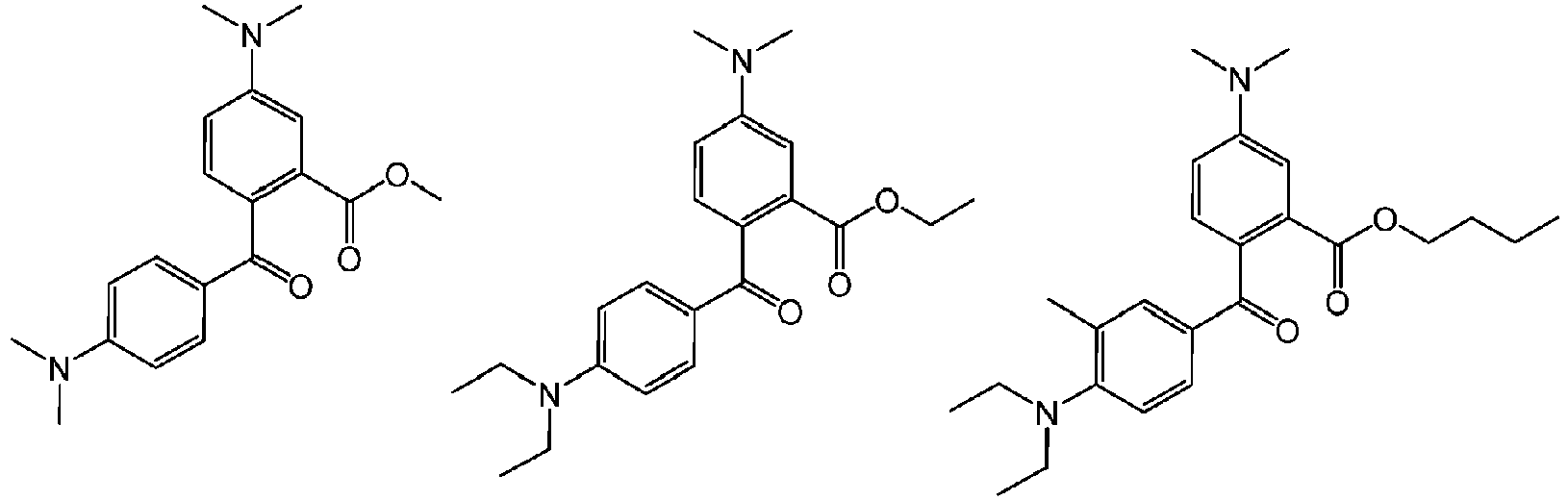
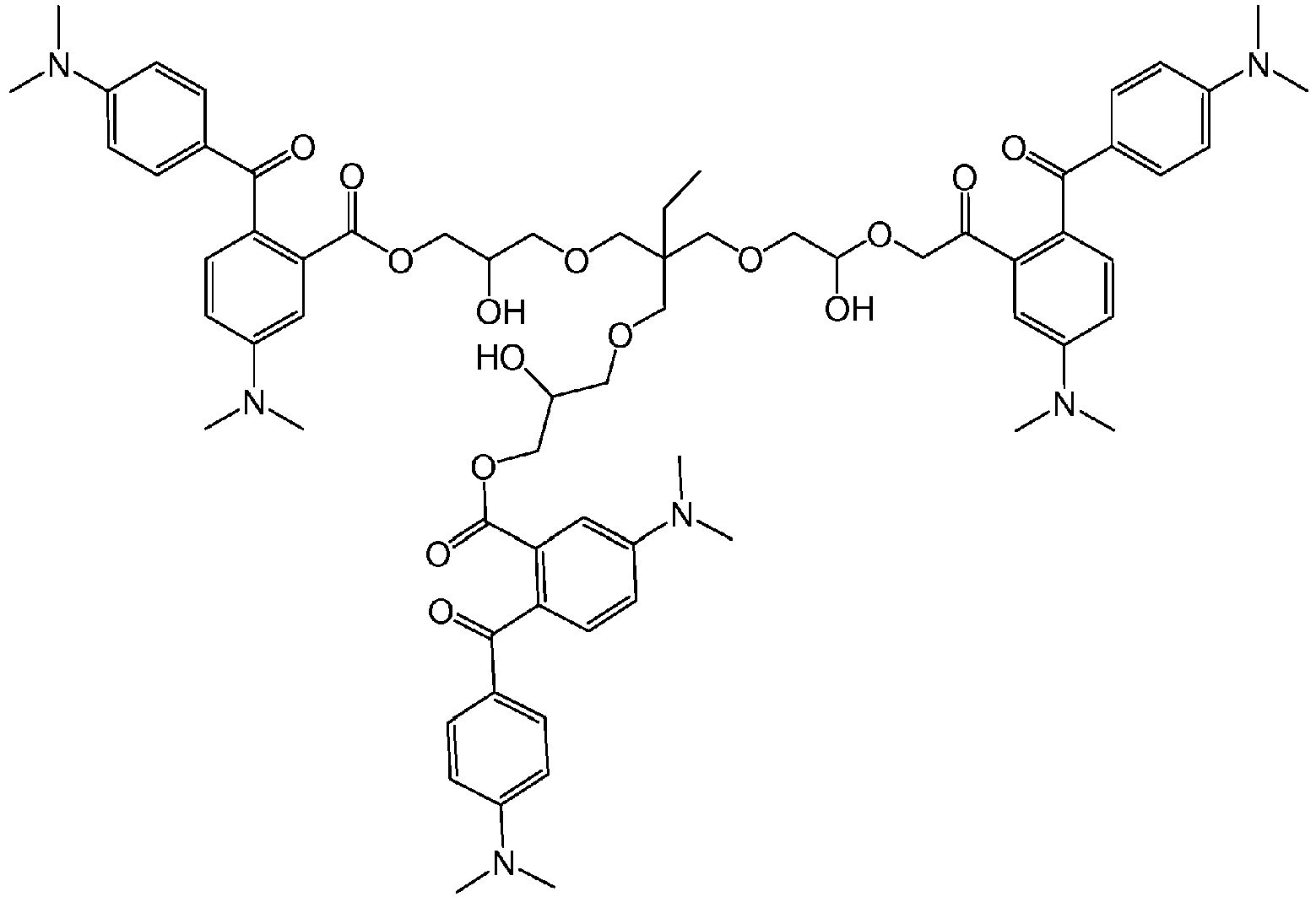
- Examples of compounds of Formula I include, but are not limited to, the following:
- the carboxylic acid group in the compounds of Formula II can be partly or completely neutralized to form compounds of Formula la, depending on the required solubility in aqueous energy curing systems.
- neutralizing agents metal carbonates, metal hydroxides, metal alkoxides, tetraalkylammoium hydroxides, or strong amines are suitable. Examples include, but are not limited to, potassium carbonate, sodium hydroxide, lithium hydroxide, magnesium hydroxide, potassium hydroxide, tetraethylammonium hydroxide, sodium methoxide, butyl lithium or diazabicyclooctane (DABCO) and tetramethylguanidine.
- DABCO diazabicyclooctane
- the aqueous curable compositions of the present invention are made by dissolving, mixing or blending a water soluble, or dispersible, acrylate or methacrylate with compounds of Formula Ia.
- the weight ratio range of (meth)acrylate compounds and compounds of Formula Ia is from 99.5:0.5 to 50:50, preferred is 95:5 to 85:15.
- the UV-curable aqueous compositions can be a real solution, or a dispersion or emulsion.
- the compounds of Formula Ia can also be used in non-aqueous UV and LED curing systems, as the large organic part of the molecules provide solubility in polar acrylate and methacrylate monomers as well.
- the curable compositions of the present invention are made by dissolving, mixing or blending an acrylate or methacrylate with compounds of Formula I and/or II.
- the weight ratio range of acrylate or methacrylate compounds and compounds of Formula I and/or II is from 99.5:0.5 to 50:50, preferred is 95:5 to 85:15.
- acrylates suitable in the radiation curable compositions include ethylene glycol diacrylate, 1,4-butandiol diacrylate, 1,6-hexandiol diacrylate, dipropylene glycol diacrylate, neopentylglycol diacrylate, ethoxylated neopentylglycol diacrylates, propoxylated neopentylglycol diacrylates, tripropylene glycol diacrylate, bisphenol-A diacrylate, ethoxylated bisphenol-A-diacrylates, bisphenol-A-diglycidylether diacrylate, ethoxylated bisphenol-A-diacrylates, poly(ethylene)glycol diacrylates, trimethylolpropane triacrylate, ethoxylated trimethylolpropane triacrylates, propoxylated trimethylolpropane triacrylates, propoxylated glycerol triacrylates, pentaerythrito
- ethoxylated trimethylolpropane triacrylates ethoxylated pentaerythritol triacrylates and propoxylated pentaerythritol tetraacrylates
- oligomeric and polymeric acrylates applied in the art, such as for example epoxy acrylates, polyester acrylates, acrylated polyurethanes, acrylated polyacrylates, acrylated polyethers, acrylated epoxidized oils based on linseed oil and soybean oil and mixtures thereof, and the like.
- suitable methacrylates are ethylene glycol dimethacrylate, 1,4-butandiol dimethacrylate, 1,6-hexandiol dimethacrylate, dipropylene glycol dimethacrylate, neopentylglycol dimethacrylate, ethoxylated neopentylglycol dimethacrylates, propoxylated neopentylglycol dimethacrylates, tripropylene glycol dimethacrylate, bisphenol-A dimethacrylate, ethoxylated bisphenol-A-dimethacrylates, bisphenol-A-diglycidylether dimethacrylate, ethoxylated bisphenol-A-dimethacrylates, poly(ethylene)glycol dimethacrylates, trimethylolpropane trimethacrylate, ethoxylated trimethylolpropane trimethacrylates, propoxylated trimethylolpropane trimethacrylates,
- Suitable water-soluble or water-dispersible acrylates for the inventive aqueous compositions are, for example, highly ethoxylated multifunctional acrylates such as polyethylene oxide diacrylates or ethoxylated trimethylol propane triacrylates, ethoxylated pentaerythritol triacrylates or epoxy acrylates, such as alkane diglycidylether diacrylates, polyglycerol diacrylates or aqueous acrylated polyurethane acrylate dispersions such as Bayhydrol UV2280 and UV2282 (Trademark of Bayer Company). Especially in combinations with polyurethane acrylates, high curing speeds were observed.
- highly ethoxylated multifunctional acrylates such as polyethylene oxide diacrylates or ethoxylated trimethylol propane triacrylates, ethoxylated pentaerythritol triacrylates or epoxy acrylates, such as alkane diglycidylether diacrylates, polyglycerol di
- the compounds of Formulae I, Ia and II are useful in radiation curable compositions which can be UV-cured by an actinic light source, such as UV-light, provided by a high-voltage mercury bulb, a medium-voltage mercury bulb, a xenon bulb, a carbon arc lamp, a metal halide bulb, and especially with an UV-LED lamp or sunlight.
- an actinic light source such as UV-light
- the wavelength of applied irradiation is preferably within a range of 300 to 500 nm, more preferably 320-395 nm, and most preferably 365 to 395 nm.
- the inks are made according to the methods known in the art, as, for example, by dispersing a pigment in the radiation curable compositions of this invention with a bead mill or a three roll mill until the desired particle size and color strength is achieved.
- the energy curable inks or coatings may contain one or more colorants in the form of a dye or pigment dispersed therein.
- Pigments suitable for use in the present invention include conventional organic or inorganic pigments. Representative pigments may, for example, be selected from the group of Pigment Yellow 1, Pigment Yellow 3, Pigment Yellow 12, Pigment Yellow 13, Pigment Yellow 14, Pigment Yellow 17, Pigment Yellow 63, Pigment Yellow 65, Pigment Yellow 73, Pigment Yellow 74, Pigment Yellow 75, Pigment Yellow 83, Pigment Yellow 97, Pigment Yellow 98, Pigment Yellow 106, Pigment Yellow 111, Pigment Yellow 114, Pigment Yellow 121, Pigment Yellow 126, Pigment Yellow 127, Pigment Yellow 136, Pigment Yellow 138, Pigment Yellow 139, Pigment Yellow 174, Pigment Yellow 176, Pigment Yellow 188, Pigment Yellow 194, Pigment Orange 5, Pigment Orange 13, Pigment Orange 16, Pigment Orange 34, Pigment Orange 36, Pigment Orange 61, Pigment Orange 62, Pigment Orange 64, Pig
- the radiation curable compositions and inks of this invention may contain the usual additives to modify flow, surface tension, gloss, and abrasion resistance of the cured coating or printed ink.
- additives contained in inks or coatings typically are a surface-active agent, a wax, or a combination thereof. These additives may function as leveling agents, wetting agents, slip agents, dispersants and de-aerators.
- Preferred additives include fluorocarbon surfactants, silicones and organic polymer surfactants and inorganic materials such as talc. Examples include the Tegorad product lines (Tegorad are trademarks and are commercially available products of Tego Chemie, Essen, Germany) and the Solsperse product lines (Solsperse are trademarks and are commercially available products of Lubrizol company)
- the radiation curable composition of the present invention may optionally contain small amounts of additional type-1 and type-2 photoinitiators, such as, for example, benzophenones, benzilketales, dialkoxy acetophenones, hydroxyalkylacetophenones, aminoalkylphenones, acylphosphinoxides and thioxanthones.
- additional type-1 and type-2 photoinitiators such as, for example, benzophenones, benzilketales, dialkoxy acetophenones, hydroxyalkylacetophenones, aminoalkylphenones, acylphosphinoxides and thioxanthones.
- Examples include, but are not limited to, benzophenone, methylbenzophenone, 4-phenylbenzophenone, 4,4'-bis(dimethylamino)-benzophenone, 4,4'-bis(diethylamino)-benzophenone, 2,2-dimethoxy-2-phenylacetophenone, dimethoxyacetophenone, diethoxyacetophenone, 2-hydroxy-2-methyl-1-phenylpropan-1-one, 2-benzyl-2-dimethylamino-1-(4-morpholinophenyl)-butan-1-one, 2-methyl-1-[4(methoxythio)-phenyl]-2-morpholinopropan-2-one, diphenylacylphenyl phosphinoxide, diphenyl(2,4,6-trimethylbenzoyl) phosphinoxide, 2,4,6-trimethylbenzoylethoxyphenyl phosphinoxide, 2-isopropylthioxanthone, 4-isoprop
- the substrate to be printed on may be composed of any typical substrate material such as paper, plastics, metals, and composites.
- the substrate may be print stock typically used for publications, or may be a packaging material in the form of a sheet, a container such as a bottle or can, or the like.
- the packaging material is a polyolefin such as a polyethylene or a polypropylene, a polyester such as polyethylene terephthalate, or a metal such as an aluminum foil, a metalized polyester, or a metal container.
- curable compositions of this invention are suitable as UV curable protective coatings, UV-powder coatings, UV-overprint varnishes, UV-lacquers, polymerizable masses for UV-curable 3D printing and prototyping, aqueous coatings and impregnation fluids, curable with UV-light and LED's emitting at wavelengths of preferably 365-405 nm.
- the curable inks of the present invention are suitable in virtually any ink or coating system, such as for example a UV-offset ink, a UV-flexographic ink, a UV-jet ink, a UV-gravure ink or a UV-screen ink, curable with UV-light and LED's emitting at wavelengths of preferably 365-405 nm.
- the radiation curable compositions of the present invention are especially suitable for such applications in which no small molecules which have the tendency to migrate, or are under suspect to cause health risks, are present.
- Such applications are, for example, the coating of (food) packaging articles, where especially small photoinitiator molecules are undesirable.
- Water-soluble compounds of Formula Ia are especially suitable in environment friendly water-based inks, such as, for example, water-based flexographic inks sold under the trade name "Wetflex” (Sun Chemical corporation), and make them curable with UV and LED light.
- the energy curable composition may be used to contain any kind of liquid or solid material, such as foods, drinks, cosmetics, biological materials or specimens, pharmaceuticals, etc.
- the energy curable compositions of this invention may be formulated as inks, adhesives, paints, coatings and the like.
- the fields of use lie in, but are not limited to, graphic arts, wood coatings, metal coatings, rigid packaging, automotive and automotive refinish paints and coatings, and adhesives.
- a preferred field of use is in inks and coatings for graphic arts.
- An especially preferred field of use is in inks and coatings for packaging materials.
- Molecular weight was measured by Gel Permeation Chromatography (GPC) using three GPC columns (manufactured by PSS (Polymer Standards Service-USA, Inc.)), SDV 5 ⁇ m 1000 ⁇ , SDV 5 ⁇ m 500 ⁇ , and SDV 5 ⁇ m 100 ⁇ , at a flow rate of 1.0 ml/min.
- the eluent was tetrahydrofurane (THF), and the column temperature was 40°C.
- Calibration was done using mono-disperse polystyrene equivalent molecular weight calibration.
- a differential refractive index detector (RI) and a UV-detector (254nm) were used. The dispersability (Mw/Mn) was calculated from the measurement results.
- Spectra were acquired using a Unicam UV-2 UV/VIS spectro-photometer. All absorption spectra were obtained using 1 cm cuvettes, scanning within the 200 - 800 nm range. Solutions were prepared in a 100 cm 3 volumetric flask, and, if required, subsequently diluted so that a maximum absorbance of less than 2 was obtained. From the absorption the molar extinction coefficient e was calculated in liter ⁇ mol -1 ⁇ cm -1 .
- Tack was measured with a calibrated "Tack-o-scope" (1 ml ink at 30°C held for 90 seconds at 50 rpm, then 30 seconds at 300 rpm). Then, the tack value was taken at 150 rpm.
- FTIR Fourier transform infrared
- a 500 ml 3-necked flask equipped with a mechanical stirrer, reflux condenser and thermometer was charged with 50.0 g (0.169 mole) 3-(4-dimethylaminophenyl)-6-dimethylaminophthalide of Example 1.
- the ivory white solid was suspended in 200 ml of a 10 wt% aqueous solution of sodium hydroxide.
- the resulting mixture was heated to 90°C for one hour with stirring, to obtain a homogenous mixture.
- 50.0 g (0.222 mole) of sodium 3-nitrobenzenesulfonate was added to the solution, and the reddish mixture was refluxed for 15 hours on an oil bath (temperature 110-115°C) resulting in a dark-colored mixture.
- the reaction mixture was stirred for 30 minutes at room temperature without change in color.
- the pH-value was determined to be 8.
- the resulting reaction product crystallized from the crude reaction mixture.
- the product was purified by precipitation: a highly concentrated solution of the product in water was added drop-wise to a stirred surplus of THF. The product precipitated and was collected by filtration.
- Figure 1 shows the characterization of the UV absorption spectrum of Example 6.
- the UV-absorption spectrum of the compound of Example 6 shows that the chromophor has the ability to absorb the strongest emission wavelength from medium pressure mercury arc lamps at 365 nm. Moreover, the absorption UV-absorption spectrum fits very well to the wavelengths emitted by typical commercially available LED bulbs at 365, 385, 395 and 405 nm.
- Example 7 LED-curing aqueous solution with a compound of Formula la from Example 6
- Example 7 cure results Conveyor speed of LED-curing rig [meter/min] 9 13 Hardness - Thumb twist test ok ok Solvent resistance - Isopropanol rubs > 40 ⁇ 40 Solvent resistance - Acetone rubs > 30 ⁇ 10
- Table 1 shows the curing performance of an aqueous LED-curing solution at two different conveyor speeds. The higher the conveyor speed, the less is the dose of UV-light. Table 1 shows that at a conveyor speed of 9 meter/min films are obtained with good hardness and with high solvent resistance. At a speed of 13 meter/min the resistance of the LED-curable varnish to acetone is reduced.
- Example 8 LED-curing aqueous dispersion with a compound of Formula la from Example 6
- Table 2 shows the curing performance of an aqueous LED-curing dispersion at two different conveyor speeds. The higher the conveyor speed, the less is the dose of UV-light. Table 2 shows that at a conveyor speed of 10 meter/min films are obtained with good hardness and with high solvent resistance. At a speed of 20 meter/min the resistance of the LED-curable varnish to acetone is reduced.
- Example 9 LED-module (365 nm) curable composition with a compound of Example 4
- the curable composition was applied on a coated "Byk” cardboard test chart with a wire applicator (6 ⁇ m) and cured with a Heraeus Noblecure UV-LED module as described below (8.0 W at 365 nm, and 4.6 W at 365 nm).
- the curing experiment was done at the measuring laboratory of Heraeus Noblelight GmbH in Hanau, Germany.
- As the LED-module a Heraeus Noblecure (registered trademark of Heraeus Noblelight GmbH, Hanau, Germany) UV-LED module operating at a wavelength of 365 nm with 8 W/cm 2 at 100% was used. The module can be dimmed to work also with lower emittance.
- the power (emittance) of the UV-LED module was measured by a UV-sensor NobleProbe (registered trademark of Heraeus Noblelight GmbH, Hanau, Germany), a special measuring instrument for UV-LEDs commercially available from Heraeus Noblelight GmbH. It can be used to take precise measurements of irradiance in the near UV range from 1 mW/cm 2 to 100 W/cm 2 at wavelengths of between 360 nm and 450 nm.
- the UV-LED measuring instrument was calibrated in Heraeus Noblelight's own accredited measuring laboratory. However, the NobleProbe instrument just gives a value for the emittance of the UV-LED module, not a dose. So it is independent of the belt-speed. Therefore, the dose (which depends on the belt speed) was measured using a Power Puck II of EIT (Electronic Instrumentation &Technology, Inc.; EIT Instrument Markets Group, Sterling, USA). The Power Puck gives the measured irradiance at 365 nm as a value in the UV-A region.
- EIT Electronic Instrumentation &Technology, Inc.
- Example 9 Details about the LED module used to cure Example 9 365 nm LED-module 365nm LED-module Intensity of Module [%] 100 50 Belt-speed [m/min] 12.7 12.7 Distance between board and module [cm] 2.2 2.2 Irradiance [W/cm 2 ] (measured with NobleProbe) 8.0 4.6 UV-Dose [mJ/cm 2 ] measured with PowerPuck II 976 509
- Table 4 Example 9 cure results 365nm LED-module (100%) 365nm LED-module (50%) Film Hardness: Thumb twist test OK Ok (very slight mark of fingerprint visible) Solvent resistance - Acetone double rubs >25 >25
- Example 10 Low migration LED-Photoinitiator with good solubility in acrylates
- the product as obtained according to Example 10 was added to different multifunctional acrylates to check solubility.
- Propoxylated pentaerythritol tetraacrylate (SR 494 LM, Sartomer company) (PPTTA), trimethylol propane triacrylate (SR 351M, Sartomer company) (TMPTA) and ethoxylated trimethylol propane triacrylate (Ebecryl LEO 10501, Allnex company) (EO-TMPTA) were used.
- the compound of example 10 was added in amounts of 10 and 20 weight % to each of the acrylates and stirred for 10 minutes at 45°C. In all cases (even at 20 weight %), clear, intense yellow, transparent mixtures were obtained. This shows the very good solubility of the inventive compound.
- Example 11 Formulation of an offset printing ink containing the new LED-photoinitiator and assessment of cure
- all Omnipol TX was replaced by the inventive compound synthesized as described in Example 10.
- Table 5 Photoinitiator blend for a low migration ink
- Inventive Comparison Omnipol TX 20 Compound from Example 10 20 2-Benzyl-2-(dimethylamino)-4'-morpholinobutyrophenone (e. g. Irgacure 369) 15 15 Oligomeric aromatic amine synergist 20 20 Oligomeric benzophenone 45 45
- the photoinitiator blend according to Table 5 (9.0 wt-%) was in each case mixed with 91.0 (wt-%) of a cyan offset ink containing no photoinitiator blend: SunBeam ELM25 Process Cyan ink (an ink curable by electron beam intended for low migration applications commercially available from Sun Chemical Corporation) using a butterfly stirrer (e.g a trifoil butterfly stirrer) at a speed of 1500 rpm for 10 minutes. During mixing temperature increased to 47°C.
- a butterfly stirrer e.g a trifoil butterfly stirrer
- the inks were printed onto Invercoat G paper, using an IGT C5 proofer to densities of 1.4 to 1.5 (cyan), and cured using a Phoseon LED-module (8W at 395 nm, at 100% intensity, dimmable).
- Intensity of the LED-module was lowered so that the value measured in the UV-V region with Power Puck II was 60 mJ/cm 2 at a conveyer speed of 10 meter/min, to prevent both inks from full-cure.
- the conveyor speed of the LED-curing rig was adjusted to 10 meter/min.
- the resulting UV-dose of the LED-module was measured using a Power Puck II of EIT (Electronic Instrumentation &Technology, Inc.; EIT Instrument Markets Group, Sterling, USA).
- the Power Puck gives the measured irradiance at 395 nm mainly as a value in the UV-V region.
- the value measured in the UV-V region for this curing experiment was 60 mJ/cm 2 .
- Table 6 Properties of inks Inventive ink Comparison ink Viscosity at 50s -1 , 23°C (Pa ⁇ s) 54.7 41.3 Tack 150 250 232 LED Cure evaluation Optical density 1.43 1.45 Film weight (g/m 2 ) 0.86 0.88 Thumb twist (through cure, rating: 1: very good to 5:bad 3 5 Set-off test 0.29 0.40
- the low-migration LED-photoinitiator of the present invention is at least as reactive as Omnipol TX, a commercially available photoinitiator based on thioxanthone chemistry.
Landscapes
- Chemical & Material Sciences (AREA)
- Organic Chemistry (AREA)
- Life Sciences & Earth Sciences (AREA)
- Engineering & Computer Science (AREA)
- Materials Engineering (AREA)
- Wood Science & Technology (AREA)
- Health & Medical Sciences (AREA)
- Chemical Kinetics & Catalysis (AREA)
- Medicinal Chemistry (AREA)
- Polymers & Plastics (AREA)
- Inks, Pencil-Leads, Or Crayons (AREA)
- Polymerisation Methods In General (AREA)
Claims (9)
- Verbindung der Formel I:
 R1 und R1a jeweils für ein unabhängig ausgewähltes tertiäres Amin, das jeweils gegebenenfalls durch ein oder mehrere unabhängig ausgewählte Sauerstoff, Stickstoff, Schwefel oder C1-C12-Alkoxy substituiert ist, stehen;R2 jeweils unabhängig aus der Gruppe bestehend aus Wasserstoff und einem tertiären Amin-, C1-C12-Alkoxy-, C1-C12-Alkyl-, C3-C12-Cycloalkyl- und C6-C12-Arylrest ausgewählt ist, wobei jede dieser Gruppen gegebenenfalls durch ein oder mehrere unabhängig ausgewählte Sauerstoff, Stickstoff, Schwefel oder C1-C12-Alkoxy substituiert ist;R3 aus der Gruppe bestehend aus einem ein-, zwei-, drei-, vier-, fünf-, sechs- oder mehrwertigen Alkyl- oder Alkoxyrest, der gegebenenfalls durch ein oder mehrere unabhängig ausgewählte Sauerstoff, Schwefel, Stickstoff, OH, Carbonyl, (Hydroxyl)alkyl, COOH, (Carboxy)alkyl, R4, Carboxamido, (Carboxamido)alkyl oder OCONR5 substituiert ist, ausgewählt ist;R4 aus der Gruppe bestehend aus C3-C12-Cycloalkyl, (Cycloalkyl) alkyl, C6-C12-Aryl, C3-C12-Heterocyclyl, C6-C12-Heteroaryl, Aralkyl und Alkaryl ausgewählt ist, wobei jede dieser Gruppen gegebenenfalls durch ein oder mehrere unabhängig ausgewählte OH, (Hydroxy)alkyl, C1-C12-Alkyl, Carboxamido, (Carboxamido)alkyl, COOH oder (Carboxy)alkyl substituiert ist;R5 aus der Gruppe bestehend aus H, C1-C12-Alkyl und C1-C12-Alkoxy ausgewählt ist; undn für eine ganze Zahl von 1-100 steht; mit der Maßgabe, dass n kleiner oder gleich der Wertigkeit des Alkyl- oder Alkoxyrests von R3 ist.
 - Verbindung der Formel Ia:
 R1 und R1a jeweils unabhängig aus der Gruppe bestehend aus einem tertiären Amin-, C1-C12-Alkoxy-, C1-C12-Alkyl-, C3-C12-Cycloalkyl- und C6-C12-Arylrest ausgewählt ist, wobei jede dieser Gruppen gegebenenfalls durch ein oder mehrere unabhängig ausgewählte Sauerstoff, Stickstoff, Schwefel oder C1-C12-Alkoxy substituiert ist; mit der Maßgabe, dass mindestens eines von R1 und R1a für ein tertiäres Amin steht;R2 jeweils unabhängig aus der Gruppe bestehend aus Wasserstoff und einem tertiären Amin-, C1-C12-Alkoxy-, C1-C12-Alkyl-, C3-C12-Cycloalkyl- und C6-C12-Arylrest ausgewählt ist, wobei jede dieser Gruppen gegebenenfalls durch ein oder mehrere unabhängig ausgewählte Sauerstoff, Stickstoff, Schwefel oder C1-C12-Alkoxy substituiert ist;r für eine ganze Zahl von 1-6 steht;M aus der Gruppe bestehend aus einem ein-, zwei-, drei-, vier-, fünf- oder sechswertigen Metallkation, einem protonierten tertiären Amin und einem Tetraalkylammoniumgruppenrest, Phosphonium, Sulfonium und Pyridinium ausgewählt ist, wobei jede dieser Gruppen gegebenenfalls durch einen oder mehrere C1-C12-Alkylreste substituiert sein kann.
 - Verbindung nach Anspruch 2, wobei R1 und R1a jeweils für ein unabhängig ausgewähltes tertiäres Amin stehen.
- UV-härtbare Druckfarben- oder Beschichtungszusammensetzung, umfassend mindestens eine Acrylat- oder Methacrylat-Verbindung und mindestens eine Verbindung der Formel I oder Ia nach Anspruch 1 oder 2.
- UV-härtbare Druckfarben- oder Beschichtungszusammensetzung nach Anspruch 4, ferner umfassend mindestens ein Farbmittel.
- UV-härtbare Druckfarben- oder Beschichtungszusammensetzung nach Anspruch 4, umfassend mindestens eine Acrylat- oder Methacrylat-Verbindung, Wasser und mindestens eine Verbindung der Formel Ia.
- UV-härtbare Druckfarben- oder Beschichtungszusammensetzung nach Anspruch 6, ferner umfassend mindestens ein Farbmittel.
- UV-härtbare Druckfarben- oder Beschichtungszusammensetzung nach einem der Ansprüche 4-7, die mit LED-Licht mit einem Wellenlängenmaximum von 300 bis 450 nm, vorzugsweise 350 bis 450 nm, härtbar ist.
- Verbindung der Formel I nach Anspruch 1, ausgewählt aus der Gruppe bestehend aus:




Applications Claiming Priority (2)
| Application Number | Priority Date | Filing Date | Title |
|---|---|---|---|
| US201461983166P | 2014-04-23 | 2014-04-23 | |
| PCT/US2015/026427 WO2015164208A1 (en) | 2014-04-23 | 2015-04-17 | Led photoinitiators |
Publications (3)
| Publication Number | Publication Date |
|---|---|
| EP3134443A1 EP3134443A1 (de) | 2017-03-01 |
| EP3134443A4 EP3134443A4 (de) | 2017-11-29 |
| EP3134443B1 true EP3134443B1 (de) | 2019-10-30 |
Family
ID=54333031
Family Applications (1)
| Application Number | Title | Priority Date | Filing Date |
|---|---|---|---|
| EP15782816.1A Active EP3134443B1 (de) | 2014-04-23 | 2015-04-17 | Led-fotoinitiatoren |
Country Status (3)
| Country | Link |
|---|---|
| US (1) | US9938232B2 (de) |
| EP (1) | EP3134443B1 (de) |
| WO (1) | WO2015164208A1 (de) |
Families Citing this family (9)
| Publication number | Priority date | Publication date | Assignee | Title |
|---|---|---|---|---|
| CN105517990B (zh) * | 2013-08-12 | 2018-10-02 | 太阳化学公司 | 低聚氨基酮及其作为光敏引发剂的用途 |
| CN107452859B (zh) * | 2017-08-21 | 2019-02-01 | 苏州轻光材料科技有限公司 | 一种紫外激发led器件用紫外吸收剂 |
| CN109467387A (zh) * | 2018-01-15 | 2019-03-15 | 杭州创屹机电科技有限公司 | 一种低孔隙率3d打印陶瓷制品及其制备方法 |
| PL240495B1 (pl) * | 2018-03-15 | 2022-04-19 | Inst Fizyki Polskiej Akademii Nauk | Białe fluorofory organiczne-nowe pochodne ftalidu emitujące podwójną fluorescencję o cechach światła białego, sposób ich wytwarzania oraz zastosowanie |
| CN110183326A (zh) * | 2019-07-03 | 2019-08-30 | 上海中溶科技有限公司 | 一种连续制备提纯苯甲酸乙二醇单丁醚酯的方法 |
| US12264120B2 (en) | 2021-12-24 | 2025-04-01 | Sun Chemical Corporation | Amine synergists with UV—a absorption |
| CN115504896B (zh) * | 2022-10-09 | 2024-05-07 | 湖北固润科技股份有限公司 | 用于led光聚合的丙烯酰甲酸酯类化合物、其制备方法及其用途 |
| CN115850099B (zh) * | 2022-12-19 | 2024-09-20 | 浙江工业大学 | 一种具有双二芳基甲酮结构的光引发剂及其合成方法和应用 |
| CN119708499A (zh) * | 2023-09-28 | 2025-03-28 | 上海交通大学 | 低表面能大分子光引发剂、uv led光固化涂料及光固化肤感涂层 |
Family Cites Families (18)
| Publication number | Priority date | Publication date | Assignee | Title |
|---|---|---|---|---|
| US4022674A (en) * | 1973-10-11 | 1977-05-10 | Sun Chemical Corporation | Photopolymerizable compounds and compositions comprising the product of the reaction of a monomeric ester and a polycarboxy-substituted benzophenone |
| JPS52108957A (en) | 1976-03-04 | 1977-09-12 | Kanzaki Paper Mfg Co Ltd | New process for preparing benzophenone derivatives |
| US4535172A (en) | 1982-01-08 | 1985-08-13 | The Hilton-Davis Chemical Co. | 3(Ether and thioether) 3-(4-dialkylaminophenyl) phthalides |
| US4431840A (en) | 1982-10-22 | 1984-02-14 | Sterling Drug Inc. | Process for preparing 2-benzoylbenzoic acids |
| JPH01261355A (ja) | 1988-04-11 | 1989-10-18 | Nippon Kayaku Co Ltd | 安息香酸誘導体の製造方法 |
| JPH05119474A (ja) | 1991-10-30 | 1993-05-18 | Fuji Photo Film Co Ltd | ポジ型フオトレジスト組成物 |
| JPH07196929A (ja) | 1994-01-05 | 1995-08-01 | Fuji Photo Film Co Ltd | フタリド化合物及びこれを用いた記録材料 |
| DE10115001A1 (de) | 2001-03-26 | 2002-10-02 | Heraeus Kulzer Gmbh & Co Kg | Aushärtbare Dentalzusammensetzung sowie Dentalsystem |
| BRPI0509896B1 (pt) | 2004-04-15 | 2016-07-12 | Ciba Sc Holding Ag | "processo para curar compostos polimerizáveis etilenicamente insaturados para produção de revestimentos,coberturas de gel, compósitos ou adesivos tendo cortes espessos". |
| WO2005112932A2 (en) * | 2004-05-07 | 2005-12-01 | Exelixis, Inc. | Raf modulators and methods of use |
| WO2008061957A1 (en) | 2006-11-23 | 2008-05-29 | Agfa Graphics Nv | Novel radiation curable compositions |
| WO2008070737A1 (en) | 2006-12-05 | 2008-06-12 | University Of Southern Mississippi | Benzophenone/thioxanthone derivatives and their use in photopolymerizable compositions |
| US7544216B2 (en) | 2007-02-09 | 2009-06-09 | Milliken & Company | Unsubstituted and polymeric lactone colorants for coloring consumer products |
| JP2010520253A (ja) * | 2007-03-07 | 2010-06-10 | ビーエーエスエフ ソシエタス・ヨーロピア | 有機微粉化uv吸収剤の安定化のためのアミン類およびアミド類の使用 |
| CN101747654A (zh) | 2008-12-16 | 2010-06-23 | 上海瑞年精细化工有限公司 | 苯并呋喃酮类紫色压敏成色剂的合成方法 |
| EP2444429B1 (de) | 2010-10-20 | 2016-09-07 | Agfa Graphics N.V. | Led-härtbare zusammensetzungen |
| CN103064251A (zh) | 2012-12-05 | 2013-04-24 | 北京化工大学常州先进材料研究院 | 一种含有双官能团光引发剂的感光性组合物 |
| CN105517990B (zh) * | 2013-08-12 | 2018-10-02 | 太阳化学公司 | 低聚氨基酮及其作为光敏引发剂的用途 |
-
2015
- 2015-04-17 EP EP15782816.1A patent/EP3134443B1/de active Active
- 2015-04-17 US US15/305,133 patent/US9938232B2/en active Active
- 2015-04-17 WO PCT/US2015/026427 patent/WO2015164208A1/en not_active Ceased
Non-Patent Citations (1)
| Title |
|---|
| None * |
Also Published As
| Publication number | Publication date |
|---|---|
| EP3134443A1 (de) | 2017-03-01 |
| US20170044093A1 (en) | 2017-02-16 |
| US9938232B2 (en) | 2018-04-10 |
| WO2015164208A1 (en) | 2015-10-29 |
| EP3134443A4 (de) | 2017-11-29 |
Similar Documents
| Publication | Publication Date | Title |
|---|---|---|
| EP3134443B1 (de) | Led-fotoinitiatoren | |
| EP3134379B1 (de) | Flüssige arylbenzoylbenzoesäureesterderivate für energiehärtbare zusammensetzungen | |
| TWI635361B (zh) | 液態雙醯基氧化膦光引發劑 | |
| JP6420403B2 (ja) | 光活性樹脂、放射線硬化性組成物および放射線硬化性インク | |
| ES2395424T3 (es) | Composiciones curables por radiación novedosa | |
| US10563073B2 (en) | Oligomeric aminoketones and their use as photoinitiators | |
| Cho et al. | Dual curing of cationic UV-curable clear and pigmented coating systems photosensitized by thioxanthone and anthracene | |
| DE19526856A1 (de) | Strahlungshärtbare Massen mit kovalent gebundenen Photoinitiatoren | |
| Yossif et al. | Preparation and characterization of polymeric dispersants based on vegetable oils for printing ink application | |
| US10689533B2 (en) | Energy curable lithographic inks containing lactic acid resins | |
| EP2738159B1 (de) | Mercaptobenzophenonverbindungen sowie zusammensetzungen daraus und herstellungsverfahren dafür | |
| Chen et al. | Synthesis and preliminary photopolymerization envaluation of photopolymerizalbe type II photoinitiators BRA and TXRA | |
| JP2024099620A (ja) | N-置換マレイミド系重合体、及びその製造方法 | |
| US11608445B2 (en) | Oligomeric aminoketones and their use as photoinitiators | |
| ES2385616T5 (es) | Composiciones curables por radiación novedosas | |
| EP4244281A1 (de) | Photoinitiatorharze mit dibenzoylmethanunterstruktur | |
| CN116964139B (zh) | 具有二苯甲酰基甲烷亚结构的光引发剂树脂 | |
| JP2024132542A (ja) | 光硬化型インク | |
| Zhu et al. | Star-shaped polymeric α-aminoketone photoinitiator with low migration and high photo-activity |
Legal Events
| Date | Code | Title | Description |
|---|---|---|---|
| STAA | Information on the status of an ep patent application or granted ep patent |
Free format text: STATUS: THE INTERNATIONAL PUBLICATION HAS BEEN MADE |
|
| PUAI | Public reference made under article 153(3) epc to a published international application that has entered the european phase |
Free format text: ORIGINAL CODE: 0009012 |
|
| STAA | Information on the status of an ep patent application or granted ep patent |
Free format text: STATUS: REQUEST FOR EXAMINATION WAS MADE |
|
| 17P | Request for examination filed |
Effective date: 20161012 |
|
| AK | Designated contracting states |
Kind code of ref document: A1 Designated state(s): AL AT BE BG CH CY CZ DE DK EE ES FI FR GB GR HR HU IE IS IT LI LT LU LV MC MK MT NL NO PL PT RO RS SE SI SK SM TR |
|
| AX | Request for extension of the european patent |
Extension state: BA ME |
|
| DAV | Request for validation of the european patent (deleted) | ||
| DAX | Request for extension of the european patent (deleted) | ||
| A4 | Supplementary search report drawn up and despatched |
Effective date: 20171030 |
|
| RIC1 | Information provided on ipc code assigned before grant |
Ipc: C08F 2/48 20060101AFI20171024BHEP Ipc: C09D 11/03 20140101ALI20171024BHEP Ipc: C09D 11/101 20140101ALI20171024BHEP Ipc: C08F 2/50 20060101ALI20171024BHEP |
|
| STAA | Information on the status of an ep patent application or granted ep patent |
Free format text: STATUS: EXAMINATION IS IN PROGRESS |
|
| 17Q | First examination report despatched |
Effective date: 20190402 |
|
| GRAP | Despatch of communication of intention to grant a patent |
Free format text: ORIGINAL CODE: EPIDOSNIGR1 |
|
| STAA | Information on the status of an ep patent application or granted ep patent |
Free format text: STATUS: GRANT OF PATENT IS INTENDED |
|
| INTG | Intention to grant announced |
Effective date: 20190718 |
|
| GRAS | Grant fee paid |
Free format text: ORIGINAL CODE: EPIDOSNIGR3 |
|
| GRAA | (expected) grant |
Free format text: ORIGINAL CODE: 0009210 |
|
| STAA | Information on the status of an ep patent application or granted ep patent |
Free format text: STATUS: THE PATENT HAS BEEN GRANTED |
|
| AK | Designated contracting states |
Kind code of ref document: B1 Designated state(s): AL AT BE BG CH CY CZ DE DK EE ES FI FR GB GR HR HU IE IS IT LI LT LU LV MC MK MT NL NO PL PT RO RS SE SI SK SM TR |
|
| REG | Reference to a national code |
Ref country code: GB Ref legal event code: FG4D |
|
| REG | Reference to a national code |
Ref country code: CH Ref legal event code: EP |
|
| REG | Reference to a national code |
Ref country code: DE Ref legal event code: R096 Ref document number: 602015040774 Country of ref document: DE |
|
| REG | Reference to a national code |
Ref country code: AT Ref legal event code: REF Ref document number: 1196044 Country of ref document: AT Kind code of ref document: T Effective date: 20191115 |
|
| REG | Reference to a national code |
Ref country code: IE Ref legal event code: FG4D |
|
| REG | Reference to a national code |
Ref country code: LT Ref legal event code: MG4D |
|
| PG25 | Lapsed in a contracting state [announced via postgrant information from national office to epo] |
Ref country code: LT Free format text: LAPSE BECAUSE OF FAILURE TO SUBMIT A TRANSLATION OF THE DESCRIPTION OR TO PAY THE FEE WITHIN THE PRESCRIBED TIME-LIMIT Effective date: 20191030 Ref country code: NO Free format text: LAPSE BECAUSE OF FAILURE TO SUBMIT A TRANSLATION OF THE DESCRIPTION OR TO PAY THE FEE WITHIN THE PRESCRIBED TIME-LIMIT Effective date: 20200130 Ref country code: GR Free format text: LAPSE BECAUSE OF FAILURE TO SUBMIT A TRANSLATION OF THE DESCRIPTION OR TO PAY THE FEE WITHIN THE PRESCRIBED TIME-LIMIT Effective date: 20200131 Ref country code: PL Free format text: LAPSE BECAUSE OF FAILURE TO SUBMIT A TRANSLATION OF THE DESCRIPTION OR TO PAY THE FEE WITHIN THE PRESCRIBED TIME-LIMIT Effective date: 20191030 Ref country code: LV Free format text: LAPSE BECAUSE OF FAILURE TO SUBMIT A TRANSLATION OF THE DESCRIPTION OR TO PAY THE FEE WITHIN THE PRESCRIBED TIME-LIMIT Effective date: 20191030 Ref country code: SE Free format text: LAPSE BECAUSE OF FAILURE TO SUBMIT A TRANSLATION OF THE DESCRIPTION OR TO PAY THE FEE WITHIN THE PRESCRIBED TIME-LIMIT Effective date: 20191030 Ref country code: BG Free format text: LAPSE BECAUSE OF FAILURE TO SUBMIT A TRANSLATION OF THE DESCRIPTION OR TO PAY THE FEE WITHIN THE PRESCRIBED TIME-LIMIT Effective date: 20200130 Ref country code: FI Free format text: LAPSE BECAUSE OF FAILURE TO SUBMIT A TRANSLATION OF THE DESCRIPTION OR TO PAY THE FEE WITHIN THE PRESCRIBED TIME-LIMIT Effective date: 20191030 Ref country code: PT Free format text: LAPSE BECAUSE OF FAILURE TO SUBMIT A TRANSLATION OF THE DESCRIPTION OR TO PAY THE FEE WITHIN THE PRESCRIBED TIME-LIMIT Effective date: 20200302 Ref country code: NL Free format text: LAPSE BECAUSE OF FAILURE TO SUBMIT A TRANSLATION OF THE DESCRIPTION OR TO PAY THE FEE WITHIN THE PRESCRIBED TIME-LIMIT Effective date: 20191030 |
|
| REG | Reference to a national code |
Ref country code: NL Ref legal event code: MP Effective date: 20191030 |
|
| PG25 | Lapsed in a contracting state [announced via postgrant information from national office to epo] |
Ref country code: RS Free format text: LAPSE BECAUSE OF FAILURE TO SUBMIT A TRANSLATION OF THE DESCRIPTION OR TO PAY THE FEE WITHIN THE PRESCRIBED TIME-LIMIT Effective date: 20191030 Ref country code: IS Free format text: LAPSE BECAUSE OF FAILURE TO SUBMIT A TRANSLATION OF THE DESCRIPTION OR TO PAY THE FEE WITHIN THE PRESCRIBED TIME-LIMIT Effective date: 20200229 Ref country code: HR Free format text: LAPSE BECAUSE OF FAILURE TO SUBMIT A TRANSLATION OF THE DESCRIPTION OR TO PAY THE FEE WITHIN THE PRESCRIBED TIME-LIMIT Effective date: 20191030 |
|
| PG25 | Lapsed in a contracting state [announced via postgrant information from national office to epo] |
Ref country code: AL Free format text: LAPSE BECAUSE OF FAILURE TO SUBMIT A TRANSLATION OF THE DESCRIPTION OR TO PAY THE FEE WITHIN THE PRESCRIBED TIME-LIMIT Effective date: 20191030 |
|
| PG25 | Lapsed in a contracting state [announced via postgrant information from national office to epo] |
Ref country code: EE Free format text: LAPSE BECAUSE OF FAILURE TO SUBMIT A TRANSLATION OF THE DESCRIPTION OR TO PAY THE FEE WITHIN THE PRESCRIBED TIME-LIMIT Effective date: 20191030 Ref country code: DK Free format text: LAPSE BECAUSE OF FAILURE TO SUBMIT A TRANSLATION OF THE DESCRIPTION OR TO PAY THE FEE WITHIN THE PRESCRIBED TIME-LIMIT Effective date: 20191030 Ref country code: ES Free format text: LAPSE BECAUSE OF FAILURE TO SUBMIT A TRANSLATION OF THE DESCRIPTION OR TO PAY THE FEE WITHIN THE PRESCRIBED TIME-LIMIT Effective date: 20191030 Ref country code: CZ Free format text: LAPSE BECAUSE OF FAILURE TO SUBMIT A TRANSLATION OF THE DESCRIPTION OR TO PAY THE FEE WITHIN THE PRESCRIBED TIME-LIMIT Effective date: 20191030 Ref country code: RO Free format text: LAPSE BECAUSE OF FAILURE TO SUBMIT A TRANSLATION OF THE DESCRIPTION OR TO PAY THE FEE WITHIN THE PRESCRIBED TIME-LIMIT Effective date: 20191030 |
|
| REG | Reference to a national code |
Ref country code: DE Ref legal event code: R097 Ref document number: 602015040774 Country of ref document: DE |
|
| REG | Reference to a national code |
Ref country code: AT Ref legal event code: MK05 Ref document number: 1196044 Country of ref document: AT Kind code of ref document: T Effective date: 20191030 |
|
| PG25 | Lapsed in a contracting state [announced via postgrant information from national office to epo] |
Ref country code: SM Free format text: LAPSE BECAUSE OF FAILURE TO SUBMIT A TRANSLATION OF THE DESCRIPTION OR TO PAY THE FEE WITHIN THE PRESCRIBED TIME-LIMIT Effective date: 20191030 Ref country code: SK Free format text: LAPSE BECAUSE OF FAILURE TO SUBMIT A TRANSLATION OF THE DESCRIPTION OR TO PAY THE FEE WITHIN THE PRESCRIBED TIME-LIMIT Effective date: 20191030 |
|
| PLBE | No opposition filed within time limit |
Free format text: ORIGINAL CODE: 0009261 |
|
| STAA | Information on the status of an ep patent application or granted ep patent |
Free format text: STATUS: NO OPPOSITION FILED WITHIN TIME LIMIT |
|
| 26N | No opposition filed |
Effective date: 20200731 |
|
| PG25 | Lapsed in a contracting state [announced via postgrant information from national office to epo] |
Ref country code: SI Free format text: LAPSE BECAUSE OF FAILURE TO SUBMIT A TRANSLATION OF THE DESCRIPTION OR TO PAY THE FEE WITHIN THE PRESCRIBED TIME-LIMIT Effective date: 20191030 Ref country code: MC Free format text: LAPSE BECAUSE OF FAILURE TO SUBMIT A TRANSLATION OF THE DESCRIPTION OR TO PAY THE FEE WITHIN THE PRESCRIBED TIME-LIMIT Effective date: 20191030 Ref country code: AT Free format text: LAPSE BECAUSE OF FAILURE TO SUBMIT A TRANSLATION OF THE DESCRIPTION OR TO PAY THE FEE WITHIN THE PRESCRIBED TIME-LIMIT Effective date: 20191030 |
|
| REG | Reference to a national code |
Ref country code: CH Ref legal event code: PL |
|
| PG25 | Lapsed in a contracting state [announced via postgrant information from national office to epo] |
Ref country code: CH Free format text: LAPSE BECAUSE OF NON-PAYMENT OF DUE FEES Effective date: 20200430 Ref country code: LU Free format text: LAPSE BECAUSE OF NON-PAYMENT OF DUE FEES Effective date: 20200417 Ref country code: LI Free format text: LAPSE BECAUSE OF NON-PAYMENT OF DUE FEES Effective date: 20200430 Ref country code: FR Free format text: LAPSE BECAUSE OF NON-PAYMENT OF DUE FEES Effective date: 20200430 |
|
| REG | Reference to a national code |
Ref country code: BE Ref legal event code: MM Effective date: 20200430 |
|
| PG25 | Lapsed in a contracting state [announced via postgrant information from national office to epo] |
Ref country code: BE Free format text: LAPSE BECAUSE OF NON-PAYMENT OF DUE FEES Effective date: 20200430 |
|
| PG25 | Lapsed in a contracting state [announced via postgrant information from national office to epo] |
Ref country code: IE Free format text: LAPSE BECAUSE OF NON-PAYMENT OF DUE FEES Effective date: 20200417 |
|
| PG25 | Lapsed in a contracting state [announced via postgrant information from national office to epo] |
Ref country code: TR Free format text: LAPSE BECAUSE OF FAILURE TO SUBMIT A TRANSLATION OF THE DESCRIPTION OR TO PAY THE FEE WITHIN THE PRESCRIBED TIME-LIMIT Effective date: 20191030 Ref country code: MT Free format text: LAPSE BECAUSE OF FAILURE TO SUBMIT A TRANSLATION OF THE DESCRIPTION OR TO PAY THE FEE WITHIN THE PRESCRIBED TIME-LIMIT Effective date: 20191030 Ref country code: CY Free format text: LAPSE BECAUSE OF FAILURE TO SUBMIT A TRANSLATION OF THE DESCRIPTION OR TO PAY THE FEE WITHIN THE PRESCRIBED TIME-LIMIT Effective date: 20191030 |
|
| PG25 | Lapsed in a contracting state [announced via postgrant information from national office to epo] |
Ref country code: MK Free format text: LAPSE BECAUSE OF FAILURE TO SUBMIT A TRANSLATION OF THE DESCRIPTION OR TO PAY THE FEE WITHIN THE PRESCRIBED TIME-LIMIT Effective date: 20191030 |
|
| P01 | Opt-out of the competence of the unified patent court (upc) registered |
Effective date: 20230521 |
|
| PGFP | Annual fee paid to national office [announced via postgrant information from national office to epo] |
Ref country code: DE Payment date: 20250319 Year of fee payment: 11 |
|
| PGFP | Annual fee paid to national office [announced via postgrant information from national office to epo] |
Ref country code: GB Payment date: 20260319 Year of fee payment: 12 |
|
| PGFP | Annual fee paid to national office [announced via postgrant information from national office to epo] |
Ref country code: IT Payment date: 20260319 Year of fee payment: 12 |