EP3134852B1 - Verfahren für die verfolgbarkeit von lederähnlichen und ledermaterialien in industriellen prozessen - Google Patents
Verfahren für die verfolgbarkeit von lederähnlichen und ledermaterialien in industriellen prozessen Download PDFInfo
- Publication number
- EP3134852B1 EP3134852B1 EP15715412.1A EP15715412A EP3134852B1 EP 3134852 B1 EP3134852 B1 EP 3134852B1 EP 15715412 A EP15715412 A EP 15715412A EP 3134852 B1 EP3134852 B1 EP 3134852B1
- Authority
- EP
- European Patent Office
- Prior art keywords
- leather
- markers
- embedding
- identification
- methodology
- Prior art date
- Legal status (The legal status is an assumption and is not a legal conclusion. Google has not performed a legal analysis and makes no representation as to the accuracy of the status listed.)
- Active
Links
Images

Classifications
-
- G—PHYSICS
- G06—COMPUTING OR CALCULATING; COUNTING
- G06K—GRAPHICAL DATA READING; PRESENTATION OF DATA; RECORD CARRIERS; HANDLING RECORD CARRIERS
- G06K19/00—Record carriers for use with machines and with at least a part designed to carry digital markings
- G06K19/06—Record carriers for use with machines and with at least a part designed to carry digital markings characterised by the kind of the digital marking, e.g. shape, nature, code
- G06K19/06187—Record carriers for use with machines and with at least a part designed to carry digital markings characterised by the kind of the digital marking, e.g. shape, nature, code with magnetically detectable marking
- G06K19/06196—Constructional details
-
- G—PHYSICS
- G06—COMPUTING OR CALCULATING; COUNTING
- G06K—GRAPHICAL DATA READING; PRESENTATION OF DATA; RECORD CARRIERS; HANDLING RECORD CARRIERS
- G06K19/00—Record carriers for use with machines and with at least a part designed to carry digital markings
- G06K19/02—Record carriers for use with machines and with at least a part designed to carry digital markings characterised by the selection of materials, e.g. to avoid wear during transport through the machine
- G06K19/025—Record carriers for use with machines and with at least a part designed to carry digital markings characterised by the selection of materials, e.g. to avoid wear during transport through the machine the material being flexible or adapted for folding, e.g. paper or paper-like materials used in luggage labels, identification tags, forms or identification documents carrying RFIDs
Definitions
- the present invention relates to a methodology for the identification and traceability of materials during manufacturing processes of products.
- the present invention relates to a methodology for the identification and traceability of leather and leather-like materials throughout the manufacturing process of leather and leather-like products.
- traceability refers the ability to verify the history, location, or application of an item by means of documented recorded identification [ Glossary," ASME Boiler and Pressure Vessel Code, Section III, Article NCA-9000 ].
- product traceability indicates following the product, throughout the entire production process. Traceability requires that, at each stage of the production process, new information ( traces ) be created regarding that specific stage. Such traces are collected, stored and associated to each single finished product.
- the concept of product identification which is strictly related to traceability, refers to the possibility of discriminating each single item within a homogeneous lot of similar items, by retrieving all the identification information (regarding the production, transformation, quality status, etc.) of that item.
- Traceability and identification are extremely important for manufacturing companies, not only for ensuring safety to the customers (by guaranteeing on the origin of a product or of the raw materials) and comply with regulations, but also for optimizing management and logistics.
- Traceability and identification allow to go back to ascertain the characteristics of the product (e.g. constitutive parts and components, production lot, production stages); to reconstruct the information on its the technical/commercial history (e.g. change of property, change of destination); for product recall after the discovery of safety threats (e.g. for the health or for the environment) or product defects; etc.
- product traceability is important for the manufacturing company not only for pursuing customer advocacy policies, but also for logistics and operations management.
- logistics-related purposes the availability of product-related information is crucial for the optimal management of the numerous production flows that are intrinsically intertwined with the distribution and storage operations.
- marking solutions generally belong to either of the following broad categories:
- Tag-based marking solutions are the most widespread: all the necessary identification information are associated to a customized code, which is applied to and carried by each single item that must be traced. Tag-based marking is clearly intended for identifying and tracing specific items which, from the moment of application of the tag, are virtually indivisible (such as clothes). Barcoding is one of the most widespread tag-based marking solutions.
- a barcode is an optical machine-readable representation of data relating to the object to which it is attached. The barcodes are usually printed directly on the packaging of the item or on a separate label that is attached to the item. Barcodes are read by optical scanners, which allow to associate the code to the corresponding information.
- RFID radiofrequency identification technology
- An RFID system consists of a reader and of one or more transponders (attached to the item to identify and trace), which transmit a radiofrequency signal in response to an order received by a remote reader station.
- the response of the transponder consists of an identification code related to the item on which the transponder is applied: the identification code serves as a key to find the item-related information inside a dedicated archive or database.
- RFID transponders are typically equipped with a microchip that, in addition to managing the interaction between transponder and reader station, can also store a limited amount of data.
- WO 2005/008294A1 discloses a method of identifying an object and a tag carrying identification information: the invention described therein employs magnetic particles or electrically conductive particles as markers. However, said particles are to be deposited on a host medium which, in turn, should be applied to the item to be traced. As a result, if the marked item undergoes severe mechanical, thermal or chemical processes (such as those that are typical of the leather manufacturing process), the persistence of the markers may not be guaranteed.
- DE102009020208A1 discloses an invention related to a method for coding of products by means of a magnetic composition containing magnetic nanoparticles, and a product having such an encoding.
- the persistence of the markers may not be guaranteed.
- Tag-based marking cannot fully satisfy the requirements of the textile and leather manufacturing industry (in particular, those related to counterfeiting); in fact, the applied tags may be destroyed, damaged or removed when the product undergoes the harsh processes required for leather manufacturing.
- Chemical-physical marking As for chemical-physical marking, this represents relatively new technology; and it is still undergoing an intensive research and development stage. Chemical-physical marking is considered as the most suitable technological solution for marking "continuous products", where this expression is used to indicate those products (such as yarn, textiles, and natural fibers), which are used as raw materials and which are bound to undergo particular working processes, still remaining identifiable and traceable.
- US 2013/046227 describes various embodiments related to methods, devices, and computer systems utilized for documenting information regarding a subject's health by using a device configured to administer an information mark, said mark comprising one or more magnetic tattoo particles to be injected into the skin of a subject to store information and configured to be read by a health care provider.
- DE 10024248 describes a similar methodology comprising an identifying device, a reader device, a raster image, a software for implementing the method and a storing device, said methodology consisting in applying a raster image to a human subject (or animal) by means of several printing or painting processes.
- the first requirement that must be possessed by a methodology for marking leather and leather-like materials is that it must not have a significant effect on the features and characteristics of the finished material: for leather and leather-like materials, it is crucial that the presence of identification markers does not alter the color, touch, thickness and handle characteristics. Also, the presence of identification markers must not affect cutting, gluing, sewing and shaping the material. Overall, the candidate marking technology should not impact substantially the leather manufacturing process.
- identification markers must not be visible to the naked eye; identification should be made possible within the factory with simple means.
- the identification markers should also be resistant to physical, chemical and thermal conditions during the manufacturing operations that are necessary to obtain the finished leather or leather-like products.
- the leather manufacturing process (which consists of three major sub-processes, namely preparatory stages, tanning and crusting) requires the hides to undergo severe mechanical and chemical processes that allow to eliminate components (e.g. subcutaneous tissues, skin and fat, whose presence typically indicate low quality of the product) and to obtain a non-putrescible product, namely leather.
- components e.g. subcutaneous tissues, skin and fat, whose presence typically indicate low quality of the product
- tanning some of the sub-processes, especially tanning, are outsourced or delocalized.
- the tanning process changes completely the appearance of the obtained leather with respect to the appearance of the raw hide; hence, when the hides are sent to tanning and return to the company, it is crucial to verify that the product that has been sent back in is the same material that had been originally sent out. Based on these considerations, it is clear that, in the leather manufacturing industry, the improvement of authentication systems is vital to guarantee traceability along the chain from the sourcing of raw materials at the abattoir to their use when manufacturing a finished product.
- the present invention pertains to a methodology for the identification and traceability of materials in industrial process, with particular focus on the traceability of leather and leather-like materials throughout the manufacturing process of leather or leather-like products.
- the present invention allows verifying possible fraudulent modifications/substitutions/operations or even honest mistakes in the employment of the materials.
- the methodology object of the present invention is implemented by means of at least a marker-embedding device, a plurality of identification markers, a device for generating an electromagnetic stimulus and configured to convey the electromagnetic stimulus to the portion of the material that needs to be analyzed and a device for acquiring/recording the response to the electromagnetic stimulus, said methodology comprising the following steps:
- Said methodology is also characterized in that the marker-embedded portion of the leather or leather-like material responds to an electromagnetic stimulus differently from how a marker-free portion of the same material responds to the same electromagnetic stimulus and also differently from how the same portion of material would respond to the same electromagnetic stimulus if the portion was marker-free.
- the identification markers are also characterized in that they are permanently embedded inside the item to traced, following a pre-established pattern or a random distribution.
- Said identification markers are also characterized in that they are inert and chemically and thermally stable with respect to the leather and to leather-like materials in which they are embedded; and, therefore, the presence of the markers does not provoke modifications or any other undesired effects (e.g. stiffness, frays, unraveling) that could compromise the subsequent working operations and the final quality of the leather product.
- the method for permanently embedding the markers is characterized in that it is non-destructive and only minimally invasive in respect to the material in which the markers are to be embedded; in this way, the integrity of the leather or leather-like material is preserved and the final quality of the product is not compromised.
- the method for embedding the markers is characterized in that the markers are permanently embedded under the surface, at a depth that may vary in the range of 0.2 mm to 1.0 mm, depending on the thickness of the material to be marked.
- This method for embedding the identification markers makes the markers resistant to thermal, mechanical, chemical, physical processes that are part of leather manufacturing process (such as fleshing, dehairing and trimming). Because the markers are embedded inside (rather than attached on the surface of) the leather or leather-like material, they remain permanently inside the material, in spite of possible reduction of the thickness of the marked material, due to the production process.
- the markers are also characterized in that, after the leather manufacturing process is complete, they are invisible to the human eye, as no visible trace is left on the surface of the leather.
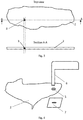
- the theoretical principle at the base of the present invention consists in employing a device (1) for embedding the markers in the material to be traced (2), in a limited portion of it (3), a number of tracing markers, such as metallic particles, ceramic powder, or a compounds of different nature. It is possible to embed said markers following a pre-established pattern, or a code, or other type of informative comment, which can be associated to the marked material.
- the object to be traced undergoes processes or is moved, it can be subjected automatically, in one or more steps of the manufacturing process, to a traceability-check, for example through X-ray, thus verifying the presence of the identification markers and, hence, the origin of the product and its authenticity (for example, through the identification of specific shapes or pattern given to the embedded markers).
- a traceability-check for example through X-ray
- the marker-embedding device (1) operates similarly to a tattoo gun.
- these are dispersed into a vector fluid (such as water or acetone), which is inert with respect to the leather or leather-like materials and which evaporates after the markers (3) have been embedded.
- a vector fluid such as water or acetone
- the method of embedding the markers makes them resistant to the working processes that the raw materials (e.g. hides) undergo throughout the product manufacturing process (e.g. leather manufacturing process).
- the traceability and identification methodology is based on the difference of the response when an electromagnetic stimulus, in the X-ray frequency band, is applied to portions of the leather or leather-like material in which the identification markers (3) are embedded and to portions of leather or leather-like material (2) without the markers.
- the step for stimulating the leather or leather-like material to be traced is performed employing an X-Ray scanning device (6), which conveys X-Rays on the marker-embedded portion (3) of the material (2).
- the presence of the markers (3) is verified by acquiring the X-ray image (7) of the marked portion of the leather or leather-like material (2).
- the markers (3) can be embedded in the item to be traced through a system of multiple injectors, arranged as an array (4).
- This configuration of the marker-embedding device allows, if necessary, to activate the "injection needles" and extend the portion of the material carrying the markers or, alternatively, to selectively activate the needles that form a pre-established identification pattern (5) which may be associated to specific information related to the item.
- the identification markers (3) are always not visible to the human eye.
- said device (1) for embedding the markers (3) can be a tattoo gun.
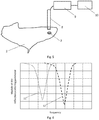
- the method for generating the microwave electromagnetic stimulus can resort to a microwave reflectometer (9), which generates the stimulus signal and, through accessories (8), conveys it to the portion of material containing the embedded markers (3).
- the accessories (8) convey the reflected signal to the microwave reflectometer (9); which, in turn, digitizes the reflected signal and sends it to the acquisition/recording unit (10) for evaluating the corresponding reflection scattering parameter.
- the response to the electromagnetic stimulus is the reflection scattering parameter, which behaves differently in presence (11) or in absence (12) of the markers, as shown in Fig. 6 .
- the identification markers (3) are substances (such as ceramic powders) with a relative dielectric permittivity that is much different from the typical relative dielectric permittivity of leather and leather-like materials.
- the method for embedding the identification markers resorts to a set of needles that inject the markers in the wetted leather or leather-like material.
Landscapes
- Physics & Mathematics (AREA)
- General Physics & Mathematics (AREA)
- Engineering & Computer Science (AREA)
- Theoretical Computer Science (AREA)
- Treatment And Processing Of Natural Fur Or Leather (AREA)
Claims (5)
- Methode zur Identifizierung und Rückverfolgbarkeit von Leder oder lederähnlichen Materialien (2) während des gesamten Herstellungsprozesses von Leder oder lederartigen Produkten, wobei die Methode mittels mindestens einer Marker-Einbettungsvorrichtung (1) durchgeführt wird, einer Vielzahl von Identifikationsmarkern (3), einer Vorrichtung zum Erzeugen eines elektromagnetischen Stimuluses (6, 9) und konfiguriert zum Übertragen des elektromagnetischen Stimuluses zu dem Teil des zu analysierenden Materials und mittels einer Vorrichtung zum Erfassen/Aufzeichnen der Antwort auf das elektromagnetische Stimulus (7, 9, 10),
wobei die besagte Methode folgende Schritte umfasst:i. dauerhaftes Einbetten der Marker (3) in das zu verfolgende Leder oder lederartige Material (2) mittels der Marker-Einbettvorrichtung (1);ii. Stimulieren des zu verfolgenden Leders oder lederartigen Materials (2) mit einer spezifischen elektromagnetischen Strahlung, die von der Erzeugungsvorrichtung (6, 9) erzeugt wird;iii. Erfassen der Reaktion des markierten leder- oder lederartigen Materials (2) auf den elektromagnetischen Stimulus mittels der externen Vorrichtung (9, 10);iv. Aufnehmen der Reaktion des markierten Leders oder lederartigen Materials auf den elektromagnetischen Stimulus mittels einer Erfassungseinheit (7, 10),wobei die besagte Methode dadurch gekennzeichnet ist, dass:die besagte Marker-Einbettvorrichtung (1) aus einer Tätowierpistole besteht;die besagten Identifikationsmarker (3) aus submikrometrischen Partikeln bestehen, wie zum Beispiel Pulvern aus Keramik oder metallischen Partikeln, die für das menschliche Auge immer nicht sichtbar sind;der besagte Schritt (i.) zum dauerhaften Einbetten der Markierungen (3), das Einbetten der Markierungen (3) in einer Tiefe von mindestens 0,2 mm unter der Oberfläche des leder- oder lederartigen Materials (2) umfasst;die von der Erzeugungseinrichtung (6, 9) erzeugte spezifische elektromagnetische Strahlung liegt im Bereich von Röntgenstrahlen bis zu Mikrowellen im elektromagnetischen Spektrum. - Methode nach Anspruch 1, wobei der Schritt zur dauerhaften Einbettung der Marker (3) mittels einer Marker-Einbettungsvorrichtung (1) das Dispergieren der Marker (3) in einem verdampfbaren/flüchtigen Trägerfluid umfasst, das das Verfahren der Einbettung der Markierungen (3) innerhalb des leder- oder lederartigen Materials (2), das verfolgt werden soll, vereinfacht.
- Methode nach den Ansprüchen 1 und 2, dadurch gekennzeichnet, dass die besagten Identifikationsmarker (3) mittels einer Mehrzahl von als Array (4) angeordneten Marker-Einbettungsvorrichtungen (1) eingebettet sind, um die Marker (3) nach einem vorgegebenen Erkennungsmuster (5) anzuordnen.
- Methode nach einem der vorhergehenden Ansprüche 1 bis 3, wobei- der Schritt zum Stimulieren des zu verfolgenden Leders oder lederartigen Materials wird unter Verwendung einer Röntgenvorrichtung (6) durchgeführt und durch die Übertragung auf dem in die Markierung eingebetteten Abschnitt (3) des Materials (2);- der Schritt zum Erfassen der Antwort des markierten Leders oder lederähnlichen Materials wird durch Sammeln der übertragenen Röntgenstrahlung durchgeführt;- der Schritt zur Aufzeichnung der Antwort umfasst das Erfassen des resultierenden Identifikations-Röntgenbildes (7).
- Methode nach einem der vorhergehenden Ansprüche 1 bis 3, wobei- der Schritt zum Stimulieren des zu verfolgenden Leders oder lederartigen Materials wird unter Verwendung einer Vorrichtung zum Erzeugen eines elektromagnetischen Mikrowellensignals (9) durchgeführt, das durch Zubehörteile (8) zu dem in die Markierung eingebetteten Abschnitt (3) des Materials (2), überträgt wird;- der Schritt zum Aufnehmen der Antwort des markierten leder- oder lederartigen Materials (2) wird durchgeführt, indem durch das Zubehör (8) das elektromagnetische Signal, das von dem stimulierten Teil des Leders oder des lederartigen Materials reflektiert wird (2), zum Mikrowellen-Reflektometer (9) übertragen wird;- der Schritt zum Aufzeichnen der Antwort umfasst das Auswerten des aus dem vorherigen Schritt resultierenden Reflexions-Streuparameters (11, 12).
Applications Claiming Priority (2)
| Application Number | Priority Date | Filing Date | Title |
|---|---|---|---|
| ITBA20140025 | 2014-04-22 | ||
| PCT/IB2015/051397 WO2015162502A1 (en) | 2014-04-22 | 2015-02-25 | Methodology for the traceability of leather-like and leather materials in industrial processes |
Publications (2)
| Publication Number | Publication Date |
|---|---|
| EP3134852A1 EP3134852A1 (de) | 2017-03-01 |
| EP3134852B1 true EP3134852B1 (de) | 2018-08-22 |
Family
ID=51033265
Family Applications (1)
| Application Number | Title | Priority Date | Filing Date |
|---|---|---|---|
| EP15715412.1A Active EP3134852B1 (de) | 2014-04-22 | 2015-02-25 | Verfahren für die verfolgbarkeit von lederähnlichen und ledermaterialien in industriellen prozessen |
Country Status (4)
| Country | Link |
|---|---|
| EP (1) | EP3134852B1 (de) |
| CN (1) | CN106462781B (de) |
| ES (1) | ES2698528T3 (de) |
| WO (1) | WO2015162502A1 (de) |
Family Cites Families (7)
| Publication number | Priority date | Publication date | Assignee | Title |
|---|---|---|---|---|
| DE10024248A1 (de) * | 2000-05-17 | 2003-02-06 | Bernhard Schipper | Verfahren und Vorrichtung zum Hinterlegen einer Kennzeichnung |
| US7865722B2 (en) | 2003-07-22 | 2011-01-04 | Agency For Science, Technology And Research | Method of identifying an object and a tag carrying identification information |
| WO2005046576A2 (en) * | 2003-08-06 | 2005-05-26 | The General Hospital Corporation | Magnetic ink tissue markings |
| DE102009020208A1 (de) * | 2009-05-07 | 2010-11-11 | Merck Patent Gmbh | Verfahren zum Codieren von Produkten |
| GB2474671A (en) * | 2009-10-22 | 2011-04-27 | Angela Maria Hirtreiter | Tattoo removal using magnetic properties of the ink |
| BR112013018443A2 (pt) * | 2011-01-28 | 2017-08-01 | Masonite Corp | redução de odor de couro submetido a laser |
| US9772270B2 (en) * | 2011-08-16 | 2017-09-26 | Elwha Llc | Devices and methods for recording information on a subject's body |
-
2015
- 2015-02-25 EP EP15715412.1A patent/EP3134852B1/de active Active
- 2015-02-25 ES ES15715412T patent/ES2698528T3/es active Active
- 2015-02-25 CN CN201580021270.3A patent/CN106462781B/zh not_active Expired - Fee Related
- 2015-02-25 WO PCT/IB2015/051397 patent/WO2015162502A1/en not_active Ceased
Non-Patent Citations (1)
| Title |
|---|
| None * |
Also Published As
| Publication number | Publication date |
|---|---|
| ES2698528T3 (es) | 2019-02-05 |
| CN106462781A (zh) | 2017-02-22 |
| CN106462781B (zh) | 2019-08-30 |
| EP3134852A1 (de) | 2017-03-01 |
| WO2015162502A1 (en) | 2015-10-29 |
Similar Documents
| Publication | Publication Date | Title |
|---|---|---|
| Awad | From classical methods to animal biometrics: A review on cattle identification and tracking | |
| CA3122237C (en) | Method and apparatus for tracking one or more plants and/or plant based products and/or tracking the sale of products derived from the same, utilizing rfid technology | |
| EP3879966B1 (de) | Verfahren und vorrichtung zur verfolgung einer oder mehrerer pflanzen und/oder von produkten auf pflanzenbasis und/oder verfolgung des verkaufs von produkten daraus unter verwendung von rfid-technologie | |
| WO2019034181A1 (zh) | 一种基于天然生物信息的商品防伪验证系统 | |
| CA2872017A1 (en) | Verification of physical encryption taggants using digital representatives and authentications thereof | |
| RU2534952C1 (ru) | Способ маркировки продукции или изделий для их идентификации и защиты от подделки | |
| EP3134852B1 (de) | Verfahren für die verfolgbarkeit von lederähnlichen und ledermaterialien in industriellen prozessen | |
| Treick et al. | Object identification technologies as key enabler for circular business models | |
| Ting et al. | Enhancing the information transmission for pharmaceutical supply chain based on Radio Frequency Identification (RFID) and Internet of Things | |
| Hinsley et al. | Tackling illegal wildlife trade by improving traceability: a case study of the potential for stable isotope analysis | |
| Gupta et al. | Traceability technologies across the food value chain | |
| KR20120132847A (ko) | 바코드를 이용한 이력추적 및 통합관리 시스템 | |
| DE102019201529A1 (de) | Steuerungsvorrichtung für eine Fertigungsanlage, Nachverfolgungsvorrichtung, Fertigungsdatenbestimmer, Methoden und Computerprogramm | |
| Kwok et al. | Physimetric identification (Physi-ID)—Applying biometric concept in physical object identification | |
| Case | Traceability of hides through the supply chain | |
| Thakur | Traceability of hides through the supply chain-Norilia Hide Case | |
| Liukkonen et al. | Life-cycle covering traceability and information management for electronic product using RFID | |
| Buskirk et al. | Traceability in the beef supply chain | |
| RU2592399C2 (ru) | Способ кодирования и записи данных на rfid-метку | |
| Ribeiro et al. | RFID in the international cattle supply chain: context, consumer privacy and legislation | |
| McMillin et al. | Traceability in the meat, poultry and seafood industries | |
| Su et al. | RFID Automatic Identification and Data Capture | |
| Lehtinen | Traceability in Agrifood Chains | |
| Verbytskyi et al. | Institute of Food Resources of NAAS, Kyiv, Ukraine E-mail: tk140@ hotmail. com | |
| KR102266866B1 (ko) | 보안이 향상된 결제 방법 |
Legal Events
| Date | Code | Title | Description |
|---|---|---|---|
| STAA | Information on the status of an ep patent application or granted ep patent |
Free format text: STATUS: THE INTERNATIONAL PUBLICATION HAS BEEN MADE |
|
| PUAI | Public reference made under article 153(3) epc to a published international application that has entered the european phase |
Free format text: ORIGINAL CODE: 0009012 |
|
| STAA | Information on the status of an ep patent application or granted ep patent |
Free format text: STATUS: REQUEST FOR EXAMINATION WAS MADE |
|
| 17P | Request for examination filed |
Effective date: 20161110 |
|
| AK | Designated contracting states |
Kind code of ref document: A1 Designated state(s): AL AT BE BG CH CY CZ DE DK EE ES FI FR GB GR HR HU IE IS IT LI LT LU LV MC MK MT NL NO PL PT RO RS SE SI SK SM TR |
|
| AX | Request for extension of the european patent |
Extension state: BA ME |
|
| DAX | Request for extension of the european patent (deleted) | ||
| STAA | Information on the status of an ep patent application or granted ep patent |
Free format text: STATUS: EXAMINATION IS IN PROGRESS |
|
| 17Q | First examination report despatched |
Effective date: 20170911 |
|
| GRAP | Despatch of communication of intention to grant a patent |
Free format text: ORIGINAL CODE: EPIDOSNIGR1 |
|
| STAA | Information on the status of an ep patent application or granted ep patent |
Free format text: STATUS: GRANT OF PATENT IS INTENDED |
|
| INTG | Intention to grant announced |
Effective date: 20180516 |
|
| GRAS | Grant fee paid |
Free format text: ORIGINAL CODE: EPIDOSNIGR3 |
|
| GRAA | (expected) grant |
Free format text: ORIGINAL CODE: 0009210 |
|
| STAA | Information on the status of an ep patent application or granted ep patent |
Free format text: STATUS: THE PATENT HAS BEEN GRANTED |
|
| AK | Designated contracting states |
Kind code of ref document: B1 Designated state(s): AL AT BE BG CH CY CZ DE DK EE ES FI FR GB GR HR HU IE IS IT LI LT LU LV MC MK MT NL NO PL PT RO RS SE SI SK SM TR |
|
| REG | Reference to a national code |
Ref country code: GB Ref legal event code: FG4D |
|
| REG | Reference to a national code |
Ref country code: CH Ref legal event code: EP |
|
| REG | Reference to a national code |
Ref country code: AT Ref legal event code: REF Ref document number: 1033336 Country of ref document: AT Kind code of ref document: T Effective date: 20180915 |
|
| REG | Reference to a national code |
Ref country code: IE Ref legal event code: FG4D |
|
| REG | Reference to a national code |
Ref country code: DE Ref legal event code: R096 Ref document number: 602015015099 Country of ref document: DE |
|
| REG | Reference to a national code |
Ref country code: NL Ref legal event code: MP Effective date: 20180822 |
|
| REG | Reference to a national code |
Ref country code: LT Ref legal event code: MG4D |
|
| PG25 | Lapsed in a contracting state [announced via postgrant information from national office to epo] |
Ref country code: GR Free format text: LAPSE BECAUSE OF FAILURE TO SUBMIT A TRANSLATION OF THE DESCRIPTION OR TO PAY THE FEE WITHIN THE PRESCRIBED TIME-LIMIT Effective date: 20181123 Ref country code: FI Free format text: LAPSE BECAUSE OF FAILURE TO SUBMIT A TRANSLATION OF THE DESCRIPTION OR TO PAY THE FEE WITHIN THE PRESCRIBED TIME-LIMIT Effective date: 20180822 Ref country code: NO Free format text: LAPSE BECAUSE OF FAILURE TO SUBMIT A TRANSLATION OF THE DESCRIPTION OR TO PAY THE FEE WITHIN THE PRESCRIBED TIME-LIMIT Effective date: 20181122 Ref country code: IS Free format text: LAPSE BECAUSE OF FAILURE TO SUBMIT A TRANSLATION OF THE DESCRIPTION OR TO PAY THE FEE WITHIN THE PRESCRIBED TIME-LIMIT Effective date: 20181222 Ref country code: RS Free format text: LAPSE BECAUSE OF FAILURE TO SUBMIT A TRANSLATION OF THE DESCRIPTION OR TO PAY THE FEE WITHIN THE PRESCRIBED TIME-LIMIT Effective date: 20180822 Ref country code: LT Free format text: LAPSE BECAUSE OF FAILURE TO SUBMIT A TRANSLATION OF THE DESCRIPTION OR TO PAY THE FEE WITHIN THE PRESCRIBED TIME-LIMIT Effective date: 20180822 Ref country code: NL Free format text: LAPSE BECAUSE OF FAILURE TO SUBMIT A TRANSLATION OF THE DESCRIPTION OR TO PAY THE FEE WITHIN THE PRESCRIBED TIME-LIMIT Effective date: 20180822 Ref country code: BG Free format text: LAPSE BECAUSE OF FAILURE TO SUBMIT A TRANSLATION OF THE DESCRIPTION OR TO PAY THE FEE WITHIN THE PRESCRIBED TIME-LIMIT Effective date: 20181122 Ref country code: SE Free format text: LAPSE BECAUSE OF FAILURE TO SUBMIT A TRANSLATION OF THE DESCRIPTION OR TO PAY THE FEE WITHIN THE PRESCRIBED TIME-LIMIT Effective date: 20180822 |
|
| REG | Reference to a national code |
Ref country code: ES Ref legal event code: FG2A Ref document number: 2698528 Country of ref document: ES Kind code of ref document: T3 Effective date: 20190205 |
|
| REG | Reference to a national code |
Ref country code: AT Ref legal event code: MK05 Ref document number: 1033336 Country of ref document: AT Kind code of ref document: T Effective date: 20180822 |
|
| PG25 | Lapsed in a contracting state [announced via postgrant information from national office to epo] |
Ref country code: LV Free format text: LAPSE BECAUSE OF FAILURE TO SUBMIT A TRANSLATION OF THE DESCRIPTION OR TO PAY THE FEE WITHIN THE PRESCRIBED TIME-LIMIT Effective date: 20180822 Ref country code: AL Free format text: LAPSE BECAUSE OF FAILURE TO SUBMIT A TRANSLATION OF THE DESCRIPTION OR TO PAY THE FEE WITHIN THE PRESCRIBED TIME-LIMIT Effective date: 20180822 Ref country code: HR Free format text: LAPSE BECAUSE OF FAILURE TO SUBMIT A TRANSLATION OF THE DESCRIPTION OR TO PAY THE FEE WITHIN THE PRESCRIBED TIME-LIMIT Effective date: 20180822 |
|
| PGFP | Annual fee paid to national office [announced via postgrant information from national office to epo] |
Ref country code: LU Payment date: 20190118 Year of fee payment: 5 |
|
| PG25 | Lapsed in a contracting state [announced via postgrant information from national office to epo] |
Ref country code: AT Free format text: LAPSE BECAUSE OF FAILURE TO SUBMIT A TRANSLATION OF THE DESCRIPTION OR TO PAY THE FEE WITHIN THE PRESCRIBED TIME-LIMIT Effective date: 20180822 Ref country code: PL Free format text: LAPSE BECAUSE OF FAILURE TO SUBMIT A TRANSLATION OF THE DESCRIPTION OR TO PAY THE FEE WITHIN THE PRESCRIBED TIME-LIMIT Effective date: 20180822 Ref country code: RO Free format text: LAPSE BECAUSE OF FAILURE TO SUBMIT A TRANSLATION OF THE DESCRIPTION OR TO PAY THE FEE WITHIN THE PRESCRIBED TIME-LIMIT Effective date: 20180822 Ref country code: CZ Free format text: LAPSE BECAUSE OF FAILURE TO SUBMIT A TRANSLATION OF THE DESCRIPTION OR TO PAY THE FEE WITHIN THE PRESCRIBED TIME-LIMIT Effective date: 20180822 Ref country code: EE Free format text: LAPSE BECAUSE OF FAILURE TO SUBMIT A TRANSLATION OF THE DESCRIPTION OR TO PAY THE FEE WITHIN THE PRESCRIBED TIME-LIMIT Effective date: 20180822 |
|
| PGFP | Annual fee paid to national office [announced via postgrant information from national office to epo] |
Ref country code: IT Payment date: 20190321 Year of fee payment: 10 Ref country code: IE Payment date: 20190116 Year of fee payment: 5 Ref country code: CH Payment date: 20190118 Year of fee payment: 5 Ref country code: FR Payment date: 20190116 Year of fee payment: 5 Ref country code: GB Payment date: 20190110 Year of fee payment: 5 Ref country code: ES Payment date: 20190311 Year of fee payment: 5 Ref country code: MC Payment date: 20190122 Year of fee payment: 5 |
|
| REG | Reference to a national code |
Ref country code: DE Ref legal event code: R097 Ref document number: 602015015099 Country of ref document: DE |
|
| PG25 | Lapsed in a contracting state [announced via postgrant information from national office to epo] |
Ref country code: SK Free format text: LAPSE BECAUSE OF FAILURE TO SUBMIT A TRANSLATION OF THE DESCRIPTION OR TO PAY THE FEE WITHIN THE PRESCRIBED TIME-LIMIT Effective date: 20180822 Ref country code: DK Free format text: LAPSE BECAUSE OF FAILURE TO SUBMIT A TRANSLATION OF THE DESCRIPTION OR TO PAY THE FEE WITHIN THE PRESCRIBED TIME-LIMIT Effective date: 20180822 Ref country code: SM Free format text: LAPSE BECAUSE OF FAILURE TO SUBMIT A TRANSLATION OF THE DESCRIPTION OR TO PAY THE FEE WITHIN THE PRESCRIBED TIME-LIMIT Effective date: 20180822 |
|
| PGFP | Annual fee paid to national office [announced via postgrant information from national office to epo] |
Ref country code: BE Payment date: 20190117 Year of fee payment: 5 |
|
| PLBE | No opposition filed within time limit |
Free format text: ORIGINAL CODE: 0009261 |
|
| STAA | Information on the status of an ep patent application or granted ep patent |
Free format text: STATUS: NO OPPOSITION FILED WITHIN TIME LIMIT |
|
| 26N | No opposition filed |
Effective date: 20190523 |
|
| PG25 | Lapsed in a contracting state [announced via postgrant information from national office to epo] |
Ref country code: SI Free format text: LAPSE BECAUSE OF FAILURE TO SUBMIT A TRANSLATION OF THE DESCRIPTION OR TO PAY THE FEE WITHIN THE PRESCRIBED TIME-LIMIT Effective date: 20180822 |
|
| PG25 | Lapsed in a contracting state [announced via postgrant information from national office to epo] |
Ref country code: TR Free format text: LAPSE BECAUSE OF FAILURE TO SUBMIT A TRANSLATION OF THE DESCRIPTION OR TO PAY THE FEE WITHIN THE PRESCRIBED TIME-LIMIT Effective date: 20180822 |
|
| PG25 | Lapsed in a contracting state [announced via postgrant information from national office to epo] |
Ref country code: PT Free format text: LAPSE BECAUSE OF FAILURE TO SUBMIT A TRANSLATION OF THE DESCRIPTION OR TO PAY THE FEE WITHIN THE PRESCRIBED TIME-LIMIT Effective date: 20181222 Ref country code: MT Free format text: LAPSE BECAUSE OF NON-PAYMENT OF DUE FEES Effective date: 20190225 |
|
| REG | Reference to a national code |
Ref country code: DE Ref legal event code: R119 Ref document number: 602015015099 Country of ref document: DE |
|
| REG | Reference to a national code |
Ref country code: CH Ref legal event code: PL |
|
| GBPC | Gb: european patent ceased through non-payment of renewal fee |
Effective date: 20200225 |
|
| REG | Reference to a national code |
Ref country code: BE Ref legal event code: MM Effective date: 20200229 |
|
| PG25 | Lapsed in a contracting state [announced via postgrant information from national office to epo] |
Ref country code: MC Free format text: LAPSE BECAUSE OF NON-PAYMENT OF DUE FEES Effective date: 20200302 Ref country code: LU Free format text: LAPSE BECAUSE OF NON-PAYMENT OF DUE FEES Effective date: 20200225 |
|
| PG25 | Lapsed in a contracting state [announced via postgrant information from national office to epo] |
Ref country code: LI Free format text: LAPSE BECAUSE OF NON-PAYMENT OF DUE FEES Effective date: 20200229 Ref country code: CH Free format text: LAPSE BECAUSE OF NON-PAYMENT OF DUE FEES Effective date: 20200229 |
|
| PG25 | Lapsed in a contracting state [announced via postgrant information from national office to epo] |
Ref country code: IE Free format text: LAPSE BECAUSE OF NON-PAYMENT OF DUE FEES Effective date: 20200225 Ref country code: GB Free format text: LAPSE BECAUSE OF NON-PAYMENT OF DUE FEES Effective date: 20200225 Ref country code: DE Free format text: LAPSE BECAUSE OF NON-PAYMENT OF DUE FEES Effective date: 20200901 Ref country code: FR Free format text: LAPSE BECAUSE OF NON-PAYMENT OF DUE FEES Effective date: 20200229 |
|
| PG25 | Lapsed in a contracting state [announced via postgrant information from national office to epo] |
Ref country code: BE Free format text: LAPSE BECAUSE OF NON-PAYMENT OF DUE FEES Effective date: 20200229 |
|
| PG25 | Lapsed in a contracting state [announced via postgrant information from national office to epo] |
Ref country code: CY Free format text: LAPSE BECAUSE OF FAILURE TO SUBMIT A TRANSLATION OF THE DESCRIPTION OR TO PAY THE FEE WITHIN THE PRESCRIBED TIME-LIMIT Effective date: 20180822 |
|
| REG | Reference to a national code |
Ref country code: ES Ref legal event code: FD2A Effective date: 20210706 |
|
| PG25 | Lapsed in a contracting state [announced via postgrant information from national office to epo] |
Ref country code: HU Free format text: LAPSE BECAUSE OF FAILURE TO SUBMIT A TRANSLATION OF THE DESCRIPTION OR TO PAY THE FEE WITHIN THE PRESCRIBED TIME-LIMIT; INVALID AB INITIO Effective date: 20150225 |
|
| PG25 | Lapsed in a contracting state [announced via postgrant information from national office to epo] |
Ref country code: ES Free format text: LAPSE BECAUSE OF NON-PAYMENT OF DUE FEES Effective date: 20200226 |
|
| PG25 | Lapsed in a contracting state [announced via postgrant information from national office to epo] |
Ref country code: MK Free format text: LAPSE BECAUSE OF FAILURE TO SUBMIT A TRANSLATION OF THE DESCRIPTION OR TO PAY THE FEE WITHIN THE PRESCRIBED TIME-LIMIT Effective date: 20180822 |