EP3135332A1 - Cathéter trachéal pour support ventilatoire des poumons par écoulement continu de gaz de respiration lors de l'intubation nasotracheal et son utilisation - Google Patents
Cathéter trachéal pour support ventilatoire des poumons par écoulement continu de gaz de respiration lors de l'intubation nasotracheal et son utilisation Download PDFInfo
- Publication number
- EP3135332A1 EP3135332A1 EP15182902.5A EP15182902A EP3135332A1 EP 3135332 A1 EP3135332 A1 EP 3135332A1 EP 15182902 A EP15182902 A EP 15182902A EP 3135332 A1 EP3135332 A1 EP 3135332A1
- Authority
- EP
- European Patent Office
- Prior art keywords
- lungs
- catheter
- terminal opening
- fact
- ventilatory support
- Prior art date
- Legal status (The legal status is an assumption and is not a legal conclusion. Google has not performed a legal analysis and makes no representation as to the accuracy of the status listed.)
- Granted
Links
Images




Classifications
-
- A—HUMAN NECESSITIES
- A61—MEDICAL OR VETERINARY SCIENCE; HYGIENE
- A61M—DEVICES FOR INTRODUCING MEDIA INTO, OR ONTO, THE BODY; DEVICES FOR TRANSDUCING BODY MEDIA OR FOR TAKING MEDIA FROM THE BODY; DEVICES FOR PRODUCING OR ENDING SLEEP OR STUPOR
- A61M16/00—Devices for influencing the respiratory system of patients by gas treatment, e.g. ventilators; Tracheal tubes
- A61M16/04—Tracheal tubes
- A61M16/0461—Nasoendotracheal tubes
-
- A—HUMAN NECESSITIES
- A61—MEDICAL OR VETERINARY SCIENCE; HYGIENE
- A61M—DEVICES FOR INTRODUCING MEDIA INTO, OR ONTO, THE BODY; DEVICES FOR TRANSDUCING BODY MEDIA OR FOR TAKING MEDIA FROM THE BODY; DEVICES FOR PRODUCING OR ENDING SLEEP OR STUPOR
- A61M16/00—Devices for influencing the respiratory system of patients by gas treatment, e.g. ventilators; Tracheal tubes
- A61M16/04—Tracheal tubes
- A61M16/0475—Tracheal tubes having openings in the tube
- A61M16/0477—Tracheal tubes having openings in the tube with incorporated means for delivering or removing fluids
- A61M16/0484—Tracheal tubes having openings in the tube with incorporated means for delivering or removing fluids at the distal end
-
- A—HUMAN NECESSITIES
- A61—MEDICAL OR VETERINARY SCIENCE; HYGIENE
- A61M—DEVICES FOR INTRODUCING MEDIA INTO, OR ONTO, THE BODY; DEVICES FOR TRANSDUCING BODY MEDIA OR FOR TAKING MEDIA FROM THE BODY; DEVICES FOR PRODUCING OR ENDING SLEEP OR STUPOR
- A61M25/00—Catheters; Hollow probes
- A61M25/0067—Catheters; Hollow probes characterised by the distal end, e.g. tips
- A61M25/0068—Static characteristics of the catheter tip, e.g. shape, atraumatic tip, curved tip or tip structure
- A61M2025/0073—Tip designed for influencing the flow or the flow velocity of the fluid, e.g. inserts for twisted or vortex flow
-
- A—HUMAN NECESSITIES
- A61—MEDICAL OR VETERINARY SCIENCE; HYGIENE
- A61M—DEVICES FOR INTRODUCING MEDIA INTO, OR ONTO, THE BODY; DEVICES FOR TRANSDUCING BODY MEDIA OR FOR TAKING MEDIA FROM THE BODY; DEVICES FOR PRODUCING OR ENDING SLEEP OR STUPOR
- A61M2207/00—Methods of manufacture, assembly or production
Definitions
- the invention concerns a catheter which is inserted into the patient's trachea during a supportive ventilation of the lungs by means of continuous flow of breath gases, which increase the effectiveness of the CO 2 washout.
- the catheter is intended for nasotracheal intubation.
- a patient during ventilatory support performs part of the ventilatory labor by his or her own respiratory effort and the other part is done by ventilator. It is known in the clinical practice that in order to reach adequate oxygenation in various clinical states - for example, after the denitrogenation of the lungs, it suffices to direct the continual flow of the oxygen to the carina by catheter. Usually, in such cases, the CO 2 in the arterial blood rises at pace of 0,2 kPa/min (1,5-2,6 torr/min) - it is so-called apnoeic oxygenation. Apnoeic oxygenation can be realized without the alternating forced flow of the gases in the airways; ventilation of the CO 2 is problematic, though. The risks are even higher with the disturbance on the level of alveolar-capillary membrane (ACM) du to increase of Qs/Qt (right-to-left shunt).
- ACM alveolar-capillary membrane
- V DF tracheal space
- V DA anatomic dead space
- Paw max peak pressure in the airways
- This method of ventilation with lowering of V DA has significant limitations which consist in the need to achieve a relatively high flow of the gases (for example 4-12 l/min) through thin - for example only 1-2 mm wide - catheter.
- the pressure needed to drive the gases therefore far surpasses 10 kPa, which is a pressure that destroys the lung parenchyma and thus causes the barotrauma.
- Known catheters are usually inserted through the intubation cannula, which undesirably increases the dynamic resistance during exspiratory phase.
- the flows surpassing 10 l/min cause the positive pressure in trachea on the principle of nozzle - receiving channel; this holds for static and mainly for dynamic state.
- Publication US2006076022A1 describes a nasotracheal catheter for breathing with adjusted distal end which is supposed to help its correct placement.
- the solution is complicated and it increases the necessary diameter of the catheter which causes problems with its insertion or it requires the increase of the driving pressure.
- the tracheal catheter for ventilatory support of lungs by continuous flow of breath gases during nasotracheal intubation which is comprised of the tubular body from at least partially flexible material, which is designed for insertion through the nose, throat, and glottis to the trachea, where on the one end the catheter has a connecting element for connection to the lung ventilator and on the other end it has terminal opening for output of the breath gas to the trachea in the direction of an axis of the body according to this invention, which essence lies in the fact it has an ending segment - whose outlet forms the terminal opening - has at least one dimension of the terminal opening that is smaller than the inner dimension of the tubular body and the surface of the terminal opening is smaller than 90% of the flowing cross-section of the body, whereby the ending segment has side outlets distributed on its circumference above the terminal opening, whereby the summary surface of the cross-section is at least 10% of the surface of the terminal opening and these outlets are leaning towards the
- the tubular body has usually, but not exclusively, a circular cross-section and its outer diameter is usually 2 to 8 mm, preferably 3 to 6 mm.
- the outer diameter of the tubular body ranges from 20% to 50% of the trachea's diameter, preferably 25% to 35% of the trachea's diameter.
- the diameter of an adult patient's trachea usually ranges from 20 to 25 mm; diameter of a trachea of a child above 10 years is usually at least 8 mm.
- the material of the tubular body is at least partially flexible, so it allows non-violent insertion of the catheter into the trachea, whereby it is also solid enough, so the body can be led through the physical cavities during insertion.
- tubular bodies for example plastic tube, mainly from polyethylene, which can be used in this invention.
- the catheter has a connecting element on one of its ends by which it can be connected to the lung ventilator.
- lung ventilator we mean any device which is capable of supplying the catheter by breath gas in the prescribed amount and quality; this includes devices which can work on different principles.
- the connecting element of the catheter can correspond to the output outlet of the lung ventilator; it can be an independent component connected with the end of the tubular body, or the tubular body itself can be shaped into desired shape and size of the connecting element.
- the significant feature of the invention is a distal ending of the catheter which includes the ending segment with the terminal opening.
- the terminal opening has a smaller flow cross-section as is the flow cross-section of the tubular body above the ending segment.
- This tightening of the cross-section produces pneumatic ratios thanks to which the breath gas will flow out of the catheter not only through terminal opening but also through side outlets.
- the ending segment includes the tightening in the direction of the distal opening, which produces the transition from the diameter of the tubular body towards the diameter of the distal opening.
- This tightening can be gradual, without sharp jumps, and it is preferable from the point of view of the easy insertion of the catheter if it is cone shaped.
- the apex angle of the cone can range from 30° to 90°.
- the ending segment can be produced as a whole together with the tubular body, for example in such a way that at the end of the plastic tube there is a conical tightening formed; or the ending segment can be an independent component which is safely attached - for example by welding and/or pressing and/or sticking - to the end of the catheter's tubular body.
- the existence and direction of the side outlets is important in order to reach the desired effects of the ventilation support.
- the side outlets are distributed evenly on the circumference above the terminal opening and they are heading towards terminal opening, which means that the direction of the outflow of the breath gas from the side outlets forms with the axis of the terminal opening an angle that is less than 90°. This achieves the state where the breath gas flowing out of the side outlets flows towards the trachea's walls not completely perpendicularly, but askew towards the lungs.
- the even distribution of the side outlets can contain common technological irregularities stemming from production, but it should secure the uniform flowing to the sides of the ending segment in terms of angle and flow.
- the outflow of the breath gas by the sides secures the position of the distal end of the catheter besides the direct contact with the surface of the trachea, which directs the outflow from the terminal opening approximately to the center of the trachea's cross-section.
- the side outlets can be produced in different ways.
- a simple realization from the point of view of production is the one where independent openings are produced in the side walls of the ending segment.
- at least three opening will be located and distributed in the regular angular gaps on the circumference.
- the axis of the openings will form an angle less than 90° with the axis of the tubular body; the angle of the conical tightening of the ending segment can contribute to this.
- Pursuant to the thickness of the wall of the ending segment the gas flowing out will be directionally led through the route of different length.
- each wall can be thicker at the places of side outlets than the thickness of the tubular body of the catheter.
- the side outlets are located above the terminal opening at the distance twice to six times larger than the dimension of the terminal opening.
- the side outlets can have different cross-sections; aside from the classical openings with the circular cross-section they can be ellipsoidal or oblong or groove-shaped. In case the ending segment is produced by the pressing in the template, multiple shapes of the side outlets optimized for different groups of patients and disorders can be produced.
- the continual flow of the breath gases has to be led to the area above the carina, preferably in the distance of 2,5 to 4 cm above the carina in case of the common adult patient.
- the catheter is placed in the trachea freely.
- a pneumatic element nozzle - receiving channel is formed, whereby in the receiving channel there is a flow of the gases in the distal direction.
- This flow helps during the inspirium on one hand - especially in cases of patients where there is at least partial spontaneous breathing effort - and on the other hand it retards eventual exspirium.
- the potential energy and size of the pressure created in the receiving channel - with zero flow in the receiving channel (PImax) - is proportional to the square of the inner diameter of the catheter and the trachea, the size of the driving pressure, which is dependent on the flow and the resistance of the catheter. It holds:
- the catheter allows significant ventilatory support in cases of at least partially spontaneously ventilating patient with higher flow of the gases and it also significantly eliminates the function of anatomically dead space (V DA ) by washing it out.
- V DA anatomically dead space
- the washing out of the anatomically dead space by the fresh breath gas takes places, which contributes to the elimination of the CO 2 and oxygenation of the patient who is in the borderline respiratory insufficiency; in such case there is a partial elimination of the anatomically dead space (V D E - dead space elimination).
- the use of the catheter according to this invention is therefore suitable even in cases of boundary respiratory insufficiency COBD, during terminal disconnection of the patient from the lung ventilator, or in order to lower V T during borderline low lung pliancy, where Paw increases during the artificial ventilation of the lungs above acceptable values.
- the trachea's space, part of the bronchial bifurcation and nasooral part of the airways constitute approximately 1/2 to 2/3 of the V DA and we call this space in this text an available dead space V DAX .
- the flow of the gases through the catheter (Qin) is an important factor for the washing out of the V DA and decrease of the concentration of CO 2 in it.
- V DAX V DAX
- Qin 85. V T .0.05 + H * 0 , 0012 / T E * 0 , 5 Qin - flow of the gases through the insufflation catheter (l/min) V T - breathing volume of the spontaneous ventilation (I) H - patients weight in kg T E - time of exspiration (sec) 85 - conversion factor to liters/min with constant multiple 1,4 x Qe
- the breath gas will have the prescribed physical and chemical features which are comparable with physiological values.
- the gas will have a temperature of 37 ⁇ 1 °C, it will be saturated by the water vapors (42 ⁇ 2 mg/liter), that is to 90-100% of relative humidity for the abovementioned temperature.
- the chemical composition of the breath gas that is, the concentration of O 2 , is strictly monitored especially in case of chronic obstructive bronchopulmonary disease, so the ventilation is not damped during better oxygenation. Serious retention of CO 2 or exitus in "CO 2 narcosis" can be monitored, too.
- the control and regulation of the temperature of the breath gases will be electronic; it will be monitored during the entering of the gases to the catheter.
- the monitoring of the concentration of the O 2 (FiO 2 ) will be continuous; it will be monitored by the meter of the concentration of the O 2 in gases with the alarm for the upper and lower boundary of the change of concentration.
- the invention brings a very simple construction of the catheter for the nasotracheal intubation during ventilatory support of the lungs by a continual flow of the breath gases, where the breath gas flowing out of the catheter effectively washes out the CO 2 , whereby this does not increase the pressures directed to the peripheral bronchs and to alveolar compartments.
- the catheter practically eliminates the pressure effects of the flow of the gases in the trachea to the values close to zero and it does not increase inspiratory or exspiratory breathing labor. The risk of barotrauma is low.
- the stabilization of the catheter in the stable position is simple and reliable and does not hinder the patient in common activity.
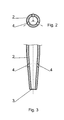
- Figure 1 depicts a tubular body of the catheter with the connecting element on the one end and with the ending element with tightening on the opposite end.
- the ending element In the lower part of the drawing there is a detail of the ending element.
- FIG 2 there is a cross-section of the ending element at the level of its side outlets.
- Short thick lines depict on this drawing an angular guidance of the cross-section subsequently depicted on the figure 3 , where the longitudal section depicts the skewed guidance of the side outlets.
- the terminal opening has rounded edges, whereby the decisive dimension is the size of the opening in the smallest cross-section.
- Figure 4 depicts the cross-section of the ending segment which is pressed out of the material of the body, whereby it forms a whole with this body.
- Figure 5 subsequently depicts the realization of the ending segment which is attached to the end of the tubular body.
- Figure 6 is a cross-section of the ending segment at the level of side outlets formed by the circumferential groove.
- Figure 7 depicts a longitudal section of the ending segment; the section runs through one of the three joints which connect the upper and lower part of the ending segment.
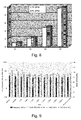
- FIG. 8 The dependence of the flow of the gases and the driving pressure is depicted in the graph on the figure 8 .
- On the x axis is the flow in l/min, on the y axis is the pressure of the propulsive breath gas in kPa for two realizations of the catheter.
- Figure 9 is a graph of the clinical application on the set of patients, which depicts in the temporal dependence the respiratory rate and the concentration of PaO 2 , PaCO 2 .
- Figure 10 depicts the temporal course of the flow of gases through the catheter and the concentration of FiO 2 during clinical application.
- the catheter is designed for persons of 40-70 kg weight.
- the catheter has tubular body 1 which is formed by flexible plastic tube with the inner diameter of 3,5 mm and with outer diameter of 4,8 mm.
- the length of the body 1 is approx. 45 cm.
- connecting element 5 On the one end of the tubular body 1 there is a connecting element 5 attached which is by its shape and size adjusted for the connection to the output of the particular lung ventilator.
- the other end of the plastic tube is formed by the ending element 2 which is tightened in the cone shape and it is ended by the mouth of the terminal opening 3 .
- the ending segment 2 is produced directly from the material of the ending of the body 1 and it forms a single whole with it.
- the tightening is formed by the gradual transition from the inner diameter of the tube of the body 1 to the diameter of the terminal opening 3 .
- three cylindrical openings are distributed above the terminal opening 3 and these form the side outlets 4 . These openings are heading downwards by its outer side, that is, they have the outflow directed towards the terminal opening 3 .
- these openings are produced by drilling and therefore they have a circular cross-section. Their slope is supported by the conical shape of the ending segment 2 .
- the side outlets 4 are distributed equally from the point of view of the angle, which means that the three openings these are distributed in 120° around the circumference of the cross-section of the ending segment 2 .
- Driving pressure Pin necessary for the transport of the desired volume of the gases has been measured, and it is 6, 12, 24 and 34 l/min. Pressure situation in the trachea with the diameter 19 mm has been checked as well. Results are in the figure 8 .
- the ending segment 2 is produced similarly as in example 1.
- the catheter is intended for the category of the patients who are heavier than 70 kg. It has a body 1 with the inner diameter 4,3 mm and with the outer diameter 5,5 mm.
- the first group of patients were patients with chronic obstructive pulmonary disease (COPD) with infectious complications; the second group of patients were patients in the phase of disconnection from the long-term artificial lung ventilation, where the previous ventilatory modes of disconnection have been unsuccessful.
- COPD chronic obstructive pulmonary disease
- the patients from the first group usually concerned patients who have overcome the myocardial infarction.
- the average age of the patients from the first group was 62,5 years, the average weight was 87,1 kg.
- the average age of the patients from the second group was 64,5 years, the average weight was 96,5 kg.
- the ventilatory support with the continual flow through the catheters according to this invention has been applied.
- the respiratory rate decreased to na 27 ⁇ 2,5 d/min, and there has been a continual decrease of the paCO 2 to 3,9 ⁇ 0,9 in the blood gases as a sign of hyperventilation, which has been probably caused by the continual decrease of paO 2 to 8,8 ⁇ 1,4 kPa.
- the ventilatory support with the continuous flow with the catheter according to this inventions is an effective ventilatory mode and it allows to overcome the phase of coping, for example of infectious complications, without the need for intubation and artificial ventilation of lungs.
- a non-invasive ventilatory mode it can be used during disconnection of the patients from the long-term artificial lung ventilation.
- the great advantage of this invention is the subjective evaluation of the device by the patients.
- the patients' assessment of the catheter and coughing up the phlegm was positive; they appreciated the possibility to communicate verbally, receive the food orally, and all this with low need for sedation.
- the ending segment 2 is according to the figure 4 created in the multi-part form, where the material at the end of the body 1 is pressed out by heat, and this single act produces the outer tightening with rounded mouth of the terminal opening 3 .
- the inner wall does not copy the outer tightening, which means that the wall becomes thicker in the area of side outlets 4 .
- the ending segment 2 is and independent plastic component produced independently on the body 1 .
- the ending segment 2 is the welded to the distal end of the body 1 according to figure 5 .
- the ending segment 2 can be produced by pressing in the template, chip machining, 3D pressing or combination of various technologies. Different ending segments with different geometry of the side outlets and the terminal opening can be separated by different colors.
- Ending segment 2 is a molding from the template.
- the side outlets are formed by the circumferential groove which is in four places interrupted by the bridges which hold together the upper and lower part of the ending element 1.
- the joints are produced inside the ending body.
- the direction of the flow from the side outlets is allowed for by the fact that the groove is skewed and delimited by two cone-shaped cylindrical surfaces.
Landscapes
- Health & Medical Sciences (AREA)
- Pulmonology (AREA)
- Heart & Thoracic Surgery (AREA)
- Engineering & Computer Science (AREA)
- Anesthesiology (AREA)
- Biomedical Technology (AREA)
- Emergency Medicine (AREA)
- Hematology (AREA)
- Life Sciences & Earth Sciences (AREA)
- Animal Behavior & Ethology (AREA)
- General Health & Medical Sciences (AREA)
- Public Health (AREA)
- Veterinary Medicine (AREA)
- Media Introduction/Drainage Providing Device (AREA)
Priority Applications (1)
| Application Number | Priority Date | Filing Date | Title |
|---|---|---|---|
| EP15182902.5A EP3135332B1 (fr) | 2015-08-28 | 2015-08-28 | Cathéter trachéal pour support ventilatoire des poumons par écoulement continu de gaz de respiration lors de l'intubation nasotracheal |
Applications Claiming Priority (1)
| Application Number | Priority Date | Filing Date | Title |
|---|---|---|---|
| EP15182902.5A EP3135332B1 (fr) | 2015-08-28 | 2015-08-28 | Cathéter trachéal pour support ventilatoire des poumons par écoulement continu de gaz de respiration lors de l'intubation nasotracheal |
Publications (2)
| Publication Number | Publication Date |
|---|---|
| EP3135332A1 true EP3135332A1 (fr) | 2017-03-01 |
| EP3135332B1 EP3135332B1 (fr) | 2021-05-05 |
Family
ID=54330575
Family Applications (1)
| Application Number | Title | Priority Date | Filing Date |
|---|---|---|---|
| EP15182902.5A Active EP3135332B1 (fr) | 2015-08-28 | 2015-08-28 | Cathéter trachéal pour support ventilatoire des poumons par écoulement continu de gaz de respiration lors de l'intubation nasotracheal |
Country Status (1)
| Country | Link |
|---|---|
| EP (1) | EP3135332B1 (fr) |
Cited By (4)
| Publication number | Priority date | Publication date | Assignee | Title |
|---|---|---|---|---|
| CN107158539A (zh) * | 2017-06-28 | 2017-09-15 | 四川省肿瘤医院 | 一种高气流流速防止鼻粘膜损伤的鼻咽通气道 |
| ES2725873A1 (es) * | 2018-03-27 | 2019-09-30 | Gil Jorge Gutierrez | Dispositivo de dilatacion y ventilacion endotraqueal |
| US11906097B2 (en) | 2019-09-04 | 2024-02-20 | Vyaire Medical, Inc. | Ventilation leak component |
| US12544535B2 (en) | 2019-05-24 | 2026-02-10 | Shelverton Holdings Pty Ltd | Catheter |
Citations (16)
| Publication number | Priority date | Publication date | Assignee | Title |
|---|---|---|---|---|
| US3794026A (en) * | 1970-07-29 | 1974-02-26 | H Jacobs | Ventilating apparatus embodying selective volume or pressure operation and catheter means for use therewith |
| US4091816A (en) | 1977-01-28 | 1978-05-30 | Elam James O | Double cuffed endotracheal tube |
| WO1992020394A1 (fr) * | 1991-05-20 | 1992-11-26 | The United States Of America, As Represented By The Secretary, U.S. Department Of Commerce | Embout de catheter servant a la ventilation intratracheale et ventilation pulmonaire intratracheale |
| US5188592A (en) * | 1991-06-24 | 1993-02-23 | Hakki Sam I | Dynamic pressurized catheter with simultaneous oxygen delivery and suction |
| US5339809A (en) | 1991-12-04 | 1994-08-23 | Beck Jr Charles A | Method of inserting a cricothyroidal endotracheal device between the cricoid and thyroid cartilages for treatment of chronic respiratory disorders |
| US5389074A (en) | 1993-10-27 | 1995-02-14 | The Regents Of The University Of California | Body insertion tube with anesthetic jacket |
| US5507284A (en) | 1993-09-27 | 1996-04-16 | Daneshvar; Yousef | Airway securing system |
| WO2004067073A1 (fr) * | 2003-01-30 | 2004-08-12 | Sorin Group Deutschland Gmbh | Canule aortique |
| US20050090819A1 (en) | 1999-01-15 | 2005-04-28 | Gyrus Medical Limited | Electrosurgical system and method |
| US20060076022A1 (en) | 2004-10-13 | 2006-04-13 | H.S. Hosptial Service S.P.A. | Device for retrograde nasotracheal intubation |
| CN201150702Y (zh) | 2007-02-26 | 2008-11-19 | 康斯坦丁·阿纳托利耶维奇·佩尔瓦科 | 气管导管 |
| CN201564930U (zh) | 2009-12-18 | 2010-09-01 | 李三亮 | 一种双充气套囊气管导管 |
| US20110004065A2 (en) * | 2006-12-06 | 2011-01-06 | Ruprecht-Karls-Universitaet Heidelberg | Intubation tube |
| US20110130745A1 (en) * | 2008-04-22 | 2011-06-02 | Becton, Dickinson And Company | Catheter hole having an inclined trailing edge |
| WO2013016094A2 (fr) * | 2011-07-28 | 2013-01-31 | Acclarent, Inc. | Dispositif et procédé améliorés de dilatation d'une sténose des voies respiratoires |
| CN203677685U (zh) | 2014-01-21 | 2014-07-02 | 上海市奉贤区中心医院 | 气管内导管 |
-
2015
- 2015-08-28 EP EP15182902.5A patent/EP3135332B1/fr active Active
Patent Citations (16)
| Publication number | Priority date | Publication date | Assignee | Title |
|---|---|---|---|---|
| US3794026A (en) * | 1970-07-29 | 1974-02-26 | H Jacobs | Ventilating apparatus embodying selective volume or pressure operation and catheter means for use therewith |
| US4091816A (en) | 1977-01-28 | 1978-05-30 | Elam James O | Double cuffed endotracheal tube |
| WO1992020394A1 (fr) * | 1991-05-20 | 1992-11-26 | The United States Of America, As Represented By The Secretary, U.S. Department Of Commerce | Embout de catheter servant a la ventilation intratracheale et ventilation pulmonaire intratracheale |
| US5188592A (en) * | 1991-06-24 | 1993-02-23 | Hakki Sam I | Dynamic pressurized catheter with simultaneous oxygen delivery and suction |
| US5339809A (en) | 1991-12-04 | 1994-08-23 | Beck Jr Charles A | Method of inserting a cricothyroidal endotracheal device between the cricoid and thyroid cartilages for treatment of chronic respiratory disorders |
| US5507284A (en) | 1993-09-27 | 1996-04-16 | Daneshvar; Yousef | Airway securing system |
| US5389074A (en) | 1993-10-27 | 1995-02-14 | The Regents Of The University Of California | Body insertion tube with anesthetic jacket |
| US20050090819A1 (en) | 1999-01-15 | 2005-04-28 | Gyrus Medical Limited | Electrosurgical system and method |
| WO2004067073A1 (fr) * | 2003-01-30 | 2004-08-12 | Sorin Group Deutschland Gmbh | Canule aortique |
| US20060076022A1 (en) | 2004-10-13 | 2006-04-13 | H.S. Hosptial Service S.P.A. | Device for retrograde nasotracheal intubation |
| US20110004065A2 (en) * | 2006-12-06 | 2011-01-06 | Ruprecht-Karls-Universitaet Heidelberg | Intubation tube |
| CN201150702Y (zh) | 2007-02-26 | 2008-11-19 | 康斯坦丁·阿纳托利耶维奇·佩尔瓦科 | 气管导管 |
| US20110130745A1 (en) * | 2008-04-22 | 2011-06-02 | Becton, Dickinson And Company | Catheter hole having an inclined trailing edge |
| CN201564930U (zh) | 2009-12-18 | 2010-09-01 | 李三亮 | 一种双充气套囊气管导管 |
| WO2013016094A2 (fr) * | 2011-07-28 | 2013-01-31 | Acclarent, Inc. | Dispositif et procédé améliorés de dilatation d'une sténose des voies respiratoires |
| CN203677685U (zh) | 2014-01-21 | 2014-07-02 | 上海市奉贤区中心医院 | 气管内导管 |
Cited By (5)
| Publication number | Priority date | Publication date | Assignee | Title |
|---|---|---|---|---|
| CN107158539A (zh) * | 2017-06-28 | 2017-09-15 | 四川省肿瘤医院 | 一种高气流流速防止鼻粘膜损伤的鼻咽通气道 |
| ES2725873A1 (es) * | 2018-03-27 | 2019-09-30 | Gil Jorge Gutierrez | Dispositivo de dilatacion y ventilacion endotraqueal |
| WO2019185956A1 (fr) | 2018-03-27 | 2019-10-03 | Gutierrez Gil Jorge | Dispositif de dilatation et de ventilation endotrachéal |
| US12544535B2 (en) | 2019-05-24 | 2026-02-10 | Shelverton Holdings Pty Ltd | Catheter |
| US11906097B2 (en) | 2019-09-04 | 2024-02-20 | Vyaire Medical, Inc. | Ventilation leak component |
Also Published As
| Publication number | Publication date |
|---|---|
| EP3135332B1 (fr) | 2021-05-05 |
Similar Documents
| Publication | Publication Date | Title |
|---|---|---|
| Hedenstierna et al. | Ventilation and perfusion of each lung during differential ventilation with selective PEEP | |
| Wolfson et al. | Mechanics and energetics of breathing helium in infants with bronchopulmonary dysplasia | |
| AU2010241205B8 (en) | Broad-band, low frequency, high-amplitude, long time duration, oscillating airway pressure breathing apparatus and method utilizing bubbles | |
| CN101927050B (zh) | 用于输送患者的呼吸气体的支路单元 | |
| JP6138055B2 (ja) | 新生児蘇生および初期呼吸補助のためのシステムおよびデバイス | |
| US8353295B2 (en) | Branching unit and arrangement for delivering a respiratory gas of a subject | |
| EP3135332B1 (fr) | Cathéter trachéal pour support ventilatoire des poumons par écoulement continu de gaz de respiration lors de l'intubation nasotracheal | |
| US10806888B2 (en) | Respiratory assistance device, nasal apparatus and respiratory assistance mask | |
| EP2376158B1 (fr) | Ventilation avec relâchement de pression des voies respiratoires | |
| Belliato et al. | Evaluation of adaptive support ventilation in paralysed patients and in a physical lung model | |
| Klein | Weaning from mechanical breathing with intermittent mandatory ventilation | |
| Schulze-Neick et al. | Acute ventilatory restriction in children after weaning off inhaled nitric oxide: relation to rebound pulmonary hypertension | |
| Hillman | Physiological aspects of intermittent positive pressure ventilation | |
| CN215024296U (zh) | 一种呼气二氧化碳监测鼻氧管 | |
| Mackenzie et al. | Tracheal insufflation of oxygen at low flow: capabilities and limitations | |
| Boisson‐Bertrand et al. | Comparative effects of laryngeal mask and tracheal tube on total respiratory resistance in anaesthetised patients | |
| US20030075178A1 (en) | Continuous gas leakage for elimination of ventilator dead space | |
| Mackenzie et al. | Low-flow endobronchial insufflation with air for 2 hours of apnea provides ventilation adequate for survival | |
| Joseph et al. | Tracheostomy in the critically ill: the myth of dead space | |
| Meissner et al. | Successful Transtracheal Lung Ventilation Using a Manual Respiration Valve: An In Vitroand In VivoStudy | |
| Shutack et al. | Effect of low-rate intermittent mandatory ventilation on pulmonary function of low-birth-weight infants | |
| Watt et al. | Does dead space ventilation always alleviate hypocapnia? Long‐term ventilation with plain tracheostomy tubes | |
| Kolobow et al. | The current status of intratracheal-pulmonary ventilation (ITPV) | |
| JPH09108352A (ja) | 肺血流量の調節装置 | |
| Stankiewicz et al. | Comparison of a standard paediatric tube with a novel tube of unconventional shape |
Legal Events
| Date | Code | Title | Description |
|---|---|---|---|
| PUAI | Public reference made under article 153(3) epc to a published international application that has entered the european phase |
Free format text: ORIGINAL CODE: 0009012 |
|
| STAA | Information on the status of an ep patent application or granted ep patent |
Free format text: STATUS: THE APPLICATION HAS BEEN PUBLISHED |
|
| AK | Designated contracting states |
Kind code of ref document: A1 Designated state(s): AL AT BE BG CH CY CZ DE DK EE ES FI FR GB GR HR HU IE IS IT LI LT LU LV MC MK MT NL NO PL PT RO RS SE SI SK SM TR |
|
| AX | Request for extension of the european patent |
Extension state: BA ME |
|
| STAA | Information on the status of an ep patent application or granted ep patent |
Free format text: STATUS: REQUEST FOR EXAMINATION WAS MADE |
|
| 17P | Request for examination filed |
Effective date: 20170831 |
|
| RBV | Designated contracting states (corrected) |
Designated state(s): AL AT BE BG CH CY CZ DE DK EE ES FI FR GB GR HR HU IE IS IT LI LT LU LV MC MK MT NL NO PL PT RO RS SE SI SK SM TR |
|
| STAA | Information on the status of an ep patent application or granted ep patent |
Free format text: STATUS: EXAMINATION IS IN PROGRESS |
|
| 17Q | First examination report despatched |
Effective date: 20190311 |
|
| GRAP | Despatch of communication of intention to grant a patent |
Free format text: ORIGINAL CODE: EPIDOSNIGR1 |
|
| STAA | Information on the status of an ep patent application or granted ep patent |
Free format text: STATUS: GRANT OF PATENT IS INTENDED |
|
| RIC1 | Information provided on ipc code assigned before grant |
Ipc: A61M 16/04 20060101AFI20201110BHEP Ipc: A61M 25/00 20060101ALN20201110BHEP Ipc: A61M 16/00 20060101ALI20201110BHEP |
|
| RIC1 | Information provided on ipc code assigned before grant |
Ipc: A61M 16/04 20060101AFI20201118BHEP Ipc: A61M 25/00 20060101ALN20201118BHEP Ipc: A61M 16/00 20060101ALI20201118BHEP |
|
| INTG | Intention to grant announced |
Effective date: 20201202 |
|
| RIN1 | Information on inventor provided before grant (corrected) |
Inventor name: TOEROEK, PAVOL Inventor name: CANDIK, PETER |
|
| GRAS | Grant fee paid |
Free format text: ORIGINAL CODE: EPIDOSNIGR3 |
|
| GRAA | (expected) grant |
Free format text: ORIGINAL CODE: 0009210 |
|
| STAA | Information on the status of an ep patent application or granted ep patent |
Free format text: STATUS: THE PATENT HAS BEEN GRANTED |
|
| AK | Designated contracting states |
Kind code of ref document: B1 Designated state(s): AL AT BE BG CH CY CZ DE DK EE ES FI FR GB GR HR HU IE IS IT LI LT LU LV MC MK MT NL NO PL PT RO RS SE SI SK SM TR |
|
| REG | Reference to a national code |
Ref country code: GB Ref legal event code: FG4D |
|
| REG | Reference to a national code |
Ref country code: CH Ref legal event code: EP |
|
| REG | Reference to a national code |
Ref country code: AT Ref legal event code: REF Ref document number: 1389023 Country of ref document: AT Kind code of ref document: T Effective date: 20210515 |
|
| REG | Reference to a national code |
Ref country code: IE Ref legal event code: FG4D |
|
| REG | Reference to a national code |
Ref country code: DE Ref legal event code: R096 Ref document number: 602015068881 Country of ref document: DE |
|
| REG | Reference to a national code |
Ref country code: LT Ref legal event code: MG9D |
|
| REG | Reference to a national code |
Ref country code: AT Ref legal event code: MK05 Ref document number: 1389023 Country of ref document: AT Kind code of ref document: T Effective date: 20210505 |
|
| REG | Reference to a national code |
Ref country code: SK Ref legal event code: T3 Ref document number: E 38100 Country of ref document: SK |
|
| PG25 | Lapsed in a contracting state [announced via postgrant information from national office to epo] |
Ref country code: FI Free format text: LAPSE BECAUSE OF FAILURE TO SUBMIT A TRANSLATION OF THE DESCRIPTION OR TO PAY THE FEE WITHIN THE PRESCRIBED TIME-LIMIT Effective date: 20210505 Ref country code: LT Free format text: LAPSE BECAUSE OF FAILURE TO SUBMIT A TRANSLATION OF THE DESCRIPTION OR TO PAY THE FEE WITHIN THE PRESCRIBED TIME-LIMIT Effective date: 20210505 Ref country code: BG Free format text: LAPSE BECAUSE OF FAILURE TO SUBMIT A TRANSLATION OF THE DESCRIPTION OR TO PAY THE FEE WITHIN THE PRESCRIBED TIME-LIMIT Effective date: 20210805 Ref country code: AT Free format text: LAPSE BECAUSE OF FAILURE TO SUBMIT A TRANSLATION OF THE DESCRIPTION OR TO PAY THE FEE WITHIN THE PRESCRIBED TIME-LIMIT Effective date: 20210505 Ref country code: HR Free format text: LAPSE BECAUSE OF FAILURE TO SUBMIT A TRANSLATION OF THE DESCRIPTION OR TO PAY THE FEE WITHIN THE PRESCRIBED TIME-LIMIT Effective date: 20210505 |
|
| PG25 | Lapsed in a contracting state [announced via postgrant information from national office to epo] |
Ref country code: ES Free format text: LAPSE BECAUSE OF FAILURE TO SUBMIT A TRANSLATION OF THE DESCRIPTION OR TO PAY THE FEE WITHIN THE PRESCRIBED TIME-LIMIT Effective date: 20210505 Ref country code: PL Free format text: LAPSE BECAUSE OF FAILURE TO SUBMIT A TRANSLATION OF THE DESCRIPTION OR TO PAY THE FEE WITHIN THE PRESCRIBED TIME-LIMIT Effective date: 20210505 Ref country code: NO Free format text: LAPSE BECAUSE OF FAILURE TO SUBMIT A TRANSLATION OF THE DESCRIPTION OR TO PAY THE FEE WITHIN THE PRESCRIBED TIME-LIMIT Effective date: 20210805 Ref country code: PT Free format text: LAPSE BECAUSE OF FAILURE TO SUBMIT A TRANSLATION OF THE DESCRIPTION OR TO PAY THE FEE WITHIN THE PRESCRIBED TIME-LIMIT Effective date: 20210906 Ref country code: SE Free format text: LAPSE BECAUSE OF FAILURE TO SUBMIT A TRANSLATION OF THE DESCRIPTION OR TO PAY THE FEE WITHIN THE PRESCRIBED TIME-LIMIT Effective date: 20210505 Ref country code: RS Free format text: LAPSE BECAUSE OF FAILURE TO SUBMIT A TRANSLATION OF THE DESCRIPTION OR TO PAY THE FEE WITHIN THE PRESCRIBED TIME-LIMIT Effective date: 20210505 Ref country code: IS Free format text: LAPSE BECAUSE OF FAILURE TO SUBMIT A TRANSLATION OF THE DESCRIPTION OR TO PAY THE FEE WITHIN THE PRESCRIBED TIME-LIMIT Effective date: 20210905 Ref country code: LV Free format text: LAPSE BECAUSE OF FAILURE TO SUBMIT A TRANSLATION OF THE DESCRIPTION OR TO PAY THE FEE WITHIN THE PRESCRIBED TIME-LIMIT Effective date: 20210505 Ref country code: GR Free format text: LAPSE BECAUSE OF FAILURE TO SUBMIT A TRANSLATION OF THE DESCRIPTION OR TO PAY THE FEE WITHIN THE PRESCRIBED TIME-LIMIT Effective date: 20210806 |
|
| REG | Reference to a national code |
Ref country code: NL Ref legal event code: MP Effective date: 20210505 |
|
| PG25 | Lapsed in a contracting state [announced via postgrant information from national office to epo] |
Ref country code: NL Free format text: LAPSE BECAUSE OF FAILURE TO SUBMIT A TRANSLATION OF THE DESCRIPTION OR TO PAY THE FEE WITHIN THE PRESCRIBED TIME-LIMIT Effective date: 20210505 |
|
| PG25 | Lapsed in a contracting state [announced via postgrant information from national office to epo] |
Ref country code: RO Free format text: LAPSE BECAUSE OF FAILURE TO SUBMIT A TRANSLATION OF THE DESCRIPTION OR TO PAY THE FEE WITHIN THE PRESCRIBED TIME-LIMIT Effective date: 20210505 Ref country code: SM Free format text: LAPSE BECAUSE OF FAILURE TO SUBMIT A TRANSLATION OF THE DESCRIPTION OR TO PAY THE FEE WITHIN THE PRESCRIBED TIME-LIMIT Effective date: 20210505 Ref country code: DK Free format text: LAPSE BECAUSE OF FAILURE TO SUBMIT A TRANSLATION OF THE DESCRIPTION OR TO PAY THE FEE WITHIN THE PRESCRIBED TIME-LIMIT Effective date: 20210505 Ref country code: EE Free format text: LAPSE BECAUSE OF FAILURE TO SUBMIT A TRANSLATION OF THE DESCRIPTION OR TO PAY THE FEE WITHIN THE PRESCRIBED TIME-LIMIT Effective date: 20210505 |
|
| REG | Reference to a national code |
Ref country code: DE Ref legal event code: R097 Ref document number: 602015068881 Country of ref document: DE |
|
| PLBE | No opposition filed within time limit |
Free format text: ORIGINAL CODE: 0009261 |
|
| STAA | Information on the status of an ep patent application or granted ep patent |
Free format text: STATUS: NO OPPOSITION FILED WITHIN TIME LIMIT |
|
| REG | Reference to a national code |
Ref country code: CH Ref legal event code: PL |
|
| PG25 | Lapsed in a contracting state [announced via postgrant information from national office to epo] |
Ref country code: MC Free format text: LAPSE BECAUSE OF FAILURE TO SUBMIT A TRANSLATION OF THE DESCRIPTION OR TO PAY THE FEE WITHIN THE PRESCRIBED TIME-LIMIT Effective date: 20210505 |
|
| 26N | No opposition filed |
Effective date: 20220208 |
|
| REG | Reference to a national code |
Ref country code: BE Ref legal event code: MM Effective date: 20210831 |
|
| PG25 | Lapsed in a contracting state [announced via postgrant information from national office to epo] |
Ref country code: LI Free format text: LAPSE BECAUSE OF NON-PAYMENT OF DUE FEES Effective date: 20210831 Ref country code: CH Free format text: LAPSE BECAUSE OF NON-PAYMENT OF DUE FEES Effective date: 20210831 |
|
| PG25 | Lapsed in a contracting state [announced via postgrant information from national office to epo] |
Ref country code: IS Free format text: LAPSE BECAUSE OF FAILURE TO SUBMIT A TRANSLATION OF THE DESCRIPTION OR TO PAY THE FEE WITHIN THE PRESCRIBED TIME-LIMIT Effective date: 20210905 Ref country code: LU Free format text: LAPSE BECAUSE OF NON-PAYMENT OF DUE FEES Effective date: 20210828 Ref country code: AL Free format text: LAPSE BECAUSE OF FAILURE TO SUBMIT A TRANSLATION OF THE DESCRIPTION OR TO PAY THE FEE WITHIN THE PRESCRIBED TIME-LIMIT Effective date: 20210505 |
|
| PG25 | Lapsed in a contracting state [announced via postgrant information from national office to epo] |
Ref country code: IT Free format text: LAPSE BECAUSE OF FAILURE TO SUBMIT A TRANSLATION OF THE DESCRIPTION OR TO PAY THE FEE WITHIN THE PRESCRIBED TIME-LIMIT Effective date: 20210505 Ref country code: BE Free format text: LAPSE BECAUSE OF NON-PAYMENT OF DUE FEES Effective date: 20210831 |
|
| PGFP | Annual fee paid to national office [announced via postgrant information from national office to epo] |
Ref country code: IE Payment date: 20220818 Year of fee payment: 8 Ref country code: GB Payment date: 20220817 Year of fee payment: 8 |
|
| PGFP | Annual fee paid to national office [announced via postgrant information from national office to epo] |
Ref country code: FR Payment date: 20220817 Year of fee payment: 8 |
|
| PG25 | Lapsed in a contracting state [announced via postgrant information from national office to epo] |
Ref country code: HU Free format text: LAPSE BECAUSE OF FAILURE TO SUBMIT A TRANSLATION OF THE DESCRIPTION OR TO PAY THE FEE WITHIN THE PRESCRIBED TIME-LIMIT; INVALID AB INITIO Effective date: 20150828 |
|
| PG25 | Lapsed in a contracting state [announced via postgrant information from national office to epo] |
Ref country code: CY Free format text: LAPSE BECAUSE OF FAILURE TO SUBMIT A TRANSLATION OF THE DESCRIPTION OR TO PAY THE FEE WITHIN THE PRESCRIBED TIME-LIMIT Effective date: 20210505 |
|
| GBPC | Gb: european patent ceased through non-payment of renewal fee |
Effective date: 20230828 |
|
| PG25 | Lapsed in a contracting state [announced via postgrant information from national office to epo] |
Ref country code: MK Free format text: LAPSE BECAUSE OF FAILURE TO SUBMIT A TRANSLATION OF THE DESCRIPTION OR TO PAY THE FEE WITHIN THE PRESCRIBED TIME-LIMIT Effective date: 20210505 |
|
| REG | Reference to a national code |
Ref country code: IE Ref legal event code: MM4A |
|
| PG25 | Lapsed in a contracting state [announced via postgrant information from national office to epo] |
Ref country code: IE Free format text: LAPSE BECAUSE OF NON-PAYMENT OF DUE FEES Effective date: 20230828 |
|
| PG25 | Lapsed in a contracting state [announced via postgrant information from national office to epo] |
Ref country code: GB Free format text: LAPSE BECAUSE OF NON-PAYMENT OF DUE FEES Effective date: 20230828 |
|
| PG25 | Lapsed in a contracting state [announced via postgrant information from national office to epo] |
Ref country code: IE Free format text: LAPSE BECAUSE OF NON-PAYMENT OF DUE FEES Effective date: 20230828 Ref country code: GB Free format text: LAPSE BECAUSE OF NON-PAYMENT OF DUE FEES Effective date: 20230828 Ref country code: FR Free format text: LAPSE BECAUSE OF NON-PAYMENT OF DUE FEES Effective date: 20230831 |
|
| PG25 | Lapsed in a contracting state [announced via postgrant information from national office to epo] |
Ref country code: MT Free format text: LAPSE BECAUSE OF FAILURE TO SUBMIT A TRANSLATION OF THE DESCRIPTION OR TO PAY THE FEE WITHIN THE PRESCRIBED TIME-LIMIT Effective date: 20210505 |
|
| PGFP | Annual fee paid to national office [announced via postgrant information from national office to epo] |
Ref country code: DE Payment date: 20240820 Year of fee payment: 10 |
|
| PGFP | Annual fee paid to national office [announced via postgrant information from national office to epo] |
Ref country code: CZ Payment date: 20240819 Year of fee payment: 10 |
|
| PGFP | Annual fee paid to national office [announced via postgrant information from national office to epo] |
Ref country code: SK Payment date: 20240819 Year of fee payment: 10 |
|
| PG25 | Lapsed in a contracting state [announced via postgrant information from national office to epo] |
Ref country code: TR Free format text: LAPSE BECAUSE OF FAILURE TO SUBMIT A TRANSLATION OF THE DESCRIPTION OR TO PAY THE FEE WITHIN THE PRESCRIBED TIME-LIMIT Effective date: 20210505 |
|
| REG | Reference to a national code |
Ref country code: DE Ref legal event code: R119 Ref document number: 602015068881 Country of ref document: DE |
|
| REG | Reference to a national code |
Ref country code: SK Ref legal event code: MM4A Ref document number: E 38100 Country of ref document: SK Effective date: 20250828 |
|
| PG25 | Lapsed in a contracting state [announced via postgrant information from national office to epo] |
Ref country code: CZ Free format text: LAPSE BECAUSE OF NON-PAYMENT OF DUE FEES Effective date: 20250828 |
|
| PG25 | Lapsed in a contracting state [announced via postgrant information from national office to epo] |
Ref country code: SK Free format text: LAPSE BECAUSE OF NON-PAYMENT OF DUE FEES Effective date: 20250828 |
|
| PG25 | Lapsed in a contracting state [announced via postgrant information from national office to epo] |
Ref country code: DE Free format text: LAPSE BECAUSE OF NON-PAYMENT OF DUE FEES Effective date: 20260303 |