EP3136371B1 - Luftfahrzeugnavigationsverfahren über eine gemeinsame laufzeitabsichtsdatenstruktur eines flugzeugs - Google Patents
Luftfahrzeugnavigationsverfahren über eine gemeinsame laufzeitabsichtsdatenstruktur eines flugzeugs Download PDFInfo
- Publication number
- EP3136371B1 EP3136371B1 EP15382435.4A EP15382435A EP3136371B1 EP 3136371 B1 EP3136371 B1 EP 3136371B1 EP 15382435 A EP15382435 A EP 15382435A EP 3136371 B1 EP3136371 B1 EP 3136371B1
- Authority
- EP
- European Patent Office
- Prior art keywords
- thread
- air vehicle
- trajectory
- aircraft
- node
- Prior art date
- Legal status (The legal status is an assumption and is not a legal conclusion. Google has not performed a legal analysis and makes no representation as to the accuracy of the status listed.)
- Active
Links
Images





Classifications
-
- G—PHYSICS
- G08—SIGNALLING
- G08G—TRAFFIC CONTROL SYSTEMS
- G08G5/00—Traffic control systems for aircraft
- G08G5/30—Flight plan management
-
- G—PHYSICS
- G05—CONTROLLING; REGULATING
- G05D—SYSTEMS FOR CONTROLLING OR REGULATING NON-ELECTRIC VARIABLES
- G05D1/00—Control of position, course, altitude or attitude of land, water, air or space vehicles, e.g. using automatic pilots
- G05D1/02—Control of position or course in two dimensions
- G05D1/0202—Control of position or course in two dimensions specially adapted to aircraft
-
- G—PHYSICS
- G08—SIGNALLING
- G08G—TRAFFIC CONTROL SYSTEMS
- G08G5/00—Traffic control systems for aircraft
- G08G5/30—Flight plan management
- G08G5/32—Flight plan management for flight plan preparation
-
- G—PHYSICS
- G08—SIGNALLING
- G08G—TRAFFIC CONTROL SYSTEMS
- G08G5/00—Traffic control systems for aircraft
- G08G5/30—Flight plan management
- G08G5/34—Flight plan management for flight plan modification
-
- G—PHYSICS
- G08—SIGNALLING
- G08G—TRAFFIC CONTROL SYSTEMS
- G08G5/00—Traffic control systems for aircraft
- G08G5/50—Navigation or guidance aids
-
- G—PHYSICS
- G08—SIGNALLING
- G08G—TRAFFIC CONTROL SYSTEMS
- G08G5/00—Traffic control systems for aircraft
- G08G5/50—Navigation or guidance aids
- G08G5/55—Navigation or guidance aids for a single aircraft
Definitions
- the present disclosure relates to methods of navigation for air vehicles, the methods comprising defining aircraft trajectories which an air vehicle follows.
- the aircraft trajectories are defined in an Aircraft Intent Description Language (AIDL) which univocally defines the way an air vehicle is to be operated in order to follow a determinate trajectory.
- the aircraft trajectories are defined and edited by means of a Common Runtime Aircraft Intent Data Structure (CRAIDS) which establishes a hierarchy and centralizes dependencies among instructions that define an aircraft trajectory.
- CRAIDS Common Runtime Aircraft Intent Data Structure
- the methods of the present disclosure are applicable in the field of civil and military Air Traffic Management, Air Traffic Control and Air Traffic Navigation and Planning.
- TBO Trajectory Based Operations
- TBO paradigm is the subject of extensive investigation worldwide within the course of the major ATM modernization and UAS (Uninhabited Aerial Systems) insertion initiatives, where it is recognized that novel methods to define and predict aircraft trajectories with higher fidelity and accuracy are needed along with advanced tools to enable their computational treatment so as to facilitate the introduction of higher levels of automation and autonomy in air vehicle operations.
- ATM modernization and UAS Uninhabited Aerial Systems
- Aircraft Intent Description Language is a first attempt to define aircraft trajectories unambiguously.
- six functions can be acknowledged: a) Trajectory Modeling; b) Intent Generation; c) Intent Inference; d) Trajectory Prediction; e) Flight Control, and; f) State Estimation.
- Trajectory Modeling basically comprises planning, editing and visualizing intended aircraft trajectories, using Aircraft Intents (Al), which univocally define a precise way an air vehicle is to be operated.
- Al Aircraft Intents
- a precise a-priory definition of the aircraft's guidance strategy and aircraft's motion is achieved, thus precisely defining an aircraft's trajectory.
- Intent Generation basically comprises finding out a determinate AI which satisfies a given constraint or a given set of constraints to which the desired aircraft trajectory must be restricted.
- Intent Inference basically comprises discovering (inferring) the most likely AI which gave rise to a known aircraft trajectory through reverse engineering from observations of its geometry and timing (e.g. from radar tracks, telemetry data or recorded navigation data).
- Trajectory Prediction basically comprises finding out (predicting) an aircraft trajectory that results from a given instance of Al, based on models of the aircraft performance and the atmospheric conditions (pressure, temperature and wind) in which the flight takes place.
- Flight Control comprises automatically and precisely executing a given instance of Al.
- State Estimation comprises making use of the precise information comprised within an AI instance to find out air vehicle state information at a certain point along its trajectory.
- the first of these problems refers to a lack of common shared data structure to handle aircraft instances in AIDL.
- the abovementioned functions related to ATM are typically tackled by means of modules which either "produce” or “consume” AIDL instances.
- modules which either "produce” or "consume” AIDL instances.
- Another problem concerning ATM systems can be regarded as a lack of unified interface to address all of the abovementioned functions.
- An additional problem refers to a lack of standard encoding for the AI instances. It would be desirable to develop a standard way in which to encode and serialize AIDL instances.
- AIDL is a formal language
- lexical and “syntactical” rules that should be validated in order to ensure that a determinate AI instance "makes sense” or satisfactorily fulfils the requirements established by the user or ATM system manager.
- EP2801963A1 discloses a generation of an aircraft intent description enriching the basic flight intent description with additional information expressed in a formal language (AIDL) that provides an unambiguous four-dimensional description of an aircraft's intended motion and configuration during a period of flight.
- AIDL formal language
- EP2040137A1 discloses how to produce a description of aircraft intent expressed using a formal language (AIDL) to predict aircraft trajectory. Rules are used to generate a set of instructions describing the aerodynamic configuration and the motion of the aircraft. Instructions are checked so they describe unambiguously the aircraft's trajectory.
- ADL formal language
- EP2482269A1 discloses how the flight intent is used alongside other information to generate the aircraft intent that does describe unambiguously the aircraft's trajectory. It determines which degrees of freedom of motion of the aircraft for each flight segment are defined and expresses the flight intent for that flight segment using a formal language (AIDL).
- AIDL formal language
- the step of flying the air vehicle according to the edited aircraft trajectory includes:
- the computation process of an aircraft trajectory preferably includes:
- the air vehicle navigation method preferably includes verifying Aircraft Intent Description Language syntax (AIDL syntax) of the instructions comprising the threads of the edited trajectory, to ensure that aircraft performance limitations are respected, that all the instructions make sense and are coherent with one another, and that the threads are complete.
- AIDL syntax Aircraft Intent Description Language syntax
- At least one instruction node upon at least one thread of the aircraft trajectory is a composite node, wherein a composite node includes a set of instruction nodes (typically focused on solving a particular task) with their associated trigger nodes.
- At least one instruction node upon at least one thread of the aircraft trajectory may be a conditional composite node, wherein a conditional composite node includes at least two sets of instruction nodes with their associated trigger nodes.
- At least one instruction node upon at least one thread of the aircraft trajectory may be a loop node, wherein a loop node includes a set of instruction nodes with their associated trigger nodes.
- the deletion of a node in a thread involves deleting all sets of instruction nodes comprised within the deleted node (i.e. deleting the child nodes pending from the deleted node).
- Each thread according to the invention defines a branch of a hierarchical tree, the hierarchical tree including a root node defining the aircraft trajectory, wherein the branches defined by each thread directly derive from the root node, such that each branch defines the aircraft trajectory according to a different degree of freedom.
- At least one thread includes instructions to univocally define aircraft's motion in a vertical plane.
- At least one thread includes instructions to univocally define aircraft's motion in a horizontal plane (it preferably includes instructions to fly the air vehicle towards certain waypoints in a horizontal plane embracing the aircraft trajectory).
- At least one thread includes instructions to univocally define aircraft's specific maneuvers at each stage of the flight (i.e. to perform certain maneuvers such as landing gear deployment, for instance).
- At least one thread includes instructions to univocally define/specify aircraft's speed and acceleration.
- the end of validity of an instruction within a determined thread is established by the activation of a trigger which is associated to that instruction; the activation of said trigger also establishes the start of validity of the next instruction in that thread (the instruction immediately following that trigger).
- the activation of a trigger is subjected to the fulfillment of a condition specified by that trigger and/or is subjected to the activation of another trigger associated to another instruction in any thread.
- a computer readable medium comprising instructions to carry out the method described above is also presented herewith.
- CRAIDS is a data structure which centralizes and unifies the different interfaces of the aircraft trajectories' consumption/production systems.
- CRAIDS is a component that centralizes the serialization and persistence of an AIDL-based aircraft trajectory.
- CRAIDS is a system that centralizes the syntactical/lexical validation of an aircraft trajectory defined by means of AIDL.
- CRAIDS is an ensemble of services that centralize the security of production/consumption of AIDL-based aircraft trajectories.
- the air vehicle navigation method preferably comprises determining initial conditions for the flight and establishing a set of trajectory requirements or flight constraints regarding an aircraft trajectory which an air vehicle is to follow.
- the method additionally comprises defining and editing an aircraft trajectory according to the established constraints and the initial conditions, and flying the air vehicle according to the defined trajectory.
- the aircraft trajectory definition makes use of AIDL.
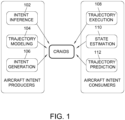
- Figure 1 shows a schematic diagram of the different functions/systems concerning the present air vehicle navigation method.
- FIG. 1 there are six main functions/systems (which are divided into modules 102, 104, 106, 108, 110, 112 represented by boxes) involved in trajectory definition and execution.
- the six functions/systems make use of Aircraft Intents, Al, expressed in AIDL.
- Three functions/systems relate to what can be regarded as Trajectory Consumption (Aircraft Intent Consumers 108, 110, 112).
- the other three functions/systems may be regarded as Trajectory Production functions/systems (Aircraft Intent Producers 102, 104, 106).
- Intent Inference 102 there are three main AI producers: Intent Inference 102, Trajectory Modeling 104 and Intent Generation 106. There are also three main AI consumers: Trajectory execution (also called Flight Control -FC-) 108, State Estimation 110, and Trajectory Prediction 112.
- the present disclosure describes a method of defining and editing an aircraft trajectory by means of a data structure which, for the purposes of the present disclosure, is arbitrarily named as CRAIDS (Common Runtime Aircraft Intent Data Structure).
- CRAIDS Common Runtime Aircraft Intent Data Structure
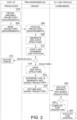
- FIG 2 shows a simplified scheme of a preferred embodiment of the processes of editing (producing) an aircraft trajectory using AIDL and flying (computing the aircraft trajectory) an air vehicle making use of CRAIDS Data Structure (in which aircraft trajectories are edited), and how these processes are related.
- the scheme is divided into three columns representing interfaces of either AI Producers, AI Consumers and CRAIDS interface, these interfaces being respectively named as "EDIT AT” (for Aircraft Trajectory edition), Fly Air Vehicle and Provider/Service (as the interface for CRAIDS).
- producers (systems and/or users wanting to edit an aircraft trajectory) first define 202 some aircraft trajectory requirements and send 204 these requirements to an edition module incorporating CRAIDS.
- the module incorporating CRAIDS receives 206 these trajectory requirements, it generates 208 an AIDL Data Structure (CRAIDS) defining the aircraft trajectory and verifies 210 grammar and syntax rules of the generated CRAIDS. If the syntax and/or grammar is invalid, the module incorporating CRAIDS returns an error 212 to the producer, indicating that there may be some inconsistency in the initial conditions and/or flight requirements. If the syntax and grammar of the generated CRAIDS are found to be valid, the CRAIDS data structure defining an aircraft trajectory is saved 214.
- CRAIDS AIDL Data Structure
- a consumer wants to check and/or use an aircraft trajectory
- the consumer opens a file where the CRAIDS structure is saved
- the module incorporating CRAIDS interprets the saved CRAIDS and generates 216 an AIDL-based aircraft trajectory and returns 218 this AIDL-based trajectory to the consumer.
- the consumer receives 220 this AIDL-based aircraft trajectory and, depending on which type of consumption it may want to perform (a Trajectory Prediction -TP- or a Flight Control -FC-), it either computes 222 a trajectory/partial trajectory or it either executes 224 the AIDL-based aircraft trajectory, thus commanding the air vehicle to execute maneuvers tending to execute an aircraft trajectory as defined by CRAIDS.
- a Trajectory Prediction -TP- or a Flight Control -FC- a Trajectory Prediction -TP- or a Flight Control -FC-
- definition/edition of an aircraft trajectory making use of CRAIDS involves defining the aircraft trajectory according to at least four different threads (which may also be named as patterns or approaches). Each of the threads is an approach of aircraft trajectory according to a different degree of freedom.
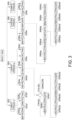
- FIG 3 and Figure 4 schematically depict how an aircraft trajectory is defined/edited by means of CRAIDS, where these threads are shown.
- the edition of this aircraft trajectory can be assumed as the edition of hierarchical tree in which the Root Node (Root AIDL Node) is the Aircraft Trajectory and the other nodes (child nodes) of the hierarchical tree refer to instructions and/or conditions that must be fulfilled in order to define the aircraft trajectory in all its degrees of freedom.
- Root Node Root AIDL Node
- child nodes the other nodes of the hierarchical tree refer to instructions and/or conditions that must be fulfilled in order to define the aircraft trajectory in all its degrees of freedom.
- Longitudinal Thread 1 defines an aircraft trajectory by means of a series of instructions 302a, 302b, 402a, 402b which univocally define aircraft motion in a vertical plane, i.e. the instructions 302a, 302b, 402a, 402b are directed to fix one degree of freedom in the aircraft's motion, namely the altitude.
- the instructions 302a, 302b, 402a, 402b concern determinate altitudes or altitude ranges to which the air vehicle must restrict when flying along certain waypoints.
- Longitudinal thread 1 comprises both instructions 302a, 302b, 402a, 402b (an altitude constraint to be fulfilled) and triggers 302a', 302b', 402a', 402b'; a trigger determines the end of the "period” of validity of an instruction and the beginning of the "period” of validity of the next instruction in the thread.
- Both the instruction and the trigger may be conditioned to the fulfillment of further conditions or instructions which may eventually concern other threads which also define the aircraft trajectory (according to other degrees of freedom).
- the word period may be understood either as a strict time period, or either as an interval in which another flight variable has a certain value.
- Longitudinal Thread 2 defines an aircraft trajectory by means of a series of instructions 304a, 304c concerning air vehicle's speed and acceleration (or engine).
- Longitudinal Thread 2 also comprises triggers 304a', 304c' and, as any other thread, the validity of an instruction (given by its associated trigger) may be conditioned to the fulfillment of a determinate condition or instruction which may eventually concern another thread.
- the Lateral Thread defines an aircraft trajectory by way of establishing the coordinates in a horizontal plane over which the air vehicle must pass by, at the different stages of the flight. Coordinates are specified in the form of instructions 306a, 306c, 406a, 406c comprising geometrical maneuvers in order to guide the air vehicle towards those coordinates. As with the other threads, the Lateral Thread 306, 406 comprises triggers 306a', 306c', 406a', 406c'. The validity of the instructions (given by their associated triggers) may be conditioned to the fulfillment of other conditions or instructions which may eventually concern other threads.
- the fourth pattern or thread is arbitrarily named as "Configuration Thread” 308, 408.
- the Configuration Thread 308, 408 defines an aircraft trajectory through the very specific maneuvers that a determinate air vehicle must carry on (e.g. high lift, landing gears, flaps deployment/retraction) at each stage along the flight.
- the Configuration Thread 308, 408 is typically dependant on the type of air vehicle.
- the Configuration Thread 308, 408 comprises triggers, and the validity of the instructions associated thereto may be conditioned to the fulfillment of other conditions or instructions which may eventually concern other threads.
- the "Longitudinal Thread 1" 302 comprises a series of two instructions 302a, 302b with its corresponding triggers 302a', 302b'.
- An instruction specifies a certain effect (e.g. altitude constraint) and a certain value (specifier) for said effect.
- the trigger specifies the termination (the end of validity) for the instruction placed immediately before.
- Figure 3 represents a series of instructions 304a, 304c with its corresponding triggers 304a', 304c' for "Longitudinal Thread 2".
- This Conditional Composite 304b comprises different series of instructions with their corresponding triggers (two series of instructions, for the case shown in Figure 3 ).
- the Conditional Composite 304b first evaluates the fulfillment of a certain condition 304bCON. Depending on this evaluation, one of the series of instructions comprising the Conditional Composite 304b becomes valid.
- one of the series of instructions comprising the Conditional Composite 304b comprises one instruction 304b1 and one trigger 304b1'
- the other series of instructions comprising the Conditional Composite 304b comprises two instructions 304b2a, 304b2b with its corresponding two triggers 304b2a', 304b2b'.
- the series of instructions comprising the Conditional Composite 304b may either be specifically defined for the Longitudinal Thread 2, or may either be series of instructions of other threads defining the aircraft trajectory (i.e. the condition 304bCON of the Conditional Composite 304b of the Longitudinal Thread 2 may invoke series of instructions belonging to other threads).
- Figure 3 also depicts a series of instructions 306a, 306c with its corresponding triggers 306a', 306c' for the "Lateral Thread" defining the aircraft trajectory.
- the series of instructions for the Lateral Thread 306 comprises a first instruction 306a with its corresponding trigger 306a', a First Intent Composite (Composite 1) 306b, and a last instruction 306c with its corresponding last trigger 306c'.
- An Intent Composite is a condensed way of expressing another series of instructions for defining the aircraft trajectory, in this case, among the first trigger 306a' and the last instruction 306c of the Lateral Thread 306.
- the First Intent Composite (Composite 1) 306b in turn comprises a first instruction 306ba with its corresponding first trigger 306ba', a Second Intent Composite (Composite 2) 306bb and a last instruction 306bc with its corresponding last trigger 306bc'.
- the Second Intent Composite (Composite 2) 306bb is another series of instructions for defining the aircraft trajectory according to the Lateral Thread 306b, in this case, among the first trigger 306ba' and the last instruction 306bc of the series of instructions comprising the First Intent Composite 306b.
- the Second Intent Composite (Composite 2) 306bb in turn comprises two instructions 306bba, 306bbb ordered one after the other, with its corresponding two triggers 306bba', 306bbb', the last instruction 306bbb being valid only when the first instruction 306bba ends its period of validity and the first trigger 306bba' leads into the last instruction306bbb.
- FIGS. 3 and 4 only schematically show a "Configuration Thread” 308, 408, without giving any particular detail on the series of instructions comprising said Configuration Thread 308, 408.
- Figure 4 shows another schematic example of how an aircraft trajectory is defined by means of CRAIDS.
- Figure 4 is almost equivalent to Figure 3 , although "Composite 1" 306b in Lateral Thread 306 has been replaced by a "Loop node” 406b.
- the first trigger 406a' establishes the end of validity of the first instruction 406a and the start of validity of the Loop node 406b (which is constituted as a Composite, i.e. it comprises sets of instructions with their corresponding triggers).
- the Loop 406b evaluates whether a pre-determined main condition 406bCON (which may either be a fixed condition or a condition pertaining the actual value of a state vector -comprising flight variables- of the air vehicle) is fulfilled. If this main condition 406bCON is not fulfilled, the validity of the Loop 406b ends, and the next instruction 406c (the last instruction for the Lateral Thread shown in Figure 4 ) of the Lateral Thread 406 starts its validity.
- the Loop main condition 406bCON If the Loop main condition 406bCON is fulfilled, then the first instruction 406ba of the Loop 406b starts its validity. Once the last instruction 406bbb in the Loop 406b ends its validity, the Loop 406b evaluates once again its condition 406bCON. If it is still fulfilled, the first instruction 406ba in the Loop 406b starts its validity; if the condition 406bCON is not fulfilled, the validity of the Loop 406b ends.
- the Loop Node 406b in the Lateral Thread 406 of Figure 4 is constituted as a composite;
- the Loop Node 406b includes a series of two instructions 406ba, 406bc with their corresponding two triggers 406ba', 406bc', and it includes in turn another composite node 406bb between the first trigger 406ba' and the last instruction 406bc;
- the composite 406bb includes a series of two instructions 406bba, 406bbb with their corresponding two triggers 406bba', 406bbb'.
- the instructions and triggers included in the Threads which define the aircraft trajectory, are susceptible of being created, deleted and/or modified, according to user preferences, constraints given and/or any other criteria.
- the structure of the trajectory definition given by CRAIDS looks like a hierarchical tree, in which the different threads defining the aircraft trajectory are at the same level, and the Composite Nodes, Loop Nodes and/or Conditional Composite Nodes lead to subordinate series of instructions which are at a lower level, thus constituting child nodes.
- Composites are expressed in a so condensed manner because they express groups of instructions which are closely related (e.g. they are intended to perform a particular task such as landing approaches for instance).
- this deletion automatically propagates downwards along the child nodes of the hierarchical tree (all the series of instructions pending from a deleted node shall be deleted too), so that all the instructions defining or particularizing a deleted Composite, Conditional Composite and/or Loop are also deleted.
- the air vehicle navigation method preferably makes use of a computer storing the aircraft trajectories defined in AIDL by means of CRAIDS structure, the computer allowing a user who accesses the computer, to partially or totally create, modify and/or delete an aircraft trajectory.
- a user of the method wants to create and/or modify an aircraft trajectory, making use of CRAIDS
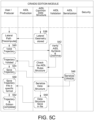
- the user accesses a CRAIDS Edition/Consumption module managing CRAIDS, the module being installed in a computer implementing the present method (the module comprising a User/Producer Interface, an AIDL Production Interface, an AIDL Common Data Structure (CRAIDS) interface, an AIDL validation interface, an AIDL serialization interface and a Security interface), and the following steps are executed:
- the triggers assess Boolean conditions in order to determine whether the instruction to which a trigger is associated, is valid.
- these Boolean conditions pertain to flight variables of the air vehicle's state vector (altitude, speed, acceleration, etc.).
- a determinate first Boolean condition may regard to an air vehicle's altitude being higher or lower than 1000 m (h > 1.000 m).
- the mentioned first Boolean condition is TRUE, and a first trigger assessing the first Boolean condition would indicate, by means of a signal, that the assessed first Boolean condition is TRUE.
- any other component or trigger linked to the first trigger would then receive the signal from the first trigger. Therefore, the first trigger and the triggers linked thereto determine that the instructions associated to them have ended their period of validity, and the next instructions (following those triggers) in each thread shall start their validity.
- Trigger1 accepts the petition of Trigger2 and Trigger3, and stores in a list the identifiers and references of Trigger2 and Trigger 3.
- Trigger1 assesses that the Boolean condition to which it is associated is TRUE, it goes through the stored list of linked triggers and communicates to them the TRUE assessment by means of a signal. This being done, the linked triggers (Trigger2 and Triggers) also assess that their respective conditions are TRUE, and also activate their corresponding signals. This way, the assessment of a Boolean condition associated to a determinate flight variable may propagate through the entire CRAIDS hierarchical tree, activating different triggers which lead to the start of validity of different instructions in one or more threads.
- the method comprises, according to a preferred embodiment thereof, pre-computing a partial trajectory of the Lateral Thread (which mainly define purely geometric instructions as straight or curved lines to follow a trajectory).
- This trajectory pre-computation leads to a considerable time saving since an a-priori knowledge of how an aircraft trajectory will look like is gained.
- a possible embodiment of a trajectory computation/pre-computation algorithm comprises:
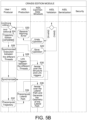
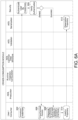
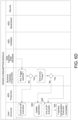
- a user of the method wants to make use of an aircraft trajectory, created and/or modified as explained with reference to Figure 5A , Figure 5B and Figure 5C , making use of CRAIDS
- the user/consumer accesses a CRAIDS Edition/Consumption module, the module being installed in a computer implementing the present method (wherein the module typically comprises a User/Consumer interface, an AIDL Production interface, a Runtime Trajectory Computation interface, an AIDL Common Data Structure (CRAIDS) interface, an AIDL validation interface, an AIDL Serialization interface and a Security interface), and the following steps shown in Figure 6A , Figure 6B , Figure 6C and Figure 6D are executed:
- Figure 7 schematically depicts the steps involved in the computation/execution process of an aircraft trajectory, according to a particular embodiment of the present method. These steps may be described as follows:
- FC has executed/commanded a trajectory
- TP has predicted another trajectory.
- the two main trajectory consumers, the TP (whose aim is to predict a trajectory in the course of flight planning for Air Traffic Management -ATM-) and the FC (Flight Control, whose aim is execute and command the air vehicle in order to follow a trajectory) interact with CRAIDS common interface for interpreting AIDL description language as a linear succession of effects over the air vehicle (instructions) and conditions (triggers) which activate the end of the effect and specify the period of validity of such effects.
- the computer implementing the methods described in the present disclosure may be associated with a conventional flight simulator.
- the computer may include a processor and a memory for a computer program, that when executed causes the processor to operate in accordance with the methods described herein.
- the computer program may also be embodied in a computer readable medium having stored therein the computer program.
Landscapes
- Engineering & Computer Science (AREA)
- Physics & Mathematics (AREA)
- General Physics & Mathematics (AREA)
- Aviation & Aerospace Engineering (AREA)
- Radar, Positioning & Navigation (AREA)
- Remote Sensing (AREA)
- Automation & Control Theory (AREA)
- Traffic Control Systems (AREA)
- Business, Economics & Management (AREA)
- Health & Medical Sciences (AREA)
- Artificial Intelligence (AREA)
- Evolutionary Computation (AREA)
- Game Theory and Decision Science (AREA)
- Medical Informatics (AREA)
- General Engineering & Computer Science (AREA)
Claims (12)
- Luftfahrzeugnavigationsverfahren über eine gemeinsame Laufzeitabsichtsdatenstruktur eines Flugzeugs, wobei das Verfahren folgende Schritte umfasst:a) Etablieren von Anfangsbedingungen für den Flug eines Luftfahrzeugs;b) Etablieren von Flugbeschränkungen;c) Editieren einer Flugzeugflugbahn basierend auf den Anfangsbedingungen und Flugbeschränkungen, wobei die Flugzeugflugbahn in der Aircraft Intent Description Language, AIDL, definiert ist, wobei AIDL eine formale Sprache ist, und;d) Fliegen des Luftfahrzeugs nach der editierten Flugzeugflugbahn;wobei der Schritt des Editierens einer Flugzeugflugbahn Folgendes umfasst:i) Bestimmen einer Anzahl von Freiheitsgraden zum Fliegen des Luftfahrzeugs;ii) Etablieren so vieler Flugbahnstränge (302, 402, 304, 404, 306, 406, 308, 408) wie Freiheitsgrade, wobei jeder Flugbahnstrang eine Reihe von Anweisungsknoten (302a, 302b, 402a, 402b, 304a, 304c, 306a, 406a, 306c, 406c) umfasst, die Anweisungen umfassen, die eindeutig definieren, wie das Luftfahrzeug nach einem Freiheitsgrad zu fliegen ist;iii) Bestimmen der Anweisungen, die die Flugbeschränkungen erfüllen, für jeden Flugbahnstrang;iv) Bestimmen der Gültigkeit jeder Anweisung in jedem Strang, wobei sich die Gültigkeit auf eine beliebige Kombination von mindestens einem oder mehreren von Folgendem bezieht:a. einer spezifischen Zeitperiode;b. einen Wert oder einen Bereich von Werten bezüglich einer Flugvariablen, und;c. einer Gültigkeit einer anderen Anweisung entweder desselben oder eines anderen Strangs;v) Etablieren eines Triggerknotens (302a', 402a', 302b', 402b', 304a', 304c', 306a', 406a', 306c', 406c'), der einen Trigger umfasst, der mit jedem Anweisungsknoten in jedem Strang assoziiert ist, wobei jeder Trigger das Ende der Gültigkeit der Anweisung, mit der er assoziiert ist, und den Beginn der Gültigkeit der nächsten Anweisung innerhalb des Strangs bestimmt, und;vi) Sequenzieren der Anweisungen und assoziierten Trigger in jedem Strang, so dass, wenn das Luftfahrzeug nach den Anweisungen in ihrer spezifizierten Sequenz fliegt, das Luftfahrzeug alle Flugbeschränkungen in jeder Phase während des Fluges erfüllt;wobei der Schritt des Editierens einer Flugzeugflugbahn mittels einer gemeinsamen Laufzeitabsichtsdatenstruktur eines Flugzeugs durchgeführt wird, wobei die gemeinsame Laufzeitdatenstruktur Flugzeugflugbahnen für eine Vielzahl von Modulen definiert, die an der Definition und Ausführung der Luftfahrzeugflugbahn beteiligt sind,dadurch gekennzeichnet, dass jeder Strang eine Verzweigung eines hierarchischen Baums definiert, wobei der hierarchische Baum einen Wurzelknoten umfasst, der die Flugzeugflugbahn definiert, wobei die von jedem Strang definierten Verzweigungen direkt von dem Wurzelknoten stammen, so dass jede Verzweigung die Flugzeugflugbahn nach einem unterschiedlichen Freiheitsgrad definiert;wobei mindestens ein Anweisungsknoten auf mindestens einem Strang der Flugzeugflugbahn ein Verbundknoten (306b) ist, der einen Satz von Anweisungsknoten (306ba, 306bc) mit ihren assoziierten Triggerknoten (306ba', 306bc') umfasst, wobei:a. die Erfüllung einer einem Trigger (306ba') assoziierten Bedingung in dem Strang (306), der dem Verbundknoten (306b) unmittelbar vorhergeht, die Gültigkeit der ersten Anweisung (306ba) des Verbundknotens startet, und;b. die Erfüllung einer Bedingung eines Triggers (306bc') in dem Verbundknoten (306b), der mit der letzten Anweisung (306bc) in dem Verbundknoten assoziiert ist, die Gültigkeit der Anweisung (306c) in dem Strang (306) startet, der dem Verbundknoten unmittelbar folgt;wobei das Löschen eines Knotens in einem Strang das Löschen aller Sätze von Anweisungsknoten beinhaltet, die innerhalb des gelöschten Knotens umfasst sind.
- Luftfahrzeugnavigationsverfahren nach Anspruch 1, wobei der Schritt des Fliegens des Luftfahrzeugs nach der editierten Flugzeugflugbahn Folgendes umfasst:a. Berechnen der editierten Flugzeugflugbahn, was zu einem Satz von Operationen führt, die von dem Luftfahrzeug durchzuführen sind, und;b. Befehlen dem Luftfahrzeug, den Satz von Operationen auszuführen;wobei das Berechnen der editierten Flugzeugflugbahn ein Prozess ist, der in jeder Phase des Fluges Folgendes umfasst:- Aktualisieren des Statusvektors des Luftfahrzeugs;- Beurteilen, nach dem Statusvektor des Luftfahrzeugs, welche Anweisungen in jedem Strang noch gültig sind, wobei diese Beurteilung das Bewerten von Triggern und Bedingungen in jedem Strang einschließt, und;- Bestimmen der durchzuführenden Operationen, so dass bei Ausführung durch das Luftfahrzeug das Luftfahrzeug nach den noch gültigen Anweisungen fliegt.
- Luftfahrzeugnavigationsverfahren nach Anspruch 2, wobei das Berechnen der Flugzeugflugbahn Folgendes umfasst:a) Erhalten der Anfangsbedingungen des Luftfahrzeugs (622);b) Bestimmen einer ersten Operation innerhalb der Liste von Operationen (632), wobei die erste Operation erste Anweisungen in jedem einzelnen Strang und mit diesen Anweisungen assoziierte Effekte umfasst;c) Aktualisieren (642) eines Statusvektors eines Luftfahrzeugs, während die erste Operation durchgeführt wird, wobei der Statusvektor des Luftfahrzeugs flugbezogene Variablen umfasst;d) Beurteilen, nach dem Statusvektor des Luftfahrzeugs, welche Anweisungen in jedem Strang noch gültig sind (644);e) Bestimmen nächster Operationen (646) innerhalb der Liste von Operationen, wobei eine nächste Operation innerhalb der Liste von Operationen alle Anweisungen, die in einer gegebenen Phase der Flugzeugflugbahn noch gültig sind, und die mit diesen gültigen Anweisungen assoziierten Effekte umfasst, und;f) Beenden der Flugbahnberechnung (650), wenn in einer gegebenen Phase der Flugbahn keine Anweisungen auf irgendeinem der Stränge noch gültig sind.
- Luftfahrzeugnavigationsverfahren nach Anspruch 1, wobei es das Verifizieren der Flugzeugabsichtbeschreibungssprachesyntax der Anweisungen umfasst, die mindestens einen der Stränge der editierten Flugbahn umfassen, um sicherzustellen, dass die Leistungsbegrenzungen des Flugzeugs eingehalten werden, dass alle Anweisungen realisierbar sind und miteinander kohärent sind und dass die Stränge vollständig sind.
- Luftfahrzeugnavigationsverfahren nach Anspruch 1, wobei mindestens ein Anweisungsknoten auf mindestens einem Strang der Flugzeugflugbahn ein bedingter Verbundknoten (304b) ist, der mindestens zwei Sätze von Anweisungsknoten mit ihren assoziierten Triggerknoten umfasst, wobei:a. der Start der Gültigkeit eines der beiden Sätze von Anweisungsknoten des bedingten Verbundknotens der Erfüllung einer Bedingung (304bCON) des bedingten Verbundknotens (304b) unterworfen ist;b. die Erfüllung der mit dem Trigger (304a') assoziierten Bedingung in dem Strang (304), der dem bedingten Verbundknoten (304b) unmittelbar vorhergeht, die Beurteilung der Bedingung (304bCON) des bedingten Verbundknotens (304b) startet, und:c. die Erfüllung der Bedingung eines Triggers (304b1', 304b2') im bedingten Verbundknoten (304b), der mit der letzten Anweisung (304b1, 304b2b) in einem der beiden Anweisungssätze des bedingten Verbundknotens assoziiert ist, die Gültigkeit der Anweisung (304c) in dem Strang (304) startet, der unmittelbar auf den bedingten Verbundknoten folgt.
- Luftfahrzeugnavigationsverfahren nach Anspruch 1, wobei mindestens ein Anweisungsknoten auf mindestens einem Strang der Flugzeugflugbahn ein Schleifenknoten (406b) ist, der einen Satz von Anweisungsknoten (406ba, 406bc) mit ihren assoziierten Triggerknoten (406ba', 406bc') umfasst, wobei:a. die Erfüllung der dem Trigger (406a') assoziierten Bedingung in dem Strang (406), der dem Schleifenknoten (406b) unmittelbar vorhergeht, die Beurteilung einer Hauptbedingung (406bCON) des Schleifenknotens startet;b. der Beginn der Gültigkeit der ersten Anweisung (406ba) des Anweisungssatzes, der den Schleifenknoten umfasst, der Erfüllung der Hauptbedingung des Schleifenknotens unterworfen ist;c. wenn die Hauptbedingung des Schleifenknotens nicht erfüllt ist, endet die Gültigkeit des Schleifenknotens und die Anweisung (406c) in dem Strang, der dem Schleifenknoten unmittelbar folgt, startet ihre Gültigkeit, und;d. die Erfüllung einer Bedingung eines Triggerknotens (406bc'), der dem letzten Anweisungsknoten (406bc) in dem Satz von Anweisungsknoten, die den Schleifenknoten umfassen, assoziiert ist, startet die Beurteilung der Hauptbedingung (406bCON) des Schleifenknotens.
- Luftfahrzeugnavigationsverfahren nach Anspruch 1, wobei mindestens ein Strang Anweisungen zum eindeutigen Definieren der Bewegung des Flugzeugs in einer vertikalen Ebene umfasst.
- Luftfahrzeugnavigationsverfahren nach Anspruch 1, wobei mindestens ein Strang Anweisungen zum eindeutigen Definieren der Bewegung des Flugzeugs in einer horizontalen Ebene umfasst.
- Luftfahrzeugnavigationsverfahren nach Anspruch 1, wobei mindestens ein Strang Anweisungen zum eindeutigen Definieren spezifischer Manöver des Flugzeugs in jeder Phase des Fluges umfasst.
- Luftfahrzeugnavigationsverfahren nach Anspruch 1, wobei mindestens ein Strang Anweisungen zum eindeutigen Definieren der Geschwindigkeit und Beschleunigung des Flugzeugs umfasst.
- Luftfahrzeugnavigationsverfahren nach Anspruch 1, wobei das Aktivieren eines Triggers das Ende der Gültigkeit der Anweisung, mit der der Trigger assoziiert ist, und den Beginn der Gültigkeit einer Anweisung in einem dem Trigger unmittelbar folgenden Strang etabliert, wobei das Aktivieren des Triggers der Erfüllung einer durch den Trigger spezifizierten Bedingung und/oder der Aktivierung eines anderen Triggers unterworfen ist, der einer anderen Anweisung in einem beliebigen Strang assoziiert ist.
- Computerlesbares Medium, das Anweisungen umfasst, die, wenn sie von einem Computer ausgeführt werden, den Computer veranlassen, das in den Ansprüchen 1 bis 11 beschriebene Verfahren durchzuführen.
Priority Applications (2)
| Application Number | Priority Date | Filing Date | Title |
|---|---|---|---|
| EP15382435.4A EP3136371B1 (de) | 2015-08-31 | 2015-08-31 | Luftfahrzeugnavigationsverfahren über eine gemeinsame laufzeitabsichtsdatenstruktur eines flugzeugs |
| US15/251,721 US10223921B2 (en) | 2015-08-31 | 2016-08-30 | Air vehicle navigation systems and methods using a common runtime aircraft intent data structure |
Applications Claiming Priority (1)
| Application Number | Priority Date | Filing Date | Title |
|---|---|---|---|
| EP15382435.4A EP3136371B1 (de) | 2015-08-31 | 2015-08-31 | Luftfahrzeugnavigationsverfahren über eine gemeinsame laufzeitabsichtsdatenstruktur eines flugzeugs |
Publications (2)
| Publication Number | Publication Date |
|---|---|
| EP3136371A1 EP3136371A1 (de) | 2017-03-01 |
| EP3136371B1 true EP3136371B1 (de) | 2024-04-17 |
Family
ID=54199150
Family Applications (1)
| Application Number | Title | Priority Date | Filing Date |
|---|---|---|---|
| EP15382435.4A Active EP3136371B1 (de) | 2015-08-31 | 2015-08-31 | Luftfahrzeugnavigationsverfahren über eine gemeinsame laufzeitabsichtsdatenstruktur eines flugzeugs |
Country Status (2)
| Country | Link |
|---|---|
| US (1) | US10223921B2 (de) |
| EP (1) | EP3136371B1 (de) |
Families Citing this family (12)
| Publication number | Priority date | Publication date | Assignee | Title |
|---|---|---|---|---|
| EP2879012A1 (de) * | 2013-11-29 | 2015-06-03 | The Boeing Company | System und Verfahren zur Kontrolle eines Arbeitsgeräts eines Flugzeugs |
| EP2889579B1 (de) * | 2013-12-31 | 2018-02-14 | The Boeing Company | System und Verfahren zum Definieren und Vorhersagen von Flugzeugflugbahnen |
| CN107113177B (zh) * | 2015-12-10 | 2019-06-21 | 深圳市大疆创新科技有限公司 | 数据连接、传送、接收、交互的方法及系统,及存储器、飞行器 |
| US11875688B2 (en) * | 2017-11-23 | 2024-01-16 | Telefonaktiebolaget Lm Ericsson (Publ) | Flight policy query at roaming |
| EP3714446B1 (de) | 2017-11-23 | 2022-06-29 | Telefonaktiebolaget LM Ericsson (publ) | Flugrichtlinienbestimmung beim roaming |
| US10769466B2 (en) * | 2018-02-20 | 2020-09-08 | International Business Machines Corporation | Precision aware drone-based object mapping based on spatial pattern recognition |
| US12360532B2 (en) * | 2019-08-16 | 2025-07-15 | isee | Latent belief space planning using a trajectory tree |
| FR3100062B1 (fr) * | 2019-08-22 | 2021-09-10 | Thales Sa | Procede de determination d'une trajectoire d'un aeronef, produit programme d'ordinateur et module de determination associes |
| EP3893224B1 (de) | 2020-04-07 | 2026-01-28 | The Boeing Company | Systeme, verfahren und vorrichtung zur verbesserung der flugverkehrskontrolle |
| KR20220140944A (ko) * | 2021-04-12 | 2022-10-19 | 현대자동차주식회사 | 도심 항공 모빌리티를 위한 비행체의 제어 방법 |
| US12566649B2 (en) * | 2023-02-15 | 2026-03-03 | Talent Unlimited Online Services Private Limited | System and method for detecting and communicating on-device intent with partner applications using streaming pipe inter-process communication |
| US12454285B2 (en) * | 2023-05-31 | 2025-10-28 | Zoox, Inc. | Vehicle trajectory tree structure including learned trajectories |
Family Cites Families (7)
| Publication number | Priority date | Publication date | Assignee | Title |
|---|---|---|---|---|
| ES2385403T3 (es) | 2007-09-21 | 2012-07-24 | The Boeing Company | Predicción de la trayectoria de una aeronave |
| US8307016B2 (en) | 2008-02-25 | 2012-11-06 | Microsoft Corporation | Accessing different application data via a common data structure |
| EP2482269B1 (de) | 2011-01-28 | 2017-03-22 | The Boeing Company | Bereitstellung von Daten zur Vorhersage der Flugbahn eines Flugzeugs |
| EP2667275B1 (de) | 2012-05-24 | 2023-03-22 | The Boeing Company | Verfahren zur Bereitstellung einer Beschreibung der beabsichtigten Flugbahn eines Flugzeugs, durch Gliederung in Flugabschnitte mit optimierten Kennwerte |
| EP2685440B1 (de) * | 2012-07-09 | 2015-06-24 | The Boeing Company | Verwendung von Flugzeugflugbahndaten zur Ableitung der Flugzeugintention |
| EP2801963B1 (de) * | 2013-05-09 | 2016-01-20 | The Boeing Company | Bereitstellung einer Beschreibung eines beabsichtigten Flugprofils |
| EP2916308B1 (de) | 2014-03-07 | 2016-05-25 | The Boeing Company | Prozessor für beabsichtigte Flugbahnen |
-
2015
- 2015-08-31 EP EP15382435.4A patent/EP3136371B1/de active Active
-
2016
- 2016-08-30 US US15/251,721 patent/US10223921B2/en active Active
Non-Patent Citations (1)
| Title |
|---|
| JAVIER LOPEZ-LEONES ET AL: "The Aircraft Intent Description Language: A key enabler for air-ground synchronization in Trajectory-Based Operations", DIGITAL AVIONICS SYSTEMS CONFERENCE, 2007. DASC '07. IEEE/AIAA 26 TH, IEEE, PI, 1 October 2007 (2007-10-01), pages 1.D.4 - 1, XP031166283, ISBN: 978-1-4244-1107-8 * |
Also Published As
| Publication number | Publication date |
|---|---|
| US10223921B2 (en) | 2019-03-05 |
| EP3136371A1 (de) | 2017-03-01 |
| US20170061804A1 (en) | 2017-03-02 |
Similar Documents
| Publication | Publication Date | Title |
|---|---|---|
| EP3136371B1 (de) | Luftfahrzeugnavigationsverfahren über eine gemeinsame laufzeitabsichtsdatenstruktur eines flugzeugs | |
| Wabersich et al. | Data-driven safety filters: Hamilton-jacobi reachability, control barrier functions, and predictive methods for uncertain systems | |
| Delahaye et al. | Mathematical models for aircraft trajectory design: A survey | |
| CN112445233B (zh) | 具有目标驱动的动作规划的自动飞行器系统 | |
| US12282839B2 (en) | Constraint based inference and machine learning system | |
| Gunetti et al. | Simulation of a soar-based autonomous mission management system for unmanned aircraft | |
| Oishi et al. | Invariance-preserving abstractions of hybrid systems: Application to user interface design | |
| Pritchett et al. | Computational assessment of authority and responsibility in air traffic concepts of operation | |
| CN112445459A (zh) | 一种飞行管理系统的设计方法 | |
| Humphrey et al. | Synthesis of admissible shields | |
| Zhu et al. | Graphical composite modeling and simulation for multi-aircraft collision avoidance | |
| Dupont et al. | Embedding approximation in Event-B: safe hybrid system design using proof and refinement | |
| Leveson | Design and assurance of control software | |
| Fayollas et al. | Exploiting action theory as a framework for analysis and design of formal methods approaches: application to the CIRCUS integrated development environment | |
| Zhi et al. | UML-based combat effectiveness simulation system modeling within MDE | |
| Salmon et al. | CARES, a framework for CPS simulation: application to autonomous underwater vehicle navigation function | |
| Harrison et al. | Relating the automation of functions in multiagent control systems to a system engineering representation | |
| Baek et al. | An extensible modeling method supporting ontology-based scenario specification and domain-specific extension | |
| Perret et al. | A user-centered approach of complexity: toward development of a method to support simplex systems design | |
| CN121596773B (zh) | 复杂系统发射控制逻辑仿真与验证方法 | |
| Ivankov et al. | Drone Swarm Control Model Based on High-Level Petri Nets | |
| KR20220112841A (ko) | 항공 컨플릭트 해결의 자동 제안을 위한 디바이스 및 방법 | |
| Albi | Onboard Mission-and Contingency Management Based on Behavior Trees for Unmanned Aerial Vehicles | |
| Hongye | Autonomous Driving Chassis Domain Control: Vertical Collaboration of Multi-Agent Reinforcement Learning MADDPG and dSPACE Simulation Platform | |
| Lee | Agent-based simulation of socio-technical systems: software architecture and timing mechanisms |
Legal Events
| Date | Code | Title | Description |
|---|---|---|---|
| PUAI | Public reference made under article 153(3) epc to a published international application that has entered the european phase |
Free format text: ORIGINAL CODE: 0009012 |
|
| STAA | Information on the status of an ep patent application or granted ep patent |
Free format text: STATUS: REQUEST FOR EXAMINATION WAS MADE |
|
| 17P | Request for examination filed |
Effective date: 20150831 |
|
| AK | Designated contracting states |
Kind code of ref document: A1 Designated state(s): AL AT BE BG CH CY CZ DE DK EE ES FI FR GB GR HR HU IE IS IT LI LT LU LV MC MK MT NL NO PL PT RO RS SE SI SK SM TR |
|
| AX | Request for extension of the european patent |
Extension state: BA ME |
|
| STAA | Information on the status of an ep patent application or granted ep patent |
Free format text: STATUS: EXAMINATION IS IN PROGRESS |
|
| 17Q | First examination report despatched |
Effective date: 20210225 |
|
| RAP3 | Party data changed (applicant data changed or rights of an application transferred) |
Owner name: THE BOEING COMPANY |
|
| GRAP | Despatch of communication of intention to grant a patent |
Free format text: ORIGINAL CODE: EPIDOSNIGR1 |
|
| STAA | Information on the status of an ep patent application or granted ep patent |
Free format text: STATUS: GRANT OF PATENT IS INTENDED |
|
| INTG | Intention to grant announced |
Effective date: 20231110 |
|
| GRAS | Grant fee paid |
Free format text: ORIGINAL CODE: EPIDOSNIGR3 |
|
| GRAA | (expected) grant |
Free format text: ORIGINAL CODE: 0009210 |
|
| STAA | Information on the status of an ep patent application or granted ep patent |
Free format text: STATUS: THE PATENT HAS BEEN GRANTED |
|
| AK | Designated contracting states |
Kind code of ref document: B1 Designated state(s): AL AT BE BG CH CY CZ DE DK EE ES FI FR GB GR HR HU IE IS IT LI LT LU LV MC MK MT NL NO PL PT RO RS SE SI SK SM TR |
|
| REG | Reference to a national code |
Ref country code: GB Ref legal event code: FG4D |
|
| REG | Reference to a national code |
Ref country code: CH Ref legal event code: EP |
|
| REG | Reference to a national code |
Ref country code: DE Ref legal event code: R096 Ref document number: 602015088335 Country of ref document: DE |
|
| REG | Reference to a national code |
Ref country code: IE Ref legal event code: FG4D |
|
| REG | Reference to a national code |
Ref country code: LT Ref legal event code: MG9D |
|
| REG | Reference to a national code |
Ref country code: NL Ref legal event code: MP Effective date: 20240417 |
|
| REG | Reference to a national code |
Ref country code: AT Ref legal event code: MK05 Ref document number: 1678031 Country of ref document: AT Kind code of ref document: T Effective date: 20240417 |
|
| PG25 | Lapsed in a contracting state [announced via postgrant information from national office to epo] |
Ref country code: NL Free format text: LAPSE BECAUSE OF FAILURE TO SUBMIT A TRANSLATION OF THE DESCRIPTION OR TO PAY THE FEE WITHIN THE PRESCRIBED TIME-LIMIT Effective date: 20240417 |
|
| PG25 | Lapsed in a contracting state [announced via postgrant information from national office to epo] |
Ref country code: NL Free format text: LAPSE BECAUSE OF FAILURE TO SUBMIT A TRANSLATION OF THE DESCRIPTION OR TO PAY THE FEE WITHIN THE PRESCRIBED TIME-LIMIT Effective date: 20240417 |
|
| PG25 | Lapsed in a contracting state [announced via postgrant information from national office to epo] |
Ref country code: IS Free format text: LAPSE BECAUSE OF FAILURE TO SUBMIT A TRANSLATION OF THE DESCRIPTION OR TO PAY THE FEE WITHIN THE PRESCRIBED TIME-LIMIT Effective date: 20240817 |
|
| PG25 | Lapsed in a contracting state [announced via postgrant information from national office to epo] |
Ref country code: BG Free format text: LAPSE BECAUSE OF FAILURE TO SUBMIT A TRANSLATION OF THE DESCRIPTION OR TO PAY THE FEE WITHIN THE PRESCRIBED TIME-LIMIT Effective date: 20240417 |
|
| PG25 | Lapsed in a contracting state [announced via postgrant information from national office to epo] |
Ref country code: HR Free format text: LAPSE BECAUSE OF FAILURE TO SUBMIT A TRANSLATION OF THE DESCRIPTION OR TO PAY THE FEE WITHIN THE PRESCRIBED TIME-LIMIT Effective date: 20240417 Ref country code: FI Free format text: LAPSE BECAUSE OF FAILURE TO SUBMIT A TRANSLATION OF THE DESCRIPTION OR TO PAY THE FEE WITHIN THE PRESCRIBED TIME-LIMIT Effective date: 20240417 |
|
| PG25 | Lapsed in a contracting state [announced via postgrant information from national office to epo] |
Ref country code: GR Free format text: LAPSE BECAUSE OF FAILURE TO SUBMIT A TRANSLATION OF THE DESCRIPTION OR TO PAY THE FEE WITHIN THE PRESCRIBED TIME-LIMIT Effective date: 20240718 |
|
| PG25 | Lapsed in a contracting state [announced via postgrant information from national office to epo] |
Ref country code: PT Free format text: LAPSE BECAUSE OF FAILURE TO SUBMIT A TRANSLATION OF THE DESCRIPTION OR TO PAY THE FEE WITHIN THE PRESCRIBED TIME-LIMIT Effective date: 20240819 |
|
| PG25 | Lapsed in a contracting state [announced via postgrant information from national office to epo] |
Ref country code: ES Free format text: LAPSE BECAUSE OF FAILURE TO SUBMIT A TRANSLATION OF THE DESCRIPTION OR TO PAY THE FEE WITHIN THE PRESCRIBED TIME-LIMIT Effective date: 20240417 |
|
| PG25 | Lapsed in a contracting state [announced via postgrant information from national office to epo] |
Ref country code: AT Free format text: LAPSE BECAUSE OF FAILURE TO SUBMIT A TRANSLATION OF THE DESCRIPTION OR TO PAY THE FEE WITHIN THE PRESCRIBED TIME-LIMIT Effective date: 20240417 |
|
| PG25 | Lapsed in a contracting state [announced via postgrant information from national office to epo] |
Ref country code: PL Free format text: LAPSE BECAUSE OF FAILURE TO SUBMIT A TRANSLATION OF THE DESCRIPTION OR TO PAY THE FEE WITHIN THE PRESCRIBED TIME-LIMIT Effective date: 20240417 |
|
| PG25 | Lapsed in a contracting state [announced via postgrant information from national office to epo] |
Ref country code: LV Free format text: LAPSE BECAUSE OF FAILURE TO SUBMIT A TRANSLATION OF THE DESCRIPTION OR TO PAY THE FEE WITHIN THE PRESCRIBED TIME-LIMIT Effective date: 20240417 |
|
| PG25 | Lapsed in a contracting state [announced via postgrant information from national office to epo] |
Ref country code: PT Free format text: LAPSE BECAUSE OF FAILURE TO SUBMIT A TRANSLATION OF THE DESCRIPTION OR TO PAY THE FEE WITHIN THE PRESCRIBED TIME-LIMIT Effective date: 20240819 Ref country code: PL Free format text: LAPSE BECAUSE OF FAILURE TO SUBMIT A TRANSLATION OF THE DESCRIPTION OR TO PAY THE FEE WITHIN THE PRESCRIBED TIME-LIMIT Effective date: 20240417 Ref country code: NO Free format text: LAPSE BECAUSE OF FAILURE TO SUBMIT A TRANSLATION OF THE DESCRIPTION OR TO PAY THE FEE WITHIN THE PRESCRIBED TIME-LIMIT Effective date: 20240717 Ref country code: LV Free format text: LAPSE BECAUSE OF FAILURE TO SUBMIT A TRANSLATION OF THE DESCRIPTION OR TO PAY THE FEE WITHIN THE PRESCRIBED TIME-LIMIT Effective date: 20240417 Ref country code: IS Free format text: LAPSE BECAUSE OF FAILURE TO SUBMIT A TRANSLATION OF THE DESCRIPTION OR TO PAY THE FEE WITHIN THE PRESCRIBED TIME-LIMIT Effective date: 20240817 Ref country code: HR Free format text: LAPSE BECAUSE OF FAILURE TO SUBMIT A TRANSLATION OF THE DESCRIPTION OR TO PAY THE FEE WITHIN THE PRESCRIBED TIME-LIMIT Effective date: 20240417 Ref country code: GR Free format text: LAPSE BECAUSE OF FAILURE TO SUBMIT A TRANSLATION OF THE DESCRIPTION OR TO PAY THE FEE WITHIN THE PRESCRIBED TIME-LIMIT Effective date: 20240718 Ref country code: FI Free format text: LAPSE BECAUSE OF FAILURE TO SUBMIT A TRANSLATION OF THE DESCRIPTION OR TO PAY THE FEE WITHIN THE PRESCRIBED TIME-LIMIT Effective date: 20240417 Ref country code: ES Free format text: LAPSE BECAUSE OF FAILURE TO SUBMIT A TRANSLATION OF THE DESCRIPTION OR TO PAY THE FEE WITHIN THE PRESCRIBED TIME-LIMIT Effective date: 20240417 Ref country code: BG Free format text: LAPSE BECAUSE OF FAILURE TO SUBMIT A TRANSLATION OF THE DESCRIPTION OR TO PAY THE FEE WITHIN THE PRESCRIBED TIME-LIMIT Effective date: 20240417 Ref country code: AT Free format text: LAPSE BECAUSE OF FAILURE TO SUBMIT A TRANSLATION OF THE DESCRIPTION OR TO PAY THE FEE WITHIN THE PRESCRIBED TIME-LIMIT Effective date: 20240417 Ref country code: RS Free format text: LAPSE BECAUSE OF FAILURE TO SUBMIT A TRANSLATION OF THE DESCRIPTION OR TO PAY THE FEE WITHIN THE PRESCRIBED TIME-LIMIT Effective date: 20240717 |
|
| PG25 | Lapsed in a contracting state [announced via postgrant information from national office to epo] |
Ref country code: DK Free format text: LAPSE BECAUSE OF FAILURE TO SUBMIT A TRANSLATION OF THE DESCRIPTION OR TO PAY THE FEE WITHIN THE PRESCRIBED TIME-LIMIT Effective date: 20240417 |
|
| REG | Reference to a national code |
Ref country code: DE Ref legal event code: R097 Ref document number: 602015088335 Country of ref document: DE |
|
| PG25 | Lapsed in a contracting state [announced via postgrant information from national office to epo] |
Ref country code: EE Free format text: LAPSE BECAUSE OF FAILURE TO SUBMIT A TRANSLATION OF THE DESCRIPTION OR TO PAY THE FEE WITHIN THE PRESCRIBED TIME-LIMIT Effective date: 20240417 |
|
| PG25 | Lapsed in a contracting state [announced via postgrant information from national office to epo] |
Ref country code: CZ Free format text: LAPSE BECAUSE OF FAILURE TO SUBMIT A TRANSLATION OF THE DESCRIPTION OR TO PAY THE FEE WITHIN THE PRESCRIBED TIME-LIMIT Effective date: 20240417 |
|
| PG25 | Lapsed in a contracting state [announced via postgrant information from national office to epo] |
Ref country code: SK Free format text: LAPSE BECAUSE OF FAILURE TO SUBMIT A TRANSLATION OF THE DESCRIPTION OR TO PAY THE FEE WITHIN THE PRESCRIBED TIME-LIMIT Effective date: 20240417 Ref country code: RO Free format text: LAPSE BECAUSE OF FAILURE TO SUBMIT A TRANSLATION OF THE DESCRIPTION OR TO PAY THE FEE WITHIN THE PRESCRIBED TIME-LIMIT Effective date: 20240417 |
|
| PG25 | Lapsed in a contracting state [announced via postgrant information from national office to epo] |
Ref country code: SM Free format text: LAPSE BECAUSE OF FAILURE TO SUBMIT A TRANSLATION OF THE DESCRIPTION OR TO PAY THE FEE WITHIN THE PRESCRIBED TIME-LIMIT Effective date: 20240417 |
|
| PG25 | Lapsed in a contracting state [announced via postgrant information from national office to epo] |
Ref country code: SM Free format text: LAPSE BECAUSE OF FAILURE TO SUBMIT A TRANSLATION OF THE DESCRIPTION OR TO PAY THE FEE WITHIN THE PRESCRIBED TIME-LIMIT Effective date: 20240417 Ref country code: SK Free format text: LAPSE BECAUSE OF FAILURE TO SUBMIT A TRANSLATION OF THE DESCRIPTION OR TO PAY THE FEE WITHIN THE PRESCRIBED TIME-LIMIT Effective date: 20240417 Ref country code: RO Free format text: LAPSE BECAUSE OF FAILURE TO SUBMIT A TRANSLATION OF THE DESCRIPTION OR TO PAY THE FEE WITHIN THE PRESCRIBED TIME-LIMIT Effective date: 20240417 Ref country code: EE Free format text: LAPSE BECAUSE OF FAILURE TO SUBMIT A TRANSLATION OF THE DESCRIPTION OR TO PAY THE FEE WITHIN THE PRESCRIBED TIME-LIMIT Effective date: 20240417 Ref country code: DK Free format text: LAPSE BECAUSE OF FAILURE TO SUBMIT A TRANSLATION OF THE DESCRIPTION OR TO PAY THE FEE WITHIN THE PRESCRIBED TIME-LIMIT Effective date: 20240417 Ref country code: CZ Free format text: LAPSE BECAUSE OF FAILURE TO SUBMIT A TRANSLATION OF THE DESCRIPTION OR TO PAY THE FEE WITHIN THE PRESCRIBED TIME-LIMIT Effective date: 20240417 |
|
| PG25 | Lapsed in a contracting state [announced via postgrant information from national office to epo] |
Ref country code: IT Free format text: LAPSE BECAUSE OF FAILURE TO SUBMIT A TRANSLATION OF THE DESCRIPTION OR TO PAY THE FEE WITHIN THE PRESCRIBED TIME-LIMIT Effective date: 20240417 |
|
| PLBE | No opposition filed within time limit |
Free format text: ORIGINAL CODE: 0009261 |
|
| STAA | Information on the status of an ep patent application or granted ep patent |
Free format text: STATUS: NO OPPOSITION FILED WITHIN TIME LIMIT |
|
| 26N | No opposition filed |
Effective date: 20250120 |
|
| REG | Reference to a national code |
Ref country code: CH Ref legal event code: PL |
|
| PG25 | Lapsed in a contracting state [announced via postgrant information from national office to epo] |
Ref country code: LU Free format text: LAPSE BECAUSE OF NON-PAYMENT OF DUE FEES Effective date: 20240831 |
|
| PG25 | Lapsed in a contracting state [announced via postgrant information from national office to epo] |
Ref country code: SI Free format text: LAPSE BECAUSE OF FAILURE TO SUBMIT A TRANSLATION OF THE DESCRIPTION OR TO PAY THE FEE WITHIN THE PRESCRIBED TIME-LIMIT Effective date: 20240417 Ref country code: CH Free format text: LAPSE BECAUSE OF NON-PAYMENT OF DUE FEES Effective date: 20240831 Ref country code: MC Free format text: LAPSE BECAUSE OF FAILURE TO SUBMIT A TRANSLATION OF THE DESCRIPTION OR TO PAY THE FEE WITHIN THE PRESCRIBED TIME-LIMIT Effective date: 20240417 |
|
| REG | Reference to a national code |
Ref country code: GB Ref legal event code: 732E Free format text: REGISTERED BETWEEN 20250424 AND 20250430 |
|
| REG | Reference to a national code |
Ref country code: DE Ref legal event code: R081 Ref document number: 602015088335 Country of ref document: DE Owner name: INSITU, INC., BINGEN, US Free format text: FORMER OWNER: THE BOEING COMPANY, ARLINGTON, VA, US |
|
| REG | Reference to a national code |
Ref country code: BE Ref legal event code: MM Effective date: 20240831 |
|
| PG25 | Lapsed in a contracting state [announced via postgrant information from national office to epo] |
Ref country code: BE Free format text: LAPSE BECAUSE OF NON-PAYMENT OF DUE FEES Effective date: 20240831 |
|
| PG25 | Lapsed in a contracting state [announced via postgrant information from national office to epo] |
Ref country code: IE Free format text: LAPSE BECAUSE OF NON-PAYMENT OF DUE FEES Effective date: 20240831 |
|
| PG25 | Lapsed in a contracting state [announced via postgrant information from national office to epo] |
Ref country code: SE Free format text: LAPSE BECAUSE OF FAILURE TO SUBMIT A TRANSLATION OF THE DESCRIPTION OR TO PAY THE FEE WITHIN THE PRESCRIBED TIME-LIMIT Effective date: 20240417 |
|
| PGFP | Annual fee paid to national office [announced via postgrant information from national office to epo] |
Ref country code: DE Payment date: 20250827 Year of fee payment: 11 |
|
| PGFP | Annual fee paid to national office [announced via postgrant information from national office to epo] |
Ref country code: GB Payment date: 20250827 Year of fee payment: 11 |
|
| PGFP | Annual fee paid to national office [announced via postgrant information from national office to epo] |
Ref country code: FR Payment date: 20250825 Year of fee payment: 11 |
|
| PG25 | Lapsed in a contracting state [announced via postgrant information from national office to epo] |
Ref country code: CY Free format text: LAPSE BECAUSE OF FAILURE TO SUBMIT A TRANSLATION OF THE DESCRIPTION OR TO PAY THE FEE WITHIN THE PRESCRIBED TIME-LIMIT; INVALID AB INITIO Effective date: 20150831 |
|
| PG25 | Lapsed in a contracting state [announced via postgrant information from national office to epo] |
Ref country code: HU Free format text: LAPSE BECAUSE OF FAILURE TO SUBMIT A TRANSLATION OF THE DESCRIPTION OR TO PAY THE FEE WITHIN THE PRESCRIBED TIME-LIMIT; INVALID AB INITIO Effective date: 20150831 |