EP3136558A1 - Harzverklebtes kohlenstoffhaltige bürste und verfahren zur herstellung davon - Google Patents
Harzverklebtes kohlenstoffhaltige bürste und verfahren zur herstellung davon Download PDFInfo
- Publication number
- EP3136558A1 EP3136558A1 EP15783580.2A EP15783580A EP3136558A1 EP 3136558 A1 EP3136558 A1 EP 3136558A1 EP 15783580 A EP15783580 A EP 15783580A EP 3136558 A1 EP3136558 A1 EP 3136558A1
- Authority
- EP
- European Patent Office
- Prior art keywords
- brush
- carbonaceous
- carbonaceous material
- metallic powder
- resin
- Prior art date
- Legal status (The legal status is an assumption and is not a legal conclusion. Google has not performed a legal analysis and makes no representation as to the accuracy of the status listed.)
- Withdrawn
Links
Images






Classifications
-
- H—ELECTRICITY
- H01—ELECTRIC ELEMENTS
- H01R—ELECTRICALLY-CONDUCTIVE CONNECTIONS; STRUCTURAL ASSOCIATIONS OF A PLURALITY OF MUTUALLY-INSULATED ELECTRICAL CONNECTING ELEMENTS; COUPLING DEVICES; CURRENT COLLECTORS
- H01R39/00—Rotary current collectors, distributors or interrupters
- H01R39/02—Details for dynamo electric machines
- H01R39/18—Contacts for co-operation with commutator or slip-ring, e.g. contact brush
- H01R39/20—Contacts for co-operation with commutator or slip-ring, e.g. contact brush characterised by the material thereof
-
- H—ELECTRICITY
- H01—ELECTRIC ELEMENTS
- H01R—ELECTRICALLY-CONDUCTIVE CONNECTIONS; STRUCTURAL ASSOCIATIONS OF A PLURALITY OF MUTUALLY-INSULATED ELECTRICAL CONNECTING ELEMENTS; COUPLING DEVICES; CURRENT COLLECTORS
- H01R39/00—Rotary current collectors, distributors or interrupters
- H01R39/02—Details for dynamo electric machines
- H01R39/18—Contacts for co-operation with commutator or slip-ring, e.g. contact brush
- H01R39/26—Solid sliding contacts, e.g. carbon brush
-
- H—ELECTRICITY
- H01—ELECTRIC ELEMENTS
- H01R—ELECTRICALLY-CONDUCTIVE CONNECTIONS; STRUCTURAL ASSOCIATIONS OF A PLURALITY OF MUTUALLY-INSULATED ELECTRICAL CONNECTING ELEMENTS; COUPLING DEVICES; CURRENT COLLECTORS
- H01R43/00—Apparatus or processes specially adapted for manufacturing, assembling, maintaining, or repairing of line connectors or current collectors or for joining electric conductors
- H01R43/12—Manufacture of brushes
-
- H—ELECTRICITY
- H02—GENERATION; CONVERSION OR DISTRIBUTION OF ELECTRIC POWER
- H02K—DYNAMO-ELECTRIC MACHINES
- H02K13/00—Structural associations of current collectors with motors or generators, e.g. brush mounting plates or connections to windings; Disposition of current collectors in motors or generators; Arrangements for improving commutation
-
- H—ELECTRICITY
- H02—GENERATION; CONVERSION OR DISTRIBUTION OF ELECTRIC POWER
- H02K—DYNAMO-ELECTRIC MACHINES
- H02K13/00—Structural associations of current collectors with motors or generators, e.g. brush mounting plates or connections to windings; Disposition of current collectors in motors or generators; Arrangements for improving commutation
- H02K13/003—Structural associations of slip-rings
Definitions
- the present invention relates to a resin bonded carbonaceous brush and a method of manufacturing the resin bonded carbonaceous brush.
- a resin bonded carbonaceous brush that includes carbon and is formed by resin bonding is used as a brush of a motor (see Patent Document 1, for example).
- the resin bonded carbonaceous brush has sufficient flexibility, and has high lubrication ability with respect to a rotating body (a rotor). Therefore, friction noise generated between the resin bonded carbonaceous brush and the rotating body is relatively small, and it is possible to reduce the noise of the motor by using the resin bonded carbonaceous brush.
- the resin bonded carbonaceous brush is used in a motor of a home electric appliance of which the quietness is required.
- the resin bonded carbonaceous brush has the large content of a resin, electrical resistivity is relatively high. In order to increase an output of the motor, it is required to decrease the electrical resistivity of the resin bonded carbonaceous brush.
- An object of the present invention is to provide a resin bonded carbonaceous brush in which electrical resistivity is decreased, and a method of manufacturing the resin bonded carbonaceous brush.
- the present invention causes the electrical resistivity of the resin bonded carbonaceous brush to decrease.
- Fig. 1 is a schematic perspective view of an AC motor using the resin bonded carbonaceous brush according to the present embodiment (hereinafter abbreviated as a brush).
- the AC motor 10 of Fig. 1 includes the brush 1 and a rotating body 2.
- the rotating body 2 is a commutator and provided to be rotatable around a rotation axis G.
- a lead wire 4 is connected to the brush 1.
- the brush 1 is biased by a brush spring (not shown) such that one end of the brush 1 comes into contact with an outer peripheral surface of the rotating body 2.
- An electric current is supplied from a power source (not shown) to the brush 1 through the lead wire 4.
- the rotating body 2 is rotated around the rotation axis G by the supply of the current from the brush 1 to the rotating body 2.
- the brush 1 slides with respect to the rotating body 2 by the rotation of the brush rotating body 2.
- the brush 1 is used in the AC motor 10 in the present embodiment, the present invention is not limited to this.
- the brush 1 may be used in a DC motor.
- a carbonaceous material is fabricated by kneading of carbon powder and a binder.
- carbon powder graphite powder is preferably used.
- graphite powder natural graphite powder, artificial graphite powder, expanded graphite powder or the like can be used, and a mixture of more than one of these may be used.
- binder a synthetic resin can be used, and any one of a thermosetting synthetic resin and a thermoplastic synthetic resin or a mixture of these may be used.
- an epoxy resin, a phenol resin, a polyester resin, a vinylester resin, a furan resin, a polyamide resin, or a polyimide resin is preferably used. Further, these binders may be dissolved in a solvent of ketones such as acetone or alcohols such as methanol or ethanol, and a dissolving liquid may be kneaded with the carbon powder.
- a ratio of the carbon powder to the total weight of the carbon powder and the binder is 5 % by weight or more and 95 % by weight or less, for example, and is preferably 50 % by weight or more and 90 % by weight or less.
- one or more types of tungsten, tungsten carbide, molybdenum and sulfides of tungsten, tungsten carbide and molybdenum may be added as an additive.
- a ratio of the additive to the total weight of the carbon powder and the binder is 0.1 % by weight or more and 10 % by weight or less, for example, and is preferably 1 % by weight or more and 5 % by weight or less.
- the carbonaceous material is granulated such that an average particle diameter of the carbonaceous material is 0.3 mm or more.
- granulation may be performed by kneading, or granulated powder may be sized by the use of a sieve.
- granulation may be performed by another method such as grinding of the carbonaceous material.
- An average particle diameter of the granulated carbonaceous material is preferably 0.3 mm or more and 2.5 mm or less, and is more preferably 0.8 mm or more and 2.0 mm or less.
- a brush material is fabricated by mixing of the granulated carbonaceous material and metallic powder.
- a ratio of the metallic powder to the total weight of the brush material is adjusted to 1 % by weight or more and 30 % by weight or less, and is preferably 2.5 % by weight or more and 10 % by weight or less.
- the metallic powder silver powder or copper powder is used, for example.
- apparent density of the silver powder is preferably 0.5 g/cm 3 or more and 0.8 g/cm 3 or less. Further, the smaller an average particle diameter of the metallic powder is, the more easily a three-dimensional net-like connection (hereinafter referred to as a metal network) of metal is formed.
- the average particle diameter of the metallic powder is preferably 0.5 ⁇ m or more and 20 ⁇ m or less, and is more preferably 2 ⁇ m or more and 10 ⁇ m or less.
- a resin included in the carbonaceous material is preferably uncured. Because the metallic powder adheres easily to the uncured resin, the metallic powder can adhere uniformly to surfaces of the carbonaceous material. Thus, the metal network can be formed efficiently. Further, the carbonaceous material and the metallic powder may be mixed with the resin being uncured and a solvent of the binder remaining.
- a temperature of the thermal processing is a temperature at which the resin in the brush material is not carbonized, and 150 °C or more and 250 °C or less, for example.
- the thermal processing is preferably performed in a nitrogen atmosphere, an ammonia reduction atmosphere or in a vacuum. In this case, oxidation of the metallic powder can be suppressed.
- the brush 1 having desired measurement and shape is fabricated from the fabricated brush base material.
- Fig. 2 is a diagram for explaining a relationship between the average particle diameter of the carbonaceous material and the electrical resistivity.
- Fig. 2(a) a state of particles of the carbonaceous material and metallic particles in the case where the average particle diameter of the carbonaceous material is relatively small is shown.
- Fig. 2(b) a state of particles of the carbonaceous material and the metallic particles in the case where particle diameters of the carbonaceous material are relatively large is shown.
- particles of the granulated carbonaceous material are referred to as carbonaceous particles.
- the plurality of carbonaceous particles P1 and the plurality of metallic particles P2 are arranged respectively and dispersively as shown in Fig. 2(a) . Therefore, the plurality of metallic particles P2 are unlikely to come into contact with one another, and the electrical resistivity of the brush 1 increases.
- the plurality of metallic particles P2 are arranged in a concentrated and successive manner in gaps formed among the plurality of carbonaceous particles P1, and the metal network is formed as shown in Fig. 2(b) .
- the conductivity caused by the plurality of metallic particles P2 is ensured, and the electrical resistivity of the brush 1 decreases.
- the thickness of a metal layer formed by the metallic particles P2 among the plurality of carbonaceous particles P1 is preferably 1 ⁇ m or more and 20 ⁇ m or less. In this case, the electrical resistivity decreases effectively by the metal network.
- the molding of the brush 1 becomes difficult. Therefore, the brush 1 can be molded easily while the electrical resistivity of the brush 1 is decreased by the adjustment of the average particle diameter of the carbonaceous material to 2.5 mm or less.
- a ratio of the metallic powder in the brush material is adjusted to 1 % by weight or more, the conductivity caused by the plurality of metallic particles P2 is ensured.
- a ratio of the metallic powder in the brush material is adjusted to 30 % by weight or less, entire surfaces of the carbonaceous particles P1 are not covered by the metallic particles P2. Therefore, a decrease in bonding force among the plurality of carbonaceous particles P1 is prevented. Therefore, bending strength of the brush 1 is ensured. Further, because a ratio of metal does not become too large, negative influence on sliding properties can be prevented.
- the electrical resistivity of the brush 1 hardly changes largely. Further, because highly conductive portions are not distributed unevenly on the surface of the brush 1, fluctuation of the electrical conductivity caused by the carbonaceous material decreases. Therefore, the electrical conductivity can decrease effectively.
- the carbonaceous material is granulated such that the average particle diameter of the carbonaceous material is 0.3 mm or more, and then the carbonaceous material and the metallic powder are mixed. Thereafter, the pressure molding and the thermal processing of the brush material made of the carbonaceous material and the metallic powder are performed.
- the metallic powder is arranged among the particles of the carbonaceous material, the conductivity increases, and the electrical resistivity decreases.
- the average particle diameter of the carbonaceous material is 0.3 mm or more, the metallic powder is arranged not dispersively but in a concentrated manner among the particles of the carbonaceous material.
- the electrical resistivity decreases effectively.
- the conductivity caused by the metallic powder is ensured sufficiently. Further, because a ratio of the metallic powder to the entire carbonaceous material and metallic powder is adjusted to 30 % by weight or less, a decrease in bonding force among the particles of the carbonaceous material is prevented. Therefore, mechanical strength such as the bending strength of the brush 1 is ensured.
- the carbonaceous material was granulated by kneading, and particle diameters of the carbonaceous material were adjusted with the use of a sieve such that an average particle diameter was 0.8 mm.
- Silver powder having an average particle diameter of 5.6 ⁇ m was added to the carbonaceous material after the adjustment of the particle diameters, and these were mixed by a powder mixer.
- the brush material was fabricated.
- amounts of the carbonaceous material and the metallic powder were adjusted such that ratios of the carbonaceous material and the metallic powder in the brush material were 97.5 % by weight and 2.5 % by weight, respectively.
- the pressure molding was performed on the fabricated brush material with the pressure of 2 t/cm 2 , and the thermal processing was performed on the molded brush material at 200 °C.
- a brush base material was fabricated.
- a brush base material was fabricated similarly to the inventive example 1 except that ratios of the carbonaceous material and the metallic powder in the brush material were adjusted to 95.0 % by weight and 5.0 % by weight, respectively.
- a brush base material was fabricated similarly to the inventive example 1 except that ratios of the carbonaceous material and the metallic powder in the brush material were adjusted to 90.0 % by weight and 10.0 % by weight, respectively.
- a brush base material was fabricated similarly to the inventive example 1 except that the particle diameters of the carbonaceous material were adjusted such that an average particle diameter was 2.0 mm.
- a brush base material was fabricated similarly to the inventive example 1 except that the particle diameters of the carbonaceous material were adjusted such that an average particle diameter was 1.5 mm.
- a brush base material was fabricated similarly to the inventive example 1 except that the particle diameters of the carbonaceous material were adjusted such that an average particle diameter was 1.0 mm.
- a brush base material was fabricated similarly to the inventive example 1 except that the particle diameters of the carbonaceous material were adjusted such that an average particle diameter was 0.5 mm.
- a brush base material was fabricated similarly to the inventive example 1 except for the following points.
- a carbonaceous material was fabricated by kneading of the carbon powder and the binder, and then the carbonaceous material was dried by a hot-air dryer. Then, the carbonaceous material was ground by a grinder such that an average particle diameter was 0.25 mm. Thereafter, the brush base material was fabricated by the pressure molding and the thermal processing of the carbonaceous material without addition of silver powder.
- a brush base material was fabricated similarly to the comparative example 1 except that the particle diameters of the carbonaceous material were adjusted by a wet granulator such that an average particle diameter was 0.8 mm.
- a brush base material was fabricated similarly to the comparative example 1 except for the following point. Silver powder was added to the carbonaceous material such that ratios of the carbonaceous material and the metallic powder were 97.5 % by weight and 2.5 % by weight, respectively.
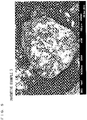
- Fig. 3 is a diagram showing the surfaces of the carbonaceous particles of the inventive example 1 observed by the microscope.
- Fig. 4 is a diagram showing the surfaces of the carbonaceous particles of the inventive example 2 observed by the microscope.
- Fig. 5 is a diagram showing the surfaces of the carbonaceous particles of the inventive example 3 observed by the microscope.
- Fig. 6 is a diagram showing the surfaces of the carbonaceous particles of the comparative example 1 observed by the microscope.
- the silver powder adheres substantially uniformly to the surfaces of the carbonaceous particles. Therefore, in the case where the brush 1 is fabricated by the pressure molding and the thermal processing of each of these carbonaceous materials (the brush materials), the silver powder is arranged intensively among the plurality of carbonaceous particles, and the electrical resistivity of the brush 1 decreases.
- an amount of the silver powder that adheres to the particle surfaces of the carbonaceous material is large in the inventive example 2 shown in Fig. 4 .
- an amount of the silver powder that adheres to the particle surfaces of the carbonaceous material is large in the inventive example 3 shown in Fig. 5 . Therefore, the electrical resistivity of the brush 1 corresponding to the inventive example 2 is low as compared to the electrical resistivity of the brush 1 corresponding to the inventive example 1, and the electrical resistivity of the brush 1 corresponding to the inventive example 3 is low as compared to the electrical resistivity of the brush 1 corresponding to the inventive example 2.
- the silver powder does not adhere to the particle surfaces of the carbonaceous material in the comparative example 1. Therefore, even if the brush 1 is fabricated by the pressure molding and the thermal processing of this carbonaceous material, the electrical resistivity of the brush 1 does not decrease.
- a cut section of the fabricated brush base material was observed by the microscope.
- Fig. 7 is a diagram showing a cut section of the brush base material of the inventive example 1 observed by the microscope
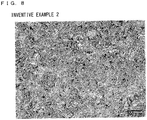
- Fig. 8 is a diagram showing a cut section of the brush base material of the inventive example 2 observed by the microscope
- Fig. 9 is a diagram showing a cut section of the brush base material of the inventive example 3 observed by the microscope.
- a bar-shaped test piece having the measurement of 6 x 6 x 42 mm was fabricated from the brush base material fabricated in each of the inventive examples 1 to 7 and the comparative examples 1 to 3, and the bulk density, the hardness, the bending strength and the electrical resistivity of the test piece were measured.
- the hardness was measured by the use of a C-type Shore hardness meter.
- the electrical resistivity in each of the inventive examples 1 to 7 is low.
- the electrical resistivity in each of the inventive examples 1 to 7 is low.
- the electrical resistivity in each of the inventive examples 1 to 7 is low.
- the electrical resistivity was low as compared to the case where the average particle diameter of the carbonaceous material was 0. 3 mm or more, the electrical resistivity was low as compared to the case where the average particle diameter of the carbonaceous material was smaller than 0.3 mm.
- the electrical resistivity is lower in the inventive example 2 than the inventive example 1, and the electrical resistivity is lower in the inventive example 3 than the inventive example 2.
- inventive example 1 and the inventive examples 4 to 7 in which the contents of the silver were the same even if the average particle diameters of the carbonaceous materials were different from one another in a range of 0.5 mm or more and 2.0 mm or less, there was no large difference in electrical resistivity.
- the bending strength in each of the inventive examples 1 to 7 was in a range of 12.3 MPa or more and 14.5 MPa or less, and was in an appropriate range as the bending strength of the brush 1 used in the motor 10 of Fig. 1 .
- the bulk density and the hardness there was no large difference among the inventive examples 1 to 7 and the comparative examples 1 to 3.
- the brush 1 having the measurement of 6.1 x 9 x 20 mm was fabricated from the brush base material fabricated in each of the inventive examples 1 to 7 and the comparative examples 1 to 3, and the brush 1 was used in the motor 10 of a vacuum cleaner. Then, the motor efficiency was measured.
- the motor efficiency here refers to a ratio of mechanical energy that is output by the motor 10 to electrical energy that is input to the motor 10. The lower the electrical resistivity of the brush 1 is, the higher the motor efficiency is.
- the measurement of the motor efficiency was performed in accordance with DIN (German Industrial Standard) 44959 "Measurement Method of Suction Work Rate of Vacuum Cleaner.”
- two motors 10 were used.
- one motor 10 hereinafter referred to as a first motor 10
- the brush 1 corresponding to each of the inventive examples 1 to 3 was used, and a relationship between the content of silver in the brush base material and the motor efficiency was examined.
- the other motor 10 hereinafter referred to as a second motor 10
- the brush 1 corresponding to each of the inventive examples 4 to 7 was used, and a relationship between the average particle diameter of the carbonaceous material and the motor efficiency was examined.
- each of a rated voltage and a power voltage was 100 V, a frequency was 60 Hz, and the pressure applied from the brush 1 to the rotating body 2 ( Fig. 1 ) was 40 KPa. Further, an aperture diameter of a suction port was 19 mm. Further, aging was performed for 20 minutes until an operation of the motor 10 was stable, and then the motor efficiency was measured.
- Fig. 10 is a diagram showing results of measurement in the first motor 10.
- Fig. 11 is a diagram showing results of measurement in the second motor 10.
- the measured motor efficiency is shown.
- a difference between the motor efficiency in the case where the brush 1 corresponding to the comparative example 1 is used, and the motor efficiency in the case where the brush 1 corresponding to another example is used is shown.
- the motor efficiency was from 46.7 to 46.8 % in the case where the brush 1 corresponding to each of the comparative example 1 and the comparative example 2 was used.
- the motor efficiency was from 47.3 to 48.8 % in the case where the brush 1 corresponding to each of the inventive examples 1 to 3 was used.
- the motor efficiency was higher in the case where the brush 1 corresponding to the inventive example 2 was used than the case where the brush 1 corresponding to the inventive example 1 was used.
- the motor efficiency was higher in the case where the brush 1 corresponding to the inventive example 3 was used than the case where the brush 1 corresponding to the inventive examples 2 was used.
- the motor efficiency was 48.4 % in the case where the brush 1 corresponding to each of the comparative example 1 and the comparative example 3 was used.
- the motor efficiency was from 48.8 to 48.9 % in the case where the brush 1 corresponding to each of the inventive examples 4 to 7 was used.
- the present invention can be utilized effectively for various types of motors.
Landscapes
- Engineering & Computer Science (AREA)
- Manufacturing & Machinery (AREA)
- Power Engineering (AREA)
- Motor Or Generator Current Collectors (AREA)
- Manufacturing Of Electrical Connectors (AREA)
Applications Claiming Priority (2)
| Application Number | Priority Date | Filing Date | Title |
|---|---|---|---|
| JP2014089272A JP6539018B2 (ja) | 2014-04-23 | 2014-04-23 | 樹脂結合炭素質ブラシおよびその製造方法 |
| PCT/JP2015/001942 WO2015162862A1 (ja) | 2014-04-23 | 2015-04-07 | 樹脂結合炭素質ブラシおよびその製造方法 |
Publications (2)
| Publication Number | Publication Date |
|---|---|
| EP3136558A1 true EP3136558A1 (de) | 2017-03-01 |
| EP3136558A4 EP3136558A4 (de) | 2018-01-10 |
Family
ID=54332044
Family Applications (1)
| Application Number | Title | Priority Date | Filing Date |
|---|---|---|---|
| EP15783580.2A Withdrawn EP3136558A4 (de) | 2014-04-23 | 2015-04-07 | Harzverklebtes kohlenstoffhaltige bürste und verfahren zur herstellung davon |
Country Status (7)
| Country | Link |
|---|---|
| US (1) | US10903613B2 (de) |
| EP (1) | EP3136558A4 (de) |
| JP (1) | JP6539018B2 (de) |
| KR (1) | KR20160145638A (de) |
| CN (1) | CN106233590B (de) |
| TW (1) | TW201542645A (de) |
| WO (1) | WO2015162862A1 (de) |
Families Citing this family (6)
| Publication number | Priority date | Publication date | Assignee | Title |
|---|---|---|---|---|
| DE102013212062B4 (de) * | 2013-06-25 | 2017-05-11 | Pantrac Gmbh | Vorrichtung zur Ableitung von Erdungsströmen, insbesondere in Windkraftanlagen |
| CN107254169B (zh) * | 2017-06-20 | 2020-04-03 | 苏州大学 | 一种耐热电刷及其制备方法 |
| CN107141794A (zh) * | 2017-06-20 | 2017-09-08 | 苏州大学 | 一种树脂基电刷及其制备方法 |
| JP2020171091A (ja) * | 2019-04-01 | 2020-10-15 | 株式会社デンソー | 直流モータ |
| KR102316130B1 (ko) * | 2019-07-19 | 2021-10-25 | 주식회사 만도 | 모터 제조 방법 및 모터 제조 시스템 |
| JP7250337B2 (ja) * | 2019-11-25 | 2023-04-03 | トライス株式会社 | 銀を主成分とする金属黒鉛質アースブラシ及びその製造方法 |
Family Cites Families (13)
| Publication number | Priority date | Publication date | Assignee | Title |
|---|---|---|---|---|
| JPS6013382B2 (ja) * | 1978-10-12 | 1985-04-06 | 日立化成工業株式会社 | 回転電機用カ−ボンブラシの製造法 |
| JPH01295642A (ja) * | 1988-05-19 | 1989-11-29 | Hitachi Chem Co Ltd | 電刷子 |
| JPH02162674A (ja) | 1988-12-14 | 1990-06-22 | Hitachi Chem Co Ltd | 金属黒鉛質電刷子の製造法 |
| JPH0767294A (ja) * | 1993-08-24 | 1995-03-10 | Toshiba Ceramics Co Ltd | ブラシ |
| JP2003134740A (ja) * | 2001-10-23 | 2003-05-09 | Matsushita Electric Ind Co Ltd | 摺動部材 |
| JP3914804B2 (ja) * | 2002-04-04 | 2007-05-16 | トライス株式会社 | 金属黒鉛質ブラシ及びその製造方法 |
| GB2389358B (en) * | 2002-06-06 | 2007-01-17 | Totankako Co Ltd | Carbon brush |
| JP2004312921A (ja) * | 2003-04-09 | 2004-11-04 | Totan Kako Kk | 金属被覆カーボンブラシ |
| JP4618484B2 (ja) | 2004-08-26 | 2011-01-26 | アイシン精機株式会社 | 金属黒鉛質ブラシ及び金属黒鉛質ブラシを備えたモータ |
| JP4588392B2 (ja) * | 2004-09-02 | 2010-12-01 | 東炭化工株式会社 | 電気機械用カーボンブラシ |
| JP5542585B2 (ja) | 2010-08-30 | 2014-07-09 | オーパック株式会社 | レジンボンド質カーボンブラシ |
| JP5901279B2 (ja) | 2011-01-31 | 2016-04-06 | トライス株式会社 | カーボンコンミテータ及びその製造方法 |
| US20150171581A1 (en) | 2012-06-18 | 2015-06-18 | Toyo Tanso Co., Ltd. | Metal-carbonaceous brush and manufacturing method of the same |
-
2014
- 2014-04-23 JP JP2014089272A patent/JP6539018B2/ja active Active
-
2015
- 2015-04-07 CN CN201580021021.4A patent/CN106233590B/zh active Active
- 2015-04-07 WO PCT/JP2015/001942 patent/WO2015162862A1/ja not_active Ceased
- 2015-04-07 US US15/305,839 patent/US10903613B2/en active Active
- 2015-04-07 EP EP15783580.2A patent/EP3136558A4/de not_active Withdrawn
- 2015-04-07 KR KR1020167030481A patent/KR20160145638A/ko not_active Withdrawn
- 2015-04-08 TW TW104111250A patent/TW201542645A/zh unknown
Also Published As
| Publication number | Publication date |
|---|---|
| US10903613B2 (en) | 2021-01-26 |
| JP2015208199A (ja) | 2015-11-19 |
| EP3136558A4 (de) | 2018-01-10 |
| TW201542645A (zh) | 2015-11-16 |
| JP6539018B2 (ja) | 2019-07-03 |
| KR20160145638A (ko) | 2016-12-20 |
| US20170047697A1 (en) | 2017-02-16 |
| WO2015162862A1 (ja) | 2015-10-29 |
| CN106233590A (zh) | 2016-12-14 |
| CN106233590B (zh) | 2020-12-29 |
Similar Documents
| Publication | Publication Date | Title |
|---|---|---|
| EP3136558A1 (de) | Harzverklebtes kohlenstoffhaltige bürste und verfahren zur herstellung davon | |
| CN109716449B (zh) | 复合配料和复合制品 | |
| WO2001085849A1 (en) | Electrically conductive resin composition | |
| EP3171493B1 (de) | Laminierte kohlenstoffbürste für kraftstoffpumpenmotor | |
| EP2863523B1 (de) | Metall-kohlenstoffhaltige bürste und verfahren zur herstellung davon | |
| JP2000197315A (ja) | 電気機械用カ―ボンブラシ | |
| WO2007055164A1 (ja) | 電動モータのカーボンブラシおよびカーボンブラシの製造方法 | |
| JP2641695B2 (ja) | 金属黒鉛質ブラシの製造方法 | |
| US9337599B2 (en) | Carbon brush for fuel pump and method for manufacturing same | |
| US10199789B2 (en) | Metal-carbonaceous brush and method of manufacturing the same | |
| CN1307651C (zh) | 树脂粘结的石墨材料和制造这种石墨材料的方法 | |
| JP7250337B2 (ja) | 銀を主成分とする金属黒鉛質アースブラシ及びその製造方法 | |
| JP2004124224A (ja) | カーボンブラシ | |
| JP2004159437A (ja) | カーボンブラシ | |
| JP2006288132A (ja) | カーボンブラシ | |
| CN109983140A (zh) | 铜石墨刷 | |
| JP2004055459A (ja) | カーボンブラシ | |
| JP2005304115A (ja) | 金属黒鉛質電刷子 | |
| JP2006320067A (ja) | 金属黒鉛質ブラシの製造法 |
Legal Events
| Date | Code | Title | Description |
|---|---|---|---|
| STAA | Information on the status of an ep patent application or granted ep patent |
Free format text: STATUS: THE INTERNATIONAL PUBLICATION HAS BEEN MADE |
|
| PUAI | Public reference made under article 153(3) epc to a published international application that has entered the european phase |
Free format text: ORIGINAL CODE: 0009012 |
|
| STAA | Information on the status of an ep patent application or granted ep patent |
Free format text: STATUS: REQUEST FOR EXAMINATION WAS MADE |
|
| 17P | Request for examination filed |
Effective date: 20161026 |
|
| AK | Designated contracting states |
Kind code of ref document: A1 Designated state(s): AL AT BE BG CH CY CZ DE DK EE ES FI FR GB GR HR HU IE IS IT LI LT LU LV MC MK MT NL NO PL PT RO RS SE SI SK SM TR |
|
| AX | Request for extension of the european patent |
Extension state: BA ME |
|
| DAV | Request for validation of the european patent (deleted) | ||
| DAX | Request for extension of the european patent (deleted) | ||
| RIC1 | Information provided on ipc code assigned before grant |
Ipc: H02K 13/00 20060101AFI20171130BHEP Ipc: H01R 39/26 20060101ALI20171130BHEP Ipc: H01R 43/12 20060101ALI20171130BHEP Ipc: H01R 39/20 20060101ALI20171130BHEP |
|
| A4 | Supplementary search report drawn up and despatched |
Effective date: 20171207 |
|
| RAP1 | Party data changed (applicant data changed or rights of an application transferred) |
Owner name: TOTAN KAKO CO., LTD. |
|
| STAA | Information on the status of an ep patent application or granted ep patent |
Free format text: STATUS: EXAMINATION IS IN PROGRESS |
|
| 17Q | First examination report despatched |
Effective date: 20191025 |
|
| STAA | Information on the status of an ep patent application or granted ep patent |
Free format text: STATUS: THE APPLICATION IS DEEMED TO BE WITHDRAWN |
|
| 18D | Application deemed to be withdrawn |
Effective date: 20210504 |