EP3136625A1 - Système et procédé de paramétrage de communications pour dispositif d'iot utilisant un terminal mobile de communications - Google Patents
Système et procédé de paramétrage de communications pour dispositif d'iot utilisant un terminal mobile de communications Download PDFInfo
- Publication number
- EP3136625A1 EP3136625A1 EP15783418.5A EP15783418A EP3136625A1 EP 3136625 A1 EP3136625 A1 EP 3136625A1 EP 15783418 A EP15783418 A EP 15783418A EP 3136625 A1 EP3136625 A1 EP 3136625A1
- Authority
- EP
- European Patent Office
- Prior art keywords
- wave signal
- information
- sound wave
- setting information
- setting
- Prior art date
- Legal status (The legal status is an assumption and is not a legal conclusion. Google has not performed a legal analysis and makes no representation as to the accuracy of the status listed.)
- Withdrawn
Links
Images







Classifications
-
- H—ELECTRICITY
- H04—ELECTRIC COMMUNICATION TECHNIQUE
- H04B—TRANSMISSION
- H04B11/00—Transmission systems employing ultrasonic, sonic or infrasonic waves
-
- H—ELECTRICITY
- H04—ELECTRIC COMMUNICATION TECHNIQUE
- H04L—TRANSMISSION OF DIGITAL INFORMATION, e.g. TELEGRAPHIC COMMUNICATION
- H04L41/00—Arrangements for maintenance, administration or management of data switching networks, e.g. of packet switching networks
- H04L41/08—Configuration management of networks or network elements
- H04L41/0803—Configuration setting
- H04L41/0806—Configuration setting for initial configuration or provisioning, e.g. plug-and-play
-
- H—ELECTRICITY
- H04—ELECTRIC COMMUNICATION TECHNIQUE
- H04L—TRANSMISSION OF DIGITAL INFORMATION, e.g. TELEGRAPHIC COMMUNICATION
- H04L12/00—Data switching networks
- H04L12/02—Details
- H04L12/12—Arrangements for remote connection or disconnection of substations or of equipment thereof
-
- H—ELECTRICITY
- H04—ELECTRIC COMMUNICATION TECHNIQUE
- H04L—TRANSMISSION OF DIGITAL INFORMATION, e.g. TELEGRAPHIC COMMUNICATION
- H04L12/00—Data switching networks
- H04L12/28—Data switching networks characterised by path configuration, e.g. LAN [Local Area Networks] or WAN [Wide Area Networks]
- H04L12/2803—Home automation networks
-
- H—ELECTRICITY
- H04—ELECTRIC COMMUNICATION TECHNIQUE
- H04L—TRANSMISSION OF DIGITAL INFORMATION, e.g. TELEGRAPHIC COMMUNICATION
- H04L12/00—Data switching networks
- H04L12/28—Data switching networks characterised by path configuration, e.g. LAN [Local Area Networks] or WAN [Wide Area Networks]
- H04L12/2803—Home automation networks
- H04L12/2816—Controlling appliance services of a home automation network by calling their functionalities
-
- H—ELECTRICITY
- H04—ELECTRIC COMMUNICATION TECHNIQUE
- H04L—TRANSMISSION OF DIGITAL INFORMATION, e.g. TELEGRAPHIC COMMUNICATION
- H04L67/00—Network arrangements or protocols for supporting network services or applications
- H04L67/01—Protocols
- H04L67/12—Protocols specially adapted for proprietary or special-purpose networking environments, e.g. medical networks, sensor networks, networks in vehicles or remote metering networks
-
- H—ELECTRICITY
- H04—ELECTRIC COMMUNICATION TECHNIQUE
- H04W—WIRELESS COMMUNICATION NETWORKS
- H04W48/00—Access restriction; Network selection; Access point selection
- H04W48/08—Access restriction or access information delivery, e.g. discovery data delivery
Definitions
- the present inventive concept relates to a communication setting system and method for an Internet of things (IoT) device using a mobile communication terminal, and more particularly, to a system capable of easily performing communication setting for various IoT devices by transmitting a sound wave signal, which includes communication setting information necessary for network access, using a mobile communication terminal and a method of performing communication setting for network access of IoT devices using the system.
- IoT Internet of things
- ICT information & communication technology
- IoT Internet of things
- the IoT is an Internet evolved from an existing wired communication-based Internet and a mobile Internet.
- the evolution of communication technology illustrated in FIG. 1 in the age of wired communication, data exchange occurred only through connection between objects such as personal computers (PCs). Therefore, the intervention of a person as a medium was necessary.
- PCs personal computers
- M2M machine to machine
- M2M has made it possible to establish intelligent relationships such as sensing, control, information exchange and processing between major elements and has been changed into the form of service. Further, the concept of M2M has gone beyond wireless communication to be applied to the Internet structure through the IoT. Therefore, the next-generation Internet environment is evolving into interacts with all information in real and virtual worlds.
- FIG. 2 illustrates various network access methods which support the IoT.
- IoT devices are connected to each other through various network methods to establish an Internet network.
- each of the IoT devices includes a communication medium for access to various networks. To access the networks, it is required to set network access information of the communication medium of each of the IoT devices.
- an IoT device includes an input medium used by a user to set network access information of a communication medium.
- a display for setting network access or a port for connecting an external device is installed in smart devices such as various wearable devices that are small enough to be always unconsciously carried or worn by users, there is a limit to reducing the size of the devices.
- the inventive concept has been made to solve the foregoing problems of the prior art and therefore an aspect of the inventive concept is to solve the problem of having a limit to a reduction of device size due to the need to install an input medium for setting network access information of a communication medium in general Internet of things (IoT) devices and the problem of discomfort felt when a wearable device is worn.
- IoT Internet of things
- an aspect of the inventive concept is to find a solution to this problem.
- a communication setting system for an Internet of things (IoT) device using a mobile communication terminal includes a mobile communication terminal including an IoT communication setting unit which obtains access setting information necessary for access to a network and generates a setting information sound wave signal including the access setting information necessary for network access of an IoT device which is to access the network and a speaker which outputs the setting information sound wave signal generated by the IoT communication setting unit, wherein the IoT device includes a communication medium necessary for access to the network, and network access information of the communication medium of the IoT device is set based on the setting information sound wave signal output from the mobile communication terminal.
- IoT Internet of things
- the IoT communication setting unit may include: a data conversion unit which converts the access setting information into binary information; a sound source generation unit which generates a sound source; and a sound wave signal generation unit which generates a setting information sound wave signal by synthesizing the binary information with the sound source.
- the sound wave signal generation unit may generate the setting information sound wave signal by synthesizing the sound source, the binary information and identification information of the IoT device which is to be access the network.
- the identification information may include a pseudo random noise (PN) sequence corresponding to the IoT device, and the sound wave signal generation unit may generate the setting information sound wave signal by synthesizing the sound source, the binary information and the PN sequence.
- PN pseudo random noise
- the communication setting system for an IoT device using a mobile communication terminal includes an IoT device including a microphone which receives a setting information sound wave signal in which access setting information necessary for access to a network is synthesized with a sound source, a setting information acquisition unit which extracts the access setting information from the setting information sound wave signal, and a communication setting module which sets network access information of a communication medium included in the IoT device for access to the network based on the access setting information so that the IoT device can access the network, wherein the setting information sound wave signal is transmitted from a mobile communication terminal which stores the access setting information for the network that is to be accessed by the IoT device.
- the setting information acquisition unit may include: a timing extraction unit which synchronizes the setting information sound wave signal; a sound source generation unit which generates a sound source; a setting information extraction unit which extracts binary information by removing the sound source from the setting information sound wave signal; and a data conversion unit which converts the binary information into the access setting information for the network.
- the setting information extraction unit may extract the binary information from the setting information sound wave signal based on identification information of the IoT device.
- the identification information may include a PN sequence corresponding to the IoT device, and the setting information extraction unit may extract the binary information by removing the sound source and the PN sequence from the setting information sound wave signal.
- the sound source may be ultrasonic waves or a melody.
- the IoT device may include an identification information storage unit implemented as radio frequency identification (RFID), near field communication (NFC), quick response (QR) code or barcode which stores the identification information
- the mobile communication terminal may include an identification information recognition unit which recognizes the identification information stored in the RFID, the NFC, the QR code or the barcode.
- a communication setting method for an IoT device using a mobile communication terminal includes: generating a setting information sound wave signal by synthesizing access setting information necessary for network access of an IoT device with a sound source and outputting the generated setting information sound wave signal using a mobile communication terminal; receiving the setting information sound wave signal and extracting the access setting information by removing the sound source from the setting information sound wave signal using a communication setting module installed in an IoT device which includes a communication medium for access to a network; and setting network access for the communication medium based on the access setting information using the communication setting module.
- the generating of the setting information sound wave signal may include: obtaining access setting information for a network that is to be accessed by the IoT device using the mobile communication terminal; converting the access setting information into binary information using the mobile communication terminal; generating a sound source and generating a setting information sound wave signal by synthesizing the sound source, the binary information and identification information of the IoT device using the mobile communication terminal; and outputting the setting information sound wave signal through a speaker of the mobile communication terminal.
- the generating of the setting information sound wave signal may include: generating a sound source and generating a data sound wave signal by synthesizing the binary information with the sound source; and generating the setting information sound wave signal by synthesizing the identification information with the data sound wave signal.
- the generating of the setting information sound wave signal may include: generating a communication setting signal by synthesizing the identification information with the binary information; and generating a sound source and generating the setting information sound wave signal by synthesizing the communication setting signal with the sound source.
- the generating of the setting information sound wave signal may include: generating a sound source and generating an identification sound wave signal by synthesizing the identification information with the sound source; and generating the setting information sound wave signal by synthesizing the binary information with the identification sound wave signal.
- the identification information may include a PN sequence corresponding to the IoT device, and the setting information sound wave signal may be generated by synthesizing the sound source, the binary information and the PN sequence in the generating of the setting information sound wave signal.
- the identification information may include a unique key or a serial number of the IoT device and may be included in a header of the setting information sound wave signal in the generating of the setting information sound wave signal.
- the generating of the setting information sound wave signal may further include recognizing identification information stored in an identification information storage unit of the IoT device by using the mobile communication terminal.
- the extracting of the access setting information may include: receiving the setting information sound wave signal through a microphone by using the communication setting module installed in the IoT device; generating a sound source and extracting the binary information from the setting information sound wave signal based on the sound source and the identification information by using the communication setting module; and converting the binary information into the access setting information by using the communication setting module.
- the extracting of the binary information may include: generating a sound source, synchronizing the sound source with the setting information sound wave signal, and extracting a communication setting signal by removing the sound source from the setting information sound wave signal; and extracting the binary information from the communication setting signal based on the identification information.
- the extracting of the binary information may include: extracting a data sound wave signal from the setting information sound wave signal based on the identification information; and generating a sound source, synchronizing the sound source with the data sound wave signal, and extracting the binary information by removing the sound source from the data sound wave signal.
- the extracting of the binary information may include: generating a sound source and generating an identification sound wave signal by synthesizing the identification information with the sound source; and synchronizing the identification sound wave signal with the setting information sound wave signal and extracting the binary information from the setting information sound wave signal based on the identification sound wave signal.
- the identification information may include a PN sequence corresponding to the IoT device
- the setting information sound wave signal including the PN sequence corresponding to the IoT device may be generated in the generating of the setting information sound wave signal
- the binary information may be extracted from the setting information sound wave signal based on the PN sequence in the extracting of the binary information.
- the identification information may include a unique key or a serial number of the IoT device
- the setting information sound wave signal may be generated by including the identification information in the header in the generating of the setting information sound wave signal
- the binary information may be extracted by recognizing the identification information included in the header of the setting information sound wave signal in the extracting of the binary information.
- the inventive concept it is possible to automatically set network access for various Internet of things (IoT) devices using a mobile communication terminal without physically connecting separate equipment for setting network access to the IoT devices.
- IoT Internet of things
- network access information for an IoT device is set using a sound wave signal generated by a mobile communication terminal, there are no space constraints.
- identification information of an IoT device is synthesized with a sound wave signal, it is possible to set individual network access information for each of a plurality of IoT devices existing in the same space.
- IoT devices can be reduced in size and worn with more comfort.
- the inventive concept suggests a way to output a sound wave signal including access setting information for network access of various Internet of things (loT) devices by using a mobile communication terminal and automatically set network access for the loT devices based on the sound wave signal by using a communication setting module included in each of the loT devices without physically connecting separate equipment for setting network access to the loT devices.
- LoT Internet of things
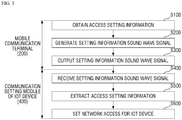
- FIG. 3 is a schematic flowchart illustrating a communication setting method for an IoT device using a mobile communication terminal according to the inventive concept.
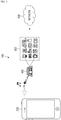
- FIG. 4 illustrates an embodiment of applying the communication setting method for an IoT device using a mobile communication terminal according to the inventive concept.
- a mobile communication terminal 200 obtains access setting information for a network to be accessed by an IoT device 300 (operation S100).
- the access setting information may be information about one network or a plurality of networks accessible in a certain space.
- the access setting information may be obtained in advance and stored in the mobile communication terminal 200 or may be obtained at a time when the loT device 300 needs to access the network.
- the access setting information for WiFi may include WiFi network information, information about an encryption method and information about a network access password.
- the access setting information for other communication methods for example, for ZigBee may include personal area network (PAN) ID information and channel information and, for Bluetooth, may include personal identification number (PIN) or media access control (MAC) address information.
- PAN personal area network
- MAC media access control
- the access setting information may be manually input by a user as illustrated in (a) of FIG. 4 or automatically obtained by the mobile communication terminal 200 through a gateway, a hub or a network management server that connects networks.
- the mobile communication terminal 200 In a state where the mobile communication terminal 200 has the access setting information for the network, the mobile communication terminal 200 starts to set network access for the loT device 300 which needs to access the network, as illustrated in (b) of FIG. 4 . To this end, the mobile communication terminal 200 generates a setting information sound wave signal by synthesizing the access setting information with a sound source (operation S200).
- the mobile communication terminal 200 may additionally perform a process of recognizing identification information of a particular loT device in order to start network access setting only for the particular loT device.
- the mobile communication terminal 200 To set network access for the loT device 300, the mobile communication terminal 200 outputs the generated setting information sound wave signal through a speaker as illustrated in (c) of FIG. 4 . Then, a microphone of a communication setting module 400 included in the loT device 300 receives the setting information sound wave signal output through the speaker of the mobile communication terminal 200 (operation S400).
- the communication setting module 400 extracts the access setting information from the received setting information sound wave signal (operation S500) and sets access information of a communication medium included in the loT device 300 based on the extracted access setting information in order for network access of the loT device 300 (operation S600).
- the communication setting module of the loT device 300 may send to the mobile communication terminal 200 a signal indicating the completion of the setting of the network access information. Accordingly, information about the completion of the setting of the network access information for the loT device 300 may be displayed on the mobile communication terminal 200 as illustrated in (d) of FIG. 4 .
- FIG. 5 illustrates the schematic configuration of a communication setting system for an IoT device using a mobile communication terminal according to an embodiment of the inventive concept.
- a communication setting system 100 for an IoT device using a mobile communication terminal includes a mobile communication terminal 200 which outputs access setting information for a network 500 as a sound wave signal and an IoT device 300 which receives the sound wave signal and accesses the network 500 by setting access information for access to the network 500 based on the sound wave signal.
- the network 500 may be limited to a network formed by devices connected to each other in a limited space.
- the network 500 may also include various Internet-accessible networks such as a wide area network (WAN), a local area network (LAN), a PAN, etc. These networks may be networks using WiFi, ZigBee or Bluetooth technology.
- the loT device 300 is a smart device that supports the loT through these various networks, wherein the loT is a network of objects in which various devices cooperatively establish intelligent relationships such as sensing, networking and information processing with each other without explicit intervention of a person.
- the loT device 300 may be a home appliance connected to a network to perform its function at home or may be production equipment, an environment controller or office equipment connected to a network to perform its function in a factory or an office.
- the loT device 300 may also be a portable smart device or a wearable device unconsciously used by humans in their daily lives.
- the loT device 300 basically includes a communication medium such as a modem or a communication interface card for access to the network 500.
- the loT device 300 includes a communication setting module 400 which receives a sound wave signal from the mobile communication terminal 200 to set network access for the loT device 300 and automatically sets network access information of the communication medium based on the sound wave signal.
- the mobile communication terminal 200 includes elements for generating a sound wave signal and a speaker for outputting the sound wave signal.
- the mobile communication terminal 200 may be a special terminal used for setting network access information of the loT device 300.
- the mobile communication terminal 200 may also be a general terminal such as a smartphone or a personal digital assistant (PDA).
- PDA personal digital assistant
- FIG. 6 illustrates the configuration of a mobile communication terminal according to an embodiment in the communication setting system for an IoT device using a mobile communication terminal according to the inventive concept.
- a mobile communication terminal 200 basically includes an loT communication setting unit 230 which generates an access setting sound wave signal for access setting of an loT device and a speaker 250 which outputs the access setting sound wave signal and may additionally include an access setting information storage unit 210 which receives and stores network access information and an identification information recognition unit 270 which identifies an loT device.
- the loT communication setting unit 230 may be formed as a type of application installed in the smartphone.
- the loT communication setting unit 230 may include a data conversion unit 231, a sound source generation unit 233, and a sound wave signal generation unit 235.
- the data conversion unit 231 converts access setting information for a network into data in a form appropriate for generating sound wave signal. To easily generate the access setting information in the sound wave signal, the data conversion unit 231 may convert the access setting information into binary information composed of a sequence of 1 and -1.
- the sound source generation unit 233 generates a sound source for carrying the access setting information.
- the sound source may be generated as ultrasonic waves in a frequency range inaudible to humans, as a simple beep sound, or as a melody to eliminate any uncomfortable feeling when a sound wave signal is output.
- the sound wave signal generation unit 235 generates a setting information sound wave signal by synthesizing the binary information received from the data conversion unit 231 with the sound source generated by the sound source generation unit 233.
- the network access information of the loT device or devices may be set using the same setting information sound wave signal without the need to identify the loT device or devices.
- the loT devices should be identified. Therefore, it is required to generate a setting information sound wave signal including identification information of each of the loT devices.
- the sound wave signal generation unit 235 may generate the setting information sound wave signal by further including identification information of an loT device 300.
- the identification information may be a unique key or a serial number given to each of a plurality of loT devices.
- the sound wave signal generation unit 235 may generate the setting information sound wave signal by including the identification information in a header.
- the identification information may include a pseudo random noise (PN) sequence corresponding to the IoT device.
- PN pseudo random noise
- the access setting information storage unit 210 of the mobile communication terminal 200 may include an input medium used by a user to input access information for a network or a network setting medium which senses a network signal and automatically sets access information for a network.
- the access setting information storage unit 210 may store access setting information for a plurality of networks accessible by various loT devices 300 and, depending on situation, extract access setting information appropriate for a particular loT device among the access setting information for a plurality of networks.
- the identification information recognition unit 270 may recognize identification information of an IoT device 300 by recognizing an identification information storage medium included in the loT device 300. To recognize the identification information, various methods such as radio frequency identification (RFID), near field communication (NFC), quick response (QR) code and barcode may be applied. The identification information recognition unit 270 may include various readers for applying these various identification methods.
- RFID radio frequency identification
- NFC near field communication
- QR quick response code
- barcode barcode
- the identification information recognition unit 270 may include various readers for applying these various identification methods.
- FIG. 8 illustrates the configuration of an IoT device according to an embodiment in the communication setting system for an IoT device using a mobile communication terminal according to the inventive concept.
- an IoT device 300 basically includes elements for performing its original function.
- the loT device is a home appliance such as a television or a refrigerator, it includes elements for performing the original function of the television or the refrigerator.
- the loT device is office equipment such as a fax or a copier, it includes elements for performing the original function of the fax or the copier.
- the loT device 300 includes a communication medium 350 such as a modem or a communication interface to access a network such as the Internet.
- the loT device 300 includes a communication setting module 400 which sets network access information of the communication medium 350 to access a network.
- the loT device 300 may include an identification information storage unit 370 which stores identification information of the loT device 300.
- the identification information storage unit 370 may be implemented as RFID, NFC, QR code or barcode including a unique key or a serial number given to the loT device 300.
- the communication setting module 400 receives a setting information sound wave signal from a mobile communication terminal, extracts access setting information from the setting information sound wave signal, and automatically sets network access information of the communication medium 350 based on the extracted access setting information.
- FIG. 9 illustrates the configuration of a communication setting module installed in an IoT device in the communication setting system for an IoT device using a mobile communication terminal according to the inventive concept.
- a communication setting module 400 may include a microphone 410 which receives a setting information sound wave signal transmitted from a mobile communication terminal, a setting information acquisition unit 430 which extracts access setting information from the received setting information sound wave signal, and a communication access setting unit 450 which sets network access information of the communication medium 350 of an loT device 300 based on the extracted access setting information so that the communication medium 350 of the loT device 300 can access a network.
- the setting information acquisition unit 430 may include a timing extraction unit 431, a sound source generation unit 433, a setting information extraction unit 435, and a data conversion unit 439.
- the timing extraction unit 431 may include, e.g., a clock for synchronization with a received setting information sound wave signal.
- the sound source generation unit 433 of the communication setting module 400 generates a sound source.
- the sound source generated by the sound source generation unit 433 of the communication setting module 400 is the same as a sound source used to generate the received setting information sound wave signal.
- the setting information extraction unit 435 extracts access setting information by removing the sound source from the received setting information sound wave signal. As described above, the mobile communication terminal 200 converts the access setting information into binary information and synthesizes the binary information with the sound source. Therefore, the setting information extraction unit 435 extracts the binary information, and the extracted binary information is converted into the access setting information by the data conversion unit 439.
- the setting information extraction unit 435 may extract the access setting information from the received setting information sound wave signal based on its identification information. For example, if identification information (such as a unique key or a serial number) of an IoT device is included in a header of the setting information sound wave signal, the setting information extraction unit 435 may recognize the identification information included in the header of the setting information sound wave signal.
- the identification information may include a PN sequence corresponding to the IoT device.
- the setting information extraction unit 435 may extract the access setting information from the setting information sound wave signal by multiplying the sound wave by the PN sequence corresponding to its loT device. That is, if the PN sequence is included in the setting information sound wave signal, the access setting information can be extracted from the setting information sound wave signal using the PN sequence only. Therefore, the access setting information corresponding only to the loT device can be extracted.
- the inventive concept also suggests a method of setting network access information of an IoT device using the above-described communication setting system for an IoT device using a mobile communication terminal according to the inventive concept. This method has been described above with reference to FIGS. 3 and 4 as an embodiment of the communication setting method for an IoT device using a mobile communication terminal according to the inventive concept.
- a specific embodiment of generating a setting information sound wave signal using a mobile communication terminal and a specific embodiment of extracting access setting information using an IoT device in the communication setting method for an IoT device using a mobile communication terminal according to the inventive concept will hereinafter be described.
- the following embodiments of the communication setting method for an IoT device using a mobile communication terminal according to the inventive concept use the communication setting system for an IoT device using a mobile communication terminal according to the inventive concept. Therefore, the following embodiments will be described by also referring to the above-described communication setting system for an IoT device using a mobile communication terminal according to the inventive concept.
- a synthesis of a sound source and binary information will be referred to as a data sound wave signal
- a synthesis of binary information and identification information will be referred to as a communication setting signal
- a synthesis of a sound source and identification information will be referred to as an identification sound wave signal.
- FIG. 11 is a flowchart illustrating a first embodiment of generating a setting information sound wave signal using a mobile communication terminal in the communication setting method for an IoT device using a mobile communication terminal according to the inventive concept.
- FIG. 11 is an embodiment of the generating of the setting information sound wave signal (operation S200) in the communication setting method for an loT device using a mobile communication terminal according to the inventive concept of FIG. 3 .
- a mobile communication terminal 200 converts access setting information for a network to be accessed by an IoT device 300 into a form appropriate for being synthesized with a sound source, for example, into binary information of 1 and -1 (operation S211).
- the mobile communication terminal 200 generates a sound source (operation S212) and synthesizes the binary information with the generated sound source to generate a data sound wave signal (operation S213).
- the sound source may be generated as ultrasonic waves inaudible to humans or as a beep sound or a melody.
- the mobile communication terminal 200 may immediately output the data sound wave signal through a speaker.
- the mobile communication terminal 200 may recognize identification information of an loT device that is to access a network (operation S214) and generate a setting information sound wave signal by synthesizing the identification information with the generated data sound wave signal (operation S215).
- the mobile communication terminal recognizes the identification information of the loT device (operation S214) after generating the data sound wave signal (operation S213).
- the recognizing of the identification information of the loT device 30 may be performed at an appropriate time after or before the obtaining of the access setting information (operation S100) in FIG. 3 .
- the mobile communication terminal 200 may select access setting information for a network most suitable for the IoT device 300 to access among a plurality of networks.
- an IoT device 300 may include QR code, barcode, RFID or NFC as an identification information storage unit 370 which stores identification information of the loT device 300.
- a mobile communication terminal 200a may include a camera which recognizes QR code, a scanner which recognizes barcode, or a reader which recognizes RFID or NFC.
- the loT device 300 does not include the identification information storage unit 370, a user may input a serial number or a unique key of the loT device 300 to a mobile communication terminal 200b so as to identify the loT device 300.
- the identification information of the loT device may include a PN sequence corresponding to the loT device.
- the mobile communication terminal 200 After recognizing the identification information of the loT device 300 that is to access the network, the mobile communication terminal 200 generates a setting information sound wave signal by synthesizing the identification information with the data sound wave signal (operation S215).
- the mobile communication terminal 200 may generate the setting information sound wave signal by generating the identification information such as a unique key or a serial number of the loT device 300 in a header of the data sound wave signal.
- the mobile communication terminal 200 may generate the setting information sound wave signal by multiplying the data sound wave signal by a PN sequence corresponding to the loT device 300.
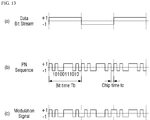
- FIG. 13 An embodiment of synthesizing a PN sequence is illustrated in FIG. 13 .
- a data bit stream in a binary form illustrated in (a) of FIG. 13 is synthesized with a PN sequence illustrated in (b) of FIG. 13 .
- a PN sequence corresponding to one bit length of the data bit stream is applied.
- the PN sequence may be synthesized with the data bit stream to generate a modulation signal illustrated in (c) of FIG. 13 .
- a setting information sound wave signal including a PN sequence can be generated by applying the above principle of synthesizing a PN sequence (operation S215).
- a data sound wave signal is generated by synthesizing binary information with a sound source, and a setting information sound wave signal is generated by synthesizing identification information with the data sound wave signal.
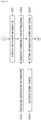
- FIG. 14 is a flowchart illustrating a second embodiment of generating a setting information sound wave signal using a mobile communication terminal in the communication setting method for an IoT device using a mobile communication terminal according to the inventive concept.
- access setting information is converted into binary information (operation S221), and a communication setting signal is generated by synthesizing the binary information with identification information of an IoT device (operation S223). Since recognizing the identification information of the loT device (operation S222) has been described above with reference to the embodiments of FIGS. 11 and 12 , a detailed description thereof is omitted.
- the communication setting signal may be generated by including the identification information in a header. If the identification information of the loT device includes a PN sequence, the communication setting signal may be generated by synthesizing the binary information and the PN sequence in the same way as in the example described above with reference to FIG. 13 .
- a communication setting signal is generated by synthesizing identification information with binary information
- a setting information sound wave signal is generated by synthesizing a sound source with the communication setting signal.
- FIG. 15 is a flowchart illustrating a third embodiment of generating a setting information sound wave signal using a mobile communication terminal in the communication setting method for an loT device using a mobile communication terminal according to the inventive concept.
- a sound source is generated (operation S232), and an identification sound wave signal is generated by synthesizing identification information with the sound source (operation S234).
- the identification information may include a unique key or a serial number of an IoT device as described above or include a PN sequence corresponding to the loT device.
- access setting information may be converted into binary information (operation S231), and then a setting information sound wave signal may be generated by synthesizing the identification sound wave signal and the binary information.
- an identification sound wave signal is generated by synthesizing a sound source and identification information
- a setting information sound wave signal is generated by synthesizing binary information with the identification sound wave signal.
- a mobile communication terminal can generate a setting information sound wave signal by synthesizing access setting information with a sound source in various ways.
- FIG. 16 is a flowchart illustrating a fourth embodiment of extracting access setting information using an IoT device in the communication setting method for an IoT device using a mobile communication terminal according to the inventive concept.
- FIG. 16 is an embodiment of the extracting of the access setting information (operation S500) in the communication setting method for an IoT device using a mobile communication terminal according to the inventive concept of FIG. 3 .
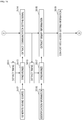
- a communication setting module 400 installed in an IoT device receives a setting information sound wave signal from a mobile communication terminal 200, it extracts a start time of a sound source of the setting information sound wave signal (operation S511), generates a sound source (operation S512), synchronizes the generated sound source with the setting information sound wave signal based on the start timing, and extracts a communication setting signal by removing the sound source from the setting information sound wave signal (operation S514).
- the sound source generated by the communication setting module 400 should be the same as the sound source included in the setting information sound wave signal. Therefore, the sound source should be preset by the mobile communication terminal 200 and the communication setting module 400.
- the communication setting signal without the sound source does not include identification information of the IoT device, it is binary information about a network. Therefore, the binary information may be converted directly into access setting information.
- the binary information may be extracted based on the identification information. For example, if the identification information is included in a header of the communication setting signal as a unique key or a serial number of the IoT device according to the second embodiment of FIG. 14 , timing of the communication signal may be extracted (operation S515) according to the fourth embodiment of FIG. 16 . If the identification information included in the header of the communication setting signal is identical to the identification information of the IoT device, the binary information may be extracted from the communication setting signal (operation S518).
- the identification information includes a PN sequence corresponding to the IoT device and synthesized according to the first embodiment of FIG. 11 , the second embodiment of FIG. 14 and the third embodiment of FIG. 15
- the start time of the communication setting signal may be extracted (operation S515) according to the fourth embodiment of FIG. 16
- the binary information may be extracted from the communication setting signal (operation S518) by synchronizing the communication setting signal with the PN sequence of the IoT device (operation S517).
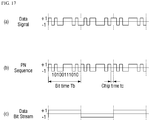
- FIG. 17 illustrates an embodiment of restoring data in a case where a PN sequence is synthesized according to FIG. 13 described above.
- a signal including a PN sequence as in (c) of FIG. 13 is illustrated.
- a PN sequence illustrated in (b) of FIG. 17 is identical to the PN sequence illustrated in (b) of FIG. 13 . If the PN sequence is synthesized with the signal illustrated in (a) of FIG. 17 , a data bit stream in a binary form is restored as illustrated in (c) of FIG. 17 .
- binary information can be extracted from a setting information sound wave signal including a PN sequence by applying the method of restoring data based on a PN sequence.
- the communication setting module 400 converts the extracted binary information into access setting information (operation S519).
- a communication setting signal is extracted by removing a sound source from a received setting information sound wave signal, and binary information is extracted from the communication setting signal based on identification information of an IoT device.
- FIG. 18 is a flowchart illustrating a fifth embodiment of extracting access setting information using an IoT device in the communication setting method for an IoT device using a mobile communication terminal according to the inventive concept.
- a start time of a sound source of a received setting information sound wave signal is extracted (operation S521), and a data sound wave signal is extracted based on identification (operation S524).
- a data sound wave signal may be extracted by recognizing the identification information included in the header of the setting information sound wave signal according to the fifth embodiment of FIG. 18 .
- the data sound wave signal may be extracted (operation S524) by synchronizing the setting information sound wave signal with the PN sequence of the IoT device (operation S523) regardless of when the PN sequence was synthesized.
- a start time of a sound source of the data sound wave signal is extracted (operation S525), and a sound source is generated (operation S526). Then, the generated sound source is synchronized with the data sound wave signal based on the start timing, and binary information is extracted by removing the sound source from the data sound wave signal (operation S529).
- a communication setting module 400 converts the binary information into access setting information (operation S529).
- a data sound wave signal is extracted from a received setting information sound wave signal based on identification information, and binary information is extracted by removing a sound source from the data sound wave signal.
- FIG. 19 is a flowchart illustrating a sixth embodiment of extracting access setting information using an IoT device in the communication setting method for an IoT device using a mobile communication terminal according to the inventive concept.
- a sound source is generated (operation S531), and an identification sound wave signal is generated by synthesizing identification information with the sound source (operation S533).
- a start time of a sound source of a received setting information sound wave signal is extracted (operation S534), and binary information is extracted from the setting information sound wave signal by synchronizing the setting information sound wave signal with the identification sound wave signal (operation S535).
- the binary information may be extracted according to the sixth embodiment of FIG. 19 .
- the identification information includes a PN sequence corresponding to the IoT device and synthesized according to the first embodiment of FIG. 11 , the second embodiment of FIG. 14 and the third embodiment of FIG. 15
- the identification sound wave signal may be generated by synthesizing the sound source and the PN sequence according to the sixth embodiment of FIG. 19 regardless of when the PN sequence was synthesized, and the binary information may be extracted based on the identification sound wave signal.
- an IoT device 400 may have an identification sound wave signal, and a communication setting module 400 may use the identification sound wave signal. If the identification sound wave signal is stored in advance, a mobile communication terminal 200 may generate a setting information sound wave signal based on the pre-stored identification sound wave signal in the third embodiment of FIG. 15 . In this case, since the identification sound wave signal of the IoT device 300 is included in the identification information of the IoT device 300, the mobile communication terminal 200 may recognize and use the identification sound wave signal.
- the communication setting module 400 converts the binary information into access setting information (operation S537).
- an identification sound wave signal in which a sound source and identification information are synthesized is prepared, and binary information is extracted from a received setting information sound wave signal based on the identification sound wave signal.
- IoT devices can be reduced in size and worn with more comfort.
Landscapes
- Engineering & Computer Science (AREA)
- Computer Networks & Wireless Communication (AREA)
- Signal Processing (AREA)
- Automation & Control Theory (AREA)
- Computer Security & Cryptography (AREA)
- Health & Medical Sciences (AREA)
- Computing Systems (AREA)
- General Health & Medical Sciences (AREA)
- Medical Informatics (AREA)
- Telephone Function (AREA)
- Telephonic Communication Services (AREA)
- Mobile Radio Communication Systems (AREA)
Applications Claiming Priority (2)
| Application Number | Priority Date | Filing Date | Title |
|---|---|---|---|
| KR1020140050122A KR101567333B1 (ko) | 2014-04-25 | 2014-04-25 | IoT 디바이스의 통신 설정을 위한 이동통신 단말기와 통신설정모듈 및 이동통신 단말기를 이용한 IoT 디바이스의 통신 설정 방법 |
| PCT/KR2015/003982 WO2015163677A1 (fr) | 2014-04-25 | 2015-04-21 | Système et procédé de paramétrage de communications pour dispositif d'iot utilisant un terminal mobile de communications |
Publications (2)
| Publication Number | Publication Date |
|---|---|
| EP3136625A1 true EP3136625A1 (fr) | 2017-03-01 |
| EP3136625A4 EP3136625A4 (fr) | 2017-11-01 |
Family
ID=54332768
Family Applications (1)
| Application Number | Title | Priority Date | Filing Date |
|---|---|---|---|
| EP15783418.5A Withdrawn EP3136625A4 (fr) | 2014-04-25 | 2015-04-21 | Système et procédé de paramétrage de communications pour dispositif d'iot utilisant un terminal mobile de communications |
Country Status (5)
| Country | Link |
|---|---|
| US (1) | US20170041083A1 (fr) |
| EP (1) | EP3136625A4 (fr) |
| KR (1) | KR101567333B1 (fr) |
| CN (1) | CN106464387A (fr) |
| WO (1) | WO2015163677A1 (fr) |
Families Citing this family (23)
| Publication number | Priority date | Publication date | Assignee | Title |
|---|---|---|---|---|
| GB2538510B (en) * | 2015-05-18 | 2019-10-16 | Humberto Jose Moran Cirkovic | Interoperating sensing devices and mobile devices |
| KR101740402B1 (ko) * | 2016-01-29 | 2017-05-26 | 주식회사 인포소닉 | 음파 신호를 이용한 모바일 어플리케이션 구동 방법 및 이를 구현하기 위한 모바일 어플리케이션 구동 시스템 |
| US20210350697A1 (en) * | 2016-01-29 | 2021-11-11 | Infosonic Inc. | Method for driving mobile application using sound wave signal and mobile application driving system for implementing same |
| US10310832B2 (en) | 2016-02-19 | 2019-06-04 | Intel Corporation | Internet-of-things device blank |
| US11146449B2 (en) | 2016-02-19 | 2021-10-12 | Intel Corporation | Network architecture for internet-of-things device |
| CN107644250A (zh) * | 2016-07-20 | 2018-01-30 | 润泽国际投资控股有限公司 | 产品溯源防伪方法及系统 |
| WO2018076240A1 (fr) * | 2016-10-27 | 2018-05-03 | Silicon Laboratories Inc. | Utilisation d'un réseau pour mettre en service un second réseau |
| KR20180066693A (ko) | 2016-12-09 | 2018-06-19 | (주)포스트미디어 | 사물인터넷용 통신 시스템 |
| US11039225B2 (en) * | 2016-12-15 | 2021-06-15 | Microsoft Technology Licensing, Llc | Declarative IoT data control |
| US10917706B2 (en) | 2016-12-15 | 2021-02-09 | Microsoft Technology Licensing, Llc | Configurable IoT device data collection |
| KR102604697B1 (ko) * | 2016-12-20 | 2023-11-22 | 삼성전자주식회사 | 모바일 기기, 모바일 기기의 사용자 인증 방법 및 사용자 인증 시스템 |
| KR20190006155A (ko) | 2017-07-09 | 2019-01-17 | 권형석 | 전자기기 관리 방법 및 시스템. |
| US11089635B1 (en) * | 2017-09-08 | 2021-08-10 | Amazon Technologies, Inc. | Wireless network device provisioning |
| CN108055180A (zh) * | 2018-01-20 | 2018-05-18 | 广东云立方互动科技有限公司 | 一种声波识别和控制的智能家居系统 |
| CN109120351A (zh) * | 2018-07-12 | 2019-01-01 | 上海新储集成电路有限公司 | 一种应用于物联网中的数据传输方法和系统 |
| KR102719971B1 (ko) | 2018-12-17 | 2024-10-22 | 삼성전자주식회사 | 전자 장치 및 전자 장치의 제어 방법 |
| KR20200117155A (ko) | 2019-04-03 | 2020-10-14 | (주) 헬로팩토리 | IoT 디바이스들의 블루투스를 이용한 와이파이 설정방법 |
| KR20200117159A (ko) | 2019-04-03 | 2020-10-14 | (주) 헬로팩토리 | IoT 디바이스들의 블루투스를 이용한 와이파이 설정방법 |
| KR20200117160A (ko) | 2019-04-03 | 2020-10-14 | (주) 헬로팩토리 | 블루투스를 이용한 와이파이 설정 장치 |
| KR20200117147A (ko) | 2019-04-03 | 2020-10-14 | (주) 헬로팩토리 | IoT 디바이스들의 블루투스를 이용한 와이파이 설정 장치 및 방법 |
| KR102154347B1 (ko) | 2019-06-20 | 2020-09-10 | 퍼핀플래닛 주식회사 | 휴대 단말기를 이용한 다수의 IoT 디바이스 통신 시스템 및 그 서비스 제공 방법 |
| CN111600663A (zh) * | 2020-04-09 | 2020-08-28 | 苏宁智能终端有限公司 | 用于物联网设备的振动配网方法及装置 |
| DE112023006155T5 (de) * | 2023-06-09 | 2026-02-19 | Mitsubishi Electric Corporation | Mobilstation, Zeitsynchronisationssteuereinrichtung, Kooperativbetriebssteuereinrichtung, Kommunikationssystem, Synchronisationssteuerverfahren, Steuerschaltung und Speichermedium |
Family Cites Families (34)
| Publication number | Priority date | Publication date | Assignee | Title |
|---|---|---|---|---|
| US5608723A (en) * | 1995-04-26 | 1997-03-04 | Interval Research Corporation | Methods and systems for secure wireless communication within a predetermined boundary |
| GB9700854D0 (en) * | 1997-01-16 | 1997-03-05 | Scient Generics Ltd | Sub-audible acoustic data transmission mechanism |
| US6607136B1 (en) * | 1998-09-16 | 2003-08-19 | Beepcard Inc. | Physical presence digital authentication system |
| DK1340320T3 (da) * | 2000-11-30 | 2009-02-23 | Intrasonics Ltd | Apparat og system til anvendelse af datasignaler indlejret i et akustisk signal |
| GB2377129B (en) * | 2001-06-29 | 2005-05-11 | Nokia Corp | Wireless communication device and method |
| US7937089B2 (en) * | 2002-02-06 | 2011-05-03 | Palo Alto Research Center Incorporated | Method, apparatus, and program product for provisioning secure wireless sensors |
| GB0402952D0 (en) * | 2004-02-11 | 2004-03-17 | Koninkl Philips Electronics Nv | Remote control system and related method and apparatus |
| US20060019605A1 (en) * | 2004-07-20 | 2006-01-26 | Jeng-Jye Shau | Wireless signal transfer by sound waves |
| JP4896455B2 (ja) * | 2005-07-11 | 2012-03-14 | 株式会社エヌ・ティ・ティ・ドコモ | データ埋込装置、データ埋込方法、データ抽出装置、及び、データ抽出方法 |
| KR100786108B1 (ko) * | 2006-05-01 | 2007-12-18 | 김준식 | 음파통신 네트워크 |
| US9554061B1 (en) * | 2006-12-15 | 2017-01-24 | Proctor Consulting LLP | Smart hub |
| JP4361575B2 (ja) * | 2007-06-07 | 2009-11-11 | 株式会社エヌ・ティ・ティ・ドコモ | 変調装置、復調装置、および音響信号伝送方法 |
| AU2008290379B2 (en) * | 2007-08-20 | 2013-10-03 | Sonitor Technologies As | Ultrasound detectors |
| US8942388B2 (en) * | 2008-08-08 | 2015-01-27 | Yamaha Corporation | Modulation device and demodulation device |
| RU2398356C2 (ru) * | 2008-10-31 | 2010-08-27 | Cамсунг Электроникс Ко., Лтд | Способ установления беспроводной линии связи и система для установления беспроводной связи |
| EP2306407B1 (fr) * | 2009-09-16 | 2013-06-19 | Openways Sas | Système de gestion sécurisée de serrures à commande numérique, adapté à un fonctionnement par accréditations acoustiques chiffrées |
| CN102056328A (zh) * | 2009-10-28 | 2011-05-11 | 联想(北京)有限公司 | 一种建立无线连接的方法及终端 |
| SI23227A (sl) * | 2010-03-10 | 2011-05-31 | Margento R&D D.O.O. | Brezžični mobilni transakcijski sistem in postopek izvedbe transakcije z mobilnim telefonom |
| JP5414059B2 (ja) * | 2010-03-17 | 2014-02-12 | Kddi株式会社 | 無線通信方法およびシステムならびにその無線通信装置 |
| JP5729161B2 (ja) * | 2010-09-27 | 2015-06-03 | ヤマハ株式会社 | 通信端末、無線機、及び無線通信システム |
| US8854985B2 (en) * | 2010-12-31 | 2014-10-07 | Yossef TSFATY | System and method for using ultrasonic communication |
| CN102572891A (zh) * | 2010-12-31 | 2012-07-11 | 国民技术股份有限公司 | 一种快速配置网络参数的系统及方法 |
| EP2747335B1 (fr) * | 2011-08-16 | 2017-01-11 | ICTK Co., Ltd. | Dispositif et procédé pour l'authentification de sécurité entre dispositifs basée sur une puf lors de la communication entre machines |
| CN103138807B (zh) * | 2011-11-28 | 2014-11-26 | 财付通支付科技有限公司 | 一种近距离通信实现方法和系统 |
| US8868016B2 (en) * | 2012-01-13 | 2014-10-21 | Sony Corporation | Acoustic signalling to switch from infrastructure communication mode to ad hoc communication mode |
| JP2013222991A (ja) * | 2012-04-12 | 2013-10-28 | Ricoh Co Ltd | 無線通信システム、無線通信方法及び無線端末装置 |
| KR102317364B1 (ko) * | 2012-05-01 | 2021-10-25 | 엘아이에스엔알, 인크. | 콘텐츠 전달 및 관리를 위한 시스템 및 방법 |
| KR101990882B1 (ko) * | 2012-10-09 | 2019-09-30 | 에스케이 텔레콤주식회사 | 사물 인터넷을 위한 인증 방법과 그를 위한 디바이스 및 인증 장치 |
| KR20140049365A (ko) * | 2012-10-17 | 2014-04-25 | 삼성전자주식회사 | 전자 장치 및 그 제어 방법 |
| WO2014062509A1 (fr) * | 2012-10-18 | 2014-04-24 | Dolby Laboratories Licensing Corporation | Systèmes et procédés pour initier des conférences au moyen de dispositifs externes |
| US9479373B2 (en) * | 2012-12-20 | 2016-10-25 | Lockheed Martin Corporation | Packet processor verification methods and systems |
| CN103166702A (zh) * | 2013-02-05 | 2013-06-19 | 何建亿 | 通过音频方式配置无线网络的方法与装置 |
| US9912415B2 (en) * | 2013-11-12 | 2018-03-06 | Qualcomm Incorporated | Fast service discovery and pairing using ultrasonic communication |
| TWI563853B (en) * | 2014-02-27 | 2016-12-21 | Beseye Cloud Security Co Ltd | Surveillance system and the operation process thereof |
-
2014
- 2014-04-25 KR KR1020140050122A patent/KR101567333B1/ko active Active
-
2015
- 2015-04-21 WO PCT/KR2015/003982 patent/WO2015163677A1/fr not_active Ceased
- 2015-04-21 EP EP15783418.5A patent/EP3136625A4/fr not_active Withdrawn
- 2015-04-21 CN CN201580022619.5A patent/CN106464387A/zh active Pending
-
2016
- 2016-10-25 US US15/333,202 patent/US20170041083A1/en not_active Abandoned
Also Published As
| Publication number | Publication date |
|---|---|
| US20170041083A1 (en) | 2017-02-09 |
| KR20150123573A (ko) | 2015-11-04 |
| KR101567333B1 (ko) | 2015-11-10 |
| EP3136625A4 (fr) | 2017-11-01 |
| CN106464387A (zh) | 2017-02-22 |
| WO2015163677A1 (fr) | 2015-10-29 |
Similar Documents
| Publication | Publication Date | Title |
|---|---|---|
| EP3136625A1 (fr) | Système et procédé de paramétrage de communications pour dispositif d'iot utilisant un terminal mobile de communications | |
| US10181910B2 (en) | Data transfer using mobile devices | |
| KR101110778B1 (ko) | 블루투스 통신 방법 및 시스템 | |
| US8831682B2 (en) | Wireless detector and adapter | |
| JP5628399B2 (ja) | 既存の無線接続鍵を使用する仮想ペアリングのための装置および方法 | |
| EP2182707A1 (fr) | Détection de bruits ambiants et procédé de reconnaissance | |
| RU2619924C2 (ru) | Система и способ передачи, хранения, приема и/или извлечения идентификационной информации или данных и/или информации совмещения или данных для аксессуаров или сопутствующих продуктов и интеллектуальных электронных устройств на определенный сервер или запоминающий носитель или с определенного сервера или запоминающего носителя | |
| JP5205400B2 (ja) | センサネットワークシステムとその無線送受信装置及びセンサ情報伝送方法 | |
| CN105392105A (zh) | 基于发送和接收设备之间的距离控制操作的方法及装置 | |
| WO2017041994A1 (fr) | Procédés et systèmes pour la transmission de données arbitraires par l'intermédiaire de connexions audio hfp bluetooth ayant une faible latence | |
| CN108243481A (zh) | 文件传输方法及装置 | |
| CN107910006A (zh) | 语音识别方法、装置和多信源语音区分识别系统 | |
| WO2018214343A1 (fr) | Procédé, système et dispositif pour mettre en œuvre une interprétation simultanée | |
| JP2014036376A (ja) | 電子装置および制御装置 | |
| Tsantilas et al. | A Comparative Study of Wireless Communication Protocols in a Computer Vision System for improving the Autonomy of the Visually Impaired. | |
| SG148853A1 (en) | Communication apparatus | |
| CN119450754A (zh) | 信号传输方法、装置、设备、系统及存储介质 | |
| KR101784309B1 (ko) | 저전력 근거리 통신을 이용한 개인 정보 교환 방법 및 시스템, 이를 수행하기 위한 기록매체 | |
| CN104994160A (zh) | 文件传输方法以及相关装置和传输系统 | |
| CN104486671B (zh) | 数据处理方法、设备及系统和音频采样设备 | |
| US20120124399A1 (en) | Method and System of Power Control | |
| CN107682549A (zh) | 一种通讯信息的获取方法、发送方法及智能设备 | |
| WO2026081958A1 (fr) | Procédé et appareil de communication | |
| CN120614067A (zh) | 一种测试方法及相关设备 | |
| Nguyen et al. | Secure context-based pairing for unprecedented devices |
Legal Events
| Date | Code | Title | Description |
|---|---|---|---|
| STAA | Information on the status of an ep patent application or granted ep patent |
Free format text: STATUS: THE INTERNATIONAL PUBLICATION HAS BEEN MADE |
|
| PUAI | Public reference made under article 153(3) epc to a published international application that has entered the european phase |
Free format text: ORIGINAL CODE: 0009012 |
|
| STAA | Information on the status of an ep patent application or granted ep patent |
Free format text: STATUS: REQUEST FOR EXAMINATION WAS MADE |
|
| 17P | Request for examination filed |
Effective date: 20161024 |
|
| AK | Designated contracting states |
Kind code of ref document: A1 Designated state(s): AL AT BE BG CH CY CZ DE DK EE ES FI FR GB GR HR HU IE IS IT LI LT LU LV MC MK MT NL NO PL PT RO RS SE SI SK SM TR |
|
| AX | Request for extension of the european patent |
Extension state: BA ME |
|
| DAV | Request for validation of the european patent (deleted) | ||
| DAX | Request for extension of the european patent (deleted) | ||
| A4 | Supplementary search report drawn up and despatched |
Effective date: 20171002 |
|
| RIC1 | Information provided on ipc code assigned before grant |
Ipc: H04L 12/28 20060101ALI20170926BHEP Ipc: H04L 12/12 20060101ALI20170926BHEP Ipc: H04B 11/00 20060101AFI20170926BHEP Ipc: H04W 48/08 20090101ALI20170926BHEP Ipc: H04L 12/24 20060101ALI20170926BHEP Ipc: H04L 29/08 20060101ALI20170926BHEP |
|
| STAA | Information on the status of an ep patent application or granted ep patent |
Free format text: STATUS: THE APPLICATION IS DEEMED TO BE WITHDRAWN |
|
| 18D | Application deemed to be withdrawn |
Effective date: 20180501 |