EP3136718A1 - Verfahren zur synchronisation von video und audio in einem virtuellen realitätssystem - Google Patents
Verfahren zur synchronisation von video und audio in einem virtuellen realitätssystem Download PDFInfo
- Publication number
- EP3136718A1 EP3136718A1 EP16185487.2A EP16185487A EP3136718A1 EP 3136718 A1 EP3136718 A1 EP 3136718A1 EP 16185487 A EP16185487 A EP 16185487A EP 3136718 A1 EP3136718 A1 EP 3136718A1
- Authority
- EP
- European Patent Office
- Prior art keywords
- delay
- audio
- host device
- signal
- video
- Prior art date
- Legal status (The legal status is an assumption and is not a legal conclusion. Google has not performed a legal analysis and makes no representation as to the accuracy of the status listed.)
- Granted
Links
Images




Classifications
-
- H—ELECTRICITY
- H04—ELECTRIC COMMUNICATION TECHNIQUE
- H04N—PICTORIAL COMMUNICATION, e.g. TELEVISION
- H04N5/00—Details of television systems
- H04N5/04—Synchronising
-
- G—PHYSICS
- G06—COMPUTING OR CALCULATING; COUNTING
- G06T—IMAGE DATA PROCESSING OR GENERATION, IN GENERAL
- G06T19/00—Manipulating three-dimensional [3D] models or images for computer graphics
- G06T19/006—Mixed reality
-
- H—ELECTRICITY
- H04—ELECTRIC COMMUNICATION TECHNIQUE
- H04N—PICTORIAL COMMUNICATION, e.g. TELEVISION
- H04N21/00—Selective content distribution, e.g. interactive television or video on demand [VOD]
- H04N21/40—Client devices specifically adapted for the reception of or interaction with content, e.g. set-top-box [STB]; Operations thereof
- H04N21/41—Structure of client; Structure of client peripherals
- H04N21/422—Input-only peripherals, i.e. input devices connected to specially adapted client devices, e.g. global positioning system [GPS]
- H04N21/42202—Input-only peripherals, i.e. input devices connected to specially adapted client devices, e.g. global positioning system [GPS] environmental sensors, e.g. for detecting temperature, luminosity, pressure, earthquakes
-
- H—ELECTRICITY
- H04—ELECTRIC COMMUNICATION TECHNIQUE
- H04N—PICTORIAL COMMUNICATION, e.g. TELEVISION
- H04N21/00—Selective content distribution, e.g. interactive television or video on demand [VOD]
- H04N21/40—Client devices specifically adapted for the reception of or interaction with content, e.g. set-top-box [STB]; Operations thereof
- H04N21/43—Processing of content or additional data, e.g. demultiplexing additional data from a digital video stream; Elementary client operations, e.g. monitoring of home network or synchronising decoder's clock; Client middleware
- H04N21/4302—Content synchronisation processes, e.g. decoder synchronisation
- H04N21/4307—Synchronising the rendering of multiple content streams or additional data on devices, e.g. synchronisation of audio on a mobile phone with the video output on the TV screen
- H04N21/43072—Synchronising the rendering of multiple content streams or additional data on devices, e.g. synchronisation of audio on a mobile phone with the video output on the TV screen of multiple content streams on the same device
-
- H—ELECTRICITY
- H04—ELECTRIC COMMUNICATION TECHNIQUE
- H04N—PICTORIAL COMMUNICATION, e.g. TELEVISION
- H04N21/00—Selective content distribution, e.g. interactive television or video on demand [VOD]
- H04N21/80—Generation or processing of content or additional data by content creator independently of the distribution process; Content per se
- H04N21/85—Assembly of content; Generation of multimedia applications
- H04N21/854—Content authoring
- H04N21/8547—Content authoring involving timestamps for synchronizing content
-
- H—ELECTRICITY
- H04—ELECTRIC COMMUNICATION TECHNIQUE
- H04N—PICTORIAL COMMUNICATION, e.g. TELEVISION
- H04N7/00—Television systems
- H04N7/10—Adaptations for transmission by electrical cable
Definitions
- the invention relates to audio/video systems, and, in particular, to a method for synchronizing video data and audio data in a virtual reality (VR) system including a VR device and a host device.
- VR virtual reality
- Displays with virtual image generation are often used in display devices which are located close to the user's eyes. These are called near-to-eye displays. Such display devices are known, for example, as head mounted displays (HMD).
- HMD head mounted displays
- An HMD is a display device that a person wears on the head in order to have video information directly displayed in front of the eyes.
- An HMD has either one or two small CRT, LCD or OLED displays with magnifying lenses and other optical elements.
- the displays and optics are typically embedded in a helmet, glasses, or a visor, which the user can wear. Lenses and other optical components are used to give the user the perception that the images are coming from a greater distance, and to prevent eyestrain.
- the display video data, images, or frames are generated and output by a host device.
- the host device transmits the video data and associated audio data to a VR device
- non-synchronization (or audio drift) between the audio data and video data may occur because the processing time in the audio transmission path may differ from that in the video transmission path. That is, the audio path delay and the video path delay can be different. Differing delays between the audio transmission path and the video transmission path can cause the audio portion of the content and the video portion of the content to become "out of sync" in time (i.e. the audio lagging behind the video, or with the video delayed with respect to the audio), and the time mismatch between the audio data and the video data can cause significant distraction and dissatisfaction to the viewer. Accordingly, there is demand for a method for synchronizing the video data and audio data in a virtual reality (VR) system including a VR device and a host device.
- VR virtual reality
- a method for audio-video synchronization in a virtual reality (VR) system includes a VR device and a host device.
- the method includes the steps of: connecting the VR device to a host device via a data transmission interface; transmitting an audio signal and a video signal from the host device to the VR device; estimating time delay information in an audio transmission path and a video transmission path of the VR device; transmitting a feedback signal recording the time delay information from the VR device to the host device; and adjusting timing of the audio signal or the video signal transmitted from the host device to the VR device according to the feedback signal.
- a virtual reality (VR) system in another exemplary embodiment, includes a host device and a VR device.
- the VR device is connected to the host device via a data transmission interface.
- the host device transmits an audio signal and a video signal to the VR device, and the VR device estimates time delay information in an audio transmission path and a video transmission path of the VR device.
- the VR device transmits a feedback signal recording the time delay information to the host device, and the host device adjusts timing of the audio signal or the video signal transmitted to the VR device according to the feedback signal, thereby synchronizing the audio signal and the video signal in the VR device.
- FIG. 1 is a schematic diagram showing interactions between a host device and a VR device in accordance with an embodiment of the invention.
- the host device 11 first synchronizes with the VR device 12, and then transmits audio data and video data to the VR device 12.
- the VR device 12 outputs a feedback signal to the host device 11 and the host device 11 controls the timing for transmitting the audio data and video data according to the feedback signal, thereby ensuring that the video data displayed on the VR device 12 and the audio data output by the VR device 12 are synchronized.
- the feedback signal comprises two different data indicating the delay of the audio data and the delay of the video data, respectively.
- the feedback signal includes time delay information between the audio data and the video data.
- the host device 11 will delay the audio data or the video data that are output to the VR device 12. In another embodiment, the host device 11 may increase the transmission speed of the audio data or the video data to the VR device 12 until the audio data have been synchronized with the video data played in the VR device 12.
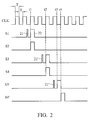
- FIG. 2 is a waveform diagram for showing a data flow between the host device and the VR device in accordance with an embodiment of the invention.
- the clock signal CLK is generated by the host device 11 and can be used to synchronize with the VR device 12.
- the signal S1 is the audio signal output by the host device 11.
- the signal S2 is the video signal output by the host device 11.
- the signal S1 comprises an audio pattern 21 indicating the timing when the audio signal is output from the host device 11. In this embodiment, the audio pattern 21 is mixed with the main audio signal 22.
- the audio pattern 21 is an audio signal with a specific tone or frequency.
- a detection signal is generated by the audio decoder to inform a controller of the VR device 12 to transmit a feedback signal to the host device 11.
- operations for the audio signal and video signal are explained separately.
- the audio signal and the video signal may be integrated into one signal, such as a digital data packet.
- the signal S3 shows the timing when the audio signal is received by the VR device 12.
- the signal S4 shows the timing when the video signal is received by the VR device 12.
- the signal S3' shows the timing when the audio signal has been processed by the VR device 12 and is ready to be played.
- the signal S4' shows the timing when the video signal has been processed by the VR device 12 and is ready to be displayed. It can be found that non-synchronization occurs between the signal S3' and the signal S4'.
- the VR device 12 transmits the time delay T between the signal S3' and the signal S4' to the host device 11, and the host device 11 will delay the audio signal for a time period T after receiving the time delay information.
- an audio pattern 21 with a special tone is used for detecting the timing of the audio signal S1.
- a timestamp is used for the video signal S2 to detecting the timing of the video signal S2.
- the timestamp is a parameter included or embedded in the video signal S2. For example, when the video signal S2 is output by the host device 11, a first timestamp corresponding to time t1 is added to the video signal S2.
- the VR device 12 has decoded or demodulated the received video signal S3 and generates a time feedback signal.
- the time feedback signal may be a second timestamp corresponding to time t4.
- the time feedback signal may record a first time interval between time t1 and time t4.
- the time feedback signal may record a second time interval between time t3 and time t4.
- the VR device 12 transmits the feedback signal including time delay information to the host device 11, and the host device 11 adjusts the timing of video or audio data transmission based on the feedback signal from the VR device 12.
- FIG. 3 is a waveform diagram for showing a data flow between the host device and the VR device in accordance with another embodiment of the invention.
- the video and the audio are integrated into one packet.
- the VR device 12 receives the packet from the host device 11, a demodulator of the VR device 12 demodulates the received packet to generate the audio data S1 and the video data S2.
- the audio data S1 includes an audio sync signal 31 with a specific tone, and the video data S2 is integrated with a timestamp.
- the host device 11 determines whether the audio signal and the video signal played by the VR device 12 are synchronized according to the audio sync signal and the timestamp.
- the clock signal CLK is generated by the host device 11 and may be used to synchronize with the VR device 12, and the clock signal CLK has a clock period of 2T.
- the packet P1 is transmitted to the VR device 12 at time t1.
- the demodulator of the VR device 12 demodulates the packet P1 to generate the audio data S1 and the video data S2 at time t2.
- the main audio pattern 32 is generated at time t3, for example.
- the audio sync pattern 31 may be mixed with the main audio pattern 32.
- the delay interval (t3-t2) between the audio data S1 and the video data S2 can be ignored.
- the delay interval (t3-t2) will be considered by the host device 11.
- the demodulated audio signal S1 is not ready to be played by a speaker of the VR device 12.
- the audio signal S1 is fully decoded by an audio encoder/decoder (codec) of the VR device 12 at time t4 and the decoded audio signal S1' is generated by the audio codec at time t4 and is ready to be played.
- codec audio encoder/decoder
- the signal FB1 represents the timing of the audio signal at different stages.
- the signal FB2 represents the timing of the video signal at different stages.
- the signals FB1 and FB2 are transmitted to a timestamp module to generate timestamp data.
- the host device 11 controls the transmission timing of the audio signal and video signal according to the timestamp data. In one embodiment, the host device 11 delays the video signal for 4T (t5-t2) or 3T (t4-t2).
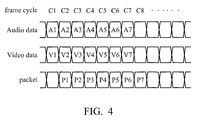
- the host device 11 may change the content of the packet based on practical situations. Assuming that the video signal is arranged in frames, each packet includes one frame, and the host device 11 transmits one packet every period of T. However, the audio data and video data in the same packet may have a 4-frame or 3-frame delay, thereby achieving synchronization between the audio signal and video signal in the VR device 12. Please refer to FIG. 4 for details.
- FIG. 4 is a waveform diagram of the audio data, video data, and the packet in the host device 11 in accordance with an embodiment of the invention.
- the audio data and video data are in form of digital data, but not limit the invention thereto.
- the audio data and the video data cannot be packed into a packet until the audio data and the video data are fully generated.
- the audio data A1 and the video data V1 are fully generated after the first clock cycle C1, and the host device 11 is capable of packing the audio data A1 and video data V1 into the packet P1 and transmitting the packet P1 to the VR device 12 at the second clock cycle C2.
- the host device 11 may transmit the packet to the VR device 12, where the packet P1 includes the audio data A1 and the video data V1, the packet P2 includes the audio A2 and the video data V2, and so on, as shown in FIG. 4 .
- the host device 11 will change the content in the packet to be transmitted to the VR device 12.
- the host device 11 will change the content in the next packet P4.
- the host device 11 first determines the delay between the audio data and the video data. If the audio data has a 2T delay after the video data, the original video data V4 in the packet P4 is replaced by video data V2, the original video data V5 is the packet P5 is replaced by video data V3, and so on. If the video data has a 2T delay after the audio data, the audio video data A4 in the packet P4 is replaced by audio data A2, the original audio data A5 is the packet P5 is replaced by audio data A3, and so on.
- the embodiment of FIG. 4 is only for illustrating the invention, and does not limit the invention thereto. A person skilled in the art can choose any data synchronization method, adding dummy data for example, based on the actual design requirements.
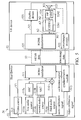
- FIG. 5 is a schematic diagram of a system with a host device and a VR device in accordance with an embodiment of the invention.
- an HDMI interface 53 is used to connect the host device 51 and the VR device 52 in the system 50, but the invention is not limited thereto.
- the connection between the host device 51 and the VR device 52 is wired (e.g. through the HDMI interface 53).
- a wireless communication protocol is used to establish the connection between the host device 52 and the VR device 52.
- the host device is a computer.
- the host device 51 is a portable device that can be placed into a slot of the VR device 52.
- the sampling rate conversion units (SRCs) 515a and 515b are optional.
- the mixer 516 receives and mixes the first audio signal from the first audio source 514a, the second audio signal from the second audio source 514b and the third audio signal from the third audio source 514c into an audio signal Al.
- the audio signal A1 is transmitted to the HDMI modulator 511 to generate the HDMI data.
- the host device 51 determines whether the third audio signal is synchronized with the video signal from the video source 513.
- the user may use the VR device 52 to play a VR game, and the video source 513 and the third audio source 514c provides the audio data and video data required for the VR game.
- the first audio source 514a provides on-line voice communication between users using software, such as RaidCall, Skype, etc.
- the second audio source 514b may be a system voice source of the host device 51. For example, when the host device 51 receives an incoming email, the host device 51 generates a corresponding voice signal via the second audio source 514b to inform the user who is playing the VR game. In another embodiment, when the host device 51 receives an incoming internet call, the host device 51 generates another corresponding voice signal via the second audio source 514b to inform the user who is playing the VR game.
- one of the first audio source 514a and the second audio source 514b generates an audio pattern, such as the audio pattern 21 in FIG. 2 or the audio pattern 31 in FIG. 3 .
- a human is more sensitive to sounds in a frequency range from 20Hz to 5KHz. If the frequency of the audio pattern is within that frequency range, other audio voice signals will be affected by the audio pattern. Therefore, it is preferred that an audio pattern having a frequency higher than 5K Hz be generated.
- the HDMI modulator 511 receives the audio data from the mixer 516 and the video data from video source 513 to generate and transmit the HDMI data to the VR device 52, wherein the HDMI data is in form of data packets.
- the video data from the HDMI demodulator 521 are in form of frames, for example, and each frame includes a timestamp for synchronization. Each timestamp records time information when the associated video frame is generated and output to the HDMI modulator 511.
- the HDMI modulator 511 may change the timestamp to indicate time information when the HDMI data is generated.
- the audio signal A1 output from mixer 516 includes an audio pattern for synchronization.
- the synchronization module 512 starts counting clock cycles for audio delay. After the HDMI demodulator 521 demodulates the received HDMI data to generate the audio data A2, The HDMI demodulator 521 further transmits a timestamp associated with the audio data A2 to the timestamp module 522, and the timestamp module 522 further forwards the timestamp associated with the audio data A2 to the synchronization module 512. When the synchronization module 512 has received the timestamp associated with the audio data A2, the synchronization module 512 stops counting and acquires a first delay (e.g. in clock cycles) between the audio signal A1 and its associated audio data A2 (i.e. an audio path delay in the audio transmission path).
- a first delay e.g. in clock cycles
- the HDMI demodulator 521 demodulates the received HDMI data to generate the video data
- the HDMI demodulator 521 further transmits the generated video data V2 to the display device 523.
- the HDMI demodulator 521 or the display device 523 may also transmit a timestamp associated with the video data V2 to the timestamp module 522.
- the timestamp module 522 then forwards the timestamp associated with the video data to the synchronization module 512, and the synchronization module 512 calculates a second delay between the video signal V1 and the video data V2 (i.e. an video path delay in the video transmission path).
- the synchronization module 512 generates an audio calibration signal and/or a video calibration signal based on the first delay and the second delay.
- the synchronization module 512 and the timestamp module 522 can be implemented by a processor, a hardware circuit, firmware, software, or a processing device executing corresponding firmware or software.
- the third audio source 514c delays the output audio data based on the audio calibration signal, and the video source 513 delays the output video data based on the video calibration signal.
- the synchronization module 512 transmits a calibration signal to the HDMI modulator 511, and the HDMI modulator 511 calibrates the content of the HDMI data based on the calibration signal.
- the HDMI demodulator 521 demodulates the received HDMI data to generate the audio data A2, and transmits the audio data A2 to an audio processing circuit 524.
- the audio processing circuit 524 comprises a codec 5241 to decode the audio data A2 to generate an analog audio signal A3, where the codec 5241 can be implemented by a dedicated audio processing integrated circuit or a processor.
- the analog audio signal A3 is then transmitted to an amplifier 5242.
- the amplifier 5242 filters out the high-frequency portion of the analog audio signal A3, thus, the audio pattern as described in FIG. 2 or FIG. 3 will is filtered out.
- the timestamp module 522 may receive a signal at nodes N1, N2, or N3 based on design requirements since the delays of the audio signal at the nodes N1, N2, and N3 are different.
- the VR device 52 comprises a video transmission path and an audio transmission path.
- the video transmission path starts from the HDMI demodulator 521 to the timestamp module 522 by passing through the display device 523.
- the audio transmission path starts from the HDMI demodulator 521 to the timestamp module 522 by passing through the nodes N1, N2 or N3.
- the video path delay (i.e. the second delay) in the video transmission path may be different from the audio path delay (i.e. the first delay) in the audio transmission paths, and one objective of the host device 51 is to synchronize the video data and the audio data to be played on the VR device 52.
- FIG. 6A is a waveform diagram showing delays of the audio data and the video data in accordance with an embodiment of the invention.
- the audio signal S A leads the video signal S V by a time period (t d2 -t d1 ), where t d2 is larger than t d1 .
- the signal S T denotes a threshold signal. If any of the time delays t d1 and t d2 is larger than the threshold t th , the host device 51 will not calibrate the synchronization error occurred in the VR device 52. The host device 51 will re-transmit the audio signal and the video signal to the VR device 52.
- the host device 51 will calibrate the synchronization error based on the time difference (t d2 -t d1 ) between the audio signal S A and the video signal S V .
- FIG. 6B is a waveform showing delays of the audio data and the video data in accordance with another embodiment of the invention.
- the video signal S V leads the audio signal S A by a time period (t d1 -t d2 ).
- the signal S T is a threshold signal. If any of the time delays t d1 and t d2 is larger than the threshold t th , the host device 51 will not calibrate the synchronization error occurred in the VR device 52. The host device 51 will re-transmit the audio data and the video data to the VR device. If both the time delays t d1 and t d2 are not longer than the threshold t th , the host device 51 will calibrate the synchronization error based on the time difference (t d1 - t d2 ) between the audio signal S A and the video signal S V .
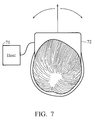
- FIG. 7 is a schematic diagram showing a VR device and a host in accordance with an embodiment of the invention.
- the user wears the VR device 72 on his head, and the VR device 72 receives audio data and video data from the host device 71.
- the VR device 72 receives audio data and video data from the host device 71.
- the viewing angle e.g. looking straightforward
- the video data may be delayed after the audio data because more video processing should be performed on the video data.
- a trigger mechanism is further disclosed in the invention to enable the synchronization method as described above.
- the VR device 72 comprises a position sensor to detect the horizontal and vertical angular movement of the VR device 72.
- the VR device 72 may determine whether the horizontal angular movement (i.e. turning clockwise or counterclockwise on the X/Y plane) of the VR device 72 is larger than a first predetermined threshold (e.g. 1 ⁇ 5 degrees) according to sensor data from the position sensor.
- a first predetermined threshold e.g. 1 ⁇ 5 degrees
- the VR device 72 will transmit a trigger signal to the host device 71 to enable the synchronization method.
- a gyroscope is deployed in the VR device 72 to detect whether the vertical angular movement (i.e.
- the VR device 72 When it is determined that the vertical angular movement of the VR device 72 is larger than the first predetermined threshold, the VR device 72 will transmit another trigger signal to the host device 71 to enable the synchronization method.
- the synchronization method described in the aforementioned embodiments is very useful to enhance the user's experience of VR device.
- the host device 71 executes the synchronization method repeatedly, the system resources of the host device 71 may be wasted.
- some parameters e.g. the first and second predetermined thresholds as described above are set as trigger conditions to perform the above-mentioned synchronization method.
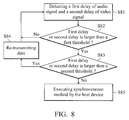
- FIG. 8 is a flowchart showing a method for monitoring synchronization between video data and audio data in the VR device in accordance with another embodiment of the invention.
- the host device detects a first delay of audio signal and a second delay of video signal in the VR device.
- the first delay and the second delay may differ due to different processing times in their respective transmission paths, the hardware configuration of the VR device, and/or the software resource of the VR device.
- the non-synchronization between the first delay and the second delay can be solved by adjusting the data transmission timing (i.e. can be transmission timing for the video data or audio data) in the host device.
- the VR device may synchronize the internal video data and audio data using a similar synchronization method described above.
- step S82 the host device determines whether any of the first delay and the second delay is longer than a first threshold. If both the first delay and the second delay are not longer than the first threshold, it indicates that the first delay and the second delay can be tolerated, and the host device will do nothing until it is determined that any of the first delay or the second delay is longer than the first threshold.
- the human ear cannot detect an audio delay less than 16ms (i.e. about 1/60 second) that can be set as the default first threshold.
- the detectable audio delay may vary from person to person, and thus the first threshold can also be set according to user experience.
- the video data displayed on the VR device may have a frame rate of 24, 30, or 60 frames per second, and thus the second threshold can be set as (1/24), (1/30), or (1/60) second.
- the host device is only concerned with the difference between the first delay and the second delay.
- the host device determines that the difference is greater than the first threshold, the host device performs the synchronization method described above.
- step S83 the host device further determines whether the first delay or the second delay is longer than a second threshold. If both the first delay and the second delay are not longer than the second threshold, step S85 is performed, and the host device performs the synchronization method described above. If any of the first delay and the second delay is longer than the second threshold, step S84 is performed.
- the determination steps S83 and S82 are implemented in the host device. Alternatively, the determination steps S83 and S82 can be implemented in the VR device. Only when the VR device determines that the non-synchronization between the audio data and video data in the VR device cannot be tolerated, the VR device will directly transmit a trigger signal to the host device to request the host device to perform the synchronization method described above.
- step S84 the audio data and video data is re-transmitted to the VR device by the host device because the first delay or the second delay is too large to be tolerated by the VR device.
- the host device will keep monitoring the synchronization status between the audio data and the video data in the VR device. If the host device determines that the first delay or the second delay is still larger than the second threshold, the host device will perform the synchronization method again to solve the problem.
- the synchronization method comprises a coarse calibration method and a fine calibration method.
- the leading signal i.e. can be audio data or video data
- a predetermined threshold delay such as t th shown in Fig. 6A or 6B
- the fine calibration method is the synchronization method described above.
- the host device further performs the fine calibration method to correct the non-synchronization issue between the audio data and video data in the VR device.
- the host device may stop some tasks, threads, or programs that have priorities lower than an application program, such as a VR game, being executed in corporation with the VR device. Then, the host device will determine whether the non-synchronization issue occurred in the VR device has been improved (i.e. the difference of the first delay and second delay is decreased). If the non-synchronization issue has been improved, the host device will perform step S83 again to check whether the first delay or the second delay is longer than the second threshold. If so, the host device will stop more tasks, threads, or programs, and only necessary programs for the operations of VR device are running on the host device.
- step S84 when the host device detects that the first delay or the second delay is still larger than the second threshold, the host device performs step S84 to re-transmits the audio signal and the video signal to the VR device. If the host device still determines that the first delay or the second delay is not longer than the second threshold after the host device has stopped some tasks, threads, or programs, the host device will perform the synchronization method again to correct the non-synchronization.
- FIG. 9 is a flowchart showing a method for monitoring synchronization between video data and audio data in the VR device in accordance with another embodiment of the invention.
- the host device receives sensor data from a position sensor of the VR device and determines the motion of the VR device. It should be noted that the user cannot be fully stationary while wearing the VR device, and there are always motions of the VR device.
- the motion may be a horizontal displacement, a vertical displacement, a horizontal rotation, a vertical rotation, or a combination thereof. In other words, the motion may be expressed as a displacement value and/or a rotation angle.
- step S92 when the host device determines that the motion is larger than a threshold, step S93 is performed, and the host device performs the synchronization method to solve the non-synchronization problem between the audio data and the video data.
- step 92 is expressed simply, and a person skilled in the art will appreciate that different threshold values can be set for the displacement and rotations of the VR device. Specifically, when the displacement of the VR device is larger than a first threshold (e.g. in centimeters) or the rotation angle of the VR device is larger than a second threshold (e.g. in degrees), the host device will determine that the overall motion of the VR device is beyond the tolerance limit for audio-video synchronization, and the synchronized method should be performed. If it is determined that the motion is not larger than the threshold, the host device will repeatedly monitor the synchronization status between the audio data and the video data in the VR device until the host device determines that the audio data and the video data are synchronized in the VR device.
- a first threshold e.g. in centimeters
- steps S91 ⁇ S93 are performed by the host device.
- the steps S91 and S92 can be performed by a processor of the VR device.
- the VR device When the VR device performs steps S91 and S92 and determines that the movement is larger than the threshold, the VR device will transmit a trigger signal to the host device, and the host device then performs step S93.
- the step S93 can also be performed by the processor of the VR device.
- the processor of the VR device will try to correct the non-synchronization issue between the audio data and video data.
- the processor of the VR device determines that the non-synchronization issue cannot be solved by itself (i.e. when the difference between the first delay and the second delay is large)
- the processor will transmit a request signal to the host device, so that the host device may take control of the synchronization procedure between the audio data and video data that was previously performed by the processor of the VR device.
- steps S82, S83 and S92 can be combined into a new flow.
Landscapes
- Engineering & Computer Science (AREA)
- Multimedia (AREA)
- Signal Processing (AREA)
- Computer Security & Cryptography (AREA)
- Life Sciences & Earth Sciences (AREA)
- Remote Sensing (AREA)
- Environmental Sciences (AREA)
- Environmental & Geological Engineering (AREA)
- Emergency Management (AREA)
- Ecology (AREA)
- Biodiversity & Conservation Biology (AREA)
- Business, Economics & Management (AREA)
- Computer Hardware Design (AREA)
- Theoretical Computer Science (AREA)
- General Physics & Mathematics (AREA)
- Physics & Mathematics (AREA)
- Software Systems (AREA)
- General Engineering & Computer Science (AREA)
- Computer Graphics (AREA)
- Two-Way Televisions, Distribution Of Moving Picture Or The Like (AREA)
Applications Claiming Priority (2)
| Application Number | Priority Date | Filing Date | Title |
|---|---|---|---|
| US201562210843P | 2015-08-27 | 2015-08-27 | |
| US15/222,146 US10015370B2 (en) | 2015-08-27 | 2016-07-28 | Method for synchronizing video and audio in virtual reality system |
Publications (2)
| Publication Number | Publication Date |
|---|---|
| EP3136718A1 true EP3136718A1 (de) | 2017-03-01 |
| EP3136718B1 EP3136718B1 (de) | 2018-05-09 |
Family
ID=56883546
Family Applications (1)
| Application Number | Title | Priority Date | Filing Date |
|---|---|---|---|
| EP16185487.2A Active EP3136718B1 (de) | 2015-08-27 | 2016-08-24 | Verfahren zur synchronisation von video und audio in einem virtuellen realitätssystem |
Country Status (4)
| Country | Link |
|---|---|
| US (1) | US10015370B2 (de) |
| EP (1) | EP3136718B1 (de) |
| CN (1) | CN106488288B (de) |
| TW (1) | TWI600320B (de) |
Cited By (4)
| Publication number | Priority date | Publication date | Assignee | Title |
|---|---|---|---|---|
| GB2577024A (en) * | 2017-06-09 | 2020-03-18 | Displaylink Uk Ltd | Using headset movement for compression |
| EP3609191A4 (de) * | 2017-03-22 | 2020-12-16 | Alpha Code Inc. | Betrachtungssystem der virtuellen realität, wiedergabesynchronisationsverfahren und betrachtungsprogramm der virtuellen realität |
| CN112770165A (zh) * | 2020-12-28 | 2021-05-07 | 杭州电子科技大学 | 一种音视频流分布式同步方法 |
| GB2606889A (en) * | 2017-06-09 | 2022-11-23 | Displaylink Uk Ltd | Using headset movement for compression |
Families Citing this family (38)
| Publication number | Priority date | Publication date | Assignee | Title |
|---|---|---|---|---|
| KR20180024616A (ko) * | 2016-08-30 | 2018-03-08 | 삼성전자주식회사 | 디스플레이 장치 및 디스플레이 장치의 캘리브레이션 수행 방법 |
| US11295525B1 (en) | 2016-09-30 | 2022-04-05 | Amazon Technologies, Inc. | Augmenting transmitted video data |
| US10950049B1 (en) | 2016-09-30 | 2021-03-16 | Amazon Technologies, Inc. | Augmenting transmitted video data |
| US10943396B1 (en) * | 2016-09-30 | 2021-03-09 | Amazon Technologies, Inc. | Synchronizing transmitted video data and enhancements |
| US10306180B2 (en) * | 2016-10-21 | 2019-05-28 | Liquidsky Software, Inc. | Predictive virtual reality content streaming techniques |
| US10477333B1 (en) * | 2016-11-29 | 2019-11-12 | Amazon Technologies, Inc. | Audio placement algorithm for determining playback delay |
| US10979676B1 (en) | 2017-02-27 | 2021-04-13 | Amazon Technologies, Inc. | Adjusting the presented field of view in transmitted data |
| US11451689B2 (en) * | 2017-04-09 | 2022-09-20 | Insoundz Ltd. | System and method for matching audio content to virtual reality visual content |
| TWI635318B (zh) * | 2017-04-28 | 2018-09-11 | 宏星技術股份有限公司 | 頭戴式顯示器、控制方法,以及非暫時性電腦可讀取媒體 |
| CN106935096A (zh) * | 2017-05-18 | 2017-07-07 | 重庆电子工程职业学院 | 一种工业控制虚拟现实教学实训平台及其操作方法 |
| CN109040818B (zh) * | 2017-06-12 | 2021-04-27 | 武汉斗鱼网络科技有限公司 | 直播时的音视频同步方法、存储介质、电子设备及系统 |
| US10623453B2 (en) * | 2017-07-25 | 2020-04-14 | Unity IPR ApS | System and method for device synchronization in augmented reality |
| US10595075B2 (en) * | 2017-08-04 | 2020-03-17 | Disney Enterprises, Inc. | Automatic timing of production devices in an internet protocol environment |
| US10970930B1 (en) | 2017-08-07 | 2021-04-06 | Amazon Technologies, Inc. | Alignment and concurrent presentation of guide device video and enhancements |
| US10970545B1 (en) | 2017-08-31 | 2021-04-06 | Amazon Technologies, Inc. | Generating and surfacing augmented reality signals for associated physical items |
| CN107632703A (zh) * | 2017-09-01 | 2018-01-26 | 广州励丰文化科技股份有限公司 | 基于双目摄像头的混合现实音频控制方法及服务设备 |
| US10878838B1 (en) | 2017-11-16 | 2020-12-29 | Amazon Technologies, Inc. | Systems and methods to trigger actions based on encoded sounds associated with containers |
| US11472598B1 (en) | 2017-11-16 | 2022-10-18 | Amazon Technologies, Inc. | Systems and methods to encode sounds in association with containers |
| CN110166764B (zh) * | 2018-02-14 | 2022-03-01 | 阿里巴巴集团控股有限公司 | 虚拟现实vr直播中的视角同步方法及装置 |
| CN108829627B (zh) * | 2018-05-30 | 2020-11-20 | 青岛小鸟看看科技有限公司 | 虚拟现实设备间的同步控制方法及系统 |
| US11429086B1 (en) | 2018-05-31 | 2022-08-30 | Amazon Technologies, Inc. | Modifying functions of computing devices based on environment |
| US10915566B2 (en) | 2019-03-01 | 2021-02-09 | Soundtrack Game LLC | System and method for automatic synchronization of video with music, and gaming applications related thereto |
| CN110290411A (zh) * | 2019-07-05 | 2019-09-27 | 四川长虹电器股份有限公司 | 视频播放过程中自动校正音画不同步的方法 |
| US11871069B2 (en) * | 2019-07-26 | 2024-01-09 | Lg Electronics Inc. | Multimedia service providing device and multimedia service providing method |
| CN112399167B (zh) * | 2020-12-08 | 2021-04-13 | 恒玄科技(北京)有限公司 | 一种用于无线通信的智能眼镜 |
| EP4260568A4 (de) * | 2020-12-11 | 2024-05-15 | QUALCOMM Incorporated | Multimedia-wiedergabesynchronisation |
| EP4258686A4 (de) * | 2021-01-13 | 2024-06-05 | Samsung Electronics Co., Ltd. | Elektronische vorrichtung zur messung der haltung eines benutzers und verfahren dafür |
| CN113179377B (zh) * | 2021-03-17 | 2022-11-08 | 青岛小鸟看看科技有限公司 | 一种vr设备的信号切换方法和一种vr设备 |
| JP7666597B2 (ja) * | 2021-06-23 | 2025-04-22 | 日本電信電話株式会社 | 伝送システム、送信システム、受信システム及び伝送方法 |
| WO2023032308A1 (ja) * | 2021-08-30 | 2023-03-09 | ソニーグループ株式会社 | 情報処理装置、情報処理方法、情報処理システム |
| TWI813213B (zh) * | 2022-03-22 | 2023-08-21 | 瑞昱半導體股份有限公司 | 影音訊號同步方法與影音同步處理系統 |
| US20250205597A1 (en) * | 2022-03-25 | 2025-06-26 | Magic Leap, Inc. | Optimized mixed reality audio rendering |
| CN115052199B (zh) * | 2022-06-20 | 2025-06-24 | 蔚来汽车科技(安徽)有限公司 | 车载观影系统及车载观影方法 |
| CN115314988B (zh) * | 2022-08-06 | 2025-08-05 | 深圳市丰禾原电子科技有限公司 | 动态报告延迟信息的方法及其播放设备 |
| CN115052119B (zh) * | 2022-08-16 | 2022-11-25 | 深圳市品为科技有限公司 | Vga视频延长器 |
| US12548601B2 (en) * | 2023-11-22 | 2026-02-10 | Shanghai Tosun Technology Ltd. | Time synchronization method of video information and bus packet formation and electronic device |
| US12520001B2 (en) | 2023-11-22 | 2026-01-06 | Shanghai Tosun Technology Ltd. | Time synchronization system of video information and bus packet formation |
| US20260101146A1 (en) * | 2024-10-04 | 2026-04-09 | Harman Becker Automotive Systems, Inc. | System and method for measuring an audio path delay for an amplifier based on a control signal |
Citations (4)
| Publication number | Priority date | Publication date | Assignee | Title |
|---|---|---|---|---|
| US5990405A (en) * | 1998-07-08 | 1999-11-23 | Gibson Guitar Corp. | System and method for generating and controlling a simulated musical concert experience |
| US20060053455A1 (en) * | 2002-12-04 | 2006-03-09 | Murali Mani | Synchronization of signals |
| US20130141421A1 (en) * | 2011-12-06 | 2013-06-06 | Brian Mount | Augmented reality virtual monitor |
| US20140259050A1 (en) * | 2013-03-08 | 2014-09-11 | Silicon Image, Inc. | Mechanism for facilitating synchronization of audio and video between multiple media devices |
Family Cites Families (7)
| Publication number | Priority date | Publication date | Assignee | Title |
|---|---|---|---|---|
| US7636126B2 (en) * | 2005-06-22 | 2009-12-22 | Sony Computer Entertainment Inc. | Delay matching in audio/video systems |
| WO2011097762A1 (en) * | 2010-02-12 | 2011-08-18 | Thomson Licensing | Method for synchronized content playback |
| MX2012010238A (es) | 2010-03-05 | 2013-01-18 | Sony Comp Entertainment Us | Mantenimiento de vistas multiples en un espacio virtual estable compartido. |
| US9418705B2 (en) * | 2010-08-26 | 2016-08-16 | Blast Motion Inc. | Sensor and media event detection system |
| EP2713609B1 (de) * | 2012-09-28 | 2015-05-06 | Stockholms Universitet Holding AB | Dynamische Verzögerungshandhabung in mobilen Echtzeitvideo-Herstellungssystemen |
| CN103888813A (zh) * | 2012-12-21 | 2014-06-25 | 北京计算机技术及应用研究所 | 一种音视频同步的实现方法及系统 |
| US9971319B2 (en) * | 2014-04-22 | 2018-05-15 | At&T Intellectual Property I, Lp | Providing audio and alternate audio simultaneously during a shared multimedia presentation |
-
2016
- 2016-07-28 US US15/222,146 patent/US10015370B2/en active Active
- 2016-08-12 CN CN201610658874.5A patent/CN106488288B/zh active Active
- 2016-08-23 TW TW105126863A patent/TWI600320B/zh active
- 2016-08-24 EP EP16185487.2A patent/EP3136718B1/de active Active
Patent Citations (4)
| Publication number | Priority date | Publication date | Assignee | Title |
|---|---|---|---|---|
| US5990405A (en) * | 1998-07-08 | 1999-11-23 | Gibson Guitar Corp. | System and method for generating and controlling a simulated musical concert experience |
| US20060053455A1 (en) * | 2002-12-04 | 2006-03-09 | Murali Mani | Synchronization of signals |
| US20130141421A1 (en) * | 2011-12-06 | 2013-06-06 | Brian Mount | Augmented reality virtual monitor |
| US20140259050A1 (en) * | 2013-03-08 | 2014-09-11 | Silicon Image, Inc. | Mechanism for facilitating synchronization of audio and video between multiple media devices |
Cited By (6)
| Publication number | Priority date | Publication date | Assignee | Title |
|---|---|---|---|---|
| EP3609191A4 (de) * | 2017-03-22 | 2020-12-16 | Alpha Code Inc. | Betrachtungssystem der virtuellen realität, wiedergabesynchronisationsverfahren und betrachtungsprogramm der virtuellen realität |
| GB2577024A (en) * | 2017-06-09 | 2020-03-18 | Displaylink Uk Ltd | Using headset movement for compression |
| GB2577024B (en) * | 2017-06-09 | 2022-08-03 | Displaylink Uk Ltd | Using headset movement for compression |
| GB2606889A (en) * | 2017-06-09 | 2022-11-23 | Displaylink Uk Ltd | Using headset movement for compression |
| GB2606889B (en) * | 2017-06-09 | 2023-02-08 | Displaylink Uk Ltd | Using headset movement for compression |
| CN112770165A (zh) * | 2020-12-28 | 2021-05-07 | 杭州电子科技大学 | 一种音视频流分布式同步方法 |
Also Published As
| Publication number | Publication date |
|---|---|
| US10015370B2 (en) | 2018-07-03 |
| CN106488288A (zh) | 2017-03-08 |
| EP3136718B1 (de) | 2018-05-09 |
| TW201709716A (zh) | 2017-03-01 |
| CN106488288B (zh) | 2019-08-06 |
| TWI600320B (zh) | 2017-09-21 |
| US20170064154A1 (en) | 2017-03-02 |
Similar Documents
| Publication | Publication Date | Title |
|---|---|---|
| US10015370B2 (en) | Method for synchronizing video and audio in virtual reality system | |
| US20140184762A1 (en) | Method of stereoscopic synchronization of active shutter glasses | |
| WO2019026765A1 (ja) | レンダリング装置、ヘッドマウントディスプレイ、画像伝送方法、および画像補正方法 | |
| US20140376873A1 (en) | Video-audio processing device and video-audio processing method | |
| US9807408B2 (en) | Control mechanism for video output | |
| US8994797B2 (en) | Display system, display device and display assistance device | |
| US11137604B2 (en) | Image generation device, image extraction device, image generation method, and image extraction method | |
| US20120019636A1 (en) | Stereoscopic 3D Images and Video on a Non-Stereoscopic 3D Capable Screen | |
| US11372609B2 (en) | System and method for locally generating data | |
| WO2010122711A1 (ja) | 立体画像表示装置、立体画像再生装置および立体画像目視システム | |
| US20110001805A1 (en) | System and method of transmitting and decoding stereoscopic sequence information | |
| WO2011052125A1 (ja) | 立体表示装置、立体表示システムおよび立体表示方法 | |
| CN103856770A (zh) | 用于3d显示装置的同步的方法和设备 | |
| TWI478579B (zh) | 3d影像顯示方法及介面單元 | |
| KR20130129174A (ko) | 다중 3d 디스플레이들/장치들을 위한 셔터 신호들의 동기화 | |
| CN102752619A (zh) | 图像显示系统、图像显示装置、3d眼镜及图像显示方法 | |
| KR20160082368A (ko) | 네트워크 기반 멀티 디스플레이에서 콘텐츠 간 동기화 방법 및 시스템 | |
| US20120050469A1 (en) | Image processing device, image processing method and image processing system | |
| US20120162397A1 (en) | Image processing apparatus and display controlling method | |
| CN112188181A (zh) | 图像显示设备、立体图像处理电路及其同步信号校正方法 | |
| TW201306555A (zh) | 解碼器、投影系統及投影系統的影像處理方法 | |
| CN104349093A (zh) | 单机双投影系统及控制方法 | |
| KR20120015831A (ko) | 3d 안경, 3d 안경의 구동방법 및 3d 영상 제공 시스템 | |
| TWI450016B (zh) | 數位光學處理器投影機及其顯示方法 | |
| WO2013071939A2 (en) | Method and a system for displaying and watching three-dimensional images on the screen |
Legal Events
| Date | Code | Title | Description |
|---|---|---|---|
| PUAI | Public reference made under article 153(3) epc to a published international application that has entered the european phase |
Free format text: ORIGINAL CODE: 0009012 |
|
| 17P | Request for examination filed |
Effective date: 20160824 |
|
| AK | Designated contracting states |
Kind code of ref document: A1 Designated state(s): AL AT BE BG CH CY CZ DE DK EE ES FI FR GB GR HR HU IE IS IT LI LT LU LV MC MK MT NL NO PL PT RO RS SE SI SK SM TR |
|
| AX | Request for extension of the european patent |
Extension state: BA ME |
|
| RBV | Designated contracting states (corrected) |
Designated state(s): AL AT BE BG CH CY CZ DE DK EE ES FI FR GB GR HR HU IE IS IT LI LT LU LV MC MK MT NL NO PL PT RO RS SE SI SK SM TR |
|
| GRAJ | Information related to disapproval of communication of intention to grant by the applicant or resumption of examination proceedings by the epo deleted |
Free format text: ORIGINAL CODE: EPIDOSDIGR1 |
|
| GRAP | Despatch of communication of intention to grant a patent |
Free format text: ORIGINAL CODE: EPIDOSNIGR1 |
|
| INTG | Intention to grant announced |
Effective date: 20171130 |
|
| RIN1 | Information on inventor provided before grant (corrected) |
Inventor name: TSENG, MONG-YU Inventor name: CHOI, IOK-KAN Inventor name: WU, JING-LUNG |
|
| GRAS | Grant fee paid |
Free format text: ORIGINAL CODE: EPIDOSNIGR3 |
|
| GRAA | (expected) grant |
Free format text: ORIGINAL CODE: 0009210 |
|
| AK | Designated contracting states |
Kind code of ref document: B1 Designated state(s): AL AT BE BG CH CY CZ DE DK EE ES FI FR GB GR HR HU IE IS IT LI LT LU LV MC MK MT NL NO PL PT RO RS SE SI SK SM TR |
|
| REG | Reference to a national code |
Ref country code: GB Ref legal event code: FG4D |
|
| REG | Reference to a national code |
Ref country code: AT Ref legal event code: REF Ref document number: 998575 Country of ref document: AT Kind code of ref document: T Effective date: 20180515 Ref country code: CH Ref legal event code: EP |
|
| REG | Reference to a national code |
Ref country code: IE Ref legal event code: FG4D |
|
| REG | Reference to a national code |
Ref country code: DE Ref legal event code: R096 Ref document number: 602016002936 Country of ref document: DE |
|
| REG | Reference to a national code |
Ref country code: NL Ref legal event code: FP |
|
| REG | Reference to a national code |
Ref country code: FR Ref legal event code: PLFP Year of fee payment: 3 |
|
| REG | Reference to a national code |
Ref country code: LT Ref legal event code: MG4D |
|
| PG25 | Lapsed in a contracting state [announced via postgrant information from national office to epo] |
Ref country code: LT Free format text: LAPSE BECAUSE OF FAILURE TO SUBMIT A TRANSLATION OF THE DESCRIPTION OR TO PAY THE FEE WITHIN THE PRESCRIBED TIME-LIMIT Effective date: 20180509 Ref country code: ES Free format text: LAPSE BECAUSE OF FAILURE TO SUBMIT A TRANSLATION OF THE DESCRIPTION OR TO PAY THE FEE WITHIN THE PRESCRIBED TIME-LIMIT Effective date: 20180509 Ref country code: SE Free format text: LAPSE BECAUSE OF FAILURE TO SUBMIT A TRANSLATION OF THE DESCRIPTION OR TO PAY THE FEE WITHIN THE PRESCRIBED TIME-LIMIT Effective date: 20180509 Ref country code: FI Free format text: LAPSE BECAUSE OF FAILURE TO SUBMIT A TRANSLATION OF THE DESCRIPTION OR TO PAY THE FEE WITHIN THE PRESCRIBED TIME-LIMIT Effective date: 20180509 Ref country code: BG Free format text: LAPSE BECAUSE OF FAILURE TO SUBMIT A TRANSLATION OF THE DESCRIPTION OR TO PAY THE FEE WITHIN THE PRESCRIBED TIME-LIMIT Effective date: 20180809 Ref country code: NO Free format text: LAPSE BECAUSE OF FAILURE TO SUBMIT A TRANSLATION OF THE DESCRIPTION OR TO PAY THE FEE WITHIN THE PRESCRIBED TIME-LIMIT Effective date: 20180809 |
|
| PG25 | Lapsed in a contracting state [announced via postgrant information from national office to epo] |
Ref country code: LV Free format text: LAPSE BECAUSE OF FAILURE TO SUBMIT A TRANSLATION OF THE DESCRIPTION OR TO PAY THE FEE WITHIN THE PRESCRIBED TIME-LIMIT Effective date: 20180509 Ref country code: GR Free format text: LAPSE BECAUSE OF FAILURE TO SUBMIT A TRANSLATION OF THE DESCRIPTION OR TO PAY THE FEE WITHIN THE PRESCRIBED TIME-LIMIT Effective date: 20180810 Ref country code: HR Free format text: LAPSE BECAUSE OF FAILURE TO SUBMIT A TRANSLATION OF THE DESCRIPTION OR TO PAY THE FEE WITHIN THE PRESCRIBED TIME-LIMIT Effective date: 20180509 Ref country code: RS Free format text: LAPSE BECAUSE OF FAILURE TO SUBMIT A TRANSLATION OF THE DESCRIPTION OR TO PAY THE FEE WITHIN THE PRESCRIBED TIME-LIMIT Effective date: 20180509 |
|
| REG | Reference to a national code |
Ref country code: AT Ref legal event code: MK05 Ref document number: 998575 Country of ref document: AT Kind code of ref document: T Effective date: 20180509 |
|
| PG25 | Lapsed in a contracting state [announced via postgrant information from national office to epo] |
Ref country code: SK Free format text: LAPSE BECAUSE OF FAILURE TO SUBMIT A TRANSLATION OF THE DESCRIPTION OR TO PAY THE FEE WITHIN THE PRESCRIBED TIME-LIMIT Effective date: 20180509 Ref country code: PL Free format text: LAPSE BECAUSE OF FAILURE TO SUBMIT A TRANSLATION OF THE DESCRIPTION OR TO PAY THE FEE WITHIN THE PRESCRIBED TIME-LIMIT Effective date: 20180509 Ref country code: DK Free format text: LAPSE BECAUSE OF FAILURE TO SUBMIT A TRANSLATION OF THE DESCRIPTION OR TO PAY THE FEE WITHIN THE PRESCRIBED TIME-LIMIT Effective date: 20180509 Ref country code: RO Free format text: LAPSE BECAUSE OF FAILURE TO SUBMIT A TRANSLATION OF THE DESCRIPTION OR TO PAY THE FEE WITHIN THE PRESCRIBED TIME-LIMIT Effective date: 20180509 Ref country code: CZ Free format text: LAPSE BECAUSE OF FAILURE TO SUBMIT A TRANSLATION OF THE DESCRIPTION OR TO PAY THE FEE WITHIN THE PRESCRIBED TIME-LIMIT Effective date: 20180509 Ref country code: EE Free format text: LAPSE BECAUSE OF FAILURE TO SUBMIT A TRANSLATION OF THE DESCRIPTION OR TO PAY THE FEE WITHIN THE PRESCRIBED TIME-LIMIT Effective date: 20180509 Ref country code: AT Free format text: LAPSE BECAUSE OF FAILURE TO SUBMIT A TRANSLATION OF THE DESCRIPTION OR TO PAY THE FEE WITHIN THE PRESCRIBED TIME-LIMIT Effective date: 20180509 |
|
| REG | Reference to a national code |
Ref country code: DE Ref legal event code: R097 Ref document number: 602016002936 Country of ref document: DE |
|
| PG25 | Lapsed in a contracting state [announced via postgrant information from national office to epo] |
Ref country code: IT Free format text: LAPSE BECAUSE OF FAILURE TO SUBMIT A TRANSLATION OF THE DESCRIPTION OR TO PAY THE FEE WITHIN THE PRESCRIBED TIME-LIMIT Effective date: 20180509 Ref country code: SM Free format text: LAPSE BECAUSE OF FAILURE TO SUBMIT A TRANSLATION OF THE DESCRIPTION OR TO PAY THE FEE WITHIN THE PRESCRIBED TIME-LIMIT Effective date: 20180509 |
|
| PLBE | No opposition filed within time limit |
Free format text: ORIGINAL CODE: 0009261 |
|
| STAA | Information on the status of an ep patent application or granted ep patent |
Free format text: STATUS: NO OPPOSITION FILED WITHIN TIME LIMIT |
|
| PG25 | Lapsed in a contracting state [announced via postgrant information from national office to epo] |
Ref country code: MC Free format text: LAPSE BECAUSE OF FAILURE TO SUBMIT A TRANSLATION OF THE DESCRIPTION OR TO PAY THE FEE WITHIN THE PRESCRIBED TIME-LIMIT Effective date: 20180509 |
|
| 26N | No opposition filed |
Effective date: 20190212 |
|
| PG25 | Lapsed in a contracting state [announced via postgrant information from national office to epo] |
Ref country code: LU Free format text: LAPSE BECAUSE OF NON-PAYMENT OF DUE FEES Effective date: 20180824 |
|
| REG | Reference to a national code |
Ref country code: BE Ref legal event code: MM Effective date: 20180831 |
|
| PG25 | Lapsed in a contracting state [announced via postgrant information from national office to epo] |
Ref country code: SI Free format text: LAPSE BECAUSE OF FAILURE TO SUBMIT A TRANSLATION OF THE DESCRIPTION OR TO PAY THE FEE WITHIN THE PRESCRIBED TIME-LIMIT Effective date: 20180509 |
|
| PG25 | Lapsed in a contracting state [announced via postgrant information from national office to epo] |
Ref country code: BE Free format text: LAPSE BECAUSE OF NON-PAYMENT OF DUE FEES Effective date: 20180831 |
|
| PG25 | Lapsed in a contracting state [announced via postgrant information from national office to epo] |
Ref country code: AL Free format text: LAPSE BECAUSE OF FAILURE TO SUBMIT A TRANSLATION OF THE DESCRIPTION OR TO PAY THE FEE WITHIN THE PRESCRIBED TIME-LIMIT Effective date: 20180509 |
|
| PG25 | Lapsed in a contracting state [announced via postgrant information from national office to epo] |
Ref country code: MT Free format text: LAPSE BECAUSE OF NON-PAYMENT OF DUE FEES Effective date: 20180824 |
|
| PG25 | Lapsed in a contracting state [announced via postgrant information from national office to epo] |
Ref country code: TR Free format text: LAPSE BECAUSE OF FAILURE TO SUBMIT A TRANSLATION OF THE DESCRIPTION OR TO PAY THE FEE WITHIN THE PRESCRIBED TIME-LIMIT Effective date: 20180509 |
|
| PG25 | Lapsed in a contracting state [announced via postgrant information from national office to epo] |
Ref country code: LI Free format text: LAPSE BECAUSE OF NON-PAYMENT OF DUE FEES Effective date: 20190831 Ref country code: CH Free format text: LAPSE BECAUSE OF NON-PAYMENT OF DUE FEES Effective date: 20190831 Ref country code: PT Free format text: LAPSE BECAUSE OF FAILURE TO SUBMIT A TRANSLATION OF THE DESCRIPTION OR TO PAY THE FEE WITHIN THE PRESCRIBED TIME-LIMIT Effective date: 20180509 |
|
| PG25 | Lapsed in a contracting state [announced via postgrant information from national office to epo] |
Ref country code: HU Free format text: LAPSE BECAUSE OF FAILURE TO SUBMIT A TRANSLATION OF THE DESCRIPTION OR TO PAY THE FEE WITHIN THE PRESCRIBED TIME-LIMIT; INVALID AB INITIO Effective date: 20160824 Ref country code: IE Free format text: LAPSE BECAUSE OF NON-PAYMENT OF DUE FEES Effective date: 20180824 Ref country code: CY Free format text: LAPSE BECAUSE OF FAILURE TO SUBMIT A TRANSLATION OF THE DESCRIPTION OR TO PAY THE FEE WITHIN THE PRESCRIBED TIME-LIMIT Effective date: 20180509 Ref country code: MK Free format text: LAPSE BECAUSE OF NON-PAYMENT OF DUE FEES Effective date: 20180509 |
|
| PG25 | Lapsed in a contracting state [announced via postgrant information from national office to epo] |
Ref country code: IS Free format text: LAPSE BECAUSE OF FAILURE TO SUBMIT A TRANSLATION OF THE DESCRIPTION OR TO PAY THE FEE WITHIN THE PRESCRIBED TIME-LIMIT Effective date: 20180909 |
|
| P01 | Opt-out of the competence of the unified patent court (upc) registered |
Effective date: 20230602 |
|
| PGFP | Annual fee paid to national office [announced via postgrant information from national office to epo] |
Ref country code: NL Payment date: 20250704 Year of fee payment: 10 |
|
| PGFP | Annual fee paid to national office [announced via postgrant information from national office to epo] |
Ref country code: DE Payment date: 20250702 Year of fee payment: 10 |
|
| PGFP | Annual fee paid to national office [announced via postgrant information from national office to epo] |
Ref country code: GB Payment date: 20250703 Year of fee payment: 10 |
|
| PGFP | Annual fee paid to national office [announced via postgrant information from national office to epo] |
Ref country code: FR Payment date: 20250703 Year of fee payment: 10 |