EP3136741A1 - Dispositif d'entrée/sortie, dispositif de relais pour transmettre contenu à un appareil externe et methodes de ceux-ci - Google Patents
Dispositif d'entrée/sortie, dispositif de relais pour transmettre contenu à un appareil externe et methodes de ceux-ci Download PDFInfo
- Publication number
- EP3136741A1 EP3136741A1 EP16176973.2A EP16176973A EP3136741A1 EP 3136741 A1 EP3136741 A1 EP 3136741A1 EP 16176973 A EP16176973 A EP 16176973A EP 3136741 A1 EP3136741 A1 EP 3136741A1
- Authority
- EP
- European Patent Office
- Prior art keywords
- contents
- moving images
- response
- processor
- external apparatus
- Prior art date
- Legal status (The legal status is an assumption and is not a legal conclusion. Google has not performed a legal analysis and makes no representation as to the accuracy of the status listed.)
- Ceased
Links
Images





Classifications
-
- H—ELECTRICITY
- H04—ELECTRIC COMMUNICATION TECHNIQUE
- H04N—PICTORIAL COMMUNICATION, e.g. TELEVISION
- H04N21/00—Selective content distribution, e.g. interactive television or video on demand [VOD]
- H04N21/40—Client devices specifically adapted for the reception of or interaction with content, e.g. set-top-box [STB]; Operations thereof
- H04N21/43—Processing of content or additional data, e.g. demultiplexing additional data from a digital video stream; Elementary client operations, e.g. monitoring of home network or synchronising decoder's clock; Client middleware
- H04N21/436—Interfacing a local distribution network, e.g. communicating with another STB or one or more peripheral devices inside the home
- H04N21/43615—Interfacing a Home Network, e.g. for connecting the client to a plurality of peripherals
-
- H—ELECTRICITY
- H04—ELECTRIC COMMUNICATION TECHNIQUE
- H04N—PICTORIAL COMMUNICATION, e.g. TELEVISION
- H04N21/00—Selective content distribution, e.g. interactive television or video on demand [VOD]
- H04N21/40—Client devices specifically adapted for the reception of or interaction with content, e.g. set-top-box [STB]; Operations thereof
- H04N21/43—Processing of content or additional data, e.g. demultiplexing additional data from a digital video stream; Elementary client operations, e.g. monitoring of home network or synchronising decoder's clock; Client middleware
- H04N21/436—Interfacing a local distribution network, e.g. communicating with another STB or one or more peripheral devices inside the home
- H04N21/4363—Adapting the video stream to a specific local network, e.g. a Bluetooth® network
- H04N21/43632—Adapting the video stream to a specific local network, e.g. a Bluetooth® network involving a wired protocol, e.g. IEEE 1394
- H04N21/43635—HDMI
-
- H—ELECTRICITY
- H04—ELECTRIC COMMUNICATION TECHNIQUE
- H04N—PICTORIAL COMMUNICATION, e.g. TELEVISION
- H04N21/00—Selective content distribution, e.g. interactive television or video on demand [VOD]
- H04N21/40—Client devices specifically adapted for the reception of or interaction with content, e.g. set-top-box [STB]; Operations thereof
- H04N21/43—Processing of content or additional data, e.g. demultiplexing additional data from a digital video stream; Elementary client operations, e.g. monitoring of home network or synchronising decoder's clock; Client middleware
- H04N21/436—Interfacing a local distribution network, e.g. communicating with another STB or one or more peripheral devices inside the home
- H04N21/4363—Adapting the video stream to a specific local network, e.g. a Bluetooth® network
- H04N21/43637—Adapting the video stream to a specific local network, e.g. a Bluetooth® network involving a wireless protocol, e.g. Bluetooth®, RF or wireless LAN [IEEE 802.11]
-
- H—ELECTRICITY
- H04—ELECTRIC COMMUNICATION TECHNIQUE
- H04N—PICTORIAL COMMUNICATION, e.g. TELEVISION
- H04N21/00—Selective content distribution, e.g. interactive television or video on demand [VOD]
- H04N21/40—Client devices specifically adapted for the reception of or interaction with content, e.g. set-top-box [STB]; Operations thereof
- H04N21/43—Processing of content or additional data, e.g. demultiplexing additional data from a digital video stream; Elementary client operations, e.g. monitoring of home network or synchronising decoder's clock; Client middleware
- H04N21/44—Processing of video elementary streams, e.g. splicing a video clip retrieved from local storage with an incoming video stream or rendering scenes according to encoded video stream scene graphs
- H04N21/4402—Processing of video elementary streams, e.g. splicing a video clip retrieved from local storage with an incoming video stream or rendering scenes according to encoded video stream scene graphs involving reformatting operations of video signals for household redistribution, storage or real-time display
-
- H—ELECTRICITY
- H04—ELECTRIC COMMUNICATION TECHNIQUE
- H04N—PICTORIAL COMMUNICATION, e.g. TELEVISION
- H04N21/00—Selective content distribution, e.g. interactive television or video on demand [VOD]
- H04N21/40—Client devices specifically adapted for the reception of or interaction with content, e.g. set-top-box [STB]; Operations thereof
- H04N21/43—Processing of content or additional data, e.g. demultiplexing additional data from a digital video stream; Elementary client operations, e.g. monitoring of home network or synchronising decoder's clock; Client middleware
- H04N21/44—Processing of video elementary streams, e.g. splicing a video clip retrieved from local storage with an incoming video stream or rendering scenes according to encoded video stream scene graphs
- H04N21/4402—Processing of video elementary streams, e.g. splicing a video clip retrieved from local storage with an incoming video stream or rendering scenes according to encoded video stream scene graphs involving reformatting operations of video signals for household redistribution, storage or real-time display
- H04N21/440263—Processing of video elementary streams, e.g. splicing a video clip retrieved from local storage with an incoming video stream or rendering scenes according to encoded video stream scene graphs involving reformatting operations of video signals for household redistribution, storage or real-time display by altering the spatial resolution, e.g. for displaying on a connected PDA
-
- H—ELECTRICITY
- H04—ELECTRIC COMMUNICATION TECHNIQUE
- H04N—PICTORIAL COMMUNICATION, e.g. TELEVISION
- H04N21/00—Selective content distribution, e.g. interactive television or video on demand [VOD]
- H04N21/40—Client devices specifically adapted for the reception of or interaction with content, e.g. set-top-box [STB]; Operations thereof
- H04N21/43—Processing of content or additional data, e.g. demultiplexing additional data from a digital video stream; Elementary client operations, e.g. monitoring of home network or synchronising decoder's clock; Client middleware
- H04N21/442—Monitoring of processes or resources, e.g. detecting the failure of a recording device, monitoring the downstream bandwidth, the number of times a movie has been viewed, the storage space available from the internal hard disk
- H04N21/44227—Monitoring of local network, e.g. connection or bandwidth variations; Detecting new devices in the local network
-
- H—ELECTRICITY
- H04—ELECTRIC COMMUNICATION TECHNIQUE
- H04N—PICTORIAL COMMUNICATION, e.g. TELEVISION
- H04N21/00—Selective content distribution, e.g. interactive television or video on demand [VOD]
- H04N21/60—Network structure or processes for video distribution between server and client or between remote clients; Control signalling between clients, server and network components; Transmission of management data between server and client, e.g. sending from server to client commands for recording incoming content stream; Communication details between server and client
- H04N21/63—Control signaling related to video distribution between client, server and network components; Network processes for video distribution between server and clients or between remote clients, e.g. transmitting basic layer and enhancement layers over different transmission paths, setting up a peer-to-peer communication via Internet between remote STB's; Communication protocols; Addressing
- H04N21/633—Control signals issued by server directed to the network components or client
- H04N21/6332—Control signals issued by server directed to the network components or client directed to client
- H04N21/6336—Control signals issued by server directed to the network components or client directed to client directed to decoder
-
- H—ELECTRICITY
- H04—ELECTRIC COMMUNICATION TECHNIQUE
- H04N—PICTORIAL COMMUNICATION, e.g. TELEVISION
- H04N21/00—Selective content distribution, e.g. interactive television or video on demand [VOD]
- H04N21/60—Network structure or processes for video distribution between server and client or between remote clients; Control signalling between clients, server and network components; Transmission of management data between server and client, e.g. sending from server to client commands for recording incoming content stream; Communication details between server and client
- H04N21/63—Control signaling related to video distribution between client, server and network components; Network processes for video distribution between server and clients or between remote clients, e.g. transmitting basic layer and enhancement layers over different transmission paths, setting up a peer-to-peer communication via Internet between remote STB's; Communication protocols; Addressing
- H04N21/637—Control signals issued by the client directed to the server or network components
- H04N21/6377—Control signals issued by the client directed to the server or network components directed to server
- H04N21/6379—Control signals issued by the client directed to the server or network components directed to server directed to encoder, e.g. for requesting a lower encoding rate
Definitions
- Apparatuses and methods consistent with exemplary embodiments relate to an input/output (I/O) device, a relay device for transmitting contents received through the I/O device to an external apparatus, and methods thereof.
- I/O input/output
- a television is a representative example of the various types of display apparatuses.
- a TV includes various types of input/output (I/O) ports to receive and display broadcast contents transmitted from a broadcasting station and/or contents received from various types of external sources such as a digital video disk (DVD) player, a Blue-ray disc player, etc.
- I/O input/output
- a user may view contents from source devices on a TV by connecting the source devices to the TV by wire.
- the number of connection lines used in the TV increases with an increase in the number of source devices connected to the TV.
- I/O ports of the TV are arranged on a back surface of the TV for an aesthetic reason.
- the TV in a case where the TV is attached on a wall of a room (e.g., a living room), the TV needs to be detached from the wall to connect the I/O ports to the connection lines, which causes inconvenience to a user. Moreover, if the TV is large and heavy, detaching the TV from the wall may be a difficult task to perform. Thus, in a case of a wall-mounted type TV, it is difficult to connect the connection lines to the I/O ports.
- the I/O ports are arranged on a side or a front of a TV to prevent the above-described problem, this may decrease the aesthetic appeal. Also, recent trends are that a bezel of the TV becomes smaller, and a thickness of a panel of the TV becomes slimmer. If the recent trends are considered, sizes and the number of I/O ports that may be arranged on the front or the side of the TV may be limited.
- connection lines may not enhance the aesthetic quality of the TV, and it is difficult for a user to manage the connection lines of the TV.
- connection lines are exposed, which may reduce the aesthetic appeal and cause an inconvenience of the user in watching the TV.
- the above problem may occur not only in a TV but also in various types of display apparatuses connectable to an external source.
- One or more exemplary embodiments overcome the above disadvantages and other disadvantages not described above. Also, an exemplary embodiment is not required to overcome the disadvantages described above, and an exemplary embodiment may not overcome any of the problems described above.
- One or more exemplary embodiments provide an input/output (I/O) device for effectively providing contents played in an external source to a display apparatus, and a method thereof.
- I/O input/output
- One or more exemplary embodiments also provide a relay device for effectively transmitting contents, which are played in an external source and then provided through an I/O device, to a display apparatus, and a method thereof.
- an input/output (I/O) device including: at least one I/O port connected to an external source; a wireless interface configured to communicate with an external apparatus; and a processor configured to, in response to receiving content from the external source through the at least one I/O port, transmit the content to the external apparatus through the wireless interface, wherein the processor is further configured to encode a moving image and transmit the encoded moving image to the external apparatus in response to determining that the content is the moving image, and transmit a still image to the external apparatus without encoding the still image in response to determining that the content is the still image.
- the I/O device may further include an encoder configured to encode the moving image, wherein in response to determining that the content is the moving image, the processor is further configured to control the encoder to encode the moving image at a compression rate lower than a compression rate at which the moving image is compressed and provided to the external source.
- the I/O device may further include an encoder configured to encode the moving image, wherein in response to determining that the content is the moving image, the processor is further configured to control the encoder to encode the moving image at a compression rate based on at least one of a data size of the moving image and a transmission speed of the wireless interface.
- the processor may be further configured to transmit the still image to the external apparatus once or a number of times during a predetermined time interval.
- the I/O device may further include a security processor configured to perform security processing with respect to the content that is to be transmitted to the external apparatus; a universal serial bus (USB) port connectable to a USB device; and a high-definition multimedia interface (HDMI) switch configured to select an HDMI port from the at least one I/O port.
- a security processor configured to perform security processing with respect to the content that is to be transmitted to the external apparatus
- USB universal serial bus
- HDMI high-definition multimedia interface
- the I/O device may further include a storage configured to store the content, wherein the processor is further configured to compare at least two frames of the content stored in the storage to determine whether the content is the still image or the moving image.
- the I/O device may further include a storage configured to store the content, wherein the processor is further configured to compare cyclic redundancy check (CRC) values of at least two frames of the stored content, and determine that the content is the still image or the moving image based on a result of comparison between the CRC values.
- CRC cyclic redundancy check
- a relay device including: a wireless interface configured to communicate with an I/O device; a wire interface connected to a display apparatus; a processor configured to, in response to receiving content of an external source from the I/O device through the wireless interface, transmit the content to the display apparatus through the wire interface, wherein the processor is further configured to transmit a still image to the display apparatus in response to determining that the content is the still image that is non-compressed, and decode a moving image and transmit the decoded moving image to the display apparatus in response to determining that the content is the moving image that is compressed.
- a method of providing content in an I/O device including: receiving content from an external source connected to an I/O port of the I/O device; in response to determining that the content is a still image, transmitting the still image, without encoding the still image, to an external apparatus through a wireless interface; and in response to determining that the content is a moving image, encoding the moving image and transmitting the encoded moving image to the external apparatus through the wireless interface.
- the encoding the moving image may include encoding the moving image at a compression rate lower than a compression rate at which the moving image is compressed and provided to the external source.
- the encoding the moving image may include encoding the moving image at a compression rate based on according to a data size of the moving image and a transmission speed of the wireless interface.
- the transmitting the still image may include transmitting the still images to the external apparatus once or a number of times during a predetermined time interval.
- the method may further include storing the content; and comparing at least two frames of the stored content in unit of at least one pixel to determine whether the content is the still image or the moving image.
- the method may further include storing the content; and comparing CRC values of at least two frames of the stored content to determine whether the content is the still image or the moving image based on a result of the comparing.
- a relaying method of a relay device including: performing a wireless communication with an I/O device to which an external source is connected; wirelessly receiving content of the external source from the I/O device; in response to determining that the content is a still image that is non-compressed, transmitting the still image, without encoding the still image, to a display apparatus connected to the relay device by wire; and in response to determining that the content is a moving image that is compressed, decoding the moving image and transmitting the decoded moving image to the display apparatus.
- a display apparatus including: a display; a wireless interface configured to communicate with an I/O device; and a processor configured to receive content of an external source from the I/O device through the wireless interface and output the content on the display, wherein the processor is further configured to output a still image to the display in a state in which the still image is received in response to determining that the content is the still image, and decode a moving image and transmit the decoded moving image to the display in response to determining that the content is the moving image.
- a connection line connected to the external source may not be provided to the display apparatus.
- the display apparatus may further include a relay device, which is connected to the display apparatus by wire and configured to receive the content from the I/O device through a wireless communication and relay the received content to the display apparatus.
- a relay device which is connected to the display apparatus by wire and configured to receive the content from the I/O device through a wireless communication and relay the received content to the display apparatus.
- the wireless interface may include a plurality of wireless interfaces according to respective wireless communication methods and the processor may be further configured to determine a wireless interface that corresponds to a characteristic of the content.
- the display apparatus may further include a decoder configured to selectively decode the content in response to determining that the content is the moving image.
- a "module” or a “unit” performs at least one function or operation, and may be implemented with hardware, software, or a combination of hardware and software.
- a plurality of “modules” or a plurality of “units” may be integrated into at least one module except for a "module” or a “unit” which has to be implemented with specific hardware, and may be implemented with at least one processor (not shown).
- any part when any part is connected to another part, this includes a direct connection and an indirect connection through another medium.
- any part when any part includes any element, it may mean that any part further include other elements without excluding other elements.
- FIG. 1 illustrates an operation of an input/output (I/O) device 100 according to an exemplary embodiment.
- the I/O device 100 may perform a wireless communication with an external apparatus 10.
- the I/O device 100 may be connected to various types of external sources 20-1, 20-2, and 20-3 by wire.
- the external apparatus 10 may include a display apparatus and/or a relay device that is connected to the display apparatus to relay contents from the I/OI device 100.
- the external apparatus 10 may include a display apparatus attached onto or embedded in a wall as shown in the exemplary embodiment of FIG. 1 .
- the external apparatus 10 and may be wirelessly connected to a relay device (not shown).
- the relay device may be realized as an apparatus such as a dongle.
- An exemplary embodiment where the external apparatus 10 is a display apparatus that is connected to the I/O device 100 without a relay device is described with reference to FIG. 1 . That is, the external apparatus 10 may be a display apparatus that performs a wireless communication to the I/O device 100 through wireless communication.
- An exemplary embodiment where the external apparatus 10 includes the relay device connected to the display apparatus will be described later.
- the I/O device 100 is positioned on a piece of furniture (e.g., a decoration cabinet) 20 to have a preset distance from the external apparatus 10.
- a piece of furniture e.g., a decoration cabinet
- three external sources 20-1, 20-2, and 20-3 are illustrated in FIG. 1 , but the number and kinds of the external sources 20-1, 20-2, and 20-3 may be various.
- the external sources 20-1, 20-2, and 20-3 may be any one of a digital versatile disk (DVD) player, a Blue-ray disc, a personal computer (PC), a universal serial bus (USB) device, a game player, a home theater, an audio player, a set-top box, an antenna cable, or the like and may be connected to the I/O device 100.
- DVD digital versatile disk
- PC personal computer
- USB universal serial bus
- the I/O device 100 transmits contents of an external source to the external apparatus 10 according to a user selection. For example, f a high definition multimedia interface (HDMI) port to which the DVD player is connected is selected, the I/O device 100 receives contents restored in the DVD player through the selected HDMI port.
- HDMI high definition multimedia interface
- the I/O device 100 may encode the moving image contents and transmit the encoded moving image contents to the external apparatus 10.
- a method of encoding contents and a compression rate of the contents may be appropriately set according to a communication speed between the I/O device 100 and the external apparatus 10, a size of the contents, etc.
- the compression rate may be set to stably provide the contents to the external apparatus 10 such that the user may not recognize an image quality deterioration.
- the I/O device 100 may encode moving image contents at a lower compression rate than an original compression rate (e.g., a compression rate at which the moving image contents are compressed and provided to the external source).
- the compression rate may be variably set according to a data size of the moving image contents.
- the external apparatus 10 decodes the encoded moving image contents and plays the moving image contents. Therefore, the external apparatus 10 may display contents restored in an external source.
- the I/O device 100 may transmit the still images to the external apparatus 10 without encoding the still images.
- the I/O device 100 may transmit the still image contents to the external apparatus 10 a preset minimum number of times. For example, the I/O device 100 may transmit the still image contents about one time or two times. According to exemplary embodiments, the I/O device 100 may transmit the still image contents to the external apparatus 10 one time or two times, repeatedly, for every preset time interval (e.g., every one second, every two seconds, or the like).
- the external apparatus 100 displays the still images in a state in which the still images are received.
- the still images may be image frames that are captured when moving images are played and/or paused or the still images may be additionally generated photo images, graphic images, or the like.
- the still images may include document images or document data. Since still image contents are not changed every frame, the external apparatus 10 may receive contents about one time or two times. In this case, the external apparatus 10 may store the contents to repeatedly display the contents. Therefore, although data restored in an external source is not continuously provided to the external apparatus 10, the same effect may be acquired.
- a compression rate may be controlled not to be overly high such that the user may not feel a deterioration in an image quality.
- the compression rate is not sufficiently high, a wireless transmission may be impossible or a transmission stability may be lowered.
- an image compression may be performed within one screen or performed by using a correlation between several consecutive screens. If a compression is performed only within one screen, compression efficiency may be low. However, hardware cost is relatively low, and a processing delay is lowered. On the other hand, if the compression (moving picture experts group (MPEG), or the like) is performed by using a correlation between consecutive screens, a compression rate may be higher. However, hardware cost greatly increases, and additional compression/decompression delays may occur. A user may not easily recognize an image quality deterioration in moving image contents but relatively easily recognize an image quality deterioration in still images.
- MPEG moving picture experts group
- the I/O device 100 when contents are still images, the I/O device 100 provides the still images to the external apparatus 10 without compressing the still images to prevent an image quality deterioration. If the contents are moving images, the I/O device 100 encodes the moving images on a level at which the encoded moving images are wirelessly transmittable while the user may not feel an image quality deterioration, and the I/O device 100 provides the encoded moving images to the external apparatus 10.
- contents restored in an external source may be efficiently transmitted to the external apparatus 10 through a wireless interface to be displayed on the external apparatus 10.
- FIG. 2 is a block diagram of a configuration of an I/O device 100 according to an exemplary embodiment.
- the I/O device 100 includes an I/O port 110, an encoder 120, a processor 130, and a wireless interface 140.
- the I/O port 110 refers to a port that may be connected to various types of external sources.
- One I/O port 110 is illustrated in FIG. 2 , but the I/O port 110 may include two or more ports that may be connected to various types of sources.
- the encoder 120 is an element that performs encoding under control of the processor 130.
- the encoder 120 may perform encoding according to an arbitrary encoding method.
- the encoder 120 may perform encoding according to any encoding methods such as high efficiency video coding (HEVC), H.264, MPEG, etc.
- HEVC high efficiency video coding
- H.264 H.264
- MPEG MPEG
- the wireless interface 140 is an element that performs wireless communications with various types of external apparatuses.
- the wireless interface 140 may perform wireless communications according to a method such as WiFi, WiFi Direct, wireless gigabit alliance (WiGig), Bluetooth, or the like. Additionally, the wireless interface 140 may perform wireless communications by using a nonstandard technique.
- a type of the wireless interface 140 may be determined according to a characteristic of contents to be input through the I/O device 100. For example, a system that may play an ultra-high definition (UHD) contents may use the wireless interface 140 through which a 60 GHz-based Gpbs wireless transmission is possible.
- UHD ultra-high definition
- the processor 130 transmits the contents to the external apparatus 10 through the wireless interface 140. For example, if a digital video disk (DVD) is played in a DVD player when the DVD player is connected to an HDMI 1 port, contents restored in the DVD are received by the I/O device 100.
- DVD digital video disk
- the processor 130 transmits the still image contents without encoding the still image contents to the external apparatus 10. If the contents are moving image contents, the moving image contents are encoded by using the encoder 120 and then transmitted to the external apparatus 10.
- the processor 130 may control the encoder 120 to encode the moving image contents at a lower compression rate than an original compression rate.
- the compression rate of the encoder 120 may vary according to a data size of the moving image contents and/or a transmission speed of the wireless interface 140.
- UHD 4K high-definition contents have a large data size and thus a transmission speed of about 15 Gbps may be employed to transmit the UHD 4K high-definition contents.
- a transmission speed of the wireless interface 140 is between about 1 Gbps and about 1.5 Gbps, the encoder 120 may perform encoding at a compression rate between about 10:1 and about 20:1. Since an original compression rate of UHD 4K high-definition contents is a level between about 200:1 and about 300:1, encoding may be performed at a relatively lower compression rate than the original compression rate, and thus a user may not feel an image quality deterioration.
- full high-definition (FHD) contents may be transmitted by employing a transmission speed between about 2.5 Gbps and about 3 Gbps. Therefore, the encoder 120 may encode the FHD contents at a compression rate between about 2:1 and about 4:1.
- FHD full high-definition
- the processor 130 may transmit still image contents to the external apparatus 10 without encoding the still image contents. However, the processor 130 may transmit the still image contents by a preset number of times, instead of transmitting the still image contents by a number of frames per unit time. For example, the processor 130 transmits the still image contents about one time or about two times per second.
- the external apparatus 10 stores the still image contents, which are transmitted one time or two times, and then repeatedly output the still image contents by a preset number of times per unit time (e.g., sixty times per second). Therefore, a wireless transmission may be efficiently performed without compressing an image, and thus an image quality deterioration may be prevented.
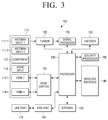
- FIG. 3 is a block diagram of a detailed configuration of the I/O device 100, according to an exemplary embodiment.
- the I/O device 100 may further include elements, such as a security processor 160, a storage 150, a tuner 165, a signal processor 170, a USB port 175, a USB host 180, an HDMI switch 185, etc., in addition to the I/O port 110, the encoder 120, the processor 130, and the wireless interface 140.
- the I/O port 110, the encoder 120, the processor 130, and the wireless interface 150 have the same or similar operations as those described above with reference to FIG. 2 and thus descriptions thereof are omitted.
- the I/O port 110 may include first and second antenna input ports 111-1 and 111-2, a component port 112, an audio input port 113, first through n-th HDMI ports 114-1 through 114-n, etc.
- the I/O port 110 illustrated in FIG. 3 is only an example, and a type, an arrangement position, the number, etc. of each port included in the I/O port 110 may be variously changed.
- the I/O port 110 may further include a PC input port, an EX-LINK port, a local area network (LAN) port, etc.
- the tuner 165 is an element that selects a broadcast channel received through the first or second antenna input port 111-1 or 111-2.
- the first antenna input port 111-1 may be used for digital broadcasting
- the second antenna input port 111-2 may be commonly used for analog broadcasting, cable broadcasting, and digital broadcasting.
- the processor 130 If a digital broadcast is received through the first or second antenna input port 111-1 or 111-2, the processor 130 provides the digital broadcast in its form to the external apparatus 10. Since a digital broadcast is received in a broadcast stream format that is packetized according to a preset broadcast standard, the I/O device 100 may provide a broadcast stream to the external apparatus 10 without additionally processing, i.e., restoring, encoding, or the like, the broadcast stream.
- the processor 130 controls the signal processor 170 to convert analog broadcast contents into digital data.
- the signal processor 170 samples the analog broadcast at an arbitrary frequency and then performs analog-to-digital conversion (ADC) to convert the sampled analog broadcast into digital data.
- ADC analog-to-digital conversion
- the processor 130 transmits the digital data converted by the signal processor 170 to the external apparatus 10 through the wireless interface 140.
- one audio input port 113 is included in the I/O port 110, but a plurality of audio input ports, such as a digital audio input port and an analog audio input port, may be included.
- the processor 130 may provide the digital audio data in its form to the external apparatus 10 through the wireless interface 140.
- the processor 130 controls the signal processor 170 to convert the analog audio signal into a digital audio signal according to an integrated interchip sound (I 2 S) standard.
- the signal processor 170 provides the converted digital audio signal to the external apparatus 10 through the wireless interface 140.
- the signal processor 170 may include a plurality of signal processors such as a video processor, an audio processor, etc.
- the I/O device 100 may further include the USB port 175 and the USB host 180.
- the USB port 175 is an element to which various types of USB sources may be connected.
- a USB memory stick, an external terminal apparatus, or the like may be connected to the USB port 175.
- the USB host 180 is an element that operates along with an external source connected to the USB port 175. For example, if the USB memory stick is connected to the USB port 175, the USB host 180 reads a file stored in the USB memory stick and then provides the read file to the external apparatus 10 through the wireless interface 140. In this case, the USB host 180 may operate along with a USB device module (not shown) embedded in the external apparatus 10.
- the processor 130 provides still image contents in their forms to the external apparatus 10 through the wireless interface 140 as described above.
- the processor 130 appropriately encodes moving image contents by using the encoder 120 and then provides the encoded moving image contents to the external apparatus 10 through the wireless interface 140.
- the processor 130 may not encode the moving image contents but may output the moving image contents in their forms through the wireless interface 140.
- the HDMI switch 185 is an element that selects one from a plurality of HDMI ports 114-1 through 114-n. If a user selects one from HDMI ports by using a main body button of a remote controller or an external apparatus, a main body button of the I/O device 100, or the like, the processor 130 provides a selection signal thereof to the HDMI switch 185. The HDMI switch 185 selects an HDMI port corresponding to the selection signal to receive contents through the selected HDMI port. The processor 130 may perform an operation as described above according to whether contents received through the HDMI port are still images or moving images.
- the processor 130 may select a port according to a selection command transmitted from the external apparatus 10 or a remote control signal or the like received through a remote control signal receiver (not shown) included in the I/O device 100.
- the storage 150 is an element that stores various types of programs or data that may be used to operate the I/O device 100.
- the storage 150 may include at least one from various types of memories such as a random access memory (RAM), a read only memory (ROM), a hard disk drive (HDD), a flash memory, a buffer, etc.
- RAM random access memory
- ROM read only memory
- HDD hard disk drive
- flash memory a flash memory
- buffer a buffer
- the security processor 160 is an element that performs security processing, i.e., digital rights management (DRM) processing, with respect to contents that will be transmitted to the external apparatus 10 through the wireless interface 140.
- DRM digital rights management
- a mechanism such as high-bandwidth digital content protection (HDCP), a content scrambling system (CSS), a decode content scrambling system (DeCss), a windows media DRM, a protected media path (PMP), an advanced access content system (AACS), an open mobile alliance (OMA) DRM, a Marlin DRM, or the like, may be applied to the security processor 160.
- HDMI high-bandwidth digital content protection
- CSS content scrambling system
- DeCss decode content scrambling system
- PMP protected media path
- AACS advanced access content system
- OMA open mobile alliance
- Marlin DRM Marlin DRM
- the processor 130 may reinforce a security of contents provided to the external apparatus 10, by using the security processor 160.
- the I/O device 100 performs different operations according to a characteristic of contents and then provides the contents to the external apparatus 10 through the wireless interface 140. For this, the I/O device 100 may first check the characteristic of the contents. The characteristic of the contents may be determined according to various methods.
- the processor 130 may store respective frames of contents input through the I/O port 110 in the storage 150. The processor 130 may compare the respective frames to determine whether the contents are still image contents or moving image contents.
- FIG. 4 illustrates a method of determining a characteristic of contents in the I/O device 100, according to an exemplary embodiment.
- the processor 130 applies a window having an arbitrary size to at least two of frames 400-1 through 400-k stored in the storage 150 to calculate a representative pixel value of pixels of the window.
- the representative pixel value may be an average pixel value of all or some pixels of the window, a pixel value that is most frequently found in the pixels of the window, a maximum pixel value, or the like.
- windows 410-1 and 410-2 are respectively applied to two frames 400-2 and 400-3 that are temporally consecutive.
- the processor 130 sequentially moves the windows 410-1 and 410-2 from a point (e.g., pixel (0, 0) of a frame 400) to a last point (e.g., pixel (n, m)) to calculate a representative value.
- Horizontal and vertical pixel sizes of the windows 410-1 and 410-2 may be determined in consideration of a calculation speed or capacity of the processor 130. For example, a window having a size of 3x3 or 5x5 may be used.
- the processor 130 may apply a window to a first frame (e.g., frame 400-2) to calculate a representative pixel value of the window and then apply a window to a second frame (e.g., frame 400-3) to calculate the representative pixel value of the window according to the same method.
- the processor 130 may simultaneously apply windows to a plurality of frames to process the plurality of frames in parallel.
- the processor 130 compares the representative pixel values, which are calculated from the windows 410-1 and 410-2 at corresponding positions of the two frames, to determine whether the representative pixel values match with each other. If the representative pixel values of the windows 410-1 and 410-2 do not match with each other according to the comparison result, it is indicated that the two frames are different form each other. Therefore, the processor 130 may determine that the two frames are moving image contents.
- the processor 130 may determine that the two frames are still image contents.
- each of pixels of two frames may be compared one by one to determine whether the pixels of the two frames match each other.
- the processor 130 may obtain a value that is determined according to a bitstream configuration of each frame, and then compare obtained values of frames to determine whether each frame is a still image content or a moving image content. For example, the processor 130 may calculate a cyclic redundancy check (CRC) value of a payload part of a bitstream corresponding to each frame. The CRC value of each frame of a still image is the same. Therefore, if the CRC values of two frames are the same, the processor 130 may determine that the two frames are still image contents. If the CRC values are different from each other, the processor 130 may determine that the two frames are moving image contents.
- CRC cyclic redundancy check
- the processor 130 may determine types of contents by using header information of each of the contents and/or signaling data that is input along with or separately from the contents and determine whether two frames are still image contents or moving image contents based on the determined types of contents.
- the processor 130 may differently process contents according to a result of determination of types of the contents. Therefore, contents input into the I/O device 100 may be stably provided to the external apparatus 10 without substantial image quality deteriorations.
- the external apparatus 10 may include a display apparatus and/or a relay device that is connected to the display apparatus to relay contents.
- FIG. 5 is a block diagram of a configuration of a relay device 200 that performs a wireless communication with the I/O device 100, according to an exemplary embodiment.
- the relay device 200 includes a wireless interface 210, a decoder 220, a wire interface 230, a processor 240, a security processor 250, and a USB device module 260.
- the wireless interface 210 is an element that performs a wireless communication with the I/O device 100. As described above, the wireless interface 210 may perform the wireless communication according to various methods such as WiFi, WiFi Direct, WiGig, Bluetooth, etc.
- the I/O device 100 and the relay device 200 may perform pairing by using connection information, such as a pre-stored service set identifier (SSID) or the like, to automatically connect wireless communication sessions.
- connection information such as a pre-stored service set identifier (SSID) or the like
- the wire interface 230 is an element that connects the relay device 200 to an external display apparatus 500 by wire.
- a connector 231 that is connected to the wire interface 230 may be connected to an integrated port 510 of the external display apparatus 500.
- a user may connect the connector 231 of the relay device 200 to the integrated port 510 of the external display apparatus 500.
- the connector 231 may be realized as a stick type or a wire type.
- the decoder 220 is an element that performs decoding. As described above, if contents are moving image contents, the I/O device 100 encodes and transmits the contents. If the moving image contents are received through the wireless interface 210, the processor 240 decodes the moving image contents by using the decoder 220 and then provides the decoded moving image contents to the external display apparatus 500 through the wire interface 230.
- a decoding method may be set to correspond to an encoding method of the I/O device 100.
- the decoder 220 may be realized as an H.264 codec, an MPEG codec, an HEVC codec, or the like.
- the processor 240 transmits the still image contents in their forms to the external display apparatus 500 through the wire interface 230.
- contents that are provided through the wire interface 230 may be displayed in their form on the external display apparatus 500.
- the relay device 200 may further include the security processor 250 and/or the USB device module 260.
- the security processor 250 releases the security processing. For example, if contents are scrambled and then input into the wireless interface 210, the processor 240 controls the security processor 250 to unscramble the contents. Therefore, the external display apparatus 500 may display normal contents.
- the USB device module 260 may operate along with a USB host of the I/O device 100 to detect various types of data from a source device connected to the USB port 175 and provide the detected data to the external display apparatus 500 through the wire interface 230.
- the external display apparatus 500 may perform a wireless communication to directly receive contents from the I/O device 100.
- elements such as the wireless interface 210, the decoder 220, the processor 240, etc., may be embedded in the external display apparatus 500. An illustration and a description of this exemplary embodiment are omitted.
- the integrated port 510 may be included in the external display apparatus 500 as described above to transmit data input from the I/O device 100 to the external display apparatus 500 through the relay device 200.
- the integrated port 510 may be realized as a type including a plurality of pins or pads corresponding to the plurality of I/O ports 110 and the USB port 175 of the I/O device 100.
- FIG. 6 illustrates the integrated port 510, according to an exemplary embodiment.
- the integrated port 510 includes a plurality of pins 601.
- the pins 601 may include a power pint for supplying power, a GND pin, an HDMI input pin, a clock pin, a control signal pin, a USB pin, etc. but are not limited thereto. Therefore, types, the number, and an arrangement form of pins may be variously changed according to exemplary embodiments.
- the pins 601 of the integrated port 510 may be connected to each processor or circuit of the external display apparatus 500.
- FIG. 7 illustrates operations of the I/O device 100 and the relay device 200, according to an exemplary embodiment.
- contents are restored from time t0 to time t1, paused from the time t1 to time t2, and restored from the time t2.
- the I/O device 100 is wirelessly connected to the relay device 200. If contents are restored from the time t0 in this state, the I/O device 100 receives the restored contents and performs an image compression in operation S715.
- the I/O device 100 transmits a compressed image packet to the relay device 200 through a wireless interface.
- the compressed image packet may include information about a compression method and a compression rate.
- the I/O device 100 continuously transmits screen data according to a frame rate. For example, sixty pieces of screen data may be transmitted per second.
- the relay device 200 decodes the compressed image packet, which is continuously transmitted, to restore an image and then outputs the restored image to a display apparatus 10 through a wire interface, in operation S725.
- the I/O device 100 receives a frame after a pause from the external source 20.
- the I/O device 100 compares sequentially input frames in unit of pixels or in unit of pixel groups to sense whether a screen is paused.
- the I/O device 100 may calculate a value for determining a data state, such as a CRC value, to sense whether the screen is paused or the I/O device 100 may sense whether the screen is paused according to various types of signaling data additionally provided from the external source 20.
- the I/O device 100 transmits a non-compressed image packet in operation S735.
- an indicator value for notifying a non-compressed state may be inserted into a header of the non-compressed image packet.
- the I/O device 100 may transmit the non-compressed image packet one time.
- the relay device 200 If the non-compressed image packet is received from the I/O device 100, the relay device 200 repeatedly outputs the non-compressed image packet in operation S740. Therefore, the display apparatus 10 repeatedly displays an image received during a time interval between the time t1 and the time t2.
- the I/O device 100 senses that the screen is changed and compresses an image in operation S745. Therefore, the I/O device 100 retransmits the compressed image packet in operation S750.
- the relay device 200 decodes the compressed image packet to restore an image and outputs the restored image to the display apparatus 10 in operation S755.
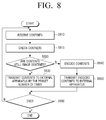
- FIG. 8 is a flowchart of a method of providing contents of an I/O device according to an exemplary embodiment.
- the I/O device determines a characteristic of the contents in operation S815. If the contents are still image contents according to a determination result in operation S820, the I/O device transmits the contents to an external apparatus by a preset number of times in operation S830. For example, the I/O device transmits the contents about one time or two times.
- the I/O device encodes the moving image contents and then transmits the encoded moving image contents to the external apparatus in operations S840 and S850.
- an encoding method and a compression rate may be variably determined in consideration of a data size, a wireless transmission speed, etc. of contents.
- the I/O device continuously determines a characteristic of the input contents and then provides the contents in a compressed or non-compressed state to the external apparatus.
- the external apparatus may be a display apparatus and/or a relay device connected to the display apparatus.
- FIG. 9 is a flowchart of a method of providing contents in a relay device, according to an exemplary embodiment.
- the relay device 200 connects a communication session with the I/O device 100 in operation S910. If contents are received from the I/O device 100 in this state in operation S920, the relay device 200 determines whether the received contents are compressed in operation S930. The relay device 200 may determine whether the received contents are compressed, by using a header of a content packet.
- the relay device 200 decodes the received contents and then transmits the decoded contents to a display apparatus in operations S940 and S950. If the received contents are non-compressed, the relay device 200 repeatedly transmits the received contents to the display apparatus in their forms in operation S955.
- the relay device 200 continuously performs the above-described operations to provide the contents to the display apparatus.
- contents that are restored in an external source connected to the I/O device 100 are mainly displayed through a display apparatus.
- the exemplary embodiments may be applied to external devices other than the display apparatus.
- the relay device 200 may be connected to the speaker. Therefore, audio data that is transmitted from the I/O device 100 may be wirelessly transmitted and output to the speaker.
- the speaker may be used in an electronic frame device, a kiosk PC, or the like attached onto a wall.
- FIG. 10 is a block diagram illustrating a configuration of a display apparatus according to an exemplary embodiment.
- the display apparatus 10 may include a wireless interface 101 and a processor 103.
- the display apparatus 10 may receive content of an external source from the I/O device 100 through the wireless interface 101.
- the processor may output a still image to the display in a state in which the still image is received by the display apparatus 10 in response to determining that the content is the still image, and decode a moving image and transmit the decoded moving image to the display in response to determining that the content is the moving image.
- the display apparatus 10 may further include the relay device 200 or may not include the relay device 200, as described above. When the display apparatus 10 does not include the relay device 200, the display apparatus 10 may include a decoder configured to selectively decode the content in response to determining that the content is the moving image that is compressed.
- the wireless interface 101 may include a plurality of wireless interfaces according to various wireless communication methods and the processor 103 may determine an appropriate wireless interface according to a characteristic of the content.
- contents of an external source may be wirelessly provided to a display apparatus. Also, a deterioration in an image quality may be reduced or minimized, and a transmission stability of contents may be secured.
- a content providing method as described above may be executed by a program.
- a non-transitory computer readable medium that stores the program may be installed in an I/O device, a relay device, and/or a display apparatus, to perform content providing methods according to the above-described exemplary embodiments.
- an I/O device may install therein a non-transitory computer readable medium that stores a program sequentially performing: in response to contents input from an external source connected to an I/O port of an I/O device, determining a characteristic of the contents; in response to determining that the contents are still images, transmitting the still images in their form to an external apparatus through a wireless interface; and in response to determining that the contents are moving images, encoding the moving images and transmitting the encoded moving images to the external apparatus through the wireless interface.
- a relay device may install a non-transitory computer readable medium that stores a program sequentially performing: connecting a wireless communication with an I/O device to which an external source is connected; wirelessly receiving contents restored in the external source through the I/O device; in response to determining that the contents are non-compressed, transmitting the contents in their forms to a display apparatus connected to the I/O device by wire; and in response to determining that the contents are compressed, decoding the contents and transmitting the decoded contents to the display apparatus.
- the non-transitory computer readable medium is a medium which does not temporarily store data such as a register, a cash, and a memory but semi-permanently stores data and is readable by devices. More specifically, the aforementioned applications or programs may be stored in the non-transitory computer readable media such as compact disks (CDs), digital video disks (DVDs), hard disks, Blu-ray disks, universal serial buses (USBs), memory cards, and read-only memory (ROM).
- CDs compact disks
- DVDs digital video disks
- hard disks hard disks
- Blu-ray disks Blu-ray disks
- USBs universal serial buses
- memory cards and read-only memory (ROM).
- At least one of the components, elements, modules or units represented by a block as illustrated in FIGS. 2 , 3 , 5 , and 10 may be embodied as various numbers of hardware, software and/or firmware structures that execute respective functions described above, according to an exemplary embodiment.
- at least one of these components, elements or units may use a direct circuit structure, such as a memory, processing, logic, a look-up table, etc. that may execute the respective functions through controls of one or more microprocessors or other control apparatuses.
- At least one of these components, elements or units may be specifically embodied by a module, a program, or a part of code, which contains one or more executable instructions for performing specified logic functions, and executed by one or more microprocessors or other control apparatuses. Also, at least one of these components, elements or units may further include a processor such as a central processing unit (CPU) that performs the respective functions, a microprocessor, or the like. Two or more of these components, elements or units may be combined into one single component, element or unit which performs all operations or functions of the combined two or more components, elements of units. Also, at least part of functions of at least one of these components, elements or units may be performed by another of these components, element or units.
- a processor such as a central processing unit (CPU) that performs the respective functions, a microprocessor, or the like.
- CPU central processing unit
- Two or more of these components, elements or units may be combined into one single component, element or unit which performs all operations or functions of the combined two or
- bus is not illustrated in the above block diagrams, communication between the components, elements or units may be performed through the bus.
- Functional aspects of the above exemplary embodiments may be implemented in algorithms that execute on one or more processors.
- the components, elements or units represented by a block or processing steps may employ any number of related art techniques for electronics configuration, signal processing and/or control, data processing and the like
Landscapes
- Engineering & Computer Science (AREA)
- Multimedia (AREA)
- Signal Processing (AREA)
- Computer Networks & Wireless Communication (AREA)
- Databases & Information Systems (AREA)
- Two-Way Televisions, Distribution Of Moving Picture Or The Like (AREA)
- Controls And Circuits For Display Device (AREA)
Applications Claiming Priority (1)
| Application Number | Priority Date | Filing Date | Title |
|---|---|---|---|
| KR1020150122088A KR20170025536A (ko) | 2015-08-28 | 2015-08-28 | 입출력 장치와, 그 입출력 장치를 통해 수신된 컨텐츠를 외부 장치로 전달하는 중계 장치 및 그 방법들 |
Publications (1)
| Publication Number | Publication Date |
|---|---|
| EP3136741A1 true EP3136741A1 (fr) | 2017-03-01 |
Family
ID=56360190
Family Applications (1)
| Application Number | Title | Priority Date | Filing Date |
|---|---|---|---|
| EP16176973.2A Ceased EP3136741A1 (fr) | 2015-08-28 | 2016-06-29 | Dispositif d'entrée/sortie, dispositif de relais pour transmettre contenu à un appareil externe et methodes de ceux-ci |
Country Status (4)
| Country | Link |
|---|---|
| US (1) | US20170064379A1 (fr) |
| EP (1) | EP3136741A1 (fr) |
| KR (1) | KR20170025536A (fr) |
| WO (1) | WO2017039134A1 (fr) |
Cited By (2)
| Publication number | Priority date | Publication date | Assignee | Title |
|---|---|---|---|---|
| EP3565263A1 (fr) * | 2018-05-04 | 2019-11-06 | Lg Electronics Inc. | Dispositif de transmission d'images |
| EP3996380A4 (fr) * | 2019-07-05 | 2023-04-05 | LG Electronics Inc. | Dispositif et procédé pour traiter et transmettre des données d'image dans un système av sans fil |
Families Citing this family (5)
| Publication number | Priority date | Publication date | Assignee | Title |
|---|---|---|---|---|
| JP2018170690A (ja) * | 2017-03-30 | 2018-11-01 | パナソニックIpマネジメント株式会社 | 放送受信装置、データ転送方法及び制御プログラム |
| CN109218748B (zh) * | 2017-06-30 | 2020-11-27 | 京东方科技集团股份有限公司 | 视频传输方法、装置及计算机可读存储介质 |
| EP4297412A4 (fr) | 2021-05-13 | 2025-04-02 | LG Electronics Inc. | Dispositif d'émission a/v et dispositif de réception a/v |
| TW202349334A (zh) * | 2022-06-14 | 2023-12-16 | 茂傑國際股份有限公司 | 多規格影像類別輸入輸出裝置 |
| EP4679839A1 (fr) * | 2023-08-30 | 2026-01-14 | Samsung Electronics Co., Ltd. | Dispositif électronique, dispositif d'affichage et procédé de commande associé |
Citations (4)
| Publication number | Priority date | Publication date | Assignee | Title |
|---|---|---|---|---|
| US20060117371A1 (en) * | 2001-03-15 | 2006-06-01 | Digital Display Innovations, Llc | Method for effectively implementing a multi-room television system |
| EP1993237A2 (fr) * | 2007-04-30 | 2008-11-19 | Vixs Systems Inc. | Système de client/serveur multimédia avec taille de paquets réglable et procédé d'utilisation associé |
| EP2648410A1 (fr) * | 2012-04-08 | 2013-10-09 | Broadcom Corporation | Transmission de vidéo utilisant des informations de contenu statique provenant d'une source vidéo |
| US20140282753A1 (en) * | 2013-03-12 | 2014-09-18 | Guoqing Li | Techniques for Transmitting Video Content to a Wirelessly Docked Device Having a Display |
Family Cites Families (8)
| Publication number | Priority date | Publication date | Assignee | Title |
|---|---|---|---|---|
| FR2846506B1 (fr) * | 2002-10-28 | 2005-02-11 | Philippe Marie Alber Guenebaud | Dispositif de trans-compression d'un flux numerique audiovisuel pour l'adapter aux equipements de television existants |
| WO2005022796A2 (fr) * | 2003-08-29 | 2005-03-10 | Rgb Networks, Inc. | Systeme multiplexeur video adaptatif avance |
| KR100563086B1 (ko) * | 2005-12-28 | 2006-03-27 | 새한항업(주) | 정적 지도의 동적 디스플레이 방법 |
| KR20080022276A (ko) * | 2006-09-06 | 2008-03-11 | 엘지전자 주식회사 | 영상표시기기의 화면 제어장치 및 방법 |
| US8520728B2 (en) * | 2010-09-23 | 2013-08-27 | Intel Corporation | Adaptive data transmission rate control for a wireless display device |
| US10187167B2 (en) * | 2011-10-19 | 2019-01-22 | FedEx Supply Chain Logistics & Electronics, Inc. | System and method for securing and testing set-top boxes |
| KR20130078557A (ko) * | 2011-12-30 | 2013-07-10 | 삼성전자주식회사 | 영상표시장치 및 그 장치의 구동방법, 영상변환장치 및 방법 |
| KR20130103859A (ko) * | 2012-03-12 | 2013-09-25 | 삼성전자주식회사 | 디스플레이 드라이버의 동작 방법 및 디스플레이 제어 시스템 |
-
2015
- 2015-08-28 KR KR1020150122088A patent/KR20170025536A/ko not_active Withdrawn
-
2016
- 2016-06-29 EP EP16176973.2A patent/EP3136741A1/fr not_active Ceased
- 2016-07-04 WO PCT/KR2016/007173 patent/WO2017039134A1/fr not_active Ceased
- 2016-07-08 US US15/205,549 patent/US20170064379A1/en not_active Abandoned
Patent Citations (4)
| Publication number | Priority date | Publication date | Assignee | Title |
|---|---|---|---|---|
| US20060117371A1 (en) * | 2001-03-15 | 2006-06-01 | Digital Display Innovations, Llc | Method for effectively implementing a multi-room television system |
| EP1993237A2 (fr) * | 2007-04-30 | 2008-11-19 | Vixs Systems Inc. | Système de client/serveur multimédia avec taille de paquets réglable et procédé d'utilisation associé |
| EP2648410A1 (fr) * | 2012-04-08 | 2013-10-09 | Broadcom Corporation | Transmission de vidéo utilisant des informations de contenu statique provenant d'une source vidéo |
| US20140282753A1 (en) * | 2013-03-12 | 2014-09-18 | Guoqing Li | Techniques for Transmitting Video Content to a Wirelessly Docked Device Having a Display |
Cited By (4)
| Publication number | Priority date | Publication date | Assignee | Title |
|---|---|---|---|---|
| EP3565263A1 (fr) * | 2018-05-04 | 2019-11-06 | Lg Electronics Inc. | Dispositif de transmission d'images |
| US10681365B2 (en) | 2018-05-04 | 2020-06-09 | Lg Electronics Inc. | Image transmitting device |
| EP3996380A4 (fr) * | 2019-07-05 | 2023-04-05 | LG Electronics Inc. | Dispositif et procédé pour traiter et transmettre des données d'image dans un système av sans fil |
| US11778264B2 (en) | 2019-07-05 | 2023-10-03 | Lg Electronics Inc. | Device and method for processing and transmitting image data in wireless AV system |
Also Published As
| Publication number | Publication date |
|---|---|
| WO2017039134A1 (fr) | 2017-03-09 |
| US20170064379A1 (en) | 2017-03-02 |
| KR20170025536A (ko) | 2017-03-08 |
Similar Documents
| Publication | Publication Date | Title |
|---|---|---|
| US20170064379A1 (en) | Input/output device, relay device for transmitting contents to an external apparatus, and methods thereof | |
| US9854254B2 (en) | Method and system for remote viewing of static and video images | |
| US9014258B2 (en) | Transmission device and method of determining transmission date format | |
| US20130194510A1 (en) | Methods circuits devices and systems for wireless transmission of mobile communication device display information | |
| US20210098137A1 (en) | Smart media device | |
| EP3859540B1 (fr) | Appareil électronique pouvant être connecté à plusieurs appareils externes ayant des protocoles différents au moyen d'un port de connexion et son procédé de commande | |
| EP3007449B1 (fr) | Enregistrement protégé des données avec deux mémoires complémentaires | |
| GB2486425A (en) | Rendering multimedia content from a mobile device onto an external display device | |
| KR20170008772A (ko) | 초고해상도 디스플레이를 갖는 무선 도크에서 비디오 성능을 최적화하기 위한 시스템 및 방법 | |
| US20250080782A1 (en) | Electronic apparatus, display apparatus and controlling method thereof | |
| EP3169076A1 (fr) | Dispositif portable de traitement de contenu multimédia à accès contrôlé | |
| US8959257B2 (en) | Information processing apparatus and information processing method | |
| JP6440509B2 (ja) | 送信装置、受信装置、送信方法及び受信方法 | |
| JP2015005800A (ja) | 受信装置、送信装置、及び送受信システム | |
| EP2416586A2 (fr) | Transmission de signaux audio et/ou vidéo à au moins une installation externe pour la retransmission de signaux audio et/ou vidéo | |
| US20150029398A1 (en) | Information processing apparatus and information processing method for outputting a charging status | |
| US20150032912A1 (en) | Information processing apparatus and information processing method | |
| JP4068605B2 (ja) | デジタルテレビ信号デコーダ | |
| CN102955666B (zh) | 自动调整无线显示品质方法及其显示装置与通信装置 | |
| KR102897441B1 (ko) | 서버 및 그 제어 방법 | |
| KR20230025256A (ko) | 전자장치 및 그 제어방법 | |
| KR100809771B1 (ko) | 영상 디스플레이 시스템 및 그 시스템의 제어방법 | |
| KR100790071B1 (ko) | 영상 디스플레이 시스템 및 그 시스템의 제어방법 | |
| CN204836401U (zh) | 一种视频通信设备 | |
| WO2012149685A1 (fr) | Transmission en continu de données vidéo haute définition sans fil avec un pont intermédiaire |
Legal Events
| Date | Code | Title | Description |
|---|---|---|---|
| PUAI | Public reference made under article 153(3) epc to a published international application that has entered the european phase |
Free format text: ORIGINAL CODE: 0009012 |
|
| STAA | Information on the status of an ep patent application or granted ep patent |
Free format text: STATUS: REQUEST FOR EXAMINATION WAS MADE |
|
| STAA | Information on the status of an ep patent application or granted ep patent |
Free format text: STATUS: EXAMINATION IS IN PROGRESS |
|
| 17P | Request for examination filed |
Effective date: 20161125 |
|
| AK | Designated contracting states |
Kind code of ref document: A1 Designated state(s): AL AT BE BG CH CY CZ DE DK EE ES FI FR GB GR HR HU IE IS IT LI LT LU LV MC MK MT NL NO PL PT RO RS SE SI SK SM TR |
|
| AX | Request for extension of the european patent |
Extension state: BA ME |
|
| 17Q | First examination report despatched |
Effective date: 20170228 |
|
| STAA | Information on the status of an ep patent application or granted ep patent |
Free format text: STATUS: THE APPLICATION HAS BEEN REFUSED |
|
| 18R | Application refused |
Effective date: 20171215 |