EP3137472B1 - Pyridiniophosphines n-substitués, procédés pour leur préparation et leur utilisation - Google Patents
Pyridiniophosphines n-substitués, procédés pour leur préparation et leur utilisation Download PDFInfo
- Publication number
- EP3137472B1 EP3137472B1 EP15718849.1A EP15718849A EP3137472B1 EP 3137472 B1 EP3137472 B1 EP 3137472B1 EP 15718849 A EP15718849 A EP 15718849A EP 3137472 B1 EP3137472 B1 EP 3137472B1
- Authority
- EP
- European Patent Office
- Prior art keywords
- aryl
- heteroaryl
- halogen
- nhr
- substituents selected
- Prior art date
- Legal status (The legal status is an assumption and is not a legal conclusion. Google has not performed a legal analysis and makes no representation as to the accuracy of the status listed.)
- Active
Links
- OSFAKVJFRGBLDE-UHFFFAOYSA-N COC(C(CC#Cc1ccccc1)(C1C=CCCCC1)C(OC)=O)=O Chemical compound COC(C(CC#Cc1ccccc1)(C1C=CCCCC1)C(OC)=O)=O OSFAKVJFRGBLDE-UHFFFAOYSA-N 0.000 description 2
- 0 C*1c(*(N)N)cccc1 Chemical compound C*1c(*(N)N)cccc1 0.000 description 1
Images


Classifications
-
- C—CHEMISTRY; METALLURGY
- C07—ORGANIC CHEMISTRY
- C07D—HETEROCYCLIC COMPOUNDS
- C07D311/00—Heterocyclic compounds containing six-membered rings having one oxygen atom as the only hetero atom, condensed with other rings
- C07D311/02—Heterocyclic compounds containing six-membered rings having one oxygen atom as the only hetero atom, condensed with other rings ortho- or peri-condensed with carbocyclic rings or ring systems
- C07D311/04—Benzo[b]pyrans, not hydrogenated in the carbocyclic ring
-
- C—CHEMISTRY; METALLURGY
- C07—ORGANIC CHEMISTRY
- C07F—ACYCLIC, CARBOCYCLIC OR HETEROCYCLIC COMPOUNDS CONTAINING ELEMENTS OTHER THAN CARBON, HYDROGEN, HALOGEN, OXYGEN, NITROGEN, SULFUR, SELENIUM OR TELLURIUM
- C07F19/00—Metal compounds according to more than one of main groups C07F1/00 - C07F17/00
-
- B—PERFORMING OPERATIONS; TRANSPORTING
- B01—PHYSICAL OR CHEMICAL PROCESSES OR APPARATUS IN GENERAL
- B01J—CHEMICAL OR PHYSICAL PROCESSES, e.g. CATALYSIS OR COLLOID CHEMISTRY; THEIR RELEVANT APPARATUS
- B01J31/00—Catalysts comprising hydrides, coordination complexes or organic compounds
- B01J31/16—Catalysts comprising hydrides, coordination complexes or organic compounds containing coordination complexes
- B01J31/24—Phosphines, i.e. phosphorus bonded to only carbon atoms, or to both carbon and hydrogen atoms, including e.g. sp2-hybridised phosphorus compounds such as phosphabenzene, phosphole or anionic phospholide ligands
- B01J31/2404—Cyclic ligands, including e.g. non-condensed polycyclic ligands, the phosphine-P atom being a ring member or a substituent on the ring
- B01J31/2409—Cyclic ligands, including e.g. non-condensed polycyclic ligands, the phosphine-P atom being a ring member or a substituent on the ring with more than one complexing phosphine-P atom
-
- B—PERFORMING OPERATIONS; TRANSPORTING
- B01—PHYSICAL OR CHEMICAL PROCESSES OR APPARATUS IN GENERAL
- B01J—CHEMICAL OR PHYSICAL PROCESSES, e.g. CATALYSIS OR COLLOID CHEMISTRY; THEIR RELEVANT APPARATUS
- B01J31/00—Catalysts comprising hydrides, coordination complexes or organic compounds
- B01J31/16—Catalysts comprising hydrides, coordination complexes or organic compounds containing coordination complexes
- B01J31/1616—Coordination complexes, e.g. organometallic complexes, immobilised on an inorganic support, e.g. ship-in-a-bottle type catalysts
-
- B—PERFORMING OPERATIONS; TRANSPORTING
- B01—PHYSICAL OR CHEMICAL PROCESSES OR APPARATUS IN GENERAL
- B01J—CHEMICAL OR PHYSICAL PROCESSES, e.g. CATALYSIS OR COLLOID CHEMISTRY; THEIR RELEVANT APPARATUS
- B01J31/00—Catalysts comprising hydrides, coordination complexes or organic compounds
- B01J31/16—Catalysts comprising hydrides, coordination complexes or organic compounds containing coordination complexes
- B01J31/24—Phosphines, i.e. phosphorus bonded to only carbon atoms, or to both carbon and hydrogen atoms, including e.g. sp2-hybridised phosphorus compounds such as phosphabenzene, phosphole or anionic phospholide ligands
- B01J31/2404—Cyclic ligands, including e.g. non-condensed polycyclic ligands, the phosphine-P atom being a ring member or a substituent on the ring
-
- C—CHEMISTRY; METALLURGY
- C07—ORGANIC CHEMISTRY
- C07C—ACYCLIC OR CARBOCYCLIC COMPOUNDS
- C07C2/00—Preparation of hydrocarbons from hydrocarbons containing a smaller number of carbon atoms
- C07C2/54—Preparation of hydrocarbons from hydrocarbons containing a smaller number of carbon atoms by addition of unsaturated hydrocarbons to saturated hydrocarbons or to hydrocarbons containing a six-membered aromatic ring with no unsaturation outside the aromatic ring
- C07C2/64—Addition to a carbon atom of a six-membered aromatic ring
- C07C2/66—Catalytic processes
-
- C—CHEMISTRY; METALLURGY
- C07—ORGANIC CHEMISTRY
- C07C—ACYCLIC OR CARBOCYCLIC COMPOUNDS
- C07C67/00—Preparation of carboxylic acid esters
- C07C67/30—Preparation of carboxylic acid esters by modifying the acid moiety of the ester, such modification not being an introduction of an ester group
-
- C—CHEMISTRY; METALLURGY
- C07—ORGANIC CHEMISTRY
- C07F—ACYCLIC, CARBOCYCLIC OR HETEROCYCLIC COMPOUNDS CONTAINING ELEMENTS OTHER THAN CARBON, HYDROGEN, HALOGEN, OXYGEN, NITROGEN, SULFUR, SELENIUM OR TELLURIUM
- C07F15/00—Compounds containing elements of Groups 8, 9, 10 or 18 of the Periodic Table
- C07F15/0006—Compounds containing elements of Groups 8, 9, 10 or 18 of the Periodic Table compounds of the platinum group
- C07F15/0073—Rhodium compounds
-
- C—CHEMISTRY; METALLURGY
- C07—ORGANIC CHEMISTRY
- C07F—ACYCLIC, CARBOCYCLIC OR HETEROCYCLIC COMPOUNDS CONTAINING ELEMENTS OTHER THAN CARBON, HYDROGEN, HALOGEN, OXYGEN, NITROGEN, SULFUR, SELENIUM OR TELLURIUM
- C07F15/00—Compounds containing elements of Groups 8, 9, 10 or 18 of the Periodic Table
- C07F15/0006—Compounds containing elements of Groups 8, 9, 10 or 18 of the Periodic Table compounds of the platinum group
- C07F15/0086—Platinum compounds
-
- C—CHEMISTRY; METALLURGY
- C07—ORGANIC CHEMISTRY
- C07F—ACYCLIC, CARBOCYCLIC OR HETEROCYCLIC COMPOUNDS CONTAINING ELEMENTS OTHER THAN CARBON, HYDROGEN, HALOGEN, OXYGEN, NITROGEN, SULFUR, SELENIUM OR TELLURIUM
- C07F15/00—Compounds containing elements of Groups 8, 9, 10 or 18 of the Periodic Table
- C07F15/0006—Compounds containing elements of Groups 8, 9, 10 or 18 of the Periodic Table compounds of the platinum group
- C07F15/0086—Platinum compounds
- C07F15/0093—Platinum compounds without a metal-carbon linkage
-
- C—CHEMISTRY; METALLURGY
- C07—ORGANIC CHEMISTRY
- C07F—ACYCLIC, CARBOCYCLIC OR HETEROCYCLIC COMPOUNDS CONTAINING ELEMENTS OTHER THAN CARBON, HYDROGEN, HALOGEN, OXYGEN, NITROGEN, SULFUR, SELENIUM OR TELLURIUM
- C07F9/00—Compounds containing elements of Groups 5 or 15 of the Periodic Table
- C07F9/02—Phosphorus compounds
- C07F9/547—Heterocyclic compounds, e.g. containing phosphorus as a ring hetero atom
- C07F9/553—Heterocyclic compounds, e.g. containing phosphorus as a ring hetero atom having one nitrogen atom as the only ring hetero atom
- C07F9/576—Six-membered rings
- C07F9/58—Pyridine rings
-
- B—PERFORMING OPERATIONS; TRANSPORTING
- B01—PHYSICAL OR CHEMICAL PROCESSES OR APPARATUS IN GENERAL
- B01J—CHEMICAL OR PHYSICAL PROCESSES, e.g. CATALYSIS OR COLLOID CHEMISTRY; THEIR RELEVANT APPARATUS
- B01J2231/00—Catalytic reactions performed with catalysts classified in B01J31/00
- B01J2231/30—Addition reactions at carbon centres, i.e. to either C-C or C-X multiple bonds
- B01J2231/32—Addition reactions to C=C or C-C triple bonds
-
- B—PERFORMING OPERATIONS; TRANSPORTING
- B01—PHYSICAL OR CHEMICAL PROCESSES OR APPARATUS IN GENERAL
- B01J—CHEMICAL OR PHYSICAL PROCESSES, e.g. CATALYSIS OR COLLOID CHEMISTRY; THEIR RELEVANT APPARATUS
- B01J2231/00—Catalytic reactions performed with catalysts classified in B01J31/00
- B01J2231/30—Addition reactions at carbon centres, i.e. to either C-C or C-X multiple bonds
- B01J2231/32—Addition reactions to C=C or C-C triple bonds
- B01J2231/324—Cyclisations via conversion of C-C multiple to single or less multiple bonds, e.g. cycloadditions
-
- B—PERFORMING OPERATIONS; TRANSPORTING
- B01—PHYSICAL OR CHEMICAL PROCESSES OR APPARATUS IN GENERAL
- B01J—CHEMICAL OR PHYSICAL PROCESSES, e.g. CATALYSIS OR COLLOID CHEMISTRY; THEIR RELEVANT APPARATUS
- B01J2231/00—Catalytic reactions performed with catalysts classified in B01J31/00
- B01J2231/50—Redistribution or isomerisation reactions of C-C, C=C or C-C triple bonds
- B01J2231/52—Isomerisation reactions
-
- B—PERFORMING OPERATIONS; TRANSPORTING
- B01—PHYSICAL OR CHEMICAL PROCESSES OR APPARATUS IN GENERAL
- B01J—CHEMICAL OR PHYSICAL PROCESSES, e.g. CATALYSIS OR COLLOID CHEMISTRY; THEIR RELEVANT APPARATUS
- B01J2531/00—Additional information regarding catalytic systems classified in B01J31/00
- B01J2531/10—Complexes comprising metals of Group I (IA or IB) as the central metal
- B01J2531/18—Gold
-
- B—PERFORMING OPERATIONS; TRANSPORTING
- B01—PHYSICAL OR CHEMICAL PROCESSES OR APPARATUS IN GENERAL
- B01J—CHEMICAL OR PHYSICAL PROCESSES, e.g. CATALYSIS OR COLLOID CHEMISTRY; THEIR RELEVANT APPARATUS
- B01J2531/00—Additional information regarding catalytic systems classified in B01J31/00
- B01J2531/80—Complexes comprising metals of Group VIII as the central metal
- B01J2531/82—Metals of the platinum group
- B01J2531/822—Rhodium
-
- B—PERFORMING OPERATIONS; TRANSPORTING
- B01—PHYSICAL OR CHEMICAL PROCESSES OR APPARATUS IN GENERAL
- B01J—CHEMICAL OR PHYSICAL PROCESSES, e.g. CATALYSIS OR COLLOID CHEMISTRY; THEIR RELEVANT APPARATUS
- B01J2531/00—Additional information regarding catalytic systems classified in B01J31/00
- B01J2531/80—Complexes comprising metals of Group VIII as the central metal
- B01J2531/82—Metals of the platinum group
- B01J2531/828—Platinum
-
- C—CHEMISTRY; METALLURGY
- C07—ORGANIC CHEMISTRY
- C07C—ACYCLIC OR CARBOCYCLIC COMPOUNDS
- C07C2531/00—Catalysts comprising hydrides, coordination complexes or organic compounds
- C07C2531/16—Catalysts comprising hydrides, coordination complexes or organic compounds containing coordination complexes
- C07C2531/24—Phosphines
Definitions
- the present invention deals with the synthesis and applications of new cationic compounds being useful as metal ligands.
- N-alkyl/aryl substituted pyridiniophosphines are prepared and used as ligands for transition metals.
- the so-obtained metal complexes and their use as catalysts in chemical synthesis is also described.
- the inventive N-alkyl/aryl pyridiniophosphines can be synthesized through a short, scalable and highly modular route.
- the choice of the ancillary ligand is crucial; in fact, it can be as critical as the choice of the metal itself. This is due to the extraordinary control that ligands exert over the reactivity of the resulting catalysts and, not less important, over the product selectivity of the catalysed process. The selection of the most appropriate ligand for each particular transformation must then consider among others, the nature of the rate determining step and the plausible (not desired) reaction pathways.
- phosphanes play a prominent role because both, their donor ability and steric requirements can be adjusted by modification of the substituents attached to the phosphorus atom.
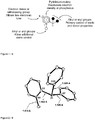
- N-(alkyl/arylpyridinium) substituted phosphines can be a potentially very useful family of strong ⁇ -acceptor ligands. According to the considerations of the inventors this is due to the simultaneous confluence of three beneficial factors: (a) the low-lying ⁇ * orbitals of the pyridinium moiety should effectively interact with the lone pair at phosphorus making the resulting phosphines very poor donating ligands; (b) besides the selection of the other two R-groups at phosphorus, the introduction of substituents on the pyridinium ring provides an additional manifold for the fine steroelectronic tuning of the resulting phosphine ( Figure 1 ); and finally, (c) the reaction of 1-alkyl/aryl-2-chloro pyridinium salts with different secondary phosphines offers a short, effective and highly modular synthetic route to the target ligands.
- the present inventions is directed to N-alkyl/aryl-substituted pyridiniophosphines having the general formula (I) wherein
- R 1 , R 2 , R 3 , R 4 R 5 , R 6 and R 7 and optional substituents thereof are such that they do in particular not negatively influence the reactivity of the pyridinio compound or of the metal complexes thereof.
- any reactive substituent such as e.g. -OH of any of R 1 , R 2 , R 3 , R 4 R 5 , R 6 and R 7 should preferably be not on the carbon atom attached to a pyridinio ring atom.
- Substituents such as -O-, -NH or NR- might be present in the C 1 -C 20 -alkyl group of R 1 , R 2 , R 3 , R 4 R 5 , R 6 , R 7 and R and might thus also form ether linkages or amino linkages.
- R 1 , R 3 and R 4 each represent hydrogen and R 2 represents, halogen, a linear, cyclic or branched C 1 -C 20 -alkyl,
- the present invention is also directed to the process for the preparation of N-substituted pyridiniophosphine with the general formula I: wherein
- the leaving group Q can be chosen in a broad range and can be a halogen, sulfonate, tosyl or a triflate group,
- the reaction conditions are not critical and basically comprise heating with gentle heat to reflux in an organic solvent such as THF of suspensions containing a pyridinium compound of general formula II (1.0 equiv.) with the desired secondary phosphine (2.5-3.0 equiv.) for 1 to 7 days.
- organic solvent such as THF of suspensions containing a pyridinium compound of general formula II (1.0 equiv.) with the desired secondary phosphine (2.5-3.0 equiv.) for 1 to 7 days.
- microwave heating 150 °C of the reaction mixtures might be used.
- the new N-substituted pyridiniophosphines of the general formula (I) thus prepared can serve as ligands for metal complexes. They can be easily prepared by reacting the N-substituted pyridiniophosphines of the general formula (I) with a the desired metal precursors.
- a the desired metal precursors As illustrative example, complexes containing B, Cu, Fe, Ni, Co, Ag, Au, Ru, Rh, Pd, Os, Ir and Pt have been prepared.
- the number of ligands L, of the inventive N-substituted pyridiniophosphines of the general formula (I) and of the anions X - is chosen to obtain a stable uncharged metal complex.
- Ligands L on the metal complex can be chosen among halogen, CN, CO, alkenes, cycloalkenes and/or alkynes, arenes, nitriles, phosphines, amines, pyridines or carboxylates.
- the metal complex preferably comprises M being selected from B, Cu, Ag, Fe, Ni, Co, Au, Ru, Rh, Pd, Os, Ir or Pt.
- inventive metal complexes can be advantageously used as catalysts in organic synthesis, in particular for cycloisomerizations and hydroarylations, but also for hydroxylation and hydroamination of unsaturated compounds such as alkynes, allenes and alkenes and direct arylation reactions.
- the reaction conditions for the catalysed process are not critical quite soft and generally comprise stirring of the catalysts and the desired substrate in an organic solvent or mixtures thereof, such as dichloroethane, at moderate temperatures (20°. to 80°C).
- a substituents group might also contain one to three halogen atoms such as a -CF 3 . group
- C 1 -C 20 -alkyl can be straight chain or branched and can have 1, 2, 3, 4, 5, 6, 7, 8, 9, 10, 11, 12, 13, 14, 15, 16, 17, 18, 19 or 20 carbon atoms.
- Alkyl might be C 1 -C 12 -alkyl or lower alkyl such as C 1 -C 6 -alkyl, in particular methyl, ethyl, propyl, isopropyl, butyl, isobutyl, sec-butyl or tert-butyl, likewise pentyl, 1-, 2- or 3-methylpropyl, 1,1-, 1,2- or 2,2-dimethylpropyl, 1-ethylpropyl, hexyl, 1-, 2, 3- or 4-methylpentyl, 1,1-, 1,2-, 1,3-, 2,2-, 2,3- or 3,3-dimethylbutyl, 1- or 2-ethylbutyl, 1-ethyl-1-methylpropyl, 1-ethyl-2-methylpropyl, 1,
- Cycloalkyl might preferably be C 3 -C 18 -alkyl and may be cyclopropyl, cyclobutyl, cyclopentyl, cyclohexyl or cycloheptyl.
- Alkenyl might be C 2 -C 20 alkenyl.
- Alkynyl might be C 2 -C 20 alkynyl.
- Halogen is F, Cl, Br or I.
- Alkoxy is preferably C 2 -C 10 alkoxy such as methoxy, ethoxy, propoxy, iso -propoxy, tert- butoxy etc.
- Heterocycloalkyl having one or more heteroatoms selected from among N, O and S is preferably 2,3-dihydro-2-, -3-, -4- or -5-furyl, 2,5-dihydro-2-, -3-, -4- or -5-furyl, tetrahydro-2- or -3-furyl, 1,3-dioxolan-4-yl, tetrahydro-2- or -3-thienyl, 2,3-dihydro-1-, -2-, -3-, -4- or - 5-pyrrolyl, 2,5-dihydro-1-, -2-, -3-, -4- or -5-pyrrolyl, 1-, 2- or 3-pyrrolidinyl, tetrahydro-1-, - 2- or -4-imidazolyl, 2,3-dihydro-1-, -2-, -3-, -4- or -5-pyrazolyl, tetrahydro-1
- Optionally substituted means unsubstituted or monosubstituted, disubstituted, trisubstituted, tetrasubstituted, pentasubstituted, or even further substituted for each hydrogen on the hydrocarbon.
- Aryl might be phenyl, naphthyl, biphenyl, anthracenyl, and other polycondensed aromatic systems.
- Aryl-(C 1 -C 6 )-alkyl might be benzyl or substituted benzyl.
- Heteroaryl may have one or more heteroatoms selected from among N, O and S is preferably 2- or 3-furyl, 2- or 3-thienyl, 1-, 2- or 3-pyrrolyl, 1-, 2-, 4- or 5-imidazolyl, 1-, 3-, 4- or 5-pyrazolyl, 2-, 4- or 5-oxazolyl, 3-, 4- or 5-isoxazolyl, 2-, 4- or 5-thiazolyl, 3-, 4- or 5-isothiazolyl, 2-, 3- or 4-pyridyl, 2-, 4-, 5- or 6-pyrimidinyl, also preferably 1,2,3-triazol-1-, - 4- or -5-yl, 1,2,4-triazol-1-, -3- or -5-yl, 1- or 5-tetrazolyl, 1,2,3-oxadiazol-4- or -5-yl, 1,2,4-oxadiazol-3- or -5-yl, 1,3,4-thiadiazol-2- or -5-yl, 1,2,4-thiadiazol-3
- E p (ox) values measured for cyclopropenium substituted phosphines 26 and 27 are also shown for comparison purposes. [2a, 2c] These values support the notion that pyridinium substituents are more effective electron withdrawing groups than di(alkylamino)cyclopropenium rings (compare Entries 1 and 7), and also indicate that if appropriately substituted, pyridiniophosphines can reach donor abilities characteristic of dicationic ligands (Entries 3, 6 and 8).
- Figure 1 illustrates structural features of the inventive pyridinium-substituted phosphines and their impact on the donor properties of the resulting ligand.
- Figure 2 depicts the structure of 12 in the solid state.
- the P1-C1 distance (1.8551(7) ⁇ ) is only slightly longer than the other two C-P bonds (P1-C7, 1.8260(7) ⁇ ; P1-C13, 1.8244(7) ⁇ ) probably due to the increased steric hindrance of the N-methylpyridinium rest when compared with the two phenyl rings.
- the degree of pyramidalization at phosphorus (61.3%) is even slightly higher than that observed for PPh 3 (56.7%).
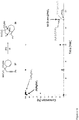
- Figure 3 shows the ligand effect on the Pt-catalyzed hydroarylation of propargyl aryl ether 35 to chromene 36.
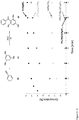
- Figure 4 shows the ligand effect on the Pt-catalyzed cycloisomerization of enyne 37 to cyclobutene 38.
- Figure 5 shows the ligand effect on the Au-catalyzed hydroarylation of alkyne 39 with arene 40.
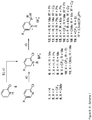
- Scheme 1 illustrates the synthesis of pyridinium-substituted phosphines.
- Hydrogen atoms and BF 4 anions were omitted for clarity; ellipsoids are set at 50% probability.
- Scheme 3 illustrates the synthesis of Pt and Au complexes and crystal structure of 28 and 31. Hydrogen atoms, solvent molecules and BF 4 anions were omitted for clarity; ellipsoids are set at 50% probability.
- the invention is further illustrated in the following experimental part.
- Compound 10 Prepared from 2-chloro-5-(trifluoromethyl)pyridine (1 g, 5.5 mmol) and Et 3 OBF 4 (1.05 g, 5.5 mmol) in DCM (20 ml) following the general procedure and purified by filtration and washing with DCM (2 x 10 ml) to afford 10 as a white solid (1.6 g, 5.4 mmol, 99%).
- Compound 14 Prepared by heating a THF suspension of 7 (650 mg, 2.3 mmol) and diphenylphosphine (1.2 ml, 6.9 mmol) at 130°C for 12 h in a ⁇ wave oven. White solid (715 mg, 71%).
- Compound 15 Prepared by heating a THF suspension of 8 (500 mg, 2.14 mmol) and diphenylphosphine (0.92 ml, 5.35 mmol) at 65°C for 3 days. White solid (351 mg, 43%).
- Compound 17 Prepared by heating a THF suspension of 8 (500 mg, 2.14 mmol) and dicyclohexylphosphine (1.08 ml, 5.35 mmol) at 65°C during 12 hours. White solid (648 mg, 77%).
- the inventive compounds when used as ligands, depict excellent ⁇ -acceptor properties and, as consequence, a remarkable ability to enhance the Lewis acidity of the metals they coordinate.
- the beneficial effects of these properties in homogeneous catalysis have been demonstrated along three mechanistically diverse Pt(II)- and Au(I)-catalysed reactions.
Landscapes
- Chemical & Material Sciences (AREA)
- Organic Chemistry (AREA)
- Chemical Kinetics & Catalysis (AREA)
- Inorganic Chemistry (AREA)
- Engineering & Computer Science (AREA)
- Materials Engineering (AREA)
- Health & Medical Sciences (AREA)
- Life Sciences & Earth Sciences (AREA)
- Biochemistry (AREA)
- General Health & Medical Sciences (AREA)
- Molecular Biology (AREA)
- Catalysts (AREA)
- Pyridine Compounds (AREA)
- Organic Low-Molecular-Weight Compounds And Preparation Thereof (AREA)
- Low-Molecular Organic Synthesis Reactions Using Catalysts (AREA)
Claims (9)
- Pyridiniophosphine N-substituée de formule générale (I) :
 R1, R2, R3 et R4 sont identiques ou différents et chacun représente hydrogène, halogène, un groupe C1-C20-alkyle, -alcényle, -alcynyle linéaire, cyclique ou ramifié, ou un groupe C5-C14-aryle ou -hétéroaryle, qui peut présenter des substituants convenables choisis parmi halogène, =O, -OH, -OR, -NH2, -NHR, -NR2, aryle ou hétéroaryle, ou au moins un des R1, R2, R3 et R4 est lié à l'anneau pyridinio par l'intermédiaire de -O- ou -NR-, ou au moins deux parmi R1, R2, R3 et R4 peuvent former un noyau alkyle C4 à C12 linéaire ou ramifié, qui peut comprendre au moins une liaison insaturée et qui peut présenter des substituants convenables choisis parmi halogène, =O, -OH, -OR, -NH2, -NHR, -NR2, aryle ou hétéroaryle, ou au moins deux parmi R1, R2, R3 et R4 peuvent former un noyau C5 à C14 aromatique ou hétéroaromatique qui peut présenter des substituants convenables choisis parmi halogène, -OH, -OR, -NH2, -NHR, -NR2, aryle ou hétéroaryle ;R5 représente un groupe C1-C20-alkyle linéaire, cyclique ou ramifié ou un groupe C5-C14-aryle ou -hétéroaryle, qui peut présenter des substituants convenables choisis parmi halogène, =O, -OH, -OR, -NH2, -NHR, -NR2, aryle ou hétéroaryle ;R6 et R7 chacun représentent un groupe C1-C20-alkyle linéaire, cyclique ou ramifié, saturé ou insaturé ou un groupe C5-C14-aryle ou -hétéroaryle, qui peut présenter des substituants convenables choisis parmi halogène, -OH, -OR, -NH2, -NHR, -NR2, aryle ou hétéroaryle ;ou R6 et R7 peuvent former un noyau C4 à C20 qui peut comprendre au moins une liaison insaturée ou un noyau aromatique ou hétéroaromatique qui peut présenter des substituants convenables choisis parmi halogène, -OH, -OR, -NH2, -NHR, -NR2, aryle ou hétéroaryle ;R représente un groupe C1-C20-alkyle ou un groupe C5-C14-aryle ou -hétéroaryle qui peut présenter des substituants convenables choisis parmi halogène, =O, -OH, - OR, -NH2, -NHR, -NR2, aryle ou hétéroaryle, etX- est un anion.
 - Pyridiniophosphine N-substituée de formule générale (I) selon la revendication 1, dans laquelle R1, R3 et R4 chacun représentent hydrogène et R2 représente, halogène, un groupe C1-C20-alkyle, -alcényle, -alcynyle linéaire, cyclique ou ramifié, ou un groupe C5-C14-aryle ou -hétéroaryle, qui peut présenter des substituants convenables choisis parmi halogène, =O, -OH, -OR, -NH2, -NHR, -NR2, aryle ou R2 est lié à l'anneau pyridinio par l'intermédiaire de -O- ou -NR- ; et
R5, R6, R7, R et X- ont le même sens que celui donné précédemment. - Pyridiniophosphine N-substituée de formule générale (I) selon la revendication 1 ou la revendication 2, dans laquelle X- est un anion choisi parmi Cl-, Br-, I-, PF6 -, SbF6 -, BF4 -, ClO4 -, F3CCOO-, Tf2N-, (Tf = trifluorométhanesulfonyle), TfO-, tosyle, [B[3,5-(CF3)2C6H3]4]-, [B(C6F5)4]-, [Al(OC(CF3)3)4]- , de préférence à partir de BF4 -, PF6 -, SbF6 -, BPh4 -.
- Processus permettant la préparation d'une pyridiniophosphine N-substituée de formule générale I :
 R1, R2, R3 et R4 sont identiques ou différents et chacun représentent hydrogène, halogène, un groupe C1-C20-alkyle, -alcényle, ou -alcynyle linéaire, cyclique ou ramifié, ou un groupe C5-C14-aryle ou -hétéroaryle, qui peut présenter des substituants convenables choisis parmi halogène, =O, -OH, -OR, -NH2, -NHR, -NR2, aryle ou hétéroaryle, ou au moins un des R1, R2, R3 et R4 est lié à l'anneau pyridinio par l'intermédiaire de -O- ou -NR-, ou au moins deux parmi R1, R2, R3 et R4 peuvent former un noyau alkyle C4 à C12 linéaire ou ramifié, qui peut comprendre au moins une liaison insaturée et qui peut présenter des substituants convenables choisis parmi halogène, =O, -OH, - OR, -NH2, -NHR, -NR2, aryle ou hétéroaryle, ou au moins deux parmi R1, R2, R3 et R4 peuvent former un noyau C5 à C14 aromatique ou hétéroaromatique qui peut présenter des substituants convenables choisis parmi halogène, -OH, -OR, -NH2, -NHR, -NR2, aryle ou hétéroaryle ;R5 représente un groupe C1-C20-alkyle linéaire, cyclique ou ramifié ou un groupe C5-C14-aryle ou -hétéroaryle, qui peut présenter des substituants convenables choisis parmi halogène, =O, -OH, -OR, -NH2, -NHR, -NR2, aryle ou hétéroaryle ;R6 et R7 chacun représentent un groupe C1-C20-alkyle linéaire, cyclique ou ramifié, saturé ou insaturé ou un groupe C5-C14-aryle ou -hétéroaryle, qui peut présenter des substituants convenables choisis parmi halogène, -OH, -OR, - NH2, -NHR, -NR2, aryle ou hétéroaryle ;ou R6 et R7 peuvent former un noyau C4 à C20 qui peut comprendre au moins une liaison insaturée ou un noyau aromatique ou hétéroaromatique qui peut présenter des substituants convenables choisis parmi halogène, -OH, -OR, - NH2, -NHR, -NR2, aryle ou hétéroaryle ;R représente un groupe C1-C20-alkyle ou un groupe C5-C14-aryle ou - hétéroaryle qui peut présenter des substituants convenables choisis parmi halogène, =O, -OH, -OR, -NH2, -NHR, -NR2, aryle ou hétéroaryle, et X- est un anion,dans ce processus un sel de composé pyridinio de formule générale II :
est mis en réaction avec une phosphine de formule générale III :
HPR7R8 (III)
dans laquelle R7 et R8 sont définis comme ci-dessus. - Utilisation d'une pyridiniophosphine N-substituée de formule générale (I) selon les revendications 1, 2 ou 3 en tant que ligand dans des complexes métalliques.
- Complexe métallique de formule générale (IV)
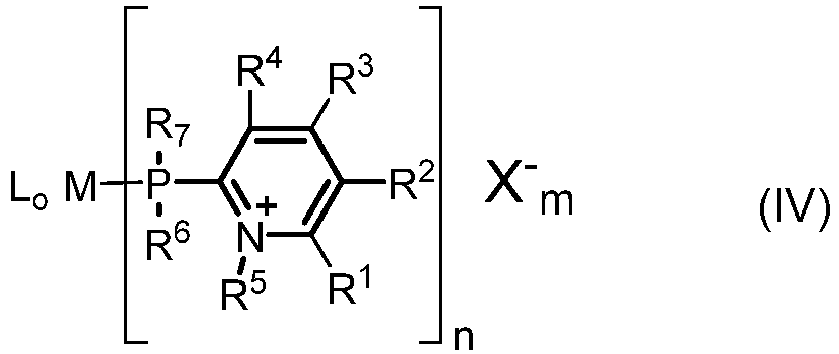 R1, R2, R3 et R4 sont identiques ou différents et chacun représentent hydrogène, halogène, un groupe C1-C20-alkyle, -alcényle, -alcynyle linéaire, cyclique ou ramifié, ou un groupe C5-C14-aryle ou -hétéroaryle, qui peut présenter des substituants convenables choisis parmi halogène, =O, -OH, -OR, -NH2, -NHR, -NR2, aryle ou hétéroaryle, ou au moins un des R1, R2, R3 et R4 est lié à l'anneau pyridinio par l'intermédiaire de -O- ou -NR-, ou au moins deux parmi R1, R2, R3 et R4 peuvent former un noyau alkyle C4 à C12 linéaire ou ramifié, qui peut comprendre au moins une liaison insaturée et qui peut présenter des substituants convenables choisis parmi halogène, =O, -OH, -OR, -NH2, -NHR, -NR2, aryle ou hétéroaryle, ou au moins deux parmi R1, R2, R3 et R4 peuvent former un noyau C5 à C14 aromatique ou hétéroaromatique qui peut présenter des substituants convenables choisis parmi halogène, -OH, -OR, -NH2, -NHR, -NR2, aryle ou hétéroaryle ;R5 représente un groupe C1-C20-alkyle linéaire, cyclique ou ramifié ou un groupe C5-C14-aryle ou -hétéroaryle, qui peut présenter des substituants convenables choisis parmi halogène, =O, -OH, -OR, -NH2, -NHR, -NR2, aryle ou hétéroaryle ;R6 et R7 chacun représentent un groupe C1-C20-alkyle linéaire, cyclique ou ramifié, saturé ou insaturé ou un groupe C5-C14-aryle ou -hétéroaryle, qui peut présenter des substituants convenables choisis parmi halogène, -OH, -OR, -NH2, -NHR, -NR2, aryle ou hétéroaryle ;ou R6 et R7 peuvent former un noyau C4 à C20 qui peut comprendre au moins une liaison insaturée ou un noyau aromatique ou hétéroaromatique qui peut présenter des substituants convenables choisis parmi halogène, -OH, -OR, -NH2, -NHR, -NR2, aryle ou hétéroaryle ;R représente un groupe C1-C20-alkyle ou un groupe C5-C14-aryle ou -hétéroaryle qui peut présenter des substituants convenables choisis parmi halogène, =O, -OH, - OR, -NH2, -NHR, -NR2, aryle ou hétéroaryle, etX- est un anion,M représente un atome de métal, de préférence choisi parmi le groupe constitué de B, Cu, Fe, Ni, Co, Ag, Au, Ru, Rh, Pd, Os, Ir et Pt.L représente un ligand qui peut également être cationique, neutre ou anionique et qui peut être le même ou différent si plus d'un L est coordonné au métal, etm peut valoir 1, 2 ou 3,n peut valoir 1, 2 ou 3,o peut être un nombre entier compris entre 1 et 5, etm, n et o sont choisis, en fonction de l'atome de métal, afin d'obtenir un complexe métallique.
 - Complexe métallique selon la revendication 6, caractérisée en ce que le ligand L peut être choisi parmi un halogène, CN, CO, des alcènes, des cycloalcènes et/ou des alcynes, des arènes, des nitriles, des phosphines, des amines, des pyridines ou des carboxylates.
- Complexe métallique selon la revendication 6 ou la revendication 7 qui comprend M étant choisi parmi Ag, Au, Ru, Rh, Pd, Os, Ir et Pt.
- Utilisation du complexe métallique selon l'une quelconque des revendications 6 à 8 en tant que catalyseur dans la synthèse organique, en particulier dans des cycloisomérisations.
Applications Claiming Priority (2)
| Application Number | Priority Date | Filing Date | Title |
|---|---|---|---|
| EP14166125.6A EP2937354A1 (fr) | 2014-04-27 | 2014-04-27 | Pyridiniophosphines n-substitués, procédés pour leur préparation et leur utilisation |
| PCT/EP2015/058618 WO2015165781A1 (fr) | 2014-04-27 | 2015-04-21 | Pyridiniophosphines n-substituées, leurs procédés de préparation et leur utilisation |
Publications (2)
| Publication Number | Publication Date |
|---|---|
| EP3137472A1 EP3137472A1 (fr) | 2017-03-08 |
| EP3137472B1 true EP3137472B1 (fr) | 2018-07-04 |
Family
ID=50555083
Family Applications (2)
| Application Number | Title | Priority Date | Filing Date |
|---|---|---|---|
| EP14166125.6A Withdrawn EP2937354A1 (fr) | 2014-04-27 | 2014-04-27 | Pyridiniophosphines n-substitués, procédés pour leur préparation et leur utilisation |
| EP15718849.1A Active EP3137472B1 (fr) | 2014-04-27 | 2015-04-21 | Pyridiniophosphines n-substitués, procédés pour leur préparation et leur utilisation |
Family Applications Before (1)
| Application Number | Title | Priority Date | Filing Date |
|---|---|---|---|
| EP14166125.6A Withdrawn EP2937354A1 (fr) | 2014-04-27 | 2014-04-27 | Pyridiniophosphines n-substitués, procédés pour leur préparation et leur utilisation |
Country Status (7)
| Country | Link |
|---|---|
| US (1) | US9962690B2 (fr) |
| EP (2) | EP2937354A1 (fr) |
| JP (1) | JP6236170B2 (fr) |
| KR (1) | KR102204260B1 (fr) |
| CN (1) | CN106661063B (fr) |
| CA (1) | CA2946922C (fr) |
| WO (1) | WO2015165781A1 (fr) |
Family Cites Families (6)
| Publication number | Priority date | Publication date | Assignee | Title |
|---|---|---|---|---|
| CA1331173C (fr) * | 1986-12-05 | 1994-08-02 | Eit Drent | Procede pour la carboxylation de composes acetyleniquement insatures |
| JP2004269522A (ja) * | 2003-02-20 | 2004-09-30 | Mitsubishi Chemicals Corp | 新規なルテニウム錯体、その製造方法、及びそれを用いたアミド化合物の製造方法 |
| JP2008088153A (ja) * | 2006-04-10 | 2008-04-17 | Okayama Univ | アミド化合物を製造する方法及びその方法に使用される触媒 |
| JP2009023925A (ja) * | 2007-07-18 | 2009-02-05 | Okayama Univ | アミド化合物を製造する方法及びその方法に使用される触媒 |
| DE102007052640A1 (de) * | 2007-11-05 | 2009-05-07 | Albert-Ludwigs-Universität Freiburg | Verfahren zur Hydroformylierung |
| EP2543685A1 (fr) * | 2011-07-08 | 2013-01-09 | cynora GmbH | Procédé de connexion covalente d'un complexe métallique sur un polymère |
-
2014
- 2014-04-27 EP EP14166125.6A patent/EP2937354A1/fr not_active Withdrawn
-
2015
- 2015-04-21 JP JP2016564619A patent/JP6236170B2/ja not_active Expired - Fee Related
- 2015-04-21 US US15/307,077 patent/US9962690B2/en active Active
- 2015-04-21 KR KR1020167033110A patent/KR102204260B1/ko not_active Expired - Fee Related
- 2015-04-21 WO PCT/EP2015/058618 patent/WO2015165781A1/fr not_active Ceased
- 2015-04-21 EP EP15718849.1A patent/EP3137472B1/fr active Active
- 2015-04-21 CA CA2946922A patent/CA2946922C/fr active Active
- 2015-04-21 CN CN201580028648.2A patent/CN106661063B/zh not_active Expired - Fee Related
Non-Patent Citations (1)
| Title |
|---|
| None * |
Also Published As
| Publication number | Publication date |
|---|---|
| KR102204260B1 (ko) | 2021-01-18 |
| US20170050180A1 (en) | 2017-02-23 |
| KR20160147277A (ko) | 2016-12-22 |
| WO2015165781A1 (fr) | 2015-11-05 |
| CA2946922A1 (fr) | 2015-11-05 |
| JP2017519722A (ja) | 2017-07-20 |
| CN106661063B (zh) | 2019-01-15 |
| CN106661063A (zh) | 2017-05-10 |
| EP2937354A1 (fr) | 2015-10-28 |
| EP3137472A1 (fr) | 2017-03-08 |
| US9962690B2 (en) | 2018-05-08 |
| CA2946922C (fr) | 2021-07-06 |
| JP6236170B2 (ja) | 2017-11-22 |
Similar Documents
| Publication | Publication Date | Title |
|---|---|---|
| EP2802561B1 (fr) | Imidodiphosphates chiraux et dérivés associés | |
| KR102740741B1 (ko) | 키랄성 포스포르아미드이미데이트 및 이의 유도체 | |
| CA2925058C (fr) | Procede d'hydroboration trans-selective d'alkynes internes | |
| EP3137472B1 (fr) | Pyridiniophosphines n-substitués, procédés pour leur préparation et leur utilisation | |
| EP4200308B1 (fr) | Procédé de préparation d'acides de brønsted dimériques dérivés du phosphazène | |
| EP3981775A1 (fr) | Procédé de préparation d'acides de brønsted dimériques dérivés du phosphazène | |
| US9061963B2 (en) | Process for preparing aromatic and heteroaromatic amines |
Legal Events
| Date | Code | Title | Description |
|---|---|---|---|
| STAA | Information on the status of an ep patent application or granted ep patent |
Free format text: STATUS: THE INTERNATIONAL PUBLICATION HAS BEEN MADE |
|
| PUAI | Public reference made under article 153(3) epc to a published international application that has entered the european phase |
Free format text: ORIGINAL CODE: 0009012 |
|
| STAA | Information on the status of an ep patent application or granted ep patent |
Free format text: STATUS: REQUEST FOR EXAMINATION WAS MADE |
|
| 17P | Request for examination filed |
Effective date: 20161020 |
|
| AK | Designated contracting states |
Kind code of ref document: A1 Designated state(s): AL AT BE BG CH CY CZ DE DK EE ES FI FR GB GR HR HU IE IS IT LI LT LU LV MC MK MT NL NO PL PT RO RS SE SI SK SM TR |
|
| AX | Request for extension of the european patent |
Extension state: BA ME |
|
| DAV | Request for validation of the european patent (deleted) | ||
| DAX | Request for extension of the european patent (deleted) | ||
| GRAP | Despatch of communication of intention to grant a patent |
Free format text: ORIGINAL CODE: EPIDOSNIGR1 |
|
| STAA | Information on the status of an ep patent application or granted ep patent |
Free format text: STATUS: GRANT OF PATENT IS INTENDED |
|
| INTG | Intention to grant announced |
Effective date: 20171213 |
|
| GRAJ | Information related to disapproval of communication of intention to grant by the applicant or resumption of examination proceedings by the epo deleted |
Free format text: ORIGINAL CODE: EPIDOSDIGR1 |
|
| GRAP | Despatch of communication of intention to grant a patent |
Free format text: ORIGINAL CODE: EPIDOSNIGR1 |
|
| INTG | Intention to grant announced |
Effective date: 20180124 |
|
| GRAS | Grant fee paid |
Free format text: ORIGINAL CODE: EPIDOSNIGR3 |
|
| GRAA | (expected) grant |
Free format text: ORIGINAL CODE: 0009210 |
|
| STAA | Information on the status of an ep patent application or granted ep patent |
Free format text: STATUS: THE PATENT HAS BEEN GRANTED |
|
| AK | Designated contracting states |
Kind code of ref document: B1 Designated state(s): AL AT BE BG CH CY CZ DE DK EE ES FI FR GB GR HR HU IE IS IT LI LT LU LV MC MK MT NL NO PL PT RO RS SE SI SK SM TR |
|
| REG | Reference to a national code |
Ref country code: GB Ref legal event code: FG4D |
|
| REG | Reference to a national code |
Ref country code: CH Ref legal event code: EP |
|
| REG | Reference to a national code |
Ref country code: AT Ref legal event code: REF Ref document number: 1014395 Country of ref document: AT Kind code of ref document: T Effective date: 20180715 |
|
| REG | Reference to a national code |
Ref country code: IE Ref legal event code: FG4D |
|
| REG | Reference to a national code |
Ref country code: DE Ref legal event code: R096 Ref document number: 602015013029 Country of ref document: DE |
|
| REG | Reference to a national code |
Ref country code: NL Ref legal event code: FP |
|
| REG | Reference to a national code |
Ref country code: LT Ref legal event code: MG4D |
|
| REG | Reference to a national code |
Ref country code: AT Ref legal event code: MK05 Ref document number: 1014395 Country of ref document: AT Kind code of ref document: T Effective date: 20180704 |
|
| PG25 | Lapsed in a contracting state [announced via postgrant information from national office to epo] |
Ref country code: LT Free format text: LAPSE BECAUSE OF FAILURE TO SUBMIT A TRANSLATION OF THE DESCRIPTION OR TO PAY THE FEE WITHIN THE PRESCRIBED TIME-LIMIT Effective date: 20180704 Ref country code: RS Free format text: LAPSE BECAUSE OF FAILURE TO SUBMIT A TRANSLATION OF THE DESCRIPTION OR TO PAY THE FEE WITHIN THE PRESCRIBED TIME-LIMIT Effective date: 20180704 Ref country code: IS Free format text: LAPSE BECAUSE OF FAILURE TO SUBMIT A TRANSLATION OF THE DESCRIPTION OR TO PAY THE FEE WITHIN THE PRESCRIBED TIME-LIMIT Effective date: 20181104 Ref country code: PL Free format text: LAPSE BECAUSE OF FAILURE TO SUBMIT A TRANSLATION OF THE DESCRIPTION OR TO PAY THE FEE WITHIN THE PRESCRIBED TIME-LIMIT Effective date: 20180704 Ref country code: AT Free format text: LAPSE BECAUSE OF FAILURE TO SUBMIT A TRANSLATION OF THE DESCRIPTION OR TO PAY THE FEE WITHIN THE PRESCRIBED TIME-LIMIT Effective date: 20180704 Ref country code: CZ Free format text: LAPSE BECAUSE OF FAILURE TO SUBMIT A TRANSLATION OF THE DESCRIPTION OR TO PAY THE FEE WITHIN THE PRESCRIBED TIME-LIMIT Effective date: 20180704 Ref country code: BG Free format text: LAPSE BECAUSE OF FAILURE TO SUBMIT A TRANSLATION OF THE DESCRIPTION OR TO PAY THE FEE WITHIN THE PRESCRIBED TIME-LIMIT Effective date: 20181004 Ref country code: NO Free format text: LAPSE BECAUSE OF FAILURE TO SUBMIT A TRANSLATION OF THE DESCRIPTION OR TO PAY THE FEE WITHIN THE PRESCRIBED TIME-LIMIT Effective date: 20181004 Ref country code: GR Free format text: LAPSE BECAUSE OF FAILURE TO SUBMIT A TRANSLATION OF THE DESCRIPTION OR TO PAY THE FEE WITHIN THE PRESCRIBED TIME-LIMIT Effective date: 20181005 Ref country code: FI Free format text: LAPSE BECAUSE OF FAILURE TO SUBMIT A TRANSLATION OF THE DESCRIPTION OR TO PAY THE FEE WITHIN THE PRESCRIBED TIME-LIMIT Effective date: 20180704 Ref country code: SE Free format text: LAPSE BECAUSE OF FAILURE TO SUBMIT A TRANSLATION OF THE DESCRIPTION OR TO PAY THE FEE WITHIN THE PRESCRIBED TIME-LIMIT Effective date: 20180704 |
|
| PG25 | Lapsed in a contracting state [announced via postgrant information from national office to epo] |
Ref country code: AL Free format text: LAPSE BECAUSE OF FAILURE TO SUBMIT A TRANSLATION OF THE DESCRIPTION OR TO PAY THE FEE WITHIN THE PRESCRIBED TIME-LIMIT Effective date: 20180704 Ref country code: ES Free format text: LAPSE BECAUSE OF FAILURE TO SUBMIT A TRANSLATION OF THE DESCRIPTION OR TO PAY THE FEE WITHIN THE PRESCRIBED TIME-LIMIT Effective date: 20180704 Ref country code: LV Free format text: LAPSE BECAUSE OF FAILURE TO SUBMIT A TRANSLATION OF THE DESCRIPTION OR TO PAY THE FEE WITHIN THE PRESCRIBED TIME-LIMIT Effective date: 20180704 Ref country code: HR Free format text: LAPSE BECAUSE OF FAILURE TO SUBMIT A TRANSLATION OF THE DESCRIPTION OR TO PAY THE FEE WITHIN THE PRESCRIBED TIME-LIMIT Effective date: 20180704 |
|
| REG | Reference to a national code |
Ref country code: DE Ref legal event code: R097 Ref document number: 602015013029 Country of ref document: DE |
|
| PG25 | Lapsed in a contracting state [announced via postgrant information from national office to epo] |
Ref country code: IT Free format text: LAPSE BECAUSE OF FAILURE TO SUBMIT A TRANSLATION OF THE DESCRIPTION OR TO PAY THE FEE WITHIN THE PRESCRIBED TIME-LIMIT Effective date: 20180704 Ref country code: EE Free format text: LAPSE BECAUSE OF FAILURE TO SUBMIT A TRANSLATION OF THE DESCRIPTION OR TO PAY THE FEE WITHIN THE PRESCRIBED TIME-LIMIT Effective date: 20180704 Ref country code: RO Free format text: LAPSE BECAUSE OF FAILURE TO SUBMIT A TRANSLATION OF THE DESCRIPTION OR TO PAY THE FEE WITHIN THE PRESCRIBED TIME-LIMIT Effective date: 20180704 |
|
| PLBE | No opposition filed within time limit |
Free format text: ORIGINAL CODE: 0009261 |
|
| STAA | Information on the status of an ep patent application or granted ep patent |
Free format text: STATUS: NO OPPOSITION FILED WITHIN TIME LIMIT |
|
| PG25 | Lapsed in a contracting state [announced via postgrant information from national office to epo] |
Ref country code: SM Free format text: LAPSE BECAUSE OF FAILURE TO SUBMIT A TRANSLATION OF THE DESCRIPTION OR TO PAY THE FEE WITHIN THE PRESCRIBED TIME-LIMIT Effective date: 20180704 Ref country code: DK Free format text: LAPSE BECAUSE OF FAILURE TO SUBMIT A TRANSLATION OF THE DESCRIPTION OR TO PAY THE FEE WITHIN THE PRESCRIBED TIME-LIMIT Effective date: 20180704 Ref country code: SK Free format text: LAPSE BECAUSE OF FAILURE TO SUBMIT A TRANSLATION OF THE DESCRIPTION OR TO PAY THE FEE WITHIN THE PRESCRIBED TIME-LIMIT Effective date: 20180704 |
|
| 26N | No opposition filed |
Effective date: 20190405 |
|
| PG25 | Lapsed in a contracting state [announced via postgrant information from national office to epo] |
Ref country code: SI Free format text: LAPSE BECAUSE OF FAILURE TO SUBMIT A TRANSLATION OF THE DESCRIPTION OR TO PAY THE FEE WITHIN THE PRESCRIBED TIME-LIMIT Effective date: 20180704 |
|
| PG25 | Lapsed in a contracting state [announced via postgrant information from national office to epo] |
Ref country code: LU Free format text: LAPSE BECAUSE OF NON-PAYMENT OF DUE FEES Effective date: 20190421 Ref country code: MC Free format text: LAPSE BECAUSE OF FAILURE TO SUBMIT A TRANSLATION OF THE DESCRIPTION OR TO PAY THE FEE WITHIN THE PRESCRIBED TIME-LIMIT Effective date: 20180704 |
|
| PG25 | Lapsed in a contracting state [announced via postgrant information from national office to epo] |
Ref country code: TR Free format text: LAPSE BECAUSE OF FAILURE TO SUBMIT A TRANSLATION OF THE DESCRIPTION OR TO PAY THE FEE WITHIN THE PRESCRIBED TIME-LIMIT Effective date: 20180704 |
|
| PG25 | Lapsed in a contracting state [announced via postgrant information from national office to epo] |
Ref country code: PT Free format text: LAPSE BECAUSE OF FAILURE TO SUBMIT A TRANSLATION OF THE DESCRIPTION OR TO PAY THE FEE WITHIN THE PRESCRIBED TIME-LIMIT Effective date: 20181104 |
|
| PG25 | Lapsed in a contracting state [announced via postgrant information from national office to epo] |
Ref country code: CY Free format text: LAPSE BECAUSE OF FAILURE TO SUBMIT A TRANSLATION OF THE DESCRIPTION OR TO PAY THE FEE WITHIN THE PRESCRIBED TIME-LIMIT Effective date: 20180704 |
|
| PG25 | Lapsed in a contracting state [announced via postgrant information from national office to epo] |
Ref country code: MT Free format text: LAPSE BECAUSE OF FAILURE TO SUBMIT A TRANSLATION OF THE DESCRIPTION OR TO PAY THE FEE WITHIN THE PRESCRIBED TIME-LIMIT Effective date: 20180704 Ref country code: HU Free format text: LAPSE BECAUSE OF FAILURE TO SUBMIT A TRANSLATION OF THE DESCRIPTION OR TO PAY THE FEE WITHIN THE PRESCRIBED TIME-LIMIT; INVALID AB INITIO Effective date: 20150421 |
|
| PG25 | Lapsed in a contracting state [announced via postgrant information from national office to epo] |
Ref country code: MK Free format text: LAPSE BECAUSE OF FAILURE TO SUBMIT A TRANSLATION OF THE DESCRIPTION OR TO PAY THE FEE WITHIN THE PRESCRIBED TIME-LIMIT Effective date: 20180704 |
|
| P01 | Opt-out of the competence of the unified patent court (upc) registered |
Effective date: 20230528 |
|
| PGFP | Annual fee paid to national office [announced via postgrant information from national office to epo] |
Ref country code: DE Payment date: 20220620 Year of fee payment: 9 |
|
| PGFP | Annual fee paid to national office [announced via postgrant information from national office to epo] |
Ref country code: NL Payment date: 20240418 Year of fee payment: 10 |
|
| PGFP | Annual fee paid to national office [announced via postgrant information from national office to epo] |
Ref country code: IE Payment date: 20240419 Year of fee payment: 10 |
|
| PGFP | Annual fee paid to national office [announced via postgrant information from national office to epo] |
Ref country code: GB Payment date: 20240419 Year of fee payment: 10 |
|
| PGFP | Annual fee paid to national office [announced via postgrant information from national office to epo] |
Ref country code: CH Payment date: 20240501 Year of fee payment: 10 |
|
| PGFP | Annual fee paid to national office [announced via postgrant information from national office to epo] |
Ref country code: FR Payment date: 20240425 Year of fee payment: 10 |
|
| PGFP | Annual fee paid to national office [announced via postgrant information from national office to epo] |
Ref country code: BE Payment date: 20240418 Year of fee payment: 10 |
|
| REG | Reference to a national code |
Ref country code: DE Ref legal event code: R119 Ref document number: 602015013029 Country of ref document: DE |
|
| REG | Reference to a national code |
Ref country code: CH Ref legal event code: H13 Free format text: ST27 STATUS EVENT CODE: U-0-0-H10-H13 (AS PROVIDED BY THE NATIONAL OFFICE) Effective date: 20251125 |
|
| REG | Reference to a national code |
Ref country code: NL Ref legal event code: MM Effective date: 20250501 |
|
| GBPC | Gb: european patent ceased through non-payment of renewal fee |
Effective date: 20250421 |
|
| REG | Reference to a national code |
Ref country code: BE Ref legal event code: MM Effective date: 20250430 |
|
| PG25 | Lapsed in a contracting state [announced via postgrant information from national office to epo] |
Ref country code: DE Free format text: LAPSE BECAUSE OF NON-PAYMENT OF DUE FEES Effective date: 20251104 |
|
| PG25 | Lapsed in a contracting state [announced via postgrant information from national office to epo] |
Ref country code: GB Free format text: LAPSE BECAUSE OF NON-PAYMENT OF DUE FEES Effective date: 20250421 |
|
| PG25 | Lapsed in a contracting state [announced via postgrant information from national office to epo] |
Ref country code: NL Free format text: LAPSE BECAUSE OF NON-PAYMENT OF DUE FEES Effective date: 20250501 Ref country code: FR Free format text: LAPSE BECAUSE OF NON-PAYMENT OF DUE FEES Effective date: 20250430 |
|
| PG25 | Lapsed in a contracting state [announced via postgrant information from national office to epo] |
Ref country code: BE Free format text: LAPSE BECAUSE OF NON-PAYMENT OF DUE FEES Effective date: 20250430 |
|
| PG25 | Lapsed in a contracting state [announced via postgrant information from national office to epo] |
Ref country code: CH Free format text: LAPSE BECAUSE OF NON-PAYMENT OF DUE FEES Effective date: 20250430 |
|
| PG25 | Lapsed in a contracting state [announced via postgrant information from national office to epo] |
Ref country code: IE Free format text: LAPSE BECAUSE OF NON-PAYMENT OF DUE FEES Effective date: 20250421 |