EP3137568B1 - Ruban adhésif détachable comprenant un adhésif liquide détachable dosable - Google Patents
Ruban adhésif détachable comprenant un adhésif liquide détachable dosable Download PDFInfo
- Publication number
- EP3137568B1 EP3137568B1 EP15721140.0A EP15721140A EP3137568B1 EP 3137568 B1 EP3137568 B1 EP 3137568B1 EP 15721140 A EP15721140 A EP 15721140A EP 3137568 B1 EP3137568 B1 EP 3137568B1
- Authority
- EP
- European Patent Office
- Prior art keywords
- adhesive
- layer
- adhesive tape
- bonding
- equal
- Prior art date
- Legal status (The legal status is an assumption and is not a legal conclusion. Google has not performed a legal analysis and makes no representation as to the accuracy of the status listed.)
- Not-in-force
Links
Images


Classifications
-
- C—CHEMISTRY; METALLURGY
- C09—DYES; PAINTS; POLISHES; NATURAL RESINS; ADHESIVES; COMPOSITIONS NOT OTHERWISE PROVIDED FOR; APPLICATIONS OF MATERIALS NOT OTHERWISE PROVIDED FOR
- C09J—ADHESIVES; NON-MECHANICAL ASPECTS OF ADHESIVE PROCESSES IN GENERAL; ADHESIVE PROCESSES NOT PROVIDED FOR ELSEWHERE; USE OF MATERIALS AS ADHESIVES
- C09J7/00—Adhesives in the form of films or foils
- C09J7/20—Adhesives in the form of films or foils characterised by their carriers
-
- C—CHEMISTRY; METALLURGY
- C09—DYES; PAINTS; POLISHES; NATURAL RESINS; ADHESIVES; COMPOSITIONS NOT OTHERWISE PROVIDED FOR; APPLICATIONS OF MATERIALS NOT OTHERWISE PROVIDED FOR
- C09J—ADHESIVES; NON-MECHANICAL ASPECTS OF ADHESIVE PROCESSES IN GENERAL; ADHESIVE PROCESSES NOT PROVIDED FOR ELSEWHERE; USE OF MATERIALS AS ADHESIVES
- C09J2203/00—Applications of adhesives in processes or use of adhesives in the form of films or foils
- C09J2203/318—Applications of adhesives in processes or use of adhesives in the form of films or foils for the production of liquid crystal displays
-
- C—CHEMISTRY; METALLURGY
- C09—DYES; PAINTS; POLISHES; NATURAL RESINS; ADHESIVES; COMPOSITIONS NOT OTHERWISE PROVIDED FOR; APPLICATIONS OF MATERIALS NOT OTHERWISE PROVIDED FOR
- C09J—ADHESIVES; NON-MECHANICAL ASPECTS OF ADHESIVE PROCESSES IN GENERAL; ADHESIVE PROCESSES NOT PROVIDED FOR ELSEWHERE; USE OF MATERIALS AS ADHESIVES
- C09J2203/00—Applications of adhesives in processes or use of adhesives in the form of films or foils
- C09J2203/326—Applications of adhesives in processes or use of adhesives in the form of films or foils for bonding electronic components such as wafers, chips or semiconductors
-
- C—CHEMISTRY; METALLURGY
- C09—DYES; PAINTS; POLISHES; NATURAL RESINS; ADHESIVES; COMPOSITIONS NOT OTHERWISE PROVIDED FOR; APPLICATIONS OF MATERIALS NOT OTHERWISE PROVIDED FOR
- C09J—ADHESIVES; NON-MECHANICAL ASPECTS OF ADHESIVE PROCESSES IN GENERAL; ADHESIVE PROCESSES NOT PROVIDED FOR ELSEWHERE; USE OF MATERIALS AS ADHESIVES
- C09J2301/00—Additional features of adhesives in the form of films or foils
- C09J2301/40—Additional features of adhesives in the form of films or foils characterized by the presence of essential components
- C09J2301/416—Additional features of adhesives in the form of films or foils characterized by the presence of essential components use of irradiation
Definitions
- the present invention relates to the field of adhesive tapes, in particular of the splittable adhesive tapes, for the bonding and encapsulation of permeate of sensitive surfaces.
- the present invention relates to a fissile storable adhesive tape comprising (i) at least one support layer, (ii) at least one cover layer and (iii) at least one at least partially existing adhesive layer having a complex viscosity less than or equal to 1000 Pas, measured according to ISO 6721-10 23 ° C and a frequency of 1 rad / s, comprising at least one settable liquid adhesive.
- the present invention relates to the provision of the described multi-splittable adhesive tape, as well as at least once split adhesive tape with an at least once split and reduced in layer thickness bonding layer and the, in particular multiple, use of adhesive tapes, preferably the cleavable and / or cleaved adhesive layers, in particular for the bonding and encapsulation permeate of sensitive surfaces, preferably of optoelectronic arrangements.
- Barrier adhesive tapes are necessary wherever permeate sensitive components, in particular electronic elements, have to be protected.
- numerous barrier tapes are known whose adhesives are permeation-inhibiting.
- Such barrier tapes for inorganic and / or organic (opto) electronics, in particular for the organic (opto) electronics, must enable flexible bonding, which at the same time constitutes a permeation barrier for permeates, such as oxygen and / or water vapor.
- the flexible adhesive solutions are not only intended to achieve good adhesion between two substrates, but also to fulfill properties such as high shear strength and peel strength, chemical resistance, aging resistance, high transparency, easy processability and high flexibility and flexibility.
- barrier adhesives which have a low permeability to oxygen and in particular water vapor and a have sufficient adhesion to the (opto) electronic device and its components and can flow well on this.
- Low infiltration on the (opto) electronic assembly can reduce the barrier effect at the interfaces by incomplete wetting of the respective surface and residual pores, thereby permitting penetration of oxygen and water vapor irrespective of the properties of the adhesive. Only if the contact between mass and substrate is continuous, the mass properties are the determining factor for the barrier effect of the adhesive.
- liquid adhesives and adhesives based on epoxides have been used ( WO 98/21287 A1 ; US 4,051,195 A ; US 4,552,604 A ). These have a low diffusion term due to strong crosslinking. A full-surface bonding is hardly possible due to the shrinkage caused by the curing, since it comes to tensions between adhesive and substrate during curing.
- the DE 10 2008 060 113 A1 describes a method for encapsulating an electronic device against permeates, in which a pressure-sensitive adhesive based on butylene block copolymers, in particular isobutylene block copolymers, is used, and the use of such an adhesive in an encapsulation process.
- the EP 1 518 912 A1 teaches an adhesive composition for encapsulating an electroluminescent element containing a photocationic curable compound and a photocationic initiator and an epoxy-based adhesive.
- the US 2009/026934 A1 describes adhesive layers for encapsulating organic electroluminescent elements containing polyisobutylene and a hydrogenated hydrocarbon resin. For crosslinking after application, various reactive resins, such as acrylates, can be used. WVTR values are the examples, typically between 5 and 20 g / m 2 per day.
- the WO 2008/144080 A1 teaches assemblies with sensitive organic layers encapsulated with a cured elastomeric laminating adhesive.
- Suitable adhesives are mixtures of reactive oligomers and / or polymers and reactive monomers, such as (meth) acrylate groups.
- WO 2012030494 A2 describes a method of making a screen in which a layer of curable liquid adhesive is coated onto a pressure-sensitive adhesive tape.
- liquid resin impregnated fabrics such as prepregs for the production of printed circuit boards or components made of fiber reinforced plastics.
- these are textile fabrics that are impregnated with a reactive resin.
- the reactive resins are usually gelled, i. the hardening reaction is initiated and stopped at an early stage (so-called B-state).
- B-state early stage
- a significant increase in viscosity of the resin occurs, which makes the impregnated structure manageable.
- Prepregs of this type are tacky and can therefore be laminated together at room temperature. Like adhesive tapes, they are usually covered with release liners to make them stackable or windable.
- a disadvantage of this prior art is that the gelled prepregs must be stored refrigerated in order to prevent the hardening reaction from continuing. The increase in viscosity also reduces the wettability of the substrate surface in a bond.
- liquid resin-impregnated fabrics are electrical insulation films, which are usually made of resin-impregnated paper or fiber structure. These materials are known under the designations hard paper or hard tissue, wherein also in these materials, the resin is in a B-state, but is usually no longer sticky and can be stacked or wound up without liner. The disadvantage is that these materials can be laminated only under heat and / or high pressure.
- Adhesive tapes or adhesive pads which contain at least one layer of a highly thickened reactive liquid adhesive (for example Henkel Powerknete - 2K system).
- the thickening is achieved mainly by a high addition of fillers, whereby this type of adhesives is substantially plastically deformable, but only to a small extent flowable. This is disadvantageous for the Auffcher on a substrate surface, in particular in electronic devices.
- Adhesive tapes or pads can be covered with conventional liners for transport and storage.
- an adhesive tape is to be provided which can be wound in addition to a roll. More preferably, an adhesive tape for producing a bond on a substrate to protect the substrate against penetration of permeates should be provided. It is particularly preferable to provide a permeation-inhibiting adhesive tape having good barrier properties. It is also an adhesive tape to be provided with the properties described above, which is reusable (that is, applied, removable, re-applicable, etc.) and is preferably metered. Another object is to provide a method for producing the above-described adhesive tape.
- an adhesive tape with barrier properties not only has to comprise a permeation-inhibiting adhesive, but also has to be excellently sealed at the interface between the adhesive and the adhesive substrate.
- the at least one bonding layer has a complex viscosity, as defined above, less than or equal to 100 Pas, more preferably less than or equal to 10 Pas, and in particular greater than or equal to 0.1 Pas, preferably greater than or equal to 1 Pas.
- a viscosity less than or equal to 100 Pas, in particular less than or equal to 10 Pas, is particularly preferred because at higher viscosities the splitting of the bond coat is less reliable. At low viscosities, an at least partial, preferably full-surface, homogeneous cleavage is possible.
- Preferred ranges are greater than or equal to 0.1 Pas to less than or equal to 1 Pas, greater than or equal to 10 Pas to less than 500 Pas, greater than or equal to 0.5 Pas to less than or equal to 5 Pas, greater than or equal to 1 Pas to less than or equal to 10 Pas.
- the adhesive tape of the invention has at least one adhesive layer with a complex viscosity of greater than or equal to 0.1 Pas to less than 100 Pas, measured according to ISO 6721-10 at 23 ° C and a frequency of 1 rad / s.
- a layer is a planar arrangement of a system of uniform functionality whose dimensions in one spatial direction, such as thickness or height, are significantly smaller than in the two other spatial directions, such as length or width, which define the main extent of a layer.
- Such a layer can be made compact or perforated and consist of a single material or of different materials, in particular if they contribute to the uniform functionality of this layer.
- a layer can have a constant thickness over its entire surface area within a fluctuation range with a standard deviation of up to plus / minus less than or equal to 5% or different thicknesses.
- a layer may also have more than one functionality.
- a plurality of different layers can be arranged next to one another and / or one on top of another and join together to form a large layer.
- the bonding layer according to the invention and to the adhesive tape according to the invention, which comprises at least one liquid adhesive in each case, and to the backing layer according to the invention.
- the at least one bonding layer can be made up of several partial layers next to each other and / or one another. Preferably, these are arranged side by side and join together to form a bond layer.
- the bonding layer according to the invention may alternatively or additionally be composed of several, in particular different, layers of variable liquid adhesives, wherein these are arranged one above the other.
- the different liquid adhesive layers may be in direct contact with each other or, in particular, in the at least one bonding layer with intermediate layers separated from each other.
- the at least one, in particular cleavable, at least partially existing bonding layer consists of exactly one layer.
- a liquid adhesive comprises at least one settable component.
- further components may be present, for example further reducible components, polymers, solvents or dispersants, initiators, crosslinkers, hardeners, accelerators, catalysts, plasticizers, resins, waxes, tackifiers, fillers, stabilizers, antioxidants, deaerators, defoamers, emulsifiers , Protective colloids, adhesion promoters and / or primers.
- Components of liquid adhesives are for example in Have not: Glue 6th edition, 2009, Berlin, Springer , described in detail.
- the thickness of the at least one carrier layer corresponds to the usual thicknesses in the range of adhesive tapes in a range of greater than or equal to 1 micron to less than or equal to 3000 microns, preferably greater than or equal to 10 .mu.m to less than or equal to 250 .mu.m, greater than or equal to 10 .mu.m to less than or equal to 200 .mu.m, larger equal to 15 microns to less than or equal to 200 microns, greater than or equal to 15 microns to less than or equal to 150 microns, preferably greater than or equal to 15 microns to less than or equal to 100 microns.
- the at least one carrier layer is a layer of c) at least one activatable adhesive which is in solid (not in a liquid) state at room temperature.
- an activatable adhesive advantageously makes it possible to produce a double-sided adhesive tape, wherein the at least one backing layer comprising at least one activatable adhesive does not stick before its activation and is thus easy to handle.
- another object of the present invention is a double-sided adhesive, in particular cleavable, adhesive tape comprising (i) at least one activatable adhesive in the form of a carrier layer, (ii) at least one cover layer and (iii) at least one adhesive layer according to the invention.
- the double-sided adhesive tape according to the invention can be adhesively bonded to the one side by the at least one bonding layer according to the invention and to the second side by the activatable adhesive.
- an adhesion layer according to the invention can be present on both sides of the at least one carrier layer comprising at least one activatable adhesive.
- the activatable adhesive as a carrier without coming into direct contact with a surface of a substrate.
- activatable adhesive it is possible in principle to use all customary adhesively bonded adhesive systems that are activated.
- the activation usually takes place via an energy input, for example by actinic radiation or heat.
- heat-adhesive adhesives can be classified into two categories: thermoplastic heat-activated adhesives (hot-melt adhesives) and reactive heat-activated adhesives (reactive adhesives).
- This classification also contains such adhesives, which can be assigned to both categories, namely reactive thermoplastic heat-activated adhesive adhesives (reactive hot melt adhesives).
- Thermoplastic adhesives are based on polymers that reversibly soften when heated and solidify again during cooling.
- thermoplastic adhesives have been found to be advantageous on the basis of polyolefins and copolymers of polyolefins and of their acid-modified derivatives, of ionomers, of thermoplastic polyurethanes, of polyamides and polyesters and copolymers thereof and also of block copolymers such as styrene block copolymers.
- reactive, heat-activated, adhesive compositions contain reactive components.
- the latter ingredients are also referred to as "reactive resins” in which the heating initiates a crosslinking process which, upon completion of the crosslinking reaction, ensures a durable, stable compound.
- Such adhesives preferably also contain elastic components, for example synthetic nitrile rubbers or styrene block copolymers. Due to their high flow viscosity, such elastic components impart to the heat-activated adhesive composition a particularly high dimensional stability, even under pressure.
- a mixture of at least one activatable adhesive and at least one liquid adhesive, in particular reactive resin, in the context of the invention is also used as (i) carrier layer.
- Radiation activated adhesives are also based on reactive components.
- the latter constituents may comprise, for example, polymers or reactive resins in which the irradiation initiates a crosslinking process which, upon completion of the crosslinking reaction, ensures a permanent stable compound.
- Prefers Such adhesives also contain elastic components, as stated above.
- Reactively activatable adhesives are particularly preferred in combination with chemically curing liquid adhesive, since these can be activated simultaneously and thus chemical bonds can be formed between these layers, which produce a particularly good composite layer.
- the reactive activatable adhesive contains reactive resins or reactive polymers of the same or similar class as the bond coat.
- the carrier layer may be an adhesive layer.
- Carrier layers within the meaning of the invention also comprise in particular also d) all planar structures, for example films or film sections expanded in two dimensions, tapes of extended length and limited width, strip sections, diecuts (for example in the form of borders or boundaries of an (opto) electronic arrangement) , Multi-layer arrangements and the like.
- Different carriers such as, for example, films, textile fabrics, such as fabrics or nonwovens and papers, can be combined with various adhesives for various applications.
- the carrier layers used for the adhesive tape d) according to the invention are films, preferably polymer films, or film composites. Films have a low roughness of the surface, which is advantageous for a uniform layer thickness of a bonding layer, in particular after splitting and dosing.
- Such films / film composites can consist of all common plastics used for film production, but are not to be mentioned as examples by way of non-limiting example: Polyethylene, polypropylene - especially the oriented polypropylene (OPP) produced by mono- or biaxial stretching, cyclic olefin copolymers (COC), polyvinyl chloride (PVC), polyesters - in particular polyethylene terephthalate (PET) and polyethylene naphthalate (PEN), ethylene vinyl alcohol (EVOH), polyvinylidene chloride (PVDC), polyvinylidene fluoride (PVDF), polyacrylonitrile (PAN), polycarbonate (PC), Polymethyl methacrylate (PMMA), polyamide (PA), polyethersulfone (PES) or polyimide (PI). Also composites with metal foils or pure metal foils are preferred.
- OPP oriented polypropylene
- COC cyclic olefin copolymers
- PVC polyvinyl chloride
- the carrier layer according to the invention in particular the above-described film used as a carrier layer, can also be combined with organic or inorganic coatings or layers. This can be done by conventional methods, such as painting, printing, evaporation, sputtering, co-extrusion or lamination.
- organic or inorganic coatings or layers can be combined with organic or inorganic coatings or layers.
- This can be done by conventional methods, such as painting, printing, evaporation, sputtering, co-extrusion or lamination.
- oxides or nitrides of silicon and of aluminum, indium-tin oxide (ITO) or sol-gel coatings may be mentioned here.
- the at least one carrier layer d) is a second liner, preferably the second liner is a film. More preferably, the film is selected from films comprising a biaxially stretched polyethylene terephthalate, polybutene, polypropylene, polyethylene, monoaxially drawn polypropylene, biaxially stretched polypropylene or polyethylene, preferably polyolefin films (polypropylene and polyethylene films) or polyester films.
- the at least one adhesive layer is obtainable by leakage, in particular diffusion, of the at least one liquid adhesive from (i) the at least one carrier layer (for example Tables 1, T2) comprising a mixture of at least one carrier layer material, in particular a pressure-sensitive adhesive , and at least one liquid adhesive (Examples, Table 2, Sample K10).
- the leakage or deposition of the at least one liquid adhesive takes place during storage of the adhesive tape according to the invention, preferably over a period of preferably greater than or equal to 24 hours at room temperature, in particular equal to or greater than 19 ° C to less than or equal to 25 ° C, preferably 23 ° C.
- the at least one liquid adhesive may emerge at least partially over a portion of preferably greater than or equal to 0.5% by weight, preferably greater than or equal to 5% by weight. greater than or equal to 10% by weight, greater than or equal to 20% by weight, particularly preferably greater than or equal to 50% by weight, based in each case on the proportion of the at least one liquid adhesive in (i) of the at least one support layer.
- Adhesive adhesives are adhesives which, even under relatively slight pressure, permit a permanent bond with the primer, in particular a substrate, and can be removed again from the primer without leaving any residue after use.
- Pressure-sensitive adhesives are permanently tacky at room temperature and therefore have a sufficiently low viscosity and high tack, so that they wet the surface of the respective adhesive base even at low pressure.
- the adhesiveness of the adhesives is based on their adhesive properties and the removability on their cohesive properties. As a basis for PSAs, various compounds come into question.
- the at least one pressure-sensitive adhesive in particular alone or in a mixture with at least one liquid adhesive, in the adhesive tape according to the invention, in particular in (i) the at least one support layer, comprises at least one compound based on acrylates, (meth) acrylates, polyurethanes, polyesters, natural rubbers , Synthetic rubbers, styrene block copolymers, styrene block copolymers having an elastomeric block of unsaturated or hydrogenated polydiene blocks, in particular polybutadiene, polyisoprene, copolymers of both, and other elastomer blocks familiar to the person skilled in the art, polyolefins, fluoropolymers and / or silicones or mixtures of at least two of said compounds.
- Pressure-sensitive adhesives such as are used (i) as a carrier layer alone or in a mixture with at least one liquid adhesive in the sense of the invention also comprise elastomers, as described in US Pat. Handbook of Pressure Sensitive Adhesive Technology "by Donatas Satas (Satas & Associates, Warwick 1-999 ) are described.
- elastomers include compounds based on acrylates and / or methacrylates, polyurethanes, natural rubbers, synthetic rubbers such as butyl, (iso) butyl, nitrile or butadiene rubbers, styrene block copolymers having an elastomeric block of unsaturated or partially or fully hydrogenated polydiene blocks (polybutadiene, polyisoprene , Poly (iso) butylene, copolymers of these and other, familiar to the expert elastomer blocks), polyolefins, fluoropolymers and / or silicones.
- polyurethanes natural rubbers
- synthetic rubbers such as butyl, (iso) butyl, nitrile or butadiene rubbers
- styrene block copolymers having an elastomeric block of unsaturated or partially or fully hydrogenated polydiene blocks (polybutadiene, polyisoprene , Poly (iso
- the natural rubber can basically be selected from all available qualities, such as Crepe, RSS, ADS, TSR or CV grades, depending on the required purity and viscosity level, and the synthetic rubber or the synthetic rubbers from the group of random copolymerized styrene butadiene rubbers (SBR), butadiene rubbers (BR), synthetic polyisoprenes (IR), butyl rubbers (IIR), halogenated butyl rubbers (XIIR), acrylate rubbers (ACM), the ethylene-vinyl acetate copolymers (EVA) or the polyurethanes and / or their blends.
- SBR random copolymerized styrene butadiene rubbers
- BR butadiene rubbers
- synthetic polyisoprenes IR
- IIR butyl rubbers
- XIIR halogenated butyl rubbers
- ACM acrylate rubbers
- EVA ethylene-vinyl acetate copolymers
- EVA
- based on means that the properties of the polymer mixture are at least strongly determined by the basic properties of this polymer (the so-called “base polymer”), whereby it is of course not ruled out that these can be avoided by using modifying auxiliary agents. or additives or further polymers in the composition. In particular, this may mean that the proportion of the base polymer in the total mass of the elastomeric phase is more than 50 wt .-%. Also within the meaning of the invention are combinations and blends of several base polymers and adhesives, fillers, anti-aging agents and crosslinkers additivtechnisch adhesives, the list of additives is to be understood as illustrative and not restrictive. Further additives for compositions of pressure-sensitive adhesives and activatable adhesives are known to the person skilled in the art and include, inter alia, suitable photoinitiators, rheological additives and other known technical additives.
- the polymer may be of linear, branched, star or grafted structure, to give but a few examples, and may be constructed as a homopolymer, a random copolymer, an alternating or a block copolymer.
- random copolymer for the purposes of this invention includes not only those copolymers in which the comonomers used in the polymerization are purely randomly incorporated, but also those in which occur gradients in the comonomer composition and / or local enrichment of individual Comonomersorten in the polymer chains , Individual polymer blocks may be constructed as a copolymer block (random or alternating).
- the above-described PSAs are preferably used alone (see Table 1, T3) or in combination as a mixture with at least one liquid adhesive (see Table 1, T1 and T2) as (i) carrier layers according to the invention, wherein preferably at least one liquid adhesive emerges during storage, in particular at the interface between (i) carrier layer and (ii) top layer, and thus (iii) forms an adhesive layer between (i) carrier layer and (ii) top layer.
- the at least one liquid adhesive has a high affinity for the cover layer, preferably for the liner, which positively influences the formation of the bond layer.
- the liquid adhesive can also remain in the PSA, for example if at least one separate adhesive layer comprising at least one liquid adhesive is applied.
- a preferred (i) carrier layer according to the invention comprises b) a mixture of at least one PSA comprising at least one polymer based on at least one vinyl monomer and at least one diene monomer, wherein diene monomers are selected from acrylate, methacrylate, isoprene, isoprene derivatives and vinyl Monomers are selected from aromatic vinyls, preferably styrene, preference is given to copolymers of at least two of the abovementioned monomers, particularly preferably styrene and isoprene, and at least one liquid adhesive, wherein the at least one liquid adhesive comprises vinyl acetate, polyvinyl alcohol, polyvinyl acetal, polyvinyl chloride, (meth) ) Acrylate, polyamide and copolymers of at least two of the aforementioned compounds, cellulose, urea, melamine resin, phenolic resin, epoxy, polyurethane, polyester, polyaromatic, chloroprene, nitrile rubber,
- a pressure-sensitive adhesive which preferably comprises the components at least one copolymer based on vinyl and diene monomers, preferably styrene and isoprene, particularly preferably a polystyrene-block-polyisobutylene- Block copolymer, at least one adhesive resin, preferably a fully hydrogenated hydrocarbon resin, and at least one liquid adhesive, preferably a reactive resin, preferably an epoxy resin, more preferably a cycloaliphatic epoxy resin.
- a carrier layer comprising a pressure-sensitive adhesive, preferably a polystyrene block-polyisobutylene block copolymer, a cycloaliphatic diepoxide, a fully hydrogenated hydrocarbon resin and a cationic photoinitiator (Table 1).
- (i) comprises at least one Support layer, a pressure-sensitive adhesive, preferably a polystyrene block polyisobutylene block copolymer, at least one liquid adhesive selected from a cycloaliphatic diepoxide, a fully hydrogenated hydrocarbon resin and a cationic photoinitiator (see Table 1).
- the at least one liquid adhesive in the adhesive tape according to the invention in particular in the at least (i) a backing layer and / or (iii) bonding layer, comprises vinyl acetate, polyvinyl alcohol, polyvinyl acetal, polyvinyl chloride, (meth) acrylate, polyamide and copolymers of at least two of the aforementioned compounds , Cellulose, urea, melamine resin, phenolic resin, epoxides, polyurethane, polyester, polyaromatic, chloroprene, nitrile rubber, styrene, butyl rubber, polysulfide and / or silicone or mixtures of at least two of the compounds mentioned.
- reactive resins are used as liquid adhesives, such as reactive resins based on an acrylate and / or methacrylate for the radiation-chemical and optionally thermal crosslinking with a softening temperature of less than or equal to 40 ° C., preferably less than or equal to 20 ° C.
- the reactive resins based on acrylates or methacrylates are, in particular, aromatic or in particular aliphatic or cycloaliphatic acrylates or methacrylates.
- Suitable reactive resins carry at least one (meth) acrylate function, preferably at least two (meth) acrylate functions.
- Other compounds having at least one (meth) acrylate function, preferably higher (meth) acrylate functionality can also be used.
- Reactive resins based on acrylate and / or methacrylate include acrylic and methacrylic acid esters with alkyl groups consisting of 4 to 18 carbon atoms. Specific examples of such compounds, without wishing to be limited by this list, are n-butyl acrylate, n-butyl methacrylate, n-pentyl acrylate, n-pentyl methacrylate, n-hexyl acrylate, n-hexyl methacrylate, n-heptyl acrylate, n-heptyl methacrylate, n-butyl acrylate, n-butyl methacrylate.
- acryloylmorpholine methacryloylmorpholine, Trimethylolpropanformalmonoacrylat, Trimethylolpropanformalmonomethacrylat, propoxylated Neopentylmethylethermonoacrylat, propoxylated Neopentylmethylethermonomethacrylat, Tripropylenglykolmethylethermonoacrylat, Tripropylenglykolmethylethermonomethacrylat, ethoxylated ethyl acrylate as Ethyldiglykolacrylat, ethoxylated methacrylate as Ethyldiglykolmethacrylat, propoxylated and propoxylated propyl propyl.
- acrylic and methacrylic acid esters containing aromatic groups such as phenyl acrylate, benzyl acrylate, phenyl methacrylate, benzyl methacrylate, phenoxyethyl acrylate, phenoxyethyl methacrylate, ethoxylated phenol acrylate, ethoxylated phenol methacrylate, ethoxylated nonylphenol acrylate or ethoxylated nonylphenol methacrylate.
- aromatic groups such as phenyl acrylate, benzyl acrylate, phenyl methacrylate, benzyl methacrylate, phenoxyethyl acrylate, phenoxyethyl methacrylate, ethoxylated phenol acrylate, ethoxylated phenol methacrylate, ethoxylated nonylphenol acrylate or ethoxylated nonylphenol methacrylate.
- aliphatic or aromatic in particular ethoxylated or propoxylated, polyether mono (meth) acrylates, aliphatic or aromatic polyester mono (meth) acrylates, aliphatic or aromatic urethane mono (meth) acrylates or aliphatic or aromatic epoxy mono (meth) acrylates as compounds which are a (meth) acrylate Wear function.
- aliphatic or aromatic, in particular ethoxylated and propoxylated polyether (meth) acrylates having especially two, three, four or six (meth) acrylate functions such as ethoxylated bisphenol A di (meth) acrylate, polyethylene glycol di (meth) acrylate, propoxylated trimethylolpropane tri (meth) acrylate, propoxylated glycerol tri (meth ) acrylate, propoxylated neopentylglycerol di (meth) acrylate, ethoxylated trimethyloltri (meth) acrylate, ethoxylated trimethylolpropane di (meth) acrylate, ethoxylated trimethylolpropane tri (meth) acrylate, tetraethylene glycol di (meth) acrylate, ethoxylated neopentyl glycol di (meth) acrylate, tetraethylene glycol di (
- Reactive resins based on cyclic ethers in particular epoxides, that is to say compounds which carry at least one oxirane group, or oxetanes, are preferred as the liquid adhesive. They may be aromatic or in particular aliphatic or cycloaliphatic nature. Useful reactive resins can be monofunctional, difunctional, trifunctional, tetrafunctional or higher functional to polyfunctional, with functionality relating to the cyclic ether group.
- Examples are 3,4-epoxycyclohexylmethyl-3 ', 4'-epoxycyclohexanecarboxylate (EEC) and derivatives, dicyclopendadiene dioxide and derivatives, 3-ethyl-3-oxetanemethanol and derivatives, tetrahydrophthalic acid diglycidyl ester and derivatives, hexahydrophthalic acid diglycidyl ester and derivatives, 1,2-Ethanediglycidyl ethers and derivatives, 1,3-propanediglycidyl ethers and derivatives, 1,4-butanediol diglycidyl ethers and derivatives, higher 1,1-n-alkanediglycidyl ethers and derivatives, bis - [(3,4-epoxycyclohexyl) methyl] adipate and derivatives, Vinylcyclohexyl dioxide and derivatives, 1,4-cyclohexanedimethanol bis (3,4-cyclohexaned
- Reactive resins can be used in their monomeric or dimeric, trimeric, etc., up to their oligomeric form.
- liquid adhesives are based on epoxides, particularly preferred reactive resins are diepoxides, especially cycloalipahtic diepoxides (for example Uvacure 1500).
- the above-described compounds suitable as liquid adhesive are liquid or pasty at a temperature of greater than or equal to 19 ° C. to less than or equal to 23 ° C. and have flowability at these temperatures.
- the above-described liquid adhesives from (i) the support layer can emerge well and (iii) form the bond layer according to the invention.
- the flowability is subsequently expressed and described by the complex viscosity.
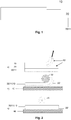
- a further subject of the present invention is the above-described adhesive tape ( Fig. 1 . Fig. 3 ) comprising (iii) at least one adhesive layer containing at least one liquid adhesive having a loss factor tan delta (quotient loss modulus G "/ storage modulus G ') greater than or equal to 2, preferably greater than or equal to 3, greater than or equal to 4, more preferably greater than or equal to 5 Loss factor is preferred because with increasing tan ⁇ , the cleavage of the bond layer can be easily brought about.
- tan delta quotient loss modulus G "/ storage modulus G '
- the at least one bonding layer is in the form of a layer, which in particular has at least one liquid adhesive having a thixotropic or pseudoplastic flow behavior with a zero viscosity of less than or equal to 1000 Pas.
- the zero viscosity is derived by extrapolation of complex viscosity measurements according to ISO 6721-10 at 23 ° C at different frequencies for zero shear rate.
- the respective adhesive layer can each have at least one Liquid adhesive with the same flow behavior or a combination of at least two liquid adhesives having different flow behavior.
- liquid adhesive mixtures of different liquid adhesives can be used.
- the advantage of a liquid adhesive with pseudoplastic flow behavior is the easier storage, since the adhesive has a higher viscosity at rest and thus at rest the risk of leakage of the liquid adhesive from the composite, in particular from the adhesive tape according to the invention, is lower. Due to the reduction in viscosity under shear or strain, such a bonding layer can still be easily split despite the higher quiescent viscosity (zero viscosity).
- the advantage of a liquid adhesive with thixotropic flow behavior is the easier storage, since the adhesive has a higher viscosity at rest. Prior to splitting, the adhesive is placed in a lower viscous state by introducing mechanical energy, for example, vibrations, which is initially maintained by the thixotropy to facilitate splitting.
- a liquid adhesive with dilatant flow behavior may also be advantageous since such a liquid adhesive is less likely to flow out when stored under pressure, for example, the winding pressure in a roll of adhesive tape.
- the zero viscosity is preferably below 100 Pas, since otherwise the splitting forces can become too high.
- the at least one bonding layer comprises at least two layers, each of which has at least one liquid adhesive with opposite flow behavior.
- an embodiment comprises a bonding layer comprising a layer of at least one pseudoplastic liquid adhesive and a layer of at least one dilatant liquid adhesive.
- the yield point in rheology is the marginal stress to be applied, beyond which a substance changes from elastic elongation to flow (that is, from non-permanent to permanent deformation).
- the shear stress ramp test (Stress Ramp Test) is used to determine any yield stress. In this case, a sample is subjected to a shear stress, which increases continuously with time. The shear stress at which the sample begins to flow is referred to as yield point, yield stress.
- the test is detailed in Rüdiger Brummer "Rheology Essentials of Cosmetic and Food Emulsions", Springer, 2005, pages 65 to 67 described.
- the at least one adhesive layer may comprise at least one or more liquid adhesive layers, which may be arranged side by side and / or one above the other.
- the thickness of the at least one adhesive layer in the adhesive tape according to the invention is in particular greater than or equal to 0.5 .mu.m to less than or equal to 1000 .mu.m, preferably greater than or equal to 0.5 .mu.m to less than or equal to 500 .mu.m, greater than or equal to 1 .mu.m to less than or equal to 500 .mu.m, greater than or equal to 2 .mu.m to less than or equal to 200 ⁇ m (examples, Table 2).
- the thickness of the bond coat depends on the liquid adhesives used, the nature of the manufacturing process, in particular the putty or diffusion during storage, and the intended use.
- (iii) has at least one, in particular original and / or at least one, in particular at least Once split, bonding layer in the set state, a cohesion greater than or equal to 150 N / cm 2 , measured in a dynamic shear test according to ISO 29862 with a layer thickness of 100 microns, wherein the failure is cohesive.
- the at least one bonding layer has at least one liquid adhesive with a cohesive state in a set state of greater than or equal to 150 N / cm 2 .
- the bonding substrate should be chosen so that the bond layer fails cohesively.
- the advantage of the above-described embodiment of the adhesive tape according to the invention with (iii) at least one adhesive layer, in particular with the above-described cohesion, is the improved flow of the adhesive tape and thus an excellent barrier effect, as shown by the water vapor permeation rate (see Table 3).
- the improved flow shows up in an improved wetting of the surface of a substrate and in a preferably continuous contact between the adhesive tape and the surface of the substrate without the formation of pores at the interface between the adhesive layer and the surface of the substrate.
- the adhesive tape section comprises (i) at least one carrier layer, preferably a pressure-sensitive adhesive, and (iii) two adhesion layers, wherein the first adhesion layer on the first surface of the at least one carrier layer and the second adhesive layer is arranged on the second surface of the at least one carrier layer and the opposite surface of the respective adhesive layer is in each case covered with (ii) a cover layer, preferably a liner ( Fig. 5 ).
- the two adhesive layers may each comprise the same liquid adhesive or different liquid adhesives. In this embodiment, it is particularly advantageous if the viscosities of the liquid adhesives are different.
- a further subject of the present invention is an adhesive tape comprising (iii) at least two adhesive layers ( Fig. 5 ), wherein the first adhesive layer comprises at least one liquid adhesive having a viscosity which deviates from the viscosity of the liquid adhesive of the second bonding layer.
- the viscosity of the respective liquid adhesives in the two bonding layers preferably differs from one another by a factor of 2, particularly preferably by a factor 5.
- a corresponding difference in viscosity can also be achieved by introducing or removing energy. For example, one side of the adhesive tape can be cooled or heated prior to splitting become.
- the adhesive tape according to the invention comprises at least one cover layer, at least one adhesion layer as defined above and at least one pressure-sensitive adhesive, as in US Pat Fig. 1 and, optionally, at least one second cover layer, in particular for temporary covering and protection of the pressure-sensitive adhesive during storage and transport.
- An example of a pressure-sensitive adhesive of the invention is T3, as described in Table 1 and the examples.
- the adhesive tape (ii) according to the invention comprises at least one cover layer, (i) in the form of a carrier layer, a mixture of at least one pressure-sensitive adhesive and at least one settable liquid adhesive, preferably comprising an epoxy resin, and (i) optionally at least one second cover layer.
- the construction of this embodiment corresponds to that in FIG Fig. 3 shown Arrangement, wherein, in particular before storage, instead of the bonding layer, the above-described mixture is present. After the at least one liquid adhesive emerges from the mixture according to the invention, in particular during storage, a bonding layer is formed. Examples of such mixtures are T1 and T2 as described in Table 1 and Examples.
- the adhesive tape (ii) according to the invention comprises at least one cover layer, (i) at least one activatable adhesive as support layer, (iii) at least one adhesion layer according to the above definition, analogous to Fig. 1 and (i) optionally at least one second cover layer.
- topcoat in the context of the invention, preference is given to using liners, preferably PET foils.
- Pressure-sensitive adhesive tapes which are coated with adhesives on one or both sides, are usually wound into a roll in the form of an Archimedean spiral at the end of the production process.
- the adhesive tapes before wrapping with a cover material (as a release material designated) or a cover layer covered, which is wound up together with the adhesive tape.
- cover material as a release material designated
- liners are also used to cover pure adhesives (transfer adhesive tape) and adhesive tape sections (for example labels). Another function of such liners is the protection of the respective adhesive, in particular of the at least one bonding layer, from contamination to the targeted use of the respective adhesive tape, in particular of the adhesive tape according to the invention.
- the at least one cover layer in particular the at least one liner, is used not only for the functions hitherto known in the prior art, but preferably as a metering aid and application aid.
- a cover layer, in particular a liner, in the sense of the invention is used for the cleavage of the at least one bond layer, wherein the liner is peeled off from the at least one bond layer.
- cover layers in the sense of Invention temporary cover layers, which are deducted when using the adhesive tape according to the invention.
- a liner is applied to a bonding layer according to the invention which has already been split at least once. Subsequently, the, as metering aid and application aid, newly applied liner is removed and thus the bond layer split again and simultaneously metered. The cleaved adhesive layer adhering to the new liner can then be applied again to another substrate.
- a liner is not part of an adhesive tape, but only a temporary tool for its production, storage or for further processing, in particular the use according to the invention as dosing aid and application aid.
- the composite is only temporary and not permanent because the liner is preferably peeled off with at least a portion of the liquid adhesive of the at least one adhesive layer.
- a prior art liner consists of at least one abhesive layer (release layer) to reduce the adhesion tendency of adherend products to these surfaces (release function). This layer can be applied to a carrier material.
- the material of the abhesive release layer is preferably selected from the group consisting of silicones, fluorinated silicones, silicone copolymers, waxes, carbamates, fluoropolymers and polyolefins or mixtures of two or more of the substances mentioned.
- the at least one cover layer is a liner without release layer which is selected from the group comprising paper, polymer-coated paper, nonwoven, polymer-coated nonwoven, film, film comprising biaxially stretched polyethylene terephthalate, polybutene, polypropylene, polyethylene, monoaxially stretched polypropylene, biaxially stretched polypropylene or polyethylene, polyolefin and polyester, and combinations of at least two of said compounds.
- polyolefin films polypropylene and polyethylene films
- polyester films are used.
- a liner with at least one release layer can be used.
- the abhesive release layer is selected from silicones, fluorinated silicones, silicone copolymers, waxes, carbamates, fluoropolymers and polyolefins, or mixtures of at least two of said compounds.
- Particularly preferred is an etched PET film.
- a liner without abhesive layer is used as the at least one cover layer, a liner without abhesive layer.
- a liner has a positive influence on the splitting process of the at least one bonding layer. Preferably, this facilitates a homogeneous cleavage of the bond layer.
- the bond layer is homogeneously split in its average layer thickness (standard deviation plus / minus less than or equal to 20%) over at least part of the area, preferably over the whole area.
- Homogeneously split means that a bonding layer which is homogeneously split in its layer thickness is obtained on the peeled liner (cover layer), a substrate and / or on a carrier layer.
- a bonding layer, in particular at least once split has a homogeneous layer thickness after cleavage, if its layer thickness over the surface of the adhesive tape section used has a standard deviation of plus / minus less than or equal to 20%, preferably less than or equal to 10%, particularly preferably less than or equal to 5%, does not exceed.
- the release force which is required to release the bond layer from the liner is higher than the force required to split the bond layer.
- a liner which has a surface energy of more than 30 mN / m, preferably more than 38 mN / m, at 23 ° C. and a relative atmospheric humidity of 50%.
- the surface energy was measured as the wetting angle, as explained in the examples.
- a fissile adhesive tape according to the invention comprising at least one cover layer with a surface energy of greater than or equal to 30 mN / m, measured at 23 ° C and a relative humidity of 50%, preferably greater than or equal to 38 mN / m also subject of the present invention.
- a separation force required for separating the bonding layer according to the invention from the at least one covering layer is achieved than the separating force required for splitting the bonding layer. Consequently, when the cover layer and / or carrier layer are removed, the adhesive layer is split and not peeled off from the cover layer or carrier layer.
- the at least one bonding layer can be cleaved at least once, in particular by peeling off the at least one backing layer and / or the at least one cover layer, as in US Pat Figures 2 and 4 shown schematically.
- the at least one bonding layer is preferably multiply cleavable, preferably cleavable at least twice, as shown schematically in FIG. B, wherein the cleaving takes place each time by peeling off a carrier layer or a cover layer.
- the cleavage of the at least one bonding layer can be carried out at least once or several times. Wherein the cleavage is always from the same side, for example in the case of a bonding layer provided on one side for bonding, in particular when the at least one backing layer is designed as a pressure-sensitive adhesive ( Fig. 2 ), can be done. Alternatively, according to the invention, the cleavage can also take place from both sides of the bonding layer, for example in the case of a bonding layer which can be cleaved on both sides and provided for bonding, in particular a bonding layer covered by two liners (US Pat. Fig. 4 ).
- a third, fourth and further cover layer in particular a temporary cover layer, can be newly applied to the exposed bond layer split at least once.
- the splitting process can be repeated, as already described.
- an adhesive tape according to the invention in which an adhesion layer which is at least once split and has a reduced layer thickness, based on the layer thickness (iii) of the at least one original adhesion layer, is present on the at least one support layer and on the at least one cover layer.
- the bond layer which has been split at least once in the adhesive tape according to the invention, is obtained by peeling off (i) the at least one carrier layer and / or (ii) At least one cover layer available, in particular by peeling off the original bonding layer or the already at least once split bond layer.
- the splitting can be repeated several times, at least a second, third, fourth and fifth times.
- the columns are in Figures 2 and 4 shown schematically. The possible frequency of cleavage depends on the starting layer thickness and the complex viscosity of the bond layer.
- the at least one bonding layer having a complex viscosity of less than or equal to 10 Pas, measured according to ISO 6721-10 at 23 ° C. and a frequency of 1 rad / s preferably has a layer thickness of less than or equal to 50 ⁇ m, preferably less than or equal to 40 ⁇ m, less than or equal to 30 ⁇ m, less than or equal to 25 ⁇ m, less than or equal to 15 ⁇ m, particularly less than or equal to 10 ⁇ m, in particular less than or equal to 5 ⁇ m, 4 ⁇ m, 3 ⁇ m, 2 ⁇ m and particularly preferably less than or equal to 1 ⁇ m, for example 500 nm , 400 nm, 300 nm and 200 nm, because if the layer thickness of the bond layer is too large, there is a risk of the low-viscosity liquid adhesive emerging from the bond.
- the at least one bonding layer having a complex viscosity of less than or equal to 1 Pas has a layer thickness of less than or equal to 10 ⁇ m, preferably less than or equal to 5 ⁇ m, less than or equal to 3 .mu.m, more preferably less than or equal to 1 .mu.m, for example 500 nm, 400 nm, 300 nm and 200 nm.
- low-viscosity adhesives have the advantage that it is also easier to produce very thin adhesive layers. Since the bond strengths can decrease with very thin layer thicknesses, the preferred layer thickness of a bond layer having a complex viscosity of less than or equal to 10 Pas is between greater than or equal to 1 ⁇ m and less than or equal to 25 ⁇ m.
- the adhesive tape according to the invention comprises at least two adhesive layers, the first and second adhesive layers may have deviating or identical viscosities.
- Adhesive layers comprising at least one high-viscosity or pasty liquid adhesive can be used alone or in combination with adhesive layers comprising low-viscosity liquid adhesives.
- Highly viscous or pasty liquid adhesives have a complex viscosity of greater than or equal to 10 5 mPas, and / or have in particular a tan delta less than or equal to 2, and may have a layer thickness greater than or equal to 10 .mu.m, preferably greater than or equal to 50 .mu.m, preferably greater than or equal to 200 .mu.m, particularly preferably greater than or equal to 500 .mu.m.
- the at least one bonding layer containing at least one high-viscosity liquid adhesive preferably has a layer thickness of greater than or equal to 25 ⁇ m to less than or equal to 200 ⁇ m.
- the at least one bonding layer containing at least one high-viscosity liquid adhesive preferably has a layer thickness of greater than or equal to 25 ⁇ m to less than or equal to 200 ⁇ m.
- highly viscous liquid adhesives have a low flowability, they are preferably used for very thick adhesive layers, in particular for layer thicknesses greater than or equal to 200 ⁇ m, 300 ⁇ m, 400 ⁇ m and particularly preferably greater than or equal to 500 ⁇ m.
- the preferred layer thickness is greater than or equal to 25 ⁇ m to less than or equal to 200 ⁇ m. Bonding layers greater than or equal to 200 ⁇ m may cause adhesive leakage from the composite if the viscosity is too low.
- the at least one bonding layer and / or backing layer of the adhesive tape according to the invention comprises at least one liquid adhesive which has a contact angle, measured between a drop of the at least one liquid adhesive and (ii) the cover layer lying below the drop is less than or equal to 90 °, measured at room temperature of 23 ° C and 50% relative humidity by dropping 4 ul of the liquid adhesive.
- the contact angle is less than or equal to 70 °, less than or equal to 50 °, particularly preferably less than or equal to 30 °, in particular measured between at least one liquid adhesive and a PET film as cover layer.
- Such a contact angle shows a high affinity of the liquid adhesive to the cover layer and, with a latent incompatibility of the liquid adhesive in the support layer, positively influences a diffusion of the at least one liquid adhesive to the cover layer. This, in turn, promotes leakage of the liquid adhesive from the carrier layer during storage. Furthermore, this leads to a good wetting of the liner by the liquid adhesive, in particular during storage, and subsequently to a good splitting, in particular homogeneous gaps when removing the at least one cover layer, in particular of the liner, from the at least one adhesive layer.
- the adhesive tape of the invention is readily storable, in particular over a period of greater than or equal to 3 days, preferably greater than or equal to 5 days, greater than or equal to 10 days, in particular less than or equal to 3 years, preferably less than or equal to 2 years, less than or equal to 1 year, most preferably less than or equal to 6 months.
- Storage can take place at temperatures from 0 ° C to 150 ° C. At temperatures of more than 120 ° C there is a risk that the liquid adhesive already hardens.
- the specified storage periods do not define the duration of the leakage of the at least one liquid adhesive, but only the smallest possible storage time of the adhesive tape of the invention without affecting the properties of the adhesive tape, in particular the at least one leaked bonding layer.
- the at least once split, bonded and set adhesive layer and / or the at least one carrier layer of the adhesive tape according to the invention have a Wasserdampfpermeationsrate (WVTR), measured according to ASTM F-1249 at 38 ° C and 90% relative humidity and based on a layer thickness of 50 microns, of less than or equal to 50 g / m 2 per day, preferably less than or equal to 40 g / m 2 per day, less than or equal to 30 g / m 2 per day, more preferably less than or equal to 20 g / m 2 / day (see Table 3).
- WVTR Wasserdampfpermeationsrate
- This water vapor permeation rate has, in particular, a bond layer bonded to at least one substrate and cleaved at least once after the at least one liquid adhesive has set in the at least one bond layer and / or carrier layer. Consequently, according to the invention, a substrate, in particular an electronic component, using the adhesive tape according to the invention, in particular the adhesive layer, is excellently encapsulated, so that an electronic component encapsulated according to the invention has an increased service life (examples, Table 3).
- the setting takes place after splitting and bonding of the bonding layer according to the invention.
- the setting can be effected by physical processes (gel formation, hydration, cooling, evaporation of volatile constituents) and / or chemical reaction (polymerization, crosslinking, oxidation, vulcanization).
- the adhesive layer molecules are usually already in their final macromolecular state at the time of application; chemical reactions dependent on the parameters of temperature and time no longer take place.
- the final strength results directly after the end of the physical setting processes.
- the final strength and the material-mechanical behavior is a function of time and temperature that is specific to the particular curing mechanism.
- the at least one liquid adhesive is a chemically setting system, which is the initiator for the chemical reaction (below 200 ° C., in particular below 130 ° C., since many reactions take place at sufficiently high temperature even without an initiator).
- the initiator for the chemical reaction is missing, for example, a liquid reactive resin.
- initiators are often solids that are often not very soluble in the reactive resins, such initiator-free liquid adhesives can be smoothed out to thin layers without interfering particles or additional solvents.
- the setting of the adhesive layer starts from the carrier layer. This can be solved by containing the carrier layer a (latent) initiator for the setting reaction of the liquid adhesive. Only by a trigger, such as heat or radiation, preferably UV, the setting reaction is initiated.
- the setting of the at least one liquid adhesive is initiated by the at least one carrier layer.
- the carrier layer has a composition that is initiated by a similar or similar chemical reaction that propagates across the layer boundary into the bond layer.
- Particularly preferred here is the cationic crosslinking, as used for example in epoxides, since this type of reaction shows a pronounced dark reaction.
- Another object of the invention is an adhesive tape comprising (iii) at least one adhesive layer having at least one chemically setting liquid adhesive without initiator and at least one carrier layer comprising at least one activatable adhesive, preferably a reactive activatable adhesive comprising at least one crosslinking compound, such as polymers and / or reactive resins which triggers the setting of the at least one liquid adhesive in the at least one bonding layer.
- the setting is preferably triggered by a trigger, such as heat or radiation, wherein this reaction radiates into the bonding layer and propagates through the layer boundaries into the bonding layer.
- Preference is given to cationic crosslinking, as for example in the case of epoxides. In this way, chemical bonds between the respective layers are preferably produced which produce a good layer composite at least between the carrier layer and the bond layer.
- the setting, in particular the crosslinking, of the at least one, in particular liquid or pasty, liquid adhesive is preferably carried out by evaporation or evaporation of water or organic solvents (for example solvent adhesives, dispersion adhesives), gelatinization (for example plastisols), reaction with exclusion of air and metal contact (For example, anaerobic adhesives), reaction by atmospheric moisture (for example cyanoacrylates, one-component polyurethanes), reaction by heat (for example, one-component reaction adhesives), reaction by the influence of radiation (for example, UV or electron beam curing acrylates), reaction after In -Contacting of two or more components (for example, cold and thermosetting reaction adhesives), evaporation or evaporation of organic solvents and subsequent reaction of two components (for example, solvent-containing reactive adhesives), these Abbindeme can take place at normal or elevated temperature.
- the setting is triggered by evaporation or evaporation of water or organic solvents (for example solvent adhesives, dispersion adhesives),
- the adhesive tape according to the invention may be in the form of a stamped sheet, sheet, label, a roll and / or band and cut into any desired shape and then used, in particular cleaved and glued.
- an adhesive tape section in particular in the form of a sheet, stamped sheet or roll, in each case comprising at least one inventive (i) carrier layer, (ii) top layer and (iii) adhesive layer. It may completely cover or even leave portions of the area bounded by its outer periphery, such as a frame-shaped die-cut or a perforated section.
- adhesive tapes may also be included, such as additional adhesive or support layers, primers or release layers, or layers having specific physical functions (e.g., optically active layers, permeation-inhibiting or promoting layers, thermal or electrically conductive layers).
- additional adhesive or support layers such as primers or release layers, or layers having specific physical functions (e.g., optically active layers, permeation-inhibiting or promoting layers, thermal or electrically conductive layers).
- the at least one carrier layer according to a preferred alternative b) comprises a mixture of at least one pressure-sensitive adhesive and at least one liquid adhesive and the cover layer is brought into contact with this carrier layer.
- an adhesive layer is formed between the carrier layer and the cover layer, in particular by the leakage of the at least one liquid adhesive from the carrier layer, preferably during storage. The leakage of the liquid adhesive takes place in particular at the interface between the carrier layer and the cover layer. Subsequently, an inventive adhesive tape is obtained.
- the at least one adhesion layer that is present at least over the entire area is the original, non-cleaved, adhesive layer which, according to the process according to the invention, has an alternative a) or c) by application to an auxiliary carrier, preferably to a cover layer and / or carrier layer, or to an alternative b ) by diffusion from the at least one Carrier layer is obtained.
- This bonding layer is used in the inventive use for bonding, encapsulation and protection of surfaces from permeates, in particular for use as protection of electronic components from permeates.
- a further subject of the present invention is a split adhesive tape, in particular at least once split adhesive tape, obtained by splitting a fissile adhesive tape according to the invention of the type described above and obtainable according to the above-described method, wherein at least one support layer and / or (ii) during cleaving (i) the at least one cover layer is peeled off from (iii) at least one bonding layer which is present at least partially, wherein one adhering to (i) the backing layer and / or (ii) the cover layer, at least once split, at least partially existing adhesive layer is obtained, which has a reduced layer thickness, based on the layer thickness (iii) of the at least one original bonding layer.
- a spliced adhesive tape in particular at least once, preferably an adhesion layer which has been split at least once and which in each case has an adhesion layer which is reduced in the layer thickness and has at least a partial area (for example Fig. 2 b) and Fig. 4 b) or d) ), based on the layer thickness of the at least one original bonding layer.
- This is available by stripping ( Fig. 2 and Fig. 4 ) of (i) at least one carrier layer and / or (ii) the at least one cover layer, wherein in each case at least a portion of the at least one liquid adhesive adheres to the carrier layer and / or cover layer.
- a proportion of the original bond coat remains greater than or equal to 10 wt% to less than or equal to 90 wt%, preferably greater than or equal to 20 wt% to less than or equal to 80 wt%, greater than or equal to 30 wt% to less than or equal to 70% by weight, more preferably greater than or equal to 40% by weight to less than or equal to 60% by weight, based in each case on the layer thickness (iii) of the original bonding layer.
- Another object of the present invention is the use of the inventive adhesive tape of the type described above and obtainable by the process according to the invention, and in particular a at least once split Adhesive tape, for multiple use and bonding, with each use, the bond layer is split and their layer thickness is reduced.
- the use takes place by peeling off (i) the at least one carrier layer and / or (ii) the at least one cover layer, wherein an at least partial-area, preferably full-area, at least twice-split adhesive layer is obtained with each use.
- the use according to the invention of the adhesive tape according to the invention of the type described above and obtainable by the method according to the invention, and in particular of an adhesive tape split at least once, comprises the use as a barrier adhesive tape, for the formation of barrier layers, for the coating, bonding and / or encapsulation of surfaces, for bonding, adhesion and fixing at least a first surface to an at least second surface to protect surfaces from permeation, in a process for coating, bonding and / or encapsulating surfaces, in a process for coating, bonding and / or encapsulating permeate Materials, of surfaces of electronic assemblies and electronic components, in particular of displays, monitors, LEDs, OLEDS and other optoelectronic arrangements, for structural bonding, for structural bonding with a tensile shear strength greater than or equal to 1 MPa measured according to DIN EN 1465 at room temperature of 23 ° C and a relative humidity of 50%, for producing a bond with a high peel resistance, for producing a permanent bond between at least two materials and for
- Such rough substrates also include substrates with steps, for example substrates provided with conductive structures for electric current whose step height is greater than or equal to 1 ⁇ m, in particular greater than or equal to 10 ⁇ m.
- (Opto) Electronic arrangements include inorganic or organic electronic structures, such as organic, organometallic or polymeric semiconductors or combinations thereof. These arrangements and products are rigid or flexible depending on the desired application.
- Examples of (opto) electronic applications include electrophoretic or electrochromic structures or displays, organic or polymeric light-emitting diodes (OLEDs or PLEDs) in display and display devices or called lighting, electroluminescent lamps, light-emitting electrochemical cells (LEECs), organic solar cells , prefers Dye or polymer solar cells, inorganic solar cells, preferably thin-film solar cells, in particular based on silicon, germanium, copper, indium and / or selenium, perovskite solar cells, organic field effect transistors, organic switching elements, organic optical amplifiers, organic laser diodes, organic or inorganic sensors or also listed organic or inorganic based RFID transponder.
- OLEDs or PLEDs organic or polymeric light-emitting diodes
- LEECs light-emitting electrochemical cells
- organic solar cells prefers Dye or polymer solar cells, inorganic solar cells, preferably thin-film solar cells, in particular based on silicon, germanium, copper, indium and / or selenium
- the adhesive tape according to the invention in particular the at least one bonding layer according to the invention, is suitable for realizing a sufficient lifetime and function of (opto) electronic arrangements in the field of inorganic and / or organic (opto) electronics, especially in the field of organic ( Opto -) electronics, very well suited.
- (opto) electronic arrangements in particular in the field of inorganic and / or organic (opto) electronics, are protected in particular against both water vapor and oxygen.
- the encapsulation of the invention ensures protection during the extended life of the electronic device, reducing or even preventing the degradation of performance over the period of use. Preferably, a bubble-free encapsulation is achieved.
- the bonding layer according to the invention which according to the invention is brought into contact with a surface of a substrate, in particular with the cover in the case of an encapsulation structure for an electronic arrangement, advantageously produces a particularly good wetting of this surface, whereby the interfacial permeation is reduced.
- the application of the bonding layer according to the invention in combination with the at least one carrier layer simplifies handling and achieves simple and accurate metering of the amount of liquid adhesive.
- Substrate according to the invention comprises any material to which adheres the bonding layer according to the invention.
- the substrate comprises at least one material or material or at least partial areas which can be encapsulated and protected against penetration of permeates, such as oxygen and / or water or water vapor.
- permeates such as oxygen and / or water or water vapor.
- Such substrates can be found in particular in electronic components and arrangements, in particular in optoelectronic units.
- the adhesive tape according to the invention such areas are encapsulated.
- substrates are preferred an average roughness r z or steps of more than 1 .mu.m, in particular more than 10 microns, understood.
- Encapsulation in the sense of the invention means the at least partial encapsulation of at least one area of the substrate.
- the coating of such materials and / or surfaces of a substrate which have an increased sensitivity to physical agents, in particular penetration and / or permeation of permeates.
- Permeates include a variety of low molecular weight organic or inorganic compounds that are adsorbed by sorption at the interface, such as gases, vapors, or liquids or suspended solids, by diffusion or by desorption, such as an adsorbate, which acts as a gas on the other side of the solid escape. Permeate penetrate the solid or the solid material through pores or molecular spaces. Permeates include in particular water vapor and oxygen.
- Bonding in the sense of the invention is a compound which is produced by the bonding layer according to the invention, specifically between bond layer and a substrate, a carrier layer, cover layer and / or a second substrate ( Figures 1-6 ).
- Adhesive tape in the sense of the invention comprises transportable and storable wound-up rolls and banderoles as well as adhesive tape sections in the usual shapes and dimensions, such as stamped sheets, sheets and labels, in particular pieces cut from a roll or banderole, diecuts, sheets and labels.
- the adhesive tape of the invention is used for structural bonding.
- structural bonding is not uniformly defined. However, in general and within the meaning of the invention, a possible structural design with high strength or rigidity is understood to mean largely uniform and favorable stress distribution. Furthermore, this term also characterizes the requirement for bonding, the mechanical and aging stresses imposed on it permanently without failure (according to Have not: Glueing, 6th edition, 2009, Berlin, Springer, page 4 ). Structural pressure-sensitive adhesives have, in particular, very high peel resistance. In order to achieve this, they usually have (for example, thermally) crosslinking components (Habenicht, page 194).
- Structural pressure-sensitive tapes bridge the gap between the advantages of conventional pressure-sensitive adhesive tapes and reactive adhesives.
- the principle consists, for example, in the addition of latent-reactive polyaddition compounds, for example epoxy resin / hardener mixtures, to the pressure-sensitive adhesive polymer.
- Required is a (for example thermal) curing after preparation of the pressure-sensitive adhesive (furnace, hot air, contact heat, IR radiation, dielectric heating), which is given, for example, in applications in the body manufacture.
- the advantage of these formulations lies in the immediate adhesion after the joint fixation and the high strengths, which can exceed the deformation strengths of the joining parts with appropriate dimensioning of the adhesive surfaces. Due to the additional networking eliminates the additional disadvantage of creep at creep loads.
- the structural properties mentioned can be achieved, for example, by polyesterification of the polybutadiene functionalized with OH and COOH groups as a base material (Habenicht, page 246).
- the invention accordingly also provides for the use of the adhesive tape according to the invention for structural and semi-structural bonding, wherein the adhesive tape according to the invention comprises (i) at least one backing layer comprising at least one PSA, (iii) at least one bond layer comprising at least one liquid adhesive and (ii) at least a cover layer, preferably a liner.
- the at least one carrier layer comprises a pressure-sensitive adhesive, preferably based on at least one polymer at least one vinyl monomer and at least one diene monomer, wherein diene monomers are selected from acrylate, methacrylate, isoprene, isoprene derivatives and vinyl monomers are selected from aromatic vinyls, preferably styrene, particularly preferred are copolymers of at least two of the aforementioned monomers, particularly preferably from styrene and isoprene.
- the at least one bonding layer comprises at least one liquid adhesive, preferably selected from epoxy resins and mixtures of epoxy resins / hardener mixtures.
- the liquid adhesive described is admixed with the composition of the pressure-sensitive adhesive comprising in the at least one carrier layer, preferably comprising copolymers based on styrene and diene.
- a preferred use of the adhesive tape according to the invention is the bonding on rough substrates. Bonding on rough substrates places particularly high demands on the flowability of adhesives in pressure-sensitive adhesive tapes. As a result of the bonding layer exposed in the inventive use, in particular when the at least one bonding layer is split, comprising at least one liquid adhesive, a very flowable anchoring layer is provided. Thus, an advantageous use is the bonding on a substrate with an average roughness r z or steps of more than 1 .mu.m, in particular more than 10 microns.
- another object is an electronic component, in particular an electronic arrangement described above, which has been encapsulated in a use according to the invention with an adhesive tape according to the invention, in particular at least one bond layer cleaved at least once, wherein the electronic component at least on one surface before permeation is encapsulated, preferably the complete permeate accessible, in particular sensitive, surface is encapsulated (examples, Table 3).
- the softening temperature of copolymers, hard and soft blocks and uncured reactive resins is determined calorimetrically by differential scanning calorimetry (DSC) according to DIN 53765: 1994-03. Heating curves run at a heating rate of 10 K / min. The samples are measured in AI crucibles with perforated lid and nitrogen atmosphere. The second heating curve is evaluated. In the case of amorphous materials, glass transition temperatures occur; in the case of (semi) crystalline materials, melting temperatures. A glass transition is recognizable as a step in the thermogram. The glass transition temperature is evaluated as the center of this stage. A melting temperature can be recognized as a peak in the thermogram. The melting temperature is the temperature at which the highest heat of reaction occurs.
- the molecular weight determinations of the number-average molecular weights M n and the weight-average molecular weights M w were carried out by means of gel permeation chromatography (GPC).
- the eluent used was THF (tetrahydrofuran) containing 0.1% by volume of trifluoroacetic acid. The measurement was carried out at 25 ° C.
- the precolumn used was PSS-SDV, 5 ⁇ , 10 3 ⁇ , ID 8.0 mm ⁇ 50 mm.
- the columns PSS-SDV, 5 ⁇ , 10 3 and 10 5 and 10 6 were used , each with ID 8.0 mm x 300 mm.
- the sample concentration was 4 g / l, the flow rate 1.0 ml per minute. It was measured against polystyrene standards.
- MMAP is the mixed methylcyclohexane aniline cloud point determined using a modified ASTM C 611 method. Methylcyclohexane is used for the heptane used in the standard test procedure. The process uses resin / aniline / methylcyclohexane in a ratio of 1/2/1 (5 g / 10 ml / 5 ml) and the cloud point is determined by cooling a heated, clear mixture of the three components until complete turbidity is just entering ,
- the DACP is the diacetone cloud point and is determined by cooling a heated solution of 5 g of resin, 5 g of xylene and 5 g of diacetone alcohol to the point where the solution becomes cloudy.
- the adhesive resin softening temperature is carried out according to the relevant method known as Ring and Ball and standardized according to ASTM E28.
- a Ring-Ball-Automat HRB 754 from Herzog is used to determine the adhesive resin softening temperature of the resins. Resin samples are first finely ground. The resulting powder is placed in a brass cylinder with bottom opening (inner diameter at the upper part of the cylinder 20 mm, diameter of the bottom opening of the cylinder 16 mm, height of the cylinder 6 mm) and melted on a heating table. The filling amount is chosen so that the resin after melting completely fills the cylinder without supernatant. The resulting specimen, including the cylinder, is inserted in the sample holder of the HRB 754. Glycerol is used to fill the tempering bath, provided that the adhesive resin softening temperature is between 50 ° C and 150 ° C.
- the test balls have a diameter of 9.5 mm and weigh 3.5 g.
- the ball is placed above the specimen in the temperature control bath and deposited on the specimen. 25 mm below the cylinder bottom there is a catch plate, 2 mm above this a light barrier.
- the temperature is increased at 5 ° C / min.
- the ball begins to move through the bottom opening of the cylinder until it eventually stops on the catch plate. In this position, it is detected by the photocell and registered at this time, the temperature of the bath. There is a double determination.
- the adhesive resin softening temperature is the average of the two individual measurements.
- the complex viscosity, and thus the storage modulus and loss modulus, for adhesives is determined in the oscillatory shear experiment (dynamic mechanical analysis, DMA) under torsional stress at a temperature of 23 ° C. and a frequency of 1 rad / s.
- the test is described in detail in ISO 6721-10. He is driven under torsional loading in a shear rate controlled rheometer using a plate-plate geometry with a plate diameter of 25 mm.
- the loss factor tan ⁇ is determined by the quotient G" / G'. If the loss modulus G "is greater than the storage modulus G 'and thus tan ⁇ is greater than or equal to 1, then a flowable or liquid adhesive is present, but tan ⁇ is preferably greater than 2, particularly preferably greater than 5 (see Fig. 8 ).
- the wetting angle ⁇ between the liquid adhesive and a joining part is measured.
- the wetting angle which the liquid adhesive forms with a joining part is determined as a measure of the wettability of the adherend surface with the adhesive and thus the quality of the possible adhesive bond.
- the liquid adhesive according to the invention preferably has a wetting angle of less than or equal to 90 ° on the cover layer under the above conditions.
- An adhesive tape is glued and set between two glass plates, hardened in the examples, in particular by means of UV light (UV dose: sum UV-A + B + C, determined with the Power Puck from EIT, of 2000 mJ / cm 2 ). Thereafter, the bonded specimens were stored for one hour at 80 ° C. The composite is separated in a tensile tester at 50 mm / min at 23 ° C and 50% relative humidity so that the two glass plates were pulled apart at an angle of 180 °, and the maximum force in N / cm 2 determined. A quadratic test pattern with an edge length of 25 mm is examined. In addition, the type of breakage is determined. A distinction is made between a cohesive fracture (K), adhesive fracture (A) and a mixed fracture (M).
- K cohesive fracture
- A adhesive fracture
- M mixed fracture
- the water vapor permeation rate (WVTR) was measured according to ASTM F-1249 at a temperature of 38 ° C and a relative humidity of 90% and determined in g / m 2 per day. Bonded liquid adhesive or carrier material, each with a layer thickness of 50 ⁇ m, were used as test areas.
- the Wasserdampfpermeationsrate is less than or equal to 50 g / m 2 per day, more preferably less than or equal to 20 g / m 2 per day.
- a calcium test was performed. This one is in the FIG. 7 shown.
- a 10 ⁇ 10 mm 2 large, thin calcium layer 63 is deposited on a glass plate 61 in a vacuum and then stored under a nitrogen atmosphere.
- the thickness of the calcium layer 63 is about 100 nm.
- an adhesive tape 23 ⁇ 23 mm 2
- a thin glass pane 64 35 ⁇ m, Schott
- the thin glass pane 64 was laminated with a 100 ⁇ m thick PET film 66 by means of a 50 ⁇ m thick transfer adhesive tape 65 and an optically highly transparent acrylic PSA.
- the adhesive 62 is applied to the glass plate 61 in such a way that the adhesive 62 covers the calcium mirror 63 with an edge of 6.5 mm (AA) protruding on all sides. Due to the impermeable glass carrier 64 only the permeation through the adhesive tape or along the interfaces is determined.
- the test is based on the reaction of calcium with water vapor and oxygen, such as from AG Erlat et. al. in "47th Annual Technical Conference Proceedings-Society of Vacuum Coaters", 2004, pages 654-659 , and from ME Gross et al. in "46th Annual Technical Conference Proceedings-Society of Vacuum Coaters", 2003, pages 89-92 , is described.
- the light transmission of the calcium layer is thereby monitored, which increases by the conversion into calcium hydroxide and calcium oxide. This takes place in the described test setup from the edge, so that the visible surface of the calcium level is reduced. It is called the time to halving the light absorption of the calcium level as a lifetime.
- the method captures both the degradation of the surface of the calcium level from the edge and the selective reduction in the area as well as the homogeneous reduction of the layer thickness of the calcium level due to full-scale degradation.
- the measuring conditions used were 60 ° C and 90% relative humidity.
- the samples were glued with the specified layer thickness over the entire surface and without bubbles. Thereafter, the thin glass substrate was cured by UV light (dose: 120 mJ / cm 2 , UV-C measured between 250 and 260 nm, lamp type: undoped mercury radiator).
- the measured value (in h) was the average of three individual measurements.
- a water vapor permeation rate (Ca-WVTR) is also calculated.
- the mass of the evaporated calcium is multiplied by the factor 0.9 (mass ratio H 2 O / Ca for the reaction of conversion of metallic calcium to transparent calcium hydroxide) to determine the mass of einperme faced water vapor.
- This is based on the permeation cross section (circumferential length of the test setup x adhesive thickness) and the time to complete degradation of the calcium level.
- the calculated measured value is further divided by the width of the overlapping edge (in mm) and thus normalized to a permeation distance of 1 mm.
- the indication of Ca-WVTR is in g / m 2 per day.
- the layer thickness of the bond layer is determined gravimetrically.
- the known mass application is converted to the coated area in g / m 2 or g / cm 2 .
- this value is divided by the approximate density of 1 g / cm 3 , or, for example, a microscopic analysis can be carried out.
- SibStar 62 M SiBS (polystyrene block polyisobutylene block copolymer) from Kaneka with 20 wt .-% block polystyrene content.
- a polystyrene block-polyisobutylene block copolymer (Sibstar 62M, Kaneka) was selected as the polymer base.
- the proportion of styrene in the total polymer is 20 wt .-%.
- the molecular weight is 60,000 g / mol.
- the glass transition temperature of the polystyrene blocks is 100 ° C and that of the polyisobutylene blocks -60 ° C.
- the adhesive resin selected was Escorez 5300 (Exxon), a fully hydrogenated hydrocarbon resin.
- Uvacure 1500 (Dow) is a cycloaliphatic diepoxide (3,4-Epoxycyclohexylmethyl 3,4-epoxycyclohexanecarboxylate) and has a glass transition temperature of -53 ° C.
- toluene 300 parts
- acetone 150 parts
- boiling grade 60/95 550 parts
- the formulations were coated from solution onto a siliconized PET liner as a backing and dried at 120 ° C for 15 minutes.
- the patterns were covered with another layer of a siliconized, but more easily separating, PET liner as a topcoat.
- the liquid adhesive Uvacure 1500 (in a 25% solution in toluene, without photoinitiator) was spread on the etched foil as a bonding layer, so that a dried layer thickness of 0.8 ⁇ m resulted.
- the pressure-sensitive adhesive composition T1 carrier layer T1
- the easier-to-separate liner was removed and the adhesive layer of the liquid adhesive which had been spread out on the liners (cover layers) was laminated to the carrier layer T1 by means of a hand roller.
- adhesive tapes according to the invention comprising a carrier layer (PSA) with liquid adhesive (T1, T2) or without liquid adhesive (T3), a bonding layer (Uvacure) of different layer thickness and a cover layer (PET film or etched PET film) were prepared (Table 2).
- the liquid adhesive Uvacure 1500 (with 1% photoinitiator) as a bonding layer, so that a layer thickness of 24 microns resulted.
- another etched foil (cover layer) of the same type was laminated.
- an adhesive tape according to the invention comprising a carrier layer (etched PET film) without liquid adhesive, a bonding layer (Uvacure) and a cover layer (etched PET film) was prepared (Table 2).
- the PSA T2 was laminated as a carrier layer with the above-mentioned etched PET film as a liner and stored for 7 days at 23 ° C.
- the liquid adhesive enriched exclusively between cover layer and carrier layer, in particular at the interface to the etched PET liner (cover layer), and thus formed the adhesive layer according to the invention.
- No liquid adhesive film was formed on the side of the substrate covered with the siliconized liner.
- Table 2 summarizes the samples produced according to the invention (K1 to K11).
- Table 3 shows the samples tested in the shear text and life test. From Table 3 it can be seen that in K2 to K4 the cohesion [N / cm 2 ] decreases with increasing layer thickness.
- An adhesive tape K10 which after 24 hours storage at room temperature, in particular greater than or equal to 19 ° C. to less than or equal to 23 ° C., has a bond coat of 0.5 .mu.m at the interface between support layer T2 and cover layer (PET film) shows a high Cohesion of 340 N / cm 2 .
- the etched PET film could only be removed with great force due to its direct adhesion to the carrier layer T2, after the storage time the formed adhesive layer split according to the invention with little effort. Since a microscopic determination of the layer thickness was not possible, the layer thickness was estimated from equivalence considerations of splitting force and splitting behavior in comparison to the other experiments (in particular to K8) with about 0.5 ⁇ m.
- the dynamic shear tests further show that, although the strength of the bond for the patterns K1 - K4 does not increase compared to the comparative pattern T1, but the fracture pattern changes in the inventive use.
- the transition from the adhesion break in the pattern T1 to the cohesive failure in the bonds produced according to the invention shows the improved flow and thus the improved connection to the substrate.
- the cohesive breaking point was usually at the interface of the bond layer to the carrier layer.
- the pattern K8 shows that even without initiating the setting in the bonding layer, curing is achieved, which here is attributed to the propagation of the cationic crosslinking from the carrier layer into the bond layer.
- the investigated samples K3 and K8 also have an improved water vapor barrier in the life test (WVTR), which is attributed to the improved wetting of the substrate surface with the bond layer in the inventive use.
- WVTR water vapor barrier in the life test
- the adhesive tape according to the invention and the use according to the invention are advantageous for the encapsulation of permeates of sensitive electronic structures.
- the pattern K9 shows that also use after FIG. 3 and FIG. 4 leads to a successful bond, which here has semi-structural strength (> 1 MPa).
- Pattern K10 shows that this forms an effective layer of liquid adhesive that provides both higher strength and improved water vapor barrier (WVTR).
- Wetting angle measurements of the liquid adhesive on the etched PET revealed an angle of 20 ° while comparative measurements of the liquid adhesive on the siliconized PET liner showed a contact angle of 85 °. This indicates a preferred automatic formation of a bonding layer at a wetting angle between liquid adhesive and liner of less than 30 °.
- the loss factor tan delta ⁇ of the liquid adhesive Uvacure 1500 was determined to be 10.0 (without initiator addition).
- the flawless splitting behavior shows that a loss factor tan ⁇ of more than 5 is favorable for the splitting process, as in Fig. 8 shown.
Landscapes
- Chemical & Material Sciences (AREA)
- Organic Chemistry (AREA)
- Adhesive Tapes (AREA)
- Adhesives Or Adhesive Processes (AREA)
Claims (21)
- Bande adhésive séparable comprenant :(i) au moins une couche support (30, 11),(ii) au moins une couche de recouvrement (10) et(iii) au moins une couche de collage (20, 21) présente au moins sur une partie de la surface ayant une viscosité complexe inférieure ou égale à 1 000 Pas, mesurée selon ISO 6721-10 à 23 °C et à une fréquence de 1 rad/s,comprenant au moins un adhésif liquide décollable,
ladite au moins une couche de collage (20, 21) étant agencée entre (i) ladite au moins une couche support (30, 11) et (ii) ladite au moins une couche de recouvrement (10) . - Bande adhésive selon la revendication 1, caractérisée en ce que(i) ladite au moins une couche support (30) comprend :a) au moins une masse adhésive de contact oub) un mélange d'au moins une masse adhésive de contact et d'au moins un adhésif liquide décollable, ouc) au moins une masse adhésive activable ayant une viscosité complexe inférieure ou égale à 10 000 Pas, mesurée selon ISO 6721-10 à 23 °C et à une fréquence de 1 rad/s.
- Bande adhésive selon la revendication 1 ou 2, caractérisée en ce que
(iii) ladite au moins une couche de collage (20, 21) peut être obtenue par sortie dudit au moins un adhésif liquide de (i) ladite au moins une couche support (30) comprenant un mélange d'au moins un matériau de couche support, notamment d'une masse adhésive de contact, et d'au moins un adhésif liquide. - Bande adhésive selon la revendication 2 ou 3, caractérisée en ce que ladite au moins une masse adhésive de contact comprend au moins un composé à base d'acrylates, de (méth)acrylates, de polyuréthanes, de polyesters, de caoutchoucs naturels, de caoutchoucs de synthèse, de copolymères séquencés de styrène, de copolymères séquencés de styrène comprenant une séquence élastomère à base de séquences polydiène insaturées ou hydrogénées, de polyoléfines, de polymères fluorés et/ou de silicones ou de mélanges d'au moins deux des composés mentionnés.
- Bande adhésive selon l'une quelconque des revendications 1 à 4, caractérisée en ce que ledit au moins un adhésif liquide comprend de l'acétate de vinyle, de l'alcool polyvinylique, du polyvinylacétal, du polychlorure de vinyle, un (méth)acrylate, du polyamide, ainsi que des copolymères d'au moins deux des composés susmentionnés, de la cellulose, de l'urée, une résine de mélamine, une résine de phénol, un époxyde, un polyuréthane, un polyester, un composé polyaromatique, du chloroprène, du caoutchouc de nitrile, du styrène, du caoutchouc de butyle, un polysulfure et/ou de la silicone ou des mélanges d'au moins deux des composés mentionnés.
- Bande adhésive selon l'une quelconque des revendications 1 à 5, caractérisée en ce que ledit au moins un adhésif liquide comprend au moins une résine époxyde.
- Bande adhésive selon l'une quelconque des revendications 1, 5 ou 6, caractérisée en ce que (i) ladite au moins une couche support d) est une deuxième couche de recouvrement (11).
- Bande adhésive selon l'une quelconque des revendications 1 à 7, caractérisée en ce que (iii) ladite au moins une couche de collage est séparable au moins à une reprise.
- Bande adhésive selon l'une quelconque des revendications 1 à 8, caractérisée en ce qu'une couche de collage (20', 20", 21') présente au moins sur une partie de la surface, séparée au moins à une reprise, d'épaisseur de couche réduite, par rapport à l'épaisseur de couche de (iii) ladite au moins une couche de collage initiale (20, 21), est présente respectivement sur ladite au moins une couche support (30, 11) et sur ladite au moins une couche de recouvrement (10).
- Bande adhésive selon la revendication 9, caractérisée en ce que la couche de collage séparée au moins à une reprise (20', 20", 21') peut être obtenue en enlevant (i) ladite au moins une couche support (30, 11) et/ou (ii) ladite au moins une couche de recouvrement (10) .
- Bande adhésive selon l'une quelconque des revendications 1 à 10, caractérisée en ce que ladite au moins une couche de collage présente une viscosité complexe supérieure ou égale à 0,1 Pas et inférieure ou égale à 100 Pas, mesurée selon ISO 6721-10 à 23 °C et à une fréquence de 1 rad/s.
- Bande adhésive selon l'une quelconque des revendications 1 à 11, caractérisée en ce que ladite au moins une couche de collage (20, 21) ayant une viscosité complexe inférieure ou égale à 10 Pas, mesurée selon ISO 6721-10 à 23 °C et à une fréquence de 1 rad/s, présente une épaisseur de couche inférieure ou égale à 50 µm, ou ladite au moins une couche de collage (20, 21) ayant une viscosité complexe inférieure ou égale à 1 Pas, mesurée selon ISO 6721-10 à 23 °C et à une fréquence de 1 rad/s, présente une épaisseur de couche inférieure ou égale à 10 µm.
- Bande adhésive selon l'une quelconque des revendications 1 à 12, caractérisée en ce que l'angle de contact mesuré entre une goutte dudit au moins un adhésif liquide et la couche de recouvrement (10, 11) présente sous la goutte est inférieur ou égal à 90°, mesuré à 23 °C et 50 % d'humidité relative de l'air par égouttement de 4 µl de l'adhésif liquide.
- Bande adhésive selon l'une quelconque des revendications 1 à 13, caractérisée en ce qu'elle comprend au moins deux couches de collage (20, 21), la première et la deuxième couche de collage (20, 21) présentant des viscosités différentes ou identiques l'une de l'autre.
- Bande adhésive selon l'une quelconque des revendications 1 à 14, caractérisée en ce qu'elle peut être utilisée à plusieurs reprises, lors de chaque utilisation, en enlevant(i) ladite au moins une couche support (30, 11) ou(ii) ladite au moins une couche de recouvrement (10),(iii) ladite au moins une couche de collage (20, 21) étant séparée au moins à une reprise et son épaisseur de couche étant ainsi réduite.
- Bande adhésive selon l'une quelconque des revendications 1 à 15, sous la forme d'une pièce découpée, d'une feuille, d'une étiquette, d'un rouleau et/ou d'une banderole.
- Procédé de fabrication d'une bande adhésive selon l'une quelconque des revendications 1 à 16, comprenant les étapes suivantes :- ladite au moins une couche support (30, 11) est munie d'au moins une couche de collage (20, 21) ayant une viscosité complexe inférieure ou égale à 1 000 Pas, mesurée selon ISO 6721-10 à 23 °C et à une fréquence de 1 rad/s, comprenant au moins un adhésif liquide décollable, puis la couche de collage (20, 21) est mise en contact avec au moins une couche de recouvrement (10), ou- ladite au moins une couche de recouvrement (10) est munie d'au moins une couche de collage (20, 21) ayant une viscosité complexe inférieure ou égale à 1 000 Pas, mesurée selon ISO 6721-10 à 23 °C et à une fréquence de 1 rad/s, comprenant au moins un adhésif liquide décollable, puis la couche de collage (20, 21) est mise en contact avec au moins une couche support (30, 11), et- un composite comprenant (i) au moins une couche support (30, 11), (ii) au moins une couche de recouvrement (10) et au moins une couche de collage (20, 21) agencée entre la couche support (30, 11) et la couche de recouvrement (10), ayant une viscosité complexe inférieure ou égale à 1 000 Pas, mesurée selon ISO 6721-10 à 23 °C et à une fréquence de 1 rad/s, est obtenu.
- Procédé de fabrication d'une bande adhésive selon l'une quelconque des revendications 1 à 6 ou 8 à 16, caractérisé en ce que
ladite au moins une couche support (30) comprend un mélange d'au moins une masse adhésive de contact et d'au moins un adhésif liquide,
la couche de recouvrement (10) est mise en contact avec cette couche support (30, 11) et, lors d'une étape supplémentaire, la formation d'une couche de collage (20, 21) entre la couche support (30) et la couche de recouvrement (10) a lieu, et
une bande adhésive est obtenue. - Bande adhésive séparée, obtenue par séparation d'une bande adhésive séparable selon l'une quelconque des revendications 1 à 16, ainsi que d'une bande adhésive pouvant être obtenue selon la revendication 17 ou 18, caractérisée en ce que
lors de la séparation,(i) ladite au moins une couche support (30, 11) et/ou(ii) ladite au moins une couche de recouvrement (10) est enlevée de(iii) ladite au moins une couche de collage (20, 21) présente au moins sur une partie de la surface agencée entre (i) la couche support et (ii) la couche de recouvrement,une couche de collage (20', 20", 21') présente au moins sur une partie de la surface séparée au moins à une reprise, adhérant sur (i) la couche support (30, 11) et/ou sur (ii) la couche de recouvrement (10), étant obtenue,
qui présente une épaisseur de couche réduite, par rapport à l'épaisseur de couche de (iii) ladite au moins une couche de collage initiale (20, 21). - Utilisation d'une bande adhésive selon l'une quelconque des revendications 1 à 16, ainsi que d'une bande adhésive pouvant être obtenue selon la revendication 17 ou 18 pour l'utilisation et le collage à plusieurs reprises, la couche de collage étant séparée lors de chaque utilisation et son épaisseur de couche étant réduite.
- Utilisation d'une bande adhésive selon l'une quelconque des revendications 1 à 16, ainsi que d'une bande adhésive pouvant être obtenue selon la revendication 17 ou 18 en tant que bande adhésive de barrière, pour la formation de couches de barrière, pour le revêtement, le collage et/ou l'encapsulation de surfaces, pour la liaison, l'adhésion et la fixation d'au moins une première surface sur au moins une seconde surface, pour la protection contre la pénétration de perméats, dans un procédé de revêtements, de collage et/ou d'encapsulation de surfaces, dans un procédé de revêtement, de collage et/ou d'encapsulation de matériaux perméables par un perméat, de surfaces d'appareils électroniques et de composants électroniques, pour le collage structural, pour le collage structural avec une résistance au cisaillement et à la traction supérieure ou égale à 1 MPa mesurée selon DIN EN 1465 à 23 °C, pour la fabrication d'un collage ayant une résistance au pelage élevée, pour la fabrication d'une liaison durable entre au moins deux matériaux et pour le collage de substrats rugueux ayant une profondeur de rugosité moyenne rz supérieure ou égale à 1 µm.
Applications Claiming Priority (2)
| Application Number | Priority Date | Filing Date | Title |
|---|---|---|---|
| DE102014208109.2A DE102014208109A1 (de) | 2014-04-29 | 2014-04-29 | Spaltbares Klebend mit dosierfähigen spaltbaren Flüssigklebstoff |
| PCT/EP2015/058583 WO2015165772A1 (fr) | 2014-04-29 | 2015-04-21 | Ruban adhésif détachable comprenant un adhésif liquide détachable dosable |
Publications (2)
| Publication Number | Publication Date |
|---|---|
| EP3137568A1 EP3137568A1 (fr) | 2017-03-08 |
| EP3137568B1 true EP3137568B1 (fr) | 2019-01-16 |
Family
ID=53059048
Family Applications (1)
| Application Number | Title | Priority Date | Filing Date |
|---|---|---|---|
| EP15721140.0A Not-in-force EP3137568B1 (fr) | 2014-04-29 | 2015-04-21 | Ruban adhésif détachable comprenant un adhésif liquide détachable dosable |
Country Status (5)
| Country | Link |
|---|---|
| EP (1) | EP3137568B1 (fr) |
| CN (1) | CN106661393B (fr) |
| DE (1) | DE102014208109A1 (fr) |
| TW (1) | TWI638875B (fr) |
| WO (1) | WO2015165772A1 (fr) |
Families Citing this family (7)
| Publication number | Priority date | Publication date | Assignee | Title |
|---|---|---|---|---|
| DE102015109667A1 (de) * | 2015-06-17 | 2016-12-22 | Car i.t.a. GmbH & Co. KG | Reaktives Klebesystem und Verfahren für die Herstellung eines solchen Klebesystems |
| DE102016212954A1 (de) * | 2016-07-15 | 2018-01-18 | Tesa Se | Applikator für 2-komponentige Klebebänder mit Faltmechanismus |
| WO2019031466A1 (fr) | 2017-08-09 | 2019-02-14 | リンテック株式会社 | Procédé de démontage d'une structure adhésive |
| CN108230878B (zh) * | 2017-12-29 | 2019-04-05 | 浙江中域科技股份有限公司 | 用于酒精饮品容器的标签及其制备方法 |
| WO2020155155A1 (fr) * | 2019-02-02 | 2020-08-06 | 海宁优腾建材科技有限公司 | Élément de liaison à utiliser dans un revêtement de sol, revêtement de sol et son procédé de fabrication |
| PL3986972T3 (pl) | 2019-06-18 | 2025-01-13 | Avery Dennison Corporation | Kleje przylepcowe na bazie kauczuku butylowego |
| RU2736080C1 (ru) * | 2019-12-10 | 2020-11-11 | Акционерное общество "Научные приборы" | Многослойный полимерный материал для лазерной гравировки и способ его получения |
Family Cites Families (17)
| Publication number | Priority date | Publication date | Assignee | Title |
|---|---|---|---|---|
| US4051195A (en) | 1975-12-15 | 1977-09-27 | Celanese Polymer Specialties Company | Polyepoxide-polyacrylate ester compositions |
| GB1552046A (en) | 1977-02-02 | 1979-09-05 | Ciba Geigy Ag | Film adhesives |
| DE2854766C2 (de) * | 1978-12-19 | 1985-11-07 | Audi AG, 8070 Ingolstadt | Verfahren zum Verkleben zweier Werkstücke sowie Klebestreifen zur Durchführung des Verfahrens |
| EP0938526B1 (fr) | 1996-11-12 | 2003-04-23 | Minnesota Mining And Manufacturing Company | Adhesif thermodurcissable, sensible a la pression |
| KR100647132B1 (ko) * | 2001-08-27 | 2006-11-17 | 히다치 가세고교 가부시끼가이샤 | 접착시트 및 반도체장치 및 그 제조방법 |
| KR101028603B1 (ko) | 2002-06-17 | 2011-04-11 | 세키스이가가쿠 고교가부시키가이샤 | 유기 전계 발광 소자 밀봉용 접착제 및 그의 응용 |
| US20060100299A1 (en) * | 2002-07-24 | 2006-05-11 | Ranjit Malik | Transformable pressure sensitive adhesive tape and use thereof in display screens |
| DE102005051181A1 (de) * | 2005-10-24 | 2007-04-26 | Tesa Ag | Spaltfreudiges Klebeband, seine Verwendung und Werkzeug zu seiner Herstellung |
| JP2007197517A (ja) | 2006-01-24 | 2007-08-09 | Three M Innovative Properties Co | 接着性封止組成物、封止フィルム及び有機el素子 |
| KR101433778B1 (ko) | 2007-05-18 | 2014-08-27 | 헨켈 아게 운트 코. 카게아아 | 탄성 라미네이트 접착제에 의해 보호된 유기 전자 장치 |
| JP5119478B2 (ja) * | 2007-06-07 | 2013-01-16 | 東洋紡株式会社 | 光学用積層フィルム、およびそれを得るための密着性改質基材フィルム |
| DE102008060113A1 (de) | 2008-12-03 | 2010-07-29 | Tesa Se | Verfahren zur Kapselung einer elektronischen Anordnung |
| EP2353736A1 (fr) * | 2010-01-29 | 2011-08-10 | 3M Innovative Properties Company | Procédé continu pour la formation d'un film multicouche et film multicouche préparé selon un tel procédé |
| JP5485834B2 (ja) * | 2010-09-01 | 2014-05-07 | スリーエム イノベイティブ プロパティズ カンパニー | 画像表示装置の作製方法および画像表示装置作製装置 |
| EP2557132B1 (fr) * | 2011-08-10 | 2018-03-14 | 3M Innovative Properties Company | Film adhésif multicouches, en particulier pour la liaison de capteurs optiques |
| DE102012202377A1 (de) * | 2011-10-21 | 2013-04-25 | Tesa Se | Klebemasse insbesondere zur Kapselung einer elektronischen Anordnung |
| DE102012102377A1 (de) * | 2012-03-21 | 2013-09-26 | Rehau Ag + Co | Verfahren zur Steuerung eines Lüftungssystems mindestens eines Raums sowie entsprechendes Lüftungssystem |
-
2014
- 2014-04-29 DE DE102014208109.2A patent/DE102014208109A1/de not_active Withdrawn
-
2015
- 2015-04-10 TW TW104111635A patent/TWI638875B/zh active
- 2015-04-21 CN CN201580035755.8A patent/CN106661393B/zh not_active Expired - Fee Related
- 2015-04-21 WO PCT/EP2015/058583 patent/WO2015165772A1/fr not_active Ceased
- 2015-04-21 EP EP15721140.0A patent/EP3137568B1/fr not_active Not-in-force
Non-Patent Citations (1)
| Title |
|---|
| None * |
Also Published As
| Publication number | Publication date |
|---|---|
| EP3137568A1 (fr) | 2017-03-08 |
| TWI638875B (zh) | 2018-10-21 |
| WO2015165772A1 (fr) | 2015-11-05 |
| CN106661393A (zh) | 2017-05-10 |
| TW201542747A (zh) | 2015-11-16 |
| DE102014208109A1 (de) | 2015-10-29 |
| CN106661393B (zh) | 2020-03-27 |
Similar Documents
| Publication | Publication Date | Title |
|---|---|---|
| EP3137566B1 (fr) | Procédé pour réaliser un collage sur des surfaces sensibles aux perméats | |
| EP3137568B1 (fr) | Ruban adhésif détachable comprenant un adhésif liquide détachable dosable | |
| EP2768918B1 (fr) | Matière adhésive, en particulier pour encapsuler un système électronique | |
| EP2087056B1 (fr) | Élément plat doté d'un adhésif activé thermiquement | |
| EP4001333B1 (fr) | Préparation destinée à la fabrication de matières adhésives à réactivité latente | |
| DE102021200580A1 (de) | Zubereitung zur Herstellung latentreaktiver Klebmassen | |
| EP2759578B1 (fr) | Produits adhésifs réactifs sensibles à la pression | |
| EP3188892A1 (fr) | Procédé d'augmentation de l'adhérence entre la première surface d'un premier matériau en forme de bande et une première surface d'un deuxième matériau en forme de bande | |
| DE102011008191A1 (de) | Hitzeaktivierbares strukturelles Haftklebeband mit Gewebeträger | |
| WO2019215258A1 (fr) | Ruban adhésif à bande antiadhésive à base d'un revêtement de silicone autoadhésif | |
| WO2019145194A1 (fr) | Ruban adhésif à matière adhesive dense et film adhésif à base d'un revêtement de silicone collant | |
| WO2016034514A1 (fr) | Procédé d'augmentation de l'adhérence entre la première surface d'un premier matériau en forme de bande et une première surface d'un deuxième matériau en forme de bande | |
| DE102018217567A1 (de) | Zusammensetzung für eine Trennbeschichtung, welche einen niedrigen Reibungskoeffizienten und einen geringen Silikonübertrag aufweist | |
| EP2698829A1 (fr) | Procédé de fabrication d'un module solaire | |
| EP3931280B1 (fr) | Bande adhésive, comportant au moins deux matières adhésives différentes l'une de l'autre, séparées l'une de l'autre par une couche barrière | |
| WO2020025670A1 (fr) | Dispositif de couverture de cartouche destiné à sceller une cartouche microfluidique | |
| DE102017221670A1 (de) | Latent reaktiver Klebefilm enthaltend mindestens eine Substanz / einen Stoff / eine Komponente, der / die die Oberflächenspannung einer Flüssigkeit und / oder die Grenzflächenspannung zwischen zwei Phasen herabsetzen kann | |
| DE202011001275U1 (de) | Hitzeaktivierbares strukturelles Haftklebeband mit Gewebeträger | |
| WO2019081387A1 (fr) | Rubans adhésifs à stabilité dimensionnelle |
Legal Events
| Date | Code | Title | Description |
|---|---|---|---|
| STAA | Information on the status of an ep patent application or granted ep patent |
Free format text: STATUS: THE INTERNATIONAL PUBLICATION HAS BEEN MADE |
|
| PUAI | Public reference made under article 153(3) epc to a published international application that has entered the european phase |
Free format text: ORIGINAL CODE: 0009012 |
|
| STAA | Information on the status of an ep patent application or granted ep patent |
Free format text: STATUS: REQUEST FOR EXAMINATION WAS MADE |
|
| 17P | Request for examination filed |
Effective date: 20161219 |
|
| AK | Designated contracting states |
Kind code of ref document: A1 Designated state(s): AL AT BE BG CH CY CZ DE DK EE ES FI FR GB GR HR HU IE IS IT LI LT LU LV MC MK MT NL NO PL PT RO RS SE SI SK SM TR |
|
| AX | Request for extension of the european patent |
Extension state: BA ME |
|
| DAV | Request for validation of the european patent (deleted) | ||
| DAX | Request for extension of the european patent (deleted) | ||
| STAA | Information on the status of an ep patent application or granted ep patent |
Free format text: STATUS: EXAMINATION IS IN PROGRESS |
|
| 17Q | First examination report despatched |
Effective date: 20171102 |
|
| REG | Reference to a national code |
Ref country code: DE Ref legal event code: R079 Ref document number: 502015007717 Country of ref document: DE Free format text: PREVIOUS MAIN CLASS: C09J0007020000 Ipc: C09J0007000000 |
|
| GRAP | Despatch of communication of intention to grant a patent |
Free format text: ORIGINAL CODE: EPIDOSNIGR1 |
|
| STAA | Information on the status of an ep patent application or granted ep patent |
Free format text: STATUS: GRANT OF PATENT IS INTENDED |
|
| RIC1 | Information provided on ipc code assigned before grant |
Ipc: C09J 7/00 20060101AFI20180530BHEP |
|
| INTG | Intention to grant announced |
Effective date: 20180626 |
|
| RIN1 | Information on inventor provided before grant (corrected) |
Inventor name: JUNGHANS, MONIKA Inventor name: KEITE-TELGENBUESCHER, DR. KLAUS Inventor name: BAI, MINYOUNG Inventor name: ELLINGER, JAN Inventor name: SCHERF, LESMONA |
|
| GRAS | Grant fee paid |
Free format text: ORIGINAL CODE: EPIDOSNIGR3 |
|
| GRAA | (expected) grant |
Free format text: ORIGINAL CODE: 0009210 |
|
| STAA | Information on the status of an ep patent application or granted ep patent |
Free format text: STATUS: THE PATENT HAS BEEN GRANTED |
|
| AK | Designated contracting states |
Kind code of ref document: B1 Designated state(s): AL AT BE BG CH CY CZ DE DK EE ES FI FR GB GR HR HU IE IS IT LI LT LU LV MC MK MT NL NO PL PT RO RS SE SI SK SM TR |
|
| REG | Reference to a national code |
Ref country code: GB Ref legal event code: FG4D Free format text: NOT ENGLISH |
|
| REG | Reference to a national code |
Ref country code: CH Ref legal event code: EP |
|
| REG | Reference to a national code |
Ref country code: IE Ref legal event code: FG4D Free format text: LANGUAGE OF EP DOCUMENT: GERMAN |
|
| REG | Reference to a national code |
Ref country code: DE Ref legal event code: R096 Ref document number: 502015007717 Country of ref document: DE |
|
| REG | Reference to a national code |
Ref country code: AT Ref legal event code: REF Ref document number: 1089687 Country of ref document: AT Kind code of ref document: T Effective date: 20190215 |
|
| REG | Reference to a national code |
Ref country code: NL Ref legal event code: FP |
|
| REG | Reference to a national code |
Ref country code: LT Ref legal event code: MG4D |
|
| PG25 | Lapsed in a contracting state [announced via postgrant information from national office to epo] |
Ref country code: ES Free format text: LAPSE BECAUSE OF FAILURE TO SUBMIT A TRANSLATION OF THE DESCRIPTION OR TO PAY THE FEE WITHIN THE PRESCRIBED TIME-LIMIT Effective date: 20190116 Ref country code: PT Free format text: LAPSE BECAUSE OF FAILURE TO SUBMIT A TRANSLATION OF THE DESCRIPTION OR TO PAY THE FEE WITHIN THE PRESCRIBED TIME-LIMIT Effective date: 20190516 Ref country code: SE Free format text: LAPSE BECAUSE OF FAILURE TO SUBMIT A TRANSLATION OF THE DESCRIPTION OR TO PAY THE FEE WITHIN THE PRESCRIBED TIME-LIMIT Effective date: 20190116 Ref country code: FI Free format text: LAPSE BECAUSE OF FAILURE TO SUBMIT A TRANSLATION OF THE DESCRIPTION OR TO PAY THE FEE WITHIN THE PRESCRIBED TIME-LIMIT Effective date: 20190116 Ref country code: NO Free format text: LAPSE BECAUSE OF FAILURE TO SUBMIT A TRANSLATION OF THE DESCRIPTION OR TO PAY THE FEE WITHIN THE PRESCRIBED TIME-LIMIT Effective date: 20190416 Ref country code: LT Free format text: LAPSE BECAUSE OF FAILURE TO SUBMIT A TRANSLATION OF THE DESCRIPTION OR TO PAY THE FEE WITHIN THE PRESCRIBED TIME-LIMIT Effective date: 20190116 Ref country code: PL Free format text: LAPSE BECAUSE OF FAILURE TO SUBMIT A TRANSLATION OF THE DESCRIPTION OR TO PAY THE FEE WITHIN THE PRESCRIBED TIME-LIMIT Effective date: 20190116 |
|
| PG25 | Lapsed in a contracting state [announced via postgrant information from national office to epo] |
Ref country code: IS Free format text: LAPSE BECAUSE OF FAILURE TO SUBMIT A TRANSLATION OF THE DESCRIPTION OR TO PAY THE FEE WITHIN THE PRESCRIBED TIME-LIMIT Effective date: 20190516 Ref country code: GR Free format text: LAPSE BECAUSE OF FAILURE TO SUBMIT A TRANSLATION OF THE DESCRIPTION OR TO PAY THE FEE WITHIN THE PRESCRIBED TIME-LIMIT Effective date: 20190417 Ref country code: HR Free format text: LAPSE BECAUSE OF FAILURE TO SUBMIT A TRANSLATION OF THE DESCRIPTION OR TO PAY THE FEE WITHIN THE PRESCRIBED TIME-LIMIT Effective date: 20190116 Ref country code: LV Free format text: LAPSE BECAUSE OF FAILURE TO SUBMIT A TRANSLATION OF THE DESCRIPTION OR TO PAY THE FEE WITHIN THE PRESCRIBED TIME-LIMIT Effective date: 20190116 Ref country code: RS Free format text: LAPSE BECAUSE OF FAILURE TO SUBMIT A TRANSLATION OF THE DESCRIPTION OR TO PAY THE FEE WITHIN THE PRESCRIBED TIME-LIMIT Effective date: 20190116 Ref country code: BG Free format text: LAPSE BECAUSE OF FAILURE TO SUBMIT A TRANSLATION OF THE DESCRIPTION OR TO PAY THE FEE WITHIN THE PRESCRIBED TIME-LIMIT Effective date: 20190416 |
|
| REG | Reference to a national code |
Ref country code: DE Ref legal event code: R097 Ref document number: 502015007717 Country of ref document: DE |
|
| PG25 | Lapsed in a contracting state [announced via postgrant information from national office to epo] |
Ref country code: IT Free format text: LAPSE BECAUSE OF FAILURE TO SUBMIT A TRANSLATION OF THE DESCRIPTION OR TO PAY THE FEE WITHIN THE PRESCRIBED TIME-LIMIT Effective date: 20190116 Ref country code: RO Free format text: LAPSE BECAUSE OF FAILURE TO SUBMIT A TRANSLATION OF THE DESCRIPTION OR TO PAY THE FEE WITHIN THE PRESCRIBED TIME-LIMIT Effective date: 20190116 Ref country code: CZ Free format text: LAPSE BECAUSE OF FAILURE TO SUBMIT A TRANSLATION OF THE DESCRIPTION OR TO PAY THE FEE WITHIN THE PRESCRIBED TIME-LIMIT Effective date: 20190116 Ref country code: DK Free format text: LAPSE BECAUSE OF FAILURE TO SUBMIT A TRANSLATION OF THE DESCRIPTION OR TO PAY THE FEE WITHIN THE PRESCRIBED TIME-LIMIT Effective date: 20190116 Ref country code: EE Free format text: LAPSE BECAUSE OF FAILURE TO SUBMIT A TRANSLATION OF THE DESCRIPTION OR TO PAY THE FEE WITHIN THE PRESCRIBED TIME-LIMIT Effective date: 20190116 Ref country code: SK Free format text: LAPSE BECAUSE OF FAILURE TO SUBMIT A TRANSLATION OF THE DESCRIPTION OR TO PAY THE FEE WITHIN THE PRESCRIBED TIME-LIMIT Effective date: 20190116 Ref country code: AL Free format text: LAPSE BECAUSE OF FAILURE TO SUBMIT A TRANSLATION OF THE DESCRIPTION OR TO PAY THE FEE WITHIN THE PRESCRIBED TIME-LIMIT Effective date: 20190116 |
|
| PLBE | No opposition filed within time limit |
Free format text: ORIGINAL CODE: 0009261 |
|
| STAA | Information on the status of an ep patent application or granted ep patent |
Free format text: STATUS: NO OPPOSITION FILED WITHIN TIME LIMIT |
|
| PG25 | Lapsed in a contracting state [announced via postgrant information from national office to epo] |
Ref country code: SM Free format text: LAPSE BECAUSE OF FAILURE TO SUBMIT A TRANSLATION OF THE DESCRIPTION OR TO PAY THE FEE WITHIN THE PRESCRIBED TIME-LIMIT Effective date: 20190116 |
|
| REG | Reference to a national code |
Ref country code: CH Ref legal event code: PL |
|
| REG | Reference to a national code |
Ref country code: BE Ref legal event code: MM Effective date: 20190430 |
|
| 26N | No opposition filed |
Effective date: 20191017 |
|
| PG25 | Lapsed in a contracting state [announced via postgrant information from national office to epo] |
Ref country code: LU Free format text: LAPSE BECAUSE OF NON-PAYMENT OF DUE FEES Effective date: 20190421 Ref country code: MC Free format text: LAPSE BECAUSE OF FAILURE TO SUBMIT A TRANSLATION OF THE DESCRIPTION OR TO PAY THE FEE WITHIN THE PRESCRIBED TIME-LIMIT Effective date: 20190116 |
|
| PG25 | Lapsed in a contracting state [announced via postgrant information from national office to epo] |
Ref country code: LI Free format text: LAPSE BECAUSE OF NON-PAYMENT OF DUE FEES Effective date: 20190430 Ref country code: CH Free format text: LAPSE BECAUSE OF NON-PAYMENT OF DUE FEES Effective date: 20190430 |
|
| PG25 | Lapsed in a contracting state [announced via postgrant information from national office to epo] |
Ref country code: SI Free format text: LAPSE BECAUSE OF FAILURE TO SUBMIT A TRANSLATION OF THE DESCRIPTION OR TO PAY THE FEE WITHIN THE PRESCRIBED TIME-LIMIT Effective date: 20190116 Ref country code: BE Free format text: LAPSE BECAUSE OF NON-PAYMENT OF DUE FEES Effective date: 20190430 |
|
| PG25 | Lapsed in a contracting state [announced via postgrant information from national office to epo] |
Ref country code: TR Free format text: LAPSE BECAUSE OF FAILURE TO SUBMIT A TRANSLATION OF THE DESCRIPTION OR TO PAY THE FEE WITHIN THE PRESCRIBED TIME-LIMIT Effective date: 20190116 |
|
| PG25 | Lapsed in a contracting state [announced via postgrant information from national office to epo] |
Ref country code: IE Free format text: LAPSE BECAUSE OF NON-PAYMENT OF DUE FEES Effective date: 20190421 |
|
| PG25 | Lapsed in a contracting state [announced via postgrant information from national office to epo] |
Ref country code: CY Free format text: LAPSE BECAUSE OF FAILURE TO SUBMIT A TRANSLATION OF THE DESCRIPTION OR TO PAY THE FEE WITHIN THE PRESCRIBED TIME-LIMIT Effective date: 20190116 |
|
| REG | Reference to a national code |
Ref country code: AT Ref legal event code: MM01 Ref document number: 1089687 Country of ref document: AT Kind code of ref document: T Effective date: 20200421 |
|
| PG25 | Lapsed in a contracting state [announced via postgrant information from national office to epo] |
Ref country code: HU Free format text: LAPSE BECAUSE OF FAILURE TO SUBMIT A TRANSLATION OF THE DESCRIPTION OR TO PAY THE FEE WITHIN THE PRESCRIBED TIME-LIMIT; INVALID AB INITIO Effective date: 20150421 Ref country code: MT Free format text: LAPSE BECAUSE OF FAILURE TO SUBMIT A TRANSLATION OF THE DESCRIPTION OR TO PAY THE FEE WITHIN THE PRESCRIBED TIME-LIMIT Effective date: 20190116 |
|
| PG25 | Lapsed in a contracting state [announced via postgrant information from national office to epo] |
Ref country code: AT Free format text: LAPSE BECAUSE OF NON-PAYMENT OF DUE FEES Effective date: 20200421 |
|
| PG25 | Lapsed in a contracting state [announced via postgrant information from national office to epo] |
Ref country code: MK Free format text: LAPSE BECAUSE OF FAILURE TO SUBMIT A TRANSLATION OF THE DESCRIPTION OR TO PAY THE FEE WITHIN THE PRESCRIBED TIME-LIMIT Effective date: 20190116 |
|
| P01 | Opt-out of the competence of the unified patent court (upc) registered |
Effective date: 20230526 |
|
| PGFP | Annual fee paid to national office [announced via postgrant information from national office to epo] |
Ref country code: NL Payment date: 20240418 Year of fee payment: 10 |
|
| PGFP | Annual fee paid to national office [announced via postgrant information from national office to epo] |
Ref country code: GB Payment date: 20240419 Year of fee payment: 10 |
|
| PGFP | Annual fee paid to national office [announced via postgrant information from national office to epo] |
Ref country code: DE Payment date: 20240418 Year of fee payment: 10 |
|
| PGFP | Annual fee paid to national office [announced via postgrant information from national office to epo] |
Ref country code: FR Payment date: 20240425 Year of fee payment: 10 |
|
| REG | Reference to a national code |
Ref country code: DE Ref legal event code: R119 Ref document number: 502015007717 Country of ref document: DE |
|
| REG | Reference to a national code |
Ref country code: NL Ref legal event code: MM Effective date: 20250501 |
|
| GBPC | Gb: european patent ceased through non-payment of renewal fee |
Effective date: 20250421 |
|
| PG25 | Lapsed in a contracting state [announced via postgrant information from national office to epo] |
Ref country code: DE Free format text: LAPSE BECAUSE OF NON-PAYMENT OF DUE FEES Effective date: 20251104 |
|
| PG25 | Lapsed in a contracting state [announced via postgrant information from national office to epo] |
Ref country code: GB Free format text: LAPSE BECAUSE OF NON-PAYMENT OF DUE FEES Effective date: 20250421 |
|
| PG25 | Lapsed in a contracting state [announced via postgrant information from national office to epo] |
Ref country code: NL Free format text: LAPSE BECAUSE OF NON-PAYMENT OF DUE FEES Effective date: 20250501 Ref country code: FR Free format text: LAPSE BECAUSE OF NON-PAYMENT OF DUE FEES Effective date: 20250430 |