EP3137643B1 - Revêtement de carbure de titane et procédé de sa fabrication - Google Patents
Revêtement de carbure de titane et procédé de sa fabrication Download PDFInfo
- Publication number
- EP3137643B1 EP3137643B1 EP15786121.2A EP15786121A EP3137643B1 EP 3137643 B1 EP3137643 B1 EP 3137643B1 EP 15786121 A EP15786121 A EP 15786121A EP 3137643 B1 EP3137643 B1 EP 3137643B1
- Authority
- EP
- European Patent Office
- Prior art keywords
- tic
- particles
- composition
- overlay
- weight
- Prior art date
- Legal status (The legal status is an assumption and is not a legal conclusion. Google has not performed a legal analysis and makes no representation as to the accuracy of the status listed.)
- Not-in-force
Links
Images




Classifications
-
- C—CHEMISTRY; METALLURGY
- C22—METALLURGY; FERROUS OR NON-FERROUS ALLOYS; TREATMENT OF ALLOYS OR NON-FERROUS METALS
- C22C—ALLOYS
- C22C29/00—Alloys based on carbides, oxides, nitrides, borides, or silicides, e.g. cermets, or other metal compounds, e.g. oxynitrides, sulfides
- C22C29/02—Alloys based on carbides, oxides, nitrides, borides, or silicides, e.g. cermets, or other metal compounds, e.g. oxynitrides, sulfides based on carbides or carbonitrides
- C22C29/06—Alloys based on carbides, oxides, nitrides, borides, or silicides, e.g. cermets, or other metal compounds, e.g. oxynitrides, sulfides based on carbides or carbonitrides based on carbides, but not containing other metal compounds
- C22C29/10—Alloys based on carbides, oxides, nitrides, borides, or silicides, e.g. cermets, or other metal compounds, e.g. oxynitrides, sulfides based on carbides or carbonitrides based on carbides, but not containing other metal compounds based on titanium carbide
-
- C—CHEMISTRY; METALLURGY
- C23—COATING METALLIC MATERIAL; COATING MATERIAL WITH METALLIC MATERIAL; CHEMICAL SURFACE TREATMENT; DIFFUSION TREATMENT OF METALLIC MATERIAL; COATING BY VACUUM EVAPORATION, BY SPUTTERING, BY ION IMPLANTATION OR BY CHEMICAL VAPOUR DEPOSITION, IN GENERAL; INHIBITING CORROSION OF METALLIC MATERIAL OR INCRUSTATION IN GENERAL
- C23C—COATING METALLIC MATERIAL; COATING MATERIAL WITH METALLIC MATERIAL; SURFACE TREATMENT OF METALLIC MATERIAL BY DIFFUSION INTO THE SURFACE, BY CHEMICAL CONVERSION OR SUBSTITUTION; COATING BY VACUUM EVAPORATION, BY SPUTTERING, BY ION IMPLANTATION OR BY CHEMICAL VAPOUR DEPOSITION, IN GENERAL
- C23C14/00—Coating by vacuum evaporation, by sputtering or by ion implantation of the coating forming material
- C23C14/22—Coating by vacuum evaporation, by sputtering or by ion implantation of the coating forming material characterised by the process of coating
- C23C14/24—Vacuum evaporation
- C23C14/26—Vacuum evaporation by resistance or inductive heating of the source
-
- B—PERFORMING OPERATIONS; TRANSPORTING
- B22—CASTING; POWDER METALLURGY
- B22F—WORKING METALLIC POWDER; MANUFACTURE OF ARTICLES FROM METALLIC POWDER; MAKING METALLIC POWDER; APPARATUS OR DEVICES SPECIALLY ADAPTED FOR METALLIC POWDER
- B22F1/00—Metallic powder; Treatment of metallic powder, e.g. to facilitate working or to improve properties
- B22F1/05—Metallic powder characterised by the size or surface area of the particles
- B22F1/052—Metallic powder characterised by the size or surface area of the particles characterised by a mixture of particles of different sizes or by the particle size distribution
-
- B—PERFORMING OPERATIONS; TRANSPORTING
- B22—CASTING; POWDER METALLURGY
- B22F—WORKING METALLIC POWDER; MANUFACTURE OF ARTICLES FROM METALLIC POWDER; MAKING METALLIC POWDER; APPARATUS OR DEVICES SPECIALLY ADAPTED FOR METALLIC POWDER
- B22F1/00—Metallic powder; Treatment of metallic powder, e.g. to facilitate working or to improve properties
- B22F1/18—Non-metallic particles coated with metal
-
- B—PERFORMING OPERATIONS; TRANSPORTING
- B23—MACHINE TOOLS; METAL-WORKING NOT OTHERWISE PROVIDED FOR
- B23K—SOLDERING OR UNSOLDERING; WELDING; CLADDING OR PLATING BY SOLDERING OR WELDING; CUTTING BY APPLYING HEAT LOCALLY, e.g. FLAME CUTTING; WORKING BY LASER BEAM
- B23K10/00—Welding or cutting by means of a plasma
- B23K10/02—Plasma welding
- B23K10/027—Welding for purposes other than joining, e.g. build-up welding
-
- C—CHEMISTRY; METALLURGY
- C22—METALLURGY; FERROUS OR NON-FERROUS ALLOYS; TREATMENT OF ALLOYS OR NON-FERROUS METALS
- C22C—ALLOYS
- C22C19/00—Alloys based on nickel or cobalt
- C22C19/03—Alloys based on nickel or cobalt based on nickel
- C22C19/05—Alloys based on nickel or cobalt based on nickel with chromium
- C22C19/051—Alloys based on nickel or cobalt based on nickel with chromium and Mo or W
- C22C19/055—Alloys based on nickel or cobalt based on nickel with chromium and Mo or W with the maximum Cr content being at least 20% but less than 30%
-
- C—CHEMISTRY; METALLURGY
- C22—METALLURGY; FERROUS OR NON-FERROUS ALLOYS; TREATMENT OF ALLOYS OR NON-FERROUS METALS
- C22C—ALLOYS
- C22C32/00—Non-ferrous alloys containing at least 5% by weight but less than 50% by weight of oxides, carbides, borides, nitrides, silicides or other metal compounds, e.g. oxynitrides, sulfides, whether added as such or formed in situ
- C22C32/0047—Non-ferrous alloys containing at least 5% by weight but less than 50% by weight of oxides, carbides, borides, nitrides, silicides or other metal compounds, e.g. oxynitrides, sulfides, whether added as such or formed in situ with carbides, nitrides, borides or silicides as the main non-metallic constituents
-
- C—CHEMISTRY; METALLURGY
- C22—METALLURGY; FERROUS OR NON-FERROUS ALLOYS; TREATMENT OF ALLOYS OR NON-FERROUS METALS
- C22C—ALLOYS
- C22C32/00—Non-ferrous alloys containing at least 5% by weight but less than 50% by weight of oxides, carbides, borides, nitrides, silicides or other metal compounds, e.g. oxynitrides, sulfides, whether added as such or formed in situ
- C22C32/0047—Non-ferrous alloys containing at least 5% by weight but less than 50% by weight of oxides, carbides, borides, nitrides, silicides or other metal compounds, e.g. oxynitrides, sulfides, whether added as such or formed in situ with carbides, nitrides, borides or silicides as the main non-metallic constituents
- C22C32/0052—Non-ferrous alloys containing at least 5% by weight but less than 50% by weight of oxides, carbides, borides, nitrides, silicides or other metal compounds, e.g. oxynitrides, sulfides, whether added as such or formed in situ with carbides, nitrides, borides or silicides as the main non-metallic constituents only carbides
-
- C—CHEMISTRY; METALLURGY
- C22—METALLURGY; FERROUS OR NON-FERROUS ALLOYS; TREATMENT OF ALLOYS OR NON-FERROUS METALS
- C22C—ALLOYS
- C22C33/00—Making ferrous alloys
- C22C33/02—Making ferrous alloys by powder metallurgy
- C22C33/0207—Using a mixture of pre-alloyed powders or a master alloy
- C22C33/0228—Using a mixture of pre-alloyed powders or a master alloy comprising other non-metallic compounds or more than 5% of graphite
-
- C—CHEMISTRY; METALLURGY
- C22—METALLURGY; FERROUS OR NON-FERROUS ALLOYS; TREATMENT OF ALLOYS OR NON-FERROUS METALS
- C22C—ALLOYS
- C22C38/00—Ferrous alloys, e.g. steel alloys
- C22C38/002—Ferrous alloys, e.g. steel alloys containing In, Mg, or other elements not provided for in one single group C22C38/001 - C22C38/60
-
- C—CHEMISTRY; METALLURGY
- C22—METALLURGY; FERROUS OR NON-FERROUS ALLOYS; TREATMENT OF ALLOYS OR NON-FERROUS METALS
- C22C—ALLOYS
- C22C38/00—Ferrous alloys, e.g. steel alloys
- C22C38/005—Ferrous alloys, e.g. steel alloys containing rare earths, i.e. Sc, Y, Lanthanides
-
- C—CHEMISTRY; METALLURGY
- C22—METALLURGY; FERROUS OR NON-FERROUS ALLOYS; TREATMENT OF ALLOYS OR NON-FERROUS METALS
- C22C—ALLOYS
- C22C38/00—Ferrous alloys, e.g. steel alloys
- C22C38/18—Ferrous alloys, e.g. steel alloys containing chromium
- C22C38/34—Ferrous alloys, e.g. steel alloys containing chromium with more than 1.5% by weight of silicon
-
- C—CHEMISTRY; METALLURGY
- C22—METALLURGY; FERROUS OR NON-FERROUS ALLOYS; TREATMENT OF ALLOYS OR NON-FERROUS METALS
- C22C—ALLOYS
- C22C38/00—Ferrous alloys, e.g. steel alloys
- C22C38/18—Ferrous alloys, e.g. steel alloys containing chromium
- C22C38/40—Ferrous alloys, e.g. steel alloys containing chromium with nickel
-
- C—CHEMISTRY; METALLURGY
- C23—COATING METALLIC MATERIAL; COATING MATERIAL WITH METALLIC MATERIAL; CHEMICAL SURFACE TREATMENT; DIFFUSION TREATMENT OF METALLIC MATERIAL; COATING BY VACUUM EVAPORATION, BY SPUTTERING, BY ION IMPLANTATION OR BY CHEMICAL VAPOUR DEPOSITION, IN GENERAL; INHIBITING CORROSION OF METALLIC MATERIAL OR INCRUSTATION IN GENERAL
- C23C—COATING METALLIC MATERIAL; COATING MATERIAL WITH METALLIC MATERIAL; SURFACE TREATMENT OF METALLIC MATERIAL BY DIFFUSION INTO THE SURFACE, BY CHEMICAL CONVERSION OR SUBSTITUTION; COATING BY VACUUM EVAPORATION, BY SPUTTERING, BY ION IMPLANTATION OR BY CHEMICAL VAPOUR DEPOSITION, IN GENERAL
- C23C14/00—Coating by vacuum evaporation, by sputtering or by ion implantation of the coating forming material
- C23C14/06—Coating by vacuum evaporation, by sputtering or by ion implantation of the coating forming material characterised by the coating material
-
- C—CHEMISTRY; METALLURGY
- C23—COATING METALLIC MATERIAL; COATING MATERIAL WITH METALLIC MATERIAL; CHEMICAL SURFACE TREATMENT; DIFFUSION TREATMENT OF METALLIC MATERIAL; COATING BY VACUUM EVAPORATION, BY SPUTTERING, BY ION IMPLANTATION OR BY CHEMICAL VAPOUR DEPOSITION, IN GENERAL; INHIBITING CORROSION OF METALLIC MATERIAL OR INCRUSTATION IN GENERAL
- C23C—COATING METALLIC MATERIAL; COATING MATERIAL WITH METALLIC MATERIAL; SURFACE TREATMENT OF METALLIC MATERIAL BY DIFFUSION INTO THE SURFACE, BY CHEMICAL CONVERSION OR SUBSTITUTION; COATING BY VACUUM EVAPORATION, BY SPUTTERING, BY ION IMPLANTATION OR BY CHEMICAL VAPOUR DEPOSITION, IN GENERAL
- C23C24/00—Coating starting from inorganic powder
-
- C—CHEMISTRY; METALLURGY
- C23—COATING METALLIC MATERIAL; COATING MATERIAL WITH METALLIC MATERIAL; CHEMICAL SURFACE TREATMENT; DIFFUSION TREATMENT OF METALLIC MATERIAL; COATING BY VACUUM EVAPORATION, BY SPUTTERING, BY ION IMPLANTATION OR BY CHEMICAL VAPOUR DEPOSITION, IN GENERAL; INHIBITING CORROSION OF METALLIC MATERIAL OR INCRUSTATION IN GENERAL
- C23C—COATING METALLIC MATERIAL; COATING MATERIAL WITH METALLIC MATERIAL; SURFACE TREATMENT OF METALLIC MATERIAL BY DIFFUSION INTO THE SURFACE, BY CHEMICAL CONVERSION OR SUBSTITUTION; COATING BY VACUUM EVAPORATION, BY SPUTTERING, BY ION IMPLANTATION OR BY CHEMICAL VAPOUR DEPOSITION, IN GENERAL
- C23C4/00—Coating by spraying the coating material in the molten state, e.g. by flame, plasma or electric discharge
- C23C4/04—Coating by spraying the coating material in the molten state, e.g. by flame, plasma or electric discharge characterised by the coating material
- C23C4/06—Metallic material
-
- C—CHEMISTRY; METALLURGY
- C23—COATING METALLIC MATERIAL; COATING MATERIAL WITH METALLIC MATERIAL; CHEMICAL SURFACE TREATMENT; DIFFUSION TREATMENT OF METALLIC MATERIAL; COATING BY VACUUM EVAPORATION, BY SPUTTERING, BY ION IMPLANTATION OR BY CHEMICAL VAPOUR DEPOSITION, IN GENERAL; INHIBITING CORROSION OF METALLIC MATERIAL OR INCRUSTATION IN GENERAL
- C23C—COATING METALLIC MATERIAL; COATING MATERIAL WITH METALLIC MATERIAL; SURFACE TREATMENT OF METALLIC MATERIAL BY DIFFUSION INTO THE SURFACE, BY CHEMICAL CONVERSION OR SUBSTITUTION; COATING BY VACUUM EVAPORATION, BY SPUTTERING, BY ION IMPLANTATION OR BY CHEMICAL VAPOUR DEPOSITION, IN GENERAL
- C23C4/00—Coating by spraying the coating material in the molten state, e.g. by flame, plasma or electric discharge
- C23C4/04—Coating by spraying the coating material in the molten state, e.g. by flame, plasma or electric discharge characterised by the coating material
- C23C4/06—Metallic material
- C23C4/073—Metallic material containing MCrAl or MCrAlY alloys, where M is nickel, cobalt or iron, with or without non-metal elements
-
- C—CHEMISTRY; METALLURGY
- C23—COATING METALLIC MATERIAL; COATING MATERIAL WITH METALLIC MATERIAL; CHEMICAL SURFACE TREATMENT; DIFFUSION TREATMENT OF METALLIC MATERIAL; COATING BY VACUUM EVAPORATION, BY SPUTTERING, BY ION IMPLANTATION OR BY CHEMICAL VAPOUR DEPOSITION, IN GENERAL; INHIBITING CORROSION OF METALLIC MATERIAL OR INCRUSTATION IN GENERAL
- C23C—COATING METALLIC MATERIAL; COATING MATERIAL WITH METALLIC MATERIAL; SURFACE TREATMENT OF METALLIC MATERIAL BY DIFFUSION INTO THE SURFACE, BY CHEMICAL CONVERSION OR SUBSTITUTION; COATING BY VACUUM EVAPORATION, BY SPUTTERING, BY ION IMPLANTATION OR BY CHEMICAL VAPOUR DEPOSITION, IN GENERAL
- C23C4/00—Coating by spraying the coating material in the molten state, e.g. by flame, plasma or electric discharge
- C23C4/04—Coating by spraying the coating material in the molten state, e.g. by flame, plasma or electric discharge characterised by the coating material
- C23C4/10—Oxides, borides, carbides, nitrides or silicides; Mixtures thereof
-
- C—CHEMISTRY; METALLURGY
- C23—COATING METALLIC MATERIAL; COATING MATERIAL WITH METALLIC MATERIAL; CHEMICAL SURFACE TREATMENT; DIFFUSION TREATMENT OF METALLIC MATERIAL; COATING BY VACUUM EVAPORATION, BY SPUTTERING, BY ION IMPLANTATION OR BY CHEMICAL VAPOUR DEPOSITION, IN GENERAL; INHIBITING CORROSION OF METALLIC MATERIAL OR INCRUSTATION IN GENERAL
- C23C—COATING METALLIC MATERIAL; COATING MATERIAL WITH METALLIC MATERIAL; SURFACE TREATMENT OF METALLIC MATERIAL BY DIFFUSION INTO THE SURFACE, BY CHEMICAL CONVERSION OR SUBSTITUTION; COATING BY VACUUM EVAPORATION, BY SPUTTERING, BY ION IMPLANTATION OR BY CHEMICAL VAPOUR DEPOSITION, IN GENERAL
- C23C4/00—Coating by spraying the coating material in the molten state, e.g. by flame, plasma or electric discharge
- C23C4/12—Coating by spraying the coating material in the molten state, e.g. by flame, plasma or electric discharge characterised by the method of spraying
- C23C4/134—Plasma spraying
-
- B—PERFORMING OPERATIONS; TRANSPORTING
- B22—CASTING; POWDER METALLURGY
- B22F—WORKING METALLIC POWDER; MANUFACTURE OF ARTICLES FROM METALLIC POWDER; MAKING METALLIC POWDER; APPARATUS OR DEVICES SPECIALLY ADAPTED FOR METALLIC POWDER
- B22F2301/00—Metallic composition of the powder or its coating
- B22F2301/15—Nickel or cobalt
-
- B—PERFORMING OPERATIONS; TRANSPORTING
- B22—CASTING; POWDER METALLURGY
- B22F—WORKING METALLIC POWDER; MANUFACTURE OF ARTICLES FROM METALLIC POWDER; MAKING METALLIC POWDER; APPARATUS OR DEVICES SPECIALLY ADAPTED FOR METALLIC POWDER
- B22F2302/00—Metal Compound, non-Metallic compound or non-metal composition of the powder or its coating
- B22F2302/10—Carbide
-
- B—PERFORMING OPERATIONS; TRANSPORTING
- B22—CASTING; POWDER METALLURGY
- B22F—WORKING METALLIC POWDER; MANUFACTURE OF ARTICLES FROM METALLIC POWDER; MAKING METALLIC POWDER; APPARATUS OR DEVICES SPECIALLY ADAPTED FOR METALLIC POWDER
- B22F2302/00—Metal Compound, non-Metallic compound or non-metal composition of the powder or its coating
- B22F2302/45—Others, including non-metals
-
- B—PERFORMING OPERATIONS; TRANSPORTING
- B22—CASTING; POWDER METALLURGY
- B22F—WORKING METALLIC POWDER; MANUFACTURE OF ARTICLES FROM METALLIC POWDER; MAKING METALLIC POWDER; APPARATUS OR DEVICES SPECIALLY ADAPTED FOR METALLIC POWDER
- B22F2304/00—Physical aspects of the powder
- B22F2304/10—Micron size particles, i.e. above 1 micrometer up to 500 micrometer
-
- B—PERFORMING OPERATIONS; TRANSPORTING
- B22—CASTING; POWDER METALLURGY
- B22F—WORKING METALLIC POWDER; MANUFACTURE OF ARTICLES FROM METALLIC POWDER; MAKING METALLIC POWDER; APPARATUS OR DEVICES SPECIALLY ADAPTED FOR METALLIC POWDER
- B22F2998/00—Supplementary information concerning processes or compositions relating to powder metallurgy
- B22F2998/10—Processes characterised by the sequence of their steps
-
- B—PERFORMING OPERATIONS; TRANSPORTING
- B23—MACHINE TOOLS; METAL-WORKING NOT OTHERWISE PROVIDED FOR
- B23K—SOLDERING OR UNSOLDERING; WELDING; CLADDING OR PLATING BY SOLDERING OR WELDING; CUTTING BY APPLYING HEAT LOCALLY, e.g. FLAME CUTTING; WORKING BY LASER BEAM
- B23K2103/00—Materials to be soldered, welded or cut
- B23K2103/02—Iron or ferrous alloys
- B23K2103/04—Steel or steel alloys
- B23K2103/05—Stainless steel
-
- B—PERFORMING OPERATIONS; TRANSPORTING
- B23—MACHINE TOOLS; METAL-WORKING NOT OTHERWISE PROVIDED FOR
- B23K—SOLDERING OR UNSOLDERING; WELDING; CLADDING OR PLATING BY SOLDERING OR WELDING; CUTTING BY APPLYING HEAT LOCALLY, e.g. FLAME CUTTING; WORKING BY LASER BEAM
- B23K2103/00—Materials to be soldered, welded or cut
- B23K2103/08—Non-ferrous metals or alloys
-
- B—PERFORMING OPERATIONS; TRANSPORTING
- B23—MACHINE TOOLS; METAL-WORKING NOT OTHERWISE PROVIDED FOR
- B23K—SOLDERING OR UNSOLDERING; WELDING; CLADDING OR PLATING BY SOLDERING OR WELDING; CUTTING BY APPLYING HEAT LOCALLY, e.g. FLAME CUTTING; WORKING BY LASER BEAM
- B23K2103/00—Materials to be soldered, welded or cut
- B23K2103/18—Dissimilar materials
-
- B—PERFORMING OPERATIONS; TRANSPORTING
- B23—MACHINE TOOLS; METAL-WORKING NOT OTHERWISE PROVIDED FOR
- B23K—SOLDERING OR UNSOLDERING; WELDING; CLADDING OR PLATING BY SOLDERING OR WELDING; CUTTING BY APPLYING HEAT LOCALLY, e.g. FLAME CUTTING; WORKING BY LASER BEAM
- B23K2103/00—Materials to be soldered, welded or cut
- B23K2103/50—Inorganic materials other than metals or composite materials
- B23K2103/52—Ceramics
Definitions
- the invention relates to compositions and methods for applying to a surface an overlay comprising titanium carbide.
- PTA plasma transferred arc welding
- spray-and-fuse methods gas tungsten arc welding
- gas metal arc welding gas metal arc welding
- laser cladding a technique also called hardfacing.
- a non-transferred arc is formed between an electrode and the nozzle, and then a transferred arc is formed between the electrode and the workpiece.
- the transferred arc is ignited, the workpiece becomes part of the electrical circuit and the plasma arc is directed and focused through the torch orifice onto the workpiece.
- a powder composition (comprising, e.g., alloys and or carbides) is metered into the nozzle, under a positive pressure gas flow, and onto the workpiece surface, thereby forming a molten deposit that hardens as it cools.
- a weld overlay deposit can be formed on the workpiece.
- Titanium carbide is material with a high degree of hardness, and so it would be desirable to use TiC in a PTA process.
- TiC is also a very low density material compared to most metals. Therefore, when used in a PTA process, commercially available TiC particles tend to float to the top of the deposit before the deposit cools and hardens. This results in an uneven deposit where TiC is mostly in the top portion, with relatively little in the intermediate portion and adjacent to the workpiece. This effect is exacerbated when thick deposit layers are required, and in multi-pass deposition processes.
- TiC for hardfacing is mostly used in fine granular or agglomerated and sintered forms, and generally applied by methods other than PTA or spray/fuse deposition.
- U.S. Patent 3,725,016 which is incorporated by reference herein in its entirety, forms a hard surface with a composition comprising 10-75% fine TiC powder (e.g., 5-7 ⁇ m), 25-90% steel-forming matrix, and other optional components; forming the composition into a slurry; and applying the slurry to a metal substrate by spraying, dipping, or painting; followed by drying.
- Other compositions comprising TiC particles are generally disclosed by documents GB 2 076 019 A and US 4,806,394 .
- the method is preferably amenable for use with coarse TiC, e.g., particles larger than 45 ⁇ m.
- the present invention provides a method of preparing an overlay on a substrate, according to claim 1, the overlay comprising titanium carbide, the method comprising: (a) obtaining a composition comprising TiC particles and non-TiC particles; and (b) applying the composition to a substrate with plasma transferred arc or spray/fuse deposition to form an overlay; wherein the TiC particles sizes are 44-250 micrometers (-60+325 mesh size); wherein the titanium carbide particles comprise 50-100% by weight rounded particles, and 0-50% by weight angular particles, based on weight of TiC; and wherein the TiC comprises 5-70 wt% of the composition, based on weight of TiC and non-TiC particles; wherein the non-TiC particles comprise an alloy and/or a nonmetal.
- the present invention also provides a composition, according to claim 7, suitable for plasma transferred arc welding or spray/fuse deposition, the composition comprising TiC particles and non-TiC particles, wherein the TiC particles sizes are 44-250 micrometers (-60+325 mesh size); wherein the titanium carbide particles comprise 50-100% by weight rounded particles, and 0-50% by weight angular particles, based on weight of TiC; and wherein the TiC comprises 5-70 wt% of the composition, based on weight of TiC and non-TiC particles; wherein the non-TiC particles comprise an alloy and/or a nonmetal.
- the present invention also provides an overlay comprising titanium carbide particles, according to claim 8.
- the composition preferably comprises densified TiC particles, more preferably plasma- densified TiC particles.
- the TiC particles sizes are 63-149 micrometers (-100+230 mesh size).
- the composition is of size 44-250 micrometers (-60+325 mesh size), more preferably of size 63-149 micrometers (-100+230 mesh size).
- the non-TiC particles comprise an alloy comprising nickel or iron.
- the non-TiC particles comprise a non-metal.
- Cladding material preferably includes nickel metal or an alloy comprising nickel.
- Preferred nickel alloy cladding materials include chromium and/or aluminum.
- the applying comprises plasma transferred arc welding.
- the overlay comprises homogeneously distributed TiC.
- titanium carbide can be controlled by controlling the density and morphology of the titanium carbide particles.
- Rounded (smooth) densified particles of titanium carbide tend to sink in a freshly deposited (non-solidified) layer.
- angular particles of densified titanium carbide tend either to float, or to sink slowly enough to set in place as the overlay hardens. It has been unexpectedly found that by using a combination of rounded and angular particles, it is possible to balance these tendencies against each other, thereby obtaining a substantially more uniform distribution of TiC particles, preferably coarse TiC particles, in a hardcoat than previously possible.
- the present invention provides a method of coating a substrate with a powder composition comprising titanium carbide.
- the titanium carbide preferably comprises particles that are rounded, and more preferably also comprises particles that are angular.
- the composition may comprise other components, such as metals, alloys, non-metal, and/or other carbides.
- the coating method is preferably gas plasma (e.g., plasma transferred arc) or spray/fuse deposition.
- TiC is readily commercially available in small particle sizes of several micrometers. Such particles can be agglomerated, for example, by preparing a slurry of TiC particles and an organic binder, injecting the slurry into a spray dryer chamber, and atomizing with a compressed gas. Spherical agglomerates of TiC particles glued together by the binder are collected and may be sintered to remove the binder and increase strength of the agglomerates. Other methods of agglomerating and sintering, or variations of the method described above, are available, including methods known to those having ordinary skill in the art.
- the agglomerates are preferably processed to remove pores, thereby making the particles denser.
- Any method of densification may be used.
- a preferred method comprises plasma densification.
- plasma densification the agglomerates are injected into an induction plasma where they melt, or partially melt, and then re-solidify into a mix of particles ranging from completely dense and spherical particles to partially melted or un-melted particles with spherical or angular morphology.
- Induction plasma densification can be carried out, for example, using equipment produced by Tekna Advanced Materials Ltd.
- Suitable commercially available products comprising dense rounded particles include TEKMAT TIC-150 and TIC-125 (Tekna Advanced Materials).
- Dense TiC particles have a number of other unexpected advantages in addition to reduced floating. The advantages are especially pronounced in PTA or spray/fuse deposition. Dense TiC particles have better particle mechanical properties such as cohesive strength that results in better wear resistance of the hardface. The higher density results in a smaller density difference between TiC and matrix alloy (for example density of Ni alloys are generally about 8-9 g/cm 3 depending on alloying elements). The more regular particle shape results in lower drag force and as a result better particle size distribution in an overlay. Dense TiC particles in the sizes discussed below (e.g., at least 45 ⁇ m) are especially preferred for their advantageous hardness attributes. The theoretical bulk density of TiC is 4.93 g/cm 3 .
- Dense TiC particles in compositions and methods of the present invention preferably have bulk density (including any remaining pores) at least 4 g/cm 3 , 4.2 g/cm 3 , 4.4 g/cm 3 , 4.6 g/cm 3 , 4.8 g/cm 3 , or 4.9 g/cm 3 .
- angular particles of titanium carbide Any source of angular particles of titanium carbide is acceptable.
- One way of making angular TiC particles is disclosed in U.S. Patent No. 4,615,734 .
- Angular particles can also be made and/or densified using a plasma torch, such as can be obtained from Tekna Plasma Systems, Inc., preferably densified in an inert atmosphere.
- Angular particles can also be made by other methods, such as by crushing larger TiC particles.
- the ratio of rounded to angular TiC may be 100:0, 95:5, 75:25, or 50:50, all ratios being by weight. Ranges formed by any combination of these values are also preferred. Suitable commercially available products include TEKMAT TIC-150 and TIC-125 (Tekna Advanced Materials).
- TiC particles are preferably of suitable size to be capable of application using a PTA or a spray/fuse method.
- the particles are preferably larger than or about 38 ⁇ m, 45 ⁇ m, 54 ⁇ m, or 64 ⁇ m.
- the particles are preferably smaller than or about 250 ⁇ m, 210 ⁇ m, 177 ⁇ m, 149 ⁇ m, 125 ⁇ m, 105 ⁇ m, 88 ⁇ m, or 74 ⁇ m. All ranges formed from these values are also preferred, e.g., 44-63 ⁇ m, 37-88 ⁇ m, etc.
- a TiC particle composition comprises particles wholly or partially outside a desired size range
- the composition can be modified to attain the target size range. Any of several sizing methods can be used to obtain the target size range, and can be determined by one of ordinary skill in the art. Some sizing methods can also be used to confirm particle size distribution.
- a preferred method comprises using meshes, which can be standardized or non-standardized meshes.
- Standardized meshes are preferred, and are well known to those of ordinary skill in the art.
- a 325 mesh allows passage of 44 ⁇ m particles
- a 270 mesh allows passage of 53 ⁇ m particles.
- a -270+325 mesh composition comprises particles in the range of 45-53 ⁇ m.
- Some standardized mesh sizes include 60 (250 ⁇ m), 70 (210 ⁇ m), 80 (177 ⁇ m), 100 (149 ⁇ m), 120 (125 ⁇ m), 140 (105 ⁇ m), 170 (88 ⁇ m), 200 (74 ⁇ m), 230 (63 ⁇ m), 270 (53 ⁇ m), 325 (44 ⁇ m), and 400 (37 ⁇ m). All particle size ranges formed by combinations of mesh sizes, preferably standardized mesh sizes, are suitable. Mesh sizes may be used in a descriptive sense, i.e., without regard to how the particle size distribution of a composition was actually obtained. For example, a particle size distribution of 47-52 ⁇ m obtained by any method would satisfy a -270+325 distribution and a -230+325 distribution. Some preferred mesh sizes and/or particle sizes for the present invention include -60+325, more preferably -80+270, yet more preferably -100+230.
- the powder composition can comprise one or more non-TiC component, i.e., components other than TiC, such as metals, alloys, or non-metals, e.g., as a separate powder, or as a cladding material for TiC particles. Any proportion of these components may be used, and can be determined by one of ordinary skill in the art for a particular application, using this disclosure as a guide.
- the TiC comprises at least 5%, 10%, 15%, 20%, or 25% of the powder composition by weight.
- the TiC comprises up to 70%, 60%, 50%, 40% or 30% of the powder composition by weight.
- Metals and/or alloys may also be included in the powder composition, e.g., as a separate powder, or as a cladding material for TiC particles.
- Some preferred metals include iron, nickel, cobalt, copper, and/or aluminum.
- Some preferred alloys include alloys of iron, nickel, cobalt, copper, and/or aluminum; more preferably alloys of iron, nickel and/or cobalt; yet more preferably alloys of nickel and/or iron. If iron, nickel, cobalt or copper are alloying elements, their content is preferably up to 50 wt% and/or at least 5 wt%, 10 wt%, or 15 wt% of the alloy.
- Chromium may also optionally be used, and when used, preferably comprises up to 50 wt%, 40 wt%, or 30 wt% of the alloy, and/or at least 5 wt%, 10 wt%, or 15 wt% of the alloy.
- Aluminum may optionally be used, and when used, preferably comprises up to 20 wt% of the alloy.
- Other metals that can be included in the alloys include molybdenum, niobium, vanadium, manganese, and/or titanium, each up to 10 wt% of the alloy.
- the alloys may comprise non-metallic components as well.
- the alloys may comprise carbon (preferably less than 1 wt%), silicon (preferably less than 10 wt%, more preferably less than 5 wt%), boron (preferably less than 10 wt%, more preferably less than 5 wt%), and/or phosphorous (preferably less than 10 wt%, more preferably less than 5 wt%).
- Nickel-chromium alloys such as Type 304 and Type 316
- METCOCLAD commercially available powders
- AMDRY METCO
- METCO all available from Oerlikon Metco
- suitable stainless steels include the 300 Series (austenitic chromium-nickel steels) such as Type 304 and Type 316; and the 400 Series (ferritic and martensitic chromium steels) such as Type 410, Type 420, and Type 430.
- Some suitable carbon steels include low-carbon steel with up to 0.3% C (such as AISI 1008, 1010, 1015, 1018, 1020, 1022, 1025), medium carbon steel with 0.3-0.6% C (such as AISI 1030, 1040, 1050, 1060); and high carbon steel with 0.6-0.95% C (such as AISI 1080, 1095), all of which are commercially available from a number of sources.
- C such as AISI 1008, 1010, 1015, 1018, 1020, 1022, 1025
- medium carbon steel with 0.3-0.6% C such as AISI 1030, 1040, 1050, 1060
- high carbon steel with 0.6-0.95% C such as AISI 1080, 1095
- metals, alloys, and non-metals can comprise any amount of the powder composition.
- the amount and type of non-TiC component can be determined by one of skill in the art for each application.
- the non-TiC portion of the powder composition preferably comprises at least 50 wt%, 60 wt%, or 65 wt% of the powder composition, and/or up to 95 wt%, 85 wt%, or 75 wt% of the powder composition.
- the alloy powder can have any particle size distribution that permits combining with the TiC powder and application of the overlay. For ease of processing and handling, it is generally preferred that the alloy powder has the same particle size distribution as the TiC powder. For example, as with the TiC powder, a suitable particle size distribution for the alloy powder incudes -60+325, more preferably -80+270, yet more preferably -100+230 mesh sizes.
- titanium carbide particles When titanium carbide particles are cladded, they are preferably cladded with a metal or an alloy.
- cladding refers to application of a material (e.g., metal or alloy) to the surface of another material (e.g., a TiC particle) to form a layer.
- “Cladding” may also refer to the material to be applied, or to the applied layer. Any metal or alloy may be used for cladding, preferably a metal or alloy that produces a suitable overlay when the composition is applied to a substrate, preferably an overlay having homogeneously distributed TiC.
- Preferred cladding materials include nickel and nickel alloys.
- the TiC particles can be cladded by any method, and can be determined by a person of ordinary skill in the art.
- One such method employs a Sherritt hydrometallurgical process.
- the cladding can be applied directly as an alloy, or the alloy cladding can be applied in stages, e.g., application of a first metal cladding (e.g., nickel), followed by alloying the first metal cladding with another material, such as chromium and/or aluminum.
- the alloying process can be done by any method, such as a pack cementation method.
- Pack cementation comprises blending a coarse cladded powder with a fine powder of an alloying metal, and heat treating the blend in a reducing atmosphere, usually above 900° C, until the alloying element diffuses into cladding material and becomes homogenously distributed. It is also common to add an activator, such as a halide, preferably a chloride such as NH 4 Cl, to increase the rate of transfer of the alloying metal into the cladding of the composite powder.
- an activator such as a halide, preferably a chloride such as NH 4 Cl
- Plasma densified TiC (weight proportion round:angular about 70:30) in a particle range -125+45 micrometers (-120+325 mesh) is blended together with 65wt% of METCOCLAD 625 powder (Oerlikon Metco) in the size range -100+200 mesh.
- METCOCLAD 625 powder (Oerlikon Metco) is a nickel-based powder with nominal chemistry Ni 21Cr 9Mo 4Nb. This simple mechanical mixture is PTA (Plasma Transferred Arc) deposited on a mild steel substrate.
- Deposition equipment is STARWELD 400A with EXCALIBUR torch and deposition parameters are: 2 l/min Ar center gas flow, 2 l/min Ar powder gas flow, 12 l/min Ar/H2 shielding gas flow, voltage 29V, current 145A, 43g/min feed rate, oscillation width 22mm, dwell time on each side 0.2s, oscillation speed 1100mm/min, traverse speed 60mm/min, cathode and electrode 1/8".
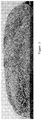
- a cross-section of the overlay is shown in Fig. 3 .
- Plasma densified TiC (weight proportion round:angular about 70:30) in a particle range -125+45 micrometers (-120+325 mesh) is blended together with 70wt% of AMDRY 805 powder (Oerlikon Metco) in the size range -140+325 mesh.
- AMDRY 805 powder (Oerlikon Metco) is an iron based brazing powder with the nominal chemistry Fe 29Cr 18Ni 6P 6Si 0.2RE.
- the simple mechanical mixture is PTA (Plasma Transferred Arc) deposited on a mild steel substrate.
- Deposition equipment is STARWELD 400A with EXCALIBUR torch and deposition parameters are: 2 l/min Ar center gas flow, 2 l/min Ar powder gas flow, 12 1/min Ar shielding gas flow, voltage 27V, current 120A, 25g/min feed rate, oscillation width 18mm, dwell time on each side 0.2s, oscillation speed 800mm/min, traverse speed 50mm/min, cathode 1/8" and electrode 3/16".
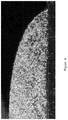
- FIG. 4 A cross-section of the overlay is shown in Fig. 4 .
- the overlay has an even carbide distribution and good bonding.
- Plasma densified TiC (weight proportion round : angular about 90:10) in a particle range -150+45 micrometers (-100+325 mesh) is blended together with 65wt% total of Metcoclad 316L-Si powder and Fe29Cr17.5Ni6.5Si6P powder alloy in the ratio 30/70, 50/50, and 70/30.
- Metcoclad 316L-Si powder is a stainless steel 316L based powder with an addition of Si.
- PTA Plasma Transferred Arc
- Deposition equipment is STARWELD 400A with EXCALIBUR torch and deposition parameters are: 2 l/min Ar/H2 center gas flow, 2 l/min Ar powder gas flow, 16 l/min Ar shielding gas flow, voltage 30V, current 140A, 25g/min feed rate, oscillation width 26mm, dwell time on each side 0.2s, oscillation speed 1200mm/min, traverse speed 45mm/min, cathode 3/16", nozzle 1/8" for the 30/70 ratio; 3 1/min Ar/H2 center gas flow, 2 l/min Ar powder gas flow, 16 l/min Ar shielding gas flow, voltage 30V, current 140A, 39g/min feed rate, oscillation width 26mm, dwell time on each side 0.2s, oscillation speed 1000mm/min, traverse speed 50mm/min, cathode 3/16", nozzle 1/8" for the 50/50 ratio; and 3 l/min Ar/H2 center gas flow, 2 l/min Ar powder gas flow, 16 l/min Ar shielding
- Plasma densified TiC (weight proportion round : angular about 80:20) in a particle range -150+45 micrometers (-100+325 mesh) is suspended in an autoclave and a layer of nickel cladding essentially covering the TiC particle surface is deposited using a Sherritt hydrometallurgical process known to those skilled in the art.
- Ni cladding comprises 65wt% of composition.
- This composite powder is PTA (Plasma Transferred Arc) deposited on a mild steel substrate.
- Deposition equipment is STARWELD 400A with EXCALIBUR torch and deposition parameters are: 2.5 l/min Ar/H2 center gas flow, 2 l/min Ar powder gas flow, 14 l/min Ar shielding gas flow, current 120A, 23.5g/min feed rate, oscillation width 26mm, dwell time on each side 0.1s, oscillation speed 800mm/min, traverse speed 30mm/min, cathode 3/16", nozzle 1/8".
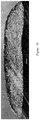
- a cross-section of the overlay is shown in Fig. 8 .
- Ni clad TiC powder (e.g., from Example 4) is alloyed with Cr by pack cementation to obtain NiCr cladding with Ni/Cr ratio 80/20 wt%.
- This alloyed composite powder is PTA (Plasma Transferred Arc) deposited on a mild steel substrate.
- Deposition equipment is STARWELD 400A with EXCALIBUR torch and deposition parameters are: 2.5 l/min Ar center gas flow, 2 l/min Ar powder gas flow, 16 l/min Ar shielding gas flow, current 100A, voltage 35V, 23.5g/min feed rate, oscillation width 26mm, dwell time on each side 0.1s, oscillation speed 800mm/min, traverse speed 30mm/min, cathode 3/16", nozzle 1/8".
- a cross-section of the overlay is shown in Fig. 9 .
- NiCr clad TiC powder (e.g., from Example 5) is further alloyed with Al by pack cementation to obtain NiCrAl cladding with Ni/Cr/Al ratio 73.5/17.8/8.7 wt%.
- This alloyed composite powder is PTA (Plasma Transferred Arc) deposited on a mild steel substrate.
- Deposition equipment is STARWELD 400A with EXCALIBUR torch and deposition parameters are: 1.5 l/min Ar center gas flow, 2 l/min Ar powder gas flow, 12 l/min Ar shielding gas flow, current 150A, voltage 30V, 25g/min feed rate, oscillation width 26mm, dwell time on each side 0.1s, oscillation speed 800mm/min, traverse speed 30mm/min, cathode 3/16", nozzle 1/8".
- a cross-section of the overlay is shown in Fig. 10 .
Landscapes
- Chemical & Material Sciences (AREA)
- Engineering & Computer Science (AREA)
- Mechanical Engineering (AREA)
- Materials Engineering (AREA)
- Metallurgy (AREA)
- Organic Chemistry (AREA)
- Plasma & Fusion (AREA)
- Physics & Mathematics (AREA)
- Chemical Kinetics & Catalysis (AREA)
- Coating By Spraying Or Casting (AREA)
- Powder Metallurgy (AREA)
- Other Surface Treatments For Metallic Materials (AREA)
- Carbon And Carbon Compounds (AREA)
Claims (8)
- Un procédé de préparation d'un revêtement sur un substrat, le revêtement comprenant du carbure de titane, le procédé comprenant:a) obtenir une composition comprenant des particules de TiC et des particules non-TiC; etb) appliquer la composition sur un substrat par rechargement soudage plasma sous flux en poudre ou par dépôt par pulvérisation/fusion pour former un revêtement;dans lequel les particules de TiC ont une taille de 44 à 250 micromètres (-60+325 taille de mailles); dans lequel les particules de TiC comprennent 50 à 100 % en poids de particules arrondies, et 0 à 50 % en poids de particules angulaires, sur la base du poids de TiC; et dans lequel le TiC comprend 5-70 % en poids de la composition, sur la base du poids des particules de TiC et de non-TiC; dans lequel les particules non-TiC comprennent un alliage et/ou un non-métal.
- Le procédé selon la revendication 1, dans lequel la composition comprend des particules de TiC densifiées par plasma.
- Le procédé selon la revendication 1, dans lequel la composition est de taille 44-250 micromètres (-60+325 taille de mailles) ou de taille 63-149 micromètres (-100+230 taille de mailles).
- Le procédé selon la revendication 1, dans lequel les particules non-TiC comprennent un alliage comprenant du nickel ou du fer ou les particules non-TiC comprennent un non-métal.
- Le procédé selon la revendication 1, dans lequel l'application comprend le rechargement soudage plasma sous flux en poudre.
- Le procédé selon la revendication 1, dans lequel le revêtement comprend du TiC distribué de manière homogène.
- Une composition adaptée au rechargement soudage plasma sous flux en poudre ou au dépôt par pulvérisation/fusion, la composition comprenant des particules de TiC et des particules non-TiC, dans lequel les particules de TiC ont une taille de 44 à 250 micromètres (-60+325 taille de mailles); dans lequel les particules de TiC comprennent 50 à 100 % en poids de particules arrondies, et 0 à 50 % en poids de particules angulaires, sur la base du poids de TiC; et dans lequel le TiC comprend 5-70 % en poids de la composition, sur la base du poids des particules de TiC et de non-TiC; dans lequel les particules non-TiC comprennent un alliage et/ou un non-métal.
- Un revêtement sur un substrat, le revêtement comprenant des particules de carbure de titane distribué de manière homogène dans le revêtement, dans lequel le revêtement est obtenu en appliquant une composition comprenant des particules de TiC et des particules de non-TiC par rechargement soudage plasma sous flux en poudre ou par dépôt par pulvérisation/fusion pour former le revêtement; dans lequel les particules de TiC dans la composition ont une taille de 44 à 250 micromètres (-60+325 taille de mailles); dans lequel les particules de TiC dans la composition comprennent 50 à 100 % en poids de particules arrondies, et 0 à 50 % en poids de particules angulaires, sur la base du poids de TiC; et dans lequel le TiC comprend 5-70 % en poids de la composition, sur la base du poids des particules de TiC et de non-TiC; dans lequel les particules non-TiC comprennent un alliage et/ou un non-métal.
Applications Claiming Priority (2)
| Application Number | Priority Date | Filing Date | Title |
|---|---|---|---|
| US201461986516P | 2014-04-30 | 2014-04-30 | |
| PCT/US2015/025055 WO2015167769A1 (fr) | 2014-04-30 | 2015-04-09 | Revêtement de carbure de titane et procédé de fabrication |
Publications (3)
| Publication Number | Publication Date |
|---|---|
| EP3137643A1 EP3137643A1 (fr) | 2017-03-08 |
| EP3137643A4 EP3137643A4 (fr) | 2017-09-06 |
| EP3137643B1 true EP3137643B1 (fr) | 2020-05-06 |
Family
ID=54359147
Family Applications (1)
| Application Number | Title | Priority Date | Filing Date |
|---|---|---|---|
| EP15786121.2A Not-in-force EP3137643B1 (fr) | 2014-04-30 | 2015-04-09 | Revêtement de carbure de titane et procédé de sa fabrication |
Country Status (9)
| Country | Link |
|---|---|
| US (1) | US20170043426A1 (fr) |
| EP (1) | EP3137643B1 (fr) |
| JP (2) | JP6804982B2 (fr) |
| CN (1) | CN106536774B (fr) |
| AU (1) | AU2015253670B2 (fr) |
| CA (1) | CA2944782A1 (fr) |
| RU (1) | RU2682738C2 (fr) |
| SA (1) | SA516380102B1 (fr) |
| WO (1) | WO2015167769A1 (fr) |
Families Citing this family (7)
| Publication number | Priority date | Publication date | Assignee | Title |
|---|---|---|---|---|
| US10668566B2 (en) | 2016-01-27 | 2020-06-02 | H.C. Starck Inc. | Fabrication of high-entropy alloy wire and multi-principal element alloy wire |
| RU2637734C1 (ru) * | 2016-12-29 | 2017-12-06 | Федеральное государственное автономное образовательное учреждение высшего образования "Национальный исследовательский технологический университет "МИСиС" | Порошок на основе железа для плазменной наплавки деталей сельскохозяйственных машин в среде сжатого воздуха |
| EP3482850B1 (fr) * | 2017-11-08 | 2021-02-24 | The Swatch Group Research and Development Ltd | Composition de moulage par métallurgie des poudres destinée notamment à la fabrication d'articles de décor ou d'habillage en cermet massif fritté et lesdits articles de décor ou d'habillage en cermet massif fritté |
| JP7255430B2 (ja) * | 2019-09-06 | 2023-04-11 | 株式会社プロテリアル | 複合部材の製造方法 |
| JP2024517218A (ja) * | 2021-05-03 | 2024-04-19 | エリコン メテコ(ユーエス)インコーポレイテッド | 向上した堆積効率を有する、薄く、平滑でかつ高速で火炎溶射される被覆用材料 |
| CN114083177B (zh) * | 2021-12-15 | 2023-07-18 | 青岛维轮智能装备有限公司 | 一种复合碳化物强化镍基合金堆焊用药芯焊丝 |
| CN116180071B (zh) * | 2022-10-09 | 2025-03-18 | 西南交通大学 | 陶瓷增强铝基复合材料耐磨涂层的制备方法、铝合金材料和列车制动盘 |
Family Cites Families (17)
| Publication number | Priority date | Publication date | Assignee | Title |
|---|---|---|---|---|
| US3254970A (en) * | 1960-11-22 | 1966-06-07 | Metco Inc | Flame spray clad powder composed of a refractory material and nickel or cobalt |
| US3914507A (en) * | 1970-03-20 | 1975-10-21 | Sherritt Gordon Mines Ltd | Method of preparing metal alloy coated composite powders |
| US3886637A (en) * | 1971-11-17 | 1975-06-03 | Chromalloy American Corp | Method of producing heat treatable titanium carbide tool steel coatings on cylinders of internal combustion engines |
| US3725016A (en) * | 1972-01-24 | 1973-04-03 | Chromalloy American Corp | Titanium carbide hard-facing steel-base composition |
| GB2076019B (en) * | 1980-05-16 | 1984-03-28 | Metallurg Ind Inc | Erosion-resistant alloys |
| US4704336A (en) * | 1984-03-12 | 1987-11-03 | General Electric Company | Solid particle erosion resistant coating utilizing titanium carbide |
| US4615734A (en) * | 1984-03-12 | 1986-10-07 | General Electric Company | Solid particle erosion resistant coating utilizing titanium carbide, process for applying and article coated therewith |
| US5145506A (en) * | 1984-07-05 | 1992-09-08 | The United States Of America As Represented By The Secretary Of The Navy | Method of bonding metal carbides in non-magnetic alloy matrix |
| CH670103A5 (fr) * | 1986-02-04 | 1989-05-12 | Castolin Sa | |
| RU2161661C1 (ru) * | 1999-08-16 | 2001-01-10 | Падеров Анатолий Николаевич | Способ нанесения износостойких покрытий и повышения долговечности деталей |
| US7345255B2 (en) * | 2005-01-26 | 2008-03-18 | Caterpillar Inc. | Composite overlay compound |
| RU2467850C2 (ru) * | 2006-02-23 | 2012-11-27 | Пикодеон Лтд Ой | Покрытие из нитрида углерода и изделие с таким покрытием |
| JP4850241B2 (ja) * | 2006-03-30 | 2012-01-11 | 株式会社小松製作所 | 耐摩耗粒子及び耐摩耗構造部材 |
| IL182344A (en) * | 2007-04-01 | 2011-07-31 | Iscar Ltd | Cutting with a ceramic coating |
| BE1018130A3 (fr) * | 2008-09-19 | 2010-05-04 | Magotteaux Int | Materiau composite hierarchique. |
| RU2459887C1 (ru) * | 2011-07-21 | 2012-08-27 | Учреждение Российской Академии Наук Институт Физики Прочности И Материаловедения Сибирского Отделения Ран (Ифпм Со Ран) | Металлокерамический сплав на основе карбида титана и металлического связующего с модифицированной структурой поверхностного слоя |
| CN103614723B (zh) * | 2013-12-19 | 2015-09-23 | 山东大学 | 一种钛合金表面TiC增强钴基金属陶瓷复合涂层及其制备工艺 |
-
2015
- 2015-04-09 CN CN201580019830.1A patent/CN106536774B/zh not_active Expired - Fee Related
- 2015-04-09 US US15/305,829 patent/US20170043426A1/en not_active Abandoned
- 2015-04-09 EP EP15786121.2A patent/EP3137643B1/fr not_active Not-in-force
- 2015-04-09 AU AU2015253670A patent/AU2015253670B2/en not_active Ceased
- 2015-04-09 JP JP2016562239A patent/JP6804982B2/ja not_active Expired - Fee Related
- 2015-04-09 WO PCT/US2015/025055 patent/WO2015167769A1/fr not_active Ceased
- 2015-04-09 RU RU2016144040A patent/RU2682738C2/ru not_active IP Right Cessation
- 2015-04-09 CA CA2944782A patent/CA2944782A1/fr not_active Abandoned
-
2016
- 2016-10-19 SA SA516380102A patent/SA516380102B1/ar unknown
-
2020
- 2020-05-22 JP JP2020089258A patent/JP2020186165A/ja active Pending
Non-Patent Citations (1)
| Title |
|---|
| None * |
Also Published As
| Publication number | Publication date |
|---|---|
| CA2944782A1 (fr) | 2015-11-05 |
| JP6804982B2 (ja) | 2020-12-23 |
| US20170043426A1 (en) | 2017-02-16 |
| JP2017521548A (ja) | 2017-08-03 |
| JP2020186165A (ja) | 2020-11-19 |
| SA516380102B1 (ar) | 2020-05-14 |
| CN106536774B (zh) | 2019-01-15 |
| WO2015167769A1 (fr) | 2015-11-05 |
| RU2016144040A (ru) | 2018-05-31 |
| AU2015253670B2 (en) | 2019-07-18 |
| RU2016144040A3 (fr) | 2018-11-01 |
| CN106536774A (zh) | 2017-03-22 |
| RU2682738C2 (ru) | 2019-03-21 |
| EP3137643A4 (fr) | 2017-09-06 |
| AU2015253670A1 (en) | 2016-10-27 |
| EP3137643A1 (fr) | 2017-03-08 |
Similar Documents
| Publication | Publication Date | Title |
|---|---|---|
| AU2015253670B2 (en) | Titanium carbide overlay and method of making | |
| EP0960954B2 (fr) | Poudre de carbure de chrome et de nickel-chrome | |
| EP3642377B1 (fr) | Alliage à base de fer approprié pour fournir un revêtement dur et résistant à la corrosion sur un substrat, article comprenant un revêtement dur et résistant à la corrosion, et son procédé de production | |
| US4507151A (en) | Coating material for the formation of abrasion-resistant and impact-resistant coatings on workpieces | |
| US9108276B2 (en) | Hardface coating systems and methods for metal alloys and other materials for wear and corrosion resistant applications | |
| EP1485220B1 (fr) | Poudre et revetement resistant a la corrosion | |
| US5935350A (en) | Hardfacing method and nickel based hardfacing alloy | |
| EP1857571B1 (fr) | Accessoire de découpe | |
| US9982332B2 (en) | Hardface coating systems and methods for metal alloys and other materials for wear and corrosion resistant applications | |
| US3254970A (en) | Flame spray clad powder composed of a refractory material and nickel or cobalt | |
| WO2022223835A1 (fr) | Revêtement à base de fer résistant à l'usure et à la corrosion | |
| JP7018603B2 (ja) | クラッド層の製造方法 | |
| US6888088B2 (en) | Hardfacing materials & methods | |
| US4678511A (en) | Spray micropellets | |
| CN1929991B (zh) | 耐磨材料 | |
| Techel et al. | Microstructure of advanced TiC-based coatings prepared by laser cladding | |
| WO2014105239A1 (fr) | Systèmes et procédés de revêtement par rechargement dur pour des alliages métalliques et autres matières pour des applications nécessitant une résistance à l'usure et à la corrosion | |
| EP2414106B1 (fr) | Revêtement sans chrome, procédé de sa production et câble composite | |
| EP0212435A2 (fr) | Procédé pour la fabrication d'alliages métalliques durs, résistants à l'usure et/ou à la corrosion ainsi que les alliages métalliques fabriqués selon ce procédé | |
| Banai et al. | Effect of composite coating using TIG cladding process: A review | |
| US7459219B2 (en) | Items made of wear resistant materials | |
| WO2024084057A2 (fr) | Alliages nickel-chrome | |
| JP2025091773A (ja) | 肉盛層 | |
| Techel et al. | Laser and PTA Surfacing with TiC-based Materials |
Legal Events
| Date | Code | Title | Description |
|---|---|---|---|
| STAA | Information on the status of an ep patent application or granted ep patent |
Free format text: STATUS: THE INTERNATIONAL PUBLICATION HAS BEEN MADE |
|
| PUAI | Public reference made under article 153(3) epc to a published international application that has entered the european phase |
Free format text: ORIGINAL CODE: 0009012 |
|
| STAA | Information on the status of an ep patent application or granted ep patent |
Free format text: STATUS: REQUEST FOR EXAMINATION WAS MADE |
|
| 17P | Request for examination filed |
Effective date: 20161130 |
|
| AK | Designated contracting states |
Kind code of ref document: A1 Designated state(s): AL AT BE BG CH CY CZ DE DK EE ES FI FR GB GR HR HU IE IS IT LI LT LU LV MC MK MT NL NO PL PT RO RS SE SI SK SM TR |
|
| AX | Request for extension of the european patent |
Extension state: BA ME |
|
| DAV | Request for validation of the european patent (deleted) | ||
| DAX | Request for extension of the european patent (deleted) | ||
| A4 | Supplementary search report drawn up and despatched |
Effective date: 20170808 |
|
| RIC1 | Information provided on ipc code assigned before grant |
Ipc: B23K 103/08 20060101ALI20170802BHEP Ipc: C22C 19/05 20060101ALI20170802BHEP Ipc: C23C 4/134 20160101ALI20170802BHEP Ipc: C22C 33/02 20060101ALI20170802BHEP Ipc: B23K 103/00 20060101ALI20170802BHEP Ipc: C22C 38/40 20060101ALI20170802BHEP Ipc: C23C 4/06 20160101ALI20170802BHEP Ipc: B23K 10/02 20060101ALI20170802BHEP Ipc: C23C 4/131 20160101ALI20170802BHEP Ipc: C23C 24/04 20060101ALI20170802BHEP Ipc: C22C 29/02 20060101AFI20170802BHEP Ipc: C23C 4/10 20160101ALI20170802BHEP Ipc: B22F 1/02 20060101ALI20170802BHEP Ipc: B22F 1/00 20060101ALI20170802BHEP Ipc: C22C 38/34 20060101ALI20170802BHEP Ipc: B23K 103/18 20060101ALI20170802BHEP Ipc: C22C 32/00 20060101ALI20170802BHEP Ipc: C22C 29/10 20060101ALI20170802BHEP Ipc: B23K 103/04 20060101ALI20170802BHEP Ipc: C22C 38/00 20060101ALI20170802BHEP |
|
| STAA | Information on the status of an ep patent application or granted ep patent |
Free format text: STATUS: EXAMINATION IS IN PROGRESS |
|
| 17Q | First examination report despatched |
Effective date: 20190314 |
|
| GRAP | Despatch of communication of intention to grant a patent |
Free format text: ORIGINAL CODE: EPIDOSNIGR1 |
|
| STAA | Information on the status of an ep patent application or granted ep patent |
Free format text: STATUS: GRANT OF PATENT IS INTENDED |
|
| INTG | Intention to grant announced |
Effective date: 20191127 |
|
| RAP1 | Party data changed (applicant data changed or rights of an application transferred) |
Owner name: OERLIKON METCO (US) INC. |
|
| GRAS | Grant fee paid |
Free format text: ORIGINAL CODE: EPIDOSNIGR3 |
|
| GRAA | (expected) grant |
Free format text: ORIGINAL CODE: 0009210 |
|
| STAA | Information on the status of an ep patent application or granted ep patent |
Free format text: STATUS: THE PATENT HAS BEEN GRANTED |
|
| AK | Designated contracting states |
Kind code of ref document: B1 Designated state(s): AL AT BE BG CH CY CZ DE DK EE ES FI FR GB GR HR HU IE IS IT LI LT LU LV MC MK MT NL NO PL PT RO RS SE SI SK SM TR |
|
| REG | Reference to a national code |
Ref country code: GB Ref legal event code: FG4D |
|
| REG | Reference to a national code |
Ref country code: CH Ref legal event code: EP Ref country code: AT Ref legal event code: REF Ref document number: 1266818 Country of ref document: AT Kind code of ref document: T Effective date: 20200515 |
|
| REG | Reference to a national code |
Ref country code: IE Ref legal event code: FG4D |
|
| REG | Reference to a national code |
Ref country code: DE Ref legal event code: R096 Ref document number: 602015052345 Country of ref document: DE |
|
| REG | Reference to a national code |
Ref country code: LT Ref legal event code: MG4D |
|
| REG | Reference to a national code |
Ref country code: NL Ref legal event code: MP Effective date: 20200506 |
|
| PG25 | Lapsed in a contracting state [announced via postgrant information from national office to epo] |
Ref country code: GR Free format text: LAPSE BECAUSE OF FAILURE TO SUBMIT A TRANSLATION OF THE DESCRIPTION OR TO PAY THE FEE WITHIN THE PRESCRIBED TIME-LIMIT Effective date: 20200807 Ref country code: PT Free format text: LAPSE BECAUSE OF FAILURE TO SUBMIT A TRANSLATION OF THE DESCRIPTION OR TO PAY THE FEE WITHIN THE PRESCRIBED TIME-LIMIT Effective date: 20200907 Ref country code: NO Free format text: LAPSE BECAUSE OF FAILURE TO SUBMIT A TRANSLATION OF THE DESCRIPTION OR TO PAY THE FEE WITHIN THE PRESCRIBED TIME-LIMIT Effective date: 20200806 Ref country code: FI Free format text: LAPSE BECAUSE OF FAILURE TO SUBMIT A TRANSLATION OF THE DESCRIPTION OR TO PAY THE FEE WITHIN THE PRESCRIBED TIME-LIMIT Effective date: 20200506 Ref country code: IS Free format text: LAPSE BECAUSE OF FAILURE TO SUBMIT A TRANSLATION OF THE DESCRIPTION OR TO PAY THE FEE WITHIN THE PRESCRIBED TIME-LIMIT Effective date: 20200906 Ref country code: SE Free format text: LAPSE BECAUSE OF FAILURE TO SUBMIT A TRANSLATION OF THE DESCRIPTION OR TO PAY THE FEE WITHIN THE PRESCRIBED TIME-LIMIT Effective date: 20200506 Ref country code: LT Free format text: LAPSE BECAUSE OF FAILURE TO SUBMIT A TRANSLATION OF THE DESCRIPTION OR TO PAY THE FEE WITHIN THE PRESCRIBED TIME-LIMIT Effective date: 20200506 |
|
| PG25 | Lapsed in a contracting state [announced via postgrant information from national office to epo] |
Ref country code: BG Free format text: LAPSE BECAUSE OF FAILURE TO SUBMIT A TRANSLATION OF THE DESCRIPTION OR TO PAY THE FEE WITHIN THE PRESCRIBED TIME-LIMIT Effective date: 20200806 Ref country code: RS Free format text: LAPSE BECAUSE OF FAILURE TO SUBMIT A TRANSLATION OF THE DESCRIPTION OR TO PAY THE FEE WITHIN THE PRESCRIBED TIME-LIMIT Effective date: 20200506 Ref country code: HR Free format text: LAPSE BECAUSE OF FAILURE TO SUBMIT A TRANSLATION OF THE DESCRIPTION OR TO PAY THE FEE WITHIN THE PRESCRIBED TIME-LIMIT Effective date: 20200506 Ref country code: LV Free format text: LAPSE BECAUSE OF FAILURE TO SUBMIT A TRANSLATION OF THE DESCRIPTION OR TO PAY THE FEE WITHIN THE PRESCRIBED TIME-LIMIT Effective date: 20200506 |
|
| REG | Reference to a national code |
Ref country code: AT Ref legal event code: MK05 Ref document number: 1266818 Country of ref document: AT Kind code of ref document: T Effective date: 20200506 |
|
| PG25 | Lapsed in a contracting state [announced via postgrant information from national office to epo] |
Ref country code: NL Free format text: LAPSE BECAUSE OF FAILURE TO SUBMIT A TRANSLATION OF THE DESCRIPTION OR TO PAY THE FEE WITHIN THE PRESCRIBED TIME-LIMIT Effective date: 20200506 Ref country code: AL Free format text: LAPSE BECAUSE OF FAILURE TO SUBMIT A TRANSLATION OF THE DESCRIPTION OR TO PAY THE FEE WITHIN THE PRESCRIBED TIME-LIMIT Effective date: 20200506 |
|
| PG25 | Lapsed in a contracting state [announced via postgrant information from national office to epo] |
Ref country code: DK Free format text: LAPSE BECAUSE OF FAILURE TO SUBMIT A TRANSLATION OF THE DESCRIPTION OR TO PAY THE FEE WITHIN THE PRESCRIBED TIME-LIMIT Effective date: 20200506 Ref country code: EE Free format text: LAPSE BECAUSE OF FAILURE TO SUBMIT A TRANSLATION OF THE DESCRIPTION OR TO PAY THE FEE WITHIN THE PRESCRIBED TIME-LIMIT Effective date: 20200506 Ref country code: AT Free format text: LAPSE BECAUSE OF FAILURE TO SUBMIT A TRANSLATION OF THE DESCRIPTION OR TO PAY THE FEE WITHIN THE PRESCRIBED TIME-LIMIT Effective date: 20200506 Ref country code: SM Free format text: LAPSE BECAUSE OF FAILURE TO SUBMIT A TRANSLATION OF THE DESCRIPTION OR TO PAY THE FEE WITHIN THE PRESCRIBED TIME-LIMIT Effective date: 20200506 Ref country code: IT Free format text: LAPSE BECAUSE OF FAILURE TO SUBMIT A TRANSLATION OF THE DESCRIPTION OR TO PAY THE FEE WITHIN THE PRESCRIBED TIME-LIMIT Effective date: 20200506 Ref country code: RO Free format text: LAPSE BECAUSE OF FAILURE TO SUBMIT A TRANSLATION OF THE DESCRIPTION OR TO PAY THE FEE WITHIN THE PRESCRIBED TIME-LIMIT Effective date: 20200506 Ref country code: CZ Free format text: LAPSE BECAUSE OF FAILURE TO SUBMIT A TRANSLATION OF THE DESCRIPTION OR TO PAY THE FEE WITHIN THE PRESCRIBED TIME-LIMIT Effective date: 20200506 Ref country code: ES Free format text: LAPSE BECAUSE OF FAILURE TO SUBMIT A TRANSLATION OF THE DESCRIPTION OR TO PAY THE FEE WITHIN THE PRESCRIBED TIME-LIMIT Effective date: 20200506 |
|
| REG | Reference to a national code |
Ref country code: DE Ref legal event code: R097 Ref document number: 602015052345 Country of ref document: DE |
|
| PG25 | Lapsed in a contracting state [announced via postgrant information from national office to epo] |
Ref country code: PL Free format text: LAPSE BECAUSE OF FAILURE TO SUBMIT A TRANSLATION OF THE DESCRIPTION OR TO PAY THE FEE WITHIN THE PRESCRIBED TIME-LIMIT Effective date: 20200506 Ref country code: SK Free format text: LAPSE BECAUSE OF FAILURE TO SUBMIT A TRANSLATION OF THE DESCRIPTION OR TO PAY THE FEE WITHIN THE PRESCRIBED TIME-LIMIT Effective date: 20200506 |
|
| PLBE | No opposition filed within time limit |
Free format text: ORIGINAL CODE: 0009261 |
|
| STAA | Information on the status of an ep patent application or granted ep patent |
Free format text: STATUS: NO OPPOSITION FILED WITHIN TIME LIMIT |
|
| 26N | No opposition filed |
Effective date: 20210209 |
|
| PG25 | Lapsed in a contracting state [announced via postgrant information from national office to epo] |
Ref country code: SI Free format text: LAPSE BECAUSE OF FAILURE TO SUBMIT A TRANSLATION OF THE DESCRIPTION OR TO PAY THE FEE WITHIN THE PRESCRIBED TIME-LIMIT Effective date: 20200506 |
|
| REG | Reference to a national code |
Ref country code: DE Ref legal event code: R119 Ref document number: 602015052345 Country of ref document: DE |
|
| PG25 | Lapsed in a contracting state [announced via postgrant information from national office to epo] |
Ref country code: MC Free format text: LAPSE BECAUSE OF FAILURE TO SUBMIT A TRANSLATION OF THE DESCRIPTION OR TO PAY THE FEE WITHIN THE PRESCRIBED TIME-LIMIT Effective date: 20200506 |
|
| GBPC | Gb: european patent ceased through non-payment of renewal fee |
Effective date: 20210409 |
|
| PG25 | Lapsed in a contracting state [announced via postgrant information from national office to epo] |
Ref country code: LU Free format text: LAPSE BECAUSE OF NON-PAYMENT OF DUE FEES Effective date: 20210409 |
|
| REG | Reference to a national code |
Ref country code: BE Ref legal event code: MM Effective date: 20210430 |
|
| PG25 | Lapsed in a contracting state [announced via postgrant information from national office to epo] |
Ref country code: DE Free format text: LAPSE BECAUSE OF NON-PAYMENT OF DUE FEES Effective date: 20211103 Ref country code: FR Free format text: LAPSE BECAUSE OF NON-PAYMENT OF DUE FEES Effective date: 20210430 Ref country code: GB Free format text: LAPSE BECAUSE OF NON-PAYMENT OF DUE FEES Effective date: 20210409 Ref country code: LI Free format text: LAPSE BECAUSE OF NON-PAYMENT OF DUE FEES Effective date: 20210430 Ref country code: CH Free format text: LAPSE BECAUSE OF NON-PAYMENT OF DUE FEES Effective date: 20210430 |
|
| PG25 | Lapsed in a contracting state [announced via postgrant information from national office to epo] |
Ref country code: IE Free format text: LAPSE BECAUSE OF NON-PAYMENT OF DUE FEES Effective date: 20210409 |
|
| PG25 | Lapsed in a contracting state [announced via postgrant information from national office to epo] |
Ref country code: BE Free format text: LAPSE BECAUSE OF NON-PAYMENT OF DUE FEES Effective date: 20210430 |
|
| PG25 | Lapsed in a contracting state [announced via postgrant information from national office to epo] |
Ref country code: HU Free format text: LAPSE BECAUSE OF FAILURE TO SUBMIT A TRANSLATION OF THE DESCRIPTION OR TO PAY THE FEE WITHIN THE PRESCRIBED TIME-LIMIT; INVALID AB INITIO Effective date: 20150409 |
|
| PG25 | Lapsed in a contracting state [announced via postgrant information from national office to epo] |
Ref country code: CY Free format text: LAPSE BECAUSE OF FAILURE TO SUBMIT A TRANSLATION OF THE DESCRIPTION OR TO PAY THE FEE WITHIN THE PRESCRIBED TIME-LIMIT Effective date: 20200506 |
|
| PG25 | Lapsed in a contracting state [announced via postgrant information from national office to epo] |
Ref country code: MK Free format text: LAPSE BECAUSE OF FAILURE TO SUBMIT A TRANSLATION OF THE DESCRIPTION OR TO PAY THE FEE WITHIN THE PRESCRIBED TIME-LIMIT Effective date: 20200506 |
|
| PG25 | Lapsed in a contracting state [announced via postgrant information from national office to epo] |
Ref country code: TR Free format text: LAPSE BECAUSE OF FAILURE TO SUBMIT A TRANSLATION OF THE DESCRIPTION OR TO PAY THE FEE WITHIN THE PRESCRIBED TIME-LIMIT Effective date: 20200506 |
|
| PG25 | Lapsed in a contracting state [announced via postgrant information from national office to epo] |
Ref country code: MT Free format text: LAPSE BECAUSE OF FAILURE TO SUBMIT A TRANSLATION OF THE DESCRIPTION OR TO PAY THE FEE WITHIN THE PRESCRIBED TIME-LIMIT Effective date: 20200506 |