EP3138866A1 - Monomère, polymère, film de compensation, film optique et dispositif d'affichage - Google Patents
Monomère, polymère, film de compensation, film optique et dispositif d'affichage Download PDFInfo
- Publication number
- EP3138866A1 EP3138866A1 EP16184785.0A EP16184785A EP3138866A1 EP 3138866 A1 EP3138866 A1 EP 3138866A1 EP 16184785 A EP16184785 A EP 16184785A EP 3138866 A1 EP3138866 A1 EP 3138866A1
- Authority
- EP
- European Patent Office
- Prior art keywords
- group
- substituted
- unsubstituted
- independently
- diamine compound
- Prior art date
- Legal status (The legal status is an assumption and is not a legal conclusion. Google has not performed a legal analysis and makes no representation as to the accuracy of the status listed.)
- Withdrawn
Links
- 0 CC(C=N)=C*=CC=C*(C)=C Chemical compound CC(C=N)=C*=CC=C*(C)=C 0.000 description 5
- YXFVVABEGXRONW-UHFFFAOYSA-N Cc1ccccc1 Chemical compound Cc1ccccc1 YXFVVABEGXRONW-UHFFFAOYSA-N 0.000 description 1
Images


Classifications
-
- C—CHEMISTRY; METALLURGY
- C08—ORGANIC MACROMOLECULAR COMPOUNDS; THEIR PREPARATION OR CHEMICAL WORKING-UP; COMPOSITIONS BASED THEREON
- C08G—MACROMOLECULAR COMPOUNDS OBTAINED OTHERWISE THAN BY REACTIONS ONLY INVOLVING UNSATURATED CARBON-TO-CARBON BONDS
- C08G73/00—Macromolecular compounds obtained by reactions forming a linkage containing nitrogen with or without oxygen or carbon in the main chain of the macromolecule, not provided for in groups C08G12/00 - C08G71/00
- C08G73/06—Polycondensates having nitrogen-containing heterocyclic rings in the main chain of the macromolecule
- C08G73/10—Polyimides; Polyester-imides; Polyamide-imides; Polyamide acids or similar polyimide precursors
- C08G73/1039—Polyimides; Polyester-imides; Polyamide-imides; Polyamide acids or similar polyimide precursors comprising halogen-containing substituents
-
- C—CHEMISTRY; METALLURGY
- C07—ORGANIC CHEMISTRY
- C07C—ACYCLIC OR CARBOCYCLIC COMPOUNDS
- C07C209/00—Preparation of compounds containing amino groups bound to a carbon skeleton
- C07C209/30—Preparation of compounds containing amino groups bound to a carbon skeleton by reduction of nitrogen-to-oxygen or nitrogen-to-nitrogen bonds
- C07C209/32—Preparation of compounds containing amino groups bound to a carbon skeleton by reduction of nitrogen-to-oxygen or nitrogen-to-nitrogen bonds by reduction of nitro groups
- C07C209/36—Preparation of compounds containing amino groups bound to a carbon skeleton by reduction of nitrogen-to-oxygen or nitrogen-to-nitrogen bonds by reduction of nitro groups by reduction of nitro groups bound to carbon atoms of six-membered aromatic rings in presence of hydrogen-containing gases and a catalyst
-
- C—CHEMISTRY; METALLURGY
- C07—ORGANIC CHEMISTRY
- C07C—ACYCLIC OR CARBOCYCLIC COMPOUNDS
- C07C1/00—Preparation of hydrocarbons from one or more compounds, none of them being a hydrocarbon
- C07C1/20—Preparation of hydrocarbons from one or more compounds, none of them being a hydrocarbon starting from organic compounds containing only oxygen atoms as heteroatoms
-
- C—CHEMISTRY; METALLURGY
- C07—ORGANIC CHEMISTRY
- C07C—ACYCLIC OR CARBOCYCLIC COMPOUNDS
- C07C17/00—Preparation of halogenated hydrocarbons
- C07C17/26—Preparation of halogenated hydrocarbons by reactions involving an increase in the number of carbon atoms in the skeleton
- C07C17/263—Preparation of halogenated hydrocarbons by reactions involving an increase in the number of carbon atoms in the skeleton by condensation reactions
- C07C17/266—Preparation of halogenated hydrocarbons by reactions involving an increase in the number of carbon atoms in the skeleton by condensation reactions of hydrocarbons and halogenated hydrocarbons
-
- C—CHEMISTRY; METALLURGY
- C07—ORGANIC CHEMISTRY
- C07C—ACYCLIC OR CARBOCYCLIC COMPOUNDS
- C07C201/00—Preparation of esters of nitric or nitrous acid or of compounds containing nitro or nitroso groups bound to a carbon skeleton
- C07C201/06—Preparation of nitro compounds
- C07C201/12—Preparation of nitro compounds by reactions not involving the formation of nitro groups
-
- C—CHEMISTRY; METALLURGY
- C07—ORGANIC CHEMISTRY
- C07C—ACYCLIC OR CARBOCYCLIC COMPOUNDS
- C07C211/00—Compounds containing amino groups bound to a carbon skeleton
- C07C211/43—Compounds containing amino groups bound to a carbon skeleton having amino groups bound to carbon atoms of six-membered aromatic rings of the carbon skeleton
- C07C211/44—Compounds containing amino groups bound to a carbon skeleton having amino groups bound to carbon atoms of six-membered aromatic rings of the carbon skeleton having amino groups bound to only one six-membered aromatic ring
- C07C211/49—Compounds containing amino groups bound to a carbon skeleton having amino groups bound to carbon atoms of six-membered aromatic rings of the carbon skeleton having amino groups bound to only one six-membered aromatic ring having at least two amino groups bound to the carbon skeleton
- C07C211/50—Compounds containing amino groups bound to a carbon skeleton having amino groups bound to carbon atoms of six-membered aromatic rings of the carbon skeleton having amino groups bound to only one six-membered aromatic ring having at least two amino groups bound to the carbon skeleton with at least two amino groups bound to carbon atoms of six-membered aromatic rings of the carbon skeleton
- C07C211/51—Phenylenediamines
-
- C—CHEMISTRY; METALLURGY
- C07—ORGANIC CHEMISTRY
- C07C—ACYCLIC OR CARBOCYCLIC COMPOUNDS
- C07C227/00—Preparation of compounds containing amino and carboxyl groups bound to the same carbon skeleton
- C07C227/04—Formation of amino groups in compounds containing carboxyl groups
-
- C—CHEMISTRY; METALLURGY
- C07—ORGANIC CHEMISTRY
- C07C—ACYCLIC OR CARBOCYCLIC COMPOUNDS
- C07C229/00—Compounds containing amino and carboxyl groups bound to the same carbon skeleton
- C07C229/52—Compounds containing amino and carboxyl groups bound to the same carbon skeleton having amino and carboxyl groups bound to carbon atoms of six-membered aromatic rings of the same carbon skeleton
- C07C229/54—Compounds containing amino and carboxyl groups bound to the same carbon skeleton having amino and carboxyl groups bound to carbon atoms of six-membered aromatic rings of the same carbon skeleton with amino and carboxyl groups bound to carbon atoms of the same non-condensed six-membered aromatic ring
- C07C229/60—Compounds containing amino and carboxyl groups bound to the same carbon skeleton having amino and carboxyl groups bound to carbon atoms of six-membered aromatic rings of the same carbon skeleton with amino and carboxyl groups bound to carbon atoms of the same non-condensed six-membered aromatic ring with amino and carboxyl groups bound in meta- or para- positions
-
- C—CHEMISTRY; METALLURGY
- C07—ORGANIC CHEMISTRY
- C07C—ACYCLIC OR CARBOCYCLIC COMPOUNDS
- C07C29/00—Preparation of compounds having hydroxy or O-metal groups bound to a carbon atom not belonging to a six-membered aromatic ring
- C07C29/32—Preparation of compounds having hydroxy or O-metal groups bound to a carbon atom not belonging to a six-membered aromatic ring increasing the number of carbon atoms by reactions without formation of -OH groups
-
- C—CHEMISTRY; METALLURGY
- C08—ORGANIC MACROMOLECULAR COMPOUNDS; THEIR PREPARATION OR CHEMICAL WORKING-UP; COMPOSITIONS BASED THEREON
- C08G—MACROMOLECULAR COMPOUNDS OBTAINED OTHERWISE THAN BY REACTIONS ONLY INVOLVING UNSATURATED CARBON-TO-CARBON BONDS
- C08G73/00—Macromolecular compounds obtained by reactions forming a linkage containing nitrogen with or without oxygen or carbon in the main chain of the macromolecule, not provided for in groups C08G12/00 - C08G71/00
- C08G73/06—Polycondensates having nitrogen-containing heterocyclic rings in the main chain of the macromolecule
- C08G73/10—Polyimides; Polyester-imides; Polyamide-imides; Polyamide acids or similar polyimide precursors
-
- C—CHEMISTRY; METALLURGY
- C08—ORGANIC MACROMOLECULAR COMPOUNDS; THEIR PREPARATION OR CHEMICAL WORKING-UP; COMPOSITIONS BASED THEREON
- C08G—MACROMOLECULAR COMPOUNDS OBTAINED OTHERWISE THAN BY REACTIONS ONLY INVOLVING UNSATURATED CARBON-TO-CARBON BONDS
- C08G73/00—Macromolecular compounds obtained by reactions forming a linkage containing nitrogen with or without oxygen or carbon in the main chain of the macromolecule, not provided for in groups C08G12/00 - C08G71/00
- C08G73/06—Polycondensates having nitrogen-containing heterocyclic rings in the main chain of the macromolecule
- C08G73/10—Polyimides; Polyester-imides; Polyamide-imides; Polyamide acids or similar polyimide precursors
- C08G73/1003—Preparatory processes
- C08G73/1007—Preparatory processes from tetracarboxylic acids or derivatives and diamines
-
- C—CHEMISTRY; METALLURGY
- C08—ORGANIC MACROMOLECULAR COMPOUNDS; THEIR PREPARATION OR CHEMICAL WORKING-UP; COMPOSITIONS BASED THEREON
- C08G—MACROMOLECULAR COMPOUNDS OBTAINED OTHERWISE THAN BY REACTIONS ONLY INVOLVING UNSATURATED CARBON-TO-CARBON BONDS
- C08G73/00—Macromolecular compounds obtained by reactions forming a linkage containing nitrogen with or without oxygen or carbon in the main chain of the macromolecule, not provided for in groups C08G12/00 - C08G71/00
- C08G73/06—Polycondensates having nitrogen-containing heterocyclic rings in the main chain of the macromolecule
- C08G73/10—Polyimides; Polyester-imides; Polyamide-imides; Polyamide acids or similar polyimide precursors
- C08G73/1042—Copolyimides derived from at least two different tetracarboxylic compounds or two different diamino compounds
-
- C—CHEMISTRY; METALLURGY
- C08—ORGANIC MACROMOLECULAR COMPOUNDS; THEIR PREPARATION OR CHEMICAL WORKING-UP; COMPOSITIONS BASED THEREON
- C08G—MACROMOLECULAR COMPOUNDS OBTAINED OTHERWISE THAN BY REACTIONS ONLY INVOLVING UNSATURATED CARBON-TO-CARBON BONDS
- C08G73/00—Macromolecular compounds obtained by reactions forming a linkage containing nitrogen with or without oxygen or carbon in the main chain of the macromolecule, not provided for in groups C08G12/00 - C08G71/00
- C08G73/06—Polycondensates having nitrogen-containing heterocyclic rings in the main chain of the macromolecule
- C08G73/10—Polyimides; Polyester-imides; Polyamide-imides; Polyamide acids or similar polyimide precursors
- C08G73/1046—Polyimides containing oxygen in the form of ether bonds in the main chain
-
- C—CHEMISTRY; METALLURGY
- C08—ORGANIC MACROMOLECULAR COMPOUNDS; THEIR PREPARATION OR CHEMICAL WORKING-UP; COMPOSITIONS BASED THEREON
- C08G—MACROMOLECULAR COMPOUNDS OBTAINED OTHERWISE THAN BY REACTIONS ONLY INVOLVING UNSATURATED CARBON-TO-CARBON BONDS
- C08G73/00—Macromolecular compounds obtained by reactions forming a linkage containing nitrogen with or without oxygen or carbon in the main chain of the macromolecule, not provided for in groups C08G12/00 - C08G71/00
- C08G73/06—Polycondensates having nitrogen-containing heterocyclic rings in the main chain of the macromolecule
- C08G73/10—Polyimides; Polyester-imides; Polyamide-imides; Polyamide acids or similar polyimide precursors
- C08G73/1046—Polyimides containing oxygen in the form of ether bonds in the main chain
- C08G73/1053—Polyimides containing oxygen in the form of ether bonds in the main chain with oxygen only in the tetracarboxylic moiety
-
- C—CHEMISTRY; METALLURGY
- C08—ORGANIC MACROMOLECULAR COMPOUNDS; THEIR PREPARATION OR CHEMICAL WORKING-UP; COMPOSITIONS BASED THEREON
- C08G—MACROMOLECULAR COMPOUNDS OBTAINED OTHERWISE THAN BY REACTIONS ONLY INVOLVING UNSATURATED CARBON-TO-CARBON BONDS
- C08G73/00—Macromolecular compounds obtained by reactions forming a linkage containing nitrogen with or without oxygen or carbon in the main chain of the macromolecule, not provided for in groups C08G12/00 - C08G71/00
- C08G73/06—Polycondensates having nitrogen-containing heterocyclic rings in the main chain of the macromolecule
- C08G73/10—Polyimides; Polyester-imides; Polyamide-imides; Polyamide acids or similar polyimide precursors
- C08G73/1067—Wholly aromatic polyimides, i.e. having both tetracarboxylic and diamino moieties aromatically bound
-
- C—CHEMISTRY; METALLURGY
- C08—ORGANIC MACROMOLECULAR COMPOUNDS; THEIR PREPARATION OR CHEMICAL WORKING-UP; COMPOSITIONS BASED THEREON
- C08G—MACROMOLECULAR COMPOUNDS OBTAINED OTHERWISE THAN BY REACTIONS ONLY INVOLVING UNSATURATED CARBON-TO-CARBON BONDS
- C08G73/00—Macromolecular compounds obtained by reactions forming a linkage containing nitrogen with or without oxygen or carbon in the main chain of the macromolecule, not provided for in groups C08G12/00 - C08G71/00
- C08G73/06—Polycondensates having nitrogen-containing heterocyclic rings in the main chain of the macromolecule
- C08G73/10—Polyimides; Polyester-imides; Polyamide-imides; Polyamide acids or similar polyimide precursors
- C08G73/1067—Wholly aromatic polyimides, i.e. having both tetracarboxylic and diamino moieties aromatically bound
- C08G73/1071—Wholly aromatic polyimides containing oxygen in the form of ether bonds in the main chain
-
- C—CHEMISTRY; METALLURGY
- C08—ORGANIC MACROMOLECULAR COMPOUNDS; THEIR PREPARATION OR CHEMICAL WORKING-UP; COMPOSITIONS BASED THEREON
- C08G—MACROMOLECULAR COMPOUNDS OBTAINED OTHERWISE THAN BY REACTIONS ONLY INVOLVING UNSATURATED CARBON-TO-CARBON BONDS
- C08G73/00—Macromolecular compounds obtained by reactions forming a linkage containing nitrogen with or without oxygen or carbon in the main chain of the macromolecule, not provided for in groups C08G12/00 - C08G71/00
- C08G73/06—Polycondensates having nitrogen-containing heterocyclic rings in the main chain of the macromolecule
- C08G73/10—Polyimides; Polyester-imides; Polyamide-imides; Polyamide acids or similar polyimide precursors
- C08G73/1075—Partially aromatic polyimides
- C08G73/1082—Partially aromatic polyimides wholly aromatic in the tetracarboxylic moiety
-
- C—CHEMISTRY; METALLURGY
- C08—ORGANIC MACROMOLECULAR COMPOUNDS; THEIR PREPARATION OR CHEMICAL WORKING-UP; COMPOSITIONS BASED THEREON
- C08G—MACROMOLECULAR COMPOUNDS OBTAINED OTHERWISE THAN BY REACTIONS ONLY INVOLVING UNSATURATED CARBON-TO-CARBON BONDS
- C08G73/00—Macromolecular compounds obtained by reactions forming a linkage containing nitrogen with or without oxygen or carbon in the main chain of the macromolecule, not provided for in groups C08G12/00 - C08G71/00
- C08G73/06—Polycondensates having nitrogen-containing heterocyclic rings in the main chain of the macromolecule
- C08G73/10—Polyimides; Polyester-imides; Polyamide-imides; Polyamide acids or similar polyimide precursors
- C08G73/12—Unsaturated polyimide precursors
- C08G73/126—Unsaturated polyimide precursors the unsaturated precursors being wholly aromatic
- C08G73/127—Unsaturated polyimide precursors the unsaturated precursors being wholly aromatic containing oxygen in the form of ether bonds in the main chain
-
- C—CHEMISTRY; METALLURGY
- C08—ORGANIC MACROMOLECULAR COMPOUNDS; THEIR PREPARATION OR CHEMICAL WORKING-UP; COMPOSITIONS BASED THEREON
- C08J—WORKING-UP; GENERAL PROCESSES OF COMPOUNDING; AFTER-TREATMENT NOT COVERED BY SUBCLASSES C08B, C08C, C08F, C08G or C08H
- C08J5/00—Manufacture of articles or shaped materials containing macromolecular substances
- C08J5/18—Manufacture of films or sheets
-
- G—PHYSICS
- G02—OPTICS
- G02B—OPTICAL ELEMENTS, SYSTEMS OR APPARATUS
- G02B5/00—Optical elements other than lenses
- G02B5/30—Polarising elements
- G02B5/3025—Polarisers, i.e. arrangements capable of producing a definite output polarisation state from an unpolarised input state
- G02B5/3033—Polarisers, i.e. arrangements capable of producing a definite output polarisation state from an unpolarised input state in the form of a thin sheet or foil, e.g. Polaroid
- G02B5/3041—Polarisers, i.e. arrangements capable of producing a definite output polarisation state from an unpolarised input state in the form of a thin sheet or foil, e.g. Polaroid comprising multiple thin layers, e.g. multilayer stacks
- G02B5/305—Polarisers, i.e. arrangements capable of producing a definite output polarisation state from an unpolarised input state in the form of a thin sheet or foil, e.g. Polaroid comprising multiple thin layers, e.g. multilayer stacks including organic materials, e.g. polymeric layers
-
- G—PHYSICS
- G02—OPTICS
- G02B—OPTICAL ELEMENTS, SYSTEMS OR APPARATUS
- G02B5/00—Optical elements other than lenses
- G02B5/30—Polarising elements
- G02B5/3083—Birefringent or phase retarding elements
-
- G—PHYSICS
- G02—OPTICS
- G02F—OPTICAL DEVICES OR ARRANGEMENTS FOR THE CONTROL OF LIGHT BY MODIFICATION OF THE OPTICAL PROPERTIES OF THE MEDIA OF THE ELEMENTS INVOLVED THEREIN; NON-LINEAR OPTICS; FREQUENCY-CHANGING OF LIGHT; OPTICAL LOGIC ELEMENTS; OPTICAL ANALOGUE/DIGITAL CONVERTERS
- G02F1/00—Devices or arrangements for the control of the intensity, colour, phase, polarisation or direction of light arriving from an independent light source, e.g. switching, gating or modulating; Non-linear optics
- G02F1/01—Devices or arrangements for the control of the intensity, colour, phase, polarisation or direction of light arriving from an independent light source, e.g. switching, gating or modulating; Non-linear optics for the control of the intensity, phase, polarisation or colour
- G02F1/13—Devices or arrangements for the control of the intensity, colour, phase, polarisation or direction of light arriving from an independent light source, e.g. switching, gating or modulating; Non-linear optics for the control of the intensity, phase, polarisation or colour based on liquid crystals, e.g. single liquid crystal display cells
- G02F1/133—Constructional arrangements; Operation of liquid crystal cells; Circuit arrangements
- G02F1/1333—Constructional arrangements; Manufacturing methods
- G02F1/1335—Structural association of cells with optical devices, e.g. polarisers or reflectors
- G02F1/133528—Polarisers
-
- H—ELECTRICITY
- H10—SEMICONDUCTOR DEVICES; ELECTRIC SOLID-STATE DEVICES NOT OTHERWISE PROVIDED FOR
- H10K—ORGANIC ELECTRIC SOLID-STATE DEVICES
- H10K59/00—Integrated devices, or assemblies of multiple devices, comprising at least one organic light-emitting element covered by group H10K50/00
- H10K59/80—Constructional details
- H10K59/8791—Arrangements for improving contrast, e.g. preventing reflection of ambient light
-
- H—ELECTRICITY
- H10—SEMICONDUCTOR DEVICES; ELECTRIC SOLID-STATE DEVICES NOT OTHERWISE PROVIDED FOR
- H10K—ORGANIC ELECTRIC SOLID-STATE DEVICES
- H10K59/00—Integrated devices, or assemblies of multiple devices, comprising at least one organic light-emitting element covered by group H10K50/00
- H10K59/80—Constructional details
- H10K59/8793—Arrangements for polarized light emission
-
- C—CHEMISTRY; METALLURGY
- C08—ORGANIC MACROMOLECULAR COMPOUNDS; THEIR PREPARATION OR CHEMICAL WORKING-UP; COMPOSITIONS BASED THEREON
- C08G—MACROMOLECULAR COMPOUNDS OBTAINED OTHERWISE THAN BY REACTIONS ONLY INVOLVING UNSATURATED CARBON-TO-CARBON BONDS
- C08G73/00—Macromolecular compounds obtained by reactions forming a linkage containing nitrogen with or without oxygen or carbon in the main chain of the macromolecule, not provided for in groups C08G12/00 - C08G71/00
- C08G73/06—Polycondensates having nitrogen-containing heterocyclic rings in the main chain of the macromolecule
- C08G73/10—Polyimides; Polyester-imides; Polyamide-imides; Polyamide acids or similar polyimide precursors
- C08G73/12—Unsaturated polyimide precursors
-
- C—CHEMISTRY; METALLURGY
- C08—ORGANIC MACROMOLECULAR COMPOUNDS; THEIR PREPARATION OR CHEMICAL WORKING-UP; COMPOSITIONS BASED THEREON
- C08J—WORKING-UP; GENERAL PROCESSES OF COMPOUNDING; AFTER-TREATMENT NOT COVERED BY SUBCLASSES C08B, C08C, C08F, C08G or C08H
- C08J2379/00—Characterised by the use of macromolecular compounds obtained by reactions forming in the main chain of the macromolecule a linkage containing nitrogen with or without oxygen, or carbon only, not provided for in groups C08J2361/00 - C08J2377/00
- C08J2379/04—Polycondensates having nitrogen-containing heterocyclic rings in the main chain; Polyhydrazides; Polyamide acids or similar polyimide precursors
- C08J2379/08—Polyimides; Polyester-imides; Polyamide-imides; Polyamide acids or similar polyimide precursors
Definitions
- a monomer, a polymer, a compensation film, an optical film, and a display device are disclosed.
- a flat panel displays may be classified into a light-emitting display device emitting light by itself and a non-emissive display device requiring a separate light source, and a compensation film or an optical film is frequently employed for improving the image quality thereof.
- a compensation film or an optical film is frequently employed for improving the image quality thereof.
- An embodiment provides a novel monomer that is applicable to a compensation film.
- Another embodiment provides a polymer including a moiety derived from the novel monomer by polymerization of the novel monomer.
- Yet another embodiment provides a compensation film including the polymer.
- Still another embodiment provides an optical film including the compensation film.
- a further embodiment provides a display device including the compensation film or the optical film.
- a monomer represented by Chemical Formula 1-1 is provided.
- L 1 and L 2 are independently a single bond, a substituted or unsubstituted C1 to C20 alkylene group, a substituted or unsubstituted C1 to C20 oxyalkylene group, a substituted or unsubstituted C3 to C20 cycloalkylene group, a substituted or unsubstituted C3 to C20 oxycycloalkylene group, a substituted or unsubstituted C6 to C20 arylene group, a substituted or unsubstituted C6 to C20 oxyarylene group, a substituted or unsubstituted
- the monomer may be represented by Chemical Formula 1-1a or 1-1b.
- L 1 and L 2 are independently a single bond, a substituted or unsubstituted C1 to C20 alkylene group, a substituted or unsubstituted C1 to C20 oxyalkylene group, a substituted or unsubstituted C3 to C20 cycloalkylene group, a substituted or unsubstituted C3 to C20 oxycycloalkylene group, a substituted or unsubstituted C6 to C20 arylene group, a substituted or unsubstituted C6 to C20 oxyarylene group, a substituted or unsubd
- the monomer may be represented by Chemical Formula 1 a or 1 b.
- a polymer which is a reaction product of an anhydride and a diamine compound, wherein the diamine compound includes a first diamine compound represented by Chemical Formula 1-1, is provided.
- the first diamine compound may be represented by Chemical Formula 1-1a or 1-1b.
- the first diamine compound may be represented by Chemical Formula 1a or 1b.
- the diamine compound may further include a second diamine compound, which is different from the first diamine compound, wherein the second diamine compound may include at least one selected from compounds of Group 1.
- R 32 to R 48 are independently hydrogen, a substituted or unsubstituted C1 to C20 alkyl group, a substituted or unsubstituted C1 to C20 alkoxy group, a substituted or unsubstituted C1 to C20 fluoroalkyl group, a substituted or unsubstituted C3 to C20 cycloalkyl group, a substituted or unsubstituted C3 to C20 heterocyclic group, a substituted or unsubstituted C3 to C20 cycloalkoxy group, a substituted or unsubstituted C6 to C20 aryl group, a substituted or unsubstituted C6 to C20 aryloxy group, a substituted or unsubstituted amine group, a substituted or unsubstituted C1 to C20 alkylamine group, a substituted or unsubstituted silyl group, a hydroxy group, a halogen,
- the second diamine compound may include at least one selected from compounds of Group 3.
- a mole ratio of the first diamine compound and the second diamine compound may be about 1:9 to about 5:5.
- the anhydride may be represented by Chemical Formula 2 or 3.
- the anhydride may include 2,3,3',4'-biphenyltetracarboxylic dianhydride, 2,3,3',4'-diphenylsulfone tetracarboxylic dianhydride, 3,4'-oxydiphthalic anhydride, 3,3',4,4'-biphenyl tetracarboxylic dianhydride, bicyclo[2.2.2]oct-7-ene-2,3,5,6-tetracarboxylic dianhydride, 3,3',4,4'-diphenylsulfone tetracarboxylic dianhydride, 4,4'-(hexafluoroisopropylidene)diphthalic anhydride, 4,4'-oxydiphthalic anhydride, pyromellitic dianhydride, 4-(2,5-dioxotetrahydrofuran-3-yl)-1,2,3,4-tetrahydronaphthalene-1,2-dicarboxy
- a compensation film includes a polymer, which is a reaction product of an anhydride and a diamine compound, wherein the polymer includes a side chain including at least one acetylene group.
- the diamine compound may include a first diamine compound represented by Chemical Formula 1-2.
- L 1 and L 2 are independently a single bond, a substituted or unsubstituted C1 to C20 alkylene group, a substituted or unsubstituted C1 to C20 oxyalkylene group, a substituted or unsubstituted C3 to C20 cycloalkylene group, a substituted or unsubstituted C3 to C20 oxycycloalkylene group, a substituted or unsubstituted C6 to C20 arylene group, a substituted or unsubstituted C6 to C20 oxyarylene group, a substituted or unsubstituted C3
- the first diamine compound may be represented by Chemical Formula 1-2a or 1-2b.
- L 1 and L 2 are independently a single bond, a substituted or unsubstituted C1 to C20 alkylene group, a substituted or unsubstituted C1 to C20 oxyalkylene group, a substituted or unsubstituted C3 to C20 cycloalkylene group, a substituted or unsubstituted C3 to C20 oxycycloalkylene group, a substituted or unsubstituted C6 to C20 arylene group, a substituted or unsubstituted C6 to C20 oxyarylene group, a substituted or unsubstituted
- the first diamine compound may be represented by one of Chemical Formulae 1 a to 1 d.
- the diamine compound may include a second diamine compound, which is different from the first diamine compound, wherein the second diamine compound may include at least one selected from compounds of Group 1.
- the second diamine compound may include at least one selected from Group 3.
- a mole ratio of the first diamine compound and the second diamine compound may be about 1:9 to about 5:5.
- the anhydride may be represented by Chemical Formula 2 or 3.
- the anhydride may include 2,3,3',4'-biphenyltetracarboxylic dianhydride, 2,3,3',4'-diphenylsulfone tetracarboxylic dianhydride, 3,4'-oxydiphthalic anhydride, 3,3',4,4'-biphenyl tetracarboxylic dianhydride, bicyclo[2.2.2]oct-7-ene-2,3,5,6-tetracarboxylic dianhydride, 3,3',4,4'-diphenylsulfone tetracarboxylic dianhydride, 4,4'-(hexafluoroisopropylidene)diphthalic anhydride, 4,4'-oxydiphthalic anhydride, pyromellitic dianhydride, 4-(2,5-dioxotetrahydrofuran-3-yl)-1,2,3,4-tetrahydronaphthalene-1,2-dicarboxy
- the compensation film may be elongated in a uniaxial direction.
- Retardation of the compensation film at a 550 nanometer wavelength may be about 110 nanometers to about 160 nanometers.
- Retardation values (R) of the compensation film at a 450 nanometer wavelength, a 550 nanometer wavelength, and a 650 nanometer wavelength may satisfy one of Relationship Equations 1 to 5.
- R 450 nanometers > R 550 nanometers ⁇ R 650 nanometers
- an optical film includes the compensation film and a polarization film.
- the polarization film may be made of a melt-blend of a hydrophobic polymer and a dichroic dye.
- a display device includes the compensation film or the optical film.
- the term “and/or” includes any and all combinations of one or more of the associated listed items.
- the term “or” means “and/or.” Expressions such as "at least one of” when preceding a list of elements, modify the entire list of elements and do not modify the individual elements of the list.
- first, second, third etc. may be used herein to describe various elements, components, regions, layers and/or sections, these elements, components, regions, layers and/or sections should not be limited by these terms. These terms are only used to distinguish one element, component, region, layer or section from another element, component, region, layer, or section. Thus, a first element, component, region, layer, or section discussed below could be termed a second element, component, region, layer, or section without departing from the teachings of the present embodiments.
- Exemplary embodiments are described herein with reference to cross section illustrations that are schematic illustrations of idealized embodiments. As such, variations from the shapes of the illustrations as a result, for example, of manufacturing techniques and/or tolerances, are to be expected. Thus, embodiments described herein should not be construed as limited to the particular shapes of regions as illustrated herein but are to include deviations in shapes that result, for example, from manufacturing. For example, a region illustrated or described as flat may, typically, have rough and/or nonlinear features. Moreover, sharp angles that are illustrated may be rounded. Thus, the regions illustrated in the figures are schematic in nature and their shapes are not intended to illustrate the precise shape of a region and are not intended to limit the scope of the present claims.
- Matture as used herein is inclusive of all types of combinations, including blends, alloys, solutions, and the like.
- substituted refers to one substituted with a substituent selected from a halogen (F, Br, Cl, or I), a hydroxy group, an alkoxy group, a nitro group, a cyano group, an amino group, an azido group, an amidino group, a hydrazino group, a hydrazono group, a carbonyl group, a carbamoyl group, a thiol group, an ester group, a carboxyl group or a salt thereof, a sulfonic acid group or a salt thereof, phosphoric acid or a salt thereof, a C1 to C20 alkyl group, a C2 to C20 alkenyl group, a C2 to C20 alkynyl group, a C6 to C30 aryl group, a C7 to C30 arylalkyl group, a C1 to C30 alkoxy group, a halogen (F, Br, Cl, or I), a hydroxy group,
- the number of carbon atoms in the resulting "substituted” group is defined as the sum of the carbon atoms contained in the original (unsubstituted) group and the carbon atoms (if any) contained in the substituent.
- substituted C1 to C20 alkyl refers to a C1 to C20 alkyl group substituted with a C6 to C20 aryl group
- the total number of carbon atoms in the resulting aryl substituted alkyl group is C7 to C40.
- alkyl indicates a group derived from a completely saturated, branched or unbranched (or a straight or linear) hydrocarbon and having a specified number of carbon atoms.
- alkoxy represents “alkyl-O-”, wherein the term “alkyl” has the same meaning as described above.
- alkoxyalkyl indicates an alkyl group substituted with one or more alkoxy groups, wherein the terms “alkyl” and “alkoxy” have the same meaning as described above.
- fluoroalkyl indicates an alkyl group substituted with one or more fluorine groups, wherein the term “alkyl” has the same meaning as described above.
- cycloalkyl indicates a monovalent group having one or more saturated rings in which all ring members are carbon.
- cycloalkyloxy represents “cycloalkyl-O-", wherein the term “cycloalkyl” has the same meaning as described above.
- cycloalkoxyalkyl indicates an alkyl group substituted with one or more cycloalkoxy groups, wherein the terms “alkyl” and “cycloalkoxy” have the same meaning as described above.
- aryl indicates a group derived from an aromatic hydrocarbon containing at least one ring and having the specified number of carbon atoms.
- sil indicates “R 3 Si-", wherein each R is independently “hydrogen”, “alkyl” or “aryl” having the same meaning as described above.
- alkylene indicates a straight or branched saturated aliphatic hydrocarbon group having a valence of at least two, optionally substituted with one or more substituents where indicated, provided that the valence of the alkylene group is not exceeded.
- oxyalkylene indicates an alkylene group in which any one or more methylene groups (-CH 2 -) is substituted with an oxygen group (-O-), wherein the term “alkylene” has the same meaning as described above.
- cycloalkylene indicates a divalent group having one or more saturated rings in which all ring members are carbon, optionally substituted with one or more substituents where indicated, provided that the valence of the cycloalkylene group is not exceeded.
- oxycycloalkylene indicates a cycloalkylene group in which any one or more methylene groups (-CH 2 -) is substituted with an oxygen group (-O-), wherein the term “cycloalkylene” has the same meaning as described above.
- arylene indicates a divalent group formed by the removal of two hydrogen atoms from one or more rings of an arene, wherein the hydrogen atoms may be removed from the same or different rings of the arene.
- oxyarylene represents “-arylene-O-” or “-O-arylene-”, wherein the term “arylene” has the same meaning as described above.
- alkylarylene indicates an arylene group substituted with an alkylene group, wherein the terms “arylene” and “alkylene” have the same meaning as described above.
- arylalkylene indicates an alkylene group substituted with an arylene group, wherein the terms “alkylene” and “arylene” have the same meaning as described above.
- hetero refers to one including 1 to 3 heteroatoms selected from N, O, S, Se, and P.
- heterocyclic group refers to C1 to C20 heteroaryl group, for example C2 to C8 heteroaryl group, including 1 to 3 heteroatoms selected from N, O, S, Se, and P, or C1 to C20 heterocycloalkyl group, for example C3 to C8 heterocycloalkyl group, including 1 to 3 heteroatoms selected from N, O, S, Se, and P.
- a monomer according to an embodiment is represented by Chemical Formula 1-1.
- L 1 and L 2 are independently a single bond, a substituted or unsubstituted C1 to C20 alkylene group, a substituted or unsubstituted C1 to C20 oxyalkylene group, a substituted or unsubstituted C3 to C20 cycloalkylene group, a substituted or unsubstituted C3 to C20 oxycycloalkylene group, a substituted or unsubstituted C6 to C20 arylene group, a substituted or unsubstituted C6 to C20 oxyarylene group, a substituted or unsubstituted C3 to C20 divalent hetero
- L 1 and L 2 may be independently a single bond, a substituted or unsubstituted C1 to C6 alkylene group, a substituted or unsubstituted C1 to C20 oxyalkylene group, a substituted or unsubstituted C3 to C8 cycloalkylene group, a substituted or unsubstituted C3 to C20 oxycycloalkylene group, a substituted or unsubstituted C6 to C12 arylene group, a substituted or unsubstituted C6 to C20 oxyarylene group, a substituted or unsubstituted C3 to C8 divalent heterocyclic group, or a combination thereof.
- the monomer is a diamine compound including an acetylene group, and may be used as a reagent of a polyimide and/or polyamic acid.
- the monomer may be, for example, represented by Chemical Formula 1-1a or 1-1b.
- the monomer may be, for example, represented by Chemical Formula 1a or 1b.
- a polymer according to an embodiment is a reaction product of an anhydride and a diamine compound, and the polymer may include a moiety derived from a first diamine compound represented by Chemical Formula 1-1.
- L 1 and L 2 are independently a single bond, a substituted or unsubstituted C1 to C20 alkylene group, a substituted or unsubstituted C1 to C20 oxyalkylene group, a substituted or unsubstituted C3 to C20 cycloalkylene group, a substituted or unsubstituted C3 to C20 oxycycloalkylene group, a substituted or unsubstituted C6 to C20 arylene group, a substituted or unsubstituted C6 to C20 oxyarylene group, a substituted or unsubstituted C3
- the polymer may be a polyimide, polyamic acid, or a combination thereof.
- the polymer may include a main chain containing a polyimide, polyamic acid, or a combination thereof obtained by a reaction of an anhydride and a diamine compound, and a side chain including an acetylene group derived from the first diamine compound represented by Chemical Formula 1-1.
- the side chain including an acetylene group may be arranged in a substantially vertical direction with respect to the main chain, and may provide the polymer with predetermined modified optical properties.
- the first diamine compound may be, for example, represented by Chemical Formula 1-1a or 1-1b.
- the first diamine compound may be, for example, represented by Chemical Formula 1 a or 1 b.
- the diamine compound may further include a second diamine compound, which is different from the first diamine compound, in addition to the first diamine compound.
- One or more of the second diamine compound may be used.
- the second diamine compound may, for example, include at least one selected from compounds of Group 1.
- R 32 to R 48 are independently hydrogen, a substituted or unsubstituted C1 to C20 alkyl group, a substituted or unsubstituted C1 to C20 alkoxy group, a substituted or unsubstituted C1 to C20 fluoroalkyl group, a substituted or unsubstituted C3 to C20 cycloalkyl group, a substituted or unsubstituted C3 to C20 heterocyclic group, a substituted or unsubstituted C3 to C20 cycloalkoxy group, a substituted or unsubstituted C6 to C20 aryl group, a substituted or unsubstituted C6 to C20 aryloxy group, a substituted or unsubstituted amine group, a substituted or unsubstituted C1 to C20 alkylamine group, a substituted or unsubstituted silyl group, a hydroxy group, a halogen,
- the second diamine compound may include at least one selected from compounds of Group 3, but is not limited thereto.
- the first diamine compound and the second diamine compound may be included in a mole ratio of about 1:9 to about 9:1, for example about 1:9 to about 5:5.
- the anhydride may be, for example, represented by Chemical Formula 2 or 3.
- the anhydride may include, for example, 2,3,3',4'-biphenyltetracarboxylic dianhydride, 2,3,3',4'-diphenylsulfone tetracarboxylic dianhydride, 3,4'-oxydiphthalic anhydride, 3,3',4,4'-biphenyl tetracarboxylic dianhydride (BPDA), bicyclo[2.2.2]oct-7-ene-2,3,5,6-tetracarboxylic dianhydride (BTDA), 3,3',4,4'-diphenylsulfone tetracarboxylic dianhydride (DSDA), 4,4'-(hexafluoroisopropylidene)diphthalic anhydride (6FDA), 4,4'-oxydiphthalic anhydride (ODPA), pyromellitic dianhydride (PMDA), 4-(2,5-dioxotetrahydrofuran-3-yl)
- the anhydride and the diamine compound may be, for example, included in a mole ratio of about 1:9 to about 9:1, for example about 3:7 to about 7:3, and in another example about 5:5.
- the polymer may be, for example, prepared in a form of a thin film, and may be used as a polymer film.
- the polymer film may be, for example, transparent, and may be used for articles requiring transparency.
- the polymer film may be, for example, used as a substrate, a protective film, an optical film, a dielectric layer, an insulation layer, an adhesive layer, and the like.
- a compensation film includes a polymer, which is a reaction product of an anhydride and a diamine compound, wherein the polymer includes a side chain including at least one acetylene group.
- the polymer may be a polyimide, polyamic acid, or a combination thereof.
- the polymer may include a main chain containing a polyimide, polyamic acid, or a combination thereof obtained by a reaction of an anhydride and a diamine compound, and a side chain including at least one acetylene group.
- the side chain of the polymer may be arranged in a substantially vertical direction with respect to the main chain of the polymer, and may modify light absorption characteristics depending on a refractive index and a wavelength, and thus a phase delay due to the presence of at least one acetylene group in the side chain.
- the polymer may adjust a refractive index (ne) in a main chain direction and a refractive index (n o ) in a side chain direction, and thus control birefringence depending on a wavelength.
- the side chain of the polymer may be derived from the diamine compound, and the diamine compound may further include at least one substituted or unsubstituted arylene group in addition to the above at least one acetylene group.
- the diamine compound may include, for example, a first diamine compound represented by Chemical Formula 1-2.
- L 1 and L 2 are independently a single bond, a substituted or unsubstituted C1 to C20 alkylene group, a substituted or unsubstituted C1 to C20 oxyalkylene group, a substituted or unsubstituted C3 to C20 cycloalkylene group, a substituted or unsubstituted C3 to C20 oxycycloalkylene group, a substituted or unsubstituted C6 to C20 arylene group, a substituted or unsubstituted C6 to C20 oxyarylene group, a substituted or unsubstituted C3 to
- the first diamine derivative may be, for example, represented by Chemical Formula 1-2a or 1-2b.
- the first diamine compound may be, for example, represented by one of Chemical Formulae 1a to 1 d, but is not limited thereto.
- the diamine compound may further include a second diamine compound, which is different from the first diamine compound, in addition to the first diamine compound.
- One or more of the second diamine compound may be used.
- the second diamine compound may, for example, include at least one selected from compounds of Group 1.
- R 32 to R 48 are independently hydrogen, a substituted or unsubstituted C1 to C20 alkyl group, a substituted or unsubstituted C1 to C20 alkoxy group, a substituted or unsubstituted C1 to C20 fluoroalkyl group, a substituted or unsubstituted C3 to C20 cycloalkyl group, a substituted or unsubstituted C3 to C20 heterocyclic group, a substituted or unsubstituted C3 to C20 cycloalkoxy group, a substituted or unsubstituted C6 to C20 aryl group, a substituted or unsubstituted C6 to C20 aryloxy group, a substituted or unsubstituted amine group, a substituted or unsubstituted C1 to C20 alkylamine group, a substituted or unsubstituted silyl group, a hydroxy group, a halogen,
- the second diamine compound may include at least one selected from compounds of Group 3, but is not limited thereto.
- the first diamine compound and the second diamine compound may be included in a mole ratio of about 1:9 to about 9:1, for example about 1:9 to about 5:5.
- the anhydride may be, for example, represented by Chemical Formula 2 or 3.
- the anhydride may include, for example, 2,3,3',4'-biphenyltetracarboxylic dianhydride, 2,3,3',4'-diphenylsulfone tetracarboxylic dianhydride, 3,4'-oxydiphthalic anhydride, 3,3',4,4'-biphenyl tetracarboxylic dianhydride (BPDA), bicyclo[2.2.2]oct-7-ene-2,3,5,6-tetracarboxylic dianhydride (BTDA), 3,3',4,4'-diphenylsulfone tetracarboxylic dianhydride (DSDA), 4,4'-(hexafluoroisopropylidene)diphthalic anhydride (6FDA), 4,4'-oxydiphthalic anhydride (ODPA), pyromellitic dianhydride (PMDA), 4-(2,5-dioxotetrahydrofuran-3-yl)
- the anhydride and the diamine compound may be, for example, included in a mole ratio of about 1:9 to about 9:1, for example about 3:7 to about 7:3, and in another example about 5:5.
- the compensation film may be, for example, elongated in a uniaxial direction.
- the compensation film may have modified light absorption characteristics depending on a refractive index and a wavelength due to the polymer having at least one acetylene group in the side chain, and thus may have desirable phase delay characteristics by varying the number of the acetylene groups and length of the side chain.
- the compensation film may have retardation ranging from about 110 nanometers (nm) to about 160 nm at a wavelength of about 550 nm (hereinafter called a "reference wavelength").
- the retardation may be in-plane retardation or thickness direction retardation.
- the retardation of the compensation film at a wavelength of about 550 nm may be, for example, in a range of about 120 nm to about 150 nm within the above broader range.
- the retardation of the compensation film may be the same or different depending on a wavelength.
- the compensation film may have a reverse wavelength dispersion phase delay in which retardation regarding light at a long wavelength is greater than retardation regarding light at a short wavelength, and herein, the retardation (R) of the compensation film regarding light at a wavelength of about 450 nm, about 550 nm, and about 650 nm may satisfy Relationship Equation 1 or 2.
- R 450 nm ⁇ R 550 nm ⁇ R 650 nm may satisfy Relationship Equation 1 or 2.
- the compensation film may have a normal wavelength dispersion phase delay in which retardation regarding light at a long wavelength is less than retardation regarding light at a short wavelength, and herein, the retardation (R) of the compensation film regarding light at a wavelength of about 450 nm, about 550 nm, and about 650 nm may satisfy Relationship Equation 3 or 4.
- R 450 nm > R 550 nm ⁇ R 650 nm
- the compensation film may have a flat wavelength dispersion phase delay in which retardation regarding light at a long wavelength is substantially equal to retardation regarding light at a short wavelength, and herein, the retardation (R) of the compensation film regarding light at a wavelength of about 450 nm, about 550 nm, and about 650 nm may satisfy Relationship Equation 5.
- the compensation film may have high birefringence and thus a relatively low thickness.
- the compensation film may have, for example, a thickness of about 3 micrometers ( ⁇ m) to about 100 ⁇ m, for example, a thickness of about 5 ⁇ m to about 70 ⁇ m, and in another example, a thickness of about 5 ⁇ m to about 30 ⁇ m.
- the compensation film includes a substantially transparent polymer, which may be used as a substrate, and accordingly, a separate substrate may be omitted beneath the compensation film. Accordingly, the compensation film may be much thinner.
- the compensation film may be effectively applied to a flexible display device such as a foldable display device or a bendable display device, and thus improve optical properties and display characteristics.
- the compensation film may be, for example, manufactured by a method including providing a composition, transforming the composition into a thin film, and curing the thin film.
- the composition may include an anhydride, a diamine compound, and a solvent.
- the anhydride and diamine compound are the same as described above.
- the solvent may be, for example, an aprotic polar solvent, for example a sulfoxide-containing solvent such as dimethylsulfoxide and diethylsulfoxide, a formamide-containing solvent such as N,N-dimethylformamide and N,N-diethylformamide, an acetamide-containing solvent such as N,N-dimethylacetamide, N,N-dimethylmethoxyacetamide, and N,N-diethylacetamide, a pyrrolidone-containing solvent such as N-methyl-2-pyrrolidone (NMP), N-acetyl-2-pyrrolidone, and N-vinyl-2-pyrrolidone, a halogenated phenol such as o-cresol, m-cresol, p-cresol, and xylenol
- the anhydride and the diamine compound may be, for example, included in a mole ratio of about 1:9 to about 9:1, for example about 3:7 to about 7:3, and in another example about 5:5.
- the anhydride and the diamine compound may be included in an amount of about 10 to about 80 percent by weight (wt%), for example about 30 to about 60 wt%, based on the total amount of the composition.
- the solvent may be included in a balance amount except the anhydride and the diamine compound in the composition.
- composition may be, for example, coated by spin coating, slit coating, inkjet coating, dip coating, and the like, but is not limited thereto.
- the curing may be, for example, performed at about 50 to about 120°C, for example about 70 to about 100°C.
- the compensation film may be, for example, elongated in a uniaxial direction.
- the compensation film may be, for example, elongated at an elongation rate of about 200% to about 1,000% at a temperature of about 50°C to about 500°C.
- the elongation rate refers to a length ratio of after the elongation to before the elongation of the compensation film, and means the elongation extent of the compensation film after uniaxial elongation.
- the compensation film may be used alone or with another compensation film.
- the compensation film may be used with a polarization film to provide an optical film for preventing reflection of external light of a display device.
- the optical film may be, for example, an antireflective film, but is not limited thereto.
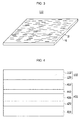
- FIG. 1 is a schematic cross-sectional view showing an optical film according to an embodiment
- FIG. 2 is a schematic view showing the anti-reflection principle of an optical film according to an embodiment
- FIG. 3 is a schematic view showing an example of a polarization film.
- an optical film 100 includes a polarization film 110 and a compensation film 120.
- the compensation film 120 may circularly polarize light passing through the polarization film 110 and thus cause retardation and have an influence on reflection and/or absorption of the light.
- the optical film 100 may be disposed on one side or both sides of a display device, and particularly, on the screen side of the display device, and thus may prevent reflection of light flowing in from the outside (hereinafter referred to as "reflection of external light”). Therefore, the optical film 100 may prevent visibility deterioration due to the reflection of external light.
- FIG. 2 is a schematic view showing the external light anti-reflection principle of an optical film according to an embodiment.
- the polarization film 110 has a self-integrated structure which is made of a melt blend of a polymer 71 and a dichroic dye 72.
- the polymer 71 may be, for example, a hydrophobic polymer, for example a polyolefin such as polyethylene (PE), polypropylene (PP), and a copolymer thereof; a polyamide such as nylon and an aromatic polyamide; a polyester such as polyethylene terephthalate (PET), glycol modified polyethylene terephthalate (PETG), and polyethylene naphthalate (PEN); a polyacrylate such as polymethyl(meth)acrylate; a polystyrene such as polystyrene (PS) and an acrylonitrile-styrene copolymer; a polycarbonate; a vinyl chloride type polymer; a polyimide; a polysulfone resin; a polyethersulfone; a polyether-etherketone; a polyphenylene sulfide; a vinyl alcohol type polymer; a vinylidene chloride type polymer; a vinyl butyral type polymer; an allylic polymer
- the polymer 71 may be, for example, a polyolefin, a polyamide, a polyester, a polyacrylate, a polystyrene, a copolymer thereof, or a combination thereof, and in another example, polyethylene (PE), polypropylene (PP), polyethylene terephthalate (PET), glycol modified polyethylene terephthalate (PETG), polyethylene naphthalate (PEN), nylon, a copolymer thereof, or a combination thereof.
- PE polyethylene
- PP polypropylene
- PET polyethylene terephthalate
- PET glycol modified polyethylene terephthalate
- PEN polyethylene naphthalate
- nylon a copolymer thereof, or a combination thereof.
- the polymer 71 may be a polyolefin.
- the polyolefin may be, for example, a mixture of at least two selected from polyethylene (PE), polypropylene (PP), and a copolymer of polyethylene and polypropylene (PE-PP), and in another example, a mixture of polypropylene (PP) and a polyethylene-polypropylene copolymer (PE-PP).
- the polymer 71 may have transmittance of greater than or equal to about 85% in a wavelength region of about 400 nm to about 780 nm.
- the polymer 71 is elongated in a uniaxial direction.
- the uniaxial direction may be the same as a length direction of the dichroic dye 72.
- the dichroic dye 72 is dispersed into the polymer 71, and is aligned in the elongation direction of the polymer 71.
- the dichroic dye 72 may transmit one perpendicular polarization component of two perpendicular polarization components in a predetermined wavelength region.
- the dichroic dye 72 may be included in an amount of about 0.01 to about 5 parts by weight, based on 100 parts by weight of the polymer 71. While not wishing to be bound by theory, it is understood that within the above range, sufficient polarization characteristics may be obtained without deteriorating transmittance of a polarization film. Within the above broader range, the dichroic dye 72 may be included in an amount of about 0.05 to about 1 part by weight, based on 100 parts by weight of the polymer 71.
- the polarization film 110 may have a relatively low thickness of less than or equal to about 100 ⁇ m, for example about 30 ⁇ m to about 95 ⁇ m. While not wishing to be bound by theory, it is understood that when the polarization film 110 has a thickness within the range, it may be significantly thinner than a polarizing plate requiring a protective layer such as triacetyl cellulose (TAC), and may contribute to realizing a thin display device.
- TAC triacetyl cellulose
- the compensation film 120 is the same as described above.
- the optical film 100 may further include a correction layer (not shown) positioned on one side of the compensation film 120.
- the correction layer may be, for example, a color shift resistant layer, but is not limited thereto.
- the optical film 100 may further include a light blocking layer (not shown) extended along the edge.
- the light blocking layer may be formed in a strip along the circumference of the optical film 100, and for example, may be positioned between the polarization film 110 and the compensation film 120.
- the light blocking layer may include an opaque material, for example, a black material.
- the light blocking layer may be made of a black ink.
- the optical film 100 may be applied to various display devices.
- a display device includes a display panel and an optical film positioned on the display panel.
- the display panel may be a liquid crystal display panel or an organic light emitting display panel, but is not limited thereto.
- an organic light emitting diode device is described as an example of a display device.
- FIG. 4 is a schematic cross-sectional view showing an organic light emitting diode (OLED) device according to an embodiment.
- OLED organic light emitting diode
- the organic light emitting diode device includes an organic light emitting display panel 400 and an optical film 100 positioned on the organic light emitting display panel 400.
- the organic light emitting display panel 400 may include a base substrate 410, a lower electrode 420, an organic emission layer 430, an upper electrode 440, and an encapsulation substrate 450.
- the base substrate 410 may be made of glass or plastic.
- At least one of the lower electrode 420 and the upper electrode 440 may be an anode, and the other may be a cathode.
- the anode is an electrode injected with holes, and it may be made of a transparent conductive material having a high work function to transmit the emitted light to the outside, for example, ITO or IZO.
- the cathode is an electrode injected with electrons, and it may be made of a conductive material having a low work function without affecting the organic material, and may be selected from, for example, aluminum (Al), calcium (Ca), and barium (Ba).
- the organic emission layer 430 includes an organic material which may emit light when a voltage to the lower electrode 420 and the upper electrode 440 is applied.
- An auxiliary layer may be further provided between the lower electrode 420 and the organic emission layer 430, and between the upper electrode 440 and the organic emission layer 430.
- the auxiliary layer is used to balance electrons and holes, and may include a hole transport layer, a hole injection layer (HIL), an electron injection layer (EIL), and an electron transporting layer.
- HIL hole injection layer
- EIL electron injection layer
- the encapsulation substrate 450 may be made of glass, metal, or a polymer, and may seal the lower electrode 420, the organic emission layer 430, and the upper electrode 440 to prevent moisture and/or oxygen inflow from the outside.
- the optical film 100 may be disposed on the light-emitting side.
- the optical film 100 may be disposed on the exterior side of the base substrate 410, while in the case of a top emission structure emitting light at the side of the encapsulation substrate 450, the optical film 100 may be disposed on the exterior side of the encapsulation substrate 450.
- the optical film 100 includes the integrated polarization film 110 and the integrated compensation film 120.
- the polarization film 110 and the compensation film 120 are respectively the same as described above, and may prevent a display device from having visibility deterioration caused by light inflowing from the outside after passing the polarization film 110 and being reflected by a metal such as an electrode and the like in the organic light emitting display panel 400. Accordingly, display characteristics of the organic light emitting diode device may be improved.
- LCD liquid crystal display
- FIG. 5 is a schematic cross-sectional view showing a liquid crystal display (LCD) device according to an embodiment.
- LCD liquid crystal display
- the liquid crystal display includes a liquid crystal display panel 500, and an optical film 100 positioned on the liquid crystal panel 500.
- the liquid crystal panel 500 may be a twist nematic (TN) mode panel, a patterned vertical alignment (PVA) mode panel, an in-plane switching (IPS) mode panel, an optically compensated bend (OCB) mode panel, or the like.
- TN twist nematic
- PVA patterned vertical alignment
- IPS in-plane switching
- OBC optically compensated bend
- the liquid crystal panel 500 may include a first display panel 510, a second display panel 520, and a liquid crystal layer 530 interposed between the first display panel 510 and the second display panel 520.
- the first display panel 510 may include, for example, a thin film transistor (not shown) formed on a substrate (not shown) and a first electric field generating electrode (not shown) connected to the same
- the second display panel 520 may include, for example, a color filter (not shown) formed on a substrate (not shown) and a second electric field generating electrode (not shown).
- the color filter may be included in the first display panel 510, while the first electric field generating electrode and the second electric field generating electrode may be disposed on the first display panel 510 together therewith.
- the liquid crystal layer 530 may include a plurality of liquid crystal molecules.
- the liquid crystal molecules may have positive or negative dielectric anisotropy.
- the major axes thereof may be aligned substantially parallel to the surface of the first display panel 510 and the second display panel 520 when an electric field is not applied, and the major axes may be aligned substantially perpendicular to the surface of the first display panel 510 and second display panel 520 when an electric field is applied.
- the major axes may be aligned substantially perpendicular to the surface of the first display panel 510 and the second display panel 520 when an electric field is not applied, and the major axes may be aligned substantially parallel to the surface of the first display panel 510 and the second display panel 520 when an electric field is applied.
- the optical film 100 may be disposed on the outside of the liquid crystal panel 500. Although the optical film 100 is shown to be provided on both the lower part and the upper part of the liquid crystal panel 500 in the drawing, it is not limited thereto, and it may be formed on only one of the lower part and the upper part of the liquid crystal panel 500.
- the optical film 100 includes the integrated polarization film 110 and the integrated compensation film 120, which are the same as described above.
- the suspension is filtered to obtain a precipitate, and the precipitate is washed several times with a small amount of hot ethyl acetate. Then, the solvent is removed from the mother liquor under a reduced pressure, and the remaining solid is crystallized from ethyl acetate. The mother liquid is concentrated after the crystallization and dried at 60°C under vacuum to obtain an intermediate I-1. The yield of the intermediate 1-1 is 88.3%.
- the obtained solid is suspended in 300 ml of boiling methanol and then filtered while being cooled, which is repeated three times.
- the obtained product is dissolved in 300 ml of dimethyl acetamide and filtered, and then reprecipitated in 2 L of water.
- the precipitate is filtered and then suspended in iso-propanol to remove water therefrom.
- the obtained product is collected by filtration, and the obtained solid is suspended in 600 ml of boiling methanol and then filtered while being cooled. Then, the product obtained therefrom is dried at 70°C under vacuum to obtain compound 1.
- the yield of the compound 1 is 67.1 %.
- the obtained solid is suspended in 400 ml of boiling iso-propanol and then filtered while being cooled, which is repeated three times.
- the obtained product is dissolved in 300 ml of dimethyl acetamide and filtered, and then reprecipitated in 2 L of water.
- the obtained precipitate is collected by filtration and then suspended in iso-propanol to remove water.
- the obtained product is collected by filtration, and the solid obtained is suspended in 600 ml of boiling methanol and then filtered while being cooled.
- the obtained product is dried at 70°C under vacuum to obtain compound 2.
- the yield of compound 2 is 65.4%.
- the extracted solution is washed with water, and the solvent is removed therefrom under reduced pressure. Then, 2 equivalents of concentrated hydrochloric acid are added to the product obtained therefrom to obtain a precipitate.
- the precipitate is suspended in boiling acetone and then collected by filtration. The obtained solid is dissolved in 1 L of hot water and treated with charcoal, and then filtered. Subsequently, an ammonium hydroxide aqueous solution is added thereto to obtain a white precipitate. The precipitate is filtered and washed with water and then dried at 70°C for 24 h under a reduced pressure to obtain compound 4.
- the composition is spin coated on a 5x5 square centimeters (cm 2 ) glass plate at 1,000 revolutions per minute (rpm) for 1 minute (min) and dried in an 80°C oven for 2 h to form a 15 micrometer ( ⁇ m)-thick polymer film.
- the polymer has a structural unit of Chemical Formula C-1 and a weight average molecular weight of 260,000 g/mol.
- a polymer film is formed according to the same method as Synthesis Example 5, except for including compound 1, compound 5, and compound 6 in a mole ratio of 1:9:10.
- the polymer has a structural unit of Chemical Formula C-2 and a weight average molecular weight of 280,000 g/mol.
- a polymer film is prepared according to the same method as Synthesis Example 5, except for including compound 1, compound 5, and compound 6 in a mole ratio of 2:8:10.
- the polymer has a structural unit of Chemical Formula C-3 and a weight average molecular weight of 270,000 g/mol.
- a polymer film is prepared according to the same method as Synthesis Example 5, except for including compound 1, compound 5, and compound 6 in a mole ratio of 3:7:10.
- the polymer has a structural unit of Chemical Formula C-4 and a weight average molecular weight of 250,000 g/mol.
- a polymer film is prepared according to the same method as Synthesis Example 5, except for including compound 1, compound 5, and compound 6 in a mole ratio of 4:7:10.
- the polymer has a structural unit of Chemical Formula C-5 and a weight average molecular weight of 270,000 g/mol.
- Compound 3 according to Synthesis Example 3 and compound 7 represented by Chemical Formula A-2 (4,4'-oxydianiline, Sigma-Aldrich Co. Ltd.) in a mole ratio of 1:9 are dissolved in dimethyl acetamide to prepare a solution.
- Compound 8 represented by Chemical Formula B-2 (benzene-1,2,4,5-tetracarboxylic dianhydride, Sigma-Aldrich Co., Ltd.) is added thereto, and the mixture is reacted at room temperature for 48 h under a nitrogen atmosphere to prepare a composition.
- the composition includes compound 3, compound 7, and compound 8 in a mole ratio of 1:9:10.
- the reaction is complete, the composition is spin coated on a 5x5 cm 2 glass plate at 1,000 rpm for 1 min and dried in an 80°C oven for 2 h to form a 15 ⁇ m-thick polymer film.
- the polymer has a structural unit of Chemical Formula D-1 and a weight average molecular weight of 240,000 g/mol.
- a polymer film is prepared according to the same method as Synthesis Example 10, except for including compound 3, compound 7, and compound 8 in a mole ratio of 2:8:10.
- the polymer has a structural unit of Chemical Formula D-2 and a weight average molecular weight of 260,000 g/mol.
- the polymer film according to Synthesis Example 5 is detached from the glass plate and cut to a size of 15x45 square millimeters (mm 2 ) to obtain a sample, and an elongated compensation film having an average thickness of about 12 ⁇ m is prepared by fixing the long side of the sample at a metal frame, putting it in an oven under a nitrogen atmosphere, and heating it up to 300°C at 10 degree Centigrade per minute (°C/min) for 1 h.
- An elongated compensation film is prepared according to the same method as Example 1, except for using the polymer film according to Synthesis Example 6 instead of the polymer film according to Synthesis Example 5.
- An elongated compensation film is prepared according to the same method as Example 1, except for using the polymer film according to Synthesis Example 7 instead of the polymer film according to Synthesis Example 5.
- An elongated compensation film is prepared according to the same method as Example 1, except for using the polymer film according to Synthesis Example 8 instead of the polymer film according to Synthesis Example 5.
- An elongated compensation film is prepared according to the same method as Example 1, except for using the polymer film according to Synthesis Example 9 instead of the polymer film according to Synthesis Example 5.
- An elongated compensation film is prepared according to the same method as Example 1, except for using the polymer film according to Synthesis Example 10 instead of the polymer film according to Synthesis Example 5.
- An elongated compensation film is prepared according to the same method as Example 1, except for using the polymer film according to Synthesis Example 11 instead of the polymer film according to Synthesis Example 5.
- the retardation values of the compensation films according to Examples 1 to 7 are measured.
- the retardation value is measured by using Axoscan equipment (Axometrics Inc.).
- the reference wavelength of the retardation is about 550 nanometers (nm).
- the compensation films according to Examples 1 to 7 have in-plane retardation values ranging from about 110 to 160 nm and may be used as a ⁇ /4 phase delay layer.
- the wavelength dispersion values of the compensation films according to Examples 1 to 7 are evaluated.
- the wavelength dispersion value is measured by using Axoscan equipment (Axometrics Inc.).
- the compensation films according to Examples 1 to 7 show different retardation values depending on a wavelength, and specifically, the compensation films according to Examples 1 and 7 have a reverse wavelength dispersion phase delay of which retardation regarding light at a long wavelength is larger than retardation regarding light at a short wavelength, and the compensation films according to Examples 2 to 6 show a normal wavelength dispersion phase delay of which retardation regarding light at a long wavelength is smaller than retardation regarding light at a short wavelength.
Landscapes
- Chemical & Material Sciences (AREA)
- Organic Chemistry (AREA)
- Chemical Kinetics & Catalysis (AREA)
- Health & Medical Sciences (AREA)
- Medicinal Chemistry (AREA)
- Polymers & Plastics (AREA)
- Physics & Mathematics (AREA)
- General Physics & Mathematics (AREA)
- Optics & Photonics (AREA)
- Engineering & Computer Science (AREA)
- Manufacturing & Machinery (AREA)
- Nonlinear Science (AREA)
- Materials Engineering (AREA)
- Crystallography & Structural Chemistry (AREA)
- Mathematical Physics (AREA)
- Macromolecular Compounds Obtained By Forming Nitrogen-Containing Linkages In General (AREA)
- Polarising Elements (AREA)
- Organic Low-Molecular-Weight Compounds And Preparation Thereof (AREA)
Applications Claiming Priority (1)
| Application Number | Priority Date | Filing Date | Title |
|---|---|---|---|
| KR20150121502 | 2015-08-28 |
Publications (1)
| Publication Number | Publication Date |
|---|---|
| EP3138866A1 true EP3138866A1 (fr) | 2017-03-08 |
Family
ID=56852078
Family Applications (1)
| Application Number | Title | Priority Date | Filing Date |
|---|---|---|---|
| EP16184785.0A Withdrawn EP3138866A1 (fr) | 2015-08-28 | 2016-08-18 | Monomère, polymère, film de compensation, film optique et dispositif d'affichage |
Country Status (5)
| Country | Link |
|---|---|
| US (2) | US10247867B2 (fr) |
| EP (1) | EP3138866A1 (fr) |
| JP (1) | JP6896387B2 (fr) |
| KR (1) | KR20170026181A (fr) |
| CN (1) | CN106478427B (fr) |
Cited By (1)
| Publication number | Priority date | Publication date | Assignee | Title |
|---|---|---|---|---|
| CN111848556A (zh) * | 2020-07-31 | 2020-10-30 | 上海天马有机发光显示技术有限公司 | 化合物、显示面板和显示装置 |
Families Citing this family (4)
| Publication number | Priority date | Publication date | Assignee | Title |
|---|---|---|---|---|
| KR102555870B1 (ko) * | 2018-02-22 | 2023-07-14 | 삼성전자주식회사 | 폴리머, 상기 폴리머를 포함하는 필름, 및 상기 필름을 포함하는 표시 장치 |
| EP3919548A4 (fr) | 2019-02-01 | 2022-10-12 | Wingo Technology Co., Ltd. | Composé polyimide et article moulé contenant ledit composé polyimide |
| JP2021024842A (ja) * | 2019-08-08 | 2021-02-22 | 三菱ケミカル株式会社 | 含硫黄芳香族複素環を有する化合物とその製造方法、重合性組成物、及び重合物 |
| CN114516807B (zh) * | 2022-02-24 | 2023-11-17 | 南京大学 | 一种含硝基多取代芳香二胺单体及其制备方法 |
Citations (7)
| Publication number | Priority date | Publication date | Assignee | Title |
|---|---|---|---|---|
| US4038320A (en) * | 1976-04-19 | 1977-07-26 | The United States Of America As Represented By The Secretary Of The Air Force | Phenylethynyl substituted aromatic diamines |
| US5689004A (en) * | 1995-08-04 | 1997-11-18 | The United States Of America As Represented By The Administrator Of The National Aeronautics And Space Administration | Diamines containing pendent phenylethynyl groups |
| JP2001056469A (ja) * | 1999-08-19 | 2001-02-27 | Fuji Photo Film Co Ltd | 液晶配向膜、液晶性分子を配向させる方法、光学補償シートおよびstn型液晶表示装置 |
| US20070232780A1 (en) * | 2006-03-16 | 2007-10-04 | Chisso Corporation | Photo-alignment film and liquid crystal display element |
| US20080273153A1 (en) * | 2007-05-01 | 2008-11-06 | Nitto Denko Corporation | Liquid crystal panel and liquid crystal display apparatus |
| US20100003490A1 (en) * | 2006-10-02 | 2010-01-07 | Nitto Denko Corporation | Optical film, image display device, diethynylfluorene, and polymer thereof |
| WO2014093225A2 (fr) * | 2012-12-10 | 2014-06-19 | Cellceutix Corporation | Composés polycycliques et leurs procédés de fabrication et d'utilisation |
Family Cites Families (10)
| Publication number | Priority date | Publication date | Assignee | Title |
|---|---|---|---|---|
| US4365093A (en) * | 1975-05-14 | 1982-12-21 | William H. Rorer, Inc. | Ethynylbenzene compounds and derivatives thereof |
| JP2001089427A (ja) | 1999-09-20 | 2001-04-03 | Fuji Photo Film Co Ltd | 新規アセチレン化合物 |
| CN101056903B (zh) | 2004-11-11 | 2012-02-08 | 住友化学株式会社 | 光学膜 |
| JP5481771B2 (ja) * | 2006-03-16 | 2014-04-23 | Jnc株式会社 | 光配向膜及び液晶表示素子 |
| JP4995618B2 (ja) | 2007-04-17 | 2012-08-08 | 日東電工株式会社 | 光学フィルム、及び画像表示装置 |
| JP5068146B2 (ja) * | 2007-05-01 | 2012-11-07 | 日東電工株式会社 | 液晶パネルおよび液晶表示装置 |
| JP4726148B2 (ja) * | 2007-11-20 | 2011-07-20 | 日東電工株式会社 | 液晶パネル、及び液晶表示装置 |
| JP2012155311A (ja) | 2011-01-05 | 2012-08-16 | Jnc Corp | 光配向用液晶配向膜を形成するための液晶配向剤、液晶配向膜およびこれを用いた液晶表示素子 |
| US9207359B2 (en) | 2012-11-07 | 2015-12-08 | Samsung Electronics Co., Ltd. | Polarizing film and display device including the polarizing film |
| US9194980B2 (en) * | 2012-11-07 | 2015-11-24 | Samsung Electronics Co., Ltd. | Polarizing film and display device including the polarizing film |
-
2016
- 2016-08-18 EP EP16184785.0A patent/EP3138866A1/fr not_active Withdrawn
- 2016-08-22 US US15/242,862 patent/US10247867B2/en active Active
- 2016-08-23 KR KR1020160106930A patent/KR20170026181A/ko not_active Abandoned
- 2016-08-24 JP JP2016163404A patent/JP6896387B2/ja not_active Expired - Fee Related
- 2016-08-25 CN CN201610729005.7A patent/CN106478427B/zh not_active Expired - Fee Related
-
2019
- 2019-02-01 US US16/265,205 patent/US10877198B2/en not_active Expired - Fee Related
Patent Citations (7)
| Publication number | Priority date | Publication date | Assignee | Title |
|---|---|---|---|---|
| US4038320A (en) * | 1976-04-19 | 1977-07-26 | The United States Of America As Represented By The Secretary Of The Air Force | Phenylethynyl substituted aromatic diamines |
| US5689004A (en) * | 1995-08-04 | 1997-11-18 | The United States Of America As Represented By The Administrator Of The National Aeronautics And Space Administration | Diamines containing pendent phenylethynyl groups |
| JP2001056469A (ja) * | 1999-08-19 | 2001-02-27 | Fuji Photo Film Co Ltd | 液晶配向膜、液晶性分子を配向させる方法、光学補償シートおよびstn型液晶表示装置 |
| US20070232780A1 (en) * | 2006-03-16 | 2007-10-04 | Chisso Corporation | Photo-alignment film and liquid crystal display element |
| US20100003490A1 (en) * | 2006-10-02 | 2010-01-07 | Nitto Denko Corporation | Optical film, image display device, diethynylfluorene, and polymer thereof |
| US20080273153A1 (en) * | 2007-05-01 | 2008-11-06 | Nitto Denko Corporation | Liquid crystal panel and liquid crystal display apparatus |
| WO2014093225A2 (fr) * | 2012-12-10 | 2014-06-19 | Cellceutix Corporation | Composés polycycliques et leurs procédés de fabrication et d'utilisation |
Cited By (1)
| Publication number | Priority date | Publication date | Assignee | Title |
|---|---|---|---|---|
| CN111848556A (zh) * | 2020-07-31 | 2020-10-30 | 上海天马有机发光显示技术有限公司 | 化合物、显示面板和显示装置 |
Also Published As
| Publication number | Publication date |
|---|---|
| KR20170026181A (ko) | 2017-03-08 |
| CN106478427A (zh) | 2017-03-08 |
| JP6896387B2 (ja) | 2021-06-30 |
| CN106478427B (zh) | 2021-09-14 |
| US20170059755A1 (en) | 2017-03-02 |
| JP2017043770A (ja) | 2017-03-02 |
| US20190162888A1 (en) | 2019-05-30 |
| US10877198B2 (en) | 2020-12-29 |
| US10247867B2 (en) | 2019-04-02 |
Similar Documents
| Publication | Publication Date | Title |
|---|---|---|
| US10877198B2 (en) | Monomer, polymer, compensation film, optical film, and display device | |
| CN108431136B (zh) | 聚酰亚胺材料、其制造方法和其制造中使用的聚酰亚胺前体组合物 | |
| EP3187528B1 (fr) | Composition pour la préparation d'un film polymère transparent, film polymère transparent et dispositif électronique comprenant ce dernier | |
| CN107614483B (zh) | 二胺及其利用 | |
| CN107849352B (zh) | 聚酰亚胺前体组合物和聚酰亚胺组合物 | |
| EP3497492B1 (fr) | Film optique de compensation comportant une dispersion inverse de longueurs d'onde | |
| US11702509B2 (en) | Monomer, polymer, compensation film, optical film, and display device | |
| JP2022519404A (ja) | ポリイミド系樹脂フィルム、およびこれを利用したディスプレイ装置用基板ならびに光学装置 | |
| EP3438157B1 (fr) | Monomère, polymère, film de compensation, film optique et dispositif d'affichage | |
| KR102555870B1 (ko) | 폴리머, 상기 폴리머를 포함하는 필름, 및 상기 필름을 포함하는 표시 장치 | |
| US10053424B2 (en) | Monomer and polymer and compensation film and optical film and display device | |
| KR102592065B1 (ko) | 플렉서블 디바이스 기판형성용 조성물 | |
| KR20090027748A (ko) | 광학 적층체, 편광판, 화상 표시 장치 및 광학 적층체의 제조 방법 | |
| JP2017186285A (ja) | フルオレン骨格を有するジアミン化合物、ポリアミック酸、及びポリイミド | |
| CN115175955B (zh) | 基于聚酰亚胺的聚合物膜、使用其的显示装置用基底和光学装置 | |
| US20250043079A1 (en) | Polyimide, polyimide varnish, and polyimide thin film | |
| KR102417139B1 (ko) | 보상 필름, 광학 필름 및 표시 장치 | |
| KR101725592B1 (ko) | 위상차 필름 및 그 제조 방법 | |
| US11518734B2 (en) | Monomer and polymer, compensation film, optical film, and display device | |
| KR20190093020A (ko) | 화합물, 중합체, 필름, 및 광학 장치 | |
| KR101725591B1 (ko) | 위상차 필름 및 그 제조 방법 |
Legal Events
| Date | Code | Title | Description |
|---|---|---|---|
| PUAI | Public reference made under article 153(3) epc to a published international application that has entered the european phase |
Free format text: ORIGINAL CODE: 0009012 |
|
| STAA | Information on the status of an ep patent application or granted ep patent |
Free format text: STATUS: THE APPLICATION HAS BEEN PUBLISHED |
|
| AK | Designated contracting states |
Kind code of ref document: A1 Designated state(s): AL AT BE BG CH CY CZ DE DK EE ES FI FR GB GR HR HU IE IS IT LI LT LU LV MC MK MT NL NO PL PT RO RS SE SI SK SM TR |
|
| AX | Request for extension of the european patent |
Extension state: BA ME |
|
| STAA | Information on the status of an ep patent application or granted ep patent |
Free format text: STATUS: REQUEST FOR EXAMINATION WAS MADE |
|
| 17P | Request for examination filed |
Effective date: 20170908 |
|
| RBV | Designated contracting states (corrected) |
Designated state(s): AL AT BE BG CH CY CZ DE DK EE ES FI FR GB GR HR HU IE IS IT LI LT LU LV MC MK MT NL NO PL PT RO RS SE SI SK SM TR |
|
| STAA | Information on the status of an ep patent application or granted ep patent |
Free format text: STATUS: EXAMINATION IS IN PROGRESS |
|
| 17Q | First examination report despatched |
Effective date: 20210910 |
|
| P01 | Opt-out of the competence of the unified patent court (upc) registered |
Effective date: 20230520 |
|
| STAA | Information on the status of an ep patent application or granted ep patent |
Free format text: STATUS: THE APPLICATION IS DEEMED TO BE WITHDRAWN |
|
| 18D | Application deemed to be withdrawn |
Effective date: 20240217 |