EP3139063A1 - Zahnriemen - Google Patents
Zahnriemen Download PDFInfo
- Publication number
- EP3139063A1 EP3139063A1 EP15786007.3A EP15786007A EP3139063A1 EP 3139063 A1 EP3139063 A1 EP 3139063A1 EP 15786007 A EP15786007 A EP 15786007A EP 3139063 A1 EP3139063 A1 EP 3139063A1
- Authority
- EP
- European Patent Office
- Prior art keywords
- rubber
- toothed belt
- cord
- rubber composition
- parts
- Prior art date
- Legal status (The legal status is an assumption and is not a legal conclusion. Google has not performed a legal analysis and makes no representation as to the accuracy of the status listed.)
- Granted
Links
Images

Classifications
-
- F—MECHANICAL ENGINEERING; LIGHTING; HEATING; WEAPONS; BLASTING
- F16—ENGINEERING ELEMENTS AND UNITS; GENERAL MEASURES FOR PRODUCING AND MAINTAINING EFFECTIVE FUNCTIONING OF MACHINES OR INSTALLATIONS; THERMAL INSULATION IN GENERAL
- F16G—BELTS, CABLES, OR ROPES, PREDOMINANTLY USED FOR DRIVING PURPOSES; CHAINS; FITTINGS PREDOMINANTLY USED THEREFOR
- F16G1/00—Driving-belts
- F16G1/28—Driving-belts with a contact surface of special shape, e.g. toothed
-
- B—PERFORMING OPERATIONS; TRANSPORTING
- B29—WORKING OF PLASTICS; WORKING OF SUBSTANCES IN A PLASTIC STATE IN GENERAL
- B29D—PRODUCING PARTICULAR ARTICLES FROM PLASTICS OR FROM SUBSTANCES IN A PLASTIC STATE
- B29D29/00—Producing belts or bands
- B29D29/08—Toothed driving belts
-
- D—TEXTILES; PAPER
- D03—WEAVING
- D03D—WOVEN FABRICS; METHODS OF WEAVING; LOOMS
- D03D1/00—Woven fabrics designed to make specified articles
- D03D1/0094—Belts
-
- F—MECHANICAL ENGINEERING; LIGHTING; HEATING; WEAPONS; BLASTING
- F16—ENGINEERING ELEMENTS AND UNITS; GENERAL MEASURES FOR PRODUCING AND MAINTAINING EFFECTIVE FUNCTIONING OF MACHINES OR INSTALLATIONS; THERMAL INSULATION IN GENERAL
- F16G—BELTS, CABLES, OR ROPES, PREDOMINANTLY USED FOR DRIVING PURPOSES; CHAINS; FITTINGS PREDOMINANTLY USED THEREFOR
- F16G1/00—Driving-belts
-
- F—MECHANICAL ENGINEERING; LIGHTING; HEATING; WEAPONS; BLASTING
- F16—ENGINEERING ELEMENTS AND UNITS; GENERAL MEASURES FOR PRODUCING AND MAINTAINING EFFECTIVE FUNCTIONING OF MACHINES OR INSTALLATIONS; THERMAL INSULATION IN GENERAL
- F16G—BELTS, CABLES, OR ROPES, PREDOMINANTLY USED FOR DRIVING PURPOSES; CHAINS; FITTINGS PREDOMINANTLY USED THEREFOR
- F16G1/00—Driving-belts
- F16G1/04—Driving-belts made of fibrous material, e.g. textiles, whether rubber-covered or not
-
- F—MECHANICAL ENGINEERING; LIGHTING; HEATING; WEAPONS; BLASTING
- F16—ENGINEERING ELEMENTS AND UNITS; GENERAL MEASURES FOR PRODUCING AND MAINTAINING EFFECTIVE FUNCTIONING OF MACHINES OR INSTALLATIONS; THERMAL INSULATION IN GENERAL
- F16G—BELTS, CABLES, OR ROPES, PREDOMINANTLY USED FOR DRIVING PURPOSES; CHAINS; FITTINGS PREDOMINANTLY USED THEREFOR
- F16G1/00—Driving-belts
- F16G1/06—Driving-belts made of rubber
- F16G1/08—Driving-belts made of rubber with reinforcement bonded by the rubber
-
- B—PERFORMING OPERATIONS; TRANSPORTING
- B29—WORKING OF PLASTICS; WORKING OF SUBSTANCES IN A PLASTIC STATE IN GENERAL
- B29K—INDEXING SCHEME ASSOCIATED WITH SUBCLASSES B29B, B29C OR B29D, RELATING TO MOULDING MATERIALS OR TO MATERIALS FOR MOULDS, REINFORCEMENTS, FILLERS OR PREFORMED PARTS, e.g. INSERTS
- B29K2105/00—Condition, form or state of moulded material or of the material to be shaped
- B29K2105/06—Condition, form or state of moulded material or of the material to be shaped containing reinforcements, fillers or inserts
- B29K2105/08—Condition, form or state of moulded material or of the material to be shaped containing reinforcements, fillers or inserts of continuous length, e.g. cords, rovings, mats, fabrics, strands or yarns
- B29K2105/10—Cords, strands or rovings, e.g. oriented cords, strands or rovings
-
- B—PERFORMING OPERATIONS; TRANSPORTING
- B29—WORKING OF PLASTICS; WORKING OF SUBSTANCES IN A PLASTIC STATE IN GENERAL
- B29K—INDEXING SCHEME ASSOCIATED WITH SUBCLASSES B29B, B29C OR B29D, RELATING TO MOULDING MATERIALS OR TO MATERIALS FOR MOULDS, REINFORCEMENTS, FILLERS OR PREFORMED PARTS, e.g. INSERTS
- B29K2309/00—Use of inorganic materials not provided for in groups B29K2303/00 - B29K2307/00, as reinforcement
- B29K2309/08—Glass
-
- D—TEXTILES; PAPER
- D10—INDEXING SCHEME ASSOCIATED WITH SUBLASSES OF SECTION D, RELATING TO TEXTILES
- D10B—INDEXING SCHEME ASSOCIATED WITH SUBLASSES OF SECTION D, RELATING TO TEXTILES
- D10B2331/00—Fibres made from polymers obtained otherwise than by reactions only involving carbon-to-carbon unsaturated bonds, e.g. polycondensation products
- D10B2331/02—Fibres made from polymers obtained otherwise than by reactions only involving carbon-to-carbon unsaturated bonds, e.g. polycondensation products polyamides
-
- D—TEXTILES; PAPER
- D10—INDEXING SCHEME ASSOCIATED WITH SUBLASSES OF SECTION D, RELATING TO TEXTILES
- D10B—INDEXING SCHEME ASSOCIATED WITH SUBLASSES OF SECTION D, RELATING TO TEXTILES
- D10B2331/00—Fibres made from polymers obtained otherwise than by reactions only involving carbon-to-carbon unsaturated bonds, e.g. polycondensation products
- D10B2331/10—Fibres made from polymers obtained otherwise than by reactions only involving carbon-to-carbon unsaturated bonds, e.g. polycondensation products polyurethanes
-
- D—TEXTILES; PAPER
- D10—INDEXING SCHEME ASSOCIATED WITH SUBLASSES OF SECTION D, RELATING TO TEXTILES
- D10B—INDEXING SCHEME ASSOCIATED WITH SUBLASSES OF SECTION D, RELATING TO TEXTILES
- D10B2505/00—Industrial
Definitions
- the present invention relates to a toothed belt.
- Bending fatigue resistance is required for a toothed belt to be used in automobile uses such as transmission drive of an overhead camshaft (OHC), balancer drive, oil pump drive, or opening/closing drive of a slid door of automobiles. Accordingly, there is known a technology of improving the bending fatigue resistance by using a Lang-twisted cord as a tension member of the toothed belt (see Patent Documents 1 and 2).
- Lang twist is one in which one or two or more pieces of a fiber are arranged and twisted (primary twist) and two or more pieces of the resulting one are arranged and twisted in the same direction as the direction in the primary twist (final twist).
- the toothed belt to be used in the automobile uses are used under conditions at cold regions, for example, an extremely low temperature state of from - 20°C to -30°C, or used under highly humid or rainwater-attaching conditions. That is, the toothed belt to be used in the automobile uses is sometimes necessary to have water resistance and cold resistance while the bending fatigue resistance is secured, depending on the use environment.
- ply twist is one in which one or two or more pieces of a fiber are arranged and twisted (primary twist) and two or more pieces of the resulting one are arranged and twisted in the reverse direction to the direction in the primary twist (final twist).
- the plied cord shows an advantage of little occurrence of kink as compared with the Lang-twisted cord.
- a toothed belt excellent in water resistance is required while the bending fatigue resistance is secured.
- the toothed belt under conditions at cold regions, that is, extremely low temperature (e.g., from -20°C to -30°C), for example, the toothed belt is left standing in the extremely low temperature state during the automobile engine is stopped at night and a portion at which the belt is wound on a pulley is hardened at the low temperature while being bent.
- extremely low temperature e.g., from -20°C to -30°C
- the toothed belt is left standing in the extremely low temperature state during the automobile engine is stopped at night and a portion at which the belt is wound on a pulley is hardened at the low temperature while being bent.
- large torque is necessary for the start of the engine in the morning and the hardened toothed belt severely gets fatigue through rapid stretching and there is a concern that cracks are generated in an early period and severance of the toothed belt is caused due to extension of the cracks. Therefore, there is required a toothed belt excellent in cold resistance, which is not hardened even when it is left standing in an extremely cold
- the present invention is for solving the aforementioned problems, and an object thereof is to provide a toothed belt excellent in water resistance and cold resistance while bending fatigue resistance is secured.
- the toothed belt of the present invention is a toothed belt containing tooth parts that are disposed at predetermined intervals along the belt longitudinal direction, a cord, and a back side that has the cord embedded therein, in which the cord contains a Lang-twisted glass fiber, an adhesion treatment layer, and an overcoat treatment layer, the overcoat treatment layer is formed on the surface of the adhesion treatment layer, the back side is composed of a rubber composition, and the rubber composition contains from 5 parts by mass to 20 parts by mass of a plasticizer based on 100 parts by mass of a rubber component.
- the cord is configured by Lang twist, as compared to plied cords, the cord is excellent in abrasion resistance even when water infiltrates and swelling occurs, so that the surface thereof is structurally less likely to wear and the adhesive component hardly separates. Therefore, protection of the cord relatively remains and thus water resistance is improved.
- the overcoat treatment layer is further formed on the surface of the adhesion treatment layer of the cord, the severance or the like of the fiber resulting from infiltration of water into the cord is less likely to occur.
- the cord is composed of a glass fiber, elongation and change with temperature are small, so that dimensional stability is excellent and bending fatigue resistance can be maintained not only at normal temperature but also at an extremely low temperature.
- a plasticizer is added to the rubber composition constituting the back side, the toothed belt is not hardened even when it is left standing at an extremely low temperature for a long period of time and has such a degree of flexibility that there is not so much difference to that at normal temperature, and thus cold resistance can be improved.
- the addition amount of the plasticizer is less than 5 parts by mass based on 100 parts by mass of the rubber component, it is impossible to impart such a degree of flexibility that is not so much different from that at normal temperature to the rubber composition at an extremely low temperature.
- the addition amount of the plasticizer exceeds 20 parts by mass, the toothed belt becomes too soft, so that tooth shearing force of the toothed belt decreases.
- the plasticizer preferably contains at least one selected from the group consisting of ether-based, ester-based, ether ester-based, phthalic acid-based, and adipic acid-based ones.
- the toothed belt is not hardened even when it is left standing at an extremely low temperature for a long period of time and can have such a degree of flexibility that there is not so much difference to that at normal temperature.
- an adipic acid-based plasticizer that can impart such a degree of flexibility that there is not so much difference to that at normal temperature even at an extremely low temperature to the rubber composition by the addition thereof in a small amount.
- the rubber composition constituting the back side has a rubber hardness measured at 25°C of from 70° to 85°.
- the rubber hardness measured at 25°C of the rubber composition constituting the back side falls within the above range, usable rubber hardness of the toothed belt can be secured at normal temperature.
- the rubber hardness is less than 70°, since the toothed belt is too soft, there arises a problem that it adheres to a pulley or the like on which it is wound.
- the rubber hardness exceeds 80°, since the toothed belt is too hard, there arises a problem in bendability at the time when the belt is wound on a pulley or the like.
- the rubber hardness is hardness measured by using a type A durometer in accordance with JIS K 6253 (2012) and is judged by hardness of the back side rubber of the toothed belt left standing under an atmosphere of 25°C for 90 minutes.
- the rubber hardness at -30°C of the rubber composition constituting the back side is preferably from +0° to +4° as compared to the rubber hardness at 25°C.
- the toothed belt has such a degree of flexibility that there is not so much difference to that at normal temperature, so that it is not hardened even when it is left standing at an extremely low temperature for a long period of time, and thus cold resistance can be improved.
- the rubber hardness is hardness measured by using a type A durometer in accordance with JIS K 6253 (2012) and is judged by hardness of the back side rubber of the toothed belt left standing under an atmosphere of each of -30°C and 25°C for 90 minutes.
- starting torque at -30°C is preferably less than 30 cN ⁇ m.
- the starting torque at -30°C falls within the above range, cracks (cracking) can be suppressed at belt start and during subsequent drive even at an extremely low temperature. That is, even at an extremely low temperature, crack resistance can be maintained.
- the starting torque for a toothed belt left standing under an atmosphere of -30°C for 90 minutes in a state of being wound on pulleys of a two-axis layout, there is measured torque required for starting by rotating the pulleys by 180°.
- the rubber composition constituting the back side preferably contains at least chloroprene rubber.
- the tooth parts are composed of a rubber composition and the rubber composition contains at least chloroprene rubber.
- the toothed belt can be constituted by using chloroprene rubber that is inexpensive.
- the glass fiber is preferably alkali-free glass.
- the toothed belt can be constituted by using alkali-free glass that is inexpensive.
- a toothed belt excellent in water resistance and cold resistance can be obtained while bending fatigue resistance is secured.
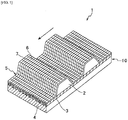
- the toothed belt 1 of the present embodiment contains a belt main body 10 containing a plurality of tooth parts 2 which are disposed at predetermined intervals along the belt longitudinal direction (arrow in the figure), a plurality of cords 3, and a back side 4 in which a plurality of the cords 3 are embedded, and a tooth fabric 5 with which the surface of a plurality of the tooth parts 2 is covered.
- the belt main body 10 having a plurality of the tooth parts 2 and the back side 4 is composed of a rubber composition.
- the rubber composition constituting the belt main body 10 use can be made of chloroprene rubber, acrylonitrile-butadiene rubber, hydrogenated acrylonitrile-butadiene rubber (HNBR), natural rubber, EPT (ethylenepropylene terpolymer), styrene-butadiene rubber, butyl rubber, chlorosulfonated polyethylene rubber, or the like.
- the rubber composition constituting the belt main body 10 is preferably a polymer having an excellent cold resistance. Particularly, in view of inexpensiveness, chloroprene rubber is preferred.
- the same rubber composition may be used or different rubber compositions may be used.
- a plasticizer is added to the rubber composition constituting the back side 4.
- the plasticizer is added to the rubber composition constituting the back side 4 and may be added or may not be added to the rubber composition constituting the tooth parts 2.
- the toothed belt is not hardened even when it is left standing at an extremely low temperature for a long period of time and can have such a degree of flexibility that there is not so much difference to that at normal temperature.
- the plasticizer for example, ether-based, ester-based, ether ester-based, phthalic acid-based, and adipic acid-based plasticizers can be used.
- adipic acid-based plasticizers that can impart such a degree of flexibility that there is not so much difference to that at normal temperature even at an extremely low temperature to the rubber composition by the addition thereof in a small amount.
- adipic acid-based plasticizers include dioctyl adipate (DOA), diisononyl adipate (DINA), diisodecyl adipate (DIDA), and the like.
- DOA dioctyl adipate
- DINA diisononyl adipate
- DIDA diisodecyl adipate
- “such a degree of flexibility that is not so much different from that at normal temperature” specifically means that the rubber hardness at -30°C is preferably from +0° to +4° as compared to the rubber hardness at 25°C.
- the rubber hardness is hardness measured by using a type A durometer in accordance with JIS K 6253 (2012) and is judged by hardness of the back side rubber of the toothed belt 1 left standing under an atmosphere of each of -30°C and 25°C for 90 minutes.
- the addition amount of the plasticizer is from 5 to 20 parts by mass based on 100 parts by mass of the rubber component. In the case where the addition amount is less than 5 parts by mass, such a degree of flexibility that is not so much different from that at normal temperature cannot be imparted to the rubber composition an extremely low temperature. On the other hand, in the case where the addition amount exceeds 20 parts by mass, since the toothed belt 1 becomes too soft, the tooth shearing force of the toothed belt 1 decreases.
- the tooth shearing force of the toothed belt 1 is preferably from 800 N to 1500 N.
- the starting torque at -30°C is preferably less than 30 cN ⁇ m.
- the starting torque for the toothed belt 1 left standing under an atmosphere of -30°C for 90 minutes in a state of being wound on pulleys of a two-axis layout, there is judged torque required for starting by rotating the pulleys by 180°.
- the cord 3 is a Lang-twisted cord in which one or two or more pieces of a glass fiber are arranged and twisted (primary twist) and two or more pieces of the resulting one are arranged and twisted in the same direction as the direction in the primary twist (final twist).
- the glass fiber constituting the cord 3 may be either alkali-free glass (E glass) or high-strength glass containing much Si component (K, U, or S glass), and is not limited in thickness of filament, the convergence number of filaments and the number of strands. Of these glass fibers, from the viewpoint of "inexpensiveness", the alkali-free glass (E glass) is most preferred.
- the cord 3 is subjected to an adhesion treatment for enhancing adhesion to the rubber composition constituting the back side 4.
- an adhesion treatment for example, the glass fiber constituting the cord 3 is immersed in a resorcin-formalin-latex treating liquid (RFL treating liquid) and subsequently dried under heating to form an adhesion treatment layer on the surface uniformly.
- the RFL treating liquid is obtained by mixing an initial condensate of resorcin and formalin into a latex, and examples of the latex used here include chloroprene, a styrene-butadiene-vinylpyridine terpolymer (VP latex), hydrogenated acrylonitrile-butadiene, NBR, and the like.
- the adhesion treatment there is also known a method of performing a treatment with the RFL treating liquid after pre-treatment with an epoxy or isocyanate compound.
- the RFL treating liquid is preferably added at least one vulcanization aid among an aqueous dispersion of a sulfur compound, a quinone oxime-based compound, a methacrylate-based compound, and a maleimide-based compound or one obtained by dispersing any of these vulcanization aids in water.
- aqueous dispersion of a sulfur compound for example, an aqueous dispersion of sulfur, tetramethylthiuram disulfide, or the like may be employed.
- the quinone oxime-based compound for example, p-quinone dioxime or the like may be employed.
- the following effects are expected by the addition of the vulcanization aid to the RFL treating liquid. That is, chemical bonding force between the layers of the rubber latex component contained in the RFL treating liquid and an outer layer rubber (it means a rubber composition constituting the overcoat treatment layer formed by an overcoat treatment to be mentioned later) is strengthened and thereby, the adhesion is improved, the exfoliation of the adhesion treatment layer of the cord 3 is suppressed, and the water resistance of the cord 3 is improved.
- the chemical bonding force (force of crosslinking) of the rubber latex component itself contained in the RFL treating liquid is strengthened and, as a result, it is considered that the exfoliation owing to the destruction of the outer layer rubber that is a target to be adhered precedes the exfoliation owing to cohesive failure of the adhesive layer (adhesion treatment layer) (i.e., interlayer exfoliation).
- the immersion treatment of the glass fiber constituting the cord 3 may be performed with dividing the treatment into two.
- any of the vulcanization aids described above is not added to the RFL treating liquid. This is because, in the first immersion treatment, thermal curing of RF is prioritized over crosslinking of the rubber latex component.
- an RFL treating liquid which contains a larger amount of a rubber latex component in comparison to the first RFL treating liquid and to which at least one vulcanization aid among an aqueous dispersion of a sulfur compound, a quinone oxime-based compound, a methacrylate-based compound, and a maleimide-based compound or one obtained by dispersing the vulcanization aid in water.
- the reason why a difference in the proportion of the rubber latex component in the RFL treating liquid is provided between the first immersion treatment and the second immersion treatment is that it is intended to enhance the adhesion of the RFL layer to both the fiber and the rubber which have different affinity.
- the overcoat treatment is performed by immersing the cord 3 subjected to the adhesion treatment such as RFL treatment with a treating liquid obtained by dissolving a rubber composition such as hydrogenated acrylonitrile-butadiene rubber (H-NBR) or chlorosulfonated polyethylene rubber (CSM) in an organic solvent such as methyl ethyl ketone, toluene, or xylene, and subsequently drying the cord under heating to form an overcoat treatment layer uniformly on the surface.
- a rubber composition such as hydrogenated acrylonitrile-butadiene rubber (H-NBR) or chlorosulfonated polyethylene rubber (CSM)
- organic solvent such as methyl ethyl ketone, toluene, or xylene
- the tooth fabric 5 is formed of a canvas and uses, as a base material, a fiber-woven fabric made by weaving a warp yarn 7 extending to the belt longitudinal direction and a weft yarn 6 extending to the belt width direction.
- a material of the fiber materials forming the weft yarn 6, the warp yarn 7 and the like any of nylon, aramid, polyester, polybenzoxazole, and cotton or a combination thereof may be employed.
- the form of the fiber may be any of a filament yarn and a spun yarn, and may be any of a twisted yarn having a sole composition or a blended twisted yarn and a blended yarn.
- nylon, aramid, or the like is suitably used depending on use environment and required life.
- the weave structure of the tooth fabric may be any of a twill weave, satin weave, flat weave, and the like.
- the tooth fabric 5 is preferably adhered to the rubber constituting the tooth parts 2 through a series of adhesion treatments including the following steps.
- the pre-treatment of (2) is performed before the rubber cement treatment of (3).
- the pre-treatment of (2) or the pre-treatment of (2) and the rubber cement treatment of (3) may be omitted.
- an imprint treatment of the rubber composition to the tooth fabric 5 by passing the tooth fabric 5 and the rubber composition through a calender roll or a treatment of laminating the rubber composition onto the side of the tooth fabric 5 to be adhered to the tooth parts 2 may be performed. That is, a treatment of coating the surface of the fiber-woven fabric constituting the tooth fabric 5 with a rolled rubber to form an adhesion treatment layer may be performed, or a treatment of coating the fiber-woven fabric constituting the tooth fabric 5 toward the tooth parts 2 with a rubber cement and a rolled rubber in this order to form an adhesion treatment layer may be performed. These treatments are also referred to as coat treatments.
- the toothed belt 1 is, for example, prepared by the following method. First, a canvas forming the tooth fabric 5 is wound on a cylindrical mold having a plurality of recessed stripes corresponding to the tooth parts 2 of the toothed belt 1. Subsequently, a cord constituting the cord 3 is wound on the cylindrical mold, on which the canvas has been wound, so as to have a predetermined pitch in the longitudinal direction of the cylindrical mold. Then, a rubber sheet forming the back side 4 and the tooth parts 2 is wound on the mold to form an unvulcanized sleeve.
- each toothed belt 1 is obtained by cutting the resultant sleeve-like molded body with a cutting blade according to a predetermined cutting width.
- the toothed belt 1 can be prepared by a preforming method.
- the belt is prepared by the following procedures. First, the tooth fabric 5 and the tooth parts 2 are preliminary molded by using a mold having a tooth form to obtain a preform. Then, the resultant preform is wound on a mold, and thereon is spun the cord 3 spirally. Subsequently, an unvulcanized rubber constituting the back side 4 is wound thereon, and thereafter the whole is vulcanized in a vulcanizer to thereby obtain the toothed belt 1.
- the tooth fabric 5 and the tooth parts 2 are preliminarily molded before vulcanization, it is not necessary to make the unvulcanized rubber constituting the back side 4 flow through gaps between the cords into the inside (ventral side, i.e., side of the tooth parts 2) and make the tooth fabric 5 tense to form the tooth parts 2 at the time of vulcanization. Thus, it becomes possible to narrow the distance (pitch) between the cords.
- the cord 3 is configured by Lang twist, as compared to plied cords, the cord is excellent in abrasion resistance even when water infiltrates and swelling occurs, so that the surface thereof is structurally less likely to wear and the adhesive component hardly separates. Therefore, protection of the cord relatively remains and thus the water resistance is improved.
- the overcoat treatment layer is further formed on the surface of the adhesion treatment layer of the cord 3, the severance or the like of the fiber to be caused by the infiltration of water into the cord 3 is less likely to occur.
- the cord 3 is composed of a glass fiber, elongation and change with temperature are small, so that dimensional stability is excellent and bending fatigue resistance can be maintained not only at normal temperature but also at an extremely low temperature.
- a plasticizer is added to the rubber composition constituting the back side 4, the toothed belt 1 is not hardened even when it is left standing at an extremely low temperature for a long period of time and has such a degree of flexibility that is not so much different from that at normal temperature and thus the cold resistance can be improved.
- the cords 1 to 6 those in which primary twist and final twist were imparted to a glass fiber were used.
- the number of primary twist was set to 16 (T/10 cm) and the number of final twist was set to 8 (T/10 cm);
- the cords 2 and 4 to 6 the number of primary twist was set to 12 (T/10 cm) and the number of final twist was set to 8 (T/10 cm);
- the cord 3 the number of primary twist was set to 8 (T/10 cm) and the number of final twist was set to 8 (T/10 cm).
- E glass was used as the glass fiber. In the glass fiber, the raw yarn was ECG-150, the strand structure was 3/6, and the cord diameter was 0.9 mm.
- the cords 1 to 3 and 6 were configured by Lang twist and the cords 4 and 5 were configured by ply twist.
- toothed belts were prepared by using the cords 1 to 6, respectively.
- the rubber compositions to be used in the preparation of the toothed belt were as shown in Table 4. [Table 4] part(s) by mass Chloroprene rubber 100 Adipic acid-based plasticizer 10 Magnesium oxide 5 Antiaging agent 20 Vulcanization accelerator 2 Carbon black 50 Inorganic filler 30 Zinc oxide 5 Sulfur 1 Total 223
- the configuration of the fiber-woven fabric used in the tooth fabric is as follows.
- the weft yarn is nylon 66 and spandex and the warp yarn is nylon 66.
- the weft yarn is 155 dtex and 122 dtex and the warp yarn is 155 dtex.
- the density the weft yarn is 95 ⁇ 5 yarns/3 cm and the warp yarn is 116 yarns/3 cm.
- the weave structure is twill weave.
- the tooth fabric having the above configuration was subjected to a RFL treatment with the RFL treating liquid shown in Table 1. Thereafter, an adhesion treatment was performed with a rubber cement obtained by dissolving the rubber blend shown in Table 4 in toluene and further, a coat treatment was performed through the lamination with a rubber composition sheet having the formulation shown in Table 4.
- each of the cords 1 to 6 shown in Table 3 was wound on the tooth fabric of the mold on which the tooth fabric had been wound. Furthermore, a rubber sheet composed of the chloroprene rubber blend shown in Table 4 was wound thereon. Thereafter, the resultant one was placed in a vulcanizer and tooth shapes were formed by a usual pressing method. Then, vulcanization was performed at 161 °C for 25 minutes. Belt back surface was ground at a certain thickness and was cut into a certain width to obtain a toothed belt.
- the prepared toothed belt has a width of 8 mm, a circumferential length of 1,000 mm, a tooth shape S5M (STPD tooth shape, tooth pitch: 5.0 mm), and the number of teeth of 200.
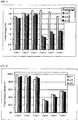
- FIG. 2 is a graph showing the results of measuring the tensile strength before and after the water-pouring running test.
- FIG. 3 is a graph showing the tensile strength retention calculated based on the tensile strength before and after the water-pouring running test.
- FIG. 3 and Table 6 it is found that the cords (cords 1 to 3) which were Lang-twisted and in which the adhesion treatment layer was subjected to an overcoat treatment to form an overcoat treatment layer exhibited a high tensile strength retention and were excellent in water resistance. More precisely, the toothed belts using Lang-twisted cords (cords 1 to 3 and 6) had improved water resistance as compared to the plied cords (cords 4 and 5). It is considered that this is because, since a Lang-twisted cord is excellent in abrasion resistance even when water infiltrates and the cords are swollen, the surface is structurally less likely to wear and the adhesive component is less likely to separate.
- the Lang-twisted cord As a result, in the Lang-twisted cord, as compared to the plied cord, the protection of the cord relatively remains and the water resistance becomes high. Furthermore, by subjecting the Lang-twisted cords to the overcoat treatment (cords 1 to 3), as compared to the cord not subjected to the overcoat treatment (cord 6), the water resistance was further improved. It is considered that this is because a protective layer (overcoat treatment layer) is formed on the cord by performing the overcoat treatment and thus the contact with water is prevented.
- overcoat treatment layer is formed on the cord by performing the overcoat treatment and thus the contact with water is prevented.
- the formulations of the rubber compositions are 7 kinds of formulations 1 to 7 as shown in Table 7.
- a plasticizer was added to the rubber compositions of the formulations 2 to 7.
- No plasticizer was added to the rubber composition of the formulation 1.
- an adipic acid-based plasticizer was added to the rubber compositions of the formulations 2 to 6, and an ether ester-based plasticizer was added to the rubber composition of the formulation 7.
- the formulations of the rubber compositions shown in Table 7 were shown in parts by mass of the plasticizer and the like based on 100 parts by mass of the rubber component.
- the rubber compositions of the formulations 1 to 7 were vulcanized at 161 °C for 25 minutes and test pieces for physical property evaluation tests (individual tests of a rubber hardness measurement test, a low-temperature impact brittleness test, and a Gehman torsion test, which are mentioned later) of the rubber compositions were prepared. Then, for each of the rubber compositions of the formulations 1 to 7, as physical property evaluation tests of the rubber composition, the rubber hardness measurement test, the low-temperature impact brittleness test, and the Gehman torsion test were carried out.
- the rubber hardness measurement test was performed in accordance with JIS K 6253 (2012) and measurement was conducted on a JIS A type durometer.
- the low-temperature impact brittleness test was performed in accordance with JIS K 6261 (2006) and low-temperature impact brittleness temperature was measured.
- a smaller value indicates that flexibility can be maintained until lower temperature and thus cold resistance (low-temperature flexibility) is improved.
- a sample (test piece) for the low-temperature impact brittleness test had a strip shape of 40.0 mmx6.0 mmx2.0 mm.
- the Gehman torsion test was performed in accordance with JIS K 6261 (2006) and there was measured a temperature at which torsional rigidity became ten times the value at 23°C, that is, the temperature being T10 in the Gehman torsion test. With regard to the temperature T10 in the Gehman torsion test, a smaller value indicates that flexibility can be maintained until lower temperature and thus cold resistance (low-temperature flexibility) is improved.
- Table 7 shows the results of the rubber hardness measurement test, the low-temperature impact brittleness test, and the Gehman torsion test carried out for each of the rubber compositions of the formulations 1 to 7.
- Formulation 1 Formulation 2 Formulation 3
- Formulation 4 Formulation 5
- Formulation 6 Formulation 7
- Chloroprene rubber 100 100 100 100 100 100 100 100 100 100 100 100 100 100 100 100 100 Adipic acid-based plasticizer 0 2 5 10 20 30 - Ether ester-based plasticizer - - - - - - 10
- Formulation of rubber composition Magnesium oxide 5 5 5 5 5 5 5 5 5 5
- Antiaging agent 20 20 20 20 20 20 20 20 20 20 20 20 20 20 20 20 20 20 20 20 20 20 20 20 20 20 20 20 20 20 20 20 Vulcanization accelerator 2 2 2 2 2 2 2 2 Carbon black 50 50 50 50 50 50 50 50 50 50 50 Inorganic filler 30 30 30 30 30 30 30 30 30 30 30 30 30 30 30 30 30 30 30 30 30 30 30
- the cold resistance of the rubber composition is improved by adding the adipic acid-based plasticizer.
- the addition of the plasticizer to the rubber composition affords a configuration which does not hardened even at an extremely low temperature and has such a degree of flexibility that is not so much different from that at normal temperature.
- the tooth fabric used for the toothed belts is the same as that in the aforementioned water resistance test of the cords of the toothed belts.
- the vulcanization conditions for the rubber compositions are 161°C ⁇ 25 minutes that is the same as in the aforementioned physical property evaluation test for the rubber compositions of the toothed belts according to the present Examples.
- the method of molding the toothed belts is the same as in the water resistance test of the cords of the toothed belts according to the present Examples except that the belt width is 10 mm.
- a toothed belt exhibiting a tooth shearing force of 1,200 N or more was evaluated as Excellent
- a toothed belt exhibiting a tooth shearing force of 800 N or more and less than 1,200 N was evaluated as Good
- a toothed belt exhibiting a tooth shearing force of less than 800 N was evaluated as Bad.
- a toothed belt in which the evaluation on the tooth shearing force measurement test was Excellent or Good, the evaluation on the rubber hardness measurement test was Good, the evaluation on the cold-resistant endurance running test was Excellent or Good, and the evaluation on the starting torque measurement test was Excellent or Good was evaluated as Good as a toothed belt excellent in cold resistance.
- evaluated as Bad as a toothed belt having no cold resistance, was a toothed belt which was Bad in any evaluation on the tooth shearing force measurement test, the rubber hardness measurement test, the cold-resistant endurance running test, and the starting torque measurement test mentioned above.
- the toothed belts of Examples 1 to 4 and Comparative Examples 3 and 4 of the formulations 3 to 7 are graded the evaluation of the difference in the rubber hardness between 25°C and -30°C as Good and thus it is found that an increase in the rubber hardness at -30°C can be suppressed by the addition of the plasticizer.
- the toothed belt of Comparative Example 3 in which the addition amount of the plasticizer is largest showed the rubber hardness at 25°C of less than 70° and thus, it is found that usable rubber hardness of the toothed belt cannot be secured at normal temperature.
- the rubber hardness at 25°C falls within the range of from 70 to 85° and thus, it was confirmed that usable rubber hardness of the toothed belt at normal temperature can be secured even when the plasticizer is added.
- the toothed belt of Comparative Example 1 in which no plasticizer was added and the toothed belt of Comparative Example 2 in which the adipic acid-based plasticizer was added in an amount of 2 parts by mass based on 100 parts by mass of the rubber component showed a large starting torque, which did not reach a practical level.
- the toothed belt of Example 4 in which the ether ester-based plasticizer was blended into the rubber composition such an effect as that in the case of the toothed belts of Examples 1 to 3 and Comparative Example 3 in which the adipic acid-based plasticizer was blended into the rubber composition was not obtained, but it was possible to decrease the starting torque at -30°C to less than 30 cN ⁇ m by adding the plasticizer.
- the plasticizer is added in an amount of more than 20 parts by mass based on 100 parts by mass of the rubber component, the tooth shearing force of the toothed belt is low, which does not reach a practical level.
- the ether ester-based plasticizer such an effect as that in the case of the adipic acid-based plasticizer was not obtained but it was found that cold resistance (low-temperature flexibility) is improved by adding the plasticizer. It was found that, in the case of using a plied cord, a crack is generated in an early period in the cold-resistant endurance running test even if the adipic acid-based plasticizer is added.
- the glass cord preferably has the following configuration.
- the glass cord is configured by Lang twist. That is, since a Lang-twisted cord is excellent in abrasion resistance even when water infiltrates therein and the cord is swollen, the surface thereof is structurally less likely to wear and the adhesive component is less likely to separate. Therefore, as compared to a plied cord, protection of the cord relatively remains and water resistance is improved. Also from the results of the cord 4 and the cord 6 in the water-pouring running test shown in Table 6, since the tensile strength retention is improved by about 23% by changing the cord from plied one to Lang-twisted one (with no overcoat treatment), the excellent water resistance of the Lang-twisted glass cord was confirmed.
- the adhesion treatment layer of the cord is further subjected to an overcoat treatment to form an overcoat treatment layer that is a protective layer, thereby preventing the contact with water. Also from the results of the cord 2 and the cord 4 in the water-pouring running test shown in Table 6, since the tensile strength retention is improved by about 61 % by changing the cord from plied one to Lang-twisted one and further performing the overcoat treatment, the excellent water resistance resulting from the overcoat treatment was confirmed.
- the bending fatigue resistance can be maintained not only at normal temperature but also at an extremely low temperature of from -20 to -30°C.
- a plasticizer is added to the rubber composition.
- the addition amount of the plasticizer is controlled to from 5 to 20 parts by mass based on 100 parts by mass of the rubber component.
- the plasticizer is preferably an adipic acid-based plasticizer and also, an ether ester-based plasticizer, an ether-based plasticizer, an ester-based plasticizer, a phthalic acid-based plasticizer, or the like may be used.
- the tooth shearing force that is a maximum value of tensile values when one tooth of the toothed belt is stretched at a rate of 50 ⁇ 10 mm/min by an autograph in a state that the tooth is pressed under a certain pressure, is from 800 N to 1,500 N, and thus excellent tooth strength and tooth crack resistance were confirmed.
- the running time is 30 hours or more when each toothed belt after being left standing under an atmosphere of -30°C for 15 hours in a state that the belt was wound on pulleys of a two-axis layout was allowed to run until crack generation, and thus an excellent cold resistance was confirmed.
- the toothed belt prepared by subjecting a Lang-twisted glass cord to an adhesion treatment to form an adhesion treatment layer, subsequently further performing an overcoat treatment thereon to form an overcoat treatment layer, and adding a plasticizer to the rubber composition constituting the back side in an amount of from 5 to 20 parts by mass based on 100 parts by mass of the rubber component is excellent in water resistance and cold resistance while bending fatigue resistance is secured.
Landscapes
- Engineering & Computer Science (AREA)
- General Engineering & Computer Science (AREA)
- Mechanical Engineering (AREA)
- Textile Engineering (AREA)
- Compositions Of Macromolecular Compounds (AREA)
- Reinforced Plastic Materials (AREA)
Applications Claiming Priority (3)
| Application Number | Priority Date | Filing Date | Title |
|---|---|---|---|
| JP2014093930 | 2014-04-30 | ||
| JP2015083109A JP6096239B2 (ja) | 2014-04-30 | 2015-04-15 | 歯付ベルト |
| PCT/JP2015/062748 WO2015166929A1 (ja) | 2014-04-30 | 2015-04-27 | 歯付ベルト |
Publications (3)
| Publication Number | Publication Date |
|---|---|
| EP3139063A1 true EP3139063A1 (de) | 2017-03-08 |
| EP3139063A4 EP3139063A4 (de) | 2018-01-31 |
| EP3139063B1 EP3139063B1 (de) | 2021-07-21 |
Family
ID=54358656
Family Applications (1)
| Application Number | Title | Priority Date | Filing Date |
|---|---|---|---|
| EP15786007.3A Active EP3139063B1 (de) | 2014-04-30 | 2015-04-27 | Zahnriemen |
Country Status (5)
| Country | Link |
|---|---|
| US (1) | US10006519B2 (de) |
| EP (1) | EP3139063B1 (de) |
| JP (1) | JP6096239B2 (de) |
| CN (1) | CN106255842B (de) |
| WO (1) | WO2015166929A1 (de) |
Cited By (1)
| Publication number | Priority date | Publication date | Assignee | Title |
|---|---|---|---|---|
| EP3822399A1 (de) * | 2019-11-18 | 2021-05-19 | Arntz Beteiligungs GmbH & Co. KG | Antriebsriemen und verfahren zur herstellung eines antriebsriemens |
Families Citing this family (9)
| Publication number | Priority date | Publication date | Assignee | Title |
|---|---|---|---|---|
| CA3053234C (en) * | 2017-04-24 | 2022-05-31 | Mitsuboshi Belting Ltd. | Toothed belt |
| DE102017220469A1 (de) * | 2017-11-16 | 2019-05-16 | Contitech Antriebssysteme Gmbh | Verfahren zum Anhaften eines Textilmaterials an einem Elastomer |
| US20190178339A1 (en) * | 2017-12-13 | 2019-06-13 | Gates Corporation | Toothed power transmission belt with back fabric |
| US11028900B2 (en) * | 2017-12-13 | 2021-06-08 | Gates Corporation | Banded friction power transmission belt |
| JP6603350B2 (ja) * | 2018-03-30 | 2019-11-06 | バンドー化学株式会社 | ローエッジvベルト |
| DE102019207434A1 (de) * | 2019-05-21 | 2020-11-26 | Contitech Antriebssysteme Gmbh | Zahnriemen |
| US12247639B2 (en) | 2021-04-27 | 2025-03-11 | Mitsuboshi Belting Ltd. | Toothed belt and belt transmission mechanism |
| WO2022249027A1 (en) * | 2021-05-24 | 2022-12-01 | Dayco Europe S.R.L. | Power transmission belt |
| JP2025067364A (ja) * | 2023-10-13 | 2025-04-24 | ニッタ株式会社 | 搬送用ベルト |
Family Cites Families (25)
| Publication number | Priority date | Publication date | Assignee | Title |
|---|---|---|---|---|
| JPS58118332U (ja) * | 1982-02-05 | 1983-08-12 | 三ツ星ベルト株式会社 | 動力伝動用ベルト |
| JPS5915780U (ja) | 1982-07-21 | 1984-01-31 | 木村新株式会社 | 折り畳み扉用案内装置 |
| JPS5919744A (ja) | 1982-07-22 | 1984-02-01 | Mitsuboshi Belting Ltd | 動力伝動用ベルト |
| JPH0772578B2 (ja) * | 1991-05-08 | 1995-08-02 | 三ツ星ベルト株式会社 | アラミド繊維コード及びこれを用いた動力伝動用ベルト |
| JP3200088B2 (ja) * | 1991-05-17 | 2001-08-20 | 三ツ星ベルト株式会社 | 歯付ベルト |
| JPH0727179A (ja) | 1993-07-08 | 1995-01-27 | Bando Chem Ind Ltd | ガラス繊維コードおよびそれを用いた伝動ベルト |
| JP2918826B2 (ja) | 1995-10-30 | 1999-07-12 | バンドー化学株式会社 | ベルト用抗張体の製造方法 |
| JP2000193040A (ja) * | 1998-12-25 | 2000-07-14 | Unitta Co Ltd | 歯付きベルトおよびこの歯付きベルトを用いた駆動伝達システム |
| JP2004116691A (ja) * | 2002-09-27 | 2004-04-15 | Mitsuboshi Belting Ltd | 動力伝動用ベルト |
| JP2004293754A (ja) | 2003-03-28 | 2004-10-21 | Mitsuboshi Belting Ltd | 歯付ベルト |
| JP4360993B2 (ja) * | 2004-09-17 | 2009-11-11 | 株式会社椿本チエイン | 歯付ベルト |
| JP4214161B2 (ja) * | 2006-12-05 | 2009-01-28 | バンドー化学株式会社 | 伝動ベルトの製造方法 |
| JP2009102766A (ja) * | 2007-10-23 | 2009-05-14 | Asahi Kasei Fibers Corp | 伝動ベルト心線用補強繊維コード並びに該コードで補強された伝動ベルト |
| JP5498941B2 (ja) * | 2008-07-17 | 2014-05-21 | バンドー化学株式会社 | 伝動ベルト |
| JP5002043B2 (ja) * | 2009-11-13 | 2012-08-15 | 三ツ星ベルト株式会社 | ゴム製歯付ベルトおよび歯付ベルト用ゴム組成物 |
| DE102010016393A1 (de) | 2010-04-12 | 2011-10-13 | Contitech Antriebssysteme Gmbh | PAK-freier Antriebsriemen, insbesondere Zahnriemen |
| DE102011054978A1 (de) * | 2011-11-02 | 2013-05-02 | Contitech Antriebssysteme Gmbh | Riemen mit einem Zugträger, insbesondere Carbon-Zugträger, der mit einem vernetzten Polyurethan präpariert ist, sowie Präparationsverfahren |
| KR101992943B1 (ko) | 2012-01-11 | 2019-06-25 | 반도 카가쿠 가부시키가이샤 | 마찰 전동 벨트 및 그 제조방법, 그리고 벨트 전동장치 |
| JP5711167B2 (ja) | 2012-02-22 | 2015-04-30 | 三ツ星ベルト株式会社 | アラミド心線及び伝動ベルト |
| JP5727442B2 (ja) * | 2012-04-25 | 2015-06-03 | 三ツ星ベルト株式会社 | 伝動用ベルト |
| JP5914202B2 (ja) * | 2012-06-18 | 2016-05-11 | 三ツ星ベルト株式会社 | 伝動ベルト用カバー布および歯付ベルト |
| EP2871387B1 (de) | 2012-07-06 | 2019-01-02 | Bando Chemical Industries, Ltd. | Transmissionsriemen |
| AU2013302594B2 (en) * | 2012-08-15 | 2016-04-28 | Gates Corporation | Power transmission belt |
| JP5465346B1 (ja) * | 2013-01-22 | 2014-04-09 | 株式会社椿本チエイン | 歯付ベルト |
| JP6275585B2 (ja) * | 2013-08-30 | 2018-02-07 | 三ツ星ベルト株式会社 | 歯付ベルト |
-
2015
- 2015-04-15 JP JP2015083109A patent/JP6096239B2/ja active Active
- 2015-04-27 EP EP15786007.3A patent/EP3139063B1/de active Active
- 2015-04-27 CN CN201580023697.7A patent/CN106255842B/zh active Active
- 2015-04-27 WO PCT/JP2015/062748 patent/WO2015166929A1/ja not_active Ceased
- 2015-04-27 US US15/307,674 patent/US10006519B2/en active Active
Cited By (1)
| Publication number | Priority date | Publication date | Assignee | Title |
|---|---|---|---|---|
| EP3822399A1 (de) * | 2019-11-18 | 2021-05-19 | Arntz Beteiligungs GmbH & Co. KG | Antriebsriemen und verfahren zur herstellung eines antriebsriemens |
Also Published As
| Publication number | Publication date |
|---|---|
| EP3139063A4 (de) | 2018-01-31 |
| JP2015222121A (ja) | 2015-12-10 |
| CN106255842A (zh) | 2016-12-21 |
| US20170051810A1 (en) | 2017-02-23 |
| EP3139063B1 (de) | 2021-07-21 |
| JP6096239B2 (ja) | 2017-03-15 |
| US10006519B2 (en) | 2018-06-26 |
| WO2015166929A1 (ja) | 2015-11-05 |
| CN106255842B (zh) | 2019-05-10 |
Similar Documents
| Publication | Publication Date | Title |
|---|---|---|
| EP3139063B1 (de) | Zahnriemen | |
| US9695906B2 (en) | Method for fabricating a belt with treated tension members with envelope layer and belt thus produced | |
| EP1167814B1 (de) | Treibriemen mit einem Gewebe auf einer Oberfläche | |
| US9382969B2 (en) | Belt having a tension member, in particular a carbon tension member, which is prepared with a cross-linked polyurethane, and preparation method | |
| EP2489899B1 (de) | Zahnriemen | |
| KR101614573B1 (ko) | 톱니형 벨트 및 오일 중 톱니형 벨트의 용도 | |
| CN109844194B (zh) | 合股捻绳及其制造方法以及传动带及其使用方法 | |
| EP1830102B1 (de) | Verstärkungsbahn zur verstärkung eines zahnriemens und zahnriemen und verfahren zur herstellung davon | |
| EP3643832B1 (de) | Cord zur kautschukverstärkung und unter verwendung davon erhaltenes kautschukprodukt | |
| EP2014824A1 (de) | Armierungskord, seine herstellung und verwendung | |
| JP6616793B2 (ja) | 摩擦伝動ベルト | |
| EP3617551B1 (de) | Schrägverzahnte zahnriemenkraftübertragungsvorrichtung | |
| US10442147B2 (en) | Method for preparing a tension member, in particular a carbon tension member, in the production of a belt | |
| JP6322303B2 (ja) | 歯付ベルト | |
| JP2006124484A (ja) | エチレン・α−オレフィンゴム組成物と繊維との接着体の製造方法及び動力伝動ベルト | |
| JP2004292735A (ja) | エチレン・α−オレフィンゴム組成物と繊維との接着体の製造方法及び伝動ベルト | |
| JP2003240055A (ja) | 動力伝動ベルト | |
| JP2004190686A (ja) | 動力伝動用ベルト | |
| WO2017179690A1 (ja) | 摩擦伝動ベルト | |
| JP2003294087A (ja) | 動力伝動用ベルト | |
| JP2004353806A (ja) | 歯付ベルト | |
| JP2006258114A (ja) | 摩擦伝動ベルト | |
| JP2004003609A (ja) | 伝動ベルト | |
| JP2001330083A (ja) | Vリブドベルト | |
| JP2003247604A (ja) | Vリブドベルト |
Legal Events
| Date | Code | Title | Description |
|---|---|---|---|
| STAA | Information on the status of an ep patent application or granted ep patent |
Free format text: STATUS: THE INTERNATIONAL PUBLICATION HAS BEEN MADE |
|
| PUAI | Public reference made under article 153(3) epc to a published international application that has entered the european phase |
Free format text: ORIGINAL CODE: 0009012 |
|
| STAA | Information on the status of an ep patent application or granted ep patent |
Free format text: STATUS: REQUEST FOR EXAMINATION WAS MADE |
|
| 17P | Request for examination filed |
Effective date: 20161027 |
|
| AK | Designated contracting states |
Kind code of ref document: A1 Designated state(s): AL AT BE BG CH CY CZ DE DK EE ES FI FR GB GR HR HU IE IS IT LI LT LU LV MC MK MT NL NO PL PT RO RS SE SI SK SM TR |
|
| AX | Request for extension of the european patent |
Extension state: BA ME |
|
| DAV | Request for validation of the european patent (deleted) | ||
| DAX | Request for extension of the european patent (deleted) | ||
| A4 | Supplementary search report drawn up and despatched |
Effective date: 20180105 |
|
| RIC1 | Information provided on ipc code assigned before grant |
Ipc: D03D 1/00 20060101ALI20171222BHEP Ipc: F16G 1/00 20060101ALI20171222BHEP Ipc: F16G 1/04 20060101ALI20171222BHEP Ipc: F16G 1/08 20060101ALI20171222BHEP Ipc: F16G 1/28 20060101AFI20171222BHEP Ipc: B29D 29/00 20060101ALI20171222BHEP |
|
| GRAP | Despatch of communication of intention to grant a patent |
Free format text: ORIGINAL CODE: EPIDOSNIGR1 |
|
| STAA | Information on the status of an ep patent application or granted ep patent |
Free format text: STATUS: GRANT OF PATENT IS INTENDED |
|
| INTG | Intention to grant announced |
Effective date: 20201005 |
|
| GRAJ | Information related to disapproval of communication of intention to grant by the applicant or resumption of examination proceedings by the epo deleted |
Free format text: ORIGINAL CODE: EPIDOSDIGR1 |
|
| STAA | Information on the status of an ep patent application or granted ep patent |
Free format text: STATUS: REQUEST FOR EXAMINATION WAS MADE |
|
| INTC | Intention to grant announced (deleted) | ||
| GRAP | Despatch of communication of intention to grant a patent |
Free format text: ORIGINAL CODE: EPIDOSNIGR1 |
|
| STAA | Information on the status of an ep patent application or granted ep patent |
Free format text: STATUS: GRANT OF PATENT IS INTENDED |
|
| INTG | Intention to grant announced |
Effective date: 20210319 |
|
| GRAS | Grant fee paid |
Free format text: ORIGINAL CODE: EPIDOSNIGR3 |
|
| GRAA | (expected) grant |
Free format text: ORIGINAL CODE: 0009210 |
|
| STAA | Information on the status of an ep patent application or granted ep patent |
Free format text: STATUS: THE PATENT HAS BEEN GRANTED |
|
| AK | Designated contracting states |
Kind code of ref document: B1 Designated state(s): AL AT BE BG CH CY CZ DE DK EE ES FI FR GB GR HR HU IE IS IT LI LT LU LV MC MK MT NL NO PL PT RO RS SE SI SK SM TR |
|
| REG | Reference to a national code |
Ref country code: GB Ref legal event code: FG4D |
|
| REG | Reference to a national code |
Ref country code: CH Ref legal event code: EP |
|
| REG | Reference to a national code |
Ref country code: DE Ref legal event code: R096 Ref document number: 602015071507 Country of ref document: DE |
|
| REG | Reference to a national code |
Ref country code: AT Ref legal event code: REF Ref document number: 1412867 Country of ref document: AT Kind code of ref document: T Effective date: 20210815 |
|
| REG | Reference to a national code |
Ref country code: IE Ref legal event code: FG4D |
|
| REG | Reference to a national code |
Ref country code: LT Ref legal event code: MG9D |
|
| REG | Reference to a national code |
Ref country code: NL Ref legal event code: MP Effective date: 20210721 |
|
| REG | Reference to a national code |
Ref country code: AT Ref legal event code: MK05 Ref document number: 1412867 Country of ref document: AT Kind code of ref document: T Effective date: 20210721 |
|
| PG25 | Lapsed in a contracting state [announced via postgrant information from national office to epo] |
Ref country code: NO Free format text: LAPSE BECAUSE OF FAILURE TO SUBMIT A TRANSLATION OF THE DESCRIPTION OR TO PAY THE FEE WITHIN THE PRESCRIBED TIME-LIMIT Effective date: 20211021 Ref country code: NL Free format text: LAPSE BECAUSE OF FAILURE TO SUBMIT A TRANSLATION OF THE DESCRIPTION OR TO PAY THE FEE WITHIN THE PRESCRIBED TIME-LIMIT Effective date: 20210721 Ref country code: PT Free format text: LAPSE BECAUSE OF FAILURE TO SUBMIT A TRANSLATION OF THE DESCRIPTION OR TO PAY THE FEE WITHIN THE PRESCRIBED TIME-LIMIT Effective date: 20211122 Ref country code: FI Free format text: LAPSE BECAUSE OF FAILURE TO SUBMIT A TRANSLATION OF THE DESCRIPTION OR TO PAY THE FEE WITHIN THE PRESCRIBED TIME-LIMIT Effective date: 20210721 Ref country code: ES Free format text: LAPSE BECAUSE OF FAILURE TO SUBMIT A TRANSLATION OF THE DESCRIPTION OR TO PAY THE FEE WITHIN THE PRESCRIBED TIME-LIMIT Effective date: 20210721 Ref country code: BG Free format text: LAPSE BECAUSE OF FAILURE TO SUBMIT A TRANSLATION OF THE DESCRIPTION OR TO PAY THE FEE WITHIN THE PRESCRIBED TIME-LIMIT Effective date: 20211021 Ref country code: AT Free format text: LAPSE BECAUSE OF FAILURE TO SUBMIT A TRANSLATION OF THE DESCRIPTION OR TO PAY THE FEE WITHIN THE PRESCRIBED TIME-LIMIT Effective date: 20210721 Ref country code: LT Free format text: LAPSE BECAUSE OF FAILURE TO SUBMIT A TRANSLATION OF THE DESCRIPTION OR TO PAY THE FEE WITHIN THE PRESCRIBED TIME-LIMIT Effective date: 20210721 Ref country code: RS Free format text: LAPSE BECAUSE OF FAILURE TO SUBMIT A TRANSLATION OF THE DESCRIPTION OR TO PAY THE FEE WITHIN THE PRESCRIBED TIME-LIMIT Effective date: 20210721 Ref country code: SE Free format text: LAPSE BECAUSE OF FAILURE TO SUBMIT A TRANSLATION OF THE DESCRIPTION OR TO PAY THE FEE WITHIN THE PRESCRIBED TIME-LIMIT Effective date: 20210721 Ref country code: HR Free format text: LAPSE BECAUSE OF FAILURE TO SUBMIT A TRANSLATION OF THE DESCRIPTION OR TO PAY THE FEE WITHIN THE PRESCRIBED TIME-LIMIT Effective date: 20210721 |
|
| PG25 | Lapsed in a contracting state [announced via postgrant information from national office to epo] |
Ref country code: PL Free format text: LAPSE BECAUSE OF FAILURE TO SUBMIT A TRANSLATION OF THE DESCRIPTION OR TO PAY THE FEE WITHIN THE PRESCRIBED TIME-LIMIT Effective date: 20210721 Ref country code: LV Free format text: LAPSE BECAUSE OF FAILURE TO SUBMIT A TRANSLATION OF THE DESCRIPTION OR TO PAY THE FEE WITHIN THE PRESCRIBED TIME-LIMIT Effective date: 20210721 Ref country code: GR Free format text: LAPSE BECAUSE OF FAILURE TO SUBMIT A TRANSLATION OF THE DESCRIPTION OR TO PAY THE FEE WITHIN THE PRESCRIBED TIME-LIMIT Effective date: 20211022 |
|
| REG | Reference to a national code |
Ref country code: DE Ref legal event code: R097 Ref document number: 602015071507 Country of ref document: DE |
|
| PG25 | Lapsed in a contracting state [announced via postgrant information from national office to epo] |
Ref country code: DK Free format text: LAPSE BECAUSE OF FAILURE TO SUBMIT A TRANSLATION OF THE DESCRIPTION OR TO PAY THE FEE WITHIN THE PRESCRIBED TIME-LIMIT Effective date: 20210721 |
|
| PLBE | No opposition filed within time limit |
Free format text: ORIGINAL CODE: 0009261 |
|
| STAA | Information on the status of an ep patent application or granted ep patent |
Free format text: STATUS: NO OPPOSITION FILED WITHIN TIME LIMIT |
|
| PG25 | Lapsed in a contracting state [announced via postgrant information from national office to epo] |
Ref country code: SM Free format text: LAPSE BECAUSE OF FAILURE TO SUBMIT A TRANSLATION OF THE DESCRIPTION OR TO PAY THE FEE WITHIN THE PRESCRIBED TIME-LIMIT Effective date: 20210721 Ref country code: SK Free format text: LAPSE BECAUSE OF FAILURE TO SUBMIT A TRANSLATION OF THE DESCRIPTION OR TO PAY THE FEE WITHIN THE PRESCRIBED TIME-LIMIT Effective date: 20210721 Ref country code: RO Free format text: LAPSE BECAUSE OF FAILURE TO SUBMIT A TRANSLATION OF THE DESCRIPTION OR TO PAY THE FEE WITHIN THE PRESCRIBED TIME-LIMIT Effective date: 20210721 Ref country code: EE Free format text: LAPSE BECAUSE OF FAILURE TO SUBMIT A TRANSLATION OF THE DESCRIPTION OR TO PAY THE FEE WITHIN THE PRESCRIBED TIME-LIMIT Effective date: 20210721 Ref country code: CZ Free format text: LAPSE BECAUSE OF FAILURE TO SUBMIT A TRANSLATION OF THE DESCRIPTION OR TO PAY THE FEE WITHIN THE PRESCRIBED TIME-LIMIT Effective date: 20210721 Ref country code: AL Free format text: LAPSE BECAUSE OF FAILURE TO SUBMIT A TRANSLATION OF THE DESCRIPTION OR TO PAY THE FEE WITHIN THE PRESCRIBED TIME-LIMIT Effective date: 20210721 |
|
| 26N | No opposition filed |
Effective date: 20220422 |
|
| REG | Reference to a national code |
Ref country code: CH Ref legal event code: PL |
|
| REG | Reference to a national code |
Ref country code: BE Ref legal event code: MM Effective date: 20220430 |
|
| PG25 | Lapsed in a contracting state [announced via postgrant information from national office to epo] |
Ref country code: MC Free format text: LAPSE BECAUSE OF FAILURE TO SUBMIT A TRANSLATION OF THE DESCRIPTION OR TO PAY THE FEE WITHIN THE PRESCRIBED TIME-LIMIT Effective date: 20210721 Ref country code: LU Free format text: LAPSE BECAUSE OF NON-PAYMENT OF DUE FEES Effective date: 20220427 Ref country code: LI Free format text: LAPSE BECAUSE OF NON-PAYMENT OF DUE FEES Effective date: 20220430 Ref country code: CH Free format text: LAPSE BECAUSE OF NON-PAYMENT OF DUE FEES Effective date: 20220430 |
|
| PG25 | Lapsed in a contracting state [announced via postgrant information from national office to epo] |
Ref country code: BE Free format text: LAPSE BECAUSE OF NON-PAYMENT OF DUE FEES Effective date: 20220430 |
|
| PG25 | Lapsed in a contracting state [announced via postgrant information from national office to epo] |
Ref country code: IE Free format text: LAPSE BECAUSE OF NON-PAYMENT OF DUE FEES Effective date: 20220427 |
|
| P01 | Opt-out of the competence of the unified patent court (upc) registered |
Effective date: 20230420 |
|
| PG25 | Lapsed in a contracting state [announced via postgrant information from national office to epo] |
Ref country code: HU Free format text: LAPSE BECAUSE OF FAILURE TO SUBMIT A TRANSLATION OF THE DESCRIPTION OR TO PAY THE FEE WITHIN THE PRESCRIBED TIME-LIMIT; INVALID AB INITIO Effective date: 20150427 |
|
| PG25 | Lapsed in a contracting state [announced via postgrant information from national office to epo] |
Ref country code: MK Free format text: LAPSE BECAUSE OF FAILURE TO SUBMIT A TRANSLATION OF THE DESCRIPTION OR TO PAY THE FEE WITHIN THE PRESCRIBED TIME-LIMIT Effective date: 20210721 Ref country code: CY Free format text: LAPSE BECAUSE OF FAILURE TO SUBMIT A TRANSLATION OF THE DESCRIPTION OR TO PAY THE FEE WITHIN THE PRESCRIBED TIME-LIMIT Effective date: 20210721 |
|
| PG25 | Lapsed in a contracting state [announced via postgrant information from national office to epo] |
Ref country code: TR Free format text: LAPSE BECAUSE OF FAILURE TO SUBMIT A TRANSLATION OF THE DESCRIPTION OR TO PAY THE FEE WITHIN THE PRESCRIBED TIME-LIMIT Effective date: 20210721 |
|
| PG25 | Lapsed in a contracting state [announced via postgrant information from national office to epo] |
Ref country code: MT Free format text: LAPSE BECAUSE OF FAILURE TO SUBMIT A TRANSLATION OF THE DESCRIPTION OR TO PAY THE FEE WITHIN THE PRESCRIBED TIME-LIMIT Effective date: 20210721 |
|
| PGFP | Annual fee paid to national office [announced via postgrant information from national office to epo] |
Ref country code: DE Payment date: 20250305 Year of fee payment: 11 |
|
| PGFP | Annual fee paid to national office [announced via postgrant information from national office to epo] |
Ref country code: GB Payment date: 20260313 Year of fee payment: 12 |
|
| PGFP | Annual fee paid to national office [announced via postgrant information from national office to epo] |
Ref country code: IT Payment date: 20260320 Year of fee payment: 12 |
|
| PGFP | Annual fee paid to national office [announced via postgrant information from national office to epo] |
Ref country code: FR Payment date: 20260309 Year of fee payment: 12 |