EP3140436B1 - Metallvorbehandlungsmodifizierung für verbesserte wurfleistung - Google Patents
Metallvorbehandlungsmodifizierung für verbesserte wurfleistung Download PDFInfo
- Publication number
- EP3140436B1 EP3140436B1 EP15722632.5A EP15722632A EP3140436B1 EP 3140436 B1 EP3140436 B1 EP 3140436B1 EP 15722632 A EP15722632 A EP 15722632A EP 3140436 B1 EP3140436 B1 EP 3140436B1
- Authority
- EP
- European Patent Office
- Prior art keywords
- composition
- metal
- copper
- group
- ppm
- Prior art date
- Legal status (The legal status is an assumption and is not a legal conclusion. Google has not performed a legal analysis and makes no representation as to the accuracy of the status listed.)
- Active
Links
Images

Classifications
-
- C—CHEMISTRY; METALLURGY
- C25—ELECTROLYTIC OR ELECTROPHORETIC PROCESSES; APPARATUS THEREFOR
- C25D—PROCESSES FOR THE ELECTROLYTIC OR ELECTROPHORETIC PRODUCTION OF COATINGS; ELECTROFORMING; APPARATUS THEREFOR
- C25D13/00—Electrophoretic coating characterised by the process
- C25D13/20—Pretreatment
-
- C—CHEMISTRY; METALLURGY
- C23—COATING METALLIC MATERIAL; COATING MATERIAL WITH METALLIC MATERIAL; CHEMICAL SURFACE TREATMENT; DIFFUSION TREATMENT OF METALLIC MATERIAL; COATING BY VACUUM EVAPORATION, BY SPUTTERING, BY ION IMPLANTATION OR BY CHEMICAL VAPOUR DEPOSITION, IN GENERAL; INHIBITING CORROSION OF METALLIC MATERIAL OR INCRUSTATION IN GENERAL
- C23C—COATING METALLIC MATERIAL; COATING MATERIAL WITH METALLIC MATERIAL; SURFACE TREATMENT OF METALLIC MATERIAL BY DIFFUSION INTO THE SURFACE, BY CHEMICAL CONVERSION OR SUBSTITUTION; COATING BY VACUUM EVAPORATION, BY SPUTTERING, BY ION IMPLANTATION OR BY CHEMICAL VAPOUR DEPOSITION, IN GENERAL
- C23C22/00—Chemical surface treatment of metallic material by reaction of the surface with a reactive liquid, leaving reaction products of surface material in the coating, e.g. conversion coatings, passivation of metals
- C23C22/05—Chemical surface treatment of metallic material by reaction of the surface with a reactive liquid, leaving reaction products of surface material in the coating, e.g. conversion coatings, passivation of metals using aqueous solutions
- C23C22/06—Chemical surface treatment of metallic material by reaction of the surface with a reactive liquid, leaving reaction products of surface material in the coating, e.g. conversion coatings, passivation of metals using aqueous solutions using aqueous acidic solutions with pH less than 6
- C23C22/34—Chemical surface treatment of metallic material by reaction of the surface with a reactive liquid, leaving reaction products of surface material in the coating, e.g. conversion coatings, passivation of metals using aqueous solutions using aqueous acidic solutions with pH less than 6 containing fluorides or complex fluorides
-
- C—CHEMISTRY; METALLURGY
- C09—DYES; PAINTS; POLISHES; NATURAL RESINS; ADHESIVES; COMPOSITIONS NOT OTHERWISE PROVIDED FOR; APPLICATIONS OF MATERIALS NOT OTHERWISE PROVIDED FOR
- C09D—COATING COMPOSITIONS, e.g. PAINTS, VARNISHES OR LACQUERS; FILLING PASTES; CHEMICAL PAINT OR INK REMOVERS; INKS; CORRECTING FLUIDS; WOODSTAINS; PASTES OR SOLIDS FOR COLOURING OR PRINTING; USE OF MATERIALS THEREFOR
- C09D5/00—Coating compositions, e.g. paints, varnishes or lacquers, characterised by their physical nature or the effects produced; Filling pastes
- C09D5/44—Coating compositions, e.g. paints, varnishes or lacquers, characterised by their physical nature or the effects produced; Filling pastes for electrophoretic applications
- C09D5/4476—Coating compositions, e.g. paints, varnishes or lacquers, characterised by their physical nature or the effects produced; Filling pastes for electrophoretic applications comprising polymerisation in situ
-
- C—CHEMISTRY; METALLURGY
- C09—DYES; PAINTS; POLISHES; NATURAL RESINS; ADHESIVES; COMPOSITIONS NOT OTHERWISE PROVIDED FOR; APPLICATIONS OF MATERIALS NOT OTHERWISE PROVIDED FOR
- C09D—COATING COMPOSITIONS, e.g. PAINTS, VARNISHES OR LACQUERS; FILLING PASTES; CHEMICAL PAINT OR INK REMOVERS; INKS; CORRECTING FLUIDS; WOODSTAINS; PASTES OR SOLIDS FOR COLOURING OR PRINTING; USE OF MATERIALS THEREFOR
- C09D5/00—Coating compositions, e.g. paints, varnishes or lacquers, characterised by their physical nature or the effects produced; Filling pastes
- C09D5/44—Coating compositions, e.g. paints, varnishes or lacquers, characterised by their physical nature or the effects produced; Filling pastes for electrophoretic applications
- C09D5/4488—Cathodic paints
-
- C—CHEMISTRY; METALLURGY
- C09—DYES; PAINTS; POLISHES; NATURAL RESINS; ADHESIVES; COMPOSITIONS NOT OTHERWISE PROVIDED FOR; APPLICATIONS OF MATERIALS NOT OTHERWISE PROVIDED FOR
- C09D—COATING COMPOSITIONS, e.g. PAINTS, VARNISHES OR LACQUERS; FILLING PASTES; CHEMICAL PAINT OR INK REMOVERS; INKS; CORRECTING FLUIDS; WOODSTAINS; PASTES OR SOLIDS FOR COLOURING OR PRINTING; USE OF MATERIALS THEREFOR
- C09D7/00—Features of coating compositions, not provided for in group C09D5/00; Processes for incorporating ingredients in coating compositions
- C09D7/40—Additives
-
- C—CHEMISTRY; METALLURGY
- C23—COATING METALLIC MATERIAL; COATING MATERIAL WITH METALLIC MATERIAL; CHEMICAL SURFACE TREATMENT; DIFFUSION TREATMENT OF METALLIC MATERIAL; COATING BY VACUUM EVAPORATION, BY SPUTTERING, BY ION IMPLANTATION OR BY CHEMICAL VAPOUR DEPOSITION, IN GENERAL; INHIBITING CORROSION OF METALLIC MATERIAL OR INCRUSTATION IN GENERAL
- C23C—COATING METALLIC MATERIAL; COATING MATERIAL WITH METALLIC MATERIAL; SURFACE TREATMENT OF METALLIC MATERIAL BY DIFFUSION INTO THE SURFACE, BY CHEMICAL CONVERSION OR SUBSTITUTION; COATING BY VACUUM EVAPORATION, BY SPUTTERING, BY ION IMPLANTATION OR BY CHEMICAL VAPOUR DEPOSITION, IN GENERAL
- C23C22/00—Chemical surface treatment of metallic material by reaction of the surface with a reactive liquid, leaving reaction products of surface material in the coating, e.g. conversion coatings, passivation of metals
- C23C22/78—Pretreatment of the material to be coated
- C23C22/80—Pretreatment of the material to be coated with solutions containing titanium or zirconium compounds
-
- C—CHEMISTRY; METALLURGY
- C23—COATING METALLIC MATERIAL; COATING MATERIAL WITH METALLIC MATERIAL; CHEMICAL SURFACE TREATMENT; DIFFUSION TREATMENT OF METALLIC MATERIAL; COATING BY VACUUM EVAPORATION, BY SPUTTERING, BY ION IMPLANTATION OR BY CHEMICAL VAPOUR DEPOSITION, IN GENERAL; INHIBITING CORROSION OF METALLIC MATERIAL OR INCRUSTATION IN GENERAL
- C23C—COATING METALLIC MATERIAL; COATING MATERIAL WITH METALLIC MATERIAL; SURFACE TREATMENT OF METALLIC MATERIAL BY DIFFUSION INTO THE SURFACE, BY CHEMICAL CONVERSION OR SUBSTITUTION; COATING BY VACUUM EVAPORATION, BY SPUTTERING, BY ION IMPLANTATION OR BY CHEMICAL VAPOUR DEPOSITION, IN GENERAL
- C23C22/00—Chemical surface treatment of metallic material by reaction of the surface with a reactive liquid, leaving reaction products of surface material in the coating, e.g. conversion coatings, passivation of metals
- C23C22/82—After-treatment
- C23C22/83—Chemical after-treatment
-
- C—CHEMISTRY; METALLURGY
- C25—ELECTROLYTIC OR ELECTROPHORETIC PROCESSES; APPARATUS THEREFOR
- C25D—PROCESSES FOR THE ELECTROLYTIC OR ELECTROPHORETIC PRODUCTION OF COATINGS; ELECTROFORMING; APPARATUS THEREFOR
- C25D13/00—Electrophoretic coating characterised by the process
- C25D13/04—Electrophoretic coating characterised by the process with organic material
-
- C—CHEMISTRY; METALLURGY
- C25—ELECTROLYTIC OR ELECTROPHORETIC PROCESSES; APPARATUS THEREFOR
- C25D—PROCESSES FOR THE ELECTROLYTIC OR ELECTROPHORETIC PRODUCTION OF COATINGS; ELECTROFORMING; APPARATUS THEREFOR
- C25D5/00—Electroplating characterised by the process; Pretreatment or after-treatment of workpieces
- C25D5/34—Pretreatment of metallic surfaces to be electroplated
-
- C—CHEMISTRY; METALLURGY
- C25—ELECTROLYTIC OR ELECTROPHORETIC PROCESSES; APPARATUS THEREFOR
- C25D—PROCESSES FOR THE ELECTROLYTIC OR ELECTROPHORETIC PRODUCTION OF COATINGS; ELECTROFORMING; APPARATUS THEREFOR
- C25D13/00—Electrophoretic coating characterised by the process
- C25D13/22—Servicing or operating apparatus or multistep processes
Definitions
- the present invention relates to metal pretreatment compositions and to methods for treating a metal substrate prior to painting using the metal pretreatment compositions.
- protective coatings on metal substrates for improved corrosion resistance and paint adhesion is common.
- Conventional techniques for coating such substrates include techniques that involve pretreating the metal substrate with a phosphate conversion coating and chrome-containing rinses.
- phosphate and/or chromate-containing compositions imparts environmental and health concerns.
- chromate-free and/or phosphate-free pretreatment compositions have been developed.
- Such compositions are generally based on chemical mixtures that in some way react with the substrate surface and bind to it to form a protective layer. For example, pretreatment compositions based on a Group IV(b) metal compound have recently become more prevalent.
- DE 10 2012 219 296 A1 refers to a method for improving the throwing power of an electrodeposition coating by coating metallic surfaces with aqueous pretreatment compositions.
- US 2006/0151070 A1 relates to rinsable, non-chromate, non-metal phosphate coatings for steel, zinc coated steel, and aluminum surfaces to improve the adhesion of siccative coatings to the surface and provide enhanced corrosion protection.
- US 2013/0266819 A1 discloses coating compositions that can be applied to metal substrates to enhance paint adhesion even after extended coating times.
- the present invention is directed to a composition for treating metal substrates comprising (a) a Group IV(b) metal ion and (b) a copper ion, (c) a fluoride ion and (d) an organophosphonic acid, and (e) a carrier, wherein (a) is derived from a zirconium, titanium or hafnium compound or mixtures thereof, wherein (b) is present in the composition in amounts of 5 to 40 ppm based on elemental copper and on total weight of the composition, wherein (d) is a monophosphonic acid, wherein the carrier (e) is an aqueous medium, and wherein the composition has a pH between 3 and 7.
- the present invention is directed to methods for pretreating a metal substrate comprising contacting the substrate by first pretreating the metal substrate with a Group IV(b) metal ion followed by treating the pretreated substrate with the above-described composition, followed by electrodepositing a cationic electrodepositable coating on the treated substrate.
- the organophosphonic acid has been found to result in an increase in throwpower of the subsequently applied cationic electrodepositable coating composition compared to pretreating the metal substrate with a pretreatment composition without the organophosphonic acid.
- any numerical range recited herein is intended to include all sub-ranges subsumed therein.
- a range of "1 to 10" is intended to include all sub-ranges between (and including) the recited minimum value of 1 and the recited maximum value of 10, that is, having a minimum value equal to or greater than 1 and a maximum value of equal to or less than 10.
- Suitable metal substrates for use in the present invention include those that are often used in the assembly of automotive bodies, automotive parts, and other articles, such as small metal parts, including fasteners, i.e., nuts, bolts, screws, pins, nails, clips, buttons, and the like.
- suitable metal substrates include, but are not limited to, cold rolled steel, hot rolled steel, steel coated with zinc metal, zinc compounds, or zinc alloys, such as electrogalvanized steel, hot-dipped galvanized steel, galvanealed steel, and steel plated with zinc alloy.
- aluminum alloys, aluminum plated steel and aluminum alloy plated steel substrates may be used.
- the bare metal substrate being coating by the methods of the present invention may be a cut edge of a substrate that is otherwise treated and/or coated over the rest of its surface.
- the metal substrate coated in accordance with the methods of the present invention may be in the form of, for example, a sheet of metal or a fabricated part.
- the substrate to be treated in accordance with the compositions and methods of the present invention may first be cleaned to remove grease, dirt, or other extraneous matter. This is often done by employing mild or strong alkaline cleaners, such as are commercially available and conventionally used in metal pretreatment processes.
- alkaline cleaners suitable for use in the present invention include Chemkleen 2010 LP, Chemkleen 163, Chemkleen 177, and Chemkleen 490MX, each of which are commercially available from PPG Industries. Such cleaners are often followed and/or preceded by a water rinse.
- certain embodiments of the present invention are directed to compositions and to methods for treating a metal substrate that comprise contacting the metal substrate with a pretreatment composition comprising a Group IV(b) metal ion according to the present claims.
- treatment composition and “pretreatment composition” refer to a composition that is applied to a metal substrate prior to the application of a pigmented coating or paint, particularly an electrodeposited coating. It is believed the treatment composition upon contact with the substrate reacts with and chemically alters the substrate surface and binds to it to form a protective layer enhancing the adhesion and corrosion performance of the subsequently applied pigmented coating.
- the treatment composition comprises a carrier, being an aqueous medium, so that the composition is in the form of a solution of a Group IV(b) metal compound in the carrier.
- the solution is brought into contact with the substrate by any of a variety of known techniques, such as dipping or immersion, spraying, intermittent spraying, dipping followed by spraying, spraying followed by dipping, brushing, or roll-coating.
- the solution or dispersion when applied to the metal substrate is at a temperature ranging from 15 to 65°C. (60 to 150°F.).
- the contact time is often from 10 seconds to five minutes, such as 30 seconds to 2 minutes.
- the Group IV(b) metal compound is at least partially soluble in the carrier resulting in a Group IV(b) metal ion.
- the Group IV(b) metal compound used in the treatment composition is a compound of zirconium, titanium, hafnium, and mixtures thereof.
- Suitable compounds of zirconium include, but are not limited to, hexafluorozirconic acid, alkali metal and ammonium salts thereof, ammonium zirconium carbonate, zirconyl nitrate, zirconium carboxylates and zirconium hydroxy carboxylates, such as hydrofluorozirconic acid, zirconium acetate, zirconium oxalate, ammonium zirconium glycolate, ammonium zirconium lactate, ammonium zirconium citrate, and mixtures thereof.
- Suitable compounds of titanium include, but are not limited to, fluorotitanic acid and its salts.
- a suitable compound of hafnium includes, but is not limited to, hafnium nitrate.
- the Group IV(b) metal ion is present in the treatment composition in an amount of at least 10 parts per million (ppm) metal, such as at least 100 ppm metal, or, in some cases, at least 150 ppm metal. In certain embodiments, the Group IV(b) metal ion is present in the treatment composition in an amount of no more than 5000 ppm metal, such as no more than 300 ppm metal, or, in some cases, no more than 250 ppm metal. The amount of Group IV(b) metal in the treatment composition can range between any combination of the recited values inclusive of the recited values. The ppm are based on elemental metal and on total weight of the treatment composition and elemental Group IV(b) metal.
- the treatment composition also comprises copper ion.
- the source of copper ion in the treatment composition is a copper salt at least partially soluble in the carrier.
- copper compounds which are suitable for use in the present invention include, but are not limited to, copper cyanide, copper potassium cyanide, copper sulfate, copper nitrate, copper pyrophosphate, copper thiocyanate, disodium copper ethylenediaminetetraacetate tetrahydrate, copper bromide, copper oxide, copper hydroxide, copper chloride, copper fluoride, copper gluconate, copper citrate, copper lauroyl sarcosinate, copper formate, copper acetate, copper propionate, copper butyrate, copper lactate, copper oxalate, copper phytate, copper tartarate, copper malate, copper succinate, copper malonate, copper maleate, copper benzoate, copper salicylate, copper aspartate, copper glutamate, copper fumarate, copper glycerophosphate, sodium copper chlorophyllin, copper fluorosilicate
- the copper compound is added as a copper complex salt such as K 3 Cu(CN) 4 or Cu-EDTA, which can be present stably in the composition on its own, but it is also possible to form a copper complex that can be present stably in the composition by combining a complexing agent with a compound that is difficultly soluble on its own.
- a complexing agent such as K 3 Cu(CN) 4 or Cu-EDTA
- Examples thereof include a copper cyanide complex formed by a combination of CuCN and KCN or a combination of CuSCN and KSCN or KCN, and a Cu-EDTA complex formed by a combination of CuSO 4 and EDTA.2Na.
- a compound that can form a complex with copper ions can be used; examples thereof include inorganic compounds, such as cyanide compounds and thiocyanate compounds, and polycarboxylic acids, and specific examples thereof include ethylenediaminetetraacetic acid, salts of ethylenediaminetetraacetic acid, such as dihydrogen disodium ethylenediaminetetraacetate dihydrate, aminocarboxylic acids, such as nitrilotriacetic acid and iminodiacetic acid, oxycarboxylic acids, such as citric acid and tartaric acid, succinic acid, oxalic acid, ethylenediaminetetramethylenephosphonic acid, and glycine.
- inorganic compounds such as cyanide compounds and thiocyanate compounds
- polycarboxylic acids and specific examples thereof include ethylenediaminetetraacetic acid, salts of ethylenediaminetetraacetic acid, such as dihydrogen disodium ethylenediaminetetraa
- the copper ion is present in the treatment compositions in an amount of at least 5 ppm, or in some cases, at least 10 ppm.
- the copper ion is included in such treatment compositions in an amount of no more than 40 ppm of total metal (measured as elemental metal).
- the amount of copper ion in the treatment composition can range between any combination of the recited values inclusive of the recited values.
- the amount of copper is based on total weight of the treatment composition and elemental copper.
- the treatment compositions further contain a fluorine ion or free fluorine.
- the supply source of the fluorine ion is not particularly limited; examples thereof include fluorides such as hydrofluoric acid (HF), ammonium fluoride (NH 4 F), fluoroboric acid, ammonium hydrogen fluoride (NH 4 HF 2 ), sodium fluoride (NaF), and sodium hydrogen fluoride (NaHF).
- fluorine ion is present in the treatment composition in amounts of 20 to 300, usually 50 to 200 ppm. The amount is based on elemental fluorine and total weight of the treatment composition.
- the organophosphonic acid compound means an organic compound containing a phosphonic group (-PO 3 H 2 ), and this compound is preferably a compound in which the phosphonic group (-PO 3 H 2 ) combines with an organo group containing 6 or less carbon atoms, usually 2 to 4 carbon atoms.
- the organophosphonic acid is a monophosphonic acid. Examples of suitable phosphonic acids are butyl phosphonic acid, pentyl phosphonic acid and hexyl phosphonic acid.
- the organophosphonic acid compounds may be used alone or in combination of two or more.
- the amount of the organophosphonic acid typically has a lower limit of 15 ppm and an upper limit of 500 ppm. When the amount is less than 15 ppm, there is negligible increase in throwpower of the subsequently applied electrodeposition coating. Amounts greater than 500 ppm do not have a beneficial effect of increasing throwpower. Usually, the lower limit is 15 ppm and the upper limit is 50 ppm. The amount is based on elemental phosphorus and total weight of the treatment composition.
- the treatment composition may include additives such as surfactants that function as defoamers or substrate wetting agents.
- Anionic, cationic, amphoteric, or nonionic surfactants may be used. Compatible mixtures of such materials are also suitable.
- Defoaming surfactants are often present at levels up to 1 percent, such as up to 0.1 percent by volume, and wetting agents are often present at levels up to 2 percent, such as up to 0.5 percent by volume, based on the total volume of the solution.
- the treatment composition has a pH between 3 and 7.
- the solids content of the treatment composition typically is from about 0.1 to 10% resin solids.
- the film coverage of the residue of the treatment composition generally ranges from 1 to 1000 milligrams per square meter (mg/m 2 ), such as 10 to 400 mg/m 2 .
- the thickness of the treatment coating can vary, but it is generally very thin, often having a thickness of less than 1 micrometer, in some cases it is from 1 to 500 nanometers, and, in yet other cases, it is 10 to 300 nanometers.
- the substrate may be rinsed with water and dried.
- the corrosion resistance of the treated metal substrates can be enhanced by pretreating, usually by prerinsing the substrate with a Group IV(b) metal ion prior to the application of the treatment composition.
- the prerinse is applied after the metal has been cleaned with an alkaline cleaner and rinsed with deionized water.
- a solution of the Group IV(b) metal ion is contacted with the substrate by any of a variety of techniques, including dipping or immersion, spraying, intermittent spraying, dipping followed by spraying, spraying followed by dipping, brushing, or roll-coating.
- a dipping or immersion technique is used and the solution, when applied to the metal substrate, is at a temperature ranging from about room temperature to a slightly elevated temperature of up to about 140°F. (about 15 to 60°C.).
- the contact time is often from 10 seconds to five minutes, such as 30 seconds to 2 minutes. After removal of the bare substrate from the solution, the substrate is usually rinsed with water and dried.
- the pretreatment solution referenced above is often an aqueous solution of a water soluble Group IV(b) metal such as the zirconium and titanium compounds mentioned above.
- the Group IV(b) metal ion is included in the pretreatment solution in an amount of at least 1 ppm, such as at least 50 ppm, or, in some cases, at least 100 ppm. In certain embodiments, the Group IV(b) metal ion is included in the solution in an amount of no more than 5,000 ppm, such as no more than 1,000 ppm, or, in some cases, no more than 300 ppm. The amount of Group IV(b) metal ion in the solution can range between any combination of the recited values inclusive of the recited values. In certain embodiments, the Group IV(b) metal ion included in the solution is between about 5 and 100 ppm. The amount of the Group IV(b) metal is based on elemental Group IV(b) metal and total weight of the pretreatment solution.
- the metal substrate After the metal substrate has been contacted with the treatment composition, the metal substrate is then contacted with a cationic electrodepositable coating composition comprising a film-forming resin.
- film-forming resin refers to resins that can form a self-supporting continuous film on at least a horizontal surface of a substrate upon removal of any diluents or carriers present in the composition or upon curing at ambient or elevated temperature.
- Conventional film-forming resins that may be used include, without limitation, those typically used in automotive OEM coating compositions.
- the coating composition comprises a thermosetting film-forming resin.
- thermosetting refers to resins that "set” irreversibly upon curing or crosslinking, wherein the polymer chains of the polymeric components are joined together by covalent bonds. This property is usually associated with a crosslinking reaction of the composition constituents often induced, for example, by heat or radiation. Curing or crosslinking reactions also may be carried out under ambient conditions. Once cured or crosslinked, a thermosetting resin will not melt upon the application of heat and is insoluble in solvents.
- the coating composition comprises a thermoplastic film-forming resin.
- thermoplastic refers to resins that comprise polymeric components that are not joined by covalent bonds and thereby can undergo liquid flow upon heating and are soluble in solvents.
- the substrate is contacted with a coating composition comprising a film-forming resin by an electrocoating step wherein an electrodepositable composition is deposited onto the metal substrate by electrodeposition.
- a coating composition comprising a film-forming resin by an electrocoating step wherein an electrodepositable composition is deposited onto the metal substrate by electrodeposition.
- the metal substrate being treated, serving as an electrode, and an electrically conductive counter electrode are placed in contact with an ionic, electrodepositable composition.
- an adherent film of the electrodepositable composition will deposit in a substantially continuous manner on the metal substrate.
- Electrodeposition is usually carried out at a constant voltage in the range of from 1 volt to several thousand volts, typically between 50 and 500 volts.
- Current density is usually between 1.0 ampere and 15 amperes per square foot (10.8 to 161.5 amperes per square meter) and tends to decrease quickly during the electrodeposition process, indicating formation of a continuous self-insulating film.
- the electrodepositable composition utilized in certain embodiments of the present invention often comprises a resinous phase dispersed in an aqueous medium wherein the resinous phase comprises: (a) an active hydrogen group-containing cationic electrodepositable resin, and (b) a curing agent having functional groups reactive with the active hydrogen groups of (a).
- a wide variety of electrodepositable film-forming resins are known and can be used in the present invention so long as the polymers are "water dispersible", i.e., adapted to be solubilized, dispersed or emulsified in water.
- the water dispersible polymer is cationic in nature, that is, the polymer will contain cationic functional groups to impart a positive charge.
- cationic film-forming resins examples include amine salt group-containing resins, such as the acid-solubilized reaction products of polyepoxides and primary or secondary amines, such as those described in U.S. Pat. Nos. 3,663,389 ; 3,984,299 ; 3,947,338 ; and 3,947,339 .
- these amine salt group-containing resins are used in combination with a blocked isocyanate curing agent.
- the isocyanate can be fully blocked, as described in U.S. Pat. No. 3,984,299 , or the isocyanate can be partially blocked and reacted with the resin backbone, such as is described in U.S. Pat. No. 3,947,338 .
- film-forming resins can also be selected from cationic acrylic resins, such as those described in U.S. Pat. Nos. 3,455,806 and 3,928,157 .
- quaternary ammonium salt group-containing resins can also be employed, such as those formed from reacting an organic polyepoxide with a tertiary amine salt as described in U.S. Pat. Nos. 3,962,165 ; 3,975,346 ; and 4,001,101 .
- examples of other cationic resins are ternary sulfonium salt group-containing resins and quaternary phosphonium salt-group containing resins, such as those described in U.S. Pat. Nos. 3,793,278 and 3,984,922 , respectively.
- film-forming resins which cure via transesterification such as described in European Application No. 12463 can be used.
- cationic compositions prepared from Mannich bases such as described in U.S. Pat. No. 4,134,932 , can be used.
- the active hydrogen-containing cationic electrodepositable resin is present in the electrodepositable composition in an amount of 1 to 60 percent by weight, such as 5 to 25 percent by weight, based on total weight of the electrodeposition bath.
- the polyisocyanate curing agents are typically utilized in conjunction with the active hydrogen containing cationic electrodepositable resin in amounts ranging from 5 percent to 60 percent by weight, such as from 20 percent to 50 percent by weight, the percentages based on the total weight of the resin solids of the electrodepositable composition.
- the electrodepositable compositions described herein are in the form of an aqueous dispersion.
- the term "dispersion” is believed to be a two-phase transparent, translucent or opaque resinous system in which the resin is in the dispersed phase and the water is in the continuous phase.
- the average particle size of the resinous phase is generally less than 1.0 and usually less than 0.5 micrometer, often less than 0.15 micrometer.
- the concentration of the resinous phase in the aqueous medium is often at least 1 percent by weight, such as from 2 to 60 percent by weight, based on total weight of the aqueous dispersion.
- concentration of the resinous phase in the aqueous medium is often at least 1 percent by weight, such as from 2 to 60 percent by weight, based on total weight of the aqueous dispersion.
- compositions are in the form of resin concentrates, they generally have a resin solids content of 20 to 60 percent by weight based on weight of the aqueous dispersion.
- the coating is often heated to cure the deposited composition.
- the heating or curing operation is often carried out at a temperature in the range of from 120 to 250°C., such as from 120 to 190°C. for a period of time ranging from 10 to 60 minutes.
- the thickness of the resultant film is from 10 to 50 micrometer.
- composition for treating a metal substrate comprising (a) a Group IV(b) metal ion, (b) a copper ion, (c) a fluoride ion, (d) an organophosphonic acid, and (e) a carrier, wherein (a) is derived from a zirconium, titanium or hafnium compound or mixtures thereof, wherein (b) is present in the composition in amounts of 5 to 40 ppm based on elemental copper and on total weight of the composition, wherein (d) is a monophosphonic acid, wherein the carrier (e) is an aqueous medium, and wherein the composition has a pH between 3 and 7 has been used, have to be regarded as "according to the invention".
- the other compositions show alternatives not falling under the claimed invention.
- an electrodepositable coating composition As defined herein, the ability for an electrodepositable coating composition to coat interior recesses of a substrate, at a given temperature and voltage, is called “throwpower".
- a higher “throwpower” means that the electrodepositable coating composition is further "thrown” into the recesses of a recessed substrate. Higher throwpower therefore is synonymous with greater surface coverage on hard to reach recessed areas of a substrate.
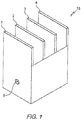
- the throwpower was evaluated in accordance with the "Nagoya Box Method" as shown in FIGS. 1 and 2 .
- the Nagoya Box 10 has 4 parallel metal plates 1, 2, 3 and 4 having dimensions of 6.9 cm (w) x 15.2 cm (I) with a distance of 20 mm between them with the bottom and sides sealed. Through holes 5 of diameter 1.6 cm are centered 5 cm from the bottom edge of the metal plates 1, 2 and 3 but not 4.
- the box 10 was immersed into an electrodeposition coating container 20 filled with a cathodic electrodeposition coating material.
- the cathodic electrodeposition coating material flows into the box 10 only from each through hole 5.
- the metal plates 1 to 4 are electrically connected and a counter electrode 21 was disposed at a distance of 150 mm from the metal plate 1.
- a voltage is applied to the metal plates 1-4 as a negative electrode and the counter electrode 21 as a positive electrode to conduct a cathodic electrodeposition coating.
- the box 10 was immersed in an electrodepositable composition (ED 7000Z from PPG Industries) heated to 32°C. that was magnetically stirred. Each panel served as a cathode that was electrically connected to a counter electrode spaced 150 mm from the first panel. Voltage was applied to the panels for a duration in which there was an initial 30 s ramp imposed to rise to maximum voltage. The maximum voltage applied was determined as the value that would result in the formation of an electrodeposited coating on A face that was 20 micrometer thick after 180 seconds. In subsequent experiments, the duration of time that maximum voltage was applied was determined by monitoring the coating that developed on G face. In these experiments, voltage was applied on a timescale that would result in the formation of an electrodeposited coating on G face that was 20 micrometer thick with complete coverage of the panel face and uniform thickness.
- ED 7000Z from PPG Industries
- the coated panels were rinsed thoroughly in deionized water and placed in an electric oven heated to 175°C. for 25 minutes.
- the thickness and uniformity of the coating on each panel face was evaluated in 4 regions positioned at right angles spaced 1 mm away from the center hole on 1, 2 and 3 panels. These locations were also examined on the face of 4 panel which did not contain a hole.
- the film thickness on G face was divided by the film thickness on A face. The change in throwpower imparted by adding organophosphonic acid to the pretreatment was observed by normalizing the throwpower of the control pretreated surface which contained no organophosphonic acid to "0".
- compositions comprising Butyl Phosphonic Acid, Ethyl Phosphonic Acid, Vinyl Phosphonic Acid or Hexyl Phosphonic Acid are according to the invention, the remaining compositions represent reference examples.
- the treatment composition had the following basic formulation: 175 ppm Zr, 20 ppm Cu, pH 4.6-4.7, and 70-75 ppm free fluoride.
- Each pretreatment bath was prepared in the following manner. To a clean 5-gallon bucket was added 16.9 g fluorozirconic acid (45 wt.% in water, PPG Industries), 20.0 g copper nitrate solution (2 wt.% Cu in deionized (DI) water), and 10.0 g Chemfos AFL (PPG Industries). If applicable, the phosphonic acid was then added to the pretreatment bath to give the appropriate level of elemental phosphorus.
- the bath was brought to a pH of 4.6-4.7 with Chemfil buffer, which is an alkaline material available from PPG Industries.
- Chemfil buffer which is an alkaline material available from PPG Industries.
- 1.1 g of Chemfos AFL was added instead of 10.0 g.
- the free fluoride was measured to be 95-100 ppm instead of the expected 70-75 ppm.
- Organophosphonic acids in the following amounts expressed as parts per million (ppm) based on elemental phosphorus.
- Cold rolled steel panels 1, 2, 3 and 4 as shown in FIG. 2 were treated with the above compositions as follows.
- Cold rolled steel panels were obtained from ACT (Item #26920, unpolish, cut only, 150x70 mm).
- Panels 1, 2, 3 and 4 were degreased for two minutes at 49°C. (120°F.) in a spray tank.
- the alkaline cleaner was comprised of 1.25 wt% Chemkleen 2010LP (PPG Industries) and 0.13 wt% Chemkleen 181ALP (PPG Industries) in DI water. After degreasing, the panels were immersed in DI water for 30 seconds followed by a 30 second DI spray rinse.
- the panels were immersed in the Zr-pretreatment bath for two minutes at 27°C. (80°F.). The panels were then spray rinsed with DI water for 30 seconds and were dried with hot air for five minutes at 54°C. (130°F.).
- the zirconium rinse pretreatment composition was prepared as follows: 200 ppm Zr, 155 ppm free fluoride, pH 3.48. To a spray tank was added 19.96 g fluorozirconic acid followed by 30.0 g Chemfos AFL. The solution was neutralized with Chemfil buffer to a pH of 3.48.
- the cold rolled steel panels 1, 2, 3 and 4 were pretreated in the same manner as when no Zr rinse was applied. However, the zirconium rinse step was applied for one minute at 24°C. (75°F.) between the DI spray rinse stage and the immersion Zr-pretreatment stage.
- the present invention is directed to a composition for treating a metal substrate comprising (a) a Group IV(b) metal ion, (b) a copper ion, (c) a fluoride ion, (d) an organophosphonic acid, and (e) a carrier, wherein (a) is derived from a zirconium, titanium or hafnium compound or mixtures thereof, wherein (b) is present in the composition in amounts of 5 to 40 ppm based on elemental copper and on total weight of the composition, wherein (d) is a monophosphonic acid, wherein the carrier (e) is an aqueous medium, and wherein the composition has a pH between 3 and 7, and to methods for coating a metal substrate comprising: (a) contacting the metal substrate with a Group IV(b) metal ion, (b) contacting the substrate with the above treatment composition, and (c) electrophoretically depositing a cationic electrodepositable coating composition onto the substrate
- steps (a), (b) and (c) are typically done sequentially without any intervening steps or processes. In certain other embodiments, one or more intervening steps or processes may occur between any of steps (a), (b) and/or (c).
Landscapes
- Chemical & Material Sciences (AREA)
- Engineering & Computer Science (AREA)
- Organic Chemistry (AREA)
- Materials Engineering (AREA)
- Chemical Kinetics & Catalysis (AREA)
- Metallurgy (AREA)
- General Chemical & Material Sciences (AREA)
- Mechanical Engineering (AREA)
- Life Sciences & Earth Sciences (AREA)
- Electrochemistry (AREA)
- Wood Science & Technology (AREA)
- Molecular Biology (AREA)
- Health & Medical Sciences (AREA)
- Chemical Treatment Of Metals (AREA)
- Paints Or Removers (AREA)
- Cleaning And De-Greasing Of Metallic Materials By Chemical Methods (AREA)
Claims (12)
- Eine Zusammensetzung zur Behandlung eines Metallsubstrats, enthaltend:(a) ein Gruppe IV(b) Metallion,(b) ein Kupferion,(c) ein Fluoridion, und(d) eine Organophosphonsäure, und(e) ein Träger,wobei (a) von einer Zirkonium-, Titan oder Hafniumverbindung oder Mischungen davon abgeleitet ist,
wobei (b) in der Zusammensetzung in Mengen von 5 bis 40 ppm, bezogen auf elementares Kupfer und auf das Gesamtgewicht der Zusammensetzung vorhanden ist,
wobei (d) eine Monophosphonsäure ist,
wobei (e) ein wässriges Medium ist, und
wobei die Zusammensetzung einen pH zwischen 3 und 7 hat. - Die Zusammensetzung nach Anspruch 1, wobei (a) von einer Zirkoniumverbindung oder Mischungen von Zirkoniumverbindung abgeleitet ist.
- Die Zusammensetzung nach Anspruch 1, in der (c) von einer Gruppe enthaltend HF, NH4F, NH4HF2, NaF and NaHF2 abgeleitet ist.
- Die Zusammensetzung nach Anspruch 1, in der die Organogruppe der Organophosphonsäure 6 oder weniger Kohlenstoffatome aufweist.
- Die Zusammensetzung nach Anspruch 1, in der die Organogruppe der Organophosphonsäure von 2 bis 4 Kohlenstoffatome aufweist.
- Die Zusammensetzung nach Anspruch 1, in der (a) in der Zusammensetzung in Mengen von 50 bis 300 Anteile pro Million (ppm), bezogen auf elementares Metall und auf das Gesamtgewicht der Zusammensetzung, vorhanden ist.
- Die Zusammensetzung nach Anspruch 1, in der (c) in der Zusammensetzung in Mengen von 50 bis 200 ppm, bezogen auf elementares Fluor und auf das Gesamtgewicht der Zusammensetzung, vorhanden ist.
- Die Zusammensetzung nach Anspruch 1, in der (d) in der Zusammensetzung in Mengen von 15 bis 50 ppm, bezogen auf elementares Phosphor und auf das Gesamtgewicht der Zusammensetzung, vorhanden ist.
- Ein Verfahren zum Beschichten eines Metallsubstrats, umfassend:(a) Vorbehandeln des Metallsubstrats mit einem Metallion der Gruppe IV(b), gefolgt von einem(b) Behandeln des Substrats von (a) mit einer Zusammensetzung nach Anspruch 1,(c) Elektroabscheiden einer kationischen elektroabscheidbaren Zusammensetzung auf dem Substrat von (b).
- Das Verfahren nach Anspruch 9, in der das Gruppe IV(b) Metallion von (a) von einer Zirkoniumverbindung oder Mischung von Zirkoniumverbindungen abgeleitet ist.
- Das Verfahren nach Anspruch 10, in der das Gruppe IV(b) Metallion von (a) in einer wässrigen Zusammensetzung in Mengen von 50 bis 300 ppm, bezogen auf elementrares Gruppe IV(b) Metall und auf das Gesamtgewicht der Zusammensetzung, vorhanden ist.
- Das Verfahren nach Anspruch 9, wobei die Zusammensetzung in Schritt (b) wie in einem der Ansprüche 2 und 4-8 definiert ist.
Applications Claiming Priority (2)
| Application Number | Priority Date | Filing Date | Title |
|---|---|---|---|
| US14/269,628 US20150315718A1 (en) | 2014-05-05 | 2014-05-05 | Metal pretreatment modification for improved throwpower |
| PCT/US2015/028450 WO2015171413A1 (en) | 2014-05-05 | 2015-04-30 | Metal pretreatment modification for improved throwpower |
Publications (2)
| Publication Number | Publication Date |
|---|---|
| EP3140436A1 EP3140436A1 (de) | 2017-03-15 |
| EP3140436B1 true EP3140436B1 (de) | 2019-12-25 |
Family
ID=53177895
Family Applications (1)
| Application Number | Title | Priority Date | Filing Date |
|---|---|---|---|
| EP15722632.5A Active EP3140436B1 (de) | 2014-05-05 | 2015-04-30 | Metallvorbehandlungsmodifizierung für verbesserte wurfleistung |
Country Status (9)
| Country | Link |
|---|---|
| US (1) | US20150315718A1 (de) |
| EP (1) | EP3140436B1 (de) |
| KR (2) | KR20160147050A (de) |
| CN (1) | CN106460187A (de) |
| CA (1) | CA2947857C (de) |
| ES (1) | ES2768727T3 (de) |
| MX (1) | MX2016014381A (de) |
| RU (1) | RU2666807C2 (de) |
| WO (1) | WO2015171413A1 (de) |
Families Citing this family (4)
| Publication number | Priority date | Publication date | Assignee | Title |
|---|---|---|---|---|
| ES2763038T3 (es) | 2015-04-15 | 2020-05-26 | Henkel Ag & Co Kgaa | Revestimientos finos protectores contra corrosión que incorporan polímeros de poliamidoamina |
| CN109642339B (zh) * | 2016-08-12 | 2021-08-06 | Prc-迪索托国际公司 | 用于处理金属基材的系统和方法 |
| MX2022004334A (es) * | 2019-10-10 | 2022-04-26 | Ppg Ind Ohio Inc | Sistemas y métodos para tratar un sustrato. |
| EP4658831A2 (de) * | 2023-02-01 | 2025-12-10 | PPG Industries Ohio Inc. | Zusammensetzungen, systeme und verfahren zur behandlung eines substrats |
Citations (1)
| Publication number | Priority date | Publication date | Assignee | Title |
|---|---|---|---|---|
| US20130266819A1 (en) * | 2010-12-07 | 2013-10-10 | Henkel Ag & Co. Kgaa | Metal pretreatment composition containing zirconium, copper, and metal chelating agents and related coatings on metal substrates |
Family Cites Families (31)
| Publication number | Priority date | Publication date | Assignee | Title |
|---|---|---|---|---|
| US3984922A (en) | 1944-10-10 | 1976-10-12 | Leo Rosen | Rotors |
| DE1546840C3 (de) | 1965-02-27 | 1975-05-22 | Basf Ag, 6700 Ludwigshafen | Verfahren zum Herstellen von Überzügen |
| US4001101A (en) | 1969-07-10 | 1977-01-04 | Ppg Industries, Inc. | Electrodeposition of epoxy compositions |
| US3975346A (en) | 1968-10-31 | 1976-08-17 | Ppg Industries, Inc. | Boron-containing, quaternary ammonium salt-containing resin compositions |
| US3663389A (en) | 1970-04-17 | 1972-05-16 | American Cyanamid Co | Method of electrodepositing novel coating |
| US3984299A (en) | 1970-06-19 | 1976-10-05 | Ppg Industries, Inc. | Process for electrodepositing cationic compositions |
| US3962165A (en) | 1971-06-29 | 1976-06-08 | Ppg Industries, Inc. | Quaternary ammonium salt-containing resin compositions |
| US3947338A (en) | 1971-10-28 | 1976-03-30 | Ppg Industries, Inc. | Method of electrodepositing self-crosslinking cationic compositions |
| US3947339A (en) | 1971-12-01 | 1976-03-30 | Ppg Industries, Inc. | Method of electrodepositing primary amine group-containing cationic resins |
| US3793278A (en) | 1972-03-10 | 1974-02-19 | Ppg Industries Inc | Method of preparing sulfonium group containing compositions |
| US3928157A (en) | 1972-05-15 | 1975-12-23 | Shinto Paint Co Ltd | Cathodic treatment of chromium-plated surfaces |
| DE2707405C3 (de) | 1976-07-19 | 1987-12-03 | Vianova Kunstharz Ag, Werndorf | Verfahren zur Herstellung von Bindemitteln für die Elektrotauchlackierung |
| DE2711425A1 (de) | 1977-03-16 | 1978-09-21 | Basf Ag | Lackbindemittel fuer die kathodische elektrotauchlackierung |
| US4134866A (en) | 1977-06-03 | 1979-01-16 | Kansai Paint Company, Limited | Aqueous cationic coating from amine-epoxy adduct, polyamide, and semi-blocked polyisocyanate, acid salt |
| EP0012463B1 (de) | 1978-12-11 | 1982-06-30 | Shell Internationale Researchmaatschappij B.V. | Zusammensetzungen auf der Basis hitzehärtbarer harzartiger Bindemittel, deren Herstellung und deren Verwendung als Überzugsmittel |
| US5427632A (en) * | 1993-07-30 | 1995-06-27 | Henkel Corporation | Composition and process for treating metals |
| DE19933189A1 (de) * | 1999-07-15 | 2001-01-18 | Henkel Kgaa | Verfahren zur korrosionsschützenden Behandlung oder Nachbehandlung von Metalloberflächen |
| DE60324379D1 (de) * | 2002-12-24 | 2008-12-11 | Chemetall Gmbh | Chemisches Konversionsbeschichtungsmittel und beschichtete Metalloberflächen |
| DE10339165A1 (de) * | 2003-08-26 | 2005-03-24 | Henkel Kgaa | Farbige Konversionsschichten auf Metalloberflächen |
| WO2006050916A2 (de) * | 2004-11-10 | 2006-05-18 | Chemetall Gmbh | Verfahren zur beschichtung von metallischen oberflächen mit einer wässerigen zusammensetzung |
| US20060099332A1 (en) * | 2004-11-10 | 2006-05-11 | Mats Eriksson | Process for producing a repair coating on a coated metallic surface |
| US20060151070A1 (en) * | 2005-01-12 | 2006-07-13 | General Electric Company | Rinsable metal pretreatment methods and compositions |
| US20080138615A1 (en) * | 2005-04-04 | 2008-06-12 | Thomas Kolberg | Method for Coating Metallic Surfaces with an Aqueous Composition and Said Composition |
| JP2008088552A (ja) * | 2006-09-08 | 2008-04-17 | Nippon Paint Co Ltd | 金属基材の表面処理方法、当該表面処理方法により処理されてなる金属材料、及び当該金属材料の塗装方法。 |
| US8916006B2 (en) * | 2006-09-08 | 2014-12-23 | Nippon Paint Co., Ltd. | Method of treating surface of metal base metallic material treated by the surface treatment method and method of coating the metallic material |
| US8673091B2 (en) * | 2007-08-03 | 2014-03-18 | Ppg Industries Ohio, Inc | Pretreatment compositions and methods for coating a metal substrate |
| JP2010013677A (ja) * | 2008-07-01 | 2010-01-21 | Nippon Parkerizing Co Ltd | 金属構造物用化成処理液および表面処理方法 |
| DE102008038653A1 (de) * | 2008-08-12 | 2010-03-25 | Henkel Ag & Co. Kgaa | Sukzessive korrosionsschützende Vorbehandlung von Metalloberflächen in einem Mehrstufenprozess |
| CN103249867B (zh) * | 2010-12-07 | 2016-04-20 | 汉高股份有限及两合公司 | 含有锆、铜和金属螯合剂的金属预处理组合物和在金属基材上的相关涂层 |
| BR112014009860B1 (pt) * | 2011-10-24 | 2021-01-19 | Chemetall Gmbh | processo para aperfeiçoamento do poder de arremesso de um revestimento por eletrodeposição, e, uso de substratos metálicos revestidos e de uma composição de tratamento prévio aquosa |
| US20130146460A1 (en) * | 2011-12-13 | 2013-06-13 | Ppg Industries Ohio, Inc. | Resin based post rinse for improved throwpower of electrodepositable coating compositions on pretreated metal substrates |
-
2014
- 2014-05-05 US US14/269,628 patent/US20150315718A1/en not_active Abandoned
-
2015
- 2015-04-30 EP EP15722632.5A patent/EP3140436B1/de active Active
- 2015-04-30 CA CA2947857A patent/CA2947857C/en not_active Expired - Fee Related
- 2015-04-30 KR KR1020167033895A patent/KR20160147050A/ko not_active Ceased
- 2015-04-30 WO PCT/US2015/028450 patent/WO2015171413A1/en not_active Ceased
- 2015-04-30 ES ES15722632T patent/ES2768727T3/es active Active
- 2015-04-30 CN CN201580030445.7A patent/CN106460187A/zh active Pending
- 2015-04-30 KR KR1020187030831A patent/KR20180119700A/ko not_active Withdrawn
- 2015-04-30 RU RU2016147418A patent/RU2666807C2/ru active
- 2015-04-30 MX MX2016014381A patent/MX2016014381A/es unknown
Patent Citations (1)
| Publication number | Priority date | Publication date | Assignee | Title |
|---|---|---|---|---|
| US20130266819A1 (en) * | 2010-12-07 | 2013-10-10 | Henkel Ag & Co. Kgaa | Metal pretreatment composition containing zirconium, copper, and metal chelating agents and related coatings on metal substrates |
Also Published As
| Publication number | Publication date |
|---|---|
| RU2016147418A3 (de) | 2018-06-06 |
| RU2016147418A (ru) | 2018-06-06 |
| CA2947857C (en) | 2019-07-09 |
| WO2015171413A1 (en) | 2015-11-12 |
| EP3140436A1 (de) | 2017-03-15 |
| KR20160147050A (ko) | 2016-12-21 |
| US20150315718A1 (en) | 2015-11-05 |
| CN106460187A (zh) | 2017-02-22 |
| KR20180119700A (ko) | 2018-11-02 |
| RU2666807C2 (ru) | 2018-09-12 |
| CA2947857A1 (en) | 2015-11-12 |
| ES2768727T3 (es) | 2020-06-23 |
| MX2016014381A (es) | 2017-04-10 |
Similar Documents
| Publication | Publication Date | Title |
|---|---|---|
| AU2008248694B2 (en) | Preliminary metallizing treatment of zinc surfaces | |
| CA2905744C (en) | Method for preparing and treating a steel substrate | |
| US12104272B2 (en) | Treated substrates | |
| CN104053826B (zh) | 用于改进在预处理的金属基底上的可电沉积的涂料组合物的泳透力的树脂基后冲洗 | |
| EP3140436B1 (de) | Metallvorbehandlungsmodifizierung für verbesserte wurfleistung | |
| EP2890829B1 (de) | Mit zirkonium vorbehandelte lithiumhaltige zusammensetzungen, entsprechende verfahren zur behandlung von metallsubstraten und entsprechende beschichtete metallsubstrate | |
| TW201437430A (zh) | 金屬表面處理劑及金屬表面處理方法 | |
| EP2739768B1 (de) | Mit zirkonium vorbehandelte zusammensetzungen mit einem seltenerdmetall, entsprechende verfahren zur behandlung von metallsubstraten und entsprechende beschichtete metallsubstrate |
Legal Events
| Date | Code | Title | Description |
|---|---|---|---|
| STAA | Information on the status of an ep patent application or granted ep patent |
Free format text: STATUS: THE INTERNATIONAL PUBLICATION HAS BEEN MADE |
|
| PUAI | Public reference made under article 153(3) epc to a published international application that has entered the european phase |
Free format text: ORIGINAL CODE: 0009012 |
|
| STAA | Information on the status of an ep patent application or granted ep patent |
Free format text: STATUS: REQUEST FOR EXAMINATION WAS MADE |
|
| 17P | Request for examination filed |
Effective date: 20161121 |
|
| AK | Designated contracting states |
Kind code of ref document: A1 Designated state(s): AL AT BE BG CH CY CZ DE DK EE ES FI FR GB GR HR HU IE IS IT LI LT LU LV MC MK MT NL NO PL PT RO RS SE SI SK SM TR |
|
| AX | Request for extension of the european patent |
Extension state: BA ME |
|
| DAV | Request for validation of the european patent (deleted) | ||
| DAX | Request for extension of the european patent (deleted) | ||
| STAA | Information on the status of an ep patent application or granted ep patent |
Free format text: STATUS: EXAMINATION IS IN PROGRESS |
|
| 17Q | First examination report despatched |
Effective date: 20171206 |
|
| GRAP | Despatch of communication of intention to grant a patent |
Free format text: ORIGINAL CODE: EPIDOSNIGR1 |
|
| STAA | Information on the status of an ep patent application or granted ep patent |
Free format text: STATUS: GRANT OF PATENT IS INTENDED |
|
| RIC1 | Information provided on ipc code assigned before grant |
Ipc: C09D 7/40 20180101ALI20190801BHEP Ipc: C25D 13/04 20060101ALI20190801BHEP Ipc: C25D 13/20 20060101ALI20190801BHEP Ipc: C23C 22/80 20060101ALI20190801BHEP Ipc: C25D 13/22 20060101ALN20190801BHEP Ipc: C09D 5/44 20060101ALI20190801BHEP Ipc: C23C 22/83 20060101ALI20190801BHEP Ipc: C23C 22/34 20060101AFI20190801BHEP |
|
| INTG | Intention to grant announced |
Effective date: 20190829 |
|
| REG | Reference to a national code |
Ref country code: DE Ref legal event code: R079 Ref document number: 602015044242 Country of ref document: DE Free format text: PREVIOUS MAIN CLASS: C25D0005340000 Ipc: C23C0022340000 |
|
| GRAJ | Information related to disapproval of communication of intention to grant by the applicant or resumption of examination proceedings by the epo deleted |
Free format text: ORIGINAL CODE: EPIDOSDIGR1 |
|
| STAA | Information on the status of an ep patent application or granted ep patent |
Free format text: STATUS: EXAMINATION IS IN PROGRESS |
|
| GRAR | Information related to intention to grant a patent recorded |
Free format text: ORIGINAL CODE: EPIDOSNIGR71 |
|
| GRAS | Grant fee paid |
Free format text: ORIGINAL CODE: EPIDOSNIGR3 |
|
| STAA | Information on the status of an ep patent application or granted ep patent |
Free format text: STATUS: GRANT OF PATENT IS INTENDED |
|
| INTC | Intention to grant announced (deleted) | ||
| GRAA | (expected) grant |
Free format text: ORIGINAL CODE: 0009210 |
|
| STAA | Information on the status of an ep patent application or granted ep patent |
Free format text: STATUS: THE PATENT HAS BEEN GRANTED |
|
| RIC1 | Information provided on ipc code assigned before grant |
Ipc: C25D 13/20 20060101ALI20191018BHEP Ipc: C25D 13/04 20060101ALI20191018BHEP Ipc: C09D 7/40 20180101ALI20191018BHEP Ipc: C23C 22/80 20060101ALI20191018BHEP Ipc: C09D 5/44 20060101ALI20191018BHEP Ipc: C23C 22/83 20060101ALI20191018BHEP Ipc: C25D 13/22 20060101ALN20191018BHEP Ipc: C23C 22/34 20060101AFI20191018BHEP |
|
| INTG | Intention to grant announced |
Effective date: 20191113 |
|
| AK | Designated contracting states |
Kind code of ref document: B1 Designated state(s): AL AT BE BG CH CY CZ DE DK EE ES FI FR GB GR HR HU IE IS IT LI LT LU LV MC MK MT NL NO PL PT RO RS SE SI SK SM TR |
|
| REG | Reference to a national code |
Ref country code: GB Ref legal event code: FG4D |
|
| REG | Reference to a national code |
Ref country code: CH Ref legal event code: EP |
|
| REG | Reference to a national code |
Ref country code: AT Ref legal event code: REF Ref document number: 1217219 Country of ref document: AT Kind code of ref document: T Effective date: 20200115 |
|
| REG | Reference to a national code |
Ref country code: DE Ref legal event code: R096 Ref document number: 602015044242 Country of ref document: DE |
|
| REG | Reference to a national code |
Ref country code: IE Ref legal event code: FG4D |
|
| REG | Reference to a national code |
Ref country code: DE Ref legal event code: R082 Ref document number: 602015044242 Country of ref document: DE Representative=s name: FLEISCHER, ENGELS & PARTNER MBB, PATENTANWAELT, DE |
|
| REG | Reference to a national code |
Ref country code: NL Ref legal event code: MP Effective date: 20191225 |
|
| PG25 | Lapsed in a contracting state [announced via postgrant information from national office to epo] |
Ref country code: LV Free format text: LAPSE BECAUSE OF FAILURE TO SUBMIT A TRANSLATION OF THE DESCRIPTION OR TO PAY THE FEE WITHIN THE PRESCRIBED TIME-LIMIT Effective date: 20191225 Ref country code: SE Free format text: LAPSE BECAUSE OF FAILURE TO SUBMIT A TRANSLATION OF THE DESCRIPTION OR TO PAY THE FEE WITHIN THE PRESCRIBED TIME-LIMIT Effective date: 20191225 Ref country code: LT Free format text: LAPSE BECAUSE OF FAILURE TO SUBMIT A TRANSLATION OF THE DESCRIPTION OR TO PAY THE FEE WITHIN THE PRESCRIBED TIME-LIMIT Effective date: 20191225 Ref country code: FI Free format text: LAPSE BECAUSE OF FAILURE TO SUBMIT A TRANSLATION OF THE DESCRIPTION OR TO PAY THE FEE WITHIN THE PRESCRIBED TIME-LIMIT Effective date: 20191225 Ref country code: NO Free format text: LAPSE BECAUSE OF FAILURE TO SUBMIT A TRANSLATION OF THE DESCRIPTION OR TO PAY THE FEE WITHIN THE PRESCRIBED TIME-LIMIT Effective date: 20200325 Ref country code: GR Free format text: LAPSE BECAUSE OF FAILURE TO SUBMIT A TRANSLATION OF THE DESCRIPTION OR TO PAY THE FEE WITHIN THE PRESCRIBED TIME-LIMIT Effective date: 20200326 Ref country code: BG Free format text: LAPSE BECAUSE OF FAILURE TO SUBMIT A TRANSLATION OF THE DESCRIPTION OR TO PAY THE FEE WITHIN THE PRESCRIBED TIME-LIMIT Effective date: 20200325 |
|
| REG | Reference to a national code |
Ref country code: LT Ref legal event code: MG4D |
|
| PG25 | Lapsed in a contracting state [announced via postgrant information from national office to epo] |
Ref country code: RS Free format text: LAPSE BECAUSE OF FAILURE TO SUBMIT A TRANSLATION OF THE DESCRIPTION OR TO PAY THE FEE WITHIN THE PRESCRIBED TIME-LIMIT Effective date: 20191225 Ref country code: HR Free format text: LAPSE BECAUSE OF FAILURE TO SUBMIT A TRANSLATION OF THE DESCRIPTION OR TO PAY THE FEE WITHIN THE PRESCRIBED TIME-LIMIT Effective date: 20191225 |
|
| REG | Reference to a national code |
Ref country code: ES Ref legal event code: FG2A Ref document number: 2768727 Country of ref document: ES Kind code of ref document: T3 Effective date: 20200623 |
|
| PG25 | Lapsed in a contracting state [announced via postgrant information from national office to epo] |
Ref country code: AL Free format text: LAPSE BECAUSE OF FAILURE TO SUBMIT A TRANSLATION OF THE DESCRIPTION OR TO PAY THE FEE WITHIN THE PRESCRIBED TIME-LIMIT Effective date: 20191225 |
|
| PG25 | Lapsed in a contracting state [announced via postgrant information from national office to epo] |
Ref country code: RO Free format text: LAPSE BECAUSE OF FAILURE TO SUBMIT A TRANSLATION OF THE DESCRIPTION OR TO PAY THE FEE WITHIN THE PRESCRIBED TIME-LIMIT Effective date: 20191225 Ref country code: PT Free format text: LAPSE BECAUSE OF FAILURE TO SUBMIT A TRANSLATION OF THE DESCRIPTION OR TO PAY THE FEE WITHIN THE PRESCRIBED TIME-LIMIT Effective date: 20200520 Ref country code: CZ Free format text: LAPSE BECAUSE OF FAILURE TO SUBMIT A TRANSLATION OF THE DESCRIPTION OR TO PAY THE FEE WITHIN THE PRESCRIBED TIME-LIMIT Effective date: 20191225 Ref country code: NL Free format text: LAPSE BECAUSE OF FAILURE TO SUBMIT A TRANSLATION OF THE DESCRIPTION OR TO PAY THE FEE WITHIN THE PRESCRIBED TIME-LIMIT Effective date: 20191225 Ref country code: EE Free format text: LAPSE BECAUSE OF FAILURE TO SUBMIT A TRANSLATION OF THE DESCRIPTION OR TO PAY THE FEE WITHIN THE PRESCRIBED TIME-LIMIT Effective date: 20191225 |
|
| PGFP | Annual fee paid to national office [announced via postgrant information from national office to epo] |
Ref country code: FR Payment date: 20200427 Year of fee payment: 6 Ref country code: ES Payment date: 20200504 Year of fee payment: 6 Ref country code: DE Payment date: 20200429 Year of fee payment: 6 |
|
| PG25 | Lapsed in a contracting state [announced via postgrant information from national office to epo] |
Ref country code: IS Free format text: LAPSE BECAUSE OF FAILURE TO SUBMIT A TRANSLATION OF THE DESCRIPTION OR TO PAY THE FEE WITHIN THE PRESCRIBED TIME-LIMIT Effective date: 20200425 Ref country code: SK Free format text: LAPSE BECAUSE OF FAILURE TO SUBMIT A TRANSLATION OF THE DESCRIPTION OR TO PAY THE FEE WITHIN THE PRESCRIBED TIME-LIMIT Effective date: 20191225 Ref country code: SM Free format text: LAPSE BECAUSE OF FAILURE TO SUBMIT A TRANSLATION OF THE DESCRIPTION OR TO PAY THE FEE WITHIN THE PRESCRIBED TIME-LIMIT Effective date: 20191225 |
|
| PGFP | Annual fee paid to national office [announced via postgrant information from national office to epo] |
Ref country code: GB Payment date: 20200427 Year of fee payment: 6 Ref country code: IT Payment date: 20200423 Year of fee payment: 6 |
|
| REG | Reference to a national code |
Ref country code: DE Ref legal event code: R097 Ref document number: 602015044242 Country of ref document: DE |
|
| PG25 | Lapsed in a contracting state [announced via postgrant information from national office to epo] |
Ref country code: DK Free format text: LAPSE BECAUSE OF FAILURE TO SUBMIT A TRANSLATION OF THE DESCRIPTION OR TO PAY THE FEE WITHIN THE PRESCRIBED TIME-LIMIT Effective date: 20191225 |
|
| PLBE | No opposition filed within time limit |
Free format text: ORIGINAL CODE: 0009261 |
|
| STAA | Information on the status of an ep patent application or granted ep patent |
Free format text: STATUS: NO OPPOSITION FILED WITHIN TIME LIMIT |
|
| REG | Reference to a national code |
Ref country code: AT Ref legal event code: MK05 Ref document number: 1217219 Country of ref document: AT Kind code of ref document: T Effective date: 20191225 |
|
| PG25 | Lapsed in a contracting state [announced via postgrant information from national office to epo] |
Ref country code: MC Free format text: LAPSE BECAUSE OF FAILURE TO SUBMIT A TRANSLATION OF THE DESCRIPTION OR TO PAY THE FEE WITHIN THE PRESCRIBED TIME-LIMIT Effective date: 20191225 Ref country code: SI Free format text: LAPSE BECAUSE OF FAILURE TO SUBMIT A TRANSLATION OF THE DESCRIPTION OR TO PAY THE FEE WITHIN THE PRESCRIBED TIME-LIMIT Effective date: 20191225 |
|
| REG | Reference to a national code |
Ref country code: CH Ref legal event code: PL |
|
| 26N | No opposition filed |
Effective date: 20200928 |
|
| PG25 | Lapsed in a contracting state [announced via postgrant information from national office to epo] |
Ref country code: CH Free format text: LAPSE BECAUSE OF NON-PAYMENT OF DUE FEES Effective date: 20200430 Ref country code: AT Free format text: LAPSE BECAUSE OF FAILURE TO SUBMIT A TRANSLATION OF THE DESCRIPTION OR TO PAY THE FEE WITHIN THE PRESCRIBED TIME-LIMIT Effective date: 20191225 Ref country code: LI Free format text: LAPSE BECAUSE OF NON-PAYMENT OF DUE FEES Effective date: 20200430 Ref country code: LU Free format text: LAPSE BECAUSE OF NON-PAYMENT OF DUE FEES Effective date: 20200430 |
|
| REG | Reference to a national code |
Ref country code: BE Ref legal event code: MM Effective date: 20200430 |
|
| PG25 | Lapsed in a contracting state [announced via postgrant information from national office to epo] |
Ref country code: BE Free format text: LAPSE BECAUSE OF NON-PAYMENT OF DUE FEES Effective date: 20200430 Ref country code: PL Free format text: LAPSE BECAUSE OF FAILURE TO SUBMIT A TRANSLATION OF THE DESCRIPTION OR TO PAY THE FEE WITHIN THE PRESCRIBED TIME-LIMIT Effective date: 20191225 |
|
| PG25 | Lapsed in a contracting state [announced via postgrant information from national office to epo] |
Ref country code: IE Free format text: LAPSE BECAUSE OF NON-PAYMENT OF DUE FEES Effective date: 20200430 |
|
| REG | Reference to a national code |
Ref country code: DE Ref legal event code: R119 Ref document number: 602015044242 Country of ref document: DE |
|
| GBPC | Gb: european patent ceased through non-payment of renewal fee |
Effective date: 20210430 |
|
| PG25 | Lapsed in a contracting state [announced via postgrant information from national office to epo] |
Ref country code: FR Free format text: LAPSE BECAUSE OF NON-PAYMENT OF DUE FEES Effective date: 20210430 Ref country code: GB Free format text: LAPSE BECAUSE OF NON-PAYMENT OF DUE FEES Effective date: 20210430 Ref country code: DE Free format text: LAPSE BECAUSE OF NON-PAYMENT OF DUE FEES Effective date: 20211103 |
|
| PG25 | Lapsed in a contracting state [announced via postgrant information from national office to epo] |
Ref country code: TR Free format text: LAPSE BECAUSE OF FAILURE TO SUBMIT A TRANSLATION OF THE DESCRIPTION OR TO PAY THE FEE WITHIN THE PRESCRIBED TIME-LIMIT Effective date: 20191225 Ref country code: MT Free format text: LAPSE BECAUSE OF FAILURE TO SUBMIT A TRANSLATION OF THE DESCRIPTION OR TO PAY THE FEE WITHIN THE PRESCRIBED TIME-LIMIT Effective date: 20191225 Ref country code: CY Free format text: LAPSE BECAUSE OF FAILURE TO SUBMIT A TRANSLATION OF THE DESCRIPTION OR TO PAY THE FEE WITHIN THE PRESCRIBED TIME-LIMIT Effective date: 20191225 |
|
| PG25 | Lapsed in a contracting state [announced via postgrant information from national office to epo] |
Ref country code: MK Free format text: LAPSE BECAUSE OF FAILURE TO SUBMIT A TRANSLATION OF THE DESCRIPTION OR TO PAY THE FEE WITHIN THE PRESCRIBED TIME-LIMIT Effective date: 20191225 |
|
| REG | Reference to a national code |
Ref country code: ES Ref legal event code: FD2A Effective date: 20220727 |
|
| PG25 | Lapsed in a contracting state [announced via postgrant information from national office to epo] |
Ref country code: ES Free format text: LAPSE BECAUSE OF NON-PAYMENT OF DUE FEES Effective date: 20210501 |
|
| PG25 | Lapsed in a contracting state [announced via postgrant information from national office to epo] |
Ref country code: IT Free format text: LAPSE BECAUSE OF NON-PAYMENT OF DUE FEES Effective date: 20200430 |