EP3141122B1 - Vorrichtung und verfahren zur seitlichen beaufschlagung eines teigbandes - Google Patents
Vorrichtung und verfahren zur seitlichen beaufschlagung eines teigbandes Download PDFInfo
- Publication number
- EP3141122B1 EP3141122B1 EP16164668.2A EP16164668A EP3141122B1 EP 3141122 B1 EP3141122 B1 EP 3141122B1 EP 16164668 A EP16164668 A EP 16164668A EP 3141122 B1 EP3141122 B1 EP 3141122B1
- Authority
- EP
- European Patent Office
- Prior art keywords
- dough
- dough sheet
- edge
- pushing members
- pushing
- Prior art date
- Legal status (The legal status is an assumption and is not a legal conclusion. Google has not performed a legal analysis and makes no representation as to the accuracy of the status listed.)
- Active
Links
Images





Classifications
-
- A—HUMAN NECESSITIES
- A21—BAKING; EDIBLE DOUGHS
- A21C—MACHINES OR EQUIPMENT FOR MAKING OR PROCESSING DOUGHS; HANDLING BAKED ARTICLES MADE FROM DOUGH
- A21C3/00—Machines or apparatus for shaping batches of dough before subdivision
Definitions
- the invention relates to a device which is used for lateral loading, in particular for moving at least one strip of dough resting on a conveyor device.
- U1 known device has a pressing member for the shaping action on at least one edge of the dough strip or piece of dough, wherein the at least one pressing member is guided by at least one drive means so that it can move relative to at least one edge.
- the known device has separate drives for the pressing elements on both sides, so that a synchronous action on the two dough edges by opposite pressing elements is not guaranteed.
- a device which is used for the continuous transport of a continuous sheet of dough, wherein the sheet of dough can be moved to the left or right by a sliding device, depending on the signal from a sheet of dough position sensor.
- the pushing device includes a centering roller, which is arranged on a crank axle with a motor drive. The dough strip rests on the pusher axis and this is moved back or forth depending on the offset of the dough strip to a desired center position in relation to the transport direction.
- SU 99 352 A1 discloses a conveyor for baked goods, in which the baked goods can be arranged offset by means of adjusting elements.
- the invention is based on the object of designing a device with the features of the preamble of claim 1 in such a way that the dough strip in the area of the conveyor device is brought into a desired central position in a safe, simple and space-saving manner, with stress formation or tension formation in the edge area of the dough strip being avoided in particular should be avoided.
- the pressing member that acts on an edge of the dough sheet, d. H. when the piece of dough is offset from a desired center position, it exerts pressure on the edge, executes a superimposed movement that runs along in the conveying direction.
- the pressing element not only acts on the dough strip at right angles to the conveying direction, but also gives the dough strip a superimposed impulse in the conveying direction, which helps to ensure that the dough strip is moved safely and in particular prevents denting, deformation, turning up or other damage, in particular tearing of the dough crust avoids.
- the at least one pressing member in the edge area of the dough strip can be driven to rotate on a circular path or similar path, with the circulation being selected so that the superimposed displacement impulse runs in the conveying direction of the dough strip.
- two essentially opposing pressing elements are arranged adjacent to both edge regions of the dough strip, the pressing elements being driven in opposite directions, pulsating in the direction of the edges of the dough strip.
- the movement component of the pressing element or elements can be designed to be adjustable in the conveying direction of the dough strip.
- the pressing elements can be mounted individually or in groups on rotating eccentrics whose axis of rotation is arranged at right angles to the conveying direction.
- a group-like arrangement of the pressing elements is selected in such a way that the pressing elements on the one edge side of several dough strips that are to be transported essentially parallel on the conveyor device are fastened to a common rail-like carrier element and the pressing elements of the respectively opposite side or sides are fastened to another rail-like carrier element are arranged.
- the two carrier elements are driven by counter-rotating eccentric drives. On the one hand, this leads to a counter-rotating, pulsating and synchronous movement in the direction of the edges of the dough, and on the other hand to a to-and-fro movement at right angles to the longitudinal direction of the carrier elements.
- the pressing elements are designed as strip-like elements which act on the edge regions of the dough sheet and whose ends are advantageously bent away from the edges.
- the two carrier elements run parallel to one another at a short distance and are pulsated in opposite directions by their eccentric drives arranged at one drive end, so that the pressing elements attached to them carry out the opposite pulsating movements to offset the sheet of dough if the sheet of dough is guided outside of its desired central position on the transport device .
- the pressing elements can be arranged on their carrier elements in an adjustable manner in relation to the edge of the sheet of dough to be acted upon, for which purpose the pressing elements are advantageously fastened in oblong holes running transversely to the conveying direction.
- the carrier elements are guided in mutually displaceable manner at their mutually facing edge regions and can therefore be exchanged in a simple manner if a different number of dough sheets, possibly with a different bandwidth, is to be processed in the production line.
- the pressing elements can also be attached to their carrier element so that they can be exchanged individually, so that, depending on the type of dough, individual elements of different shapes or lengths can be used can be used.
- each pressing member as a roller conveyor or to provide a roller conveyor at least in sections in the area of the pressing member.
- the device configured as described allows the controlled, dough-friendly shifting of several dough webs running next to one another on a conveyor device, in particular a conveyor belt.
- the device is simple in design, a plurality of dough strips can be displaced by only two eccentric elements, which rotate in opposite directions and can move a large number of pressing elements back and forth.
- FIG 1 a plan view of a production line section 1 is shown, into which an uncut sheet of dough 2 is fed from the right-hand side to a cutting device 3 with cutting disks 4 arranged at a distance from one another.
- a cutting device 3 With cutting disks 4 arranged at a distance from one another.
- the device according to the invention for lateral loading of the dough strip or strips 5 is arranged, which is the subject of this invention.
- this device 10 for lateral loading of the dough strips does not necessarily have to be arranged within the production line section 1 selected as an example, but can also be used wherever individual dough strips or dough strip sections on a conveyor device 7 are in a certain target central position have to be spent.
- the device 10 for lateral loading of the at least one sheet of dough 5 resting on the conveyor device 7 has pressing elements 11 which are used for the shifting action on at least one edge 12 of the sheet of dough 5 or piece of dough, the pressing elements 11 being driven by a drive means, namely an electric motor 13 are movably guided on the at least one edge 12.
- the pressing elements 11 lead when the edges 12 of the strip of dough 5 is superimposed on the sliding movement guided against the edge 12 in the conveying direction 14 of the strip of dough 5 by a movement which can be referred to as a movement running along in the conveying direction 14 .
- the pressing member 11 is driven in the edge region of the dough sheet 5 to revolve on a circular path, essentially opposite pressing members 11 lead towards the edges 12 of the dough sheet 5 in opposite directions from a pulsating displacement movement.
- the additional movement component of the pressing elements 11 in the conveying direction 14 of the dough sheet(s) 5 can be adjusted in terms of speed and feed and thus adapted to the conveying speed of the conveying device 7, ie it can be selected to be higher than the conveying speed or lower.
- the pressing elements 11 are mounted in groups by rotating eccentrics 29, 30, the axes of rotation of which are arranged essentially at right angles to the conveying direction 14.
- pressing elements 11a are arranged on a first carrier element 25, these are the pressing elements 11 which act on the left-hand edges 12 of the dough strips 5 in the conveying direction.
- the pressing elements 11b lying opposite the pressing elements 11a are fastened to a further carrier element 26 and act on the edges 12 of the dough strips 5 on the right-hand side in the conveying direction 14.
- the minimum distance between the opposing pressing elements 11a, 11b corresponds approximately to the distance between the cutting disks 4 of the cutting device 3 and thus to the width of the dough strips 5.
- the maximum distance is greater and can be adjusted depending on the design of the eccentric 20; as a rule, the maximum distance is 4-8 mm greater than the minimum distance between the pressing elements 11a, 11b, which corresponds to the width of the dough strip.
- the rail-like support elements 25, 26 are each mounted with a drive end 27, 28 on a motor-driven eccentric 29, 30, the eccentrics being coupled via a drive shaft 31 and suitable gear units 32, 33 to an electric motor 34 of the drive means, the speed of which can be regulated .
- the eccentrics 29, 30 are driven in opposite directions, which is why the opposing pulsating movement of the pressing elements 11a, 11b results, which is indicated by the rotating arrows in FIG 4 are shown.
- a carrier element 25, 26 Between the drive ends 27, 28 are the carrier elements 25, 26, with mutually pointing guide areas linearly displaceably guided with respect to their longitudinal extent to each other, for which purpose on a carrier element 25 z.
- a C-profile rail 41 is arranged as the first guide element and carriage elements 42 are provided on the carrier element 26, which can slide back and forth in the C-profile rail 41.
- the sliding attachment of the carrier elements 25, 26 to one another can, of course, also be achieved by means of completely different guide elements, such as guide rods, guide grooves or differently designed guide rails, e.g. B. can be in the form of T-rails.
- the drive shaft 31 between the gear units 32, 33 runs below the conveying device 14 designed as a conveyor belt, so that the carrier elements 25, 26 seated on the eccentrics 29, 30 with the pressing elements 11 arranged thereon can be arranged directly above the surface of the conveying device 7, so that they dough webs guided on it can be detected with certainty.
- the pressing elements 11 are designed as strip-like elements 50 which act on the edge regions of the dough sheet and whose inlet and outlet ends 51 are bent away from the edge regions.
- the pressing members 11 or elements 50 can be resiliently mounted on the carrier elements 25, 26 or also be mounted in the conveying direction 14 of the dough sheet 5 with slippage on their carrier element 25, 26.
- the carrier elements 25, 26 are provided with elongated holes 52, which extend in the longitudinal direction of the carrier elements 25, 26 and thus transversely to the conveying direction 14.
- the pressing elements 11 can be screwed adjustably onto the carrier elements 25, 26 in the region of the elongated holes 52 and thus also in other pressure organs 11 are exchanged.
- the pressing elements 11 can also be designed as revolving conveyor belts, in order to act on the edges 12 of the dough strip(s) 5 in the conveying direction.
Landscapes
- Life Sciences & Earth Sciences (AREA)
- Engineering & Computer Science (AREA)
- Food Science & Technology (AREA)
- Manufacturing And Processing Devices For Dough (AREA)
Description
- Die Erfindung betrifft eine Vorrichtung, die zum seitlichen Beaufschlagen, insbesondere zum Verschieben wenigstens eines auf einer Fördereinrichtung aufliegenden Teigbandes dient.
- Eine aus
DE 297 01 345 U1 bekannte Vorrichtung weist ein Drückorgan zur formgebenden Einwirkung auf wenigstens einen Rand des Teigbandes oder Teigstückes auf, wobei das wenigstens eine Drückorgan durch wenigstens ein Antriebsmittel bezogen auf wenigstens einen Rand bewegbar geführt ist. Die bekannte Vorrichtung weist für die beidseitigen Drückorgane gesonderte Antriebe auf, sodass eine synchrone Beaufschlagung der beiden Teigränder durch sich gegenüberliegende Drückorgane nicht gewährleistet ist. - Aus
EP 1 198 989 B1 ist eine Vorrichtung bekannt, die zum kontinuierlichen transportieren eines fortlaufenden Teigbandes dient, wobei das Teigband durch eine Schiebevorrichtung nach links oder rechts bewegt werden kann, abhängig vom Signal eines Teigbandlagesensors. Die Schiebevorrichtung umfasst eine Zentrierwalze, die auf einer Kurbelachse mit einem motorischen Antrieb angeordnet ist. Das Teigband liegt auf der Schieberachse auf und diese wird je nach Versatz des Teigbandes zu einer gewollten Mittellage bezogen auf die Transportrichtung hin-oder her bewegt. -
SU 99 352 A1 - Der Erfindung liegt die Aufgabe zugrunde, eine Vorrichtung mit den Merkmalen des Oberbegriffes des Anspruches 1 derart auszubilden, dass das Teigband im Bereich der Fördereinrichtung auf sichere, einfache und platzsparende Weise in eine Sollmittellage gebracht wird, wobei insbesondere eine Stressbildung oder Spannungsbildung im Randbereich des Teigbandes vermieden werden soll.
- Das Erreichen einer exakten Sollmittellage auf einem Fördermittel ist insbesondere dann von hoher Bedeutung, wenn das Teigband oder mehrere Teigbänder einer Stanzvorrichtung zugeführt werden, in der die Teigbänder in Teigabschnitte, insbesondere Dreiecke geschnitten werden. Würde ein Teigband oder mehrere Teigbänder abweichend von einer Sollmittellage in eine derartige Schneidevorrichtung einlaufen, dann würden Dreiecke unterschiedlicher Basislängen ausgestanzt, so dass die Teigdreiecke z.B. beim Einlaufen in eine Hörnchenwickelmaschine zu Produkten minderer Formqualität und unterschiedlichem Gewicht führen können. Dies soll vermieden werden. Patentansprüche 14 und 15 betreffen ein Verfahren, das mit der Vorrichtung der Ansprüche 1 - 13 mit besonderem Vorteil und hoher Geschwindigkeit durchgeführt werden kann.
- Diese Aufgabe wird durch die kennzeichnenden Merkmale des Anspruches 1 gelöst, vorteilhafte Weiterbildungen des Anspruches 1 ergeben sich aus den Unteransprüchen.
- Das Drückorgan, das einen Rand des Teigbandes beaufschlagt, d. h. bei Versatz des Teigstückes zu einer Sollmittellage einen Druck auf den Rand ausübt, führt eine überlagerte, in Förderrichtung mitlaufende Bewegung aus. Mit anderen Worten beaufschlagt das Drückorgan das Teigband nicht nur rechtwinkelig zur Förderrichtung, sondern gibt dem Teigband auch noch einen in Förderrichtung überlagerten Impuls mit, was einen sicheren Versetzen des Teigbandes entgegenkommt und insbesondere eine Eindellung, Verformung, Aufstülpung oder sonstige Beschädigung, insbesondere ein Einreißen des Teigrandes vermeidet.
- Vorteilhafter Weise ist das wenigstens eine Drückorgan im Randbereich des Teigbandes auf einer Kreisbahn oder kreisähnlichen Bahn umlaufend antreibbar, wobei der Umlauf jeweils so gewählt ist, dass der überlagerte Verschiebeimpuls in Förderrichtung des Teigbandes verläuft. Vorteilhafter Weise sind zwei sich im wesentlichen gegenüberliegende Drückorgane benachbart zu beiden Randbereichen des Teigbandes angeordnet, wobei die Drückorgane gegenläufig pulsierend in Richtung der Ränder der Teigbandes angetrieben werden. Die Bewegungskomponente des oder der Drückorgane kann in Förderrichtung des Teigbandes einstellbar gestaltet sein.
- Die Drückorgane können einzeln oder in Gruppen auf umlaufenden Exzentern gelagert werden, deren Drehachse rechtwinkelig zur Förderrichtung angeordnet ist.
- Eine gruppenartige Anordnung der Drückorgane ist so gewählt, dass die Drückorgane der einen Randseiten von mehreren Teigbändern, die auf der Fördereinrichtung im Wesentlichen parallel transportiert werden sollen auf einem gemeinsamen schienenartigen Trägerelement befestigt sind und die Drückorgane der jeweils gegenüberliegenden Seite oder Seiten auf einem weiteren schienenartigen Trägerelement angeordnet sind.
- Die beiden Trägerelemente werden durch gegenläufig umlaufende Exzenter-Antriebe angetrieben. Dies führt einerseits zu einer gegenläufigen pulsierenden und synchronen Bewegung in Richtung der Teigränder, andererseits auch zu einer Hin- und Herbewegung rechtwinkelig zur Längsrichtung der Trägerelemente.
- Die Drückorgane sind als die Randbereiche des Teigbandes beaufschlagende streifenartige Elemente ausgebildet, deren Enden von den Rändern vorteilhafter Weise weggebogen sind. Es ist aber auch möglich, die Drückorgane federnd an den Trägerelementen anzuordnen und/oder gegenüber den Trägerelementen sogar einen gewissen Schlupf in Förderrichtung zu erlauben, sodass die Beaufschlagung der Randbereiche besonders schonend erfolgt.
- Die beiden Trägerelemente verlaufen mit geringem Abstand parallel zueinander, und werden durch ihre an jeweils einem Antriebsende angeordneten Exzenterantriebe gegenläufig pulsierend bewegt, sodass die an ihnen befestigten Drückorgane die gegenläufigen Pulsationsbewegungen zum Versatz der Teigbahn durchführen, sofern die Teigbahnen außerhalb ihrer Sollmittellage auf der Transporteinrichtung geführt wird. Die Drückorgane können bezogen auf den zu beaufschlagenden Rand der Teigbahn einstellbar an ihren Trägerelementen angeordnet sein, wozu die Drückorgane vorteilhafterweise in quer zur Förderrichtung verlaufenden Langlöchern befestigt werden. Die Trägerelemente sind an ihren zueinanderweisenden Randbereichen gegeneinander verschiebbar geführt und können damit zusammenhängend auf einfache Weise ausgetauscht werden, sofern in der Produktionslinie eine geänderte Anzahl von Teigbahnen ggf. mit anderer Bandbreite bearbeitet werden soll.
- Die Drückorgane können auch einzeln austauschbar an ihrem Trägerelement befestigt sein, sodass je nach Teigtyp einzeln Organe unterschiedlicher Form oder Länge eingesetzt werden können.
- Schließlich ist es noch möglich jedes Drückorgan auch als Rollengang auszubilden oder zumindest abschnittsweise im Bereich des Drückorgans einen Rollengang vorzusehen.
- In besonders vorteilhafter Weise erlaubt die, wie beschrieben ausgebildete Vorrichtung das kontrollierte teigschonende Versetzen von mehreren nebeneinander verlaufenden Teigbahnen auf einer Fördereinrichtung, insbesondere einem Förderband. Die Vorrichtung ist einfach ausgebildet, eine Mehrzahl von Teigbändern können durch nur zwei Exzenterelemente, die gegenläufig umlaufen und eine Vielzahl von Drückorganen hin- und her bewegen können, versetzt werden.
- Die Erfindung ist anhand von Ausführungsbeispielen in den Zeichnungsfiguren näher erläutert. Diese zeigen:
- Fig. 1
- eine Draufsicht auf einen Produktionslinienabschnitt einer Fördereinrichtung zur Förderung von fünf einlaufenden Teigbahnen, die einer Stanzeinrichtung zugeführt werden, wobei zwischen einer Schneidevorrichtung und der Stanzvorrichtung die erfindungsgemäße Vorrichtung zum Versetzen der Teigbahnen angeordnet ist;
- Fig. 2
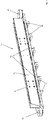
- eine perspektivische Teilansicht der Vorrichtung;
- Fig. 3
- eine weitere perspektivische Ansicht der beiden Trägerelemente der Vorrichtung mit den daran angeordneten Drückorganen;
- Fig. 4
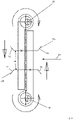
- eine schematische Draufsicht auf zwei Teigbandabschnitte im Bereich der Vorrichtung, wobei der rechts dargestellte Teigbandabschnitt noch zur Mittelsolllage versetzt ist und der links dargestellte Teigbandabschnitt durch die beiden Drückorgane bereits in seine Solllage verbracht ist;
- Fig. 5
- eine schematische Draufsicht auf zwei parallel zueinander geführte Trägerelemente der Vorrichtung mit zwei gegenüberliegend angeordneten Drückorganen für lediglich eine Teigbahn;
- Fig. 6
- eine detaillierte Draufsicht gem.
Fig. 6 ; - Fig. 7
- eine perspektivische Ansicht von Führungselementen zur gegenseitigen Führung zweier parallel zueinander geführter Trägerelemente der Vorrichtung über einer Motoranordnung mit gekoppelten Exzentergetrieben.
- Zunächst wird auf Zeichnungsfigur 1 Bezug genommen.
- In
Figur 1 ist in Draufsicht ein Produktionslinienabschnitt 1 dargestellt, in den von der rechten Seite her eine ungeschnittene Teigbahn 2 einer Schneidevorrichtung 3 mit beabstandet angeordneten Schneidscheiben 4 zugeführt wird. Als Resultat dieses Schneidvorganges liegen fünf schmale Teigbahnen 5 vor, die im Bereich eines Spreizbandes 6 auseinandergezogen werden. Im auseinandergezogenen Zustand liegen sie auf einer Fördereinrichtung 7 in Form eines Förderbandes auf und werden auf diesem einer Stanzeinrichtung 8 zugeführt, in welcher die schmalen Teigbahnen 5 in weitgehend identische Teigdreiecke 9 durch einen Stanzvorgang geschnitten werden. Zwischen dem Spreizband 6 und der Stanzvorrichtung 8, d. h. im Bereich der Fördereinrichtung 7 ist die erfindungsgemäße Vorrichtung zur seitlichen Beaufschlagung des oder der Teigbänder 5 angeordnet, die Gegenstand dieser Erfindung ist. Es sei angemerkt, dass die Anordnung dieser Vorrichtung 10 zur seitlichen Beaufschlagung der Teigbänder nicht notwendiger Weise innerhalb des als Beispiel gewählten Produktionslinienabschnittes 1 angeordnet werden muss, sondern auch überall dort eingesetzt werden kann, wo einzelne Teigbänder oder Teigbandabschnitte auf einer Fördereinrichtung 7 in eine gewisse Sollmittellage verbracht werden müssen. - Die Vorrichtung 10 zur seitlichen Beaufschlagung des wenigstens einen auf der Fördereinrichtung 7 aufliegenden Teigbandes 5 weist Drückorgane 11 auf, die zur verschiebenden Einwirkung auf wenigstens einen Rand 12 des Teigbandes 5 oder Teigstückes dienen, wobei die Drückorgane 11 durch ein Antriebsmittel, nämlich einen Elektromotor 13 bezogen auf den wenigstens einen Rand 12 bewegbar geführt sind.
- Erfindungsgemäß führen die Drückorgane 11 bei der Beaufschlagung der Ränder 12 des Teigbandes 5 überlagert zu der gegen den Rand 12 geführten Schiebebewegung in Förderrichtung 14 des Teigbandes 5 eine Bewegung durch, die als in Förderrichtung 14 mitlaufende Bewegung bezeichnet werden kann. Das Drückorgan 11 ist im Randbereich des Teigbandes 5 auf einer kreisähnlichen Bahn umlaufend angetrieben, sich im wesentlichen gegenüberliegende Drückorgane 11 führen gegen in Richtung der Ränder 12 des Teigbandes 5 eine gegenläufig pulsierende Verschiebebewegung aus. Die zusätzliche Bewegungskomponente der Drückorgane 11 in Förderrichtung 14 des oder der Teigbänder 5 kann hinsichtlich ihrer Geschwindigkeit und hinsichtlich des Vorschubes eingestellt werden und damit an die Fördergeschwindigkeit der Fördereinrichtung 7 angepasst werden, d. h. sie kann höher als die Fördergeschwindigkeit gewählt werden oder auch niedriger.
- Die Drückorgane 11 sind beim Ausführungsbeispiel in Gruppen durch umlaufende Exzenter 29, 30 gelagert, deren Drehachsen 21 im Wesentlichen rechtwinkelig zur Förderrichtung 14 angeordnet ist.
- Beim dargestellten Ausführungsbeispiel in den
Figuren 1 ,3 ,6 und7 sind jeweils 5 Drückorgane 11a auf einem ersten Trägerelement 25 angeordnet, es handelt sich dabei um die Drückorgane 11, die in Förderrichtung die linken Ränder 12 der Teigbänder 5 beaufschlagen. Die den Drückorganen 11a gegenüberliegenden Drückorgane 11b sind auf einem weiteren Trägerelement 26 befestigt und beaufschlagen die in Förderrichtung 14 rechtsseitigen Ränder 12 der Teigbänder 5. - Aus Zeichnungsfigur 4 ist ersichtlich, dass der minimale Abstand der sich gegenüberliegenden Drückorgane 11a, 11b etwa dem Abstand der Schneidscheiben 4 der Schneidevorrichtung 3 und damit der Breite der Teigbänder 5 entspricht. Der maximale Abstand ist größer und kann abhängig von der Ausbildung der Exzenter 20 eingestellt werden, in der Regel ist der maximale Abstand 4 - 8 mm größer als der minimale der Teigbandbreite entsprechende Abstand der Drückorgane 11a, 11b.
- Die schienenartigen Trägerelemente 25, 26 sind mit einem Antriebsende 27, 28 auf jeweils einem motorisch angetriebenen Exzenter 29, 30 gelagert, wobei die Exzenter über eine Antriebswelle 31 und geeignete Getriebeeinheiten 32, 33 an einen Elektromotor 34 des Antriebsmittels angekoppelt sind, dessen Geschwindigkeit regelbar ist.
- Die Exzenter 29, 30 sind gegenläufig angetrieben, weswegen sich die gegenläufige pulsierende Bewegung der Drückelemente 11a, 11b ergibt, die durch umlaufende Pfeile in
Fig. 4 dargestellt sind. - Zwischen den Antriebsenden 27, 28 sind die Trägerelemente 25, 26, mit zueinander hinweisenden Führungsbereichen linear hinsichtlich ihrer Längserstreckung verschiebblich aneinander geführt, wozu an einem Trägerelement 25 z. B. eine C-Profilschiene 41 als erstes Führungselement angeordnet ist und an dem Trägerelement 26 Schlittenelemente 42 vorgesehen sind, die in der C-Profilschiene 41 hin- und her gleiten können. Es sei an dieser Stelle angemerkt, dass die gleitende Befestigung der Trägerelemente25, 26 aneinander natürlich auch durch völlig andere Führungselemente, wie Führungsstangen, Führungsnuten oder anders ausgebildete Führungsschienen z. B. in Form von T-Schienen ausgeführt sein kann.
- Die Antriebswelle 31 zwischen den Getriebeeinheiten 32, 33 verläuft unterhalb der als Förderband ausgebildeten Fördereinrichtung 14, sodass die auf den Exzentern 29, 30 aufsitzenden Trägerelemente 25, 26 mit den daran angeordneten Drückorganen 11 unmittelbar über der Oberfläche der Fördereinrichtung 7 angeordnet werden können, sodass sie darauf geführte Teigbahnen mit Sicherheit erfassen können.
- Beim Ausführungsbeispiel sind die Drückorgane 11 als die Randbereiche des Teigbandes beaufschlagende streifenartige Elemente 50 ausgebildet, deren Ein- und Auslaufenden 51 von den Randbereichen weggebogen sind.
- Die Drückorgane 11 bzw. Elemente 50 können federnd an den Trägerelementen 25, 26 gelagert werden oder auch in Förderrichtung 14 des Teigbandes 5 mit Schlupf an ihrem Trägerelement 25, 26 gelagert sein.
- Die Trägerelemente 25, 26 sind mit Langlöchern 52 versehen, die sich in Längsrichtung der Trägerelemente 25, 26 erstrecken und damit quer zur Förderrichtung 14. Die Drückorgane 11 können im Bereich der Langlöcher 52 einstellbar an die Trägerelemente 25, 26 angeschraubt werden und damit auch in andere Drückorgane 11 ausgetauscht werden.
- Es liegt auch im Rahmen der Erfindung, die Trägerelemente zusammen mit den jeweils daran befestigten Drückorganen 11a und 11b als Austauschmodule 53 auszubilden, wobei die Austauschmodule zusammen mit den an ihnen befestigten Drückorganen aus der Vorrichtung 10 entnommen werden können.
- In weiterer Ausgestaltung der Erfindung ist es möglich, die Drückorgane 11 nicht unbedingt auf einer Kreisbahn oder kreisähnlichen Bahn umlaufend zu führen, vorteilhaft ist auch eine mitfahrende Bewegung, wobei z. B. in dem die gesamte Vorrichtung 10 in Förderrichtung 14 linear vor- und zurückbewegt wird und dabei die synchron pulsierende Bewegung zur seitlichen Verschiebung des Teigbandes 5 überlagert wird. In diesem Fall ist auch eine in Richtung der Teigbänder 5 geführte pulsierende Bewegung der Drückorgane 11 beispielsweise mit Luft- oder Hydraulikzylindern möglich.
- Darüber hinaus können die Drückorgane 11 auch als umlaufend angetriebene Förderbänder ausgebildet sein, um die Ränder 12 des oder der Teigbänder 5 in Förderrichtung zu beaufschlagen.
BEZUGSZEICHENLISTE 1 Produktionslinienabschnitt 25 Trägerelement 2 Teigbahn (breit) 26 Trägerelement 3 Schneidevorrichtung 27 Antriebsende v. 25 4 Schneidscheiben 28 Antriebsende v. 26 5 Teigbahn (schmal) 29 Exzenter 6 Spreizband 30 Exzenter 7 Fördereinrichtung 31 Antriebswelle 8 Stanzvorrichtung 32 Getriebeeinheit 9 Teigdreieck 33 Getriebeeinheit 10 Vorrichtung 34 Elektromotor 11 Drückorgan 12 Rand v. 5 40 Führungsbereich 13 Antriebsmittel 41 C-Profilschiene 14 Förderrichtung 42 Schlittenelement 20 Exzentervorrichtung 50 Elemente 21 Drehachse 51 Ein/Auslaufende 52 Langloch 53 Austauschmodul
Claims (15)
- Vorrichtung (10) zur seitlichen Beaufschlagung wenigstens eines auf einer Fördereinrichtung (7) aufliegenden Teigbandes (5), mit wenigstens einem Drückorgan (11) zum Einwirken auf wenigstens einen Rand (12) des Teigbandes (5), wobei das wenigstens eine Drückorgan (11) durch wenigstens ein Antriebsmittel (13) bezogen auf den wenigstens einen Rand (12) bewegbar geführt ist, dadurch gekennzeichnet, dass das wenigstens eine Drückorgan (11) zum verschiebenden Einwirken bei der Beaufschlagung des Randes (12) des Teigbandes (5) überlagert zu der gegen den Rand (12) geführten Bewegung in Förderrichtung (14) des Teigbandes (5) antreibbar ist.
- Vorrichtung nach Anspruch 1, dadurch gekennzeichnet, dass das wenigstens eine Drückorgan (11) im Randbereich des Teigbandes (5) auf einer Kreisbahn oder kreisähnlichen Bahn umlaufend oder durch eine lineare Antriebseinheit in Förderrichtung (14), und gegen den wenigstens einen Rand (12) des Teigbandes antreibbar ist.
- Vorrichtung nach Anspruch 1 oder 2, dadurch gekennzeichnet, dass jeweils zwei sich i. w. gegenüberliegende Drückorgane (11) benachbart zu beiden Randbereichen des Teigbandes (5) angeordnet sind, wobei die Drückorgane (11) gegenläufig synchron pulsierend in Richtung der Ränder (12) des Teigbandes (5) antreibbar sind.
- Vorrichtung nach einem der vorhergehenden Ansprüche, dadurch gekennzeichnet, dass die Bewegungskomponente des oder der Drückorgane(s) (11) in Förderrichtung (14) des Teigbandes (5) einstellbar ist.
- Vorrichtung nach einem der vorhergehenden Ansprüche, dadurch gekennzeichnet, dass die Drückorgane (11) einzeln oder in Gruppen durch umlaufende Exzenter (29, 30) gelagert sind, deren Drehachsen (21) rechtwinkelig zur Förderrichtung (14) angeordnet sind.
- Vorrichtung nach einem der vorangehenden Ansprüche, dadurch gekennzeichnet, dass mehrere Drückorgane (11a, 11 b) zur Beaufschlagung jeweils einer Randseite einer Mehrzahl von nebeneinander geführten Teigbändern (5) gemeinsam an einem schienenartigen Trägerelement (25, 26) befestigt sind, das wenigstens einseitig auf einem umlaufenden Exzenter (29, 30) gelagert ist.
- Vorrichtung nach Anspruch 6, dadurch gekennzeichnet, dass die Trägerelemente (25, 26) der Drückorgane (11) beider Ränder (12) des Teigbandes (5) parallel zueinander geführt sind.
- Vorrichtung nach Anspruch 7, dadurch gekennzeichnet, dass die Drückorgane (11) der beiden Ränder (12) des Teigbandes (5) jeweils an gegenläufigen Exzentern (29, 30) einzeln oder in Gruppen gelagert sind, wobei die Exzenter (29, 30) an ein gemeinsames Antriebsmittel (13) angekoppelt sind.
- Vorrichtung nach einem der vorhergehenden Ansprüche, dadurch gekennzeichnet, dass der Beaufschlagungshub der Drückorgane (11) in Querrichtung zu den Teigbändern (5) im Bereich von 1 - 10 mm liegt.
- Vorrichtung nach einem der vorhergehenden Ansprüche, dadurch gekennzeichnet, dass die Drückorgane (11) als die Ränder (12) des Teigbandes (5) beaufschlagende streifenartige Elemente (50) ausgebildet sind.
- Vorrichtung nach einem der vorhergehenden Ansprüche, dadurch gekennzeichnet, dass die Drückorgane (11) federnd gelagert sind und / oder in Förderrichtung des Teigbandes (5) mit Schlupf an ihrem Trägerelement (25, 26) gelagert sind.
- Vorrichtung nach einem der vorhergehenden Ansprüche, dadurch gekennzeichnet, dass die Drückorgane (11) bezogen auf den zu beaufschlagenden Rand der Teigbahn (5) einstellbar an ihrem Trägerelement (25, 26) angeordnet sind.
- Vorrichtung nach einem der vorhergehenden Ansprüche, dadurch gekennzeichnet, dass die Drückorgane (11) austauschbar an ihren Trägerelementen (25, 26) angeordnet sind oder schienenartige Trägerelemente (25, 26) einer Mehrzahl von Drückorganen (11) einer Randseite des Teigbandes (5) als Austauschmodule (53) ausgebildet sind.
- Verfahren zur seitlichen Beaufschlagung wenigstens eines auf einer Fördereinrichtung (7) aufliegenden Teigbandes (5), mit folgenden Verfahrensschritten:- Vorsehen wenigstens eines Drückorgans zur Einwirkung auf wenigstens einen Rand des Teigbandes bezogen auf die Fördereinrichtung sowie Antreiben des wenigstens einen Drückorgans (11) durch ein Antriebsmittel (13) bezogen auf den wenigstens einen Rand (12), gekennzeichnet durch folgende Verfahrensschritte:- Beaufschlagen des Randes (12) des Teigbandes (5) durch das wenigstens eine Drückorgan (11) zum Zwecke der seitlichen Verschiebung in einer überlagerten Bewegung, wobei die Bewegung einerseits gegen den Rand (12) geführt ist und andererseits in Förderrichtung des Teigbandes (5) gerichtet ist.
- Verfahren nach Anspruch 14, gekennzeichnet durch Kopplung der Bewegung einer Mehrzahl von die linken Ränder des Teigbandes (5) beaufschlagenden Drückorgane (11a) bzw. die rechten Ränder der Teigbänder (5) beaufschlagenden Drückorgane (11 b) durch starre Trägerelemente (25, 26) und parallele Führung der Trägerelemente (25, 26) aneinander.
Applications Claiming Priority (1)
| Application Number | Priority Date | Filing Date | Title |
|---|---|---|---|
| DE102015115299.1A DE102015115299B4 (de) | 2015-09-10 | 2015-09-10 | Vorrichtung zur seitlichen Beaufschlagung eines Teigbandes oder Teigstückes |
Publications (2)
| Publication Number | Publication Date |
|---|---|
| EP3141122A1 EP3141122A1 (de) | 2017-03-15 |
| EP3141122B1 true EP3141122B1 (de) | 2022-07-06 |
Family
ID=55542539
Family Applications (1)
| Application Number | Title | Priority Date | Filing Date |
|---|---|---|---|
| EP16164668.2A Active EP3141122B1 (de) | 2015-09-10 | 2016-04-11 | Vorrichtung und verfahren zur seitlichen beaufschlagung eines teigbandes |
Country Status (3)
| Country | Link |
|---|---|
| EP (1) | EP3141122B1 (de) |
| DE (1) | DE102015115299B4 (de) |
| ES (1) | ES2923906T3 (de) |
Cited By (1)
| Publication number | Priority date | Publication date | Assignee | Title |
|---|---|---|---|---|
| DE102023100544A1 (de) * | 2023-01-11 | 2024-07-11 | r o p a c k Abfüll- und Verpackungsmaschinen GmbH | Schneidmessereinheit |
Families Citing this family (2)
| Publication number | Priority date | Publication date | Assignee | Title |
|---|---|---|---|---|
| CN109748129B (zh) * | 2019-02-21 | 2020-05-08 | 嘉兴七色狼服饰有限公司 | 一种高效的编带量取装置 |
| DE102024114317A1 (de) | 2024-05-22 | 2025-11-27 | Fritsch Bakery Technologies GmbH & Co. KG | Teigwalzvorrichtung und Verfahren |
Family Cites Families (8)
| Publication number | Priority date | Publication date | Assignee | Title |
|---|---|---|---|---|
| US2728307A (en) * | 1952-09-26 | 1955-12-27 | Read Standard Corp | Cross grain dough molding means |
| SU99352A1 (ru) * | 1953-11-27 | 1953-11-30 | В.В. Комаров | Самораскладчик на расстойные доски тестовых заготовок бараночных изделий |
| DE29701345U1 (de) | 1997-01-28 | 1997-04-10 | A. Fritsch Gmbh & Co Kg, 97348 Markt Einersheim | Teigband-Randformer |
| EP0882400B1 (de) * | 1997-06-04 | 2001-01-03 | A. FRITSCH GMBH & CO. KG | Herstellungsverfahren für einzelne Teigstücke und Schneid- und/oder Stanzwerkzeug dafür |
| DE60020711T2 (de) | 2000-10-17 | 2006-03-16 | Rheon Automatic Machinery Co. Ltd., Utsunomiya | Transportvorrichtung |
| DE10146998A1 (de) | 2001-09-25 | 2003-04-10 | Fritsch A Gmbh & Co Kg | Verfahren und Anordnung zur Regelung und/oder Steuerung mehrerer Teigverarbeitungs- und/oder Backprozesse |
| DE102010027622B4 (de) * | 2010-05-21 | 2015-03-05 | Fritsch Gmbh | Vorrichtung zum Formen von Teiglingen |
| JP5805968B2 (ja) * | 2011-03-23 | 2015-11-10 | 株式会社明治 | 難保形性食用油脂製品の供給装置及び供給方法 |
-
2015
- 2015-09-10 DE DE102015115299.1A patent/DE102015115299B4/de not_active Expired - Fee Related
-
2016
- 2016-04-11 EP EP16164668.2A patent/EP3141122B1/de active Active
- 2016-04-11 ES ES16164668T patent/ES2923906T3/es active Active
Cited By (1)
| Publication number | Priority date | Publication date | Assignee | Title |
|---|---|---|---|---|
| DE102023100544A1 (de) * | 2023-01-11 | 2024-07-11 | r o p a c k Abfüll- und Verpackungsmaschinen GmbH | Schneidmessereinheit |
Also Published As
| Publication number | Publication date |
|---|---|
| EP3141122A1 (de) | 2017-03-15 |
| DE102015115299A1 (de) | 2017-03-16 |
| ES2923906T3 (es) | 2022-10-03 |
| DE102015115299B4 (de) | 2022-09-29 |
Similar Documents
| Publication | Publication Date | Title |
|---|---|---|
| DE102006014454B3 (de) | Stanzvorrichtung mit Zuführeinrichtung | |
| EP1914033B1 (de) | Fördervorrichtungen für Gegenstände mit verschiedenen Grössen ; Schweisseinrichtung mit einer solchen Fördervorrichtung ; Verfahren zum Schweissen von Dosenzargen mit verschiedenen Grössen | |
| EP1832170A2 (de) | Vorrichtung zum Schneiden und Separieren eines kontinuierlich oder getaktet geführten Teigbandes | |
| EP1520682A1 (de) | Thermoformanlage | |
| DE102007015046B3 (de) | Stanzvorrichtung und Stanzverfahren | |
| DE102015115299B4 (de) | Vorrichtung zur seitlichen Beaufschlagung eines Teigbandes oder Teigstückes | |
| DE102011116145A1 (de) | Vorrichtung und Verfahren zum Ausrichten von Produkten | |
| DE102017004318B3 (de) | Vorrichtung und Verfahren zum Transportieren und Bearbeiten von Halbzeugen | |
| WO2010136509A2 (de) | Walzprofiliervorrichtung und -verfahren | |
| EP2641709A1 (de) | Schneidevorrichtung | |
| DE2206137B2 (de) | Fördereinrichtung für das Zuführen von Stückwaren zu einer Zähl- und/ oder Verpackungsstation | |
| EP2481540B1 (de) | Einrichtung zum Zersägen von zumindest zwei platten- oder plattenstapelförmigen Werkstücken | |
| DE102015224999A1 (de) | Kabelkanalstanzvorrichtung und Verfahren zum Stanzen von Kabelkanälen | |
| EP1351783A1 (de) | Vorrichtung zum querteilen von metallbändern | |
| DE3107438A1 (de) | "einrichtung zum zentrierenden ausrichten von plattenfoermigen werkstuecken" | |
| DE3123127A1 (de) | Arbeitsverfahren zur weiterverarbeitung von gewalztem stabmaterial einschliesslich profilen und adjustageeinrichtung zur durchfuehrung des arbeitsverfahrens | |
| AT521629B1 (de) | Rundwirkeinrichtung mit Funktionen Rund- und Langwirken | |
| DE102021120394B4 (de) | Fördervorrichtung für rasenmäherklingen | |
| EP1074324B1 (de) | Vorrichtung zur Dünnblech-Bearbeitung | |
| EP4118018B1 (de) | Beladesystem | |
| DE102006045477A1 (de) | Arbeitsstation für eine Tiefziehmaschine | |
| DE19917390C2 (de) | Vorrichtung zum Bearbeiten eines Teigstrangs | |
| DE102011085011B4 (de) | Messermodul für eine Teigbearbeitungsanlage | |
| EP3369663B1 (de) | Bundbildungseinrichtung für längliche werkstücke sowie verfahren zum bündeln von länglichen werkstücken | |
| EP0811439B1 (de) | Vorrichtung zum Perforieren von Blechen |
Legal Events
| Date | Code | Title | Description |
|---|---|---|---|
| PUAI | Public reference made under article 153(3) epc to a published international application that has entered the european phase |
Free format text: ORIGINAL CODE: 0009012 |
|
| STAA | Information on the status of an ep patent application or granted ep patent |
Free format text: STATUS: THE APPLICATION HAS BEEN PUBLISHED |
|
| AK | Designated contracting states |
Kind code of ref document: A1 Designated state(s): AL AT BE BG CH CY CZ DE DK EE ES FI FR GB GR HR HU IE IS IT LI LT LU LV MC MK MT NL NO PL PT RO RS SE SI SK SM TR |
|
| AX | Request for extension of the european patent |
Extension state: BA ME |
|
| STAA | Information on the status of an ep patent application or granted ep patent |
Free format text: STATUS: REQUEST FOR EXAMINATION WAS MADE |
|
| 17P | Request for examination filed |
Effective date: 20170519 |
|
| RBV | Designated contracting states (corrected) |
Designated state(s): AL AT BE BG CH CY CZ DE DK EE ES FI FR GB GR HR HU IE IS IT LI LT LU LV MC MK MT NL NO PL PT RO RS SE SI SK SM TR |
|
| STAA | Information on the status of an ep patent application or granted ep patent |
Free format text: STATUS: EXAMINATION IS IN PROGRESS |
|
| 17Q | First examination report despatched |
Effective date: 20181008 |
|
| 19U | Interruption of proceedings before grant |
Effective date: 20190701 |
|
| 19W | Proceedings resumed before grant after interruption of proceedings |
Effective date: 20200203 |
|
| RAP1 | Party data changed (applicant data changed or rights of an application transferred) |
Owner name: FRITSCH BAKERY TECHNOLOGIES GMBH & CO. KG |
|
| GRAP | Despatch of communication of intention to grant a patent |
Free format text: ORIGINAL CODE: EPIDOSNIGR1 |
|
| STAA | Information on the status of an ep patent application or granted ep patent |
Free format text: STATUS: GRANT OF PATENT IS INTENDED |
|
| INTG | Intention to grant announced |
Effective date: 20211006 |
|
| GRAJ | Information related to disapproval of communication of intention to grant by the applicant or resumption of examination proceedings by the epo deleted |
Free format text: ORIGINAL CODE: EPIDOSDIGR1 |
|
| STAA | Information on the status of an ep patent application or granted ep patent |
Free format text: STATUS: EXAMINATION IS IN PROGRESS |
|
| GRAP | Despatch of communication of intention to grant a patent |
Free format text: ORIGINAL CODE: EPIDOSNIGR1 |
|
| STAA | Information on the status of an ep patent application or granted ep patent |
Free format text: STATUS: GRANT OF PATENT IS INTENDED |
|
| INTC | Intention to grant announced (deleted) | ||
| INTG | Intention to grant announced |
Effective date: 20220221 |
|
| GRAS | Grant fee paid |
Free format text: ORIGINAL CODE: EPIDOSNIGR3 |
|
| GRAA | (expected) grant |
Free format text: ORIGINAL CODE: 0009210 |
|
| STAA | Information on the status of an ep patent application or granted ep patent |
Free format text: STATUS: THE PATENT HAS BEEN GRANTED |
|
| AK | Designated contracting states |
Kind code of ref document: B1 Designated state(s): AL AT BE BG CH CY CZ DE DK EE ES FI FR GB GR HR HU IE IS IT LI LT LU LV MC MK MT NL NO PL PT RO RS SE SI SK SM TR |
|
| REG | Reference to a national code |
Ref country code: AT Ref legal event code: REF Ref document number: 1502192 Country of ref document: AT Kind code of ref document: T Effective date: 20220715 Ref country code: CH Ref legal event code: EP |
|
| REG | Reference to a national code |
Ref country code: DE Ref legal event code: R096 Ref document number: 502016015035 Country of ref document: DE |
|
| REG | Reference to a national code |
Ref country code: IE Ref legal event code: FG4D Free format text: LANGUAGE OF EP DOCUMENT: GERMAN |
|
| REG | Reference to a national code |
Ref country code: NL Ref legal event code: FP |
|
| REG | Reference to a national code |
Ref country code: ES Ref legal event code: FG2A Ref document number: 2923906 Country of ref document: ES Kind code of ref document: T3 Effective date: 20221003 |
|
| REG | Reference to a national code |
Ref country code: LT Ref legal event code: MG9D |
|
| PG25 | Lapsed in a contracting state [announced via postgrant information from national office to epo] |
Ref country code: SE Free format text: LAPSE BECAUSE OF FAILURE TO SUBMIT A TRANSLATION OF THE DESCRIPTION OR TO PAY THE FEE WITHIN THE PRESCRIBED TIME-LIMIT Effective date: 20220706 Ref country code: RS Free format text: LAPSE BECAUSE OF FAILURE TO SUBMIT A TRANSLATION OF THE DESCRIPTION OR TO PAY THE FEE WITHIN THE PRESCRIBED TIME-LIMIT Effective date: 20220706 Ref country code: PT Free format text: LAPSE BECAUSE OF FAILURE TO SUBMIT A TRANSLATION OF THE DESCRIPTION OR TO PAY THE FEE WITHIN THE PRESCRIBED TIME-LIMIT Effective date: 20221107 Ref country code: NO Free format text: LAPSE BECAUSE OF FAILURE TO SUBMIT A TRANSLATION OF THE DESCRIPTION OR TO PAY THE FEE WITHIN THE PRESCRIBED TIME-LIMIT Effective date: 20221006 Ref country code: LV Free format text: LAPSE BECAUSE OF FAILURE TO SUBMIT A TRANSLATION OF THE DESCRIPTION OR TO PAY THE FEE WITHIN THE PRESCRIBED TIME-LIMIT Effective date: 20220706 Ref country code: LT Free format text: LAPSE BECAUSE OF FAILURE TO SUBMIT A TRANSLATION OF THE DESCRIPTION OR TO PAY THE FEE WITHIN THE PRESCRIBED TIME-LIMIT Effective date: 20220706 Ref country code: FI Free format text: LAPSE BECAUSE OF FAILURE TO SUBMIT A TRANSLATION OF THE DESCRIPTION OR TO PAY THE FEE WITHIN THE PRESCRIBED TIME-LIMIT Effective date: 20220706 |
|
| PG25 | Lapsed in a contracting state [announced via postgrant information from national office to epo] |
Ref country code: PL Free format text: LAPSE BECAUSE OF FAILURE TO SUBMIT A TRANSLATION OF THE DESCRIPTION OR TO PAY THE FEE WITHIN THE PRESCRIBED TIME-LIMIT Effective date: 20220706 Ref country code: IS Free format text: LAPSE BECAUSE OF FAILURE TO SUBMIT A TRANSLATION OF THE DESCRIPTION OR TO PAY THE FEE WITHIN THE PRESCRIBED TIME-LIMIT Effective date: 20221106 Ref country code: GR Free format text: LAPSE BECAUSE OF FAILURE TO SUBMIT A TRANSLATION OF THE DESCRIPTION OR TO PAY THE FEE WITHIN THE PRESCRIBED TIME-LIMIT Effective date: 20221007 |
|
| REG | Reference to a national code |
Ref country code: DE Ref legal event code: R097 Ref document number: 502016015035 Country of ref document: DE |
|
| PG25 | Lapsed in a contracting state [announced via postgrant information from national office to epo] |
Ref country code: SM Free format text: LAPSE BECAUSE OF FAILURE TO SUBMIT A TRANSLATION OF THE DESCRIPTION OR TO PAY THE FEE WITHIN THE PRESCRIBED TIME-LIMIT Effective date: 20220706 Ref country code: RO Free format text: LAPSE BECAUSE OF FAILURE TO SUBMIT A TRANSLATION OF THE DESCRIPTION OR TO PAY THE FEE WITHIN THE PRESCRIBED TIME-LIMIT Effective date: 20220706 Ref country code: DK Free format text: LAPSE BECAUSE OF FAILURE TO SUBMIT A TRANSLATION OF THE DESCRIPTION OR TO PAY THE FEE WITHIN THE PRESCRIBED TIME-LIMIT Effective date: 20220706 Ref country code: CZ Free format text: LAPSE BECAUSE OF FAILURE TO SUBMIT A TRANSLATION OF THE DESCRIPTION OR TO PAY THE FEE WITHIN THE PRESCRIBED TIME-LIMIT Effective date: 20220706 |
|
| PLBE | No opposition filed within time limit |
Free format text: ORIGINAL CODE: 0009261 |
|
| STAA | Information on the status of an ep patent application or granted ep patent |
Free format text: STATUS: NO OPPOSITION FILED WITHIN TIME LIMIT |
|
| PG25 | Lapsed in a contracting state [announced via postgrant information from national office to epo] |
Ref country code: SK Free format text: LAPSE BECAUSE OF FAILURE TO SUBMIT A TRANSLATION OF THE DESCRIPTION OR TO PAY THE FEE WITHIN THE PRESCRIBED TIME-LIMIT Effective date: 20220706 Ref country code: EE Free format text: LAPSE BECAUSE OF FAILURE TO SUBMIT A TRANSLATION OF THE DESCRIPTION OR TO PAY THE FEE WITHIN THE PRESCRIBED TIME-LIMIT Effective date: 20220706 |
|
| 26N | No opposition filed |
Effective date: 20230411 |
|
| P01 | Opt-out of the competence of the unified patent court (upc) registered |
Effective date: 20230329 |
|
| PG25 | Lapsed in a contracting state [announced via postgrant information from national office to epo] |
Ref country code: AL Free format text: LAPSE BECAUSE OF FAILURE TO SUBMIT A TRANSLATION OF THE DESCRIPTION OR TO PAY THE FEE WITHIN THE PRESCRIBED TIME-LIMIT Effective date: 20220706 |
|
| PG25 | Lapsed in a contracting state [announced via postgrant information from national office to epo] |
Ref country code: SI Free format text: LAPSE BECAUSE OF FAILURE TO SUBMIT A TRANSLATION OF THE DESCRIPTION OR TO PAY THE FEE WITHIN THE PRESCRIBED TIME-LIMIT Effective date: 20220706 |
|
| GBPC | Gb: european patent ceased through non-payment of renewal fee |
Effective date: 20230411 |
|
| PG25 | Lapsed in a contracting state [announced via postgrant information from national office to epo] |
Ref country code: LU Free format text: LAPSE BECAUSE OF NON-PAYMENT OF DUE FEES Effective date: 20230411 |
|
| REG | Reference to a national code |
Ref country code: BE Ref legal event code: MM Effective date: 20230430 |
|
| PG25 | Lapsed in a contracting state [announced via postgrant information from national office to epo] |
Ref country code: MC Free format text: LAPSE BECAUSE OF FAILURE TO SUBMIT A TRANSLATION OF THE DESCRIPTION OR TO PAY THE FEE WITHIN THE PRESCRIBED TIME-LIMIT Effective date: 20220706 |
|
| PG25 | Lapsed in a contracting state [announced via postgrant information from national office to epo] |
Ref country code: GB Free format text: LAPSE BECAUSE OF NON-PAYMENT OF DUE FEES Effective date: 20230411 |
|
| PG25 | Lapsed in a contracting state [announced via postgrant information from national office to epo] |
Ref country code: MC Free format text: LAPSE BECAUSE OF FAILURE TO SUBMIT A TRANSLATION OF THE DESCRIPTION OR TO PAY THE FEE WITHIN THE PRESCRIBED TIME-LIMIT Effective date: 20220706 Ref country code: GB Free format text: LAPSE BECAUSE OF NON-PAYMENT OF DUE FEES Effective date: 20230411 |
|
| REG | Reference to a national code |
Ref country code: IE Ref legal event code: MM4A |
|
| PG25 | Lapsed in a contracting state [announced via postgrant information from national office to epo] |
Ref country code: BE Free format text: LAPSE BECAUSE OF NON-PAYMENT OF DUE FEES Effective date: 20230430 |
|
| PG25 | Lapsed in a contracting state [announced via postgrant information from national office to epo] |
Ref country code: IE Free format text: LAPSE BECAUSE OF NON-PAYMENT OF DUE FEES Effective date: 20230411 |
|
| PG25 | Lapsed in a contracting state [announced via postgrant information from national office to epo] |
Ref country code: IE Free format text: LAPSE BECAUSE OF NON-PAYMENT OF DUE FEES Effective date: 20230411 |
|
| REG | Reference to a national code |
Ref country code: AT Ref legal event code: MM01 Ref document number: 1502192 Country of ref document: AT Kind code of ref document: T Effective date: 20230411 |
|
| PG25 | Lapsed in a contracting state [announced via postgrant information from national office to epo] |
Ref country code: AT Free format text: LAPSE BECAUSE OF NON-PAYMENT OF DUE FEES Effective date: 20230411 |
|
| PG25 | Lapsed in a contracting state [announced via postgrant information from national office to epo] |
Ref country code: AT Free format text: LAPSE BECAUSE OF NON-PAYMENT OF DUE FEES Effective date: 20230411 |
|
| PG25 | Lapsed in a contracting state [announced via postgrant information from national office to epo] |
Ref country code: HR Free format text: LAPSE BECAUSE OF FAILURE TO SUBMIT A TRANSLATION OF THE DESCRIPTION OR TO PAY THE FEE WITHIN THE PRESCRIBED TIME-LIMIT Effective date: 20220706 |
|
| PG25 | Lapsed in a contracting state [announced via postgrant information from national office to epo] |
Ref country code: HR Free format text: LAPSE BECAUSE OF FAILURE TO SUBMIT A TRANSLATION OF THE DESCRIPTION OR TO PAY THE FEE WITHIN THE PRESCRIBED TIME-LIMIT Effective date: 20220706 |
|
| PG25 | Lapsed in a contracting state [announced via postgrant information from national office to epo] |
Ref country code: BG Free format text: LAPSE BECAUSE OF FAILURE TO SUBMIT A TRANSLATION OF THE DESCRIPTION OR TO PAY THE FEE WITHIN THE PRESCRIBED TIME-LIMIT Effective date: 20220706 |
|
| PG25 | Lapsed in a contracting state [announced via postgrant information from national office to epo] |
Ref country code: BG Free format text: LAPSE BECAUSE OF FAILURE TO SUBMIT A TRANSLATION OF THE DESCRIPTION OR TO PAY THE FEE WITHIN THE PRESCRIBED TIME-LIMIT Effective date: 20220706 |
|
| PGFP | Annual fee paid to national office [announced via postgrant information from national office to epo] |
Ref country code: NL Payment date: 20250422 Year of fee payment: 10 |
|
| PGFP | Annual fee paid to national office [announced via postgrant information from national office to epo] |
Ref country code: DE Payment date: 20250417 Year of fee payment: 10 |
|
| PGFP | Annual fee paid to national office [announced via postgrant information from national office to epo] |
Ref country code: ES Payment date: 20250519 Year of fee payment: 10 |
|
| PGFP | Annual fee paid to national office [announced via postgrant information from national office to epo] |
Ref country code: IT Payment date: 20250430 Year of fee payment: 10 |
|
| PGFP | Annual fee paid to national office [announced via postgrant information from national office to epo] |
Ref country code: FR Payment date: 20250422 Year of fee payment: 10 |
|
| PGFP | Annual fee paid to national office [announced via postgrant information from national office to epo] |
Ref country code: CH Payment date: 20250501 Year of fee payment: 10 |
|
| PG25 | Lapsed in a contracting state [announced via postgrant information from national office to epo] |
Ref country code: CY Free format text: LAPSE BECAUSE OF FAILURE TO SUBMIT A TRANSLATION OF THE DESCRIPTION OR TO PAY THE FEE WITHIN THE PRESCRIBED TIME-LIMIT; INVALID AB INITIO Effective date: 20160411 |
|
| PG25 | Lapsed in a contracting state [announced via postgrant information from national office to epo] |
Ref country code: HU Free format text: LAPSE BECAUSE OF FAILURE TO SUBMIT A TRANSLATION OF THE DESCRIPTION OR TO PAY THE FEE WITHIN THE PRESCRIBED TIME-LIMIT; INVALID AB INITIO Effective date: 20160411 |
|
| PG25 | Lapsed in a contracting state [announced via postgrant information from national office to epo] |
Ref country code: TR Free format text: LAPSE BECAUSE OF FAILURE TO SUBMIT A TRANSLATION OF THE DESCRIPTION OR TO PAY THE FEE WITHIN THE PRESCRIBED TIME-LIMIT Effective date: 20220706 |