EP3141231A2 - Verfahren und vorrichtungen zur verbesserung der nützlichkeit einer exoskelettmobilitätsbasis - Google Patents
Verfahren und vorrichtungen zur verbesserung der nützlichkeit einer exoskelettmobilitätsbasis Download PDFInfo
- Publication number
- EP3141231A2 EP3141231A2 EP16188362.4A EP16188362A EP3141231A2 EP 3141231 A2 EP3141231 A2 EP 3141231A2 EP 16188362 A EP16188362 A EP 16188362A EP 3141231 A2 EP3141231 A2 EP 3141231A2
- Authority
- EP
- European Patent Office
- Prior art keywords
- exoskeleton
- mobile base
- energy module
- power
- receptacle
- Prior art date
- Legal status (The legal status is an assumption and is not a legal conclusion. Google has not performed a legal analysis and makes no representation as to the accuracy of the status listed.)
- Withdrawn
Links
- 238000000034 method Methods 0.000 title claims description 50
- 230000033001 locomotion Effects 0.000 claims description 49
- 238000012546 transfer Methods 0.000 claims description 47
- 238000003032 molecular docking Methods 0.000 claims description 45
- 230000008878 coupling Effects 0.000 claims description 23
- 238000010168 coupling process Methods 0.000 claims description 23
- 238000005859 coupling reaction Methods 0.000 claims description 23
- 230000001141 propulsive effect Effects 0.000 claims description 17
- 230000007246 mechanism Effects 0.000 claims description 16
- 230000037230 mobility Effects 0.000 description 54
- 238000004891 communication Methods 0.000 description 19
- 210000002683 foot Anatomy 0.000 description 18
- 238000010586 diagram Methods 0.000 description 14
- 210000002414 leg Anatomy 0.000 description 10
- 230000008901 benefit Effects 0.000 description 9
- 210000001624 hip Anatomy 0.000 description 9
- 210000000689 upper leg Anatomy 0.000 description 8
- 238000004146 energy storage Methods 0.000 description 7
- 230000007704 transition Effects 0.000 description 7
- 230000001965 increasing effect Effects 0.000 description 6
- 210000001503 joint Anatomy 0.000 description 6
- 230000001939 inductive effect Effects 0.000 description 5
- 230000001976 improved effect Effects 0.000 description 4
- 238000005096 rolling process Methods 0.000 description 4
- 210000000544 articulatio talocruralis Anatomy 0.000 description 3
- 238000013461 design Methods 0.000 description 3
- 230000010354 integration Effects 0.000 description 3
- 210000003127 knee Anatomy 0.000 description 3
- 230000004048 modification Effects 0.000 description 3
- 238000012986 modification Methods 0.000 description 3
- 210000003205 muscle Anatomy 0.000 description 3
- 238000000926 separation method Methods 0.000 description 3
- 208000027418 Wounds and injury Diseases 0.000 description 2
- 230000001133 acceleration Effects 0.000 description 2
- 238000000418 atomic force spectrum Methods 0.000 description 2
- 230000008859 change Effects 0.000 description 2
- 238000002485 combustion reaction Methods 0.000 description 2
- 230000006378 damage Effects 0.000 description 2
- 230000000694 effects Effects 0.000 description 2
- 239000000446 fuel Substances 0.000 description 2
- 230000005021 gait Effects 0.000 description 2
- 208000014674 injury Diseases 0.000 description 2
- 230000003993 interaction Effects 0.000 description 2
- 230000003387 muscular Effects 0.000 description 2
- 230000002829 reductive effect Effects 0.000 description 2
- 230000001172 regenerating effect Effects 0.000 description 2
- 230000003068 static effect Effects 0.000 description 2
- 239000000725 suspension Substances 0.000 description 2
- 230000001225 therapeutic effect Effects 0.000 description 2
- 208000012514 Cumulative Trauma disease Diseases 0.000 description 1
- 230000009471 action Effects 0.000 description 1
- 210000003423 ankle Anatomy 0.000 description 1
- 230000009286 beneficial effect Effects 0.000 description 1
- 230000033228 biological regulation Effects 0.000 description 1
- 230000015572 biosynthetic process Effects 0.000 description 1
- 238000007796 conventional method Methods 0.000 description 1
- 125000004122 cyclic group Chemical group 0.000 description 1
- 238000013016 damping Methods 0.000 description 1
- 208000037265 diseases, disorders, signs and symptoms Diseases 0.000 description 1
- 208000035475 disorder Diseases 0.000 description 1
- 238000006073 displacement reaction Methods 0.000 description 1
- 210000003414 extremity Anatomy 0.000 description 1
- 230000005484 gravity Effects 0.000 description 1
- 210000004394 hip joint Anatomy 0.000 description 1
- 230000001771 impaired effect Effects 0.000 description 1
- 210000000629 knee joint Anatomy 0.000 description 1
- 230000000670 limiting effect Effects 0.000 description 1
- 239000007788 liquid Substances 0.000 description 1
- 230000004220 muscle function Effects 0.000 description 1
- 230000002232 neuromuscular Effects 0.000 description 1
- 210000004197 pelvis Anatomy 0.000 description 1
- 238000000554 physical therapy Methods 0.000 description 1
- 230000035479 physiological effects, processes and functions Effects 0.000 description 1
- 230000003389 potentiating effect Effects 0.000 description 1
- 230000002265 prevention Effects 0.000 description 1
- 230000004044 response Effects 0.000 description 1
- 230000000284 resting effect Effects 0.000 description 1
- 230000000717 retained effect Effects 0.000 description 1
- 230000000630 rising effect Effects 0.000 description 1
- 208000020431 spinal cord injury Diseases 0.000 description 1
- 230000006641 stabilisation Effects 0.000 description 1
- 238000011105 stabilization Methods 0.000 description 1
- 230000007103 stamina Effects 0.000 description 1
- 239000013589 supplement Substances 0.000 description 1
- 230000000153 supplemental effect Effects 0.000 description 1
- 230000008093 supporting effect Effects 0.000 description 1
Images


















Classifications
-
- A—HUMAN NECESSITIES
- A61—MEDICAL OR VETERINARY SCIENCE; HYGIENE
- A61H—PHYSICAL THERAPY APPARATUS, e.g. DEVICES FOR LOCATING OR STIMULATING REFLEX POINTS IN THE BODY; ARTIFICIAL RESPIRATION; MASSAGE; BATHING DEVICES FOR SPECIAL THERAPEUTIC OR HYGIENIC PURPOSES OR SPECIFIC PARTS OF THE BODY
- A61H3/00—Appliances for aiding patients or disabled persons to walk about
-
- A—HUMAN NECESSITIES
- A61—MEDICAL OR VETERINARY SCIENCE; HYGIENE
- A61G—TRANSPORT, PERSONAL CONVEYANCES, OR ACCOMMODATION SPECIALLY ADAPTED FOR PATIENTS OR DISABLED PERSONS; OPERATING TABLES OR CHAIRS; CHAIRS FOR DENTISTRY; FUNERAL DEVICES
- A61G5/00—Chairs or personal conveyances specially adapted for patients or disabled persons, e.g. wheelchairs
- A61G5/06—Chairs or personal conveyances specially adapted for patients or disabled persons, e.g. wheelchairs with obstacle mounting facilities, e.g. for climbing stairs, kerbs or steps
- A61G5/066—Chairs or personal conveyances specially adapted for patients or disabled persons, e.g. wheelchairs with obstacle mounting facilities, e.g. for climbing stairs, kerbs or steps with endless belts
-
- A—HUMAN NECESSITIES
- A61—MEDICAL OR VETERINARY SCIENCE; HYGIENE
- A61G—TRANSPORT, PERSONAL CONVEYANCES, OR ACCOMMODATION SPECIALLY ADAPTED FOR PATIENTS OR DISABLED PERSONS; OPERATING TABLES OR CHAIRS; CHAIRS FOR DENTISTRY; FUNERAL DEVICES
- A61G5/00—Chairs or personal conveyances specially adapted for patients or disabled persons, e.g. wheelchairs
- A61G5/10—Parts, details or accessories
- A61G5/14—Standing-up or sitting-down aids
-
- A—HUMAN NECESSITIES
- A61—MEDICAL OR VETERINARY SCIENCE; HYGIENE
- A61G—TRANSPORT, PERSONAL CONVEYANCES, OR ACCOMMODATION SPECIALLY ADAPTED FOR PATIENTS OR DISABLED PERSONS; OPERATING TABLES OR CHAIRS; CHAIRS FOR DENTISTRY; FUNERAL DEVICES
- A61G7/00—Beds specially adapted for nursing; Devices for lifting patients or disabled persons
- A61G7/10—Devices for lifting patients or disabled persons, e.g. special adaptations of hoists thereto
-
- A—HUMAN NECESSITIES
- A61—MEDICAL OR VETERINARY SCIENCE; HYGIENE
- A61H—PHYSICAL THERAPY APPARATUS, e.g. DEVICES FOR LOCATING OR STIMULATING REFLEX POINTS IN THE BODY; ARTIFICIAL RESPIRATION; MASSAGE; BATHING DEVICES FOR SPECIAL THERAPEUTIC OR HYGIENIC PURPOSES OR SPECIFIC PARTS OF THE BODY
- A61H1/00—Apparatus for passive exercising; Vibrating apparatus; Chiropractic devices, e.g. body impacting devices, external devices for briefly extending or aligning unbroken bones
- A61H1/02—Stretching or bending or torsioning apparatus for exercising
- A61H1/0237—Stretching or bending or torsioning apparatus for exercising for the lower limbs
- A61H1/024—Knee
-
- A—HUMAN NECESSITIES
- A61—MEDICAL OR VETERINARY SCIENCE; HYGIENE
- A61H—PHYSICAL THERAPY APPARATUS, e.g. DEVICES FOR LOCATING OR STIMULATING REFLEX POINTS IN THE BODY; ARTIFICIAL RESPIRATION; MASSAGE; BATHING DEVICES FOR SPECIAL THERAPEUTIC OR HYGIENIC PURPOSES OR SPECIFIC PARTS OF THE BODY
- A61H1/00—Apparatus for passive exercising; Vibrating apparatus; Chiropractic devices, e.g. body impacting devices, external devices for briefly extending or aligning unbroken bones
- A61H1/02—Stretching or bending or torsioning apparatus for exercising
- A61H1/0237—Stretching or bending or torsioning apparatus for exercising for the lower limbs
- A61H1/0244—Hip
-
- A—HUMAN NECESSITIES
- A61—MEDICAL OR VETERINARY SCIENCE; HYGIENE
- A61H—PHYSICAL THERAPY APPARATUS, e.g. DEVICES FOR LOCATING OR STIMULATING REFLEX POINTS IN THE BODY; ARTIFICIAL RESPIRATION; MASSAGE; BATHING DEVICES FOR SPECIAL THERAPEUTIC OR HYGIENIC PURPOSES OR SPECIFIC PARTS OF THE BODY
- A61H1/00—Apparatus for passive exercising; Vibrating apparatus; Chiropractic devices, e.g. body impacting devices, external devices for briefly extending or aligning unbroken bones
- A61H1/02—Stretching or bending or torsioning apparatus for exercising
- A61H1/0237—Stretching or bending or torsioning apparatus for exercising for the lower limbs
- A61H1/0255—Both knee and hip of a patient, e.g. in supine or sitting position, the feet being moved together in a plane substantially parallel to the body-symmetrical plane
-
- A—HUMAN NECESSITIES
- A61—MEDICAL OR VETERINARY SCIENCE; HYGIENE
- A61H—PHYSICAL THERAPY APPARATUS, e.g. DEVICES FOR LOCATING OR STIMULATING REFLEX POINTS IN THE BODY; ARTIFICIAL RESPIRATION; MASSAGE; BATHING DEVICES FOR SPECIAL THERAPEUTIC OR HYGIENIC PURPOSES OR SPECIFIC PARTS OF THE BODY
- A61H1/00—Apparatus for passive exercising; Vibrating apparatus; Chiropractic devices, e.g. body impacting devices, external devices for briefly extending or aligning unbroken bones
- A61H1/02—Stretching or bending or torsioning apparatus for exercising
- A61H1/0274—Stretching or bending or torsioning apparatus for exercising for the upper limbs
-
- A—HUMAN NECESSITIES
- A61—MEDICAL OR VETERINARY SCIENCE; HYGIENE
- A61H—PHYSICAL THERAPY APPARATUS, e.g. DEVICES FOR LOCATING OR STIMULATING REFLEX POINTS IN THE BODY; ARTIFICIAL RESPIRATION; MASSAGE; BATHING DEVICES FOR SPECIAL THERAPEUTIC OR HYGIENIC PURPOSES OR SPECIFIC PARTS OF THE BODY
- A61H3/00—Appliances for aiding patients or disabled persons to walk about
- A61H3/04—Wheeled walking aids for patients or disabled persons
-
- H—ELECTRICITY
- H01—ELECTRIC ELEMENTS
- H01M—PROCESSES OR MEANS, e.g. BATTERIES, FOR THE DIRECT CONVERSION OF CHEMICAL ENERGY INTO ELECTRICAL ENERGY
- H01M50/00—Constructional details or processes of manufacture of the non-active parts of electrochemical cells other than fuel cells, e.g. hybrid cells
- H01M50/20—Mountings; Secondary casings or frames; Racks, modules or packs; Suspension devices; Shock absorbers; Transport or carrying devices; Holders
- H01M50/247—Mountings; Secondary casings or frames; Racks, modules or packs; Suspension devices; Shock absorbers; Transport or carrying devices; Holders specially adapted for portable devices, e.g. mobile phones, computers, hand tools or pacemakers
-
- H—ELECTRICITY
- H01—ELECTRIC ELEMENTS
- H01M—PROCESSES OR MEANS, e.g. BATTERIES, FOR THE DIRECT CONVERSION OF CHEMICAL ENERGY INTO ELECTRICAL ENERGY
- H01M50/00—Constructional details or processes of manufacture of the non-active parts of electrochemical cells other than fuel cells, e.g. hybrid cells
- H01M50/20—Mountings; Secondary casings or frames; Racks, modules or packs; Suspension devices; Shock absorbers; Transport or carrying devices; Holders
- H01M50/296—Mountings; Secondary casings or frames; Racks, modules or packs; Suspension devices; Shock absorbers; Transport or carrying devices; Holders characterised by terminals of battery packs
-
- A—HUMAN NECESSITIES
- A61—MEDICAL OR VETERINARY SCIENCE; HYGIENE
- A61G—TRANSPORT, PERSONAL CONVEYANCES, OR ACCOMMODATION SPECIALLY ADAPTED FOR PATIENTS OR DISABLED PERSONS; OPERATING TABLES OR CHAIRS; CHAIRS FOR DENTISTRY; FUNERAL DEVICES
- A61G5/00—Chairs or personal conveyances specially adapted for patients or disabled persons, e.g. wheelchairs
- A61G5/10—Parts, details or accessories
- A61G5/1054—Large wheels, e.g. higher than the seat portion
-
- A—HUMAN NECESSITIES
- A61—MEDICAL OR VETERINARY SCIENCE; HYGIENE
- A61H—PHYSICAL THERAPY APPARATUS, e.g. DEVICES FOR LOCATING OR STIMULATING REFLEX POINTS IN THE BODY; ARTIFICIAL RESPIRATION; MASSAGE; BATHING DEVICES FOR SPECIAL THERAPEUTIC OR HYGIENIC PURPOSES OR SPECIFIC PARTS OF THE BODY
- A61H2201/00—Characteristics of apparatus not provided for in the preceding codes
- A61H2201/01—Constructive details
- A61H2201/0107—Constructive details modular
-
- A—HUMAN NECESSITIES
- A61—MEDICAL OR VETERINARY SCIENCE; HYGIENE
- A61H—PHYSICAL THERAPY APPARATUS, e.g. DEVICES FOR LOCATING OR STIMULATING REFLEX POINTS IN THE BODY; ARTIFICIAL RESPIRATION; MASSAGE; BATHING DEVICES FOR SPECIAL THERAPEUTIC OR HYGIENIC PURPOSES OR SPECIFIC PARTS OF THE BODY
- A61H2201/00—Characteristics of apparatus not provided for in the preceding codes
- A61H2201/16—Physical interface with patient
- A61H2201/1602—Physical interface with patient kind of interface, e.g. head rest, knee support or lumbar support
- A61H2201/1628—Pelvis
- A61H2201/163—Pelvis holding means therefor
-
- A—HUMAN NECESSITIES
- A61—MEDICAL OR VETERINARY SCIENCE; HYGIENE
- A61H—PHYSICAL THERAPY APPARATUS, e.g. DEVICES FOR LOCATING OR STIMULATING REFLEX POINTS IN THE BODY; ARTIFICIAL RESPIRATION; MASSAGE; BATHING DEVICES FOR SPECIAL THERAPEUTIC OR HYGIENIC PURPOSES OR SPECIFIC PARTS OF THE BODY
- A61H2201/00—Characteristics of apparatus not provided for in the preceding codes
- A61H2201/16—Physical interface with patient
- A61H2201/1602—Physical interface with patient kind of interface, e.g. head rest, knee support or lumbar support
- A61H2201/1635—Hand or arm, e.g. handle
-
- A—HUMAN NECESSITIES
- A61—MEDICAL OR VETERINARY SCIENCE; HYGIENE
- A61H—PHYSICAL THERAPY APPARATUS, e.g. DEVICES FOR LOCATING OR STIMULATING REFLEX POINTS IN THE BODY; ARTIFICIAL RESPIRATION; MASSAGE; BATHING DEVICES FOR SPECIAL THERAPEUTIC OR HYGIENIC PURPOSES OR SPECIFIC PARTS OF THE BODY
- A61H2201/00—Characteristics of apparatus not provided for in the preceding codes
- A61H2201/16—Physical interface with patient
- A61H2201/1602—Physical interface with patient kind of interface, e.g. head rest, knee support or lumbar support
- A61H2201/164—Feet or leg, e.g. pedal
- A61H2201/1642—Holding means therefor
-
- Y—GENERAL TAGGING OF NEW TECHNOLOGICAL DEVELOPMENTS; GENERAL TAGGING OF CROSS-SECTIONAL TECHNOLOGIES SPANNING OVER SEVERAL SECTIONS OF THE IPC; TECHNICAL SUBJECTS COVERED BY FORMER USPC CROSS-REFERENCE ART COLLECTIONS [XRACs] AND DIGESTS
- Y02—TECHNOLOGIES OR APPLICATIONS FOR MITIGATION OR ADAPTATION AGAINST CLIMATE CHANGE
- Y02E—REDUCTION OF GREENHOUSE GAS [GHG] EMISSIONS, RELATED TO ENERGY GENERATION, TRANSMISSION OR DISTRIBUTION
- Y02E60/00—Enabling technologies; Technologies with a potential or indirect contribution to GHG emissions mitigation
- Y02E60/10—Energy storage using batteries
Definitions
- the present invention relates to devices that augment a user's strength and/or aid in the prevention of injury during the performance of certain motions or tasks. More particularly, the present invention relates to devices suitable for therapeutic use with patients that have impaired neuromuscular/muscular function of the appendages and devices suitable for use by a person engaging in heavy tool use or weight-bearing tasks. These devices comprise a set of artificial limbs, movable by actuators under the direction of control systems, that potentiate improved function of a user's appendages for activities including, but not limited to, enabling walking for a disabled person, granting greater strength and endurance in the user's arms, or allowing for more weight to be carried by the user while walking.
- Wearable exoskeletons have been designed for medical, commercial, and military applications. Medical exoskeletons are often used to restore and rehabilitate proper muscle function for people with disorders that affect muscle control. Medical exoskeletons include a system of motorized braces that can apply forces to a user's appendages. In a rehabilitation setting, medical exoskeletons are controlled by a physical therapist who uses one of a plurality of possible input means to command an exoskeleton control system. In turn, the exoskeleton control system actuates the position of the motorized braces, resulting in the application of force to, and typically movement of, the body of the user. Medical exoskeletons can also be used outside of a therapeutic setting to grant improved mobility to a disabled individual.
- Tool-holding exoskeletons are outfitted with a tool-holding arm that supports the weight of a tool, reducing user fatigue by providing tool-holding assistance.
- the tool-holding arm transfers the vertical force required to hold the tool through the arms of the exoskeleton rather than through the user's arms and body.
- weight-bearing exoskeletons transfer the weight of an exoskeleton load through the legs of the exoskeleton rather than through the user's legs.
- weight-bearing exoskeletons are designed to carry a specific load, such as a heavy backpack.
- military weight-bearing exoskeletons support the weight of armor.
- Commercial and military exoskeletons can have actuated joints that augment the strength of the exoskeleton user, with these actuated joints being controlled by the exoskeleton control system, and with the exoskeleton user using any of a plurality of possible input means to command an exoskeleton control system.
- exoskeleton control systems prescribe and control trajectories in the joints of the exoskeleton, resulting in the movement of the exoskeleton.
- These control trajectories can be prescribed as position-based, force-based, or a combination of both methodologies, such as those seen in impedance controllers.
- Position-based control systems can be modified directly through modification of the prescribed positions.
- Force-based control systems can also be modified directly through modification of the prescribed force profiles.
- Complicated exoskeleton movements such as walking in an ambulatory medical exoskeleton
- an exoskeleton control system through the use of a series of exoskeleton trajectories, with increasingly complicated exoskeleton movements requiring an increasingly complicated series of exoskeleton trajectories.
- These series of trajectories can be cyclic, such as the exoskeleton taking a series of steps with each leg, or they can be discrete, such as an exoskeleton rising from a seated position into a standing position.
- exoskeleton In the case of an ambulatory exoskeleton, during a rehabilitation session and/or over the course of rehabilitation, it is highly beneficial for the physical therapist to have the ability to modify the prescribed positions and/or the prescribed force profiles depending on the particular physiology or rehabilitation stage of a patient. As different exoskeleton users may be differently proportioned, variously adjusted or customized powered exoskeletons will fit each user somewhat differently, requiring that the exoskeleton control system take into account these differences in exoskeleton user proportion, exoskeleton configuration/customization, and exoskeleton user fit, resulting in changes to prescribed exoskeleton trajectories.
- exoskeleton control systems assign trajectories to the joints of the exoskeleton and control the positions of these joints, the actual forces applied to exoskeleton joints are exerted by actuators.
- actuators can take many forms, as is known in the art, each with advantages and disadvantages in various applications.
- the actuator exerting force on a joint typically comprises an electric motor located proximal to the joint that is being controlled.
- Exoskeletons also are equipped with a variety of sensors, as is known in the art, with these sensors reporting information on exoskeleton state to the exoskeleton control system.
- Ambulatory exoskeleton-based physical therapy is currently in use with patients that have been affected by a variety of conditions, including stroke and spinal cord injuries. Such patients may have reduced or no ability to control certain muscles, including muscles involved in walking. These same patients, in many cases, also use wheelchairs for purposes of mobility. Wheelchairs, including both powered and manual wheelchairs, are a very efficient form of transportation in certain environments - though many natural and man-made environments are inaccessible to wheelchairs. Dynamic wheeled mobility is exemplified in the marketplace by specialized standing and/or tilt/recline wheelchairs (both manual and powered), as well as the recently developed and commercialized "Elevation" wheelchair. In addition, the device described in International Application No.
- PCT/CA2013/050836 which is incorporated herein by reference, allows an exoskeleton and user to sit in a specific wheeled base, with this wheeled base being compatible with the exoskeleton frame.
- the wheeled base includes mechanisms to assist the exoskeleton and user in standing while doffing the wheeled base or in sitting while donning the wheeled base.
- the wheeled base aims to overcome disadvantages seen in some current exoskeletons, such as slow exoskeleton gait and limited exoskeleton range, as well as relatively complex exoskeleton operation compared to that of a wheelchair, by allowing the exoskeleton user to use the wheeled base like a wheelchair in situations or environments where the use of a wheelchair would be preferred to an exoskeleton.
- An exoskeleton will weigh a minimum of 20 pounds, and could be as heavy as 70 pounds, so supporting the exoskeleton weight on a wheeled base will make moving it from one location to another easier than other methods, such as taking the exoskeleton apart and putting it into a bag or case.
- Another benefit of transporting an exoskeleton on a wheeled base is that the weight can be balanced ideally between the front and rear wheels since it is aligned with the user's body (this is how wheelchairs are configured for stability). Transporting an exoskeleton in a bag or case could require it to be carried in the user's lap or supported on the front or back of the wheelchair, thus requiring additional wheels or counterweight to prevent tip-over.
- Another less ideal transport method would be to have a helper carry or roll a bag or case with the exoskeleton components disassembled or folded.
- Exoskeletons receive power from energy modules ("EMODs"), with these EMODs being electrical batteries of any type or chemistry, fuel cells, compressed air, or any of a plurality of other energy storage means known in the art.
- EMODs energy modules
- the EMODs used to provide power to exoskeletons have a limited capacity that may be less than the power requirements of a desired exoskeleton use. When more capacity is desired in a single EMOD, the resulting module will typically weigh more.
- a mobility system comprising:
- At least one of the exoskeleton and mobile base energy module receptacles may include an automated energy module transfer mechanism configured to automatically transfer the energy module between the exoskeleton and mobile base energy module receptacles.
- the exoskeleton energy module receptacle may be configured to automatically and selectively couple the energy module thereto; and the mobile base energy module receptacle may be configured to automatically and selectively couple the energy module thereto.
- the exoskeleton may further include an exoskeleton control system configured to control coupling of the energy module to the exoskeleton energy module receptacle; and the mobile base may further include a mobile base control system configured to control coupling of the energy module to the mobile base energy module receptacle.
- the exoskeleton and mobile base control systems may be configured to coordinate whether the energy module is coupled to the exoskeleton energy module receptacle or the mobile base energy module receptacle.
- the exoskeleton may be configured to determine a remaining power of the energy module when the energy module is received in the exoskeleton energy module receptacle; the mobile base may be further configured to determine the remaining power of the energy module when the energy module is received in the mobile base energy module receptacle; and the exoskeleton and mobile base control systems may be configured to coordinate whether the energy module is coupled to the exoskeleton energy module receptacle or the mobile base energy module receptacle based on the remaining power of the energy module.
- the exoskeleton may further include an exoskeleton power system; the exoskeleton may further include actuators configured to cause movement of the exoskeleton; the exoskeleton energy module receptacle may be configured to transfer power from the energy module to the exoskeleton power system when the energy module is received in the exoskeleton energy module receptacle; and the exoskeleton power system may be configured to transfer power to the actuators.
- the mobile base may further include a mobile base power system; the mobile base may further include propulsive motors configured to cause movement of the mobile base across the support surface; the mobile base energy module receptacle may be configured to transfer power from the energy module to the mobile base power system when the energy module is received in the mobile base energy module receptacle; and the mobile base power system may be configured to transfer power to the propulsive motors.
- the mobile base may be further configured to receive power from an external energy supply; and the mobile base energy module receptacle may be further configured to transfer power to the energy module when the energy module is received in the mobile base energy module receptacle, thereby charging the energy module.
- the exoskeleton may be configured to receive power from the mobile base; and the exoskeleton energy module receptacle may be further configured to transfer power to the energy module when the energy module is received in the exoskeleton energy module receptacle, thereby charging the energy module.
- the exoskeleton may be further configured to transfer power to the mobile base.
- the mobile base may further include a docking interface configured to connect to a docking port, wherein the docking port may be configured to receive power from the external energy supply and transfer the energy to the mobile base through the docking interface when the docking interface is connected to the docking port.
- the external energy supply may be an electric generator mounted on the mobile base.
- the mobility system may further comprise a central server, wherein the mobile base may further include a mobile base control system configured to receive data from the central server and cause movement of the mobile base based on the data.
- the exoskeleton may further include an exoskeleton control system; and the mobile base may further include a mobile base control system configured to receive data from the exoskeleton control system and cause movement of the mobile base based on the data.
- the exoskeleton may further include a user interface configured to receive commands from a user and pass the commands to the mobile base control system through the exoskeleton control system; and the mobile base control system may be configured to cause movement of the mobile base based on the commands.
- the mobility system may further comprise a wheelchair accessible vehicle including a wheelchair accessible vehicle power system and a docking port configured to connect the mobile base to the wheelchair accessible vehicle, wherein: the mobile base may further include a mobile base power system; the docking port may be configured to transfer power from the wheelchair accessible vehicle power system to the mobile base power system; and the mobile base energy module receptacle may be further configured to transfer power from the mobile base power system to the energy module when the energy module is received in the mobile base energy module receptacle, thereby charging the energy module.
- the energy module may be a battery.
- the exoskeleton may be an ambulatory exoskeleton including a foot support, a lower leg support, an upper leg support, a leg brace, a torso brace, a knee actuator and a hip actuator.
- the ambulatory exoskeleton may further include a back support, and the back support may include the exoskeleton energy module receptacle.
- the mobile base may further include a wheel configured to contact the support surface, and rotation of the wheel may cause movement of the mobile base across the support surface.
- the mobile base may further include a track configured to contact the support surface, and movement of the track may cause movement of the mobile base across the support surface.
- the mobile base may be configured to transport the exoskeleton across the support surface while the exoskeleton is in a standing position.
- the exoskeleton energy module receptacle may be configured to receive a plurality of energy modules; and the mobile base energy module receptacle may be configured to receive a plurality of energy modules.
- the method may further comprise automatically transferring the energy module between the exoskeleton and mobile base energy module receptacles with an automated energy module transfer mechanism.
- Uncoupling the energy module from the mobile base energy module receptacle may include automatically uncoupling the energy module from the mobile base energy module receptacle with the mobile base energy module receptacle; and coupling the energy module to the exoskeleton energy module receptacle may include automatically coupling the energy module to the exoskeleton energy module receptacle with the exoskeleton energy module receptacle.
- the method may further comprise controlling coupling of the energy module to the mobile base energy module receptacle with a mobile base control system of the mobile base; and controlling coupling of the energy module to the exoskeleton energy module receptacle with an exoskeleton control system of the exoskeleton.
- the method may further comprise coordinating whether the energy module is coupled to the mobile base energy module receptacle or the exoskeleton energy module receptacle with the exoskeleton and mobile base control systems.
- the method may further comprise determining a remaining power of the energy module with the exoskeleton or the mobile base; and coordinating whether the energy module is coupled to the mobile base energy module receptacle or the exoskeleton energy module receptacle based on the remaining power of the energy module.
- the exoskeleton may further include an exoskeleton power system and actuators configured to cause movement of the exoskeleton, and the method may further comprise: transferring power from the energy module to the exoskeleton power system with the exoskeleton energy module receptacle; and transferring power to the actuators with the exoskeleton power system.
- the mobile base may further include a mobile base power system and propulsive motors configured to cause movement of the mobile base across the support surface, and the method may further comprise: transferring power from the energy module to the mobile base power system with the mobile base energy module receptacle; and transferring power to the propulsive motors with the mobile base power system.
- the method may further comprise: transferring power from an external energy supply to the mobile base; and transferring power to the energy module with the mobile base energy module receptacle, thereby charging the energy module.
- the method may further comprise: transferring power from the mobile base to the exoskeleton; and transferring power to the energy module with the exoskeleton energy module receptacle, thereby charging the energy module.
- the method may further comprise transferring power from the exoskeleton to the mobile base.
- the mobile base may further include a docking interface configured to connect to a docking port, and the method may further comprise: transferring power from the external energy supply to the mobile base through the docking interface with the docking port.
- Transferring power from the external energy supply to the mobile base may include transferring power to the mobile base from an electric generator mounted on the mobile base.
- the method may further comprise: transferring data from a central server to a mobile base control system of the mobile base; and causing movement of the mobile base based on the data.
- the method may further comprise: transferring data from an exoskeleton control system of the exoskeleton to a mobile base control system of the mobile base; and causing movement of the mobile base based on the data.
- the method may further comprise: receiving commands from a user with a user interface of the exoskeleton; passing the commands to the mobile base control system through the exoskeleton control system; and causing movement of the mobile base based on the commands.
- the method may further comprise: transferring power from a wheelchair accessible vehicle power system of a wheelchair accessible vehicle to a mobile base power system of the mobile base with a docking port of the wheelchair accessible vehicle; and transferring power from the mobile base power system to the energy module with the mobile base energy module receptacle, thereby charging the energy module.
- the energy module may constitute a first energy module, and the method may further comprise: uncoupling a second energy module from the exoskeleton energy module receptacle; and coupling the second energy module to the mobile base energy module receptacle.
- the method may further comprise: transferring power to the energy module while the energy module is coupled to the mobile base energy module receptacle; and transferring power from the energy module to the exoskeleton while the energy module is coupled to the exoskeleton energy module receptacle.
- the present invention is directed to a mobility system and a method of extending a range of an exoskeleton.
- the mobility system comprises an energy module, an exoskeleton and a mobile base.
- the exoskeleton includes an exoskeleton energy module receptacle that is configured to receive the energy module
- the mobile base includes a mobile base energy module receptacle that is also configured to receive the energy module.
- the mobile base includes an exoskeleton support configured to support the exoskeleton on the mobile base, the mobile base being configured to transport the exoskeleton across a support surface.
- At least one of the exoskeleton and mobile base energy module receptacles includes an automated energy module transfer mechanism configured to automatically transfer the energy module between the exoskeleton and mobile base energy module receptacles.
- the exoskeleton energy module receptacle is configured to automatically and selectively couple the energy module thereto
- the mobile base energy module receptacle is configured to automatically and selectively couple the energy module thereto.
- the exoskeleton further includes an exoskeleton control system configured to control coupling of the energy module to the exoskeleton energy module receptacle
- the mobile base further includes a mobile base control system configured to control coupling of the energy module to the mobile base energy module receptacle.
- the exoskeleton and mobile base control systems are configured to coordinate whether the energy module is coupled to the exoskeleton energy module receptacle or the mobile base energy module receptacle.
- the exoskeleton is configured to determine a remaining power of the energy module when the energy module is received in the exoskeleton energy module receptacle, and the mobile base is further configured to determine the remaining power of the energy module when the energy module is received in the mobile base energy module receptacle.
- the exoskeleton and mobile base control systems are configured to coordinate whether the energy module is coupled to the exoskeleton energy module receptacle or the mobile base energy module receptacle based on the remaining power of the energy module.
- the exoskeleton further includes an exoskeleton power system and actuators configured to cause movement of the exoskeleton.
- the exoskeleton energy module receptacle is configured to transfer power from the energy module to the exoskeleton power system when the energy module is received in the exoskeleton energy module receptacle.
- the exoskeleton power system is configured to transfer power to the actuators.
- the mobile base further includes a mobile base power system and propulsive motors configured to cause movement of the mobile base across the support surface.
- the mobile base energy module receptacle is configured to transfer power from the energy module to the mobile base power system when the energy module is received in the mobile base energy module receptacle.
- the mobile base power system is configured to transfer power to the propulsive motors.
- the mobile base is further configured to receive power from an external energy supply, and the mobile base energy module receptacle is further configured to transfer power to the energy module when the energy module is received in the mobile base energy module receptacle, thereby charging the energy module.
- the exoskeleton is configured to receive power from the mobile base, and the exoskeleton energy module receptacle is further configured to transfer power to the energy module when the energy module is received in the exoskeleton energy module receptacle, thereby charging the energy module.
- the exoskeleton is further configured to transfer power to the mobile base.
- the mobile base further includes a docking interface configured to connect to a docking port.
- the docking port is configured to receive power from the external energy supply and transfer the energy to the mobile base through the docking interface when the docking interface is connected to the docking port.
- the external energy supply is an electric generator mounted on the mobile base.
- the mobility system further comprises a central server, and the mobile base further includes a mobile base control system configured to receive data from the central server and cause movement of the mobile base based on the data.
- the exoskeleton further includes an exoskeleton control system, and the mobile base further includes a mobile base control system configured to receive data from the exoskeleton control system and cause movement of the mobile base based on the data.
- the exoskeleton further includes a user interface configured to receive commands from a user and pass the commands to the mobile base control system through the exoskeleton control system.
- the mobile base control system is configured to cause movement of the mobile base based on the commands.
- the mobility system further comprises a wheelchair accessible vehicle including a wheelchair accessible vehicle power system and a docking port configured to connect the mobile base to the wheelchair accessible vehicle.
- the mobile base further includes a mobile base power system, and the docking port is configured to transfer power from the wheelchair accessible vehicle power system to the mobile base power system.
- the mobile base energy module receptacle is further configured to transfer power from the mobile base power system to the energy module when the energy module is received in the mobile base energy module receptacle, thereby charging the energy module.
- the energy module is a battery
- the exoskeleton is an ambulatory exoskeleton.
- the ambulatory exoskeleton includes a foot support, a lower leg support, an upper leg support, a back support, a leg brace, a torso brace, a knee actuator and a hip actuator.
- the back support includes the exoskeleton energy module receptacle.
- the mobile base further includes a wheel configured to contact the support surface, and rotation of the wheel causes movement of the mobile base across the support surface.
- the mobile base further includes a track configured to contact the support surface, and movement of the track causes movement of the mobile base across the support surface. The mobile base is configured to transport the exoskeleton across the support surface while the exoskeleton is in a standing position.
- the exoskeleton energy module receptacle is configured to receive a plurality of energy modules
- the mobile base energy module receptacle is configured to receive a plurality of energy modules.
- a first energy module is uncoupled from the mobile base energy module receptacle and coupled to the exoskeleton energy module receptacle.
- a second energy module is uncoupled from the exoskeleton energy module receptacle and coupled to the mobile base energy module receptacle. Power is transferred to the energy modules while the energy modules are coupled to the mobile base energy module receptacle, and power is transferred from the energy modules to the exoskeleton while the energy modules are coupled to the exoskeleton energy module receptacle.
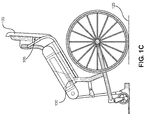
- a wheeled base 100 includes an exoskeleton support 105 and a wheeled base frame 110.
- Wheeled base frame 110 is connected to exoskeleton support 105 and includes front wheels 115 and rear wheels 116, which allow wheeled base 100 to roll over a support surface 120.
- Exoskeleton support 105 includes foot supports 125, an upper leg and hip support 130, and a seat back 135.
- Each component of exoskeleton support 105 is rotatably connected to the other components of exoskeleton support 105 and to wheeled base frame 110 in such a way as to allow exoskeleton support 105, as well as an exoskeleton and user coupled to exoskeleton support 105, to transition from a seated configuration to an upright configuration.
- the seated configuration is illustrated in Figures 1A and 1B
- the upright configuration is illustrated in Figure 1D .
- An intermediate position is shown in Figure 1C .
- rear wheels 116 are motorized for purposes of propulsion.
- motorized mechanisms assist in the transition of exoskeleton support 105 between seated and upright positions.
- the structural particulars of a wheeled base can take various forms, as is known in the art, and are not part of the present invention, they will not be detailed further herein.
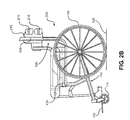
- Figures 2A-F show a wheeled (or mobile) base 200 constructed in accordance with the first embodiment.
- Wheeled base 200 includes an exoskeleton support 205 and wheeled base frame 110.
- Wheeled base frame 110 is connected to exoskeleton support 205 and includes front wheels 115 and rear wheels 116, which allow wheeled base 200 to roll over surface 120. Accordingly, rotation of wheels 115 and 116 causes movement of wheeled base 200 across surface 120 such that wheeled base 200 can transport an exoskeleton across surface 120.
- Exoskeleton support 205 is configured to support an exoskeleton on wheeled base 200 and includes foot supports 125, upper leg and hip support 130, and seat back 135. Each component of exoskeleton support 205 is rotatably connected to the other components of exoskeleton support 205 and to wheeled base frame 110 in such a way as to allow exoskeleton support 205, as well as an exoskeleton and user coupled to exoskeleton support 205, to transition from a seated configuration to an upright configuration.
- the seated configuration is illustrated in Figures 2A and 2B
- the upright configuration is illustrated in Figure 2C .
- Wheeled base 200 also includes an EMOD receptacle 210 that receives and supports the weight of a first EMOD 215 and a second EMOD 216, which are directly coupled thereto.
- EMOD receptacle 210 is connected to seat back 135 such that the weight of EMODs 215 and 216 is transferred through exoskeleton support 205 to wheeled base frame 110 and then to surface 120.
- the wheeled base is only usable in the seated configuration, i.e ., the wheeled based cannot transition between seated and upright configurations.
- Exoskeleton 225 includes a back support 230, an upper leg support 235, a lower leg support 240, and foot support 245.
- Exoskeleton 225 is coupled to person 220 by a torso brace 250, shoulder strapping 255, and a leg brace 260.
- a knee actuator 265 and a hip actuator 270 cause movement of a leg of person 220 via movement of upper leg support 235 and lower leg support 240.
- exoskeleton 225 can take various forms, as is known in the art, and are not part of the present invention, they will not be detailed further herein.
- Exoskeleton 225 is configured to be carried by and/or affixed to wheeled base 200 through exoskeleton support 205, as described in International Application No. PCT/CA2013/050836 .
- exoskeleton 225 is configured to use EMODs, such as those carried by wheeled base 200, as a power source for the systems of exoskeleton 225.
- the EMODs can be directly coupled to an EMOD receptacle 275 of exoskeleton 225.
- EMOD receptacle 275 is part of back support 230. However, EMOD receptacle 275 can be located elsewhere on exoskeleton 225.
- EMOD receptacle 275 has two slots 280 to which the EMODs can be affixed ( i.e ., in which the EMODs can be received).
- an EMOD 285 powers exoskeleton 225.
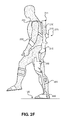
- person 220 can remove first EMOD 215 from wheeled base 200 and couple first EMOD 215 to EMOD receptacle 275 of exoskeleton 225, as shown in Figure 2E , thereby allowing exoskeleton 225 to draw additional power from first EMOD 215.
- person 220 can then remove the depleted EMOD (i.e ., EMOD 285) from exoskeleton 225, as shown in Figure 2F .
- the ability of exoskeleton 225 to draw power from more than one EMOD at a time is advantageous in that exoskeleton 225 will not lose power during an exchange of EMODs ( e.g. , during the transition shown in Figures 2D-F ).
- EMODs e.g. , during the transition shown in Figures 2D-F .
- the desire for a reduced weight exoskeleton results in only a single EMOD being mountable on the exoskeleton, in which case an EMOD swap would result in the exoskeleton losing power.
- wheeled base 200 provides a convenient and safe sitting location during EMOD exchange.
- the exoskeleton has some auxiliary power so that exoskeleton systems can remain active for a limited period of time with no EMOD affixed, thereby allowing EMOD exchange without loss of power to exoskeleton actuators or other systems.
- more than two EMODs are used to provide power to the exoskeleton, and more than two EMODs are carried on the wheeled base.
- the EMODs are mounted at different positions on the exoskeleton or wheeled base to facilitate ease of exchange by person 220.
- the exoskeleton system is configured such that a user with sufficient arm and hand function is able to remove an EMOD independently, either wearing the exoskeleton or not.
- the exoskeleton grants superior personal mobility characteristics, as compared to a wheelchair.
- the power consumption requirements of the exoskeleton can result in either insufficient range of operating time or a very heavy (and slow/cumbersome) exoskeleton.
- This disabled person may also use wheelchair mobility devices, including the specialized exoskeleton-bearing wheeled base devices described above, as an alternative or supplement to exoskeleton-based mobility.
- the person could make use of the device of the first embodiment in which a wheeled base supports the weight of additional power storage devices for the exoskeleton. This would allow the person to extend the operating time of the exoskeleton without the exoskeleton having to support the weight of this additional energy capacity (in this case, the weight of replacement EMODs). Transporting additional EMODs from one location to another on the wheeled base is more energy efficient than the available alternatives.
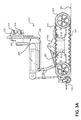
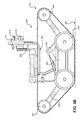
- Tracked base 300 includes exoskeleton support 205, a base frame 305 and a propulsion system 310.
- Propulsion system 310 includes a track 315, drive wheels 320, a drive mechanism 325, and a support structure 330.
- Base frame 305 is connected to propulsion system 310 at support structure 330 and to front wheels 115.
- Propulsion system 310 interacts with surface 120 through track 315, with front wheels 115 primarily acting as balance support when exoskeleton support 205 and base frame 305 are transitioning into an upright configuration.
- Movement of track 315 causes movement of tracked base 300 across surface 120.
- front wheels 115 are absent and replaced by another support device that interacts with surface 120 during transitions between seated and upright configurations.
- track 315 is articulated in such a way as to enable ascent or descent of a curb, uneven terrain, or a set of stairs, as is known in the art.
- a tracked base 300' includes exoskeleton support 205, a base frame 305' and a propulsion system 335.
- Propulsion system 335 includes a track 340, drive wheels 345, guide wheels 350, suspension arms 355, a drive mechanism 360, and a support structure 365.
- Base frame 305' is connected to propulsion system 335 at support structure 365.
- various springs, dampers, bearings, and other suspension members exist between components of propulsion system 335, support structure 365, and base frame 305' in order to provide for a smoother ride or assist in traversing uneven or sloping terrain.
- the track in continuous. In other embodiments, the track is not continuous.
- the track can be articulated or adjustable as with the tracked devices described in U.S. Patent Nos. 6,263,989 and 8,333,256 , which are incorporated herein by reference.
- the propulsive portion of a wheeled exoskeleton mobility device can be interchanged with the propulsive portion of a tracked exoskeleton mobility device, and vice versa.
- the present invention can be used with devices having more than 4 wheels, with these wheels variously articulated and suspended relative to each other and the chassis of the vehicle, such as those shown in U.S. Patent Nos.
- mobile base and “mobile exoskeleton base” refer to any of the plurality of potential wheeled or tracked exoskeleton bases usable in connection with the present invention.
- the device of the second embodiment would allow for safer and/or faster travel, relative to a wheeled base or ambulatory exoskeleton, over certain slippery surfaces, such as ice- or snow-covered sidewalks. Similarly, the device of the second embodiment would have traction advantages over slick, muddy surfaces.
- FIG. 4A A third embodiment of the present invention is shown in Figures 4A and 4B .
- a first EMOD 400 is affixed to an exoskeleton EMOD receptacle 405 and provides power to an exoskeleton power system 410.
- Exoskeleton power system 410 transfers this power to exoskeleton actuators 415, resulting in movement of the exoskeleton (as well as a user coupled thereto) across a support surface.
- a second EMOD 420 is affixed to mobile base EMOD receptacle 425 and provides power to mobile base power system 430.
- Mobile base power system 430 transfers this power to propulsive motors 435, resulting in movement of the mobile base (as well as the exoskeleton and user coupled thereto) across a support surface. Since the EMODs that power the exoskeleton and mobile base are interchangeable, the user can exchange first EMOD 400 and second EMOD 420, as shown in Figure 4B , where second EMOD 420 is affixed to exoskeleton EMOD receptacle 405 and first EMOD 400 is affixed to mobile base EMOD receptacle 425. As a result, second EMOD 420 provides power to exoskeleton power system 410 and first EMOD 400 provides power to mobile base power system 430.
- the exoskeleton includes multiple EMOD receptacles.
- the mobile base includes multiple EMOD receptacles.
- the EMODs stored on the mobile base are located such that they can be easily reached by the user while the user is seated in the exoskeleton on the mobile base.
- the EMODs are mounted securely enough as to prevent accidental displacement during movement but not so securely as to be difficult for the user to remove.
- the exoskeleton does not need significant power. Accordingly, as the mobile base power is depleted with use, the user can exchange the charged EMOD from the exoskeleton with the depleted EMOD of the mobile base, thereby providing additional range to the mobile base.
- FIG. 5A A fourth embodiment of the present invention is shown in Figures 5A-H .
- a mobile base acts as an EMOD charging interface.
- an external energy supply (or source) 500 provides power to a mobile base power system 505, which charges a first EMOD 510 and a second EMOD 515 through a mobile base EMOD receptacle 520.
- external energy supply 500 provides power to mobile base power system 505, with power from mobile base power system 505 being used by mobile base EMOD receptacle 520 to charge a first EMOD 525.
- a second EMOD 530 draws power from first EMOD 525.
- the mobile base acts as both an EMOD charging interface and as a conduit of power to an exoskeleton affixed to the mobile base.
- This can provide power to exoskeleton systems and allow charging of EMODs affixed to the exoskeleton.
- external energy supply 500 provides power to mobile base power system 505, which charges first EMOD 510 and second EMOD 515 in mobile base EMOD receptacle 520. If an exoskeleton is affixed to the mobile base, mobile base power system 505 also supplies power to an exoskeleton power system 535, which charges a first EMOD 540 and a second EMOD 545 in an exoskeleton EMOD receptacle 550.
- mobile base power system 505 and exoskeleton power system 535 are linked so as to allow for internal energy sharing amongst power systems 505 and 535, including charging EMODs mounted on either the mobile base or the exoskeleton.
- power can be drawn from first EMOD 510 to charge first EMOD 540 and vice versa.
- a mobile base 555 constructed in accordance with the fourth embodiment is shown drawing power from an external energy supply in the form of a wall outlet 560. The power travels through a flexible conduit 565 and into mobile base EMOD receptacle 520.
- a mobile base 555' is connected to a wall-mounted docking port 570 by a docking interface 575, with wall-mounted docking port 570 drawing power from wall outlet 560 through a flexible conduit 580 and relaying this power through docking interface 575 into mobile base EMOD receptacle 520.
- a mobile base 555" is connected to a surface-mounted docking port 585 by a docking interface 590, with surface-mounted docking port 585 drawing power from wall outlet 560 through a flexible conduit 595 and relaying this power through docking interface 590 and mobile base power system 505 (not visible) into mobile base EMOD receptacle 520.
- external energy supply 500 is an electrical wall socket, compressed gas or liquid vessel, solar generating module, electrical battery, fuel cell, combustion engine generator, or any other energy supply not mounted to the mobile base 555.
- energy is transferred using an electrical cable with connectors, direct contact electrical connectors with no cable, inductive or resonant inductive coupling between two inductive coils, pressure hose and connectors, or any other means known in the art.
- Power sharing can be engaged while the exoskeleton is connected to mobile base 555 in a seated, upright, or intermediate configuration.
- Mobile base 555 can selectively charge EMODs docked on mobile base 555 and/or the exoskeleton as desired by a user or as controlled by algorithms implemented in exoskeleton and/or mobile base systems.
- a pairing method between a mobile base and an external energy source includes a charging pad that rests on the floor and is connected to a standard electrical wall socket to provide power to a mobile base EMOD receptacle using electrical resonant inductive coupling.
- a preferred embodiment of a pairing method between a mobile base and an attached exoskeleton utilizes electrical resonant inductive coupling.
- the "external" power source is a small electric generator 598 mounted on wheeled base frame 110 of a mobile base 555"'.
- mobile base 555"' can recharge EMODs through use of an internal combustion engine of generator 598 when the exoskeleton and user are remote from and not coupled to mobile base 555"'.
- external energy can be provided to a mobile base through regenerative braking while the mobile base is rolling down a slope, for example.
- the user has the ability to provide muscular energy input, the user can spin the wheels of the mobile base to provide regenerative power.
- the mobile base can access stationary power sources, such as electric wall outlets, to charge additional EMODs, thereby providing the person with a supply of charged EMODs over the course of the workday, as well as charged EMODs to power the mobile base for returning home from work.
- stationary power sources such as electric wall outlets
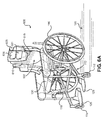
- FIG. 6A shows a mobile base 600 constructed in accordance with the fifth embodiment.
- Mobile base 600 includes an exoskeleton support 605 and wheeled base frame 110.
- a seat back 610 of exoskeleton support 605 has a recessed area 615 in which a first EMOD 620 and a second EMOD 621 are mounted to an automated mobile base EMOD receptacle 625.
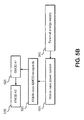
- Figure 6B shows the systems in communication when a compatible exoskeleton is coupled to mobile base 600.
- Automated mobile base EMOD receptacle 625 is connected to EMODs 620 and 621, which provide power to a mobile base power system 630 to drive propulsive motors 635.
- Mobile base power system 630 determines the remaining power in EMODs 620 and 621 and reports this data to a mobile base control system 640.
- EMODs 620 and 621 are also connected to an automated exoskeleton EMOD receptacle 645, with EMODs 620 and 621 providing power to an exoskeleton power system 650 to drive exoskeleton actuators 655.
- Exoskeleton power system 650 determines the remaining power in EMODs 620 and 621 and reports this data to an exoskeleton control system 660.
- Mobile base control system 640 controls automated mobile base EMOD receptacle 625, which can automatically and selectively couple and decouple EMODs 620 and 621.
- exoskeleton control system 660 controls automated exoskeleton EMOD receptacle 645, which can automatically and selectively couple and decouple EMODs 620 and 621.
- Mobile base control system 640 and exoskeleton control system 660 are in communication and coordinate which of EMODs 620 and 621 is coupled to each EMOD receptacle 625, 645 immediately prior to separation of the exoskeleton and mobile base 600. This determination can be made based on the remaining power in EMODs 620 and 621, for example.
- FIG. 6C shows one EMOD each on the exoskeleton and mobile base 600, with first EMOD 620 being used to power the exoskeleton and second EMOD 621 remaining on mobile base 600.
- first EMOD 620 might be largely discharged and in need of replacement.
- the exoskeleton user then rejoins the exoskeleton to mobile base 600, returning to the configuration shown in Figure 6B in which control systems 640 and 660 will assess the power remaining in each EMOD 620, 621.
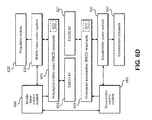
- Control systems 640 and 660 then direct the automated EMOD receptacles 625, 645 to reassign EMODs 620 and 621 such that, prior to the next mobile base-exoskeleton separation, second EMOD 621 is affixed to automated exoskeleton EMOD receptacle 645 to power the exoskeleton and first EMOD 620 is affixed to mobile base 600, as shown in Figure 6D .
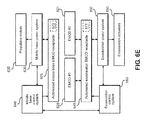
- both EMODs 620, 621 can be affixed to automated exoskeleton EMOD receptacle 645 and provide power for the exoskeleton, as shown in Figure 6E .
- Figures 6F and 6G show the addition of an external energy supply 665 to this system.
- EMODs This allows all EMODs to be charged when the exoskeleton is coupled to mobile base 600, as shown in Figure 6F , and allows EMODs affixed to mobile base 600 (e.g., second EMOD 621) to be charged when the exoskeleton is uncoupled from mobile base 600, as shown in Figure 6G .
- more than two EMODs are used in the automated EMOD sharing and transfer system.
- auxiliary (non-EMOD) power storage exists on either mobile base 600 or the exoskeleton to allow the corresponding automated EMOD receptacle to accept an EMOD when no EMOD is affixed to power the automated system.
- manual mechanisms allow the attachment and detachment of EMODs without a power requirement.
- one or both of automated EMOD receptacles 625 and 645 includes an automated EMOD transfer mechanism 670, 671 for automatically transferring EMODs 620 and 621 between automated EMOD receptacles 625 and 645.
- Automated EMOD transfer mechanisms 670 and 671 can make use of mechanical, electromagnetic, or any of a plurality of means for attachment of EMODs to the automated receptacles and for formation of electrical or other contact required for use of EMOD energy by exoskeleton or mobile base systems.
- the person can exchange exoskeleton EMODs simply by coupling the exoskeleton to a mobile base, either in a standing or seated position, allowing the automated systems to remove the depleted EMOD from and affix a charged EMOD to the exoskeleton.
- the person decouples the exoskeleton from the mobile base, with a fully-charged EMOD affixed to and powering the exoskeleton and the depleted EMOD retained by the mobile base where it can be charged if the mobile base is connected to an external energy supply.
- EMOD electrospray
- Such a system may also be more convenient than manual EMOD exchange for a less disabled person or even for an able-bodied person wearing an industrial or military exoskeleton.
- One additional advantage of such a system is that it allows not only the exoskeleton user but also the exoskeleton control system (or the mobile base control system or a remote server) to predict and determine which EMOD configuration provides the optimal power-to-weight ratio for the exoskeleton for a given situation or task.
- a mobile base control system 700 is in communication with, and issues commands to, a mobile base power system 705.
- Mobile base power system 705 uses power from mobile base EMOD(s) 710, transferred through a mobile base EMOD receptacle 715, to drive the motion of propulsive motors 720, thereby causing movement of the mobile base.
- Mobile base control system 700 receives data on mobile base state, position, and, in some embodiments, environment from mobile base sensors 725.
- an exoskeleton control system 730 receives data on exoskeleton state, position, and, in some embodiments, environment from exoskeleton sensors 735.
- Mobile base control system 700 is in communication with exoskeleton control system 730 and/or a central server 740.
- Exoskeleton control system 730 is in communication with an exoskeleton user interface 745, which relays data to and receives commands from an exoskeleton user 750.
- the communication with mobile base control system 700 is remote.
- commands can be issued to mobile base control system 700, causing the engagement of mobile base power system 705 and propulsive motors 720 so as to change the position of mobile base position as desired by exoskeleton user 750, automatically by strategies programmed in the exoskeleton and mobile base system computers, or by commands issued from central server 740.
- exoskeleton user 750 can issue commands to exoskeleton user interface 745, with these commands being passed from exoskeleton user interface 745 to mobile base control system 700 through exoskeleton control system 730.
- Mobile base control system 700 then causes movement of the mobile base based on the commands.
- mobile base control system 700 causes movement of the mobile base based on data received from exoskeleton control system 730 or central server 740.
- the remote-controlled or automatic mobility system moves the mobile base to assist in coupling of the exoskeleton to or uncoupling of the exoskeleton from the mobile base.
- the system moves the mobile base to a location away from the user after uncoupling, such as a docking port for charging or a storage location.
- the mobile base follows the exoskeleton while the exoskeleton is being used to walk such that if the user loses his or her balance the exoskeleton can perform a controlled sit into the mobile base.
- the mobile base moves to the user wearing the exoskeleton system when the exoskeleton-mounted EMOD energy level is low enough that the exoskeleton would soon need to cease operation, allowing the exoskeleton EMOD to be swapped or the exoskeleton to be coupled to the mobile base for alternative mobility using the mobile base.
- the mobile base follows the exoskeleton while being used for load carriage so that the exoskeleton and user can more easily transport a heavy or awkward load without unbalancing the walking exoskeleton and user.
- mobile bases are remotely dispatched, through use of a central server, by exoskeleton manufacturers, rental companies, hospitals, or sharing organizations (not unlike bike-sharing) to deliver EMODs or provide mobile bases to exoskeleton users in order to extend exoskeleton range or operating time or to provide for alternative mobility using the mobile base.
- the mobile base uses sensors in order to move semi-autonomously, allowing the mobile base to search for charging stations or parking/storage locations without extensive user involvement.
- the mobile base is in communication with charging locations directly or via a central server in order to facilitate mobile base movement and linkage to charging stations.
- the sixth embodiment of the present invention consider a disabled person using an exoskeleton and mobile base for personal mobility in a public place. This person may wish to use the mobile base for street mobility and the exoskeleton for mobility inside public structures, such as a restaurant.
- the person can decouple the exoskeleton from the base when he or she arrives at the restaurant and remotely park the mobile base at a location away from the seating area of the restaurant, such as a public charging station in a parking lot.
- the person has finished eating at the restaurant, he or she could use the device and method of the sixth embodiment to summon the mobile base, now bearing fully charged EMODs, to his or her location and resume use of the mobile base.
- a seventh embodiment of the present invention is illustrated in which a combined mobile base and exoskeleton mobility system is integrated so as to be both compatible and in communication with a wheelchair accessible vehicle (WAV).
- a WAV control system 800 is in communication with and issues commands to a WAV power system 805, which provides power to a wheelchair lift 810 and an adjustable (driver's) seat 815.
- WAV control system 800 is in communication with mobile base control system 700 and a WAV user interface 820 and receives data from WAV sensors 825.
- Mobile base control system 700 which receives data from mobile base sensors 725, is in communication with central server 740 and exoskeleton control system 730.
- Exoskeleton control system 730 receives data from exoskeleton sensors 735 and is in communication with exoskeleton user interface 745.
- Exoskeleton user 750 receives data from and issues commands directly through exoskeleton user interface 745 and/or WAV user interface 820.
- exoskeleton control system 730 and/or central server 740 are in direct communication with WAV control system 800.
- WAV-mobile base docking port 830 When the mobile base and the WAV are physically connected via a WAV-mobile base docking port 830, power from WAV power system 805 is transferred into mobile base EMOD(s) 710 through mobile base power system 705 and mobile base EMOD receptacle 715.
- the mobile base and exoskeleton mobility system can communicate with the WAV to adjust the position and shape of driver's seat 815 depending on whether exoskeleton user 750 is wearing the exoskeleton or not.
- Exoskeleton user 750 can maneuver the combined mobility system, in some embodiments with use of wheelchair lift 810, or other mechanisms known in the art of WAV design, into the WAV and either transfer into driver's seat 815 while leaving the exoskeleton connected to the mobile base or while wearing the exoskeleton and disconnecting from the mobile base.
- the exoskeleton upper portion will protrude from the user's torso and pelvis area and will require additional room for ideal user positioning with respect to the WAV steering and driving controls.
- the seventh embodiment of the present invention consider a disabled person who uses an exoskeleton, mobile base, and WAV for personal mobility.
- the device and method of the seventh embodiment will allow the person to transport both the exoskeleton and mobile base in the WAV, as well as allow the WAV to charge EMODs mounted on the mobile base and connected systems while the mobile base is docked with the WAV.
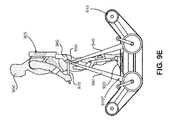
- an eighth embodiment of the present invention is shown in which an exoskeleton and user are mounted in an upright or standing position upon a mobile exoskeleton base.
- the exoskeleton and mobile base docking assembly are operable between a coupled position, in which the exoskeleton is coupled to the mobile base, and a released position, in which the exoskeleton is separated from the mobile base.
- the coupling between the exoskeleton and mobile base takes place at the feet and lower portions of the exoskeleton.
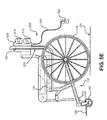
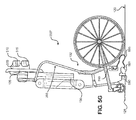
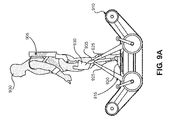
- a user 900 is shown wearing an exoskeleton 905 and standing on a mobile base 910.
- a mobile base-exoskeleton docking interface 915 selectively couples a foot support 920 of exoskeleton 905 to mobile base 910.
- docking interface 915 includes a lower body interface structure 925, which selectively couples to a leg 930 of exoskeleton 905 at an attachment point 935.
- the mobile base docking assembly is coupled to the feet and intermediate portions of the exoskeleton.
- a mobile base-exoskeleton docking interface 915' selectively couples foot support 920 of exoskeleton 905 to mobile base 910.
- docking interface 915' includes a mid-body interface structure 940, which selectively couples to a hip 945 of exoskeleton 905 at attachment point 950.
- connection between the exoskeleton and mobile base takes place at the feet of the exoskeleton, with the ankle joint of the exoskeleton rigidized to prevent the angle of the exoskeleton from changing with respect to the mobile base.
- a mobile base-exoskeleton docking interface 915" selectively couples foot support 920 of exoskeleton 905 to mobile base 910, and a rigidized ankle joint 955 supports the position of exoskeleton 905 at an ankle 960.
- user 900 holds a handle 965 to aid in stabilization on mobile base 910.
- a mobile base-exoskeleton docking interface 915' selectively couples foot support 920 of exoskeleton 905 to mobile base 910, and mid-body interface structure 940 selectively couples to hip 945 of exoskeleton 905 at attachment point 950.
- user 900 holds a handle 970 connected to attachment point 950.
- the wheeled or continuous track mobile base is wider than the exoskeleton and user standing width, increasing lateral (coronal plane) stability.
- the mobile base provides increased sagittal stability through use of a longer and/or heavier base. In either case, these arrangements provide a wider base of support and thus increase stability.
- the different docking interface embodiments can be variously combined.
- the attachments and supports between the exoskeleton and mobile base can take other forms, as is known in the art.
- variable length connecting elements can be used, with these connecting elements having pivots where they attach to the exoskeleton lower and/or intermediate portions.
- the variable length connecting elements are designed and controlled to provide the ideal stiffness, damping, and actuation capability by any of a plurality of means known in the art.
- the eighth embodiment of the present invention consider a person wearing an exoskeleton and mobile base for mobility purposes in a crowded environment or on uneven terrain.
- Use of the device of the eight embodiment will allow this person to make use of a mobile base, such as a tracked base, for improved mobility over uneven surfaces, with the advantage of maintaining a standing position to better view the crowd or terrain for navigational purposes.
- a mobile base such as a tracked base
- the ability to uncouple from the mobile base without having to stand from a seated position reduces power consumption.
- the motorized mobile base is configured such that the motors and/or actuators are modular and can be shared between the exoskeleton and the mobile base as desired by the user.
- the motors and/or actuators are upgradable for different uses or future expandability. The sharing of these typically expensive subsystems would save weight and cost for the user.
- the modular motors and/or actuators are configured so that the user can connect and disconnect the modules independently without tools.
- an upper portion is arranged to be braced to the torso of a user
- an intermediate portion is arranged to be braced to the thighs of the user
- a hip joint pivotally couples the intermediate portion to the upper portion.
- an intermediate portion is arranged to be braced to the thighs of the user
- a lower portion is arranged to be braced to the lower legs of the user
- a knee joint pivotally couples the lower leg portion to the intermediate portion.
- the communication between the different systems can be wireless, making use of any wireless communication method known in the art.
- the exoskeleton mobility base device can couple to the exoskeleton such that the mobile base transitions not into a seated position but rather into a laying position, such that the mobile base can act as a gurney or stretcher in order to transport a damaged exoskeleton or an injured or resting user in a hospital or battlefield setting.
- the various embodiments of the present invention can be combined, providing combined or additional benefits to persons who use an exoskeleton and a wheeled or tracked mobile base for mobility purposes.
- the present invention provides increased range and operating time for an exoskeleton by increasing the total power available to the exoskeleton.
- the present invention also makes this additional power mobile and available to the exoskeleton in locations distal to stationary sources of energy, such as wall outlets.
- the present invention provides for shared power systems between an exoskeleton and a wheeled base.
Landscapes
- Health & Medical Sciences (AREA)
- Life Sciences & Earth Sciences (AREA)
- Veterinary Medicine (AREA)
- Public Health (AREA)
- General Health & Medical Sciences (AREA)
- Animal Behavior & Ethology (AREA)
- Pain & Pain Management (AREA)
- Physical Education & Sports Medicine (AREA)
- Rehabilitation Therapy (AREA)
- Epidemiology (AREA)
- Chemical Kinetics & Catalysis (AREA)
- Chemical & Material Sciences (AREA)
- General Chemical & Material Sciences (AREA)
- Electrochemistry (AREA)
- Biophysics (AREA)
- Engineering & Computer Science (AREA)
- Computer Hardware Design (AREA)
- Nursing (AREA)
- Manipulator (AREA)
- Battery Mounting, Suspending (AREA)
Applications Claiming Priority (1)
| Application Number | Priority Date | Filing Date | Title |
|---|---|---|---|
| US201562217085P | 2015-09-11 | 2015-09-11 |
Publications (2)
| Publication Number | Publication Date |
|---|---|
| EP3141231A2 true EP3141231A2 (de) | 2017-03-15 |
| EP3141231A3 EP3141231A3 (de) | 2017-05-31 |
Family
ID=56896464
Family Applications (1)
| Application Number | Title | Priority Date | Filing Date |
|---|---|---|---|
| EP16188362.4A Withdrawn EP3141231A3 (de) | 2015-09-11 | 2016-09-12 | Verfahren und vorrichtungen zur verbesserung der nützlichkeit einer exoskelettmobilitätsbasis |
Country Status (2)
| Country | Link |
|---|---|
| US (1) | US10245204B2 (de) |
| EP (1) | EP3141231A3 (de) |
Cited By (8)
| Publication number | Priority date | Publication date | Assignee | Title |
|---|---|---|---|---|
| CN107582320A (zh) * | 2017-10-29 | 2018-01-16 | 张桂华 | 一种神经外科用患者术后护理设备 |
| CN107595560A (zh) * | 2017-10-29 | 2018-01-19 | 张桂华 | 一种心内科术后康复装置 |
| CN107693230A (zh) * | 2017-10-29 | 2018-02-16 | 张桂华 | 一种重病患者康复护理装置 |
| CN109512644A (zh) * | 2018-11-12 | 2019-03-26 | 哈尔滨工业大学 | 可变形为轮椅的多功能外骨骼机器人 |
| CN109984918A (zh) * | 2019-04-24 | 2019-07-09 | 皖南医学院第一附属医院(皖南医学院弋矶山医院) | 一种可调节具有按摩功能的膝关节康复装置 |
| EP3539522A1 (de) * | 2018-03-14 | 2019-09-18 | Toyota Motor North America, Inc. | Systeme und verfahren zur bereitstellung synchronisierter bewegungen eines angetriebenen rollstuhls und eines exoskeletts |
| US20240225942A1 (en) * | 2023-01-09 | 2024-07-11 | Sarcos Corp. | Convertible Ride-On and Walk-About Platform for A Robotic Upper Exoskeleton |
| US12589482B2 (en) | 2023-01-09 | 2026-03-31 | Sarcos Corp. | Walk-about exoskeleton |
Families Citing this family (30)
| Publication number | Priority date | Publication date | Assignee | Title |
|---|---|---|---|---|
| US10611020B2 (en) | 2013-12-19 | 2020-04-07 | Roam Robotics Inc. | Pneumatic exomuscle system and method |
| FR3016821B1 (fr) * | 2014-01-29 | 2019-08-02 | Robotiques 3 Dimensions | Exosquelette a port frontal et procede d'utilisation d'un tel exosquelette. |
| WO2016160624A1 (en) | 2015-03-27 | 2016-10-06 | Other Lab Llc | Lower-leg exoskeleton system and method |
| KR101755806B1 (ko) * | 2015-07-09 | 2017-07-07 | 현대자동차주식회사 | 착용식 로봇 의자 |
| US20200268578A1 (en) * | 2015-12-31 | 2020-08-27 | Lamisha Fleming | Hydro-chair |
| ES2759298T3 (es) * | 2016-02-18 | 2020-05-08 | Hexowheel | Estructura de soporte |
| ES2969892T3 (es) * | 2017-02-03 | 2024-05-23 | Roam Robotics Inc | Sistema y método para reconocimiento de intención de usuario |
| JP6546956B2 (ja) * | 2017-04-28 | 2019-07-17 | 株式会社Subaru | 車両 |
| IL272623B2 (en) | 2017-08-29 | 2024-12-01 | Roam Robotics Inc | Semi-supervised intent recognition system and method |
| US10932965B2 (en) | 2018-01-31 | 2021-03-02 | Toyota Motor Engineering & Manufacturing North America, Inc. | Systems and methods for configuring a wheelchair |
| EP3524217B1 (de) | 2018-02-13 | 2021-11-17 | LG Electronics Inc. | Adaptive unterstützende und/oder rehabilitative vorrichtung und system |
| CN108127647B (zh) * | 2018-02-13 | 2024-06-07 | 中山市沃倍特智能医疗器械股份有限公司 | 长续航且轻量化的智能外骨骼机器人 |
| DE102018211050A1 (de) * | 2018-07-04 | 2020-01-09 | Audi Ag | Verfahren zum Betreiben eines Exoskelett-System, Exoskelett-System sowie zentrale Servereinheit |
| WO2020140051A1 (en) * | 2018-12-28 | 2020-07-02 | Participant Assistive Products | Modular mobility systems |
| US10830562B2 (en) * | 2019-04-14 | 2020-11-10 | Hamilton Sundstrand Corporation | Wearable power modules with distributed energy storage systems |
| US20220378644A1 (en) * | 2019-10-30 | 2022-12-01 | Dignity Health | Apparatus for storage and transportation of an exoskeleton |
| ES3039928T3 (en) | 2019-12-13 | 2025-10-27 | Roam Robotics Inc | Powered device to benefit a wearer during skiing |
| US11865054B1 (en) | 2020-02-18 | 2024-01-09 | Stephen C Golden, Jr. | Wheelchair mount apparatus |
| IL295817A (en) | 2020-02-25 | 2022-10-01 | Roam Robotics Inc | Fluid Actuator Systems and Methods for Mobile Robots |
| CN115916472A (zh) | 2020-05-27 | 2023-04-04 | 漫游机械人技术公司 | 用于移动机器人的适配和悬挂系统和方法 |
| US12514775B2 (en) | 2020-05-27 | 2026-01-06 | Roam Robotics Inc. | Powered medical device and methods for improved user mobility and treatment |
| US20210369539A1 (en) * | 2020-05-27 | 2021-12-02 | Roam Robotics Inc. | Battery systems and methods for a mobile robot |
| CN112711838B (zh) * | 2020-12-23 | 2022-03-22 | 华南理工大学 | 一种踝关节柔性行走外骨骼电能成本预估方法 |
| CN113425520B (zh) * | 2021-08-03 | 2022-11-22 | 青岛市城阳区人民医院 | 一种外科用应急折叠双动力轮椅 |
| US12466060B2 (en) | 2021-08-17 | 2025-11-11 | Roam Robotics Inc. | Mobile power source for a mobile robot |
| JP2024534808A (ja) | 2021-08-17 | 2024-09-26 | ローム ロボティクス インコーポレイテッド | モバイルロボットのための海事アプリケーション |
| WO2023023564A1 (en) | 2021-08-17 | 2023-02-23 | Roam Robotics Inc. | Unified pneumatic and electrical connector system and method |
| CN113997277B (zh) * | 2022-01-04 | 2022-04-15 | 广东工业大学 | 一种用于穿戴式下肢外骨骼机器人的光伏供电系统 |
| US20240033158A1 (en) * | 2022-08-01 | 2024-02-01 | Skeletal Axes Assistive Robots Inc. | Lower extremity exoskeleton with integrated poles and sit to stand chair |
| CN117656100B (zh) | 2024-01-31 | 2024-04-05 | 燕山大学 | 运动轴线自适应踝关节运动机器人及其控制方法 |
Family Cites Families (19)
| Publication number | Priority date | Publication date | Assignee | Title |
|---|---|---|---|---|
| US2592023A (en) | 1946-12-23 | 1952-04-08 | Gleep Mfg Co Inc | Motor-driven invalid's chair |
| US3463146A (en) | 1967-01-20 | 1969-08-26 | Arthur Schwartz | Invalid mobility device |
| US3631542A (en) | 1969-08-11 | 1972-01-04 | Univ Iowa State Res Found | Myoelectric brace |
| US4077483A (en) | 1975-09-19 | 1978-03-07 | Randolph Arthur J | Invalid vehicle |
| WO1996029969A1 (en) | 1990-05-23 | 1996-10-03 | Galumbeck Michael H | Wheelchair |
| US6263989B1 (en) | 1998-03-27 | 2001-07-24 | Irobot Corporation | Robotic platform |
| US6076619A (en) | 1998-12-10 | 2000-06-20 | Hammer; Adolph | All terrain vehicle for disabled persons |
| US7396337B2 (en) | 2002-11-21 | 2008-07-08 | Massachusetts Institute Of Technology | Powered orthotic device |
| IL163589A0 (en) | 2004-08-17 | 2005-12-18 | Lev Kritman | Stair climbing apparatus |
| US7938756B2 (en) | 2007-02-10 | 2011-05-10 | Roy Rodetsky | Powered mobile lifting, gait training and omnidirectional rolling apparatus and method |
| NZ586912A (en) | 2007-12-26 | 2013-03-28 | Rex Bionics Ltd | Walking aid as exoskeleton from pelvic support down to foot supports to power assist walking for a user |
| KR101043207B1 (ko) * | 2008-10-22 | 2011-06-22 | 서강대학교산학협력단 | 휠체어식 보행 보조용 로봇 |
| WO2011002306A1 (en) | 2009-07-01 | 2011-01-06 | Rex Bionics Limited | Control system for a mobility aid |
| US8333256B2 (en) | 2009-08-13 | 2012-12-18 | Rustam Stolkin | Polymorphic tracked vehicle |
| US9682006B2 (en) | 2010-09-27 | 2017-06-20 | Vanderbilt University | Movement assistance devices |
| US8942846B2 (en) | 2011-04-29 | 2015-01-27 | Raytheon Company | System and method for controlling a teleoperated robotic agile lift system |
| JP5854719B2 (ja) | 2011-06-10 | 2016-02-09 | 本田技研工業株式会社 | バッテリパック収容構造およびバッテリパックおよび歩行補助装置 |
| WO2014067015A1 (en) * | 2012-11-01 | 2014-05-08 | British Columbia Institute Of Technology | Mobility system including an exoskeleton assembly releasably supported on a wheeled base |
| CN105916478A (zh) * | 2013-08-28 | 2016-08-31 | 阿普恩莱德机器人技术有限公司 | 站立式轮椅 |
-
2016
- 2016-09-09 US US15/260,577 patent/US10245204B2/en active Active
- 2016-09-12 EP EP16188362.4A patent/EP3141231A3/de not_active Withdrawn
Non-Patent Citations (1)
| Title |
|---|
| None |
Cited By (11)
| Publication number | Priority date | Publication date | Assignee | Title |
|---|---|---|---|---|
| CN107582320A (zh) * | 2017-10-29 | 2018-01-16 | 张桂华 | 一种神经外科用患者术后护理设备 |
| CN107595560A (zh) * | 2017-10-29 | 2018-01-19 | 张桂华 | 一种心内科术后康复装置 |
| CN107693230A (zh) * | 2017-10-29 | 2018-02-16 | 张桂华 | 一种重病患者康复护理装置 |
| EP3539522A1 (de) * | 2018-03-14 | 2019-09-18 | Toyota Motor North America, Inc. | Systeme und verfahren zur bereitstellung synchronisierter bewegungen eines angetriebenen rollstuhls und eines exoskeletts |
| AU2019201719B2 (en) * | 2018-03-14 | 2023-03-09 | Toyota Motor North America, Inc. | Systems and methods for providing synchronized movements of a powered wheelchair and an exoskeleton |
| US11602479B2 (en) | 2018-03-14 | 2023-03-14 | Toyota Motor North America, Inc. | Systems and methods for providing synchronized movements of a powered wheelchair and an exoskeleton |
| CN109512644A (zh) * | 2018-11-12 | 2019-03-26 | 哈尔滨工业大学 | 可变形为轮椅的多功能外骨骼机器人 |
| CN109984918A (zh) * | 2019-04-24 | 2019-07-09 | 皖南医学院第一附属医院(皖南医学院弋矶山医院) | 一种可调节具有按摩功能的膝关节康复装置 |
| CN109984918B (zh) * | 2019-04-24 | 2020-12-18 | 皖南医学院第一附属医院(皖南医学院弋矶山医院) | 一种可调节具有按摩功能的膝关节康复装置 |
| US20240225942A1 (en) * | 2023-01-09 | 2024-07-11 | Sarcos Corp. | Convertible Ride-On and Walk-About Platform for A Robotic Upper Exoskeleton |
| US12589482B2 (en) | 2023-01-09 | 2026-03-31 | Sarcos Corp. | Walk-about exoskeleton |
Also Published As
| Publication number | Publication date |
|---|---|
| US20170071812A1 (en) | 2017-03-16 |
| US10245204B2 (en) | 2019-04-02 |
| EP3141231A3 (de) | 2017-05-31 |
Similar Documents
| Publication | Publication Date | Title |
|---|---|---|
| US10245204B2 (en) | Devices and methods for improving the utility of an exoskeleton mobility base | |
| US12059384B2 (en) | Mobility assistance device | |
| US11406555B2 (en) | Mobility assistance device | |
| CN108749482B (zh) | 麦克纳姆轮、底盘和帮扶机器人 | |
| US9861549B2 (en) | Mobility assistance device | |
| CN104936569B (zh) | 具有可拆卸地装于轮式基座的外骨骼组件的移动系统 | |
| EP3539527A1 (de) | Steuerung der position einer assistierenden wearable-vorrichtung in abhängigkeit des betriebsmodus | |
| JP2016193721A (ja) | 輸送装置 | |
| US12303454B2 (en) | Mobility assistance device with tensioner | |
| KR101299351B1 (ko) | 휠체어 결합형 하지 운동/재활훈련 장치 | |
| US8602138B2 (en) | Motorized anti-tipper device | |
| Koontz et al. | Wheelchairs | |
| CN209808851U (zh) | 一种人工智能助老助残多功能伺服车 | |
| KR101888186B1 (ko) | 전동식 보조 보행기 | |
| Babinec | Power mobility applications: Mobility categories and clinical indicators | |
| Eguchi et al. | Standing mobility vehicle with passive exoskeleton assisting voluntary postural changes | |
| KR101906202B1 (ko) | 분리형 전동식 이동장치 | |
| Mori et al. | Passing over several steps using a pair of step-climbing units for a manual wheelchair user | |
| Chaichaowarat | Wheelchair–Exoskeleton Hybrid Robot With Retractable Parallelogram Lift for Sit-to-Stand Support: Motion Analysis and Muscle Activity Assessment | |
| CN113995640A (zh) | 一种多功能智能助行器 | |
| Zhang et al. | A Self-care Assistive Robot for the People with Lower Extremity Dyskinesia | |
| JP2021045427A (ja) | 歩行可能な車椅子 |
Legal Events
| Date | Code | Title | Description |
|---|---|---|---|
| PUAI | Public reference made under article 153(3) epc to a published international application that has entered the european phase |
Free format text: ORIGINAL CODE: 0009012 |
|
| STAA | Information on the status of an ep patent application or granted ep patent |
Free format text: STATUS: THE APPLICATION HAS BEEN PUBLISHED |
|
| AK | Designated contracting states |
Kind code of ref document: A2 Designated state(s): AL AT BE BG CH CY CZ DE DK EE ES FI FR GB GR HR HU IE IS IT LI LT LU LV MC MK MT NL NO PL PT RO RS SE SI SK SM TR |
|
| AX | Request for extension of the european patent |
Extension state: BA ME |
|
| RIN1 | Information on inventor provided before grant (corrected) |
Inventor name: REA, ROCHELLE Inventor name: MEADOWS, CHRIS Inventor name: SANDLER, REUBEN Inventor name: SMITH, RENATA Inventor name: JONES, JARED Inventor name: SWEENEY, MATT |
|
| PUAL | Search report despatched |
Free format text: ORIGINAL CODE: 0009013 |
|
| AK | Designated contracting states |
Kind code of ref document: A3 Designated state(s): AL AT BE BG CH CY CZ DE DK EE ES FI FR GB GR HR HU IE IS IT LI LT LU LV MC MK MT NL NO PL PT RO RS SE SI SK SM TR |
|
| AX | Request for extension of the european patent |
Extension state: BA ME |
|
| RIC1 | Information provided on ipc code assigned before grant |
Ipc: B62D 55/00 20060101ALI20170427BHEP Ipc: B25J 19/00 20060101ALI20170427BHEP Ipc: A61H 3/00 20060101ALI20170427BHEP Ipc: A61H 1/02 20060101ALI20170427BHEP Ipc: H01M 2/10 20060101ALI20170427BHEP Ipc: A61G 5/14 20060101AFI20170427BHEP Ipc: B62D 55/075 20060101ALI20170427BHEP Ipc: A61H 3/04 20060101ALI20170427BHEP Ipc: A61G 5/10 20060101ALI20170427BHEP |
|
| STAA | Information on the status of an ep patent application or granted ep patent |
Free format text: STATUS: REQUEST FOR EXAMINATION WAS MADE |
|
| 17P | Request for examination filed |
Effective date: 20171016 |
|
| RBV | Designated contracting states (corrected) |
Designated state(s): AL AT BE BG CH CY CZ DE DK EE ES FI FR GB GR HR HU IE IS IT LI LT LU LV MC MK MT NL NO PL PT RO RS SE SI SK SM TR |
|
| STAA | Information on the status of an ep patent application or granted ep patent |
Free format text: STATUS: EXAMINATION IS IN PROGRESS |
|
| 17Q | First examination report despatched |
Effective date: 20191016 |
|
| STAA | Information on the status of an ep patent application or granted ep patent |
Free format text: STATUS: THE APPLICATION IS DEEMED TO BE WITHDRAWN |
|
| 18D | Application deemed to be withdrawn |
Effective date: 20200227 |