EP3141343A2 - Schleifer, abdeckung und verschlussmutter - Google Patents
Schleifer, abdeckung und verschlussmutter Download PDFInfo
- Publication number
- EP3141343A2 EP3141343A2 EP16187688.3A EP16187688A EP3141343A2 EP 3141343 A2 EP3141343 A2 EP 3141343A2 EP 16187688 A EP16187688 A EP 16187688A EP 3141343 A2 EP3141343 A2 EP 3141343A2
- Authority
- EP
- European Patent Office
- Prior art keywords
- cover
- tool accessory
- spindle
- grinder
- cover part
- Prior art date
- Legal status (The legal status is an assumption and is not a legal conclusion. Google has not performed a legal analysis and makes no representation as to the accuracy of the status listed.)
- Withdrawn
Links
- 239000013013 elastic material Substances 0.000 claims description 55
- 239000007769 metal material Substances 0.000 claims description 13
- 239000002994 raw material Substances 0.000 claims description 6
- 230000001681 protective effect Effects 0.000 description 105
- 239000004575 stone Substances 0.000 description 28
- 239000000463 material Substances 0.000 description 27
- 239000012858 resilient material Substances 0.000 description 17
- 239000000853 adhesive Substances 0.000 description 14
- 230000001070 adhesive effect Effects 0.000 description 14
- 229920001971 elastomer Polymers 0.000 description 12
- 239000005060 rubber Substances 0.000 description 12
- 239000002184 metal Substances 0.000 description 7
- 239000012780 transparent material Substances 0.000 description 6
- 230000002452 interceptive effect Effects 0.000 description 5
- 239000008186 active pharmaceutical agent Substances 0.000 description 3
- 239000000428 dust Substances 0.000 description 3
- 210000000887 face Anatomy 0.000 description 3
- 230000000670 limiting effect Effects 0.000 description 3
- 229920005989 resin Polymers 0.000 description 3
- 239000011347 resin Substances 0.000 description 3
- 244000043261 Hevea brasiliensis Species 0.000 description 2
- 230000002411 adverse Effects 0.000 description 2
- 239000006260 foam Substances 0.000 description 2
- 229920003052 natural elastomer Polymers 0.000 description 2
- 229920001194 natural rubber Polymers 0.000 description 2
- 239000004033 plastic Substances 0.000 description 2
- 229920003023 plastic Polymers 0.000 description 2
- 238000005498 polishing Methods 0.000 description 2
- 238000003466 welding Methods 0.000 description 2
- 229910000831 Steel Inorganic materials 0.000 description 1
- 230000008602 contraction Effects 0.000 description 1
- 230000001419 dependent effect Effects 0.000 description 1
- 230000003292 diminished effect Effects 0.000 description 1
- -1 e.g. Substances 0.000 description 1
- 230000000694 effects Effects 0.000 description 1
- 239000013536 elastomeric material Substances 0.000 description 1
- 230000005484 gravity Effects 0.000 description 1
- 239000000203 mixture Substances 0.000 description 1
- 230000036961 partial effect Effects 0.000 description 1
- 238000003672 processing method Methods 0.000 description 1
- 239000010959 steel Substances 0.000 description 1
- 229920003051 synthetic elastomer Polymers 0.000 description 1
- 229920003002 synthetic resin Polymers 0.000 description 1
- 239000000057 synthetic resin Substances 0.000 description 1
- 239000005061 synthetic rubber Substances 0.000 description 1
- 239000004636 vulcanized rubber Substances 0.000 description 1
Images





Classifications
-
- B—PERFORMING OPERATIONS; TRANSPORTING
- B24—GRINDING; POLISHING
- B24B—MACHINES, DEVICES, OR PROCESSES FOR GRINDING OR POLISHING; DRESSING OR CONDITIONING OF ABRADING SURFACES; FEEDING OF GRINDING, POLISHING, OR LAPPING AGENTS
- B24B41/00—Component parts such as frames, beds, carriages, headstocks
- B24B41/04—Headstocks; Working-spindles; Features relating thereto
-
- B—PERFORMING OPERATIONS; TRANSPORTING
- B24—GRINDING; POLISHING
- B24B—MACHINES, DEVICES, OR PROCESSES FOR GRINDING OR POLISHING; DRESSING OR CONDITIONING OF ABRADING SURFACES; FEEDING OF GRINDING, POLISHING, OR LAPPING AGENTS
- B24B55/00—Safety devices for grinding or polishing machines; Accessories fitted to grinding or polishing machines for keeping tools or parts of the machine in good working condition
- B24B55/04—Protective covers for the grinding wheel
- B24B55/05—Protective covers for the grinding wheel specially designed for portable grinding machines
- B24B55/052—Protective covers for the grinding wheel specially designed for portable grinding machines with rotating tools
-
- B—PERFORMING OPERATIONS; TRANSPORTING
- B24—GRINDING; POLISHING
- B24B—MACHINES, DEVICES, OR PROCESSES FOR GRINDING OR POLISHING; DRESSING OR CONDITIONING OF ABRADING SURFACES; FEEDING OF GRINDING, POLISHING, OR LAPPING AGENTS
- B24B23/00—Portable grinding machines, e.g. hand-guided; Accessories therefor
- B24B23/02—Portable grinding machines, e.g. hand-guided; Accessories therefor with rotating grinding tools; Accessories therefor
-
- B—PERFORMING OPERATIONS; TRANSPORTING
- B24—GRINDING; POLISHING
- B24B—MACHINES, DEVICES, OR PROCESSES FOR GRINDING OR POLISHING; DRESSING OR CONDITIONING OF ABRADING SURFACES; FEEDING OF GRINDING, POLISHING, OR LAPPING AGENTS
- B24B23/00—Portable grinding machines, e.g. hand-guided; Accessories therefor
- B24B23/02—Portable grinding machines, e.g. hand-guided; Accessories therefor with rotating grinding tools; Accessories therefor
- B24B23/028—Angle tools
-
- B—PERFORMING OPERATIONS; TRANSPORTING
- B24—GRINDING; POLISHING
- B24B—MACHINES, DEVICES, OR PROCESSES FOR GRINDING OR POLISHING; DRESSING OR CONDITIONING OF ABRADING SURFACES; FEEDING OF GRINDING, POLISHING, OR LAPPING AGENTS
- B24B55/00—Safety devices for grinding or polishing machines; Accessories fitted to grinding or polishing machines for keeping tools or parts of the machine in good working condition
- B24B55/06—Dust extraction equipment on grinding or polishing machines
- B24B55/10—Dust extraction equipment on grinding or polishing machines specially designed for portable grinding machines, e.g. hand-guided
- B24B55/102—Dust extraction equipment on grinding or polishing machines specially designed for portable grinding machines, e.g. hand-guided with rotating tools
-
- F—MECHANICAL ENGINEERING; LIGHTING; HEATING; WEAPONS; BLASTING
- F16—ENGINEERING ELEMENTS AND UNITS; GENERAL MEASURES FOR PRODUCING AND MAINTAINING EFFECTIVE FUNCTIONING OF MACHINES OR INSTALLATIONS; THERMAL INSULATION IN GENERAL
- F16B—DEVICES FOR FASTENING OR SECURING CONSTRUCTIONAL ELEMENTS OR MACHINE PARTS TOGETHER, e.g. NAILS, BOLTS, CIRCLIPS, CLAMPS, CLIPS OR WEDGES; JOINTS OR JOINTING
- F16B37/00—Nuts or like thread-engaging members
- F16B37/04—Devices for fastening nuts to surfaces, e.g. sheets, plates
- F16B37/041—Releasable devices
Definitions
- the present disclosure relates to a grinder.
- Known grinders are capable of performing processing, such as grinding, polishing, cutting, or the like, on a workpiece.
- a grinder comprises a spindle that is rotationally driven by a drive device.
- Various tool accessories are detachably mountable on the spindle.
- a protective cover that covers the tool accessory from above is normally mounted on the grinder as shown, for example, in Japanese Laid-open Patent Publication No. 2013-78823 .
- One aspect of the present disclosure is therefore to provide a grinder that achieves an improved balance of the benefits of increased covering of a tool accessory and the work efficiency of the tool accessory.
- a grinder comprises a motor, a housing, a spindle, and a cover.
- the housing houses the motor.
- the spindle protrudes downward from the housing, is driven by the motor, and thereby rotates.
- the cover at least partially covers the tool accessory mounted on the spindle.
- the cover is fixed to, for example, the housing.
- the cover can be configured such that it at least partially encircles the spindle in the circumferential direction and at least partially covers the tool accessory, which is mounted on the spindle, from above.
- the cover is further configured such that at least one part of the cover can be resiliently deformed in a direction away from the tool accessory. According to this configuration, the cover is capable of deforming, and consequently it is possible to prevent problems that may be caused by a cover that is not capable of deforming.
- At least one part of the cover may comprise or be composed of an elastic and/or resilient material.
- the cover can be configured such that at least part thereof can deform, due to the deformation of the elastic material, in a direction away from the tool accessory.
- the cover may be configured such that it deforms, by folding, in a direction away from the tool accessory.
- the cover can be configured such that a plurality of cover parts, which at least partially covers the tool accessory from above, is provided.
- the plurality of cover parts may include a first cover part that is foldably connected to a second cover part, e.g., at a location that is farther spaced apart from the spindle in the radial direction than is the second cover part.
- first cover part In order to fold the first cover part, it may be connected to the second cover part via a hinge.
- a connection part that connects the first cover part and the second cover part, at least part of the first cover part, or at least part of the second cover part may be composed of an elastic and/or resilient material.
- the cover may be configured such that a specific angular area along the circumferential direction deforms in the direction away from the tool accessory. This angular area is defined by an angle along the circumferential direction.
- the cover may have a circular shape or a doughnut shape that encircles the spindle in the circumferential direction, and may be configured such that a semicircular (180°) area thereof deforms in a direction away from the tool accessory. This deformation should occur at least partially in the specific angular area.
- a grinder may be provided that comprises: a motor; a housing; a spindle; and a cover that at least partially encircles the spindle in the circumferential direction and that at least partially covers the tool accessory mounted on the spindle.
- the cover is preferably at least partially composed of an elastic and/or resilient material that can be provided in order to, for example, deform, arrange, or adjust the cover.
- a grinder may be provided that comprises: a motor; a housing; a spindle; and a cover that at least partially encircles the spindle in the circumferential direction and at least partially covers the tool accessory, which is mounted on the spindle, from above.
- the cover preferably has a plurality of angular areas defined along the circumferential direction and each angular area is composed of a raw material that differs from the angular area adjacent thereto. At least one of the plurality of angular areas is composed of an elastic and/or resilient material.
- the cover may be configured such that it has, as the above-mentioned plurality of angular areas, a semicircular area composed of an elastic material and a semicircular area composed of a metal material.
- the cover comprising the semicircular area composed of an elastic material and the semicircular area composed of a metal material may be provided on the grinder.
- the area composed of an elastic material can be deformed in a direction away from the tool accessory. Deformation contributes to preventing a drop in work efficiency, a drop in processing performance, or the like caused by the cover interfering with the workpiece.
- a grinder may be provided that comprises: a motor; a housing; a spindle; a cover that at least partially encircles the spindle in the circumferential direction and at least partially covers the tool accessory, which is mounted on the spindle; and an elastic and/or resilient material that at least partially encircles the surface of the cover that faces the tool accessory.
- the cover may be configured such that the tool accessory is at least partially covered from above and the side. According to the cover composed of this elastic material, impacts that occur when debris from the workpiece, the tool accessory, or the like flies about inside the cover during processing work can be absorbed by the elastic material.
- the elastic material can be affixed to the surface of the cover that faces the tool accessory.
- a grinder may be provided that comprises: a motor; a housing; a spindle; and a cover that at least partially encircles the spindle in the circumferential direction and at least partially covers the tool accessory, which is mounted on the spindle, from above and below.
- the cover may be composed of an elastic and/or resilient material. The cover can be configured such that at least a portion of the cover that covers the tool accessory from below is elastically and/or resiliently deformable in a direction downward from and away from the tool accessory.
- the cover may comprise: a first cover part that at least partially encircles the spindle in the circumferential direction and at least partially covers the tool accessory from above; and a second cover part that is fixed to the first cover part and at least partially covers the tool accessory from below.
- the second cover part can be at least partially composed of an elastic and/or resilient material. Because of this elastic material, the cover can be configured such that at least a portion of the cover is elastically and/or resiliently deformable in a direction downward and away from the tool accessory.
- Covering the tool accessory with a cover from below in addition to above helps prevent the scattering of dust. Nevertheless, adequate space is usually needed below the spindle in order to allow tool accessories to be changed. Accordingly, an inflexible cover that at least partially covers the tool accessory from below might interfere with or even prevent the tool accessory from being changed (exchanged or replaced).
- the elastic material that constitutes the cover is deformable, the space below the spindle needed to perform the work of exchanging the tool accessory can be enlarged, and interference between the cover and the tool accessory during the exchange can be prevented. Accordingly, it is possible to provide a highly convenient grinder while preventing the scattering of dust.
- a grinder may be provided in which a cover comprises: a first cover part that at least partially encircles the spindle in the circumferential direction and at least partially covers the tool accessory from above; and a second cover part that is fixed to the first cover part and at least partially covers the tool accessory from below. At least one part of the second cover part is preferably configured such that the user's view is not blocked.
- the second cover part will be interposed between the portion of the workpiece to be processed and the user's eyes. If the second cover part is configured such that it does not partially or completely block the user's view, then it is possible to prevent the second cover part from having an undesirable effect on work efficiency.
- the second cover part may have a through hole so that the user's view is not completely blocked.
- the second cover part may be at least partially composed of a mesh material.
- the second cover part may be at least partially composed of a transparent material.
- Transparent herein includes semitransparent. According to such a configuration, it is possible to provide a grinder that is capable of achieving high work efficiency.
- a grinder may be provided that comprises: a motor; a housing; a spindle; an inner flange that is provided on a tip part of the spindle; a lock nut that is disposed downward of the inner flange and separated therefrom by a tool accessory, the lock nut fixing the tool accessory between the lock nut and the inner flange; and a cover for grinding that at least partially encircles the spindle in the circumferential direction and that at least partially covers the tool accessory, which is mounted on the spindle, from above.
- the lock nut can be configured such that it has, on both surfaces, a boss or pilot part that forms, between the inner flange and the lock nut, a space that corresponds to the thickness of the tool accessory for grinding.
- the protruding pilot part faces the inner flange when the lock nut is mounted on the spindle.
- a tool accessory for cutting is usually thinner than a tool accessory for grinding. Consequently, according to the configuration of the above-mentioned lock nut, it is possible to make it difficult to fix the tool accessory for cutting to the spindle using the same lock nut for affixing a grinding tool to the spindle.
- the cover for grinding can be, for example, a cover in which the surface area that covers the tool accessory is smaller than that of the cover for cutting.
- the cover for grinding can be, for example, a cover configured such that the tool accessory is essentially not covered from below.
- a cover which is mounted on the grinder, may be provided.
- a cover may be provided that comprises: a cover part, which at least partially covers the tool accessory; and a fixing part, which is for fixing the cover part.
- a cover part preferably has one or more of the features described above.
- the fixing part can be configured such that the cover part is fixed to the housing, which constitutes the grinder.
- a cover may be provided that is configured to at least partially encircle a spindle, which constitutes a grinder and protrudes downward, in a circumferential direction.
- the cover preferably at least partially covers a tool accessory, which is mounted on the spindle, from above.
- a structure is preferably provided in which at least part of the cover is deformable in a direction away from the tool accessory.
- the cover can be configured such that it comprises the cover part, which at least partially covers the tool accessory from above, and the fixing part, which is for fixing the cover part.
- the cover part can be configured such that at least part of the cover is deformable in a direction away from the tool accessory.
- a cover may be provided that is configured to at least partially encircle the spindle of a grinder in a circumferential direction.
- the cover also preferably at least partially covers a tool accessory, which is mounted on the spindle, from above, and comprises an elastic and/or resilient material.
- the cover is preferably configured such that at least part thereof is elastically and/or resiliently deformable in a direction away from the tool accessory.
- the cover comprises the cover part and the fixing part; the cover part is at least partially composed of an elastic material, and at least part of the cover is configured to deform in a direction away from the tool accessory.
- a cover may be provided that is configured to at least partially encircle the spindle of a grinder in the circumferential direction, and at least partially covers the tool accessory, which is mounted on the spindle, from above.
- the cover preferably has a structure in which at least part of the cover is configured to deform by folding in a direction away from the tool accessory.
- Such a cover preferably comprises a plurality of cover parts and can be configured such that a first cover part is foldably connected to a second cover part.
- a cover may be provided that is configured to at least partially encircle a spindle of a grinder in a circumferential direction and at least partially covers a tool accessory, which is mounted on the spindle.
- the cover is preferably at least partially formed of an elastic or resilient material.
- a cover may be provided that is configured to at least partially encircle a spindle of a grinder in a circumferential direction and at least partially covers a tool accessory, which is mounted on the spindle, from above.
- the cover preferably comprises a plurality of angular areas along the circumferential direction and each angular area is composed of a raw material different from that of its adjacent area. At least one of the plurality of angular areas is preferably composed of an elastic and/or resilient material.
- a cover may be provided that is configured to at least partially encircle a spindle of a grinder in a circumferential direction and at least partially covers the tool accessory, which is mounted on the spindle, from above.
- a cover preferably has a semicircular area that is composed of an elastic and/or resilient material and a semicircular area that is composed of a metal or other inelastic, durable material.
- a cover may be provided that is configured to at least partially encircle a spindle of a grinder in a circumferential direction and at least partially covers a tool accessory, which is mounted on the spindle.
- a cover preferably comprises an elastic and/or resilient material that covers at least part of a surface of the cover that faces the tool accessory.
- a cover may be provided that is configured to at least partially encircle a spindle of a grinder in a circumferential direction and at least partially covers a tool accessory, which is mounted on the spindle, from above and below.
- a cover preferably comprises an elastic and/or resilient material. At least a portion of the cover that covers the tool accessory from below is elastically and/or resiliently deformable in a direction downward and away from the tool accessory.
- a cover may be provided that is configured to at least partially encircle a spindle of a grinder in a circumferential direction and at least partially covers a tool accessory, which is mounted on the spindle.
- a cover preferably comprises a first cover part that at least partially encircles the spindle in the circumferential direction and at least partially covers the tool accessory from above; and a second cover part that is fixed to the first cover part and at least partially covers the tool accessory from below.
- at least one part of the second cover part can be composed of an elastic and/or resilient material.
- at least one part of the second cover part may be configured such that a user's view below the tool accessory is not blocked.
- At least one part of the second cover part can be composed of a transparent material or a mesh material.
- a lock nut may be provided that is fixed to a tip part of a spindle of a grinder and fixes the tool accessory between the lock nut and the inner flange of the spindle.
- the lock nut can be configured such that it has, on both surfaces, a boss or pilot part that forms, between the inner flange and the lock nut, a space that corresponds to the thickness of the tool accessory for grinding.
- the protruding pilot part faces the inner flange when the lock nut is mounted on the spindle.
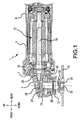
- the grinder 1 is a so-called disc grinder to which a discoidal (disk-shaped) tool accessory 40 is attached.
- the grinder 1 performs processing on a workpiece 50 (refer to FIG. 3 ) by rotating the tool accessory 40.
- the tool accessory 40 may be selected from a variety of grinding wheels, such as a cutting stone, a grinding stone, etc., or a wire brush.
- the grinder 1 is configured such that the tool accessories are interchangeable.
- Grinders 100, 200, 300, 400, 500 according to a first embodiment to a fifth embodiment will be explained following the explanation of the grinder 1, and are each configured such that, in each embodiment, a protective cover according to the present disclosure is attached to the grinder 1 shown in FIG. 1 or to a similar grinder.
- a grinder 600 according to a sixth embodiment is the grinder 1 shown in FIG. 1 or a similar grinder modified by the addition of a lock nut.
- a seventh embodiment explains a configuration of a tool accessory 40 according to the present disclosure that is attached to the grinder 1 or to a similar grinder.
- a front-rear direction is defined along an axis line of an elongate grinder main body or along a corresponding rotary shaft 14 of a motor 12.
- the side on which a spindle 24 is provided on the grinder main body is defined as the "front”; the opposite side is defined as the "rear”, as shown in the coordinate system identified in FIG. 1 .
- an up-down direction is defined based on an axis line of the spindle 24.
- the side on which the spindle 24 is housed in a first gear housing 6 and a second gear housing 30 is defined as "up”
- the side on which the tool accessory 40 is mounted on the spindle 24 is defined as “down”
- a surface that extends in the up-down direction is defined as a "side surface” and thus utilizes a term related to direction.
- the grinder 1 shown in FIG. 1 comprises a motor housing 4, the first gear housing 6, and a rear cover 8.
- the grinder 1 further comprises a second gear housing 30.
- the internal elements that constitute the grinder 1 are housed in an internal space of the grinder main body, which is principally formed by the motor housing 4, the first gear housing 6, the second gear housing 30, and the rear cover 8.
- the motor housing 4 is a substantially circular-cylindrical housing and houses the motor 12.
- the rotary shaft 14 of the motor 12 is disposed such that it protrudes toward the adjacent first gear housing 6.
- the rear cover 8 is provided rearward of the motor housing 4 and houses electronic circuitry for supplying drive current to the motor 12 in order to drive the motor 12.
- the circuitry is supplied with external electric power via a power-supply cord 18 (refer to FIG. 3 , etc.), which is not shown in FIG. 1 .
- the drive of the grinder 1 is turned ON and OFF by a user operating a switch-operation unit 19 (not shown in FIG. 1 ) that is provided such that it is externally exposed.
- the first gear housing 6 is provided forward of the motor housing 4 and houses a first bevel gear 20, a second bevel gear 22, a spindle 24, and bearings 26, 28.
- the first bevel gear 20 is fixed to the rotary shaft 14 of the motor 12 inside the first gear housing 6.
- the second bevel gear 22 and the spindle 24 are rotatably provided in the second gear housing 30, which is configured as a structure separate from the first gear housing 6, via the bearing 26.
- the second bevel gear 22 and an upper part of the spindle 24 are housed inside the first gear housing 6, and the second gear housing 30 is fixed to the first gear housing 6.
- the second gear housing 30 is fixed to the first gear housing 6 such that the spindle 24 is orthogonal to the rotary shaft 14 of the motor 12.
- the second gear housing 30 is, for example, screw-fastened to the first gear housing 6.
- the second bevel gear 22 is fixed to the spindle 24.
- the second bevel gear 22 meshes with the first bevel gear 20 inside the first gear housing 6, and the rotational output of the motor 12 is thereby converted into a rotational force around the axis of the spindle 24.
- One end of the spindle 24 is rotatably supported by the first gear housing 6 via the bearing 28, and the other end of the spindle 24 protrudes downward from the second gear housing 30.
- An inner flange 32 for positioning and fixing the discoidal tool accessory 40 is provided on the portion of the spindle 24 that protrudes from the second gear housing 30.
- a screw part 25, onto which a lock nut 34 is screwed, is formed on an outer-circumferential portion of the spindle 24 that is closer to the tip than is the inner flange 32.
- the lock nut 34 is fixed to a lower end of the spindle 24 by screw-fastening, and the tool accessory 40 is sandwiched and fixed between the lock nut 34 and the inner flange 32.
- the motor 12 rotates, and the rotational output thereof is transmitted to the spindle 24 via a gear mechanism (the bevel gears 20, 22) inside the first gear housing 6. That is, the spindle 24 is rotationally driven by a drive device that includes the motor 12 and the gear mechanism housed in the housings 4, 6, 30.
- the tool accessory 40 rotates in accordance with the rotation of the spindle 24.
- the grinder 1 performs processing, such as grinding, polishing, cutting, or the like, on the workpiece 50 by rotating the tool accessory 40.
- processing such as grinding, polishing, cutting, or the like
- the type of processing work depends on the type of the tool accessory 40 mounted on the spindle 24.
- a protective cover 60 which covers the discoidal (disc-shaped or wheel-shaped) tool accessory 40, is further provided on the grinder 1 (refer to FIG. 2 ).
- the protective cover 60 is also known as a wheel cover or a disc cover in the power tool field.
- the phrase "to cover” in the present specification means to at least partially cover an object and, unless otherwise specially mentioned, is not limited to covering the entirety of the object.
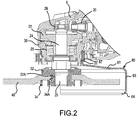
- FIG. 2 shows a cross-sectional configuration of the periphery of the spindle 24 and the tool accessory 40 with the conventional protective cover 60 mounted on the grinder 1 shown in FIG. 1 .
- the protective cover 60 shown in FIG. 2 comprises: a semicircular upper-part structure 61 for covering a rearward semicircular portion of an upper part of the discoidal tool accessory 40; and a side-part structure 63, which extends downward from an outer-circumferential-end edge of the upper-part structure 61.
- the protective cover 60 is configured by integrally forming the upper-part structure 61 and the side-part structure 63.
- the upper-part structure 61 and the side-part structure 63 are integrally formed of a metal material.
- a curved part 64 is provided at the lower end of the side-part structure 63 and thereby the side-part structure 63 is slightly curved at the lower end on the inner side in the radial direction.
- the protective cover 60 further comprises a circular-tubular part 67 for fixing the protective cover 60 to the second gear housing 30.
- the circular-tubular part 67 is provided on the upper-part structure 61 and serves as a circular-tubular part that is concentric with an outer-circumferential arc of the upper-part structure 61.
- the circular-tubular part 67 is designed such that its inner diameter is slightly larger than the outer diameter of a cover-connection part 31, which is provided on the second gear housing 30 and has a circular side surface.
- the circular-tubular part 67 is configured such that a section along a plane perpendicular to the up-down direction describes an open-ring shape, and the portion of the circular-tubular part 67 that is open in the circumferential direction is provided with a tightening part for tightening the circular-tubular part 67 to the cover-connection part 31 of the second gear housing 30 on the inner side in the radial direction.
- a circular-tubular part 170 and a tightening part 175, which have the same or corresponding configurations, are shown in FIG. 5 .
- the tightening part 175 functions such that, by changing the positional relationship between a screw and a nut, which sandwich the tightening part 175 on both sides, an inner side of the circular-tubular part 67 is tightened onto the cover-connection part 31 of the second gear housing 30, and thereby the protective cover 60 is fixed to the second gear housing 30.
- the protective cover 60 shown in FIG. 2 is used when processing the workpiece 50 by using, for example, a grinding stone.
- the protective cover 60 can be attached to the cover-connection part 31 at an arbitrary angle (orientation) in the circumferential direction.
- the arrangement shown in FIG. 2 is a common arrangement used in grinding.
- the protective covers described in each embodiment below likewise can be attached to the grinder at an arbitrary angle. Accordingly, when explaining front, rear, left, and right in relation to the structural elements of the protective cover, the explanations are merely of the directions based on the common arrangement when performing grinding, and it should be understood that the orientation of the circumferential direction of the protective cover with respect to the grinder is not limited to any specific direction.
- the grinder 100 is configured by mounting a protective cover 110, which is shown in FIG. 3 , FIGS. 4A , 4B , and FIG. 5 , on the grinder 1 shown in FIG. 1 or a similar grinder.
- the protective cover 110 comprises: a forward-cover part 130 and a rearward-cover part 150, which are for covering the tool accessory 40 from above and extend in the circumferential direction of the spindle 24; and the circular-tubular part 170, which is for fixing the protective cover 110 to the second gear housing 30.
- the forward-cover part 130 is composed of a resiliently elastic material, such as rubber or a rubber-like material.
- the rearward-cover part 150 is composed of a metal material.
- the circular-tubular part 170 is provided on the rearward-cover part 150 and is composed of a metal material.
- the term “elastic” refers to materials that are capable of changing shape (being deformed) in response to the application of a force and at least substantially (preferably, completely) returning to their original shape after the force is removed. While all materials have some degree of elasticity, as used herein, “elastic” preferably refers to materials that have a Young's modulus of less than about 0.5, e.g., less than about 0.2, e.g., less than about 0.05. Natural rubber (Young's modulus: approximately 0.002) is a representative, non-limiting example of such an elastic material. If the front cover section 130 is formed of an "elastic" material according to the present disclosure, it can be shifted from the position shown in Fig.
- the forward-cover part 130 is composed of a resiliently elastic material, a forward portion of the protective cover 110 is deformable in the direction (on the upward side) away from the tool accessory 40 mounted on the spindle 24.
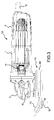
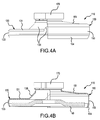
- the protective cover 110 in FIG. 3 is shown in a state in which it has been deformed from its normal state shown in FIG. 4A . In other words, the forward-cover part 130 has been deformed due to the application of a force from below.
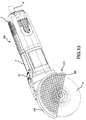
- the forward-cover part 130 has received a counteracting force from the workpiece 50 and thereby has deformed upward. Owing to this deformation, a forward-side-edge part of the tool accessory 40 is revealed from the forward-cover part 130, and the user can perform processing work, using the side edge of the tool accessory 40 or areas radially inwardly of the side edge of the tool accessor 50 on the lower face of the tool accessory 40, without much interference between the workpiece 50 and the protective cover 110.
- FIG. 3 indicates the contour of the tool accessory 40, which is housed within the protective cover 110 and is not externally visible from the side when the cover 110 is not deformed.
- FIG. 3 shows a side view of the circular-tubular part 170 and shows a cross-sectional view of the configuration below the circular-tubular part 170.
- the forward-cover part 130 and the rearward-cover part 150 which constitute the protective cover 110, each have a semicircular shape.
- the rearward-cover part 150 and the circular-tubular part 170 basically have the same configuration as the conventional protective cover 60 shown in FIG. 2 .
- the rearward-cover part 150 comprises: a semicircular upper-part structure 151 for covering the rearward semicircular portion of the upper part of the tool accessory 40; and a side-part structure 153 that extends downward from an outer-circumferential-end edge of the upper-part structure 151.
- the upper-part structure 151 and the side-part structure 153 are integrally formed of a metal material.
- the side-part structure 153 comprises a curved part 154 that faces radially inwardly (toward the axis-line of the spindle 24) at the lower end.
- the circular-tubular part 170 is provided on the upper-part structure 151, which serves as a circular-tubular part that is concentric with an arc of the upper-part structure 151.
- a tightening part 175 is provided for tightening the circular-tubular part 170 onto the cover-connection part 31 of the second gear housing 30.
- the upper-part structure 151 has an extended portion that extends upward at a location corresponding to the circular-tubular part 170 and is connected to the circular-tubular part 170 at the extended portion.
- the circular-tubular part 170 is integrally configured with the extended portion or is configured as a structure separate from the extended portion.
- the tightening part 175 is configured such that, by changing the positional relationship between a screw and a nut that sandwich the tightening part 175 on both sides, an inner side of the circular-tubular part 170 is tightened to the cover-connection part 31 of the second gear housing 30. Owing to the function of the circular-tubular part 170, the protective cover 110 is fixed to the second gear housing 30. After the protective cover 110 is fitted onto the cover-connection part 31 of the second gear housing 30, the protective cover 110 is fixed to the cover-connection part 31 by being tightened thereto.
- the forward-cover part 130 comprises: a semicircular upper-part structure 131 for covering the forward semicircular portion of the upper part of the tool accessory 40; and a side-part structure 133, which extends downward from an outer-circumferential-end edge of the upper-part structure 131.
- the upper-part structure 131 and the side-part structure 133 are integrally formed of rubber or a rubber-like material, e.g., an elastomeric material.
- the upper-part structure 131 and the side-part structure 133 have a connection part (not shown) that overlaps an inner surface of the rearward-cover part 150, and this connection part is fixed to an inner surface of the rearward-cover part 150.
- the upper-part structure 131 and the side-part structure 133 are fixed to the rearward-cover part 150 by an adhesive.
- the upper-part structure 131 has angled wall portions or slopes 135 at the periphery of the connection part that connects to the rearward-cover part 150. Owing to the slopes 135, the majority of an upper surface of the upper-part structure 131 is disposed at a location lower than an upper surface of the rearward-cover part 150. A portion of each slope 135 is composed of a thick rubber material, and the forward-cover part 130 is configured such that it is easily folded from or at locations near the lower ends of the slopes 135. The lower end of the side-part structure 133 is disposed at a location higher than the lower end of the curved part 154.
- the protective cover 110 has the following characteristics.
- a first characteristic is that the protective cover 110 can partially deform (elastically and/or resiliently deform) away from the tool accessory 40.
- a second characteristic is that the protective cover 110 can deform by folding upward and away from the tool accessory 40.
- the protective cover 110 can prevent an adverse impact on work efficiency due to interference between the protective cover 110 and the workpiece 50 while still covering a large surface area of the tool accessory 40.
- the side edge of the tool accessory 40 is generally used.
- the workpiece 50 may be processed using the flat bottom surface of the tool accessory 40 -depending on the shape of the workpiece 50, the surrounding circumstances, the processing method, and the like.
- the forward-cover part 130 foldable at a location spaced apart from the spindle 24 in the radial direction, in other words, at a location near the side edge of the tool accessory 40, it is possible to prevent the protective cover 110 from interfering with the workpiece 50 during processing work, and thereby to prevent any hindrance to the processing work due to interference.
- the protective cover 110 is configured such that a specific angular area along the circumferential direction (the rotational direction of the spindle 24) deforms in a direction away from the tool accessory 40.
- the forward semicircular (180°) area of the protective cover 110 is configured such that it deforms in the direction away from the tool accessory 40.
- the forward-cover part 130 may be configured to be deformable over an area narrower than 180°.
- the protective cover 110 may be configured such that the boundary between the forward-cover part 130 and the rearward-cover part 150 lies along the chain line shown in FIG. 5 .
- a rubber material is used in order to make the protective cover 110 deformable, but other elastic and/or resilient materials may be used, and a movable member, such as a hinge, may alternately be used as described below.
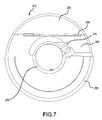
- the grinder 200 is configured by mounting a protective cover 210, which is shown in FIG. 6 and FIG. 7 , on the grinder 1 shown in FIG. 1 or on a similar grinder.
- the protective cover 210 comprises a forward-cover part 230, an intermediate-cover part 240, a rearward-cover part 250, and a circular-tubular part 270 for fixing the protective cover 210 onto the second gear housing 30.
- the rearward-cover part 250 and the circular-tubular part 270 are configured the same as the rearward-cover part 150 and the circular-tubular part 170 that constitute the protective cover 110 according to the first embodiment.
- the forward-cover part 130 that constitutes the protective cover 110 of the first embodiment is replaced by the forward-cover part 230 and the intermediate-cover part 240.
- the forward-cover part 230 and the intermediate-cover part 240 are composed of a metal (rigid) material, which may be the same as or different from the rearward-cover part 250.
- the metal (rigid) material may be replaced with hard, durable plastics that are not "elastic" in accordance with the present teachings.
- the forward-cover part 230 and the intermediate-cover part 240 are connected by a hinge 290.
- the hinge 290 holds the forward-cover part 230 so that it can pivot around an axis along the left-right direction, which is perpendicular to the front-rear direction and the up-down direction.
- the intermediate-cover part 240 is fixed to the rearward-cover part 250. Consequently, due to the presence of the hinge 290, the forward-cover part 230 pivots and folds with respect to the intermediate-cover part 240 and the rearward-cover part 250, which are fixed relative to the connection part 31.
- the hinge 290 is configured such that the forward-cover part 230 can not pivot downward from the position at which the forward-cover part 230 is horizontal or coplanar with the intermediate-cover part 240.
- the hinge 290 may be configured such that it has a prescribed frictional resistance and therefore, when the forward-cover part 230 has pivoted upward, it does not move downward (or moves downward only slowly) due to gravity.
- the protective cover 210 comprises the plurality of cover parts 230, 240, 250, which covers the tool accessory 40 from above. Furthermore, of the plurality of cover parts 230, 240, 250, the forward-cover part 230 positioned at a location spaced apart from the spindle 24 in the radial direction is foldably connected to the intermediate-cover part 240 by the hinge 290. Based on this configuration, the protective cover 210 is configured such that the portion that covers the forward-upper part of the tool accessory 40 can deform in the direction upward and away from the tool accessory 40.
- the grinder 200 it is possible to prevent the protective cover 210 from interfering with the workpiece 50 and thus to prevent a drop in the work efficiency of the grinder 200 while still covering the entirety of the tool accessory 40 from above, the same as in the first embodiment. Accordingly, according to the present embodiment, a grinder 200 that excels in work efficiency can be provided.
- a tightening part 275 of the circular-tubular part 270 which corresponds to the tightening part 175 of the first embodiment, is disposed such that it is rotated by 60° relative to the front-rear axis of the tool, the same as in the first embodiment.
- This arrangement is significant from the viewpoint that, when the forward-cover part 230 has been pivoted upward, the tightening part 275 does not interfere with the forward-cover part 230.
- the rearward-cover part 250 and the intermediate-cover part 240 described above may be composed of monolithic sheet metal.
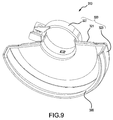
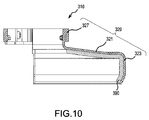
- the grinder 300 according to a third embodiment is configured such that a protective cover 310 shown in FIG. 8 , FIG. 9 , and FIG. 10 is mounted on the grinder 1 shown in FIG. 1 or on a similar grinder.
- the protective cover 310 includes a cushioning member on the inner surface of a conventional protective cover 60. That is, the protective cover 310 comprises: a cover main body 320, which corresponds to the protective cover 60 and extends in the circumferential direction of the spindle 24; and a cushioning member 390, which is affixed to an inner surface of the cover main body 320.
- the cover main body 320 comprises an upper-part structure 321, a side-part structure 323, and a circular-tubular part 327, which is for fixing the protective cover 310 to the second gear housing 30.
- the upper-part structure 321 and the side-part structure 323 are integrally formed of a metal material.
- the cushioning member 390 is thin and plate shaped and coats or covers the inner surface of the cover main body 320.
- the cushioning member 390 is composed of, for example, an elastic foam body or sponge that is formed using a synthetic resin, a natural rubber, or a synthetic rubber as the raw material.
- the cushioning member 390 is affixed to an inner surface of the upper-part structure 321 that faces the tool accessory 40 and to an inner surface of the side-part structure 323 that faces the tool accessory 40.
- the cover main body 320 and the cushioning member 390 may be integrally molded from metal and rubber, respectively.
- the rubber may be attached to the metal (e.g., steel) via a vulcanized rubber bond.
- the cushioning member 390 extends substantially over the entirety of the inner surface of the upper-part structure 321 and the inner surface of the side-part structure 323.
- any impacts that occur when debris from the workpiece 50, the tool accessory 40, or the like flies about inside the protective cover 310 during processing work can be absorbed by the cushioning member 390.
- the cushioning member 390 is provided over substantially the entire area of the inner surface of the upper-part structure 321 and the inner surface of the side-part structure 323, the cushioning member 390 may be provided over just a portion of the areas of the inner surfaces.
- the cushioning member 390 can be provided over the entire surface or a portion thereof of either the upper-part structure 321 or the side-part structure 323 alone.
- the cushioning member 390 may be provided evenly or unevenly over the inner surfaces, e.g., with different thicknesses.
- An elastic and/or resilient material instead of the foam body may be used as the cushioning member 390.
- a representative elastic material is rubber.
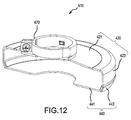
- the grinder 400 according to a fourth embodiment is configured such that a protective cover 410 shown in FIG. 11 and FIG. 12 is mounted on the grinder 1 shown in FIG. 1 or on a similar grinder.
- the protective cover 410 is a protective cover suitable for cutting work.
- the protective cover 410 is configured such that it covers the tool accessory 40 from below in addition to covering it from above.
- the protective cover 410 comprises an upward-cover part 420 and a downward-cover part 440.
- a circular-tubular part 470 for fixing the protective cover 410 to the second gear housing 30 is further provided on the upward-cover part 420.
- the upward-cover part 420 and the circular-tubular part 470 are configured the same as the rearward-cover part 150 and the circular-tubular part 170 that constitute the protective cover 110 of the first embodiment.
- the upward-cover part 420 comprises an upper-part structure 421 and a side-part structure 423, which extends downward from an outer-circumferential-end edge of the upper-part structure 421, and is configured such that it extends in the circumferential direction of the spindle 24 and covers the tool accessory 40 from above and the sides.
- the upper-part structure 421 and the side-part structure 423 are integrally formed of a metal material.
- the side-part structure 423 is configured such that its lower end is curved slightly to the inner side in the radial direction.
- the circular-tubular part 470 is provided on the upper-part structure 421, and the upward-cover part 420 is fixed to the second gear housing 30 by the circular-tubular part 470.
- the downward-cover part 440 comprises a lower-part structure 441 and a connection part 443.
- the lower-part structure 441 and the connection part 443 are integrally formed of an elastic and/or resilient material, such as, e.g., rubber or a rubber-like material.
- the lower-part structure 441 has a semicircular shape, the same as the upper-part structure 421, is disposed in an opening of the upward-cover part 420 that is surrounded by the lower end of the side-part structure 423, and partially closes up the upward-cover part 420 from below. That is, the lower-part structure 441 is disposed such that, below the upward-cover part 420, it covers the tool accessory 40 from below.
- connection part 443 is provided along an outer circumference of the lower-part structure 441.
- the connection part 443 has a hollow or groove that faces upward, and thereby the upper part of the connection part 443 has a bifurcated shape. This shape allows the connection part 443 to be connected to the side-part structure 423 by sandwiching the lower end of the side-part structure 423 of the upward-cover part 420.
- the connection part 443 is fixed to the side-part structure 423 by an adhesive. Owing to this configuration, the downward-cover part 440 is fixed to the upward-cover part 420.
- the downward-cover part 440 as described above is composed of a rubber material and therefore is capable of deforming as well as expanding and contracting. This expansion/contraction function is helpful in mounting the tool accessory 40 on the spindle 24 and dismounting the tool accessory 40 therefrom, as shown in FIG. 11 .
- the downward-cover part 440 is composed of a rubber material and deforming the downward-cover part 440 makes it possible to move the downward-cover part 440 out of the way and enlarge the space below the spindle 24 to provide room (space) for exchanging the tool accessory 40.
- FIG. 11 shows the downward-cover part 440 pressed and thereby deformed during the work of exchanging the tool accessory 40.
- the protective cover 410 it is possible to prevent interference between the downward-cover part 440 and the tool accessory 40 when exchanging the tool accessory (e.g., grinding wheel).
- the tool accessory e.g., grinding wheel.
- the entire downward-cover part 440 is composed of a rubber material; however the entire downward-cover part 440 does not have to be composed of a rubber material.
- the protective cover 410 may be configured such that just a circumferential portion the downward-cover part 440 near the spindle can deform downward.
- the downward-cover part 440 may be composed of a metal material.
- the connection part between the downward-cover part 440 and the upward-cover part 420 may be composed of an elastic material such that it can flex and expand and contract, and therefore it is possible to configure the protective cover 410 such that the downward-cover part 440 can be pressed downward.
- the downward-cover part 440 is fixed to the upward-cover part 420 by an adhesive
- the downward-cover part 440 may instead be detachably mounted to the upward-cover part 420.
- the protective cover 410 is particularly expedient in cutting work in which both a cutting stone is used and there is a possibility that the underside of the tool accessory 40 might face toward the user.
- the grinder 500 according to a fifth embodiment is configured such that a protective cover 510 shown in FIG. 13 and FIG. 14 is mounted on the grinder 1 shown in FIG. 1 or on a similar grinder.
- the circumferential orientation of the protective cover 510 is adjusted to an orientation that is suited to the cutting work being performed.
- the lower-part structure 441 which corresponds to the protective cover 410 of the fourth embodiment, is configured as a mesh material that does not block the user's view of the underside of the tool accessory 40.
- the protective cover 510 comprises an upward-cover part 520 and a downward-cover part 540.
- a circular-tubular part 570 for fixing the protective cover 510 to the second gear housing 30 is further provided on the upward-cover part 520.
- the upward-cover part 520 and the circular-tubular part 570 are configured the same as the rearward-cover part 150 and the circular-tubular part 170 that constitute the protective cover 110 of the first embodiment.
- the upward-cover part 520 comprises an upper-part structure 521 and a side-part structure 523, which extends downward from an outer-circumferential-end edge of the upper-part structure 521, and is configured such that it extends in the circumferential direction of the spindle 24 and covers the tool accessory 40 from above and the sides.
- the upper-part structure 521 and the side-part structure 523 are integrally formed of a metal material.
- a lower end of the side-part structure 523 is slightly curved to the inner side in the radial direction.
- the circular-tubular part 570 is provided on the upper-part structure 521, and the upward-cover part 520 is fixed to the second gear housing 30 by the function of the circular-tubular part 570.
- the downward-cover part 540 comprises a lower-part structure 541 and a connection part 543.
- the lower-part structure 541 is composed of a mesh material made of metal, in other words, a wire mesh, and is configured as a semicircle.
- the mesh size is preferably selected to prevent large debris from flying through the lower-part structure 541 during processing work.
- connection part 543 is provided along the outer circumference of the lower-part structure 541 and is fixed to the lower-part structure 541.
- the connection part 543 is composed of, for example, a metal material and is capable of being connected to the lower-part structure 541 by welding.
- connection part 543 has a hollow or groove that faces upward and is connected to the side-part structure 523 such that the connection part 543 sandwiches the lower end of the side-part structure 523 of the upward-cover part 520.
- connection part 543 is fixed to the side-part structure 523 by an adhesive or by welding.
- connection part 543 is detachably fixed to the side-part structure 523.
- the downward-cover part 540 may be interposed between the portion of the workpiece 50 to be processed and the user's eyes.
- the lower-part structure 541 is composed of a mesh material such that the user's view downward of the tool accessory 40 is not completely blocked by the downward-cover part, and consequently it is possible to prevent a drop in work efficiency in such a case.
- the lower-part structure 541 is composed of a mesh material
- the lower-part structure 541 may instead be composed of a transparent resin (plastic) material.
- the downward-cover part 540 may be configured by substituting the lower-part structure 441 of the protective cover 410 shown in FIG. 12 or the lower-part structure 541 of the protective cover 510 shown in FIG. 14 with a lower-part structure composed of the transparent resin material.
- the lower-part structure 541 may be composed of a mesh material or a transparent material
- the lower-part structure 541 may be provided with one or a plurality of through holes so that the user's view is not completely blocked.
- the protective cover 510 may comprise a connection part 543. That is, the lower-part structure 541 may be directly welded to the side-part structure 523 of the upward-cover part 520.
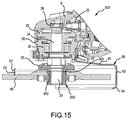
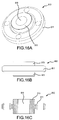
- the grinder 600 according to a sixth embodiment is configured such that, instead of the lock nut 34, a lock nut 610 shown in FIG. 15 and FIGS. 16A, 16B, 16C is mounted on the grinder 1 shown in FIG. 1 or on a similar grinder.
- the lock nut 610 of the present embodiment includes cylindrical bosses or pilot parts 613 that protrude from opposite surfaces of the lock nut main body 611 at locations at which they face a pilot part 32A of the inner flange 32.
- a screw hole 615 which passes through the lock-nut main body 611 and the pilot parts 613, is provided in the center of the lock nut 610.
- the screw hole 615 is configured such that the screw part 25, which is provided on the tip of the spindle 24, can be screwed thereto.
- the conventional lock nut 34 comprises a protruding pilot part 34A on only a first surface of the lock-nut main body, and a protruding pilot part is not provided on a second surface on the opposite side of the lock-nut main body.
- the first surface is configured such that, because it includes the protruding pilot part 34A, when the lock nut 34 is mounted on the screw part 25 at the tip of the spindle 24 such that the first surface opposes the inner flange 32, a space that corresponds to the thickness of the grinding stone is formed between the lock nut 34 and the inner flange 32. Therefore, the grinding stone (grinding wheel), which is one example of the tool accessory 40, can be appropriately held between the lock nut 34 and the inner flange 32.
- the second surface is configured such that, by virtue of not being provided with a protruding pilot part, when the lock nut 34 is mounted on the screw part 25 at the tip of the spindle 24 such that the second surface opposes the inner flange 32, a space that corresponds to the thickness of the cutting stone is formed between the lock nut 34 and the inner flange 32. Therefore, the cutting stone (cutting wheel) can be appropriately held between the lock nut 34 and the inner flange 32. In other words, either a grinding stone or a cutting stone can be connected to the spindle 24 using the same lock nut 34 merely by reversing the orientation of the lock nut 34.
- the cutting stone which serves as the tool accessory 40, can be mounted on the spindle 24 with the protective cover 60 for grinding work mounted as is.
- a user might be tempted to replace a grinding stone with a cutting stone without using a protective cover that is suitable for cutting work.
- the tool accessory 40 is disposed perpendicular to the workpiece 50, and the state arises in which the workpiece 50 is processed using the side edge of the tool accessory 40. In this state, there is a possibility that the underside of the tool accessory 40 will face toward the user. Accordingly, the protective cover for cutting work that covers the tool accessory 40 from below is preferably mounted on the grinder 1. Nevertheless, there is a possibility that, because it is labor-intensive to exchange the protective cover, the user will merely exchange the tool accessory 40 for the cutting stone without exchanging the protective cover 60 for grinding work, which is already mounted, with the protective cover for cutting work.
- the lock nut 610 of the present embodiment is configured such that the same structure of the first surface of the conventional lock nut 34 is provided on both the first surface and the second surface.
- the lock nut 610 is configured such that, in the state in which the lock nut 610 is disposed downward of the inner flange 32 via the screw part 25 such that the pilot part 32A of the inner flange 32 and its pilot part 613 contact one another, a space that corresponds to the thickness of the grinding stone is formed between the lock nut 610 and the inner flange 32.
- the lock nut 610 is configured such that an amount-of-protrusion D2 of the pilot part 613 is set so that a total DS (D1 + D2) of an amount-of-protrusion D1 of the pilot part 32A of the inner flange 32 and an amount-of-protrusion D2 of the pilot part 613 of the lock nut 610 corresponds to the thickness of the grinding stone.
- the thickness of the grinding stone in the up-down direction is generally approximately 6 mm. Accordingly, the total DS can be set to a value of, for example, 6 mm or a value smaller than that.
- the thickness of the cutting stone in the up-down direction is usually significantly smaller than the grinding stone, and is less than 2 mm. Accordingly, according to the lock nut 610 in which the pilot parts 613 designed such that the total DS is greater than 2 mm is provided on both surfaces, the cutting stone cannot be fixed to the spindle 24 using the lock nut 610 regardless of which surface is disposed facing the inner flange 32.
- the lock nut 610 which has a shape specialized for the grinding stone, on both the protective cover 60 for grinding work and the grinder 600, the cutting stone essentially cannot be used with the grinder 600. Accordingly, according to the present embodiment, by mounting the cutting stone on the grinder 600 having the protective cover 60 for grinding work, it is possible to prevent the protective value of having the protective cover 60 from being diminished.
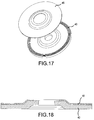
- an adhesive sheet 45 having a shape that corresponds to the upper surface of the tool accessory 40 is affixed to the upper surface of the tool accessory 40, which is not the processing surface.
- FIG. 17 shows the tool accessory 40 and the adhesive sheet 45 prior to the adhesive sheet 45 being affixed to the tool accessory 40
- FIG. 18 shows a cross section of the tool accessory 40 after the adhesive sheet 45 has been affixed to the tool accessory 40.
- the adhesive sheet 45 helps prevent debris from flying away from the spindle 24 if the tool accessory 40 breaks due to fatigue.
- the adhesive sheet 45 is preferably composed of a high-strength resin sheet.
- a function possessed by one structural element in the above-mentioned embodiments may be provided such that it is distributed among multiple structural elements.
- a function possessed by multiple structural elements may be integrated in one structural element.
- Some of the structural elements in the above-mentioned embodiments may be omitted.
- At least some of the structural elements in the above-mentioned embodiments may be added to or replaced by structural elements in other embodiments mentioned above. Any aspect that is included in the technical concepts specified based on the text of the claims is an embodiment of the present invention.
Landscapes
- Engineering & Computer Science (AREA)
- Mechanical Engineering (AREA)
- General Engineering & Computer Science (AREA)
- Grinding-Machine Dressing And Accessory Apparatuses (AREA)
- Finish Polishing, Edge Sharpening, And Grinding By Specific Grinding Devices (AREA)
Applications Claiming Priority (1)
| Application Number | Priority Date | Filing Date | Title |
|---|---|---|---|
| JP2015178869A JP6571463B2 (ja) | 2015-09-10 | 2015-09-10 | グラインダ、及びカバー |
Publications (2)
| Publication Number | Publication Date |
|---|---|
| EP3141343A2 true EP3141343A2 (de) | 2017-03-15 |
| EP3141343A3 EP3141343A3 (de) | 2017-03-22 |
Family
ID=56883732
Family Applications (1)
| Application Number | Title | Priority Date | Filing Date |
|---|---|---|---|
| EP16187688.3A Withdrawn EP3141343A3 (de) | 2015-09-10 | 2016-09-07 | Schleifer, abdeckung und verschlussmutter |
Country Status (4)
| Country | Link |
|---|---|
| US (1) | US10357868B2 (de) |
| EP (1) | EP3141343A3 (de) |
| JP (1) | JP6571463B2 (de) |
| CN (1) | CN106514487A (de) |
Cited By (1)
| Publication number | Priority date | Publication date | Assignee | Title |
|---|---|---|---|---|
| CN110788711A (zh) * | 2019-11-11 | 2020-02-14 | 浙江冠鑫科技股份有限公司 | 一种用于加工铁质零件的角磨机 |
Families Citing this family (17)
| Publication number | Priority date | Publication date | Assignee | Title |
|---|---|---|---|---|
| JP6634248B2 (ja) | 2015-09-10 | 2020-01-22 | 株式会社マキタ | グラインダ及びカバー |
| JP6667236B2 (ja) | 2015-09-10 | 2020-03-18 | 株式会社マキタ | グラインダ、カバー及びカバーセット |
| JP6577830B2 (ja) | 2015-10-28 | 2019-09-18 | 株式会社マキタ | 電動工具 |
| JP6531139B2 (ja) * | 2017-08-02 | 2019-06-12 | 本田技研工業株式会社 | 車両駆動装置および車両駆動装置の製造方法 |
| US11440160B2 (en) * | 2018-03-23 | 2022-09-13 | Paul Mueller Company | Guards for use with power tools and power tools including such guards |
| WO2020026747A1 (ja) * | 2018-08-01 | 2020-02-06 | 株式会社マキタ | 電動工具のホイールカバー |
| JP7467031B2 (ja) | 2018-08-01 | 2024-04-15 | 株式会社マキタ | 電動工具のホイールカバー |
| US12162113B2 (en) | 2018-09-14 | 2024-12-10 | Makita Corporation | Tool with accessory detection |
| JP6531337B1 (ja) * | 2018-10-06 | 2019-06-19 | 株式会社ナカヤ | 粉塵制御機能付電動研削機 |
| US11396078B2 (en) * | 2019-06-10 | 2022-07-26 | Makita Corporation | Grinder |
| US11685017B2 (en) | 2020-02-07 | 2023-06-27 | West Bufkin Industries, Llc | Storage shield for angle grinding disc |
| CN112388469B (zh) * | 2020-10-16 | 2021-11-23 | 永康市开源动力工具有限公司 | 具有安全防护结构的角磨机 |
| CN112355831B (zh) * | 2020-10-16 | 2021-09-24 | 永康市开源动力工具有限公司 | 一种具有保护和清洁功能的角磨机 |
| KR102535473B1 (ko) * | 2022-07-03 | 2023-05-26 | 조병준 | 안전기능이 강화된 그라인더용 안전커버 |
| US12454035B2 (en) | 2022-12-19 | 2025-10-28 | Black & Decker Inc. | Shield assembly for power tool |
| CN220051394U (zh) * | 2023-06-26 | 2023-11-21 | 浙江华丰电动工具有限公司 | 角磨机两用护罩 |
| US20260175348A1 (en) * | 2024-12-23 | 2026-06-25 | Black & Decker Inc. | Reversible flange assembly for power tools |
Citations (1)
| Publication number | Priority date | Publication date | Assignee | Title |
|---|---|---|---|---|
| JP2013078823A (ja) | 2011-10-04 | 2013-05-02 | Makita Corp | 動力工具、および動力工具の製造方法 |
Family Cites Families (46)
| Publication number | Priority date | Publication date | Assignee | Title |
|---|---|---|---|---|
| US2152352A (en) * | 1937-10-19 | 1939-03-28 | William E Holt | Electric surfacing tool |
| DE1847728U (de) | 1961-07-12 | 1962-03-01 | Bosch Gmbh Robert | Schutzhaube fuer motorisch angetriebene handwerkzeugmaschine. |
| DE7028588U (de) | 1970-07-29 | 1970-12-17 | Fritz Jetzt Fa | Schutzvorrichtung fuer die trensscheibe einer hand-trennmaschine. |
| JPS5633156B2 (de) | 1973-05-08 | 1981-08-01 | ||
| JPS5633156U (de) * | 1979-08-23 | 1981-04-01 | ||
| JPS5813952U (ja) | 1981-07-14 | 1983-01-28 | 神鋼電機株式会社 | デイスクグラインダ− |
| JPS60142062U (ja) | 1984-02-29 | 1985-09-20 | 京セラミタ株式会社 | デイスクグラインダ− |
| US4622782A (en) * | 1985-08-09 | 1986-11-18 | Roestenberg Jerome R | Sander shield |
| EP0267993A1 (de) * | 1986-11-17 | 1988-05-25 | Jerome Roestenberg | Schutzhaube für Handschleifer |
| JPS63127873A (ja) * | 1986-11-17 | 1988-05-31 | ジエロ−ム リ−ステンバ−グ | 研摩機の研摩部用真空シ−ルド |
| JPH02122755U (de) | 1989-03-15 | 1990-10-09 | ||
| US5125190A (en) * | 1990-05-16 | 1992-06-30 | Buser John P | Dust collector and shield for rotary grinder |
| SE507264C2 (sv) | 1996-06-13 | 1998-05-04 | Atlas Copco Tools Ab | Handhållet motordrivet verktyg |
| US5791979A (en) * | 1997-03-17 | 1998-08-11 | Duncan; C. Warren | Grinding vacuum shroud |
| GB2329440A (en) * | 1997-09-23 | 1999-03-24 | Liu Wun Hui | Front shield of power sanding machine |
| JP2000176817A (ja) * | 1998-12-18 | 2000-06-27 | Kajimoto:Kk | ハンドディスクグラインダ |
| CN2403545Y (zh) * | 1999-11-12 | 2000-11-01 | 桑义昌 | 曲面磨光机 |
| DE10107290A1 (de) | 2001-02-16 | 2002-09-05 | Esau Ulrich | Schutzvorrichtung für Elektrohandmaschine |
| US6699114B1 (en) | 2002-04-26 | 2004-03-02 | Benedict Engineering Company, Inc. | Pivotal guards for power hand tools with rotating discs |
| AU2003291857B2 (en) * | 2002-12-23 | 2010-02-18 | Advance Posture Systems Pty Ltd | Dust Shroud |
| DE102004047278A1 (de) | 2004-09-29 | 2006-04-06 | Hilti Ag | Abdeckeinrichtung für ein Werkzeuggerät |
| DE102007041840A1 (de) | 2006-11-13 | 2008-05-15 | Robert Bosch Gmbh | Handwerkzeugmaschine mit Schutzhaube, insbesondere Winkelschleifer |
| TWM319119U (en) | 2007-02-02 | 2007-09-21 | Double Dynasty Co Ltd | Direction adjustable device of front guard for grinding machine |
| JP2009000795A (ja) | 2007-06-25 | 2009-01-08 | Gt Engineer:Kk | 研摩粉塵飛散防止カバー |
| DE102007035704A1 (de) | 2007-07-30 | 2009-02-05 | Robert Bosch Gmbh | Schutzvorrichtung |
| DE102007046311A1 (de) * | 2007-09-27 | 2009-04-02 | Robert Bosch Gmbh | Schutzvorrichtung |
| US20090229436A1 (en) | 2008-03-11 | 2009-09-17 | Crain Cutter Company, Inc. | Undercut saw height adjustment, handle, blade guard improvements |
| DE102008022294A1 (de) * | 2008-04-28 | 2009-10-29 | C. & E. Fein Gmbh | Schutzhaube für ein Schleifgerät |
| ITPR20090034A1 (it) * | 2009-05-07 | 2010-11-08 | Giovanni Ficai | Sistema di accoppiamento rapido di un disco abrasivo all'albero ruotante di una macchina smerigliatrice portatile |
| DE102009028404A1 (de) | 2009-08-10 | 2011-02-17 | Robert Bosch Gmbh | Werkzeugmaschine mit einer Schutzhaube |
| US8764518B2 (en) * | 2009-10-21 | 2014-07-01 | Pathfinder Concepts, Llc | Dust shroud for a grinder |
| JP5471573B2 (ja) * | 2010-02-19 | 2014-04-16 | 日立工機株式会社 | 電動工具 |
| DE102010030598A1 (de) | 2010-06-28 | 2011-12-29 | Robert Bosch Gmbh | Handwerkzeugschutzvorrichtung |
| JP5684056B2 (ja) | 2010-08-16 | 2015-03-11 | 株式会社マキタ | 手持ち工具 |
| CN202212843U (zh) * | 2011-08-10 | 2012-05-09 | 浙江博大实业有限公司 | 角向磨光机 |
| CN102294641B (zh) * | 2011-09-03 | 2013-08-28 | 浙江皇冠电动工具制造有限公司 | 一种角磨类电动工具装换砂轮和转动防护罩的集成机构 |
| JP5870658B2 (ja) | 2011-12-02 | 2016-03-01 | 株式会社Ihi | 電動工具及び素地調整方法 |
| JP5836876B2 (ja) | 2012-04-25 | 2015-12-24 | 株式会社マキタ | 電動工具 |
| DE102012207571B4 (de) | 2012-04-27 | 2021-11-11 | Robert Bosch Gmbh | Abdeckvorrichtung mit Staubabsaugung bei Verwendung mit einem Elektrowerkzeug |
| DE102012111987A1 (de) * | 2012-12-07 | 2014-06-12 | Flex-Elektrowerkzeuge Gmbh | Handgehaltene Schleifmaschine |
| DE102013208809B4 (de) | 2013-05-14 | 2025-09-18 | Robert Bosch Gmbh | Schutzhaubenvorrichtung |
| CN204565813U (zh) * | 2014-12-25 | 2015-08-19 | 王文财 | 一种墙体打磨机 |
| JP6667236B2 (ja) | 2015-09-10 | 2020-03-18 | 株式会社マキタ | グラインダ、カバー及びカバーセット |
| JP6632840B2 (ja) | 2015-09-10 | 2020-01-22 | 株式会社マキタ | グラインダ |
| JP6634248B2 (ja) | 2015-09-10 | 2020-01-22 | 株式会社マキタ | グラインダ及びカバー |
| US10035240B2 (en) * | 2015-12-15 | 2018-07-31 | Shave Away Europe, Inc. | Adaptive dust shield device having zero standoff capability |
-
2015
- 2015-09-10 JP JP2015178869A patent/JP6571463B2/ja not_active Expired - Fee Related
-
2016
- 2016-07-20 CN CN201610578881.4A patent/CN106514487A/zh active Pending
- 2016-09-07 US US15/257,987 patent/US10357868B2/en active Active
- 2016-09-07 EP EP16187688.3A patent/EP3141343A3/de not_active Withdrawn
Patent Citations (1)
| Publication number | Priority date | Publication date | Assignee | Title |
|---|---|---|---|---|
| JP2013078823A (ja) | 2011-10-04 | 2013-05-02 | Makita Corp | 動力工具、および動力工具の製造方法 |
Cited By (1)
| Publication number | Priority date | Publication date | Assignee | Title |
|---|---|---|---|---|
| CN110788711A (zh) * | 2019-11-11 | 2020-02-14 | 浙江冠鑫科技股份有限公司 | 一种用于加工铁质零件的角磨机 |
Also Published As
| Publication number | Publication date |
|---|---|
| EP3141343A3 (de) | 2017-03-22 |
| JP2017052061A (ja) | 2017-03-16 |
| US20170072532A1 (en) | 2017-03-16 |
| JP6571463B2 (ja) | 2019-09-04 |
| CN106514487A (zh) | 2017-03-22 |
| US10357868B2 (en) | 2019-07-23 |
Similar Documents
| Publication | Publication Date | Title |
|---|---|---|
| US10357868B2 (en) | Grinder, cover, and lock nut | |
| US20170072535A1 (en) | Grinder and cover | |
| US10478943B2 (en) | Grinder, cover and cover set | |
| JP6915973B2 (ja) | 作業機 | |
| CN112313036B (zh) | 电动工具的砂轮罩 | |
| EP1894674B1 (de) | Schleifmaschine | |
| US20120129435A1 (en) | Rotary tool | |
| CN102574272A (zh) | 圆盘式研磨机的集尘罩 | |
| EP2436484B1 (de) | Drehwerkzeuge | |
| JP4962896B2 (ja) | 動力工具 | |
| JPWO2015029659A1 (ja) | グラインダ | |
| EP2447003A2 (de) | Scheibenschleifer | |
| JP6163967B2 (ja) | 動力工具および先端工具の固定構造 | |
| JP6871348B2 (ja) | グラインダ及びカバー | |
| JP2016016469A (ja) | 回転工具 | |
| JP2017007001A (ja) | 手持ち式電動工具 | |
| CN223532154U (zh) | 角磨机 | |
| WO2020026747A1 (ja) | 電動工具のホイールカバー | |
| JP2025181533A (ja) | 作業機 | |
| JP7319912B2 (ja) | カバーアタッチメントおよび電動工具 | |
| JP2013075345A (ja) | 回転工具 | |
| JP2026036005A (ja) | カバーアタッチメント | |
| EP2636483A1 (de) | Handwerkzeugmaschine zum Schmirgeln, Schleifen oder Polieren eines Werkstücks | |
| JP2015104772A (ja) | 動力工具 | |
| KR101879301B1 (ko) | 예취기 |
Legal Events
| Date | Code | Title | Description |
|---|---|---|---|
| PUAI | Public reference made under article 153(3) epc to a published international application that has entered the european phase |
Free format text: ORIGINAL CODE: 0009012 |
|
| PUAL | Search report despatched |
Free format text: ORIGINAL CODE: 0009013 |
|
| AK | Designated contracting states |
Kind code of ref document: A2 Designated state(s): AL AT BE BG CH CY CZ DE DK EE ES FI FR GB GR HR HU IE IS IT LI LT LU LV MC MK MT NL NO PL PT RO RS SE SI SK SM TR |
|
| AX | Request for extension of the european patent |
Extension state: BA ME |
|
| AK | Designated contracting states |
Kind code of ref document: A3 Designated state(s): AL AT BE BG CH CY CZ DE DK EE ES FI FR GB GR HR HU IE IS IT LI LT LU LV MC MK MT NL NO PL PT RO RS SE SI SK SM TR |
|
| AX | Request for extension of the european patent |
Extension state: BA ME |
|
| RIC1 | Information provided on ipc code assigned before grant |
Ipc: B24B 55/05 20060101AFI20170214BHEP Ipc: B24B 23/02 20060101ALI20170214BHEP |
|
| STAA | Information on the status of an ep patent application or granted ep patent |
Free format text: STATUS: THE APPLICATION IS DEEMED TO BE WITHDRAWN |
|
| 18D | Application deemed to be withdrawn |
Effective date: 20170923 |