EP3141380A1 - Compartiment passager avec un moule positif creux et une enveloppe extérieure en plastique renforcé à la fibre de verre et sa fabrication - Google Patents
Compartiment passager avec un moule positif creux et une enveloppe extérieure en plastique renforcé à la fibre de verre et sa fabrication Download PDFInfo
- Publication number
- EP3141380A1 EP3141380A1 EP16194108.3A EP16194108A EP3141380A1 EP 3141380 A1 EP3141380 A1 EP 3141380A1 EP 16194108 A EP16194108 A EP 16194108A EP 3141380 A1 EP3141380 A1 EP 3141380A1
- Authority
- EP
- European Patent Office
- Prior art keywords
- passenger compartment
- fiber
- positive mold
- reinforced plastic
- fibers
- Prior art date
- Legal status (The legal status is an assumption and is not a legal conclusion. Google has not performed a legal analysis and makes no representation as to the accuracy of the status listed.)
- Withdrawn
Links
- 229920002430 Fibre-reinforced plastic Polymers 0.000 title claims abstract description 21
- 239000011151 fibre-reinforced plastic Substances 0.000 title claims abstract description 21
- 238000004519 manufacturing process Methods 0.000 title claims abstract description 21
- 239000000835 fiber Substances 0.000 claims description 52
- 238000000034 method Methods 0.000 claims description 13
- 238000004804 winding Methods 0.000 claims description 8
- 239000004744 fabric Substances 0.000 claims description 6
- 239000012815 thermoplastic material Substances 0.000 claims description 6
- 229920000049 Carbon (fiber) Polymers 0.000 claims description 4
- 229920000271 Kevlar® Polymers 0.000 claims description 4
- 239000004760 aramid Substances 0.000 claims description 4
- 229920006231 aramid fiber Polymers 0.000 claims description 4
- 239000004917 carbon fiber Substances 0.000 claims description 4
- 239000003365 glass fiber Substances 0.000 claims description 4
- 239000004761 kevlar Substances 0.000 claims description 4
- 239000000203 mixture Substances 0.000 claims description 4
- 239000011435 rock Substances 0.000 claims description 4
- 235000013311 vegetables Nutrition 0.000 claims description 4
- 239000004745 nonwoven fabric Substances 0.000 claims description 2
- 239000002131 composite material Substances 0.000 description 8
- 230000002349 favourable effect Effects 0.000 description 4
- 229920001169 thermoplastic Polymers 0.000 description 4
- 239000004416 thermosoftening plastic Substances 0.000 description 4
- 229920003023 plastic Polymers 0.000 description 3
- 239000004033 plastic Substances 0.000 description 3
- 239000011347 resin Substances 0.000 description 3
- 229920005989 resin Polymers 0.000 description 3
- 238000000926 separation method Methods 0.000 description 3
- 239000011159 matrix material Substances 0.000 description 2
- 238000010276 construction Methods 0.000 description 1
- 238000005520 cutting process Methods 0.000 description 1
- 230000001419 dependent effect Effects 0.000 description 1
- 238000011161 development Methods 0.000 description 1
- 230000018109 developmental process Effects 0.000 description 1
- 230000009977 dual effect Effects 0.000 description 1
- 239000011152 fibreglass Substances 0.000 description 1
- 230000006870 function Effects 0.000 description 1
- 239000012510 hollow fiber Substances 0.000 description 1
- 238000001746 injection moulding Methods 0.000 description 1
- 239000011810 insulating material Substances 0.000 description 1
- 238000003698 laser cutting Methods 0.000 description 1
- 239000000463 material Substances 0.000 description 1
- 238000003801 milling Methods 0.000 description 1
- 238000012986 modification Methods 0.000 description 1
- 230000004048 modification Effects 0.000 description 1
- 230000004297 night vision Effects 0.000 description 1
- 230000009993 protective function Effects 0.000 description 1
- 239000012783 reinforcing fiber Substances 0.000 description 1
- 229920001187 thermosetting polymer Polymers 0.000 description 1
- XLYOFNOQVPJJNP-UHFFFAOYSA-N water Substances O XLYOFNOQVPJJNP-UHFFFAOYSA-N 0.000 description 1
Images

Classifications
-
- B—PERFORMING OPERATIONS; TRANSPORTING
- B29—WORKING OF PLASTICS; WORKING OF SUBSTANCES IN A PLASTIC STATE IN GENERAL
- B29C—SHAPING OR JOINING OF PLASTICS; SHAPING OF MATERIAL IN A PLASTIC STATE, NOT OTHERWISE PROVIDED FOR; AFTER-TREATMENT OF THE SHAPED PRODUCTS, e.g. REPAIRING
- B29C70/00—Shaping composites, i.e. plastics material comprising reinforcements, fillers or preformed parts, e.g. inserts
- B29C70/68—Shaping composites, i.e. plastics material comprising reinforcements, fillers or preformed parts, e.g. inserts by incorporating or moulding on preformed parts, e.g. inserts or layers, e.g. foam blocks
- B29C70/86—Incorporated in coherent impregnated reinforcing layers, e.g. by winding
- B29C70/865—Incorporated in coherent impregnated reinforcing layers, e.g. by winding completely encapsulated
-
- B—PERFORMING OPERATIONS; TRANSPORTING
- B29—WORKING OF PLASTICS; WORKING OF SUBSTANCES IN A PLASTIC STATE IN GENERAL
- B29C—SHAPING OR JOINING OF PLASTICS; SHAPING OF MATERIAL IN A PLASTIC STATE, NOT OTHERWISE PROVIDED FOR; AFTER-TREATMENT OF THE SHAPED PRODUCTS, e.g. REPAIRING
- B29C70/00—Shaping composites, i.e. plastics material comprising reinforcements, fillers or preformed parts, e.g. inserts
- B29C70/04—Shaping composites, i.e. plastics material comprising reinforcements, fillers or preformed parts, e.g. inserts comprising reinforcements only, e.g. self-reinforcing plastics
- B29C70/06—Fibrous reinforcements only
- B29C70/08—Fibrous reinforcements only comprising combinations of different forms of fibrous reinforcements incorporated in matrix material, forming one or more layers, and with or without non-reinforced layers
- B29C70/086—Fibrous reinforcements only comprising combinations of different forms of fibrous reinforcements incorporated in matrix material, forming one or more layers, and with or without non-reinforced layers and with one or more layers of pure plastics material, e.g. foam layers
-
- B—PERFORMING OPERATIONS; TRANSPORTING
- B29—WORKING OF PLASTICS; WORKING OF SUBSTANCES IN A PLASTIC STATE IN GENERAL
- B29C—SHAPING OR JOINING OF PLASTICS; SHAPING OF MATERIAL IN A PLASTIC STATE, NOT OTHERWISE PROVIDED FOR; AFTER-TREATMENT OF THE SHAPED PRODUCTS, e.g. REPAIRING
- B29C70/00—Shaping composites, i.e. plastics material comprising reinforcements, fillers or preformed parts, e.g. inserts
- B29C70/04—Shaping composites, i.e. plastics material comprising reinforcements, fillers or preformed parts, e.g. inserts comprising reinforcements only, e.g. self-reinforcing plastics
- B29C70/28—Shaping operations therefor
- B29C70/30—Shaping by lay-up, i.e. applying fibres, tape or broadsheet on a mould, former or core; Shaping by spray-up, i.e. spraying of fibres on a mould, former or core
- B29C70/32—Shaping by lay-up, i.e. applying fibres, tape or broadsheet on a mould, former or core; Shaping by spray-up, i.e. spraying of fibres on a mould, former or core on a rotating mould, former or core
-
- B—PERFORMING OPERATIONS; TRANSPORTING
- B62—LAND VEHICLES FOR TRAVELLING OTHERWISE THAN ON RAILS
- B62D—MOTOR VEHICLES; TRAILERS
- B62D29/00—Superstructures, understructures, or sub-units thereof, characterised by the material thereof
- B62D29/04—Superstructures, understructures, or sub-units thereof, characterised by the material thereof predominantly of synthetic material
- B62D29/046—Combined superstructure and frame, i.e. monocoque constructions
Definitions
- the invention relates to a passenger compartment comprising a positive shape of the passenger compartment and an outer shell of fiber-reinforced plastic enveloping this positive form. Furthermore, the invention relates to a method for producing a passenger compartment, in which a positive shape of the passenger compartment is wrapped in fiber-reinforced plastic.
- a fiber composite hollow body in particular a hollow fiber composite component for a motor vehicle is known from WO 2009/68127 A1 known in principle.
- endless reinforcing fibers are applied to a lost mold corresponding to the later cavity and impregnated with a curable resin. Thereafter, the applied resin is cured and the lost form dissolved out of the finished component.
- FR 2 894 869 A1 is a method for producing an aircraft fuselage known, with an inner framework that is surrounded by a shell made of composite material.
- the inner framework is essentially constructed of many frame members which are completed during application of the composite material with shell elements to a closed structure. After application of the composite material, the shell elements are removed again.
- the object of the invention is therefore to provide an improved passenger compartment or an improved method for their production.
- a possibility for the rational production of a passenger compartment with the same or even improved quality should be created in comparison to passenger compartments manufactured by known methods.
- the object of the invention is achieved with a passenger compartment of the type mentioned, in which the positive mold is hollow.
- the fiber-reinforced plastic enveloping the positive mold forms a self-contained outer shell from which doors and / or lids are separated and then movably connected to the passenger compartment.
- the object of the invention is achieved by a method of the type mentioned, in which the positive mold is hollow and remains in the finished passenger compartment.
- the positive-mold enveloping fiber-reinforced plastic forms a self-contained outer shell, separated from the doors and / or cover and then be connected to the passenger cell movable.
- motor vehicles can be produced particularly cost-effectively and with high quality, because the remaining in the passenger compartment positive shape further processing steps, as they are necessary in a lost form omitted.
- the outer shell is made initially self-contained, whereby the passenger compartment can be easily produced in a winding machine.
- the orientation of the fibers in the passenger compartment is very homogeneous, since they are laid in the production of the outer shell on the later parting surface to doors and / or cover away.
- the fiber-reinforced outer shell can be produced with the aid of "rovings” and / or “prepregs” as well as using an "autoclave”.
- Rovings are bundles of untwisted, stretched fibers that are used in the production of fiber composites and especially of fiber-plastic composites. Rovings can be processed by machine and can thus be used in automated processes.
- Prepregs are preimpregnated fibers consisting of fibers and an uncured thermosetting plastic matrix. Prepregs can be processed by machine and can thus be used in automated processes.
- An “autoclave” is a gas-tight sealable pressure vessel for the production of fiber-plastic composites. In these autoclaves usually pressures of up to 10 bar and temperatures of up to 400 ° C are generated to compress the individual laminate layers. As semi-finished fiber prepregs are often used.
- the positive mold on the inside comprises functional components, in particular an interior trim, a dashboard and / or a holder for a seat.
- functional components in particular an interior trim, a dashboard and / or a holder for a seat.
- the positive form consists of several parts. In this way, for example, undercuts can be made in the interior. Despite the separation points in the positive mold, the passenger compartment remains stable due to the fiber-reinforced and especially self-contained outer shell.
- the positive mold has a substantially closed outer surface.
- the positive form can be wrapped particularly well in fiber-reinforced plastic. Smaller openings or depressions do not interfere and are usually spanned by the fibers without any problems.
- the positive mold consists of thermoplastic material.
- the positive core can be produced particularly inexpensively.
- the positive form may also be fiber-reinforced.
- the fiber-reinforced plastic contains fiber fabrics, fiber braids, fiber fabrics or fiber webs. In this way, the characteristics of the passenger compartment can be well adapted to the requirements of the same.
- the fiber-reinforced plastic contains glass fibers, Kevlar fibers, aramid fibers, carbon fibers, vegetable fibers, rock fibers, thermoplastic fibers or mixtures thereof. In this way, the characteristics of the passenger compartment can also be well adapted to the requirements of the same.
- the passenger compartment is egg-shaped. As a result, the passenger compartment along its longitudinal axis is particularly stable, whereby the forces occurring in rear-end collisions can be well dissipated.
- the passenger compartment is windowless and comprises outside cameras which are provided for transmitting an image of the surroundings of the passenger compartment to screens which are arranged in the interior of the passenger compartment.
- the passenger compartment is particularly stable in this case, since debilitating openings are largely or completely missing.
- Particularly advantageous is the wrapping of the positive mold with fibers in a winding machine.
- the production of the passenger compartment can be automated and thus made even more efficient and according to even narrower quality criteria.
- the use of a winding machine for the production of a passenger compartment is made possible only by the fact that it is made via the detour of a positive mold.
- the advantage of the invention therefore appears particularly at this point, or the invention can also be seen in this context to recognize that the production of a passenger compartment via the detour of a hollow positive shape allows the use of a winding machine.
- Fig. 1 shows a section through a first vehicle which comprises a passenger compartment 1a, which comprises a multi-part positive mold 2a, 2b, which is enveloped by an outer shell 3 made of fiber-reinforced plastic.
- the positive mold 2a, 2b is hollow and thus forms the interior of the passenger compartment 1a.
- the positive mold 2a, 2b in this example comprises functional components, specifically a dashboard 4a, a holder 4b for a seat, and armrests 4c.
- a passenger compartment 1a can be made particularly efficient in this way.
- mixed forms of functional components 4a..4c integrated in the positive mold 2a, 2b and subsequently incorporated functional components are also possible.
- the positive mold 2a, 2b as in the present example, a substantially closed outer surface, so that it can be easily wrapped in a fiber-reinforced plastic. Smaller openings can be easily bridged.
- the positive mold 2a, 2b continue to be made of thermoplastic material and can be easily prepared. It is also conceivable that the positive form is also fiber-reinforced.
- the outer sheath 3 made of fiber-reinforced plastic may contain fiber fabrics, fiber braids, fiber knits and / or nonwoven fabrics. Furthermore, the fiber-reinforced plastic Glass fibers, kevlar fibers, aramid fibers, carbon fibers, vegetable fibers, rock fibers, thermoplastic fibers or mixtures thereof.
- the passenger compartment 1a is windowless and comprises outside cameras 5a, 5b, which are provided for transmitting an image of the surroundings of the passenger compartment 1a to one or more screens 6, which are arranged inside the passenger compartment 1a.
- the passenger compartment 1a is thus particularly stable, which is particularly favored by their egg shape, which is particularly stable along its longitudinal axis, whereby the forces occurring in rear-end collisions can be well dissipated.
- the passenger compartment 1a is not interrupted by these attachments 7 and 8, whereby the protective function of the passenger compartment 1a is maintained.
- Fig. 2 now shows a vehicle in side view, which the vehicle from the Fig. 1 is very similar.
- the passenger compartment 1b includes windows 10a..10c.
- the cameras 5a and 5b and screens can therefore be omitted, but are still included in this embodiment to provide additional security.
- the cameras 5a, 5b could detect the environment in the infrared region or be particularly sensitive to light in order to improve night vision.
- an entrance door 9 shown.
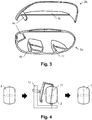
- Fig. 3 shows the positive forms 2a and 2b now in an oblique view. Specifically, approximately one quarter of the positive shape is formed by the lower part 2a and another quarter by the upper part 2b Good to see in this illustration, the functional components, namely the dashboard 4a, the holder 4b for a seat, and the armrest 4c. The latter also forms a cover for a widening arranged in the lower part 2a, which can be filled up, for example, with insulating material or can also accommodate an audio system. In order to facilitate the assembly of the positive molds 2a, 2b, these dowel pins / fitting holes 11 have. Equally, of course, other means can be used which ensure the exact alignment of the positive forms 2a, 2b. In order to obtain a stable positive mold 2a, 2b, the parts 2a, 2b can of course also be glued, welded or permanently connected in any other way.
- Fig. 4 shows now the steps of an exemplary manufacturing method for producing a passenger compartment 1.
- a positive mold 2 is produced or provided in a first step (left image). This can, for example, as in Fig. 3 be executed.
- the positive mold 2 is clamped in a winding machine 12 and wound with a fiber strand 11 (middle image).
- the fiber strand 11 may be unimpregnated (roving) or impregnated with a plastic matrix (prepreg).
- the fiber strand 11 may also contain fibers made of thermoplastic material.
- the positive mold 2 can also be covered with fiber braids, fiber fabrics, fiber knits or fiber webs.
- the fibers may contain, for example, glass fibers, Kevlar fibers, aramid fibers, carbon fibers, vegetable fibers, rock fibers, thermoplastic fibers or mixtures thereof.
- the positive mold itself may consist of thermoplastic material and be produced for example by injection molding.
- the passenger compartment 1 is finished, in which the outer shell 3 is impregnated with resin (if rovings are used), or cured directly in the autoclave (if prepregs or thermoplastic fibers are used).
- resin if rovings are used
- cured directly in the autoclave if prepregs or thermoplastic fibers are used.
- the resulting hollow body is shown in the right picture.
- this step can also take place in a negative mold, so that the passenger compartment 1 is virtually finished after curing.
- the production of a passenger compartment 1 in the manner shown can be very efficient, since the wrapping of the positive mold 2 in a winding machine 12 and thus can be done automatically.
- the orientation of the fibers in the outer shell 3 is very homogeneous.
- the manufacturing process is also favored by the fact that the positive mold 2 can remain in the finished passenger compartment 1.
- doors 9 and / or covers are separated out of the passenger compartment 1 and then movably connected to the passenger compartment 1.
- the windows 10a..10c are also cut out.
- the separation can be done for example by means of a milling cutter, a laser cutting process or a water jet cutting process.
- the advantage of this procedure is that the outer shell 3 is initially made self-contained, whereby the passenger compartment 1 can be easily produced in a winding machine 12.
- the orientation of the fibers in the passenger compartment 1 is very homogeneous, since they are routed to the door 9 in the manufacture of the outer shell 3 on the later separation surface.
- the outer shape of a motor vehicle may be different than shown.
- the add-on parts 7 and 8 can also be integrated in the passenger compartment and the engine compartment can be closed, for example, with a separate plate.
Landscapes
- Engineering & Computer Science (AREA)
- Chemical & Material Sciences (AREA)
- Mechanical Engineering (AREA)
- Composite Materials (AREA)
- Architecture (AREA)
- Structural Engineering (AREA)
- Combustion & Propulsion (AREA)
- Transportation (AREA)
- Reinforced Plastic Materials (AREA)
- Moulding By Coating Moulds (AREA)
- Laminated Bodies (AREA)
Applications Claiming Priority (3)
| Application Number | Priority Date | Filing Date | Title |
|---|---|---|---|
| US201061425902P | 2010-12-22 | 2010-12-22 | |
| DE102011114387 | 2011-09-24 | ||
| EP11796985.7A EP2655047B1 (fr) | 2010-12-22 | 2011-12-12 | Habitacle comportant une forme positive creuse et une enveloppe extérieure en plastique renforcé par fibres et fabrication de l'habitacle |
Related Parent Applications (2)
| Application Number | Title | Priority Date | Filing Date |
|---|---|---|---|
| EP11796985.7A Division EP2655047B1 (fr) | 2010-12-22 | 2011-12-12 | Habitacle comportant une forme positive creuse et une enveloppe extérieure en plastique renforcé par fibres et fabrication de l'habitacle |
| EP11796985.7A Division-Into EP2655047B1 (fr) | 2010-12-22 | 2011-12-12 | Habitacle comportant une forme positive creuse et une enveloppe extérieure en plastique renforcé par fibres et fabrication de l'habitacle |
Publications (1)
| Publication Number | Publication Date |
|---|---|
| EP3141380A1 true EP3141380A1 (fr) | 2017-03-15 |
Family
ID=45349499
Family Applications (2)
| Application Number | Title | Priority Date | Filing Date |
|---|---|---|---|
| EP16194108.3A Withdrawn EP3141380A1 (fr) | 2010-12-22 | 2011-12-12 | Compartiment passager avec un moule positif creux et une enveloppe extérieure en plastique renforcé à la fibre de verre et sa fabrication |
| EP11796985.7A Not-in-force EP2655047B1 (fr) | 2010-12-22 | 2011-12-12 | Habitacle comportant une forme positive creuse et une enveloppe extérieure en plastique renforcé par fibres et fabrication de l'habitacle |
Family Applications After (1)
| Application Number | Title | Priority Date | Filing Date |
|---|---|---|---|
| EP11796985.7A Not-in-force EP2655047B1 (fr) | 2010-12-22 | 2011-12-12 | Habitacle comportant une forme positive creuse et une enveloppe extérieure en plastique renforcé par fibres et fabrication de l'habitacle |
Country Status (3)
| Country | Link |
|---|---|
| EP (2) | EP3141380A1 (fr) |
| DE (1) | DE112011104538A5 (fr) |
| WO (1) | WO2012084560A2 (fr) |
Families Citing this family (1)
| Publication number | Priority date | Publication date | Assignee | Title |
|---|---|---|---|---|
| DE102017117410A1 (de) * | 2017-08-01 | 2019-02-07 | Rehau Ag & Co | Verfahren zur Herstellung eines Verkleidungsteils |
Citations (7)
| Publication number | Priority date | Publication date | Assignee | Title |
|---|---|---|---|---|
| GB1057344A (en) * | 1964-03-30 | 1967-02-01 | Midland Ross Corp | Container or enclosure wall unit |
| GB1490575A (en) * | 1974-12-02 | 1977-11-02 | Pikaz Inzenyrsky Podnik | Body for a road or rail vehicle or for a container |
| US4705716A (en) | 1985-04-01 | 1987-11-10 | Jinsheng Tang | Integral car body made of composite material |
| EP0554539A1 (fr) * | 1992-01-28 | 1993-08-11 | Inventio Ag | Procédé de fabrication de caisses monogues de véhicules |
| FR2894869A1 (fr) | 2005-12-20 | 2007-06-22 | Airbus France Sas | Procede de fabrication d'un fuselage d'aeronef en materiau composite |
| WO2009068127A1 (fr) | 2007-11-28 | 2009-06-04 | Daimler Ag | Procédé de fabrication d'un corps creux composite renforcé par fibres à orientation des fibres optimisée en matière de flux de force et de tension |
| WO2010107766A1 (fr) * | 2009-03-19 | 2010-09-23 | Ballard Lon R | Chassis de vehicule en mousse renforce |
Family Cites Families (2)
| Publication number | Priority date | Publication date | Assignee | Title |
|---|---|---|---|---|
| JP2935722B2 (ja) * | 1990-02-28 | 1999-08-16 | 富士重工業株式会社 | 航空機の胴体構造およびその成形方法 |
| US6296301B1 (en) * | 1999-12-21 | 2001-10-02 | Daimlerchrysler Corporation | Motor vehicle body structure using a woven fiber |
-
2011
- 2011-12-12 EP EP16194108.3A patent/EP3141380A1/fr not_active Withdrawn
- 2011-12-12 EP EP11796985.7A patent/EP2655047B1/fr not_active Not-in-force
- 2011-12-12 DE DE112011104538T patent/DE112011104538A5/de not_active Withdrawn
- 2011-12-12 WO PCT/EP2011/072394 patent/WO2012084560A2/fr not_active Ceased
Patent Citations (7)
| Publication number | Priority date | Publication date | Assignee | Title |
|---|---|---|---|---|
| GB1057344A (en) * | 1964-03-30 | 1967-02-01 | Midland Ross Corp | Container or enclosure wall unit |
| GB1490575A (en) * | 1974-12-02 | 1977-11-02 | Pikaz Inzenyrsky Podnik | Body for a road or rail vehicle or for a container |
| US4705716A (en) | 1985-04-01 | 1987-11-10 | Jinsheng Tang | Integral car body made of composite material |
| EP0554539A1 (fr) * | 1992-01-28 | 1993-08-11 | Inventio Ag | Procédé de fabrication de caisses monogues de véhicules |
| FR2894869A1 (fr) | 2005-12-20 | 2007-06-22 | Airbus France Sas | Procede de fabrication d'un fuselage d'aeronef en materiau composite |
| WO2009068127A1 (fr) | 2007-11-28 | 2009-06-04 | Daimler Ag | Procédé de fabrication d'un corps creux composite renforcé par fibres à orientation des fibres optimisée en matière de flux de force et de tension |
| WO2010107766A1 (fr) * | 2009-03-19 | 2010-09-23 | Ballard Lon R | Chassis de vehicule en mousse renforce |
Also Published As
| Publication number | Publication date |
|---|---|
| DE112011104538A5 (de) | 2013-09-19 |
| WO2012084560A2 (fr) | 2012-06-28 |
| EP2655047A2 (fr) | 2013-10-30 |
| WO2012084560A3 (fr) | 2012-09-13 |
| EP2655047B1 (fr) | 2019-01-30 |
Similar Documents
| Publication | Publication Date | Title |
|---|---|---|
| DE102005059933B4 (de) | Flechttechnisch hergestelltes Faserverbundbauteil | |
| DE69009726T2 (de) | Ansatzloser fahrradrahmen aus verbundwerkstoff und sein herstellungsverfahren. | |
| EP3580048B1 (fr) | Procédé de fabrication d'un profilé porteur creux en matériau composite renforcé par des fibres et utilisation du profilé porteur creux en matériau composite renforcé par des fibres | |
| DE102012005434B3 (de) | Lenksäule mit im Flechtverfahren hergestellten Faserverbundelementen | |
| DE102012007005B4 (de) | Leichtbaulenksäule aus Faserverbundwerkstoff | |
| EP3374167B1 (fr) | Procédé de fabrication pour piece de vehicule en matière composite | |
| DE112015002298B4 (de) | Verfahren und System zum Herstellen eines Verbund-Rohrknotens | |
| EP3165430B1 (fr) | Procédé de fabrication d'une structure de liaison comprenant au moins deux composants profilés, et structure de liaison et carrosserie | |
| EP1567385B1 (fr) | Tableau de bord et procede de realisation | |
| EP3071395A1 (fr) | Élément composite en matière plastique renforcée de fibres et procédé de fabrication d'un élément composite en matière plastique renforcée de fibres, en particulier d'un élément de carrosserie de véhicule à moteur | |
| EP2497624A2 (fr) | Demi-produit en fibre comprenant une âme et procédé de fabrication d'un composant en matière synthétique renforcé par des fibres | |
| WO2014118004A1 (fr) | Noyau et procédé de fabrication de demi-produits en matière plastique renforcée de fibres | |
| EP2626218B1 (fr) | Procédé de fabrication d'une jante à base de matière première composite en fibres et jante pour un véhicule automobile | |
| EP3423263A1 (fr) | Procédé pour fabriquer une pièce de structure creuse renforcée par des fibres ainsi que pièce de structure creuse | |
| EP3165428B1 (fr) | Structure de liaison pour carrosserie de véhicule, son procédé de fabrication et carrosserie de véhicule comprenant au moins une structure de liaison | |
| EP2655047B1 (fr) | Habitacle comportant une forme positive creuse et une enveloppe extérieure en plastique renforcé par fibres et fabrication de l'habitacle | |
| DE102008029518B4 (de) | Verfahren zur Herstellung von Faserverbundbauteilen und Faserverbundbauteile | |
| DE102011003747A1 (de) | Faserverstärktes Bauteil und Verfahren zur Herstellung eines faserverstärkten Bauteils | |
| DE102007054087A1 (de) | Verfahren zur Herstellung eines Faserverbundbauteils und Vorrichtung hierfür | |
| DE102011114389A1 (de) | Verfahren zur Herstellung eines schalenförmigen Hohlkörpers sowie eine Verwendung dafür | |
| DE102017119797A1 (de) | Verfahren und Formwerkzeug zur Herstellung eines Faserverbund-Hohlkörpers | |
| DE102010003656A1 (de) | KFZ-Verkleidungsbauteil mit daran bereichsweise vorgesehenem Wärmeschutzbauteil aus Kunststoffmaterial und Verfahren zur Herstellung desselben | |
| EP3224031B1 (fr) | Procédé de fabrication d'un groupe d'éléments structuraux et groupe d'éléments structuraux | |
| EP2873518A1 (fr) | Procédé de fabrication d'un composant en composite renforcé en fibres | |
| DE29700151U1 (de) | Sicherheitstank |
Legal Events
| Date | Code | Title | Description |
|---|---|---|---|
| PUAI | Public reference made under article 153(3) epc to a published international application that has entered the european phase |
Free format text: ORIGINAL CODE: 0009012 |
|
| AC | Divisional application: reference to earlier application |
Ref document number: 2655047 Country of ref document: EP Kind code of ref document: P |
|
| AK | Designated contracting states |
Kind code of ref document: A1 Designated state(s): AL AT BE BG CH CY CZ DE DK EE ES FI FR GB GR HR HU IE IS IT LI LT LU LV MC MK MT NL NO PL PT RO RS SE SI SK SM TR |
|
| 17P | Request for examination filed |
Effective date: 20170727 |
|
| RBV | Designated contracting states (corrected) |
Designated state(s): AL AT BE BG CH CY CZ DE DK EE ES FI FR GB GR HR HU IE IS IT LI LT LU LV MC MK MT NL NO PL PT RO RS SE SI SK SM TR |
|
| GRAP | Despatch of communication of intention to grant a patent |
Free format text: ORIGINAL CODE: EPIDOSNIGR1 |
|
| INTG | Intention to grant announced |
Effective date: 20181123 |
|
| STAA | Information on the status of an ep patent application or granted ep patent |
Free format text: STATUS: THE APPLICATION IS DEEMED TO BE WITHDRAWN |
|
| 18D | Application deemed to be withdrawn |
Effective date: 20190404 |