EP3141897B1 - Procédé de prédiction de propriétés physico-chimiques d'une fraction de distillation de pétrole - Google Patents
Procédé de prédiction de propriétés physico-chimiques d'une fraction de distillation de pétrole Download PDFInfo
- Publication number
- EP3141897B1 EP3141897B1 EP16188167.7A EP16188167A EP3141897B1 EP 3141897 B1 EP3141897 B1 EP 3141897B1 EP 16188167 A EP16188167 A EP 16188167A EP 3141897 B1 EP3141897 B1 EP 3141897B1
- Authority
- EP
- European Patent Office
- Prior art keywords
- chemical
- physical properties
- oil
- atmospheric
- distillation
- Prior art date
- Legal status (The legal status is an assumption and is not a legal conclusion. Google has not performed a legal analysis and makes no representation as to the accuracy of the status listed.)
- Active
Links
Images




Classifications
-
- G—PHYSICS
- G01—MEASURING; TESTING
- G01N—INVESTIGATING OR ANALYSING MATERIALS BY DETERMINING THEIR CHEMICAL OR PHYSICAL PROPERTIES
- G01N33/00—Investigating or analysing materials by specific methods not covered by groups G01N1/00 - G01N31/00
- G01N33/26—Oils; Viscous liquids; Paints; Inks
- G01N33/28—Oils, i.e. hydrocarbon liquids
- G01N33/2823—Raw oil, drilling fluid or polyphasic mixtures
-
- G—PHYSICS
- G01—MEASURING; TESTING
- G01N—INVESTIGATING OR ANALYSING MATERIALS BY DETERMINING THEIR CHEMICAL OR PHYSICAL PROPERTIES
- G01N24/00—Investigating or analyzing materials by the use of nuclear magnetic resonance, electron paramagnetic resonance or other spin effects
- G01N24/08—Investigating or analyzing materials by the use of nuclear magnetic resonance, electron paramagnetic resonance or other spin effects by using nuclear magnetic resonance
Definitions
- the present invention relate to a prediction method of chemical-physical properties of a fraction of distillation of a petroleum (oil).
- the invention relates to a prediction method of the properties of a fraction of distillation of a oil, which can be implemented without the need to carry out the actual distillation, and still more in detail a prediction method of the properties of the residue of a oil, wherein by residue it is intended a heavy fraction of the dstillation of oil.
- Muller [ Müller A.L.H., Picoloto R.S., de Azevedo Mello P., Ferr ⁇ o M.F., dos Santos M.d.F.P., Guimar ⁇ es R.C.L., Müller E.I., and Flores E.M.M., Spectrochimica Acta 2012, Part A 89 ] determined the total content of sulfur in atmospheric and vacuum residues, by means of ATR-FTIR spectroscopy.
- the patent EP859952B1 describes a method for predicting the properties of oil fractions by exploiting the correlation between their IR spectrum and the properties of interest.
- De Peinder [ De Peinder P., Petrauskas D.D., Singelenberg F., Salvatori F., Visser T., Soulimani F., and Weckhuysen B.M., Applied Spectroscopy 2008, 62 ; De Peinder P., Visser T., Petrauskas D.D., Salvatori F., Soulimani F., Weckhuysen B.M., Vibrational Spectroscopy 2009, 51 .] verified the possibility of using the IR spectra of oil to estimate the properties of the atmospheric residue as a function of the flash temperature.
- the related procedure is also subject of the European patent EP2142908B1 (originally published as WO2008/135411 ).
- the patent describes a method to predict the physical chemical properties of a residue that can be obtained from the distillation of crude oil (at certain parametric conditions) by applying a correlation-based predictive model that includes characteristic parameters of the distillation process.
- the method does not require correlations to include, descriptive physical chemical properties of oil.
- the international application WO2013/102916 describes a method for the prediction of the processability, quality and cost of oil and its distillates through correlations that can also use the physical chemical properties of oil, obtained through standard analytical methods. However, the method does not involve the use of spectroscopic data.
- the solution according to the present invention aims to provide a method to obtain the information contained in the NMR spectrum of an oil connected with the chemical-physical properties of the fractions of civilic and vacuum distillation, by exploiting the correlation that exists between the oil properties and the properties of its fractions, consequently significantly improving the capacity of prediction of the properties of industrial interest of distillation fractions.
- Purpose of the present invention is therefore to provide a prediction method of chemical-physical properties of a fraction of a oil distillation which overcomes the limits of the prediction methods according to the prior art and to obtain the technical results previously described.
- Another aim of the invention is that said prediction method can be implemented with substantially low costs.
- Another object of the invention is to propose a prediction method of chemical-physical properties of a fraction of a oil distillation that is simple, safe and reliable.
- the analytical method developed according to the present invention allows to accurately estimate the properties of a fraction of atmospheric distillation and a fraction of vacuum distillation, without carrying out the distillation, through the application of a partial least squares (PLS) regression model, starting from the spectrum 1 H NMR of the oil, which is concatenated with selected chemical-physical properties, respectively, of oil and of the fraction of atmospheric distillation.
- PLS partial least squares
- the set of samples, collected over three years, consists of 70 oils from 18 different geographical areas, and presents a wide range of composition and chemical-physical properties.
- Table 1 shows maximum and minimum values of chemical and physical parameters of the analyzed oils and residues, analytically determined.
- Table 1 Oil Atmospheric residue Vacuum residue U.M.
- the properties of the oils were determined by means of standard analytical methods ASTM. To obtain the residue, the samples were subjected to atmospheric distillation (atmospheric residue AR) and vacuum distillation (vacuum residue VR). The residues were then in turn characterised by means of standard analytical methods ASTM.
- the proton spectra ( 1 H NMR) used for the development of the method were obtained with a Varian Unity INOVA 300 spectrometer (Varian Inc., Palo Alto, CA (USA)) that operates at a frequency of 299,905 MHz.
- TMS tetramethylsilane
- the acquisition was made with a spectral window of 4382Hz, equal to 14,6ppm, and with magnetization pulse of 90° ( ⁇ /2) of the duration of 8,1 ⁇ s and a recovery time between two successive transients of 30s.
- the spectra were obtained at a temperature of 25°C.
- the sequence is completed by the setting of a time of acquisition of 1,5s.
- the number of transients used for the acquisition of spectra with a good signal/noise ratio is 128.
- a multivariate calibration refers to the construction of a mathematical expression that binds a property, or a chemical physical parameter, to the experimental set of data, for example the absorbance as a function of wavelength in a set of IR spectra, or the intensity as a function of the chemichal shift in the case of NMR data.
- One of the most common methods of constructing these mathematical expressions is the partial least squares PLS regression.
- the PLS regression is a well-known multivariate analysis method, used to find the fundamental relationships between two data matrixs (X and Y).
- This method relates the dependent variable y with an independent set of variables X, through the reduction of the matrix in its main components and the use of the latter for the regression with the variable y.
- the PLS simultaneously models both matrixs X and Y to find the latent variables in X that best predict the latent variables in Y.
- the PLS regression is particularly suited to the NMR spectral data, that is, matrixs X having more variables that observable. In the specific case of the present invention,the PLS regression was implemented using the well-known PLS-1 algorithm.
- the 178 areas obtained by the 1 H NMR spectra constitute the elements of the matrix X (70 x 178) of spectral data, and the analytical data of the residues form the matrix Y of the chemical-physical properties.
- the chemometric models for predicting properties of the residue from 1 H NMR spectra of the oils have been developed using a unique set for the calibration and validation, the model performance has been evaluated with the known cross-validation method with the exception of an object at a time, ie, with a leave-one-out cross-validation (CVloo).
- the performance of the models were evaluated in terms of: number of factors used, standard error in cross validation (SECV).
- SECV standard deviation of the differences between the analytically measured values and those estimated from NMR models.
- the models were developed using the software The Unscrambler X® 10.2 (CAMO Software AS, Computer Aided Modeling, Norway).
- the calibration process of PLS models is divided into two parts, one which is more properly computational and one which is analytical.
- the steps characterising the first stage can be summarized as follows:
- the prediction models were constructed starting from the matrix Y of the chemical-physical properties of residues and the matrix Z, formed by the matrix X of the 1 H NMR spectra of the oils and the chemical-physical properties of the same oils.
- the matrix Z is called "expanded matrix”.
- Models were developed for the characteristic properties of the residues: acidity (expressed as total acid numer or TAN), asphaltenes, MCRT carbon residue, the content of sulfur and metals (Ni, V, Fe) of the atmospheric residue were correlated using the 1 H NMR spectrum of the oil, from time to time expanded with the analogous properties of the oil; similarly, the viscosity blending number VBN, asphaltenes, MCRT carbon residue, the content of sulfur and metals (Ni, V, Fe) of the vacuum residue, were correlated using the spectrum 1 H NMR of the oil, expanded this time with the properties of the atmospheric residue. The performance of the proposed method were compared with those of the NMR models without making use of additional properties.
- the models for the VR properties have been developed using the matrix Z of the "expanded spectra", obtained this time by combining the matrix of 1 H NMR spectra of the oil with a column with the corresponding AR properties.
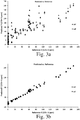
- Figures 5-8 are graphically represented sulfur ( Figures 5a and 5b ), MCRT ( Figures 6a and 6b ), nickel ( Figures 7a and 7b ) and VBN ( Figures 8a and 8b ).
- the results of the prediction method according to the present invention are well represented in the graphs of regressions.
- both of the AR and of the VR it is observed a substantial improvement of performance by switching from the models that use only the spectra to those in which an analytical property is added: the SECV values decrease significantly, in some cases more than one half, for example, for the prediction models of the content of asphaltenes, MCRT and metals.
- the prediction method of chemical-physical properties of a fraction of a oil distillation according to the present invention provides more accurate results, not only with respect to the methods which make use of the spectra of the oils, but also with respect to the prediction methods developed using the spectra of the residues [ Nielsen K.E., Dittmer J., Malmendal A., and Nielsen N.C., Energy & Fuels 2008, 22 ].
- the prediction method of the chemical-physical properties of a distillation fraction of a oil according to the present invention the current limits of the applications that use the IR and NMR spectroscopy to characterize the oils residues are overcome, without having to make the distillation.
- the applications of the prediction method of chemical-physical properties of a distillation fraction of a oil according to the present invention may be different.
- the prediction method of chemical-physical properties of a distillation fraction of a oil according to the present invention as such.
- a small portion of the oil sample is taken for the acquisition of the proton spectrum while another portion is used for the determination of the required parameters (eg. asphaltenes, MCRT, TAN, sulfur, nickel, vanadium and iron).
- the spectrum is processed in the manner described in the experimental part and concatenated with the chemical-physical properties previously determined in the oil.
- the values of the properties of atmospheric residue are estimated by applying the prediction model according to the present invention to the expanded spectrum of the unknown sample.
- the method for the VR can be used without the need to perform the analysis of the AR residue, concatenating to the spectrum of the oil the values estimated with the new method, instead of the analytically determined properties of the AR residue. Then, using the predicted properties, it is possible to obtain, without having to perform any distillation, both the estimates of the AR properties and those of VR properties.
- the method of prediction of chemical-physical properties of a distillation fraction of an oil provides for the use of PLS models on the expanded spectra, created by combining the NMR spectra with information of physical chemical character. It represents a valuable alternative to laboratory methods usually used to estimate the properties of oil residues, offering the huge advantage of avoiding the distillation of oil to its fractions before they can be characterised, with considerable savings in terms of time and money.
- the method of prediction according to the present invention is applicable to any complex mixture divisible into sub-samples, the percentage content of which is worthy of note and the properties of which are reflected on the starting mixture; making use of other spectroscopic techniques; using different algorithms; using chemical-physical properties for the creation of the "expanded spectra" which are different from those that it is desired to predict.
Landscapes
- Chemical & Material Sciences (AREA)
- Physics & Mathematics (AREA)
- Health & Medical Sciences (AREA)
- Life Sciences & Earth Sciences (AREA)
- General Physics & Mathematics (AREA)
- Engineering & Computer Science (AREA)
- Biochemistry (AREA)
- General Health & Medical Sciences (AREA)
- High Energy & Nuclear Physics (AREA)
- Immunology (AREA)
- Pathology (AREA)
- Analytical Chemistry (AREA)
- Chemical Kinetics & Catalysis (AREA)
- General Chemical & Material Sciences (AREA)
- Oil, Petroleum & Natural Gas (AREA)
- Food Science & Technology (AREA)
- Medicinal Chemistry (AREA)
- Investigating Or Analysing Materials By Optical Means (AREA)
Claims (5)
- Procédé de prédiction de propriétés physicochimiques d'une fraction d'une distillation atmosphérique d'une huile, qui comprend les étapes suivantes consistant à :- retirer un premier échantillon de ladite huile et obtenir son spectre RMN 1H ;- retirer un second échantillon de ladite huile et déterminer analytiquement, selon des procédés analytiques standard, les mêmes propriétés physicochimiques pour lesquelles on souhaite faire une prédiction par rapport à ladite fraction de distillation atmosphérique ;- élaborer un « spectre expansé » par concaténation du spectre RMN 1H dudit premier échantillon de ladite huile avec les propriétés physiques et chimiques déterminées sur ledit second échantillon de ladite huile ;- obtenir la propriété souhaitée de ladite fraction de distillation en saisissant les données obtenues dans les étapes précédentes dans une expression mathématique représentative d'un modèle de prédiction, obtenu antérieurement par :I. sélection d'un ensemble d'huiles similaires à celles sur lesquelles l'analyse devra être effectuée ;II. obtention des spectres desdites huiles par la technique RMN 1H ;III. préparation de résidus atmosphériques par distillation desdites huiles ;IV. détermination d'un ensemble de propriétés physicochimiques desdites huiles au moyen de procédés analytiques standard ;V. détermination d'un ensemble de propriétés physicochimiques desdits résidus atmosphériques au moyen de procédés analytiques standard ; et élaboration et calibrage ultérieurs du modèle de prédiction par les étapes suivantes consistant à :VI. produire un ensemble de « spectres expansés » obtenus par la concaténation des données de propriétés physicochimiques de l'étape IV dans le cas de la détermination de propriétés physicochimiques d'une fraction de distillation atmosphérique avec les spectres obtenus à l'étape II ;VII. effectuer une régression avec un procédé de calibrage multivariable de l'ensemble de « spectres expansés » obtenus à l'étape VI avec les propriétés physicochimiques des résidus atmosphérique de l'étape V.
- Procédé de prédiction de propriétés physicochimiques d'une fraction de distillation sous vide d'une huile, qui comprend les étapes suivantes consistant à :- retirer un premier échantillon de ladite huile et obtenir son spectre RMN 1H ;- retirer un second échantillon de ladite huile et le soumettre à une distillation atmosphérique pour obtenir le résidu et déterminer analytiquement, selon des procédés analytiques standard, les mêmes propriétés physicochimiques pour lesquelles on souhaite faire une prédiction par rapport à ladite fraction de distillation sous vide ;- élaborer un « spectre expansé » par concaténation du spectre RMN 1H dudit premier échantillon de ladite huile avec les propriétés physicochimiques déterminées sur ledit échantillon du résidu de ladite distillation atmosphérique ;- obtenir la propriété souhaitée de ladite fraction de distillation sous vide en saisissant les données obtenues dans les étapes précédentes dans une expression mathématique représentative d'un modèle de prédiction, obtenu antérieurement par :I. sélection d'un ensemble d'huiles similaires à celles sur lesquelles l'analyse devra être effectuée ;II. obtention des spectres desdites huiles par la technique RMN 1H ;III. préparation de résidus atmosphériques et sous vide par distillation desdites huiles ;IV. détermination d'un ensemble de propriétés physicochimiques desdites huiles au moyen de procédés analytiques standard ;V. détermination d'un ensemble de propriétés physicochimiques desdits résidus atmosphériques et sous vide au moyen de procédés analytiques standard ; et élaboration et calibrage ultérieurs du modèle de prédiction par les étapes suivantes consistant à :VI. produire un ensemble de « spectres expansés » obtenus par la concaténation des données de propriétés physicochimiques des résidus atmosphériques de l'étape V avec les spectres obtenus à l'étape II ;VII. effectuer une régression avec un procédé de calibrage multivariable de l'ensemble de « spectres expansés » obtenus à l'étape VI avec les propriétés physicochimiques des résidus atmosphériques et sous vide de l'étape V.
- Procédé de prédiction de propriétés physicochimiques d'une fraction de distillation sous vide d'une huile, qui comprend les étapes suivantes consistant à :- retirer un premier échantillon de ladite huile et obtenir son spectre RMN 1H ;- retirer un second échantillon de ladite huile et déterminer selon une application du procédé de production de la revendication 1 les propriétés physicochimiques d'un résidu atmosphérique pour lequel on souhaite faire une prédiction concernant ladite fraction de distillation sous vide ;- élaborer un « spectre expansé » par concaténation du spectre RMN 1H dudit premier échantillon de ladite huile avec les propriétés physicochimiques d'un résidu de distillation atmosphérique dudit échantillon d'huile ;- obtenir la propriété souhaitée de ladite fraction de distillation sous vide en saisissant les données obtenues dans les étapes précédentes dans une expression mathématique représentative d'un modèle de prédiction, obtenu antérieurement par :I. sélection d'un ensemble d'huiles similaires à celles sur lesquelles l'analyse devra être effectuée ;II. obtention des spectres desdites huiles par la technique RMN 1H ;III. préparation de résidus atmosphériques et sous vide par distillation desdites huiles ;IV. détermination d'un ensemble de propriétés physicochimiques desdites huiles au moyen de procédés analytiques standard ;V. détermination d'un ensemble de propriétés physicochimiques desdits résidus atmosphériques et sous vide au moyen de procédés analytiques standard ; et élaboration et calibrage ultérieurs du modèle de prédiction par les étapes suivantes consistant à :VI. produire un ensemble de « spectres expansés » obtenus par la concaténation des données de propriétés physicochimiques des résidus atmosphériques de l'étape V avec les spectres obtenus à l'étape II ;VII. effectuer une régression avec un procédé de calibrage multivariable de l'ensemble de « spectres expansés » obtenus à l'étape VI avec les propriétés physicochimiques des résidus atmosphériques et/ou sous vide de l'étape V.
- Procédé de prédiction de propriétés physicochimiques d'une fraction de distillation atmosphérique et/ou sous vide d'une huile selon l'une quelconque des revendications précédentes, caractérisé en ce que les spectres sont concaténés dans une pluralité de propriétés physicochimiques de ladite huile ou de ladite fraction de distillation atmosphérique.
- Procédé de prédiction de propriétés physicochimiques d'une fraction de distillation atmosphérique et/ou sous vide d'une huile selon l'une quelconque des revendications précédentes, caractérisé en ce que les spectres sont concaténés dans une propriété physicochimique de ladite huile ou de ladite fraction de distillation atmosphérique différente de celle qui doit être déterminée.
Applications Claiming Priority (1)
| Application Number | Priority Date | Filing Date | Title |
|---|---|---|---|
| ITUB2015A003510A ITUB20153510A1 (it) | 2015-09-09 | 2015-09-09 | Metodo di predizione di proprieta chimico fisiche di una frazione di distillazione di petrolio. |
Publications (2)
| Publication Number | Publication Date |
|---|---|
| EP3141897A1 EP3141897A1 (fr) | 2017-03-15 |
| EP3141897B1 true EP3141897B1 (fr) | 2020-02-12 |
Family
ID=54884179
Family Applications (1)
| Application Number | Title | Priority Date | Filing Date |
|---|---|---|---|
| EP16188167.7A Active EP3141897B1 (fr) | 2015-09-09 | 2016-09-09 | Procédé de prédiction de propriétés physico-chimiques d'une fraction de distillation de pétrole |
Country Status (3)
| Country | Link |
|---|---|
| EP (1) | EP3141897B1 (fr) |
| ES (1) | ES2789323T3 (fr) |
| IT (1) | ITUB20153510A1 (fr) |
Families Citing this family (2)
| Publication number | Priority date | Publication date | Assignee | Title |
|---|---|---|---|---|
| CN113640262A (zh) * | 2021-07-30 | 2021-11-12 | 安徽科技学院 | 一种利用荧光法进行快速鉴别堆肥腐熟程度的技术方法 |
| CN119250657B (zh) * | 2024-12-06 | 2025-05-27 | 江西省水利科学院(江西省大坝安全管理中心、江西省水资源管理中心) | 一种基于分层特性的疏浚弃渣资源化利用潜力评估方法 |
Family Cites Families (5)
| Publication number | Priority date | Publication date | Assignee | Title |
|---|---|---|---|---|
| EP0304232B1 (fr) | 1987-08-18 | 1996-12-27 | Bp Oil International Limited | Procédé de détermination directe des propriétés physiques de produits hydrocarbonés |
| AR003845A1 (es) * | 1995-10-18 | 1998-09-09 | Shell Int Research | Un método para predecir una propiedad física de un residuo de petróleo crudo, de un petróleo combustible (fuel oil) residual o de un material bituminoso. |
| WO2008135411A1 (fr) * | 2007-05-02 | 2008-11-13 | Shell Internationale Research Maatschappij B.V. | Procédé permettant de prédire une propriété physique d'un résidu obtenu à partir de pétrole brut |
| US20150106027A1 (en) * | 2011-02-22 | 2015-04-16 | Omer Refa Koseoglu | Characterization of crude oil by nmr spectroscopy |
| EP2699900B1 (fr) * | 2012-01-06 | 2019-02-13 | Bharat Petroleum Corporation Limited | Prédiction de caractéristiques liées au raffinage du pétrole |
-
2015
- 2015-09-09 IT ITUB2015A003510A patent/ITUB20153510A1/it unknown
-
2016
- 2016-09-09 ES ES16188167T patent/ES2789323T3/es active Active
- 2016-09-09 EP EP16188167.7A patent/EP3141897B1/fr active Active
Non-Patent Citations (1)
| Title |
|---|
| None * |
Also Published As
| Publication number | Publication date |
|---|---|
| ITUB20153510A1 (it) | 2017-03-09 |
| EP3141897A1 (fr) | 2017-03-15 |
| ES2789323T3 (es) | 2020-10-26 |
Similar Documents
| Publication | Publication Date | Title |
|---|---|---|
| Xiaobo et al. | Variables selection methods in near-infrared spectroscopy | |
| Lee et al. | Random forest as a potential multivariate method for near-infrared (NIR) spectroscopic analysis of complex mixture samples: Gasoline and naphtha | |
| Ye et al. | Non-destructive prediction of protein content in wheat using NIRS | |
| Masili et al. | Prediction of physical–chemical properties of crude oils by 1H NMR analysis of neat samples and chemometrics | |
| CN109324014B (zh) | 一种自适应的原油性质近红外快速预测方法 | |
| US9244052B2 (en) | Global crude oil quality monitoring using direct measurement and advanced analytic techniques for raw material valuation | |
| Olivieri et al. | MVC3: a MATLAB graphical interface toolbox for third-order multivariate calibration | |
| US20180196778A1 (en) | Method for Correlating Physical and Chemical Measurement Data Sets to Predict Physical and Chemical Properties | |
| CN107817223A (zh) | 快速无损实时预测原油性质模型的构建方法及其应用 | |
| Wang et al. | Near-infrared wavelength-selection method based on joint mutual information and weighted bootstrap sampling | |
| CN105388123A (zh) | 一种由近红外光谱预测原油性质的方法 | |
| Rodrigues et al. | Evaluation of calibration transfer methods using the ATR-FTIR technique to predict density of crude oil | |
| Gómez-Carracedo et al. | Selecting the optimum number of partial least squares components for the calibration of attenuated total reflectance-mid-infrared spectra of undesigned kerosene samples | |
| Satya et al. | Estimation of properties of crude oil residual fractions using chemometrics | |
| WO2024011687A1 (fr) | Procédé et appareil pour l'établissement d'un modèle d'évaluation rapide de propriété physique de produit pétrolier | |
| US20060047444A1 (en) | Method for analyzing an unknown material as a blend of known materials calculated so as to match certain analytical data and predicting properties of the unknown based on the calculated blend | |
| Zhu et al. | An effective and rapid approach to predict molecular composition of naphtha based on raw NIR spectra | |
| Laxalde et al. | Combining near and mid infrared spectroscopy for heavy oil characterisation | |
| CN103134763B (zh) | 由红外光谱预测原油密度的方法 | |
| US6477516B1 (en) | System and method for predicting parameter of hydrocarbon with spectroscopy and neural networks | |
| Garcia et al. | Diesel cetane number estimation from NIR spectra of hydrocracking total effluent | |
| Leal et al. | Data driven models exploring the combination of NIR and 1H NMR spectroscopies in the determination of gasoline properties | |
| EP3141897B1 (fr) | Procédé de prédiction de propriétés physico-chimiques d'une fraction de distillation de pétrole | |
| CN107966499A (zh) | 一种由近红外光谱预测原油碳数分布的方法 | |
| EP3861320B1 (fr) | Systèmes et procédés de résolution chimique implicite de gasoil sous vide et détermination de la qualité d'ajustement |
Legal Events
| Date | Code | Title | Description |
|---|---|---|---|
| PUAI | Public reference made under article 153(3) epc to a published international application that has entered the european phase |
Free format text: ORIGINAL CODE: 0009012 |
|
| STAA | Information on the status of an ep patent application or granted ep patent |
Free format text: STATUS: THE APPLICATION HAS BEEN PUBLISHED |
|
| AK | Designated contracting states |
Kind code of ref document: A1 Designated state(s): AL AT BE BG CH CY CZ DE DK EE ES FI FR GB GR HR HU IE IS IT LI LT LU LV MC MK MT NL NO PL PT RO RS SE SI SK SM TR |
|
| AX | Request for extension of the european patent |
Extension state: BA ME |
|
| STAA | Information on the status of an ep patent application or granted ep patent |
Free format text: STATUS: REQUEST FOR EXAMINATION WAS MADE |
|
| 17P | Request for examination filed |
Effective date: 20170915 |
|
| RBV | Designated contracting states (corrected) |
Designated state(s): AL AT BE BG CH CY CZ DE DK EE ES FI FR GB GR HR HU IE IS IT LI LT LU LV MC MK MT NL NO PL PT RO RS SE SI SK SM TR |
|
| RIC1 | Information provided on ipc code assigned before grant |
Ipc: G01N 33/28 20060101AFI20180430BHEP Ipc: G01N 24/08 20060101ALI20180430BHEP |
|
| STAA | Information on the status of an ep patent application or granted ep patent |
Free format text: STATUS: EXAMINATION IS IN PROGRESS |
|
| 17Q | First examination report despatched |
Effective date: 20180704 |
|
| GRAP | Despatch of communication of intention to grant a patent |
Free format text: ORIGINAL CODE: EPIDOSNIGR1 |
|
| STAA | Information on the status of an ep patent application or granted ep patent |
Free format text: STATUS: GRANT OF PATENT IS INTENDED |
|
| INTG | Intention to grant announced |
Effective date: 20190829 |
|
| GRAS | Grant fee paid |
Free format text: ORIGINAL CODE: EPIDOSNIGR3 |
|
| GRAA | (expected) grant |
Free format text: ORIGINAL CODE: 0009210 |
|
| STAA | Information on the status of an ep patent application or granted ep patent |
Free format text: STATUS: THE PATENT HAS BEEN GRANTED |
|
| AK | Designated contracting states |
Kind code of ref document: B1 Designated state(s): AL AT BE BG CH CY CZ DE DK EE ES FI FR GB GR HR HU IE IS IT LI LT LU LV MC MK MT NL NO PL PT RO RS SE SI SK SM TR |
|
| REG | Reference to a national code |
Ref country code: GB Ref legal event code: FG4D |
|
| REG | Reference to a national code |
Ref country code: CH Ref legal event code: EP |
|
| REG | Reference to a national code |
Ref country code: AT Ref legal event code: REF Ref document number: 1232821 Country of ref document: AT Kind code of ref document: T Effective date: 20200215 |
|
| REG | Reference to a national code |
Ref country code: IE Ref legal event code: FG4D |
|
| REG | Reference to a national code |
Ref country code: DE Ref legal event code: R096 Ref document number: 602016029417 Country of ref document: DE |
|
| PG25 | Lapsed in a contracting state [announced via postgrant information from national office to epo] |
Ref country code: RS Free format text: LAPSE BECAUSE OF FAILURE TO SUBMIT A TRANSLATION OF THE DESCRIPTION OR TO PAY THE FEE WITHIN THE PRESCRIBED TIME-LIMIT Effective date: 20200212 Ref country code: FI Free format text: LAPSE BECAUSE OF FAILURE TO SUBMIT A TRANSLATION OF THE DESCRIPTION OR TO PAY THE FEE WITHIN THE PRESCRIBED TIME-LIMIT Effective date: 20200212 Ref country code: NO Free format text: LAPSE BECAUSE OF FAILURE TO SUBMIT A TRANSLATION OF THE DESCRIPTION OR TO PAY THE FEE WITHIN THE PRESCRIBED TIME-LIMIT Effective date: 20200512 |
|
| REG | Reference to a national code |
Ref country code: LT Ref legal event code: MG4D |
|
| REG | Reference to a national code |
Ref country code: NL Ref legal event code: MP Effective date: 20200212 |
|
| PG25 | Lapsed in a contracting state [announced via postgrant information from national office to epo] |
Ref country code: SE Free format text: LAPSE BECAUSE OF FAILURE TO SUBMIT A TRANSLATION OF THE DESCRIPTION OR TO PAY THE FEE WITHIN THE PRESCRIBED TIME-LIMIT Effective date: 20200212 Ref country code: LV Free format text: LAPSE BECAUSE OF FAILURE TO SUBMIT A TRANSLATION OF THE DESCRIPTION OR TO PAY THE FEE WITHIN THE PRESCRIBED TIME-LIMIT Effective date: 20200212 Ref country code: BG Free format text: LAPSE BECAUSE OF FAILURE TO SUBMIT A TRANSLATION OF THE DESCRIPTION OR TO PAY THE FEE WITHIN THE PRESCRIBED TIME-LIMIT Effective date: 20200512 Ref country code: IS Free format text: LAPSE BECAUSE OF FAILURE TO SUBMIT A TRANSLATION OF THE DESCRIPTION OR TO PAY THE FEE WITHIN THE PRESCRIBED TIME-LIMIT Effective date: 20200612 Ref country code: GR Free format text: LAPSE BECAUSE OF FAILURE TO SUBMIT A TRANSLATION OF THE DESCRIPTION OR TO PAY THE FEE WITHIN THE PRESCRIBED TIME-LIMIT Effective date: 20200513 Ref country code: HR Free format text: LAPSE BECAUSE OF FAILURE TO SUBMIT A TRANSLATION OF THE DESCRIPTION OR TO PAY THE FEE WITHIN THE PRESCRIBED TIME-LIMIT Effective date: 20200212 |
|
| PG25 | Lapsed in a contracting state [announced via postgrant information from national office to epo] |
Ref country code: NL Free format text: LAPSE BECAUSE OF FAILURE TO SUBMIT A TRANSLATION OF THE DESCRIPTION OR TO PAY THE FEE WITHIN THE PRESCRIBED TIME-LIMIT Effective date: 20200212 |
|
| REG | Reference to a national code |
Ref country code: ES Ref legal event code: FG2A Ref document number: 2789323 Country of ref document: ES Kind code of ref document: T3 Effective date: 20201026 |
|
| PG25 | Lapsed in a contracting state [announced via postgrant information from national office to epo] |
Ref country code: SK Free format text: LAPSE BECAUSE OF FAILURE TO SUBMIT A TRANSLATION OF THE DESCRIPTION OR TO PAY THE FEE WITHIN THE PRESCRIBED TIME-LIMIT Effective date: 20200212 Ref country code: RO Free format text: LAPSE BECAUSE OF FAILURE TO SUBMIT A TRANSLATION OF THE DESCRIPTION OR TO PAY THE FEE WITHIN THE PRESCRIBED TIME-LIMIT Effective date: 20200212 Ref country code: SM Free format text: LAPSE BECAUSE OF FAILURE TO SUBMIT A TRANSLATION OF THE DESCRIPTION OR TO PAY THE FEE WITHIN THE PRESCRIBED TIME-LIMIT Effective date: 20200212 Ref country code: EE Free format text: LAPSE BECAUSE OF FAILURE TO SUBMIT A TRANSLATION OF THE DESCRIPTION OR TO PAY THE FEE WITHIN THE PRESCRIBED TIME-LIMIT Effective date: 20200212 Ref country code: DK Free format text: LAPSE BECAUSE OF FAILURE TO SUBMIT A TRANSLATION OF THE DESCRIPTION OR TO PAY THE FEE WITHIN THE PRESCRIBED TIME-LIMIT Effective date: 20200212 Ref country code: LT Free format text: LAPSE BECAUSE OF FAILURE TO SUBMIT A TRANSLATION OF THE DESCRIPTION OR TO PAY THE FEE WITHIN THE PRESCRIBED TIME-LIMIT Effective date: 20200212 Ref country code: CZ Free format text: LAPSE BECAUSE OF FAILURE TO SUBMIT A TRANSLATION OF THE DESCRIPTION OR TO PAY THE FEE WITHIN THE PRESCRIBED TIME-LIMIT Effective date: 20200212 Ref country code: PT Free format text: LAPSE BECAUSE OF FAILURE TO SUBMIT A TRANSLATION OF THE DESCRIPTION OR TO PAY THE FEE WITHIN THE PRESCRIBED TIME-LIMIT Effective date: 20200705 |
|
| REG | Reference to a national code |
Ref country code: DE Ref legal event code: R097 Ref document number: 602016029417 Country of ref document: DE |
|
| REG | Reference to a national code |
Ref country code: AT Ref legal event code: MK05 Ref document number: 1232821 Country of ref document: AT Kind code of ref document: T Effective date: 20200212 |
|
| PLBE | No opposition filed within time limit |
Free format text: ORIGINAL CODE: 0009261 |
|
| STAA | Information on the status of an ep patent application or granted ep patent |
Free format text: STATUS: NO OPPOSITION FILED WITHIN TIME LIMIT |
|
| 26N | No opposition filed |
Effective date: 20201113 |
|
| PG25 | Lapsed in a contracting state [announced via postgrant information from national office to epo] |
Ref country code: AT Free format text: LAPSE BECAUSE OF FAILURE TO SUBMIT A TRANSLATION OF THE DESCRIPTION OR TO PAY THE FEE WITHIN THE PRESCRIBED TIME-LIMIT Effective date: 20200212 |
|
| PG25 | Lapsed in a contracting state [announced via postgrant information from national office to epo] |
Ref country code: SI Free format text: LAPSE BECAUSE OF FAILURE TO SUBMIT A TRANSLATION OF THE DESCRIPTION OR TO PAY THE FEE WITHIN THE PRESCRIBED TIME-LIMIT Effective date: 20200212 Ref country code: PL Free format text: LAPSE BECAUSE OF FAILURE TO SUBMIT A TRANSLATION OF THE DESCRIPTION OR TO PAY THE FEE WITHIN THE PRESCRIBED TIME-LIMIT Effective date: 20200212 |
|
| PG25 | Lapsed in a contracting state [announced via postgrant information from national office to epo] |
Ref country code: MC Free format text: LAPSE BECAUSE OF FAILURE TO SUBMIT A TRANSLATION OF THE DESCRIPTION OR TO PAY THE FEE WITHIN THE PRESCRIBED TIME-LIMIT Effective date: 20200212 |
|
| REG | Reference to a national code |
Ref country code: CH Ref legal event code: PL |
|
| REG | Reference to a national code |
Ref country code: BE Ref legal event code: MM Effective date: 20200930 |
|
| PG25 | Lapsed in a contracting state [announced via postgrant information from national office to epo] |
Ref country code: LU Free format text: LAPSE BECAUSE OF NON-PAYMENT OF DUE FEES Effective date: 20200909 |
|
| PG25 | Lapsed in a contracting state [announced via postgrant information from national office to epo] |
Ref country code: CH Free format text: LAPSE BECAUSE OF NON-PAYMENT OF DUE FEES Effective date: 20200930 Ref country code: BE Free format text: LAPSE BECAUSE OF NON-PAYMENT OF DUE FEES Effective date: 20200930 Ref country code: IE Free format text: LAPSE BECAUSE OF NON-PAYMENT OF DUE FEES Effective date: 20200909 Ref country code: LI Free format text: LAPSE BECAUSE OF NON-PAYMENT OF DUE FEES Effective date: 20200930 |
|
| PG25 | Lapsed in a contracting state [announced via postgrant information from national office to epo] |
Ref country code: TR Free format text: LAPSE BECAUSE OF FAILURE TO SUBMIT A TRANSLATION OF THE DESCRIPTION OR TO PAY THE FEE WITHIN THE PRESCRIBED TIME-LIMIT Effective date: 20200212 Ref country code: MT Free format text: LAPSE BECAUSE OF FAILURE TO SUBMIT A TRANSLATION OF THE DESCRIPTION OR TO PAY THE FEE WITHIN THE PRESCRIBED TIME-LIMIT Effective date: 20200212 Ref country code: CY Free format text: LAPSE BECAUSE OF FAILURE TO SUBMIT A TRANSLATION OF THE DESCRIPTION OR TO PAY THE FEE WITHIN THE PRESCRIBED TIME-LIMIT Effective date: 20200212 |
|
| PG25 | Lapsed in a contracting state [announced via postgrant information from national office to epo] |
Ref country code: MK Free format text: LAPSE BECAUSE OF FAILURE TO SUBMIT A TRANSLATION OF THE DESCRIPTION OR TO PAY THE FEE WITHIN THE PRESCRIBED TIME-LIMIT Effective date: 20200212 Ref country code: AL Free format text: LAPSE BECAUSE OF FAILURE TO SUBMIT A TRANSLATION OF THE DESCRIPTION OR TO PAY THE FEE WITHIN THE PRESCRIBED TIME-LIMIT Effective date: 20200212 |
|
| REG | Reference to a national code |
Ref country code: DE Ref legal event code: R081 Ref document number: 602016029417 Country of ref document: DE Owner name: UNIVERSITA DEGLI STUDI DI CAGLIARI, IT Free format text: FORMER OWNERS: SARAS RICERCHE E TECNOLOGIE S.P.A., ASSEMINI (CA), IT; UNIVERSITA DEGLI STUDI DI CAGLIARI, CAGLIARI, IT Ref country code: DE Ref legal event code: R081 Ref document number: 602016029417 Country of ref document: DE Owner name: SARLUX S.R.L., SARROCH, IT Free format text: FORMER OWNERS: SARAS RICERCHE E TECNOLOGIE S.P.A., ASSEMINI (CA), IT; UNIVERSITA DEGLI STUDI DI CAGLIARI, CAGLIARI, IT |
|
| PGFP | Annual fee paid to national office [announced via postgrant information from national office to epo] |
Ref country code: DE Payment date: 20240702 Year of fee payment: 9 |
|
| PGFP | Annual fee paid to national office [announced via postgrant information from national office to epo] |
Ref country code: GB Payment date: 20240701 Year of fee payment: 9 |
|
| PGFP | Annual fee paid to national office [announced via postgrant information from national office to epo] |
Ref country code: FR Payment date: 20240702 Year of fee payment: 9 |
|
| PGFP | Annual fee paid to national office [announced via postgrant information from national office to epo] |
Ref country code: IT Payment date: 20240905 Year of fee payment: 9 |
|
| PGFP | Annual fee paid to national office [announced via postgrant information from national office to epo] |
Ref country code: ES Payment date: 20241003 Year of fee payment: 9 |
|
| REG | Reference to a national code |
Ref country code: GB Ref legal event code: 732E Free format text: REGISTERED BETWEEN 20250109 AND 20250115 |
|
| REG | Reference to a national code |
Ref country code: ES Ref legal event code: PC2A Owner name: SARAS RICERCHE E TECNOLOGIE S.R.L. Effective date: 20260406 |