EP3142008A2 - Systeme und verfahren zur zuweisung von umweltregulierter feinkohle - Google Patents
Systeme und verfahren zur zuweisung von umweltregulierter feinkohle Download PDFInfo
- Publication number
- EP3142008A2 EP3142008A2 EP16186915.1A EP16186915A EP3142008A2 EP 3142008 A2 EP3142008 A2 EP 3142008A2 EP 16186915 A EP16186915 A EP 16186915A EP 3142008 A2 EP3142008 A2 EP 3142008A2
- Authority
- EP
- European Patent Office
- Prior art keywords
- slack
- time
- tpe
- allocation
- environmentally regulated
- Prior art date
- Legal status (The legal status is an assumption and is not a legal conclusion. Google has not performed a legal analysis and makes no representation as to the accuracy of the status listed.)
- Granted
Links
Images




Classifications
-
- G—PHYSICS
- G06—COMPUTING OR CALCULATING; COUNTING
- G06F—ELECTRIC DIGITAL DATA PROCESSING
- G06F9/00—Arrangements for program control, e.g. control units
- G06F9/06—Arrangements for program control, e.g. control units using stored programs, i.e. using an internal store of processing equipment to receive or retain programs
- G06F9/46—Multiprogramming arrangements
- G06F9/48—Program initiating; Program switching, e.g. by interrupt
- G06F9/4806—Task transfer initiation or dispatching
- G06F9/4843—Task transfer initiation or dispatching by program, e.g. task dispatcher, supervisor, operating system
- G06F9/4881—Scheduling strategies for dispatcher, e.g. round robin, multi-level priority queues
- G06F9/4887—Scheduling strategies for dispatcher, e.g. round robin, multi-level priority queues involving deadlines, e.g. rate based, periodic
-
- G—PHYSICS
- G06—COMPUTING OR CALCULATING; COUNTING
- G06F—ELECTRIC DIGITAL DATA PROCESSING
- G06F9/00—Arrangements for program control, e.g. control units
- G06F9/06—Arrangements for program control, e.g. control units using stored programs, i.e. using an internal store of processing equipment to receive or retain programs
- G06F9/46—Multiprogramming arrangements
- G06F9/50—Allocation of resources, e.g. of the central processing unit [CPU]
- G06F9/5005—Allocation of resources, e.g. of the central processing unit [CPU] to service a request
- G06F9/5027—Allocation of resources, e.g. of the central processing unit [CPU] to service a request the resource being a machine, e.g. CPUs, Servers, Terminals
- G06F9/5038—Allocation of resources, e.g. of the central processing unit [CPU] to service a request the resource being a machine, e.g. CPUs, Servers, Terminals considering the execution order of a plurality of tasks, e.g. taking priority or time dependency constraints into consideration
-
- G—PHYSICS
- G06—COMPUTING OR CALCULATING; COUNTING
- G06F—ELECTRIC DIGITAL DATA PROCESSING
- G06F9/00—Arrangements for program control, e.g. control units
- G06F9/06—Arrangements for program control, e.g. control units using stored programs, i.e. using an internal store of processing equipment to receive or retain programs
- G06F9/46—Multiprogramming arrangements
- G06F9/48—Program initiating; Program switching, e.g. by interrupt
- G06F9/4806—Task transfer initiation or dispatching
- G06F9/4843—Task transfer initiation or dispatching by program, e.g. task dispatcher, supervisor, operating system
- G06F9/4881—Scheduling strategies for dispatcher, e.g. round robin, multi-level priority queues
- G06F9/4893—Scheduling strategies for dispatcher, e.g. round robin, multi-level priority queues taking into account power or heat criteria
-
- Y—GENERAL TAGGING OF NEW TECHNOLOGICAL DEVELOPMENTS; GENERAL TAGGING OF CROSS-SECTIONAL TECHNOLOGIES SPANNING OVER SEVERAL SECTIONS OF THE IPC; TECHNICAL SUBJECTS COVERED BY FORMER USPC CROSS-REFERENCE ART COLLECTIONS [XRACs] AND DIGESTS
- Y02—TECHNOLOGIES OR APPLICATIONS FOR MITIGATION OR ADAPTATION AGAINST CLIMATE CHANGE
- Y02D—CLIMATE CHANGE MITIGATION TECHNOLOGIES IN INFORMATION AND COMMUNICATION TECHNOLOGIES [ICT], I.E. INFORMATION AND COMMUNICATION TECHNOLOGIES AIMING AT THE REDUCTION OF THEIR OWN ENERGY USE
- Y02D10/00—Energy efficient computing, e.g. low power processors, power management or thermal management
Definitions
- Time partitioned processing systems are typically used for safety critical real time applications where critical tasks need to be guaranteed time to execute.
- the granularity at which time partitioning is applied differs among scheduling paradigms, where in some paradigms a number of tasks share a common time budget, and in other paradigms each task has an independent budget.
- a TPE can be, for example, a 653 Partition which encompasses multiple tasks, or it can be a time partitioned RMA thread. Accordingly, such TPEs are allocated time periods with guaranteed processing time budgets in which they are executed.
- the budget for each TPE is established under worst case cache conditions and account for worst case code paths to ensure that they provide sufficient processing time for the TPE to complete the budgeted task with still some additional margin padding.
- TPEs often complete their budgeted task with time to spare within their allocated partition leaving slack time available.
- budget padding can be extreme because execution time variation of TPEs tend to increase and worst case cross-core interference is assumed for memory interactions, real-time operating system critical sections assume worst case timing interactions between cores, etc.
- thermal margins between the processor operating temperature and the local ambient environment, and/or the heat dissipating capacity of the processing system are reduced. This reduces the thermal margin available to continue operation during an event that may quickly increase the temperature of the operating environment.
- unbounded slack utilization can lead to a thermal overload of the processor so that the scheduling of noncritical tasks during slack time may compromise the ability of the system to execute the safety critical TPEs.
- Embodiments of the present invention provide methods and systems for allocation of environmentally regulated slack and will be understood by reading and studying the following specification.
- a time partitioned processing system comprises: at least one processing core; a memory coupled to the at least one processing core; a real-time operating system, the real-time operating system including a scheduler configured to partition processing time for the at least one processing core into a plurality of time periods, wherein the scheduler further budgets a pre-determined duration of processing time for executing a first budgeted time partitioned entity (TPE) by allocating at least a first allocation of time to the first budgeted TPE; wherein the scheduler utilizes at least a portion of processing time within the plurality of time periods not used to execute the first budgeted TPE or any other budgeted TPE as environmentally regulated slack; wherein the scheduler allocates at least a portion of environmentally regulated slack to one or more slack consuming TPEs based on a measurement of one or more operational environment parameters associated with the at least one processing core.
- TPE first budgeted time partitioned entity
- Embodiments of the present disclosure provide system and methods that introduce an environment monitor which is utilized by a time-partitioned processing system to evaluate when (and/or how much) slack time may be allocated to time partitioned entities desiring such allocations.
- the system's task scheduler can take advantage of the large amount of slack time that is generated by time partitioned systems and provide a slack shaping capability that is regulated based on environmental constraints such as thermal and/or power constraints.
- the embodiments described herein provides protection against a slack consumer detrimentally driving thermal characteristics and margins of the system.
- a mild processor sleep state may also be mandated during those slack times when no useful work can be scheduled due to environmental throttling of slack time use.
- time partitioned entity or "TPE” as used herein is intended to refer to any segment of executable computer instructions (that is, a segment of a program) such as, but not necessarily limited to, threads in a time-partitioned RMA, a multithread application, an ARINC 653 partition, tasks executed in some other time window where multiple tasks share the time quota, and may refer to a single task or a group of tasks sharing a common budget.
- partitioned may include space and time partitioning in Safety-critical avionics Real-time operating systems as defined by Avionics Application Standard Software Interface ARINC (653), but is not so limited. They may refer to any pre-determined duration of time periods budgeted on a processor for the execution of TPEs.
- FIG. 1 is a diagram illustrating at 100 a time partitioned processing system of one embodiment of the present disclosure.
- System 100 includes one or more processing cores 112 coupled to a memory 114 and a real-time operating system (RTOS) 111.
- RTOS real-time operating system
- System 100 is a time partitioned processing system in that RTOS 111 partitions access to the one or more processing cores 112 so that high priority tasks, referred to herein as budgeted TPEs, are executed in time periods having a pre-determined duration of time budgeted to execution of these TPEs.
- all of the one or more processing cores 112 while in others only a subset of the total number of cores is time partitioned.
- some portion of the processing timeline for one or more of the cores 112 may be time partitioned while another segment of the timeline is not.
- the time budget provides sufficient time to complete their budgeted tasks without interference or corruption from the execution of other tasks.
- Scheduling of the execution of TPEs (for both TPEs executing on fixed budget and those executing on slack) on the one or more processing cores 112 is performed by the scheduler 116, which may be a component of the RTOS 111.
- scheduler 116 allocates slack time to TPEs desiring slack time processing resources based on other operational considerations.
- scheduler 116 in addition to considering what slack time is available and what TPEs are requesting access to that slack time, also considers environmental parameters (such as the operating temperature of the one or more processing cores 112, or other element of system 100, or ambient temperature) and/or operational parameters (such as power constraints). To that end, in the embodiment shown in Figure 1 scheduler 116 either comprises or otherwise interfaces with an operational environment monitor 118 that is coupled to at least one processor operating environment sensor 120 and a slack allocation policy 119. It should be appreciated that in alternate embodiments, the environment monitor 118 and the slack allocation policy 119 may be part of the real-time-operating system 111, or one or both may be alternately implemented as a board support package.
- the operating environment sensor 120 may comprise a sensing device such as a voltage, current, power or temperature sensor, or a combination thereof, and may be integral to the processor core(s) 112 or implemented using separate hardware components.
- Environment monitor 118 receives and processes the data from sensor 120. In one embodiment, environment monitor 118, based on the data from sensor 120, compares the sensor data to various pre-determined categories of possible operating conditions and from that determines a current operating environment state which may be communicated to the scheduler 116. For example, if the data from sensor 120 indicates temperature and power draw within a predefined normal operating range, then environment monitor 118, then environment monitor 118 may indicate the current operating environment state as "Normal".
- environment monitor 118 may indicate the current operating environment state as exceeding the moderate temperature threshold.
- a plurality of different possible operating state categories may be established for different thresholds and ranges of the parameters measured by sensor 120.
- Slack-time allocation policy 119 sets forth criteria or rules applied by scheduler 116 indicating which, if any, and/or when slack consuming TPEs may be executed depending on the current operating conditions as defined by environment monitor 118.
- power limits can be assessed by environment monitor 118 based on power draw, current draw, or by voltage levels or voltage fluctuations, or some combination thereof.
- Power related thresholds may be assessed instantaneously or averaged over some period of time.
- temperature values can be assessed as a unit temperature, board temperature, or temperature as measured from a processor core or package sensor. In one embodiment, these temperatures can be assessed for the purposes of monitoring by taking periodic instantaneous values, or averaging temperature readings over some period of time, or even by taking several temperature readings into account. Detection can be accomplished by software, hardware, or through some combination of hardware and software. In alternate implementations, power and/or temperature thresholds can be enforced with or without hysteresis.
- FIG. 2 is a diagram illustrating at 200 an example of a periodically arbitrary time period 202 scheduled by scheduler 116 for system 100.
- time period 202 may be a reoccurring time period of a larger frame such as a reoccurring time slot.
- this is not necessarily the case and may just be some duration of time budgeted for execution of a TPE which was allocated on some other basis.
- a budgeted TPE 210 is scheduled to execute during time period 202 and is guaranteed by scheduler 116 the full time of time period 202 to complete its task.
- the remaining balance of time in time period 202 (shown at 205) comprises environmentally regulated slack (ERS) 220.
- ERS 220 comprises slack time that may be allocated to a slack consuming TPE to take up all or part of the remaining time in time period 202. Whether or not ERS 220 is allocated to execute a slack consuming TPE is determined by scheduler 116 based on applying slack-time allocation policy 119 to the current operating state defined by environment monitor 118.
- Figure 2A at 250 illustrates another sequence of separate time periods (shown at 202A, 202B, 202C, ... 202Q) which may be scheduled by scheduler 116 for executing budgeted TPE, slack consuming TPE, or some combination thereof.
- each of the time periods shown in Figure 2A may be equal in duration, but that is not necessarily so in other embodiments.
- a budgeted TPE "X" is executed which consumes the entirety of that time period leaving no slack time for scheduler 116 to allocate.
- TPE "X" is provided sufficient budgeted time to perform its critical tasks, it may also desire additional time to execute auxiliary tasks and request slack time from scheduler 116 for that purpose.
- a TPE which is categorized as a "budgeted TPE" during its own budgeted time periods may be categorized as a slack-consuming TPE if executed during slack-time of other time periods that are budgeted to other budgeted TPEs, or time period set aside for slack-consuming TPEs.
- other TPEs may be pure slack consuming, and only executed during available slack time. Such pure slack consuming are low priority tasks that are never guaranteed any execution time.
- Time periods 202B and 202C execute the respective budgeted TPEs Y and Z.
- the balance of processing time available for environmentally regulated slack in each of these time periods will depend on the how much of the time period was consumed by the respective budgeted TPEs Y and Z.
- some time periods may optionally be dedicated entirely as environmentally regulated slack for executing slack consuming TPEs and not budgeted to a critical TPE.
- the provisioning of time period 202Q provides that for each cycle of partitions, at least some slack-time will be available if the current operating environment state permits.
- one or more time periods may be reserved for conditionally scheduled TPEs. Such time periods present a reserved duration of time in the timeline that will be used for a specific ERS consuming TPE and otherwise becomes restricted slack.
- TPE A for example
- TPE B for example
- each successive time period for executing a budgeted TPE has an opportunity (if so configured) to start early.
- budget TPE B is also configured to be a slack consumer, it may potentially exceed its scheduled duration (i.e., the duration of its original time period 202E) and use up slack accumulated from earlier time periods in the timeline, though it cannot extend its execution time to go beyond its originally configured end time of time period 202E.
- a "clean-up" time period which may be schedule at the end of a timeline which inherits all of the slack time accumulated up until then. Time period 202Q in Figure 2A , may be implemented for such a purpose.
- a time partitioned RMA may have no dedicated time slots at all.
- TPEs that use less than their budgeted time allotment donate to a slack pool. Later TPEs can use that time if so configured as slack consumers. Unbudgeted CPU time is of course included in the slack pool by default.
- slack-time allocation policy 119 can be tailored to provide flexibility in how slack time is throttled or curtailed. Scheduling of slack consuming TPEs may be controlled in a manner where non-essential task activity is gradually scaled back and even completely disallowed as temperature or power usage increases.
- the specific threshold values set forth in slack-time allocation policy 119 may be implementation dependent.
- Curtailment of environmentally regulated slack can be accomplished via a timeline percentage, a priority value, or numeric indication which the scheduler 116 interprets, or via a frame map where the scheduler 116 is told to allow non-essential scheduling in certain frames only, or through commands to disable/disallow specific applications or scheduling capabilities (such as processor slack). For example, in one implementation, based on a hierarchy of increasingly severe operating environment states, allocation of the environmentally regulated slack can be increasingly curtailed.
- Environmentally regulated slack which, due to the application of slack-time allocation policy 119, is off-limits for executing slack consuming TPEs, is referred to herein as restricted slack time.
- restricted slack time when environmentally regulated slack is designated as restricted slack time, no TPE is allowed to execute during restricted slack time period, allowing the processor 112 to rest.
- processor 112 may be placed into a sleep state further reducing processor power consumption and heat production.
- an optional board support package (shown in Figure 1 at 113 coupled to processor 112) may be invoked during a time period when all environmentally regulated slack is curtailed or otherwise remains unallocated. This provides an opportunity to put processor 112 to sleep, usually until the next interrupt or periodic partition scheduling point occurs.
- environmentally regulated slack is restricted to allocation to only a limited predefined subset of slack consuming TPEs.
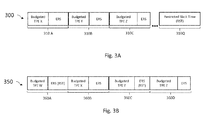
- Figure 3A at 300 shows one example implementation where because of the current operating environment state, time period 310Q is designated by scheduler 116 to be entirely restricted slack time due to the current operating environment state. In this example, scheduler 116 does not allocate any of time period 310Q for executing TPEs so that processor 112 is certain to be provided at least the duration of time period 310Q as a rest period during this cycle of partitions.
- Figure 3B at 350 shows another example implementation where slack consuming TPEs are permitted to be allocated in some partitions, but not in others.
- environmental regulated slack is available in time periods 360A (after budgeted TPE W is completed) and in 360C (after budgeted TPE Y is completed), but these unused balances of remaining time in time periods 360A and 360C are designated as restricted slack time.
- environmental regulated slack is also available in time periods 360B (after budgeted TPE X is completed) and 360 D (after budgeted TPE Z is completed) where it is not designated as restricted slack time but instead available for scheduler 116 to allocate to a slack consuming TPE.
- the percentage of environmental regulated slack available to scheduler 116 for allocation can be at least roughly controlled by regulating the percentage of timeslots designated as having restricted slack time.
- scheduler 116 may be permitted to allocate any available environmental regulated slack during time periods for a complete cycle (i.e. a frame) of partitions, while restricted during the next. It should be noted that regardless of the particular scheme used to compile slack time for use to execute slack consuming TPEs, with the embodiments of the present disclosure, when and how that slack time may utilized is further regulated based on the operating environment state of system 100.
- slack consuming TPEs may be assigned a priority value used to further regulate when they may be executed based on the operating environment state of system 100.
- all slack consuming TPEs are eligible for scheduling.
- a slack allocation policy 119 that implements priority based scheduling of environmental regulated slack is provided in the example policy 400 of Figure 4 .
- the operating environment state assigned by the environment monitor 118 may be one of several states based on the operating environment data received from the operational environment sensor 120. In this particular example, four states: Normal, Low Level Threshold Exceeded, Medium Level Threshold Exceeded, and High Level Threshold Exceeded, are defined by the environment monitor 118. In other implementations, the number of possible operating environment state may be fewer or greater than four.
- Column 420 shows the priority based rule to be implemented to curtail allocation of environmentally regulated slack as a function of the operating environment state indicated in column 410. In this example, each TPE in the population of potential slack consuming TPEs are categorized and assigned a priority.
- potential slack consuming TPEs are categorized as either priority 1, 2 or 3, with priority 1 TPEs the highest priority and priority 3 TPEs the lowest.
- the number of possible priority levels assigned to the potential slack consuming TPEs may be fewer or greater than three.
- priority 3 slack consuming TPEs When one or more designated low level thresholds are exceeded, then priority 3 slack consuming TPEs will not be allowed to utilize slack during restricted slack times, while priority 1 and 2 TPEs may continue to be scheduled to utilize slack by scheduler 116. When one or more designated medium level thresholds are exceeded, then priority 2 and priority 3 slack consuming TPEs will not be allowed to utilize slack during restricted slack times. Only priority 1 TPEs may continue to be scheduled by scheduler 116 during restricted slack times. When one or more designated high level thresholds are exceeded, then priority 1, 2 and priority 3 slack consuming TPEs will not be allowed to utilize slack during restricted slack times.
- a priority based slack allocation policy may be combined with partition based allocation curtailment such as discussed above with respect to Figures 3A and/or 3B. That is, in such an implementation, the priority based slack allocation policy would only apply to time periods with environmentally regulated slack designated as restricted slack time and not to time periods with environmentally regulated slack not designated as restricted slack time.
- Figure 5 is a flow chart diagram illustrating a method 500 of one embodiment of the present disclosure. It should be understood that method 500 may be implemented using any one of the embodiments described above. As such, elements of method 500 may be used in conjunction with, in combination with, or substituted for elements of the embodiments described above. Further, the functions, structures and other description of elements for such embodiments described above may apply to like named elements of method 500 and vice versa .
- the method begins at 510 with executing a budgeted TPE at the start of a current time period and proceeds to 520 which comprises determining when the budgeted TPE has completed execution with available time left in the current partition.
- a budgeted TPE that is scheduled to execute during a time period is guaranteed by the system scheduler the full time of the time period to complete its task.
- the remaining balance of time in that time period comprises environmentally regulated slack (ERS) which is now free for re-allocation.
- whether that environmentally regulated slack is allocated to execute a slack consuming TPE is determined based on measurements of one or more operational environment parameters (for example, temperature and/or power measurements) associated with the systems processing core or cores. This determination may be made based on applying rules defined in a slack-time allocation policy as dictated by a current operating state. While the method may begin at 510 and proceed to 520, in some implementations the method may instead begin at 530, such as would be the case for a time period such as time period 202Q discussed above during which no budgeted TPE is executed.
- the method proceeds with determining when at least one slack consuming TPE is requesting an allocation of slack time to execute on a time partitioned processing system. If not, then there is no need to make an allocation. If so, then the method proceeds to 540 with calculating a current operating environment state based on data from at least one operational environment sensor. As discussed above, allocation of environmentally regulated slack may be permitted without restrictions when the current operating environment state is normal, but throttled or curtailed when the current operating environment state indicates that one or more operating thresholds have been exceeded. Curtailment of these allocations under such permits the processor(s) to continue to operate and execute critical budgeted TPEs while maintaining sufficient margins to avoid damage or degradation.
- the method accordingly proceeds to 550 with allocating available environmentally regulated slack in a first time period to the at least one slack consuming TPE to execute on the time partitioned processing system based on the current operating environment state and a slack allocation policy, wherein the slack allocation policy defines criteria for allocating the environmentally regulated slack based on the current operating environment state.
- the slack allocation policy may implement policies to do so based on throttling the time which may be allocated to slack consuming TPEs, based on a priority assigned to each of the slack consuming TPEs, or some combination thereof.
- a time partitioned processing system comprising: at least one processing core; a memory coupled to the at least one processing core; a real-time operating system, the real-time operating system including a scheduler configured to partition processing time for the at least one processing core into a plurality of time periods, wherein the scheduler further budgets a pre-determined duration of processing time for executing a first budgeted time partitioned entity (TPE) by allocating at least a first allocation of time to the first budgeted TPE; wherein the scheduler utilizes at least a portion of processing time within the plurality of time periods not used to execute the first budgeted TPE or any other budgeted TPE as environmentally regulated slack; wherein the scheduler allocates at least a portion of environmentally regulated slack to one or more slack consuming TPEs based on a measurement of one or more operational environment parameters associated with the at least one processing core.
- TPE first budgeted time partitioned entity
- Example 2 includes the system of example 1, wherein any balance of time in a first time period remaining after execution of the first budgeted TPE is complete is utilized by the scheduler as environmentally regulated slack.
- Example 3 includes the system of any of examples 1-2, wherein at least one time period of the plurality of time periods is not utilized to schedule budgeted TPEs and is utilized as environmentally regulated slack.
- Example 4 includes the system of any of examples 1-3, further comprising: an environment monitor in communication with the scheduler; at least one operational environment sensor coupled to the environment monitor, wherein the at least one operational environment sensor measures at least one of the one or more operational environment parameters associated with the at least one processing core and the environment monitor determines an operational environment state based on the one or more operational environment parameters; and a slack allocation policy accessible to the scheduler, the slack allocation policy defining rules for the allocating environmentally regulated slack; wherein the scheduler allocates environmentally regulated slack to the one or more slack consuming TPEs based on the operational environment state determined by the environment monitor and the slack allocation policy.
- Example 5 includes the system of example 4, wherein when the operational environment state indicates that an operational environment threshold is exceeded, the scheduler designates the portion of the environmentally regulated slack as restricted slack time during which allocation of said portion of the environmentally regulated slack to slack consuming TPEs is at least partially curtailed.
- Example 6 includes the system of any of examples 4-5, wherein when the scheduler curtails allocation of environmentally regulated slack to slack consuming TPEs based on priority.
- Example 7 includes the system of any of examples 4-6, wherein when the scheduler curtails allocation of environmentally regulated slack to slack consuming TPEs by reducing the percent of environmentally regulated slack which is eligible for allocation.
- Example 8 includes the system of any of examples 4-7, wherein based on the operational environment state determined by the environment monitor and the slack allocation policy, the at least one processing core is placed into a sleep state during periods of environmentally regulated slack not allocated to at least one slack consuming TPE.
- Example 9 includes the system of example 8, further comprising a board support package coupled to the at least one processing core, wherein the board support package places the at least one processing core into the sleep state until either an interrupt or a periodic partition scheduling point occurs.
- Example 10 includes the system of any of examples 1-9, wherein the one or more operational environment parameters associated with the at least one processing core include at least one of: a temperature measurement; a measurement of power or current drawn by the at least one processing core; a measurement of voltage level; a measurement of current, power or voltage fluctuation; or a measurement of an output of a power supply to the at least one processing core.
- the one or more operational environment parameters associated with the at least one processing core include at least one of: a temperature measurement; a measurement of power or current drawn by the at least one processing core; a measurement of voltage level; a measurement of current, power or voltage fluctuation; or a measurement of an output of a power supply to the at least one processing core.
- Example 11 includes a method for environmental regulation of slack allocation for a time partitioned processing system, the method comprising: determining when at least one slack consuming time partitioned entity (TPE) is requesting an allocation of slack time to execute on a time partitioned processing system; calculating a current operating environment state based on data from at least one operational environment sensor; and allocating available environmentally regulated slack in a first time period to the at least one slack consuming TPE to execute on the time partitioned processing system based on the current operating environment state and a slack allocation policy, wherein the slack allocation policy defines criteria for allocating the environmentally regulated slack based on the current operating environment state.
- TPE time partitioned entity
- Example 12 includes the method of example 11, further comprising: executing a budgeted TPE at the start of a current time period; and determining when the budgeted TPE has completed execution with available time left in the current time period; wherein allocating available environmentally regulated slack comprises allocating environmentally regulated slack within the current time period.
- Example 13 includes the method of any of examples 11-12, wherein calculating a current operating environment state further comprises inputting one or more operational environment parameters associated with at least one processing core of the time partitioned processing system from an operational environment sensor.
- Example 14 includes the method of example 13, wherein the at least one operational environment sensor is internal to the time partitioned processing system.
- Example 15 includes the method of any of examples 11-14, wherein calculating a current operating environment state further comprises: measuring one or more operational environment parameters associated with at least one processing core of the time partitioned processing system, the one or more operational environment parameters comprising at least one of: a temperature measurement; a measurement of power or current drawn by the at least one processing core; a measurement of voltage level; a measurement of current, power or voltage fluctuation; or a measurement of an output of a power supply to the at least one processing core.
- Example 16 includes the method of any of examples 11-15, further comprising: when the operational environment state indicates that an operational environment threshold is exceeded, curtailing allocation of environmentally regulated slack to slack consuming TPEs based on a priority associated with the at least one slack consuming TPE.
- Example 17 includes the method of any of examples 11-16, further comprising: when the operational environment state indicates that an operational environment threshold is exceeded, curtailing allocation of environmentally regulated slack to slack consuming TPEs by reducing a percent of environmentally regulated slack which is eligible for allocation.
- Example 18 includes the method of any of examples 11-17, further comprising: placing at least one processing core of the time partitioned processing system into a sleep state during periods of environmentally regulated slack not allocated to at least one slack consuming TPE.
- Example 19 includes the method of example 18, wherein placing the at least one processing core into a sleep state further comprises: invoking a board support package coupled to the at least one processing core, wherein the board support package places the at least one processing core into the sleep state until either an interrupt or a periodic partition scheduling point occurs.
- system elements, method steps, or examples described throughout this disclosure may be implemented using one or more computer systems, field programmable gate arrays (FPGAs), a system on a chip (SOC), graphic processing units (GPUs), application-specific integrated circuit (ASIC) or similar devices comprising a processor coupled to a memory (such as shown in Figure 1 , for example) and executing code to realize those elements, processes, or examples, said code stored on a non-transient data storage device.
- FPGAs field programmable gate arrays
- SOC system on a chip
- GPUs graphic processing units
- ASIC application-specific integrated circuit
- FIG. 1 A block diagram illustrating an exemplary computing environment in accordance with the present disclosure.
- FIG. 1 A block diagram illustrating an exemplary computing environment in accordance with the present disclosure.
- FIG. 1 A block diagram illustrating an exemplary computing environment in accordance with the present disclosure.
- FIG. 1 A block diagram illustrating an exemplary computing environment in accordance with the present disclosure.
- FIG. 1 A block diagram illustrating an exemplary computing environment in accordance with the present disclosure.
- FIG. 1 A block diagram illustrating an exemplary computing environment in accordance with the present disclosure.
- FIG. 1 A block diagram illustrating an exemplary computing environment in accordance with the present disclosure.
- FIG. 1 A block diagram illustrating an exemplary computing environment in accordance with the present disclosure.
- FIG. 1 A block diagram illustrating an exemplary computing environment in accordance with the present disclosure.
- FIG. 1 A block diagram illustrating an exemplary computing environment in accordance with the present disclosure.
- FIG. 1 A block diagram illustrating an exemplary computing environment in accordance with the present disclosure.
Landscapes
- Engineering & Computer Science (AREA)
- Software Systems (AREA)
- Theoretical Computer Science (AREA)
- Physics & Mathematics (AREA)
- General Engineering & Computer Science (AREA)
- General Physics & Mathematics (AREA)
- Power Sources (AREA)
- Stored Programmes (AREA)
- Management, Administration, Business Operations System, And Electronic Commerce (AREA)
- Memory System (AREA)
Applications Claiming Priority (1)
| Application Number | Priority Date | Filing Date | Title |
|---|---|---|---|
| US14/848,381 US9465664B1 (en) | 2015-09-09 | 2015-09-09 | Systems and methods for allocation of environmentally regulated slack |
Publications (3)
| Publication Number | Publication Date |
|---|---|
| EP3142008A2 true EP3142008A2 (de) | 2017-03-15 |
| EP3142008A3 EP3142008A3 (de) | 2017-04-26 |
| EP3142008B1 EP3142008B1 (de) | 2022-11-16 |
Family
ID=56853498
Family Applications (1)
| Application Number | Title | Priority Date | Filing Date |
|---|---|---|---|
| EP16186915.1A Active EP3142008B1 (de) | 2015-09-09 | 2016-09-01 | Systeme und verfahren zur zuweisung von umweltregulierter feinkohle |
Country Status (3)
| Country | Link |
|---|---|
| US (1) | US9465664B1 (de) |
| EP (1) | EP3142008B1 (de) |
| JP (1) | JP6895235B2 (de) |
Families Citing this family (8)
| Publication number | Priority date | Publication date | Assignee | Title |
|---|---|---|---|---|
| US10768984B2 (en) * | 2015-06-11 | 2020-09-08 | Honeywell International Inc. | Systems and methods for scheduling tasks using sliding time windows |
| CN106681812B (zh) * | 2016-12-14 | 2020-09-29 | 西北工业大学 | 一种分区调度方法 |
| US10114981B2 (en) * | 2016-12-31 | 2018-10-30 | Intel Corporation | Architecture for telemetry and adaptive lifetime control of integrated circuits |
| US10908955B2 (en) | 2018-03-22 | 2021-02-02 | Honeywell International Inc. | Systems and methods for variable rate limiting of shared resource access |
| KR20190118277A (ko) | 2018-04-10 | 2019-10-18 | 이기용 | 칫솔 |
| US11138043B2 (en) * | 2019-05-23 | 2021-10-05 | Honeywell International s.r.o | System and methods for contingency budgeting for time-partitioned systems |
| US11409643B2 (en) | 2019-11-06 | 2022-08-09 | Honeywell International Inc | Systems and methods for simulating worst-case contention to determine worst-case execution time of applications executed on a processor |
| CN114356580B (zh) * | 2022-01-12 | 2024-05-28 | 重庆邮电大学 | 基于共享资源访问的异构多核系统任务分配方法和装置 |
Family Cites Families (23)
| Publication number | Priority date | Publication date | Assignee | Title |
|---|---|---|---|---|
| US6442700B1 (en) | 1999-08-10 | 2002-08-27 | Intel Corporation | Thermal control within systems having multiple CPU performance states |
| US6823516B1 (en) | 1999-08-10 | 2004-11-23 | Intel Corporation | System and method for dynamically adjusting to CPU performance changes |
| US7302685B2 (en) * | 2000-06-02 | 2007-11-27 | Honeywell International Inc. | Methods and apparatus for sharing slack in a time-partitioned system |
| US7140022B2 (en) | 2000-06-02 | 2006-11-21 | Honeywell International Inc. | Method and apparatus for slack stealing with dynamic threads |
| US7137117B2 (en) | 2000-06-02 | 2006-11-14 | Microsoft Corporation | Dynamically variable idle time thread scheduling |
| EP1433054A2 (de) * | 2000-12-29 | 2004-06-30 | Honeywell International, Inc. | Verfahren und gerät zum stehlen von spielraum mit dynamischen threads |
| JP3610930B2 (ja) | 2001-07-12 | 2005-01-19 | 株式会社デンソー | オペレーティングシステム、プログラム、車両用電子制御装置 |
| US8224639B2 (en) * | 2004-03-29 | 2012-07-17 | Sony Computer Entertainment Inc. | Methods and apparatus for achieving thermal management using processing task scheduling |
| JP3862715B2 (ja) * | 2004-06-01 | 2006-12-27 | 株式会社ソニー・コンピュータエンタテインメント | タスク管理方法、タスク管理装置、半導体集積回路、電子装置、およびタスク管理システム |
| DE102004054571B4 (de) * | 2004-11-11 | 2007-01-25 | Sysgo Ag | Verfahren zur Verteilung von Rechenzeit in einem Rechnersystem |
| US20070226795A1 (en) | 2006-02-09 | 2007-09-27 | Texas Instruments Incorporated | Virtual cores and hardware-supported hypervisor integrated circuits, systems, methods and processes of manufacture |
| US20080098245A1 (en) | 2006-03-22 | 2008-04-24 | G2 Microsystems, Inc. | Power management system and method |
| US8032889B2 (en) | 2006-04-05 | 2011-10-04 | Maxwell Technologies, Inc. | Methods and apparatus for managing and controlling power consumption and heat generation in computer systems |
| EP2075696A3 (de) | 2007-05-10 | 2010-01-27 | Texas Instruments Incorporated | Unterbrechungsbedingte Schaltkreise, Systeme und Verfahren |
| US8813080B2 (en) | 2007-06-28 | 2014-08-19 | Intel Corporation | System and method to optimize OS scheduling decisions for power savings based on temporal characteristics of the scheduled entity and system workload |
| US7730248B2 (en) | 2007-12-13 | 2010-06-01 | Texas Instruments Incorporated | Interrupt morphing and configuration, circuits, systems and processes |
| US7739434B2 (en) * | 2008-01-11 | 2010-06-15 | International Business Machines Corporation | Performing a configuration virtual topology change and instruction therefore |
| EP2307940A1 (de) | 2008-07-23 | 2011-04-13 | Nxp B.V. | Einstellung einer prozessorfrequenz |
| DE102010025884B3 (de) | 2010-07-02 | 2011-07-07 | Siemens Aktiengesellschaft, 80333 | Verfahren zum Betrieb eines Prozessors in einer Echtzeitumgebung |
| TWI454905B (zh) | 2011-09-30 | 2014-10-01 | 英特爾股份有限公司 | 在多核心平台中之受限制的啓動技術 |
| US8775838B2 (en) | 2012-02-01 | 2014-07-08 | Texas Instruments Incorporated | Limiting the number of unexpected wakeups in a computer system implementing a power-saving preemptive wakeup method from historical data |
| CN104321747B (zh) * | 2012-04-19 | 2017-11-17 | 西门子公司 | 用于多核/众核可编程逻辑控制器的时间裕隙应用流水线平衡 |
| US9836418B2 (en) * | 2013-03-13 | 2017-12-05 | Dornerworks, Ltd. | System and method for deterministic time partitioning of asynchronous tasks in a computing environment |
-
2015
- 2015-09-09 US US14/848,381 patent/US9465664B1/en active Active
-
2016
- 2016-09-01 EP EP16186915.1A patent/EP3142008B1/de active Active
- 2016-09-07 JP JP2016174317A patent/JP6895235B2/ja active Active
Non-Patent Citations (1)
| Title |
|---|
| None |
Also Published As
| Publication number | Publication date |
|---|---|
| EP3142008A3 (de) | 2017-04-26 |
| JP6895235B2 (ja) | 2021-06-30 |
| JP2017062779A (ja) | 2017-03-30 |
| EP3142008B1 (de) | 2022-11-16 |
| US9465664B1 (en) | 2016-10-11 |
Similar Documents
| Publication | Publication Date | Title |
|---|---|---|
| US9465664B1 (en) | Systems and methods for allocation of environmentally regulated slack | |
| US8069444B2 (en) | Method and apparatus for achieving fair cache sharing on multi-threaded chip multiprocessors | |
| Herman et al. | RTOS support for multicore mixed-criticality systems | |
| EP2624135B1 (de) | Systeme und Verfahren zum Aufgabengruppieren auf Multiprozessoren | |
| EP3129880B1 (de) | Verfahren und vorrichtung zur verstärkung und freigabe der kapazität von computerressourcen in einem echtzeit-stream-computing-system | |
| US8028286B2 (en) | Methods and apparatus for scheduling threads on multicore processors under fair distribution of cache and other shared resources of the processors | |
| Xu et al. | Cache-aware compositional analysis of real-time multicore virtualization platforms | |
| JP6668355B2 (ja) | 動的時間的電力ステアリングのためのシステム及び方法 | |
| CN105190556A (zh) | 允许确定性的实时错误恢复的任务时间分配方法 | |
| US20160364267A1 (en) | Systems and methods for scheduling tasks using sliding time windows | |
| US10402232B2 (en) | Method and system for deterministic multicore execution | |
| US9128754B2 (en) | Resource starvation management in a computer system | |
| Ghattas et al. | Preemption threshold scheduling: Stack optimality, enhancements and analysis | |
| KR102923729B1 (ko) | 다중 스레드 마이크로프로세서의 공유 리소스 할당 | |
| US10698620B2 (en) | Dynamic cache allocation | |
| US11138043B2 (en) | System and methods for contingency budgeting for time-partitioned systems | |
| Kim et al. | Using DVFS and task scheduling algorithms for a hard real-time heterogeneous multicore processor environment | |
| Melani et al. | A scheduling framework for handling integrated modular avionic systems on multicore platforms | |
| US8527999B2 (en) | Method, computer program and device for supervising a scheduler for managing the sharing of processing time in a multi-task computer system | |
| JP6156379B2 (ja) | スケジューリング装置、及び、スケジューリング方法 | |
| US9864423B2 (en) | Mitigating component performance variation | |
| KR101733339B1 (ko) | 사이버 물리 시스템을 위한 보안 제약 사항을 포함하는 실시간 스케줄링 장치 및 방법 | |
| Discepoli et al. | Compute kernels as moldable tasks: Towards real‑time gang scheduling in GPUs | |
| Starke et al. | A heterogeneous preemptive and non-preemptive scheduling approach for real-time systems on multiprocessors | |
| Schade et al. | Using Trace Data for Run-Time Optimization of Parallel Execution in Real-Time Multi-Core Systems |
Legal Events
| Date | Code | Title | Description |
|---|---|---|---|
| PUAI | Public reference made under article 153(3) epc to a published international application that has entered the european phase |
Free format text: ORIGINAL CODE: 0009012 |
|
| STAA | Information on the status of an ep patent application or granted ep patent |
Free format text: STATUS: REQUEST FOR EXAMINATION WAS MADE |
|
| 17P | Request for examination filed |
Effective date: 20160901 |
|
| AK | Designated contracting states |
Kind code of ref document: A2 Designated state(s): AL AT BE BG CH CY CZ DE DK EE ES FI FR GB GR HR HU IE IS IT LI LT LU LV MC MK MT NL NO PL PT RO RS SE SI SK SM TR |
|
| AX | Request for extension of the european patent |
Extension state: BA ME |
|
| PUAL | Search report despatched |
Free format text: ORIGINAL CODE: 0009013 |
|
| AK | Designated contracting states |
Kind code of ref document: A3 Designated state(s): AL AT BE BG CH CY CZ DE DK EE ES FI FR GB GR HR HU IE IS IT LI LT LU LV MC MK MT NL NO PL PT RO RS SE SI SK SM TR |
|
| AX | Request for extension of the european patent |
Extension state: BA ME |
|
| RIC1 | Information provided on ipc code assigned before grant |
Ipc: G06F 9/50 20060101ALI20170320BHEP Ipc: G06F 9/48 20060101AFI20170320BHEP |
|
| STAA | Information on the status of an ep patent application or granted ep patent |
Free format text: STATUS: EXAMINATION IS IN PROGRESS |
|
| 17Q | First examination report despatched |
Effective date: 20180807 |
|
| GRAP | Despatch of communication of intention to grant a patent |
Free format text: ORIGINAL CODE: EPIDOSNIGR1 |
|
| STAA | Information on the status of an ep patent application or granted ep patent |
Free format text: STATUS: GRANT OF PATENT IS INTENDED |
|
| RIC1 | Information provided on ipc code assigned before grant |
Ipc: G06F 9/48 20060101AFI20220614BHEP |
|
| INTG | Intention to grant announced |
Effective date: 20220707 |
|
| GRAS | Grant fee paid |
Free format text: ORIGINAL CODE: EPIDOSNIGR3 |
|
| GRAA | (expected) grant |
Free format text: ORIGINAL CODE: 0009210 |
|
| STAA | Information on the status of an ep patent application or granted ep patent |
Free format text: STATUS: THE PATENT HAS BEEN GRANTED |
|
| AK | Designated contracting states |
Kind code of ref document: B1 Designated state(s): AL AT BE BG CH CY CZ DE DK EE ES FI FR GB GR HR HU IE IS IT LI LT LU LV MC MK MT NL NO PL PT RO RS SE SI SK SM TR |
|
| REG | Reference to a national code |
Ref country code: GB Ref legal event code: FG4D |
|
| REG | Reference to a national code |
Ref country code: CH Ref legal event code: EP |
|
| REG | Reference to a national code |
Ref country code: IE Ref legal event code: FG4D |
|
| REG | Reference to a national code |
Ref country code: DE Ref legal event code: R096 Ref document number: 602016076322 Country of ref document: DE |
|
| REG | Reference to a national code |
Ref country code: AT Ref legal event code: REF Ref document number: 1532188 Country of ref document: AT Kind code of ref document: T Effective date: 20221215 |
|
| REG | Reference to a national code |
Ref country code: LT Ref legal event code: MG9D |
|
| REG | Reference to a national code |
Ref country code: NL Ref legal event code: MP Effective date: 20221116 |
|
| REG | Reference to a national code |
Ref country code: AT Ref legal event code: MK05 Ref document number: 1532188 Country of ref document: AT Kind code of ref document: T Effective date: 20221116 |
|
| PG25 | Lapsed in a contracting state [announced via postgrant information from national office to epo] |
Ref country code: SE Free format text: LAPSE BECAUSE OF FAILURE TO SUBMIT A TRANSLATION OF THE DESCRIPTION OR TO PAY THE FEE WITHIN THE PRESCRIBED TIME-LIMIT Effective date: 20221116 Ref country code: PT Free format text: LAPSE BECAUSE OF FAILURE TO SUBMIT A TRANSLATION OF THE DESCRIPTION OR TO PAY THE FEE WITHIN THE PRESCRIBED TIME-LIMIT Effective date: 20230316 Ref country code: NO Free format text: LAPSE BECAUSE OF FAILURE TO SUBMIT A TRANSLATION OF THE DESCRIPTION OR TO PAY THE FEE WITHIN THE PRESCRIBED TIME-LIMIT Effective date: 20230216 Ref country code: LT Free format text: LAPSE BECAUSE OF FAILURE TO SUBMIT A TRANSLATION OF THE DESCRIPTION OR TO PAY THE FEE WITHIN THE PRESCRIBED TIME-LIMIT Effective date: 20221116 Ref country code: FI Free format text: LAPSE BECAUSE OF FAILURE TO SUBMIT A TRANSLATION OF THE DESCRIPTION OR TO PAY THE FEE WITHIN THE PRESCRIBED TIME-LIMIT Effective date: 20221116 Ref country code: ES Free format text: LAPSE BECAUSE OF FAILURE TO SUBMIT A TRANSLATION OF THE DESCRIPTION OR TO PAY THE FEE WITHIN THE PRESCRIBED TIME-LIMIT Effective date: 20221116 Ref country code: AT Free format text: LAPSE BECAUSE OF FAILURE TO SUBMIT A TRANSLATION OF THE DESCRIPTION OR TO PAY THE FEE WITHIN THE PRESCRIBED TIME-LIMIT Effective date: 20221116 |
|
| PG25 | Lapsed in a contracting state [announced via postgrant information from national office to epo] |
Ref country code: RS Free format text: LAPSE BECAUSE OF FAILURE TO SUBMIT A TRANSLATION OF THE DESCRIPTION OR TO PAY THE FEE WITHIN THE PRESCRIBED TIME-LIMIT Effective date: 20221116 Ref country code: PL Free format text: LAPSE BECAUSE OF FAILURE TO SUBMIT A TRANSLATION OF THE DESCRIPTION OR TO PAY THE FEE WITHIN THE PRESCRIBED TIME-LIMIT Effective date: 20221116 Ref country code: LV Free format text: LAPSE BECAUSE OF FAILURE TO SUBMIT A TRANSLATION OF THE DESCRIPTION OR TO PAY THE FEE WITHIN THE PRESCRIBED TIME-LIMIT Effective date: 20221116 Ref country code: IS Free format text: LAPSE BECAUSE OF FAILURE TO SUBMIT A TRANSLATION OF THE DESCRIPTION OR TO PAY THE FEE WITHIN THE PRESCRIBED TIME-LIMIT Effective date: 20230316 Ref country code: HR Free format text: LAPSE BECAUSE OF FAILURE TO SUBMIT A TRANSLATION OF THE DESCRIPTION OR TO PAY THE FEE WITHIN THE PRESCRIBED TIME-LIMIT Effective date: 20221116 Ref country code: GR Free format text: LAPSE BECAUSE OF FAILURE TO SUBMIT A TRANSLATION OF THE DESCRIPTION OR TO PAY THE FEE WITHIN THE PRESCRIBED TIME-LIMIT Effective date: 20230217 |
|
| PG25 | Lapsed in a contracting state [announced via postgrant information from national office to epo] |
Ref country code: NL Free format text: LAPSE BECAUSE OF FAILURE TO SUBMIT A TRANSLATION OF THE DESCRIPTION OR TO PAY THE FEE WITHIN THE PRESCRIBED TIME-LIMIT Effective date: 20221116 |
|
| P01 | Opt-out of the competence of the unified patent court (upc) registered |
Effective date: 20230525 |
|
| PG25 | Lapsed in a contracting state [announced via postgrant information from national office to epo] |
Ref country code: SM Free format text: LAPSE BECAUSE OF FAILURE TO SUBMIT A TRANSLATION OF THE DESCRIPTION OR TO PAY THE FEE WITHIN THE PRESCRIBED TIME-LIMIT Effective date: 20221116 Ref country code: RO Free format text: LAPSE BECAUSE OF FAILURE TO SUBMIT A TRANSLATION OF THE DESCRIPTION OR TO PAY THE FEE WITHIN THE PRESCRIBED TIME-LIMIT Effective date: 20221116 Ref country code: EE Free format text: LAPSE BECAUSE OF FAILURE TO SUBMIT A TRANSLATION OF THE DESCRIPTION OR TO PAY THE FEE WITHIN THE PRESCRIBED TIME-LIMIT Effective date: 20221116 Ref country code: DK Free format text: LAPSE BECAUSE OF FAILURE TO SUBMIT A TRANSLATION OF THE DESCRIPTION OR TO PAY THE FEE WITHIN THE PRESCRIBED TIME-LIMIT Effective date: 20221116 Ref country code: CZ Free format text: LAPSE BECAUSE OF FAILURE TO SUBMIT A TRANSLATION OF THE DESCRIPTION OR TO PAY THE FEE WITHIN THE PRESCRIBED TIME-LIMIT Effective date: 20221116 |
|
| REG | Reference to a national code |
Ref country code: DE Ref legal event code: R097 Ref document number: 602016076322 Country of ref document: DE |
|
| PG25 | Lapsed in a contracting state [announced via postgrant information from national office to epo] |
Ref country code: SK Free format text: LAPSE BECAUSE OF FAILURE TO SUBMIT A TRANSLATION OF THE DESCRIPTION OR TO PAY THE FEE WITHIN THE PRESCRIBED TIME-LIMIT Effective date: 20221116 Ref country code: AL Free format text: LAPSE BECAUSE OF FAILURE TO SUBMIT A TRANSLATION OF THE DESCRIPTION OR TO PAY THE FEE WITHIN THE PRESCRIBED TIME-LIMIT Effective date: 20221116 |
|
| PLBE | No opposition filed within time limit |
Free format text: ORIGINAL CODE: 0009261 |
|
| STAA | Information on the status of an ep patent application or granted ep patent |
Free format text: STATUS: NO OPPOSITION FILED WITHIN TIME LIMIT |
|
| 26N | No opposition filed |
Effective date: 20230817 |
|
| PG25 | Lapsed in a contracting state [announced via postgrant information from national office to epo] |
Ref country code: SI Free format text: LAPSE BECAUSE OF FAILURE TO SUBMIT A TRANSLATION OF THE DESCRIPTION OR TO PAY THE FEE WITHIN THE PRESCRIBED TIME-LIMIT Effective date: 20221116 |
|
| REG | Reference to a national code |
Ref country code: CH Ref legal event code: PL |
|
| PG25 | Lapsed in a contracting state [announced via postgrant information from national office to epo] |
Ref country code: LU Free format text: LAPSE BECAUSE OF NON-PAYMENT OF DUE FEES Effective date: 20230901 |
|
| REG | Reference to a national code |
Ref country code: BE Ref legal event code: MM Effective date: 20230930 |
|
| PG25 | Lapsed in a contracting state [announced via postgrant information from national office to epo] |
Ref country code: LU Free format text: LAPSE BECAUSE OF NON-PAYMENT OF DUE FEES Effective date: 20230901 Ref country code: IT Free format text: LAPSE BECAUSE OF FAILURE TO SUBMIT A TRANSLATION OF THE DESCRIPTION OR TO PAY THE FEE WITHIN THE PRESCRIBED TIME-LIMIT Effective date: 20221116 Ref country code: MC Free format text: LAPSE BECAUSE OF FAILURE TO SUBMIT A TRANSLATION OF THE DESCRIPTION OR TO PAY THE FEE WITHIN THE PRESCRIBED TIME-LIMIT Effective date: 20221116 |
|
| REG | Reference to a national code |
Ref country code: IE Ref legal event code: MM4A |
|
| PG25 | Lapsed in a contracting state [announced via postgrant information from national office to epo] |
Ref country code: IE Free format text: LAPSE BECAUSE OF NON-PAYMENT OF DUE FEES Effective date: 20230901 |
|
| PG25 | Lapsed in a contracting state [announced via postgrant information from national office to epo] |
Ref country code: CH Free format text: LAPSE BECAUSE OF NON-PAYMENT OF DUE FEES Effective date: 20230930 |
|
| PG25 | Lapsed in a contracting state [announced via postgrant information from national office to epo] |
Ref country code: IE Free format text: LAPSE BECAUSE OF NON-PAYMENT OF DUE FEES Effective date: 20230901 Ref country code: CH Free format text: LAPSE BECAUSE OF NON-PAYMENT OF DUE FEES Effective date: 20230930 |
|
| PG25 | Lapsed in a contracting state [announced via postgrant information from national office to epo] |
Ref country code: BE Free format text: LAPSE BECAUSE OF NON-PAYMENT OF DUE FEES Effective date: 20230930 |
|
| PG25 | Lapsed in a contracting state [announced via postgrant information from national office to epo] |
Ref country code: BG Free format text: LAPSE BECAUSE OF FAILURE TO SUBMIT A TRANSLATION OF THE DESCRIPTION OR TO PAY THE FEE WITHIN THE PRESCRIBED TIME-LIMIT Effective date: 20221116 |
|
| PG25 | Lapsed in a contracting state [announced via postgrant information from national office to epo] |
Ref country code: BG Free format text: LAPSE BECAUSE OF FAILURE TO SUBMIT A TRANSLATION OF THE DESCRIPTION OR TO PAY THE FEE WITHIN THE PRESCRIBED TIME-LIMIT Effective date: 20221116 |
|
| PG25 | Lapsed in a contracting state [announced via postgrant information from national office to epo] |
Ref country code: CY Free format text: LAPSE BECAUSE OF FAILURE TO SUBMIT A TRANSLATION OF THE DESCRIPTION OR TO PAY THE FEE WITHIN THE PRESCRIBED TIME-LIMIT; INVALID AB INITIO Effective date: 20160901 |
|
| PG25 | Lapsed in a contracting state [announced via postgrant information from national office to epo] |
Ref country code: HU Free format text: LAPSE BECAUSE OF FAILURE TO SUBMIT A TRANSLATION OF THE DESCRIPTION OR TO PAY THE FEE WITHIN THE PRESCRIBED TIME-LIMIT; INVALID AB INITIO Effective date: 20160901 |
|
| PGFP | Annual fee paid to national office [announced via postgrant information from national office to epo] |
Ref country code: DE Payment date: 20250926 Year of fee payment: 10 |
|
| PGFP | Annual fee paid to national office [announced via postgrant information from national office to epo] |
Ref country code: GB Payment date: 20250923 Year of fee payment: 10 |
|
| PGFP | Annual fee paid to national office [announced via postgrant information from national office to epo] |
Ref country code: FR Payment date: 20250925 Year of fee payment: 10 |
|
| PG25 | Lapsed in a contracting state [announced via postgrant information from national office to epo] |
Ref country code: TR Free format text: LAPSE BECAUSE OF FAILURE TO SUBMIT A TRANSLATION OF THE DESCRIPTION OR TO PAY THE FEE WITHIN THE PRESCRIBED TIME-LIMIT Effective date: 20221116 |