EP3142094A1 - Algorithmuslehrvorrichtung mit blöcken - Google Patents
Algorithmuslehrvorrichtung mit blöcken Download PDFInfo
- Publication number
- EP3142094A1 EP3142094A1 EP15788874.4A EP15788874A EP3142094A1 EP 3142094 A1 EP3142094 A1 EP 3142094A1 EP 15788874 A EP15788874 A EP 15788874A EP 3142094 A1 EP3142094 A1 EP 3142094A1
- Authority
- EP
- European Patent Office
- Prior art keywords
- event
- execution
- block
- command
- algorithm
- Prior art date
- Legal status (The legal status is an assumption and is not a legal conclusion. Google has not performed a legal analysis and makes no representation as to the accuracy of the status listed.)
- Withdrawn
Links
- 230000001360 synchronised effect Effects 0.000 claims description 11
- 230000004044 response Effects 0.000 claims description 6
- 230000006870 function Effects 0.000 description 16
- 230000004913 activation Effects 0.000 description 15
- 238000001514 detection method Methods 0.000 description 6
- 238000010586 diagram Methods 0.000 description 6
- 238000000034 method Methods 0.000 description 3
- 230000008569 process Effects 0.000 description 3
- 230000000694 effects Effects 0.000 description 2
- 230000005540 biological transmission Effects 0.000 description 1
- 210000001072 colon Anatomy 0.000 description 1
- 230000023077 detection of light stimulus Effects 0.000 description 1
- 238000012986 modification Methods 0.000 description 1
- 230000004048 modification Effects 0.000 description 1
- 230000003287 optical effect Effects 0.000 description 1
- 239000012780 transparent material Substances 0.000 description 1
Images



Classifications
-
- G—PHYSICS
- G09—EDUCATION; CRYPTOGRAPHY; DISPLAY; ADVERTISING; SEALS
- G09B—EDUCATIONAL OR DEMONSTRATION APPLIANCES; APPLIANCES FOR TEACHING, OR COMMUNICATING WITH, THE BLIND, DEAF OR MUTE; MODELS; PLANETARIA; GLOBES; MAPS; DIAGRAMS
- G09B19/00—Teaching not covered by other main groups of this subclass
- G09B19/0053—Computers, e.g. programming
-
- A—HUMAN NECESSITIES
- A63—SPORTS; GAMES; AMUSEMENTS
- A63H—TOYS, e.g. TOPS, DOLLS, HOOPS OR BUILDING BLOCKS
- A63H11/00—Self-movable toy figures
-
- A—HUMAN NECESSITIES
- A63—SPORTS; GAMES; AMUSEMENTS
- A63H—TOYS, e.g. TOPS, DOLLS, HOOPS OR BUILDING BLOCKS
- A63H30/00—Remote-control arrangements specially adapted for toys, e.g. for toy vehicles
- A63H30/02—Electrical arrangements
- A63H30/04—Electrical arrangements using wireless transmission
-
- G—PHYSICS
- G09—EDUCATION; CRYPTOGRAPHY; DISPLAY; ADVERTISING; SEALS
- G09B—EDUCATIONAL OR DEMONSTRATION APPLIANCES; APPLIANCES FOR TEACHING, OR COMMUNICATING WITH, THE BLIND, DEAF OR MUTE; MODELS; PLANETARIA; GLOBES; MAPS; DIAGRAMS
- G09B1/00—Manually or mechanically operated educational appliances using elements forming, or bearing, symbols, signs, pictures, or the like which are arranged or adapted to be arranged in one or more particular ways
- G09B1/02—Manually or mechanically operated educational appliances using elements forming, or bearing, symbols, signs, pictures, or the like which are arranged or adapted to be arranged in one or more particular ways and having a support carrying or adapted to carry the elements
- G09B1/30—Manually or mechanically operated educational appliances using elements forming, or bearing, symbols, signs, pictures, or the like which are arranged or adapted to be arranged in one or more particular ways and having a support carrying or adapted to carry the elements wherein the elements are adapted to be arranged in co-operation with the support to form symbols
-
- G—PHYSICS
- G09—EDUCATION; CRYPTOGRAPHY; DISPLAY; ADVERTISING; SEALS
- G09B—EDUCATIONAL OR DEMONSTRATION APPLIANCES; APPLIANCES FOR TEACHING, OR COMMUNICATING WITH, THE BLIND, DEAF OR MUTE; MODELS; PLANETARIA; GLOBES; MAPS; DIAGRAMS
- G09B5/00—Electrically-operated educational appliances
Definitions
- the present disclosure relates to an algorithm teaching apparatus, and more particularly, to an algorithm teaching apparatus allowing children to learn algorithms subconsciously or naturally while playing with blocks like toys.
- the algorithm teaching apparatus has an event area, an execution area, and a condition area divided from each other, in which an event block mount in the event area has a different shape to that of an execution block mount in the execution area, such that the basic principles of algorithms can be easily and effectively taught to children.
- An education in algorithms is a process of learning a logical language, as well as a process of understanding which one has to be picked up and connected.
- it is important to teach the basic concepts of logical languages (e.g. how a loop operates, how to determine, how to calculate, how to acquire information that a computer provides, how to instruct a computer to work, and the like). It is also important to provide creative experiences and to provide learners with a sense of achievement about what they have created.
- Such an education in algorithms can improve the logical thinking of children, and can help children to think creatively.
- the present disclosure has been made keeping in consideration of the above problems occurring in the conventional education in algorithms, and the present disclosure is intended to propose an algorithm teaching apparatus allowing children to learn algorithms subconsciously or naturally while playing with blocks like toys.
- the present disclosure is also intended to propose an algorithm teaching apparatus having an event area, an execution area, and a condition area divided from each other, in which an event block mount in the event area has a different shape to that of an execution block mount in the execution area, such that children can easily and effectively understand the basic principles of algorithms.
- the present disclosure is also intended to propose an algorithm teaching apparatus allowing an event block, an execution block, or a variable area mounted to be activated in synchronous with the sequence of the execution of a composed algorithm, whereby children can visually determine and debug algorithms composed by themselves.
- an algorithm teaching apparatus may include: an algorithm creating section having an event block for inputting an event command or an execution block for inputting an execution command mounted thereto; an algorithm control section controlling a robot by recognizing a command code of the event block or the execution block mounted to the algorithm creating section and combining the event block and the execution block; and a communications section transmitting a control signal of the algorithm control section to the robot via a wired/wireless medium
- the algorithm creating section may include: an event area having an event block mount to which the event block for inputting the event command is mounted; and an execution area having an execution block mount to which the execution block is mounted, the execution block inputting the execution command corresponding to the event command of the event block mounted to the event block mount.
- the execution block mount for inputting the execution command subordinate to the event command of the event block mounted to the event block mount is allocated to the execution area.
- the execution block mount allocated to the execution area may include at least one execution block mount.
- the algorithm creating section may further include a variable area to be activated in one of on and off states in order to realize a condition command, thereby displaying a condition.
- the event block mount may have a first recess in which the event block is seated.
- the execution block mount may have a second recess in which the execution block is seated.
- the first recess and the second recess have different shapes such that the event block and the execution block having different shapes are seated therein.
- the event block mount may include an event block connector to which the event block is connected, the event block connector determining a mounting state of the event block or acquiring the event command from the event block.
- the execution block mount may include an execution block connector to which the execution block is connected, the execution block connector determining a mounting state of the execution block or acquiring the execution command from the execution block.
- the algorithm control section may include: a block-identifying section identifying the event block mounted to the event block mount or the execution block mounted to the execution block mount and subordinate to the event block; a command-recognizing section recognizing the event command of the identified event block or the execution command of the execution block subordinate to the identified event block and mounted to the execution block mount; and an execution control section.
- the execution control section When the event command of the identified event block has been satisfied, the execution control section generates a control signal and transmits the control signal to the robot such that the robot executes the execution command of the execution block subordinate to the identified event block and mounted to the execution block mount.
- the algorithm control section may further include an operation state output section.
- the operation state output section is synchronized with the event command or the execution command and sequentially activates the event block corresponding to the event command or the execution block corresponding to the execution command, thereby output-controlling an operating state of the event command or the execution command.
- the algorithm teaching apparatus may further include: the event block to be mounted to the event block mount of the algorithm creating section to input the event command; and the execution block to be mounted to the execution block mount of the algorithm creating section to input the execution command.
- the event blocks may have a text or an image marked on predetermined surfaces thereof, the text or the image corresponding to the event command.
- the execution blocks may have a text or an image marked on predetermined surface thereof, the text or the image corresponding to the execution command.
- an algorithm teaching apparatus may include a body and algorithm blocks.
- the body includes: an algorithm creating section including an event area having an event block mount to which an event block is mounted and an execution area having an execution block mount to which an execution block for inputting an execution command corresponding to an event command of the event block is mounted; an algorithm control section controlling a robot by recognizing a command code of the event block mounted to the event block mount or a command code of the execution block mounted to the execution block mount and combining the event block and the execution block; and a communications section transmitting a control signal of the algorithm control section to the robot via a wired/wireless medium.
- the algorithm blocks include the event block to be mounted to the event block mount to input the event command and the execution block to be mounted to the execution block mount to input the execution command.
- the algorithm control section may be synchronized with the event command or the execution command and sequentially activate the event block corresponding to the event command or the execution block corresponding to the execution command, thereby output-controlling an operating state of the event command or the execution command.
- the event block mount or the execution block mount includes an output section synchronized with the event command or the execution command to output an operating state in response to the output-controlling of the algorithm control section, thereby allowing the operating state of the event command or the execution command to be visually determined.
- the event block or the execution block includes an output section to output an operating state in response to the output-controlling of the algorithm control section, thereby allowing the operating state of the event command or the execution command to be visually determined.
- an algorithm teaching apparatus may include:
- the robot may include: a sensor detecting the event command; and a driving unit realizing the execution command.
- the algorithm teaching apparatus has the event area, the execution area, and the condition area divided from each other, in which the execution area subordinate to the event area is allocated, with the event block mount in the event area having a different shape to that of the execution block mount in the execution area. Accordingly, children can easily and effectively understand the basic principles of algorithms.
- the algorithm teaching apparatus activates the event block, the execution block, or the variable area mounted in synchronous with the sequence of the execution of a composed algorithm, whereby children can visually determine and debug algorithms composed by themselves.
- FIG. 1 is a diagram illustrating an algorithm teaching system according to the present disclosure.
- the algorithm teaching system includes a robot 20 and a body 10 performing wireless or wired communications with the robot 20.
- the body 10 generates control signals for controlling the operations of the robot 20 and transmits control signals to the robot 20.
- a user creates an algorithm by inserting an event block (not shown) or an execution block (not shown) into the body 10 or using a variable area.
- the body 10 recognizes an event command, an execution command, or a condition corresponding to the event block, the execution block, or the variable area inserted thereinto, and controls the operation of the robot 20 based on a combination of an event command code, an execution command code, or the condition.
- the body 10 compiles an algorithm based on a combination of the event command code, the execution command code, or the condition by recognizing the event command, the execution command, or the condition corresponding to the event block, the execution block, or the variable area, and when the event command is satisfied, generates a control signal for control over execution of the execution command or the condition subordinate to the event command and transmits the control signal to the robot 20.
- the body 10 transmits a combination of the event command code, the execution command code, or the condition to the robot 20 by recognizing the event command, the execution command, or the condition corresponding to the event block, the execution block, or the variable area.
- the robot 20 compiles an algorithm based on the event command code, the execution command code, or the condition that is received, and when the event command is satisfied, generates a control signal for control over execution of the execution command or the condition subordinate to the event command.
- the robot 20 includes a sensor for detecting external conditions, such as a light sensor or a sound sensor, and a driving unit for moving the robot 20.
- the robot 20 transmits a detection signal to the body 10 upon detecting light or sound using the sensor.
- the body 10 generates a control signal for driving the robot 20 based on the detection signal, and transmits the control signal to the robot 20.
- the execution command is executed using the control signal by determining whether or not the event command has been satisfied using the detection signal. For example, in an algorithm "Drive forwards when light is detected,” the phrase "when light is detected” corresponds to the event command, and the phrase "Drive forwards" corresponds to the execution command.
- a detection signal indicative of the detection of light is received, it is determined that the event command has been satisfied, and a command signal for execution of the execution command to drive forwards is generated and transmitted to the robot 20.
- the robot 20 when the robot 20 detects light or sound using the sensor, the robot 20 generates a control signal for execution of the execution command, thereby controlling the driving thereof.
- FIG. 2 is a functional block diagram more specifically illustrating the body according to the present disclosure.
- the body includes an algorithm creating section 100 for composing an algorithm, an algorithm control section 200, and a communications section 400.
- Event blocks for inputting event commands or execution blocks for inputting execution commands are mounted to the algorithm creating section 100.
- the algorithm control section 200 controls the operation of the robot by recognizing command codes of the event blocks or the execution blocks mounted to the algorithm creating section 100 and combining the event blocks, the execution blocks, or the variable area displaying conditions.
- the communications section 400 transmits control signals to the robot via a wired/wireless medium.
- the algorithm creating section 100 includes an event area 110 having event block mounts to which the event blocks are mounted, an execution area 120 having execution block mounts to which the execution blocks are mounted, and a variable area 130 that is activated in one of on and off states in order to realize condition commands.
- the event area 110, the execution area 120, and the variable area 130 are divided from each other.
- At least one event block mount is formed in the event area 110.
- At least one execution block mount subordinate to the event block mount is formed in the execution area 120.
- An execution command corresponding to an event command of the event block mounted to the event block mount is input into the at least one execution block mount.
- an algorithm is composed using an event block mounted to the event block mount and at least one execution block subordinate and corresponding to the mounted event block. When the event command of the event block is satisfied, execution commands of the execution blocks subordinate to the event block are sequentially executed.
- Each of the event block mounts has an event block connector to which the event block is connected.
- the event block connector determines whether or not the event block is mounted to the event block mount or acquires an event command from the event block.
- Each of the execution block mounts has an execution block connector to which the execution block is connected. The execution block connector determines whether or not the execution block is mounted to the execution block mount or acquires an execution command from the execution block.
- the event block connector includes a plurality of first mount-side connecting terminals to which block-side connecting terminals formed on the event block are to be connected. It is preferable that the execution block connector includes a plurality of second mount-side connecting terminals to which block-side connecting terminals formed on the execution block are to be connected.
- variable area allows conditions to be added to the execution command.
- the variable area has at least one on/off activation section to display conditions.
- the activation sections may be implemented as light-emitting diode (LED) sections that are turned on and off.
- An algorithm may be composed by adding a condition "when an LED section is activated" to an execution command.
- the algorithm control section 200 generates a control signal to control a robot by compiling an algorithm using a combination of a command code corresponding to an event command of an event block mounted to the event block mount of the event area 110, a command code corresponding to an execution command of an execution block mounted to the execution block mount of the execution area 120, a command code corresponding to the event command set by recognizing the condition of the variable area, a command code corresponding to the execution command, or conditions of the variable area.
- the algorithm control section 200 determines whether or not an event command has been satisfied by receiving a detection signal from the robot through the communications section 400, and when the event command has been satisfied, generates a control signal to execute an execution command subordinate to the event command.
- the algorithm control section 200 may simply transmit a control signal to the robot without compiling an algorithm such that the robot compiles the algorithm.
- the control signal provides the robot with a command code corresponding to an event command and a command code corresponding to an execution command.
- the algorithm control section 200 is synchronized with the event command or the execution command that is being executed, and controls an event block or an execution block corresponding to the event command or the execution command to be activated.
- An activation section 300 activates the event block or the execution block in response to an activation control signal from the algorithm control section 200.
- the activation section 300 is disposed on the event block mount or disposed on the execution block mount to activate the event block or the execution block that is being executed.
- the activation section 300 is an LED disposed on the event block mount or an execution block mount.
- the activation section 300 may be disposed on the event block or the execution block instead of being disposed on the event block mount or the execution block mount.
- the activation section disposed on the event block or the execution block is activated in response to the activation control signal.
- the event block or the execution block is formed of a transparent material.
- a text or image visually indicating the event command or the execution command is formed on one surface of the event block or the execution block.
- the activation section 300 As described above, children can visually indicate the event command and the execution command that sequentially operate according to a composed algorithm. In addition, with the activation section 300, children can more easily understand the operation of the composed algorithm. Furthermore, the activation section 300 allows children to determine whether or not algorithms that they have composed have an error. Thus, with the activation section 300, children can be naturally taught with a program debugging operation.
- a user interface 500 is a means allowing user commands to be input.
- the user interface 50 may input a user command to select an activation mode of an event block or an execution block or may input a user command to operate the robot according to a composed algorithm.
- a variety of user interfaces for inputting user commands may be used in the technical field to which the present disclosure pertains, without departing from the scope of the present disclosure.
- FIG. 3 is a functional block diagram illustrating the algorithm control section according to the present disclosure.
- a block-identifying section 210 identifies an event block mounted to an event block mount or an execution block mounted to an execution block mount and subordinate to the event block.
- the block-identifying section 210 identifies the event block mounted to the event block mount through the event block connector.
- the block-identifying section 210 identifies the execution block mounted to the execution block mount through the execution block connector.
- the event block is configured such that a plurality of event commands can be input thereto, and has an event selection button with which one event command from among the plurality of event commands can be selected.
- the block-side connecting terminals of the event block are changed by the event selection button, and the block-identifying section 210 can identify the event block based on the changed block-side connecting terminals.
- the execution block is configured such that a plurality of execution commands can be input thereto, and has an execution command selection button with which one execution command from among the plurality of execution commands can be selected.
- the block-side connecting terminals of the execution block is changed by the execution command selection button, and the block-identifying section 210 can identify the execution block based on the changed block-side connecting terminals.
- the event block or the execution block has a user interface allowing user commands to be input.
- the user interface may be an event selection button with which one event command from among a plurality of event commands can be selected or a button with which an operation condition can be input.
- the operation condition may refer to a time, date, point in time, or the like at which an execution command is executed. For example, in the case in which an event command and an execution command to control a first lamp to be turned on and a second lamp to be turned off at 9 p.m. are input, 9 p.m. may be input to the event command of the event block via the user interface.
- a command-recognizing section 230 recognizes the event command of the identified event block or the execution command of the execution block subordinate to the identified event block and mounted to the execution block mount.
- the command-recognizing section 230 recognizes the event command of the event block mounted via the event block connector or the execution command of the execution block mounted via the execution block connector.
- the event block connector includes a plurality of first mount-side connecting terminals.
- the event block has block-side connecting terminals to be differently connected to the plurality of first mount-side connecting terminals according to event commands.
- the command-recognizing section 230 can recognize event commands based on the number and positions of block-side connecting terminals of event blocks connected to the mount-side connecting terminals. In the same manner, the command-recognizing section 230 may recognize execution commands based on the number and positions of block-side connecting terminals of execution blocks connected to second mount-side connecting terminals.
- an execution control section 250 When the event command of the identified event block has been satisfied, an execution control section 250 generates a control signal to execute the execution command of the execution block subordinate to the identified event block and mounted to the execution block mount.
- the event command is characterized as being a detection signal received from the robot or a command function composed by a user.
- an operation state output section 270 is synchronized with the event command or the execution command and sequentially activates the event block corresponding to the event command or the execution block corresponding to the execution command, thereby output-controlling the operating state of the event command or the execution command.
- FIG. 4 is a view illustrating an exemplary body according to the present disclosure.
- variable area 130 is provided on the upper portion of the body, the event area 110 having event block mounts 111 is provided below the variable area 130, and the execution area 120 having execution block mounts 121 is provided below the event area 110.
- the variable area 130 includes a plurality of LEDs that are activated on and off to display conditions.
- the user interface 500 is disposed below the execution area 120.
- the user interface 500 includes a variety of buttons with which user commands are input.
- the event area 110 may have a plurality of event block mounts 111 to which a plurality of event blocks are to be mounted.
- the execution area 120 may have a plurality of execution block mounts 121 subordinate to the event block mounts 111, such that a plurality of execution blocks are mounted to the execution block mounts 121.
- a first line of the execution area 120 is subordinate and allocated to the first event block mount of the event area 110
- a second line of the execution area 120 is subordinate and allocated to the second event block mount of the event area 110.
- each of the event block mounts 111 has a first recess (not shown) in which an event block is seated
- each of the execution block mounts 121 has a second recess (not shown) in which an execution block is seated.
- the first recess and the second recess are characterized as having different shapes such that the event block and the execution blocks having different shapes are seated therein.
- block-side connecting terminals formed on the event block is connected to first mount-side connecting terminals 113 formed on the event block mount 111.
- block-side connecting terminals formed on the execution block are connected to second mount-side connecting terminals 123 formed on the execution block mount 121.
- the user composes an algorithm by mounting event blocks to the event block mounts 111, mounting execution blocks to the execution block mounts 121, or inputting conditions using LEDs in the variable area.
- the composed algorithm is executed.
- an LED or an LED sequentially disposed in the position of the event block or in the position of the execution block, synchronized with the event command or the execution command performed according the composed algorithm is activated.
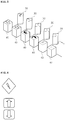
- FIG. 5 is a view illustrating exemplary event blocks and exemplary execution blocks.
- the event blocks 30 are columns having a diamond-shaped cross-section
- the execution blocks 40 are columns having a quadrangular cross-section, the shape of which differs from that of the event blocks.
- the event block 31 is used to input an event command "when light is detected”
- the event block 33 is used to input an event command "when detecting sound”
- the event block 35 is used to input an event command "when a command function E1 is generated”
- the event block 37 is used to input an event command "when a command function E2 is generated”
- the event block 39 is used to input an event command "when a command function E3 is generated.”
- the execution block 41 is used to input an execution command "Move to the right”
- the execution block 42 is used to input an execution command “Move to the left”
- the execution block 43 is used to input an execution command “Turn to the left”
- the execution block 44 is used to input an execution command “Turn to the right”
- the execution block 45 is used to input an execution command "Turn off a variable area V1,”
- the execution block 46 is used to input an execution command "Execute the command function E1.”
- a text or an image indicating an event command or an execution command is marked on the front surface of each of the event blocks 30 and the execution blocks 40, thereby helping children to understand the event command or the execution command and compose an algorithm.
- FIG. 6 illustrates an exemplary algorithm composed using the algorithm teaching apparatus according to the present disclosure.
- an event block for inputting an event command "when light is detected” is mounted to an event block mount, and an execution block for inputting an execution command "Move up” is mounted to an execution block mount of the execution area subordinate to the mounted event block.
- An algorithm "Move up when light is detected” is composed by combining the event block and the execution block. Thus, when the robot detects light, the robot is controlled to move up.
- FIG. 7 illustrates another exemplary algorithm composed using the algorithm teaching apparatus according to the present disclosure.
- an event block for inputting an event command "when light is detected” is mounted to the first event block mount, and an event block for inputting an event command "when a command function F1 has occurred” is mounted to the second event block mount.
- An execution block for inputting an execution command "Execute the command function F1" is mounted to the first execution block mount of the execution area subordinate to the first event block mount.
- an execution block for inputting an execution command "Move up” is mounted to the first execution block mount, and an execution block for inputting an execution command "Move down” is mounted to the second execution block mount.
- an algorithm “Execute the command function F1 when light is detected” and an algorithm “Move up and down when the command function F1 has occurred” are composed.
- the robot detects light the robot is controlled to move up and down.
- FIG. 8 illustrates a further exemplary algorithm composed using the algorithm teaching apparatus according to the present disclosure.
- an event block for inputting an event command "when sound is detected” is mounted to the first event block mount
- an event block for inputting an event command "when a command function F1 has occurred” is mounted to the second event block mount
- an event block for inputting an event command "when a command function F2 has occurred” is mounted to the third event block mount.
- An execution block for inputting an execution command "Execute F1 when a variable area V1 is on” is mounted to the first execution block mount of the execution area subordinate to the first event block mount, and an execution block for inputting an execution command "Execute F2 when a variable area V1 is off” is mounted to the second execution block mount of the execution area subordinate to the first event block mount.
- an execution block for inputting an execution command "Move up” is mounted to the first execution block mount, and an execution block for inputting an execution command "Turn off the variable area V1" is mounted to the second execution block mount.
- an execution block for inputting an execution command "Move down” is mounted to the first execution block mount, and an execution block for inputting an execution command "Turn on the variable area V1" is mounted to the second execution block mount.
- an algorithm “Determine whether or not a variable area V1 is on when sound is detected, and execute a command function F1 when the variable area V1 is on. Determine whether or not the variable area V1 is off when sound is detected, and execute a command function F2 when the variable area V1 is off," an algorithm “Move up and turn off the variable area V1 when the command function F1 has occurred,” and an algorithm “Move down and turn on the variable area V1 when the command function F2 has occurred” are composed.
- the command function F1 is executed to move up the robot and switch the variable area V1 to an off state.
- Examples of the computer readable storage medium include a magnetic storage medium (e.g. a floppy disk or a hard disk), an optical storage medium (e.g. a compact disc read only memory (CD-ROM) or a digital versatile disc (DVD)), and a carrier wave (e.g. transmission through the Internet).
- a magnetic storage medium e.g. a floppy disk or a hard disk
- an optical storage medium e.g. a compact disc read only memory (CD-ROM) or a digital versatile disc (DVD)
- CD-ROM compact disc read only memory
- DVD digital versatile disc
- carrier wave e.g. transmission through the Internet
Landscapes
- Engineering & Computer Science (AREA)
- Business, Economics & Management (AREA)
- Physics & Mathematics (AREA)
- Educational Administration (AREA)
- Educational Technology (AREA)
- General Physics & Mathematics (AREA)
- Theoretical Computer Science (AREA)
- Computer Hardware Design (AREA)
- Entrepreneurship & Innovation (AREA)
- Computer Networks & Wireless Communication (AREA)
- Manipulator (AREA)
- Toys (AREA)
Applications Claiming Priority (2)
| Application Number | Priority Date | Filing Date | Title |
|---|---|---|---|
| KR20140054198 | 2014-05-07 | ||
| PCT/KR2015/004512 WO2015170873A1 (ko) | 2014-05-07 | 2015-05-06 | 블록을 이용한 알고리즘 교육 장치 |
Publications (2)
| Publication Number | Publication Date |
|---|---|
| EP3142094A1 true EP3142094A1 (de) | 2017-03-15 |
| EP3142094A4 EP3142094A4 (de) | 2017-04-26 |
Family
ID=54061853
Family Applications (1)
| Application Number | Title | Priority Date | Filing Date |
|---|---|---|---|
| EP15788874.4A Withdrawn EP3142094A4 (de) | 2014-05-07 | 2015-05-06 | Algorithmuslehrvorrichtung mit blöcken |
Country Status (6)
| Country | Link |
|---|---|
| US (1) | US10229613B2 (de) |
| EP (1) | EP3142094A4 (de) |
| JP (1) | JP6405392B2 (de) |
| KR (1) | KR101546927B1 (de) |
| CN (1) | CN105793911B (de) |
| WO (1) | WO2015170873A1 (de) |
Families Citing this family (43)
| Publication number | Priority date | Publication date | Assignee | Title |
|---|---|---|---|---|
| KR101697511B1 (ko) * | 2015-09-25 | 2017-01-18 | 주식회사 로보로보 | 완구용 로봇 제어 시스템 |
| KR101683022B1 (ko) * | 2016-02-29 | 2016-12-08 | 주식회사 휴인텍 | 코딩 학습용 교구 |
| JP6321066B2 (ja) * | 2016-03-10 | 2018-05-09 | 株式会社デザイニウム | プログラミング学習用の装置、方法およびプログラム |
| KR101831334B1 (ko) * | 2016-03-15 | 2018-02-23 | 주식회사 휴인텍 | 코딩 학습용 교구 |
| US10885801B2 (en) * | 2016-05-24 | 2021-01-05 | Tangible Play, Inc. | Virtualized tangible programming |
| US10304353B1 (en) * | 2016-08-15 | 2019-05-28 | Delfin Lozano | Tray-and-block apparatus for device programming |
| KR101915245B1 (ko) * | 2016-09-21 | 2018-11-22 | (주)이산로봇 | 로봇 동작 제어 보드, 이의 동작 방법 및 이를 포함하는 로봇 동작 제어 보드 어셈블리 |
| KR101940077B1 (ko) * | 2016-09-21 | 2019-01-18 | (주)이산로봇 | 코드인식장치, 코드인식방법, 및 코드인식장치를 포함하는 코드인식 어셈블리 |
| KR20180058030A (ko) * | 2016-11-23 | 2018-05-31 | 손승희 | 프로그램 코딩용 블록 |
| KR101843831B1 (ko) * | 2017-02-10 | 2018-03-30 | 주식회사 씨앤알테크 | 쪼물락 코딩 블록 |
| JP6253170B1 (ja) * | 2017-02-22 | 2017-12-27 | 合同会社オフィス・ゼロ | プログラム作成支援システム及びその方法 |
| JP6877688B2 (ja) * | 2017-03-27 | 2021-05-26 | カシオ計算機株式会社 | プログラミング装置及びその制御プログラム、プログラミング方法 |
| JP6529544B2 (ja) * | 2017-07-07 | 2019-06-12 | 株式会社エルイーテック | 物体の接続の順序を動作の順序として特定する装置 |
| JP6748038B2 (ja) | 2017-08-15 | 2020-08-26 | Vivita株式会社 | 情報処理装置 |
| JP6651148B2 (ja) * | 2017-11-22 | 2020-02-19 | 合同会社オフィス・ゼロ | プログラム作成支援システム及びその方法並びにそのプログラム |
| WO2019112334A1 (ko) * | 2017-12-06 | 2019-06-13 | 김진욱 | 장난감 식별 블록 및 식별 블록을 구비한 알고리즘 생성 장치 |
| WO2019117590A1 (ko) * | 2017-12-11 | 2019-06-20 | 김진욱 | 알고리즘 생성 방법 및 장치 |
| KR102107284B1 (ko) * | 2017-12-11 | 2020-05-07 | 김진욱 | 알고리즘 생성 방법 |
| KR102107283B1 (ko) * | 2017-12-11 | 2020-05-28 | 김진욱 | 알고리즘 생성 장치 |
| JP6530843B1 (ja) * | 2018-07-03 | 2019-06-12 | 株式会社エルイーテック | ブロック玩具 |
| JP6545315B1 (ja) * | 2018-04-16 | 2019-07-17 | 株式会社エルイーテック | ソフトウェア構築ブロック |
| WO2019138951A1 (ja) * | 2018-01-12 | 2019-07-18 | 株式会社エルイーテック | 玩具 |
| KR20190088787A (ko) | 2018-01-19 | 2019-07-29 | 김태권 | 알고리즘 교육을 위한 작동 모듈이 구비된 조합가능형 로봇 블록 |
| CN108305529A (zh) * | 2018-04-10 | 2018-07-20 | 广州大学 | 一种实体化编程系统 |
| JP7347785B2 (ja) * | 2018-06-04 | 2023-09-20 | 株式会社はくぶん | プログラム駆動装置 |
| KR102507013B1 (ko) * | 2018-07-04 | 2023-03-06 | 현대자동차주식회사 | 블록코딩을 이용한 자동차 편의장치 작동 설정 방법 |
| US20200019386A1 (en) * | 2018-07-11 | 2020-01-16 | Jay Wright | Interlocking blocks for the creation of computer code systems via three dimensional representation using virtual representation, holography, and enhanced reality |
| KR102199611B1 (ko) * | 2018-10-22 | 2021-01-07 | 주식회사 로보로보 | 카드 리더기를 이용한 블록 프로그래밍 시스템 및 이를 이용한 블록 프로그래밍 방법 |
| KR102186719B1 (ko) * | 2018-11-15 | 2020-12-08 | 주식회사 마르시스 | 블록형 무선 코딩 명령어 입력 장치 및 방법 |
| KR102030149B1 (ko) | 2018-11-20 | 2019-10-08 | 주식회사 화성 | 사용자 커리큐럼 추천 방법 및 이를 이용한 사용자 맞춤형 소프트웨어 교육용 시스템 |
| KR102175316B1 (ko) * | 2018-12-12 | 2020-11-06 | 유준배 | 코딩교육장치 |
| CN111346390B (zh) | 2018-12-21 | 2020-12-25 | 上海葡萄纬度科技有限公司 | 编程积木 |
| KR102217922B1 (ko) * | 2019-01-08 | 2021-02-19 | 주식회사 럭스로보 | 조립 정보 제공 시스템 및 모듈 어셈블리 |
| KR102069878B1 (ko) * | 2019-01-31 | 2020-02-11 | (주)이이알에스소프트 | 블록형 스마트토이를 활용한 증강현실 기반 교육용 프로그래밍언어 저작 시스템 |
| US11295630B2 (en) * | 2019-03-08 | 2022-04-05 | Lilyza Llc | Language learning assembly and method of use |
| KR102203829B1 (ko) * | 2019-05-27 | 2021-01-15 | 정용비 | 코딩용 카드를 이용하여 코딩로봇의 제어를 위한 알고리즘을 생성하는 코딩보드장치 및 방법 |
| JP6815052B2 (ja) * | 2020-01-08 | 2021-01-20 | 合同会社オフィス・ゼロ | プログラム作成支援システム及びその方法 |
| KR20210119709A (ko) | 2020-03-25 | 2021-10-06 | 한국과학기술연구원 | 모듈형 로봇 제어 시스템 |
| US20220001292A1 (en) * | 2020-06-18 | 2022-01-06 | Saifeng Chen | Programmable toy building blocks system |
| KR20220006347A (ko) * | 2020-07-08 | 2022-01-17 | 박준형 | 블록코딩 장치 |
| JP7284516B2 (ja) * | 2020-12-14 | 2023-05-31 | 合同会社オフィス・ゼロ | プログラム作成支援システム及びその方法並びにそのプログラム |
| TWI800163B (zh) * | 2021-12-16 | 2023-04-21 | 許紓琬 | 智慧互動式擴增實境之手部精細動作復健系統 |
| KR102563623B1 (ko) * | 2023-03-02 | 2023-08-04 | 주식회사 인비전테크 | 치매예방을 위한 블록형 코딩 조립체 및 로봇 장치의 운용방법 |
Family Cites Families (19)
| Publication number | Priority date | Publication date | Assignee | Title |
|---|---|---|---|---|
| US4712184A (en) * | 1984-09-12 | 1987-12-08 | Haugerud Albert R | Computer controllable robotic educational toy |
| JP2660163B2 (ja) * | 1994-10-11 | 1997-10-08 | 有限会社アレフロジック | アルゴリズム教育支援システム |
| KR20020061186A (ko) | 2001-01-15 | 2002-07-24 | 주식회사 보스텍 | 로봇 제어, 설계 및 활용을 위한 학습시스템 |
| KR100426035B1 (ko) * | 2001-08-01 | 2004-04-03 | 주식회사 마이크로로보트 | 마이크로로봇 제어프로그램 교육 시스템 |
| KR20030066839A (ko) | 2002-02-05 | 2003-08-14 | 주식회사토이테크 | 디지털 교육용 완구 |
| JP2004008442A (ja) | 2002-06-06 | 2004-01-15 | Takamasa Ichikawa | 知育用ブロック |
| JP3922139B2 (ja) | 2002-09-03 | 2007-05-30 | ヤマハ株式会社 | 音色パラメータ生成装置、音色パラメータ生成方法およびプログラム |
| US7316567B2 (en) | 2003-08-01 | 2008-01-08 | Jennifer Chia-Jen Hsieh | Physical programming toy |
| CN2857141Y (zh) | 2004-08-27 | 2007-01-10 | 乔兵 | 可编程教学智能机器人实验系统 |
| KR100598311B1 (ko) | 2004-10-06 | 2006-07-10 | 정보통신연구진흥원 | 지능로봇실습키트 및 지능로봇을 이용한 지능로봇교육시스템 |
| US20080166946A1 (en) * | 2007-01-10 | 2008-07-10 | Frank Gallagher | Dump truck toy |
| WO2011011084A1 (en) * | 2009-07-24 | 2011-01-27 | Modular Robotics Llc | Modular robotics |
| CN101908289A (zh) | 2010-08-31 | 2010-12-08 | 南京智慧天下教育科技有限公司 | 一种教学用动态实时交互编程学习系统 |
| KR101037901B1 (ko) * | 2011-03-21 | 2011-05-30 | 권대용 | 텐저블 프로그래밍 블록에 기반한 로봇 시스템 |
| CN102289981A (zh) | 2011-06-02 | 2011-12-21 | 朱鼎新 | 一种可编程学习型机器人 |
| CN102789713B (zh) * | 2012-07-19 | 2015-04-15 | 中国科学院软件研究所 | 一种基于红外和无线传输技术的实物编程方法和系统 |
| CN103116286A (zh) | 2013-01-16 | 2013-05-22 | 博雅创世(北京)智能科技有限公司 | 基于网络的机器人开发平台的实现方法和设备 |
| US20140297035A1 (en) * | 2013-04-01 | 2014-10-02 | Tufts University | Educational robotic systems and methods |
| CN203366587U (zh) | 2013-08-11 | 2013-12-25 | 侯双双 | 一种计算机信息技术的冒泡算法演示装置 |
-
2015
- 2015-05-06 EP EP15788874.4A patent/EP3142094A4/de not_active Withdrawn
- 2015-05-06 CN CN201580002800.XA patent/CN105793911B/zh not_active Expired - Fee Related
- 2015-05-06 KR KR1020150063073A patent/KR101546927B1/ko active Active
- 2015-05-06 JP JP2016566904A patent/JP6405392B2/ja not_active Expired - Fee Related
- 2015-05-06 WO PCT/KR2015/004512 patent/WO2015170873A1/ko not_active Ceased
- 2015-05-06 US US15/107,354 patent/US10229613B2/en active Active
Also Published As
| Publication number | Publication date |
|---|---|
| EP3142094A4 (de) | 2017-04-26 |
| US20170004730A1 (en) | 2017-01-05 |
| US10229613B2 (en) | 2019-03-12 |
| WO2015170873A1 (ko) | 2015-11-12 |
| JP2017517030A (ja) | 2017-06-22 |
| JP6405392B2 (ja) | 2018-10-17 |
| KR101546927B1 (ko) | 2015-08-25 |
| CN105793911B (zh) | 2019-05-10 |
| CN105793911A (zh) | 2016-07-20 |
Similar Documents
| Publication | Publication Date | Title |
|---|---|---|
| US10229613B2 (en) | Algorithm teaching apparatus using blocks | |
| CN110622231B (zh) | 编程装置及记录介质、编程方法 | |
| KR100533839B1 (ko) | 동작기반 전자기기 제어장치 및 그 제어방법 | |
| CN108492679A (zh) | 基于智能积木的可编程学习装置及方法 | |
| KR101843831B1 (ko) | 쪼물락 코딩 블록 | |
| KR20180007199A (ko) | 코딩교육 시스템, 애플리케이션 시스템 및 그 제공방법 | |
| CN110585744A (zh) | 一种实物化编程式积木系统 | |
| US11727819B2 (en) | Interactive system for teaching sequencing and programming | |
| KR102062163B1 (ko) | 장난감 식별 블록을 구비한 알고리즘 생성 장치 | |
| KR102186719B1 (ko) | 블록형 무선 코딩 명령어 입력 장치 및 방법 | |
| KR20250073916A (ko) | 탭펜을 이용한 엠타이니 로봇 이동제어 시스템 및 그 운용 방법 | |
| KR102203829B1 (ko) | 코딩용 카드를 이용하여 코딩로봇의 제어를 위한 알고리즘을 생성하는 코딩보드장치 및 방법 | |
| KR20200145875A (ko) | 로봇과 페어링하여 코딩 교육을 제공하는 코딩펜 및 동작 방법 | |
| JP4611416B2 (ja) | 教具 | |
| KR100746156B1 (ko) | 로봇 트레이닝 장치 및 상기 로봇 트레이닝 장치를 이용한로봇 교육 시스템 | |
| KR102525276B1 (ko) | 로봇시스템 및 그에 대한 스마트 코딩방법 | |
| KR102144891B1 (ko) | 휴머노이드 로봇 개발 프레임워크 시스템 | |
| KR102236604B1 (ko) | 교육용 로봇, 교육용 로봇을 이용한 외국어 학습 방법 및 교육용 로봇을 이용한 외국어 학습 방법을 실행시키는 프로그램이 기록된 기록 매체 | |
| KR102276439B1 (ko) | 코딩 교육용 로봇 | |
| KR102253013B1 (ko) | 어린이 영어학습이 가능한 코딩로봇 세트 | |
| KR101313794B1 (ko) | 로봇 교육 서비스 장치 | |
| Cardoso | Tangible language for educational programming of robots and other targets | |
| US12603016B2 (en) | Wearable terminal, presentation method, and recording medium | |
| JP2024073888A (ja) | 作業習熟システム、作業習熟方法及び作業再現ロボット | |
| KR20210000555A (ko) | 다방향 삽입이 가능한 블록을 가진 쪼물락 코딩 블록 |
Legal Events
| Date | Code | Title | Description |
|---|---|---|---|
| STAA | Information on the status of an ep patent application or granted ep patent |
Free format text: STATUS: THE INTERNATIONAL PUBLICATION HAS BEEN MADE |
|
| PUAI | Public reference made under article 153(3) epc to a published international application that has entered the european phase |
Free format text: ORIGINAL CODE: 0009012 |
|
| STAA | Information on the status of an ep patent application or granted ep patent |
Free format text: STATUS: REQUEST FOR EXAMINATION WAS MADE |
|
| 17P | Request for examination filed |
Effective date: 20161115 |
|
| AK | Designated contracting states |
Kind code of ref document: A1 Designated state(s): AL AT BE BG CH CY CZ DE DK EE ES FI FR GB GR HR HU IE IS IT LI LT LU LV MC MK MT NL NO PL PT RO RS SE SI SK SM TR |
|
| AX | Request for extension of the european patent |
Extension state: BA ME |
|
| A4 | Supplementary search report drawn up and despatched |
Effective date: 20170327 |
|
| RIC1 | Information provided on ipc code assigned before grant |
Ipc: G09B 19/00 20060101ALI20170321BHEP Ipc: A63H 30/04 20060101ALN20170321BHEP Ipc: G09B 5/00 20060101AFI20170321BHEP Ipc: G09B 1/30 20060101ALI20170321BHEP |
|
| DAV | Request for validation of the european patent (deleted) | ||
| DAX | Request for extension of the european patent (deleted) | ||
| STAA | Information on the status of an ep patent application or granted ep patent |
Free format text: STATUS: EXAMINATION IS IN PROGRESS |
|
| 17Q | First examination report despatched |
Effective date: 20181009 |
|
| STAA | Information on the status of an ep patent application or granted ep patent |
Free format text: STATUS: THE APPLICATION HAS BEEN WITHDRAWN |
|
| 18W | Application withdrawn |
Effective date: 20200818 |