EP3142289B1 - Fahrzeuginternes netzwerksystem, elektronische steuereinheit und detektionsverfahren für unregelmässigkeiten - Google Patents
Fahrzeuginternes netzwerksystem, elektronische steuereinheit und detektionsverfahren für unregelmässigkeiten Download PDFInfo
- Publication number
- EP3142289B1 EP3142289B1 EP15788947.8A EP15788947A EP3142289B1 EP 3142289 B1 EP3142289 B1 EP 3142289B1 EP 15788947 A EP15788947 A EP 15788947A EP 3142289 B1 EP3142289 B1 EP 3142289B1
- Authority
- EP
- European Patent Office
- Prior art keywords
- data frame
- ecu
- specific identifier
- data
- predetermined
- Prior art date
- Legal status (The legal status is an assumption and is not a legal conclusion. Google has not performed a legal analysis and makes no representation as to the accuracy of the status listed.)
- Active
Links
Images








Classifications
-
- H—ELECTRICITY
- H04—ELECTRIC COMMUNICATION TECHNIQUE
- H04L—TRANSMISSION OF DIGITAL INFORMATION, e.g. TELEGRAPHIC COMMUNICATION
- H04L67/00—Network arrangements or protocols for supporting network services or applications
- H04L67/01—Protocols
- H04L67/12—Protocols specially adapted for proprietary or special-purpose networking environments, e.g. medical networks, sensor networks, networks in vehicles or remote metering networks
-
- H—ELECTRICITY
- H04—ELECTRIC COMMUNICATION TECHNIQUE
- H04L—TRANSMISSION OF DIGITAL INFORMATION, e.g. TELEGRAPHIC COMMUNICATION
- H04L9/00—Cryptographic mechanisms or cryptographic arrangements for secret or secure communications; Network security protocols
- H04L9/32—Cryptographic mechanisms or cryptographic arrangements for secret or secure communications; Network security protocols including means for verifying the identity or authority of a user of the system or for message authentication, e.g. authorization, entity authentication, data integrity or data verification, non-repudiation, key authentication or verification of credentials
- H04L9/3236—Cryptographic mechanisms or cryptographic arrangements for secret or secure communications; Network security protocols including means for verifying the identity or authority of a user of the system or for message authentication, e.g. authorization, entity authentication, data integrity or data verification, non-repudiation, key authentication or verification of credentials using cryptographic hash functions
- H04L9/3242—Cryptographic mechanisms or cryptographic arrangements for secret or secure communications; Network security protocols including means for verifying the identity or authority of a user of the system or for message authentication, e.g. authorization, entity authentication, data integrity or data verification, non-repudiation, key authentication or verification of credentials using cryptographic hash functions involving keyed hash functions, e.g. message authentication codes [MACs], CBC-MAC or HMAC
-
- B—PERFORMING OPERATIONS; TRANSPORTING
- B60—VEHICLES IN GENERAL
- B60R—VEHICLES, VEHICLE FITTINGS, OR VEHICLE PARTS, NOT OTHERWISE PROVIDED FOR
- B60R16/00—Electric or fluid circuits specially adapted for vehicles and not otherwise provided for; Arrangement of elements of electric or fluid circuits specially adapted for vehicles and not otherwise provided for
- B60R16/02—Electric or fluid circuits specially adapted for vehicles and not otherwise provided for; Arrangement of elements of electric or fluid circuits specially adapted for vehicles and not otherwise provided for electric constitutive elements
- B60R16/023—Electric or fluid circuits specially adapted for vehicles and not otherwise provided for; Arrangement of elements of electric or fluid circuits specially adapted for vehicles and not otherwise provided for electric constitutive elements for transmission of signals between vehicle parts or subsystems
-
- H—ELECTRICITY
- H04—ELECTRIC COMMUNICATION TECHNIQUE
- H04L—TRANSMISSION OF DIGITAL INFORMATION, e.g. TELEGRAPHIC COMMUNICATION
- H04L63/00—Network architectures or network communication protocols for network security
- H04L63/08—Network architectures or network communication protocols for network security for authentication of entities
-
- H—ELECTRICITY
- H04—ELECTRIC COMMUNICATION TECHNIQUE
- H04L—TRANSMISSION OF DIGITAL INFORMATION, e.g. TELEGRAPHIC COMMUNICATION
- H04L63/00—Network architectures or network communication protocols for network security
- H04L63/10—Network architectures or network communication protocols for network security for controlling access to devices or network resources
-
- H—ELECTRICITY
- H04—ELECTRIC COMMUNICATION TECHNIQUE
- H04L—TRANSMISSION OF DIGITAL INFORMATION, e.g. TELEGRAPHIC COMMUNICATION
- H04L63/00—Network architectures or network communication protocols for network security
- H04L63/12—Applying verification of the received information
-
- H—ELECTRICITY
- H04—ELECTRIC COMMUNICATION TECHNIQUE
- H04L—TRANSMISSION OF DIGITAL INFORMATION, e.g. TELEGRAPHIC COMMUNICATION
- H04L63/00—Network architectures or network communication protocols for network security
- H04L63/20—Network architectures or network communication protocols for network security for managing network security; network security policies in general
-
- H—ELECTRICITY
- H04—ELECTRIC COMMUNICATION TECHNIQUE
- H04L—TRANSMISSION OF DIGITAL INFORMATION, e.g. TELEGRAPHIC COMMUNICATION
- H04L9/00—Cryptographic mechanisms or cryptographic arrangements for secret or secure communications; Network security protocols
- H04L9/32—Cryptographic mechanisms or cryptographic arrangements for secret or secure communications; Network security protocols including means for verifying the identity or authority of a user of the system or for message authentication, e.g. authorization, entity authentication, data integrity or data verification, non-repudiation, key authentication or verification of credentials
- H04L9/3297—Cryptographic mechanisms or cryptographic arrangements for secret or secure communications; Network security protocols including means for verifying the identity or authority of a user of the system or for message authentication, e.g. authorization, entity authentication, data integrity or data verification, non-repudiation, key authentication or verification of credentials involving time stamps, e.g. generation of time stamps
-
- H—ELECTRICITY
- H04—ELECTRIC COMMUNICATION TECHNIQUE
- H04L—TRANSMISSION OF DIGITAL INFORMATION, e.g. TELEGRAPHIC COMMUNICATION
- H04L2209/00—Additional information or applications relating to cryptographic mechanisms or cryptographic arrangements for secret or secure communication H04L9/00
- H04L2209/84—Vehicles
Definitions
- the present disclosure relates to a technology for detecting a fraudulent frame sent over an in-vehicle network in which electronic control units perform communication.
- ECUs Electronic Control Units
- a network that connects the ECUs with one another is called an in-vehicle network.
- a plurality of standards are provided for in-vehicle networks.
- One of the mainstream standards is CAN (Controller Area Network) defined by ISO11898-1 (refer to NPL 1).
- the communication channel is formed from 2 buses.
- An ECU connected to the bus is referred to as a "node".
- Each of the nodes connected to the bus receives and sends a message called a frame.
- a sender node that sends a frame applies voltages on the 2 buses so as to generate a potential difference between the buses.
- the sender node sends a value of "1" called “recessive” and a value of "0" called “dominant”. If a plurality of sender nodes send recessive and dominant at exactly the same time, dominant has higher priority and is sent.
- the receiver node sends a frame called error frame.
- An error frame is formed from 6 consecutively sent dominant bits. By sending the error frame, the sender node or another receiver node is notified of the abnormity of a frame.
- identifiers indicating the destination address and the sender address are not present.
- the sender node attaches an ID called a message ID to each of frames and sends the frame (i.e., delivers a signal to the bus).
- Each of the receiver nodes receives only a predetermined ID (i.e., reads the signal from the bus).
- CAN employs the CSMA/CA (Carrier Sense Multiple Access/Collision Avoidance) technique.
- a fraudulent node When, in an in-vehicle network, a fraudulent node is connected to the bus and if the fraudulent node unauthorizedly sends a data frame, the receiver node cannot detect that a fraudulent data frame is sent, since the identifier of the sender is not present in CAN.
- NPL 2 Message Authentication Code
- WO 2013/065689 A1 relates to a plurality of electronic control units each counting the number of times a message is transmitted for each controller area network ID.
- DE 11 2012 002836 T5 relates to an in-vehicle network equipped with a function whereby configuration verification is performed while preventing an increase in the processing load (and cost) for each in-vehicle control device, thus improving vehicle security.
- an ECU may send a data frame as triggered by an event (hereinafter, the non-periodically sent data frame is referred to as an "event-driven data frame") in addition to periodically sending a data frame, even an authorized event-driven data frame is misdetected to be an unauthorized data frame.
- an authorized event-driven data frame is misdetected to be an unauthorized data frame.
- the processing load required for attaching and verifying the MAC significantly increases.
- the present disclosure provides an electronic control unit (ECU) capable of efficiently and appropriately detecting that a fraudulent message is sent over a bus in an in-vehicle network system that performs communication in accordance with, for example, the CAN protocol.
- ECU electronice control unit
- the present disclosure provides a fraud detection method for efficiently and appropriately detecting an unauthorized message and an in-vehicle network system including the ECU.
- a fraud detection method for use in an in-vehicle network system including a plurality of electronic control units that communicate with one another via a bus in accordance with the CAN (Controller Area Network) protocol.
- the method includes the reception step of receiving a data frame sent over the bus and the verification step of, if a data frame that does not follow a predetermined rule regarding a transmission period is received in the reception step, verifying a specific identifier in the data frame.
- a fraud detection method for sending a data frame to be subjected to fraud detection in an in-vehicle network system including a plurality of electronic control units that communicate with one another via a bus in accordance with the CAN (Controller Area Network) protocol.
- the method includes the provision step of providing a specific identifier in a data frame that does not follow a predetermined rule regarding a transmission period when sending the data frame and the transmission step of sending the data frame that includes the specific identifier provided in the provision step and that does not follow the predetermined rule via the bus.
- an in-vehicle network system including a plurality of electronic control units that communicate with one another via a bus in accordance with the CAN (Controller Area Network) protocol is provided.
- CAN Controller Area Network
- the system includes a first electronic control unit including a providing unit that provides a specific identifier in a data frame that does not follow a predetermined rule regarding a transmission period when sending the data frame and a transmitting unit that sends, via the bus, the data frame that includes a specific identifier provided by the providing unit and that does not follow the predetermined rule, and a second electronic control unit including a receiving unit that receives the data frame sent over the bus and a verifying unit that verifies a specific identifier in a data frame when the data frame that does not follow the predetermined rule is received by the receiving unit.
- an electronic control unit for communicating via a bus in accordance with the CAN (Controller Area Network) protocol.
- the electronic control unit includes a providing unit that provides a specific identifier in a data frame that does not follow a predetermined rule regarding a transmission period when sending the data frame and a transmitting unit that sends, via the bus, the data frame that includes the specific identifier provided by the providing unit and that does not follow the predetermined rule.
- an electronic control unit for communicating via a bus in accordance with the CAN (Controller Area Network) protocol.
- the electronic control unit includes a receiving unit that receives a data frame sent over the bus and a verifying unit that verifies a specific identifier in a data frame that does not follow a predetermined rule regarding a transmission period when the data frame is received by the receiving unit.
- the fraudulent data frame can be efficiently and appropriately detected.
- a fraud detection method for use in an in-vehicle network system including a plurality of electronic control units that communicate with one another via a bus in accordance with the CAN (Controller Area Network) protocol.
- the method includes the reception step of receiving a data frame sent over the bus and the verification step of, if a data frame that does not follow a predetermined rule regarding a transmission period is received in the reception step, verifying a specific identifier in the data frame.
- the predetermined rule regarding a transmission period is a rule defined in advance.
- the predetermined rule regarding a transmission period is a condition of the transmission period of data frames having the same ID (a time difference between the previous transmission time and the current transmission time).
- the fraud detection method verification is performed to detect a fraudulent data frame. If the verification is successful for a data frame, the data frame is not detected as being fraudulent. Thus, when a data frame having a transmission period that does not satisfy the condition, that is, an event-driven data frame is received, the validity of the data frame cannot be determined on the basis of the predetermined rule. However, by verifying the specific identifier, the validity can be determined. As a result, misdetection, where a data frame that does not satisfy the predetermined rule is detected to be a fraudulent data frame, can be prevented, and a fraudulent data frame (a fraudulent message) can be properly detected.
- the specific identifier may be a message authentication code that is set in a data field of the data frame at a predetermined position and that reflects the information in the data frame.
- verification may be performed by a predetermined processing procedure for determining whether the data set in the data frame that does not follow the predetermined rule at the predetermined position is the message authentication code on the basis of the information in the data frame.
- a fraudulent ECU that does not know the predetermined rule regarding a transmission period and a predetermined verification procedure (e.g., an ECU other than the ECU that is a regular constituent element of the in-vehicle network system) has a difficulty sending a data frame including a specific identifier that makes the verification successful.
- the specific identifier may be a predetermined value that is set in a data field of the data frame at a predetermined position.
- verification may be performed by determining whether a value of the data set in the data frame that does not follow the predetermined rule at the predetermined position is the same as the predetermined value.
- the specific identifier may be formed from a single bit or a plurality of bits. In this manner, the verification for fraud detection can be performed using a procedure with relatively low processing load, that is, comparison of the value with the predetermined value.
- the specific identifier may be a counter value set in a data field of the data frame at a predetermined position.
- verification may be performed by determining whether a value of the data set in the data frame that does not follow the predetermined rule at the predetermined position is the same as the counter value that reflects the number of times at which a data frame that does not follow the predetermined rule is received in the reception step.
- the specific identifier is formed as a counter value that can vary in accordance with transmission and reception of data frames, a fraudulent ECU has difficulty sending a data frame including a specific identifier that makes the verification successful.
- reception of a data frame is repeatedly performed in the reception step.
- the specific identifier may be a resultant value that is obtained through predetermined calculation and that is set in the data field of the data frame at a predetermined position.
- verification may be performed by determining whether a value of the data set in the data frame that does not follow the predetermined rule at the predetermined position is the same as a value obtained through the predetermined calculation on the basis of the specific identifier in a data frame including the specific identifier previously received in the reception step.
- the predetermined calculation is a calculation (a function) performed by each of an authorized sender that sends a data frame that does not follow the predetermined rule regarding a transmission period (i.e., a non-periodic data frame) and an authorized receiver that receives the data frame.
- the output value (the resultant value) of the calculation is derived on the basis of the input value. If each of the sender and the receiver stores the resultant value of the predetermined calculation, which is the specific identifier when the previous non-periodical data frame was sent, the following verification can be made.
- the sender sets, in the next non-periodic data frame, the output value (the resultant value) of the predetermined calculation (the function) using the previous specific identifier as the input and sends the data frame.
- the receiver verifies whether the received data frame contains the same value as the resultant value of the predetermined calculation using the previous specific identifier as the input. In this manner, a fraudulent ECU has difficulty sending a data frame including a specific identifier that makes the verification successful.
- the verification step when a data frame that does not follow the predetermined rule is received in the reception step and only if a state of a vehicle having the in-vehicle network system mounted therein is a predetermined state, the verification may be performed on the specific identifier in the data frame. If a data frame that follows the predetermined rule is received in the reception step, the fraud detection method may detect the data frame to be an authorized data frame. If a data frame that does not follow the predetermined rule is received in the reception step and if the verification of the specific identifier in the data frame is successful in the verification step, the fraud detection method may detect the data frame to be an authorized data frame.
- the fraud detection method may detect the data frame to be a fraudulent data frame.
- the processing to be performed after a fraudulent data frame is detected can be predetermined by the in-vehicle network system. Examples of the processing include discarding the data frame (e.g., no control of the vehicle is performed on the basis of the information in the data frame), recording the data frame as a log, and changing the operation mode of the vehicle.
- the predetermined state is, for example, a state in which the need for detecting a fraudulent data frame flowing in the bus is higher than in a state other than the predetermined state.
- the verification can be efficiently performed when the vehicle is in a predetermined state (e.g., when the need for fraud detection is high).
- a fraud detection method for sending a data frame to be subjected to fraud detection in an in-vehicle network system including a plurality of electronic control units that communicate with one another via a bus in accordance with the CAN (Controller Area Network) protocol.
- the method includes the provision step of providing a specific identifier in the data frame when sending the data frame that does not follow a predetermined rule regarding a transmission period and the transmission step of sending the data frame that includes the specific identifier provided in the provision step and that does not follow the predetermined rule via the bus.
- a sender ECU that regularly constitutes the in-vehicle network system sends a data frame that does not follow the predetermined rule and that includes the specific identifier so that the receiver can detect whether the data frame is a fraudulent data frame by verifying whether the data frame includes the specific identifier even when the received data frame does not follow the predetermined rule.
- appropriate fraud detection can be performed by the provision step and the transmission step.
- the specific identifier may be provided by setting, in the data field of the data frame at a predetermined position, a message authentication code that reflects the information in the data frame.
- a fraudulent ECU that does not know the predetermined rule regarding a transmission period and the message authentication code (e.g., an ECU other than the ECU that is a regular constituent element of the in-vehicle network system) has a difficulty sending a data frame including a specific identifier that makes the verification successful.
- the specific identifier may be provided by setting, in the data field of the data frame at a predetermined position, a predetermined value as the specific identifier.
- the ECU that receives the data frame can perform verification for fraud detection using a procedure with relatively low processing load, that is, comparison of the value with the predetermined value.
- the specific identifier may be provided by setting, in the data field of the data frame at a predetermined position, a counter value that reflects the number of transmissions of the data frame that does not follow the predetermined rule in the transmission step as the specific identifier. In this manner, since the specific identifier is formed as a counter value that can vary in accordance with transmission and reception of a data frame, a fraudulent ECU has difficulty sending a data frame including a specific identifier that makes the verification successful.
- the transmission of the data frame that does not follow the predetermined rule in the transmission step and provision of the specific identifier in the provision step may be repeatedly performed.
- the specific identifier may be provided by setting, in the data field of the data frame at a predetermined position, a resultant value obtained by performing a predetermined calculation on the basis of a specific identifier provided in the data frame that does not follow the predetermined rule and that was previously sent when the data frame is sent in the transmission step.
- a fraudulent ECU has difficulty sending a data frame including a specific identifier that makes the verification successful.
- a data frame that follows the predetermined rule may be further sent.
- the provision step when the state of the vehicle having the in-vehicle network system mounted therein is a predetermined state and only if the data frame that does not follow the predetermined rule is to be sent in the transmission step, the provision of a specific identifier in the data frame may be performed.
- the predetermined state is, for example, a state in which the need for detecting a fraudulent data frame flowing in the bus is higher than in a state other than the predetermined state.
- an in-vehicle network system including a plurality of electronic control units that communicate with one another via a bus in accordance with the CAN (Controller Area Network) protocol is provided.
- CAN Controller Area Network
- the system includes a first electronic control unit including a providing unit that provides a specific identifier in a data frame that does not follow a predetermined rule regarding a transmission period when sending the data frame and a transmitting unit that sends, via the bus, the data frame that includes the specific identifier provided by the providing unit and that does not follow the predetermined rule, and a second electronic control unit including a receiving unit that receives a data frame sent over the bus and a verifying unit that verifies a specific identifier in a data frame when the data frame that does not follow the predetermined rule is received by the receiving unit.
- the validity can be determined.
- misdetection where a data frame that does not satisfy the predetermined rule is detected to be a fraudulent data frame, can be prevented, and a fraudulent data frame (a fraudulent message) can be properly detected.
- an electronic control unit for communicating via a bus in accordance with the CAN (Controller Area Network) protocol.
- the electronic control unit includes a providing unit that provides a specific identifier in a data frame that does not follow a predetermined rule regarding a transmission period when sending the data frame and a transmitting unit that sends, via the bus, the data frame that includes the specific identifier provided by the providing unit and that does not follow the predetermined rule.
- an electronic control unit for communicating via a bus in accordance with the CAN (Controller Area Network) protocol.
- the electronic control unit includes a receiving unit that receives a data frame sent over the bus and a verifying unit that verifies a specific identifier in a data frame that does not follow a predetermined rule regarding a transmission period when the data frame is received by the receiving unit.
- a data frame having a transmission period that does not satisfy the condition, that is, an event-driven data frame is received, the validity of the data frame cannot be determined.
- the specific identifier the validity can be determined.
- misdetection where a data frame that does not satisfy the predetermined rule is detected as being fraudulent, can be prevented, and a fraudulent data frame can be properly detected.
- An in-vehicle network system 10 that achieves a fraud detection method for appropriately detecting that a fraudulent data frame is sent between an ECU 100a and an ECU 100b that communicate data frames to each other under the condition that a non-periodical event-driven data frame can be sent in addition to a periodically sent data frame is described below with reference to the accompanying drawings.
- Fig. 1 illustrates the overall configuration of the in-vehicle network system 10 according to a first embodiment.
- the in-vehicle network system 10 is an example of an in-vehicle network system that performs communication in accordance with the CAN protocols.
- the in-vehicle network system 10 is a network communication system in a motor vehicle having a variety of devices, such as a control unit and a sensor, mounted therein.
- the in-vehicle network system 10 includes the ECUs 100a and 100b connected to a variety of devices and a bus 200 that connects the ECUs to each another. Note that the in-vehicle network system 10 further includes ECUs (not illustrated in Fig. 1 ) other than the ECUs 100a and 100b.
- the ECU is a device including, for example, digital circuits, such as a processor (a microprocessor) and a memory, analog circuits, and a communication circuit.
- the memory includes a ROM and a RAM, which can store a control program (a computer program) executed by the processor.
- the processor operates in accordance with the control program (the computer program)
- the ECU can provide a variety of functions.
- the computer program is formed from a plurality of instruction codes that instruct the processor to operate so that a predetermined function is provided.
- description is given under the assumption that a fraudulent ECU that sends a fraudulent data frame may be connected to the bus 200.
- the ECU 100a is connected to a power window switch 110, which is an example of a device including at least one sensor.
- the ECU 100a periodically sends, to the bus 200, a data frame including information indicating the state of the power window switch 110.
- the ECU 100a sends a data frame including the information indicating the state of the power window switch 110 (i.e., the information indicating a sensor value) to the bus 200.
- the ECU 100a sends a non-periodical event-driven data frame to the bus 200 if the time at which the state of the power window switch 110 varies does not exactly match the transmission period.
- the ECU 100a receives a data frame that is sent from the ECU 100b to the bus 200 and that flows in the bus 200. Thereafter, the ECU 100a verifies whether, for example, the data frame received by the ECU 100a has been correctly received.
- the ECU 100b is connected to a power window 120.
- the ECU 100b receives a data frame that is sent from the ECU 100a to the bus 200 and that flows in the bus 200. Thereafter, the ECU 100b controls the power window 120 so that the power window 120 is open or closed in accordance with the state of the power window switch 110 included in the data frame. In addition, the ECU 100b periodically sends a data frame in accordance with the open/close control state of the power window 120 to the bus 200.
- each of the ECUs sends and receives a frame in accordance with the CAN protocol.
- the ECUs have a function of determining whether the received data frame is a fraudulent data frame.
- a data frame which is one of the frames used in a network based on the CAN protocol, is described below.
- Fig. 2 illustrates the format of a data frame defined by the CAN protocol.
- the data frame having a standard ID format defined by the CAN protocol is illustrated in Fig. 2 .
- the data frame includes an SOF (Start Of Frame) field, an ID field, an RTR (Remote Transmission Request) field, an IDE (Identifier Extension) field, a reservation bit "r”, a DLC (Data Length Code) field, a data field, a CRC (Cyclic Redundancy Check) sequence field, a CRC delimiter field "DEL", an ACK (Acknowledgement) slot field, an ACK delimiter field "DEL", and an EOF (End Of Frame) field.
- SOF Start Of Frame
- ID field an ID field
- an RTR Remote Transmission Request
- IDE IDE
- a reservation bit "r” a DLC (Data Length Code) field
- a data field a CRC (Cyclic Redundancy Check) sequence field
- the SOF field is formed from one dominant bit.
- the state of the bus is recessive.
- the notice of start of frame transmission is given.
- the ID field is a 11-bit field.
- the ID field includes an ID (a message ID) that is a value indicating the type of data.
- the design is such that if a plurality of nodes simultaneously start transmission, a frame having a lower ID value has a higher priority.
- RTR is a value for distinguishing a data frame from a remote frame. In data frames, the RTR field is formed from one dominant bit.
- Each of IDE and "r" is formed from one dominant bit.
- DLC is of 4 bits. DLC indicates the length of the data field. Note that IDE, "r”, and DLC are collectively referred to as a "control field”.
- the data field indicates the data to be transmitted, where the maximum length of the data field is 64 bits.
- the length can be controlled to 8 to 64 bits (multiple of 8 bits).
- the specification of data to be transmitted is not defined by the CAN protocol and is defined by the in-vehicle network system 10. Accordingly, the specification of the data depends on, for example, the type of vehicle and the manufacturer (the maker).
- the CRC sequence field is a 15-bit field.
- the CRC sequence is calculated using the transmitted values of SOF, the ID field, the control field, and the data field.
- the CRC delimiter is formed from one recessive bit.
- the CRC delimiter is a delimiter symbol that indicates termination of the CRC sequence. Note that the CRC sequence field and the CRC delimiter field are collectively referred to as a "CRC field".
- the ACK slot field is a 1-bit field.
- the sender node sets the ACK slot to recessive and transmits data. If a receiver node successfully receives the data up to the CRC sequence, the receiver node sets the ACK slot to dominant and sends the data. The dominant has a priority over the recessive. Accordingly, if the ACK slot is dominant after transmission, the sender node can be aware that any one of the receiver nodes has successfully received the data.
- the ACK delimiter is formed from one recessive bit.
- the ACK delimiter is a delimiter symbol that indicates termination of ACK.
- the EOF field is formed from 7 recessive bits. EOF indicates termination of the data frame.
- the data field of the data frame used in the in-vehicle network system 10 is described below.
- Fig. 3 illustrates an example of the data field format used in the in-vehicle network system.
- the most significant bit "I" of the data field (the first one bit) is an identification flag that identifies whether the data frame including the data field is an event-driven data frame (hereinafter, the flag is referred to as an "event-driven identification flag").
- the event-driven identification flag I is set to 0 for a data frame that is periodically sent. In contrast, the event-driven identification flag I is set to 1 for an event-driven data frame.
- a data area that follows the event-driven identification flag I includes data indicating the sensor values acquired from, for example, a device by the ECU (e.g., a value indicating the state of the power window switch 110 in the data frame sent from the ECU 100a).
- the most significant bit is used as the event-driven identification flag I.
- the event-driven identification flag I may be placed at any bit position (e.g., the least significant bit) in the data field.
- Fig. 4 is the configuration diagram of the ECU 100a.
- the ECU 100a includes a data frame transceiver unit 101, a data frame generation unit 102, a data frame generation rule holding unit 103, a fraudulent data frame determination unit 104, a received data frame period holding unit 105, a data frame reception history holding unit 106, a data frame processing unit 107, a timer 108, and a sensor value acquiring unit 109.
- These constituent elements are functional constituent elements.
- the functions of the constituent elements are realized by the communication circuit of the ECU 100a and one of, for example, the processor that executes the control program stored in the memory and a digital circuit.
- the ECU 100b has substantially the same configuration as that of the ECU 100a.
- each of the data frame generation rule holding unit 103, the received data frame period holding unit 105, and the data frame reception history holding unit 106 may differ on an ECU basis.
- the processing performed by the data frame processing unit 107 differs on an ECU basis.
- the data frame transceiver unit 101 receives a data frame flowing in the bus 200 and interprets the data frame in accordance with the CAN protocol. If the ID (the message ID), which is the information in the ID field of the received data frame, is a message ID that is predetermined for the ECU 100a itself to receive, the data frame transceiver unit 101 sends the information in the data frame to the fraudulent data frame determination unit 104. In addition, the data frame transceiver unit 101 sends the data frame sent from the data frame generation unit 102 to the bus 200 in accordance with the CAN protocol.
- the ID the message ID
- the data frame transceiver unit 101 sends the information in the data frame to the fraudulent data frame determination unit 104.
- the data frame transceiver unit 101 sends the data frame sent from the data frame generation unit 102 to the bus 200 in accordance with the CAN protocol.
- the data frame generation unit 102 generates a data frame in accordance with data frame generation rules stored in the data frame generation rule holding unit 103 and sends the generated data frame to the data frame transceiver unit 101.
- the data frame generation unit 102 acquires the current time from the timer 108.
- the data frame generation unit 102 acquires, from the sensor value acquiring unit 109, the data regarding a device (the power window switch 110) connected to the ECU 100a (i.e., the sensor value).
- the data frame generation unit 102 determines the timing at which the data frame is generated using the current time and the transmission period stored in the data frame generation rule holding unit 103 and periodically generates the data frame.
- the data frame is sent to the data frame transceiver unit 101.
- the data frame transceiver unit 101 sends the data frame.
- the data frame generation unit 102 generates an event-driven data frame. That is, when sending a data frame at a timing that does not follow the data frame generation rule indicating the transmission period, the data frame generation unit 102 generates a data frame having a specific identifier called event-driven identification flag provided therein.
- the data frame generation unit 102 functions as a providing unit.
- the sensor value acquiring unit 109 may operate using a technique in which the sensor value acquiring unit 109 acquires the sensor value from the sensor (the power window switch 110) when the sensor value varies or remains unchanged as needed or using a technique in which the sensor value acquiring unit 109 acquires the sensor value only when the sensor value varies.
- the data frame generation unit 102 periodically generates a data frame having the data field including the latest sensor value acquired from the sensor by the sensor value acquiring unit 109.
- the data frame generation unit 102 generates an event-driven data frame including the sensor value that has varied from the previous sensor value.
- the data frame including a sensor value that has not varied from the previous sensor value and, thus, is the same as the previous sensor value may be generated, or the data frame including a sensor value that has varied from the previous sensor value may be generated.
- an event-driven data frame that is generated at a timing that is not the periodical timing is a data frame including a sensor value that has varied from the previous sensor value. Accordingly, a data frame is periodically sent from the ECU 100a to the bus 200 by the data frame transceiver unit 101. In addition, the event-driven data frame is non-periodically sent.
- the data frame transceiver unit 101 has a function of sending an event-driven data frame, which includes a specific identifier and which does not follow the data frame generation rule indicating the transmission period, to another ECU via the bus 200.
- the data frame transceiver unit 101 also functions as a transmitting unit.
- the data frame generation rule holding unit 103 is formed from a storage medium, such as a memory.
- the data frame generation rule holding unit 103 stores, as the data frame generation rule, the transmission period used to periodically send a data frame for each of the message IDs sent from the ECU 100a itself.
- Fig. 5 illustrates an example of the data frame generation rule stored in the data frame generation rule holding unit 103.
- the ECU 100a sends a plurality of types of data frame (a type of data frame identified by the message ID), such as a data frame indicating the state of the power window switch 110.
- the transmission period of a data frame that is periodically sent from the ECU 100a and that has a message ID of 0x100 is 50 ms.
- the transmission period of a data frame having a message ID of 0x200 is 100 ms
- the transmission period of a data frame having a message ID of 0x300 is 70 ms.
- the fraudulent data frame determination unit 104 determines whether the received data frame is an authorized data frame (not a fraudulent data frame). That is, the fraudulent data frame determination unit 104 refers to period rule information (described in more detail below) in the received data frame period holding unit 105 for the data frame sent from the data frame transceiver unit 101 and verifies whether the data frame satisfies a transmission period condition predetermined for each of the message IDs. If the data frame satisfies a transmission period condition, the fraudulent data frame determination unit 104 determines that the data frame is a data frame sent from an authorized ECU (i.e., an authorized data frame).
- an authorized ECU i.e., an authorized data frame
- the fraudulent data frame determination unit 104 verifies the event-driven identification flag used to identify whether the data frame is an event-driven data frame. If it is identified that the data frame is an event-driven data frame, the fraudulent data frame determination unit 104 determines that the data frame is a data frame sent from an authorized ECU (i.e., an authorized data frame). That is, if a data frame that does not match the period rule information (described in more detail below) corresponding to the data frame generation rule indicating the transmission period is received by the data frame transceiver unit 101, the fraudulent data frame determination unit 104 verifies the specific identifier called the event-driven identification flag in the data frame.
- an authorized ECU i.e., an authorized data frame
- the fraudulent data frame determination unit 104 has a function of a verifying unit.
- the fraudulent data frame determination unit 104 determines that the received data frame is a fraudulent data frame. If it is determined that the received data frame is an authorized data frame, the fraudulent data frame determination unit 104 causes the data frame processing unit 107 to process the data frame. However, if it is determined that the received data frame is a fraudulent data frame, the fraudulent data frame determination unit 104 discards the data frame (i.e., inhibits the data frame processing unit 107 from processing the data frame).
- the fraudulent data frame determination unit 104 receives a data frame that satisfies the transmission period condition, the fraudulent data frame determination unit 104 stores the receipt time in the data frame reception history holding unit 106 as the previous receipt time (described in more detail below).
- the received data frame period holding unit 105 is formed from a storage medium, such as a memory.
- the received data frame period holding unit 105 stores the period rule information.
- the period rule information indicates a correspondence between a predetermined transmission period for each of the message IDs of the data frames received by the ECU 100a itself and a margin indicating an allowable range used for the data frame reception period to be determined to satisfy the transmission period condition (that is, to be the same as the valid transmission period).
- the transmission period in the period rule information stored in the received data frame period holding unit 105 of an ECU on a data frame receiver side corresponds to the transmission period of the data frame generation rule stored in the data frame generation rule holding unit 103 of an ECU on the data frame sender side.
- the transmission period of the data frame having a message ID of 0x100 is 50 ms.
- the transmission period of the data frame having a message ID of 0x200 is 100 ms, and the transmission period of the data frame having a message ID of 0x300 is 70 ms.
- the margin is 1 ms for all the message IDs.
- the fraudulent data frame determination unit 104 of the ECU 100b determines that the transmission period condition is satisfied if the transmission period for the data frame having a message ID of 0x100 is in the range between 49 ms and 51 ms (inclusive).
- the data frame reception history holding unit 106 is formed from a storage medium, such as a memory.
- the data frame reception history holding unit 106 holds a list of the message IDs of data frames periodically and normally received (i.e., received as an authorized data frame) by the ECU 100a itself with their previous receipt times, where the previous receipt time is the latest time of periodical reception of the data frame.
- Fig. 7 illustrates an example of a list of the message IDs of data frames periodically received as authorized data frames with their previous receipt times.
- Fig. 7 an example of a list held by the data frame reception history holding unit 106 of the ECU 100b is illustrated.
- the latest time (the previous receipt time) at which a periodical data frame having a message ID of 0x100 is received is 200 ms.
- the data frame processing unit 107 performs a process on the data frame that is determined to be the authorized data frame by the fraudulent data frame determination unit 104.
- the process is predetermined in accordance with the data frame for each of the ECUs. For example, the ECU 100a that has sent a data frame indicating the state of the power window switch 110 receives, from the ECU 100b, a data frame corresponding to the open/close control state of the power window 120. Thereafter, the ECU 100a performs a process for determining whether the power window 120 has appropriately responded. If the power window 120 has not appropriately responded, the ECU 100a performs a process for outputting alarm sound or sending an abnormal message to another ECU.
- the timer 108 is a clock mechanism. For example, the timer 108 is reset to 0 when the engine of the vehicle is started or the power is supplied from a battery to the timer 108 and sends, to the data frame generation unit 102 and the fraudulent data frame determination unit 104, a message indicating the elapsed time from that point.
- the data frame generation unit 102 can periodically send a data frame at predetermined transmission periods.
- the fraudulent data frame determination unit 104 can determine whether the reception period of the received data frame satisfies the predetermined transmission period condition.
- the sensor value acquiring unit 109 acquires the sensor value indicating the state of the device (the power window switch 110) that is connected to the ECU 100a itself and periodically sends the acquired sensor value to the data frame generation unit 102. In addition, when the sensor value varies, the sensor value acquiring unit 109 sends the sensor value to the data frame generation unit 102.
- Fig. 8 illustrates the flow of the transmitted and received data frames when the ECU 100a is the sender of a data frame and the ECU 100b is the receiver of the data frame.
- a period of time T illustrated in Fig. 8 represents the transmission period of a data frame that is periodically sent.
- the period of time T is the transmission period held by the data frame generation rule holding unit 103 of the ECU 100a serving as a sender.
- the period of time T is presumably the same as the transmission period in the period rule information held by the received data frame period holding unit 105 of the ECU 100b serving as a receiver.
- the ECU 100a periodically sends a data frame.
- the ECU 100a sends an event-driven data frame at the timing when the state changes.
- the fraudulent data frame can be distinguished from the authorized data frame sent from the ECU 100a. That is, the fraudulent data frame can be distinguished from an authorized data frame by the ECU 100b.
- the period rule information regarding the data frames that are periodically sent (the condition regarding the transmission period) is used for the above-described periodically sent data frames.
- the specific identifier called the event-driven identification flag in the data field is used for event-driven data frames that do not satisfy the transmission period condition.
- Fig. 9 is a flowchart of a data frame transmission process performed by the ECU 100a.
- the ECU 100a needs to generate a data frame at a transmission timing in accordance with the transmission period defined in the data frame generation rules (a timing at which the transmission period has elapsed since the previous transmission) or at a timing at which the sensor value received from the sensor value acquiring unit 109 varies. Thus, the ECU 100a starts the transmission process illustrated in Fig. 9 . In the transmission process, the ECU 100a determines whether the data frame to be sent is an event-driven data frame or a periodically sent data frame first (step S1101).
- step S1101 the ECU 100a determines that the data frame to be sent is an event-driven data frame that does not follow the transmission period defined in the data frame generation rules
- the ECU 100a sets the event-driven identification flag I (refer to Fig. 3 ) in the data field of the generated data frame to 1, which indicates that the data frame is an event-driven data frame (step S1102).
- step S1101 the ECU 100a determines that the data frame to be sent is a periodical data frame that follows the transmission period defined in the data frame generation rules (determines that the data frame is not an event-driven data frame)
- the ECU 100a sets the event-driven identification flag I (refer to Fig. 3 ) in the data field of the generated data frame to 0, which indicates that the data frame is not an event-driven data frame (step S1103).
- the ECU 100a After the ECU 100a has completed the process in step S1102 or S1103, the ECU 100a sets the latest sensor value acquired from the sensor value acquiring unit 109 in the data area of the data field. Thus, the ECU 100a generates a data frame to be sent and sends the data frame to the bus 200 (step S1104). In this manner, the data frame flows in the bus 200 and can be received by the ECU 100b.
- Fig. 10 is a flowchart illustrating a data frame reception process performed by the ECU 100b.
- the ECU 100b receives the data frame appearing in the bus 200 (step S1201). Note that if the data frame does not include the message ID to be received by ECU 100b itself, the ECU 100b discards the data frame and completes its processing. However, if the data frame includes the message ID to be received by the ECU 100b itself, the ECU 100b determines whether the reception is within a transmission period range defined in the held period rule information (step S1202).
- the fraudulent data frame determination unit 104 of the ECU 100b determines whether the reception interval of the received data frame (i.e., the transmission period) is within a predetermined transmission period range (i.e., the reception interval satisfies the transmission period condition defined in the period rule information) using the information acquired by the timer 108, the received data frame period holding unit 105, and the data frame reception history holding unit 106.
- the words "within a predetermined transmission period range” are used to refer to the condition that a difference between the previous receipt time and the receipt time of the currently received data frame (a reception interval) is greater than or equal to a value obtained by subtracting the margin from the transmission period determined for the message ID of the received data frame and is less than or equal to a value obtained by adding the margin to the transmission period.
- step S1202 If, in step S1202, the reception interval of the data frame is within the transmission period range, the transmission period condition is satisfied.
- the ECU 100b associates the message ID of the received data frame with the receipt time of the data frame and records the receipt time of the data frame in the list held by the data frame reception history holding unit 106 as the previous receipt time (i.e., updates the previous receipt time) (step S1204).
- the fraudulent data frame determination unit 104 of the ECU 100b determines that the received data frame is an authorized data frame (step S1205), and the data frame processing unit 107 performs a process corresponding to the data frame.
- step S1202 determines whether the difference between the previous data frame receipt time and the receipt time of the currently received data frame is not within the transmission period range. If, in step S1202, the difference between the previous data frame receipt time and the receipt time of the currently received data frame is not within the transmission period range, the ECU 100b determines whether the event-driven identification flag I in the data field of the data frame is 1 (step S1203). If the event-driven identification flag I is 1, the fraudulent data frame determination unit 104 of the ECU 100b determines that the received data frame is an authorized data frame (step S1205) and, thus, the data frame processing unit 107 performs a process corresponding to the data frame.
- step S1203 it is determined that the event-driven identification flag I in the data field of the data frame is not 1, the ECU 100b determines that the received data frame is a fraudulent data frame and, thus, discards the data frame (step S1206). Accordingly, the ECU 100b does not process the fraudulent data frame sent from the fraudulent ECU.
- step S1202 it is determined whether the reception interval of the data frame (i.e., the transmission period) is within the predetermined transmission period range and if the previous receipt time is not stored (e.g., at the first time of determination), the received data frame can be considered as an event-driven data frame. Thereafter, when the event-driven identification flag I is correct, the receipt time of the data frame can be recorded as the previous receipt time and, subsequently, the process in step S1205 can be performed. In such a case, at the start point of periodical transmission, such as the first transmission, the sender ECU sends an event-driven data frame.
- the data frame may be sent as an event-driven data frame when the periodical transmission resumes.
- the sender ECU enters a sleep mode and, thus periodical transmission stops for a predetermined period of time since the previous receipt time
- the receiver ECU cancels out the previous receipt time.
- the receiver ECU considers the next time as a first time and considers the received data frame as an event-driven data frame. In this manner, the receiver ECU can determine the validity of the data frame.
- the ECU 100b can perform a transmission process that is similar to the transmission process illustrated in Fig. 9
- the ECU 100a can perform a reception process that is similar to the reception process illustrated in Fig. 10 .
- the in-vehicle network system 10 is provided. Even when an event-driven data frame that is non-periodically sent is present in addition to a periodically sent data frame, the in-vehicle network system 10 is capable of determining whether a data frame is an authorized data frame by providing the specific identifier in the event-driven data frame. That is, the in-vehicle network system 10 determines whether a data frame is an authorized data frame using the transmission period condition. Only when it is difficult to determine whether a data frame is an authorized data frame using the transmission period condition, the in-vehicle network system 10 determines whether the data frame is an authorized data frame using the specific identifier.
- a fraudulent ECU sends a data frame, it is highly likely that the data frame does not satisfy the transmission period condition.
- the specific identifier is not provided. Accordingly, the ECU that has received the data frame can determine that the data frame is a fraudulent data frame.
- a data frame that is not an event-driven data frame i.e., a periodically sent data frame
- An in-vehicle network system 11 that achieves a fraud detection method for appropriately detecting that a fraudulent data frame is sent between an ECU 2100a and an ECU 2100b that communicate data frames to each other under the condition that a non-periodical event-driven data frame can be sent in addition to a periodically sent data frame is described below with reference to the accompanying drawings.
- Fig. 11 illustrates the overall configuration of the in-vehicle network system 11 according to a second embodiment.
- the in-vehicle network system 11 is formed by partially modifying the in-vehicle network system 10 according to the first embodiment.
- the in-vehicle network system 11 is a network communication system of a motor vehicle having a variety of devices, such as a control unit and a sensor mounted therein.
- the in-vehicle network system 11 includes the ECUs 2100a and 2100b connected to a variety of devices and a bus 200 that connects the ECUs to each another.
- the ECU is a device including, for example, digital circuits, such as a processor (a microprocessor) and a memory, analog circuits, and a communication circuit.
- digital circuits such as a processor (a microprocessor) and a memory
- analog circuits such as a CMOS, complementary metal-oxide-semiconductor (SRAM), and a CMOS, complementary metal-oxide-semiconductor (S-S)
- a communication circuit such as a processor (a microprocessor) and a memory
- description is given under the assumption that a fraudulent ECU that sends a fraudulent data frame may be connected to the bus 200.
- the ECU 2100a is formed by partially modifying the ECU 100a according to the first embodiment.
- the ECU 2100a is connected to a power window switch 110.
- the ECU 2100a periodically sends, to the bus 200, a data frame including information indicating the state of the power window switch 110.
- the ECU 2100a sends a data frame including the information indicating the state of the power window switch 110 (i.e., the information indicating a sensor value) to the bus 200.
- the ECU 2100a sends a non-periodical event-driven data frame to the bus 200 if the time at which the state of the power window switch 110 varies does not exactly match the transmission period. Furthermore, the ECU 2100a receives a data frame that is sent from the ECU 2100b to the bus 200 and that flows in the bus 200. Thereafter, the ECU 2100a verifies that, for example, the data frame sent from the ECU 2100a has been properly received.
- the ECU 2100b is formed by partially modifying the ECU 100b according to the first embodiment.
- the ECU 2100b is connected to a power window 120.
- the ECU 2100b receives a data frame that is sent from the ECU 2100a to the bus 200 and that flows in the bus 200. Thereafter, the ECU 2100b controls the power window 120 to open or close in accordance with the state of the power window switch 110 included in the data frame.
- the ECU 2100b periodically sends a data frame in accordance with the open/close control state of the power window 120 to the bus 200.
- each of the ECUs sends and receives a frame in accordance with the CAN protocol.
- the ECUs have a function of determining whether the received data frame is a fraudulent data frame.
- the data field of a data frame used in the in-vehicle network system 11 is described below.
- Fig. 12 illustrates an example of the data field format used in the in-vehicle network system 11.
- the most significant 8 bits "I" (the first 8 bits) of the data field is a counter that increments its value each time an event-driven data frame is sent (hereinafter referred to as an "event counter").
- the value of the event counter I remains unchanged when a periodical data frame is sent.
- the value of the event counter I is incremented by one each time an event-driven data frame is sent. Note that exceptionally, when the value of the event counter I is the highest value (the highest 8-bit value) and if the value of the event counter is incremented by one, the value is set to the lowest value.
- the event counter I serves as the specific identifier used by the receiver of the data frame to identify whether the data frame is an authorized event-driven data frame.
- the data area that follows the event counter I includes data indicating the sensor value acquired from, for example, a device by the ECU (e.g., a value indicating the state of the power window switch 110 in the data frame sent from the ECU 2100a).
- the most significant 8 bits serve as the event counter I.
- the event counter I may be placed at any bit position (e.g., the least significant 8 bits) in the data field.
- the length of the event counter I is 8 bits. However, the length is not limited to 8 bits. Any length may be employed.
- Fig. 13 is the configuration diagram of the ECU 2100a.
- the ECU 2100a includes a data frame transceiver unit 101, a data frame generation unit 2102, a data frame generation rule holding unit 2103, a fraudulent data frame determination unit 2104, a received data frame period holding unit 105, a data frame reception history holding unit 2106, a data frame processing unit 107, a timer 108, and a sensor value acquiring unit 109.
- the constituent element having a function that is the same as that of the ECU 100a according to the first embodiment is identified with the same reference numeral, and description of the constituent element is not repeated. These constituent elements are functional constituent elements.
- the functions are realized by the communication circuit and one of, for example, the processor that executes the control program stored in the memory and a digital circuit of the ECU 2100a.
- the ECU 2100b has substantially the same configuration as that of the ECU 2100a.
- the information stored in each of the data frame generation rule holding unit 2103, the received data frame period holding unit 105, and the data frame reception history holding unit 2106 may differ on an ECU basis.
- the processing performed by the data frame processing unit 107 differs on an ECU basis.
- the data frame generation unit 2102 generates a data frame in accordance with data frame generation rules stored in the data frame generation rule holding unit 2103 and sends the generated data frame to the data frame transceiver unit 101.
- the data frame generation unit 2102 acquires the current time from the timer 108.
- the data frame generation unit 2102 acquires, from the sensor value acquiring unit 109, the data regarding a device (the power window switch 110) connected to the ECU 2100a (i.e., the sensor value).
- the data frame generation unit 2102 determines the timing at which the data frame is generated using the current time and the transmission period stored in the data frame generation rule holding unit 2103 and periodically generates the data frame. Note that after the data frame is generated by the data frame generation unit 2102, the data frame is sent to the data frame transceiver unit 101.
- the data frame transceiver unit 101 sends the data frame.
- the data frame generation unit 2102 generates an event-driven data frame. Accordingly, a data frame is periodically sent from the ECU 2100a to the bus 200 by the data frame transceiver unit 101. In addition, an event-driven data frame is non-periodically sent by the data frame transceiver unit 101.
- the data frame generation unit 2102 sets the value of the transmission event counter for each of the message IDs, which is stored in the data frame generation rule holding unit 2103, in the data field of each of the data frame to be periodically sent and the event-driven data frame as the event counter I.
- the data frame generation unit 2102 increments the value of the transmission event counter stored in the data frame generation rule holding unit 2103 by one before generating the data frame.
- the data frame generation unit 2102 generates a data frame having a specific identifier called an event counter provided therein when sending the data frame at a timing that does not follow the data frame generation rule indicating the transmission period. That is, the data frame generation unit 2102 has the function of a providing unit.
- the data frame generation rule holding unit 2103 is formed from a storage medium, such as a memory.
- the data frame generation rule holding unit 2103 store, as the data frame generation rule, the transmission period used to periodically send a data frame for each of the message IDs sent from the ECU 2100a.
- the data frame generation rule holding unit 2103 provides the transmission event counter indicating the number of sent event-driven data frames in the data frame generation rules.
- the transmission event counter is used as a value set in the event counter of the data field when the data frame is sent.
- the data frame generation unit 2102 increments the transmission event counter by one.
- the value of the transmission event counter is used as the event counter I in the data field.
- the ECU 2100a sends a plurality of types of data frame (a type of data frame identified by the message ID), such as the data frame indicating the state of the power window switch 110.
- a type of data frame identified by the message ID such as the data frame indicating the state of the power window switch 110.
- the transmission period of a data frame that is periodically sent from the ECU 2100a and that has a message ID of 0x100 is 50 ms
- the current transmission event counter of the data frame is 15 (e.g., a value indicating that an event-driven data frame has been sent 15 times).
- the transmission period of a data frame having a message ID of 0x200 is 100 ms, and the current transmission event counter of the data frame is 0 (e.g., a value indicating that no event-driven data frame has been sent).
- the transmission period of a data frame having a message ID of 0x300 is 300 ms, and the current transmission event counter of the data frame is 5.
- the fraudulent data frame determination unit 2104 determines whether the received data frame is an authorized data frame (not a fraudulent data frame). That is, the fraudulent data frame determination unit 2104 refers to the period rule information in the received data frame period holding unit 105 and verifies whether the data frame satisfies a transmission period condition predetermined for each of the message IDs. If the data frame satisfies the transmission period condition, the fraudulent data frame determination unit 2104 determines that the data frame is a data frame sent from an authorized ECU (i.e., an authorized data frame).
- the fraudulent data frame determination unit 2104 compares the value of a reception event counter stored in the data frame reception history holding unit 2106 with the value of the event counter I included in the received data frame. If it is determined that the value of the event counter I is an expected value for the authorized event-driven data frame, the fraudulent data frame determination unit 2104 determines that the data frame is an event-driven data frame sent from an authorized ECU (i.e., an authorized data frame).
- the fraudulent data frame determination unit 2104 verifies the specific identifier called the event counter in the data frame. That is, the fraudulent data frame determination unit 2104 has a function of a verifying unit. If the value of the event counter I included in the received data frame is the same as the value obtained by incrementing the value of the reception event counter by one, the value is an expected value for an authorized event-driven data frame. Thus, it is determined that the data frame is an authorized data frame.
- the fraudulent data frame determination unit 2104 determines that the received data frame is a fraudulent data frame. If it is determined that the received data frame is an authorized data frame, the fraudulent data frame determination unit 2104 causes the data frame processing unit 107 to process the data frame. However, if it is determined that the received data frame is a fraudulent data frame, the fraudulent data frame determination unit 2104 discards the data frame (i.e., inhibits the data frame processing unit 107 from processing the data frame). In addition, if the fraudulent data frame determination unit 2104 receives the data frame that satisfies the transmission period condition, the fraudulent data frame determination unit 2104 stores the receipt time in the data frame reception history holding unit 2106 as the previous receipt time.
- the data frame reception history holding unit 2106 is formed from a storage medium, such as a memory.
- the data frame reception history holding unit 2106 holds a list of the message IDs of data frames periodically and normally received by the ECU 2100a itself (i.e., the periodically received authorized data frame) with their previous receipt times, where the previous receipt time is the latest time of periodical receipt of the data frame.
- the entry of the list of the message IDs further includes the reception event counter indicating the number of receptions of an event-driven data frame received as an authorized data frame.
- Fig. 15 illustrates an example of a list of the message IDs of data frames periodically received as authorized data frames with the previous receipt time of the data frame and the reception event counter. In Fig.
- the latest time (the previous receipt time) at which a periodical data frame having a message ID of 0x100 is received is 200 ms.
- the reception event counter corresponding to the event-driven data frame having a message ID of 0x100 is currently 15 (e.g., a value indicating that, for example, an event-driven data frame has been received 15 times).
- the previous receipt time at which a periodical data frame having a message ID of 0x200 is received is 220 ms.
- the reception event counter corresponding to the event-driven data frame having a message ID of 0x200 is currently 0 (e.g., a value indicating that, for example, no event-driven data frame has been received).
- the previous receipt time at which a periodical data frame having a message ID of 0x300 is received is 230 ms.
- the reception event counter is currently 5.
- the data frame transmission process performed by the ECU 2100a under the condition that the ECU 2100a sends a data frame to the bus 200 and the ECU 2100b receives the data frame from the bus 200 is described below.
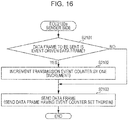
- Fig. 16 is a flowchart of a data frame transmission process performed by the ECU 2100a.
- the ECU 2100a needs to generate a data frame at a transmission timing in accordance with the transmission period defined in the data frame generation rules (a timing at which the transmission period has elapsed since the previous transmission) or at a timing at which the sensor value from the sensor value acquiring unit 109 varies. Thus, the ECU 2100a starts the transmission process illustrated in Fig. 16 . In the transmission process, the ECU 2100a determines whether the data frame to be sent is an event-driven data frame or a periodical data frame first (step S2101).
- step S2101 the ECU 2100a determines that the data frame to be sent is an event-driven data frame that does not follow the transmission period defined in the data frame generation rules
- the ECU 2100a increments the value of the transmission event counter stored in the data frame generation rule holding unit 2103 by one (step S2102).
- step S2102 the ECU 2100a determines that the data frame to be sent is a periodical data frame that follows the transmission period defined in the data frame generation rules (i.e., not an event-driven data frame)
- the ECU 2100a skips the process in step S2102 in which the value of the transmission event counter is incremented.
- the ECU 2100a After the ECU 2100a has completed the process in step S2102 or has skipped the process in step S2102, the ECU 2100a sets the event counter I of the data field to the value of the transmission event counter and sets, in the data area of the data field, the latest sensor value acquired from the sensor value acquiring unit 109. Thus, the ECU 2100a generates a data frame to be sent and sends the data frame to the bus 200 (step S2103). In this manner, the data frame flows in the bus 200 and can be received by the ECU 2100b.
- the ECU 2100b can perform a transmission process that is similar to the transmission process illustrated in Fig. 16 .
- the data frame reception process performed by the ECU 2100b under the assumption that the ECU 2100a sends a data frame to the bus 200 and the ECU 2100b receives the data frame from the bus 200 is described below.
- Fig. 17 is a flowchart of a data frame reception process performed by the ECU 2100b.
- the ECU 2100b receives the data frame appearing in the bus 200 (step S2201). Note that if the data frame does not include the message ID to be received by ECU 2100b itself, the ECU 2100b discards the data frame and completes its processing. However, if the ECU 2100b has received the data frame having a message ID to be received by the ECU 2100b itself, the ECU 2100b determines whether the reception is within a transmission period range defined in the held period rule information (step S2202).
- the fraudulent data frame determination unit 2104 of the ECU 2100b determines whether the reception interval of the received data frame (i.e., the transmission period) is within a predetermined transmission period range (i.e., the reception period satisfies the transmission period condition defined in the period rule information) using the information acquired by the timer 108, the received data frame period holding unit 105, and the data frame reception history holding unit 106. That is, the fraudulent data frame determination unit 2104 determines whether the difference between the previous receipt time and the receipt time of the currently received data frame (the reception interval) is greater than or equal to a value obtained by subtracting the margin from the transmission period determined for the message ID of the received data frame and is less than or equal to a value obtained by adding the margin to the transmission period.
- a predetermined transmission period range i.e., the reception period satisfies the transmission period condition defined in the period rule information
- step S2202 If, in step S2202, the reception interval of the data frame is within the transmission period range, the transmission period condition is satisfied.
- the ECU 2100b associates the message ID of the received data frame with the receipt time of the data frame and records the receipt time of the data frame in the list held by the data frame reception history holding unit 2106 as the previous receipt time (i.e., updates the previous receipt time) (step S2204).
- the fraudulent data frame determination unit 2104 of the ECU 2100b determines that the received data frame is an authorized data frame (step S2206), and the data frame processing unit 107 performs a process corresponding to the data frame.
- step S2202 determines whether the event counter I of the data field of the data frame is the same as a value obtained by incrementing the value of the reception event counter stored in the data frame reception history holding unit 2106 by one (step S2203). If the event counter I is the same as the value, the ECU 2100b increments the value of the reception event counter by one (step S2205). Subsequently, the fraudulent data frame determination unit 2104 of the ECU 2100b determines that the received data frame is an authorized data frame (step S2206) and, thus, the data frame processing unit 107 performs a process corresponding to the data frame.
- step S2203 determines that the event counter I is not the same as the value
- the ECU 2100b determines that the received data frame is a fraudulent data frame and, thus, discards the data frame (step S2207). Accordingly, the ECU 2100b does not process the fraudulent data frame sent from the fraudulent ECU.
- step S2202 it is determined whether the reception interval of the data frame (i.e., the transmission period) is within the predetermined transmission period range and if the previous receipt time is not stored (e.g., at the first time of determination), the received data frame can be considered as an event-driven data frame. Thereafter, when the event counter is correct, the reception event counter can be incremented by one and, subsequently, the receipt time of the data frame can be recorded as the previous receipt time. Subsequently, the process in step S2206 can be performed. In such a case, at the start point of periodic transmission, such as the first transmission, the sender ECU sends an event-driven data frame.
- the data frame may be sent as an event-driven data frame when the periodical transmission resumes.
- the sender ECU enters a sleep mode and, thus periodical transmission stops for a predetermined period of time since the previous receipt time
- the receiver ECU cancels out the previous receipt time.
- the receiver ECU considers the next time as a first time and considers the received data frame as an event-driven data frame. In this manner, the receiver ECU can determine the validity of the data frame.
- the ECU 2100a can perform a reception process that is similar to the reception process illustrated in Fig. 17 .
- the in-vehicle network system 11 is provided. Even when an event-driven data frame that is non-periodically sent is present in addition to a periodically sent data frame, the in-vehicle network system 11 is capable of determining whether a data frame is an authorized data frame by providing the specific identifier (i.e., the event counter) in the event-driven data frame. That is, the in-vehicle network system 11 determines whether a data frame is an authorized data frame using the transmission period condition. Only when it is difficult to determine whether a data frame is an authorized data frame using the transmission period condition, the in-vehicle network system 11 determines whether the data frame is an authorized data frame using the specific identifier.
- the specific identifier i.e., the event counter
- a fraudulent ECU Since the event counter is not a fixed value, it is difficult for a fraudulent ECU to provide a value that is the same as the event counter in the data frame. If the fraudulent ECU sends a data frame, it is highly likely that the data frame does not satisfy the transmission period condition. In addition, since it is not easy for the fraudulent ECU to correctly set the event counter, an ECU that has received the data frame can determine that the received data frame is a fraudulent data frame.
- a data frame that is not an event-driven data frame i.e., a periodically sent data frame
- An in-vehicle network system 12 that achieves a fraud detection method for appropriately detecting that a fraudulent data frame is sent between an ECU 3100a and an ECU 3100b that communicate data frames to each other under the condition that a non-periodical event-driven data frame can be sent in addition to a periodically sent data frame is described below with reference to the accompanying drawings.
- Fig. 18 illustrates the overall configuration of the in-vehicle network system 12 according to a third embodiment.
- the in-vehicle network system 12 is formed by partially modifying the in-vehicle network system 10 according to the first embodiment.
- the in-vehicle network system 12 is a network communication system of a motor vehicle having a variety of devices, such as a control unit and a sensor mounted therein.
- the in-vehicle network system 12 includes the ECUs 3100a and 3100b connected to a variety of devices and a bus 200 that connects the ECUs to one another.
- the ECU is a device including, for example, digital circuits, such as a processor (a microprocessor) and a memory, analog circuits, and a communication circuit.
- digital circuits such as a processor (a microprocessor) and a memory
- analog circuits such as a CMOS, complementary metal-oxide-semiconductor (SRAM), and a CMOS, complementary metal-oxide-semiconductor (S-S)
- a communication circuit such as a processor (a microprocessor) and a memory
- description is given under the assumption that a fraudulent ECU that sends a fraudulent data frame may be connected to the bus 200.
- the ECU 3100a is formed by partially modifying the ECU 100a according to the first embodiment.
- the ECU 3100a is connected to a power window switch 110.
- the ECU 3100a periodically sends, to the bus 200, a data frame including information indicating the state of the power window switch 110.
- the ECU 3100a sends a data frame including the information indicating the state of the power window switch 110 (i.e., the information indicating a sensor value) to the bus 200.
- the ECU 3100a sends a non-periodical event-driven data frame to the bus 200 if the time at which the state of the power window switch 110 varies does not exactly match the transmission period. Furthermore, the ECU 3100a receives a data frame that is sent from the ECU 3100b to the bus 200 and that flows in the bus 200. Thereafter, the ECU 3100a verifies that, for example, the data frame sent from the ECU 3100a has been correctly received.
- the ECU 3100b is formed by partially modifying the ECU 100b according to the first embodiment.
- the ECU 3100b is connected to a power window 120.
- the ECU 3100b receives a data frame that is sent from the ECU 2100a to the bus 200 and that flows in the bus 200. Thereafter, the ECU 3100b controls the power window 120 to open or close in accordance with the state of the power window switch 110 included in the data frame.
- the ECU 3100b periodically sends a data frame in accordance with the open/close control state of the power window 120 to the bus 200.
- each of the ECUs sends and receives a frame in accordance with the CAN protocol.
- the ECUs have a function of determining whether the received data frame is a fraudulent data frame.
- the data field of a data frame used in the in-vehicle network system 12 is described below.
- Fig. 19 illustrates an example of the data field format used in the in-vehicle network system 12.
- the example illustrated in Fig. 19 is an example in the case of an event-driven data frame.
- the least significant 16 bits "I" (the last 16 bits) of the data field serve as a MAC field I that stores a Message Authentication Code (MAC).
- MAC Message Authentication Code
- the information as to whether the data field of an event-driven data frame includes the MAC field I and the position and the length of the MAC field I when the MAC field I is included are defined by an event-driven data frame format (described in more detail below) of the data frame generation rules stored in a data frame generation rule holding unit 3103.
- MAC is set in the MAC field I in accordance with the event-driven data frame format stored in the data frame generation rule holding unit 3103.
- MAC serves as a specific identifier used to identify whether the event-driven data frame is an authorized event-driven data frame.
- MAC need not be set in the data field.
- a fixed value may be set in the data field.
- the entire data field may be used as a data area without setting MAC or the alternative data. In this example, description is given with reference to a periodical data frame that does not include MAC and an event-driven data frame that includes MAC.
- the data area which is the area of the data field other than the MAC field I (refer to Fig. 19 ), contains the data indicating the sensor value acquired from, for example, a device by the ECU (e.g., a value indicating the state of the power window switch 110 in the data frame sent from the ECU 3100a).
- the least significant 16 bits serve as the MAC field I.
- the MAC field I may be placed at any bit position (e.g., the most significant 16 bits) in the data field if the information is defined by the event-driven data frame format.
- the size of MAC may be set to a size other than 16 bits.
- Fig. 20 is the configuration diagram of the ECU 3100a.
- the ECU 3100a includes a data frame transceiver unit 101, a data frame generation unit 3102, the data frame generation rule holding unit 3103, a fraudulent data frame determination unit 3104, a received data frame period holding unit 3105, a data frame reception history holding unit 106, a data frame processing unit 107, a timer 108, a sensor value acquiring unit 109, a MAC generation unit 3110, a MAC key holding unit 3111, and a counter holding unit 3112.
- the constituent element having a function that is the same as that of the ECU 100a according to the first embodiment is identified with the same reference numeral, and description of the constituent element is not repeated.
- These constituent elements are functional constituent elements.
- the functions are realized by the communication circuit of the ECU 3100a and one of, for example, the processor that executes the control program stored in the memory and a digital circuit.
- the ECU 3100b has substantially the same configuration as that of the ECU 3100a.
- the information stored in each of the data frame generation rule holding unit 3103, the received data frame period holding unit 3105, and the data frame reception history holding unit 106 may differ on an ECU basis.
- the processing performed by the data frame processing unit 107 differs on an ECU basis.
- the data frame generation unit 3102 generates a data frame in accordance with data frame generation rules stored in the data frame generation rule holding unit 3103 and sends the generated data frame to the data frame transceiver unit 101.
- the data frame generation unit 3102 acquires the current time from the timer 108.
- the data frame generation unit 3102 acquires, from the sensor value acquiring unit 109, the data regarding a device (the power window switch 110) connected to the ECU 3100a (i.e., the sensor value).
- the data frame generation unit 3102 determines the timing at which the data frame is generated using the current time and the transmission period stored in the data frame generation rule holding unit 3103 and periodically generates the data frame.
- the data frame is sent to the data frame transceiver unit 101.
- the data frame transceiver unit 101 sends the data frame.
- the data frame generation unit 3102 generates an event-driven data frame.
- the data frame generation unit 3102 sets MAC in the data frame in accordance with the event-driven data frame format of the data frame generation rules for each of the message IDs stored in the data frame generation rule holding unit 3103.
- the MAC is obtained by rounding down the value acquired from the MAC generation unit 3110 by sending, to the MAC generation unit 3110, the message ID of the data frame to be generated and the data (the sensor value) stored in the data area of the data field so that the value has the data length (the bit length) defined by the event-driven data frame format.
- the data frame is periodically sent from the ECU 3100a to the bus 200 by the data frame transceiver unit 101.
- the event-driven data frame is non-periodically sent.
- the data frame generation unit 3102 Like the data frame generation unit 102 according to the first embodiment, the data frame generation unit 3102 generates a data frame having a specific identifier called MAC provided therein when sending the data frame at a timing that does not follow the data frame generation rule indicating the transmission period. That is, the data frame generation unit 3102 functions as a providing unit.
- the data frame generation rule holding unit 3103 is formed from a storage medium, such as a memory.
- the data frame generation rule holding unit 3103 stores, as the data frame generation rules, the transmission period used to periodically send a data frame for each of the message IDs sent from the ECU 3100a and the event-driven data frame format indicating, for example, the position at which MAC is stored and the data length.
- Fig. 21 illustrates an example of the data frame generation rules stored in the data frame generation rule holding unit 3103.
- the ECU 3100a sends a plurality of types of data frame (a type of data frame identified by the message ID), such as the data frame indicating the state of the power window switch 110.
- a type of data frame identified by the message ID such as the data frame indicating the state of the power window switch 110.
- the transmission period of a data frame that is periodically sent from the ECU 3100a and that has a message ID of 0x100 is 50 ms. If the data frame is sent as an event-driven data frame that does not follow the transmission period, MAC needs to be stored in the least significant 16 bits of the data field. In addition, the transmission period of a data frame having a message ID of 0x200 is 100 ms, and an event-driven data frame having a message ID of 0x200 is not sent. Furthermore, the transmission period of a data frame that has a message ID of 0x300 and that is periodically sent from the ECU 3100a is 70 ms. If the data frame is sent as an event-driven data frame that does not follow the transmission period, MAC needs to be stored in the least significant 16 bits of the data field.
- the fraudulent data frame determination unit 3104 determines whether the received data frame is an authorized data frame (not a fraudulent data frame). That is, the fraudulent data frame determination unit 3104 refers to the period rule information in the received data frame period holding unit 3105 and verifies whether the data frame satisfies a transmission period condition predetermined for each of the message IDs. If the data frame satisfies the transmission period condition, the fraudulent data frame determination unit 3104 determines that the data frame is a data frame sent from an authorized ECU (i.e., an authorized data frame). In addition, even when the data frame does not satisfy the transmission period condition, the fraudulent data frame determination unit 3104 determines that the data frame is an authorized data frame as long as it is verified that an authorized MAC is included in the data field.
- the MAC is verified by determining whether the value acquired from the MAC generation unit 3110 by sending the message ID of the data frame and the information in the data area of the data field to the MAC generation unit 3110 is the same as the information in the MAC field I in the data field. If the value acquired from the MAC generation unit 3110 is the same as the information in the MAC field I, the verification is successful. That is, like the fraudulent data frame determination unit 104 according to the first embodiment, if a data frame that does not follow the period rule information corresponding to the data frame generation rule indicating the transmission period is received by the data frame transceiver unit 101, the fraudulent data frame determination unit 3104 verifies the specific identifier called MAC in the data frame.
- the fraudulent data frame determination unit 3104 has a function of a verifying unit.
- the fraudulent data frame determination unit 3104 determines that the received data frame is a fraudulent data frame. If it is determined that the received data frame is an authorized data frame, the fraudulent data frame determination unit 2104 causes the data frame processing unit 107 to process the data frame. However, if it is determined that the received data frame is a fraudulent data frame, the fraudulent data frame determination unit 2104 discards the data frame (i.e., inhibits the data frame processing unit 107 from processing the data frame). In addition, if the fraudulent data frame determination unit 3104 receives the data frame that satisfies the transmission period condition, the fraudulent data frame determination unit 3104 stores the receipt time in the data frame reception history holding unit 106 as the previous receipt time.
- the received data frame period holding unit 3105 is formed from a storage medium, such as a memory.
- the received data frame period holding unit 3105 stores the period rule information.
- the period rule information indicates a correspondence between a predetermined transmission period for each of the message IDs of the data frames received by the ECU 3100a itself and a margin indicating an allowable range used for the data frame reception period to be determined to satisfy the transmission period condition (that is, to be the same as the valid transmission period).
- the period rule information includes an event-driven data frame format that indicates, for example, the position and the length of MAC stored in the data field of the event-driven data frame which does not satisfy the transmission period condition.
- the event-driven data frame format is used by the fraudulent data frame determination unit 3104 to verify the validity of the event-driven data frame (i.e., verify the MAC).
- the transmission period in the period rule information held by the received data frame period holding unit 3105 of an ECU on a data frame receiver side corresponds to the transmission period in the data frame generation rules held by the data frame generation rule holding unit 3103 of an ECU on the data frame sender side.
- the event-driven data frame format in the period rule information held by the received data frame period holding unit 3105 of an ECU on a data frame receiver side corresponds to the event-driven data frame format in the data frame generation rules held by the data frame generation rule holding unit 3103 of an ECU on the data frame sender side.
- the transmission period of the data frame having a message ID of 0x100 is 50 ms.
- the transmission period of the data frame having a message ID of 0x200 is 100 ms, and the transmission period of the data frame having a message ID of 0x300 is 70 ms.
- the margin is 1 ms for all the message IDs.
- the fraudulent data frame determination unit 3104 of the ECU 3100b determines that the transmission period condition is satisfied if the transmission period for the data frame having a message ID of 0x100 is in the range between 49 ms and 51 ms (inclusive).
- the event-driven data frame format indicates that the event-driven data frame having a message ID of each of 0x100 and 0x300 has MAC provided in the least significant 16 bits of the data field. Also, the event-driven data frame format indicates that the event-driven data frame having a message ID of 0x200 is not sent.
- the MAC generation unit 3110 generates MAC on the basis of the information regarding the data frame sent from the fraudulent data frame determination unit 3104 or the data frame generation unit 3102 (i.e., the message ID and the data in the data area of the data field) and sends the value of MAC to the sender. That is, the MAC generation unit 3110 performs HMAC (refer to NPL 4) calculation on a concatenation of the sent message ID, the value of data in the data area of the data field, and the counter value that is stored in the counter holding unit 3112 and that corresponds to the sent message ID using a MAC key corresponding to the sent message ID stored in the MAC key holding unit 3111. Thus, the MAC generation unit 3110 generates MAC and sends back the MAC to the sender.
- HMAC transfer to NPL 4
- the MAC key holding unit 3111 is formed from a storage medium, such as a memory.
- the MAC key holding unit 3111 stores an encryption key used for MAC generation for each of the message IDs of the data frames to be sent from the ECU 3100a itself.
- the MAC key holding unit 3111 stores an encryption key used for MAC generation for each of the message IDs of the data frames to be received by the ECU 3100a itself.
- the counter holding unit 3112 is formed so as to include a storage medium, such as a memory.
- the counter holding unit 3112 holds a transmission counter for each of the message IDs of the data frames to be sent by the ECU 3100a itself and a reception counter for each of the message IDs of the data frames to be received by the ECU 3100a itself.
- the fraudulent data frame determination unit 3104 determines that the received data frame is not fraudulent and, thus, the data frame is sent to the data frame processing unit 107, the reception counter corresponding to the message ID is incremented by one.
- the transmission counter is synchronized with the reception counter so that the value of the transmission counter held by the sender ECU that sends the event-driven data frame for each of the message IDs is the same as the value of the reception counter held by the receiver ECU for the message ID.
- the MAC generation unit 3110 When generating MAC for transmission of a data frame, the MAC generation unit 3110 generates the MAC using the transmission counter.
- the MAC generation unit 3110 When generating MAC for verification of the received data frame, the MAC generation unit 3110 generates the MAC using the reception counter.
- the data frame transmission process performed by the ECU 3100a under the assumption that the ECU 3100a sends a data frame to the bus 200 and the ECU 3100b receives the data frame from the bus 200 is described below.
- Fig. 23 is a flowchart of a data frame transmission process performed by the ECU 3100a.
- the ECU 3100a needs to generate a data frame at a transmission timing in accordance with the transmission period defined in the data frame generation rules (a timing at which the transmission period has elapsed since the previous transmission) or at a timing at which the sensor value from the sensor value acquiring unit 109 varies. Thus, the ECU 3100a starts the transmission process illustrated in Fig. 23 . In the transmission process, the ECU 3100a determines whether the data frame to be sent is an event-driven data frame or a periodical data frame first (step S3101).
- step S3101 the ECU 3100a determines that the data frame to be sent is an event-driven data frame that does not follow the transmission period defined in the data frame generation rules, the ECU 3100a provides MAC in the MAC field I of the data field of the data frame to be generated in accordance with the event-driven data frame format (step S3102).
- step S3101 the ECU 3100a determines that the data frame to be sent is a periodical data frame that follows the transmission period defined in the data frame generation rules (i.e., not an event-driven data frame), the ECU 3100a skips the process in step S3102.
- the ECU 3100a After the ECU 3100a has completed the process in step S3102 or has skipped the process in step S3102, the ECU 3100a sets the latest sensor value acquired from the sensor value acquiring unit 109 in the data area of the data field to generate the data frame to be sent. Thereafter, the ECU 3100a sends the generated data frame to the bus 200 (step S3103). In this manner, the data frame flows in the bus 200 and can be received by the ECU 3100b.
- the ECU 3100b can perform a transmission process that is similar to the transmission process illustrated in Fig. 23 .
- the data frame reception process performed by the ECU 3100b under the assumption that the ECU 3100a sends a data frame to the bus 200 and the ECU 3100b receives the data frame from the bus 200 is described below.
- Fig. 24 is a flowchart of a data frame reception process performed by the ECU 3100b.
- the ECU 3100b receives the data frame appearing in the bus 200 (step S3201). Note that if the data frame does not include the message ID to be received by the ECU 3100b itself, the ECU 3100b discards the data frame and completes its processing. However, if the ECU 3100b has received the data frame having a message ID to be received by the ECU 3100b itself, the ECU 3100b determines whether the reception is within a transmission period range defined in the held period rule information (step S3202).
- the fraudulent data frame determination unit 3104 of the ECU 3100b determines whether the reception interval of the received data frame (i.e., the transmission period) is within a predetermined transmission period range (i.e., the reception period satisfies the transmission period condition defined in the period rule information) using the information acquired by the timer 108, the received data frame period holding unit 3105, and the data frame reception history holding unit 106. That is, the fraudulent data frame determination unit 3104 determines whether the difference between the previous receipt time and the receipt time of the currently received data frame (the reception interval) is greater than or equal to a value obtained by subtracting the margin from the transmission period determined for the message ID of the received data frame and is less than or equal to a value obtained by adding the margin to the transmission period.
- a predetermined transmission period range i.e., the reception period satisfies the transmission period condition defined in the period rule information
- step S3202 If, in step S3202, the reception interval of the data frame is within the transmission period range, the transmission period condition is satisfied.
- the ECU 3100b associates the message ID of the received data frame with the receipt time of the data frame and records the receipt time of the data frame in the list held by the data frame reception history holding unit 106 as the previous receipt time (i.e., updates the previous receipt time) (step S3204).
- the fraudulent data frame determination unit 3104 of the ECU 3100b determines that the received data frame is an authorized data frame (step S3205), and the data frame processing unit 107 performs a process corresponding to the data frame.
- the ECU 3100b separates the data field of the data frame into the MAC field I and a data area in accordance with the event-driven data frame format stored in the received data frame period holding unit 3105. Thereafter, the ECU 3100b compares the MAC calculated using the data area and the message ID with the MAC contained in the MAC field and verifies the validity of the data frame (the MAC is valid) (step S3203). If the calculated MAC is the same as the MAC contained in the MAC field, the verification of the MAC (i.e., verification of the validity of the MAC) is successful. Accordingly, the ECU 3100b determines that the received data frame is an authorized data frame (step S3205) and, thus, the data frame processing unit 107 performs a process corresponding to the data frame.
- the ECU 3100b determines that the received data frame is an authorized data frame (step S3205) and, thus, the data frame processing unit 107 performs a process corresponding to the data frame.
- step S3203 determines that the received data frame is a fraudulent data frame and, thus, discards the data frame (step S3206). Accordingly, the ECU 3100b does not process the fraudulent data frame sent from the fraudulent ECU.
- step S3202 it is determined whether the reception interval of the data frame (i.e., the transmission period) is within the predetermined transmission period range and if the previous receipt time is not stored (e.g., at the first time of determination), the received data frame can be considered as an event-driven data frame. Thereafter, when the verification of the MAC is successful, the receipt time of the data frame can be recorded as the previous receipt time. Subsequently, the process in step S3205 can be performed. In such a case, at the start point of periodic transmission, such as the first transmission, the sender ECU exceptionally sends an event-driven data frame.
- the data frame may be sent as an event-driven data frame when the periodical transmission resumes.
- the sender ECU enters a sleep mode and, thus periodical transmission stops for a predetermined period of time since the previous receipt time
- the receiver ECU cancels out the previous receipt time.
- the receiver ECU considers the next time as a first time and considers the received data frame as an event-driven data frame. In this manner, the receiver ECU can determine the validity of the data frame.
- the ECU 3100a can perform a reception process that is similar to the reception process illustrated in Fig. 24 .
- the in-vehicle network system 12 is provided. Even when in addition to a periodically sent data frame, an event-driven data frame that is non-periodically sent is present, the in-vehicle network system 12 is capable of determining whether a data frame is an authorized data frame by providing the specific identifier (i.e., MAC) in an event-driven data frame. That is, the in-vehicle network system 12 determines whether a data frame is an authorized data frame using the transmission period condition. Only when it is difficult to determine whether a data frame is an authorized data frame using the transmission period condition, the in-vehicle network system 12 determines (verifies) whether the data frame is an authorized data frame using the specific identifier.
- the specific identifier i.e., MAC
- an authorized event-driven data frame that does not satisfy the transmission period condition is prevented from being misdetected as a fraudulent data frame.
- a fraudulent ECU sends a data frame, it is highly likely that the data frame does not satisfy the transmission period condition and, thus, it is difficult for the fraudulent ECU to correctly provide the MAC. Accordingly, an ECU that has received the data frame can determine that the received data frame is a fraudulent data frame.
- a data frame that is not an event-driven data frame i.e., a periodically sent data frame
- An in-vehicle network system 13 that achieves a fraud detection method for appropriately detecting that a fraudulent data frame is sent between an ECU 4100a and an ECU 4100b that communicate data frames to each other under the condition that a non-periodical event-driven data frame can be sent in addition to a periodically sent data frame is described below with reference to the accompanying drawings.
- the in-vehicle network system 13 is formed by partially modifying the in-vehicle network system 10 according to the first embodiment and the in-vehicle network system 12 according to the third embodiment.
- the format of the data field of a data frame used in the in-vehicle network system 13 is the same as that of the third embodiment.
- Fig. 25 illustrates the overall configuration of the in-vehicle network system 13 according to a fourth embodiment.
- the in-vehicle network system 13 is a network communication system of a motor vehicle having a variety of devices, such as a control unit and a sensor mounted therein.
- the in-vehicle network system 13 includes the ECUs 4100a to 4100c connected to a variety of devices and a bus 200 that connects the ECUs to one another.
- the constituent element having a function that is the same as that of the above-described in-vehicle network system 10 or other in-vehicle network systems is identified with the same reference numeral, and description of the constituent element is not repeated.
- the ECU is a device including, for example, digital circuits, such as a processor (a microprocessor) and a memory, analog circuits, and a communication circuit.
- digital circuits such as a processor (a microprocessor) and a memory
- analog circuits such as a CMOS, complementary metal-oxide-semiconductor (SRAM), and a CMOS, complementary metal-oxide-semiconductor (S-S)
- a communication circuit such as a processor (a microprocessor) and a memory, analog circuits, and a communication circuit.
- description is given under the assumption that a fraudulent ECU that sends a fraudulent data frame may be connected to the bus 200.
- the ECU 4100c is connected to a gear 4130.
- the ECU 4100c determines the state of the vehicle in accordance with the state of the gear 4130 and sends a data frame indicating the state of the vehicle to the bus 200.
- Examples of the state of the vehicle determined from the gear 4130 include the states of the vehicle that is, for example, driving and parking.
- the ECU 4100a is formed by partially modifying the ECU 100a according to the first embodiment.
- the ECU 4100a is connected to the power window switch 110.
- the ECU 4100a periodically sends, to the bus 200, a data frame including information indicating the state of the power window switch 110.
- the ECU 4100a sends a data frame including the information indicating the state of the power window switch 110 (i.e., the information indicating a sensor value) to the bus 200.
- the ECU 4100a sends a non-periodical event-driven data frame to the bus 200 if the time at which the state of the power window switch 110 varies does not exactly match the transmission period. Furthermore, the ECU 4100a receives a data frame that is sent from the ECU 4100b to the bus 200 and that flows in the bus 200. Thereafter, the ECU 4100a verifies that, for example, the data frame sent from the ECU 4100a has been correctly received. Still furthermore, the ECU 4100a can receive a data frame indicating the state of the vehicle sent from the ECU 4100c and recognize the state of the vehicle.
- the ECU 4100b is formed by partially modifying the ECU 100b according to the first embodiment.
- the ECU 4100b is connected to a power window 120.
- the ECU 4100b receives a data frame that is sent from the ECU 4100a to the bus 200 and that flows in the bus 200. Thereafter, the ECU 4100b controls the power window 120 so that the power window 120 is open or closed in accordance with the state of the power window switch 110 included in the data frame.
- the ECU 4100b periodically sends a data frame in accordance with the open/close control state of the power window 120 to the bus 200.
- the ECU 4100b receives, from the ECU 4100c, a data frame indicating the state of the vehicle and, thus, can recognize the state of the vehicle.
- each of the ECUs sends and receives a frame in accordance with the CAN protocol.
- the ECUs have a function of determining whether the received data frame is a fraudulent data frame.
- Fig. 26 is the configuration diagram of the ECU 4100a.
- the ECU 4100a includes a data frame transceiver unit 101, a data frame generation unit 4102, the data frame generation rule holding unit 4103, a fraudulent data frame determination unit 4104, a received data frame period holding unit 4105, a data frame reception history holding unit 106, a data frame processing unit 107, a timer 108, a sensor value acquiring unit 109, a MAC generation unit 3110, a MAC key holding unit 3111, and a counter holding unit 3112.
- constituent elements of the ECU 4100a the constituent element having a function that is the same as that of the ECU 100a according to the first embodiment or the ECU 3100a according to the third embodiment is identified with the same reference numeral, and description of the constituent element is not repeated.
- These constituent elements are functional constituent elements.
- the functions are realized by the communication circuit of the ECU 4100a and one of, for example, the processor that executes the control program stored in the memory and a digital circuit. Note that each of the ECU 4100b and the ECU 4100c has substantially the same configuration as that of the ECU 4100a.
- each of the data frame generation rule holding unit 4103, the received data frame period holding unit 4105, and the data frame reception history holding unit 106 may differ on an ECU basis.
- the processing performed by the data frame processing unit 107 differs on an ECU basis.
- the data frame generation unit 4102 generates a data frame in accordance with data frame generation rules stored in the data frame generation rule holding unit 4103 and sends the generated data frame to the data frame transceiver unit 101.
- the data frame generation unit 4102 acquires the current time from the timer 108.
- the data frame generation unit 4102 acquires, from the sensor value acquiring unit 109, the data regarding a device (the power window switch 110) connected to the ECU 4100a (i.e., the sensor value).
- the data frame generation unit 4102 determines the timing at which the data frame is generated using the current time and the transmission period stored in the data frame generation rule holding unit 4103 and periodically generates the data frame.
- the data frame is sent to the data frame transceiver unit 101.
- the data frame transceiver unit 101 sends the data frame.
- the data frame generation unit 4102 generates an event-driven data frame.
- the data frame generation unit 4102 determines whether MAC is set in the event-driven data frame on the basis of MAC providing conditions (described in more detail below) of the data frame generation rules for each of the message IDs stored in the data frame generation rule holding unit 4103.
- the data frame generation unit 4102 determines that the MAC is set, the data frame generation unit 4102 sets the MAC in the data frame in accordance with the event-driven data frame format.
- the MAC is the same as that described in the third embodiment. That is, like the data frame generation unit 3102 according to the third embodiment, the data frame generation unit 4102 generates a data frame having a specific identifier called MAC provided therein when sending the data frame at a timing that does not follow the data frame generation rule indicating the transmission period. That is, the data frame generation unit 4102 functions as a providing unit. As a result of generation of the data frame by the data frame generation unit 4102, the data frame is periodically sent from the ECU 3100a to the bus 200 by the data frame transceiver unit 101.
- the data frame generation unit 4102 sends the data frame in the format of the event-driven data frame. This is because if a periodic data frame is sent at the start point of periodic transmission instead of an event-driven data frame, the receiver ECU cannot make determination based on the transmission period condition. Note that at, for example, the start point of periodic transmission, MAC may be set in the event-driven data frame.
- the data frame generation rule holding unit 4103 is formed from a storage medium, such as a memory.
- the data frame generation rule holding unit 4103 store, as the data frame generation rules, the transmission period used to periodically send a data frame for each of the message IDs sent from the ECU 4100a, the event-driven data frame format indicating, for example, the position at which MAC is stored and the data length, and the MAC providing conditions that determine whether the MAC is provided in the event-driven data frame.
- the MAC providing conditions further determine in which state of the vehicle the MAC should be provided.
- Fig. 27 illustrates an example of the data frame generation rules stored in the data frame generation rule holding unit 4103.
- the ECU 4100a sends a plurality of types of data frame (a type of data frame identified by the message ID), such as the data frame indicating the state of the power window switch 110.
- a type of data frame identified by the message ID such as the data frame indicating the state of the power window switch 110.
- the transmission period of a data frame that is periodically sent from the ECU 4100a and that has a message ID of 0x100 is 50 ms. If the data frame is sent as an event-driven data frame that does not follow the transmission period, MAC needs to be provided only when the vehicle is traveling. In addition, to provide the MAC, the MAC needs to be stored in the least significant 16 bits of the data field.
- the transmission period of a data frame having a message ID of 0x200 is 100 ms, and an event-driven data frame having a message ID of 0x200 is not sent. Furthermore, the transmission period of a data frame that is periodically sent from the ECU 4100a and that has a message ID of 0x300 is 70 ms. If the data frame is sent as an event-driven data frame that does not follow the transmission period, MAC needs to be provided when the state of the vehicle is traveling or parking. In addition, to provide the MAC, the MAC needs to be stored in the least significant 16 bits of the data field.
- the fraudulent data frame determination unit 4104 determines whether the received data frame is an authorized data frame (not a fraudulent data frame). That is, the fraudulent data frame determination unit 4104 refers to the period rule information in the received data frame period holding unit 4105 and verifies whether the data frame satisfies a transmission period condition predetermined for each of the message IDs. If the data frame satisfies the transmission period condition, the fraudulent data frame determination unit 4104 determines that the data frame is a data frame sent from an authorized ECU (i.e., an authorized data frame).
- the fraudulent data frame determination unit 4104 determines whether the data frame is a fraudulent data frame by verifying whether MAC is contained in the data frame in accordance with the event-driven data frame format if the state of the vehicle stored in a vehicle state holding unit 4113 satisfies a MAC provided event-driven data frame reception condition stored in the received data frame period holding unit 4105.
- the MAC provided event-driven data frame reception condition determines in which state of the vehicle an event-driven data frame having MAC provided therein should be received.
- the fraudulent data frame determination unit 4104 determines that the received data frame is an authorized data frame. However, if the verification fails, the fraudulent data frame determination unit 4104 determines that the received data frame is a fraudulent data frame. That is, like the fraudulent data frame determination unit 3104 according to the third embodiment, if a data frame that does not follow the period rule information corresponding to the data frame generation rule indicating the transmission period is received by the data frame transceiver unit 101, the fraudulent data frame determination unit 4104 verifies the specific identifier called MAC in the data frame. That is, the fraudulent data frame determination unit 4104 has a function of a verifying unit.
- the value obtained from the MAC generation unit 3110 by sending the message ID of the data frame and the information in the data area of the data field to the MAC generation unit 3110 is compared with the information in the MAC field I in the data field. If the values are the same, the verification of the MAC is successful. If the received data frame does not satisfy the predetermined transmission period condition and, in addition, the state of the vehicle does not satisfy the MAC provided event-driven data frame reception condition, the fraudulent data frame determination unit 4104 determines that the event-driven data frame is the authorized data frame without verifying the MAC.
- the fraudulent data frame determination unit 4104 verifies the MAC. Otherwise, the fraudulent data frame determination unit 4104 does not perform the verification. However, if in, for example, the first periodical transmission, the sender sets MAC in the event-driven data frame, the corresponding MAC verification can be performed by the receiver. Note that upon receiving a data frame that satisfies the transmission period condition, the fraudulent data frame determination unit 4104 stores the receipt time in the data frame reception history holding unit 106 as the previous receipt time. If it is determined that the received data frame is an authorized data frame, the fraudulent data frame determination unit 4104 causes the data frame processing unit 107 to process the data frame. However, if it is determined that the received data frame is a fraudulent data frame, the fraudulent data frame determination unit 4104 discards the data frame (i.e., inhibits the data frame processing unit 107 from processing the data frame).
- the received data frame period holding unit 4105 is formed from a storage medium, such as a memory.
- the received data frame period holding unit 4105 stores the period rule information.
- the period rule information indicates a correspondence between a predetermined transmission period for each of the message IDs of the data frames received by the ECU 4100a itself and a margin indicating an allowable range used for the data frame reception period to be determined to satisfy the transmission period condition (that is, to be the same as the valid transmission period).
- the period rule information includes an event-driven data frame format that indicates, for example, the position at which the MAC is stored in the data field of the event-driven data frame and the length of data and the MAC provided event-driven data frame reception condition.
- the event-driven data frame format is used by the fraudulent data frame determination unit 4104 to verify the validity of the event-driven data frame (i.e., verify the MAC).
- the MAC provided event-driven data frame reception condition is a condition related to the state of the vehicle and indicates in which state of the vehicle MAC should be verified for the event-driven data frame. Note that the transmission period in the period rule information held by the received data frame period holding unit 4105 of an ECU on a data frame receiver side corresponds to the transmission period in the data frame generation rules held by the data frame generation rule holding unit 4103 of an ECU on the data frame sender side.
- the event-driven data frame format in the period rule information held by the received data frame period holding unit 4105 of an ECU on a data frame receiver side corresponds to the event-driven data frame format in the data frame generation rules held by the data frame generation rule holding unit 4103 of an ECU on the data frame sender side.
- the MAC provided event-driven data frame reception condition in the period rule information held by the received data frame period holding unit 4105 on the data frame receiver side corresponds to the MAC providing conditions in the data frame generation rules held by the data frame generation rule holding unit 4103 of the ECU on a data frame sender side.
- the transmission period of the data frame having a message ID of 0x100 is 50 ms.
- the transmission period of the data frame having a message ID of 0x200 is 100 ms, and the transmission period of the data frame having a message ID of 0x300 is 70 ms.
- the margin is 1 ms for all the message IDs.
- the fraudulent data frame determination unit 4104 of the ECU 4100b determines that the transmission period condition is satisfied if the transmission period for the data frame having a message ID of 0x100 is in the range between 49 ms and 51 ms (inclusive).
- the event-driven data frame format indicates that the event-driven data frame having a message ID of each of 0x100 and 0x300 has MAC provided in the least significant 16 bits of the data field. Also, the event-driven data frame format indicates that the event-driven data frame having a message ID of 0x200 is not sent. Furthermore, in the example illustrated in Fig.
- the MAC provided event-driven data frame reception condition indicates that the MAC of the event-driven data frame having a message ID of 0x100 needs to be verified when the state of the vehicle is "traveling" and indicates that the MAC of the event-driven data frame having a message ID of 0x200 need not be verified since the event-driven data frame is not sent.
- the MAC provided event-driven data frame reception condition indicates that the MAC of the event-driven data frame having a message ID of 0x300 needs to be verified when the state of the vehicle is "traveling" or "parking".
- the vehicle state holding unit 4113 is formed from a storage medium, such as a memory.
- the vehicle state holding unit 4113 stores the value indicating the state of the vehicle.
- Fig. 29 illustrates an example of the state of the vehicle stored in the vehicle state holding unit 4113. In this example, the state of the vehicle indicates "traveling".
- the data frame sent from the ECU 4100c (the data frame indicating the state of the vehicle) is received and if it is determined that the data frame is an authorized data frame, the state of the vehicle held in the vehicle state holding unit 4113 is stored (updated) by the data frame processing unit 107 in accordance with the information in the data frame.
- the data frame transmission process performed by the ECU 4100a under the assumption that the ECU 4100a sends a data frame to the bus 200 and the ECU 4100b receives the data frame from the bus 200 is described below.
- Fig. 30 is a flowchart of a data frame transmission process performed by the ECU 4100a.
- the ECU 4100a needs to generate a data frame at a transmission timing in accordance with the transmission period defined in the data frame generation rules (a timing at which the transmission period has elapsed since the previous transmission) or at a timing at which the sensor value from the sensor value acquiring unit 109 varies. Thus, the ECU 4100a starts the transmission process illustrated in Fig. 30 . In the transmission process, the ECU 4100a determines whether the data frame to be sent is an event-driven data frame or a periodical data frame first (step S4101).
- step S4101 the ECU 4100a determines whether the data frame to be sent is an event-driven data frame that does not follow the transmission period defined in the data frame generation rules
- the ECU 4100a determines whether the state of the vehicle stored in the vehicle state holding unit 4113 in accordance with the data frame received from the ECU 4100c satisfies the MAC providing conditions in the data frame generation rules (step S4102). For example, when the MAC providing conditions indicates "traveling" or "parked” and if the state of the vehicle indicated by the data frame from the ECU 4100a (the state of the vehicle in the vehicle state holding unit 4113) indicates "traveling", the vehicle state holding unit 4113 determines that the state of the vehicle satisfies the MAC providing conditions.
- step S4102 the ECU 4100a determines that the state of the vehicle satisfies the MAC providing conditions, the ECU 4100a provides MAC in the MAC field I of the data field of the generated data frame in accordance with the event-driven data frame format in the data frame generation rules (step S4103).
- step S4101 the ECU 4100a determines that the data frame to be sent is a periodical data frame that follows the transmission period defined in the data frame generation rules (i.e., not an event-driven data frame), the ECU 4100a skips the processes in steps S4102 and S4103. In addition, if, in step S4102, the ECU 4100a determines that the state of the vehicle does not satisfy the MAC providing conditions, the ECU 4100a skips the process in step S4103.
- the ECU 4100a After the ECU 4100a has completed the process in step S4103 or has skipped the process in step S4103, the ECU 4100a sets the latest sensor value acquired from the sensor value acquiring unit 109 in the data area of the data field to generate the data frame to be sent. Thereafter, the ECU 4100a sends the generated data frame to the bus 200 (step S4104). In this manner, the data frame flows in the bus 200 and can be received by the ECU 4100b.
- the ECU 4100b can perform a transmission process that is similar to the transmission process illustrated in Fig. 30 .
- the data frame reception process performed by the ECU 4100b under the assumption that the ECU 4100a sends a data frame to the bus 200 and the ECU 4100b receives the data frame from the bus 200 is described below.
- Fig. 31 is a flowchart of the data frame reception process performed by the ECU 4100b.
- the ECU 4100b receives the data frame appearing in the bus 200 (step S4201). Note that if the data frame does not include the message ID to be received by ECU 4100b itself, the ECU 4100b discards the data frame and completes its processing. However, if the ECU 4100b has received the data frame having a message ID to be received by the ECU 4100b itself, the ECU 4100b determines whether the reception is within a transmission period range defined in the held period rule information (step S4202).
- the fraudulent data frame determination unit 4104 of the ECU 4100b determines whether the reception period of the received data frame (i.e., the transmission period) is within a predetermined transmission period range (i.e., the reception period satisfies the transmission period condition defined in the period rule information) using the information acquired by the timer 108, the received data frame period holding unit 4105, and the data frame reception history holding unit 106. That is, the fraudulent data frame determination unit 4104 determines whether the difference between the previous receipt time and the receipt time of the currently received data frame (the reception interval) is greater than or equal to a value obtained by subtracting the margin from the transmission period determined for the message ID of the received data frame and is less than or equal to a value obtained by adding the margin to the transmission period.
- a predetermined transmission period range i.e., the reception period satisfies the transmission period condition defined in the period rule information
- step S4202 If, in step S4202, the reception interval of the data frame is within the transmission period range, the transmission period condition is satisfied.
- the ECU 4100b associates the message ID of the received data frame with the receipt time of the data frame and records the receipt time of the data frame in the list held by the data frame reception history holding unit 106 as the previous receipt time (i.e., updates the previous receipt time) (step S4204).
- the fraudulent data frame determination unit 4104 of the ECU 4100b determines that the received data frame is an authorized data frame (step S4206), and the data frame processing unit 107 performs a process corresponding to the data frame.
- step S4203 determines whether the state of the vehicle satisfies the MAC provided event-driven data frame reception condition. That is, the ECU 4100b determines whether the state of the vehicle stored in the vehicle state holding unit 4113 in accordance with the data frame received from the ECU 4100c satisfies the MAC provided event-driven data frame reception condition.
- step S4203 If, in step S4203, it is determined that the state of the vehicle satisfies the MAC provided event-driven data frame reception condition, the ECU 4100b separates the data field of the data frame into the MAC field I and a data area in accordance with the event-driven data frame format stored in the received data frame period holding unit 4105. Thereafter, the ECU 4100b compares the MAC calculated using the data area and the message ID with the MAC contained in the MAC field and verifies the validity of the data frame (the MAC is valid) (step S4205). If the calculated MAC is the same as the MAC contained in the MAC field, the verification of the MAC (i.e., verification of the validity of the MAC) is successful. Accordingly, the ECU 4100b determines that the received data frame is an authorized data frame (step S4206) and, thus, the data frame processing unit 107 performs a process corresponding to the data frame.
- the ECU 4100b determines that the received data frame is an authorized data frame (
- step S4205 determines that the calculated MAC is not the same as the MAC contained in the MAC field (the verification of MAC is not successful)
- the ECU 4100b determines that the received data frame is a fraudulent data frame and, thus, discards the data frame (step S4207). Accordingly, the ECU 4100b does not process the fraudulent data frame sent from the fraudulent ECU.
- step S4203 determines that the state of the vehicle does not satisfy the MAC provided event-driven data frame reception condition. Accordingly, the data frame processing unit 107 performs a process corresponding to the data frame.
- step S4202 it is determined whether the reception interval of the data frame (i.e., the transmission period) is within the predetermined transmission period range and if the previous receipt time is not stored (e.g., at the first time of determination), the received data frame can be considered as an event-driven data frame. Thereafter, when the verification of the MAC is successful, the receipt time of the data frame can be recorded as the previous receipt time. Subsequently, the process in step S4206 can be performed. In such a case, at the start point of periodic transmission, such as the first transmission, the sender ECU exceptionally sends an event-driven data frame having MAC provided therein.
- the data frame may be sent as an event-driven data frame when the periodical transmission resumes.
- the sender ECU enters a sleep mode and, thus periodical transmission stops for a predetermined period of time since the previous receipt time
- the receiver ECU cancels out the previous receipt time.
- the receiver ECU considers the next time as a first time and considers the received data frame as an event-driven data frame. In this manner, the receiver ECU can determine the validity of the data frame.
- the ECU 4100a can perform a reception process that is similar to the reception process illustrated in Fig. 31 .
- a transmission process in which the ECU 4100c acquires the state of the vehicle and sends a data frame indicating the state of the vehicle to the bus 200 is described below.
- Fig. 32 is a flowchart of the transmission process of a data frame indicating the state of the vehicle performed by ECU 4100c. The process illustrated in Fig. 32 is repeatedly performed by the ECU 4100c.
- the ECU 4100c acquires the state of the gear 4130 connected thereto from the sensor (step S4301).
- the ECU 4100c determines whether the acquired state of the gear 4130 is the state changed from the previously acquired state (step S4302). If the state of the gear 4130 has been changed, the ECU 4100c identifies the state of the vehicle on the basis of a correspondence between a predetermined state of the gear 4130 (e.g., the gear position, such as the first gear, the second gear, or parking) and the state of the vehicle (e.g., traveling or parking) and generates a data frame having the state of the vehicle as the information in the data field. Thereafter, the ECU 4100c sends the generated data frame to the bus 200 as an event-driven data frame (step S4303).
- a predetermined state of the gear 4130 e.g., the gear position, such as the first gear, the second gear, or parking
- the state of the vehicle e.g., traveling or parking
- the ECU 4100c may provide MAC in the event-driven data frame and send the event-driven data frame.
- each of the ECU 4100a and the ECU 4100b verifies the MAC in the event-driven data frame received from the bus 200. Only when the verification is successful, each of the ECU 4100a and the ECU 4100b acquires the state of the vehicle and stores the state of the vehicle in the vehicle state holding unit 4113.
- step S4203 if, in step S4203, the state of the vehicle does not satisfy the MAC provided event-driven data frame reception condition, the received data frame is determined to be valid. However, modification may be made so that if the state of the vehicle does not satisfy the MAC provided event-driven data frame reception condition, the received data frame is determined to be a fraudulent data frame and, thus, is discarded.
- the modification of the reception process is described below.
- Fig. 33 is a flowchart of the modification of the data frame reception process performed by the ECU 4100b.
- the ECU 4100b receives a data frame appearing in the bus 200 (step S4401). If the ECU 4100b receives a data frame having the message ID to be received by ECU 4100b itself, the ECU 4100b determines whether the reception is within a transmission period range defined in the held period rule information (step S4402). If, in step S4402, the reception interval of the data frame is within a predetermined transmission period range, the ECU 4100b associates the message ID of the received data frame with the receipt time of the data frame and records the receipt time of the data frame in the list held by the data frame reception history holding unit 106 as the previous receipt time (step S4404).
- step S4404 the fraudulent data frame determination unit 4104 of the ECU 4100b determines that the received data frame is an authorized data frame (step S4406), and the data frame processing unit 107 performs a process corresponding to the data frame.
- step S4402 determines whether the state of the vehicle satisfies the MAC provided event-driven data frame reception condition.
- step S4403 the ECU 4100b determines that the state of the vehicle satisfies the MAC provided event-driven data frame reception condition
- the ECU 4100b compares the MAC calculated using the data area and the message ID with the MAC contained in the MAC field on the basis of the event-driven data frame format stored in the received data frame period holding unit 4105 and verifies the validity of the data frame (the MAC is valid) (step S4405). If the MAC is verified as being valid, the ECU 4100b determines that the received data frame is an authorized data frame (step S4406) and, thus, the data frame processing unit 107 performs a process corresponding to the data frame.
- step S4403 it is determined that the state of the vehicle does not satisfy the MAC provided event-driven data frame reception condition and the verification of the validity of the MAC is unsuccessful in step S4405, the ECU 4100b determines that the received data frame is a fraudulent data frame and, thus, discards the data frame (step S4407). Accordingly, the ECU 4100b does not process the fraudulent data frame sent from the fraudulent ECU.
- the in-vehicle network system 13 is provided. Even when in addition to a periodically sent data frame, an event-driven data frame that is non-periodically sent is present, the in-vehicle network system 13 is capable of determining whether a data frame is an authorized data frame by providing the specific identifier (i.e., MAC) in the event-driven data frame. That is, the in-vehicle network system 13 determines whether a data frame is an authorized data frame using the transmission period condition. Only when it is difficult to determine whether a data frame is an authorized data frame using the transmission period condition, the in-vehicle network system 13 determines (verifies) whether the data frame is an authorized data frame using the specific identifier.
- the specific identifier i.e., MAC
- an authorized event-driven data frame that does not satisfy the transmission period condition is prevented from being misdetected as a fraudulent data frame.
- a fraudulent ECU sends a data frame, it is highly likely that the data frame does not satisfy the transmission period condition and, thus, it is difficult for the fraudulent ECU to correctly provide the MAC.
- an ECU that has received the data frame can determine that the received data frame is a fraudulent data frame.
- the fraudulent data frame can be efficiently detected.
- the present disclosure is available in order to efficiently and appropriately detect that a fraudulent ECU has sent a fraudulent message over the bus in an in-vehicle network system.
Landscapes
- Engineering & Computer Science (AREA)
- Computer Security & Cryptography (AREA)
- Computer Networks & Wireless Communication (AREA)
- Signal Processing (AREA)
- Computing Systems (AREA)
- Computer Hardware Design (AREA)
- General Engineering & Computer Science (AREA)
- Power Engineering (AREA)
- Small-Scale Networks (AREA)
- Mechanical Engineering (AREA)
- Health & Medical Sciences (AREA)
- General Health & Medical Sciences (AREA)
- Medical Informatics (AREA)
Claims (15)
- Betrugserkennungsverfahren zur Verwendung in einem fahrzeuginternen Netzwerksystem (10), das mehrere elektronische Steuereinheiten (100a, 100b) enthält, die über einen Bus (200) gemäß einem CAN-, Controller Area Netzwerk-, Protokoll miteinander kommunizieren, mit:einem Empfangsschritt (S1201) zum Empfangen eines Datenblocks, der über den Bus gesendet wird; undwobei, wenn in dem Empfangsschritt ein Datenblock, der einer vorbestimmten Regel hinsichtlich einer Übertragungsperiode folgt, empfangen wird, der Datenblock als ein autorisierter Datenblock erkannt wird,einem Verifizierungsschritt zum Verifizieren einer speziellen Kennung in dem Datenblock, wenn ein Datenblock, der der vorbestimmten Regel bezüglich einer Übertragungsperiode nicht folgt, in dem Empfangsschritt empfangen wird und nur wenn ein Zustand eines Fahrzeugs, in welchem das fahrzeuginterne Netzwerksystem montiert ist, ein vorbestimmter Zustand (S1202) ist,wobei, wenn in dem Verifizierungsschritt die Verifizierung der speziellen Kennung erfolgreich ist, der Datenblock als ein autorisierter Datenblock erkannt wird (S1205), undwobei, wenn in dem Verifizierungsschritt die Verifizierung der speziellen Kennung fehlschlägt, der Datenblock als ein Betrugsdatenblock erkannt wird (S1206),wobei der vorbestimmte Zustand des Fahrzeugs ein Zustand ist, in welchem das Fahrzeug fährt.
- Betrugserkennungsverfahren nach Anspruch 1, wobei die spezielle Kennung ein Nachrichtenauthentifizierungscode ist, der in einem Datenfeld in dem Datenblock an einer vorbestimmten Position steht und der die Information in dem Datenblock wiedergibt, und
wobei in dem Verifizierungsschritt eine Verifizierung durch eine vorbestimmte Verarbeitungsprozedur ausgeführt wird zum Ermitteln, auf der Grundlage der Information in dem Datenblock, ob Daten, die in dem Datenblock, der der vorbestimmten Regel nicht folgt, an der vorbestimmten Position stehen, der Nachrichtenauthentifizierungscode ist. - Betrugserkennungsverfahren nach Anspruch 1, wobei die spezielle Kennung ein vorbestimmter Wert ist, der in einem Datenfeld des Datenblocks an einer vorbestimmten Position steht, und
wobei in dem Verifizierungsschritt eine Verifizierung ausgeführt wird, indem ermittelt wird, ob ein Wert von Daten, der in dem Datenblock, der der vorbestimmten Regel nicht folgt, an der vorbestimmten Position steht, gleich dem vorbestimmten Wert ist. - Betrugserkennungsverfahren nach Anspruch 1, wobei die spezielle Kennung ein Zählerwert ist, der in einem Datenfeld des Datenblocks an einer vorbestimmten Position steht, und
wobei in dem Verifizierungsschritt eine Verifizierung ausgeführt wird, indem ermittelt wird, ob ein Wert von Daten, der in dem Datenblock, der der vorbestimmten Regel nicht folgt, an der vorbestimmten Position steht, gleich dem Zählerwert ist, der die Anzahl für die Häufigkeit wiedergibt, mit der der Datenblock, der der vorbestimmten Regel nicht folgt, in dem Empfangsschritt empfangen wird. - Betrugserkennungsverfahren nach Anspruch 1, wobei der Empfang eines Datenblocks in dem Empfangsschritt wiederholt ausgeführt wird,
wobei die spezielle Kennung ein Ergebniswert ist, der durch eine vorbestimmte Berechnung erhalten wird und in dem Datenfeld des Datenblocks an einer vorbestimmten Position steht, und
wobei in dem Verifizierungsschritt eine Verifizierung ausgeführt wird, indem ermittelt wird, ob ein Wert von Daten, der in dem Datenblock, der der vorbestimmten Regel nicht folgt, an der vorbestimmten Position steht, gleich dem Wert ist, der durch die vorbestimmte Berechnung auf der Grundlage der speziellen Kennung in einem Datenblock erhalten wird, der die spezielle Kennung enthält, die zuvor in dem Empfangsschritt empfangen wird. - Betrugserkennungsverfahren nach Anspruch 1, wobei, wenn in dem Empfangsschritt ein Datenblock, der der vorbestimmten Regel nicht folgt, empfangen wird und wenn die Verifizierung der speziellen Kennung in dem Datenblock in dem Verifizierungsschritt erfolgreich ist, das Betrugserkennungsverfahren den Datenblock als einen autorisierten Datenblock erkennt.
- Betrugserkennungsverfahren nach Anspruch 1, wobei, wenn in dem Empfangsschritt ein Datenblock, der der vorbestimmten Regel nicht folgt, empfangen wird und wenn die Verifizierung der speziellen Kennung in dem Datenblock in dem Verifizierungsschritt fehlschlägt, das Betrugserkennungsverfahren den Datenblock als einen Betrugsdatenblock erkennt.
- Betrugserkennungsverfahren zum Senden eines Datenblocks, der einer Betrugserkennung in einem fahrzeuginternen Netzwerksystem (10), das mehrere elektronische Steuereinheiten (100a, 100b) enthält, die über einen Bus (200) gemäß dem CAN-, Controller Area Netzwerk-, Protokoll miteinander kommunizieren, zu unterziehen ist, mit:einem Bereitstellungsschritt (S1101) zur Bereitstellung einer speziellen Kennung in einem Datenblock, wenn ein Zustand eines Fahrzeugs, in welchem das fahrzeuginterne Netzwerksystem montiert ist, ein vorbestimmter Zustand ist und nur wenn der Datenblock, der nicht einer vorbestimmten Regel hinsichtlich einer Übertragungsperiode folgt, zu senden ist;einem Sendeschritt zum Senden des Datenblocks, der die spezielle Kennung, die in dem Bereitstellungsschritt bereitgestellt wird, enthält und der der vorbestimmten Regel nicht folgt, über den Bus, und wobei in dem Sendeschritt ferner ein Datenblock, der der vorbestimmten Regel folgt, gesendet wird, undder vorbestimmte Zustand des Fahrzeugs ein Zustand ist, in welchem das Fahrzeug fährt.
- Betrugserkennungsverfahren nach Anspruch 8, wobei in dem Bereitstellungsschritt die spezielle Kennung bereitgestellt wird, indem in einem Datenfeld des Datenblocks an einer vorbestimmten Position ein Nachrichtenauthentifizierungscode, der die Information in dem Datenblock wiedergibt, abgelegt wird.
- Betrugserkennungsverfahren nach Anspruch 8, wobei in dem Bereitstellungsschritt die spezielle Kennung bereitgestellt wird, indem in dem Datenfeld des Datenblocks an einer vorbestimmten Position ein vorbestimmter Wert als die spezielle Kennung abgelegt wird.
- Betrugserkennungsverfahren nach Anspruch 8, wobei in dem Bereitstellungsschritt die spezielle Kennung bereitgestellt wird, indem in dem Datenfeld des Datenblocks an einer vorbestimmten Position ein Zählerwert als die spezielle Kennung abgelegt wird, der die Anzahl der Übertragungen des Datenblocks, der der vorbestimmten Regel nicht folgt, in dem Sendeschritt wiedergibt
- Betrugserkennungsverfahren nach Anspruch 8, wobei die Übertragung des Datenblocks, der der vorbestimmten Regel nicht folgt, in dem Sendeschritt und die Bereitstellung der speziellen Kennung in dem Bereitstellungsschritt wiederholt ausgeführt werden, und wobei in dem Bereitstellungsschritt die spezielle Kennung bereitgestellt wird, indem in einem Datenfeld des Datenblocks an einer vorbestimmten Position ein Ergebniswert als eine spezielle Kennung abgelegt wird, der erhalten wird, indem eine vorbestimmte Berechnung auf der Grundlage einer speziellen Kennung ausgeführt wird, die in einem Datenblock bereitgestellt wird, der der vorbestimmten Regel nicht folgt und der zuvor gesendet wird, wenn der Datenblock in dem Sendeschritt gesendet wird.
- Fahrzeuginternes Netzwerksystem (10), das mehrere elektronische Steuereinheiten (100a, 100b) enthält, die über einen Bus (200) gemäß dem CAN-, Controller Area Netzwerk-, Protokoll miteinander kommunizieren, wobei das System aufweist:eine erste elektronische Steuereinheit, die eine Bereitstellungseinheit enthält, die ausgebildet ist,wenn ein Zustand eines Fahrzeugs, in welchem das fahrzeuginterne Netzwerksystem montiert ist, ein vorbestimmter Zustand ist, und nur wenn ein Datenblock, der einer vorbestimmten Regel hinsichtlich einer Übertragungsperiode nicht folgt, gesendet wird, eine spezielle Kennung in dem Datenblock bereitzustellen,eine Sendeeinheit, die ausgebildet ist, den Datenblock, der die spezielle durch die Bereitstellungseinheit bereitgestellte Kennung enthält und der der vorbestimmten Regel nicht folgt, über den Bus zu senden; undeine zweite elektronische Steuereinheit, die aufweisteine Empfangseinheit, die ausgebildet ist, einen über den Bus gesendeten Datenblock zu empfangen, wobei, wenn ein Datenblock, der der vorbestimmten Regel folgt, empfangen wird, der Datenblock als ein autorisierter Datenblock erkannt wird, undeine Verifizierungseinheit, die ausgebildet ist, wenn ein Datenblock, der der vorbestimmten Regel nicht folgt, durch die Empfangseinheit empfangen wird, und nur wenn ein Zustand eines Fahrzeugs, in welchem das fahrzeuginterne Netzwerksystem montiert ist, in einem vorbestimmten Zustand ist, eine spezielle Kennung in dem Datenblock zu verifizieren, wobei, wenn die Verifizierung der speziellen Kennung erfolgreich ist, die Verifizierungseinheit ausgebildet ist, den Datenblock als einen autorisierten Datenblock zu erkennen,wobei, wenn die Verifizierung der speziellen Kennung fehlschlägt, die Verifizierungseinheit ausgebildet ist, den Datenblock als einen Betrugsdatenblock zu erkennen, undwobei der vorbestimmte Zustand des Fahrzeugs ein Zustand ist, in welchem das Fahrzeug fährt.
- Elektronische Steuereinheit (100a, 100b) zur Kommunikation über einen Bus (200) gemäß dem CAN-, Controller Area Netzwerk-, Protokoll, mit:einer Bereitstellungseinheit, die ausgebildet ist, wenn ein Zustand eines Fahrzeugs, in welchem das fahrzeuginterne Netzwerksystem (10) montiert ist, ein vorbestimmter Zustand ist und nur wenn ein Datenblock, der einer vorbestimmten Regel hinsichtlich einer Übertragungsperiode nicht folgt, zu senden ist, eine spezielle Kennung in dem Datenblock bereitzustellen;einer Sendeeinheit, die ausgebildet ist, über den Bus den Datenblock, der die spezielle Kennung enthält, die durch die Bereitstellungseinheit bereitgestellt ist, zu senden und ferner über den Bus einen Datenblock zu senden, der der vorbestimmten Regel folgt; undwobei der vorbestimmte Zustand des Fahrzeugs ein Zustand ist, in welchem das Fahrzeug fährt.
- Elektronische Steuereinheit (100a, 100b) zur Kommunikation über einen Bus (200) gemäß dem CAN-, Controller Area Netzwerk-, Protokoll, mit:einer Empfangseinheit, die ausgebildet ist, einen Datenblock, der über den Bus gesendet wird, zu empfangen; undwobei, wenn ein Datenblock, der einer vorbestimmten Regel folgt, empfangen wird, die Empfangseinheit den Datenblock als einen autorisierten Datenblock erkennt;einer Verifizierungseinheit, die ausgebildet ist, wenn ein Datenblock, der einer vorbestimmten Regel hinsichtlich einer Übertragungsperiode nicht folgt, durch die Empfangseinheit empfangen wird, und nur wenn ein Zustand eines Fahrzeugs, in welchem das fahrzeuginterne Netzwerksystem (10) montiert ist, ein vorbestimmter Zustand ist, eine spezielle Kennung in dem Datenblock zu verifizieren,wobei, wenn die Verifizierung der speziellen Kennung erfolgreich ist, die Verifizierungseinheit ausgebildet ist, den Datenblock als einen autorisierten Datenblock zu erkennen,wobei, wenn die Verifizierung der speziellen Kennung fehlschlägt, die Verifizierungseinheit ausgebildet ist, den Datenblock als einen Betrugsdatenblock zu erkennen; undwobei der vorbestimmte Zustand des Fahrzeugs ein Zustand ist, in welchem das Fahrzeug fährt.
Applications Claiming Priority (3)
| Application Number | Priority Date | Filing Date | Title |
|---|---|---|---|
| US201461990360P | 2014-05-08 | 2014-05-08 | |
| JP2015032206 | 2015-02-20 | ||
| PCT/JP2015/002161 WO2015170451A1 (ja) | 2014-05-08 | 2015-04-21 | 車載ネットワークシステム、電子制御ユニット及び不正検知方法 |
Publications (3)
| Publication Number | Publication Date |
|---|---|
| EP3142289A1 EP3142289A1 (de) | 2017-03-15 |
| EP3142289A4 EP3142289A4 (de) | 2017-05-17 |
| EP3142289B1 true EP3142289B1 (de) | 2020-10-07 |
Family
ID=54392311
Family Applications (1)
| Application Number | Title | Priority Date | Filing Date |
|---|---|---|---|
| EP15788947.8A Active EP3142289B1 (de) | 2014-05-08 | 2015-04-21 | Fahrzeuginternes netzwerksystem, elektronische steuereinheit und detektionsverfahren für unregelmässigkeiten |
Country Status (5)
| Country | Link |
|---|---|
| US (2) | US10158717B2 (de) |
| EP (1) | EP3142289B1 (de) |
| JP (2) | JP6417407B2 (de) |
| CN (2) | CN111181732B (de) |
| WO (1) | WO2015170451A1 (de) |
Families Citing this family (81)
| Publication number | Priority date | Publication date | Assignee | Title |
|---|---|---|---|---|
| EP3142289B1 (de) * | 2014-05-08 | 2020-10-07 | Panasonic Intellectual Property Corporation of America | Fahrzeuginternes netzwerksystem, elektronische steuereinheit und detektionsverfahren für unregelmässigkeiten |
| JP6967097B2 (ja) * | 2014-05-08 | 2021-11-17 | パナソニック インテレクチュアル プロパティ コーポレーション オブ アメリカPanasonic Intellectual Property Corporation of America | 車載ネットワークシステム、電子制御ユニット及び不正検知方法 |
| JP6569087B2 (ja) * | 2014-05-29 | 2019-09-04 | パナソニックIpマネジメント株式会社 | 受信装置および受信方法 |
| EP3480064B1 (de) * | 2014-09-12 | 2020-08-19 | Panasonic Intellectual Property Corporation of America | Fahrzeugkommunikationsvorrichtung, fahrzeuginternes netzwerksystem und kommunikationsverfahren für ein fahrzeug |
| KR101596753B1 (ko) * | 2014-10-02 | 2016-02-23 | 현대자동차주식회사 | 메시지 인증 코드 분할을 통한 순차적 can 패킷 인증 방법 및 그 장치 |
| KR101572935B1 (ko) * | 2014-10-02 | 2015-12-11 | 현대자동차주식회사 | 메시지 인증 코드 혼합을 통한 can 패킷 인증 방법 및 그 장치 |
| US10708293B2 (en) | 2015-06-29 | 2020-07-07 | Argus Cyber Security Ltd. | System and method for time based anomaly detection in an in-vehicle communication network |
| US10798114B2 (en) | 2015-06-29 | 2020-10-06 | Argus Cyber Security Ltd. | System and method for consistency based anomaly detection in an in-vehicle communication network |
| US11165851B2 (en) | 2015-06-29 | 2021-11-02 | Argus Cyber Security Ltd. | System and method for providing security to a communication network |
| EP3326312B1 (de) * | 2015-07-22 | 2025-10-01 | Arilou Information Security Technologies Ltd. | Datensicherheit für fahrzeugkommunikationsbus |
| JP6684690B2 (ja) * | 2016-01-08 | 2020-04-22 | パナソニック インテレクチュアル プロパティ コーポレーション オブ アメリカPanasonic Intellectual Property Corporation of America | 不正検知方法、監視電子制御ユニット及び車載ネットワークシステム |
| US11044260B2 (en) | 2016-04-01 | 2021-06-22 | The Regents Of The University Of Michigan | Fingerprinting electronic control units for vehicle intrusion detection |
| EP3440817B1 (de) * | 2016-04-06 | 2022-06-22 | Karamba Security | Automatisierte sicherheitsrichtlinienerzeugung für steuergeräte |
| JP6846991B2 (ja) * | 2016-07-05 | 2021-03-24 | パナソニック インテレクチュアル プロパティ コーポレーション オブ アメリカPanasonic Intellectual Property Corporation of America | 異常検知電子制御ユニット、車載ネットワークシステム及び異常検知方法 |
| JP6433951B2 (ja) * | 2016-08-09 | 2018-12-05 | 東芝デジタルソリューションズ株式会社 | ネットワーク監視装置およびプログラム |
| JP2018032977A (ja) * | 2016-08-24 | 2018-03-01 | 株式会社オートネットワーク技術研究所 | 送信装置、通信システム、送信方法及びコンピュータプログラム |
| JP6805667B2 (ja) * | 2016-09-15 | 2020-12-23 | 住友電気工業株式会社 | 検知装置、ゲートウェイ装置、検知方法および検知プログラム |
| WO2018057321A2 (en) * | 2016-09-23 | 2018-03-29 | Kwourz Research Llc | Secure communication of network traffic |
| US10567400B2 (en) | 2016-09-27 | 2020-02-18 | Fujitsu Limited | Attack detection device, attack detection method, and non-transitory computer-readable recording medium |
| JP6536537B2 (ja) * | 2016-11-04 | 2019-07-03 | トヨタ自動車株式会社 | 車載ネットワークシステム |
| US10630481B2 (en) | 2016-11-07 | 2020-04-21 | Ford Global Technologies, Llc | Controller area network message authentication |
| JP6822090B2 (ja) * | 2016-11-16 | 2021-01-27 | トヨタ自動車株式会社 | 通信システム |
| JP6798280B2 (ja) | 2016-11-29 | 2020-12-09 | 富士通株式会社 | 攻撃検知装置、攻撃検知方法、および、攻撃検知プログラム |
| US11588567B2 (en) * | 2016-12-02 | 2023-02-21 | Texas Instruments Incorporated | Synchronizing vehicle devices over a controller area network |
| WO2018135098A1 (ja) * | 2017-01-18 | 2018-07-26 | パナソニックIpマネジメント株式会社 | 監視装置、監視方法およびコンピュータプログラム |
| JP6782444B2 (ja) * | 2017-01-18 | 2020-11-11 | パナソニックIpマネジメント株式会社 | 監視装置、監視方法およびコンピュータプログラム |
| JP6846706B2 (ja) * | 2017-03-22 | 2021-03-24 | パナソニックIpマネジメント株式会社 | 監視装置、監視方法およびコンピュータプログラム |
| JP6981755B2 (ja) * | 2017-01-25 | 2021-12-17 | トヨタ自動車株式会社 | 車載ネットワークシステム |
| US10382466B2 (en) * | 2017-03-03 | 2019-08-13 | Hitachi, Ltd. | Cooperative cloud-edge vehicle anomaly detection |
| JP6956624B2 (ja) * | 2017-03-13 | 2021-11-02 | パナソニック インテレクチュアル プロパティ コーポレーション オブ アメリカPanasonic Intellectual Property Corporation of America | 情報処理方法、情報処理システム、及びプログラム |
| JP2018157463A (ja) * | 2017-03-21 | 2018-10-04 | オムロンオートモーティブエレクトロニクス株式会社 | 車載通信システム、通信管理装置、車両制御装置 |
| JP2018160851A (ja) * | 2017-03-23 | 2018-10-11 | 株式会社オートネットワーク技術研究所 | 車載通信装置、コンピュータプログラム及びメッセージ判定方法 |
| JPWO2018198545A1 (ja) * | 2017-04-26 | 2020-01-23 | ボッシュ株式会社 | Ecu |
| US11606344B2 (en) | 2017-05-10 | 2023-03-14 | Osr Enterprises Ag | Security enforcement in a system with a multiplicity of end units |
| DE112018002549T5 (de) * | 2017-05-18 | 2020-04-09 | Bosch Corporation | Elektronisches Steuergerät |
| KR102464430B1 (ko) * | 2017-06-27 | 2022-11-07 | 현대자동차주식회사 | 차량 전자 모듈의 통신방법 및 이를 포함하는 차량 |
| JP6891671B2 (ja) | 2017-06-29 | 2021-06-18 | 富士通株式会社 | 攻撃検知装置および攻撃検知方法 |
| WO2019017056A1 (ja) | 2017-07-19 | 2019-01-24 | パナソニック インテレクチュアル プロパティ コーポレーション オブ アメリカ | 車載中継装置、中継方法及びプログラム |
| JP7020990B2 (ja) * | 2017-07-19 | 2022-02-16 | パナソニック インテレクチュアル プロパティ コーポレーション オブ アメリカ | 車載中継装置、中継方法及びプログラム |
| SG10201705960QA (en) * | 2017-07-20 | 2019-02-27 | Huawei Int Pte Ltd | System and method for managing secure communications between modules in a controller area network |
| WO2019021403A1 (ja) | 2017-07-26 | 2019-01-31 | パナソニック インテレクチュアル プロパティ コーポレーション オブ アメリカ | 制御ネットワークシステム、車両遠隔制御システム及び車載中継装置 |
| US11036853B2 (en) | 2017-08-02 | 2021-06-15 | Enigmatos Ltd. | System and method for preventing malicious CAN bus attacks |
| KR102272081B1 (ko) * | 2017-09-25 | 2021-07-02 | 현대모비스 주식회사 | 자동차 네트워크의 데이터 통신방법 |
| JP7003544B2 (ja) * | 2017-09-29 | 2022-01-20 | 株式会社デンソー | 異常検知装置、異常検知方法、プログラム及び通信システム |
| CN109696900A (zh) * | 2017-10-23 | 2019-04-30 | 北京长城华冠汽车科技股份有限公司 | 一种测试汽车控制器局域网络报文发送周期的系统和方法 |
| JP6939907B2 (ja) * | 2018-01-17 | 2021-09-22 | 日本電信電話株式会社 | 検知装置、その方法、及びプログラム |
| JP7172043B2 (ja) | 2018-01-19 | 2022-11-16 | 富士通株式会社 | 攻撃検知装置および攻撃検知方法 |
| US11178158B2 (en) | 2018-01-29 | 2021-11-16 | Nagravision S.A. | Secure communication between in-vehicle electronic control units |
| JP7119537B2 (ja) * | 2018-04-24 | 2022-08-17 | 日本電信電話株式会社 | 検知システムおよび検知方法 |
| JP7046700B2 (ja) * | 2018-04-25 | 2022-04-04 | 矢崎総業株式会社 | 通信システム |
| CN111434077B (zh) * | 2018-05-23 | 2023-02-24 | 松下电器(美国)知识产权公司 | 通信控制装置、移动网络系统、通信控制方法以及存储介质 |
| JP7178408B2 (ja) * | 2018-05-23 | 2022-11-25 | パナソニック インテレクチュアル プロパティ コーポレーション オブ アメリカ | 異常検出装置、異常検出システム及び制御方法 |
| WO2019239669A1 (ja) * | 2018-06-14 | 2019-12-19 | 住友電気工業株式会社 | 非正規車載装置の検出システム、ハーネスシステム、検出装置、及びコンピュータプログラム |
| US11711384B2 (en) | 2018-08-27 | 2023-07-25 | Lear Corporation | Method and system for detecting message injection anomalies |
| CN109286547B (zh) * | 2018-08-30 | 2021-03-23 | 百度在线网络技术(北京)有限公司 | 报文处理方法、装置、电子控制单元及可读存储介质 |
| JP7016783B2 (ja) * | 2018-10-17 | 2022-02-07 | 日立Astemo株式会社 | 情報処理装置、管理装置 |
| WO2020079874A1 (ja) * | 2018-10-18 | 2020-04-23 | 住友電気工業株式会社 | 検知装置、ゲートウェイ装置、検知方法および検知プログラム |
| RU2726884C1 (ru) | 2019-02-07 | 2020-07-16 | Акционерное общество "Лаборатория Касперского" | Система и способ контроля доступа к кибер-физической системе |
| JP7147635B2 (ja) * | 2019-03-05 | 2022-10-05 | トヨタ自動車株式会社 | 不正送信データ検知装置 |
| US12069027B2 (en) * | 2019-03-22 | 2024-08-20 | Fortinet, Inc. | Securing intra-vehicle communications via a controller area network bus system based on behavioral statistical analysis |
| CN111835627B (zh) * | 2019-04-23 | 2022-04-26 | 华为技术有限公司 | 车载网关的通信方法、车载网关及智能车辆 |
| JP7046869B2 (ja) * | 2019-06-12 | 2022-04-04 | 矢崎総業株式会社 | 占有率算出装置及び占有率算出方法 |
| JP2021005821A (ja) * | 2019-06-27 | 2021-01-14 | 矢崎総業株式会社 | 異常検出装置 |
| WO2021002010A1 (ja) * | 2019-07-04 | 2021-01-07 | パナソニック インテレクチュアル プロパティ コーポレーション オブ アメリカ | 不正フレーム検知装置および不正フレーム検知方法 |
| US11546353B2 (en) * | 2019-07-18 | 2023-01-03 | Toyota Motor North America, Inc. | Detection of malicious activity on CAN bus |
| JP7011637B2 (ja) * | 2019-10-17 | 2022-01-26 | 本田技研工業株式会社 | 不正信号検出装置 |
| JP7505503B2 (ja) * | 2019-11-28 | 2024-06-25 | 住友電気工業株式会社 | 検知装置、車両、検知方法および検知プログラム |
| JP7247875B2 (ja) * | 2019-12-06 | 2023-03-29 | 株式会社オートネットワーク技術研究所 | 判定装置、判定プログラム及び判定方法 |
| US12316644B2 (en) * | 2020-02-26 | 2025-05-27 | Nippon Telegraph And Telephone Corporation | Communication apparatus, external apparatus, communication system, communication method and program |
| CN111641948B (zh) * | 2020-04-30 | 2023-07-18 | 深圳精匠云创科技有限公司 | 边缘计算接入时的注册方法及边缘计算节点装置 |
| US11677582B2 (en) | 2020-12-09 | 2023-06-13 | Raytheon Company | Detecting anomalies on a controller area network bus |
| CN116530060B (zh) * | 2020-12-25 | 2026-03-27 | 住友电气工业株式会社 | 检测装置、检测方法及记录介质 |
| WO2022185370A1 (ja) * | 2021-03-01 | 2022-09-09 | 株式会社オートネットワーク技術研究所 | 車載装置、プログラム及び情報処理方法 |
| US11995183B2 (en) * | 2021-06-24 | 2024-05-28 | Intel Corporation | Context-based response to attacks against autonomous systems |
| US20240291832A1 (en) * | 2021-06-24 | 2024-08-29 | Sumitomo Electric Industries, Ltd. | In-vehicle device, detection device, transmission control method, and detection method |
| US12417304B2 (en) | 2021-08-11 | 2025-09-16 | Toyota Motor North America, Inc. | Odometer fraud detection via data storage on components |
| US12495042B2 (en) * | 2021-08-16 | 2025-12-09 | Capital One Services, Llc | Systems and methods for resetting an authentication counter |
| JP2024000213A (ja) | 2022-06-20 | 2024-01-05 | 株式会社東芝 | 通信システム、情報処理装置、情報処理方法、および情報処理プログラム |
| CN115277219A (zh) * | 2022-07-29 | 2022-11-01 | 中国第一汽车股份有限公司 | 消息加密方法、解密方法、装置及存储介质 |
| JP7746973B2 (ja) * | 2022-11-11 | 2025-10-01 | トヨタ自動車株式会社 | 通信システム、及び受信装置 |
| JP2024093195A (ja) * | 2022-12-27 | 2024-07-09 | 株式会社デンソー | 異常フレーム判定装置、異常フレーム判定方法、及び異常フレーム判定プログラム |
Family Cites Families (25)
| Publication number | Priority date | Publication date | Assignee | Title |
|---|---|---|---|---|
| JP2003324459A (ja) * | 2002-04-26 | 2003-11-14 | Sumitomo Electric Ind Ltd | 通信システム |
| KR100769741B1 (ko) * | 2003-05-29 | 2007-10-23 | 교세라 가부시키가이샤 | 무선 통신 시스템, 무선 통신 장치, 무선 통신 단말, 및 이동 무선 통신 장치 |
| WO2007032488A1 (ja) * | 2005-09-16 | 2007-03-22 | Autonetworks Technologies, Ltd. | 車載負荷駆動制御システム |
| JP4701977B2 (ja) * | 2005-10-06 | 2011-06-15 | 株式会社デンソー | 車載ネットワークの診断システム及び車載制御装置 |
| US8448234B2 (en) * | 2007-02-15 | 2013-05-21 | Marvell Israel (M.I.S.L) Ltd. | Method and apparatus for deep packet inspection for network intrusion detection |
| JP4826609B2 (ja) * | 2008-08-29 | 2011-11-30 | トヨタ自動車株式会社 | 車両用異常解析システム及び車両用異常解析方法 |
| CN101540094B (zh) * | 2009-04-27 | 2011-12-07 | 天泽信息产业股份有限公司 | 车载无线传感器系统及其检测方法 |
| CA2712576C (en) * | 2009-08-11 | 2012-04-10 | Certusview Technologies, Llc | Systems and methods for complex event processing of vehicle-related information |
| JP2011250110A (ja) * | 2010-05-26 | 2011-12-08 | Denso Corp | 電子制御装置 |
| FR2962241A1 (fr) * | 2010-06-30 | 2012-01-06 | France Telecom | Verification de la mise en fonction d'un equipement embarque dans un vehicule |
| JP5267598B2 (ja) * | 2011-02-25 | 2013-08-21 | トヨタ自動車株式会社 | 車両制御装置のデータ書き換え支援システム及びデータ書き換え支援方法 |
| US8723687B2 (en) * | 2011-03-31 | 2014-05-13 | Alex Thomas | Advanced vehicle traffic management and control |
| US9648107B1 (en) * | 2011-04-22 | 2017-05-09 | Angel A. Penilla | Methods and cloud systems for using connected object state data for informing and alerting connected vehicle drivers of state changes |
| JP5479408B2 (ja) * | 2011-07-06 | 2014-04-23 | 日立オートモティブシステムズ株式会社 | 車載ネットワークシステム |
| JP5899739B2 (ja) * | 2011-09-16 | 2016-04-06 | 株式会社リコー | 配線基板 |
| JP5770602B2 (ja) | 2011-10-31 | 2015-08-26 | トヨタ自動車株式会社 | 通信システムにおけるメッセージ認証方法および通信システム |
| WO2013094072A1 (ja) * | 2011-12-22 | 2013-06-27 | トヨタ自動車 株式会社 | 通信システム及び通信方法 |
| CN102638562A (zh) * | 2012-02-01 | 2012-08-15 | 浙江大学 | 工程机械车辆联网应用的车载终端通信方法 |
| JP5637190B2 (ja) * | 2012-07-27 | 2014-12-10 | トヨタ自動車株式会社 | 通信システム及び通信方法 |
| JP5919205B2 (ja) | 2013-01-28 | 2016-05-18 | 日立オートモティブシステムズ株式会社 | ネットワーク装置およびデータ送受信システム |
| CN103475523B (zh) * | 2013-09-10 | 2016-04-27 | 浙江大学 | 带总线错误解析功能的can总线分析系统 |
| US20150244743A1 (en) * | 2014-02-21 | 2015-08-27 | Airwatch Llc | Risk assessment for managed client devices |
| US9288048B2 (en) * | 2013-09-24 | 2016-03-15 | The Regents Of The University Of Michigan | Real-time frame authentication using ID anonymization in automotive networks |
| US9301082B2 (en) * | 2013-12-06 | 2016-03-29 | Apple Inc. | Mobile device sensor data subscribing and sharing |
| EP3142289B1 (de) * | 2014-05-08 | 2020-10-07 | Panasonic Intellectual Property Corporation of America | Fahrzeuginternes netzwerksystem, elektronische steuereinheit und detektionsverfahren für unregelmässigkeiten |
-
2015
- 2015-04-21 EP EP15788947.8A patent/EP3142289B1/de active Active
- 2015-04-21 WO PCT/JP2015/002161 patent/WO2015170451A1/ja not_active Ceased
- 2015-04-21 CN CN202010008717.6A patent/CN111181732B/zh active Active
- 2015-04-21 JP JP2016517804A patent/JP6417407B2/ja active Active
- 2015-04-21 CN CN201580001979.7A patent/CN105594156B/zh active Active
-
2016
- 2016-03-22 US US15/076,650 patent/US10158717B2/en active Active
-
2018
- 2018-09-26 JP JP2018179730A patent/JP6670354B2/ja active Active
- 2018-10-25 US US16/170,451 patent/US10462226B2/en active Active
Non-Patent Citations (1)
| Title |
|---|
| None * |
Also Published As
| Publication number | Publication date |
|---|---|
| CN111181732A (zh) | 2020-05-19 |
| CN105594156A (zh) | 2016-05-18 |
| US20160205194A1 (en) | 2016-07-14 |
| US10158717B2 (en) | 2018-12-18 |
| US10462226B2 (en) | 2019-10-29 |
| EP3142289A4 (de) | 2017-05-17 |
| CN111181732B (zh) | 2024-10-01 |
| CN105594156B (zh) | 2020-01-21 |
| JPWO2015170451A1 (ja) | 2017-04-20 |
| JP6670354B2 (ja) | 2020-03-18 |
| EP3142289A1 (de) | 2017-03-15 |
| JP2019024227A (ja) | 2019-02-14 |
| WO2015170451A1 (ja) | 2015-11-12 |
| US20190068715A1 (en) | 2019-02-28 |
| JP6417407B2 (ja) | 2018-11-07 |
Similar Documents
| Publication | Publication Date | Title |
|---|---|---|
| EP3142289B1 (de) | Fahrzeuginternes netzwerksystem, elektronische steuereinheit und detektionsverfahren für unregelmässigkeiten | |
| US11943233B2 (en) | Vehicle communication apparatus, in-vehicle network system, and vehicle communication method | |
| US11570184B2 (en) | In-vehicle network system, fraud-detection electronic control unit, and fraud-detection method | |
| EP3132979B1 (de) | Fahrzeugmontiertes netzwerksystem, elektronische steuereinheit für invaliditätsnachweis und invaliditätsnachweisverfahren | |
| EP3128699B1 (de) | Netzwerkkommunikationssystem, elektronische steuereinheit für betrugserkennung und betrugshandhabungsverfahren | |
| KR101472896B1 (ko) | 차량 내 통신 네트워크에서의 보안 강화 방법 및 그 장치 | |
| JP6525824B2 (ja) | 中継装置 | |
| CN108476155B (zh) | 不正当消息检测装置、方法、记录介质、以及电子控制装置 | |
| RU2712138C2 (ru) | Способ, система и электронный блок управления для предотвращения спуфинга в автомобильной сети | |
| EP3142288A1 (de) | Bordnetzwerksystem, elektronische steuerungseinheit und aktualisierungsverarbeitungsverfahren | |
| CN109076016B9 (zh) | 非法通信检测基准决定方法、决定系统以及记录介质 | |
| US20200014758A1 (en) | On-board communication device, computer program, and message determination method | |
| CN114008983A (zh) | 车载通信系统、车载通信装置及发送周期计算方法 | |
| JP6967097B2 (ja) | 車載ネットワークシステム、電子制御ユニット及び不正検知方法 |
Legal Events
| Date | Code | Title | Description |
|---|---|---|---|
| STAA | Information on the status of an ep patent application or granted ep patent |
Free format text: STATUS: THE INTERNATIONAL PUBLICATION HAS BEEN MADE |
|
| PUAI | Public reference made under article 153(3) epc to a published international application that has entered the european phase |
Free format text: ORIGINAL CODE: 0009012 |
|
| STAA | Information on the status of an ep patent application or granted ep patent |
Free format text: STATUS: REQUEST FOR EXAMINATION WAS MADE |
|
| 17P | Request for examination filed |
Effective date: 20161004 |
|
| AK | Designated contracting states |
Kind code of ref document: A1 Designated state(s): AL AT BE BG CH CY CZ DE DK EE ES FI FR GB GR HR HU IE IS IT LI LT LU LV MC MK MT NL NO PL PT RO RS SE SI SK SM TR |
|
| AX | Request for extension of the european patent |
Extension state: BA ME |
|
| A4 | Supplementary search report drawn up and despatched |
Effective date: 20170420 |
|
| RIC1 | Information provided on ipc code assigned before grant |
Ipc: H04L 29/06 20060101ALI20170412BHEP Ipc: H04L 29/08 20060101ALI20170412BHEP Ipc: H04L 9/32 20060101AFI20170412BHEP Ipc: B60R 16/023 20060101ALI20170412BHEP |
|
| DAV | Request for validation of the european patent (deleted) | ||
| DAX | Request for extension of the european patent (deleted) | ||
| STAA | Information on the status of an ep patent application or granted ep patent |
Free format text: STATUS: EXAMINATION IS IN PROGRESS |
|
| 17Q | First examination report despatched |
Effective date: 20180803 |
|
| GRAP | Despatch of communication of intention to grant a patent |
Free format text: ORIGINAL CODE: EPIDOSNIGR1 |
|
| STAA | Information on the status of an ep patent application or granted ep patent |
Free format text: STATUS: GRANT OF PATENT IS INTENDED |
|
| INTG | Intention to grant announced |
Effective date: 20200519 |
|
| GRAS | Grant fee paid |
Free format text: ORIGINAL CODE: EPIDOSNIGR3 |
|
| GRAA | (expected) grant |
Free format text: ORIGINAL CODE: 0009210 |
|
| STAA | Information on the status of an ep patent application or granted ep patent |
Free format text: STATUS: THE PATENT HAS BEEN GRANTED |
|
| AK | Designated contracting states |
Kind code of ref document: B1 Designated state(s): AL AT BE BG CH CY CZ DE DK EE ES FI FR GB GR HR HU IE IS IT LI LT LU LV MC MK MT NL NO PL PT RO RS SE SI SK SM TR |
|
| REG | Reference to a national code |
Ref country code: GB Ref legal event code: FG4D |
|
| REG | Reference to a national code |
Ref country code: CH Ref legal event code: EP Ref country code: AT Ref legal event code: REF Ref document number: 1322327 Country of ref document: AT Kind code of ref document: T Effective date: 20201015 |
|
| REG | Reference to a national code |
Ref country code: DE Ref legal event code: R096 Ref document number: 602015060197 Country of ref document: DE |
|
| REG | Reference to a national code |
Ref country code: IE Ref legal event code: FG4D |
|
| REG | Reference to a national code |
Ref country code: NL Ref legal event code: MP Effective date: 20201007 |
|
| REG | Reference to a national code |
Ref country code: AT Ref legal event code: MK05 Ref document number: 1322327 Country of ref document: AT Kind code of ref document: T Effective date: 20201007 |
|
| PG25 | Lapsed in a contracting state [announced via postgrant information from national office to epo] |
Ref country code: GR Free format text: LAPSE BECAUSE OF FAILURE TO SUBMIT A TRANSLATION OF THE DESCRIPTION OR TO PAY THE FEE WITHIN THE PRESCRIBED TIME-LIMIT Effective date: 20210108 Ref country code: FI Free format text: LAPSE BECAUSE OF FAILURE TO SUBMIT A TRANSLATION OF THE DESCRIPTION OR TO PAY THE FEE WITHIN THE PRESCRIBED TIME-LIMIT Effective date: 20201007 Ref country code: RS Free format text: LAPSE BECAUSE OF FAILURE TO SUBMIT A TRANSLATION OF THE DESCRIPTION OR TO PAY THE FEE WITHIN THE PRESCRIBED TIME-LIMIT Effective date: 20201007 Ref country code: PT Free format text: LAPSE BECAUSE OF FAILURE TO SUBMIT A TRANSLATION OF THE DESCRIPTION OR TO PAY THE FEE WITHIN THE PRESCRIBED TIME-LIMIT Effective date: 20210208 Ref country code: NL Free format text: LAPSE BECAUSE OF FAILURE TO SUBMIT A TRANSLATION OF THE DESCRIPTION OR TO PAY THE FEE WITHIN THE PRESCRIBED TIME-LIMIT Effective date: 20201007 Ref country code: NO Free format text: LAPSE BECAUSE OF FAILURE TO SUBMIT A TRANSLATION OF THE DESCRIPTION OR TO PAY THE FEE WITHIN THE PRESCRIBED TIME-LIMIT Effective date: 20210107 |
|
| REG | Reference to a national code |
Ref country code: LT Ref legal event code: MG4D |
|
| PG25 | Lapsed in a contracting state [announced via postgrant information from national office to epo] |
Ref country code: PL Free format text: LAPSE BECAUSE OF FAILURE TO SUBMIT A TRANSLATION OF THE DESCRIPTION OR TO PAY THE FEE WITHIN THE PRESCRIBED TIME-LIMIT Effective date: 20201007 Ref country code: LV Free format text: LAPSE BECAUSE OF FAILURE TO SUBMIT A TRANSLATION OF THE DESCRIPTION OR TO PAY THE FEE WITHIN THE PRESCRIBED TIME-LIMIT Effective date: 20201007 Ref country code: IS Free format text: LAPSE BECAUSE OF FAILURE TO SUBMIT A TRANSLATION OF THE DESCRIPTION OR TO PAY THE FEE WITHIN THE PRESCRIBED TIME-LIMIT Effective date: 20210207 Ref country code: SE Free format text: LAPSE BECAUSE OF FAILURE TO SUBMIT A TRANSLATION OF THE DESCRIPTION OR TO PAY THE FEE WITHIN THE PRESCRIBED TIME-LIMIT Effective date: 20201007 Ref country code: AT Free format text: LAPSE BECAUSE OF FAILURE TO SUBMIT A TRANSLATION OF THE DESCRIPTION OR TO PAY THE FEE WITHIN THE PRESCRIBED TIME-LIMIT Effective date: 20201007 Ref country code: ES Free format text: LAPSE BECAUSE OF FAILURE TO SUBMIT A TRANSLATION OF THE DESCRIPTION OR TO PAY THE FEE WITHIN THE PRESCRIBED TIME-LIMIT Effective date: 20201007 Ref country code: BG Free format text: LAPSE BECAUSE OF FAILURE TO SUBMIT A TRANSLATION OF THE DESCRIPTION OR TO PAY THE FEE WITHIN THE PRESCRIBED TIME-LIMIT Effective date: 20210107 |
|
| PG25 | Lapsed in a contracting state [announced via postgrant information from national office to epo] |
Ref country code: HR Free format text: LAPSE BECAUSE OF FAILURE TO SUBMIT A TRANSLATION OF THE DESCRIPTION OR TO PAY THE FEE WITHIN THE PRESCRIBED TIME-LIMIT Effective date: 20201007 |
|
| REG | Reference to a national code |
Ref country code: DE Ref legal event code: R097 Ref document number: 602015060197 Country of ref document: DE |
|
| PG25 | Lapsed in a contracting state [announced via postgrant information from national office to epo] |
Ref country code: SM Free format text: LAPSE BECAUSE OF FAILURE TO SUBMIT A TRANSLATION OF THE DESCRIPTION OR TO PAY THE FEE WITHIN THE PRESCRIBED TIME-LIMIT Effective date: 20201007 Ref country code: EE Free format text: LAPSE BECAUSE OF FAILURE TO SUBMIT A TRANSLATION OF THE DESCRIPTION OR TO PAY THE FEE WITHIN THE PRESCRIBED TIME-LIMIT Effective date: 20201007 Ref country code: CZ Free format text: LAPSE BECAUSE OF FAILURE TO SUBMIT A TRANSLATION OF THE DESCRIPTION OR TO PAY THE FEE WITHIN THE PRESCRIBED TIME-LIMIT Effective date: 20201007 Ref country code: LT Free format text: LAPSE BECAUSE OF FAILURE TO SUBMIT A TRANSLATION OF THE DESCRIPTION OR TO PAY THE FEE WITHIN THE PRESCRIBED TIME-LIMIT Effective date: 20201007 Ref country code: RO Free format text: LAPSE BECAUSE OF FAILURE TO SUBMIT A TRANSLATION OF THE DESCRIPTION OR TO PAY THE FEE WITHIN THE PRESCRIBED TIME-LIMIT Effective date: 20201007 Ref country code: SK Free format text: LAPSE BECAUSE OF FAILURE TO SUBMIT A TRANSLATION OF THE DESCRIPTION OR TO PAY THE FEE WITHIN THE PRESCRIBED TIME-LIMIT Effective date: 20201007 |
|
| PLBE | No opposition filed within time limit |
Free format text: ORIGINAL CODE: 0009261 |
|
| STAA | Information on the status of an ep patent application or granted ep patent |
Free format text: STATUS: NO OPPOSITION FILED WITHIN TIME LIMIT |
|
| PG25 | Lapsed in a contracting state [announced via postgrant information from national office to epo] |
Ref country code: DK Free format text: LAPSE BECAUSE OF FAILURE TO SUBMIT A TRANSLATION OF THE DESCRIPTION OR TO PAY THE FEE WITHIN THE PRESCRIBED TIME-LIMIT Effective date: 20201007 |
|
| 26N | No opposition filed |
Effective date: 20210708 |
|
| PG25 | Lapsed in a contracting state [announced via postgrant information from national office to epo] |
Ref country code: IT Free format text: LAPSE BECAUSE OF FAILURE TO SUBMIT A TRANSLATION OF THE DESCRIPTION OR TO PAY THE FEE WITHIN THE PRESCRIBED TIME-LIMIT Effective date: 20201007 Ref country code: AL Free format text: LAPSE BECAUSE OF FAILURE TO SUBMIT A TRANSLATION OF THE DESCRIPTION OR TO PAY THE FEE WITHIN THE PRESCRIBED TIME-LIMIT Effective date: 20201007 |
|
| PG25 | Lapsed in a contracting state [announced via postgrant information from national office to epo] |
Ref country code: MC Free format text: LAPSE BECAUSE OF FAILURE TO SUBMIT A TRANSLATION OF THE DESCRIPTION OR TO PAY THE FEE WITHIN THE PRESCRIBED TIME-LIMIT Effective date: 20201007 Ref country code: SI Free format text: LAPSE BECAUSE OF FAILURE TO SUBMIT A TRANSLATION OF THE DESCRIPTION OR TO PAY THE FEE WITHIN THE PRESCRIBED TIME-LIMIT Effective date: 20201007 |
|
| GBPC | Gb: european patent ceased through non-payment of renewal fee |
Effective date: 20210421 |
|
| PG25 | Lapsed in a contracting state [announced via postgrant information from national office to epo] |
Ref country code: LU Free format text: LAPSE BECAUSE OF NON-PAYMENT OF DUE FEES Effective date: 20210421 |
|
| REG | Reference to a national code |
Ref country code: BE Ref legal event code: MM Effective date: 20210430 |
|
| PG25 | Lapsed in a contracting state [announced via postgrant information from national office to epo] |
Ref country code: LI Free format text: LAPSE BECAUSE OF NON-PAYMENT OF DUE FEES Effective date: 20210430 Ref country code: CH Free format text: LAPSE BECAUSE OF NON-PAYMENT OF DUE FEES Effective date: 20210430 Ref country code: FR Free format text: LAPSE BECAUSE OF NON-PAYMENT OF DUE FEES Effective date: 20210430 Ref country code: GB Free format text: LAPSE BECAUSE OF NON-PAYMENT OF DUE FEES Effective date: 20210421 |
|
| PG25 | Lapsed in a contracting state [announced via postgrant information from national office to epo] |
Ref country code: IE Free format text: LAPSE BECAUSE OF NON-PAYMENT OF DUE FEES Effective date: 20210421 |
|
| PG25 | Lapsed in a contracting state [announced via postgrant information from national office to epo] |
Ref country code: IS Free format text: LAPSE BECAUSE OF FAILURE TO SUBMIT A TRANSLATION OF THE DESCRIPTION OR TO PAY THE FEE WITHIN THE PRESCRIBED TIME-LIMIT Effective date: 20210207 |
|
| PG25 | Lapsed in a contracting state [announced via postgrant information from national office to epo] |
Ref country code: BE Free format text: LAPSE BECAUSE OF NON-PAYMENT OF DUE FEES Effective date: 20210430 |
|
| PG25 | Lapsed in a contracting state [announced via postgrant information from national office to epo] |
Ref country code: HU Free format text: LAPSE BECAUSE OF FAILURE TO SUBMIT A TRANSLATION OF THE DESCRIPTION OR TO PAY THE FEE WITHIN THE PRESCRIBED TIME-LIMIT; INVALID AB INITIO Effective date: 20150421 |
|
| PG25 | Lapsed in a contracting state [announced via postgrant information from national office to epo] |
Ref country code: CY Free format text: LAPSE BECAUSE OF FAILURE TO SUBMIT A TRANSLATION OF THE DESCRIPTION OR TO PAY THE FEE WITHIN THE PRESCRIBED TIME-LIMIT Effective date: 20201007 |
|
| PG25 | Lapsed in a contracting state [announced via postgrant information from national office to epo] |
Ref country code: MK Free format text: LAPSE BECAUSE OF FAILURE TO SUBMIT A TRANSLATION OF THE DESCRIPTION OR TO PAY THE FEE WITHIN THE PRESCRIBED TIME-LIMIT Effective date: 20201007 |
|
| PG25 | Lapsed in a contracting state [announced via postgrant information from national office to epo] |
Ref country code: TR Free format text: LAPSE BECAUSE OF FAILURE TO SUBMIT A TRANSLATION OF THE DESCRIPTION OR TO PAY THE FEE WITHIN THE PRESCRIBED TIME-LIMIT Effective date: 20201007 |
|
| PG25 | Lapsed in a contracting state [announced via postgrant information from national office to epo] |
Ref country code: MT Free format text: LAPSE BECAUSE OF FAILURE TO SUBMIT A TRANSLATION OF THE DESCRIPTION OR TO PAY THE FEE WITHIN THE PRESCRIBED TIME-LIMIT Effective date: 20201007 |
|
| PGFP | Annual fee paid to national office [announced via postgrant information from national office to epo] |
Ref country code: DE Payment date: 20250422 Year of fee payment: 11 |