EP3142340B1 - Appareil de communication et couvercle de batterie - Google Patents
Appareil de communication et couvercle de batterie Download PDFInfo
- Publication number
- EP3142340B1 EP3142340B1 EP16186469.9A EP16186469A EP3142340B1 EP 3142340 B1 EP3142340 B1 EP 3142340B1 EP 16186469 A EP16186469 A EP 16186469A EP 3142340 B1 EP3142340 B1 EP 3142340B1
- Authority
- EP
- European Patent Office
- Prior art keywords
- main body
- communication apparatus
- screw thread
- communication
- battery cover
- Prior art date
- Legal status (The legal status is an assumption and is not a legal conclusion. Google has not performed a legal analysis and makes no representation as to the accuracy of the status listed.)
- Active
Links
Images



Classifications
-
- H—ELECTRICITY
- H04—ELECTRIC COMMUNICATION TECHNIQUE
- H04B—TRANSMISSION
- H04B1/00—Details of transmission systems, not covered by a single one of groups H04B3/00 - H04B13/00; Details of transmission systems not characterised by the medium used for transmission
- H04B1/38—Transceivers, i.e. devices in which transmitter and receiver form a structural unit and in which at least one part is used for functions of transmitting and receiving
- H04B1/3827—Portable transceivers
- H04B1/3888—Arrangements for carrying or protecting transceivers
-
- A—HUMAN NECESSITIES
- A63—SPORTS; GAMES; AMUSEMENTS
- A63F—CARD, BOARD, OR ROULETTE GAMES; INDOOR GAMES USING SMALL MOVING PLAYING BODIES; VIDEO GAMES; GAMES NOT OTHERWISE PROVIDED FOR
- A63F13/00—Video games, i.e. games using an electronically generated display having two or more dimensions
- A63F13/20—Input arrangements for video game devices
- A63F13/21—Input arrangements for video game devices characterised by their sensors, purposes or types
- A63F13/212—Input arrangements for video game devices characterised by their sensors, purposes or types using sensors worn by the player, e.g. for measuring heart beat or leg activity
-
- A—HUMAN NECESSITIES
- A63—SPORTS; GAMES; AMUSEMENTS
- A63F—CARD, BOARD, OR ROULETTE GAMES; INDOOR GAMES USING SMALL MOVING PLAYING BODIES; VIDEO GAMES; GAMES NOT OTHERWISE PROVIDED FOR
- A63F13/00—Video games, i.e. games using an electronically generated display having two or more dimensions
- A63F13/25—Output arrangements for video game devices
- A63F13/28—Output arrangements for video game devices responding to control signals received from the game device for affecting ambient conditions, e.g. for vibrating players' seats, activating scent dispensers or affecting temperature or light
- A63F13/285—Generating tactile feedback signals via the game input device, e.g. force feedback
-
- A—HUMAN NECESSITIES
- A63—SPORTS; GAMES; AMUSEMENTS
- A63F—CARD, BOARD, OR ROULETTE GAMES; INDOOR GAMES USING SMALL MOVING PLAYING BODIES; VIDEO GAMES; GAMES NOT OTHERWISE PROVIDED FOR
- A63F13/00—Video games, i.e. games using an electronically generated display having two or more dimensions
- A63F13/90—Constructional details or arrangements of video game devices not provided for in groups A63F13/20 or A63F13/25, e.g. housing, wiring, connections or cabinets
- A63F13/98—Accessories, i.e. detachable arrangements optional for the use of the video game device, e.g. grip supports of game controllers
-
- F—MECHANICAL ENGINEERING; LIGHTING; HEATING; WEAPONS; BLASTING
- F21—LIGHTING
- F21S—NON-PORTABLE LIGHTING DEVICES; SYSTEMS THEREOF; VEHICLE LIGHTING DEVICES SPECIALLY ADAPTED FOR VEHICLE EXTERIORS
- F21S9/00—Lighting devices with a built-in power supply; Systems employing lighting devices with a built-in power supply
- F21S9/02—Lighting devices with a built-in power supply; Systems employing lighting devices with a built-in power supply the power supply being a battery or accumulator
-
- G—PHYSICS
- G06—COMPUTING OR CALCULATING; COUNTING
- G06F—ELECTRIC DIGITAL DATA PROCESSING
- G06F1/00—Details not covered by groups G06F3/00 - G06F13/00 and G06F21/00
- G06F1/16—Constructional details or arrangements
- G06F1/1613—Constructional details or arrangements for portable computers
- G06F1/163—Wearable computers, e.g. on a belt
-
- G—PHYSICS
- G09—EDUCATION; CRYPTOGRAPHY; DISPLAY; ADVERTISING; SEALS
- G09G—ARRANGEMENTS OR CIRCUITS FOR CONTROL OF INDICATING DEVICES USING STATIC MEANS TO PRESENT VARIABLE INFORMATION
- G09G5/00—Control arrangements or circuits for visual indicators common to cathode-ray tube indicators and other visual indicators
- G09G5/003—Details of a display terminal, the details relating to the control arrangement of the display terminal and to the interfaces thereto
-
- H—ELECTRICITY
- H01—ELECTRIC ELEMENTS
- H01M—PROCESSES OR MEANS, e.g. BATTERIES, FOR THE DIRECT CONVERSION OF CHEMICAL ENERGY INTO ELECTRICAL ENERGY
- H01M50/00—Constructional details or processes of manufacture of the non-active parts of electrochemical cells other than fuel cells, e.g. hybrid cells
- H01M50/20—Mountings; Secondary casings or frames; Racks, modules or packs; Suspension devices; Shock absorbers; Transport or carrying devices; Holders
- H01M50/204—Racks, modules or packs for multiple batteries or multiple cells
- H01M50/207—Racks, modules or packs for multiple batteries or multiple cells characterised by their shape
- H01M50/216—Racks, modules or packs for multiple batteries or multiple cells characterised by their shape adapted for button or coin cells
-
- H—ELECTRICITY
- H04—ELECTRIC COMMUNICATION TECHNIQUE
- H04B—TRANSMISSION
- H04B1/00—Details of transmission systems, not covered by a single one of groups H04B3/00 - H04B13/00; Details of transmission systems not characterised by the medium used for transmission
- H04B1/38—Transceivers, i.e. devices in which transmitter and receiver form a structural unit and in which at least one part is used for functions of transmitting and receiving
- H04B1/3827—Portable transceivers
- H04B1/385—Transceivers carried on the body, e.g. in helmets
-
- H—ELECTRICITY
- H04—ELECTRIC COMMUNICATION TECHNIQUE
- H04M—TELEPHONIC COMMUNICATION
- H04M1/00—Substation equipment, e.g. for use by subscribers
- H04M1/02—Constructional features of telephone sets
- H04M1/0202—Portable telephone sets, e.g. cordless phones, mobile phones or bar type handsets
- H04M1/0254—Portable telephone sets, e.g. cordless phones, mobile phones or bar type handsets comprising one or a plurality of mechanically detachable modules
-
- H—ELECTRICITY
- H04—ELECTRIC COMMUNICATION TECHNIQUE
- H04M—TELEPHONIC COMMUNICATION
- H04M1/00—Substation equipment, e.g. for use by subscribers
- H04M1/72—Mobile telephones; Cordless telephones, i.e. devices for establishing wireless links to base stations without route selection
- H04M1/724—User interfaces specially adapted for cordless or mobile telephones
- H04M1/72403—User interfaces specially adapted for cordless or mobile telephones with means for local support of applications that increase the functionality
- H04M1/72409—User interfaces specially adapted for cordless or mobile telephones with means for local support of applications that increase the functionality by interfacing with external accessories
- H04M1/72412—User interfaces specially adapted for cordless or mobile telephones with means for local support of applications that increase the functionality by interfacing with external accessories using two-way short-range wireless interfaces
-
- H—ELECTRICITY
- H04—ELECTRIC COMMUNICATION TECHNIQUE
- H04M—TELEPHONIC COMMUNICATION
- H04M19/00—Current supply arrangements for telephone systems
- H04M19/02—Current supply arrangements for telephone systems providing ringing current or supervisory tones, e.g. dialling tone or busy tone
- H04M19/04—Current supply arrangements for telephone systems providing ringing current or supervisory tones, e.g. dialling tone or busy tone the ringing-current being generated at the substations
- H04M19/047—Vibrating means for incoming calls
-
- H—ELECTRICITY
- H04—ELECTRIC COMMUNICATION TECHNIQUE
- H04M—TELEPHONIC COMMUNICATION
- H04M19/00—Current supply arrangements for telephone systems
- H04M19/02—Current supply arrangements for telephone systems providing ringing current or supervisory tones, e.g. dialling tone or busy tone
- H04M19/04—Current supply arrangements for telephone systems providing ringing current or supervisory tones, e.g. dialling tone or busy tone the ringing-current being generated at the substations
- H04M19/048—Arrangements providing optical indication of the incoming call, e.g. flasher circuits
-
- H—ELECTRICITY
- H05—ELECTRIC TECHNIQUES NOT OTHERWISE PROVIDED FOR
- H05B—ELECTRIC HEATING; ELECTRIC LIGHT SOURCES NOT OTHERWISE PROVIDED FOR; CIRCUIT ARRANGEMENTS FOR ELECTRIC LIGHT SOURCES, IN GENERAL
- H05B45/00—Circuit arrangements for operating light-emitting diodes [LED]
- H05B45/20—Controlling the colour of the light
-
- F—MECHANICAL ENGINEERING; LIGHTING; HEATING; WEAPONS; BLASTING
- F21—LIGHTING
- F21Y—INDEXING SCHEME ASSOCIATED WITH SUBCLASSES F21K, F21L, F21S and F21V, RELATING TO THE FORM OR THE KIND OF THE LIGHT SOURCES OR OF THE COLOUR OF THE LIGHT EMITTED
- F21Y2115/00—Light-generating elements of semiconductor light sources
- F21Y2115/10—Light-emitting diodes [LED]
-
- G—PHYSICS
- G09—EDUCATION; CRYPTOGRAPHY; DISPLAY; ADVERTISING; SEALS
- G09G—ARRANGEMENTS OR CIRCUITS FOR CONTROL OF INDICATING DEVICES USING STATIC MEANS TO PRESENT VARIABLE INFORMATION
- G09G2330/00—Aspects of power supply; Aspects of display protection and defect management
-
- H—ELECTRICITY
- H01—ELECTRIC ELEMENTS
- H01M—PROCESSES OR MEANS, e.g. BATTERIES, FOR THE DIRECT CONVERSION OF CHEMICAL ENERGY INTO ELECTRICAL ENERGY
- H01M2220/00—Batteries for particular applications
- H01M2220/30—Batteries in portable systems, e.g. mobile phone, laptop
-
- H—ELECTRICITY
- H04—ELECTRIC COMMUNICATION TECHNIQUE
- H04M—TELEPHONIC COMMUNICATION
- H04M1/00—Substation equipment, e.g. for use by subscribers
- H04M1/02—Constructional features of telephone sets
- H04M1/0202—Portable telephone sets, e.g. cordless phones, mobile phones or bar type handsets
- H04M1/026—Details of the structure or mounting of specific components
- H04M1/0262—Details of the structure or mounting of specific components for a battery compartment
-
- H—ELECTRICITY
- H04—ELECTRIC COMMUNICATION TECHNIQUE
- H04M—TELEPHONIC COMMUNICATION
- H04M1/00—Substation equipment, e.g. for use by subscribers
- H04M1/02—Constructional features of telephone sets
- H04M1/04—Supports for telephone transmitters or receivers
- H04M1/05—Supports for telephone transmitters or receivers specially adapted for use on head, throat or breast
-
- H—ELECTRICITY
- H04—ELECTRIC COMMUNICATION TECHNIQUE
- H04M—TELEPHONIC COMMUNICATION
- H04M2250/00—Details of telephonic subscriber devices
- H04M2250/02—Details of telephonic subscriber devices including a Bluetooth® interface
-
- Y—GENERAL TAGGING OF NEW TECHNOLOGICAL DEVELOPMENTS; GENERAL TAGGING OF CROSS-SECTIONAL TECHNOLOGIES SPANNING OVER SEVERAL SECTIONS OF THE IPC; TECHNICAL SUBJECTS COVERED BY FORMER USPC CROSS-REFERENCE ART COLLECTIONS [XRACs] AND DIGESTS
- Y02—TECHNOLOGIES OR APPLICATIONS FOR MITIGATION OR ADAPTATION AGAINST CLIMATE CHANGE
- Y02E—REDUCTION OF GREENHOUSE GAS [GHG] EMISSIONS, RELATED TO ENERGY GENERATION, TRANSMISSION OR DISTRIBUTION
- Y02E60/00—Enabling technologies; Technologies with a potential or indirect contribution to GHG emissions mitigation
- Y02E60/10—Energy storage using batteries
Definitions
- the present invention relates to a communication apparatus and a battery cover, and in particular, relates to a communication apparatus for communicating with another apparatus and a battery cover for covering a battery attachment portion of the communication apparatus.
- Patent Literature 1 an attachable and detachable battery cover for covering a battery accommodation portion of an electronic apparatus is provided.
- a user of the electronic apparatus removes the battery cover and thereby can detach or attach from or to a battery of the electronic apparatus.
- the battery cover merely covers the battery accommodation portion of the electronic apparatus to prevent an accommodated battery from coming off, and also allows the replacement of the battery.
- the battery cover does not expand the use of the electronic apparatus.
- US 2010/008514 A1 (BATES IAN ET AL) 14 January 2010 ( 2010-01-04 ) discloses an audio belt buckle.
- the present invention can employ, for example, the following configurations. It should be noted that it is understood that, to interpret the descriptions of the claims, the scope of the claims should be interpreted only by the descriptions of the claims. If there is a conflict between the descriptions of the claims and the descriptions of the specification, the descriptions of the claims take precedence.
- a battery cover covers a battery accommodation portion in a main body of a communication apparatus and to detach or attach a battery from or to the communication apparatus.
- the battery cover includes a band threading portion and an engagement portion. Through the band threading portion, a band member can pass.
- the engagement portion is detachably engageable with the main body of the communication apparatus.
- a communication apparatus through which a band member can pass, by attaching the communication apparatus as a battery cover to a main body of the communication apparatus. Further, it is possible to form a battery cover having a function (e.g., a band fastening function) different from the function of covering a battery accommodation portion so that a battery is detachable from and attachable to the communication apparatus.
- a function e.g., a band fastening function
- the battery cover may further include a part of at least one screwing mechanism.
- the part of the screwing mechanism is screwed to the main body of the communication apparatus to fix the battery cover to the main body of the communication apparatus.
- the part of the at least one screwing mechanism may be a male screw thread that can be screwed to a female screw thread in the main body of the communication apparatus.
- a male screw thread is included, whereby it is possible to easily form a screwing mechanism screwed to the main body of the communication apparatus.
- the groove in the head of the male screw thread or the outer shape of the head may be different from the groove in the head of a male screw thread used in the main body of the communication apparatus or the outer shape of the head.
- the groove in the head of the male screw thread of the screwing mechanism may be a plus shape or a minus shape.
- the groove in the head of the male screw thread used in the communication apparatus main body may be a Y-shape.
- the groove in the head of the male screw thread of the screwing mechanism or the outer shape of the head may be at least different from the groove in the head of a male screw thread exposed to the outside in the main body of the communication apparatus when the battery cover is removed from the main body of the communication apparatus, or the outer shape of the head.
- the part of the at least one screwing mechanism may be a hole through which a male screw thread can be passed to be screwed to a female screw thread in the main body of the communication apparatus, and which has an inner diameter greater than a nominal diameter of the male screw thread.
- the part of the at least one screwing mechanism may be a female screw thread configured to be screwed to a male screw thread in the main body of the communication apparatus.
- a female screw thread is formed, whereby it is possible to easily form a screwing mechanism screwed to the main body of the communication apparatus.
- the battery cover may further include at least one latch portion.
- the latch portion When a positional relationship between the at least one latch portion and the main body of the communication apparatus satisfies a particular relationship, the latch portion is latched with the main body of the communication apparatus.
- the battery cover may be configured to be fixed to the main body of the communication apparatus by the at least one screwing mechanism and the at least one latch portion.
- part of one of the at least one screwing mechanism and one of the at least one latch portion may be at positions on opposite sides via the battery accommodation portion when the one of the at least one screwing mechanism and the one of the at least one latch portion are attached to the main body of the communication apparatus.
- the part of the screwing mechanism and the latch portion are provided at positions on opposite sides via a battery accommodation portion when the screwing mechanism and the latch portion are attached to the main body of the communication apparatus, whereby it is possible to certainly cover the battery accommodation portion with the battery cover.
- a direction that connects a position of the part of the one of the at least one screwing mechanism and a position of the at least one latch portion may be almost parallel with a passing-through direction of the band member when the band member is passed through the band threading portion.
- a protruding piece may be configured to be engaged with a protruding portion in the main body of the communication apparatus.
- the part of the at least one screwing mechanism may be in the protruding piece.
- a flat surface portion for, when an engagement portion is engaged with the main body of the communication apparatus, joining with a packing in the main body of the communication apparatus to tightly close an accommodation portion for accommodating a battery may be formed.
- the battery cover may further include at least two threading holes in the band threading portion that are configured to pass the band member therethrough.
- a single band member may be passed through two threading holes.
- the band threading portion at least two threading holes for passing through the band member may be formed.
- the part of the screwing mechanism may be between the two threading holes.
- the band threading portion may be formed of a predetermined resin.
- the shape of the battery cover may almost coincide with an outer frame shape of the main body of the communication apparatus.
- the battery cover may further include a band member passed through the band threading portion.
- the band member may be in a ring shape.
- the band member may include a size adjustment mechanism configured to adjust a size of the ring shape.
- a user of the communication apparatus can adjust the size of the ring diameter of the band member.
- the ring size adjustment mechanism may be able to adjust the size of the ring in a stepless manner.
- the ring size adjustment mechanism may include a clamping mechanism.
- the clamping mechanism is in a part of the band member, and any other portion of the band member is clamped, whereby it is possible to adjust the ring diameter in a stepless manner.
- the band member may further include a fixing member configured to fix a front end portion of the band member left from a ring-shaped band member.
- the band member may be made of a fiber.
- a battery cover covers a battery accommodation portion in a main body of a communication apparatus to detach or attach a battery from or to the communication apparatus.
- the battery cover includes a clip, an engagement portion, and a fixing mechanism.
- the engagement portion is detachably engaged with the main body of the communication apparatus.
- the fixing mechanism is fixed in a state of being engaged with the main body of the communication apparatus.
- the fixing mechanism includes a part of a screwing mechanism on one side and a latch portion on the other side or a part of a screwing mechanism on the other side.
- the part of the screwing mechanism on one side is on one side, which is an opposite side via the battery accommodation portion when the screwing mechanism is attached to the main body of the communication apparatus, and is screwed to the main body of the communication apparatus to fix the battery cover to the main body of the communication apparatus.
- the latch portion on the other side is on the other side, which is an opposite side via the battery accommodation portion when the latch portion is attached to the main body of the communication apparatus, and when a positional relationship between the latch portion and the main body of the communication apparatus satisfies a particular relationship, is latched with the main body of the communication apparatus.
- the part of the screwing mechanism on the other side is on the other side, which is an opposite side via the battery accommodation portion when the screwing mechanism is attached to the main body of the communication apparatus, and is screwed to the main body of the communication apparatus to fix the battery cover to the main body of the communication apparatus.
- a direction of connecting a position where the part of the screwing mechanism on one side is provided and a position where the latch portion on the other side or the part of the screwing mechanism on the other side is provided is almost parallel with a direction in which the clip is provided so as to extend.
- a communication apparatus that can be attached by being clamped by a clip, by attaching the communication apparatus as a battery cover to a main body of the communication apparatus. Further, it is possible to form a communication apparatus including a battery cover having a function (e.g., a clip function) different from the function of covering a battery accommodation portion so that a battery is detachable from and attachable to the communication apparatus. Further, even under stress of the clip, it is possible to stably maintain the state where the battery cover is fixed to the main body of the communication apparatus.
- a function e.g., a clip function
- the clip may be on an outer surface of a cover portion of the battery cover and clamp another member between a part, opposed to the outer surface, in the clip and the outer surface, whereby it may be possible to cause the member to clamp the battery cover.
- the clip may include a pillar portion that is provided so as to stand on the outer surface of the cover portion of the battery cover and supports the side, opposed to the outer surface, of the clip.
- a hole portion to which a strap can be attached may be formed.
- the hole portion may be at a position opposite in a direction in which the clip opens to clamp another member.
- the clip may include a pillar portion that supports the clip against the outer surface of the cover portion of the battery cover.
- the hole portion may be at a position opposite across the pillar portion in a direction in which the clip opens to clamp another member.
- the clip may be on the outer surface side of the battery cover and clamps another member between a part, opposed to the outer surface, in the clip and the outer surface, and thereby may be able to cause the member to clamp the battery cover.
- the part of the screwing mechanism may be at a position that does not overlap the clip when the outer surface is viewed from front.
- the shape of the battery cover may almost coincide with an outer frame shape of the main body of the communication apparatus.
- a flat surface portion for, when an engagement portion is engaged with the main body of the communication apparatus, joining with a packing in the main body of the communication apparatus to tightly close the accommodation portion for accommodating a battery may be formed.
- part of the screwing mechanism on one side and/or the part of the screwing mechanism on the other side may be a male screw thread that can be screwed to a female screw thread in the main body of the communication apparatus.
- a male screw thread is included, whereby it is possible to easily form a screwing mechanism screwed to the main body of the communication apparatus.
- the groove in the head of the male screw thread or the outer shape of the head may be different from the groove in the head of a male screw thread used in the main body of the communication apparatus or the outer shape of the head.
- the groove in the head of the male screw thread of the screwing mechanism may be a plus shape or a minus shape.
- the groove in the head of the male screw thread used in the communication apparatus main body may be a Y-shape.
- the groove in the head of the male screw thread of the screwing mechanism or the outer shape of the head may be at least different from the groove in the head of a male screw thread exposed to the outside in the main body of the communication apparatus when the battery cover is removed from the main body of the communication apparatus, or the outer shape of the head.
- the part of the screwing mechanism on one side and/or the part of the screwing mechanism on the other side may be a hole portion through which a male screw thread that can be screwed to a female screw thread in the main body of the communication apparatus can pass, and which has an inner diameter greater than the nominal diameter of the male screw thread.
- part of the screwing mechanism on one side and/or the part of the screwing mechanism on the other side may be a female screw thread formed so as to be screwed to a male screw thread in the main body of the communication apparatus.
- a female screw thread is formed, whereby it is possible to easily form a screwing mechanism screwed to the main body of the communication apparatus.
- a protruding piece engaged with a protruding portion in the main body of the communication apparatus may be formed.
- the part of the screwing mechanism on one side and/or the part of the screwing mechanism on the other side may be in the protruding piece.
- the clip may be on an outer surface of the battery cover and clamp another member between a part, opposed to the outer surface, in the clip and the outer surface, whereby it may be possible to cause the member to clamp the battery cover.
- the shape of the clip may almost coincide with an outer frame shape of the main body of the communication apparatus except for the protruding portion as viewed from the outer surface side.
- a communication apparatus is capable of communicating with another apparatus.
- the communication apparatus includes an engagement portion, a communicator, and a vibrator.
- the engagement portion is detachably engaged with one of a plurality of types of attachments in a selective manner.
- the communicator communicates with the other apparatus.
- the vibrator vibrates in accordance with a signal received from the other apparatus.
- the communication apparatus may further include a light-emitting diode and a light emission controller.
- the light emission controller controls light emission of the light-emitting diode in accordance with the signal received from the other apparatus by the communicator.
- the light-emitting diode may be configured to emit light of a plurality of colors.
- the light emission controller may be configured to control a light emission color of the light-emitting diode in accordance with the signal received from the other apparatus by the communicator.
- the communication apparatus may further include an operation button on which a user can perform a pressing operation.
- the light-emitting diode may be built into the operation button.
- the communication apparatus may further include a single operation button on which a user can perform a pressing operation.
- the communicator may be configured to transmit a signal to the other apparatus indicating that the operation button is subjected to a pressing operation when the operation button is pressed.
- the communication apparatus may further include a part of at least one screwing mechanism configured to be screwed to the attachment to fix the attachment to a main body of the communication apparatus.
- the part of the screwing mechanism may be a male screw thread that can be screwed to a female screw thread in an attachment.
- a male screw thread is included, whereby it is possible to easily form a screwing mechanism screwed to an attachment.
- the part of the screwing mechanism may be a hole portion through which a male screw thread that can be screwed to a female screw thread in the attachment can pass, and which has an inner diameter greater than a nominal diameter of the male screw thread.
- the part of the screwing mechanism may be a female screw thread formed so as to be screwed to a male screw thread in the attachment.
- a female screw thread is formed, whereby it is possible to easily form a screwing mechanism screwed to an attachment.
- the groove in the head of a male screw thread used in another portion in the main body of the communication apparatus or the outer shape of the head may be different from the groove in the head of the male screw thread in the attachment or the outer shape of the head.
- the groove in the head of the male screw thread in the attachment may have a plus shape or a minus shape.
- the groove formed in the head of a male screw thread used in another portion in the main body of the communication apparatus may be a Y-shape.
- the groove in the head of a male screw thread exposed to the outside in the main body of the communication apparatus when the attachment is removed from the main body of the communication apparatus or the outer shape of the head may be at least different from the groove in the head of the male screw thread in the attachment or the outer shape of the head.
- the communication apparatus may further include at least one latch portion.
- the latch portion is latched with the attachment by way of a positional relationship between the at least one latch portion and the attachment satisfying a particular relationship.
- the attachment may be fixed to the main body of the communication apparatus by the at least one screwing mechanism and the at least one latch portion.
- part of one of the at least one screwing mechanism and one of the at least one latch portion may be at positions on opposite sides of a battery accommodation portion of the main body of the communication apparatus covered by the attachment.
- the part of the screwing mechanism and the latch portion are at positions on opposite sides via a battery accommodation portion, whereby it is possible to certainly cover the battery accommodation portion with the attachment.
- the communication apparatus may further include a protruding portion engaged with a protruding piece of the attachment.
- the part of the at least one screwing mechanism may be in the protruding portion.
- the communication apparatus may further include a battery accommodation portion configured to detach or attach a battery from or to the communication apparatus.
- the attachment may be a battery cover configured to cover the battery accommodation portion.
- the engagement portion may be detachably engaged with the battery cover.
- an outer frame shape of the main body of the communication apparatus may almost coincide with the shape of the battery cover.
- the vibrator may vibrate only in accordance with a signal received from another apparatus.
- a communication apparatus in another exemplary configuration of a communication apparatus according to the present invention, includes a main body of the communication apparatus including a communicator configured to communicate with another apparatus, and a battery accommodation portion for accommodating a battery, and a detachable battery cover for covering the battery accommodation portion.
- the main body of the communication apparatus includes a first main portion and a protruding portion.
- the first main portion includes a first engagement portion, a first latch portion for latching the battery cover, and the battery accommodation portion.
- the protruding portion includes a first screw portion protruding from the first main portion and screwed to a second engagement portion and the battery cover.
- the battery cover includes a clip or a band threading portion, a second main portion, and a protruding piece.
- the clip is on an outer surface of the battery cover. Through the band threading portion, a band member can pass, and the band threading portion is on the outer surface.
- the second main portion includes a second latch portion that fits a third engagement portion, and the first latch portion that is engaged with the first engagement portion.
- the protruding piece protrudes from the second main portion and includes a fourth engagement portion screwed to the second engagement portion, and a second screw portion engaged with the first screw portion.
- a communication apparatus to which a battery cover corresponding to use can be selectively attached. Further, it is possible to form a communication apparatus including a battery cover having a function (e.g., a clip function or a band fastening function) different from the function of covering a battery accommodation portion so that a battery is detachable from and attachable to the communication apparatus.
- a function e.g., a clip function or a band fastening function
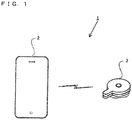
- FIG. 1 is a diagram showing an example of the external appearance of the communication system 1, which includes the communication apparatus according to the exemplary embodiment.
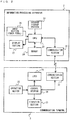
- FIG. 2 is a diagram showing an example of the configuration of the communication system 1.
- the communication system 1 includes an information processing apparatus 2 and a communication terminal 3.
- the information processing apparatus 2 can perform wireless communication with the communication terminal 3.
- the communication terminal 3 can perform near field communication with the information processing apparatus 2.
- the information processing apparatus 2 and the communication terminal 3 perform near field communication with each other.
- the information processing apparatus 2 and the communication terminal 3 exchange data through wireless communication using a predetermined near field communication standard (e.g., Bluetooth (registered trademark)).
- a predetermined near field communication standard e.g., Bluetooth (registered trademark)
- predetermined settings are made in the information processing apparatus 2 and the communication terminal 3, whereby the information processing apparatus 2 and the communication terminal 3 are paired with each other. The completion of the pairing enables the information processing apparatus 2 and the communication terminal 3 to perform wireless communication with each other.
- the information processing apparatus 2 is any information processing apparatus capable of performing near field communication.
- the information processing apparatus 2 may be a mobile (or portable) apparatus, e.g., a mobile phone such as a smartphone, a mobile information processing apparatus such as a tablet, or a mobile game apparatus, a stationary apparatus such as a personal computer or a home game machine, or a large-sized apparatus such as a commercial arcade game apparatus.
- the communication terminal 3 is any apparatus capable of performing near field communication with the information processing apparatus 2 and operates using as a power supply a predetermined battery built into the communication terminal 3.
- the communication terminal 3 is a small-sized apparatus that can be attached to the clothes or the body of a user, and includes a circuit for performing near field communication (an IC chip), means for giving a notification to the user (a lamp, a vibration apparatus, or the like), means for allowing the user to provide an operation input (an operation button or the like), and the like.
- the communication terminal 3 may have the function of storing data, the function of performing information processing, and the like.
- the information processing apparatus 2 includes a communication section 22.
- the communication section 22 is used for near field communication with the communication terminal 3, generates a signal (radio waves) to be sent in accordance with an instruction from a CPU 23 described later, and sends the signal from the communication section 22.
- the communication section 22 may be configured to be attachable to and detachable from the information processing apparatus 2.
- the information processing apparatus 2 includes a CPU 23 and a memory 24.
- the CPU 23 is an information processing section for performing various types of information processing to be performed by the information processing apparatus 2.
- the CPU 23 performs the various types of information processing using the memory 24.
- the information processing apparatus 2 includes a program storage section 25.
- the program storage section 25 stores various programs (e.g., a communication program and an application program) to be executed by the information processing apparatus 2.
- the program storage section 25 is any storage device (storage medium) accessible by the CPU 23.
- the program storage section 25 may be a storage section built into the information processing apparatus 2, such as a hard disk or a memory, or may be a storage medium attachable to and detachable from the information processing apparatus 2, such as an optical disc or a cartridge, or may be both the storage section and the storage medium.
- the information processing apparatus 2 includes an input section 26, which receives an instruction from a user, such as a button or a touch panel. Further, the information processing apparatus 2 includes a display section 27, which displays an image generated by the above information processing.
- the input section 26 includes a touch panel for detecting a position on the display screen of the display section 27.
- the information processing apparatus 2 may include a plurality of apparatuses.
- at least part of the information processing performed by the information processing apparatus 2 may be performed in a dispersed manner by a plurality of apparatuses capable of communicating with each other via a network (a wide-area network and/or a local network).
- the information processing apparatus 2 may be configured such that the CPU 23 can execute a plurality of programs such as an application program and a communication program.
- the application program is a program for executing any application for performing data communication with the communication terminal 3 and may be a game program for performing game processing in accordance with a user operation using the communication terminal 3.
- the communication program is a program for performing near field communication with the communication terminal 3.
- the communication program is firmware or driver software for causing the communication section 22 to operate.
- the communication program receives an instruction from an application and causes the communication section 22 to perform an operation for communication.
- the communication terminal 3 includes a communication section 32.
- the communication section 32 is used for near field communication with the information processing apparatus 2 and operates using as a power supply a battery built into the communication terminal 3.
- the communication section 32 generates a signal (radio waves) to be sent in accordance with an instruction from a control section 31 described later and sends the signal from the communication section 32.
- the communication terminal 3 includes a vibration section 33 and an LED (light-emitting diode) 34.
- the vibration section 33 includes a vibration actuator (a vibrator) for imparting a predetermined vibration to the main body of the communication terminal 3 and operates using as a power supply a battery built into the communication terminal 3.
- the vibration section 33 drives the vibration actuator based on an instruction from the control section 31 described later.
- the vibration actuator may use the method of generating a vibration by an eccentric motor (ERM: Eccentric Rotating Mass), the method of generating a vibration by a linear vibrator (LRA: Linear Resonant Actuator), the method of generating a vibration by a piezoelectric element, or the like.
- ECM Eccentric Rotating Mass
- LRA Linear Resonant Actuator
- a driving signal corresponding to a method in which the vibration actuator generates a vibration is generated, whereby a vibration actuator using any method can impart various vibrations to the user of the communication terminal 3.
- the LED 34 is provided on the upper surface of the main body of the communication terminal 3 and lights up using as a power supply a battery built into the communication terminal 3.
- the LED 34 lights up or goes out based on an instruction from the control section 31 described later.
- the LED 34 can emit light of a plurality of colors, and the light emission colors are also controlled by the control section 31.
- the LED 34 may be able to represent any colors using blue, red, and green light-emitting diodes.
- a plurality of LEDs 34 may be provided on the upper surface and/or another surface of the communication terminal 3.
- the communication terminal 3 includes an operation button 35 as an example of an input section for receiving an instruction from the user.
- the operation button 35 outputs to the control section 31 a signal indicating that the operation button 35 is subjected to the pressing operation.
- the LED 34 is provided within a press member of the press button 35.
- a plurality of input sections e.g., operation buttons 35
- a plurality of input sections maybe provided on the upper surface and/or another surface of the communication terminal 3.
- the communication terminal 3 includes a control section 31.
- the control section 31 performs vibration control for controlling the operation of the vibration section 33 and performs light emission control for controlling the lighting, the extinguishing, and the light emission colors of the LED 34. Further, if the operation button 35 is subjected to a pressing operation, the control section 31 transmits from the communication section 32 to the information processing apparatus 2 a signal indicating that the operation button 35 is subjected to the pressing operation.
- the control section 31 operates using as a power supply a battery built into the communication terminal 3.
- the control section 31 may be a computer such as a microcomputer or may be composed of a dedicated circuit.
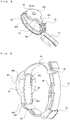
- FIG. 3 is a top perspective view showing an example of the communication terminal 3 formed by combining a main body 30 and a first attachment 40.
- FIG. 4 is a bottom perspective view showing an example of the communication terminal 3 formed by combining the main body 30 and the first attachment 40.
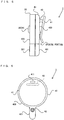
- FIG. 5 is a side view showing an example of the communication terminal 3 formed by combining the main body 30 and the first attachment 40.
- FIG. 6 is a bottom view showing an example of the communication terminal 3 formed by combining the main body 30 and the first attachment 40.
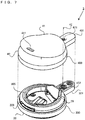
- FIG. 7 is a top perspective view showing an example of the state where the first attachment 40 is removed from the main body 30.
- FIG. 8 is a top perspective view showing an example of the communication terminal 3 formed by combining the main body 30 and a second attachment 50.
- FIG. 9 is a bottom perspective view showing an example of the communication terminal 3 formed by combining the main body 30 and the second attachment 50.
- FIG. 10 is a side view showing an example of the communication terminal 3 formed by combining the main body 30 and the second attachment 50.
- FIG. 11 is a bottom view showing an example of the communication terminal 3 formed by combining the main body 30 and the second attachment 50.
- FIG. 12 is a side view (some components shown in a side perspective view) showing an example of the state where the ring diameter of a band mechanism assembled to the second attachment 50 is tightened.
- FIG. 13 is a side view (some components shown in a side perspective view) showing an example of the state where the ring diameter of the band mechanism assembled to the second attachment 50 is loosened.
- the communication terminal 3 is formed by detachably engaging a main body 30 and a first attachment 40.
- the main body 30 is assembled to the first attachment 40 on the upper surface side of the communication terminal 3.
- the main body 30 includes a main portion 300 and a protruding portion 301, which protrudes from the main portion 300.
- main functions such as the control section 31, the communication section 32, the vibration section 33, the LED 34, and the operation button 35, a battery, and the like are built into the main portion 300 of the main body 30.
- a single operation button 35 into which the LED 34 is built is disposed.
- the press member of the operation button 35 is formed of a material that allows light to pass therethrough. Thus, if the LED 34 lights up, light passing through the press member is emitted, thereby enabling representation such that the operation button 35 itself lights up.
- the first attachment 40 is, for example, a resin molding (e.g., an ABS resin molding) and is assembled to the main body 30 on the lower surface side of the communication terminal 3.
- the first attachment 40 has an outer frame shape that almost coincides with the outer frame shape of the main body 30.
- the first attachment 40 includes a main portion 400, which is engaged with the main portion 300 of the main body 30, and a protruding portion 401, which is engaged with the protruding portion (protruding piece) 301 of the main body 30.
- a clip 41 is provided on the lower surface of the first attachment 40.
- the clip 41 clamps another member between a part opposed to the lower surface of the first attachment 40 and the lower surface, and thereby can cause the member to clamp the first attachment 40 (i.e., the communication terminal 3 in which the main body 30 is combined). Then, as shown in FIG. 5 , an opening portion of the clip 41 for inserting the member for clamping the first attachment 40 is formed in the direction in which the protruding portion 401 protrudes from the main portion 400.
- the opening portion of the clip 41 is thus formed, whereby, if the first attachment 40 is clamped by the clip 41 from above the member, the communication terminal 3 is attached to the member in the state where the protruding portion 401 (i.e., the protruding portion 301 of the main body 30) is directed downward relative to the main portion 400 (i.e., the main portion 300 of the main body 30).
- the clip 41 is supported on the main portion 400 by a pillar portion 43, which is provided so as to stand on the outer surface of the main portion 400 (an outer surface of a cover portion for covering a battery accommodation portion 305 described later).
- the clip 41 has a structure in which the clip 41 is supported by the pillar portion 43, it is possible to form the clip 41 in a freer shape than a structure in which the clip 41 is integrated with the side surface of the main portion 400, and it is also easy to open and close the clip 41.
- the clip 41 is formed in an outer frame shape that almost coincides with the outer frame shape of the main portion 400 of the first attachment 40. This makes it possible to secure a relatively large clip area.
- a hole 411 is formed on the side opposed to the opening of the clip 41.
- the hole 411 is provided to thread a string such as a strap thereinto and attaches the string thereto. Then, the hole 411 is formed on the side opposed to the opening of the clip 41, whereby, if the user holds the strap attached to the hole 411 or attaches the strap to the body of the user, the communication terminal 3 is attached in the state where the protruding portion 401 (i.e., the protruding portion 301 of the main body 30) is directed downward relative to the main portion 400 (i.e., the main portion 300 of the main body 30).
- a screwing mechanism 42 is provided in the protruding portion 301 of the main body 30 and the protruding portion 401 of the first attachment 40.
- the screwing mechanism 42 screws and fixes the main body 30 and the first attachment 40.
- a female screw thread portion 422 is formed in the protruding portion 301 of the main body 30, and a hole portion through which a male screw thread 421 that can be screwed to the female screw thread can pass and which has an inner diameter greater than the nominal diameter of the male screw thread 421 is formed in the protruding portion 401 of the first attachment 40.
- the screwing mechanism 42 includes the female screw thread portion 422 formed in the main body 30, the male screw thread 421 provided in the first attachment 40, and a hole portion which is formed in the first attachment 40 and through which the male screw thread 421 can pass. It should be noted that as is clear from FIGS.
- the screwing mechanism 42 is provided in the protruding portion 401 of the first attachment 40, and therefore, even if a relatively large clip area is secured by forming the clip 41 in an outer frame shape that almost coincides with the outer frame shape of the main portion 400 of the first attachment 40, the position of the screwing mechanism 42 does not overlap the clip 41 when the lower surface of the first attachment 40 is viewed from front.
- the screwing mechanism 42 is provided in the protruding portion 401 of the first attachment 40, thereby facilitating the work of detaching or attaching the male screw thread 421 of the screwing mechanism 42.
- the screwing mechanism 42 may have a mechanism in which a female screw thread portion is formed on the first attachment 40 side, and a male screw thread is screwed from the main body 30 side. That is, in the screwing mechanism, if the screw portion of the first attachment 40 is a male screw thread, the screw portion of the main body 30 may be a female screw thread portion. Alternatively, in the screwing mechanism, if the screw portion on the first attachment 40 side is a female screw thread portion, the screw portion of the main body 30 may be a male screw thread.
- the male screw thread 421 shown in FIG. 6 and the like is a Phillips screw in which a groove shape formed in the head thereof is plus-shaped, but may be of a type different from that of the head of a screw used within the main body 30.
- the groove formed in the head of the male screw thread 421 or the outer shape of the head is of a type different from that of the groove formed in the head of a male screw thread used in the main body 30 or the outer shape of the head, whereby it is not possible to detach or attach the male screw thread used in the main body 30, using a tool for detaching or attaching the male screw thread 421.
- a groove shape formed in the head of the male screw thread 421 is a plus shape or a minus shape, it is possible to easily detach or attach the male screw thread 421 using a Phillips screwdriver or a slotted screwdriver.
- the groove formed in the head of the male screw thread shape used in the main body 30 is of a different shape (e.g., a so-called tamper-resistant screw such a Y-shape), it is not possible to detach or attach the male screw thread using a tool for detaching or attaching the male screw thread 421.
- male screw threads used in the main body 30 may be of a type (e.g., a Y-shaped screw) different from that of the groove formed in the head of the male screw thread 421 or the outer shape of the head.
- at least a male screw thread of the main body 30 that is exposed to the outside when the first attachment 40 is removed from the main body 30 may be of this different type.
- the battery accommodation portion 305 is a space for accommodating a battery (e.g., a coin-type lithium-ion battery (a button cell)) of a predetermined shape used as the power supply of the communication terminal 3. Within the space, an electrode for coming into contact with the positive electrode and the negative electrode of the battery is provided.
- the battery accommodation portion 305 has a space where a coin-type battery can be accommodated in parallel with the upper surface and the lower surface of the communication terminal 3.
- the first attachment 40 If the first attachment 40 is attached to the main body 30, the battery accommodated in the battery accommodation portion 305 is pressed by the inner surface of the first attachment 40, thereby fixing the battery in the communication terminal 3. That is, the first attachment 40 functions as a battery cover for pressing a battery accommodated in the main body 30.
- the packing 39 is provided in a part which is the periphery of the battery accommodation portion 305 and in which the main body 30 abuts the first attachment 40.
- the packing 39 is provided on the top surface of the main body 30 so as to surround the periphery of the battery accommodation portion 305. If the first attachment 40 is attached to the main body 30, the entire circumference of the packing 39 abuts the inner surface of the first attachment 40. In a part of the inner surface of the first attachment 40 that abuts the packing 39, an abutment flat surface (not shown) is formed. If the first attachment 40 is attached to the main body 30, the packing 39 tightly closes the inside of the battery accommodation portion 305 from the outside world. It should be noted that the packing 39 may be provided on the first attachment 40 side. Further, the packing 39 may only need to tightly close the inside of the battery accommodation portion 305 from the outside world, and may be another seal member such as a gasket.
- a latch portion 309 on one side is formed on the outer side surface of the main body 30 that is opposed to the protruding portion 301.
- the latch portion 309 formed on the main body 30 side is formed so as to have a recessed shape from the outer side surface of the main body 30 toward the battery accommodation portion 305.
- a protruding portion (not shown) that fits and is latched with the recessed shape is formed as a latch portion 309 on the other side (the first attachment 40 side).
- the latch portions 309 formed in the main body 30 and the first attachment 40 are provided at, as viewed from the battery accommodation portion 305, positions on opposite sides (opposed surfaces) through the screwing mechanism 42 provided on the protruding portion 301 side and the battery accommodation portion 305. It should be noted that on the opposite sides, the latch portions 309 and the screwing mechanism 42 include positions on 180-degree opposite sides through the battery accommodation portion 305. These positions may be those on almost opposite sides, such as 175-degree opposite sides.
- the male screw thread 421 is screwed to the female screw thread portion 422 in the state where the latch portions 309 fit together, thereby preventing the first attachment 40 from coming off in the up-down direction with respect to the main body 30 at the position opposed to the screwing mechanism 42.
- the latch portions 309 may be latched by forming a protruding shape portion on the main body 30 side and forming a recessed shape portion on the first attachment 40 side.
- the screwing mechanism 42 may be provided, and screw portions at two places are screwed to each other, thereby fixing the first attachment 40 to the main body 30.
- the communication terminal 3 can be formed by attaching a second attachment 50 to a main body 30.
- the communication terminal 3 is formed by detachably and attachably combining the main body 30 and the second attachment 50. That is, the communication terminal 3 is formed by combining the first attachment 40 with the main body 30 as the first form and formed by combining the second attachment 50 also with the main body 30 as the second form. Then, the communication terminal 3 can be used in a plurality of forms by the user freely detaching or attaching the first attachment 40 or the second attachment 50 from or to the main body 30.
- the main body 30 is assembled to the second attachment 50 on the upper surface side of the communication terminal 3.
- the main body 30 in the second form includes a main portion 300 and a protruding portion 301, which protrudes from the main portion 300.
- main functions such as the control section 31, the communication section 32, the vibration section 33, the LED 34, and the operation button 35, a battery, and the like are built into the main portion 300 of the main body 30.
- the main body 30 in the second form is a device similar to the main body 30 in the first form and therefore is not described in detail here.
- the second attachment 50 is, for example, a resin molding (e.g., an ABS resin molding) and is assembled to the main body 30 on the lower surface side of the communication terminal 3.
- the second attachment 50 has an outer frame shape that almost coincides with the outer frame shape of the main body 30.
- the second attachment 50 includes a main portion 500, which is engaged with the main portion 300 of the main body 30, and a protruding portion 501, which is engaged with the protruding portion 301 of the main body 30.
- a screwing mechanism 57 is provided in the protruding portion 301 of the main body 30 and the protruding portion 501 of the second attachment 50.
- the screwing mechanism 57 screws and fixes the main body 30 and the second attachment 50.
- a female screw thread portion is formed in the protruding portion 301 of the main body 30, and a male screw thread that can be screwed to the female screw thread is screwed from the second attachment 50 side.
- a hole portion having an inner diameter greater than the nominal diameter of the male screw thread is formed.
- the screwing mechanism 57 includes a female screw thread portion 422 formed in the main body 30, a male screw thread provided in the second attachment 50, and a hole portion which is formed in the second attachment 50 and through which the male screw thread can pass. It should be noted that as shown in FIG. 11 , the screwing mechanism 57 is provided between band threading portions 502 and 503 described later and at a position that does not overlap the band threading portions 502 and 503. This facilitates the work of detaching or attaching the male screw thread of the screwing mechanism 57.
- a protruding portion (not shown) that fits a recessed shape of the latch portion 309 is formed as a latch portion 309 on the second attachment 50 side.
- an abutment flat surface (not shown) is formed. If the second attachment 50 is attached to the main body 30, the packing 39 tightly covers the inside of the battery accommodation portion 305 from the outside world.
- strip-shaped band members 51 and 52 are assembled.
- the band members 51 and 52 are formed of soft strip-shaped members (e.g., strip-shaped members made of a fiber or strip-shaped members made of a synthetic resin) and are formed in a ring-shape so as to be assembled to the second attachment 50. Then, the band members 51 and 52 are so formed that the above ring diameter can be adjusted in a stepless manner by two length adjustment mechanisms 53 and 54. The ring diameter is adjusted, whereby it is possible to attach the band members 51 and 52 to the body (e.g., the wrist, the arm, the ankle, the leg, the neck, the head, the waist, or the like) of the user.
- the body e.g., the wrist, the arm, the ankle, the leg, the neck, the head, the waist, or the like
- the band members 51 and 52 are passed through a pair of band threading portions 502 and 503, thereby being assembled to the second attachment 50.
- the band threading portion 502 is formed at a position in the second attachment 50 on the lower surface of the protruding portion 301 and is formed by integral molding using the same resin as the second attachment 50 (i.e., an ABS resin).
- the band threading portion 503 is formed at a position in the second attachment 50 on the lower surface of the main portion 500 and a position opposed to the band threading portion 502, and is formed by integral molding using the same resin as the second attachment 50 (i.e., an ABS resin).
- band members 51 and 52 may be formed so as to be attachable to and detachable from the second attachment 50.
- the band members 51 and 52 may be passed through the band threading portions 502 and 503 in the state where the band members 51 and 52 cannot be removed from the second attachment 50.
- a mechanism for adjusting the ring diameter of the band members 51 and 52 and also attaching the communication terminal 3 to the body of the user a first length adjustment mechanism 53, a second length adjustment mechanism 54, an end stop portion 55, and a joining member 56 are provided.
- One end of the band member 51 is connected to one end of the band member 52 via the joining member 56. Further, the band member 51 is formed such that the length from the other end of the band member 52 can be adjusted in a stepless manner by the second length adjustment mechanism 54. Then, the band member 52 is passed through the pair of band threading portions 502 and 503, and the first length adjustment mechanism 53 is attached to the other end of the band member 52. Further, the first length adjustment mechanism 53 can be slid to any position in the band member 51. Then, the first length adjustment mechanism 53 includes a clamping portion for clamping the band member 51.
- the first length adjustment mechanism 53 is slid to any position in the band member 51 and clamps the band member 51, and thereby can fix the other end of the band member 52 and the band member 51 at any position.
- the first length adjustment mechanism 53 is slid in the direction of the other end of the band member 51 in the state where the clamping mechanism of the first length adjustment mechanism 53 is released, whereby it is possible to enlarge and loosen the ring diameter.
- the ring diameter is loosened, and then, the first length adjustment mechanism 53 is slid in the direction of one end of the band member 51 in the state where the clamping mechanism of the first length adjustment mechanism 53 is released.
- the first length adjustment mechanism 53 clamps the band member 51, whereby it is possible to reduce the ring diameter and also fix the ring diameter.
- the end stop portion 55 includes an opening portion that stops the band member 51 sideways. The end stop portion 55 is loosely passed so as to be slidable to any position in the band member 52. Then, the end stop portion 55 fixes the ring diameter and then fits the other end of the band member 51 into the opening portion, and thereby can stop the other end of the band member 51 sideways along the band member 52.
- the joining member 56 is in the form of a ring made of a predetermined resin, whereby it is also possible to form the joining member 56 such that if stress equal to or greater than prescribed is applied to the band members 51 and 52, the joining member 56 ruptures.
- FIG. 14 is a diagram showing an example of a data area set in the memory 24 of the information processing apparatus 2 in the exemplary embodiment. It should be noted that the memory 24 stores, as well as data shown in FIG. 14 , data used in other types of processing. The data, however, is not described in detail.
- various programs Pa to be executed by the information processing apparatus 2 are stored.
- the various programs Pa the above communication program for performing near field communication, an application program for performing information processing (e.g., game processing) using the communication terminal 3, and the like are stored.
- the various programs Pa may be stored in advance in the program storage section 25, or may be acquired from a storage medium attachable to and detachable from the information processing apparatus 2 and stored in the memory 24, or may be acquired from another apparatus via a network such as the Internet and stored in the memory 24.
- the CPU 23 executes the various programs Pa stored in the memory 24.
- a data storage area of the memory 24 various types of data used in the communication process and the information processing to be performed by the information processing apparatus 2 are stored.
- the following are stored in the memory 24: communication terminal data Da; reception data Db; transmission data Dc; game processing data Dd; image data De; and the like.
- the communication terminal data Da is data for performing wireless communication with the communication terminal 3 that can perform wireless communication with the information processing apparatus 2 as a result of being paired with the information processing apparatus 2.
- the communication terminal data Da includes data (a pass key, a link key, and the like for each communication destination) necessary to perform wireless communication with a communication destination (the communication terminal 3), and may include ID data and the like for identifying a communication destination.
- the reception data Db is data received from the communication terminal 3 through the wireless communication described above.
- the transmission data Dc is data to be transmitted to the communication terminal 3 through the wireless communication described above.
- the game processing data Dd is data used when a game using the communication terminal 3 is performed.
- the image data De is data for displaying an image on the display section 27 when the game is performed.
- FIG. 15 is a flow chart showing an example of the processes (a communication process and game processing) performed by the information processing apparatus 2 in the exemplary embodiment.
- FIG. 16 is a flow chart showing an example of the processes (a communication process and a light emission/vibration control process) performed by the communication terminal 3 in the exemplary embodiment.
- a series of processes shown in FIG 15 is performed by the CPU 23 executing the communication program and a predetermined application program included in the various programs Pa. It should be noted that the processes shown in FIGS. 15 and 16 are started at any timing. Further, in FIGS. 15 and 16 , all the steps performed by the CPU 23 and the control section 31 are abbreviated as "S".
- the CPU 23 performs initialization in processes (e.g., a communication process and game processing) using the communication terminal 3 (step 71), and the processing proceeds to the next step.
- the CPU 23 sets, in the communication terminal data Da, data (a pass key, a link key, ID data of the communication terminal 3, and the like) necessary to perform wireless communication with the communication terminal 3 that can perform wireless communication as a result of being paired with the information processing apparatus 2, with respect to each communication terminal 3 with which the information processing apparatus 2 performs wireless communication.
- the CPU 23 initializes parameters for performing the following processes (e.g., game processing using the communication terminal 3).
- the CPU 23 performs through wireless communication a reception process for receiving data from the communication terminal 3 (step 72), and the processing proceeds to the next step.
- the CPU 23 performs the process of receiving data from each of communication terminals 3 capable of performing near field communication with the information processing apparatus 2, and of storing the received data in the reception data Db with respect to each communication terminal 3.
- the communication terminal 3 transmits a signal indicating that the operation button 35 is subjected to the pressing operation. Then, the signal is received in the above step 72.
- the CPU 23 performs game processing (step 73), and the processing proceeds to the next step.
- the CPU 23 performs the process of advancing a game in accordance with the state where the operation button 35 of the communication terminal 3 is subjected to a pressing operation, the number of communication terminals 3 capable of performing wireless communication with the information processing apparatus 2, the type of a communication terminal 3 capable of performing wireless communication with the information processing apparatus 2, the game situation, and the like. Then, the CPU 23 performs the process of generating a game image corresponding to the progress state of the game and displaying the game image on the display section 27.
- the CPU 23 In a case where the state of any one of communication terminals 3 is to be changed, such as a case where the LED 34 of any one of communication terminals 3 is to be changed from an extinguished state to a lighting state in accordance with the progress state of the game, a case where the lighting color of the LED 34 of any one of communication terminals 3 is to be changed, a case where the LED 34 of any one of communication terminals 3 is to be changed from a lighting state to an extinguished state, a case where the vibration of the vibration section 33 of any one of communication terminals 3 is to be started, or a case where the vibration of the vibration section 33 of any one of communication terminals 3 is to be ended, the CPU 23 generates command data indicating that the state of the communication terminal 3 is to be changed, and stores the command data together with the communication destination in the transmission data Dc.
- the CPU 23 performs the process of transmitting transmission data to the communication terminal 3 (step 74), and the processing proceeds to the next step. For example, with reference to the transmission data Dc, if transmission data is stored, the CPU 23, using the communication destination indicated by the transmission data and the communication terminal data Da for performing wireless communication with the communication destination, transmits the transmission data to the communication terminal 3 as the communication destination.
- the CPU 23 determines whether or not the game is to be ended (step 75).
- examples of conditions for ending the game include: the fact that the result of the above game is settled; and the fact that the user performs the operation of ending the game. If the game is not to be ended, the CPU 23 returns to the above step 72 and repeats the process thereof. If the game is to be ended, the CPU 23 ends the processing of the flow chart. Then, the CPU 23 repeatedly performs the series of processes of steps 72 to 75 until it is determined in step 75 that the game is to be ended.
- the control section 31 performs through wireless communication a reception process for receiving data from the information processing apparatus 2 (step 81), and the processing proceeds to the next step.
- the control section 31 receives, from an information processing apparatus 2 capable of performing near field communication with the communication terminal 3, data transmitted to the communication terminal 3.
- data transmitted to the communication terminal 3. For example, as described above, there is a case where command data for changing the state of the communication terminal 3 is transmitted from the information terminal apparatus 2. If such command data is transmitted to the communication terminal 3, the command data is received in the above step 81.
- the control section 31 determines whether or not the command data received in the above step 81 indicates that the lighting state of the LED 34 is to be changed (step 82). For example, in a case where the command data indicates that the LED 34 is to be changed from an extinguished state to a lighting state, or that the LED 34 is to be changed from a lighting state to an extinguished state, or that the lighting color of the LED 34 is to be changed, the determination is affirmative in the above step 82. Then, if the command data indicates that the lighting state of the LED 34 is to be changed, the processing proceeds to step 83. If, on the other hand, the command data does not indicate that the lighting state of the LED 34 is to be changed, or command data transmitted to the communication terminal 3 is not received in the above step 81, the processing proceeds to step 84.
- step 83 the control section 31 performs the process of controlling the light emission of the LED 34, and the processing proceeds to step 86.
- the control section 31 performs control to light up the LED 34 using a light emission color indicated by the command data.
- the control section 31 performs control to extinguish the LED 34 in a lighting state.
- the control section 31 performs control to change the lighting color of the LED 34 to a light emission color indicated by the command data.
- step 84 the control section 31 determines whether or not the command data received in the above step 81 indicates that the vibration state of the vibration section 33 is to be changed. For example, if the command data indicates that the vibration of the vibration section 33 is to be started, or that the vibration of the vibration section 33 is to be ended, the determination is affirmative in the above step 84. Then, if the command data indicates that the vibration state of the vibration section 33 is to be changed, the processing proceeds to step 85. If, on the other hand, the command data does not indicate that the vibration state of the vibration section 33 is to be changed, or command data transmitted to the communication terminal 3 is not received in the above step 81, the processing proceeds to step 86.
- step 85 the control section 31 performs the process of controlling the vibration of the vibration section 33, and the processing proceeds to step 86.
- the control section 31 performs control to drive the vibration actuator of the vibration section 33 and impart a vibration to the user of the communication terminal 3. Further, if the command data received in the above step 81 indicates that the vibration of the vibration section 33 is to be stopped, the control section 31 performs control to stop the driving of the vibration actuator in a driven state.
- step 86 the control section 31 determines whether or not the operation button 35 is subjected to a pressing operation. For example, if a signal indicating that the operation button 35 is subjected to a pressing operation is output from the operation button 35, the control section 31 determines that the operation button 35 is subjected to a pressing operation. Then, if the operation button 35 is subjected to a pressing operation, the processing proceeds to step 87. If, on the other hand, the operation button 35 is not subjected to a pressing operation, the processing proceeds to step 88.
- step 87 the control section 31 performs the process of transmitting an operation signal, and the processing proceeds to step 88.
- the control section 31 performs the process of generating a signal indicating that the operation button 35 is subjected to a pressing operation, and of transmitting the generated signal from the communication section 22 to the information processing apparatus 2 through wireless communication.
- step 88 the control section 31 determines whether or not the process is to be ended.
- examples of conditions for ending the process include: the fact that the result of the above game is settled; and the fact that the user performs the operation of ending the process. If the process is not to be ended, the control section 31 returns to the above step 81 and repeats the process thereof. If the process is to be ended, the control section 31 ends the processing of the flow chart. Then, the control section 31 repeatedly performs the series of processes of steps 81 to 88 until it is determined in step 88 that the process is to be ended.
- the communication terminal 3 in the first form, in which the clip 41 is provided, and in the second form, in which the band members 51 and 52 are assembled, is used.
- the communication terminal 3 may be formed such that an attachment in another form is attachable to and detachable from the communication terminal 3.
- the communication terminal 3 may be formed such that at least one of attachments in which a key ring, a hook, a suction member such as a suction cup, a wheel, a magnet, a pin, a clamp, and the like are provided may be attachable to and detachable from the communication terminal 3.
- the shape of the communication terminal 3 described above is merely illustrative.
- the communication terminal 3 may have another shape.
- two or more protruding portions protruding from the main portion may be formed.
- the shape of the main portion may be other than a disk shape.
- a battery to be accommodated in the communication terminal 3 is not limited to a coin-type battery, and may be a battery of another shape such as a dry cell battery.
- the communication terminal 3 may have a shape corresponding to the battery to be accommodated.
- the vibration section 33, the LED 34, and the input section are provided.
- at least one in the group including these components may only need to be provided.
- another input device e.g., an acceleration sensor, a gyro sensor, a magnetic sensor, an optical sensor, or the like
- another informing device e.g., a loudspeaker, a display screen, or the like
- the vibration section 33, the LED 34, and the operation button 35 are provided on the main body 30 side of the communication terminal 3. Alternatively, these functions may be provided on the attachment side.
- the above descriptions have been given using an example where the information processing apparatus 2 and the communication terminal 3 each perform a communication process and information processing.
- another apparatus may perform at least some of the processing steps.
- the information processing apparatus 2 is further configured to communicate with another apparatus (e.g., another server, another information processing apparatus, another game apparatus, or another mobile terminal), the other apparatus may cooperate to perform the processing steps of the processing.
- Another apparatus may thus perform at least some of the processing steps, which enables processing similar to that described above.
- the communication process and the information processing described above can be performed by a processor or the cooperation of a plurality of processors, the processor or the plurality of processors included in an information processing system including at least one information processing apparatus.
- a communication process and information processing can be performed by the CPU 23 of the information processing apparatus 2 or the control section 31 of the communication terminal 3 executing a predetermined program.
- part or all of the processing of the flow charts may be performed by a dedicated circuit included in the information processing apparatus 2 or the communication terminal 3.
- the above variations make it possible to achieve the present invention also by a system form such as cloud computing, or a system form such as a distributed wide area network or a local area network.
- a system form such as a distributed local area network
- a stationary information processing apparatus a stationary game apparatus
- a mobile information processing apparatus a mobile game apparatus
- processing orders, the setting values, the conditions used in the determinations, and the like that are used in the information processing described above are merely illustrative.
- the exemplary embodiment can be achieved also with other orders, other values, and other conditions.
- the above program may be supplied to the information processing apparatus 2 and the communication terminal 3 not only through an external storage medium such as an external memory, but also through a wired or wireless communication link. Further, the program may be stored in advance in a non-volatile storage device included in the apparatus. It should be noted that examples of an information storage medium having stored therein the program may include CD-ROMs, DVDs, optical disk storage media similar to these, flexible disks, hard disks, magneto-optical disks, and magnetic tapes, as well as non-volatile memories. Alternatively, an information storage medium having stored therein the program may be a volatile memory for storing the program. It can be said that such a storage medium is a storage medium readable by a computer or the like. For example, it is possible to provide the various functions described above by causing a computer or the like to load a program from the storage medium and execute it.
- the present invention can be used as, for example, a communication apparatus, a battery cover, and the like in order, for example, to enable the expansion of use and the like.
Landscapes
- Engineering & Computer Science (AREA)
- Multimedia (AREA)
- Signal Processing (AREA)
- Human Computer Interaction (AREA)
- Computer Networks & Wireless Communication (AREA)
- Theoretical Computer Science (AREA)
- Computer Hardware Design (AREA)
- Physics & Mathematics (AREA)
- General Engineering & Computer Science (AREA)
- General Physics & Mathematics (AREA)
- Health & Medical Sciences (AREA)
- Chemical & Material Sciences (AREA)
- Electrochemistry (AREA)
- Chemical Kinetics & Catalysis (AREA)
- General Chemical & Material Sciences (AREA)
- Life Sciences & Earth Sciences (AREA)
- Biophysics (AREA)
- Cardiology (AREA)
- General Health & Medical Sciences (AREA)
- Heart & Thoracic Surgery (AREA)
- Telephone Set Structure (AREA)
- Casings For Electric Apparatus (AREA)
- Battery Mounting, Suspending (AREA)
Claims (10)
- Un capot de batterie (50) destiné à couvrir une partie de logement de batterie (305) dans un corps principal (30) d'un appareil de communication et à attacher une batterie sur l'appareil de communication ou l'en détacher, le capot de batterie comprenant :une partie d'enfilage de bande (502, 503) au travers de laquelle peut être inséré un élément de bande (51, 52) ; etune partie d'emboitement emboitable de façon détachable sur le corps principal de l'appareil de communication,une partie d'au moins un système vissant (57) qui est configurée pour être vissée sur le corps principal (30) de l'appareil de communication pour fixer le capot de batterie (50) au corps principal (30) de l'appareil de communication,
dans lequel une pièce saillante (501) est configurée pour être emboitée sur une partie saillante (301) du corps principal de l'appareil de communication, et
la partie du au moins un système vissant est dans la pièce saillante. - Le capot de batterie selon la revendication 1, dans lequel
la partie du au moins un système vissant est un filet mâle (421) qui peut être vissé dans un taraudage femelle (422) formé dans le corps principal de l'appareil de communication. - Le capot de batterie selon la revendication 1, dans lequel
la partie du au moins un système vissant est un orifice au travers duquel un filet mâle peut être inséré pour le visser dans un taraudage femelle formé dans le corps principal de l'appareil de communication, et qui présente un diamètre intérieur supérieur à un diamètre nominal du filet mâle. - Le capot de batterie selon la revendication 1, dans lequel
la partie du au moins un système vissant est un taraudage femelle configuré pour être vissé avec un filet mâle dans le corps principal de l'appareil de communication. - Le capot de batterie selon l'une des revendications 1 à 4, comprenant en outre au moins une partie de verrou (309) configurée pour être verrouillée au corps principal de l'appareil de communication lorsqu'une relation de position entre la au moins une partie de verrou et le corps principal de l'appareil de communication vérifie une relation particulière, dans lequel
le capot de batterie est configuré pour être fixé sur le corps principal de l'appareil de communication par le au moins un système vissant et la au moins une partie de verrou. - Le capot de batterie selon la revendication 5, dans lequel
la partie de l'un des au moins un système vissant et d'une des au moins une partie de verrou sont à des positions sur des côtés opposés via la partie de logement de batterie lorsque ledit un des au moins un système vissant et ladite une des au moins une des parties de verrou sont solidarisés au corps principal de l'appareil de communication. - Le capot de batterie selon la revendication 6, dans lequel
une direction qui relie une position de la partie dudit un des au moins un système vissant et une position de la au moins une partie de verrou est quasiment parallèle à une direction de traversée de l'élément de bande lorsque l'élément de bande est inséré dans la partie d'enfilage de bande. - Le capot de batterie selon l'une des revendications 1 à 7, comprenant en outre au moins deux orifices d'enfilage dans la partie d'enfilage de bande qui sont configurés pour insérer l'élément de bande au travers.
- Le capot de batterie selon l'une des revendications 1 à 8, comprenant en outre un élément de bande inséré au travers de la partie d'enfilage de bande.
- Le capot de batterie selon la revendication 9, dans lequel
l'élément de bande est d'une forme annulaire, et
l'élément de bande comprend un mécanisme d'ajustement de taille (53, 54) configuré pour ajuster une taille de la forme annulaire.
Priority Applications (1)
| Application Number | Priority Date | Filing Date | Title |
|---|---|---|---|
| EP19152335.6A EP3493512B1 (fr) | 2015-09-09 | 2016-08-31 | Appareil de communication avec une partie d'engagement pour un d'une pluralité d'attachements |
Applications Claiming Priority (1)
| Application Number | Priority Date | Filing Date | Title |
|---|---|---|---|
| JP2015177604A JP6652353B2 (ja) | 2015-09-09 | 2015-09-09 | 通信装置および電池蓋 |
Related Child Applications (2)
| Application Number | Title | Priority Date | Filing Date |
|---|---|---|---|
| EP19152335.6A Division EP3493512B1 (fr) | 2015-09-09 | 2016-08-31 | Appareil de communication avec une partie d'engagement pour un d'une pluralité d'attachements |
| EP19152335.6A Division-Into EP3493512B1 (fr) | 2015-09-09 | 2016-08-31 | Appareil de communication avec une partie d'engagement pour un d'une pluralité d'attachements |
Publications (3)
| Publication Number | Publication Date |
|---|---|
| EP3142340A2 EP3142340A2 (fr) | 2017-03-15 |
| EP3142340A3 EP3142340A3 (fr) | 2017-05-31 |
| EP3142340B1 true EP3142340B1 (fr) | 2019-03-06 |
Family
ID=56851496
Family Applications (2)
| Application Number | Title | Priority Date | Filing Date |
|---|---|---|---|
| EP16186469.9A Active EP3142340B1 (fr) | 2015-09-09 | 2016-08-31 | Appareil de communication et couvercle de batterie |
| EP19152335.6A Active EP3493512B1 (fr) | 2015-09-09 | 2016-08-31 | Appareil de communication avec une partie d'engagement pour un d'une pluralité d'attachements |
Family Applications After (1)
| Application Number | Title | Priority Date | Filing Date |
|---|---|---|---|
| EP19152335.6A Active EP3493512B1 (fr) | 2015-09-09 | 2016-08-31 | Appareil de communication avec une partie d'engagement pour un d'une pluralité d'attachements |
Country Status (3)
| Country | Link |
|---|---|
| US (1) | US20170070256A1 (fr) |
| EP (2) | EP3142340B1 (fr) |
| JP (1) | JP6652353B2 (fr) |
Families Citing this family (4)
| Publication number | Priority date | Publication date | Assignee | Title |
|---|---|---|---|---|
| JP2019004338A (ja) | 2017-06-15 | 2019-01-10 | 任天堂株式会社 | ユーザ補助構造およびそれを有する携帯型装置 |
| CN107707753A (zh) * | 2017-09-29 | 2018-02-16 | 努比亚技术有限公司 | 一种振动控制方法、设备及计算机可读存储介质 |
| US10596456B2 (en) | 2018-05-25 | 2020-03-24 | Nintendo Co., Ltd. | Game controller |
| CN110312025B (zh) * | 2019-06-12 | 2020-05-08 | 深圳市宝富来智能技术有限公司 | 补光灯及保护壳 |
Family Cites Families (24)
| Publication number | Priority date | Publication date | Assignee | Title |
|---|---|---|---|---|
| US6809723B2 (en) * | 2001-05-14 | 2004-10-26 | Agilent Technologies, Inc. | Pushbutton optical screen pointing device |
| US7854942B2 (en) * | 2004-04-16 | 2010-12-21 | The Governors Of The University Of Alberta | Anti-gluten egg yolk antibodies for the treatment of celiac disease |
| US7586732B2 (en) * | 2005-04-29 | 2009-09-08 | Steven B. Myers | Remote controlled locking electroshock stun device and methods of use |
| US20070151315A1 (en) * | 2005-12-29 | 2007-07-05 | Umbra Inc. | Combination locket and key holder |
| US7844310B2 (en) * | 2006-07-20 | 2010-11-30 | L3 Communications Corporation | Wearable communication device with contoured back |
| US20080019131A1 (en) * | 2006-07-24 | 2008-01-24 | Yoshiharu Takei | Lighting systems and methods |
| US20100008514A1 (en) * | 2008-07-14 | 2010-01-14 | Ian Bates | Apparatus and system for an audio belt buckle |
| EP2559728A1 (fr) * | 2010-04-12 | 2013-02-20 | Nok Corporation | Composition de caoutchouc et utilisation associée |
| US20110277679A1 (en) * | 2010-05-14 | 2011-11-17 | Access Business Group International Llc | Hand held particle sensor device |
| EP2802381A4 (fr) * | 2012-01-12 | 2015-02-18 | Goodlux Technology Llc | Surveillance de photothérapie |
| US9196139B2 (en) * | 2012-09-12 | 2015-11-24 | ACCO Brands Corporation | Proximity tag for object tracking |
| US9265310B2 (en) * | 2012-10-30 | 2016-02-23 | Bin Lam | Methods, systems, and apparatuses for incorporating wireless headsets, terminals, and communication devices into fashion accessories and jewelry |
| JP2014102920A (ja) | 2012-11-16 | 2014-06-05 | Nintendo Co Ltd | 手持ち型電子装置、コネクタ付き電池、電池蓋、コネクタおよびコネクタ離脱防止方法 |
| US11237719B2 (en) * | 2012-11-20 | 2022-02-01 | Samsung Electronics Company, Ltd. | Controlling remote electronic device with wearable electronic device |
| WO2014093989A1 (fr) * | 2012-12-14 | 2014-06-19 | Hamra Andrew | Ensemble sac de messager et courroie d'épaule détachable de verrouillage et de transport pour des dispositifs électroniques personnels |
| EP2981266B1 (fr) * | 2013-03-04 | 2018-01-03 | Daya CNS LLC | Dérivés de pyridoindolobenz[b,d]azépines pentacycliques et leurs utilisations |
| US10105149B2 (en) * | 2013-03-15 | 2018-10-23 | Board Of Regents Of The University Of Nebraska | On-board tool tracking system and methods of computer assisted surgery |
| US20150195391A1 (en) * | 2014-01-09 | 2015-07-09 | Aava Mobile Oy | Portable data processing apparatus and peripheral apparatus |
| EP3154362B1 (fr) * | 2014-06-13 | 2025-08-13 | Goel, Pawan Kumar | Extrait de grains de café verts et procédé de préparation associé |
| US9618611B2 (en) * | 2014-09-24 | 2017-04-11 | Nxp B.V. | Personal radar assistance |
| US20160150398A1 (en) * | 2014-11-25 | 2016-05-26 | Mediatek Inc. | Wearable device, portable device and associated control method |
| US9589457B1 (en) * | 2015-04-07 | 2017-03-07 | Mission Cables, Llc | Remote control systems and methods |
| CN106326076A (zh) * | 2015-06-16 | 2017-01-11 | 鸿富锦精密工业(武汉)有限公司 | 指示装置 |
| US9763311B2 (en) * | 2015-08-11 | 2017-09-12 | Lumic Technology Inc. | Interactive lighting effect portable light illuminating devices and system thereof |
-
2015
- 2015-09-09 JP JP2015177604A patent/JP6652353B2/ja active Active
-
2016
- 2016-08-31 EP EP16186469.9A patent/EP3142340B1/fr active Active
- 2016-08-31 EP EP19152335.6A patent/EP3493512B1/fr active Active
- 2016-09-01 US US15/254,348 patent/US20170070256A1/en not_active Abandoned
Non-Patent Citations (1)
| Title |
|---|
| None * |
Also Published As
| Publication number | Publication date |
|---|---|
| EP3142340A3 (fr) | 2017-05-31 |
| EP3493512A1 (fr) | 2019-06-05 |
| EP3142340A2 (fr) | 2017-03-15 |
| US20170070256A1 (en) | 2017-03-09 |
| JP2017054686A (ja) | 2017-03-16 |
| EP3493512B1 (fr) | 2020-06-24 |
| JP6652353B2 (ja) | 2020-02-19 |
Similar Documents
| Publication | Publication Date | Title |
|---|---|---|
| EP3142340B1 (fr) | Appareil de communication et couvercle de batterie | |
| US11307870B2 (en) | Wearable device and method of controlling the same | |
| US9939913B2 (en) | Smart home control using modular sensing device | |
| JP6666505B1 (ja) | 入力装置 | |
| EP3050456B1 (fr) | Dispositif portable | |
| US10379877B2 (en) | Wearable device and method of controlling the same | |
| JP6666504B1 (ja) | 装置、システム、ゲームシステム、および、装置セット | |
| CN106233363A (zh) | 弯曲主体及具有其的可穿戴设备 | |
| KR20090054012A (ko) | 무선 헤드셋 및 그의 배터리 상태 표시 방법 | |
| KR20150109229A (ko) | 글래스 타입 단말기 | |
| KR102561635B1 (ko) | 전자 장치 및 전자 장치의 제어 방법 | |
| KR101637368B1 (ko) | 와치타입 이동 단말기 | |
| EP3393211A1 (fr) | Procédé de traitement d'informations, système de traitement d'informations et dispositif de source lumineuse de type ampoule | |
| US9175837B1 (en) | Marker system | |
| US9503796B2 (en) | Speaker | |
| US20150003629A1 (en) | Portable wireless speaker system | |
| CN215837431U (zh) | 生耳组件及穿戴设备 | |
| US11941182B2 (en) | Electronic apparatus | |
| US20170060110A1 (en) | Electronic device | |
| US11284252B2 (en) | Electronic apparatus for displaying image using visual afterimage of light source | |
| KR20160012436A (ko) | 웨어러블 기기 | |
| CN105027140A (zh) | 便携式信息码读取装置 | |
| CN110146987A (zh) | 头戴显示装置以及vr一体机设备 | |
| KR20160070998A (ko) | 웨어러블 단말기 | |
| US12368986B2 (en) | Electronic apparatus |
Legal Events
| Date | Code | Title | Description |
|---|---|---|---|
| PUAI | Public reference made under article 153(3) epc to a published international application that has entered the european phase |
Free format text: ORIGINAL CODE: 0009012 |
|
| STAA | Information on the status of an ep patent application or granted ep patent |
Free format text: STATUS: THE APPLICATION HAS BEEN PUBLISHED |
|
| AK | Designated contracting states |
Kind code of ref document: A2 Designated state(s): AL AT BE BG CH CY CZ DE DK EE ES FI FR GB GR HR HU IE IS IT LI LT LU LV MC MK MT NL NO PL PT RO RS SE SI SK SM TR |
|
| AX | Request for extension of the european patent |
Extension state: BA ME |
|
| PUAL | Search report despatched |
Free format text: ORIGINAL CODE: 0009013 |
|
| AK | Designated contracting states |
Kind code of ref document: A3 Designated state(s): AL AT BE BG CH CY CZ DE DK EE ES FI FR GB GR HR HU IE IS IT LI LT LU LV MC MK MT NL NO PL PT RO RS SE SI SK SM TR |
|
| AX | Request for extension of the european patent |
Extension state: BA ME |
|
| RIC1 | Information provided on ipc code assigned before grant |
Ipc: G06F 1/16 20060101ALI20170425BHEP Ipc: H01M 2/10 20060101ALI20170425BHEP Ipc: H04M 1/02 20060101AFI20170425BHEP |
|
| STAA | Information on the status of an ep patent application or granted ep patent |
Free format text: STATUS: REQUEST FOR EXAMINATION WAS MADE |
|
| 17P | Request for examination filed |
Effective date: 20171130 |
|
| RBV | Designated contracting states (corrected) |
Designated state(s): AL AT BE BG CH CY CZ DE DK EE ES FI FR GB GR HR HU IE IS IT LI LT LU LV MC MK MT NL NO PL PT RO RS SE SI SK SM TR |
|
| GRAP | Despatch of communication of intention to grant a patent |
Free format text: ORIGINAL CODE: EPIDOSNIGR1 |
|
| STAA | Information on the status of an ep patent application or granted ep patent |
Free format text: STATUS: GRANT OF PATENT IS INTENDED |
|
| INTG | Intention to grant announced |
Effective date: 20180918 |
|
| GRAS | Grant fee paid |
Free format text: ORIGINAL CODE: EPIDOSNIGR3 |
|
| GRAA | (expected) grant |
Free format text: ORIGINAL CODE: 0009210 |
|
| STAA | Information on the status of an ep patent application or granted ep patent |
Free format text: STATUS: THE PATENT HAS BEEN GRANTED |
|
| AK | Designated contracting states |
Kind code of ref document: B1 Designated state(s): AL AT BE BG CH CY CZ DE DK EE ES FI FR GB GR HR HU IE IS IT LI LT LU LV MC MK MT NL NO PL PT RO RS SE SI SK SM TR |
|
| REG | Reference to a national code |
Ref country code: GB Ref legal event code: FG4D |
|
| REG | Reference to a national code |
Ref country code: CH Ref legal event code: EP Ref country code: AT Ref legal event code: REF Ref document number: 1106130 Country of ref document: AT Kind code of ref document: T Effective date: 20190315 |
|
| REG | Reference to a national code |
Ref country code: DE Ref legal event code: R096 Ref document number: 602016010622 Country of ref document: DE |
|
| REG | Reference to a national code |
Ref country code: IE Ref legal event code: FG4D |
|
| REG | Reference to a national code |
Ref country code: NL Ref legal event code: FP |
|
| REG | Reference to a national code |
Ref country code: LT Ref legal event code: MG4D |
|
| PG25 | Lapsed in a contracting state [announced via postgrant information from national office to epo] |
Ref country code: SE Free format text: LAPSE BECAUSE OF FAILURE TO SUBMIT A TRANSLATION OF THE DESCRIPTION OR TO PAY THE FEE WITHIN THE PRESCRIBED TIME-LIMIT Effective date: 20190306 Ref country code: FI Free format text: LAPSE BECAUSE OF FAILURE TO SUBMIT A TRANSLATION OF THE DESCRIPTION OR TO PAY THE FEE WITHIN THE PRESCRIBED TIME-LIMIT Effective date: 20190306 Ref country code: NO Free format text: LAPSE BECAUSE OF FAILURE TO SUBMIT A TRANSLATION OF THE DESCRIPTION OR TO PAY THE FEE WITHIN THE PRESCRIBED TIME-LIMIT Effective date: 20190606 Ref country code: LT Free format text: LAPSE BECAUSE OF FAILURE TO SUBMIT A TRANSLATION OF THE DESCRIPTION OR TO PAY THE FEE WITHIN THE PRESCRIBED TIME-LIMIT Effective date: 20190306 |
|
| PG25 | Lapsed in a contracting state [announced via postgrant information from national office to epo] |
Ref country code: GR Free format text: LAPSE BECAUSE OF FAILURE TO SUBMIT A TRANSLATION OF THE DESCRIPTION OR TO PAY THE FEE WITHIN THE PRESCRIBED TIME-LIMIT Effective date: 20190607 Ref country code: BG Free format text: LAPSE BECAUSE OF FAILURE TO SUBMIT A TRANSLATION OF THE DESCRIPTION OR TO PAY THE FEE WITHIN THE PRESCRIBED TIME-LIMIT Effective date: 20190606 Ref country code: HR Free format text: LAPSE BECAUSE OF FAILURE TO SUBMIT A TRANSLATION OF THE DESCRIPTION OR TO PAY THE FEE WITHIN THE PRESCRIBED TIME-LIMIT Effective date: 20190306 Ref country code: RS Free format text: LAPSE BECAUSE OF FAILURE TO SUBMIT A TRANSLATION OF THE DESCRIPTION OR TO PAY THE FEE WITHIN THE PRESCRIBED TIME-LIMIT Effective date: 20190306 Ref country code: LV Free format text: LAPSE BECAUSE OF FAILURE TO SUBMIT A TRANSLATION OF THE DESCRIPTION OR TO PAY THE FEE WITHIN THE PRESCRIBED TIME-LIMIT Effective date: 20190306 |
|
| REG | Reference to a national code |
Ref country code: AT Ref legal event code: MK05 Ref document number: 1106130 Country of ref document: AT Kind code of ref document: T Effective date: 20190306 |
|
| PG25 | Lapsed in a contracting state [announced via postgrant information from national office to epo] |
Ref country code: SK Free format text: LAPSE BECAUSE OF FAILURE TO SUBMIT A TRANSLATION OF THE DESCRIPTION OR TO PAY THE FEE WITHIN THE PRESCRIBED TIME-LIMIT Effective date: 20190306 Ref country code: CZ Free format text: LAPSE BECAUSE OF FAILURE TO SUBMIT A TRANSLATION OF THE DESCRIPTION OR TO PAY THE FEE WITHIN THE PRESCRIBED TIME-LIMIT Effective date: 20190306 Ref country code: RO Free format text: LAPSE BECAUSE OF FAILURE TO SUBMIT A TRANSLATION OF THE DESCRIPTION OR TO PAY THE FEE WITHIN THE PRESCRIBED TIME-LIMIT Effective date: 20190306 Ref country code: EE Free format text: LAPSE BECAUSE OF FAILURE TO SUBMIT A TRANSLATION OF THE DESCRIPTION OR TO PAY THE FEE WITHIN THE PRESCRIBED TIME-LIMIT Effective date: 20190306 Ref country code: IT Free format text: LAPSE BECAUSE OF FAILURE TO SUBMIT A TRANSLATION OF THE DESCRIPTION OR TO PAY THE FEE WITHIN THE PRESCRIBED TIME-LIMIT Effective date: 20190306 Ref country code: ES Free format text: LAPSE BECAUSE OF FAILURE TO SUBMIT A TRANSLATION OF THE DESCRIPTION OR TO PAY THE FEE WITHIN THE PRESCRIBED TIME-LIMIT Effective date: 20190306 Ref country code: AL Free format text: LAPSE BECAUSE OF FAILURE TO SUBMIT A TRANSLATION OF THE DESCRIPTION OR TO PAY THE FEE WITHIN THE PRESCRIBED TIME-LIMIT Effective date: 20190306 Ref country code: PT Free format text: LAPSE BECAUSE OF FAILURE TO SUBMIT A TRANSLATION OF THE DESCRIPTION OR TO PAY THE FEE WITHIN THE PRESCRIBED TIME-LIMIT Effective date: 20190706 |
|
| PG25 | Lapsed in a contracting state [announced via postgrant information from national office to epo] |
Ref country code: SM Free format text: LAPSE BECAUSE OF FAILURE TO SUBMIT A TRANSLATION OF THE DESCRIPTION OR TO PAY THE FEE WITHIN THE PRESCRIBED TIME-LIMIT Effective date: 20190306 Ref country code: PL Free format text: LAPSE BECAUSE OF FAILURE TO SUBMIT A TRANSLATION OF THE DESCRIPTION OR TO PAY THE FEE WITHIN THE PRESCRIBED TIME-LIMIT Effective date: 20190306 |
|
| REG | Reference to a national code |
Ref country code: DE Ref legal event code: R097 Ref document number: 602016010622 Country of ref document: DE |
|
| PG25 | Lapsed in a contracting state [announced via postgrant information from national office to epo] |
Ref country code: AT Free format text: LAPSE BECAUSE OF FAILURE TO SUBMIT A TRANSLATION OF THE DESCRIPTION OR TO PAY THE FEE WITHIN THE PRESCRIBED TIME-LIMIT Effective date: 20190306 Ref country code: IS Free format text: LAPSE BECAUSE OF FAILURE TO SUBMIT A TRANSLATION OF THE DESCRIPTION OR TO PAY THE FEE WITHIN THE PRESCRIBED TIME-LIMIT Effective date: 20190706 |
|
| PLBE | No opposition filed within time limit |
Free format text: ORIGINAL CODE: 0009261 |
|
| STAA | Information on the status of an ep patent application or granted ep patent |
Free format text: STATUS: NO OPPOSITION FILED WITHIN TIME LIMIT |
|
| PG25 | Lapsed in a contracting state [announced via postgrant information from national office to epo] |
Ref country code: DK Free format text: LAPSE BECAUSE OF FAILURE TO SUBMIT A TRANSLATION OF THE DESCRIPTION OR TO PAY THE FEE WITHIN THE PRESCRIBED TIME-LIMIT Effective date: 20190306 |
|
| 26N | No opposition filed |
Effective date: 20191209 |
|
| PG25 | Lapsed in a contracting state [announced via postgrant information from national office to epo] |
Ref country code: SI Free format text: LAPSE BECAUSE OF FAILURE TO SUBMIT A TRANSLATION OF THE DESCRIPTION OR TO PAY THE FEE WITHIN THE PRESCRIBED TIME-LIMIT Effective date: 20190306 |
|
| PG25 | Lapsed in a contracting state [announced via postgrant information from national office to epo] |
Ref country code: TR Free format text: LAPSE BECAUSE OF FAILURE TO SUBMIT A TRANSLATION OF THE DESCRIPTION OR TO PAY THE FEE WITHIN THE PRESCRIBED TIME-LIMIT Effective date: 20190306 |
|
| PG25 | Lapsed in a contracting state [announced via postgrant information from national office to epo] |
Ref country code: CH Free format text: LAPSE BECAUSE OF NON-PAYMENT OF DUE FEES Effective date: 20190831 Ref country code: MC Free format text: LAPSE BECAUSE OF FAILURE TO SUBMIT A TRANSLATION OF THE DESCRIPTION OR TO PAY THE FEE WITHIN THE PRESCRIBED TIME-LIMIT Effective date: 20190306 Ref country code: LI Free format text: LAPSE BECAUSE OF NON-PAYMENT OF DUE FEES Effective date: 20190831 Ref country code: LU Free format text: LAPSE BECAUSE OF NON-PAYMENT OF DUE FEES Effective date: 20190831 |
|
| REG | Reference to a national code |
Ref country code: BE Ref legal event code: MM Effective date: 20190831 |
|
| PG25 | Lapsed in a contracting state [announced via postgrant information from national office to epo] |
Ref country code: IE Free format text: LAPSE BECAUSE OF NON-PAYMENT OF DUE FEES Effective date: 20190831 |
|
| PG25 | Lapsed in a contracting state [announced via postgrant information from national office to epo] |
Ref country code: BE Free format text: LAPSE BECAUSE OF NON-PAYMENT OF DUE FEES Effective date: 20190831 |
|
| PG25 | Lapsed in a contracting state [announced via postgrant information from national office to epo] |
Ref country code: CY Free format text: LAPSE BECAUSE OF FAILURE TO SUBMIT A TRANSLATION OF THE DESCRIPTION OR TO PAY THE FEE WITHIN THE PRESCRIBED TIME-LIMIT Effective date: 20190306 |
|
| PG25 | Lapsed in a contracting state [announced via postgrant information from national office to epo] |
Ref country code: MT Free format text: LAPSE BECAUSE OF FAILURE TO SUBMIT A TRANSLATION OF THE DESCRIPTION OR TO PAY THE FEE WITHIN THE PRESCRIBED TIME-LIMIT Effective date: 20190306 Ref country code: HU Free format text: LAPSE BECAUSE OF FAILURE TO SUBMIT A TRANSLATION OF THE DESCRIPTION OR TO PAY THE FEE WITHIN THE PRESCRIBED TIME-LIMIT; INVALID AB INITIO Effective date: 20160831 |
|
| PG25 | Lapsed in a contracting state [announced via postgrant information from national office to epo] |
Ref country code: MK Free format text: LAPSE BECAUSE OF FAILURE TO SUBMIT A TRANSLATION OF THE DESCRIPTION OR TO PAY THE FEE WITHIN THE PRESCRIBED TIME-LIMIT Effective date: 20190306 |
|
| P01 | Opt-out of the competence of the unified patent court (upc) registered |
Effective date: 20230428 |
|
| PGFP | Annual fee paid to national office [announced via postgrant information from national office to epo] |
Ref country code: NL Payment date: 20250704 Year of fee payment: 10 |
|
| PGFP | Annual fee paid to national office [announced via postgrant information from national office to epo] |
Ref country code: DE Payment date: 20250702 Year of fee payment: 10 |
|
| PGFP | Annual fee paid to national office [announced via postgrant information from national office to epo] |
Ref country code: GB Payment date: 20250703 Year of fee payment: 10 |
|
| PGFP | Annual fee paid to national office [announced via postgrant information from national office to epo] |
Ref country code: FR Payment date: 20250703 Year of fee payment: 10 |