EP3142499B1 - Homovanillinsäure-ester, insbesondere zum erzielen eines wärme- und/oder schärfeeindrucks - Google Patents
Homovanillinsäure-ester, insbesondere zum erzielen eines wärme- und/oder schärfeeindrucks Download PDFInfo
- Publication number
- EP3142499B1 EP3142499B1 EP15718467.2A EP15718467A EP3142499B1 EP 3142499 B1 EP3142499 B1 EP 3142499B1 EP 15718467 A EP15718467 A EP 15718467A EP 3142499 B1 EP3142499 B1 EP 3142499B1
- Authority
- EP
- European Patent Office
- Prior art keywords
- hydroxy
- acetate
- acid
- methoxyphenyl
- residue
- Prior art date
- Legal status (The legal status is an assumption and is not a legal conclusion. Google has not performed a legal analysis and makes no representation as to the accuracy of the status listed.)
- Active
Links
- 0 CC(CCC1*)CC1(*)OC(Cc(cc1OC)ccc1O)=O Chemical compound CC(CCC1*)CC1(*)OC(Cc(cc1OC)ccc1O)=O 0.000 description 3
- HOTXQJCNUXAOAS-UHFFFAOYSA-N CCC(C)(C)OC(Cc(cc1)cc(OC)c1O)=O Chemical compound CCC(C)(C)OC(Cc(cc1)cc(OC)c1O)=O HOTXQJCNUXAOAS-UHFFFAOYSA-N 0.000 description 2
- WUIYBQPAJSKVOF-UHFFFAOYSA-N CCCCCCOC(Cc(cc1)cc(OC)c1O)=O Chemical compound CCCCCCOC(Cc(cc1)cc(OC)c1O)=O WUIYBQPAJSKVOF-UHFFFAOYSA-N 0.000 description 2
- TYXDILLUJWDLRM-UHFFFAOYSA-N COc(cc(CC(OCCCCc1ccccc1)=O)cc1)c1O Chemical compound COc(cc(CC(OCCCCc1ccccc1)=O)cc1)c1O TYXDILLUJWDLRM-UHFFFAOYSA-N 0.000 description 2
- BSPJAOXQGMTTNW-UHFFFAOYSA-N CC(C)=CCOC(Cc(cc1)cc(OC)c1O)=O Chemical compound CC(C)=CCOC(Cc(cc1)cc(OC)c1O)=O BSPJAOXQGMTTNW-UHFFFAOYSA-N 0.000 description 1
- IEJBKAVZNKQNGT-UHFFFAOYSA-N CC(C)CCOC(Cc(cc1)cc(OC)c1O)=O Chemical compound CC(C)CCOC(Cc(cc1)cc(OC)c1O)=O IEJBKAVZNKQNGT-UHFFFAOYSA-N 0.000 description 1
- YTWAADUPRCSBKM-UHFFFAOYSA-N CC(C)COC(Cc(cc1)cc(OC)c1O)=O Chemical compound CC(C)COC(Cc(cc1)cc(OC)c1O)=O YTWAADUPRCSBKM-UHFFFAOYSA-N 0.000 description 1
- AUWPOLXJHFZONI-UHFFFAOYSA-N CC(C)OC(Cc(cc1)cc(OC)c1O)=O Chemical compound CC(C)OC(Cc(cc1)cc(OC)c1O)=O AUWPOLXJHFZONI-UHFFFAOYSA-N 0.000 description 1
- IJKPVUGDJJFSQF-QPEQYQDCSA-N CC(O/C1=C\c(cc2)cc(OC)c2O)=CC1=O Chemical compound CC(O/C1=C\c(cc2)cc(OC)c2O)=CC1=O IJKPVUGDJJFSQF-QPEQYQDCSA-N 0.000 description 1
- YRZOZIGTYFDIDB-AATRIKPKSA-N CCC/C=C/COC(Cc(cc1)cc(OC)c1O)=O Chemical compound CCC/C=C/COC(Cc(cc1)cc(OC)c1O)=O YRZOZIGTYFDIDB-AATRIKPKSA-N 0.000 description 1
- CAZMLKCZUMAWOL-UHFFFAOYSA-N CCCCCCCOC(Cc(cc1)cc(OC)c1O)=O Chemical compound CCCCCCCOC(Cc(cc1)cc(OC)c1O)=O CAZMLKCZUMAWOL-UHFFFAOYSA-N 0.000 description 1
- SYEBQVUZYCJAEQ-UHFFFAOYSA-N CCCOC(Cc(cc1)cc(OC)c1O)=O Chemical compound CCCOC(Cc(cc1)cc(OC)c1O)=O SYEBQVUZYCJAEQ-UHFFFAOYSA-N 0.000 description 1
- UXXAIUVETJGEEL-VMPITWQZSA-N COc(cc(CC(OC/C=C/c1ccccc1)=O)cc1)c1O Chemical compound COc(cc(CC(OC/C=C/c1ccccc1)=O)cc1)c1O UXXAIUVETJGEEL-VMPITWQZSA-N 0.000 description 1
- ANSYMFFOUMIZJJ-UHFFFAOYSA-N COc(cc(CC(OCCc1ccccc1)=O)cc1)c1O Chemical compound COc(cc(CC(OCCc1ccccc1)=O)cc1)c1O ANSYMFFOUMIZJJ-UHFFFAOYSA-N 0.000 description 1
Images


Classifications
-
- A—HUMAN NECESSITIES
- A23—FOODS OR FOODSTUFFS; TREATMENT THEREOF, NOT COVERED BY OTHER CLASSES
- A23L—FOODS, FOODSTUFFS OR NON-ALCOHOLIC BEVERAGES, NOT OTHERWISE PROVIDED FOR; PREPARATION OR TREATMENT THEREOF
- A23L27/00—Spices; Flavouring agents or condiments; Artificial sweetening agents; Table salts; Dietetic salt substitutes; Preparation or treatment thereof
- A23L27/20—Synthetic spices, flavouring agents or condiments
- A23L27/204—Aromatic compounds
-
- C—CHEMISTRY; METALLURGY
- C07—ORGANIC CHEMISTRY
- C07C—ACYCLIC OR CARBOCYCLIC COMPOUNDS
- C07C69/00—Esters of carboxylic acids; Esters of carbonic or haloformic acids
- C07C69/66—Esters of carboxylic acids having esterified carboxylic groups bound to acyclic carbon atoms and having any of the groups OH, O—metal, —CHO, keto, ether, acyloxy, groups, groups, or in the acid moiety
- C07C69/73—Esters of carboxylic acids having esterified carboxylic groups bound to acyclic carbon atoms and having any of the groups OH, O—metal, —CHO, keto, ether, acyloxy, groups, groups, or in the acid moiety of unsaturated acids
- C07C69/734—Ethers
-
- A—HUMAN NECESSITIES
- A23—FOODS OR FOODSTUFFS; TREATMENT THEREOF, NOT COVERED BY OTHER CLASSES
- A23B—PRESERVATION OF FOODS, FOODSTUFFS OR NON-ALCOHOLIC BEVERAGES; CHEMICAL RIPENING OF FRUIT OR VEGETABLES
- A23B4/00—Preservation of meat, sausages, fish or fish products
- A23B4/06—Freezing; Subsequent thawing; Cooling
-
- A—HUMAN NECESSITIES
- A23—FOODS OR FOODSTUFFS; TREATMENT THEREOF, NOT COVERED BY OTHER CLASSES
- A23L—FOODS, FOODSTUFFS OR NON-ALCOHOLIC BEVERAGES, NOT OTHERWISE PROVIDED FOR; PREPARATION OR TREATMENT THEREOF
- A23L27/00—Spices; Flavouring agents or condiments; Artificial sweetening agents; Table salts; Dietetic salt substitutes; Preparation or treatment thereof
- A23L27/20—Synthetic spices, flavouring agents or condiments
- A23L27/205—Heterocyclic compounds
- A23L27/2052—Heterocyclic compounds having oxygen or sulfur as the only hetero atoms
-
- A—HUMAN NECESSITIES
- A23—FOODS OR FOODSTUFFS; TREATMENT THEREOF, NOT COVERED BY OTHER CLASSES
- A23L—FOODS, FOODSTUFFS OR NON-ALCOHOLIC BEVERAGES, NOT OTHERWISE PROVIDED FOR; PREPARATION OR TREATMENT THEREOF
- A23L27/00—Spices; Flavouring agents or condiments; Artificial sweetening agents; Table salts; Dietetic salt substitutes; Preparation or treatment thereof
- A23L27/84—Flavour masking or reducing agents
-
- A—HUMAN NECESSITIES
- A23—FOODS OR FOODSTUFFS; TREATMENT THEREOF, NOT COVERED BY OTHER CLASSES
- A23L—FOODS, FOODSTUFFS OR NON-ALCOHOLIC BEVERAGES, NOT OTHERWISE PROVIDED FOR; PREPARATION OR TREATMENT THEREOF
- A23L27/00—Spices; Flavouring agents or condiments; Artificial sweetening agents; Table salts; Dietetic salt substitutes; Preparation or treatment thereof
- A23L27/88—Taste or flavour enhancing agents
-
- A—HUMAN NECESSITIES
- A61—MEDICAL OR VETERINARY SCIENCE; HYGIENE
- A61K—PREPARATIONS FOR MEDICAL, DENTAL OR TOILETRY PURPOSES
- A61K47/00—Medicinal preparations characterised by the non-active ingredients used, e.g. carriers or inert additives; Targeting or modifying agents chemically bound to the active ingredient
- A61K47/06—Organic compounds, e.g. natural or synthetic hydrocarbons, polyolefins, mineral oil, petrolatum or ozokerite
- A61K47/08—Organic compounds, e.g. natural or synthetic hydrocarbons, polyolefins, mineral oil, petrolatum or ozokerite containing oxygen, e.g. ethers, acetals, ketones, quinones, aldehydes, peroxides
- A61K47/14—Esters of carboxylic acids, e.g. fatty acid monoglycerides, medium-chain triglycerides, parabens or PEG fatty acid esters
-
- C—CHEMISTRY; METALLURGY
- C07—ORGANIC CHEMISTRY
- C07C—ACYCLIC OR CARBOCYCLIC COMPOUNDS
- C07C69/00—Esters of carboxylic acids; Esters of carbonic or haloformic acids
- C07C69/66—Esters of carboxylic acids having esterified carboxylic groups bound to acyclic carbon atoms and having any of the groups OH, O—metal, —CHO, keto, ether, acyloxy, groups, groups, or in the acid moiety
- C07C69/67—Esters of carboxylic acids having esterified carboxylic groups bound to acyclic carbon atoms and having any of the groups OH, O—metal, —CHO, keto, ether, acyloxy, groups, groups, or in the acid moiety of saturated acids
- C07C69/708—Ethers
-
- C—CHEMISTRY; METALLURGY
- C07—ORGANIC CHEMISTRY
- C07C—ACYCLIC OR CARBOCYCLIC COMPOUNDS
- C07C69/00—Esters of carboxylic acids; Esters of carbonic or haloformic acids
- C07C69/74—Esters of carboxylic acids having an esterified carboxyl group bound to a carbon atom of a ring other than a six-membered aromatic ring
- C07C69/757—Esters of carboxylic acids having an esterified carboxyl group bound to a carbon atom of a ring other than a six-membered aromatic ring having any of the groups OH, O—metal, —CHO, keto, ether, acyloxy, groups, groups, or in the acid moiety
-
- A—HUMAN NECESSITIES
- A23—FOODS OR FOODSTUFFS; TREATMENT THEREOF, NOT COVERED BY OTHER CLASSES
- A23V—INDEXING SCHEME RELATING TO FOODS, FOODSTUFFS OR NON-ALCOHOLIC BEVERAGES AND LACTIC OR PROPIONIC ACID BACTERIA USED IN FOODSTUFFS OR FOOD PREPARATION
- A23V2002/00—Food compositions, function of food ingredients or processes for food or foodstuffs
-
- A—HUMAN NECESSITIES
- A23—FOODS OR FOODSTUFFS; TREATMENT THEREOF, NOT COVERED BY OTHER CLASSES
- A23V—INDEXING SCHEME RELATING TO FOODS, FOODSTUFFS OR NON-ALCOHOLIC BEVERAGES AND LACTIC OR PROPIONIC ACID BACTERIA USED IN FOODSTUFFS OR FOOD PREPARATION
- A23V2200/00—Function of food ingredients
- A23V2200/15—Flavour affecting agent
-
- A—HUMAN NECESSITIES
- A23—FOODS OR FOODSTUFFS; TREATMENT THEREOF, NOT COVERED BY OTHER CLASSES
- A23V—INDEXING SCHEME RELATING TO FOODS, FOODSTUFFS OR NON-ALCOHOLIC BEVERAGES AND LACTIC OR PROPIONIC ACID BACTERIA USED IN FOODSTUFFS OR FOOD PREPARATION
- A23V2200/00—Function of food ingredients
- A23V2200/16—Taste affecting agent
-
- C—CHEMISTRY; METALLURGY
- C07—ORGANIC CHEMISTRY
- C07C—ACYCLIC OR CARBOCYCLIC COMPOUNDS
- C07C2601/00—Systems containing only non-condensed rings
- C07C2601/12—Systems containing only non-condensed rings with a six-membered ring
- C07C2601/14—The ring being saturated
Definitions
- the present invention relates in particular to novel uses of compounds of the formula (I) (as described herein), in part also novel compounds of the formula (I) as such, flavor compounds containing compounds of the formula (I), novel compositions and novel processes using Compounds of the formula (I). Further aspects of the present invention will become apparent from the claims and the following description including examples.
- Capsaicin [N- (4-hydroxy-3-methoxybenzyl) -8-methyl- (6E) -nonoic acid amide] and other capsaicinoids such as nonivamide ([N- (4-hydroxy-3-methoxybenzyl) nonanoic acid amide) are known to be pungent and heat-producing flavors from various Capsicum species, especially chilli pepper, have long been known. With a correspondingly low dosage of the capsaicinoids a neutral sharpness and a warm sensation in the mouth is perceived, whereby the threshold to the painful sharpness and heat sensation is exceeded very fast.
- capsaicin in food is not allowed in the European Union (was dropped by the Community Flavoring List in 2004), as the genotoxic potential of the compound was assessed negatively ( European Food Safety Authority (EFSA), P., Italy, Opinion of the Scientific Committee on Food on Capsaicin. European Comission 2002 , (SDF / CS / FLAV / FLAVOR / 8 ADD1 Final)).
- EFSA European Food Safety Authority
- SDF / CS / FLAV / FLAVOR / 8 ADD1 Final European Food Safety Authority
- use in foods is often difficult because capsaicin has a very low taste threshold and high potency as a pungent (16,000,000 scoville units, see http://en.wikipedia.org/wiki/Capsaicin; November 2011, 21:02).
- Capsaicin is, also due to the high price of the pure substance, also used almost exclusively in the form of a capsicum extract, which in addition to other pungent remains of other, after Capsicum tasting or smelling flavors contains and is therefore only partially suitable for widespread use. Thus, despite the good sensory properties, there is a need for less problematic minerals.
- piperine (1-piperoylpiperidine), which occurs in white pepper, also gives a strong, sharp impression ( Römpp Lexikon Naturstoffchemie, Thieme 1997, p. 500 ), but shows relative to capsaicin a relative sharpness of only about 1%.
- piperine has an intense taste that is pronounced of pepper, so that the application can be limited in many preparations.
- the methyl ester of homovanillic acid has been detected in various woods used for storage of wine and spirits (e.g. Fernandez de Simon, B .; Esteruelas, E .; Munoz, AM; Cadahia, E .; Sanz, M., J. Agric. Food Chem. 2009, 57, 3217-3227 .).
- the ethyl ester of homovanillic acid was detected in wine and spirits themselves, mostly in connection with storage in oak barrels (eg Cabaroglu, T .; Canbas, A .; Baumes, R .; Bayonove, C .; Lepoutre, JP; Günata, Z., J. Food Sci.
- homovanillic acid ester derivative ethyl 2- (4-hydroxy-3-methoxyphenyl) acetate is described as an inhibitor of monoamine oxidase A ( Tao G et al .: “Eugenol and its structural analogs inhibit monoamine oxidase A and exhibit antidepressant-like activity ", Bioorganic & Medicinal Chemistry 2005, 13, 4777-4788 ).
- the compounds described herein are advantageously suitable for use (especially as above) in a pharmaceutical, nutritional, oral hygiene or pleasure preparation, preferably wherein the total amount of compound (s) of formula (I) and / or salt (s) ) of which in the preparation is sufficient to Sensitively induce a warming and / or sharp effect on the tongue or in the mouth during use or consumption of the preparation, and a pleasant flavor impression, selected from the group consisting of warming, hot and cooling, to reinforce (more details on this can be found in the comments below).
- compounds of the formula (I) or their salts or mixtures thereof advantageously advantageously have no significant other or undesired aroma effects and can therefore be used particularly well in many different types of aromatics.
- Aromatic compositions which contain combinations of compounds of the formula (I) or salts thereof with one or more other trigeminal substances (pungent, warming, pungent, biting, scratching, cooling, anesthetic, tingling, astringent) are particularly advantageous.
- the trigeminal (main) effect of which can advantageously be modulated by compounds of the formula (I) or salts thereof.
- a warming, sharp or cooling effect can be enhanced, while an astringent effect can be attenuated.
- a preparation according to the invention preferably comprises one or more customary bases, auxiliaries and additives in an amount of, based on the total weight of the preparation, from 5 to 99.9999% by weight, preferably from 10 to 80% by weight, and or Water in an amount, based on the total weight of the preparation, up to 99.9999 wt .-%, preferably in an amount of 5 to 80 wt .-%.
- nutrition or pleasure-serving preparations are, for example, baked goods (eg bread, dry biscuits, cakes, other pastries), confectionery (for example chocolates, chocolate bar products, other bar products, fruit gums, hard and soft caramels, chewing gum), alcoholic or non-alcoholic beverages.
- baked goods eg bread, dry biscuits, cakes, other pastries
- confectionery for example chocolates, chocolate bar products, other bar products, fruit gums, hard and soft caramels, chewing gum
- alcoholic or non-alcoholic beverages are, for example, baked goods (eg bread, dry biscuits, cakes, other pastries), confectionery (for example chocolates, chocolate bar products, other bar products, fruit gums, hard and soft caramels, chewing gum), alcoholic or non-alcoholic beverages.
- alcoholic beverages eg cocoa, coffee, green tea, black tea, (green, black) tea extracts enriched with green, black tea, rooibos tea, other herbal tea, wine, wine-based beverages, beer, beer-containing Beverages, liqueurs, schnapps, brandies, fruit-based sodas, isotonic drinks, soft drinks, nectars, fruit and vegetable juices, fruit or vegetable juice preparations), instant drinks (eg instant cocoa drinks, instant tea drinks, instant coffee drinks), meat products (eg ham, fresh sausage or raw sausage preparations, spiced or marinated fresh or cured meat products), eggs or Egg products (dry egg, egg whites, egg yolks), cereal products (eg breakfast cereals, muesli bars, pre-cooked finished rice products), dairy products (eg full fat or reduced fat or fat free milk drinks, rice pudding, yogurt, kefir, cream cheese, soft cheese, hard cheese, dried milk powder, whey, butter , Buttermilk, partially or wholly hydrolysed milk protein-containing products),
- Pharmaceutical preparations comprise a pharmaceutically active substance.
- Advantageous pharmaceutical agents are, for example, corticosteroids steroidal anti-inflammatory substances such.
- Hydrocortisone, hydrocortisone derivatives such as hydrocortisone 17-butyrate, dexamethasone, dexamethasone phosphate, methylprednisolone or cortisone.
- non-steroidal pharmaceutical active ingredients are, for example, anti-inflammatory agents such as oxicams such as piroxicam or tenoxicam; Salicylates such as Aspirin® (acetylsalicylic acid), disalcide, solprin or fendosal; Acetic acid derivatives such as diclofenac, fenclofenac, indomethacin, sulindac, tolmetin, or clindanac; Fenamates such as Mefenamic, Meclofenamic, Flufenamic or Niflumic; Propionic acid derivatives such as ibuprofen, naproxen, flurbiprofen, benoxaprofen or pyrazoles such as phenylbutazone, oxyphenylbutazone, febrazone or azapropazone.
- oxicams such as piroxicam or tenoxicam
- Salicylates such as Aspirin® (acetylsalicylic acid), disalcid
- Particularly preferred pharmaceutical preparations are non-prescription products and over-the-counter medicines, so-called OTC (over-the-counter) preparations containing active ingredients such as paracetamol, acetylsalicylic acid or ibuprofen, vitamins (for example vitamin H, B-series vitamins such as vitamin B1, B2, B6, B12, niacin, pantothenic acid, preferably in the form of (effervescent) tablets or capsules), minerals (preferably in the form of (Effervescent) tablets or capsules) such as iron salts, zinc salts, selenium salts, products containing active ingredients or extracts of ribwort (eg in cough syrup) or St. John's wort.
- active ingredients such as paracetamol, acetylsalicylic acid or ibuprofen
- vitamins for example vitamin H, B-series vitamins such as vitamin B1, B2, B6, B12, niacin, pantothenic acid, preferably in the form of (effervescent
- the preparations according to the invention may also be in the form of capsules, tablets (non-coated and coated tablets, eg enteric coatings), dragees, granules, pellets, solid mixtures, Dispersions in liquid phases, as emulsions, as powders, as solutions, as pastes or as other swallowable or chewable preparations and as a preparation with functional ingredients, as dietary supplements or as balanced diets.
- the oral care preparations according to the invention are in particular oral and / or dental care such as toothpastes, tooth gums, tooth powder, mouthwash, chewing gum and other oral care products.
- Dentifrices (as a base for oral care preparations) generally comprise an abrasive system (grinding or polishing agents), such as e.g. Silicic acids, calcium carbonates, calcium phosphates, aluminum oxides and / or hydroxyl apatites, surface-active substances such as e.g. Sodium lauryl sulfate, sodium lauryl sarcosinate and / or cocamidopropyl betaine, humectants, e.g. Glycerol and / or sorbitol, thickening agents, e.g. Carboxymethylcellulose, polyethylene glycols, carrageenan and / or Laponite®, sweeteners, e.g.
- an abrasive system grinding or polishing agents
- Silicic acids e.g. Silicic acids, calcium carbonates, calcium phosphates, aluminum oxides and / or hydroxyl apatites
- surface-active substances such as e.g
- taste modulating substances e.g. inositol phosphate, nucleotides like guanosine monophosphate, adenosine monophosphate or other substances like sodium glutamate or 2-phenoxypropionic acid
- cooling agents like e.g.
- Menthol, menthol derivatives eg L-menthol, L-menthyl lactate, L-menthyl alkyl carbonates, menthone ketals, menthane carboxylic acid amides
- 2,2,2-trialkylacetic acid amides eg 2,2-diisopropylpropionic acid methylamide
- methylenedioxycinnamic acid N, N-diphenylamide methylenedioxycinnamic acid N- ethyl-N-phenylamide, methylenedioxycinnamic acid-N-pyridyl-N-phenylamide
- iccilin derivatives stabilizers and active agents, such as Sodium fluoride, sodium monofluorophosphate, tin difluoride, quaternary ammonium fluoride, zinc citrate, zinc sulfate, tin pyrophosphate, tin dichloride, mixtures of various pyrophosphates, triclos
- Chewing gums (as another example of oral care preparations) generally comprise a chewing gum base, ie chewing gum that becomes plastic upon chewing, sugars of various types, sugar substitutes, sweeteners, sugar alcohols, other taste senses for unpleasant taste sensations, taste scores for others, as a rule unpleasant taste impressions, flavor modulating substances (eg inositol phosphate, nucleotides such as guanosine monophosphate, adenosine monophosphate or other substances such as Monosodium glutamate or 2-phenoxypropionic acid), the cooling agents, humectants, thickeners, emulsifiers, flavors and stabilizers or odor precursors mentioned in the previous section.
- flavor modulating substances eg inositol phosphate, nucleotides such as guanosine monophosphate, adenosine monophosphate or other substances such as Monosodium glutamate or 2-phenoxypropionic acid
- customary bases, auxiliaries and additives for preparations according to the invention are water, mixtures of fresh or processed, vegetable or animal raw materials or raw materials (eg raw, roasted, dried, fermented, smoked and / or cooked meat, bones, cartilage, fish, Vegetables, fruits, herbs, nuts, vegetable or fruit juices or pastes or mixtures thereof), digestible or non-digestible carbohydrates (eg sucrose, maltose, fructose, glucose, dextrins, amylose, amylopectin, inulin, xylans, cellulose), sugar alcohols ( eg sorbitol), natural or hardened fats (eg tallow, lard, palm fat, coconut fat, hardened vegetable fat), oils (eg sunflower oil, peanut oil, corn oil, olive oil, fish oil, soybean oil, sesame oil), fatty acids or their salts (eg potassium stearate), proteinogenic or non-proteinogenic amino acids and related compounds (eg, taurine), peptides,
- taste-modulating substances eg inositol phosphate, nucleotides such as guanosine monophosphate, adenosine monophosphate or other substances such as monosodium glutamate or 2-phenoxypropionic acid
- emulsifiers eg lecithins, diacylglycerols
- flavoring agents for further, generally not unpleasant taste impressions
- Stabilizers eg carageenan, alginate
- preservatives eg benzoic acid, sorbic acid
- antioxidants eg tocopherol, ascorbic acid
- chelators eg citric acid
- organic or inorganic acidulants eg malic acid, acetic acid, citric acid, tartaric acid, phosphoric acid, lactic acid
- additional bitter substances eg quinine, caffeine, limonin, amarogentin, humolone,
- preparations according to the invention are preferably prepared by incorporating an ester of homovanillic acid to be used according to the invention as a substance, as a solution or in the form of an aroma composition into a nutritional, oral care or pleasure or oral pharmaceutical base preparation.
- preparations according to the invention which are present as a solution may also be used, for example. be converted by spray drying in a solid preparation.
- Vanillyl alcohol comes in eg Beer (Flavor Base, 9th Edition, Leffingwell & Associates, 2013 ) or Sitka spruce ( Picea sitchensis, PJ Kohlbrenner, C. Schuerch, Benzene-Alcohol-Soluble Extractives of Sitka Spruce, J. Org. Chem. 1959, 24 (2), 166-172 ) in front.
- the aroma preparations according to the invention described above are characterized in that, in addition to ethyl homovanillate ( 17 ), they may also contain at least one further substance from the following Table 1 (the same applies to the aroma compositions according to the invention described herein):
- Tab. 1 No. Retention time [min] * Molar mass m / z (Gef .: ESI +)
- IPUAC name structure 1 2.88 gef. 227.04618 for 221047189 for C 10 H 10 O 6 3- (1,2-dihydroxyethyl) -1,3-dihydroiso-benzofuran-1,4,5-triol 2 3.73 gef. 313.0921 over.
- compounds of the formula (I) or their salts or an aroma composition according to the invention are used for the preparation of preparations according to the invention
- the compounds of formula (I) or their salts are prepared prior to incorporation with one or more suitable complexing agents, for example with cycloglycans, e.g. Cyclofructans, cyclodextrins or cyclodextrin derivatives, preferably alpha-, beta- and gamma-cyclodextrin, complexed and used in this complexed form.
- suitable complexing agents for example with cycloglycans, e.g. Cyclofructans, cyclodextrins or cyclodextrin derivatives, preferably alpha-, beta- and gamma-cyclodextrin, complexed and used in this complexed form.
- Example 1 Preparation of a flavoring preparation (primary reaction mixture) containing ethyl homovanillate ( 17 ) by reaction of ascorbic acid with vanillyl alcohol
- Example 2 Isolation of Ethyl Homovanillate ( 17 ) from a Flavoring Preparation (Primary Reaction Mixture)
- the primary reaction mixture is pre-fractionated by medium pressure chromatography (MPLC) (column material: Lewatit VP OC 1064, water / ethanol 3/1, v / v). Further separation is then carried out by preparative high pressure chromatography (pHPLC) (column: Phenomenex Luna C18 5 ⁇ 150x21.2 mm, flow rate 30mL / min, detection 210 nm) in isocratic mode (63% H 2 O, 37% MeOH).
- MPLC medium pressure chromatography
- pHPLC preparative high pressure chromatography
- ethyl homovanillate ( 17 ) The final isolation of ethyl homovanillate ( 17 ) is achieved by semi-preparative high-pressure chromatography (sPHPLC) in gradient mode (column: YMC Triart C18 5 ⁇ 250x10mm; A: H 2 O; B: MeOH; 0min 65% A, 35% B; 25min 40% A, 60% B, 30min 100% B, flow rate 3 mL / min, detection: 250 nm).
- the ethyl homovanillate ( 17 ) obtained was then freeze-dried and tasted at a dosage of 100 ppm to 5% sugar, 0.5% salt, 500 ppm caffeine solution and water and evaluated by sensors.
- medium Tasting Notes water sharp, pungent, slightly warming 5% sugar solution sharp, warming 0.5% saline solution sharp
- the primary reaction mixture is determined by LC-Taste® (nach WO 2006 111,476 ) in gradient mode (Hamilton PRP-1 10 ⁇ 250x21.5mm, A: H 2 O, B: EtOH, 0 min 100% A, 25 min 75% A, 25% B, 40 min 100% B, flow rate: 10 mL / min, oven temperature: 80 ° C) cut into 12 fractions, the fractionation being based on the UV trace at 210 nm. After concentration of the fractions to 0.5 mL on Buchi Syncore at 40 ° C, the residue was dissolved in 10 mL of water.
- Homovanillic acid (1.5-3 g) was presented with the respective alcohol (equimolar) in toluene (100 mL), conc. Sulfuric acid added and heated for 5 h at the water to boiling. It was once with ges. aq. NaHCO 3 solution, twice with water or optionally sat. aq. NaCl solution and the solvent removed in vacuo. The product was obtained after purification by column chromatography on silica gel in about 70% yield.
- Homovanillic acid (1.5-3 g) was stirred in the respective alcohol (100 mL) and 0.2-0.5 equivalents of sulfuric acid for 7 h at 90 ° C (heating block temperature). Most of the alcohol was removed in vacuo, sat. aq. NaHCO 3 solution and EtOAc were added, the org. Phase separated and the aq. Phase extracted once with EtOAc. The united org. Phases were once each with sat. aq. NaHCO 3 - and with water or alternatively sat. aq. NaCl solution, dried over NaSO 4 and the solvent removed in vacuo. The product was obtained after purification by column chromatography on silica gel in 90% to quantitative yield.
- homovanillic acid esters may also be obtained by transesterification, as exemplified by substance 2 :
- Ethyl homovanillate (5 g) was heated with cinnamyl alcohol (7.5 g) and sodium methylate solution 25% (0.52 g) to 150-170 ° C, applied from about 130 ° C vacuum and for 1-3 h MeOH / EtOH from the reaction mixture distilled out. It was diluted with MTBE, the org. Phase once with ges. aq. NH 4 Cl solution and water and the solvent removed in vacuo. Excess cinnamyl alcohol was then removed by distillation and the product obtained after purification by column chromatography on silica gel or by fractional distillation in 40-50% yield.
- the substance to be tasted was dissolved in ethanol and the ethanolic solution was then diluted with 5% sugar solution (final concentration: 10 ppm).
- capsicum extract containing 1,000,000 SHU (0.3-10 ppm) and nonivamide (0.1-1 ppm) in 5% sugar solution in ascending concentration were prepared.
- the oral cavity was rinsed by 4 examiners each with approx. 5 mL of the tasting solution and the solution was spit out again and evaluated against the reference series.
- the thresholds were determined using the method ASTM E 679-91 (Standard Practice for Determination of Odor and Key Thresholds by a Forced-Choice Ascending Concentration Series Method of Limits1). It is the respective Flavor Threshold on Vittel® water.
- the threshold of hexyl 2- (4-hydroxy-3-methoxyphenyl) acetate ( 21 ) in water is 1.7 ppm (1700 ppb).
- the threshold of ethyl 2- (4-hydroxy-3-methoxy-phenyl) acetate ( 17 ) in water is 29.5 ppm (29460 ppb).
- the threshold level of butyl 2- (4-hydroxy-3-methoxy-phenyl) -acetate ( 19 ) in water is 3.5 ppm (3540 ppb).
- Example 8 Sharpness profile of butyl 2- (4-hydroxy-3-methoxyphenyl) acetate ( 19 ) compared to nonivamide
- Homovanillic acid esters have a reinforcing effect on the compounds used.
- Paradise Grain Extract PN 300953, Symrise
- ethyl 2- (4-hydroxy-3-methoxyphenyl) acetate 17 , Examples 2 and 3
- a more rapid onset of sharpness was noted.
- ethyl 2- (4-hydroxy-3-methoxy-phenyl) -acetate 17 )
- nonivamide Examples 7 and 8, and 12 and 13
- the sharpness of nonivamide was enhanced at both concentrations tested, with this enhancement more as the additive effect.
- a faster onset of sharpness was noted.
- Example 10 Reinforcing the alcoholic strength of an ethanolic solution by ethyl 2- (4-hydroxy-3-methoxyphenyl) acetate ( 17 )
- Example 1 The base solution (5% sugar solution with 20% ethanol, Example 1) was described as alcoholic, burning.
- Flavone polymethoxylated PMF 60 alone (Example 6) gave an alcoholic taste enhancement in the tasting solution but no burning sensation in mouth compared to Example 1.
- Test solutions containing 4-10 ppm homovanillic acid ester in a 5% sugar solution were sensory evaluated and compared to a test solution of 10 ppm vanillyl butyl ether.
- Ethyl 2- (4-hydroxy-3-methoxy-phenyl) -acetate ( 17 ) had a milder heat effect compared to vanillyl butyl ether.
- Butyl 2- (4-hydroxy-3-methoxy-phenyl) -acetate ( 19 ) had a clearer thermal effect than vanillyl butyl ether.
- Isobutyl-2- (4-hydroxy-3-methoxy-phenyl) -acetate ( 9 ) showed a thermal effect similar to vanillyl butyl ether, but it lasted longer.
- Propyl 2- (4-hydroxy-3-methoxyphenyl) acetate ( 18 ) also showed a long-lasting heat effect, but occurred relatively later.
- ingredients are mixed in the proportions given above and then taken up with propylene glycol and completely dissolved by gentle warming.
- the two components are dissolved in a mixture of ethanol and demineralized water and then spray-dried.
- part ingredient Wt .-% A Chewing gum base, Company "Jagum T" 30.00 B Sorbitol, powdered 39.00 Isomalt® (Palatinit GmbH) 9:50 xylitol 2:00 mannitol 3:00 Aspartam® 12:10 Acesulfame® K 12:10 Emulgum® (Colloids Naturels, Inc.) 12:30 C Sorbitol, 70% 14:00 glycerin 1:00 D Aroma compositions according to application example 4 1:00
- Parts A to D are mixed and kneaded intensively.
- the raw mass obtained can then be processed for example in the form of thin strips to ready-to-eat chewing gum.
- Aroma Composition (Application Example 3A) 12:50 - - - - - - Aroma composition (Application Example 3B) - 12:50 - - - - Aroma Composition (Application Example 3C) - - 12:50 - - - - Aroma composition (application example 3D) - - - 12:50 - - - Aroma Composition (Application Example 3F) - - - - - 1:00 - - Aroma composition (application example 3H) - - - - - - 1:00 - Aroma Composition (Application Example 3I) - - - - - - - 1:00 Total 100 100 100 100 100 100 100 100 100 100 100 100 100 100 100 100 100 100 100 100 100 100 100 100 100 100 100 100 100 100 100 100 100 100 100 100 100 100 100 100 100 100 100 100 100 100 100 100 100 100 100 100 100 100 100 100 100 100 100 100 100 100 100 100 100 100 100 100 100 100 100 100 100 100 100 100 100
- Version B Liqueur base 5.5% vol + 0.075% of a 10% solution of a paradise grain extract in ethanol + 0.2% of a solution of ethyl 2- (4-hydroxy-3-methoxy-phenyl) acetate ( 17 ) 1% in ethanol ( corresponds to 20 ppm).
- Version C Liqueur base 5.5% vol + 0.075% of a 10% solution of a paradise grain extract in ethanol + 0.01% of a solution of 3-phenylpropyl 2- (4-hydroxy-3-methoxy-phenyl) -acetate ( 22 ) 1% in ethanol (corresponds to 1 ppm).
- Version A and the comparison sample are very sensory-like.
- Preparation Heat the components of phases A and B separately from each other to approx. 80 ° C. Stir phase B into phase A while homogenizing. Cool with stirring to about 40 ° C, add the phases C and D and briefly nachhomogen gives. Cool to room temperature while stirring.
- Palatinit was mixed with water. The mixture was then melted at 165 ° C and then cooled to 115 ° C. Then the peppermint flavor and the flavor preparation (Example 1) were added. After mixing, the mixtures were poured into molds, removed from the molds after solidification and then individually packaged.
- the green tea concentrate is in the case of beverage A with the 1% solution of ethyl 2- (4-hydroxy-3-methoxy-phenyl) acetate (17) in propylene glycol and in the case of beverage B with the 1% solution of 3-phenylpropyl 2- (4-hydroxy-3-methoxy-phenyl) -acetate ( 22 ) in propylene glycol. Then it is filled up with demineralized water and thoroughly mixed again. The product is then filtered, packed ready for use and sterilized at 118 ° C. The taste of drinks A and B is evaluated by a panel of trained panelists as clearly preferred over the unflavoured green tea concentrate. The bitterness and astringency is reduced by the addition of the compounds of the invention.
- the homovanillic acid esters were each pre-dissolved in ethanol at 10% or 1%.
- Black tea extract was dissolved in water and stirred together with sugar, a flavoring preparation (peach flavor), and the ethanolic solutions of homovanillic acid esters in a beaker.
- Example of use 20 Instant soup, type chicken soup with noodles
- Application example 21 Production of dark chilli chocolates using the substances according to the invention.
Landscapes
- Chemical & Material Sciences (AREA)
- Organic Chemistry (AREA)
- Life Sciences & Earth Sciences (AREA)
- Engineering & Computer Science (AREA)
- Health & Medical Sciences (AREA)
- Food Science & Technology (AREA)
- Polymers & Plastics (AREA)
- Nutrition Science (AREA)
- Zoology (AREA)
- Wood Science & Technology (AREA)
- Veterinary Medicine (AREA)
- Epidemiology (AREA)
- Animal Behavior & Ethology (AREA)
- General Health & Medical Sciences (AREA)
- Public Health (AREA)
- Medicinal Chemistry (AREA)
- Oil, Petroleum & Natural Gas (AREA)
- General Chemical & Material Sciences (AREA)
- Chemical Kinetics & Catalysis (AREA)
- Pharmacology & Pharmacy (AREA)
- Acyclic And Carbocyclic Compounds In Medicinal Compositions (AREA)
- Organic Low-Molecular-Weight Compounds And Preparation Thereof (AREA)
- Seasonings (AREA)
- Cosmetics (AREA)
- Medicinal Preparation (AREA)
- Confectionery (AREA)
- Preparation Of Fruits And Vegetables (AREA)
- Seeds, Soups, And Other Foods (AREA)
- Alcoholic Beverages (AREA)
- Fats And Perfumes (AREA)
- Tea And Coffee (AREA)
- Pharmaceuticals Containing Other Organic And Inorganic Compounds (AREA)
Description
- Die vorliegende Erfindung betrifft insbesondere neue Verwendungen von Verbindungen der Formel (I) (wie hierin beschrieben), zum Teil auch neue Verbindungen der Formel (I) als solche, Verbindungen der Formel (I) enthaltende Aromakompositionen, neue Zubereitungen sowie neue Verfahren unter Verwendung von Verbindungen der Formel (I). Weitere Aspekte der vorliegenden Erfindung ergeben sich aus den Patentansprüchen und der nachfolgenden Beschreibung samt Beispielen.
- Capsaicin [N-(4-Hydroxy-3-methoxybenzyl)-8-methyl-(6E)-nonensäureamid] und andere Capsaicinoide wie Nonivamid ([N-(4-Hydroxy-3-methoxybenzyl)-nonansäureamid) sind als scharf schmeckende und wärmeerzeugende Aromastoffe aus verschiedenen Capsicum-Arten, insbesondere Chilipfeffer, schon seit langem bekannt. Bei entsprechend geringer Dosierung der Capsaicinoide wird eine neutrale Schärfe und ein Wärmegefühl im Mund wahrgenommen, wobei die Schwelle zum schmerzhaften Schärfe- und Hitzeempfinden sehr schnell überschritten wird. Der Einsatz von Capsaicin in Lebensmitteln ist allerdings in der Europäischen Union nicht erlaubt (wurde von der Community Flavoring List in 2004 gestrichen), da das genotoxische Potential der Verbindung negativ bewertet wurde (European Food Safety Authority (EFSA), P., Italy, Opinion of the Scientific Committee on Food on Capsaicin. European Comission 2002, (SDF/CS/FLAV/FLAVOUR/8 ADD1 Final)). Zudem ist der Einsatz in Lebensmitteln oft schwierig, da Capsaicin einen sehr niedrigen Geschmacksschwellenwert und eine hohe Potenz als Scharfstoff (16,000,000 Scoville units, vgl. http://en.wikipedia.org/wiki/Capsaicin; Version des Eintrags mit letzten Änderungen vom 11. November 2011, 21:02 Uhr) hat. Capsaicin wird, auch auf Grund des hohen Preises des Reinstoffs, zudem nahezu ausschließlich in Form eines Capsicumextrakts verwendet, der neben weiteren Scharfstoffen noch Reste anderer, nach Capsicum schmeckender oder riechender Aromastoffe enthält und daher für den breiten Einsatz nur bedingt geeignet ist. Somit besteht trotz der guten sensorischen Eigenschaften ein Bedarf an weniger problematischen Scharfstoffen.
- Das im weißen Pfeffer vorkommende Piperin (1-Piperoylpiperidin) verursacht zwar auch einen starken scharfen Eindruck (Römpp Lexikon Naturstoffchemie, Thieme 1997, S. 500), zeigt aber im Vergleich zu Capsaicin eine relative Schärfe von nur ca. 1 %. Darüber hinaus besitzt Piperin einen intensiven Eigengeschmack, der an Pfeffer erinnert, so dass die Anwendung in vielen Zubereitungen nur beschränkt erfolgen kann.
- Auf Grund des lipophilen Charakters dieser vanilloiden Scharfstoffe ist der Einsatz des Schärfeeindrucks oft um einige Sekunden verzögert und hält auch besonders lange an, insbesondere in wenig lipophile Bestandteile (z.B. Triglyceride) enthaltenden Zubereitungen, wobei hier gleichzeitig die Löslichkeit nur unzureichend ist. Ähnliches gilt für Scharfstoffe wie Gingerol-[6] aus Ingwer oder Paradol-[6] aus Paradieskörnern, die beide zwar scharf schmecken, aber ein starken Nachgeschmack haben.
- Zwar sind weitere (z.B. Starkenmann, C.; Cayeux, I.; Birkbeck, A. A., Exploring Natural Products for New Taste Sensations. Chimia 2011, 65, (6), 407-410) scharf schmeckende Stoffe wie das Driman Polygodial (aus Tasmanischem Pfeffer, Tasmannia lanceolata) oder Resiniferatoxin aus Euphorbia resinifera bekannt (Szallasi, A.; Biro, T.; Modarres, S.; Garlaschelli, L.; Petersen, M.; Klush, A.; Vidari, G.; Jonassohn, M.; De Rosa, S.; Sterner, O.; Blumberg, P. M.; Krause, J. E., Dialdehyde sesquiterpenes and other terpenoids as vanilloid. Eur. J. Pharmacol. 1998, 356, 81-89); die Drimane sind aber auf Grund ihrer Dialdehyd-Struktur nur begrenzt einsatzfähig, da sie mit freien Aminogruppen z.B. von Proteinen reagieren und somit ihre Wirkung einbüßen und das Resiniferatoxin ist stark toxisch und nicht geeignet für die menschliche Ernährung. Zudem sind diese Stoffe ebenfalls stark lipophil.
- Der Methylester der Homovanillinsäure wurde in verschiedenen Hölzern, welche zur Lagerung von Wein und Spirituosen verwendet werden, nachgewiesen (z. B. Fernandez de Simon, B.; Esteruelas, E.; Munoz, A. M.; Cadahia, E.; Sanz, M., J. Agric. Food Chem. 2009, 57, 3217-3227.). Der Ethylester der Homovanillinsäure wurde hingegen in Wein und Spirituosen selber nachgewiesen, meistens in Zusammenhang mit einer Lagerung in Eichenfässern (z.B. Cabaroglu, T.; Canbas, A.; Baumes, R.; Bayonove, C.; Lepoutre, J. P.; Günata, Z., J. Food Sci. 1997, 62, 680-692. van Jaarsveld, F. P.; Hattingh, S.; Minnaar, P., S. Afr. J. Enol. Vitic. 2009, 30, 24-37.). Die geringen Konzentrationen von z.B. 2 µg/L reichen aber nicht, um einen wärme und/oder schärfeerzeugenden Effekt hervorzurufen.
- In
US 2009/0170942 A1 sind bestimmte Homovanillinsäure-Ester-Derivate und diverse (medizinische) Anwendungen davon beschrieben. - Zudem wird im Stand der Technik das Homovanillinsäure-Ester-Derivat Ethyl-2-(4-hydroxy-3-methoxyphenyl)acetat als Inhibitor der Monoaminoxidase A beschrieben (Tao G et al.: "Eugenol and its structural analogs inhibit monoamine oxidase A and exhibit antidepressant-like activity", Bioorganic & Medicinal Chemistry 2005, 13, 4777-4788).
- Bei einer Untersuchung der Schmerzempfindung verschiedenster Capsaicin-Derivate in Rattenaugen wurden Methyl-, Propyl-, Octyl-, Nonyl- und Dodecylester der Homovanillinsäure getestet und als aktiv bewertet (Szolcsanyi, J.; Jancso-Gabor, A.: "Sensory Effects of Capsaicin Congeners", Arzneim.-Forsch.(Drug. Res.) 1975, 25, 1877-1881).
- Im Gegensatz zu den oben genannten Scharfstoffen ist Ethanol ein kleines hydrophiles Molekül, das einen schnellen und angenehmen Schärfeeindruck verursacht, der aber nicht sehr lange vorhält. Da dies erst bei relativ hohen Konzentrationen von 0.5 % und mehr funktioniert, der Genuss von Ethanol aber gesundheitlich problematisch ist und bei dauerhafter Aufnahme auch zur Sucht führen kann, wird nach Aromaformulierungen gesucht, die den Schärfeverlauf von Ethanol simulieren können, ohne dabei die genannten Nachteile zu zeigen. Für diese Anwendung sind schon einige Scharfstoffe beschrieben worden, so z.B. wurden in
EP 1,515,943-B1 bestimmte längerkettige Vanillomandelsäurealkylamide oder inWO 2009 065,239 Polygodial und Warburganal als Scharfstoffe zur Erzielung eines Ethanol-ähnlichen Schärfegefühls beschrieben; durch die ebenfalls vorhandene Lipophilie ist wiederum ein langanhaltender Schärfeeindruck zu beobachten, der von den Testern nicht als Ethanol-typischer Eindruck beschrieben wird. - Somit besteht der Bedarf an weniger lipophilen, sensorisch schnell einsetzenden und nicht langanhaltenden Scharfstoffen, die einen wärmenden Geschmackseindruck hervorrufen. Besonderer Bedarf besteht an Stoffen, die oben genannte Eigenschaften besitzen und natürlich vorkommen oder in lebensmittelüblichen Prozessen aus natürlich vorkommenden Lebensmittelbestandteilen oder Aromastoffen gebildet werden.
- Diesem Bedarf kann nun erfindungsgemäß durch Verwendung einer Verbindung der Formel (I)

- (i) R1 und R2 unabhängig voneinander ein Wasserstoffatom oder einen Alkylrest mit 1-2 Kohlenstoffatomen darstellen,
R3 und R4 unabhängig voneinander ein Wasserstoffatom oder einen linearen oder verzweigten Alkylrest mit 1 bis 5 Kohlenstoffatomen (beispielsweise ausgewählt aus der Gruppe bestehend aus Methyl, Ethyl, 1-Propyl, 2-Propyl-, 1-Butyl, 2-Butyl, tert-Butyl, 2-Methylprop-1-yl, 1-, 2- oder 3-Pentyl-, 2-Methylbut-1-yl, 2-Methylbut-2-yl, 3-Methylbut-1-yl und 3-Methylbut-2-yl, vorzugsweise aus Methyl, Ethyl, 1-Propyl, 2-Propyl, 1-Butyl, 2-Butyl, tert-Butyl, 2-Methylprop-1-yl und 1-Pentyl), einen Phenylrest, einen Alkylphenylrest oder einen Phenylalkylrest oder einen linearen oder verzweigten Alkenylrest mit 2 bis 4 Kohlenstoffatomen (beispielsweise ausgewählt aus der Gruppe bestehend aus Ethenyl, Prop-2-en-1-yl, Prop-1-en-1-yl, Prop-1-en-2-yl, 1- oder 2-Cyclopropenyl-, But-1-en-1-yl, But-1-en-2-yl, But-1-en-3-yl, But-2-en-1-yl, But-3-en-1-yl, But-2-en-2-yl, 2-Methylprop-1-en-1-yl, 2-Methylprop-2-en-1-yl, 1,3-Butadien-1-yl, 1,3-Butadien-2-yl, und die jeweiligen gegebenenfalls möglichen Z- und E-Isomere) oder einen Alkenylphenylrest oder einen Phenylalkylenrest darstellen,
oder - (ii) R1 und R3 zusammen mit den sie verknüpfenden Kohlenstoffatomen einen Cyclohexylring bilden (die Reste R2 und R4 sind dann Substituenten des Cycloalkylrings; s. hierzu z.B. Formel (la) weiter unten), der optional mit einem zusätzlichen Rest R5 substituiert ist, wobei R5 ein Alkylrest mit 1-2 Kohlenstoffatomen ist,
R2 ein Wasserstoffatom oder einen Alkylrest mit 1-2 Kohlenstoffatomen darstellt,
R4 ein Wasserstoffatom oder einen linearen oder verzweigten Alkylrest mit 1 bis 5 Kohlenstoffatomen (beispielsweise ausgewählt aus der Gruppe bestehend aus Methyl, Ethyl, 1-Propyl, 2-Propyl-, 1-Butyl, 2-Butyl, tert-Butyl, 2-Methylprop-1-yl, 1-, 2- oder 3-Pentyl-, 2-Methylbut-1-yl, 2-Methylbut-2-yl, 3-Methylbut-1-yl und 3-Methylbut-2-yl, vorzugsweise aus Methyl, Ethyl, 1-Propyl, 2-Propyl, 1-Butyl, 2-Butyl, tert-Butyl, 2-Methylprop-1-yl und 1-Pentyl), einen Phenylrest, einen Alkylphenylrest oder einen Phenylalkylrest oder einen linearen oder verzweigten Alkenylrest mit 2 bis 4 Kohlenstoffatomen (beispielsweise ausgewählt aus der Gruppe bestehend aus Ethenyl, Prop-2-en-1-yl, Prop-1-en-1-yl, Prop-1-en-2-yl, 1- oder 2-Cyclopropenyl-, But-1-en-1-yl, But-1-en-2-yl, But-1-en-3-yl, But-2-en-1-yl, But-3-en-1-yl, But-2-en-2-yl, 2-Methylprop-1-en-1-yl, 2-Methylprop-2-en-1-yl, 1,3-Butadien-1-yl, 1,3-Butadien-2-yl, und die jeweiligen gegebenenfalls möglichen Z- und E-Isomere) oder einen Alkenylphenylrest oder einen Phenylalkylenrest darstellt, - als Aromastoff zum Verstärken eines angenehmen Geschmackseindrucks, ausgewählt aus der Gruppe bestehend aus wärmend, scharf und kühlend (weitere Details hierzu ergeben sich aus den Ausführungen weiter unten)
- An dieser Stelle ist anzumerken, dass die hierin beschriebenen Vorteile und Effekte der Verbindungen der Formel (I) in der Regel für deren Salze (wie hierin beschrieben) entsprechend gelten.
- Im Falle einer Mischung von unterschiedlichen Verbindungen der Formel (I) (wie hierin beschrieben) gilt im Rahmen des vorliegenden Textes, dass die unterschiedlichen Verbindungen z.B. nicht nur Verbindungen mit unterschiedlicher Summenformel, sondern auch verschiedene Stereoisomere mit identischer Summenformel sein können.
- Bevorzugt ist eine Verwendung wie oben beschrieben, wobei für die Verbindung der Formel (I) bzw. eine, mehrere oder sämtliche Verbindungen der Formel (I) unabhängig voneinander in der Mischung gilt:
- (i) R1 und R2 stellen unabhängig voneinander ein Wasserstoffatom oder Methyl dar,
R3 und R4 stellen unabhängig voneinander ein Wasserstoffatom oder einen linearen oder verzweigten Alkylrest mit 1 bis 5 Kohlenstoffatomen oder einen Phenylrest, einen Alkylphenylrest oder einen Phenylalkylrest oder einen Alkenylphenylrest oder einen Phenylalkenylrest (beispielsweise wie oben beschrieben) dar,
oder - (ii) Formel (I) entspricht der folgenden Formel (la)

R4 stellt 2-Propyl dar. - Bevorzugt ist auch eine Verwendung wie oben beschrieben, wobei für die Verbindung der Formel (I) bzw. eine, mehrere oder sämtliche Verbindungen der Formel (I) unabhängig voneinander in der Mischung gilt:
- R1 und R2 stellen jeweils ein Wasserstoffatom dar,
- R3 stellt ein Wasserstoffatom oder einen linearen oder verzweigten Alkylrest mit 1 bis 4 Kohlenstoffatomen oder einen Phenylrest, einen Alkylphenylrest oder einen Phenylalkylrest oder einen Alkenylphenylrest oder einen Phenylalkenylrest dar,
- R4 stellt ein Wasserstoffatom dar.
- Besonders bevorzugt ist die Verbindung der Formel (I) bzw. sind eine, mehrere oder sämtliche Verbindungen der Formel (I) in der Mischung ausgewählt bzw. aus der Gruppe bestehend aus
- 2-Phenylethyl-2-(4-hydroxy-3-methoxy-phenyl)acetat (1)

- [(E)-Cinnamyl]-2-(4-hydroxy-3-methoxy-phenyl)acetat (2)

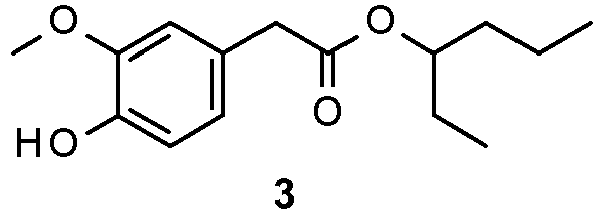
- 1-Ethylbutyl-2-(4-hydroxy-3-methoxy-phenyl)acetat (3)
- 3-Methylbut-2-enyl-2-(4-hydroxy-3-methoxy-phenyl)acetat (4)

- [(E)-Hex-2-enyl]-2-(4-hydroxy-3-methoxy-phenyl)acetat (5)

- [(Z)-Hex-3-enyl]-2-(4-hydroxy-3-methoxy-phenyl)acetat (6)

- Isopropyl-2-(4-hydroxy-3-methoxy-phenyl)acetat (7)

- sec-Butyl-2-(4-hydroxy-3-methoxy-phenyl)acetat (8)

- Isobutyl-2-(4-hydroxy-3-methoxy-phenyl)acetat (9)

- 1,1-Dimethylpropyl 2-(4-hydroxy-3-methoxy-phenyl)acetat (10)

- Isopentyl-2-(4-hydroxy-3-methoxy-phenyl)acetat (11)

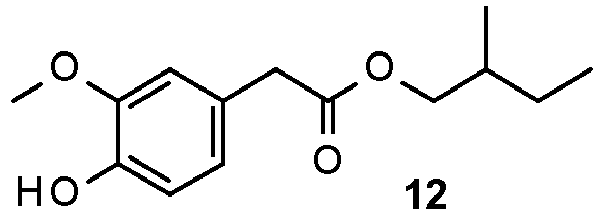
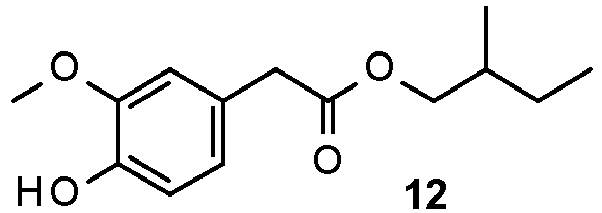
- 2-Methylbutyl-2-(4-hydroxy-3-methoxy-phenyl)acetat (12)
- 1-Methylpentyl-2-(4-hydroxy-3-methoxy-phenyl)acetat (13)

- Heptyl-2-(4-hydroxy-3-methoxy-phenyl)acetat (14)

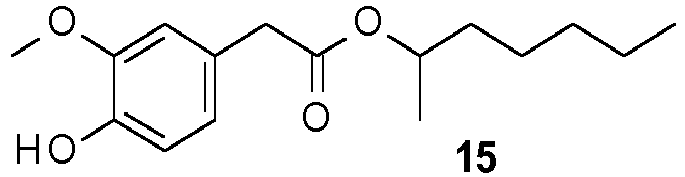
- 1-Methylhexyl-2-(4-hydroxy-3-methoxy-phenyl)acetat (15)

- (2-Isopropyl-5-methyl-cyclohexyl)-2-(4-hydroxy-3-methoxy-phenyl)acetat (16)

- Ethyl-2-(4-hydroxy-3-methoxy-phenyl)acetat (17)

- Propyl-2-(4-hydroxy-3-methoxy-phenyl)acetat (18)

- Butyl-2-(4-hydroxy-3-methoxy-phenyl)acetat (19)

- Pentyl-2-(4-hydroxy-3-methoxy-phenyl)acetat (20)

- Hexyl-2-(4-hydroxy-3-methoxy-phenyl)acetat (21)

- 3-Phenylpropyl 2-(4-hydroxy-3-methoxy-phenyl)acetat (22)

- 4-Phenylbutyl 2-(4-hydroxy-3-methoxy-phenyl)acetat (23)

- Die hierin beschriebenen Verbindungen eignen sich vorteilhafterweise zur Verwendung (insbesondere wie oben) in einer pharmazeutischen, einer der Ernährung, der Mundhygiene oder dem Genuss dienenden Zubereitung, vorzugsweise wobei die Gesamtmenge an Verbindung(en) der Formel (I) und/oder Salz(en) davon in der Zubereitung ausreicht, um
bei Gebrauch oder Verzehr der Zubereitung sensorisch einen wärmenden und/oder scharfen Effekt auf der Zunge oder im Mundraum hervorzurufen,
und
einen angenehmen Geschmackseindruck, ausgewählt aus der Gruppe bestehend aus wärmend, scharf und kühlend, zu verstärken (weitere Details hierzu ergeben sich aus den Ausführungen weiter unten). - Ein weiterer Aspekt der vorliegenden Erfindung betrifft neue Verbindungen der Formel (I), Salze davon deren Mischungen, nämlich eine Verbindung der Formel (I) oder ein physiologisch akzeptables Salz davon, wobei die phenolische Hydroxygruppe in Formel (I) deprotoniert ist, oder eine Mischung umfassend eine oder mehrere unterschiedliche Verbindungen der Formel (I) und/oder ein oder mehrere physiologisch akzeptable Salze davon, wobei die phenolische Hydroxygruppe in Formel (I) jeweils deprotoniert ist, oder bestehend aus mehreren unterschiedlichen Verbindungen der Formel (I) und/oder physiologisch akzeptablen Salzen davon, wobei die phenolische Hydroxygruppe in Formel (I) jeweils deprotoniert ist,
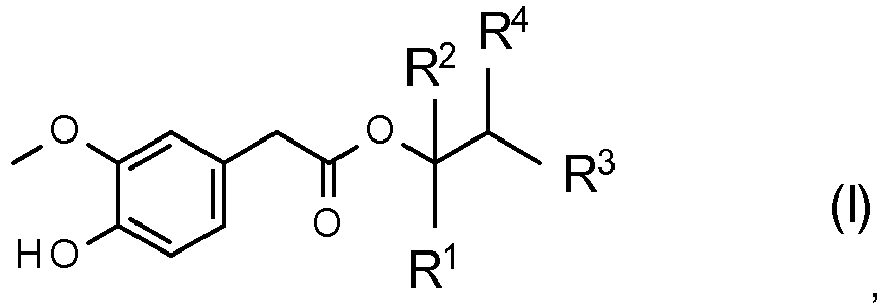
- (i) R1 und R2 unabhängig voneinander ein Wasserstoffatom oder einen Alkylrest mit 1-2 Kohlenstoffatomen darstellen,
R3 und R4 unabhängig voneinander ein Wasserstoffatom oder einen linearen oder verzweigten Alkylrest mit 1 bis 5 Kohlenstoffatomen (beispielsweise wie oben beschrieben), einen Phenylrest, einen Alkylphenylrest oder einen Phenylalkylrest oder einen linearen oder verzweigten Alkenylrest mit 2 bis 4 Kohlenstoffatomen (beispielsweise wie oben beschrieben) oder einen Alkenylphenylrest oder einen Phenylalkenylrest darstellen,
oder - (ii) R1 und R3 zusammen mit den sie verknüpfenden Kohlenstoffatomen einen Cyclohexylring bilden, der optional mit einem zusätzlichen Rest R5 substituiert ist, wobei R5 ein Alkylrest mit 1-2 Kohlenstoffatomen ist,
R2 ein Wasserstoffatom oder einen Alkylrest mit 1-2 Kohlenstoffatomen darstellt,
R4 ein Wasserstoffatom oder einen linearen oder verzweigten Alkylrest mit 1 bis 5 Kohlenstoffatomen (beispielsweise wie oben beschrieben), einen Phenylrest, einen Alkylphenylrest oder einen Phenylalkylrest oder einen linearen oder verzweigten Alkenylrest mit 2 bis 4 Kohlenstoffatomen (beispielsweise wie oben beschrieben) oder einen Alkenylphenylrest oder einen Phenylalkenylrest darstellt, - [(E)-Cinnamyl]-2-(4-hydroxy-3-methoxy-phenyl)acetat (2)

- 1-Ethylbutyl-2-(4-hydroxy-3-methoxy-phenyl)acetat (3)

- 3-Methylbut-2-enyl-2-(4-hydroxy-3-methoxy-phenyl)acetat (4)

- [(E)-Hex-2-enyl]-2-(4-hydroxy-3-methoxy-phenyl)acetat (5)

- [(Z)-Hex-3-enyl]-2-(4-hydroxy-3-methoxy-phenyl)acetat (6)

- 1,1-Dimethylpropyl-2-(4-hydroxy-3-methoxy-phenyl)acetat (10)

- 2-Methylbutyl-2-(4-hydroxy-3-methoxy-phenyl)acetat (12)
- 1-Methylpentyl-2-(4-hydroxy-3-methoxy-phenyl)acetat (13)

- 1-Methylhexyl-2-(4-hydroxy-3-methoxy-phenyl)acetat (15)
- (2-Isopropyl-5-methyl-cyclohexyl)-2-(4-hydroxy-3-methoxy-phenyl)acetat (16)

- 4-Phenylbutyl 2-(4-hydroxy-3-methoxy-phenyl)acetat (23)

- Im Übrigen gilt für die neuen Verbindungen der Formel (I) und deren Salze sowie Mischungen davon das oben im Zusammenhang mit den erfindungsgemäß zu verwendenden Verbindungen, Salzen und Mischungen Gesagte entsprechend.
- Im Rahmen der vorliegenden Erfindung wurde festgestellt, dass Verbindungen der Formel (I) bzw. deren Salze und Mischungen davon, vorteilhafterweise ab Konzentrationen von 0.1 mg/kg, insbesondere von 1.0 mg/kg, schnell aufkommende und wenig lang anhaltende, angenehme Schärfe- bzw. Wärme- und leicht stechende Eindrücke vermitteln.
- Die vorliegende Erfindung betrifft demnach insbesondere auch neue Aromakompositionen, nämlich eine Aromakomposition
- (A) umfassend oder bestehend aus einer neuen, erfindungsgemäßen Mischung wie oben beschrieben,
vorzugsweise wobei
die Gesamtmenge an Verbindung(en) der Formel (I) und/oder Salz(en) davon in der Aromakomposition, bezogen auf das Gesamtgewicht der Aromakomposition, im Bereich von 100 bis 100.000 mg/kg liegt, vorzugsweise im Bereich von 250 bis 40.000 mg/kg, besonders bevorzugt im Bereich von 250 bis 15.000 mg/kg. - Vorzugsweiseumfasst die Aromakomposition zudem einen oder mehrere weitere, nicht der Formel (I) entsprechende Aromastoffe, beispielsweise ausgewählt aus der Gruppe bestehend aus
- a) Wärme verursachende oder Scharfstoffe, bevorzugt ausgewählt aus der Liste bestehend aus: Capsaicinoiden, wie zum Beispiel Capsaicin, Dihydrocapsaicin oder Nonivamid; Gingerolen, wie zum Beispiel Gingerol-[6], Gingerol-[8], oder Gingerol-[10]; Shogaolen wie Shogaol-[6], Shogaol-[8], Shogaol-[10]; Gingerdionen, wie zum Beispiel Gingerdion-[6], Gingerdion-[8] oder Gingerdion-[10]; Paradolen, wie zum Beispiel Paradol-[6], Paradol-[8] oder Paradol-[10]; Dehydrogingerdionen, wie zum Beispiel Dehydrogingerdion-[6], Dehydrogingerdion-[8] oder Dehydrogingerdion-[10]; Piperin und Piperinderivaten;
- b) als stechend oder beißend wahrnehmbare Stoffe, bevorzugt ausgewählt aus der Gruppe bestehend aus: aromatischen Isothiocyanaten, wie zum Beispiel Phenylethylisothiocyanat, Allylisothiocyanat, Cyclopropylisothiocyanat, Butylisothiocyanat, 3-Methylthiopropylisothiocyanat, 4-Hydroxybenzylisothiocyanat, 4-Methoxybenzylisothiocyanat;
- c) als kribbelnd (tingling) beschriebenen Alkamiden, vorzugsweise ausgewählt aus der Gruppe bestehend aus 2E,4E-Decadiensäure-N-isobutylamid (trans-Pellitorin) (insbesondere solche wie beschrieben in
WO 2004/043906 , die bezüglich der darin offenbarten entsprechenden Verbindungen auf dem Wege der Verweisung Bestandteil dieser Anmeldung wird); 2E,4Z- Decadiensäure-N-isobutylamid (cis-Pellitorin) (insbesondere solche wie beschrieben inWO 2004/000787 , die bezüglich der darin offenbarten entsprechenden Verbindungen auf dem Wege der Verweisung Bestandteil dieser Anmeldung wird); 2Z,4Z- Decadiensäure-N-isobutylamid; 2Z,4E- Decadiensäure-N-isobutylamid; 2E,4E-Decadiensäure-N-([2S]-2-methylbutyl)amid; 2E,4E-Decadiensäure-N-([2S]-2-methylbutyl)amid; 2E,4E-Decadiensäure-N-([2R]-2-methylbutylamid); 2E,4Z-Decadiensäure-N-(2-methylbutyl)amid; 2E,4E-Decadiensäure-N-piperid (Achilleamid); 2E,4E-Decadiensäure-N-piperid (Sarmentin); 2E-Decensäure-N-isobutylamid; 3E-Decensäure-N-isobutylamid; 3E-Nonensäure-N-isobutylamid; 2E,6Z,8E-Decatriensäure-N-isobutylamid (Spilanthol); 2E,6Z,8E-Decatriensäure-N-([2S]-2-methylbutyl)amid (Homospilanthol); 2E,6Z,8E-Decatriensäure-N-([2R]-2-methylbutyl)amid; 2E-Decen-4-insäure-N-isobutylamid; 2Z-Decen-4-insäure-N-isobutylamid; 2E,6Z,8E,10E-Dodecatetraensäure-N-(2-methylpropyl)amid (alpha-Sanshool); 2E,6Z,8E,10E-Dodecatetraensäure-N-(2-hydroxy-2-methylpropyl)amid (alpha-Hydroxysanshool); 2E,6E,8E,10E-Dodecatetraensäure-N-(2-hydroxy-2-methylpropyl)amid (gamma-Hydroxysanshool); 2E,4E,8Z,10E,12E-Tetradecapentaensäure-N-(2-hydroxy-2-methylpropyl)amid (gamma-Hydroxysanshool); 2E,4E,8E,10E,12E-Tetradecapentaensäure-N-(2-hydroxy-2-methylpropyl)amid (gamma-Hydroxyisosanshool); 2E,4E,8Z,10E,12E-Tetradecapentaensäure-N-(2-methyl-2-propenyl)amid (gamma-Dehydrosanshool); 2E,4E,8Z,10E,12E-Tetradecapentaensäure-N-(2-methylpropyl)amid (gamma-Sanshool); 2E,4E,8Z,11Z-Tetradecatetraensäure-N-(2-hydroxy-2-methylpropyl)amid (Bungeanool); 2E,4E,8Z,11E-Tetradecatetraensäure-N-(2-hydroxy-2-methylpropyl)amid (Isobungeanool); 2E,4E,8Z-Tetradecatriensäure-N-(2-hydroxy-2-methylpropyl)amid (Dihydrobungeanool) und 2E,4E -Tetradecadiensäure-N-(2-hydroxy-2-methylpropyl)amid (Tetrahydrobungeanool); - d) Stoffe mit physiologischer Kühlwirkung, vorzugsweise ausgewählt aus der folgenden Liste: Menthol und Mentholderivate (z.B. L-Menthol, D-Menthol, racemisches Menthol, Isomenthol, Neoisomenthol, Neomenthol) Menthylether (z.B. (L-Menthoxy)-1,2-propandiol, (L-Menthoxy)-2-methyl-1,2-propandiol, L-Menthyl-methylether), Menthylester (z.B. Menthylformiat, Menthylacetat, Menthylisobutyrat, Menthyllactate, L-Menthyl-L-lactat, L-Menthyl-D-lactat, Menthyl-(2-methoxy)acetat, Menthyl-(2-methoxyethoxy)acetat, Menthylpyroglutamat), Menthylcarbonate (z.B. Menthylpropylenglycolcarbonat, Menthylethylenglycolcarbonat, Menthylglycerincarbonat oder deren Gemischen), die Halbester von Mentholen mit einer Dicarbonsäure oder deren Derivate (z.B. Mono-Menthylsuccinat, Mono-Menthylglutarat, Mono-Menthylmalonat, O-Menthylbernsteinsäureester-N,N-(dimethyl)amid, O-Menthylbernsteinsäureesteramid), andere als in der vorliegenden Erfindung genannte Menthancarbonsäureamide (z.B. Menthancarbonsäure-N-ethylamid [WS3], Menthancarbonsäure-N-(p-methoxyphenyl)amid [SC1], Nα-(Menthancarbonyl)glycinethylester [WS5], Menthancarbonsäure-N-(4-cyanophenyl)amid, Menthancarbonsäure-N-(alkoxyalkyl)amide), Menthon und Menthonderivate (z.B. L-Menthonglycerinketal), 2,3-Dimethyl-2-(2-propyl)-butansäurederivate (z.B. 2,3-Dimethyl-2-(2-propyl)-butansäure-N-methylamid [WS23]), Isopulegol oder seine Ester (I-(-)-Isopulegol, I-(-)-Isopulegolacetat), Menthanderivate (z.B. p-Menthan-3,8-diol), Cubebol oder synthetische oder natürliche Mischungen, enthaltend Cubebol, Pyrrolidonderivate von Cycloalkyldionderivaten (z.B. 3-Methyl-2(1-pyrrolidinyl)-2-cyclopenten-1-on) oder Tetrahydropyrimidin-2-one (z.B. Icilin oder verwandte Verbindungen, wie in
WO 2004/026840 beschrieben), weitere Kühlwirkstoffe wie inWO2011061330 beschrieben, insbesondere Derivate verschieden substituierter Zimt- und 2-Phenoxysäuren, besonders bevorzugt Methylendioxyzimtsäure-N,N-diphenylamid, Methylendioxyzimtsäure-N-ethyl-N-phenylamid, Methylendioxyzimtsäure-N-pyridyl-N-phenylamid; - e) Stoffe mit adstringierender Wirkung, vorzugsweise ausgewählt aus der folgenden Liste: Catechine wie z.B. Epicatechine, Gallocatechine, Epigallocatechine sowie deren jeweiligen Gallussäureester, z.B. Epigallocatechingallat oder Epicatechingallat, dern Oligomere (Procyanidine, Proanthocyanidine, Prodelphinidine, Procyanirine, Thearubigenine, Theogalline) sowie deren C- und O-Glycoside; Dihydroflavonoide wie Dihydromyricetin, Taxifolin, sowie deren C- und O-Glycoside, Flavonole wie Myricetin, Quercetin sowie deren C- und O-Glycoside wie Quercetrin, Rutin, Gallussäaureester von Kohlenhydraten wie Tannin, Pentagalloylglucose oder deren Reaktionsprodukte wie Elligatannin, Aluminiumsalze, z.B. Alaun,
- Insbesondere in den hierin beschriebenen erfindungsgemäß bzw. erfindungsgemäß bevorzugt zu verwendenden Konzentrationen haben Verbindungen der Formel (I) bzw. deren Salze oder Mischungen davon vorteilhafterweise häufig keine signifikanten anderen bzw. unerwünschten Aromawirkungen, können also besonders gut in vielen verschiedenen Aromatypen eingesetzt werden.
- Besonders vorteilhaft sind Aromakompositionen, die Kombinationen von Verbindungen der Formel (I) bzw. deren Salzen mit einem oder mehreren anderen trigeminal (scharf, wärmend, stechend, beißend, kratzend, kühlend, betäubend, kribbelnd (tingling), adstringierend) wirksamen Stoffen enthalten, wobei deren trigeminaler (Haupt-)Effekt durch Verbindungen der Formel (I) bzw. deren Salze vorteilhafterweise moduliert werden kann. Dabei kann beispielsweise ein wärmender, scharfer oder kühlender Effekt verstärkt werden, während ein adstringierender Effekt abgeschwächt werden kann.
- Bevorzugt ist daher auch eine Aromakomposition, die zudem einen oder mehrere nicht der Formel (I) entsprechende Stoffe mit unangenehmer, insbesondere bitterer Geschmacksqualität, oder einer adstringierenden, bitteren, trockenen, staubigen, mehligen, kalkigen und/oder metallischen Note enthält, vorzugsweise ausgewählt aus der Gruppe bestehend aus:
- f) Xanthinalkaloide, Xanthine (Coffein, Theobromin, Theophyllin und Methylxanthine), Alkaloide (Chinin, Brucin, Strychnin, Nicotin), phenolische Glycoside (z.B. Salicin, Arbutin), Flavonoidglycoside (z.B. Neohespereidin, Hesperidin, Naringin, Quercitrin, Rutin, Hyperosid, Quercetin-3-O-glucosid, Myricetin-3-O-glycoside), Chalcone oder Chalconglycoside (z.B. Phloridzin, Phloridzinxyloside), hydrolisierbare Tannine (Gallus- oder Elagsäureester von Kohlenhydraten, z.B. Pentagalloylglucose, Tanninsäuren), nichthydrolisierbare Tannine (ggfs. galloylierte Catechine, Gallocatechine, Epigallocatechine oder Epicatechine und deren Oligomeren, z.B. Proanthyocyanidine oder Procyanidine, Thearubigenin), Flavone (z.B. Quercetin, Taxifolin, Myricetin), Phenole wie z.B. Salicin, Polyphenole (z.B. gamma-Oryzanol, Kaffeesäure oder deren Ester (z. B. Chlorogensäure und Isomere)), terpenoide Bitter- und Gerbstoffe (z.B. Limonoide wie Limonin oder Nomilin aus Zitrusfrüchten, Lupolone und Humolone aus Hopfen, Iridoide, Secoiridoide), Absinthin aus Wermut, Amarogentin aus Enzian, metallische Salze (insbesondere Kalium-, Magnesium- und Calciumsalze, Kaliumchlorid, Kaliumgluconat, Kaliumcarbonat, Kaliumsulfat, Kaliumlactat, Kaliumglutamat, Kaliumsuccinat, Kaliummalat, Natriumsulfat, Magnesiumsulfat, Aluminiumsalze, Zinksalze, Zinnsalze, Eisen-(II)-salze, Eisen-(III)-salze, Chrom-(II)-picolinat), pharmazeutische Wirkstoffe (z.B. Fluorchinolon-Antibiotika, Paracetamol, Aspirin, beta-Lactam-Antibiotika, Ambroxol, Propylthiouracil [PROP], Guaifenesin), Vitamine (beispielsweise Vitamin H, Vitamine aus der B-Reihe wie Vitamin B1, B2, B6, B12, Niacin, Panthotensäure), Denatoniumbenzoat, Sucraloseoctaacetat, Eisensalze, Aluminiumsalze, Zinksalze, Harnstoff, ungesättigte Fettsäuren, insbesondere ungesättigte Fettsäuren in Emulsionen, bitter/adstringierend schmeckende Aminosäuren (z.B. Leucin, Isoleucin, Valin, Tryptophan, Prolin, Histidin, Tyrosin, Lysin oder Phenylalanin) und bitter oder adstringierend schmeckende Peptide oder Proteine (insbesondere Peptide mit einer Aminosäure aus der Gruppe Leucin, Isoleucin, Valin, Tryptophan, Prolin oder Phenylalanin am N- oder C-Terminus), Saponine, insbes. Sojasaponine, Isoflavonoide (insbes. Genistein, Daidzein, Genistin, Daidzin, deren Glycoside und acylierten Glycoside);
- g) Stoffe mit einem nicht unangenehmen Primärgeschmack (beispielsweise süß, salzig, würzig, sauer) und/oder -geruch, vorzugsweise ausgewählt aus der Gruppe der Süßstoffe oder Zuckeraustauschstoffe, vorzugsweise Kaliumsalze (insbesondere Kaliumchlorid, Kaliumgluconat, Kaliumcarbonat, Kaliumsulfat, Kaliumlactat, Kaliumglutamat, Kaliumsuccinat, Kaliummalat), Aspartam, Acesulfam K, Neotam, Superaspartam, Saccharin, Sucralose, Tagatose, Monellin, Stevioside, Rebaudioside, Rebaudiosid A, Rebaudiosid B, Rebaudiosid C, Rebaudiosid D, Rebaudiosid X, Rubusoside, Hernandulcin, Thaumatin, Miraculin, Glycyrrhizin, Glycyrrhetinsäure, Balansin A oder Balansin B, oder deren Derivate, Cyclamat oder die pharmazeutisch akzeptablen Salze der vorgenannten Verbindungen.
- Die vorliegende Erfindung betrifft weiterhin eine pharmazeutische Zubereitung, der Ernährung, der Mundhygiene oder dem Genuss dienende Zubereitung, umfassend
- (A) eine neue, erfindungsgemäße Mischung wie oben beschrieben,
vorzugsweise wobei
die Gesamtmenge an Verbindung(en) der Formel (I) und/oder Salz(en) davon in der Zubereitung, bezogen auf das Gesamtgewicht der Zubereitung, im Bereich von 0,1 bis 1.000 mg/kg liegt, vorzugsweise im Bereich von 1 bis 1.000 mg/kg, vorzugsweise im Bereich von 1 bis 750 mg/kg, besonders bevorzugt im Bereich von 5 bis 500 mg/kg,
oder - (C) eine Aromakomposition wie oben beschrieben,
vorzugsweise wobei
die Gesamtmenge an Verbindung(en) der Formel (I) und/oder Salz(en) davon in der Zubereitung, bezogen auf das Gesamtgewicht der Zubereitung, im Bereich von 0,1 bis 1.000 mg/kg liegt, vorzugsweise im Bereich von 1 bis 1.000 mg/kg, vorzugsweise im Bereich von 1 bis 750 mg/kg, besonders bevorzugt im Bereich von 5 bis 500 mg/kg,
wobei die Gesamtmenge an Verbindung(en) der Formel (I) und/oder Salz(en) davon in der Zubereitung ausreicht, um
bei Gebrauch oder Verzehr der Zubereitung sensorisch einen wärmenden und/oder scharfen Effekt auf der Zunge oder im Mundraum hervorzurufen,
und
einen angenehmen Geschmackseindruck, vorzugsweise eines anderen in der Zubereitung enthaltenen Stoffes, ausgewählt aus der Gruppe bestehend aus wärmend, scharf und kühlend, zu verstärken (vgl. hierzu oben). - Bevorzugt umfasst eine erfindungsgemäße Zubereitung zudem
ein oder mehrere übliche Grund-, Hilfs- und Zusatzstoffe in einer Menge von, bezogen auf das Gesamtgewicht der Zubereitung, 5 bis 99,9999 Gew.-%, vorzugsweise 10 bis 80 Gew.-%,
und/oder
Wasser in einer Menge, bezogen auf das Gesamtgewicht der Zubereitung, bis zu 99,9999 Gew.-%, vorzugsweise in einer Menge von 5 bis 80 Gew.-%. - Bevorzugt ist ferner eine erfindungsgemäße Zubereitung, die neben Verbindungen der Formel (I) bzw. deren Salzen (wie oben definiert) zumindest eine weitere Substanz zum Verändern, Maskieren oder Vermindern des unangenehmen Geschmackseindrucks eines unangenehm schmeckenden Stoffes oder Stoffgemisches umfasst. Entsprechend liegt dann eine Kombination von zumindest zwei Geschmackskorrigenzien vor.
- Der Ernährung oder dem Genuss dienende Zubereitungen im Sinne der Erfindung sind z.B. Backwaren (z.B. Brot, Trockenkekse, Kuchen, sonstiges Gebäck), Süßwaren (z.B. Schokoladen, Schokoladenriegelprodukte, sonstige Riegelprodukte, Fruchtgummi, Hart- und Weichkaramellen, Kaugummi), alkoholische oder nicht-alkoholische Getränke (z.B. Kakao, Kaffee, Grüntee, Schwarztee, mit (Grün-, Schwarz-)Tee-Extrakten angereicherte (Grün-, Schwarz-)Tee-Getränke, Rooibos-Tee, andere Kräutertee, Wein, weinhaltige Getränke, Bier, bierhaltige Getränke, Liköre, Schnäpse, Weinbrände, fruchthaltige Limonaden, isotonische Getränke, Erfrischungsgetränke, Nektare, Obst- und Gemüsesäfte, Frucht- oder Gemüsesaftzubereitungen), Instantgetränke (z.B. Instant-Kakao-Getränke, Instant-Tee-Getränke, Instant-Kaffeegetränke), Fleischprodukte (z.B. Schinken, Frischwurst- oder Rohwurstzubereitungen, gewürzte oder marinierte Frisch- oder Pökelfleischprodukte), Eier oder Eiprodukte (Trockenei, Eiweiß, Eigelb), Getreideprodukte (z.B. Frühstückscerealien, Müsliriegel, vorgegarte Fertigreis-Produkte), Milchprodukte (z.B. Vollfett- oder fettreduzierte oder fettfreie Milchgetränke, Milchreis, Joghurt, Kefir, Frischkäse, Weichkäse, Hartkäse, Trockenmilchpulver, Molke, Butter, Buttermilch, teilweise oder ganz hydrolisierte Milchprotein-haltige Produkte), Produkte aus Sojaprotein oder anderen Sojabohnen-Fraktionen (z.B. Sojamilch und daraus gefertigte Produkte, isoliertes oder enzymatisch behandeltes Sojaprotein enthaltende Getränke, Sojamehl enthaltende Getränke, Sojalecithin-haltige Zubereitungen, fermentierte Produkte wie Tofu oder Tempe oder daraus gefertigte Produkte und Mischungen mit Fruchtzubereitungen und fakultativ Aromen), Fruchtzubereitungen (z.B. Konfitüren, Fruchteis, Fruchtsoßen, Fruchtfüllungen), Gemüsezubereitungen (z.B. Ketchup, Soßen, Trockengemüse, Tiefkühlgemüse, vorgegarte Gemüse, eingekochte Gemüse), Knabberartikel (z.B. gebackene oder frittierte Kartoffelchips oder Kartoffelteigprodukte, Extrudate auf Mais- oder Erdnussbasis), Produkte auf Fett- und Ölbasis oder Emulsionen derselben (z.B. Mayonnaise, Remoulade, Dressings, jeweils Vollfett- oder fettreduziert), sonstige Fertiggerichte und Suppen (z.B. Trockensuppen, Instant-Suppen, vorgegarte Suppen), Gewürze, Würzmischungen sowie insbesondere Aufstreuwürzungen (englisch: Seasonings), die beispielsweise im Snackbereich Anwendung finden, Süßstoffzubereitungen, -tabletten oder -sachets, sonstige Zubereitung zum Süßen oder Weißen von Getränken oder anderen Nahrungsmitteln. Die Zubereitungen im Sinne der Erfindung können auch als Halbfertigware zur Herstellung weiterer der Ernährung oder dem Genuss dienenden Zubereitungen dienen.
- Pharmazeutische Zubereitungen umfassen einen pharmazeutischen Wirkstoff. Vorteilhafte pharmazeutische Wirkstoffe sind beispielsweise steroidale entzündungshemmende Substanzen vom Kortikosteroiden-Typ wie z. B. Hydrocortison, Hydrocortison-Derivate wie Hydrocortison-17-butyrat, Dexamethason, Dexamethasonphosphat, Methylprednisolon oder Cortison. Vorteilhafte nichtsteroidale pharmazeutische Wirkstoffe sind beispielsweise Entzündungshemmer wie Oxicame wie Piroxicam oder Tenoxicam; Salicylate wie Aspirin® (Acetylsalicyl-säure), Disalcid, Solprin oder Fendosal; Essigsäure-Derivate wie Diclofenac, Fenclofenac, Indomethacin, Sulindac, Tolmetin, oder Clindanac; Fenamate wie Mefenamic, Meclofenamic, Flufenamic oder Niflumic; Propionsäure-Derivate wie Ibuprofen, Naproxen, Flurbiprofen, Benoxaprofen oder Pyrazole wie Phenylbutazon, Oxyphenylbutazon, Febrazon oder Azapropazon.
- Besonders bevorzugte pharmazeutische Zubereitungen sind nicht verschreibungspflichtige Produkte und frei verkäufliche Arzneimittel, sogenannte OTC ("over the counter") -Präparate, enthaltend Wirkstoffe wie Paracetamol, Acetylsalicylsäure oder Ibuprofen, Vitamine (beispielsweise Vitamin H, Vitamine aus der B-Reihe wie Vitamin B1, B2, B6, B12, Niacin, Panthotensäure, vorzugsweise in Form von (Brause-)Tabletten oder Kapseln), Mineralien (vorzugsweise in Form von (Brause-)Tabletten oder Kapseln) wie Eisensalze, Zinksalze, Selensalze, Produkte enthaltend Wirkstoffe oder Extrakte von Spitzwegerich (z.B. in Hustensirup) oder Johanniskraut.
- Die Zubereitungen im Sinne der Erfindung, welche auch unangenehm schmeckende Stoffe oder Stoffgemische enthalten können (vgl. hierzu oben), können auch in Form von Kapseln, Tabletten (nichtüberzogene sowie überzogene Tabletten, z.B. magensaftresistente Überzüge), Dragees, Granulaten, Pellets, Feststoffmischungen, Dispersionen in flüssigen Phasen, als Emulsionen, als Pulver, als Lösungen, als Pasten oder als andere schluck- oder kaubare Zubereitungen vorliegen sowie als Zubereitung mit funktionellen Inhaltsstoffen, als Nahrungsergänzungsmittel oder als bilanzierte Diäten.
- Der Mundpflege dienende Zubereitungen im Sinne der Erfindung sind insbesondere Mund- und/oder Zahnpflegemittel wie Zahnpasten, Zahngele, Zahnpulver, Mundwässer, Kaugummis und andere Mundpflegemittel.
- Zahnpflegemittel (als Basis für die Mundpflege dienende Zubereitungen), umfassen im Allgemeinen ein abrasives System (Schleif- oder Poliermittel), wie z.B. Kieselsäuren, Calciumcarbonate, Calciumphosphate, Alumiuniumoxide und/oder Hydroxylapatite, oberflächenaktive Substanzen wie z.B. Natriumlaurylsulfat, Natriumlaurylsarcosinat und/oder Cocamidopropylbetain, Feuchthaltemitteln wie z.B. Glycerin und/oder Sorbit, Verdickungsmittel, wie z.B. Carboxymethylcellulose, Polyethylenglycole, Carrageenan und/oder Laponite®, Süßstoffe, wie z.B. Saccharin, andere Geschmackskorrigenzien für unangenehme Geschmackseindrücke, Geschmackskorrigenzien für weitere, in der Regel nicht unangenehme Geschmackseindrücke, geschmacksmodulierende Stoffe (z.B. Inositolphosphat, Nucleotide wie Guanosinmonophosphat, Adenosinmonophosphat oder andere Stoffe wie Natriumglutamat oder 2-Phenoxypropionsäure), Kühlwirkstoffen wie z.B. Menthol, Mentholderivate (z.B. L-Menthol, L-Menthyllactat, L-Menthylalkylcarbonate, Menthonketale, Menthancarbonsäureamide), 2,2,2-Trialkylessigsäureamiden (z.B. 2,2-Diisopropylpropionsäuremethylamid), Methylendioxyzimtsäure-N,N-diphenylamid, Methylendioxyzimtsäure-N-ethyl-N-phenylamid, Methylendioxyzimtsäure-N-pyridyl-N-phenylamid, Icilin-Derivate, Stabilisatoren und aktive Wirkstoffe, wie z.B. Natriumfluorid, Natriummonofluorphosphat, Zinndifluorid, quartären Ammoniumfluoriden, Zinkcitrat, Zinksulfat, Zinnpyrophosphat, Zinndichlorid, Mischungen verschiedener Pyrophosphate, Triclosan, Cetylpyridiniumchlorid, Aluminiumlactat, Kaliumcitrat, Kaliumnitrat, Kaliumchlorid, Strontiumchlorid, Wasserstoffperoxid, Aromen und/oder Natriumbicarbonat oder Geruchskorrigenzien.
- Kaugummis (als weiteres Beispiel für die Mundpflege dienende Zubereitungen), umfassen im allgemeinen eine Kaugummibase, d.h. eine beim Kauen plastisch werdende Kaumasse, Zucker verschiedener Arten, Zuckeraustauschstoffe, Süßstoffe, Zuckeralkohole, andere Geschmackskorrigenzien für unangenehme Geschmackseindrücke, Geschmackskorrigenzien für weitere, in der Regel nicht unangenehme Geschmackseindrücke, geschmacksmodulierende Stoffe (z.B. Inositolphosphat, Nucleotide wie Guanosinmonophosphat, Adenosinmonophosphat oder andere Stoffe wie Natriumglutamat oder 2-Phenoxypropionsäure), die im vorherigen Abschnitt genannten Kühlwirkstoffe, Feuchthaltemittel, Verdicker, Emulgatoren, Aromen und Stabilisatoren oder Geruchskorrigenzien.
- Beispiele üblicher Grund-, Hilfs- und Zusatzstoffe für erfindungsgemäße Zubereitungen sind Wasser, Gemische frischer oder prozessierter, pflanzlicher oder tierischer Grund- oder Rohstoffe (z.B. rohes, gebratenes, getrocknetes, fermentiertes, geräuchertes und/oder gekochtes Fleisch, Knochen, Knorpel, Fisch, Gemüse, Früchte, Kräuter, Nüsse, Gemüse- oder Fruchtsäfte oder -pasten oder deren Gemische), verdauliche oder nicht verdauliche Kohlenhydrate (z.B. Saccharose, Maltose, Fructose, Glucose, Dextrine, Amylose, Amylopektin, Inulin, Xylane, Cellulose), Zuckeralkohole (z.B. Sorbit), natürliche oder gehärtete Fette (z.B. Talg, Schmalz, Palmfett, Kokosfett, gehärtetes Pflanzenfett), Öle (z.B. Sonnenblumenöl, Erdnussöl, Maiskeimöl, Olivenöl, Fischöl, Sojaöl, Sesamöl), Fettsäuren oder deren Salze (z.B. Kaliumstearat), proteinogene oder nicht-proteinogene Aminosäuren und verwandte Verbindungen (z.B. Taurin), Peptide, native oder prozessierte Proteine (z.B. Gelatine), Enzyme (z.B. Peptidasen), Nukleinsäuren, Nucleotide, andere als die erfindungsgemäß verwendeten Geschmackskorrigenzien für unangenehme Geschmackseindrücke (z. B. Hesperetin, Phloretin oder andere gemäß
US 2008/0227867 zu verwendende Hydroxychalkonderivate sowie gegebenenfalls die dort beschriebenen Lactone), Geschmackskorrigenzien für weitere, in der Regel nicht unangenehme Geschmackseindrücke, geschmacksmodulierende Stoffe (z.B. Inositolphosphat, Nucleotide wie Guanosinmonophosphat, Adenosinmonophosphat oder andere Stoffe wie Natriumglutamat oder 2-Phenoxypropionsäure), Emulgatoren (z.B. Lecithine, Diacylglycerole), Stabilisatoren (z.B. Carageenan, Alginat), Konservierungsstoffe (z.B. Benzoesäure, Sorbinsäure), Antioxidantien (z.B. Tocopherol, Ascorbinsäure), Chelatoren (z.B. Citronensäure), organische oder anorganische Säuerungsmittel (z.B. Äpfelsäure, Essigsäure, Citronensäure, Weinsäure, Phosphorsäure, Milchsäure), zusätzliche Bitterstoffe (z.B. Chinin, Coffein, Limonin, Amarogentin, Humolone, Lupolone, Catechine, Tannine), Süßstoffe (z.B. Saccharin, Cyclamat, Aspartam, Neotam, Stevioside, Rebaudioside, Acesulfam K, Neohesperidindihydrochalkon, Thaumatin, Superaspartam), mineralische Salze (z.B. Natriumchlorid, Kaliumchlorid, Magnesiumchlorid, Natriumphosphate), die enzymatische Bräunung verhindernde Stoffe (z.B. Sulfit, Ascorbinsäure), etherische Öle, Pflanzenextrakte, natürliche oder synthetische Farbstoffe oder Farbpigmente (z.B. Carotinoide, Flavonoide, Anthocyane, Chlorophyll und deren Derivate), Gewürze, synthetische, natürliche oder naturidentische Aromastoffe oder Riechstoffe sowie Geruchskorrigenzien. - Die vorliegende Erfindung betrifft auch ein Verfahren zum Herstellen einer erfindungsgemäßen Zubereitung, insbesondere einer solchen wie hierin als bevorzugt beschrieben, umfassend folgende Schritte:
- i) Bereitstellen
- (A) einer erfindungsgemäßen Mischung wie hierin beschrieben,
vorzugsweise wobei
die Gesamtmenge an Verbindung(en) der Formel (I) und/oder Salz(en) davon so ausgewählt ist, dass die Gesamtmenge in der herzustellenden Zubereitung, bezogen auf das Gesamtgewicht der Zubereitung, im Bereich von 0,1 bis 1.000 mg/kg liegt, vorzugsweise im Bereich von 1 bis 1.000 mg/kg, vorzugsweise im Bereich von 1 bis 750 mg/kg, besonders bevorzugt im Bereich von 5 bis 500 mg/kg,
oder - (C) eine erfindungsgemäße Aromakomposition wie hierin beschrieben,
vorzugsweise wobei
die Gesamtmenge an Verbindung(en) der Formel (I) und/oder Salz(en) so ausgewählt ist, dass die Gesamtmenge in der herzustellenden Zubereitung, bezogen auf das Gesamtgewicht der Zubereitung, im Bereich von 0,1 bis 1.000 mg/kg liegt, vorzugsweise im Bereich von 1 bis 1.000 mg/kg, vorzugsweise im Bereich von 1 bis 750 mg/kg, besonders bevorzugt im Bereich von 5 bis 500 mg/kg,
- (A) einer erfindungsgemäßen Mischung wie hierin beschrieben,
- ii) Bereitstellen eines oder mehrerer weiterer Bestandteile der herzustellenden Zubereitung, und
- iii) Inkontaktbringen oder Mischen der in Schritt ii) bereitgestellten weiteren Bestandteile mit dem/den in Schritt i) bereitgestellten Bestandteil(en), vorzugsweise in einer sensorisch wirksamen Menge.
- Die beschriebenen erfindungsgemäßen Zubereitungen werden vorzugsweise hergestellt, indem ein erfindungsgemäß einzusetzender Ester der Homovanillinsäure als Substanz, als Lösung oder in Form einer Aromakomposition in eine der Ernährung, der Mundpflege oder dem Genuss dienende oder orale pharmazeutische Basis-Zubereitung eingearbeitet werden. Vorteilhafterweise können als Lösung vorliegende erfindungsgemäße Zubereitungen auch z.B. durch Sprühtrocknung in eine feste Zubereitung überführt werden.
- Im Folgenden ist exemplarisch die Herstellung von erfindungsgemäßen Aromakompositionen (hier: enthaltend Ethylhomovanillat (17)) beschrieben, indem man
- i) 1 Äquivalent Ascorbinsäure oder eines ihrer physiologisch akzeptablen Salze mit
- ii) 1 Äquivalent Vanillylalkohol
- iii) in einer (50/50; v/v) Mischung aus Wasser und einem Vertreter aus der Stoffgruppe der Alkohole, besonders bevorzugt sind Ethanol, Propanol, Butanol, Pentanol, Hexanol, Isopropylalkohol
- iv) bei einer Temperatur von 100-150 °C (ggf. unter Druck)
- v) für eine Zeit von 4-6 h
- Ascorbinsäure und Vanillylalkohol kommen jeweils in der Natur in Nahrungsmitteln vor und sind als Lebensmittelzusatzstoffe bzw. Aromastoffe zugelassen; besonders vorteilhaft ist daher der Einsatz von isolierter oder natürlich gewonnener Ascorbinsäure sowie von isoliertem oder natürlich gewonnenem Vanillylalkohol, wobei diese auch in Form von nicht vollständig aufgereinigten Extrakten oder Fraktionen eingesetzt werden können. Vanillylalkohol kommt z.B. in Bier (Flavor-Base, 9th Edition, Leffingwell & Associates, 2013) oder der Sitka-Fichte (Picea sitchensis, P. J. Kohlbrenner, C. Schuerch, Benzene-Alcohol-Soluble Extractives of Sitka Spruce, J. Org. Chem. 1959, 24(2), 166-172) vor.
- Dabei sind die vorstehend beschriebenen erfindungsgemäßen Aromazubereitungen dadurch charakterisiert, dass sie neben Ethylhomovanillat (17) noch mindestens einen weiteren Stoff aus der folgenden Tab. 1 enthalten können (entsprechendes gilt für die hierin beschriebenen erfindungsgemäßen Aromakompositionen):
Tab. 1: Nr. Retentionszeit [min]* Molare Masse m/z (Gef.: ESI+) IPUAC Name Struktur 1 2.88 gef. 227.0546 ber. 226.047189 für C10H10O6 3-(1,2-Dihydroxyethyl)-1,3-dihydroiso-benzofuran-1,4,5-triol 
2 3.73 gef. 313.0921 ber. 312.083969 für C14H16O8 6-[(3-Hydroperoxy-4-hydroxyphenyl)-methyl]-3,6,6a-trihydroxy-3,3a-dihydro-2H-furo[3,2-b]furan-5-on* 
3 3.98 gef. 313.0920 ber. 312.083969 für C14H16O8 2-Hydroxy-3-(4-hydroxy-3-methoxy-phenyl)-2-(3-hydroxy-2-oxo-tetrahydrofuran-3-yl)propansäure 
4 4.66 gef. 251.0924 ber. 250.083575 für C13H14O5 2-Hydroxy-3-(4-hydroxy-3-methoxy-phenyl)-4-(hydroxymethyl)cyclopent-2-en-1-on* 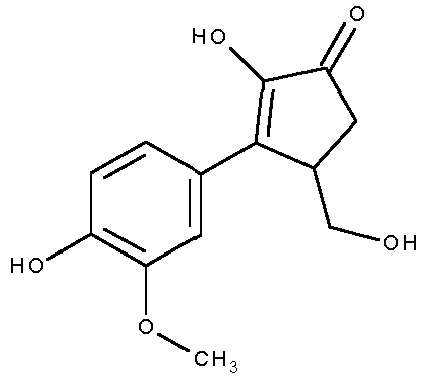
5 6.12 gef. 387.1449 ber. 386.136004 für C21H22O7 2-Hydroxy-3-[4-hydroxy-2-[(4-hydroxy-3-methoxy-phenyl)methyl]-5-methoxy-phenyl]-4-(hydroxymethyl)cyclopent-2-en-1-on 
6 6.33 gef. 251.0925 brr. 250.083575 für C13H14O5 2-[(4-Hydroxy-3-methoxy-phenyl)-methylene]-5-(hydroxymethyl)-tetrahydrofuran-3-on 
7 6.34 gef. 251.0921 ber. 250.083575 für C13H14O5 5-Hydroxy-6-[(4-hydroxy-3-methoxy-phenyl)methyl]-2,3-dihydropyran-4-on 
8 6.98 gef. 341.1251 ber. 340.115269 für C16H20O8 Ethyl-2-hydroxy-3-(4-hydroxy-3-methoxy-phenyl)-2-(3-hydroxy-2-oxotetrahydro-furan-3-yl)propanoat 
9 7.68 gef. 233.0842 ber. 232.073010 für C13H12O4 1-(2-Furyl)-2-(4-hydroxy-3-methoxy-phenyl)ethanon 
10 7.71 gef. 387.1457 ber. 386.136004 für C21H22O7 2-Hydroxy-3-[4-hydroxy-3-[(4-hydroxy-3-methoxyphenyl)methyl]-5-methoxyphenyl]-4-(hydroxymethyl)cyclopent-2-en-1-on 
11 7.93 gef. 233.0821 ber. 233.073010 für C13H12O4 2-[(4-Hydroxy-3-methoxyphenyl)methylene]-5-methylfuran-3-on 
12 8.22 gef. 297.1347 ber. 296.125440 für C15H20O6 Ethyl-3-[3-(4-hydroxy-3-methoxy-phenyl)-2-oxopropoxy]propanoat 
14 8.82 gef. 465.1606 ber. 464.146569 für C26H24O8 2-[3-(2-Furyl)-1,2-bis(4-hydroxy-3-methoxy-phenyl)-3-oxo-propyl]-5-methyl-furan-3-on 
15 9.52 gef. 369.1346 ber. 368.125440 für C21H20O6 1-(2-Furyl)-2-[4-hydroxy-2-[(4-hydroxy-3-methoxyphenyl)methyl]-5-methoxyphenyl]ethanon 
* s. Preobrazhenskaya, M.N. et al. Tetrahedron 1997, 53, 6971-6976 - Die Aufreinigung des primären Reaktionsgemischs kann erfolgen durch eines oder mehrere der folgenden Verfahren:
- a) gegebenenfalls Aufkonzentrierung des primären Reaktionsgemischs, vorzugsweise durch ein oder mehrere evaporative oder pervaporative Verfahren,
- b) gegebenenfalls Behandlung des (gegebenenfalls in Schritt a) aufkonzentrierten) primären Reaktionsgemischs durch verteilungschromatographische (z.B. Gegenstromverteilungsverfahren wie FCPC, SCCC, Craig-Verfahren) oder adsorptionschromatographische Verfahren mit oder an Adsorbentien, vorzugsweise ausgewählt aus der Gruppe bestehend aus Kieselgel, modifiziertes Kieselgel, Aktivkohle, Zeolith, Bentonit, Kieselgur, Aluminiumoxid, basischer oder saurer oder neutraler, optional makroporöser, lonentauscher, bevorzugt im Batch- oder Säulenverfahren, gegebenenfalls unter Zuhilfenahme weiterer Extraktionsmittel, wodurch eine aufgereinigte Aromakomposition erhalten wird,
- c) gegebenenfalls Trocknung der in Schritt b) erhaltenen aufgereinigten Aromakomposition, vorzugsweise durch ein evaporatives oder pervaporatives Verfahren,
- d) gegebenenfalls ein- oder mehrmaliger Wiederholung der Schritte b) und c)
- e) gegebenenfalls Mischen der in den vorherigen Schritten erhaltenen aufgereinigte Aromakomposition mit einem geeigneten Verdünnungsmittel oder einem Gemisch zweier oder mehrerer Verdünnungsmittel, bevorzugt ausgewählt aus der Gruppe bestehend aus Ethanol, Isopropanol, 1,2-Propylenglycol, Pflanzenöltriglyceriden, Diacetin, Triacetin und Glycerin, wobei vorzugsweise die Aromakomposition in Form einer Lösung erhalten wird.
- Gemäß einer weiteren bevorzugten Ausführungsform werden zur Herstellung erfindungsgemäßer Zubereitungen erfindungsgemäß verwendete Verbindungen der Formel (I) bzw. deren Salze oder eine erfindungsgemäße Aromakomposition, insbesondere das primäre Reaktionsgemisch (wie oben exemplarisch beschrieben) oder die aufgereinigten Aromakompositionen (wie oben exemplarisch beschrieben) und gegebenenfalls andere Bestandteile der erfindungsgemäßen Zubereitung in Form von Emulsionen, in Liposomen, z.B. ausgehend von Phosphatidylcholin, in Microsphären, in Nanosphären oder auch in Kapseln, Granulaten oder Extrudaten aus einer für Lebens- und Genussmittel geeigneten Matrix, z.B. aus Stärke, Stärkederivaten, Cellulose oder Cellulosederivaten (z.B. Hydroxypropylcellulose), anderen Polysacchariden (z.B. Alginat), natürlichen Fetten, natürlichen Wachsen (z.B. Bienenwachs, Carnaubawachs) oder aus Proteinen, z.B. Gelatine, eingearbeitet. In einem bevorzugten Herstellungsverfahren werden die Verbindungen der Formel (I) bzw. deren Salze vor dem Einarbeiten mit einem oder mehreren geeigneten Komplexbildnern, beispielsweise mit Cycloglycanen, z.B. Cyclofructanen, Cyclodextrinen oder Cyclodextrinderivaten, bevorzugt alpha-, beta- und gamma-Cyclodextrin, komplexiert und in dieser komplexierten Form eingesetzt.
- Im Folgenden wird die vorliegende Erfindung anhand ausgewählter, konkreter Beispiele näher beschrieben. Die Beispiele dienen nur zur Verdeutlichung der Erfindung, ohne diese einzuschränken bzw. darauf zu beschränken. Sofern nicht anders angegeben, beziehen sich alle Angaben auf das Gewicht.
- 3 mmol Ascorbinsäure und 3 mmol Vanillylalkohol wurden in 10 mL Wasser/Ethanol (1/1; v/v) gelöst. Die Lösung wurde unter stetigem Rühren in der Mikrowelle (Mars Synthesis, CEM) in 7 min auf 100°C erhitzt. Anschließend wurde das Reaktionsgemisch weitere 6 h bei 100°C unter stetigem Rühren in der Mikrowelle erhitzt. Im unten abgebildeten LC-MS/QTOF-Chromatogramm sind die nach 6 h entstehenden in Tabelle 1 aufgelisteten Substanzen sowie Ethylhomovanillat (EHV, 17) zu sehen. Ethylhomovanillat (17) ist zu 1.2% in dem primären Reaktionsgemisch enthalten.
- Die Durchführung der obigen Reaktion mit den aufgeführten Verhältnissen an Ascorbinsäure und Vanillylalkohol mit einer Kochzeit von 4 h führt ebenfalls zur Entstehung von EHV.
- Siehe hierzu
Fig. 1 (LC-MS/QTOF Chromatogramm des primäres Reaktionsgemischs nach 6 h bei 100°C; oberes Chromatogramm Massenspur ESI positiv, unteres Chromatogramm UV-VIS summiert; die Nummern stellen die Verbindungen nach Tabelle 1 dar und EHV steht für Ethylhomovanillat (17)). - Das primäre Reaktionsgemisch wird mittels Mitteldruckchromatographie (MPLC) (Säulenmaterial: Lewatit VP OC 1064; Wasser/Ethanol 3/1; v/v) vorfraktioniert. Anschließend erfolgt eine weitere Auftrennung via präparativer Hochdruckchromatographie (pHPLC) (Säule: Phenomenex Luna C18 5µ 150x21.2 mm; Flussrate 30mL/min; Detektion 210 nm) im isokratischen Modus (63% H2O, 37% MeOH). Die abschließende Isolierung von Ethylhomovanillat (17) wird via semipräparativer Hochdruckchromatographie (sPHPLC) im Gradienten-Modus (Säule: YMC Triart C18 5µ 250x10mm; A: H2O; B: MeOH; 0min 65% A, 35% B; 25min 40% A, 60% B; 30min 100% B; Flussrate 3 mL/min; Detektion: 250 nm) durchgeführt. Das erhaltene Ethylhomovanillat (17) wurde anschließend gefriergetrocknet und in einer Dosierung von 100 ppm auf 5%-ige Zucker-, 0.5%ige Salz-, 500 ppm Coffeinlösung und Wasser verkostet und sensorisch bewertet.
Medium Geschmacksbeschreibung Wasser scharf, stechend, leicht wärmend 5%-ige Zuckerlösung scharf, wärmend 0.5%-ige Salzlösung scharf - Das primäre Reaktionsgemisch wird mittels LC-Taste® (nach
WO 2006 111,476 ) im Gradientenmodus (Hamilton PRP-1 10 µ 250x21.5 mm; A: H2O, B: EtOH; 0 min 100% A; 25 min 75% A, 25% B; 40 min 100% B; Flussrate: 10 mL/min, Ofentemperatur: 80 °C) in 12 Fraktionen geschnitten, wobei die Fraktionseinteilung anhand der UV Spur bei 210 nm erfolgte. Nach Einengung der Fraktionen auf 0.5 mL am Büchi Syncore bei 40 °C wurde der Rückstand in 10 mL Wasser gelöst. Von diesen Lösungen wurden jeweils 2 mL mit 18 mL 3.33%iger Zuckerlösung vermischt (entspricht einer Enddosierung von 96 mg/kg Ethylhomovanillat (17) für Fraktion 10 und 26 mg/kg Ethylhomovanillat für Fraktion 11 in 3%iger Zuckerlösung) und sensorisch bewertet. - Siehe hierzu
Fig. 2 (LC Taste Chromatogramm des primären Reaktionsgemischs; Fraktion 10 und 11 enthalten EHV)Tab. 2: Sensorisches Geschmacksprofil der Fraktionen 10 und 11 der LC Taste Trennung (siehe Fig. 2) Fraktion Geschmack Intensität 10 wärmend 5-6 medizinisch 4-5 Paprika 3-4 geräucherter Schinken (rauchig) 3 scharf 5 11 wärmend 2-3 geräucherter Schinken 4-5 rauchig 4 gegrillt, BBQ 4 phenolisch 3 Vanille 2 - Homovanillinsäure (1.5-3 g) wurde mit dem jeweiligen Alkohol (äquimolar) in Toluol (100 mL) vorgelegt, konz. Schwefelsäure dazugegeben und für 5 h am Wasserabscheider zum Sieden erhitzt. Es wurde einmal mit ges. wäss. NaHCO3-Lösung, zweimal mit Wasser oder wahlweise ges. wäss. NaCl-Lösung gewaschen und das Lösungsmittel im Vakuum entfernt. Das Produkt wurde nach säulenchromatographischer Reinigung an Kieselgel in ca. 70% Ausbeute erhalten.
- Homovanillinsäure (1.5-3 g) wurde in dem jeweiligen Alkohol (100 mL) und 0.2-0.5 Äquivalenten Schwefelsäure für 7 h bei 90 °C (Heizblocktemperatur) gerührt. Der größte Teil des Alkohols wurde im Vakuum entfernt, ges. wäss. NaHCO3-Lösung und EtOAc dazugegeben, die org. Phase abgetrennt und die wäss. Phase einmal mit EtOAc extrahiert. Die vereinigten org. Phasen wurden je einmal mit ges. wäss. NaHCO3- und mit Wasser oder wahlweise ges. wäss. NaCl-Lösung, über NaSO4 getrocknet und das Lösungsmittel im Vakuum entfernt. Das Produkt wurde nach säulenchromatographischer Reinigung an Kieselgel in 90%-iger bis quantitativer Ausbeute erhalten.
-

- 1H-NMR (400 MHz, CDCl3): δ = 6.85 (d, J = 8.1 Hz, 1H), 6.81 (dd, J = 2.0, 0.5 Hz, 1H), 6.76 (ddt, J = 8.0, 2.0, 0.6 Hz,1H), 5.60 (s, 1H), 5.01 (hept, J = 6.3 Hz, 1H), 3.88 (s, 3H), 3.496 (t, J = 0.5 Hz, 2H), 1.23 (d, J = 6.3 Hz, 6H).
13C-NMR (100 MHz, CDCl3): δ = 171.5, 146.4, 144.7, 126.1, 122.1, 114.3, 111.7, 68.1, 55.9, 41.3, 21.8 (2C).
GCMS: m/z (%) = 224 [M+] (30), 137 (100), 122 (10), 107 (2), 94 (6), 77 (3), 66 (5), 51 (3), 43 (15). -

- 1H-NMR (400 MHz, CDCl3): δ = 6.85 (d, J = 8.1 Hz, 1H), 6.82 (d, J = 1.9 Hz, 1H), 6.79-6.74 (m, 1H), 5.57 (s, 1H), 4.92-4.78 (m, 1H), 3.88 (s, 3H), 3.51 (t, J = 0.5 Hz, 2H), 1.62-1.46 (m, 2H), 1.19 (d, J = 6.3 Hz, 3H), 0.85 (t, J = 7.5 Hz, 3H).
13C-NMR (100 MHz, CDCl3): δ = 171.6, 146.4, 144.7, 126.2, 122.1, 114.3, 111.7, 72.7, 55.9, 41.4, 28.8, 19.4, 9.6.
GCMS: m/z (%) = 238 [M+] (30), 137 (100), 122 (8), 107 (2), 94 (5), 77 (2), 66 (3), 57 (20), 51 (2), 41 (8), 29 (8). -

- 1H-NMR (400 MHz, CDCl3): δ = 6.85 (dd, J = 8.1, 0.3 Hz, 1H), 6.82-6.81 (m, 1H), 6.77 (ddt, J = 8.1, 2.0, 0.6 Hz, 1H), 5.60 (s, 1H), 3.87 (d, J = 0.3 Hz, 3H), 3.86 (d, J = 6.6 Hz, 2H), 3.54 (t, J = 0.5 Hz, 2H), 1.91 (dq, J = 6.7 Hz, 1H), 0.90 (d, J = 6.7 Hz, 6H).
13C-NMR (100 MHz, CDCl3): δ = 172.0, 146.5, 144.7, 126.0, 122.1, 114.3, 111.7, 70.9, 55.9, 41.1, 27.7, 19.0 (2C).
GCMS: m/z (%) = 238 [M+] (30), 182 (5), 137 (100), 122 (9), 107 (2), 94 (6), 77 (2), 66 (3), 57 (11), 51 (2), 41 (8), 29 (7). -

- 1H-NMR (400 MHz, CDCl3): δ = 6.85 (d, J = 8.1 Hz, 1H), 6.81 (dd, J = 2.0, 0.5 Hz, 1H), 6.76 (ddt, J = 8.1, 1.9, 0.6 Hz, 1H), 5.60 (s, 1H), 4.09 (t, J = 6.7 Hz, 2H), 3.87 (d, J = 0.3 Hz, 3H), 3.53 (t, J = 0.5 Hz, 2H), 1.67-1.55 (m, 2H), 1.42-1.29 (m, 2H), 0.91 (t, J = 7.4 Hz, 3H).
13C-NMR (100 MHz, CDCl3): δ = 172.0, 146.5, 144.7, 126.0, 122.1, 114.3, 111.7, 64.7, 55.9, 41.1, 30.6, 19.1, 13.7.
GCMS: m/z (%) = 238 [M+] (27), 182 (2), 137 (100), 122 (9), 107 (2), 94 (5), 77 (2), 66 (2), 57 (4), 41 (5), 29 (8). -

- 1H-NMR (400 MHz, CDCl3): δ = 6.85 (d, J = 8.0 Hz, 1H), 6.81 (d, J = 2.0 Hz, 1H), 6.76 (dd, J = 8.1, 2.0 Hz, 1H), 5.61-5.58 (m, 1H), 4.05 (t, J = 6.7 Hz, 2H), 3.88 (s, 3H), 3.54 (s, 2H), 1.71-1.52 (m, 2H), 0.91 (t, J = 7.4 Hz, 3H).
13C-NMR (100 MHz, CDCl3): δ = 172.0, 146.5, 144.7, 126.0, 122.2, 144.3, 111.7, 66.4, 55.9, 41.1, 22.0, 10.4.
GCMS: m/z (%) = 224 [M+] (30), 137 (100), 122 (10), 107 (2), 94 (8), 77 (2), 66 (3), 51 (2) 43 (8). -

- 1H-NMR (400 MHz, CDCl3): δ = 6.85 (d, J = 8.05 Hz, 1H), 6.81 (d, J = 1.94 Hz, 1H), 6.76 (ddd, J = 8.01, 1.99, 0.50 Hz, 1H), 5.61 (d, J = 0.36 Hz, 1H), 4.15 (q, J = 7.13 Hz, 2H), 3.88 (s, 3H), 3.53 (d, J = 0.57 Hz, 2H), 1.25 (t, J = 7.13 Hz, 1H).
13C-NMR (100 MHz, CDCl3): δ = 172.0, 146.5, 144.7, 125.9, 122.1, 114.4, 111.7, 60.8, 55.9, 41.0, 14.2.
GCMS: m/z (%) = 210 [M+] (30), 137 (100), 122 (11), 107 (2), 94 (8), 77 (2), 66 (3), 51 (3), 39 (3), 29 (8). -

- 1H-NMR (400 MHz, CDCl3): δ = 6.85 (dd, J = 8.1, 0.3 Hz, 1H), 6.81 (d, J = 2.0 Hz, 1H), 6.76 (ddq, J = 8.1, 2.0, 0.5 Hz, 1H), 5.58 (s, 1H), 4.08 (t, J = 6.7 Hz, 2H), 3.88 (s, 3H), 3.53 (s, 2H), 1.65-1.56 (m, 2H), 1.36-1.20 (m, 6H), 0.87 (t, J = 7.0 Hz, 3H).
13C-NMR (100 MHz, CDCl3): δ = 172.0, 146.5, 144.7, 126.0, 122.1, 114.3, 111.7, 65.0, 55.9, 41.1, 31.4, 28.6, 25.5, 22.5, 14.0.
GCMS: m/z (%) = 266 [M+] (30), 182 (8), 137 (100), 122 (8), 107 (2), 94 (4), 77 (2), 66 (2), 55 (3), 43 (13). -

- 1H NMR (600 MHz, CDCl3): δ = 7.29 - 7.24 (m, 2H), 7.20 - 7.16 (m, 1H), 7.14 - 7.10 (m, 2H), 6.87 (d, J = 8.0 Hz, 1H), 6.81 (d, J = 2.0 Hz, 1H), 6.78 (dd, J = 8.1, 2.0 Hz, 1H), 5.57 (s, 1H), 4.10 (t, J = 6.5 Hz, 2H), 3.88 (s, 3H), 3.54 (s, 2H), 2.64 (dd, J = 8.5, 6.8 Hz, 2H), 1.98 - 1.90 (m, 2H).
13C NMR (151 MHz, CDCl3): δ = 171.91, 146.46, 144.75, 141.09, 128.42, 128.37, 126.00, 125.88, 122.13, 114.36, 111.68, 64.10, 55.90, 41.08, 32.06, 30.16.
GCMS: m/z (%) = 300 [M+] (28), 182 (62), 137 (100), 122 (16), 118 (20), 91 (34), 77 (6), 65 (6), 51 (4), 28 (4). -

- 1H NMR (600 MHz, CDCl3): δ = 7.29 - 7.25 (m, 2H), 7.20 - 7.16 (m, 1H), 7.15 - 7.11 (m, 2H), 6.85 (d, J = 8.1 Hz, 1H), 6.79 (d, J = 2.0 Hz, 1H), 6.75 (dd, J = 8.0, 2.0 Hz, 1H), 5.60 (s, 1H), 4.10 (t, J = 6.1 Hz, 2H), 3.83 (s, 3H), 3.52 (s, 2H), 2.60 (t, J = 7.1 Hz, 2H), 1.69 - 1.60 (m, 4H).
13C NMR (151 MHz, CDCl3): δ = 171.97, 146.45, 144.72, 141.97, 128.33, 128.32, 125.86, 125.81, 122.09, 114.35, 111.67, 64.67, 55.84, 41.06, 35.38, 28.17, 27.68.
GCMS: m/z (%) = 314 [M+] (48), 182 (36), 137 (100), 122 (10), 104 (20), 91 (44), 65 (4), 51 (2). -

- 1H-NMR (400 MHz, CDCl3): δ = 6.85 (d, J = 8.1 Hz, 1H), 6.80 (d, J = 2.0 Hz, 1H), 6.76 (dd, J = 8.0, 2.0 Hz, 1H), 5.58 (s, 1H), 5.49 (ddt, J = 10.9, 7.3, 1.6 Hz, 1H), 5.29 (ddt, J = 10.7, 7.3, 1.5 Hz, 1H), 4.08 (t, J = 7.0 Hz, 2H), 3.88 (s, 3H), 3.53 (s, 2H), 2.43-2.32 (m, 2H), 2.03 (pd, J = 7.5, 1.6 Hz, 2H), 0.96 (t, J = 7.5 Hz, 3H).
13C-NMR (100 MHz, CDCl3): δ = 171.9, 146.5, 144.7, 134.6, 125.8, 123.6, 122.1, 114.3, 111.7, 64.4, 55.9, 41.0, 26.7, 20.6, 14.2.
GCMS: m/z (%) = 264 [M+] (30), 182 (55), 137 (100), 122 (15), 94 (10), 82 (8), 67 (15), 55 (20), 41 (15). -

- 1H-NMR (400 MHz, CDCl3): δ = 6.86 (d, J = 8.1 Hz, 1H), 6.81 (d, J = 2.0 Hz, 1H), 6.77 (dd, J = 8.0, 2.0 Hz, 1H), 5.55 (s, 1H), 3.97 (dd, J = 10.7, 6.0 Hz, 1H), 3.90 (dd, J = 10.8, 6.7 Hz, 1H), 3.88 (s, 3H), 3.54 (s, 2H), 1.69 (dddd, J = 12.4, 7.8, 6.8, 5.8 Hz, 1H), 1.38 (dtd, J = 13.1, 7.5, 5.6 Hz, 1H), 1.23-1.08 (m, 1H), 0.88 (d, J = 6.8 Hz, 3H), 0.88 (t, J = 7.5 Hz, 3H).
13C-NMR (100 MHz, CDCl3): δ = 172.0, 146.4, 144.7, 126.0, 122.1, 114.3, 111.7, 69.4, 55.9, 41.1, 34.1, 26.0, 16.3, 11.2.
GCMS: m/z (%) = 252 [M+] (30), 182 (10), 137 (100), 122 (8), 94 (7), 71 (5), 55 (4), 43 (18), 29 (10). -

- 1H-NMR (400 MHz, CDCl3): δ = 7.29-7.24 (m, 2H), 7.24-7.19 (m, 1H), 7.16 - 7.12 (m, 2H), 6.85 (d, J = 7.9 Hz, 1H), 6.74 (d, J = 1.9 Hz, 1H), 6.72 (dd, J = 8.0, 1.9 Hz, 1H), 5.57 (s, 1H), 4.30 (t, J = 6.9 Hz, 2H), 3.84 (s, 3H), 3.51 (s, 2H), 2.91 (t, J = 6.9 Hz, 2H).
13C-NMR (100 MHz, CDCl3): δ = 171.8, 146.4, 144.7, 137.7, 128.9 (2C), 128.4 (2C), 126.5, 125.7, 122.2, 114.3, 111.7, 65.3, 55.87, 41.1, 35.0.
GCMS: m/z (%) = 286 [M+] (30), 182 (48), 137 (100), 122 (12), 105 (30), 94 (11), 77 (12), 65 (8), 51 (7), 39 (5). -

- 1H-NMR (400 MHz, CDCl3): δ = 6.85 (d, J = 8.0 Hz, 1H), 6.81 (d, J = 2.0 Hz, 1H), 6.76 (dd, J = 8.1, 2.0 Hz, 1H), 5.58 (s, 1H), 4.08 (t, J = 6.7 Hz, 2H), 3.88 (s, 3H), 3.53 (s, 2H), 1.61 (q, J = 6.7 Hz, 2H), 1.37-1.24 (m, 4H), 0.94-0.83 (m, 3H).
13C-NMR (100 MHz, CDCl3): δ = 172.0, 146.5, 144.7, 126.0, 122.1, 114.3, 111.7, 65.0, 55.9, 41.1, 28.3, 28.0, 22.3, 14.0.
GCMS: mlz (%) = 252 [M+] (28), 182 (5), 137 (100), 122 (10), 94 (5), 66 (3), 43 (13), 29 (4). -
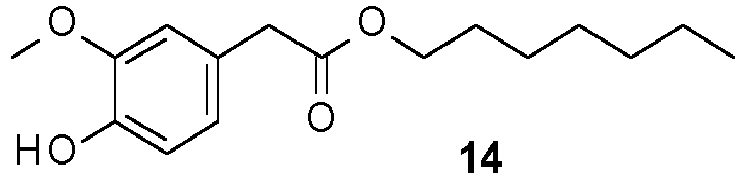
- 1H-NMR (400 MHz, CDCl3): δ = 6.85 (dd, J = 8.1, 1.1 Hz, 1H), 6.81 (t, J = 1.4 Hz, 1H), 6.76 (dt, J = 8.2, 1.4 Hz, 1H), 5.59 (d, J = 1.1 Hz, 1H), 4.08 (td, J = 6.8, 1.1 Hz, 2H), 3.88 (d, J = 1.2 Hz, 3H), 3.53 (s, 2H), 1.68-1.55 (m, 2H), 1.28 (td, J = 9.8, 9.3, 4.0 Hz, 8H), 0.94-0.82 (m, 3H).
13C-NMR (100 MHz, CDCl3): δ = 172.0, 146.5, 144.7, 126.0, 122.1, 114.3, 111.7, 65.0, 55.9, 41.1, 31.7, 28.9, 28.6, 25.8, 22.6, 14.1.
GCMS: mlz (%) = 280 [M+] (34), 182 (12), 137 (100), 122 (8), 94 (5), 57 (11), 41 (8). - Alternativ können Homovanillinsäureester auch durch Umesterung erhalten werden, wie an Substanz 2 beispielhaft gezeigt:
- Ethylhomovanillat (5 g) wurde mit Zimtalkohol (7.5 g) und Natriummethylat-Lösung 25% (0.52 g) auf 150-170 °C erhitzt, ab ca. 130 °C Vakuum angelegt und für 1-3 h MeOH/EtOH aus der Reaktionsmischung heraus destilliert. Es wurde mit MTBE verdünnt, die org. Phase je einmal mit ges. wäss. NH4Cl-Lösung und Wasser gewaschen und das Lösungsmittel im Vakuum entfernt. Überschüssiger Zimtalkohol wurde anschließend durch Destillation entfernt und das Produkt nach säulenchromatographischer Reinigung an Kieselgel oder nach fraktionierter Destillation in 40-50% Ausbeute erhalten.

- 1H NMR (400 MHz, CDCl3): δ = 7.38 - 7.35 (m, 2H), 7.35 - 7.29 (m, 2H), 7.29 - 7.23 (m, 1H), 6.87 (d, J = 8.0 Hz, 1H), 6.82 (d, J = 2.0 Hz, 1H), 6.79 (dd, J = 8.0, 2.0 Hz, 1H), 6.60 (dt, J = 15.9, 1.5 Hz, 1H), 6.27 (dt, J = 15.9, 6.4 Hz, 1H), 5.56 (s, 1H), 4.75 (dd, J = 6.4, 1.4 Hz, 2H), 3.86 (s, 3H), 3.59 (s, 2H).
13C NMR (100 MHz, CDCl3): δ = 171.64, 146.48, 144.80, 136.15, 134.17, 128.60, 128.08, 126.58, 125.69, 123.02, 122.19, 114.38, 111.71, 65.34, 55.89, 40.99.
GCMS: m/z (%) = 298 [M+] (12), 137 (100), 122 (8), 117 (68), 94 (8), 91 (12), 77 (4), 65 (4), 51 (4), 39 (6). - Die zu verkostende Substanz wurde in Ethanol gelöst und die ethanolische Lösung dann mit 5%iger Zuckerlosung verdünnt (Endkonzentration: 25 ppm). Zur Verkostung wurde von 4 Prüfern der Mundraum jeweils mit ca. 5 mL der Zuckerlösung gespült und die Lösung wieder ausgespuckt. Die Schärfe wurde auf einer Skala 1 (sehr schwach) - 9 (sehr stark) eingeschätzt und das Profil bewertet.
- a) Profil Hexyl-2-(4-hydroxy-3-methoxy-phenyl)acetat (21): Deutlich scharf, leicht verzögerter Effekt, wärmend, relativ schnelle Abnahme der Schärfe; Einschätzung der Schärfe 9.
- b) Profil Butyl-2-(4-hydroxy-3-methoxy-phenyl)acetat (19): Unmittelbare Schärfe, schnelle Abnahme; Einschätzung der Schärfe: 7.
- c) Profil Isobutyl-2-(4-hydroxy-3-methoxy-phenyl)acetat (9): Schnelles Einsetzen der Schärfe, wärmend, etwas beißende Schärfe; Einschätzung der Schärfe: 4-5.
- d) Profil Propyl-2-(4-hydroxy-3-methoxy-phenyl)acetat (18): Schwache und verzögerte Schärfe, sich aufbauend wärmend, Tingling; Einschätzung der Schärfe: 4-5.
- e) Profil Ethyl-2-(4-hydroxy-3-methoxy-phenyl)acetat (17): Etwas wärmend, etwas scharf; Einschätzung der Schärfe: 1-2.
- f) Profil Isopropyl-2-(4-hydroxy-3-methoxy-phenyl)acetat (7): Spätes Einsetzen, Tingling, wärmend, scharf, etwas verzögert, nicht langlebig, angenehm; Einschätzung der Schärfe: 3.
- g) Profil sec-Butyl-2-(4-hydroxy-3-methoxy-phenyl)acetat (8): sehr langsames Einsetzen, Tingling, hauptsächlich wärmend, Schärfe sich aufbauend, Einschätzung der Schärfe: 3.
- h) Profil Octyl-2-(4-hydroxy-3-methoxy-phenyl)acetat (nicht erfindungsgemäß): Schärfe setzt langsam ein, spät, verzögert, fettig-fruchtige Nebennote, brennend; Einschätzung der Schärfe: 7.
- i) Profil Decyl-2-(4-hydroxy-3-methoxy-phenyl)acetat (nicht erfindungsgemäß): Schwache Schärfe, verzögert, Birnen-artig und fettig-fruchtige Nebennote, brennend mehr im Hals als auf der Zunge; Einschätzung der Schärfe: 2.
- k) 3-Phenylpropyl-2-(4-hydroxy-3-methoxy-phenyl)acetat (22):2 ppm*: Verzögerter Effekt, scharf, wärmend, leicht prickelnd; Einschätzung der Schärfe: 5.
- l) 4-Phenylbutyl-2-(4-hydroxy-3-methoxy-phenyl)acetat (23):2,5 ppm*: Verzögerter Effekt, Schärfe, verzögert wärmend, brennend, leicht tingling; Einschätzung der Schärfe: 4-5.
- m) [(E)-Cinnamyl]-2-(4-hydroxy-3-methoxy-phenyl)acetat (2):1,5 ppm*: Verzögerter Effekt, sehr scharf, etwas wärmend, etwas mundwässernd; Einschätzung der Schärfe: 5-6.
- n) Heptyl-2-(4-hydroxy-3-methoxy-phenyl)acetat (14):1,5 ppm*: Leicht verzögerter Effekt, brennend, scharf, wärmend, Einschätzung der Schärfe: 3.
- *Aufgrund starker Schärfe wurden diese Verbindungen lediglich bei Endkonzentrationen von 1.5-2.5 ppm verkostet.
- Die zu verkostende Substanz wurde in Ethanol gelöst und die ethanolische Lösung dann mit 5%iger Zuckerlösung verdünnt (Endkonzentration: 10 ppm). Zum Vergleich wurden Capsicum-Extrakt mit 1.000.000 SHU (0.3-10 ppm) und Nonivamid (0.1-1 ppm) in 5%iger Zuckerlösung in aufsteigender Konzentration vorbereitet. Zur Verkostung wurde von 4 Prüfern der Mundraum jeweils mit ca. 5 mL der Verkostungslösung gespült und die Lösung wieder ausgespuckt und gegen die Referenzreihen bewertet.
- Die Schärfe von 10 ppm Hexyl-2-(4-hydroxy-3-methoxy-phenyl)acetat (21) ist vergleichbar mit der von 0.5 ppm Nonivamid.
- Die Schärfe von 10 ppm Butyl-2-(4-hydroxy-3-methoxy-phenyl)acetat (19) ist vergleichbar mit der von 0.3 ppm Nonivamid.
- Die Schärfe von 10 ppm Butyl-2-(4-hydroxy-3-methoxy-phenyl)acetat (19) ist vergleichbar mit der von 4.5 ppm Capsicum-Extrakt 1.000.000 SHU.
- Die Schärfe von 10 ppm Hexyl-2-(4-hydroxy-3-methoxy-phenyl)acetat (21) ist vergleichbar mit der von 8.5 ppm Capsicum-Extrakt 1.000.000 SHU.
- Die Schwellenwerte wurden nach der Methode ASTM E 679 - 91 ("Standard Practice for Determination of Odor and Taste Thresholds By a Forced-Choice Ascending Concentration Series Method of Limits1 ") bestimmt. Es handelt sich um die jeweilige Flavor Reizschwelle auf Vittel® Wasser.
- Zum Beispiel der Schwellenwert von Hexyl-2-(4-hydroxy-3-methoxy-phenyl)acetat (21) in Wasser liegt bei 1.7 ppm (1700 ppb).
- Zum Beispiel der Schwellenwert von Ethyl-2-(4-hydroxy-3-methoxy-phenyl)acetat (17) in Wasser liegt bei 29.5 ppm (29460 ppb).
- Zum Beispiel der Schwellenwert von Butyl-2-(4-hydroxy-3-methoxy-phenyl)acetat (19) in Wasser liegt bei 3.5 ppm (3540 ppb).
- Zur Erstellung eines Zeit-Intensitäts-Profils wurde der Mundraum von geschulten Panelisten (n = 8-10) mit einem Schluck einer Probenlösung (5 mL einer 5% Zuckerlösung) gespült. Dann wurde die Intensität der Eigenschaft Schärfe in definierten Zeitabständen anhand einer Skala ohne feste Einteilung bewertet. Die zwei Verkostungslösungen (Butyl-2-(4-hydroxy-3-methoxy-phenyl)acetat (19) mit 25 ppm und Nonivamid mit 0.5 ppm der entsprechenden Substanz wurden dabei codiert und in gemischter Reihung platziert. Zwischen den beiden Verkostungsproben mit Brot und Wasser wieder neutralisiert und mit 5 mL 5%ige Zuckerlösung vorgespült. Die Daten wurden analysiert und graphisch in einer Zeit-Intensitätskurve wiedergegeben (s.
Fig. 3 (Schärfeprofil Butyl-2-(4-hydroxy-3-methoxyphenyl)acetat (19) im Vergleich zu Nonivamid)). - Deutlich zu erkennen ist das schnellere Einsetzen der Schärfe von Butyl-2-(4-hydroxy-3-methoxyphenyl)acetat (19) gegenüber Nonivamid bei ähnlicher Gesamtintensität sowie die deutlich schnellere Abnahme der Schärfe.
- Es wurden verschiedene Kombinationen von Ethyl-2-(4-hydroxy-3-methoxy-phenyl)acetat (17) und Butyl-2-(4-hydroxy-3-methoxy-phenyl)acetat (19) mit Paradieskörnerextrakt (PN 300953, Symrise), Nonivamid und Capsicum-Extrakt 1.000.000 SHU sensorisch bewertet. Die Verkostungslösungen aus einem Homovanillinsäureester in ansteigender Konzentration (ppm) in Kombination mit einer trigeminalen Substanz bestimmter Konzentration auf Basis einer 5%igen Zuckerlösung (Tab. 3) wurden von 3 Prüfern bewertet. Hierfür wurde der Mundraum jeweils mit ca. 5 mL der jeweiligen Verkostungslösung gespült und die Lösung wieder ausgespuckt.

- Homovanillinsäureester haben einen verstärkenden Einfluss auf die eingesetzten Verbindungen. Für die Kombination von Paradieskörnerextrakt (PN 300953, Symrise) mit Ethyl-2-(4-hydroxy-3-methoxyphenyl)acetat (17, Beispiele 2 und 3) wurde ein schnelleres Einsetzen der Schärfe festgestellt. Bei der Kombination von Ethyl-2-(4-hydroxy-3-methoxy-phenyl)acetat (17) mit Nonivamid (Beispiele 7 und 8 sowie 12 und 13) wurde in beiden geprüften Konzentrationen die Schärfe von Nonivamid verstärkt, wobei diese Verstärkung mehr als dem additiven Effekt entsprach. Weiterhin wurde ein schnelleres Einsetzen der Schärfe festgestellt. Derselbe verstärkende und schneller einsetzende Effekt wurde auch in der Kombination von Ethyl-2-(4-hydroxy-3-methoxy-phenyl)acetat (17) mit 2 ppm Capsicum-Extrakt 1.000.000 SHU festgestellt (Beispiele 17 und 18), wobei die Schärfe als angenehm und nicht lang nachklingend beurteilt wurde. Ohne die Kombination mit einem Homovanillylester wurde der Eintritt der Schärfe von Capsicum-Extrakt 1.000.000 SHU erst verzögert wahrgenommen (Beispiele 16* und 21*). Die Verstärkung der Schärfe war bei 2 ppm Capsicum-Extrakt 1.000.000 SHU deutlicher als bei 5 ppm. Bei der Kombination von 5 ppm Capsicum-Extrakt 1.000.000 SHU mit verschiedenen Mengen Ethyl-2-(4-hydroxy-3-methoxy-phenyl)acetat (17, Beispiele 22 und 23) wurde ein schnelles Abklingen der Schärfe deutlich. Zusätzlich wurde die Schärfe von Capsicum-Extrakt 1.000.000 SHU in der Kombination mit Ethyl-2-(4-hydroxy-3-methoxy-phenyl)acetat (17) in allen Konzentrationen um einen angenehmen wärmenden Effekt erweitert, der nach Abklingen des Schärfeempfindens zurückblieb. Für Butyl-2-(4-hydroxy-3-methoxy-phenyl)acetat (19) wurden dieselben Effekte bereits bei geringeren Konzentrationen festgestellt (Beispiele 19 und 20 sowie 24 und 25), wobei die Verstärkungen ebenfalls deutlicher als einem additiven Effekt waren. Auch eine Kombination von Nonivamid, Capsicum-Extrakt 1.000.000 SHU und Ethyl-2-(4-hydroxy-3-methoxy-phenyl)acetat (17, Beispiel 27) oder Butyl-2-(4-hydroxy-3-methoxy-phenyl)acetat (19, Beispiel 29) zeigte zusätzlich zu den Kombinationen ohne Homovanillinsäureester (Beispiele 26* und 28*) ein schnelleres Abklingen der Schärfe sowie zusätzlich einen wärmenden Effekt.
- Auf der Basis einer 5%igen Zuckerlösung mit 20% Ethanol (Beispiel 1) wurden verschiedene Konzentrationen (10-100 ppm) von Ethyl-2-(4-hydroxy-3-methoxy-phenyl)acetat (17), Flavon polymethoxyliert PMF 60 (Miritz) sowie Kombinationen (10-50 ppm) von Ethyl-2-(4-hydroxy-3-methoxy-phenyl)acetat (17) mit Flavon polymethoxyliert PMF 60 (Miritz) (20 ppm) mit einer zweiten Basislösung (5%ige Zuckerlösung mit 40% Ethanol) verglichen (Tab. 4). Hierfür wurde von 5 Prüfern der Mundraum jeweils mit ca. 5 mL der jeweiligen Verkostungslösung gespült, die Lösung wieder ausgespuckt und der Geschmackseindruck bewertet.
Tab. 4: Kombinationen von Ethyl-2-(4-hydroxy-3-methoxy-phenyl)acetat (17) und Flavon polymethoxyliert PMF 60 (Miritz) in einer 5%igen Zuckerlösung mit 20% Ethanol (Angaben in ppm). Inhaltsstoff 1* 2 3 4 5 6* 7 8 9 Ethyl-2-(4-hydroxy-3-methoxy-phenyl)acetat (17) - 10 20 50 100 - 10 20 50 Flavon polymethoxyliert PMF 60 - - - - - 20 20 20 20 *nicht erfindungsgemäß - Die Basislösung (5%ige Zuckerlösung mit 20% Ethanol, Beispiel 1) wurde als alkoholisch, brennend beschrieben. Die Zugabe von Ethyl-2-(4-hydroxy-3-methoxy-phenyl)acetat (17, Beispiel 2) führte zu einer Verstärkung und einer Verlängerung des brennenden Mundgefühls. Weitere Erhöhung auf 20 ppm und 50 ppm (Beispiele 2-5) ergab zusätzlich einen Schärfeeffekt. Flavon polymethoxyliert PMF 60 alleine (Beispiel 6) ergab in der Verkostungslösung eine Verstärkung des alkoholischen Geschmacks, aber kein brennendes Mundgefühl im Vergleich zu Beispiel 1. Durch die Kombination mit Ethyl-2-(4-hydroxy-3-methoxy-phenyl)acetat (17, Beispiele 7-9) wurde dieser Geschmack verstärkt, zusätzlich eine Verstärkung des brennenden Gefühls erzeugt und auch eine Verlängerung dieser Effekte erreicht, wobei der Einsatz von 20-50 ppm Ethyl-2-(4-hydroxy-3-methoxy-phenyl)acetat (17) sensorisch bevorzugt wurde. Im Vergleich zur zweiten Basislösung (5%igen Zuckerlösung mit 40% Ethanol) mit einem höheren Alkoholgehalt und starkem nasalen Effekt zeigte diese Kombination keine nasale Einwirkung.
- Es wurden Testlösungen mit 4-10 ppm Homovanillinsäureester in einer 5%igen Zuckerlösung sensorisch bewertet und mit einer Testlösung von 10 ppm Vanillylbutylether verglichen. Ethyl-2-(4-hydroxy-3-methoxy-phenyl)acetat (17) hatte einen milderen Wärmeeffekt im Vergleich zu Vanillylbutylether. Butyl-2-(4-hydroxy-3-methoxy-phenyl)acetat (19) hatte einen deutlicheren Wärmeeffekt als Vanillylbutylether. Isobutyl-2-(4-hydroxy-3-methoxy-phenyl)acetat (9) zeigte einen Wärmeeffekt ähnlich zu Vanillylbutylether, der aber länger anhielt. Propyl-2-(4-hydroxy-3-methoxyphenyl)acetat (18) zeigte ebenfalls einen langanhaltenden Wärmeeffekt, der aber vergleichsweise später eintrat.
- Es wurden vermischt (alle Angaben, soweit nicht anders vermerkt, in Gew-%):
Inhaltsstoff A B C D E F G H 10 Gew.-% Pellitorin in 1,2-Propylenglycol/Diethylmalonat 0.25 0.25 0.25 0.25 0.25 0.25 0.25 0.25 Hesperetin 2.50 2.50 2.50 2.50 2.50 2.50 2.50 2.50 Phloretin 1.50 1.50 1.50 1.50 1.50 1.50 1.50 1.50 Ethyl-2-(4-hydroxy-3-methoxy-phenyl)acetat (17) 3.00 - 1.50 1.00 - - - - Butyl-2-(4-hydroxy-3-methoxy-phenyl)acetat (19) - 0.50 0.25 - - - - - Propyl-2-(4-hydroxy-3-methoxy-phenyl)acetat (18) - - - 1.50 - - 1.00 - 3-Phenylpropyl 2-(4-hydroxy-3-methoxy-phenyl)acetat (22) - - - - 0.05 - - - 4-Phenylbutyl 2-(4-hydroxy-3-methoxy-phenyl)acetat (23) - - - - - 0.07 - - Heptyl-2-(4-hydroxy-3-methoxy-phenyl)acetat (14) - - - - - - 0.10 - [(E)-Cinnamyl] 2-(4-hydroxy-3-methoxy-phenyl)acetat (2) - - - - - - - 0.06 Propylenglycol ad 100 ad 100 ad 100 ad 100 ad 100 ad 100 ad 100 ad 100 - Die Inhaltsstoffe (Stoffe bzw. Lösungen) werden in den oben angegebenen Mengenverhältnissen gemischt und dann mit Propylenglycol aufgenommen und durch leichtes Erwärmen vollständig gelöst.
- Es wurden vermischt (alle Angaben, soweit nicht anders vermerkt, in Gew-%):
Inhaltsstoff A B C D E F G H Ethyl-2-(4-hydroxy-3-methoxy-phenyl)acetat (17) 10.00 - - - - - - - Butyl-2-(4-hydroxy-3-methoxy-phenyl)acetat (19) - 3.50 - - - - - - Propyl-2-(4-hydroxy-3-methoxy-phenyl)acetat (18) - - 5.00 - - - - - Hexyl-2-(4-hydroxy-3-methoxy-phenyl)acetat (21) - - - 2.50 - - - - 3-Phenylpropyl 2-(4-hydroxy-3-methoxy-phenyl)acetat (22) - - - - 0.20 - - - 4-Phenylbutyl 2-(4-hydroxy-3-methoxy-phenyl)acetat (23) - - - - - 0.22 - - Heptyl-2-(4-hydroxy-3-m ethoxy-phenyl)acetat (14) - - - - - - 0.25 - [(E)-Cinnamyl] 2-(4-hydroxy-3-methoxy-phenyl)acetat (2) - - - - - - - 0.21 Maltodextrin ad 100 ad 100 ad 100 ad 100 ad 100 ad 100 ad 100 ad 100 - Die beiden Bestandteile werden in einer Mischung aus Ethanol und demineralisiertem Wasser gelöst und anschließend sprühgetrocknet.
- Es wurden vermischt (alle Angaben, soweit nicht anders vermerkt, in Gew-%):
Inhaltsstoff A B C D E F G H I Anethol 30 30 30 30 30 30 30 30 30 Eucalyptol 25 25 25 25 25 25 25 25 25 L-Menthol 36.00 36.00 38.00 36.20 36.00 36.90 39.85 34.90 39.90 Optacool A - 8 - 8 - 8 - 8 - Coolact 10 5 - 5 - 5 - 5 - 5 Ethyl-2-(4-hydroxy-3-methoxy-phenyl)acetat (17) 4.00 - - - 3.00 - - 2.00 - Butyl-2-(4-hydroxy-3-methoxy-phenyl)acetat (19) - 1.00 - - - - - - - Propyl-2-(4-hydroxy-3-methoxy-phenyl)acetat (18) - - 2.00 - 1.00 - - - - Hexyl-2-(4-hydroxy-3-methoxy-phenyl)acetat (21) - - - 0.80 - - - - - 3-Phenylpropyl 2-(4-hydroxy-3-methoxy-phenyl)acetat (22) - - - - - 0.10 - - - 4-Phenylbutyl 2-(4-hydroxy-3-methoxy-phenyl)acetat (23) - - - - - - 0.15 - - Heptyl-2-(4-hydroxy-3-methoxy-phenyl)acetat (14) - - - - - - - 0.10 - [(E)-Cinnamyl] 2-(4-hydroxy-3-methoxy-phenyl)acetat (2) - - - - - - - - 0.10 Total 100 100 100 100 100 100 100 100 100 - Es wurden vermischt (alle Angaben, soweit nicht anders vermerkt, in Gew-%):
Inhaltsstoff A B C D E F G H I K Pfefferminzöl Mentha arvensis 56 59.00 58.50 58.80 56 59 60 60 59.5 60 L-Menthon 20 20 20 20 20 20 20 20 20 20 L-Menthol 20 20 20 20 20 20 20 20 20 20 Ethyl-2-(4-hydroxy-3-methoxy-phenyl)acetat (17) 4.00 - - - 3.00 - - - - - Butyl-2-(4-hydroxy-3-methoxy-phenyl)acetat (19) - 1.00 - - - 0.50 - - 0.50 - Propyl-2-(4-hydroxy-3-methoxy-phenyl)acetat (18) - - 1.50 - 1.00 0.50 - - - - Pentyl-2-(4-hydroxy-3-methoxy-phenyl)acetat (20) - - - 1.20 - - - - - - 3-Phenylpropyl 2-(4-hydroxy-3-methoxy-phenyl)acetat (22) - - - - - - 0.20 - - - 4-Phenylbutyl 2-(4-hydroxy-3-methoxy-phenyl)acetat (23) - - - - - - - 0.22 - - Heptyl-2-(4-hydroxy-3-methoxy-phenyl)acetat (14) - - - - - - - - 0.25 - [(E)-Cinnamyl] 2-(4-hydroxy-3-methoxy-phenyl)acetat (2) - - - - - - - - - 0.21 Total 100 100 100 100 100 100 100 100 100 100 - Die Aromakompositionen wurden in nachfolgend beschriebenen Anwendungsbeispielen eingesetzt.
- Herstellung eines Biermix-Getränkes mit reduziertem Alkoholgehalt oder ohne Alkohol. Alle Angaben sind in Gew-%.
Bestandteil A* B C D E F G H I Zuckersirup 4 4 4 4 4 4 4 4 4 Bier (4.9% vol.) 50 - - - - - - - - Bier (alkohol- und kalorienreduziert, 2.8% vol.) - - 50 - 50 - 50 - 50 Bier (alkoholfrei, 0%) - 50 - 50 - 50 - 50 - Zitronensäure 0.15 0.15 0.15 0.15 0.15 0.15 0.15 0.15 0.15 Ascorbinsäure 0.01 0.01 0.01 0.01 0.01 0.01 0.01 0.01 0.01 Grapefruitsaft 6 6 6 6 6 6 6 6 6 Grapefruitaroma 0.20 0.20 0.20 0.20 0.20 0.20 0.20 0.20 0.20 Aromakomposition (Anwendungsbeispiel 1A) - 0.20 0.20 - - - - - - Aromakomposition (Anwendungsbeispiel 1B) - - - 0.20 0.20 - - - - Aromakomposition (Anwendungsbeispiel 1E) - - - - - 0.20 0.20 - - Aromakomposition (Anwendungsbeispiel 1H) - - - - - - - 0.20 0.20 Wasser ad 100 ad 100 ad 100 ad 100 ad 100 ad 100 ad 100 ad 100 ad 100 Kohlensäure 0.70 0.70 0.70 0.70 0.70 0.70 0.70 0.70 0.70 *nicht erfindungsgemäß - Alle Angaben, soweit nicht anders vermerkt, in Gew-%.
Bestandteil A B C D E F G H I K Entionisiertes Wasser 26.53 26.53 26.53 26.53 26.53 26.53 26.53 26.53 26.53 26.53 Sorbitol 70% 45 44.975 45 44.975 45 44.975 45 44.975 45 44.975 Solbrol M Na-Salz 0.15 0.15 0.15 0.15 0.15 0.15 0.15 0.15 0.15 0.15 Trinatriumphosphat 0.10 0.10 0.10 0.10 0.10 0.10 0.10 0.10 0.10 0.10 Saccharin 0.20 0.20 0.20 0.20 0.20 0.20 0.20 0.20 0.20 0.20 Natriummonofluorphosphat 1.12 1.12 1.12 1.12 1.12 1.12 1.12 1.12 1.12 1.12 PEG 1500 5 5 5 5 5 5 5 5 5 5 Sident 9 (Abrasive Silica) 10 10 10 10 10 10 10 10 10 10 Sident 22 S (Dickende Silica) 8 8 8 8 8 8 8 8 8 8 Natriumcarboxymethylcellul ose 0.90 0.90 0.90 0.90 0.90 0.90 0.90 0.90 0.90 0.90 Titan (IV) oxid 0.50 0.50 0.50 0.50 0.50 0.50 0.50 0.50 0.50 0.50 Natriumlaurylsulfat (SLS) 1.50 1.50 1.50 1.50 1.50 1.50 1.50 1.50 1.50 1.50 Pellitorin-Lösung PLM (enthaltend 10% Pellitorin) - 0.025 - 0.025 - 0.025 - 0.025 - 0.025 Aroma Typ Pfefferminze (Anwendungsbeispiel 4A) 1.00 1.00 - - - - - - - - Aroma Typ Pfefferminze (Anwendungsbeispiel 4B) - - 1.00 1.00 - - - - - - Aroma Typ Pfefferminze (Anwendungsbeispiel 4C) - - - - 1.00 1.00 - - - - Aroma Typ Pfefferminze (Anwendungsbeispiel 4G) - - - - - - 1.00 1.00 - - Aroma Typ Pfefferminze (Anwendungsbeispiel 4K) - - - - - - - - 1.00 1.00 Total 100 100 100 100 100 100 100 100 100 100 - Alle Angaben, soweit nicht anders vermerkt, in Gew-%.
Bestandteil A B C D E F G H I K Entionisiertes Wasser 27.5 27.48 27.5 27.48 27.5 27.48 27.5 27.48 27.5 27.48 Saccharin 0.20 0.20 0.20 0.20 0.20 0.20 0.20 0.20 0.20 0.20 Solbrol M Natriumsalz 0.20 0.20 0.20 0.20 0.20 0.20 0.20 0.20 0.20 0.20 Natriummonofluorphosphat 0.80 0.80 0.80 0.80 0.80 0.80 0.80 0.80 0.80 0.80 Sorbitol 70% 29 29 29 29 29 29 29 29 29 29 Calciumcarbonat 35 35 35 35 35 35 35 35 35 35 Sident 22 S (Verdickende Silica) 2.50 2.50 2.50 2.50 2.50 2.50 2.50 2.50 2.50 2.50 Natriumcarboxymethylcell ulose 1.30 1.30 1.30 1.30 1.30 1.30 1.30 1.30 1.30 1.30 Titandioxid 0.50 0.50 0.50 0.50 0.50 0.50 0.50 0.50 0.50 0.50 Natriumlaurylsulfat 2 2 2 2 2 2 2 2 2 2 Pellitorin-Lösung PLM (enthaltend 10% Pellitorin) - 0.02 - 0.02 - 0.02 - 0.02 - 0.02 Aroma Typ Pfefferminze (Anwendungsbeispiel 4D) 1.00 1.00 - - - - - - - - Aroma Typ Pfefferminze (Anwendungsbeispiel 4E) - - 1.00 1.00 - - - - - - Aroma Typ Pfefferminze (Anwendungsbeispiel 4F) - - - - 1.00 1.00 - - - - Aroma Typ Pfefferminze (Anwendungsbeispiel 4H) - - - - - - 1.00 1.00 - - Aroma Typ Pfefferminze (Anwendungsbeispiel 4I) - - - - - - - - 1.00 1.00 Total 100 100 100 100 100 100 100 100 100 100 - Durch die Verwendung der erfindungsgemäßen Substanzen wird ein schnell einsetzendes angenehmes Schärfeprofil mit wärmenden Aspekten erreicht. Zusätzlich wird ein verstärkter mundwässernder Effekt erzielt.
-
Teil Inhaltsstoff Gew.-% A Kaugummibase, Company "Jagum T" 30.00 B Sorbit, pulverisiert 39.00 Isomalt® (Palatinit GmbH) 9.50 Xylit 2.00 Mannit 3.00 Aspartam® 0.10 Acesulfam® K 0.10 Emulgum® (Colloides Naturels, Inc.) 0.30 C Sorbitol, 70 % 14.00 Glycerin 1.00 D Aromakompositionen gemäß Anwendungsbeispiel 4 1.00 - Die Teile A bis D werden gemischt und intensiv geknetet. Die erhaltene Rohmasse kann dann z.B. in Form von dünnen Streifen zu verzehrfertigen Kaugummis verarbeitet werden.
- Alle Angaben, soweit nicht anders vermerkt in Gew-%.
Bestandteil A B C D E F G H I K Cremophor RH 455 1.80 1.80 1.80 1.80 1.80 1.80 1.80 1.80 1.80 1.80 Entionisiertes Wasser 87.57 87.5575 87.57 87.5575 87.57 87.5575 87.57 87.5575 87.57 87.5575 Sorbitol 70% 10 10 10 10 10 10 10 10 10 10 Natriumfluorid 0.18 0.18 0.18 0.18 0.18 0.18 0.18 0.18 0.18 0.18 Natriumsaccharin 450 0.10 0.10 0.10 0.10 0.10 0.10 0.10 0.10 0.10 0.10 Solbrol M Natriumsalz 0.15 0.15 0.15 0.15 0.15 0.15 0.15 0.15 0.15 0.15 Pellitorin-Lösung PLM (enthaltend 10% Pellitorin) - 0.0125 - 0.0125 - 0.0125 0.0125 0.0125 Mundwasser Aroma (Anwendungsbeispiel 3A) 0.20 0.20 - - - - - - - - Mundwasser Aroma (Anwendungsbeispiel 3B) - - 0.20 0.20 - - - - - - Mundwasser Aroma (Anwendungsbeispiel 3C) - - - - 0.20 0.20 - - - - Mundwasser Aroma (Anwendungsbeispiel 3F) - - - - - - 0.20 0.20 - - Mundwasser Aroma (Anwendungsbeispiel 3I) - - - - - - - - 0.20 0.20 Total 100 100 100 100 100 100 100 100 100 100 - Alle Angaben sind in Gew-%.
Bestandteil A B C D E F G Ethanol, 96%ig 5 5 5 5 5 5 5 Sorbitol, 70 %ig in Wasser 40 40 40 40 40 40 40 Glycerin 20 20 20 20 20 20 20 Saccharin 0.20 0.20 0.20 0.20 0.20 0.20 0.20 Na-Monofluorphosphat 0.76 0.76 0.76 0.76 0.76 0.76 0.76 Solbrol M, Na-Salz 0.15 0.15 0.15 0.15 0.15 0.15 0.15 Abrasivkieselsäure (Sident 9) 20 20 20 20 20 20 20 Verdickungskieselsäure (Sident 22S) 2 2 2 2 2 2 2 Na-Carboxymethylcellu lose 0.30 0.30 0.30 0.30 0.30 0.30 0.30 Natriumlaurylsulfat 1.20 1.20 1.20 1.20 1.20 1.20 1.20 Grüner Farbstoff (1%ig in Wasser) 0.50 0.50 0.50 0.50 0.50 0.50 0.50 Wasser dest. 9.39 9.39 9.39 9.39 8.89 8.89 8.89 Aromakomposition (Anwendungsbeispiel 3A) 0.50 - - - - - - Aromakomposition (Anwendungsbeispiel 3B) - 0.50 - - - - - Aromakomposition (Anwendungsbeispiel 3C) - - 0.50 - - - - Aromakomposition (Anwendungsbeispiel 3D) - - - 0.50 - - - Aromakomposition (Anwendungsbeispiel 3F) - - - - 1.00 - - Aromakomposition (Anwendungsbeispiel 3H) - - - - - 1.00 - Aromakomposition (Anwendungsbeispiel 3I) - - - - - - 1.00 Total 100 100 100 100 100 100 100 -
Vergleichsprobe Likörbase 10%vol 7.39 kg Alkohol, p.A.-Ware 20 kg Invertzuckersirup, 66.5 % Trockenmasse 72.61 kg Wasser Summe 100 kg Likorbase 5,5%vol 4.06 kg Alkohol, p.A.-Ware 20 kg Invertzuckersirup, 66.5 % Trockenmasse 75.94 kg Wasser Summe 100 kg - Version A: Likörbase 5.5 %vol + 0.3 % einer 10 %igen Lösung eines Paradieskörnerextrakts in Ethanol
- Version B: Likörbase 5.5 %vol + 0.075% einer 10 %igen Lösung eines Paradieskörnerextrakts in Ethanol + 0.2% einer Lösung von Ethyl-2-(4-hydroxy-3-methoxy-phenyl)acetat (17) 1%ig in Ethanol (entspricht 20 ppm).
- Version C: Likörbase 5.5 %vol + 0.075% einer 10 %igen Lösung eines Paradieskörnerextrakts in Ethanol + 0.01% einer Lösung von 3-Phenylpropyl 2-(4-hydroxy-3-methoxy-phenyl)acetat (22) 1%ig in Ethanol (entspricht 1 ppm).
- Bei Versionen B und C wird sensorisch die Alkoholschärfe der Vergleichsprobe besser imitiert als in Version A. Version A und die Vergleichsprobe sind sensorisch sehr ähnlich zu bewerten.
-
Gew.-% Inhaltsstoff (INCI) A 2.00 Ceteareth-6, Stearylalkohol 2.00 Ceteareth-25 5.00 Cetearylethylhexanoat 4.00 Cetylalkohol 4.00 Glycerylstearat 5.00 Mineralöl 0.20 Menthol 0.50 Kampfer B 69.30 Aqua dem. q.s. Konservierungsmittel C 1.00 Bisabolol 1.00 Tocopherylacetat D 1.00 wässrige Lösung mit 1-1.5 % Pentyl-2-(4-hydroxy-3-methoxy-phenyl)acetat (20) 5.00 Zaubernussextrakt 100 Total - Herstellung: Die Komponenten der Phasen A und B getrennt voneinander auf ca. 80 °C erwärmen. Phase B in Phase A unter Homogenisieren einrühren. Unter Rühren abkühlen auf ca. 40 °C, die Phasen C und D hinzugeben und kurz nachhomogenisieren. Unter Rühren auf Raumtemperatur abkühlen.
-
Inhaltsstoff Gehalt [Gew.-%] Palatinit, Typ M 75.47 Wasser 24.03 Pfefferminzaroma 0.10 Aromazubereitung (Beispiel 1) 0.40 Total 100 - Zunächst wurde Palatinit mit Wasser gemischt. Die Mischung wurde dann bei 165 °C aufgeschmolzen und anschließend auf 115°C abgekühlt. Dann wurden das Pfefferminzaroma und die Aromazubereitung (Beispiel 1) zugegeben. Nach dem Durchmischen wurden die Mischungen in Formen gegossen, nach dem Erstarren aus den Formen entfernt und anschließend einzeln verpackt.
-
- A = Vergleichszubereitung
- B, C, D, E = erfindungsgemäße Zubereitungen
- Alle Angaben sind in Gew-%.
Bestandteil A* B C D E F G Milchprotein 0.80 0.80 0.80 0.80 0.80 0.80 0.80 Johannisbrotkernmehl 2.00 2.00 2.00 2.00 2.00 2.00 2.00 Maisstärke 24.00 23.00 23.00 23.00 23.00 23.00 23.00 Kochsalz 14.00 14.00 14.00 14.00 14.00 14.00 14.00 Paprikapulver 12.00 12.00 12.00 12.00 12.00 12.00 12.00 Tomatenpulver 12.00 12.00 12.00 12.00 12.00 12.00 12.00 Saccharose 4.00 4.00 4.00 4.00 4.00 4.00 4.00 Knoblauchpulver 0.50 0.50 0.50 0.50 0.50 0.50 0.50 Gehärtetes Pflanzenfett 8.00 8.00 8.00 8.00 8.00 8.00 8.00 Fettpulver 11.00 11.00 11.00 11.00 11.00 11.00 11.00 Natriumglutamat 6.00 6.00 6.00 6.00 6.00 6.00 6.00 Lebensmittelfarbstoff Rote Bete und Paprika 2.00 2.00 2.00 2.00 2.00 2.00 2.00 Aroma Typ "Pfeffer" 2.00 2.00 2.00 2.00 2.00 2.00 2.00 Aroma Typ "Pizza" 1.20 1.20 1.20 1.20 1.20 1.20 1.20 Aroma Typ "Tomate" 0.40 0.40 0.40 0.40 0.40 0.40 0.40 Extrakt aus schwarzem Pfeffer 0.10 0.10 0.10 0.10 0.10 0.10 0.10 Aromakomposition (Anwendungsbeispiel 1A) - 1.00 - - - - - Aromakomposition (Anwendungsbeispiel 1B) - - 1.00 - - - - Aromakomposition (Anwendungsbeispiel 1C) - - - 1.00 - - - Aromakomposition (Anwendungsbeispiel 1D) - - - - 1.00 - - Aromakomposition (Anwendungsbeispiel 1E) - - - - - 1.00 - Aromakomposition (Anwendungsbeispiel 1G) - - - - - - 1.00 Total 100 100 100 100 100 100 100 *nicht erfindungsgemäß -
- A = Vergleichszubereitung
- B, C, D, E = erfindungsgemäße Zubereitungen
- Alle Angaben sind in Gew-%.
Bestandteil A* B C D E F G Natriumglutamat 3.50 3.50 3.50 3.50 3.50 3.50 3.50 Käsepulver 10.00 10.00 10.00 10.00 10.00 10.00 10.00 Knoblauchpulver 2.00 2.00 2.00 2.00 2.00 2.00 2.00 Molkenpulver 38.86 36.86 36.86 36.86 36.86 36.86 36.86 Würzextraktöl 0.20 0.20 0.20 0.20 0.20 0.20 0.20 Paprikapulver 9.80 9.80 9.80 9.80 9.80 9.80 9.80 Kochsalz 21.00 21.00 21.00 21.00 21.00 21.00 21.00 Tomatenpulver 9.00 9.00 9.00 9.00 9.00 9.00 9.00 Trockenaroma 2.50 2.50 2.50 2.50 2.50 2.50 2.50 Siliciumdioxid 0.02 0.02 0.02 0.02 0.02 0.02 0.02 Pflanzenöl 0.02 0.02 0.02 0.02 0.02 0.02 0.02 Zwiebelpulver 3.00 3.00 3.00 3.00 3.00 3.00 3.00 Sahne Aromakonzentrat 0.03 0.03 0.03 0.03 0.03 0.03 0.03 Käse Aroma 0.03 0.03 0.03 0.03 0.03 0.03 0.03 Tomaten Aromakonzentrat 0.04 0.04 0.04 0.04 0.04 0.04 0.04 Sprühgetrocknete Zusammensetzung gemäß Anwendungsbeispiel 2A - 2.00 - - - Sprühgetrocknete Zusammensetzung gemäß Anwendungsbeispiel 2B - - 2.00 - - Sprühgetrocknete Zusammensetzung gemäß Anwendungsbeispiel 2C - - - 2.00 - Sprühgetrocknete Zusammensetzung gemäß Anwendungsbeispiel 2D - - - - 2.00 Sprühgetrocknete Zusammensetzung gemäß Anwendungsbeispiel 2E 2.00 Sprühgetrocknete Zusammensetzung gemäß Anwendungsbeispiel 2H 2.00 Total 100 100 100 100 100 100 100 nicht erfindungsgemäß - 6 g der Würzmischung wurden auf 94 g Kartoffelchips aufgezogen.
-
Inhaltsstoff Einsatz in Gew.-% A B Grünteekonzentrat 18.00 18.00 1% ige Lösung Ethyl-2-(4-hydroxy-3-methoxyphenyl)acetat (17) 0.40 - 1% ige Lösung 3-Phenylpropyl 2-(4-hydroxy-3-methoxy-phenyl)acetat (22) - 0.015 demineralisiertes Wasser 81.60 81.985 Total 100 100 - Das Grünteekonzentrat wird im Fall von Getränk A mit der 1 %igen Lösung Ethyl-2-(4-hydroxy-3-methoxy-phenyl)acetat (17) in Propylenglycol und im Fall von Getränk B mit der 1 %igen Lösung 3-Phenylpropyl 2-(4-hydroxy-3-methoxy-phenyl)acetat (22) in Propylenglycol vermischt. Anschließend wird mit demineralisiertem Wasser aufgefüllt und erneut gründlich durchmischt. Dann wird das Produkt filtriert, verbrauchsfertig verpackt und bei 118°C sterilisiert. Der Geschmack der Getränke A und B wird durch ein Panel ausgebildeter Testpersonen als deutlich bevorzugt gegenüber dem nicht aromatisierten Grünteekonzentrat bewertet. Die Bitterkeit und Adstringenz wird durch die Zugabe der erfindungsgemäßen Verbindungen reduziert.
- Die Homovanillinsäureester wurden jeweils 10 % oder 1% in Ethanol vorgelöst. Schwarztee-Extrakt wurde in Wasser gelöst und zusammen mit Zucker, einer Aromazubereitung (Pfirsichgeschmack), sowie den ethanolischen Lösungen der Homovanillinsäurelester in einem Becherglas verrührt.
Inhaltsstoff Einsatz in Gew.-% A B C D Schwarztee-Extrakt 1.40 1.40 1.40 1.40 Wasser 89.5 89.51 89.51 89.515 Aromazubereitung (Typ Pfirsich) 0.67 0.67 0.67 0.67 Zucker 7 7 7 7 Citronensäure (kristallin) 1.20 1.20 1.20 1.20 Ascorbinsäure 0.20 0.20 0.20 0.20 10 % in Ethanol 0.03 - - - Ethyl-2-(4-hydroxy-3-methoxy-phenyl)acetat (17) 10 % in Ethanol - 0.02 - - Propyl-2-(4-hydroxy-3-methoxy-phenyl)acetat (18) 1% in Ethanol - - 0.02 - 3-Phenylpropyl 2-(4-hydroxy-3-methoxy-phenyl)acetat (22) 1% in Ethanol - - - 0.015 [(E)-Cinnamyl] 2-(4-hydroxy-3-methoxy-phenyl)acetat (2) Total 100 100 100 100 -
- A = Vergleichszubereitung
- B, C, D = erfindungsgemäße Zubereitungen
- Alle Angaben sind in Gew-%.
Bestandteil A* B C D E F Fettpulver 8.77 8.77 8.77 8.77 8.77 8.77 Natriumglutamat 8.77 8.77 8.77 8.77 8.77 8.77 Hefeextrakt Pulver 12.28 12.28 12.28 12.28 12.28 12.28 Kochsalz 29.83 29.83 29.83 29.83 29.83 29.83 Maltodextrin 37.28 36.68 36.98 36.88 37.265 37.27 Natürlicher Gemüseextrakt 3.07 3.07 3.07 3.07 3.07 3.07 Ethyl-2-(4-hydroxy-3-methoxy-phenyl)acetat (17) - 0.60 - - - - Butyl-2-(4-hydroxy-3-methoxy-phenyl)acetat (19) - - 0.30 - - Isobutyl-2-(4-hydroxy-3-methoxy-phenyl)acetat (9) - - - 0.40 - - 3-Phenylpropyl 2-(4-hydroxy-3-methoxyphenyl)acetat (22) - - - - 0.015 - [(E)-Cinnamyl] 2-(4-hydroxy-3-methoxyphenyl)acetat (2) - - - - - 0.01 Total 100 100 100 100 100 100 *nicht erfindungsgemäß - 15 g der jeweiligen Pulvermischung wurden mit je 1000 mL heißem Wasser aufgegossen.
-
- A = Vergleichszubereitung
- B, C, D, E = erfindungsgemäße Zubereitungen
- Alle Angaben sind in Gew-%.
Bestandteil A* B C D E F G Kartoffelstärke 20.00 20.00 20.00 20.00 20.00 20.00 20.00 Fettpulver 25.00 25.00 25.00 25.00 25.00 25.00 25.00 Lactose 20.00 20.00 20.00 20.00 20.00 20.00 20.00 Maltodextrin 11.73 11.65 11.68 11.67 11.66 11.727 11.725 Kochsalz 8.00 8.00 8.00 8.00 8.00 8.00 8.00 Natriumglutamat 3.00 3.00 3.00 3.00 3.00 3.00 3.00 Spinatpulver 2.00 2.00 2.00 2.00 2.00 2.00 2.00 Grünes Lauchpulver 2.00 2.00 2.00 2.00 2.00 2.00 2.00 Citronensäure, als Pulver 0.30 0.30 0.30 0.30 0.30 0.30 0.30 Gehärtetes Pflanzenfett 3.00 3.00 3.00 3.00 3.00 3.00 3.00 Gefriergetrockneter Lauch 1.00 1.00 1.00 1.00 1.00 1.00 1.00 Huhnaroma 1.00 1.00 1.00 1.00 1.00 1.00 1.00 Würzmischung Typ "grüner Lauch", Pulver 2.00 2.00 2.00 2.00 2.00 2.00 2.00 Würzmischung, Typ "gekochte Zwiebel" 0.60 0.60 0.60 0.60 0.60 0.60 0.60 Hefe-Würzmischung, Typ "Gemüsebrühe", Pulver 0.30 0.30 0.30 0.30 0.30 0.30 0.30 Curcuma-Extrakt 0.07 0.07 0.07 0.07 0.07 0.07 0.07 Ethyl-2-(4-hydroxy-3-methoxyphenyl)acetat (17) - 0.08 - - 0.06 Propyl-2-(4-hydroxy-3-methoxyphenyl)acetat (18) - - 0.05 Isobutyl-2-(4-hydroxy-3-methoxyphenyl)acetat (8) - - - 0.06 0.01 3-Phenylpropyl 2-(4-hydroxy-3-methoxyphenyl)acetat (22) 0.003 [(E)-Cinnamyl] 2-(4-hydroxy-3-methoxyphenyl)acetat (2) 0.005 Total 100 100 100 100 100 100 100 - 5 g der jeweiligen Pulvermischung wurden mit je 100 mL heißem Wasser aufgegossen, um eine verzehrfertige Suppe zu erhalten.
-
- A = Vergleichszubereitung
- B, C, D, E = erfindungsgemäße Zubereitungen
- Alle Angaben sind in Gew-%.
Bestandteil A* B C D E F G Stärke 16.16 16.06 16.12 16.13 16.11 16.155 16.157 Kochsalz 7.00 7.00 7.00 7.00 7.00 7.00 7.00 Saccharose, raffiniert 3.20 3.20 3.20 3.20 3.20 3.20 3.20 Natriumglutamat 3.20 3.20 3.20 3.20 3.20 3.20 3.20 Natriuminosinat / Natriumguanylat im Verhältnis 1:1 0.80 0.80 0.80 0.80 0.80 0.80 0.80 Säurehydrolysiertes Pflanzenprotein 8.00 8.00 8.00 8.00 8.00 8.00 8.00 Fettpulver 2.00 2.00 2.00 2.00 2.00 2.00 2.00 Gemüsefett, sprühgetrocknet 1.00 1.00 1.00 1.00 1.00 1.00 1.00 Gefrierg etrocknetes Hühnerfleisch, in Stückchen 2.00 2.00 2.00 2.00 2.00 2.00 2.00 Suppen-Nudeln 32.00 32.00 32.00 32.00 32.00 32.00 32.00 Maltodextrin 12.00 12.00 12.00 12.00 12.00 12.00 12.00 Chinesisches Gemüse, gefriergetrocknet 4.60 4.60 4.60 4.60 4.60 4.60 4.60 Huhnaroma 8.00 8.00 8.00 8.00 8.00 8.00 8.00 Lebensmittelfarbstoff Riboflavin 0.04 0.04 0.04 0.04 0.04 0.04 0.04 Ethyl-2-(4-hydroxy-3-methoxy-phenyl)acetat (17) - 0.10 - - 0.04 - - Butyl-2-(4-hydroxy-3-methoxy-phenyl)acetat (19) - - 0.04 - 0.01 - - Hexyl-2-(4-hydroxy-3-methoxy-phenyl)acetat (21) - - - 0.031 - - - 3-Phenylpropyl 2-(4-hydroxy-3-methoxy-phenyl)acetat (22) - - - - - 0.005 - [(E)-Cinnamyl] 2-(4-hydroxy-3-methoxy-phenyl)acetat (2) - - - - - - 0.003 Total 100 100 100 100 100 100 100 *nicht erfindungsgemäß - 4.60 g der jeweiligen Pulvermischung wurden 10 Minuten in je 100 mL Wasser gekocht, um eine verzehrfertige Suppe zu erhalten.
- Alle Angaben, soweit nicht anders vermerkt, in Gew-%.
- A = Vergleichszubereitung dunkle Schokolade
- B = kalorienreduzierte dunkle Schokolade
- C = kalorienreduzierte dunkle Schokolade
- D = kalorienreduzierte dunkle Schokolade
- E = kalorienreduzierte Vollmilchschokolade
- F = dunkle Schokolade
- G = dunkle Schokolade
- Die in den vorstehenden Anwendungsbeispielen gefundenen Effekte lassen sich - gegebenenfalls durch vom Fachmann unschwer vorzunehmende Modifikationen - auf alle Produkte der jeweiligen Produktgruppe, d.h. insbesondere auf Zahnpasten, Kaugummis, Mundwässer, Halsbonbons, Gelatinekapseln, Kaubonbons und Tee in Beuteln übertragen. Dabei ist es für den Fachmann aufgrund der vorliegenden Beschreibung unschwer erkennbar, dass ohne großen Aufwand die erfindungsgemäßen Verbindungen und Mischungen - eventuell unter geringfügigen Modifikationen - untereinander austauschbar sind. Das bedeutet, dass die in den Produkten der Anwendungsbeispiele verwendete erfindungsgemäße Verbindung als Platzhalter auch für die anderen erfindungsgemäßen Verbindungen und Mischungen aufgefasst werden muss. Auch die Konzentration der verwendeten erfindungsgemäßen Verbindung oder Mischung ist für den Fachmann leicht erkenntlich variierbar. Außerdem sind die produktspezifischen weiteren Bestandteile in dem jeweiligen Anwendungsbeispiel für den Fachmann leicht nachvollziehbar ebenfalls gegen weitere produkttypische Bestandteile austauschbar bzw. durch solche ergänzbar. Eine Vielzahl solcher produktspezifischen Bestandteile ist in der oben stehenden Beschreibung offenbart.
als Aromastoff bzw. Scharfstoff mit einem wärme- und/oder schärfeerzeugenden Effekt, d.h. als Stoff, der sensorisch einen Wärmeeindruck hervorrufen kann,
und
| Bestandteil | A* | B | C | D | E | F | G |
| Kakaobutter | 14.49 | 12.99 | 13.49 | 9.48 | 14.00 | 14.49 | 14.50 |
| Cacaomasse | 41.00 | 39.00 | 42.00 | 44.00 | 23.00 | 41.00 | 41.00 |
| Erythritol | - | 47.45 | - | - | - | - | - |
| Maltitol, kristallin | - | - | - | 23.00 | - | - | |
| Inulin | - | - | - | 23.00 | - | - | |
| Sorbitol | - | - | 44.00 | - | - | - | - |
| Lactitol | - | - | - | - | 38.55 | - | - |
| Polydextrose | - | - | - | - | 9.70 | - | - |
| Vollmilchpulver | - | - | - | - | 14.00 | - | - |
| Sucrose | 43.98 | - | - | - | - | 44.00 | 44.00 |
| Lecitin | 0.48 | 0.48 | 0.40 | 0.48 | 0.50 | 0.48 | 0.48 |
| Vanillin | 0.02 | 0.02 | 0.02 | 0.02 | 0.20 | 0.02 | 0.02 |
| Aspartam | - | 0.03 | 0.06 | - | 0.03 | - | - |
| Capsicum-Extrakt (1.000.000 SHU) | 0.03 | 0.02 | 0.02 | 0.01 | - | 0.01 | - |
| Hexyl-2-(4-hydroxy-3-methoxy-phenyl)acetat (21) | - | 0.01 | - | 0.01 | 0.01 | - | - |
| Butyl-2-(4-hydroxy-3-methoxy-phenyl)acetat (19) | - | - | 0.01 | - | 0.01 | - | - |
| 3-Phenylpropyl 2-(4-hydroxy-3-methoxyphenyl)acetat (22) | - | - | - | - | - | 0.001 | - |
| [(E)-Cinnamyl] 2-(4-hydroxy-3-methoxyphenyl)acetat (2) | - | - | - | - | - | - | 0.002 |
| Total | 100 | 100 | 100 | 100 | 100 | 100 | 100 |
| *nicht erfindungsgemäß |
Claims (12)
- Verwendung einer Verbindung der Formel (I)
 (i) R1 und R2 unabhängig voneinander ein Wasserstoffatom oder einen Alkylrest mit 1-2 Kohlenstoffatomen darstellen,
R3 und R4 unabhängig voneinander ein Wasserstoffatom oder einen linearen oder verzweigten Alkylrest mit 1 bis 5 Kohlenstoffatomen, einen Phenylrest, einen Alkylphenylrest oder einen Phenylalkylrest oder einen linearen oder verzweigten Alkenylrest mit 2 bis 4 Kohlenstoffatomen oder einen Alkenylphenylrest oder einen Phenylalkenylrest darstellen,
oder(ii) R1 und R3 zusammen mit den sie verknüpfenden Kohlenstoffatomen einen Cyclohexylring bilden, der optional mit einem zusätzlichen Rest R5 substituiert ist, wobei R5 ein Alkylrest mit 1-2 Kohlenstoffatomen ist,oder eines physiologisch akzeptablen Salzes davon, wobei die phenolische Hydroxygruppe in Formel (I) deprotoniert ist, oder einer Mischung umfassend eine oder mehrere unterschiedliche Verbindungen der Formel (I) und/oder physiologisch akzeptable Salze davon, wobei jeweils die phenolische Hydroxygruppe in Formel (I) deprotoniert ist, oder bestehend aus mehreren unterschiedlichen Verbindungen der Formel (I) und/oder Salzen davon, wobei jeweils die phenolische Hydroxygruppe in Formel (I) deprotoniert ist,
R2 ein Wasserstoffatom oder einen Alkylrest mit 1-2 Kohlenstoffatomen darstellt,
R4 ein Wasserstoffatom oder einen linearen oder verzweigten Alkylrest mit 1 bis 5 Kohlenstoffatomen, einen Phenylrest, einen Alkylphenylrest oder einen Phenylalkylrest oder einen linearen oder verzweigten Alkenylrest mit 2 bis 4 Kohlenstoffatomen oder einen Alkenylphenylrest oder einen Phenylalkenylrest darstellt,
als Aromastoff bzw. Scharfstoff mit einem wärme- und/oder schärfeerzeugenden Effekt,
und als Aromastoff zum Verstärken eines angenehmen Geschmackseindrucks, ausgewählt aus der Gruppe bestehend aus wärmend, scharf und kühlend. - Verwendung nach Anspruch 1, wobei für die Verbindung der Formel (I) bzw. eine, mehrere oder sämtliche Verbindungen der Formel (I) unabhängig voneinander in der Mischung gilt:(i) R1 und R2 stellen unabhängig voneinander ein Wasserstoffatom oder Methyl dar,
R3 und R4 stellen unabhängig voneinander ein Wasserstoffatom oder einen linearen oder verzweigten Alkylrest mit 1 bis 5 Kohlenstoffatomen oder einen Phenylrest, einen Alkylphenylrest oder einen Phenylalkylrest oder einen Alkenylphenylrest oder einen Phenylalkenylrest dar,
oder(ii) Formel (I) entspricht der folgenden Formel (la)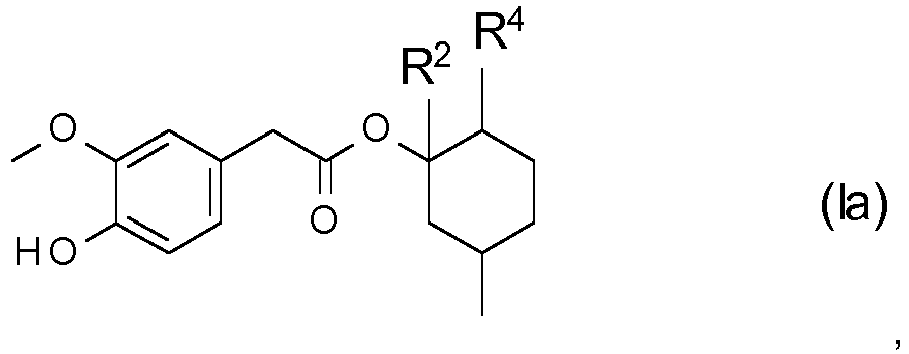
R4 stellt 2-Propyl dar. - Verwendung nach einem der vorangehenden Ansprüche, wobei für die Verbindung der Formel (I) bzw. eine, mehrere oder sämtliche Verbindungen der Formel (I) unabhängig voneinander in der Mischung gilt:R1 und R2 stellen jeweils ein Wasserstoffatom dar,R3 stellt ein Wasserstoffatom oder einen linearen oder verzweigten Alkylrest mit 1 bis 4 Kohlenstoffatomen oder einen Phenylrest, einen Alkylphenylrest oder einen Phenylalkylrest oder einen Alkenylphenylrest oder einen Phenylalkenylrest dar,R4 stellt ein Wasserstoffatom dar.
- Verwendung nach einem der vorangehenden Ansprüche, wobei die Verbindung der Formel (I) bzw. eine, mehrere oder sämtliche Verbindungen der Formel (I) in der Mischung ausgewählt ist bzw. sind aus der Gruppe bestehend aus2-Phenylethyl-2-(4-hydroxy-3-methoxy-phenyl)acetat (1)
 [(E)-Cinnamyl]-2-(4-hydroxy-3-methoxy-phenyl)acetat (2)
 1-Ethylbutyl-2-(4-hydroxy-3-methoxy-phenyl)acetat (3)
 3-Methylbut-2-enyl-2-(4-hydroxy-3-methoxy-phenyl)acetat (4)
 [(E)-Hex-2-enyl]-2-(4-hydroxy-3-methoxy-phenyl)acetat (5)
 [(Z)-Hex-3-enyl]-2-(4-hydroxy-3-methoxy-phenyl)acetat (6)
 Isopropyl-2-(4-hydroxy-3-methoxy-phenyl)acetat (7)
 sec-Butyl-2-(4-Hydroxy-3-methoxy-phenyl)acetat (8)
 Isobutyl-2-(4-hydroxy-3-methoxy-phenyl)acetat (9)
 1,1-Dimethylpropyl 2-(4-hydroxy-3-methoxy-phenyl)acetat (10)
 Isopentyl-2-(4-hydroxy-3-methoxy-phenyl)acetat (11)
 2-Methylbutyl-2-(4-hydroxy-3-methoxy-phenyl)acetat (12)
 1-Methylpentyl-2-(4-hydroxy-3-methoxy-phenyl)acetat (13)
 Heptyl-2-(4-hydroxy-3-methoxy-phenyl)acetat (14)
 1-Methylhexyl-2-(4-hydroxy-3-methoxy-phenyl)acetat (15)
 (2-Isopropyl-5-methyl-cyclohexyl)-2-(4-hydroxy-3-methoxy-phenyl)acetat (16)
 Ethyl-2-(4-hydroxy-3-methoxy-phenyl)acetat (17)
 Propyl-2-(4-hydroxy-3-methoxy-phenyl)acetat (18)
 Butyl-2-(4-hydroxy-3-methoxy-phenyl)acetat (19)
 Pentyl-2-(4-hydroxy-3-methoxy-phenyl)acetat (20)
 Hexyl-2-(4-hydroxy-3-methoxy-phenyl)acetat (21)
 3-Phenylpropyl-2-(4-hydroxy-3-methoxy-phenyl)acetat (22)
 4-Phenylbutyl-2-(4-hydroxy-3-methoxy-phenyl)acetat (23)
- Verwendung nach einem der vorangehenden Ansprüche in einer pharmazeutischen, einer der Ernährung, der Mundhygiene oder dem Genuss dienenden Zubereitung, vorzugsweise wobei die Gesamtmenge an Verbindung(en) der Formel (I) und/oder Salz(en) davon in der Zubereitung ausreicht, um
bei Gebrauch oder Verzehr der Zubereitung sensorisch einen wärmenden und/oder scharfen Effekt auf der Zunge oder im Mundraum hervorzurufen,
und einen angenehmen Geschmackseindruck, ausgewählt aus der Gruppe bestehend aus wärmend, scharf und kühlend, zu verstärken. - Verbindung der Formel (I) oder physiologisch akzeptables Salz davon, wobei die phenolische Hydroxygruppe in Formel (I) deprotoniert ist, oder Mischung umfassend eine oder mehrere unterschiedliche Verbindungen der Formel (I) und/oder ein oder mehrere physiologisch akzeptable Salze davon, wobei die phenolische Hydroxygruppe in Formel (I) jeweils deprotoniert ist, oder bestehend aus mehreren unterschiedlichen Verbindungen der Formel (I) und/oder physiologisch akzeptablen Salzen davon, wobei die phenolische Hydroxygruppe in Formel (I) jeweils deprotoniert ist,
 (i) R1 und R2 unabhängig voneinander ein Wasserstoffatom oder einen Alkylrest mit 1-2 Kohlenstoffatomen darstellen,
R3 und R4 unabhängig voneinander ein Wasserstoffatom oder einen linearen oder verzweigten Alkylrest mit 1 bis 5 Kohlenstoffatomen, einen Phenylrest, einen Alkylphenylrest oder einen Phenylalkylrest oder einen linearen oder verzweigten Alkenylrest mit 2 bis 4 Kohlenstoffatomen oder einen Alkenylphenylrest oder einen Phenylalkenylrest darstellen,
oder(ii) R1 und R3 zusammen mit den sie verknüpfenden Kohlenstoffatomen einen Cyclohexylring bilden, der optional mit einem zusätzlichen Rest R5 substituiert ist, wobei R5 ein Alkylrest mit 1-2 Kohlenstoffatomen ist,mit der Maßgabe, dass
R2 ein Wasserstoffatom oder einen Alkylrest mit 1-2 Kohlenstoffatomen darstellt,
R4 ein Wasserstoffatom oder einen linearen oder verzweigten Alkylrest mit 1 bis 5 Kohlenstoffatomen, einen Phenylrest, einen Alkylphenylrest oder einen Phenylalkylrest oder einen linearen oder verzweigten Alkenylrest mit 2 bis 4 Kohlenstoffatomen oder einen Alkenylphenylrest oder einen Phenylalkenylrest darstellt,
die Verbindung der Formel (I) bzw. eine, mehrere oder sämtliche Verbindungen der Formel (I) in der Mischung ausgewählt ist bzw. sind aus der Gruppe bestehend aus[(E)-Cinnamyl]-2-(4-hydroxy-3-methoxy-phenyl)acetat (2) 1-Ethylbutyl-2-(4-hydroxy-3-methoxy-phenyl)acetat (3)
 3-Methylbut-2-enyl-2-(4-hydroxy-3-methoxy-phenyl)acetat (4)
 [(E)-Hex-2-enyl]-2-(4-hydroxy-3-methoxy-phenyl)acetat (5)
 [(Z)-Hex-3-enyl]-2-(4-hydroxy-3-methoxy-phenyl)acetat (6)
 1,1-Dimethylpropyl 2-(4-hydroxy-3-methoxy-phenyl)acetat (10)
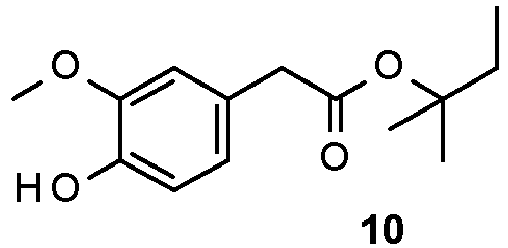 2-Methylbutyl-2-(4-hydroxy-3-methoxy-phenyl)acetat (12)
 1-Methylpentyl-2-(4-hydroxy-3-methoxy-phenyl)acetat (13)
 1-Methylhexyl-2-(4-hydroxy-3-methoxy-phenyl)acetat (15)
 (2-Isopropyl-5-methyl-cyclohexyl)-2-(4-hydroxy-3-methoxy-phenyl)acetat (16)
 4-Phenylbutyl 2-(4-hydroxy-3-methoxy-phenyl)acetat (23)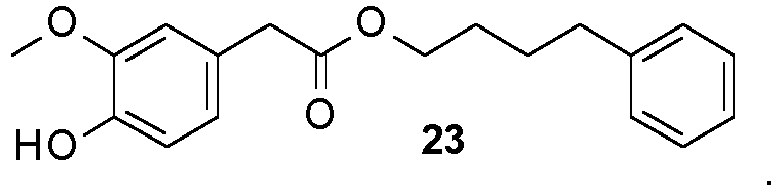
- Aromakomposition
umfassend oder bestehend aus einer Mischung nach Anspruch 6, vorzugsweise wobei
die Gesamtmenge an Verbindung(en) der Formel (I) und/oder Salz(en) davon in der Aromakomposition, bezogen auf das Gesamtgewicht der Aromakomposition, im Bereich von 100 bis 100.000 mg/kg liegt, vorzugsweise im Bereich von 250 bis 40.000 mg/kg, besonders bevorzugt im Bereich von 250 bis 15.000 mg/kg. - Aromakomposition nach Anspruch 7,
wobei
die Gesamtmenge an Verbindung(en) der Formel (I) und/oder Salz(en) davon in der Aromakomposition, bezogen auf das Gesamtgewicht der Aromakomposition, im Bereich von 100 bis 100.000 mg/kg liegt, vorzugsweise im Bereich von 250 bis 40.000 mg/kg, besonders bevorzugt im Bereich von 250 bis 15.000 mg/kg,
zudem umfassend einen oder mehrere weitere, nicht der Formel (I) entsprechende Aromastoffe, vorzugsweise ausgewählt aus der Gruppe bestehend ausa) Wärme verursachende oder Scharfstoffe, bevorzugt ausgewählt aus der Liste bestehend aus: Capsaicinoiden, wie zum Beispiel Capsaicin, Dihydrocapsaicin oder Nonivamid; Gingerolen, wie zum Beispiel Gingerol-6, Gingerol-8, oder Gingerol-10; Shogaolen wie Shogaol-6, Shogaol-8, Shogaol-10; Gingerdionen, wie zum Beispiel Gingerdion-6, Gingerdion-8 oder Gingerdion-10; Paradolen, wie zum Beispiel Paradol-6, Paradol-8 oder Paradol-10; Dehydrogingerdionen, wie zum Beispiel Dehydrogingerdion-6, Dehydrogingerdion-8 oder Dehydrogingerdion-10; Piperin und Piperinderivaten;b) als stechend oder beißend wahrnehmbare Stoffe, bevorzugt ausgewählt aus der Gruppe bestehend aus: aromatischen Isothiocyanaten, wie zum Beispiel Phenylethylisothiocyanat, Allylisothiocyanat, Cyclopropylisothiocyanat, Butylisothiocyanat, 3-Methylthiopropylisothiocyanat, 4-Hydroxybenzylisothiocyanat, 4-Methoxybenzylisothiocyanat;c) als kribbelnd (tingling) beschriebenen Alkamide, vorzugsweise ausgewählt aus der Gruppe bestehend aus 2E,4E-Decadiensäure-N-isobutylamid (trans-Pellitorin) (insbesondere solche wie beschrieben in WO 2004/043906, die bezüglich der darin offenbarten entsprechenden Verbindungen auf dem Wege der Verweisung Bestandteil dieser Anmeldung wird); 2E,4Z- Decadiensäure-N-isobutylamid (cis-Pellitorin) (insbesondere solche wie beschrieben in WO 2004/000787, die bezüglich der darin offenbarten entsprechenden Verbindungen auf dem Wege der Verweisung Bestandteil dieser Anmeldung wird); 2Z,4Z- Decadiensäure-N-isobutylamid; 2Z,4E- Decadiensäure-N-isobutylamid; 2E,4E-Decadiensäure-N-([2S]-2-methylbutyl)amid; 2E,4E-Decadiensäure-N-([2S]-2-methylbutyl)amid; 2E,4E-Decadiensäure-N-([2R]-2-methylbutylamid); 2E,4Z-Decadiensäure-N-(2-methylbutyl)amid; 2E,4E-Decadiensäure-N-piperid (Achilleamid); 2E,4E-Decadiensäure-N-piperid (Sarmentin); 2E-Decensäure-N-isobutylamid; 3E-Decensäure-N-isobutylamid; 3E-Nonensäure-N-isobutylamid; 2E,6Z,8E-Decatriensäure-N-isobutylamid (Spilanthol); 2E,6Z,8E-Decatriensäure-N-([2S]-2-methylbutyl)amid (Homospilanthol); 2E,6Z,8E-Decatriensäure-N-([2R]-2-methylbutyl)amid; 2E-Decen-4-insäure-N-isobutylamid; 2Z-Decen-4-insäure-N-isobutylamid; 2E,6Z,8E,10E-Dodecatetraensäure-N-(2-methylpropyl)amid (alpha-Sanshool); 2E,6Z,8E,10E-Dodecatetraensäure-N-(2-hydroxy-2-methylpropyl)amid (alpha-Hydroxysanshool); 2E,6E,8E,10E-Dodecatetraensäure-N-(2-hydroxy-2-methyl propyl)amid (gamma-Hydroxysanshool); 2E, 4E, 8Z, 10E, 12E-Tetradecapentaensäure-N-(2-hydroxy-2-methylpropyl)amid (gamma-Hydroxysanshool); 2E, 4E, 8E,10E, 12E-Tetradecapentaensäure-N-(2-hydroxy-2-methylpropyl)amid (gamma-Hydroxyisosanshool); 2E, 4E, 8Z, 10E, 12E-Tetradecapentaensäure-N-(2-methyl-2-propenyl)amid (gamma-Dehydrosanshool); 2E, 4E, 8Z, 10E, 12E-Tetradecapentaensäure-N-(2-methylpropyl)amid (gamma-Sanshool); 2E,4E,8Z,11Z-Tetradecatetraensäure-N-(2-hydroxy-2-methylpropyl)amid (Bungeanool); 2E,4E,8Z, 11E-Tetradecatetraensäure-N-(2-hydroxy-2-methylpropyl)amid (Isobungeanool); 2E,4E,8Z-Tetradecatriensäure-N-(2-hydroxy-2-methylpropyl)amid (Dihydrobungeanool) und 2E,4E -Tetradecadiensäure-N-(2-hydroxy-2-methylpropyl)amid (Tetrahydrobungeanool);d) Stoffe mit physiologischer Kühlwirkung, vorzugsweise ausgewählt aus der folgenden Liste: Menthol und Mentholderivate (z.B. L-Menthol, D-Menthol, racemisches Menthol, Isomenthol, Neoisomenthol, Neomenthol) Menthylether (z.B. (L-Menthoxy)-1,2-propandiol, (L-Menthoxy)-2-methyl-1,2-propandiol, L-Menthyl-methylether), Menthylester (z.B. Menthylformiat, Menthylacetat, Menthylisobutyrat, Menthyllactate, L-Menthyl-L-lactat, L-Menthyl-D-lactat, Menthyl-(2-methoxy)acetat, Menthyl-(2-methoxyethoxy)acetat, Menthylpyroglutamat), Menthylcarbonate (z.B. Menthylpropylenglycolcarbonat, Menthylethylenglycolcarbonat, Menthylglycerincarbonat oder deren Gemischen), die Halbester von Mentholen mit einer Dicarbonsäure oder deren Derivate (z.B. Mono-Menthylsuccinat, Mono-Menthylglutarat, Mono-Menthylmalonat, O-Menthylbernsteinsäureester-N,N-(dimethyl)amid, O-Menthylbernsteinsäureesteramid), andere als in der vorliegenden Erfindung genannte Menthancarbonsäureamide (z.B. Menthancarbonsäure-N-ethylamid [WS3], Menthancarbonsäure-N-(p-methoxyphenyl)amid [SC1], Nα-(Menthancarbonyl)glycinethylester [WS5], Menthancarbonsäure-N-(4-cyanophenyl)amid, Menthancarbonsäure-N-(alkoxyalkyl)amide), Menthon und Menthonderivate (z.B. L-Menthonglycerinketal), 2,3-Dimethyl-2-(2-propyl)-butansäurederivate (z.B. 2,3-Dimethyl-2-(2-propyl)-butansäure-N-methylamid [WS23]), Isopulegol oder seine Ester (I-(-)-Isopulegol, I-(-)-Isopulegolacetat), Menthanderivate (z.B. p-Menthan-3,8-diol), Cubebol oder synthetische oder natürliche Mischungen, enthaltend Cubebol, Pyrrolidonderivate von Cycloalkyldionderivaten (z.B. 3-Methyl-2(1-pyrrolidinyl)-2-cyclopenten-1-on) oder Tetrahydropyrimidin-2-one (z.B. Icilin oder verwandte Verbindungen, wie in WO 2004/026840 beschrieben), weitere Kühlwirkstoffe wie in WO2011061330 beschrieben, insbesondere Derivate verschieden substituierter Zimt- und 2-Phenoxysäuren, besonders bevorzugt Methylendioxyzimtsäure-N,N-diphenylamid, Methylendioxyzimtsäure-N-ethyl-N-phenylamid, Methylendioxyzimt-säure-N-pyridyl-N-phenylamid;e) Stoffe mit adstringierender Wirkung, vorzugsweise ausgewählt aus der folgenden Liste: Catechine wie z.B. Epicatechine, Gallocatechine, Epigallocatechine sowie deren jeweiligen Gallussäureester, z.B. Epigallocatechingallat oder Epicatechingallat, dern Oligomere (Procyanidine, Proanthocyanidine, Prodelphinidine, Procyanirine, Thearubigenine, Theogalline) sowie deren C- und O-Glycoside; Dihydroflavonoide wie Dihydromyricetin, Taxifolin, sowie deren C- und O-Glycoside, Flavonole wie Myricetin, Quercetin sowie deren C- und O-Glycoside wie Quercetrin, Rutin, Gallussäaureester von Kohlenhydraten wie Tannin, Pentagalloylglucose oder deren Reaktionsprodukte wie Elligatannin, Aluminiumsalze, z.B. Alaun. - Aromakomposition nach Anspruch 7 oder 8, zudem umfassend einen oder mehrere nicht der Formel (I) entsprechende Stoffe mit unangenehmer, insbesondere bitterer Geschmacksqualität, oder einer adstringierenden, bitteren, trockenen, staubigen, mehligen, kalkigen und/oder metallischen Note, vorzugsweise ausgewählt aus der Gruppe bestehend aus:f) Xanthinalkaloide, Xanthine (Coffein, Theobromin, Theophyllin und Methylxanthine), Alkaloide (Chinin, Brucin, Strychnin, Nicotin), phenolische Glycoside (z.B. Salicin, Arbutin), Flavonoidglycoside (z.B. Neohespereidin, Hesperidin, Naringin, Quercitrin, Rutin, Hyperosid, Quercetin-3-O-glucosid, Myricetin-3-O-glycoside), Chalcone oder Chalconglycoside (z.B. Phloridzin, Phloridzinxyloside), hydrolisierbare Tannine (Gallus- oder Elagsäureester von Kohlenhydraten, z.B. Pentagalloylglucose, Tanninsäuren), nichthydrolisierbare Tannine (ggfs. galloylierte Catechine, Gallocatechine, Epigallocatechine oder Epicatechine und deren Oligomeren, z.B. Proanthyocyanidine oder Procyanidine, Thearubigenin), Flavone (z.B. Quercetin, Taxifolin, Myricetin), Phenole wie z.B. Salicin, Polyphenole (z.B. gamma-Oryzanol, Kaffeesäure oder deren Ester (z. B. Chlorogensäure und Isomere)), terpenoide Bitter- und Gerbstoffe (z.B. Limonoide wie Limonin oder Nomilin aus Zitrusfrüchten, Lupolone und Humolone aus Hopfen, Iridoide, Secoiridoide), Absinthin aus Wermut, Amarogentin aus Enzian, metallische Salze (insbesondere Kalium-, Magnesium- und Calciumsalze, Kaliumchlorid, Kaliumgluconat, Kaliumcarbonat, Kaliumsulfat, Kaliumlactat, Kaliumglutamat, Kaliumsuccinat, Kaliummalat, Natriumsulfat, Magnesiumsulfat, Aluminiumsalze, Zinksalze, Zinnsalze, Eisen-(II)-salze, Eisen-(III)-salze, Chrom-(II)-picolinat), pharmazeutische Wirkstoffe (z.B. Fluorchinolon-Antibiotika, Paracetamol, Aspirin, beta-Lactam-Antibiotika, Ambroxol, Propylthiouracil [PROP], Guaifenesin), Vitamine (beispielsweise Vitamin H, Vitamine aus der B-Reihe wie Vitamin B1, B2, B6, B12, Niacin, Panthotensäure), Denatoniumbenzoat, Sucraloseoctaacetat, Eisensalze, Aluminiumsalze, Zinksalze, Harnstoff, ungesättigte Fettsäuren, insbesondere ungesättigte Fettsäuren in Emulsionen, bitter/adstringierend schmeckende Aminosäuren (z.B. Leucin, Isoleucin, Valin, Tryptophan, Prolin, Histidin, Tyrosin, Lysin oder Phenylalanin) und bitter oder adstringierend schmeckende Peptide oder Proteine (insbesondere Peptide mit einer Aminosäure aus der Gruppe Leucin, Isoleucin, Valin, Tryptophan, Prolin oder Phenylalanin am N- oder C-Terminus), Saponine, insbes. Sojasaponine, Isoflavonoide (insbes. Genistein, Daidzein, Genistin, Daidzin, deren Glycoside und acylierten Glycoside);g) Stoffe mit einem nicht unangenehmen Primärgeschmack (beispielsweise süß, salzig, würzig, sauer) und/oder -geruch, vorzugsweise ausgewählt aus der Gruppe der Süßstoffe oder Zuckeraustauschstoffe, vorzugsweise Kaliumsalze (insbesondere Kaliumchlorid, Kaliumgluconat, Kaliumcarbonat, Kaliumsulfat, Kaliumlactat, Kaliumglutamat, Kaliumsuccinat, Kaliummalat), Aspartam, Acesulfam K, Neotam, Superaspartam, Saccharin, Sucralose, Tagatose, Monellin, Stevioside, Rebaudioside, Rebaudiosid A, Rebaudiosid B, Rebaudiosid C, Rebaudiosid D, Rebaudiosid X, Rubusoside, Hernandulcin, Thaumatin, Miraculin, Glycyrrhizin, Glycyrrhetinsäure, Balansin A oder Balansin B, oder deren Derivate, Cyclamat oder die pharmazeutisch akzeptablen Salze der vorgenannten Verbindungen.
- Pharmazeutische Zubereitung, der Ernährung, der Mundhygiene oder dem Genuss dienende Zubereitung, umfassend(A) eine Mischung nach Anspruch 6,
vorzugsweise wobei
die Gesamtmenge an Verbindung(en) der Formel (I) und/oder Salz(en) davon in der Zubereitung, bezogen auf das Gesamtgewicht der Zubereitung, im Bereich von 0,1 bis 1.000 mg/kg liegt, vorzugsweise im Bereich von 1 bis 1.000 mg/kg, vorzugsweise im Bereich von 1 bis 750 mg/kg, besonders bevorzugt im Bereich von 5 bis 500 mg/kg,
oder(C) eine Aromakomposition nach Anspruch 7, 8 oder 9,wobei die Gesamtmenge an Verbindung(en) der Formel (I) und/oder Salz(en) davon in der Zubereitung ausreicht, um
vorzugsweise wobei
die Gesamtmenge an Verbindung(en) der Formel (I) und/oder Salz(en) davon in der Zubereitung, bezogen auf das Gesamtgewicht der Zubereitung, im Bereich von 0,1 bis 1.000 mg/kg liegt, vorzugsweise im Bereich von 1 bis 1.000 mg/kg, vorzugsweise im Bereich von 1 bis 750 mg/kg, besonders bevorzugt im Bereich von 5 bis 500 mg/kg,
bei Gebrauch oder Verzehr der Zubereitung sensorisch einen wärmenden und/oder scharfen Effekt auf der Zunge oder im Mundraum hervorzurufen,
und einen angenehmen Geschmackseindruck ausgewählt aus der Gruppe bestehend aus wärmend, scharf und kühlend, zu verstärken. - Zubereitung nach Anspruch 10, zudem umfassend
ein oder mehrere übliche Grund-, Hilfs- und Zusatzstoffe in einer Menge von, bezogen auf das Gesamtgewicht der Zubereitung, 5 bis 99,9999 Gew.-%, vorzugsweise 10 bis 80 Gew.-%,
und/oder
Wasser in einer Menge, bezogen auf das Gesamtgewicht der Zubereitung, bis zu 99,9999 Gew.-%, vorzugsweise in einer Menge von 5 bis 80 Gew.-%. - Verfahren zum Herstellen einer Zubereitung nach einem der Ansprüche 10 bis 11, umfassend folgende Schritte:i) Bereitstellen(A) einer Mischung nach Anspruch 6,
vorzugsweise wobei
die Gesamtmenge an Verbindung(en) der Formel (I) und/oder Salz(en) davon so ausgewählt ist, dass die Gesamtmenge in der herzustellenden Zubereitung, bezogen auf das Gesamtgewicht der Zubereitung, im Bereich von 0,1 bis 1.000 mg/kg liegt, vorzugsweise im Bereich von 1 bis 1.000 mg/kg, vorzugsweise im Bereich von 1 bis 750 mg/kg, besonders bevorzugt im Bereich von 5 bis 500 mg/kg,
oder(C) eine Aromakomposition nach Anspruch 7, 8 oder 9,
vorzugsweise wobei
die Gesamtmenge an Verbindung(en) der Formel (I) und/oder Salz(en) so ausgewählt ist, dass die Gesamtmenge in der herzustellenden Zubereitung, bezogen auf das Gesamtgewicht der Zubereitung, im Bereich von 0,1 bis 1.000 mg/kg liegt, vorzugsweise im Bereich von 1 bis 1.000 mg/kg, vorzugsweise im Bereich von 1 bis 750 mg/kg, besonders bevorzugt im Bereich von 5 bis 500 mg/kg,ii) Bereitstellen eines oder mehrerer weiterer Bestandteile der herzustellenden Zubereitung, undiii) Inkontaktbringen oder Mischen der in Schritt ii) bereitgestellten weiteren Bestandteile mit dem/den in Schritt i) bereitgestellten Bestandteil(en), vorzugsweise in einer sensorisch wirksamen Menge.
Applications Claiming Priority (2)
| Application Number | Priority Date | Filing Date | Title |
|---|---|---|---|
| EP14165020.0A EP2932858A1 (de) | 2014-04-16 | 2014-04-16 | Homovanillinsäure-Ester, insbesondere zum Erzielen eines Wärme- und/oder Schärfeeindrucks |
| PCT/EP2015/058004 WO2015158677A1 (de) | 2014-04-16 | 2015-04-14 | Homovanillinsäure-ester, insbesondere zum erzielen eines wärme- und/oder schärfeeindrucks |
Publications (2)
| Publication Number | Publication Date |
|---|---|
| EP3142499A1 EP3142499A1 (de) | 2017-03-22 |
| EP3142499B1 true EP3142499B1 (de) | 2019-10-30 |
Family
ID=50479146
Family Applications (2)
| Application Number | Title | Priority Date | Filing Date |
|---|---|---|---|
| EP14165020.0A Withdrawn EP2932858A1 (de) | 2014-04-16 | 2014-04-16 | Homovanillinsäure-Ester, insbesondere zum Erzielen eines Wärme- und/oder Schärfeeindrucks |
| EP15718467.2A Active EP3142499B1 (de) | 2014-04-16 | 2015-04-14 | Homovanillinsäure-ester, insbesondere zum erzielen eines wärme- und/oder schärfeeindrucks |
Family Applications Before (1)
| Application Number | Title | Priority Date | Filing Date |
|---|---|---|---|
| EP14165020.0A Withdrawn EP2932858A1 (de) | 2014-04-16 | 2014-04-16 | Homovanillinsäure-Ester, insbesondere zum Erzielen eines Wärme- und/oder Schärfeeindrucks |
Country Status (7)
| Country | Link |
|---|---|
| US (2) | US20190276386A1 (de) |
| EP (2) | EP2932858A1 (de) |
| JP (1) | JP6712549B2 (de) |
| KR (1) | KR102498596B1 (de) |
| AU (1) | AU2015248962B2 (de) |
| PH (1) | PH12016502050A1 (de) |
| WO (1) | WO2015158677A1 (de) |
Families Citing this family (10)
| Publication number | Priority date | Publication date | Assignee | Title |
|---|---|---|---|---|
| JP6794758B2 (ja) * | 2015-10-21 | 2020-12-02 | 大正製薬株式会社 | 経口液体医薬組成物 |
| CN105779217A (zh) * | 2016-02-01 | 2016-07-20 | 李滋星 | 生姜酚生物饮品及其制备方法 |
| EP3432878A1 (de) * | 2016-03-23 | 2019-01-30 | Symrise AG | Homovanillinsäure-ester zum reduzieren oder inhibieren der fettsäureaufnahme im dünndarm |
| US11059771B2 (en) * | 2016-08-04 | 2021-07-13 | Takasago International Corporation | Warming sensation compounds |
| EP3687311A1 (de) * | 2017-09-27 | 2020-08-05 | Symrise AG | Amide zur erzeugung eines trigeminalen effekts |
| WO2020015816A1 (de) | 2018-07-16 | 2020-01-23 | Symrise Ag | Zusammensetzung zur substitution von zucker in backwaren |
| US20220071933A1 (en) | 2019-01-18 | 2022-03-10 | Symrise Ag | Combination remedy |
| CN113993500B (zh) * | 2019-06-13 | 2025-08-12 | 德国德之馨香精香料公司 | 一种清凉制剂 |
| CN115697961B (zh) | 2020-04-27 | 2025-03-18 | 西姆莱斯有限公司 | 高香草酸酯的制备方法 |
| CN114601743B (zh) * | 2022-03-22 | 2022-09-13 | 宝萃生物科技有限公司 | 一种二氢杨梅素脂质体及其制备和应用 |
Family Cites Families (12)
| Publication number | Priority date | Publication date | Assignee | Title |
|---|---|---|---|---|
| GB2168974A (en) * | 1984-12-20 | 1986-07-02 | Procter & Gamble | Compounds and compositions having anti-inflammatory activity |
| DE10226942A1 (de) | 2002-06-17 | 2003-12-24 | Symrise Gmbh & Co Kg | Verwendung von Mandelsäurealkylamiden als Aromastoffe |
| DE10227462A1 (de) | 2002-06-20 | 2004-01-08 | Symrise Gmbh & Co. Kg | Herstellung von cis-Pellitorin und Verwendung als Aromastoff |
| GB0221697D0 (en) | 2002-09-18 | 2002-10-30 | Unilever Plc | Novel compouds and their uses |
| DE10253331A1 (de) | 2002-11-14 | 2004-06-03 | Symrise Gmbh & Co. Kg | Verwendung von trans-Pellitori als Aromastoff |
| US7879378B2 (en) | 2005-04-21 | 2011-02-01 | Symrise Gmbh & Co. Kg | Process for the separation and sensory evaluation of flavours using HTLC |
| WO2007111276A1 (ja) | 2006-03-24 | 2007-10-04 | Ajinomoto Co., Inc. | 新規エステル誘導体およびその用途 |
| JP5249767B2 (ja) * | 2006-09-14 | 2013-07-31 | 長谷川香料株式会社 | 硬化油風味付与剤 |
| US8778987B2 (en) | 2007-03-13 | 2014-07-15 | Symrise Ag | Use of 4-hydroxychalcone derivatives for masking an unpleasant taste |
| WO2009065239A1 (en) | 2007-11-19 | 2009-05-28 | Givaudan Sa | Compositions and their use |
| GB0911000D0 (en) * | 2009-06-25 | 2009-08-12 | Givaudan Sa | Compounds |
| DE102010002558A1 (de) | 2009-11-20 | 2011-06-01 | Symrise Ag | Verwendung physiologischer Kühlwirkstoffe und Mittel enthaltend solche Wirkstoffe |
-
2014
- 2014-04-16 EP EP14165020.0A patent/EP2932858A1/de not_active Withdrawn
-
2015
- 2015-04-14 EP EP15718467.2A patent/EP3142499B1/de active Active
- 2015-04-14 AU AU2015248962A patent/AU2015248962B2/en active Active
- 2015-04-14 KR KR1020167032034A patent/KR102498596B1/ko active Active
- 2015-04-14 WO PCT/EP2015/058004 patent/WO2015158677A1/de not_active Ceased
- 2015-04-14 JP JP2016563026A patent/JP6712549B2/ja not_active Expired - Fee Related
- 2015-04-14 US US16/345,921 patent/US20190276386A1/en not_active Abandoned
-
2016
- 2016-10-14 PH PH12016502050A patent/PH12016502050A1/en unknown
-
2020
- 2020-10-22 US US17/077,133 patent/US11535584B2/en active Active
Non-Patent Citations (1)
| Title |
|---|
| None * |
Also Published As
| Publication number | Publication date |
|---|---|
| US20210040028A1 (en) | 2021-02-11 |
| KR20160145734A (ko) | 2016-12-20 |
| PH12016502050B1 (en) | 2017-01-09 |
| US20190276386A1 (en) | 2019-09-12 |
| AU2015248962A1 (en) | 2016-11-03 |
| WO2015158677A1 (de) | 2015-10-22 |
| US11535584B2 (en) | 2022-12-27 |
| PH12016502050A1 (en) | 2017-01-09 |
| EP3142499A1 (de) | 2017-03-22 |
| JP2017514468A (ja) | 2017-06-08 |
| EP2932858A1 (de) | 2015-10-21 |
| AU2015248962B2 (en) | 2019-03-21 |
| JP6712549B2 (ja) | 2020-06-24 |
| KR102498596B1 (ko) | 2023-02-10 |
Similar Documents
| Publication | Publication Date | Title |
|---|---|---|
| EP2008530B1 (de) | Aromakomposition zum Verringern oder Unterdrücken von unerwünschtem bitteren und adstringierenden Eindruck | |
| EP2253226B1 (de) | Verwendung von Hydroxyflavan-Derivaten zur Geschmacksmodifizierung | |
| US11535584B2 (en) | Homovanillinic acid ester, in particular for creating a warm and/or pungent sensation | |
| US10165791B2 (en) | Use of rubusoside for reducing or suppressing certain unpleasant taste impressions | |
| EP1972203B1 (de) | Verwendung von 4-Hydroxychalkonderivaten zur Maskierung eines unangenehmen Geschmacks | |
| EP2529633B1 (de) | Oral konsumierbare Zubereitungen umfassend bestimmte süß schmeckende Triterpene und Triterpenglycoside | |
| EP2570036B1 (de) | Verwendung bestimmter Neoflavonoide zur Verstärkung und/oder Erzeugung eines süßen sensorischen Eindruckes | |
| EP2058297B1 (de) | Verwendung von Alkamiden zur Maskierung eines unangenehmen Geschmacks | |
| EP2353403B1 (de) | Verwendung von 1-(2,4-Dihydroxy-phenyl)-3-(3-hydroxy-4-methoxy-phenyl)-propan-1-on | |
| EP2570035B1 (de) | Verwendung von Neoflavonoiden zur Geschmacksmodifizierung | |
| WO2006024587A1 (de) | Hydroxybenzoesäureamide und deren verwendung zur maskierung von bitterem geschmack | |
| DE10351422A1 (de) | Verwendung von Alkencarbonsäure-N-alkylamiden als Aromastoffe | |
| CN1318390C (zh) | 反式-佩利特灵作为芳香物质的用途 | |
| JP2017514468A5 (de) | ||
| WO2019063069A1 (de) | Amide zur erzeugung eines trigeminalen effekts | |
| EP1765772A1 (de) | Verwendung von alkyloxyalkansäureamiden insbesondere als aromastoffe sowie neue alkyloxyalkansäureamide | |
| DE102009046126A1 (de) | Oral konsumierbare Zubereitung umfassend Wurzelextrakt aus Mondia whitei | |
| DE102009002268A1 (de) | 4,4'-Dihydroxydeoxybenzoine und deren Verwendung als Geschmacksverbesserer | |
| DE202004021058U1 (de) | Verwendung von Alkencarbonsäure-N-alkylamiden als Aromastoffe | |
| DE202016009245U1 (de) | Verwendung von 3-(3-Hydroxy-4-Methoxy-Phenyl)-1-(2,4,6-Trihydroxy-Phenyl)-Propan-1-one |
Legal Events
| Date | Code | Title | Description |
|---|---|---|---|
| STAA | Information on the status of an ep patent application or granted ep patent |
Free format text: STATUS: THE INTERNATIONAL PUBLICATION HAS BEEN MADE |
|
| PUAI | Public reference made under article 153(3) epc to a published international application that has entered the european phase |
Free format text: ORIGINAL CODE: 0009012 |
|
| STAA | Information on the status of an ep patent application or granted ep patent |
Free format text: STATUS: REQUEST FOR EXAMINATION WAS MADE |
|
| 17P | Request for examination filed |
Effective date: 20161116 |
|
| AK | Designated contracting states |
Kind code of ref document: A1 Designated state(s): AL AT BE BG CH CY CZ DE DK EE ES FI FR GB GR HR HU IE IS IT LI LT LU LV MC MK MT NL NO PL PT RO RS SE SI SK SM TR |
|
| AX | Request for extension of the european patent |
Extension state: BA ME |
|
| RIN1 | Information on inventor provided before grant (corrected) |
Inventor name: HENTSCHEL, FABIA Inventor name: REICHELT, KATHARINA Inventor name: BACKES, MICHAEL Inventor name: RIESS, THOMAS Inventor name: PAETZ, SUSANNE Inventor name: DEGENHARDT, ANDREAS Inventor name: KLOSE, BETTINA Inventor name: LEY, JAKOB PETER |
|
| DAV | Request for validation of the european patent (deleted) | ||
| DAX | Request for extension of the european patent (deleted) | ||
| STAA | Information on the status of an ep patent application or granted ep patent |
Free format text: STATUS: EXAMINATION IS IN PROGRESS |
|
| 17Q | First examination report despatched |
Effective date: 20180123 |
|
| REG | Reference to a national code |
Ref country code: DE Ref legal event code: R079 Ref document number: 502015010795 Country of ref document: DE Free format text: PREVIOUS MAIN CLASS: A23L0027000000 Ipc: A23B0004060000 |
|
| GRAP | Despatch of communication of intention to grant a patent |
Free format text: ORIGINAL CODE: EPIDOSNIGR1 |
|
| STAA | Information on the status of an ep patent application or granted ep patent |
Free format text: STATUS: GRANT OF PATENT IS INTENDED |
|
| RIC1 | Information provided on ipc code assigned before grant |
Ipc: A23B 4/06 20060101AFI20190429BHEP |
|
| INTG | Intention to grant announced |
Effective date: 20190528 |
|
| GRAS | Grant fee paid |
Free format text: ORIGINAL CODE: EPIDOSNIGR3 |
|
| GRAA | (expected) grant |
Free format text: ORIGINAL CODE: 0009210 |
|
| STAA | Information on the status of an ep patent application or granted ep patent |
Free format text: STATUS: THE PATENT HAS BEEN GRANTED |
|
| AK | Designated contracting states |
Kind code of ref document: B1 Designated state(s): AL AT BE BG CH CY CZ DE DK EE ES FI FR GB GR HR HU IE IS IT LI LT LU LV MC MK MT NL NO PL PT RO RS SE SI SK SM TR |
|
| REG | Reference to a national code |
Ref country code: GB Ref legal event code: FG4D Free format text: NOT ENGLISH |
|
| REG | Reference to a national code |
Ref country code: CH Ref legal event code: EP |
|
| REG | Reference to a national code |
Ref country code: AT Ref legal event code: REF Ref document number: 1195202 Country of ref document: AT Kind code of ref document: T Effective date: 20191115 |
|
| REG | Reference to a national code |
Ref country code: DE Ref legal event code: R096 Ref document number: 502015010795 Country of ref document: DE |
|
| REG | Reference to a national code |
Ref country code: IE Ref legal event code: FG4D Free format text: LANGUAGE OF EP DOCUMENT: GERMAN |
|
| REG | Reference to a national code |
Ref country code: LT Ref legal event code: MG4D |
|
| PG25 | Lapsed in a contracting state [announced via postgrant information from national office to epo] |
Ref country code: PL Free format text: LAPSE BECAUSE OF FAILURE TO SUBMIT A TRANSLATION OF THE DESCRIPTION OR TO PAY THE FEE WITHIN THE PRESCRIBED TIME-LIMIT Effective date: 20191030 Ref country code: NL Free format text: LAPSE BECAUSE OF FAILURE TO SUBMIT A TRANSLATION OF THE DESCRIPTION OR TO PAY THE FEE WITHIN THE PRESCRIBED TIME-LIMIT Effective date: 20191030 Ref country code: LV Free format text: LAPSE BECAUSE OF FAILURE TO SUBMIT A TRANSLATION OF THE DESCRIPTION OR TO PAY THE FEE WITHIN THE PRESCRIBED TIME-LIMIT Effective date: 20191030 Ref country code: SE Free format text: LAPSE BECAUSE OF FAILURE TO SUBMIT A TRANSLATION OF THE DESCRIPTION OR TO PAY THE FEE WITHIN THE PRESCRIBED TIME-LIMIT Effective date: 20191030 Ref country code: NO Free format text: LAPSE BECAUSE OF FAILURE TO SUBMIT A TRANSLATION OF THE DESCRIPTION OR TO PAY THE FEE WITHIN THE PRESCRIBED TIME-LIMIT Effective date: 20200130 Ref country code: FI Free format text: LAPSE BECAUSE OF FAILURE TO SUBMIT A TRANSLATION OF THE DESCRIPTION OR TO PAY THE FEE WITHIN THE PRESCRIBED TIME-LIMIT Effective date: 20191030 Ref country code: BG Free format text: LAPSE BECAUSE OF FAILURE TO SUBMIT A TRANSLATION OF THE DESCRIPTION OR TO PAY THE FEE WITHIN THE PRESCRIBED TIME-LIMIT Effective date: 20200130 Ref country code: PT Free format text: LAPSE BECAUSE OF FAILURE TO SUBMIT A TRANSLATION OF THE DESCRIPTION OR TO PAY THE FEE WITHIN THE PRESCRIBED TIME-LIMIT Effective date: 20200302 Ref country code: GR Free format text: LAPSE BECAUSE OF FAILURE TO SUBMIT A TRANSLATION OF THE DESCRIPTION OR TO PAY THE FEE WITHIN THE PRESCRIBED TIME-LIMIT Effective date: 20200131 Ref country code: LT Free format text: LAPSE BECAUSE OF FAILURE TO SUBMIT A TRANSLATION OF THE DESCRIPTION OR TO PAY THE FEE WITHIN THE PRESCRIBED TIME-LIMIT Effective date: 20191030 |
|
| REG | Reference to a national code |
Ref country code: NL Ref legal event code: MP Effective date: 20191030 |
|
| PG25 | Lapsed in a contracting state [announced via postgrant information from national office to epo] |
Ref country code: IS Free format text: LAPSE BECAUSE OF FAILURE TO SUBMIT A TRANSLATION OF THE DESCRIPTION OR TO PAY THE FEE WITHIN THE PRESCRIBED TIME-LIMIT Effective date: 20200229 Ref country code: HR Free format text: LAPSE BECAUSE OF FAILURE TO SUBMIT A TRANSLATION OF THE DESCRIPTION OR TO PAY THE FEE WITHIN THE PRESCRIBED TIME-LIMIT Effective date: 20191030 Ref country code: RS Free format text: LAPSE BECAUSE OF FAILURE TO SUBMIT A TRANSLATION OF THE DESCRIPTION OR TO PAY THE FEE WITHIN THE PRESCRIBED TIME-LIMIT Effective date: 20191030 |
|
| PG25 | Lapsed in a contracting state [announced via postgrant information from national office to epo] |
Ref country code: AL Free format text: LAPSE BECAUSE OF FAILURE TO SUBMIT A TRANSLATION OF THE DESCRIPTION OR TO PAY THE FEE WITHIN THE PRESCRIBED TIME-LIMIT Effective date: 20191030 |
|
| PG25 | Lapsed in a contracting state [announced via postgrant information from national office to epo] |
Ref country code: ES Free format text: LAPSE BECAUSE OF FAILURE TO SUBMIT A TRANSLATION OF THE DESCRIPTION OR TO PAY THE FEE WITHIN THE PRESCRIBED TIME-LIMIT Effective date: 20191030 Ref country code: RO Free format text: LAPSE BECAUSE OF FAILURE TO SUBMIT A TRANSLATION OF THE DESCRIPTION OR TO PAY THE FEE WITHIN THE PRESCRIBED TIME-LIMIT Effective date: 20191030 Ref country code: CZ Free format text: LAPSE BECAUSE OF FAILURE TO SUBMIT A TRANSLATION OF THE DESCRIPTION OR TO PAY THE FEE WITHIN THE PRESCRIBED TIME-LIMIT Effective date: 20191030 Ref country code: EE Free format text: LAPSE BECAUSE OF FAILURE TO SUBMIT A TRANSLATION OF THE DESCRIPTION OR TO PAY THE FEE WITHIN THE PRESCRIBED TIME-LIMIT Effective date: 20191030 Ref country code: DK Free format text: LAPSE BECAUSE OF FAILURE TO SUBMIT A TRANSLATION OF THE DESCRIPTION OR TO PAY THE FEE WITHIN THE PRESCRIBED TIME-LIMIT Effective date: 20191030 |
|
| REG | Reference to a national code |
Ref country code: DE Ref legal event code: R097 Ref document number: 502015010795 Country of ref document: DE |
|
| PG25 | Lapsed in a contracting state [announced via postgrant information from national office to epo] |
Ref country code: IT Free format text: LAPSE BECAUSE OF FAILURE TO SUBMIT A TRANSLATION OF THE DESCRIPTION OR TO PAY THE FEE WITHIN THE PRESCRIBED TIME-LIMIT Effective date: 20191030 Ref country code: SM Free format text: LAPSE BECAUSE OF FAILURE TO SUBMIT A TRANSLATION OF THE DESCRIPTION OR TO PAY THE FEE WITHIN THE PRESCRIBED TIME-LIMIT Effective date: 20191030 Ref country code: SK Free format text: LAPSE BECAUSE OF FAILURE TO SUBMIT A TRANSLATION OF THE DESCRIPTION OR TO PAY THE FEE WITHIN THE PRESCRIBED TIME-LIMIT Effective date: 20191030 |
|
| PLBE | No opposition filed within time limit |
Free format text: ORIGINAL CODE: 0009261 |
|
| STAA | Information on the status of an ep patent application or granted ep patent |
Free format text: STATUS: NO OPPOSITION FILED WITHIN TIME LIMIT |
|
| 26N | No opposition filed |
Effective date: 20200731 |
|
| PG25 | Lapsed in a contracting state [announced via postgrant information from national office to epo] |
Ref country code: MC Free format text: LAPSE BECAUSE OF FAILURE TO SUBMIT A TRANSLATION OF THE DESCRIPTION OR TO PAY THE FEE WITHIN THE PRESCRIBED TIME-LIMIT Effective date: 20191030 Ref country code: SI Free format text: LAPSE BECAUSE OF FAILURE TO SUBMIT A TRANSLATION OF THE DESCRIPTION OR TO PAY THE FEE WITHIN THE PRESCRIBED TIME-LIMIT Effective date: 20191030 |
|
| PG25 | Lapsed in a contracting state [announced via postgrant information from national office to epo] |
Ref country code: LU Free format text: LAPSE BECAUSE OF NON-PAYMENT OF DUE FEES Effective date: 20200414 |
|
| REG | Reference to a national code |
Ref country code: BE Ref legal event code: MM Effective date: 20200430 |
|
| PG25 | Lapsed in a contracting state [announced via postgrant information from national office to epo] |
Ref country code: BE Free format text: LAPSE BECAUSE OF NON-PAYMENT OF DUE FEES Effective date: 20200430 |
|
| PG25 | Lapsed in a contracting state [announced via postgrant information from national office to epo] |
Ref country code: IE Free format text: LAPSE BECAUSE OF NON-PAYMENT OF DUE FEES Effective date: 20200414 |
|
| REG | Reference to a national code |
Ref country code: AT Ref legal event code: MM01 Ref document number: 1195202 Country of ref document: AT Kind code of ref document: T Effective date: 20200414 |
|
| PG25 | Lapsed in a contracting state [announced via postgrant information from national office to epo] |
Ref country code: AT Free format text: LAPSE BECAUSE OF NON-PAYMENT OF DUE FEES Effective date: 20200414 |
|
| PG25 | Lapsed in a contracting state [announced via postgrant information from national office to epo] |
Ref country code: TR Free format text: LAPSE BECAUSE OF FAILURE TO SUBMIT A TRANSLATION OF THE DESCRIPTION OR TO PAY THE FEE WITHIN THE PRESCRIBED TIME-LIMIT Effective date: 20191030 Ref country code: MT Free format text: LAPSE BECAUSE OF FAILURE TO SUBMIT A TRANSLATION OF THE DESCRIPTION OR TO PAY THE FEE WITHIN THE PRESCRIBED TIME-LIMIT Effective date: 20191030 Ref country code: CY Free format text: LAPSE BECAUSE OF FAILURE TO SUBMIT A TRANSLATION OF THE DESCRIPTION OR TO PAY THE FEE WITHIN THE PRESCRIBED TIME-LIMIT Effective date: 20191030 |
|
| PG25 | Lapsed in a contracting state [announced via postgrant information from national office to epo] |
Ref country code: MK Free format text: LAPSE BECAUSE OF FAILURE TO SUBMIT A TRANSLATION OF THE DESCRIPTION OR TO PAY THE FEE WITHIN THE PRESCRIBED TIME-LIMIT Effective date: 20191030 |
|
| PGFP | Annual fee paid to national office [announced via postgrant information from national office to epo] |
Ref country code: DE Payment date: 20250417 Year of fee payment: 11 |
|
| PGFP | Annual fee paid to national office [announced via postgrant information from national office to epo] |
Ref country code: FR Payment date: 20250422 Year of fee payment: 11 |
|
| PGFP | Annual fee paid to national office [announced via postgrant information from national office to epo] |
Ref country code: CH Payment date: 20250501 Year of fee payment: 11 |
|
| PGFP | Annual fee paid to national office [announced via postgrant information from national office to epo] |
Ref country code: GB Payment date: 20260324 Year of fee payment: 12 |
|
| REG | Reference to a national code |
Ref country code: CH Ref legal event code: U11 Free format text: ST27 STATUS EVENT CODE: U-0-0-U10-U11 (AS PROVIDED BY THE NATIONAL OFFICE) Effective date: 20260501 |