EP3142617B1 - Polymères photosensibles pour applications adhésives - Google Patents
Polymères photosensibles pour applications adhésives Download PDFInfo
- Publication number
- EP3142617B1 EP3142617B1 EP15792302.0A EP15792302A EP3142617B1 EP 3142617 B1 EP3142617 B1 EP 3142617B1 EP 15792302 A EP15792302 A EP 15792302A EP 3142617 B1 EP3142617 B1 EP 3142617B1
- Authority
- EP
- European Patent Office
- Prior art keywords
- photoresponsive
- group
- adhesive
- individually
- crosslinker
- Prior art date
- Legal status (The legal status is an assumption and is not a legal conclusion. Google has not performed a legal analysis and makes no representation as to the accuracy of the status listed.)
- Not-in-force
Links
Images


Classifications
-
- C—CHEMISTRY; METALLURGY
- C09—DYES; PAINTS; POLISHES; NATURAL RESINS; ADHESIVES; COMPOSITIONS NOT OTHERWISE PROVIDED FOR; APPLICATIONS OF MATERIALS NOT OTHERWISE PROVIDED FOR
- C09B—ORGANIC DYES OR CLOSELY-RELATED COMPOUNDS FOR PRODUCING DYES, e.g. PIGMENTS; MORDANTS; LAKES
- C09B57/00—Other synthetic dyes of known constitution
- C09B57/02—Coumarine dyes
-
- C—CHEMISTRY; METALLURGY
- C09—DYES; PAINTS; POLISHES; NATURAL RESINS; ADHESIVES; COMPOSITIONS NOT OTHERWISE PROVIDED FOR; APPLICATIONS OF MATERIALS NOT OTHERWISE PROVIDED FOR
- C09J—ADHESIVES; NON-MECHANICAL ASPECTS OF ADHESIVE PROCESSES IN GENERAL; ADHESIVE PROCESSES NOT PROVIDED FOR ELSEWHERE; USE OF MATERIALS AS ADHESIVES
- C09J133/00—Adhesives based on homopolymers or copolymers of compounds having one or more unsaturated aliphatic radicals, each having only one carbon-to-carbon double bond, and at least one being terminated by only one carboxyl radical, or of salts, anhydrides, esters, amides, imides, or nitriles thereof; Adhesives based on derivatives of such polymers
- C09J133/04—Homopolymers or copolymers of esters
- C09J133/06—Homopolymers or copolymers of esters of esters containing only carbon, hydrogen and oxygen, the oxygen atom being present only as part of the carboxyl radical
- C09J133/08—Homopolymers or copolymers of acrylic acid esters
-
- A—HUMAN NECESSITIES
- A61—MEDICAL OR VETERINARY SCIENCE; HYGIENE
- A61F—FILTERS IMPLANTABLE INTO BLOOD VESSELS; PROSTHESES; DEVICES PROVIDING PATENCY TO, OR PREVENTING COLLAPSING OF, TUBULAR STRUCTURES OF THE BODY, e.g. STENTS; ORTHOPAEDIC, NURSING OR CONTRACEPTIVE DEVICES; FOMENTATION; TREATMENT OR PROTECTION OF EYES OR EARS; BANDAGES, DRESSINGS OR ABSORBENT PADS; FIRST-AID KITS
- A61F13/00—Bandages or dressings; Absorbent pads
- A61F13/02—Adhesive bandages or dressings
- A61F13/0246—Adhesive bandages or dressings characterised by the skin-adhering layer
- A61F13/0253—Adhesive bandages or dressings characterised by the skin-adhering layer characterized by the adhesive material
-
- A—HUMAN NECESSITIES
- A61—MEDICAL OR VETERINARY SCIENCE; HYGIENE
- A61L—METHODS OR APPARATUS FOR STERILISING MATERIALS OR OBJECTS IN GENERAL; DISINFECTION, STERILISATION OR DEODORISATION OF AIR; CHEMICAL ASPECTS OF BANDAGES, DRESSINGS, ABSORBENT PADS OR SURGICAL ARTICLES; MATERIALS FOR BANDAGES, DRESSINGS, ABSORBENT PADS OR SURGICAL ARTICLES
- A61L15/00—Chemical aspects of, or use of materials for, bandages, dressings or absorbent pads
- A61L15/16—Bandages, dressings or absorbent pads for physiological fluids such as urine or blood, e.g. sanitary towels, tampons
- A61L15/22—Bandages, dressings or absorbent pads for physiological fluids such as urine or blood, e.g. sanitary towels, tampons containing macromolecular materials
- A61L15/24—Macromolecular compounds obtained by reactions only involving carbon-to-carbon unsaturated bonds; Derivatives thereof
-
- A—HUMAN NECESSITIES
- A61—MEDICAL OR VETERINARY SCIENCE; HYGIENE
- A61L—METHODS OR APPARATUS FOR STERILISING MATERIALS OR OBJECTS IN GENERAL; DISINFECTION, STERILISATION OR DEODORISATION OF AIR; CHEMICAL ASPECTS OF BANDAGES, DRESSINGS, ABSORBENT PADS OR SURGICAL ARTICLES; MATERIALS FOR BANDAGES, DRESSINGS, ABSORBENT PADS OR SURGICAL ARTICLES
- A61L15/00—Chemical aspects of, or use of materials for, bandages, dressings or absorbent pads
- A61L15/16—Bandages, dressings or absorbent pads for physiological fluids such as urine or blood, e.g. sanitary towels, tampons
- A61L15/42—Use of materials characterised by their function or physical properties
- A61L15/58—Adhesives
-
- B—PERFORMING OPERATIONS; TRANSPORTING
- B32—LAYERED PRODUCTS
- B32B—LAYERED PRODUCTS, i.e. PRODUCTS BUILT-UP OF STRATA OF FLAT OR NON-FLAT, e.g. CELLULAR OR HONEYCOMB, FORM
- B32B27/00—Layered products comprising a layer of synthetic resin
- B32B27/06—Layered products comprising a layer of synthetic resin as the main or only constituent of a layer, which is next to another layer of the same or of a different material
-
- C—CHEMISTRY; METALLURGY
- C09—DYES; PAINTS; POLISHES; NATURAL RESINS; ADHESIVES; COMPOSITIONS NOT OTHERWISE PROVIDED FOR; APPLICATIONS OF MATERIALS NOT OTHERWISE PROVIDED FOR
- C09B—ORGANIC DYES OR CLOSELY-RELATED COMPOUNDS FOR PRODUCING DYES, e.g. PIGMENTS; MORDANTS; LAKES
- C09B69/00—Dyes not provided for by a single group of this subclass
- C09B69/10—Polymeric dyes; Reaction products of dyes with monomers or with macromolecular compounds
- C09B69/109—Polymeric dyes; Reaction products of dyes with monomers or with macromolecular compounds containing other specific dyes
-
- C—CHEMISTRY; METALLURGY
- C09—DYES; PAINTS; POLISHES; NATURAL RESINS; ADHESIVES; COMPOSITIONS NOT OTHERWISE PROVIDED FOR; APPLICATIONS OF MATERIALS NOT OTHERWISE PROVIDED FOR
- C09J—ADHESIVES; NON-MECHANICAL ASPECTS OF ADHESIVE PROCESSES IN GENERAL; ADHESIVE PROCESSES NOT PROVIDED FOR ELSEWHERE; USE OF MATERIALS AS ADHESIVES
- C09J7/00—Adhesives in the form of films or foils
- C09J7/30—Adhesives in the form of films or foils characterised by the adhesive composition
- C09J7/38—Pressure-sensitive adhesives [PSA]
- C09J7/381—Pressure-sensitive adhesives [PSA] based on macromolecular compounds obtained by reactions involving only carbon-to-carbon unsaturated bonds
- C09J7/385—Acrylic polymers
-
- G—PHYSICS
- G03—PHOTOGRAPHY; CINEMATOGRAPHY; ANALOGOUS TECHNIQUES USING WAVES OTHER THAN OPTICAL WAVES; ELECTROGRAPHY; HOLOGRAPHY
- G03F—PHOTOMECHANICAL PRODUCTION OF TEXTURED OR PATTERNED SURFACES, e.g. FOR PRINTING, FOR PROCESSING OF SEMICONDUCTOR DEVICES; MATERIALS THEREFOR; ORIGINALS THEREFOR; APPARATUS SPECIALLY ADAPTED THEREFOR
- G03F7/00—Photomechanical, e.g. photolithographic, production of textured or patterned surfaces, e.g. printing surfaces; Materials therefor, e.g. comprising photoresists; Apparatus specially adapted therefor
- G03F7/004—Photosensitive materials
- G03F7/039—Macromolecular compounds which are photodegradable, e.g. positive electron resists
-
- B—PERFORMING OPERATIONS; TRANSPORTING
- B32—LAYERED PRODUCTS
- B32B—LAYERED PRODUCTS, i.e. PRODUCTS BUILT-UP OF STRATA OF FLAT OR NON-FLAT, e.g. CELLULAR OR HONEYCOMB, FORM
- B32B2307/00—Properties of the layers or laminate
- B32B2307/40—Properties of the layers or laminate having particular optical properties
- B32B2307/41—Opaque
-
- B—PERFORMING OPERATIONS; TRANSPORTING
- B32—LAYERED PRODUCTS
- B32B—LAYERED PRODUCTS, i.e. PRODUCTS BUILT-UP OF STRATA OF FLAT OR NON-FLAT, e.g. CELLULAR OR HONEYCOMB, FORM
- B32B2307/00—Properties of the layers or laminate
- B32B2307/40—Properties of the layers or laminate having particular optical properties
- B32B2307/412—Transparent
-
- B—PERFORMING OPERATIONS; TRANSPORTING
- B32—LAYERED PRODUCTS
- B32B—LAYERED PRODUCTS, i.e. PRODUCTS BUILT-UP OF STRATA OF FLAT OR NON-FLAT, e.g. CELLULAR OR HONEYCOMB, FORM
- B32B2535/00—Medical equipment, e.g. bandage, prostheses or catheter
-
- C—CHEMISTRY; METALLURGY
- C09—DYES; PAINTS; POLISHES; NATURAL RESINS; ADHESIVES; COMPOSITIONS NOT OTHERWISE PROVIDED FOR; APPLICATIONS OF MATERIALS NOT OTHERWISE PROVIDED FOR
- C09J—ADHESIVES; NON-MECHANICAL ASPECTS OF ADHESIVE PROCESSES IN GENERAL; ADHESIVE PROCESSES NOT PROVIDED FOR ELSEWHERE; USE OF MATERIALS AS ADHESIVES
- C09J2301/00—Additional features of adhesives in the form of films or foils
- C09J2301/40—Additional features of adhesives in the form of films or foils characterized by the presence of essential components
- C09J2301/416—Additional features of adhesives in the form of films or foils characterized by the presence of essential components use of irradiation
-
- C—CHEMISTRY; METALLURGY
- C09—DYES; PAINTS; POLISHES; NATURAL RESINS; ADHESIVES; COMPOSITIONS NOT OTHERWISE PROVIDED FOR; APPLICATIONS OF MATERIALS NOT OTHERWISE PROVIDED FOR
- C09J—ADHESIVES; NON-MECHANICAL ASPECTS OF ADHESIVE PROCESSES IN GENERAL; ADHESIVE PROCESSES NOT PROVIDED FOR ELSEWHERE; USE OF MATERIALS AS ADHESIVES
- C09J2433/00—Presence of (meth)acrylic polymer
Definitions
- One or more embodiments of are directed to adhesive polymers crosslinked with a crosslinker that includes a photoresponsive group.
- Adhesives may be broadly divided in two classes: structural and pressure-sensitive.
- structural adhesives harden via processes such as evaporation of solvent, reaction with UV radiation (as in dental adhesives), chemical reaction (such as multi part epoxy), or cooling (as in hot melt).
- pressure-sensitive adhesives form a bond simply by the application of light pressure to marry the adhesive with the adherend.
- Pressure-sensitive adhesives are designed with a balance between flow and resistance to flow. The bond forms because the adhesive is soft enough to flow, or wet the adherend. The bond has strength because the adhesive is hard enough to resist flow when stress is applied to the bond.
- PSAs exhibit viscoelastic (viscous and elastic) properties, both of which are used for proper bonding.
- pressure-sensitive adhesives are capable of bonding to surfaces simply by the application of light pressure. This makes them very convenient products and accounts for its usage in fields as varied as automotive, electronics and dental applications.
- Acrylic polymers have been most widely used as pressure-sensitive adhesives in commercial products because of the low-cost, nontoxicity, transparency, and good resistance to weathering.
- tack the ability of pressure-sensitive adhesives to be quickly adhered to an objective surface at a slight pressure
- peel strength the ability of pressure-sensitive adhesives to resist interface separation by peeling
- shear strength the ability of pressure-sensitive adhesives to resist creep when shear force is applied up on
- modulating the crosslinking density is the most effective method to improve adhesive properties, especially for heat and chemical resistance. While those skilled in the art generally recognize that properties of pressure-sensitive adhesives can be adjusted, these adjustments generally produce static results. Presently there is a need in the art for pressure-sensitive adhesives with controllable properties such as adhesive strength.
- WO 97/06836 A2 disclose photoresponsive adhesive polymers.
- One or more embodiments provide a photoresponsive adhesive polymer comprising adhesive polymers crosslinked with a crosslinker that includes a photoresponsive group.
- the present invention provides a photoresponsive adhesive polymer according to claim 1.
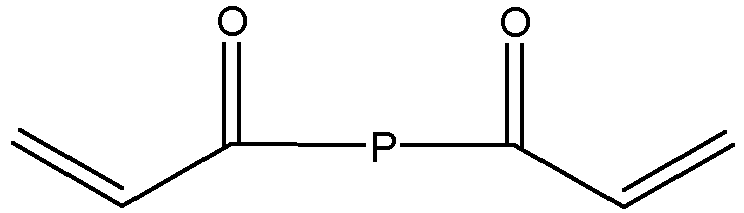
- the photoresponsive adhesive polymer comprises adhesive polymers crosslinked with a crosslinker that includes a photoresponsive group, where the photoresponsive group in not pendantly attached to the crosslinker and the photoresponsive adhesive polymer is a polymer of a vinyl monomer and a photoresponsive crosslinker with two acryl end groups, where the vinyl monomer is selected from the group consisting of acrylates, methacrylates, substituted acrylates, acrylamides, methacrylamides, and vinyl siloxanes, and the photoresponsive crosslinker is defined by the formula: where P is a photoresponsive group that is a coumarin group or an alkoxyphenacyl group.
- a medical dressing comprising: a transparent or partially transparent backing layer with a first and a second side; and a photoresponsive adhesive polymer comprising crosslinked adhesive polymers with a crosslinker that includes a photoresponsive group coated on the first side of the backing layer.
- Embodiments are based, at least in part, on the discovery that photoresponsive groups may be used in a crosslinker of an adhesive polymer to produce a switchable adhesive.
- the photoresponsive groups of the switchable adhesive may be reversibly crosslinked to control the strength of the adhesive.
- a switchable polymer that includes a photoresponsive group placed in a crosslinker of an adhesive polymer may simply be referred to as a photoresponsive adhesive.
- photoresponsive adhesives may be used as water-based adhesives, solvent based adhesives, or hot melt adhesives. Due to the ability to control the strength of the photoresponsive adhesives, the photoresponsive adhesive may be suitable for use as an adhesive in a medical dressing.
- the photoresponsive adhesive may be used as a single-component adhesive.
- Single-component adhesives are advantageous because they include a built in crosslinker.
- single-component adhesives are more convenient than multi-component adhesives, because adhesive and crosslinker of a multi-component adhesive must be stored separately. Additionally, quality control issues may arise from poorly mixed multi- component adhesives or multi- component adhesives that use incorrect ratios of components.
- the pressure sensitive adhesive polymer comprises adhesive polymers crosslinked with a crosslinker that includes a photoresponsive group.
- Suitable adhesive polymers include those that are capable of being crosslinked and adhere to an objective surface with pressure.
- the photoresponsive group is not pendantly attached to the crosslinker.
- the photoresponsive group is connected to the crosslinker by at least two bonds.
- the photoresponsive adhesive may have a high adhesive strength conformation and a low adhesive strength conformation.
- the high adhesive conformation is where the photoresponsive adhesive is crosslinked and in the low adhesive conformation the crosslinks are broken.
- the strength may be measured by a peel test.
- the high strength conformation is at least 2 times stronger, in other embodiments at least 3 times stronger, in other embodiments at least 4 times stronger, and in still other embodiments at least 5 times stronger than the low strength conformation.
- the high strength conformation is at most 100 times stronger, in other embodiments at most 50 times stronger, in other embodiments at most 20 times stronger, and in still other embodiments at most 10 times stronger than the low strength conformation.
- the high strength conformation is from about 2 times to about 100 times stronger, in other embodiments from about 3 times to about 50 times stronger, in other embodiments from about 4 times to about 20 times stronger, and in still other embodiments from about 5 times to about 10 times stronger than the low strength conformation.
- Suitable photoresponsive groups include groups that may reversibly form dimers or photocleave when exposed to light.
- the photoresponsive groups according to the invention are coumarin groups and alkoxyphenacyl groups.
- the photoresponsive group may be a coumarin group.
- a coumarin group may be defined by the following formula:
- the photoactive coumarin group may have a substitution at any of the hydrogen atoms of the base coumarin group.
- the coumarin group may have one or more hydrogen atoms substituted with a bromine atom, an iodine atom, or an alkoxy group.
- Coumarin groups are useful in the production of photoresponsive adhesives because they can be used to provide a reversible crosslink.
- Coumarin groups are capable of undergoing photodimerization with another coumarin group or when the photoresponsive adhesive is irradiated with light.
- photoresponsive adhesives with a coumarin group undergo photodimerization when irradiated at a wavelength of about 320 nm to about 420 nm.
- the dimerization may be reversed by the irradiation of a crosslinked polymer.
- the dimer of coumarin group may separate when irradiated at a wavelength of about 230 nm to about 300 nm.
- the photoresponsive group may be an alkoxyphenacyl group.
- a alkoxyphenacyl group may be defined by the following formula: where each R is individually an organic group.
- the alkoxyphenacyl group may have a substitution at any of the hydrogen atoms of the base alkoxyphenacyl group.
- the alkoxyphenacyl group may have one or more hydrogen atoms substituted with a bromine atom, an iodine atom, or an alkoxy group.
- Alkoxyphenacyl groups are useful in the production of photoresponsive adhesives because they can be used to provide a photocleaveable bond. Alkoxyphenacyl groups are capable of undergoing photocleaveage when the photoresponsive adhesive is irradiated with light. In one or more embodiments, photoresponsive adhesives with an alkoxyphenacyl group undergo photocleaveage when irradiated at a wavelength of about 250 nm to about 350 nm.
- the pressure sensitive adhesive polymer may be prepared by polymerizing a vinyl monomer and photoresponsive crosslinker with two acryl end groups.
- an acryl end group may be defined by the following formula where R is a hydrogen atom or an akyl group.
- the photoresponsive adhesive may be polymerized through conventional radical polymerization.
- the polymerization may be initiated by any free radical initiators that can produce a living polymer. Examples of initiators include reversible addition fragmentation chain transfer (RAFT), atom transfer radical polymerization (ATRP), telluride-mediated polymerization (TERP), or nitroxide mediated polymerization NMP difunctional initiators.
- RAFT reversible addition fragmentation chain transfer
- ATRP atom transfer radical polymerization
- TRIP telluride-mediated polymerization
- NMP difunctional initiators include reversible addition fragmentation chain transfer (RAFT), atom transfer radical polymerization (ATRP), telluride-mediated polymerization (TERP), or nitroxide mediated polymerization NMP difunctional initiators.
- the photoresponsive adhesive may be polymerized through a reversible addition-fragmentation chain-transfer polymerization to prepare a nanoparticle.
- the vinyl monomers used are selected from acrylates, methacrylates, substituted acrylates, acrylamides, methacrylamides, and vinyl siloxanes.
- acrylates include, but are not limited to methyl acrylate, ethyl acrylate, n-butyl acrylate, isobutyl acrylate, n-hexyl acrylate, 2-ethylhexyl acrylate, 2-carboxyethyl acrylate and hydroxybutyl acrylate.
- methacrylates include, but are not limited to methyl methacrylate, ethyl methacrylate, n-butyl methacrylate, isobutyl methacrylate, n-hexyl methacrylate, 2-ethylhexyl methacrylate, and hydroxybutyl methacrylate.
- acrylamides include, but are not limited to N-methyl acrylamide, N,N- dimethyl acrylamide, N-ethyl acrylamide, N,N-diethyl acrylamide, N-isopropyl acrylamide, and N-t-butyl acrylamide.
- methacrylamides include, but are not limited to N-methyl methacrylamide, N,N- dimethyl methacrylamide, N-ethyl methacrylamide, N,N-diethyl methacrylamide, N-isopropyl methacrylamide, and N-t-butyl methacrylamide.
- vinyl siloxanes include, but are not limited to 3-methacryloxypropyl trimethoxysilane, 3-acryloxypropyl trimethoxysilane, 3-methacryloxypropyl triethoxysilane, 3-acryloxypropyl triethoxysilane, 3-methacryloxypropyl tritert-butyloxysilane, 3-acryloxypropyl tritert-butyloxysilane, 3-methacryloxypropyl dimethoxethoxysilane, 3-acryloxypropyldimethoxethoxysilane, 3-methacryloxypropyldiethoxmethoxysilane, 3-acryloxypropyldiethoxmethoxysilane, vinyl trimethoxysilane, vinyl triethoxysilane and vinyl tris(2-methoxyethoxy)silane.
- substituted acrylates include, but are not limited to alkyl a-hydroxymethyl acrylate and 2-hydroxyethyl acrylate.
- Other suitable substituted acrylates include Baylis-Hillman adducts, described in WO 2014/152850 .
- the photoresponsive crosslinker with two acryl end groups is defined by the formula: where P is a photoresponsive group.
- photoresponsive crosslinker with two acryl end groups includes a photoresponsive that is a alkoxyphenacyl group
- the photoresponsive crosslinker may be defined by the formula: where R 1 is a hydrocarbon group or a substituted hydrocarbon group; each R 2 is individually a hydrogen atom, a bromine atom, an iodine atom, or an alkoxy group; and n is from 0 to 4.
- photoresponsive crosslinker with two acryl end groups includes a photoresponsive that is a alkoxyphenacyl group
- the photoresponsive crosslinker may be defined by the formula:
- photoresponsive crosslinker with two acryl end groups includes a photoresponsive that is a coumarin group
- the photoresponsive crosslinker may be defined by the formula: where each R 1 is a hydrocarbon group or a substituted hydrocarbon group; each R 2 is individually a hydrogen atom, a bromine atom, an iodine atom, or an alkoxy group; n is from 0 to 3; and m is from 0 to 1.
- photoresponsive crosslinker with two acryl end groups includes a photoresponsive that is a coumarin group
- the photoresponsive crosslinker may be defined by the formula:
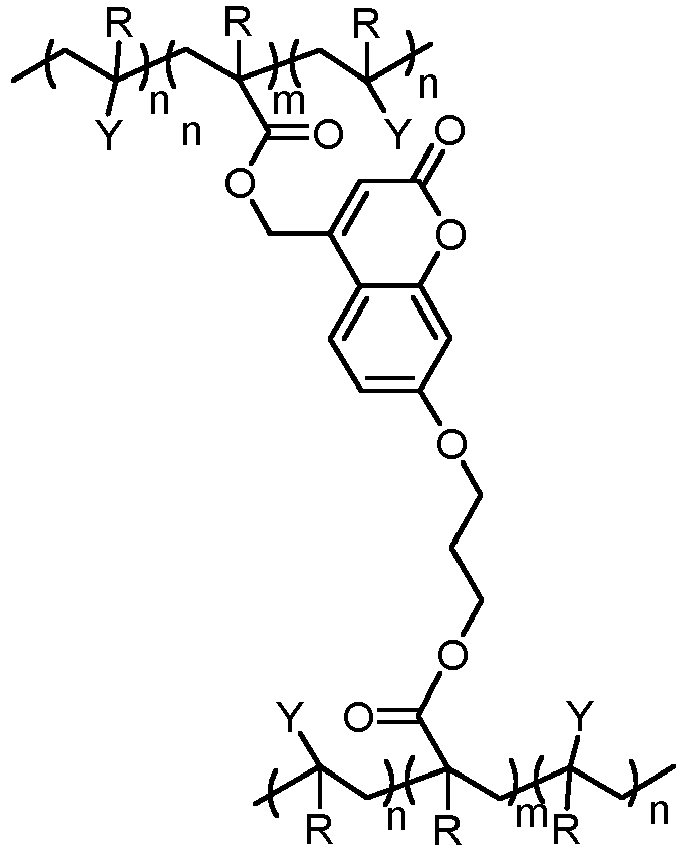
- the pressure sensitive adhesive polymer may include the formula where each Y is individually an ester, amide, or siloxane group; each R is individually a hydrogen atom or an alkyl group; each n is individually 50 to 10,000 units; and each m is individually 1 to 1,000 units.
- the pressure sensitive adhesive polymer may include the formula where each Y is individually an ester, amide, or siloxane group; each R is individually a hydrogen atom or an alkyl group; each n is individually 50 to 10,000 units; and each m is individually 1 to 1,000 units.
- the photoresponsive adhesive may be prepared as an aqueous dispersion type emulsion adhesive.
- an aqueous dispersion type emulsion adhesive may be prepared by polymerizing a vinyl monomer and photoresponsive crosslinker with two acryl end groups together with an emulsifier in aqueous medium.
- the photoresponsive adhesive may have a backbone that includes a photoresponsive group.
- the photoresponsive adhesive may be prepared with a difunctional initiation compound that includes a photoresponsive group.
- a difunctional initiator compound that includes a photoresponsive group has two polymerization initiation sites tethered by a bond or an organic group to a photoresponsive group.
- the difunctional initiator compound that includes a photoresponsive group imparts a photoresponsive group into the backbone of the polymer. Each initiation site is able to initiate a living polymerization.
- RAFT reversible addition fragmentation chain transfer
- ATRP atom transfer radical polymerization
- TRP telluride-mediated polymerization
- NMP difunctional initiators nitroxide mediated polymerization
- the difunctional initiator compound that includes a photoresponsive group is a RAFT agent
- R and X function to stabilize the radical formed during polymerization.
- the photoresponsive group may be a coumarin group. In other embodiments, the photoresponsive group may be an alkoxyphenacyl group.
- the photoresponsive adhesive may be prepared as solvent-type adhesive.
- the photoresponsive adhesive may be prepared by polymerizing a vinyl monomer and photoresponsive crosslinker with two acryl end groups in a solution polymerization.
- a solvent-type adhesive may be prepared by polymerizing a vinyl monomer and photoresponsive crosslinker with two acryl end groups together with a difunctional initiator compound that includes a photoresponsive group in a solution polymerization.
- a difunctional RAFT agent that includes a coumarin group is used to prepare an adhesive with a polymer backbone that includes a coumarin group
- a difunctional RAFT agent that includes a alkoxyphenacyl group is used to prepare a photoresponsive adhesive with a polymer backbone that includes a alkoxyphenacyl group
- a coupling agent may be attached to the photoresponsive adhesive to increase the molecular weight and change the physical properties of the material. This will advantageously allow for hybrid class of adhesives.
- the resultant polymer from a photoresponsive adhesive prepared through a RAFT polymerization includes RAFT head groups, which may be removed to produce a free polar thiol group, and the free polar thiol group is then modified by attaching to other polymers such as elastomers and PU.
- a supramolecular coupling agent may be attached to the photoresponsive adhesive to increase the molecular weight without increasing the crosslink density. This will advantageously allow for higher molecular weight without increasing the polymer chain length or crosslink density.
- the resultant polymer from a photoresponsive adhesive prepared through a RAFT polymerization includes RAFT head groups, which may be removed to produce a free polar thiol group, and the free polar thiol group is then modified by attaching a supramolecular coupling agent.
- the supramolecular coupling agent may be attached to the free polar thiol group by a thiol-ene click reaction.
- the supramolecular coupling agent may have a molecular weight of at least 100 Dalton in other embodiments at least 1000 Dalton, and in still other embodiments at least 10,000 Da. In one or more embodiments, the supramolecular coupling agent may be a group that is capable of forming strong hydrogen bonds.
- An exemplary supramolecular coupling agent is ureido-pyrimidinone (UPy).
- the photoresponsive adhesive may be a hot melt adhesive.
- Hot melt adhesive possesses the reversible properties of strong cohesive strength at ambient temperature and desirable melt viscosity at elevated temperatures.
- a photoresponsive adhesive with a supramolecular coupling agent may be used as a hot melt adhesive.
- the photoresponsive adhesive with a polymer backbone that includes a coumarin group may be defined by the formula where each Y is individually an ester, aminde, or siloxy group; each R is individually a hydrogen atom or an alkyl group; each n is 50 to 10,000 units; and each m is individually 1 to 1,000 units; X is individually a leaving group; each R 1 is individually an electron withdrawing group; and L is a hydrocarbon group.
- the photoresponsive adhesive with a polymer backbone that includes a alkoxyphenacyl group may be defined by the formula where each Y is individually an ester, amine, or siloxy group; each R is individually a hydrogen atom or an alkyl group; each n is 50 to 10,000 units; and each m is individually 1 to 1,000 units; X is individually a leaving group; each R 1 is individually an electron withdrawing group; and L is a hydrocarbon group.
- the photoresponsive adhesives may be applied to a variety of substrates, including paper, cardboard, wood, glass, and metal. Due to photoresponsive nature of the photoresponsive adhesives, the photoresponsive adhesive may be applied to transparent or partially transparent substrate.
- the transparent or partially transparent substrate may be completely transparent or transparent to at least one wavelength that allows the photoresponsive group to alter the strength properties of the photoresponsive adhesive.
- a photoresponsive adhesive in a high strength conformation may be used to attach a transparent or partially transparent substrate to a surface.
- the transparent or partially transparent substrate allows for light to pass to the photoresponsive adhesive to switch the photoresponsive adhesive to a low strength conformation, allowing the substrate to be removed from the surface easily.
- a removable light occlusive layer may be attached to the transparent or partially transparent substrate to prevent the photoresponsive adhesive from prematurely switching to a low strength conformation.
- the photoresponsive adhesive may be used as an adhesive in a medical dressing.
- Medical dressings are described in U.S/ Pat. Pub. 2013/0017246 .
- a medical dressing may comprise a transparent or partially transparent backing layer with a first and a second side; and a pressure sensitive adhesive polymer comprising crosslinked adhesive polymers with a crosslinker that includes a photoresponsive group coated on the first side of the backing layer.
- the medical dressing may include a removable light occlusive layer attached to the second side of the transparent or partially transparent backing layer.
- Polymers with different amount of cross-linker (0.1%, 0.2%, 0.3% and 0.5% mole fraction) were synthesized to obtain the optimal polymer properties.
- the synthesis of polymers with 0.5% cross-linker is as follows: in a 50 ml round-bottom flask equipped with a magnetic stir bar, water (6 ml) and sodium dodecyl sulfate (16.2 mg) were added. A mixture of butyl acrylate (1.86 g, 14.5 mmol, 89.5%), 2-carboxyethyl acrylate (0.23 g, 1.6 mmol, 10%) and alkoxyphenacyl-based cross-linker (25.8 mg, 0.081 mmol, 0.5%) was added dropwise.
- Polymers with different amount of cross-linker (0.1%, 0.2%, 0.3% and 0.5% mole fraction) were synthesized to obtain the optimal polymer properties.
- the synthesis of polymers with 0.5% cross-linker is as follows: in a 50ml round-bottom flask equipped with a magnetic stir bar, water (6 ml) and sodium dodecyl sulfate (16.2 mg) were added. A mixture of butyl acrylate (1.86 g, 14.5 mmol, 89.5%), 2-carboxyethyl acrylate (0.23 g, 1.6 mmol, 10%) and coumarin-based cross-linker (29.0 mg, 0.081 mmol, 0.5%) was added dropwise.
- Typical characterization techniques of the emulsions are Dynamic Light Scattering (DLS) for particle size, solid content, and monomer conversion.
- the emulsion sample was prepared onto quartz plates, which is UV transmissible so that the irradiation test can be measured. Quartz plates were put on to a horizontal desk and pipetted with 150 ⁇ l emulsion on the fix area (25mm*20mm). The emulsion was spread to form a homogeneous emulsion film and then dry at room temperature for 24h. After the sample is dry, the sample was vacuumed in vacuum oven at 37 °C for 2h to remove the water thoroughly. Thickness of these samples varies from 85-96 ⁇ m and they are further used for peel test and lap shear.
- Lap shear and peel test were both measured on the TA. XT Plus texture analyser.
- ten samples were prepared based on different test standard. Five samples of them were tested without irradiation and the other five left were first irradiated for 5 minutes and then continue for specific testing. The irradiation experiments were conducted by a Rayonet reactor at 300nm (16 tubes, 5.34mW / cm2).
- the ten dry samples are covered with another quartz plate and clamped for 45min, respectively. Then the clamps were removed. Five samples were placed under irradiation for 5min and the other five were not. And the shear rate used was 5mm/s at room temperature.
- the peel strength of PSAs was measured at a peel rate of 25mm/s.
- a 25mm wide PE film UVO treated
- the peel test sample was irradiated for 5 min. After 2 min dwell, the peel of the PET film was performed. And the other samples without irradiation were tested in the same procedures except the irradiation step.
Landscapes
- Chemical & Material Sciences (AREA)
- Health & Medical Sciences (AREA)
- Organic Chemistry (AREA)
- Physics & Mathematics (AREA)
- General Health & Medical Sciences (AREA)
- Engineering & Computer Science (AREA)
- Veterinary Medicine (AREA)
- Public Health (AREA)
- Life Sciences & Earth Sciences (AREA)
- Animal Behavior & Ethology (AREA)
- Chemical Kinetics & Catalysis (AREA)
- Hematology (AREA)
- Materials Engineering (AREA)
- Epidemiology (AREA)
- General Physics & Mathematics (AREA)
- Spectroscopy & Molecular Physics (AREA)
- Vascular Medicine (AREA)
- Heart & Thoracic Surgery (AREA)
- Biomedical Technology (AREA)
- Dermatology (AREA)
- Adhesives Or Adhesive Processes (AREA)
- Addition Polymer Or Copolymer, Post-Treatments, Or Chemical Modifications (AREA)
Claims (7)
- Polymère adhésif photosensible comprenant des polymères adhésifs réticulés avec un agent de réticulation qui comprend un groupe photosensible, dans lequel le groupe photosensible n'est pas attaché de manière pendante à l'agent de réticulation et le polymère adhésif photosensible est un polymère d'un monomère vinylique et d'un agent de réticulation photosensible avec deux groupes terminaux acryliques, dans lequel le monomère vinylique est choisi dans le groupe constitué par les acrylates, méthacrylates, acrylates substitués, acrylamides, méthacrylamides, et siloxanes vinyliques, et l'agent de réticulation photosensible est défini par la formule :
- Polymère adhésif photosensible selon la revendication 1 dans lequel le polymère adhésif est choisi dans le groupe constitué par les polyacrylates, polyméthacrylates, polyacrylates substitués, polyacrylamides, polyméthacrylamides, polysiloxanes, et leurs combinaisons.
- Polymère adhésif photosensible selon la revendication 2, dans lequel le polymère adhésif photosensible comprend la formule
- Polymère adhésif photosensible selon la revendication 2, dans lequel le polymère adhésif photosensible comprend la formule

- Polymère adhésif photosensible selon la revendication 1, dans lequel les polymères adhésifs ont un squelette qui comprend un groupe photosensible.
- Procédé de préparation d'un polymère adhésif photosensible selon la revendication 1 comprenant la polymérisation d'un monomère vinylique et d'un agent de réticulation photosensible avec deux groupes terminaux acryliques, dans laquelle le monomère vinylique et l'agent de réticulation photosensible sont tels que définis à la revendication 1.
- Procédé selon la revendication 6, dans lequel l'agent de réticulation photosensible est défini par la formule :

Priority Applications (1)
| Application Number | Priority Date | Filing Date | Title |
|---|---|---|---|
| PL15792302T PL3142617T3 (pl) | 2014-05-15 | 2015-05-15 | Fotoreaktywne polimery do zastosowań adhezyjnych |
Applications Claiming Priority (2)
| Application Number | Priority Date | Filing Date | Title |
|---|---|---|---|
| US201461993654P | 2014-05-15 | 2014-05-15 | |
| PCT/US2015/031126 WO2015175963A1 (fr) | 2014-05-15 | 2015-05-15 | Polymères photosensibles pour applications adhésives |
Publications (3)
| Publication Number | Publication Date |
|---|---|
| EP3142617A1 EP3142617A1 (fr) | 2017-03-22 |
| EP3142617A4 EP3142617A4 (fr) | 2018-01-10 |
| EP3142617B1 true EP3142617B1 (fr) | 2021-11-03 |
Family
ID=54480792
Family Applications (1)
| Application Number | Title | Priority Date | Filing Date |
|---|---|---|---|
| EP15792302.0A Not-in-force EP3142617B1 (fr) | 2014-05-15 | 2015-05-15 | Polymères photosensibles pour applications adhésives |
Country Status (5)
| Country | Link |
|---|---|
| US (1) | US10336923B2 (fr) |
| EP (1) | EP3142617B1 (fr) |
| CA (1) | CA2949084C (fr) |
| PL (1) | PL3142617T3 (fr) |
| WO (1) | WO2015175963A1 (fr) |
Families Citing this family (11)
| Publication number | Priority date | Publication date | Assignee | Title |
|---|---|---|---|---|
| US11752041B2 (en) * | 2017-09-05 | 2023-09-12 | Kci Licensing, Inc. | Systems and methods for mitigating premature light deactivation of light deactivated adhesive drapes using a filtering layer |
| WO2019094923A1 (fr) * | 2017-11-13 | 2019-05-16 | Kci Licensing, Inc. | Adhésifs sensibles à la pression photosensibles pour pansements pour plaies |
| US12076217B2 (en) | 2018-02-19 | 2024-09-03 | Solventum Intellectual Properties Company | Systems and methods for trauma-free application and removal of light deactivated adhesive drapes |
| KR102577386B1 (ko) | 2018-12-28 | 2023-09-13 | 생-고뱅 퍼포먼스 플라스틱스 코포레이션 | 접착제 조성물 및 이의 형성 방법 |
| KR20240060706A (ko) | 2018-12-28 | 2024-05-08 | 생-고뱅 퍼포먼스 플라스틱스 코포레이션 | 접착제 조성물 및 이의 형성 방법 |
| US11033573B1 (en) | 2019-02-01 | 2021-06-15 | The University Of Akron | Non-ionic coacervates for dry, humid and wet adhesion |
| CN111004589A (zh) * | 2019-12-23 | 2020-04-14 | 苏州世华新材料科技股份有限公司 | 一种光调控光学级压敏胶带的制备方法 |
| EP3878482A1 (fr) | 2020-03-11 | 2021-09-15 | Nitto Belgium NV | Adhésifs commutables électriquement pour application sur la peau et produits et utilisations associés |
| EP4015512A1 (fr) | 2020-12-16 | 2022-06-22 | AMO Ireland | Dispositifs optiquement actifs |
| CN119709024A (zh) * | 2023-09-28 | 2025-03-28 | 北京小米移动软件有限公司 | 光固化胶粘剂及其制备方法、显示屏和电子设备 |
| WO2025255434A1 (fr) * | 2024-06-07 | 2025-12-11 | Miami University | Adhésif de décollement à la demande |
Family Cites Families (18)
| Publication number | Priority date | Publication date | Assignee | Title |
|---|---|---|---|---|
| US4391687A (en) | 1980-02-14 | 1983-07-05 | Minnesota Mining And Manufacturing Company | Photoactive mixture of acrylic monomers and chromophore-substituted halomethyl-1-triazine |
| CN1090032C (zh) * | 1995-08-11 | 2002-09-04 | 史密夫及内修公开有限公司 | 粘合剂 |
| JP2002338934A (ja) * | 2001-05-17 | 2002-11-27 | Three M Innovative Properties Co | 接着剤組成物及び接着性物品 |
| DE10149084A1 (de) | 2001-10-05 | 2003-06-18 | Tesa Ag | UV-vernetzbare Acrylathaftschmelzhaftkleber mit enger Molekulargewichtsverteilung |
| US7204997B2 (en) * | 2002-01-29 | 2007-04-17 | Supratek Pharma Inc. | Responsive microgel and methods related thereto |
| DE10359764A1 (de) * | 2003-12-19 | 2005-07-14 | Goldschmidt Ag | Polysiloxane mit über SiOC-Gruppen gebundenen (Meth)acrylsäureestergruppen, Verfahren zu deren Herstellung sowie deren Verwendung als strahlenhärtbare abhäsive Beschichtung |
| US8771924B2 (en) * | 2006-12-26 | 2014-07-08 | Fujifilm Corporation | Polymerizable composition, lithographic printing plate precursor and lithographic printing method |
| EP2037323B1 (fr) | 2007-07-17 | 2014-12-10 | FUJIFILM Corporation | Compositions photosensibles |
| CN101925369A (zh) * | 2008-02-27 | 2010-12-22 | 凯希特许有限公司 | 用于治愈组织部位处的创伤的系统和方法 |
| US8053151B2 (en) * | 2008-06-30 | 2011-11-08 | Xerox Corporation | Phosphonate containing photoconductors |
| GB0904582D0 (en) * | 2008-09-24 | 2009-04-29 | Lumina Adhesives | Switchable adhesives |
| EP2371920A1 (fr) | 2010-03-31 | 2011-10-05 | Lumina Adhesives AB | Adhésifs commutables |
| EP2791187A4 (fr) * | 2011-12-16 | 2015-07-15 | Univ Akron | Molécules à phénacyle substitué et polymères photosensibles |
| US8415432B1 (en) | 2011-12-21 | 2013-04-09 | The Goodyear Tire & Rubber Company | Rubber composition and pneumatic tire |
| CN103204837A (zh) * | 2012-01-13 | 2013-07-17 | 张家港卡邦新材料有限公司 | 光降解型交联剂及其制备方法和应用 |
| US9161983B2 (en) * | 2012-06-15 | 2015-10-20 | Vanderbilt University | Linear polyester and semi-linear glycidol polymer systems: formulation and synthesis of novel monomers and macromolecular structures |
| WO2014152850A1 (fr) | 2013-03-14 | 2014-09-25 | The University Of Akron | Polymères densément fonctionnalisés dérivés de produits d'addition de baylis-hillman |
| US9745419B2 (en) * | 2014-01-24 | 2017-08-29 | Vanderbilt University | Aqueous polyglycidol synthesis with ultra-low branching |
-
2015
- 2015-05-15 EP EP15792302.0A patent/EP3142617B1/fr not_active Not-in-force
- 2015-05-15 PL PL15792302T patent/PL3142617T3/pl unknown
- 2015-05-15 US US15/311,319 patent/US10336923B2/en active Active
- 2015-05-15 WO PCT/US2015/031126 patent/WO2015175963A1/fr not_active Ceased
- 2015-05-15 CA CA2949084A patent/CA2949084C/fr active Active
Also Published As
| Publication number | Publication date |
|---|---|
| US10336923B2 (en) | 2019-07-02 |
| US20170081568A1 (en) | 2017-03-23 |
| EP3142617A1 (fr) | 2017-03-22 |
| CA2949084C (fr) | 2022-08-16 |
| PL3142617T3 (pl) | 2022-02-07 |
| EP3142617A4 (fr) | 2018-01-10 |
| CA2949084A1 (fr) | 2015-11-19 |
| WO2015175963A1 (fr) | 2015-11-19 |
Similar Documents
| Publication | Publication Date | Title |
|---|---|---|
| CA2949084C (fr) | Polymeres photosensibles pour applications adhesives | |
| US9777198B2 (en) | Method for producing cohesive polyacrylate adhesive compounds with a narrow molar mass distribution | |
| CN103596992B (zh) | 具有*-环氧树脂交联系统的压敏粘合剂 | |
| CN102292317B (zh) | 氮丙啶官能化光活性交联化合物 | |
| KR20130053397A (ko) | 압력 감응성 접착제를 위한 양이온성 uv가교성 아크릴 중합체 | |
| KR102548692B1 (ko) | Uv 경화성 감압성 접착제에서 사용하기 위한 중합체성 또는 중합성 광개시제 | |
| CN106459300B (zh) | 包含可裂解交联剂的组合物及其制备方法 | |
| KR101851411B1 (ko) | 아미노알킬 (메트)아크릴로일 용매 단량체를 갖는 가교결합성 시럽 공중합체 | |
| KR20100137520A (ko) | 작용기의 위치가 조절된 아크릴 중합체 | |
| KR20110015433A (ko) | 개선된 방출 거동을 지닌 압력 감응성 접착제 조성물 | |
| WO2021225778A1 (fr) | Résines adhésives sensibles à la pression, thermofusibles, acryliques, réticulables par rayonnement, présentant un photodurcissement par les uva amélioré | |
| Taghizadeh et al. | Synthesis and optimization of a four-component acrylic-based copolymer as pressure sensitive adhesive | |
| JP2021095441A (ja) | 樹脂組成物、粘着剤樹脂組成物および粘着フィルム | |
| KR20200044722A (ko) | 점착제 조성물, 점착 테이프 및 반도체 디바이스의 보호 방법 | |
| CN104603220A (zh) | 丙烯酸类粘合剂组合物 | |
| JP2002069412A (ja) | 反応型ホツトメルト粘着剤組成物およびその粘着シ―トならびにこれらの製造方法 | |
| JP2017508823A (ja) | 高い粘着性を有する耐せん断性の感圧接着料 | |
| Li | Synthesis and Characterization of Photoresponsive Polyacrylates for Pressure Sensitive Adhesives Application | |
| WO2025255434A1 (fr) | Adhésif de décollement à la demande |
Legal Events
| Date | Code | Title | Description |
|---|---|---|---|
| STAA | Information on the status of an ep patent application or granted ep patent |
Free format text: STATUS: THE INTERNATIONAL PUBLICATION HAS BEEN MADE |
|
| PUAI | Public reference made under article 153(3) epc to a published international application that has entered the european phase |
Free format text: ORIGINAL CODE: 0009012 |
|
| STAA | Information on the status of an ep patent application or granted ep patent |
Free format text: STATUS: REQUEST FOR EXAMINATION WAS MADE |
|
| 17P | Request for examination filed |
Effective date: 20161115 |
|
| AK | Designated contracting states |
Kind code of ref document: A1 Designated state(s): AL AT BE BG CH CY CZ DE DK EE ES FI FR GB GR HR HU IE IS IT LI LT LU LV MC MK MT NL NO PL PT RO RS SE SI SK SM TR |
|
| AX | Request for extension of the european patent |
Extension state: BA ME |
|
| DAV | Request for validation of the european patent (deleted) | ||
| DAX | Request for extension of the european patent (deleted) | ||
| A4 | Supplementary search report drawn up and despatched |
Effective date: 20171211 |
|
| RIC1 | Information provided on ipc code assigned before grant |
Ipc: C09B 57/02 20060101ALI20171205BHEP Ipc: G03F 7/039 20060101ALI20171205BHEP Ipc: A61L 15/24 20060101ALI20171205BHEP Ipc: C09J 133/08 20060101ALI20171205BHEP Ipc: A61F 13/02 20060101AFI20171205BHEP Ipc: A61L 15/58 20060101ALI20171205BHEP Ipc: B32B 27/06 20060101ALI20171205BHEP Ipc: C09B 69/10 20060101ALI20171205BHEP Ipc: G03F 7/004 20060101ALI20171205BHEP Ipc: C09J 7/02 00000000ALI20171205BHEP |
|
| RIC1 | Information provided on ipc code assigned before grant |
Ipc: A61L 15/24 20060101ALI20171205BHEP Ipc: C09J 7/02 20060101ALI20171205BHEP Ipc: G03F 7/004 20060101ALI20171205BHEP Ipc: A61F 13/02 20060101AFI20171205BHEP Ipc: C09J 133/08 20060101ALI20171205BHEP Ipc: A61L 15/58 20060101ALI20171205BHEP Ipc: G03F 7/039 20060101ALI20171205BHEP Ipc: C09B 69/10 20060101ALI20171205BHEP Ipc: B32B 27/06 20060101ALI20171205BHEP Ipc: C09B 57/02 20060101ALI20171205BHEP |
|
| STAA | Information on the status of an ep patent application or granted ep patent |
Free format text: STATUS: EXAMINATION IS IN PROGRESS |
|
| 17Q | First examination report despatched |
Effective date: 20210205 |
|
| REG | Reference to a national code |
Ref country code: DE Ref legal event code: R079 Ref document number: 602015074714 Country of ref document: DE Free format text: PREVIOUS MAIN CLASS: A61F0013020000 Ipc: C09B0069100000 |
|
| GRAP | Despatch of communication of intention to grant a patent |
Free format text: ORIGINAL CODE: EPIDOSNIGR1 |
|
| STAA | Information on the status of an ep patent application or granted ep patent |
Free format text: STATUS: GRANT OF PATENT IS INTENDED |
|
| RIC1 | Information provided on ipc code assigned before grant |
Ipc: G03F 7/039 20060101ALI20210531BHEP Ipc: C09J 133/08 20060101ALI20210531BHEP Ipc: C09J 7/38 20180101ALI20210531BHEP Ipc: C09B 57/02 20060101ALI20210531BHEP Ipc: C09B 69/10 20060101AFI20210531BHEP |
|
| INTG | Intention to grant announced |
Effective date: 20210705 |
|
| GRAS | Grant fee paid |
Free format text: ORIGINAL CODE: EPIDOSNIGR3 |
|
| GRAA | (expected) grant |
Free format text: ORIGINAL CODE: 0009210 |
|
| STAA | Information on the status of an ep patent application or granted ep patent |
Free format text: STATUS: THE PATENT HAS BEEN GRANTED |
|
| AK | Designated contracting states |
Kind code of ref document: B1 Designated state(s): AL AT BE BG CH CY CZ DE DK EE ES FI FR GB GR HR HU IE IS IT LI LT LU LV MC MK MT NL NO PL PT RO RS SE SI SK SM TR |
|
| REG | Reference to a national code |
Ref country code: GB Ref legal event code: FG4D |
|
| REG | Reference to a national code |
Ref country code: AT Ref legal event code: REF Ref document number: 1443938 Country of ref document: AT Kind code of ref document: T Effective date: 20211115 Ref country code: CH Ref legal event code: EP |
|
| REG | Reference to a national code |
Ref country code: IE Ref legal event code: FG4D |
|
| REG | Reference to a national code |
Ref country code: DE Ref legal event code: R096 Ref document number: 602015074714 Country of ref document: DE |
|
| REG | Reference to a national code |
Ref country code: LT Ref legal event code: MG9D |
|
| REG | Reference to a national code |
Ref country code: NL Ref legal event code: MP Effective date: 20211103 |
|
| REG | Reference to a national code |
Ref country code: AT Ref legal event code: MK05 Ref document number: 1443938 Country of ref document: AT Kind code of ref document: T Effective date: 20211103 |
|
| PG25 | Lapsed in a contracting state [announced via postgrant information from national office to epo] |
Ref country code: RS Free format text: LAPSE BECAUSE OF FAILURE TO SUBMIT A TRANSLATION OF THE DESCRIPTION OR TO PAY THE FEE WITHIN THE PRESCRIBED TIME-LIMIT Effective date: 20211103 Ref country code: LT Free format text: LAPSE BECAUSE OF FAILURE TO SUBMIT A TRANSLATION OF THE DESCRIPTION OR TO PAY THE FEE WITHIN THE PRESCRIBED TIME-LIMIT Effective date: 20211103 Ref country code: FI Free format text: LAPSE BECAUSE OF FAILURE TO SUBMIT A TRANSLATION OF THE DESCRIPTION OR TO PAY THE FEE WITHIN THE PRESCRIBED TIME-LIMIT Effective date: 20211103 Ref country code: BG Free format text: LAPSE BECAUSE OF FAILURE TO SUBMIT A TRANSLATION OF THE DESCRIPTION OR TO PAY THE FEE WITHIN THE PRESCRIBED TIME-LIMIT Effective date: 20220203 Ref country code: AT Free format text: LAPSE BECAUSE OF FAILURE TO SUBMIT A TRANSLATION OF THE DESCRIPTION OR TO PAY THE FEE WITHIN THE PRESCRIBED TIME-LIMIT Effective date: 20211103 |
|
| PG25 | Lapsed in a contracting state [announced via postgrant information from national office to epo] |
Ref country code: IS Free format text: LAPSE BECAUSE OF FAILURE TO SUBMIT A TRANSLATION OF THE DESCRIPTION OR TO PAY THE FEE WITHIN THE PRESCRIBED TIME-LIMIT Effective date: 20220303 Ref country code: SE Free format text: LAPSE BECAUSE OF FAILURE TO SUBMIT A TRANSLATION OF THE DESCRIPTION OR TO PAY THE FEE WITHIN THE PRESCRIBED TIME-LIMIT Effective date: 20211103 Ref country code: PT Free format text: LAPSE BECAUSE OF FAILURE TO SUBMIT A TRANSLATION OF THE DESCRIPTION OR TO PAY THE FEE WITHIN THE PRESCRIBED TIME-LIMIT Effective date: 20220303 Ref country code: NO Free format text: LAPSE BECAUSE OF FAILURE TO SUBMIT A TRANSLATION OF THE DESCRIPTION OR TO PAY THE FEE WITHIN THE PRESCRIBED TIME-LIMIT Effective date: 20220203 Ref country code: NL Free format text: LAPSE BECAUSE OF FAILURE TO SUBMIT A TRANSLATION OF THE DESCRIPTION OR TO PAY THE FEE WITHIN THE PRESCRIBED TIME-LIMIT Effective date: 20211103 Ref country code: LV Free format text: LAPSE BECAUSE OF FAILURE TO SUBMIT A TRANSLATION OF THE DESCRIPTION OR TO PAY THE FEE WITHIN THE PRESCRIBED TIME-LIMIT Effective date: 20211103 Ref country code: HR Free format text: LAPSE BECAUSE OF FAILURE TO SUBMIT A TRANSLATION OF THE DESCRIPTION OR TO PAY THE FEE WITHIN THE PRESCRIBED TIME-LIMIT Effective date: 20211103 Ref country code: GR Free format text: LAPSE BECAUSE OF FAILURE TO SUBMIT A TRANSLATION OF THE DESCRIPTION OR TO PAY THE FEE WITHIN THE PRESCRIBED TIME-LIMIT Effective date: 20220204 Ref country code: ES Free format text: LAPSE BECAUSE OF FAILURE TO SUBMIT A TRANSLATION OF THE DESCRIPTION OR TO PAY THE FEE WITHIN THE PRESCRIBED TIME-LIMIT Effective date: 20211103 |
|
| PG25 | Lapsed in a contracting state [announced via postgrant information from national office to epo] |
Ref country code: SM Free format text: LAPSE BECAUSE OF FAILURE TO SUBMIT A TRANSLATION OF THE DESCRIPTION OR TO PAY THE FEE WITHIN THE PRESCRIBED TIME-LIMIT Effective date: 20211103 Ref country code: SK Free format text: LAPSE BECAUSE OF FAILURE TO SUBMIT A TRANSLATION OF THE DESCRIPTION OR TO PAY THE FEE WITHIN THE PRESCRIBED TIME-LIMIT Effective date: 20211103 Ref country code: RO Free format text: LAPSE BECAUSE OF FAILURE TO SUBMIT A TRANSLATION OF THE DESCRIPTION OR TO PAY THE FEE WITHIN THE PRESCRIBED TIME-LIMIT Effective date: 20211103 Ref country code: EE Free format text: LAPSE BECAUSE OF FAILURE TO SUBMIT A TRANSLATION OF THE DESCRIPTION OR TO PAY THE FEE WITHIN THE PRESCRIBED TIME-LIMIT Effective date: 20211103 Ref country code: DK Free format text: LAPSE BECAUSE OF FAILURE TO SUBMIT A TRANSLATION OF THE DESCRIPTION OR TO PAY THE FEE WITHIN THE PRESCRIBED TIME-LIMIT Effective date: 20211103 Ref country code: CZ Free format text: LAPSE BECAUSE OF FAILURE TO SUBMIT A TRANSLATION OF THE DESCRIPTION OR TO PAY THE FEE WITHIN THE PRESCRIBED TIME-LIMIT Effective date: 20211103 |
|
| REG | Reference to a national code |
Ref country code: DE Ref legal event code: R097 Ref document number: 602015074714 Country of ref document: DE |
|
| PLBE | No opposition filed within time limit |
Free format text: ORIGINAL CODE: 0009261 |
|
| STAA | Information on the status of an ep patent application or granted ep patent |
Free format text: STATUS: NO OPPOSITION FILED WITHIN TIME LIMIT |
|
| 26N | No opposition filed |
Effective date: 20220804 |
|
| PG25 | Lapsed in a contracting state [announced via postgrant information from national office to epo] |
Ref country code: AL Free format text: LAPSE BECAUSE OF FAILURE TO SUBMIT A TRANSLATION OF THE DESCRIPTION OR TO PAY THE FEE WITHIN THE PRESCRIBED TIME-LIMIT Effective date: 20211103 |
|
| PG25 | Lapsed in a contracting state [announced via postgrant information from national office to epo] |
Ref country code: SI Free format text: LAPSE BECAUSE OF FAILURE TO SUBMIT A TRANSLATION OF THE DESCRIPTION OR TO PAY THE FEE WITHIN THE PRESCRIBED TIME-LIMIT Effective date: 20211103 |
|
| REG | Reference to a national code |
Ref country code: CH Ref legal event code: PL |
|
| REG | Reference to a national code |
Ref country code: BE Ref legal event code: MM Effective date: 20220531 |
|
| PG25 | Lapsed in a contracting state [announced via postgrant information from national office to epo] |
Ref country code: MC Free format text: LAPSE BECAUSE OF FAILURE TO SUBMIT A TRANSLATION OF THE DESCRIPTION OR TO PAY THE FEE WITHIN THE PRESCRIBED TIME-LIMIT Effective date: 20211103 Ref country code: LU Free format text: LAPSE BECAUSE OF NON-PAYMENT OF DUE FEES Effective date: 20220515 Ref country code: LI Free format text: LAPSE BECAUSE OF NON-PAYMENT OF DUE FEES Effective date: 20220531 Ref country code: CH Free format text: LAPSE BECAUSE OF NON-PAYMENT OF DUE FEES Effective date: 20220531 |
|
| PG25 | Lapsed in a contracting state [announced via postgrant information from national office to epo] |
Ref country code: IE Free format text: LAPSE BECAUSE OF NON-PAYMENT OF DUE FEES Effective date: 20220515 |
|
| PG25 | Lapsed in a contracting state [announced via postgrant information from national office to epo] |
Ref country code: IT Free format text: LAPSE BECAUSE OF FAILURE TO SUBMIT A TRANSLATION OF THE DESCRIPTION OR TO PAY THE FEE WITHIN THE PRESCRIBED TIME-LIMIT Effective date: 20211103 Ref country code: BE Free format text: LAPSE BECAUSE OF NON-PAYMENT OF DUE FEES Effective date: 20220531 |
|
| P01 | Opt-out of the competence of the unified patent court (upc) registered |
Effective date: 20230525 |
|
| PGFP | Annual fee paid to national office [announced via postgrant information from national office to epo] |
Ref country code: FR Payment date: 20230526 Year of fee payment: 9 |
|
| PGFP | Annual fee paid to national office [announced via postgrant information from national office to epo] |
Ref country code: PL Payment date: 20230505 Year of fee payment: 9 |
|
| PGFP | Annual fee paid to national office [announced via postgrant information from national office to epo] |
Ref country code: GB Payment date: 20230524 Year of fee payment: 9 |
|
| PGFP | Annual fee paid to national office [announced via postgrant information from national office to epo] |
Ref country code: DE Payment date: 20230726 Year of fee payment: 9 |
|
| PG25 | Lapsed in a contracting state [announced via postgrant information from national office to epo] |
Ref country code: HU Free format text: LAPSE BECAUSE OF FAILURE TO SUBMIT A TRANSLATION OF THE DESCRIPTION OR TO PAY THE FEE WITHIN THE PRESCRIBED TIME-LIMIT; INVALID AB INITIO Effective date: 20150515 |
|
| PG25 | Lapsed in a contracting state [announced via postgrant information from national office to epo] |
Ref country code: MK Free format text: LAPSE BECAUSE OF FAILURE TO SUBMIT A TRANSLATION OF THE DESCRIPTION OR TO PAY THE FEE WITHIN THE PRESCRIBED TIME-LIMIT Effective date: 20211103 Ref country code: CY Free format text: LAPSE BECAUSE OF FAILURE TO SUBMIT A TRANSLATION OF THE DESCRIPTION OR TO PAY THE FEE WITHIN THE PRESCRIBED TIME-LIMIT Effective date: 20211103 |
|
| PG25 | Lapsed in a contracting state [announced via postgrant information from national office to epo] |
Ref country code: MT Free format text: LAPSE BECAUSE OF FAILURE TO SUBMIT A TRANSLATION OF THE DESCRIPTION OR TO PAY THE FEE WITHIN THE PRESCRIBED TIME-LIMIT Effective date: 20211103 |
|
| REG | Reference to a national code |
Ref country code: DE Ref legal event code: R119 Ref document number: 602015074714 Country of ref document: DE |
|
| GBPC | Gb: european patent ceased through non-payment of renewal fee |
Effective date: 20240515 |
|
| PG25 | Lapsed in a contracting state [announced via postgrant information from national office to epo] |
Ref country code: DE Free format text: LAPSE BECAUSE OF NON-PAYMENT OF DUE FEES Effective date: 20241203 |
|
| PG25 | Lapsed in a contracting state [announced via postgrant information from national office to epo] |
Ref country code: FR Free format text: LAPSE BECAUSE OF NON-PAYMENT OF DUE FEES Effective date: 20240531 |
|
| PG25 | Lapsed in a contracting state [announced via postgrant information from national office to epo] |
Ref country code: GB Free format text: LAPSE BECAUSE OF NON-PAYMENT OF DUE FEES Effective date: 20240515 |
|
| PG25 | Lapsed in a contracting state [announced via postgrant information from national office to epo] |
Ref country code: PL Free format text: LAPSE BECAUSE OF FAILURE TO SUBMIT A TRANSLATION OF THE DESCRIPTION OR TO PAY THE FEE WITHIN THE PRESCRIBED TIME-LIMIT Effective date: 20240515 |
|
| PG25 | Lapsed in a contracting state [announced via postgrant information from national office to epo] |
Ref country code: PL Free format text: LAPSE BECAUSE OF NON-PAYMENT OF DUE FEES Effective date: 20240515 |
|
| PG25 | Lapsed in a contracting state [announced via postgrant information from national office to epo] |
Ref country code: TR Free format text: LAPSE BECAUSE OF FAILURE TO SUBMIT A TRANSLATION OF THE DESCRIPTION OR TO PAY THE FEE WITHIN THE PRESCRIBED TIME-LIMIT Effective date: 20211103 |