EP3142618B1 - Saugfähiges produkt - Google Patents
Saugfähiges produkt Download PDFInfo
- Publication number
- EP3142618B1 EP3142618B1 EP14891809.7A EP14891809A EP3142618B1 EP 3142618 B1 EP3142618 B1 EP 3142618B1 EP 14891809 A EP14891809 A EP 14891809A EP 3142618 B1 EP3142618 B1 EP 3142618B1
- Authority
- EP
- European Patent Office
- Prior art keywords
- product
- core
- absorbent product
- absorbent
- width
- Prior art date
- Legal status (The legal status is an assumption and is not a legal conclusion. Google has not performed a legal analysis and makes no representation as to the accuracy of the status listed.)
- Active
Links
Images

Classifications
-
- A—HUMAN NECESSITIES
- A61—MEDICAL OR VETERINARY SCIENCE; HYGIENE
- A61F—FILTERS IMPLANTABLE INTO BLOOD VESSELS; PROSTHESES; DEVICES PROVIDING PATENCY TO, OR PREVENTING COLLAPSING OF, TUBULAR STRUCTURES OF THE BODY, e.g. STENTS; ORTHOPAEDIC, NURSING OR CONTRACEPTIVE DEVICES; FOMENTATION; TREATMENT OR PROTECTION OF EYES OR EARS; BANDAGES, DRESSINGS OR ABSORBENT PADS; FIRST-AID KITS
- A61F13/00—Bandages or dressings; Absorbent pads
- A61F13/15—Absorbent pads, e.g. sanitary towels, swabs or tampons for external or internal application to the body; Supporting or fastening means therefor; Tampon applicators
- A61F13/45—Absorbent pads, e.g. sanitary towels, swabs or tampons for external or internal application to the body; Supporting or fastening means therefor; Tampon applicators characterised by the shape
- A61F13/47—Sanitary towels, incontinence pads or napkins
- A61F13/472—Sanitary towels, incontinence pads or napkins specially adapted for female use
- A61F13/47236—Sanitary towels, incontinence pads or napkins specially adapted for female use characterised by an unusual contour
- A61F13/47245—Sanitary towels, incontinence pads or napkins specially adapted for female use characterised by an unusual contour with asymmetry around the x or y axis
-
- A—HUMAN NECESSITIES
- A61—MEDICAL OR VETERINARY SCIENCE; HYGIENE
- A61F—FILTERS IMPLANTABLE INTO BLOOD VESSELS; PROSTHESES; DEVICES PROVIDING PATENCY TO, OR PREVENTING COLLAPSING OF, TUBULAR STRUCTURES OF THE BODY, e.g. STENTS; ORTHOPAEDIC, NURSING OR CONTRACEPTIVE DEVICES; FOMENTATION; TREATMENT OR PROTECTION OF EYES OR EARS; BANDAGES, DRESSINGS OR ABSORBENT PADS; FIRST-AID KITS
- A61F13/00—Bandages or dressings; Absorbent pads
- A61F13/15—Absorbent pads, e.g. sanitary towels, swabs or tampons for external or internal application to the body; Supporting or fastening means therefor; Tampon applicators
- A61F13/15203—Properties of the article, e.g. stiffness or absorbency
-
- A—HUMAN NECESSITIES
- A61—MEDICAL OR VETERINARY SCIENCE; HYGIENE
- A61F—FILTERS IMPLANTABLE INTO BLOOD VESSELS; PROSTHESES; DEVICES PROVIDING PATENCY TO, OR PREVENTING COLLAPSING OF, TUBULAR STRUCTURES OF THE BODY, e.g. STENTS; ORTHOPAEDIC, NURSING OR CONTRACEPTIVE DEVICES; FOMENTATION; TREATMENT OR PROTECTION OF EYES OR EARS; BANDAGES, DRESSINGS OR ABSORBENT PADS; FIRST-AID KITS
- A61F13/00—Bandages or dressings; Absorbent pads
- A61F13/15—Absorbent pads, e.g. sanitary towels, swabs or tampons for external or internal application to the body; Supporting or fastening means therefor; Tampon applicators
- A61F13/45—Absorbent pads, e.g. sanitary towels, swabs or tampons for external or internal application to the body; Supporting or fastening means therefor; Tampon applicators characterised by the shape
-
- A—HUMAN NECESSITIES
- A61—MEDICAL OR VETERINARY SCIENCE; HYGIENE
- A61F—FILTERS IMPLANTABLE INTO BLOOD VESSELS; PROSTHESES; DEVICES PROVIDING PATENCY TO, OR PREVENTING COLLAPSING OF, TUBULAR STRUCTURES OF THE BODY, e.g. STENTS; ORTHOPAEDIC, NURSING OR CONTRACEPTIVE DEVICES; FOMENTATION; TREATMENT OR PROTECTION OF EYES OR EARS; BANDAGES, DRESSINGS OR ABSORBENT PADS; FIRST-AID KITS
- A61F13/00—Bandages or dressings; Absorbent pads
- A61F13/15—Absorbent pads, e.g. sanitary towels, swabs or tampons for external or internal application to the body; Supporting or fastening means therefor; Tampon applicators
- A61F13/45—Absorbent pads, e.g. sanitary towels, swabs or tampons for external or internal application to the body; Supporting or fastening means therefor; Tampon applicators characterised by the shape
- A61F13/47—Sanitary towels, incontinence pads or napkins
- A61F13/472—Sanitary towels, incontinence pads or napkins specially adapted for female use
-
- A—HUMAN NECESSITIES
- A61—MEDICAL OR VETERINARY SCIENCE; HYGIENE
- A61F—FILTERS IMPLANTABLE INTO BLOOD VESSELS; PROSTHESES; DEVICES PROVIDING PATENCY TO, OR PREVENTING COLLAPSING OF, TUBULAR STRUCTURES OF THE BODY, e.g. STENTS; ORTHOPAEDIC, NURSING OR CONTRACEPTIVE DEVICES; FOMENTATION; TREATMENT OR PROTECTION OF EYES OR EARS; BANDAGES, DRESSINGS OR ABSORBENT PADS; FIRST-AID KITS
- A61F13/00—Bandages or dressings; Absorbent pads
- A61F13/15—Absorbent pads, e.g. sanitary towels, swabs or tampons for external or internal application to the body; Supporting or fastening means therefor; Tampon applicators
- A61F13/51—Absorbent pads, e.g. sanitary towels, swabs or tampons for external or internal application to the body; Supporting or fastening means therefor; Tampon applicators characterised by the outer layers of the pads
- A61F13/511—Topsheet, i.e. the permeable cover or layer facing the skin
- A61F13/51121—Topsheet, i.e. the permeable cover or layer facing the skin characterised by the material
-
- A—HUMAN NECESSITIES
- A61—MEDICAL OR VETERINARY SCIENCE; HYGIENE
- A61F—FILTERS IMPLANTABLE INTO BLOOD VESSELS; PROSTHESES; DEVICES PROVIDING PATENCY TO, OR PREVENTING COLLAPSING OF, TUBULAR STRUCTURES OF THE BODY, e.g. STENTS; ORTHOPAEDIC, NURSING OR CONTRACEPTIVE DEVICES; FOMENTATION; TREATMENT OR PROTECTION OF EYES OR EARS; BANDAGES, DRESSINGS OR ABSORBENT PADS; FIRST-AID KITS
- A61F13/00—Bandages or dressings; Absorbent pads
- A61F13/15—Absorbent pads, e.g. sanitary towels, swabs or tampons for external or internal application to the body; Supporting or fastening means therefor; Tampon applicators
- A61F13/51—Absorbent pads, e.g. sanitary towels, swabs or tampons for external or internal application to the body; Supporting or fastening means therefor; Tampon applicators characterised by the outer layers of the pads
- A61F13/514—Backsheet, i.e. the impermeable cover or layer furthest from the skin
- A61F13/51401—Backsheet, i.e. the impermeable cover or layer furthest from the skin characterised by the material
- A61F13/51405—Backsheet, i.e. the impermeable cover or layer furthest from the skin characterised by the material treated or coated, e.g. with moisture repellent agent
-
- A—HUMAN NECESSITIES
- A61—MEDICAL OR VETERINARY SCIENCE; HYGIENE
- A61F—FILTERS IMPLANTABLE INTO BLOOD VESSELS; PROSTHESES; DEVICES PROVIDING PATENCY TO, OR PREVENTING COLLAPSING OF, TUBULAR STRUCTURES OF THE BODY, e.g. STENTS; ORTHOPAEDIC, NURSING OR CONTRACEPTIVE DEVICES; FOMENTATION; TREATMENT OR PROTECTION OF EYES OR EARS; BANDAGES, DRESSINGS OR ABSORBENT PADS; FIRST-AID KITS
- A61F13/00—Bandages or dressings; Absorbent pads
- A61F13/15—Absorbent pads, e.g. sanitary towels, swabs or tampons for external or internal application to the body; Supporting or fastening means therefor; Tampon applicators
- A61F13/53—Absorbent pads, e.g. sanitary towels, swabs or tampons for external or internal application to the body; Supporting or fastening means therefor; Tampon applicators characterised by the absorbing medium
-
- A—HUMAN NECESSITIES
- A61—MEDICAL OR VETERINARY SCIENCE; HYGIENE
- A61F—FILTERS IMPLANTABLE INTO BLOOD VESSELS; PROSTHESES; DEVICES PROVIDING PATENCY TO, OR PREVENTING COLLAPSING OF, TUBULAR STRUCTURES OF THE BODY, e.g. STENTS; ORTHOPAEDIC, NURSING OR CONTRACEPTIVE DEVICES; FOMENTATION; TREATMENT OR PROTECTION OF EYES OR EARS; BANDAGES, DRESSINGS OR ABSORBENT PADS; FIRST-AID KITS
- A61F13/00—Bandages or dressings; Absorbent pads
- A61F13/15—Absorbent pads, e.g. sanitary towels, swabs or tampons for external or internal application to the body; Supporting or fastening means therefor; Tampon applicators
- A61F13/56—Supporting or fastening means
- A61F13/5605—Supporting or fastening means specially adapted for sanitary napkins or the like
-
- A—HUMAN NECESSITIES
- A61—MEDICAL OR VETERINARY SCIENCE; HYGIENE
- A61F—FILTERS IMPLANTABLE INTO BLOOD VESSELS; PROSTHESES; DEVICES PROVIDING PATENCY TO, OR PREVENTING COLLAPSING OF, TUBULAR STRUCTURES OF THE BODY, e.g. STENTS; ORTHOPAEDIC, NURSING OR CONTRACEPTIVE DEVICES; FOMENTATION; TREATMENT OR PROTECTION OF EYES OR EARS; BANDAGES, DRESSINGS OR ABSORBENT PADS; FIRST-AID KITS
- A61F13/00—Bandages or dressings; Absorbent pads
- A61F13/15—Absorbent pads, e.g. sanitary towels, swabs or tampons for external or internal application to the body; Supporting or fastening means therefor; Tampon applicators
- A61F13/15203—Properties of the article, e.g. stiffness or absorbency
- A61F2013/15284—Properties of the article, e.g. stiffness or absorbency characterized by quantifiable properties
- A61F2013/15365—Dimensions
- A61F2013/15373—Calliper, i.e. thickness
-
- A—HUMAN NECESSITIES
- A61—MEDICAL OR VETERINARY SCIENCE; HYGIENE
- A61F—FILTERS IMPLANTABLE INTO BLOOD VESSELS; PROSTHESES; DEVICES PROVIDING PATENCY TO, OR PREVENTING COLLAPSING OF, TUBULAR STRUCTURES OF THE BODY, e.g. STENTS; ORTHOPAEDIC, NURSING OR CONTRACEPTIVE DEVICES; FOMENTATION; TREATMENT OR PROTECTION OF EYES OR EARS; BANDAGES, DRESSINGS OR ABSORBENT PADS; FIRST-AID KITS
- A61F13/00—Bandages or dressings; Absorbent pads
- A61F13/15—Absorbent pads, e.g. sanitary towels, swabs or tampons for external or internal application to the body; Supporting or fastening means therefor; Tampon applicators
- A61F13/15203—Properties of the article, e.g. stiffness or absorbency
- A61F2013/15284—Properties of the article, e.g. stiffness or absorbency characterized by quantifiable properties
- A61F2013/15422—Density
-
- A—HUMAN NECESSITIES
- A61—MEDICAL OR VETERINARY SCIENCE; HYGIENE
- A61F—FILTERS IMPLANTABLE INTO BLOOD VESSELS; PROSTHESES; DEVICES PROVIDING PATENCY TO, OR PREVENTING COLLAPSING OF, TUBULAR STRUCTURES OF THE BODY, e.g. STENTS; ORTHOPAEDIC, NURSING OR CONTRACEPTIVE DEVICES; FOMENTATION; TREATMENT OR PROTECTION OF EYES OR EARS; BANDAGES, DRESSINGS OR ABSORBENT PADS; FIRST-AID KITS
- A61F13/00—Bandages or dressings; Absorbent pads
- A61F13/15—Absorbent pads, e.g. sanitary towels, swabs or tampons for external or internal application to the body; Supporting or fastening means therefor; Tampon applicators
- A61F13/53—Absorbent pads, e.g. sanitary towels, swabs or tampons for external or internal application to the body; Supporting or fastening means therefor; Tampon applicators characterised by the absorbing medium
- A61F2013/530007—Absorbent pads, e.g. sanitary towels, swabs or tampons for external or internal application to the body; Supporting or fastening means therefor; Tampon applicators characterised by the absorbing medium being made from pulp
-
- A—HUMAN NECESSITIES
- A61—MEDICAL OR VETERINARY SCIENCE; HYGIENE
- A61F—FILTERS IMPLANTABLE INTO BLOOD VESSELS; PROSTHESES; DEVICES PROVIDING PATENCY TO, OR PREVENTING COLLAPSING OF, TUBULAR STRUCTURES OF THE BODY, e.g. STENTS; ORTHOPAEDIC, NURSING OR CONTRACEPTIVE DEVICES; FOMENTATION; TREATMENT OR PROTECTION OF EYES OR EARS; BANDAGES, DRESSINGS OR ABSORBENT PADS; FIRST-AID KITS
- A61F13/00—Bandages or dressings; Absorbent pads
- A61F13/15—Absorbent pads, e.g. sanitary towels, swabs or tampons for external or internal application to the body; Supporting or fastening means therefor; Tampon applicators
- A61F13/53—Absorbent pads, e.g. sanitary towels, swabs or tampons for external or internal application to the body; Supporting or fastening means therefor; Tampon applicators characterised by the absorbing medium
- A61F2013/530481—Absorbent pads, e.g. sanitary towels, swabs or tampons for external or internal application to the body; Supporting or fastening means therefor; Tampon applicators characterised by the absorbing medium having superabsorbent materials, i.e. highly absorbent polymer gel materials
-
- A—HUMAN NECESSITIES
- A61—MEDICAL OR VETERINARY SCIENCE; HYGIENE
- A61F—FILTERS IMPLANTABLE INTO BLOOD VESSELS; PROSTHESES; DEVICES PROVIDING PATENCY TO, OR PREVENTING COLLAPSING OF, TUBULAR STRUCTURES OF THE BODY, e.g. STENTS; ORTHOPAEDIC, NURSING OR CONTRACEPTIVE DEVICES; FOMENTATION; TREATMENT OR PROTECTION OF EYES OR EARS; BANDAGES, DRESSINGS OR ABSORBENT PADS; FIRST-AID KITS
- A61F13/00—Bandages or dressings; Absorbent pads
- A61F13/15—Absorbent pads, e.g. sanitary towels, swabs or tampons for external or internal application to the body; Supporting or fastening means therefor; Tampon applicators
- A61F13/53—Absorbent pads, e.g. sanitary towels, swabs or tampons for external or internal application to the body; Supporting or fastening means therefor; Tampon applicators characterised by the absorbing medium
- A61F2013/530481—Absorbent pads, e.g. sanitary towels, swabs or tampons for external or internal application to the body; Supporting or fastening means therefor; Tampon applicators characterised by the absorbing medium having superabsorbent materials, i.e. highly absorbent polymer gel materials
- A61F2013/5307—Absorbent pads, e.g. sanitary towels, swabs or tampons for external or internal application to the body; Supporting or fastening means therefor; Tampon applicators characterised by the absorbing medium having superabsorbent materials, i.e. highly absorbent polymer gel materials characterized by the quantity or ratio of superabsorbent material
-
- A—HUMAN NECESSITIES
- A61—MEDICAL OR VETERINARY SCIENCE; HYGIENE
- A61F—FILTERS IMPLANTABLE INTO BLOOD VESSELS; PROSTHESES; DEVICES PROVIDING PATENCY TO, OR PREVENTING COLLAPSING OF, TUBULAR STRUCTURES OF THE BODY, e.g. STENTS; ORTHOPAEDIC, NURSING OR CONTRACEPTIVE DEVICES; FOMENTATION; TREATMENT OR PROTECTION OF EYES OR EARS; BANDAGES, DRESSINGS OR ABSORBENT PADS; FIRST-AID KITS
- A61F13/00—Bandages or dressings; Absorbent pads
- A61F13/15—Absorbent pads, e.g. sanitary towels, swabs or tampons for external or internal application to the body; Supporting or fastening means therefor; Tampon applicators
- A61F13/53—Absorbent pads, e.g. sanitary towels, swabs or tampons for external or internal application to the body; Supporting or fastening means therefor; Tampon applicators characterised by the absorbing medium
- A61F2013/530802—Absorbent pads, e.g. sanitary towels, swabs or tampons for external or internal application to the body; Supporting or fastening means therefor; Tampon applicators characterised by the absorbing medium characterized by the foam or sponge other than superabsorbent
Definitions
- the present invention relates to an absorbent product, such as a panty liner.
- the absorbent product comprises a liquid-permeable top layer, a liquid-impermeable bottom layer and an absorbent core arranged between the top layer and the bottom layer.
- the absorbent core comprises an absorbent material with absorbent characteristics and a superabsorbent material.
- the product has a first extension in a longitudinal direction and a second extension in a transverse direction.
- the product has a longitudinal central line extending through the product and located between a first longitudinal portion and a second longitudinal portion of the product. The first and second longitudinal portions are symmetrical about the longitudinal central line.
- the product has a head portion, an intermediate portion and a rear portion extending in a longitudinal direction of the product.
- the product has an outer contour having a shape resembling an hourglass, wherein the intermediate portion comprises an area with a smaller width than any area in the head portion and rear portion respectively.
- the core extends in the longitudinal direction and transverse direction of the product and has an outer contour that is asymmetrical with the outer contour of the product.
- Panty liners are absorbent products that are used to absorb small amounts of bodily fluids such as urine and blood. Panty liners are smaller in size than sanitary towels or incontinence pads and are intended to be used for everyday freshness and to protect lingerie, i.e. briefs.
- the object of the present invention is to provide an obtained absorbent product, such as a panty liner, where the previously mentioned problems are avoided.
- the object is thus to provide an absorbent product that can be worn with different types of underwear while optimal comfortability and protection can be provided. This object is achieved by the features of the appended claim 1.
- the invention relates to an absorbent product, such as a panty liner.
- panty liner is meant an absorbent product which is used for feminine hygiene and which is narrower than sanitary napkins. Panty liners absorb less liquid than sanitary napkins and are thus aimed for light bodily discharge and for everyday cleanliness.
- the product comprises a liquid-permeable top layer, a liquid-impermeable bottom layer and an absorbent core arranged between the top layer and the bottom layer.
- the absorbent core comprises an absorbent material with absorbent characteristics and a superabsorbent material.
- the product has a first extension in a longitudinal direction and a second extension in a transverse direction.
- the product has a longitudinal central line extending through the product and located between a first longitudinal portion and a second longitudinal portion of the product.
- the first and second longitudinal portions are symmetrical about the longitudinal central line.
- the product has a head portion, an intermediate portion and a rear portion extending in a longitudinal direction of the product.
- the product has an outer contour having a shape resembling an hourglass, wherein the intermediate portion comprises an area with a smaller width than any area in the head portion and rear portion, respectively.
- the core extends in the longitudinal direction and transverse direction of the product and has an outer contour that is asymmetrical with the outer contour of the product.
- the head portion of the product comprises:
- the head portion transitions to the intermediate portion at intermediate transition points of the product and second transition points of the core.
- the core has a second core width in the transverse direction extending between two opposing second transition points of the core, the second width being smaller than the first core width.
- the intermediate portion of the product comprises:
- the intermediate portion transitions to the rear portion at rear transition points of the product and at third transition points of the core.
- the rear portion of the product comprises:
- a point on the outer contour of the product having the largest distance to the outer contour of the core is meant that a perpendicular line that crosses a tangent of the point on the outer contour of the product and which perpendicular line crosses a point on the outer contour of the core has a largest distance in the rear portion of the product.
- One advantage with an absorbent product with the shape according to the invention is that it is suitable for use with most types of briefs, for instance thong-type briefs, traditional briefs and hipster-type briefs while optimal comfort and conformance to the wearer's body can be provided.
- the shape of the absorbent product has been found to fit the various widths of the crotch portions of for instance thong-type briefs, traditional briefs and hipster-type briefs while still providing a good absorption capacity, good coverage of the crotch portion of the underwear to avoid the undergarment to become soiled during use and comfort due to the shape of the core together with the shape of the complete product.
- the outer contour of the product follows the curvature of the crotch portion of the briefs.
- the shape of the product allows the rear portion of the product to be folded round the edges of the briefs, similar to a product with wings, in order to secure the product to the briefs.
- the absorbent product covers the crotch portion, while in the hipster-type briefs the absorbent product may extend out to the edges and beyond the edges of the crotch portion of many hipster-type briefs.
- the core having an asymmetrical shape compared with the shape of the outer contour of the product, i.e. which is not resembling an hourglass shape, is designed to follow the shape of the body and fit snugly between the thighs of the user.
- the absorbent product according to the invention besides being suitable to wear with all kinds of briefs, protects the briefs from getting wet and is comfortable to the skin.
- the ratio of the thickness between the edge area of the product and the core is from 1:35 to 1:3.
- the thickness of the core is from 1.5 to 3.4 mm, preferably from 2.2 to 3.0 mm and the thickness of the edge area of the product is 0.1 to 0.3mm.
- An absorbent product according to the invention has a high absorption capacity while being soft and comfortable against the skin of a user.
- the thin edge area ensures that it is easy to fold the edge area around the crotch portion of the briefs if necessary, it is less noticeable and due to its thinness creates high comfort to the wearer.
- a shape resembling an hourglass is a shape which is wide at the ends of the product and narrows towards the middle of the product.
- the shape resembling an hourglass may be a symmetric or essentially symmetric shape wide at its ends and narrow in the middle.
- the outer contour of the product may be an asymmetrical hourglass-shaped contour, wherein the outer contour of the product comprises in the intermediate portion a first concave arch-shaped portion having a first radius which transitions to a second arch-shaped portion having a second radius, wherein the first radius is smaller than the second radius.
- a shape resembling an hourglass is a symmetric or essentially symmetric shape wide at its ends and narrow in or close to the middle.
- the top layer may comprise a nonwoven material, being a spunbond material comprising polypropylene fibres.
- the top layer may alternatively consist entirely of a nonwoven material, being a spunbond material comprising polypropylene fibres.
- the absorbent product may additionally comprise an acquisition layer located beneath the top layer.
- the acquisition layer is intended to quickly absorb liquid and disperse the liquid before it is transported to the absorbent core, where it is retained.
- the acquisition layer preferably comprises low density airlaid or wadding.
- the head portion of the core may comprise in the respective first and second longitudinal portions mirror imaged:
- the intermediate portion of the core may comprise in the respective first and second longitudinal portions mirror imaged first convex edge portions extending between the second transition points and third transition points which third transition points are located between the intermediate portion and the rear portion, wherein the convex edge portions have a length of from 50-60 % of the total length of the central line and have a maximum height of the arch in the transverse direction of the core of from 1-10 mm.
- the rear portion may comprise second edge lines tapering towards a rear end point and the central line of the core in an angle being from 3-20°.
- the second edge lines taper to a fourth transition point from which the second edge lines transition to a rear end portion that joins the edge lines together.
- the rear end portion is semi-circular or has a shape of circular segment, thus providing a comfortable shape during use.
- an absorbent core having a shape as described above is that the core is suitable for use in an absorbent product according to the invention and thus suitable for use with many types of briefs.
- the shape of the absorbent core has been found to fit the various widths of the crotch portions of for instance thong-type briefs, traditional briefs and hipster-type briefs.
- the core When used in an absorbent product according to the invention the core provides a good absorption capacity and comfort and a secure feeling of protection.
- the total length of the product between the front end point and the rear end point of the product is from 130 to 175 mm, preferably from 140 to 160 mm, and most preferably 150 mm. This product length has been found to be optimal for use in panty liners, such that maximal protection can be provided while the absorbent product can be placed discretely in most briefs. The length of the absorbent product further ensures that the product is long enough so that the core of the absorbent product does not move away from the intended position in the crotch portion of the briefs.
- the longitudinal extension of the head portion is about 1/3 of the extension of the product along the central line
- the extension of the intermediate portion is about 1/3 of the extension of the product along the central line
- the extension of the rear portion is about 1/3 of the extension of the product along the central line.
- the longitudinal extension of the head portion along the central line is from 40 to 50 mm
- the extension of the intermediate portion is about 45-60 mm of the extension of the product
- the extension of the rear portion is about 40-50 mm of the extension of the product.
- the first product width of the product in the head portion is from 64-72 mm, preferably from 66 to 70 mm. This width provides for maximal protection and adaptation to the shape of the underwear.
- the second product width in the intermediate portion is from 42-50 mm, preferably from 44 to 48 mm.
- a narrower portion is provided in the absorbent product which improves the adaptation to the wearer, e.g. to the thighs of the wearer.
- the product as well as the core is easier to fold in transverse direction in this narrower portion making the product easier to handle. Also, in this way the product follows the underwear behaviour when the underwear is pulled up.
- the third product width in the rear portion of the product is from 55 to 63 mm, preferably from 57 to 61 mm. This wider portion enables the rear portion to be folded round the rear crotch portion of for instance thong-type briefs.
- the dimensions and the geometrical design of the absorbent product that follows with the dimensions described above have been found to advantageously ensure that the absorbent product can be placed in a desired location and cover the crotch portion of the briefs where discharge of for instance menstrual fluid or urine occurs regardless of the type of briefs worn by the user.
- the absorbent product according to the invention ensures that the core remains intact within the crotch area of the brief independent of the brief type when used in an absorbent product, i.e. the core fits within the crotch region of each briefs type and is subjected to minimal stress from the movements of the user.
- the amount of the superabsorbent material in the core is from 10 to 30% by weight of the total weight of the absorbent core, preferably from 15 to 20% by weight.
- the amount of superabsorbent material ensures a good absorption capacity while maintaining a soft and comfortable core.
- the density of the core is from about 100 to 180 kg/m3, preferably from 120 to 145 kg/m3.
- the density of the core makes the core pliable and allows the core to easily follow the body of a wearer.
- An absorbent core according to the invention is capable of handling of at least 5 ml of menstrual fluid and is therefore suitable for everyday freshness use.
- the core may comprise cellulosic fluff pulp, tissue, absorbent foam materials or absorbent nonwoven materials as the absorbent material.
- the core comprises of cellulosic fluff pulp, which is easy to process and thus makes the core easy to manufacture while very good absorption capacity can be provided.
- the area of the product in which the core is positioned may be embossed with a pattern that principally follows the design of the core.
- the embossing can be made in a variety of ways such as continuous pattern or discontinuous pattern, preferably discontinuous.
- the embossing may for instance be made to steer and improve the flexibility of the core and to control and improve the fluid acquisition.
- the bottom layer may comprise a sprayed adhesive coating on the side facing away from the body facing side of the product on which a release paper is attached.
- the sprayed adhesive coating is preferably sprayed onto the entire body facing side of the product although in practice a small area needs to be free from adhesive in order for a user to be able to remove the release paper from the product before placing the absorbent product in the briefs.
- Sprayed adhesive coating gives a good adhesion to the bottom layer which leads to that the product is not torn apart when removed from the briefs after use.
- Sprayed adhesive coating at the same time gives a good adhesion to the briefs ensuring that the product stays in place during use.
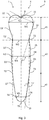
- Fig. 1 is a schematic view of an absorbent product 1 in accordance with the present invention, viewed from the above.
- the absorbent product 1 comprises a first covering layer in the form of a liquid-permeable top layer 2 (shown in Fig. 2 ) which is arranged on the side of the absorbent product 1 which, during use, is intended to face towards the wearer.
- the absorbent product 1 also comprises an absorbent core 3 comprising an absorbent material with absorbent characteristics and a superabsorbent material, arranged between the top layer 2 and a second covering layer in the form of liquid-impermeable bottom layer 4 (shown in Fig. 2 ).
- the liquid-impermeable bottom layer 4 is arranged on the side of the absorbent product 1 which, during use, is intended to face away from the wearer.
- the liquid-permeable top layer 2 is preferably manufactured from a material that exhibits characteristics such as dryness and softness during the time when the absorbent product 1 is being worn, because this top layer is in contact with the wearer's body. It is also desirable for the top layer to have a soft and textile-like surface which remains dry, even in the event of repeated wetting.
- the top layer can consist of a nonwoven material, for example, with a soft and smooth surface, such as a spunbond material made from polypropylene fibres. A perforated, hydrophobic nonwoven material may be used in order to permit the surface that is closest to the wearer's body to be kept dry, in conjunction with which openings are formed in the material that are larger than the holes between the fibres in the material.
- top layer can be joined together with the subjacent bottom layer and the absorbent core, for example by means of adhesive, ultrasonic jointing or by means of some form of thermal bonding.
- the nonwoven part of the top layer can also be a spunbond nonwoven material, an air-thru nonwoven material, a spunlace nonwoven (hydroentangled) material, a meltblown nonwoven material, or a combination of these.
- the raw material can be polypropylene (PP), polyethylene (PE) polyester (PET), polyamide (PA), or a combination of these.
- this can be a mixture of fibres from different polymers, although each fibre can also include different polymers (e.g. PP/PE bi-component fibres or PP/PE copolymers).
- the plastic film can consist of PE or PP, PET, PLA or amyl (or, for that matter, any other thermoplastic polymer), or a mixture or copolymers of the aforementioned polymers.
- the top layer is preferably a spunbond material comprising polypropylene fibres which provide for optimal comfort and handleability of the product.
- suitable fibres for making the nonwoven material are for example natural fibres such as bamboo, cotton and flax.
- the absorbent core 3 is appropriately manufactured from a suitable fibre material in the form of natural or synthetic fibres with absorbent characteristics, or a mixture or natural fibres and synthetic fibres or other absorbent materials of a previously disclosed kind that are suitable for use in, for example, sanitary towels, incontinence pads and panty liners.
- the absorbent core 3 can also comprise a predetermined proportion, for example 10-30%, of superabsorbent material, that is to say polymer materials in the form of particles, fibres, flakes or the like, which possess the ability to absorb and chemically bind liquid equivalent to several times their own weight to form an aqueous gel. This imparts a very high liquid-absorbent capacity to the finished absorbent product 1 while the product 1 is still soft and easy to handle and manufacture.
- the absorbent core 3 is preferably of a unitary construction.
- unitary construction in the present context is meant that the absorbent core 3 is constructed from essentially one type of material, this being essentially the same material, or essentially the same combination of two or more materials throughout the absorbent core 3. Variations in density and concentration of the material may occur, but these are limited to those which may be obtained without incorporation of regions which have been formed separately and then physically joined to each other.
- the absorbent core 3 comprises a matrix of an absorbent material with absorbent characteristics, e.g. hydrophilic fibres, and superabsorbent material
- the relative concentrations of superabsorbent material and fibres may be different in different parts of the core 3.
- the absorbent material could also be a hydrophobic material that has the capability to retain liquid within the structure of the material.
- the absorbent core 3 does not, for instance, comprise layers or laminates of different composition.
- variations in the density or concentration of various components across the longitudinal direction, the transverse direction or the thickness direction of the absorbent core 3 may occur, yet the core 3 should not comprise areas or layers of different composition which are formed separately and later joined together.
- the area of the product in which the core 3 is positioned is embossed with a pattern 200 that principally follows the design of the core 3.
- the embossing pattern comprises discrete circular points which are arranged in a pattern that follows the design of the core 3.
- Other designs are of course possible.
- the bottom layer 4 is preferably liquid-impermeable (or should at least possess high resistance to penetration by liquid) and is thus so arranged as to prevent any leakage of excreted fluid from the absorbent product 1.
- the bottom layer 4, on the other hand may be executed so that it is vapour-permeable.
- the bottom layer 4 may be manufactured from a liquid-impermeable material which consists appropriately of a thin and liquid-proof plastic film.
- plastic films of polyethylene, polypropylene or polyester can be used for this purpose.
- a laminate of nonwoven and plastic film or other suitable material layers can be used as a liquid-proof bottom layer 4.
- the underside of the bottom layer 4 can be provided with a sprayed adhesive coating (not illustrated), which can then be utilized for the attachment of the absorbent product 1 to an item of clothing.
- the absorbent product 1 of figure 1 has a first extension in a longitudinal direction and a second extension in a transverse direction.
- the absorbent product 1 has a longitudinal central line A extending through the absorbent product 1 and located between a first longitudinal portion I and a second longitudinal portion II of the absorbent product 1, which first and second longitudinal portions I; II are symmetrical about the longitudinal central line A.
- the absorbent product 1 has a head product portion b1, an intermediate product portion b2 and a rear product portion b3 extending in a longitudinal direction of the absorbent product 1.
- the absorbent product 1 has an outer contour 100 having a shape resembling an hourglass.
- the intermediate product portion b2 comprises an area with a smaller width than any area in the head product portion b1 and rear product portion b3, respectively.
- the absorbent core 3 extends in the longitudinal direction and transverse direction of the absorbent product 1 and has an outer contour 300 that is asymmetrical with the outer contour 100 of the absorbent product 1.
- the outer contour 300 is defined by the shape of core 3 which will be described in more detail below.
- the area between the outer contour 100 of the absorbent product 1 and the outer contour 300 of the absorbent core is defined as edge area 5.
- the edge area 5 comprises the top layer 2 and the bottom layer 4.
- the top layer 2 and the bottom layer 4 extend beyond the edges of the absorbent core 3 and are joined to each other to form the edge area 5. This efficiently encapsulates the core 3 and prevents fibres, superabsorbent particles or similar to leak from the core 3.
- the head product portion b1 of the absorbent product 1 comprises a foremost point T10 of the absorbent product 1 in the longitudinal direction at the point where the central line A of the absorbent product 1 crosses the outer contour 100 of the absorbent product 1.
- the outer contour 100 comprises first product circular segments 111, 111' extending from the foremost point T10 downward at an angle ⁇ 1 towards two opposing outermost points T11; T11'.
- the angle ⁇ 1 is defined as the angle between a transverse line perpendicular to the central line A and a tangent line of the first product circular segment portions 111; 111', where the tangent line is the tangent line at the transition point T10 of the respective first product circular segment portions 111; 111'.
- the angle ⁇ 1 may be for example 1-10° and preferably 2-7°.
- the head portion further comprises a first product width L1 extending between two opposing outermost points T11; T11' on the outer contour 100 of the absorbent product 1 in the transverse direction.
- the first product width L1 is the broadest in the absorbent product 1.
- a first core width M1 extends between two opposing outermost points T5; T5' of the outer contour 300 of the core 3 in the transverse direction, the first core width M1 being the broadest in the core. It is important that M1 has a sufficient width to ensure that the core is comfortable during use.
- the width should be sufficient to cover the labia and to not to glide in between the labia while the width should be small enough to not to extend outside the edges of the intended underwear. The width above has been found to fulfil these requirements.
- the head product portion b1 transitions to the intermediate product portion b2 at intermediate transition points T12; T12' of the absorbent product 1 and second transition points T2, T2' of the core 3.
- the core has a second core width M2 in transverse direction extending between the two opposing second transition points T2, T2' of the core.
- the second core width M2 is smaller than the first core width M1.
- the outer contour 100 of the absorbent product 1 is an asymmetrical hourglass-shaped contour, wherein the outer contour 100 of the absorbent product 1 comprises in the intermediate product portion b2 a first concave arch-shaped portion having a radius r1 which transitions to a second arch-shaped portion having a radius r2, wherein the radius r1 is smaller than the radius r2.
- the first product circular segments 111; 111' transition to the first concave arch-shaped portion at or slightly below the two opposing outermost points T11; T11'.
- the intermediate product portion b2 of the absorbent product 1 comprises a second product width L2 extending between two opposing points T14; T14' in the area of the absorbent product 1 having the smallest width.
- the second product width L2 is longitudinally distanced from the second core width M2.
- the intermediate product portion b2 further comprises a third core width M3 extending between two opposing outermost points T6; T6' of the intermediate core portion a2, the third core width M3 being broader than the second core width M2. It is important that M3 has a sufficient width to ensure that maximum amount of the discharge lands on the core and not outside the core during use while the width should be small enough to not to extend outside the edges of the intended underwear. In this way leakage problems can be avoided.
- the intermediate product portion b2 transitions to the rear product portion b3 at rear transition points T13, T13' of the absorbent product 1, and at third transition points T3, T3' of the core 3.
- the rear product portion b3 of the absorbent product 1 comprises a third product width L3, extending from two opposing points T15; T15', which is broader than the second product width L2.
- a rear core portion a3 tapers towards a rear end point T5 which is longitudinally distanced from the rear end point T20 of the absorbent product 1.
- a point on the outer contour 100 of the absorbent product 1 has the largest distance to the outer contour 300 of the core, which means that a perpendicular line that crosses a tangent of a point on the outer contour of the product and which perpendicular line crosses a point on the outer contour of the core has a largest distance in the rear portion of the product.
- the second concave arch-shaped portion transition to second product circular segments 113; 113' at or slightly above the two opposing points T15; T15'.
- the second product circular segments 113; 113' joins at rear end point T20 to close the outer contour 100.
- the core will be described in more detail below.
- the longitudinal extension of the head product portion b1 can be about 1/3 of the extension of the absorbent product 1 along the central line A
- the extension of the intermediate product portion b2 can be about 1/3 of the extension of the absorbent product 1 along the central line A
- the extension of the rear product portion b3 can be about 1/3 of the extension of the absorbent product 1 along the central line A.
- the longitudinal extension of the head product portion b1 along the central line A may be from 40 to 50 mm
- the extension of the intermediate product portion b2 may be about 45-60 mm of the extension of the absorbent product 1
- the extension of the rear product portion b3 may be about 40-50 mm of the extension of the absorbent product 1.
- the first product width L1 of the absorbent product 1 in the head product portion b1 is from 64-72 mm, preferably from 66 to 70 mm.
- the second product width L2 in the intermediate product portion b2 is from 42-50 mm, preferably from 44 to 48 mm.
- the third product width L3 in the rear product portion b3 of the absorbent product 1 is from 55 to 63 mm, preferably from 57 to 61 mm.
- the first and second portions I; II are designed and arranged such that they are symmetric in respect to each other about the longitudinal centre line A of the core. This is important so that the core lies symmetrically on the user's body when in use.
- symmetric about the longitudinal centre line A it is herein meant that each point in the first or second portions on one side of the longitudinal centre line A has a corresponding point in the opposing side of the longitudinal centre line A; the two points being related to each other by reflection in a plane located on the longitudinal centre line A.
- the first longitudinal portion located on one side of the longitudinal centre line A is therefore the mirror image of the second longitudinal portion located on the other side of the longitudinal centre line A.
- Fig. 2 schematically shows a cross section of the absorbent product along the line a-a in figure 1 .
- the cross section schematically shows the relationship between the thickness of the core 3 and the thickness of the edge area 5, not to scale.
- the thickness of the core 3 is taken in the centre of the core 3.
- the thickness of the edge area 5 is taken at a point between the outer contour 100 of the absorbent product 1 and the outer contour of core 3.
- the thickness of the core 3 and of the outer edge 5 is measured using a thickness gauge.
- the thickness gauge and the method for using the thickness gauge are described below.
- the gauge consists of: Mitutoyo gauge with a data output. Resolution 0.01 mm (0.001 mm). Accuracy ⁇ 0.02 mm ( ⁇ 0.002 mm).
- Speed reducing unit intended for adjustment of the lowering speed of the measurement foot. Normal setting 13 ⁇ 1 mm/s.
- Lever arm for adjustment of the load of the measurement plate is 0.5 kPa ⁇ 0.002 kPa
- Measurement foot with different shape and area depending on measurement object.
- Rollax device with 3 bearings, of which one is eccentric for adjustment of the axle.
- Oil container filled up to 1/3 with oil.
- Oil that does not exert influence on the gaskets e.g. ATF oil, Q8 auto 15.
- the thickness is determined by means of a measurement foot with a fixed load, which is lowered onto the sample at a given rate. The thickness is read off at the digital thickness gauge.
- the ratio of the thickness between the edge area 5 of the absorbent product 1 and the core is from 1:35 to 1:3. More specifically, the thickness of the core 3 is from 1.5 to 3.4 mm, preferably from 2.2 to 3.0 mm and the thickness of the edge area of the absorbent product 1 is 0.1 to 0.3 mm.
- FIG. 3 is a schematic view of an absorbent core 3 in accordance with the present invention, viewed from the above.
- a head core portion a1 comprises in the respective first and second longitudinal portions I; II mirror imaged first circular segment portions 11; 11' extending in a longitudinally forward direction of the core from a first transition point T1.
- a longitudinal forward direction of the core 3 is in the direction towards and over the head core portion a1.
- the first transition point T1 is located on the central line A in the intersection between the circular segment portions 11, 11'.
- the first circular segment portions 11; 11' extend in the forward direction over the transition point T1 and from the transition point T1 in an acute angle ⁇ .
- ⁇ is defined as the angle between the central line A and a tangent line of the circular segment portions 11; 11', where the tangent line is the tangent line at the transition point T1 of the respective circular segment portions 11; 11'.
- the angle ⁇ may be for 30-70°, preferably 40-60°, and most preferably 45°.
- the head core portion a1 further comprises in the first and second longitudinal portions I; II mirror imaged first edge lines 13; 13', to which the circular segment portions 11; 11' transition directly or indirectly via a smooth curved connection.
- the first edge lines 11; 11' are essentially straight or slightly arched.
- the core 3 has a first maximum width M1 in the head core portion a1 before transition of the circular segment portions 11; 11' to the first tapering edge lines 13; 13'.
- the first maximum width M1 is from 35-50 mm, preferably from 36 to 40 mm. It is important that M1 has a sufficient width to ensure that the core is comfortable during use.
- the width M1 should be sufficient to cover the labia, while the width should be small enough to not to extend outside the edges of the intended underwear.
- the width above has been found to fulfil these requirements.
- the circular segment portions 11; 11' can transition to the first tapering edge lines 13; 13' at the first maximum width M1 of head core portion a1 or below the first maximum width M1 of the head core portion a1. From the transition the first edge lines 13; 13' taper towards an intermediate core portion a2 and towards the central line A of the core in an angle ⁇ , ⁇ being from 15-45°.
- a larger angle than 45° leads to a broad head portion which may not completely fit within the crotch portion of the brief.
- a smaller angle than 15° leads to a narrow head core portion a1 which may not have enough absorption capacity or coverage to ensure that discharge of fluids does not reach the briefs as well as the comfort during use is impaired.
- the first edge lines 13; 13' taper to second transition points T2, T2' located between the head core portion a1 and the intermediate core portion a2.
- the distance between the second transition points T2; T2' is the width M2 of the core 3.
- M2 is from 20-34 mm, preferably from 24 to 28 mm.
- the intermediate core portion a2 comprises in the respective first and second longitudinal portions I; II mirror imaged first convex edge portions 15; 15' extending between the second transition points T2; T2' and third transition points T3; T3'.
- the third transition points T3; T3' are located between the intermediate core portion a2 and the rear core portion a3.
- the length of the convex edge portions 15; 15' in respect to the central line A is from 50-60% of the total length of the central line A of the core and have a maximum height h1; h1' of the arch in the transverse direction of the core of from 1-10 mm.
- the total length of the convex edges 15; 15' is thus determined by the distance D1; D1' between the second transition points T2; T2' and the third transition points T3; T3' in the direction along the central line A and the maximum height h1; h1'.
- the maximum height h1; h1' is measured from a longitudinally extending line coinciding with the distance D1; D1' to the highest point on the convex edges 15; 15'.
- the location of the maximum height h1; h1' coincides with the location of the second maximum width M3 of the intermediate core portion a2.
- the transition between the first edge lines 13; 13' and the first convex edge portions 15; 15' can be a continuous, smooth transition.
- the transition between the first edge lines 13; 13' and the first convex edge portions 15; 15' can alternatively be a dis-continuous transition, i.e. a transition in which the first edge lines 13; 13' and the first convex edge portions 15; 15' form a notch at the transition.
- the rear core portion a3 comprises second edge lines 17; 17' extending between the third transition points T3; T3' and fourth transition points T4; T4'.
- the second edge lines 17; 17' are essentially straight or slightly arched.
- the transition between the first convex edge portions 15; 15' and the second edge lines 17; 17' is preferably a continuous, smooth transition.
- the second edge lines 17; 17' taper towards a rear end T5 and the central line A of the core in an angle ⁇ .
- the angle ⁇ is defined as the angle between an extension of the distance D1 passing through transition point T3; T3' and a tangent line of the first convex edge portions 15; 15', where the tangent line is the tangent line at the transition point T3; T3' of the respective first convex edge portions 15; 15'.
- the angle may be for example 3-20°, preferably 5-15°, and most preferably 7-11°.
- the second edge lines 17; 17' taper to a fourth transition point T4, T4' from which the second edge lines 17; 17' transition to a rear end portion 19 that joins the edge lines 17; 17' together.
- the rear end portion 19 is semi-circular or has a shape of a circular segment.
- the end rear portion could have a straight line connecting the second edge lines 17; 17'.
- the transition between the second edge lines 17; 17' and the semi-circular or circular segment rear end portion 19 is preferably a continuous, smooth transition.
- the total length of the core 3 between the first transition point T1 and the rear end T5 of the core 3 is from 100 to 150 mm, preferably from 120 to 135 mm, and most preferably of from 126 to 131 mm.
- the absorbent core 3 also preferably has rounded edges for increased comfort.
Landscapes
- Health & Medical Sciences (AREA)
- Epidemiology (AREA)
- Engineering & Computer Science (AREA)
- Biomedical Technology (AREA)
- Heart & Thoracic Surgery (AREA)
- Vascular Medicine (AREA)
- Life Sciences & Earth Sciences (AREA)
- Animal Behavior & Ethology (AREA)
- General Health & Medical Sciences (AREA)
- Public Health (AREA)
- Veterinary Medicine (AREA)
- Dermatology (AREA)
- Absorbent Articles And Supports Therefor (AREA)
- Orthopedics, Nursing, And Contraception (AREA)
Claims (19)
- Saugfähiges Produkt (1), wie beispielsweise ein Slipeinlage, wobei das saugfähige Produkt (1) eine flüssigkeitsundurchlässige obere Schicht, eine flüssigkeitsundurchlässige untere Schicht und einen zwischen der oberen Schicht und der unteren Schicht angeordneten saugfähigen Kern (3), wobei der saugfähige Kern ein saugfähiges Material mit saugfähigen Eigenschaften und ein supersaugfähiges Material umfasst, wobei das saugfähige Produkt (1) eine erste Verlängerung in einer Längsrichtung und eine zweite Verlängerung in einer Querrichtung aufweist, und das saugfähige Produkt (1) eine längslaufende Mittellinie (A) aufweist, die sich durch das saugfähige Produkt (1) erstreckt und sich zwischen einem ersten Längsabschnitt (I) und einem zweiten Längsabschnitt (II) des saugfähigen Produkts (1) befindet, wobei der erste und zweite Längsabschnitt (I; II) um die längslaufende Mittellinie (A) symmetrisch sind, und wobei das saugfähige Produkt (1) einen Kopfproduktabschnitt (b1), einen Zwischenproduktabschnitt (b2) und einen hinteren Produktabschnitt (b3) aufweist, sich in einer Längsrichtung des saugfähigen Produkts (1) erstreckend, und wobei das saugfähige Produkt (1) eine Außenkontur (100) aufweist, welche eine einem Stundenglas ähnelnde Form aufweist, wobei der Zwischenproduktabschnitt (b2) einen Bereich mit einer kleineren Breite als irgendeinen Bereich in dem Kopfproduktabschnitt (b1) bzw. dem hinteren Produktabschnitt (b3) umfasst, und wobei sich der Kern (3) in der Längsrichtung und Querrichtung des saugfähigen Produkts (1) erstreckt und eine zur Außenkontur (100) des saugfähigen Produkts (1) asymmetrische Außenkontur (300) aufweist; dadurch gekennzeichnet, dass- der Kopfproduktabschnitt (b1) des saugfähigen Produkts (1) umfasst:- einen vordersten Punkt (T10) des saugfähigen Produkts (1) in der Längsrichtung an dem Punkt, an dem die Mittellinie (A) des saugfähigen Produkts (1) die Außenkontur (100) des saugfähigen Produkts (1) durchkreuzt;- eine erste Produktbreite (L1), die sich zwischen zwei gegenüberliegenden vordersten Punkten (T11; T11') an der Außenkontur (100) des saugfähigen Produkts (1) in der Querrichtung erstreckt, wobei die erste Produktbreite (L1) die breiteste in dem saugfähigen Produkt (1) ist;- eine erste Kernbreite (M1), die sich zwischen zwei gegenüberliegenden äußersten Punkten (T5; T5') der Außenkontur (300) des Kerns (3) in der Querrichtung erstreckt, wobei die erste Kernbreite (M1) die breiteste im Kern ist, wobeider Kopfproduktabschnitt (b1) in den Zwischenproduktabschnitt (b2) an zwischenliegenden Übergangspunkten (T12; T12') des saugfähigen Produkts (1) und zweiten Übergangspunkten (T2, T2') des Kerns (3) übergeht, wobei der Kern eine zweite Kernbreite (M2) in Querrichtung aufweist, die sich zwischen zwei gegenüberliegenden Übergangspunkten (T2, T2') des Kerns erstreckt, wobei die zweite Breite (M2) kleiner als die erste Kernbreite (M1) ist, und wobei- der Zwischenproduktabschnitt (b2) des saugfähigen Produkts (1) umfasst:- eine zweite Produktbreite (L2), die sich zwischen zwei gegenüberliegenden Punkten (T14; T14') in dem Bereich des saugfähigen Produkts (1) mit der kleinsten Breite erstreckt, wobei die zweite Produktbreite (L2) von der zweiten Kernbreite (M2) in Längsrichtung beabstandet ist;- eine dritte Kernbreite (M3), die sich zwischen zwei gegenüberliegenden äußersten Punkten (T6; T6') des Zwischenkernabschnitts (a2) erstreckt, wobei die dritte Kernbreite (M3) breiter als die zweite Kernbreite (M2) ist; wobeider Zwischenproduktabschnitt (b2) in den hinteren Produktabschnitt (b3) an hinteren Übergangspunkten (T13, T13') des saugfähigen Produkts (1) und dritten Übergangspunkten (T3, T3') des Kerns übergeht, und wobei- der hintere Produktabschnitt (b3) des saugfähigen Produkts (1) umfasst:- eine dritte Produktbreite (L3), die breiter als die zweite Produktbreite (L2) ist,- einen hinteren Kernabschnitt (a3), der sich in Richtung auf einen hinteren Endpunkt (T5) verjüngt, der vom hinteren Endpunkt (T20) des saugfähigen Produkts (1) in Längsrichtung beabstandet ist, und wobei- ein Punkt an der Außenkontur (100) des saugfähigen Produkts (1), das den größten Abstand zur Außenkontur (300) des Kerns aufweist.
- Saugfähiges Produkt (1) nach Anspruch 1, dadurch gekennzeichnet, dass das Verhältnis der Dicke zwischen dem Randbereich (5) des saugfähigen Produkts (1) und des Kerns von 1:35 bis 1:3 beträgt.
- Saugfähiges Produkt (1) nach Anspruch 2, dadurch gekennzeichnet, dass die Dicke des Kerns (3) von 1,5 bis 3,4 mm, bevorzugt von 2,2 bis 3,0 mm beträgt, und die Dicke des Randbereichs des saugfähigen Produkts (1) 0,1 bis 0,3 mm beträgt.
- Saugfähiges Produkt (1) nach einem der vorgehenden Ansprüche, dadurch gekennzeichnet, dass die Außenkontur des saugfähigen Produkts (1) eine asymmetrische stundenglasförmige Kontur ist, wobei die Außenkontur (100) des saugfähigen Produkts (1) in dem Zwischenproduktabschnitt (b2) einen ersten konkaven bogenförmigen Abschnitt umfasst, welcher einen Radius (r1) aufweist, der in einen, einen Radius (r2) aufweisenden, zweiten bogenförmigen Abschnitt übergeht, wobei der Radius (r1) kleiner als der Radius (r2) ist.
- Saugfähiges Produkt (1) nach einem der vorgehenden Ansprüche, dadurch gekennzeichnet, dass die obere Schicht ein Vliesmaterial umfasst, das ein Polypropylenfasern umfassendes Spinnvliesmaterial ist.
- Saugfähiges Produkt (1) nach einem der vorgehenden Ansprüche, dadurch gekennzeichnet, dass der Kopfkernabschnitt (a1) in dem jeweiligen ersten und zweiten längslaufenden Abschnitt (I; II) umfasst:a. spiegelbildliche erste kreisförmige Segmentabschnitte (11; 11'), die sich in einer längslaufenden Vorwärtsrichtung des Kerns von einem ersten Übergangspunkt (T1), der sich auf der Mittellinie (A) zwischen den kreisförmigen Segmentabschnitten (11, 11') befindet, in einem spitzen Winkel β zwischen der Mittellinie (A) und einer Tangente an einem Punkt des Übergangspunkts (T1) in Bezug auf den kreisförmigen Segmentabschnitt (11; 11') erstreckt,b. erste Randlinien (13; 13'), in die die kreisförmigen Segmentabschnitte (11, 11') übergehen, sich in Richtung auf den Zwischenkernabschnitt (a2) und in Richtung auf die Mittellinie (A) des Kerns (3) in einem Winkel α verjüngend, welcher von 15-45° beträgt, und wobei die ersten Randlinien (13; 13') sich zu einem zweiten Übergangspunkt (T2, T2') hin verjüngen, der sich zwischen dem Kopfkernabschnitt (a1) und dem Zwischenkernabschnitt (a2) befindet.
- Saugfähiges Produkt (1) nach einem der vorgehenden Ansprüche, dadurch gekennzeichnet, dass der Zwischenkernabschnitt (a2) in dem jeweiligen ersten und zweiten Längsabschnitt (I; II) spiegelbildliche erste konvexe Randabschnitte (15; 15') umfasst, welche sich zwischen den zweiten Übergangspunkten (T2, T2') und dritten Übergangspunkten (T3; T3') erstrecken, wobei die dritten Übergangspunkte (T3; T3') sich zwischen dem Zwischenkernabschnitt (a2) und dem hinteren Kernabschnitt (a3) befinden, wobei die konvexen Randabschnitte (15; 15') eine Länge von 50-60 % der Gesamtlänge der Mittellinie (A) aufweisen und eine Maximalhöhe (h1; h1') des Bogens in der Querrichtung des Kerns von 1-10 mm aufweisen.
- Saugfähiges Produkt (1) nach einem der vorgehenden Ansprüche, dadurch gekennzeichnet, dass der hintere Kernabschnitt (a3) zweite Randlinien (17; 17') umfasst, die sich in Richtung auf einen hinteren Endpunkt (T5) und die Mittellinie (A) des Kerns in einem Winkel (γ) verjüngen, der von 3-15° beträgt, und wobei sich die zweiten Randlinien (17; 17') in Richtung auf einen vierten Übergangspunkt (T4, T4') verjüngen, von dem die zweiten Randlinien (17; 17') in einen, die Randlinien (17; 17') miteinander verbindenden, hinteren Endabschnitt (19) des halbkreisförmigen oder kreisförmigen Segments übergehen.
- Saugfähiges Produkt (1) nach einem der vorgehenden Ansprüche, dadurch gekennzeichnet, dass die Gesamtlänge des saugfähigen Produkts (1) zwischen dem vorderen Endpunkt (T10) und dem hinteren Endpunkt (T20) des saugfähigen Produkts (1) von 130 bis 175 mm, bevorzugt von 140 bis 160 mm, und am meisten bevorzugt 150 mm, beträgt.
- Saugfähiges Produkt (1) nach einem der vorgehenden Ansprüche, dadurch gekennzeichnet, dass die längslaufende Verlängerung des Kopfproduktabschnitts (b1) etwa 1/3 der Verlängerung des saugfähigen Produkts (1) entlang der Mittellinie (A) beträgt, die Verlängerung des Zwischenproduktabschnitts (b2) etwa 1/3 der Verlängerung des saugfähigen Produkts (1) entlang der Mittellinie (A) beträgt, und die Verlängerung des hinteren Produktabschnitts (b3) etwa 1/3 der Verlängerung des saugfähigen Produkts (1) entlang der Mittellinie (A) beträgt.
- Saugfähiges Produkt (1) nach einem der vorgehenden Ansprüche 1 bis 9, dadurch gekennzeichnet, dass die längslaufende Verlängerung des Kopfproduktabschnitts (b1) entlang der Mittellinie (A) von 40 bis 50 mm beträgt, die Verlängerung des Zwischenproduktabschnitts (b2) etwa 45-60 mm der Verlängerung des saugfähigen Produkts (1) beträgt, und die Verlängerung des hinteren Produktabschnitts (b3) etwa 40-50 mm der Verlängerung des saugfähigen Produkts (1) beträgt.
- Saugfähiges Produkt (1) nach einem der vorgehenden Ansprüche, dadurch gekennzeichnet, dass die erste Produktbreite (L1) des saugfähigen Produkts (1) in dem Kopfproduktabschnitt (b1) von 64-72 mm, bevorzugt von 66 bis 70 mm beträgt.
- Saugfähiges Produkt (1) nach einem der vorgehenden Ansprüche, dadurch gekennzeichnet, dass die zweite Produktbreite (L2) in dem Zwischenproduktabschnitt (b2) von 42-50 mm, bevorzugt von 44 bis 48 mm beträgt.
- Saugfähiges Produkt (1) nach einem der vorgehenden Ansprüche, dadurch gekennzeichnet, dass die dritte Produktbreite (L3) in dem hinteren Produktabschnitt (b3) des saugfähigen Produkts (1) von 55 bis 63 mm, bevorzugt von 57 bis 61 mm beträgt.
- Saugfähiges Produkt (1) nach einem der vorgehenden Ansprüche, dadurch gekennzeichnet, dass die Menge des supersaugfähigen Materials in dem Kern (1) von 10 bis 30 Gew.-% des Gesamtgewichts des saugfähigen Kerns, bevorzugt von 15 bis 20 Gew.-%, beträgt.
- Saugfähiges Produkt (1) nach einem der vorgehenden Ansprüche, dadurch gekennzeichnet, dass die Dichte des Kerns von etwa 100 bis 180 kg/m3, bevorzugt von 120 bis 145 kg/m3 beträgt.
- Saugfähiges Produkt (1) nach einem der vorgehenden Ansprüche, dadurch gekennzeichnet, dass der Kern Zelluloseflockenzellstoff, Gewebe, saugfähige Schaummaterialien oder saugfähige Vliesmaterialien als das saugfähige Material umfasst.
- Saugfähiges Produkt (1) nach einem der vorgehenden Ansprüche, dadurch gekennzeichnet, dass der Bereich des saugfähigen Produkts (1), in welchem der Kern (3) untergebracht ist, mit einem im Wesentlichen der Gestalt des Kerns (3) folgenden Muster geprägt ist.
- Saugfähiges Produkt (1) nach einem der vorgehenden Ansprüche, dadurch gekennzeichnet, dass die untere Schicht eine aufgesprühte Klebebeschichtung auf der Seite umfasst, die der körperzugewandten Seite des saugfähigen Produkts (1) abgewandt ist, an dem ein Trennpapier befestigt ist.
Applications Claiming Priority (1)
| Application Number | Priority Date | Filing Date | Title |
|---|---|---|---|
| PCT/SE2014/050589 WO2015174896A1 (en) | 2014-05-15 | 2014-05-15 | Absorbent product |
Publications (3)
| Publication Number | Publication Date |
|---|---|
| EP3142618A1 EP3142618A1 (de) | 2017-03-22 |
| EP3142618A4 EP3142618A4 (de) | 2017-11-01 |
| EP3142618B1 true EP3142618B1 (de) | 2018-10-17 |
Family
ID=54480305
Family Applications (1)
| Application Number | Title | Priority Date | Filing Date |
|---|---|---|---|
| EP14891809.7A Active EP3142618B1 (de) | 2014-05-15 | 2014-05-15 | Saugfähiges produkt |
Country Status (12)
| Country | Link |
|---|---|
| US (1) | US9889049B2 (de) |
| EP (1) | EP3142618B1 (de) |
| JP (1) | JP6324542B2 (de) |
| CN (1) | CN106456397B (de) |
| AU (1) | AU2014394158B2 (de) |
| BR (1) | BR112016026078B1 (de) |
| ES (1) | ES2705273T3 (de) |
| MX (1) | MX357849B (de) |
| RU (1) | RU2644100C1 (de) |
| TN (1) | TN2016000486A1 (de) |
| WO (1) | WO2015174896A1 (de) |
| ZA (1) | ZA201607396B (de) |
Families Citing this family (7)
| Publication number | Priority date | Publication date | Assignee | Title |
|---|---|---|---|---|
| CN106456398B (zh) | 2014-05-15 | 2019-08-20 | 易希提卫生与保健公司 | 吸收芯 |
| EP3697360A1 (de) * | 2017-10-20 | 2020-08-26 | The Procter and Gamble Company | Saugfähige einwegartikel |
| US20190133839A1 (en) * | 2017-11-03 | 2019-05-09 | Alesha Puckett | Protective Shield Blocker |
| HUE069180T2 (hu) * | 2018-09-26 | 2025-02-28 | Procter & Gamble | Adaptálható nedvszívó termék |
| MX2021006641A (es) | 2018-12-07 | 2021-07-15 | Essity Hygiene & Health Ab | Almohadilla para incontinencia con perfil de grosor variante. |
| PL3890670T3 (pl) | 2018-12-07 | 2023-10-16 | Essity Hygiene And Health Aktiebolag | Wkładki inkontynencyjne ze zmiennym profilem grubości |
| US20210393452A1 (en) * | 2020-06-23 | 2021-12-23 | Katrina Marie Arceo-Yap | Feminine pad with large petal design |
Family Cites Families (19)
| Publication number | Priority date | Publication date | Assignee | Title |
|---|---|---|---|---|
| US2408508A (en) | 1942-12-01 | 1946-10-01 | John P Canavan | Nonchafing catamenial pad |
| US4627848A (en) * | 1984-04-23 | 1986-12-09 | Kimberly-Clark Corporation | Anatomical pad |
| SE507964C2 (sv) * | 1993-10-07 | 1998-08-03 | Moelnlycke Ab | Dambinda eller liknande absorberande artikel |
| PH31502A (en) | 1994-03-02 | 1998-11-03 | Mcneil Ppc Inc | Methods and apparaus for making multi-layer absorbent products. |
| US5683373A (en) | 1996-04-22 | 1997-11-04 | Darby; Kamela J. | Sanitary napkin shaped for use with a thong garment |
| SE513198C2 (sv) | 1996-11-15 | 2000-07-31 | Sca Hygiene Prod Ab | Absorberande alster med hög styvhet |
| DE19713189A1 (de) * | 1997-03-27 | 1998-10-01 | Kimberly Clark Gmbh | Absorbierender Artikel |
| SE9704231L (sv) * | 1997-11-19 | 1999-05-20 | Sca Hygiene Prod Ab | Absorberande alster såsom en dambinda, ett inkontinensskydd, ett trosskydd, eller liknande |
| DE29915071U1 (de) | 1999-08-27 | 2000-01-13 | Seiffert, Annett, 63505 Langenselbold | Damenhygieneeinlage |
| SE9904198L (sv) * | 1999-11-18 | 2001-05-19 | Sca Hygiene Prod Ab | Absorberande alster |
| ES2230013T5 (es) * | 2000-03-29 | 2008-12-01 | Mcneil-Ppc, Inc. | Protector de braga con alas para tanga. |
| US6632210B1 (en) * | 2000-12-22 | 2003-10-14 | Neil-Ppc, Inc. | Sanitary napkin with intergluteal strip |
| US20020177832A1 (en) * | 2001-05-23 | 2002-11-28 | Elena Fernandez-Kleinlein | Adaptable absorbent articles |
| CN2612365Y (zh) * | 2002-10-29 | 2004-04-21 | 福建恒安集团有限公司 | 多功能吸收垫 |
| CN101203201B (zh) | 2005-07-13 | 2011-06-08 | Sca卫生产品股份公司 | 具有改进贴合性的吸收制品 |
| EP1959892B1 (de) | 2005-12-15 | 2012-02-08 | SCA Hygiene Products AB | Saugfähiger artikel |
| EP1994917B1 (de) * | 2007-05-25 | 2011-06-22 | The Procter & Gamble Company | Artikel für die weibliche Hygiene mit gedrucktem Muster und geprägtem Muster |
| WO2010077306A1 (en) | 2008-12-17 | 2010-07-08 | Carlozzi Antonella F | Feminine undergarment |
| CN106456398B (zh) | 2014-05-15 | 2019-08-20 | 易希提卫生与保健公司 | 吸收芯 |
-
2014
- 2014-05-15 WO PCT/SE2014/050589 patent/WO2015174896A1/en not_active Ceased
- 2014-05-15 MX MX2016014611A patent/MX357849B/es active IP Right Grant
- 2014-05-15 CN CN201480078648.9A patent/CN106456397B/zh active Active
- 2014-05-15 US US15/308,849 patent/US9889049B2/en active Active
- 2014-05-15 TN TN2016000486A patent/TN2016000486A1/en unknown
- 2014-05-15 AU AU2014394158A patent/AU2014394158B2/en active Active
- 2014-05-15 BR BR112016026078-3A patent/BR112016026078B1/pt active IP Right Grant
- 2014-05-15 ES ES14891809T patent/ES2705273T3/es active Active
- 2014-05-15 RU RU2016147942A patent/RU2644100C1/ru active
- 2014-05-15 JP JP2016567037A patent/JP6324542B2/ja active Active
- 2014-05-15 EP EP14891809.7A patent/EP3142618B1/de active Active
-
2016
- 2016-10-26 ZA ZA2016/07396A patent/ZA201607396B/en unknown
Non-Patent Citations (1)
| Title |
|---|
| None * |
Also Published As
| Publication number | Publication date |
|---|---|
| BR112016026078A2 (pt) | 2017-08-15 |
| BR112016026078A8 (pt) | 2021-05-18 |
| JP2017515571A (ja) | 2017-06-15 |
| MX357849B (es) | 2018-07-26 |
| EP3142618A4 (de) | 2017-11-01 |
| JP6324542B2 (ja) | 2018-05-16 |
| AU2014394158A1 (en) | 2016-11-17 |
| RU2644100C1 (ru) | 2018-02-07 |
| ES2705273T3 (es) | 2019-03-22 |
| US20170071799A1 (en) | 2017-03-16 |
| BR112016026078B1 (pt) | 2021-12-21 |
| ZA201607396B (en) | 2018-05-30 |
| EP3142618A1 (de) | 2017-03-22 |
| AU2014394158B2 (en) | 2017-02-02 |
| MX2016014611A (es) | 2017-03-06 |
| CN106456397B (zh) | 2019-06-04 |
| CN106456397A (zh) | 2017-02-22 |
| TN2016000486A1 (en) | 2018-04-04 |
| WO2015174896A1 (en) | 2015-11-19 |
| US9889049B2 (en) | 2018-02-13 |
Similar Documents
| Publication | Publication Date | Title |
|---|---|---|
| EP3142618B1 (de) | Saugfähiges produkt | |
| EP3573588B1 (de) | Einweghygieneartikel | |
| US10159608B2 (en) | Absorbent article with an absorbent layer having an opening extending therethrough | |
| US8029487B2 (en) | Absorbent article with improved fit and leakage security | |
| EP1901692B1 (de) | Saugfähiger artikel mit verbesserter passform | |
| JP5551926B2 (ja) | 吸収性物品 | |
| CN1229087C (zh) | 复合卫生巾 | |
| AU2014394157B2 (en) | Absorbent core | |
| CN1301529A (zh) | 复合卫生巾 | |
| CN1297725A (zh) | 锥形复合卫生巾 | |
| US9931253B2 (en) | Contoured absorbent pad | |
| EP3923893B1 (de) | Hygieneartikel | |
| EP2858616B1 (de) | Absorbierender artikel | |
| BR112019015182B1 (pt) | Artigo de higiene descartável e método para a fabricação de um artigo descartável |
Legal Events
| Date | Code | Title | Description |
|---|---|---|---|
| STAA | Information on the status of an ep patent application or granted ep patent |
Free format text: STATUS: THE INTERNATIONAL PUBLICATION HAS BEEN MADE |
|
| PUAI | Public reference made under article 153(3) epc to a published international application that has entered the european phase |
Free format text: ORIGINAL CODE: 0009012 |
|
| STAA | Information on the status of an ep patent application or granted ep patent |
Free format text: STATUS: REQUEST FOR EXAMINATION WAS MADE |
|
| 17P | Request for examination filed |
Effective date: 20161107 |
|
| AK | Designated contracting states |
Kind code of ref document: A1 Designated state(s): AL AT BE BG CH CY CZ DE DK EE ES FI FR GB GR HR HU IE IS IT LI LT LU LV MC MK MT NL NO PL PT RO RS SE SI SK SM TR |
|
| AX | Request for extension of the european patent |
Extension state: BA ME |
|
| DAX | Request for extension of the european patent (deleted) | ||
| A4 | Supplementary search report drawn up and despatched |
Effective date: 20171004 |
|
| RIC1 | Information provided on ipc code assigned before grant |
Ipc: A61F 13/531 20060101ALI20170927BHEP Ipc: A61F 13/472 20060101ALI20170927BHEP Ipc: A61F 13/45 20060101AFI20170927BHEP |
|
| GRAP | Despatch of communication of intention to grant a patent |
Free format text: ORIGINAL CODE: EPIDOSNIGR1 |
|
| STAA | Information on the status of an ep patent application or granted ep patent |
Free format text: STATUS: GRANT OF PATENT IS INTENDED |
|
| INTG | Intention to grant announced |
Effective date: 20180518 |
|
| RAP1 | Party data changed (applicant data changed or rights of an application transferred) |
Owner name: ESSITY HYGIENE AND HEALTH AB |
|
| RAP1 | Party data changed (applicant data changed or rights of an application transferred) |
Owner name: ESSITY HYGIENE AND HEALTH AKTIEBOLAG |
|
| GRAS | Grant fee paid |
Free format text: ORIGINAL CODE: EPIDOSNIGR3 |
|
| GRAA | (expected) grant |
Free format text: ORIGINAL CODE: 0009210 |
|
| STAA | Information on the status of an ep patent application or granted ep patent |
Free format text: STATUS: THE PATENT HAS BEEN GRANTED |
|
| AK | Designated contracting states |
Kind code of ref document: B1 Designated state(s): AL AT BE BG CH CY CZ DE DK EE ES FI FR GB GR HR HU IE IS IT LI LT LU LV MC MK MT NL NO PL PT RO RS SE SI SK SM TR |
|
| REG | Reference to a national code |
Ref country code: GB Ref legal event code: FG4D |
|
| REG | Reference to a national code |
Ref country code: CH Ref legal event code: EP |
|
| REG | Reference to a national code |
Ref country code: IE Ref legal event code: FG4D |
|
| REG | Reference to a national code |
Ref country code: DE Ref legal event code: R096 Ref document number: 602014034466 Country of ref document: DE Ref country code: AT Ref legal event code: REF Ref document number: 1053116 Country of ref document: AT Kind code of ref document: T Effective date: 20181115 |
|
| REG | Reference to a national code |
Ref country code: NL Ref legal event code: MP Effective date: 20181017 |
|
| REG | Reference to a national code |
Ref country code: LT Ref legal event code: MG4D |
|
| REG | Reference to a national code |
Ref country code: AT Ref legal event code: MK05 Ref document number: 1053116 Country of ref document: AT Kind code of ref document: T Effective date: 20181017 |
|
| REG | Reference to a national code |
Ref country code: ES Ref legal event code: FG2A Ref document number: 2705273 Country of ref document: ES Kind code of ref document: T3 Effective date: 20190322 |
|
| PG25 | Lapsed in a contracting state [announced via postgrant information from national office to epo] |
Ref country code: NL Free format text: LAPSE BECAUSE OF FAILURE TO SUBMIT A TRANSLATION OF THE DESCRIPTION OR TO PAY THE FEE WITHIN THE PRESCRIBED TIME-LIMIT Effective date: 20181017 |
|
| PG25 | Lapsed in a contracting state [announced via postgrant information from national office to epo] |
Ref country code: FI Free format text: LAPSE BECAUSE OF FAILURE TO SUBMIT A TRANSLATION OF THE DESCRIPTION OR TO PAY THE FEE WITHIN THE PRESCRIBED TIME-LIMIT Effective date: 20181017 Ref country code: PL Free format text: LAPSE BECAUSE OF FAILURE TO SUBMIT A TRANSLATION OF THE DESCRIPTION OR TO PAY THE FEE WITHIN THE PRESCRIBED TIME-LIMIT Effective date: 20181017 Ref country code: LT Free format text: LAPSE BECAUSE OF FAILURE TO SUBMIT A TRANSLATION OF THE DESCRIPTION OR TO PAY THE FEE WITHIN THE PRESCRIBED TIME-LIMIT Effective date: 20181017 Ref country code: NO Free format text: LAPSE BECAUSE OF FAILURE TO SUBMIT A TRANSLATION OF THE DESCRIPTION OR TO PAY THE FEE WITHIN THE PRESCRIBED TIME-LIMIT Effective date: 20190117 Ref country code: HR Free format text: LAPSE BECAUSE OF FAILURE TO SUBMIT A TRANSLATION OF THE DESCRIPTION OR TO PAY THE FEE WITHIN THE PRESCRIBED TIME-LIMIT Effective date: 20181017 Ref country code: AT Free format text: LAPSE BECAUSE OF FAILURE TO SUBMIT A TRANSLATION OF THE DESCRIPTION OR TO PAY THE FEE WITHIN THE PRESCRIBED TIME-LIMIT Effective date: 20181017 Ref country code: LV Free format text: LAPSE BECAUSE OF FAILURE TO SUBMIT A TRANSLATION OF THE DESCRIPTION OR TO PAY THE FEE WITHIN THE PRESCRIBED TIME-LIMIT Effective date: 20181017 Ref country code: IS Free format text: LAPSE BECAUSE OF FAILURE TO SUBMIT A TRANSLATION OF THE DESCRIPTION OR TO PAY THE FEE WITHIN THE PRESCRIBED TIME-LIMIT Effective date: 20190217 Ref country code: BG Free format text: LAPSE BECAUSE OF FAILURE TO SUBMIT A TRANSLATION OF THE DESCRIPTION OR TO PAY THE FEE WITHIN THE PRESCRIBED TIME-LIMIT Effective date: 20190117 |
|
| PG25 | Lapsed in a contracting state [announced via postgrant information from national office to epo] |
Ref country code: AL Free format text: LAPSE BECAUSE OF FAILURE TO SUBMIT A TRANSLATION OF THE DESCRIPTION OR TO PAY THE FEE WITHIN THE PRESCRIBED TIME-LIMIT Effective date: 20181017 Ref country code: SE Free format text: LAPSE BECAUSE OF FAILURE TO SUBMIT A TRANSLATION OF THE DESCRIPTION OR TO PAY THE FEE WITHIN THE PRESCRIBED TIME-LIMIT Effective date: 20181017 Ref country code: PT Free format text: LAPSE BECAUSE OF FAILURE TO SUBMIT A TRANSLATION OF THE DESCRIPTION OR TO PAY THE FEE WITHIN THE PRESCRIBED TIME-LIMIT Effective date: 20190217 Ref country code: GR Free format text: LAPSE BECAUSE OF FAILURE TO SUBMIT A TRANSLATION OF THE DESCRIPTION OR TO PAY THE FEE WITHIN THE PRESCRIBED TIME-LIMIT Effective date: 20190118 Ref country code: RS Free format text: LAPSE BECAUSE OF FAILURE TO SUBMIT A TRANSLATION OF THE DESCRIPTION OR TO PAY THE FEE WITHIN THE PRESCRIBED TIME-LIMIT Effective date: 20181017 |
|
| REG | Reference to a national code |
Ref country code: DE Ref legal event code: R097 Ref document number: 602014034466 Country of ref document: DE |
|
| PG25 | Lapsed in a contracting state [announced via postgrant information from national office to epo] |
Ref country code: CZ Free format text: LAPSE BECAUSE OF FAILURE TO SUBMIT A TRANSLATION OF THE DESCRIPTION OR TO PAY THE FEE WITHIN THE PRESCRIBED TIME-LIMIT Effective date: 20181017 Ref country code: DK Free format text: LAPSE BECAUSE OF FAILURE TO SUBMIT A TRANSLATION OF THE DESCRIPTION OR TO PAY THE FEE WITHIN THE PRESCRIBED TIME-LIMIT Effective date: 20181017 |
|
| PLBE | No opposition filed within time limit |
Free format text: ORIGINAL CODE: 0009261 |
|
| STAA | Information on the status of an ep patent application or granted ep patent |
Free format text: STATUS: NO OPPOSITION FILED WITHIN TIME LIMIT |
|
| PG25 | Lapsed in a contracting state [announced via postgrant information from national office to epo] |
Ref country code: SM Free format text: LAPSE BECAUSE OF FAILURE TO SUBMIT A TRANSLATION OF THE DESCRIPTION OR TO PAY THE FEE WITHIN THE PRESCRIBED TIME-LIMIT Effective date: 20181017 Ref country code: EE Free format text: LAPSE BECAUSE OF FAILURE TO SUBMIT A TRANSLATION OF THE DESCRIPTION OR TO PAY THE FEE WITHIN THE PRESCRIBED TIME-LIMIT Effective date: 20181017 Ref country code: SK Free format text: LAPSE BECAUSE OF FAILURE TO SUBMIT A TRANSLATION OF THE DESCRIPTION OR TO PAY THE FEE WITHIN THE PRESCRIBED TIME-LIMIT Effective date: 20181017 Ref country code: RO Free format text: LAPSE BECAUSE OF FAILURE TO SUBMIT A TRANSLATION OF THE DESCRIPTION OR TO PAY THE FEE WITHIN THE PRESCRIBED TIME-LIMIT Effective date: 20181017 |
|
| 26N | No opposition filed |
Effective date: 20190718 |
|
| PG25 | Lapsed in a contracting state [announced via postgrant information from national office to epo] |
Ref country code: SI Free format text: LAPSE BECAUSE OF FAILURE TO SUBMIT A TRANSLATION OF THE DESCRIPTION OR TO PAY THE FEE WITHIN THE PRESCRIBED TIME-LIMIT Effective date: 20181017 |
|
| REG | Reference to a national code |
Ref country code: CH Ref legal event code: PL |
|
| PG25 | Lapsed in a contracting state [announced via postgrant information from national office to epo] |
Ref country code: LI Free format text: LAPSE BECAUSE OF NON-PAYMENT OF DUE FEES Effective date: 20190531 Ref country code: CH Free format text: LAPSE BECAUSE OF NON-PAYMENT OF DUE FEES Effective date: 20190531 Ref country code: MC Free format text: LAPSE BECAUSE OF FAILURE TO SUBMIT A TRANSLATION OF THE DESCRIPTION OR TO PAY THE FEE WITHIN THE PRESCRIBED TIME-LIMIT Effective date: 20181017 |
|
| REG | Reference to a national code |
Ref country code: BE Ref legal event code: MM Effective date: 20190531 |
|
| PG25 | Lapsed in a contracting state [announced via postgrant information from national office to epo] |
Ref country code: LU Free format text: LAPSE BECAUSE OF NON-PAYMENT OF DUE FEES Effective date: 20190515 |
|
| PG25 | Lapsed in a contracting state [announced via postgrant information from national office to epo] |
Ref country code: TR Free format text: LAPSE BECAUSE OF FAILURE TO SUBMIT A TRANSLATION OF THE DESCRIPTION OR TO PAY THE FEE WITHIN THE PRESCRIBED TIME-LIMIT Effective date: 20181017 |
|
| PG25 | Lapsed in a contracting state [announced via postgrant information from national office to epo] |
Ref country code: IE Free format text: LAPSE BECAUSE OF NON-PAYMENT OF DUE FEES Effective date: 20190515 |
|
| REG | Reference to a national code |
Ref country code: DE Ref legal event code: R082 Ref document number: 602014034466 Country of ref document: DE |
|
| PG25 | Lapsed in a contracting state [announced via postgrant information from national office to epo] |
Ref country code: BE Free format text: LAPSE BECAUSE OF NON-PAYMENT OF DUE FEES Effective date: 20190531 |
|
| PG25 | Lapsed in a contracting state [announced via postgrant information from national office to epo] |
Ref country code: CY Free format text: LAPSE BECAUSE OF FAILURE TO SUBMIT A TRANSLATION OF THE DESCRIPTION OR TO PAY THE FEE WITHIN THE PRESCRIBED TIME-LIMIT Effective date: 20181017 |
|
| PG25 | Lapsed in a contracting state [announced via postgrant information from national office to epo] |
Ref country code: MT Free format text: LAPSE BECAUSE OF FAILURE TO SUBMIT A TRANSLATION OF THE DESCRIPTION OR TO PAY THE FEE WITHIN THE PRESCRIBED TIME-LIMIT Effective date: 20181017 Ref country code: HU Free format text: LAPSE BECAUSE OF FAILURE TO SUBMIT A TRANSLATION OF THE DESCRIPTION OR TO PAY THE FEE WITHIN THE PRESCRIBED TIME-LIMIT; INVALID AB INITIO Effective date: 20140515 |
|
| PG25 | Lapsed in a contracting state [announced via postgrant information from national office to epo] |
Ref country code: MK Free format text: LAPSE BECAUSE OF FAILURE TO SUBMIT A TRANSLATION OF THE DESCRIPTION OR TO PAY THE FEE WITHIN THE PRESCRIBED TIME-LIMIT Effective date: 20181017 |
|
| PGFP | Annual fee paid to national office [announced via postgrant information from national office to epo] |
Ref country code: DE Payment date: 20250528 Year of fee payment: 12 |
|
| PGFP | Annual fee paid to national office [announced via postgrant information from national office to epo] |
Ref country code: ES Payment date: 20250611 Year of fee payment: 12 Ref country code: GB Payment date: 20250520 Year of fee payment: 12 |
|
| PGFP | Annual fee paid to national office [announced via postgrant information from national office to epo] |
Ref country code: IT Payment date: 20250522 Year of fee payment: 12 |
|
| PGFP | Annual fee paid to national office [announced via postgrant information from national office to epo] |
Ref country code: FR Payment date: 20250526 Year of fee payment: 12 |