EP3143038B1 - Monomères et oligomères d'acide nucléique peptidique - Google Patents
Monomères et oligomères d'acide nucléique peptidique Download PDFInfo
- Publication number
- EP3143038B1 EP3143038B1 EP15724512.7A EP15724512A EP3143038B1 EP 3143038 B1 EP3143038 B1 EP 3143038B1 EP 15724512 A EP15724512 A EP 15724512A EP 3143038 B1 EP3143038 B1 EP 3143038B1
- Authority
- EP
- European Patent Office
- Prior art keywords
- flupac
- group
- lys
- atom
- guaninyl
- Prior art date
- Legal status (The legal status is an assumption and is not a legal conclusion. Google has not performed a legal analysis and makes no representation as to the accuracy of the status listed.)
- Active
Links
- 0 CCOP(CCN(CCCC[C@](C(OC)=O)N(CC*)C(C*)=O)C(OCc1ccccc1)=O)(OCC)=O Chemical compound CCOP(CCN(CCCC[C@](C(OC)=O)N(CC*)C(C*)=O)C(OCc1ccccc1)=O)(OCC)=O 0.000 description 3
- JRVDQZPCKDQSRU-UHFFFAOYSA-N CC(CCC(C(O)=O)NC(c(cc1)ccc1NCc(cn1)nc2c1N=C(N)NC2=O)=O)=O Chemical compound CC(CCC(C(O)=O)NC(c(cc1)ccc1NCc(cn1)nc2c1N=C(N)NC2=O)=O)=O JRVDQZPCKDQSRU-UHFFFAOYSA-N 0.000 description 1
- GBZYJSGLOGULGX-UHFFFAOYSA-N CCOP(CCN(CCCCC(C(OC)=O)NCCNC(OC(C)(C)C)=O)C(OCc1ccccc1)=O)(OCC)=O Chemical compound CCOP(CCN(CCCCC(C(OC)=O)NCCNC(OC(C)(C)C)=O)C(OCc1ccccc1)=O)(OCC)=O GBZYJSGLOGULGX-UHFFFAOYSA-N 0.000 description 1
- MXKVWVBHAZNMRF-UHFFFAOYSA-N CNC(Cc(cc1)ccc1F)=O Chemical compound CNC(Cc(cc1)ccc1F)=O MXKVWVBHAZNMRF-UHFFFAOYSA-N 0.000 description 1
- TZCYLJGNWDVJRA-UHFFFAOYSA-N O[n]1nnc(cc2)c1cc2Cl Chemical compound O[n]1nnc(cc2)c1cc2Cl TZCYLJGNWDVJRA-UHFFFAOYSA-N 0.000 description 1
Images


Classifications
-
- C—CHEMISTRY; METALLURGY
- C12—BIOCHEMISTRY; BEER; SPIRITS; WINE; VINEGAR; MICROBIOLOGY; ENZYMOLOGY; MUTATION OR GENETIC ENGINEERING
- C12N—MICROORGANISMS OR ENZYMES; COMPOSITIONS THEREOF; PROPAGATING, PRESERVING, OR MAINTAINING MICROORGANISMS; MUTATION OR GENETIC ENGINEERING; CULTURE MEDIA
- C12N15/00—Mutation or genetic engineering; DNA or RNA concerning genetic engineering, vectors, e.g. plasmids, or their isolation, preparation or purification; Use of hosts therefor
- C12N15/09—Recombinant DNA-technology
- C12N15/11—DNA or RNA fragments; Modified forms thereof; Non-coding nucleic acids having a biological activity
- C12N15/113—Non-coding nucleic acids modulating the expression of genes, e.g. antisense oligonucleotides; Antisense DNA or RNA; Triplex- forming oligonucleotides; Catalytic nucleic acids, e.g. ribozymes; Nucleic acids used in co-suppression or gene silencing
- C12N15/1138—Non-coding nucleic acids modulating the expression of genes, e.g. antisense oligonucleotides; Antisense DNA or RNA; Triplex- forming oligonucleotides; Catalytic nucleic acids, e.g. ribozymes; Nucleic acids used in co-suppression or gene silencing against receptors or cell surface proteins
-
- A—HUMAN NECESSITIES
- A61—MEDICAL OR VETERINARY SCIENCE; HYGIENE
- A61P—SPECIFIC THERAPEUTIC ACTIVITY OF CHEMICAL COMPOUNDS OR MEDICINAL PREPARATIONS
- A61P1/00—Drugs for disorders of the alimentary tract or the digestive system
- A61P1/04—Drugs for disorders of the alimentary tract or the digestive system for ulcers, gastritis or reflux esophagitis, e.g. antacids, inhibitors of acid secretion, mucosal protectants
-
- A—HUMAN NECESSITIES
- A61—MEDICAL OR VETERINARY SCIENCE; HYGIENE
- A61P—SPECIFIC THERAPEUTIC ACTIVITY OF CHEMICAL COMPOUNDS OR MEDICINAL PREPARATIONS
- A61P11/00—Drugs for disorders of the respiratory system
- A61P11/06—Antiasthmatics
-
- A—HUMAN NECESSITIES
- A61—MEDICAL OR VETERINARY SCIENCE; HYGIENE
- A61P—SPECIFIC THERAPEUTIC ACTIVITY OF CHEMICAL COMPOUNDS OR MEDICINAL PREPARATIONS
- A61P19/00—Drugs for skeletal disorders
- A61P19/02—Drugs for skeletal disorders for joint disorders, e.g. arthritis, arthrosis
-
- A—HUMAN NECESSITIES
- A61—MEDICAL OR VETERINARY SCIENCE; HYGIENE
- A61P—SPECIFIC THERAPEUTIC ACTIVITY OF CHEMICAL COMPOUNDS OR MEDICINAL PREPARATIONS
- A61P21/00—Drugs for disorders of the muscular or neuromuscular system
-
- A—HUMAN NECESSITIES
- A61—MEDICAL OR VETERINARY SCIENCE; HYGIENE
- A61P—SPECIFIC THERAPEUTIC ACTIVITY OF CHEMICAL COMPOUNDS OR MEDICINAL PREPARATIONS
- A61P25/00—Drugs for disorders of the nervous system
-
- A—HUMAN NECESSITIES
- A61—MEDICAL OR VETERINARY SCIENCE; HYGIENE
- A61P—SPECIFIC THERAPEUTIC ACTIVITY OF CHEMICAL COMPOUNDS OR MEDICINAL PREPARATIONS
- A61P25/00—Drugs for disorders of the nervous system
- A61P25/14—Drugs for disorders of the nervous system for treating abnormal movements, e.g. chorea, dyskinesia
- A61P25/16—Anti-Parkinson drugs
-
- A—HUMAN NECESSITIES
- A61—MEDICAL OR VETERINARY SCIENCE; HYGIENE
- A61P—SPECIFIC THERAPEUTIC ACTIVITY OF CHEMICAL COMPOUNDS OR MEDICINAL PREPARATIONS
- A61P29/00—Non-central analgesic, antipyretic or antiinflammatory agents, e.g. antirheumatic agents; Non-steroidal antiinflammatory drugs [NSAID]
-
- A—HUMAN NECESSITIES
- A61—MEDICAL OR VETERINARY SCIENCE; HYGIENE
- A61P—SPECIFIC THERAPEUTIC ACTIVITY OF CHEMICAL COMPOUNDS OR MEDICINAL PREPARATIONS
- A61P3/00—Drugs for disorders of the metabolism
- A61P3/04—Anorexiants; Antiobesity agents
-
- A—HUMAN NECESSITIES
- A61—MEDICAL OR VETERINARY SCIENCE; HYGIENE
- A61P—SPECIFIC THERAPEUTIC ACTIVITY OF CHEMICAL COMPOUNDS OR MEDICINAL PREPARATIONS
- A61P3/00—Drugs for disorders of the metabolism
- A61P3/06—Antihyperlipidemics
-
- A—HUMAN NECESSITIES
- A61—MEDICAL OR VETERINARY SCIENCE; HYGIENE
- A61P—SPECIFIC THERAPEUTIC ACTIVITY OF CHEMICAL COMPOUNDS OR MEDICINAL PREPARATIONS
- A61P31/00—Antiinfectives, i.e. antibiotics, antiseptics, chemotherapeutics
- A61P31/12—Antivirals
-
- A—HUMAN NECESSITIES
- A61—MEDICAL OR VETERINARY SCIENCE; HYGIENE
- A61P—SPECIFIC THERAPEUTIC ACTIVITY OF CHEMICAL COMPOUNDS OR MEDICINAL PREPARATIONS
- A61P31/00—Antiinfectives, i.e. antibiotics, antiseptics, chemotherapeutics
- A61P31/12—Antivirals
- A61P31/14—Antivirals for RNA viruses
- A61P31/18—Antivirals for RNA viruses for HIV
-
- A—HUMAN NECESSITIES
- A61—MEDICAL OR VETERINARY SCIENCE; HYGIENE
- A61P—SPECIFIC THERAPEUTIC ACTIVITY OF CHEMICAL COMPOUNDS OR MEDICINAL PREPARATIONS
- A61P35/00—Antineoplastic agents
-
- A—HUMAN NECESSITIES
- A61—MEDICAL OR VETERINARY SCIENCE; HYGIENE
- A61P—SPECIFIC THERAPEUTIC ACTIVITY OF CHEMICAL COMPOUNDS OR MEDICINAL PREPARATIONS
- A61P35/00—Antineoplastic agents
- A61P35/02—Antineoplastic agents specific for leukemia
-
- A—HUMAN NECESSITIES
- A61—MEDICAL OR VETERINARY SCIENCE; HYGIENE
- A61P—SPECIFIC THERAPEUTIC ACTIVITY OF CHEMICAL COMPOUNDS OR MEDICINAL PREPARATIONS
- A61P37/00—Drugs for immunological or allergic disorders
- A61P37/02—Immunomodulators
-
- A—HUMAN NECESSITIES
- A61—MEDICAL OR VETERINARY SCIENCE; HYGIENE
- A61P—SPECIFIC THERAPEUTIC ACTIVITY OF CHEMICAL COMPOUNDS OR MEDICINAL PREPARATIONS
- A61P37/00—Drugs for immunological or allergic disorders
- A61P37/02—Immunomodulators
- A61P37/06—Immunosuppressants, e.g. drugs for graft rejection
-
- A—HUMAN NECESSITIES
- A61—MEDICAL OR VETERINARY SCIENCE; HYGIENE
- A61P—SPECIFIC THERAPEUTIC ACTIVITY OF CHEMICAL COMPOUNDS OR MEDICINAL PREPARATIONS
- A61P43/00—Drugs for specific purposes, not provided for in groups A61P1/00-A61P41/00
-
- C—CHEMISTRY; METALLURGY
- C07—ORGANIC CHEMISTRY
- C07D—HETEROCYCLIC COMPOUNDS
- C07D473/00—Heterocyclic compounds containing purine ring systems
- C07D473/02—Heterocyclic compounds containing purine ring systems with oxygen, sulphur, or nitrogen atoms directly attached in positions 2 and 6
- C07D473/18—Heterocyclic compounds containing purine ring systems with oxygen, sulphur, or nitrogen atoms directly attached in positions 2 and 6 one oxygen and one nitrogen atom, e.g. guanine
-
- C—CHEMISTRY; METALLURGY
- C07—ORGANIC CHEMISTRY
- C07D—HETEROCYCLIC COMPOUNDS
- C07D473/00—Heterocyclic compounds containing purine ring systems
- C07D473/26—Heterocyclic compounds containing purine ring systems with an oxygen, sulphur, or nitrogen atom directly attached in position 2 or 6, but not in both
- C07D473/32—Nitrogen atom
- C07D473/34—Nitrogen atom attached in position 6, e.g. adenine
-
- C—CHEMISTRY; METALLURGY
- C07—ORGANIC CHEMISTRY
- C07D—HETEROCYCLIC COMPOUNDS
- C07D475/00—Heterocyclic compounds containing pteridine ring systems
- C07D475/02—Heterocyclic compounds containing pteridine ring systems with an oxygen atom directly attached in position 4
- C07D475/04—Heterocyclic compounds containing pteridine ring systems with an oxygen atom directly attached in position 4 with a nitrogen atom directly attached in position 2
-
- C—CHEMISTRY; METALLURGY
- C07—ORGANIC CHEMISTRY
- C07D—HETEROCYCLIC COMPOUNDS
- C07D519/00—Heterocyclic compounds containing more than one system of two or more relevant hetero rings condensed among themselves or condensed with a common carbocyclic ring system not provided for in groups C07D453/00 or C07D455/00
-
- C—CHEMISTRY; METALLURGY
- C07—ORGANIC CHEMISTRY
- C07F—ACYCLIC, CARBOCYCLIC OR HETEROCYCLIC COMPOUNDS CONTAINING ELEMENTS OTHER THAN CARBON, HYDROGEN, HALOGEN, OXYGEN, NITROGEN, SULFUR, SELENIUM OR TELLURIUM
- C07F9/00—Compounds containing elements of Groups 5 or 15 of the Periodic Table
- C07F9/02—Phosphorus compounds
- C07F9/28—Phosphorus compounds with one or more P—C bonds
- C07F9/38—Phosphonic acids [RP(=O)(OH)2]; Thiophosphonic acids ; [RP(=X1)(X2H)2(X1, X2 are each independently O, S or Se)]
- C07F9/40—Esters thereof
-
- C—CHEMISTRY; METALLURGY
- C07—ORGANIC CHEMISTRY
- C07F—ACYCLIC, CARBOCYCLIC OR HETEROCYCLIC COMPOUNDS CONTAINING ELEMENTS OTHER THAN CARBON, HYDROGEN, HALOGEN, OXYGEN, NITROGEN, SULFUR, SELENIUM OR TELLURIUM
- C07F9/00—Compounds containing elements of Groups 5 or 15 of the Periodic Table
- C07F9/02—Phosphorus compounds
- C07F9/547—Heterocyclic compounds, e.g. containing phosphorus as a ring hetero atom
- C07F9/645—Heterocyclic compounds, e.g. containing phosphorus as a ring hetero atom having two nitrogen atoms as the only ring hetero atoms
- C07F9/6509—Six-membered rings
- C07F9/6512—Six-membered rings having the nitrogen atoms in positions 1 and 3
-
- C—CHEMISTRY; METALLURGY
- C07—ORGANIC CHEMISTRY
- C07H—SUGARS; DERIVATIVES THEREOF; NUCLEOSIDES; NUCLEOTIDES; NUCLEIC ACIDS
- C07H19/00—Compounds containing a hetero ring sharing one ring hetero atom with a saccharide radical; Nucleosides; Mononucleotides; Anhydro-derivatives thereof
- C07H19/02—Compounds containing a hetero ring sharing one ring hetero atom with a saccharide radical; Nucleosides; Mononucleotides; Anhydro-derivatives thereof sharing nitrogen
- C07H19/04—Heterocyclic radicals containing only nitrogen atoms as ring hetero atom
- C07H19/06—Pyrimidine radicals
- C07H19/073—Pyrimidine radicals with 2-deoxyribosyl as the saccharide radical
-
- C—CHEMISTRY; METALLURGY
- C07—ORGANIC CHEMISTRY
- C07H—SUGARS; DERIVATIVES THEREOF; NUCLEOSIDES; NUCLEOTIDES; NUCLEIC ACIDS
- C07H21/00—Compounds containing two or more mononucleotide units having separate phosphate or polyphosphate groups linked by saccharide radicals of nucleoside groups, e.g. nucleic acids
-
- C—CHEMISTRY; METALLURGY
- C07—ORGANIC CHEMISTRY
- C07K—PEPTIDES
- C07K14/00—Peptides having more than 20 amino acids; Gastrins; Somatostatins; Melanotropins; Derivatives thereof
- C07K14/001—Peptides having more than 20 amino acids; Gastrins; Somatostatins; Melanotropins; Derivatives thereof by chemical synthesis
- C07K14/003—Peptide-nucleic acids (PNAs)
-
- C—CHEMISTRY; METALLURGY
- C12—BIOCHEMISTRY; BEER; SPIRITS; WINE; VINEGAR; MICROBIOLOGY; ENZYMOLOGY; MUTATION OR GENETIC ENGINEERING
- C12N—MICROORGANISMS OR ENZYMES; COMPOSITIONS THEREOF; PROPAGATING, PRESERVING, OR MAINTAINING MICROORGANISMS; MUTATION OR GENETIC ENGINEERING; CULTURE MEDIA
- C12N15/00—Mutation or genetic engineering; DNA or RNA concerning genetic engineering, vectors, e.g. plasmids, or their isolation, preparation or purification; Use of hosts therefor
- C12N15/09—Recombinant DNA-technology
- C12N15/11—DNA or RNA fragments; Modified forms thereof; Non-coding nucleic acids having a biological activity
- C12N15/111—General methods applicable to biologically active non-coding nucleic acids
-
- C—CHEMISTRY; METALLURGY
- C12—BIOCHEMISTRY; BEER; SPIRITS; WINE; VINEGAR; MICROBIOLOGY; ENZYMOLOGY; MUTATION OR GENETIC ENGINEERING
- C12N—MICROORGANISMS OR ENZYMES; COMPOSITIONS THEREOF; PROPAGATING, PRESERVING, OR MAINTAINING MICROORGANISMS; MUTATION OR GENETIC ENGINEERING; CULTURE MEDIA
- C12N15/00—Mutation or genetic engineering; DNA or RNA concerning genetic engineering, vectors, e.g. plasmids, or their isolation, preparation or purification; Use of hosts therefor
- C12N15/09—Recombinant DNA-technology
- C12N15/11—DNA or RNA fragments; Modified forms thereof; Non-coding nucleic acids having a biological activity
- C12N15/113—Non-coding nucleic acids modulating the expression of genes, e.g. antisense oligonucleotides; Antisense DNA or RNA; Triplex- forming oligonucleotides; Catalytic nucleic acids, e.g. ribozymes; Nucleic acids used in co-suppression or gene silencing
-
- A—HUMAN NECESSITIES
- A61—MEDICAL OR VETERINARY SCIENCE; HYGIENE
- A61K—PREPARATIONS FOR MEDICAL, DENTAL OR TOILETRY PURPOSES
- A61K38/00—Medicinal preparations containing peptides
-
- C—CHEMISTRY; METALLURGY
- C12—BIOCHEMISTRY; BEER; SPIRITS; WINE; VINEGAR; MICROBIOLOGY; ENZYMOLOGY; MUTATION OR GENETIC ENGINEERING
- C12N—MICROORGANISMS OR ENZYMES; COMPOSITIONS THEREOF; PROPAGATING, PRESERVING, OR MAINTAINING MICROORGANISMS; MUTATION OR GENETIC ENGINEERING; CULTURE MEDIA
- C12N2310/00—Structure or type of the nucleic acid
- C12N2310/30—Chemical structure
- C12N2310/31—Chemical structure of the backbone
- C12N2310/318—Chemical structure of the backbone where the PO2 is completely replaced, e.g. MMI or formacetal
- C12N2310/3181—Peptide nucleic acid, PNA
-
- C—CHEMISTRY; METALLURGY
- C12—BIOCHEMISTRY; BEER; SPIRITS; WINE; VINEGAR; MICROBIOLOGY; ENZYMOLOGY; MUTATION OR GENETIC ENGINEERING
- C12N—MICROORGANISMS OR ENZYMES; COMPOSITIONS THEREOF; PROPAGATING, PRESERVING, OR MAINTAINING MICROORGANISMS; MUTATION OR GENETIC ENGINEERING; CULTURE MEDIA
- C12N2320/00—Applications; Uses
- C12N2320/30—Special therapeutic applications
- C12N2320/33—Alteration of splicing
-
- C—CHEMISTRY; METALLURGY
- C12—BIOCHEMISTRY; BEER; SPIRITS; WINE; VINEGAR; MICROBIOLOGY; ENZYMOLOGY; MUTATION OR GENETIC ENGINEERING
- C12N—MICROORGANISMS OR ENZYMES; COMPOSITIONS THEREOF; PROPAGATING, PRESERVING, OR MAINTAINING MICROORGANISMS; MUTATION OR GENETIC ENGINEERING; CULTURE MEDIA
- C12N2320/00—Applications; Uses
- C12N2320/50—Methods for regulating/modulating their activity
- C12N2320/51—Methods for regulating/modulating their activity modulating the chemical stability, e.g. nuclease-resistance
-
- Y—GENERAL TAGGING OF NEW TECHNOLOGICAL DEVELOPMENTS; GENERAL TAGGING OF CROSS-SECTIONAL TECHNOLOGIES SPANNING OVER SEVERAL SECTIONS OF THE IPC; TECHNICAL SUBJECTS COVERED BY FORMER USPC CROSS-REFERENCE ART COLLECTIONS [XRACs] AND DIGESTS
- Y02—TECHNOLOGIES OR APPLICATIONS FOR MITIGATION OR ADAPTATION AGAINST CLIMATE CHANGE
- Y02P—CLIMATE CHANGE MITIGATION TECHNOLOGIES IN THE PRODUCTION OR PROCESSING OF GOODS
- Y02P20/00—Technologies relating to chemical industry
- Y02P20/50—Improvements relating to the production of bulk chemicals
- Y02P20/55—Design of synthesis routes, e.g. reducing the use of auxiliary or protecting groups
Definitions
- the present invention relates to novel peptide nucleic acid monomers and peptide nucleic acid oligomers having a dialkylamine side chain substituted with phosphonic ester or phosphonic acid group (s), their preparation, and their uses.
- PNAs Peptide nucleic acids
- NB denotes a nucleobase
- PNAs are made by tapping peptide bonds between N-acetyl-N- (2-aminoethyl) glycine (PNA) monomers. Each of these N-acetyl-N- (2-aminoethyl) glycine building blocks represents a PNA unit.
- PNAs are resistant to hydrolytic (enzymatic) cleavage under physiological conditions, and that they can sequence-specifically recognize and bind to complementary nucleic acid sequences (DNA or RNA) with high affinity. PNAs are therefore considered to be attractive compounds for biotechnological and / or medical applications, for example as diagnostics or in antisense therapy.
- the antisense agent must be present in sufficient, for a therapeutic effect, sufficient amount at the site of action, the target RNA or DNA. This means that the antisense drug after its delivery in sufficient amount first (i) penetrate into the tissues, then (ii) in the tissue cells and finally (iii) within the cells in the cell compartment to the target RNA or DNA in order to achieve an antisense effect to a therapeutically relevant extent.
- PNAs have the disadvantage that, compared to DNA, they are poorly water-soluble and can penetrate cell membranes only poorly. Accordingly, the use of PNAs as an active ingredient in antisense therapy in living organisms is severely limited, such as by Beth M. et al., Antisense & Nucleic Acid Drug Development (2002) 12: 65-70 ) has been demonstrated by studies on the uptake or bioavailability of PNAs in various organs and tissues. In their investigations, Beth M. et al. found that after intraperitoneal administration to rats PNAs were excreted 90% unchanged within 24 hours. The peptide nucleic acids were recorded by the kidney only 2.5% - 4.5%, in all other organs examined even well below 1%.
- PNA * a modification of the PNAs by introducing a group R at the alpha position of the PNA unit according to the following general formula (PNA *) proposed:
- PNAs with a lysine-modified backbone showed improved water solubility and increased melting point of PNA / DNA hybrids ( US 5719262 ).
- the disadvantage of these lysine modified PNAs is that these remain trapped in the intracellular endosomes after uptake into the cell interior ( Nielsen P., Quarterly Reviews of Biophysics 38, 4 (2005), 345-350 ; Koppelhus U. et al., Antisense & Nucleic Acid Drug Development (2002) 12: 51-63 ).
- modified PNAs within the cell are not sufficiently available for binding to RNA and are therefore useless for therapeutic use.
- GPNAs guanidine-based peptide nucleic acids
- R guanidine-based peptide nucleic acids
- GPNAs are located intracellularly in the endoplasmic reticulum (ER) after cell uptake and may be available for binding to cell-derived mRNA.
- ER endoplasmic reticulum
- GPNAs in the living organism are only taken up by kidney, liver and tumor tissue after systemic administration ( Thomas SM et al., ACS Chem. Biol.2013 February 15; 8 (2): 345-352 ). This limited bioavailability prevents a broader use of GPNAs as therapeutics.
- PNAs modified with alkyl phosphonic acid ester group have the disadvantage that their water solubility is dependent on the nucleobase sequence. For example, in a sequence containing a larger number of guanine and cytosine bases, the water solubility of these PNAs is reduced. This sequence-dependent water solubility may complicate the therapeutic application.
- PNAs For a broad use as a therapeutic, a combination of several different properties is important for PNAs: good and sequence-independent water solubility; good cell uptake; good binding properties to DNA and / or RNA; good bioavailability (the better the bioavailability in different tissues, the more possibilities of therapeutic application are available); long half-lives (in order to achieve binding of the PNA to the DNA and / or RNA also in a cell in the living organism and there to achieve the desired effect of the modulation of gene expression); good binding to blood plasma proteins to support bioavailability and increase half-life (blood-plasma protein-bound oligomers are not rapidly removed from the bloodstream in the kidney and excreted in the urine); and a strong effect of modulation of gene expression, for which also good cell uptake and intracellular distribution as well good binding properties of PNA to DNA and / or RNA are required.
- modified PNAs only have some of the important properties of (i) good and sequence-independent water solubility, (ii) good cell uptake and intracellular distribution, (iii) good bioavailability and long half lives in as many therapeutically relevant Tissues (iv) have good binding to blood plasma proteins, or (v) have a strong effect of modulating gene expression, but do not possess all the properties necessary for broad applicability as a therapeutic.
- the object of the present invention is thus to provide novel modified PNA monomers; and in providing novel modified PNA oligomers having improved property profiles containing the novel PNA monomers as building blocks.
- the improved property profile relates to the combination of properties (i) good and sequence-independent water solubility, (ii) good cell uptake and intracellular distribution, (iii) good bioavailability and long half lives in as many therapeutically relevant tissues (iv) strong binding to blood Plasma proteins and (v) strong effect of modulation of gene expression.
- the bond of the group R 1 to the backbone of the monomeric compound according to the general formula (I) is formed at the junction of R 1 and backbone an asymmetric center (#) in the backbone.
- an R configuration or an S configuration may be present.
- the configuration at this asymmetric center (#) is defined analogously to the Cahn-Ingold-Prelog rules, with the additional proviso that the priority of the ligands is always defined as follows:
- the nitrogen atom at the asymmetric center always receives the priority 1.
- the carbon atom of the carboxyl group at the asymmetric center is always given the priority 2.
- the carbon atom of the group R 1 at the asymmetric center is always given the priority 3.
- the hydrogen atom at the asymmetric center always receives the priority 4.
- carboxylic acid-active ester group refers to those skilled in the art known carboxylic acid derivatives, which are commonly used in peptide chemistry to increase the coupling reactivity of the carboxylic acid function.
- Such carboxylic acid ester groups are described, for example, in: O. Marder, F. Albericio, Chimica Oggi, 2002, 37 ; N. Sewald, H.-D.
- Examples of a carboxylic acid active ester group are carboxylic acid halides, acylphosphonium salts such as tris (pyrrolidino) phosphonium carboxylates (by reaction with PyBroP), anhydrides, thiophenyl esters, cyanomethyl esters, nitro and dinitrophenyl esters, pentafluorophenyl esters, chlorophenyl esters, trichlorophenyl esters, pentachlorophenyl esters, and those in the following Table listed active esters
- Activating group Commonly used symbol structure (Short) name for the reagent with which the activating group is introduced among other things N-Hydroxypiperidinyl OPIP N-hydroxypiperidine (HOPip) 8-quinolyl OQ 8-hydroxyquinoline N-hydroxy
- amino protecting group refers to protecting groups known to those skilled in the art used in the organic synthesis of amino acids or peptides, for example a trifluoroacetyl, oxocarbamate, thiocarbamate, fluorenylmethoxycarbonyl (Fmoc), carbobenzoxy (Cbz), monomethoxytrityl (Mmt ), Phthaloyl, t-butoxycarbonyl (Boc), benzhydryloxycarbonyl (Bhoc), or an allyloxycarbonyl (Alloc) protecting group.
- Fmoc fluorenylmethoxycarbonyl
- Cbz carbobenzoxy
- Mmt monomethoxytrityl
- Phthaloyl t-butoxycarbonyl
- Bhoc benzhydryloxycarbonyl
- Alloc allyloxycarbonyl
- nucleobases refers to bases known to those skilled in the art which are capable of base pairing with DNA bases or RNA bases.
- nucleobases include bases with a purine backbone, eg adenine, guanine, hypoxanthine, xanthine and 7-methylguanine; or a pyrimidine skeleton, eg, cytosine, uracil, thymine, 5-hydroxymethylcytosine, 5-methylcytosine, and 5,6-dihydouracil; as well as analogs and bioisosteres thereof.
- nucleobase protecting group refers to protective groups known to those skilled in the art which are used in the organic synthesis of compounds having nucleobases, for example an acetyl, isobutyryl, benzyloxycarbonyl, diphenylmethyl, benzhydryloxycarbonyl, anisoyl, 4-tert-butylbenzoyl- , Benzyl or diphenylcarbamoyl group.
- alkyl refers to a saturated, straight or branched hydrocarbon group having 1 to 40 carbon atoms, preferably 1 to 20 carbon atoms, more preferably 1 to 12 carbon atoms, and most preferably 1 to 6 carbon atoms; e.g. the methyl, ethyl, propyl, isopropyl, n-butyl, isobutyl, tert-butyl, n-pentyl, n-hexyl, 2,2-dimethylbutyl or n-octyl group.
- alkenyl and alkynyl refer to at least partially unsaturated, straight or branched hydrocarbon groups having from 2 to 40 carbon atoms, preferably from 2 to 20 carbon atoms, more preferably from 2 to 12 carbon atoms, and most preferably from 2 to 6 carbon atoms, for example the ethenyl, Allyl, acetylenyl, propargyl, isoprenyl or hex-2-enyl group.
- Alkenyl groups preferably have one or two (particularly preferably one) double bonds or alkinyl groups one or two (particularly preferably one) triple bonds.
- aryl or Ar refers to an aromatic group having one or more rings and containing 6 to 14 ring carbon atoms, preferably 6 to 10 (especially 6) ring carbon atoms. Specific examples are benzene, naphthalene or biphenyl.
- aralkyl refers to groups containing, in accordance with the above definitions, both aryl and alkyl, alkenyl, alkynyl and / or cycloalkyl groups, e.g. Arylalkyl, arylalkenyl, arylalkynyl, arylcycloalkyl, arylcycloalkenyl, alkylarylcycloalkyl and alkylarylcycloalkenyl groups.
- aralkyls are toluene, xylene, mesitylene, styrene, 1H-indene, tetralin, dihydronaphthalene, indanone, phenylcyclopentyl, cyclohexylphenyl, fluorene and indane.
- an aralkyl group contains one or two aromatic ring systems (1 or 2 rings) having 6 to 10 carbon atoms and one or two alkyl, alkenyl and / or alkynyl groups having 1 or 2 to 6 carbon atoms and / or a cycloalkyl group having 5 or 6 ring carbon atoms ,
- cycloalkyl refers to a saturated or partially unsaturated (eg cycloalkenyl) cyclic group having one or more rings (preferably 1 or 2), and 3 to 14 ring carbon atoms, preferably 3 to 10 (especially 3, 4, 5, 6 or 7) contains ring carbon atoms.
- cycloalkyl groups are a cyclopropyl, cyclobutyl, cyclopentyl, spiro [4,5] decanyl, norbornyl, cyclohexyl, cyclopentenyl, cyclohexadienyl, decalinyl, bicyclo [4.3.0] nonyl, tetralin , Cyclopentylcyclohexyl-, or a cyclohex-2-enyl group.
- alkylcycloalkyl refers to groups containing both cycloalkyl and alkyl, alkenyl or alkynyl groups according to the above definitions, for example alkylcycloalkyl, cycloalkylalkyl, alkylcycloalkenyl, alkenylcycloalkyl and alkynylcycloalkyl groups.
- An alkylcycloalkyl group preferably contains a cycloalkyl group which has one or two rings and contains 3 to 14 ring carbon atoms, preferably 3 to 10, in particular 3, 4, 5, 6 or 7, ring carbon atoms; and one, two or three, preferably 1 or 2, alkyl, alkenyl or alkynyl group (s) each having 1 or 2 to 6 carbon atoms; wherein a C 4 -C 11 alkylcycloalkyl group is preferred, and a C 4 -C 7 alkylcycloalkyl group is particularly preferred.
- alkylcycloalkyl groups are methylcyclopropyl (C 4 ), methylcyclobutyl (C 5 ), ethylcyclopropyl (C 5 ), methylcyclopentyl (C 6 ), propylcyclopropyl (C 6 ), ethylcyclopentyl (C 7 ), methylcyclohexyl ( C 7 ) -, ethylcyclopentenyl (C 7 ) -, or an ethylcyclohexadienyl (C 8 ) group.
- alkyloxy, alkenyloxy, alkynyloxy, alkyloxyaryl, and cycloalkyloxy refer to an alkyl, alkenyl, alkynyl, alkylaryl, or cycloalkyl group, as noted above, containing one or more -O- groups. Examples are a methoxy, ethoxy, furan, tetrahydrofuran, or a 4-methoxybenzyl group.
- heterocycle refers to a cycloalkyl, an aryl or an aralkyl group as defined above in which one or more, preferably 1, 2 or 3, carbon atoms are replaced by an oxygen, nitrogen or sulfur atom.
- Examples are the piperidyl, piperazinyl, morpholinyl, urotropinyl, pyrrolidinyl, tetrahydrothiophenyl, Tetrahydropyranyl, tetrahydrofuryl or 2-pyrazolinyl group.
- heterocycle also includes, for example, an aromatic group which has one or more rings and contains 5 to 14 ring atoms, preferably 5 to 10, in particular 5 or 6 ring atoms, one or more, preferably 1, 2, 3 or 4, oxygen -, nitrogen, or sulfur ring atoms are.
- Examples are the 4-pyridyl, 2-imidazolyl, 3-phenylpyrrolyl, thiazolyl, oxazolyl, triazolyl, tetrazolyl, isoxazolyl, indazolyl, indolyl, benzimidazolyl, pyridazinyl, quinolinyl, purinyl , Carbazolyl, acridinyl, pyrimidyl, 2,3'-bifuryl, 3-pyrazolyl and isoquinolinyl groups.
- amino acid refers to a carboxylic acid in which one or more hydrogen atoms on a carbon atom are replaced by an amino group.
- An amino acid may be, for example, an ⁇ -amino acid such as glycine, leucine, isoleucine, valine, alanine, phenylalanine, tyrosine, tryptophan, aspartic acid, asparagine, glutamic acid, glutamine, cysteine, methionine, arginine, lysine, proline, serine, threonine, histidine, selenocysteine , Pyrrolysine, thyroxine, DOPA and L-ornithine, 5-hydroxytryptophan, lanthionine, ⁇ -chloroalanine, 2-methylalanine, citrulline, canavanine, theanine, cucurbitin, a ⁇ -amino acid such as ⁇ -alanine, or a ⁇ -amin
- the invention discloses a pharmaceutical composition which contains at least one (or more) oligomeric compound (s) according to the invention, and optionally at least one carrier, optionally in combination with conventional pharmacologically tolerated excipients and / or fillers, and / or at least one adjuvant.
- an oligomeric compound according to the invention as a medicament or drug is the subject of the present invention.
- compounds of the invention using the known and acceptable modes, either alone or in combination with any other therapeutic agent.
- administration may be by any of the following routes: orally, for example dragees, coated tablets, pills, semi-solids, soft or hard capsules, solutions, emulsions or suspensions; parenteral, eg as an injectable solution; rectally as suppositories; by inhalation, eg as a powder formulation or spray, transdermally or intranasally.
- the therapeutically useful product can be mixed with pharmacologically inert, inorganic or organic excipients, for example with lactose, sucrose, glucose, gelatin, malt, silica gel, starch or derivatives thereof , Talc, stearic acid or its salts, dry skimmed milk and the like.
- excipients such as vegetable oils, petroleum, animal or synthetic oils, waxes, fats, polyols.
- excipients such as water, alcohols, aqueous saline, aqueous dextrose, polyols, glycerol, vegetable oils, petroleum, animal or synthetic oils.
- excipients such as vegetable oils, petroleum, animal or synthetic oils, waxes, fats and polyols.
- compressed gases suitable for this purpose may be used, such as oxygen, nitrogen, chlorofluorocarbons, fluorohydrocarbons, chlorinated hydrocarbons, and carbon dioxide.
- the pharmaceutically usable agents may also contain additives for preservation, stabilization, emulsifiers, sweeteners, flavorings, Salts for changing the osmotic pressure, buffers, coating additives and antioxidants.
- an oligomeric compound or pharmaceutical composition of the invention may be useful in the prevention and / or treatment of many different diseases.
- diseases that can be prevented or treated with the oligomeric compounds of the invention include, for example: diseases caused by viruses such as human immunodeficiency virus (HIV), hepatitis B virus and hepatitis C virus or human papillomavirus (HPV); Cancer, such as skin cancer, lung cancer, liver cancer, prostate cancer, leukemia, or brain tumors; rare neuromuscular diseases such as Duchenne muscular dystrophy or spinal muscular atrophy; Inflammatory diseases such as asthma, rheumatoid arthritis, or psoriasis; Autoimmune diseases such as Crohn's disease or multiple sclerosis; neurological diseases such as Parkinson's disease; or metabolic diseases such as elevated cholesterol levels or obesity.
- viruses such as human immunodeficiency virus (HIV), hepatitis B virus and hepatitis C virus or human papillomavirus (HPV)
- Cancer
- oligomeric compounds according to the invention show in comparison to the EP 2041161 known oligomeric compounds having alkyl phosphonic acid ester groups (hereinafter referred to as: EP2041161 Oligomers) surprising and improved properties, such as a significantly improved bioavailability and a longer half-life in various therapeutically relevant organs. This was for example at a comparative tissue distribution study in which mice were administered the respective oligomeric compounds and the amount was measured at different times in 18 therapeutically relevant organs found (see Example 14 and Fig. 1 and 2 ).
- N-phos oligomers according to the invention in comparison to the EP 2041161 Oligomers have stronger binding to blood plasma proteins (see Example 15); this is beneficial for bioavailability and prolongs the half-life.
- N-phos oligomers according to the invention have improved binding properties to DNA (increased melting point) (see Example 17).
- the N-phos oligomers according to the invention show a surprisingly significantly greater effect on the modulation of gene expression in comparison to the EP 2041161 Oligomers.
- the stronger effect on the modulation of gene expression can be seen, for example, in the downregulation of NFkB in HeLa cells (see Example 18) and in the splice site modulation of the TNFR2 gene in THP1 cells (see Example 19).
- N-phos oligomers The strong effect of N-phos oligomers on the modulation of gene expression even in living organisms is evident from the splice site modulation of the TNFR2 gene in the spleen and in the mouse lymphatics (see Example 20). Also in the lungs (see example 22 and Fig. 4 and Example 23 and Fig. 5 ), the kidney (see example 23 and Fig. 5 and Example 24 and Fig. 6 ), liver (see example 23 and Fig. 5 ) and in the muscle (see example 25 and Fig. 7 ) a strong effect could be observed for various N-phos oligomers according to the invention.
- N-phos oligomers according to the invention show an up to 12.6-fold greater effect in the splice site modulation of the TNFR2 gene compared to the mouse EP 2041161 Oligomers (see Example 24 and Fig. 6 ).
- a strong effect of the N-phos oligomers according to the invention on the modulation of gene expression of the dystrophin gene could be shown (see Example 25 and FIG Fig. 7 ).
- oligomeric compounds of the invention are suitable for therapeutic use in immune system-mediated Diseases such as inflammatory diseases, autoimmune diseases or cancer.
- the monomers of the general formula (I) according to the invention can be prepared by means of reactions known to the person skilled in the art.
- a monomer of the general formula (I) according to the invention wherein the asymmetric center (#) has the R configuration and R 3 is a Cbz protecting group can be prepared according to the following synthetic scheme (for a more detailed illustration see Examples 1-10 ):
- the oligomeric compounds according to the general formula (III) or (VI) according to the invention can be prepared, for example, by reacting monomers of the general formula (I) described in the literature, or optionally further PNA monomers or amino acids, in a manner known per se (eg L. Christensen, R. Fitzpatrick, B. Gildea, KH Petersen, HF Hansen, T. Koch, M. Egholm, O. Buchardt, PE Nielsen, J. Coull, RH Berg, J.Pept.Sci. 3, 1995, 175-183 , T. Koch, HF Hansen, P. Andersen, T. Larsen, HG Batz, K. Otteson, H. ⁇ rum, J.Pept.Res.
- monomers of the general formula (I) described in the literature or optionally further PNA monomers or amino acids
- illustration 1 Bioavailability of a 3 H-labeled N-phos oligomer according to the present invention and a 3 H-labeled one EP2041161 Oligomers in different tissues over the period of 14 days.
- the bioavailability of the 3 H-labeled N-phos oligomer is 3 H labeled against the bioavailability EP2041161 Oligomers increased by 1.7-4.6 fold over the period of 14 days in all tissues.
- Figure 2 Half life of a 3 H-labeled N-phos oligomer according to the present invention and of a 3 H-labeled one EP2041161 Oligomers over the period of 14 days.
- Out Figure 2 It can be seen that the half-life of the 3 H-labeled N-phos oligomer was marked against the half-life of 3 H EP2041161 Oligomers over the period of 14 days in most tissues, in the spleen even increased by 2 times.
- Figure 3 Comparison of efficacy between an N-phos oligomer according to the invention, a EP 2041161 Oligomer and a US5719262 Oligomer in splice site modulation of the target TNFR2 (skipping of exon 7) in THP1 cells.
- the N-phos oligomer compared to the EP 2041161 Oligomer shows a 2.6-fold greater effect in splice site modulation of the TNFR2 target in THP1 cells, while the modulation of the TNFR2 target in THP1 cells by the US5719262 Oligomer is close to zero.
- Figure 4 Effect of N-phos oligomers according to the invention with different residues U on the splice site modulation of the target TNFR2 (skipping of exon 7) in the lungs of mice.
- N-phos oligomers of the invention according to the formula (VI) with a radical U according to the general formula VII and a group of the formula IXc (cholesterol derivative) or IXd (folic acid derivative) as R 46 the effect on gene expression in Splice Site Modulation is increased 560-fold (cholesterol derivative) or 378-fold (folic acid derivative) over PBS negative control.
- Figure 5 Effect of the N-Phos Oligomers N-Phos 23-1, N-Phos 23-2, N-Phos 23-3 and N-Phos 23-4 According to the Invention on the Splice Site Modulation of the Target TNFR2 (Skipping of Exon 7) in the kidney, liver and lungs of mice.
- the N-phos oligomers according to the invention N-Phos 23-1, N-Phos 23-2, N-Phos 23-3 and N-Phos 23-4 differ in the nucleobase sequence, the residues U and in the number and position of the groups of the general Formula (IV) and (V) according to the general formula (VI).
- N-phos oligomers according to the invention N-Phos 23-1, N-Phos 23-2, N-Phos 23-3 and N-Phos 23-4 in various mouse tissues (kidney, liver and lung) show very strong effects on gene expression of mRNA isoform without exon 7. In the kidney, for example, the effect of N-Phos 23-1 is increased 1983-fold over PBS-negative control.
- Figure 6 Comparison of efficacy between N-phos oligomers of the invention and EP 2041161 Oligomers in splice site modulation of the target TNFR2 (skipping of exon 7) in the kidney of mice.
- the oligomers tested vary on the one hand in the sum of all repeat units Yd, Zf, Yg, and Zj (15 or 14) and on the other in the number and position of the groups of general formulas (IV) and (V).
- Out Fig. 6 It can be seen that the effect of the N-phos oligomers on the gene expression of the mRNA isoform without exon 7 in direct comparison with the EP2041161- Oligomer is 12.6 or 6.7 times stronger.
- the N-phos oligomer according to the invention already shows a 9-fold stronger effect on the gene expression of the mRNA isoform without exon 23 in comparison with the PBS control group in a short-time experiment over 15 days with only 3 injections in the muscle.
- the intermediate obtained in the first step is dissolved in 400 ml of THF, treated with 85.94 ml (620 mmol, 2eq) of triethylamine and cooled to 0 ° C. Then 66.11 ml (465 mmol, 1.5 eq) of benzyl chloroformate are added dropwise, the cooling is removed and the mixture is stirred at room temperature overnight. Subsequently, the reaction mixture is neutralized with 1 M hydrochloric acid and the solvent is removed by rotary evaporation. The residue is shaken with ether and stored overnight in the refrigerator. The precipitated solid is separated off and washed twice more thoroughly with ether. The ether solutions are combined and spun off.
- the mixture is cooled to room temperature and treated with 20 ml of water. After stirring for half an hour, the solvent is removed by rotary evaporation. The residue is then rotary evaporated twice more with dichloromethane in order to remove as much pyridine as possible. Then the residue is taken up in dichloromethane again and placed in the refrigerator overnight. The precipitated solid is filtered off, the filtrate is concentrated by rotary evaporation and purified by flash chromatography (silica gel, 2-5% methanol in dichloromethane) to give the product as a white-yellow-colored foam.
- a pH of 2.5 is adjusted with 1M HCl solution, during which a white solid precipitates.
- the solution is extracted with dichloromethane (about 5 times) until no more product passes into the organic phase (TLC check).
- the combined organic phases are dried with magnesium sulfate, concentrated by rotary evaporation and vacuum dried. The product is obtained as a white-yellow solid.
- T R , C R , G R , A R , P R , T S , C S , G S , A S and P S are each the nucleobase of the respective monomer unit and the superscript R or S is the R or S configuration at the asymmetric center (#) of the unit Z according to the general formula (V).
- Monomers consisting of N-acetyl-N- (2-aminoethyl) glycine building blocks are abbreviated analogously to the above-described monomers of general formula (V), with the difference that instead of the capital letter for the nucleobase and the superscript letter for the configuration (eg A R ) of the corresponding lowercase letter a is used.
- a monomer with C as the nucleobase is abbreviated as c.
- a compound of general formulas (III) or (VI) is obtained which is bound to the resin at the C-terminal end.
- oligomeric compounds of the general formulas (III) or (VI) are obtained, which are abbreviated as follows:
- an oligomeric compound of the invention of monomers of general formula (I) having an asymmetric center of R configuration and other, PNA monomers and the Amino acid L-lysine (abbreviation: Lys L ) prepared and capped in the last step, the ⁇ -amino function of lysine with acetyl and last the oligomeric compound thereafter cleaved as a primary amide from the resin, abbreviated as Ac-Lys L -cC R gG R gG R tcgcaG R cT R gG R -NH 2 .
- an oligomeric compound according to the invention is prepared from monomers of the general formula (I) having an asymmetric center with S configuration and further, PNA monomers and the amino acid glycine (abbreviation: Gly) and in the last step the ⁇ -amino function of lysine with phenylacetate (abbreviation: Pac) capped oligomeric compound and the last cleaved from the resin as a primary amide, abbreviated as Pac-Gly-agcccT AACT S S S T S gcacT CCAT S -NH2.
- an oligomeric compound according to the invention is prepared from monomers of the general formula (I) having an asymmetric center with R configuration and further PNA monomers and the amino acid D-lysine (abbreviation: Lys D ) and in the last step the ⁇ -amino function of lysine capped with 4-fluoro-phenylacetate (abbreviation: FluPac) and the oligomeric compound cleaved off as the primary amide from the resin last, and then the ⁇ -amino function of lysine coupled with the fluorescent dye ATTO647, abbreviated as FluPac-Lys D (ATTO647) -cC R gG R gG R tcgcaG R cT R gG R -NH 2 .
- fluorescent dyes include ATTO, MegaRed, Alexa, BODIPY and TAMRA
- Example 14 Improved bioavailability and prolonged half life in various organs / tissues
- a 3 H labeled N-phos oligomer and a 3 H labeled EP2041161 Oligomer are each dissolved in PBS (pH 7.1) and administered at a concentration of 10 mg / kg to mice by intravenous bolus injection. After various time points (20 min, 1.5 hours, 3 hours, 6 hours, 24 hours, 2 days, 4 days, 8 days and 14 days) the mice are bled with blood and 18 different organs / tissues (kidney, liver, spleen, Bone marrow, lymph node, lung, large intestine, small intestine, pancreas, urinary bladder, heart, thymus, stomach, muscle, cerebrum, cerebellum, prostate and skin) and measured the 3 H concentration in each tissue.
- organs / tissues kidney, liver, spleen, Bone marrow, lymph node, lung, large intestine, small intestine, pancreas, urinary bladder, heart, thymus, stomach, muscle, cerebrum, cerebellum,
- the pharmacokinetic analysis was performed using the validated professional WinNonlin software version 4.0.1 (Pharsight Corporation, Mountain View, USA).
- the radioactivity in the respective organs / tissues was evaluated without accepted compartments to calculate bioavailability (expressed as area under the curve) and half-lives in organs / tissues.
- the bioavailability of the 3 H-labeled N-phos oligomer was found to label 3 H over bioavailability EP2041161 Oligomers over the period of 14 days in all tissues increased by 1.7-4.6 fold. The results are in illustration 1 shown.
- N-phos oligomer or a EP2041161 Oligomer and the sequence-complementary DNA oligomer are dissolved in an equimolar ratio in magnesium and calcium-free physiological PBS buffer.
- the solution is diluted to such an extent that an OD value of 0.8 is measured in the UV spectrometer.
- the cuvettes in the UV spectrometer are gradually heated from room temperature to 95 ° C in 1 ° C increments. After every 1 ° C step, the OD value is determined. The melting point results from the inflection point of the resulting curve.
- the following table shows that the N-phos oligomer has a higher melting point than the corresponding one EP2041161 Oligomer has.
- N-phos oligomer forms a more stable bond to the sequence-complementary DNA oligomer.
- the number of cell nuclei is determined on the basis of the staining with a maximum dye, which serves as a surrogate for the extent of cell proliferation and thus for the down-regulation of NFkB by the oligomeric compounds.
- the following table shows that the effect on the gene expression of the N-phos oligomers based on the lower number of cell nuclei, especially at the concentrations of 2.5 ⁇ M and 10 ⁇ M, based on the increased down-regulation of NFkB in comparison to the EP2041161 Oligomers is improved.
- Example 19 Stronger splice site modulation of the target TNFR2 (skipping of exon 7) in THP1 cells
- THP1 cell culture of ATCC ATCC TIB-202® TM.
- THP1 is a human monocyte cell line from an acute monocytic leukemia patient.
- THP1 cell cultures (in RPMI 1640 medium with 10% FCS) are carried out without the use of antibiotics.
- Mycoplasma tests (with Venor GeM kit from Minerva) are performed regularly.
- THP1 cells are seeded with PMA at 13,000 cells / well in Greiner collagen I 384W plates (# 781956) with a multidrop dispenser. In this step, the cells are treated in complete medium with 10% serum and penicillin / streptomycin.
- the RT reaction is performed using the LifeTech High Capacity cDNA Kit (# 4368813) with RNase inhibitor (# N8080119).
- the qPCR is performed at 11 ⁇ l reaction volume using the Bioline SensiMix Sybr qPCR Mastermix (# QT605-20) with specific primers for human TNFR2 isoforms mRNAs with and without exon 7.
- the qPCR reactions are performed on an ABI PRISM 7900HT system.
- the RT-qPCR data is manually checked for amplification curves in each well. Relative mRNA of the target gene is normalized to the mRNA level of the Rpl13a reference gene.
- the ratio (expressed as a percentage) of the expression of the induced TNFR2 isoform without exon 7 is determined with respect to the expression of the TFNR2 isoform with exon 7, always relative to the expression of the reference gene Rpl13a.
- the equipotent effective concentration, EC50 is calculated on the basis of the curve function with the best statistical fit to the individual concentration data (quadratic adjustment) using the Excel add-in XLfit.5 (IDBS).
- Example 20 Splice site modulation of the target TNFR2 (skipping of exon 7) in mice
- RNA is extracted from the tissue samples using the Qiagen RNeasy 96 Universal Tissue Kit (Qiagen # 74881) according to the manufacturer's protocol.
- the resulting RNA is stored at -80 ° C until further use.
- the qPCR analysis uses the High Capacity cDNA Reverse Transcription Kit with RNase Inhibitor, Invitrogen (cat # 4374966) according to the manufacturer's protocol for the RT reaction.
- the qPCR reactions are set up using the Bioline SensiMix SYBR Mastermix (# QT605-20), 11 ⁇ l reaction volume, SybrGreen-based recognition and pre-validated transcript-specific primer pairs as triplicates.
- Real-time PCR reactions are performed on an ABI PRISM 7900HT system.
- the RT-qPCR data were manually checked and the amount of target mRNA normalized to the amount of mRNA of the RNA reference gene Rpl13a.
- the expression level of the target mRNA, the mRNA isoform of the TNFR2 gene of the mouse without the exon 7, was determined as the median of the 5 medians of the triplicate measurement of the spleen or the mesenteric lymph nodes normalized to Rpl13a of one mouse each from the experimental group of 5 mice. certainly.
- the N-phos oligomer according to the invention shows in comparison to the EP 2041161 Oligomer has a 2.6-fold greater effect in the splice site modulation of the TNFR2 target in THP1 cells, while the modulation of the TNFR2 target in THP1 cells by the US5719262- Oligomer is almost zero.
- the tested inventive N-phos oligomers according to the formula (VI) with a radical U according to the general formula VII and a group of the formula IXc (cholesterol derivative) or IXd (folic acid derivative) as R 46 show a strong effect gene expression in splice site modulation of the target TNFR2 in mice.
- the effect in the lung is 560-fold higher for the cholesterol derivative and 378-fold for the folic acid derivative than the PBS negative control.
- the results are in Fig. 4 shown.
- N-phos oligomers of the invention show very strong effects on the gene expression of the mRNA isoform without exon 7 in various mouse tissues (kidney, liver and lung). In the kidney, for example, the effect of N-phosphine 23-1 is that Increased 1983-fold over the PBS negative control. The results are in Fig. 5 shown.
- Variant 2 number and position of the groups of the general Formula (IV and (V) according to the general formula (VI)) and the corresponding variants of EP2041161 -Oligomers tested. The tested variants are in Fig. 6 shown. The experiment was carried out as described in Example 20, with the difference that in this Experiment the animals were already killed 2 hours after LPS stimulation.
- the tested compound is in Fig. 7 shown.
- the experiment was carried out as described in Example 20, except that in this experiment mice of the strain C57BL / 10ScSn-Dmdmdx / J (Jackson Labs) were used, the animals were not stimulated with LPS and killed on day 15 , The level of expression of the target mRNA, the mRNA isoform of the mouse dystrophin gene without exon 23, was determined as the median of the 5 medians of triplicate measurement of the muscle normalized to Rpl13a.
- the N-phos oligomer according to the invention with 20 components shows in muscle a 9-fold greater effect in vivo on the gene expression of the mRNA isoform without exon 23 in comparison to the PBS control group. The result is in Fig. 7 shown.
Landscapes
- Chemical & Material Sciences (AREA)
- Health & Medical Sciences (AREA)
- Organic Chemistry (AREA)
- Life Sciences & Earth Sciences (AREA)
- Engineering & Computer Science (AREA)
- Genetics & Genomics (AREA)
- General Health & Medical Sciences (AREA)
- Molecular Biology (AREA)
- Biochemistry (AREA)
- Biomedical Technology (AREA)
- Bioinformatics & Cheminformatics (AREA)
- Biotechnology (AREA)
- Chemical Kinetics & Catalysis (AREA)
- General Chemical & Material Sciences (AREA)
- Medicinal Chemistry (AREA)
- Zoology (AREA)
- Wood Science & Technology (AREA)
- General Engineering & Computer Science (AREA)
- Nuclear Medicine, Radiotherapy & Molecular Imaging (AREA)
- Public Health (AREA)
- Animal Behavior & Ethology (AREA)
- Veterinary Medicine (AREA)
- Pharmacology & Pharmacy (AREA)
- Biophysics (AREA)
- Physics & Mathematics (AREA)
- Plant Pathology (AREA)
- Microbiology (AREA)
- Immunology (AREA)
- Gastroenterology & Hepatology (AREA)
- Proteomics, Peptides & Aminoacids (AREA)
- Neurology (AREA)
- Oncology (AREA)
- Hematology (AREA)
- Virology (AREA)
- Neurosurgery (AREA)
- Orthopedic Medicine & Surgery (AREA)
- Physical Education & Sports Medicine (AREA)
- Communicable Diseases (AREA)
- Rheumatology (AREA)
- Diabetes (AREA)
Claims (11)
- Composé de formule générale (I) :
 K représente un groupe ester actif d'acide carboxylique ou -O-RM ; où RM représente un atome de H, un groupe méthyle, éthyle, allyle, benzyle, phényle, tert.-butyle, ou triméthylsilyle ;Pr représente un atome de H ou un groupe protecteur amino ;# désigne un atome de C asymétrique ;E représente un groupe adéninyle, cytosinyle, pseudoisocytosinyle, guaninyle, thyminyle, uracilyle ou phényle éventuellement substitué par un groupe protecteur de nucléobases ;R1 est un groupe représenté par la formule générale (II) :
 R2 est un groupe ester d'acide phosphonique ou acide phosphonique ;R3 est un atome de H ou un groupe protecteur amino ;m est 1, 2, 3 ou 4 ; eth est 0, 1, 2 ou 3 ;à condition que, pour la somme de m et h, on ait dans la formule générale (II) : 2 ≤ x ≤ 5.
 - Composé selon la revendication 1, dans lequel E représente un groupe thyminyle, uracilyle, phényle, N2-acétyl-guaninyle, N2-isobutyryl-guaninyle, N2-benzyloxycarbonyl-guaninyle, N2-(4-méthoxyphényl)-diphénylméthyl-guaninyle, N2-benzhydryloxycarbonyl-guaninyle, N2-dibenzhydryloxycarbonyl-guaninyle, N2-tert-butyloxycarbonyl-guaninyle, N2-di-tert-butyloxycarbonyl-guaninyle, N6-benzyloxycarbonyl-adéninyle, N6-(4-méthoxyphényl)-diphénylméthyl-adéninyle, N6-anisoyl-adéninyle, N6-benzhydryloxycarbonyl-adéninyle, N6-di-benzhydryloxycarbonyl-adéninyle, N6-tert-butyloxycarbonyl-adéninyle, N6-di-tert-butyloxycarbonyl-adéninyle, O6-benzylguaninyle, N2-acétyl-O6-diphénylcarbamoyl-guaninyle, N2-isobutyryl-O6-diphénylcarbamoyl-guaninyle, N2-benzyloxycarbonyl-O6-diphénylcarbamoyl-guaninyle, N2-(4-méthoxyphényl)-diphénylméthyl-O6-diphénylcarbamoyl-guaninyle, N2-benzhydryloxycarbonyl-O6-diphénylcarbamoyl-guaninyle, N4-benzyloxycarbonyl-cytosinyle, N4-(4-méthoxyphényl)-diphénylméthyl-cytosinyle, N4-4-tert.-butylbenzoyl-cytosinyle, N4-benzhydryloxycarbonyl-cytosinyle, N4-di-benzhydryloxycarbonyl-cytosinyle, N4-tert-butyloxycarbonyl-cytosinyle, N4-di-tert-butyloxycarbonyl-cytosinyle, N2-benzyloxycarbonyl-pseudo-isocytosinyle, N2-(4-méthoxyphényl)-diphénylméthyl-pseudoisocytosinyle, N2-4-tert.-butylbenzoyl-pseudoisocytosinyle, N2-benzhydryloxycarbonyl-pseudo-isocytosinyle, N2-di-benzhydryloxycarbonyl-pseudo-isocytosinyle, N2-tert-butyloxycarbonyl-pseudo-isocytosinyle, ou N2-di-tert-butyloxycarbonyl-pseudo-isocytosinyle.
- Composé selon la revendication 2, dans lequel E représente un groupe thyminyle, uracilyle, phényle, N2-benzyloxycarbonyl-guaninyle, N2-benzhydryloxycarbonyl-guaninyle, N2-tert-butyloxycarbonyl-guaninyle, N2-benzyloxycarbonyl-O6-diphénylcarbamoyl-guaninyle, N6-benzyloxycarbonyl-adéninyle, N6-benzhydryloxycarbonyl-adéninyle, N6-tert-butyloxycarbonyl-adéninyle, N6-di-tert-butyloxycarbonyl-adéninyle, N4-benzyloxycarbonyl-cytosinyle, N4-benzhydryloxycarbonyl-cytosinyle, N4-di-tert-butyloxycarbonyl-cytosinyle, N2-benzyloxycarbonyl-pseudoisocytosinyle, N2-benzhydryloxycarbonyl-pseudo-isocytosinyle, ou N2-tert-butyloxycarbonyl-pseudo-isocytosinyle.
- Composé selon l'une des revendications 1 à 3, dans lequel R2 représente un groupe ester d'acide phosphonique de formule -P(=O)(OV)2 ou -P(=O)(OV)(OH) ; et chaque V représente indépendamment un groupe méthyle, éthyle, cyclohexyle ou benzyle.
- Composé selon l'une des revendications 1 à 4, dans lequel R3 est un atome H.
- Composé selon l'une des revendications 1 à 4, dans lequel R3 représente un groupe oxocarbamate, thiocarbamate ou un groupe protecteur Mmt.
- Composé représenté par la formule générale (VI) :

chaque Y représente respectivement indépendamment un groupe de formule générale (IV) :
 chaque E représente respectivement indépendamment un groupe adéninyle, cytosinyle, pseudoisocytosinyle, guaninyle, thyminyle, uracilyle, ou phényle ;# désigne un atome de C asymétrique ;chaque R41 représente respectivement un atome de H ;chaque R11 représente un groupe -(CH2)m-NH-(CH2)h-CH2-R12 ;où R12 représente respectivement indépendamment un groupe ester d'acide phosponique de formule -P(=O)(OV)2 ou -P(=O)(OV)(OH) ; et chaque V représente respectivement indépendamment un groupe méthyle, éthyle, cyclohexyle ou benzyle ;m est respectivement indépendamment 1, 2, 3 ou 4 et h est respectivement indépendamment 0, 1, 2 ou 3 ; à condition que, pour la somme de m et h, on ait : 2 ≤ x ≤ 5 ;d est respectivement indépendamment 0, 1, 2, 3 ou 4 ;f est respectivement indépendamment 0, 1, 2, 3 ou 4 ;g est respectivement indépendamment 0, 1, 2, 3 ou 4 ;j est respectivement indépendamment 0, 1, 2, 3 ou 4 ;n = 0, 1, 2, 3, 4, 5, 6, 7 ou 8 ;à condition que, pour la somme de tous les motifs récurrents Yd, Zf, Yg, et Zj, on ait dans la formule générale (VI) : 7 ≤ x ≤ 30 ; et au moins l'une des variables f ou j représente un nombre entier de 1 à 5 ;à condition que, pour le rapport (somme des motifs récurrents Zf et Zj) : (somme de tous les motifs récurrents Yd, Zf, Yg, et Zj), on ait dans la formule générale (VI) : 0,1 ≤ x ≤ 0, 5 ;R31 représente un atome de H ; une chaîne latérale de l'acide aminé alanine, arginine, asparagine, acide aspartique, cystéine, glutamine, acide glutamique, histidine, isoleucine, leucine, lysine, méthionine, ornithine, phénylalanine, proline, histidine, sérine, thréonine, tryptophane, tyrosine ou valine ; ou un groupe -(CH2)m-NH-(CH2)h-CH2-R12 ; où R12 représente un groupe ester d'acide phosponique ou acide phosphonique ; m représente un nombre entier de 1 à 5 ; et h représente un nombre entier de 0 à 4 ; à condition que, pour la somme de m et h, on ait : 2 ≤ x ≤ 5 ;R47 représente respectivement indépendamment un atome de H ; ou une chaîne latérale de l'acide aminé lysine, ornithine ou arginine ;t = 0, 1, 2, 3, 4, 5, 6, 7 ou 8 ;L représente OH, OEt, NH2 ou -NHNH2 ;U représente un groupe de formule générale (VII) :
 (i) chaque R46 représente respectivement indépendamment l'un de l'autre un atome de H ou une chaîne latérale de l'acide aminé alanine, arginine, asparagine, acide aspartique, cystéine, glutamine, acide glutamique, histidine, isoleucine, leucine, lysine, méthionine, ornithine, phénylalanine, proline, histidine, sérine, thréonine, tryptophane, tyrosine ou valine ; et s est 0, 1, 2, 3, 4, 5, 6, 7 ou 8 ; ou(ii) chaque R46 représente respectivement indépendamment l'un de l'autre un atome de H, ou un groupe de formule (IXb) :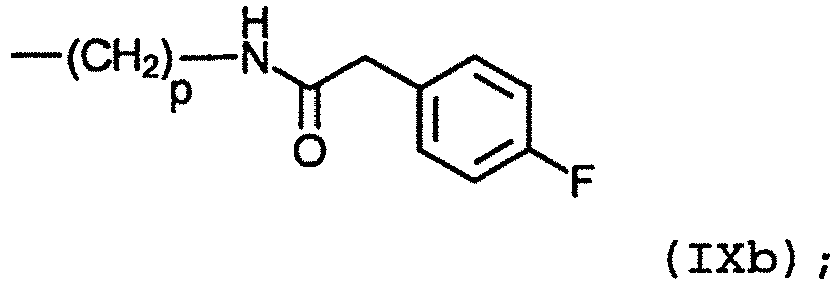


- Composé selon la revendication 7, dans lequel chaque R11 représente respectivement un groupe de formule -CH2-CH2-CH2-CH2-NH-CH2-CH2-P=O(OEt)2, ou un groupe de formule -CH2-CH2-CH2-NH-CH2-CH2-P=O(OEt)2.
- Composé selon la revendication 7 ou 8, dans lequel chaque R31 représente un atome de H, une chaîne latérale de l'acide aminé lysine, ornithine, arginine, histidine, tryptophane, tyrosine, thréonine, ou sérine, un groupe de formule -CH2-CH2-CH2-CH2-NH-CH2-CH2-P=O(OEt)2, ou un groupe de formule -CH2-CH2-CH2-NH-CH2-CH2-P=O(OEt)2.
- Composé selon l'une des revendications 7 à 9 destiné à être utilisé comme médicament.
- Composition pharmaceutique, contenant au moins un composé selon l'une des revendications 7 à 9, et facultativement au moins un excipient et/ou au moins un adjuvant.
Priority Applications (1)
| Application Number | Priority Date | Filing Date | Title |
|---|---|---|---|
| PL15724512T PL3143038T3 (pl) | 2014-05-16 | 2015-05-15 | Monomery i oligomery kwasów peptydonukleinowych |
Applications Claiming Priority (2)
| Application Number | Priority Date | Filing Date | Title |
|---|---|---|---|
| DE102014007158.8A DE102014007158A1 (de) | 2014-05-16 | 2014-05-16 | Neue Peptid-Nukleinsäuren-Monomere und -Oligomere |
| PCT/EP2015/000998 WO2015172889A1 (fr) | 2014-05-16 | 2015-05-15 | Monomères et oligomères d'acide nucléique peptidique |
Publications (3)
| Publication Number | Publication Date |
|---|---|
| EP3143038A1 EP3143038A1 (fr) | 2017-03-22 |
| EP3143038B1 true EP3143038B1 (fr) | 2018-08-01 |
| EP3143038B8 EP3143038B8 (fr) | 2018-09-12 |
Family
ID=53267289
Family Applications (1)
| Application Number | Title | Priority Date | Filing Date |
|---|---|---|---|
| EP15724512.7A Active EP3143038B8 (fr) | 2014-05-16 | 2015-05-15 | Monomères et oligomères d'acide nucléique peptidique |
Country Status (13)
| Country | Link |
|---|---|
| US (1) | US20170166900A1 (fr) |
| EP (1) | EP3143038B8 (fr) |
| JP (1) | JP6546272B2 (fr) |
| KR (1) | KR102515760B1 (fr) |
| CN (1) | CN107074911B (fr) |
| AU (1) | AU2015258476B2 (fr) |
| CA (1) | CA2949185C (fr) |
| DE (1) | DE102014007158A1 (fr) |
| DK (1) | DK3143038T3 (fr) |
| ES (1) | ES2683186T3 (fr) |
| PL (1) | PL3143038T3 (fr) |
| RU (1) | RU2693827C2 (fr) |
| WO (1) | WO2015172889A1 (fr) |
Families Citing this family (7)
| Publication number | Priority date | Publication date | Assignee | Title |
|---|---|---|---|---|
| ES3038159T3 (en) * | 2016-11-16 | 2025-10-09 | Academisch Ziekenhuis Leiden | Substances for targeting various selected organs or tissues |
| CN110740994A (zh) * | 2017-03-23 | 2020-01-31 | 特鲁科德基因修复公司 | 具有受正交保护的酯部分的肽核酸(pna)单体 |
| GB202109880D0 (en) * | 2018-12-13 | 2021-08-25 | Neubase Therapeutics Inc | PNA Oligomers and related methods |
| US20200385713A1 (en) | 2019-01-22 | 2020-12-10 | Korro Bio, Inc. | Rna-editing oligonucleotides and uses thereof |
| CA3127243A1 (fr) | 2019-01-22 | 2020-07-30 | Korro Bio, Inc. | Oligonucleotides d'edition d'arn et leurs utilisations |
| EP3914260A4 (fr) | 2019-01-22 | 2023-05-17 | Korro Bio, Inc. | Oligonucléotides d'édition d'arn et leurs utilisations |
| KR102403904B1 (ko) * | 2019-12-24 | 2022-06-02 | 주식회사 시선바이오머티리얼스 | 용액공정상 pna 올리고머의 제조방법 |
Family Cites Families (8)
| Publication number | Priority date | Publication date | Assignee | Title |
|---|---|---|---|---|
| US5719262A (en) | 1993-11-22 | 1998-02-17 | Buchardt, Deceased; Ole | Peptide nucleic acids having amino acid side chains |
| UA48150C2 (uk) * | 1994-11-02 | 2002-08-15 | Ай-Сі-Ен Фармасьютикалз | Похідні амінокислот або аміноспиртів, олігонуклеотид |
| EP0960121B1 (fr) * | 1996-07-24 | 2005-11-30 | BUCHARDT, Dorte | Acides nucleiques peptidiques presentant une affinite de fixation, une specificite de sequence et une solubilite accrues |
| CA2291839A1 (fr) * | 1997-05-28 | 1998-12-03 | Peter E. Nielsen | Acides nucleiques peptidiques conjugues presentant une fixation cellulaire accrue |
| DE19909373A1 (de) * | 1999-03-03 | 2000-10-05 | Ugichem | Neue PNA-Monomere, daraus resultierende PNA-Oligomere und deren Verwendung |
| DE102006034319A1 (de) * | 2006-07-21 | 2008-01-31 | Ugichem Gmbh | Chirale mit Phosponsäurester- oder Phosphonsäure- substituierte Verbindungen |
| DE102006050091A1 (de) * | 2006-10-24 | 2008-09-11 | Ugichem Gesellschaft für Organische Chemie mbH | Verfahren zur selektiven Lokalisierung von Wirkstoffen an und in Mitochondrien und entsprechende Wirkstoffe |
| WO2009147368A1 (fr) * | 2008-06-04 | 2009-12-10 | Medical Research Council | Peptides |
-
2014
- 2014-05-16 DE DE102014007158.8A patent/DE102014007158A1/de not_active Withdrawn
-
2015
- 2015-05-15 KR KR1020167035152A patent/KR102515760B1/ko active Active
- 2015-05-15 AU AU2015258476A patent/AU2015258476B2/en active Active
- 2015-05-15 ES ES15724512.7T patent/ES2683186T3/es active Active
- 2015-05-15 JP JP2017512102A patent/JP6546272B2/ja active Active
- 2015-05-15 WO PCT/EP2015/000998 patent/WO2015172889A1/fr not_active Ceased
- 2015-05-15 RU RU2016149427A patent/RU2693827C2/ru active
- 2015-05-15 PL PL15724512T patent/PL3143038T3/pl unknown
- 2015-05-15 CN CN201580038548.8A patent/CN107074911B/zh active Active
- 2015-05-15 US US15/311,704 patent/US20170166900A1/en active Pending
- 2015-05-15 DK DK15724512.7T patent/DK3143038T3/en active
- 2015-05-15 CA CA2949185A patent/CA2949185C/fr active Active
- 2015-05-15 EP EP15724512.7A patent/EP3143038B8/fr active Active
Non-Patent Citations (1)
| Title |
|---|
| None * |
Also Published As
| Publication number | Publication date |
|---|---|
| AU2015258476B2 (en) | 2018-12-20 |
| EP3143038B8 (fr) | 2018-09-12 |
| DK3143038T3 (en) | 2018-11-26 |
| CN107074911A (zh) | 2017-08-18 |
| JP2017518363A (ja) | 2017-07-06 |
| PL3143038T3 (pl) | 2019-01-31 |
| RU2016149427A (ru) | 2018-06-20 |
| ES2683186T3 (es) | 2018-09-25 |
| CN107074911B (zh) | 2020-11-03 |
| RU2016149427A3 (fr) | 2018-12-05 |
| DE102014007158A1 (de) | 2015-11-19 |
| KR102515760B1 (ko) | 2023-03-29 |
| US20170166900A1 (en) | 2017-06-15 |
| KR20170002649A (ko) | 2017-01-06 |
| CA2949185A1 (fr) | 2015-11-19 |
| CA2949185C (fr) | 2023-03-14 |
| WO2015172889A1 (fr) | 2015-11-19 |
| RU2693827C2 (ru) | 2019-07-05 |
| AU2015258476A1 (en) | 2016-12-01 |
| JP6546272B2 (ja) | 2019-07-17 |
| EP3143038A1 (fr) | 2017-03-22 |
Similar Documents
| Publication | Publication Date | Title |
|---|---|---|
| EP3143038B1 (fr) | Monomères et oligomères d'acide nucléique peptidique | |
| EP0646595B1 (fr) | Oligomères liant les acides nucléiques avec branchement en C et leur utilisation en thérapie et diagnostic | |
| JP3273135B2 (ja) | 新規ペプチド核酸 | |
| US20030207804A1 (en) | Modified peptide nucleic acids | |
| RU2759022C2 (ru) | Вещества для нацеливания на различные выбранные органы или ткани | |
| EP0646596B1 (fr) | Oligomères liant les acides nucléiques avec branchement en C et leur usage en thérapie et diagnostic | |
| EP2041161B1 (fr) | Composés chiraux substitués d'ester d'acide phosphonique ou d'acide phosphonique | |
| EP2079757B1 (fr) | Procédé de localisation sélective de substances actives sur et dans des mitochondries et substances actives correspondantes | |
| HK1235073A1 (en) | Peptide-nucleic acid-monomers and -oligomers | |
| HK1235073B (en) | Peptide-nucleic acid-monomers and -oligomers | |
| EP0816379A2 (fr) | Oligomères liant l'ADN | |
| WO2025261376A1 (fr) | Ligand d'administration extrahépatique et conjugué associé | |
| WO2025038902A2 (fr) | Ciblage intracellulaire d'oligonucléotides | |
| HK40015212B (en) | Substances for targeting various selected organs or tissues | |
| HK40015212A (en) | Substances for targeting various selected organs or tissues | |
| DE19635064A1 (de) | Nukleinsäure-bindende Oligomere | |
| JPH01226899A (ja) | 新規ペプチド |
Legal Events
| Date | Code | Title | Description |
|---|---|---|---|
| STAA | Information on the status of an ep patent application or granted ep patent |
Free format text: STATUS: THE INTERNATIONAL PUBLICATION HAS BEEN MADE |
|
| PUAI | Public reference made under article 153(3) epc to a published international application that has entered the european phase |
Free format text: ORIGINAL CODE: 0009012 |
|
| STAA | Information on the status of an ep patent application or granted ep patent |
Free format text: STATUS: REQUEST FOR EXAMINATION WAS MADE |
|
| 17P | Request for examination filed |
Effective date: 20161129 |
|
| AK | Designated contracting states |
Kind code of ref document: A1 Designated state(s): AL AT BE BG CH CY CZ DE DK EE ES FI FR GB GR HR HU IE IS IT LI LT LU LV MC MK MT NL NO PL PT RO RS SE SI SK SM TR |
|
| AX | Request for extension of the european patent |
Extension state: BA ME |
|
| DAV | Request for validation of the european patent (deleted) | ||
| DAX | Request for extension of the european patent (deleted) | ||
| REG | Reference to a national code |
Ref country code: HK Ref legal event code: DE Ref document number: 1235073 Country of ref document: HK |
|
| GRAP | Despatch of communication of intention to grant a patent |
Free format text: ORIGINAL CODE: EPIDOSNIGR1 |
|
| STAA | Information on the status of an ep patent application or granted ep patent |
Free format text: STATUS: GRANT OF PATENT IS INTENDED |
|
| INTG | Intention to grant announced |
Effective date: 20180309 |
|
| GRAS | Grant fee paid |
Free format text: ORIGINAL CODE: EPIDOSNIGR3 |
|
| GRAA | (expected) grant |
Free format text: ORIGINAL CODE: 0009210 |
|
| STAA | Information on the status of an ep patent application or granted ep patent |
Free format text: STATUS: THE PATENT HAS BEEN GRANTED |
|
| AK | Designated contracting states |
Kind code of ref document: B1 Designated state(s): AL AT BE BG CH CY CZ DE DK EE ES FI FR GB GR HR HU IE IS IT LI LT LU LV MC MK MT NL NO PL PT RO RS SE SI SK SM TR |
|
| REG | Reference to a national code |
Ref country code: GB Ref legal event code: FG4D Free format text: NOT ENGLISH |
|
| REG | Reference to a national code |
Ref country code: CH Ref legal event code: EP Ref country code: CH Ref legal event code: NV Representative=s name: E. BLUM AND CO. AG PATENT- UND MARKENANWAELTE , CH Ref country code: CH Ref legal event code: PCOW Free format text: NEW ADDRESS: OTTO-HAHN-STRASSE 15, 44227 DORTMUND (DE) Ref country code: AT Ref legal event code: REF Ref document number: 1024177 Country of ref document: AT Kind code of ref document: T Effective date: 20180815 |
|
| REG | Reference to a national code |
Ref country code: IE Ref legal event code: FG4D Free format text: LANGUAGE OF EP DOCUMENT: GERMAN |
|
| REG | Reference to a national code |
Ref country code: DE Ref legal event code: R096 Ref document number: 502015005306 Country of ref document: DE |
|
| REG | Reference to a national code |
Ref country code: CH Ref legal event code: PK Free format text: BERICHTIGUNG B8 |
|
| REG | Reference to a national code |
Ref country code: SE Ref legal event code: TRGR |
|
| REG | Reference to a national code |
Ref country code: ES Ref legal event code: FG2A Ref document number: 2683186 Country of ref document: ES Kind code of ref document: T3 Effective date: 20180925 |
|
| REG | Reference to a national code |
Ref country code: NL Ref legal event code: FP |
|
| REG | Reference to a national code |
Ref country code: DK Ref legal event code: T3 Effective date: 20181119 |
|
| REG | Reference to a national code |
Ref country code: LT Ref legal event code: MG4D |
|
| PG25 | Lapsed in a contracting state [announced via postgrant information from national office to epo] |
Ref country code: LT Free format text: LAPSE BECAUSE OF FAILURE TO SUBMIT A TRANSLATION OF THE DESCRIPTION OR TO PAY THE FEE WITHIN THE PRESCRIBED TIME-LIMIT Effective date: 20180801 Ref country code: IS Free format text: LAPSE BECAUSE OF FAILURE TO SUBMIT A TRANSLATION OF THE DESCRIPTION OR TO PAY THE FEE WITHIN THE PRESCRIBED TIME-LIMIT Effective date: 20181201 Ref country code: BG Free format text: LAPSE BECAUSE OF FAILURE TO SUBMIT A TRANSLATION OF THE DESCRIPTION OR TO PAY THE FEE WITHIN THE PRESCRIBED TIME-LIMIT Effective date: 20181101 Ref country code: FI Free format text: LAPSE BECAUSE OF FAILURE TO SUBMIT A TRANSLATION OF THE DESCRIPTION OR TO PAY THE FEE WITHIN THE PRESCRIBED TIME-LIMIT Effective date: 20180801 Ref country code: GR Free format text: LAPSE BECAUSE OF FAILURE TO SUBMIT A TRANSLATION OF THE DESCRIPTION OR TO PAY THE FEE WITHIN THE PRESCRIBED TIME-LIMIT Effective date: 20181102 Ref country code: NO Free format text: LAPSE BECAUSE OF FAILURE TO SUBMIT A TRANSLATION OF THE DESCRIPTION OR TO PAY THE FEE WITHIN THE PRESCRIBED TIME-LIMIT Effective date: 20181101 Ref country code: RS Free format text: LAPSE BECAUSE OF FAILURE TO SUBMIT A TRANSLATION OF THE DESCRIPTION OR TO PAY THE FEE WITHIN THE PRESCRIBED TIME-LIMIT Effective date: 20180801 |
|
| PG25 | Lapsed in a contracting state [announced via postgrant information from national office to epo] |
Ref country code: LV Free format text: LAPSE BECAUSE OF FAILURE TO SUBMIT A TRANSLATION OF THE DESCRIPTION OR TO PAY THE FEE WITHIN THE PRESCRIBED TIME-LIMIT Effective date: 20180801 Ref country code: HR Free format text: LAPSE BECAUSE OF FAILURE TO SUBMIT A TRANSLATION OF THE DESCRIPTION OR TO PAY THE FEE WITHIN THE PRESCRIBED TIME-LIMIT Effective date: 20180801 Ref country code: AL Free format text: LAPSE BECAUSE OF FAILURE TO SUBMIT A TRANSLATION OF THE DESCRIPTION OR TO PAY THE FEE WITHIN THE PRESCRIBED TIME-LIMIT Effective date: 20180801 |
|
| PG25 | Lapsed in a contracting state [announced via postgrant information from national office to epo] |
Ref country code: EE Free format text: LAPSE BECAUSE OF FAILURE TO SUBMIT A TRANSLATION OF THE DESCRIPTION OR TO PAY THE FEE WITHIN THE PRESCRIBED TIME-LIMIT Effective date: 20180801 Ref country code: RO Free format text: LAPSE BECAUSE OF FAILURE TO SUBMIT A TRANSLATION OF THE DESCRIPTION OR TO PAY THE FEE WITHIN THE PRESCRIBED TIME-LIMIT Effective date: 20180801 |
|
| REG | Reference to a national code |
Ref country code: DE Ref legal event code: R097 Ref document number: 502015005306 Country of ref document: DE |
|
| PG25 | Lapsed in a contracting state [announced via postgrant information from national office to epo] |
Ref country code: SK Free format text: LAPSE BECAUSE OF FAILURE TO SUBMIT A TRANSLATION OF THE DESCRIPTION OR TO PAY THE FEE WITHIN THE PRESCRIBED TIME-LIMIT Effective date: 20180801 Ref country code: SM Free format text: LAPSE BECAUSE OF FAILURE TO SUBMIT A TRANSLATION OF THE DESCRIPTION OR TO PAY THE FEE WITHIN THE PRESCRIBED TIME-LIMIT Effective date: 20180801 |
|
| PLBE | No opposition filed within time limit |
Free format text: ORIGINAL CODE: 0009261 |
|
| STAA | Information on the status of an ep patent application or granted ep patent |
Free format text: STATUS: NO OPPOSITION FILED WITHIN TIME LIMIT |
|
| 26N | No opposition filed |
Effective date: 20190503 |
|
| PG25 | Lapsed in a contracting state [announced via postgrant information from national office to epo] |
Ref country code: SI Free format text: LAPSE BECAUSE OF FAILURE TO SUBMIT A TRANSLATION OF THE DESCRIPTION OR TO PAY THE FEE WITHIN THE PRESCRIBED TIME-LIMIT Effective date: 20180801 |
|
| PG25 | Lapsed in a contracting state [announced via postgrant information from national office to epo] |
Ref country code: MC Free format text: LAPSE BECAUSE OF FAILURE TO SUBMIT A TRANSLATION OF THE DESCRIPTION OR TO PAY THE FEE WITHIN THE PRESCRIBED TIME-LIMIT Effective date: 20180801 |
|
| PG25 | Lapsed in a contracting state [announced via postgrant information from national office to epo] |
Ref country code: LU Free format text: LAPSE BECAUSE OF NON-PAYMENT OF DUE FEES Effective date: 20190515 |
|
| PG25 | Lapsed in a contracting state [announced via postgrant information from national office to epo] |
Ref country code: PT Free format text: LAPSE BECAUSE OF FAILURE TO SUBMIT A TRANSLATION OF THE DESCRIPTION OR TO PAY THE FEE WITHIN THE PRESCRIBED TIME-LIMIT Effective date: 20181201 |
|
| PG25 | Lapsed in a contracting state [announced via postgrant information from national office to epo] |
Ref country code: CY Free format text: LAPSE BECAUSE OF FAILURE TO SUBMIT A TRANSLATION OF THE DESCRIPTION OR TO PAY THE FEE WITHIN THE PRESCRIBED TIME-LIMIT Effective date: 20180801 |
|
| PG25 | Lapsed in a contracting state [announced via postgrant information from national office to epo] |
Ref country code: MT Free format text: LAPSE BECAUSE OF FAILURE TO SUBMIT A TRANSLATION OF THE DESCRIPTION OR TO PAY THE FEE WITHIN THE PRESCRIBED TIME-LIMIT Effective date: 20180801 |
|
| REG | Reference to a national code |
Ref country code: FR Ref legal event code: PLFP Year of fee payment: 8 |
|
| PG25 | Lapsed in a contracting state [announced via postgrant information from national office to epo] |
Ref country code: MK Free format text: LAPSE BECAUSE OF FAILURE TO SUBMIT A TRANSLATION OF THE DESCRIPTION OR TO PAY THE FEE WITHIN THE PRESCRIBED TIME-LIMIT Effective date: 20180801 |
|
| PGFP | Annual fee paid to national office [announced via postgrant information from national office to epo] |
Ref country code: NL Payment date: 20250522 Year of fee payment: 11 |
|
| PGFP | Annual fee paid to national office [announced via postgrant information from national office to epo] |
Ref country code: PL Payment date: 20250512 Year of fee payment: 11 Ref country code: DE Payment date: 20250521 Year of fee payment: 11 |
|
| PGFP | Annual fee paid to national office [announced via postgrant information from national office to epo] |
Ref country code: ES Payment date: 20250616 Year of fee payment: 11 Ref country code: GB Payment date: 20250522 Year of fee payment: 11 Ref country code: DK Payment date: 20250521 Year of fee payment: 11 |
|
| PGFP | Annual fee paid to national office [announced via postgrant information from national office to epo] |
Ref country code: HU Payment date: 20250512 Year of fee payment: 11 |
|
| PGFP | Annual fee paid to national office [announced via postgrant information from national office to epo] |
Ref country code: BE Payment date: 20250520 Year of fee payment: 11 Ref country code: IT Payment date: 20250530 Year of fee payment: 11 |
|
| PGFP | Annual fee paid to national office [announced via postgrant information from national office to epo] |
Ref country code: FR Payment date: 20250521 Year of fee payment: 11 |
|
| PGFP | Annual fee paid to national office [announced via postgrant information from national office to epo] |
Ref country code: CH Payment date: 20250601 Year of fee payment: 11 |
|
| PGFP | Annual fee paid to national office [announced via postgrant information from national office to epo] |
Ref country code: AT Payment date: 20250519 Year of fee payment: 11 |
|
| PGFP | Annual fee paid to national office [announced via postgrant information from national office to epo] |
Ref country code: TR Payment date: 20250507 Year of fee payment: 11 |
|
| PGFP | Annual fee paid to national office [announced via postgrant information from national office to epo] |
Ref country code: CZ Payment date: 20250430 Year of fee payment: 11 |
|
| PGFP | Annual fee paid to national office [announced via postgrant information from national office to epo] |
Ref country code: IE Payment date: 20250521 Year of fee payment: 11 |
|
| PGFP | Annual fee paid to national office [announced via postgrant information from national office to epo] |
Ref country code: SE Payment date: 20250522 Year of fee payment: 11 |