EP3143086B1 - Stabilisierte harzzusammensetzung - Google Patents
Stabilisierte harzzusammensetzung Download PDFInfo
- Publication number
- EP3143086B1 EP3143086B1 EP15722208.4A EP15722208A EP3143086B1 EP 3143086 B1 EP3143086 B1 EP 3143086B1 EP 15722208 A EP15722208 A EP 15722208A EP 3143086 B1 EP3143086 B1 EP 3143086B1
- Authority
- EP
- European Patent Office
- Prior art keywords
- butyl
- resin composition
- hydroxyphenyl
- bis
- propionate
- Prior art date
- Legal status (The legal status is an assumption and is not a legal conclusion. Google has not performed a legal analysis and makes no representation as to the accuracy of the status listed.)
- Active
Links
Classifications
-
- C—CHEMISTRY; METALLURGY
- C08—ORGANIC MACROMOLECULAR COMPOUNDS; THEIR PREPARATION OR CHEMICAL WORKING-UP; COMPOSITIONS BASED THEREON
- C08L—COMPOSITIONS OF MACROMOLECULAR COMPOUNDS
- C08L23/00—Compositions of homopolymers or copolymers of unsaturated aliphatic hydrocarbons having only one carbon-to-carbon double bond; Compositions of derivatives of such polymers
- C08L23/02—Compositions of homopolymers or copolymers of unsaturated aliphatic hydrocarbons having only one carbon-to-carbon double bond; Compositions of derivatives of such polymers not modified by chemical after-treatment
- C08L23/10—Homopolymers or copolymers of propene
- C08L23/12—Polypropene
-
- C—CHEMISTRY; METALLURGY
- C08—ORGANIC MACROMOLECULAR COMPOUNDS; THEIR PREPARATION OR CHEMICAL WORKING-UP; COMPOSITIONS BASED THEREON
- C08K—Use of inorganic or non-macromolecular organic substances as compounding ingredients
- C08K5/00—Use of organic ingredients
- C08K5/0008—Organic ingredients according to more than one of the "one dot" groups of C08K5/01 - C08K5/59
- C08K5/005—Stabilisers against oxidation, heat, light, ozone
-
- C—CHEMISTRY; METALLURGY
- C08—ORGANIC MACROMOLECULAR COMPOUNDS; THEIR PREPARATION OR CHEMICAL WORKING-UP; COMPOSITIONS BASED THEREON
- C08K—Use of inorganic or non-macromolecular organic substances as compounding ingredients
- C08K3/00—Use of inorganic substances as compounding ingredients
- C08K3/34—Silicon-containing compounds
-
- C—CHEMISTRY; METALLURGY
- C08—ORGANIC MACROMOLECULAR COMPOUNDS; THEIR PREPARATION OR CHEMICAL WORKING-UP; COMPOSITIONS BASED THEREON
- C08K—Use of inorganic or non-macromolecular organic substances as compounding ingredients
- C08K5/00—Use of organic ingredients
- C08K5/04—Oxygen-containing compounds
- C08K5/10—Esters; Ether-esters
- C08K5/101—Esters; Ether-esters of monocarboxylic acids
- C08K5/105—Esters; Ether-esters of monocarboxylic acids with phenols
-
- C—CHEMISTRY; METALLURGY
- C08—ORGANIC MACROMOLECULAR COMPOUNDS; THEIR PREPARATION OR CHEMICAL WORKING-UP; COMPOSITIONS BASED THEREON
- C08K—Use of inorganic or non-macromolecular organic substances as compounding ingredients
- C08K5/00—Use of organic ingredients
- C08K5/04—Oxygen-containing compounds
- C08K5/13—Phenols; Phenolates
-
- C—CHEMISTRY; METALLURGY
- C08—ORGANIC MACROMOLECULAR COMPOUNDS; THEIR PREPARATION OR CHEMICAL WORKING-UP; COMPOSITIONS BASED THEREON
- C08K—Use of inorganic or non-macromolecular organic substances as compounding ingredients
- C08K5/00—Use of organic ingredients
- C08K5/16—Nitrogen-containing compounds
- C08K5/34—Heterocyclic compounds having nitrogen in the ring
- C08K5/3412—Heterocyclic compounds having nitrogen in the ring having one nitrogen atom in the ring
- C08K5/3432—Six-membered rings
- C08K5/3435—Piperidines
-
- C—CHEMISTRY; METALLURGY
- C08—ORGANIC MACROMOLECULAR COMPOUNDS; THEIR PREPARATION OR CHEMICAL WORKING-UP; COMPOSITIONS BASED THEREON
- C08K—Use of inorganic or non-macromolecular organic substances as compounding ingredients
- C08K5/00—Use of organic ingredients
- C08K5/36—Sulfur-, selenium-, or tellurium-containing compounds
- C08K5/37—Thiols
-
- C—CHEMISTRY; METALLURGY
- C08—ORGANIC MACROMOLECULAR COMPOUNDS; THEIR PREPARATION OR CHEMICAL WORKING-UP; COMPOSITIONS BASED THEREON
- C08K—Use of inorganic or non-macromolecular organic substances as compounding ingredients
- C08K5/00—Use of organic ingredients
- C08K5/49—Phosphorus-containing compounds
- C08K5/51—Phosphorus bound to oxygen
- C08K5/52—Phosphorus bound to oxygen only
- C08K5/524—Esters of phosphorous acids, e.g. of H3PO3
-
- C—CHEMISTRY; METALLURGY
- C08—ORGANIC MACROMOLECULAR COMPOUNDS; THEIR PREPARATION OR CHEMICAL WORKING-UP; COMPOSITIONS BASED THEREON
- C08L—COMPOSITIONS OF MACROMOLECULAR COMPOUNDS
- C08L23/00—Compositions of homopolymers or copolymers of unsaturated aliphatic hydrocarbons having only one carbon-to-carbon double bond; Compositions of derivatives of such polymers
- C08L23/02—Compositions of homopolymers or copolymers of unsaturated aliphatic hydrocarbons having only one carbon-to-carbon double bond; Compositions of derivatives of such polymers not modified by chemical after-treatment
- C08L23/04—Homopolymers or copolymers of ethene
- C08L23/06—Polyethylene
-
- C—CHEMISTRY; METALLURGY
- C08—ORGANIC MACROMOLECULAR COMPOUNDS; THEIR PREPARATION OR CHEMICAL WORKING-UP; COMPOSITIONS BASED THEREON
- C08L—COMPOSITIONS OF MACROMOLECULAR COMPOUNDS
- C08L23/00—Compositions of homopolymers or copolymers of unsaturated aliphatic hydrocarbons having only one carbon-to-carbon double bond; Compositions of derivatives of such polymers
- C08L23/02—Compositions of homopolymers or copolymers of unsaturated aliphatic hydrocarbons having only one carbon-to-carbon double bond; Compositions of derivatives of such polymers not modified by chemical after-treatment
- C08L23/10—Homopolymers or copolymers of propene
- C08L23/14—Copolymers of propene
-
- C—CHEMISTRY; METALLURGY
- C08—ORGANIC MACROMOLECULAR COMPOUNDS; THEIR PREPARATION OR CHEMICAL WORKING-UP; COMPOSITIONS BASED THEREON
- C08L—COMPOSITIONS OF MACROMOLECULAR COMPOUNDS
- C08L2201/00—Properties
- C08L2201/08—Stabilised against heat, light or radiation or oxydation
-
- C—CHEMISTRY; METALLURGY
- C08—ORGANIC MACROMOLECULAR COMPOUNDS; THEIR PREPARATION OR CHEMICAL WORKING-UP; COMPOSITIONS BASED THEREON
- C08L—COMPOSITIONS OF MACROMOLECULAR COMPOUNDS
- C08L2205/00—Polymer mixtures characterised by other features
- C08L2205/02—Polymer mixtures characterised by other features containing two or more polymers of the same C08L -group
-
- C—CHEMISTRY; METALLURGY
- C08—ORGANIC MACROMOLECULAR COMPOUNDS; THEIR PREPARATION OR CHEMICAL WORKING-UP; COMPOSITIONS BASED THEREON
- C08L—COMPOSITIONS OF MACROMOLECULAR COMPOUNDS
- C08L2205/00—Polymer mixtures characterised by other features
- C08L2205/03—Polymer mixtures characterised by other features containing three or more polymers in a blend
Definitions
- the invention relates to a resin composition that has both high heat resistance and high resistance against ultraviolet radiation.
- the invention is further directed to an article comprising said composition, and to the use of a combination of compounds for stabilising a resin composition.
- Polypropylene resins deteriorate by, for example, heat, light and oxygen.
- the mechanical strength can be decreased and the polypropylene material can become coloured.
- Phenolic antioxidant (PAO) additives are widely employed to protect polypropylene against thermo-oxidative degradation during processing and in service conditions. Even though phenolic antioxidants offer good stabilisation of polypropylene, most phenolic antioxidants exhibit the disadvantage of yellowing due to their oxidation to coloured quinonoid compounds by air or NO x gases. Furthermore, the phenolic antioxidants often exert only a limited effect when employed alone. Therefore phenolic antioxidants have been used in combination with other compounds. For example, phenolic antioxidants have been used in combination with phosphites which are known to enhance the effectiveness of the phenolic antioxidants due to complementary and synergistic mechanisms of action (e.g. decomposition of hydroperoxides formed in the polymer at high temperature and in the presence of oxygen). Also, phenolic antioxidants have been combined with sulphur containing antioxidants such as a dialkyl thiodipropionate in order to achieve increased heat performance.
- Phenolic antioxidants have also been combined with various light stabilisers in order to achieve a high weather resistance.
- light stabilisers include benzophenone, benzotriazole and triazine type ultraviolet radiation absorbers, hindered hydroxy-benzoates and hindered amine compounds.
- HALS hindered amine light stabilisers
- EP-A-1 088 871 describes a pressure sensitive adhesive tape, which may have an olefin-based resin layer laminated between a urethane resin layer and a pressure-sensitive adhesive layer. Additives such as photostabilisers and antioxidants may also be used. EP-A-1 088 871 is not directed to improving weathering resistance combined with desirable mechanical properties and does not disclose the additional presence of a thiosynergist.
- US-A-5 214 456 is directed to dihydropyridines for the heat and light stabilisation of organic polymers.
- the compositions disclosed in US-A-5 214 456 can contain additives, such as photostabilisers and antioxidants.
- US-A-5 214 456 does not disclose the additional presence of a thiosynergist.
- DE-A-10 2008 026 672 describes an adhesive made from a specific isotactic polypropylene resin.
- the adhesive can contain additives, such as primary and secondary antioxidants, and fillers.
- DE-A-10 2008 026 672 is not directed to improving weathering resistance combined with desirable mechanical properties and does not disclose the additional presence of a thiosynergist.
- Objective of the invention is to address this problem by providing a resin composition with improved resistance against both ultraviolet radiation and heat.
- the invention is directed to a resin composition
- a resin composition comprising
- component (C) the hindered amine functionality is comprised in the backbone of the hindered amine light stabiliser molecule.
- a propylene resin is to be interpreted as meaning a single type of polypropylene resin or as a mixture of different types of polypropylene resins.
- a polypropylene resin as meant herein is interchangeable with the term polypropylene polymer or polypropylene.
- composition showing minimal surface oxidation when exposed to UV-radiation and thus having excellent weathering resistance.
- composition retains desirable mechanical properties (such as Izod impact strength and tensile strength) when exposed to high heat.
- the resin composition of the invention may further preferably comprise one or more of the following components: a second phenolic antioxidant (E) which is different from the first phenolic antioxidant (B), and a third antioxidant (F) selected from the group consisting of secondary antioxidants (such as a phosphite) and different from antioxidants (B) and (E).
- a second phenolic antioxidant E which is different from the first phenolic antioxidant (B)
- a third antioxidant selected from the group consisting of secondary antioxidants (such as a phosphite) and different from antioxidants (B) and (E).
- the polypropylene resin in the resin composition of the invention is a polymer based on propylene as the single or predominantly present monomer.
- the polypropylene resin may be a homopolymer, a copolymer or a random copolymer.
- the copolymer may be a heterophasic propylene copolymer having a matrix phase and a disperse phase. Such polymers are known to the skilled person.
- the polypropylene resin may be a mixture, or blend, of at least two polypropylene resins.
- the matrix phase consists of a propylene homopolymer or a propylene - ⁇ -olefin copolymer with a comonomer content of at most 2 wt.% based on the weight of matrix phase.
- the matrix phase consists of a propylene homopolymer.
- the disperse phase consists of a propylene/a-olefin copolymer.
- the ⁇ -olefin is preferably selected from the group consisting of ethylene, butylene, hexene and octene and most preferably is ethylene.
- the amount of disperse phase may vary within wide limits depending on the desired mechanical properties of the resin composition.
- the amount of disperse phase may be from 5-50 wt.%, such as from 10-40 wt.% or from 15-25 wt.% based on the weight of the heterophasic propylene copolymer.
- the amount of ⁇ -olefin comonomer in the propylene - ⁇ -olefin copolymer of the disperse phase may be from 15-65 wt.% such as from 20-60 wt.% or 40-55 wt.% based on the weight of the disperse phase.
- the polypropylene polymer can be a polymer made by any known polymerisation technique as well as with any known polymerisation catalyst system.
- any known polymerisation catalyst system reference can be given to slurry, solution or gas-phase polymerisations; regarding the catalyst system reference can be given to Ziegler-Natta, metallocene, or (other) single-site catalyst systems. All are, in themselves, known in the art.
- the polypropylene polymer has a melt flow index (MFI), measured according to ISO 1133 at 230 °C and 2.16 kg, of between 0.1 and 100.
- MFI melt flow index
- a polyethylene resin may form part of the component (A) and can comprise a polymer based on ethylene as the single or predominantly present monomer, or in other words: the polymer is either a homopolymer, a copolymer or a random copolymer.
- component (A) is a blend of a polypropylene resin and a polyethylene resin.
- the phenolic antioxidant (B) has a molecular weight of 750 g/mol or less as determined by gel permeation chromatography preferably 600 g/mol or less, more preferably 550 g/mol or less.
- the phenolic antioxidant (B) is an optionally substituted linear or branched alkyl ester of 3-(alkylated 4'-hydroxyphenol) propionic acid.
- the phenolic antioxidant (B) may have one or more substituents on the phenol group.
- the phenolic antioxidant (B) can be a hindered phenolic antioxidant.
- Such hindered phenolic antioxidants can, for example, have one or two alkyl groups (preferably t -butyl groups) on the phenol ring in ortho position with respect to the hydroxyl group.
- the phenolic antioxidant (B) comprises an alkyl ester (i.e. propionic) group.
- the phenolic antioxidant (B) may comprise a C 8-24 alkyl ester (i.e. propionic) group, preferably a C 12-20 alkyl ester group, more preferably a C 14-18 alkyl ester (i.e. propionic) group.
- the alkyl group is preferably a linear alkyl group.
- the phenolic antioxidant (B) comprises an alkyl propionate group.
- the phenolic antioxidant (B) has only one phenolic group per molecule.
- Preferred phenolic antioxidants (B) with only one phenolic group per molecule are C 1-20 -3-(3,5-di- t -butyl-4-hydroxyphenyl)propionates, preferably selected from the group consisting of methyl-3-(3,5-di- t -butyl-4-hydroxyphenyl)propionate, octyl-3-(3,5-di- t -butyl-4-hydroxyphenyl)propionate, isooctyl-3-(3,5-di- t -butyl-4-hydroxyphenyl)propionate, tridecyl-3-(3,5-di- t -butyl-4-hydroxyphenyl)propionate, tetradecyl-3-(3,5-di- t -butyl-4-hydroxyphenyl)propionate, pentadecyl-3-(3,5-di- t -butyl-4-hydroxyphenyl)
- the phenolic antioxidant (B) is selected from the group consisting of octadecyl-3-(3,5-di- t -butyl-4-hydroxyphenyl)propionate, octyl-3-(3,5-di- t -butyl-4-hydroxyphenyl)propionate, isooctyl-3-(3,5-di- t -butyl-4-hydroxyphenyl)propionate, tridecyl-3-(3,5-di- t -butyl-4-hydroxyphenyl)propionate, tetradecyl-3-(3,5-di- t -butyl-4-hydroxyphenyl)propionate, and pentadecyl-3-(3,5-di- t -butyl-4-hydroxyphenyl)propionate.
- the phenolic antioxidant (B) is octadecyl-3-(3,5-di- t -butyl-4-hydroxyphenyl)propionate.
- phenolic antioxidant (B) with two phenolic groups per molecule include tri-ethylene-glycol-bis-3-( t -butyl-4-hydoxy-5-methyl-phenyl)-propionate and 1,6-hexane-diol-bis-3-(3,5-di- t -butyl-4-hydoxyphenyl)-propionate.
- phenolic antioxidants are also commercially available. Some examples include Anox® BF (3,5-bis(1,1-dimethyl-ethyl)-4-hydroxy benzene propanic ester of a C 14 -C 15 alcohol blend, available from Great Lakes Chemical Company), Irganox® 245 (triethylene glycol bis(3- t -butyl-4-hydroxy-5-methylphenyl)propionate, available from BASF), Irganox® 259 (hexamethylene bis[3-(3,5-di- t -butyl-4-hydroxyphenyl)propionate], available from BASF), Irganox® 1076 (octadecyl-3-(3,5-di- t -butyl-4-hydroxyphenyl)propionate, available from BASF), and Irganox® 1135 (octyl-3-(3,5-di- t -butyl-4-hydroxyphenyl)propionate, available from BASF
- the amount of the phenolic antioxidant (B) in the resin composition of the invention can vary and may, for instance, be 0.01-1 % by total weight of the resin composition, such as 0.05-0.9 % by total weight of the resin composition, or 0.1-0.4 % by total weight of the resin composition.
- the resin composition of the invention further comprises a specific hindered amine light stabiliser (C).
- C specific hindered amine light stabiliser
- the hindered amine light stabiliser (C) preferably has a number average molecular weight of 1250 g/mol or more as determined by gel permeation chromatography, such as 1300 g/mol or more, preferably from 1500-4000 g/mol.
- the resin composition of the invention is substantially free from hindered amine light stabilisers having a molecular weight of less than 1250 g/mol. More preferably, the resin composition of the invention is substantially free from hindered amine light stabilisers having a molecular weight of less than 1000 g/mol, such as hindered amine light stabilisers having a molecular weight of less than 750 g/mol.
- the amount of such hindered amine light stabilisers in the resin composition of the invention can be 0.1 % or less by weight of the resin composition, more preferably 0.05 % or less, such as 0.01 % or less, or 0.005 % or less.
- the resin composition of the invention is completely free from such low molecular weight hindered amine light stabilisers.
- Low molecular weight hindered amine light stabilisers are in many cases undesirable, because they tend to migrate to the surface and can cause for example stickiness and blooming.
- the hindered amine light stabiliser (C) is an oligomeric hindered amine light stabiliser.
- the hindered amine (functionality) is comprised in the backbone of the hindered amine light stabiliser molecule, rather than in pendant substituents that are attached to the backbone.
- the nitrogen atom of the hindered amine group is part of the main chain of the hindered amine light stabiliser molecule.
- the term "hindered amine” refers to a compound or moiety in which one or more, preferably two or more, carbon atoms adjacent to the nitrogen atom of the amine group do not have a hydrogen atom attached directly thereto.
- one or more carbon atoms (preferably two or more carbon atoms) adjacent to the hindered amine nitrogen atom are not carbonyl carbons (i.e., a carbon atom having an oxygen atom double bonded thereto).
- one or more carbon atoms, and preferably two or more carbon atoms, adjacent the amine nitrogen have a methyl substitution.
- Hindered amine light stabilisers include those comprising derivatives of 2,2,6,6-tetramethyl piperidine in the backbone.
- hindered amine light stabilisers wherein the hindered amine (functionality) is not comprised in the backbone include Chimassorb 944, Chimassorb 119, Tinuvin NOR 371, and Uvinul 4050H. In each of these cases, the hindered amine is present in pendant substituents that are not part of the actual backbone but are pendant side groups of the backbone, while the amine that is present in the backbone is not a hindered amine.
- the hindered amine light stabiliser (C) is free from pendant piperidinyl groups (although piperidinyl groups may be present as part of the backbone).
- the hindered amine light stabiliser may be a polyester hindered amine light stabiliser. Since such polyester hindered amine light stabilisers are prone to photolytic and hydrolytic cleavage reactions, they are typically avoided for applications where resistance against ultraviolet radiation (weathering) is required. The inventors, however, found that the compositions of the invention, containing the combination of such polyester hindered amine light stabilisers with the additional components are resistant against heat but surprisingly also against ultraviolet radiation (weathering).
- the hindered amine light stabiliser (C) preferably comprises a group according to formula (I) below in the backbone of the hindered amine light stabiliser molecule.
- the hindered amine light stabiliser (C) comprises a group according to formula (II) or (III) shown below in the backbone.
- the hindered amine light stabiliser (C) is selected from the group consisting of wherein n is selected in the range of 9-16, preferably in the range of 10-15, such as in the range of 11-14, and wherein m is selected in the range of 3-10, preferably in the range of 3-8, such as in the range 3-6, or in the range of 3-4.
- Such hindered amine light stabilisers are commercially available, e.g, as Tinuvin® 622 (poly(4-hydroxy-2,2,6,6-tetramethyl-1-piperidine ethanol-alt-1,4-butanedioic acid), available from BASF) and Hostavin® N30 (polymer of 2,2,4,4-tetramethyl-7-oxa-3,20-diaza-dispiro [5.1.11.2]-heneicosan-21-on and epichlorohydrin, available from Clariant).
- Tinuvin® 622 poly(4-hydroxy-2,2,6,6-tetramethyl-1-piperidine ethanol-alt-1,4-butanedioic acid), available from BASF
- Hostavin® N30 polymer of 2,2,4,4-tetramethyl-7-oxa-3,20-diaza-dispiro [5.1.11.2]-heneicosan-21-on and epichlorohydrin, available from Clariant).
- the amount of the hindered amine light stabiliser (C) in the resin composition of the invention can vary and may, for instance, be 0.01-1 % by total weight of the resin composition, such as 0.05-0.9 % by total weight of the resin composition, or 0.1-0.4 % by total weight of the resin composition.
- the weight ratio of the hindered amine light stabiliser (C) and the phenolic antioxidant (B) in the resin composition of the invention is 3 or less, preferably 2 or less, more preferably 1 or less.
- the resin composition of the invention further comprises a thiosynergist (D).
- Thiosynergists are sulphur-based hydroperoxide decomposers and are well-known to the person skilled in the art.
- the thiosynergist may, for example, be selected from the group consisting of dilauryl thiodipropionate, distearyl thiodipropionate, dimyristyl thiodipropionate and ditridecyl thiodipropionate.
- the preferred thiosynergist is distearyl thiodipropionate.
- the amount of the thiosynergist (D) in the resin composition of the invention can vary and may, for instance, be 0-0.1 % by total weight of the resin composition, such as 0.01-0.08 % by total weight of the resin composition, or 0.01-0.06 % by total weight of the resin composition.
- the resin composition of the invention may comprise a further phenolic antioxidant (E) which is different from (B).
- the further phenolic antioxidant (E) comprises two or more phenolic groups per molecule.
- phenolic antioxidants (E) include pentaerythritol tetrakis(3-(3,5-di- t -butyl-4-hydroxyphenyl)propionate), tris(3,5-di- t -butyl-4-hydroxybenzyl)isocyanurate, and 1,3,5-trimethyl-2,4,6-tris(3,5-di- t -butyl-4-hydroxybenzyl)benzene.
- Such antioxidants increase the processing and long-term thermal stability of the resin composition of the invention.
- phenolic antioxidants (E) in the resin composition of the invention include 2,2'-methylenebis(4-methyl-6- t -butylphenol), 4,4'-butylidenebis(3-methyl-6- t -butylphenol), 4,4'-thiobis(3-methyl-6- t -butylphenol), 2,2'-thiobis(4-methyl-6- t -butylphenol), 4,4'-methylenebis(2,6-di- t -butylphenol), 2,2'-methylenebis[6-(1-methylcyclohexyl)- p -cresol], 2,2'-ethylidenebis(2,4-di- t -butylphenol), 2,2'-butylidenebis(2- t -butyl-4-methylphenol), 1,1,3-tris(2-methyl-4-hydroxy-5- t -butylphenyl)butane, triethylene glycol-bis[3-(3-(3-
- phenolic antioxidants are commercially available. Some examples include Irganox® 1010 (pentaerythritol tetrakis(3-(3,5-di- t -butyl-4-hydroxyphenyl)propionate, available from BASF), Irganox® 1098 (1,6-hexamethylene bis(3,5-di- t -butyl-4-hydroxyhydrocinnamate, available from BASF), ADK STAB AO-80 (3,9-bis(2-(3-(3- t -butyl-4-hydroxy-5-methyl-phenyl)-propionyl-oxy)-1,1-dimethyl)-2,4,8,10-tetraoxospiro[5,5]undecane, available from Adeka Palmarole), Topanol® CA (1,1,3-tris(2-methyl-4-hydroxy-5- t -butylphenyl)butane, available from Vertellus Specialties), Ir
- the amount of the phenolic antioxidant (E) in the resin composition of the invention can vary and may, for instance, be 0.01-1 % by total weight of the resin composition, such as 0.05-0.9 % by total weight of the resin composition, or 0.1-0.8 % by total weight of the resin composition.
- the resin composition of the invention can suitably also comprise an antioxidant (F) selected from the class of secondary antioxidants.
- the secondary antioxidant (F) is different from phenolic antioxidant (B) and phenolic antioxidant (E), which are both primary antioxidants.
- the difference between primary and secondary antioxidants is well-known in the art.
- Primary antioxidants are typically organic molecules consisting of hindered phenol and amine derivatives. These primary antioxidants are radical scavengers and are usually added to polymers to protect against degradation during the service life of the finished product. Phosphites and phophonites are examples of secondary antioxidants.
- Secondary antioxidants can prevent formation of additional free radicals by decomposing unstable hydroperoxides into stable alcohols and are usually added to polymers to provide processing stability during the pelletisation and extrusion and/or moulding processes.
- primary antioxidants such as hindered phenols
- polyolefins can develop a more yellow colour, decreasing the commercial value of the polyolefins.
- Secondary antioxidants such as phosphite compounds, are often utilised in polyolefins in combination with hindered phenols to increase the stability and decrease yellowing.
- suitable secondary antioxidants include organic phosphites and phosphonites, such as triphenyl phosphite, diphenyl alkyl phosphites, phenyl dialkylphoshites, tris(nonylphenyl)phosphite, tris(2,4-di- t -butylphenyl)phosphite, bis(2,4-di- t -butylphenyl)pentaerythritol diphosphite, bis(2,6-di- t -butyl-4-methylphenyl) pentaerythritol diphosphite, bis(2,4-di- t -butyl-6-methylphenyl)pentaerythritol diphosphite, bis(2,4,6-tri- t -butylphenyl)pentaerythritol diphosphite, tetrakis(2,4-
- Some preferred secondary phenolic antioxidants are tris(2,4-di- t -butylphenyl)phosphite, bis(2,4-di- t -butyl-6-methylphenyl)ethyl phosphite, bis(2,4-di- t -butylphenyl) pentaerythritol diphosphite, and tetrakis(2,4-di- t -butylphenyl)-4,4'-biphenylenediphosphonite.
- the most preferred secondary phenolic antioxidant is tris(2,4-di- t -butylphenyl)phosphite.
- antioxidants are commercially available. Some examples include Irgafos® 168 (tris(2,4-di- t -butylphenyl)phosphite, available from BASF), and Irgafos® P-EPQ (tetrakis(2,4-di- t -butylphenyl)[1,1-biphenyl]-4,4'-diylbisphosphonite, available from BASF).
- Irgafos® 168 tris(2,4-di- t -butylphenyl)phosphite, available from BASF
- Irgafos® P-EPQ tetrakis(2,4-di- t -butylphenyl)[1,1-biphenyl]-4,4'-diylbisphosphonite, available from BASF.
- the amount of the antioxidant (F) in the resin composition of the invention can vary and may, for instance, be 0.01-1 % by total weight of the resin composition, such as 0.05-0.9 % by total weight of the resin composition, or 0.1-0.8 % by total weight of the resin composition.
- the resin composition of the invention can also comprise non-phenolic antioxidants, such as hydroxyl amines.
- Useful hydroxylamine stabilisers include, for example, N,N -dibenzylhydroxylamine, N,N -diethylhydroxylamine, N,N -dibutylhydroxylamine, N,N -dihexylhydroxylamine, the N,N -dialkylhydroxylamine derived from oxidation of hydrogenated tallow amine, and hydroxyl amines of the general formula RN(OH)R', in which R and R' are each independently alkyl groups of eight to eighteen carbon atoms, such as N,N -dioctylhydroxylamine, N,N -didecylhydroxylamine, N,N -didodecylhydroxylamine, N,N -ditetradecylhydroxylamine, N,N -dihexadecylhydroxy
- the resin composition of the invention comprises
- the resin composition of the invention may comprise further additives.
- suitable additives include colourants, nucleating agents, clarifiers, release agents, pigments, dyes, plasticisers, antioxidants, anti-statics, scratch resistance agents, fillers, impact modifiers, flame retardants, blowing agents, recycling additives, coupling agents, anti-microbials, anti-fogging additives, slip additives, anti-blocking agents, polymer processing aids, such as lubricants and the like, surface tension modifiers, co-agents, components that enhance interfacial bonding, etc.
- additives are well-known in the art.
- the amount of additives depends on their type and function. Typically, their amounts can vary from 0-30 % by total weight of the resin composition, 0-20 % by total weight of the resin composition, 0-10 % by total weight of the resin composition, or 0-5 % by total weight of the resin composition.
- the resin composition of the invention comprises one or more colourants.
- These colourants may be organic colourants, inorganic colourants, or mixtures thereof.
- the colourants can be dyes or pigments such as titanium dioxide, copper phthalocyanine, and carbon black.
- Such colourants can provide the resin composition of the invention with a colour.
- the colourant is present in the resin composition of the invention in an amount of 0.05 % or more by total weight of the resin composition. Usually, the amount of colourant does not exceed 5 % by total weight of the resin composition.
- the resin composition of the invention comprises at least a filler, such as an inorganic filler.
- inorganic filler include talc, calcium carbonate, calcium oxide, calcium hydroxide, magnesium carbonate, magnesium hydroxide, magnesium oxide, aluminium hydroxide, magnesium sulphate, barium sulphate, glass powder, clay, dolomite, mica, silica, alumina, potassium titanate, wollastonite, fibrous magnesium oxysulphate, and glass fibre.
- these inorganic fillers may be used alone or in any combination of two or more thereof.
- Talc, calcium carbonate, barium sulphate and fibrous magnesium oxysulphate are particularly preferred as inorganic filler.
- the resin composition of the invention comprises talc.
- Talc can be categorised as a hydrated magnesium silicate and its main components can be represented by, amongst others, one or more of the formulas (Si 2 O 5 ) 2 Mg 3 (OH) 2 , Si 8 Mg 6 O 20 (OH) 4 or Mg 12 Si 16 O 40 (OH) 8 .
- the talc may be surface-treated talc or surface-coated talc, for example talc which is treated with a surface modifier such as one or more selected from the group consisting silanes, amines, glycols, stearates, sorbates and titanates.
- the amount of inorganic filler in the resin composition of the invention may, for instance, be 0-30 % by total weight of the resin composition, such as 1-25 % by total weight of the resin composition, or 2-20 % by total weight of the resin composition.
- the resin composition of the invention may further comprise from 1-25 % by total weight of the resin composition, of an ethylene ⁇ -olefin copolymer elastomer.
- ethylene ⁇ -olefin copolymer elastomer is preferably selected from one or more of ethylene-butene copolymer elastomer, ethylene-hexene copolymer elastomer and ethylene-octene copolymer elastomer.
- the ethylene ⁇ -olefin copolymer elastomer is selected from one or more of an metallocene ethylene-octene copolymer-elastomer and a metallocene ethylene-butene copolymer elastomer.
- these elastomers are added to further improve the impact resistance.
- the density of such elastomers may be from 860-885 kg/m 3 .
- the melt flow index for the elastomer may be from 0.10-10 g/10min (ISO 1133, 2.16 kg, 230 °C).
- the amount of elastomer in the resin composition of the invention may, for instance, be 0-25 % by total weight of the resin composition, such as 1-20 % by total weight of the resin composition, or 2-15 % by total weight of the resin composition.
- the resin composition of the invention may be transformed into shaped (semi-)finished articles using a variety of processing techniques.
- suitable processing techniques include injection moulding, injection compression moulding, thin wall injection moulding, extrusion, and extrusion compression moulding.
- Injection moulding is widely used to produce articles such as caps and closures, batteries, pails, containers, automotive exterior parts like bumpers, automotive interior parts like instrument panels, or automotive parts under the bonnet.
- Extrusion is widely used to produce articles such as rods, sheets and pipes.
- Thin wall injection moulding may for example be used to make thin wall packaging.
- Processes for preparing the resin composition of the invention can be any process known in the art to compound liquid or solid ingredients into a polymer. Examples thereof include extruder mixing, mixing in a Banbury type equipment, solution blending etc.
- the invention is directed to an article comprising the resin composition of the invention, typically a shaped article, such as a three-dimensional article.
- the article of the invention advantageously has improved properties in respect of heat resistance and resistance against ultraviolet radiation.
- the article of the invention preferably has a tensile yield strength retention of 90 % or more, preferably 92 % or more, more preferably 94 % or more, such as 95 % or more after air oven exposure at 120 °C during 1000 hours.
- Tensile properties were determined in accordance with ISO 527-1A and were measured at 23 °C.
- the article of the invention further preferably has an Izod impact strength retention upon air oven exposure at 120 °C during 1000 hours of 90 % or more, preferably 92 % or more, more preferably 94 % or more, such as 95 % or more.
- the Izod impact strength was determined in accordance with ISO 180-1A and was measured at -40 °C and 23 °C.
- the article of the invention preferably has a grey scale value of 4 or more, preferably 4.5 or more, such as 4.5-5 after 3609 kJ/m 2 irradiation (ultraviolet interior test protocol FLTM-BO 116-01).
- Grey scale assessment was determined according to ISO 105A02.
- the invention is directed to the use of a combination of
- Said resin combination is used for stabilising a polyolefin resin composition, such as a polypropylene resin composition, a polyethylene resin composition, or any mixture thereof.
- a polyolefin resin composition such as a polypropylene resin composition, a polyethylene resin composition, or any mixture thereof.
- Injection moulded tensile bars (ISO 527-1A test bars) and notched Izod bars cut from these injection moulded tensile bars were air oven aged at 120 °C during 1000 hours.
- Greyscale value was determined in accordance with ISO 105A02. The greyscale is a scale from 5 to 1. Greyscale 5 represents no visual degradation and greyscale 1 represents severe visual degradation.
- Colour measurements were done with a Macbeth CE-741 GL multi-angle, L*, a*, b*, and delta E* values (CIE), Geometry 75°, D65, 10° viewing angle. Additional colour measurements were done with a Minolta CM3700d spectrophotometer according to ISO 7742-2, L*, a*, b*, and delta E* values (CIE), D/8 Geometry, D65, 10° viewing angle.
- Thermal ageing was performed using a forced air circulation oven provided by Vötsch Industrietechnik, more accurately model NTU 60/60 provided with a calibrated air flow meter (set at 150 air changes per hour). The ability to withstand thermooxidative stress in applications for a sufficient long time is traditionally determined using such oven ageing.
- Ultraviolet exposure ageing of injection moulded plaques (65 ⁇ 65 ⁇ 3.2 mm) with VW K59 texture was carried out according to the interior test protocol FLTM-BO 116-01 prescribing ultraviolet radiation intensity of 1.06 W/m 2 /nm at 420 nm, xenon light filtering consisting of quartz inner and borosilicate outer filters and additional filter lantern equipped with SF-5 filters, black panel temperature of 89 °C and light:dark cycle 3.8:1 hours.
- the greyscale value was determined in accordance with ISO 105A02 (rement: rating of minimum 4 after 3609 kJ/m 2 received radiation or 1165 hours total test duration).
- the greyscale is a scale from 5 to 1.
- Greyscale 5 represents no visual degradation and greyscale 1 represents severe visual degradation.
- Colour measurements were done with a Macbeth CE-741 GL multi-angle, L*, a*, b*, and delta E* values (CIE), Geometry 75°, D65, 10° viewing angle. Additional colour measurements were done with a Minolta CM3700d spectrophotometer according to ISO 7742-2, L*, a*, b*, and delta E* values (CIE), D/8 Geometry, D65, 10° viewing angle. Also chemical changes due to photooxidation were determined using attenuated total reflection infrared spectroscopy (FT-IR/ATR). The degree of surface oxidation (N ox ) was determined in course of the accelerated UV-ageing.
- compositions contained rubbers, fillers, stabilisers, coupling agent, scratch agent, slip agent, siloxane polymer masterbatch and colour masterbatch.
- Table 1 Base composition of the samples Component Supplier wt.% Base Polymer SABIC® PP513MNK10E SABIC 40-45 Base polymer SABIC®PP48M10 SABIC 20 Elastomer Rubbers- PE s- Oils mPE Oct-870-50 (alt.
- composition of the examples (7 kg) was compounded in a twin screw ZE21 extruder.
- the temperature profile in the extruder was 80-210 °C, at a throughput of 4 kg/h at 750 rpm.
- phenolic antioxidants Irganox® 1076 (octadecyl-3-(3,5-di- t -butyl-4-hydroxyphenyl)propionate, available from BASF) and Cyasorb® UV2908 (3,5-di- t -butyl-4-hydroxybenzoic acid, hexadecyl ester, available from Cytec).
- Distearyl thiodipropionate (DSTDP) was also supplied by BASF.
- the inventive example containing the polyester hindered amine light stabiliser Tinuvin 622 shows surprisingly good performance in comparison to the comparative examples containing Chimassorb 944, Chimassorb 119, Uvinul 4050H and Tinuvin NOR 371, respectively, all in combination with Irganox 1076.
- the inventive example shows surprisingly good performance, both in heat ageing as well as in UV-ageing. This improved performance is believed to be related directly to its structure. Without wishing to be bound by any theory, the inventors believe that in order to generate the active species for radical trapping, the polyester hindered amine light stabiliser must first begin to self-destruct.
- An advantage may be that due to its self-destruction, lower molecular weight stabilising species are formed which are showing an increased mobility in a polymer matrix, and as such could have an enhanced ability to participate in radical trapping and peroxide decomposition reactions. Other possible explanations may involve compatibility, distribution of stabilising groups, etc .).
- the degree of surface oxidation (N ox ) was determined in course of the accelerated UV-ageing and the values provided in table 5 correspond to 1195 hours total test duration.
- Table 4. Mechanical data on impact strength retention after prescribed heat ageing during 1200 hours G 1 H 1 I 2 Tinuvin 622 0.4 0.4 0.4 Irganox 1076 0.2 0.2 DSTDP 0.05 0.05 Izod impact strength retention (23 °C) (%) 88 94 92 1 comparative example 2 inventive example Table 5.
- the inventive example containing both the alkyl ester of 3-(alkylated-4-'hydroxyphenyl) propionic acid and the thiosynergist shows surprisingly good performance in comparison to the comparative examples, in particular with respect to the combination of Izod impact strength retention and the degree of surface oxidation.
Landscapes
- Chemical & Material Sciences (AREA)
- Health & Medical Sciences (AREA)
- Chemical Kinetics & Catalysis (AREA)
- Medicinal Chemistry (AREA)
- Polymers & Plastics (AREA)
- Organic Chemistry (AREA)
- Compositions Of Macromolecular Compounds (AREA)
Claims (15)
- Harzzusammensetzung, umfassend(A) ein Polypropylenharz,(B) einen gegebenenfalls substituierten linearen oder verzweigten Alkylester von 3-(alkylierter 4'- Hydroxyphenyl) propionsäure mit einer Molekülmasse von 750 g/mol oder weniger,(C) einen gehinderten Amin-Lichtstabilisator mit einer Molekülmasse von 1.250 g/mol oder mehr, wobei das gehinderte Amin in dem Rückgrat des gehinderten Amin-Lichtstabilisatormoleküls enthalten ist, und(D) einen Thiosynergisten, der ein Hydroperoxidzersetzer auf Schwefelbasis ist.
- Harzzusammensetzung nach Anspruch 1, ferner umfassend
(E) ein phenolisches Antioxidationsmittel, das sich von (B) unterscheidet. - Harzzusammensetzung nach Anspruch 1 oder 2, ferner umfassend
(F) ein von (B) und (E) verschiedenes Antioxidationsmittel, ausgewählt aus der Gruppe, bestehend aus sekundären Antioxidationsmitteln und nicht-phenolischen Antioxidationsmitteln. - Harzzusammensetzung nach einem der Ansprüche 1 bis 3, wobei das Polypropylenharz (A) ein heterophasisches Polypropylen ist und eine Polypropylen-Homopolymer-Matrix-Phase und eine disperse Propylen/a-Olefin-Elastomer-Copolymer-Phase umfasst.
- Harzzusammensetzung nach einem der Ansprüche 1 bis 4, wobei das phenolische Antioxidationsmittel (B) eine phenolische Gruppe pro Molekül aufweist, vorzugsweise das phenolische Antioxidationsmittel (B) eine C12-30-Alkylgruppe umfasst, noch bevorzugter eine C12-20-Alkylgruppe, noch bevorzugter eine C14-18-Alkylgruppe, am meisten bevorzugt das phenolische Antioxidationsmittel (B) ausgewählt ist aus der Gruppe bestehend aus C1-20-3-(3,5-Di-t-butyl-4-hydroxyphenyl)propionaten,
vorzugsweise das phenolische Antioxidationsmittel (B) ausgewählt ist aus der Gruppe, bestehend aus Methyl-3-(3,5-di-t-butyl-4-hydroxyphenyl)propionat, Octyl-3-(3,5-di-t-butyl-4-hydroxyphenyl)propionat, Isooctyl-3-(3,5-di-t-butyl-4-hydroxyphenyl)propionat,
Tridecyl-3-(3,5-di-t-butyl-4-hydroxyphenyl)propionat, Tetradecyl-3-(3,5-di-t-butyl-4-hydroxyphenyl)propionat, Heptadecyl-3-(3,5-di-t-butyl-4-hydroxyphenyl)propionat, Hexadecyl-3-(3,5-di-t-butyl-4-hydroxyphenyl)propionat, Heptadecyl-3-(3,5-di-t-butyl-4-hydroxyphenyl)propionat, Octadecyl-3-(3,5-di-t-butyl-4-hydroxyphenyl)propionat und Nonadecyl-3-(3,5-di-t-butyl-4-hydroxyphenyl)propionat, noch bevorzugter ist das phenolische Antioxidationsmittel (B) Octadecyl-3-(3,5-di-t-butyl-4-hydroxyphenyl)propionat. - Harzzusammensetzung nach einem der Ansprüche 1 bis 5, wobei der gehinderte Amin-Lichtstabilisator (C) eine Molekülmasse von 1.500 bis 4.000 g/mol aufweist.
- Harzzusammensetzung nach einem der Ansprüche 1 bis 6, wobei der gehinderte Amin-Lichtstabilisator (C) eine Gruppe gemäß Formel (I), (II) oder (III) in dem Rückgrat umfasst


- Harzzusammensetzung nach einem der Ansprüche 1 bis 7, wobei der gehinderte Amin-Lichtstabilisator (C) ausgewählt ist aus der Gruppe, bestehend aus

dem Bereich von 11 bis 14 und
und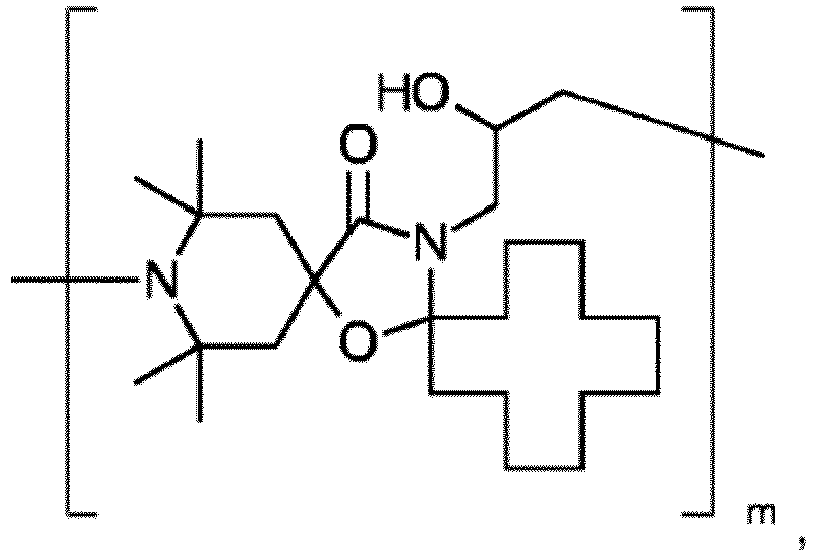
wobei vorzugsweise der gehinderte Amin-Lichtstabilisator (C) (Poly(4-hydroxy-2,2,6,6-tetramethyl-1-piperidin-ethanol-alt-1,4-butandisäure) oder ein Polymer aus 2,2,4,4-Tetramethyl-7-oxa-3,20-diaza-dispiro[5.1.11.2]-heneicosan-21-on und Epichlorhydrin ist. - Harzzusammensetzung nach einem der Ansprüche 1 bis 8, wobei die HarzZusammensetzung im Wesentlichen frei von gehinderten Amin-Lichtstabilisatoren mit einem Molekülmasse von weniger als 1.250 g/mol ist, wobei vorzugsweise die Menge an gehinderten Amin-Lichtstabilisatoren mit einer Molekülmasse von weniger als 1.250 g/mol 0,1 % oder weniger, bezogen auf das Gewicht der Harzzusammensetzung, stärker bevorzugt 0,05 % oder weniger, wie zum Beispiel 0,01 % ist oder weniger, oder 0,005 % oder weniger, am meisten bevorzugt ist die Harzzusammensetzung vollständig frei von
gehinderten Amin-Lichtstabilisatoren mit einer Molekülmasse von weniger als 1.250 g/mol. - Harzzusammensetzung nach einem der Ansprüche 1 bis 9, wobei der Thiosynergist (D) ausgewählt ist aus der Gruppe bestehend aus Dilaurylthiodipropionat, Distearyl-3,3'-thiodipropionat und Neopentantetrayl-tetrakis(3-dodecylthiopropionat), wobei vorzugsweise der Thiosynergist Distearyl-3,3'-thiodipropionat ist.
- Harzzusammensetzung nach einem der Ansprüche 2 bis 10, wobei das phenolische Antioxidationsmittel (E) zwei oder mehr phenolische Gruppen pro Molekül aufweist und vorzugsweise das phenolische Antioxidationsmittel (E) ausgewählt ist aus der Gruppe bestehend aus 2,2'-Methylenbis(4-methyl-6-t-butylphenol), 4,4'-Butylidenbis(3-methyl-6-t-butylphenol), 4,4'-Thiobis(3-methyl-6-t-butylphenol), 2,2'-Thiobis(4-methyl-6-t-butylphenol), 4,4'-Methylenbis(2,6-di-t-butylphenol), 2,2'-Methylenbis[6-(1-methylcyclohexyl)-p-cresol], 2,2'-Ethylidenbis(2,4-di-t-butylphenol), 2,2'-Butylidenbis(2-t-butyl-4-methylphenol), 1,1,3-Tris(2-methyl-4-hydroxy-5-t-butylphenyl)butan, Triethylen glycol-bis[3-(3-t-butyl-5-methyl-4-hydroxyphenyl)propionat], 1,6-Hexandiol-bis[3-(3,5-di-t-butyl-4-hydroxyphenyl)propionat], 2,2-Thiodiethylenbis[3-(3,5-di-t-butyl-4-hydroxyphenyl)propionat], N,N'-Hexamethylenbis(3,5-di-t-butyl-4-hydroxyhydrocinnamid), 3,5-Di-t-butyl-4-hydroxybenzylphosphonat-diethylester 1,3,5-Tris(2,6-dimethyl-3-hydroxy-4-t-butylbenzylisocyanurat, 1,3,5-Tris[(3,5-di-t-butyl-4-hydroxyphenyl)propionyloxyethyl]isocyanurat, tris(4-t-butyl-2,6-dimethyl-3-hydroxybenzylisocyanurat, 2,4-Bis(n-octylthio)-6-(4-hydroxy-3,5-t-butylanilino)-1,3,5-triazin, Tetrakis[methylen-3-(3,5-di-t-butyl-4-hydroxyphenyl)propionat]methan, Bis(3,5-di-t-butyl-4-hydroxybenzylphosphonsäureethylester)-Calcium, Bis(3,5-di-t-butyl-4-hydroxybenzylphosphonsäureethylester)-Nickel, Bis[3,3-bis(3-t-4-hydroxyphenyl)buttersäure]glycolester, N,N'-Bis[3,5-di-t-butyl-4-hydroxyphenyl)propionyl]hydrazin, 2,2'-Oxaimidobis[ethyl-3-(3,5-di-t-butyl-4-hydroxyphenyl)propionat], 2,2'-Methylenbis(4-methyl-6-t-butylphenol)terephthalat, 1,3,5-Trimethyl-2,4,6-tris(3,5-di-t-butyl-4-hydroxybenzyl)benzol, 3,9-Bis[1,1-dimethyl-2-{β-(3-t-butyl-4-hydroxy-5-methylphenyl)propionyloxy}ethyl]-2,4,8,10-tetraoxaspiro[5,5]-undecan, 2,2-Bis[4-(2-)3,5-di-t-butyl-4-hydroxyhydrocinnamoyloxy))ethoxyphenyl]propan und Alkylestern von β-(3,5-di-t-butyl-4-hydroxyphenyl)propionsäure.
- Harzzusammensetzung nach einem der Ansprüche 3 bis 11, wobei das Antioxidationsmittel (F) ausgewählt ist aus der Gruppe bestehend aus sekundären Phosphit-Antioxidationsmitteln, vorzugsweise ist das Antioxidationsmittel (F) ausgewählt aus der Gruppe bestehend aus Triphenylphosphit, Diphenylalkylphosphiten, Phenyl-dialkylphoshiten, Tris(nonylphenyl)phosphit, Tris(2,4-di-t-butylphenyl)phosphit, Bis(2,4-di-t-butylphenyl)pentaerythritol-diphosphit, Bis(2,6-di-t-butyl-4-methylphenyl)pentaerythritol-diphosphit, Bis(2,4-di-t-butyl-6-methylphenyl)pentaerythritol-diphosphit, Bis(2,4,6-tri-t-butylphenyl)pentaerythritol-diphosphit, Tetrakis(2,4-di-t-butylphenyl)-4,4'-biphenylendiphosphonit, Bis(2,4-di-t-butyl-6-methylphenyl)methylphosphit, und Bis(2,4-di-t-butyl-6-methylphenyl)ethylphosphit,
noch bevorzugter ist das Antioxidationsmittel (F) ausgewählt aus Tris(2,4-di-t-butylphenyl)phosphit, Bis(2,4-di-t-butyl-6-methylphenyl)ethylphosphit, Bis(2,4-di-t-butylphenyl)pentaerythritol-diphosphit und Tetrakis(2,4-di-t-butylphenyl)-4,4'-biphenylendiphosphonit, am meisten bevorzugt ist das Antioxidationsmittel (F) Tris(2,4-di-t-butylphenyl)phosphit. - Harzzusammensetzung nach einem der Ansprüche 1 bis 12, wobei die Harzzusammensetzung ferner einen anorganischen Talkumfüllstoff umfasst, wobei vorzugsweise der
anorganische Talkumfüllstoff einen mittleren Teilchendurchmesser von 5 µm oder weniger, vorzugsweise 4 µm oder weniger, noch mehr bevorzugt 1 bis 3 µm aufweist, und/oder wobei die Harzzusammensetzung ferner ein oder mehrere Färbemittel, wie zum Beispiel eines oder mehrere, die ausgewählt sind aus der Gruppe, bestehend aus Titandioxid, Kupferphthalocyanin und Russschwarz. - Gegenstand, umfassend eine Harzzusammensetzung nach einem der Ansprüche 1 bis 13, wobei vorzugsweise der Gegenstand eine Streckgrenzen-Retention von 90 % oder mehr nach der Exposition im Luftofen bei 120 °C während 1.000 Stunden, vorzugsweise von 92 % oder mehr, besonders bevorzugt 94 % oder mehr, wie zum Beispiel 95 % oder mehr, aufweist, wobei die Streckgrenze bestimmt wird gemäß ISO 527-1A, gemessen bei 23 °C, und/oder
wobei der Gegenstand eine Izod-Schlagzähigkeits-Retention von 90% oder mehr Exposition im Luftofen von 120 °C während 1.000 Stunden, vorzugsweise 92 % oder mehr, besonders bevorzugt 94 % oder mehr, wie zum Beispiel 95 % oder mehr, aufweist, wobei die Izod-Schlagzähigkeit gemäß ISO 180-1A, gemessen bei -40 °C und 23 °C, bestimmt wird,
und/oder
wobei der Gegenstand nach einer Bestrahlung mit 3609 kJ/m2 einen Graustufenwert von 4 oder mehr, vorzugsweise 4,5 oder mehr, wie zum Beispiel 4,5 bis 5, aufweist, wobei die Graustufenbewertung gemäß ISO 105A02 bestimmt wird. - Verwendung einer Kombination aus(B) einem gegebenenfalls substituierten linearen oder verzweigten Alkylester von 3-(alkylierter 4'- Hydroxyphenyl)propionsäure mit einer Molekülmasse von 750 g/mol oder weniger,(C) einem gehinderten Amin-Lichtstabilisator mit einer Molekülmasse von 1.250 g/mol oder mehr, wobei das gehinderte Amin in dem Rückgrat des gehinderten Amin-Lichtstabilisatormoleküls enthalten ist, und(D) einem Thiosynergisten, der ein Hydroperoxidzersetzer auf Schwefelbasis ist, gegebenenfalls ferner umfassend eines oder mehrere, ausgewählt aus(E) einem phenolischen Antioxidationsmittel, das sich von (B) unterscheidet, und(F) einem von (B) und (E) verschiedenen Antioxidationsmittel, ausgewählt aus der Gruppe der sekundärenAntioxidationsmittel,
zur Stabilisierung einer Polyolefinharzzusammensetzung.
Applications Claiming Priority (2)
| Application Number | Priority Date | Filing Date | Title |
|---|---|---|---|
| EP14168526 | 2014-05-15 | ||
| PCT/EP2015/060615 WO2015173315A1 (en) | 2014-05-15 | 2015-05-13 | Stabilised resin composition |
Publications (2)
| Publication Number | Publication Date |
|---|---|
| EP3143086A1 EP3143086A1 (de) | 2017-03-22 |
| EP3143086B1 true EP3143086B1 (de) | 2018-10-10 |
Family
ID=50771080
Family Applications (1)
| Application Number | Title | Priority Date | Filing Date |
|---|---|---|---|
| EP15722208.4A Active EP3143086B1 (de) | 2014-05-15 | 2015-05-13 | Stabilisierte harzzusammensetzung |
Country Status (5)
| Country | Link |
|---|---|
| US (1) | US10214627B2 (de) |
| EP (1) | EP3143086B1 (de) |
| CN (2) | CN114539675A (de) |
| ES (1) | ES2703705T3 (de) |
| WO (1) | WO2015173315A1 (de) |
Families Citing this family (22)
| Publication number | Priority date | Publication date | Assignee | Title |
|---|---|---|---|---|
| EP3298097B1 (de) * | 2015-05-21 | 2025-02-26 | Basf Se | Stabilisierung von heissschmelzklebstoffen |
| GB2549061B (en) * | 2015-09-03 | 2020-04-01 | Si Group Switzerland Chaa Gmbh | Stabilising Compositions |
| KR20180015072A (ko) * | 2016-08-02 | 2018-02-12 | 토토 가부시키가이샤 | 안정화된 폴리올레핀 수지 재료 |
| EP3538599A1 (de) | 2016-11-09 | 2019-09-18 | Borealis AG | Polypropylenzusammensetzung |
| WO2018114977A1 (en) * | 2016-12-23 | 2018-06-28 | Sabic Global Technologies B.V. | Automotive part |
| CN120310135A (zh) * | 2017-06-26 | 2025-07-15 | Sabic环球技术有限责任公司 | Uv和热稳定的阻燃玻璃填充的聚合物组合物和由其制成的增强制品 |
| CA3067853A1 (en) | 2017-06-29 | 2019-01-03 | Arkema Inc. | Polymer compositions stabilized with organopolysulfides |
| JP7297746B2 (ja) * | 2017-11-09 | 2023-06-26 | ミリケン・アンド・カンパニー | 添加剤組成物およびその添加剤組成物を含むポリマー組成物 |
| ES2890961T3 (es) | 2017-11-28 | 2022-01-25 | Borealis Ag | Composición de polímero con adherencia de la pintura mejorada |
| ES2924380T3 (es) * | 2018-07-12 | 2022-10-06 | Sabic Global Technologies Bv | Elemento fotovoltaico y composición polimérica para su lámina frontal |
| CA3121690A1 (en) * | 2018-12-04 | 2020-06-11 | Basf Se | Polyethylene or polypropylene articles |
| EP3898816A1 (de) * | 2018-12-19 | 2021-10-27 | SABIC Global Technologies B.V. | Polymerzusammensetzung, artikel mit dieser zusammensetzung und verwendung des artikels |
| CN111471241A (zh) | 2019-01-24 | 2020-07-31 | Sabic环球技术有限责任公司 | 具有改进的落锤冲击抗性的天线壳体 |
| US11753566B2 (en) | 2019-01-31 | 2023-09-12 | Synthomer Adhesive Technologies Llc | Low volatile tackifier compositions |
| CN110157094B (zh) * | 2019-04-30 | 2022-01-14 | 南通市东方塑胶有限公司 | 具有抗热氧老化功能的阻燃光扩散pp材料及其制备方法 |
| CN110423397B (zh) * | 2019-08-29 | 2022-04-01 | 山东三丰新材料有限公司 | 一种抗氧化稳定剂组合物及其在聚乙烯膜料中的应用 |
| WO2022132462A1 (en) * | 2020-12-16 | 2022-06-23 | Ticona Llc | Uv stable fiber-reinforced polymer composition |
| CN112745576A (zh) * | 2020-12-30 | 2021-05-04 | 上海聚威新材料股份有限公司 | 一种高耐热、高耐候的长玻纤增强聚丙烯材料及其制备方法 |
| KR20240032974A (ko) * | 2021-07-06 | 2024-03-12 | 알케마 인코포레이티드 | 유기디설파이드 블렌드로 안정된 중합체 조성물 |
| CN114957860B (zh) * | 2022-06-28 | 2024-01-26 | 江苏万纳普新材料科技有限公司 | 一种聚丙烯专用耐热氧老化改性功能母粒及其制备方法 |
| CN118812957A (zh) * | 2023-04-18 | 2024-10-22 | 中国石油化工股份有限公司 | 聚丙烯组合物、管材材料及其制备方法和应用 |
| CN116622159B (zh) * | 2023-05-10 | 2025-04-15 | 金发科技股份有限公司 | 一种聚丙烯组合物及其制备方法和应用 |
Family Cites Families (8)
| Publication number | Priority date | Publication date | Assignee | Title |
|---|---|---|---|---|
| US4590231A (en) * | 1983-10-11 | 1986-05-20 | Ciba-Geigy Corporation | Polyolefin compositions stabilized against degradation using hydroxylamine derivatives |
| JPH083006B2 (ja) * | 1987-07-31 | 1996-01-17 | 旭電化工業株式会社 | 安定化されたポリプロピレン系樹脂組成物 |
| FR2652578B1 (fr) | 1989-10-02 | 1994-04-29 | Rhone Poulenc Chimie | Nouvelles dihydropyridines a groupements amine encombree. |
| US5922794A (en) * | 1997-03-26 | 1999-07-13 | General Electric Company | Compositions stabilized with tertiary amine oxides |
| WO2000055273A1 (en) | 1999-03-18 | 2000-09-21 | Sekisui Chemical Co., Ltd. | Pressure-sensitive adhesive tape or sheet and process for producing the same |
| US7291669B2 (en) * | 2004-03-16 | 2007-11-06 | Ciba Specialty Chemicals Corporation | Stabilized polyolefin compositions |
| US8721946B2 (en) * | 2008-01-25 | 2014-05-13 | Borealis Ag | Low-sticky additive package for automotive interior applications |
| DE102008026672A1 (de) | 2008-06-04 | 2009-12-10 | Tesa Se | Klebstoff aus Polypropylenharz |
-
2015
- 2015-05-13 CN CN202210396696.9A patent/CN114539675A/zh active Pending
- 2015-05-13 EP EP15722208.4A patent/EP3143086B1/de active Active
- 2015-05-13 ES ES15722208T patent/ES2703705T3/es active Active
- 2015-05-13 US US15/311,032 patent/US10214627B2/en active Active
- 2015-05-13 CN CN201580034833.2A patent/CN106459537A/zh active Pending
- 2015-05-13 WO PCT/EP2015/060615 patent/WO2015173315A1/en not_active Ceased
Non-Patent Citations (1)
| Title |
|---|
| None * |
Also Published As
| Publication number | Publication date |
|---|---|
| CN106459537A (zh) | 2017-02-22 |
| ES2703705T3 (es) | 2019-03-12 |
| EP3143086A1 (de) | 2017-03-22 |
| CN114539675A (zh) | 2022-05-27 |
| US10214627B2 (en) | 2019-02-26 |
| WO2015173315A1 (en) | 2015-11-19 |
| US20170088689A1 (en) | 2017-03-30 |
Similar Documents
| Publication | Publication Date | Title |
|---|---|---|
| EP3143086B1 (de) | Stabilisierte harzzusammensetzung | |
| JP6586339B2 (ja) | 樹脂組成物 | |
| EP2333013B1 (de) | Polycarbonatblends mit hoher Wärmeformbeständigkeit und verbesserten Oberflächeneigenschaften | |
| EP3527617B1 (de) | Polyolefinharzzusammensetzung und formartikel damit | |
| AU2008336876B2 (en) | Olefin elastic resin composition | |
| JP7717214B2 (ja) | 核剤組成物、オレフィン系樹脂組成物、その成形品およびオレフィン系樹脂組成物の製造方法 | |
| TWI620779B (zh) | Resin additive masterbatch and polyolefin resin composition containing the resin additive masterbatch | |
| EP3680310B1 (de) | Zusammensetzung und flammhemmende harzzusammensetzung | |
| CN104428350B (zh) | 混合粒料 | |
| WO2019021671A1 (ja) | 組成物及び難燃性樹脂組成物 | |
| US7259198B2 (en) | Ultraviolet radiation stabilized polyolefins | |
| EP3808807B1 (de) | Polycarbonatharzzusammensetzung und diese enthaltender optischer formartikel | |
| JP5628539B2 (ja) | ジベンジリデンソルビトール系透明化剤の効果を向上させた透明化剤組成物 | |
| EP3707205B1 (de) | Thermoplastisches vulkanisate und zusammensetzungen daraus | |
| CN105705570B (zh) | 提高了涂装性的被涂装基材 | |
| KR20070026225A (ko) | 폴리카르보네이트 및 신규 uv 흡수제 함유 조성물 | |
| CN114729153A (zh) | 具有改进的抗冲击性和耐候性的脂族共聚酯组合物 | |
| CN115335447A (zh) | 成核剂、树脂组合物、树脂组合物的制造方法和成形品 | |
| CN111936594B (zh) | 颗粒状紫外线吸收剂和树脂组合物 | |
| CN101193963A (zh) | 铝颜料配合树脂组合物 | |
| JP4721823B2 (ja) | 難燃性樹脂組成物及びそれからなる成形体 | |
| JP2001089610A (ja) | ポリオレフィン系樹脂組成物、そのフィルムおよび農業用フィルム | |
| JP2025177264A (ja) | ポリプロピレン樹脂組成物およびフィルム並びにその製造方法 | |
| WO2022265042A1 (ja) | 核剤組成物、樹脂組成物、その成形品および樹脂組成物の製造方法 | |
| JP2001089609A (ja) | ポリオレフィン系樹脂組成物、そのフィルムおよび農業用フィルム |
Legal Events
| Date | Code | Title | Description |
|---|---|---|---|
| STAA | Information on the status of an ep patent application or granted ep patent |
Free format text: STATUS: THE INTERNATIONAL PUBLICATION HAS BEEN MADE |
|
| PUAI | Public reference made under article 153(3) epc to a published international application that has entered the european phase |
Free format text: ORIGINAL CODE: 0009012 |
|
| STAA | Information on the status of an ep patent application or granted ep patent |
Free format text: STATUS: REQUEST FOR EXAMINATION WAS MADE |
|
| 17P | Request for examination filed |
Effective date: 20161209 |
|
| AK | Designated contracting states |
Kind code of ref document: A1 Designated state(s): AL AT BE BG CH CY CZ DE DK EE ES FI FR GB GR HR HU IE IS IT LI LT LU LV MC MK MT NL NO PL PT RO RS SE SI SK SM TR |
|
| AX | Request for extension of the european patent |
Extension state: BA ME |
|
| DAV | Request for validation of the european patent (deleted) | ||
| DAX | Request for extension of the european patent (deleted) | ||
| STAA | Information on the status of an ep patent application or granted ep patent |
Free format text: STATUS: EXAMINATION IS IN PROGRESS |
|
| 17Q | First examination report despatched |
Effective date: 20171128 |
|
| RAP3 | Party data changed (applicant data changed or rights of an application transferred) |
Owner name: SABIC GLOBAL TECHNOLOGIES B.V. |
|
| GRAP | Despatch of communication of intention to grant a patent |
Free format text: ORIGINAL CODE: EPIDOSNIGR1 |
|
| STAA | Information on the status of an ep patent application or granted ep patent |
Free format text: STATUS: GRANT OF PATENT IS INTENDED |
|
| INTG | Intention to grant announced |
Effective date: 20180725 |
|
| GRAS | Grant fee paid |
Free format text: ORIGINAL CODE: EPIDOSNIGR3 |
|
| GRAA | (expected) grant |
Free format text: ORIGINAL CODE: 0009210 |
|
| STAA | Information on the status of an ep patent application or granted ep patent |
Free format text: STATUS: THE PATENT HAS BEEN GRANTED |
|
| AK | Designated contracting states |
Kind code of ref document: B1 Designated state(s): AL AT BE BG CH CY CZ DE DK EE ES FI FR GB GR HR HU IE IS IT LI LT LU LV MC MK MT NL NO PL PT RO RS SE SI SK SM TR |
|
| REG | Reference to a national code |
Ref country code: GB Ref legal event code: FG4D |
|
| REG | Reference to a national code |
Ref country code: CH Ref legal event code: EP Ref country code: AT Ref legal event code: REF Ref document number: 1051166 Country of ref document: AT Kind code of ref document: T Effective date: 20181015 |
|
| REG | Reference to a national code |
Ref country code: IE Ref legal event code: FG4D |
|
| REG | Reference to a national code |
Ref country code: DE Ref legal event code: R096 Ref document number: 602015017847 Country of ref document: DE |
|
| REG | Reference to a national code |
Ref country code: NL Ref legal event code: MP Effective date: 20181010 |
|
| REG | Reference to a national code |
Ref country code: LT Ref legal event code: MG4D |
|
| REG | Reference to a national code |
Ref country code: ES Ref legal event code: FG2A Ref document number: 2703705 Country of ref document: ES Kind code of ref document: T3 Effective date: 20190312 |
|
| REG | Reference to a national code |
Ref country code: AT Ref legal event code: MK05 Ref document number: 1051166 Country of ref document: AT Kind code of ref document: T Effective date: 20181010 |
|
| PG25 | Lapsed in a contracting state [announced via postgrant information from national office to epo] |
Ref country code: NL Free format text: LAPSE BECAUSE OF FAILURE TO SUBMIT A TRANSLATION OF THE DESCRIPTION OR TO PAY THE FEE WITHIN THE PRESCRIBED TIME-LIMIT Effective date: 20181010 |
|
| PG25 | Lapsed in a contracting state [announced via postgrant information from national office to epo] |
Ref country code: FI Free format text: LAPSE BECAUSE OF FAILURE TO SUBMIT A TRANSLATION OF THE DESCRIPTION OR TO PAY THE FEE WITHIN THE PRESCRIBED TIME-LIMIT Effective date: 20181010 Ref country code: IS Free format text: LAPSE BECAUSE OF FAILURE TO SUBMIT A TRANSLATION OF THE DESCRIPTION OR TO PAY THE FEE WITHIN THE PRESCRIBED TIME-LIMIT Effective date: 20190210 Ref country code: NO Free format text: LAPSE BECAUSE OF FAILURE TO SUBMIT A TRANSLATION OF THE DESCRIPTION OR TO PAY THE FEE WITHIN THE PRESCRIBED TIME-LIMIT Effective date: 20190110 Ref country code: AT Free format text: LAPSE BECAUSE OF FAILURE TO SUBMIT A TRANSLATION OF THE DESCRIPTION OR TO PAY THE FEE WITHIN THE PRESCRIBED TIME-LIMIT Effective date: 20181010 Ref country code: PL Free format text: LAPSE BECAUSE OF FAILURE TO SUBMIT A TRANSLATION OF THE DESCRIPTION OR TO PAY THE FEE WITHIN THE PRESCRIBED TIME-LIMIT Effective date: 20181010 Ref country code: LT Free format text: LAPSE BECAUSE OF FAILURE TO SUBMIT A TRANSLATION OF THE DESCRIPTION OR TO PAY THE FEE WITHIN THE PRESCRIBED TIME-LIMIT Effective date: 20181010 Ref country code: BG Free format text: LAPSE BECAUSE OF FAILURE TO SUBMIT A TRANSLATION OF THE DESCRIPTION OR TO PAY THE FEE WITHIN THE PRESCRIBED TIME-LIMIT Effective date: 20190110 Ref country code: HR Free format text: LAPSE BECAUSE OF FAILURE TO SUBMIT A TRANSLATION OF THE DESCRIPTION OR TO PAY THE FEE WITHIN THE PRESCRIBED TIME-LIMIT Effective date: 20181010 Ref country code: LV Free format text: LAPSE BECAUSE OF FAILURE TO SUBMIT A TRANSLATION OF THE DESCRIPTION OR TO PAY THE FEE WITHIN THE PRESCRIBED TIME-LIMIT Effective date: 20181010 |
|
| PG25 | Lapsed in a contracting state [announced via postgrant information from national office to epo] |
Ref country code: PT Free format text: LAPSE BECAUSE OF FAILURE TO SUBMIT A TRANSLATION OF THE DESCRIPTION OR TO PAY THE FEE WITHIN THE PRESCRIBED TIME-LIMIT Effective date: 20190210 Ref country code: AL Free format text: LAPSE BECAUSE OF FAILURE TO SUBMIT A TRANSLATION OF THE DESCRIPTION OR TO PAY THE FEE WITHIN THE PRESCRIBED TIME-LIMIT Effective date: 20181010 Ref country code: SE Free format text: LAPSE BECAUSE OF FAILURE TO SUBMIT A TRANSLATION OF THE DESCRIPTION OR TO PAY THE FEE WITHIN THE PRESCRIBED TIME-LIMIT Effective date: 20181010 Ref country code: RS Free format text: LAPSE BECAUSE OF FAILURE TO SUBMIT A TRANSLATION OF THE DESCRIPTION OR TO PAY THE FEE WITHIN THE PRESCRIBED TIME-LIMIT Effective date: 20181010 Ref country code: GR Free format text: LAPSE BECAUSE OF FAILURE TO SUBMIT A TRANSLATION OF THE DESCRIPTION OR TO PAY THE FEE WITHIN THE PRESCRIBED TIME-LIMIT Effective date: 20190111 |
|
| REG | Reference to a national code |
Ref country code: DE Ref legal event code: R097 Ref document number: 602015017847 Country of ref document: DE |
|
| PG25 | Lapsed in a contracting state [announced via postgrant information from national office to epo] |
Ref country code: CZ Free format text: LAPSE BECAUSE OF FAILURE TO SUBMIT A TRANSLATION OF THE DESCRIPTION OR TO PAY THE FEE WITHIN THE PRESCRIBED TIME-LIMIT Effective date: 20181010 Ref country code: DK Free format text: LAPSE BECAUSE OF FAILURE TO SUBMIT A TRANSLATION OF THE DESCRIPTION OR TO PAY THE FEE WITHIN THE PRESCRIBED TIME-LIMIT Effective date: 20181010 |
|
| PLBE | No opposition filed within time limit |
Free format text: ORIGINAL CODE: 0009261 |
|
| STAA | Information on the status of an ep patent application or granted ep patent |
Free format text: STATUS: NO OPPOSITION FILED WITHIN TIME LIMIT |
|
| PG25 | Lapsed in a contracting state [announced via postgrant information from national office to epo] |
Ref country code: SM Free format text: LAPSE BECAUSE OF FAILURE TO SUBMIT A TRANSLATION OF THE DESCRIPTION OR TO PAY THE FEE WITHIN THE PRESCRIBED TIME-LIMIT Effective date: 20181010 Ref country code: EE Free format text: LAPSE BECAUSE OF FAILURE TO SUBMIT A TRANSLATION OF THE DESCRIPTION OR TO PAY THE FEE WITHIN THE PRESCRIBED TIME-LIMIT Effective date: 20181010 Ref country code: RO Free format text: LAPSE BECAUSE OF FAILURE TO SUBMIT A TRANSLATION OF THE DESCRIPTION OR TO PAY THE FEE WITHIN THE PRESCRIBED TIME-LIMIT Effective date: 20181010 Ref country code: SK Free format text: LAPSE BECAUSE OF FAILURE TO SUBMIT A TRANSLATION OF THE DESCRIPTION OR TO PAY THE FEE WITHIN THE PRESCRIBED TIME-LIMIT Effective date: 20181010 |
|
| 26N | No opposition filed |
Effective date: 20190711 |
|
| PG25 | Lapsed in a contracting state [announced via postgrant information from national office to epo] |
Ref country code: SI Free format text: LAPSE BECAUSE OF FAILURE TO SUBMIT A TRANSLATION OF THE DESCRIPTION OR TO PAY THE FEE WITHIN THE PRESCRIBED TIME-LIMIT Effective date: 20181010 |
|
| REG | Reference to a national code |
Ref country code: CH Ref legal event code: PL |
|
| PG25 | Lapsed in a contracting state [announced via postgrant information from national office to epo] |
Ref country code: CH Free format text: LAPSE BECAUSE OF NON-PAYMENT OF DUE FEES Effective date: 20190531 Ref country code: MC Free format text: LAPSE BECAUSE OF FAILURE TO SUBMIT A TRANSLATION OF THE DESCRIPTION OR TO PAY THE FEE WITHIN THE PRESCRIBED TIME-LIMIT Effective date: 20181010 Ref country code: LI Free format text: LAPSE BECAUSE OF NON-PAYMENT OF DUE FEES Effective date: 20190531 |
|
| REG | Reference to a national code |
Ref country code: BE Ref legal event code: MM Effective date: 20190531 |
|
| PG25 | Lapsed in a contracting state [announced via postgrant information from national office to epo] |
Ref country code: LU Free format text: LAPSE BECAUSE OF NON-PAYMENT OF DUE FEES Effective date: 20190513 |
|
| PG25 | Lapsed in a contracting state [announced via postgrant information from national office to epo] |
Ref country code: TR Free format text: LAPSE BECAUSE OF FAILURE TO SUBMIT A TRANSLATION OF THE DESCRIPTION OR TO PAY THE FEE WITHIN THE PRESCRIBED TIME-LIMIT Effective date: 20181010 |
|
| PG25 | Lapsed in a contracting state [announced via postgrant information from national office to epo] |
Ref country code: IE Free format text: LAPSE BECAUSE OF NON-PAYMENT OF DUE FEES Effective date: 20190513 |
|
| PG25 | Lapsed in a contracting state [announced via postgrant information from national office to epo] |
Ref country code: BE Free format text: LAPSE BECAUSE OF NON-PAYMENT OF DUE FEES Effective date: 20190531 |
|
| PGFP | Annual fee paid to national office [announced via postgrant information from national office to epo] |
Ref country code: ES Payment date: 20200601 Year of fee payment: 6 |
|
| PGFP | Annual fee paid to national office [announced via postgrant information from national office to epo] |
Ref country code: GB Payment date: 20200506 Year of fee payment: 6 Ref country code: IT Payment date: 20200414 Year of fee payment: 6 |
|
| PG25 | Lapsed in a contracting state [announced via postgrant information from national office to epo] |
Ref country code: CY Free format text: LAPSE BECAUSE OF FAILURE TO SUBMIT A TRANSLATION OF THE DESCRIPTION OR TO PAY THE FEE WITHIN THE PRESCRIBED TIME-LIMIT Effective date: 20181010 |
|
| PG25 | Lapsed in a contracting state [announced via postgrant information from national office to epo] |
Ref country code: HU Free format text: LAPSE BECAUSE OF FAILURE TO SUBMIT A TRANSLATION OF THE DESCRIPTION OR TO PAY THE FEE WITHIN THE PRESCRIBED TIME-LIMIT; INVALID AB INITIO Effective date: 20150513 Ref country code: MT Free format text: LAPSE BECAUSE OF FAILURE TO SUBMIT A TRANSLATION OF THE DESCRIPTION OR TO PAY THE FEE WITHIN THE PRESCRIBED TIME-LIMIT Effective date: 20181010 |
|
| GBPC | Gb: european patent ceased through non-payment of renewal fee |
Effective date: 20210513 |
|
| PG25 | Lapsed in a contracting state [announced via postgrant information from national office to epo] |
Ref country code: GB Free format text: LAPSE BECAUSE OF NON-PAYMENT OF DUE FEES Effective date: 20210513 |
|
| PG25 | Lapsed in a contracting state [announced via postgrant information from national office to epo] |
Ref country code: MK Free format text: LAPSE BECAUSE OF FAILURE TO SUBMIT A TRANSLATION OF THE DESCRIPTION OR TO PAY THE FEE WITHIN THE PRESCRIBED TIME-LIMIT Effective date: 20181010 |
|
| REG | Reference to a national code |
Ref country code: ES Ref legal event code: FD2A Effective date: 20220729 |
|
| PG25 | Lapsed in a contracting state [announced via postgrant information from national office to epo] |
Ref country code: ES Free format text: LAPSE BECAUSE OF NON-PAYMENT OF DUE FEES Effective date: 20210514 |
|
| PG25 | Lapsed in a contracting state [announced via postgrant information from national office to epo] |
Ref country code: IT Free format text: LAPSE BECAUSE OF NON-PAYMENT OF DUE FEES Effective date: 20200513 |
|
| P01 | Opt-out of the competence of the unified patent court (upc) registered |
Effective date: 20230529 |
|
| PGFP | Annual fee paid to national office [announced via postgrant information from national office to epo] |
Ref country code: DE Payment date: 20250529 Year of fee payment: 11 |
|
| PGFP | Annual fee paid to national office [announced via postgrant information from national office to epo] |
Ref country code: FR Payment date: 20250526 Year of fee payment: 11 |
|
| PG25 | Lapsed in a contracting state [announced via postgrant information from national office to epo] |
Ref country code: IT Free format text: LAPSE BECAUSE OF NON-PAYMENT OF DUE FEES Effective date: 20210513 |