EP3143115B1 - Agent de lavage et de nettoyage avec des performances de blanchiment amélioré - Google Patents
Agent de lavage et de nettoyage avec des performances de blanchiment amélioré Download PDFInfo
- Publication number
- EP3143115B1 EP3143115B1 EP15720976.8A EP15720976A EP3143115B1 EP 3143115 B1 EP3143115 B1 EP 3143115B1 EP 15720976 A EP15720976 A EP 15720976A EP 3143115 B1 EP3143115 B1 EP 3143115B1
- Authority
- EP
- European Patent Office
- Prior art keywords
- amino acid
- alkyl
- seq
- acid sequence
- phenyl
- Prior art date
- Legal status (The legal status is an assumption and is not a legal conclusion. Google has not performed a legal analysis and makes no representation as to the accuracy of the status listed.)
- Active
Links
- 0 *C(*)=NN(*)C(*)=O Chemical compound *C(*)=NN(*)C(*)=O 0.000 description 1
Classifications
-
- C—CHEMISTRY; METALLURGY
- C11—ANIMAL OR VEGETABLE OILS, FATS, FATTY SUBSTANCES OR WAXES; FATTY ACIDS THEREFROM; DETERGENTS; CANDLES
- C11D—DETERGENT COMPOSITIONS; USE OF SINGLE SUBSTANCES AS DETERGENTS; SOAP OR SOAP-MAKING; RESIN SOAPS; RECOVERY OF GLYCEROL
- C11D3/00—Other compounding ingredients of detergent compositions covered in group C11D1/00
- C11D3/16—Organic compounds
- C11D3/38—Products with no well-defined composition, e.g. natural products
- C11D3/386—Preparations containing enzymes, e.g. protease or amylase
-
- C—CHEMISTRY; METALLURGY
- C11—ANIMAL OR VEGETABLE OILS, FATS, FATTY SUBSTANCES OR WAXES; FATTY ACIDS THEREFROM; DETERGENTS; CANDLES
- C11D—DETERGENT COMPOSITIONS; USE OF SINGLE SUBSTANCES AS DETERGENTS; SOAP OR SOAP-MAKING; RESIN SOAPS; RECOVERY OF GLYCEROL
- C11D3/00—Other compounding ingredients of detergent compositions covered in group C11D1/00
- C11D3/39—Organic or inorganic per-compounds
- C11D3/3902—Organic or inorganic per-compounds combined with specific additives
- C11D3/3905—Bleach activators or bleach catalysts
- C11D3/3907—Organic compounds
- C11D3/3917—Nitrogen-containing compounds
- C11D3/392—Heterocyclic compounds, e.g. cyclic imides or lactames
-
- C—CHEMISTRY; METALLURGY
- C11—ANIMAL OR VEGETABLE OILS, FATS, FATTY SUBSTANCES OR WAXES; FATTY ACIDS THEREFROM; DETERGENTS; CANDLES
- C11D—DETERGENT COMPOSITIONS; USE OF SINGLE SUBSTANCES AS DETERGENTS; SOAP OR SOAP-MAKING; RESIN SOAPS; RECOVERY OF GLYCEROL
- C11D3/00—Other compounding ingredients of detergent compositions covered in group C11D1/00
- C11D3/39—Organic or inorganic per-compounds
- C11D3/3902—Organic or inorganic per-compounds combined with specific additives
- C11D3/3905—Bleach activators or bleach catalysts
- C11D3/3907—Organic compounds
- C11D3/3917—Nitrogen-containing compounds
- C11D3/3927—Quarternary ammonium compounds
Definitions
- the present invention relates to the use of a specific protease for enhancing the bleaching performance of certain acylhydrazone, when washing textiles or cleaning hard surfaces, and detergents and cleaning agents which contain such a protease and such acylhydrazone.
- the acylhydrazones can be in the E or Z configuration; when R 2 is hydrogen, the compound of general formula (I) can exist in one of its tautomeric forms or as a mixture thereof.
- R 2 is preferably hydrogen.
- R 1 and / or R 3 is preferably a methyl, phenyl or naphthyl group substituted by an electron-withdrawing group.
- R 4 is preferably hydrogen.
- An electron-withdrawing group is preferably an ammonium group which optionally carries alkyl or hydroxyalkyl groups or is formed, including the N atom bearing an alkyl group, as a heterocyloalkyl group optionally bearing further heteroatoms.
- Preferred embodiments of the compounds of the general formula (I) include those of the general formula (II) in which R 1 represents a C 1-4 alkyl group selected from a substituent in which R 10 represents hydrogen or a C 1-28 alkyl, C 2-28 alkenyl, C 2-22 alkynyl, C 3-12 cycloalkyl, C 3-12 cycloalkenyl, C 7-9 aralkyl, C 3-20 heteroalkyl, C 3-12 cycloheteroalkyl, C 5-16 heteroaralkyl and A - represents the anion of an organic or inorganic acid, R 2 and R 4 represent Formula (I) have the meaning given and R 5 , R 6 , R 7 and R 8 independently of one another for R 1 , hydrogen, halogen, a hydroxyl, amino, an optionally substituted N-mono- or di-C 1-4 -alkyl- or C 2-4 hydroxyalkyl-amino, N-phenyl- or N-naphth
- the anion A - is preferably carboxylate such as lactate, citrate, tartrate or succinate, perchlorate, tetrafluoroborate, hexafluorophosphate, alkyl sulfonate, alkyl sulfate, hydrogen sulfate, sulfate, dihydrogen phosphate, hydrogen phosphate, phosphate, isocyanate, rhodanide, chloride, nitrate, bromide, fluoride, fluoride Carbonate, in the case of polyvalent anions the charge balance can be achieved by the presence of additional cations such as sodium or ammonium ions.
- carboxylate such as lactate, citrate, tartrate or succinate, perchlorate, tetrafluoroborate, hexafluorophosphate, alkyl sulfonate, alkyl sulfate, hydrogen sulfate, sulfate, dihydrogen phosphate, hydrogen phosphate, phosphate
- the acylhydrazone of the formula (III) is particularly preferred
- proteases are enzymes that catalyze the hydrolysis of amide bonds in protein substrates.
- the protease used according to the invention preferably has the amino acid V at position 193 in the count according to SEQ ID NO: 1 and preferably the amino acid L at position 211, or it has the position 9 in position 9 according to the SEQ ID NO: 2 Amino acid R, amino acid T at position 15, amino acid A at position 66, amino acid D at position 212 and / or amino acid R at position 239, several, for example 2, 3, 4 or 5, such proteases can be used.
- those of the subtilisin type can also be used.
- subtilisins BPN 'and Carlsberg examples of this are the subtilisins BPN 'and Carlsberg, the protease PB92, the subtilisins 147 and 309, the alkaline protease from Bacillus lentus, subtilisin DY and the enzymes thermitase, proteinase K and the enzyme which can no longer be assigned to the subtilisins in the narrower sense Proteases TW3 and TW7.
- Subtilisin Carlsberg is available in a further developed form under the trade name Alcalase® from Novozymes A / S, Bagsvaerd, Denmark.
- the subtilisins 147 and 309 are sold under the trade names Esperase® and Savinase® by Novozymes.
- protease variants known as BLAP® are derived from the protease from Bacillus lentus DSM 5483.
- Further usable proteases are, for example, those under the trade names Durazym®, Relase®, Everlase®, Nafizym®, Natalase® and Kannase® from Novozymes, which under the trade names, Purafect®, Purafect® OxP, Purafect® Prime, Excellase® and Properase® from Genencor, which under the trade name Biotouch® ROC 250 L from AB-Enzymes, Darmstadt, under the trade name Protosol® from Advanced Biochemicals Ltd., Thane, India, under the trade name Wuxi® from from Wuxi Snyder Bioproducts Ltd., China, under the trade names Proleather® and Protease P® from Amano Pharmaceuticals Ltd., Nagoya, Japan, under the trade name Biogent® 900 G from Ishaan Bio Private Limited, Ahmedabad, India, and the enzyme available under the name
- proteases from Bacillus gibsonii and Bacillus pumilus which are disclosed in the international patent applications, are also used with particular preference WO2008 / 086916 and WO2007 / 131656 , The effect according to the invention of increasing the bleaching performance is not observed when using the protease according to SEQ ID NO: 4.
- nucleic acid or amino acid sequences is determined by a sequence comparison.
- This sequence comparison is based on the BLAST algorithm established and commonly used in the prior art (cf. for example Altschul, SF, Gish, W., Miller, W., Myers, EW & Lipman, DJ (1990) "Basic local alignment search tool.” J. Mol. Biol. 215: 403-410 , and Altschul, Stephan F., Thomas L. Madden, Alejandro A. Schaffer, Jinghui Zhang, Hheng Zhang, Webb Miller, and David J.
- T-Coffee see for example Notredame et al. (2000): T-Coffee: A novel method for multiple sequence alignments. J. Mol. Biol. 302, 205-217 ) or programs based on these programs or algorithms.
- all sequence comparisons were created with the computer program Vector NTI® Suite 10.3 (Invitrogen Corporation, 1600 Faraday Avenue, Carlsbad, California, USA) with the specified standard parameters, whose AlignX module for sequence comparisons is based on ClustalW ,
- Such a comparison also allows a statement about the similarity of the compared sequences to one another. It is usually given in percent identity, that is to say the proportion of identical nucleotides or amino acid residues in the same positions or in an alignment corresponding to one another.
- the broader concept of homology also includes conserved amino acid exchanges in amino acid sequences, that is, amino acids with similar chemical activity, since these usually have similar chemical activities within the protein. Therefore, the similarity of the compared sequences can also be given as percent homology or percent similarity.
- Identity and / or homology information can be made about entire polypeptides or genes or only over individual areas. Homologous or identical regions of different nucleic acid or amino acid sequences are therefore defined by matches in the sequences. Such areas often have identical functions.
- nucleic acid or amino acid sequence can be small and contain only a few nucleotides or amino acids. Such small areas often have essential functions for the overall activity of the protein. It can therefore make sense to relate sequence matches only to individual, possibly small, areas. Unless otherwise stated, identity or homology information in the present application relates to the total length of the nucleic acid or amino acid sequence specified in each case.
- the proportion by weight of the protease, based on active protein, in the total weight of washing or cleaning agents according to the invention is preferably 0.005 to 1.0% by weight, in particular 0.01 to 0.5% by weight and particularly preferably 0.02 to 0.2% by weight .-%.
- the protein concentration can be determined using known methods, for example the BCA method (bicinchoninic acid; 2,2'-bichinolyl-4,4'-dicarboxylic acid) or the biuret method ( AG Gornall, CS Bardawill and MM David, J. Biol. Chem., 177 (1948), pp. 751-766 ) can be determined.
- the active protein concentration was determined by titrating the active centers using a suitable irreversible inhibitor (for proteases, for example, phenylmethylsulfonyl fluoride (PMSF)) and determining the residual activity (cf. M. Bender et al., J. Am. Chem. Soc. 88, 24 (1966), pp. 5890-5913 ).
- a suitable irreversible inhibitor for proteases, for example, phenylmethylsulfonyl fluoride (PMSF)
- the cleaning-active effects of the protease are retained in the presence of the acylhydrazone present at the same time.
- the cleaning-active effects of the acylhydrazone are, however, enhanced in the presence of protease present at the same time if the protease is selected from the above-mentioned enzymes.
- the combined use of such protease and acylhydrazone also results in a greater number of improved stains removed than the sum of improved stains removed when using the individual of the two active substances, in particular at low washing temperatures of, for example, 40 ° C. and below, and even at room temperature.
- the performance of compounds of the general formula (I) can, if appropriate, be determined by the presence of manganese, titanium, cobalt, nickel or copper ions, preferably Mn (II) - (III) - (IV) - (V), Cu ( I) - (II) - (III), Fe (I) - (II) - (III) - (IV), Co (I) - (II) - (III), Ni (I) - (II) - (III), Ti (II) - (III) - (IV) and particularly preferably those selected from Mn (II) - (III) - (IV) - (V), Cu (I) - (II) - (III ), Fe (I) - (II) - (III) - (IV) and Co (I) - (II) - (III), are further reinforced; if desired, the acylhydrazone can also be used in the form of complex compounds of the metal central atoms
- a bleach-enhancing complex which has a ligand with a skeleton of the formula (I) can have the corresponding ligand once or more than once, in particular twice. It can have one or, if necessary, two or more cores. It can also contain other neutral, anion or cation ligands, such as H 2 O, NH 3 , CH 3 OH, acetylacetone, terpyridine, organic anions such as citrate, oxalate, tartrate, formate, a C 2-18 carboxylate, a C 1-18 alkyl sulfate, in particular methosulfate, or a corresponding alkanesulfonate, inorganic anions, such as, for example, halide, in particular chloride, perchlorate, tetrafluoroborate, hexafluorophosphate, nitrate, hydrogen sulfate, hydroxide or hydroperoxide. It can also have bridging ligands such as alkylene diamine
- the concentration of the compound according to formula (I) in aqueous liquor is 0.5 ⁇ mol / l to 500 ⁇ mol / l, in particular 5 ⁇ mol / l to 100 ⁇ mol / l.
- the above-mentioned complex-forming metal ions are preferably not added intentionally, but they can be present from possible sources for such metal ions, which in particular include tap water, the washing machine itself, buildup on textiles and soiling on the textiles. If necessary, metal ions brought in unintentionally with other detergent ingredients can also be used.
- Preferred peroxygen concentrations (calculated as H 2 O 2 ) in the liquor are in the range from 0.001 g / l to 10 g / l, in particular from 0.1 g / l to 1 g / l and particularly preferably from 0.2 g / l up to 0.5 g / l.
- the use according to the invention is preferably carried out at temperatures in the range from 10 ° C. to 95 ° C., in particular 20 ° C. to 40 ° C. and particularly preferably at temperatures below 30 ° C.
- the water hardness of the water used to prepare the aqueous liquor is preferably in the range from 0 ° dH to 21 ° dH, in particular 0 ° dH to 3 ° dH.
- the water hardness in the wash liquor is preferably in the range from 0 ° dH to 16 ° dH, in particular 0 ° dH to 3 ° dH, which can be achieved, for example, by using conventional builder materials or water softeners.
- the use according to the invention is preferably carried out at pH values in the range from pH 5 to pH 12, in particular from pH 7 to pH 11.
- the use according to the invention is preferably carried out in such a way that a peroxygen compound and a detergent which contains an acylhydrazone of the general formula (I) and the above-mentioned protease are allowed to act on a contaminated textile in the course of a washing process carried out by machine or by hand.
- the use according to the invention can be achieved particularly simply by using a detergent which contains peroxygen compound, the protease mentioned and a compound of the formula (I) or, if desired, a bleaching catalyst which is accessible from the bleaching catalyst from said transition metal ion, in the washing of textiles in need of cleaning.
- the peroxygen compound and / or the compound of formula (I) and / or a complex accessible therefrom and / or the protease can also be added separately to a washing liquor which has a detergent without the particular ingredient mentioned.
- a washing liquor which has a detergent without the particular ingredient mentioned.
- lipases or cutinases in particular because of their triglyceride-cleaving activities, but also to generate peracids in situ from suitable precursors.
- lipases or cutinases include, for example, the lipases originally obtainable from Humicola lanuginosa (Thermomyces lanuginosus) or developed further, in particular those with the amino acid exchange D96L.
- the cutinases which were originally isolated from Fusarium solani pisi and Humicola insolens, can also be used. Lipases or cutinases whose starting enzymes were originally isolated from Pseudomonas mendocina and Fusarium solanii can also be used.
- oxidoreductases for example oxidases, oxygenases, catalases, peroxidases, such as halo-, chloro-, bromo-, lignin, glucose or manganese peroxidases, dioxygenases or laccases (phenoloxidases, polyphenoloxidases) can be used to increase the bleaching effect.
- organic, particularly preferably aromatic, compounds interacting with the enzymes are additionally added in order to increase the activity of the oxidoreductases in question (enhancers) or to ensure the flow of electrons (mediators) in the case of very different redox potentials between the oxidizing enzymes and the soiling.
- the cleaning agents according to the invention particularly preferably contain another enzyme at least one amylase.
- An amylase is an enzyme as described in the introduction. Synonymous terms can be used for amylases, for example 1,4-alpha-D-glucan-glucanohydrolase or glycogenase.
- Amylases preferred according to the invention are ⁇ -amylases. What is decisive for whether an enzyme is an ⁇ -amylase in the sense of the invention is its ability to hydrolize ⁇ (1-4) glycoside bonds in the amylose of starch.
- Exemplary amylases are the ⁇ -amylases from Bacillus licheniformis, from Bacillus amyloliquefaciens or from Bacillus stearothermophilus, and in particular also their further developments which are improved for use in detergents or cleaning agents.
- the enzyme from Bacillus licheniformis is available from Novozymes under the name Termamyl® and from Danisco / Genencor under the name Purastar®ST.
- this ⁇ -amylase is available from Novozymes under the trade names Duramyl® and Termamy®ultra, from Danisco / Genencor under the name Purastar®OxAm and from Daiwa Seiko Inc., Tokyo, Japan, as Keistase®.
- the Bacillus amyloliquefaciens ⁇ -amylase is sold by Novozymes under the name BAN®, and derived variants of the Bacillus stearothermophilus ⁇ -amylase under the names BSG® and Novamyl®, also from Novozymes.
- the ⁇ -amylase from Bacillus sp.
- a 7-7 (DSM 12368) and the cyclodextrin glucanotransferase (CGTase) from Bacillus agaradherens (DSM 9948). Fusion products of all the molecules mentioned can also be used.
- the further developments of the ⁇ -amylase from Aspergillus niger and A. oryzae available from Novozymes under the trade names Fungamyl® are suitable.
- Variants of these enzymes obtainable by point mutations can also be used according to the invention.
- Particularly preferred amylases are disclosed in the international publications WO 00/60060 .
- WO 03/002711 WO 03/054177 and WO07 / 079938 ,
- preferred cleaning agents according to the invention are characterized in that at least one enzyme from the group of the amylases, cellulases, hemicellulases, mannanases, tannases, xylanases, xanthanases, xyloglucanases, ⁇ -glucosidases, pectinases, carrageenases, perhydrolases, oxidases, oxidoreductases or an is further enzyme Lipase, and mixtures thereof, is preferably used from the group of amylases.
- the proportion by weight of the further enzymes, based on active protein, in the total weight of the washing and cleaning agents is preferably 0.0005 to 1.0% by weight, in particular 0.001 to 0.5% by weight and particularly preferably 0.002 to 0.2% by weight. -%.
- washing or cleaning agents is 0.001% by weight to 5% by weight, in particular 0.05 wt .-% to 0.15 wt .-% and particularly preferably 0.03 wt .-% to 0.09 wt .-% of the compound according to formula (I).
- the agent additionally contains a manganese, titanium, cobalt, nickel or copper salt and / or a manganese, titanium, cobalt, nickel or copper complex without a ligand which corresponds to a compound according to formula (I).
- the molar ratio of the transition metal mentioned or the sum of the transition metals mentioned to the compound of the formula (I) is preferably in the range from 0.001: 1 to 2: 1, in particular 0.01: 1 to 1: 1.
- 0.05% by weight to 1% by weight, in particular 0.1% by weight to 0.5% by weight, of bleach-enhancing complex which contains a ligand of the formula ( I) has included.
- the preferred transition metal is Mn.
- the peroxygen compounds contained in the compositions include, in particular, organic peracids or peracidic salts of organic acids, such as phthalimidopercaproic acid, perbenzoic acid or salts of diperoxododecanedioic acid, other peroxoacids or peroxoacid salts, such as alkali metal persulfates or peroxodisulfates or caroates, or tetrayl peroxides or tetrayl peroxides and tetrayl peroxides Washing conditions Hydrogen peroxide releasing substances, such as alkali perborates, alkali percarbonates, alkali persilicates and urea perhydrate, can be considered.
- organic peracids or peracidic salts of organic acids such as phthalimidopercaproic acid, perbenzoic acid or salts of diperoxododecanedioic acid, other peroxoacids or peroxoacid
- Hydrogen peroxide can also be generated using an enzymatic system, i.e. an oxidase and its substrate. If solid peroxygen compounds are to be used, they can be used in the form of powders or granules, which can also be coated in a manner known in principle. Alkali percarbonate, alkali perborate monohydrate, alkali perborate tetrahydrate or hydrogen peroxide are particularly preferably used in the form of aqueous solutions which contain 3% by weight to 10% by weight of hydrogen peroxide. Peroxygen compounds are preferably present in the compositions in amounts of up to 50% by weight, in particular from 2% by weight to 45% by weight and particularly preferably from 5% by weight to 20% by weight.
- a customary bleach activator is used together with the acylhydrazone of the general formula (I), the general formula (II) and in particular the formula (III).
- Such bleach activators are preferably contained in detergents in amounts of up to 10% by weight, in particular from 1.5% by weight to 5% by weight.
- Compounds which provide peroxocarboxylic acid under perhydrolysis conditions are, in particular, compounds which may be substituted perbenzoic acid and / or aliphatic peroxocarboxylic acids having 1 to 12 carbon atoms, in particular 2 to 4 carbon atoms, under perhydrolysis conditions result, used alone or in mixtures.
- Bleach activators which carry O- and / or N-acyl groups, in particular of the number of carbon atoms mentioned and / or optionally substituted benzoyl groups, are suitable.
- acylated alkylenediamines in particular tetraacetylethylenediamine (TAED), acylated glycolurils, in particular tetraacetylglycoluril (TAGU), acylated triazine derivatives, in particular 1,5-diacetyl-2,4-dioxohexahydro-1,3,5-triazine (DADHT), N- Acylimides, in particular N-nonanoylsuccinimide (NOSI), acylated phenolsulfonates or carboxylates or the sulfonic or carboxylic acids thereof, in particular nonanoyl- or isononanoyl- or lauroyloxybenzenesulfonate (NOBS or iso-NOBS or LOBS) or decanoyloxybenzoic acid derivatives (D-formaldehyde carboxylates), or decanoyloxybenzoate derivatives thereof such as
- bleach-activating compounds for example nitriles, from which perimidic acids are formed under perhydrolysis conditions
- nitriles include, in particular, aminoacetonitrile derivatives with a quaternized nitrogen atom according to the formula in which R 11 represents -H, -CH 3 , a C 2-24 alkyl or alkenyl radical, a substituted C 1-24 alkyl or C 2-24 alkenyl radical with at least one substituent from the group -Cl, -Br, -OH, -NH 2 , -CN and -N (+) -CH 2 -CN, an alkyl or alkenylaryl radical with a C 1-24 alkyl group, or for a substituted alkyl or alkenylaryl radical with at least one, preferably two, optionally substituted C 1-24 alkyl group (s) and optionally further substituents on the aromatic ring
- the bleach activators may have been coated or granulated with coating substances in a known manner, with tetraacetylethylenediamine granulated with carboxymethylcellulose with average grain sizes of 0.01 mm to 0.8 mm, granulated 1.5- Diacetyl-2,4-dioxohexahydro-1,3,5-triazine, and / or trialkylammonium acetonitrile made up in particulate form is particularly preferred.
- customary bleach-activating transition metal complexes can also be used. These are preferably selected from the cobalt, iron, copper, titanium, vanadium, manganese and ruthenium complexes.
- Suitable ligands in such transition metal complexes are both inorganic and organic compounds, to which, in addition to carboxylates, in particular compounds with primary, secondary and / or tertiary amine and / or alcohol functions, such as pyridine, pyridazine, pyrimidine, pyrazine, imidazole, pyrazole , Triazole, 2,2'-bispyridylamine, tris- (2-pyridylmethyl) amine, 1,4,7-triazacyclononane and its substituted derivatives such as 1,4,7-trimethyl-1,4,7-triazacyclononane, 1.5 , 9-triazacyclododecane and its substituted derivatives such as 1,5,9-trimethyl-1,
- the inorganic neutral ligands include, in particular, ammonia and water. If not all of the coordination sites of the transition metal central atom are occupied by neutral ligands, the complex contains further, preferably anionic, and in particular monodentate or bidentate ligands. These include in particular the halides such as fluoride, chloride, bromide and iodide, and the (NO 2 ) - group, that is to say a nitro ligand or a nitrito ligand.
- the (NO 2 ) - group can also be chelated to a transition metal or it can bridge two transition metal atoms asymmetrically or ⁇ 1 -O.
- the transition metal complexes can also carry other ligands, generally of a simpler structure, in particular mono- or polyvalent anion ligands.
- ligands generally of a simpler structure, in particular mono- or polyvalent anion ligands.
- anion ligands are intended to balance the charge between the transition metal central atom and the ligand system.
- the presence of oxo ligands, peroxo ligands and imino ligands is also possible.
- Such ligands in particular can also act as bridges, so that multinuclear complexes are formed.
- both metal atoms in the complex do not have to be the same.
- the use of dinuclear complexes in which the two transition metal central atoms have different oxidation numbers is also possible. If anion ligands are absent or the presence of anion ligands does not lead to charge balance in the complex, anionic counterions are present in the transition metal complex compounds to be used according to the invention, which neutralize the cationic transition metal complex.
- anionic counterions include in particular nitrate, hydroxide, hexafluorophosphate, sulfate, chlorate, perchlorate, the halides such as chloride or the anions of carboxylic acids such as formate, acetate, oxalate, benzoate or citrate.
- transition metal complex compounds which can be used are Mn (IV) 2 ( ⁇ -O) 3 (1,4,7-trimethyl-1,4,7-triazacyclononane) -di-hexafluorophosphate, [N, N'-bis [(2 -hydroxy-5-vinylphenyl) methylene] -1,2-diaminocyclohexane] manganese (III) chloride, [N, N'-bis [(2-hydroxy-5-nitrophenyl) methylene] -1.2 -diaminocyclohexane] -manganese (III) acetate, [N, N'-bis [(2-hydroxyphenyl) methylene] -1,2-phenylenediamine] -manganese (III) acetate, [N, N'- Bis [(2-hydroxyphenyl) methylene] -1,2-diaminocyclohexane] manganese (III) chloride, [N, N'-bis
- Detergents containing peroxygen compounds which can be present in particular as powdery solids, in post-compacted particle form, as homogeneous solutions or suspensions, can, in addition to the combination of protease and compound according to formula (I) to be used according to the invention, and optionally the bleach activators and catalysts mentioned, in principle, all known and contain common ingredients in such agents.
- the agents can include, in particular, builder substances, surface-active surfactants, water-miscible organic solvents, further enzymes, sequestering agents, electrolytes, pH regulators, polymers with special effects, such as soil release polymers, color transfer inhibitors, graying inhibitors, crease-reducing polymeric active ingredients and shape-retaining polymeric active ingredients, and other auxiliaries, such as optical brighteners, foam regulators, dyes and fragrances.
- an agent can additionally include customary antimicrobial active ingredients, such as, for example, alcohols, aldehydes, acids, carboxylic acid esters, acid amides, phenols and phenol derivatives, diphenyls, diphenylalkanes, urea derivatives, O-acetates and O bound to organic frameworks -Formals, benzamidines, Isothiazolines, phthalimide derivatives, pyridine derivatives, amines, quaternary ammonium compounds, guanidines, amphoteric compounds, quinolines, benzimidazoles, IPBC, dithiocarbamates, metals and metal compounds such as silver and silver salts, halogens such as chlorine, iodine and their compounds, other oxidizing agents and inorganic nitrogen compounds.
- antimicrobial additives are preferably present in amounts of up to 10% by weight, in particular from 0.01% by weight to 5% by weight, in each case
- the agents can contain one or more surfactants, in particular anionic surfactants, nonionic surfactants and mixtures thereof, but also cationic and / or amphoteric surfactants.
- Suitable nonionic surfactants are, in particular, alkyl glycosides and ethoxylation and / or propoxylation products of alkyl glycosides or linear or branched alcohols each having 12 to 18 carbon atoms in the alkyl part and 3 to 20, preferably 4 to 10, alkyl ether groups.
- Suitable anionic surfactants are especially soaps and those which contain sulfate or sulfonate groups with preferably alkali ions as cations.
- Usable soaps are preferably the alkali salts of saturated or unsaturated fatty acids with 12 to 18 carbon atoms. Such fatty acids can also be used in a form that is not completely neutralized.
- the surfactants of the sulfate type which can be used include the salts of the sulfuric acid half-esters of fatty alcohols having 12 to 18 carbon atoms and the sulfation products of the nonionic surfactants mentioned with a low degree of ethoxylation.
- the sulfonate-type surfactants that can be used include linear alkylbenzenesulfonates with 9 to 14 carbon atoms in the alkyl part, alkanesulfonates with 12 to 18 carbon atoms, and olefin sulfonates with 12 to 18 carbon atoms, which are formed when corresponding monoolefins are reacted with sulfur trioxide, as well as alpha-sulfofatty acid esters which are formed in the sulfonation of fatty acid methyl or ethyl esters.
- Such surfactants are present in detergents in proportions of preferably 5% by weight to 50% by weight, in particular 8% by weight to 30% by weight,
- a detergent preferably contains at least one water-soluble and / or water-insoluble, organic and / or inorganic builder.
- the water-soluble organic builder substances include polycarboxylic acids, in particular citric acid and sugar acids, monomeric and polymeric aminopolycarboxylic acids, in particular glycinediacetic acid, methylglycinediacetic acid, Nitrilotriacetic acid, iminodisuccinates, such as ethylenediamine-N, N'-disuccinic acid and Hydroxyiminodisuccinate, ethylenediaminetetraacetic acid and polyaspartic acid, polyphosphonic acids, especially amino-tris (methylenephosphonic acid), ethylenediaminetetrakis (methylenephosphonic acid), lysine tetra (methylenphosphoklare) and 1-hydroxyethane-1,1-diphosphonic acid, polymeric hydroxy compounds such as Dextrin and polymeric (poly) carboxylic acids, in particular polycar
- the relative average molecular weight (here and hereinafter: weight average) of the homopolymers of unsaturated carboxylic acids is generally between 5,000 g / mol and 200,000 g / mol, that of the copolymers between 2,000 g / mol and 200,000 g / mol, preferably 50 000 g / mol to 120 000 g / mol, each based on free acid.
- a particularly preferred acrylic acid-maleic acid copolymer has a relative average molecular weight of 50,000 to 100,000.
- Suitable, albeit less preferred, compounds of this class are copolymers of acrylic acid or methacrylic acid with vinyl ethers, such as vinyl methyl ethers, vinyl esters, ethylene, propylene and styrene, in which the proportion of acid is at least 50% by weight.
- Terpolymers can also be used as water-soluble organic builder substances which contain two unsaturated acids and / or their salts as monomers and vinyl alcohol and / or a vinyl alcohol derivative or a carbohydrate as third monomer.
- the first acidic monomer or its salt is derived from a monoethylenically unsaturated C 3 -C 8 carboxylic acid and preferably from a C 3 -C 4 monocarboxylic acid, in particular from (meth) acrylic acid.
- the second acidic monomer or its salt can be a derivative of a C 4 -C 8 dicarboxylic acid, maleic acid being particularly preferred.
- the third monomeric unit is formed from vinyl alcohol and / or preferably an esterified vinyl alcohol.
- Vinyl alcohol derivatives which are an ester of short-chain carboxylic acids, for example of C 1 -C 4 -carboxylic acids, with vinyl alcohol are particularly preferred.
- Preferred polymers contain 60% by weight to 95% by weight, in particular 70% by weight to 90% by weight of (meth) acrylic acid or (meth) acrylate, particularly preferably acrylic acid or acrylate, and maleic acid or Maleinate and 5 wt .-% to 40 wt .-%, preferably 10 wt .-% to 30 wt .-% vinyl alcohol and / or vinyl acetate.
- Polymers in which the weight ratio of (meth) acrylic acid or (meth) acrylate to maleic acid or maleinate is between 1: 1 and 4: 1, preferably between 2: 1 and 3: 1 and in particular 2: 1 and 2 are very particularly preferred , 5: 1 lies. Both the amounts and the weight ratios are based on the acids.
- the second acidic monomer or its salt can also be a derivative of an allylsulfonic acid which, in the 2-position, has an alkyl radical, preferably a C 1 -C 4 -alkyl radical, or an aromatic radical which is preferably derived from benzene or benzene derivatives is substituted.
- Preferred terpolymers contain 40% by weight to 60% by weight, in particular 45 to 55% by weight of (meth) acrylic acid or (meth) acrylate, particularly preferably acrylic acid or acrylate, 10% by weight to 30% by weight.
- % preferably 15% by weight to 25% by weight of methallylsulfonic acid or methallylsulfonate and as the third monomer 15% by weight to 40% by weight, preferably 20% by weight to 40% by weight, of a carbohydrate.
- This carbohydrate can be, for example, a mono-, di-, oligo- or polysaccharide, mono-, di- or oligosaccharides being preferred. Sucrose is particularly preferred.
- the use of the third monomer presumably creates predetermined breaking points in the polymer, which are responsible for the good biodegradability of the polymer.
- terpolymers generally have a relative average molecular weight between 1,000 g / mol and 200,000 g / mol, preferably between 200 g / mol and 50,000 g / mol.
- Further preferred copolymers are those which have acrolein and acrylic acid / acrylic acid salts or vinyl acetate as monomers.
- the organic builder substances in particular for the production of liquid agents, can be used in the form of aqueous solutions, preferably in the form of 30 to 50 percent by weight aqueous solutions. All of the acids mentioned are generally used in the form of their water-soluble salts, in particular their alkali metal salts.
- Such organic builder substances can, if desired, be present in amounts of up to 40% by weight, in particular up to 25% by weight and preferably from 1% by weight to 8% by weight. Amounts close to the upper limit mentioned are preferably used in paste-like or liquid, in particular water-containing, agents.
- Particularly suitable water-soluble inorganic builder materials are polyphosphates, preferably sodium triphosphate.
- crystalline or amorphous, water-dispersible alkali alumosilicates are used as water-insoluble inorganic builder materials, in amounts of not more than 25% by weight, preferably from 3% by weight to 20% by weight and in particular in amounts of 5% by weight to 15% by weight. -% used.
- the detergent-grade crystalline sodium aluminosilicates in particular zeolite A, zeolite P and zeolite MAP and optionally zeolite X, are preferred. Amounts close to the above upper limit are preferably used in solid, particulate compositions.
- Suitable aluminosilicates in particular have no particles with a grain size above 30 ⁇ m and preferably consist of at least 80% by weight of particles with a size below 10 ⁇ m.
- Your calcium binding capacity is usually in the range of 100 to 200 mg CaO per gram.
- water-soluble inorganic builder materials can be contained.
- polyphosphates such as sodium triphosphate
- these include in particular the water-soluble crystalline and / or amorphous alkali silicate builders.
- Such water-soluble inorganic builder materials are preferably contained in the compositions in amounts of from 1% by weight to 20% by weight, in particular from 5% by weight to 15% by weight.
- the alkali silicates which can be used as builder materials preferably have a molar ratio of alkali oxide to SiO 2 below 0.95, in particular from 1: 1.1 to 1:12 and can be amorphous or crystalline.
- Preferred alkali silicates are the sodium silicates, in particular the amorphous sodium silicates, with a Na 2 O: SiO 2 molar ratio of 1: 2 to 1: 2.8.
- Crystalline phyllosilicates of the general formula Na 2 Si x O 2x + 1 .yH 2 O, in which x, the so-called modulus, is a number of 1, are preferably used as crystalline silicates, which may be present alone or in a mixture with amorphous silicates. 9 to 4 and y is a number from 0 to 20 and preferred values for x are 2, 3 or 4.
- Preferred crystalline layered silicates are those in which x assumes the values 2 or 3 in the general formula mentioned.
- both ⁇ - and ⁇ -sodium disitikates Na 2 Si 2 O 5 .y H 2 O
- Practically anhydrous crystalline alkali silicates of the above general formula, in which x denotes a number from 1.9 to 2.1, prepared from amorphous alkali silicates can also be used in the compositions.
- a crystalline layered sodium silicate with a modulus of 2 to 3 is used, as can be produced from sand and soda.
- sodium silicates with a module in the range from 1.9 to 3.5 are used.
- a granular compound of alkali silicate and alkali carbonate is used, as is commercially available, for example, under the name Nabion® 15.
- Enzymes which may be present in the detergents are in particular those from the class of proteases, cutinases, amylases, pullulanases, xylanases, hemicellulases, cellulases, peroxidases and oxidases or mixtures thereof, the use of protease, amylase and / or cellulase being particularly preferred is.
- the proportion is preferably 0.2% by weight to 1.5% by weight, in particular 0.5% by weight to 1% by weight.
- the enzymes can be adsorbed onto carrier substances in a conventional manner and / or embedded in coating substances or incorporated as concentrated liquid formulations which are as anhydrous as possible.
- Suitable graying inhibitors or soil release agents are cellulose ethers, such as carboxymethyl cellulose, methyl cellulose, hydroxyalkyl celluloses and mixed cellulose ethers, such as methyl hydroxyethyl cellulose, methyl hydroxypropyl cellulose and methyl carboxymethyl cellulose. Sodium carboxymethyl cellulose and mixtures thereof with methyl cellulose are preferably used.
- Commonly used soil release agents include copolyesters containing dicarboxylic acid units, alkylene glycol units and polyalkylene glycol units. The proportion of graying inhibitors and / or soil release active substances in the compositions is generally not more than 2% by weight and is preferably 0.5% to 1.5% by weight.
- Derivatives of diaminostilbenedisulfonic acid or its alkali metal salts can be present in detergents as optical brighteners for, in particular, textiles made from cellulose fibers (for example cotton).
- Suitable are, for example, salts of 4,4'-bis (2-anilino-4-morpholino-1,3,5-triazin-6-yl-amino) -stilbene-2,2'-disulfonic acid or compounds of the same structure, which carry a diethanolamino group, a methylamino group or a 2-methoxyethylamino group instead of the morpholino group.
- Brighteners of the substituted 4,4'-distyryl-diphenyl type may also be present, for example 4,4'-bis (4-chloro-3-sulfostyryl) diphenyl. Mixtures of brighteners can also be used.
- Brighteners of the 1,3-diaryl-2-pyrazoline type for example 1- (p-sulfoamoylphenyl) -3- (p-chlorophenyl) -2-pyrazoline, and compounds of the same structure are particularly suitable for polyamide fibers.
- the content of optical brighteners or brightener mixtures in the agent is generally not more than 1% by weight and preferably in the range from 0.05% by weight to 0.5% by weight.
- the usual foam regulators that can be used in detergents include, for example, polysiloxane-silica mixtures, the fine-particle silica contained therein preferably being silanized or otherwise hydrophobized.
- the polysiloxanes can consist of both linear compounds and crosslinked polysiloxane resins and mixtures thereof.
- Further defoamers are paraffin hydrocarbons, in particular microparaffins and paraffin waxes, whose melting point is above 40 ° C, saturated fatty acids or soaps with in particular 20 to 22 C atoms, for example sodium behenate, and alkali metal salts of phosphoric acid mono- and / or dialkyl esters, in which the alkyl chains each have 12 to 22 carbon atoms.
- sodium monoalkyl phosphate and / or dialkyl phosphate with C 16 to C 18 alkyl groups is preferably used.
- the proportion of foam regulators can preferably be 0.2% by weight to 2% by weight.
- the agents can contain water as a solvent.
- the organic solvents which can be used in the compositions include alcohols with 1 to 4 carbon atoms, in particular methanol, ethanol, isopropanol and tert-butanol, diols with 2 to 4 carbon atoms, in particular ethylene glycol and propylene glycol, as well as their mixtures and the ethers derived from the compound classes mentioned.
- Such water-miscible solvents are present in the compositions in amounts of preferably not more than 20% by weight, in particular from 1% by weight to 15% by weight.
- the agents can be system and environmentally compatible acids, in particular citric acid, acetic acid, tartaric acid, malic acid, lactic acid, glycolic acid, succinic acid, glutaric acid and / or adipic acid, but also contain mineral acids, especially sulfuric acid or alkali hydrogen sulfates, or bases, especially ammonium or alkali hydroxides.
- Such pH regulators are preferably not in excess of 10% by weight, in particular from 0.5% by weight to 6% by weight.
- Agents in the form of aqueous or other conventional solvent-containing solutions are particularly advantageously produced by simply mixing the ingredients, which can be added in bulk or as a solution to an automatic mixer.
- the agents are preferably in the form of powdery, granular or tablet-like preparations which, in a manner known per se, for example by mixing, granulating, roller compacting and / or by spray-drying the thermally loadable components and admixing the more sensitive components, to which in particular enzymes, bleaching agents and bleach-activating agents Active ingredients are expected to be manufactured.
- a method having an extrusion step is preferred for producing agents with increased bulk density, in particular in the range from 650 g / l to 950 g / l.
- the procedure is preferably such that all constituents are mixed with one another in a mixer and the mixture by means of conventional tablet presses, for example eccentric presses or rotary presses, with compression pressures in the range from 200 ⁇ 10 5 Pa to 1 500 ⁇ 10 5 Pa pressed.
- conventional tablet presses for example eccentric presses or rotary presses
- compression pressures in the range from 200 ⁇ 10 5 Pa to 1 500 ⁇ 10 5 Pa pressed.
- a tablet produced in this way preferably has a weight of 15 g to 40 g, in particular 20 g to 30 g, with a diameter of 35 mm to 40 mm.
- a protease-free and acylhydrazone-containing powder detergent V1 the otherwise identical to V1 protease-containing and acylhydrazone-free detergents V2, V3, V4 and V5 and the protease and acylhydrazone-containing detergents E1 and E2 with the compositions given in Table 1 below ( Ingredients in wt .-%) were tested at 20 ° C in washing tests with a dosage of 67.5 g per 17 l of water in a Miele® W1935 washing machine.
- agents V6 and V7 were used which contained other proteases and whose composition otherwise corresponded to agents E1 and E2.
- the proteases were used in the agents with the same activity.
Landscapes
- Chemical & Material Sciences (AREA)
- Life Sciences & Earth Sciences (AREA)
- Engineering & Computer Science (AREA)
- Chemical Kinetics & Catalysis (AREA)
- Oil, Petroleum & Natural Gas (AREA)
- Wood Science & Technology (AREA)
- Organic Chemistry (AREA)
- Inorganic Chemistry (AREA)
- Detergent Compositions (AREA)
Claims (10)
- Utilisation d'une protéase sélectionnée parmia) les protéases comprenant une séquence d'acides aminés qui est identique à raison d'au moins 70 % à la séquence d'acides aminés donnée dans SEQ ID NO:1 sur toute la longueur de celle-ci et qui a l'acide aminé V à la position 193 et/ou l'acide aminé L à la position 211 dans le compte selon SEQ ID NO:1,b) les protéases comprenant une séquence d'acides aminés qui est identique à raison d'au moins 70 % à la séquence d'acides aminés donnée dans SEQ ID NO:2 sur toute sa longueur et qui, dans le compte selon SEQ ID NO:2, a l'acide aminé R à la position 9 et/ou l'acide aminé T à la position 15 et/ou l'acide aminé A à la position 66 et/ou l'acide aminé D à la position 212 et/ou l'acide aminé R à la position 239, etc) leurs mélanges,
pour améliorer la performance de blanchiment des acylhydrazones de formule générale (I), dans laquelle R1 représente un groupe CF3 ou un groupe alkyle en C1-28, un groupe alcényle en C2-28, un groupe alcynyle en C2-22, un groupe cycloalkyle en C3-12, un groupe cycloalcényle en C3-12, un groupe phényle, un groupe naphtyle, un groupe aralkyle en C7-9, un groupe hétéroalkyle en C3-20 ou un groupe cyclohétéroalkyle en C3-12,R2 et R3 représentent, indépendamment l'un de l'autre, l'hydrogène ou un groupe alkyle en C1-28, un groupe alcényle en C2-28, un groupe alcynyle en C2-22, un groupe cycloalkyle en C3-12, un groupe cycloalcényle en C3-12, un groupe aralkyle en C7-9, un groupe hétéroalkyle en C3-28, un groupe cyclohétéroalkyle en C3-12, un groupe hétéroaralkyle en C5-16, un groupe phényle, un groupe naphtyle ou un groupe hétéroaryle éventuellement substitué, ou bien R2 et R3 représentent, avec l'atome de carbone qui les relie, un noyau à 5, 6, 7, 8 ou 9 chaînons éventuellement substitué, qui peut éventuellement contenir des hétéroatomes, etR4 représente l'hydrogène ou un groupe alkyle en C1-28, un groupe alcényle en C2-28, un groupe alcynyle en C2-22, un groupe cycloalkyle en C3-12, un groupe cycloalcényle en C3-12, un groupe aralkyle en C7-9, un groupe hétéroalkyle en C3-20, un groupe cyclohétéroalkyle en C3-12, un groupe hétéroaralkyle en C5-16 ou un groupe phényle ou un groupe naphtyle ou un groupe hétéroaryle éventuellement substitué, pour le nettoyage de textiles ou de surfaces dures en présence de détergents ou de produits de nettoyage contenant de l'oxygène.
 - Utilisation selon la revendication 1, caractérisée en ce que la concentration du composé selon la formule (I) dans la liqueur aqueuse est de 0,5 µmol/l à 500 µmol/l, en particulier de 5 µmol/l à 100 µmol/l.
- Utilisation selon la revendication 1 ou 2, caractérisée en ce que la concentration en peroxygène (calculée comme H2O2) dans la liqueur est dans la plage de 0,001 g/l à 10 g/l, en particulier de 0,1 g/l à 1 g/l.
- Agent de lavage ou de nettoyage contenant un agent de blanchiment contenant du peroxygène, une protéase choisie parmia) les protéases comprenant une séquence d'acides aminés qui est identique à raison d'au moins 70 % à la séquence d'acides aminés donnée dans SEQ ID NO:1 sur toute la longueur de celle-ci et qui a l'acide aminé V à la position 193 et/ou l'acide aminé L à la position 211 dans le compte selon SEQ ID NO:1,b) les protéases comprenant une séquence d'acides aminés qui est identique à raison d'au moins 70 % à la séquence d'acides aminés donnée dans SEQ ID NO:2 sur toute sa longueur et qui, dans le compte selon SEQ ID NO:2, a l'acide aminé R à la position 9 et/ou l'acide aminé T à la position 15 et/ou l'acide aminé A à la position 66 et/ou l'acide aminé D à la position 212 et/ou l'acide aminé R à la position 239, etc) leurs mélanges,
et un composé de formule (I) dans laquelle R1 représente un groupe CF3 ou un groupe alkyle en C1-28, un groupe alcényle en C2-28, un groupe alcynyle en C2-22, un groupe cycloalkyle en C3-12, un groupe cycloalcényle en C3-12, un groupe phényle, un groupe naphtyle, un groupe aralkyle en C7-9, un groupe hétéroalkyle en C3-20 ou un groupe cyclohétéroalkyle en C3-12,R2 et R3 représentent, indépendamment l'un de l'autre, l'hydrogène ou un groupe alkyle en C1-28, un groupe alcényle en C2-28, un groupe alcynyle en C2-22, un groupe cycloalkyle en C3-12, un groupe cycloalcényle en C3-12, un groupe aralkyle en C7-9, un groupe hétéroalkyle en C3-28, un groupe cyclohétéroalkyle en C3-12, un groupe hétéroaralkyle en C5-16, un groupe phényle, un groupe naphtyle ou un groupe hétéroaryle éventuellement substitué, ou R2 et R3 représentent, avec l'atome de carbone qui les relie, un noyau à 5, 6, 7, 8 ou 9 chaînons éventuellement substitué, qui peut éventuellement contenir des hétéroatomes, etR4 représente un atome d'hydrogène ou un groupe alkyle en C1-28, un groupe alcényle en C2-28, un groupe alcynyle en C2-22, un groupe cycloalkyle en C3-12, un groupe cycloalcényle en C3-12, un groupe aralkyle en C7-9, un groupe hétéroalkyle en C3-20, un groupe cyclohétéroalkyle en C3-12, un groupe hétéroaralkyle en C5-16 ou un groupe phényle ou un groupe naphtyle ou un groupe hétéroaryle éventuellement substitué.
 - Agent selon la revendication 4, caractérisé en ce qu'il contient 0,001 à 5 % en poids, en particulier 0,05 à 0,15 % en poids du composé de formule (I).
- Agent selon la revendication 4 ou 5, caractérisé en ce qu'il contient une protéase dans des quantités de 0,005 % à 1,0 % en poids, en particulier de 0,01 % à 0,5 % en poids, dans chaque cas par rapport à la protéine active.
- Agent selon l'une quelconque des revendications 4 à 6, caractérisé en ce qu'il contient des composés peroxygénés dans des quantités allant jusqu'à 50 % en poids, en particulier de 2 % à 45 % en poids.
- Agent selon l'une quelconque des revendications 4 à 7, caractérisé en ce qu'il contient des activateurs de blanchiment dans des quantités allant jusqu'à 10 % en poids, en particulier de 1,5 % à 5 % en poids.
- Utilisation selon l'une quelconque des revendications 1 à 3 ou agent selon l'une quelconque des revendications 4 à 8, caractérisé(e) en ce que le composé de formule générale (I) correspond à la formule générale (II),
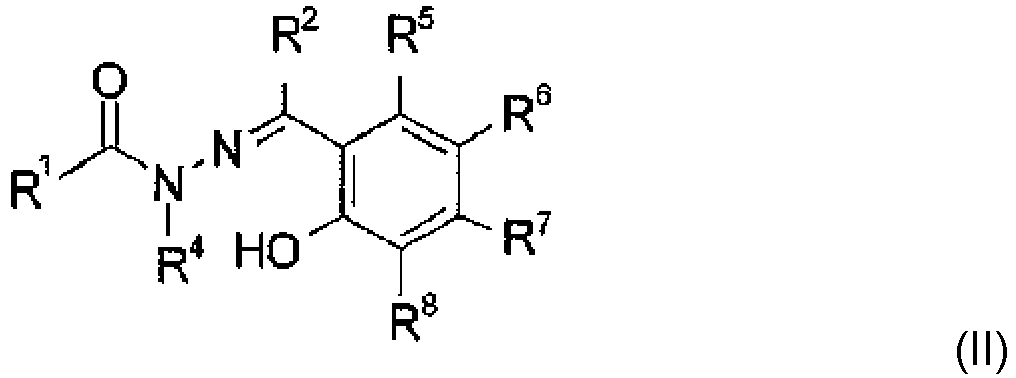

R5, R6, R7 et R8 représentent, indépendamment les uns des autres, R1, un atome d'hydrogène, un atome d'halogène, un groupe hydroxy, un groupe amino, un groupe N-mono ou di-alkyle en C1-4 éventuellement substitué ou un groupe hydroxyalkyl-amino en C2-4, un groupe N-phényl ou un groupe N-naphtyl-amino, un groupe alkyle en C1-28, un groupe alcoxy en C1-28, un groupe phénoxy, un groupe alcényle en C2-28, un groupe alcynyle en C2-22, un groupe cycloalkyle en C3-12, un groupe cycloalcényle en C3-12, un groupe aralkyle en C7-9, un groupe hétéroalkyle en C3-20, un groupe cyclohétéroalkyle en C3-12, un groupe hétéroaralkyle en C5-16, un groupe phényle ou un groupe naphtyle, où les substituants sont choisis parmi un groupe alkyle C1-4, un groupe alcoxy C1-4, un groupe hydroxy, un groupe sulfo, un groupe sulfato, un groupe halogéno, un groupe cyano, un groupe nitro, un groupe carboxy, un groupe phényle, un groupe phénoxy, un groupe naphtoxy, un groupe amino, un groupe N-mono ou di-alkyle en C1-4 ou un groupe hydroxyalkylamino en C2-4, un groupe N-phényle ou N-naphtylamino, ou R5 et R6 ou R6 et R7 ou R7 et R8 sont reliés entre eux pour former 1, 2 ou 3 noyaux carbocycliques ou un noyau O-, un noyau NR10 ou un noyau S-hétérocyclique, éventuellement aromatiques et/ou éventuellement substitués par un alkyle en C1-6. - Utilisation ou agent selon l'une quelconque des revendications précédentes, caractérisé(e) en ce que la protéase est choisie parmia) les protéases comprenant une séquence d'acides aminés identique à la séquence présentée dans SEQ ID NO:1 sur toute sa longueur, de préférence à raison d'au moins 75 %, 80 %, 81 %, 82 %, 83 %, 84 %, 85 %, 86 %, 87 %, 88 %, 89 %, 90 %, 90,5 %, 91 %, 91,5 %, 92 %, 92,5 %, 93 %, 93,5 %, 94 %, 94,5 %, 95 %, 95,5 %, 96 %, 96,5 %, 97 %, 97,5 %, 98 %, 98,5 % et 99 %,b) les protéases comprenant une séquence d'acides aminés identique à la séquence présentée dans SEQ ID NO:2 sur toute sa longueur, de préférence à raison d'au moins 75 %, 80 %, 81 %, 82 %, 83 %, 84 %, 85 %, 86 %, 87 %, 88 %, 89 %, 90 %, 90,5 %, 91 %, 91,5 %, 92 %, 92,5 %, 93 %, 93,5 %, 94 %, 94,5 %, 95 %, 95,5 %, 96 %, 96,5 %, 97 %, 97,5 %, 98 %, 98,5 % et 99 %, etc) leurs mélanges.
Priority Applications (1)
| Application Number | Priority Date | Filing Date | Title |
|---|---|---|---|
| PL15720976.8T PL3143115T5 (pl) | 2014-05-15 | 2015-05-05 | Środek piorący i czyszczący o zwiększonej mocy wybielającej |
Applications Claiming Priority (2)
| Application Number | Priority Date | Filing Date | Title |
|---|---|---|---|
| DE102014209241.8A DE102014209241A1 (de) | 2014-05-15 | 2014-05-15 | Wasch- und Reinigungsmittel mit erhöhter Bleichleistung |
| PCT/EP2015/059766 WO2015173055A1 (fr) | 2014-05-15 | 2015-05-05 | Produits de lavage et de nettoyage à blanchiment amélioré |
Publications (3)
| Publication Number | Publication Date |
|---|---|
| EP3143115A1 EP3143115A1 (fr) | 2017-03-22 |
| EP3143115B1 true EP3143115B1 (fr) | 2020-02-19 |
| EP3143115B2 EP3143115B2 (fr) | 2024-08-14 |
Family
ID=53055045
Family Applications (1)
| Application Number | Title | Priority Date | Filing Date |
|---|---|---|---|
| EP15720976.8A Active EP3143115B2 (fr) | 2014-05-15 | 2015-05-05 | Agent de lavage et de nettoyage avec des performances de blanchiment amélioré |
Country Status (4)
| Country | Link |
|---|---|
| EP (1) | EP3143115B2 (fr) |
| DE (1) | DE102014209241A1 (fr) |
| PL (1) | PL3143115T5 (fr) |
| WO (1) | WO2015173055A1 (fr) |
Families Citing this family (5)
| Publication number | Priority date | Publication date | Assignee | Title |
|---|---|---|---|---|
| DE102014220663A1 (de) * | 2014-10-13 | 2016-04-14 | Henkel Ag & Co. Kgaa | Farbschützende Waschmittel |
| DE102015210416A1 (de) * | 2015-06-08 | 2016-12-08 | Henkel Ag & Co. Kgaa | Acylhydrazone als Enzymstabilisatoren |
| DE102015225881A1 (de) * | 2015-12-18 | 2017-06-22 | Henkel Ag & Co. Kgaa | Flüssige Wasch- oder Reinigungsmittel enthaltend Acylhydrazon und Reduktionsmittel |
| DE102015225874A1 (de) * | 2015-12-18 | 2017-06-22 | Henkel Ag & Co. Kgaa | Flüssige Wasch- oder Reinigungsmittel enthaltend Acylhydrazon |
| EP3249032A1 (fr) * | 2016-05-26 | 2017-11-29 | The Procter and Gamble Company | Composition détergente comprenant un catalyseur de blanchiment et une protéase |
Citations (7)
| Publication number | Priority date | Publication date | Assignee | Title |
|---|---|---|---|---|
| US5352604A (en) | 1989-08-25 | 1994-10-04 | Henkel Research Corporation | Alkaline proteolytic enzyme and method of production |
| WO2009124855A1 (fr) | 2008-04-09 | 2009-10-15 | Basf Se | Utilisation de composés complexes d'hydrazides métalliques comme catalyseurs d'oxydation |
| WO2011036263A1 (fr) | 2009-09-25 | 2011-03-31 | Novozymes A/S | Variants de subtilase |
| EP2395071A1 (fr) | 2010-06-10 | 2011-12-14 | The Procter & Gamble Company | Composition détergente solide comprenant une lipase d'origine bactérienne |
| WO2012080088A1 (fr) | 2010-12-13 | 2012-06-21 | Basf Se | Catalyseurs de blanchiment |
| WO2012171980A1 (fr) * | 2011-06-16 | 2012-12-20 | Henkel Ag & Co. Kgaa | Détergent pour vaisselle comprenant un catalyseur de blanchiment et une protéase |
| DE102012200333A1 (de) | 2012-01-11 | 2013-07-11 | Henkel Ag & Co. Kgaa | Acylhydrazone als bleichverstärkende Wirkstoffe |
Family Cites Families (7)
| Publication number | Priority date | Publication date | Assignee | Title |
|---|---|---|---|---|
| ES2532606T3 (es) | 1999-03-31 | 2015-03-30 | Novozymes A/S | Polipéptidos con actividad de alfa-amilasa alcalina y ácidos nucleicos que los codifican |
| DE10131441A1 (de) | 2001-06-29 | 2003-01-30 | Henkel Kgaa | Eine neue Gruppe von alpha-Amylasen sowie ein Verfahren zur Identifizierung und Gewinnung neuer alpha-Amylasen |
| DE10163748A1 (de) | 2001-12-21 | 2003-07-17 | Henkel Kgaa | Neue Glykosylhydrolasen |
| DE102006038448A1 (de) | 2005-12-28 | 2008-02-21 | Henkel Kgaa | Enzym-haltiges Reinigungsmittel |
| DE102006022224A1 (de) | 2006-05-11 | 2007-11-15 | Henkel Kgaa | Subtilisin aus Bacillus pumilus und Wasch- und Reinigungsmittel enthaltend dieses neue Subtilisin |
| DE102007003143A1 (de) | 2007-01-16 | 2008-07-17 | Henkel Kgaa | Neue Alkalische Protease aus Bacillus gibsonii und Wasch- und Reinigungsmittel enthaltend diese neue Alkalische Protease |
| DE102011076417A1 (de) * | 2011-05-24 | 2012-11-29 | Henkel Ag & Co. Kgaa | Aktivatorsysteme für Persauerstoffverbindungen |
-
2014
- 2014-05-15 DE DE102014209241.8A patent/DE102014209241A1/de not_active Withdrawn
-
2015
- 2015-05-05 WO PCT/EP2015/059766 patent/WO2015173055A1/fr not_active Ceased
- 2015-05-05 EP EP15720976.8A patent/EP3143115B2/fr active Active
- 2015-05-05 PL PL15720976.8T patent/PL3143115T5/pl unknown
Patent Citations (7)
| Publication number | Priority date | Publication date | Assignee | Title |
|---|---|---|---|---|
| US5352604A (en) | 1989-08-25 | 1994-10-04 | Henkel Research Corporation | Alkaline proteolytic enzyme and method of production |
| WO2009124855A1 (fr) | 2008-04-09 | 2009-10-15 | Basf Se | Utilisation de composés complexes d'hydrazides métalliques comme catalyseurs d'oxydation |
| WO2011036263A1 (fr) | 2009-09-25 | 2011-03-31 | Novozymes A/S | Variants de subtilase |
| EP2395071A1 (fr) | 2010-06-10 | 2011-12-14 | The Procter & Gamble Company | Composition détergente solide comprenant une lipase d'origine bactérienne |
| WO2012080088A1 (fr) | 2010-12-13 | 2012-06-21 | Basf Se | Catalyseurs de blanchiment |
| WO2012171980A1 (fr) * | 2011-06-16 | 2012-12-20 | Henkel Ag & Co. Kgaa | Détergent pour vaisselle comprenant un catalyseur de blanchiment et une protéase |
| DE102012200333A1 (de) | 2012-01-11 | 2013-07-11 | Henkel Ag & Co. Kgaa | Acylhydrazone als bleichverstärkende Wirkstoffe |
Also Published As
| Publication number | Publication date |
|---|---|
| EP3143115B2 (fr) | 2024-08-14 |
| PL3143115T3 (pl) | 2020-08-10 |
| PL3143115T5 (pl) | 2024-11-04 |
| EP3143115A1 (fr) | 2017-03-22 |
| DE102014209241A1 (de) | 2015-11-19 |
| WO2015173055A1 (fr) | 2015-11-19 |
Similar Documents
| Publication | Publication Date | Title |
|---|---|---|
| EP2714877B1 (fr) | Systèmes activateurs pour composés peroxygénés | |
| EP2912156B1 (fr) | Utilisation d'un acyl hydrazone dans les compositions détergentes | |
| WO1998045398A1 (fr) | Activateurs pour composes peroxyde dans des detergents et des nettoyants | |
| EP3030642B1 (fr) | Détergent présentant une puissance de lavage primaire augmentée | |
| EP3143115B2 (fr) | Agent de lavage et de nettoyage avec des performances de blanchiment amélioré | |
| EP3406698A1 (fr) | Composition de blanchiment pour lavage ou nettoyage comprenant un précurseur d'oxaziridine | |
| EP3152289A1 (fr) | Détergents contenant au moins une laccase en tant qu'inhibiteur de transfert de couleur | |
| DE102014218507A1 (de) | Spinnenseidenproteine als Enzymstabilisatoren | |
| EP4061918B1 (fr) | Activateur de blanchiment ayant un groupe cationique et produit détergent ou nettoyant le contenant | |
| DE102012219405A1 (de) | Katalytische Verstärkung der Bleichwirkung von Persauerstoffverbindungen | |
| EP3095847B1 (fr) | Produit de lavage et de nettoyage a hygiene amelioree | |
| DE102019217852A1 (de) | Bleichaktivator mit kationischer Gruppe und diesen enthaltendes Wasch- oder Reinigungsmittel IV | |
| EP2727987B1 (fr) | Polymères pour équipement antimicrobien | |
| EP3409757B1 (fr) | Composition detergente blanchissante | |
| DE102015225882A1 (de) | Partikuläres Mittel zur Verstärkung der Bleichwirkung | |
| EP3075835A2 (fr) | Lessive particulaire comprenant un catalyseur de blanchiment | |
| WO2021099243A1 (fr) | Activateur de blanchiment ayant un groupe cationique et produit détergent ou nettoyant le contenant | |
| EP3409756A1 (fr) | Composition detergente blanchissante | |
| DE102019217850A1 (de) | Bleichaktivator mit kationischer Gruppe und diesen enthaltendes Wasch- oder Reinigungsmittel II | |
| DE102012221198A1 (de) | Anti-adhäsive Polymere zur mikrobiell-repulsiven Textilausrüstung |
Legal Events
| Date | Code | Title | Description |
|---|---|---|---|
| STAA | Information on the status of an ep patent application or granted ep patent |
Free format text: STATUS: THE INTERNATIONAL PUBLICATION HAS BEEN MADE |
|
| PUAI | Public reference made under article 153(3) epc to a published international application that has entered the european phase |
Free format text: ORIGINAL CODE: 0009012 |
|
| STAA | Information on the status of an ep patent application or granted ep patent |
Free format text: STATUS: REQUEST FOR EXAMINATION WAS MADE |
|
| 17P | Request for examination filed |
Effective date: 20161109 |
|
| AK | Designated contracting states |
Kind code of ref document: A1 Designated state(s): AL AT BE BG CH CY CZ DE DK EE ES FI FR GB GR HR HU IE IS IT LI LT LU LV MC MK MT NL NO PL PT RO RS SE SI SK SM TR |
|
| AX | Request for extension of the european patent |
Extension state: BA ME |
|
| DAV | Request for validation of the european patent (deleted) | ||
| DAX | Request for extension of the european patent (deleted) | ||
| STAA | Information on the status of an ep patent application or granted ep patent |
Free format text: STATUS: EXAMINATION IS IN PROGRESS |
|
| 17Q | First examination report despatched |
Effective date: 20190108 |
|
| GRAP | Despatch of communication of intention to grant a patent |
Free format text: ORIGINAL CODE: EPIDOSNIGR1 |
|
| STAA | Information on the status of an ep patent application or granted ep patent |
Free format text: STATUS: GRANT OF PATENT IS INTENDED |
|
| INTG | Intention to grant announced |
Effective date: 20191008 |
|
| GRAS | Grant fee paid |
Free format text: ORIGINAL CODE: EPIDOSNIGR3 |
|
| GRAA | (expected) grant |
Free format text: ORIGINAL CODE: 0009210 |
|
| STAA | Information on the status of an ep patent application or granted ep patent |
Free format text: STATUS: THE PATENT HAS BEEN GRANTED |
|
| AK | Designated contracting states |
Kind code of ref document: B1 Designated state(s): AL AT BE BG CH CY CZ DE DK EE ES FI FR GB GR HR HU IE IS IT LI LT LU LV MC MK MT NL NO PL PT RO RS SE SI SK SM TR |
|
| REG | Reference to a national code |
Ref country code: CH Ref legal event code: EP |
|
| REG | Reference to a national code |
Ref country code: DE Ref legal event code: R096 Ref document number: 502015011773 Country of ref document: DE |
|
| REG | Reference to a national code |
Ref country code: AT Ref legal event code: REF Ref document number: 1234972 Country of ref document: AT Kind code of ref document: T Effective date: 20200315 |
|
| REG | Reference to a national code |
Ref country code: IE Ref legal event code: FG4D Free format text: LANGUAGE OF EP DOCUMENT: GERMAN |
|
| REG | Reference to a national code |
Ref country code: NL Ref legal event code: MP Effective date: 20200219 |
|
| PG25 | Lapsed in a contracting state [announced via postgrant information from national office to epo] |
Ref country code: FI Free format text: LAPSE BECAUSE OF FAILURE TO SUBMIT A TRANSLATION OF THE DESCRIPTION OR TO PAY THE FEE WITHIN THE PRESCRIBED TIME-LIMIT Effective date: 20200219 Ref country code: RS Free format text: LAPSE BECAUSE OF FAILURE TO SUBMIT A TRANSLATION OF THE DESCRIPTION OR TO PAY THE FEE WITHIN THE PRESCRIBED TIME-LIMIT Effective date: 20200219 Ref country code: NO Free format text: LAPSE BECAUSE OF FAILURE TO SUBMIT A TRANSLATION OF THE DESCRIPTION OR TO PAY THE FEE WITHIN THE PRESCRIBED TIME-LIMIT Effective date: 20200519 |
|
| REG | Reference to a national code |
Ref country code: LT Ref legal event code: MG4D |
|
| PG25 | Lapsed in a contracting state [announced via postgrant information from national office to epo] |
Ref country code: BG Free format text: LAPSE BECAUSE OF FAILURE TO SUBMIT A TRANSLATION OF THE DESCRIPTION OR TO PAY THE FEE WITHIN THE PRESCRIBED TIME-LIMIT Effective date: 20200519 Ref country code: IS Free format text: LAPSE BECAUSE OF FAILURE TO SUBMIT A TRANSLATION OF THE DESCRIPTION OR TO PAY THE FEE WITHIN THE PRESCRIBED TIME-LIMIT Effective date: 20200619 Ref country code: GR Free format text: LAPSE BECAUSE OF FAILURE TO SUBMIT A TRANSLATION OF THE DESCRIPTION OR TO PAY THE FEE WITHIN THE PRESCRIBED TIME-LIMIT Effective date: 20200520 Ref country code: LV Free format text: LAPSE BECAUSE OF FAILURE TO SUBMIT A TRANSLATION OF THE DESCRIPTION OR TO PAY THE FEE WITHIN THE PRESCRIBED TIME-LIMIT Effective date: 20200219 Ref country code: SE Free format text: LAPSE BECAUSE OF FAILURE TO SUBMIT A TRANSLATION OF THE DESCRIPTION OR TO PAY THE FEE WITHIN THE PRESCRIBED TIME-LIMIT Effective date: 20200219 Ref country code: HR Free format text: LAPSE BECAUSE OF FAILURE TO SUBMIT A TRANSLATION OF THE DESCRIPTION OR TO PAY THE FEE WITHIN THE PRESCRIBED TIME-LIMIT Effective date: 20200219 |
|
| PG25 | Lapsed in a contracting state [announced via postgrant information from national office to epo] |
Ref country code: NL Free format text: LAPSE BECAUSE OF FAILURE TO SUBMIT A TRANSLATION OF THE DESCRIPTION OR TO PAY THE FEE WITHIN THE PRESCRIBED TIME-LIMIT Effective date: 20200219 |
|
| PG25 | Lapsed in a contracting state [announced via postgrant information from national office to epo] |
Ref country code: EE Free format text: LAPSE BECAUSE OF FAILURE TO SUBMIT A TRANSLATION OF THE DESCRIPTION OR TO PAY THE FEE WITHIN THE PRESCRIBED TIME-LIMIT Effective date: 20200219 Ref country code: SM Free format text: LAPSE BECAUSE OF FAILURE TO SUBMIT A TRANSLATION OF THE DESCRIPTION OR TO PAY THE FEE WITHIN THE PRESCRIBED TIME-LIMIT Effective date: 20200219 Ref country code: DK Free format text: LAPSE BECAUSE OF FAILURE TO SUBMIT A TRANSLATION OF THE DESCRIPTION OR TO PAY THE FEE WITHIN THE PRESCRIBED TIME-LIMIT Effective date: 20200219 Ref country code: PT Free format text: LAPSE BECAUSE OF FAILURE TO SUBMIT A TRANSLATION OF THE DESCRIPTION OR TO PAY THE FEE WITHIN THE PRESCRIBED TIME-LIMIT Effective date: 20200712 Ref country code: SK Free format text: LAPSE BECAUSE OF FAILURE TO SUBMIT A TRANSLATION OF THE DESCRIPTION OR TO PAY THE FEE WITHIN THE PRESCRIBED TIME-LIMIT Effective date: 20200219 Ref country code: RO Free format text: LAPSE BECAUSE OF FAILURE TO SUBMIT A TRANSLATION OF THE DESCRIPTION OR TO PAY THE FEE WITHIN THE PRESCRIBED TIME-LIMIT Effective date: 20200219 Ref country code: LT Free format text: LAPSE BECAUSE OF FAILURE TO SUBMIT A TRANSLATION OF THE DESCRIPTION OR TO PAY THE FEE WITHIN THE PRESCRIBED TIME-LIMIT Effective date: 20200219 Ref country code: CZ Free format text: LAPSE BECAUSE OF FAILURE TO SUBMIT A TRANSLATION OF THE DESCRIPTION OR TO PAY THE FEE WITHIN THE PRESCRIBED TIME-LIMIT Effective date: 20200219 Ref country code: ES Free format text: LAPSE BECAUSE OF FAILURE TO SUBMIT A TRANSLATION OF THE DESCRIPTION OR TO PAY THE FEE WITHIN THE PRESCRIBED TIME-LIMIT Effective date: 20200219 |
|
| REG | Reference to a national code |
Ref country code: DE Ref legal event code: R026 Ref document number: 502015011773 Country of ref document: DE |
|
| PLBI | Opposition filed |
Free format text: ORIGINAL CODE: 0009260 |
|
| PLAX | Notice of opposition and request to file observation + time limit sent |
Free format text: ORIGINAL CODE: EPIDOSNOBS2 |
|
| 26 | Opposition filed |
Opponent name: NOVOZYMES A/S Effective date: 20201117 |
|
| PG25 | Lapsed in a contracting state [announced via postgrant information from national office to epo] |
Ref country code: CH Free format text: LAPSE BECAUSE OF NON-PAYMENT OF DUE FEES Effective date: 20200531 Ref country code: LI Free format text: LAPSE BECAUSE OF NON-PAYMENT OF DUE FEES Effective date: 20200531 Ref country code: MC Free format text: LAPSE BECAUSE OF FAILURE TO SUBMIT A TRANSLATION OF THE DESCRIPTION OR TO PAY THE FEE WITHIN THE PRESCRIBED TIME-LIMIT Effective date: 20200219 |
|
| PG25 | Lapsed in a contracting state [announced via postgrant information from national office to epo] |
Ref country code: SI Free format text: LAPSE BECAUSE OF FAILURE TO SUBMIT A TRANSLATION OF THE DESCRIPTION OR TO PAY THE FEE WITHIN THE PRESCRIBED TIME-LIMIT Effective date: 20200219 |
|
| REG | Reference to a national code |
Ref country code: BE Ref legal event code: MM Effective date: 20200531 |
|
| PLBB | Reply of patent proprietor to notice(s) of opposition received |
Free format text: ORIGINAL CODE: EPIDOSNOBS3 |
|
| GBPC | Gb: european patent ceased through non-payment of renewal fee |
Effective date: 20200519 |
|
| PG25 | Lapsed in a contracting state [announced via postgrant information from national office to epo] |
Ref country code: LU Free format text: LAPSE BECAUSE OF NON-PAYMENT OF DUE FEES Effective date: 20200505 |
|
| PG25 | Lapsed in a contracting state [announced via postgrant information from national office to epo] |
Ref country code: IE Free format text: LAPSE BECAUSE OF NON-PAYMENT OF DUE FEES Effective date: 20200505 Ref country code: GB Free format text: LAPSE BECAUSE OF NON-PAYMENT OF DUE FEES Effective date: 20200519 Ref country code: FR Free format text: LAPSE BECAUSE OF NON-PAYMENT OF DUE FEES Effective date: 20200531 |
|
| PG25 | Lapsed in a contracting state [announced via postgrant information from national office to epo] |
Ref country code: BE Free format text: LAPSE BECAUSE OF NON-PAYMENT OF DUE FEES Effective date: 20200531 |
|
| REG | Reference to a national code |
Ref country code: AT Ref legal event code: MM01 Ref document number: 1234972 Country of ref document: AT Kind code of ref document: T Effective date: 20200505 |
|
| PG25 | Lapsed in a contracting state [announced via postgrant information from national office to epo] |
Ref country code: AT Free format text: LAPSE BECAUSE OF NON-PAYMENT OF DUE FEES Effective date: 20200505 |
|
| PG25 | Lapsed in a contracting state [announced via postgrant information from national office to epo] |
Ref country code: TR Free format text: LAPSE BECAUSE OF FAILURE TO SUBMIT A TRANSLATION OF THE DESCRIPTION OR TO PAY THE FEE WITHIN THE PRESCRIBED TIME-LIMIT Effective date: 20200219 Ref country code: MT Free format text: LAPSE BECAUSE OF FAILURE TO SUBMIT A TRANSLATION OF THE DESCRIPTION OR TO PAY THE FEE WITHIN THE PRESCRIBED TIME-LIMIT Effective date: 20200219 Ref country code: CY Free format text: LAPSE BECAUSE OF FAILURE TO SUBMIT A TRANSLATION OF THE DESCRIPTION OR TO PAY THE FEE WITHIN THE PRESCRIBED TIME-LIMIT Effective date: 20200219 |
|
| PG25 | Lapsed in a contracting state [announced via postgrant information from national office to epo] |
Ref country code: MK Free format text: LAPSE BECAUSE OF FAILURE TO SUBMIT A TRANSLATION OF THE DESCRIPTION OR TO PAY THE FEE WITHIN THE PRESCRIBED TIME-LIMIT Effective date: 20200219 Ref country code: AL Free format text: LAPSE BECAUSE OF FAILURE TO SUBMIT A TRANSLATION OF THE DESCRIPTION OR TO PAY THE FEE WITHIN THE PRESCRIBED TIME-LIMIT Effective date: 20200219 |
|
| P01 | Opt-out of the competence of the unified patent court (upc) registered |
Effective date: 20230530 |
|
| PUAH | Patent maintained in amended form |
Free format text: ORIGINAL CODE: 0009272 |
|
| STAA | Information on the status of an ep patent application or granted ep patent |
Free format text: STATUS: PATENT MAINTAINED AS AMENDED |
|
| 27A | Patent maintained in amended form |
Effective date: 20240814 |
|
| AK | Designated contracting states |
Kind code of ref document: B2 Designated state(s): AL AT BE BG CH CY CZ DE DK EE ES FI FR GB GR HR HU IE IS IT LI LT LU LV MC MK MT NL NO PL PT RO RS SE SI SK SM TR |
|
| REG | Reference to a national code |
Ref country code: DE Ref legal event code: R102 Ref document number: 502015011773 Country of ref document: DE |
|
| PGFP | Annual fee paid to national office [announced via postgrant information from national office to epo] |
Ref country code: PL Payment date: 20250425 Year of fee payment: 11 Ref country code: DE Payment date: 20250521 Year of fee payment: 11 |
|
| PGFP | Annual fee paid to national office [announced via postgrant information from national office to epo] |
Ref country code: IT Payment date: 20250527 Year of fee payment: 11 |