EP3143627B1 - Dispositif et procédé pour sources de rayonnement gamma à iridium enrichi - Google Patents
Dispositif et procédé pour sources de rayonnement gamma à iridium enrichi Download PDFInfo
- Publication number
- EP3143627B1 EP3143627B1 EP15744389.6A EP15744389A EP3143627B1 EP 3143627 B1 EP3143627 B1 EP 3143627B1 EP 15744389 A EP15744389 A EP 15744389A EP 3143627 B1 EP3143627 B1 EP 3143627B1
- Authority
- EP
- European Patent Office
- Prior art keywords
- iridium
- boron
- gamma radiation
- source
- disks
- Prior art date
- Legal status (The legal status is an assumption and is not a legal conclusion. Google has not performed a legal analysis and makes no representation as to the accuracy of the status listed.)
- Active
Links
Images

Classifications
-
- G—PHYSICS
- G21—NUCLEAR PHYSICS; NUCLEAR ENGINEERING
- G21G—CONVERSION OF CHEMICAL ELEMENTS; RADIOACTIVE SOURCES
- G21G4/00—Radioactive sources
- G21G4/04—Radioactive sources other than neutron sources
- G21G4/06—Radioactive sources other than neutron sources characterised by constructional features
-
- G—PHYSICS
- G01—MEASURING; TESTING
- G01N—INVESTIGATING OR ANALYSING MATERIALS BY DETERMINING THEIR CHEMICAL OR PHYSICAL PROPERTIES
- G01N2223/00—Investigating materials by wave or particle radiation
- G01N2223/10—Different kinds of radiation or particles
- G01N2223/101—Different kinds of radiation or particles electromagnetic radiation
- G01N2223/1013—Different kinds of radiation or particles electromagnetic radiation gamma
Definitions
- This disclosure pertains to a gamma radiation source, including enriched Iridium-191 with additives, which lower the density, increase activation yield and gamma ray emission efficiency, which additives include, but are not limited to, boron, aluminum, silicon, vanadium, titanium, nickel, platinum, phosphorus and/or combinations thereof.
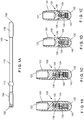
- Iridium-192 gamma radiography sources are manufactured by encapsulating stacked disks or pellets of activated iridium metal into a source capsule with an attaching wire or cable to provide a source reference assembly. This is illustrated in Figures 1A-1E .
- Common source activities range from 10 curie - 150 curie and use different capsule sizes, disk or pellet diameters and various stack heights.
- a 100 curie natural iridium source may typically contain a stack of disks measuring about 3 millimeters in diameter and about 3 millimeters high. This varies from manufacturer to manufacturer and depends on the age and decay of the contained Iridium-192.
- a 100 curie source containing enriched Iridium-192 may contain a stack of disks as small as a 2 millimeter diameter and a 2 millimeter height or a 3 millimeter diameter and a 1.5 millimeter height. Individual iridium disks typically have a thickness up to about 0.3 millimeters. Above this thickness, activation efficiency decreases substantially due to the high neutron absorption cross section of iridium, which prevents neutrons from penetrating very far beneath the surface of disks.
- Disks are stacked inside sources to produce a cylindrical geometry.
- High activity sources are made with multiple thin disks so that the activation yield of each individual disk in the reactor is maximized, however low activity Iridium-192 sources (up to about 20 curies) can be made using small single pellets providing the maximum pellet dimension is kept below about 1 millimeter to ensure that activation yield is not too impaired.
- Iridium-193 A problem that is encountered when activating natural iridium, which contains approximately 37 percent Iridium-191 and approximately 63 percent Iridium-193, is that the majority isotope (Ir-193) is also activated. Iridium-193 also has a very high neutron absorption cross section similar to Iridium-191 and it activates uselessly to form Iridium-194, which is a short-lived unwanted radioisotope. This means that activations of natural iridium wastes valuable neutrons in a reactor, and increases irradiation costs, relative to the cost of irradiating enriched Iridium-191.
- Ir-191 can be economically enriched to a concentration of about 80 percent Iridium-191 and 20 percent Iridium-193.
- Making Iridium-192 gamma radiation sources using enriched Iridium-191 target material can almost double the activation efficiency and yield of Iridium-192, relative to natural iridium irradiations (the efficiency relationship is actually complex and depends on many factors, including total reactor loading, reactor flux and flux depression, which may be caused by overloading), pellet diameter and thickness and irradiation time.
- Reactor operators benefit the most from large cost savings and increase in reactor capacity, compared with irradiating natural iridium.
- Radiation source manufacturers typically receive little or no cost benefit from enriched iridium irradiations, however source quality and performance is improved due to the smaller focal dimension that can be achieved.
- gamma ray emissions from a source Due to the very high density of iridium (22.56 grams per cubic centimeter), a large proportion of gamma ray emissions from a source are self-attenuated within a source. A source with an output equivalent to 100 curies needs to contain between 150-200 curies actual content. One third to one half of the gamma ray emissions are lost due to self-attenuation within a source. The actual amount of attenuation depends of the disk stack height and diameter inside the source. Gamma radiography sources are sold on output activity, not content activity, so the cost of a source is considerably increased if valuable Iridium-192 is wasted due to excessive self-attenuation within a source.
- Figure 2 illustrates how the attenuation of Iridium-192 varies with distance in iridium metal. About 40 percent of all Iridium-192 emissions are absorbed by a one millimeter thickness of iridium.
- a further drawback of high self-attenuation within a source is that lower energy emissions of Iridium-192 are preferentially attenuated, relative to higher energy emissions. This causes the gamma ray spectrum to be "hardened” (i.e. the average energy of the emissions is increased). This can be disadvantageous when radiographing thinner materials sections because higher energy decreases contrast and resolution is poorer in a radiographic image. It is beneficial to maximize emission of lower energy gamma rays in order to improve image quality.
- iridium is very hard and brittle. It melts at the very high temperature of 2447° Centigrade, which makes iridium (whether natural, or enriched) extremely difficult and costly to fabricate into thin disks that are suitable for irradiation. Very high temperature thermal processes are required.
- Depleted Boron-11 is a byproduct of enriched Boron-10 manufacture.
- Enriched Boron-10 is used in the nuclear industry because of its unusually high neutron absorption cross section over a wide energy range (fast, epithermal and thermal). Boron-10 finds uses in boron tri-fluoride neutron detectors, as a neutron moderator and in neutron shielding.
- Boron-10 cannot be mixed with Iridium-192 in radiography sources because the activation cross section of Boron-10 is much too high so it would absorb an excessive number of neutrons during irradiations thereby depressing the yield.
- depleted Boron-11 (a byproduct of Boron-10 enrichment) has an extremely low neutron absorption cross section of the order of 5 millibams. Depleted Boron-11 is relatively inexpensive.
- Boron-11 does not significantly activate when irradiated with neutrons, so there are no interfering gamma-emitting impurities generated, which could interfere with the output or performance of an Iridium-192 gamma radiography source.
- the disclosure seeks to lower the density of iridium target material by alloying it (or making a composite, or a mixture) with a lower density, non-activating additive.
- the possible metals include Boron-11, silicon, titanium, and/or combinations thereof. Some embodiments may include alloying. In one embodiment, enriched Iridium-191 fine powder is sintered with a Boron-11 additive. Further embodiments include aluminum/boron/iridium (AL-B-Ir) alloys.
- platinum-boron alloys analogous to iridium-boron alloys, also exist, thereby indicating the beta-minus decay product of iridium-192, platinum-192, will be expected to produce a physically stable alloy mixture with iridium-boron alloys and the target material will remain stable during and after irradiation, transmutation and decay.
- FIGS 1A-1E illustrate prior art source reference devices 100 which may use the disclosed embodiments of the gamma radiation sources of the present disclosure.
- the source reference device 100 typically includes a proximal end 102 with an attachment device 104 and a distal end 106 with a source encapsulation 108.
- a tubular body 110 extends between the proximal end 102 and the distal end 106 and may include a spherical portion 112 to engage the inner walls of a pipe (not shown) or similar structure through which the source reference device 100 may travel.
- Various embodiments of the source encapsulation 108 are illustrated in the cross-sectional views of Figures 1B-1E .
- the source encapsulation 108 includes a fixture element 120 with a blind aperture 122 for receiving the distal end 106 of tubular body 110.
- the fixture element 120 further includes a distally extending male element 124 of reduced diameter which further includes a concentric blind aperture thereby forming a spring seat 126 for receiving and seating spring 130.
- Source encapsulation 108 further includes a forward head 132 which includes an interior chamber 134 for receiving the radioactive source material, either as a pellet 140 as shown in Figures 1B and 1D or as a series of disks 142 as shown in Figures 1C and IE.
- the pellet 140 or the series of disks 142 is kept in place by spring 130.
- Forward head 132 further includes an inner concentric cylindrical portion 136 of somewhat increased diameter for receiving and seating the distally extending male element 124 of fixture element 120 thereby completing the assembly.
- This disclosure relates to improved methods for making the disks 142 or the pellet 140.
- Figures 1A-1E are meant as illustrations of possible uses for the product of the present disclosure. It is envisioned that the present disclosure is adaptable to a broad range of applications.
- a first embodiment of the disclosure relates to a mixture of Boron-11 and Iridium-192.
- Enriched Iridium-191 fine powder is sintered with a Boron-11 additive. It has been shown that boron added, at 37.5 atomic percentage and greater, to iridium produces a broad array of liquid-solid equilibrium conditions in the 1235 to 1290° Centigrade range. It may be typically desired to produce disk with a 0.25 millimeter thickness and a 2 millimeter diameter with enough strength to survive activating neutron irradiation. It may be further desired to exceed a 70 percent yield by increasing the concentration of Iridium in the 2 millimeter focal spot.
- a typical procedure would be to use a 2.4 millimeter press die to press round disks about 0.3 millimeters thick, with 20 milligrams of powder per disk.
- the disks may typically be pressed with a 10.5 Bar (152 PSI) gauge pressure with a ten second dwell time, with subsequent sintering.
- 152 PSI 10.5 Bar gauge pressure
- Sintering is typically performed in an air furnace with a standard sintering cycle - ramp from room temperature (about 20° Centigrade) to soak temperature at 5 degrees Centigrade per minute, soak for the prescribed time, then cool at a controlled rate of 10 degrees Centigrade per minute.
- the resulting disks or similar structures are typically subsequently activated by neutron irradiation and placed into structures similar to those illustrated in Figures 1A-1E to serve as radiation sources. In many instances, it may be commercially relevant to use the resulting disks in prior art devices, as a direct substitute for prior art radiation sources.
- boron forms useful alloys and intermetallic compounds with iridium, and boron additions substantially depress the melting temperature as shown in the Iridium/Boron phase diagram Figure 3 (the x-axis is atomic percentage of Iridium, the y-axis is temperature).
- pure boron has a low density of 2.37 grams per cubic centimeter compared with the density of iridium of 22.56 grams per cubic centimeter. Alloys and composites containing somewhere between 30-60 atom percentage iridium have low melting point below 1300° Centigrade and their densities are estimated to be in the range 10-16 grams per cubic centimeter (boron has an atomic radius of about 1.2 angstroms and iridium has an atomic radius of about 1.7 angstroms).
- focal size larger than 100 percent enriched Iridium-192 sources, but smaller than natural Iridium-192 sources.
- the focal dimension is of paramount importance. In this case 100 percent enriched sources may be preferred. In other applications, softer energy spectrum and higher yield and output efficiency may provide more benefits, in which case enriched Iridium-Boron sources can be selected.
- Focal dimension can also be minimized by changing from cylindrical geometry to a more spherical geometry.
- the lower melting point of Iridium-Boron alloys and composites increases the number of fabrication techniques that can be used in target manufacture (either before or after irradiation) to make more spherical target geometry.
- non-activating, low density, stable additives or combinations thereof can also be incorporated with iridium or with iridium-boron alloys or composites to enhance the activation yield, to increase gamma ray output efficiency and to improve the performance of sources.
- a pure 100% enriched Iridium-191 pellet or disk can be made by compacting and partially sintering iridium powder.
- Enriched Iridium-192 is produced in the physical form of iridium-black powder. This is very finely divided and has very small (in the nanometer range) particle size. It is an amorphous black powder produced when iridium hexafluoride gas is decomposed and reduced to iridium metal after the gas centrifuge enrichment process is completed. This material can be pressed into thin disks or other shapes in a simple die press and then it can be sintered at a high temperature.
- Sintering can be controlled to produce a partially dense compact with, say 75% theoretical density and 25% empty void space inside, while the material may be robust enough to be handled and used in sources.
- a form of pellet or disk would provide a lower density form of iridium, while also eliminating the need to add additives.
- the open pore structure may make disks more prone to oxidation at high temperature (producing iridium oxide, IrO 2 ) and reduce durability.
- a small amount of sintering additive can lower sintering temperature and accelerate the sintering process due to local melting at points of contact.
- a few percent of Boron-11 powder can be blended with pure iridium-black powder. This significantly lowers the sintering temperature to a range somewhere between 1000° Centigrade to 1500° Centigrade, depending on the percentage of Boron-11 added.
- Points of contact between Boron-11 and Iridium-191 particles chemically react at the sintering temperature to produce low melting point Iridium-Boron alloys and composites within the structure. This is called "chemical sintering" where both sintering and chemical reaction occurs simultaneously.
- Chemical sintering with additives can be used to produce a partially sintered alloy or composite or a fully sintered alloy or composite depending on the percentage of additive used and the sintering time and temperature.
- low-activating, low density additives can also be used to produce further embodiments of low density Iridium-192 target disks or pellets.
- Iridium forms alloys and composites with aluminum, silicon, aluminum boron mixtures (e.g. AlBIr 3 ), vanadium, aluminum silicon mixtures, aluminum vanadium mixtures, vanadium boron mixtures, titanium, nickel, platinum, and phosphorus all or some of which may enhance the physical properties, depending on the percentage of the additive.
- Some or all of these additives can be included to form binary, ternary or more complex alloys and composites, which may be either partially or fully sintered, fused, cast, hot pressed, forged, melted or otherwise thermally or physically processed to form disks or pellets suitable for radiation source manufacture.
Landscapes
- Chemical & Material Sciences (AREA)
- Chemical Kinetics & Catalysis (AREA)
- General Chemical & Material Sciences (AREA)
- Physics & Mathematics (AREA)
- Engineering & Computer Science (AREA)
- General Engineering & Computer Science (AREA)
- High Energy & Nuclear Physics (AREA)
- Particle Accelerators (AREA)
- Radiation-Therapy Devices (AREA)
- Measurement Of Radiation (AREA)
- Luminescent Compositions (AREA)
- Powder Metallurgy (AREA)
Claims (8)
- Source de rayonnement gamma (100) comportant un mélange d'iridium et d'un métal choisi dans le groupe constitué par le bore-11, le silicium, le titane et les combinaisons de ceux-ci.
- Source de rayonnement gamma (100) de la revendication 1 dans laquelle ledit mélange est un mélange de bore-11 et d'iridium.
- Source de rayonnement gamma de la revendication 2 dans laquelle l'iridium comporte une première partie d'iridium-191 et une deuxième partie d'iridium-192.
- Source de rayonnement gamma de la revendication 3 dans laquelle la deuxième partie d'iridium-192 est obtenue par irradiation neutronique d'iridium-191.
- Source de rayonnement gamma d'une des revendications précédentes dans laquelle le bore-11 et l'iridium sont frittés, ou dans laquelle le bore-11 et l'iridium forment un alliage.
- Source de rayonnement gamma d'une des revendications précédentes dans laquelle le mélange de bore-11 et d'iridium est façonné comme un disque (142) ou comme une pastille (140).
- Source de rayonnement gamma d'une des revendications précédentes dans laquelle le mélange de bore-11 et d'iridium est soumis à un procédé choisi dans le groupe constitué par la fusion, le mélange par fusion, la coulée, le forgeage, le pressage, l'extrusion, l'usinage à partir de pièces coulées et l'usinage à partir d'extrusions.
- Source de rayonnement gamma d'une des revendications précédentes dans laquelle le mélange comporte en outre de l'aluminium.
Priority Applications (1)
| Application Number | Priority Date | Filing Date | Title |
|---|---|---|---|
| PL15744389T PL3143627T3 (pl) | 2014-05-13 | 2015-05-08 | Urządzenie i sposób dla wzmocnionych źródeł promieniowania gamma irydu |
Applications Claiming Priority (2)
| Application Number | Priority Date | Filing Date | Title |
|---|---|---|---|
| US201461992473P | 2014-05-13 | 2014-05-13 | |
| PCT/US2015/029806 WO2015175326A1 (fr) | 2014-05-13 | 2015-05-08 | Dispositif et procédé pour sources de rayonnement gamma à iridium enrichi |
Publications (2)
| Publication Number | Publication Date |
|---|---|
| EP3143627A1 EP3143627A1 (fr) | 2017-03-22 |
| EP3143627B1 true EP3143627B1 (fr) | 2018-07-11 |
Family
ID=53761477
Family Applications (1)
| Application Number | Title | Priority Date | Filing Date |
|---|---|---|---|
| EP15744389.6A Active EP3143627B1 (fr) | 2014-05-13 | 2015-05-08 | Dispositif et procédé pour sources de rayonnement gamma à iridium enrichi |
Country Status (8)
| Country | Link |
|---|---|
| US (1) | US10811156B2 (fr) |
| EP (1) | EP3143627B1 (fr) |
| KR (1) | KR102391334B1 (fr) |
| CN (1) | CN106463191B (fr) |
| CA (1) | CA2945202C (fr) |
| PL (1) | PL3143627T3 (fr) |
| RU (1) | RU2663222C2 (fr) |
| WO (1) | WO2015175326A1 (fr) |
Families Citing this family (7)
| Publication number | Priority date | Publication date | Assignee | Title |
|---|---|---|---|---|
| RU2633203C2 (ru) * | 2015-12-09 | 2017-10-11 | Общество С Ограниченной Ответственностью Научно-Производственное Объединение "Металлы Урала" | Способ получения изделий из металлического иридия |
| US11017911B2 (en) * | 2016-05-24 | 2021-05-25 | Qsa Global, Inc. | Low density porous iridium |
| WO2018084929A1 (fr) | 2016-08-24 | 2018-05-11 | Qsa Global Inc. | Iridium poreux à faible densité |
| WO2017205202A1 (fr) | 2016-05-24 | 2017-11-30 | Qsa Global Inc. | Source d'iridium sphérique à faible densité |
| KR102805289B1 (ko) * | 2018-06-19 | 2025-05-08 | 큐에스에이 글로벌, 인크. | 저밀도 이리듐 선원 |
| WO2020167716A1 (fr) | 2019-02-11 | 2020-08-20 | Qsa Global, Inc. | Iridium de faible densité et piles de faible densité de disques d'iridium |
| US11508491B2 (en) | 2020-12-15 | 2022-11-22 | Chiyoda Technol Corporation | Radiation source for nondestructive inspection, and method and apparatus for manufacturing same |
Citations (4)
| Publication number | Priority date | Publication date | Assignee | Title |
|---|---|---|---|---|
| US20040258614A1 (en) * | 2003-06-20 | 2004-12-23 | University Of Maryland, Baltimore | Microparticles for microarterial imaging and radiotherapy |
| US20120031613A1 (en) * | 2005-08-09 | 2012-02-09 | Momentive Specialty Chemicals Inc. | Methods and compositions for determination of fracture geometry in subterranean formations |
| EP2428966A2 (fr) * | 2010-09-10 | 2012-03-14 | GE-Hitachi Nuclear Energy Americas LLC | Assemblage de barres pour réacteurs nucléaires |
| US8170172B2 (en) * | 2006-12-11 | 2012-05-01 | Mallinckrodt Llc | Target bodies and uses thereof in the production of radioisotope materials |
Family Cites Families (11)
| Publication number | Priority date | Publication date | Assignee | Title |
|---|---|---|---|---|
| US6099457A (en) * | 1990-08-13 | 2000-08-08 | Endotech, Inc. | Endocurietherapy |
| CN1198668C (zh) * | 1998-02-12 | 2005-04-27 | 罗伯特·罗伯逊 | 密封的低能量近距治疗源 |
| DE19824689C1 (de) * | 1998-06-03 | 1999-10-21 | Heraeus Gmbh W C | Verfahren zur Herstellung von Iridium enthaltenden Formteilen, Formteil sowie Verwendung des Formteils |
| RU2152096C1 (ru) | 1998-06-30 | 2000-06-27 | Государственный научный центр - Научно-исследовательский институт атомных реакторов | Способ изготовления источника гамма-излучения |
| US6547816B1 (en) | 1999-07-12 | 2003-04-15 | Civatech Corporation | Formable integral source material for medical devices |
| NL1023613C2 (nl) | 2003-06-06 | 2004-12-07 | Nrg | Werkwijze voor het vervaardigen van een gammastralingsbron. |
| WO2005113846A2 (fr) * | 2004-05-10 | 2005-12-01 | Deringer-Ney, Inc. | Alliage de palladium |
| US9408530B2 (en) * | 2006-04-12 | 2016-08-09 | Gearbox, Llc | Parameter-based navigation by a lumen traveling device |
| RU95166U1 (ru) | 2010-01-19 | 2010-06-10 | Закрытое Акционерное Общество "Уральские Инновационные Технологии" (ЗАО "УРАЛИНТЕХ") | Заготовка для сердечника источника гамма-излучения на основе иридия |
| WO2013170068A2 (fr) * | 2012-05-09 | 2013-11-14 | Karyopharm Therapeutics, Inc. | Modulateurs du transport nucléaire et leurs utilisations |
| US20140034116A1 (en) * | 2012-08-06 | 2014-02-06 | Tionesta Applied Research Corporation | Energizing Energy Converters By Stimulating Three-Body Association Radiation Reactions |
-
2015
- 2015-05-08 WO PCT/US2015/029806 patent/WO2015175326A1/fr not_active Ceased
- 2015-05-08 CA CA2945202A patent/CA2945202C/fr active Active
- 2015-05-08 KR KR1020167032077A patent/KR102391334B1/ko active Active
- 2015-05-08 CN CN201580024357.6A patent/CN106463191B/zh active Active
- 2015-05-08 RU RU2016148618A patent/RU2663222C2/ru active
- 2015-05-08 US US15/308,126 patent/US10811156B2/en active Active
- 2015-05-08 EP EP15744389.6A patent/EP3143627B1/fr active Active
- 2015-05-08 PL PL15744389T patent/PL3143627T3/pl unknown
Patent Citations (4)
| Publication number | Priority date | Publication date | Assignee | Title |
|---|---|---|---|---|
| US20040258614A1 (en) * | 2003-06-20 | 2004-12-23 | University Of Maryland, Baltimore | Microparticles for microarterial imaging and radiotherapy |
| US20120031613A1 (en) * | 2005-08-09 | 2012-02-09 | Momentive Specialty Chemicals Inc. | Methods and compositions for determination of fracture geometry in subterranean formations |
| US8170172B2 (en) * | 2006-12-11 | 2012-05-01 | Mallinckrodt Llc | Target bodies and uses thereof in the production of radioisotope materials |
| EP2428966A2 (fr) * | 2010-09-10 | 2012-03-14 | GE-Hitachi Nuclear Energy Americas LLC | Assemblage de barres pour réacteurs nucléaires |
Also Published As
| Publication number | Publication date |
|---|---|
| US10811156B2 (en) | 2020-10-20 |
| CN106463191B (zh) | 2018-12-14 |
| KR102391334B1 (ko) | 2022-04-26 |
| RU2016148618A3 (fr) | 2018-06-13 |
| PL3143627T3 (pl) | 2019-01-31 |
| WO2015175326A1 (fr) | 2015-11-19 |
| KR20170005010A (ko) | 2017-01-11 |
| EP3143627A1 (fr) | 2017-03-22 |
| CA2945202A1 (fr) | 2015-11-19 |
| US20170084357A1 (en) | 2017-03-23 |
| CN106463191A (zh) | 2017-02-22 |
| CA2945202C (fr) | 2018-11-13 |
| RU2663222C2 (ru) | 2018-08-02 |
| RU2016148618A (ru) | 2018-06-13 |
Similar Documents
| Publication | Publication Date | Title |
|---|---|---|
| EP3143627B1 (fr) | Dispositif et procédé pour sources de rayonnement gamma à iridium enrichi | |
| US3019176A (en) | Fuel element | |
| KR20180121788A (ko) | SiC 및 흑연 매트릭스 TRISO-포함 페블 연료의 신속한 처리를 위한 공정 | |
| US10109381B2 (en) | Methods of forming triuranium disilicide structures, and related fuel rods for light water reactors | |
| CN105161144B (zh) | 一种核反应堆堆芯中子吸收材料钛酸镝芯块的制备方法 | |
| CN103608481A (zh) | 可用于制造核燃料和旨在产生放射性同位素的靶的基于铀和钼的合金粉末 | |
| KR102595082B1 (ko) | 방사성 동위 원소를 생성하기 위한 조사 타겟, 조사 타겟을 제조하는 방법 및 이 조사 타겟의 용도 | |
| AU775572B2 (en) | Gamma radiation source | |
| JP5569834B2 (ja) | 高密度,高純度(n,γ)99Moを製造する方法 | |
| Burkes et al. | A US perspective on fast reactor fuel fabrication technology and experience. Part II: Ceramic fuels | |
| JP2004309453A (ja) | タングステン金属網を含有した核燃料焼結体及びその製造方法 | |
| JP4674312B2 (ja) | 核燃料ペレットの製造方法および核燃料ペレット | |
| EP3776594B1 (fr) | Combustible nucléaire et procédé d'incorporation d'un additif au combustible nucléaire | |
| EP3504717B1 (fr) | Iridium poreux à faible densité | |
| US20200111584A1 (en) | Composite fuel with enhanced oxidation resistance | |
| CA3222955A1 (fr) | Procede de fabrication de combustible pour generateurs thermoelectriques de radio-isotopes | |
| De Bona | Grain size effects on radiogenic Helium gas in the nuclear fuel UO2 | |
| US3288595A (en) | Nuclear reactor fuel production | |
| NL2011415C2 (en) | Manufacturing of a fissionable element metal alloy target. | |
| US11017911B2 (en) | Low density porous iridium | |
| Miyano et al. | Sintered Nickel Casing for Irradiation Targets | |
| Dayton et al. | Progress Relating to Civilian Applications During December, 1960 | |
| Mukerjee et al. | and Arun Kumar | |
| Shepherd et al. | D6. 35 SPARK plasma sintering research in nuclear technology (public summary) |
Legal Events
| Date | Code | Title | Description |
|---|---|---|---|
| STAA | Information on the status of an ep patent application or granted ep patent |
Free format text: STATUS: THE INTERNATIONAL PUBLICATION HAS BEEN MADE |
|
| PUAI | Public reference made under article 153(3) epc to a published international application that has entered the european phase |
Free format text: ORIGINAL CODE: 0009012 |
|
| STAA | Information on the status of an ep patent application or granted ep patent |
Free format text: STATUS: REQUEST FOR EXAMINATION WAS MADE |
|
| 17P | Request for examination filed |
Effective date: 20161026 |
|
| AK | Designated contracting states |
Kind code of ref document: A1 Designated state(s): AL AT BE BG CH CY CZ DE DK EE ES FI FR GB GR HR HU IE IS IT LI LT LU LV MC MK MT NL NO PL PT RO RS SE SI SK SM TR |
|
| AX | Request for extension of the european patent |
Extension state: BA ME |
|
| DAV | Request for validation of the european patent (deleted) | ||
| DAX | Request for extension of the european patent (deleted) | ||
| GRAP | Despatch of communication of intention to grant a patent |
Free format text: ORIGINAL CODE: EPIDOSNIGR1 |
|
| STAA | Information on the status of an ep patent application or granted ep patent |
Free format text: STATUS: GRANT OF PATENT IS INTENDED |
|
| INTG | Intention to grant announced |
Effective date: 20180212 |
|
| GRAS | Grant fee paid |
Free format text: ORIGINAL CODE: EPIDOSNIGR3 |
|
| GRAA | (expected) grant |
Free format text: ORIGINAL CODE: 0009210 |
|
| STAA | Information on the status of an ep patent application or granted ep patent |
Free format text: STATUS: THE PATENT HAS BEEN GRANTED |
|
| AK | Designated contracting states |
Kind code of ref document: B1 Designated state(s): AL AT BE BG CH CY CZ DE DK EE ES FI FR GB GR HR HU IE IS IT LI LT LU LV MC MK MT NL NO PL PT RO RS SE SI SK SM TR |
|
| REG | Reference to a national code |
Ref country code: GB Ref legal event code: FG4D |
|
| REG | Reference to a national code |
Ref country code: CH Ref legal event code: EP |
|
| REG | Reference to a national code |
Ref country code: AT Ref legal event code: REF Ref document number: 1017762 Country of ref document: AT Kind code of ref document: T Effective date: 20180715 |
|
| REG | Reference to a national code |
Ref country code: IE Ref legal event code: FG4D |
|
| REG | Reference to a national code |
Ref country code: DE Ref legal event code: R096 Ref document number: 602015013482 Country of ref document: DE |
|
| REG | Reference to a national code |
Ref country code: NL Ref legal event code: FP |
|
| REG | Reference to a national code |
Ref country code: LT Ref legal event code: MG4D |
|
| REG | Reference to a national code |
Ref country code: AT Ref legal event code: MK05 Ref document number: 1017762 Country of ref document: AT Kind code of ref document: T Effective date: 20180711 |
|
| PG25 | Lapsed in a contracting state [announced via postgrant information from national office to epo] |
Ref country code: LT Free format text: LAPSE BECAUSE OF FAILURE TO SUBMIT A TRANSLATION OF THE DESCRIPTION OR TO PAY THE FEE WITHIN THE PRESCRIBED TIME-LIMIT Effective date: 20180711 Ref country code: FI Free format text: LAPSE BECAUSE OF FAILURE TO SUBMIT A TRANSLATION OF THE DESCRIPTION OR TO PAY THE FEE WITHIN THE PRESCRIBED TIME-LIMIT Effective date: 20180711 Ref country code: AT Free format text: LAPSE BECAUSE OF FAILURE TO SUBMIT A TRANSLATION OF THE DESCRIPTION OR TO PAY THE FEE WITHIN THE PRESCRIBED TIME-LIMIT Effective date: 20180711 Ref country code: RS Free format text: LAPSE BECAUSE OF FAILURE TO SUBMIT A TRANSLATION OF THE DESCRIPTION OR TO PAY THE FEE WITHIN THE PRESCRIBED TIME-LIMIT Effective date: 20180711 Ref country code: GR Free format text: LAPSE BECAUSE OF FAILURE TO SUBMIT A TRANSLATION OF THE DESCRIPTION OR TO PAY THE FEE WITHIN THE PRESCRIBED TIME-LIMIT Effective date: 20181012 Ref country code: NO Free format text: LAPSE BECAUSE OF FAILURE TO SUBMIT A TRANSLATION OF THE DESCRIPTION OR TO PAY THE FEE WITHIN THE PRESCRIBED TIME-LIMIT Effective date: 20181011 Ref country code: IS Free format text: LAPSE BECAUSE OF FAILURE TO SUBMIT A TRANSLATION OF THE DESCRIPTION OR TO PAY THE FEE WITHIN THE PRESCRIBED TIME-LIMIT Effective date: 20181111 Ref country code: BG Free format text: LAPSE BECAUSE OF FAILURE TO SUBMIT A TRANSLATION OF THE DESCRIPTION OR TO PAY THE FEE WITHIN THE PRESCRIBED TIME-LIMIT Effective date: 20181011 Ref country code: SE Free format text: LAPSE BECAUSE OF FAILURE TO SUBMIT A TRANSLATION OF THE DESCRIPTION OR TO PAY THE FEE WITHIN THE PRESCRIBED TIME-LIMIT Effective date: 20180711 |
|
| PG25 | Lapsed in a contracting state [announced via postgrant information from national office to epo] |
Ref country code: HR Free format text: LAPSE BECAUSE OF FAILURE TO SUBMIT A TRANSLATION OF THE DESCRIPTION OR TO PAY THE FEE WITHIN THE PRESCRIBED TIME-LIMIT Effective date: 20180711 Ref country code: LV Free format text: LAPSE BECAUSE OF FAILURE TO SUBMIT A TRANSLATION OF THE DESCRIPTION OR TO PAY THE FEE WITHIN THE PRESCRIBED TIME-LIMIT Effective date: 20180711 Ref country code: AL Free format text: LAPSE BECAUSE OF FAILURE TO SUBMIT A TRANSLATION OF THE DESCRIPTION OR TO PAY THE FEE WITHIN THE PRESCRIBED TIME-LIMIT Effective date: 20180711 |
|
| REG | Reference to a national code |
Ref country code: DE Ref legal event code: R097 Ref document number: 602015013482 Country of ref document: DE |
|
| PG25 | Lapsed in a contracting state [announced via postgrant information from national office to epo] |
Ref country code: CZ Free format text: LAPSE BECAUSE OF FAILURE TO SUBMIT A TRANSLATION OF THE DESCRIPTION OR TO PAY THE FEE WITHIN THE PRESCRIBED TIME-LIMIT Effective date: 20180711 Ref country code: ES Free format text: LAPSE BECAUSE OF FAILURE TO SUBMIT A TRANSLATION OF THE DESCRIPTION OR TO PAY THE FEE WITHIN THE PRESCRIBED TIME-LIMIT Effective date: 20180711 Ref country code: RO Free format text: LAPSE BECAUSE OF FAILURE TO SUBMIT A TRANSLATION OF THE DESCRIPTION OR TO PAY THE FEE WITHIN THE PRESCRIBED TIME-LIMIT Effective date: 20180711 Ref country code: IT Free format text: LAPSE BECAUSE OF FAILURE TO SUBMIT A TRANSLATION OF THE DESCRIPTION OR TO PAY THE FEE WITHIN THE PRESCRIBED TIME-LIMIT Effective date: 20180711 Ref country code: EE Free format text: LAPSE BECAUSE OF FAILURE TO SUBMIT A TRANSLATION OF THE DESCRIPTION OR TO PAY THE FEE WITHIN THE PRESCRIBED TIME-LIMIT Effective date: 20180711 |
|
| PLBE | No opposition filed within time limit |
Free format text: ORIGINAL CODE: 0009261 |
|
| STAA | Information on the status of an ep patent application or granted ep patent |
Free format text: STATUS: NO OPPOSITION FILED WITHIN TIME LIMIT |
|
| PG25 | Lapsed in a contracting state [announced via postgrant information from national office to epo] |
Ref country code: DK Free format text: LAPSE BECAUSE OF FAILURE TO SUBMIT A TRANSLATION OF THE DESCRIPTION OR TO PAY THE FEE WITHIN THE PRESCRIBED TIME-LIMIT Effective date: 20180711 Ref country code: SM Free format text: LAPSE BECAUSE OF FAILURE TO SUBMIT A TRANSLATION OF THE DESCRIPTION OR TO PAY THE FEE WITHIN THE PRESCRIBED TIME-LIMIT Effective date: 20180711 Ref country code: SK Free format text: LAPSE BECAUSE OF FAILURE TO SUBMIT A TRANSLATION OF THE DESCRIPTION OR TO PAY THE FEE WITHIN THE PRESCRIBED TIME-LIMIT Effective date: 20180711 |
|
| 26N | No opposition filed |
Effective date: 20190412 |
|
| PG25 | Lapsed in a contracting state [announced via postgrant information from national office to epo] |
Ref country code: SI Free format text: LAPSE BECAUSE OF FAILURE TO SUBMIT A TRANSLATION OF THE DESCRIPTION OR TO PAY THE FEE WITHIN THE PRESCRIBED TIME-LIMIT Effective date: 20180711 |
|
| REG | Reference to a national code |
Ref country code: CH Ref legal event code: PL |
|
| GBPC | Gb: european patent ceased through non-payment of renewal fee |
Effective date: 20190508 |
|
| PG25 | Lapsed in a contracting state [announced via postgrant information from national office to epo] |
Ref country code: LI Free format text: LAPSE BECAUSE OF NON-PAYMENT OF DUE FEES Effective date: 20190531 Ref country code: CH Free format text: LAPSE BECAUSE OF NON-PAYMENT OF DUE FEES Effective date: 20190531 Ref country code: MC Free format text: LAPSE BECAUSE OF FAILURE TO SUBMIT A TRANSLATION OF THE DESCRIPTION OR TO PAY THE FEE WITHIN THE PRESCRIBED TIME-LIMIT Effective date: 20180711 |
|
| REG | Reference to a national code |
Ref country code: BE Ref legal event code: MM Effective date: 20190531 |
|
| PG25 | Lapsed in a contracting state [announced via postgrant information from national office to epo] |
Ref country code: LU Free format text: LAPSE BECAUSE OF NON-PAYMENT OF DUE FEES Effective date: 20190508 |
|
| PG25 | Lapsed in a contracting state [announced via postgrant information from national office to epo] |
Ref country code: TR Free format text: LAPSE BECAUSE OF FAILURE TO SUBMIT A TRANSLATION OF THE DESCRIPTION OR TO PAY THE FEE WITHIN THE PRESCRIBED TIME-LIMIT Effective date: 20180711 |
|
| PG25 | Lapsed in a contracting state [announced via postgrant information from national office to epo] |
Ref country code: IE Free format text: LAPSE BECAUSE OF NON-PAYMENT OF DUE FEES Effective date: 20190508 Ref country code: GB Free format text: LAPSE BECAUSE OF NON-PAYMENT OF DUE FEES Effective date: 20190508 |
|
| PG25 | Lapsed in a contracting state [announced via postgrant information from national office to epo] |
Ref country code: BE Free format text: LAPSE BECAUSE OF NON-PAYMENT OF DUE FEES Effective date: 20190531 |
|
| PG25 | Lapsed in a contracting state [announced via postgrant information from national office to epo] |
Ref country code: PT Free format text: LAPSE BECAUSE OF FAILURE TO SUBMIT A TRANSLATION OF THE DESCRIPTION OR TO PAY THE FEE WITHIN THE PRESCRIBED TIME-LIMIT Effective date: 20181111 |
|
| PG25 | Lapsed in a contracting state [announced via postgrant information from national office to epo] |
Ref country code: CY Free format text: LAPSE BECAUSE OF FAILURE TO SUBMIT A TRANSLATION OF THE DESCRIPTION OR TO PAY THE FEE WITHIN THE PRESCRIBED TIME-LIMIT Effective date: 20180711 |
|
| PG25 | Lapsed in a contracting state [announced via postgrant information from national office to epo] |
Ref country code: MT Free format text: LAPSE BECAUSE OF FAILURE TO SUBMIT A TRANSLATION OF THE DESCRIPTION OR TO PAY THE FEE WITHIN THE PRESCRIBED TIME-LIMIT Effective date: 20180711 Ref country code: HU Free format text: LAPSE BECAUSE OF FAILURE TO SUBMIT A TRANSLATION OF THE DESCRIPTION OR TO PAY THE FEE WITHIN THE PRESCRIBED TIME-LIMIT; INVALID AB INITIO Effective date: 20150508 |
|
| PG25 | Lapsed in a contracting state [announced via postgrant information from national office to epo] |
Ref country code: MK Free format text: LAPSE BECAUSE OF FAILURE TO SUBMIT A TRANSLATION OF THE DESCRIPTION OR TO PAY THE FEE WITHIN THE PRESCRIBED TIME-LIMIT Effective date: 20180711 |
|
| P01 | Opt-out of the competence of the unified patent court (upc) registered |
Effective date: 20231101 |
|
| PGFP | Annual fee paid to national office [announced via postgrant information from national office to epo] |
Ref country code: NL Payment date: 20250526 Year of fee payment: 11 |
|
| PGFP | Annual fee paid to national office [announced via postgrant information from national office to epo] |
Ref country code: PL Payment date: 20250422 Year of fee payment: 11 Ref country code: DE Payment date: 20250529 Year of fee payment: 11 |
|
| PGFP | Annual fee paid to national office [announced via postgrant information from national office to epo] |
Ref country code: FR Payment date: 20250526 Year of fee payment: 11 |