EP3143632B1 - Élément interrupteur destiné à être utilisé dans une zone potentiellement explosive - Google Patents
Élément interrupteur destiné à être utilisé dans une zone potentiellement explosive Download PDFInfo
- Publication number
- EP3143632B1 EP3143632B1 EP15721202.8A EP15721202A EP3143632B1 EP 3143632 B1 EP3143632 B1 EP 3143632B1 EP 15721202 A EP15721202 A EP 15721202A EP 3143632 B1 EP3143632 B1 EP 3143632B1
- Authority
- EP
- European Patent Office
- Prior art keywords
- base plate
- opening
- switch element
- seam
- gap
- Prior art date
- Legal status (The legal status is an assumption and is not a legal conclusion. Google has not performed a legal analysis and makes no representation as to the accuracy of the status listed.)
- Not-in-force
Links
Images

Classifications
-
- H—ELECTRICITY
- H01—ELECTRIC ELEMENTS
- H01H—ELECTRIC SWITCHES; RELAYS; SELECTORS; EMERGENCY PROTECTIVE DEVICES
- H01H9/00—Details of switching devices, not covered by groups H01H1/00 - H01H7/00
- H01H9/02—Bases, casings, or covers
- H01H9/04—Dustproof, splashproof, drip-proof, waterproof, or flameproof casings
- H01H9/042—Explosion-proof cases
-
- H—ELECTRICITY
- H01—ELECTRIC ELEMENTS
- H01H—ELECTRIC SWITCHES; RELAYS; SELECTORS; EMERGENCY PROTECTIVE DEVICES
- H01H9/00—Details of switching devices, not covered by groups H01H1/00 - H01H7/00
- H01H9/02—Bases, casings, or covers
- H01H9/04—Dustproof, splashproof, drip-proof, waterproof, or flameproof casings
- H01H9/042—Explosion-proof cases
- H01H9/043—Explosion-proof cases with pressure-relief devices
-
- H—ELECTRICITY
- H01—ELECTRIC ELEMENTS
- H01H—ELECTRIC SWITCHES; RELAYS; SELECTORS; EMERGENCY PROTECTIVE DEVICES
- H01H9/00—Details of switching devices, not covered by groups H01H1/00 - H01H7/00
- H01H9/02—Bases, casings, or covers
- H01H9/04—Dustproof, splashproof, drip-proof, waterproof, or flameproof casings
- H01H9/047—Dustproof, splashproof, drip-proof, waterproof, or flameproof casings provided with venting means
-
- H—ELECTRICITY
- H01—ELECTRIC ELEMENTS
- H01H—ELECTRIC SWITCHES; RELAYS; SELECTORS; EMERGENCY PROTECTIVE DEVICES
- H01H2223/00—Casings
- H01H2223/002—Casings sealed
-
- H—ELECTRICITY
- H01—ELECTRIC ELEMENTS
- H01H—ELECTRIC SWITCHES; RELAYS; SELECTORS; EMERGENCY PROTECTIVE DEVICES
- H01H50/00—Details of electromagnetic relays
- H01H50/02—Bases; Casings; Covers
- H01H50/023—Details concerning sealing, e.g. sealing casing with resin
Definitions
- the present invention relates to a switch element that is used in a potentially explosive area.
- the present invention also relates to the use of a switch element in a potentially explosive area in order to connect an electrical circuit and thereby prevent ignition of the explosive mixture present in the potentially explosive area due to a switching arc occurring within the switch element.
- Switch elements for example relays which are used in a potentially explosive area (also called an "ex-protection area") are currently produced such that the explosive gas mixture of the potentially explosive area can not pass into the inside of the switch element. If the explosive mixture were to pass into the inside of the protection element, it could be ignited by a switching spark or a switching arc that occurs between two contacts of the switch element and be caused to explode. The energy released by the explosion would destroy the switch element and be released suddenly into the area surrounding the switch element. As a result, the density of energy in the immediate vicinity of the switch element would be very high, and this could lead to ignition of the explosive mixture in the whole of the ex-protection area.
- the switch element In order to prevent the explosive mixture from penetrating into the inside of the switch element the latter is hermetically sealed, for example by means of a metal capsule that is welded at the seams.
- the tightness of the capsule can be achieved technically, but the effort required for this is considerable.
- standard switch elements are produced from synthetic materials and the welded seam is generally an appropriate adhesive.
- One difficulty relating to tightness is that the welded seam may be damaged by the effect of heat, for example when soldering on the relay connections.
- relays are electromechanical components which, by their nature, are subject to wear and tear. For example, the contact resistance may increase due to wear and tear of the contacts, and this may lead to an increase in the production of heat and ultimately to leakiness.
- EP 2 214 192 A2 relates to an electromagnetic relay including a resin case, a coil, a movable contact, a fixed contact, a flat recess, a ventilation hole, a cooling member and a flat passage.
- the resin case has a housing space therein.
- the movable contact is within the housing space and is actuated by the coil.
- the fixed contact is within the housing space.
- the flat recess is formed at the case to communicate with the housing space.
- the ventilation hole is formed at the case to provide communication between the recess and an exterior of the case.
- the cooling member is within the recess to cool flame that passes through the recess.
- the flat passage is formed between the cooling member and an internal wall surface of the recess and has a clearance dimension such that flame is extinguished.
- GB 1 450 724 A1 relates to an electrical circuit breaker suitable for use under conditions in which the atmosphere may present a danger of explosion.
- the circuit barker comprises an aperture communicating with the arcing chamber and is covered with a wire mesh screen adhesively secured to a counterbore in a housing to prevent flame being blown out of the aperture.
- a single layer wire mesh is not larger than 30 per square inch or equivalent in multiple layers. Plastics material mesh may be substituted for wire.
- US 4 260 863 discloses a housing for a circuit breaker provided with a venting passageway between the interior of the housing and the exterior.
- EP 2 469 564 A1 describes a cover mounted on a case of an electromagnetic contactor and sealing an extinction chamber, wherein a gap between the case and the cover links the extinction chamber with the external air.
- a switch element preferably a relay
- the present invention is based on the idea of providing the switch element with an opening to the outside and otherwise sealing it to the outside.
- the opening is to be made here such that it spreads any escaping explosive energy that is released during an explosion within the switch element over a sufficiently long period of time, and the sufficiently long period of time is such that the explosive energy escaping to the outside can not ignite the explosive mixture in the potentially explosive area.
- the present invention makes it possible for the explosive mixture of the potentially explosive area to penetrate into the inside of the switch element and for the latter to be ignited or caused to explode by a switching spark or a switching arc within the switch element.
- the present invention also makes it possible for the energy released by this explosion to be able to pass out into the potentially explosive area, but not suddenly, rather spread over a longer period of time. In this way the density of energy in the immediate vicinity of the switch element is kept so low that it is not sufficient to ignite the explosive mixture in the potentially explosive area.
- the switch element according to the present invention corresponds to standard IEC 60079-15, paragraph 22.4.3, and so is suitable for use in a potentially explosive area.
- the exemplary embodiments of the present invention have a base plate and a top.
- the top covers/encloses a surface of the base plate such that a cavity is produced between this surface of the base plate and the top.
- Contacts for closing or opening an electrical circuit are provided in the cavity. Voltage can be applied to these contacts by means of connecting terminals which are passed through the base plate. Due to this voltage, upon opening or closing the contacts a switching spark or a switching arc may occur. The latter may ignite an explosive mixture located within the switch element and cause it to explode.
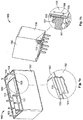
- Figures 1a and 1b show a perspective view of the switch element according to the first exemplary embodiment of the present invention.
- Figure 1a shows a view from below of the base plate 101 of the switch element 100
- Figure 1b shows a view from above of the top 102 of the switch element 100.
- Reference number 111 identifies the periphery of the base plate 101.
- the seam extends between the base plate 101 and the top 102 along the periphery 111.
- the switch element 100 is sealed to the outside with a filling compound 104.
- Figure 1a shows a detailed view along the seam between the base plate 101 and the top 102 at the location of the gap 105
- Figure 1b shows a cross-section through the seam between the base plate 101 and the top 102 at the location of the gap 105
- the gap 105 extends along the seam between the base plate 101 and the top 102, and is formed by a side face 107 of the base plate 101 and a side wall 106 of the top 102.
- the side face 107 of the base plate 101 is fully covered by the side wall 106 of the top 102.
- the gap 105' is formed similarly to the gap 105.
- No filling compound 104 is provided at the locations of the base plate 101 where the gaps 105 and 105' are disposed.
- the gap 105 has a width (or breadth) 109 which is smaller than 0.1 mm.
- the gap 105 has a height 108 which is greater than one millimetre.
- the gap 105' has a width which is smaller than 0.1 mm and a height which is greater than one millimetre.
- the sum of the lengths of the gaps 105 and 105' is smaller than one third of the length of the periphery 111 of the seam between the base plate 101 and the top 102.
- the two gaps 105 and 105' constitute an opening of the switch element 100 to the outside via which the explosive energy, which is released during an explosion within the switch element 100, can escape to the outside, for example in a potentially explosive area.
- the two gaps 105 and 105' in the first exemplary embodiment of the present invention have dimensions, however, such that they spread the explosive energy escaping into the potentially explosive space over a sufficiently long period of time.
- the sufficiently long period of time is chosen here such that the explosive energy escaping to the outside is not capable of igniting the explosive mixture of the potentially explosive area or of causing it to explode.
- the sufficiently long period of time is such that the explosive energy escaping to the outside does not increase the density of energy in the immediate vicinity of the switch element such that this can trigger an explosion in the potentially explosive area.
- the switch element 100 has an opening with two joints 105 and 105' and has a substantially rectangular-parallelepipedal form.
- the present invention is not restricted to this exemplary embodiment, but also includes exemplary embodiments in which the switch element has i) just one gap or ii) more than two gaps between the base plate and the top.
- the switch element has an opening which is formed as a gap between the base plate and the top along the seam between the base plate and the top.
- the gap serving as an opening has a length that is smaller than one third of the length of the periphery of the seam between the base plate and the top.
- the part of the seam between the base plate and the top that is not part of the gap is sealed.
- the seam between the base plate and the connecting terminals is sealed.
- the width of the gap serving as an opening is smaller than 0.1 mm and its height is greater than one millimetre.
- the switch element has an opening which is in the form of a plurality of gaps between the base plate and the top along the seam between the base plate and the top.
- the plurality of gaps have a total length which is smaller than one third of the length of the periphery of the seam between the base plate and the top.
- the part of the seam between the base plate and the top which does not form part of the plurality of gaps is sealed.
- the seam between the base plate and the connecting terminals is sealed.
- the width of each gap of the plurality of gaps is smaller than 0.1 mm and its height is greater than one millimetre.
- the exemplary embodiment shown in Figures 1a and 1b is formed such that the seam between the base plate 101 and the top 102 extends along the periphery 111 of the base plate 101 and the side walls 106 of the top 102 totally cover the side faces 107 of the base plate.
- the present invention is not restricted to this exemplary embodiment, but also includes exemplary embodiments wherein the top, along the seam, only partially covers the side faces of the base plate. In this case, at least at the point where the gap or the gaps are provided, the base plate must have a thickness which is greater than one millimetre.
- the present invention also includes exemplary embodiments wherein the lower edge of the top is placed on the surface of the base plate with the contacts for closing and opening an electrical circuit. In this case the periphery of the seam between the top and the base plate is substantially predetermined by the periphery of the lower edge of the top.
- FIG 2 shows a perspective view of the switch element 200 according to the second exemplary embodiment of the present invention.
- the second exemplary embodiment has in the base plate (this is not shown in Figure 2 ) or in the top 202 an opening or hole 205.
- the hole or the opening 205 is provided in the top 302.
- the switch element 200 is sealed to the outside.
- the seam between the base plate and the top 202 and the seam between the base plate and the connecting terminals (these are not shown in Figure 2 ) is sealed with filling compound.
- Figure 2 shows a section of a cross-section through the cap at the point at which the opening/hole 205 is provided.
- the hole 205 is cylindrical.
- the hole 205 has a diameter 209 which is smaller than 0.4 mm and a height/depth 208 that is greater than 1.2 mm.
- the explosive energy which is released during an explosion within the switch element 200 can escape via the hole 205 to the outside, for example into a potentially explosive area.
- the hole 205 has dimensions such that it spreads the explosive energy escaping into the potentially explosive space over a sufficiently long period of time; and it is spread such that the explosive energy escaping to the outside can not cause the explosive mixture of the potentially explosive area to explode.
- the hole is provided in the middle of the top 202.
- the position of the hole 205 on the top 202 or the base plate is not crucial for the present invention.
- the hole 205 can be located at any point on the top 202 or at any point on the base plate.
- the present invention is not restricted to a circular hole 205.
- the cross-sectional area of the hole may be of any form, for example oval, rectangular or square.
- the cross-sectional area of the hole has a surface area smaller than 0.1256 mm 2 and a height or a depth that is greater than 1.2 mm.
- the present invention also includes exemplary embodiments wherein the hole (or the opening) is conical in form in the longitudinal direction.
- the hole tapers inwardly or outwardly.
- the hole can also have a biconical or meandering form in the longitudinal direction.
- the hole tapers in the middle part or at its ends if the hole has a biconical form.
- the cross-sectional area of the hole has at its narrowest point a surface area that is smaller than 0.1256 mm 2 and a height or depth that is greater than 1.2 mm.
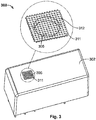
- FIG 3 shows a perspective view of the switch element 300 according to the third exemplary embodiment of the present invention.
- the third exemplary embodiment has in the base plate (this is not shown in Figure 3 ) or in the top 202 an opening or hole 305 that is covered from the outside with a metal grid 311 and that has a mesh size of less than 0.1 mm.
- the hole or the opening 305 is provided in the top 302.
- the switch element 300 is sealed to the outside.
- the seam between the base plate and the top 302 and the seam between the base plate and the connecting terminals are sealed with filling compound.
- Figure 3 shows a detailed top view of the opening 305 with the metal grid 311.
- the metal grid 311 has rectangular or square meshes which have a surface area smaller than 0.01 mm 2 .
- the shape of the opening or of the hole 305, its height or depth, and the surface area of the cross-sectional area at its narrowest point are not essential for the present invention.
- the hole 305 may not be too small.
- the position of the hole 305 on the base plate or on the top 302 is not essential for the present invention either.
- the explosive energy which is released during an explosion within the switch element 300 can escape to the outside via the hole 305 covered by the grid 311, for example into a potentially explosive area.
- the grid 311, in particular its mesh size 312 has dimensions such that it first of all spreads the explosive energy escaping into the potentially explosive space over a sufficiently long period of time, and secondly absorbs/stores part of the explosive energy itself. The combination of these two effects ultimately leads to the explosive energy escaping to the outside not being able to cause the explosive mixture of the potentially explosive area to explode.
- the grid 311 used in the third exemplary embodiment need not be made of metal.
- the grid can be produced from a plastic that is covered with a metal or contains metal; or else the grid can be a ceramic grid that is covered with metal or contains metal.
- the form of the mesh 312 is not essential for the present invention either. In fact, this mesh can be of any form, for example circular, oval or diamond-shaped. In all of these cases it is essential for the invention that the surface area of the mesh 312 is smaller than 0.01 mm 2 .
- Switch elements according to the present invention are preferably relays. Relays according to the first, second and third exemplary embodiment of the present invention have been tested in special laboratories according to standard IEC 60079-15, paragraph 22.4.3. The tests showed that these relays correspond to standard IEC 60079-15, paragraph 22.4.3, and are therefore suitable for use as switch elements in a potentially explosive area.
- Switch elements according to the present invention are used, for example, for connecting mains voltages (230 V for single-phase or 400 V for three-phase alternating voltages) in potentially explosive areas in order to prevent ignition of the mixture present in the potentially explosive area due to a switching spark/switching arc occurring within the switch element.
- mains voltages 230 V for single-phase or 400 V for three-phase alternating voltages
- Reference number Description 100 Switch element according to the first exemplary embodiment 101 Base plate 102 Top 103 Filling compound for sealing 104 Connecting terminal 105, 105' Gap between the base plate and the top 106 Side wall of the top 107 Side face of the base plate 108 Height of the gap 109 Width/Breadth of the gap 110 Length of the gap along the peripheral direction of the base plate 111 Periphery of the base plate 200
- Switch element according to the second exemplary embodiment 202 Top 205 Opening/Hole 208 Depth/Height of the opening 209 Diameter of the opening 300
- Switch element according to the third exemplary embodiment 302 Top 305 Opening/Hole 311 Close meshed grid 312 Mesh of the grid
Landscapes
- Switch Cases, Indication, And Locking (AREA)
- Casings For Electric Apparatus (AREA)
Claims (9)
- Élément de commutation destiné à être utilisé dans une zone potentiellement explosive qui comporte une plaque de base et un sommet, le sommet recouvrant/renfermant une surface de la plaque de base de telle sorte qu'il est produit entre une surface de la plaque de base et le sommet une cavité dans laquelle il y a des contacts pour fermer et ouvrir un circuit électrique, et
l'élément de commutation ayant également une ouverture vers l'extérieur et qui est sinon scellé vis-à-vis de l'extérieur,
caractérisé en ce que :l'ouverture (205) est disposée dans la plaque de base ou dans le sommet (202) ;la surface en coupe transversale de l'ouverture (205) présente au niveau de son point le plus étroit une surface qui est plus petite que 0,1256 mm2 ; et au point où l'ouverture (205) est disposée, la plaque de base ou le sommet (202) a une épaisseur qui est supérieure à 1,2 mm, de sorte que la profondeur (208) de l'ouverture (205) est supérieure à 1,2 mm ;dans lequel une surface en coupe transversale de l'ouverture (205) est ronde, en particulier ovale ou circulaire
oudans lequel une surface en coupe transversale de l'ouverture est angulaire, en particulier carrée ou rectangulaire ; etdans lequel l'ouverture (205) a la forme d'un cône qui se rétrécit soit vers l'intérieur soit vers l'extérieur, ou l'ouverture a une forme biconique qui est rétrécie dans la partie médiane ou aux extrémités. - Élément de commutation destiné à être utilisé dans une zone potentiellement explosive qui comporte une plaque de base et un sommet, le sommet recouvrant/renfermant une surface de la plaque de base de telle sorte qu'il est produit entre une surface de la plaque de base et le sommet une cavité dans laquelle il y a des contacts pour fermer et ouvrir un circuit électrique, et
l'élément de commutation ayant également une ouverture vers l'extérieur et qui est sinon scellé vis-à-vis de l'extérieur,
caractérisé en ce que :l'ouverture (305) est disposée dans la plaque de base ou dans le sommet (302) et est recouverte de l'extérieur d'une grille (311) dont la maille (312) a une surface qui est inférieure à 0,01 mm2 ; etdans lequel la grille (311) est produite à partir d'un métal ou la grille (311) est produite à partir d'une matière plastique qui est recouverte d'un métal ou contient du métal, ou la grille (311) est une grille en céramique qui est recouverte d'un métal ou contient du métal. - Élément de commutation selon la revendication 2, caractérisé en ce que la maille (312) de la grille (311) est carrée et a une taille de maille qui est inférieure à 0,1 mm.
- Élément de commutation destiné à être utilisé dans une zone potentiellement explosive qui comporte une plaque de base et un sommet, le sommet recouvrant/renfermant une surface de la plaque de base de telle sorte qu'il est produit entre une surface de la plaque de base et le sommet une cavité dans laquelle il y a des contacts pour fermer et ouvrir un circuit électrique, et
l'élément de commutation ayant également une ouverture vers l'extérieur et qui est sinon scellé vis-à-vis de l'extérieur,
dans lequel l'ouverture est réalisée sous forme d'un espace (105) entre la plaque de base et le sommet le long du joint entre la plaque de base (101) et le sommet (102), l'espace (105) servant d'ouverture a une longueur (110) qui est inférieure à un tiers de la longueur de la périphérie du joint entre la plaque de base (101) et le sommet (102),
la partie du joint entre la plaque de base (101) et le sommet (102) qui ne fait pas partie de l'espace (105) est scellée,
caractérisé en ce que :la largeur (109) de l'espace (105) servant d'ouverture est inférieure à 0,1 mm,la hauteur (108) de l'espace (105) est supérieure à un millimètre ;dans lequel le joint entre la plaque de base (101) et le sommet (102) s'étend le long de la périphérie (111) de la plaque de base (101), et le long du joint ;le sommet (102) recouvre au moins partiellement les faces latérales (107) de la plaque de base (101) ; etla plaque de base (101) et le sommet (102) ont sensiblement la forme d'un parallélépipède rectangulaire, et les quatre parois latérales (106) du sommet (102) recouvrent totalement les quatre faces latérales (107) de la plaque de base (101). - Élément de commutation destiné à être utilisé dans une zone potentiellement explosive qui comporte une plaque de base et un sommet, le sommet recouvrant/renfermant une surface de la plaque de base de telle sorte qu'il est produit entre une surface de la plaque de base et le sommet une cavité dans laquelle il y a des contacts pour fermer et ouvrir un circuit électrique, et
l'élément de commutation ayant également une ouverture vers l'extérieur et qui est sinon scellé vis-à-vis de l'extérieur,
l'ouverture est réalisée sous forme d'une pluralité d'espaces (105, 105') entre la plaque de base et le sommet le long du joint entre la plaque de base (101) et le sommet (102),
la somme de la pluralité d'espaces (105, 105') servant d'ouverture a une longueur qui est inférieure à un tiers de la longueur de la périphérie du joint entre la plaque de base (101) et le sommet (102),
la partie du joint entre la plaque de base (101) et le sommet (102) qui ne forme pas une partie de la pluralité d'espaces (105, 105') est scellée,
caractérisé en ce que :la largeur (109) de chaque espace de la pluralité d'espaces (105, 105') est inférieure à 0,1 mm,la hauteur (108) de chaque espace de la pluralité d'espaces (105, 105') est supérieure à un millimètre ; etdans lequel le joint entre la plaque de base (101) et le sommet (102) s'étend le long de la périphérie (111) de la plaque de base (101), et le long du joint ;le sommet (102) recouvre au moins partiellement les faces latérales (107) de la plaque de base (101) ; etla plaque de base (101) et le sommet (102) ont sensiblement la forme d'un parallélépipède rectangulaire, et les quatre parois latérales (106) du sommet (102) recouvrent totalement les quatre faces latérales (107) de la plaque de base (101). - Élément de commutation selon l'une quelconque des revendications 1 à 5, caractérisé en ce que l'élément de commutation est un relais.
- Utilisation d'un élément de commutation (200) dans une zone potentiellement explosive afin de connecter un circuit électrique et ainsi empêcher l'inflammation du mélange explosif présent dans la zone potentiellement explosive en raison d'un arc de commutation se produisant à l'intérieur de l'élément de commutation,
l'élément de commutation (200) ayant une plaque de base et un sommet (202), le sommet (202) recouvrant/renfermant une surface de la plaque de base de telle sorte qu'il est produit entre une surface de la plaque de base et le sommet (202) une cavité dans laquelle sont positionnés des contacts pour fermer et ouvrir un circuit électrique,
l'élément de commutation (200) étant scellé à part au niveau d'une ouverture (205), l'ouverture (205) étant disposée dans la plaque de base ou dans le sommet (202),
la surface en coupe transversale de l'ouverture (205) présentant une surface inférieure à 0,1256 mm2 au niveau de son point le plus étroit,
caractérisée en ce que :au point où l'ouverture (205) est disposée, la plaque de base et le sommet (202) ayant une épaisseur qui est supérieure à 1,2 mm, de sorte que la profondeur (208) de l'ouverture est supérieure à 1,2 mm ;dans laquelle une surface en coupe transversale de l'ouverture (205) est ronde, en particulier ovale ou circulaire,oudans laquelle une surface en coupe transversale de l'ouverture est angulaire, en particulier carrée ou rectangulaire ; etl'ouverture (205) a la forme d'un cône qui se rétrécit soit vers l'intérieur soit vers l'extérieur, ou l'ouverture a une forme biconique qui est rétrécie dans la partie médiane ou aux extrémités. - Utilisation d'un élément de commutation (300) dans une zone potentiellement explosive afin de connecter un circuit électrique et ainsi empêcher l'inflammation du mélange explosif présent dans la zone potentiellement explosive en raison d'un arc de commutation se produisant à l'intérieur de l'élément de commutation,
l'élément de commutation (300) ayant une plaque de base et un sommet (302), le sommet (302) recouvrant/renfermant une surface de la plaque de base de telle sorte qu'il est produit entre une surface de la plaque de base et le sommet (302) une cavité dans laquelle il y a des contacts pour fermer et ouvrir un circuit électrique,
l'élément de commutation (300) étant scellé à part au niveau d'une ouverture (305), caractérisée en ce que :l'ouverture (305) est disposée dans la plaque de base ou dans le sommet (302) et est recouverte de l'extérieur d'une grille (311) dont la maille (312) a une surface qui est inférieure à 0,01 mm2 ; etdans laquelle la grille (311) est produite à partir d'un métal ou la grille (311) est produite à partir d'une matière plastique qui est recouverte d'un métal ou contient du métal, ou la grille (311) est une grille en céramique qui est recouverte d'un métal ou contient du métal. - Utilisation d'un élément de commutation (100) dans une zone potentiellement explosive afin de connecter un circuit électrique et ainsi empêcher l'inflammation du mélange explosif présent dans la zone potentiellement explosive en raison d'un arc de commutation se produisant à l'intérieur de l'élément de commutation,
l'élément de commutation (100) ayant une plaque de base (101) et un sommet (102), le sommet (102) recouvrant/renfermant une surface de la plaque de base (101) de telle sorte qu'il est produit entre une surface de la plaque de base (101) et le sommet (102) une cavité dans laquelle il y a des contacts pour fermer et ouvrir un circuit électrique,
un espace (105) ou une pluralité d'espaces (105, 105') étant formés entre la plaque de base et le sommet le long du joint entre la plaque de base (101) et le sommet (102),
l'espace (105) ayant une longueur (110) et la pluralité d'espaces (105, 105') ayant une longueur totale (110) qui est inférieure à un tiers de la longueur de la périphérie du joint entre la plaque de base (101) et le sommet (102),
la partie du joint entre la plaque de base (101) et le sommet (102) ne formant pas une partie de l'espace (105) ou de la pluralité d'espaces (105, 105') étant scellée, l'élément de commutation (100) étant par ailleurs également scellé,
caractérisée en ce que :la largeur (107) de l'espace (105) ou la largeur de chaque espace de la pluralité d'espaces (105, 105') étant inférieure à 0,1 mm, etla hauteur (108) de l'espace (105) ou la hauteur de chaque espace de la pluralité (105, 105') d'espaces étant supérieure à un millimètre ; etdans laquelle le joint entre la plaque de base (101) et le sommet (102) s'étend le long de la périphérie (111) de la plaque de base (101), et le long du joint ;le sommet (102) recouvre au moins partiellement les faces latérales (107) de la plaque de base (101) ; etla plaque de base (101) et le sommet (102) ont sensiblement la forme d'un parallélépipède rectangulaire, et les quatre parois latérales (106) du sommet (102) recouvrent totalement les quatre faces latérales (107) de la plaque de base (101).
Applications Claiming Priority (2)
| Application Number | Priority Date | Filing Date | Title |
|---|---|---|---|
| DE102014006957.5A DE102014006957A1 (de) | 2014-05-12 | 2014-05-12 | Schaltelement für den Einsatz in einem explosionsgefährdeten Bereich |
| PCT/EP2015/059688 WO2015173046A1 (fr) | 2014-05-12 | 2015-05-04 | Élément interrupteur destiné à être utilisé dans une zone potentiellement explosive |
Publications (2)
| Publication Number | Publication Date |
|---|---|
| EP3143632A1 EP3143632A1 (fr) | 2017-03-22 |
| EP3143632B1 true EP3143632B1 (fr) | 2020-07-01 |
Family
ID=53059093
Family Applications (1)
| Application Number | Title | Priority Date | Filing Date |
|---|---|---|---|
| EP15721202.8A Not-in-force EP3143632B1 (fr) | 2014-05-12 | 2015-05-04 | Élément interrupteur destiné à être utilisé dans une zone potentiellement explosive |
Country Status (6)
| Country | Link |
|---|---|
| US (1) | US10283286B2 (fr) |
| EP (1) | EP3143632B1 (fr) |
| JP (1) | JP2017516266A (fr) |
| CN (2) | CN106463288A (fr) |
| DE (1) | DE102014006957A1 (fr) |
| WO (1) | WO2015173046A1 (fr) |
Families Citing this family (2)
| Publication number | Priority date | Publication date | Assignee | Title |
|---|---|---|---|---|
| JP7326739B2 (ja) * | 2018-12-27 | 2023-08-16 | オムロン株式会社 | 電子部品 |
| US12061007B2 (en) | 2020-02-07 | 2024-08-13 | Carrier Corporation | A2L compliant contactor |
Citations (1)
| Publication number | Priority date | Publication date | Assignee | Title |
|---|---|---|---|---|
| GB1450724A (en) * | 1972-04-28 | 1976-09-29 | Airpax Electronics | Electrical circuit breaker |
Family Cites Families (22)
| Publication number | Priority date | Publication date | Assignee | Title |
|---|---|---|---|---|
| NL184696C (nl) * | 1953-02-06 | Nat Res Dev | Draad of folie van georienteerd hoge dichtheid polyetheen en werkwijze voor het vervaardigen van een gestrekt voorwerp. | |
| JPS4712428Y1 (fr) * | 1968-12-26 | 1972-05-09 | ||
| US4177367A (en) * | 1978-07-18 | 1979-12-04 | Amf Incorporated | Push button switch |
| US4260863A (en) * | 1978-11-06 | 1981-04-07 | Appleton Arthur I | Vented plastic enclosure for arcing devices |
| DE2902169C2 (de) * | 1979-01-20 | 1983-07-21 | AEG-Telefunken Nachrichtentechnik GmbH, 7150 Backnang | Regen- und spritzwassergeschütztes Gehäuse zur Aufnahme von elektrischen Geräten |
| JPS5619814A (en) * | 1979-07-27 | 1981-02-24 | Mitsubishi Electric Corp | Switching device |
| US4620863A (en) * | 1981-07-02 | 1986-11-04 | Rensselaer Polytechnic Institute | Radiation coloration resistant glass |
| JPS5866537U (ja) * | 1981-10-29 | 1983-05-06 | オリジナル電機株式会社 | リレ− |
| US4427863A (en) * | 1982-03-22 | 1984-01-24 | Izumi Denki Corporation | Small-sized relay and method for fabricating the same |
| JP3004854U (ja) * | 1994-05-23 | 1994-11-29 | 光樹 永本 | 電磁継電器のカバー構造 |
| DE19634673C2 (de) * | 1996-08-28 | 1998-08-27 | Stahl R Schaltgeraete Gmbh | Kunststoffgehäuse in der Zündschutzart "Druckfeste Kapselung" |
| DE19708116C2 (de) | 1997-02-28 | 1999-02-25 | Telefunken Microelectron | Anordnung zum Verschließen von Druckausgleichsöffnungen |
| JPH11125482A (ja) * | 1997-10-21 | 1999-05-11 | Matsushita Electric Ind Co Ltd | 可燃性冷媒を用いた冷凍機器の爆発防止装置 |
| DE19840761C1 (de) * | 1998-09-07 | 2000-05-04 | Daimler Chrysler Ag | Verfahren zur Herstellung eines feuchtigkeitsundurchlässigen Druckausgleichselement für ein Gehäuse |
| DE202006001911U1 (de) * | 2005-03-02 | 2006-06-22 | Crastal Technology (Shenzhen) Co., Ltd. | Relaisschalter für Toaster |
| JP4712428B2 (ja) | 2005-04-25 | 2011-06-29 | 日本高圧電気株式会社 | 物体を測定する装置 |
| US7321281B2 (en) * | 2005-05-17 | 2008-01-22 | Gigavac Llc | Hermetically sealed relay having low permeability plastic housing |
| JP4540064B2 (ja) * | 2005-09-09 | 2010-09-08 | Necトーキン株式会社 | 電磁継電器 |
| DE102007024421C5 (de) * | 2007-05-25 | 2016-05-19 | Cooper Crouse-Hinds Gmbh | Gehäuse für ein elektrisches Betriebsmittel |
| JP5131218B2 (ja) * | 2008-09-12 | 2013-01-30 | アンデン株式会社 | 電磁継電器 |
| JP5131219B2 (ja) * | 2009-02-02 | 2013-01-30 | アンデン株式会社 | 電磁継電器 |
| JP5018845B2 (ja) * | 2009-08-20 | 2012-09-05 | 富士電機機器制御株式会社 | 電磁接触器 |
-
2014
- 2014-05-12 DE DE102014006957.5A patent/DE102014006957A1/de not_active Withdrawn
-
2015
- 2015-05-04 EP EP15721202.8A patent/EP3143632B1/fr not_active Not-in-force
- 2015-05-04 WO PCT/EP2015/059688 patent/WO2015173046A1/fr not_active Ceased
- 2015-05-04 CN CN201580025236.3A patent/CN106463288A/zh active Pending
- 2015-05-04 CN CN202010908848.XA patent/CN112185728A/zh active Pending
- 2015-05-04 JP JP2016567420A patent/JP2017516266A/ja active Pending
-
2016
- 2016-11-10 US US15/348,418 patent/US10283286B2/en not_active Expired - Fee Related
Patent Citations (1)
| Publication number | Priority date | Publication date | Assignee | Title |
|---|---|---|---|---|
| GB1450724A (en) * | 1972-04-28 | 1976-09-29 | Airpax Electronics | Electrical circuit breaker |
Also Published As
| Publication number | Publication date |
|---|---|
| JP2017516266A (ja) | 2017-06-15 |
| CN106463288A (zh) | 2017-02-22 |
| EP3143632A1 (fr) | 2017-03-22 |
| US10283286B2 (en) | 2019-05-07 |
| US20170062147A1 (en) | 2017-03-02 |
| CN112185728A (zh) | 2021-01-05 |
| DE102014006957A1 (de) | 2015-11-12 |
| WO2015173046A1 (fr) | 2015-11-19 |
Similar Documents
| Publication | Publication Date | Title |
|---|---|---|
| RU2710540C1 (ru) | Разъединительное устройство для ограничителя перенапряжений и защитное устройство, содержащее ограничитель перенапряжений, соединенный с таким разъединительным устройством | |
| RU2497250C1 (ru) | Устройство защиты от перенапряжений | |
| US11682899B2 (en) | Protection of a surge arrester with a better protection against failure from thermal overload in case of a temporary overvoltage in an electrical grid line | |
| JPH0145173B2 (fr) | ||
| US20100051437A1 (en) | Disconnection Arrangement and Method for Operation of a Disconnection Arrangement | |
| EP3143632B1 (fr) | Élément interrupteur destiné à être utilisé dans une zone potentiellement explosive | |
| US3291937A (en) | Explosive disconnect having the explosive means thermally and electrically isolated from resistance ignition means | |
| KR20160021663A (ko) | 진공차단기의 진공인터럽터 | |
| US20160079020A1 (en) | Encapsulation of components and a low energy circuit for hazardous locations | |
| CA1144962A (fr) | Fusible a percuteur actionne par un piston | |
| US20210066011A1 (en) | Device for Interrupting an Electrical Current Circuit | |
| US3560794A (en) | Lightning arrester with a rupturable diaphragm for gas pressure release | |
| CN105552720B (zh) | 浪涌电压保护器 | |
| JP2005521225A (ja) | 開閉装置の耐アーク性囲壁 | |
| CN203895381U (zh) | 防火隔板及包括该防火隔板的插头式断路器 | |
| JP7197887B2 (ja) | 避雷器 | |
| JP2020057634A (ja) | 電子部品保護ケース | |
| EP3373401B1 (fr) | Agencement de sectionneur et procédé de fabrication | |
| JP6562269B2 (ja) | サージ防護素子 | |
| JPH0356030Y2 (fr) | ||
| JP6170466B2 (ja) | サージ保護装置 | |
| JP2016533015A (ja) | サージ避雷器 | |
| JPS5963684A (ja) | 避雷器 | |
| JPS63294638A (ja) | カットアウト | |
| PL226463B1 (pl) | Komora próżniowa do wyłącznika wysokiego napięcia |
Legal Events
| Date | Code | Title | Description |
|---|---|---|---|
| STAA | Information on the status of an ep patent application or granted ep patent |
Free format text: STATUS: THE INTERNATIONAL PUBLICATION HAS BEEN MADE |
|
| PUAI | Public reference made under article 153(3) epc to a published international application that has entered the european phase |
Free format text: ORIGINAL CODE: 0009012 |
|
| STAA | Information on the status of an ep patent application or granted ep patent |
Free format text: STATUS: REQUEST FOR EXAMINATION WAS MADE |
|
| 17P | Request for examination filed |
Effective date: 20161207 |
|
| AK | Designated contracting states |
Kind code of ref document: A1 Designated state(s): AL AT BE BG CH CY CZ DE DK EE ES FI FR GB GR HR HU IE IS IT LI LT LU LV MC MK MT NL NO PL PT RO RS SE SI SK SM TR |
|
| AX | Request for extension of the european patent |
Extension state: BA ME |
|
| DAV | Request for validation of the european patent (deleted) | ||
| DAX | Request for extension of the european patent (deleted) | ||
| STAA | Information on the status of an ep patent application or granted ep patent |
Free format text: STATUS: EXAMINATION IS IN PROGRESS |
|
| 17Q | First examination report despatched |
Effective date: 20190321 |
|
| GRAP | Despatch of communication of intention to grant a patent |
Free format text: ORIGINAL CODE: EPIDOSNIGR1 |
|
| STAA | Information on the status of an ep patent application or granted ep patent |
Free format text: STATUS: GRANT OF PATENT IS INTENDED |
|
| INTG | Intention to grant announced |
Effective date: 20200212 |
|
| RIN1 | Information on inventor provided before grant (corrected) |
Inventor name: KROEPFL, CHRISTIAN |
|
| GRAS | Grant fee paid |
Free format text: ORIGINAL CODE: EPIDOSNIGR3 |
|
| GRAA | (expected) grant |
Free format text: ORIGINAL CODE: 0009210 |
|
| STAA | Information on the status of an ep patent application or granted ep patent |
Free format text: STATUS: THE PATENT HAS BEEN GRANTED |
|
| AK | Designated contracting states |
Kind code of ref document: B1 Designated state(s): AL AT BE BG CH CY CZ DE DK EE ES FI FR GB GR HR HU IE IS IT LI LT LU LV MC MK MT NL NO PL PT RO RS SE SI SK SM TR |
|
| REG | Reference to a national code |
Ref country code: CH Ref legal event code: EP Ref country code: AT Ref legal event code: REF Ref document number: 1286934 Country of ref document: AT Kind code of ref document: T Effective date: 20200715 |
|
| REG | Reference to a national code |
Ref country code: IE Ref legal event code: FG4D |
|
| REG | Reference to a national code |
Ref country code: DE Ref legal event code: R096 Ref document number: 602015055053 Country of ref document: DE |
|
| REG | Reference to a national code |
Ref country code: LT Ref legal event code: MG4D |
|
| PG25 | Lapsed in a contracting state [announced via postgrant information from national office to epo] |
Ref country code: BG Free format text: LAPSE BECAUSE OF FAILURE TO SUBMIT A TRANSLATION OF THE DESCRIPTION OR TO PAY THE FEE WITHIN THE PRESCRIBED TIME-LIMIT Effective date: 20201001 |
|
| REG | Reference to a national code |
Ref country code: NL Ref legal event code: MP Effective date: 20200701 |
|
| REG | Reference to a national code |
Ref country code: AT Ref legal event code: MK05 Ref document number: 1286934 Country of ref document: AT Kind code of ref document: T Effective date: 20200701 |
|
| PG25 | Lapsed in a contracting state [announced via postgrant information from national office to epo] |
Ref country code: NO Free format text: LAPSE BECAUSE OF FAILURE TO SUBMIT A TRANSLATION OF THE DESCRIPTION OR TO PAY THE FEE WITHIN THE PRESCRIBED TIME-LIMIT Effective date: 20201001 Ref country code: SE Free format text: LAPSE BECAUSE OF FAILURE TO SUBMIT A TRANSLATION OF THE DESCRIPTION OR TO PAY THE FEE WITHIN THE PRESCRIBED TIME-LIMIT Effective date: 20200701 Ref country code: GR Free format text: LAPSE BECAUSE OF FAILURE TO SUBMIT A TRANSLATION OF THE DESCRIPTION OR TO PAY THE FEE WITHIN THE PRESCRIBED TIME-LIMIT Effective date: 20201002 Ref country code: ES Free format text: LAPSE BECAUSE OF FAILURE TO SUBMIT A TRANSLATION OF THE DESCRIPTION OR TO PAY THE FEE WITHIN THE PRESCRIBED TIME-LIMIT Effective date: 20200701 Ref country code: PT Free format text: LAPSE BECAUSE OF FAILURE TO SUBMIT A TRANSLATION OF THE DESCRIPTION OR TO PAY THE FEE WITHIN THE PRESCRIBED TIME-LIMIT Effective date: 20201102 Ref country code: AT Free format text: LAPSE BECAUSE OF FAILURE TO SUBMIT A TRANSLATION OF THE DESCRIPTION OR TO PAY THE FEE WITHIN THE PRESCRIBED TIME-LIMIT Effective date: 20200701 Ref country code: FI Free format text: LAPSE BECAUSE OF FAILURE TO SUBMIT A TRANSLATION OF THE DESCRIPTION OR TO PAY THE FEE WITHIN THE PRESCRIBED TIME-LIMIT Effective date: 20200701 Ref country code: CZ Free format text: LAPSE BECAUSE OF FAILURE TO SUBMIT A TRANSLATION OF THE DESCRIPTION OR TO PAY THE FEE WITHIN THE PRESCRIBED TIME-LIMIT Effective date: 20200701 Ref country code: LT Free format text: LAPSE BECAUSE OF FAILURE TO SUBMIT A TRANSLATION OF THE DESCRIPTION OR TO PAY THE FEE WITHIN THE PRESCRIBED TIME-LIMIT Effective date: 20200701 Ref country code: HR Free format text: LAPSE BECAUSE OF FAILURE TO SUBMIT A TRANSLATION OF THE DESCRIPTION OR TO PAY THE FEE WITHIN THE PRESCRIBED TIME-LIMIT Effective date: 20200701 |
|
| PG25 | Lapsed in a contracting state [announced via postgrant information from national office to epo] |
Ref country code: PL Free format text: LAPSE BECAUSE OF FAILURE TO SUBMIT A TRANSLATION OF THE DESCRIPTION OR TO PAY THE FEE WITHIN THE PRESCRIBED TIME-LIMIT Effective date: 20200701 Ref country code: LV Free format text: LAPSE BECAUSE OF FAILURE TO SUBMIT A TRANSLATION OF THE DESCRIPTION OR TO PAY THE FEE WITHIN THE PRESCRIBED TIME-LIMIT Effective date: 20200701 Ref country code: RS Free format text: LAPSE BECAUSE OF FAILURE TO SUBMIT A TRANSLATION OF THE DESCRIPTION OR TO PAY THE FEE WITHIN THE PRESCRIBED TIME-LIMIT Effective date: 20200701 Ref country code: IS Free format text: LAPSE BECAUSE OF FAILURE TO SUBMIT A TRANSLATION OF THE DESCRIPTION OR TO PAY THE FEE WITHIN THE PRESCRIBED TIME-LIMIT Effective date: 20201101 |
|
| PG25 | Lapsed in a contracting state [announced via postgrant information from national office to epo] |
Ref country code: NL Free format text: LAPSE BECAUSE OF FAILURE TO SUBMIT A TRANSLATION OF THE DESCRIPTION OR TO PAY THE FEE WITHIN THE PRESCRIBED TIME-LIMIT Effective date: 20200701 |
|
| REG | Reference to a national code |
Ref country code: DE Ref legal event code: R097 Ref document number: 602015055053 Country of ref document: DE |
|
| PG25 | Lapsed in a contracting state [announced via postgrant information from national office to epo] |
Ref country code: IT Free format text: LAPSE BECAUSE OF FAILURE TO SUBMIT A TRANSLATION OF THE DESCRIPTION OR TO PAY THE FEE WITHIN THE PRESCRIBED TIME-LIMIT Effective date: 20200701 Ref country code: DK Free format text: LAPSE BECAUSE OF FAILURE TO SUBMIT A TRANSLATION OF THE DESCRIPTION OR TO PAY THE FEE WITHIN THE PRESCRIBED TIME-LIMIT Effective date: 20200701 Ref country code: RO Free format text: LAPSE BECAUSE OF FAILURE TO SUBMIT A TRANSLATION OF THE DESCRIPTION OR TO PAY THE FEE WITHIN THE PRESCRIBED TIME-LIMIT Effective date: 20200701 Ref country code: SM Free format text: LAPSE BECAUSE OF FAILURE TO SUBMIT A TRANSLATION OF THE DESCRIPTION OR TO PAY THE FEE WITHIN THE PRESCRIBED TIME-LIMIT Effective date: 20200701 Ref country code: EE Free format text: LAPSE BECAUSE OF FAILURE TO SUBMIT A TRANSLATION OF THE DESCRIPTION OR TO PAY THE FEE WITHIN THE PRESCRIBED TIME-LIMIT Effective date: 20200701 |
|
| PLBE | No opposition filed within time limit |
Free format text: ORIGINAL CODE: 0009261 |
|
| STAA | Information on the status of an ep patent application or granted ep patent |
Free format text: STATUS: NO OPPOSITION FILED WITHIN TIME LIMIT |
|
| PG25 | Lapsed in a contracting state [announced via postgrant information from national office to epo] |
Ref country code: AL Free format text: LAPSE BECAUSE OF FAILURE TO SUBMIT A TRANSLATION OF THE DESCRIPTION OR TO PAY THE FEE WITHIN THE PRESCRIBED TIME-LIMIT Effective date: 20200701 |
|
| 26N | No opposition filed |
Effective date: 20210406 |
|
| PG25 | Lapsed in a contracting state [announced via postgrant information from national office to epo] |
Ref country code: SK Free format text: LAPSE BECAUSE OF FAILURE TO SUBMIT A TRANSLATION OF THE DESCRIPTION OR TO PAY THE FEE WITHIN THE PRESCRIBED TIME-LIMIT Effective date: 20200701 |
|
| PG25 | Lapsed in a contracting state [announced via postgrant information from national office to epo] |
Ref country code: SI Free format text: LAPSE BECAUSE OF FAILURE TO SUBMIT A TRANSLATION OF THE DESCRIPTION OR TO PAY THE FEE WITHIN THE PRESCRIBED TIME-LIMIT Effective date: 20200701 |
|
| REG | Reference to a national code |
Ref country code: DE Ref legal event code: R119 Ref document number: 602015055053 Country of ref document: DE |
|
| REG | Reference to a national code |
Ref country code: CH Ref legal event code: PL |
|
| GBPC | Gb: european patent ceased through non-payment of renewal fee |
Effective date: 20210504 |
|
| PG25 | Lapsed in a contracting state [announced via postgrant information from national office to epo] |
Ref country code: MC Free format text: LAPSE BECAUSE OF FAILURE TO SUBMIT A TRANSLATION OF THE DESCRIPTION OR TO PAY THE FEE WITHIN THE PRESCRIBED TIME-LIMIT Effective date: 20200701 Ref country code: LU Free format text: LAPSE BECAUSE OF NON-PAYMENT OF DUE FEES Effective date: 20210504 Ref country code: LI Free format text: LAPSE BECAUSE OF NON-PAYMENT OF DUE FEES Effective date: 20210531 Ref country code: CH Free format text: LAPSE BECAUSE OF NON-PAYMENT OF DUE FEES Effective date: 20210531 |
|
| REG | Reference to a national code |
Ref country code: BE Ref legal event code: MM Effective date: 20210531 |
|
| PG25 | Lapsed in a contracting state [announced via postgrant information from national office to epo] |
Ref country code: IE Free format text: LAPSE BECAUSE OF NON-PAYMENT OF DUE FEES Effective date: 20210504 Ref country code: GB Free format text: LAPSE BECAUSE OF NON-PAYMENT OF DUE FEES Effective date: 20210504 Ref country code: DE Free format text: LAPSE BECAUSE OF NON-PAYMENT OF DUE FEES Effective date: 20211201 |
|
| PG25 | Lapsed in a contracting state [announced via postgrant information from national office to epo] |
Ref country code: FR Free format text: LAPSE BECAUSE OF NON-PAYMENT OF DUE FEES Effective date: 20210531 |
|
| PG25 | Lapsed in a contracting state [announced via postgrant information from national office to epo] |
Ref country code: BE Free format text: LAPSE BECAUSE OF NON-PAYMENT OF DUE FEES Effective date: 20210531 |
|
| PG25 | Lapsed in a contracting state [announced via postgrant information from national office to epo] |
Ref country code: HU Free format text: LAPSE BECAUSE OF FAILURE TO SUBMIT A TRANSLATION OF THE DESCRIPTION OR TO PAY THE FEE WITHIN THE PRESCRIBED TIME-LIMIT; INVALID AB INITIO Effective date: 20150504 |
|
| PG25 | Lapsed in a contracting state [announced via postgrant information from national office to epo] |
Ref country code: CY Free format text: LAPSE BECAUSE OF FAILURE TO SUBMIT A TRANSLATION OF THE DESCRIPTION OR TO PAY THE FEE WITHIN THE PRESCRIBED TIME-LIMIT Effective date: 20200701 |
|
| PG25 | Lapsed in a contracting state [announced via postgrant information from national office to epo] |
Ref country code: MK Free format text: LAPSE BECAUSE OF FAILURE TO SUBMIT A TRANSLATION OF THE DESCRIPTION OR TO PAY THE FEE WITHIN THE PRESCRIBED TIME-LIMIT Effective date: 20200701 |
|
| PG25 | Lapsed in a contracting state [announced via postgrant information from national office to epo] |
Ref country code: MT Free format text: LAPSE BECAUSE OF FAILURE TO SUBMIT A TRANSLATION OF THE DESCRIPTION OR TO PAY THE FEE WITHIN THE PRESCRIBED TIME-LIMIT Effective date: 20200701 |
|
| PG25 | Lapsed in a contracting state [announced via postgrant information from national office to epo] |
Ref country code: TR Free format text: LAPSE BECAUSE OF FAILURE TO SUBMIT A TRANSLATION OF THE DESCRIPTION OR TO PAY THE FEE WITHIN THE PRESCRIBED TIME-LIMIT Effective date: 20200701 |