EP3144342A1 - Dispositif pour l'application d'une amorce - Google Patents
Dispositif pour l'application d'une amorce Download PDFInfo
- Publication number
- EP3144342A1 EP3144342A1 EP15185666.3A EP15185666A EP3144342A1 EP 3144342 A1 EP3144342 A1 EP 3144342A1 EP 15185666 A EP15185666 A EP 15185666A EP 3144342 A1 EP3144342 A1 EP 3144342A1
- Authority
- EP
- European Patent Office
- Prior art keywords
- primer component
- primer
- chamber
- source
- substrate
- Prior art date
- Legal status (The legal status is an assumption and is not a legal conclusion. Google has not performed a legal analysis and makes no representation as to the accuracy of the status listed.)
- Withdrawn
Links
- 239000000758 substrate Substances 0.000 claims abstract description 79
- 239000000203 mixture Substances 0.000 claims abstract description 56
- 239000004830 Super Glue Substances 0.000 claims abstract description 31
- FGBJXOREULPLGL-UHFFFAOYSA-N ethyl cyanoacrylate Chemical compound CCOC(=O)C(=C)C#N FGBJXOREULPLGL-UHFFFAOYSA-N 0.000 claims abstract description 28
- 239000000853 adhesive Substances 0.000 claims abstract description 23
- 230000001070 adhesive effect Effects 0.000 claims abstract description 23
- 230000037452 priming Effects 0.000 claims abstract description 10
- 230000037361 pathway Effects 0.000 claims abstract description 6
- 238000000034 method Methods 0.000 claims description 22
- 239000007787 solid Substances 0.000 claims description 22
- 239000007788 liquid Substances 0.000 claims description 21
- 230000004888 barrier function Effects 0.000 claims description 9
- 239000011248 coating agent Substances 0.000 claims description 6
- 238000000576 coating method Methods 0.000 claims description 6
- 239000012190 activator Substances 0.000 claims description 5
- 238000010521 absorption reaction Methods 0.000 claims description 4
- 238000001179 sorption measurement Methods 0.000 claims description 4
- 239000003380 propellant Substances 0.000 claims description 3
- 230000013011 mating Effects 0.000 claims description 2
- 239000007789 gas Substances 0.000 description 29
- 239000000463 material Substances 0.000 description 22
- 239000012159 carrier gas Substances 0.000 description 19
- 239000002904 solvent Substances 0.000 description 18
- 239000003570 air Substances 0.000 description 11
- 239000011236 particulate material Substances 0.000 description 11
- 239000000178 monomer Substances 0.000 description 8
- 239000002245 particle Substances 0.000 description 8
- 229920003023 plastic Polymers 0.000 description 7
- 239000004033 plastic Substances 0.000 description 7
- -1 polyethylene Polymers 0.000 description 7
- 229920001651 Cyanoacrylate Polymers 0.000 description 6
- MWCLLHOVUTZFKS-UHFFFAOYSA-N Methyl cyanoacrylate Chemical compound COC(=O)C(=C)C#N MWCLLHOVUTZFKS-UHFFFAOYSA-N 0.000 description 6
- 239000004743 Polypropylene Substances 0.000 description 5
- 229920000098 polyolefin Polymers 0.000 description 5
- 229920001155 polypropylene Polymers 0.000 description 5
- 238000011282 treatment Methods 0.000 description 5
- OEBXWWBYZJNKRK-UHFFFAOYSA-N 1-methyl-2,3,4,6,7,8-hexahydropyrimido[1,2-a]pyrimidine Chemical compound C1CCN=C2N(C)CCCN21 OEBXWWBYZJNKRK-UHFFFAOYSA-N 0.000 description 4
- GQHTUMJGOHRCHB-UHFFFAOYSA-N 2,3,4,6,7,8,9,10-octahydropyrimido[1,2-a]azepine Chemical compound C1CCCCN2CCCN=C21 GQHTUMJGOHRCHB-UHFFFAOYSA-N 0.000 description 4
- 239000004698 Polyethylene Substances 0.000 description 4
- QVGXLLKOCUKJST-UHFFFAOYSA-N atomic oxygen Chemical compound [O] QVGXLLKOCUKJST-UHFFFAOYSA-N 0.000 description 4
- 230000008901 benefit Effects 0.000 description 4
- 125000004432 carbon atom Chemical group C* 0.000 description 4
- 229910052760 oxygen Inorganic materials 0.000 description 4
- 239000001301 oxygen Substances 0.000 description 4
- 239000012071 phase Substances 0.000 description 4
- 230000002829 reductive effect Effects 0.000 description 4
- 229920006395 saturated elastomer Polymers 0.000 description 4
- 239000012855 volatile organic compound Substances 0.000 description 4
- QWENRTYMTSOGBR-UHFFFAOYSA-N 1H-1,2,3-Triazole Chemical compound C=1C=NNN=1 QWENRTYMTSOGBR-UHFFFAOYSA-N 0.000 description 3
- YXFVVABEGXRONW-UHFFFAOYSA-N Toluene Chemical compound CC1=CC=CC=C1 YXFVVABEGXRONW-UHFFFAOYSA-N 0.000 description 3
- 239000002318 adhesion promoter Substances 0.000 description 3
- 239000000969 carrier Substances 0.000 description 3
- 150000001875 compounds Chemical class 0.000 description 3
- 230000003750 conditioning effect Effects 0.000 description 3
- 238000004519 manufacturing process Methods 0.000 description 3
- 239000004800 polyvinyl chloride Substances 0.000 description 3
- 229920000915 polyvinyl chloride Polymers 0.000 description 3
- 230000000717 retained effect Effects 0.000 description 3
- 238000004381 surface treatment Methods 0.000 description 3
- XLYOFNOQVPJJNP-UHFFFAOYSA-N water Chemical compound O XLYOFNOQVPJJNP-UHFFFAOYSA-N 0.000 description 3
- SGUVLZREKBPKCE-UHFFFAOYSA-N 1,5-diazabicyclo[4.3.0]-non-5-ene Chemical compound C1CCN=C2CCCN21 SGUVLZREKBPKCE-UHFFFAOYSA-N 0.000 description 2
- 125000003903 2-propenyl group Chemical group [H]C([*])([H])C([H])=C([H])[H] 0.000 description 2
- NURQLCJSMXZBPC-UHFFFAOYSA-N 3,4-dimethylpyridine Chemical compound CC1=CC=NC=C1C NURQLCJSMXZBPC-UHFFFAOYSA-N 0.000 description 2
- KWYHDKDOAIKMQN-UHFFFAOYSA-N N,N,N',N'-tetramethylethylenediamine Chemical compound CN(C)CCN(C)C KWYHDKDOAIKMQN-UHFFFAOYSA-N 0.000 description 2
- 239000004952 Polyamide Substances 0.000 description 2
- 230000009471 action Effects 0.000 description 2
- 239000002671 adjuvant Substances 0.000 description 2
- 239000012615 aggregate Substances 0.000 description 2
- 125000003342 alkenyl group Chemical group 0.000 description 2
- 239000012298 atmosphere Substances 0.000 description 2
- 239000011324 bead Substances 0.000 description 2
- 238000005266 casting Methods 0.000 description 2
- 238000006243 chemical reaction Methods 0.000 description 2
- 238000010276 construction Methods 0.000 description 2
- 230000035622 drinking Effects 0.000 description 2
- HQQADJVZYDDRJT-UHFFFAOYSA-N ethene;prop-1-ene Chemical group C=C.CC=C HQQADJVZYDDRJT-UHFFFAOYSA-N 0.000 description 2
- 238000001704 evaporation Methods 0.000 description 2
- 229920001903 high density polyethylene Polymers 0.000 description 2
- 239000004700 high-density polyethylene Substances 0.000 description 2
- 239000011261 inert gas Substances 0.000 description 2
- 239000004615 ingredient Substances 0.000 description 2
- 239000007791 liquid phase Substances 0.000 description 2
- 229920001684 low density polyethylene Polymers 0.000 description 2
- 239000004702 low-density polyethylene Substances 0.000 description 2
- 150000002902 organometallic compounds Chemical class 0.000 description 2
- 239000008188 pellet Substances 0.000 description 2
- 229920002647 polyamide Polymers 0.000 description 2
- 229920000573 polyethylene Polymers 0.000 description 2
- 229920000642 polymer Polymers 0.000 description 2
- 238000006116 polymerization reaction Methods 0.000 description 2
- 229920006324 polyoxymethylene Polymers 0.000 description 2
- 239000011148 porous material Substances 0.000 description 2
- 239000000843 powder Substances 0.000 description 2
- 230000008569 process Effects 0.000 description 2
- 239000010902 straw Substances 0.000 description 2
- 229920001897 terpolymer Polymers 0.000 description 2
- 229920006342 thermoplastic vulcanizate Polymers 0.000 description 2
- 125000004169 (C1-C6) alkyl group Chemical group 0.000 description 1
- KFDVPJUYSDEJTH-UHFFFAOYSA-N 4-ethenylpyridine Chemical compound C=CC1=CC=NC=C1 KFDVPJUYSDEJTH-UHFFFAOYSA-N 0.000 description 1
- IJGRMHOSHXDMSA-UHFFFAOYSA-N Atomic nitrogen Chemical compound N#N IJGRMHOSHXDMSA-UHFFFAOYSA-N 0.000 description 1
- 0 C1C2N*CC1C2 Chemical compound C1C2N*CC1C2 0.000 description 1
- UXVMQQNJUSDDNG-UHFFFAOYSA-L Calcium chloride Chemical compound [Cl-].[Cl-].[Ca+2] UXVMQQNJUSDDNG-UHFFFAOYSA-L 0.000 description 1
- 229920000742 Cotton Polymers 0.000 description 1
- 229920000858 Cyclodextrin Polymers 0.000 description 1
- VGGSQFUCUMXWEO-UHFFFAOYSA-N Ethene Chemical compound C=C VGGSQFUCUMXWEO-UHFFFAOYSA-N 0.000 description 1
- 239000005977 Ethylene Substances 0.000 description 1
- 241000424725 Heide Species 0.000 description 1
- 229940123973 Oxygen scavenger Drugs 0.000 description 1
- 229930182556 Polyacetal Natural products 0.000 description 1
- XSTXAVWGXDQKEL-UHFFFAOYSA-N Trichloroethylene Chemical group ClC=C(Cl)Cl XSTXAVWGXDQKEL-UHFFFAOYSA-N 0.000 description 1
- 238000005299 abrasion Methods 0.000 description 1
- DHKHKXVYLBGOIT-UHFFFAOYSA-N acetaldehyde Diethyl Acetal Natural products CCOC(C)OCC DHKHKXVYLBGOIT-UHFFFAOYSA-N 0.000 description 1
- 125000002777 acetyl group Chemical class [H]C([H])([H])C(*)=O 0.000 description 1
- 230000004913 activation Effects 0.000 description 1
- 150000001338 aliphatic hydrocarbons Chemical class 0.000 description 1
- 150000001336 alkenes Chemical class 0.000 description 1
- 125000004183 alkoxy alkyl group Chemical group 0.000 description 1
- 125000000217 alkyl group Chemical group 0.000 description 1
- 125000000304 alkynyl group Chemical group 0.000 description 1
- PNEYBMLMFCGWSK-UHFFFAOYSA-N aluminium oxide Inorganic materials [O-2].[O-2].[O-2].[Al+3].[Al+3] PNEYBMLMFCGWSK-UHFFFAOYSA-N 0.000 description 1
- 239000012080 ambient air Substances 0.000 description 1
- 238000010539 anionic addition polymerization reaction Methods 0.000 description 1
- 125000003710 aryl alkyl group Chemical group 0.000 description 1
- 125000003118 aryl group Chemical group 0.000 description 1
- 150000007514 bases Chemical class 0.000 description 1
- 238000010923 batch production Methods 0.000 description 1
- 125000002619 bicyclic group Chemical group 0.000 description 1
- 239000011230 binding agent Substances 0.000 description 1
- 238000009835 boiling Methods 0.000 description 1
- 239000001110 calcium chloride Substances 0.000 description 1
- 229910001628 calcium chloride Inorganic materials 0.000 description 1
- VTJUKNSKBAOEHE-UHFFFAOYSA-N calixarene Chemical class COC(=O)COC1=C(CC=2C(=C(CC=3C(=C(C4)C=C(C=3)C(C)(C)C)OCC(=O)OC)C=C(C=2)C(C)(C)C)OCC(=O)OC)C=C(C(C)(C)C)C=C1CC1=C(OCC(=O)OC)C4=CC(C(C)(C)C)=C1 VTJUKNSKBAOEHE-UHFFFAOYSA-N 0.000 description 1
- 239000002775 capsule Substances 0.000 description 1
- 230000015556 catabolic process Effects 0.000 description 1
- 239000003638 chemical reducing agent Substances 0.000 description 1
- 239000003795 chemical substances by application Substances 0.000 description 1
- 239000008199 coating composition Substances 0.000 description 1
- 238000011109 contamination Methods 0.000 description 1
- 229920001577 copolymer Polymers 0.000 description 1
- BERDEBHAJNAUOM-UHFFFAOYSA-N copper(I) oxide Inorganic materials [Cu]O[Cu] BERDEBHAJNAUOM-UHFFFAOYSA-N 0.000 description 1
- 238000003851 corona treatment Methods 0.000 description 1
- 238000005260 corrosion Methods 0.000 description 1
- 230000007797 corrosion Effects 0.000 description 1
- 239000003431 cross linking reagent Substances 0.000 description 1
- 150000003983 crown ethers Chemical class 0.000 description 1
- 239000013078 crystal Substances 0.000 description 1
- KRFJLUBVMFXRPN-UHFFFAOYSA-N cuprous oxide Chemical compound [O-2].[Cu+].[Cu+] KRFJLUBVMFXRPN-UHFFFAOYSA-N 0.000 description 1
- 125000000753 cycloalkyl group Chemical group 0.000 description 1
- 229940097362 cyclodextrins Drugs 0.000 description 1
- 230000003247 decreasing effect Effects 0.000 description 1
- 238000006731 degradation reaction Methods 0.000 description 1
- 230000003111 delayed effect Effects 0.000 description 1
- 239000002274 desiccant Substances 0.000 description 1
- 150000001993 dienes Chemical class 0.000 description 1
- 230000003292 diminished effect Effects 0.000 description 1
- 238000004090 dissolution Methods 0.000 description 1
- 238000001035 drying Methods 0.000 description 1
- 239000000975 dye Substances 0.000 description 1
- 229920001971 elastomer Polymers 0.000 description 1
- 238000005538 encapsulation Methods 0.000 description 1
- 230000007613 environmental effect Effects 0.000 description 1
- 125000001495 ethyl group Chemical group [H]C([H])([H])C([H])([H])* 0.000 description 1
- 229920001038 ethylene copolymer Polymers 0.000 description 1
- 230000008020 evaporation Effects 0.000 description 1
- 238000002474 experimental method Methods 0.000 description 1
- 239000000835 fiber Substances 0.000 description 1
- 239000000945 filler Substances 0.000 description 1
- 229920002313 fluoropolymer Polymers 0.000 description 1
- 239000004811 fluoropolymer Substances 0.000 description 1
- 238000009472 formulation Methods 0.000 description 1
- 239000011521 glass Substances 0.000 description 1
- 229920001112 grafted polyolefin Polymers 0.000 description 1
- 239000008187 granular material Substances 0.000 description 1
- 230000005484 gravity Effects 0.000 description 1
- 125000001188 haloalkyl group Chemical group 0.000 description 1
- 150000008282 halocarbons Chemical class 0.000 description 1
- 239000000383 hazardous chemical Substances 0.000 description 1
- 238000010438 heat treatment Methods 0.000 description 1
- 125000005842 heteroatom Chemical group 0.000 description 1
- 229920001519 homopolymer Polymers 0.000 description 1
- 239000003112 inhibitor Substances 0.000 description 1
- 230000002452 interceptive effect Effects 0.000 description 1
- 238000005304 joining Methods 0.000 description 1
- 239000003562 lightweight material Substances 0.000 description 1
- 230000000670 limiting effect Effects 0.000 description 1
- 239000006193 liquid solution Substances 0.000 description 1
- 230000014759 maintenance of location Effects 0.000 description 1
- 125000002496 methyl group Chemical group [H]C([H])([H])* 0.000 description 1
- 239000011490 mineral wool Substances 0.000 description 1
- 125000002950 monocyclic group Chemical group 0.000 description 1
- 125000004108 n-butyl group Chemical group [H]C([H])([H])C([H])([H])C([H])([H])C([H])([H])* 0.000 description 1
- 229910052757 nitrogen Inorganic materials 0.000 description 1
- 125000004433 nitrogen atom Chemical group N* 0.000 description 1
- 229910052756 noble gas Inorganic materials 0.000 description 1
- 150000002835 noble gases Chemical class 0.000 description 1
- 239000004745 nonwoven fabric Substances 0.000 description 1
- 239000003605 opacifier Substances 0.000 description 1
- 150000007530 organic bases Chemical class 0.000 description 1
- 125000000962 organic group Chemical group 0.000 description 1
- 239000003960 organic solvent Substances 0.000 description 1
- 125000002524 organometallic group Chemical group 0.000 description 1
- 239000002304 perfume Substances 0.000 description 1
- 239000000049 pigment Substances 0.000 description 1
- 238000009832 plasma treatment Methods 0.000 description 1
- 239000004014 plasticizer Substances 0.000 description 1
- 229920001083 polybutene Polymers 0.000 description 1
- 229920000728 polyester Polymers 0.000 description 1
- 229920000570 polyether Polymers 0.000 description 1
- 229920000306 polymethylpentene Polymers 0.000 description 1
- 239000011116 polymethylpentene Substances 0.000 description 1
- 229920001296 polysiloxane Polymers 0.000 description 1
- 229920001343 polytetrafluoroethylene Polymers 0.000 description 1
- 239000004810 polytetrafluoroethylene Substances 0.000 description 1
- 229920002635 polyurethane Polymers 0.000 description 1
- 239000004814 polyurethane Substances 0.000 description 1
- 238000004382 potting Methods 0.000 description 1
- 238000003825 pressing Methods 0.000 description 1
- 238000002203 pretreatment Methods 0.000 description 1
- 150000003139 primary aliphatic amines Chemical class 0.000 description 1
- 230000001141 propulsive effect Effects 0.000 description 1
- 230000001681 protective effect Effects 0.000 description 1
- 239000008262 pumice Substances 0.000 description 1
- 238000005086 pumping Methods 0.000 description 1
- 239000000376 reactant Substances 0.000 description 1
- 239000005060 rubber Substances 0.000 description 1
- 239000004576 sand Substances 0.000 description 1
- 150000005619 secondary aliphatic amines Chemical class 0.000 description 1
- 230000035945 sensitivity Effects 0.000 description 1
- 150000004760 silicates Chemical class 0.000 description 1
- 239000011343 solid material Substances 0.000 description 1
- 239000007790 solid phase Substances 0.000 description 1
- 239000007921 spray Substances 0.000 description 1
- 239000003381 stabilizer Substances 0.000 description 1
- 150000003510 tertiary aliphatic amines Chemical class 0.000 description 1
- 229920002725 thermoplastic elastomer Polymers 0.000 description 1
- 239000002562 thickening agent Substances 0.000 description 1
- 231100000331 toxic Toxicity 0.000 description 1
- 230000002588 toxic effect Effects 0.000 description 1
- 231100000419 toxicity Toxicity 0.000 description 1
- 230000001988 toxicity Effects 0.000 description 1
- 239000010455 vermiculite Substances 0.000 description 1
- 229910052902 vermiculite Inorganic materials 0.000 description 1
- 235000019354 vermiculite Nutrition 0.000 description 1
- 229920006163 vinyl copolymer Polymers 0.000 description 1
- 239000004034 viscosity adjusting agent Substances 0.000 description 1
- 239000011800 void material Substances 0.000 description 1
- 238000009736 wetting Methods 0.000 description 1
- 239000002023 wood Substances 0.000 description 1
Images

Classifications
-
- B—PERFORMING OPERATIONS; TRANSPORTING
- B05—SPRAYING OR ATOMISING IN GENERAL; APPLYING FLUENT MATERIALS TO SURFACES, IN GENERAL
- B05B—SPRAYING APPARATUS; ATOMISING APPARATUS; NOZZLES
- B05B11/00—Single-unit hand-held apparatus in which flow of contents is produced by the muscular force of the operator at the moment of use
- B05B11/01—Single-unit hand-held apparatus in which flow of contents is produced by the muscular force of the operator at the moment of use characterised by the means producing the flow
- B05B11/04—Deformable containers producing the flow, e.g. squeeze bottles
- B05B11/042—Deformable containers producing the flow, e.g. squeeze bottles the spray being effected by a gas or vapour flow in the nozzle, spray head, outlet or dip tube
- B05B11/045—Deformable containers producing the flow, e.g. squeeze bottles the spray being effected by a gas or vapour flow in the nozzle, spray head, outlet or dip tube designed for spraying particulate material
-
- B—PERFORMING OPERATIONS; TRANSPORTING
- B05—SPRAYING OR ATOMISING IN GENERAL; APPLYING FLUENT MATERIALS TO SURFACES, IN GENERAL
- B05B—SPRAYING APPARATUS; ATOMISING APPARATUS; NOZZLES
- B05B11/00—Single-unit hand-held apparatus in which flow of contents is produced by the muscular force of the operator at the moment of use
- B05B11/01—Single-unit hand-held apparatus in which flow of contents is produced by the muscular force of the operator at the moment of use characterised by the means producing the flow
- B05B11/06—Gas or vapour producing the flow, e.g. from a compressible bulb or air pump
- B05B11/062—Gas or vapour producing the flow, e.g. from a compressible bulb or air pump designed for spraying particulate material
-
- C—CHEMISTRY; METALLURGY
- C09—DYES; PAINTS; POLISHES; NATURAL RESINS; ADHESIVES; COMPOSITIONS NOT OTHERWISE PROVIDED FOR; APPLICATIONS OF MATERIALS NOT OTHERWISE PROVIDED FOR
- C09D—COATING COMPOSITIONS, e.g. PAINTS, VARNISHES OR LACQUERS; FILLING PASTES; CHEMICAL PAINT OR INK REMOVERS; INKS; CORRECTING FLUIDS; WOODSTAINS; PASTES OR SOLIDS FOR COLOURING OR PRINTING; USE OF MATERIALS THEREFOR
- C09D133/00—Coating compositions based on homopolymers or copolymers of compounds having one or more unsaturated aliphatic radicals, each having only one carbon-to-carbon double bond, and at least one being terminated by only one carboxyl radical, or of salts, anhydrides, esters, amides, imides, or nitriles thereof; Coating compositions based on derivatives of such polymers
- C09D133/18—Homopolymers or copolymers of nitriles
-
- C—CHEMISTRY; METALLURGY
- C09—DYES; PAINTS; POLISHES; NATURAL RESINS; ADHESIVES; COMPOSITIONS NOT OTHERWISE PROVIDED FOR; APPLICATIONS OF MATERIALS NOT OTHERWISE PROVIDED FOR
- C09J—ADHESIVES; NON-MECHANICAL ASPECTS OF ADHESIVE PROCESSES IN GENERAL; ADHESIVE PROCESSES NOT PROVIDED FOR ELSEWHERE; USE OF MATERIALS AS ADHESIVES
- C09J5/00—Adhesive processes in general; Adhesive processes not provided for elsewhere, e.g. relating to primers
- C09J5/02—Adhesive processes in general; Adhesive processes not provided for elsewhere, e.g. relating to primers involving pretreatment of the surfaces to be joined
-
- C—CHEMISTRY; METALLURGY
- C08—ORGANIC MACROMOLECULAR COMPOUNDS; THEIR PREPARATION OR CHEMICAL WORKING-UP; COMPOSITIONS BASED THEREON
- C08J—WORKING-UP; GENERAL PROCESSES OF COMPOUNDING; AFTER-TREATMENT NOT COVERED BY SUBCLASSES C08B, C08C, C08F, C08G or C08H
- C08J2323/00—Characterised by the use of homopolymers or copolymers of unsaturated aliphatic hydrocarbons having only one carbon-to-carbon double bond; Derivatives of such polymers
- C08J2323/02—Characterised by the use of homopolymers or copolymers of unsaturated aliphatic hydrocarbons having only one carbon-to-carbon double bond; Derivatives of such polymers not modified by chemical after treatment
- C08J2323/04—Homopolymers or copolymers of ethene
- C08J2323/06—Polyethene
-
- C—CHEMISTRY; METALLURGY
- C08—ORGANIC MACROMOLECULAR COMPOUNDS; THEIR PREPARATION OR CHEMICAL WORKING-UP; COMPOSITIONS BASED THEREON
- C08J—WORKING-UP; GENERAL PROCESSES OF COMPOUNDING; AFTER-TREATMENT NOT COVERED BY SUBCLASSES C08B, C08C, C08F, C08G or C08H
- C08J2323/00—Characterised by the use of homopolymers or copolymers of unsaturated aliphatic hydrocarbons having only one carbon-to-carbon double bond; Derivatives of such polymers
- C08J2323/02—Characterised by the use of homopolymers or copolymers of unsaturated aliphatic hydrocarbons having only one carbon-to-carbon double bond; Derivatives of such polymers not modified by chemical after treatment
- C08J2323/10—Homopolymers or copolymers of propene
- C08J2323/12—Polypropene
-
- C—CHEMISTRY; METALLURGY
- C09—DYES; PAINTS; POLISHES; NATURAL RESINS; ADHESIVES; COMPOSITIONS NOT OTHERWISE PROVIDED FOR; APPLICATIONS OF MATERIALS NOT OTHERWISE PROVIDED FOR
- C09J—ADHESIVES; NON-MECHANICAL ASPECTS OF ADHESIVE PROCESSES IN GENERAL; ADHESIVE PROCESSES NOT PROVIDED FOR ELSEWHERE; USE OF MATERIALS AS ADHESIVES
- C09J2433/00—Presence of (meth)acrylic polymer
Definitions
- the present invention is directed to a device for the application of a primer or adhesion promoter to a substrate. More particularly, the invention is directed to a device for applying a primer which can promote the bonding of non-polar or highly crystalline substrates with adhesives and, especially, with cyanoacrylate adhesives.
- non-polar substrates include: Polyolefins, for example linear homo- or copolymers of simple olefins, such as polyethylene, polypropylene, polybutene, polymethylpentene, and polytetrafluoroethylene; polyacetals; plasticised PVC (polyvinyl chloride); some polyurethanes; some polyamides; EPDM (ethylene-propylene/diene terpolymer) rubber; thermoplastic rubbers based on vulcanised polyolefins; and, the like.
- Polyolefins for example linear homo- or copolymers of simple olefins, such as polyethylene, polypropylene, polybutene, polymethylpentene, and polytetrafluoroethylene
- polyacetals plasticised PVC (polyvinyl chloride); some polyurethanes; some polyamides
- EPDM ethylene-propylene/diene terpolymer
- Such substrates often have a waxy, paraffin-like surface character, with a low critical surface tension of wetting and may possess a weak boundary layer at their surface.
- primers have also long been used to promote the bonding of substrates which otherwise are not readily bonded together to a satisfactory extent by adhesive alone.
- the primer - or "adhesion promoter" - is applied to the surfaces to be bonded to "activate” or “prime” the surface for reception of a later applied adhesive.
- JP-A- 61023630 similarly proposes organometallic primers for joining plastic models.
- Each of these documents discloses the use of organo-metallic compounds which are potentially highly toxic materials.
- EP 187171 A discloses a primer for polyolefin substrates which comprises: (i) modified or grafted polyolefins such as chlorinated polyolefins, ethylene/vinyl copolymer or ethylene/propylene terpolymer; (ii) a crosslinkable binder; and, (iii) crosslinking agents. It is considered that the primer described therein is somewhat inconvenient to use and apply on account of its rubbery consistency. Furthermore, heating may be needed to activate the primer on the substrate surface and the carrier solvents of the primer- such as toluene and 1,1,1-trichloroethylene - have an undesirable toxicity.
- Japanese Application No. 60157940 discloses a primer composition based on a solution of 4-vinyl pyridine as an essential ingredient, and 3,4-lutidine as an optional ingredient, for bonding polyolefins. polyacetal, polyamide, polyester, boron-polymer silicone or PVC.
- the disclosed primer has a strong, undesirable odour.
- a primer composition which comprises a primer component in a solvent - such as those primers of the two documents immediately mentioned above - is typically performed by way of a brush or some such other applicator.
- the primer composition is applied as a layer or coating on the substrate surface and allowed to dry for a period of time before bonding with adhesive is attempted.
- the solvent is normally a volatile one which evaporates readily at room temperature to leave behind the primer component. The solvent does not therefore interfere with the adhesion process, acting only as an inert carrier solvent for emplacing the adhesion-promoting primer component on the substrate.
- the solvent may be a polymerizable monomer or oligomer which may take part in the polymerization process during bonding. Accordingly these solvents are not usually considered “inert carriers" in the sense that they participate in the subsequent bonding process.
- primers are often characterized by a high volatile organic compound (VOC) content. From an environmental standpoint, it is conversely desirable to have a low or substantially zero VOC content.
- VOC volatile organic compound
- Further disadvantages of the solvent content of primer compositions include but are not limited to: i) problematically long dry-off-times between primer application and adhesive application; ii) corrosion or softening of substrates, in particular of plastics, caused by the solvent; iii) contamination of skin and clothes caused by spillage during handling of liquid primer formulations; iv) difficulties in the neat application of primer compositions in an upward direction, against gravity; and, v) the strong, often overpowering smell of many solvents.
- Cyanoacrylate adhesives have exhibited high bond strengths on difficult-to-bond substrates which have undergone the aforementioned surface treatment, these substrates including low density polyethylene (LDPE), high density polyethylene (HDPE), polypropylene (PP), acetal homopolymers, fluoropolymers and thermoplastic vulcanizates (TPV). Cyanoacrylate adhesives are polar, linear molecules that undergo an anionic polymerization reaction. A weak base triggers the reaction causing the linear chains to form.
- LDPE low density polyethylene
- HDPE high density polyethylene
- PP polypropylene
- TPV thermoplastic vulcanizates
- cyanoacrylate adhesives generally harden after only a few seconds, after which the joined parts exhibit at least a certain degree of initial strength.
- adhesives are applied in a relatively thick layer (>0.1 mm thickness) to substrates and consequently drops or beads of adhesive can protrude from between the parts or substrates to be joined. Rapid hardening throughout the adhesive may rarely be achieved, i.e. cure-through-gap or cure-through-volume (CTV) performance may be unsatisfactory.
- primers can have a particular utility in accelerating the polymerization of cyanoacrylate adhesive compositions.
- such primers have been solvent borne and therefore suffer from the aforementioned problems.
- a device for priming a substrate surface comprising:
- the primer component consists of one or more compounds which are to be applied to and retained on the substrate surface prior to the application of an adhesive or other coating composition thereto.
- the source of this component will generally be a volatile solid or liquid such that the gaseous form of the primer component is in equilibrium with another phase of the component.
- the primer component should have a boiling point less than 350 °C (at 1 atm pressure) and should preferably be characterized by a vapour pressure of at least 0.1 mBar at 25°C.
- the source of the primer component is solvent-free; the absence of volatile organic solvents means that the chamber of the device will not contain the gas phase of such solvents in equilibrium with the liquid phase thereof.
- the source of the primer component is also non-flammable;
- the primer component may include basic compounds such as primary, secondary and tertiary aliphatic amines, or organic bases.
- each R may independently be a substituted or un-substituted, branched or linear aliphatic hydrocarbon of up to 12 carbon atoms.
- Two R groups, in particular where two R groups are on the same nitrogen atom may together form a monocyclic or bicyclic group.
- the R groups may also be interrupted by heteroatoms.
- the primer component comprises a compound selected from the group consisting of: 1,2,3-triazole; 1,5-diazabicyclo[4.3.0]non-5-ene ("DBN”); 1,8-diazabicyclo[5.4.0]undec-7-ene (“DBU”); 7-methyl-1,5,7-triazabicyclo[4.4.0]dec-5-ene; N-t-butyl-N,N-dimethylformamidine; and, N,N,N',N'- tetramethylethylenediamine.
- DBN 1,5-diazabicyclo[4.3.0]non-5-ene
- DBU 1,8-diazabicyclo[5.4.0]undec-7-ene
- 7-methyl-1,5,7-triazabicyclo[4.4.0]dec-5-ene N-t-butyl-N,N-dimethylformamidine
- N,N,N',N'- tetramethylethylenediamine N,N,N'
- the source of the primer component may be provided in the solid state in the device.
- the source can thereby include solid primer components which sublimate.
- the solid source may be provided in particulate form.
- the source of the primer component may be volatile solid which is cast in a predetermined shape, which shape preferably conforms at least partially to the shape of the chamber of the device; the source of the primer component might, for example, be shaped to follow an inner wall of the chamber of the device. In this instance, the solid may be attached to that inner wall through being melted or glued thereon.
- the source of the primer component may equally be provided in the liquid state in the device. Whilst that liquid may simply be disposed within the chamber of the device, it is more desirable that the liquid source is retained in a form which is not easily spilled. This may be achieved by a liquid source which is absorbed and/ or adsorbed onto a suitable solid retainer.
- Suitable retainer materials may be natural or artificial, particulate or blocky, but are preferably open structured or porous materials capable of retaining the source liquid by both adsorption and absorption.
- the retainer materials should also be inert towards the primer component.
- Exemplar retainer materials the following might be mentioned: Paper; sponges; silicates; sand; gravel; alumina; vermiculite; pumice; wood; non-woven fibers; Raschig rings; glass and plastic beads; and, combinations thereof.
- the device may be desirable for the device to further comprise a barrier, preferably a mesh or a filter, which restricts the movement of those particles.
- a barrier may be flexible or rigid and may define a compartment within the chamber of the device; pouches made of porous materials such as paper or non-wovens might find utility in this regard. It is noted that such barrier features may also help to prevent non-gaseous forms of either the primer component or the source material from being inadvertently blown out during operation of the device.
- the primer source and any barrier present will occupy only part of the enclosed chamber of the device so that the portion of the chamber unoccupied thereby - the "head-space" of the chamber - becomes filled with gas saturated with the vapour form of the primer component.
- This primer component vapour/ carrier gas mix is then contactable with the substrate surface to be primed in accordance with the two contacting arrangements discussed herein below.
- This carrier gas will typically be air.
- other inert gases or inert gas mixtures in the present devices is not precluded.
- the carrier gas provided to the device may be dried prior to use in the event that the primer component is sensitive to water vapor, for instance to the humidity contained in air. Further, oxygen may be scavenged from the carrier gas provided to the device. Equally, the device itself may further be equipped with one or more of: a drying agent, such as CaCl 2 ; an oxygen scavenger, such as Cu 2 O; a seal which is protective against the ingress of water and / or oxygen; and, one or more valves which can similarly prevent the ingress of air, oxygen or water into the device.
- a drying agent such as CaCl 2
- an oxygen scavenger such as Cu 2 O
- a seal which is protective against the ingress of water and / or oxygen
- valves which can similarly prevent the ingress of air, oxygen or water into the device.
- the device may further comprise a source of the carrier gas. It is recommended that this source of carrier gas is operable so that the pressure of the carrier gas in the head-space above the source of the primer component is fairly low; this can ensure that the vapour pressure of the primer component is relatively high. The skilled operator must be wary of employing too high a pressure of the carrier gas within the head-space such that the vapour pressure of the primer component is detrimentally diminished.
- the device of the present invention provides two principle arrangements by which a suitable primer component may contact a substrate surface.
- the arrangements are not mutually exclusive and a device may be provided with either one or both of said arrangements.
- both described contacting arrangements entail contact between a primer component in gaseous form and the substrate surface, the spillage of liquid primers can be obviated and there is concomitantly no need to equip production with explosion-proof areas.
- Other common benefits are reduced odour, since the novel systems are not based on solvents, as well as nearly zero VOC emissions.
- Still further the devices will be of reduced weight since the mass contribution of solvents is absent.
- the device is a dispenser adapted to dispense the primer component onto a surface to be primed.
- the device will generally comprise an enclosed chamber which allows for the retention of the primer component until dispensing is desired; a conduit from the chamber to a dispensing nozzle is used to dispense the gaseous form of the primer component when force is applied to the contents of the container.
- suitable means of propulsion might include: A squeezable container; a manual pump; a motorized pump; a plunger arrangement; a pressurized propellant; connection to a pressurized gas line; and, combinations thereof.
- the squeezable container obviously represents a very simple construction: Squeezing the chamber increases its internal pressure and thereby ejects the carrier gas / primer component vapour mixture from the dispensing nozzle; the release of the (manual) squeezing force causes air to be drawn back through that dispensing nozzle into the head-space of the chamber.
- a further simple construct of the device is a "pump-up" spray container in which the expulsion pressure on the carrier gas / primer component vapour mixture can be increased by a pumping action prior to expulsion of material. Both of these constructs have the advantage that they made be made of inexpensive and lightweight materials. For the "pump-up" container, this advantage may be weighed against the decreased volatility of the primer source on account of the increased internal pressure of the device, which results in a reduced evaporation rate.
- a controlled stream of carrier gas may enter the device though a port or other conduit and be passed through the chamber of the device-and thereby over or through the source of the primer component - to dispense the gaseous form of the primer component.
- the use of an introduced carrier gas in this fashion can lead to greater amounts of primer being picked up as a result of a moving gas stream.
- Such a gas stream can be generated by a manual or mechanically actuated pump, by connection of the device to a pressurized source of carrier gas or by other means which will be readily apparent to a person of ordinary skill in the art.
- the device must be sufficiently robust to tolerate the stream of gas passed through it and it is envisaged that a pressurised container containing the source of the primer component may be required in certain circumstance.
- the dispensing arrangement can be provided with a retaining barrier, such as a mesh, cotton wool, rock wool or the like.
- This barrier which may be disposed within the conduit and / or the dispensing nozzle, may act as a filter for the undesired material while not interfering to any substantial extent with the dispensing of gaseous primer component.
- the dispensing nozzle disposed at the distal end of the conduit from the chamber of the device, should provide for the controlled direction of the carrier gas / primer component mixture which egresses from it.
- the user may, for instance, be able to manipulate the position of the dispensing nozzle based on flexibility provided in the conduit.
- the dispensing nozzle may be provided with an adjustable, single or multi-aperture diffusor head.
- the dispensing nozzle or the diffusor head should preferably be removable from the conduit, at least in part, to allow it to be cleaned.
- the dispensing arrangement enables a method for priming a substrate surface for application of an adhesive composition, said method comprising the steps of dispensing a gaseous form of a primer component onto the surface of a substrate.
- the gaseous primer component condenses on the substrate surface upon application.
- the primer component may be dispensed on the surface of the substrate in a controlled manner which, on the one hand allows sufficient application of the primer component and on the other hand prevents overdosing of the primer component. Moreover, no drying time for the applied primer component is required: the time allowed for the solvent to evaporate from traditional forms of primer is substantially reduced or completely eliminated.
- the device is provided with an enclosure in which the surface to be primed may be placed and the primer component in gaseous form is disposed within the enclosure.
- the enclosure may have a stationary atmosphere including the primer component in gaseous form.
- the primer component may be provided as a moving volume of gas: the movement may be caused by a blower or fan disposed within the chamber or via a continuous or intermittent flow-through gas stream within the chamber.
- the device of the invention includes a product pathway contacting arrangement of this type, it is nonetheless desirable for the device to also include have a dispensing arrangement as described above; this might be used to dispense the gaseous primer component into the enclosure, for instance.
- the product pathway arrangement of the device enables a method of priming a substrate surface for the application of an adhesive composition, said method comprising the steps of:
- the present invention provides a kit comprising;
- the methods of the present invention can be carried out on an as needed basis or be employed within an industrial process, for example a (continuous) line production process or a batch process.
- solvent-free as it pertains to the primer(s), means a primer material or a combination of primer materials, which is not provided in a liquid solution by dissolution in a carrier solvent. This does not preclude the possibility of small or trace amounts of solvent, up to 1 wt.% by weight of the primer material(s), being present in the primer.
- particle material is not intended to be particularly limiting and should encompass particles such as free flowing powders, granules, aggregates, clumps, pellets and tablets.
- the person of ordinary skill in the art will be able to select an appropriate particle size or form based on the device being used. That person will also recognise that certain, specific particulate forms - such as capsules - which may prevent a liquid or solid phase primer component from evaporating or sublimating into the chamber of the device may not be suitable for use herein.
- porous means a characteristic embodied by a material having a non-zero void fraction therein.
- vapor pressure is the pressure of a vapor in thermodynamic equilibrium with its condensed phases in a closed container at a stated temperature.
- cyanoacrylate adhesive composition denotes a curable adhesive composition comprising at least 10 wt.% of cyanoacrylate monomers, based on the weight of said adhesive composition. Whilst the amount of cyanoacrylate monomer in the cyanoacrylate adhesive composition can be varied to suit a particular application, it will be usual for such compositions to comprise at least 50 wt.%, for example from 75 to 99.99 wt.%.of cyanoacrylate monomers.
- Typical cyanoacrylate monomers which can be used singly or in admixture in the cyanoacrylate adhesive composition, may be represented by the structure: wherein R is selected from alkyl, alkoxyalkyl, cycloalkyl, alkenyl, alkynyl, aralkyl, aryl, allyl and haloalkyl groups each having from 1 to 16 carbon atoms, preferably from 1 to 12 carbon atoms and more preferably 1 to 8 carbon atoms.
- R is a C 1 - 6 alkyl, C 1-6 alkenyl or C 2-6 alkoxyalkyl radical might be mentioned.
- R is methyl, ethyl, n-butyl, or allyl.
- the cyanoacrylate adhesive compositions comprise ethyl-2-cyanoacrylate.
- Known adjuvants for use in cyanoacrylate adhesive compositions include: stabilizers; accelerators, such as crown ethers, calixarenes, cyclodextrins and oligo- and polyethers; plasticizers; fillers; opacifiers; thickeners; viscosity modifiers; inhibitors; thixotropy conferring agents; dyes; pigments; perfumes; fluorescence markers; thermal degradation reducers; and, adhesion promoters.
- accelerators such as crown ethers, calixarenes, cyclodextrins and oligo- and polyethers
- plasticizers fillers; opacifiers; thickeners; viscosity modifiers; inhibitors; thixotropy conferring agents; dyes; pigments; perfumes; fluorescence markers; thermal degradation reducers; and, adhesion promoters.
- the present invention provides a volatile primer component which is disposed within a dispenser in a solid or liquid form.
- a gas such as air, which is either present in or otherwise fed into that dispenser, takes up small quantities of the primer component in gaseous form and the resultant primer / carrier gas mixture may then be dispensed onto the substrate to be bonded thereafter.
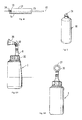
- FIG. 1 illustrates a first embodiment of the present invention.
- the dispenser 1 comprises a container 2 - usually constituted by an elastically deformable structure such as a squeezable wash bottle type - having an enclosed chamber 3.
- the enclosed chamber or reservoir 3 houses an amount of solid, particulate material 4a above which is provided a head-space 5 comprising a suitable gas, such as air.
- the form of the particulate material 4a is not particularly limited and may, for instance, be a free flowing powder, an agglomerate, a pellet or a tablet.
- This particulate material 4a may be itself constituted by a solid, particulate primer component.
- the particulate material 4a may be constituted by a solid, particulate carrier onto which a liquid primer is adsorbed or into which said liquid primer is absorbed, in the case of porous carriers.
- the primer component is desirably of high volatility and can provide sufficient saturation of the head-space 5 of the enclosed chamber 3.
- the gas in the head-space 5 of the container 2 will be air but can be any suitable gas as described hereinbefore.
- the dispenser 1 further comprises a dispensing arrangement in the form of a nozzle 8 which protrudes from the neck 9 of the container 2 and which has two spaced apart ends 8a and 8b.
- the nozzle 8 has an outlet 10 at its first end 8a and an elongate body 11.
- the elongate body extends from the outlet 10 through the neck 9 of the container 2 such that the second end 8b is positioned within the bottle 1 proximate the particulate material 4a.
- This arrangement allows for gas entering the end 8b of the nozzle 8 to pass over and/or through the particulate material 4a and thereby take up primer vapour.
- the carrier gas / primer mixture is dispensed by manually or mechanically squeezing the container 2.
- the resultant pressure then forces the mixture along the elongate body 11 of the nozzle 8 and through the outlet 10 at the first end 8a thereof.
- the nozzle 8 may have a bendable area 12 - analogous to a bendable or flexible drinking straw - such that the angle of the nozzle can be adjusted to control the locus at which the primer component is dispensed.
- the nozzle 8 is also herein provided with a stop filter or mesh 13 to prevent unwanted material (e.g. liquid or solid primer) from being dispensed.
- the embodiment of Figure 2 is identical to that of Figure 1 save for the fact that the primer component 4b is disposed on the internal sidewall of the dispenser 1.
- This component 4b may be constituted by a coating or casting of a solid primer component onto the sidewall.
- this component 4b may be constituted by a coating or casting of a solid material which retains a liquid primer by adsorption and / or absorption.
- the solid component 4b may be constituted by a barrier which holds therein either a solid, typically particulate primer or a solid, particulate carrier onto which a liquid primer is adsorbed or into which said liquid primer is absorbed; the barrier can take any suitable form and it too may be shaped to conform to the shape of the container.
- the primer component(s) may evaporate to form a gaseous primer mix in the head space 5 of the dispenser 1. And, as discussed with regard to Figure 1 above, air or gas which either is present in or is fed into the dispenser 1 takes up small quantities of the primer in gaseous form.
- the embodiment of Figure 3 depicts an alternative means of generating dispensing pressure to the act of manually or mechanical squeezing the container 1 as required in the dispensers of Figure 1 and 2 .
- the gas supplied into the dispenser is pumped by squeezing a squeezable reservoir or bulb 15.
- the gas from the reservoir 15 enters the headspace 5 and mixes with primer material vapour while moving over or through the primer material or retainer 4a retained in the dispenser 1.
- the primer material is shown in Figure 3 as a disintegrated, particulate solid, it will be recognized that the primer material may be provided in the manner illustrated in Figure 2 .
- the gas which is taken into the reservoir 15 can be contained by a one-way valve 16.
- a further, optionally one-way, valve 20 may be provided to prevent the gas /primer mixture present in the dispenser 1 from re-entering the bulb 15.
- FIG. 4 An alternative arrangement dispensing arrangement with an external gas feed is shown in Figure 4 where a gas stream indicated by arrow 21 is passed into a chamber 17 over particulate material 4a which is or comprises the primer.
- the stream of gas enters through a first port 15, passes over the particulate material 4a and exits through port 16; that exiting gas includes a gaseous form of the primer component.
- the device includes a filter 13 which prevents the egress of particles.
- the gas stream 21 is generated from an external source which may optionally be pressurized but may equally be generated by a pump disposed in the exit line 16. The dispensing of the primer component may thereby be controlled by controlling the pressure and rate of flow of the gas stream 21.
- Figure 5 shows an image of a pump dispenser 30 of a type which can be utilized to dispense primer through nozzle 31 by pressing upon the button of nozzle 31.
- This type of arrangement is embodied by either a pressurized bottle or a bottle that can be "pumped up”.
- a manual pump of the dispenser may be actuated until it is primed and/or until a desired level of pressure is achieved, and then used to blow out primer-saturated air (or carrier gas) at that pressure.
- Figures 6a and 6b provide different views of a device 1 according to the present invention which is of similar construction to that shown in Figure 1 .
- the device of Figure 6 includes a screw-on cap 35 which allows for the container to be re-filled.
- the nozzle 8 extends through the cap 35 and may come away with the cap 35.
- the nozzle 8 is provided with a diffusor head 36 with apertures 37 defined therein in a predetermined pattern.
- a bendable section 12 - akin to that of flexible drinking straw - is disposed on the device.
- the device is simply squeezed to eject the primer-saturated carrier gas. After this squeeze action the elasticity of the container allows it to expand and take up ambient air.
- Figures 1 to 6 are each characterized in that the primer is dispensed therefrom onto the substrate surface to be primed.
- the container 2 and, in particular, the head space 5 of the dispensers 1 are sized to generate an atmosphere in the container which has sufficient gas phase primer component to achieve the desired function upon dispensing.
- the primer component which is borne by the gas exiting the nozzle 8 of the device condenses upon the substrate surface.
- the cyanoacrylate adhesive composition should be applied to the primed surface subsequent to the previous priming step. If the application of the adhesive is unduly delayed, the conditioning effect of the primer may be insufficient to realize the full benefits of this invention.
- both substrates to be bonded are both either non-polar or otherwise difficult-to-bond materials
- both substrates are treated with primer. If the non-polar substrate is to be bonded to a polar or more active substrate, only the non-polar substrate need be treated with the primer.
- the present invention also encompasses a contacting arrangement in which the container 2 of the device is dimensioned to accommodate the substrate which is to be primed.
- a second chamber may be provided which is dimensioned to accommodate the substrate and the dispenser is arranged to dispense the gaseous form of the primer into that chamber: generally the dispenser will be external to the chamber but it could be accommodated within the chamber if desired.
- the primer conditioning time commences when the substrate is disposed within the chamber.
- the substrate may be removed from the chamber and disposed appropriately for the application of the cyanoacrylate adhesive compositions thereto.
- Lap shears of PE polyethylene
- PP polypropylene
- ASTM No. D3163 Strength Properties of Adhesively Bonded Rigid Plastic Lap-Shear Joints in Shear by Tension Loading. This standard was followed with and without pre-treatment of the substrates with primer.
- a squeezable bottle (wash bottle type, total volume ⁇ 260 ml) such as shown in Figure 1 , had placed therein about 50 g of 1,2,3-triazole as the primer component.
- the dispensing nozzle was fitted with a paper filter in order to avoid particles been blown out of nozzle.
- the bottle was squeezed ten times to apply ten separate jets of air saturated with primer vapor onto both lap-shear surfaces. The surfaces were then bonded with the cyanoacrylate adhesive composition and the Tensile Shear Strength (N/mm 2 ) measured and recorded.
Landscapes
- Chemical & Material Sciences (AREA)
- Organic Chemistry (AREA)
- Life Sciences & Earth Sciences (AREA)
- Engineering & Computer Science (AREA)
- Materials Engineering (AREA)
- Wood Science & Technology (AREA)
- Application Of Or Painting With Fluid Materials (AREA)
Priority Applications (1)
| Application Number | Priority Date | Filing Date | Title |
|---|---|---|---|
| EP15185666.3A EP3144342A1 (fr) | 2015-09-17 | 2015-09-17 | Dispositif pour l'application d'une amorce |
Applications Claiming Priority (1)
| Application Number | Priority Date | Filing Date | Title |
|---|---|---|---|
| EP15185666.3A EP3144342A1 (fr) | 2015-09-17 | 2015-09-17 | Dispositif pour l'application d'une amorce |
Publications (1)
| Publication Number | Publication Date |
|---|---|
| EP3144342A1 true EP3144342A1 (fr) | 2017-03-22 |
Family
ID=54238200
Family Applications (1)
| Application Number | Title | Priority Date | Filing Date |
|---|---|---|---|
| EP15185666.3A Withdrawn EP3144342A1 (fr) | 2015-09-17 | 2015-09-17 | Dispositif pour l'application d'une amorce |
Country Status (1)
| Country | Link |
|---|---|
| EP (1) | EP3144342A1 (fr) |
Citations (6)
| Publication number | Priority date | Publication date | Assignee | Title |
|---|---|---|---|---|
| EP0129069A2 (fr) | 1983-05-20 | 1984-12-27 | Toagosei Chemical Industry Co., Ltd. | Procédé de collage de substrats en résine non-polaire ou hautement cristalline avec des substrats de même nature ou avec des substrats de nature différente |
| JPS6123630A (ja) | 1984-07-13 | 1986-02-01 | Toagosei Chem Ind Co Ltd | 低極性又は高結晶性樹脂製模型の製造法 |
| EP0187171A1 (fr) | 1984-02-23 | 1986-07-16 | Renout, Tiddo Willem | Apprêts |
| DE3601518A1 (de) | 1985-01-18 | 1986-07-24 | Toagosei Chemical Industrial Co., Ltd., Tokio/Tokyo | Primer |
| EP0295930A2 (fr) * | 1987-06-19 | 1988-12-21 | LOCTITE (IRELAND) Ltd. | Compositions d'apprêt de diazabicyclo et de triazabicyclo et leur utilisation pour la liaison de substrats non polaires |
| US20050205087A1 (en) * | 2004-03-17 | 2005-09-22 | Genzyme Corporation | Powder delivery device |
-
2015
- 2015-09-17 EP EP15185666.3A patent/EP3144342A1/fr not_active Withdrawn
Patent Citations (6)
| Publication number | Priority date | Publication date | Assignee | Title |
|---|---|---|---|---|
| EP0129069A2 (fr) | 1983-05-20 | 1984-12-27 | Toagosei Chemical Industry Co., Ltd. | Procédé de collage de substrats en résine non-polaire ou hautement cristalline avec des substrats de même nature ou avec des substrats de nature différente |
| EP0187171A1 (fr) | 1984-02-23 | 1986-07-16 | Renout, Tiddo Willem | Apprêts |
| JPS6123630A (ja) | 1984-07-13 | 1986-02-01 | Toagosei Chem Ind Co Ltd | 低極性又は高結晶性樹脂製模型の製造法 |
| DE3601518A1 (de) | 1985-01-18 | 1986-07-24 | Toagosei Chemical Industrial Co., Ltd., Tokio/Tokyo | Primer |
| EP0295930A2 (fr) * | 1987-06-19 | 1988-12-21 | LOCTITE (IRELAND) Ltd. | Compositions d'apprêt de diazabicyclo et de triazabicyclo et leur utilisation pour la liaison de substrats non polaires |
| US20050205087A1 (en) * | 2004-03-17 | 2005-09-22 | Genzyme Corporation | Powder delivery device |
Non-Patent Citations (5)
| Title |
|---|
| ANONYMOUS: "CA-Haftvermittler 50 ml Flasche mit Zerstäuber - FF-Chemie-Shop", 28 August 2015 (2015-08-28), XP055244692, Retrieved from the Internet <URL:http://www.shop-ffchemie.de/ca-haftvermittler-50-ml-flasche-mit-zerstaeuber.html> [retrieved on 20160126] * |
| D. DWIGHT: "Practising Polymer Surface Chemistry", CHEMTECH, March 1982 (1982-03-01), pages 166 |
| E.F. BUCHEL., BRITISH PLASTICS, 1964, pages 142 |
| J.C. VON DER HEIDE; H.L. WILSON, MODERN PLASTICS, vol. 38 9, 1961, pages 199 |
| THOMAS FISCHER: "CA-Haftvermittler (Primer) flüssig", 12 August 2015 (2015-08-12), XP055244677, Retrieved from the Internet <URL:https://static.webshopapp.com/shops/080468/files/045777260/db-ca-haftvermittler-primer-fluessig-ff550401-d-de.pdf> [retrieved on 20160126] * |
Similar Documents
| Publication | Publication Date | Title |
|---|---|---|
| JP2519524B2 (ja) | 無極性基質の結合用接着促進プライマ―組成物、該組成物を含む二液型接着剤系および接着方法 | |
| TW572778B (en) | Apparatus and methods for continuous surface modification of substrates | |
| CA2155928C (fr) | Articles en matiere plastique a degagement reduit de gaz, et methode de fabrication | |
| US7947776B2 (en) | Aqueous dispersion, its production method, and its use | |
| US8637152B2 (en) | Packaging material | |
| CN106133082B (zh) | 等离子体引发粘结的方法 | |
| JPH0476378B2 (fr) | ||
| JP6970095B2 (ja) | 変性ポリオレフィン系樹脂 | |
| JP2010005802A (ja) | 包装材料 | |
| CN101405330B (zh) | 通过氟引发的氧化来改进塑料制成的成型件表面的方法 | |
| RU2543218C2 (ru) | 2-х компонентный клей на водной основе | |
| KR20100014868A (ko) | 프라이머 조성물 및 접착성 기재 | |
| EP3411448A1 (fr) | Compositions adhésives sensibles à la pression améliorées | |
| CN100430435C (zh) | 氧氟化 | |
| CN108189525A (zh) | 一种提高复合薄膜粘接性能的方法 | |
| BRPI0718123A2 (pt) | Solução intencionada especialmente para pré-tratamento de um substrato hidrofílico, com a finalidade de aperfeiçoar uma ligação adesiva sob condições úmidas e molhadas | |
| WO2017105918A1 (fr) | Composition d'apprêt et articles fabriqués à partir de celle-ci | |
| Bloomfield | Primer system for bonding conventional adhesives and coatings to silicone rubber | |
| EP3144072A1 (fr) | Distributeur, kit et procédé pour appliquer un activateur pour un composant durcissable à base de cyanoacrylate | |
| CN101896569B (zh) | 胶粘剂组合物 | |
| JPH09511014A (ja) | 非−オゾン破壊補助溶剤組成物 | |
| EP3144073A1 (fr) | Distributeur, kit et procédé pour appliquer un activateur pour un matériau durcissable | |
| JP2009235115A (ja) | 2−シアノアクリレート系接着剤用硬化促進剤 | |
| CN1646654A (zh) | 丙烯酸类粘合剂及粘合带 | |
| JP6914255B2 (ja) | エラストマー包装体の処理方法 |
Legal Events
| Date | Code | Title | Description |
|---|---|---|---|
| PUAI | Public reference made under article 153(3) epc to a published international application that has entered the european phase |
Free format text: ORIGINAL CODE: 0009012 |
|
| AK | Designated contracting states |
Kind code of ref document: A1 Designated state(s): AL AT BE BG CH CY CZ DE DK EE ES FI FR GB GR HR HU IE IS IT LI LT LU LV MC MK MT NL NO PL PT RO RS SE SI SK SM TR |
|
| AX | Request for extension of the european patent |
Extension state: BA ME |
|
| STAA | Information on the status of an ep patent application or granted ep patent |
Free format text: STATUS: THE APPLICATION IS DEEMED TO BE WITHDRAWN |
|
| 18D | Application deemed to be withdrawn |
Effective date: 20170923 |