EP3144362A1 - Utilisation d'un ruban adhésif d'un seul côté - Google Patents
Utilisation d'un ruban adhésif d'un seul côté Download PDFInfo
- Publication number
- EP3144362A1 EP3144362A1 EP16187864.0A EP16187864A EP3144362A1 EP 3144362 A1 EP3144362 A1 EP 3144362A1 EP 16187864 A EP16187864 A EP 16187864A EP 3144362 A1 EP3144362 A1 EP 3144362A1
- Authority
- EP
- European Patent Office
- Prior art keywords
- adhesive
- adhesive tape
- use according
- film carrier
- component
- Prior art date
- Legal status (The legal status is an assumption and is not a legal conclusion. Google has not performed a legal analysis and makes no representation as to the accuracy of the status listed.)
- Withdrawn
Links
- 239000002390 adhesive tape Substances 0.000 title claims abstract description 56
- 239000000853 adhesive Substances 0.000 claims abstract description 58
- 230000001070 adhesive effect Effects 0.000 claims abstract description 58
- 239000000203 mixture Substances 0.000 claims abstract description 20
- 239000004814 polyurethane Substances 0.000 claims abstract description 17
- 229920003023 plastic Polymers 0.000 claims abstract description 14
- 239000004033 plastic Substances 0.000 claims abstract description 14
- 239000003795 chemical substances by application Substances 0.000 claims abstract description 11
- IQPQWNKOIGAROB-UHFFFAOYSA-N isocyanate group Chemical group [N-]=C=O IQPQWNKOIGAROB-UHFFFAOYSA-N 0.000 claims abstract description 11
- 229920002635 polyurethane Polymers 0.000 claims abstract description 11
- 239000004922 lacquer Substances 0.000 claims abstract description 10
- 239000002184 metal Substances 0.000 claims abstract description 10
- 229910052751 metal Inorganic materials 0.000 claims abstract description 10
- 239000000049 pigment Substances 0.000 claims abstract description 8
- 229920003009 polyurethane dispersion Polymers 0.000 claims abstract description 8
- 150000001875 compounds Chemical class 0.000 claims abstract description 6
- 239000002318 adhesion promoter Substances 0.000 claims abstract description 5
- 239000012876 carrier material Substances 0.000 claims abstract description 5
- 239000000975 dye Substances 0.000 claims abstract description 5
- 239000010410 layer Substances 0.000 claims description 18
- 239000000463 material Substances 0.000 claims description 5
- 239000012790 adhesive layer Substances 0.000 claims description 3
- 238000009736 wetting Methods 0.000 abstract description 9
- -1 MOPP Substances 0.000 description 16
- 239000011230 binding agent Substances 0.000 description 9
- 239000006229 carbon black Substances 0.000 description 9
- 229920000435 poly(dimethylsiloxane) Polymers 0.000 description 9
- 239000004205 dimethyl polysiloxane Substances 0.000 description 8
- 235000013870 dimethyl polysiloxane Nutrition 0.000 description 8
- XLYOFNOQVPJJNP-UHFFFAOYSA-N water Substances O XLYOFNOQVPJJNP-UHFFFAOYSA-N 0.000 description 8
- 239000006185 dispersion Substances 0.000 description 7
- 239000003973 paint Substances 0.000 description 7
- 239000000047 product Substances 0.000 description 7
- 238000012360 testing method Methods 0.000 description 7
- 125000001931 aliphatic group Chemical group 0.000 description 6
- 239000005056 polyisocyanate Substances 0.000 description 6
- 229920001228 polyisocyanate Polymers 0.000 description 6
- 238000000576 coating method Methods 0.000 description 5
- 238000013016 damping Methods 0.000 description 5
- 239000000314 lubricant Substances 0.000 description 5
- 238000000034 method Methods 0.000 description 5
- 229920000728 polyester Polymers 0.000 description 5
- 239000000080 wetting agent Substances 0.000 description 5
- NIXOWILDQLNWCW-UHFFFAOYSA-M Acrylate Chemical compound [O-]C(=O)C=C NIXOWILDQLNWCW-UHFFFAOYSA-M 0.000 description 4
- VYPSYNLAJGMNEJ-UHFFFAOYSA-N Silicium dioxide Chemical compound O=[Si]=O VYPSYNLAJGMNEJ-UHFFFAOYSA-N 0.000 description 4
- 239000011248 coating agent Substances 0.000 description 4
- 229920001577 copolymer Polymers 0.000 description 4
- 238000004132 cross linking Methods 0.000 description 4
- 239000000839 emulsion Substances 0.000 description 4
- 229920001343 polytetrafluoroethylene Polymers 0.000 description 4
- 239000004810 polytetrafluoroethylene Substances 0.000 description 4
- VGGSQFUCUMXWEO-UHFFFAOYSA-N Ethene Chemical compound C=C VGGSQFUCUMXWEO-UHFFFAOYSA-N 0.000 description 3
- LYCAIKOWRPUZTN-UHFFFAOYSA-N Ethylene glycol Chemical compound OCCO LYCAIKOWRPUZTN-UHFFFAOYSA-N 0.000 description 3
- PEDCQBHIVMGVHV-UHFFFAOYSA-N Glycerine Chemical compound OCC(O)CO PEDCQBHIVMGVHV-UHFFFAOYSA-N 0.000 description 3
- 239000004698 Polyethylene Substances 0.000 description 3
- 239000004820 Pressure-sensitive adhesive Substances 0.000 description 3
- DNIAPMSPPWPWGF-UHFFFAOYSA-N Propylene glycol Chemical compound CC(O)CO DNIAPMSPPWPWGF-UHFFFAOYSA-N 0.000 description 3
- 230000000903 blocking effect Effects 0.000 description 3
- 125000005442 diisocyanate group Chemical group 0.000 description 3
- 239000002270 dispersing agent Substances 0.000 description 3
- 238000005516 engineering process Methods 0.000 description 3
- 239000006260 foam Substances 0.000 description 3
- NIMLQBUJDJZYEJ-UHFFFAOYSA-N isophorone diisocyanate Chemical compound CC1(C)CC(N=C=O)CC(C)(CN=C=O)C1 NIMLQBUJDJZYEJ-UHFFFAOYSA-N 0.000 description 3
- 239000004417 polycarbonate Substances 0.000 description 3
- 229920000515 polycarbonate Polymers 0.000 description 3
- 229920000642 polymer Polymers 0.000 description 3
- 239000011527 polyurethane coating Substances 0.000 description 3
- 239000000758 substrate Substances 0.000 description 3
- 229920005789 ACRONAL® acrylic binder Polymers 0.000 description 2
- 239000005977 Ethylene Substances 0.000 description 2
- 239000005058 Isophorone diisocyanate Substances 0.000 description 2
- 239000004743 Polypropylene Substances 0.000 description 2
- QQONPFPTGQHPMA-UHFFFAOYSA-N Propene Chemical compound CC=C QQONPFPTGQHPMA-UHFFFAOYSA-N 0.000 description 2
- 229910000831 Steel Inorganic materials 0.000 description 2
- PPBRXRYQALVLMV-UHFFFAOYSA-N Styrene Chemical compound C=CC1=CC=CC=C1 PPBRXRYQALVLMV-UHFFFAOYSA-N 0.000 description 2
- 239000000654 additive Substances 0.000 description 2
- 150000001298 alcohols Chemical class 0.000 description 2
- 239000002981 blocking agent Substances 0.000 description 2
- 230000009849 deactivation Effects 0.000 description 2
- 239000013530 defoamer Substances 0.000 description 2
- 238000013461 design Methods 0.000 description 2
- 238000011161 development Methods 0.000 description 2
- 230000018109 developmental process Effects 0.000 description 2
- 230000000694 effects Effects 0.000 description 2
- 150000002148 esters Chemical class 0.000 description 2
- 229920002313 fluoropolymer Polymers 0.000 description 2
- 239000004811 fluoropolymer Substances 0.000 description 2
- 238000000227 grinding Methods 0.000 description 2
- RRAMGCGOFNQTLD-UHFFFAOYSA-N hexamethylene diisocyanate Chemical compound O=C=NCCCCCCN=C=O RRAMGCGOFNQTLD-UHFFFAOYSA-N 0.000 description 2
- 239000006224 matting agent Substances 0.000 description 2
- 238000005259 measurement Methods 0.000 description 2
- 239000002245 particle Substances 0.000 description 2
- 229920001296 polysiloxane Polymers 0.000 description 2
- 239000000843 powder Substances 0.000 description 2
- 238000007650 screen-printing Methods 0.000 description 2
- 239000000377 silicon dioxide Substances 0.000 description 2
- 229920002545 silicone oil Polymers 0.000 description 2
- 239000010959 steel Substances 0.000 description 2
- 238000003756 stirring Methods 0.000 description 2
- 125000000229 (C1-C4)alkoxy group Chemical group 0.000 description 1
- FKTHNVSLHLHISI-UHFFFAOYSA-N 1,2-bis(isocyanatomethyl)benzene Chemical class O=C=NCC1=CC=CC=C1CN=C=O FKTHNVSLHLHISI-UHFFFAOYSA-N 0.000 description 1
- AZYRZNIYJDKRHO-UHFFFAOYSA-N 1,3-bis(2-isocyanatopropan-2-yl)benzene Chemical compound O=C=NC(C)(C)C1=CC=CC(C(C)(C)N=C=O)=C1 AZYRZNIYJDKRHO-UHFFFAOYSA-N 0.000 description 1
- CDMDQYCEEKCBGR-UHFFFAOYSA-N 1,4-diisocyanatocyclohexane Chemical compound O=C=NC1CCC(N=C=O)CC1 CDMDQYCEEKCBGR-UHFFFAOYSA-N 0.000 description 1
- ATOUXIOKEJWULN-UHFFFAOYSA-N 1,6-diisocyanato-2,2,4-trimethylhexane Chemical compound O=C=NCCC(C)CC(C)(C)CN=C=O ATOUXIOKEJWULN-UHFFFAOYSA-N 0.000 description 1
- QGLRLXLDMZCFBP-UHFFFAOYSA-N 1,6-diisocyanato-2,4,4-trimethylhexane Chemical compound O=C=NCC(C)CC(C)(C)CCN=C=O QGLRLXLDMZCFBP-UHFFFAOYSA-N 0.000 description 1
- VXNZUUAINFGPBY-UHFFFAOYSA-N 1-Butene Chemical compound CCC=C VXNZUUAINFGPBY-UHFFFAOYSA-N 0.000 description 1
- LIKMAJRDDDTEIG-UHFFFAOYSA-N 1-hexene Chemical compound CCCCC=C LIKMAJRDDDTEIG-UHFFFAOYSA-N 0.000 description 1
- KWKAKUADMBZCLK-UHFFFAOYSA-N 1-octene Chemical compound CCCCCCC=C KWKAKUADMBZCLK-UHFFFAOYSA-N 0.000 description 1
- VZDIRINETBAVAV-UHFFFAOYSA-N 2,4-diisocyanato-1-methylcyclohexane Chemical compound CC1CCC(N=C=O)CC1N=C=O VZDIRINETBAVAV-UHFFFAOYSA-N 0.000 description 1
- SMZOUWXMTYCWNB-UHFFFAOYSA-N 2-(2-methoxy-5-methylphenyl)ethanamine Chemical compound COC1=CC=C(C)C=C1CCN SMZOUWXMTYCWNB-UHFFFAOYSA-N 0.000 description 1
- BLDFSDCBQJUWFG-UHFFFAOYSA-N 2-(methylamino)-1,2-diphenylethanol Chemical compound C=1C=CC=CC=1C(NC)C(O)C1=CC=CC=C1 BLDFSDCBQJUWFG-UHFFFAOYSA-N 0.000 description 1
- NIXOWILDQLNWCW-UHFFFAOYSA-N 2-Propenoic acid Natural products OC(=O)C=C NIXOWILDQLNWCW-UHFFFAOYSA-N 0.000 description 1
- NEAQRZUHTPSBBM-UHFFFAOYSA-N 2-hydroxy-3,3-dimethyl-7-nitro-4h-isoquinolin-1-one Chemical compound C1=C([N+]([O-])=O)C=C2C(=O)N(O)C(C)(C)CC2=C1 NEAQRZUHTPSBBM-UHFFFAOYSA-N 0.000 description 1
- YCKRFDGAMUMZLT-UHFFFAOYSA-N Fluorine atom Chemical compound [F] YCKRFDGAMUMZLT-UHFFFAOYSA-N 0.000 description 1
- VVQNEPGJFQJSBK-UHFFFAOYSA-N Methyl methacrylate Chemical compound COC(=O)C(C)=C VVQNEPGJFQJSBK-UHFFFAOYSA-N 0.000 description 1
- 229920006448 PE-UHMW Polymers 0.000 description 1
- 229920011250 Polypropylene Block Copolymer Polymers 0.000 description 1
- 239000004972 Polyurethane varnish Substances 0.000 description 1
- 241000282806 Rhinoceros Species 0.000 description 1
- 239000004809 Teflon Substances 0.000 description 1
- 229920006362 Teflon® Polymers 0.000 description 1
- ZJCCRDAZUWHFQH-UHFFFAOYSA-N Trimethylolpropane Chemical compound CCC(CO)(CO)CO ZJCCRDAZUWHFQH-UHFFFAOYSA-N 0.000 description 1
- 239000007983 Tris buffer Substances 0.000 description 1
- XTXRWKRVRITETP-UHFFFAOYSA-N Vinyl acetate Chemical compound CC(=O)OC=C XTXRWKRVRITETP-UHFFFAOYSA-N 0.000 description 1
- 238000005299 abrasion Methods 0.000 description 1
- 229920005700 acResin® Polymers 0.000 description 1
- 239000002253 acid Substances 0.000 description 1
- 239000008186 active pharmaceutical agent Substances 0.000 description 1
- 230000032683 aging Effects 0.000 description 1
- 229920003232 aliphatic polyester Polymers 0.000 description 1
- 150000001336 alkenes Chemical class 0.000 description 1
- 125000003545 alkoxy group Chemical group 0.000 description 1
- 150000001408 amides Chemical class 0.000 description 1
- 125000003277 amino group Chemical group 0.000 description 1
- 239000003945 anionic surfactant Substances 0.000 description 1
- 239000011324 bead Substances 0.000 description 1
- 229920006378 biaxially oriented polypropylene Polymers 0.000 description 1
- 239000011127 biaxially oriented polypropylene Substances 0.000 description 1
- 239000003139 biocide Substances 0.000 description 1
- 230000015572 biosynthetic process Effects 0.000 description 1
- 238000009835 boiling Methods 0.000 description 1
- CDQSJQSWAWPGKG-UHFFFAOYSA-N butane-1,1-diol Chemical compound CCCC(O)O CDQSJQSWAWPGKG-UHFFFAOYSA-N 0.000 description 1
- IAQRGUVFOMOMEM-UHFFFAOYSA-N butene Natural products CC=CC IAQRGUVFOMOMEM-UHFFFAOYSA-N 0.000 description 1
- CQEYYJKEWSMYFG-UHFFFAOYSA-N butyl acrylate Chemical compound CCCCOC(=O)C=C CQEYYJKEWSMYFG-UHFFFAOYSA-N 0.000 description 1
- 125000003178 carboxy group Chemical group [H]OC(*)=O 0.000 description 1
- 239000000969 carrier Substances 0.000 description 1
- 238000005266 casting Methods 0.000 description 1
- 239000003054 catalyst Substances 0.000 description 1
- 239000003093 cationic surfactant Substances 0.000 description 1
- 239000007795 chemical reaction product Substances 0.000 description 1
- 238000010276 construction Methods 0.000 description 1
- 230000007423 decrease Effects 0.000 description 1
- 230000001419 dependent effect Effects 0.000 description 1
- 235000014113 dietary fatty acids Nutrition 0.000 description 1
- 239000000539 dimer Substances 0.000 description 1
- 150000002009 diols Chemical class 0.000 description 1
- 238000007598 dipping method Methods 0.000 description 1
- KPUWHANPEXNPJT-UHFFFAOYSA-N disiloxane Chemical class [SiH3]O[SiH3] KPUWHANPEXNPJT-UHFFFAOYSA-N 0.000 description 1
- 238000001035 drying Methods 0.000 description 1
- 229920001971 elastomer Polymers 0.000 description 1
- 125000003700 epoxy group Chemical group 0.000 description 1
- 238000005530 etching Methods 0.000 description 1
- XYIBRDXRRQCHLP-UHFFFAOYSA-N ethyl acetoacetate Chemical compound CCOC(=O)CC(C)=O XYIBRDXRRQCHLP-UHFFFAOYSA-N 0.000 description 1
- 239000000194 fatty acid Substances 0.000 description 1
- 229930195729 fatty acid Natural products 0.000 description 1
- 239000011737 fluorine Substances 0.000 description 1
- 229910052731 fluorine Inorganic materials 0.000 description 1
- 238000009472 formulation Methods 0.000 description 1
- 238000009499 grossing Methods 0.000 description 1
- 229920001903 high density polyethylene Polymers 0.000 description 1
- 239000004700 high-density polyethylene Substances 0.000 description 1
- 229920001519 homopolymer Polymers 0.000 description 1
- 239000012943 hotmelt Substances 0.000 description 1
- 125000002887 hydroxy group Chemical group [H]O* 0.000 description 1
- 150000002460 imidazoles Chemical class 0.000 description 1
- 150000003949 imides Chemical class 0.000 description 1
- 238000005470 impregnation Methods 0.000 description 1
- 239000004615 ingredient Substances 0.000 description 1
- 238000001746 injection moulding Methods 0.000 description 1
- 238000009434 installation Methods 0.000 description 1
- 150000003951 lactams Chemical class 0.000 description 1
- 229920000092 linear low density polyethylene Polymers 0.000 description 1
- 239000004707 linear low-density polyethylene Substances 0.000 description 1
- 239000007788 liquid Substances 0.000 description 1
- 229920001684 low density polyethylene Polymers 0.000 description 1
- 239000004702 low-density polyethylene Substances 0.000 description 1
- 239000010687 lubricating oil Substances 0.000 description 1
- 238000004519 manufacturing process Methods 0.000 description 1
- 229920001179 medium density polyethylene Polymers 0.000 description 1
- 239000004701 medium-density polyethylene Substances 0.000 description 1
- 238000013508 migration Methods 0.000 description 1
- 230000005012 migration Effects 0.000 description 1
- 239000002480 mineral oil Substances 0.000 description 1
- CWQXQMHSOZUFJS-UHFFFAOYSA-N molybdenum disulfide Chemical compound S=[Mo]=S CWQXQMHSOZUFJS-UHFFFAOYSA-N 0.000 description 1
- 239000000178 monomer Substances 0.000 description 1
- WHIVNJATOVLWBW-UHFFFAOYSA-N n-butan-2-ylidenehydroxylamine Chemical compound CCC(C)=NO WHIVNJATOVLWBW-UHFFFAOYSA-N 0.000 description 1
- 238000006386 neutralization reaction Methods 0.000 description 1
- 239000002736 nonionic surfactant Substances 0.000 description 1
- 239000003921 oil Substances 0.000 description 1
- JRZJOMJEPLMPRA-UHFFFAOYSA-N olefin Natural products CCCCCCCC=C JRZJOMJEPLMPRA-UHFFFAOYSA-N 0.000 description 1
- 230000003287 optical effect Effects 0.000 description 1
- 150000002989 phenols Chemical class 0.000 description 1
- 229920006294 polydialkylsiloxane Polymers 0.000 description 1
- 229920000098 polyolefin Polymers 0.000 description 1
- 229920001155 polypropylene Polymers 0.000 description 1
- 229920005629 polypropylene homopolymer Polymers 0.000 description 1
- 229920005630 polypropylene random copolymer Polymers 0.000 description 1
- 230000036316 preload Effects 0.000 description 1
- 238000002360 preparation method Methods 0.000 description 1
- 238000007639 printing Methods 0.000 description 1
- 230000002035 prolonged effect Effects 0.000 description 1
- 230000005855 radiation Effects 0.000 description 1
- 239000002994 raw material Substances 0.000 description 1
- 230000002441 reversible effect Effects 0.000 description 1
- 150000003335 secondary amines Chemical class 0.000 description 1
- 150000004756 silanes Chemical class 0.000 description 1
- 229920002050 silicone resin Polymers 0.000 description 1
- 239000002904 solvent Substances 0.000 description 1
- 239000004071 soot Substances 0.000 description 1
- 238000005507 spraying Methods 0.000 description 1
- 239000000126 substance Substances 0.000 description 1
- 238000010998 test method Methods 0.000 description 1
- BFKJFAAPBSQJPD-UHFFFAOYSA-N tetrafluoroethene Chemical group FC(F)=C(F)F BFKJFAAPBSQJPD-UHFFFAOYSA-N 0.000 description 1
- 239000002562 thickening agent Substances 0.000 description 1
- 150000004072 triols Chemical class 0.000 description 1
- 239000013585 weight reducing agent Substances 0.000 description 1
Images


Classifications
-
- B—PERFORMING OPERATIONS; TRANSPORTING
- B60—VEHICLES IN GENERAL
- B60R—VEHICLES, VEHICLE FITTINGS, OR VEHICLE PARTS, NOT OTHERWISE PROVIDED FOR
- B60R13/00—Elements for body-finishing, identifying, or decorating; Arrangements or adaptations for advertising purposes
- B60R13/02—Internal Trim mouldings ; Internal Ledges; Wall liners for passenger compartments; Roof liners
- B60R13/0237—Side or rear panels
- B60R13/025—Pillars; Roof rails
-
- B—PERFORMING OPERATIONS; TRANSPORTING
- B60—VEHICLES IN GENERAL
- B60R—VEHICLES, VEHICLE FITTINGS, OR VEHICLE PARTS, NOT OTHERWISE PROVIDED FOR
- B60R13/00—Elements for body-finishing, identifying, or decorating; Arrangements or adaptations for advertising purposes
- B60R13/02—Internal Trim mouldings ; Internal Ledges; Wall liners for passenger compartments; Roof liners
- B60R13/0206—Arrangements of fasteners and clips specially adapted for attaching inner vehicle liners or mouldings
-
- C—CHEMISTRY; METALLURGY
- C09—DYES; PAINTS; POLISHES; NATURAL RESINS; ADHESIVES; COMPOSITIONS NOT OTHERWISE PROVIDED FOR; APPLICATIONS OF MATERIALS NOT OTHERWISE PROVIDED FOR
- C09J—ADHESIVES; NON-MECHANICAL ASPECTS OF ADHESIVE PROCESSES IN GENERAL; ADHESIVE PROCESSES NOT PROVIDED FOR ELSEWHERE; USE OF MATERIALS AS ADHESIVES
- C09J7/00—Adhesives in the form of films or foils
- C09J7/20—Adhesives in the form of films or foils characterised by their carriers
- C09J7/29—Laminated material
-
- F—MECHANICAL ENGINEERING; LIGHTING; HEATING; WEAPONS; BLASTING
- F16—ENGINEERING ELEMENTS AND UNITS; GENERAL MEASURES FOR PRODUCING AND MAINTAINING EFFECTIVE FUNCTIONING OF MACHINES OR INSTALLATIONS; THERMAL INSULATION IN GENERAL
- F16B—DEVICES FOR FASTENING OR SECURING CONSTRUCTIONAL ELEMENTS OR MACHINE PARTS TOGETHER, e.g. NAILS, BOLTS, CIRCLIPS, CLAMPS, CLIPS OR WEDGES; JOINTS OR JOINTING
- F16B11/00—Connecting constructional elements or machine parts by sticking or pressing them together, e.g. cold pressure welding
- F16B11/006—Connecting constructional elements or machine parts by sticking or pressing them together, e.g. cold pressure welding by gluing
-
- C—CHEMISTRY; METALLURGY
- C09—DYES; PAINTS; POLISHES; NATURAL RESINS; ADHESIVES; COMPOSITIONS NOT OTHERWISE PROVIDED FOR; APPLICATIONS OF MATERIALS NOT OTHERWISE PROVIDED FOR
- C09J—ADHESIVES; NON-MECHANICAL ASPECTS OF ADHESIVE PROCESSES IN GENERAL; ADHESIVE PROCESSES NOT PROVIDED FOR ELSEWHERE; USE OF MATERIALS AS ADHESIVES
- C09J2301/00—Additional features of adhesives in the form of films or foils
- C09J2301/20—Additional features of adhesives in the form of films or foils characterized by the structural features of the adhesive itself
- C09J2301/204—Additional features of adhesives in the form of films or foils characterized by the structural features of the adhesive itself the adhesive coating being discontinuous
-
- C—CHEMISTRY; METALLURGY
- C09—DYES; PAINTS; POLISHES; NATURAL RESINS; ADHESIVES; COMPOSITIONS NOT OTHERWISE PROVIDED FOR; APPLICATIONS OF MATERIALS NOT OTHERWISE PROVIDED FOR
- C09J—ADHESIVES; NON-MECHANICAL ASPECTS OF ADHESIVE PROCESSES IN GENERAL; ADHESIVE PROCESSES NOT PROVIDED FOR ELSEWHERE; USE OF MATERIALS AS ADHESIVES
- C09J2301/00—Additional features of adhesives in the form of films or foils
- C09J2301/30—Additional features of adhesives in the form of films or foils characterized by the chemical, physicochemical or physical properties of the adhesive or the carrier
- C09J2301/302—Additional features of adhesives in the form of films or foils characterized by the chemical, physicochemical or physical properties of the adhesive or the carrier the adhesive being pressure-sensitive, i.e. tacky at temperatures inferior to 30°C
-
- C—CHEMISTRY; METALLURGY
- C09—DYES; PAINTS; POLISHES; NATURAL RESINS; ADHESIVES; COMPOSITIONS NOT OTHERWISE PROVIDED FOR; APPLICATIONS OF MATERIALS NOT OTHERWISE PROVIDED FOR
- C09J—ADHESIVES; NON-MECHANICAL ASPECTS OF ADHESIVE PROCESSES IN GENERAL; ADHESIVE PROCESSES NOT PROVIDED FOR ELSEWHERE; USE OF MATERIALS AS ADHESIVES
- C09J2423/00—Presence of polyolefin
- C09J2423/04—Presence of homo or copolymers of ethene
- C09J2423/046—Presence of homo or copolymers of ethene in the substrate
-
- C—CHEMISTRY; METALLURGY
- C09—DYES; PAINTS; POLISHES; NATURAL RESINS; ADHESIVES; COMPOSITIONS NOT OTHERWISE PROVIDED FOR; APPLICATIONS OF MATERIALS NOT OTHERWISE PROVIDED FOR
- C09J—ADHESIVES; NON-MECHANICAL ASPECTS OF ADHESIVE PROCESSES IN GENERAL; ADHESIVE PROCESSES NOT PROVIDED FOR ELSEWHERE; USE OF MATERIALS AS ADHESIVES
- C09J2433/00—Presence of (meth)acrylic polymer
-
- C—CHEMISTRY; METALLURGY
- C09—DYES; PAINTS; POLISHES; NATURAL RESINS; ADHESIVES; COMPOSITIONS NOT OTHERWISE PROVIDED FOR; APPLICATIONS OF MATERIALS NOT OTHERWISE PROVIDED FOR
- C09J—ADHESIVES; NON-MECHANICAL ASPECTS OF ADHESIVE PROCESSES IN GENERAL; ADHESIVE PROCESSES NOT PROVIDED FOR ELSEWHERE; USE OF MATERIALS AS ADHESIVES
- C09J2475/00—Presence of polyurethane
- C09J2475/006—Presence of polyurethane in the substrate
Definitions
- the invention relates to the use of a single-sided adhesive tape.
- diaphragms are used in many places for optical or practical reasons, which are fixed on the underlying body part. This concerns, for example, the B-pillars in an automobile.
- a plastic panel is attached to the underlying sheet metal because of the weight reduction, the cost reduction and especially for design considerations.
- folds are present on the panel, which engage in a correspondingly shaped recess in the metal sheet (Gegenfalz) and hooked with this.
- the problem is that the diaphragm and the sheet are formed differently stable and also have different expansion coefficients. When twisting the car body, as they occur in normal driving, the plastic part and the sheet metal part react differently.
- the sheet metal part is relatively stable and has only slight reversible deformations, the softer material of the plastic cover can deform much more. This can cause the plastic part, especially in the area of the recess located in the recess rubs against the metal substrate, resulting in annoying and unpleasant Knarzgeschen or rattling noises, as everyone knows from their own car and feels uncomfortable. Such noises are classified as quality-reducing and are not accepted or tolerated by the customer or the vehicle manufacturer, especially for high-end automobiles.
- a liquid lubricant is applied in the folding area (for example, Molykote DowCorning), which then adapts completely between the folds to the surface of the attachment of the panel.
- the disadvantage of such lubricants is the sustainability of the medium, since these are usually based on water and washed off after prolonged use on the vehicle. The creaking sounds occur with a time delay. The effect of water during use is unavoidable, as it is an external accessory. Due to the surface quality of the system, the lubricant layer thins by the constant rubbing of the two surfaces, wears off and thus continuously reduces the protection of the rhinoceros.
- Object of the present invention is to provide an adhesive tape with a suitable substrate available, which ensures both the sliding properties between the plastic parts and the body in the fixation of particular plastic parts on bodies as well as dampen rattling noises.
- the at least one adhesive layer has a smaller width in the longitudinal direction of the adhesive tape than the film carrier of the adhesive tape.
- the adhesive strip extends starting from a longitudinal edge of the film carrier in the direction of the center of the film carrier.
- an adhesive strip on the tape and a non-adhesive strip whose surface can also be used as a sliding surface and for damping.
- This non-adhesive strip is also called flag below.
- the width of the adhesive strip makes up at most 50% of the width of the film carrier, preferably between 10% and 30%.
- the available sliding surface / damping surface shrinks because the width of the flag decreases, while the adhesive surface increases accordingly. It is therefore necessary to make a compromise that the sliding surface / pad (flag) is chosen as large as possible, taking care that the secure fixing of the adhesive tape is ensured on the ground.
- the adhesive strip on the adhesive tape can be produced in various ways.
- the adhesive can be applied to the carrier in the form of a strip extending in the longitudinal direction of the adhesive tape, that is, there is only as much adhesive on the carrier as is actually required to ensure the fixation of the adhesive tape.
- the adhesive strip consists of a double-sided adhesive tape which is laminated to the film carrier.
- the adhesive is applied over the entire surface of the film carrier and then a portion of the open adhesive is neutralized again, so that only one strip remains as an adhesive area.
- the adhesive is applied only partially and in addition a part of the same is inactivated.
- Methods for applying a strip of an adhesive to a film carrier are familiar to the person skilled in the art.
- the method in the DE 103 09 447 A1 directed.
- a carrier web is guided past a dipping roller, which is in contact with the carrier web, the roller rotates in a bath with an adhesive, whereby the adhesive is transferred to the roll surface, and the roller is formed by grooves or a corresponding dephasesive coating such that after running the roller through the bath on the roll surface at least one adhesive mass strip is present, which is transferred to the carrier material.
- the partial deactivation of the adhesive can be achieved by the application of films or paper.
- the area can be generated by irradiation, powdering or neutralization of the adhesive.
- a paint or a primer can be applied in the appropriate places. So then the surface can be changed by chemical treatment such as etching to create a non-stick zone.
- the adhesive tape can be interrupted, it can be applied by screen printing, so consist of countless individual adhesive points that can contact each other.
- the strip can consist of several thin strips, between which very narrow strips can be adhesive-free. It is not difficult for the skilled person to present further variants of the order, which are not mentioned here in detail, without the need for any inventive step.
- the adhesive tape or also the deactivation can be produced by printing technologies such as raster gravure, flexographic or screen printing, by spraying techniques such as ink jet, by partial impregnation, by pressure-free application from a casting head, by jet strip coating or by the doctor blade application method.
- the width of the adhesive tape is preferably between 17 and 30 mm, in particular between 19 and 25 mm and / or the width of the adhesive strip between 2 and 10 mm, in particular between 4 and 7 mm.
- the thickness of the adhesive strip is preferably between 40 and 400 .mu.m, in particular at 100 microns.
- the film carrier preferably consists of a PE film, in particular of a PE-UHMW film. This film is resistant to aging and abrasion resistant with an extremely high density surface.
- film carriers are, for example, BOPP, MOPP, PP, PE, polyesters such as PET, PA, PU or PVC.
- polyolefins but also copolymers of ethylene and polar monomers such as styrene, vinyl acetate, methyl methacrylate, butyl acrylate or acrylic acid are included. It may be a homopolymer such as HDPE, LDPE, MDPE or a copolymer of ethylene with another olefin such as propene, butene, hexene or octene (for example LLDPE, VLLDE).
- polypropylenes for example polypropylene homopolymers, polypropylene random copolymers or polypropylene block copolymers.
- the film carrier can be foamed.
- the film may be unstretched monoaxially and / or biaxially stretched.
- the film carrier may also consist of several individual layers, for example, layers coextruded into a film.
- the film carrier has a plurality of layers, wherein at least one of the layers consists of a film.
- a foam carrier can be combined with a film layer.
- the carrier and / or the adhesive are preferably black.
- the support is black
- the product does not appear optically disadvantageous, even if it is not optimally glued so that portions thereof are not covered and thus visible.
- the adhesive used is in particular a self-adhesive composition, particularly preferably a commercially available pressure-sensitive adhesive based on PUR, acrylate or rubber.
- An adhesive which is particularly suitable is a low molecular weight acrylate hot melt pressure-sensitive adhesive, such as that which is marketed under the name acResin UV or Acronal®, in particular Acronal® DS 3458, by BASF.
- This adhesive with a low K value obtains its application-oriented properties through a final radiation-induced crosslinking.
- the layer of an aqueous polyurethane lacquer composition contains at least one aqueous polyurethane dispersion, a compound with blocked isocyanate groups, a lubricant (friction coefficient or friction coefficient), at least one wetting and leveling agent and optionally conventional adhesion promoters, dyes and / or pigments.
- polyurethane dispersions it is possible in principle to use all aliphatic PU dispersions which are based on polyesters or polycarbonates and aliphatic polyisocyanates. These polyurethane dispersions contain binders which essentially no longer contain any free isocyanate groups, but they may contain self-crosslinking groups. Particularly preferred is the use of combinations of polyurethane dispersions based on aliphatic polyisocyanates and polycarbonates and on the basis of aliphatic polyisocyanates and polyesters. These polyurethane binders are known and common commercial products, they are preferably used for water-based coatings.
- blocked polyisocyanate derivatives are reaction products of low molecular weight diols and / or triols such as ethylene glycol, propylene glycol, butanediol, trimethylolpropane, glycerol and the like with a stoichiometric excess of diisocyanates such as 4,4'-dicyclohexylmethane diisocyanate (H 12 MDI), 1 Isocyanatomethyl-3-isocyanato-1,5,5-trimethylcyclohexane (isophorone diisocyanate, IPDI), cyclohexane-1,4-diisocyanate, hydrogenated xylylene diisocyanate (H 6 XDI), 1-methyl-2,4-diisocyanato cyclohexane, m- or p-tetramethylxylene diisocyanate (m-TMXDI, p-TMXDI), dimer fatty acid
- the blocking agents to be used are selected from aldoximes, ketoximes, lactams, imidazole compounds, ⁇ -dicarbonyl compounds such as malonic dialkyl ester or acetoacetic ester.
- Further blocking agents known per se may be alcohols, phenols, in particular alkylphenols, thio alcohols, thiophenols, secondary amines, amides, imides or hydroxamic acid esters.
- blocking groups are then released during curing or crosslinking of the binder system, optionally with the assistance of catalysts, so that the then liberated isocyanate groups can react with other reactive groups such as hydroxyl groups, epoxy groups, amino groups or carboxyl groups from other binder components and so to the molecular weight or contribute to the crosslinking of the binder system.
- powdered fluoropolymers in particular polytetrafluoroethylene (PTFE) and copolymers of perfluoroethylene with other olefinically unsaturated comonomers, which may be fluorine-containing but need not be, powdered dialkylsiloxane polymers and / or copolymers or mixtures thereof be used.
- PTFE polytetrafluoroethylene
- Polydimethylsiloxane powders are preferably used in the pulverulent polydialkylsiloxanes.
- emulsions of an amino-functional polydimethylsiloxane, a epoxy-functional polydimethylsiloxane or a hydroxialkyl-functional polydimethylsiloxane optionally used as a mixture of different emulsions and / or together with the abovementioned pulverulent fluoropolymers or siloxane polymers.
- emulsions of a polydimethylsiloxane that they contain at least one organofunctional group per molecule, which is capable of reacting chemically with the reactive groups of the binder - in particular with the blocked isocyanate groups - during the drying process or the curing process, so that the Polydimethylsiloxankette is chemically bonded into the binder system and is not capable of migration.
- wetting and leveling agents are all additives which are customary in coating technology, including wetting agents and dispersants, optionally thickeners, defoamers, optionally biocides, film-forming aids and lubricants.
- the wetting agents and dispersants used may be the customary low molecular weight or else polymeric dispersants. Examples which may be mentioned are anionic surfactants, nonionic surfactants or optionally also cationic surfactants.
- the polyether-modified low molecular weight polydimethylsiloxanes can be used as wetting aids. Defoamers are known to accumulate on the surface of the liquid paint or paint film in extremely thin layers and suppress there the formation of foam bubbles or bring foam already formed to disintegrate.
- the flow control agents are intended to assist in smoothing the surface of the paint films; for this purpose, high-boiling solvents in small amounts and, furthermore, silicone oils which are partially polyester-modified and similar auxiliaries known in paint technology can be used.
- the total amount of wetting and leveling agents in the formulations is up to about 5 wt .-% based on the total composition, preferably, the sum of the various wetting and leveling agents is about 3 to 4 wt .-%.
- the polyurethane coating compositions may further comprise customary adhesion promoters, preferably based on organofunctional silanes, examples being the aminoalkylalkoxixilanes, 3-glycidyloxipropyltrialkoxysilane or else vinyltrialkoxysilane.
- the alkoxy groups are generally C 1 - to C 4 -alkoxy groups.
- polyurethane lacquer compositions may contain soluble dyes, color pigments, matting aids and other common auxiliaries.
- Preferred matting agents are those based on silica, a particularly preferred black color pigment is carbon black.
- the manufacturing process is very simple, the polyurethane dispersions, the blocked polyisocyanate compound, the wetting and leveling agents and the other auxiliaries and the water are mixed with each other by intensive stirring and then the Pigments and the one or more agents for improving the sliding behavior stirred.
- the carbon black can be registered as a color pigment as pre-dispersed carbon black paste or carbon black dispersion, the means for improving the sliding behavior should have a particle diameter of less than 10 microns, preferably 2 to 5 microns, so that a further grinding of the powdery components can be omitted with the binder system ,
- the thickness of the layer of the aqueous polyurethane lacquer composition is preferably between 5 and 20 ⁇ m, more preferably between 8 and 12 ⁇ m.
- the adhesive tape is used in the fixation of a component, in particular made of plastic or sheet, on a (vehicle) body.
- the first component is a cover made of plastic or metal, which is to be applied to a section of a body.
- an adhesive tape according to the invention has proven effective in fixing a diaphragm on the B-pillar of an automobile by introducing the adhesive tape between the diaphragm and the body at the connection points.
- the adhesive-mass-free side is completely available as a sliding surface over which one of the two connected components can slide.
- the sliding surface is limited to the non-adhesive area, this area is also sufficient if the tape is skillfully adhered.
- the adhesive strip of the adhesive tape that the adhesive tape is securely fixed, even during the application of the one component on the other. Furthermore, the bond ensures that the adhesive tape remains in place even in its function as a sliding and rattle protection band.
- the product according to the invention meets all requirements for this application and reduces creaking and rattling noise in the long run.
- the surface of the adhesive tape in the form of the layer of the aqueous polyurethane lacquer composition has good sliding properties, so that the parts passing over it are movable - without encountering great resistance. Moreover, they show a sufficiently high stability, especially against mechanical friction, so that the adhesive tape according to the invention does not fail in its functionality for a "car life long". Finally, these are designed in accordance with preferred embodiments such that they are not visually striking.
- an adhesive tape equipped over the entire surface with an adhesive is used, as is the adhesive tape FIG. 1 represents.
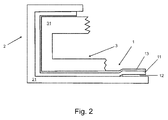
- FIG. 1 It is shown how a full surface with an adhesive 12 equipped adhesive tape 1 on a U-shaped fold 21, as provided on the panel 2 for a B pillar 3 of a body, is applied.
- the panel 2 On the B-pillar 3, the panel 2 is clipped, so that the provided on the panel 2 fold 21 engages in the Gegenfalz 31 of the B-pillar 3. Shown is the perspective from above on the severed B-pillar or aperture shown.
- the adhesive tape 1 has a film carrier 11, on which an adhesive 12 is provided.
- the layer 13 of the aqueous polyurethane lacquer composition is applied to the film carrier 11.
- the adhesive layer 12 fixes the adhesive tape 1 in its position.
- the adhesive tape 1 has a film carrier 11, on which only one strip of a Adhesive 12 is provided. On the upper side, the layer 13 of the aqueous polyurethane coating composition is again applied to the film carrier 11. The strip 12 fixes the adhesive tape 1 in its position. The non-adhesive part of the adhesive tape 1, the flag, is completely available as a sliding and rattle protection tape.
- the adhesive tape 1 according to the invention is pressed by the provided on the bodyellesfalz 31 in the fold 21 and thus lies between the panel 2 and body 3 as a sliding medium, which in the area of the flag neither on the panel 2 still on the body 3 sticks and thus flexibly prevents the creaking and rattling noises between the parts.
- the circle points to the visible edge.
- the film carrier 11 of the adhesive tape 1 protrudes under the panel 2. This is unproblematic insofar as the adhesive tape 1 is black and thus the projecting area is optically not conspicuous.
- the adhesive tape equipped on one side with an adhesive is constructed as follows and has the specified technical values: carrier adhesive thickness Elongation at break (longitudinal) Maximum tensile force (longitudinal) Bond strength (steel) width damping PE acrylate 280 ⁇ m 20% 40 N / cm 4.3 N / cm 19 mm 5 dB
- the acrylate adhesive is applied to the carrier film at 30 g / m 2 , which corresponds to a thickness of approximately 30 ⁇ m. Furthermore, the adhesive coating is covered with release paper.
- an aqueous polyurethane lacquer composition having the following composition: raw material Wt .-% PU dispersion, aliphatic (polycarbonate) (40%) 17.00 PU dispersion, aliphatic (polyester) (36% pure) 28,00 Wetting agents / sulphosuccinic ester sodium salt 0.50 Silica / matting agent TS-100 1.50 Defoamer / polyester-based 0.10 Teflon / polytetrafluoroethylene, average particle diameter 2 to 5 microns 3.00 Entblasungsstoff / mixture of surface-active polymers 0.50 Wetting agents / Polyether-polydimethylsiloxane 1.00 Wetting aid / polydimethylsiloxane, polyether-modified 1.00 Aminofunctional polydimethylsiloxane O / W emulsion 2.00 1,3,5-tris [6 - [[[[([(trifluor)] (polyester) (36% pure) 28,00 We
- a carbon black paste consists of the following components (in% by weight): Fettalkoholedoxilate 15.00 Defoamer based on white oil, wetting agents and silicones 1.00 soot 25,00 Water, demineralized 59,00
- the ingredients of the carbon black paste are ground with a bead mill until the freeness is below 50 microns.
- the preparation of the paint is carried out by the PU dispersions are presented, then the addition of the paint and wetting aids, and it is added a portion of the water. Subsequently, the carbon black paste is added. Stirring is continued for 15 minutes, and the product is filtered through a 50 ⁇ m filter. This is followed by the addition of the PTFE powder, the silicone resin and the silicone additives.
- the measurements are carried out at a test climate of 23 ⁇ 1 ° C and 50 ⁇ 5% rel. Humidity carried out.
- the tensile elongation behavior of the adhesive tape is determined on test specimens of type 2 (rectangular, 150 mm long and, if possible, 15 mm wide test strips) according to DIN EN ISO 527-3 / 2/300 with a test speed of 300 mm / min, a clamping length of 100 mm and a pre-load of 0.3 N / cm, with patterns being cut to determine the data with sharp blades.
- the tensile elongation behavior is tested in the machine direction (MD, direction of travel) unless otherwise specified.
- the force is expressed in N / stripe width and the elongation at break in%.
- the test results, in particular the elongation at break (elongation at break) must be statistically verified by a sufficient number of measurements.
- Adhesive forces are determined at a deduction angle of 180 ° according to AFERA 4001 on (if possible) 15 mm wide test strips.
- steel plates according to the AFERA standard are used as the test substrate, as far as no other primer is mentioned.
- the thickness of the carrier of the adhesive tape is determined according to DIN 53370 (the pressure-sensitive adhesive layer is not taken into account).
- the damping properties are determined according to LV315.
Landscapes
- Engineering & Computer Science (AREA)
- Mechanical Engineering (AREA)
- Chemical & Material Sciences (AREA)
- Organic Chemistry (AREA)
- General Engineering & Computer Science (AREA)
- Laminated Bodies (AREA)
- Adhesive Tapes (AREA)
- Adhesives Or Adhesive Processes (AREA)
Applications Claiming Priority (1)
| Application Number | Priority Date | Filing Date | Title |
|---|---|---|---|
| DE102015217913.3A DE102015217913A1 (de) | 2015-09-18 | 2015-09-18 | Verwendung eines einseitig klebend ausgerüsteten Klebebands |
Publications (1)
| Publication Number | Publication Date |
|---|---|
| EP3144362A1 true EP3144362A1 (fr) | 2017-03-22 |
Family
ID=56889014
Family Applications (1)
| Application Number | Title | Priority Date | Filing Date |
|---|---|---|---|
| EP16187864.0A Withdrawn EP3144362A1 (fr) | 2015-09-18 | 2016-09-08 | Utilisation d'un ruban adhésif d'un seul côté |
Country Status (2)
| Country | Link |
|---|---|
| EP (1) | EP3144362A1 (fr) |
| DE (1) | DE102015217913A1 (fr) |
Citations (5)
| Publication number | Priority date | Publication date | Assignee | Title |
|---|---|---|---|---|
| DE19945848A1 (de) * | 1999-09-24 | 2001-04-05 | Henkel Kgaa | Beschichtungsmittel für Elastomere |
| DE10309447A1 (de) | 2003-03-05 | 2004-09-16 | Tesa Ag | Verfahren zur Herstellung eines streifenförmigen Auftrags eines Substrats, insbesondere einer Klebemasse, auf einem Trägermaterial |
| DE102009023206A1 (de) * | 2008-10-21 | 2010-07-08 | Tesa Se | Verwendung eines zumindest einseitig klebend ausgerüsteten Klebebands mit einem Folienträger als Gleitklebeband |
| DE102010030537A1 (de) * | 2010-03-03 | 2011-09-08 | Tesa Se | Verwendung eines zumindest einseitig klebend ausgerüsteten Klebebands |
| DE102010030020A1 (de) * | 2010-06-14 | 2011-12-15 | Tesa Se | Zumindest einseitig klebriges Band mit Folienträger |
Family Cites Families (1)
| Publication number | Priority date | Publication date | Assignee | Title |
|---|---|---|---|---|
| DE102010030019A1 (de) * | 2010-06-14 | 2011-12-15 | Tesa Se | Zumindest einseitig klebend ausgerüstetes Klebeband mit einem flächigen Träger |
-
2015
- 2015-09-18 DE DE102015217913.3A patent/DE102015217913A1/de not_active Withdrawn
-
2016
- 2016-09-08 EP EP16187864.0A patent/EP3144362A1/fr not_active Withdrawn
Patent Citations (5)
| Publication number | Priority date | Publication date | Assignee | Title |
|---|---|---|---|---|
| DE19945848A1 (de) * | 1999-09-24 | 2001-04-05 | Henkel Kgaa | Beschichtungsmittel für Elastomere |
| DE10309447A1 (de) | 2003-03-05 | 2004-09-16 | Tesa Ag | Verfahren zur Herstellung eines streifenförmigen Auftrags eines Substrats, insbesondere einer Klebemasse, auf einem Trägermaterial |
| DE102009023206A1 (de) * | 2008-10-21 | 2010-07-08 | Tesa Se | Verwendung eines zumindest einseitig klebend ausgerüsteten Klebebands mit einem Folienträger als Gleitklebeband |
| DE102010030537A1 (de) * | 2010-03-03 | 2011-09-08 | Tesa Se | Verwendung eines zumindest einseitig klebend ausgerüsteten Klebebands |
| DE102010030020A1 (de) * | 2010-06-14 | 2011-12-15 | Tesa Se | Zumindest einseitig klebriges Band mit Folienträger |
Also Published As
| Publication number | Publication date |
|---|---|
| DE102015217913A1 (de) | 2017-03-23 |
Similar Documents
| Publication | Publication Date | Title |
|---|---|---|
| EP1224244B1 (fr) | Substance de revetement pour elastomeres | |
| DE69027944T2 (de) | Druckempfindliche Mehrschichtfolie mit einer verbesserten Adhäsion gegenüber plastifizierten Vinylsubstraten | |
| DE3881570T2 (de) | Reaktionsfähige härtbare Zusammensetzung sowie die gehärteten Produkte dieser Zusammensetzung enthaltenden Produkte. | |
| DE3877135T2 (de) | Schicht von haftklebstoff. | |
| EP2535389B1 (fr) | Couche de séparation avec coefficient de friction réduit | |
| EP0826754B1 (fr) | Film de protection autocollant | |
| DE202006021212U1 (de) | Mehrschichtige Polyurethan-Schutzfilme | |
| EP0429020A2 (fr) | Feuille en mousse déformable par compression et par le vide pour garniture intérieure de véhicules | |
| EP0761315A2 (fr) | Feuille de protection autocollante | |
| WO2010070026A1 (fr) | Bande de masquage constituée d'une feuille de pvc | |
| EP2730626A1 (fr) | Adhésif thermofusible de polyoléfine réactif ayant une faible adhérence aux outils en aluminium non revêtus et son utilisation en tant que masque thermofusible | |
| DE102009023206B4 (de) | Verwendung eines zumindest einseitig klebend ausgerüsteten Klebebands mit einem Folienträger als Gleitklebeband | |
| EP2607442A1 (fr) | Colle à fondre à base de polyoléfine réactive ayant une moindre viscosité et son utilisation pour adhésifs sur textiles | |
| EP1099738B1 (fr) | Article de protection auto-collant et hautement transparent pour vitrages automobiles et autre surfaces délicates | |
| EP1297088B1 (fr) | Feuille de protection de surface pour surfaces peintes, au moyen d'un produit auto-adhesif a base de polyurethanne | |
| EP1326937B1 (fr) | Pellicule de protection de surface pour surfaces d'automobiles fraichement peintes contenant une colle a plusieurs composants | |
| DE4121599A1 (de) | Kunststoffolienbahn | |
| EP3144362A1 (fr) | Utilisation d'un ruban adhésif d'un seul côté | |
| DE102010030537A1 (de) | Verwendung eines zumindest einseitig klebend ausgerüsteten Klebebands | |
| DE102010030019A1 (de) | Zumindest einseitig klebend ausgerüstetes Klebeband mit einem flächigen Träger | |
| DE3610487A1 (de) | Selbstklebende folie von hoher optischer qualitaet aus kunststoff | |
| EP3819347B1 (fr) | Procédé de fabrication d'un produit adhésif | |
| DE102006040846B4 (de) | Extrusionsfolie sowie deren Verwendung | |
| EP2556127B1 (fr) | Produit autoadhésif inscriptible | |
| WO2017129401A1 (fr) | Profilé destiné à un véhicule automobile et procédé de fabrication d'un profilé |
Legal Events
| Date | Code | Title | Description |
|---|---|---|---|
| PUAI | Public reference made under article 153(3) epc to a published international application that has entered the european phase |
Free format text: ORIGINAL CODE: 0009012 |
|
| STAA | Information on the status of an ep patent application or granted ep patent |
Free format text: STATUS: THE APPLICATION HAS BEEN PUBLISHED |
|
| AK | Designated contracting states |
Kind code of ref document: A1 Designated state(s): AL AT BE BG CH CY CZ DE DK EE ES FI FR GB GR HR HU IE IS IT LI LT LU LV MC MK MT NL NO PL PT RO RS SE SI SK SM TR |
|
| AX | Request for extension of the european patent |
Extension state: BA ME |
|
| STAA | Information on the status of an ep patent application or granted ep patent |
Free format text: STATUS: THE APPLICATION IS DEEMED TO BE WITHDRAWN |
|
| 18D | Application deemed to be withdrawn |
Effective date: 20170923 |