EP3144437A1 - Modulanordnung für ein gebäude - Google Patents
Modulanordnung für ein gebäude Download PDFInfo
- Publication number
- EP3144437A1 EP3144437A1 EP16189386.2A EP16189386A EP3144437A1 EP 3144437 A1 EP3144437 A1 EP 3144437A1 EP 16189386 A EP16189386 A EP 16189386A EP 3144437 A1 EP3144437 A1 EP 3144437A1
- Authority
- EP
- European Patent Office
- Prior art keywords
- module
- panel
- frame
- side panel
- seal
- Prior art date
- Legal status (The legal status is an assumption and is not a legal conclusion. Google has not performed a legal analysis and makes no representation as to the accuracy of the status listed.)
- Withdrawn
Links
Images




Classifications
-
- E—FIXED CONSTRUCTIONS
- E04—BUILDING
- E04B—GENERAL BUILDING CONSTRUCTIONS; WALLS, e.g. PARTITIONS; ROOFS; FLOORS; CEILINGS; INSULATION OR OTHER PROTECTION OF BUILDINGS
- E04B1/00—Constructions in general; Structures which are not restricted either to walls, e.g. partitions, or floors or ceilings or roofs
- E04B1/348—Structures composed of units comprising at least considerable parts of two sides of a room, e.g. box-like or cell-like units closed or in skeleton form
- E04B1/34815—Elements not integrated in a skeleton
- E04B1/34846—Elements not integrated in a skeleton the supporting structure consisting of other specified material, e.g. of plastics
-
- E—FIXED CONSTRUCTIONS
- E04—BUILDING
- E04B—GENERAL BUILDING CONSTRUCTIONS; WALLS, e.g. PARTITIONS; ROOFS; FLOORS; CEILINGS; INSULATION OR OTHER PROTECTION OF BUILDINGS
- E04B2/00—Walls, e.g. partitions, for buildings; Wall construction with regard to insulation; Connections specially adapted to walls
- E04B2/72—Non-load-bearing walls of elements of relatively thin form with respect to the thickness of the wall
-
- E—FIXED CONSTRUCTIONS
- E04—BUILDING
- E04B—GENERAL BUILDING CONSTRUCTIONS; WALLS, e.g. PARTITIONS; ROOFS; FLOORS; CEILINGS; INSULATION OR OTHER PROTECTION OF BUILDINGS
- E04B2/00—Walls, e.g. partitions, for buildings; Wall construction with regard to insulation; Connections specially adapted to walls
- E04B2/74—Removable non-load-bearing partitions; Partitions with a free upper edge
- E04B2/7407—Removable non-load-bearing partitions; Partitions with a free upper edge assembled using frames with infill panels or coverings only; made-up of panels and a support structure incorporating posts
- E04B2/7416—Removable non-load-bearing partitions; Partitions with a free upper edge assembled using frames with infill panels or coverings only; made-up of panels and a support structure incorporating posts with free upper edge, e.g. for use as office space dividers
- E04B2/7422—Removable non-load-bearing partitions; Partitions with a free upper edge assembled using frames with infill panels or coverings only; made-up of panels and a support structure incorporating posts with free upper edge, e.g. for use as office space dividers with separate framed panels without intermediary support posts
- E04B2/7427—Removable non-load-bearing partitions; Partitions with a free upper edge assembled using frames with infill panels or coverings only; made-up of panels and a support structure incorporating posts with free upper edge, e.g. for use as office space dividers with separate framed panels without intermediary support posts with adjustable angular connection of panels
Definitions
- the present invention relates to module assemblies for the construction of modular buildings. More specifically, the present invention relates to assemblies of modules for modular buildings for human occupancy, which modules can be transported in a collapsed configuration and erected at a desired site.
- Modular buildings are known in the art, and are used in a wide range of situations. Such buildings are usually employed where temporary use is desirable. For example, in a building site it is often useful to set up temporary offices and premises where work can be undertaken whilst the permanent building is being constructed. Similarly in military environments, temporary construction of offices and dwellings for military personal is desirable.
- the buildings need to be easily transported taking up the minimum amount of space.
- Known temporary buildings are therefore constructed of several fold-flat modules which can be assembled together in at least one configuration.
- the buildings need to be easily erected and dismantled, using the minimum number of tools. Preferably, no specialist tools should be required.
- the buildings need to be well sealed, in the event that the environment is hostile (for example sandy), or in the event that heating or air conditioning is to be used. Therefore the ability to made as air- and water-tight as possible is desirable.
- the buildings need to be modular in nature-that is the sub-assemblies should be suitable for assembly in a variety of different configurations. In this manner, part count is reduced, and the modules can be used to construct a variety of buildings, from small stores, to offices, to officers' quarters, to full barracks as required.
- a known modular building is disclosed in GB2286337A .
- the building comprises at least three side members connected by pin and slot joints.
- the building is configurable between a collapsed and erected configuration.
- a further known modular building is disclosed in US5904005 .
- the building comprises a plurality of modular units, each of which has a central frame and four walls arranged in opposing pairs to give an I-shaped configuration. One pair of walls may be extended with the other flat against the frame to provide a [or] shaped configuration.
- modules of US'005 can only be arranged in an end-to-end formation-i.e. where the central frames are spaced apart and offset from each other. Therefore the user is constrained as to the configuration of the buildings which can be constructed.
- the only option is to form buildings with an Nx1 module arrangement. The only way to make the building larger is to make it longer, which may a problem considering the intended use and / or external space restrictions.
- NxM configurations i.e. N modules long by M modules wide.
- a modular building assembly comprising:
- the inter-panel seal engaging formations and the inter-panel seal are configured such that the inter-panel seal can only be inserted and removed in a direction parallel to the side of each first side panel on which the inter-panel seal receiving formation is defined. In use, this is the vertical direction.
- this inhibits seal opening by accidental impact, building movement etc. and provides for a better seal.
- each inter-panel seal receiving formation defines an undercut recess in the respective first side panel, and in which the inter-panel seal defines a flange at either end for engagement in the undercut recess.
- this prevents pull-out of the seal from the formation (apart from in the intended axial direction).
- the flanges of the inter-panel seal are joined by a seal body, in which the flanges are stiffer than the seal. This provides the dual functionality of providing secure engagement with the panels, but provides a flexible seal which allows for inter-panel movement in use.
- inter-panel seal engaging formation of the first module first side panel and the inter-panel seal engaging formation of the second module first side panel are configured to have an uninterrupted line of sight there between before the inter-panel seal is inserted.
- this allows easy assembly and disassembly of the seal.
- each first side panel defines an adjacent pair of inter-panel seal engaging formations, and in which two adjacent inter-panel seals are provided between each first side panel. This provides redundancy, and a better seal.
- each of the pair of inter-panel seal engaging formations is positioned either side of a central plane of the respective first side panel.
- each first side panel further defines a frame seal engaging formation facing the respective first or second module frame. This allows the panel to seal against the frame as well (when required).
- the frame seal engaging formations face in a direction normal to the respective inter-panel seal engaging formations.
- each of the first and second module first side panels is pivotably mounted to the respective frame. This allows for easy opening and closure.
- This configuration allows for a wide range of building formations.
- each of the second side panels is identical to each of the first side panels.
- each first and second side panels is rotatable about a respective first and second panel axis, in which the first panel axis is at a first end of the frame, and the second panel axis is at a second end of the frame such that the respective frame and panels can form a "Z" shape.
- This configuration allows for a wide range of building formations.
- each of the side panels comprises a panel member and an edge member attached to opposite edges of the panel member, which edge members define the inter-panel seal engaging formation or formations. This allows the load bearing / seal bearing parts of the panel to be stiff, and the main panel to be light.
- edge members are extrusions defining the inter-panel seal engaging formation or formations parallel to an axis of extrusion.
- Extrusions are inexpensive to manufacture, and such formations are well suited to aluminium which is an ideal material due to its strength and low density.
- edge members define one side of a rotational joint to facilitate rotation of the side panel from the stowed and deployed positions.
- the side panels comprise a cellular core with an outer skin, which provides a stiff but light structure.
- the cellular core and outer skin are constructed from a thermally bonded polymer material.
- a module 100 generally comprising a frame 102, a first panel assembly 104 and a second panel assembly 106 mounted on either side of the frame 102.
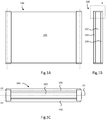
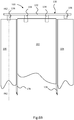
- the module 100 is generally rectangular and planar, and is shown in Figures 1A to 1C in a folded, flat configuration for storage and transportation in which the first and second panel assemblies 104, 106 overlie opposite sides of the frame 102.
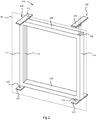
- the frame 102 is shown without the panel assemblies 104, 106.
- the frame 102 is a generally rectangular endless loop in shape, comprising horizontal top and bottom members 108, 110 respectively and vertical side members 112, 114.
- the top and bottom members 108, 110 are closed section rectangular steel tubes.
- the side members are rectangular steel tubes with internally-facing channels 116, the channels 116 running longitudinally along the members 112, 114.
- the channels 116 can be used for routing e.g. electrical cables.
- a frame plane FP lies halfway through the thickness of the frame 102.
- first and second fixed hinge plates 120, 122 are flat rectangular plates which extend normal to the frame plane FP outwardly from the frame 102 on both sides.
- Each hinge plate 120, 122 is provided with two vertically extending hinge pins 123, 124 one on each side of the frame 102 (see the lower part of Figure 6A ).
- the first hinge pin 123 is longer than the second hinge pin 124.
- the hinge plates 120, 122 are permanently attached- specifically welded- to the frame 102.
- the plates 120, 122 are welded to the frame 102 such that the first pin 123 of the first plate 120 is on the same side of the frame 102 as the second pin 124 of the second plate 122 and vice versa.
- the frame 102 further comprises a first and second removable hinge plate 128, 130 respectively.
- the removable hinge plates 128,130 are identical and are more clearly shown in Figure 6A .
- Each comprises a plate member 132, with two central pins 134 or equal length extending therefrom.
- the first panel assembly 104 is shown. It will be understood that the second panel assembly 106 is identical to the first panel assembly 104.
- the first panel assembly 104 comprises a rectangular panel core 140 having a panel plane PP halfway through its thickness.
- the panel core 140 is a thermally fused polypropylene panel having a honeycomb polypropylene core 141 sandwiched between two planar sheets 143 of glass fibre reinforced polypropylene.
- Such panels are sold under the brand name MONOPAN (RTM) by Wihag Composites GmbH & Co. KG (although alternatives are available). These panels are strong, light, and have excellent thermal insulation properties.
- first and second extrusion 142, 144 are provided at each vertical end of the panel core 140 at each vertical end of the panel core 140 respectively.
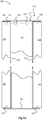
- the extrusions 142, 144 are constructed from aluminium. A section through the extrusion 142 is shown in detail in Figure 4A .
- the extrusion 144 is identical to the extrusion 142.
- the extrusion 142 is prismatic.
- the section of the extrusion 142 comprises a central cylinder 146 defining a bore 148 having an axis X1 and an inner radius R1.
- a cross-member 150 extends tangentially either side of the cylinder 146.
- a first and second flange 152, 154 extend in a first direction from opposite ends of the cross-member 150 and define spaced apart screw bores 156 along the extrusion 142.
- a hollow closed section 158 extends from the cross-member 150 to contain the cylinder 146.
- the closed section 158 is defined by first and second straight walls 160, 162 extending opposite the flanges 152, 154.
- the first and second straight walls extend into a semi-circular wall section 164 having outer radius R2 and prescribing a 180 degree arc to join the walls 160, 162.
- a stiffener 166 extends radially from the central cylinder 146 to the inside of the semi-circular wall section 164.
- the geometric centre of the semi-circular wall section 164, axis X2, is offset from axis X1 by offset distance OD.
- the axis X2 is offset towards the semi-circular wall section 164, and away from the flanges 152, 154.
- the flanges 152, 154 define a panel receiving formation (as will be described below) facing in a panel direction P.
- the end of the extrusion 142 opposition the panel receiving formation is known as the free end 172 which faces in a free end direction F.
- First and second sideward facing directions S1 and S2 are also defined in Figure 4A and are generally perpendicular to the directions P and F.
- the extrusion 142 defines two pairs of seal receiving formations in the form of outwardly facing slots.
- a first and second seal receiving formation 168, 170 are defined on the outer free end facing surface of the semi-circular wall section 164.
- the seal receiving formations 168, 170 are positioned symmetrically at either side of the extrusion and face in the free end direction F.
- the extrusion further comprises a third and fourth seal receiving formation 174, 176.
- the third seal receiving formation 174 is defined in the second straight wall 162
- the fourth seal receiving formation 176 is defined proximate the third seal receiving formation 174 in the semi-circular wall section 164 where it joins the second straight wall 162.
- the third and fourth seal formations 174,176 face in the second sideways direction S2, substantially perpendicular to the first and second seal formations 168, 170.
- Each of the seal receiving formations 168, 170, 174, 176 is identical in shape.
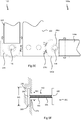
- the formation 168 is shown in more detail in Figure 9F and comprises an undercut elongate slot 169 of width W1 arranged to receive a flange of a seal.
- the seal receiving formation 168 defines a mouth 171 in communication with the slot 169 having width W2 ⁇ W1.
- the seals 178 are identical and are of the foam type, in this embodiment Q-LON (RTM) 69950 sold by Schlegel Systems, Inc.
- the first and second seal receiving formations 168, 170 are further from the axis X1 than the third and fourth seal formations 174, 176.
- the modules are assembled as follows.
- the first panel assembly 140 is assembled as follows.
- the extrusions 142, 144 are attached to either side of the panel core 140.
- the end of the panel core is received within the panel receiving formation defined by the flanges 152, 154 and abuts the cross-member 150.
- the panel core 140 and respective extrusion 142, 144 are then attached using screws 180.
- the extrusions 142, 144 are oriented such that the third and fourth seal receiving formations 174, 176 of each extrusion face in the same direction (S2). With the exception of the presence of the third and fourth seal receiving formations 174, 176, the extrusion is symmetrical about the panel plane PP.
- the seals 178 can be slid down the respective first pair of seal receiving formations 168, 170 and / or second pair of seal receiving formations 174, 176 as required by the application (as will be explained below).
- first panel assembly 104 is mounted parallel to and adjacent the frame by placing the respective bores 148 in the extrusions 142, 144 over the hinge pins 123, 124 in the hinge plates 120, 122 respectively.
- the third and fourth seal receiving formations 174, 176 face the frame 102.
- the second panel assembly 106 is mounted to the hinge pins 123, 124 on the opposite side of the frame 102 with the third and fourth seal receiving formations facing the frame.
- the removable hinge plates 128, 130 can be put in place.
- the removable hinge plates are assembled with the central pins 134 engaging the bores 126 in the frame 102.
- the hinge plates 128, 130 are oriented in opposite directions- specifically the first hinge pin 136 of the second removable hinge plate 132 is on the same side of the frame as the second hinge pin 138 of the first removable hinge plate 130 and vice versa.
- the first hinge pins 136 of the removable plates 128, 130 are always aligned with the first hinge pins 123 of the fixed plates 120, 122
- the second hinge pins 138 of the removable plates 128, 130 are always aligned with the second hinge pins 124 of the fixed plates 120, 122.
- the first extrusion 142 is pivoted on a pair of second hinge pins 124, 138
- the second extrusion 144 is pivoted on a pair of first hinge pins 123, 136, in which the first hinge pins 123, 136 are shorter than the second hinge pins 123, 136.
- the panel assemblies 104, 106 are secured in position and the module 100 is formed in a folded or stowed position.
- the seals 178 in the third and fourth seal receiving formations 174, 176 seal against the side member 114 of the frame 102 to provide and air- and water-tight seal.
- the use of two seals provides redundancy and improves the sealing capability of the arrangement.
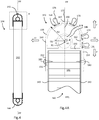
- Either or both of the panel assemblies 104,106 can be moved from the folded position to an extended position as shown in Figure 7 .
- the second removable hinge plate 130 can be lifted to free the second hinge pin 138 from the first panel assembly 104.
- the panel assembly 104 can then be lifted off the second hinge pin 124. Because the first hinge pins 123, 136 are longer than the second hinge pins 124, 138, the other end of the panel assembly is still captured, and can be rotated about a first panel axis PA1 as shown in Figure 7 .
- panel assembly 106 being selectively rotatable about a second panel axis PA2 at the opposite end and side of the frame 102 to the first panel axis PA1.
- the panel assemblies can also be completely removed if required by one of the applications described below.
- Figure 8A shows the clearance C between the extrusion 144 and the frame 102. Because of the offset distance OD between the axes X1 and X2, as the second panel assembly 106 rotates from the folded / stowed condition to the extended position perpendicular to the frame 102, the clearance C decreases by distance OD. This takes account of the fact that the seals (not shown) in the third and fourth seal receiving formations 176, 178 are set further back into the extrusion 144 than the seals in the first and second seal receiving formations 172, 174.
- Figure 9A shows a building 10 having a simple 1x1 module arrangement comprising the module 100, and a second module 100a, which is identical to module 100.
- Module 100a equivalent to module 100 are denoted by the same reference numerals suffixed by a.
- the first panel assembly 104 of the first module 100 forms an end wall in the folded / stowed condition.
- the second panel assembly 106 of the first module 100 has been rotated about its axis by 90 degrees to form a side wall.
- the first panel assembly 104a of the second module 100a has been rotated about its axis by 90 degrees to form a side wall.
- the second panel assembly 106a of the second module 100a remains in the folded / stowed condition to form an end wall.
- the two modules have been combined with the end of the panel assembly 106 of the module 100 sealing against the side of the frame 102a of the module 100a.
- the panel assembly 104a of the module 100a seals against the side of the frame 102 of the module 100.
- the joint at region E is shown in more detail in Figure 9E with the seals 178a of the extrusion 142a of the panel assembly 104a abutting and sealing against the frame 102 of the module 100.
- the first hinge pins 124, 138 retain the extrusion 142a of the panel assembly 104a by engaging the bore 148a.
- Figure 9B shows a second building 12 having a 2x1 arrangement comprising the module 100, the second module 100a and a third module 100b which is identical to module 100.
- Module 100b equivalent to module 100 are denoted by the same reference numerals suffixed by b.
- Module 100 is configured as per the building 10, with the first panel assembly 104 stowed to form an end wall, and the second panel assembly 106 rotated through 90 degrees to form a sidewall sealing against the frame 102a of the module 100a.
- the second module 100a has both panel assemblies 104a, 106a rotated through 90 degrees such that the first panel assembly 104a extends to seal against the frame 102a of the first module 100, and the second panel assembly 106a extends to seal against the frame 102b of the third module 100b.
- the third module 100b is configured such that the first panel assembly 104b is rotated by 90 degrees to seal against the frame 102a of the second module 100a.
- the second panel assembly 106b is kept in the folded / stowed position to form an end wall opposite and parallel to the first panel 104 of the first module 100.
- FIG. 9C a 2x2 module building 14, the construction of which is made possible by the present invention, is shown in plan.
- the building comprises six modules, 100, 100a, 100b, 100c, 100d, 100e.
- Features of modules equivalent to module 100 are denoted by the same reference numerals suffixed by a, b, c etc.
- Modules 100, 100a, 100b are in the same configuration as in the building 12 with the exception that the second panel assemblies 106a and 106b have been removed completely. Three further modules 100c, 100d, 100c are provided.
- the module 100c is configured such that the frame 102c is adjacent to and coplanar with the frame 102 of the module 100.
- the first panel assembly 104c is folded and as such is adjacent to and coplanar with the first panel assembly 104.
- the second panel assembly 106c is rotated through 90 degrees to form a sidewall, and seals against the frame 102d of the module 100d.
- the module 100d is provided with a frame 102d and a second panel assembly 106d only.
- the frame 102d is positioned adjacent to, and coplanar with, the frame 102a of the module 100a.
- the second panel assembly 106d is rotated through 90 degrees to seal against the frame 102e of the module 100e.
- the module 100e is provided with a frame 102e and a second panel assembly 106e only.
- the frame 102e is in its folded / stowed condition to form an end wall adjacent to, and coplanar with, the second panel assembly 106c of the module 100c.
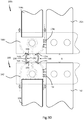
- FIG. 9C The region D of Figure 9C is shown in more detail in Figure 9D .
- the panel assemblies 104 and 104c can be sealed together however to seal the end wall of the building.
- first seal receiving formation 168 of the extrusion 144 of the first panel assembly 104 of the module 102 has a direct, uninterrupted line of sight to the first seal receiving formation 168c of the extrusion 144c of the first panel assembly 104c of the module 102c.
- the seal receiving formations 168, 168c are mirror images of each other.
- the second seal receiving formation 170 of the extrusion 144 of the first panel assembly 104 of the module 102 has a direct, uninterrupted line of sight to the second seal receiving formation 170c of the extrusion 144c of the first panel assembly 104c of the module 102c.
- the seal receiving formations 170, 170c are mirror images of each other.
- a first gap seal 182 is provided simultaneously engage with the seal receiving formations 168, 168c.
- a second gap seal 184 is provided simultaneously engage with the seal receiving formations 170, 170c.
- the gap seals 182, 184 are identical foam seals, and are shown in section detail in Figure 9F .
- the gap seal 182 defines a first and second flange 186, 188 joined by a seal body 190 which extends between, and normal to, the flanges 186, 188.
- the flanges 186, 188 are constructed from a solid plastics material, whereas the seal body 190 is flexible, having a foam core 191 and membrane skin 193. Therefore the portions of the seal 182 (i.e. flanges 186, 188) which engages the seal receiving formations 168, 168c are unable to pass through the gap 171.
- seal pairs have a direct, uninterrupted line of sight to each other allows a simply unitary seal component (like seals 182, 184) to bridge the gap simply and effectively.
- the seal receiving formations are undercut, the flanges 186, 188 of the gap seals can only be inserted from the ends of the extrusions 142, 144 (i.e. from the top or bottom of the walls).
- the seals 182, 184 are fed in at the end of the extrusion and pulled along the extrusion until they extend the full length of the panel assemblies 104, 104c. Because of the co-operating shape of the flanges and the undercut seal receiving formations, the seals cannot be pulled out in the free end direction F of the extrusions.
- the seal receiving formations may be any kind of seal engaging formations capable of holding a seal in place.
- the seal members are male and the seal receiving formations female, the seals may define a female formation to receive part of the panel assembly.
- the panel assembly may instead be a unitary member constructed from e.g. additive layer manufacturing.
- the modules 100 can be used to create NxM configuration buildings.
Landscapes
- Engineering & Computer Science (AREA)
- Architecture (AREA)
- Physics & Mathematics (AREA)
- Electromagnetism (AREA)
- Civil Engineering (AREA)
- Structural Engineering (AREA)
- Building Environments (AREA)
Applications Claiming Priority (1)
| Application Number | Priority Date | Filing Date | Title |
|---|---|---|---|
| GB1516513.7A GB2542390A (en) | 2015-09-17 | 2015-09-17 | Module assembly for a building |
Publications (1)
| Publication Number | Publication Date |
|---|---|
| EP3144437A1 true EP3144437A1 (de) | 2017-03-22 |
Family
ID=54544423
Family Applications (1)
| Application Number | Title | Priority Date | Filing Date |
|---|---|---|---|
| EP16189386.2A Withdrawn EP3144437A1 (de) | 2015-09-17 | 2016-09-19 | Modulanordnung für ein gebäude |
Country Status (2)
| Country | Link |
|---|---|
| EP (1) | EP3144437A1 (de) |
| GB (1) | GB2542390A (de) |
Families Citing this family (1)
| Publication number | Priority date | Publication date | Assignee | Title |
|---|---|---|---|---|
| CN116677079B (zh) * | 2023-06-08 | 2024-03-12 | 重庆交通大学 | 一种快速搭建的装配式蜂巢建筑 |
Citations (4)
| Publication number | Priority date | Publication date | Assignee | Title |
|---|---|---|---|---|
| DE8013713U1 (de) * | 1979-05-23 | 1981-03-12 | Compagnie Internationale de Participation et d' Investissement CIPARI S.A., Luxembourg | Transportables Betriebs-, Geschäfts- oder Lagergebäude |
| GB2286337A (en) | 1994-02-09 | 1995-08-16 | David Charles Dyer | Improved means of collapsing and erecting structures |
| WO1997030257A1 (en) * | 1996-02-19 | 1997-08-21 | Innovation Development Enterprise I Stockholm Ab | Hinge |
| US5904005A (en) | 1995-02-18 | 1999-05-18 | Kudos 2000 Limited | Modular structures |
Family Cites Families (4)
| Publication number | Priority date | Publication date | Assignee | Title |
|---|---|---|---|---|
| FR2501754A1 (fr) * | 1981-03-16 | 1982-09-17 | Sicopar | Elements modulaires de construction et batiments formes par assemblage de tels elements. |
| BE896466A (fr) * | 1983-04-14 | 1983-08-01 | Applic De La Chemie De L Elect | Dispositif permettant de solidariser entre eux deux chassis metalliques contigus appartenant a des niveaux differents |
| US4965970A (en) * | 1988-01-19 | 1990-10-30 | Dynatherm Systems U.S.A. Ltd. | Prefabricated dome-shaped structure |
| JP3821949B2 (ja) * | 1998-05-01 | 2006-09-13 | ヤマハリビングテック株式会社 | 壁パネル |
-
2015
- 2015-09-17 GB GB1516513.7A patent/GB2542390A/en not_active Withdrawn
-
2016
- 2016-09-19 EP EP16189386.2A patent/EP3144437A1/de not_active Withdrawn
Patent Citations (4)
| Publication number | Priority date | Publication date | Assignee | Title |
|---|---|---|---|---|
| DE8013713U1 (de) * | 1979-05-23 | 1981-03-12 | Compagnie Internationale de Participation et d' Investissement CIPARI S.A., Luxembourg | Transportables Betriebs-, Geschäfts- oder Lagergebäude |
| GB2286337A (en) | 1994-02-09 | 1995-08-16 | David Charles Dyer | Improved means of collapsing and erecting structures |
| US5904005A (en) | 1995-02-18 | 1999-05-18 | Kudos 2000 Limited | Modular structures |
| WO1997030257A1 (en) * | 1996-02-19 | 1997-08-21 | Innovation Development Enterprise I Stockholm Ab | Hinge |
Also Published As
| Publication number | Publication date |
|---|---|
| GB201516513D0 (en) | 2015-11-04 |
| GB2542390A (en) | 2017-03-22 |
Similar Documents
| Publication | Publication Date | Title |
|---|---|---|
| US11566414B2 (en) | Enclosure component perimeter structures | |
| US9988812B2 (en) | Interconnection system for panel assemblies | |
| AU2011219049B2 (en) | Folding partitions having adjoining panels and related methods | |
| MX2014002601A (es) | Sistema de paneles de pared extruida y metodo de formacion. | |
| US20040049992A1 (en) | Structures incorporating interlocking wall modules | |
| EP3144437A1 (de) | Modulanordnung für ein gebäude | |
| EP3250773A1 (de) | Expandierbare platte | |
| US5502938A (en) | Modular wall assembly system and elastic hinge therefor | |
| US9803669B2 (en) | Bidirectional modular assembly clip | |
| SE432275B (sv) | System for uppbyggnad av konstruktioner, speciellt ladliknande konstruktioner | |
| CN110537030B (zh) | 用于组合产品的镶板 | |
| CN201074411Y (zh) | 一种集装箱式组合房屋 | |
| US12116829B1 (en) | Fenestration assembly mull joints with improved strength and methods | |
| AU2017203115A1 (en) | Interconnection system for panel assemblies | |
| CN207988154U (zh) | 一种多层模块化建筑的连接组件 | |
| EP1483467B1 (de) | Bauteil | |
| CN2730969Y (zh) | 活动房组件 | |
| CN216587010U (zh) | 一种可折叠拼装应急房 | |
| US20260022556A1 (en) | Fiber-reinforced polymer wall framing system | |
| JP5855367B2 (ja) | 組立家屋 | |
| US20260022557A1 (en) | Fiber-reinforced polymer wall framing system | |
| US12404671B2 (en) | Partition panel system | |
| GB2404207A (en) | Room divider panel | |
| JP2024005503A (ja) | 間仕切りパーティション | |
| TR2023002888A2 (tr) | L-bi̇çi̇mli̇ mödüllerden oluşan, tersi̇ni̇r reversible ve kendi̇n yap diy modüler barinak si̇stemi̇ |
Legal Events
| Date | Code | Title | Description |
|---|---|---|---|
| PUAI | Public reference made under article 153(3) epc to a published international application that has entered the european phase |
Free format text: ORIGINAL CODE: 0009012 |
|
| AK | Designated contracting states |
Kind code of ref document: A1 Designated state(s): AL AT BE BG CH CY CZ DE DK EE ES FI FR GB GR HR HU IE IS IT LI LT LU LV MC MK MT NL NO PL PT RO RS SE SI SK SM TR |
|
| AX | Request for extension of the european patent |
Extension state: BA ME |
|
| STAA | Information on the status of an ep patent application or granted ep patent |
Free format text: STATUS: THE APPLICATION IS DEEMED TO BE WITHDRAWN |
|
| 18D | Application deemed to be withdrawn |
Effective date: 20170923 |