EP3144529B1 - Éolienne comprenant au moins un composant déformable elastiquement et procédé de détermination du début de la vie résiduelle d'un composant en fonction de l'usure dans une éolienne - Google Patents
Éolienne comprenant au moins un composant déformable elastiquement et procédé de détermination du début de la vie résiduelle d'un composant en fonction de l'usure dans une éolienne Download PDFInfo
- Publication number
- EP3144529B1 EP3144529B1 EP16001986.5A EP16001986A EP3144529B1 EP 3144529 B1 EP3144529 B1 EP 3144529B1 EP 16001986 A EP16001986 A EP 16001986A EP 3144529 B1 EP3144529 B1 EP 3144529B1
- Authority
- EP
- European Patent Office
- Prior art keywords
- component
- wind
- wind turbine
- deformation
- measuring
- Prior art date
- Legal status (The legal status is an assumption and is not a legal conclusion. Google has not performed a legal analysis and makes no representation as to the accuracy of the status listed.)
- Active
Links
Images


Classifications
-
- F—MECHANICAL ENGINEERING; LIGHTING; HEATING; WEAPONS; BLASTING
- F03—MACHINES OR ENGINES FOR LIQUIDS; WIND, SPRING, OR WEIGHT MOTORS; PRODUCING MECHANICAL POWER OR A REACTIVE PROPULSIVE THRUST, NOT OTHERWISE PROVIDED FOR
- F03D—WIND MOTORS
- F03D17/00—Monitoring or testing of wind motors, e.g. diagnostics
-
- F—MECHANICAL ENGINEERING; LIGHTING; HEATING; WEAPONS; BLASTING
- F05—INDEXING SCHEMES RELATING TO ENGINES OR PUMPS IN VARIOUS SUBCLASSES OF CLASSES F01-F04
- F05B—INDEXING SCHEME RELATING TO WIND, SPRING, WEIGHT, INERTIA OR LIKE MOTORS, TO MACHINES OR ENGINES FOR LIQUIDS COVERED BY SUBCLASSES F03B, F03D AND F03G
- F05B2260/00—Function
- F05B2260/83—Testing, e.g. methods, components or tools therefor
-
- Y—GENERAL TAGGING OF NEW TECHNOLOGICAL DEVELOPMENTS; GENERAL TAGGING OF CROSS-SECTIONAL TECHNOLOGIES SPANNING OVER SEVERAL SECTIONS OF THE IPC; TECHNICAL SUBJECTS COVERED BY FORMER USPC CROSS-REFERENCE ART COLLECTIONS [XRACs] AND DIGESTS
- Y02—TECHNOLOGIES OR APPLICATIONS FOR MITIGATION OR ADAPTATION AGAINST CLIMATE CHANGE
- Y02E—REDUCTION OF GREENHOUSE GAS [GHG] EMISSIONS, RELATED TO ENERGY GENERATION, TRANSMISSION OR DISTRIBUTION
- Y02E10/00—Energy generation through renewable energy sources
- Y02E10/70—Wind energy
- Y02E10/72—Wind turbines with rotation axis in wind direction
Definitions
- the invention relates to a wind turbine with a rotor having at least one elastically deformable component as a structural part and / or bearing part according to the preamble of claim 1 and a method for determining the beginning of a wear-related component remaining useful life in a wind turbine according to the preamble of claim 10.
- Wind energy is a renewable energy source available worldwide, which is increasingly used to generate electricity from onshore and offshore wind farms.
- Wind turbines already have a high level of technical development, and their safe operation at the lowest possible operating and maintenance costs is a constant challenge.
- a problem here is the estimation of the service life of deformable components and their replacement, since these components are usually difficult to access and / or can not be checked by inspection.
- elastically deformable components In wind turbines act on elastically deformable components as structural parts and / or bearing parts in operation as a function of changing wind conditions different deformation forces, which ultimately lead to a component service life limiting component wear.
- Such elastically deformable components are in particular rubber-metal bearings as Shaft bearings and / or generator bearings and / or gearbox bearings and / or elastic couplings and / or a nacelle storage and / or their components.
- these are structural parts made of plastic, in particular fiber composite materials, for example, rotor blades.
- rubber-metal bearings is, as is common in the art, to be generally understood and interpreted broadly, with “rubber” as a synonym for “elastomeric material” and “metal” stands for a deformation-resistant bearing component, which in particular also consist of plastic can.
- Such rubber-metal bearings and / or plastic parts, in particular fiber composite parts are known to function reliably with proper design over a long service life even at high oscillating loads and in principle wear-free.
- a criterion for the function of such a component is the deformation under force or the corresponding component rigidity.
- the component life is measured in a known manner on a test bed at clearly defined ratios.
- a rubber-metal bearing is subjected to oscillating loads.
- the load changes or repetitive load blocks are counted and thereby force and deformation are measured, whereby one of the two values is specified.
- a diagram is generated as a measuring curve, in which a falling stiffness over the number of load changes is recognizable.
- the number of load changes can be interpreted directly as service life. From such a diagram, an increase in deformation corresponding to a decrease in rigidity in characteristic three stages can be seen in each case over the service life.
- the stiffness drops very quickly, for example, by about 30%, which is referred to as flowing and setting.
- a very small drop in stiffness measured according to a plateau with linear and / or slight drop in stiffness.
- a measurable comparatively rapid progressive drop in rigidity which marks the near end of the component function with a possible failure and thus the end of its useful life.
- the beginning end of the useful life can be relatively easily detected according to the third diagram stage, for example by a change in noise or in a vehicle by a changed driving behavior.
- incipient damage according to the third diagram stage may also be visually recognized.
- component damage can lead to a safety risk and / or to expensive consequential damage and operational failures. It is precisely for this purpose that previously relevant components are tested as far as possible beforehand and a measured maximum load duration is established, after which, taking into account normal scattering and safety deductions, they are usually exchanged long before a possible lifetime, long before damage has progressed far.
- Another evolution of this principle is over US2011 / 0125419 known.
- the disadvantage is that for such a preventive exchange of a component at regular maintenance intervals, a wind turbine can be put out of service. In order to exclude a safety risk and consequential damage, a component replacement must take place well before a possible average useful life. This leads to high failure, component and maintenance costs, which would not yet be required by the current and still functionally reliable component state. Since in a wind turbine regularly several such components, such as rubber-metal bearings are installed, multiply the cost accordingly.
- the object of the invention is to determine the possible component service life in a wind turbine with at least one elastically deformable component as a structural part and / or bearing part more accurate than is possible by test bench measurements and estimates. Another object of the invention is to provide a method for determining the beginning of a wear-related remaining service life of an elastically deformable component in a wind turbine to propose.
- a time-repeating, respectively identical wind state is predetermined, to which a specific, respectively identical deformation force is assigned.
- a wind condition is recognizable and detectable each time it occurs with a detection unit.
- a wind condition is selected and determined which occurs relatively frequently with a significantly measurable component deformation, so that a relatively large number of evaluable measurement results can be obtained.
- load levels with a relatively high proportion of damage, in particular lasting, high oscillating loads on the component should occur. It is assumed that, with largely identical wind conditions and correspondingly identical operating states of the wind energy plant, the deformation forces that occur as a result of this on the component are likewise largely the same.
- several different wind conditions can also be predetermined for a plurality of parallel evaluations or for evaluations on a plurality of components installed in the wind energy plant.
- the triggering of a measuring process takes place by means of a start signal, component deformation being measured as parameter for a current component rigidity and the measured value stored for component monitoring with at least one component-associated sensor and a downstream measuring and evaluation unit.
- the deformation force acting on the component need not be measured absolutely.
- Absolute measurement of component deformation or its reciprocal value as component stiffness since in the further evaluation only relative values and tendency profiles between successive measured values are used.
- the predetermination of a narrow "wind window" which provides well usable results for the evaluation of tendentious processes, should be included here.
- a measurement curve from the measured values must be averaged and smoothed to compensate for measurement tolerances.
- the uncritical plateau range is clearly marked by a sharp increase in the slope of a measurement curve with respect to the component deformation or a strong inclination drop of a measurement curve with respect to component stiffness leave. If such a threshold value predeterminable slope increase or inclination drop is determined, thus the beginning of a wear-related predefinable component remaining service life is determined.
- a corresponding warning information for example, issued as an optical or acoustic signal indicative of a required component replacement. This second result is when the third stage in the stiffness diagram described above is reached.
- the core of the invention is thus a qualitative determination of the stiffness of the deformable component, which in the installed state in the wind turbine is not directly controllable and measurable. Only in the knowledge of a force and deformation, such as on a test bench, can the stiffness be determined absolutely. In a technical application, it is not possible with reasonable effort to measure the force applied to a built-component. Paths or deformations, however, are relatively easy to measure in a conventional manner. The determination of the component life is advantageously carried out according to the invention only by evaluations of measured value that are to be carried out simply.
- a measurement of the component deformation is triggered in each case.
- the time corresponding to the occurrence of a predetermined wind condition is selected so that load levels with clearly measurable deformations and preferably with high Damage component occur.
- the damage component is achieved by a frequent occurrence of this load level and not by high loads with low frequency in order to obtain a large number of measurement results whose inevitable scattering is thus better than scattering and not as looming component damage can be assessed.
- the number of measured values obtained which can be interpreted as useful life, is expediently plotted on the X-axis of a diagram.
- the deformation can be applied on the Y-axis. However, it is visually more understandable to apply their inverse, one by the deformation, thus obtaining a measurement curve analogous to the course of the rigidity.
- a straight line is determined as the measuring curve, which maps the described plateau well in its course, whereby this is possible after only a few measured values in the plateau region.
- Each additional measured value is evaluated in terms of how it changes or deviates from the characteristic of the previously determined straight line.
- a change in the slope of this straight line is used as the criterion for an evaluation. If, after the plateau area, the magnitude of the slope increases significantly above the value of scattering over several measured values, then the region of progressive stiffness decrease begins as a signal for replacement of the component. In principle, therefore, the differential of the averaged trace is evaluated.
- the state of wear of a deformable component is advantageously determined directly and directly during its component service life.
- a component can be used over its actual life to the beginning of its progressive stiffness drop.
- pre-emptive replacement measures predefined prior to the actually possible end of use can be dispensed with by means of useful life estimates, thereby saving on maintenance and operating costs.
- component safety is increased by the direct measurement on the component and the risk of possible follow-up costs in case of a non-recognized component failure is reduced.
- the predetermined wind condition can be easily detected as a predetermined wind speed with a rotor rotated transversely to the wind.
- An indirect detection of the wind condition is possible via the rotor speed.
- Measurement signals for the wind speed and for the rotor speed are generated in the wind energy plant anyway and can be utilized according to the invention.
- a single measurement operation can be started and performed.
- a further measurement process can be automatically started and carried out again after a predetermined waiting time, even if the wind condition is stopped for a long time.
- Particularly suitable for the monitoring according to the invention are the initially mentioned elastically deformable components of a wind energy plant as gumite metal bearings and as structural parts.
- a temperature window of 6 ° C should be maintained as a further condition for the start of a measurement process and / or for the utilization of a measured value, this temperature window in a temperature range from 0 ° C to 35 ° C can be selected. It is taken into account that temperature influences at temperatures below 0 ° C and above 35 ° C lead to strong, unfavorable measured value fluctuations. The influence of temperature on the measured values in a temperature window of 6 ° C within the temperature range of 0 ° C to 35 ° C, however, is negligible for the evaluation of the invention.
- a measured value counter corresponding to a service life is nevertheless set high in order not to distort the measured curve, in particular the stiffness course.
- a sensor for measuring a displacement and / or a speed and / or an acceleration can be used as a sensor for measuring the component deformation.
- a deformation can be measured directly or indirectly between component components and / or attachments.
- the sensor system can be integrated in the deformable component, in particular in an elastomer, and / or arranged on adjoining / adjacent attachment parts.
- a distance can be measured directly as component deformation by having a signal generator on the inside of a rubber-metal bearing and a sensor on the outside. It is also possible to measure the accelerations in the elements, to integrate twice and to add, so that the relative path is obtained.
- known simple inductive displacement transducers, magnetoresistive sensors, Hall probes, acceleration sensors or other sensors can be used, with which a displacement, a velocity, an acceleration or another displacement-equivalent signal can be measured.
- the detection unit and the measuring and evaluation unit are expediently fully or partially integrated with their components in a central electronic unit which is usually present in the wind energy plant, where measurement values already available for other purposes, for example wind speed measured values or rotor rotational speed measured values, may be used.
- shaft bearings, generator bearings, gearbox bearings, elastic couplings or nacelle usually can not be easily inspected and are difficult to replace, so it is worthwhile in any case, to exploit the possible full useful life according to the invention and not to carry out a preventive early stock exchange. Accordingly, the situation with structural parts made of plastic, in particular fiber composite materials, which can also be monitored according to the invention with respect to their end of use, in particular advantageously the rotor blades can be monitored.
- a wind turbine 25 is shown with Fig. 1a in a front view and with Fig. 1b in a side view.
- a vertically rotatable nacelle 27 is arranged with a horizontally oriented hub 28 for a rotor 29 with three rotor blades 30th
- Fig. 1b is also indicated with wind arrows 31, the wind direction with a certain wind speed.
- the nacelle 27 is already controlled in the wind rotated or the rotor 29 oriented transversely to the wind, whereby the rotor 29 rotates rotationally driven (arrow 32).
- the generation of a start pulse for a measuring process is indicated schematically:
- a wind speed signal is supplied with a control line 33 to a comparator module 34 in which a wind window 35 is defined. If the wind window 35 is reached by the detected wind speed, a switching unit generates a trigger pulse as a start pulse for a deformation measurement on a component by the measuring and evaluation unit 37 (control line 38). Recorded measured values are supplied via the measuring lines 39 of the measuring and evaluation unit 37 and according to the flowchart according to Fig. 2 processed.
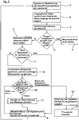
- Fig. 2 the process sequence is represented by status / process rectangles and decision diamond: According to the first rectangle 1, the system is ready for measuring the component service life. As a component example, a rubber-metal bearing of the wind turbine is assumed in the installed state.
- Such a trigger signal for a measurement start becomes corresponding Fig. 1 output when the preset wind speed is reached and a nacelle of the system is aligned with the wind.
- decision diamond 4 is also checked whether a predetermined temperature window is met in the measurement.
- additional boundary conditions may optionally be specified, for example, a rotor speed as an indicator that the system is not shut down.
- the measured value counter is nevertheless counted up in order to largely reduce otherwise given distortions of the measuring curve (rectangle 5).
- decision diamond 7 it is determined whether values for the deformation are present, this is not the case, the current measurement and evaluation cycle is terminated.
- Fig. 3 is a diagram of a typical measurement curve 14 for a component use of an elastically deformable component, shown here by way of example for a rubber-metal bearing of the wind turbine at successive within the same limits and time-offset loads occur.
- the respectively determined parameter for the stiffness is plotted upward on the Y-axis as 1 divided by deformation.
- the X-axis of the graph plots the number of readings taken as the useful life is interpretable, with an existing measured value in the diagram is shown as the measuring point 15 with equal intervals for each predetermined wind condition.
- the stiffness drops relatively quickly due to flowing and setting.
- the second stiffness region 17 which can be indicated by a straight line 18 by averaging out the measured value scattering, a plateau region is characterized by only a very small drop in stiffness. In the diagram, this stiffness range is shown for a better illustration with a relatively large inclination of the straight line 18.
- the second stiffness region 17 as a plateau region in comparison to the first and third stiffness region 16, 19 is shown substantially shortened / longer with many measured values 15 and here for a better clarification of the principal course of the measurement curve.
- a rapid progressive drop in stiffness is detected as an indication of a soon to be required replacement of the component corresponding to the rectangle 12 Fig. 1 .
- This progressive drop in stiffness as a clear deviation from the extension 20 of the straight line 18 can be detected quickly and easily shortly after it starts (for example, with the measured value 21).
Landscapes
- Engineering & Computer Science (AREA)
- Life Sciences & Earth Sciences (AREA)
- Sustainable Development (AREA)
- Sustainable Energy (AREA)
- Chemical & Material Sciences (AREA)
- Combustion & Propulsion (AREA)
- Mechanical Engineering (AREA)
- General Engineering & Computer Science (AREA)
- Wind Motors (AREA)
- Testing Of Devices, Machine Parts, Or Other Structures Thereof (AREA)
Claims (10)
- Éolienne comprenant un rotor et au moins un composant déformable élastiquement en tant que pièce structurelle et/ou pièce de palier, sur lequel agissent des forces de déformation différentes dépendant de conditions du vent variables pendant le fonctionnement, lesquelles forces entraînent une usure du composant limitant la durée de vie utile du composant,
caractérisée
en ce qu'une résistance du vent se reproduisant de manière différée, à chaque fois identique, est prédéterminée, à laquelle est associée une force de déformation déterminée, à chaque fois identique, et une telle résistance du vent peut être reconnue et détectée avec une unité de détection (33, 34, 35),
en ce qu'à la reconnaissance et à la détection d'une telle condition du vent prédéterminée (2), une opération de mesure est amorcée et effectuée (3) automatiquement par un signal de démarrage, et pour une surveillance du composant, une déformation du composant en tant que grandeur caractéristique d'une rigidité actuelle du composant étant mesurée avec au moins un capteur associé au composant et avec une unité de mesure et d'analyse (37) montée en aval et la valeur de mesures étant mémorisée,
en ce qu'avec une unité de comparaison de l'unité de mesure et d'analyse (37), une comparaison d'une valeur de mesure de déformation actuelle par rapport à des valeurs de mesure de déformation précédentes mémorisées est effectuée (9) avec pour résultat
que les valeurs de mesure de déformation mémorisées pendant une durée d'utilisation relativement longue, ou des grandeurs caractéristiques correspondantes de la rigidité du composant, sont approximativement identiques et une courbe de mesure (14) formée à partir des valeurs de mesure forme une zone de plateau (17) avec une faible augmentation d'inclinaison au cours de cette durée d'utilisation pour la déformation du composant, ou avec une faible diminution d'inclinaison pour la rigidité du composant, avec quoi l'on peut établir un fonctionnement des composants encore plus sûr, ou
qu'en variante, sur une durée d'utilisation courte par rapport à la durée d'utilisation de la zone de plateau, des valeurs de mesure de déformation détectées les unes après les autres deviennent successivement et progressivement plus grandes de telle sorte que l'on quitte (19) la zone de plateau avec une augmentation de la pente, plus forte par rapport à la zone de plateau, d'une courbe de mesure relative à la déformation du composant ou avec une diminution de l'inclinaison, plus forte par rapport à l'inclinaison de la zone de plateau, d'une courbe de mesure (14) relative à la rigidité du composant, de sorte que le début d'une durée de vie utile restante du composant, prédéfinissable et dépendant de l'usure, soit établi et qu'une information d'avertissement correspondante soit émise (12), en particulier dès qu'une augmentation de la pente ou qu'une diminution de l'inclinaison de la courbe de mesure (14), prédéfinie en tant que valeur de seuil, est atteinte. - Éolienne selon la revendication 1, caractérisée en ce qu'une zone (16) montante ou descendante de la courbe de mesure (14), détectée au début d'une utilisation du composant, n'est pas utilisée lors de l'analyse pour le début d'une durée de vie utile restante.
- Éolienne selon la revendication 1 ou 2, caractérisée en ce que la condition du vent prédéterminée est détectée directement en tant que vitesse du vent prédéterminée (33) lorsque le rotor (29) tourne transversalement au vent et/ou est détectée indirectement en tant que vitesse de rotation du rotor prédéterminée lorsque le rotor tourne transversalement au vent (29).
- Éolienne selon l'une quelconque des revendications 1 à 3, caractérisée en ce qu'au cas où, après le démarrage et la mise en oeuvre d'une opération de mesure, la condition du vent (33) détectée pour le démarrage s'interrompt pendant une durée prédéterminée, après un temps d'attente prédéterminé, une opération de mesure supplémentaire est à chaque fois automatiquement commencée et effectuée, sinon à chaque fois en présence d'une telle condition du vent, une seule opération de mesure est commencée et effectuée.
- Éolienne selon l'une quelconque des revendications 1 à 4, caractérisée en ce qu'un composant élastique surveillé est un palier en caoutchouc-métal, en particulier en tant que palier d'arbre et/ou palier de générateur et/ou palier de transmission et/ou des accouplements élastiques et/ou un palier pour une nacelle et/ou ses composants, et/ou
en ce qu'un composant élastique surveillé est une pièce structurelle en plastique, en particulier en matériaux composites renforcés par des fibres, en particulier une pale de rotor d'un rotor. - Éolienne selon l'une quelconque des revendications 1 à 5, caractérisée en ce que
la température ambiante autour du composant est détectée avec une unité de mesure de température et le début d'une opération de mesure et/ou l'exploitation d'une valeur de mesure est seulement lancée (4) lorsque la température ambiante pour chaque opération de mesure est située dans une fenêtre de température prédéfinissable à chaque fois identique, de préférence dans une plage de température de 6° C, la fenêtre de température pouvant être sélectionnée dans une plage de températures de 0° C à 35° C, et
en ce qu'en présence des autres conditions de démarrage, un compteur de valeurs de mesure est toutefois mis à la valeur maximale (5) lorsque seulement la condition de température et éventuellement d'autres conditions marginales prédéfinissables ne sont pas satisfaites pour le lancement. - Éolienne selon l'une quelconque des revendications 1 à 6, caractérisée en ce que la durée de vie utile antérieure du composant est détectée jusqu'à l'émission d'une information d'avertissement et avec l'information d'avertissement, est fournie une information d'une utilisation supplémentaire possible non critique ou jusqu'à un remplacement du composant obligatoirement nécessaire avec une durée d'utilisation supplémentaire en tant que durée de vie restante de 10 % de la durée de vie utile antérieure du composant.
- Éolienne selon l'une quelconque des revendications 1 à 7, caractérisée en ce que
l'on utilise en tant que capteur pour la mesure de la déformation du composant un système de capteurs pour la mesure d'un déplacement et/ou d'une vitesse et/ou d'une accélération, avec lequel une déformation peut être mesurée directement ou indirectement sous forme de déplacement entre des composants constitutifs et/ou des pièces rapportées, et
en ce que le système de capteurs est intégré au moins en partie dans le composant déformable et/ou est disposé sur des pièces rapportées adjacentes/voisines. - Éolienne selon l'une quelconque des revendications 1 à 8, caractérisée en ce que l'unité de détection et l'unité de mesure et d'analyse sont complètement ou partiellement intégrées avec leurs composants dans une électronique centrale de l'éolienne.
- Procédé pour déterminer le début d'une durée de vie utile restante, dépendant de l'usure, d'un composant déformable élastiquement en tant que pièce structurelle et/ou pièce de palier d'une éolienne, caractérisé par les caractéristiques de l'une quelconque des revendications 1 à 9.
Applications Claiming Priority (1)
| Application Number | Priority Date | Filing Date | Title |
|---|---|---|---|
| DE102015011761.0A DE102015011761B4 (de) | 2015-09-15 | 2015-09-15 | Windenergieanlage mit wenigstens einem elastisch verformbaren Bauteil und Verfahren zur Feststellung des Beginns einer verschleißbedingten Bauteil-Restnutzungsdauer in einer Windenergieanlage |
Publications (2)
| Publication Number | Publication Date |
|---|---|
| EP3144529A1 EP3144529A1 (fr) | 2017-03-22 |
| EP3144529B1 true EP3144529B1 (fr) | 2018-08-15 |
Family
ID=56925947
Family Applications (1)
| Application Number | Title | Priority Date | Filing Date |
|---|---|---|---|
| EP16001986.5A Active EP3144529B1 (fr) | 2015-09-15 | 2016-09-13 | Éolienne comprenant au moins un composant déformable elastiquement et procédé de détermination du début de la vie résiduelle d'un composant en fonction de l'usure dans une éolienne |
Country Status (3)
| Country | Link |
|---|---|
| EP (1) | EP3144529B1 (fr) |
| DE (1) | DE102015011761B4 (fr) |
| DK (1) | DK3144529T3 (fr) |
Families Citing this family (2)
| Publication number | Priority date | Publication date | Assignee | Title |
|---|---|---|---|---|
| DE102019135628A1 (de) * | 2019-12-20 | 2021-06-24 | fos4X GmbH | Verfahren zur Bestimmung einer Restnutzungsdauer einer Windenergieanlage und Windenergieanlage |
| AT523919B1 (de) * | 2020-08-14 | 2022-01-15 | Eologix Sensor Tech Gmbh | Messvorrichtung für Windkraftanlagen |
Family Cites Families (6)
| Publication number | Priority date | Publication date | Assignee | Title |
|---|---|---|---|---|
| US7945351B2 (en) * | 2008-12-12 | 2011-05-17 | Vestas Wind Systems A/S | Method for controlling the operation of a wind turbine based on deviation between operating and predetermined frequency response functions |
| US8279073B2 (en) * | 2009-09-18 | 2012-10-02 | General Electric Company | Systems, methods, and apparatus for monitoring and controlling a wind driven machine |
| EP2502174B1 (fr) * | 2009-11-16 | 2018-06-13 | Simmonds Precision Products, Inc. | Système d'acquisition de données pour maintenance conditionnelle |
| GB201110003D0 (en) * | 2011-06-14 | 2011-07-27 | Romax Technology Ltd | Identifying wind turbines for maintenance |
| US9605654B2 (en) * | 2012-07-24 | 2017-03-28 | General Electric Company | Wind turbine lifetime estimator |
| EP2853730A1 (fr) * | 2013-09-25 | 2015-04-01 | Siemens Aktiengesellschaft | Surveillance de charge mécanique d'un composant d'éolienne |
-
2015
- 2015-09-15 DE DE102015011761.0A patent/DE102015011761B4/de not_active Expired - Fee Related
-
2016
- 2016-09-13 DK DK16001986.5T patent/DK3144529T3/en active
- 2016-09-13 EP EP16001986.5A patent/EP3144529B1/fr active Active
Non-Patent Citations (1)
| Title |
|---|
| None * |
Also Published As
| Publication number | Publication date |
|---|---|
| DK3144529T3 (en) | 2018-12-10 |
| DE102015011761B4 (de) | 2018-05-09 |
| DE102015011761A1 (de) | 2017-03-16 |
| EP3144529A1 (fr) | 2017-03-22 |
Similar Documents
| Publication | Publication Date | Title |
|---|---|---|
| EP3729040B1 (fr) | Procédé basé sur un modèle et système de surveillance d'état d'un palier lisse, en particulier pour des éoliennes | |
| EP2565444B1 (fr) | Procédé et dispositif de surveillance d'état de pales de rotor | |
| DE102007017823B4 (de) | Turbolader mit einer Einrichtung zum Feststellen einer Fehlfunktion des Turboladers und ein Verfahren zum Feststellen einer solchen Fehlfunktion | |
| EP2927662B1 (fr) | Procédé et système de surveillance de l'état d'un palier de roulement d'une éolienne | |
| EP3397860B1 (fr) | Procédé permettant de déterminer une valeur pour une quantité d'accumulation de givre sur au moins une pale de rotor d'une éolienne et son utilisation | |
| EP3803114B1 (fr) | Arrangement de capteur pour un aérogénérateur | |
| EP3144658B1 (fr) | Appareil comprenant au moins un composant deformable elastiquement et procede de determination du debut de la vie residuelle d'un composant en fonction de l'usure | |
| EP2159418B1 (fr) | Procédé de fonctionnement d'une éolienne dotée d'un dispositif de mesure de la vitesse du vent | |
| DE102011115244A1 (de) | Verfahren und System zur Überwachung des Betriebszustands einer Pumpe | |
| EP3144529B1 (fr) | Éolienne comprenant au moins un composant déformable elastiquement et procédé de détermination du début de la vie résiduelle d'un composant en fonction de l'usure dans une éolienne | |
| DE102015011762B4 (de) | Schienenfahrzeug mit wenigstens einem elastisch verformbaren Bauteil und Verfahren zur Feststellung des Beginns einer verschleißbedingten Bauteil-Restnutzungsdauer an einem Schienenfahrzeug | |
| EP3358332B1 (fr) | Procédé de détermination de début d'une vie utile résiduelle en fonction d'un composant à déformation élastique comme une pièce structurelle et/ou pièce de support d'un appareil | |
| DE102017131241B4 (de) | Überwachungsverfahren für eine Windkraftanlage, zugehörige Überwachungsvorrichtung sowie Windkraftanlage mit Überwachungsvorrichtung | |
| EP3420224B1 (fr) | Procédé pour surveiller l'état oscillatoire d'une éolienne | |
| EP3144211B1 (fr) | Navire comprenant au moins un composant deformable elastiquement et procede de determination du debut d'une vie residuelle d'un composant sur un navire, en fonction de l'usure | |
| EP4348825A1 (fr) | Procédé et dispositif de surveillance pour surveiller l'état d'une machine | |
| EP4057094B1 (fr) | Procédé de détermination du début d'une durée d'utilité résiduelle de composant dépendant de l'usure d'un composant déformable de manière élastique, en tant que partie structurale et/ou partie de palier d'un appareil | |
| DE102015011763A1 (de) | Flugzeug mit wenigstens einem elastisch verformbaren Bauteil und Verfahren zur Feststellung des Beginns einer verschleißbedingten Bauteil-Restnutzungsdauer an einem Flugzeug | |
| DE102017000926B4 (de) | Gerät mit wenigstens einem elastisch verformbaren Bauteil, insbesondere einem Gummi-Metall-Lager und mit einer Einrichtung zur Feststellung des Beginns einer verschleißbedingten Bauteil-Restnutzungsdauer, sowie Verfahren zur Bestimmung der Bauteil-Restnutzungsdauer | |
| DE102023207829B4 (de) | Verfahren und System zum Erkennen von Anomalien in einem Satz von Signalen | |
| EP1189126A2 (fr) | Procédé de surveillance d'une installation | |
| DE102017219549A1 (de) | Verfahren zur Zustandsüberwachung einer Fertigungsanlage | |
| DE102020216210B4 (de) | System und Verfahren zur thermischen Überwachung großer Wälzlager | |
| DE102024126321A1 (de) | Verfahren zur Bestimmung einer Restlebensdauer eines Getriebes |
Legal Events
| Date | Code | Title | Description |
|---|---|---|---|
| PUAI | Public reference made under article 153(3) epc to a published international application that has entered the european phase |
Free format text: ORIGINAL CODE: 0009012 |
|
| AK | Designated contracting states |
Kind code of ref document: A1 Designated state(s): AL AT BE BG CH CY CZ DE DK EE ES FI FR GB GR HR HU IE IS IT LI LT LU LV MC MK MT NL NO PL PT RO RS SE SI SK SM TR |
|
| AX | Request for extension of the european patent |
Extension state: BA ME |
|
| 17P | Request for examination filed |
Effective date: 20170921 |
|
| RBV | Designated contracting states (corrected) |
Designated state(s): AL AT BE BG CH CY CZ DE DK EE ES FI FR GB GR HR HU IE IS IT LI LT LU LV MC MK MT NL NO PL PT RO RS SE SI SK SM TR |
|
| GRAP | Despatch of communication of intention to grant a patent |
Free format text: ORIGINAL CODE: EPIDOSNIGR1 |
|
| RIC1 | Information provided on ipc code assigned before grant |
Ipc: F03D 17/00 20160101AFI20180207BHEP |
|
| INTG | Intention to grant announced |
Effective date: 20180228 |
|
| GRAS | Grant fee paid |
Free format text: ORIGINAL CODE: EPIDOSNIGR3 |
|
| GRAA | (expected) grant |
Free format text: ORIGINAL CODE: 0009210 |
|
| AK | Designated contracting states |
Kind code of ref document: B1 Designated state(s): AL AT BE BG CH CY CZ DE DK EE ES FI FR GB GR HR HU IE IS IT LI LT LU LV MC MK MT NL NO PL PT RO RS SE SI SK SM TR |
|
| REG | Reference to a national code |
Ref country code: CH Ref legal event code: EP Ref country code: GB Ref legal event code: FG4D Free format text: NOT ENGLISH Ref country code: AT Ref legal event code: REF Ref document number: 1030081 Country of ref document: AT Kind code of ref document: T Effective date: 20180815 |
|
| REG | Reference to a national code |
Ref country code: IE Ref legal event code: FG4D Free format text: LANGUAGE OF EP DOCUMENT: GERMAN |
|
| REG | Reference to a national code |
Ref country code: DE Ref legal event code: R096 Ref document number: 502016001634 Country of ref document: DE |
|
| REG | Reference to a national code |
Ref country code: FR Ref legal event code: PLFP Year of fee payment: 3 |
|
| REG | Reference to a national code |
Ref country code: NL Ref legal event code: FP |
|
| REG | Reference to a national code |
Ref country code: DK Ref legal event code: T3 Effective date: 20181203 |
|
| REG | Reference to a national code |
Ref country code: LT Ref legal event code: MG4D |
|
| PG25 | Lapsed in a contracting state [announced via postgrant information from national office to epo] |
Ref country code: RS Free format text: LAPSE BECAUSE OF FAILURE TO SUBMIT A TRANSLATION OF THE DESCRIPTION OR TO PAY THE FEE WITHIN THE PRESCRIBED TIME-LIMIT Effective date: 20180815 Ref country code: IS Free format text: LAPSE BECAUSE OF FAILURE TO SUBMIT A TRANSLATION OF THE DESCRIPTION OR TO PAY THE FEE WITHIN THE PRESCRIBED TIME-LIMIT Effective date: 20181215 Ref country code: FI Free format text: LAPSE BECAUSE OF FAILURE TO SUBMIT A TRANSLATION OF THE DESCRIPTION OR TO PAY THE FEE WITHIN THE PRESCRIBED TIME-LIMIT Effective date: 20180815 Ref country code: GR Free format text: LAPSE BECAUSE OF FAILURE TO SUBMIT A TRANSLATION OF THE DESCRIPTION OR TO PAY THE FEE WITHIN THE PRESCRIBED TIME-LIMIT Effective date: 20181116 Ref country code: NO Free format text: LAPSE BECAUSE OF FAILURE TO SUBMIT A TRANSLATION OF THE DESCRIPTION OR TO PAY THE FEE WITHIN THE PRESCRIBED TIME-LIMIT Effective date: 20181115 Ref country code: BG Free format text: LAPSE BECAUSE OF FAILURE TO SUBMIT A TRANSLATION OF THE DESCRIPTION OR TO PAY THE FEE WITHIN THE PRESCRIBED TIME-LIMIT Effective date: 20181115 Ref country code: SE Free format text: LAPSE BECAUSE OF FAILURE TO SUBMIT A TRANSLATION OF THE DESCRIPTION OR TO PAY THE FEE WITHIN THE PRESCRIBED TIME-LIMIT Effective date: 20180815 Ref country code: LT Free format text: LAPSE BECAUSE OF FAILURE TO SUBMIT A TRANSLATION OF THE DESCRIPTION OR TO PAY THE FEE WITHIN THE PRESCRIBED TIME-LIMIT Effective date: 20180815 |
|
| PG25 | Lapsed in a contracting state [announced via postgrant information from national office to epo] |
Ref country code: HR Free format text: LAPSE BECAUSE OF FAILURE TO SUBMIT A TRANSLATION OF THE DESCRIPTION OR TO PAY THE FEE WITHIN THE PRESCRIBED TIME-LIMIT Effective date: 20180815 Ref country code: AL Free format text: LAPSE BECAUSE OF FAILURE TO SUBMIT A TRANSLATION OF THE DESCRIPTION OR TO PAY THE FEE WITHIN THE PRESCRIBED TIME-LIMIT Effective date: 20180815 Ref country code: LV Free format text: LAPSE BECAUSE OF FAILURE TO SUBMIT A TRANSLATION OF THE DESCRIPTION OR TO PAY THE FEE WITHIN THE PRESCRIBED TIME-LIMIT Effective date: 20180815 |
|
| PG25 | Lapsed in a contracting state [announced via postgrant information from national office to epo] |
Ref country code: RO Free format text: LAPSE BECAUSE OF FAILURE TO SUBMIT A TRANSLATION OF THE DESCRIPTION OR TO PAY THE FEE WITHIN THE PRESCRIBED TIME-LIMIT Effective date: 20180815 Ref country code: CZ Free format text: LAPSE BECAUSE OF FAILURE TO SUBMIT A TRANSLATION OF THE DESCRIPTION OR TO PAY THE FEE WITHIN THE PRESCRIBED TIME-LIMIT Effective date: 20180815 Ref country code: PL Free format text: LAPSE BECAUSE OF FAILURE TO SUBMIT A TRANSLATION OF THE DESCRIPTION OR TO PAY THE FEE WITHIN THE PRESCRIBED TIME-LIMIT Effective date: 20180815 Ref country code: ES Free format text: LAPSE BECAUSE OF FAILURE TO SUBMIT A TRANSLATION OF THE DESCRIPTION OR TO PAY THE FEE WITHIN THE PRESCRIBED TIME-LIMIT Effective date: 20180815 Ref country code: EE Free format text: LAPSE BECAUSE OF FAILURE TO SUBMIT A TRANSLATION OF THE DESCRIPTION OR TO PAY THE FEE WITHIN THE PRESCRIBED TIME-LIMIT Effective date: 20180815 Ref country code: IT Free format text: LAPSE BECAUSE OF FAILURE TO SUBMIT A TRANSLATION OF THE DESCRIPTION OR TO PAY THE FEE WITHIN THE PRESCRIBED TIME-LIMIT Effective date: 20180815 |
|
| REG | Reference to a national code |
Ref country code: DE Ref legal event code: R097 Ref document number: 502016001634 Country of ref document: DE |
|
| PG25 | Lapsed in a contracting state [announced via postgrant information from national office to epo] |
Ref country code: SM Free format text: LAPSE BECAUSE OF FAILURE TO SUBMIT A TRANSLATION OF THE DESCRIPTION OR TO PAY THE FEE WITHIN THE PRESCRIBED TIME-LIMIT Effective date: 20180815 Ref country code: SK Free format text: LAPSE BECAUSE OF FAILURE TO SUBMIT A TRANSLATION OF THE DESCRIPTION OR TO PAY THE FEE WITHIN THE PRESCRIBED TIME-LIMIT Effective date: 20180815 |
|
| REG | Reference to a national code |
Ref country code: BE Ref legal event code: MM Effective date: 20180930 |
|
| PLBE | No opposition filed within time limit |
Free format text: ORIGINAL CODE: 0009261 |
|
| STAA | Information on the status of an ep patent application or granted ep patent |
Free format text: STATUS: NO OPPOSITION FILED WITHIN TIME LIMIT |
|
| REG | Reference to a national code |
Ref country code: IE Ref legal event code: MM4A |
|
| PG25 | Lapsed in a contracting state [announced via postgrant information from national office to epo] |
Ref country code: MC Free format text: LAPSE BECAUSE OF FAILURE TO SUBMIT A TRANSLATION OF THE DESCRIPTION OR TO PAY THE FEE WITHIN THE PRESCRIBED TIME-LIMIT Effective date: 20180815 Ref country code: LU Free format text: LAPSE BECAUSE OF NON-PAYMENT OF DUE FEES Effective date: 20180913 |
|
| 26N | No opposition filed |
Effective date: 20190516 |
|
| PG25 | Lapsed in a contracting state [announced via postgrant information from national office to epo] |
Ref country code: IE Free format text: LAPSE BECAUSE OF NON-PAYMENT OF DUE FEES Effective date: 20180913 |
|
| PG25 | Lapsed in a contracting state [announced via postgrant information from national office to epo] |
Ref country code: BE Free format text: LAPSE BECAUSE OF NON-PAYMENT OF DUE FEES Effective date: 20180930 Ref country code: SI Free format text: LAPSE BECAUSE OF FAILURE TO SUBMIT A TRANSLATION OF THE DESCRIPTION OR TO PAY THE FEE WITHIN THE PRESCRIBED TIME-LIMIT Effective date: 20180815 |
|
| PGFP | Annual fee paid to national office [announced via postgrant information from national office to epo] |
Ref country code: DK Payment date: 20190917 Year of fee payment: 4 Ref country code: FR Payment date: 20190919 Year of fee payment: 4 Ref country code: NL Payment date: 20190926 Year of fee payment: 4 |
|
| PG25 | Lapsed in a contracting state [announced via postgrant information from national office to epo] |
Ref country code: MT Free format text: LAPSE BECAUSE OF FAILURE TO SUBMIT A TRANSLATION OF THE DESCRIPTION OR TO PAY THE FEE WITHIN THE PRESCRIBED TIME-LIMIT Effective date: 20180815 |
|
| PG25 | Lapsed in a contracting state [announced via postgrant information from national office to epo] |
Ref country code: TR Free format text: LAPSE BECAUSE OF FAILURE TO SUBMIT A TRANSLATION OF THE DESCRIPTION OR TO PAY THE FEE WITHIN THE PRESCRIBED TIME-LIMIT Effective date: 20180815 |
|
| PG25 | Lapsed in a contracting state [announced via postgrant information from national office to epo] |
Ref country code: PT Free format text: LAPSE BECAUSE OF FAILURE TO SUBMIT A TRANSLATION OF THE DESCRIPTION OR TO PAY THE FEE WITHIN THE PRESCRIBED TIME-LIMIT Effective date: 20180815 |
|
| REG | Reference to a national code |
Ref country code: CH Ref legal event code: PL |
|
| PG25 | Lapsed in a contracting state [announced via postgrant information from national office to epo] |
Ref country code: MK Free format text: LAPSE BECAUSE OF NON-PAYMENT OF DUE FEES Effective date: 20180815 Ref country code: HU Free format text: LAPSE BECAUSE OF FAILURE TO SUBMIT A TRANSLATION OF THE DESCRIPTION OR TO PAY THE FEE WITHIN THE PRESCRIBED TIME-LIMIT; INVALID AB INITIO Effective date: 20160913 Ref country code: CY Free format text: LAPSE BECAUSE OF FAILURE TO SUBMIT A TRANSLATION OF THE DESCRIPTION OR TO PAY THE FEE WITHIN THE PRESCRIBED TIME-LIMIT Effective date: 20180815 |
|
| PG25 | Lapsed in a contracting state [announced via postgrant information from national office to epo] |
Ref country code: LI Free format text: LAPSE BECAUSE OF NON-PAYMENT OF DUE FEES Effective date: 20190930 Ref country code: CH Free format text: LAPSE BECAUSE OF NON-PAYMENT OF DUE FEES Effective date: 20190930 |
|
| REG | Reference to a national code |
Ref country code: DK Ref legal event code: EBP Effective date: 20200930 |
|
| REG | Reference to a national code |
Ref country code: NL Ref legal event code: MM Effective date: 20201001 |
|
| GBPC | Gb: european patent ceased through non-payment of renewal fee |
Effective date: 20200913 |
|
| PG25 | Lapsed in a contracting state [announced via postgrant information from national office to epo] |
Ref country code: NL Free format text: LAPSE BECAUSE OF NON-PAYMENT OF DUE FEES Effective date: 20201001 |
|
| PG25 | Lapsed in a contracting state [announced via postgrant information from national office to epo] |
Ref country code: FR Free format text: LAPSE BECAUSE OF NON-PAYMENT OF DUE FEES Effective date: 20200930 |
|
| PG25 | Lapsed in a contracting state [announced via postgrant information from national office to epo] |
Ref country code: GB Free format text: LAPSE BECAUSE OF NON-PAYMENT OF DUE FEES Effective date: 20200913 |
|
| PG25 | Lapsed in a contracting state [announced via postgrant information from national office to epo] |
Ref country code: DK Free format text: LAPSE BECAUSE OF NON-PAYMENT OF DUE FEES Effective date: 20200930 |
|
| REG | Reference to a national code |
Ref country code: AT Ref legal event code: MM01 Ref document number: 1030081 Country of ref document: AT Kind code of ref document: T Effective date: 20210913 |
|
| PG25 | Lapsed in a contracting state [announced via postgrant information from national office to epo] |
Ref country code: AT Free format text: LAPSE BECAUSE OF NON-PAYMENT OF DUE FEES Effective date: 20210913 |
|
| PGFP | Annual fee paid to national office [announced via postgrant information from national office to epo] |
Ref country code: DE Payment date: 20250925 Year of fee payment: 10 |