EP3144774A1 - Procédés et appareil de transmission d'une information d'angle de rotation à un ensemble d'actionneurs associés à une surface - Google Patents
Procédés et appareil de transmission d'une information d'angle de rotation à un ensemble d'actionneurs associés à une surface Download PDFInfo
- Publication number
- EP3144774A1 EP3144774A1 EP15306415.9A EP15306415A EP3144774A1 EP 3144774 A1 EP3144774 A1 EP 3144774A1 EP 15306415 A EP15306415 A EP 15306415A EP 3144774 A1 EP3144774 A1 EP 3144774A1
- Authority
- EP
- European Patent Office
- Prior art keywords
- rubbing contact
- rotation angle
- translation vector
- texture
- properties
- Prior art date
- Legal status (The legal status is an assumption and is not a legal conclusion. Google has not performed a legal analysis and makes no representation as to the accuracy of the status listed.)
- Withdrawn
Links
Images

Classifications
-
- G—PHYSICS
- G06—COMPUTING OR CALCULATING; COUNTING
- G06F—ELECTRIC DIGITAL DATA PROCESSING
- G06F3/00—Input arrangements for transferring data to be processed into a form capable of being handled by the computer; Output arrangements for transferring data from processing unit to output unit, e.g. interface arrangements
- G06F3/01—Input arrangements or combined input and output arrangements for interaction between user and computer
- G06F3/03—Arrangements for converting the position or the displacement of a member into a coded form
- G06F3/041—Digitisers, e.g. for touch screens or touch pads, characterised by the transducing means
- G06F3/0414—Digitisers, e.g. for touch screens or touch pads, characterised by the transducing means using force sensing means to determine a position
-
- G—PHYSICS
- G06—COMPUTING OR CALCULATING; COUNTING
- G06F—ELECTRIC DIGITAL DATA PROCESSING
- G06F3/00—Input arrangements for transferring data to be processed into a form capable of being handled by the computer; Output arrangements for transferring data from processing unit to output unit, e.g. interface arrangements
- G06F3/01—Input arrangements or combined input and output arrangements for interaction between user and computer
- G06F3/016—Input arrangements with force or tactile feedback as computer generated output to the user
-
- G—PHYSICS
- G06—COMPUTING OR CALCULATING; COUNTING
- G06F—ELECTRIC DIGITAL DATA PROCESSING
- G06F2203/00—Indexing scheme relating to G06F3/00 - G06F3/048
- G06F2203/048—Indexing scheme relating to G06F3/048
- G06F2203/04809—Textured surface identifying touch areas, e.g. overlay structure for a virtual keyboard
-
- G—PHYSICS
- G06—COMPUTING OR CALCULATING; COUNTING
- G06F—ELECTRIC DIGITAL DATA PROCESSING
- G06F3/00—Input arrangements for transferring data to be processed into a form capable of being handled by the computer; Output arrangements for transferring data from processing unit to output unit, e.g. interface arrangements
- G06F3/01—Input arrangements or combined input and output arrangements for interaction between user and computer
- G06F3/048—Interaction techniques based on graphical user interfaces [GUI]
- G06F3/0487—Interaction techniques based on graphical user interfaces [GUI] using specific features provided by the input device, e.g. functions controlled by the rotation of a mouse with dual sensing arrangements, or of the nature of the input device, e.g. tap gestures based on pressure sensed by a digitiser
- G06F3/0488—Interaction techniques based on graphical user interfaces [GUI] using specific features provided by the input device, e.g. functions controlled by the rotation of a mouse with dual sensing arrangements, or of the nature of the input device, e.g. tap gestures based on pressure sensed by a digitiser using a touch-screen or digitiser, e.g. input of commands through traced gestures
Definitions
- the present disclosure relates to rendering haptic properties of a texture on a surface when rubbing a surface, for example when the surface is a touch screen of a tablet or a smartphone.
- Tablets and smartphones allow users to use their sense of touch to interact with media content such as video and pictures. For example, a user may "feel" the texture or the roughness of an image when he/she is touching a device by the means of haptic effects such as vibrations generated by actuators embedded in the end-user devices or roughness variations using dedicated "smart surfaces”.
- Texture rendering on a surface can be achieved by the means of versatile renderers able to change their own surface properties depending on the underlying texture properties to render.
- One example of such renderers implements an array of pins going up and down (like a dynamic braille surface) and/or left and right. In this way, the surface granularity may be modulated.
- This approach has the disadvantage not to be adapted to touch screens as it disturbs the viewing conditions.
- Another approach makes use of embedded actuators (e.g. piezoelectric vibrators) to give vibrations as a feedback.
- Another approach addresses the problem of texture rendering by translating the screen in space. Some systems use horizontal translations (in the plane of the screen, left and right for example), others use backward and forward translations (the screen moves away and closer to the user's finger).
- the purpose of the present disclosure is to overcome at least one of the disadvantages of the background.
- the present disclosure relates to a method of transmitting a rotation angle information to a set of at least one actuator associated with a surface, the method comprising:
- the rotation angle information is equal to the first rotation angle.
- the method further comprises:
- the method further comprises:
- the translation vector information is equal to the first translation vector.
- the translation vector information is an interpolation between a first and a second translation vector computed according to a first and a second rubbing contact and properties of the texture.
- the present disclosure also relates to an apparatus configured for transmitting a rotation angle information to a set of at least one actuator associated with a surface, the apparatus comprising:
- the present disclosure also relates to an apparatus configured for transmitting a rotation angle information to a set of at least one actuator associated with a surface, the apparatus comprising :
- the apparatus further comprises a transmitter transmitting an image associated to the texture to a display device.
- the present disclosure also relates to a computer program product comprising instructions of program code for executing, by at least one processor, the abovementioned method of transmitting a rotation angle information to a set of at least one actuator associated with a surface, when the program is executed on a computer.
- the present disclosure also relates to a (non-transitory) processor readable medium having stored therein instructions for causing a processor to perform at least the abovementioned method of transmitting a rotation angle information to a set of at least one actuator associated with a surface.
- a "texture” is an amount of data representative of the haptic properties of a surface of a real-world material.
- a texture comprises models describing, for example, friction, roughness and embossment of the surface of a material. For instance, rough stone is a coarse material with some granularity, velvet is smooth, sponge is soft and embossed and ice is flat and slippery. Texture may also comprise an image visually representative of the associated material.
- a "rubbing contact” is a physical contact between a surface and at least one object, the continuous contact moving on the surface with a non-zero speed.
- a system is used to detect parameters of a rubbing contact between the surface and at least one object (e.g. fingers of the user or a stylus).
- a rotation angle around an axis perpendicular to the direction of the rubbing contact is computed and transmitted to the at least one actuator.
- the at least one actuator makes the surface rotate around the provided axis.
- a slope is created in favour or in opposition to the current rubbing contact motion in order to simulate a lower or higher friction feedback depending on the underlying texture properties at the current contact position.
- the amplitude of the slope is a function of the friction level at the point of the rubbing contact and of parameters of the rubbing contact (e.g. the rubbing speed, the contact pressure, the contact area, ).
- the present principles further comprise interpolating the rotation angle over the time.
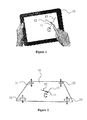
- Figure 1 illustrates an example of a rubbing contact on a surface (10).
- Figure 1 illustrates an example of a finger in a rubbing contact with the surface (10).
- the rubbing contact has a point location (11) and is moving according to a direction and a speed illustrated by the arrow (12).
- An axis (13) is computed.
- the axis (13) is contained within the plane of the surface (10) and is perpendicular to direction and speed (12) of the rubbing contact.
- the rotation angle is computed according to the rubbing contact parameters and according to the texture properties at the contact location.
- the rotation angle may be a function of direction and speed of the rubbing contact on one hand and of friction of the texture at the location of the rubbing contact on the surface.
- the function g determines the rotation angle in order to command to the set of at least one actuator to rotate the surface in the opposite or same direction than the direction of the rubbing contact. For instance, if in the direction the rubbing contact is moving, the friction parameter of the texture is high, the surface will incline oppositely to the movement of the rubbing contact in order to make a rising slope and to make the user's displacement harder. On the contrary, if the friction parameter of the texture is low (e.g. a slippery texture), the surface will incline according to the direction of the rubbing contact to create a falling slope and then to make the user's displacement easier.
- the rotation angle may be filtered making use of quaternion interpolation, according to a non-limiting embodiment.
- the apparatus considers a first pose of the surface, which is the pose of the surface at the moment of the current rubbing contact.
- a first rotation angle information i.e. an axis and an rotation angle
- the apparatus determines a second pose, which is the first pose rotated by the rotation angle information.
- the first pose is represented by a quaternion called q t-dt
- the second pose is represented by a quaternion called q t
- a second rotation angle information is computed according to a quaternion intermediate between q t-dt and q t , determined by an equation like [E2] for example.
- q q t - d t q t - d t - 1 .
- the parameter ⁇ controls the smoothness of the pose trajectory. High values of ⁇ leading to brutal change while low values correspond to slight changes.
- the second rotation angle information is transmitted to the set of at least one actuator.
- Figure 2 illustrates an exemplary diagram of a surface (10) associated with a set of at least one actuator.
- Figure 2 shows a rectangular surface associated with four actuators (21, 22, 23, 24) located at the four corners of the rectangular surface.
- the system may comprise three actuators or more.
- the format of the signal of containing the rotation angle information may be adapted to the set of actuators.
- each actuators may make the surface go up or down along the z-axis independently to cause a rotation of the surface.
- the surface At rest position, the surface is horizontal and the four actuators lie at a rest elevation called z h .
- these elevations are shifted by a value dz 1 for the actuator (21), dz 2 for the actuator (22), dz 3 for the actuator (23) and dz 4 for the actuator (24) making the surface rotate.
- Setting the values dz 1 , dz 2 , dz 3 and dz 4 may consist in solving a non-linear least-square optimization at each time t as in equation [E3].
- d z 1 , d z 2 , d z 3 t argmin d z 1 , d z 2 , d z 3 ⁇ q d z 1 , d z 2 , d z 3 - q t - d t q t - d t - 1 ⁇ q t ⁇ 2
- q ( dz 1 ,dz 2 ,dz 3 ) represents a quaternion associated with the pose of the surface computed according location (11), direction and speed (12) of the rubbing contact .
- the elevation shift dz 4 is linearly correlated to the three previous elevation shifts due to the hyper-static configuration of the system illustrated in Figure 2 .
- the rotation angle information transmitted to the set of actuators contains a list of four elevation shifts.
- a set of actuators as illustrated in Figure 2 has the advantage to allow vertical translations when the four elevation shifts are equal to each other.
- a translation vector information is computed in addition to and in correlation with the rotation angle information.
- the translation vector information is determined according to parameters of the texture such as embossment for example.
- a hollow on the texture e.g. on the surface of a sponge
- a bump at the opposite, takes the form of an elevation shift toward the up.
- the translation vector information may be combined with a rotation angle information.
- the surface is nested in a box on which the actuators are fixed.
- the reference plane of the surface depends on the inclination of the box.
- the at least one actuator is a robotic arm which can make the surface rotate and translate in every directions.
- the surface may translate in its own plane (e.g. horizontally, at the rest pose).
- Figure 3 shows a hardware embodiment of an apparatus (30) configured to transmit a rotation angle information to a set of at least one actuator associated with a surface.
- the device (30) comprises the following elements, connected to each other by a bus (36) of addresses and data that also transports a clock signal:
- the device (30) is connected to one or more display devices (38) of display screen type directly to the graphics card (32) to display images calculated in the graphics card.
- the contact receiver (35) is a touch screen and the display(38) is integrated to the apparatus (30).
- the apparatus (30) is connected, for example via the link (36), to a set of at least one actuator (39).
- register used in the description of memories (321), (33) and (34) designates in each of the memories mentioned, both a memory zone of low capacity (some binary data) as well as a memory zone of large capacity (enabling a whole program to be stored or all or part of the data representative of data calculated or to be displayed).
- the microprocessor (31) loads and executes the instructions of the program contained in the RAM (34).
- the random access memory (34) notably comprises:
- the algorithms implementing the steps of the method specific to the present disclosure and described hereafter are advantageously stored in the memory GRAM (321) of the graphics card (32) associated with the device (30) implementing these steps.
- the graphic processors (320) of the graphics card (32) loads these data into the GRAM (521) and execute the instructions of these algorithms in the form of microprograms of "shader" type using HLSL (High Level Shader Language) language or GLSL (OpenGL Shading Language) for example.
- HLSL High Level Shader Language
- GLSL OpenGL Shading Language
- the random access memory GRAM (321) notably comprises data representative of the texture and may contain an image representative of the texture (3210).
- a part of the RAM (33) is assigned by the CPU (31) for storage of the algorithms.
- the power supply (37) is external to the device (30).
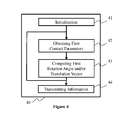
- Figure 4 diagrammatically shows an embodiment of a method (40) as implemented in a processing apparatus such as the apparatus (30) according to a non-restrictive advantageous embodiment.
- the apparatus obtains data representative of the texture, stored these data in a register (341) and reset its computational values according to the rest pose (i.e. default values at the rest pose).
- a step (42) consists in receiving parameters of a rubbing contact.
- the surface is a touch surface and the rubbing contact is detected on and by the touch surface.
- the data representative of the rubbing contact comprise parameters such as the touch area, the duration of the contact, the direction and the speed of the touch displacement and the pressure over the touch area. All these parameters are detected by the touch surface.
- the rubbing contact is detected by an external system such as a system of infra-red cameras or a pressure detection system. Parameters of the detected rubbing contact are transmitted to the apparatus (30) and received by the contact receiver (35).
- the step (43) is executed. If no change is detected, the surface does not need to rotate or to translate and the step (43) is not executed. According to a variant, the step (43) is executed at a constant rate even if no change is detected in the rubbing contact parameters.
- rotation angle information and/or translation vector information is/are computed according to the properties of the texture (341) at the rubbing contact location and to the rubbing contact parameters, in particular direction and speed of the rubbing contact and according to the principles presented in this disclosure.
- the rotation angle information and/or the translation vector information is/are transmitted to the set of at least one actuator at a step (44) that is executed each time a new information is computed.
- both rotation angle information and translation vector information are transmitted to the set of at least one actuator at a constant rate, even if they did not change.
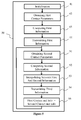
- Figure 5 diagrammatically shows another embodiment of a method (50) as implemented in a processing apparatus such as the apparatus (30) according to a non-restrictive advantageous embodiment.
- the method (50) begins with the same steps (41), (42), (43), (44) than the method (40).
- a step (51) consists in obtaining a second set of parameters of the rubbing contact, an instant after the step (42).
- a step (52) is executed to compute a second rotation angle information and/or a second translation vector information the same way the first rotation angle information and/or first translation vector information are computed.
- a third rotation angle information is computed as an interpolation between the first and the second rotation angle information.
- the third rotation angle information is obtained by interpolating quaternions associated with resulting poses of the surface once the first rotation angle information and the second rotation information are applied to the surface by the set of at least one actuator.
- a third translation vector information is computed as an interpolation between the first and the second translation vector information.
- the rotation angle information and the translation vector information are combined in one motion information.
- the computed information is transmitted to the set of at least one actuator at a step (54).
- the parameters of the second rubbing contact replace the parameters of the first rubbing contact in the registers of the apparatus (30).
- the second rotation angle information and the second translation vector information are stored in place of the first rotation angle information and the first translation vector information.
- the second motion information is stored in place of the first motion information.
- the apparatus (30) is ready to receive new rubbing contact parameters which are stored as second rubbing contact parameters at step (51).
- the present disclosure is not limited to the embodiments previously described.
- the present disclosure is not limited to a method of transmitting a rotation angle information to a set of at least one actuator associated with a surface but also extends to any method of rendering any texture property (e.g. roughness, embossment, granularity) implementing this rotating and/or translating rendering method.
- the implementation of calculations necessary to render the texture properties is not limited either to an implementation in shader type microprograms but also extends to an implementation in any program type, for example programs that can be executed by a CPU type microprocessor.
- the implementations described herein may be implemented in, for example, a method or a process, an apparatus, a software program, a data stream, or a signal. Even if only discussed in the context of a single form of implementation (for example, discussed only as a method or an apparatus), the implementation of features discussed may also be implemented in other forms (for example a program).
- An apparatus may be implemented in, for example, appropriate hardware, software, and firmware.
- the methods may be implemented in, for example, an apparatus such as, for example, a processor, which refers to processing devices in general, including, for example, a computer, a microprocessor, an integrated circuit, or a programmable logic device. Processors also include communication devices, such as, for example, smartphones, tablets, computers, mobile phones, portable/personal digital assistants ("PDAs”), and other devices.
- PDAs portable/personal digital assistants
- Implementations of the various processes and features described herein may be embodied in a variety of different equipment or applications, particularly, for example, equipment or applications associated with data encoding, data decoding, view generation, texture processing, and other processing of images and related texture information and/or depth information.
- equipment or applications associated with data encoding, data decoding, view generation, texture processing, and other processing of images and related texture information and/or depth information.
- Examples of such equipment include an encoder, a decoder, a post-processor processing output from a decoder, a pre-processor providing input to an encoder, a video coder, a video decoder, a web server, a set-top box, a laptop, a personal computer, a cell phone, a PDA, and other communication devices.
- the equipment may be mobile and even installed in a mobile vehicle.
- the methods may be implemented by instructions being performed by a processor, and such instructions (and/or data values produced by an implementation) may be stored on a processor-readable medium such as, for example, an integrated circuit, a software carrier or other storage device such as, for example, a hard disk, a compact diskette (“CD"), an optical disc (such as, for example, a DVD, often referred to as a digital versatile disc or a digital video disc), a random access memory (“RAM”), or a read-only memory (“ROM”).
- the instructions may form an application program tangibly embodied on a processor-readable medium. Instructions may be, for example, in hardware, firmware, software, or a combination.
- a processor may be characterized, therefore, as, for example, both a device configured to carry out a process and a device that includes a processor-readable medium (such as a storage device) having instructions for carrying out a process. Further, a processor-readable medium may store, in addition to or in lieu of instructions, data values produced by an implementation.
- implementations may produce a variety of signals formatted to carry information that may be, for example, stored or transmitted.
- the information may include, for example, instructions for performing a method, or data produced by one of the described implementations.
- a signal may be formatted to carry as data the rules for writing or reading the syntax of a described embodiment, or to carry as data the actual syntax-values written by a described embodiment.
- Such a signal may be formatted, for example, as an electromagnetic wave (for example, using a radio frequency portion of spectrum) or as a baseband signal.
- the formatting may include, for example, encoding a data stream and modulating a carrier with the encoded data stream.
- the information that the signal carries may be, for example, analog or digital information.
- the signal may be transmitted over a variety of different wired or wireless links, as is known.
- the signal may be stored on a processor-readable medium.
Landscapes
- Engineering & Computer Science (AREA)
- General Engineering & Computer Science (AREA)
- Theoretical Computer Science (AREA)
- Human Computer Interaction (AREA)
- Physics & Mathematics (AREA)
- General Physics & Mathematics (AREA)
- User Interface Of Digital Computer (AREA)
Priority Applications (2)
| Application Number | Priority Date | Filing Date | Title |
|---|---|---|---|
| EP15306415.9A EP3144774A1 (fr) | 2015-09-15 | 2015-09-15 | Procédés et appareil de transmission d'une information d'angle de rotation à un ensemble d'actionneurs associés à une surface |
| US15/265,799 US20170075480A1 (en) | 2015-09-15 | 2016-09-14 | Methods and apparatus of transmitting a rotation angle information to a set of at least one actuator associated with a surface |
Applications Claiming Priority (1)
| Application Number | Priority Date | Filing Date | Title |
|---|---|---|---|
| EP15306415.9A EP3144774A1 (fr) | 2015-09-15 | 2015-09-15 | Procédés et appareil de transmission d'une information d'angle de rotation à un ensemble d'actionneurs associés à une surface |
Publications (1)
| Publication Number | Publication Date |
|---|---|
| EP3144774A1 true EP3144774A1 (fr) | 2017-03-22 |
Family
ID=54293184
Family Applications (1)
| Application Number | Title | Priority Date | Filing Date |
|---|---|---|---|
| EP15306415.9A Withdrawn EP3144774A1 (fr) | 2015-09-15 | 2015-09-15 | Procédés et appareil de transmission d'une information d'angle de rotation à un ensemble d'actionneurs associés à une surface |
Country Status (2)
| Country | Link |
|---|---|
| US (1) | US20170075480A1 (fr) |
| EP (1) | EP3144774A1 (fr) |
Families Citing this family (3)
| Publication number | Priority date | Publication date | Assignee | Title |
|---|---|---|---|---|
| BR102018004967A2 (pt) * | 2018-03-13 | 2019-10-01 | Samsung Eletrônica da Amazônia Ltda. | Método para processar o movimento de ponteiros virtuais |
| FR3102866B1 (fr) * | 2019-10-30 | 2021-10-01 | Safran Electronics & Defense | Procédé de commande d’un actionneur de système mécanique à frottements imbriqués |
| CN111338489B (zh) * | 2020-02-21 | 2024-03-22 | 维沃移动通信有限公司 | 参数调整方法、电子设备 |
Citations (4)
| Publication number | Priority date | Publication date | Assignee | Title |
|---|---|---|---|---|
| US20100231508A1 (en) * | 2009-03-12 | 2010-09-16 | Immersion Corporation | Systems and Methods for Using Multiple Actuators to Realize Textures |
| US20130215079A1 (en) * | 2010-11-09 | 2013-08-22 | Koninklijke Philips Electronics N.V. | User interface with haptic feedback |
| US20140139450A1 (en) * | 2012-11-20 | 2014-05-22 | Immersion Corporation | System and Method for Simulated Physical Interactions With Haptic Effects |
| US20140320436A1 (en) * | 2013-04-26 | 2014-10-30 | Immersion Corporation | Simulation of tangible user interface interactions and gestures using array of haptic cells |
Family Cites Families (3)
| Publication number | Priority date | Publication date | Assignee | Title |
|---|---|---|---|---|
| KR100595926B1 (ko) * | 1998-01-26 | 2006-07-05 | 웨인 웨스터만 | 수동 입력 통합 방법 및 장치 |
| KR102163740B1 (ko) * | 2012-10-05 | 2020-10-12 | 삼성전자주식회사 | 플렉서블 디스플레이 장치 및 플렉서블 디스플레이 장치의 제어 방법 |
| US10359835B2 (en) * | 2013-04-17 | 2019-07-23 | Nokia Technologies Oy | Method and apparatus for causing display of notification content |
-
2015
- 2015-09-15 EP EP15306415.9A patent/EP3144774A1/fr not_active Withdrawn
-
2016
- 2016-09-14 US US15/265,799 patent/US20170075480A1/en not_active Abandoned
Patent Citations (4)
| Publication number | Priority date | Publication date | Assignee | Title |
|---|---|---|---|---|
| US20100231508A1 (en) * | 2009-03-12 | 2010-09-16 | Immersion Corporation | Systems and Methods for Using Multiple Actuators to Realize Textures |
| US20130215079A1 (en) * | 2010-11-09 | 2013-08-22 | Koninklijke Philips Electronics N.V. | User interface with haptic feedback |
| US20140139450A1 (en) * | 2012-11-20 | 2014-05-22 | Immersion Corporation | System and Method for Simulated Physical Interactions With Haptic Effects |
| US20140320436A1 (en) * | 2013-04-26 | 2014-10-30 | Immersion Corporation | Simulation of tangible user interface interactions and gestures using array of haptic cells |
Also Published As
| Publication number | Publication date |
|---|---|
| US20170075480A1 (en) | 2017-03-16 |
Similar Documents
| Publication | Publication Date | Title |
|---|---|---|
| US10016679B2 (en) | Multiple frame distributed rendering of interactive content | |
| AU2016262789B2 (en) | 3d modeling by tracing 2d image ui | |
| JP6831482B2 (ja) | アルファブレンディングを使用した動的な画像の色の再マッピングのための方法 | |
| US10977549B2 (en) | Object animation using generative neural networks | |
| CN106331687B (zh) | 根据参考部分的位置处理沉浸式视频内容的一部分的方法和设备 | |
| US10489937B2 (en) | Paintbrush and liquid simulation | |
| US10783716B2 (en) | Three dimensional facial expression generation | |
| US12482151B2 (en) | Stroke-guided sketch vectorization | |
| US20170213394A1 (en) | Environmentally mapped virtualization mechanism | |
| CN102307308B (zh) | 一种在触摸屏上生成立体图像的方法和设备 | |
| US20170075480A1 (en) | Methods and apparatus of transmitting a rotation angle information to a set of at least one actuator associated with a surface | |
| US10275919B1 (en) | Preventing transition shocks during transitions between realities | |
| US9959672B2 (en) | Color-based dynamic sub-division to generate 3D mesh | |
| US12511867B2 (en) | Machine learning model training using synthetic data for under-display camera (UDC) image restoration | |
| US20240119570A1 (en) | Machine learning model training using synthetic data for under-display camera (udc) image restoration | |
| EP3495922A1 (fr) | Procédé et dispositif pour générer un effet pseudo-haptique | |
| US20170076489A1 (en) | Methods and apparatus of composing an image of a textured material distorted when rubbing a touch surface | |
| US12573103B2 (en) | Environment map upscaling for digital image generation | |
| KR101630257B1 (ko) | 3d 이미지 제공 시스템 및 그 제공방법 | |
| US10579812B2 (en) | 3D digital content interaction and control | |
| US10380784B2 (en) | Electronic apparatus for mapping texture image and generating blending image | |
| CN114924658A (zh) | 一种终端设备及笔迹生成方法 | |
| CN110992444A (zh) | 图像处理方法、装置及电子设备 |
Legal Events
| Date | Code | Title | Description |
|---|---|---|---|
| PUAI | Public reference made under article 153(3) epc to a published international application that has entered the european phase |
Free format text: ORIGINAL CODE: 0009012 |
|
| AK | Designated contracting states |
Kind code of ref document: A1 Designated state(s): AL AT BE BG CH CY CZ DE DK EE ES FI FR GB GR HR HU IE IS IT LI LT LU LV MC MK MT NL NO PL PT RO RS SE SI SK SM TR |
|
| AX | Request for extension of the european patent |
Extension state: BA ME |
|
| 17P | Request for examination filed |
Effective date: 20170918 |
|
| RBV | Designated contracting states (corrected) |
Designated state(s): AL AT BE BG CH CY CZ DE DK EE ES FI FR GB GR HR HU IE IS IT LI LT LU LV MC MK MT NL NO PL PT RO RS SE SI SK SM TR |
|
| 17Q | First examination report despatched |
Effective date: 20180126 |
|
| GRAP | Despatch of communication of intention to grant a patent |
Free format text: ORIGINAL CODE: EPIDOSNIGR1 |
|
| RIC1 | Information provided on ipc code assigned before grant |
Ipc: G06F 3/041 20060101ALI20180621BHEP Ipc: G06F 3/01 20060101AFI20180621BHEP Ipc: G06F 3/0488 20130101ALN20180621BHEP |
|
| INTG | Intention to grant announced |
Effective date: 20180718 |
|
| STAA | Information on the status of an ep patent application or granted ep patent |
Free format text: STATUS: THE APPLICATION IS DEEMED TO BE WITHDRAWN |
|
| 18D | Application deemed to be withdrawn |
Effective date: 20181129 |