EP3144833A1 - Computervorrichtung und verfahren zur verbesserung klinischer behandlungspfade - Google Patents
Computervorrichtung und verfahren zur verbesserung klinischer behandlungspfade Download PDFInfo
- Publication number
- EP3144833A1 EP3144833A1 EP16169983.0A EP16169983A EP3144833A1 EP 3144833 A1 EP3144833 A1 EP 3144833A1 EP 16169983 A EP16169983 A EP 16169983A EP 3144833 A1 EP3144833 A1 EP 3144833A1
- Authority
- EP
- European Patent Office
- Prior art keywords
- clinical
- pathway
- care
- predefined
- pathways
- Prior art date
- Legal status (The legal status is an assumption and is not a legal conclusion. Google has not performed a legal analysis and makes no representation as to the accuracy of the status listed.)
- Withdrawn
Links
Images



Classifications
-
- G—PHYSICS
- G06—COMPUTING OR CALCULATING; COUNTING
- G06Q—INFORMATION AND COMMUNICATION TECHNOLOGY [ICT] SPECIALLY ADAPTED FOR ADMINISTRATIVE, COMMERCIAL, FINANCIAL, MANAGERIAL OR SUPERVISORY PURPOSES; SYSTEMS OR METHODS SPECIALLY ADAPTED FOR ADMINISTRATIVE, COMMERCIAL, FINANCIAL, MANAGERIAL OR SUPERVISORY PURPOSES, NOT OTHERWISE PROVIDED FOR
- G06Q50/00—Information and communication technology [ICT] specially adapted for implementation of business processes of specific business sectors, e.g. utilities or tourism
- G06Q50/10—Services
- G06Q50/22—Social work or social welfare, e.g. community support activities or counselling services
-
- G—PHYSICS
- G16—INFORMATION AND COMMUNICATION TECHNOLOGY [ICT] SPECIALLY ADAPTED FOR SPECIFIC APPLICATION FIELDS
- G16H—HEALTHCARE INFORMATICS, i.e. INFORMATION AND COMMUNICATION TECHNOLOGY [ICT] SPECIALLY ADAPTED FOR THE HANDLING OR PROCESSING OF MEDICAL OR HEALTHCARE DATA
- G16H10/00—ICT specially adapted for the handling or processing of patient-related medical or healthcare data
- G16H10/60—ICT specially adapted for the handling or processing of patient-related medical or healthcare data for patient-specific data, e.g. for electronic patient records
-
- G—PHYSICS
- G16—INFORMATION AND COMMUNICATION TECHNOLOGY [ICT] SPECIALLY ADAPTED FOR SPECIFIC APPLICATION FIELDS
- G16H—HEALTHCARE INFORMATICS, i.e. INFORMATION AND COMMUNICATION TECHNOLOGY [ICT] SPECIALLY ADAPTED FOR THE HANDLING OR PROCESSING OF MEDICAL OR HEALTHCARE DATA
- G16H40/00—ICT specially adapted for the management or administration of healthcare resources or facilities; ICT specially adapted for the management or operation of medical equipment or devices
- G16H40/20—ICT specially adapted for the management or administration of healthcare resources or facilities; ICT specially adapted for the management or operation of medical equipment or devices for the management or administration of healthcare resources or facilities, e.g. managing hospital staff or surgery rooms
Definitions
- the present invention relates to computer apparatus and a method for enhancing clinical pathways.
- Clinical authorities normally draw expertise from all concerned domains and compose and publish clinical guidelines as to the recommended best practice for practitioners to follow. These guidelines are implemented as instances of clinical pathways based on the constitution of the particular situation that each case presents. Decisions on how to treat patients using the clinical pathways are likely to require information from multidisciplinary resources and materials, e.g. administrative, personnel, education level, resource availability and other operational data.
- a modern healthcare system is normally formed from a complex network of interacting actors, processes and sub-systems.
- more than one actor for example, several clinicians, in more than one hospital or clinical centre, in the same or different countries
- more than one actor for example, several clinicians, in more than one hospital or clinical centre, in the same or different countries
- a patient may be subject to a raft of clinical pathways (e.g. exercised by different clinical centres).
- human beings seldom follow the text-book symptom description.
- a patient is presented to a health centre with more than one disease (co-morbidity), In case of co-morbidity, clinical pathways for different diseases need to be integrated and assessed so the clinicians can identify the best investigation and treatment solutions.
- a clinical pathway enhancement method in respect of a clinical pathway having a plurality of care steps, where the clinical pathway is a predefined clinical pathway which is associated with an individual patient or a cohort of patients, or a merged clinical pathway obtained by merging two or more such predefined clinical pathways associated with the patient or patient cohort
- the apparatus comprising: integration means configured to integrate the clinical pathway with at least one non-clinical process, the integration means being operable to associate non-clinical data from the non-clinical process with at least one care step which is related to that non-clinical data: and enriched pathway formation means configured to use the non-clinical data associated with the care step to produce one or more enriched clinical pathways.
- the enriched pathway formation means may be operable to align one or more predefined criteria of care steps in the enriched clinical pathway with one or more predefined criteria of related non-clinical steps in the non-clinical process
- the integration means may be operable to associate with a care step non-clinical data relating to administrative and/or clinical procedures, and/or clinical assets of one or more clinical centres, where the administrative and/or clinical procedures comprise at least one of: authorisation requirements; timing requirements; personnel requirements; cost requirements; and equipment requirements; and where the clinical assets comprise at least one of: staff resources; facilities; location; and equipment resources.
- Apparatus embodying the first aspect of the present invention may further comprise refinement means configured to determine, according to one or more predefined refinement conditions, whether to split or merge one or more care steps of the enriched clinical pathway, and, if so determined, to split or merge the care step(s) to produce a refined enriched clinical pathway.
- the refinement conditions may comprise at least one of: an expected positive or negative change in the patient's biological markers at that care step beyond a first predetermined threshold; an expected positive or negative change in the financial cost of the care step beyond a second predetermined threshold; and a requirement for that care step to involve more than one clinical centre.
- Apparatus embodying the first aspect of the present invention may further comprise selection means operable, where the total number of enriched clinical pathways is greater than one, to use status conditions indicative of the current status of the patient to dynamically select a preferred clinical pathway, from the enriched clinical pathways, which best meets one or more preset criteria.
- the selection means may be operable to select the preferred clinical pathway by identifying a set of candidate care steps from all the care steps in the enriched clinical pathways and ranking the candidate steps in the set in accordance with one or more preset criteria, and may identify the candidate care steps by comparing input conditions of each care step with a patient's current status.
- the one or more preset criteria for ranking the candidate steps may comprise at least one of: degree of similarity between the current patient status and the input conditions of the care step; likely output conditions of the care step; and possible prognosis as a result of the care step.
- Apparatus embodying the first aspect of the present invention may be operable, before carrying out the enrichment method, to model the or each predefined clinical pathway as a graph having labelled vertices respectively representing different care steps in the clinical pathway and interconnecting lines between the vertices representing the flow of the pathway, wherein the graph is subsequently used in the enrichment method.
- Apparatus embodying the first aspect of the present invention may further comprise pathway merging means configured to merge predefined clinical pathways to form a merged clinical pathway for enrichment in the clinical pathway enhancement method, which pathway merging means are operable to: compare the care steps and step order in one of the predefined clinical pathways with the care steps and step order in one or more other predefined clinical pathways; identify any care steps in the one predefined clinical pathway which match care steps and step order in one or more of the other predefined clinical pathways; select from any unmatched care steps in the predefined clinical pathways one or more care steps which satisfies most appropriately requirements for the merged clinical pathway which take into account the matched care steps, step order and information associated with the unmatched care step(s); and form the merged clinical pathway from the matching care steps and the selected care step(s).
- a computer-implemented clinical pathway enhancement method for enhancing a clinical pathway having a plurality of care steps, where the clinical pathway is a predefined clinical pathway which is associated with an individual patient or a cohort of patients, or a merged clinical pathway obtained by merging two or more such predefined clinical pathways associated with the patient or patient cohort, the method comprising: integrating the clinical pathway with at least one non-clinical process so as to associate non-clinical data from the non-clinical process with at least one care step which is related to that non-clinical data; and using the non-clinical data associated with the care step to produce one or more enriched clinical pathways.
- a method embodying the second aspect of the present invention may further comprise determining, according to one or more predefined refinement conditions, whether to split or merge one or more care steps of the enriched clinical pathway, and, if so determined, splitting or merging the care step(s) to produce a refined enriched clinical pathway.
- a method embodying the second aspect of the present invention may further comprise using status conditions indicative of the current status of the patient to dynamically select a preferred clinical pathway, where the total number of enriched clinical pathways is greater than one, which best meets one or more preset criteria.
- a computer program which, when run on a computer, causes that computer to carry out a method embodying the second aspect of the present invention.
- Apparatus and methods embodying the present invention can enrich and align clinical pathways with non-clinical processes to incorporate non-clinical data, to assist in decision making and ensure the most suitable services are delivered to a patient or a cohort of patients at the right moment.
- FIG. 1 A flowchart of a clinical pathway enhancement method embodying the present invention is shown in Figure 1 .
- the illustrated method is described with reference to an individual patient and comprises an optional first step (Step 1) of merging predefined clinical pathways for co-morbidity if a patient has more than one illness to which a predefined clinical pathway has been assigned.
- the second step (Step 2) of the method comprises integrating the clinical pathway with data from one or more non-clinical processes, from which an enriched clinical pathway is produced.
- the enriched clinical pathway may be refined so as to split the clinical pathway at one or more care steps, so as to produce two or more enriched clinical pathways.
- the enriched clinical pathways may be adapted to the current status of the patient and at least one preferred enriched clinical pathway selected.
- an embodiment of the present system merges two or more clinical pathways into a single pathway for better alignment and information transparency.
- Step 1 of the method of Figure 1 where the patient has more than one medical condition that requires treatment, a preliminary process is carried out in order to merge the predefined clinical pathways relating to those medical conditions to form a merged clinical pathway.
- This preliminary process may comprise: comparing the care steps and step order in one of the predefined clinical pathways with the care steps and step order in one or more other predefined clinical pathways; identifying any care steps in the one predefined clinical pathway which match care steps and step order in one or more of the other predefined clinical pathways; selecting from any unmatched care steps in the predefined clinical pathways one or more care steps which satisfies most appropriately requirements for the merged clinical pathway which take into account the matched care steps, step order and information associated with the unmatched care step(s); and forming the merged clinical pathway from the matching care steps and the selected care step(s).
- Clinical pathways can be integrated in different ways.
- the present application document describes, with reference to the flowchart of Figure 2 , an approach based on multiple strategies, in which clinical pathways are considered as graphs, with tasks (care steps or caring functions) as graph vertices where the interconnecting paths between vertices indicate the sequence or flow of processes. That is, the clinical pathways are considered as labelled, directed graphs.
- other approaches which also embody the present invention, may be used, such as applying methods from constraint satisfaction problems, or machine learning methods, for example.
- each predefined clinical pathway is modelled as a graph having labelled vertices respectively representing different care steps in the clinical pathway and interconnecting lines between the vertices representing the flow of the pathway.
- Initial alignment candidates are suggested based on graph characteristics (Step 21). For example, labels of pathway vertices can be used to find converging points where multiple pathways contain care steps in common. For instance, if two pathways suggest a histopathology check, this can be a care step where the two pathways should be merged.
- Step 22 of Figure 2 "Similarity propagation", it is considered how known similarities affect other unmatched care steps.
- Many existing string and graph based alignment technologies can be applied. The most basic one can be simple string distance computation based on the label strings. This can be enhanced with graph edit distance to penalise the initial string distance based suggestions. For instance, assume there are two pathways: A ⁇ B ⁇ C 1 ⁇ D ⁇ C 2 ⁇ E and A ⁇ C ⁇ E . After matching the " A " and " E " care steps, two candidate care steps could be aligned with " C ", namely C 1 and C 2 . The graph characteristics suggest that " C " has strong influence from "E”.
- candidate pathway vertices may be subject to further prioritisation based on the following aspects:
- quantification measures are necessary. For risk assessment, different levels of significance can be the basis for quantification. For instance, risk of immediate death can be quantified by a number between 7-10 with very high death risk corresponding to 10, and low death risk corresponding to 7. Alternatively, the quantification can be done based on statistics from a cohort of patients sharing the same characteristics. Other suitable quantification techniques are described, for example, in EP2677445A and EP2685407A .
- Cost for clinical centres can be easily obtained based on the cost of equipment and cost of personnel Vertices with high expected costs should be given higher priority when aligning. Merging such tests (for joint assessments) where appropriate can remove or lessen the chance of performing duplicated tests with high cost. Emphasis can also be given to caring functions that involve multiple different domains. For instance, if a caring function A involves multiple experts while a caring function B only summons up those from the same department, higher preference should be given to A.
- Step 26 After these factors are taken into account and there are no more merging points to be added (Step 26), and the steps which are to be included in the merged pathway have been chosen, a single clinical pathway is formulated (Step 27).
- Clinical pathways are not isolated from administrative and operational processes in a clinical centre. In many cases, the success of clinical pathway execution is highly dependent on non-clinical processes.
- the clinical pathway (predefined or merged) is integrated with at least one non-clinical process so as to associate non-clinical data from the non-clinical process with at least one care step which is related to that non-clinical data.
- the non-clinical data associated with the care step is used to produce one or more enriched clinical pathways.
- Such enhancement of the clinical pathway can help a clinician make better informed decisions on patient care.
- the non-clinical data may relate to administrative and/or clinical procedures (such as requirements for authorisation, timing, personnel, cost, and/or equipment) and/or clinical assets of one or more clinical centres (such as staff resources, facilities, location, and/or equipment resources).
- One or more predefined criteria of care steps in the enriched clinical pathway are preferably aligned with one or more predefined criteria of related non-clinical steps in the non-clinical process
- clinical and non-clinical processes may be integrated/aligned as follows:
- the domain ontology O asset can be used in ontology-based process alignment as follows:
- Step 32 - For each different hospital department from I CTA - LL , the corresponding business processes will be retrieved. Time constraints may be taken into account when integrating clinical pathways and business processes. In this case the integration will not be used to enrich a single pathway step. Instead, the integration serves to ensure that different steps from both clinical pathways and business processes are carried out along parallel timelines. For instance, assume A ⁇ B ⁇ C ⁇ D is a clinical pathway where C prompts a CTA to be carried out, and O ⁇ P ⁇ Q ⁇ R is a business process for acquiring and authorising a CTA from one of the available locations where Q indicates the approval of a referral and R the initial preparation for CTA. The integration process will enrich C with data from the business process. However, instead of expanding step C, a time constraint satisfaction algorithm will be used to parallelise steps before C, i.e. A ⁇ B with O ⁇ P, and steps following C, i.e. D, with R .
- Step 33 - The result may be multiple enriched clinical pathways (for instance due to the existence of multiple CTA sites).
- the system may evaluate the overall length of expected time period for each of the multiple enriched pathways and give higher preference to the pathway with the shortest overall duration of the parallelised pathway and business processes.
- Steps 34, 35 and 36 - These multiple enriched clinical pathway instances may then be subject to further refinement/re-sorting, based for example on resource/equipment availability, distance from the patient's location (if it is an inpatient procedure), cost of running, personnel availability, etc.
- Step 37 Clinical pathways enhanced (enriched) with data from non-clinical/business processes are thereby obtained.
- Enriched clinical pathways may be further refined to clearly define one or more patient caring milestones, as shown in Step 3 of Figure 1 . That is, in an embodiment of the present invention, it is determined, according to one or more predefined refinement conditions, whether to split or merge one or more steps of the enriched clinical pathway. If so the step(s) is split or merged to produce a refined enriched clinical pathway. For example, steps in two or more independent pathways may be merged to provide a common checkpoint across several pathways. Alternatively, it may be desirable to split a step into several sequential steps to provide a more detailed checkpoint in the pathway.
- the refinement conditions may comprise at least one of:
- the clinical pathways, merged, enriched and refined through the above processes, can be used to treat patients without further alteration. However, there may still be more than one enriched clinical pathway suitable for treating a patient, and the decision as to which clinical pathway to use can change during execution of a clinical pathway depending upon on the changing condition of each individual patient.
- status conditions indicative of the current status of the patient are used to dynamically select a preferred clinical pathway, from the enriched clinical pathways, which best meets one or more preset criteria.
- the preferred clinical pathway may be selected by identifying a set of candidate care steps from all the care steps in the enriched clinical pathways and ranking the candidate steps in the set in accordance with one or more preset criteria comprising, for example, at least one of: degree of similarity between the current patient status and the input conditions of the care step; likely output conditions of the care step; and possible prognosis as a result of the care step.
- the candidate care steps may be identified by comparing input conditions of each care step with a patient's current status.
- the input and output conditions are modelled.
- the input conditions may include a patient's biomarkers, vital sign readings, cost, time constraints (availability), physical constraints (e.g. constraints on mobility), etc.
- the output conditions may include the expected improvement or deterioration of a patient's biomarkers, vital sign readings, cost, as well as effectiveness and quality of care (for example as proposed in EP2677445A and EP2685407A .
- Step 41 - The patient's current status is modelled (including biomarkers, vital signs, time and physical constraints, medical histories, allergic reactions, etc.).
- Step 42 - The patient's current status is matched against the input conditions of each caring function. This filters out a set of candidate caring functions.
- the resultant set of candidate caring functions is then sorted based on:
- the clinical pathway selected for the patient by the method may change to a lesser or greater extent, effectively dynamically adapting the current clinical pathway to reflect the current status of both the patient and the clinical centre(s).
- Such an approach provides more flexibility than a single, rigid pathway.
- an embodiment of the present invention can enhance clinical pathways by integrating non-clinical data from related non-clinical processes into the clinical pathway to allow a clinician to make better decisions regarding a patient's treatment on the basis of the enriched pathways.
- multiple clinical pathways may be simplified by merging the pathways into one.
- Enriched pathways may be refined to define clear milestones and checkpoints to avoid delay in treatment.
- a pathway may be changed so as to dynamically adapt the care steps to the individual situation of each patient, thereby potentially shortening the course of caring and potentially reducing the cost of caring.
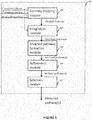
- computer apparatus 100 configured to carry out a clinical pathway enhancement method embodying the present invention may comprise: pathway merging module 101 configured to merge, if necessary, two or more predefined clinical pathways to form a merged clinical pathway for enhancement in the clinical pathway enhancement method; integration module 102 configured to integrate the clinical pathway (the merged clinical pathway or a predefined clinical pathway, as appropriate) with at least one non-clinical process by associating non-clinical data from the non-clinical process with at least one care step which is related to that non-clinical data; enriched pathway formation module 103 configured to use the non-clinical data associated with the care step to produce one or more enriched clinical pathways and align the timing of care steps in the enriched clinical pathway with the timing of related non-clinical steps in the non-clinical process; refinement module 104 configured to determine, according to one or more predefined refinement conditions, whether to split the enriched clinical pathway at one or more care steps in that clinical pathway, and, if so determined, to split the clinical pathway at the care step(s) to produce
- FIG. 6 is a block diagram of a computing device, such as a data storage server, which embodies the present invention, and which may be used to implement a method of an embodiment and perform the tasks of apparatus of an embodiment.
- the computing device comprises a computer processing unit (CPU) 993, memory, such as Random Access Memory (RAM) 995, and storage, such as a hard disk, 996.
- the computing device also includes a network interface 999 for communication with other such computing devices of embodiments.
- an embodiment may be composed of a network of such computing devices.
- the computing device also includes Read Only Memory 994, one or more input mechanisms such as keyboard and mouse 998, and a display unit such as one or more monitors 997.
- the components are connectable to one another via a bus 992.
- the CPU 993 is configured to control the computing device and execute processing operations.
- the RAM 995 stores data being read and written by the CPU 993.
- the storage unit 996 may be, for example, a non-volatile storage unit, and is configured to store data.
- the display unit 997 displays a representation of data stored by the computing device and displays a cursor and dialog boxes and screens enabling interaction between a user and the programs and data stored on the computing device.
- the input mechanisms 998 enable a user to input data and instructions to the computing device.
- the network interface (network I/F) 999 is connected to a network, such as the Internet, and is connectable to other such computing devices via the network.
- the network I/F 999 controls data input/output from/to other apparatus via the network.
- Other peripheral devices such as microphone, speakers, printer, power supply unit, fan, case, scanner, trackerball etc may be included in the computing device.
- Methods embodying the present invention may be carried out on a computing device such as that illustrated in Figure 6 . Such a computing device need not have every component illustrated in Figure 6 , and may be composed of a subset of those components.
- a method embodying the present invention may be carried out by a single computing device in communication with one or more data storage servers via a network.
- the computing device may be a data storage itself storing at least a portion of the data.
- a method embodying the present invention may be carried out by a plurality of computing devices operating in cooperation with one another.
- One or more of the plurality of computing devices may be a data storage server storing at least a portion of the data.
- Embodiments of the present invention may be implemented in hardware, or as software modules running on one or more processors, or on a combination thereof. That is, those skilled in the art will appreciate that a microprocessor or digital signal processor (DSP) may be used in practice to implement some or all of the functionality described above.
- DSP digital signal processor
- the invention may also be embodied as one or more device or apparatus programs (e.g. computer programs and computer program products) for carrying out part or all of the methods described herein.
- Such programs embodying the present invention may be stored on computer-readable media, or could, for example, be in the form of one or more signals.
- signals may be data signals downloadable from an Internet website, or provided on a carrier signal, or in any other form.
Landscapes
- Business, Economics & Management (AREA)
- Health & Medical Sciences (AREA)
- Engineering & Computer Science (AREA)
- General Business, Economics & Management (AREA)
- General Health & Medical Sciences (AREA)
- Primary Health Care (AREA)
- Public Health (AREA)
- Medical Informatics (AREA)
- Epidemiology (AREA)
- Biomedical Technology (AREA)
- Tourism & Hospitality (AREA)
- Physics & Mathematics (AREA)
- Strategic Management (AREA)
- General Physics & Mathematics (AREA)
- Marketing (AREA)
- Theoretical Computer Science (AREA)
- Human Resources & Organizations (AREA)
- Economics (AREA)
- Child & Adolescent Psychology (AREA)
- Medical Treatment And Welfare Office Work (AREA)
Applications Claiming Priority (1)
| Application Number | Priority Date | Filing Date | Title |
|---|---|---|---|
| GB1516433.8A GB2542374A (en) | 2015-09-16 | 2015-09-16 | Computer apparatus and method for enhancing clinical pathways |
Publications (1)
| Publication Number | Publication Date |
|---|---|
| EP3144833A1 true EP3144833A1 (de) | 2017-03-22 |
Family
ID=54363276
Family Applications (1)
| Application Number | Title | Priority Date | Filing Date |
|---|---|---|---|
| EP16169983.0A Withdrawn EP3144833A1 (de) | 2015-09-16 | 2016-05-17 | Computervorrichtung und verfahren zur verbesserung klinischer behandlungspfade |
Country Status (2)
| Country | Link |
|---|---|
| EP (1) | EP3144833A1 (de) |
| GB (1) | GB2542374A (de) |
Cited By (5)
| Publication number | Priority date | Publication date | Assignee | Title |
|---|---|---|---|---|
| CN109102845A (zh) * | 2018-08-14 | 2018-12-28 | 平安医疗健康管理股份有限公司 | 医疗单据审核方法、装置、计算机设备和存储介质 |
| WO2021037657A1 (en) * | 2019-08-26 | 2021-03-04 | Koninklijke Philips N.V. | Methods for the statistical analysis and predictive modeling of state transition graphs |
| WO2021037715A1 (en) * | 2019-08-26 | 2021-03-04 | Koninklijke Philips N.V. | Methods for the automatic construction of state transition graphs from the timeline data of individuals |
| CN113539504A (zh) * | 2021-06-29 | 2021-10-22 | 兰州大学第一医院 | 一种基于大数据的临床路径信息管理系统及方法 |
| WO2022240973A1 (en) * | 2021-05-11 | 2022-11-17 | F. Hoffmann-La Roche Ag | Patient pathway reconstruction and aggregation |
Citations (5)
| Publication number | Priority date | Publication date | Assignee | Title |
|---|---|---|---|---|
| CA2213997A1 (en) * | 1995-02-28 | 1996-09-06 | Clinicomp International, Inc. | Clinical critical care path system and method of using same |
| US20120231959A1 (en) * | 2011-03-04 | 2012-09-13 | Kew Group Llc | Personalized medical management system, networks, and methods |
| EP2677445A1 (de) | 2012-06-21 | 2013-12-25 | Fujitsu Limited | Computersystem, Verfahren und Programm zum Quantifizieren der Auswirkung einer physischen Aktivität auf den Körper |
| EP2685407A1 (de) | 2012-07-11 | 2014-01-15 | Fujitsu Limited | Computersystem, Verfahren und Programm zur Quantifizierung der Dienstleistungsbereitstellungsqualität |
| US20150066524A1 (en) * | 2013-09-05 | 2015-03-05 | Dorsata, Inc. | Methods and systems for the implementation of web based collaborative clinical pathways |
-
2015
- 2015-09-16 GB GB1516433.8A patent/GB2542374A/en not_active Withdrawn
-
2016
- 2016-05-17 EP EP16169983.0A patent/EP3144833A1/de not_active Withdrawn
Patent Citations (5)
| Publication number | Priority date | Publication date | Assignee | Title |
|---|---|---|---|---|
| CA2213997A1 (en) * | 1995-02-28 | 1996-09-06 | Clinicomp International, Inc. | Clinical critical care path system and method of using same |
| US20120231959A1 (en) * | 2011-03-04 | 2012-09-13 | Kew Group Llc | Personalized medical management system, networks, and methods |
| EP2677445A1 (de) | 2012-06-21 | 2013-12-25 | Fujitsu Limited | Computersystem, Verfahren und Programm zum Quantifizieren der Auswirkung einer physischen Aktivität auf den Körper |
| EP2685407A1 (de) | 2012-07-11 | 2014-01-15 | Fujitsu Limited | Computersystem, Verfahren und Programm zur Quantifizierung der Dienstleistungsbereitstellungsqualität |
| US20150066524A1 (en) * | 2013-09-05 | 2015-03-05 | Dorsata, Inc. | Methods and systems for the implementation of web based collaborative clinical pathways |
Cited By (6)
| Publication number | Priority date | Publication date | Assignee | Title |
|---|---|---|---|---|
| CN109102845A (zh) * | 2018-08-14 | 2018-12-28 | 平安医疗健康管理股份有限公司 | 医疗单据审核方法、装置、计算机设备和存储介质 |
| WO2021037657A1 (en) * | 2019-08-26 | 2021-03-04 | Koninklijke Philips N.V. | Methods for the statistical analysis and predictive modeling of state transition graphs |
| WO2021037715A1 (en) * | 2019-08-26 | 2021-03-04 | Koninklijke Philips N.V. | Methods for the automatic construction of state transition graphs from the timeline data of individuals |
| CN114365227A (zh) * | 2019-08-26 | 2022-04-15 | 皇家飞利浦有限公司 | 用于状态转换图的统计分析和预测建模的方法 |
| WO2022240973A1 (en) * | 2021-05-11 | 2022-11-17 | F. Hoffmann-La Roche Ag | Patient pathway reconstruction and aggregation |
| CN113539504A (zh) * | 2021-06-29 | 2021-10-22 | 兰州大学第一医院 | 一种基于大数据的临床路径信息管理系统及方法 |
Also Published As
| Publication number | Publication date |
|---|---|
| GB2542374A (en) | 2017-03-22 |
| GB201516433D0 (en) | 2015-10-28 |
Similar Documents
| Publication | Publication Date | Title |
|---|---|---|
| Al-Dmour et al. | Impact of AI and big data analytics on healthcare outcomes: an empirical study in Jordanian healthcare institutions | |
| Tresp et al. | Going digital: a survey on digitalization and large-scale data analytics in healthcare | |
| De Grood et al. | Adoption of e-health technology by physicians: a scoping review | |
| Preti et al. | Implementation of machine learning applications in health care organizations: systematic review of empirical studies | |
| Schulte et al. | How can big data analytics support people-centred and integrated health services: a scoping review | |
| Batista | The transforming clinical practice: The role of AI-powered medical assistants in enhancing healthcare efficiency and decision-making | |
| EP3144833A1 (de) | Computervorrichtung und verfahren zur verbesserung klinischer behandlungspfade | |
| US20230124321A1 (en) | Predicting performance of clinical trial facilitators using patient claims and historical data | |
| Dai et al. | Evaluating a natural language processing–driven, ai-assisted international classification of diseases, 10th revision, clinical modification, coding system for diagnosis related groups in a real hospital environment: Algorithm development and validation study | |
| US11348680B2 (en) | System for assignment of assessment tasks based on task criteria and reviewer credentials | |
| Urbi et al. | Technology and innovation in healthcare: adoption of AI and predictive analytics in hospital management | |
| Ganti | Beyond the Stethoscope: How Artificial Intelligence is Redefining Diagnosis, Treatment, and Patient Care in the 21st Century | |
| Alqadi et al. | Artificial Intelligence in Vascular Neurology: Applications, Challenges, and a Review of AI Tools for Stroke Imaging, Clinical Decision Making, and Outcome Prediction Models | |
| Allen et al. | The role of an artificial intelligence ecosystem in radiology | |
| Kapadia et al. | Enhancing efficiency with an AI-augmented clinician in neurology | |
| Algarni | CareAssist GPT improves patient user experience with a patient centered approach to computer aided diagnosis | |
| Melo Sierra et al. | Use of artificial intelligence in the management of stroke: scoping review | |
| Gao et al. | MoMA: a mixture-of-multimodal-agents architecture for enhancing clinical prediction modelling | |
| Salomi et al. | Need, application and characteristics of big data analytics in healthcare—A survey | |
| Sierra et al. | Use of artificial intelligence in the management of stroke: scoping review | |
| Sharma et al. | NLP in Medicine: Enhancing Diagnostics and Patient Care | |
| Georgiev et al. | Comparing care pathways between COVID-19 pandemic waves using electronic health records: a process mining case study | |
| He et al. | Applying Quantitative Approaches in the Use of RWE in Clinical Development and Life-Cycle Management | |
| Bhardwaj et al. | A novel and effective multi-class classification method for imbalanced medical transcriptions | |
| IBRAHIM | The Future of AI-Powered Healthcare: Revolutionizing Patient Care |
Legal Events
| Date | Code | Title | Description |
|---|---|---|---|
| PUAI | Public reference made under article 153(3) epc to a published international application that has entered the european phase |
Free format text: ORIGINAL CODE: 0009012 |
|
| AK | Designated contracting states |
Kind code of ref document: A1 Designated state(s): AL AT BE BG CH CY CZ DE DK EE ES FI FR GB GR HR HU IE IS IT LI LT LU LV MC MK MT NL NO PL PT RO RS SE SI SK SM TR |
|
| AX | Request for extension of the european patent |
Extension state: BA ME |
|
| STAA | Information on the status of an ep patent application or granted ep patent |
Free format text: STATUS: THE APPLICATION IS DEEMED TO BE WITHDRAWN |
|
| 18D | Application deemed to be withdrawn |
Effective date: 20170923 |