EP3144883A1 - Verfahren und vorrichtung zum schärfen eines videobildes mit unschärfeanzeige - Google Patents
Verfahren und vorrichtung zum schärfen eines videobildes mit unschärfeanzeige Download PDFInfo
- Publication number
- EP3144883A1 EP3144883A1 EP15306421.7A EP15306421A EP3144883A1 EP 3144883 A1 EP3144883 A1 EP 3144883A1 EP 15306421 A EP15306421 A EP 15306421A EP 3144883 A1 EP3144883 A1 EP 3144883A1
- Authority
- EP
- European Patent Office
- Prior art keywords
- video
- blurring
- indication
- video signal
- media content
- Prior art date
- Legal status (The legal status is an assumption and is not a legal conclusion. Google has not performed a legal analysis and makes no representation as to the accuracy of the status listed.)
- Withdrawn
Links
Images



Classifications
-
- G—PHYSICS
- G06—COMPUTING OR CALCULATING; COUNTING
- G06T—IMAGE DATA PROCESSING OR GENERATION, IN GENERAL
- G06T5/00—Image enhancement or restoration
- G06T5/73—Deblurring; Sharpening
-
- H—ELECTRICITY
- H04—ELECTRIC COMMUNICATION TECHNIQUE
- H04N—PICTORIAL COMMUNICATION, e.g. TELEVISION
- H04N1/00—Scanning, transmission or reproduction of documents or the like, e.g. facsimile transmission; Details thereof
- H04N1/32—Circuits or arrangements for control or supervision between transmitter and receiver or between image input and image output device, e.g. between a still-image camera and its memory or between a still-image camera and a printer device
- H04N1/32101—Display, printing, storage or transmission of additional information, e.g. ID code, date and time or title
- H04N1/32128—Display, printing, storage or transmission of additional information, e.g. ID code, date and time or title attached to the image data, e.g. file header, transmitted message header, information on the same page or in the same computer file as the image
-
- H—ELECTRICITY
- H04—ELECTRIC COMMUNICATION TECHNIQUE
- H04N—PICTORIAL COMMUNICATION, e.g. TELEVISION
- H04N1/00—Scanning, transmission or reproduction of documents or the like, e.g. facsimile transmission; Details thereof
- H04N1/40—Picture signal circuits
- H04N1/409—Edge or detail enhancement; Noise or error suppression
- H04N1/4092—Edge or detail enhancement
-
- H—ELECTRICITY
- H04—ELECTRIC COMMUNICATION TECHNIQUE
- H04N—PICTORIAL COMMUNICATION, e.g. TELEVISION
- H04N1/00—Scanning, transmission or reproduction of documents or the like, e.g. facsimile transmission; Details thereof
- H04N1/46—Colour picture communication systems
- H04N1/56—Processing of colour picture signals
- H04N1/58—Edge or detail enhancement; Noise or error suppression, e.g. colour misregistration correction
-
- G—PHYSICS
- G06—COMPUTING OR CALCULATING; COUNTING
- G06T—IMAGE DATA PROCESSING OR GENERATION, IN GENERAL
- G06T2207/00—Indexing scheme for image analysis or image enhancement
- G06T2207/10—Image acquisition modality
- G06T2207/10016—Video; Image sequence
Definitions
- the present disclosure generally relates to a method and apparatus for sharpening video content using an indication of blurring. More specifically, the present disclosure relates to creating and providing a blur metric and/or other blur information as a part of metadata associated with media content in order to adaptively sharpen the video image in the media content.
- the media content may be streamed from a content service provider or content aggregator to a user's device (e.g., a television, settop box, smart phone, tablet, and the like) over wired or wireless networks.
- the media content may also include visual effects shots or content that requires significant data bandwidth to deliver.
- the networks used to deliver the media content may have data bandwidth constraints that limit the delivery capability.
- the constraints may include inherent technical limits in the network(s) or bandwidth limiting by a service provider or aggregator based on fees paid by the user.
- the bandwidth constraints create a further problem as a result of the increasing availability of, and user desire for, higher resolution media content. In some instances, it may be useful or necessary to deliver some or all of the media content at a lower resolution that utilizes less data bandwidth in the network(s).
- Some resolution lowering techniques may introduce an artifact known as blurring of the video signal.
- Blurring results in the video image appearing out of focus, having a grainy quality, or lacking sharpness in the edges present in the video content.
- the blurring may be present in the video image either intentionally or as a byproduct of a resolution change.
- one type of blurring arises from motion that is not properly characterized or maintained during the application of video compression.
- a second type of blurring may be intentionally introduced as an artistic effect by creating or modifying all or a portion of an image or object as out of focus.
- the blurring may or may not be perceptible on all user devices.
- video processing to sharpen the image may be performed.
- the image sharpening is typically performed in a receiving device prior to display to the user.
- Image sharpening enhances the edges present in video content.
- the image sharpening is usually performed with little information regarding the source or reason for the blurring of the video image originally.
- the image sharpening in a receiving device it is possible for the image sharpening in a receiving device to introduce its own set of undesirable video artifacts including, but not limited to, noise enhancement, temporal artifacts, or spatial artifacts in the video image. Therefore, there is a need for an improved characterization of the blur, referred to as a blur metric. Further, there is a need to provide the blur characterization, or blur metric, with the delivered media content in order to allow the user device to process the media content and improve the user experience with the media content.
- a method includes providing an indication of blurring along with the video signal to a signal receiving device, wherein the indication of blurring is provided to improve the sharpness of the video image.
- an apparatus includes a network interface that provides an indication of blurring along with the video signal to a signal receiving device, the indication of blurring provided to improve the sharpness of the video image.
- the method includes receiving a video signal, the video signal including metadata representing an indication of blurring in the video signal, adjusting the sharpness of the video signal using the indication of the blurring recovered from the metadata, and providing the adjusted video signal for display on a display device.
- an apparatus includes a tuner that receives a video signal, the video signal including metadata representing an indication of blurring in the video signal, a video processor that adjusts the sharpness of the video signal using the indication of the blurring recovered from the metadata, and a display interface that provides the adjusted video signal for display on a display device.
- the elements shown in the figures may be implemented in various forms of hardware, software or combinations thereof. Preferably, these elements are implemented in a combination of hardware and software on one or more appropriately programmed general-purpose devices, which may include a processor, memory and input/output interfaces.
- general-purpose devices which may include a processor, memory and input/output interfaces.
- the phrase "coupled" is defined to mean directly connected to or indirectly connected with through one or more intermediate components. Such intermediate components may include both hardware and software based components.
- processor or “controller” should not be construed to refer exclusively to hardware capable of executing software, and may implicitly include, without limitation, digital signal processor (DSP) hardware, read only memory (ROM) for storing software, random access memory (RAM), and nonvolatile storage.
- DSP digital signal processor
- ROM read only memory
- RAM random access memory
- any switches shown in the figures are conceptual only. Their function may be carried out through the operation of program logic, through dedicated logic, through the interaction of program control and dedicated logic, or even manually, the particular technique being selectable by the implementer as more specifically understood from the context.
- any element expressed as a means for performing a specified function is intended to encompass any way of performing that function including, for example, a) a combination of circuit elements that performs that function or b) software in any form, including, therefore, firmware, microcode or the like, combined with appropriate circuitry for executing that software to perform the function.
- the disclosure as defined by such claims resides in the fact that the functionalities provided by the various recited means are combined and brought together in the manner which the claims call for. It is thus regarded that any means that can provide those functionalities are equivalent to those shown herein.
- the present disclosure addresses issues related to enhancing the viewing experience of media content delivered or streamed to a user device over a network.
- the media content may not be able to be delivered at a quality level that is the same as the original content due to limitations, such as data bandwidth, in the delivery of the media content over the network.
- the media content may be processed prior to delivery or streaming in order to convert the media content for delivery over a data bandwidth limited network.
- One or more of the processing functions used for delivering or streaming the media content may introduce blurriness into the video portion of the media content which may degrade the viewing experience of the user.
- the user may desire to improve the quality of the display video image by sharpening the video image.
- user initiated or other static image sharpening processes may not significantly improve or may actually degrade the viewing experience.
- sharpening of low or medium quality videos such as user generated content or content that requires a high level of video compression prior to delivery may over-amplify the high frequencies to improve the display of the video image.
- the over-amplification may lead to artifacts including, but not limited to, noise enhancement, temporal artifacts, and spatial image displacement artifacts.
- Higher quality content such as professional movies that are delivered with a lower level of video compression, may include blurred images corresponding to an artistic intent that needs to be preserved. In these cases, sharpening of the video image is likely not desirable.
- the present disclosure describes an apparatus and method for sharpening video content using an indication of blurring.
- the apparatus and method may include receiving and processing a video signal to determine an indication of the blurring in the video signal.
- the blur indication may be determined in a number of ways.
- the blur indication includes a blur metric that is determined using a gradient value on each side of each of the pixels in the first video image and the second video signal.
- the gradient values are further processed to determine a blur metric for a range of amounts of blurring.
- the blur metric may be further normalized to be monotonic in a range from zero to one for the range of amounts of blurring.
- the apparatus and method may include determining extremal values of blur for a series of video images in the video signal and providing these values along with, or instead of, a blur metric.
- extremal values of blur are the smallest (minimum) or largest (maximum) values for a blur measurement or metric.
- the extremal values may be determined for an area around a single point in the image, referred to as a relative or local extremal value, or over the entire image.
- the series of images may make up what is referred to as a shot for the portion of the video signal.
- the blur metric and/or extremal values i.e., maximum and minimum levels
- the blur indication is provided as metadata with the media content signal and may be streamed, or otherwise delivered, to users for processing and display.
- the present disclosure also describes an apparatus and method for receiving and processing media content that includes an indication of blurring in the video signal in order to adaptively sharpen the video image for display.
- One or more embodiments describe receiving and using an indication of blurring included as part of metadata for media content in order to process a video image or video signal that is part of the media content.
- the indication of blurring may include a blur metric for the video signal and/or extremal values for blurring present in the video signal.
- the indication of blurring is used in conjunction with a video sharpening circuit to improve the display of the video signal.
- the blur metric and/or the extremal values for blurring are used to adjust the processing of the high frequency portion of the video signal in order to sharpen the image for the video signal.
- the indication of blurring may also be used to provide an indication to a user that some or all of the media content provided and displayed is blurry.
- the present disclosure describes one or more specific embodiments for generating, providing, and using blur indication information, or a blur metric, associated with a media content file (e.g., movie or television show) as it relates to media content conversion for network download or streaming over a network
- the principles may be applicable to other media content conversion and delivery mechanisms.
- similar principles may be applied to disk replication techniques.
- similar principles may be applied to media content creation and/or processing done by a user using home devices (e.g., a computer and portable camera).
- the blur indication information may be used as part of additional video processing along with image sharpening in a receiving device to enhance the displayed video image, such as dynamic range enhancement processing.
- Such modifications are considered within the ability of one skilled in the art.
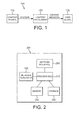
- FIG. 1 a block diagram of an embodiment of a system 100 for implementing media content delivery is shown.
- the system 100 includes a content source 110, content processing block 120, and a user device 130 coupled together. Each of these will be discussed in more detail below.
- the content source 110 may be a server or other storage device, such as a hard drive, flash storage, magnetic tape, optical disc, or the like.
- the content source 110 may be located at a facility used by a content owner, a facility used by a content provider, or a facility used by a content aggregator.
- the content source 110 provides media content (e.g., audio and video) to content processing block 120.
- the media content may include content at more than one video resolution and/or video format.
- the media content may also include special content, such as visual effects (VFX) shots.
- the content may be in any number of formats and resolutions. In one embodiment, some or all of the media content is provided in ultra high definition (UHD) resolution and format, also known as 4K resolution using high dynamic range (HDR) contrast.
- UHD ultra high definition
- HDR high dynamic range
- Other formats and resolutions, including different combinations within the same media content are possible as are well known to those skilled in the art.
- the content processing block 120 may be co-located with the content source 110 or may be located at a different facility (e.g., content source 110 at content owner facility and content processing block 120 at content aggregator facility).
- the content processing block 120 analyzes the media content from content source 110 to determine how to best optimize the conversion, reformatting, or scaling of the media content.
- the optimization, along with any processing, may be performed automatically within central processing block 120 with external inputs from an operator.
- the optimization may also be performed manually by an operator providing direct inputs for the various processing functions.
- the content processing block 120 may also encode, re-encode, or transcode some or all of the media content.
- the encoding, re-encoding, or transcoding may change the format or resolution of the media content in order to facilitate delivery over a network and reception by user device 130.
- the content processing block 120 also provides metadata to accompany the media content. Some of the metadata may be provided along with the media content from the content source 110. Other metadata may be generated, or the provided metadata may be modified, based on the analysis of the original media content. The metadata may also be generated or modified based on the various processing functions (e.g., encoding, upscaling, conversion, re-formatting) performed in content processing block 120.
- metadata may also be generated or modified based on the various processing functions (e.g., encoding, upscaling, conversion, re-formatting) performed in content processing block 120.
- the user device 130 is typically interfaced to the content processing block 120 through one or more networks including, but not limited to, the Internet, a wide area network (WAN), and a broadcast medium (e.g., terrestrial, cable, satellite).
- the use device 130 typically includes circuitry for receiving and processing the media content and metadata received from the content processing block 120.
- the user device 130 also may include the processing circuitry for rendering or displaying the video portion of the media content at a desired resolution.
- the user device 130 also receives and processes the metadata along with the media content.
- the user device 130 may use the metadata to optimize or improve the rendering or display of the media content.
- the metadata may be used to upscale visual effects or other portions of the media content from a lower resolution to a higher resolution.
- the user device 130 may be, but is not limited to, a gateway device, a television, a desktop computer, a laptop computer, a game console, a settop box, a smart phone, an augmented reality device, a virtual reality device, and a tablet.
- the metadata includes an indication of blurring, such as a global blur metric value and/or extremal blurring level values, as a result of video signal processing of the media content.
- the video data may have been either intentionally blurred or may become blurred due to, or as an artifact of, processing in processing block 120.
- the blur indication information may be used in conjunction with other metadata in a processing circuit in user device 130 to adaptively sharpen the video content prior to display to the user.
- the blur metric value and information may further be used to provide an indication of blurring in order to determine if sharpening the video content is necessary or desirable.
- the generation of blur indication information as well as the use of the blur indication information to sharpen the video content for display will be described in further detail below.
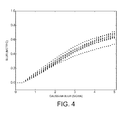
- FIG. 2 a block diagram of an electronic device 200 used for processing media content in accordance with the present disclosure is shown.
- the electronic device 200 includes one or more processors 210 coupled to metadata generator 220, memory 230, storage 240, and network interface 250. Each of these elements will be discussed in more detail below.
- Electronic device 200 may operate in a manner similar to content processing block 120 described in FIG. 1 . Additionally, certain elements necessary for complete operation of electronic device 200 will not be described here in order to remain concise as those elements are well known to those skilled in the art.
- the media content is received in electronic device 200 from a content source (e.g., content source 110 described in FIG. 1 ) and provided to processor(s) 210.
- the processor(s) 210 controls the operation of the electronic device 200.
- the processor(s) 210 runs the software that operates electronic device 200 and further provides the functionality associated with video optimization for the video portion of the media content such as, but not limited to, encoding, reformatting, converting and scaling.
- the processor(s) 210 also handles the transfer and processing of information between metadata generator 220, memory 230, storage 240, and network interface 250.
- the processor(s) 210 may be one or more general purpose processors, such as microprocessors, that operate using software stored in memory 230.
- Processor(s) 210 may alternatively or additionally include one or more dedicated signal processors that include a specific functionality (e.g., encoding, reformatting, converting, or scaling).
- Metadata generator 220 creates parameters and informational data associated with the media content based on the originally received media content and/or the processed media content in processor(s) 210.
- the metadata may be generated based on the results of the analysis and optimization performed as part of the processing of the media content in processor(s) 210.
- the metadata may include instructions that will be provided to a user device (e.g., user device 130 described in FIG. 3 ) as to how to best optimize rendering or display of the visual content.
- the metadata may include code or hardware specific instructions for an upscaler and/or decoder in the user device.
- the metadata may be time synchronized to the particular scene that was analyzed in the scene analysis process.
- the metadata generator 220 may also perform a verification of the metadata to determine whether the metadata achieves the desired result or otherwise does not adversely affect the desired optimization as part of rendering or display of the media content.
- the verification may be performed by using the metadata for the desired optimization and reviewing the result as part of a display.
- the parameters and/or metadata may be further adjusted as necessary.
- the memory 230 stores software instructions and data to be executed by processor(s) 210. Memory 230 may also store temporary intermediate data and results as part of the processing of the media content, either by processor(s) 210 or metadata generator 220.
- the memory 230 may be implemented using volatile memory (e.g., static RAM), non-volatile memory (e.g., electronically erasable programmable ROM), or other suitable media.
- Storage 240 stores the data used and produced by the processor in executing the analysis and optimization of the media content for a longer period of time. In some cases, the resulting converted media content may be stored for later use, for instance, as part of a later request by a different user.
- Storage 240 may include, but is not limited to magnetic media (e.g., a hard drive), optical media (e.g., a compact disk (CD)/digital versatile disk (DVD)), or electronic flash memory based storage.
- the network interface 250 provides a communication interface for electronic device 200 to provide the converted media content and associated metadata to other devices (e.g., user device 130 described in FIG. 1 ) over a wired or wireless network.
- suitable networks include broadcast networks, Ethernet networks, Wi-Fi enabled networks, cellular networks, and the like. It is important to note that more than one network may be used to deliver content to the other devices. For example, the media content and associated metadata may first be packaged for delivery over a cable network controlled by a service provider before terminating into one of the other suitable networks listed above.
- the metadata generator 220 processes the video signal from the media content to produce an indication of blurring for the video.
- the indication of blurring in conjunction with other metadata, may be provided to and used by a processing circuit in a user device (e.g., user device 130 described in FIG.1 ) to process the received video signal.
- a global metric for blur may be generated in metadata generator 220.
- the global metric for blur may be used to sharpen the received video signal for display to a user. Sharpening the video signal typically removes or mitigates the blurriness present in the video signal. Sharpening the video may also improve the apparent focus in the video content and may also improve the definition of edges in the video content.
- the global metric for blur may also be used to enhance the rendering or display of the video portion of the media content.
- extremal (e.g., minimum and maximum) values of the blur metric may be computed for a section or shot in the video content.
- a section or shot may include a group of visually-consistent and semantically-coherent frames in the video signal. It is important to note that in some embodiments the global metric for blur and extremal values may both be computed and provided to the user device. The generation of a blur metric value and additional blur information will be described in further detail below.
- the electronic device 200 can include any number of elements and certain elements can provide part or all of the functionality of other elements. Other possible implementations will be apparent to one skilled in the art given the benefit of the present disclosure.
- Process 300 may be implemented as part of content processing block 120 described in FIG. 1 .
- Process 300 may also be implemented in a processing device such as electronic device 200 described in FIG. 2 .
- Process 300 involves receiving media content, processing the media content, producing metadata associated with the media content, and providing the metadata related to the media content along with the processed media content to a network for use in a user device (e.g., user device 130 described in FIG. 1 ).
- the media content is received from a content source, (e.g., content source 110 described in FIG. 1 ).
- the media content may include both an audio portion and a video portion and may further include metadata associated with the audio and/or video portion.
- the media content may be in any number of formats and resolutions.
- the content includes a visual effect in a first resolution that is different from the video resolution for the remaining media content. Examples of visual effects include, but are not limited to, matte paintings, live action effects (such as green screening), digital animation, computer enhanced graphics, and digital effects.
- the visual effect may be provided in standard definition (SD) resolution (e.g., 480i, 480P) or high definition (HD)resolution (e.g., 720p, 1080i, 1080p) while the remaining media content may be provided in UHD.
- SD standard definition
- HD high definition
- the processing, at step 320 may include determining the initial resolution and format for the media content, determining the desired output resolution and format for the media content to be delivered to the user device, and performing the necessary conversion of the received media content.
- the processing, at step 320 may also include analyzing the video portion of the media content to determine the one or more video resolutions contained in the video (e.g., visual effects may be in a first resolution).
- the analysis is used to determine how to best optimize the rendering or display of the content.
- the analysis may be done on a scene-by-scene or shot-by-shot basis that includes providing a time code based mapping of image optimization requirements.
- the analysis may initially be performed on the media content received from the content source with a second analysis performed on the converted media content to produce final results.
- the analysis may also be performed only on the converted media content.
- Parameters used as part of analysis and optimization include, but are not limited to, high frequency content, spectral noise content, dynamic range, the amount of focus in the scene or lack of focus in the scene, amount of motion, color, brightness, shadowing, bit depth, block size, and quantization level.
- the parameters may take into account the rendering abilities and limitations of display rendering hardware (e.g., the display on a user device).
- step 320 further processing may be performed on the media content to determine how to best optimize the visual effects content using such parameters.
- the optimization may include how to best upscale the video effects content from a lower resolution to a higher resolution.
- this optimization may involve the encoding of the visual effects content or otherwise changing the format or resolution of portions of the media content for delivery as a signal over a network.
- Certain visual conditions present in the media content may require an adjustment to various settings for noise, chroma and scaling to avoid artifacts and maximize the quality of the viewing experience.
- the optimizations can also account for the abilities or limitations of the hardware being used for the processing of the received media content in a user device. For example, some scenes may have a higher concentration of visual effects, animated shots may transition into a very detailed image, or portions of the video signal may have a very high contrast ratio.
- the variance in scenes require different encoding that may introduce blurring, either intentionally or as an artifact, in order to reduce bandwidth of the delivered signal.
- the metadata may include instructions for the rendering device 130 to best optimize rendering or display of the visual content.
- the metadata may include code or hardware specific instructions for an upscaler and/or decoder of a user device (e.g., use device 130 described in FIG. 1 ).
- the metadata may be time synchronized to the particular scene that was analyzed in the scene analysis process.
- Metadata instructions include generic parameters such as sharpness, contrast, or noise reduction.
- the metadata may also include specific instructions for different types of devices or hardware.
- the metadata includes a blur metric for some or all of processed media content file.
- the metadata may be verified to determine that metadata achieves the desired result or otherwise does not adversely affect the desired optimization as part of rendering or display of the media content.
- the verification may be performed by using the metadata for the desired optimization and reviewing the result.
- the parameters and/or metadata may be further adjusted as necessary.
- a master or reference file may be created for each piece of content.
- the file includes two elements:
- step 340 once the metadata is produced and, if necessary, verified, in step 330, the metadata along with the converted media content is provided for delivery to a user device over a network.
- the generation of a blur metric may be based on the analysis of processed media content.
- the blur metric may be specifically computed using the luminance information in the video signal portion of the media content.
- An image u from the media content is analyzed and an integral image of u is computed.
- the integral image u is computed to increase the speed of the blur step.
- the implementation determines a separate blur metric for the horizontal direction and vertical direction, denoted as B h and B v .
- B max B h B v .
- processing e.g., in processing block 120 described in FIG. 1 or in processor(s) 210 described in FIG. 2 ) produces a blurred image in the chosen direction.
- the sum of the gradients of the image is computed and the sum of the variance of the gradients, denoted as S v , is computed. It is important to note that the variance is evaluated only when the absolute differences between the gradient of the original image and the gradient of the blurry image are greater than zero.
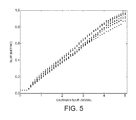
- a representative blur metric B h over a plurality of images covering a range of gaussian blur in each image is shown in FIG. 4 . While the blur metric value shown in equation 7 provides an acceptable indication of blurring in an image, influences from a number of parameters associated with the image as well as the content of the image itself limit or restrict the effectiveness of this blur metric. Further improvement in blur may be achieved by modification of the computation, limiting range of computation, and in further linearizing the metric values for the range of Gaussian blur.
- the computation of the blur metric may include linearization of the blur metric over the range of [0,1] in order to have better surjectivity (i.e., that the interval of confidence to identify the amount of blurriness from the blur metric is better).
- the blur metric may be linearized by adjusting the curve to be more linear and monotonic over a wider range of the interval [0,1] for a range of Gaussian blur.
- a polynomial function P is applied to the computed blur metric B (e.g., the combination of B h and B V ).
- one possible polynomial P is found from the minimization of the following: min a , b , c , d , e ⁇ n ay n 4 + by n 3 + cy n 2 + dy n + e - x n 2 .
- n y n 8 ⁇ n y n 7 ⁇ n y n 6 ⁇ n y n 5 ⁇ n y n 4 ⁇ n y n 7 ⁇ n y n 6 ⁇ n y n 5 ⁇ n y n 4 ⁇ n y n 3 ⁇ n y n 6 ⁇ n y n 5 ⁇ n y n 4 ⁇ n y n 3 ⁇ n y n 2 ⁇ n y n 5 ⁇ n y n 4 ⁇ n y n 3 ⁇ n y n 2 ⁇ n y n 5 ⁇ n y n 4 ⁇ n y n 3 ⁇ n y n 2 ⁇ n y n ⁇ n y n 4 ⁇ n y n 3 ⁇ n y n 2 ⁇ n y n ⁇ n y
- the polynomial P may be determined experimentally, or otherwise learned by processing a set of different images and different values of blur.
- the coefficients for polynomial P may be fixed for the computation based on the determination.
- An exemplary set of coefficients is shown below:
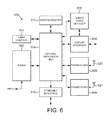
- FIG. 5 An exemplary final blur metric, after applying the polynomial P to the improved blur metric, for a series of images in media content over a range of Gaussian blur, is shown in FIG. 5 .
- a global metric for blur may be determined or otherwise determined by first obtaining the blur measure B as described in above (e.g., equation 7).
- An offset value equal to 2/(2 ⁇ +1) is subtracted from the blur measure B in order to obtain a minimal value that is close to zero (0) for perfectly sharp images, where ⁇ is related to a property of the video processing filter.
- the shifted value for the blur measure B is linearized by applying a polynomial function to the shifted value for the blur measure B in order to get a maximal value close to one (1) for highly blurred images (e.g., Gaussian blur > 5).
- the computed global metric for blur may be provided to a user device (e.g., user device 130 described in FIG. 1 ) in order to improve the sharpness of the delivered video signal.
- the minimum and maximum values of the blur metric may also be computed for portions of the video signal. It is important to note that, in some embodiments, the minimum and maximum values for blur may be determined in the user device after receiving the media content with the metadata including the global metric for blur.
- FIG. 6 a block diagram of an exemplary user device 600 according to aspects of the present disclosure is shown.
- User device 600 may operate in a manner similar to user device 130 described in FIG. 1 .
- User device 600 may also be configured as a home gateway device capable of receiving a signal including media content and metadata over a wired or wireless network and capable of providing a video output signal for display.
- user device 600 receives an input signal from a cable or digital subscriber line (DSL) network.
- DSL digital subscriber line
- user device 600 it is important to note that other embodiments similar to user device 600 are also possible using aspects of the present disclosure described here including, but not limited to, a television, a desktop computer, a laptop computer, a game console, a settop box, a smart phone, an augmented reality device, a virtual reality device, and a tablet.
- an input signal containing media content that has been processed for streaming delivery along with metadata is provided as an input to tuner 602.
- Tuner 602 connects to central processor unit 604.
- Central processor unit 604 connects to audio/video decoder 605, display interface 606, transceiver 608, transceiver 609, Ethernet interface 610, system memory 612, and user control 614.
- Audio/video decoder 605 further connects to display interface 606.
- Transceiver 608 further connects to antenna 620.
- Transceiver 609 further connects to antenna 621. It is important to note that several components and interconnections necessary for complete operation of user device 600 are not shown in the interest of conciseness, as the components not shown are well known to those skilled in the art.
- User device 600 may be capable of operating as an interface to a cable or DSL communication network and further may be capable of providing an interface to one or more devices connected through either a wired and wireless home network.
- Tuner 602 performs RF modulation functions on a signal provided to the network and demodulation functions on a signal received from the network.
- the RF modulation and demodulation functions are the same as those commonly used in communication systems, such as cable or DSL systems.
- Tuner 602 provides the demodulated signal to central processor unit 604.
- Central processing unit 604 digitally processes the signal to recover the media content and metadata.
- Central processing unit 604 also includes circuitry for processing the metadata along the with media content in order to provide an improved viewing experience for the video signal in the media content.
- central processor unit 604 also processes and directs any data received from any of the interfaces in gateway 600 for delivery to tuner 602 and transmission to the network.
- the metadata may include an indication of blurring for the media content.
- the blur indication may include a blur metric, such as the global metric for blur described earlier.
- the blur metric may be a characterization of a specific portion of the media content (e.g., a frame of video, a block of pictures, a scene segment, or a special effects portion) or may be a time synchronized characterization of the entire media content program.
- the blur indication may include extremal values (e.g., minimum and maximum values) for the blurring of the signal or for the blur metric.
- Audio/video decoder 605 processes the video portion of the demodulated signal.
- the processing may include transport layer processing as well as video decoding using one or more video decoding standard, such as Motion Picture Entertainment Group (MPEG) standard MPEG-2 coding, Advance Video Coding (AVC), or High Efficiency Video Coding (HEVC).
- MPEG Motion Picture Entertainment Group
- AVC Advance Video Coding
- HEVC High Efficiency Video Coding
- Audio/video decoder 605 may also process the decoded video for use with a video display through display interface 606.
- Audio/video decoder 605 may further process the audio portion of the demodulated signal using any one of a number of audio decoding standards and provide the audio signal to an audio interface, not shown.
- System memory 612 supports the processing and control functions in central processor unit 604 and also serves as storage for program and data information. Processed and/or stored digital data from central processor unit 604 is available for transfer to and from Ethernet interface 610. Ethernet interface may support a typical Registered Jack (RJ) type RJ-45 physical interface connector or other standard interface connector and allow connection to an external local computer. Processed and/or stored digital data from central processor unit 604 along with video signals from video decoder 605 are also available for display through display interface 606. Display interface 606 provides an interface to a display unit, such as a monitor or television. In some embodiments, the display unit may be included in user device 600 as part of display interface 606.
- RJ Registered Jack
- Display interface 606 provides an interface to a display unit, such as a monitor or television. In some embodiments, the display unit may be included in user device 600 as part of display interface 606.
- Central processor unit 604 is also operative to receive and process user input signals provided via a user control interface 614, which may include a display and/or a user input device such as a hand-held remote control and/or other type of user input device.
- a user control interface 614 may include a display and/or a user input device such as a hand-held remote control and/or other type of user input device.
- media content along with metadata that is associated with the media content is received from a network, processed through tuner 602 and provided to central processor unit 604.
- Metadata including the indication of blurring, is extracted in central processor unit 604 and provided to audio/video decoder 605 along with the video stream portion of the media content.
- the blur indication is used during the processing of the video portion of the media content in video decoder 605 in order to sharpen the video image based on the desired display performance or display capabilities.
- three metadata elements for the blur indication are used for adaptive sharpening of the video content.
- an input image I is separated into high-frequency component I h and a low frequency component I I , which is equal to I - I h .
- the separation may be performed using many different types of filters including, but not limited to, an iterated median filter, edge preserving filters, bilateral filter, and a rolling guidance filter.
- the blur ratio is applied to one or more coefficients or to a kernel size in the separation filter.
- the blur ratio may be used to adapt the kernel size of an iterated median filter or a bilateral filter.
- the function that maps the blur ratio to the kernel size may be a continuous strictly increasing function and may also be a simple linear function It is important to note that a non-linear function may also be implemented (e.g., a logic or boolean function).
- the blur ratio is used to control the separation. The more blur that is present in the frame the smaller the portion of signal for the input image that is present in the high frequency portion of the separated image.
- the high frequency portion of the separated image is amplified to enhance edges and sharpen the image using an amplification coefficient ⁇ .
- the amplification coefficient ⁇ is adjusted or tuned using the blur ratio described earlier.
- the blur ratio is also used to control the amplification. The more blur that is present in the image, the less sharpening (i.e., less amplification or smaller coefficient ⁇ ) of the high frequency portion of the separated image occurs.
- the mapping function between ⁇ and the blur ratio may be a continuous strictly decreasing linear function. However, other implementations may use non-linear functions (e.g., a logic or Boolean function).
- Process 700 may be implemented as part of user device 130 described in FIG. 1 .
- Process 700 may also be implemented as part of user device 600 described in FIG. 6 .
- Process 700 includes receiving the media content to be optimized for display along with metadata used for optimizing the media content, processing the metadata to determine the parameters (e.g., a blur metric, extremal values for blurring), processing the media content including modifying the media content based on the parameters, and providing the processed video content portion of the media content for display.
- the parameters e.g., a blur metric, extremal values for blurring
- the media content along with the metadata is received over a network.
- the media content and metadata may be streamed as a data file to a user device (e.g., user device 600 described in FIG. 6 ) over a broadcast service provider network or may be delivered through a wired or wireless network from the Internet.
- the received metadata is processed.
- the metadata is processed to extract instructions and parameters that may be used in conjunction with video processing performed on the media content in a user device. Parameters, such as a blur metric and/or extremal blur values, are extracted and may be used in conjunction with reformatting and video rescaling to adjust the video sharpening of video signal.
- the blur metric may also be used to indicate the presence of blurriness in the video signal to a user.
- the metadata may also include adjustment to various settings for noise, chroma, and scaling to avoid artifacts and maximize the quality of the viewing experience on the user device.
- the media content is processed.
- the media content may be processed based on inherent instructions included in the metadata for the media content.
- the processing may include decoding, decompression, rescaling, and conversion functions.
- the inherent instructions may reverse some or all of the video processing functions that were applied to the original media content (e.g., in central processing block 120 described in FIG. 1 ).
- the processing may be replaced or augmented based on instructions and parameters recovered from the received metadata at step 720.
- the instructions and parameters provided by the metadata for handling or otherwise presenting the video portion of media content may be used for optimizing the processing functions of some or all of the media content.
- the optimization of the processing based on the metadata may include accounting for the abilities or limitations of the hardware being used for the rendering or display of the media content.
- blur indication information such as a blur metric and/or extremal blur values, is used in conjunction with the optimization and processing of the media content in order to sharpen the video image for display. Further details regarding the use of blur indication information in a receiving device will described below.
- the processed media content that has been further optimized based on the received metadata is provided for display.
- the display may be a separate display device from the user device or may be integrated as part of the user device that received the media content and metadata from the network.
- the media content and the metadata may not be provided together.
- the media content file may be downloaded or provided as a data file stream over a network and stored.
- a user device may be identified for display of the media content and a separate metadata file may be downloaded and used to augment and/or improve the processing of the media content to enhance the visual appearance of the media content on the identified user device.
- the media content file may be provided on a storage medium, such as a DVD, Blu-Ray DVD, flash memory, or hard drive.
- the metadata file may be downloaded or provided as a data file stream over a network at a later time such as when the user desires to view the media content file.
- Other possible delivery mechanisms and formats are also possible as are known to those skilled in the art given the benefit of this disclosure.
- FIG. 8 a flowchart of a process 800 for sharpening the image in a video display signal using an indication of blurring in accordance with the present disclosure is shown.
- Process 800 will primarily be described in relation to user device 600 described in FIG. 6 . Some or all of process 800 may be implemented as part of video decoder 605 and/or central processing unit 604 described in FIG. 6 . Process 800 may also be implemented as part of user device 130 described in FIG. 1 .
- Process 800 many include extracting metadata, including the indication of blurring and providing the metadata, along with a video signal, for video decoding.
- the indication of blurring is used during the processing of the video portion of the media content in video decoder 605 in order to sharpen the video image.
- the image sharpening may be a preset operational condition, such as a condition established by a media content service provider, or may be based on the desired display performance or display capabilities.
- the video images in the video content are separated into a high frequency portion and a low frequency portion using the indication of blurring. Typically, the separation frequency may be adapted using the indication of blurring.
- the high frequency portion of the separated video image is amplified to enhance edges and sharpen the image using an amplification coefficient that is also based on the indication of blurring.
- the amplified high frequency portion of the separated image is recombined with the low frequency portion to form a processed video image and the processed video signal is provided for use in a display device.
- video content including metadata associated with the video content
- the video content may be received at the receiving circuit in a user device (e.g., tuner 603) and delivered from a video streaming service or other Internet service provider.
- the video content may alternatively by provided from a fixed or portable data storage device including, but not limited to, an optical disk, a magnetic storage disk, or an electronic memory storage device.
- metadata including the indication of blurring, is extracted. The extraction may be performed in a processing unit (e.g., central processing unit 604) and/or in a video decoder (e.g., video decoder 605).
- the indication of blurring includes two extremal values of blur over the shot or a series of frames, as well as current blur metric value for some or all of the video images or frames in the video content. It is important to note that other indications of blurring may be used instead of, or in place of, the two extremal values and/or the current blur metric value.
- the indication of blurring is used during the processing of the video portion of the media content in order to sharpen the video image based on the desired display performance or display capabilities.
- the video content is separated into a high frequency portion and a low frequency portion based on the indication of blurring information.
- the indication of blurring is used to adaptively adjust or tune the separation frequency between the high frequency portion and low frequency portion.
- the separation may be performed in a video decoder (e.g., audio/video decoder 605) using many different types of filters including, but not limited to, an iterated median filter, edge preserving filters, bilateral filter, and a rolling guidance filter.
- the two extremal values of blur over the shot or a series of frames, as well as current blur metric value are used to determine a blur ratio, as described earlier.
- the blur ratio is used to adjust the characteristic of the separation filter.
- the high frequency portion of the video image is level-adjusted based on the indication of blur information.
- the high frequency portion of the separated image may be adjusted (e.g., amplified or attenuated) in a video decoder (e.g., audio/video decoder 605) to enhance edges and sharpen the image using an amplification coefficient ⁇ .
- the amplification coefficient ⁇ is adjusted or tuned using the blur ratio as described earlier.
- the amplified high frequency portion of the video image is recombined with the low frequency portion of the video image.
- the recombination, at step 840 may also be performed in a video decoder (e.g., audio/video decoder 605).
- recombined video image, including the processed high frequency portion is provided as a video signal for further processing.
- the further processing may include providing the video signal to a display device through a display interface (e.g., display interface 606).
- a blurry video signal may be provided over a network (e.g., through a media content streaming service) to a user device.
- the user device may determine an indication of blurring using aspects of steps 720 and 730 described in process 700.
- the indication of blurring may be used to sharpen the video content for display using aspects of steps 820, 830, 840, and 850 described in process 800.
- Some delay or latency will likely exist in order to determine the indication of blurring, particularly if extremal values for blurring are determined.
- one or more steps of process 300 described in FIG. 3 and one or more steps of process 700 described in 700 may be combined into one process and implemented in a single device (e.g., user device 130 described in FIG. 1 ).
- the processing and determination of metadata, including an indication of blurring, at step 330 may be implemented in the user device as part of a modified process 700 after receiving the media content from a content provider, at step 710.
- One or more embodiments above describe an apparatus and method for sharpening video content using an indication of blurring.
- the embodiments include receiving a processing video signal to determine an indication of the blurring in the video signal.
- the blur indication may be determined in a number of ways.
- the blur indication is determined using a gradient value on each side of each of the pixels in the first video image and the second video signal and determining a blur metric for a range of amounts of blurring based on the determined video blur characteristic, the blur metric further normalized to be monotonic in a range from zero to one for the range of amounts of blurring.
- the apparatus and method may include determining extremal values (i.e., maximum and minimum levels) of blur for a series of video images in the video signal and providing these along with, or instead of, a blur metric.
- the series of images may make up what is referred to as a shot for the portion of the video signal.
- the extremal values may further allow adaptive sharpening of the video image over the video image frames in the shot.
- the blur indication is provided as metadata with the media content signal and may be streamed, or otherwise delivered, to users for processing and display.
- the embodiments described above may also include receiving and processing media content that includes an indication of blurring in the video signal in order to adaptively sharpen the video image for display.
- One or more embodiments describe receiving and using an indication of blurring included as part of metadata for media content in order to process a video image or video signal that is part of the media content.
- the indication of blurring may include a blur metric for the video signal and/or extremal values for blurring present in the video signal.
- the indication of blurring is used in conjunction with a video sharpening circuit to improve the display of the video signal.
- the blur metric and/or the extremal values for blurring are used to adjust the processing of the high frequency portion of the video signal in order to sharpen the image for the video signal.
- the adaptive sharpening techniques described herein including use of a blur metric and/or extremal values result in a reduction of sharpening artifacts typically present in the common static or sharpening processes. Further, the techniques described herein further improve the preservation of intentional blurring that may be present in high quality videos.
- the techniques for generating and providing an indication of blurring may also be used to provide an indication that some or all of the media content provided and displayed is blurry.
Landscapes
- Engineering & Computer Science (AREA)
- Multimedia (AREA)
- Signal Processing (AREA)
- Physics & Mathematics (AREA)
- General Physics & Mathematics (AREA)
- Theoretical Computer Science (AREA)
- General Engineering & Computer Science (AREA)
- Two-Way Televisions, Distribution Of Moving Picture Or The Like (AREA)
Priority Applications (2)
| Application Number | Priority Date | Filing Date | Title |
|---|---|---|---|
| EP15306421.7A EP3144883A1 (de) | 2015-09-16 | 2015-09-16 | Verfahren und vorrichtung zum schärfen eines videobildes mit unschärfeanzeige |
| US15/254,235 US20170076433A1 (en) | 2015-09-16 | 2016-09-01 | Method and apparatus for sharpening a video image using an indication of blurring |
Applications Claiming Priority (1)
| Application Number | Priority Date | Filing Date | Title |
|---|---|---|---|
| EP15306421.7A EP3144883A1 (de) | 2015-09-16 | 2015-09-16 | Verfahren und vorrichtung zum schärfen eines videobildes mit unschärfeanzeige |
Publications (1)
| Publication Number | Publication Date |
|---|---|
| EP3144883A1 true EP3144883A1 (de) | 2017-03-22 |
Family
ID=54293186
Family Applications (1)
| Application Number | Title | Priority Date | Filing Date |
|---|---|---|---|
| EP15306421.7A Withdrawn EP3144883A1 (de) | 2015-09-16 | 2015-09-16 | Verfahren und vorrichtung zum schärfen eines videobildes mit unschärfeanzeige |
Country Status (2)
| Country | Link |
|---|---|
| US (1) | US20170076433A1 (de) |
| EP (1) | EP3144883A1 (de) |
Cited By (1)
| Publication number | Priority date | Publication date | Assignee | Title |
|---|---|---|---|---|
| CN107545251A (zh) * | 2017-08-31 | 2018-01-05 | 北京图铭视界科技有限公司 | 人脸质量判别及图片增强的方法及装置 |
Families Citing this family (5)
| Publication number | Priority date | Publication date | Assignee | Title |
|---|---|---|---|---|
| EP3316212A1 (de) * | 2016-10-28 | 2018-05-02 | Thomson Licensing | Verfahren zum schärfen eines videos, zugehörige vorrichtung und computerprogrammprodukt |
| WO2018086399A1 (zh) * | 2016-11-14 | 2018-05-17 | 华为技术有限公司 | 一种图像渲染的方法、装置及vr设备 |
| GB2575009B (en) * | 2018-05-14 | 2022-12-14 | Advanced Risc Mach Ltd | Media processing systems |
| US11481884B2 (en) | 2020-06-04 | 2022-10-25 | Nuro, Inc. | Image quality enhancement for autonomous vehicle remote operations |
| CN111918112B (zh) * | 2020-06-29 | 2021-07-20 | 北京大学 | 一种视频优化的方法、装置、存储介质及终端 |
Citations (4)
| Publication number | Priority date | Publication date | Assignee | Title |
|---|---|---|---|---|
| US20050088460A1 (en) * | 2003-09-02 | 2005-04-28 | Makoto Ouchi | Association of image data with information that relates to variation at the time of photograhy, and utilization of the information associated with the image data |
| US20090135264A1 (en) * | 2007-11-28 | 2009-05-28 | Motorola, Inc. | Motion blur detection using metadata fields |
| US20140241573A1 (en) * | 2013-02-27 | 2014-08-28 | Blendagram, Inc. | System for and method of tracking target area in a video clip |
| WO2015116971A1 (en) * | 2014-01-31 | 2015-08-06 | Heller Noah Raymond | Determination of aesthetic preferences based on user history |
Family Cites Families (14)
| Publication number | Priority date | Publication date | Assignee | Title |
|---|---|---|---|---|
| US7099518B2 (en) * | 2002-07-18 | 2006-08-29 | Tektronix, Inc. | Measurement of blurring in video sequences |
| US7515771B2 (en) * | 2005-08-19 | 2009-04-07 | Seiko Epson Corporation | Method and apparatus for reducing brightness variations in a panorama |
| JP4548355B2 (ja) * | 2006-02-03 | 2010-09-22 | カシオ計算機株式会社 | 動画再生装置及びそのプログラム |
| KR101225062B1 (ko) * | 2006-03-10 | 2013-01-23 | 삼성전자주식회사 | 이미지 프레임의 선택적 출력 장치 및 방법 |
| US7843462B2 (en) * | 2007-09-07 | 2010-11-30 | Seiko Epson Corporation | System and method for displaying a digital video sequence modified to compensate for perceived blur |
| US8098303B2 (en) * | 2008-12-09 | 2012-01-17 | Abbyy Software Ltd. | Method and system for restoring a motion-blurred image |
| RU2653461C2 (ru) * | 2014-01-21 | 2018-05-08 | Общество с ограниченной ответственностью "Аби Девелопмент" | Обнаружение блика в кадре данных изображения |
| JP2011024017A (ja) * | 2009-07-16 | 2011-02-03 | Sony Corp | 動画抽出装置、プログラム、および動画抽出方法 |
| US20110122224A1 (en) * | 2009-11-20 | 2011-05-26 | Wang-He Lou | Adaptive compression of background image (acbi) based on segmentation of three dimentional objects |
| US9704230B2 (en) * | 2011-09-30 | 2017-07-11 | Layar B.V. | Feedback to user for indicating augmentability of an image |
| US8824793B2 (en) * | 2012-03-02 | 2014-09-02 | Adobe Systems Incorporated | Methods and apparatus for applying a bokeh effect to images |
| KR101810876B1 (ko) * | 2012-03-13 | 2018-01-26 | 삼성전자주식회사 | 타일 단위를 기반으로 큰 입력 영상의 비균일 모션 블러를 제거하는 방법 및 장치 |
| ITBO20120628A1 (it) * | 2012-11-16 | 2014-05-17 | In Pro Di Inghirami Produzione Dist Ribuzione S P | Procedimento e sistema per la realizzazione di capi di abbigliamento su misura. |
| JP6472183B2 (ja) * | 2014-07-28 | 2019-02-20 | キヤノン株式会社 | 画像処理装置、その制御方法、プログラム |
-
2015
- 2015-09-16 EP EP15306421.7A patent/EP3144883A1/de not_active Withdrawn
-
2016
- 2016-09-01 US US15/254,235 patent/US20170076433A1/en not_active Abandoned
Patent Citations (4)
| Publication number | Priority date | Publication date | Assignee | Title |
|---|---|---|---|---|
| US20050088460A1 (en) * | 2003-09-02 | 2005-04-28 | Makoto Ouchi | Association of image data with information that relates to variation at the time of photograhy, and utilization of the information associated with the image data |
| US20090135264A1 (en) * | 2007-11-28 | 2009-05-28 | Motorola, Inc. | Motion blur detection using metadata fields |
| US20140241573A1 (en) * | 2013-02-27 | 2014-08-28 | Blendagram, Inc. | System for and method of tracking target area in a video clip |
| WO2015116971A1 (en) * | 2014-01-31 | 2015-08-06 | Heller Noah Raymond | Determination of aesthetic preferences based on user history |
Cited By (1)
| Publication number | Priority date | Publication date | Assignee | Title |
|---|---|---|---|---|
| CN107545251A (zh) * | 2017-08-31 | 2018-01-05 | 北京图铭视界科技有限公司 | 人脸质量判别及图片增强的方法及装置 |
Also Published As
| Publication number | Publication date |
|---|---|
| US20170076433A1 (en) | 2017-03-16 |
Similar Documents
| Publication | Publication Date | Title |
|---|---|---|
| US20170076433A1 (en) | Method and apparatus for sharpening a video image using an indication of blurring | |
| EP3176749B1 (de) | Effiziente bildverarbeitung auf inhaltsbezogenem pq-signalbereich | |
| EP3266208B1 (de) | Inhaltsadaptive wahrnehmungsquantisierung für bilder mit hohem dynamikbereich | |
| CN112106357A (zh) | 端对端单层后向兼容编码流水线中的高保真度全参考和高效部分参考编码 | |
| US10225624B2 (en) | Method and apparatus for the generation of metadata for video optimization | |
| US12206907B2 (en) | Adaptive local reshaping for SDR-to-HDR up-conversion | |
| CN104335567B (zh) | 视频处理装置、视频处理方法、电视接收机 | |
| US20170230546A1 (en) | Method and apparatus for locally sharpening a video image using a spatial indication of blurring | |
| WO2018231968A1 (en) | Efficient end-to-end single layer inverse display management coding | |
| JP2024505493A (ja) | グローバルおよびローカル再整形を介した画像向上 | |
| EP3639238A1 (de) | Effiziente inverse end-to-end-einzelschicht-anzeigeverwaltungskodierung | |
| US20160336040A1 (en) | Method and apparatus for video optimization using metadata | |
| JP4762352B1 (ja) | 画像処理装置及び画像処理方法 | |
| EP4441697B1 (de) | Entrauschen für die lokale umformung von sdr zu hdr | |
| US20160330400A1 (en) | Method, apparatus, and computer program product for optimising the upscaling to ultrahigh definition resolution when rendering video content | |
| US8115789B2 (en) | Display control apparatus and method for enlarging image of content and displaying enlarged image | |
| JP2010093856A (ja) | 画像処理装置、および画像処理方法 | |
| CN118355404A (zh) | 用于sdr到hdr局部整形的去噪 |
Legal Events
| Date | Code | Title | Description |
|---|---|---|---|
| PUAI | Public reference made under article 153(3) epc to a published international application that has entered the european phase |
Free format text: ORIGINAL CODE: 0009012 |
|
| AK | Designated contracting states |
Kind code of ref document: A1 Designated state(s): AL AT BE BG CH CY CZ DE DK EE ES FI FR GB GR HR HU IE IS IT LI LT LU LV MC MK MT NL NO PL PT RO RS SE SI SK SM TR |
|
| AX | Request for extension of the european patent |
Extension state: BA ME |
|
| 17P | Request for examination filed |
Effective date: 20170915 |
|
| RBV | Designated contracting states (corrected) |
Designated state(s): AL AT BE BG CH CY CZ DE DK EE ES FI FR GB GR HR HU IE IS IT LI LT LU LV MC MK MT NL NO PL PT RO RS SE SI SK SM TR |
|
| 17Q | First examination report despatched |
Effective date: 20180202 |
|
| STAA | Information on the status of an ep patent application or granted ep patent |
Free format text: STATUS: THE APPLICATION IS DEEMED TO BE WITHDRAWN |
|
| 18D | Application deemed to be withdrawn |
Effective date: 20190129 |