EP3145272A1 - Sélection d'un état de communication pour un terminal mobile - Google Patents
Sélection d'un état de communication pour un terminal mobile Download PDFInfo
- Publication number
- EP3145272A1 EP3145272A1 EP16185182.9A EP16185182A EP3145272A1 EP 3145272 A1 EP3145272 A1 EP 3145272A1 EP 16185182 A EP16185182 A EP 16185182A EP 3145272 A1 EP3145272 A1 EP 3145272A1
- Authority
- EP
- European Patent Office
- Prior art keywords
- mobile terminal
- state
- slave
- communication
- connection
- Prior art date
- Legal status (The legal status is an assumption and is not a legal conclusion. Google has not performed a legal analysis and makes no representation as to the accuracy of the status listed.)
- Granted
Links
Images
Classifications
-
- H—ELECTRICITY
- H04—ELECTRIC COMMUNICATION TECHNIQUE
- H04M—TELEPHONIC COMMUNICATION
- H04M1/00—Substation equipment, e.g. for use by subscribers
- H04M1/72—Mobile telephones; Cordless telephones, i.e. devices for establishing wireless links to base stations without route selection
- H04M1/724—User interfaces specially adapted for cordless or mobile telephones
- H04M1/72403—User interfaces specially adapted for cordless or mobile telephones with means for local support of applications that increase the functionality
- H04M1/72409—User interfaces specially adapted for cordless or mobile telephones with means for local support of applications that increase the functionality by interfacing with external accessories
- H04M1/72412—User interfaces specially adapted for cordless or mobile telephones with means for local support of applications that increase the functionality by interfacing with external accessories using two-way short-range wireless interfaces
-
- H—ELECTRICITY
- H04—ELECTRIC COMMUNICATION TECHNIQUE
- H04R—LOUDSPEAKERS, MICROPHONES, GRAMOPHONE PICK-UPS OR LIKE ACOUSTIC ELECTROMECHANICAL TRANSDUCERS; ELECTRIC HEARING AIDS; PUBLIC ADDRESS SYSTEMS
- H04R1/00—Details of transducers, loudspeakers or microphones
- H04R1/10—Earpieces; Attachments therefor ; Earphones; Monophonic headphones
- H04R1/1041—Mechanical or electronic switches, or control elements
-
- H—ELECTRICITY
- H04—ELECTRIC COMMUNICATION TECHNIQUE
- H04R—LOUDSPEAKERS, MICROPHONES, GRAMOPHONE PICK-UPS OR LIKE ACOUSTIC ELECTROMECHANICAL TRANSDUCERS; ELECTRIC HEARING AIDS; PUBLIC ADDRESS SYSTEMS
- H04R25/00—Electric hearing aids
- H04R25/55—Electric hearing aids using an external connection, either wireless or wired
- H04R25/552—Binaural
-
- H—ELECTRICITY
- H04—ELECTRIC COMMUNICATION TECHNIQUE
- H04W—WIRELESS COMMUNICATION NETWORKS
- H04W4/00—Services specially adapted for wireless communication networks; Facilities therefor
- H04W4/70—Services for machine-to-machine communication [M2M] or machine type communication [MTC]
-
- H—ELECTRICITY
- H04—ELECTRIC COMMUNICATION TECHNIQUE
- H04W—WIRELESS COMMUNICATION NETWORKS
- H04W84/00—Network topologies
- H04W84/18—Self-organising networks, e.g. ad-hoc networks or sensor networks
- H04W84/20—Leader-follower arrangements
-
- H—ELECTRICITY
- H04—ELECTRIC COMMUNICATION TECHNIQUE
- H04R—LOUDSPEAKERS, MICROPHONES, GRAMOPHONE PICK-UPS OR LIKE ACOUSTIC ELECTROMECHANICAL TRANSDUCERS; ELECTRIC HEARING AIDS; PUBLIC ADDRESS SYSTEMS
- H04R25/00—Electric hearing aids
- H04R25/55—Electric hearing aids using an external connection, either wireless or wired
- H04R25/554—Electric hearing aids using an external connection, either wireless or wired using a wireless connection, e.g. between microphone and amplifier or using Tcoils
-
- H—ELECTRICITY
- H04—ELECTRIC COMMUNICATION TECHNIQUE
- H04W—WIRELESS COMMUNICATION NETWORKS
- H04W4/00—Services specially adapted for wireless communication networks; Facilities therefor
- H04W4/80—Services using short range communication, e.g. near-field communication [NFC], radio-frequency identification [RFID] or low energy communication
-
- H—ELECTRICITY
- H04—ELECTRIC COMMUNICATION TECHNIQUE
- H04W—WIRELESS COMMUNICATION NETWORKS
- H04W76/00—Connection management
- H04W76/10—Connection setup
-
- H—ELECTRICITY
- H04—ELECTRIC COMMUNICATION TECHNIQUE
- H04W—WIRELESS COMMUNICATION NETWORKS
- H04W76/00—Connection management
- H04W76/10—Connection setup
- H04W76/14—Direct-mode setup
Definitions
- the invention relates to a method for selecting a communication state at least for a first mobile terminal, wherein the first mobile terminal as a result of the method permanently assumes a "slave” state or permanently assumes a "master” state.
- Such an architecture of the network presupposes, for successful communication, the existence of a master-slave relationship between the individual mobile terminals of the network.
- a relationship may be dictated statically, depending on the type of network, when one of the mobile terminals is expected to transmit significantly more data to the other mobile terminals in the network than the others, such as e.g. in the wireless connection of a speaker with a laptop for streaming music, in which the latter is usually operated as a master and the speaker as a slave.
- a static allocation often makes little sense. For example, this can be given by the two hearing aids of a binaural hearing aid system or the individual headsets of a mobile communication system, as it is partly used for the construction and implementation of major events.
- this can be given by the two hearing aids of a binaural hearing aid system or the individual headsets of a mobile communication system, as it is partly used for the construction and implementation of major events.
- there is no natural hierarchy regarding communication in the network Moreover, it can not be determined from the beginning whether and when another mobile terminal is present in the network at all.
- the invention is therefore based on the object of specifying a method by which a hierarchical communication status can be dynamically selected and assigned in the simplest and most reliable way for at least one mobile terminal.
- the above object is achieved by a method for selecting a communication state at least for a first mobile terminal, wherein it is provided that the first mobile terminal during a first period of time assumes a slave state, waiting to be established by a communication request from another mobile terminal to the first mobile terminal a connection with the other mobile terminal, and in such a successful establishment of a connection permanently assumes the slave state, and the other mobile terminal permanently assumes a master state. It is further provided that after the first time period without communication request by another mobile terminal, the first mobile terminal for a second period from the slave state changes to the master state, while a number of communication requests to establish a connection with another mobile terminal sent, and in such a successful establishment of a connection permanently assumes the master state, and the other mobile terminal permanently assumes the slave state.
- any mobile device that is designed and set up for wireless communication with at least one other device in a network is to be understood in particular as a mobile terminal.
- a permanent assumption of the master state or of the slave state here includes in particular that the relevant communication state is assumed for a period of time which is considerably greater than the first time span and the second time span.
- the master state is characterized in particular by the fact that the mobile terminal which assumes the master state requests the transmission of data by the further mobile terminal after the establishment of a connection with at least one further mobile terminal by sending communication requests which the communication request was sent.
- the slave state is characterized in particular by the fact that a mobile terminal, which assumes the slave state, transfers data only to a communication request from another mobile terminal, which assumes the master state, after establishing a connection.
- a communication request in this case, on the one hand in each case such a communication request which is sent specifically for the purpose of establishing a connection, as well as a direct request directed to the transmission of data.
- the starting point of the method here is the consideration, at least the first mobile terminal for communication with at least one other mobile terminal to assign the appropriate communication state - ie master or slave.
- the first mobile terminal to which the communication state is to be assigned by the method should thereby i.a. be designed for a business, which can be interrupted by prolonged breaks, so that the assignment of a communication state has to consider such behavior.
- the mobility of the first mobile terminal and other mobile terminals with regard to the integration into a network has to be considered.
- an assignment of the communication status is to be carried out correspondingly dynamically. This preferably takes place when the first mobile terminal is put into operation for the first time or when the communication is restarted after one of the mentioned breaks in operation.
- the method is then carried out locally during commissioning or when changing the spatial environment of the first mobile terminal, in order to select a communication state for the first mobile terminal for communication in a network.
- an existing hierarchy in a possibly existing network is best respected by the first mobile terminal first temporarily assuming the slave state and in response to a communication request another mobile device is waiting.
- the first mobile terminal first itself at least temporarily the Master state and send communication requests, this would possibly have the advantage of a non-existent network to build a hierarchy faster, but this would be done at the price that, in the case of an existing network with another mobile device, which, in an at least temporary master state, itself sends out communication requests, could lead to interference in the channel and thereby disturbances and instabilities.
- the first mobile terminal recognizes the existence of a network comprising at least the other mobile terminal from which the communication request originated, and thus the existence of a corresponding hierarchy.
- a connection can be established, wherein the first mobile terminal accordingly assumes the slave state for the further progress of the communication, wherein the other mobile terminal, which has sent the communication request, continue in Master state remains, and hence controls the transmission by the first mobile terminal accordingly by sending communication requests.
- the first mobile terminal concludes that in its environment no other mobile terminal in the master mode operates, and thus also no network exists. On the one hand, this may be the case, since there is no other mobile terminal in the environment, or other mobile terminals in the environment, if they are even in operation, are themselves in the slave state, and accordingly send no communication requests.
- this further mobile terminal initially assumes the slave state and is activated by a communication request for establishing a connection by the first mobile terminal, which is the master state has been integrated into the network.
- the first mobile terminal iterates the taking of the slave state for a first period of time and the assumption of the master state in each case for a second period of time until a connection with another mobile terminal is established.
- the first mobile terminal In the slave state, the first mobile terminal in turn waits for a first period of time for a communication request which has been sent by another mobile terminal to establish a connection. Does this stay out, the first mobile terminal again switches to the master state to again send itself communication requests to establish a connection.
- the first mobile terminal and the other mobile terminal, with which the connection is established are then operated in each case in that communication state - that is, master or slave state - which is in each case at the successful establishment of the connection.
- the duration for the first period of time and / or the second period of time is predetermined in each case randomly or pseudo-randomly.
- a random or a pseudo-random specification of the first time span and / or the second time span is to be understood in particular as a specification which, for the duration of a corresponding time span in the broadest sense, uses a table or a generator for random numbers or for pseudo-random numbers.
- the first time period and second period of time in each iteration step in each case given randomly or pseudo-randomly.
- the first mobile terminal and the other mobile terminal with which the first mobile terminal is to establish a connection are put into operation in mutual transmit range almost simultaneously, a static specification of the first time span and the second time span could possibly lead to the Both mobile devices involved almost synchronously from the slave state to the master state change. This would mean that, despite the transmission range, it may not be possible to establish a connection successfully, since it is preferable to have an at least temporary master-slave relationship between the two mobile terminals.
- the durations for the first period of time and / or the second period independently of each other randomly or pseudo-randomly, and preferably in each mobile terminal independently, it is avoided that the two mobile terminals are synchronized Switch between the communication states, which greatly facilitates the construction of a connection and accelerates.
- the first mobile terminal permanently assumes the slave state or an inactive communication state, if after a third period no connection has been established with another mobile terminal.
- the mobile terminal In the "slave" state, the mobile terminal remains permanently available for receiving communication requests that were sent by another mobile terminal, while conversely, in the inactive communication state, a readiness for reception of the mobile terminal is deactivated, and in particular no provision for receiving readiness becomes.
- a connection is set up between the first mobile terminal and another mobile terminal, in the event of loss of this connection the first mobile terminal assumes the slave state, and iterates the slave state with the master state until again a connection to the master station other mobile terminal is built.
- the first mobile terminal in the slave state awaits a communication request in each case from the other mobile terminal, and in the master state itself sends a number of communication requests.
- the iteration of the slave state with the master state by the first mobile terminal can also continue until a connection to a further mobile terminal, to which previously no connection existed, is established.
- the first mobile terminal after a third period of time in which the first mobile terminal has iterated the slave state with the master state, without it being possible to establish a connection to the other mobile terminal or to another mobile terminal, it remains in the slave state.
- a loss of a connection is in principle possible for technical reasons. If this case occurs, then the said procedure, when rebuilding the connection, or possibly when rebuilding another connection, also allows the two mobile terminals involved in the connection to be assigned a communication state dynamically.
- the first mobile terminal sends the number of communication requests by means of an inductive transmission.
- An inductive transmission usually has a comparatively short transmission range. Depending on the frequency and transmission power, this is between a few centimeters and a few meters.
- an inductive transmission has the advantage of being less susceptible to interference due to the short transmission range due to interference from other transmission sources not involved in the network.
- a first hearing device of a hearing aid system and as another mobile terminal a second hearing device of the hearing aid system are used as the first mobile terminal, wherein the first hearing device permanently assumes the slave state and the second hearing device permanently assumes the master state, or the first hearing device permanently assumes the master state and the second hearing device permanently assumes the slave state and thereby the hearing aid system is used in a binaural operation.
- This is intended to mean that the two hearing aids of a binaural hearing device system each perform the method steps for selecting the communication state as the first mobile terminal or the other mobile terminal.
- the first hearing device is thus permanently operated in the slave state after establishing a connection with the second hearing device and the second hearing device accordingly permanently in the master state, or the first hearing device is operated permanently after a connection with the second hearing aid in the master state and the second hearing aid accordingly permanently in the slave state.
- the corresponding communication states are assigned for the communication in the binaural operation of the hearing aid.
- a master-slave relationship between the two hearing aids is usually established for the transmission of the respective audio data for generating a local surround sound in each of the two hearing aids.
- this master-slave relationship is statically assigned, for example, during the fitting process to a hearing care professional.
- this static allocation of the communication state to the respective hearing device has in particular in case of failure of one of the two hearing aids -. due to a defect or a regular maintenance - the disadvantage that the functionality of the remaining hearing aid can be considerably limited for a monaural operation.
- the implementation of the method with the two hearing aids of a binaural hearing aid system as respective mobile terminals now has the advantage, in a simple way, two hearing aids after a common startup each one Assign communication state to a master-slave relationship.
- the embodiment also has an advantageous effect, in the event of a loss of the connection, of at least one of the hearing devices repeating the slave state with the master state - and corresponding behavior with respect to the communication requests - until the connection with the other hearing device is rebuilt is, and thus each of the two hearing aids is assigned a communication state.
- the iteration preferably takes place here with random or pseudo-random first and second time periods.
- a first hearing device of a hearing aid system is used as first mobile terminal, wherein the first hearing device permanently assumes the slave state or the inactive communication state, and thereby the hearing aid system is used in a monaural operation.
- the first hearing device preferably iterates the slave state and the master state in the manner described for a third period of time, after which the first hearing device concludes an absence of the second hearing device, and is operated in a monaural manner. For this purpose, it remains permanently in the slave state or in the inactive communication state, which has a particularly advantageous effect on energy consumption.
- the invention further mentions a hearing aid system having at least one hearing aid, wherein the hearing aid system is set up to carry out the method described above.
- the advantages mentioned for the method and its developments can hereby be transferred analogously to the hearing aid system.
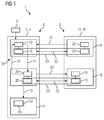
- FIG. 1 the sequence of a method 1 is shown in a block diagram.
- the first hearing device 4 waits for a communication request 12 from another mobile terminal 14, which is designed here as a second hearing device 16 of the binaural hearing aid system 6. If the second hearing device 16 sends a communication request 12 to the first hearing device 4, the second hearing device 16 is temporarily in a master state 20. In this case, a communication 22 is sent by the communication request 12 sent by the second hearing device 16 to the first hearing device 4 built up.
- the first hearing device 4 assumes the slave state 10 permanently, ie for the duration of the operation until the next switch-off, while the second hearing device 16 permanently assumes the master state 20.
- the binaural hearing aid system 6 is used in the binaural operation 23 from now on.
- the first hearing device 4 changes itself from the slave state 10 in the master state 20, and in turn sends communication requests 24 for establishing the connection 22 with the second hearing aid 16.
- the first hearing aid 4 remains in the master state 20.
- the binaural hearing aid system 6 is now in binaural operation 23 used.
- the first hearing device 4 changes back to the slave state 10.
- the first hearing device now iterates the slave state 10, in which it waits for a communication request 12 from the second hearing aid 16 to establish the connection 22, with the master state 20, in which it itself communication requests 24 for establishing the connection 22 to the second hearing aid 16 shipped.
- the durations of the respectively first time periods T1, in which the first hearing device 4 remains in the slave state 10, and the respectively second time periods T2, in which the first hearing device 4 remains in the master state 20, may be random or pseudo during the iteration 26 be randomly varied to prevent synchronous with the second hearing aid 16 when switching between the communication states 30.
- the binaural hearing aid system 6 is now used only with the first hearing aid 4 in a monaural operation 32.
- the first hearing device 4 permanently assumes the slave state 10, and thus no communication requests 24 sent, the battery or the accumulator of the first hearing aid can be spared.
- the battery or the accumulator can be further protected in this case if the first hearing device 4 changes permanently into an inactive communication state, not shown, in which the first hearing device 4 no longer expects communication requests 12, so that no power is required for the readiness of the first hearing device 4 to receive more is consumed.
- the connection 22 between the first hearing aid 4 and the second hearing aid 16 temporarily disappears, for example because of a technical disturbance in one of the two hearing aids 4, 16 or due to interference with an external signal.
- the first hearing aid 4 begins again in the slave state 10 to wait for a communication request 12 of the second hearing aid 16 to restore the connection 22, and iterates the slave state 10 with the master state 20 in the manner already described until either the connection 22 is rebuilt, or the third time period T3 has expired.
Landscapes
- Engineering & Computer Science (AREA)
- Computer Networks & Wireless Communication (AREA)
- Signal Processing (AREA)
- Physics & Mathematics (AREA)
- Acoustics & Sound (AREA)
- Health & Medical Sciences (AREA)
- General Health & Medical Sciences (AREA)
- Neurosurgery (AREA)
- Otolaryngology (AREA)
- Human Computer Interaction (AREA)
- Mobile Radio Communication Systems (AREA)
Applications Claiming Priority (1)
| Application Number | Priority Date | Filing Date | Title |
|---|---|---|---|
| DE102015217982.6A DE102015217982B4 (de) | 2015-09-18 | 2015-09-18 | Verfahren zur Auswahl eines Kommunikationszustands wenigstens für ein mobiles Endgerät |
Publications (2)
| Publication Number | Publication Date |
|---|---|
| EP3145272A1 true EP3145272A1 (fr) | 2017-03-22 |
| EP3145272B1 EP3145272B1 (fr) | 2019-05-08 |
Family
ID=56925968
Family Applications (1)
| Application Number | Title | Priority Date | Filing Date |
|---|---|---|---|
| EP16185182.9A Active EP3145272B1 (fr) | 2015-09-18 | 2016-08-22 | Sélection d'un état de communication pour un terminal mobile |
Country Status (5)
| Country | Link |
|---|---|
| US (1) | US9942381B2 (fr) |
| EP (1) | EP3145272B1 (fr) |
| CN (1) | CN107071604B (fr) |
| DE (1) | DE102015217982B4 (fr) |
| DK (1) | DK3145272T3 (fr) |
Cited By (3)
| Publication number | Priority date | Publication date | Assignee | Title |
|---|---|---|---|---|
| CN109121172A (zh) * | 2018-07-27 | 2019-01-01 | Oppo广东移动通信有限公司 | 传输链路切换控制方法及相关产品 |
| CN109117111A (zh) * | 2018-07-27 | 2019-01-01 | Oppo广东移动通信有限公司 | 传输链路切换控制方法及相关产品 |
| CN109121171A (zh) * | 2018-07-26 | 2019-01-01 | Oppo广东移动通信有限公司 | 传输链路切换控制方法及相关产品 |
Families Citing this family (3)
| Publication number | Priority date | Publication date | Assignee | Title |
|---|---|---|---|---|
| JP2021193758A (ja) * | 2018-09-03 | 2021-12-23 | ソニーグループ株式会社 | 情報処理装置、情報処理方法、及び、プログラム |
| US11127214B2 (en) * | 2018-09-17 | 2021-09-21 | Qualcomm Incorporated | Cross layer traffic optimization for split XR |
| CN115390465B (zh) * | 2022-07-22 | 2024-11-19 | 青岛海尔科技有限公司 | 设备监控方法、装置、系统、存储介质和电子装置 |
Citations (3)
| Publication number | Priority date | Publication date | Assignee | Title |
|---|---|---|---|---|
| US20100291955A1 (en) * | 2007-11-28 | 2010-11-18 | Saettele Peter | Method and apparatus for autonomous port role assignments in master-slave networks |
| US20110033071A1 (en) * | 2003-06-06 | 2011-02-10 | Gn Resound A/S | Hearing aid wireless network |
| WO2015018456A1 (fr) * | 2013-08-09 | 2015-02-12 | Phonak Ag | Système et procédé d'aide auditive |
Family Cites Families (16)
| Publication number | Priority date | Publication date | Assignee | Title |
|---|---|---|---|---|
| US20020076073A1 (en) | 2000-12-19 | 2002-06-20 | Taenzer Jon C. | Automatically switched hearing aid communications earpiece |
| US6931141B2 (en) * | 2001-10-12 | 2005-08-16 | Gn Resound A/S | Hearing aid and a method for operating a hearing aid |
| US8401001B2 (en) * | 2007-03-28 | 2013-03-19 | Intel Corporation | Method and apparatus of connectivity recovery in wireless network |
| WO2008031901A1 (fr) | 2007-11-23 | 2008-03-20 | Phonak Ag | Procédé de fonctionnement d'un dispositif auditif et dispositif auditif |
| EP2071874B1 (fr) | 2007-12-14 | 2016-05-04 | Oticon A/S | Dispositif auditif, systeme de dispositif auditif et procedure pour controler le systeme de dispositif auditif |
| EP2117180B1 (fr) * | 2008-05-07 | 2013-10-23 | Oticon A/S | Lien sans fil unidirectionnel à courte distance |
| US7953056B2 (en) * | 2009-08-26 | 2011-05-31 | Pixart Imaging Inc. | Polling method compliant to bluetooth protocol for increasing transfer efficiency and system thereof |
| JP2011065437A (ja) * | 2009-09-17 | 2011-03-31 | Hitachi Solutions Ltd | 無線端末機器の個人認証システム |
| US8265311B2 (en) | 2009-10-12 | 2012-09-11 | Starkey Laboratories, Inc. | Method and apparatus for using text messages to distribute ring tones to adjust hearing aids |
| US9137613B2 (en) * | 2010-02-12 | 2015-09-15 | Phonak Ag | Wireless sound transmission system and method |
| US9247355B2 (en) * | 2010-02-12 | 2016-01-26 | Sonova Ag | Wireless sound transmission system and method |
| US8804988B2 (en) | 2010-04-13 | 2014-08-12 | Starkey Laboratories, Inc. | Control of low power or standby modes of a hearing assistance device |
| CN104396179B (zh) * | 2012-05-31 | 2018-09-07 | 索诺亚公司 | 用于听觉设备的基于灵活的串行总线的主从数据传输的系统和方法 |
| EP2712211B1 (fr) | 2012-09-25 | 2015-09-16 | GN Resound A/S | Prothèse auditive pour reproduire des signaux téléphoniques |
| US9288584B2 (en) | 2012-09-25 | 2016-03-15 | Gn Resound A/S | Hearing aid for providing phone signals |
| DK2885925T3 (da) * | 2012-09-28 | 2019-07-22 | Siemens Ltd China | Dynamisk høreapparatsystem og en fremgangsmåde til konfigurering af høreapparatsystemet. |
-
2015
- 2015-09-18 DE DE102015217982.6A patent/DE102015217982B4/de active Active
-
2016
- 2016-08-22 EP EP16185182.9A patent/EP3145272B1/fr active Active
- 2016-08-22 DK DK16185182.9T patent/DK3145272T3/da active
- 2016-09-18 CN CN201610829063.7A patent/CN107071604B/zh active Active
- 2016-09-19 US US15/268,778 patent/US9942381B2/en active Active
Patent Citations (3)
| Publication number | Priority date | Publication date | Assignee | Title |
|---|---|---|---|---|
| US20110033071A1 (en) * | 2003-06-06 | 2011-02-10 | Gn Resound A/S | Hearing aid wireless network |
| US20100291955A1 (en) * | 2007-11-28 | 2010-11-18 | Saettele Peter | Method and apparatus for autonomous port role assignments in master-slave networks |
| WO2015018456A1 (fr) * | 2013-08-09 | 2015-02-12 | Phonak Ag | Système et procédé d'aide auditive |
Cited By (5)
| Publication number | Priority date | Publication date | Assignee | Title |
|---|---|---|---|---|
| CN109121171A (zh) * | 2018-07-26 | 2019-01-01 | Oppo广东移动通信有限公司 | 传输链路切换控制方法及相关产品 |
| CN109121171B (zh) * | 2018-07-26 | 2021-05-04 | Oppo广东移动通信有限公司 | 传输链路切换控制方法及相关产品 |
| CN109121172A (zh) * | 2018-07-27 | 2019-01-01 | Oppo广东移动通信有限公司 | 传输链路切换控制方法及相关产品 |
| CN109117111A (zh) * | 2018-07-27 | 2019-01-01 | Oppo广东移动通信有限公司 | 传输链路切换控制方法及相关产品 |
| CN109121172B (zh) * | 2018-07-27 | 2021-01-08 | Oppo广东移动通信有限公司 | 传输链路切换控制方法及相关产品 |
Also Published As
| Publication number | Publication date |
|---|---|
| DE102015217982A1 (de) | 2017-03-23 |
| DK3145272T3 (da) | 2019-08-12 |
| CN107071604A (zh) | 2017-08-18 |
| CN107071604B (zh) | 2019-10-01 |
| US20170085695A1 (en) | 2017-03-23 |
| US9942381B2 (en) | 2018-04-10 |
| EP3145272B1 (fr) | 2019-05-08 |
| DE102015217982B4 (de) | 2022-01-20 |
Similar Documents
| Publication | Publication Date | Title |
|---|---|---|
| EP3145272B1 (fr) | Sélection d'un état de communication pour un terminal mobile | |
| DE10116838C1 (de) | Verfahren zur Halbduplexübertragung von Informationen zwischen Kommunikationseinrichtungen mit Repeatern | |
| DE69929575T2 (de) | Verfahren zur drahtlosen Kommunikationssteuerung und Vorrichtung zur drahtlosen Übertragung | |
| DE69427404T2 (de) | Zuordnungsverfahren und Vorrichtung zur Wiederverwendung von Netzressourcen in einem drahtlosen Kommunikationssystem | |
| DE602005004047T2 (de) | Methode zur Zuordnung von Adressen zu einer Vielzahl von Geräten in einem Netzwerk und entsprechendes System | |
| DE102015101698A1 (de) | Kommunizieren von Daten über ein Maschen-Netzwerk | |
| DE102015104291A1 (de) | Drathloses Austauschen von Konfigurationsinformationen | |
| EP3949682B1 (fr) | Combinaison de système d'un système radio asynchrone et synchrone | |
| DE102022107055A1 (de) | Zeitsynchronisation in drahtlosen netzwerken | |
| EP0020893B1 (fr) | Réseau radio | |
| EP1881650A1 (fr) | Procédé d'établissement d'un réseau de communication auto-organisé | |
| DE102024133141A1 (de) | Auf bluetooth-low-energy basierendes drahtloses air-time-verwaltungssystem | |
| DE10310771A1 (de) | Vorrichtung und Verfahren zum Steuern des Leistungsverbrauchs einer kombinierten UMTS/GSM/EDGE-Funkstation | |
| EP2786620B1 (fr) | Système de gestion d'énergie d'appareils électroménagers selon une norme de radiotéléphonie mobile évolutive et procédé correspondant | |
| EP1777903B1 (fr) | Procédé et dispositif de transmission d'énergie et des données entre une unité centrale et un noeud | |
| WO2003017575A1 (fr) | Procede de transfert de donnees entre une station maitresse et une station esclave, et systeme de transfert de donnees y relatif | |
| DE112015006595B4 (de) | Funkkommunikationsvorrichtung und Funkkommunikationsverfahren | |
| DE112015006594B4 (de) | Funkkommunikationsvorrichtung und funkkommunikationsverfahren | |
| AT515956B1 (de) | Notbeleuchtungsanlage für ein Gebäude | |
| EP2232782B1 (fr) | Procédé pour la configuration d'adresses dans un réseau de communication | |
| DE102023210714A1 (de) | Verfahren und Vorrichtung zur Verarbeitung von mit Zeitinformationen assoziierten Daten | |
| EP2911309B1 (fr) | Appareil radio et procédé de transmission d'informations | |
| WO2018086833A1 (fr) | Procédé de traitement de données pour gérer des canaux de communication et/ou des services d'informations dans un véhicule | |
| EP1400045A1 (fr) | Procede, dispositif et systeme pour transmettre des donnees | |
| DE102024104012A1 (de) | Elektrische Geräteanordnung für Multiclient -Netzwerk und Peripherievorrichtungen |
Legal Events
| Date | Code | Title | Description |
|---|---|---|---|
| PUAI | Public reference made under article 153(3) epc to a published international application that has entered the european phase |
Free format text: ORIGINAL CODE: 0009012 |
|
| STAA | Information on the status of an ep patent application or granted ep patent |
Free format text: STATUS: THE APPLICATION HAS BEEN PUBLISHED |
|
| AK | Designated contracting states |
Kind code of ref document: A1 Designated state(s): AL AT BE BG CH CY CZ DE DK EE ES FI FR GB GR HR HU IE IS IT LI LT LU LV MC MK MT NL NO PL PT RO RS SE SI SK SM TR |
|
| AX | Request for extension of the european patent |
Extension state: BA ME |
|
| STAA | Information on the status of an ep patent application or granted ep patent |
Free format text: STATUS: REQUEST FOR EXAMINATION WAS MADE |
|
| 17P | Request for examination filed |
Effective date: 20170714 |
|
| RBV | Designated contracting states (corrected) |
Designated state(s): AL AT BE BG CH CY CZ DE DK EE ES FI FR GB GR HR HU IE IS IT LI LT LU LV MC MK MT NL NO PL PT RO RS SE SI SK SM TR |
|
| STAA | Information on the status of an ep patent application or granted ep patent |
Free format text: STATUS: EXAMINATION IS IN PROGRESS |
|
| RAP1 | Party data changed (applicant data changed or rights of an application transferred) |
Owner name: SIVANTOS PTE. LTD. |
|
| 17Q | First examination report despatched |
Effective date: 20180208 |
|
| RIC1 | Information provided on ipc code assigned before grant |
Ipc: H04M 1/725 20060101ALI20181015BHEP Ipc: H04W 4/70 20170322ALI20181015BHEP Ipc: H04R 25/00 20060101ALI20181015BHEP Ipc: H04W 76/10 20170322ALN20181015BHEP Ipc: H04W 4/80 20170322ALN20181015BHEP Ipc: H04W 84/20 20090101AFI20181015BHEP |
|
| GRAP | Despatch of communication of intention to grant a patent |
Free format text: ORIGINAL CODE: EPIDOSNIGR1 |
|
| STAA | Information on the status of an ep patent application or granted ep patent |
Free format text: STATUS: GRANT OF PATENT IS INTENDED |
|
| RIC1 | Information provided on ipc code assigned before grant |
Ipc: H04M 1/725 20060101ALI20181019BHEP Ipc: H04W 4/70 20170322ALI20181019BHEP Ipc: H04R 25/00 20060101ALI20181019BHEP Ipc: H04W 76/10 20170322ALN20181019BHEP Ipc: H04W 4/80 20170322ALN20181019BHEP Ipc: H04W 84/20 20090101AFI20181019BHEP |
|
| INTG | Intention to grant announced |
Effective date: 20181128 |
|
| RIC1 | Information provided on ipc code assigned before grant |
Ipc: H04W 76/10 20180101ALN20181019BHEP Ipc: H04R 25/00 20060101ALI20181019BHEP Ipc: H04W 4/70 20180101ALI20181019BHEP Ipc: H04W 4/80 20180101ALN20181019BHEP Ipc: H04M 1/725 20060101ALI20181019BHEP Ipc: H04W 84/20 20090101AFI20181019BHEP |
|
| RIC1 | Information provided on ipc code assigned before grant |
Ipc: H04M 1/725 20060101ALI20181019BHEP Ipc: H04W 84/20 20090101AFI20181019BHEP Ipc: H04R 25/00 20060101ALI20181019BHEP Ipc: H04W 4/70 20180101ALI20181019BHEP Ipc: H04W 76/10 20180101ALN20181019BHEP Ipc: H04W 4/80 20180101ALN20181019BHEP |
|
| GRAS | Grant fee paid |
Free format text: ORIGINAL CODE: EPIDOSNIGR3 |
|
| GRAA | (expected) grant |
Free format text: ORIGINAL CODE: 0009210 |
|
| STAA | Information on the status of an ep patent application or granted ep patent |
Free format text: STATUS: THE PATENT HAS BEEN GRANTED |
|
| AK | Designated contracting states |
Kind code of ref document: B1 Designated state(s): AL AT BE BG CH CY CZ DE DK EE ES FI FR GB GR HR HU IE IS IT LI LT LU LV MC MK MT NL NO PL PT RO RS SE SI SK SM TR |
|
| REG | Reference to a national code |
Ref country code: GB Ref legal event code: FG4D Free format text: NOT ENGLISH |
|
| REG | Reference to a national code |
Ref country code: CH Ref legal event code: EP Ref country code: AT Ref legal event code: REF Ref document number: 1132246 Country of ref document: AT Kind code of ref document: T Effective date: 20190515 |
|
| REG | Reference to a national code |
Ref country code: DE Ref legal event code: R096 Ref document number: 502016004530 Country of ref document: DE Ref country code: IE Ref legal event code: FG4D Free format text: LANGUAGE OF EP DOCUMENT: GERMAN |
|
| REG | Reference to a national code |
Ref country code: CH Ref legal event code: NV Representative=s name: E. BLUM AND CO. AG PATENT- UND MARKENANWAELTE , CH |
|
| REG | Reference to a national code |
Ref country code: DK Ref legal event code: T3 Effective date: 20190807 |
|
| REG | Reference to a national code |
Ref country code: NL Ref legal event code: MP Effective date: 20190508 |
|
| REG | Reference to a national code |
Ref country code: LT Ref legal event code: MG4D |
|
| PG25 | Lapsed in a contracting state [announced via postgrant information from national office to epo] |
Ref country code: NL Free format text: LAPSE BECAUSE OF FAILURE TO SUBMIT A TRANSLATION OF THE DESCRIPTION OR TO PAY THE FEE WITHIN THE PRESCRIBED TIME-LIMIT Effective date: 20190508 Ref country code: LT Free format text: LAPSE BECAUSE OF FAILURE TO SUBMIT A TRANSLATION OF THE DESCRIPTION OR TO PAY THE FEE WITHIN THE PRESCRIBED TIME-LIMIT Effective date: 20190508 Ref country code: HR Free format text: LAPSE BECAUSE OF FAILURE TO SUBMIT A TRANSLATION OF THE DESCRIPTION OR TO PAY THE FEE WITHIN THE PRESCRIBED TIME-LIMIT Effective date: 20190508 Ref country code: ES Free format text: LAPSE BECAUSE OF FAILURE TO SUBMIT A TRANSLATION OF THE DESCRIPTION OR TO PAY THE FEE WITHIN THE PRESCRIBED TIME-LIMIT Effective date: 20190508 Ref country code: PT Free format text: LAPSE BECAUSE OF FAILURE TO SUBMIT A TRANSLATION OF THE DESCRIPTION OR TO PAY THE FEE WITHIN THE PRESCRIBED TIME-LIMIT Effective date: 20190908 Ref country code: NO Free format text: LAPSE BECAUSE OF FAILURE TO SUBMIT A TRANSLATION OF THE DESCRIPTION OR TO PAY THE FEE WITHIN THE PRESCRIBED TIME-LIMIT Effective date: 20190808 Ref country code: FI Free format text: LAPSE BECAUSE OF FAILURE TO SUBMIT A TRANSLATION OF THE DESCRIPTION OR TO PAY THE FEE WITHIN THE PRESCRIBED TIME-LIMIT Effective date: 20190508 Ref country code: AL Free format text: LAPSE BECAUSE OF FAILURE TO SUBMIT A TRANSLATION OF THE DESCRIPTION OR TO PAY THE FEE WITHIN THE PRESCRIBED TIME-LIMIT Effective date: 20190508 Ref country code: SE Free format text: LAPSE BECAUSE OF FAILURE TO SUBMIT A TRANSLATION OF THE DESCRIPTION OR TO PAY THE FEE WITHIN THE PRESCRIBED TIME-LIMIT Effective date: 20190508 |
|
| PG25 | Lapsed in a contracting state [announced via postgrant information from national office to epo] |
Ref country code: BG Free format text: LAPSE BECAUSE OF FAILURE TO SUBMIT A TRANSLATION OF THE DESCRIPTION OR TO PAY THE FEE WITHIN THE PRESCRIBED TIME-LIMIT Effective date: 20190808 Ref country code: GR Free format text: LAPSE BECAUSE OF FAILURE TO SUBMIT A TRANSLATION OF THE DESCRIPTION OR TO PAY THE FEE WITHIN THE PRESCRIBED TIME-LIMIT Effective date: 20190809 Ref country code: LV Free format text: LAPSE BECAUSE OF FAILURE TO SUBMIT A TRANSLATION OF THE DESCRIPTION OR TO PAY THE FEE WITHIN THE PRESCRIBED TIME-LIMIT Effective date: 20190508 Ref country code: RS Free format text: LAPSE BECAUSE OF FAILURE TO SUBMIT A TRANSLATION OF THE DESCRIPTION OR TO PAY THE FEE WITHIN THE PRESCRIBED TIME-LIMIT Effective date: 20190508 |
|
| PG25 | Lapsed in a contracting state [announced via postgrant information from national office to epo] |
Ref country code: EE Free format text: LAPSE BECAUSE OF FAILURE TO SUBMIT A TRANSLATION OF THE DESCRIPTION OR TO PAY THE FEE WITHIN THE PRESCRIBED TIME-LIMIT Effective date: 20190508 Ref country code: RO Free format text: LAPSE BECAUSE OF FAILURE TO SUBMIT A TRANSLATION OF THE DESCRIPTION OR TO PAY THE FEE WITHIN THE PRESCRIBED TIME-LIMIT Effective date: 20190508 Ref country code: CZ Free format text: LAPSE BECAUSE OF FAILURE TO SUBMIT A TRANSLATION OF THE DESCRIPTION OR TO PAY THE FEE WITHIN THE PRESCRIBED TIME-LIMIT Effective date: 20190508 Ref country code: SK Free format text: LAPSE BECAUSE OF FAILURE TO SUBMIT A TRANSLATION OF THE DESCRIPTION OR TO PAY THE FEE WITHIN THE PRESCRIBED TIME-LIMIT Effective date: 20190508 |
|
| REG | Reference to a national code |
Ref country code: DE Ref legal event code: R097 Ref document number: 502016004530 Country of ref document: DE |
|
| PG25 | Lapsed in a contracting state [announced via postgrant information from national office to epo] |
Ref country code: SM Free format text: LAPSE BECAUSE OF FAILURE TO SUBMIT A TRANSLATION OF THE DESCRIPTION OR TO PAY THE FEE WITHIN THE PRESCRIBED TIME-LIMIT Effective date: 20190508 Ref country code: IT Free format text: LAPSE BECAUSE OF FAILURE TO SUBMIT A TRANSLATION OF THE DESCRIPTION OR TO PAY THE FEE WITHIN THE PRESCRIBED TIME-LIMIT Effective date: 20190508 |
|
| PLBE | No opposition filed within time limit |
Free format text: ORIGINAL CODE: 0009261 |
|
| STAA | Information on the status of an ep patent application or granted ep patent |
Free format text: STATUS: NO OPPOSITION FILED WITHIN TIME LIMIT |
|
| PG25 | Lapsed in a contracting state [announced via postgrant information from national office to epo] |
Ref country code: TR Free format text: LAPSE BECAUSE OF FAILURE TO SUBMIT A TRANSLATION OF THE DESCRIPTION OR TO PAY THE FEE WITHIN THE PRESCRIBED TIME-LIMIT Effective date: 20190508 |
|
| 26N | No opposition filed |
Effective date: 20200211 |
|
| PG25 | Lapsed in a contracting state [announced via postgrant information from national office to epo] |
Ref country code: PL Free format text: LAPSE BECAUSE OF FAILURE TO SUBMIT A TRANSLATION OF THE DESCRIPTION OR TO PAY THE FEE WITHIN THE PRESCRIBED TIME-LIMIT Effective date: 20190508 |
|
| PG25 | Lapsed in a contracting state [announced via postgrant information from national office to epo] |
Ref country code: LU Free format text: LAPSE BECAUSE OF NON-PAYMENT OF DUE FEES Effective date: 20190822 Ref country code: MC Free format text: LAPSE BECAUSE OF FAILURE TO SUBMIT A TRANSLATION OF THE DESCRIPTION OR TO PAY THE FEE WITHIN THE PRESCRIBED TIME-LIMIT Effective date: 20190508 Ref country code: SI Free format text: LAPSE BECAUSE OF FAILURE TO SUBMIT A TRANSLATION OF THE DESCRIPTION OR TO PAY THE FEE WITHIN THE PRESCRIBED TIME-LIMIT Effective date: 20190508 |
|
| REG | Reference to a national code |
Ref country code: BE Ref legal event code: MM Effective date: 20190831 |
|
| PG25 | Lapsed in a contracting state [announced via postgrant information from national office to epo] |
Ref country code: IE Free format text: LAPSE BECAUSE OF NON-PAYMENT OF DUE FEES Effective date: 20190822 |
|
| PG25 | Lapsed in a contracting state [announced via postgrant information from national office to epo] |
Ref country code: BE Free format text: LAPSE BECAUSE OF NON-PAYMENT OF DUE FEES Effective date: 20190831 |
|
| PG25 | Lapsed in a contracting state [announced via postgrant information from national office to epo] |
Ref country code: CY Free format text: LAPSE BECAUSE OF FAILURE TO SUBMIT A TRANSLATION OF THE DESCRIPTION OR TO PAY THE FEE WITHIN THE PRESCRIBED TIME-LIMIT Effective date: 20190508 |
|
| PG25 | Lapsed in a contracting state [announced via postgrant information from national office to epo] |
Ref country code: IS Free format text: LAPSE BECAUSE OF FAILURE TO SUBMIT A TRANSLATION OF THE DESCRIPTION OR TO PAY THE FEE WITHIN THE PRESCRIBED TIME-LIMIT Effective date: 20190908 |
|
| PG25 | Lapsed in a contracting state [announced via postgrant information from national office to epo] |
Ref country code: HU Free format text: LAPSE BECAUSE OF FAILURE TO SUBMIT A TRANSLATION OF THE DESCRIPTION OR TO PAY THE FEE WITHIN THE PRESCRIBED TIME-LIMIT; INVALID AB INITIO Effective date: 20160822 Ref country code: MT Free format text: LAPSE BECAUSE OF FAILURE TO SUBMIT A TRANSLATION OF THE DESCRIPTION OR TO PAY THE FEE WITHIN THE PRESCRIBED TIME-LIMIT Effective date: 20190508 |
|
| PG25 | Lapsed in a contracting state [announced via postgrant information from national office to epo] |
Ref country code: MK Free format text: LAPSE BECAUSE OF FAILURE TO SUBMIT A TRANSLATION OF THE DESCRIPTION OR TO PAY THE FEE WITHIN THE PRESCRIBED TIME-LIMIT Effective date: 20190508 |
|
| REG | Reference to a national code |
Ref country code: AT Ref legal event code: MM01 Ref document number: 1132246 Country of ref document: AT Kind code of ref document: T Effective date: 20210822 |
|
| PG25 | Lapsed in a contracting state [announced via postgrant information from national office to epo] |
Ref country code: AT Free format text: LAPSE BECAUSE OF NON-PAYMENT OF DUE FEES Effective date: 20210822 |
|
| PGFP | Annual fee paid to national office [announced via postgrant information from national office to epo] |
Ref country code: DK Payment date: 20250723 Year of fee payment: 10 Ref country code: DE Payment date: 20250724 Year of fee payment: 10 |
|
| PGFP | Annual fee paid to national office [announced via postgrant information from national office to epo] |
Ref country code: GB Payment date: 20250724 Year of fee payment: 10 |
|
| PGFP | Annual fee paid to national office [announced via postgrant information from national office to epo] |
Ref country code: FR Payment date: 20250725 Year of fee payment: 10 |
|
| PGFP | Annual fee paid to national office [announced via postgrant information from national office to epo] |
Ref country code: CH Payment date: 20250901 Year of fee payment: 10 |