EP3145392B1 - Messung des absoluten blutvolumens mithilfe von ultrafiltrationspulsung - Google Patents
Messung des absoluten blutvolumens mithilfe von ultrafiltrationspulsung Download PDFInfo
- Publication number
- EP3145392B1 EP3145392B1 EP15726479.7A EP15726479A EP3145392B1 EP 3145392 B1 EP3145392 B1 EP 3145392B1 EP 15726479 A EP15726479 A EP 15726479A EP 3145392 B1 EP3145392 B1 EP 3145392B1
- Authority
- EP
- European Patent Office
- Prior art keywords
- blood volume
- ultrafiltration
- absolute
- volume
- patient
- Prior art date
- Legal status (The legal status is an assumption and is not a legal conclusion. Google has not performed a legal analysis and makes no representation as to the accuracy of the status listed.)
- Active
Links
Images








Classifications
-
- A—HUMAN NECESSITIES
- A61—MEDICAL OR VETERINARY SCIENCE; HYGIENE
- A61M—DEVICES FOR INTRODUCING MEDIA INTO, OR ONTO, THE BODY; DEVICES FOR TRANSDUCING BODY MEDIA OR FOR TAKING MEDIA FROM THE BODY; DEVICES FOR PRODUCING OR ENDING SLEEP OR STUPOR
- A61M1/00—Suction or pumping devices for medical purposes; Devices for carrying-off, for treatment of, or for carrying-over, body-liquids; Drainage systems
- A61M1/36—Other treatment of blood in a by-pass of the natural circulatory system, e.g. temperature adaptation, irradiation ; Extra-corporeal blood circuits
- A61M1/3607—Regulation parameters
- A61M1/3609—Physical characteristics of the blood, e.g. haematocrit, urea
- A61M1/361—Physical characteristics of the blood, e.g. haematocrit, urea before treatment
-
- A—HUMAN NECESSITIES
- A61—MEDICAL OR VETERINARY SCIENCE; HYGIENE
- A61B—DIAGNOSIS; SURGERY; IDENTIFICATION
- A61B5/00—Measuring for diagnostic purposes; Identification of persons
- A61B5/02—Detecting, measuring or recording for evaluating the cardiovascular system, e.g. pulse, heart rate, blood pressure or blood flow
-
- A—HUMAN NECESSITIES
- A61—MEDICAL OR VETERINARY SCIENCE; HYGIENE
- A61B—DIAGNOSIS; SURGERY; IDENTIFICATION
- A61B5/00—Measuring for diagnostic purposes; Identification of persons
- A61B5/02—Detecting, measuring or recording for evaluating the cardiovascular system, e.g. pulse, heart rate, blood pressure or blood flow
- A61B5/02028—Determining haemodynamic parameters not otherwise provided for, e.g. cardiac contractility or left ventricular ejection fraction
-
- A—HUMAN NECESSITIES
- A61—MEDICAL OR VETERINARY SCIENCE; HYGIENE
- A61B—DIAGNOSIS; SURGERY; IDENTIFICATION
- A61B5/00—Measuring for diagnostic purposes; Identification of persons
- A61B5/02—Detecting, measuring or recording for evaluating the cardiovascular system, e.g. pulse, heart rate, blood pressure or blood flow
- A61B5/0205—Simultaneously evaluating both cardiovascular conditions and different types of body conditions, e.g. heart and respiratory condition
-
- A—HUMAN NECESSITIES
- A61—MEDICAL OR VETERINARY SCIENCE; HYGIENE
- A61B—DIAGNOSIS; SURGERY; IDENTIFICATION
- A61B5/00—Measuring for diagnostic purposes; Identification of persons
- A61B5/145—Measuring characteristics of blood in vivo, e.g. gas concentration or pH-value ; Measuring characteristics of body fluids or tissues, e.g. interstitial fluid or cerebral tissue
- A61B5/14542—Measuring characteristics of blood in vivo, e.g. gas concentration or pH-value ; Measuring characteristics of body fluids or tissues, e.g. interstitial fluid or cerebral tissue for measuring blood gases
-
- A—HUMAN NECESSITIES
- A61—MEDICAL OR VETERINARY SCIENCE; HYGIENE
- A61B—DIAGNOSIS; SURGERY; IDENTIFICATION
- A61B5/00—Measuring for diagnostic purposes; Identification of persons
- A61B5/68—Arrangements of detecting, measuring or recording means, e.g. sensors, in relation to patient
- A61B5/6846—Arrangements of detecting, measuring or recording means, e.g. sensors, in relation to patient specially adapted to be brought in contact with an internal body part, i.e. invasive
- A61B5/6847—Arrangements of detecting, measuring or recording means, e.g. sensors, in relation to patient specially adapted to be brought in contact with an internal body part, i.e. invasive mounted on an invasive device
- A61B5/6866—Extracorporeal blood circuits, e.g. dialysis circuits
-
- A—HUMAN NECESSITIES
- A61—MEDICAL OR VETERINARY SCIENCE; HYGIENE
- A61M—DEVICES FOR INTRODUCING MEDIA INTO, OR ONTO, THE BODY; DEVICES FOR TRANSDUCING BODY MEDIA OR FOR TAKING MEDIA FROM THE BODY; DEVICES FOR PRODUCING OR ENDING SLEEP OR STUPOR
- A61M1/00—Suction or pumping devices for medical purposes; Devices for carrying-off, for treatment of, or for carrying-over, body-liquids; Drainage systems
- A61M1/34—Filtering material out of the blood by passing it through a membrane, i.e. hemofiltration or diafiltration
- A61M1/3403—Regulation parameters
-
- A—HUMAN NECESSITIES
- A61—MEDICAL OR VETERINARY SCIENCE; HYGIENE
- A61M—DEVICES FOR INTRODUCING MEDIA INTO, OR ONTO, THE BODY; DEVICES FOR TRANSDUCING BODY MEDIA OR FOR TAKING MEDIA FROM THE BODY; DEVICES FOR PRODUCING OR ENDING SLEEP OR STUPOR
- A61M1/00—Suction or pumping devices for medical purposes; Devices for carrying-off, for treatment of, or for carrying-over, body-liquids; Drainage systems
- A61M1/36—Other treatment of blood in a by-pass of the natural circulatory system, e.g. temperature adaptation, irradiation ; Extra-corporeal blood circuits
- A61M1/3607—Regulation parameters
- A61M1/3609—Physical characteristics of the blood, e.g. haematocrit, urea
- A61M1/3612—Physical characteristics of the blood, e.g. haematocrit, urea after treatment
-
- G—PHYSICS
- G16—INFORMATION AND COMMUNICATION TECHNOLOGY [ICT] SPECIALLY ADAPTED FOR SPECIFIC APPLICATION FIELDS
- G16H—HEALTHCARE INFORMATICS, i.e. INFORMATION AND COMMUNICATION TECHNOLOGY [ICT] SPECIALLY ADAPTED FOR THE HANDLING OR PROCESSING OF MEDICAL OR HEALTHCARE DATA
- G16H20/00—ICT specially adapted for therapies or health-improving plans, e.g. for handling prescriptions, for steering therapy or for monitoring patient compliance
- G16H20/40—ICT specially adapted for therapies or health-improving plans, e.g. for handling prescriptions, for steering therapy or for monitoring patient compliance relating to mechanical, radiation or invasive therapies, e.g. surgery, laser therapy, dialysis or acupuncture
-
- A—HUMAN NECESSITIES
- A61—MEDICAL OR VETERINARY SCIENCE; HYGIENE
- A61M—DEVICES FOR INTRODUCING MEDIA INTO, OR ONTO, THE BODY; DEVICES FOR TRANSDUCING BODY MEDIA OR FOR TAKING MEDIA FROM THE BODY; DEVICES FOR PRODUCING OR ENDING SLEEP OR STUPOR
- A61M2230/00—Measuring parameters of the user
- A61M2230/20—Blood composition characteristics
- A61M2230/207—Blood composition characteristics hematocrit
Definitions
- IDH Intradialytic hypotension
- IDH has been linked to mortality, which is not surprising given the above. See Shoji, T., et al., Kidney international, 2004. 66(3): p. 1212-20 .
- IDH occurs as a consequence of a reduction in blood volume during ultrafiltration.
- Devices for monitoring relative blood volume i.e., the intradialytic blood volume as a fraction of the blood volume at the start of the dialysis treatment
- IDH critical thresholds
- IDH is believed to occur when the ultrafiltration rate outpaces the vascular refilling rate from the interstitial space.
- Ultrafiltration rates are largely a function of treatment frequency and duration and, as such, are dictated by dialysis practice. Attempts to reduce the rate of interdialytic weight gain, while valuable in principle, are arguably of limited impact. So, when operating within the constraints of current dialysis practice where the risk for IDH is high, being able to detect impending IDH with sufficient lead time to prevent it from manifesting becomes a primary goal in the efforts to improve dialysis therapy and, ultimately, patient outcomes.
- EP2380609 A1 discloses a method for controlling an ultrafiltration rate during dialysis and provides information on how the filtration rate should be controlled or fixed and on how high the filtration rate may be set to prevent unwanted blood pressure drops.
- absolute blood volume is of key importance, because in fluid overloaded patients, it is arguably the excess blood volume that mediates most of the cardiovascular damage (e.g., vascular stiffening, left-ventricular hypertrophy, congestive heart failure), and not the excess interstitial volume.
- cardiovascular damage e.g., vascular stiffening, left-ventricular hypertrophy, congestive heart failure
- the method includes establishing a prescribed step to be applied to the existing ultrafiltration rate to establish a change in the ultrafiltration rate, measuring a patient's hemoglobin concentration with a high sampling frequency (e.g., 1-50 Hz) immediately before the change in the ultrafiltration rate is executed, executing the prescribed step in the existing ultrafiltration rate, and measuring the patient's hemoglobin concentration with a high frequency immediately after the established step is executed.
- a high sampling frequency e.g. 1-50 Hz
- the step in ultrafiltration rate is a substantial step, for example, a step in a range of between about 500 milliliters per hour (mL/h) and about 1,200 mL/h or more, such as about 600 mL/h, about 700 mL/h, about 800 mL/h, about 900 mL/h, about 1,000 mL/h, or about 1,100 mL/h.
- the method includes calculating the patient's absolute blood volume based upon the change in hemoglobin concentration slope immediately before and immediately after execution of the prescribed step in the ultrafiltration rate.
- the ultrafiltration rate is adjusted to a different rate believed to be an appropriate rate based on the absolute blood volume of the patient.
- the step of adjusting the ultrafiltration rate to a different rate believed to be appropriate based on the absolute blood volume of the patient can be repeated until an appropriate ultrafiltration rate for the patient is established.
- Calculating the patient's absolute blood volume can include, for example, using least absolute value or least square cost functionals.
- a hemodialysis machine including a computer program product for determining absolute blood volume of a patient undergoing hemodialysis treatment or ultrafiltration treatment or both, the computer program product including a computer usable medium and a set of computer program instructions embodied on the computer usable medium.
- the computer program instructions include the instructions to establish an initial ultrafiltration rate for the patient, determine characteristics, and timing at least one ultrafiltration step, execute at least one ultrafiltration step, measure hemoglobin concentration with high sampling frequency immediately before and immediately after each ultrafiltration step, calculate the patient's absolute blood volume from a change in the hemoglobin concentration slope after each ultrafiltration step, and confirm, based on the absolute blood volume, that the ultrafiltration rate is appropriate or not.
- the computer program instructions can include the instructions to adjust the ultrafiltration rate if it is not appropriate.
- the high sampling frequency can be, for example, a frequency in a range of between about 1 Hz to about 50 Hz.
- the computer program instructions can further include the instructions to trigger an alarm if the absolute blood volume of the patient is less than an alarm volume.
- calculating the patient's absolute blood volume can include using minimization of least absolute value or least square cost functionals measuring the distance between the measured hemoglobin concentration and the model before and after each ultrafiltration step.
- the method includes establishing an initial ultrafiltration rate for the patient, determining characteristics, and timing of ultrafiltration steps, executing at least one ultrafiltration step, measuring hemoglobin concentration with high sampling frequency (e.g., 1-50 Hz) immediately before and immediately after each ultrafiltration step, calculating the patient's absolute blood volume from a change in the hemoglobin concentration slope using, for example, minimization of a least absolute value cost functional, and confirming, based on the absolute blood volume, that the ultrafiltration rate is appropriate or not.
- high sampling frequency e.g. 1-50 Hz
- the invention is a hemodialysis machine including means for establishing an initial ultrafiltration rate for the patient, means for determining characteristics, and timing of at least one ultrafiltration rate change step, means for executing at least one ultrafiltration rate change step, means for measuring hemoglobin concentration with high sampling frequency of at least 10 Hz immediately before and immediately after each ultrafiltration rate change step, means for calculating the patient's absolute blood volume from a change in the hemoglobin concentration slope immediately before and immediately after each ultrafiltration rate change step, and means for confirming, based on the absolute blood volume, that the ultrafiltration rate is appropriate or not.
- the hemodialysis machine can include means for adjusting the ultrafiltration rate if it is not appropriate.
- the hemodialysis machine can further include means for triggering an alarm if the absolute blood volume of the patient is less than an alarm volume.
- This invention has many advantages, including enabling automating this absolute blood volume measurement methodology, so that these data can be provided to the healthcare team at the bedside and in real-time during the dialysis treatment. This will be significantly more valuable than the provision of relative blood volume data, without significant changes in the typical dialysis or ultrafiltration procedure.
- Circulatory regulation is enormous complex, and only some of the cornerstones are discussed below.
- the purpose of blood circulation broadly speaking, is to supply oxygen and nutrients to the tissues, to remove carbon dioxide and other metabolic waste products from the tissues, and to distribute humoral transmitters throughout the body.
- the blood flow through the various tissues is controlled by the respective metabolic needs of these tissues, but in order for there to be any blood flow (i.e., circulation) at all, both arterial blood pressure and cardiac output are necessary.
- Arterial blood pressure itself is a function of cardiac output and total peripheral resistance of the vasculature.
- cardiac output cardiac output
- Blood flow rate through the tissues is largely regulated locally on the tissue level according to each tissue's metabolic needs at any given time, and is mediated via constriction or dilation of the arterioles, metarterioles and precapillary sphincters.
- the autonomic nervous system also modulates vasoconstriction/vasodilation and contributes to the regulation of tissue blood flow.
- these changes in tissue blood flow are effected via changes in total peripheral resistance-vasoconstriction goes along with an increase in total peripheral resistance, while vasodilation lowers total peripheral resistance.
- Equation 1 for any given cardiac output, a change in total peripheral resistance will cause an inverse change in arterial pressure.
- Baroreceptors in large arteries sense arterial pressure changes and elicit autonomic nervous system responses that act on three levels to restore blood pressure. For a decrease in arterial pressure, these are: 1. Arteriolar constriction-this increases total peripheral resistance and raises blood pressure, 2. Constriction of large vessels (primarily veins), thereby displacing blood into the central circulation, which leads to increased ejection fraction and increased cardiac output via the Frank-Starling mechanism, and 3.
- Changes in blood volume initially affect primarily the venous side of the circulation: they alter the cardiac filling pressure and then secondarily impact cardiac output, which ultimately affects arterial blood pressure.
- the change in cardiac output also alters total peripheral resistance via autoregulation of the vasculature, which contributes to the change in arterial pressure.
- stretch receptors upstream in the atria and the pulmonary arteries that specifically detect changes in the low-pressure circulation (as brought about by changes in blood volume).
- These elicit autonomic nervous system responses (as outlined above) and greatly help in blunting arterial pressure changes in response to changes in blood volume.
- Atrial stretch further increases the heart rate, partially via the direct effect of sinus node stretch but mostly via the Bainbridge reflex, which leads to autonomic nervous system effects on the heart in the form of positive inotropy and positive chronotropy.
- ECV extracellular volume
- blood volume When kidney function is normal, even a wide range of fluid intakes can be handled with only mild changes in extracellular volume (ECV), including blood volume.
- ECV extracellular volume
- fluid intake between dialysis treatments expands both the overall extracellular volume and the blood volume.
- ECV extracellular volume
- blood volume Over a certain range, the relationship between ECV and blood volume is linear, but with large ECV expansions, blood volume eventually falls behind, and almost all of the additional fluid distributes into the interstitial space. This happens because blood volume expansion ultimately leads to marked increases in intravascular filling pressure, while the interstitial tissue is very compliant and, therefore, acts as a spillway basin for the vasculature. The clinical manifestation of this is edema.
- certain comorbidities can go along with altered blood volume and, subsequently, extracellular volume (e.g., congestive heart failure and liver disease).
- Plasma refilling rate i.e., the rate of fluid transfer from the interstitial compartment into the vasculature, which itself varies throughout the dialysis treatment and depends on the Starling forces (hydrostatic and oncotic pressure differences across the capillary wall). These are a function of various factors, such as arteriolar tone, venous tone, changes in plasma solute concentrations (acid-base, electrolytes, proteins), capillary permeability (protein retention), and also the overall fluid volume state of the patient. Plasma refilling rates are on average higher in patients with higher degrees of fluid overload, and lower in patients who are closer to their "dry weight".
- the normal acute response to such an ultrafiltration-induced decrease in blood volume starts with the cardiopulmonary stretch receptors picking up the volume reduction and eliciting an autonomic nervous system response resulting in increased arteriolar tone (direct increase in afterload to maintain arterial blood pressure), increased contraction of the venous capacitance vessels (increase in central blood volume, cardiac filling pressure and cardiac output to maintain arterial pressure), and direct cardiac stimulation (increase in heart rate and contractility and, consequently, cardiac output, to maintain arterial pressure).
- the arteriolar constriction also lowers the capillary pressure and permits an increased fluid flux from the interstitial space into the vasculature to reconstitute the blood volume. If these counter-regulatory mechanisms are not sufficient to prevent a "spill over" into the arterial side of the systemic circulation, baroreceptors there pick up the decrease in arterial pressure and further enhance the autonomic system response as outlined above.
- Heat accumulation in the patient as a result of the hemodialysis procedure can lead to vasodilation of thermoregulatory cutaneous vessels, which can counter the vasoconstrictive autonomic response to a decrease in blood volume and predispose the patient to IDH.
- thermoregulatory cutaneous vessels which can counter the vasoconstrictive autonomic response to a decrease in blood volume and predispose the patient to IDH.
- plasma electrolyte and acid-base changes may impair cardiac contractility or, in the case of calcium, affect peripheral vascular tone directly.
- vascular tone both the arterial and venous systems are of importance, and they are interdependent.
- tissue hypoperfusion may cause arteriolar dilation (via tissue autoregulation). This not only lowers arterial pressure directly, but it also allows greater transmission of the arterial pressure into the venous system, causing the veins to distend and increase their capacitance (called De Jager-Krogh phenomenon), which in turn can lead to marked reductions in cardiac filling pressure and cardiac output and further reduction in arterial pressure.
- Daugirdas 2001 Daugirdas, J.T., American journal of kidney diseases: the official journal of the National Kidney Foundation, 2001. 38 (4 Suppl 4): p. S11-7 (hereinafter "Daugirdas 2001"). This may impair tissue perfusion even further and lead to a vicious cycle.
- central blood volume i.e., the blood volume in the heart, the pulmonary circulation and the intrathoracic segments of the large arteries and veins
- central blood volume does not necessarily indicate how much the counter-regulatory system is strained at any given point in time.
- knowledge of the total absolute blood volume appears to be far more relevant. It stands to reason that the counter-regulatory reserve is substantially more strained with a total blood volume 20% below normal than with a normal blood volume.
- Central blood volume may be nearly the same in both situations. Therefore, for the purpose of predicting impending circulatory breakdown, total blood volume carries more information than central blood volume.
- Relative blood volume in the context of intradialytic blood volume measurements, refers to the ratio of the current blood volume to the initial blood volume at the start of the treatment, typically expressed as a percentage. Absolute blood volume can easily be converted to relative blood volume. The same is not true in the opposite direction. All else being equal, absolute is preferable over relative blood volume for this reason alone. But that aside, knowledge of relative blood volume is inferior to knowledge of absolute blood volume in several ways. Predialysis blood volume varies between patients depending on body size, body composition and fluid status. The relative blood volume change during dialysis contains no information regarding the actual absolute post-dialysis blood volume. Two patients with the same decrease in relative blood volume can have very different absolute blood volumes at the end of the treatment.
- microcirculation refers to vessels below 200 ⁇ m in diameter. Since the hematocrit is lower in the microcirculation (F ⁇ hr ⁇ us effect), blood translocation from the micro- to the macrocirculation leads to central hemodilution, which causes the relative blood volume to underestimate the actual decrease in absolute blood volume. The same may occur with postural changes immediately before and during dialysis, intradialytic food intake and intradialytic exercise. To complicate matters further, different devices for measuring relative blood volume appear to yield quite different results. See Dasselaar, J.J., et al., Hemodialysis international. International Symposium on Home Hemodialysis, 2007. 11(4): p. 448-55 .
- absolute blood volume gives an indication of the degree of strain on the counter-regulatory system and is far more likely than central (let alone relative) blood volume to be useful for establishing critical threshold values, possibly stratified by co-morbid conditions like diabetes mellitus or congestive heart failure.
- a 1-liter blood volume decrease from 6 L to 5 L can be expected to be less of a concern than a 1-liter decrease from 4 L to 3 L, and using relative blood volume automatically reflects this by yielding a larger decrease in the latter case, but the actual absolute blood volume level (not the change) still supersedes this information in terms of circulatory relevance.
- Goldfarb et al. showed in a cohort of 10 hemodialysis subjects that 8 were hypervolemic and only 2 were normovolemic with respect to their blood volume, as assessed by an isotope dilution method. See Jun-Ki Park, Aditya Mattoo, Frank Modersitzki, David S. Goldfarb, J Am Soc Nephrol 23, 2012: 257A . Relative blood volume does not convey this important information.
- d dt BV t Q r t ⁇ Q u t , 0 ⁇ t ⁇ T with T denoting the total duration of the hemodialysis treatment, BV denoting the blood volume, Q r being the capillary refilling rate, Q u being the ultrafiltration rate, and t denoting a time point during the dialysis treatment.
- a step also called a jump
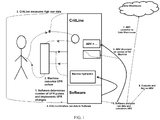
- a device such as a modified Crit-Line® III monitor, that can provide high-frequency, real-time hemoglobin concentration data
- the last two terms in equation (7) can be derived, i.e., the right-side and left-side differentials of 1/(hemoglobin concentration) around the time point t 0 at which the ultrafiltration rate was changed.
- These are the slopes of the 1/Hgb time course data just before and after t 0 , which can be obtained by regression from the raw data.
- the application of this concept was evaluated with a modified Crit-Line® III monitor capable of providing a high sampling frequency (e.g., 10 Hz or greater).
- the Crit-Line® III monitor is a device for non-invasive real-time measurements of hematocrit, relative blood volume and oxygen saturation during hemodialysis.
- the Crit-Line®-derived blood volume estimates were compared as described below against reference blood volume measurements obtained by tracer dilution using the Daxor BVA-100 analyzer (Daxor Corporation, New York, NY, USA).
- the Crit-Line®-derived blood volume estimates allow for seamless integration of routine, non-invasive assessment of absolute blood volume into the dialysis treatment without any disruption to operations in the clinic.
- FIGS. 2 and 3 The results of a test run using the modified Crit-Line® III monitor and the method described above for estimation of absolute blood volume are shown in FIGS. 2 and 3 .
- a dialysis treatment was started with an ultrafiltration rate of 50 mL/hour. Fifteen minutes after the start of the treatment, the ultrafiltration rate was increased to 710 mL/hour, i.e., an ultrafiltration step of +660 mL/hour was introduced, which allowed calculation of hemoglobin mass and absolute blood volume at the time of this initial ultrafiltration step. Absolute blood volume during the remainder of the treatment was then calculated as hemoglobin mass divided by hemoglobin concentration (measured by the Crit-Line® monitor).
- FIG. 2 shows the time course of absolute blood volume over the entire dialysis treatment.
- the upward spike at approximately minute 106 is the result of measurement artifacts and has no physiological correlate.
- Knowledge of absolute blood volume and ultrafiltration rate at any given time during the treatment enables the calculation of the cumulative capillary refill over the course of the dialysis session, which is depicted in FIG. 3 .
- hematocrit and hemoglobin concentration are not constant throughout the vasculature. Rather, they are lower in the micro-than in the macrocirculation.
- the ratio of whole body hematocrit (the average hematocrit of the entire blood in the vasculature) to the systemic hematocrit, also called the F cell ratio, is about 0.91 on average. Using this average ratio, whole body hematocrit or hemoglobin concentration can be calculated from the systemic values, but this may not reflect the true F cell ratio in a given patient.
- ultrafiltration during hemodialysis may prompt significant changes in the blood volume distribution between the micro- and macrovasculature, thereby changing the F cell ratio during the course of the treatment.
- Ultrafiltration during dialysis is in some respects comparable to acute bleeding, and a shift of blood volume from the micro- to the macrocirculation has been documented in rabbits in response to blood loss. See LaForte, A.J., et al., The American journal of physiology, 1992. 262(1 Pt 2): p. H190-9 .
- Blood volume remains relatively stable in the face of changes in circulating hemoglobin mass, i.e., as the number of red blood cells increases ( e.g., in response to erythropoietin therapy), plasma volume shrinks to maintain a stable blood volume.
- changes in blood volume do affect hemoglobin levels. See Bellizzi, V., et al., American journal of kidney diseases: the official journal of the National Kidney Foundation, 2002. 40(3): p. 549-55 .
- knowledge of the absolute blood volume is relevant for assessment of the size of the circulating hemoglobin pool and can help distinguish between patients with too little hemoglobin in circulation and those with adequate hemoglobin mass but suffering from hemodilution.
- Post-dialysis weight should be gradually reduced toward an objectively defined (and measurable) target, but the path toward this target should be guided and informed by absolute blood volume determinations, and these should also dictate at what body weight this path ends. At that point, it should be considered whether treatment regimen modifications (especially with respect to treatment duration/frequency) are possible and feasible to allow further improvements in fluid volume status.
- ABSV absolute blood volume
- Concerning the choice of a > 0 see the statement following (1.14) in Section 1.2 below.
- Equation (1.5) suggests that the following statement is true:
- p ( t ) 0 ⁇ t ⁇ T
- p t ⁇ 0 Hb t , 0 ⁇ t ⁇ T
- BV t 0 ⁇ q 0 p t 0 / d + dt 1 p t 0 ⁇ d ⁇ dt 1 p t 0 .
- the approach described in this section also works if one assumes that the CRFR Q r ( t ) can be approximated by functions of the type f ( t, ⁇ 1 , ⁇ 1 , ⁇ 1 , ⁇ ) for t ⁇ t 0 and g ( t, ⁇ 2 , ⁇ 2 , ⁇ 2 , ⁇ ) for t ⁇ t 0 which depend on a finite number of parameters ⁇ 1 , ⁇ 1 , ⁇ 1 , ⁇ and ⁇ 2 , ⁇ 2 , ⁇ 2 , ⁇ .
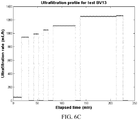
- FIG. 6A the profile for the ultrafiltration rate (UFR) is presented showing the time and the size of the steps that were introduced in all tests, with the exception of the last three Tests no. 12, 13 and 15, where, as shown in FIGS. 6B , 6C , and 6D , respectively, larger steps were introduced throughout the test because it was already clear that large steps (e.g., up to about 1200 ml/h, as shown in FIG. 6C ) give better results.
- UFR ultrafiltration rate
- the Crit-Line® device provided measurement for the hemoglobin concentration Hb with a rate of 10 Hz.
- the hemoglobin concentration is given in g/dL with two decimal places.
- Test BV1 BV3 BV4 BV5 BV6 BV7 BV Daxor (liter) 6.029 7.162 4.520 8.043 5.757 4.532
- Test BV8 BV9 BV10 BV12 BV13 BV15 BV Daxor (liter) 4.877 4.956 3.980 5.670 6.872 4.584
- Table 2 Times t 0 ⁇ and the values for ⁇ av ⁇ . The values of t 0 ⁇ are in elapsed minutes since beginning of the treatment.
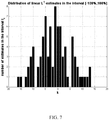
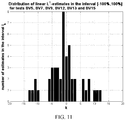
- the distribution of the relative error BV rel,err is shown in the interval [-100%,100%] for all tests and all steps where an estimate could be obtained (i.e., for 98 cases) in case of estimates obtained by linear respectively quadratic L 1 -approximation.
- an estimate could be obtained (i.e., for 98 cases) in case of estimates obtained by linear respectively quadratic L 1 -approximation.
- the relative error BV rel,err is in [-10%,10%], whereas this is true for 13 estimates out of 98 cases when the quadratic L 1 -approximation is used.
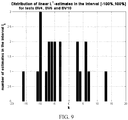
- FIGS. 9 and 10 the distribution of the relative error is shown for those tests which provided the least satisfying results in case of linear approximation respectively in case of quadratic approximation. In both cases, one sees a bias towards negative values of the relative error.
- FIGS. 11 and 12 the distribution of the relative error is shown for tests which provided satisfying results for linear respectively quadratic approximation.
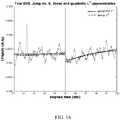
- linear approximation corresponds to the assumption that the capillary refill rate can be assumed to be constant before and after the step in the UFR and that the quadratic approximation corresponds to the case of a linear, non-constant change of the capillary refill rate.
- BV i - j stands for Test BV i , Step no. j.
- Tables 6 and 7 show the performance of linear respectively quadratic approximation for different step sizes in the UFR.
- Linear approximation gave the best results for downward step of sizes between -1260 and -760 mL/h, whereas quadratic approximation gave the best results for upward steps of sizes between 780 and 1250 mL/h.
- Table 6 Number of cases with relative error of the blood volume estimate in [-10%, 10%] respectively in [-20%,20%] for different step sizes for linear L 1 -approximation.
- Jump size (mL/h) Total no. of cases No. of cases with relative error in [-10%, 10%] No.
Landscapes
- Health & Medical Sciences (AREA)
- Life Sciences & Earth Sciences (AREA)
- Heart & Thoracic Surgery (AREA)
- Engineering & Computer Science (AREA)
- Public Health (AREA)
- General Health & Medical Sciences (AREA)
- Biomedical Technology (AREA)
- Veterinary Medicine (AREA)
- Animal Behavior & Ethology (AREA)
- Vascular Medicine (AREA)
- Cardiology (AREA)
- Physics & Mathematics (AREA)
- Medical Informatics (AREA)
- Surgery (AREA)
- Hematology (AREA)
- Pathology (AREA)
- Molecular Biology (AREA)
- Biophysics (AREA)
- Anesthesiology (AREA)
- Physiology (AREA)
- Optics & Photonics (AREA)
- Nuclear Medicine, Radiotherapy & Molecular Imaging (AREA)
- Urology & Nephrology (AREA)
- Epidemiology (AREA)
- Primary Health Care (AREA)
- Pulmonology (AREA)
- External Artificial Organs (AREA)
Claims (6)
- Hämodialysemaschine, Folgendes umfassend:a) Mittel zum Einrichten einer anfänglichen Ultrafiltrationsgeschwindigkeit für einen Patienten;b) Mittel zum Bestimmen von Eigenschaften und Zeiteinstellen von wenigstens einem Ultrafiltrationsgeschwindigkeitsänderungsschritt;c) Mittel zum Ausführen des wenigstens einen Ultrafiltrationsgeschwindigkeitsänderungsschritts;d) Mittel zum Messen der Hämoglobinkonzentration mit einer Probenahmefrequenz von wenigstens 10 Hz unmittelbar vor und nach jedem des wenigstens einen Ultrafiltrationsgeschwindigkeitsänderungsschritts;e) Mittel zum Berechnen des absoluten Blutvolumens des Patienten aus einer Änderung der Hämoglobinkonzentrationssteigung unmittelbar vor und unmittelbar nach jedem des wenigstens einen Ultrafiltrationsgeschwindigkeitsänderungsschritts; undf) Mittel zum Bestätigen, dass die Ultrafiltrationsgeschwindigkeit angemessen oder nicht angemessen ist, basierend auf dem absoluten Blutvolumen.
- Hämodialysemaschine nach Anspruch 1, ferner umfassend Mittel zum Einstellen der Ultrafiltrationsgeschwindigkeit, basierend auf dem absoluten Blutvolumen.
- Hämodialysemaschine nach Anspruch 1 oder 2, ferner umfassend Mittel zum Auslösen eines Alarms, wenn das absolute Blutvolumen des Patienten weniger als ein Alarmvolumen beträgt.
- Hämodialysemaschine nach einem der Ansprüche 1-3, wobei das Berechnen des absoluten Blutvolumens des Patienten ein Verwenden des geringsten absoluten Werts beinhaltet.
- Hämodialysemaschine nach einem der Ansprüche 1-3, wobei das Berechnen des absoluten Blutvolumens des Patienten ein Verwenden des geringsten quadratischen Kostenfunktionals beinhaltet.
- Hämodialysemaschine nach einem der vorhergehenden Ansprüche, ferner umfassend Mittel zum Anzeigen des absoluten Blutvolumens.
Applications Claiming Priority (2)
| Application Number | Priority Date | Filing Date | Title |
|---|---|---|---|
| US201462000667P | 2014-05-20 | 2014-05-20 | |
| PCT/US2015/031581 WO2015179401A1 (en) | 2014-05-20 | 2015-05-19 | Absolute blood volume measurement using ultrafiltration pulsing |
Publications (2)
| Publication Number | Publication Date |
|---|---|
| EP3145392A1 EP3145392A1 (de) | 2017-03-29 |
| EP3145392B1 true EP3145392B1 (de) | 2019-10-30 |
Family
ID=53276315
Family Applications (1)
| Application Number | Title | Priority Date | Filing Date |
|---|---|---|---|
| EP15726479.7A Active EP3145392B1 (de) | 2014-05-20 | 2015-05-19 | Messung des absoluten blutvolumens mithilfe von ultrafiltrationspulsung |
Country Status (6)
| Country | Link |
|---|---|
| EP (1) | EP3145392B1 (de) |
| CN (1) | CN106659391B (de) |
| AU (1) | AU2015264323B2 (de) |
| CA (1) | CA2949679C (de) |
| MX (1) | MX378053B (de) |
| WO (1) | WO2015179401A1 (de) |
Families Citing this family (9)
| Publication number | Priority date | Publication date | Assignee | Title |
|---|---|---|---|---|
| WO2018223046A1 (en) * | 2017-06-02 | 2018-12-06 | Yossi Chait | Absolute blood volume estimation device and method |
| US10881347B2 (en) * | 2017-12-29 | 2021-01-05 | Fresenius Medical Care Holdings, Inc. | Closed loop dialysis treatment using adaptive ultrafiltration rates |
| CA3107951C (en) * | 2018-09-19 | 2026-02-10 | Fresenius Medical Care Holdings, Inc. | Techniques for dialysis based on relative blood volume |
| US11389576B2 (en) | 2018-12-03 | 2022-07-19 | Fresenius Medical Care Holdings, Inc. | Determination of patient blood volume at start of a dialysis treatment |
| CN110124138B (zh) * | 2019-04-19 | 2022-05-10 | 暨南大学 | 一种血液透析过程中干体重控制系统 |
| AU2020358078B2 (en) | 2019-10-04 | 2023-11-30 | Fresenius Medical Care Holdings, Inc. | Techniques for determining patient blood characteristics during a dialysis process |
| US11923078B2 (en) | 2019-11-01 | 2024-03-05 | Terumo Cardiovascular Systems Corporation | Semi-autonomous medical systems and methods |
| US12040092B2 (en) | 2019-12-20 | 2024-07-16 | Fresenius Medical Care Holdings, Inc. | Real-time intradialytic hypotension prediction |
| US20220226553A1 (en) * | 2021-01-15 | 2022-07-21 | Global Monitors, Inc. | Hemodialysis enhancement apparatus & method |
Family Cites Families (9)
| Publication number | Priority date | Publication date | Assignee | Title |
|---|---|---|---|---|
| US6061590A (en) * | 1997-06-03 | 2000-05-09 | Transonic Systems, Inc. | Method and apparatus for predicting intradialytic morbid events through the monitoring of a central blood volume |
| DE10230413B4 (de) * | 2002-07-06 | 2004-07-22 | Fresenius Medical Care Deutschland Gmbh | Vorrichtung zur Bestimmung des Blutvolumens während einer extrakorporalen Blutbehandlung |
| US7608043B1 (en) * | 2002-10-18 | 2009-10-27 | Global Monitors, Inc. | Optical and ultrasound probe for monitoring blood volume changes |
| DE102008010531A1 (de) * | 2008-02-22 | 2009-08-27 | Fresenius Medical Care Deutschland Gmbh | Verfahren zum Betreiben einer Blutbehandlungsvorrichtung, sowie Blutvolumenmonitor und Blutbehandlungsvorrichtung zum Ausführen des Verfahrens |
| EP2295097A1 (de) * | 2009-09-09 | 2011-03-16 | Fresenius Medical Care Deutschland GmbH | Verfahren und Vorrichtung zur Beurteilung von Werten, die eine Masse oder eine Konzentration einer im Körper des Patienten vorhandenen Substanz darstellen |
| JP5824034B2 (ja) * | 2010-04-22 | 2015-11-25 | フレゼニウス ムディカル カーレ ドイチェランド ゲーエムベーハーFresenius Medical Care Deutschland GmbH | ろ過率の制御方法、コントローラ、及びデバイス |
| ES2639446T3 (es) * | 2010-04-22 | 2017-10-26 | Fresenius Medical Care Deutschland Gmbh | Dispositivos y controlador para controlar una velocidad de filtración |
| EP2469431B1 (de) * | 2010-12-23 | 2018-10-10 | Fresenius Medical Care Deutschland GmbH | Verfahren zur Berechnung oder Näherung eines Werts, der das relative Blutvolumen darstellt, und Vorrichtungen |
| US9974491B2 (en) * | 2012-08-28 | 2018-05-22 | Fresenius Medical Care Holdings, Inc. | Detecting indications of intradialytic morbid events by measurement of relative blood volume, blood pressure and heart rate |
-
2015
- 2015-05-19 EP EP15726479.7A patent/EP3145392B1/de active Active
- 2015-05-19 WO PCT/US2015/031581 patent/WO2015179401A1/en not_active Ceased
- 2015-05-19 MX MX2016015117A patent/MX378053B/es unknown
- 2015-05-19 AU AU2015264323A patent/AU2015264323B2/en active Active
- 2015-05-19 CA CA2949679A patent/CA2949679C/en active Active
- 2015-05-19 CN CN201580039671.1A patent/CN106659391B/zh active Active
Non-Patent Citations (1)
| Title |
|---|
| None * |
Also Published As
| Publication number | Publication date |
|---|---|
| CA2949679C (en) | 2022-08-30 |
| WO2015179401A8 (en) | 2016-02-11 |
| CN106659391A (zh) | 2017-05-10 |
| WO2015179401A1 (en) | 2015-11-26 |
| AU2015264323B2 (en) | 2018-10-04 |
| AU2015264323A1 (en) | 2016-12-01 |
| EP3145392A1 (de) | 2017-03-29 |
| MX378053B (es) | 2025-03-10 |
| CA2949679A1 (en) | 2015-11-26 |
| CN106659391B (zh) | 2020-03-10 |
| MX2016015117A (es) | 2017-03-03 |
Similar Documents
| Publication | Publication Date | Title |
|---|---|---|
| AU2015264323B2 (en) | Absolute blood volume measurement using ultrafiltration pulsing | |
| Thijssen et al. | Absolute blood volume in hemodialysis patients: why is it relevant, and how to measure it | |
| John et al. | Plasma volume, albumin, and fluid status in peritoneal dialysis patients | |
| US8303807B2 (en) | Dialyser with measuring devices for monitoring the blood pressure, method of determining the blood pressure and a storage medium for use in a dialyser | |
| Kron et al. | Adjustment of target weight based on absolute blood volume reduces the frequency of intradialytic morbid events | |
| Tølløfsrud et al. | The dynamics of vascular volume and fluid shifts of lactated Ringer’s solution and hypertonic-saline-dextran solutions infused in normovolemic sheep | |
| Yalcin et al. | Impact of continuous flow left ventricular assist device therapy on chronic kidney disease: a longitudinal multicenter study | |
| EP3145393B1 (de) | Schätzung des absoluten blutvolumens mittels blutverdünnung | |
| Raghunathan et al. | Importance of intravenous fluid dose and composition in surgical ICU patients | |
| Prowle et al. | Fluid balance management during continuous renal replacement therapy | |
| Assa et al. | Effect of isolated ultrafiltration and isovolemic dialysis on myocardial perfusion and left ventricular function assessed with 13N-NH3 positron emission tomography and echocardiography | |
| Álvarez Nadal et al. | Individually adjusted absolute blood volume feedback control: a promising solution for intradialytic hypotension | |
| Habas et al. | Intradialytic hypotension pathophysiology and therapy update: Review and update | |
| Castro et al. | Preload responsiveness–guided fluid removal in mechanically ventilated patients with fluid overload: A comprehensive clinical–physiological study | |
| Schmiedecker et al. | Ultrafiltration‐induced decrease in relative blood volume is larger in hemodialysis patients with low specific blood volume: Results from a dialysate bolus administration study | |
| du Cheyron et al. | Blood volume-and blood temperature-controlled hemodialysis in critically ill patients: a 6-month, case-matched, open-label study | |
| Shin et al. | Impact of intradialytic blood pressure changes on cardiovascular outcomes is independent of the volume status of maintenance hemodialysis patients | |
| Ikeda et al. | Hemodynamic Ramp Test in Cardiogenic Shock Supported by Microaxial Flow Pump: Protocol Description, Feasibility, and Hemodynamic Response | |
| Abdelmobdy et al. | The Impact of Low Sodium Dialysate on Different Echocardiographic Parameters in Prevalent Hemodialysis Patients | |
| US20250177648A1 (en) | Management of fluid administration | |
| Macedo et al. | A Randomized Trial of Albumin Infusion to Prevent Intradialytic Hypotension in Hypoalbuminemic Patients | |
| Khanna et al. | 13 Cardiac Complications and their Monitoring in Thalassemia | |
| WO2018223046A1 (en) | Absolute blood volume estimation device and method | |
| Waheed et al. | Comparison between Torsemide Infusion Versus Intermittent Boluses and Their Impact-On Thoracic Fluid Content in Acute Decompensated Heart Failure Critically Ill Patients | |
| Baan Jr et al. | Systolic coronary flow reduction in the canine heart in situ: Effects of left ventricular pressure and elastance |
Legal Events
| Date | Code | Title | Description |
|---|---|---|---|
| STAA | Information on the status of an ep patent application or granted ep patent |
Free format text: STATUS: THE INTERNATIONAL PUBLICATION HAS BEEN MADE |
|
| PUAI | Public reference made under article 153(3) epc to a published international application that has entered the european phase |
Free format text: ORIGINAL CODE: 0009012 |
|
| STAA | Information on the status of an ep patent application or granted ep patent |
Free format text: STATUS: REQUEST FOR EXAMINATION WAS MADE |
|
| 17P | Request for examination filed |
Effective date: 20161114 |
|
| AK | Designated contracting states |
Kind code of ref document: A1 Designated state(s): AL AT BE BG CH CY CZ DE DK EE ES FI FR GB GR HR HU IE IS IT LI LT LU LV MC MK MT NL NO PL PT RO RS SE SI SK SM TR |
|
| AX | Request for extension of the european patent |
Extension state: BA ME |
|
| DAV | Request for validation of the european patent (deleted) | ||
| DAX | Request for extension of the european patent (deleted) | ||
| STAA | Information on the status of an ep patent application or granted ep patent |
Free format text: STATUS: EXAMINATION IS IN PROGRESS |
|
| 17Q | First examination report despatched |
Effective date: 20181126 |
|
| REG | Reference to a national code |
Ref country code: DE Ref legal event code: R079 Ref document number: 602015040692 Country of ref document: DE Free format text: PREVIOUS MAIN CLASS: A61B0005020000 Ipc: A61M0001340000 |
|
| RIC1 | Information provided on ipc code assigned before grant |
Ipc: A61B 5/02 20060101ALI20190426BHEP Ipc: A61M 1/34 20060101AFI20190426BHEP |
|
| GRAP | Despatch of communication of intention to grant a patent |
Free format text: ORIGINAL CODE: EPIDOSNIGR1 |
|
| STAA | Information on the status of an ep patent application or granted ep patent |
Free format text: STATUS: GRANT OF PATENT IS INTENDED |
|
| INTG | Intention to grant announced |
Effective date: 20190607 |
|
| GRAS | Grant fee paid |
Free format text: ORIGINAL CODE: EPIDOSNIGR3 |
|
| GRAA | (expected) grant |
Free format text: ORIGINAL CODE: 0009210 |
|
| STAA | Information on the status of an ep patent application or granted ep patent |
Free format text: STATUS: THE PATENT HAS BEEN GRANTED |
|
| AK | Designated contracting states |
Kind code of ref document: B1 Designated state(s): AL AT BE BG CH CY CZ DE DK EE ES FI FR GB GR HR HU IE IS IT LI LT LU LV MC MK MT NL NO PL PT RO RS SE SI SK SM TR |
|
| REG | Reference to a national code |
Ref country code: GB Ref legal event code: FG4D |
|
| REG | Reference to a national code |
Ref country code: CH Ref legal event code: EP |
|
| REG | Reference to a national code |
Ref country code: DE Ref legal event code: R096 Ref document number: 602015040692 Country of ref document: DE |
|
| REG | Reference to a national code |
Ref country code: AT Ref legal event code: REF Ref document number: 1195468 Country of ref document: AT Kind code of ref document: T Effective date: 20191115 |
|
| REG | Reference to a national code |
Ref country code: IE Ref legal event code: FG4D |
|
| REG | Reference to a national code |
Ref country code: SE Ref legal event code: TRGR |
|
| REG | Reference to a national code |
Ref country code: LT Ref legal event code: MG4D |
|
| PG25 | Lapsed in a contracting state [announced via postgrant information from national office to epo] |
Ref country code: NL Free format text: LAPSE BECAUSE OF FAILURE TO SUBMIT A TRANSLATION OF THE DESCRIPTION OR TO PAY THE FEE WITHIN THE PRESCRIBED TIME-LIMIT Effective date: 20191030 Ref country code: LV Free format text: LAPSE BECAUSE OF FAILURE TO SUBMIT A TRANSLATION OF THE DESCRIPTION OR TO PAY THE FEE WITHIN THE PRESCRIBED TIME-LIMIT Effective date: 20191030 Ref country code: BG Free format text: LAPSE BECAUSE OF FAILURE TO SUBMIT A TRANSLATION OF THE DESCRIPTION OR TO PAY THE FEE WITHIN THE PRESCRIBED TIME-LIMIT Effective date: 20200130 Ref country code: FI Free format text: LAPSE BECAUSE OF FAILURE TO SUBMIT A TRANSLATION OF THE DESCRIPTION OR TO PAY THE FEE WITHIN THE PRESCRIBED TIME-LIMIT Effective date: 20191030 Ref country code: PT Free format text: LAPSE BECAUSE OF FAILURE TO SUBMIT A TRANSLATION OF THE DESCRIPTION OR TO PAY THE FEE WITHIN THE PRESCRIBED TIME-LIMIT Effective date: 20200302 Ref country code: NO Free format text: LAPSE BECAUSE OF FAILURE TO SUBMIT A TRANSLATION OF THE DESCRIPTION OR TO PAY THE FEE WITHIN THE PRESCRIBED TIME-LIMIT Effective date: 20200130 Ref country code: GR Free format text: LAPSE BECAUSE OF FAILURE TO SUBMIT A TRANSLATION OF THE DESCRIPTION OR TO PAY THE FEE WITHIN THE PRESCRIBED TIME-LIMIT Effective date: 20200131 Ref country code: LT Free format text: LAPSE BECAUSE OF FAILURE TO SUBMIT A TRANSLATION OF THE DESCRIPTION OR TO PAY THE FEE WITHIN THE PRESCRIBED TIME-LIMIT Effective date: 20191030 Ref country code: PL Free format text: LAPSE BECAUSE OF FAILURE TO SUBMIT A TRANSLATION OF THE DESCRIPTION OR TO PAY THE FEE WITHIN THE PRESCRIBED TIME-LIMIT Effective date: 20191030 |
|
| REG | Reference to a national code |
Ref country code: NL Ref legal event code: MP Effective date: 20191030 |
|
| PG25 | Lapsed in a contracting state [announced via postgrant information from national office to epo] |
Ref country code: RS Free format text: LAPSE BECAUSE OF FAILURE TO SUBMIT A TRANSLATION OF THE DESCRIPTION OR TO PAY THE FEE WITHIN THE PRESCRIBED TIME-LIMIT Effective date: 20191030 Ref country code: HR Free format text: LAPSE BECAUSE OF FAILURE TO SUBMIT A TRANSLATION OF THE DESCRIPTION OR TO PAY THE FEE WITHIN THE PRESCRIBED TIME-LIMIT Effective date: 20191030 Ref country code: IS Free format text: LAPSE BECAUSE OF FAILURE TO SUBMIT A TRANSLATION OF THE DESCRIPTION OR TO PAY THE FEE WITHIN THE PRESCRIBED TIME-LIMIT Effective date: 20200229 |
|
| PG25 | Lapsed in a contracting state [announced via postgrant information from national office to epo] |
Ref country code: AL Free format text: LAPSE BECAUSE OF FAILURE TO SUBMIT A TRANSLATION OF THE DESCRIPTION OR TO PAY THE FEE WITHIN THE PRESCRIBED TIME-LIMIT Effective date: 20191030 |
|
| PG25 | Lapsed in a contracting state [announced via postgrant information from national office to epo] |
Ref country code: CZ Free format text: LAPSE BECAUSE OF FAILURE TO SUBMIT A TRANSLATION OF THE DESCRIPTION OR TO PAY THE FEE WITHIN THE PRESCRIBED TIME-LIMIT Effective date: 20191030 Ref country code: ES Free format text: LAPSE BECAUSE OF FAILURE TO SUBMIT A TRANSLATION OF THE DESCRIPTION OR TO PAY THE FEE WITHIN THE PRESCRIBED TIME-LIMIT Effective date: 20191030 Ref country code: RO Free format text: LAPSE BECAUSE OF FAILURE TO SUBMIT A TRANSLATION OF THE DESCRIPTION OR TO PAY THE FEE WITHIN THE PRESCRIBED TIME-LIMIT Effective date: 20191030 Ref country code: DK Free format text: LAPSE BECAUSE OF FAILURE TO SUBMIT A TRANSLATION OF THE DESCRIPTION OR TO PAY THE FEE WITHIN THE PRESCRIBED TIME-LIMIT Effective date: 20191030 Ref country code: EE Free format text: LAPSE BECAUSE OF FAILURE TO SUBMIT A TRANSLATION OF THE DESCRIPTION OR TO PAY THE FEE WITHIN THE PRESCRIBED TIME-LIMIT Effective date: 20191030 |
|
| REG | Reference to a national code |
Ref country code: DE Ref legal event code: R097 Ref document number: 602015040692 Country of ref document: DE |
|
| REG | Reference to a national code |
Ref country code: AT Ref legal event code: MK05 Ref document number: 1195468 Country of ref document: AT Kind code of ref document: T Effective date: 20191030 |
|
| PG25 | Lapsed in a contracting state [announced via postgrant information from national office to epo] |
Ref country code: SK Free format text: LAPSE BECAUSE OF FAILURE TO SUBMIT A TRANSLATION OF THE DESCRIPTION OR TO PAY THE FEE WITHIN THE PRESCRIBED TIME-LIMIT Effective date: 20191030 Ref country code: SM Free format text: LAPSE BECAUSE OF FAILURE TO SUBMIT A TRANSLATION OF THE DESCRIPTION OR TO PAY THE FEE WITHIN THE PRESCRIBED TIME-LIMIT Effective date: 20191030 |
|
| PLBE | No opposition filed within time limit |
Free format text: ORIGINAL CODE: 0009261 |
|
| STAA | Information on the status of an ep patent application or granted ep patent |
Free format text: STATUS: NO OPPOSITION FILED WITHIN TIME LIMIT |
|
| 26N | No opposition filed |
Effective date: 20200731 |
|
| PG25 | Lapsed in a contracting state [announced via postgrant information from national office to epo] |
Ref country code: SI Free format text: LAPSE BECAUSE OF FAILURE TO SUBMIT A TRANSLATION OF THE DESCRIPTION OR TO PAY THE FEE WITHIN THE PRESCRIBED TIME-LIMIT Effective date: 20191030 Ref country code: AT Free format text: LAPSE BECAUSE OF FAILURE TO SUBMIT A TRANSLATION OF THE DESCRIPTION OR TO PAY THE FEE WITHIN THE PRESCRIBED TIME-LIMIT Effective date: 20191030 |
|
| PG25 | Lapsed in a contracting state [announced via postgrant information from national office to epo] |
Ref country code: LI Free format text: LAPSE BECAUSE OF NON-PAYMENT OF DUE FEES Effective date: 20200531 Ref country code: CH Free format text: LAPSE BECAUSE OF NON-PAYMENT OF DUE FEES Effective date: 20200531 Ref country code: MC Free format text: LAPSE BECAUSE OF FAILURE TO SUBMIT A TRANSLATION OF THE DESCRIPTION OR TO PAY THE FEE WITHIN THE PRESCRIBED TIME-LIMIT Effective date: 20191030 |
|
| REG | Reference to a national code |
Ref country code: BE Ref legal event code: MM Effective date: 20200531 |
|
| PG25 | Lapsed in a contracting state [announced via postgrant information from national office to epo] |
Ref country code: LU Free format text: LAPSE BECAUSE OF NON-PAYMENT OF DUE FEES Effective date: 20200519 |
|
| PG25 | Lapsed in a contracting state [announced via postgrant information from national office to epo] |
Ref country code: IE Free format text: LAPSE BECAUSE OF NON-PAYMENT OF DUE FEES Effective date: 20200519 |
|
| PG25 | Lapsed in a contracting state [announced via postgrant information from national office to epo] |
Ref country code: BE Free format text: LAPSE BECAUSE OF NON-PAYMENT OF DUE FEES Effective date: 20200531 |
|
| PG25 | Lapsed in a contracting state [announced via postgrant information from national office to epo] |
Ref country code: TR Free format text: LAPSE BECAUSE OF FAILURE TO SUBMIT A TRANSLATION OF THE DESCRIPTION OR TO PAY THE FEE WITHIN THE PRESCRIBED TIME-LIMIT Effective date: 20191030 Ref country code: MT Free format text: LAPSE BECAUSE OF FAILURE TO SUBMIT A TRANSLATION OF THE DESCRIPTION OR TO PAY THE FEE WITHIN THE PRESCRIBED TIME-LIMIT Effective date: 20191030 Ref country code: CY Free format text: LAPSE BECAUSE OF FAILURE TO SUBMIT A TRANSLATION OF THE DESCRIPTION OR TO PAY THE FEE WITHIN THE PRESCRIBED TIME-LIMIT Effective date: 20191030 |
|
| PG25 | Lapsed in a contracting state [announced via postgrant information from national office to epo] |
Ref country code: MK Free format text: LAPSE BECAUSE OF FAILURE TO SUBMIT A TRANSLATION OF THE DESCRIPTION OR TO PAY THE FEE WITHIN THE PRESCRIBED TIME-LIMIT Effective date: 20191030 |
|
| P01 | Opt-out of the competence of the unified patent court (upc) registered |
Effective date: 20230602 |
|
| PGFP | Annual fee paid to national office [announced via postgrant information from national office to epo] |
Ref country code: DE Payment date: 20250423 Year of fee payment: 11 |
|
| PGFP | Annual fee paid to national office [announced via postgrant information from national office to epo] |
Ref country code: GB Payment date: 20250423 Year of fee payment: 11 |
|
| PGFP | Annual fee paid to national office [announced via postgrant information from national office to epo] |
Ref country code: IT Payment date: 20250423 Year of fee payment: 11 |
|
| PGFP | Annual fee paid to national office [announced via postgrant information from national office to epo] |
Ref country code: FR Payment date: 20250423 Year of fee payment: 11 |
|
| PGFP | Annual fee paid to national office [announced via postgrant information from national office to epo] |
Ref country code: SE Payment date: 20250423 Year of fee payment: 11 |