EP3145499B1 - Capsules enrobées à libération modifiée - Google Patents
Capsules enrobées à libération modifiée Download PDFInfo
- Publication number
- EP3145499B1 EP3145499B1 EP15726022.5A EP15726022A EP3145499B1 EP 3145499 B1 EP3145499 B1 EP 3145499B1 EP 15726022 A EP15726022 A EP 15726022A EP 3145499 B1 EP3145499 B1 EP 3145499B1
- Authority
- EP
- European Patent Office
- Prior art keywords
- capsule
- capsules
- modified release
- release coating
- coating
- Prior art date
- Legal status (The legal status is an assumption and is not a legal conclusion. Google has not performed a legal analysis and makes no representation as to the accuracy of the status listed.)
- Active
Links
Images







Classifications
-
- A—HUMAN NECESSITIES
- A61—MEDICAL OR VETERINARY SCIENCE; HYGIENE
- A61K—PREPARATIONS FOR MEDICAL, DENTAL OR TOILETRY PURPOSES
- A61K9/00—Medicinal preparations characterised by special physical form
- A61K9/48—Preparations in capsules, e.g. of gelatin, of chocolate
- A61K9/4891—Coated capsules; Multilayered drug free capsule shells
-
- A—HUMAN NECESSITIES
- A61—MEDICAL OR VETERINARY SCIENCE; HYGIENE
- A61K—PREPARATIONS FOR MEDICAL, DENTAL OR TOILETRY PURPOSES
- A61K9/00—Medicinal preparations characterised by special physical form
- A61K9/48—Preparations in capsules, e.g. of gelatin, of chocolate
- A61K9/4808—Preparations in capsules, e.g. of gelatin, of chocolate characterised by the form of the capsule or the structure of the filling; Capsules containing small tablets; Capsules with outer layer for immediate drug release
-
- A—HUMAN NECESSITIES
- A61—MEDICAL OR VETERINARY SCIENCE; HYGIENE
- A61K—PREPARATIONS FOR MEDICAL, DENTAL OR TOILETRY PURPOSES
- A61K9/00—Medicinal preparations characterised by special physical form
- A61K9/48—Preparations in capsules, e.g. of gelatin, of chocolate
- A61K9/4816—Wall or shell material
- A61K9/4825—Proteins, e.g. gelatin
-
- A—HUMAN NECESSITIES
- A61—MEDICAL OR VETERINARY SCIENCE; HYGIENE
- A61K—PREPARATIONS FOR MEDICAL, DENTAL OR TOILETRY PURPOSES
- A61K9/00—Medicinal preparations characterised by special physical form
- A61K9/48—Preparations in capsules, e.g. of gelatin, of chocolate
- A61K9/4833—Encapsulating processes; Filling of capsules
-
- A—HUMAN NECESSITIES
- A61—MEDICAL OR VETERINARY SCIENCE; HYGIENE
- A61K—PREPARATIONS FOR MEDICAL, DENTAL OR TOILETRY PURPOSES
- A61K9/00—Medicinal preparations characterised by special physical form
- A61K9/48—Preparations in capsules, e.g. of gelatin, of chocolate
- A61K9/4841—Filling excipients; Inactive ingredients
- A61K9/4866—Organic macromolecular compounds
Definitions
- the present invention relates to a modified release coated capsule and a process to obtain that capsule as defined by the claims.
- oral pharmaceutical preparations When orally administered, pharmaceutical preparations are generally disintegrated in the stomach. However, when a certain release profile of the pharmaceutical or nutritional ingredient is desired, oral pharmaceutical preparations can be coated with a so-called functional or modified release coating to achieve delayed or controlled release of an active pharmaceutical ingredient (API).
- API active pharmaceutical ingredient
- Those coatings intended to protect the drug from the acidic environment of the gastric medium, to prevent the drug release in the stomach, or to provide release of an active ingredient to certain and specific section of the gastrointestinal tract (GIT) as e.g. the jejunum, duodenum, ileum, the colon and the rectum are commonly called delayed release coating formulations using enteric polymers.
- controlled release coatings are requested to control the release of the drug over a prolonged period of time.
- controlled release approaches are also known in the pharmaceutical area as sustained, extended and prolonged release, respectively. Combinations of these coatings are possible as well.
- enteric coated HPMC hydroxypropyl methylcellulose
- enteric coated HPMC hydroxypropyl methylcellulose
- capsules Prior to the coating, the capsules were sealed with the LEMs (liquid encapsulation by microspray) process.
- Enteric coatings with an amount of enteric polymer of at least 6 mg/cm 2 showed no pores or cracks.
- E. T. Cole et al reported that due to the good compatibility between HPMC and the enteric films, variation in coating levels showed little influence on the dissolution profiles.
- liquid filled capsules are frequently sealed either by using a band or using the LEMs technology to avoid leakage during further manufacturing steps, such as coating steps, packaging and so on.
- a band or other seal is not considered, even if a coating process is involved, as there is less risk of capsule opening.
- US 2011/0033530 suggests coating each capsule half before closing the capsule. It is said that as a result of coating the capsule halves prior to closing the capsule, in the closed state, the enteric coating of the lower part is partially overlapped by the upper part. The overlapped part of the coating is assumed having a sealing function which prevents the penetration of fluid through a possible gap between the lower part and the upper part.
- coating the two halves of a capsule shell prior to closing the capsule is a cumbersome process. Furthermore, there remains the risk that the coating may be damaged during capsule closure.
- WO 2013/054285 discloses gastroretentive dosage systems wherein the extended-release layer comprises one or more extended-release polymer(s) and one or more coating additive(s).
- the system can be a band sealed capsule which is coated with an extended-release coating being applied until there is a weight gain of up to 15 % w/w based on the total weight of the dosage form.
- compositions having an inner core and at least two surrounding layers.
- the inner core may be a capsule which may be sealed via banding or LEMS.
- the inner layer may be a continuous coating having a coating weight of up to 25 mg/cm 2 .
- the outer layer may be a wax at a coating weight of about 10 mg/cm 2 .
- WO 03/013480 discloses an enteric formulation of fluoxetine.
- the formulation may be in the form of a gelatin capsule comprising an optional smoothening coat, an enteric coating and an optional finishing coat.
- the enteric coating may comprise polymers in an amount of up to 20 mg/cm 2 .
- WO 2012/058695 discloses pharmaceutical compositions of (-)-17-(cyclobutylmethyl)morphinan-3,14-diol.
- the composition may be in the form of a capsule which optionally may be sealed by banding.
- the capsules may be coated with an aqueous composition of Eudragit® FS30D in an amount of up to 20 mg/cm 2 .
- modified release coated capsules which can be easily prepared at reduced costs using usual manufacturing processes. Furthermore, it would be desirable to provide a modified release coated capsule which can be prepared by the same method and with the same coating materials independent of the capsule shell material. Additionally, it would be desirable to provide a modified release coated capsule with a drug release profile which can be easily tailored according to the requirements.
- the present invention therefore relates to a capsule comprising a band seal and a modified release coating, characterized in that the modified release coating comprises a film forming agent in an amount of 4 to 6 mg/cm 2 of the modified release coating, wherein the band seal is a gelatin band sealing the gap between body and cap of the capsule and the capsule is filled with a liquid material.
- sealing the gap by a band allows the reduction of the amount of enteric polymer required for obtaining the same or even improved level of enteric coating compared to prior art coatings.
- This has the advantage that manufacturing costs are not only reduced by omitting the precoat, but can additionally be reduced by reducing the amount of enteric polymer.
- This reduction has the further advantage that the thickness of the enteric coating can be reduced thereby reducing the overall size and weight of the final capsule.
- resistance to release under simulated stomach conditions can be achieved already with very thin enteric coating films.
- the invention is of further advantage for tailoring drug release profile by adjusting the coating thickness according to the desired area of release within the gastrointestinal tract.
- the capsule of the present invention in particular is for oral administration, such as for oral administration of a pharmaceutical or nutritional ingredient.
- the size of the capsule is not particularly limited and can be any usual size, such as 000, 00, 0, 1, 2, 3, 4 or 5.
- the capsule shell can be of any suitable material, such as gelatin, HPMC, pullulan or polyvinyl alcohol (PVA). HPMC and hard gelatin capsules are preferred. Hard gelatin capsules are particularly preferred.
- Capsules and in particular hard capsules are usually prepared by closing a capsule body with a cap.
- the gap between the body and the cap of the capsule is sealed with a gelatin band.
- the modified release coating of the capsule according to the invention may be a delayed release coating, such as an enteric coating, or a controlled release coating. Combinations of these coatings are also possible.
- the function of the coating is usually attained by a film forming agent, in particular a film forming polymer. Any usual film forming agent known to the person skilled in the art for forming the desired coating may be used.
- the film forming agent usually comprises a compound which is insoluble in the gastrointestinal juice at a pH of below 5 and which is soluble in the intestinal juice at a pH at or above 5.
- this film forming agent dissolves in a pH dependent manner.
- the film forming agent has a pH threshold which is the pH below which it is insoluble and at or above which it is soluble.
- the pH of the surrounding medium triggers the dissolution of the film forming agent.
- none (or essentially none) of the film forming agent dissolves below the pH threshold. Once the pH of the surrounding medium reaches (or exceeds) the pH threshold, the film forming agent becomes soluble.
- insoluble it is understood that 1 g of the film forming agent requires more than 10,000 ml of solvent (surrounding medium) to dissolve at a given pH.
- solvent surrounding medium
- soluble it is understood that 1 g of the film forming agent requires less than 10,000 ml, preferably less than 5,000 ml, more preferably less than 1,000 ml, even more preferably less than 100 ml or 10 ml of solvent to dissolve at a given pH.
- Standardrounding medium means the medium in the gastrointestinal tract, such as the gastric juice or intestinal juice. Alternatively, the surrounding medium may be an in vitro equivalent of the medium in the gastrointestinal tract.
- the normal pH of gastric juice is usually in the range of 1 to 3.
- the film forming agent for intestinal, such as colon targeting should thus be insoluble below pH 5 and should be soluble at or above pH 5.
- the film forming agent therefore is usually insoluble in gastric juice.
- Such material may be referred to as an "enteric" material.
- the pH of intestinal juice gradually increases to about 7 to 8 along the small intestine.
- a film forming agent for intestinal targeting therefore becomes soluble in the terminal ileum/colon and allows release of e.g. the active agent from the capsule.
- the film forming agent preferably has a pH threshold of 6.5, more preferably of 7.
- suitable film forming agents for intestinal targeting and in particular for the preparation of the coating surrounding the capsule are acrylate polymers, cellulose polymers and polyvinyl-based polymers, or other polymers.
- suitable cellulose polymers include cellulose acetate phthalate, cellulose acetate trimellitate, cellulose acetate succinate, hydroxypropylmethyl cellulose phthalate, hydroxypropylmethyl cellulose acetate succinate and carboxymethylethyl cellulose acetate butyrate.
- suitable polyvinyl-based polymers include polyvinyl acetate phthalate.
- the material for intestinal targeting is a co-polymer of a (meth)acrylic acid and a (meth)acrylic acid C 1-4 alkyl ester, for instance, a co-polymer of methacrylic acid and methacrylic acid methyl ester.
- Suitable examples of such co-polymers are usually anionic.
- these co-polymers usually are not sustained release polymethacrylates.
- the ratio of carboxylic acid groups to methylester groups in these co-polymers determines the pH at which the copolymer is soluble.
- the acid:ester ratio may be from about 2:1 to about 1:3, e.g. about 1:1 or, about 1:2.
- the molecular weight of such anionic co-polymers is usually from about 120,000 to 150,000, preferably about 135,000.
- Known anionic poly(methacrylic acid/methyl methacrylate) co-polymers include Eudragit® L (pH threshold about 6.0), Eudragit® S (pH threshold about 7) and Eudragit® FS (pH threshold about 7).
- Eudragit® L 100-55 which is a copolymer of methacrylic acid and ethylacetate and which has a pH threshold of about 5.5 is also suitable.
- the Eudragit® copolymers can be obtained from Evonik.
- the film forming agent for intestinal may comprise a compound which is susceptible to attack by colonic bacteria, such as polysaccharides.
- Suitable polysaccharides are for example starch, amylose, amylopectine, chitosan, chondroitine sulfate, cyclodextrine, dextrane, pullulan, carrageenan, scleroglucan, chitin, curdulan, pectin, guar gum, xanthan gum and levan.
- the modified release coating can be a controlled release coating. These coatings are able to provide release of the active substance after a predetermined time after administration or a controlled release over time.
- Galenical principles used to achieve the different release forms typically reduce the dissolution of the active ingredient; establish diffusion barriers including osmotic systems and erosion systems. With regards to functional coatings the focus is on establishment of diffusion barriers. Diffusion barriers can be established by membranes controlling the diffusion being permeable or not; by using a controlling principle as pH or natural degradation during the GIT transit; by using a controlled release matrix releasing an active ingredient contained in the matrix controlled by diffusion; by using a membrane controlled osmotic effect, or by using a diffusion membrane eroding after degradation.
- Suitable polymers for diffusion membranes that typically are gastric resistant are cellulose derivatives as cellulose acetate phthalate (CAP), Hydroxypropyl methylcellulose phthalate (HPMCP), polymethacrylates and polyvinylacetate phthalate.
- CAP cellulose acetate phthalate
- HPPMCP Hydroxypropyl methylcellulose phthalate
- polymethacrylates polyvinylacetate phthalate.
- the film forming agent does not comprise cellulose acetate. In another embodiment of the present invention, the film forming agent does not comprise cellulose acetate phthalate.
- the film forming agent does not comprise hydroxypropylmethyl cellulose phthalate.
- Suitable polymers for a controlled release matrix coating are digestible, long chain (C8-C50 , especially C12-C40), substituted or unsubstituted hydrocarbons, such as fatty acids, fatty alcohols, glyceryl esters of fatty acids, mineral and vegetable oils and waxes, polyalkylene glycols, hydrophilic polymers, such as gums, cellulose ethers, acrylic resins and protein derived materials, and in general polymers that are insoluble over the entire pH-range, and combinations thereof.
- C8-C50 especially C12-C40
- substituted or unsubstituted hydrocarbons such as fatty acids, fatty alcohols, glyceryl esters of fatty acids, mineral and vegetable oils and waxes, polyalkylene glycols, hydrophilic polymers, such as gums, cellulose ethers, acrylic resins and protein derived materials, and in general polymers that are insoluble over the entire pH-range, and combinations thereof.
- CMEC carboxy methylethylcellulose
- ethylcellulose which provide a release by diffusion but are not entirely gastric resistant.
- CMEC carboxy methylethylcellulose
- ethylcellulose which provide a release by diffusion but are not entirely gastric resistant.
- polymethacrylate sustained release polymers such as Eudragit® RS, RL, NM and NE.
- the film forming agent does not comprise ethylcellulose.
- the film forming agent does not comprise Eudragit® RL PO. In another embodiment of the present invention, the film forming agent does not comprise Eudragit® FS, such as Eudragit® FS30D.
- Suitable polymers for an erosion system among others are cellulose ether derivatives and degradable natural polymers as polysaccharides.
- a person skilled in the art is able to tailor the composition of the coatings in a way that the release of the active ingredient starts, or takes place, specifically at the targeted site of the GIT.
- This can, among others, be achieved by the means of introducing pores to make the membrane permeable, or more permeable, by including pore formers and/or further excipients; by introducing further excipients for erosion as e.g. using degradable natural polymers as polysaccharides or synthetic polymers that dissolve at a certain pH.
- Mixtures of two or more film forming agents may be used as appropriate.
- the modified release coating may additionally comprise conventional excipients, such as plasticizers for film formation (for example triethylcitrate), anti-tacking agents (such as glyceryl monostearate), colorants, pigments, solublilizers, dispersion agents and surfactants.
- excipients may be included in amounts known to the skilled person of e.g. up to 30 % by weight of the total weight of the coating.
- a particular advantage of the present invention is that the amount of film forming agent can be lower than usual.
- a modified release coating comprising a low amount of film forming agent being applied onto the capsule shell (with a band seal) with or without any precoat shows improved adhesion and can even impart improved dissolution properties to the capsule compared to a modified release coating comprising a higher amount of film forming agent. It was surprisingly found that this beneficial effect does not occur if the capsule is sealed using an alternative method, namely the LEMs technology. As demonstrated by the present comparative examples either sealing the capsules by LEMs technology alone or in combination with a precoat does not provide satisfactory acid resistance to the capsules even if a high amount of enteric coating is applied.
- the present invention does not only save material and, thus, costs, but constitutes a surprising beneficial technical effect over prior art coated capsules.
- the film forming agent according to the invention is present in an amount of 4 to 6 mg per cm 2 of the modified release coating.
- the film forming agent according to the invention is present in an amount of about 4 mg, about 5 mg, or about 6 mg, each amount per cm 2 of the modified release coating.
- the capsule according to the present invention is filled with one or more pharmaceutically active ingredients.
- the one or more pharmaceutically active ingredients are selected from compounds used for the treatment of inflammatory bowel disease, such as mesalazine, prednisone, methotrexate and antibiotics, such as metronidazole. Particularly preferred is mesalazine.
- the capsule according to the invention may comprise one or more additional coatings, preferably above the modified release coating.
- “above” means that the additional coating may be coated on the modified release coating.
- the additional coating may also be between the capsule shell and the coating, although it is preferred that there is no coating and in particular no precoat between the capsule shell and the modified release coating.
- the additional coating may for example be present for increasing the stability of the capsule against humidity or for increasing the visual appearance of the capsule.
- any of the above coatings including the modified release coating may comprise one or more pharmaceutically active ingredients. Any coating additional to the modified release coating may consist of the one or more pharmaceutically active ingredients.
- the one or more pharmaceutically active ingredients in the above coatings have a combined effect together with the pharmaceutically active ingredient within the capsule.
- the capsule according to the present invention is filled with one or more pharmaceutically active ingredients and the additional coating above the modified release coating comprises or consists of one or more pharmaceutically active ingredients.
- the one or more pharmaceutically active ingredients within the capsule and within the additional coating can be the same or different. In a preferred embodiment the one or more pharmaceutically active ingredients within the capsule and within the coating are different.
- the capsule according to the present invention is filled with one or more pharmaceutically active ingredients and the modified release coating comprises one or more pharmaceutically active ingredients.
- the one or more pharmaceutically active ingredients within the capsule and within the modified release coating can be the same or different. In a preferred embodiment the one or more pharmaceutically active ingredients within the capsule and within the modified release coating are different.
- the capsule is filled with mesalazine (5-ASA) and the additional coating above the modified release coating comprises metronidazole, or an ester or salt thereof, in particular metronidazole benzoate.
- the capsule is filled with mesalazine (5-ASA) and the coating comprises metronidazole, or an ester or salt thereof, in particular metronidazole benzoate.
- the capsule according to the present invention does not comprise an additional coating, in particular any additional coating above the modified release coating.
- the capsule according to the present invention does not comprise an additional coating (in particular above the modified release coating) comprising carnuba wax or paraffin wax, in particular waxes.
- the capsule according to the present invention does not comprise a coating, such as an additional coating, comprising one or more pharmaceutically active ingredients.
- the capsule according to the invention is filled with a liquid material, such as a solution or dispersion.
- a liquid material such as a solution or dispersion.
- the material may comprise a nutritional ingredient and/or an active pharmaceutical ingredient either alone or in combination with usual excipients.
- the capsule according to the present invention is filled with a liquid and the film forming agent is present in an amount of from 4 mg to 6 mg, and preferably at about 4 mg, each amount per cm 2 of the modified release coating.
- the present invention further relates to a process to obtain the above described capsule comprising the steps of filling the capsule body with a liquid, or liquid and solid material, closing the capsule with a cap, sealing the gap between body and cap with a gelatin band and applying a modified release coating onto the capsule shell such that the modified release coating comprises a film forming agent in an amount of 4 to 6 mg/cm 2 of the modified release coating.
- Coating can be carried out by any usual method known to the person skilled in the art.
- a film comprising the film forming agent and optional excipients can be applied as an organic solution, as an aqueous-organic coating emulsion, as an aqueous-organic coating solution, as an aqueous dispersion or as a neutralized aqueous solution.
- organic liquids alcohols and in particular ethanol may be used.
- the solution, emulsion or dispersion of the film forming agent and optionally excipients may be sprayed onto the capsule in an amount required for providing the desired amount of dry film forming agent per cm 2 of the final modified release coating.
- Size 1 hard gelatin capsules were filled with a model powder formulation containing methylene blue as marker. The capsules were closed and sealed with a gelatin band. Without any precoat, the capsules were then coated with aqueous Eudragit L30D-55 in amounts of 4 mg/cm 2 and 6 mg/cm 2 , respectively, each relating to the dry amount of film forming agent per cm 2 of the final coating.
- Capsules were manufactured in the same manner as in example 1 but without sealing the capsules with the gelatin band prior to the enteric coating.
- Capsules were manufactured in the same manner as in comparative example 1A but with 3 mg/cm 2 HPMC precoat between the gelatin capsule shell and the Eudragit L30D-55 enteric coating.
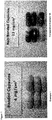
- the acid resistance of the capsules obtained in example 1 and comparative examples 1A and 1B was tested by immersing the capsules for 120 minutes in 0.1 N HCI solution. After the capsules were recovered from the solution, they were visually controlled. Due to the use of methylene blue as marker in the model powder formulation filled into the capsules even small leakages could be easily observed.
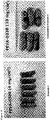
- Figure 1 shows the capsules of example 1 being coated with 4 mg/cm 2 of the film forming agent after recovering from the acid solution. No deterioration of the capsules or leakage was observed.
- the capsules of comparative example 1A showed strong deterioration and leakage (capsules turned blue) after immersion in the acid solution although they were coated with three-times the amount of enteric coating compared to example 1, namely 12 mg/cm 2 of film forming agent.
- This comparative example demonstrates that sealing the capsules with a band allows the use of much lower amounts of enteric coating material for obtaining capsules having even improved properties.
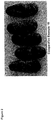
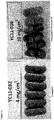
- the capsules of comparative example 1B after immersion into the acid solution are shown in figure 2 .
- These capsules were prepared according to usual prior art methods using a HPMC precoat and being enterically coated with 6 mg/cm 2 of the film forming agent. Despite the precoat the capsules showed strong deterioration. Furthermore, the capsules turned blue indicating that the marker substance leaked out of the capsules.
- the banded capsules without any precoat according to the invention exhibit an improved acid resistance although they are coated with a lower amount of enteric coating.
- the release profiles of the capsules were measured using pH 6.8 Hanks buffer.
- In vitro dissolution studies were performed on a USP type II apparatus using a paddle speed of 50 rpm and a media temperature of 37 ⁇ 0.5 °C.
- Capsules were first tested in 900 ml 0.1 N HCI for 2 hours followed by 8 or 10 hours in Hanks buffer (pH 6.8).
- the pH of the buffer was stabilized at 6.8 ⁇ 0.05 by continuously sparging with 5% CO 2 / 95% O 2 .
- Methylene blue absorbance measurements were taken at 5 minute intervals, with an absorbance wavelength of 663 nm.
- the composition per litre of Hanks buffer was 0.06 g of KH 2 PO 4 , 0.06 g Na 2 HPO 4 .2H 2 O, 8.0 g NaCl, 0.4 g KCl, 0.2 g MgSO 4 .7H 2 O, 0.139 g CaCl 2 .2H 2 O and 0.350 g NaHCO 3 .
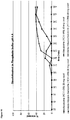
- Figure 4 shows a comparison of the release profiles of banded capsules according to example 1 coated with 4 mg/cm 2 of the film forming agent and non-banded capsules according to example 1A being coated with as much as 16 mg/cm 2 of the film forming agent. While the significant increase in the amount of enteric coating suppressed the premature release of the API under simulated stomach conditions, the API was released at a later lag time, which could results in a too late release in vivo leading to lower oral bioavailability of drugs preferably absorbed in the proximal small intestine. Only up to about 60 % of API was released even after prolonged time in the bicarbonate buffer solution.
- Capsules were prepared in the same manner as in example 1 but using organic Eudragit L100-55 for preparing the enteric coating.
- Capsules were prepared in the same manner as in example 2 but without sealing the capsules with the gelatin band prior to the enteric coating.
- Capsules were prepared in the same manner as in comparative example 2A but using a precoat of 3 mg/cm 2 of HPMC prior to the enteric coating.
- the acid resistance of the capsules obtained in example 2 and comparative examples 2A and 2B were tested as described above with respect to the capsules of example 1 and comparative examples 1A and 1B.
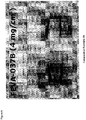
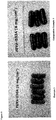
- the results are shown in figures 5 and 6 for the capsules obtained in example 2 being coated with 4 mg/cm 2 of the film forming agent ( figure 5 ), the capsules obtained in comparative example 2A being coated with 16 mg/cm 2 of the film forming agent ( figure 5 ) and the capsules obtained in comparative example 2B being coated with a precoat and with 4 mg/cm 2 of the film forming agent ( figure 6 ).
- the capsules according to the invention (example 2) exhibited no deterioration or leakage while the capsules being coated with even four times the amount of enteric coating obtained in comparative example 2A and the capsules being coated with the same amount of enteric coating as the capsules of example 2 but additionally comprising a precoat obtained in comparative example 2B exhibited strong deterioration and leakage.
- Capsules were manufactured in the same manner as in example 1 but being filled with a model liquid formulation containing methylene blue as marker.
- Capsules were prepared in the same manner as in example 3 but being sealed with the LEMs technology instead of the sealing band.
- Capsules were prepared in the same manner as in example 3 but being precoated with 3 mg/cm 2 of HPMC prior to the coating with the enteric coating.
- Capsules were prepared in the same manner as in comparative example 3 but being precoated with 3 mg/cm 2 of HPMC prior to the coating with the enteric coating.
- the capsules according to the invention (example 4) being coated with 3 mg/cm 2 HPMC precoat and 4 mg/cm 2 enteric coating exhibited no deterioration or leakage ( figure 10 ; capsules remained red).
- the capsules of comparative example 4 being sealed with the LEMs technology instead of the sealing band and being coated with as much as 10 mg/cm 2 of the enteric film forming agent and additionally comprising the precoat also showed leakage of the marker agent (as observed by the blue color of the capsules after immersion).
- the release profiles of the capsules being coated with 4 mg/cm 2 of the film forming agent obtained in example 3 and comparative example 3 were measured. The results are shown in figure 11 . While the capsules according to the invention show no significant release during immersion in 0.1 N HCI for 120 minutes and complete release after a lag time of about 37 minutes in Hanks buffer, the capsules of comparative example 3 being sealed with the LEMs technology instead of the sealing band showed significant release already during immersion in 0.1 N HCI.
- Size 1 hard HPMC capsules were filled with a model powder formulation containing methylene blue as marker. The capsules were closed and sealed with a HPMC band. Without any precoat, the capsules were then coated with an amount of 4 mg/cm 2 aqueous Eudragit L30D-55, relating to the dry amount of film forming agent per cm 2 of the final coating.
- Capsules were manufactured in the same manner as in example 5 but without sealing the capsules with the HPMC band prior to the enteric coating.
- Capsules were manufactured in the same manner as in comparative example 5A but with 3 mg/cm 2 HPMC precoat between the HPMC capsule shell and the Eudragit L30D-55 enteric coating.
- Size 1 hard gelatin capsules were filled with 314 mg of mesalazine (5-ASA). The capsules were closed and sealed with a gelatin band. Without any precoat, the capsules were then coated with aqueous Eudragit L30D-55 in an amount of 4 mg/cm 2 relating to the dry amount of film forming agent per cm 2 of the final coating. Then the capsules were coated with an additional coating comprising 60 mg of metronidazole benzoate.
- the release profiles of the capsules were measured using pH 6.8 Hanks buffer.
- In vitro dissolution studies were performed on a USP type II apparatus using a paddle speed of 50 rpm and a media temperature of 37 ⁇ 0.5 °C.
- Capsules were first tested in 900 ml 0.1 N HCI for 2 hours followed by 8 or 10 hours in Hanks buffer (pH 6.8).
- the pH of the buffer was stabilized at 6.8 ⁇ 0.05 by continuously sparging with 5% CO 2 / 95% O 2 .
- Metronidazole benzoate and mesalazine measurements were taken at 5 minute intervals.
- the composition per litre of Hanks buffer was 0.06 g of KH 2 PO 4 , 0.06 g Na 2 HPO 4 .2H 2 O, 8.0 g NaCl, 0.4 g KCl, 0.2 g MgSO 4 .7H 2 O, 0.139 g CaCl 2 .2H 2 O and 0.350 g NaHCO 3 .
- the results are shown in Figure 14 .
- Size 1 hard gelatin capsules were filled with 312 mg of mesalazine (5-ASA). The capsules were closed and sealed with a gelatin band. Without any precoat, the capsules were then coated with a coating comprising metronidazole benzoate in Eudragit® RS in amounts of 20 mg (4 mg/cm 2 Eudragit® RS) and 60mg (12 mg/cm 2 Eudragit® RS), respectively.
- 5-ASA mesalazine
- Capsules were manufactured in the same manner as in example 7 but without sealing the capsules with the gelatin band prior to the coating.
- the release profiles of the capsules were measured using pH 6.8 Phosphate buffer.
- In vitro dissolution studies were performed on a USP type II apparatus using a paddle speed of 50 rpm and a media temperature of 37 ⁇ 0.5 °C.
- Capsules were first tested in 900 ml 0.1 N HCI for 2 hours followed by 8 or 10 hours in Phosphate buffer (pH 6.8). Metronidazole benzoate and mesalazine measurements were taken at 5 minute intervals.
- the capsules according to the invention did not release significant amounts of both, metronidazole benzoate and mesalazine under the simulated conditions of the intestine during a period of up to 450 minutes, irrespective of whether the capsules were coated with 4 mg/cm 2 or 12 mg/cm 2 of the film forming agent ( Figure 15 ).
- the non-banded capsules did release mesalazine under the simulated conditions of the intestine starting from 160 minutes (4 mg/cm 2 ) or 210 minutes (12 mg/cm 2 ), respectively. Metronidazole benzoate was not released under the above conditions ( Figure 16 ).
Landscapes
- Health & Medical Sciences (AREA)
- Epidemiology (AREA)
- Chemical & Material Sciences (AREA)
- Medicinal Chemistry (AREA)
- Pharmacology & Pharmacy (AREA)
- Life Sciences & Earth Sciences (AREA)
- Animal Behavior & Ethology (AREA)
- General Health & Medical Sciences (AREA)
- Public Health (AREA)
- Veterinary Medicine (AREA)
- Bioinformatics & Cheminformatics (AREA)
- Engineering & Computer Science (AREA)
- Medicinal Preparation (AREA)
- Pharmaceuticals Containing Other Organic And Inorganic Compounds (AREA)
Claims (12)
- Capsule comprenant une bande d'étanchéité et un enrobage de libération modifiée, caractérisée en ce que l'enrobage de libération modifiée comprend un agent filmogène en une quantité de 4 à 6 mg/cm2 de l'enrobage de libération modifiée, dans laquelle la bande d'étanchéité est une bande de gélatine scellant l'espace entre le corps et le capuchon de la capsule et la capsule est remplie de matériau liquide.
- Capsule selon la revendication 1, dans laquelle ladite enveloppe de capsule est une enveloppe de gélatine, une enveloppe d'hydroxypropylméthyl cellulose, une enveloppe de pullulan ou une enveloppe à base de PVA.
- Capsule selon l'une quelconque des revendications précédentes, dans laquelle l'enrobage à libération modifiée est un enrobage à libération retardée et/ou un enrobage à libération contrôlée.
- Capsule selon la revendication 3, dans laquelle l'enrobage à libération modifiée est un enrobage entérique et ledit agent filmogène est choisi dans le groupe constitué de polymères d'acrylate, polymères de cellulose, polymères à base de polyvinyle et leurs mélanges.
- Capsule selon la revendication 4, dans laquelle ledit agent filmogène est choisi dans le groupe constitué de copolymères d'acide (méth)acrylique et d'un ester alkyle C1-4 d'acide (méth)acrylique, acétate-phtalate de cellulose, acétate-trimellitate de cellulose, acétate-succinate de cellulose, phtalate d'hydroxypropylméthylcellulose, acétate-succinate d'hydroxypropylméthylcellulose, acétate-butyrate de carboxyméthyléthylcellulose, acétate-phtalate de polyvinyle et leurs mélanges.
- Capsule selon la revendication 5, dans laquelle ledit agent filmogène est choisi dans le groupe constitué de copolymères anioniques de poly(acide méthacrylique/méthacrylate de méthyle) qui ont un seuil de pH de 6,0 ou 7.
- Capsule selon l'une quelconque des revendications précédentes, dans laquelle l'enrobage à libération modifiée comprend en outre au moins un excipient choisi dans le groupe constitué de plastifiants, d'agents antiadhésifs, de colorants, de pigments, de solubilisants, d'agents de dispersion et de tensioactifs.
- Capsule selon l'une quelconque des revendications précédentes, comprenant en outre un ou plusieurs enrobages supplémentaires.
- Capsule selon l'une quelconque des revendications précédentes, dans laquelle la capsule ne comporte pas de préenrobage entre l'enveloppe de capsule et l'enrobage à libération modifiée.
- Capsule selon l'une quelconque des revendications précédentes, dans laquelle ledit matériau liquide comprend un ingrédient nutritionnel et/ou un ingrédient pharmaceutique actif.
- Procédé pour obtenir une capsule selon l'une quelconque des revendications précédentes, comprenant les étapes consistant à remplir le corps de capsule avec un matériau liquide ou un matériau liquide et solide, à fermer la capsule avec un capuchon, à sceller l'espace entre le corps et le capuchon avec une bande de gélatine et à appliquer un enrobage à libération modifiée sur l'enveloppe de capsule de telle sorte que l'enrobage à libération modifiée comprend un agent filmogène en une quantité de 4 à 6 mg/cm2 de l'enrobage à libération modifiée.
- Procédé selon la revendication 11, dans lequel l'enrobage à libération modifiée est appliqué sur l'enveloppe de capsule sous la forme d'une composition liquide aqueuse ou non aqueuse comprenant l'agent filmogène.
Priority Applications (1)
| Application Number | Priority Date | Filing Date | Title |
|---|---|---|---|
| SI201531428T SI3145499T1 (sl) | 2014-05-19 | 2015-05-13 | Obložene kapsule s prirejenim sproščanjem |
Applications Claiming Priority (2)
| Application Number | Priority Date | Filing Date | Title |
|---|---|---|---|
| EP14168892.9A EP2946774B1 (fr) | 2014-05-19 | 2014-05-19 | Capsules enrobées à libération modifiée |
| PCT/EP2015/060633 WO2015177025A1 (fr) | 2014-05-19 | 2015-05-13 | Capsules enrobées à libération modifiée |
Publications (2)
| Publication Number | Publication Date |
|---|---|
| EP3145499A1 EP3145499A1 (fr) | 2017-03-29 |
| EP3145499B1 true EP3145499B1 (fr) | 2020-09-30 |
Family
ID=50732835
Family Applications (2)
| Application Number | Title | Priority Date | Filing Date |
|---|---|---|---|
| EP14168892.9A Active EP2946774B1 (fr) | 2014-05-19 | 2014-05-19 | Capsules enrobées à libération modifiée |
| EP15726022.5A Active EP3145499B1 (fr) | 2014-05-19 | 2015-05-13 | Capsules enrobées à libération modifiée |
Family Applications Before (1)
| Application Number | Title | Priority Date | Filing Date |
|---|---|---|---|
| EP14168892.9A Active EP2946774B1 (fr) | 2014-05-19 | 2014-05-19 | Capsules enrobées à libération modifiée |
Country Status (11)
| Country | Link |
|---|---|
| US (2) | US11266605B2 (fr) |
| EP (2) | EP2946774B1 (fr) |
| JP (2) | JP2017515880A (fr) |
| CN (2) | CN106456559A (fr) |
| AU (1) | AU2015263308B2 (fr) |
| CA (1) | CA2946952C (fr) |
| DK (2) | DK2946774T3 (fr) |
| ES (2) | ES2793530T3 (fr) |
| NZ (1) | NZ725578A (fr) |
| SI (2) | SI2946774T1 (fr) |
| WO (1) | WO2015177025A1 (fr) |
Families Citing this family (7)
| Publication number | Priority date | Publication date | Assignee | Title |
|---|---|---|---|---|
| SI2946774T1 (sl) * | 2014-05-19 | 2020-07-31 | Tillotts Pharma Ag | Obložene kapsule s prirejenim sproščanjem |
| BR112020000011A2 (pt) * | 2017-07-11 | 2020-07-21 | Qualicaps Co., Ltd. | cápsula dura entérica |
| ES3006512T3 (en) * | 2017-11-17 | 2025-03-18 | Evonik Operations Gmbh | Process for preparing a coated hard shell capsule |
| KR20210022716A (ko) | 2018-06-22 | 2021-03-03 | 쿠오리카프스 가부시키가이샤 | 장용성 경질 캡슐 |
| KR102938078B1 (ko) * | 2019-05-15 | 2026-03-11 | 에보닉 오퍼레이션스 게엠베하 | 캡슐 충전 기계를 사용한 셀룰로오스 또는 전분을 기반으로 하는 코팅을 갖는 충전된 경질 쉘 캡슐의 제조 방법 |
| GB202006074D0 (en) | 2020-04-24 | 2020-06-10 | Vicore Pharma Ab | New composition |
| JP2023553309A (ja) * | 2020-11-25 | 2023-12-21 | キャプシュゲル・ベルジウム・エヌ・ヴィ | 二重層遅延放出硬質カプセル |
Family Cites Families (34)
| Publication number | Priority date | Publication date | Assignee | Title |
|---|---|---|---|---|
| US3784390A (en) * | 1971-07-23 | 1974-01-08 | Hayashibara Biochem Lab | Shaped bodies of pullulan and their use |
| US3871892A (en) * | 1972-12-18 | 1975-03-18 | Hayashibara Biochem Lab | Shaped bodies of pullulan esters and their use |
| DE2363853A1 (de) * | 1973-12-21 | 1975-07-03 | Hoechst Ag | Selbsttragende packungen oder kapseln zum umhuellen von medikamenten |
| JPS61100519A (ja) * | 1984-10-23 | 1986-05-19 | Shin Etsu Chem Co Ltd | 医薬用硬質カプセル |
| JPS6229515A (ja) | 1985-07-30 | 1987-02-07 | Shinjiro Tsuji | 硬カプセル剤のフイルムコ−テイング方法 |
| US5498422A (en) * | 1991-04-08 | 1996-03-12 | Nippon Shinyaku Company Limited | Sustained release capsule |
| US5330759A (en) * | 1992-08-26 | 1994-07-19 | Sterling Winthrop Inc. | Enteric coated soft capsules and method of preparation thereof |
| US5756123A (en) * | 1994-12-01 | 1998-05-26 | Japan Elanco Co., Ltd. | Capsule shell |
| JPH1071186A (ja) * | 1996-08-29 | 1998-03-17 | Shionogi & Co Ltd | カプセルのバンドシール形成方法 |
| AU2785199A (en) * | 1998-03-11 | 1999-09-27 | Warner-Lambert Company | Polyvinyl alcohol compositions |
| KR20000011247A (ko) * | 1998-07-23 | 2000-02-25 | 김윤 | 다당류를이용한대장선택성약물전달조성물및약학제제 |
| MXPA01003197A (es) * | 1998-09-28 | 2004-04-21 | Warner Lambert Co | Suministro enterico y colonico utilizando capsulas de chpm. |
| DE60020716T2 (de) * | 1999-07-22 | 2005-12-15 | Warner-Lambert Co. Llc | Filmbildende zusammensetzungen aus pullulan |
| US6238696B1 (en) * | 2000-01-07 | 2001-05-29 | Gaia Herbs, Inc. | Process for providing herbal medicants in cellulose derivative capsules |
| IT1318597B1 (it) * | 2000-06-23 | 2003-08-27 | A C R Applied Coating Res S A | Uso di un amido ad alto contenuto di amilosio acetilato epregelatinizzato. |
| US6967026B2 (en) * | 2000-08-29 | 2005-11-22 | Nisshin Kasel Co., Ltd. | Hard capsule |
| CA2457385A1 (fr) * | 2001-08-06 | 2003-02-20 | Dr. Reddy's Laboratories Ltd. | Preparation enterique de fluoxetine |
| US8168170B2 (en) * | 2002-10-03 | 2012-05-01 | The Procter And Gamble Company | Compositions having an inner core and at least three surrounding layers |
| DE10309064A1 (de) * | 2003-03-03 | 2004-09-16 | Clariant Gmbh | Polymere Zusammensetzung auf Basis von PVA |
| EP1721604A4 (fr) * | 2004-03-04 | 2008-04-30 | Takeda Pharmaceutical | Preparation de capsule stable |
| EP1593376A1 (fr) * | 2004-05-04 | 2005-11-09 | Warner-Lambert Company LLC | Gélules de pullulane ameliorées |
| WO2006070578A1 (fr) * | 2004-12-28 | 2006-07-06 | Qualicaps Co., Ltd. | Bande de fermeture etanche pour gelule dure |
| GB0607534D0 (en) * | 2006-04-13 | 2006-05-24 | Univ London Pharmacy | Colonic drug delivery formulation |
| EP2283830A1 (fr) * | 2009-07-23 | 2011-02-16 | Actogenix N.V. | Revêtement de capsule entérique aqueuse |
| US9107451B2 (en) | 2009-07-29 | 2015-08-18 | Evonik Röhm Gmbh | Coating composition for the dip coating of capsule halves |
| EP2632441A4 (fr) * | 2010-10-29 | 2015-04-01 | Relmada Therapeutics Inc | Compositions de (-)-17-(cyclobutylméthyl)morphinane-3,14-diol |
| JP5860480B2 (ja) * | 2011-01-11 | 2016-02-16 | キャプシュゲル・ベルジウム・エヌ・ヴィ | プルランを含む新しい硬カプセル |
| WO2013054285A1 (fr) * | 2011-10-11 | 2013-04-18 | Ranbaxy Laboratories Limited | Système de dosage de rétention gastrique et procédé de préparation de celui-ci |
| JP6219836B2 (ja) * | 2011-11-09 | 2017-10-25 | キャプシュゲル・ベルジウム・エヌ・ヴィ | 耐酸性ツーピースハードカプセル用の耐酸性バンディング溶液 |
| EP3446713A3 (fr) * | 2012-05-02 | 2019-05-15 | Capsugel Belgium NV | Dispersions aqueuses de polymères à libération contrôlée et coques et capsules de celles-ci |
| KR102678074B1 (ko) | 2012-05-17 | 2024-06-26 | 제넨테크, 인크. | 무정형 형태의 akt 저해성 피리미디닐 - 사이클로펜탄 화합물, 조성물 및 이들의 방법 |
| AU2014239883B2 (en) * | 2013-03-14 | 2019-01-17 | Therabiome, Llc | Targeted gastrointestinal tract delivery of probiotic organisms and/or therapeutic agents |
| EP3082778B1 (fr) * | 2013-12-18 | 2019-04-03 | Capsugel Belgium NV | Capsule dure remplie de liquide stable comprenant de l'acide bêta-hydroxy-bêta-méthylbutyrique |
| SI2946774T1 (sl) * | 2014-05-19 | 2020-07-31 | Tillotts Pharma Ag | Obložene kapsule s prirejenim sproščanjem |
-
2014
- 2014-05-19 SI SI201431587T patent/SI2946774T1/sl unknown
- 2014-05-19 DK DK14168892.9T patent/DK2946774T3/da active
- 2014-05-19 EP EP14168892.9A patent/EP2946774B1/fr active Active
- 2014-05-19 ES ES14168892T patent/ES2793530T3/es active Active
-
2015
- 2015-05-13 NZ NZ725578A patent/NZ725578A/en unknown
- 2015-05-13 CN CN201580026060.3A patent/CN106456559A/zh active Pending
- 2015-05-13 WO PCT/EP2015/060633 patent/WO2015177025A1/fr not_active Ceased
- 2015-05-13 SI SI201531428T patent/SI3145499T1/sl unknown
- 2015-05-13 ES ES15726022T patent/ES2831321T3/es active Active
- 2015-05-13 AU AU2015263308A patent/AU2015263308B2/en active Active
- 2015-05-13 JP JP2016568689A patent/JP2017515880A/ja active Pending
- 2015-05-13 EP EP15726022.5A patent/EP3145499B1/fr active Active
- 2015-05-13 CA CA2946952A patent/CA2946952C/fr active Active
- 2015-05-13 US US15/312,571 patent/US11266605B2/en active Active
- 2015-05-13 CN CN202210354917.6A patent/CN114983971A/zh active Pending
- 2015-05-13 DK DK15726022.5T patent/DK3145499T3/da active
-
2019
- 2019-12-23 JP JP2019231409A patent/JP7041334B2/ja active Active
-
2021
- 2021-10-26 US US17/510,829 patent/US11998641B2/en active Active
Non-Patent Citations (1)
| Title |
|---|
| None * |
Also Published As
| Publication number | Publication date |
|---|---|
| WO2015177025A1 (fr) | 2015-11-26 |
| DK2946774T3 (da) | 2020-05-25 |
| JP7041334B2 (ja) | 2022-03-24 |
| CN114983971A (zh) | 2022-09-02 |
| DK3145499T3 (da) | 2020-11-02 |
| ES2831321T3 (es) | 2021-06-08 |
| US11998641B2 (en) | 2024-06-04 |
| JP2020063295A (ja) | 2020-04-23 |
| CA2946952C (fr) | 2022-07-12 |
| ES2793530T3 (es) | 2020-11-16 |
| US20220047516A1 (en) | 2022-02-17 |
| CN106456559A (zh) | 2017-02-22 |
| US11266605B2 (en) | 2022-03-08 |
| CA2946952A1 (fr) | 2015-11-26 |
| NZ725578A (en) | 2023-06-30 |
| EP3145499A1 (fr) | 2017-03-29 |
| AU2015263308A1 (en) | 2016-11-10 |
| AU2015263308B2 (en) | 2020-01-16 |
| JP2017515880A (ja) | 2017-06-15 |
| SI3145499T1 (sl) | 2021-01-29 |
| EP2946774A1 (fr) | 2015-11-25 |
| SI2946774T1 (sl) | 2020-07-31 |
| US20170119681A1 (en) | 2017-05-04 |
| EP2946774B1 (fr) | 2020-04-22 |
Similar Documents
| Publication | Publication Date | Title |
|---|---|---|
| US11998641B2 (en) | Modified release coated capsules | |
| EP3145497B1 (fr) | Capsules enrobées à libération modifiée | |
| CN101801357B (zh) | 耐受乙醇的影响的pH依赖性受控释放的药物组合物 | |
| EP0827398B1 (fr) | Forme pharmaceutique destinee a etre liberee dans le colon | |
| US20170258869A1 (en) | Pharmaceutical Compositions for Colon-Specific Delivery | |
| WO2019245975A1 (fr) | Compositions pour l'administration de réboxétine | |
| TWI837237B (zh) | 結腸藥物遞送配方 | |
| WO2018219897A1 (fr) | Forme posologique orale multiparticulaire permettant une libération prolongée de tapentadol | |
| HK40078378A (en) | Modified release coated capsules | |
| HK1230515B (en) | Modified release coated capsules | |
| WO2017156214A1 (fr) | Compositions pharmaceutiques pour une libération spécifiquement au niveau du côlon | |
| WO2010122574A2 (fr) | Capsule enrobée | |
| KR20250164363A (ko) | 부티르산의 장 표적화된 전달을 위한 제형 및 이의 제조 방법 | |
| WO2010138064A1 (fr) | Composition de revêtement par film aqueux |
Legal Events
| Date | Code | Title | Description |
|---|---|---|---|
| STAA | Information on the status of an ep patent application or granted ep patent |
Free format text: STATUS: THE INTERNATIONAL PUBLICATION HAS BEEN MADE |
|
| PUAI | Public reference made under article 153(3) epc to a published international application that has entered the european phase |
Free format text: ORIGINAL CODE: 0009012 |
|
| STAA | Information on the status of an ep patent application or granted ep patent |
Free format text: STATUS: REQUEST FOR EXAMINATION WAS MADE |
|
| 17P | Request for examination filed |
Effective date: 20161027 |
|
| AK | Designated contracting states |
Kind code of ref document: A1 Designated state(s): AL AT BE BG CH CY CZ DE DK EE ES FI FR GB GR HR HU IE IS IT LI LT LU LV MC MK MT NL NO PL PT RO RS SE SI SK SM TR |
|
| AX | Request for extension of the european patent |
Extension state: BA ME |
|
| RIN1 | Information on inventor provided before grant (corrected) |
Inventor name: OLIVEIRA VARUM, FELIPE JOSE Inventor name: BRAVO GONZALEZ, ROBERTO CARLOS Inventor name: BUSER, THOMAS |
|
| REG | Reference to a national code |
Ref country code: HK Ref legal event code: DE Ref document number: 1230516 Country of ref document: HK |
|
| STAA | Information on the status of an ep patent application or granted ep patent |
Free format text: STATUS: EXAMINATION IS IN PROGRESS |
|
| 17Q | First examination report despatched |
Effective date: 20190107 |
|
| GRAP | Despatch of communication of intention to grant a patent |
Free format text: ORIGINAL CODE: EPIDOSNIGR1 |
|
| STAA | Information on the status of an ep patent application or granted ep patent |
Free format text: STATUS: GRANT OF PATENT IS INTENDED |
|
| INTG | Intention to grant announced |
Effective date: 20200504 |
|
| GRAS | Grant fee paid |
Free format text: ORIGINAL CODE: EPIDOSNIGR3 |
|
| GRAA | (expected) grant |
Free format text: ORIGINAL CODE: 0009210 |
|
| STAA | Information on the status of an ep patent application or granted ep patent |
Free format text: STATUS: THE PATENT HAS BEEN GRANTED |
|
| AK | Designated contracting states |
Kind code of ref document: B1 Designated state(s): AL AT BE BG CH CY CZ DE DK EE ES FI FR GB GR HR HU IE IS IT LI LT LU LV MC MK MT NL NO PL PT RO RS SE SI SK SM TR |
|
| AX | Request for extension of the european patent |
Extension state: BA ME |
|
| REG | Reference to a national code |
Ref country code: CH Ref legal event code: EP Ref country code: GB Ref legal event code: FG4D |
|
| REG | Reference to a national code |
Ref country code: DE Ref legal event code: R096 Ref document number: 602015059790 Country of ref document: DE Ref country code: AT Ref legal event code: REF Ref document number: 1318062 Country of ref document: AT Kind code of ref document: T Effective date: 20201015 |
|
| REG | Reference to a national code |
Ref country code: IE Ref legal event code: FG4D |
|
| REG | Reference to a national code |
Ref country code: DK Ref legal event code: T3 Effective date: 20201030 |
|
| REG | Reference to a national code |
Ref country code: SE Ref legal event code: TRGR |
|
| REG | Reference to a national code |
Ref country code: FI Ref legal event code: FGE |
|
| REG | Reference to a national code |
Ref country code: NL Ref legal event code: FP |
|
| REG | Reference to a national code |
Ref country code: SK Ref legal event code: T3 Ref document number: E 35895 Country of ref document: SK |
|
| PG25 | Lapsed in a contracting state [announced via postgrant information from national office to epo] |
Ref country code: GR Free format text: LAPSE BECAUSE OF FAILURE TO SUBMIT A TRANSLATION OF THE DESCRIPTION OR TO PAY THE FEE WITHIN THE PRESCRIBED TIME-LIMIT Effective date: 20201231 Ref country code: BG Free format text: LAPSE BECAUSE OF FAILURE TO SUBMIT A TRANSLATION OF THE DESCRIPTION OR TO PAY THE FEE WITHIN THE PRESCRIBED TIME-LIMIT Effective date: 20201230 Ref country code: HR Free format text: LAPSE BECAUSE OF FAILURE TO SUBMIT A TRANSLATION OF THE DESCRIPTION OR TO PAY THE FEE WITHIN THE PRESCRIBED TIME-LIMIT Effective date: 20200930 |
|
| REG | Reference to a national code |
Ref country code: AT Ref legal event code: MK05 Ref document number: 1318062 Country of ref document: AT Kind code of ref document: T Effective date: 20200930 Ref country code: NO Ref legal event code: T2 Effective date: 20200930 |
|
| PG25 | Lapsed in a contracting state [announced via postgrant information from national office to epo] |
Ref country code: RS Free format text: LAPSE BECAUSE OF FAILURE TO SUBMIT A TRANSLATION OF THE DESCRIPTION OR TO PAY THE FEE WITHIN THE PRESCRIBED TIME-LIMIT Effective date: 20200930 Ref country code: LV Free format text: LAPSE BECAUSE OF FAILURE TO SUBMIT A TRANSLATION OF THE DESCRIPTION OR TO PAY THE FEE WITHIN THE PRESCRIBED TIME-LIMIT Effective date: 20200930 |
|
| REG | Reference to a national code |
Ref country code: LT Ref legal event code: MG4D |
|
| PG25 | Lapsed in a contracting state [announced via postgrant information from national office to epo] |
Ref country code: SM Free format text: LAPSE BECAUSE OF FAILURE TO SUBMIT A TRANSLATION OF THE DESCRIPTION OR TO PAY THE FEE WITHIN THE PRESCRIBED TIME-LIMIT Effective date: 20200930 Ref country code: RO Free format text: LAPSE BECAUSE OF FAILURE TO SUBMIT A TRANSLATION OF THE DESCRIPTION OR TO PAY THE FEE WITHIN THE PRESCRIBED TIME-LIMIT Effective date: 20200930 Ref country code: EE Free format text: LAPSE BECAUSE OF FAILURE TO SUBMIT A TRANSLATION OF THE DESCRIPTION OR TO PAY THE FEE WITHIN THE PRESCRIBED TIME-LIMIT Effective date: 20200930 Ref country code: LT Free format text: LAPSE BECAUSE OF FAILURE TO SUBMIT A TRANSLATION OF THE DESCRIPTION OR TO PAY THE FEE WITHIN THE PRESCRIBED TIME-LIMIT Effective date: 20200930 Ref country code: PT Free format text: LAPSE BECAUSE OF FAILURE TO SUBMIT A TRANSLATION OF THE DESCRIPTION OR TO PAY THE FEE WITHIN THE PRESCRIBED TIME-LIMIT Effective date: 20210201 |
|
| PG25 | Lapsed in a contracting state [announced via postgrant information from national office to epo] |
Ref country code: AL Free format text: LAPSE BECAUSE OF FAILURE TO SUBMIT A TRANSLATION OF THE DESCRIPTION OR TO PAY THE FEE WITHIN THE PRESCRIBED TIME-LIMIT Effective date: 20200930 Ref country code: AT Free format text: LAPSE BECAUSE OF FAILURE TO SUBMIT A TRANSLATION OF THE DESCRIPTION OR TO PAY THE FEE WITHIN THE PRESCRIBED TIME-LIMIT Effective date: 20200930 Ref country code: PL Free format text: LAPSE BECAUSE OF FAILURE TO SUBMIT A TRANSLATION OF THE DESCRIPTION OR TO PAY THE FEE WITHIN THE PRESCRIBED TIME-LIMIT Effective date: 20200930 Ref country code: IS Free format text: LAPSE BECAUSE OF FAILURE TO SUBMIT A TRANSLATION OF THE DESCRIPTION OR TO PAY THE FEE WITHIN THE PRESCRIBED TIME-LIMIT Effective date: 20210130 |
|
| REG | Reference to a national code |
Ref country code: ES Ref legal event code: FG2A Ref document number: 2831321 Country of ref document: ES Kind code of ref document: T3 Effective date: 20210608 |
|
| REG | Reference to a national code |
Ref country code: DE Ref legal event code: R097 Ref document number: 602015059790 Country of ref document: DE |
|
| PLBE | No opposition filed within time limit |
Free format text: ORIGINAL CODE: 0009261 |
|
| STAA | Information on the status of an ep patent application or granted ep patent |
Free format text: STATUS: NO OPPOSITION FILED WITHIN TIME LIMIT |
|
| 26N | No opposition filed |
Effective date: 20210701 |
|
| PG25 | Lapsed in a contracting state [announced via postgrant information from national office to epo] |
Ref country code: LU Free format text: LAPSE BECAUSE OF NON-PAYMENT OF DUE FEES Effective date: 20210513 Ref country code: MC Free format text: LAPSE BECAUSE OF FAILURE TO SUBMIT A TRANSLATION OF THE DESCRIPTION OR TO PAY THE FEE WITHIN THE PRESCRIBED TIME-LIMIT Effective date: 20200930 |
|
| PG25 | Lapsed in a contracting state [announced via postgrant information from national office to epo] |
Ref country code: HU Free format text: LAPSE BECAUSE OF FAILURE TO SUBMIT A TRANSLATION OF THE DESCRIPTION OR TO PAY THE FEE WITHIN THE PRESCRIBED TIME-LIMIT; INVALID AB INITIO Effective date: 20150513 |
|
| P01 | Opt-out of the competence of the unified patent court (upc) registered |
Effective date: 20230518 |
|
| PG25 | Lapsed in a contracting state [announced via postgrant information from national office to epo] |
Ref country code: CY Free format text: LAPSE BECAUSE OF FAILURE TO SUBMIT A TRANSLATION OF THE DESCRIPTION OR TO PAY THE FEE WITHIN THE PRESCRIBED TIME-LIMIT Effective date: 20200930 |
|
| REG | Reference to a national code |
Ref country code: HK Ref legal event code: WD Ref document number: 1230516 Country of ref document: HK |
|
| REG | Reference to a national code |
Ref country code: DE Ref legal event code: R082 Ref document number: 602015059790 Country of ref document: DE Representative=s name: KRAUS & LEDERER PARTGMBB, DE |
|
| PG25 | Lapsed in a contracting state [announced via postgrant information from national office to epo] |
Ref country code: MK Free format text: LAPSE BECAUSE OF FAILURE TO SUBMIT A TRANSLATION OF THE DESCRIPTION OR TO PAY THE FEE WITHIN THE PRESCRIBED TIME-LIMIT Effective date: 20200930 |
|
| VS25 | Lapsed in a validation state [announced via postgrant information from nat. office to epo] |
Ref country code: MA Free format text: LAPSE BECAUSE OF FAILURE TO SUBMIT A TRANSLATION OF THE DESCRIPTION OR TO PAY THE FEE WITHIN THE PRESCRIBED TIME-LIMIT Effective date: 20200930 |
|
| PG25 | Lapsed in a contracting state [announced via postgrant information from national office to epo] |
Ref country code: MT Free format text: LAPSE BECAUSE OF FAILURE TO SUBMIT A TRANSLATION OF THE DESCRIPTION OR TO PAY THE FEE WITHIN THE PRESCRIBED TIME-LIMIT Effective date: 20200930 |
|
| PGFP | Annual fee paid to national office [announced via postgrant information from national office to epo] |
Ref country code: NL Payment date: 20250522 Year of fee payment: 11 |
|
| PGFP | Annual fee paid to national office [announced via postgrant information from national office to epo] |
Ref country code: FI Payment date: 20250520 Year of fee payment: 11 |
|
| PGFP | Annual fee paid to national office [announced via postgrant information from national office to epo] |
Ref country code: DE Payment date: 20250528 Year of fee payment: 11 |
|
| PGFP | Annual fee paid to national office [announced via postgrant information from national office to epo] |
Ref country code: GB Payment date: 20250522 Year of fee payment: 11 Ref country code: ES Payment date: 20250616 Year of fee payment: 11 Ref country code: DK Payment date: 20250521 Year of fee payment: 11 |
|
| PGFP | Annual fee paid to national office [announced via postgrant information from national office to epo] |
Ref country code: NO Payment date: 20250520 Year of fee payment: 11 |
|
| PGFP | Annual fee paid to national office [announced via postgrant information from national office to epo] |
Ref country code: BE Payment date: 20250520 Year of fee payment: 11 Ref country code: IT Payment date: 20250530 Year of fee payment: 11 |
|
| PGFP | Annual fee paid to national office [announced via postgrant information from national office to epo] |
Ref country code: FR Payment date: 20250521 Year of fee payment: 11 |
|
| PGFP | Annual fee paid to national office [announced via postgrant information from national office to epo] |
Ref country code: CH Payment date: 20250601 Year of fee payment: 11 |
|
| PGFP | Annual fee paid to national office [announced via postgrant information from national office to epo] |
Ref country code: TR Payment date: 20250506 Year of fee payment: 11 Ref country code: SK Payment date: 20250506 Year of fee payment: 11 |
|
| PGFP | Annual fee paid to national office [announced via postgrant information from national office to epo] |
Ref country code: CZ Payment date: 20250430 Year of fee payment: 11 |
|
| PGFP | Annual fee paid to national office [announced via postgrant information from national office to epo] |
Ref country code: IE Payment date: 20250521 Year of fee payment: 11 |
|
| PGFP | Annual fee paid to national office [announced via postgrant information from national office to epo] |
Ref country code: SI Payment date: 20250506 Year of fee payment: 11 Ref country code: SE Payment date: 20250522 Year of fee payment: 11 |