EP3145909B1 - 1,3-dipolare verbindung mit einer esterfunktionen von carbonsäure und kautschukzusammensetzung damit - Google Patents
1,3-dipolare verbindung mit einer esterfunktionen von carbonsäure und kautschukzusammensetzung damit Download PDFInfo
- Publication number
- EP3145909B1 EP3145909B1 EP15725548.0A EP15725548A EP3145909B1 EP 3145909 B1 EP3145909 B1 EP 3145909B1 EP 15725548 A EP15725548 A EP 15725548A EP 3145909 B1 EP3145909 B1 EP 3145909B1
- Authority
- EP
- European Patent Office
- Prior art keywords
- rubber composition
- group
- composition according
- carbon atoms
- dipolar compound
- Prior art date
- Legal status (The legal status is an assumption and is not a legal conclusion. Google has not performed a legal analysis and makes no representation as to the accuracy of the status listed.)
- Active
Links
Classifications
-
- C—CHEMISTRY; METALLURGY
- C07—ORGANIC CHEMISTRY
- C07C—ACYCLIC OR CARBOCYCLIC COMPOUNDS
- C07C291/00—Compounds containing carbon and nitrogen and having functional groups not covered by groups C07C201/00 - C07C281/00
- C07C291/02—Compounds containing carbon and nitrogen and having functional groups not covered by groups C07C201/00 - C07C281/00 containing nitrogen-oxide bonds
- C07C291/06—Nitrile oxides
-
- B—PERFORMING OPERATIONS; TRANSPORTING
- B60—VEHICLES IN GENERAL
- B60C—VEHICLE TYRES; TYRE INFLATION; TYRE CHANGING; CONNECTING VALVES TO INFLATABLE ELASTIC BODIES IN GENERAL; DEVICES OR ARRANGEMENTS RELATED TO TYRES
- B60C1/00—Tyres characterised by the chemical composition or the physical arrangement or mixture of the composition
- B60C1/0016—Compositions of the tread
-
- C—CHEMISTRY; METALLURGY
- C07—ORGANIC CHEMISTRY
- C07C—ACYCLIC OR CARBOCYCLIC COMPOUNDS
- C07C291/00—Compounds containing carbon and nitrogen and having functional groups not covered by groups C07C201/00 - C07C281/00
- C07C291/02—Compounds containing carbon and nitrogen and having functional groups not covered by groups C07C201/00 - C07C281/00 containing nitrogen-oxide bonds
-
- C—CHEMISTRY; METALLURGY
- C08—ORGANIC MACROMOLECULAR COMPOUNDS; THEIR PREPARATION OR CHEMICAL WORKING-UP; COMPOSITIONS BASED THEREON
- C08C—TREATMENT OR CHEMICAL MODIFICATION OF RUBBERS
- C08C19/00—Chemical modification of rubber
- C08C19/22—Incorporating nitrogen atoms into the molecule
-
- C—CHEMISTRY; METALLURGY
- C08—ORGANIC MACROMOLECULAR COMPOUNDS; THEIR PREPARATION OR CHEMICAL WORKING-UP; COMPOSITIONS BASED THEREON
- C08K—Use of inorganic or non-macromolecular organic substances as compounding ingredients
- C08K3/00—Use of inorganic substances as compounding ingredients
- C08K3/34—Silicon-containing compounds
- C08K3/36—Silica
-
- C—CHEMISTRY; METALLURGY
- C08—ORGANIC MACROMOLECULAR COMPOUNDS; THEIR PREPARATION OR CHEMICAL WORKING-UP; COMPOSITIONS BASED THEREON
- C08K—Use of inorganic or non-macromolecular organic substances as compounding ingredients
- C08K5/00—Use of organic ingredients
- C08K5/16—Nitrogen-containing compounds
- C08K5/32—Compounds containing nitrogen bound to oxygen
Definitions
- the field of the present invention is that of diene rubber compositions reinforced with an inorganic filler and usable in particular for the manufacture of tires for vehicles. It relates more particularly to the treads of tires with low rolling resistance.
- a tire tread should be as least hysteretic as possible to minimize its contribution to the rolling resistance of the tire.
- a tread must be sufficiently resistant to wear, which implies that the rubber composition which constitutes it must be sufficiently cohesive.
- a rubber composition for a tire tread must have a certain level of rigidity when cooked to ensure good road behavior for the tire.
- a rubber composition with a good level of cohesion or a good level of rigidity can be obtained by introducing into the rubber composition relatively high levels of reinforcing fillers, preferably fine, or by reducing the amount of plasticizer in the rubber composition.
- the Applicants have developed a technical solution which makes it possible to achieve an improved compromise between the cohesion, rigidity and hysteresis of the rubber composition.
- the invention also relates to a tread comprising the rubber composition according to the invention.
- the invention also relates to a tire comprising the rubber composition according to the invention, in particular in its tread.
- any interval of values designated by the expression “between a and b” represents the domain of values greater than “a” and less than “b” (that is to say limits a and b excluded) while any interval of values designated by the expression “from a to b” means the range of values going from “a” to "b” (that is to say including the strict limits a and b).
- composition comprising the mixture and/or the in situ reaction product of the different constituents used, some of these basic constituents (for example the elastomer, the filler or other additive conventionally used in a rubber composition intended for the manufacture of tires) being capable of, or intended to react with each other, at least in part, during the different phases of manufacture of the composition intended for the manufacture of tires .
- 1,3-dipolar compound is understood according to the definition given by IUPAC.
- the carbon group which may contain a heteroatom preferably contains 1 to 20 carbon atoms, more preferably 1 to 12 carbon atoms, even more preferably 1 to 6 carbon atoms. According to any embodiment of the invention, those having from 1 to 3 carbon atoms such as the methyl group or the ethyl group are suitable as R carbon groups.
- A may be a group containing up to 20 carbon atoms, which group may contain at least one heteroatom.
- A can be an aliphatic or aromatic group.
- A When A is an aliphatic group, A preferably contains 1 to 20 carbon atoms, more preferably 1 to 12 carbon atoms, even more preferably 1 to 6 carbon atoms, most particularly 1 to 3 carbon atoms. When A is an aromatic group, A preferably contains 6 to 20 carbon atoms, more preferably 6 to 12 carbon atoms.
- an alkylene group containing 1 to 20 carbon atoms, preferably 1 to 12 carbon atoms, more preferably 1 to 6 carbon atoms, even more preferably 1 to 3 carbon atoms, is particularly suitable.
- a suitable divalent group A containing 1 to 3 carbon atoms we can cite the methylene group.
- divalent group A may also be suitable an arylene group preferably containing 6 to 20 carbon atoms, more preferably 6 to 12 carbon atoms.
- Q preferably comprises the motif corresponding to formula (III) in which four of the five identical or different symbols R1 to R5 are each a atom or a group of atoms and the fifth symbol designates a direct or indirect attachment to A, knowing that R1 and R5 are both different from H.
- the four of the five symbols R1 to R5 can be aliphatic or aromatic groups.
- the aliphatic groups can contain 1 to 20 carbon atoms, preferably 1 to 12 carbon atoms, more preferably 1 to 6 carbon atoms, even more preferably 1 to 3 carbon atoms.
- the aromatic groups can contain 6 to 20 carbon atoms, preferably 6 to 12 carbon atoms.
- R1, R3 and R5 are each preferably an alkyl group of 1 to 6 carbon atoms, more preferably of 1 to 3 carbon atoms, even more preferably a methyl or ethyl group.
- R1, R3 and R5 are identical. According to this variant where they are identical, R1, R3 and R5 are each preferably an alkyl group of 1 to 6 carbon atoms, more preferably of 1 to 3 carbon atoms, even more preferably a methyl or ethyl group.
- the fifth symbol designates an indirect attachment to A
- the fifth symbol preferably represents a heteroatom, preferably oxygen.
- the 1,3-dipolar compound is the compound 3-(2-ethoxy-2-oxoethoxy)-2,4,6-trimethylbenzonitrile oxide corresponding to formula (IIIa)
- An essential characteristic of the rubber composition according to the invention is to comprise the 1,3-dipolar compound defined according to any embodiment of the invention.
- the quantity of 1,3-dipolar compound introduced into the rubber composition is expressed in molar equivalent of carboxylic acid ester function. For example, if the 1,3-dipolar compound contains a single carboxylic acid ester function, one mole of 1,3-dipolar compound corresponds to one mole of carboxylic acid ester function. If the 1,3-dipolar compound contains two carboxylic acid ester functions, one mole of 1,3-dipolar compound corresponds to two moles of carboxylic acid ester functions. In the latter case, the use of the 1,3-dipolar compound according to a molar equivalent of carboxylic acid ester function corresponds to half a mole of 1,3-dipolar compound.
- the quantity of 1,3-dipolar compound in the rubber composition is preferably between 0 and 5 molar equivalents, more preferably between 0 and 2 molar equivalents, even more preferably between 0 and 1 molar equivalent of carboxylic acid ester function per 100 moles of monomer units constituting the diene elastomer.
- the lower limit is preferably at least 0.1 molar equivalent of 1,3-dipolar compound.
- iene elastomer (or indistinctly rubber), must be understood in a known manner one (or more) elastomer constituted at least in part (i.e., a homopolymer or a copolymer) of diene monomer units (monomers carrying two double carbon bonds -carbon, conjugated or not).
- diene elastomers can be classified into two categories: “essentially unsaturated” or “essentially saturated”.
- the term "essentially unsaturated” is generally understood to mean a diene elastomer derived at least in part from conjugated diene monomers, having a level of units or units of diene origin (conjugated dienes) which is greater than 15% (mole %); this is how diene elastomers such as butyl rubbers or copolymers of dienes and alpha-olefins such as EPDM do not fall within the previous definition and can be described in particular as "essentially saturated” diene elastomers (low or very low rate of units of diene origin, always less than 15%).
- the term “highly unsaturated” diene elastomer means in particular a diene elastomer having a level of units of diene origin (conjugated dienes) which is greater than 50%.
- diene elastomer any type of diene elastomer, those skilled in the tire art will understand that the present invention is preferably implemented with essentially unsaturated diene elastomers, in particular of type (a) or (b ) above.
- copolymers of type (b) contain from 20 to 99% by weight of diene units and from 1 to 80% by weight of vinylaromatic units.
- Suitable conjugated dienes include 1,3-butadiene, 2-methyl-1,3-butadiene, 2,3-di(C 1 -C 5 alkyl)-1,3-butadienes such as for example 2,3-dimethyl-1,3-butadiene, 2,3-diethyl-1,3-butadiene, 2-methyl-3-ethyl-1,3-butadiene, 2-methyl-3-isopropyl- 1,3-butadiene, aryl-1,3-butadiene, 1,3-pentadiene, 2,4-hexadiene.
- Suitable vinylaromatic compounds include, for example, styrene, ortho-, meta-, para-methylstyrene, the commercial "vinyl-toluene" mixture, para-tertiobutylstyrene, methoxystyrenes, chlorostyrenes, vinylmesitylene, divinylbenzene, vinylnaphthalene.
- the diene elastomer is an essentially unsaturated elastomer chosen from the group consisting of polybutadienes, polyisoprenes, butadiene copolymers, isoprene copolymers, and mixtures of these elastomers.
- a diene elastomer a polybutadiene (BR), a copolymer of butadiene and styrene (SBR), a natural rubber (NR) or a synthetic polyisoprene (IR) preferably having a molar rate of cis-1 bond is particularly suitable. .4 greater than 90%.
- the rubber composition according to the invention comprises a reinforcing inorganic filler.
- inorganic filler By “reinforcing inorganic filler”, must be understood here any inorganic or mineral filler, whatever its color and its origin (natural or synthetic), also called “white” filler, “clear” filler or even “non-black” filler. “as opposed to carbon black, capable of reinforcing by itself, without any other means than an intermediate coupling agent, a rubber composition intended for the manufacture of pneumatic tires, in other words capable of replacing, in its function reinforcement, a conventional pneumatic grade carbon black; such a charge is generally characterized, in a known manner, by the presence of hydroxyl groups (-OH) on its surface.
- -OH hydroxyl groups
- reinforcing inorganic fillers suitable in particular are mineral fillers of the siliceous type, preferably silica (SiOz).
- the silica used can be any reinforcing silica known to those skilled in the art, in particular any precipitated or pyrogenic silica having a BET surface area as well as a CTAB specific surface area both less than 450 m 2 /g, preferably 30 to 400 m 2 /g, notably between 60 and 300 m 2 /g.
- HDS highly dispersible precipitated silicas
- the BET specific surface area is determined in a known manner by gas adsorption using the Brunauer-Emmett-Teller method described in " The Journal of the American Chemical Society” Vol. 60, page 309, February 1938 , more precisely according to the French standard NF ISO 9277 of December 1996 (multi-point volumetric method (5 points) - gas: nitrogen - degassing: 1 hour at 160°C - relative pressure range p / in : 0.05 to 0.17).
- the CTAB specific surface area is the external surface area determined according to French standard NF T 45-007 of November 1987 (method B).
- reinforcing inorganic filler appears is indifferent, whether in the form of powder, microbeads, granules, or even beads.
- reinforcing inorganic filler also means mixtures of different reinforcing inorganic fillers, in particular highly dispersible silicas as described above.
- a reinforcing filler of another nature could be used, in particular organic such as carbon black, since this filler reinforcing material would be covered with an inorganic layer such as silica, or would have functional sites on its surface, in particular hydroxyl sites, requiring the use of a coupling agent to establish the connection between the filler and the elastomer.
- organic such as carbon black
- silica inorganic layer
- a coupling agent to establish the connection between the filler and the elastomer.
- the inorganic filler preferably a silica
- the inorganic filler represents more than 50% by mass of the mass of the reinforcing filler of the rubber composition. We then say that the reinforcing inorganic filler is the majority.
- the carbon black When combined with a majority reinforcing inorganic filler such as silica, the carbon black is preferably used at a level of less than 20 phr, more preferably less than 10 phr (for example between 0.5 and 20 phr, in particular between 2 and 10 pce). In the intervals indicated, we benefit from the coloring (black pigmentation agent) and anti-UV properties of carbon blacks, without penalizing the typical performances provided by the reinforcing inorganic filler.
- All carbon blacks are suitable as carbon blacks, in particular blacks conventionally used in tires or their treads (so-called pneumatic grade blacks).
- pneumatic grade blacks we will particularly mention the reinforcing carbon blacks of the 100, 200, 300 series, or the blacks of the 500, 600 or 700 series (ASTM grades), such as for example the blacks N115, N134, N234, N326, N330 , N339, N347, N375, N550, N683, N772).
- These carbon blacks can be used in isolated state, such as available commercially, or in any other form, for example as a support for some of the rubber additives used.
- the rate of reinforcing inorganic filler is preferably between 30 and 160 phr, more preferably between 40 phr and 160 phr. Below 30 phr, the reinforcement of the rubber composition may be insufficient to provide an adequate level of cohesion or wear resistance of the rubber component of the tire comprising this composition. Even more preferably, the rate of reinforcing inorganic filler is at least 50 phr. Beyond 160 pce, there is a risk of increasing hysteresis and therefore the rolling resistance of the tires. For this reason, the rate of reinforcing inorganic filler is preferably in a range ranging from 50 to 120 phr, in particular for use in a tire tread. Any of these reinforcing inorganic filler rate ranges applies to any of the embodiments of the invention.
- a coupling agent is used in a well-known manner, in particular a silane, (or bonding agent) at least bifunctional intended to ensure a sufficient connection, of chemical and/or physical nature.
- a silane or bonding agent
- at least bifunctional organosilanes or polyorganosiloxanes are used.
- polysulfurized silanes are used, called “symmetrical” or “asymmetrical” depending on their particular structure, as described for example in the applications WO03/002648 (Or US 2005/016651 ) And WO03/002649 (Or US 2005/016650 ).
- polysulfurized silanes mention will be made more particularly of polysulfides (in particular disulfides, trisulfides or tetrasulfides) of bis-(alkoxyl(C 1 -C 4 )-alkyl(C 1 -C 4 )silyl-alkyl(C 1 -C 4 )), such as for example bis(3-trimethoxysilylpropyl) or bis(3-triethoxysilylpropyl) polysulphides.
- polysulfides in particular disulfides, trisulfides or tetrasulfides
- bis-(alkoxyl(C 1 -C 4 )-alkyl(C 1 -C 4 )silyl-alkyl(C 1 -C 4 ) such as for example bis(3-trimethoxysilylpropyl) or bis(3-triethoxysilylpropyl) polysulphides.
- TESPT bis(3-triethoxysilylpropyl) tetrasulfide
- TESPD bis(3-triethoxysilylpropyl) tetrasulfide
- TESPD bis(triethoxysilylpropyl) tetrasulfide
- the content of coupling agent is advantageously less than 20 phr, it being understood that it is generally desirable to use as little as possible.
- the level of coupling agent represents 0.5% to 15% by weight relative to the quantity of inorganic filler. Its rate is preferably between 0.5 and 12 pce, plus preferably included in a range ranging from 3 to 10 pce. This rate is easily adjusted by those skilled in the art according to the rate of inorganic filler used in the composition.
- the rubber composition according to the invention may also contain, in addition to the coupling agents, coupling activators, inorganic charge recovery agents or more generally processing aids capable, in a known manner, of thanks to an improvement in the dispersion of the filler in the rubber matrix and a lowering of the viscosity of the compositions, to improve their ability to be used in the raw state.
- the rubber composition according to the invention may also comprise all or part of the usual additives usually used in elastomer compositions intended to constitute external mixtures of finished rubber articles such as tires, in particular treads, such as for example plasticizers or extender oils, whether the latter are aromatic or non-aromatic in nature, in particular very weakly or non-aromatic oils (eg, paraffinic oils, hydrogenated naphthenics, MES or TDAE oils), vegetable oils , in particular glycerol esters such as glycerol triolates, hydrocarbon plasticizing resins having a high Tg, preferably greater than 30°C, as described for example in the applications WO 2005/087859 , WO 2006/061064 And WO 2007/017060 , pigments, protective agents such as anti-ozone waxes, chemical anti-ozonants, antioxidants, anti-fatigue agents, reinforcing resins (such as resorcinol or bismaleimide), acceptors (for example novolac phenolic resin)
- the rubber composition according to the invention is manufactured in appropriate mixers, using two successive preparation phases well known to those skilled in the art: a first working phase or thermomechanical mixing (so-called “non-productive” phase) at high temperature, up to a maximum temperature between 130°C and 200°C, followed by a second phase of mechanical work (called “productive” phase) up to a lower temperature, typically below 110°C, for example between 40°C and 100°C, finishing phase during which the crosslinking system is incorporated.
- a first working phase or thermomechanical mixing at high temperature, up to a maximum temperature between 130°C and 200°C
- a second phase of mechanical work called “productive” phase
- the 1,3-dipolar compound is incorporated into the diene elastomer before the introduction of the other constituents of the rubber composition.
- the contact time between the diene elastomer and the 1,3-dipolar compound which are thermomechanically kneaded is adjusted as a function of the thermomechanical kneading conditions, in particular as a function of the temperature. The higher the mixing temperature, the shorter this contact time. Typically it is 1 to 5 minutes for a temperature of 100 to 130°C.
- At least one antioxidant is preferably added to the diene elastomer before its introduction into a mixer, in particular at the end of the synthesis of the diene elastomer as is done conventionally.
- the final composition thus obtained is then calendered, for example in the form of a sheet or a plate, in particular for characterization in the laboratory, or even extruded, for for example, to form a rubber profile used as a rubber component for making the tire.
- the rubber composition according to the invention which can be either in the raw state (before crosslinking or vulcanization), or in the cooked state (after crosslinking or vulcanization), is in a tire, in particular in a tire tread.
- the structural analysis as well as the determination of the molar purities of the synthetic molecules are carried out by NMR analysis.
- the spectra are acquired on an Avance 3,400 MHz BRUKER spectrometer equipped with a BBFO-zgrad 5 mm “broadband” probe.
- the quantitative 1 H NMR experiment uses a single 30° pulse sequence and a repetition delay of 3 seconds between each of the 64 acquisitions.
- the samples are solubilized in deuterated dimethyl sulfoxide (DMSO). This solvent is also used for the lock signal.
- DMSO deuterated dimethyl sulfoxide
- the calibration is carried out on the signal of the protons of DMSO deuterated at 2.44 ppm and on the carbons of DMSO deuterated at 39.5 ppm compared to a TMS reference at 0 ppm.
- the 1H NMR spectrum coupled with the 2D HSQC 1H /13C and HMBC 1H / 13C experiments allow the structural determination of the molecules (see attribution tables).
- the molar quantifications are carried out from the quantitative 1D 1 H NMR spectrum.
- the MSA100 and MSA300 modules are expressed in base 100 relative to the control composition.
- a value greater than 100 reflects an increase in modulus.
- the reinforcement index which is the ratio of the MSA300 module to the MSA100 module, is expressed in base 100 relative to the control composition. A value greater than 100 reflects an improvement in the reinforcement of the composition considered compared to the control composition.
- the dynamic properties tan( ⁇ )max are measured on a viscoanalyzer (Metravib VA4000), according to the ASTM D 5992-96 standard.
- the response of a sample of vulcanized composition (cylindrical test piece 4 mm thick and 400 mm 2 in section) is recorded, subjected to sinusoidal stress in alternating simple shear, at a frequency of 10 Hz, under normal operating conditions. temperature (23°C) according to standard ASTM D 1349-99.
- We carry out a sweep of deformation amplitude from 0.1% to 100% (forward cycle), then from 100% to 0.1% (return cycle).
- ⁇ G ⁇ are expressed in base 100 relative to the control: a value less than 100 reflects a reduction in the modulus difference, or an increase in the linearization of the rubber composition.
- the G* values are expressed in base 100 relative to the control: a value greater than 100 reflects an increase in modulus, i.e. an increase in the rigidity of the rubber composition
- the tan( ⁇ )max values are expressed in base 100 relative to the control: a value less than 100 reflects a reduction in the maximum value of the loss factor, i.e. a reduction in the hysteresis of the rubber composition.
- This compound can be prepared according to the following reaction scheme:
- the combined organic phases are washed with water (3 times per 75 mL) and concentrated under reduced pressure (Tbain 25 oC) to 50 mL (97 g).
- the solution obtained is diluted with petroleum ether (120 ml, fractions 40/60°C) and concentrated under reduced pressure (Tbain 25°C) until a precipitate is formed.
- the precipitate is filtered and washed on the filter with a CH 2 Cl 2 / petroleum ether mixture (5 ml / 20 ml), then with petroleum ether (2 times per 25 ml, fractions 40/60°C) and finally dried for 12 hours under atmospheric pressure at room temperature.
- the 1,3-dipolar compound is used, the synthesis of which is described above.
- compositions A and B described in Table I.
- Compositions A and B based on SBR and silica differ in that composition B contains the 1,3-dipolar compound.
- Composition B is in accordance with the invention, composition A is not in accordance with the invention and is the control composition of composition B.
- the elastomer is introduced into an internal mixer (final filling rate: approximately 70% by volume), the initial tank temperature of which is approximately 110° C., where appropriate the 1,3-dipolar compound which is kneaded alone with the elastomer for approximately 1 minute at 110°C, then the silica, the coupling agent, as well as the various other ingredients with the exception of the system of vulcanization.
- Thermomechanical work is then carried out (non-productive phase) in one step, which lasts approximately 5 min to 6 minutes, until a maximum “drop” temperature of 160°C is reached.
- the mixture thus obtained is recovered, cooled and then sulfur and a sulfenamide type accelerator are incorporated on a mixer (homo-finisher) at 25°C, mixing everything (productive phase) for an appropriate time (for example between 5 and 12 mins).
- compositions thus obtained are then calendered, either in the form of plates (with a thickness ranging from 2 to 3 mm) or thin sheets of rubber, for the measurement of their physical or mechanical properties, either in the form of directly usable profiles, after cutting and/or assembly to the desired dimensions, for example as semi-finished products for tires, in particular for treads.
- Crosslinking is carried out at 150°C.
- Table (II) Composition HAS B Baked Properties MSA100 at 23°C 100 109 MSA300 at 23°C 100 114 MSA300/MSA100 at 23°C 100 104 G* at 23°C 100 96 tan ⁇ max at 23°C 100 89 ⁇ G ⁇ at 23°C 100 65
- composition B in accordance with the invention has both a higher MSA300/MSA100 reinforcement index, a very lower tan ⁇ max and a ⁇ G ⁇ while the module G* loses only 4 points.
- Composition B presents a better compromise between rigidity, cohesion and hysteresis.
Landscapes
- Chemical & Material Sciences (AREA)
- Organic Chemistry (AREA)
- Health & Medical Sciences (AREA)
- Chemical Kinetics & Catalysis (AREA)
- Medicinal Chemistry (AREA)
- Polymers & Plastics (AREA)
- General Chemical & Material Sciences (AREA)
- Engineering & Computer Science (AREA)
- Mechanical Engineering (AREA)
- Compositions Of Macromolecular Compounds (AREA)
Claims (17)
- Kautschukzusammensetzung auf Basis von mindestens einem Dienelastomer, einem verstärkenden anorganischen Füllstoff und einer 1,3-dipolaren Verbindung, die aus der Gruppe bestehend aus Nitriloxiden, Nitriliminen und Nitronen ausgewählt ist, dadurch gekennzeichnet, dass die 1,3-dipolare Verbindung der Formel (I) entspricht:
Q-A-B (I),
wobeiQ eine -C≡N→O-, -C≡N→N- oder -C=N(→O) -Einheit enthält,A, das vorzugsweise zweiwertig ist, für ein Atom oder eine Gruppe von Atomen, das bzw. die Q mit B verbindet, steht,B für eine Carbonsäureesterfunktion steht, die der Formel (II) entspricht:
-C(OR)=O (II),
in der R für eine kohlenstoffhaltige Gruppe, die mindestens ein Heteroatom enthalten kann, steht. - Kautschukzusammensetzung nach Anspruch 1, wobei die kohlenstoffhaltige Gruppe 1 bis 20 Kohlenstoffatome enthält.
- Kautschukzusammensetzung nach Anspruch 1 oder 2, wobei A für eine Gruppe, die bis zu 20 Kohlenstoffatome enthält und mindestens ein Heteroatom enthalten kann, steht.
- Kautschukzusammensetzung nach einem der Ansprüche 1 bis 3, wobei A für eine Alkylengruppe steht, die vorzugsweise 1 bis 3 Kohlenstoffatome enthält.
- Kautschukzusammensetzung nach einem der Ansprüche 1 bis 4, wobei Q die der Formel (III) entsprechende Einheit umfasst:
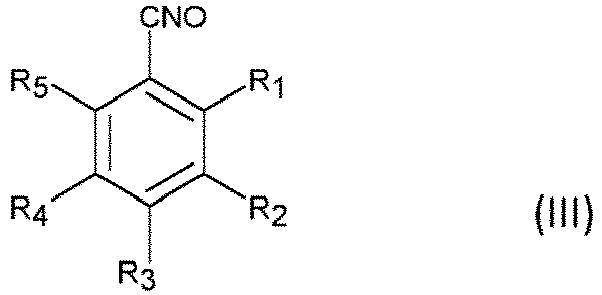 das Symbol CNO für die -C≡N→O- Einheit steht,vier der fünf Symbole R1 bis R5 gleich oder verschieden sind und jeweils für ein Atom oder eine Gruppe von Atomen, vorzugsweise eine aliphatische Gruppe oder eine aromatische Gruppe, stehen und das fünfte Symbol eine direkte oder indirekte Bindung an A bezeichnet, mit der Maßgabe, dass R1 und R5 beide von H verschieden sind.
 - Kautschukzusammensetzung nach Anspruch 5, wobei R1, R3 und R5 jeweils für eine Alkylgruppe mit 1 bis 6 Kohlenstoffatomen stehen.
- Kautschukzusammensetzung nach Anspruch 5 oder 6, wobei R1, R3 und R5 jeweils für ein Methyl oder Ethyl stehen.
- Kautschukzusammensetzung nach einem der Ansprüche 5 bis 7, wobei die 1,3-dipolare Verbindung die Formel (IIIa) aufweist:

- Kautschukzusammensetzung nach einem der Ansprüche 1 bis 4, wobei Q die der Formel (IV) oder (V) entsprechende Einheit umfasst:
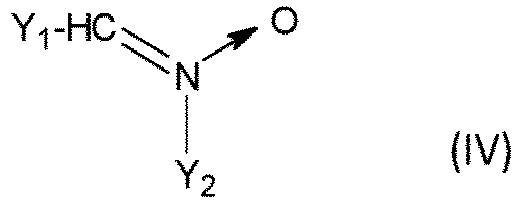
 Y1 für eine aliphatische Gruppe, vorzugsweise eine Alkylgruppe mit vorzugsweise 1 bis 12 Kohlenstoffatomen, oder eine aromatische Gruppe mit 6 bis 20 Kohlenstoffatomen, vorzugsweise eine Alkylarylgruppe, weiter bevorzugt eine Phenyl- oder Tolyl Gruppe, stehtund Y2 für eine aliphatische Gruppe, vorzugsweise eine gesättigte Kohlenwasserstoffgruppe mit vorzugsweise 1 bis 12 Kohlenstoffatomen und einer direkten Bindung an A, oder eine aromatische Gruppe mit vorzugsweise 6 bis 20 Kohlenstoffatomen und einer direkten Bindung an A an ihrem Benzolkern steht.
 - Kautschukzusammensetzung nach einem der Ansprüche 1 bis 9, wobei die Menge der 1,3-dipolaren Verbindung zwischen 0 und 5 Moläquivalenten Carbonsäureesterfunktion pro 100 Mol Monomereinheiten, aus denen das Dienelastomer aufgebaut ist, liegt.
- Kautschukzusammensetzung nach einem der Ansprüche 1 bis 10, wobei es sich bei dem Dienelastomer um ein im Wesentlichen ungesättigtes Elastomer aus der Gruppe bestehend aus Polybutadienen, Polyisoprenen, Butadien-Copolymeren, Isopren-Copolymeren und Mischungen dieser Elastomere handelt.
- Kautschukzusammensetzung nach einem der Ansprüche 1 bis 11, wobei es sich bei dem anorganischen Füllstoff um eine Kieselsäure handelt.
- Kautschukzusammensetzung nach einem der Ansprüche 1 bis 12, wobei der verstärkende anorganische Füllstoff mehr als 50 Massen-% der Masse des verstärkenden Füllstoffs in der Kautschukzusammensetzung ausmacht.
- Kautschukzusammensetzung nach einem der Ansprüche 1 bis 13, wobei die Kautschukzusammensetzung ein Silankupplungsmittel zum Binden des anorganischen Füllstoffs an das Dienelastomer umfasst.
- Kautschukzusammensetzung nach einem der Ansprüche 1 bis 14, wobei sie ein Vernetzungssystem, vorzugsweise auf Basis von Schwefel, umfasst.
- Lauffläche für Reifen, die eine Kautschukzusammensetzung nach einem der Ansprüche 1 bis 15 umfasst.
- Reifen, der eine Kautschukzusammensetzung nach einem der Ansprüche 1 bis 16 umfasst, vorzugsweise in seiner Lauffläche.
Applications Claiming Priority (2)
| Application Number | Priority Date | Filing Date | Title |
|---|---|---|---|
| FR1454655A FR3021315B1 (fr) | 2014-05-23 | 2014-05-23 | Compose 1,3-dipolaire portant une fonction ester d'acide carboxylique et composition de caoutchouc le contenant |
| PCT/EP2015/060926 WO2015177104A1 (fr) | 2014-05-23 | 2015-05-19 | Compose 1,3-dipolaire portant une fonction ester d'acide carboxylique et composition de caoutchouc le contenant |
Publications (2)
| Publication Number | Publication Date |
|---|---|
| EP3145909A1 EP3145909A1 (de) | 2017-03-29 |
| EP3145909B1 true EP3145909B1 (de) | 2023-11-01 |
Family
ID=51610216
Family Applications (1)
| Application Number | Title | Priority Date | Filing Date |
|---|---|---|---|
| EP15725548.0A Active EP3145909B1 (de) | 2014-05-23 | 2015-05-19 | 1,3-dipolare verbindung mit einer esterfunktionen von carbonsäure und kautschukzusammensetzung damit |
Country Status (3)
| Country | Link |
|---|---|
| EP (1) | EP3145909B1 (de) |
| FR (1) | FR3021315B1 (de) |
| WO (1) | WO2015177104A1 (de) |
Families Citing this family (5)
| Publication number | Priority date | Publication date | Assignee | Title |
|---|---|---|---|---|
| FR3046603B1 (fr) | 2016-01-11 | 2017-12-29 | Michelin & Cie | Procede de modification d'un caoutchouc naturel et caoutchouc naturel modifie |
| US11247424B1 (en) | 2016-12-13 | 2022-02-15 | Bridgestone Americas Tire Operations, Llc | Methods for retreading tires |
| FR3060452A1 (fr) * | 2016-12-20 | 2018-06-22 | Compagnie Generale Des Etablissements Michelin | Pneumatique pour vehicule portant des lourdes charges comprenant une nouvelle bande de roulement |
| WO2019122546A1 (fr) * | 2017-12-20 | 2019-06-27 | Compagnie Generale Des Etablissements Michelin | Composition de caoutchouc |
| FR3105237B1 (fr) | 2019-12-24 | 2022-12-30 | Michelin & Cie | Melange maitre a base d’un polymere modifie et d’un additif organophosphore et son procede de fabrication |
Citations (4)
| Publication number | Priority date | Publication date | Assignee | Title |
|---|---|---|---|---|
| US20060084730A1 (en) * | 2004-10-20 | 2006-04-20 | Yasuo Fukushima | Polymer-filler coupling additives |
| JP2008163232A (ja) * | 2006-12-28 | 2008-07-17 | Bridgestone Corp | 混合処理ゴム、それを用いたゴム組成物及びタイヤ |
| US20120046418A1 (en) * | 2010-08-19 | 2012-02-23 | Tokyo Institute Of Technology | Crosslinkable polymer material, crosslinked polymer material, and production method thereof |
| WO2012095425A1 (de) * | 2011-01-12 | 2012-07-19 | Hakan Cinar | Polynitrone auf der basis von polysekundäraminen zur vernetzung und/oder modifizierung von ungesättigten polymeren |
Family Cites Families (16)
| Publication number | Priority date | Publication date | Assignee | Title |
|---|---|---|---|---|
| GB1174922A (en) * | 1966-03-14 | 1969-12-17 | Lepetit Spa | Substituted Nitrone Derivatives |
| JPS60500957A (ja) * | 1983-03-30 | 1985-06-27 | スコツト、ジエラルド | 安定化ゴム組成物 |
| CA2221564C (en) | 1995-05-22 | 2009-02-03 | Cabot Corporation | Elastomeric compounds incorporating silicon-treated carbon blacks |
| JP2001525436A (ja) | 1997-11-28 | 2001-12-11 | コンパニー ゼネラール デ エタブリッスマン ミシュラン−ミシュラン エ コムパニー | アルミナ層で被覆されたカーボンブラックで補強したタイヤ用ゴム組成物 |
| EP1311600A2 (de) | 2000-07-31 | 2003-05-21 | Société de Technologie Michelin | Reifenlauffläche |
| ES2256317T3 (es) | 2000-10-13 | 2006-07-16 | Societe De Technologie Michelin | Organosilano polifuncional utilizable como agente de acoplamiento y su procedimiento de obtencion. |
| CA2425330A1 (fr) | 2000-10-13 | 2002-04-18 | Jean-Claude Tardivat | Composition de caoutchouc comportant a titre d'agent de couplage un organosilane polyfonctionnel |
| JP4536375B2 (ja) | 2001-06-28 | 2010-09-01 | ソシエテ ド テクノロジー ミシュラン | 極めて低い比表面積のシリカで強化されたタイヤトレッド |
| WO2003002648A1 (fr) | 2001-06-28 | 2003-01-09 | Societe De Technologie Michelin | Bande de roulement pour pneumatique renforcee d'une silice a basse surface specifique |
| BR0211898A (pt) | 2001-08-13 | 2004-09-21 | Michelin Soc Tech | Composição de borracha diênica para pneumático, processo para preparar a mesma, utilização de uma composição de borracha, artigo semi-acabado de borracha para pneumático, pneumático, banda de rodagem de pneumático, e, processo para reforçar uma composição de borracha diênica destinada à fabricação de pneumáticos |
| FR2866028B1 (fr) | 2004-02-11 | 2006-03-24 | Michelin Soc Tech | Systeme plastifiant pour composition de caoutchouc |
| FR2877348B1 (fr) | 2004-10-28 | 2007-01-12 | Michelin Soc Tech | Systeme plastifiant pour composition de caoutchouc |
| FR2886304B1 (fr) | 2005-05-26 | 2007-08-10 | Michelin Soc Tech | Composition de caoutchouc pour pneumatique comportant un systeme de couplage organosilicique |
| FR2886305B1 (fr) | 2005-05-26 | 2007-08-10 | Michelin Soc Tech | Composition de caoutchouc pour pneumatique comportant un agent de couplage organosilicique et un agent de recouvrement de charge inorganique |
| FR2886306B1 (fr) | 2005-05-26 | 2007-07-06 | Michelin Soc Tech | Composition de caoutchouc pour pneumatique comportant un agent de couplage organosiloxane |
| FR2889538B1 (fr) | 2005-08-08 | 2007-09-14 | Michelin Soc Tech | Systeme plastifiant pour compsition de caoutchouc. |
-
2014
- 2014-05-23 FR FR1454655A patent/FR3021315B1/fr not_active Expired - Fee Related
-
2015
- 2015-05-19 WO PCT/EP2015/060926 patent/WO2015177104A1/fr not_active Ceased
- 2015-05-19 EP EP15725548.0A patent/EP3145909B1/de active Active
Patent Citations (4)
| Publication number | Priority date | Publication date | Assignee | Title |
|---|---|---|---|---|
| US20060084730A1 (en) * | 2004-10-20 | 2006-04-20 | Yasuo Fukushima | Polymer-filler coupling additives |
| JP2008163232A (ja) * | 2006-12-28 | 2008-07-17 | Bridgestone Corp | 混合処理ゴム、それを用いたゴム組成物及びタイヤ |
| US20120046418A1 (en) * | 2010-08-19 | 2012-02-23 | Tokyo Institute Of Technology | Crosslinkable polymer material, crosslinked polymer material, and production method thereof |
| WO2012095425A1 (de) * | 2011-01-12 | 2012-07-19 | Hakan Cinar | Polynitrone auf der basis von polysekundäraminen zur vernetzung und/oder modifizierung von ungesättigten polymeren |
Non-Patent Citations (3)
| Title |
|---|
| MORIO YONEKAWA ET AL: "Intramolecular 1,3-Dipolar Cycloaddition of Nitrile N -Oxide Accompanied by Dearomatization", ORGANIC LETTERS, vol. 14, no. 4, 17 February 2012 (2012-02-17), pages 1164 - 1167, XP055685415, ISSN: 1523-7060, DOI: 10.1021/ol300125s * |
| T. POLOHSKI ET AL: "Nitrones as Intermediates in the Synthesis of N-Hydroxyamino Acid Esters", J. ORG. CHEM VOL. 41, NO. 12,1976, 1 January 1976 (1976-01-01), pages 2092 - 2095, XP055161933, Retrieved from the Internet <URL:http://pubs.acs.org/doi/pdf/10.1021/jo00874a004> [retrieved on 20150114] * |
| YASUHITO KOYAMA ET AL: "Cascade functionalization of unsaturated bond-containing polymers using ambident agents possessing both nitrile N-oxide and electrophilic functions", CHEMICAL COMMUNICATIONS, vol. 48, no. 83, 1 January 2012 (2012-01-01), UK, pages 10304, XP055461889, ISSN: 1359-7345, DOI: 10.1039/c2cc35158g * |
Also Published As
| Publication number | Publication date |
|---|---|
| FR3021315A1 (fr) | 2015-11-27 |
| WO2015177104A1 (fr) | 2015-11-26 |
| EP3145909A1 (de) | 2017-03-29 |
| FR3021315B1 (fr) | 2017-11-03 |
Similar Documents
| Publication | Publication Date | Title |
|---|---|---|
| EP3060585B1 (de) | Kautschukzusammensetzung mit einem dienelastomer mit zufällig entlang der kette verteilten imidazolfunktionen | |
| EP3060413B1 (de) | Kautschukzusammensetzung mit einem additiv aus einer 1,3-dipolaren verbindung mit imidazolfunktion | |
| EP3319972B1 (de) | Gummizusammensetzung mit einer 1,3-dipolare verbindung mit einer phosphorhaltigen gruppe und dipol mit einem stickstoffatom | |
| EP2150422B1 (de) | Kautschukzusammensetzung für reifen mit einem diester enthaltenden weichmacher | |
| EP2569365B1 (de) | Reifen mit reifenlaufflaeche ein vulkanisiertes thermoplastisches elastomer beinhaltend | |
| EP2104705B1 (de) | Reifenlauffläche | |
| EP2104619B1 (de) | Weichmachersystem und kautschukzusammensetzung für das system enthaltenden reifen | |
| EP2379638B1 (de) | Kautschukzusammensetzung für einen reifen, enthaltend epoxid-naturkautschuk und ein weichmachendes harz | |
| EP2432827B1 (de) | Kautschukzusammensetzung mit einem organosilankoppler | |
| EP2791226A1 (de) | Kautschukzusammensetzung mit einem geblockten mercaptosilan-kopplungsmittel | |
| EP3145909B1 (de) | 1,3-dipolare verbindung mit einer esterfunktionen von carbonsäure und kautschukzusammensetzung damit | |
| FR3017393A1 (fr) | Bande de roulement pour pneumatique a base de polyisoprene epoxyde | |
| EP2488374B1 (de) | Kautschukzusammensetzung basierend auf synthetischem kautschuk und reifenlaufflaeche hiervon | |
| FR3017869A1 (fr) | Composition de caoutchouc comprenant un systeme plastifiant a base d'huile et de resine hydrocarbonee de faible temperature de transition vitreuse | |
| EP3102432B1 (de) | Kautschukzusammensetzung auf basis von polyisoprenepoxid | |
| EP2486087B1 (de) | Kautschukzusammensetzung mit thiazolverbindung | |
| FR2994187A1 (fr) | Composition elastomerique presentant une conductivite thermique amelioree | |
| EP2486088B1 (de) | Kautschukzusammensetzung mit einer 1,2,4-triazineverbindung | |
| EP3134472B1 (de) | Gummireifenzusammensetzung mit einem azo-silan-kuppler | |
| EP3261853A1 (de) | Dienkautschukzusammensetzung auf der basis einer 1,3-dipolaren verbindung mit einer imidazolfunktion und auf einem blockierten mercaptosilan | |
| FR3131324A1 (fr) | Composition élastomérique à base d’au moins un composé oxyde de nitrile comprenant un groupe époxy. | |
| FR2985514A1 (fr) | Composition de caoutchouc | |
| FR3143612A1 (fr) | Composition de caoutchouc comprenant un élastomère diénique fortement saturé | |
| FR3143613A1 (fr) | Composition de caoutchouc comprenant un élastomère diénique fortement saturé | |
| WO2023088811A1 (fr) | Composition de caoutchouc |
Legal Events
| Date | Code | Title | Description |
|---|---|---|---|
| STAA | Information on the status of an ep patent application or granted ep patent |
Free format text: STATUS: THE INTERNATIONAL PUBLICATION HAS BEEN MADE |
|
| PUAI | Public reference made under article 153(3) epc to a published international application that has entered the european phase |
Free format text: ORIGINAL CODE: 0009012 |
|
| STAA | Information on the status of an ep patent application or granted ep patent |
Free format text: STATUS: REQUEST FOR EXAMINATION WAS MADE |
|
| 17P | Request for examination filed |
Effective date: 20161223 |
|
| AK | Designated contracting states |
Kind code of ref document: A1 Designated state(s): AL AT BE BG CH CY CZ DE DK EE ES FI FR GB GR HR HU IE IS IT LI LT LU LV MC MK MT NL NO PL PT RO RS SE SI SK SM TR |
|
| AX | Request for extension of the european patent |
Extension state: BA ME |
|
| RAP1 | Party data changed (applicant data changed or rights of an application transferred) |
Owner name: COMPAGNIE GENERALE DES ETABLISSEMENTS MICHELIN |
|
| RAP1 | Party data changed (applicant data changed or rights of an application transferred) |
Owner name: COMPAGNIE GENERALE DES ETABLISSEMENTS MICHELIN |
|
| DAV | Request for validation of the european patent (deleted) | ||
| DAX | Request for extension of the european patent (deleted) | ||
| RAP1 | Party data changed (applicant data changed or rights of an application transferred) |
Owner name: COMPAGNIE GENERALE DES ETABLISSEMENTS MICHELIN |
|
| STAA | Information on the status of an ep patent application or granted ep patent |
Free format text: STATUS: EXAMINATION IS IN PROGRESS |
|
| 17Q | First examination report despatched |
Effective date: 20200422 |
|
| GRAP | Despatch of communication of intention to grant a patent |
Free format text: ORIGINAL CODE: EPIDOSNIGR1 |
|
| STAA | Information on the status of an ep patent application or granted ep patent |
Free format text: STATUS: GRANT OF PATENT IS INTENDED |
|
| INTG | Intention to grant announced |
Effective date: 20230105 |
|
| GRAJ | Information related to disapproval of communication of intention to grant by the applicant or resumption of examination proceedings by the epo deleted |
Free format text: ORIGINAL CODE: EPIDOSDIGR1 |
|
| STAA | Information on the status of an ep patent application or granted ep patent |
Free format text: STATUS: EXAMINATION IS IN PROGRESS |
|
| GRAP | Despatch of communication of intention to grant a patent |
Free format text: ORIGINAL CODE: EPIDOSNIGR1 |
|
| STAA | Information on the status of an ep patent application or granted ep patent |
Free format text: STATUS: GRANT OF PATENT IS INTENDED |
|
| INTC | Intention to grant announced (deleted) | ||
| RIC1 | Information provided on ipc code assigned before grant |
Ipc: C08K 3/36 20060101ALI20230426BHEP Ipc: C08C 19/22 20060101ALI20230426BHEP Ipc: B60C 1/00 20060101ALI20230426BHEP Ipc: C08L 9/00 20060101ALI20230426BHEP Ipc: C08K 5/32 20060101ALI20230426BHEP Ipc: C08F 8/30 20060101ALI20230426BHEP Ipc: C07C 291/06 20060101ALI20230426BHEP Ipc: C07C 291/02 20060101AFI20230426BHEP |
|
| INTG | Intention to grant announced |
Effective date: 20230517 |
|
| GRAS | Grant fee paid |
Free format text: ORIGINAL CODE: EPIDOSNIGR3 |
|
| GRAA | (expected) grant |
Free format text: ORIGINAL CODE: 0009210 |
|
| STAA | Information on the status of an ep patent application or granted ep patent |
Free format text: STATUS: THE PATENT HAS BEEN GRANTED |
|
| AK | Designated contracting states |
Kind code of ref document: B1 Designated state(s): AL AT BE BG CH CY CZ DE DK EE ES FI FR GB GR HR HU IE IS IT LI LT LU LV MC MK MT NL NO PL PT RO RS SE SI SK SM TR |
|
| REG | Reference to a national code |
Ref country code: GB Ref legal event code: FG4D Free format text: NOT ENGLISH |
|
| REG | Reference to a national code |
Ref country code: CH Ref legal event code: EP |
|
| REG | Reference to a national code |
Ref country code: IE Ref legal event code: FG4D Free format text: LANGUAGE OF EP DOCUMENT: FRENCH |
|
| REG | Reference to a national code |
Ref country code: DE Ref legal event code: R096 Ref document number: 602015086328 Country of ref document: DE |
|
| REG | Reference to a national code |
Ref country code: LT Ref legal event code: MG9D |
|
| REG | Reference to a national code |
Ref country code: NL Ref legal event code: MP Effective date: 20231101 |
|
| PG25 | Lapsed in a contracting state [announced via postgrant information from national office to epo] |
Ref country code: GR Free format text: LAPSE BECAUSE OF FAILURE TO SUBMIT A TRANSLATION OF THE DESCRIPTION OR TO PAY THE FEE WITHIN THE PRESCRIBED TIME-LIMIT Effective date: 20240202 |
|
| PG25 | Lapsed in a contracting state [announced via postgrant information from national office to epo] |
Ref country code: IS Free format text: LAPSE BECAUSE OF FAILURE TO SUBMIT A TRANSLATION OF THE DESCRIPTION OR TO PAY THE FEE WITHIN THE PRESCRIBED TIME-LIMIT Effective date: 20240301 |
|
| PG25 | Lapsed in a contracting state [announced via postgrant information from national office to epo] |
Ref country code: LT Free format text: LAPSE BECAUSE OF FAILURE TO SUBMIT A TRANSLATION OF THE DESCRIPTION OR TO PAY THE FEE WITHIN THE PRESCRIBED TIME-LIMIT Effective date: 20231101 |
|
| REG | Reference to a national code |
Ref country code: AT Ref legal event code: MK05 Ref document number: 1627096 Country of ref document: AT Kind code of ref document: T Effective date: 20231101 |
|
| PG25 | Lapsed in a contracting state [announced via postgrant information from national office to epo] |
Ref country code: NL Free format text: LAPSE BECAUSE OF FAILURE TO SUBMIT A TRANSLATION OF THE DESCRIPTION OR TO PAY THE FEE WITHIN THE PRESCRIBED TIME-LIMIT Effective date: 20231101 |
|
| PG25 | Lapsed in a contracting state [announced via postgrant information from national office to epo] |
Ref country code: AT Free format text: LAPSE BECAUSE OF FAILURE TO SUBMIT A TRANSLATION OF THE DESCRIPTION OR TO PAY THE FEE WITHIN THE PRESCRIBED TIME-LIMIT Effective date: 20231101 |
|
| PG25 | Lapsed in a contracting state [announced via postgrant information from national office to epo] |
Ref country code: ES Free format text: LAPSE BECAUSE OF FAILURE TO SUBMIT A TRANSLATION OF THE DESCRIPTION OR TO PAY THE FEE WITHIN THE PRESCRIBED TIME-LIMIT Effective date: 20231101 |
|
| PG25 | Lapsed in a contracting state [announced via postgrant information from national office to epo] |
Ref country code: NL Free format text: LAPSE BECAUSE OF FAILURE TO SUBMIT A TRANSLATION OF THE DESCRIPTION OR TO PAY THE FEE WITHIN THE PRESCRIBED TIME-LIMIT Effective date: 20231101 Ref country code: LT Free format text: LAPSE BECAUSE OF FAILURE TO SUBMIT A TRANSLATION OF THE DESCRIPTION OR TO PAY THE FEE WITHIN THE PRESCRIBED TIME-LIMIT Effective date: 20231101 Ref country code: IS Free format text: LAPSE BECAUSE OF FAILURE TO SUBMIT A TRANSLATION OF THE DESCRIPTION OR TO PAY THE FEE WITHIN THE PRESCRIBED TIME-LIMIT Effective date: 20240301 Ref country code: GR Free format text: LAPSE BECAUSE OF FAILURE TO SUBMIT A TRANSLATION OF THE DESCRIPTION OR TO PAY THE FEE WITHIN THE PRESCRIBED TIME-LIMIT Effective date: 20240202 Ref country code: ES Free format text: LAPSE BECAUSE OF FAILURE TO SUBMIT A TRANSLATION OF THE DESCRIPTION OR TO PAY THE FEE WITHIN THE PRESCRIBED TIME-LIMIT Effective date: 20231101 Ref country code: BG Free format text: LAPSE BECAUSE OF FAILURE TO SUBMIT A TRANSLATION OF THE DESCRIPTION OR TO PAY THE FEE WITHIN THE PRESCRIBED TIME-LIMIT Effective date: 20240201 Ref country code: AT Free format text: LAPSE BECAUSE OF FAILURE TO SUBMIT A TRANSLATION OF THE DESCRIPTION OR TO PAY THE FEE WITHIN THE PRESCRIBED TIME-LIMIT Effective date: 20231101 Ref country code: PT Free format text: LAPSE BECAUSE OF FAILURE TO SUBMIT A TRANSLATION OF THE DESCRIPTION OR TO PAY THE FEE WITHIN THE PRESCRIBED TIME-LIMIT Effective date: 20240301 |
|
| PG25 | Lapsed in a contracting state [announced via postgrant information from national office to epo] |
Ref country code: SE Free format text: LAPSE BECAUSE OF FAILURE TO SUBMIT A TRANSLATION OF THE DESCRIPTION OR TO PAY THE FEE WITHIN THE PRESCRIBED TIME-LIMIT Effective date: 20231101 Ref country code: RS Free format text: LAPSE BECAUSE OF FAILURE TO SUBMIT A TRANSLATION OF THE DESCRIPTION OR TO PAY THE FEE WITHIN THE PRESCRIBED TIME-LIMIT Effective date: 20231101 Ref country code: PL Free format text: LAPSE BECAUSE OF FAILURE TO SUBMIT A TRANSLATION OF THE DESCRIPTION OR TO PAY THE FEE WITHIN THE PRESCRIBED TIME-LIMIT Effective date: 20231101 Ref country code: NO Free format text: LAPSE BECAUSE OF FAILURE TO SUBMIT A TRANSLATION OF THE DESCRIPTION OR TO PAY THE FEE WITHIN THE PRESCRIBED TIME-LIMIT Effective date: 20240201 Ref country code: LV Free format text: LAPSE BECAUSE OF FAILURE TO SUBMIT A TRANSLATION OF THE DESCRIPTION OR TO PAY THE FEE WITHIN THE PRESCRIBED TIME-LIMIT Effective date: 20231101 Ref country code: HR Free format text: LAPSE BECAUSE OF FAILURE TO SUBMIT A TRANSLATION OF THE DESCRIPTION OR TO PAY THE FEE WITHIN THE PRESCRIBED TIME-LIMIT Effective date: 20231101 |
|
| PG25 | Lapsed in a contracting state [announced via postgrant information from national office to epo] |
Ref country code: DK Free format text: LAPSE BECAUSE OF FAILURE TO SUBMIT A TRANSLATION OF THE DESCRIPTION OR TO PAY THE FEE WITHIN THE PRESCRIBED TIME-LIMIT Effective date: 20231101 |
|
| PG25 | Lapsed in a contracting state [announced via postgrant information from national office to epo] |
Ref country code: CZ Free format text: LAPSE BECAUSE OF FAILURE TO SUBMIT A TRANSLATION OF THE DESCRIPTION OR TO PAY THE FEE WITHIN THE PRESCRIBED TIME-LIMIT Effective date: 20231101 |
|
| PG25 | Lapsed in a contracting state [announced via postgrant information from national office to epo] |
Ref country code: SK Free format text: LAPSE BECAUSE OF FAILURE TO SUBMIT A TRANSLATION OF THE DESCRIPTION OR TO PAY THE FEE WITHIN THE PRESCRIBED TIME-LIMIT Effective date: 20231101 |
|
| PG25 | Lapsed in a contracting state [announced via postgrant information from national office to epo] |
Ref country code: SM Free format text: LAPSE BECAUSE OF FAILURE TO SUBMIT A TRANSLATION OF THE DESCRIPTION OR TO PAY THE FEE WITHIN THE PRESCRIBED TIME-LIMIT Effective date: 20231101 Ref country code: SK Free format text: LAPSE BECAUSE OF FAILURE TO SUBMIT A TRANSLATION OF THE DESCRIPTION OR TO PAY THE FEE WITHIN THE PRESCRIBED TIME-LIMIT Effective date: 20231101 Ref country code: RO Free format text: LAPSE BECAUSE OF FAILURE TO SUBMIT A TRANSLATION OF THE DESCRIPTION OR TO PAY THE FEE WITHIN THE PRESCRIBED TIME-LIMIT Effective date: 20231101 Ref country code: IT Free format text: LAPSE BECAUSE OF FAILURE TO SUBMIT A TRANSLATION OF THE DESCRIPTION OR TO PAY THE FEE WITHIN THE PRESCRIBED TIME-LIMIT Effective date: 20231101 Ref country code: EE Free format text: LAPSE BECAUSE OF FAILURE TO SUBMIT A TRANSLATION OF THE DESCRIPTION OR TO PAY THE FEE WITHIN THE PRESCRIBED TIME-LIMIT Effective date: 20231101 Ref country code: DK Free format text: LAPSE BECAUSE OF FAILURE TO SUBMIT A TRANSLATION OF THE DESCRIPTION OR TO PAY THE FEE WITHIN THE PRESCRIBED TIME-LIMIT Effective date: 20231101 Ref country code: CZ Free format text: LAPSE BECAUSE OF FAILURE TO SUBMIT A TRANSLATION OF THE DESCRIPTION OR TO PAY THE FEE WITHIN THE PRESCRIBED TIME-LIMIT Effective date: 20231101 |
|
| REG | Reference to a national code |
Ref country code: DE Ref legal event code: R097 Ref document number: 602015086328 Country of ref document: DE |
|
| PLBE | No opposition filed within time limit |
Free format text: ORIGINAL CODE: 0009261 |
|
| STAA | Information on the status of an ep patent application or granted ep patent |
Free format text: STATUS: NO OPPOSITION FILED WITHIN TIME LIMIT |
|
| 26N | No opposition filed |
Effective date: 20240802 |
|
| PG25 | Lapsed in a contracting state [announced via postgrant information from national office to epo] |
Ref country code: SI Free format text: LAPSE BECAUSE OF FAILURE TO SUBMIT A TRANSLATION OF THE DESCRIPTION OR TO PAY THE FEE WITHIN THE PRESCRIBED TIME-LIMIT Effective date: 20231101 |
|
| PG25 | Lapsed in a contracting state [announced via postgrant information from national office to epo] |
Ref country code: SI Free format text: LAPSE BECAUSE OF FAILURE TO SUBMIT A TRANSLATION OF THE DESCRIPTION OR TO PAY THE FEE WITHIN THE PRESCRIBED TIME-LIMIT Effective date: 20231101 |
|
| REG | Reference to a national code |
Ref country code: DE Ref legal event code: R119 Ref document number: 602015086328 Country of ref document: DE |
|
| REG | Reference to a national code |
Ref country code: CH Ref legal event code: PL |
|
| PG25 | Lapsed in a contracting state [announced via postgrant information from national office to epo] |
Ref country code: MC Free format text: LAPSE BECAUSE OF FAILURE TO SUBMIT A TRANSLATION OF THE DESCRIPTION OR TO PAY THE FEE WITHIN THE PRESCRIBED TIME-LIMIT Effective date: 20231101 |
|
| PG25 | Lapsed in a contracting state [announced via postgrant information from national office to epo] |
Ref country code: LU Free format text: LAPSE BECAUSE OF NON-PAYMENT OF DUE FEES Effective date: 20240519 |
|
| GBPC | Gb: european patent ceased through non-payment of renewal fee |
Effective date: 20240519 |
|
| PG25 | Lapsed in a contracting state [announced via postgrant information from national office to epo] |
Ref country code: MC Free format text: LAPSE BECAUSE OF FAILURE TO SUBMIT A TRANSLATION OF THE DESCRIPTION OR TO PAY THE FEE WITHIN THE PRESCRIBED TIME-LIMIT Effective date: 20231101 Ref country code: LU Free format text: LAPSE BECAUSE OF NON-PAYMENT OF DUE FEES Effective date: 20240519 Ref country code: CH Free format text: LAPSE BECAUSE OF NON-PAYMENT OF DUE FEES Effective date: 20240531 |
|
| REG | Reference to a national code |
Ref country code: BE Ref legal event code: MM Effective date: 20240531 |
|
| PG25 | Lapsed in a contracting state [announced via postgrant information from national office to epo] |
Ref country code: DE Free format text: LAPSE BECAUSE OF NON-PAYMENT OF DUE FEES Effective date: 20241203 |
|
| PG25 | Lapsed in a contracting state [announced via postgrant information from national office to epo] |
Ref country code: IE Free format text: LAPSE BECAUSE OF NON-PAYMENT OF DUE FEES Effective date: 20240519 |
|
| PG25 | Lapsed in a contracting state [announced via postgrant information from national office to epo] |
Ref country code: BE Free format text: LAPSE BECAUSE OF NON-PAYMENT OF DUE FEES Effective date: 20240531 |
|
| PG25 | Lapsed in a contracting state [announced via postgrant information from national office to epo] |
Ref country code: GB Free format text: LAPSE BECAUSE OF NON-PAYMENT OF DUE FEES Effective date: 20240519 |
|
| PGFP | Annual fee paid to national office [announced via postgrant information from national office to epo] |
Ref country code: FR Payment date: 20250528 Year of fee payment: 11 |
|
| PG25 | Lapsed in a contracting state [announced via postgrant information from national office to epo] |
Ref country code: CY Free format text: LAPSE BECAUSE OF FAILURE TO SUBMIT A TRANSLATION OF THE DESCRIPTION OR TO PAY THE FEE WITHIN THE PRESCRIBED TIME-LIMIT; INVALID AB INITIO Effective date: 20150519 |
|
| PG25 | Lapsed in a contracting state [announced via postgrant information from national office to epo] |
Ref country code: HU Free format text: LAPSE BECAUSE OF FAILURE TO SUBMIT A TRANSLATION OF THE DESCRIPTION OR TO PAY THE FEE WITHIN THE PRESCRIBED TIME-LIMIT; INVALID AB INITIO Effective date: 20150519 |
|
| PG25 | Lapsed in a contracting state [announced via postgrant information from national office to epo] |
Ref country code: FI Free format text: LAPSE BECAUSE OF FAILURE TO SUBMIT A TRANSLATION OF THE DESCRIPTION OR TO PAY THE FEE WITHIN THE PRESCRIBED TIME-LIMIT Effective date: 20231101 |