EP3146000B1 - Procédé de revêtement - Google Patents
Procédé de revêtement Download PDFInfo
- Publication number
- EP3146000B1 EP3146000B1 EP15733565.4A EP15733565A EP3146000B1 EP 3146000 B1 EP3146000 B1 EP 3146000B1 EP 15733565 A EP15733565 A EP 15733565A EP 3146000 B1 EP3146000 B1 EP 3146000B1
- Authority
- EP
- European Patent Office
- Prior art keywords
- group
- component
- independently
- fluorosilane
- polyfluoropolyether
- Prior art date
- Legal status (The legal status is an assumption and is not a legal conclusion. Google has not performed a legal analysis and makes no representation as to the accuracy of the status listed.)
- Active
Links
Images

Classifications
-
- C—CHEMISTRY; METALLURGY
- C09—DYES; PAINTS; POLISHES; NATURAL RESINS; ADHESIVES; COMPOSITIONS NOT OTHERWISE PROVIDED FOR; APPLICATIONS OF MATERIALS NOT OTHERWISE PROVIDED FOR
- C09D—COATING COMPOSITIONS, e.g. PAINTS, VARNISHES OR LACQUERS; FILLING PASTES; CHEMICAL PAINT OR INK REMOVERS; INKS; CORRECTING FLUIDS; WOODSTAINS; PASTES OR SOLIDS FOR COLOURING OR PRINTING; USE OF MATERIALS THEREFOR
- C09D171/00—Coating compositions based on polyethers obtained by reactions forming an ether link in the main chain; Coating compositions based on derivatives of such polymers
-
- A—HUMAN NECESSITIES
- A61—MEDICAL OR VETERINARY SCIENCE; HYGIENE
- A61M—DEVICES FOR INTRODUCING MEDIA INTO, OR ONTO, THE BODY; DEVICES FOR TRANSDUCING BODY MEDIA OR FOR TAKING MEDIA FROM THE BODY; DEVICES FOR PRODUCING OR ENDING SLEEP OR STUPOR
- A61M15/00—Inhalators
- A61M15/009—Inhalators using medicine packages with incorporated spraying means, e.g. aerosol cans
-
- B—PERFORMING OPERATIONS; TRANSPORTING
- B05—SPRAYING OR ATOMISING IN GENERAL; APPLYING FLUENT MATERIALS TO SURFACES, IN GENERAL
- B05D—PROCESSES FOR APPLYING FLUENT MATERIALS TO SURFACES, IN GENERAL
- B05D3/00—Pretreatment of surfaces to which liquids or other fluent materials are to be applied; After-treatment of applied coatings, e.g. intermediate treating of an applied coating preparatory to subsequent applications of liquids or other fluent materials
- B05D3/002—Pretreatement
-
- B—PERFORMING OPERATIONS; TRANSPORTING
- B05—SPRAYING OR ATOMISING IN GENERAL; APPLYING FLUENT MATERIALS TO SURFACES, IN GENERAL
- B05D—PROCESSES FOR APPLYING FLUENT MATERIALS TO SURFACES, IN GENERAL
- B05D3/00—Pretreatment of surfaces to which liquids or other fluent materials are to be applied; After-treatment of applied coatings, e.g. intermediate treating of an applied coating preparatory to subsequent applications of liquids or other fluent materials
- B05D3/10—Pretreatment of surfaces to which liquids or other fluent materials are to be applied; After-treatment of applied coatings, e.g. intermediate treating of an applied coating preparatory to subsequent applications of liquids or other fluent materials by other chemical means
- B05D3/102—Pretreatment of metallic substrates
-
- B—PERFORMING OPERATIONS; TRANSPORTING
- B05—SPRAYING OR ATOMISING IN GENERAL; APPLYING FLUENT MATERIALS TO SURFACES, IN GENERAL
- B05D—PROCESSES FOR APPLYING FLUENT MATERIALS TO SURFACES, IN GENERAL
- B05D5/00—Processes for applying liquids or other fluent materials to surfaces to obtain special surface effects, finishes or structures
- B05D5/08—Processes for applying liquids or other fluent materials to surfaces to obtain special surface effects, finishes or structures to obtain an anti-friction or anti-adhesive surface
- B05D5/083—Processes for applying liquids or other fluent materials to surfaces to obtain special surface effects, finishes or structures to obtain an anti-friction or anti-adhesive surface involving the use of fluoropolymers
-
- B—PERFORMING OPERATIONS; TRANSPORTING
- B05—SPRAYING OR ATOMISING IN GENERAL; APPLYING FLUENT MATERIALS TO SURFACES, IN GENERAL
- B05D—PROCESSES FOR APPLYING FLUENT MATERIALS TO SURFACES, IN GENERAL
- B05D7/00—Processes, other than flocking, specially adapted for applying liquids or other fluent materials to particular surfaces or for applying particular liquids or other fluent materials
- B05D7/22—Processes, other than flocking, specially adapted for applying liquids or other fluent materials to particular surfaces or for applying particular liquids or other fluent materials to internal surfaces, e.g. of tubes
- B05D7/227—Processes, other than flocking, specially adapted for applying liquids or other fluent materials to particular surfaces or for applying particular liquids or other fluent materials to internal surfaces, e.g. of tubes of containers, cans or the like
-
- B—PERFORMING OPERATIONS; TRANSPORTING
- B05—SPRAYING OR ATOMISING IN GENERAL; APPLYING FLUENT MATERIALS TO SURFACES, IN GENERAL
- B05D—PROCESSES FOR APPLYING FLUENT MATERIALS TO SURFACES, IN GENERAL
- B05D7/00—Processes, other than flocking, specially adapted for applying liquids or other fluent materials to particular surfaces or for applying particular liquids or other fluent materials
- B05D7/50—Multilayers
- B05D7/52—Two layers
- B05D7/54—No clear coat specified
- B05D7/544—No clear coat specified the first layer is let to dry at least partially before applying the second layer
-
- C—CHEMISTRY; METALLURGY
- C09—DYES; PAINTS; POLISHES; NATURAL RESINS; ADHESIVES; COMPOSITIONS NOT OTHERWISE PROVIDED FOR; APPLICATIONS OF MATERIALS NOT OTHERWISE PROVIDED FOR
- C09D—COATING COMPOSITIONS, e.g. PAINTS, VARNISHES OR LACQUERS; FILLING PASTES; CHEMICAL PAINT OR INK REMOVERS; INKS; CORRECTING FLUIDS; WOODSTAINS; PASTES OR SOLIDS FOR COLOURING OR PRINTING; USE OF MATERIALS THEREFOR
- C09D4/00—Coating compositions, e.g. paints, varnishes or lacquers, based on organic non-macromolecular compounds having at least one polymerisable carbon-to-carbon unsaturated bond ; Coating compositions, based on monomers of macromolecular compounds of groups C09D183/00 - C09D183/16
-
- A—HUMAN NECESSITIES
- A61—MEDICAL OR VETERINARY SCIENCE; HYGIENE
- A61M—DEVICES FOR INTRODUCING MEDIA INTO, OR ONTO, THE BODY; DEVICES FOR TRANSDUCING BODY MEDIA OR FOR TAKING MEDIA FROM THE BODY; DEVICES FOR PRODUCING OR ENDING SLEEP OR STUPOR
- A61M2202/00—Special media to be introduced, removed or treated
- A61M2202/06—Solids
- A61M2202/064—Powder
-
- A—HUMAN NECESSITIES
- A61—MEDICAL OR VETERINARY SCIENCE; HYGIENE
- A61M—DEVICES FOR INTRODUCING MEDIA INTO, OR ONTO, THE BODY; DEVICES FOR TRANSDUCING BODY MEDIA OR FOR TAKING MEDIA FROM THE BODY; DEVICES FOR PRODUCING OR ENDING SLEEP OR STUPOR
- A61M2207/00—Methods of manufacture, assembly or production
-
- B—PERFORMING OPERATIONS; TRANSPORTING
- B05—SPRAYING OR ATOMISING IN GENERAL; APPLYING FLUENT MATERIALS TO SURFACES, IN GENERAL
- B05D—PROCESSES FOR APPLYING FLUENT MATERIALS TO SURFACES, IN GENERAL
- B05D7/00—Processes, other than flocking, specially adapted for applying liquids or other fluent materials to particular surfaces or for applying particular liquids or other fluent materials
- B05D7/22—Processes, other than flocking, specially adapted for applying liquids or other fluent materials to particular surfaces or for applying particular liquids or other fluent materials to internal surfaces, e.g. of tubes
Definitions
- the present invention relates to methods of making components for medicinal delivery devices, to components for medicinal delivery devices and to medicinal delivery devices.
- the present invention relates to methods of making components for medicinal inhalation devices, such components and such devices.
- Medicinal delivery devices including medicinal inhalation devices such as pressurized inhalers, e.g. metered dose pressurized inhalers (MDIs), and dry powder inhalers (DPIs), are widely used for delivering medicaments.
- pressurized inhalers e.g. metered dose pressurized inhalers (MDIs), and dry powder inhalers (DPIs)
- DPIs dry powder inhalers
- Medicinal delivery devices typically comprise a plurality of hardware components, (which in the case of a MDI can include gasket seals; metered dose valves (including their individual components, such as ferrules, valve bodies, valve stems, tanks, springs, retaining cups and seals); containers; and actuators) as well as a number of internal surfaces which may be in contact with the medicinal formulation during storage or come in contact with the medicinal formulation during delivery.
- a MDI can include gasket seals; metered dose valves (including their individual components, such as ferrules, valve bodies, valve stems, tanks, springs, retaining cups and seals); containers; and actuators) as well as a number of internal surfaces which may be in contact with the medicinal formulation during storage or come in contact with the medicinal formulation during delivery.
- variability in dosing i.e. from dose to dose
- dosing between units i.e. device to device
- a desirable material for a particular component is found to be unsuitable in regard to its surface properties, e.g. surface energy, and/or its interaction with the medicinal formulation.
- Potentially undesirable interactions between a component and the medicinal formulation may include enhanced medicament degradation or permeation of a formulation constituent or extraction of chemicals from materials.
- DPIs often permeation and adsorption of ambient water pose issues.
- materials having relatively high surface energy for certain components e.g. metered dose valves and/or individual components thereof, may have undesirable effects for the operation of movable components of a medicinal delivery device.
- the present invention accordingly provides, in a first aspect, a method of making a component for a medicinal delivery device, the method comprising
- methods according to the present invention provide components which, when assembled and in use, significantly reduce dose to dose variability of medicinal delivery devices. Additionally, such methods provide components which, when assembled and in use, provide reduced unit to unit variability.
- the at least partially fluorinated compound will usually comprise one or more reactive functional groups, with the or each one reactive functional group usually being a reactive silane group, for example a hydrolysable silane group or a hydroxysilane group.
- a reactive silane group for example a hydrolysable silane group or a hydroxysilane group.
- Such reactive silane groups allow reaction of the partially fluorinated compound with one or more of the reactive silane groups of the primer. Often such reaction will be a condensation reaction.
- the reactive silane group may be of formula - Si(R 0 ) n X 3-n , wherein R 0 is a substantially non-hydrolysable group, X is a hydrolysable or hydroxy group and n is 0, 1 or 2.
- the silane having two or more reactive silane groups is of formula X 3-m (R 1 ) m Si-Q-Si(R 2 ) k X 3-k wherein R 1 and R 2 are independently selected univalent groups such as C1-C4 alkyl, X is a hydrolysable or hydroxy group, m and k are independently 0, 1, or 2 and Q is a divalent organic linking group.
- Q will comprise a 1 to 12 atom chain, more usually a substituted or unsubstituted C 2 to C 12 hydrocarbyl chain.
- Q comprises a substituted or unsubstituted C 2 to C 12 alkyl chain.
- silanes having two or more reactive silane groups include one or a mixture of two or more of 1,2- bis(trialkoxysilyl) ethane, 1,6- bis(trialkoxysilyl) hexane, 1,8- bis(trialkoxysilyl) octane, 1,4-bis(trialkoxysilylethyl)benzene, bis(trialkoxysilyl)itaconate, and 4,4'-bis(trialkoxysilyl)-1,1'-diphenyl, wherein any trialkoxy group may be independently trimethoxy or triethoxy.
- silane having two or more reactive silane groups include one or a mixture of two or more of bis(trialkoxysilylpropyl)amine; bis (3-trialkoxysilylpropyl) ethylenediamine; bis (3-trialkoxysilylpropyl) n-methylamine; bis[3-(trialkoxysilyl)propyl]fumarate and N, N-bis (3-trialkoxysilylmethyl) allylamine, wherein any trialkoxy group may be independently trimethoxy or triethoxy.
- the silane is such that Q may be of formula - (CH 2 ) i -A-(CH 2 ) j - wherein A is NR n , O, or S; i and j are independently 0, 1, 2, 3 or 4 and wherein R n is H or C 1 to C 4 alkyl. Even more preferably, Q may be of formula - (CH 2 ) i -NH - (CH 2 ) j - and i and j are each independently 1, 2, 3 or 4. Most preferably i and j are each 3.
- the coating solvent usually comprises an alcohol or a hydrofluoroether.
- the coating solvent is an alcohol
- preferred alcohols are C 1 to C 4 alcohols, in particular, an alcohol selected from ethanol, n-propanol, or iso-propanol or a mixture of two or more of these alcohols.
- the coating solvent is an hydrofluoroether
- the coating solvent comprises a C 4 to C 10 hydrofluoroether.
- the hydrofluoroether will be of formula C g F 2g+1 OC h H 2h+1 wherein g is 2, 3, 4, 5, or 6 and h is 1, 2, 3 or 4.
- suitable hydrofluoroethers include those selected from the group consisting of methyl heptafluoropropylether, ethyl heptafluoropropylether, methyl nonafluorobutylether, ethyl nonafluorobutylether and mixtures thereof.
- the at least partially fluorinated compound may contain a polyfluoroether moiety, in particular a polyfluoropolyether moiety. More particularly, the polyfluoroether moiety may be a perfluorinated polyfluoroether moiety, even more particularly the polyfluoroether moiety may be a perfluorinated polyfluoropolyether moiety.
- the polyfluoropolyether silane may be of formula R f Q 1 v [Q 2 w -[C(R 4 ) 2 -Si(X) 3-x (R 5 ) x ] y ] z wherein:
- the polyfluoropolyether moiety R f may comprise perfluorinated repeating units selected from the group consisting of -(C n F 2n O)-,-(CF(Z)O)-, (CF(Z)C n F 2n O)-, - (C n F 2n CF(Z)O)-, -(CF 2 CF(Z)O)-, and combinations thereof; wherein n is an integer from 1 to 6 and Z is a perfluoroalkyl group, an oxygen-containing perfluoroalkyl group, a perfluoroalkoxy group, or an oxygen-substituted perfluoroalkoxy group, each of which can be linear, branched, or cyclic, and have 1 to 5 carbon atoms and up to 4 oxygen atoms when oxygen-containing or oxygen-substituted and wherein for repeating units including Z the number of carbon atoms in sequence is at most 6.
- n may be an integer from 1 to 4, more particularly from 1 to 3.
- the number of carbon atoms in sequence may be at most four, more particularly at most 3.
- n is 1 or 2 and Z is an -CF 3 group, more wherein z is 2, and R f is selected from the group consisting of -CF 2 O(CF 2 O) m (C 2 F 4 O) p CF 2 -, -CF(CF 3 )O(CF(CF 3 )CF 2 O) p CF(CF 3 )-, -CF 2 O(C 2 F 4 O) p CF 2 -, -(CF 2 ) 3 O(C 4 F 8 O) p (CF 2 ) 3 -, -CF(CF 3 )-(OCF 2 CF(CF 3 )) p O-C t F 2t -O(CF(CF 3 )CF 2 O) p CF(CF 3 )-, wherein t is 2, 3 or 4 and where
- the composition may further comprise a cross-linking agent.
- the cross-linking agent may comprise a compound selected from group consisting of tetramethoxysilane; tetraethoxysilane; tetrapropoxysilane; tetrabutoxysilane; methyl triethoxysilane; dimethyldiethoxysilane; octadecyltriethoxysilane; 3-glycidoxy-propyltrimethoxysilane; 3-glycidoxy-propyltriethoxysilane; 3-aminopropyl-trimethoxysilane; 3-aminopropyl-triethoxysilane; bis(3-trimethoxysilylpropyl) amine; 3-aminopropyl tri(methoxyethoxy) silane; N(2-aminoethyl)3-aminopropyltrimethoxysilane; bis( 3-trimethoxysilylpropyl)
- the method may include a pre-treatment step prior to the step of applying the primer composition, said pre-treatment step in particular may comprise cleaning the surface with a solvent comprising a hydrofluoroether, e.g. HFE72DE an azeotropic mixture of about 70%w/w trans-dichloroethylene; 30% w/w of a mixture of methyl and ethyl nonafluorobutyl and nonafluoroisobutyl ethers.
- a hydrofluoroether e.g. HFE72DE an azeotropic mixture of about 70%w/w trans-dichloroethylene; 30% w/w of a mixture of methyl and ethyl nonafluorobutyl and nonafluoroisobutyl ethers.
- the hydrofluoroether for the cleaning step may be selected from the group consisting of methyl heptafluoropropylether; ethyl heptafluoropropylether; methyl nonafluorobutylether; ethyl nonafluorobutylether and mixtures thereof.
- the primer composition and/or the coating composition may be, independently of the application step used for the other, applied by spraying, dipping, rolling, brushing, spreading or flow coating, in particular by spraying or dipping.
- the method may further comprise a step of curing.
- the curing step may be carried out at an elevated temperature in the range from about 40°C to about 300°C.
- the primer may be cured by evaporating the solvent in a moist environment, as water is responsible for the curing, and may be aided by heat or elevated humidity.
- the prime-coated component If heat is applied to the primer coating, it is preferable to allow the prime-coated component to cool to room temperature before applying the top coating.
- the primer coat may be allowed to set on the surface such that it is not washed off by the subsequent top coating, by allowing (e.g. by leaving to stand) or causing (e.g. by blowing in a current of air) most of the primer solution solvent to be dispersed.
- valve components such as plastic stems, metal stems or elastomeric seals
- the at least partially fluorinated compound is a perfluoropolyether silane according to formula Ia in which R f comprises from 20 to 40 linked repeating units confer additional lubricity compared to those with fewer repeating units, and when these are assembled with other component to make up valves, the valves have lower actuation forces.
- Formula Ia is : R f [Q 1 -[C(R) 2 -Si(Y) 3-x (R 1a ) x ] y ] z Ia wherein:
- the surface may be a metal surface, in particular a surface of an aluminium alloy, an iron alloy, or a steel alloy.
- the surface may be a polymer surface.
- the polymer may be a thermoplastic or thermoset material.
- plastics that can thus be coated includes polyalkylenes, polyesters, polyoxymethylene, poly(acrylonitrile-butadiene-styrene) (ABS) or other copolymers comprising monomers of acrylonitrile, butadiene and styrene, such as methylmethacrylate-acrylonitrile-butadiene-styrene (MABS), polycarbonate and nylon, e.g. nylon 6,6 or nylon 6,12.
- ABS poly(acrylonitrile-butadiene-styrene)
- MABS methylmethacrylate-acrylonitrile-butadiene-styrene
- polycarbonate e.g. nylon 6,6 or nylon 6,12.
- polyalkylenes are polypropylene and polyethylenes such as low density polyethylene (LDPE), ultra-high molecular weight polyethylene (UHMPE).
- Polyesters include polyethylene terephthalate (PET) and polybutylene terephthalate (PBT) and
- Thermosets that may be usefully coated include nitrile elastomer, neoprene elastomer, EPDM and co-vulcanisates of elastomeric polymers with thermoplastic polymers.
- Medicinal delivery devices may include inhalers, or other dispensers in which accurate dosing depends on not leaving medicament behind on the device.
- examples include a pressurized metered dose inhaler (pMDI), a nebulizer and a dry powder inhaler (DPI).
- pMDI pressurized metered dose inhaler
- DPI dry powder inhaler
- components include an actuator, an aerosol container, a ferrule, a valve body, a valve stem and a compression spring.
- examples of components include a powder container, a component used to open sealed powder container, a component that defines at least in part a deagglomeration chamber, a component of a deagglomeration system, a component that defines at least in part a flow channel, a dose-transporting component, a component that defines at least in part a mixing chamber, a component that defines at least in part an actuation chamber, a mouthpiece and a nosepiece.
- Components to be coated may be made from one of the above materials, or from assemblies or co mouldings of more than one material including at least one of the above material types.
- plastics coatings on components may provide a surface amenable to further coating.
- the primer preferably comprises a linking group with a chain of one to twelve atoms. This may have at least one carbon atom either side of a heteroatom, such as nitrogen, oxygen or sulphur. Particularly useful primers include at least one amine group in the linking group.
- the surface of the device or the surface of the component of the device is preferably a surface that is or is intended to come in contact with a medicament or a medicinal formulation during storage or delivery from the medicinal delivery device.
- the medicament may comprise or the medicinal formulation may comprise a medicament that may be a drug, vaccine, DNA fragment, hormone or other treatment.
- suitable drugs include those for the treatment of respiratory disorders, e.g., bronchodilators, anti-inflammatories (e.g., corticosteroids), anti-allergics, anti-asthmatics, anti-histamines, and anti-cholinergic agents.
- Therapeutic proteins and peptides may also be employed for delivery by inhalation.
- the medicament may be selected from the an exemplary group consisting of albuterol, terbutaline, ipratropium, oxitropium, tiotropium, TD-4208, beclomethasone, flunisolide, budesonide, mometasone, ciclesonide, cromolyn sodium, nedocromil sodium, ketotifen, azelastine, ergotamine, cyclosporine, aclidinium, umeclidinium, glycopyrrolate, salmeterol, fluticasone, formoterol, procaterol, indacaterol, TA2005, milveterol, olodaterol, vilanterol, abediterol, omalizumab, zileuton, insulin, pentamidine, calcitonin, leuprolide, alpha-1-antitrypsin, interferon, triamcinolone, salbutamol, pharmaceutically acceptable salts and esters of any of the listed medicaments
- the medicinal delivery device is preferably a metered dose inhaler or a dry powder inhaler.
- the component preferably comprising metal
- the component is selected from the group consisting of an actuator, an aerosol container, a ferrule, a valve body (that defines a metering chamber), a bottle emptier, a valve stem and a compression spring.
- An aerosol formulation used in a metered dose inhaler typically comprises a medicament or a combination of medicaments (as discussed above) and liquefied propellant selected from the group consisting of HFA 134a, HFA 227 and mixtures thereof.
- Aerosol formulations may, as desired or needed, comprise other excipients, such as surfactant, a co-solvent (e.g., ethanol), CO 2 , or a particulate bulking agent.
- Medicament may be provided in particulate form (e.g. particles generally having a median diameter in the range of 1 to 10 microns) suspended (i.e. dispersed) in the liquefied propellant.
- medicament may be in solution (i.e. dissolved) in the formulation.
- all the medicaments may be suspended or in solution or alternatively one or more medicaments may be suspended, while one or more medicaments may be in solution.
- the amount of medicament may be determined by the required dose per puff and available valve sizes, which for MDIs are typically 25, 50 or 63 microlitres, or 100 microlitres..
- Pressurized metered dose inhalers including e.g., aerosol containers (in particular metal aerosol containers) whose interior surfaces are coated in accordance the invention are particularly advantageous for containing and delivering medicinal aerosol formulations comprising a medicament that is dispersed in said formulation.
- embodiments in accordance with the present invention are particularly useful in regard to metered dose inhalers including a medicinal aerosol formulation that includes low amounts of surfactant (0.005 wt % with respect to the formulation); or is substantially free (less than 0.0001 wt % with respect to drug) or free of a surfactant.
- embodiments are particularly useful in metered dose inhalers including a medicinal aerosol formulation that contains low amounts of ethanol (less than 5 wt % with respect to the formulation), or is substantially free (less than 0.1 wt % with respect to the formulation) or free of ethanol.
- the present invention provides a coated component for a medicinal delivery device comprising a component and a fluorine-containing coating, wherein the fluorine-containing coating comprises two layers, a first polyfluoropolyether-containing layer comprising polyfluoropolyether silane entities of the following Formula Ib: R f [Q 1 -[C(R) 2 -Si(O-) 3-x (R 1a ) x ] y ] z Ib which shares at least one covalent bond with a second non-fluorinated layer comprising entities of the following Formula IIb: (-O) 3-m-n (X) n (R 1 ) m Si-Q-Si(R 2 ) k (X) l (O-) 3-k-l IIb which in turn shares at least one covalent bond with the component; and wherein:
- the invention in its various combinations, either in method or apparatus form, may also be characterized by the following listing of items:
- inhaler means a device for delivery of a medicament in fluid (or powder) and does not imply that the device requires inhalation on the part of the patient during delivery. It is known that a medicament may be delivered successfully to the nasal passages by an inhaler without the need for the patient to inhale.
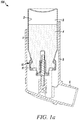
- Figure 1a shows a metered dose inhaler 100, including an aerosol container 1 fitted with a metered dose valve 10 (shown in its resting position).
- the valve is typically affixed, i.e., crimped, onto the container via a cap or ferrule 11 (typically made of aluminium or an aluminium alloy) which is generally provided as part of the valve assembly.
- a cap or ferrule 11 typically made of aluminium or an aluminium alloy
- two seals including e.g., an O-ring seal and the gasket seal.
- the container/valve dispenser is typically provided with an actuator 5 including an appropriate patient port 6, such as a mouthpiece.
- an appropriate patient port 6 such as a mouthpiece.
- the patient port is generally provided in an appropriate form (e.g., smaller diameter tube, often sloping upwardly) for delivery through the nose.
- Actuators are generally made of a plastics material, for example polypropylene or polyethylene.
- the inner walls 2 of the container and the outer walls 101 of the portion(s) of the metered dose valve located within the container define a formulation chamber 3 in which aerosol formulation 4 is contained.
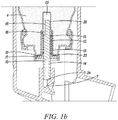
- the valve shown in Figure 1a , and Figure 1b includes a metering chamber 12, defined in part by an inner valve body 13, through which a valve stem 14 passes.
- the valve also includes a second valve body 20 in the form of a bottle emptier.
- the inner valve body also referred to as the "primary" valve body
- the second valve body defines in part a pre-metering region or chamber besides serving as a bottle emptier.
- aerosol formulation 4 can pass from the formulation chamber into a pre-metering chamber 22 provided between the secondary valve body 20 and the primary valve body 13 through an annular space 21 between the flange 23 of the secondary valve body 20 and the primary valve body 13.
- the valve stem 14 is pushed inwardly relative to the container from its resting position shown in Figures 1a and b , allowing formulation to pass from the metering chamber through a side hole 19 in the valve stem and through a stem outlet 24 to an actuator nozzle 7 then out to the patient.
- formulation enters into the valve, in particular into the pre-metering chamber 22, through the annular space 21 and thence from the pre-metering chamber through a groove 18 in the valve stem past the tank seal 16 into the metering chamber 12.
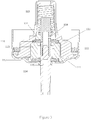
- FIG 3 shows a metered dose aerosol valve different to the one shown in Figures 1a , 1b in its rest position.
- the valve has a metering chamber 112 defined in part by a metering tank 113 through which a stem 114 is biased outwardly by spring 115.
- the stem 114 is made in two parts that are push fit together before being assembled into the valve.
- the stem 114 has an inner seal 116 and an outer seal 117 disposed about it and forming sealing contact with the metering tank 113.
- a valve body 120 crimped into a ferrule 111 retains the aforementioned components in the valve. In use, formulation enters the metering chamber via orifices 121, 118. It's outward path from the metering chamber 112 when a dose is dispensed is via orifice 119.
- aerosol formulation may be filled into the container either by cold-filling (in which chilled formulation (chilled to temperatures of about -50 to -55°C for propellant HFA 134a-based formulations) is filled into the container and subsequently the metered dose valve is crimped onto the container) or by pressure filling (in which the metered dose valve is crimped onto the container and then formulation is pressure filled through the valve into the container).
- cold-filling in which chilled formulation (chilled to temperatures of about -50 to -55°C for propellant HFA 134a-based formulations) is filled into the container and subsequently the metered dose valve is crimped onto the container
- pressure filling in which the metered dose valve is crimped onto the container and then formulation is pressure filled through the valve into the container.
- ENFBE refers to solvent ethyl nonafluorobutyl ether
- MNFBE refers to methyl nonafluorobutyl ether.
- the polyfluoropolyethersilane that is referred to as fluorosilane A is a fluorosilane of formula: (MeO) 3 Si(CH 2 ) 3 NHC(O)OCH 2 CH[O(O)CHN(CH 2 ) 3 Si(OMe) 3 ]CH 2 NHCOR f2 where R f 2 is a moiety of formula CF(CF 3 )(OCF 2 CF(CF 3 )) k O(CF 2 ) 2 CF 3 , k is approximately 5 to 6, but may be in the range 3 to 50, usually 3 to 20, more usually 4 to 10.
- Fluorosilane B is a fluorosilane of formula: (MeO) 3 Si(CH 2 ) 3 NHC(O)R f 2
- Fluorosilane C is a fluorosilane of formula: (MeO) 3 Si(CH 2 ) 3 OCH 2 R f 2 , in which k is approximately 34.
- BTMSPA refers to bis(trimethoxysilylpropyl)amine.
- Primer A is bis(3-trimethoxysilylpropyl) ethylene diamine
- Primer B is bis(triethoxysilyl)ethane
- Primer C is bis(3-triethoxysilylpropyl)amine
- Primer D is bis(3-trimethoxysilylpropyl) N-methyl amine
- Primer E is bis(methyldiethoxysilylpropyl)amine
- the salbutamol sulphate deposition screening test employed a salbutamol dispersion micronised non-amorphous salbutamol sulphate ultrasonically dispersed in decafluoropentane (1g in 400g). The test was run by employing an Eppendorf pipette to place a 0.3 ml aliquot of the salbutamol dispersion into each can. The cans were then immediately placed on a horizontal rolling mixer (Stuart Scientific model SRT2 operating to rotate cans at 35 rpm) for 3 minutes to allow the dispersion to dry to the surface. The cans were then placed in an air drying oven for 5 minutes at 65°C to fully dry. The cans were then rinsed with 2 aliquots of decafluoropentane (5ml) using a 5 inversion shaking regime with one shake cycle per second.
- Controls were uncoated cans to which salbutamol sulphate dispersion had been added and dried but which had not undergone a subsequent rinse step and hence these cans had a deposit level that represented the maximum level possible in the test. Other cans had undergone a subsequent rinse step and hence cans which showed a low level of salbutamol deposition in this test were showing that the deposited salbutamol could be easily washed away and were therefore deemed to have good release/non-stick performance.
- the residual deposited salbutamol was quantitatively transferred and assayed by u.v. spectrophotometry. For each sample, the amount assayed was divided by the corresponding amount for the controls and expressed as a percentage. Unless otherwise stated, 3 samples were taken for each determination.
- Cans were immersed in HFE72DE at its boiling temperature (43°C) for 7 minutes. They were allowed to drain for 2 minutes, and then re-immersed for 3 minutes with ultrasonic agitation. These were allowed to drain for a further 4 minutes then dried at ambient conditions for 7 minutes.
- Washed aluminium cans were fill and drain coated with primer solution (BTMSPA 0.2g in isopropanol (109.5g)) by transfer filling brimful into a first can in a first row of 10 cans, allowing 60 s solution contact time, then transferring and topping up from primer solution similarly to the subsequent cans in the row. Meanwhile primer solution was transfer filled into a first can of a second row of 10 cans, and the process repeated as for the first row of cans. Altogether 6 rows of cans were treated, giving a total of 60 cans. The cans were placed inverted to drain on a laboratory wipe, each was shaken and blown dry with compressed air and then placed in an oven for 30 minutes at 60°C.
- primer solution BTMSPA 0.2g in isopropanol (109.5g)
- a reservoir bottle of 1% w/w fluorosilane A (13.5g) in ENFBE (1355g) was prepared.
- An automated spray coater was employed to spray a sequence of cans.
- the primed and unprimed cans were presented to the sprayer alternately to eliminate any possible systematic trend in the coating efficiency.
- spraying liquid was pumped from a reservoir bottle through a spray nozzle mounted to spray vertically upwards for a programmed duration at a spraying station.
- Each can to be sprayed was delivered inverted to the spraying station, then allowed to drain.
- the optimum coating was achieved when the cans were delivered with a maximum load that did not drip excess coating solution upon draining. 8 cans for each experimental condition were coated. Results are reported to include samples from either side of the optimum.
- runs were included with 2 passes of the sprayer, allowing 60 s draining between passes, and a run with 3 short duration sprays adding up to the optimum duration for a single spray.
- the cans were placed inverted into a single stainless steel coating tray and placed into the centre of the coating oven at 120°C for 30 minutes. The cans were then removed, left to cool down and then placed into a large polythene bag for storage.
- Example 2 involved coating and performance testing of stainless steel valve components.
- BTMSPA (0.3g) was weighed into a 500 ml beaker and isopropanol (164g) was added and the solution mixed. The latter solution was then added to the beaker of components and the components mixed with a spatula then left to stand for 30 seconds. The fluid and components were then poured back into the 500 ml beaker via a stainless steel sieve thereby collecting the coated components in the sieve. The components were then poured out on to a laboratory wipe and were dried off using a hot air blower. The components were returned to the glass beaker and were then placed in an air drying oven at 60 °C for 15 minutes.
- the primed components were left to cool down and equilibrate with ambient air for 1 hour.
- ENFBE 300g was added to fluorosilane A (3.0g) in a 500ml beaker and the solution was mixed.
- the solution was the poured into the beaker of primed components and the components were stirred with a spatula.
- the components were then left to sit for 30 seconds in the solution after which time they were drained via a stainless steel sieve back into the 500 ml beaker hence collecting the components in the sieve.
- the components were then transferred to a glass beaker and placed into an oven at 120°C for 30 minutes to cure the fluorosilane.
- the coated components were assembled into inhaler valves as shown in Figs. 1a , 1b .
- the coated test valves and control valves were incorporated into metered dose inhaler and used to deliver a formulation of micronised salbutamol sulphate suspended in HFA134a.
- the target dose of the product was 100 ⁇ g per actuation and the cold filling technique was employed for the filling process.
- Example 2 The data in Table 2 show that the valves incorporating stainless steel springs and stainless steel tanks coated with BTMSPA followed by fluorosilane A in Example 2 show a very large reduction in component salbutamol sulphate deposition levels compared to the uncoated controls in Comparative Example 2A. Although only the springs and the tanks were coated, coating appears to have had a further beneficial effect in terms of lowered deposition also on the stem and seal and the bottle emptier components of the coated valves. This effect is likely due to reduced deposition at the interface points between uncoated and coated components compared to that seen at the interface points between components that are all uncoated.
- BTMSPA (0.4g) was weighed into a 500 ml beaker and isopropanol (219g) was added and the solution mixed. The latter solution was then added to the beaker of springs and mixed well with a stainless steel spatula and left to stand for 30 seconds. The fluid and components were then poured out into the beaker containing the metering tanks and the latter were then mixed well and left to stand for 30 seconds. The metering tanks and fluid contents were then poured through a sieve into a third beaker. The still wet metering tanks and springs were separated out onto two separate laboratory wipes and left in the fume cupboard with fast air flow for 10 minutes until all the isopropanol had evaporated. The components were then transferred into dry 500ml glass beakers and placed into the air drying oven for 15 minutes at a temperature of 60°C.
- the primed metering tanks and springs were removed from the air drying oven and poured out onto laboratory wipe in the fume cupboard to allow to cool and to equilibrate with atmospheric moisture for 30 minutes.
- ENFBE 400g was added to fluorosilane A (4.0g) in a 500ml beaker and the solution was mixed. The latter solution was then poured into the beaker of primed springs components and the components were stirred with a spatula. The components were then left to sit for 30 seconds in the solution after which time they were drained via a stainless steel sieve back into the 500 ml beaker containing the metering tanks. After 30 seconds the metering tanks were sieved to isolate them and each beaker of components was air dried on a laboratory wipe with the aid of a hot air blower, then placed into the oven at 120°C for 30 minutes to cure the fluorosilane.
- Valves as shown in Figs 1a , 1b were assembled from the above metering tanks and springs, by incorporating seals, a bottle emptier and a ferrule for each set and crimping. Valves as shown in Figs 1a , 1b were prepared for comparison as above, with the exception that the priming and fluorosilane coating steps were omitted.
- a suspension formulation of fluticasone propionate was made up in propellant (1%w/w ethanol + 99%w/w HFA134a). Aluminium cans were filled to deliver 120 shots via 63 ⁇ l valve, by cold transferring aliquots of the suspension, and valves prepared as above were crimped on to provide aerosol units.
- Each aerosol unit to be tested was placed into a plastic actuator (the discharge actuator).
- the aerosol unit was shaken with a gentle rocking action through 180° inversion for at least 10 s and a shot was fired to waste.
- the valve was immediately released, and these steps repeated, once using the discharge actuator and again twice using a fresh plastic actuator (the test actuator).
- Table 3 Units with coated springs and metering tanks Units with uncoated springs and metering tanks Units with uncoated springs and metering tanks Start shots mean 38.0 ⁇ g 34.9 ⁇ g Middle shots mean 38.3 ⁇ g 345 ⁇ g End shots mean 37.2 ⁇ g 34.7 ⁇ g Start shots relative standard deviation 2.0% 6.5% Middle shots relative standard deviation 2.8% 6.3% End shots relative standard deviation 2.9% 7.7% Overall mean and relative standard deviation 37.9 ⁇ g ⁇ 2.8% 34.7 ⁇ g ⁇ 6.7%
- a graph of ⁇ g fluticasone released per shot is shown in Figure 2a as a function of through life position and sample number for Example 3, showing a high level of consistency using the valve assembled with coated components.
- Figure 2b shows the corresponding results for the valve with uncoated components. The results indicate that coating according to the invention is highly advantageous because it results in less dose to dose variability of the medicament, and less unit to unit variability.
- Priming where used, was carried out by taking 20 washed cans and contacting with a solution of BTMSPA (0.1 g) in isopropanol (54.8 g) for 30 s, allowing to drain, then placing in an oven at 60°C for 1 hour.
- BTMSPA 0.1 g
- isopropanol 54.8 g
- Fluorosilane coating where used, was carried out by taking 6 cans a filling with fluorosilane A (0.5 g) in MNFBE (50 g) for 30 s, allowing to drain, then placing in an oven at 120°C for 15 minutes.
- Actuators and inhalers as claimed in the specification may include any feature described herein separately or in combination with any other feature(s), if necessary with appropriate modification of other features, as would be readily apparent to the skilled person.
- Coatings were applied to the internal surfaces of PET vials and their effectiveness assessed by the deposition test referred to earlier.
- BTMSPA, APTMS and APTES were each prepared individually as solutions of 0.1g in ethanol (50g). Each primer solution was then used to prime 3 PET vials using the fill and drain technique with 30 seconds contact time and then draining the vials upside down for 2 minutes then placing upright for 30 minutes to equilibrate then curing at 55°C for 30 minutes in an oven with a wet lab wipe to boost the moisture level. Each of the 3 samples above was then left to equilibrate with room temperature and humidity for 4 hours prior to ECC7000 coating.
- Each vial was then fill and drain coated with a solution of Fluorocarbon B (10% solution) (1.0g) in MNFBE (99g).
- the vials were left to equilibrate with ambient air for 30 minutes and then cured at 55°C for 30 minutes in an oven with a wet lab wipe to boost the moisture level.
- a top coating solution of Fluorosilane B (10%w/w) was prepared from Fluorosilane B (2g) in MNFBE (18g).
- a top coating solution of Fluorosilane C (8%w/w) was prepared from a Fluorosilane C 20%w/w solution (13.5g) in MNFBE (20.2g).
- PET vials (27) were fill and drain coated in a solution of BTMSPA (0.2g) in dehydrated ethanol (99.8g). The vials were then placed open end down onto lab wipe for 5 minutes, to drain excess coating solution, before being placed upright to equilibrate with ambient air (22°C 34% RH) for 30 minutes. The vials were then cured in an oven at 60°C for 30 minutes.
- the 27 BTMSPA primed PET vials were separated into 9 sets of 3 vials and were coated as shown in the table below employing the fill and drain approach with a 30 seconds contact time. All vials were placed open end down for 5 minutes to drain the coating solution, before being stored open end up for 30 minutes to equilibrate at ambient temperature and humidity (22°C 34% RH). The vials were then oven cured at 55°C for 30 minutes.
- Table 7a Sample designation Description of top coating solution % deposition 7A Fluorosilane A 10% solution (0.5g) in MNFBE (99.5g) 19, 19, 22 7B Fluorosilane A 10% solution (1.0g) in MNFBE (99.0g) 21, 18, 23 7C Fluorosilane A 10% solution (2.0g) in MNFBE (98.0g) 12, 15, 19 7D Fluorosilane B 10% solution (0.5g) in MNFBE (99.5g) 0, 0, 0 7E Fluorosilane B 10% solution (1.0g) in MNFBE (99.0g) 0, 0, 0 7F Fluorosilane B 10% solution (2.0g) in MNFBE (98.0g) 0, 0, 1 7G Fluorosilane C 8% solution (0.62g) in MNFBE (99.4g) 1, 2, 2 7H Fluorosilane C 8% solution (1.
- top coat for examples are given in Table 7a along with results of the deposition test, and a comparison where no coating was applied.
- Table 7b gives some further comparative tests with alternative coatings and deposition test results.
- Each primer (A to E and also BTMSPA) (0.1g) was separately dissolved in isopropanol (50g).
- Fluorosilane B (1.0g) was dissolved in MNFBE (9g) to make a 10%w/w solution. 10%w/w solution (1.0g) was then dissolved in MNFBE (99g). All vials were fill and drain coated for 30 seconds and then oven cured for 30 minutes at 0°C.
- Table 8 Sample designation Primer Top coat % deposition 8A Primer A Fluorosilane B 1.4, 0.4, 0.7 8B Primer B Fluorosilane B 56.6, 54.8, 61.8 8C Primer C Fluorosilane B 0.3, 0.3, 0.4 8D Primer D Fluorosilane B 0.7, 0.3, 0.3 8E Primer E Fluorosilane B 2.2, 4.2, 2.4 8F BTMSPA Fluorosilane B 0.1, 0.3, 0.3 8G none Fluorosilane B 58.4, 50.7, 57.9
- a modified coating process for applying coatings to the internal surfaces of PET vials was assessed by the deposition test.
- Priming solution was prepared from BTMSPA (0.2g) dissolved in ethanol and made up to 99.8g.
- Fluorosilane B 10%w/w solution (1.0g) was added to MNFBE (99g) to prepare a top coating solution.
- the following samples were prepared:
- Primer Top coat % deposition 9A BTMSPA Fluorosilane B Prime coat heat-cured 0, 1, 0, 9B BTMSPA Fluorosilane B Prime coat air-dried 2, 1, 1, 9C none Fluorosilane B No prime coat 51, 46, 53 Details of the primer and top coat used and any method variations are provided in table 9, along with the results of the deposition test.
- the prime and top coating may be cured in a single curing step.
- Metering valves as shown in Figs. 1a and 1b were assembled with various coatings, and inhalers were prepared in which the metering valves were crimped onto cans containing a suspension formulation in an HFA propellant system. After dispensing the contents, the deposition levels of a medicament on components of the valves were assayed.
- a priming solution of BTMSPA (0.2g) dissolved in HFE72DE (168g) was prepared.
- a priming solution of BTMSPA (0.1g) dissolved in dehydrated ethanol (50g) was prepared. 80 washed PBT plastic stems were dip coated in the coating solution and then oven cured at 55°C for 30 minutes.
- a top coating solution of Fluorosilane A (2.0g) dissolved in HFE72DE (168g) was prepared. 80 primed tanks and 80 primed springs were dip coated for 30 seconds in the solution. The components were then oven cured at 120°C for 30 minutes.
- a top coating solution of Fluorosilane B (10%) (1.0g) dissolved in MNFBE (84g) was prepared.
- 40 primed tanks and 40 primed springs were dip coated for 30 seconds in the solution.
- the components were then oven cured at 120°C for 30 minutes.
- Table 10b The levels of deposited medicament on each of the components following exhaustion of the contents of the inhalers is shown in Table 10b.
- Table 10b Valve lot Medicament deposition (mg) per spring Medicament deposition (mg) per tank Medicament deposition (mg) per plastic stem Medicament deposition (mg) 3 component average 10A 157, 122, 121, 186, 148 93, 123, 102, 122, 100 139, 185, 145, 155, 156 410.8 10B 149, 180, 123, 145, 111 81, 85, 88, 73, 97 152, 144, 135, 144, 147 370.8 10C 49, 46, 41, 41, 42 64, 106, 104, 85, 79 80, 83, 58, 67, 51 199.2 10D 50, 45, 63, 43, 55 59,
- Valves as shown in Figure 3 were assembled using components that had been coated.
- the coated components were made from polybutylene terephthalate (PBT).
- PBT polybutylene terephthalate
- the valves were crimped onto cans containing a suspension formulation, and tested for drug deposition after dispensing the doses.
- the primed components were left to cool down and equilibrate with ambient air overnight.
- a top coating solution of Fluorosilane C (0.2%) in MNFBE was prepared for use in Example 11C.
- the above components sets were placed into individual 250ml glass reagent bottles and contacted for 3 minutes with occasional agitation with the appropriate fluorosilane solution. The components were then strained out air dried and then cured at 60°C for 16 hours.
- the coated components were assembled into inhaler valves as shown in Fig. 3 .
- the coated test valves and control valves were incorporated into metered dose inhaler and used to deliver a formulation of micronised salbutamol sulphate suspended in HFA134a.
- the target dose of the product was 100 ⁇ g per actuation and the cold filling technique was employed for the filling process.
Landscapes
- Engineering & Computer Science (AREA)
- Chemical & Material Sciences (AREA)
- Life Sciences & Earth Sciences (AREA)
- Wood Science & Technology (AREA)
- Health & Medical Sciences (AREA)
- Materials Engineering (AREA)
- Organic Chemistry (AREA)
- Chemical Kinetics & Catalysis (AREA)
- Pulmonology (AREA)
- Bioinformatics & Cheminformatics (AREA)
- General Chemical & Material Sciences (AREA)
- Anesthesiology (AREA)
- Biomedical Technology (AREA)
- Heart & Thoracic Surgery (AREA)
- Hematology (AREA)
- Animal Behavior & Ethology (AREA)
- General Health & Medical Sciences (AREA)
- Public Health (AREA)
- Veterinary Medicine (AREA)
- Application Of Or Painting With Fluid Materials (AREA)
Claims (13)
- Procédé de fabrication d'un composant pour un dispositif de distribution de substance médicinale, le procédé comprenant :a) la fourniture d'un composant d'un dispositif de distribution de substance médicinale,b) la fourniture d'une composition d'apprêt comprenant un silane ayant deux groupes silane réactifs ou plus séparés par un groupe de liaison organique,c) la fourniture d'une composition de revêtement comprenant un composé au moins partiellement fluoré,d) l'application de la composition d'apprêt sur au moins une partie de la surface du composant,e) l'application de la composition de revêtement sur la partie de la surface du composant après l'application de la composition d'apprêt.
- Procédé selon la revendication 1, dans lequel le silane ayant deux groupes silane réactifs ou plus est de formule
X3-m(R1)mSi-Q-Si(R2)kX3-k
dans lequel R1 et R2 sont des groupes univalents choisis indépendamment, X est un groupe hydrolysable ou un groupe hydroxy, m et k sont indépendamment 0, 1, ou 2 et Q est un groupe de liaison organique divalent. - Procédé selon la revendication 2, dans lequel Q est de formule - (CH2)i-A- (CH2)j - dans lequel A est NRn, O, ou S ; i et j sont indépendamment 0, 1, 2, 3, ou 4 et dans lequel Rn est H ou un alkyle C1 à C4.
- Procédé selon l'une quelconque des revendications précédentes, dans lequel le composé partiellement fluoré est un polyfluoropolyéther silane de formule
RfQ1 v[Q2 w-[C(R4)2-Si(X)3-x(R5)x]y]z
dans lequel :R f est un fragment polyfluoropolyéther ;Q1 est un groupe de liaison trivalent ;chaque Q2 est un groupe de liaison organique divalent ou trivalent choisi indépendamment ;chaque R4 est indépendamment de l'hydrogène ou un groupe alkyle C1-4 ;chaque X est indépendamment un groupe hydrolysable ou hydroxyle ;R5 est un groupe alkyle ou phényle C1-8 ;v et w sont indépendamment 0 ou 1, x est 0 ou 1 ou 2 ; y est 1 ou 2 ; et z est 2, 3 ou 4. - Procédé selon la revendication 4, dans lequel le fragment polyfluoropolyéther R f comprend des unités répétitives perfluorées choisies parmi le groupe constitué de -(CnF2nO)-, -(CF(Z)O)-, -(CF(Z)CnF2nO)-, -(CnF2nCF(Z)O)-, -(CF2CF(Z)O)-, et des combinaisons de ceux-ci ; dans lequel n est un entier de 1 à 6 et Z est un groupe perfluoroalkyle, un groupe perfluoroalkyle contenant de l'oxygène, un groupe perfluoroalcoxy, ou un groupe perfluoroalcoxy à substitution oxygène, chacun d'entre eux pouvant être linéaire, ramifié, ou cyclique, et avoir de 1 à 5 atomes de carbone et jusqu'à 4 atomes d'oxygène lorsqu'ils contiennent de l'oxygène ou qu'ils sont substitués en oxygène et dans lequel pour les unités répétitives incluant Z le nombre d'atomes de carbone en séquence est au maximum de 6.
- Procédé selon l'une quelconque des revendications précédentes, dans lequel ladite surface est une surface en métal, en particulier une surface d'un alliage d'aluminium, un alliage de fer, ou un alliage d'acier.
- Procédé selon l'une quelconque des revendications précédentes, dans lequel ledit dispositif de distribution de substance médicinale est un inhalateur doseur ou un inhalateur de poudre sèche.
- Procédé selon l'une quelconque des revendications précédentes, dans lequel le composant est un composant d'un inhalateur doseur et le composant est choisi dans le groupe constitué d'un actionneur, un récipient d'aérosol, une virole, un corps de soupape, une tige de soupape et un ressort de compression.
- Procédé selon l'une quelconque des revendications 1 à 5, 7 et 8, dans lequel ladite partie de surface est une surface de polymère.
- Procédé selon la revendication 9 dans lequel le composant est au moins partiellement composé dudit polymère.
- Procédé selon l'une quelconque des revendications 9 à 10, dans lequel le composé au moins partiellement fluoré est un polyfluoropolyéther silane de formule la :
R f [Q1-[C(R)2-Si(Y)3-x(R1a)x]y]z Ia
dans lequel :R f est un fragment polyfluoropolyéther monovalent ou multivalent ;Q1 est un groupe de liaison organique divalent ou trivalent ;chaque R est indépendamment de l'hydrogène ou un groupe alkyle C1-4 ;chaque Y est indépendamment un groupe hydrolysable ;R1a est un groupe alkyle ou phényle C1-8 ;x est 0 ou 1 ou 2 ;y est 1 ou 2 ; etz est 1, 2, 3, ou 4 ; - Procédé selon la revendication 11, dans lequel le fragment polyfluoropolyéther R f est C3F7O(CF(CF3)CF2O)pCF(CF3)-, dans lequel la valeur moyenne de p est dans la plage de 3 à 50.
- Composant revêtu pour un dispositif de distribution de substance médicinale comprenant un composant et un revêtement contenant du fluor, dans lequel le revêtement contenant du fluor comprend deux couches, une première couche contenant du polyfluoropolyéther comprenant des entités de polyfluoropolyéther silane de formule Ib suivante :
R f [Q1-[C(R)2-Si(O-)3-x(R1a)x]y]z Ib
qui partage au moins une liaison covalente avec une deuxième couche non fluorée comprenant des entités de la formule IIb suivante :
(-O)3-m-n(X)n(R1)mSi-Q-Si(R2)k(X)l(O-)3-k-l IIb
qui à son tour partage au moins une liaison covalente avec le composant ; et dans lequel :R f est un segment polyfluoropolyéther monovalent ou multivalent ;Q1 est un groupe de liaison organique divalent ou trivalent ;chaque R est indépendamment de l'hydrogène ou un groupe alkyle C1-4 ;RIa est un groupe alkyle ou phényle C1-8 ;k, l, m et n sont indépendamment 0, 1 ou 2, mais à condition que m+n et k+1 soient au plus 2 ;x est 0 ou 1 ou 2 ;y est 1 ou 2 ; etz est 1, 2, 3 ou 4 ;R1 et R2 sont des groupes univalents choisis indépendamment, X est un groupe hydrolysable ou un groupe hydroxy, m et k sont indépendamment 0, 1, ou 2 et Q est un groupe de liaison organique divalent, comprenant une chaîne hydrocarbyle substituée en C2 à C12 et un ou plusieurs groupes aminé.
Priority Applications (1)
| Application Number | Priority Date | Filing Date | Title |
|---|---|---|---|
| EP19179530.1A EP3561004B1 (fr) | 2014-05-22 | 2015-05-20 | Composant revêtu |
Applications Claiming Priority (3)
| Application Number | Priority Date | Filing Date | Title |
|---|---|---|---|
| GBGB1409095.5A GB201409095D0 (en) | 2014-05-22 | 2014-05-22 | Coating process |
| GB1504277.3A GB2536285A (en) | 2015-03-13 | 2015-03-13 | Coating process |
| PCT/US2015/031766 WO2015179511A1 (fr) | 2014-05-22 | 2015-05-20 | Procédé de revêtement |
Related Child Applications (1)
| Application Number | Title | Priority Date | Filing Date |
|---|---|---|---|
| EP19179530.1A Division EP3561004B1 (fr) | 2014-05-22 | 2015-05-20 | Composant revêtu |
Publications (2)
| Publication Number | Publication Date |
|---|---|
| EP3146000A1 EP3146000A1 (fr) | 2017-03-29 |
| EP3146000B1 true EP3146000B1 (fr) | 2019-06-26 |
Family
ID=54554691
Family Applications (2)
| Application Number | Title | Priority Date | Filing Date |
|---|---|---|---|
| EP19179530.1A Active EP3561004B1 (fr) | 2014-05-22 | 2015-05-20 | Composant revêtu |
| EP15733565.4A Active EP3146000B1 (fr) | 2014-05-22 | 2015-05-20 | Procédé de revêtement |
Family Applications Before (1)
| Application Number | Title | Priority Date | Filing Date |
|---|---|---|---|
| EP19179530.1A Active EP3561004B1 (fr) | 2014-05-22 | 2015-05-20 | Composant revêtu |
Country Status (5)
| Country | Link |
|---|---|
| US (1) | US20170152396A1 (fr) |
| EP (2) | EP3561004B1 (fr) |
| CN (1) | CN106457305B (fr) |
| AU (2) | AU2015264249A1 (fr) |
| WO (1) | WO2015179511A1 (fr) |
Families Citing this family (23)
| Publication number | Priority date | Publication date | Assignee | Title |
|---|---|---|---|---|
| FR3003482B1 (fr) * | 2013-03-19 | 2016-06-24 | Aptar France Sas | Procede de traitement de surface d'une valve doseuse. |
| WO2015142894A1 (fr) | 2014-03-18 | 2015-09-24 | 3M Innovative Properties Company | Article traité et procédé de fabrication de ce dernier |
| CN108026406B (zh) | 2015-09-23 | 2021-03-09 | 3M创新有限公司 | 包含硅烷的组合物和制造经处理的制品的方法 |
| WO2019025994A2 (fr) | 2017-08-03 | 2019-02-07 | 3M Innovative Properties Company | Procédé de revêtement |
| WO2019236649A1 (fr) | 2018-06-07 | 2019-12-12 | 3M Innovative Properties Company | Formulation et inhalateur de fluticasone et de vilantérol |
| EP3801456A1 (fr) * | 2018-06-07 | 2021-04-14 | Kindeva Drug Delivery L.P. | Formulation et inhalateur de fluticasone et de vilantérol |
| US20210393598A1 (en) | 2018-11-12 | 2021-12-23 | Kindeva Drug Delivery L.P. | Umeclidinium and vilanterol formulation and inhaler |
| EP3996672A1 (fr) | 2019-07-12 | 2022-05-18 | Kindeva Drug Delivery L.P. | Formulation d'aérosol, cartouche et inhalateur contenant la formulation, et procédé d'utilisation |
| WO2021009573A1 (fr) | 2019-07-12 | 2021-01-21 | Kindeva Drug Delivery L.P. | Formulation d'aérosol, cartouche et inhalateur contenant la formulation, et procédé d'utilisation |
| CN110449308A (zh) * | 2019-08-22 | 2019-11-15 | 安徽华星消防设备(集团)有限公司 | 高耐腐灭火器筒体内涂层设备及其处理工艺 |
| WO2021125059A1 (fr) * | 2019-12-19 | 2021-06-24 | モメンティブ・パフォーマンス・マテリアルズ・ジャパン合同会社 | Composition durcissable |
| CN114746479B (zh) | 2019-12-19 | 2024-06-07 | 迈图高新材料日本合同公司 | 固化性组合物 |
| KR20220147663A (ko) * | 2020-02-28 | 2022-11-03 | 킨데바 드러그 딜리버리 엘.피. | 흡입기 |
| US11964121B2 (en) | 2021-10-13 | 2024-04-23 | Satio, Inc. | Mono dose dermal patch for pharmaceutical delivery |
| US12214346B2 (en) | 2021-10-13 | 2025-02-04 | Satio, Inc. | Dermal patch with a diagnostic test strip |
| US12048543B2 (en) | 2021-11-08 | 2024-07-30 | Satio, Inc. | Dermal patch for collecting a physiological sample with removable vial |
| US12178979B2 (en) | 2021-10-13 | 2024-12-31 | Satio, Inc. | Dermal patch for delivering a pharmaceutical |
| US11877848B2 (en) | 2021-11-08 | 2024-01-23 | Satio, Inc. | Dermal patch for collecting a physiological sample |
| US12023156B2 (en) | 2021-10-13 | 2024-07-02 | Satio, Inc. | Dermal patch for collecting a physiological sample |
| US11452474B1 (en) | 2021-04-14 | 2022-09-27 | Satio, Inc. | Dual lever dermal patch system |
| US12053284B2 (en) | 2021-11-08 | 2024-08-06 | Satio, Inc. | Dermal patch for collecting a physiological sample |
| JP2026509779A (ja) | 2022-03-01 | 2026-03-25 | キンデーバ ドラッグ デリバリー リミティド パートナーシップ | 定量吸入器及び高用量懸濁液 |
| AU2023391309A1 (en) * | 2022-12-07 | 2025-07-24 | Kindeva Drug Delivery L.P. | Metered dose inhaler |
Family Cites Families (19)
| Publication number | Priority date | Publication date | Assignee | Title |
|---|---|---|---|---|
| US3810874A (en) | 1969-03-10 | 1974-05-14 | Minnesota Mining & Mfg | Polymers prepared from poly(perfluoro-alkylene oxide) compounds |
| US6613860B1 (en) | 2000-10-12 | 2003-09-02 | 3M Innovative Properties Company | Compositions comprising fluorinated polyether silanes for rendering substrates oil and water repellent |
| GB0122725D0 (en) * | 2001-09-21 | 2001-11-14 | Glaxo Group Ltd | Drug dispensing components |
| US20040063805A1 (en) * | 2002-09-19 | 2004-04-01 | Pacetti Stephen D. | Coatings for implantable medical devices and methods for fabrication thereof |
| US7652115B2 (en) | 2003-09-08 | 2010-01-26 | 3M Innovative Properties Company | Fluorinated polyether isocyanate derived silane compositions |
| US7318932B2 (en) * | 2003-09-30 | 2008-01-15 | Advanced Cardiovascular Systems, Inc. | Coatings for drug delivery devices comprising hydrolitically stable adducts of poly(ethylene-co-vinyl alcohol) and methods for fabricating the same |
| US7803894B2 (en) | 2003-12-05 | 2010-09-28 | 3M Innovatie Properties Company | Coating compositions with perfluoropolyetherisocyanate derived silane and alkoxysilanes |
| CA2541543C (fr) * | 2003-12-12 | 2012-05-29 | C.R. Bard, Inc. | Dispositifs medicaux implantables pourvus de revetements polymeres fluores et procedes de revetement associes |
| FR2889183B1 (fr) * | 2005-07-26 | 2007-09-07 | Saint Gobain | Revetement hydrophobe comprenant un primage comprenant un disilane et une couche hydrophobe comprenant un alkysilane fluore |
| EP1894979A1 (fr) * | 2006-08-31 | 2008-03-05 | Sika Technology AG | Composition de primaire contenant une faible quantité ou aucun composé organique volatile |
| GB0721739D0 (en) * | 2007-11-06 | 2007-12-19 | 3M Innovative Properties Co | medicinal inhalation devices and components thereof |
| GB0721737D0 (en) | 2007-11-06 | 2007-12-19 | 3M Innovative Properties Co | Medicinal inhalation devices and components thereof |
| WO2009061891A2 (fr) * | 2007-11-06 | 2009-05-14 | 3M Innovative Properties Company | Dispositifs d'inhalation médicaux et composants de ceux-ci |
| WO2010129753A1 (fr) * | 2009-05-06 | 2010-11-11 | 3M Innovative Properties Company | Dispositif d'inhalation médical |
| BRPI1007653A2 (pt) | 2009-05-06 | 2019-09-24 | 3M Innovative Properties Co | "dispositivos para inalação de insumos medicinais e componentes dos mesmos" |
| EP2427902B1 (fr) | 2009-05-06 | 2017-01-18 | 3M Innovative Properties Company | Appareil et procédé pour le traitement au plasma de contenants |
| GB201110058D0 (en) | 2011-06-15 | 2011-07-27 | 3M Innovative Properties Co | Medicinal inhalation devices, valves and components thereof |
| WO2015142894A1 (fr) * | 2014-03-18 | 2015-09-24 | 3M Innovative Properties Company | Article traité et procédé de fabrication de ce dernier |
| CN108026406B (zh) * | 2015-09-23 | 2021-03-09 | 3M创新有限公司 | 包含硅烷的组合物和制造经处理的制品的方法 |
-
2015
- 2015-05-20 AU AU2015264249A patent/AU2015264249A1/en not_active Abandoned
- 2015-05-20 US US15/313,081 patent/US20170152396A1/en not_active Abandoned
- 2015-05-20 EP EP19179530.1A patent/EP3561004B1/fr active Active
- 2015-05-20 EP EP15733565.4A patent/EP3146000B1/fr active Active
- 2015-05-20 CN CN201580026985.8A patent/CN106457305B/zh active Active
- 2015-05-20 WO PCT/US2015/031766 patent/WO2015179511A1/fr not_active Ceased
-
2018
- 2018-03-02 AU AU2018201530A patent/AU2018201530B2/en active Active
Also Published As
| Publication number | Publication date |
|---|---|
| US20170152396A1 (en) | 2017-06-01 |
| AU2018201530A1 (en) | 2018-03-22 |
| AU2018201530B2 (en) | 2019-04-11 |
| WO2015179511A1 (fr) | 2015-11-26 |
| AU2015264249A1 (en) | 2016-12-08 |
| CN106457305B (zh) | 2020-06-02 |
| EP3146000A1 (fr) | 2017-03-29 |
| EP3561004B1 (fr) | 2021-07-14 |
| EP3561004A1 (fr) | 2019-10-30 |
| CN106457305A (zh) | 2017-02-22 |
Similar Documents
| Publication | Publication Date | Title |
|---|---|---|
| EP3146000B1 (fr) | Procédé de revêtement | |
| EP2205300B1 (fr) | Dispositifs d'inhalation médicaux et composants de ceux-ci | |
| AU2010245839B2 (en) | Medicinal inhalation devices and components thereof | |
| CN101909684B (zh) | 药物吸入装置及其部件 | |
| US8616201B2 (en) | Medicinal inhalation devices and components thereof | |
| US20240207543A1 (en) | Coating process | |
| GB2536285A (en) | Coating process | |
| EP4110442B1 (fr) | Inhalateur | |
| CN114096236A (zh) | 气雾剂制剂、含有该制剂的罐和吸入器以及使用方法 |
Legal Events
| Date | Code | Title | Description |
|---|---|---|---|
| STAA | Information on the status of an ep patent application or granted ep patent |
Free format text: STATUS: THE INTERNATIONAL PUBLICATION HAS BEEN MADE |
|
| PUAI | Public reference made under article 153(3) epc to a published international application that has entered the european phase |
Free format text: ORIGINAL CODE: 0009012 |
|
| STAA | Information on the status of an ep patent application or granted ep patent |
Free format text: STATUS: REQUEST FOR EXAMINATION WAS MADE |
|
| 17P | Request for examination filed |
Effective date: 20161122 |
|
| AK | Designated contracting states |
Kind code of ref document: A1 Designated state(s): AL AT BE BG CH CY CZ DE DK EE ES FI FR GB GR HR HU IE IS IT LI LT LU LV MC MK MT NL NO PL PT RO RS SE SI SK SM TR |
|
| AX | Request for extension of the european patent |
Extension state: BA ME |
|
| DAV | Request for validation of the european patent (deleted) | ||
| DAX | Request for extension of the european patent (deleted) | ||
| STAA | Information on the status of an ep patent application or granted ep patent |
Free format text: STATUS: EXAMINATION IS IN PROGRESS |
|
| 17Q | First examination report despatched |
Effective date: 20170914 |
|
| GRAP | Despatch of communication of intention to grant a patent |
Free format text: ORIGINAL CODE: EPIDOSNIGR1 |
|
| STAA | Information on the status of an ep patent application or granted ep patent |
Free format text: STATUS: GRANT OF PATENT IS INTENDED |
|
| INTG | Intention to grant announced |
Effective date: 20190329 |
|
| GRAS | Grant fee paid |
Free format text: ORIGINAL CODE: EPIDOSNIGR3 |
|
| GRAA | (expected) grant |
Free format text: ORIGINAL CODE: 0009210 |
|
| STAA | Information on the status of an ep patent application or granted ep patent |
Free format text: STATUS: THE PATENT HAS BEEN GRANTED |
|
| AK | Designated contracting states |
Kind code of ref document: B1 Designated state(s): AL AT BE BG CH CY CZ DE DK EE ES FI FR GB GR HR HU IE IS IT LI LT LU LV MC MK MT NL NO PL PT RO RS SE SI SK SM TR |
|
| REG | Reference to a national code |
Ref country code: GB Ref legal event code: FG4D |
|
| REG | Reference to a national code |
Ref country code: CH Ref legal event code: EP |
|
| REG | Reference to a national code |
Ref country code: AT Ref legal event code: REF Ref document number: 1148242 Country of ref document: AT Kind code of ref document: T Effective date: 20190715 |
|
| REG | Reference to a national code |
Ref country code: DE Ref legal event code: R096 Ref document number: 602015032716 Country of ref document: DE |
|
| REG | Reference to a national code |
Ref country code: IE Ref legal event code: FG4D |
|
| REG | Reference to a national code |
Ref country code: NL Ref legal event code: MP Effective date: 20190626 |
|
| PG25 | Lapsed in a contracting state [announced via postgrant information from national office to epo] |
Ref country code: SE Free format text: LAPSE BECAUSE OF FAILURE TO SUBMIT A TRANSLATION OF THE DESCRIPTION OR TO PAY THE FEE WITHIN THE PRESCRIBED TIME-LIMIT Effective date: 20190626 Ref country code: HR Free format text: LAPSE BECAUSE OF FAILURE TO SUBMIT A TRANSLATION OF THE DESCRIPTION OR TO PAY THE FEE WITHIN THE PRESCRIBED TIME-LIMIT Effective date: 20190626 Ref country code: NO Free format text: LAPSE BECAUSE OF FAILURE TO SUBMIT A TRANSLATION OF THE DESCRIPTION OR TO PAY THE FEE WITHIN THE PRESCRIBED TIME-LIMIT Effective date: 20190926 Ref country code: AL Free format text: LAPSE BECAUSE OF FAILURE TO SUBMIT A TRANSLATION OF THE DESCRIPTION OR TO PAY THE FEE WITHIN THE PRESCRIBED TIME-LIMIT Effective date: 20190626 Ref country code: FI Free format text: LAPSE BECAUSE OF FAILURE TO SUBMIT A TRANSLATION OF THE DESCRIPTION OR TO PAY THE FEE WITHIN THE PRESCRIBED TIME-LIMIT Effective date: 20190626 Ref country code: LT Free format text: LAPSE BECAUSE OF FAILURE TO SUBMIT A TRANSLATION OF THE DESCRIPTION OR TO PAY THE FEE WITHIN THE PRESCRIBED TIME-LIMIT Effective date: 20190626 |
|
| REG | Reference to a national code |
Ref country code: LT Ref legal event code: MG4D |
|
| PG25 | Lapsed in a contracting state [announced via postgrant information from national office to epo] |
Ref country code: GR Free format text: LAPSE BECAUSE OF FAILURE TO SUBMIT A TRANSLATION OF THE DESCRIPTION OR TO PAY THE FEE WITHIN THE PRESCRIBED TIME-LIMIT Effective date: 20190927 Ref country code: BG Free format text: LAPSE BECAUSE OF FAILURE TO SUBMIT A TRANSLATION OF THE DESCRIPTION OR TO PAY THE FEE WITHIN THE PRESCRIBED TIME-LIMIT Effective date: 20190926 Ref country code: RS Free format text: LAPSE BECAUSE OF FAILURE TO SUBMIT A TRANSLATION OF THE DESCRIPTION OR TO PAY THE FEE WITHIN THE PRESCRIBED TIME-LIMIT Effective date: 20190626 Ref country code: LV Free format text: LAPSE BECAUSE OF FAILURE TO SUBMIT A TRANSLATION OF THE DESCRIPTION OR TO PAY THE FEE WITHIN THE PRESCRIBED TIME-LIMIT Effective date: 20190626 |
|
| REG | Reference to a national code |
Ref country code: AT Ref legal event code: MK05 Ref document number: 1148242 Country of ref document: AT Kind code of ref document: T Effective date: 20190626 |
|
| PG25 | Lapsed in a contracting state [announced via postgrant information from national office to epo] |
Ref country code: NL Free format text: LAPSE BECAUSE OF FAILURE TO SUBMIT A TRANSLATION OF THE DESCRIPTION OR TO PAY THE FEE WITHIN THE PRESCRIBED TIME-LIMIT Effective date: 20190626 Ref country code: AT Free format text: LAPSE BECAUSE OF FAILURE TO SUBMIT A TRANSLATION OF THE DESCRIPTION OR TO PAY THE FEE WITHIN THE PRESCRIBED TIME-LIMIT Effective date: 20190626 Ref country code: EE Free format text: LAPSE BECAUSE OF FAILURE TO SUBMIT A TRANSLATION OF THE DESCRIPTION OR TO PAY THE FEE WITHIN THE PRESCRIBED TIME-LIMIT Effective date: 20190626 Ref country code: CZ Free format text: LAPSE BECAUSE OF FAILURE TO SUBMIT A TRANSLATION OF THE DESCRIPTION OR TO PAY THE FEE WITHIN THE PRESCRIBED TIME-LIMIT Effective date: 20190626 Ref country code: RO Free format text: LAPSE BECAUSE OF FAILURE TO SUBMIT A TRANSLATION OF THE DESCRIPTION OR TO PAY THE FEE WITHIN THE PRESCRIBED TIME-LIMIT Effective date: 20190626 Ref country code: SK Free format text: LAPSE BECAUSE OF FAILURE TO SUBMIT A TRANSLATION OF THE DESCRIPTION OR TO PAY THE FEE WITHIN THE PRESCRIBED TIME-LIMIT Effective date: 20190626 Ref country code: PT Free format text: LAPSE BECAUSE OF FAILURE TO SUBMIT A TRANSLATION OF THE DESCRIPTION OR TO PAY THE FEE WITHIN THE PRESCRIBED TIME-LIMIT Effective date: 20191028 |
|
| PG25 | Lapsed in a contracting state [announced via postgrant information from national office to epo] |
Ref country code: IS Free format text: LAPSE BECAUSE OF FAILURE TO SUBMIT A TRANSLATION OF THE DESCRIPTION OR TO PAY THE FEE WITHIN THE PRESCRIBED TIME-LIMIT Effective date: 20191026 Ref country code: ES Free format text: LAPSE BECAUSE OF FAILURE TO SUBMIT A TRANSLATION OF THE DESCRIPTION OR TO PAY THE FEE WITHIN THE PRESCRIBED TIME-LIMIT Effective date: 20190626 Ref country code: SM Free format text: LAPSE BECAUSE OF FAILURE TO SUBMIT A TRANSLATION OF THE DESCRIPTION OR TO PAY THE FEE WITHIN THE PRESCRIBED TIME-LIMIT Effective date: 20190626 |
|
| PG25 | Lapsed in a contracting state [announced via postgrant information from national office to epo] |
Ref country code: TR Free format text: LAPSE BECAUSE OF FAILURE TO SUBMIT A TRANSLATION OF THE DESCRIPTION OR TO PAY THE FEE WITHIN THE PRESCRIBED TIME-LIMIT Effective date: 20190626 |
|
| PG25 | Lapsed in a contracting state [announced via postgrant information from national office to epo] |
Ref country code: PL Free format text: LAPSE BECAUSE OF FAILURE TO SUBMIT A TRANSLATION OF THE DESCRIPTION OR TO PAY THE FEE WITHIN THE PRESCRIBED TIME-LIMIT Effective date: 20190626 Ref country code: DK Free format text: LAPSE BECAUSE OF FAILURE TO SUBMIT A TRANSLATION OF THE DESCRIPTION OR TO PAY THE FEE WITHIN THE PRESCRIBED TIME-LIMIT Effective date: 20190626 |
|
| PG25 | Lapsed in a contracting state [announced via postgrant information from national office to epo] |
Ref country code: IS Free format text: LAPSE BECAUSE OF FAILURE TO SUBMIT A TRANSLATION OF THE DESCRIPTION OR TO PAY THE FEE WITHIN THE PRESCRIBED TIME-LIMIT Effective date: 20200224 |
|
| REG | Reference to a national code |
Ref country code: DE Ref legal event code: R097 Ref document number: 602015032716 Country of ref document: DE |
|
| PLBE | No opposition filed within time limit |
Free format text: ORIGINAL CODE: 0009261 |
|
| STAA | Information on the status of an ep patent application or granted ep patent |
Free format text: STATUS: NO OPPOSITION FILED WITHIN TIME LIMIT |
|
| PG2D | Information on lapse in contracting state deleted |
Ref country code: IS |
|
| 26N | No opposition filed |
Effective date: 20200603 |
|
| REG | Reference to a national code |
Ref country code: GB Ref legal event code: 732E Free format text: REGISTERED BETWEEN 20200723 AND 20200729 |
|
| PG25 | Lapsed in a contracting state [announced via postgrant information from national office to epo] |
Ref country code: SI Free format text: LAPSE BECAUSE OF FAILURE TO SUBMIT A TRANSLATION OF THE DESCRIPTION OR TO PAY THE FEE WITHIN THE PRESCRIBED TIME-LIMIT Effective date: 20190626 |
|
| REG | Reference to a national code |
Ref country code: GB Ref legal event code: 732E Free format text: REGISTERED BETWEEN 20200917 AND 20200923 |
|
| PG25 | Lapsed in a contracting state [announced via postgrant information from national office to epo] |
Ref country code: MC Free format text: LAPSE BECAUSE OF FAILURE TO SUBMIT A TRANSLATION OF THE DESCRIPTION OR TO PAY THE FEE WITHIN THE PRESCRIBED TIME-LIMIT Effective date: 20190626 Ref country code: CH Free format text: LAPSE BECAUSE OF NON-PAYMENT OF DUE FEES Effective date: 20200531 Ref country code: LI Free format text: LAPSE BECAUSE OF NON-PAYMENT OF DUE FEES Effective date: 20200531 |
|
| REG | Reference to a national code |
Ref country code: BE Ref legal event code: MM Effective date: 20200531 |
|
| PG25 | Lapsed in a contracting state [announced via postgrant information from national office to epo] |
Ref country code: LU Free format text: LAPSE BECAUSE OF NON-PAYMENT OF DUE FEES Effective date: 20200520 |
|
| PG25 | Lapsed in a contracting state [announced via postgrant information from national office to epo] |
Ref country code: IE Free format text: LAPSE BECAUSE OF NON-PAYMENT OF DUE FEES Effective date: 20200520 |
|
| PG25 | Lapsed in a contracting state [announced via postgrant information from national office to epo] |
Ref country code: BE Free format text: LAPSE BECAUSE OF NON-PAYMENT OF DUE FEES Effective date: 20200531 |
|
| PG25 | Lapsed in a contracting state [announced via postgrant information from national office to epo] |
Ref country code: MT Free format text: LAPSE BECAUSE OF FAILURE TO SUBMIT A TRANSLATION OF THE DESCRIPTION OR TO PAY THE FEE WITHIN THE PRESCRIBED TIME-LIMIT Effective date: 20190626 Ref country code: CY Free format text: LAPSE BECAUSE OF FAILURE TO SUBMIT A TRANSLATION OF THE DESCRIPTION OR TO PAY THE FEE WITHIN THE PRESCRIBED TIME-LIMIT Effective date: 20190626 |
|
| PG25 | Lapsed in a contracting state [announced via postgrant information from national office to epo] |
Ref country code: MK Free format text: LAPSE BECAUSE OF FAILURE TO SUBMIT A TRANSLATION OF THE DESCRIPTION OR TO PAY THE FEE WITHIN THE PRESCRIBED TIME-LIMIT Effective date: 20190626 |
|
| P01 | Opt-out of the competence of the unified patent court (upc) registered |
Effective date: 20230523 |
|
| PGFP | Annual fee paid to national office [announced via postgrant information from national office to epo] |
Ref country code: DE Payment date: 20250529 Year of fee payment: 11 |
|
| PGFP | Annual fee paid to national office [announced via postgrant information from national office to epo] |
Ref country code: IT Payment date: 20250521 Year of fee payment: 11 |
|
| PGFP | Annual fee paid to national office [announced via postgrant information from national office to epo] |
Ref country code: FR Payment date: 20250526 Year of fee payment: 11 |
|
| PGFP | Annual fee paid to national office [announced via postgrant information from national office to epo] |
Ref country code: GB Payment date: 20260304 Year of fee payment: 12 |