EP3146840A2 - Composition biocide pour le traitement des bois - Google Patents
Composition biocide pour le traitement des bois Download PDFInfo
- Publication number
- EP3146840A2 EP3146840A2 EP16190458.6A EP16190458A EP3146840A2 EP 3146840 A2 EP3146840 A2 EP 3146840A2 EP 16190458 A EP16190458 A EP 16190458A EP 3146840 A2 EP3146840 A2 EP 3146840A2
- Authority
- EP
- European Patent Office
- Prior art keywords
- extract
- composition
- fungicidal
- substance
- wood
- Prior art date
- Legal status (The legal status is an assumption and is not a legal conclusion. Google has not performed a legal analysis and makes no representation as to the accuracy of the status listed.)
- Granted
Links
- 239000000203 mixture Substances 0.000 title claims abstract description 44
- 239000002023 wood Substances 0.000 title claims description 24
- 230000003115 biocidal effect Effects 0.000 title abstract description 29
- 239000000126 substance Substances 0.000 claims abstract description 37
- 239000003963 antioxidant agent Substances 0.000 claims abstract description 31
- KCXVZYZYPLLWCC-UHFFFAOYSA-N EDTA Chemical compound OC(=O)CN(CC(O)=O)CCN(CC(O)=O)CC(O)=O KCXVZYZYPLLWCC-UHFFFAOYSA-N 0.000 claims description 29
- 229960001484 edetic acid Drugs 0.000 claims description 29
- 230000003078 antioxidant effect Effects 0.000 claims description 20
- 230000000855 fungicidal effect Effects 0.000 claims description 20
- PXMNMQRDXWABCY-UHFFFAOYSA-N 1-(4-chlorophenyl)-4,4-dimethyl-3-(1H-1,2,4-triazol-1-ylmethyl)pentan-3-ol Chemical compound C1=NC=NN1CC(O)(C(C)(C)C)CCC1=CC=C(Cl)C=C1 PXMNMQRDXWABCY-UHFFFAOYSA-N 0.000 claims description 19
- 244000105624 Arachis hypogaea Species 0.000 claims description 19
- 235000010777 Arachis hypogaea Nutrition 0.000 claims description 19
- 239000005822 Propiconazole Substances 0.000 claims description 19
- 239000005839 Tebuconazole Substances 0.000 claims description 19
- STJLVHWMYQXCPB-UHFFFAOYSA-N propiconazole Chemical group O1C(CCC)COC1(C=1C(=CC(Cl)=CC=1)Cl)CN1N=CN=C1 STJLVHWMYQXCPB-UHFFFAOYSA-N 0.000 claims description 19
- 229940099451 3-iodo-2-propynylbutylcarbamate Drugs 0.000 claims description 17
- WYVVKGNFXHOCQV-UHFFFAOYSA-N 3-iodoprop-2-yn-1-yl butylcarbamate Chemical compound CCCCNC(=O)OCC#CI WYVVKGNFXHOCQV-UHFFFAOYSA-N 0.000 claims description 17
- 235000017060 Arachis glabrata Nutrition 0.000 claims description 17
- 235000018262 Arachis monticola Nutrition 0.000 claims description 17
- RUPBZQFQVRMKDG-UHFFFAOYSA-M Didecyldimethylammonium chloride Chemical compound [Cl-].CCCCCCCCCC[N+](C)(C)CCCCCCCCCC RUPBZQFQVRMKDG-UHFFFAOYSA-M 0.000 claims description 17
- 235000020232 peanut Nutrition 0.000 claims description 17
- 239000002738 chelating agent Substances 0.000 claims description 15
- 241001236212 Pinus pinaster Species 0.000 claims description 12
- 235000005105 Pinus pinaster Nutrition 0.000 claims description 12
- XLYOFNOQVPJJNP-UHFFFAOYSA-N water Substances O XLYOFNOQVPJJNP-UHFFFAOYSA-N 0.000 claims description 11
- 240000006365 Vitis vinifera Species 0.000 claims description 9
- 235000014787 Vitis vinifera Nutrition 0.000 claims description 9
- 235000013824 polyphenols Nutrition 0.000 claims description 8
- 238000009472 formulation Methods 0.000 claims description 6
- 235000009754 Vitis X bourquina Nutrition 0.000 claims description 4
- 235000012333 Vitis X labruscana Nutrition 0.000 claims description 4
- 230000003449 preventive effect Effects 0.000 claims description 4
- 229960000686 benzalkonium chloride Drugs 0.000 claims description 3
- CADWTSSKOVRVJC-UHFFFAOYSA-N benzyl(dimethyl)azanium;chloride Chemical compound [Cl-].C[NH+](C)CC1=CC=CC=C1 CADWTSSKOVRVJC-UHFFFAOYSA-N 0.000 claims description 3
- 229960004670 didecyldimethylammonium chloride Drugs 0.000 claims description 3
- 230000002538 fungal effect Effects 0.000 claims description 3
- 235000009470 Theobroma cacao Nutrition 0.000 claims description 2
- 244000299461 Theobroma cacao Species 0.000 claims description 2
- 238000009109 curative therapy Methods 0.000 claims description 2
- 230000007170 pathology Effects 0.000 claims description 2
- 125000004402 polyphenol group Chemical group 0.000 claims 1
- 239000002671 adjuvant Substances 0.000 abstract description 4
- 239000005445 natural material Substances 0.000 abstract description 3
- 239000000284 extract Substances 0.000 description 41
- 235000006708 antioxidants Nutrition 0.000 description 26
- LFQSCWFLJHTTHZ-UHFFFAOYSA-N Ethanol Chemical compound CCO LFQSCWFLJHTTHZ-UHFFFAOYSA-N 0.000 description 18
- 238000012360 testing method Methods 0.000 description 18
- 241000233866 Fungi Species 0.000 description 15
- 239000003139 biocide Substances 0.000 description 12
- 241001492489 Postia placenta Species 0.000 description 10
- 229940087559 grape seed Drugs 0.000 description 10
- 235000002532 grape seed extract Nutrition 0.000 description 9
- 150000002206 flavan-3-ols Chemical class 0.000 description 7
- 229940087603 grape seed extract Drugs 0.000 description 7
- 239000007788 liquid Substances 0.000 description 7
- 239000000419 plant extract Substances 0.000 description 7
- 150000008442 polyphenolic compounds Chemical class 0.000 description 7
- 239000001717 vitis vinifera seed extract Substances 0.000 description 7
- CSCPPACGZOOCGX-UHFFFAOYSA-N Acetone Chemical compound CC(C)=O CSCPPACGZOOCGX-UHFFFAOYSA-N 0.000 description 6
- ZTHYODDOHIVTJV-UHFFFAOYSA-N Propyl gallate Chemical compound CCCOC(=O)C1=CC(O)=C(O)C(O)=C1 ZTHYODDOHIVTJV-UHFFFAOYSA-N 0.000 description 6
- PFTAWBLQPZVEMU-DZGCQCFKSA-N (+)-catechin Chemical compound C1([C@H]2OC3=CC(O)=CC(O)=C3C[C@@H]2O)=CC=C(O)C(O)=C1 PFTAWBLQPZVEMU-DZGCQCFKSA-N 0.000 description 5
- CITFYDYEWQIEPX-UHFFFAOYSA-N Flavanol Natural products O1C2=CC(OCC=C(C)C)=CC(O)=C2C(=O)C(O)C1C1=CC=C(O)C=C1 CITFYDYEWQIEPX-UHFFFAOYSA-N 0.000 description 5
- 229950001002 cianidanol Drugs 0.000 description 5
- 238000010586 diagram Methods 0.000 description 5
- 238000000605 extraction Methods 0.000 description 5
- 235000011987 flavanols Nutrition 0.000 description 5
- 238000000034 method Methods 0.000 description 5
- YCCILVSKPBXVIP-UHFFFAOYSA-N 2-(4-hydroxyphenyl)ethanol Chemical compound OCCC1=CC=C(O)C=C1 YCCILVSKPBXVIP-UHFFFAOYSA-N 0.000 description 4
- 239000004322 Butylated hydroxytoluene Substances 0.000 description 4
- NLZUEZXRPGMBCV-UHFFFAOYSA-N Butylhydroxytoluene Chemical compound CC1=CC(C(C)(C)C)=C(O)C(C(C)(C)C)=C1 NLZUEZXRPGMBCV-UHFFFAOYSA-N 0.000 description 4
- LUKBXSAWLPMMSZ-OWOJBTEDSA-N Trans-resveratrol Chemical compound C1=CC(O)=CC=C1\C=C\C1=CC(O)=CC(O)=C1 LUKBXSAWLPMMSZ-OWOJBTEDSA-N 0.000 description 4
- 230000000843 anti-fungal effect Effects 0.000 description 4
- 239000008346 aqueous phase Substances 0.000 description 4
- 230000033228 biological regulation Effects 0.000 description 4
- 235000010354 butylated hydroxytoluene Nutrition 0.000 description 4
- 239000000417 fungicide Substances 0.000 description 4
- 230000000361 pesticidal effect Effects 0.000 description 4
- 239000000575 pesticide Substances 0.000 description 4
- XEKOWRVHYACXOJ-UHFFFAOYSA-N Ethyl acetate Chemical compound CCOC(C)=O XEKOWRVHYACXOJ-UHFFFAOYSA-N 0.000 description 3
- 229940121375 antifungal agent Drugs 0.000 description 3
- ADRVNXBAWSRFAJ-UHFFFAOYSA-N catechin Natural products OC1Cc2cc(O)cc(O)c2OC1c3ccc(O)c(O)c3 ADRVNXBAWSRFAJ-UHFFFAOYSA-N 0.000 description 3
- 235000005487 catechin Nutrition 0.000 description 3
- 239000000470 constituent Substances 0.000 description 3
- 238000001035 drying Methods 0.000 description 3
- 239000000835 fiber Substances 0.000 description 3
- 229930003935 flavonoid Natural products 0.000 description 3
- 235000017173 flavonoids Nutrition 0.000 description 3
- 150000002215 flavonoids Chemical class 0.000 description 3
- 238000005470 impregnation Methods 0.000 description 3
- 239000000178 monomer Substances 0.000 description 3
- 239000003960 organic solvent Substances 0.000 description 3
- 229940106587 pine bark extract Drugs 0.000 description 3
- 238000004321 preservation Methods 0.000 description 3
- 239000000473 propyl gallate Substances 0.000 description 3
- 235000010388 propyl gallate Nutrition 0.000 description 3
- 229940075579 propyl gallate Drugs 0.000 description 3
- 238000000746 purification Methods 0.000 description 3
- 230000002829 reductive effect Effects 0.000 description 3
- 239000000243 solution Substances 0.000 description 3
- 239000002904 solvent Substances 0.000 description 3
- URDCARMUOSMFFI-UHFFFAOYSA-N 2-[2-[bis(carboxymethyl)amino]ethyl-(2-hydroxyethyl)amino]acetic acid Chemical compound OCCN(CC(O)=O)CCN(CC(O)=O)CC(O)=O URDCARMUOSMFFI-UHFFFAOYSA-N 0.000 description 2
- XNCSCQSQSGDGES-UHFFFAOYSA-N 2-[2-[bis(carboxymethyl)amino]propyl-(carboxymethyl)amino]acetic acid Chemical compound OC(=O)CN(CC(O)=O)C(C)CN(CC(O)=O)CC(O)=O XNCSCQSQSGDGES-UHFFFAOYSA-N 0.000 description 2
- CWVRJTMFETXNAD-FWCWNIRPSA-N 3-O-Caffeoylquinic acid Natural products O[C@H]1[C@@H](O)C[C@@](O)(C(O)=O)C[C@H]1OC(=O)\C=C\C1=CC=C(O)C(O)=C1 CWVRJTMFETXNAD-FWCWNIRPSA-N 0.000 description 2
- 229920001817 Agar Polymers 0.000 description 2
- PZIRUHCJZBGLDY-UHFFFAOYSA-N Caffeoylquinic acid Natural products CC(CCC(=O)C(C)C1C(=O)CC2C3CC(O)C4CC(O)CCC4(C)C3CCC12C)C(=O)O PZIRUHCJZBGLDY-UHFFFAOYSA-N 0.000 description 2
- RGHNJXZEOKUKBD-SQOUGZDYSA-N D-gluconic acid Chemical compound OC[C@@H](O)[C@@H](O)[C@H](O)[C@@H](O)C(O)=O RGHNJXZEOKUKBD-SQOUGZDYSA-N 0.000 description 2
- 241000196324 Embryophyta Species 0.000 description 2
- ZHNUHDYFZUAESO-UHFFFAOYSA-N Formamide Chemical compound NC=O ZHNUHDYFZUAESO-UHFFFAOYSA-N 0.000 description 2
- 238000005033 Fourier transform infrared spectroscopy Methods 0.000 description 2
- DHMQDGOQFOQNFH-UHFFFAOYSA-N Glycine Chemical compound NCC(O)=O DHMQDGOQFOQNFH-UHFFFAOYSA-N 0.000 description 2
- DBLDQZASZZMNSL-QMMMGPOBSA-N L-tyrosinol Natural products OC[C@@H](N)CC1=CC=C(O)C=C1 DBLDQZASZZMNSL-QMMMGPOBSA-N 0.000 description 2
- QPCDCPDFJACHGM-UHFFFAOYSA-N N,N-bis{2-[bis(carboxymethyl)amino]ethyl}glycine Chemical compound OC(=O)CN(CC(O)=O)CCN(CC(=O)O)CCN(CC(O)=O)CC(O)=O QPCDCPDFJACHGM-UHFFFAOYSA-N 0.000 description 2
- CWVRJTMFETXNAD-KLZCAUPSSA-N Neochlorogenin-saeure Natural products O[C@H]1C[C@@](O)(C[C@@H](OC(=O)C=Cc2ccc(O)c(O)c2)[C@@H]1O)C(=O)O CWVRJTMFETXNAD-KLZCAUPSSA-N 0.000 description 2
- 240000007817 Olea europaea Species 0.000 description 2
- ISWSIDIOOBJBQZ-UHFFFAOYSA-N Phenol Chemical compound OC1=CC=CC=C1 ISWSIDIOOBJBQZ-UHFFFAOYSA-N 0.000 description 2
- QNVSXXGDAPORNA-UHFFFAOYSA-N Resveratrol Natural products OC1=CC=CC(C=CC=2C=C(O)C(O)=CC=2)=C1 QNVSXXGDAPORNA-UHFFFAOYSA-N 0.000 description 2
- 241000219094 Vitaceae Species 0.000 description 2
- 238000010521 absorption reaction Methods 0.000 description 2
- 239000002253 acid Substances 0.000 description 2
- 239000008272 agar Substances 0.000 description 2
- 239000012867 bioactive agent Substances 0.000 description 2
- 229940095259 butylated hydroxytoluene Drugs 0.000 description 2
- 235000001368 chlorogenic acid Nutrition 0.000 description 2
- 229940074393 chlorogenic acid Drugs 0.000 description 2
- CWVRJTMFETXNAD-JUHZACGLSA-N chlorogenic acid Chemical compound O[C@@H]1[C@H](O)C[C@@](O)(C(O)=O)C[C@H]1OC(=O)\C=C\C1=CC=C(O)C(O)=C1 CWVRJTMFETXNAD-JUHZACGLSA-N 0.000 description 2
- FFQSDFBBSXGVKF-KHSQJDLVSA-N chlorogenic acid Natural products O[C@@H]1C[C@](O)(C[C@@H](CC(=O)C=Cc2ccc(O)c(O)c2)[C@@H]1O)C(=O)O FFQSDFBBSXGVKF-KHSQJDLVSA-N 0.000 description 2
- BMRSEYFENKXDIS-KLZCAUPSSA-N cis-3-O-p-coumaroylquinic acid Natural products O[C@H]1C[C@@](O)(C[C@@H](OC(=O)C=Cc2ccc(O)cc2)[C@@H]1O)C(=O)O BMRSEYFENKXDIS-KLZCAUPSSA-N 0.000 description 2
- 150000001875 compounds Chemical class 0.000 description 2
- 229920002770 condensed tannin Polymers 0.000 description 2
- 238000001514 detection method Methods 0.000 description 2
- 235000013399 edible fruits Nutrition 0.000 description 2
- 238000001914 filtration Methods 0.000 description 2
- 229930182497 flavan-3-ol Natural products 0.000 description 2
- 238000004108 freeze drying Methods 0.000 description 2
- LNTHITQWFMADLM-UHFFFAOYSA-N gallic acid Chemical compound OC(=O)C1=CC(O)=C(O)C(O)=C1 LNTHITQWFMADLM-UHFFFAOYSA-N 0.000 description 2
- 235000021021 grapes Nutrition 0.000 description 2
- 238000004128 high performance liquid chromatography Methods 0.000 description 2
- 229930005346 hydroxycinnamic acid Natural products 0.000 description 2
- DEDGUGJNLNLJSR-UHFFFAOYSA-N hydroxycinnamic acid group Chemical class OC(C(=O)O)=CC1=CC=CC=C1 DEDGUGJNLNLJSR-UHFFFAOYSA-N 0.000 description 2
- 235000010359 hydroxycinnamic acids Nutrition 0.000 description 2
- 239000002609 medium Substances 0.000 description 2
- 239000008188 pellet Substances 0.000 description 2
- 229960003330 pentetic acid Drugs 0.000 description 2
- 150000007965 phenolic acids Chemical class 0.000 description 2
- 235000009048 phenolic acids Nutrition 0.000 description 2
- 235000010204 pine bark Nutrition 0.000 description 2
- 235000020741 pine bark extract Nutrition 0.000 description 2
- 238000011084 recovery Methods 0.000 description 2
- 235000021283 resveratrol Nutrition 0.000 description 2
- 229940016667 resveratrol Drugs 0.000 description 2
- 238000004007 reversed phase HPLC Methods 0.000 description 2
- 238000012216 screening Methods 0.000 description 2
- 239000003352 sequestering agent Substances 0.000 description 2
- 239000007787 solid Substances 0.000 description 2
- 229920001864 tannin Polymers 0.000 description 2
- 235000018553 tannin Nutrition 0.000 description 2
- 239000001648 tannin Substances 0.000 description 2
- 231100000331 toxic Toxicity 0.000 description 2
- 230000002588 toxic effect Effects 0.000 description 2
- QAIPRVGONGVQAS-DUXPYHPUSA-N trans-caffeic acid Chemical compound OC(=O)\C=C\C1=CC=C(O)C(O)=C1 QAIPRVGONGVQAS-DUXPYHPUSA-N 0.000 description 2
- 235000018991 trans-resveratrol Nutrition 0.000 description 2
- 235000004330 tyrosol Nutrition 0.000 description 2
- CXQWRCVTCMQVQX-LSDHHAIUSA-N (+)-taxifolin Chemical compound C1([C@@H]2[C@H](C(C3=C(O)C=C(O)C=C3O2)=O)O)=CC=C(O)C(O)=C1 CXQWRCVTCMQVQX-LSDHHAIUSA-N 0.000 description 1
- SBZWTSHAFILOTE-SOUVJXGZSA-N (2R,3S,4S)-leucocyanidin Chemical class C1([C@H]2OC3=CC(O)=CC(O)=C3[C@H](O)[C@@H]2O)=CC=C(O)C(O)=C1 SBZWTSHAFILOTE-SOUVJXGZSA-N 0.000 description 1
- DIWZKTYQKVKILN-VKHMYHEASA-N (2s)-2-(dicarboxymethylamino)pentanedioic acid Chemical compound OC(=O)CC[C@@H](C(O)=O)NC(C(O)=O)C(O)=O DIWZKTYQKVKILN-VKHMYHEASA-N 0.000 description 1
- ACEAELOMUCBPJP-UHFFFAOYSA-N (E)-3,4,5-trihydroxycinnamic acid Natural products OC(=O)C=CC1=CC(O)=C(O)C(O)=C1 ACEAELOMUCBPJP-UHFFFAOYSA-N 0.000 description 1
- AEQDJSLRWYMAQI-UHFFFAOYSA-N 2,3,9,10-tetramethoxy-6,8,13,13a-tetrahydro-5H-isoquinolino[2,1-b]isoquinoline Chemical compound C1CN2CC(C(=C(OC)C=C3)OC)=C3CC2C2=C1C=C(OC)C(OC)=C2 AEQDJSLRWYMAQI-UHFFFAOYSA-N 0.000 description 1
- AYPZAZPOYROADP-UHFFFAOYSA-N 2-(2-phenylethenyl)phenol Chemical class OC1=CC=CC=C1C=CC1=CC=CC=C1 AYPZAZPOYROADP-UHFFFAOYSA-N 0.000 description 1
- 241001070941 Castanea Species 0.000 description 1
- 235000014036 Castanea Nutrition 0.000 description 1
- 241000592325 Chamaecyparis lawsoniana Species 0.000 description 1
- RGHNJXZEOKUKBD-UHFFFAOYSA-N D-gluconic acid Natural products OCC(O)C(O)C(O)C(O)C(O)=O RGHNJXZEOKUKBD-UHFFFAOYSA-N 0.000 description 1
- JGFDZZLUDWMUQH-UHFFFAOYSA-N Didecyldimethylammonium Chemical compound CCCCCCCCCC[N+](C)(C)CCCCCCCCCC JGFDZZLUDWMUQH-UHFFFAOYSA-N 0.000 description 1
- ZGTMUACCHSMWAC-UHFFFAOYSA-L EDTA disodium salt (anhydrous) Chemical compound [Na+].[Na+].OC(=O)CN(CC([O-])=O)CCN(CC(O)=O)CC([O-])=O ZGTMUACCHSMWAC-UHFFFAOYSA-L 0.000 description 1
- 239000004471 Glycine Substances 0.000 description 1
- 241001465754 Metazoa Species 0.000 description 1
- 235000008331 Pinus X rigitaeda Nutrition 0.000 description 1
- 235000011613 Pinus brutia Nutrition 0.000 description 1
- 241000018646 Pinus brutia Species 0.000 description 1
- 235000008582 Pinus sylvestris Nutrition 0.000 description 1
- 241000218626 Pinus sylvestris Species 0.000 description 1
- 241001092459 Rubus Species 0.000 description 1
- 235000011034 Rubus glaucus Nutrition 0.000 description 1
- 244000235659 Rubus idaeus Species 0.000 description 1
- 235000009122 Rubus idaeus Nutrition 0.000 description 1
- 241001116451 Taiwania Species 0.000 description 1
- 241000488911 Taiwania cryptomerioides Species 0.000 description 1
- 238000000862 absorption spectrum Methods 0.000 description 1
- 231100000230 acceptable toxicity Toxicity 0.000 description 1
- 150000007513 acids Chemical class 0.000 description 1
- 230000002411 adverse Effects 0.000 description 1
- 238000004458 analytical method Methods 0.000 description 1
- 235000010208 anthocyanin Nutrition 0.000 description 1
- 229930002877 anthocyanin Natural products 0.000 description 1
- 239000004410 anthocyanin Substances 0.000 description 1
- 150000004636 anthocyanins Chemical class 0.000 description 1
- 239000003429 antifungal agent Substances 0.000 description 1
- 238000000889 atomisation Methods 0.000 description 1
- 235000004883 caffeic acid Nutrition 0.000 description 1
- 229940074360 caffeic acid Drugs 0.000 description 1
- FATUQANACHZLRT-KMRXSBRUSA-L calcium glucoheptonate Chemical compound [Ca+2].OC[C@@H](O)[C@@H](O)[C@H](O)[C@@H](O)C(O)C([O-])=O.OC[C@@H](O)[C@@H](O)[C@H](O)[C@@H](O)C(O)C([O-])=O FATUQANACHZLRT-KMRXSBRUSA-L 0.000 description 1
- 150000004657 carbamic acid derivatives Chemical class 0.000 description 1
- 150000001766 catechin derivatives Chemical class 0.000 description 1
- 239000003795 chemical substances by application Substances 0.000 description 1
- QAIPRVGONGVQAS-UHFFFAOYSA-N cis-caffeic acid Natural products OC(=O)C=CC1=CC=C(O)C(O)=C1 QAIPRVGONGVQAS-UHFFFAOYSA-N 0.000 description 1
- 238000005253 cladding Methods 0.000 description 1
- 230000001143 conditioned effect Effects 0.000 description 1
- 230000003750 conditioning effect Effects 0.000 description 1
- 238000005520 cutting process Methods 0.000 description 1
- 230000003247 decreasing effect Effects 0.000 description 1
- 230000006866 deterioration Effects 0.000 description 1
- 238000011161 development Methods 0.000 description 1
- 239000000539 dimer Substances 0.000 description 1
- 239000012153 distilled water Substances 0.000 description 1
- 230000000694 effects Effects 0.000 description 1
- 230000008029 eradication Effects 0.000 description 1
- RTZKZFJDLAIYFH-UHFFFAOYSA-N ether Substances CCOCC RTZKZFJDLAIYFH-UHFFFAOYSA-N 0.000 description 1
- 239000002038 ethyl acetate fraction Substances 0.000 description 1
- 238000011156 evaluation Methods 0.000 description 1
- 238000001704 evaporation Methods 0.000 description 1
- 230000008020 evaporation Effects 0.000 description 1
- 239000010419 fine particle Substances 0.000 description 1
- 235000004515 gallic acid Nutrition 0.000 description 1
- 229940074391 gallic acid Drugs 0.000 description 1
- 239000000174 gluconic acid Substances 0.000 description 1
- 235000012208 gluconic acid Nutrition 0.000 description 1
- 238000000227 grinding Methods 0.000 description 1
- 239000001963 growth medium Substances 0.000 description 1
- 239000012676 herbal extract Substances 0.000 description 1
- 229920001461 hydrolysable tannin Polymers 0.000 description 1
- 239000004615 ingredient Substances 0.000 description 1
- 230000002401 inhibitory effect Effects 0.000 description 1
- 230000005764 inhibitory process Effects 0.000 description 1
- 229910052500 inorganic mineral Inorganic materials 0.000 description 1
- 239000002917 insecticide Substances 0.000 description 1
- 238000002386 leaching Methods 0.000 description 1
- 230000000670 limiting effect Effects 0.000 description 1
- 230000014759 maintenance of location Effects 0.000 description 1
- 239000011159 matrix material Substances 0.000 description 1
- 238000005259 measurement Methods 0.000 description 1
- 229910052751 metal Inorganic materials 0.000 description 1
- 239000002184 metal Substances 0.000 description 1
- 244000005700 microbiome Species 0.000 description 1
- 239000011707 mineral Substances 0.000 description 1
- 235000010755 mineral Nutrition 0.000 description 1
- 238000002663 nebulization Methods 0.000 description 1
- MGFYIUFZLHCRTH-UHFFFAOYSA-N nitrilotriacetic acid Chemical compound OC(=O)CN(CC(O)=O)CC(O)=O MGFYIUFZLHCRTH-UHFFFAOYSA-N 0.000 description 1
- 230000003071 parasitic effect Effects 0.000 description 1
- 239000002245 particle Substances 0.000 description 1
- 150000002989 phenols Chemical class 0.000 description 1
- 230000003389 potentiating effect Effects 0.000 description 1
- 238000002360 preparation method Methods 0.000 description 1
- -1 propiconazole Chemical compound 0.000 description 1
- 230000001681 protective effect Effects 0.000 description 1
- 125000001453 quaternary ammonium group Chemical group 0.000 description 1
- 239000002994 raw material Substances 0.000 description 1
- 238000011160 research Methods 0.000 description 1
- 150000003839 salts Chemical class 0.000 description 1
- 239000000176 sodium gluconate Substances 0.000 description 1
- 229940005574 sodium gluconate Drugs 0.000 description 1
- 235000012207 sodium gluconate Nutrition 0.000 description 1
- 239000012085 test solution Substances 0.000 description 1
- UZVUJVFQFNHRSY-OUTKXMMCSA-J tetrasodium;(2s)-2-[bis(carboxylatomethyl)amino]pentanedioate Chemical compound [Na+].[Na+].[Na+].[Na+].[O-]C(=O)CC[C@@H](C([O-])=O)N(CC([O-])=O)CC([O-])=O UZVUJVFQFNHRSY-OUTKXMMCSA-J 0.000 description 1
- 239000010875 treated wood Substances 0.000 description 1
- 150000003852 triazoles Chemical class 0.000 description 1
- 239000003171 wood protecting agent Substances 0.000 description 1
Images

Classifications
-
- A—HUMAN NECESSITIES
- A01—AGRICULTURE; FORESTRY; ANIMAL HUSBANDRY; HUNTING; TRAPPING; FISHING
- A01N—PRESERVATION OF BODIES OF HUMANS OR ANIMALS OR PLANTS OR PARTS THEREOF; BIOCIDES, e.g. AS DISINFECTANTS, AS PESTICIDES OR AS HERBICIDES; PEST REPELLANTS OR ATTRACTANTS; PLANT GROWTH REGULATORS
- A01N43/00—Biocides, pest repellants or attractants, or plant growth regulators containing heterocyclic compounds
- A01N43/64—Biocides, pest repellants or attractants, or plant growth regulators containing heterocyclic compounds having rings with three nitrogen atoms as the only ring hetero atoms
- A01N43/647—Triazoles; Hydrogenated triazoles
- A01N43/653—1,2,4-Triazoles; Hydrogenated 1,2,4-triazoles
-
- A—HUMAN NECESSITIES
- A01—AGRICULTURE; FORESTRY; ANIMAL HUSBANDRY; HUNTING; TRAPPING; FISHING
- A01N—PRESERVATION OF BODIES OF HUMANS OR ANIMALS OR PLANTS OR PARTS THEREOF; BIOCIDES, e.g. AS DISINFECTANTS, AS PESTICIDES OR AS HERBICIDES; PEST REPELLANTS OR ATTRACTANTS; PLANT GROWTH REGULATORS
- A01N33/00—Biocides, pest repellants or attractants, or plant growth regulators containing organic nitrogen compounds
- A01N33/02—Amines; Quaternary ammonium compounds
- A01N33/12—Quaternary ammonium compounds
-
- A—HUMAN NECESSITIES
- A01—AGRICULTURE; FORESTRY; ANIMAL HUSBANDRY; HUNTING; TRAPPING; FISHING
- A01N—PRESERVATION OF BODIES OF HUMANS OR ANIMALS OR PLANTS OR PARTS THEREOF; BIOCIDES, e.g. AS DISINFECTANTS, AS PESTICIDES OR AS HERBICIDES; PEST REPELLANTS OR ATTRACTANTS; PLANT GROWTH REGULATORS
- A01N47/00—Biocides, pest repellants or attractants, or plant growth regulators containing organic compounds containing a carbon atom not being member of a ring and having no bond to a carbon or hydrogen atom, e.g. derivatives of carbonic acid
- A01N47/08—Biocides, pest repellants or attractants, or plant growth regulators containing organic compounds containing a carbon atom not being member of a ring and having no bond to a carbon or hydrogen atom, e.g. derivatives of carbonic acid the carbon atom having one or more single bonds to nitrogen atoms
- A01N47/10—Carbamic acid derivatives, i.e. containing the group —O—CO—N<; Thio analogues thereof
- A01N47/12—Carbamic acid derivatives, i.e. containing the group —O—CO—N<; Thio analogues thereof containing a —O—CO—N< group, or a thio analogue thereof, neither directly attached to a ring nor the nitrogen atom being a member of a heterocyclic ring
-
- B—PERFORMING OPERATIONS; TRANSPORTING
- B27—WORKING OR PRESERVING WOOD OR SIMILAR MATERIAL; NAILING OR STAPLING MACHINES IN GENERAL
- B27K—PROCESSES, APPARATUS OR SELECTION OF SUBSTANCES FOR IMPREGNATING, STAINING, DYEING, BLEACHING OF WOOD OR SIMILAR MATERIALS, OR TREATING OF WOOD OR SIMILAR MATERIALS WITH PERMEANT LIQUIDS, NOT OTHERWISE PROVIDED FOR; CHEMICAL OR PHYSICAL TREATMENT OF CORK, CANE, REED, STRAW OR SIMILAR MATERIALS
- B27K3/00—Impregnating wood, e.g. impregnation pretreatment, for example puncturing; Wood impregnation aids not directly involved in the impregnation process
- B27K3/02—Processes; Apparatus
- B27K3/08—Impregnating by pressure, e.g. vacuum impregnation
-
- B—PERFORMING OPERATIONS; TRANSPORTING
- B27—WORKING OR PRESERVING WOOD OR SIMILAR MATERIAL; NAILING OR STAPLING MACHINES IN GENERAL
- B27K—PROCESSES, APPARATUS OR SELECTION OF SUBSTANCES FOR IMPREGNATING, STAINING, DYEING, BLEACHING OF WOOD OR SIMILAR MATERIALS, OR TREATING OF WOOD OR SIMILAR MATERIALS WITH PERMEANT LIQUIDS, NOT OTHERWISE PROVIDED FOR; CHEMICAL OR PHYSICAL TREATMENT OF CORK, CANE, REED, STRAW OR SIMILAR MATERIALS
- B27K3/00—Impregnating wood, e.g. impregnation pretreatment, for example puncturing; Wood impregnation aids not directly involved in the impregnation process
- B27K3/34—Organic impregnating agents
- B27K3/50—Mixtures of different organic impregnating agents
-
- B—PERFORMING OPERATIONS; TRANSPORTING
- B27—WORKING OR PRESERVING WOOD OR SIMILAR MATERIAL; NAILING OR STAPLING MACHINES IN GENERAL
- B27K—PROCESSES, APPARATUS OR SELECTION OF SUBSTANCES FOR IMPREGNATING, STAINING, DYEING, BLEACHING OF WOOD OR SIMILAR MATERIALS, OR TREATING OF WOOD OR SIMILAR MATERIALS WITH PERMEANT LIQUIDS, NOT OTHERWISE PROVIDED FOR; CHEMICAL OR PHYSICAL TREATMENT OF CORK, CANE, REED, STRAW OR SIMILAR MATERIALS
- B27K2240/00—Purpose of the treatment
- B27K2240/20—Removing fungi, molds or insects
Definitions
- the present invention is in the field of compositions for uses as a biocide and, in particular, as a pesticide. More particularly, it relates to fungicidal compositions, making it possible to eradicate microorganisms such as fungi responsible for the deterioration of wooden structures such as frames, cladding or furniture elements.
- the fungicidal products are generally formulations incorporating a bioactive agent containing an organic molecule with a preventive action, aimed at preventing the development of spores in the wood, and / or curative, aimed at stopping the growth of parasitic fungi in the wood.
- bioactive agents which are here biocidal agents or even pesticides, have a relatively broad spectrum of action, and to reduce the adverse effects on non-target living organisms, they must be used in a concentration that is the most low possible.
- Adjuvants are sometimes added, their role is to improve the mode of action of the biocidal agent, or pesticide, which can then be used effectively at lower concentrations.
- fungicides such as propiconazole
- an antioxidant such as butylated hydroxytoluene (in English “butylated hydroxytoluene”, BHT) or propyl gallate (PG), as described in the article of Schultz et al. Wood and Fiber Science, 37 ((1), 2005, pp. 175-184 .
- BHT butylated hydroxytoluene
- PG propyl gallate
- the use of these antioxidants, BHT and PG is very controversial, since they are considered substances of concern because they are toxic, both by the European Union regulations, and by the North American regulations.
- EU European Regulation
- the content of biocidal or pesticidal substance must be lowered as much as possible in the composition, and the adjuvants used in combination with the biocidal or pesticidal substance must not be toxic synthetic chemicals.
- the composition must in particular aim at the eradication of harmful fungi for wood, without being harmful for humans, for animals other than those damaging wood, or the environment.
- the present invention relates, according to a first aspect, to a biocidal composition, in particular for a fungicidal action, comprising one or more biocidal substances and an adjuvant included in the category of natural substances and antioxidants, and qualified as a natural antioxidant.
- the inventors have fortuitously shown the synergy of action between the natural antioxidants and the biocidal substance, preferably chosen from pesticidal substances, which makes it possible to lower the useful concentration of biocidal and / or pesticidal substance in the composition.
- natural substance means either a purified substance isolated from its environment of origin, or a substance used in combination with all or part of its environment of origin, such as for example a seed or a seed containing said substance.
- composition according to the invention advantageously comprises a chelator (chelator), preferably selected from at least one of the following substances: ethylene diamine tetraacetic acid (EDTA), the tetrasodium salt of N-acid, N-dicarboxymethyl glutamic acid (GLDA), diethylene triamine penta acetic acid (DTPA), (2-hydroxyethyl) ethylene diamine triacetic acid (HEDTA), nitrilotriacetic acid (NTA), propylene diamine tetraacetic acid (PDTA), ethanol glycine (EDG), glucoheptonate, sodium gluconate, and gluconic acid, ...
- a chelator preferably selected from at least one of the following substances: ethylene diamine tetraacetic acid (EDTA), the tetrasodium salt of N-acid, N-dicarboxymethyl glutamic acid (GLDA), diethylene triamine penta acetic acid (DTPA), (2-hydroxy
- the chelating agent still referred to as a chelating agent, is EDTA.
- the chelator content expressed as a weight percentage relative to the total weight of the composition, is advantageously 0.5 to 5%.
- the biocidal substance is chosen from triazoles, quaternary ammoniums and carbamates.
- the biocidal substance is a fungicidal substance selected from propiconazole, tebuconazole, didecyldimethylammonium chloride (in English "N, N-didecyl-N, N-dimethylammonium chloride", DDAC), benzalkonium chloride (BKC), and 3-iodo-2-propynyl-butylcarbamate (IPBC).
- the composition according to the invention may advantageously comprise at least two of the five biocidal substances mentioned above in the context of the invention.
- Propiconazole is a wood preservative.
- the efficacy of propiconazole is known against wood discolouring fungi, mildew, blue stain, cubic fibrous rots and dry rot (merule) for the preservation of wood in use classes corresponding to uses. inside and outside and in contact with the ground.
- Tebuconazole like propiconazole, is an effective fungicidal substance as evidenced by Buschhaus et al. International Research Group on Wood Preservation, 1995 .
- 3-Iodo-2-propynyl-butylcarbamate is described as a fungicidal substance with acceptable toxicity for the preventive treatment of wood in the Hansen, J. IPBC - A new fungicide for wood protection. IRG, Wood Preservation, 1984, Document Number 3295 .
- N, N-didecyl-N, N-dimethylammonium is an effective agent as a fungicide and fungistatic agent. Applications as an insecticide are also known.
- the composition according to the invention advantageously comprises a biocidal substance content of less than 2000 g / m 3 , or even less than 1200 g / m 3 .
- the substance content biocide is from 100 to 500 g / m 3 , and advantageously it is from 150 to 450 g / m 3 .
- Such levels of biocidal substance are sufficiently low not to impact the external environment to the wood, while ensuring an effective action in combination with the antioxidant and / or the chelator.
- the natural antioxidant is obtained from one of the following plant biological sources: maritime pine, cocoa, peanut, and grapes.
- the natural antioxidant is advantageously obtained from a grape seed extract rich in polyphenols, and in particular rich in procyanidolic oligomers (OPCs).
- OPCs procyanidolic oligomers
- the natural antioxidant is advantageously obtained from an extract of maritime pine bark rich in polyphenols, and in particular rich in procyanidolic oligomers (OPCs).
- the maritime pine bark extract used in this context contains at least 90% of OPCs.
- the natural antioxidant is advantageously obtained from a peanut seed film extract, or peanut dry film, rich in polyphenols, and in particular rich in procyanidolic oligomers (OPCs).
- OPCs procyanidolic oligomers
- flavonoids flavonoids, procyanidols, proanthocyanidins, catechin tannins and total flavanolic oligomers (OFTs) are used indifferently to designate the same class of molecules also known as procyanidolic oligomers (OPCs).
- composition according to the invention advantageously comprises a content of natural antioxidant of 0.2 to 5%.
- the present invention also relates to a fungicidal formulation comprising the composition according to the invention diluted in water and ready for use.
- the composition is directly in aqueous phase under the conditions ready for use.
- the present invention relates to a use of the composition, or of the formulation, as described above in the context of the present invention for the preventive and curative treatment of fungal pathologies of wood.
- biocidal substances used are tebuconazole (97.4% purity), propiconazole (97.4% purity), 3-iodo-2-propynyl-butylcarbamate-IPBC (98% purity) and didecyldimethylammonium chloride - DDAC (79.6% purity).
- the pine bark extract is made from the dried and milled maritime pine bark, followed by an initial solid / liquid extraction with water, followed by a recovery of the aqueous phase by filtration.
- the purification is carried out by selective liquid / liquid extraction and drying. The method used is described in the applications FR 2 092 743 and FR 2,722,498 .
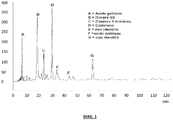
- the main constituents of said extract are quantified by reverse phase high performance liquid chromatography with ultraviolet absorption detection (see diagram 1 which gives the HPLC profile).
- the total catechin derivatives rate is greater than or equal to 30% of the extract.
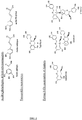
- the sum of catechin and procyanidol dimer B3 (see diagram 2) should not be less than 17%. Phenolic acids, hydroxycinnamic acids and taxifoliol are present in very small quantities not exceeding 3%.
- Dry peanut skins ( Arachis hypogaea L ) are treated either at room temperature or hot with the following solvents: water, at least one organic solvent (ethanol, acetone) or mixtures of water and organic solvents in variable proportions.
- the resulting liquid extract is concentrated by appropriate means (evaporation under reduced pressure) to reduce and / or remove organic solvents.
- the residue is reconcentrated and washed and extracted in a water / ethyl acetate mixture.
- the final extract is then obtained by nebulization or lyophilization.
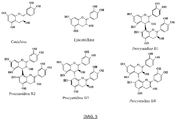
- the flavonoids contained in the OPCs of the peanut film are predominantly composed of oligomers belonging to the A series (1 interflavanic bond and 3 ether bonds per dimer, see diagram 3).
- Interflavanic bond is the bond between monomeric units such as catechin.
- Grape seed extract with at least 99% OPCs is made from dried, unpelted and unfermented white grape seeds.
- An initial extraction with water is carried out, followed by recovery of the aqueous phase by filtration.
- the purification is carried out by selective liquid / liquid extraction and drying. The method used is described in the applications FR 2 092 743 and FR 2,722,498 .
- the main constituents of said extract are quantified by reverse phase high performance liquid chromatography with ultraviolet absorption detection (see diagram 4 which gives the HPLC profile).
- the sum of the monomeric flavanols is between 18 and 32% of the extract, and those of the dimeric flavanols is between 30 and 40%.
- This extract is obtained from the same raw materials as the other extract, that is to say from unfermented white grape seeds.
- the initial solid / liquid extraction solvent is the same (water).
- the aqueous phase is directly dried (atomization or lyophilization) without undergoing purification steps.
- the extract obtained contains the same type of polyphenols as the extract containing at least 99% of OPCs, but in smaller amounts.
- the sum of flavanols of the monomers is between 5 and 7% of the extract (an average of about 6%).
- this grape seed extract is on average four times less rich in monomers than the other extract.
- the total dim flavanols it is between 5 and 7% (about 6% on average). It is approximately 5 to 7 times lower than in the case of the extract containing at least 99% of OPCs.
- Ethylene diamine tetraacetic acid was chosen for study as a chelator. It does not contain crystalline water and is hygroscopic; it is partially soluble in water, ethanol, acetone and phenol. EDTA is soluble in mineral acids and warm formamide. Disodium salt Ethylene diamine tetraacetic acid (EDTA) and ethanol (99% purity) used were obtained in particular from VWR ® .
- the fungus used for testing is a Postia placenta brown rot fungus FPRL 280.
- the tests were performed following the Gao et al. Antifungal activities of heartwood extracts of Port-Orford cedar extractives, 2008, Holzaba 62, pp 620-623 . and of Chang, et al. 1999. Antifungal compounds in the soluble ethyl acetate fraction of the extractives of Taiwania (Taiwania cryptomerioides Hayata) heartwood., 1999, Holzaba 53, pp. 487-490 . Plant extracts and / or EDTA were dissolved in distilled water, while tebuconazole was dissolved separately in ethanol.
- Test solutions of different concentrations were mixed with sterilized malt-agar and introduced into Petri dishes.
- the medium was prepared with 2.5% malt extract and 1.5% agar and sterilized for 23 min.
- the fungal samples taken from the edge of actively growing cultures were transferred to the center of the Petri dishes and incubated in a dark room at 25 ° C and 75% relative humidity. All tests were performed in three times.
- the tests were carried out under conditions identical to those of the test described in the European standard EN 113. After drying at ambient temperature and conditioning at 20 ° C. and 65% relative humidity, the samples were sterilized and exposed. Postia placenta basidiomycete fungus FPLP 280. Four treated and three untreated control samples were placed in each Kolli flask. It should be noted that no leaching of treated samples was applied prior to exposure. The evaluation of the test was based on the recorded mass loss (ML) after an exposure period (16 weeks). According to EN 113, the protection provided for wood is considered sufficient if the average mass loss of the samples is less than 3% of their initial dry mass. This principle has been adopted to evaluate the effectiveness of the formulations tested.
- the concentrations are given relative to the total mass of the composition.
- the first column of Table 1 defines the biocidal substance tested, the second column gives its effective concentration, the third column gives the evaluated dose corresponding substantially to 50% of the effective concentration, the fourth column gives the number of antioxidants tested by biocidal substance. the fifth column defines the three antioxidant concentrations evaluated and the sixth column gives the EDTA concentration.
- the samples Prior to exposure to the fungus, the samples were leached for two weeks and then conditioned according to EN 84. The efficacy of the treatment was assessed by the loss of mass after 16 weeks exposure to the Postia placenta brown rot fungus. FPRL 280.
- Infrared absorption spectra were obtained using the KBr pellet technique on a Perkin-Elmer Paragon 1000 PC TM FTIR spectrometer (4 cm -1 resolution, 50 scans). Wood samples for FTIR analysis were prepared by cutting the treated blocks into small pieces and then grinding the pieces in a Wiley TM mill to obtain fine particles. In each case, 1% (w / w) of dry compound is dispersed in a KBr matrix and pressed to form a pellet.
- the tests were performed using small 40 x 15 x 5 mm samples to test the synergy of the combination: biocide / antioxidant / chelator.
- the four biocidal substances tebuconazole, propiconazole, IPBC and DDAC
- EDTA chelating agent
Landscapes
- Life Sciences & Earth Sciences (AREA)
- Engineering & Computer Science (AREA)
- Wood Science & Technology (AREA)
- Dentistry (AREA)
- Health & Medical Sciences (AREA)
- Plant Pathology (AREA)
- Pest Control & Pesticides (AREA)
- General Health & Medical Sciences (AREA)
- Agronomy & Crop Science (AREA)
- Zoology (AREA)
- Environmental Sciences (AREA)
- Forests & Forestry (AREA)
- Agricultural Chemicals And Associated Chemicals (AREA)
- Chemical And Physical Treatments For Wood And The Like (AREA)
Abstract
Description
- La présente invention est du domaine des compositions pour des usages en tant que biocide et, en particulier, en tant que pesticide. Elle concerne, plus particulièrement, les compositions fongicides, permettant d'éradiquer les microorganismes tels que les champignons responsables de la détérioration des structures en bois comme les charpentes, les bardages ou les éléments de mobilier.
- Les produits fongicides sont généralement des formulations incorporant un agent bioactif contenant une molécule organique ayant une action préventive, visant à empêcher le développement des spores dans le bois, et/ou curative, visant à stopper la croissance des champignons parasitaires dans le bois. Ces agents bioactifs, qui sont ici des agents biocides, voire des agents pesticides, ont un spectre d'action relativement large, et pour en diminuer les effets néfastes sur les organismes vivants non ciblés, ils doivent être utilisés à une concentration qui soit la plus basse possible.
- Des adjuvants sont parfois ajoutés, leur rôle est d'améliorer le mode d'action de l'agent biocide, ou pesticide, qui peut alors être utilisé de manière efficace à de plus faibles concentrations. Par exemple, il est connu d'avoir recours, en combinaison avec des fongicides tels que le propiconazole, à un antioxydant, tel que l'hydroxytoluène butylé (en anglais « butylated hydroxytoluene », BHT) ou le propyle de gallate (PG), comme décrit dans l'article de Schultz et al. Wood and Fiber Science, 37((1), 2005, pp. 175-184. Cependant, l'utilisation de ces antioxydants, BHT et PG, est très controversée, étant donné qu'ils sont considérés comme des substances préoccupantes car toxiques, aussi bien par la réglementation de l'Union Européenne, que par la règlementation Nord-Américaine.
- Dans ce cadre, il est recherché l'utilisation de compositions contenant une substance biocide compatible avec les critères d'innocuités établis par le règlement européen (UE) n°
528/2012 , faisant suite à la directive européenne 98/8/CE et/ou une substance pesticide compatible avec les critères d'innocuités établis par le règlement européen (UE) n°1107/2009 - Pour pallier tout ou partie des inconvénients précités, la présente invention concerne, selon un premier aspect, une composition biocide, en particulier pour une action fongicide, comprenant une ou plusieurs substances biocides et un adjuvant compris dans la catégorie des substances naturelles et des antioxydants, et qualifié d'antioxydant naturel. Les inventeurs ont montrés de manière fortuite la synergie d'action entre les antioxydants naturels et la substance biocide, choisie de préférence parmi les substances pesticides, ce qui permet d'abaisser la concentration utile en substance biocide et/ou pesticide dans la composition.
- Le terme substance naturelle désigne soit une substance purifiée isolée de son milieu d'origine, soit une substance utilisée en combinaison avec tout ou partie de son milieu d'origine, comme par exemple une graine ou un pépin contenant ladite substance.
- La composition selon l'invention comprend avantageusement un chélateur (en anglais « chelator »), de préférence sélectionné parmi au moins l'une des substances suivantes : l'acide éthylène diamine tétraacétique (EDTA), le sel tétrasodique de l'acide N,N-dicarboxyméthyl glutamique (GLDA), l'acide diéthylène triamine penta acétique (DTPA), l'acide (2-Hydroxyéthyl) éthylène diamine triacétique (HEDTA), l'acide nitrilotriacétique (NTA), l'acide propylène diamine tétra acétique (PDTA), l'éthanol glycine (EDG), le glucoheptonate, le gluconate de sodium, et l'acide gluconique,... La présence du chélateur dans le milieu permet d'améliorer la stabilité et donc l'efficacité de la composition fongicide en montrant une diminution de la perte de masse des échantillons de bois traités. De préférence, le chélateur, encore qualifié d'agent chélatant, est l'EDTA.
- La teneur en chélateur, exprimée en pourcentage massique par rapport au poids total de la composition, est avantageusement de 0,5 à 5%.
- Avantageusement, la substance biocide est choisie parmi les triazoles, les ammoniums quaternaires, et les carbamates.
- Avantageusement, la substance biocide est une substance fongicide sélectionnée parmi le propiconazole, le tébuconazole, le chlorure de didécyldiméthylammonium (en anglais « N, N-didécyl-N, N-dimethylammonium chloride », DDAC), le chlorure de benzalkonium (BKC), et le 3-iodo-2-propynyl-butylcarbamate (IPBC). La composition selon l'invention pouvant comprendre avantageusement au moins deux des cinq substances biocides précitées dans le cadre de l'invention.
- Le propiconazole est un agent de protection du bois. L'efficacité du propiconazole est connue contre les champignons de discoloration du bois, , les moississures, le bleuissement, les pourritures cubiques, fibreuses et la pourriture sèche (mérule) en vue de la préservation des bois en classes d'emploi correspondant à des usages intérieur et extérieur et au contact du sol.
- Le tebuconazole, tout comme le propiconazole, est une substance fongicide efficace comme l'atteste notamment l'article de Buschhaus et al. International Research Group on Wood Preservation, 1995.
- Le 3-iodo-2-propynyl-butylcarbamate est décrit comme substance fongicide présentant une toxicité acceptable pour le traitement préventif des bois dans l'article de Hansen, J. IPBC - A new fungicide for wood protection. IRG, Wood Preservation, 1984, Document Number 3295.
- Le N, N- didécyl -N, N-diméthylammonium (DDAC) est un agent efficace en tant que fongicide et fongistatique. Des applications en tant qu'insecticide sont également connues.
- La composition selon l'invention comporte avantageusement une teneur en substance biocide inférieure à 2000 g/m3, voire inférieure à 1200 g/m3. Selon des modes de réalisation préférés, la teneur en substance biocide est de 100 à 500 g/m3, et avantageusement elle est de 150 à 450 g/m3. De telles teneurs en substance biocide sont suffisamment faibles pour ne pas impacter l'environnement extérieur au bois, tout en garantissant une action efficace en combinaison avec l'antioxydant et/ou le chélateur.
- Avantageusement, la composition selon l'invention comporte deux substances biocides sélectionnées parmi les substances biocides décrites dans le cadre de l'invention, prises dans une teneur totale en substance biocide de 100 à 150 g/m3. L'association d'au moins deux substances biocides, en synergie avec l'antioxydant, permet de réduire encore d'avantage la dose nécessaire en substance biocide. Par exemple :
- pour un mélange de propiconazole avec du tébuconazole (1:1), la dose efficace est à 200-250 g/m3 sans l'ajout de l'antioxydant et du sequestrant; et
- avec ajout de l'antioxydant, cette dose efficace est réduite de moitié.
- Avantageusement l'antioxydant naturel est obtenu à partir de l'une des sources biologiques végétales suivantes: le pin maritime, le cacao, l'arachide, et le raisin.
- L'antioxydant naturel est avantageusement obtenu à partir d'un extrait de pépin de raisin riche en polyphénols, et en particulier riche en oligomères procyanidoliques (OPCs). L'extrait de pépin de raisin utilisé dans ce cadre, et connu sous la dénomination anglo-saxonne "Grape seed extract", comporte au moins 99% d' OPCs.
- L'antioxydant naturel est avantageusement obtenu à partir d'un extrait d'écorce de pin maritime riche en polyphénols, et en particulier riche en oligomères procyanidoliques (OPCs). L'extrait d'écorce de pin maritime utilisé dans ce cadre comporte au moins 90% d' OPCs.
- L'antioxydant naturel est avantageusement obtenu à partir d'un extrait de pellicule de graine d'arachide, ou de pellicule sèche de cacahuète, riche en polyphénols, et en particulier riche en oligomères procyanidoliques (OPCs).
- Les termes flavonoïdes, procyanidols, proanthocyanidols, tanins catéchiques et oligomères flavanoliques totaux (OFT) sont utilisés indifféremment pour désigner la même classe de molécules également connue sous le nom d'oligomères procyanidoliques (OPCs).
- Avantageusement, l'antioxydant naturel est un polyphénol susceptible d'être obtenu à partir d'une source biologique végétale. Parmi les polyphénols d'intérêt dans la cadre de l'invention on peut citer :
- les phénols simples, tels que le tyrosol extrait de l'olive ;
- les acides hydroxycinnamiques, tels que l'acide chlorogénique extrait du café vert ;
- les stylbénoïdes, tels que le resveratrol extrait du raisin ;
- les tanins hydrolysables, tels que le tanin gallique extrait du châtaignier ;
- les tanins condensés, tels que les oligomères procyanidoliques extraits du pépin de raisin ou de l'écorce de pin ; et
- les anthocyanes, tels que le cyanidol extrait des fruits rouges tels que la framboise.
- La composition selon l'invention comporte avantageusement une teneur en antioxidant naturel de 0.2 à 5%.
- La présente invention concerne aussi une formulation fongicide comportant la composition selon l'invention diluée dans de l'eau et prête à l'emploi. Ainsi la composition est directement en phase à aqueuse dans les conditions prêtes à l'emploi.
- Selon un autre aspect, la présente invention concerne une utilisation de la composition, ou de la formulation, telle que décrite précédemment dans le cadre de la présente invention pour le traitement préventif et curatif des pathologies fongiques du bois.
- La présente invention sera mieux comprise à la lecture de la partie expérimentale détaillée qui suit, dont les exemples de réalisation sont uniquement donnés à titre illustratif, et qui ne peuvent en aucune façon être considérés comme limitatifs.
- Les substances biocides utilisées sont le tébuconazole (97,4% de pureté), le propiconazole (97,4% de pureté), le 3-iodo-2-propynyl-butylcarbamate - IPBC (98% de pureté) et le chlorure de didécyldiméthylammonium - DDAC (79,6% de pureté).
- Les extraits de plantes contenant l'antioxydant sont les suivants:
- un extrait de pellicule de graine d'arachide riche en oligomères procyanidoliques (OPCs) ;
- un extrait d'écorce de pin comportant au moins 90% d' OPCs ; et
- deux extraits de pépin de raisin (Vitis vinifera), représenté par un extrait connu et un extrait comportant au moins 99% d' OPCs.
- L'extrait d'écorce de pin est fabriqué à partir de l'écorce de pin maritime séchée et broyée, suivi d'une extraction solide/liquide initiale à l'eau, puis d'une récupération de la phase aqueuse par filtration. La purification est effectuée par extraction sélective liquide/liquide et séchage. Le procédé utilisé est décrit dans les demandes
FR 2 092 743 FR 2 722 498 - Les principaux constituants dudit extrait sont quantifiés par chromatographie liquide haute performance en phase inverse avec détection par absorption ultraviolette (voir le diagramme 1 qui donne le profil HPLC). Le taux de dérivés catéchiques totaux est supérieur ou égal à 30% de l'extrait. La somme de la catéchine et procyanidol dimère B3 (voir diagramme 2) ne doit pas être inférieure à 17%. Les acides phénoliques, hydroxycinnamiques et le taxifoliol sont présents en quantités très faibles ne dépassant pas 3%.
- Les pellicules sèches de cacahuètes (Arachis hypogaea L) sont traitées soit à température ambiante ou à chaud avec les solvants suivants : l'eau, au moins un solvant organique (éthanol, acétone) ou des mélanges eau et solvants organiques dans des proportions variables. L'extrait liquide obtenu est concentré par des moyens appropriés (évaporation sous pression réduite) pour réduire et ou éliminer les solvants organiques. Le résidu est reconcentré et on effectue un lavage et une extraction dans un mélange eau/acétate d'éthyle. L'extrait final est ensuite obtenu par nébulisation ou lyophilisation.
- L'extrait de pellicule de la graine d'arachide (Arachis hypogaea L) contient des polyphénols appartenant aux trois groupes ci-dessous :
- Acides phénoliques (acide gallique, acide caféique et acide chlorogénique) ;
- Les hydroxystilbènes (trans-resveratrol) ; et
- Les flavonoïdes (dont monomères et oligomères de flavan-3-ols).
- Les flavonoïdes contenus dans les OPCs de la pellicule de l'arachide sont composés majoritairement d'oligomères appartenant à la série A (1 liaison interflavanique et 3 liaisons éthers par dimère, voir le diagramme 3.). Une liaison interflavanique est la liaison entre des unités monomériques telles que la catéchine.
- L'extrait de pépin de raisin comportant au moins 99% d' OPCs est fabriqué à partir des pépins de raisin blancs séchés, débarrassés de la pulpe et non fermentés. Une extraction initiale à l'eau est effectuée, puis suivie d'une récupération de la phase aqueuse par filtration. La purification est effectuée par extraction sélective liquide/liquide et séchage. Le procédé utilisé est décrit dans les demandes
FR 2 092 743 FR 2 722 498 - Les principaux constituants dudit extrait sont quantifiés par chromatographie liquide haute performance en phase inverse avec détection par absorption ultraviolette (voir le diagramme 4 qui donne le profil HPLC).
La somme des flavanols monomères se situe entre 18 et 32% de l'extrait, et celles des flavanols dimères est entre 30 et 40%. - Les exemples de formules chimiques des constituants dudit extrait de pépin de raisin sont rappelés au diagramme 5.
- Cet extrait est obtenu à partir des mêmes matières premières que l'autre extrait, c'est-à-dire à partir de pépins de raisin blancs non fermentés. Le solvant d'extraction initiale solide/liquide est le même (eau). La phase aqueuse est directement séchée (atomisation ou lyophilisation) sans subir d'étapes de purification.
L'extrait obtenu contient le même type de polyphénols que l'extrait comportant au moins 99% d' OPCs, mais en quantités moins importantes. - La somme de flavanols des monomères se situe entre 5 et 7% de l'extrait (soit une moyenne d'environ 6%). Comparé à l'extrait comportant au moins 99% d'OPCs, (valeur moyenne en flavanols monomères d'environ 25%), cet extrait de pépin de raisin est en moyenne quatre fois moins riche en monomères que l'autre extrait.
Quant au total des flavanols dimères il est entre 5 et 7% (environ 6% en moyenne). Il est d'environ 5 à 7 fois moins élevé que dans le cas de l'extrait comportant au moins 99% d' OPCs. - L'acide éthylène diamine tétraacétique (EDTA) a été choisi pour l'étude comme chélateur. Il ne contient pas d'eau cristalline et est hygroscopique, il est partiellement soluble dans l'eau, l'éthanol, l'acétone et le phénol. L'EDTA est soluble dans les acides minéraux et le formamide chaud. Le sel disodique de l'acide éthylène diamine tétraacétique technique (EDTA) et l'éthanol (99% de pureté) utilisés ont été obtenus notamment auprès de VWR®.
- Le champignon utilisé pour les essais est un champignon de pourriture brune Postia placenta FPRL 280. Les tests ont été réalisés en suivant les informations des articles de Gao et al. Antifungal activities of heartwood extracts of Port-Orford cedar extractives, 2008, Holzforschung 62, pp 620-623. et de Chang, et al. 1999. Antifungal compounds in the ethyl acetate soluble fraction of the extractives of Taiwania (Taiwania cryptomerioides Hayata) heartwood., 1999, Holzforschung 53, pp. 487-490. Les extraits de plantes et/ou l'EDTA ont été dissous dans de l'eau distillée, tandis que le tébuconazole a été dissous séparément dans de l'éthanol. Des solutions tests de différentes concentrations ont été mélangés avec du malt-agar stérilisé et introduites dans des boîtes de Pétri. Le milieu a été préparé avec 2,5% d'extrait de malt et 1,5% de gélose et stérilisé pendant 23 min. Les prélèvements fongiques effectués à partir du bord de cultures en croissance active ont été transférés sur le centre des boites de Pétri et incubés dans une pièce sombre à 25°C et 75% d'humidité relative. Tous les essais ont été effectués en trois fois. Lorsque les mycéliums des champignons ont atteint les bords des boîtes de Pétri, le diamètre de toutes les boîtes expérimentales ayant été mesurée, l'indice antifongique exprimée en % d'inhibition a été calculé comme suit :

- Quatre extraits de plantes à trois concentrations définies et un chélateur métallique à une concentration constante ont été testés (tableau 1).
Des échantillons d'aubier de pin sylvestre (Pinus sylvestris L.) avec des dimensions de 40 x 15 x 4 mm (dans le sens de la fibre) ont été utilisés tout au long de l'étude. Les échantillons ont été imprégnés dans un autoclave dans lequel un vide de 60% a été créé pendant 30 minutes puis laissé dans la solution pendant 2h, assurant ainsi une imprégnation complète des cellules du bois. Les échantillons de bois ont été ensuite retirés de la solution de traitement, essuyés doucement pour éliminer la solution résiduelle à la surface du bois, et pesés. Le poids enregistré a été utilisé pour calculer la rétention. - Les tests ont été effectués dans des conditions identiques à celles de l'essai décrit dans la norme européenne EN 113. Après séchage à la température ambiante et conditionnement à 20°C et 65% d'humidité relative, les échantillons ont été stérilisés et exposés au champignon basidiomycète Postia placenta FPRL 280. Quatre échantillons traités et trois échantillons témoins non traités ont été placés dans chaque flacon Kolli. Il convient de souligner qu'aucune lixiviation des échantillons traités n'a été appliquée avant l'exposition. L'évaluation du test a été basée sur la perte de masse enregistrée (ML) après une période d'exposition (16 semaines). Selon la norme EN 113, la protection prévue pour le bois est considérée comme suffisante si la perte moyenne en masse des échantillons est inférieure à 3% de leur masse sèche initiale. Ce principe a été adopté pour évaluer l'efficacité des formulations testées.
- Les variables étudiées sont présentées dans le tableau 1.
Tableau 1. Conc. Min. efficace, (g/m3) Appr. 50% conc., (g/m3) Nombre d'antioxi. testé Conc. antiox., % Chelateur EDTA, % Tébuconazole 450 200 4 0.5-2-4 3 Propiconazole 390 200 4 0.5-2-4 3 IPBC 300 150 4 0.5-2-4 3 DDAC 1800 1000 4 0.5-2-4 3 - Les concentrations sont données par rapport à la masse totale de la composition. La première colonne du tableau 1 définit la substance biocide testée, la deuxième colonne donne sa concentration efficace, la troisième colonne donne la dose évaluée correspondant sensiblement à 50% de la concentration efficace, la quatrième colonne donne le nombre d'antioxydant testés par substance biocide, la cinquième colonne définit les trois concentrations en antioxydant évaluées et la sixième colonne donne la concentration en EDTA.
- Sur la base des résultats du « screening test » présenté ci-dessus, un nouveau test standard en s'inspirant de la norme EN 113 (1996) avec les fongicides sélectionnés et les antioxydants (AO) a été mis au point. Des blocs d'aubier de pin sylvestre de 15 x 25 x 50 mm de dimension (dans le sens de la fibre) ont été traités par un procédé d'imprégnation à cellules pleines. Le tébuconazole a été testé à des teneurs de 150 et 250 g/m3 et l'IPBC à 100 et 200 g/m3. Ils ont été dissous dans de l'éthanol comme solvant, éventuellement en présence de l'antioxydant (pépin de raisin ou d'écorce de pin) à une concentration de 0,2 à 1,5 % et de 3 % de chélateur (EDTA). Les tests ont été reproduits dix fois. Après traitement, les échantillons ont été pesés et séchés à température ambiante. Avant l'exposition au champignon, les échantillons ont été lessivés pendant deux semaines, puis conditionnés selon la norme EN 84. L'efficacité du traitement a été évaluée par la perte de masse après 16 semaines d'exposition au champignon de pourriture brune Postia placenta FPRL 280.
- Les spectres d'absorption infrarouge ont été obtenus en utilisant la technique de la pastille de KBr sur un spectromètre FTIR Perkin - Elmer Paragon 1000 PC™ (résolution de 4 cm - 1, 50 balayages). Des échantillons de bois pour l'analyse FTIR ont été préparés en découpant les blocs traités en petits morceaux et en broyant ensuite les morceaux dans un broyeur Wiley™ pour obtenir des particules fines. Dans chaque cas, 1 % (p/p) de composé sec est dispersé dans une matrice de KBr et pressée pour former une pastille.
- Les tests ont été effectués en utilisant les petits échantillons de dimension 40 x 15 x 5 mm pour tester la synergie de la combinaison : biocide / antioxydant / chélateur. Les quatre substances biocides (tébuconazole, propiconazole, IPBC et DDAC) à deux niveaux, avec ou sans antioxydants naturels à 0.5, 2 et 4 % et / ou 3 % de l'agent chélatant (EDTA) ont été testés. Au cours de ces essais préliminaires, dans lequel les échantillons traités n'ont pas été lessivés, l'efficacité de chaque traitement a été évaluée par la perte de masse après 16 semaines d'exposition au champignon de pourriture brune P. placenta. Les tests (tableau 2.) indiquent que l'EDTA seul a eu peu d'effet de protection contre le champignon de pourriture brune P. placenta (7,7% de perte de masse). Les résultats ont montré aussi que, à l'exception du DDAC, tous les biocides étudiés fournis ont montré un niveau de protection élevé contre P. placenta à la concentration minimale efficace. Lorsque les concentrations de biocides ont été réduites de moitié (50% de la concentration efficace), uniquement le tébuconazole était toujours suffisamment actif. L'addition de 3 % d'EDTA a augmenté l'efficacité de tous les biocides, sauf pour le tébuconazole, pour lequel l'efficacité a été légèrement diminué.
Tableau 2. Perte de masse moyenne mesurée sur les échantillons de bois non lessivés traités avec les quatre biocides et l'EDTA après l'exposition au champignon de la pourriture brune P. placenta pendant 16 semaines. Concentration EDTA Tébuconazole Propiconazole IPBC DDAC 3% 7.7 (0.2) 100% -5.9 (2.6) -4.1 (2.4) -1.1 (1.9) 4.8 (0.9) 50% 0.0 (1.2) 6.1 (9.0) 31.8 (18.3) 5.5 (4.2) 50% + 3% d'EDTA 3.2 (0.6) 3.6 (3.7) 9.0 (1.2) 4.0 (1.3) - Les antioxydants ont également été étudiés séparément et en combinaison avec de l'EDTA. Parmi les quatre extraits de plantes étudiés (Tableau 3), seul l'extrait d'arachide à 2 et 4 % a présenté de puissants effets inhibiteurs contre les champignons, probablement en raison de la solubilité limitée de cet extrait (taille de particules relativement grande) qui reste en surface après l'imprégnation des échantillons. Après l'ajout de 3% d'EDTA, une efficacité accrue a été observée pour tous les extraits, mais la perte de masse est toujours supérieure à 3%.
Tableau 3. Perte de masse moyenne mesurée sur les échantillons de bois non lessivés traités avec des extraits de plantes et de l'EDTA, après l'exposition au champignon de la pourriture brune P. placenta pendant 16 semaines. Extraits 0.5% 2% 4% 0.5% 2% 4% 3% EDTA 3% EDTA 3% EDTA Pin maritime 31.5 (2.5) 30.9 (5.5) 29.5 (13.7) 5.5 (4.9) 4.0 (0.4) 3.8 (0.9) arachide 43.8 (19.1) 2.1 (0.3) -0.8 (2.6) -0.9 (0.5) 2.2 (1.1) 0.8 (2.2) Pépin de raisin (extrait connu) 29.0 (11.9) 37.2 (12.0) 26.8 (19.6) 5.7 (9.7) 6.4 (3.4) 3.3 (0.3) Extrait de pépin à 99% d'OPCs 27.2 (13.1) 36.4 (11.8) 31.0 (14.8) 4.0 (2.2) 3.3 (1.4) 0.5 (1.2) - Des tests ont également été effectués avec les extraits de plantes mélangés avec chacun des quatre biocides (à 50 % de leur concentration efficace). Il a été observé une bonne efficacité du tébuconazole et du propiconazole (plus de 3% de perte de masse), tandis que l'IPBC et DDAC ne sont pas efficaces (voir tableau 4, 5 et 6).
Tableau 4. Perte de masse moyenne mesurée sur les échantillons de bois non lessivés traités avec les quatre biocides (50% de la concentration efficace), et des extraits de plantes à 0,5% de concentration après l'exposition au champignon de la pourriture brune P. placenta pendant 16 semaines. 0.5% Tébuconazole Propiconazole IPBC DDAC Pin maritime 1.3 (0.2) 28.0 (9.6) 3.7 (1.4) 13.4 (5.9) Arachide 0.8 (0.2) 0.5 (0.3) 11.9 (9.1) 2.9 (0.4) Pépin de raisin (extrait connu) 1.0 (0.2) 0.8 (0.1) 13.0 (20.6) 4.3 (1.5) Extrait de pépin à 99% d'OPCs 1.3 (0.2) 0.9 (0.2) 3.5 (2.0) 22.9 (2.9) Tableau 5. Perte de masse moyenne mesurée sur les échantillons de bois non lessivés traités avec les quatre biocides (50% de la concentration efficace), et des extraits de plantes à 2% de concentration après l'exposition au champignon de la pourriture brune P. placenta pendant 16 semaines. 2% Tébuconazole Propiconazole IPBC DDAC Pin maritime 0.7 (0.3) 1.7 (1.4) 45.7 (9.6) 21.0 (2.5) Arachide 0.9 (0.2) 2.5 (2.3) 0.8 (0.5) 2.6 (0.2) Pépin de raisin (extrait connu) 1.4 (0.2) 1.5 (0.3) 3.5 (7.2) 4.7 (3.9) Extrait de pépin à 99% d'OPCs 0.6 (0.3) 2.9 (3.6) 0.9(1.1) 9.6 (5.8) Tableau 6. Perte de masse moyenne mesurée sur les échantillons de bois non lessivés traités avec les quatre biocides (50% de la concentration efficace), et des extraits de plantes à 4% de concentration après l'exposition au champignon de la pourriture brune P. placenta pendant 16 semaines. 4% Tébuconazole Propiconazole IPBC DDAC Pin maritime 0.8 (0.1) 11.2 (17.7) 5.6 (4.0) 9.8 (5.9) Arachide 0.5 (0.4) 1.4 (0.2) 1.4 (0.2) 2.9 (2.0) Pépin de raisin (extrait connu) 2.3 (5.0) 1.6 (0.2) 5.0 (7.4) 3.4 (3.9) Extrait de pépin à 99% d'OPCs 0.5 (0.3) - 2.1 (0.3) 1.9 (0.4) - L'efficacité a été encore améliorée par l'addition de 3% d'EDTA (tableau 7, 8 et 9). Ceci est particulièrement illustré avec IPBC comme biocide où l'amélioration a été constatée dans tous les cas.
Tableau 7. Perte de masse moyenne mesurée sur les échantillons de bois non lessivés traités avec les quatre biocides (50% de la concentration efficace), des extraits de plantes à 0,5% de concentration, et 3% d'EDTA, après l'exposition au champignon de la pourriture brune P. placenta pendant 16 semaines. 0.5% Tebuconazole Propiconazole IPBC DDAC 3% EDTA Pin maritime 0.8 (0.5) 2.0 (1.4) 0.5 (0.6) - Arachide -0.2 (1.3) 1.9 (1.0) 1.6 (1.3) - Pépin de raisin (extrait connu) 1.4 (0.8) 1.5 (0.9) 1.6 (0.7) - Extrait de pépin à 99% d'OPCs 0.5 (0.7) 1.0 (1.4) 1.2 (1.4) - Tableau 8. Perte de masse moyenne mesurée sur les échantillons de bois non lessivés traités avec les quatre biocides (50% de la concentration efficace), des extraits de plantes à 2% de concentration, et 3% d'EDTA, après l'exposition au champignon de la pourriture brune P. placenta pendant 16 semaines. 2% Tebuconazole Propiconazole IPBC DDAC 3% EDTA Pin maritime 2.0 (1.3) 1.4 (1.3) 0.9 (0.3) - Arachide 2.1 (1.0) 2.4 (1.2) 1.2 (0.3) - Pépin de raisin (extrait connu) 1.8 (2.1) 1.2 (1.2) 0.7 (0.1) - Extrait de pépin à 99% d'OPCs 2.1 (1.1) 2.0 (1.3) 1.7 (0.5) - Tableau 9. Perte de masse moyenne mesurée sur les échantillons de bois non lessivés traités avec les quatre biocides (50% de la concentration efficace), des extraits de plantes à 4% de concentration, et 3% d'EDTA, après l'exposition au champignon de la pourriture brune P. placenta pendant 16 semaines. 4% Tebuconazole Propiconazole IPBC DDAC 3% EDTA Pin maritime 0.1 (2.2) 1.2 (0.9) 1.1 (0.2) - Arachide 1.2 (1.1) 2.2 (1.2) 0.4 (1.1) - Pépin de raisin (extrait connu) 2.1 (0.5) 1.8 (1.5) 0.8(0.7) - Extrait de pépin à 99% d'OPCs 1.1 (0.2) 1.6 (0.7) 0.6 (0.2) -
Claims (10)
- Composition fongicide comprenant une substance fongicide et un antioxydant naturel.
- Composition selon la revendication 1, comprenant un chélateur tel que l'acide éthylène diamine tétra acétique.
- Composition selon la revendication 2, dans laquelle la teneur en chélateur est de 0,5 à 5%.
- Composition selon l'une des revendications 1 à 3, dans laquelle la substance fongicide est sélectionnée parmi le propiconazole, le tébuconazole, le chlorure de didécyldiméthylammonium, le chlorure de benzalkonium et le 3-iodo-2-propynyl-butylcarbamate.
- Composition selon l'une des revendications 1 à 4, dans laquelle la teneur en substance fongicide est inférieure à 2000 g/m3.
- Composition selon l'une des revendications 1 à 5, dans laquelle l'antioxydant naturel est obtenu à partir de l'une des sources suivantes: le pin maritime, le cacao, l'arachide et le raisin.
- Composition selon l'une des revendications 1 à 6, dans laquelle l'antioxydant naturel est un polyphénol susceptible d'être obtenu à partir d'une source biologique.
- Composition selon l'une des revendications 1 à 7, dans laquelle la teneur en antioxidant naturel est de 0.2 à 5%.
- Formulation fongicide comprenant la composition selon l'une des revendications 1 à 8 diluée dans de l'eau.
- Utilisation de la composition fongicide, ou de la formulation fongicide, selon l'une des revendications 1 à 9 pour le traitement préventif et curatif des pathologies fongiques du bois.
Applications Claiming Priority (1)
| Application Number | Priority Date | Filing Date | Title |
|---|---|---|---|
| FR1559052A FR3041504A1 (fr) | 2015-09-25 | 2015-09-25 | Composition biocide pour le traitement des bois |
Publications (3)
| Publication Number | Publication Date |
|---|---|
| EP3146840A2 true EP3146840A2 (fr) | 2017-03-29 |
| EP3146840A3 EP3146840A3 (fr) | 2017-05-03 |
| EP3146840B1 EP3146840B1 (fr) | 2020-08-19 |
Family
ID=54608822
Family Applications (1)
| Application Number | Title | Priority Date | Filing Date |
|---|---|---|---|
| EP16190458.6A Active EP3146840B1 (fr) | 2015-09-25 | 2016-09-23 | Composition biocide pour le traitement des bois |
Country Status (2)
| Country | Link |
|---|---|
| EP (1) | EP3146840B1 (fr) |
| FR (1) | FR3041504A1 (fr) |
Cited By (1)
| Publication number | Priority date | Publication date | Assignee | Title |
|---|---|---|---|---|
| CN118744460A (zh) * | 2024-08-09 | 2024-10-08 | 江西鲁丽木业有限公司 | 一种防腐抗菌竹木复合刨花板的制备方法 |
Families Citing this family (1)
| Publication number | Priority date | Publication date | Assignee | Title |
|---|---|---|---|---|
| FR3130510B1 (fr) * | 2021-12-22 | 2024-07-12 | Berkem Dev | Utilisation d’oligomères procyanidoliques en tant qu’activateur de produits pesticides |
Citations (2)
| Publication number | Priority date | Publication date | Assignee | Title |
|---|---|---|---|---|
| FR2092743A1 (en) | 1970-06-15 | 1972-01-28 | Aquitaine Invest Pharma | Complete extraction of total flavanol gomers from plats -peripheral - venous activity |
| FR2722498A1 (fr) | 1994-07-12 | 1996-01-19 | Berkem Sa | Procede de preparation d'extraits contenant des composes polyphenoliques oligomeres de type catechique a partir de xources vegetales et extraits obtenus |
Family Cites Families (1)
| Publication number | Priority date | Publication date | Assignee | Title |
|---|---|---|---|---|
| WO2006116778A2 (fr) * | 2005-04-26 | 2006-11-02 | Douglas James Sutherland | Materiaux prophylactiques |
-
2015
- 2015-09-25 FR FR1559052A patent/FR3041504A1/fr not_active Withdrawn
-
2016
- 2016-09-23 EP EP16190458.6A patent/EP3146840B1/fr active Active
Patent Citations (2)
| Publication number | Priority date | Publication date | Assignee | Title |
|---|---|---|---|---|
| FR2092743A1 (en) | 1970-06-15 | 1972-01-28 | Aquitaine Invest Pharma | Complete extraction of total flavanol gomers from plats -peripheral - venous activity |
| FR2722498A1 (fr) | 1994-07-12 | 1996-01-19 | Berkem Sa | Procede de preparation d'extraits contenant des composes polyphenoliques oligomeres de type catechique a partir de xources vegetales et extraits obtenus |
Non-Patent Citations (7)
| Title |
|---|
| "RÈGLEMENT (CE) N o 1107/2009 DU PARLEMENT EUROPÉEN ET DU CONSEIL", JOURNAL OFFICIEL DE LUNION EUROPÉENNE, no. 211020, Retrieved from the Internet <URL:http://eur-lex.europa.eu/LexUriServ/LexUriServ.do?uri=OJ:L:2009:309:0001:0050:FR:PDF> |
| "RÈGLEMENT (UE) N o 528/2012 DU PARLEMENT EUROPÉEN ET DU CONSEIL", JOURNAL OFFICIEL DE LUNION EUROPÉENNE, 22 May 2012 (2012-05-22), Retrieved from the Internet <URL:http://eur-lex.europa.eu/LexUriServ/LexUriServ.do?uri=OJ:L:2012:167:0001:0123:fr:PDF> |
| BUSCHHAUS ET AL., INTERNATIONAL RESEARCH GROUP ON WOOD PRESERVATION, 1995 |
| CHANG ET AL.: "Antifungal compounds in the ethyl acetate soluble fraction of the extractives of Taiwania (Taiwania cryptomerioides Hayata) heartwood.", HOLZFORSCHUNG, vol. 53, 1999, pages 487 - 490 |
| GAO ET AL.: "Antifungal activities of heartwood extracts of Port-Orford cedar extractives", HOLZFORSCHUNG, vol. 62, 2008, pages 620 - 623 |
| HANSEN, J.: "IPBC - A new fungicide for wood protection", IRG, WOOD PRESERVATION, 1984 |
| SCHULTZ ET AL., WOOD AND FIBER SCIENCE, vol. 37, no. 1, 2005, pages 175 - 184 |
Cited By (1)
| Publication number | Priority date | Publication date | Assignee | Title |
|---|---|---|---|---|
| CN118744460A (zh) * | 2024-08-09 | 2024-10-08 | 江西鲁丽木业有限公司 | 一种防腐抗菌竹木复合刨花板的制备方法 |
Also Published As
| Publication number | Publication date |
|---|---|
| EP3146840B1 (fr) | 2020-08-19 |
| FR3041504A1 (fr) | 2017-03-31 |
| EP3146840A3 (fr) | 2017-05-03 |
Similar Documents
| Publication | Publication Date | Title |
|---|---|---|
| EP2642858B1 (fr) | Nouveau procédé de traitement de produits végétaux avant ou après récolte par l'acide phosphonique et une huile essentielle | |
| EP2763527B1 (fr) | Procédé de traitement fongicide de souches résistantes au moyen d'huile(s) essentielle(s) | |
| FR2523404A1 (fr) | Composition d'agents de controle pour la protection du bois | |
| FR2786664A1 (fr) | Procede de traitement de fruits et legumes utilisant l'eugenol et/ou l'isoeugenol et utilisation d'une composition a base d'eugenol et/ou d'isoeugenol | |
| CN113038824A (zh) | 用于保护性涂层的化合物和制剂 | |
| FR3061176A1 (fr) | Preparation d'un extrait de biomasse seche riche en polyphenols | |
| EP3146840B1 (fr) | Composition biocide pour le traitement des bois | |
| EP2763534A1 (fr) | Nouvelles formulations de pyriméthanil et leurs utilisations dans le traitement des cultures | |
| FR3067592A1 (fr) | Extrait de nœuds d'arbres appartenant au genre pinus comme fongicide | |
| EP1728429A1 (fr) | Procédé de traitement antigerminatif et/ou biocide de bulbes ou tubercules au moyen de CIPC et d'un terpène ou d'une huile terpénique | |
| EP1615502B1 (fr) | Procede de traitement de fruits et legumes a base de lecithines | |
| EP2373464B1 (fr) | Compositions pour le traitement d'un bois d'oeuvre et d'autres substrats en bois | |
| FR2647304A1 (fr) | Composition phytosanitaire, son procede de preparation et son utilisation, en particulier pour lutter contre le mildiou de la vigne | |
| EP3310163A1 (fr) | Procede de traitement des maladies du bois des plantes perennes | |
| EP3116319B1 (fr) | Procede de valorisation de feuilles caduques de plante ligneuse a port arborescent pour l'industrie phytopharmaceutique | |
| EP3217794B1 (fr) | Utilisation de gallate d'alkyle pour stimuler les défenses naturelles de plantes. | |
| EP3193596B1 (fr) | Utilisation de l'acide 4-chloroindole-3-acétique pour le contrôle de plantes indésirables | |
| KR102335785B1 (ko) | 천연 재료를 포함하는 목재 보존용 조성물 | |
| EP4452581A1 (fr) | Composition comprenant au moins un iso-alcane, au moins un éther de cellulose, au moins un extrait de plante et un mélange d'alkoxysilane et de disiloxane | |
| EP4489575A1 (fr) | Composition phytosanitaire et son utilisation | |
| WO2024023446A1 (fr) | Composition antifongique pulverisable utilisable en agriculture- procede et utilisation associes | |
| EP4201203A1 (fr) | Utilisation d'oligomères procyanidoliques en tant qu'activateur de produits pesticides | |
| Dinu et al. | Evaluation of the polypehnol extracts from vine canes (Vitis vinifera L.) obtained by an improved extraction method. | |
| FR2777422A1 (fr) | Compositions pour le traitement antibleu et antimoisissure du bois, a base d'ipbc et de compose(s) amnonium quaternaire(s) | |
| EP4529768A1 (fr) | Utilisation d'un extrait de raisin pour la défense des plantes contre des champignons phytopathogènes |
Legal Events
| Date | Code | Title | Description |
|---|---|---|---|
| PUAI | Public reference made under article 153(3) epc to a published international application that has entered the european phase |
Free format text: ORIGINAL CODE: 0009012 |
|
| STAA | Information on the status of an ep patent application or granted ep patent |
Free format text: STATUS: THE APPLICATION HAS BEEN PUBLISHED |
|
| AK | Designated contracting states |
Kind code of ref document: A2 Designated state(s): AL AT BE BG CH CY CZ DE DK EE ES FI FR GB GR HR HU IE IS IT LI LT LU LV MC MK MT NL NO PL PT RO RS SE SI SK SM TR |
|
| AX | Request for extension of the european patent |
Extension state: BA ME |
|
| PUAL | Search report despatched |
Free format text: ORIGINAL CODE: 0009013 |
|
| AK | Designated contracting states |
Kind code of ref document: A3 Designated state(s): AL AT BE BG CH CY CZ DE DK EE ES FI FR GB GR HR HU IE IS IT LI LT LU LV MC MK MT NL NO PL PT RO RS SE SI SK SM TR |
|
| AX | Request for extension of the european patent |
Extension state: BA ME |
|
| RIC1 | Information provided on ipc code assigned before grant |
Ipc: A01N 65/08 20090101ALI20170330BHEP Ipc: A01N 65/20 20090101ALI20170330BHEP Ipc: A01P 3/00 20060101ALI20170330BHEP Ipc: A01N 47/12 20060101ALI20170330BHEP Ipc: A01N 33/12 20060101AFI20170330BHEP Ipc: B27K 3/50 20060101ALI20170330BHEP Ipc: A01N 43/653 20060101ALI20170330BHEP Ipc: A01N 65/06 20090101ALI20170330BHEP |
|
| STAA | Information on the status of an ep patent application or granted ep patent |
Free format text: STATUS: REQUEST FOR EXAMINATION WAS MADE |
|
| 17P | Request for examination filed |
Effective date: 20171031 |
|
| RBV | Designated contracting states (corrected) |
Designated state(s): AL AT BE BG CH CY CZ DE DK EE ES FI FR GB GR HR HU IE IS IT LI LT LU LV MC MK MT NL NO PL PT RO RS SE SI SK SM TR |
|
| STAA | Information on the status of an ep patent application or granted ep patent |
Free format text: STATUS: EXAMINATION IS IN PROGRESS |
|
| 17Q | First examination report despatched |
Effective date: 20180403 |
|
| REG | Reference to a national code |
Ref country code: DE Ref legal event code: R079 Ref document number: 602016042160 Country of ref document: DE Free format text: PREVIOUS MAIN CLASS: A01N0033120000 Ipc: B27K0003080000 |
|
| RIC1 | Information provided on ipc code assigned before grant |
Ipc: A01N 65/20 20090101ALI20200121BHEP Ipc: B27K 3/08 20060101AFI20200121BHEP Ipc: A01N 65/06 20090101ALI20200121BHEP Ipc: A01N 43/653 20060101ALI20200121BHEP Ipc: A01P 3/00 20060101ALI20200121BHEP Ipc: A01N 33/12 20060101ALI20200121BHEP Ipc: A01N 47/12 20060101ALI20200121BHEP Ipc: B27K 3/50 20060101ALI20200121BHEP Ipc: A01N 65/08 20090101ALI20200121BHEP |
|
| GRAP | Despatch of communication of intention to grant a patent |
Free format text: ORIGINAL CODE: EPIDOSNIGR1 |
|
| STAA | Information on the status of an ep patent application or granted ep patent |
Free format text: STATUS: GRANT OF PATENT IS INTENDED |
|
| INTG | Intention to grant announced |
Effective date: 20200228 |
|
| GRAS | Grant fee paid |
Free format text: ORIGINAL CODE: EPIDOSNIGR3 |
|
| GRAA | (expected) grant |
Free format text: ORIGINAL CODE: 0009210 |
|
| STAA | Information on the status of an ep patent application or granted ep patent |
Free format text: STATUS: THE PATENT HAS BEEN GRANTED |
|
| AK | Designated contracting states |
Kind code of ref document: B1 Designated state(s): AL AT BE BG CH CY CZ DE DK EE ES FI FR GB GR HR HU IE IS IT LI LT LU LV MC MK MT NL NO PL PT RO RS SE SI SK SM TR |
|
| REG | Reference to a national code |
Ref country code: CH Ref legal event code: EP |
|
| REG | Reference to a national code |
Ref country code: DE Ref legal event code: R096 Ref document number: 602016042160 Country of ref document: DE |
|
| REG | Reference to a national code |
Ref country code: AT Ref legal event code: REF Ref document number: 1303419 Country of ref document: AT Kind code of ref document: T Effective date: 20200915 |
|
| REG | Reference to a national code |
Ref country code: IE Ref legal event code: FG4D Free format text: LANGUAGE OF EP DOCUMENT: FRENCH |
|
| PGFP | Annual fee paid to national office [announced via postgrant information from national office to epo] |
Ref country code: FR Payment date: 20200928 Year of fee payment: 5 |
|
| REG | Reference to a national code |
Ref country code: CH Ref legal event code: NV Representative=s name: VALIPAT S.A. C/O BOVARD SA NEUCHATEL, CH |
|
| PGFP | Annual fee paid to national office [announced via postgrant information from national office to epo] |
Ref country code: BE Payment date: 20200925 Year of fee payment: 5 |
|
| REG | Reference to a national code |
Ref country code: LT Ref legal event code: MG4D |
|
| REG | Reference to a national code |
Ref country code: NL Ref legal event code: MP Effective date: 20200819 |
|
| PG25 | Lapsed in a contracting state [announced via postgrant information from national office to epo] |
Ref country code: NO Free format text: LAPSE BECAUSE OF FAILURE TO SUBMIT A TRANSLATION OF THE DESCRIPTION OR TO PAY THE FEE WITHIN THE PRESCRIBED TIME-LIMIT Effective date: 20201119 Ref country code: SE Free format text: LAPSE BECAUSE OF FAILURE TO SUBMIT A TRANSLATION OF THE DESCRIPTION OR TO PAY THE FEE WITHIN THE PRESCRIBED TIME-LIMIT Effective date: 20200819 Ref country code: FI Free format text: LAPSE BECAUSE OF FAILURE TO SUBMIT A TRANSLATION OF THE DESCRIPTION OR TO PAY THE FEE WITHIN THE PRESCRIBED TIME-LIMIT Effective date: 20200819 Ref country code: PT Free format text: LAPSE BECAUSE OF FAILURE TO SUBMIT A TRANSLATION OF THE DESCRIPTION OR TO PAY THE FEE WITHIN THE PRESCRIBED TIME-LIMIT Effective date: 20201221 Ref country code: HR Free format text: LAPSE BECAUSE OF FAILURE TO SUBMIT A TRANSLATION OF THE DESCRIPTION OR TO PAY THE FEE WITHIN THE PRESCRIBED TIME-LIMIT Effective date: 20200819 Ref country code: BG Free format text: LAPSE BECAUSE OF FAILURE TO SUBMIT A TRANSLATION OF THE DESCRIPTION OR TO PAY THE FEE WITHIN THE PRESCRIBED TIME-LIMIT Effective date: 20201119 Ref country code: GR Free format text: LAPSE BECAUSE OF FAILURE TO SUBMIT A TRANSLATION OF THE DESCRIPTION OR TO PAY THE FEE WITHIN THE PRESCRIBED TIME-LIMIT Effective date: 20201120 Ref country code: LT Free format text: LAPSE BECAUSE OF FAILURE TO SUBMIT A TRANSLATION OF THE DESCRIPTION OR TO PAY THE FEE WITHIN THE PRESCRIBED TIME-LIMIT Effective date: 20200819 |
|
| PGFP | Annual fee paid to national office [announced via postgrant information from national office to epo] |
Ref country code: CH Payment date: 20201015 Year of fee payment: 5 |
|
| REG | Reference to a national code |
Ref country code: AT Ref legal event code: MK05 Ref document number: 1303419 Country of ref document: AT Kind code of ref document: T Effective date: 20200819 |
|
| PG25 | Lapsed in a contracting state [announced via postgrant information from national office to epo] |
Ref country code: RS Free format text: LAPSE BECAUSE OF FAILURE TO SUBMIT A TRANSLATION OF THE DESCRIPTION OR TO PAY THE FEE WITHIN THE PRESCRIBED TIME-LIMIT Effective date: 20200819 Ref country code: PL Free format text: LAPSE BECAUSE OF FAILURE TO SUBMIT A TRANSLATION OF THE DESCRIPTION OR TO PAY THE FEE WITHIN THE PRESCRIBED TIME-LIMIT Effective date: 20200819 Ref country code: NL Free format text: LAPSE BECAUSE OF FAILURE TO SUBMIT A TRANSLATION OF THE DESCRIPTION OR TO PAY THE FEE WITHIN THE PRESCRIBED TIME-LIMIT Effective date: 20200819 Ref country code: LV Free format text: LAPSE BECAUSE OF FAILURE TO SUBMIT A TRANSLATION OF THE DESCRIPTION OR TO PAY THE FEE WITHIN THE PRESCRIBED TIME-LIMIT Effective date: 20200819 Ref country code: IS Free format text: LAPSE BECAUSE OF FAILURE TO SUBMIT A TRANSLATION OF THE DESCRIPTION OR TO PAY THE FEE WITHIN THE PRESCRIBED TIME-LIMIT Effective date: 20201219 |
|
| REG | Reference to a national code |
Ref country code: DE Ref legal event code: R119 Ref document number: 602016042160 Country of ref document: DE |
|
| PG25 | Lapsed in a contracting state [announced via postgrant information from national office to epo] |
Ref country code: SM Free format text: LAPSE BECAUSE OF FAILURE TO SUBMIT A TRANSLATION OF THE DESCRIPTION OR TO PAY THE FEE WITHIN THE PRESCRIBED TIME-LIMIT Effective date: 20200819 Ref country code: RO Free format text: LAPSE BECAUSE OF FAILURE TO SUBMIT A TRANSLATION OF THE DESCRIPTION OR TO PAY THE FEE WITHIN THE PRESCRIBED TIME-LIMIT Effective date: 20200819 Ref country code: DK Free format text: LAPSE BECAUSE OF FAILURE TO SUBMIT A TRANSLATION OF THE DESCRIPTION OR TO PAY THE FEE WITHIN THE PRESCRIBED TIME-LIMIT Effective date: 20200819 Ref country code: CZ Free format text: LAPSE BECAUSE OF FAILURE TO SUBMIT A TRANSLATION OF THE DESCRIPTION OR TO PAY THE FEE WITHIN THE PRESCRIBED TIME-LIMIT Effective date: 20200819 Ref country code: EE Free format text: LAPSE BECAUSE OF FAILURE TO SUBMIT A TRANSLATION OF THE DESCRIPTION OR TO PAY THE FEE WITHIN THE PRESCRIBED TIME-LIMIT Effective date: 20200819 |
|
| PG25 | Lapsed in a contracting state [announced via postgrant information from national office to epo] |
Ref country code: ES Free format text: LAPSE BECAUSE OF FAILURE TO SUBMIT A TRANSLATION OF THE DESCRIPTION OR TO PAY THE FEE WITHIN THE PRESCRIBED TIME-LIMIT Effective date: 20200819 Ref country code: AL Free format text: LAPSE BECAUSE OF FAILURE TO SUBMIT A TRANSLATION OF THE DESCRIPTION OR TO PAY THE FEE WITHIN THE PRESCRIBED TIME-LIMIT Effective date: 20200819 Ref country code: AT Free format text: LAPSE BECAUSE OF FAILURE TO SUBMIT A TRANSLATION OF THE DESCRIPTION OR TO PAY THE FEE WITHIN THE PRESCRIBED TIME-LIMIT Effective date: 20200819 Ref country code: MC Free format text: LAPSE BECAUSE OF FAILURE TO SUBMIT A TRANSLATION OF THE DESCRIPTION OR TO PAY THE FEE WITHIN THE PRESCRIBED TIME-LIMIT Effective date: 20200819 |
|
| PLBE | No opposition filed within time limit |
Free format text: ORIGINAL CODE: 0009261 |
|
| STAA | Information on the status of an ep patent application or granted ep patent |
Free format text: STATUS: NO OPPOSITION FILED WITHIN TIME LIMIT |
|
| PG25 | Lapsed in a contracting state [announced via postgrant information from national office to epo] |
Ref country code: SK Free format text: LAPSE BECAUSE OF FAILURE TO SUBMIT A TRANSLATION OF THE DESCRIPTION OR TO PAY THE FEE WITHIN THE PRESCRIBED TIME-LIMIT Effective date: 20200819 Ref country code: LU Free format text: LAPSE BECAUSE OF NON-PAYMENT OF DUE FEES Effective date: 20200923 |
|
| 26N | No opposition filed |
Effective date: 20210520 |
|
| GBPC | Gb: european patent ceased through non-payment of renewal fee |
Effective date: 20201119 |
|
| PG25 | Lapsed in a contracting state [announced via postgrant information from national office to epo] |
Ref country code: DE Free format text: LAPSE BECAUSE OF NON-PAYMENT OF DUE FEES Effective date: 20210401 Ref country code: IT Free format text: LAPSE BECAUSE OF FAILURE TO SUBMIT A TRANSLATION OF THE DESCRIPTION OR TO PAY THE FEE WITHIN THE PRESCRIBED TIME-LIMIT Effective date: 20200819 |
|
| PG25 | Lapsed in a contracting state [announced via postgrant information from national office to epo] |
Ref country code: IE Free format text: LAPSE BECAUSE OF NON-PAYMENT OF DUE FEES Effective date: 20200923 Ref country code: SI Free format text: LAPSE BECAUSE OF FAILURE TO SUBMIT A TRANSLATION OF THE DESCRIPTION OR TO PAY THE FEE WITHIN THE PRESCRIBED TIME-LIMIT Effective date: 20200819 |
|
| PG25 | Lapsed in a contracting state [announced via postgrant information from national office to epo] |
Ref country code: GB Free format text: LAPSE BECAUSE OF NON-PAYMENT OF DUE FEES Effective date: 20201119 |
|
| REG | Reference to a national code |
Ref country code: CH Ref legal event code: PL |
|
| REG | Reference to a national code |
Ref country code: BE Ref legal event code: MM Effective date: 20210930 |
|
| PG25 | Lapsed in a contracting state [announced via postgrant information from national office to epo] |
Ref country code: IS Free format text: LAPSE BECAUSE OF FAILURE TO SUBMIT A TRANSLATION OF THE DESCRIPTION OR TO PAY THE FEE WITHIN THE PRESCRIBED TIME-LIMIT Effective date: 20201219 Ref country code: TR Free format text: LAPSE BECAUSE OF FAILURE TO SUBMIT A TRANSLATION OF THE DESCRIPTION OR TO PAY THE FEE WITHIN THE PRESCRIBED TIME-LIMIT Effective date: 20200819 Ref country code: MT Free format text: LAPSE BECAUSE OF FAILURE TO SUBMIT A TRANSLATION OF THE DESCRIPTION OR TO PAY THE FEE WITHIN THE PRESCRIBED TIME-LIMIT Effective date: 20200819 Ref country code: CY Free format text: LAPSE BECAUSE OF FAILURE TO SUBMIT A TRANSLATION OF THE DESCRIPTION OR TO PAY THE FEE WITHIN THE PRESCRIBED TIME-LIMIT Effective date: 20200819 |
|
| PG25 | Lapsed in a contracting state [announced via postgrant information from national office to epo] |
Ref country code: MK Free format text: LAPSE BECAUSE OF FAILURE TO SUBMIT A TRANSLATION OF THE DESCRIPTION OR TO PAY THE FEE WITHIN THE PRESCRIBED TIME-LIMIT Effective date: 20200819 |
|
| PG25 | Lapsed in a contracting state [announced via postgrant information from national office to epo] |
Ref country code: FR Free format text: LAPSE BECAUSE OF NON-PAYMENT OF DUE FEES Effective date: 20210930 Ref country code: BE Free format text: LAPSE BECAUSE OF NON-PAYMENT OF DUE FEES Effective date: 20210930 |
|
| PG25 | Lapsed in a contracting state [announced via postgrant information from national office to epo] |
Ref country code: LI Free format text: LAPSE BECAUSE OF NON-PAYMENT OF DUE FEES Effective date: 20210930 Ref country code: CH Free format text: LAPSE BECAUSE OF NON-PAYMENT OF DUE FEES Effective date: 20210930 |