EP3146876B1 - Rail mural pour cabines de douche - Google Patents
Rail mural pour cabines de douche Download PDFInfo
- Publication number
- EP3146876B1 EP3146876B1 EP16189505.7A EP16189505A EP3146876B1 EP 3146876 B1 EP3146876 B1 EP 3146876B1 EP 16189505 A EP16189505 A EP 16189505A EP 3146876 B1 EP3146876 B1 EP 3146876B1
- Authority
- EP
- European Patent Office
- Prior art keywords
- wall
- rail
- wall rail
- profile
- room
- Prior art date
- Legal status (The legal status is an assumption and is not a legal conclusion. Google has not performed a legal analysis and makes no representation as to the accuracy of the status listed.)
- Not-in-force
Links
Images





Classifications
-
- A—HUMAN NECESSITIES
- A47—FURNITURE; DOMESTIC ARTICLES OR APPLIANCES; COFFEE MILLS; SPICE MILLS; SUCTION CLEANERS IN GENERAL
- A47K—SANITARY EQUIPMENT; ACCESSORIES THEREFOR, e.g. TOILET ACCESSORIES
- A47K3/00—Baths; Showers; Appurtenances therefor
- A47K3/28—Showers or bathing douches
- A47K3/30—Screens or collapsible cabinets for showers or baths
-
- A—HUMAN NECESSITIES
- A47—FURNITURE; DOMESTIC ARTICLES OR APPLIANCES; COFFEE MILLS; SPICE MILLS; SUCTION CLEANERS IN GENERAL
- A47K—SANITARY EQUIPMENT; ACCESSORIES THEREFOR, e.g. TOILET ACCESSORIES
- A47K3/00—Baths; Showers; Appurtenances therefor
- A47K3/28—Showers or bathing douches
- A47K3/30—Screens or collapsible cabinets for showers or baths
- A47K2003/307—Adjustable connections to the wall
-
- E—FIXED CONSTRUCTIONS
- E06—DOORS, WINDOWS, SHUTTERS, OR ROLLER BLINDS IN GENERAL; LADDERS
- E06B—FIXED OR MOVABLE CLOSURES FOR OPENINGS IN BUILDINGS, VEHICLES, FENCES OR LIKE ENCLOSURES IN GENERAL, e.g. DOORS, WINDOWS, BLINDS, GATES
- E06B3/00—Window sashes, door leaves, or like elements for closing wall or like openings; Layout of fixed or moving closures, e.g. windows in wall or like openings; Features of rigidly-mounted outer frames relating to the mounting of wing frames
- E06B3/54—Fixing of glass panes or like plates
- E06B3/5454—Fixing of glass panes or like plates inside U-shaped section members
Definitions
- the invention relates to a wall rail arrangement for fastening a fixed wall element of a shower cubicle and a method for installing a wall rail of a wall rail arrangement.
- shower cubicles often have a fixed wall element which is attached to a room wall, e.g. B. a bathroom is mounted.
- a door element can be pivotably attached to the stationary wall element. It is also possible to arrange a pivotable door element in such a way that it comes to rest on the stationary wall element in the closed position of the shower cubicle.
- wall rail arrangements are known in which a wall rail is attached to the room wall, preferably screwed to the room wall by means of screws.
- the wall rail is used to hold the fixed wall element.
- the wall rail can have a U-profile, between the legs of which the wall element can be inserted and clamped.
- Wall rail assemblies of this type are for example in the DE 10 2004 031 563 A1 , the DE 10 2007 057 293 A1 , the DE 297 01 915 U1 and the DE 20 2010 003 586 U1 described.
- the GB 2 512 150 A shows a wall rail arrangement in which a wall rail with a U-profile is fastened to the wall by means of screws arranged in the profile base. Clamping pieces are used in the U-profile of the wall rail, which hold the wall element. The clamping pieces require a large clear width of the U-profile. As further prior art, the U.S. 2,743,795 and DE 20 2007 000574 U1 called.
- the invention is based on the object of providing a wall rail arrangement for a fixed wall element of a shower cubicle which enables an attractive appearance and a simple installation option.
- this object is achieved by a wall rail arrangement having the features of claim 1 and a method for assembling a wall rail of a wall rail arrangement having the features of claim 7.
- the wall rail arrangement comprises a wall rail with a U-profile, the attachment to the room wall being effected by screws which are arranged in the profile base of the U-profile.
- the screw fastening of the wall rail is not visible from the outside when the wall rail is mounted.
- the screws for fastening the wall rail are covered by this wall element after the wall element has been inserted into the U-profile.
- the shower cubicle After the shower cubicle has been installed, only the continuously smooth outer surface is of the fastening of the wall element to the room wall, both from the outside and from the inside of the shower cubicle the legs of the U-profile can be seen. This results in an elegant, pleasing appearance of the wall mounting and thus the entire shower cubicle.
- the inner clear width of the U-profile between the legs is widened in the form of an inner hollow cylinder, which is perpendicular to the profile base coaxially to the respective hole for the screw used for fastening runs.
- This cylindrical widening offers the advantage that the clear width of the U-profile between the legs can otherwise be kept as minimal as is necessary to accommodate the wall element. Due to the cylindrical widening, a stable fastening screw can be used, the screw head of which has a diameter that is greater than the clear width of the U-profile and corresponds to the inner diameter of the widened cylinder.
- the installation of the wall rail arrangement is particularly simple and can in particular also be carried out by a single person.
- the wall rail is attached to the wall of the room in the aligned position by means of a temporary adhesive.
- a guide bushing can be inserted into the cylindrical widening of the legs of the U-profile, through which a thin drill can be inserted with precise guidance. to mark a respective drill hole in the room wall.
- the temporarily fixed wall rail is then removed and the pre-marked drill holes are enlarged for inserting wall anchors.
- the wall rail is put back into position and after removing the guide bushes, the screws can be inserted through the expanded cylinder space and screwed into the dowels.
- adjusting disks are arranged in the profile base of the wall rail, into which the screws used for fastening are inserted.
- the adjusting screws can be moved to a small extent in the plane of the profile base. This makes it possible to move the wall rail slightly with respect to the screws inserted in the wall plugs, in order to enable the position of the wall rails to be fine-tuned before the screws are tightened and the wall rail is clamped and fixed to the room wall using the adjusting washer.
- the wall element is inserted into the U-profile of the wall rail and clamped and fixed in the wall rail with screws. This makes it possible to adjust the plane of the wall element at a distance from the wall of the room. For this purpose, the edge of the wall element received in the wall rail can be pushed into the U-profile of the wall rail at different depths before the wall element is clamped and fixed in the wall rail.
- Figure 1 shows a plan view of a shower cubicle 10 with a first cubicle wall 20 and a second cubicle wall 20 '.
- the cabin walls 20, 20 ' are arranged at an angle to one another and delimit with two room walls 15, 16 arranged at an angle to one another, e.g. B. building walls, the interior of the shower cubicle 10.
- a rectangular interior is formed.
- the cabin wall 20 (cf. Figures 2a to 4 ) has a door element 30 and a wall element 40, which are connected to one another so as to be pivotable about a pivot axis S via at least one fitting.
- a first fitting 60 is arranged in the lower region with the cabin wall 20, while a second fitting 70 is arranged in the upper region of the cabin wall 20.
- the door element 30 is essentially rectangular and has two longitudinal edges 30a, 30b running parallel to one another and two transverse edges 30c, 30d running parallel to one another. In the assembled state, the longitudinal edges 30a, 30b run essentially vertically, while the transverse edges 30c, 30d run essentially horizontally.
- the wall element 40 is also essentially rectangular with two longitudinal edges 40a, 40b arranged parallel to one another and two transverse edges 40c, 40d arranged parallel to one another.
- the longitudinal edges 40a, 40b run essentially vertically, while the transverse edges 40c, 40d run essentially horizontally.
- the longitudinal edge 40a faces in particular the door element 30, while the longitudinal edge 40b faces the corresponding room wall 15 on the side facing away from the door element 30.
- the wall element 40 engages with its longitudinal edge 40b facing away from the door element 30 in a wall rail 50.
- the wall rail 50 is designed as a U-profile and has two legs 51 and 52 which are essentially parallel to one another and which are connected to one another by a profile base 53.
- the U-profile has a depth t, which is measured from the free end of the legs 51, 52 to the profile base 53.
- the U-profile has in one of the legs 51, 52, for example in the leg 51 at least one, in the present exemplary embodiment, two bores 54 which have an internal thread into which a screw 56 can be screwed ( see. Figure 4 ).
- the screws 56 are screwed into the bores 54 after the wall element 40 has been inserted with its longitudinal edge 40b first into the U-profile of the wall rail 50, the screws 56 can clamp the wall element 40 between the respective screw 56 and the second leg 52.
- the depth t of the U-profile of the wall rail 50 is dimensioned such that the wall element 40 can be clamped in the wall rail 50 in positions pushed in at different depths.
- the bore 54 is sufficiently far away from the profile base 53, for example by a distance a which is at least 10 mm, advantageously at least 20 or even 30 mm.
- a fixation of the wall element 40 in the wall rail 50 is thus possible both when the wall element 40 is pushed into the U-profile except for abutment against the profile base 53, but also when the wall element 40 is about the distance a from this position from the U Profile of the wall rail 50 has been pulled out.
- the wall element 40 can of course also be fixed in the wall rail 50 in all intermediate positions. This enables a variation of the distance between the profile base 53 and the longitudinal edge 40a of the wall element 40 facing the door element 30 and thus a variation and adjustment of the width of the cabin wall 20, in particular approximately maximally by the distance a.
- the wall rail 50 is fixed to the room wall 15 in the manner described later in such a way that the profile base 53 rests on the room wall 15, while the essentially vertical legs 51, 52 protrude at right angles from the room wall 15.
- a sealing element 57 for example in the form of a sealing cord, is arranged between at least one of the legs 51, 52 and the wall element 40, advantageously between the two legs 51 and 52 and the wall element 40, in order to enable a seal against splash water.
- the sealing element 57 is preferably inserted in an inner groove 57 ′ of the respective limb 51 and 52 running in the longitudinal direction of the limbs 51 and 52.
- the wall element 40 After assembly in the wall rail 50, the wall element 40 is fixed and rigidly fixed to the room wall 15.
- the door element 30 can be pivoted about the pivot axis S against the wall element 40 by means of the fittings 60, 70.
- the lower fitting 60 has a first fitting part 61 and a second fitting part 62.
- the first fitting part 61 is attached to the door element 30, while the second fitting part 62 is attached to the wall element 40.
- the first fitting part 61 has two cheek parts 61a and 61b, which rest against the two sides of the door element 30.
- a clamping screw 61c penetrates one cheek part 61b and a hole in the door element 30 and can be screwed into a threaded hole in the opposite cheek part 61a. By means of the clamping screw 61c, the cheek parts 61a and 61b can thus be pulled against one another in order to hold the door element 30 lying between the cheek parts 61a and 61b in a clamped manner.
- the second fitting part 62 has two cheek parts 62a and 62b, which bear against the two sides of the wall element 40 and are fixed to it.
- the second fitting part 62 has first fastening means 63 and second fastening means 65.
- the two fasteners 62 and 65 are arranged next to one another in the direction parallel to the transverse edge 40c, 40d.
- the first fastening means 63 has a screw 64c which is screwed into a bore 64a with an internal thread 64b arranged in the first cheek part 62a.
- the wall element 40 arranged between the two cheek parts 62a, 62b is pressed against the other cheek part 62b by the screw 64c and is fixed in a clamping manner between the screw 64c and the second cheek part 62b.
- the second fastening means 65 has a screw 66d which engages through a bore 66a provided in the first cheek part 62a and a recess arranged in the wall element 40 and is screwed into a bore 66b with an internal thread 66c arranged in the opposite cheek part 62b.
- the screw 66d braces the two cheek parts 62a and 62b against one another in order to fix the wall element 40 arranged between the cheek parts 62a, 62b in a clamping manner.
- the recess arranged in the wall element 40 is advantageously designed as a notch 46 which starts from the corresponding transverse edge 40c or 40d and, for example, leads approximately parallel to the respective longitudinal edge 40a into the wall element 40 (cf.
- the formation of the recess as a notch 46 has the advantage over the formation as a bore that, in the case of a wall element 40 made of glass, the notch 46 can be arranged close to the longitudinal edge 40a without the risk of glass breakage.
- the second fitting part 62 can be made particularly compact because in the direction parallel to the longitudinal edge 40a of the wall element 40 only a height of the fitting part 62 is required that is sufficient to provide sufficient support surface for the heads of the screws 64c and 66d.
- the two next to each other arranged fastening means 63 and 65 enable a secure fixation of the wall element 40 in the fitting part 62 in the smallest of spaces.
- the fitting parts 62 and 61 lie flush with the transverse edges 40d and 30d of the wall element 40 and of the door element 30, respectively. As a result, a stable fastening of the fitting is combined with elegant, minimal dimensions in an advantageous manner.
- the lower fitting 60 can have a raising-lowering mechanism 67, which is basically known from the prior art and is used to lift the door element 30 in the vertical direction when pivoting from a closed position, so that the door element 30 during the pivoting movement does not touch the floor, but is lowered to the floor in a sealing manner in the closed position.
- a raising-lowering mechanism 67 which is basically known from the prior art and is used to lift the door element 30 in the vertical direction when pivoting from a closed position, so that the door element 30 during the pivoting movement does not touch the floor, but is lowered to the floor in a sealing manner in the closed position.
- the upper fitting 70 is designed essentially in the same way as the lower fitting 60 and differs from the fitting 60 in that instead of the raising-lowering mechanism 67, a bearing pin 77 is provided around which the pivoting movement of the door element 30 takes place.
- the fitting parts of the upper fitting 70 also lie flush with the upper transverse edges 30c and 40c of the door element 30 and the wall element 40, respectively.
- the Figures 5 , 6 and 7th show the Figures 2 , 3 and 4th corresponding views of the second cabin wall 20 '.
- the same reference numbers designate the same parts.
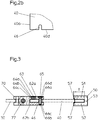
- the wall rail 50 ' has recesses 58' at its upper and lower end, which are for receiving a section of the second fitting part 62 are used (cf. Figure 6b ).
- the recesses 58 ' are formed in that only the legs 51 and 52 of the U-profile remain with a reduced wall thickness, while the profile base 53 is removed and the clear width between the legs 51 and 52 by reducing the material on the inside of these legs 51 and 52 is expanded.
- the second fitting parts 62 of the upper fitting 60 or the lower fitting 70 can be pushed into the corresponding upper and lower recesses 58 'so that essentially only the sections of these fitting parts 62 with the pivot axis S are outside the legs 51 and 52 of the wall rail 50 'as shown in Figure 6a you can see.
- the wall element 40 ' which is clamped in the lower and upper second fitting parts 62, is designed in this embodiment as a narrow rail, which is received almost completely in the profile depth t of the wall rail 50'.
- the door element 30 with the pivot axis S can be mounted so close to the wall rail 50 'that the distance does not differ from a shower cubicle, in which the door element is mounted directly on the wall of the room by means of fittings.
- the design of the fittings 60 and 70 and the fastening of the wall rail 50 ' are identical, regardless of whether a wall element 40 of greater width or a narrow wall element 40' is used.
- the wall element 40 ′ advantageously has a vertically continuous one in its front edge facing the door element 30 Groove 42 in which a seal 44 ( Figure 9 ) is used.
- the seal 44 has a web adapted to the groove 42, which can for example have ribs for better fixation in the groove 42, and a rounded mushroom-shaped head adjoining the web, which covers the end face of the wall element 40 ′ facing the door element 30.
- the mushroom head is advantageously flexible, e.g. B. hollow, in order to take account of the changing distance between the longitudinal edge 40a of the wall element 40 'facing the door element 30 and the longitudinal edge 30b of the door element 30 facing the wall element 40' when the door element 30 is pivoted relative to the wall element 40 '.
- the door element 30 is preferably made of glass or plastic and is advantageously transparent.
- the wall element 40 is preferably made to match the door element 30 from glass or a transparent plastic. If a wall element 40 'of a small width is provided, which is almost completely received in the wall rail 50', the wall element 40 'can preferably also be made of metal with a view to greater stability.
- the wall element 40 ' is expediently an aluminum profile with internal cavities, like this one Figures 6a and 7th demonstrate. This design combines high stability with low weight and material requirements.
- the wall rail 50 has a U-profile with two legs 51 and 52 and a profile base 53 connecting these legs. In one of the legs 52, the bores 54 are formed, in which the screws 56 for clamping the wall element 40/40 'screwed in.
- the profile base 53 of the wall rail 50 has at least two openings 80 spaced apart in the longitudinal direction. The openings 80 are arranged centrally in the profile base 53. In the interior of the U-profile of the wall rail 50, following the opening 80, the clear inner width between the legs 51 and 52 is widened in the form of a cylindrical widening 81 that is coaxial with the opening 80.
- the opening 80 has a diameter which is larger than the diameter of the cylindrical widening 81 and consequently also larger than the clear inner width between the legs 51 and 52.
- the opening 80 forms a circular disk-shaped receiving space 82, which is open to the outside of the profile base 53 and is limited to the inside by the legs 51 and 52, as in Figures 11 and 12 can be seen.
- the receiving space 82 is formed with an internal thread.
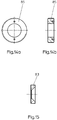
- an adjusting disk 83 is inserted, which is shown as an individual part Figure 15 is shown in axial section.
- the adjusting disk 83 has the shape of an annular disk, the outside diameter of which is smaller than the inside diameter of the receiving space 82, but larger than the inside diameter of the cylinder 81.
- the inside diameter of the adjusting disk 83 corresponds to the diameter of the screws 84 with which the wall rail 50 is attached to the respective room wall 15 is attached.
- the thickness of the adjusting disk 83 is smaller than the thickness of the profile base 53.
- a cover screw 85 is screwed into the internal thread of the receiving space 82, which has the shape of an annular disk, the external thread of which corresponds to the internal thread of the receiving space 82.
- the inside diameter of the cover screw 85 is larger than the inside diameter of the adjusting disk 83, but smaller than the outside diameter of the adjusting disk 83.
- the thickness of the cover screw 85 is smaller than the thickness of the profile base 53.
- the adjusting washer 83 is inserted into the receiving space 82 and then the cover screw 85 is screwed in, the adjusting washer 83 is held in the receiving space 82, but is radially displaceable in this due to its smaller outer diameter compared to the inner diameter of the receiving space 82 .
- the mounting of the wall rail 50, 50 ' can be carried out in a simple manner by a single person in the following manner.
- the position of the wall rails 50, 50 ' is determined with a template representing the floor plan dimensions of the shower cubicle 10.
- the wall rails 50, 50 ′ are vertically aligned and attached to the respective room wall 15, 16, for which purpose adhesive pads attached to the outside of the profile base 53 adjacent to the room wall 15, 16 are preferably used.
- guide bushings 86 are inserted into the respective cylindrical widenings 81.
- the guide bushings 86 which can consist of plastic, for example, have a cylindrical shape, the outside diameter of which corresponds to the inside diameter of the cylinder 81, so that the guide bushings 86 can be inserted into the cylindrical widenings 81 without play.
- the guide bushing 86 is preferably held in the widened portion 81 so that it cannot rotate.
- the inner diameter of the guide bushings 86 corresponds to the diameter of a drill 87, which in Figure 15 is shown in part.
- the drill bit 87 can now be guided precisely axially by the guide bushing 86 through the opening 80, the adjusting washer 83 and the cover screw 85 into the room wall 15 or 16 in order to predrill a suitable borehole there.
- the pre-drilled holes can now be expanded using a larger diameter drill in order to insert dowels in these holes.
- the guide bushings 86 are now removed from the wall rails 50, 50 ′ and the wall rails 50, 50 ′ are positioned again on the respective room wall 15, 16. Now the screws 84 are inserted and screwed through the adjusting disk 83 into the respective dowel.
- the diameter of the screws 84 corresponds to the inside diameter of the adjusting washer 83, while the diameter of the screw head corresponds to the inside diameter of the cylindrical widening 81.
- the screw 84 is thus inserted through the widening 81, its screw head fits into the conical inner diameter of the adjusting disk 83, whereby when the screw 84 is screwed into the dowel, the adjusting disk 83 over the cover screw 85, the wall rail 50, 50 'against the Room wall 15, 16 clamped and fixed. Before tightening the screw 84, it is still possible to readjust the exact position of the wall rail 50, 50 ', since the adjusting washer 83 can be moved with the screw 84 in the receiving space 82 with radial play, so that the wall rail 50, 50' relative to the screw 84 is slightly displaceable.
- the assembly of the wall rail 50, 50 ' has the advantage that this assembly can be carried out simply and precisely by a single person without additional aids.
- the arrangement of the screws 84 in the profile base 53 of the wall rails 50, 50 ' is invisible after the wall rail 50, 50' has been installed, so that the wall rail has an attractive appearance with high stability without the need to widen the wall rail.
- the inserted and screwed in screws 84 are covered by the wall elements 40, 40 'subsequently inserted into the wall rails 50, 50'.
Landscapes
- Health & Medical Sciences (AREA)
- Public Health (AREA)
- Epidemiology (AREA)
- General Health & Medical Sciences (AREA)
- Residential Or Office Buildings (AREA)
- Support Devices For Sliding Doors (AREA)
Claims (7)
- Dispositif de rail mural pour la fixation d'un élément de paroi fixe (40, 40') d'une cabine de douche (10) à un mur de local (15, 16) comprenant un rail mural (50, 50'),- le rail mural (50, 50') ayant un profil en U entre les branches (51, 52) duquel se loge et se serre l'élément de paroi (40, 40'), et- le rail mural (50, 50') est fixé par des vis (84) au mur (15, 16) du local,- le profil en U présente dans son fond (53) en appui contre le mur (15, 16), au milieu de la section du profil, au moins deux premiers perçages traversant pour les vis (84),- le profil en U ayant un élargissement (81) cylindrique, respectivement coaxial au premier perçage pour la largeur libre du profil en U entre les branches (51, 52), et- une douille de guidage (86) pour un foret (87) se loge coaxialement dans l'élargissement cylindrique (81).
- Dispositif de rail mural selon la revendication 1,
caractérisé en ce que
la douille de guidage (86) mise en place est tenue solidairement en rotation dans le profil en U. - Dispositif de rail mural selon l'une des revendications précédentes,
caractérisé en ce que
des rondelles d'ajustage (83) comportent respectivement des seconds perçages, et- les rondelles d'ajustage (83) sont logées avec du jeu radial dans le fond (53) du profil. - Dispositif de rail selon la revendication 3,
caractérisé en ce que
le fond du profil (53) comporte un logement (82) en forme de disque circulaire, coaxial à l'élargissement cylindrique (81), et dont le diamètre intérieur est supérieur au diamètre extérieur de la rondelle d'ajustage (83), et
la rondelle d'ajustage (83) est tenue axialement dans le logement (82) par une vis de couverture (85) en forme d'anneau circulaire vissé dans le filetage intérieur du logement (82). - Dispositif de rail mural selon l'une des revendications précédentes,
caractérisé en ce que
l'élément de paroi (40, 40') est serré dans le profil en U du rail mural (50, 50') par au moins deux vis (56), et- les vis (56) sont vissées dans un filetage d'un perçage (54) de l'une des branches (51) du profil en U et l'élément de paroi (40, 40') est poussé contre l'autre branche (52) du profil en U. - Dispositif de rail mural selon la revendication 5,
caractérisé en ce que
la branche (51, 52) du profil en U comporte respectivement un joint (57) sur toute la longueur du profil en U et s'appliquant contre l'élément de paroi (40, 40'). - Procédé de montage d'un rail mural (50, 50') d'un dispositif de rail mural selon l'une des revendications précédentes contre un mur de local (15, 16) comprenant les étapes suivantes consistant à :a) positionner le rail mural (50, 50') à l'aide d'un gabarit de sol contre le mur (15, 16) du local et l'orienter verticalement,b) fixer par collage provisoire le rail mural (50, 50') contre le mur (15, 16),c) placer des douilles de guidage (86) dans les élargissements cylindriques (81) du profil en U des rails muraux (50, 50'),d) percer avec un foret (87) des perçages dans le mur (15, 16) du local en passant dans la douille de guidage (86) en traversant les perçages du fond de profil (53),e) enlever le rail mural (50, 50') de sa fixation provisoire au mur (15, 16),f) agrandir les perçages du mur (15, 16) pour obtenir des perçages recevant une cheville,g) positionner de nouveau le rail mural (50, 50') contre le mur (15, 16),h) introduire par l'élargissement cylindrique (81) et par les rondelles d'ajustage (63) logées dans le fond de profil (53), une vis (84) et la visser dans la cheville respective du mur (15, 16),i) ajuster de manière fine la position du rail mural (50, 50') par un mouvement latéral par rapport aux rondelles d'ajustage (83) fixées à l'aide des vis (84),j) serrer les vis (84) pour fixer le rail mural (50, 50') solidairement et de façon définitive au mur (15, 16).
Applications Claiming Priority (1)
| Application Number | Priority Date | Filing Date | Title |
|---|---|---|---|
| DE102015116201.6A DE102015116201B3 (de) | 2015-09-24 | 2015-09-24 | Wandschienenanordnung für Duschkabinen |
Publications (3)
| Publication Number | Publication Date |
|---|---|
| EP3146876A1 EP3146876A1 (fr) | 2017-03-29 |
| EP3146876B1 true EP3146876B1 (fr) | 2020-11-25 |
| EP3146876B8 EP3146876B8 (fr) | 2021-08-25 |
Family
ID=55914013
Family Applications (1)
| Application Number | Title | Priority Date | Filing Date |
|---|---|---|---|
| EP16189505.7A Not-in-force EP3146876B8 (fr) | 2015-09-24 | 2016-09-19 | Rail mural pour cabines de douche |
Country Status (2)
| Country | Link |
|---|---|
| EP (1) | EP3146876B8 (fr) |
| DE (1) | DE102015116201B3 (fr) |
Families Citing this family (1)
| Publication number | Priority date | Publication date | Assignee | Title |
|---|---|---|---|---|
| CN115596249B (zh) * | 2022-10-31 | 2025-06-24 | 安徽克琳黛尔智能家居有限公司 | 一种具有联动调节功能的型材连接结构及淋浴房 |
Family Cites Families (11)
| Publication number | Priority date | Publication date | Assignee | Title |
|---|---|---|---|---|
| DE7428733U (de) * | 1975-03-20 | Munch P | Bausatz zum Erstellen einer Duschkabine | |
| US2743795A (en) * | 1950-07-21 | 1956-05-01 | Taubman Samuel | Bath enclosure |
| DE29701915U1 (de) * | 1997-02-04 | 1997-05-22 | Lido-Duschabtrennungen Ges. m.b.H., Taufkirchen | Wandbefestigung für eine feststehende Glaswand |
| DE10006259C2 (de) * | 2000-02-12 | 2003-03-27 | Kaldewei Franz Gmbh & Co | Wandanschlußleiste für eine Duschabtrennung |
| DE102004031563A1 (de) * | 2004-06-29 | 2006-01-26 | Munch, Paul-Jean, Dipl.-Ing. | Halteprofil für eine stationäre Trennwand |
| DE202007000574U1 (de) * | 2007-01-15 | 2007-03-29 | Alois Heiler Gmbh | Wandbefestigungsprofil für eine Duschwand und damit ausgstattete Dusche |
| DE102007057293A1 (de) * | 2007-01-15 | 2008-07-17 | Alois Heiler Gmbh | Wandbefestigungsprofil für eine Duschwand und damit ausgestattete Dusche |
| AT508713B1 (de) * | 2009-09-10 | 2014-08-15 | Tif Gmbh | Vorrichtung zur halterung von flächenförmigen elementen |
| DE202010003586U1 (de) * | 2010-03-12 | 2010-07-01 | Dusar Bath & Wellness Gmbh & Co. Kg | Duschabtrennung mit trotz Einklebung justierbarer Glasscheibe |
| DE202013002504U1 (de) * | 2013-03-17 | 2013-06-12 | Lothar Ginzel | Profil |
| GB2512150B (en) * | 2013-07-31 | 2015-02-11 | Andrzej Poradzisz | Support for rigid panel |
-
2015
- 2015-09-24 DE DE102015116201.6A patent/DE102015116201B3/de not_active Expired - Fee Related
-
2016
- 2016-09-19 EP EP16189505.7A patent/EP3146876B8/fr not_active Not-in-force
Non-Patent Citations (1)
| Title |
|---|
| None * |
Also Published As
| Publication number | Publication date |
|---|---|
| EP3146876B8 (fr) | 2021-08-25 |
| DE102015116201B3 (de) | 2016-05-25 |
| EP3146876A1 (fr) | 2017-03-29 |
Similar Documents
| Publication | Publication Date | Title |
|---|---|---|
| DE10219232C1 (de) | Anordnung mit Türblatt und Scharnieren sowie Duschkabine | |
| DE212015000118U1 (de) | Duschtüranordnung und Duschtür | |
| EP2159345B1 (fr) | Fixation pour éléments de revêtement | |
| DE202007018765U1 (de) | Halterung für Verkleidungselemente bzw. eine Unterkonstruktion für Verkleidungselemente | |
| EP2185827A1 (fr) | Vis de montage et dispositif de fixation comportant un profilé à chambre creuse | |
| EP3622142A1 (fr) | Cheville pour la fixation de pièces de ferrure | |
| DE102004005422A1 (de) | Montagekonsole für Fenster oder dergleichen | |
| EP1439269B1 (fr) | Etrier d'ancrage pour profilés pour installations sanitaires et chassis avec un tel étrier | |
| DE102015116201B3 (de) | Wandschienenanordnung für Duschkabinen | |
| EP3146877B1 (fr) | Cabine de douche | |
| EP2108774B1 (fr) | Charnière | |
| DE69410982T2 (de) | Stellbare Vorrichtung, insbesondere für Metallrahmen | |
| EP2775083B1 (fr) | Assemblage de fixation, utilisation d'un dispositif et procédé de fixation d'un corps de bâtiment dans une ouverture limitée par une surface d'appui | |
| DE19755953A1 (de) | Schraube zur Abstandsbefestigung von Abdeckplatten oder Schienen an einem Unterbau | |
| WO2023062135A1 (fr) | Vis de cadre | |
| EP2085533B1 (fr) | Dispositif de liaison destiné à la liaison du degré et du limon d'un escalier ou d'éléments de meubles | |
| DE10113405A1 (de) | Vorrichtung zum Justieren und Fixieren eines Elementes zwischen zwei Bauteilen | |
| EP2173956A1 (fr) | Dispositif de bande pour portes, fenêtres ou similaires | |
| DE4225971C2 (de) | Abstützvorrichtung zwischen Getriebegehäuse eines Einsteck-Kantengetriebes und einer damit über Ankerschrauben verbindbaren Lagerrosette eines Bedienungshebels | |
| DE102006004493B4 (de) | Führungsschienenbefestigung | |
| DE102007057293A1 (de) | Wandbefestigungsprofil für eine Duschwand und damit ausgestattete Dusche | |
| EP3674507B1 (fr) | Élément d'insertion, installation de porte pourvue d'élément d'insertion et procédé de montage d'un élément d'insertion | |
| DE10000226A1 (de) | Montagehülse | |
| EP2504512B1 (fr) | Partie de penture | |
| DE10030337C2 (de) | Gleitschiene mit integrierter Befestigungsvorrichtung |
Legal Events
| Date | Code | Title | Description |
|---|---|---|---|
| PUAI | Public reference made under article 153(3) epc to a published international application that has entered the european phase |
Free format text: ORIGINAL CODE: 0009012 |
|
| STAA | Information on the status of an ep patent application or granted ep patent |
Free format text: STATUS: THE APPLICATION HAS BEEN PUBLISHED |
|
| AK | Designated contracting states |
Kind code of ref document: A1 Designated state(s): AL AT BE BG CH CY CZ DE DK EE ES FI FR GB GR HR HU IE IS IT LI LT LU LV MC MK MT NL NO PL PT RO RS SE SI SK SM TR |
|
| AX | Request for extension of the european patent |
Extension state: BA ME |
|
| STAA | Information on the status of an ep patent application or granted ep patent |
Free format text: STATUS: REQUEST FOR EXAMINATION WAS MADE |
|
| 17P | Request for examination filed |
Effective date: 20170928 |
|
| RBV | Designated contracting states (corrected) |
Designated state(s): AL AT BE BG CH CY CZ DE DK EE ES FI FR GB GR HR HU IE IS IT LI LT LU LV MC MK MT NL NO PL PT RO RS SE SI SK SM TR |
|
| STAA | Information on the status of an ep patent application or granted ep patent |
Free format text: STATUS: EXAMINATION IS IN PROGRESS |
|
| 17Q | First examination report despatched |
Effective date: 20191017 |
|
| GRAP | Despatch of communication of intention to grant a patent |
Free format text: ORIGINAL CODE: EPIDOSNIGR1 |
|
| STAA | Information on the status of an ep patent application or granted ep patent |
Free format text: STATUS: GRANT OF PATENT IS INTENDED |
|
| INTG | Intention to grant announced |
Effective date: 20200527 |
|
| GRAS | Grant fee paid |
Free format text: ORIGINAL CODE: EPIDOSNIGR3 |
|
| GRAA | (expected) grant |
Free format text: ORIGINAL CODE: 0009210 |
|
| STAA | Information on the status of an ep patent application or granted ep patent |
Free format text: STATUS: THE PATENT HAS BEEN GRANTED |
|
| AK | Designated contracting states |
Kind code of ref document: B1 Designated state(s): AL AT BE BG CH CY CZ DE DK EE ES FI FR GB GR HR HU IE IS IT LI LT LU LV MC MK MT NL NO PL PT RO RS SE SI SK SM TR |
|
| REG | Reference to a national code |
Ref country code: GB Ref legal event code: FG4D Free format text: NOT ENGLISH |
|
| REG | Reference to a national code |
Ref country code: CH Ref legal event code: EP |
|
| REG | Reference to a national code |
Ref country code: DE Ref legal event code: R096 Ref document number: 502016011769 Country of ref document: DE |
|
| REG | Reference to a national code |
Ref country code: AT Ref legal event code: REF Ref document number: 1337305 Country of ref document: AT Kind code of ref document: T Effective date: 20201215 |
|
| REG | Reference to a national code |
Ref country code: IE Ref legal event code: FG4D Free format text: LANGUAGE OF EP DOCUMENT: GERMAN |
|
| REG | Reference to a national code |
Ref country code: NL Ref legal event code: MP Effective date: 20201125 |
|
| PG25 | Lapsed in a contracting state [announced via postgrant information from national office to epo] |
Ref country code: NO Free format text: LAPSE BECAUSE OF FAILURE TO SUBMIT A TRANSLATION OF THE DESCRIPTION OR TO PAY THE FEE WITHIN THE PRESCRIBED TIME-LIMIT Effective date: 20210225 Ref country code: RS Free format text: LAPSE BECAUSE OF FAILURE TO SUBMIT A TRANSLATION OF THE DESCRIPTION OR TO PAY THE FEE WITHIN THE PRESCRIBED TIME-LIMIT Effective date: 20201125 Ref country code: PT Free format text: LAPSE BECAUSE OF FAILURE TO SUBMIT A TRANSLATION OF THE DESCRIPTION OR TO PAY THE FEE WITHIN THE PRESCRIBED TIME-LIMIT Effective date: 20210325 Ref country code: FI Free format text: LAPSE BECAUSE OF FAILURE TO SUBMIT A TRANSLATION OF THE DESCRIPTION OR TO PAY THE FEE WITHIN THE PRESCRIBED TIME-LIMIT Effective date: 20201125 |
|
| PG25 | Lapsed in a contracting state [announced via postgrant information from national office to epo] |
Ref country code: SE Free format text: LAPSE BECAUSE OF FAILURE TO SUBMIT A TRANSLATION OF THE DESCRIPTION OR TO PAY THE FEE WITHIN THE PRESCRIBED TIME-LIMIT Effective date: 20201125 Ref country code: PL Free format text: LAPSE BECAUSE OF FAILURE TO SUBMIT A TRANSLATION OF THE DESCRIPTION OR TO PAY THE FEE WITHIN THE PRESCRIBED TIME-LIMIT Effective date: 20201125 Ref country code: LV Free format text: LAPSE BECAUSE OF FAILURE TO SUBMIT A TRANSLATION OF THE DESCRIPTION OR TO PAY THE FEE WITHIN THE PRESCRIBED TIME-LIMIT Effective date: 20201125 Ref country code: IS Free format text: LAPSE BECAUSE OF FAILURE TO SUBMIT A TRANSLATION OF THE DESCRIPTION OR TO PAY THE FEE WITHIN THE PRESCRIBED TIME-LIMIT Effective date: 20210325 Ref country code: BG Free format text: LAPSE BECAUSE OF FAILURE TO SUBMIT A TRANSLATION OF THE DESCRIPTION OR TO PAY THE FEE WITHIN THE PRESCRIBED TIME-LIMIT Effective date: 20210225 |
|
| REG | Reference to a national code |
Ref country code: LT Ref legal event code: MG9D |
|
| PG25 | Lapsed in a contracting state [announced via postgrant information from national office to epo] |
Ref country code: HR Free format text: LAPSE BECAUSE OF FAILURE TO SUBMIT A TRANSLATION OF THE DESCRIPTION OR TO PAY THE FEE WITHIN THE PRESCRIBED TIME-LIMIT Effective date: 20201125 |
|
| GRAT | Correction requested after decision to grant or after decision to maintain patent in amended form |
Free format text: ORIGINAL CODE: EPIDOSNCDEC |
|
| REG | Reference to a national code |
Ref country code: DE Ref legal event code: R081 Ref document number: 502016011769 Country of ref document: DE Owner name: KRISTHAEL GMBH, DE Free format text: FORMER OWNER: KRISTAEHL GMBH, 77756 HAUSACH, DE |
|
| PG25 | Lapsed in a contracting state [announced via postgrant information from national office to epo] |
Ref country code: SK Free format text: LAPSE BECAUSE OF FAILURE TO SUBMIT A TRANSLATION OF THE DESCRIPTION OR TO PAY THE FEE WITHIN THE PRESCRIBED TIME-LIMIT Effective date: 20201125 Ref country code: RO Free format text: LAPSE BECAUSE OF FAILURE TO SUBMIT A TRANSLATION OF THE DESCRIPTION OR TO PAY THE FEE WITHIN THE PRESCRIBED TIME-LIMIT Effective date: 20201125 Ref country code: EE Free format text: LAPSE BECAUSE OF FAILURE TO SUBMIT A TRANSLATION OF THE DESCRIPTION OR TO PAY THE FEE WITHIN THE PRESCRIBED TIME-LIMIT Effective date: 20201125 Ref country code: CZ Free format text: LAPSE BECAUSE OF FAILURE TO SUBMIT A TRANSLATION OF THE DESCRIPTION OR TO PAY THE FEE WITHIN THE PRESCRIBED TIME-LIMIT Effective date: 20201125 Ref country code: LT Free format text: LAPSE BECAUSE OF FAILURE TO SUBMIT A TRANSLATION OF THE DESCRIPTION OR TO PAY THE FEE WITHIN THE PRESCRIBED TIME-LIMIT Effective date: 20201125 Ref country code: SM Free format text: LAPSE BECAUSE OF FAILURE TO SUBMIT A TRANSLATION OF THE DESCRIPTION OR TO PAY THE FEE WITHIN THE PRESCRIBED TIME-LIMIT Effective date: 20201125 |
|
| REG | Reference to a national code |
Ref country code: CH Ref legal event code: PK Free format text: BERICHTIGUNG B8 |
|
| RAP4 | Party data changed (patent owner data changed or rights of a patent transferred) |
Owner name: KRISTHAEL GMBH |
|
| REG | Reference to a national code |
Ref country code: DE Ref legal event code: R097 Ref document number: 502016011769 Country of ref document: DE |
|
| PG25 | Lapsed in a contracting state [announced via postgrant information from national office to epo] |
Ref country code: DK Free format text: LAPSE BECAUSE OF FAILURE TO SUBMIT A TRANSLATION OF THE DESCRIPTION OR TO PAY THE FEE WITHIN THE PRESCRIBED TIME-LIMIT Effective date: 20201125 |
|
| PLBE | No opposition filed within time limit |
Free format text: ORIGINAL CODE: 0009261 |
|
| STAA | Information on the status of an ep patent application or granted ep patent |
Free format text: STATUS: NO OPPOSITION FILED WITHIN TIME LIMIT |
|
| PG25 | Lapsed in a contracting state [announced via postgrant information from national office to epo] |
Ref country code: NL Free format text: LAPSE BECAUSE OF FAILURE TO SUBMIT A TRANSLATION OF THE DESCRIPTION OR TO PAY THE FEE WITHIN THE PRESCRIBED TIME-LIMIT Effective date: 20201125 Ref country code: IT Free format text: LAPSE BECAUSE OF FAILURE TO SUBMIT A TRANSLATION OF THE DESCRIPTION OR TO PAY THE FEE WITHIN THE PRESCRIBED TIME-LIMIT Effective date: 20201125 Ref country code: AL Free format text: LAPSE BECAUSE OF FAILURE TO SUBMIT A TRANSLATION OF THE DESCRIPTION OR TO PAY THE FEE WITHIN THE PRESCRIBED TIME-LIMIT Effective date: 20201125 |
|
| 26N | No opposition filed |
Effective date: 20210826 |
|
| PG25 | Lapsed in a contracting state [announced via postgrant information from national office to epo] |
Ref country code: ES Free format text: LAPSE BECAUSE OF FAILURE TO SUBMIT A TRANSLATION OF THE DESCRIPTION OR TO PAY THE FEE WITHIN THE PRESCRIBED TIME-LIMIT Effective date: 20201125 Ref country code: SI Free format text: LAPSE BECAUSE OF FAILURE TO SUBMIT A TRANSLATION OF THE DESCRIPTION OR TO PAY THE FEE WITHIN THE PRESCRIBED TIME-LIMIT Effective date: 20201125 |
|
| REG | Reference to a national code |
Ref country code: DE Ref legal event code: R119 Ref document number: 502016011769 Country of ref document: DE |
|
| REG | Reference to a national code |
Ref country code: CH Ref legal event code: PL |
|
| REG | Reference to a national code |
Ref country code: BE Ref legal event code: MM Effective date: 20210930 |
|
| GBPC | Gb: european patent ceased through non-payment of renewal fee |
Effective date: 20210919 |
|
| PG25 | Lapsed in a contracting state [announced via postgrant information from national office to epo] |
Ref country code: IS Free format text: LAPSE BECAUSE OF FAILURE TO SUBMIT A TRANSLATION OF THE DESCRIPTION OR TO PAY THE FEE WITHIN THE PRESCRIBED TIME-LIMIT Effective date: 20210325 Ref country code: MC Free format text: LAPSE BECAUSE OF FAILURE TO SUBMIT A TRANSLATION OF THE DESCRIPTION OR TO PAY THE FEE WITHIN THE PRESCRIBED TIME-LIMIT Effective date: 20201125 |
|
| PG25 | Lapsed in a contracting state [announced via postgrant information from national office to epo] |
Ref country code: LU Free format text: LAPSE BECAUSE OF NON-PAYMENT OF DUE FEES Effective date: 20210919 Ref country code: IE Free format text: LAPSE BECAUSE OF NON-PAYMENT OF DUE FEES Effective date: 20210919 Ref country code: GB Free format text: LAPSE BECAUSE OF NON-PAYMENT OF DUE FEES Effective date: 20210919 Ref country code: FR Free format text: LAPSE BECAUSE OF NON-PAYMENT OF DUE FEES Effective date: 20210930 Ref country code: DE Free format text: LAPSE BECAUSE OF NON-PAYMENT OF DUE FEES Effective date: 20220401 Ref country code: BE Free format text: LAPSE BECAUSE OF NON-PAYMENT OF DUE FEES Effective date: 20210930 |
|
| PG25 | Lapsed in a contracting state [announced via postgrant information from national office to epo] |
Ref country code: LI Free format text: LAPSE BECAUSE OF NON-PAYMENT OF DUE FEES Effective date: 20210930 Ref country code: CH Free format text: LAPSE BECAUSE OF NON-PAYMENT OF DUE FEES Effective date: 20210930 |
|
| REG | Reference to a national code |
Ref country code: AT Ref legal event code: MM01 Ref document number: 1337305 Country of ref document: AT Kind code of ref document: T Effective date: 20210919 |
|
| PG25 | Lapsed in a contracting state [announced via postgrant information from national office to epo] |
Ref country code: AT Free format text: LAPSE BECAUSE OF NON-PAYMENT OF DUE FEES Effective date: 20210919 |
|
| PG25 | Lapsed in a contracting state [announced via postgrant information from national office to epo] |
Ref country code: HU Free format text: LAPSE BECAUSE OF FAILURE TO SUBMIT A TRANSLATION OF THE DESCRIPTION OR TO PAY THE FEE WITHIN THE PRESCRIBED TIME-LIMIT; INVALID AB INITIO Effective date: 20160919 |
|
| PG25 | Lapsed in a contracting state [announced via postgrant information from national office to epo] |
Ref country code: CY Free format text: LAPSE BECAUSE OF FAILURE TO SUBMIT A TRANSLATION OF THE DESCRIPTION OR TO PAY THE FEE WITHIN THE PRESCRIBED TIME-LIMIT Effective date: 20201125 |
|
| PG25 | Lapsed in a contracting state [announced via postgrant information from national office to epo] |
Ref country code: GR Free format text: LAPSE BECAUSE OF FAILURE TO SUBMIT A TRANSLATION OF THE DESCRIPTION OR TO PAY THE FEE WITHIN THE PRESCRIBED TIME-LIMIT Effective date: 20201125 |
|
| PG25 | Lapsed in a contracting state [announced via postgrant information from national office to epo] |
Ref country code: MK Free format text: LAPSE BECAUSE OF FAILURE TO SUBMIT A TRANSLATION OF THE DESCRIPTION OR TO PAY THE FEE WITHIN THE PRESCRIBED TIME-LIMIT Effective date: 20201125 |
|
| PG25 | Lapsed in a contracting state [announced via postgrant information from national office to epo] |
Ref country code: TR Free format text: LAPSE BECAUSE OF FAILURE TO SUBMIT A TRANSLATION OF THE DESCRIPTION OR TO PAY THE FEE WITHIN THE PRESCRIBED TIME-LIMIT Effective date: 20201125 |
|
| PG25 | Lapsed in a contracting state [announced via postgrant information from national office to epo] |
Ref country code: MT Free format text: LAPSE BECAUSE OF FAILURE TO SUBMIT A TRANSLATION OF THE DESCRIPTION OR TO PAY THE FEE WITHIN THE PRESCRIBED TIME-LIMIT Effective date: 20201125 |