EP3146949B1 - Schalldämpfungsmaterial - Google Patents
Schalldämpfungsmaterial Download PDFInfo
- Publication number
- EP3146949B1 EP3146949B1 EP16186999.5A EP16186999A EP3146949B1 EP 3146949 B1 EP3146949 B1 EP 3146949B1 EP 16186999 A EP16186999 A EP 16186999A EP 3146949 B1 EP3146949 B1 EP 3146949B1
- Authority
- EP
- European Patent Office
- Prior art keywords
- thixotropic
- sound
- honeycomb structure
- sound absorbing
- soundproofing device
- Prior art date
- Legal status (The legal status is an assumption and is not a legal conclusion. Google has not performed a legal analysis and makes no representation as to the accuracy of the status listed.)
- Active
Links
Images










Classifications
-
- A—HUMAN NECESSITIES
- A61—MEDICAL OR VETERINARY SCIENCE; HYGIENE
- A61F—FILTERS IMPLANTABLE INTO BLOOD VESSELS; PROSTHESES; DEVICES PROVIDING PATENCY TO, OR PREVENTING COLLAPSING OF, TUBULAR STRUCTURES OF THE BODY, e.g. STENTS; ORTHOPAEDIC, NURSING OR CONTRACEPTIVE DEVICES; FOMENTATION; TREATMENT OR PROTECTION OF EYES OR EARS; BANDAGES, DRESSINGS OR ABSORBENT PADS; FIRST-AID KITS
- A61F11/00—Methods or devices for treatment of the ears or hearing sense; Non-electric hearing aids; Methods or devices for enabling ear patients to achieve auditory perception through physiological senses other than hearing sense; Protective devices for the ears, carried on the body or in the hand
- A61F11/06—Protective devices for the ears
- A61F11/14—Protective devices for the ears external, e.g. earcaps or earmuffs
-
- A—HUMAN NECESSITIES
- A61—MEDICAL OR VETERINARY SCIENCE; HYGIENE
- A61F—FILTERS IMPLANTABLE INTO BLOOD VESSELS; PROSTHESES; DEVICES PROVIDING PATENCY TO, OR PREVENTING COLLAPSING OF, TUBULAR STRUCTURES OF THE BODY, e.g. STENTS; ORTHOPAEDIC, NURSING OR CONTRACEPTIVE DEVICES; FOMENTATION; TREATMENT OR PROTECTION OF EYES OR EARS; BANDAGES, DRESSINGS OR ABSORBENT PADS; FIRST-AID KITS
- A61F11/00—Methods or devices for treatment of the ears or hearing sense; Non-electric hearing aids; Methods or devices for enabling ear patients to achieve auditory perception through physiological senses other than hearing sense; Protective devices for the ears, carried on the body or in the hand
- A61F11/06—Protective devices for the ears
- A61F11/08—Protective devices for the ears internal, e.g. earplugs
-
- A—HUMAN NECESSITIES
- A61—MEDICAL OR VETERINARY SCIENCE; HYGIENE
- A61F—FILTERS IMPLANTABLE INTO BLOOD VESSELS; PROSTHESES; DEVICES PROVIDING PATENCY TO, OR PREVENTING COLLAPSING OF, TUBULAR STRUCTURES OF THE BODY, e.g. STENTS; ORTHOPAEDIC, NURSING OR CONTRACEPTIVE DEVICES; FOMENTATION; TREATMENT OR PROTECTION OF EYES OR EARS; BANDAGES, DRESSINGS OR ABSORBENT PADS; FIRST-AID KITS
- A61F11/00—Methods or devices for treatment of the ears or hearing sense; Non-electric hearing aids; Methods or devices for enabling ear patients to achieve auditory perception through physiological senses other than hearing sense; Protective devices for the ears, carried on the body or in the hand
- A61F11/06—Protective devices for the ears
- A61F11/08—Protective devices for the ears internal, e.g. earplugs
- A61F11/10—Protective devices for the ears internal, e.g. earplugs inflatable or expandable
-
- A—HUMAN NECESSITIES
- A61—MEDICAL OR VETERINARY SCIENCE; HYGIENE
- A61F—FILTERS IMPLANTABLE INTO BLOOD VESSELS; PROSTHESES; DEVICES PROVIDING PATENCY TO, OR PREVENTING COLLAPSING OF, TUBULAR STRUCTURES OF THE BODY, e.g. STENTS; ORTHOPAEDIC, NURSING OR CONTRACEPTIVE DEVICES; FOMENTATION; TREATMENT OR PROTECTION OF EYES OR EARS; BANDAGES, DRESSINGS OR ABSORBENT PADS; FIRST-AID KITS
- A61F11/00—Methods or devices for treatment of the ears or hearing sense; Non-electric hearing aids; Methods or devices for enabling ear patients to achieve auditory perception through physiological senses other than hearing sense; Protective devices for the ears, carried on the body or in the hand
- A61F11/06—Protective devices for the ears
- A61F11/08—Protective devices for the ears internal, e.g. earplugs
- A61F11/12—External mounting means
-
- A—HUMAN NECESSITIES
- A61—MEDICAL OR VETERINARY SCIENCE; HYGIENE
- A61F—FILTERS IMPLANTABLE INTO BLOOD VESSELS; PROSTHESES; DEVICES PROVIDING PATENCY TO, OR PREVENTING COLLAPSING OF, TUBULAR STRUCTURES OF THE BODY, e.g. STENTS; ORTHOPAEDIC, NURSING OR CONTRACEPTIVE DEVICES; FOMENTATION; TREATMENT OR PROTECTION OF EYES OR EARS; BANDAGES, DRESSINGS OR ABSORBENT PADS; FIRST-AID KITS
- A61F2250/00—Special features of prostheses classified in groups A61F2/00 - A61F2/26 or A61F2/82 or A61F9/00 or A61F11/00 or subgroups thereof
- A61F2250/0014—Special features of prostheses classified in groups A61F2/00 - A61F2/26 or A61F2/82 or A61F9/00 or A61F11/00 or subgroups thereof having different values of a given property or geometrical feature, e.g. mechanical property or material property, at different locations within the same prosthesis
- A61F2250/0034—Special features of prostheses classified in groups A61F2/00 - A61F2/26 or A61F2/82 or A61F9/00 or A61F11/00 or subgroups thereof having different values of a given property or geometrical feature, e.g. mechanical property or material property, at different locations within the same prosthesis differing in viscosity
Definitions
- the present invention relates to a soundproofing device comprising a sound absorbing material.
- the use of materials in energy absorbing compositions is known, for example as disclosed in WO 2007/079320 (Sereboff ).
- the composition is a substantially non-elastic incompressible composition, which does not quickly self-level under standard operating conditions and provides an incident energy absorbing property, wherein the incident energy may include sound energy.
- the applicants of WO 2007/079320 also claim that the composition may be used as an effective barrier against low frequency, high-energy sound in, for example, headphone housings, speaker housings, soundproofing in walls or submarine engine rooms.
- the compositions of WO 2007/079320 are restricted to Bingham materials, which will not flow until stress can be applied and a certain value, the yield stress value, is reached. Beyond this point the flow rate increases steadily with increasing shear stress. In essence a particular minimum value has to be achieved to activate the material.
- Thixotropic materials can be composed of a number of combinations, some of which are listed in this document and can be tailored to specific frequency and decibel adapted limits but all would be structured to suit biological protection from an early sound level stage while still allowing normal conversation and safety discussion to be maintained between co-workers when on-site. As well as this, immediate activation by pre-agitation or loud sound induction would make for a highly effective responsive invention.
- Dilitant materials are also known from the prior art as being used in hearing protection ear cups where external noise is prevented from passing directly through the ear cup itself ( US 2003/0034198 ). Furthermore, the use of particles with mis-matched characteristic acoustic impedances embedded within a matrix of a material that can support shearing loads, propagates energy diffusion thereby providing acoustic and vibration damping ( US Patent No. 5,400,296 ). However, dilitant materials become denser when exposed to high shear/mechanical forces such as energy waves. The denser the material, the easier it is to conduct the vibrations and hence the sound travels faster and more efficiently. This can be seen clearly in a simple dilitant material such as corn flour and water.
- dilitant materials are not effective sound absorbing materials due to the fact that they harden when exposed to energy waves.
- a protective helmet comprising a rigid shell, an inner lining with at least one inflatable cell and inflation/deflation means is known from the prior art, as described in UK Patent Application No. GB 2 340 381 .
- the inflatable cell may be filled with a fluid having thixotropic properties using a manual or electronic-powered pump. There is no discussion or teaching of having an already-filled cell. A method for obtaining rubber ear plugs is described in US Patent No. 3,782,379 , where vulcanizable rubber is used at a certain viscosity to provide thixotropic properties. Materials with honeycomb scaffolds are discloses in GB 1420009A .
- the invention is based on the use of a thixotropic material as a sound absorbing medium in devices, for example, those which are adapted to attach to or cover a user's ear. Examples of such devices would be noise protection headphones, audio headphones, and ear plugs.
- the thixotropic material has a resting viscosity which decreases as sound energy is incident on the material. As the viscosity of the material decreases, the level of attenuation of the incident sound increases. The thixotropic material reacts in such a way as to transfer some of the entering sound energy into kinetic energy that changes the structure of the thixotropic material and lessens the amount of sound energy passing through the material.
- the level of attenuation of sound will increase as the intensity of the sound increases, thereby allowing a user to hear low intensity sounds such as conversation though the headphones (when the material is at or close to a resting viscosity), while attenuating high intensity sounds.
- a soundproofing device comprising a sound absorbing material having a cellular scaffold with cells, wherein a thixotropic material is located in the cells of the cellular scaffold, and wherein the thixotropic material exhibits a change in viscosity in response to sound energy; in which the cellular scaffold has a honeycomb structure and in which the sound absorbing material comprises a layer of honeycomb structure having top and bottom seal layers which seal the cells in the honeycomb structure; or in which the cellular scaffold is in the form of a polymer film having a plurality of cellular compartments or pockets, and wherein said cellular compartments or pockets contain the sound absorbing material.
- At least two and preferably at least three (for example from 2 to 4 or 5 layers) layers of honeycomb structure may be arranged in a facing relationship, wherein the at least two layers are ideally disposed such that the cells of the honeycomb structure of a first layer are not in register with the cells of the honeycomb structure of the second layer.
- the structure is made up of three layers oriented at 120° apart.
- the layers of honeycomb structure may be separated by a sound insulating layer.
- a sound insulating layer may be any sound insulating layer known to a person of ordinary skill in the art, such as a fluid, a gas, a polymer, and the like.
- the arrangement of the layers of honeycomb structure in this embodiment results in a Helmholtz resonance effect, that is, increasing sound absorption through differential air pressure between the out of register arrangement of the cells in each layer.
- cellular scaffold described herein can be arranged in layers and disposed relative to each other such that the cells of the cellular structure are not in register and separated by a sound insulating layer.
- the thixotropic material may be a fluid, a solid or semi-solid material such as a gel or resin.
- the thixotropic material is a liquid. Examples of thixotropic materials will be well known to those skilled in the field.
- Examples would include structured liquids, suspensions, emulsions, polymer solutions, aqueous iron oxide gels, vanadium pentoxide sols, starch pastes, pectin gels, flocculated paints, clays, soil suspensions, creams, drilling muds, flour doughs, flour suspensions, fibre greases, jellies, paints, honey, carbon-black suspensions, hydrophobically modified hydroxethyl cellulose, non-associative cellulose water solutions, flocculated polymer latex suspension, rubber solutions, metal slushes, bentonite clays, modified laponites, oils, lubricants, coal suspensions, xanthan gums, organic bentonite, fumed silica, aluminum stearate, metal soap, castor oil derivatives or thixotropic epoxy resin without prejudice or exclusion of like materials to these listed, or combinations thereof.
- the thixotropic material can be found to be effective in systems containing non-spherical particles, and is also associated with certain colloids which form gels when left to stand but become sols when stirred or shaken. They can also be associated with concentrated solutions of substances of high molecular weight colloidal suspensions.
- the sound absorbing material consists essentially of a thixotropic material, especially a thixotropic liquid or gel.
- a floccule is a small loosely aggregated mass of flocculent material suspended in or precipitated from a liquid. If an applied shear rate is given with an appropriate time interval, the floccule disintegrates into its constituent primary particles. The minimum viscosity can be seen with individual particles. Individual particles are considered to be those of simplest primary structure where the flocculated system has degraded to such a state as to contain the smallest possible particles within a specified shear range and without risking the integrity of the structure holding the material.
- any flocculated system the disintegration will be tending towards an equilibrium scenario that is held by hydrodynamic stresses pulling structures apart by erosion and upon removal of the applied stress/strain, that is, Brownian and shear forces rebuilding the structure by collision and accumulation of particles.
- the forces holding the structure together are colloidal in design and act over approximate distances of 10 nanometres, but may vary according to requirement.
- Shear thinning systems can occur due to loss of association in polymer solutions, rod-like alignment of particles in the direction of flow, microstructure rearrangement or flocculation disintegration.
- the sound absorbing material is enclosed within a container, wherein the container is expandable to allow an increase in volume of the sound absorbing material.
- Shear can be applied by a user to the thixotropic material contained therein, thereby activating the material by reducing its viscosity and increasing its sound absorbing capacity.
- the container comprises a cellular scaffold, and wherein the sound absorbing material is located in the cells of the cellular scaffold.
- the cellular scaffold is formed of a thixotropic material.
- the container comprises a polymeric pouch which contains the sound absorbing material, wherein the polymeric pouch is expandable in response to pressure exerted by the thixotropic material as it decreases in viscosity and increases in volume.
- cellular scaffold should be understood to mean a scaffold or substrate having a plurality of pockets or containers or compartments or tubes adapted to hold the thixotropic material.
- a cellular scaffold would be a honeycomb structure, which may be formed using conventional moulding techniques from a polymeric or resin material.
- Another example of a cellular scaffold would be a polymer film having cellular compartments, wherein the sound absorbing material is located within the cellular compartments. Examples of such polymeric cellular scaffolds would be bubble wrap or polymer ice-cube making bags. In both cases, the thixotropic material would be disposed within the pockets of cells of polymer film.
- the thixotropic material is a material which exhibits a low viscosity drop in response to low intensity noise and disproportionately high viscosity decrease in response to high intensity noise.
- suitable materials include structured liquids, suspensions, emulsions, polymer solutions, aqueous iron oxide gels, vanadium pentoxide sols, starch pastes, pectin gels, flocculated paints, clays, soil suspensions, creams, drilling muds, flour doughs, flour suspensions, fibre greases, jellies, paints, honey, carbon-black suspensions, hydrophobically modified hydroxethyl cellulose, non-associative cellulose water solutions, flocculated polymer latex suspension, rubber solutions, metal slushes, bentonite clays, modified laponites, oils, lubricants, coal suspensions, xanthan gums, organic bentonite, fumed silica, aluminum stearate, metal soap, castor oil derivatives or thix
- the sound absorbing material is disposed between the speaker and the external environment, and within the ear buds, respectively.
- the thixotropic material may form a barrier layer that is disposed in the headphone cup such that it covers the ear of a user, or is disposed within the ear buds to provide a barrier between the ear and the external environment.
- the purpose of the thixotropic material is to dampen external sounds, thereby allowing a user to hear more clearly the sounds being produced by the speaker in the headphone/audio ear bud system.
- the sound absorbing material is disposed within the headphone to provide a barrier between the ear and the external environment.
- the cup of the headphone is a soft, deformable construction allowing a user to apply shear to the thixotropic material contained within the headphone.
- an audio ear bud or ear plug is formed of a thixotropic material.
- the audio ear bud or ear plug may be formed of a moulded resinous thixotropic material.
- the audio ear bud or ear plug may comprise an external shell and an internal cavity (container), wherein the thixotropic material is disposed within the cavity.
- the cavity may contain a container for holding the thixotropic material, for example a cellular scaffold as described above.
- the ear plug or audio ear bud comprises a soft, deformable, material and allows the shear to be applied to the ear plug or audio ear bud by, for example, compressing or kneading the earplug or audio ear bud.
- At least a part of the headphone is resiliently deformable such that deformation of the resiliently deformable part applies shear to the thixotropic material.
- a cup of the headphone is resiliently deformable, and wherein the thixotropic material is disposed within the cup such deformation of the cup results in deformation of the thixotropic material.
- the audio ear bud comprises a shell encasing a cavity, wherein the thixotropic material is disposed within the cavity, and wherein the shell is resiliently deformable such that deformation of the shell causes the application of shear to the thixotropic material.
- a method of protecting the ears from high intensity noise comprises the step of placing a sound absorbing device over the ears, wherein the thixotropic material has a resting viscosity which exhibits low resistance to passage of low intensity noise, and wherein the thixotropic material decreases in viscosity in response to incident high noise to thereby exhibit high resistance to the high intensity noise.
- the method involves a step of applying shear to the thixotropic material in the sound absorbing device to increase the resistance to high intensity noise.
- a user can control the noise resistance of the device.
- noise protection headphones when a user of, for example, noise protection headphones is about to enter a noisy area of a processing plant, for example, they could remove the headphones and shake them to apply shear to the thixotropic material and thereby increase the noise protection, and then put the headphones on prior to entering the noisy area of the processing plant.
- Other methods of applying shear would be to, for example, massaging the thixotropic material.
- the ear bud or ear plug may be squeezed or kneaded to "activate" the thixotropic material.
- the cups of the headphones may also comprise a construction which allows the thixotropic material contained therein to be squeezed or kneaded to activate the material.
- the invention relates to a soundproofing device comprising a sound absorbing material comprising a cellular scaffold in which the cells of the scaffold contain a thixotropic material.
- the cellular scaffold takes the form of a honeycomb structure in which the voids of the honeycomb structure contain a thixotropic material, ideally a thixotropic fluid.
- the sound absorbing material ideally comprises a layer of honeycomb structure having top and bottom seal layers which seal the voids in the honeycomb structure.
- the cellular scaffold comprises a polymeric film having a multiplicity of cells, in which the cells contain the thixotropic material. This may take the form of a structure similar to layers of ice cube sheets interleaved or smaller dimensional rounded pockets that fit between each layer's cavity, i.e. one pocket would fit into the inner pocket space of another sheet and so on.
- honeycomb structure is seen as being potentially advantageous from a structural integrity and sound dampening combination allowing individual compartments but with the added advantage of strength and minimum non-thixotropic surface area.
- the polymeric film in the form of a disc may be stacked one on top of the other.
- the discs may comprise a series of honeycomb structures, where each honeycomb structure may encase or may be comprised of a thixotropic material.
- the thixotropic material may be selected to absorb sound energy at a specific frequency range.
- the thixotropic matrix may comprise materials that respond maximally to the increasing noise levels at specific frequency ranges.
- the thixotropic material provides hearing protection over a range of about 20 Hz to about 20000 Hz (20 KHz) of a human's hearing range.
- the thixotropic material provides hearing protection for ultrasound (greater than 20 KHz) and infrasound (less than 20 Hz) as well as customised intermediate audible ranges for the purpose of particular environments such as rifle ranges, concerts, construction sites etc.
- Ultrasonic sound energy has potential physiological effects: it may cause an inflammatory response and the unwelcome heating effect of soft tissue.
- Ultrasound sound energy can also produces a mechanical rarefaction/compression wave through soft tissue. This pressure wave has the potential of causing microscopic bubbles in living tissues and can lead to the distortion of the cell membrane which affects intracellular activity.
- Ultrasound causes molecular friction and heats the tissues in the body. This effect is usually minor as normal tissue perfusion dissipates most of the heat, but with high enough intensity, it can create small pockets of gas in body fluids or tissues which may expand and contract. This phenomenon can be called cavitation.
- thixotropic energy absorbance could be utilised in medical environments for shielding either from diagnostic, medical, surgical or dentistry purposes.
- narrow ranges may be isolated to allow for specific shielding for specific purposes. For example, when utilising ultrasonic surgery in the regions of 250KHz to 2MHz, only the desired body area should be exposed to the full strength of energy so as to lower the hazards attached to the non-affected part.
- the frequency range is quite low and could be simple to have one thixotropic material. It may require a second thixotropic material which deal with higher frequency noises such as high speed drills or alarms.
- the thixotropic material may be selected from the group comprising structured liquids, suspensions, emulsions, polymer solutions, aqueous iron oxide gels, vanadium pentoxide sols, starch pastes, pectin gels, flocculated paints, clays, soil suspensions, creams, drilling muds, flour doughs, flour suspensions, fibre greases, jellies, paints, honey, carbon-black suspensions, hydrophobically modified hydroxethyl cellulose, non-associative cellulose water solutions, flocculated polymer latex suspension, rubber solutions, metal slushes, bentonite clays, modified laponites, oils, lubricants, coal suspensions, xanthan gums, organic bentonite, fumed silica, aluminum stearate, metal soap, castor oil derivatives or thixotropic epoxy resin.
- the thixotropic material may be used as a sound absorbing material for the following applications:
- the soundproofing device using the sound absorbing material of the present invention differs from conventional sound absorbing devices in that it is particularly concerned with thixotropic materials which attribute a decrease of the apparent viscosity under constant shear stress or shear rate, immediately followed by a gradual return to equilibrium once the shear stress or strain is removed. It is dependent on the finite time taken for the shear induced structural change in the thixotropic material microstructure caused by the stress tearing and flow induced collisions. Once flow ceases, Brownian motion can return the elements of the microstructure back to a more favourable equilibrium once again. It is a reversible process determined by time and shear stress or strain.
- time is as important a concern as amplitude.
- the human hearing system is able to deal with particular frequency and amplitude combinations for finite periods of time. Since thixotropic compositions act immediately and progress in lowering viscosity as time passes under shear rate, the protection is increased for the user the longer they remain in a high-risk sound environment. This allows for the use of this invention in ear plugs designed for concert audiences who wish to hear the music or performance but at increasingly safe limits as well as all other listed uses for construction workers, security personnel, dog handlers, dentists, firearms users, military personnel and associated sound induced trauma risk environments.
- the thixotropic material can be comprised of a variety of materials, comprising existing thixotropic liquids and resins or a combination thereof structured liquids, suspensions, emulsions, polymer solutions, aqueous iron oxide gels, vanadium pentoxide sols, starch pastes, pectin gels, flocculated paints, clays, soil suspensions, creams, drilling muds, flour doughs, flour suspensions, fibre greases, jellies, paints, honey, carbon-black suspensions, hydrophobically modified hydroxethyl cellulose, non-associative cellulose water solutions, flocculated polymer latex suspension, rubber solutions, metal slushes, bentonite clays, modified laponites, oils, lubricants, coal suspensions, xanthan gums, organic bentonite, fumed silica, aluminum stearate, metal soap, castor oil derivatives or thixotropic epoxy resin.
- the particular concentrations have yet to be determined
- a harder thixotropic material in a cavity for ear muffs or headphones would also be easier than trying to inject a dilitant material in less viscous form.
- An expansion area in the cavity would allow the material to change state successfully and not rupture or pressurise the cavity so as to restrict change.
- Such an application could be used in noise cancelling headphones so as to further restrict external noise and allow the user to listen to their music at lower volumes than previously experienced.
- thixotropic material refers to a material that has a certain viscosity in a resting state, but which changes viscosity in response to shear.
- Thixotropic material may take the form of solids, liquids, gases, and semi-solid materials.
- thixotropic materials include structured liquids, suspensions, emulsions, polymer solutions, aqueous iron oxide gels, vanadium pentoxide sols, starch pastes, pectin gels, flocculated paints, clays, soil suspensions, creams, drilling muds, flour doughs, flour suspensions, fibre greases, jellies, paints, honey, carbon-black suspensions, hydrophobically modified hydroxethyl cellulose, non-associative cellulose water solutions, flocculated polymer latex suspension, rubber solutions, metal slushes, bentonite clays, modified laponites, oils, lubricants, coal suspensions, xanthan gums, organic bentonite, fumed silica, aluminum stearate, metal soap, castor oil derivatives or thixotropic epoxy resin.
- thixotropic materials which show a time-dependent change in viscosity, i.e. the longer the fluid/material undergoes shear stress, the lower its viscosity.
- Many gels and colloids are thixotropic materials which exhibit a stable form at rest but become fluid when agitated.
- the thixotropic material has a dynamic viscosity of from 10 -3 to 10 3 Pa/s, preferably 10 -2 to 10 2 Pa/s, and ideally 2 Pa/s to 250 Pa/s, when measured using a Rotating Cylinder Viscometer method (European Pharmacopoeia 5.0 2.2.10 (Jan 2005)).
- the thixotropic material has a viscosity in the range of honey (preferably Boyne Valley Honey (Ireland)) and peanut butter (preferably Panda smooth peanut butter (Boyne Valley Group, Ireland)).
- the cellular scaffold of the present invention may be composed of, for example, Sheetrock, Mass Loaded Vinyl, Hardwood, rubber, cork, fibreboard, wood wool cement, glass silk, mineral wool, acoustic foam, sponge, acoustic tile, glass fibre, porous plastic, porous rubber, rubber foam, melamine sponge, foam, rubber, latex, porous absorbers, and aerated plaster. It should also be taken in this specification that the cellular scaffold may be composed of a thixotropic material described above.
- the invention is based on the use of a thixotropic material as a sound absorbing medium in soundproofing devices.
- a thixotropic material has a resting viscosity which decreases as sound energy is incident on the material. As the viscosity of the material decreases, the level of attenuation of the incident sound increases.
- the level of attenuation of sound will increase as the intensity of the sound increases, thereby allowing a user to hear low intensity sounds such as conversation though the headphones (when the material is at or close to a resting viscosity), while attenuating high intensity sounds.
- Figure 1 illustrates a perspective view of a soundproofing device configured as a honeycomb layer and is generally referred to by reference numeral 1.
- the honeycomb layer 1 is arranged in a sheet 2 and is formed from polyethylene plastic foil.
- the sheet 2 comprises a series of rows 3 and columns 4 of a honeycomb structure or cells 5.
- the cells 5 are filled with a thixotropic material, in this case lubricating oil.
- the thixotropic material reacts in such a way as to transfer some of the entering sound energy into kinetic energy that changes the structure of the thixotropic material and lessens the amount of sound energy passing through the material.
- the honeycomb cells 5 are comprised of the thixotropic material.
- the honeycomb structure may be constructed from rigid or pliable integrity material depending on tailored use. It is seen that an expansion ability will be required in some embodiments so as pressure will not increase with phase change.
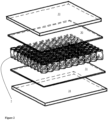
- FIG 2 there is illustrated a honeycomb structure of Figure 1 sandwiched between a series of layers of material.
- the honeycomb structure of Figure 2 comprises the sheet 2 of thixotropic material formed from thixotropic epoxy resin which is known to those skilled in the art in soundproofing and structural sealants for building construction sandwiched between adhesive seal layers 30,31.
- the outer adhesive seal layers 30,31 seal the voids of the cells 5 of the honeycomb structure.
- An outer layer 33 and inner layer 34 are placed on the side of the adhesive seals 30,31 facing away from the sheet 2.
- the combination of the sheet 2 and layers 30,31,33,34 provide a sound absorbing device 1 of the present invention.
- FIG 3 there is illustrated a further embodiment of the present invention represented by a polymeric film having a multiplicity of honeycomb cells 5 and configured as a series of discs 10,11,12.
- the series of discs 10,11,12 are stacked one on top of the other with decreasing diameters to provide a conical or substantially conical shape.
- An outer disc 10 has a diameter larger than inner disc 11, which has a diameter larger than disc 12 when the central radius point is taken at the centre.
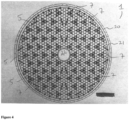
- Figure 4 illustrates a further embodiment of Figure 3 .
- An outer disc 20 and 21 comprise a non-thixotropic material.
- the honeycomb structure may be constructed from rigid or pliable integrity material depending on tailored use. It is seen that an expansion ability will be required in some embodiments so as pressure will not increase with phase change.
- the inner disc 22 may aid in this expansion as well as the outer circumference material 21.
- the outer disc 20 is rigid so as to aid manufacturing process and disposal within a housing.
- Between outer disc 21 and an inner disc 22 is found a collection of honeycomb cells 5.
- the honeycomb cells 5 are interspersed with thixotropic material-filled structures 7.
- the honeycomb cells 5 are composed of a thixotropic material.
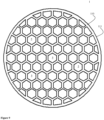
- Figure 9 illustrates a further embodiment of Figure 3 .
- a disc 110 comprises a non-thixotropic material and having an outer rim 111.
- the honeycomb structure may be constructed from rigid or pliable integrity material depending on tailored use.
- the outer rim 111 is rigid so as to aid manufacturing process and disposal within a housing.
- Within the outer rim 111 is found a collection of honeycomb cells 5.
- the honeycomb cells 5 may be filled with thixotropic material.
- the honeycomb cells 5 are composed of a thixotropic material.
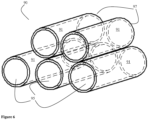
- the cellular scaffold 90 comprises a cylindrical tube 91 having an exterior surface 92 and an interior surface 94 defining a lumen 96 which is filled with a thixotropic material.
- the cylindrical tube would be arranged within the sound absorbing device (not shown) such that external sound would enter the tube at a first end 95 and travel through the tube to a second end 97. In doing so, the sound would cause some movement of the thixotropic material within the tube.
- the material at the walls of the tube would experience friction and be exposed to a higher shear rate than the material at the centre of the tube.
- the thixotropic material adjacent the walls of the tube would have greater sound absorbing capacity compared to the material at the centre of the tube.
- the cellular scaffold 90 comprises a series of cylindrical tubes 91 arranged in an interleaving arrangement.
- the cylindrical tubes would be arranged within a sound absorbing device (not shown) such that external sound would enter the tube at a first end 95 and travel through the tube to a second end 97.
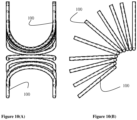
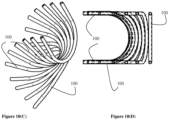
- each tube is coiled back on itself, the series of curved tubes forming a U-shaped structure 101.
- Each tube has two ends which, due to the U-shape, face the same direction.
- the U-shaped structure is disposed within a sound absorbing device such that the ends of the tube face towards incident sound, and the bend on the U-shaped structure is disposed towards the user's ear. This structure directs the incoming sound back out to the environment. As such, most of the sound energy would be directed back out to the environment even though the transmission percentage of sound in this part of the device would be quite low given that the sound energy passes through thixotropic material.
- the housing 90 and substantially U-shaped structure 100 may be immersed in thixotropic material to further dampen and attenuate any sound not passing through the tubes.
- FIG. 8 there is illustrated a sound absorbing device in the form of a headphone set 60, and comprising a headband 61 connecting ear coverings 62,63 together.
- Each ear covering 62, 63 includes a thixotropic material in the form of a polymeric sheet comprising a multiplicity of cellular pockets, wherein the thixotropic material is located within the cellular pockets (not shown).
- thixotropic material located within the cellular pockets of the polymeric sheet within the cavities 66, 67 allows low intensity sounds like voices to be heard, while high intensity sounds like those from a pneumatic drill or jet engine reduced. As such, the user does not need to increase the volume of the music to obviate the interfering external sounds. This advantage of the sound absorbing device reduces the damage done to the hearing while maintaining the enjoyment of the music being listened to.
- FIG. 11A-11C and Figures 12A-12D there is illustrated a further unclaimed embodiment of cellular scaffold including the series of thixotropic material-containing cylindrical tubes 100 previously described with reference to Figure 7 and Figure 10 .
- Each tube 121 is also coiled back on itself, the series of curved tubes 121 forming a substantially U-shaped structure 120.
- Each tube has two ends which, due to the U-shape, face the same direction.
- the series of substantially U-shaped structures 121 are connected to and supported by a spine 122.
- the spine may be flexible or rigid.
- the tubes 121 are connected to the spine 122 such that the tubes 121 point away from a plane X of the spine 122.
- an additional series of cylindrical tubes 124 are connected to and in fluid communication with the curved tubes 121.
- the cylindrical tubes 124 lie perpendicular to the plane X of the spine 122.
- FIGs 13A-13D there is illustrated a further unclaimed embodiment of a cellular scaffold 130.
- the cellular scaffold 130 comprises a plurality of tubes 90, as illustrated in Figure 5 , embedded in a base 131.
- the appearance of the scaffold 130 can be described as being like a "hedgehog”.
- the plurality of tubes 90 comprises a cylindrical tube 91 having an exterior surface 92 and an interior surface 94 defining a lumen 96 which is filled with a thixotropic material.
- the cylindrical tube would be arranged within a sound absorbing device (not shown) such that external sound would enter the tube at a first end 95 and travel through the tube to a second end embedded in the base 131. In doing so, the sound would cause some movement of the thixotropic material within the tube.
- the material at the walls of the tube would experience friction and be exposed to a higher shear rate than the material at the centre of the tube.
- the thixotropic material adjacent the walls of the tube would have greater sound absorbing capacity compared to the material at the centre of the tube.
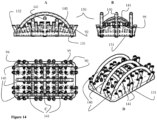
- Figure 14 illustrates a further unclaimed embodiment of the cellular scaffold 130 of Figure 13 .
- a second end 97 of the cylindrical tube 91 is exposed by an open-ended base 132.
- a series of substantially U-shaped cylinders 140 are embedded in the base 131, crossing from side 133 to the opposite side 134 of the base 131.
- a further series of substantially U-shaped cylinders 141 are embedded in the base 131, crossing from side 135 to the opposite side 136 of the base 131, and positioned such that the cylinders 141 are lying beneath cylinders 140.
- the testing environment comprises an anechoic chamber 200 with a decibel (dB) meter 201 on one side of the chamber and a signal generator 202 on the other side of the chamber.
- a hearing protector 203 for example a pair of headphones, is placed in the chamber 200 between the dB meter 201 and the signal generator 202.
- the hearing protector 203 is constructed such that there is a join 204 running down the middle of the protector to accommodate the easy insertion and removal of a cellular scaffold 210 (with reference to any of the cellular scaffolds of the Drawings and Description) of the present invention inside the hearing protector 203.
- a cellular scaffold of the present invention is placed within the protector 203 between the dB meter 201 and the signal generator 202 within the chamber 200.
- a small speaker 205 is attached to the signal generator 202 and placed between the signal generator 202 and the cellular scaffold of the present invention.
- a sound sensor 206 (a Digitech QM 1592 class 2 professional sound level meter) is attached to the dB meter 201 and placed between the dB meter 201 and the cellular scaffold of the present invention.
- a measurement for background/ambient noise was first measured to ensure that all sound from the signal generator 202 was being received by the dB meter sound sensor 206.
- the control used for the experiments is the industry standard headphone ear protectors manufactured by 3M ® , model type 1430C.
- the sound absorbing material of the control headphones were tested at frequencies indicated by the manufacturer, namely 125, 250, 500, 1000, 2000, 4000 and 8000 dB.
- a reading for each frequency was measured in triplicate and an average reading was calculated.
- the reduction in the dB level achieved by the sound absorbing material at each frequency was calculated by subtracting the measured dB level from the dB level measured when no sound absorbing material was present.
- the human ear has a large dynamic range in audio perception.
- the ratio of the sound intensity that causes permanent damage during short exposure to the quietest sound that the ear can hear is greater than or equal to 1 trillion.
- Such large measurement ranges are conveniently expressed in logarithmic units: for example, the base-10 logarithm of one trillion (10 12 ) is 12, which is expressed as an audio level of 120 dB.
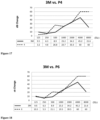
- Table 1 The dB Change achieved in seven embodiments (1-7) and the industry standard 3M ® headphone at selected frequencies (Hertz (Hz)).
- the 250-1000 Hz range is the range involved in many industrial hardware appliances and as such presents itself as a significant improvement in the area of personal protection within the construction industry.
- the 2000-8000 Hz range is an area of sound frequency which is related to high speed drills and electronic equipment. For example, dentists (and dental patients) are regularly at risk from high frequency drill sounds and as such, this improved protection is of significant value in this profession as a safety device.
- the results presented above clearly demonstrate that the sound absorbing material contained in a cellular scaffold of the soundproofing device of the present invention achieves significant improvements in sound absorption and hearing protection.
- the range of frequencies which the cellular scaffold of the soundproofing device of the present invention absorbs sound allows the user to hear conversations while dampening the harmful effects of, for example, drilling noises and the like.
- Individual earplugs can contain an insulating core that contains a sound absorbing material comprising a thixotropic material.
- Anechoic chambers can be constructed from panels of insulating material that would contain an internal structure of thixotropic material.
Landscapes
- Health & Medical Sciences (AREA)
- Life Sciences & Earth Sciences (AREA)
- Biomedical Technology (AREA)
- Animal Behavior & Ethology (AREA)
- Biophysics (AREA)
- Otolaryngology (AREA)
- Psychology (AREA)
- Engineering & Computer Science (AREA)
- Physics & Mathematics (AREA)
- Heart & Thoracic Surgery (AREA)
- Vascular Medicine (AREA)
- Acoustics & Sound (AREA)
- General Health & Medical Sciences (AREA)
- Public Health (AREA)
- Veterinary Medicine (AREA)
- Soundproofing, Sound Blocking, And Sound Damping (AREA)
- Building Environments (AREA)
- Prostheses (AREA)
- User Interface Of Digital Computer (AREA)
Claims (10)
- Schallschutzvorrichtung, umfassend ein schallabsorbierendes Material, das ein zellenartiges Gerüst (2, 110, 120, 130) mit Zellen (5, 96) aufweist, wobei sich in den Zellen (5, 96) des zellenartigen Gerüsts (2, 110) ein thixotropes Material befindet und wobei das thixotrope Material als Reaktion auf Schallenergie eine Änderung der Viskosität zeigt; wobei das zellenartige Gerüst (2, 110) eine Wabenstruktur aufweist und wobei das schallabsorbierende Material (1) eine Schicht einer Wabenstruktur mit einer oberen und einer unteren Dichtungsschicht (30, 31), die die Zellen (5) in der Wabenstruktur abdichten, umfasst; oder wobei das zellenartige Gerüst (2) in Form eines Polymerfilms mit einer Vielzahl von zellenartigen Fächern oder Taschen (5, 7) vorliegt und wobei die zellenartigen Fächer oder Taschen (5, 7) das schallabsorbierende Material enthalten.
- Schallschutzvorrichtung nach Anspruch 1, wobei die Wabenstruktur Zellen (5) umfasst, die ein thixotropes Material enthalten.
- Schallschutzvorrichtung nach Anspruch 1, wobei die zellenartigen Fächer in Form von Wabenstrukturen vorliegen.
- Schallschutzvorrichtung nach Anspruch 3, wobei Wabenstrukturen jeweils ein thixotropes Material umschließen und/oder daraus bestehen.
- Schallschutzvorrichtung nach Ansprüchen 3 oder 4, wobei der Polymerfilm einer auf dem anderen gestapelt ist.
- Schallschutzvorrichtung nach Anspruch 1, wobei das schallabsorbierende Material in mindestens einem Behälter eingeschlossen ist und wobei der Behälter expandierbar ist, um eine Zunahme des Volumens des schallabsorbierenden Materials zuzulassen.
- Schallschutzvorrichtung nach Anspruch 1, umfassend mindestens zwei Schichten einer Wabenstruktur, die in einer einander zugewandten Beziehung angeordnet sind, wobei die mindestens zwei Schichten derart angeordnet sind, dass die Zellen (5) der Wabenstruktur einer ersten Schicht sich nicht mit den Zellen (5) der Wabenstruktur der zweiten Schicht decken.
- Schallschutzvorrichtung nach Anspruch 7, wobei die mindestens zwei Schichten von Wabenstruktur durch eine schalldämmende Schicht getrennt sind.
- Schallschutzvorrichtung nach einem der vorangehenden Ansprüche, wobei das thixotrope Material ausgewählt ist, um Schallenergie über einen Bereich von etwa 20 Hz bis etwa 20,000 Hz (20 KHz) des Hörbereichs eines Menschen hinweg zu absorbieren.
- Schallschutzvorrichtung nach einem der vorangehenden Ansprüche, wobei das thixotrope Material aus der Gruppe ausgewählt ist, die strukturierte Flüssigkeiten, Suspensionen, Emulsionen, Polymerlösungen, wässrige Eisenoxidgele, Vanadium-Pentoxid-Sole, Stärkepasten, Pektingele, geflockte Lacke, Tone, Erdsuspensionen, Cremes, Bohrschlämme, Mehlteige, Mehlsuspensionen, Faserfette, Gelees, Lacke, Honig, Rußsuspensionen, hydrophob modifizierte Hydroxethylcellulose, nicht assoziative Cellulose-Wasser-Lösungen, geflockte Polymerlatexsuspension, Gummilösungen, Metallschmieren, Bentonittone, modifizierte Laponite, Öle, Schmierstoffe, Kohlesuspensionen, Xanthangummis, organischen Bentonit, pyrogene Kieselsäure, Aluminiumstearat, Metallseife, Rizinusölderivate oder thixotropes Epoxidharz oder Kombinationen davon umfasst.
Applications Claiming Priority (4)
| Application Number | Priority Date | Filing Date | Title |
|---|---|---|---|
| EP10174237A EP2422756A1 (de) | 2010-08-26 | 2010-08-26 | Behälter mit einem thixotropen Material |
| EP11763862.7A EP2608754B1 (de) | 2010-08-26 | 2011-08-25 | Schalldämpfungsvorrichtung zur abdeckung der ohren eines benutzers |
| PCT/EP2011/064684 WO2012025608A2 (en) | 2010-08-26 | 2011-08-25 | A sound absorbing device of the type adapted to cover the ears of a user |
| EP16164643.5 | 2016-04-11 |
Related Parent Applications (2)
| Application Number | Title | Priority Date | Filing Date |
|---|---|---|---|
| EP11763862.7A Division EP2608754B1 (de) | 2010-08-26 | 2011-08-25 | Schalldämpfungsvorrichtung zur abdeckung der ohren eines benutzers |
| EP16164643.5 Division | 2010-08-26 | 2016-04-11 |
Publications (3)
| Publication Number | Publication Date |
|---|---|
| EP3146949A1 EP3146949A1 (de) | 2017-03-29 |
| EP3146949B1 true EP3146949B1 (de) | 2024-05-22 |
| EP3146949C0 EP3146949C0 (de) | 2024-05-22 |
Family
ID=43415361
Family Applications (3)
| Application Number | Title | Priority Date | Filing Date |
|---|---|---|---|
| EP10174237A Withdrawn EP2422756A1 (de) | 2010-08-26 | 2010-08-26 | Behälter mit einem thixotropen Material |
| EP11763862.7A Active EP2608754B1 (de) | 2010-08-26 | 2011-08-25 | Schalldämpfungsvorrichtung zur abdeckung der ohren eines benutzers |
| EP16186999.5A Active EP3146949B1 (de) | 2010-08-26 | 2011-08-25 | Schalldämpfungsmaterial |
Family Applications Before (2)
| Application Number | Title | Priority Date | Filing Date |
|---|---|---|---|
| EP10174237A Withdrawn EP2422756A1 (de) | 2010-08-26 | 2010-08-26 | Behälter mit einem thixotropen Material |
| EP11763862.7A Active EP2608754B1 (de) | 2010-08-26 | 2011-08-25 | Schalldämpfungsvorrichtung zur abdeckung der ohren eines benutzers |
Country Status (11)
| Country | Link |
|---|---|
| US (2) | US9744078B2 (de) |
| EP (3) | EP2422756A1 (de) |
| AU (2) | AU2011295005B2 (de) |
| CA (1) | CA2809084C (de) |
| DK (1) | DK2608754T3 (de) |
| ES (2) | ES2979114T3 (de) |
| HU (1) | HUE029207T2 (de) |
| PL (2) | PL2608754T3 (de) |
| PT (1) | PT2608754T (de) |
| SI (1) | SI2608754T1 (de) |
| WO (1) | WO2012025608A2 (de) |
Families Citing this family (12)
| Publication number | Priority date | Publication date | Assignee | Title |
|---|---|---|---|---|
| EP2422756A1 (de) | 2010-08-26 | 2012-02-29 | Restored Hearing Ltd. | Behälter mit einem thixotropen Material |
| USD708162S1 (en) * | 2013-02-26 | 2014-07-01 | Grain Audio, LLC | Over-ear headphones |
| DE102014207705A1 (de) * | 2014-04-24 | 2015-10-29 | Siemens Aktiengesellschaft | Gehörschutzvorrichtung sowie eine Magnetresonanzvorrichtung mit der Gehörschutzvorrichtung |
| US10037754B1 (en) | 2014-09-22 | 2018-07-31 | Mark W. Hollmann | Surgical helmet with hearing protection |
| GB201508150D0 (en) * | 2015-05-13 | 2015-06-24 | Cambridge Entpr Ltd | Device for insertion into human or animal body and associated methods |
| AU2017245170A1 (en) * | 2016-03-31 | 2018-10-04 | 3M Innovative Properties Company | Noise simulating booth for safely testing and demonstrating hearing protection equipment |
| WO2017182314A1 (de) | 2016-04-18 | 2017-10-26 | Basf Se | Anordnung mit schallabsorbierenden und brandhemmenden eigenschaften |
| CN110300563B (zh) | 2017-02-16 | 2022-07-15 | 3M创新有限公司 | 包括声音减弱构件的耳罩听力保护装置 |
| CN108269564A (zh) * | 2018-03-11 | 2018-07-10 | 西北工业大学 | 一种由开孔型多孔玻璃与气囊构成的隔声耳罩 |
| EP4591841A3 (de) * | 2018-12-31 | 2025-09-03 | Honeywell Safety Products USA, Inc. | Vorrichtung und verfahren zur erhöhung oder manipulation der rauschdämpfung in einer gehörschutzvorrichtung |
| USD939779S1 (en) | 2019-02-20 | 2021-12-28 | Honeywell International Inc. | Hearing protection device |
| US11405716B2 (en) | 2019-03-11 | 2022-08-02 | Wiley X, lnc. | Modular headphone system |
Citations (4)
| Publication number | Priority date | Publication date | Assignee | Title |
|---|---|---|---|---|
| US3506980A (en) * | 1968-12-26 | 1970-04-21 | Gentex Corp | Seal for earcup or the like |
| GB1420009A (en) * | 1972-03-31 | 1976-01-07 | Dassault Avions | Structural panels of the sandwich type |
| US5920911A (en) * | 1997-11-17 | 1999-07-13 | Poiesis Research, Inc. | Earcup soft-seal with thinned lips and interleaving layers of damping materials |
| WO2007079230A2 (en) * | 2005-12-29 | 2007-07-12 | Joel Sereboff | Energy absorbing composition and impact and sound absorbing applications thereof |
Family Cites Families (15)
| Publication number | Priority date | Publication date | Assignee | Title |
|---|---|---|---|---|
| US3335720A (en) * | 1965-06-02 | 1967-08-15 | Leonard Peter Frieder | Valve for sound attenuating device |
| US3432861A (en) * | 1966-08-09 | 1969-03-18 | Clark Co Inc David | Ear protector |
| US3782379A (en) * | 1970-09-28 | 1974-01-01 | Gen Electric | Method of obtaining room temperature vulcanizable silicone rubber ear plugs |
| US3875592A (en) * | 1973-01-10 | 1975-04-08 | Gentex Corp | Sound attenuating earcup |
| US4023642A (en) * | 1975-06-25 | 1977-05-17 | The Raymond Lee Organization, Inc. | Soundproof earcovers |
| SE511890C2 (sv) * | 1993-02-10 | 1999-12-13 | Dalloz Safety Ab | Hörselskyddskåpa med förhöjd ljuddämpning |
| US5400296A (en) | 1994-01-25 | 1995-03-21 | Poiesis Research, Inc. | Acoustic attenuation and vibration damping materials |
| GB2340281A (en) | 1998-08-04 | 2000-02-16 | Sharp Kk | A reflective liquid crystal display device |
| GB9817601D0 (en) * | 1998-08-14 | 1998-10-07 | Playle Mark | Helmet with inflatable sound projection |
| US20030034198A1 (en) | 2001-08-20 | 2003-02-20 | Cushman William B. | Dilatant earcup soft seal |
| US6832663B2 (en) * | 2001-08-27 | 2004-12-21 | Natus Medical Inc. | Ear coupler |
| US6625819B1 (en) * | 2002-12-31 | 2003-09-30 | Kai-Mou Tsai | Headphone type earpiece assembly and earpieces for the headphone type earpiece assembly |
| US20070157575A1 (en) | 2005-12-28 | 2007-07-12 | Amy Yasbeck | Package kit of bra straps |
| SE531700C2 (sv) * | 2007-09-28 | 2009-07-14 | Msa Sordin Ab | System för hörselskydd, innefattande en yttre hörselskyddande enhet och en inre hörselskyddande enhet |
| EP2422756A1 (de) | 2010-08-26 | 2012-02-29 | Restored Hearing Ltd. | Behälter mit einem thixotropen Material |
-
2010
- 2010-08-26 EP EP10174237A patent/EP2422756A1/de not_active Withdrawn
-
2011
- 2011-08-25 PL PL11763862.7T patent/PL2608754T3/pl unknown
- 2011-08-25 EP EP11763862.7A patent/EP2608754B1/de active Active
- 2011-08-25 ES ES16186999T patent/ES2979114T3/es active Active
- 2011-08-25 ES ES11763862.7T patent/ES2582310T3/es active Active
- 2011-08-25 WO PCT/EP2011/064684 patent/WO2012025608A2/en not_active Ceased
- 2011-08-25 US US13/818,851 patent/US9744078B2/en active Active
- 2011-08-25 SI SI201130877A patent/SI2608754T1/sl unknown
- 2011-08-25 CA CA2809084A patent/CA2809084C/en active Active
- 2011-08-25 AU AU2011295005A patent/AU2011295005B2/en active Active
- 2011-08-25 EP EP16186999.5A patent/EP3146949B1/de active Active
- 2011-08-25 DK DK11763862.7T patent/DK2608754T3/en active
- 2011-08-25 PL PL16186999.5T patent/PL3146949T3/pl unknown
- 2011-08-25 HU HUE11763862A patent/HUE029207T2/en unknown
- 2011-08-25 PT PT117638627T patent/PT2608754T/pt unknown
-
2016
- 2016-08-26 AU AU2016219681A patent/AU2016219681B2/en active Active
-
2017
- 2017-06-23 US US15/631,600 patent/US10531987B2/en active Active
Patent Citations (4)
| Publication number | Priority date | Publication date | Assignee | Title |
|---|---|---|---|---|
| US3506980A (en) * | 1968-12-26 | 1970-04-21 | Gentex Corp | Seal for earcup or the like |
| GB1420009A (en) * | 1972-03-31 | 1976-01-07 | Dassault Avions | Structural panels of the sandwich type |
| US5920911A (en) * | 1997-11-17 | 1999-07-13 | Poiesis Research, Inc. | Earcup soft-seal with thinned lips and interleaving layers of damping materials |
| WO2007079230A2 (en) * | 2005-12-29 | 2007-07-12 | Joel Sereboff | Energy absorbing composition and impact and sound absorbing applications thereof |
Non-Patent Citations (1)
| Title |
|---|
| JONATHAN MCD C STEPHENS: "The factors responsible for the varying levels of UMF® in m?nuka (Leptospermum scoparium) honey", THESIS, 1 February 2006 (2006-02-01), pages 1 - 284, XP055572229, Retrieved from the Internet <URL:https://researchcommons.waikato.ac.nz/bitstream/handle/10289/2655/thesis.pdf?sequence=2&isAllowed=y> [retrieved on 20190321] * |
Also Published As
| Publication number | Publication date |
|---|---|
| ES2979114T3 (es) | 2024-09-24 |
| US9744078B2 (en) | 2017-08-29 |
| AU2016219681A1 (en) | 2016-09-15 |
| HUE029207T2 (en) | 2017-02-28 |
| EP2422756A1 (de) | 2012-02-29 |
| CA2809084A1 (en) | 2012-03-01 |
| DK2608754T3 (en) | 2016-07-25 |
| AU2011295005A1 (en) | 2013-03-14 |
| PL2608754T3 (pl) | 2016-12-30 |
| US20130153328A1 (en) | 2013-06-20 |
| EP2608754B1 (de) | 2016-04-13 |
| EP2608754A2 (de) | 2013-07-03 |
| CA2809084C (en) | 2021-11-16 |
| SI2608754T1 (sl) | 2016-08-31 |
| US10531987B2 (en) | 2020-01-14 |
| EP3146949C0 (de) | 2024-05-22 |
| US20170360617A1 (en) | 2017-12-21 |
| ES2582310T3 (es) | 2016-09-12 |
| AU2016219681B2 (en) | 2018-04-19 |
| HK1186373A1 (zh) | 2014-03-14 |
| WO2012025608A3 (en) | 2012-09-20 |
| PT2608754T (pt) | 2016-07-14 |
| WO2012025608A2 (en) | 2012-03-01 |
| AU2011295005B2 (en) | 2016-05-26 |
| EP3146949A1 (de) | 2017-03-29 |
| PL3146949T3 (pl) | 2024-11-04 |
Similar Documents
| Publication | Publication Date | Title |
|---|---|---|
| AU2016219681B2 (en) | A sound absorbing device of the type adapted to cover the ears of a user | |
| US11727910B2 (en) | Methods and devices for attenuating sound in a conduit or chamber | |
| US20200260175A1 (en) | Methods and devices for occluding an ear canal having a predetermined filter characteristic | |
| US8727071B2 (en) | Sound barrier for audible acoustic frequency management | |
| JP2012513288A (ja) | 聴覚保護方法及び装置 | |
| AU2006332634B2 (en) | Energy absorbing composition and impact and sound absorbing applications thereof | |
| HK1235659B (en) | A sound absorbing device | |
| HK1235659A1 (en) | A sound absorbing device | |
| HK1186373B (en) | A sound absorbing device of the type adapted to cover the ears of a user | |
| CN108343194A (zh) | 一种有效阻隔低频噪声的胶囊墙板 | |
| CN207846720U (zh) | 一种内嵌胶囊阵列的隔声板材 | |
| US20180280199A1 (en) | Noise reductions device | |
| CN2598536Y (zh) | 隔声防振耳罩 |
Legal Events
| Date | Code | Title | Description |
|---|---|---|---|
| PUAI | Public reference made under article 153(3) epc to a published international application that has entered the european phase |
Free format text: ORIGINAL CODE: 0009012 |
|
| STAA | Information on the status of an ep patent application or granted ep patent |
Free format text: STATUS: THE APPLICATION HAS BEEN PUBLISHED |
|
| AC | Divisional application: reference to earlier application |
Ref document number: 2608754 Country of ref document: EP Kind code of ref document: P |
|
| AK | Designated contracting states |
Kind code of ref document: A1 Designated state(s): AL AT BE BG CH CY CZ DE DK EE ES FI FR GB GR HR HU IE IS IT LI LT LU LV MC MK MT NL NO PL PT RO RS SE SI SK SM TR |
|
| STAA | Information on the status of an ep patent application or granted ep patent |
Free format text: STATUS: REQUEST FOR EXAMINATION WAS MADE |
|
| 17P | Request for examination filed |
Effective date: 20170929 |
|
| RBV | Designated contracting states (corrected) |
Designated state(s): AL AT BE BG CH CY CZ DE DK EE ES FI FR GB GR HR HU IE IS IT LI LT LU LV MC MK MT NL NO PL PT RO RS SE SI SK SM TR |
|
| REG | Reference to a national code |
Ref country code: HK Ref legal event code: DE Ref document number: 1235659 Country of ref document: HK |
|
| STAA | Information on the status of an ep patent application or granted ep patent |
Free format text: STATUS: EXAMINATION IS IN PROGRESS |
|
| RIC1 | Information provided on ipc code assigned before grant |
Ipc: A61F 11/08 20060101AFI20190122BHEP |
|
| 17Q | First examination report despatched |
Effective date: 20190211 |
|
| P01 | Opt-out of the competence of the unified patent court (upc) registered |
Effective date: 20230523 |
|
| GRAP | Despatch of communication of intention to grant a patent |
Free format text: ORIGINAL CODE: EPIDOSNIGR1 |
|
| STAA | Information on the status of an ep patent application or granted ep patent |
Free format text: STATUS: GRANT OF PATENT IS INTENDED |
|
| INTG | Intention to grant announced |
Effective date: 20231222 |
|
| GRAS | Grant fee paid |
Free format text: ORIGINAL CODE: EPIDOSNIGR3 |
|
| GRAA | (expected) grant |
Free format text: ORIGINAL CODE: 0009210 |
|
| STAA | Information on the status of an ep patent application or granted ep patent |
Free format text: STATUS: THE PATENT HAS BEEN GRANTED |
|
| AC | Divisional application: reference to earlier application |
Ref document number: 2608754 Country of ref document: EP Kind code of ref document: P |
|
| AK | Designated contracting states |
Kind code of ref document: B1 Designated state(s): AL AT BE BG CH CY CZ DE DK EE ES FI FR GB GR HR HU IE IS IT LI LT LU LV MC MK MT NL NO PL PT RO RS SE SI SK SM TR |
|
| REG | Reference to a national code |
Ref country code: GB Ref legal event code: FG4D |
|
| REG | Reference to a national code |
Ref country code: CH Ref legal event code: EP |
|
| REG | Reference to a national code |
Ref country code: DE Ref legal event code: R096 Ref document number: 602011074804 Country of ref document: DE |
|
| REG | Reference to a national code |
Ref country code: IE Ref legal event code: FG4D |
|
| U01 | Request for unitary effect filed |
Effective date: 20240522 |
|
| U07 | Unitary effect registered |
Designated state(s): AT BE BG DE DK EE FI FR IT LT LU LV MT NL PT SE SI Effective date: 20240528 |
|
| P04 | Withdrawal of opt-out of the competence of the unified patent court (upc) registered |
Effective date: 20240524 |
|
| REG | Reference to a national code |
Ref country code: ES Ref legal event code: FG2A Ref document number: 2979114 Country of ref document: ES Kind code of ref document: T3 Effective date: 20240924 |
|
| PG25 | Lapsed in a contracting state [announced via postgrant information from national office to epo] |
Ref country code: IS Free format text: LAPSE BECAUSE OF FAILURE TO SUBMIT A TRANSLATION OF THE DESCRIPTION OR TO PAY THE FEE WITHIN THE PRESCRIBED TIME-LIMIT Effective date: 20240922 |
|
| U20 | Renewal fee for the european patent with unitary effect paid |
Year of fee payment: 14 Effective date: 20240830 |
|
| PG25 | Lapsed in a contracting state [announced via postgrant information from national office to epo] |
Ref country code: HR Free format text: LAPSE BECAUSE OF FAILURE TO SUBMIT A TRANSLATION OF THE DESCRIPTION OR TO PAY THE FEE WITHIN THE PRESCRIBED TIME-LIMIT Effective date: 20240522 |
|
| PG25 | Lapsed in a contracting state [announced via postgrant information from national office to epo] |
Ref country code: GR Free format text: LAPSE BECAUSE OF FAILURE TO SUBMIT A TRANSLATION OF THE DESCRIPTION OR TO PAY THE FEE WITHIN THE PRESCRIBED TIME-LIMIT Effective date: 20240823 |
|
| PG25 | Lapsed in a contracting state [announced via postgrant information from national office to epo] |
Ref country code: NO Free format text: LAPSE BECAUSE OF FAILURE TO SUBMIT A TRANSLATION OF THE DESCRIPTION OR TO PAY THE FEE WITHIN THE PRESCRIBED TIME-LIMIT Effective date: 20240822 Ref country code: IS Free format text: LAPSE BECAUSE OF FAILURE TO SUBMIT A TRANSLATION OF THE DESCRIPTION OR TO PAY THE FEE WITHIN THE PRESCRIBED TIME-LIMIT Effective date: 20240922 Ref country code: HR Free format text: LAPSE BECAUSE OF FAILURE TO SUBMIT A TRANSLATION OF THE DESCRIPTION OR TO PAY THE FEE WITHIN THE PRESCRIBED TIME-LIMIT Effective date: 20240522 Ref country code: GR Free format text: LAPSE BECAUSE OF FAILURE TO SUBMIT A TRANSLATION OF THE DESCRIPTION OR TO PAY THE FEE WITHIN THE PRESCRIBED TIME-LIMIT Effective date: 20240823 Ref country code: RS Free format text: LAPSE BECAUSE OF FAILURE TO SUBMIT A TRANSLATION OF THE DESCRIPTION OR TO PAY THE FEE WITHIN THE PRESCRIBED TIME-LIMIT Effective date: 20240822 |
|
| P05 | Withdrawal of opt-out of the competence of the unified patent court (upc) changed |
Free format text: CASE NUMBER: APP_30193/2024 Effective date: 20240528 |
|
| PG25 | Lapsed in a contracting state [announced via postgrant information from national office to epo] |
Ref country code: CZ Free format text: LAPSE BECAUSE OF FAILURE TO SUBMIT A TRANSLATION OF THE DESCRIPTION OR TO PAY THE FEE WITHIN THE PRESCRIBED TIME-LIMIT Effective date: 20240522 |
|
| PG25 | Lapsed in a contracting state [announced via postgrant information from national office to epo] |
Ref country code: SK Free format text: LAPSE BECAUSE OF FAILURE TO SUBMIT A TRANSLATION OF THE DESCRIPTION OR TO PAY THE FEE WITHIN THE PRESCRIBED TIME-LIMIT Effective date: 20240522 |
|
| PG25 | Lapsed in a contracting state [announced via postgrant information from national office to epo] |
Ref country code: SM Free format text: LAPSE BECAUSE OF FAILURE TO SUBMIT A TRANSLATION OF THE DESCRIPTION OR TO PAY THE FEE WITHIN THE PRESCRIBED TIME-LIMIT Effective date: 20240522 |
|
| PG25 | Lapsed in a contracting state [announced via postgrant information from national office to epo] |
Ref country code: SM Free format text: LAPSE BECAUSE OF FAILURE TO SUBMIT A TRANSLATION OF THE DESCRIPTION OR TO PAY THE FEE WITHIN THE PRESCRIBED TIME-LIMIT Effective date: 20240522 Ref country code: SK Free format text: LAPSE BECAUSE OF FAILURE TO SUBMIT A TRANSLATION OF THE DESCRIPTION OR TO PAY THE FEE WITHIN THE PRESCRIBED TIME-LIMIT Effective date: 20240522 Ref country code: CZ Free format text: LAPSE BECAUSE OF FAILURE TO SUBMIT A TRANSLATION OF THE DESCRIPTION OR TO PAY THE FEE WITHIN THE PRESCRIBED TIME-LIMIT Effective date: 20240522 |
|
| REG | Reference to a national code |
Ref country code: DE Ref legal event code: R097 Ref document number: 602011074804 Country of ref document: DE |
|
| PLBE | No opposition filed within time limit |
Free format text: ORIGINAL CODE: 0009261 |
|
| STAA | Information on the status of an ep patent application or granted ep patent |
Free format text: STATUS: NO OPPOSITION FILED WITHIN TIME LIMIT |
|
| 26N | No opposition filed |
Effective date: 20250225 |
|
| U20 | Renewal fee for the european patent with unitary effect paid |
Year of fee payment: 15 Effective date: 20250830 |
|
| PGFP | Annual fee paid to national office [announced via postgrant information from national office to epo] |
Ref country code: ES Payment date: 20250909 Year of fee payment: 15 |
|
| PGFP | Annual fee paid to national office [announced via postgrant information from national office to epo] |
Ref country code: PL Payment date: 20250820 Year of fee payment: 15 |
|
| PGFP | Annual fee paid to national office [announced via postgrant information from national office to epo] |
Ref country code: GB Payment date: 20250819 Year of fee payment: 15 |
|
| PGFP | Annual fee paid to national office [announced via postgrant information from national office to epo] |
Ref country code: CH Payment date: 20250901 Year of fee payment: 15 |
|
| PGFP | Annual fee paid to national office [announced via postgrant information from national office to epo] |
Ref country code: IE Payment date: 20250825 Year of fee payment: 15 |
|
| PG25 | Lapsed in a contracting state [announced via postgrant information from national office to epo] |
Ref country code: RO Free format text: LAPSE BECAUSE OF FAILURE TO SUBMIT A TRANSLATION OF THE DESCRIPTION OR TO PAY THE FEE WITHIN THE PRESCRIBED TIME-LIMIT Effective date: 20240522 |
|
| PG25 | Lapsed in a contracting state [announced via postgrant information from national office to epo] |
Ref country code: CY Free format text: LAPSE BECAUSE OF FAILURE TO SUBMIT A TRANSLATION OF THE DESCRIPTION OR TO PAY THE FEE WITHIN THE PRESCRIBED TIME-LIMIT; INVALID AB INITIO Effective date: 20110825 |
|
| PG25 | Lapsed in a contracting state [announced via postgrant information from national office to epo] |
Ref country code: HU Free format text: LAPSE BECAUSE OF FAILURE TO SUBMIT A TRANSLATION OF THE DESCRIPTION OR TO PAY THE FEE WITHIN THE PRESCRIBED TIME-LIMIT; INVALID AB INITIO Effective date: 20110825 |