EP3147723A1 - Bilderzeugende vorrichtung - Google Patents
Bilderzeugende vorrichtung Download PDFInfo
- Publication number
- EP3147723A1 EP3147723A1 EP15796480.0A EP15796480A EP3147723A1 EP 3147723 A1 EP3147723 A1 EP 3147723A1 EP 15796480 A EP15796480 A EP 15796480A EP 3147723 A1 EP3147723 A1 EP 3147723A1
- Authority
- EP
- European Patent Office
- Prior art keywords
- toner
- image
- value
- predetermined
- amount
- Prior art date
- Legal status (The legal status is an assumption and is not a legal conclusion. Google has not performed a legal analysis and makes no representation as to the accuracy of the status listed.)
- Withdrawn
Links
- 230000015572 biosynthetic process Effects 0.000 claims abstract description 125
- 239000000463 material Substances 0.000 claims description 16
- 230000000694 effects Effects 0.000 claims description 9
- 230000006866 deterioration Effects 0.000 abstract description 171
- 230000007774 longterm Effects 0.000 abstract description 84
- 230000000875 corresponding effect Effects 0.000 description 39
- 238000007599 discharging Methods 0.000 description 31
- 239000003086 colorant Substances 0.000 description 20
- 238000012546 transfer Methods 0.000 description 20
- 238000010586 diagram Methods 0.000 description 17
- 229920006395 saturated elastomer Polymers 0.000 description 16
- 239000000654 additive Substances 0.000 description 12
- 230000000996 additive effect Effects 0.000 description 11
- 239000002245 particle Substances 0.000 description 11
- 238000003756 stirring Methods 0.000 description 11
- 238000009966 trimming Methods 0.000 description 10
- 238000001514 detection method Methods 0.000 description 9
- 238000009751 slip forming Methods 0.000 description 9
- 238000000034 method Methods 0.000 description 8
- 239000007787 solid Substances 0.000 description 8
- 230000007547 defect Effects 0.000 description 7
- 230000001105 regulatory effect Effects 0.000 description 6
- 238000011161 development Methods 0.000 description 5
- FAPWRFPIFSIZLT-UHFFFAOYSA-M Sodium chloride Chemical compound [Na+].[Cl-] FAPWRFPIFSIZLT-UHFFFAOYSA-M 0.000 description 4
- 238000009826 distribution Methods 0.000 description 4
- 230000002093 peripheral effect Effects 0.000 description 4
- VYPSYNLAJGMNEJ-UHFFFAOYSA-N Silicium dioxide Chemical compound O=[Si]=O VYPSYNLAJGMNEJ-UHFFFAOYSA-N 0.000 description 3
- 230000002596 correlated effect Effects 0.000 description 3
- 230000007423 decrease Effects 0.000 description 3
- 238000005259 measurement Methods 0.000 description 3
- 239000000203 mixture Substances 0.000 description 3
- 238000005192 partition Methods 0.000 description 3
- 229920000642 polymer Polymers 0.000 description 3
- 239000011347 resin Substances 0.000 description 3
- 229920005989 resin Polymers 0.000 description 3
- XEEYBQQBJWHFJM-UHFFFAOYSA-N Iron Chemical compound [Fe] XEEYBQQBJWHFJM-UHFFFAOYSA-N 0.000 description 2
- PXHVJJICTQNCMI-UHFFFAOYSA-N Nickel Chemical compound [Ni] PXHVJJICTQNCMI-UHFFFAOYSA-N 0.000 description 2
- 206010047571 Visual impairment Diseases 0.000 description 2
- 229910052782 aluminium Inorganic materials 0.000 description 2
- XAGFODPZIPBFFR-UHFFFAOYSA-N aluminium Chemical compound [Al] XAGFODPZIPBFFR-UHFFFAOYSA-N 0.000 description 2
- 239000003990 capacitor Substances 0.000 description 2
- 238000004040 coloring Methods 0.000 description 2
- 239000000470 constituent Substances 0.000 description 2
- 238000012937 correction Methods 0.000 description 2
- 238000005520 cutting process Methods 0.000 description 2
- 230000008021 deposition Effects 0.000 description 2
- 239000008151 electrolyte solution Substances 0.000 description 2
- 230000006870 function Effects 0.000 description 2
- CNQCVBJFEGMYDW-UHFFFAOYSA-N lawrencium atom Chemical compound [Lr] CNQCVBJFEGMYDW-UHFFFAOYSA-N 0.000 description 2
- 229910052751 metal Inorganic materials 0.000 description 2
- 239000002184 metal Substances 0.000 description 2
- 239000011780 sodium chloride Substances 0.000 description 2
- 238000012935 Averaging Methods 0.000 description 1
- VYZAMTAEIAYCRO-UHFFFAOYSA-N Chromium Chemical compound [Cr] VYZAMTAEIAYCRO-UHFFFAOYSA-N 0.000 description 1
- 241001640034 Heteropterys Species 0.000 description 1
- 239000002253 acid Substances 0.000 description 1
- 229910045601 alloy Inorganic materials 0.000 description 1
- 239000000956 alloy Substances 0.000 description 1
- 239000011230 binding agent Substances 0.000 description 1
- 238000006243 chemical reaction Methods 0.000 description 1
- 239000011248 coating agent Substances 0.000 description 1
- 238000000576 coating method Methods 0.000 description 1
- 229910017052 cobalt Inorganic materials 0.000 description 1
- 239000010941 cobalt Substances 0.000 description 1
- GUTLYIVDDKVIGB-UHFFFAOYSA-N cobalt atom Chemical compound [Co] GUTLYIVDDKVIGB-UHFFFAOYSA-N 0.000 description 1
- 230000007812 deficiency Effects 0.000 description 1
- 239000002270 dispersing agent Substances 0.000 description 1
- 239000000284 extract Substances 0.000 description 1
- 239000010419 fine particle Substances 0.000 description 1
- 230000010365 information processing Effects 0.000 description 1
- 238000009434 installation Methods 0.000 description 1
- 230000010354 integration Effects 0.000 description 1
- 229910052742 iron Inorganic materials 0.000 description 1
- 239000006249 magnetic particle Substances 0.000 description 1
- WPBNNNQJVZRUHP-UHFFFAOYSA-L manganese(2+);methyl n-[[2-(methoxycarbonylcarbamothioylamino)phenyl]carbamothioyl]carbamate;n-[2-(sulfidocarbothioylamino)ethyl]carbamodithioate Chemical compound [Mn+2].[S-]C(=S)NCCNC([S-])=S.COC(=O)NC(=S)NC1=CC=CC=C1NC(=S)NC(=O)OC WPBNNNQJVZRUHP-UHFFFAOYSA-L 0.000 description 1
- 230000000873 masking effect Effects 0.000 description 1
- 239000011159 matrix material Substances 0.000 description 1
- 150000002739 metals Chemical class 0.000 description 1
- 229910052759 nickel Inorganic materials 0.000 description 1
- 229920001225 polyester resin Polymers 0.000 description 1
- 229920001721 polyimide Polymers 0.000 description 1
- 239000009719 polyimide resin Substances 0.000 description 1
- 238000012545 processing Methods 0.000 description 1
- 229910052761 rare earth metal Inorganic materials 0.000 description 1
- 150000002910 rare earth metals Chemical class 0.000 description 1
- 230000000717 retained effect Effects 0.000 description 1
- 150000003839 salts Chemical class 0.000 description 1
- 238000004904 shortening Methods 0.000 description 1
- 239000000377 silicon dioxide Substances 0.000 description 1
- 239000000243 solution Substances 0.000 description 1
- 239000010935 stainless steel Substances 0.000 description 1
- 229910001220 stainless steel Inorganic materials 0.000 description 1
- 230000001629 suppression Effects 0.000 description 1
- 239000004094 surface-active agent Substances 0.000 description 1
- 238000011144 upstream manufacturing Methods 0.000 description 1
- XLYOFNOQVPJJNP-UHFFFAOYSA-N water Substances O XLYOFNOQVPJJNP-UHFFFAOYSA-N 0.000 description 1
- 229910000859 α-Fe Inorganic materials 0.000 description 1
Images






Classifications
-
- G—PHYSICS
- G03—PHOTOGRAPHY; CINEMATOGRAPHY; ANALOGOUS TECHNIQUES USING WAVES OTHER THAN OPTICAL WAVES; ELECTROGRAPHY; HOLOGRAPHY
- G03G—ELECTROGRAPHY; ELECTROPHOTOGRAPHY; MAGNETOGRAPHY
- G03G15/00—Apparatus for electrographic processes using a charge pattern
- G03G15/55—Self-diagnostics; Malfunction or lifetime display
- G03G15/553—Monitoring or warning means for exhaustion or lifetime end of consumables, e.g. indication of insufficient copy sheet quantity for a job
- G03G15/556—Monitoring or warning means for exhaustion or lifetime end of consumables, e.g. indication of insufficient copy sheet quantity for a job for toner consumption, e.g. pixel counting, toner coverage detection or toner density measurement
-
- G—PHYSICS
- G03—PHOTOGRAPHY; CINEMATOGRAPHY; ANALOGOUS TECHNIQUES USING WAVES OTHER THAN OPTICAL WAVES; ELECTROGRAPHY; HOLOGRAPHY
- G03G—ELECTROGRAPHY; ELECTROPHOTOGRAPHY; MAGNETOGRAPHY
- G03G15/00—Apparatus for electrographic processes using a charge pattern
- G03G15/06—Apparatus for electrographic processes using a charge pattern for developing
- G03G15/08—Apparatus for electrographic processes using a charge pattern for developing using a solid developer, e.g. powder developer
-
- G—PHYSICS
- G03—PHOTOGRAPHY; CINEMATOGRAPHY; ANALOGOUS TECHNIQUES USING WAVES OTHER THAN OPTICAL WAVES; ELECTROGRAPHY; HOLOGRAPHY
- G03G—ELECTROGRAPHY; ELECTROPHOTOGRAPHY; MAGNETOGRAPHY
- G03G15/00—Apparatus for electrographic processes using a charge pattern
- G03G15/06—Apparatus for electrographic processes using a charge pattern for developing
- G03G15/08—Apparatus for electrographic processes using a charge pattern for developing using a solid developer, e.g. powder developer
- G03G15/0822—Arrangements for preparing, mixing, supplying or dispensing developer
- G03G15/0844—Arrangements for purging used developer from the developing unit
-
- G—PHYSICS
- G03—PHOTOGRAPHY; CINEMATOGRAPHY; ANALOGOUS TECHNIQUES USING WAVES OTHER THAN OPTICAL WAVES; ELECTROGRAPHY; HOLOGRAPHY
- G03G—ELECTROGRAPHY; ELECTROPHOTOGRAPHY; MAGNETOGRAPHY
- G03G21/00—Arrangements not provided for by groups G03G13/00 - G03G19/00, e.g. cleaning, elimination of residual charge
-
- G—PHYSICS
- G03—PHOTOGRAPHY; CINEMATOGRAPHY; ANALOGOUS TECHNIQUES USING WAVES OTHER THAN OPTICAL WAVES; ELECTROGRAPHY; HOLOGRAPHY
- G03G—ELECTROGRAPHY; ELECTROPHOTOGRAPHY; MAGNETOGRAPHY
- G03G15/00—Apparatus for electrographic processes using a charge pattern
- G03G15/06—Apparatus for electrographic processes using a charge pattern for developing
- G03G15/08—Apparatus for electrographic processes using a charge pattern for developing using a solid developer, e.g. powder developer
- G03G15/09—Apparatus for electrographic processes using a charge pattern for developing using a solid developer, e.g. powder developer using magnetic brush
- G03G15/0921—Details concerning the magnetic brush roller structure, e.g. magnet configuration
-
- G—PHYSICS
- G03—PHOTOGRAPHY; CINEMATOGRAPHY; ANALOGOUS TECHNIQUES USING WAVES OTHER THAN OPTICAL WAVES; ELECTROGRAPHY; HOLOGRAPHY
- G03G—ELECTROGRAPHY; ELECTROPHOTOGRAPHY; MAGNETOGRAPHY
- G03G21/00—Arrangements not provided for by groups G03G13/00 - G03G19/00, e.g. cleaning, elimination of residual charge
- G03G21/0005—Arrangements not provided for by groups G03G13/00 - G03G19/00, e.g. cleaning, elimination of residual charge for removing solid developer or debris from the electrographic recording medium
- G03G21/0011—Arrangements not provided for by groups G03G13/00 - G03G19/00, e.g. cleaning, elimination of residual charge for removing solid developer or debris from the electrographic recording medium using a blade; Details of cleaning blades, e.g. blade shape, layer forming
-
- G—PHYSICS
- G03—PHOTOGRAPHY; CINEMATOGRAPHY; ANALOGOUS TECHNIQUES USING WAVES OTHER THAN OPTICAL WAVES; ELECTROGRAPHY; HOLOGRAPHY
- G03G—ELECTROGRAPHY; ELECTROPHOTOGRAPHY; MAGNETOGRAPHY
- G03G2215/00—Apparatus for electrophotographic processes
- G03G2215/16—Transferring device, details
- G03G2215/1647—Cleaning of transfer member
- G03G2215/1661—Cleaning of transfer member of transfer belt
Definitions
- the present invention relates to an image forming apparatus, such as a copying machine, a printer, a facsimile machine or a multi-function machine having a plurality of functions of these machines.
- the present invention relates to a constitution having a forced consumption mode in which a developer is forcedly consumed.
- the present invention has been accomplished for realizing a constitution capable of properly effecting forced consumption of the toner depending on toner deterioration even immediately after the new developing device is installed or after the images with the high print ratio are outputted in a large amount.
- an image forming apparatus comprising: an image bearing member; a developing device configured to develop, with toner, an electrostatic latent image formed on the image bearing member; and a controller capable of executing an operation in a forced consumption mode in which the toner with which the electrostatic latent image is developed on the image bearing member by the developing device is consumed without being transferred onto a recording material, wherein the controller includes a difference calculating portion configured to calculate a difference between a consumption amount depending on an amount of the toner consumed every predetermined unit image formation and a reference value set for the predetermined unit image formation, an integrating portion configured to integrate the difference to acquire an integrated value, and an executing portion configured to execute the operation in the forced consumption mode when the integrated value is larger than a predetermined threshold, and wherein the reference value is set at a first reference value when information on an average toner consumption amount per predetermined sheet number or per predetermined driving time of the developing device and is less than a value corresponding to a predetermined reference toner consumption amount and is set
- the forced consumption of the toner can be properly effected depending on the toner deterioration.
- an image forming apparatus 100 in this embodiment includes four image forming stations Y, M, C and K provided with photosensitive drums 101 (101Y, 101M, 101C and 101K) as image bearing members.
- an intermediary transfer device 120 is provided on each of the image forming stations.
- the intermediary transfer device 120 is constituted so that an intermediary transfer belt 121 as an intermediary transfer member is stretched by rollers 122, 123 and 124 and is moved in a direction indicated by arrows.
- primary charging devices 102 (102Y, 102M, 102C and 102K), developing devices 104 (104Y, 104M, 104C and 104K), cleaners 109 (109Y, 109M, 109C and 109K) and the like are provided.
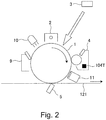
- Constitutions and an image forming operation at the peripheries of the photosensitive drums will be described with reference to Figures 1 and 2 .
- the constitutions around the photosensitive drums for the respective colors are similar to each other, and therefore in the case where there is no need to particularly distinguish the constitutions, suffixes representing the constitutions of the image forming stations for the respective colors will be omitted from description.
- the photosensitive drum 101 is rotationally driven in an arrow direction.
- the surface of the photosensitive drum 101 is electrically charged uniformly by the primary charging device 102 of a non-control charging type (corona type).
- the charged surface of the photosensitive drum 1 is exposed to light by a laser emitting device 103 as an exposure device, so that an electrostatic latent image is formed.
- the thus-formed electrostatic latent image is visualized with toner by the developing device 104, so that a toner image is formed on the photosensitive drum 101.
- the toner images of yellow (Y), magenta (M), cyan (C) and black (K) are formed, respectively.
- the toner images formed at the respective image forming stations are transferred and superposed on the intermediary transfer belt 121 of polyimide resin by a transfer bias with the primary transfer blades 105 (105Y, 105M, 105C and 105K).
- the four-color toner images formed on the intermediary transfer belt 121 are transferred onto recording material (e.g., a sheet material such as a sheet or an OHP sheet) P by a secondary transfer roller 125 as a secondary transfer means disposed opposite to the roller 124.
- the toner remaining on the intermediary transfer belt 121 without being transferred onto the recording material P is removed by an intermediary transfer belt cleaner 114b.
- the recording material P on which the toner images are transferred is pressed and heated by a fixing device 130 including fixing rollers 131 and 132, so that the toner image is fixed. Further, primary transfer residual toners remaining on the photosensitive drums 101 after the primary transfer are removed by cleaners 109, and further a potential on the photosensitive drum 101 is erased (eliminated) by a pre-exposure lamp 10, and the photosensitive drum 101 is subjected to the image formation again. Further, in the developing device 4, as a temperature detecting means of the developer in the developing device 4, a temperature sensor 104T is provided.
- an image processing unit in the image forming apparatus 100 in this embodiment will be described with reference to Figure 3 .
- an external input interface (I/F) 200 color image data as RGB image data are inputted from an unshown external device such as an original scanner or a computer (information processing device) as desired.
- 201 is a LOG conversion portion and converts luminance data of the input RGB image data into CMY density data (CMY image data) on the basis of a look-up table constituted (prepared) by data or the like stored in an ROM 210.
- 202 is a masking UCR portion and extracts a black (K) component data from the CMY image data and subjects CMYK image data to matrix operation in order to correct color shading of a recording colorant.
- 203 is a look-up table portion (LUT portion) and makes density correction of the input CMYK image data every color by using a gamma ( ⁇ ) look-up table in order that the image data are caused to coincide with an ideal gradation characteristic of a printer portion.
- the ⁇ look-up table is prepared on the basis of the data developed on an RAM 211 and the contents of the table are set by a CPU 206.
- a laser driver 205 drives the laser emitting element 103 to irradiate the surface of the photosensitive drum 101 with laser light, so that the electrostatic latent image is formed on the photosensitive drum 101.
- a video signal counting portion 207 adds up a level for each pixel (0 to 255 level) for a screenful of the image (with respect to 600 dpi in this embodiment) of the image data input into the LUT portion 203.
- the integrated value of the image data is referred to as a video count value.
- a maximum of this video count value is 1023 in the case where all the pixels for the output image are at the 255 level.
- the image signal from the laser drive 205 is similarly calculated, so that it is possible to obtain the video count value.
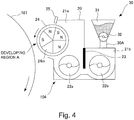
- the developing device 104 in this embodiment includes a developing container 20, in which a two-component developer including toner and a carrier is stored.
- the developing device 104 also includes a developing sleeve 24 as a developer carrying member and a trimming member 25 for regulating a magnetic brush chain formed of the developer carried on the developing sleeve 24, in the developing container 20.
- the inside of the developing container 20 is horizontally divided by a partition wall 23 into a developing chamber 21a and a stirring chamber 21b.
- the partition wall 23 extends in the direction perpendicular to the drawing sheet surface of Figure 4 .
- the developer is stored in the developing chamber 21a and the stirring chamber 21b.
- first and second feeding screws 22a and 22b which are feeding members as developer stirring and feeding means are disposed, respectively.
- the first feeding screw 22a is disposed, at the bottom portion of the developing chamber 21a, roughly in parallel to the axial direction of the developing sleeve 24. It conveys the developer in the developing chamber 21a in one direction parallel to the axial line of the developing sleeve 24 by being rotated.
- the second feeding screw 22b is disposed, at the bottom portion of the stirring chamber 21b, roughly in parallel to the first feeding screw 22a. It conveys the developer in the stirring chamber 21b in the direction opposite to that of the first feeding screw 22a.
- the developer is circulated between the developing chamber 21a and the stirring member 21b through openings 26 and 27 (that is, communicating portions) present at both ends of the partition wall 23 (see, Figure 5 ).
- the developing chamber 21a and the stirring chamber 21b are horizontally disposed.
- the present invention is also applicable to a developing device in which the developing chamber 21a and the stirring chamber 21b are vertically disposed and developing devices of other types.
- the developing container 20 is provided with an opening at a position corresponding to a developing region A wherein the developing container 20 opposes the photosensitive drum 101.
- the developing sleeve 24 is rotatably disposed so as to be partially exposed toward the photosensitive drum 101.
- the diameter of the developing sleeve 24 is 20 mm and the diameter of the photosensitive drum 101 is 80 mm, and a distance in the closest area between the developing sleeve 24 and the photosensitive drum 101 is about 400 ⁇ m.
- the developing sleeve 24 is formed of nonmagnetic material such as aluminum and stainless steel and inside thereof a magnetic roller 24m as a magnetic field generating means is non-rotationally disposed.
- the developing sleeve 24 is rotated in the direction indicated by an arrow (counterclockwise direction) to carry the two component developer regulated in its layer thickness by cutting of the chain of the magnetic brush with the trimming member 25. Then, the developing sleeve 24 conveys the layer thickness-regulated developer to the developing region A in which the developing sleeve 24 opposes the photosensitive drum 101, and supplies the developer to the electrostatic latent image formed on the photosensitive drum 101, thus developing the latent image.
- a developing bias voltage in the form of a DC voltage biased or superposed with an AC voltage is applied to the developing sleeve 24 from a power source.
- the developing bias is a combination of a DC voltage of -500 V, and an AC voltage which is 1,800 V in peak-to-peak voltage Vpp and 12 kHz in frequency f.
- the DC voltage value and the AC voltage waveform are not limited to those described above.
- a potential difference between the above-described DC voltage value and an exposed portion potential (i.e., a solid portion potential) by the laser light emitting element 103 is controlled so that the toner amount per unit area on the photosensitive drum 101 during solid image formation is 0.7 mg/cm 2 .
- the solid image is a toner image formed on an entire surface of the photosensitive drum 101 in an image formable region, and refers to the case where an image ratio (print ratio) is 100 %.
- the application of AC voltage increases the development efficiency and therefore the image has a high quality but on the other hand, fog is liable to occur. For this reason, by providing a potential difference between the DC voltage applied to the developing sleeve 24 and the charge potential of the photosensitive drum 101 (i.e., a white background portion potential), the fog is prevented.
- a trimming member (chain cutting) (regulating blade) 25 is constituted by a non-magnetic member formed with an aluminum plate or the like extending in the longitudinal axial direction of the developing sleeve 24.
- the trimming member 25 is disposed upstream of the photosensitive drum 1 with respect to the developing sleeve rotational direction. Both the toner and the carrier of the developer pass through the gap between an end of the trimming member 25 and the developing sleeve 24 and are sent into the developing region A.
- the trimming amount of the magnetic brush chain of the developer carried on the developing sleeve 24 is regulated, so that the amount of the developer sent into the developing region A is adjusted.
- a coating amount per unit area of the developer on the developing sleeve 24 is regulated at 30 mg/cm 2 by the trimming member 25.
- the gap between the trimming member 25 and the developing sleeve 24 is set at a value in the range of 200 - 1000 ⁇ m, preferably, 300 - 700 ⁇ m. In this embodiment, the gap is set at 500 ⁇ m.
- the developing sleeve 24 of the developing device 104 moves in the same direction as the movement direction of the photosensitive drum 101 at a peripheral speed ratio such that the developing sleeve 24 moves at the peripheral speed which is 1.75 times that of the photosensitive drum 101.
- the peripheral speed ratio any value may be set as long as the set value is in the range of 1.3 - 2.0, preferably, 0.5 - 2.0.
- the greater the peripheral (moving) speed ratio the higher the development efficiency.
- the ratio is desired to be set in the above-mentioned range.
- the temperature sensor 104T is disposed at the opening (communicating portion) 26 in the developing container 20, as the temperature detecting means for the developer.
- the temperature sensor 104T is disposed in the developer in the developing device 4, and directly detects the temperature of developer.
- the disposition place of the temperature sensor 104T in the developing container 20 may desirably be a position in which a sensor surface is buried in the developer in order to improve detection accuracy.
- the disposition place of the temperature sensor 104T it is not limited thereto. Although accuracy somewhat lowers, a constitution in which the temperature in the developing device is detected using a temperature sensor provided in an image forming apparatus main assembly may also be employed.
- the temperature sensor 104T will be described more specifically with reference to Figure 6 .
- a temperature/humidity sensor (“SHT1X series", mfd. by Sensirion Co., Ltd.) was used as the temperature sensor 104T.
- the temperature sensor 104T includes a sensing element 1001 of an electrostatic capacity polymer as a humidity detecting device and includes a band gap temperature sensor 1002 as a temperature detecting device.
- the temperature sensor 104T is a CMOS device having such a specification that outputs of the sensing element 1001 and band gap temperature sensor 1002 are coupled by a 14 bit-A/D converter 1003 and serial output is performed through a digital interface 1004.
- the band gap temperature sensor as the temperature detecting device uses a thermistor linearly changed in resistance value with respect to the temperature and calculates the temperature from the resistance value.
- the sensing element 1001 as the humidity detecting device is a capacitor in which a polymer is inserted as a dielectric member.
- the sensing element 1001 detects the humidity by converting the electrostatic capacity into the humidity by utilizing such a property that the content of water which is adsorbed by the polymer is changed depending on the humidity and as a result, the electrostatic capacity of the capacitor linearly changes with respect to the humidity.
- the temperature sensor 104T used in this embodiment can detect both of the temperature and the humidity. However, actually, only a detection result of the temperature is utilized, so that the use of other sensors capable of detecting only the temperature may also be sufficient.
- a supplying method of the developer in this embodiment will be described with reference to Figures 4 and 5 .
- a toner supplying device 30 as a supplying means for supplying the toner to the developing device 104 depending on a consumption amount of the developer is provided.
- the toner supplying device 30 includes a hopper 31 accommodating a two-component developer for supply in which the toner and a carrier are mixed.
- the hopper 31 includes a screw-shaped supplying member, i.e., a supplying screw 32 at a lower portion thereof, and an end of the supplying screw 32 extends to a position of a developer supplying opening 30A provided at a rear end portion of the developing device 104.
- the toner in an amount corresponding to an amount of the toner consumed by the image formation is passed from the hopper 31 through the developer supplying opening 30A and is supplied into the developing device 104 by a rotational force of the supplying screw 32 and the force of gravitation of the developer.
- the amount of the developer for supply to be supplied from the hopper 31 into the developing device 104 is roughly determined by the number of rotation (rotational frequency) of the supplying screw 32. This number of rotation is determined by a CPU 206 ( Figure 3 ) as a control means on the basis of a video count value of the image data and a detection result of a (toner) content (density) sensor 11 shown in Figure 2 .
- the central sensor 11 detects the content of a patch image (reference toner image) obtained by developing a reference latent image formed on the photosensitive drum 101.
- the toner contains primarily binder resin, and coloring agent. If necessary, particles of coloring resin, inclusive of other additives, and coloring particles having external additive such as fine particles of choroidal silica, are externally added to the toner.
- the toner is negatively chargeable polyester-based resin and is desired to be not less than 4 ⁇ m and not more than 10 ⁇ m, preferably not more than 8 ⁇ m, in volume-average particle size.
- particles of metal the surface of which has been oxidized or has not been oxidized, iron, nickel, cobalt, manganese, chrome, rare-earth metals, alloys of these metals, and oxide ferrite are preferably usable.
- the method of producing these magnetic particles is not particularly limited.
- a weight-average particle size of the carrier may be in the range of 20 - 60 ⁇ m, preferably, 30 - 50 ⁇ m.
- the carrier may be not less than 10 7 ohm.cm, preferably, not less than 10 8 ohm.cm, in resistivity. In this embodiment, the carrier with a resistivity of 10 8 ohm.cm was used.
- the volume-average particle size of the toner used in this embodiment was measured by using the following device and method.
- a sheath-flow electric resistance type particle size distribution measuring device (“SD-2000", manufactured by Sysmex Corp.) was used.
- the measuring method was as follows. To 100 - 150 ml of an electrolytic solution which is a 1 %-aqueous NaCl solution prepared using reagent-grade sodium chloride, 0.1 ml of a surfactant as a dispersant, preferably, alkylbenzenesulfonic acid salt, was added, and to this mixture, 0.5 - 50 mg of a measurement sample was added.
- an electrolytic solution which is a 1 %-aqueous NaCl solution prepared using reagent-grade sodium chloride
- a surfactant as a dispersant preferably, alkylbenzenesulfonic acid salt
- the electrolytic solution in which the sample was suspended was dispersed for about 1 - 3 minutes in an ultrasonic dispersing device. Then, the particle size distribution of the sample, the size of which is in the range of 2 - 40 ⁇ m was measured with the use of the above-mentioned measuring device ("SD-2000") fitted with a 100 ⁇ m aperture, and the volume-average distribution was obtained. Then, a volume-average particle size was obtained from the thus-obtained volume-average distribution.
- SD-2000 measuring device fitted with a 100 ⁇ m aperture
- the resistivity of the carrier used in this embodiment was measured by using a sandwich type cell with a measurement electrode area of 4 cm 2 and a gap between two electrodes of 0.4 cm. A voltage E (V/cm) was applied between the two electrodes while applying 1 kg of weight (load) to one of the electrodes, to obtain the resistivity of the carrier from the amount of the current which flowed through the circuit.
- the toner in the developing container 20 is subjected to stirring of the first and second feeding screws 22a and 22b and rubbing at the time of passing through the trimming member 25, for a long time.
- the above-described external additive for the toner comes off the toner or is buried in the toner surface, so that the flowability or charging property of the toner in lowered and thus the image quality is deteriorated.
- the important point is that the toner deterioration is proportional to a time in which the toner continuously stay in the developing device, and shortening of this stay time leads to toner deterioration suppression.
- the print ratio is an area of the toner (image) formed in a maximum image forming region, and for example, a solid black image is 100 %, and a solid white image is 0 %.
- Figure 7 shows a relation between an average toner stay sheet number in the developing device and an image formation sheet number in the case where image formation of a plurality of sheets with the images different in print ratio is carried out.
- the average toner stay sheet number shows the number of sheets on which the toner (image) stays in the developing device on average on a sheet number basis.
- a solid line shows the average toner stay sheet number in the case where the image formation with the print ratio of 0 % is made. At the print ratio of 0 %, the toner is not consumed, and therefore all of the toner (particles) in the developing device stayed in the developing device in an amount corresponding to one sheet every increment of one sheet in terms of the image formation sheet number.
- a small dotted (broken) line shows the average toner stay sheet number in the case where the image formation with the print ratio of 1 % is made.
- toner consumption is made correspondingly to the print ratio of 1 %, and therefore the toner in an amount corresponding to the print ratio of 1 % is replaced as a supply toner, i.e., a new (fresh) toner.
- a new (fresh) toner i.e., the average toner stay sheet number somewhat increases from one sheet by less than one sheet with an increment of one sheet in durability sheet number (image formation sheet number) in an amount corresponding to the replacement with the new toner, so that the average toner stay sheet number has a tendency to saturate when the image formation sheet number increases.
- the other dotted (broken) line shows the average toner stay sheet number in the case where the image formation with the print ratio of 2 % is made. It is understood that the replacement with the new toner is made correspondingly to the print ratio of 2 %, i.e., 2 times the amount in the case of the print ratio of 1 %, and therefore, an increase rate of the average toner stay sheet number further decreases, so that it is understood that a saturated average toner stay sheet number becomes low. Further, similarly, in the case where the image formation with the print ratio of 5 % is made, as shown by chain line, it is understood that the increase rate further lowers and that the saturated average toner stay sheet number further becomes low.
- a saturated value of the average toner stay sheet number is in an inversely proportional relation with the average print ratio, so that in a condition in this embodiment, the saturated value is about 7200 sheets for the print ratio of 1 %, about 3600 sheets for the print ratio of 2 %, and about 1450 sheets for the print ratio of 5 %.
- the BET value of the toner used as a change in state of deposition of the external additive on the toner surface shows a deposition amount of the external additive on the toner surface, and with a decrease in amount of the external additive existing on the toner surface, the toner BET value becomes small. That is, the external additive large in BET value is externally added to the surface of a toner base material, whereby also the BET value as that of the toner becomes large, but the toner BET value becomes small due to the burying of the external additive in the toner resin material and liberation of the external additive from the toner surface. In the case where there is no external additive on the toner surface, the BET value of the toner is equal to the BET value of the toner base material.
- the developer is sampled with a 1000 sheet-interval when the image formation is effected withe print ratios of 0 %, 1 % and 2 % in a 30 °C-environmental condition, and a relation between the BET value as an index of the toner deterioration and the image formation sheet number and a relation between the BET value and the average toner stay sheet number were checked. Results thereof are shown in Figure 8 and Figure 9 .
- Figure 8 a state in which the BET value decreases with the image formation can be grasped, and it is understood that a change in BET value with the image formation is larger when a lower print ratio image is formed.
- FIG. 9 is a graph in the case where the abscissa of Figure 9 is converted into the average toner stay sheet number. From Figure 9 , it is understood that the average toner stay sheet number and the BET value are correlated with each other irrespective of the image print ratios 0 %, 1 % and 2 %, i.e., that the toner detection (BET value in this embodiment) can be grasped uniquely by the average toner stay sheet number.
- the average toner stay sheet number of 4000 sheets when the BET value is 2.0 m 2 /g is a threshold at which the above-described problem generates.
- the print ratio is 2 %
- a saturated sheet number of the average toner stay sheet number is 3600 sheets, and therefore even when the long-term image formation is effected with the same print ratio image, the above-described problem is not generated.
- the image defect generates in the neighborhood of the image formation sheet number exceeding 6000 sheets. That is, in this embodiment, it is understood that if the image is 2 % or more in print ratio, even when the toner is deteriorated by the image formation, the toner does not reach such a level the fog and the granularity are conspicuous. As described above, in the case where the image formation with the low print ratio is effected, the toner stays in the developing device for a long term and thereby the toner deterioration generates, and therefore, it is understood that toner discharge control may only be required to be executed so that the average toner stay sheet number is not less than a predetermined sheet number.
- the important point is that the average toner stay sheet number proportional to the toner deterioration excessively requires the image formation of several thousand sheets 10000 sheets even when the low print ratio images are continuously formed although the average toner stay sheet number depends on the image print ratio. Specifically, in the case where the image formation with the print ratio of 1 % is effected, an image formation sheet number requires about 6000 sheets until the average toner stay sheet number reaches 4000 sheets. Conversely, even when the image formation with the 1 % print ratio image is effected, the image defect does not generate until the image formation sheet number reaches 6000 sheets.
- forced toner discharge control force consumption mode
- the CPU 206 as the control means is capable of executing the operation in the forced consumption mode in which the toner is forcedly consumed by the developing device.
- the CPU 206 has functions as a difference calculating means, an integrating means and an executing means.
- the difference calculating means calculates a difference (Vt-V) between a consumption amount (video count value V) depending on the amount of the toner consumed every predetermined unit of image formation and a reference value (toner deterioration threshold video count Vt) set with respect to this predetermined unit.
- the integrating means acquires an integrated value (toner deterioration integrated value X) by integrating the above-described difference (Vt-V) calculated by the difference calculating means.
- the executing means executes the operation in the forced consumption mode in the case where this integrated value is larger than a predetermined threshold (execution threshold A).
- the predetermined unit of image formation is a unit, set for effecting the image formation, such as a single A4-sized recording material.
- the predetermined unit is not limited in size and sheet number thereto, but may also be any size such as A3 or B5, and may also be appropriately set depending on the size or status of use, such as 1/2 sheet or plural sheets, principally used in the image forming apparatus.
- one sheet of the A4-sized recording material is used as the predetermined unit (of image formation).
- the toner deterioration threshold video count Vt is set.
- the above-described reference value is set at a plurality of levels.
- the information of this average toner consumption amount is an average print ratio (average image ratio) calculated by averaging video count values used for respective image forming operations correspondingly to the predetermined sheet number (5000 sheets in this embodiment), and in the following, this is referred to as a long term average print ratio.
- the CPU 206 sets the above-described reference value at a first reference value in the case where this long term average print ratio is less than a value corresponding to a predetermined reference toner consumption amount and sets the above-described reference value at a second reference value lower than the first reference value in the case where the long term average print ratio is not less than the value corresponding to the predetermined reference toner consumption amount.
- This value corresponding to the predetermined reference toner consumption amount is a print ratio (image ratio) in this embodiment and is a value such that the degree of toner deterioration falls within an assumed level (level at which there is no influence on an output image) even when the image formation with the same print ratio is effected to the end of a lifetime of the developing device.
- the value corresponding to the predetermined reference toner consumption amount was set at the print ratio of 2 %. That is, as described above, if the image has the print ratio of not less than 2 %, even when the toner is deteriorated by the image formation, the toner do not reach a level that the fog and the granularity thereof are conspicuous, and therefore the value corresponding to the predetermined reference toner consumption amount was set at 2 % in print ratio.
- the video count value per printing of one sheet is used for calculation thereof, but the following can be used in place of the video count value.
- an average toner consumption amount per predetermined rotation time of the developing sleeve per predetermined driving time of the developing device, not per printing of one sheet.
- This toner consumption amount is calculated similarly from the video count value. That is, if the number of rotation (rotational frequency) per printing of one sheet of the developing sleeve is the same, by using such a definition, there is no particular change in control.
- the toner consumption amount is calculated by the video count, but for example, a supply toner amount is controlled and detected, and may also be used as the toner consumption amount.
- a supply toner amount detecting means the number of rotation or the like of a known supplying screw is used, so that the toner consumption amount can be calculated.
- a feature of the control of the operation in the forced consumption mode in this embodiment is in that the reference value (toner deterioration threshold video count Vt) is changed depending on the long term average print ratio, not a fixed value.
- the degree of toner deterioration progresses in proportion to the average toner stay sheet number, and further, the saturated value of the average toner stay sheet number is in a reversely proportional relation with the print ratio as shown in Figure 7 .
- the important point is that since the average toner stay sheet number tends to be saturated by the image formation sheet number (long-term sheet number) of about several thousand sheets, the average toner stay sheet number is correlated with an average print ratio value over the long-term sheet number to some extent.
- the degree of toner deterioration proportional to the average toner stay sheet number is predicted using the long term average print ratio which is an average of print ratios of 5000 sheets, and the toner deterioration threshold video count value is changed correspondingly to the degree of toner deterioration.
- the saturated value of the average toner stay sheet number is a value obtained by dividing a predetermined total toner amount in the developer amount in the developing device by a toner amount corresponding to the predetermined print ratio of 2 % which is the predetermined reference toner consumption amount.
- the total toner amount is 32 g which is 8 % of 400 g of the developer, and the toner amount corresponding to the print ratio of 2 % is 0.0088 g.
- the saturated sheet number of the average toner stay sheet number is about 3600 sheets.
- the image formation sheet number (about 11000 sheets) required for saturation of the average toner stay sheet number at the predetermined print ratio of 2 % is larger than the saturated value (3600 sheets) of the average toner stay sheet number (is about 3 times the saturated value).
- the predetermined sheet number at the long term average print ratio may preferably be set at a value higher than the saturated value of the average toner stay sheet number. That is, the predetermined sheet number may preferably be set at a larger value than the saturated sheet number of 3600 sheets.
- the sheet number at the long term average print ratio is made smaller than the saturated sheet number of 3600 sheets of the average toner stay sheet number
- the sheet number is excessively small as the sheet number for predicting (estimating) the degree of toner deterioration, so that there is a possibility that the operation in the forced consumption mode is executed more than necessary. That is, as described above, the average toner stay sheet number tends to saturated by the image formation sheet number (long-term sheet number) of about several thousand sheets, and therefore is correlated with the average print ratio value over the long-term sheet number to some extent.
- the predetermined sheet number at the long term average print ratio is made excessively large, there is a possibility that even when a "state in which DUTY is low and the image formation sheet number is large" such that the reference value (toner deterioration threshold video count Vt) which has to be originally changed is formed, this reference value is not changed.
- the predetermined sheet number at the long term average print ratio is less than 6000 sheets.
- the predetermined sheet number at the long term average print ratio may preferably be set at not less than 3600 sheets and less than 6000 sheets. In this embodiment, the predetermined sheet number is set at 5000 sheets.
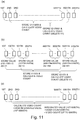
- a calculating method of the long term average print ratio will be described using Figure 11 .
- a video count value per image formation of one sheet is stored for 5000 sheets as V1 to V5000. That is, information on an average movement value of the amount of the toner consumed every predetermined sheet number (5000 sheets in this embodiment).
- the video count value V1 for first sheet is deleted, and video counts for 5000 sheets including video count values up to a video count value 5001 for the 5001-th sheet are stored and averaged, so that the long term average print ratio is calculated.
- video count values for from the first sheet to the 100-th sheet are sequentially integrated and are stored as an integrated video count value 1, and also video count values for from the 101-th sheet to the 200-th sheet are similarly sequentially integrated and are stored as an integrated video count value V2.
- the video count values V1 to V50 corresponding to 100 sheets x 50 blocks are stored, and each of the video count values V1 to V50 is integrated are averaged, so that an average video count is calculated and the long term average print ratio can be acquired with 100-sheet intervals.
- video count values for from the 5001-th sheet to the 5100-th sheet are sequentially integrated and stored as an integrated video count V51 while deleting V1, so that the long term average print ratio can be acquired from V2 to V51.
- video count values for from the first sheet to the 5000-th sheet are sequentially integrated and averaged, so that the average video count value is calculated and the long term average print ratio is calculated.
- the video count value for the 5001-th sheet is added to the integrated video count value for the first to 5000-th sheets, and then the average video count value for up to 5000-th sheet is subjected from a resultant video count value, and the thus-calculated value is averaged, so that an average video count value is calculated and the long term average print ratio.
- the thus-calculated long term average print ratio is the information on the average movement value of the amount of the toner consumed every predetermined sheet number (5000 sheets in this embodiment).
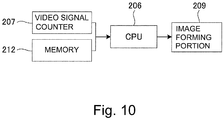
- the video signal counting portion 207 in order to effect the control as described above, as shown in Figure 10 , the video signal counting portion 207, the memory 212, the CPU 206 and the image forming portion 209 are provided.
- a control block diagram of Figure 10 is simplified by extracting a part of the control block diagram of Figure 3 .
- the video signal counting portion 207 acquires the video count value as described above
- the CPU 206 effects various calculations as described above, such as integration or the like of the video count value acquired by the video signal counting portion 207.
- the memory 212 the video count value acquired by the video signal counting portion 207 and a calculation result of the CPU 206 and the like are stored.
- the CPU 206 discriminates propriety of execution of the operation in the forced consumption mode from the video count value acquired by the video signal counting portion 207 and the information stored in the memory 212 in accordance with a flow of Figure 12 described below. Then, the CPU 206 causes the image forming portion 209 to execute the operation in the forced consumption mode in accordance with a flow of Figure 13 described later.
- the image formation portion 209 drive controls respective constituent elements of the above-described respective image forming stations.
- the video signal count portion 207 shown in Figures 3 and 10 calculates video count values V(K), V(M), V(C) and V(K) for the respective colors, every printing of one sheet. That is, the above-described consumption amount is calculated (step S1).
- the video count (value) of the whole (entire) surface solid image (the image with the print ratio of 100 %) on one surface (side) of A4-sized sheet for a certain color is 512.
- the fractional portion of the number is rounded off to the nearest integer.
- the toner deterioration threshold video count Vt means a video count value corresponding to a necessary minimum toner consumption amount in order to prevent generation of deterioration of an image quality due to the toner deterioration.
- the toner deterioration threshold video count Vt is changed depending on the long term average print ratio (information on the average toner consumption amount). Specifically, the video count values used for the respective image forming operations are averaged correspondingly to 5000 sheets, so that the long term average print ratio is calculated (S2).
- this long term average print ratio is less than a predetermined print ratio of 2 % (long term average print ratio ⁇ 2 %) is discriminated.
- the toner deterioration threshold video count Vt is set at 10 (corresponding to the print ratio of 2 %, first reference value) (S4).
- the toner deterioration threshold video count Vt is set at 5 (corresponding to the print ratio of 1 %, second reference value) (S5).
- the average print ratio is treated as 100 % which substantially equal to that at the initial stage and then the calculation is made.
- the average toner stay sheet number in the case where images with the print ratio of 100 % are formed on 5000 sheets is about 70 sheets, and as shown in Figure 9 , the BET value which is an index of the toner deterioration this time is substantially the same as that of the initial developer, and therefore can be used approximately.
- the CPU 206 uses 5 (second reference value) as the toner deterioration threshold video count Vt irrespective of the long term average print ratio until the image formation sheet number from the initial state of the developing device to the predetermined sheet number (5000 sheets).
- 5 is used as the toner deterioration threshold video count.
- a difference Vt-V between he video count value V calculated in S1 and the toner deterioration threshold video count Vt set in S3 - S5 is calculated (S6).
- a sign (positive/negative) of the difference Vt-V is discriminated (S7). That is, the difference is calculated by subtracting the video count value V which is a consumed value from the toner deterioration threshold video count Vt which is a reference value.
- the print ratio is low and thus a state in which the toner deterioration progresses is formed, and therefore the difference is integrated and the integrated value, i.e., the toner deterioration integrated value X is acquired.
- the difference Vt-V is added to the toner deterioration integrated value X (S8).
- the print ratio is high and a state in which the toner deterioration does not progress is formed, and therefore 0 is added to the toner deterioration threshold video count X (S9).
- the toner deterioration threshold video count X is an index indicating a current toner deterioration state, and is an integrated value of the video count value calculated by Vt-V.
- the toner deterioration threshold video count X is 0 or less in some cases, but in the case where the toner deterioration integrated value is 0 or less, the toner deterioration integrated value may preferably be set at 0. This is because even when the image printing with the high print ratio is continued and the toner replacement becomes frequent, the deterioration is not restored more than in the initial state.
- a difference (A-X) from a discharge execution threshold A is calculated (S10).
- the discharge execution threshold A is a predetermined threshold value which is arbitrarily settable. The smaller the discharge execution threshold A, the higher the frequency of execution of the toner discharging operation (operation in forced consumption mode) even in the continuous image formation at the same print ratio (the amount of the toner consumed per unit driving time of the developing device in the operation in the forced consumption mode).
- the discharge execution threshold A is set at 512 in this embodiment.
- the set value of the discharge execution threshold A When the set value of the discharge execution threshold A is excessively large, a time in which the toner deterioration progresses until the toner discharging operation is performed is long, so that it is desirable that the set value is approximately equal to the video count value of the whole surface solid image (the image with the print ratio of 100 %) on one surface of A4-sized sheet to A3-sized sheet. Further, e.g., with a larger volume of the developer which can be retained in the developing container 20, there is a tendency that the toner discharge execution threshold A can be set at a larger value.
- Step S11 the sign (positive or negative) of the difference (A-X), calculated by S10, between the toner deterioration integrated value X and the discharge execution value A (Step S11). That is, whether or not the difference (A-X) is 0 or more (A-X ⁇ 0). Then, in the case (A-X) is 0 or more (A-X ⁇ 0, Y of S11), discrimination that the toner deterioration does not progress to the extent that the operation in the forced consumption mode is required to be executed immediately is made, and subsequently the image formation is executed S12).
- the difference (A-X) is negative, i.e., in the case where the toner deterioration integrated value X is larger than the discharge execution value A (N of S11), the toner deterioration sufficiently progresses and therefore discrimination that there is a need to execute the toner discharging operation immediately is made. Then, the image formation is interrupted and the toner discharging operation is executed (S13). After the toner discharging operation is executed, the toner deterioration integrated value X is reset to 0 (S14). That is, in the case where the operation in the forced consumption mode is executed, the toner deterioration integrated value X which is the integrated value is reset to 0.
- the toner discharging operation (operation in the forced consumption mode) will be described with reference to Figure 13 .
- a transfer bias of an opposite polarity to that during the normal image formation i.e., the transfer bias of an identical polarity to the charge polarity of the toner image on the photosensitive drum
- S101 the transfer bias of an identical polarity to the charge polarity of the toner image on the photosensitive drum
- S102 the toner in the amount corresponding to the video count value equivalent to the discharge execution threshold A is discharged onto the photosensitive drum, so that supply of the toner in the amount corresponding to the amount of the toner used is made
- the toner in the amount corresponding to the discharge execution threshold A which is the predetermined threshold is consumed.
- the toner consumption amount in the operation in the forced consumption mode is the amount corresponding to the discharge execution threshold A, and is the same.
- the discharging operation is controlled so that the developing sleeve is rotated at least one turn.
- the latent image, on the photosensitive drum, for the toner discharging may desirably be the whole surface solid image with respect to the longitudinal direction of the photosensitive drum in order to minimize the downtime due to the discharging.
- the toner discharged on the photosensitive drum is little transferred onto the intermediary transfer belt and remains on the photosensitive drum since the primary transfer bias has the opposite polarity to that during normal image formation, and is collected by a cleaner (S103).
- the toner deterioration integrated value X is reset to zero (S104).
- the primary transfer bias is returned to the bias having the polarity during the normal image formation (S105), and the toner discharging operation is completed and is returned to the normal image forming operation.
- Embodiment 1 as a specific example of this embodiment described above will be described using Figure 14 and Figure 15 .
- the image of the "low-DUTY-black image chart” is formed on one sheet, how the toner deterioration integrated value X in the toner discharge control in Embodiment 1 is calculated for each of the colors was shown in a table of Figure 14 .
- the long term average print ratio is not less than 2 % (treated as 100 %).
- Embodiment 1 in accordance with this embodiment, in the continuous image formation of the "low-DUTY-black image chart" of 10000 sheets of the A4-sized sheets, the image formation is interrupted about 19 times, and the toner discharge is executed. Further, by one toner discharging operation, the toner in the amount corresponding to the video count value of 512 consumed.
- the toner deterioration threshold video count Vt is not changed depending on the long term average print ratio different from this embodiment and the operation in the forced consumption mode is executed in the same condition as in Embodiment 1 is Comparison Example 1.
- the toner deterioration threshold video count Vt was fixed at 10, and the operation in S6 and later in Figure 12 was performed.
- the toner discharging operation is executed using, as a reference developer amount, a value (2 % in print ratio in Comparison Example 1) at which the toner deterioration does not exceed an assumed level even in the case where the image formation with the same print ratio is effected until the end of lifetime.
- the toner discharging operation has to be executed 39 times in total. Accordingly, in Embodiment 1 on the basis of this embodiment, the toner discharge amount can be remarkably reduced relative to Comparison Example 1.
- FIG. 15 shows progression of the toner BET value in the case where the control in Embodiment 1 and the control in Comparison Example 1 were effected, respectively.
- the BET value is not below the BET value (threshold) of 2.0 m 2 /g.
- the control means in this embodiment executes the operation in the forced consumption mode on the basis of information on an average movement value of the amount of the toner consumed per first predetermined sheet number or the amount of the toner constituted per first predetermined driving time of the developing device and information on image ratio (print ratio) per second predetermined sheet number less than the first predetermined sheet number or a second predetermined driving time shorter than the first predetermined driving time of the developing device.
- the first predetermined sheet number is, e.g., 5000 sheets
- the first predetermined driving time is, e.g., a driving time corresponding to 5000 sheets.
- the second predetermined sheet number is the sheet number less than the above-described 5000 sheets and is, e.g., 1 sheet or 2 sheets
- the second predetermined driving time is a driving time corresponding to this sheet number.
- the information on the image ratio is, e.g., the video count value.
- the case where after the last operation in the forced consumption mode is executed, the image with the same print ratio which is not more than the predetermined print ratio (predetermined print ratio (2 % in this embodiment) will be considered.
- the case where the image with the predetermined image ratio or less is formed is the case where the image with a low image ratio is formed, and for example, the case where the print ratio is 1.5 %, 1.0 % or the like which are not more than 2.0 %.
- the amount of the toner consumed per unit driving time of the developing device by the operation in the forced consumption mode is controlled.
- control is effected so that the amount of the toner consumed per unit driving time of the developing device by the operation in the forced consumption mode is larger in the case where the long term average print ratio (average movement value) is smaller than the reference value (the above-described predetermined print ratio, 2 % in this embodiment) immediately after the last operation in the forced consumption mode is executed than in the case where the long term average print ratio is larger than the reference value.
- the long term average print ratio average movement value
- reference value the above-described predetermined print ratio, 2 % in this embodiment
- the increase in amount of the toner consumed per unit driving time of the developing device by the operation in the forced consumption mode includes the case where the amount itself of the toner consumed by the operation in the forced consumption mode, and in addition, the case where the amount itself of the toner consumed by one operation in the forced consumption mode is the same but the execution frequency of the operation in the forced consumption mode increases, and the like case.
- control means in this embodiment effects, in other words, the following control. That is, a proportion occupied by a period in which the long term average print ratio (average movement value) is smaller than the reference value during a period from execution of the last operation in the forced consumption mode to execution of a subsequent operation in the forced consumption mode will be considered.
- the control means in this embodiment effects control so that the amount of the toner consumed per unit driving time of the developing device by the operation in the forced consumption mode in the case where the image with the same print ratio is formed is larger with a higher value of this proportion.
- Embodiment 2 as a specific example of this embodiment as described above will be described using Figure 16 and Figure 17 .
- the image of the "very low-DUTY-black image chart” is formed on one sheet, how the toner deterioration integrated value X in the toner discharge control in Embodiment 2 is calculated for each of the colors was shown in a table of Figure 16 .
- the long term average print ratio is not less than 2 % (treated as 100 %).
- the toner deterioration threshold video count Vt is set at 5.
- Embodiment 2 in accordance with this embodiment, in the continuous image formation of the "very low-DUTY-black image chart" of 10000 sheets of the A4-sized sheets, the toner discharging operation in executed 19 times until 5000-th sheet in the first half and 68 times during 5000 sheets in the latter half, i.e., 87 times in total. Further, by one toner discharging operation, the toner in the amount corresponding to the video count value of 512 consumed.
- the toner deterioration threshold video count Vt is not changed depending on the long term average print ratio different from this embodiment and the operation in the forced consumption mode is executed in the same condition as in Embodiment 2 is Comparison Example 2.
- the toner deterioration threshold video count Vt was fixed at 10, and the operation in S6 and later in Figure 12 was performed. That is, in Comparison Example 2, the toner discharging operation is executed using, as a reference developer amount, a value (2 % in print ratio in Comparison Example 2) at which the toner deterioration does not exceed an assumed level even in the case where the image formation with the same print ratio is effected until the end of lifetime. In the case of such Comparison Example 2, the toner discharging operation has to be executed 136 times in total. Accordingly, in Embodiment 2 on the basis of this embodiment, the toner discharge amount can be remarkably reduced relative to Comparison Example 2.
- FIG. 17 shows progression of the toner BET value in the case where the control in Embodiment 2 and the control in Comparison Example 2 were effected, respectively.
- the BET value is not below the BET value (threshold) of 2.0 m 2 /g.
- Embodiment 3 as a specific example of this embodiment as described above will be described using Figure 18 and Figure 19 .
- the case where images of "low-DUTY-black image chart” and “medium-DUTY black image chart” in mixture for each of the colors of Y, M, C, K with a print ratio per (one) sheet are formed will be considered.
- Embodiment 1 So far, control similar to that in Embodiment 1 is effected. Then, image formation of the "medium-DUTY black image chart" on 500 sheets is effected. In the image formation of the "medium-DUTY black image chart", the print ratios are always high for all of the colors, and therefore the toner deterioration integrated value X is always 0.
- the toner discharging operation is not executed from 0-th sheet to 5000-th sheet of the "low-DUTY-black image chart". That is, until the 5000-th sheet, the long term average print ratio is 2 % or more, and therefore, similarly as in the above-described mechanism, the toner deterioration integrated value is kept at 0.
- the image formation is switched to the image formation of the "medium-DUTY black image chart" with the black print ratio of 10 % on 500 sheets. For this reason, the long term average print ratio exceeds 2 % (at the time of 5500 sheets), the long term average print ratio is about 2.4 %.
- the image chart is switched to the "low-DUTY-black image chart", but the long term average print ratio is kept at 2 % or more, and therefore similarly as in the above-described mechanism, the toner deterioration integrated value X is kept at 0.
- the long term average print ratio is below 2 % at the time of 10100-th sheet.
- the number of times of the black toner discharge control is 0 times.
- an example in which the toner deterioration threshold video count Vt is not changed depending on the long term average print ratio different from this embodiment and the operation in the forced consumption mode is executed in the same condition as in Embodiment 3 is Comparison Example 3.
- the toner deterioration threshold video count Vt was fixed at 10, and the operation in S6 and later in Figure 12 was performed.
- the toner discharging operation is executed using, as a reference developer amount, a value (2 % in print ratio in Comparison Example 2) at which the toner deterioration does not exceed an assumed level even in the case where the image formation with the same print ratio is effected until the end of lifetime.
- the toner discharging has to be executed 37 times in total. Accordingly, in Embodiment 3 on the basis of this embodiment, the toner discharge amount can be remarkably reduced relative to Comparison Example 3.
- FIG. 19 shows progression of the toner BET value in the case where the control in Embodiment 3 and the control in Comparison Example 3 were effected, respectively.
- the BET value is not below the BET value (threshold) of 2.0 m 2 /g.
- the toner discharge in a proper amount with no excess and no deficiency can be realized correspondingly to the degree of toner deterioration with a proper interval in which there is no defect in terms of the image density or the like.
- the reference value (toner deterioration threshold video count Vt) for calculating the difference from the consumption value (video count value V) is changed. For this reason, the forced consumption of the toner can be appropriately performed depending on (the degree of) the toner detection.
- the toner deterioration threshold video count Vt is set at a low value, and therefore, the frequency of execution of the operation in the forced consumption mode becomes low. In this case, it would be considered that the toner detection does not progress so, and therefore, the frequency of the execution of the operation in the forced consumption mode lowers, so that it is possible to suppress consumption of the toner more than necessary.
- the toner deterioration threshold video count Vt becomes high, and therefore the frequency of the execution of the operation in the forced consumption mode becomes high. That is, when the toner deterioration threshold video count Vt increases, a difference between the toner deterioration threshold video count Vt and the video count value V increases, so that an integrated value (toner deterioration integrated value X) is liable to become larger than the predetermined threshold (discharge execution threshold A). For this reason, the frequency of the execution of the operation in the forced consumption mode becomes high. In this case, it would be considered that the toner deterioration progresses, and therefore, the toner deterioration can be appropriately suppressed by increasing the frequency of the execution of the operation in the forced consumption mode.
- the toner deterioration threshold video count Vt becomes low.
- the frequency of execution of the operation in the forced consumption mode becomes low. In this case, it would be considered that the toner detection does not progress so, and therefore, the frequency of the execution of the operation in the forced consumption mode lowers, so that it is possible to suppress consumption of the toner more than necessary.
- control is effected so that the frequency of the execution of the operation in the forced consumption mode is higher in a period in which the long term average print ratio is less than the predetermined print ratio of 2 % than in a period in which the long term average print ratio is not less than the predetermined print ratio of 2 %.
- the image formation is effected with the same image ratio (the same print ratio).
- the predetermined print ratio is less than 2 % at the long term average print ratio of 1.5 %.
- the predetermined print ratio is not less than 2 % at the long term average print ratio of 5 %.
- the predetermined threshold (execution threshold A) is changed depending on information (long term average print ratio) on the average toner consumption amount.
- information on the average toner consumption amount is not less than a value corresponding to the predetermined reference toner consumption amount
- by increasing the predetermined threshold it is possible to lower the frequency of the execution of the operation in the forced consumption mode.
- the predetermined threshold is changed depending on the long term average print ratio.
- the amount of the toner consumed by the operation in the forced consumption mode is made constant irrespective of the predetermined threshold, and the predetermined threshold may also be changed depending on the long term average print ratio, but in this case, there is a possibility that the toner deterioration cannot be sufficiently restored.
- the predetermined threshold is a value as an index for restoring the toner deterioration, and when the predetermined value is small, the frequency of the execution of the operation in the forced consumption mode is high, and when the predetermined value is large, this frequency is low.
- a developing sleeve driving time detecting portion 213 is provided.
- the CPU 206 discriminates propriety of the execution of the operation in the forced consumption mode, in accordance with a flow of Figure 12 described below, from information of the developing sleeve driving time detecting portion 213 in addition to the video count value acquired by the video signal counting portion 207 and the information stored in the memory 212.
- the developing sleeve driving time detecting portion 213 counts a rotation driving time of the developing sleeve in a period from the last calculation of the video count value V to current calculation of the video count value V.
- the CPU 206 calculates a value ( ⁇ x Vt) obtained by multiplying the toner deterioration threshold video count Vt by a coefficient ⁇ obtained by dividing the driving time by a reference driving time which is a rotation driving time, per image formation of one sheet, of the developing device. Then, this difference is integrated as a toner deterioration integrated value X.
- S1 - S5 and S9 - S14 are similar to those of the flow of Figure 12 in First Embodiment. For this reason, in the following, a portion different from the flow of Figure 12 will be principally described.
- the toner deterioration threshold video count Vt is set in S3 - S5
- calculation of a developing sleeve driving time coefficient ⁇ is made.
- a total driving time of the developing sleeve from the time of calculation of the last video count V to the time of calculation of the current vide count V is calculated (S61).
- the calculated total developing sleeve driving time is divided by a predetermined reference developing sleeve driving time (reference driving time), so that the developing sleeve driving time coefficient ⁇ is calculated (S62).
- the reference sleeve driving time is defined as a driving time required for image formation of one sheet. Accordingly, in the case where interrupt control is not effected during the image formation or in the case where the developing sleeve drive is at rest during the interrupt control, the total driving time of the developing sleeve and the reference developing sleeve driving time have the same value, so that ⁇ is 1.
- a difference ( ⁇ x Vt-V) between he video count value V and the above-described developing sleeve driving time coefficient ⁇ x the toner deterioration threshold video count Vt is calculated (S63).
- a sign (positive/negative) of the difference ⁇ Vt-V is discriminated (S71). That is, whether or not the difference is ⁇ Vt-V > 0 is discriminated, and in the case where the difference is a positive value ( ⁇ Vt-V) > 0, Y of S71), the print ratio is low and thus a state in which the toner deterioration progresses is formed, and therefore the difference is integrated and the integrated value, i.e., the toner deterioration integrated value X is acquired.
- the difference ⁇ Vt-V is added to the toner deterioration integrated value X (S81).
- ⁇ 1, 1 x Vt-V and therefore calculation similar to that in First Embodiment is made.
- the reason why the toner deterioration threshold video count Vt is multiplied by ⁇ is that corresponding to an increase in developing sleeve driving time, the toner deterioration progresses proportionally.
- the video count value V is calculated by adding a video count value corresponding to an amount of the toner consumption.
- Embodiment 4 as a specific example of this embodiment described above will be described.
- Description will be made using, as an example, control in which a frequency of the interrupt control is such that the interrupt control is effected simply every time and there is no toner consumption.
- the interrupt control is effected very time, and therefore the developing sleeve driving time coefficient ⁇ is always set at 3.
- the long term average print ratio is 2 % or more and therefore the toner deterioration integrated value x per sheet is +7.
- Embodiment 4 in the continuous image formation of the "low-DUTY-black image chart" of 10000 sheets of the A4-sized sheets, the image formation is interrupted about 285 times, and the toner discharge is executed. Further, by one toner discharging operation, the toner in the amount corresponding to the video count value of 512 consumed.
- Comparison Example 4 an example in which the toner deterioration threshold video count Vt is not changed depending on the long term average print ratio different from this embodiment and the operation in the forced consumption mode is executed in the same condition (in consideration of the developing sleeve driving time during the interrupt control) as in Embodiment 4 is Comparison Example 4.
- the toner deterioration threshold video count Vt was fixed at 10, and the operation in S61 and later in Figure 21 was performed. That is, in Comparison Example 4, the toner discharging operation is executed using, as a reference developer amount, a value (2 % in print ratio in Comparison Example 4) at which the toner deterioration does not exceed an assumed level even in the case where the image formation with the same print ratio is effected until the end of lifetime.
- the toner discharging operation has to be executed 434 times in total. Accordingly, in Embodiment 4 on the basis of this embodiment, the toner discharge amount can be remarkably reduced relative to Comparison Example 4.
- FIG. 22 shows progression of the toner BET value in the case where the control in Embodiment 4 and the control in Comparison Example 4 were effected, respectively.
- the BET value is not below the BET value (threshold) of 2.0 m 2 /g.
- Comparison Example 5 an example in which the toner deterioration threshold video count Vt is not changed depending on the long term average print ratio different from this embodiment and the developing sleeve driving time is also not considered is Comparison Example 5.
- the frequency of the toner discharging operation is kept at 39 times.
- the toner deterioration corresponding to the developing sleeve driving time required for the interrupt control is not considered, and therefore, as shown in Figure 22 , the toner deterioration progresses, so that the image defect generated when the image formation sheet number roughly exceeded 5000 sheets.
- the operation in the forced consumption mode is executed in consideration of the developing sleeve driving time, and therefore, control move corresponding to the toner deterioration can be controlled, so that it is possible to suppress the toner discharge amount while suppressing the generation of the image defect.
- the video count is used as the consumption amount depending on the amount of the toner consumed every predetermined unit of image formation and as the reference value set for the predetermined unit, but the present invention is not limited thereto. That is, the amount of the toner consumed with the image formation may only be required to be determined.
- an image forming apparatus capable of properly effecting forced consumption of the toner depending on the toner deterioration even immediately after installation of a new developing device and even after images with a high print ratio are outputted in a large amount.
Landscapes
- Physics & Mathematics (AREA)
- General Physics & Mathematics (AREA)
- Dry Development In Electrophotography (AREA)
- Control Or Security For Electrophotography (AREA)
Applications Claiming Priority (2)
| Application Number | Priority Date | Filing Date | Title |
|---|---|---|---|
| JP2014107573A JP6381291B2 (ja) | 2014-05-23 | 2014-05-23 | 画像形成装置 |
| PCT/JP2015/065487 WO2015178504A1 (ja) | 2014-05-23 | 2015-05-22 | 画像形成装置 |
Publications (2)
| Publication Number | Publication Date |
|---|---|
| EP3147723A1 true EP3147723A1 (de) | 2017-03-29 |
| EP3147723A4 EP3147723A4 (de) | 2018-04-04 |
Family
ID=54554160
Family Applications (1)
| Application Number | Title | Priority Date | Filing Date |
|---|---|---|---|
| EP15796480.0A Withdrawn EP3147723A4 (de) | 2014-05-23 | 2015-05-22 | Bilderzeugende vorrichtung |
Country Status (5)
| Country | Link |
|---|---|
| US (1) | US10303103B2 (de) |
| EP (1) | EP3147723A4 (de) |
| JP (1) | JP6381291B2 (de) |
| CN (1) | CN106415408A (de) |
| WO (1) | WO2015178504A1 (de) |
Families Citing this family (7)
| Publication number | Priority date | Publication date | Assignee | Title |
|---|---|---|---|---|
| JP2016062023A (ja) * | 2014-09-19 | 2016-04-25 | キヤノン株式会社 | 現像装置 |
| US10036978B2 (en) * | 2016-11-02 | 2018-07-31 | Kabushiki Kaisha Toshiba | Image forming apparatus and developer replacement method of image forming apparatus |
| JP6935675B2 (ja) * | 2017-03-22 | 2021-09-15 | 富士フイルムビジネスイノベーション株式会社 | 画像形成装置 |
| JP7102845B2 (ja) * | 2018-03-27 | 2022-07-20 | ブラザー工業株式会社 | 画像形成装置 |
| JP7135609B2 (ja) * | 2018-09-04 | 2022-09-13 | コニカミノルタ株式会社 | 画像形成装置、及び、画像形成方法 |
| JP7275550B2 (ja) * | 2018-12-05 | 2023-05-18 | コニカミノルタ株式会社 | 画像形成装置、劣化状態検出方法および劣化状態検出プログラム |
| US12085870B2 (en) * | 2022-05-18 | 2024-09-10 | Oki Electric Industry Co., Ltd. | Image formation apparatus |
Family Cites Families (17)
| Publication number | Priority date | Publication date | Assignee | Title |
|---|---|---|---|---|
| JP4517753B2 (ja) * | 2004-07-05 | 2010-08-04 | コニカミノルタビジネステクノロジーズ株式会社 | 画像形成装置 |
| JP2007133122A (ja) | 2005-11-10 | 2007-05-31 | Ricoh Co Ltd | 現像装置および画像形成装置 |
| JP5006641B2 (ja) | 2006-12-22 | 2012-08-22 | キヤノン株式会社 | 画像形成装置 |
| JP2008203731A (ja) * | 2007-02-22 | 2008-09-04 | Canon Inc | 画像形成装置 |
| JP2008281844A (ja) * | 2007-05-11 | 2008-11-20 | Ricoh Co Ltd | 現像方法、現像装置、画像形成方法、画像形成装置、消費量演算装置、プロセスカートリッジ |
| JP5163570B2 (ja) * | 2009-03-23 | 2013-03-13 | コニカミノルタビジネステクノロジーズ株式会社 | 画像形成装置 |
| JP4906895B2 (ja) | 2009-08-26 | 2012-03-28 | キヤノン株式会社 | 画像形成装置 |
| JP5506352B2 (ja) * | 2009-12-03 | 2014-05-28 | キヤノン株式会社 | 画像形成装置 |
| JP5505235B2 (ja) | 2010-09-30 | 2014-05-28 | コニカミノルタ株式会社 | 画像形成装置 |
| JP2012103317A (ja) * | 2010-11-08 | 2012-05-31 | Fuji Xerox Co Ltd | 画像形成装置 |
| JP2013050611A (ja) * | 2011-08-31 | 2013-03-14 | Canon Inc | 画像形成装置 |
| JP6049296B2 (ja) | 2012-04-27 | 2016-12-21 | キヤノン株式会社 | 現像装置 |
| JP5805014B2 (ja) * | 2012-06-21 | 2015-11-04 | 京セラドキュメントソリューションズ株式会社 | 画像形成装置 |
| JP2014209189A (ja) * | 2013-03-27 | 2014-11-06 | キヤノン株式会社 | 画像形成装置 |
| JP6305109B2 (ja) * | 2014-02-28 | 2018-04-04 | キヤノン株式会社 | 画像形成装置 |
| JP2016062023A (ja) * | 2014-09-19 | 2016-04-25 | キヤノン株式会社 | 現像装置 |
| JP6468830B2 (ja) * | 2014-12-12 | 2019-02-13 | キヤノン株式会社 | 画像形成装置 |
-
2014
- 2014-05-23 JP JP2014107573A patent/JP6381291B2/ja active Active
-
2015
- 2015-05-22 EP EP15796480.0A patent/EP3147723A4/de not_active Withdrawn
- 2015-05-22 WO PCT/JP2015/065487 patent/WO2015178504A1/ja not_active Ceased
- 2015-05-22 CN CN201580026887.4A patent/CN106415408A/zh active Pending
-
2016
- 2016-11-16 US US15/352,936 patent/US10303103B2/en active Active
Also Published As
| Publication number | Publication date |
|---|---|
| WO2015178504A1 (ja) | 2015-11-26 |
| US10303103B2 (en) | 2019-05-28 |
| US20170068198A1 (en) | 2017-03-09 |
| JP6381291B2 (ja) | 2018-08-29 |
| CN106415408A (zh) | 2017-02-15 |
| EP3147723A4 (de) | 2018-04-04 |
| JP2015222395A (ja) | 2015-12-10 |
Similar Documents
| Publication | Publication Date | Title |
|---|---|---|
| US9829845B2 (en) | Image forming apparatus | |
| US10303103B2 (en) | Image forming apparatus | |
| US10345750B2 (en) | Image forming apparatus | |
| US8385754B2 (en) | Image forming apparatus featuring forced discharging of excessive developer | |
| US9354577B2 (en) | Image forming apparatus | |
| KR101509850B1 (ko) | 화상 형성 장치 | |
| US9223247B2 (en) | Image forming apparatus | |
| US8532538B2 (en) | Image forming apparatus featuring supply of developers having different toner ratios | |
| US10108106B2 (en) | Image forming apparatus with toner discharge operation | |
| US9557683B2 (en) | Image forming apparatus with forced supply mode for forcedly supplying toner | |
| US20190227458A1 (en) | Image forming apparatus | |
| JP2023079462A (ja) | 画像形成装置 | |
| JP2019135553A (ja) | 画像形成装置 | |
| JP2018088011A (ja) | 画像形成装置 | |
| JP2015232587A (ja) | 画像形成装置 |
Legal Events
| Date | Code | Title | Description |
|---|---|---|---|
| PUAI | Public reference made under article 153(3) epc to a published international application that has entered the european phase |
Free format text: ORIGINAL CODE: 0009012 |
|
| 17P | Request for examination filed |
Effective date: 20161223 |
|
| AK | Designated contracting states |
Kind code of ref document: A1 Designated state(s): AL AT BE BG CH CY CZ DE DK EE ES FI FR GB GR HR HU IE IS IT LI LT LU LV MC MK MT NL NO PL PT RO RS SE SI SK SM TR |
|
| AX | Request for extension of the european patent |
Extension state: BA ME |
|
| DAV | Request for validation of the european patent (deleted) | ||
| DAX | Request for extension of the european patent (deleted) | ||
| A4 | Supplementary search report drawn up and despatched |
Effective date: 20180301 |
|
| RIC1 | Information provided on ipc code assigned before grant |
Ipc: G03G 21/00 20060101AFI20180223BHEP Ipc: G03G 15/08 20060101ALI20180223BHEP |
|
| GRAP | Despatch of communication of intention to grant a patent |
Free format text: ORIGINAL CODE: EPIDOSNIGR1 |
|
| INTG | Intention to grant announced |
Effective date: 20181004 |
|
| STAA | Information on the status of an ep patent application or granted ep patent |
Free format text: STATUS: THE APPLICATION HAS BEEN WITHDRAWN |
|
| 18W | Application withdrawn |
Effective date: 20190131 |